Feeds:
Posts
Comments

Posts Tagged ‘Conference Coverage with Social Media’

Is It Time for the Virtual Scientific Conference?: Coronavirus, Travel Restrictions, Conferences Cancelled

Curator: Stephen J. Williams, PhD.

UPDATED 3/12/2020

To many of us scientists, presenting and attending scientific meetings, especially international scientific conferences, are a crucial tool for disseminating and learning new trends and cutting edge findings occurring in our respective fields.  Large international meetings, like cancer focused meetings like AACR (held in the spring time), AAAS and ASCO not only highlight the past years great discoveries but are usually the first place where breakthroughs are made known to the scientific/medical community as well as the public.  In addition these conferences allow for scientists to learn some of the newest technologies crucial for their work in vendor exhibitions.

During the coronavirus pandemic, multiple cancellations of business travel, conferences, and even university based study abroad programs are being cancelled and these cancellations are now hitting the 2020 Spring and potentially summer scientific/medical conferences.  Indeed one such conference hosted by Amgen in Massachusetts was determined as an event where some attendees tested positive for the virus, and as such, now other attendees are being asked to self quarantine.

Today I received two emails on conference cancellations, one from Experimental Biology in California and another from The Cancer Letter, highlighting other conferences, including National Cancer Coalition Network (NCCN) meetings which had been canceled.


Experimental Biology - San Diego 2020 - April 4-7

Dear Stephen,

After thoughtful deliberations, the leaders of the Experimental Biology host societies have made the difficult but necessary decision to cancel Experimental Biology (EB) 2020 set to take place April 4–7 in San Diego, California. We know how much EB means to everyone, and we did not make this decision in haste. The health and safety of our members, attendees, their students, our staff, partners and our communities are our top priority.

As we have previously communicated via email, on experimentalbiology.org and elsewhere, EB leadership has been closely monitoring the spread of COVID-19 (coronavirus disease). Based on the latest guidance from public health officials, the travel bans implemented by different institutions and the state of emergency declared in California less than 48 hours ago, it became clear to us that canceling was the right course of action.

We thank you and the entire EB community for understanding the extreme difficulty of this decision and for your commitment to the success of this conference – from the thousands of attendees to the presenters, exhibitors and sponsors who shared their time, expertise, collaboration and leadership. We deeply appreciate your contributions to this community.

What Happens Next?

Everyone who has registered to attend the meeting will receive a full registration refund within the next 45 days. Once your registration cancellation is processed, you will receive confirmation in a separate email. You do not need to contact anyone at EB or your host society to initiate the process. Despite the cancellation of the meeting, we are pleased to tell you that we will publish abstracts in the April 2020 issue of The FASEB Journal as originally planned. Please remember to cancel any personal arrangements you’ve made, such as travel and housing reservations. 

We ask for patience as we evaluate our next steps, and we will alert you as additional information becomes available please see our FAQs for details.

And in The Cancer Letter

Coronavirus vs. oncology: Meeting cancellations, travel restrictions, fears about drug supply chain

By Alexandria Carolan

NOTE: An earlier version of this story was published March 4 on the web and was updated March 6 to include information about restricted travel for employees of cancer centers, meeting cancellations, potential disruptions to the drug supply chain, and funds allocated by U.S. Congress for combating the coronavirus.

Further updates will be posted as the story develops.

Forecasts of the inevitable spread of coronavirus can be difficult to ignore, especially at a time when many of us are making travel plans for this spring’s big cancer meetings.

The decision was made all the more difficult earlier this week, as cancer centers and at least one biotechnology company—Amgen—implemented travel bans that are expected to last through the end of March and beyond. The Cancer Letter was able to confirm such travel bans at Fred Hutchinson Cancer Research Center, MD Anderson Cancer Center, and Dana-Farber Cancer Institute.

Meetings are getting cancelled in all fields, including oncology:

The National Comprehensive Cancer Network March 5 postponed its 2020 annual conference of about 1,500 attendees March 19-22 in Orlando, citing precautions against coronavirus.

“The health and safety of our attendees and the patients they take care of is our number one concern,” said Robert W. Carlson, chief executive officer of NCCN. “This was an incredibly difficult and disappointing decision to have to make. However, our conference attendees work to save the lives of immunocompromised people every day. Some of them are cancer survivors themselves, particularly at our patient advocacy pavilion. It’s our responsibility, in an abundance of caution, to safeguard them from any potential exposure to COVID-19.”

UPDATED 3/12/2020

And today the AACR canceled its yearly 2020 Meeting (https://www.aacr.org/meeting/aacr-annual-meeting-2020/coronavirus-information/)

The American Association for Cancer Research (AACR) Board of Directors has made the difficult decision, after careful consideration and comprehensive evaluation of currently available information related to the novel coronavirus (COVID-19) outbreak, to terminate the AACR Annual Meeting 2020, originally scheduled for April 24-29 in San Diego, California. A rescheduled meeting is being planned for later this year.

The AACR has been closely monitoring the rapidly increasing domestic and worldwide developments during the last several weeks related to COVID-19. This evidence-based decision was made after a thorough review and discussion of all factors impacting the Annual Meeting, including the U.S. government’s enforcement of restrictions on international travelers to enter the U.S.; the imposition of travel restrictions issued by U.S. government agencies, cancer centers, academic institutions, and pharmaceutical and biotech companies; and the counsel of infectious disease experts. It is clear that all of these elements significantly affect the ability of delegates, speakers, presenters of proffered papers, and exhibitors to participate fully in the Annual Meeting.

The health, safety, and security of all Annual Meeting attendees and the patients and communities they serve are the AACR’s highest priorities. While we believe that the decision to postpone the meeting is absolutely the correct one to safeguard our meeting participants from further potential exposure to the coronavirus, we also understand that this is a disappointing one for our stakeholders. There had been a great deal of excitement about the meeting, which was expected to be the largest ever AACR Annual Meeting, with more than 7,400 proffered papers, a projected total of 24,000 delegates from 80 countries and more than 500 exhibitors. We recognize that the presentation of new data, exchange of information, and opportunities for collaboration offered by the AACR Annual Meeting are highly valued by the entire cancer research community, and we are investigating options for rescheduling the Annual Meeting in the near future.

We thank all of our stakeholders for their patience and support at this time. Additional information regarding hotel reservation cancellations, registration refunds, and meeting logistics is available on the FAQ page on the AACR website. We will announce the dates and location of the rescheduled AACR Annual Meeting 2020 as soon as they are confirmed. Our heartfelt sympathies go out to everyone impacted by this global health crisis.

However,  according to both Dr. Fauci and Dr. Scott Gottlieb (former FDA director)  the outbreak may revisit the US and the world in the fall (see https://www.cnbc.com/2020/03/04/were-losing-valuable-time-ex-fda-chief-says-of-coronavirus-spread.html)  therefore these meetings may be cancelled for the whole year.

Is It Time For the Virtual (Real-Time) Conference?

Readers of this Online Access Journal are familiar with our ongoing commitment to open science and believe that forming networks of scientific experts in various fields using a social strategy is pertinent to enhancing the speed, reproducibility and novelty of important future scientific/medical discoveries.  Some of these ideas are highlighted in the following articles found on this site:

Scientific Curation Fostering Expert Networks and Open Innovation: Lessons from Clive Thompson and others

Old Industrial Revolution Paradigm of Education Needs to End: How Scientific Curation Can Transform Education

Twitter is Becoming a Powerful Tool in Science and Medicine

e-Scientific Publishing: The Competitive Advantage of a Powerhouse for Curation of Scientific Findings and Methodology Development for e-Scientific Publishing – LPBI Group, A Case in Point

Reconstructed Science Communication for Open Access Online Scientific Curation

In addition, we understand the importance of communicating the latest scientific/medical discoveries in an open and rapid format, accessible over the social media platforms.  To this effect we have developed a methodology for real time conference coverage

see  Press and Conference Coverage

at  https://pharmaceuticalintelligence.com/press-coverage/

AND

The Process of Real Time Coverage using Social Media

at https://pharmaceuticalintelligence.com/press-coverage/part-one-the-process-of-real-time-coverage-using-social-media/

Using these strategies we are able to communicate, in real time, analysis of conference coverage for a multitude of conferences.

Has technology and social media platforms now have enabled our ability to rapidly communicate, in a more open access platform, seminal discoveries and are scientists today amenable to virtual type of meetings including displaying abstracts using a real-time online platform?

Some of the Twitter analytics we have curated from such meetings show that conference attendees are rapidly adopting such social platforms to communicate with their peers and colleagues meeting notes.

Statistical Analysis of Tweet Feeds from the 14th ANNUAL BIOTECH IN EUROPE FORUM For Global Partnering & Investment 9/30 – 10/1/2014 • Congress Center Basel – SACHS Associates, London

Word Associations of Twitter Discussions for 10th Annual Personalized Medicine Conference at the Harvard Medical School, November 12-13, 2014

Comparative Analysis of the Level of Engagement for Four Twitter Accounts: @KDNuggets (Big Data) @GilPress @Forbes @pharma_BI @AVIVA1950

Twitter Analytics on the Inside 3DPrinting Conference #I3DPConf


Other Twitter analyses of Conferences Covered by LPBI in Real Time have produced a similar conclusion: That conference attendees are very engaged over social media networks to discuss, share, and gain new insights into material presented at these conferences, especially international conferences.

And although attracting international conferences is lucrative to many cities, the loss in revenue to organizations, as well as the loss of intellectual capital is indeed equally as great.  

Maybe there is room for such type of conferences in the future, and attending by a vast more audience than currently capable. And perhaps the #openscience movement like @MozillaScience can collaborate with hackathons to produce the platforms for such an online movement of scientific conferences as a Plan B.

Other articles on Real Time Conference Coverage in the Online Open Access Journal Include:

Innovations in electronic Scientific Publishing (eSP): Case Studies in Marketing eContent, Curation Methodology, Categories of Research Functions, Interdisciplinary conceptual innovations by Cross Section of Categories, Exposure to Frontiers of Science by Real Time Press coverage of Scientific Conferences

Real Time Coverage and eProceedings of Presentations on 11/16 – 11/17, 2016, The 12th Annual Personalized Medicine Conference, HARVARD MEDICAL SCHOOL, Joseph B. Martin Conference Center, 77 Avenue Louis Pasteur, Boston

Tweets by @pharma_BI and by @AVIVA1950: Real Time Coverage and eProceedings of The 11th Annual Personalized Medicine Conference, November 18-19, 2015, Harvard Medical School

REAL TIME Cancer Conference Coverage: A Novel Methodology for Authentic Reporting on Presentations and Discussions launched via Twitter.com @ The 2nd ANNUAL Sachs Cancer Bio Partnering & Investment Forum in Drug Development, 19th March 2014 • New York Academy of Sciences • USA

Search Results for ‘Real Time Conference’

Read Full Post »

Real Time Coverage @BIOConvention #BIO2019: Understanding the Voices of Patients: Unique Perspectives on Healthcare; June 4 11:00 AM

Reporter: Stephen J. Williams, PhD @StephenJWillia2


Description

The role of the patient has evolved dramatically over the past decade. Not only are patients increasingly more involved in their healthcare decision making, they are also passionate advocates who work tirelessly to advance drug development research and development and secure a public policy environment that is patient-centric. Join a discussion with patient advocates as they discuss their journeys to diagnosis and their viewpoints on our healthcare system. They will share their perspectives on what it means to be a patient and how they are advocating in their own unique ways to achieve a common goal: bringing new treatments to patients.

Speakers
Christopher Anselmo: affected by MS but did not understand why he should be involved in a study at the time or share your story but he saw others who benefited from both of these and now is fervent patient advocate. Each patient is worth their weight in gold as needed for other patient support.  The why needs to be asked of oneself before go out to other patients or into new trials. Might not see through to end if don’t have that discussion of why doing this.
Eve Bukowski:  she had stomach aches, went to hospital, and diagnosed with constipation, but had stage III colon cancer.  She was campaigning for Hillary Clinton but then started to campaign for her life.  She wound up having multiple therapies and even many I/O trials.  Fighting cancer is a mental challenge.   She has been fighting for eleven years but has an amazing strength and will.
Emily Kramer: cystic fibrosis patient.  Advocates for research as she has a mutant allele (nonsense mut) that is not targeted by the current new therapy against known mutants of CFTR.  So started Emily’s Entourage for this orphan of an orphan disease.  Funded $4 million in grants and helped develop a new startup and get early seed funding.  Noticed that the infrastructure to get these drugs to market was broken and also is investing to shore up these breaks in drug pipeline infrastructure for orphan diseases. For progressive diseases she would like drug developers to shift the timelines or speed with which they get to take a chance and try that new possibility. As a patient advocacy org, they want to partner every step of the way with biotech/pharma, they understand co’s and stakeholders can only do so much but let’s break out of convention.
Julie: many patient advocacy groups go person to person and make a support network.

Please follow LIVE on TWITTER using the following @ handles and # hashtags:

@Handles

@pharma_BI

@AVIVA1950

@BIOConvention

# Hashtags

#BIO2019 (official meeting hashtag)

Read Full Post »

Real Time Coverage @BIOConvention #BIO2019: Keynote: Siddhartha Mukherjee, Oncologist and Pulitzer Author; June 4 9AM Philadelphia PA

Reporter: Stephen J. Williams, PhD. @StephenJWillia2

Article ID #268: Real Time Coverage @BIOConvention #BIO2019: Keynote: Siddhartha Mukherjee, Oncologist and Pulitzer Author; June 4 9AM Philadelphia PA. Published on 6/4/2019

WordCloud Image Produced by Adam Tubman


Hematologist and oncologist Siddhartha Mukherjee was born in New Delhi, India. He holds a BS in biology from Stanford University, a DPhil in immunology from Oxford University (where he was a Rhodes Scholar), and an MD from Harvard Medical School. He completed his internal medicine residency and an oncology fellowship at Massachusetts General Hospital. Dr. Murkherjee is an assistant professor of medicine at Columbia University Medical Center. He lives in Manhattan with his wife, artist Sarah Sze, and their two daughters. His Pulitzer Prize-winning book, The Emperor of All Maladies: A Biography of Cancer, tells the story of cancer from its first description in an ancient Egyptian scroll to the gleaming laboratories of modern research institutions. A three-part documentary series based on the book, directed by Barak Goodman and executive produced by Ken Burns, debuts on PBS stations March 30 and continues on March 31 and April 1. The film interweaves a sweeping historical narrative with intimate stories about contemporary patients and an investigation into the latest scientific breakthroughs. He has also written the award winning book “The Gene: An Intimate History” and is Founder of Vor Biopharma, who had just published on their CD33 engineered hematopoetic stem cells as an immunooncology therapy VOR33.

Hon. James C. Greenwood- former Congressional representative and Founder CEO of BIO: moderator

Greenwood: Never have the threats from DC to innovation in the biotech field been so great.  Focused on some great recent innovations and successes in gene therapy.  Although the cost high, father of two LMR retinopathy patients said if his sons had to go through a lifetime of constant care it would cost much more than the gene therapy from Spark cost.  Politicians need to realize that medicines that completely cure diseases are worth much more.  They should meet in the middle with respect to developing a new payer model that will not hurt innovation.

Dr. Mukherjee:  He go into oncology from a virology PhD because he liked to understand the human aspect

of disease.  As an oncologist he gets to interact more closely with patients.  The oncology horizon is always changing.  He likened his view of oncology and cancer as a pyramid with prevention the base, then early detection then therapy at top.

We haven’t found preventable human carcinogens, none that is highly proven causal

This will be the next challenge for cancer researchers, to figure out why we can’t identify these preventable carcinogens.


Please follow on Twitter using these @ handles and # hashtags

@Handles

@DrSidMukherjee

@pharma_BI

@AVIVA1950

@BIOConvention

# Hashtags

#BIO2019 (official meeting hashtag)


Other Articles on this Open Access Journal on Interviews with Scientific Leaders Include:

Medical Scientific Discoveries for the 21st Century & Interviews with Scientific Leaders at https://www.amazon.com/dp/B078313281 – electronic Table of Contents

Jennifer Doudna and NPR science correspondent Joe Palca, several interviews

Practicing Oncology: Medscape Editor-in-Chief Eric J. Topol, MD interviews Siddhartha Mukherjee, MD, PhD

Eric Topol interviews Al Gore on Genomics and Privacy

Dr. Mercola Interviews Dr. Saul About Beta-Blockers

Volume Two: Medical Scientific Discoveries for the 21st Century & Interviews with Scientific Leaders


Read Full Post »

Real Time Coverage of BIO 2019 International Convention, June 3-6, 2019 Philadelphia Convention Center, Philadelphia PA

Reporter: Stephen J. Williams, PhD @StephenJWillia2

Please follow LIVE on TWITTER using the following @ handles and # hashtags:

@Handles

@pharma_BI

@AVIVA1950

@BIOConvention

# Hashtags

#BIO2019 (official meeting hashtag)

Please check daily on this OPEN ACCESS JOURNAL for updates on one of the most important BIO Conferences of the year for meeting notes, posts, as well as occasional PODCASTS.


The BIO International Convention is the largest global event for the biotechnology industry and attracts the biggest names in biotech, offers key networking and partnering opportunities, and provides insights and inspiration on the major trends affecting the industry. The event features keynotes and sessions from key policymakers, scientists, CEOs, and celebrities.  The Convention also features the BIO Business Forum (One-on-One Partnering), hundreds of sessions covering biotech trends, policy issues and technological innovations, and the world’s largest biotechnology exhibition – the BIO Exhibition.

The BIO International Convention is hosted by the Biotechnology Innovation Organization (BIO). BIO represents more than 1,100 biotechnology companies, academic institutions, state biotechnology centers and related organizations across the United States and in more than 30 other nations. BIO members are involved in the research and development of innovative healthcare, agricultural, industrial and environmental biotechnology products.


Keynote Speakers INCLUDE:

Fireside Chat with Margaret (Peggy) Hamburg, MD, Foreign Secretary, National Academy of Medicine; Chairman of the Board, American Association for the Advancement of Science

Tuesday Keynote: Siddhartha Mukherjee (Author of the bestsellers Emperor of All Maladies: A Biography of Cancer and  The Gene: An Intimate History)

Fireside Chat with Jeffrey Solomon, Chief Executive Officer, COWEN

Fireside Chat with Christi Shaw, Senior Vice President and President, Lilly BIO-Medicines, Eli Lilly and Company

Wednesday Keynote: Jamie Dimon (Chairman JP Morgan Chase)

Fireside Chat with Kenneth C. Frazier, Chairman of the Board and Chief Executive Officer, Merck & Co., Inc.

Fireside Chat: Understanding the Voices of Patients: Unique Perspectives on Healthcare

Fireside Chat: FDA Town Hall


ALSO SUPERSESSIONS including:

Super Session: What’s Next: The Landscape of Innovation in 2019 and Beyond

Super Session: Falling in Love with Science: Championing Science for Everyone, Everywhere

Super Session: Digital Health in Practice: A Conversation with Ameet Nathawani, Chief Digital Officer, Chief Medical Falling in Love with Science: Championing Science for Everyone, Everywhere

Super Session: Realizing the Promise of Gene Therapies for Patients Around the World

Super Session: Biotech’s Contribution to Innovation: Current and Future Drivers of Success

Super Session: The Art & Science of R&D Innovation and Productivity

Super Session: Dealmaker’s Intentions: 2019 Market Outlook

Super Session: The State of the Vaccine Industry: Stimulating Sustainable Growth


See here for full AGENDA

Link for Registration: https://convention.bio.org/register/

The BIO International Convention is literally where hundreds of deals and partnerships have been made over the years.


BIO performs many services for members, but none of them are more visible than the BIO International Convention. The BIO International Convention helps BIO fulfill its mission to help grow the global biotech industry. Profits from the BIO International Convention are returned to the biotechnology industry by supporting BIO programs and initiatives. BIO works throughout the year to create a policy environment that enables the industry to continue to fulfill its vision of bettering the world through biotechnology innovation.

The key benefits of attending the BIO International Convention are access to global biotech and pharma leaders via BIO One-on-One Partnering, exposure to industry though-leaders with over 1,500 education sessions at your fingertips, and unparalleled networking opportunities with 16,000+ attendees from 74 countries.

In addition, we produce BIOtechNOW, an online blog chronicling ‘innovations transforming our world’ and the BIO Newsletter, the organization’s bi-weekly email newsletter. Subscribe to the BIO Newsletter.


Membership with the Biotechnology Innovation Organization (BIO)

BIO has a diverse membership that is comprised of  companies from all facets of biotechnology. Corporate R&D members range from entrepreneurial companies developing a first product to Fortune 100 multinationals. The majority of our members are small companies – 90 percent have annual revenues of $25 million or less, reflecting the broader biotechnology industry. Learn more about how you can save with BIO Membership.

BIO also represents academic centers, state and regional biotech associations and service providers to the industry, including financial and consulting firms.

  • 66% R&D-Intensive Companies *Of those: 89% have annual revenues under $25 million,  4% have annual revenues between $25 million and $1 billion, 7% have annual revenues over $1 billion.
  • 16% Nonprofit/Academic
  • 11% Service Providers
  • 7% State/International Affiliate Organizations

Other posts on LIVE CONFERENCE COVERAGE using Social Media on this OPEN ACCESS JOURNAL and OTHER Conferences Covered please see the following link at https://pharmaceuticalintelligence.com/press-coverage/


Notable Conferences Covered THIS YEAR INCLUDE: (see full list from 2013 at this link)

  • Koch Institute 2019 Immune Engineering Symposium, January 28-29, 2019, Kresge Auditorium, MIT

https://calendar.mit.edu/event/immune_engineering_symposium_2019#.XBrIDc9Kgcg

http://kochinstituteevents.cvent.com/events/koch-institute-2019-immune-engineering-symposium/event-summary-8d2098bb601a4654991060d59e92d7fe.aspx?dvce=1


  • 2019 MassBio’s Annual Meeting, State of Possible Conference ​, March 27 – 28, 2019, Royal Sonesta, Cambridge

http://files.massbio.org/file/MassBio-State-Of-Possible-Conference-Agenda-Feb-22-2019.pdf


  • World Medical Innovation Forum, Partners Innovations, ARTIFICIAL INTELLIGENCE | APRIL 8–10, 2019 | Westin, BOSTON

https://worldmedicalinnovation.org/agenda-list/

https://worldmedicalinnovation.org/


  • 18th Annual 2019 BioIT, Conference & Expo, April 16-18, 2019, Boston, Seaport World Trade Center, Track 5 Next-Gen Sequencing Informatics – Advances in Large-Scale Computing

http://www.giiconference.com/chi653337/

https://pharmaceuticalintelligence.com/2019/04/22/18th-annual-2019-bioit-conference-expo-april-16-18-2019-boston-seaport-world-trade-center-track-5-next-gen-sequencing-informatics-advances-in-large-scale-computing/


  • Translating Genetics into Medicine, April 25, 2019, 8:30 AM – 6:00 PM, The New York Academy of Sciences, 7 World Trade Center, 250 Greenwich St Fl 40, New York

https://pharmaceuticalintelligence.com/2019/04/25/translating-genetics-into-medicine-april-25-2019-830-am-600-pm-the-new-york-academy-of-sciences-7-world-trade-center-250-greenwich-st-fl-40-new-york/


  • 13th Annual US-India BioPharma & Healthcare Summit, May 9, 2019, Marriott, Cambridge

https://pharmaceuticalintelligence.com/2019/04/30/13th-annual-biopharma-healthcare-summit-thursday-may-9-2019/


  • 2019 Petrie-Flom Center Annual Conference: Consuming Genetics: Ethical and Legal Considerations of New Technologies, May 17, 2019, Harvard Law School

http://petrieflom.law.harvard.edu/events/details/2019-petrie-flom-center-annual-conference

https://pharmaceuticalintelligence.com/2019/01/11/2019-petrie-flom-center-annual-conference-consuming-genetics-ethical-and-legal-considerations-of-new-technologies/


  • 2019 Koch Institute Symposium – Machine Learning and Cancer, June 14, 2019, 8:00 AM-5:00 PM  ET MIT Kresge Auditorium, 48 Massachusetts Ave, Cambridge, MA

https://pharmaceuticalintelligence.com/2019/03/12/2019-koch-institute-symposium-machine-learning-and-cancer-june-14-2019-800-am-500-pmet-mit-kresge-auditorium-48-massachusetts-ave-cambridge-ma/


Read Full Post »

37th Annual J.P. Morgan HEALTHCARE CONFERENCE: News at #JPM2019 for Jan. 8, 2019: Deals and Announcements

Reporter: Stephen J. Williams, Ph.D.

From Biospace.com

JP Morgan Healthcare Conference Update: FDA, bluebird, Moderna and the Price of Coffee

Researcher holding test tube up behind circle of animated research icons

Tuesday, January 8, was another busy day in San Francisco for the JP Morgan Healthcare Conference. One interesting sideline was the idea that the current government shutdown could complicate some deals. Kent Thiry, chief executive officer of dialysis provider DaVita, who is working on the sale of its medical group to UnitedHealth Group this quarter, said, “We couldn’t guarantee that even if the government wasn’t shut down, but we and the buyer are both working toward that goal with the same intensity if not more.”

And in a slightly amusing bit of synchrony, U.S.Food and Drug Administration (FDA)Commissioner Scott Gottlieb’s keynote address that was delivered by way of video conference from Washington, D.C., had his audio cut out in the middle of the presentation. Gottlieb was talking about teen nicotine use and continued talking, unaware that his audio had shut off for 30 seconds. When it reconnected, the sound quality was reportedly poor.

Click to search for life sciences jobs

bluebird bio’s chief executive officer, Nick Leschlygave an update of his company’s pipeline, with a particular emphasis on a proposed payment model for its upcoming LentiGlobin, a gene therapy being evaluated for transfusion-dependent ß-thalassemia (TDT). The gene therapy is expected to be approved in Europe this year and in the U.S. in 2020. Although the price hasn’t been set, figures up to $2.1 million per treatment have been floated. Bluebird is proposing a five-year payment program, a pledge to not raise prices above CPI, and no costs after the payment period.

Eli Lilly’s chief executive officer David Ricks, just days after acquiring Loxo Oncologyoffered up projections for this year, noting that 45 percent of its revenue will be created by drugs launched in 2015. Those include Trulicity, Taltz and Verzenio. The company also expects to launch two new molecular entities this year—nasal glucagons, a rescue medicine for high blood sugar (hyperglycemia), and Lasmiditan, a rescue drug for migraine headaches.

CNBC’s Jim Cramer interviewed Allergan chief executive officer Brent Saunders, in particular discussing the fact the company’s shares traded in 2015 for $331.15 but were now trading for $145.60. Cramer noted that the company’s internal fundamentals were strong, with multiple pipeline assets and a strong leadership team. Some of the stock problems are related to what Saunders said were “unforced errors,” including intellectual property rights to Restasis, its dry-eye drug, and Allergan’s dubious scheme to protect those patents by transferring the rights to the Saint Regis Mohawk Tribe in New York. On the positive side, the company’s medical aesthetics portfolio, dominated by Botox, is very strong and the overall market is expected to double.

One of the big areas of conversation is so-called “flyover tech.” Biopharma startups are dominant in Boston and in San Francisco, but suddenly venture capital investors have realized there’s a lot going on in between. New York City-based Radian Capital, for example, invests exclusively in markets outside major U.S. cities.

“At Radian, we partner with entrepreneurs who have built their businesses with a focus on strong economics rather than growth at all costs,” Aly Lovett, partner at Radian, told The Observer. “Historically, given the amount of money required to stand up a product, the software knowledge base, and coastal access to capital, health start-ups were concentrated in a handful of cities. As those dynamics have inverted and as the quality of living becomes a more important factor in attracting talent, we’re not seeing a significant increase in the number of amazing companies being built outside of the Bay Area.”

“Flyover companies” mentioned include Bind in Minneapolis, Minnesota; Solera Health in Phoenix, Arizona; ClearDATA in Austin, Texas; Healthe, in Eden Prairie, Minnesota; HistoSonics in Ann Arbor, Michigan; and many others.

Only a month after its record-breaking IPO, Moderna Therapeutics’ chief executive officer Stephane Bancelspent time both updating the company’s clinical pipeline and justifying the company’s value despite the stock dropping off 26 percent since the IPO. Although one clinical program, a Zika vaccine, mRNA-1325, has been abandoned, the company has three new drugs coming into the clinic: mRNA-2752 for solid tumors or lymphoma; mRNA-4157, a Personalized Cancer Vaccine with Merck; and mRNA-5671, a KRAS cancer vaccine. The company also submitted an IND amendment to the FDA to add an ovarian cancer cohort to its mRNA-2416 program.

One interesting bit of trivia, supplied on Twitter by Rasu Shrestha, chief innovation officer for the University of Pittsburgh Medical Center, this year at the conference, 33 female chief executive officers were presenting corporate updates … compared to 19 men named Michael. Well, it’s a start.

And for another bit of trivia, Elisabeth Bik, of Microbiome Digest, tweeted, “San Francisco prices are so out of control that one hotel is charging the equivalent of $21.25 for a cup of coffee during a JPMorgan conference.”

Other posts on the JP Morgan 2019 Healthcare Conference on this Open Access Journal include:

#JPM19 Conference: Lilly Announces Agreement To Acquire Loxo Oncology

36th Annual J.P. Morgan HEALTHCARE CONFERENCE January 8 – 11, 2018

37th Annual J.P. Morgan HEALTHCARE CONFERENCE: #JPM2019 for Jan. 8, 2019; Opening Videos, Novartis expands Cell Therapies, January 7 – 10, 2019, Westin St. Francis Hotel | San Francisco, California

Read Full Post »

Live Coverage: MedCity Converge 2018 Philadelphia: AI in Cancer and Keynote Address

Reporter: Stephen J. Williams, PhD

3.3.4

3.3.4   Live Coverage: MedCity Converge 2018 Philadelphia: AI in Cancer and Keynote Address, Volume 2 (Volume Two: Latest in Genomics Methodologies for Therapeutics: Gene Editing, NGS and BioInformatics, Simulations and the Genome Ontology), Part 2: CRISPR for Gene Editing and DNA Repair

8:30 AM -9:15

Practical Applications of AI in Cancer

We are far from machine learning dictating clinical decision making, but AI has important niche applications in oncology. Hear from a panel of innovative startups and established life science players about how machine learning and AI can transform different aspects in healthcare, be it in patient recruitment, data analysis, drug discovery or care delivery.

Moderator: Ayan Bhattacharya, Advanced Analytics Specialist Leader, Deloitte Consulting LLP
Speakers:
Wout Brusselaers, CEO and Co-Founder, Deep 6 AI @woutbrusselaers ‏
Tufia Haddad, M.D., Chair of Breast Medical Oncology and Department of Oncology Chair of IT, Mayo Clinic
Carla Leibowitz, Head of Corporate Development, Arterys @carlaleibowitz
John Quackenbush, Ph.D., Professor and Director of the Center for Cancer Computational Biology, Dana-Farber Cancer Institute

Ayan: working at IBM and Thompon Rueters with structured datasets and having gone through his own cancer battle, he is now working in healthcare AI which has an unstructured dataset(s)

Carla: collecting medical images over the world, mainly tumor and calculating tumor volumetrics

Tufia: drug resistant breast cancer clinician but interested in AI and healthcareIT at Mayo

John: taking large scale datasets but a machine learning skeptic

moderator: how has imaging evolved?

Carla: ten times images but not ten times radiologists so stressed field needs help with image analysis; they have seen measuring lung tumor volumetrics as a therapeutic diagnostic has worked

moderator: how has AI affected patient recruitment?

Tufia: majority of patients are receiving great care but AI can offer profiles and determine which patients can benefit from tertiary care;

John: 1980 paper on no free lunch theorem; great enthusiasm about optimization algortihisms fell short in application; can extract great information from e.g. images

moderator: how is AI for healthcare delivery working at mayo?

Tufia: for every hour with patient two hours of data mining. for care delivery hope to use the systems to leverage the cognitive systems to do the data mining

John: problem with irreproducible research which makes a poor dataset:  also these care packages are based on population data not personalized datasets; challenges to AI is moving correlation to causation

Carla: algorithisms from on healthcare network is not good enough, Google tried and it failed

John: curation very important; good annotation is needed; needed to go in and develop, with curators, a systematic way to curate medial records; need standardization and reproducibility; applications in radiometrics can be different based on different data collection machines; developed a machine learning model site where investigators can compare models on a hub; also need to communicate with patients on healthcare information and quality information

Ayan: Australia and Canada has done the most concerning AI and lifescience, healthcare space; AI in most cases is cognitive learning: really two types of companies 1) the Microsofts, Googles, and 2) the startups that may be more pure AI

Final Notes: We are at a point where collecting massive amounts of healthcare related data is simple, rapid, and shareable.  However challenges exist in quality of datasets, proper curation and annotation, need for collaboration across all healthcare stakeholders including patients, and dissemination of useful and accurate information

9:15 AM–9:45 AM

Opening Keynote: Dr. Joshua Brody, Medical Oncologist, Mount Sinai Health System

The Promise and Hype of Immunotherapy

Immunotherapy is revolutionizing oncology care across various types of cancers, but it is also necessary to sort the hype from the reality. In his keynote, Dr. Brody will delve into the history of this new therapy mode and how it has transformed the treatment of lymphoma and other diseases. He will address the hype surrounding it, why so many still don’t respond to the treatment regimen and chart the way forward—one that can lead to more elegant immunotherapy combination paths and better outcomes for patients.

Speaker:
Joshua Brody, M.D., Assistant Professor, Mount Sinai School of Medicine @joshuabrodyMD

Director Lymphoma therapy at Mt. Sinai

  • lymphoma a cancer with high PD-L1 expression
  • hodgkin’s lymphoma best responder to PD1 therapy (nivolumab) but hepatic adverse effects
  • CAR-T (chimeric BCR and TCR); a long process which includes apheresis, selection CD3/CD28 cells; viral transfection of the chimeric; purification
  • complete remissions of B cell lymphomas (NCI trial) and long term remissions past 18 months
  • side effects like cytokine release (has been controlled); encephalopathy (he uses a hand writing test to see progression of adverse effect)

Vaccines

  •  teaching the immune cells as PD1 inhibition exhausting T cells so a vaccine boost could be an adjuvant to PD1 or checkpoint therapy
  • using Flt3L primed in-situ vaccine (using a Toll like receptor agonist can recruit the dendritic cells to the tumor and then activation of T cell response);  therefore vaccine does not need to be produced ex vivo; months after the vaccine the tumor still in remission
  • versus rituximab, which can target many healthy B cells this in-situ vaccine strategy is very specific for the tumorigenic B cells
  • HoWEVER they did see resistant tumor cells which did not overexpress PD-L1 but they did discover a novel checkpoint (cannot be disclosed at this point)

Please follow on Twitter using the following #hashtags and @pharma_BI

#MCConverge

#AI

#cancertreatment

#immunotherapy

#healthIT

#innovation

#precisionmedicine

#healthcaremodels

#personalizedmedicine

#healthcaredata

And at the following handles:

@pharma_BI

@medcitynews

Please see related articles on Live Coverage of Previous Meetings on this Open Access Journal

LIVE – Real Time – 16th Annual Cancer Research Symposium, Koch Institute, Friday, June 16, 9AM – 5PM, Kresge Auditorium, MIT

Real Time Coverage and eProceedings of Presentations on 11/16 – 11/17, 2016, The 12th Annual Personalized Medicine Conference, HARVARD MEDICAL SCHOOL, Joseph B. Martin Conference Center, 77 Avenue Louis Pasteur, Boston

Tweets Impression Analytics, Re-Tweets, Tweets and Likes by @AVIVA1950 and @pharma_BI for 2018 BioIT, Boston, 5/15 – 5/17, 2018

BIO 2018! June 4-7, 2018 at Boston Convention & Exhibition Center

https://pharmaceuticalintelligence.com/press-coverage/

Read Full Post »

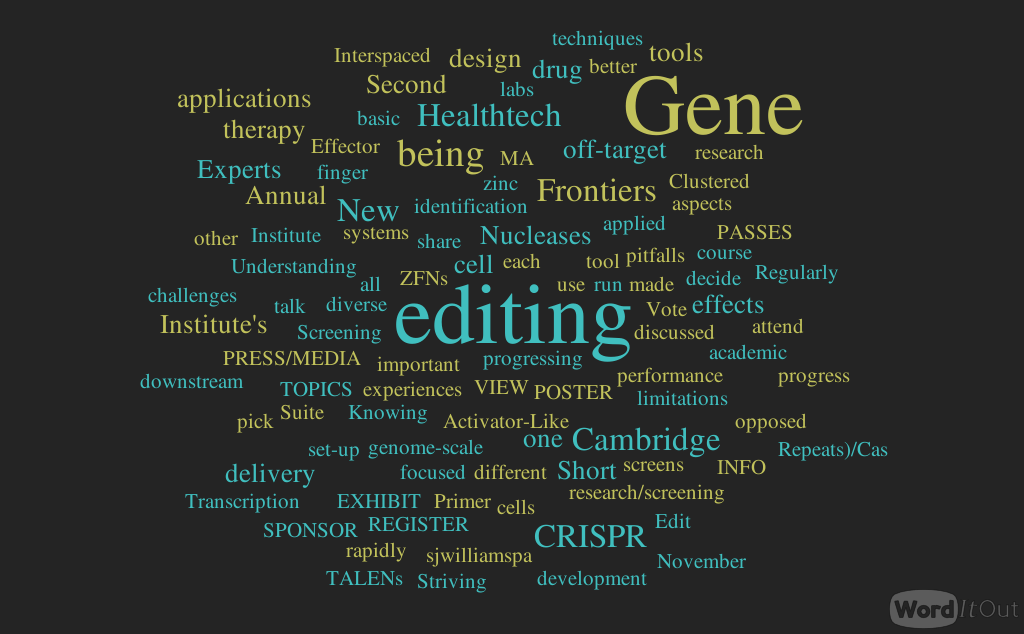
Cambridge Healthtech Institute’s Second Annual New Frontiers in Gene Editing

Reporter: Stephen J. Williams, PhD

New Frontiers in Gene Editing
Gene editing is rapidly progressing from being a research/screening tool to one that promises important applications downstream in drug development, cell therapy and bioprocessing. Cambridge Healthtech Institute’s second annual symposium on New Frontiers in Gene Editing will bring together experts from all aspects of basic science and clinical research to talk about the progress being made in gene editing and how it’s being applied. Knowing the strengths and limitations of the different tools, how does one decide when to use the CRISPR (Clustered Regularly Interspaced Short Palindromic Repeats)/Cas system, as opposed to Transcription Activator-Like Effector Nucleases (TALENs), zinc finger nucleases (ZFNs) and other systems? What is being done to overcome some of the inherent challenges with design, delivery and off-target effects, associated with each of these techniques? Experts from pharma/biotech, academic and government labs will share their experiences leveraging the utility of gene editing for diverse applications. REGISTER
VIEW SYMPOSIA AGENDA
SUBMIT A POSTER

EXHIBIT & SPONSOR INFO

PRESS/MEDIA PASSES

@TriConference #TRICON

TriConference.com

HOT TOPICS to be discussed:

  • How to pick the right tools for gene editing
  • How to set-up and run genome-scale CRISPR screens
  • Striving for better design, targeted delivery and performance
  • CRISPR Screening for drug target identification
  • Gene editing in stem cells
  • Gene editing for cell therapy and regenerative medicine
  • Understanding the pitfalls of gene editing
  • Dealing with off-target effects
Interested in Gene Editing? You may also want to attend our focused short course:

A Primer to Gene Editing

Cambridge Healthtech Institute 250 First Avenue, Suite 300 | Needham, MA 02494 | 781-972-5400 | www.healthtech.com
2.1.5.26   Cambridge Healthtech Institute’s Second Annual New Frontiers in Gene Editing, SF, 3/10-3/11, 2016, Volume 2 (Volume Two: Latest in Genomics Methodologies for Therapeutics: Gene Editing, NGS and BioInformatics, Simulations and the Genome Ontology), Part 2: CRISPR for Gene Editing and DNA Repair

Read Full Post »

Twitter, Google, LinkedIn Enter in the Curation Foray: What’s Up With That?


Reporter: Stephen J. Williams, Ph.D.

Recently Twitter has announced a new feature which they hope to use to increase engagement on their platform. Originally dubbed Project Lightning and now called Moments, this feature involves many human curators which aggregate and curate tweets surrounding individual live events(which used to be under #Live).

As Madhu Muthukumar (@justmadhu), Twitter’s Product Manager, published a blog post describing Moments said:

“Every day, people share hundreds of millions of tweets. Among them are things you can’t experience anywhere but on Twitter: conversations between world leaders and celebrities, citizens reporting events as they happen, cultural memes, live commentary on the night’s big game, and many more,” the blog post noted. “We know finding these only-on-Twitter moments can be a challenge, especially if you haven’t followed certain accounts. But it doesn’t have to be.”

Please see more about Moments on his blog here.

Moments is a new tab on Twitter’s mobile and desktop home screens where the company will curate trending topics as they’re unfolding in real-time — from citizen-reported news to cultural memes to sports events and more. Moments will fall into five total categories, including “Today,” “News,” “Sports,” “Entertainment” and “Fun.” (Source: Fox)

Now It’s Google’s Turn


As Dana Blankenhorn wrote in his article Twitter, Google Try It Buzzfeed’s Way With Curation

in SeekingAlpha

What’s a challenge for Google is a direct threat to Twitter’s existence.

For all the talk about what doesn’t work in journalism, curation works. Following the news, collecting it and commenting, and encouraging discussion, is the “secret sauce” for companies like Buzzfeed, Vox, Vice and The Huffington Post, which often wind up getting more traffic from a story at, say The New York Times (NYSE:NYT), than the Times does as a result.

Curation is, in some ways, a throwback to the pre-Internet era. It’s done by people. (At least I think I’m a people.) So as odd as it is for Twitter (NYSE:TWTR) to announce it will curate live events it’s even odder to see Google (NASDAQ:GOOG) (NASDAQ:GOOGL) doing it in a project called YouTube Newswire.

Buzzfeed, Google’s content curation platform, made for desktop as well as a mobile app, allows sharing of curated news, viral videos.

The feel for both Twitter and Google’s content curation will be like a newspaper, with an army of human content curators determining what is the trendiest news to read or videos to watch.

BuzzFeed articles, or at least, the headlines can easily be mined from any social network but reading the whole article still requires that you open the link within the app or outside using a mobile web browser. Loading takes some time–a few seconds longer. Try browsing the BuzzFeed feed on the app and you’ll notice the obvious difference.

However it was earlier this summer in a Forbes article Why Apple, Snapchat and Twitter are betting on human editors, but Facebook and Google aren’t that Apple, Snapchat and Twitter as well as LinkedIn Pulse and Instragram were going to use human editors and curators while Facebook and Google were going to rely on their powerful algorithms. Google (now Alphabet) CEO Eric Schmidt has even called Apple’s human curated playlists “elitist” although Google Play has human curated playlists.

Maybe Google is responding to views on its Google News like this review in VentureBeat:

Google News: Less focused on social signals than textual ones, Google News uses its analytic tools to group together related stories and highlight the biggest ones. Unlike Techmeme, it’s entirely driven by algorithms, and that means it often makes weird choices. I’ve heard that Google uses social sharing signals from Google+ to help determine which stories appear on Google News, but have never heard definitive confirmation of that — and now that Google+ is all but dead, it’s mostly moot. I find Google News an unsatisfying home page, but it is a good place to search for news once you’ve found it.

Now WordPress Too!


WordPress also has announced its curation plugin called Curation Traffic.

According to WordPress

You Own the Platform, You Benefit from the Traffic

“The Curation Traffic™ System is a complete WordPress based content curation solution. Giving you all the tools and strategies you need to put content curation into action.

It is push-button simple and seamlessly integrates with any WordPress site or blog.

With Curation Traffic™, curating your first post is as easy as clicking “Curate” and the same post that may originally only been sent to Facebook or Twitter is now sent to your own site that you control, you benefit from, and still goes across all of your social sites.”

The theory the more you share on your platform the more engagement the better marketing experience. And with all the WordPress users out there they have already an army of human curators.

So That’s Great For News But What About Science and Medicine?


The news and trendy topics such as fashion and music are common in most people’s experiences. However more technical areas of science, medicine, engineering are not in most people’s domain so aggregation of content needs a process of peer review to sort basically “the fact from fiction”. On social media this is extremely important as sensational stories of breakthroughs can spread virally without proper vetting and even influence patient decisions about their own personal care.

Expertise Depends on Experience

In steps the human experience. On this site (www.pharmaceuticalintelligence.com) we attempt to do just this. A consortium of M.D.s, Ph.D. and other medical professionals spend their own time to aggregate not only topics of interest but curate on specific topics to add some more insight from acceptable sources over the web.

In Power of Analogy: Curation in Music, Music Critique as a Curation and Curation of Medical Research Findings – A Comparison; Dr. Larry Berstein compares a museum or music curator to curation of scientific findings and literature and draws similar conclusions from each: that a curation can be a tool to gain new insights previously unseen an observer. A way of stepping back to see a different picture, hear a different song.


For instance, using a Twitter platform, we curate #live meeting notes and tweets from meeting attendees (please see links below and links within) to give a live conference coverage

http://pharmaceuticalintelligence.com/press-coverage/

and curation and analysis give rise not only to meeting engagement butunique insights into presentations.


In addition, the use of a WordPress platform allows easy sharing among many different social platforms including Twitter, Google+, LinkedIn, Pinterest etc.

Hopefully, this will catch on to the big powers of Twitter, Google and Facebook to realize there exists armies of niche curation communities which they can draw on for expert curation in the biosciences.

Other posts on this site on Curation and include


Inevitability of Curation: Scientific Publishing moves to embrace Open Data, Libraries and Researchers are trying to keep up

The Methodology of Curation for Scientific Research Findings

Scientific Curation Fostering Expert Networks and Open Innovation: Lessons from Clive Thompson and others

The growing importance of content curation

Data Curation is for Big Data what Data Integration is for Small Data

Stem Cells and Cardiac Repair: Content Curation & Scientific Reporting

Cardiovascular Diseases and Pharmacological Therapy: Curations

Power of Analogy: Curation in Music, Music Critique as a Curation and Curation of Medical Research Findings – A Comparison


Read Full Post »

Leaders in Pharmaceutical Intelligence Presentation at The Life Sciences Collaborative

Curator: Stephen J. Williams, Ph.D. Website Analytics: Adam Sonnenberg, BSc Leaders in Pharmaceutical Intelligence presented their ongoing efforts to develop an open-access scientific and medical publishing and curation platform to The Life Science Collaborative, an executive pharmaceutical and biopharma networking group in the Philadelphia/New Jersey area.

Our Team

Slide1

For more information on the Vision, Funding Deals and Partnerships please see our site at http://pharmaceuticalintelligence.com/vision/

Slide2

For more information about our Team please see our site at http://pharmaceuticalintelligence.com/contributors-biographies/

Slide5

For more information of LPBI Deals and Partnerships please see our site at http://pharmaceuticalintelligence.com/joint-ventures/

Slide4

For more information about our BioMed E-Series please see our site at http://pharmaceuticalintelligence.com/biomed-e-books/

E-Book Titles by LPBI

LPBI book titles slide Slide8Slide3

Slide6

For more information on Real-Time Conference Coverage including a full list of Conferences Covered by LPBI please go to http://pharmaceuticalintelligence.com/press-coverage/

For more information on Real-Time Conference Coverage and a full listing of Conferences Covered by LPBI please go to:

http://pharmaceuticalintelligence.com/press-coverage/ Slide7

Slide10

The Pennsylvania (PA) and New Jersey (NJ) Biotech environment had been hit hard by the recession and loss of anchor big pharma companies however as highlighted by our interviews in “The Vibrant Philly Biotech Scene” and other news outlets, additional issues are preventing the PA/NJ area from achieving its full potential (discussions also with LSC)

Slide9Download the PowerPoint slides here: Presentationlsc

Read Full Post »

Twitter is Becoming a Powerful Tool in Science and Medicine

 Curator: Stephen J. Williams, Ph.D.

Article ID #159: Twitter is Becoming a Powerful Tool in Science and Medicine. Published on 11/6/2014

WordCloud Image Produced by Adam Tubman

Updated 4/2016

Life-cycle of Science 2

A recent Science article (Who are the science stars of Twitter?; Sept. 19, 2014) reported the top 50 scientists followed on Twitter. However, the article tended to focus on the use of Twitter as a means to develop popularity, a sort of “Science Kardashian” as they coined it. So the writers at Science developed a “Kardashian Index (K-Index) to determine scientists following and popularity on Twitter.

Now as much buzz Kim Kardashian or a Perez Hilton get on social media, their purpose is solely for entertainment and publicity purposes, the Science sort of fell flat in that it focused mainly on the use of Twitter as a metric for either promotional or public outreach purposes. A notable scientist was mentioned in the article, using Twitter feed to gauge the receptiveness of his presentation. In addition, relying on Twitter for effective public discourse of science is problematic as:

  • Twitter feeds are rapidly updated and older feeds quickly get buried within the “Twittersphere” = LIMITED EXPOSURE TIMEFRAME
  • Short feeds may not provide the access to appropriate and understandable scientific information (The Science Communication Trap) which is explained in The Art of Communicating Science: traps, tips and tasks for the modern-day scientist. “The challenge of clearly communicating the intended scientific message to the public is not insurmountable but requires an understanding of what works and what does not work.” – from Heidi Roop, G.-Martinez-Mendez and K. Mills

However, as highlighted below, Twitter, and other social media platforms are being used in creative ways to enhance the research, medical, and bio investment collaborative, beyond a simple news-feed.  And the power of Twitter can be attributed to two simple features

  1. Ability to organize – through use of the hashtag (#) and handle (@), Twitter assists in the very important task of organizing, indexing, and ANNOTATING content and conversations. A very great article on Why the Hashtag in Probably the Most Powerful Tool on Twitter by Vanessa Doctor explains how hashtags and # search may be as popular as standard web-based browser search. Thorough annotation is crucial for any curation process, which are usually in the form of database tags or keywords. The use of # and @ allows curators to quickly find, index and relate disparate databases to link annotated information together. The discipline of scientific curation requires annotation to assist in the digital preservation, organization, indexing, and access of data and scientific & medical literature. For a description of scientific curation methodologies please see the following links:

Please read the following articles on CURATION

The Methodology of Curation for Scientific Research Findings

Power of Analogy: Curation in Music, Music Critique as a Curation and Curation of Medical Research Findings – A Comparison

Science and Curation: The New Practice of Web 2.0

  1. Information Analytics

Multiple analytic software packages have been made available to analyze information surrounding Twitter feeds, including Twitter feeds from #chat channels one can set up to cover a meeting, product launch etc.. Some of these tools include:

Twitter Analytics – measures metrics surrounding Tweets including retweets, impressions, engagement, follow rate, …

Twitter Analytics – Hashtags.org – determine most impactful # for your Tweets For example, meeting coverage of bioinvestment conferences or startup presentations using #startup generates automatic retweeting by Startup tweetbot @StartupTweetSF.


  1. Tweet Sentiment Analytics

Examples of Twitter Use

A. Scientific Meeting Coverage

In a paper entitled Twitter Use at a Family Medicine Conference: Analyzing #STFM13 authors Ranit Mishori, MD, Frendan Levy, MD, and Benjamin Donvan analyzed the public tweets from the 2013 Society of Teachers of Family Medicine (STFM) conference bearing the meeting-specific hashtag #STFM13. Thirteen percent of conference attendees (181 users) used the #STFM13 to share their thoughts on the meeting (1,818 total tweets) showing a desire for social media interaction at conferences but suggesting growth potential in this area. As we have also seen, the heaviest volume of conference-tweets originated from a small number of Twitter users however most tweets were related to session content.

However, as the authors note, although it is easy to measure common metrics such as number of tweets and retweets, determining quality of engagement from tweets would be important for gauging the value of Twitter-based social-media coverage of medical conferences.

Thea authors compared their results with similar analytics generated by the HealthCare Hashtag Project, a project and database of medically-related hashtag use, coordinated and maintained by the company Symplur.  Symplur’s database includes medical and scientific conference Twitter coverage but also Twitter usuage related to patient care. In this case the database was used to compare meeting tweets and hashtag use with the 2012 STFM conference.

These are some of the published journal articles that have employed Symplur (www.symplur.com) data in their research of Twitter usage in medical conferences.

B. Twitter Usage for Patient Care and Engagement

Although the desire of patients to use and interact with their physicians over social media is increasing, along with increasing health-related social media platforms and applications, there are certain obstacles to patient-health provider social media interaction, including lack of regulatory framework as well as database and security issues. Some of the successes and issues of social media and healthcare are discussed in the post Can Mobile Health Apps Improve Oral-Chemotherapy Adherence? The Benefit of Gamification.

However there is also a concern if social media truly engages the patient and improves patient education. In a study of Twitter communications by breast cancer patients Tweeting about breast cancer, authors noticed Tweeting was a singular event. The majority of tweets did not promote any specific preventive behavior. The authors concluded “Twitter is being used mostly as a one-way communication tool.” (Using Twitter for breast cancer prevention: an analysis of breast cancer awareness month. Thackeray R1, Burton SH, Giraud-Carrier C, Rollins S, Draper CR. BMC Cancer. 2013;13:508).

In addition a new poll by Harris Interactive and HealthDay shows one third of patients want some mobile interaction with their physicians.

Some papers cited in Symplur’s HealthCare Hashtag Project database on patient use of Twitter include:

C. Twitter Use in Pharmacovigilance to Monitor Adverse Events

Pharmacovigilance is the systematic detection, reporting, collecting, and monitoring of adverse events pre- and post-market of a therapeutic intervention (drug, device, modality e.g.). In a Cutting Edge Information Study, 56% of pharma companies databases are an adverse event channel and more companies are turning to social media to track adverse events (in Pharmacovigilance Teams Turn to Technology for Adverse Event Reporting Needs). In addition there have been many reports (see Digital Drug Safety Surveillance: Monitoring Pharmaceutical Products in Twitter) that show patients are frequently tweeting about their adverse events.

There have been concerns with using Twitter and social media to monitor for adverse events. For example FDA funded a study where a team of researchers from Harvard Medical School and other academic centers examined more than 60,000 tweets, of which 4,401 were manually categorized as resembling adverse events and compared with the FDA pharmacovigilance databases. Problems associated with such social media strategy were inability to obtain extra, needed information from patients and difficulty in separating the relevant Tweets from irrelevant chatter.  The UK has launched a similar program called WEB-RADR to determine if monitoring #drug_reaction could be useful for monitoring adverse events. Many researchers have found the adverse-event related tweets “noisy” due to varied language but had noticed many people do understand some principles of causation including when adverse event subsides after discontinuing the drug.

However Dr. Clark Freifeld, Ph.D., from Boston University and founder of the startup Epidemico, feels his company has the algorithms that can separate out the true adverse events from the junk. According to their web site, their algorithm has high accuracy when compared to the FDA database. Dr. Freifeld admits that Twitter use for pharmacovigilance purposes is probably a starting point for further follow-up, as each patient needs to fill out the four-page forms required for data entry into the FDA database.

D. Use of Twitter in Big Data Analytics

Published on Aug 28, 2012

http://blogs.ischool.berkeley.edu/i29…

Course: Information 290. Analyzing Big Data with Twitter
School of Information
UC Berkeley

Lecture 1: August 23, 2012

Course description:
How to store, process, analyze and make sense of Big Data is of increasing interest and importance to technology companies, a wide range of industries, and academic institutions. In this course, UC Berkeley professors and Twitter engineers will lecture on the most cutting-edge algorithms and software tools for data analytics as applied to Twitter microblog data. Topics will include applied natural language processing algorithms such as sentiment analysis, large scale anomaly detection, real-time search, information diffusion and outbreak detection, trend detection in social streams, recommendation algorithms, and advanced frameworks for distributed computing. Social science perspectives on analyzing social media will also be covered.

This is a hands-on project course in which students are expected to form teams to complete intensive programming and analytics projects using the real-world example of Twitter data and code bases. Engineers from Twitter will help advise student projects, and students will have the option of presenting their final project presentations to an audience of engineers at the headquarters of Twitter in San Francisco (in addition to on campus). Project topics include building on existing infrastructure tools, building Twitter apps, and analyzing Twitter data. Access to data will be provided.

Other posts on this site on USE OF SOCIAL MEDIA AND TWITTER IN HEALTHCARE and Conference Coverage include:

Methodology for Conference Coverage using Social Media: 2014 MassBio Annual Meeting 4/3 – 4/4 2014, Royal Sonesta Hotel, Cambridge, MA

Strategy for Event Joint Promotion: 14th ANNUAL BIOTECH IN EUROPE FORUM For Global Partnering & Investment 9/30 – 10/1/2014 • Congress Center Basel – SACHS Associates, London

REAL TIME Cancer Conference Coverage: A Novel Methodology for Authentic Reporting on Presentations and Discussions launched via Twitter.com @ The 2nd ANNUAL Sachs Cancer Bio Partnering & Investment Forum in Drug Development, 19th March 2014 • New York Academy of Sciences • USA

PCCI’s 7th Annual Roundtable “Crowdfunding for Life Sciences: A Bridge Over Troubled Waters?” May 12 2014 Embassy Suites Hotel, Chesterbrook PA 6:00-9:30 PM

CRISPR-Cas9 Discovery and Development of Programmable Genome Engineering – Gabbay Award Lectures in Biotechnology and Medicine – Hosted by Rosenstiel Basic Medical Sciences Research Center, 10/27/14 3:30PM Brandeis University, Gerstenzang 121

Tweeting on 14th ANNUAL BIOTECH IN EUROPE FORUM For Global Partnering & Investment 9/30 – 10/1/2014 • Congress Center Basel – SACHS Associates, London

http://pharmaceuticalintelligence.com/press-coverage/

Statistical Analysis of Tweet Feeds from the 14th ANNUAL BIOTECH IN EUROPE FORUM For Global Partnering & Investment 9/30 – 10/1/2014 • Congress Center Basel – SACHS Associates, London

1st Pitch Life Science- Philadelphia- What VCs Really Think of your Pitch

What VCs Think about Your Pitch? Panel Summary of 1st Pitch Life Science Philly

How Social Media, Mobile Are Playing a Bigger Part in Healthcare

Can Mobile Health Apps Improve Oral-Chemotherapy Adherence? The Benefit of Gamification.

Medical Applications and FDA regulation of Sensor-enabled Mobile Devices: Apple and the Digital Health Devices Market

E-Medical Records Get A Mobile, Open-Sourced Overhaul By White House Health Design Challenge Winners

Read Full Post »

« Newer Posts - Older Posts »