Feeds:
Posts
Comments

Archive for the ‘Tissue Engineering and Regenerative Medicine’ Category

Pharmacotyping Pancreatic Cancer Patients in the Future: Two Approaches – ORGANOIDS by David Tuveson and Hans Clevers and/or MICRODOSING Devices by Robert Langer

Curator: Aviva Lev-Ari, PhD, RN


UPDATED on 4/5/2018

Featured video: Magical Bob

A fascination with magic leads Institute Professor Robert Langer to solve world problems using the marvels of chemical engineering.Watch Video

MIT News Office
March 27, 2018

http://news.mit.edu/2018/featured-video-magical-bob-langer-0327


This curation provides the resources for edification on Pharmacotyping Pancreatic Cancer Patients in the Future


  • Professor Hans Clevers at Clevers Group, Hubrecht University

https://www.hubrecht.eu/onderzoekers/clevers-group/

  • Prof. Robert Langer, MIT

http://web.mit.edu/langerlab/langer.html

Langer’s articles on Drug Delivery

https://scholar.google.com/scholar?q=Langer+on+Drug+Delivery&hl=en&as_sdt=0&as_vis=1&oi=scholart&sa=X&ved=0ahUKEwixsd2w88TTAhVG4iYKHRaIAvEQgQMIJDAA

organoids, which I know you’re pretty involved in with Hans Clevers. What are your plans for organoids of pancreatic cancer?

Organoids are a really terrific model of a patient’s tumour that you generate from tissue that is either removed at the time of surgery or when they get a small needle biopsy. Culturing the tissue and observing an outgrowth of it is usually successful and when you have the cells, you can perform molecular diagnostics of any type. With a patient-derived organoid, you can sequence the exome and the RNA, and you can perform drug testing, which I call ‘pharmacotyping’, where you’re evaluating compounds that by themselves or in combination show potency against the cells. A major goal of our lab is to work towards being able to use organoids to choose therapies that will work for an individual patient – personalized medicine.

Organoids could be made moot by implantable microdevices for drug delivery into tumors, developed by Bob Langer. These devices are the size of a pencil lead and contain reservoirs that release microdoses of different drugs; the device can be injected into the tumor to deliver drugs, and can then be carefully dissected out and analyzed to gain insight into the sensitivity of cancer cells to different anticancer agents. Bob and I are kind of engaged in a friendly contest to see whether organoids or microdosing devices are going to come out on top. I suspect that both approaches will be important for pharmacotyping cancer patients in the future.

From the science side, we use organoids to discover things about pancreatic cancer. They’re great models, probably the best that I know of to rapidly discover new things about cancer because you can grow normal tissue as well as malignant tissue. So, from the same patient you can do a comparison easily to find out what’s different in the tumor. Organoids are crazy interesting, and when I see other people in the pancreatic cancer field I tell them, you should stop what you’re doing and work on these because it’s the faster way of studying this disease.

SOURCE

Other related articles on Pancreatic Cancer and Drug Delivery published in this Open Access Online Scientific Journal include the following:


Pancreatic Cancer: Articles of Note @PharmaceuticalIntelligence.com

Curator: Aviva Lev-Ari, PhD, RN

https://pharmaceuticalintelligence.com/2016/05/26/pancreatic-cancer-articles-of-note-pharmaceuticalintelligence-com/

Keyword Search: “Pancreatic Cancer” – 275 Article Titles

https://pharmaceuticalintelligence.com/wp-admin/edit.php?s=Pancreatic+Cancer&post_status=all&post_type=post&action=-1&m=0&cat=0&paged=1&action2=-1

Keyword Search: Drug Delivery: 542 Articles Titles

https://pharmaceuticalintelligence.com/wp-admin/edit.php?s=Drug+Delivery&post_status=all&post_type=post&action=-1&m=0&cat=0&paged=1&action2=-1

Keyword Search: Personalized Medicine: 597 Article Titles

https://pharmaceuticalintelligence.com/wp-admin/edit.php?s=Personalized+Medicine&post_status=all&post_type=post&action=-1&m=0&cat=0&paged=1&action2=-1

  • Cancer Biology & Genomics for Disease Diagnosis, on Amazon since 8/11/2015

http://www.amazon.com/dp/B013RVYR2K


VOLUME TWO WILL BE AVAILABLE ON AMAZON.COM ON MAY 1, 2017

Read Full Post »

cvd-series-a-volume-iv-cover

Series A: e-Books on Cardiovascular Diseases

Series A Content Consultant: Justin D Pearlman, MD, PhD, FACC

VOLUME FOUR

Regenerative and Translational Medicine

The Therapeutic Promise for

Cardiovascular Diseases

  • on Amazon since 12/26/2015

http://www.amazon.com/dp/B019UM909A


by  

Larry H Bernstein, MD, FCAP, Senior Editor, Author and Curator

and

Aviva Lev-Ari, PhD, RN, Editor and Curator


Part One:

Cardiovascular Diseases,Translational Medicine (TM) and Post TM

Introduction to Part 1: Cardiovascular Diseases,Translational Medicine (TM) and Post TM

Chapter 1: Translational Medicine Concepts

1.0 Post-Translational Modification of Proteins

1.1 Identifying Translational Science within the Triangle of Biomedicine

1.2 State of Cardiology on Wall Stress, Ventricular Workload and Myocardial Contractile Reserve: Aspects of Translational Medicine (TM)

1.3 Risk of Bias in Translational Science

1.4 Biosimilars: Intellectual Property Creation and Protection by Pioneer and by Biosimilar Manufacturers

Chapter 2: Causes and the Etiology of Cardiovascular Diseases: Translational Approaches for Cardiothoracic Medicine

2.1 Genomics

2.1.1 Genomics-Based Classification

2.1.2  Targeting Untargetable Proto-Oncogenes

2.1.3  Searchable Genome for Drug Development

2.1.4 Zebrafish Study Tool

2.1.5  International Human Genome Sequencing Consortium (2004) Finishing the euchromatic sequence of the human genome.

2.2  Proteomics

2.2.1 The Role of Tight Junction Proteins in Water and Electrolyte Transport

2.2.2 Selective Ion Conduction

2.2.3 Translational Research on the Mechanism of Water and Electrolyte Movements into the Cell

2.2.4 Inhibition of the Cardiomyocyte-Specific Kinase TNNI3K ­ Oxidative Stress

2.2.5 Oxidized Calcium Calmodulin Kinase and Atrial Fibrillation

2.2.6 S-Nitrosylation in Cardiac Ischemia and Acute Coronary Syndrome

2.2.7 Acetylation and Deacetylation

2.2.8 Nitric Oxide Synthase Inhibitors (NOS-I) 

2.3 Cardiac and Vascular Signaling

2.3.1 The Centrality of Ca(2+) Signaling and Cytoskeleton Involving Calmodulin Kinases and Ryanodine Receptors in Cardiac Failure, Arterial Smooth Muscle, Post-ischemic Arrhythmia, Similarities and Differences, and Pharmaceutical Targets

2.3.2 Leptin Signaling in Mediating the Cardiac Hypertrophy associated with Obesity

2.3.3 Triggering of Plaque Disruption and Arterial Thrombosis

2.3.4 Sensors and Signaling in Oxidative Stress

2.3.5 Resistance to Receptor of Tyrosine Kinase

2.3.6  S-nitrosylation signaling in cell biology.

2.4  Platelet Endothelial Interaction

2.4.1 Platelets in Translational Research ­ 1

2.4.2 Platelets in Translational Research ­ 2: Discovery of Potential Anti-platelet Targets

2.4.3 The Final Considerations of the Role of Platelets and Platelet Endothelial Reactions in Atherosclerosis and Novel Treatments

2.4.4 Endothelial Function and Cardiovascular Disease
Larry H Bernstein, MD, FCAP

2.5 Post-translational modifications (PTMs)

2.5.1 Post-Translational Modifications

2.5.2.  Analysis of S-nitrosylated Proteins

2.5.3  Mechanisms of Disease: Signal Transduction: Akt Phosphorylates HK-II at Thr-473 and Increases Mitochondrial HK-II Association to Protect Cardiomyocytes

2.5.4  Acetylation and Deacetylation of non-Histone Proteins

2.5.5  Study Finds Low Methylation Regions Prone to Structural Mutation

2.6 Epigenetics and lncRNAs

2.6.1 The Magic of the Pandora’s Box : Epigenetics and Stemness with Long non-coding RNAs (lincRNA)

2.6.2 The SILENCE of the Lambs” Introducing The Power of Uncoded RNA

2.6.3 Long Noncoding RNA Network regulates PTEN Transcription

2.6.4 How mobile elements in “Junk” DNA promote cancer. Part 1: Transposon-mediated tumorigenesis.

2.6.5 Transposon-mediated Gene Therapy improves Pulmonary Hemodynamics and attenuates Right Ventricular Hypertrophy: eNOS gene therapy reduces Pulmonary vascular remodeling and Arterial wall hyperplasia

2.6.6 Junk DNA codes for valuable miRNAs: non-coding DNA controls Diabetes

2.6.7 Targeted Nucleases

2.6.8 Late Onset of Alzheimer’s Disease and One-carbon Metabolism
Dr. Sudipta Saha

2.6.9 Amyloidosis with Cardiomyopathy

2.6.10 Long non-coding RNAs: Molecular Regulators of Cell Fate

2.7 Metabolomics

2.7.1 Expanding the Genetic Alphabet and Linking the Genome to the Metabolome

2.7.2 How Methionine Imbalance with Sulfur-Insufficiency Leads to Hyperhomocysteinemia

2.7.3 A Second Look at the Transthyretin Nutrition Inflammatory Conundrum

2.7.4 Transthyretin and Lean Body Mass in Stable and Stressed State

2.7.5 Hyperhomocysteinemia interaction with Protein C and Increased Thrombotic Risk

2.7.6 Telling NO to Cardiac Risk

2.8 Mitochondria and Oxidative Stress

2.8.1 Reversal of Cardiac Mitochondrial Dysfunction

2.8.2 Calcium Signaling, Cardiac Mitochondria and Metabolic Syndrome

2.8.3. Mitochondrial Dysfunction and Cardiac Disorders

2.8.4 Mitochondrial Metabolism and Cardiac Function

2.8.5 Mitochondria and Cardiovascular Disease: A Tribute to Richard Bing

2.8.6 MIT Scientists on Proteomics: All the Proteins in the Mitochondrial Matrix Identified

2.8.7 Mitochondrial Dynamics and Cardiovascular Diseases

2.8.8 Mitochondrial Damage and Repair under Oxidative Stress

2.8.9 Nitric Oxide has a Ubiquitous Role in the Regulation of Glycolysis -with a Concomitant Influence on Mitochondrial Function

2.8.10 Mitochondrial Mechanisms of Disease in Diabetes Mellitus

2.8.11 Mitochondria Dysfunction and Cardiovascular Disease – Mitochondria: More than just the “Powerhouse of the Cell”

Chapter 3: Risks and Biomarkers for Diagnosis and Prognosis in Translational Cardiothoracic Medicine

3.1 Biomarkers. Diagnosis and Management: Biomarkers. Present and Future.

3.2 Landscape of Cardiac Biomarkers for Improved Clinical Utilization

3.3 Achieving Automation in Serology: A New Frontier in Best

3.4 Accurate Identification and Treatment of Emergent Cardiac Events

3.5 Prognostic Marker Importance of Troponin I in Acute Decompensated Heart Failure (ADHF)

3.6 High-Sensitivity Cardiac Troponin Assays Preparing the United States for High-Sensitivity Cardiac Troponin Assays

3.7 Voices from the Cleveland Clinic On Circulating apoA1: A Biomarker for a Proatherogenic Process in the Artery Wall

3.8 Triggering of Plaque Disruption and Arterial Thrombosis

3.9 Relationship between Adiposity and High Fructose Intake Revealed

3.10 The Cardio-Renal Syndrome (CRS) in Heart Failure (HF)

3.11 Aneuploidy and Carcinogenesis

3.12 “Sudden Cardiac Death,” SudD is in Ferrer inCode’s Suite of Cardiovascular Genetic Tests to be Commercialized in the US

Chapter 4: Therapeutic Aspects in Translational Cardiothoracic Medicine

4.1 Molecular and Cellular Cardiology

4.1.1 αllbβ3 Antagonists As An Example of Translational Medicine Therapeutics

4.1.2 Three-Dimensional Fibroblast Matrix Improves Left Ventricular Function post MI

4.1.3 Biomaterials Technology: Models of Tissue Engineering for Reperfusion and Implantable Devices for Revascularization

4.1.4 CELLWAVE Randomized Clinical Trial: Modest improvement in LVEF at 4 months ­ “Shock wave­facilitated intracoronary administration of BMCs” vs “Shock wave treatment alone”

4.1.5 Prostacyclin and Nitric Oxide: Adventures in vascular biology –  a tale of two mediators

4.1.6 Cardiac Contractility & Myocardium Performance: Ventricular Arrhythmiasand Non-ischemic Heart Failure – Therapeutic Implications for Cardiomyocyte Ryanopathy

4.1.7 Publications on Heart Failure by Prof. William Gregory Stevenson, M.D., BWH

4.2 Interventional Cardiology and Cardiac Surgery – Mechanical Circulatory Support and Vascular Repair

4.2.1 Mechanical Circulatory Support System, LVAD, RVAD, Biventricular as a Bridge to Heart Transplantation or as “Destination Therapy”: Options for Patients in Advanced Heart Failure

4.2.2 Heart Transplantation: NHLBI’s Ten Year Strategic Research Plan to Achieving Evidence-based Outcomes

4.2.3 Improved Results for Treatment of Persistent type 2 Endoleak after Endovascular Aneurysm Repair: Onyx Glue Embolization

4.2.4 Carotid Endarterectomy (CEA) vs. Carotid Artery Stenting (CAS): Comparison of CMMS high-risk criteria on the Outcomes after Surgery: Analysis of the Society for Vascular Surgery (SVS) Vascular Registry Data

4.2.5 Effect of Hospital Characteristics on Outcomes of Endovascular Repair of Descending Aortic Aneurysms in US Medicare Population

4.2.6 Hypertension and Vascular Compliance: 2013 Thought Frontier – An Arterial Elasticity Focus

4.2.7 Preventive Medicine Philosophy: Excercise vs. Drug, IF More of the First THEN Less of the Second

4.2.8 Cardio-oncology and Onco-Cardiology Programs: Treatments for Cancer Patients with a History of Cardiovascular Disease

Summary to Part One


Part Two:

Cardiovascular Diseases and Regenerative Medicine

Introduction to Part Two

Chapter 1: Stem Cells in Cardiovascular Diseases

1.1 Regeneration: Cardiac System (cardiomyogenesis) and Vasculature (angiogenesis)

1.2 Notable Contributions to Regenerative Cardiology by Richard T. Lee (Lee’s Lab, Part I)

1.3 Contributions to Cardiomyocyte Interactions and Signaling (Lee’s Lab, Part II)

1.4 Jmjd3 and Cardiovascular Differentiation of Embryonic Stem Cells

1.5 Stem Cell Therapy for Coronary Artery Disease (CAD)

1.6 Intracoronary Transplantation of Progenitor Cells after Acute MI

1.7 Progenitor Cell Transplant for MI and Cardiogenesis (Part 1)

1.8 Source of Stem Cells to Ameliorate Damage Myocardium (Part 2)

1.9 Neoangiogenic Effect of Grafting an Acellular 3-Dimensional Collagen Scaffold Onto Myocardium (Part 3)

1.10 Transplantation of Modified Human Adipose Derived Stromal Cells Expressing VEGF165

1.11 Three-Dimensional Fibroblast Matrix Improves Left Ventricular Function Post MI

Chapter 2: Regenerative Cell and Molecular Biology

2.1 Circulating Endothelial Progenitors Cells (cEPCs) as Biomarkers

2.2 Stem Cell Research — The Frontier at the Technion in Israel

2.3 Blood vessel-generating stem cells discovered

2.4 Heart Renewal by pre-existing Cardiomyocytes: Source of New Heart Cell Growth Discovered

2.5 The Heart: Vasculature Protection – A Concept-based Pharmacological Therapy including THYMOSIN

2.6 Innovations in Bio instrumentation for Measurement of Circulating Progenetor Endothelial Cells in Human Blood.

2.7 Endothelial Differentiation and Morphogenesis of Cardiac Precursor

Chapter 3: Therapeutics Levels In Molecular Cardiology

3.1 Secrets of Your Cells: Discovering Your Body’s Inner Intelligence (Sounds True, on sale May 1, 2013) by Sondra Barrett

3.2 Human Embryonic-Derived Cardiac Progenitor Cells for Myocardial Repair

3.3 Repair using iPPCs or Stem Cells

3.3.1 Reprogramming cell in Tissue Repair

3.3.2 Heart patients’ skin cells turned into healthy heart muscle cells

3.4 Arteriogenesis and Cardiac Repair: Two Biomaterials – Injectable Thymosin beta4 and Myocardial Matrix Hydrogel 

3.5 Cardiovascular Outcomes: Function of circulating Endothelial Progenitor Cells (cEPCs): Exploring Pharmaco-therapy targeted at Endogenous Augmentation of cEPCs

3.6 Calcium Cycling (ATPase Pump) in Cardiac Gene Therapy: Inhalable Gene Therapy for Pulmonary Arterial Hypertension and Percutaneous Intra-coronary Artery Infusion for Heart Failure: Contributions by Roger J. Hajjar, MD

Chapter 4: Research Proposals for Endogenous Augmentation of circulating Endothelial Progenitor Cells (cEPCs)

4.1 Peroxisome proliferator-activated receptor (PPAR-gamma) Receptors Activation: PPARγ transrepression for Angiogenesis in Cardiovascular Disease and PPARγ transactivation for Treatment of Diabetes

4.2 Clinical Trials Results for Endothelin System: Pathophysiological role in Chronic Heart Failure, Acute Coronary Syndromes and MI – Marker of Disease Severity or Genetic Determination?

4.3 Endothelin Receptors in Cardiovascular Diseases: The Role of eNOS Stimulation

4.4 Inhibition of ET-1, ETA and ETA-ETB, Induction of NO production, stimulation of eNOS and Treatment Regime with PPAR-gamma agonists (TZD): cEPCs Endogenous Augmentation for Cardiovascular Risk Reduction – A Bibliography

4.5 Positioning a Therapeutic Concept for Endogenous Augmentation of cEPCs — Therapeutic Indications for Macrovascular Disease: Coronary, Cerebrovascular and Peripheral

4.6 Endothelial Dysfunction, Diminished Availability of cEPCs, Increasing CVD Risk for Macrovascular Disease – Therapeutic Potential of cEPCs

4.7 Vascular Medicine and Biology: CLASSIFICATION OF FAST ACTING THERAPY FOR PATIENTS AT HIGH RISK FOR MACROVASCULAR EVENTS Macrovascular Disease – Therapeutic Potential of cEPCs

4.8 Cardiovascular Disease (CVD) and the Role of agent alternatives in endothelial Nitric Oxide Synthase (eNOS) Activation and Nitric Oxide Production

4.9 Resident-cell-based Therapy in Human Ischaemic Heart Disease: Evolution in the PROMISE of Thymosin beta4 for Cardiac Repair

4.10 Macrovascular Disease – Therapeutic Potential of cEPCs: Reduction Methods for CV Risk

4.11 Bystolic’s generic Nebivolol – positive effect on circulating Endothelial Proginetor Cells endogenous augmentation

4.12 Heart Vasculature – Regeneration and Protection of Coronary Artery Endothelium and Smooth Muscle: A Concept-based Pharmacological Therapy of a Combination Three Drug Regimen including THYMOSIN

Summary to Part Two

Epilogue to Volume Four

Read Full Post »

BioPrinting Basics

Curator: Larry H. Bernstein, MD, FCAP


The ABCs of 3D Bioprinting of Living Tissues, Organs   5/06/2016 

(Credit: Ozbolat Lab/Penn State University)

Although first originated in 2003, the world of bioprinting is still very new and ambiguous. Nevertheless, as the need for organ donation continues to increase worldwide, and organ and tissue shortages prevail, a handful of scientists have started utilizing this cutting-edge science and technology for various areas of regenerative medicine to possibly fill that organ-shortage void.

Among these scientists is Ibrahim Tarik Ozbolat, an associate professor of Engineering Science and Mechanics Department and the Huck Institutes of the Life Sciences at Penn State University, who’s been studying bioprinting and tissue engineering for years.

While Ozbolat is not the first to originate 3D bioprinting research, he’s the first one at Penn State University to spearhead the studies at Ozbolat Lab, Leading Bioprinting Research.

“Tissue engineering is a big need. Regenerative medicine, biofabrication of tissues and organs that can replace the damage or diseases is important,” Ozbolat told R&D Magazine after his seminar presentation at Interphex last week in New York City, titled 3D Bioprinting of Living Tissues & Organs.”

3D bioprinting is the process of creating cell patterns in a confined space using 3D-printing technologies, where cell function and viability are preserved within the printed construct.

Recent progress has allowed 3D printing of biocompatible materials, cells and supporting components into complex 3D functional living tissues. The technology is being applied to regenerative medicine to address the need for tissues and organs suitable for transplantation. Compared with non-biological printing, 3D bioprinting involves additional complexities, such as the choice of materials, cell types, growth and differentiation factors, and technical challenges related to the sensitivities of living cells and the construction of tissues. Addressing these complexities requires the integration of technologies from the fields of engineering, biomaterials science, cell biology, physics and medicine, according to nature.com.

“If we’re able to make organs on demand, that will be highly beneficial to society,” said Ozbolat. “We have the capability to pattern cells, locate them and then make the same thing that exists in the body.”

3D bioprinting of tissues and organs

Sean V Murphy & Anthony Atala
Nature Biotechnology 32,773–785(2014)       doi:10.1038/nbt.2958


Additive manufacturing, otherwise known as three-dimensional (3D) printing, is driving major innovations in many areas, such as engineering, manufacturing, art, education and medicine. Recent advances have enabled 3D printing of biocompatible materials, cells and supporting components into complex 3D functional living tissues. 3D bioprinting is being applied to regenerative medicine to address the need for tissues and organs suitable for transplantation. Compared with non-biological printing, 3D bioprinting involves additional complexities, such as the choice of materials, cell types, growth and differentiation factors, and technical challenges related to the sensitivities of living cells and the construction of tissues. Addressing these complexities requires the integration of technologies from the fields of engineering, biomaterials science, cell biology, physics and medicine. 3D bioprinting has already been used for the generation and transplantation of several tissues, including multilayered skin, bone, vascular grafts, tracheal splints, heart tissue and cartilaginous structures. Other applications include developing high-throughput 3D-bioprinted tissue models for research, drug discovery and toxicology.


Future Technologies : Bioprinting
Bioprinting

3D printing is increasingly permitting the direct digital manufacture (DDM) of a wide variety of plastic and metal items. While this in itself may trigger a manufacturing revolution, far more startling is the recent development of bioprinters. These artificially construct living tissue by outputting layer-upon-layer of living cells. Currently all bioprinters are experimental. However, in the future, bioprinters could revolutionize medical practice as yet another element of the New Industrial Convergence.

Bioprinters may be constructed in various configurations. However, all bioprinters output cells from a bioprint head that moves left and right, back and forth, and up and down, in order to place the cells exactly where required. Over a period of several hours, this permits an organic object to be built up in a great many very thin layers.

In addition to outputting cells, most bioprinters also output a dissolvable gel to support and protect cells during printing. A possible design for a future bioprinter appears below and in the sidebar, here shown in the final stages of printing out a replacement human heart. Note that you can access larger bioprinter images on the Future Visions page. You may also like to watch my bioprinting video.

bioprinter


Bioprinting Pioneers

Several experimental bioprinters have already been built. For example, in 2002 Professor Makoto Nakamura realized that the droplets of ink in a standard inkjet printer are about the same size as human cells. He therefore decided to adapt the technology, and by 2008 had created a working bioprinter that can print out biotubing similar to a blood vessel. In time, Professor Nakamura hopes to be able to print entire replacement human organs ready for transplant. You can learn more about this groundbreaking work here or read this message from Professor Nakamura. The movie below shows in real-time the biofabrication of a section of biotubing using his modified inkjet technology.


Another bioprinting pioneer is Organovo. This company was set up by a research group lead by Professor Gabor Forgacs from the University of Missouri, and in March 2008 managed to bioprint functional blood vessels and cardiac tissue using cells obtained from a chicken. Their work relied on a prototype bioprinter with three print heads. The first two of these output cardiac and endothelial cells, while the third dispensed a collagen scaffold — now termed ‘bio-paper’ — to support the cells during printing.

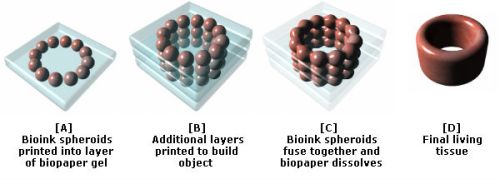
Since 2008, Organovo has worked with a company called Invetech to create a commercial bioprinter called the NovoGen MMX. This is loaded with bioink spheroids that each contain an aggregate of tens of thousands of cells. To create its output, the NovoGen first lays down a single layer of a water-based bio-paper made from collagen, gelatin or other hydrogels. Bioink spheroids are then injected into this water-based material. As illustrated below, more layers are subsequently added to build up the final object. Amazingly, Nature then takes over and the bioink spheroids slowly fuse together. As this occurs, the biopaper dissolves away or is otherwise removed, thereby leaving a final bioprinted body part or tissue.


bioprinting stages

As Organovo have demonstrated, using their bioink printing process it is not necessary to print all of the details of an organ with a bioprinter, as once the relevant cells are placed in roughly the right place Nature completes the job. This point is powerfully illustrated by the fact that the cells contained in a bioink spheroid are capable of rearranging themselves after printing. For example, experimental blood vessels have been bioprinted using bioink spheroids comprised of an aggregate mix of endothelial, smooth muscle and fibroblast cells. Once placed in position by the bioprint head, and with no technological intervention, the endothelial cells migrate to the inside of the bioprinted blood vessel, the smooth muscle cells move to the middle, and the fibroblasts migrate to the outside.

In more complex bioprinted materials, intricate capillaries and other internal structures also naturally form after printing has taken place. The process may sound almost magical. However, as Professor Forgacs explains, it is no different to the cells in an embryo knowing how to configure into complicated organs. Nature has been evolving this amazing capability for millions of years. Once in the right places, appropriate cell types somehow just know what to do.

In December 2010, Organovo create the first blood vessels to be bioprinted using cells cultured from a single person. The company has also successfully implanted bioprinted nerve grafts into rats, and anticipates human trials of bioprinted tissues by 2015. However, it also expects that the first commercial application of its bioprinters will be to produce simple human tissue structures for toxicology tests. These will enable medical researchers to test drugs on bioprinted models of the liver and other organs, thereby reducing the need for animal tests.

In time, and once human trials are complete, Organovo hopes that its bioprinters will be used to produce blood vessel grafts for use in heart bypass surgery. The intention is then to develop a wider range of tissue-on-demand and organs-on-demand technologies. To this end, researchers are now working on tiny mechanical devices that can artificially exercise and hence strengthen bioprinted muscle tissue before it is implanted into a patient.

Organovo anticipates that its first artificial human organ will be a kidney. This is because, in functional terms, kidneys are one of the more straight-forward parts of the body. The first bioprinted kidney may in fact not even need to look just like its natural counterpart or duplicate all of its features. Rather, it will simply have to be capable of cleaning waste products from the blood. You can read more about the work of Organovoand Professor Forgac’s in this article from Nature.

Regenerative Scaffolds and Bones

A further research team with the long-term goal of producing human organs-on-demand has created the Envisiontec Bioplotter. Like Organovo’s NovoGen MMX, this outputs bio-ink ’tissue spheroids’ and supportive scaffold materials including fibrin and collagen hydrogels. But in addition, the Envisontech can also print a wider range of biomaterials. These include biodegradable polymers and ceramics that may be used to support and help form artificial organs, and which may even be used as bioprinting substitutes for bone.

Talking of bone, a team lead by Jeremy Mao at the Tissue Engineering and Regenerative Medicine Lab at Columbia University is working on the application of bioprinting in dental and bone repairs. Already, a bioprinted, mesh-like 3D scaffold in the shape of an incisor has been implanted into the jaw bone of a rat. This featured tiny, interconnecting microchannels that contained ‘stem cell-recruiting substances’. In just nine weeks after implantation, these triggered the growth of fresh periodontal ligaments and newly formed alveolar bone. In time, this research may enable people to be fitted with living, bioprinted teeth, or else scaffolds that will cause the body to grow new teeth all by itself. You can read more about this development in this article from The Engineer.

In another experient, Mao’s team implanted bioprinted scaffolds in the place of the hip bones of several rabbits. Again these were infused with growth factors. As reported inThe Lancet, over a four month period the rabbits all grew new and fully-functional joints around the mesh. Some even began to walk and otherwise place weight on their new joints only a few weeks after surgery. Sometime next decade, human patients may therefore be fitted with bioprinted scaffolds that will trigger the grown of replacement hip and other bones. In a similar development, a team from Washington State University have also recently reported on four years of work using 3D printers to create a bone-like material that may in the future be used to repair injuries to human bones.

In Situ Bioprinting

The aforementioned research progress will in time permit organs to be bioprinted in a lab from a culture of a patient’s own cells. Such developments could therefore spark a medical revolution. Nevertheless, others are already trying to go further by developing techniques that will enable cells to be printed directly onto or into the human body in situ. Sometime next decade, doctors may therefore be able to scan wounds and spray on layers of cells to very rapidly heal them.

Already a team of bioprinting researchers lead by Anthony Alata at the Wake Forrest School of Medicine have developed a skin printer. In initial experiments they have taken 3D scans of test injuries inflicted on some mice and have used the data to control a bioprint head that has sprayed skin cells, a coagulant and collagen onto the wounds. The results are also very promising, with the wounds healing in just two or three weeks compared to about five or six weeks in a control group. Funding for the skin-printing project is coming in part from the US military who are keen to develop in situ bioprinting to help heal wounds on the battlefield. At present the work is still in a pre-clinical phase with Alata progressing his research usig pigs. However, trials of with human burn victims could be a little as five years away.

The potential to use bioprinters to repair our bodies in situ is pretty mind blowing. In perhaps no more than a few decades it may be possible for robotic surgical arms tipped with bioprint heads to enter the body, repair damage at the cellular level, and then also repair their point of entry on their way out. Patients would still need to rest and recuperate for a few days as bioprinted materials fully fused into mature living tissue. However, most patients could potentially recover from very major surgery in less than a week.

Cosmetic Applications …

Bioprinting Implications …

More information on bioprinting can be found in my books 3D Printing: Second Editionand The Next Big Thing. There is also a bioprinting section in my 3D Printing Directory. Oh, and there is also a great infographic about bioprinting here. Enjoy!


How to print out a blood vessel

New work moves closer to the age of organs on demand.

http://www.nature.com/news/2008/080320/images/news.2008.675.jpg

Blood vessels can now be ‘printed out’ by machine. Could bigger structures be in the future?SUSUMU NISHINAGA / SCIENCE PHOTO LIBRARY

Read Full Post »

The late Cambridge Mayor Alfred Vellucci welcomed Life Sciences Labs to Cambridge, MA – June 1976

Reporter: Aviva Lev-Ari, PhD, RN

How Cambridge became the Life Sciences Capital

Worth watching is the video below, which captures the initial Cambridge City Council hearing on recombinant DNA research from June 1976. The first speaker is the late Cambridge mayor Alfred Vellucci.

Vellucci hoped to pass a two-year moratorium on gene splicing in Cambridge. Instead, the council passed a three-month moratorium, and created a board of nine Cambridge citizens — including a nun and a nurse — to explore whether the work should be allowed, and if so, what safeguards would be necessary. A few days after the board was created, the pro and con tables showed up at the Kendall Square marketplace.

At the time, says Phillip Sharp, an MIT professor, Cambridge felt like a manufacturing town that had seen better days. He recalls being surrounded by candy, textile, and leather factories. Sharp hosted the citizens review committee at MIT, explaining what the research scientists there planned to do. “I think we built a relationship,” he says.

By early 1977, the citizens committee had proposed a framework to ensure that any DNA-related experiments were done under fairly stringent safety controls, and Cambridge became the first city in the world to regulate research using genetic material.


WATCH VIDEO

http://www.betaboston.com/news/2016/03/17/how-cambridge-became-the-life-sciences-capital/

Scott Kirsner can be reached at kirsner@pobox.com. Follow him on Twitter@ScottKirsner and on betaboston.com.

SOURCE

How Cambridge became the life sciences capital

http://www.betaboston.com/news/2016/03/17/how-cambridge-became-the-life-sciences-capital/

Read Full Post »

Cardiomyocytes from mesenchmal stem cells?

Larry H. Bernstein, MD, FCAP, Curator

LPBI

Introduction: A just published article from the Gladstone Institute establishes that cardiac muscle can be generated from inducible explandable  cardiovascular progenitor cells.  However, while the study has validity, it leaves much to be explained, especially in light of the references to many previous studies to generate cardiomycytes for heart failure.

Skin Cells Opening the Door to the Possibility of Personalized Medicine for Heart Attack Patients

iceC-Figure6

https://beyondthedish.files.wordpress.com/2016/03/iecpcs-give-rise-to-cms-ecs-and-smcs-in-vivo-and-improve-cardiac-function-after-mi.jpg?w=652


ieCPCs Give Rise to CMs, ECs, and SMCs In Vivo and Improve Cardiac Function after MI

(A–E) Immunofluorescence analyses of RFP and CM (A), EC (B and C), and SMC (D and E) markers in tissue sections collected 2 weeks after transplanting RFP-labeled ieCPCs at passage 10 into infarcted hearts of immunodeficient mice. Scale bars represent 100 μm.

(F and G) Ejection fraction and fractional shortening of the left ventricle (LV) quantified by echocardiography. Results from two independent experiments were shown. D, days; W, weeks.

(H–J) Cardiac fibrosis was evaluated at eight levels (L1–L8) by Masson’s trichrome staining 12 weeks after coronary ligation. The ligation site is marked as X. Sections of representative hearts are shown in (I) with quantification in (J). Scar tissue (%) = (the sum of fibrotic area or length at L1–L8/the sum of LV area or circumference at L1–L8) × 100. Scale bars represent 500 μm.

(K) Quantification of LV circumference of mouse hearts 12 weeks after transplantation of 2nd MEFs or ieCPCs. Data were summarized from 48 sections for each group. Data are mean ± SE. p < 0.05.

“Cardiac progenitor cells could be ideal for heart regeneration,” said senior author Sheng Ding, PhD, a senior investigator at Gladstone. “They are the closest precursor to functional heart cells, and, in a single step, they can rapidly and efficiently become heart cells, both in a dish and in a live heart. With our new technology, we can quickly create billions of these cells in a dish and then transplant them into damaged hearts to treat heart failure.”


Discussion:  The study raises some important questions.

  1. How are the cultured cells different than those used in previous studies?
  2. Cardiomyocytes and fibroblasts are both of mesodermal origin.  What determines which way the stem cell line will differentiate?
  3. What is the difference, if any, between the cell culture environment and the in vivo environment into which they are placed?
  4. There is a difference between chronic hypoxemia with congestive heart failure and acute coronary syndrome.  The experiment performed would be more apt to apply to post-ACS than to chronic heart failure.


Functional heart muscle regenerated in decellularized human hearts

March 11, 2016    http://snip.ly/txc6j#http://medicalxpress.com/news/2016-03-functional-heart-muscle-regenerated-decellularized.html

A partially recellularized human whole-heart cardiac scaffold, reseeded with human cardiomyocytes derived from induced pluripotent stem cells, being cultured in a bioreactor that delivers a nutrient solution and replicates some of the environmental conditions around a living heart. Credit: Bernhard Jank, MD, Ott Lab, Center for Regenerative Medicine, Massachusetts General Hospital


Massachusetts General Hospital (MGH) researchers have taken some initial steps toward the creation of bioengineered human hearts using donor hearts stripped of components that would generate an immune response and cardiac muscle cells generated from induced pluripotent stem cells (iPSCs), which could come from a potential recipient. The investigators described their accomplishments – which include developing an automated bioreactor system capable of supporting a whole human heart during the recellularization process—earlier this year in Circulation Research.

“Generating functional cardiac tissue involves meeting several challenges,” says Jacques Guyette, PhD, of the MGH Center for Regenerative Medicine (CRM), lead author of the report. “These include providing a structural scaffold that is able to support cardiac function, a supply of specialized cardiac , and a supportive environment in which cells can repopulate the scaffold to form mature tissue capable of handling complex cardiac functions.”

The research team is led by Harald Ott, MD, of the MGH CRM and the Department of Surgery, senior author of the paper. In 2008, Ott developed a procedure for stripping the living cells from a donor organ with a detergent solution and then repopulating the remaining extracellular matrix scaffold with organ-appropriate types of cells. Since then his team has used the approach to generate functional rat kidneys and lungs and has decellularized large-animal hearts, lungs and kidneys. This report is the first to conduct a detailed analysis of the matrix scaffold remaining after decellularization of whole human hearts, along with recellularization of the cardiac matrix in three-dimensional and whole-heart formats.

The study included 73 human hearts that had been donated through the New England Organ Bank, determined to be unsuitable for transplantation and recovered under research consent. Using a scaled-up version of the process originally developed in rat hearts, the team decellularized hearts from both brain-dead donors and from those who had undergone . Detailed characterization of the remaining cardiac scaffolds confirmed a high retention of matrix proteins and structure free of cardiac cells, the preservation of coronary vascular and microvascular structures, as well as freedom from human leukocyte antigens that could induce rejection. There was little difference between the reactions of organs from the two donor groups to the complex decellularization process.

Instead of using genetic manipulation to generate iPSCs from , the team used a newer method to reprogram skin cells with messenger RNA factors, which should be both more efficient and less likely to run into regulatory hurdles. They then induced the  to differentiate into or cardiomyocytes, documenting patterns of gene expression that reflected developmental milestones and generating cells in sufficient quantity for possible clinical application. Cardiomyocytes were then reseeded into three-dimensional matrix tissue, first into thin matrix slices and then into 15 mm fibers, which developed into spontaneously contracting tissue after several days in culture.

The last step reflected the first regeneration of human heart muscle from within a cell-free, human whole-heart matrix. The team delivered about 500 million iPSC-derived cardiomyocytes into the left ventricular wall of decellularized hearts. The organs were mounted for 14 days in an automated bioreactor system developed by the MGH team that both perfused the organ with nutrient solution and applied environmental stressors such as ventricular pressure to reproduce conditions within a living heart. Analysis of the regenerated tissue found dense regions of iPSC-derived cells that had the appearance of immature cardiac muscle tissue and demonstrated functional contraction in response to electrical stimulation.

“Regenerating a whole heart is most certainly a long-term goal that is several years away, so we are currently working on engineering a functional myocardial patch that could replace cardiac tissue damaged due a heart attack or heart failure,” says Guyette. “Among the next steps that we are pursuing are improving methods to generate even more – recellularizing a whole heart would take tens of billions—optimizing bioreactor-based culture techniques to improve the maturation and function of engineered cardiac tissue, and electronically integrating regenerated tissue to function within the recipient’s heart.”

Team leader Ott, an assistant professor of Surgery at Harvard Medical School, adds, “Generating personalized functional myocardium from patient-derived cells is an important step towards novel device-engineering strategies and will potentially enable patient-specific disease modeling and therapeutic discovery. Our team is excited to further develop both of these strategies in future projects.”

Explore further: A tool for isolating progenitor cells from human heart tissue could lead to heart repair

More information: Jacques P. Guyette et al. Bioengineering Human Myocardium on Native Extracellular MatrixNovelty and Significance, Circulation Research (2016). DOI: 10.1161/CIRCRESAHA.115.306874


Stem cell study in mice offers hope for treating heart attack patients

February 15, 2012  http://medicalxpress.com/news/2012-02-stem-cell-mice-heart-patients.html


Stem cell study in mice offers hope for treating heart attack patients

Cardiac stem cells, pictured here, give hope to patients who have suffered a heart attack. Credit: UCSF

A UCSF stem cell study conducted in mice suggests a novel strategy for treating damaged cardiac tissue in patients following a heart attack. The approach potentially could improve cardiac function, minimize scar size, lead to the development of new blood vessels – and avoid the risk of tissue rejection.

In the investigation, reported online in the journal PLoS ONE, the researchers isolated and characterized a novel type of cardiac stem cell from the tissue of middle-aged mice following a .

Then, in one experiment, they placed the in the culture dish and showed they had the ability to differentiate into cardiomyocytes, or “beating heart cells,” as well as endothelial cells and smooth muscle cells, all of which make up the heart.

In another, they made copies, or “clones,” of the cells and engrafted them in the tissue of other of the same genetic background who also had experienced heart attacks. The cells induced angiogenesis, or blood vessel growth, or differentiated, or specialized, into endothelial and smooth muscle cells, improving .

“These findings are very exciting,” said first author Jianqin Ye, PhD, MD, senior scientist at UCSF’s Translational Cardiac Stem Cell Program. First, “we showed that we can isolate these cells from the heart of middle-aged animals, even after a heart attack.” Second, he said, “we determined that we can return these cells to the animals to induce repair.”

Importantly, the stem cells were identified and isolated in all four chambers of the heart, potentially making it possible to isolate them from patients’ hearts by doing right ventricular biopsies, said Ye. This procedure is “the safest way of obtaining cells from the heart of live patients, and is relatively easy to perform,” he said.

“The finding extends the current knowledge in the field of native cardiac progenitor cell therapy,” said senior author Yerem Yeghiazarians, MD, director of UCSF’s Translational Cardiac Stem Cell Program and an associate professor at the UCSF Division of Cardiology. “Most of the previous research has focused on a different subset of cardiac progenitor cells. These novel cardiac precursor cells appear to have great therapeutic potential.”

The hope, he said, is that patients who have severe heart failure after a heart attack or have cardiomyopathy would be able to be treated with their own cardiac stem cells to improve the overall health and function of the heart. Because the cells would have come from the patients, themselves, there would be no concern of cell rejection after therapy.

The cells, known as Sca-1+ stem enriched in Islet (Isl-1) expressing cardiac precursors, play a major role in cardiac development. Until now, most of the research has focused on a different subset of cardiac progenitor, or early stage, cells known as, c-kit cells.

The Sca-1+ cells, like the c-kit cells, are located within a larger clump of cells called cardiospheres.

The UCSF researchers used special culture techniques and isolated Sca-1+ cells enriched in the Isl-1expressing cells, which are believed to be instrumental in the heart’s development. Since Isl-1 is expressed in the cell nucleus, it has been difficult to isolate them but the new technique enriches for this cell population.

The findings suggest a potential treatment strategy, said Yeghiazarians. “Heart disease, including heart attack and heart failure, is the number one killer in advanced countries. It would be a huge advance if we could decrease repeat hospitalizations, improve the quality of life and increase survival.” More studies are being planned to address these issues in the future.

An estimated 785,000 Americans will have a new heart attack this year, and 470,000 who will have a recurrent attack. Heart disease remains the number one killer in the United States, accounting for one out of every three deaths, according to the American Heart Association.

Medical costs of cardiovascular disease are projected to triple from $272.5 billion to $818.1 billion between now and 2030, according to a report published in the journal Circulation.


Sca-1+ Cardiosphere-Derived Cells Are Enriched for Isl1-Expressing Cardiac Precursors and Improve Cardiac Function after Myocardial Injury

Jianqin Ye , Andrew Boyle , Henry Shih , Richard E. Sievers , Yan Zhang , William Grossman , Harold S. Bernstein , Yerem Yeghiazarians
http://dx.doi.org:/10.1371/journal.pone.0030329

Background

Endogenous cardiac progenitor cells are a promising option for cell-therapy for myocardial infarction (MI). However, obtaining adequate numbers of cardiac progenitors after MI remains a challenge. Cardiospheres (CSs) have been proposed to have cardiac regenerative properties; however, their cellular composition and how they may be influenced by the tissue milieu remains unclear.

Methodology/Principal Finding

Using “middle aged” mice as CSs donors, we found that acute MI induced a dramatic increase in the number of CSs in a mouse model of MI, and this increase was attenuated back to baseline over time. We also observed that CSs from post-MI hearts engrafted in ischemic myocardium induced angiogenesis and restored cardiac function. To determine the role of Sca-1+CD45 cells within CSs, we cloned these from single cell isolates. Expression of Islet-1 (Isl1) in Sca-1+CD45 cells from CSs was 3-fold higher than in whole CSs. Cloned Sca-1+CD45 cells had the ability to differentiate into cardiomyocytes, endothelial cells and smooth muscle cells in vitro. We also observed that cloned cells engrafted in ischemic myocardium induced angiogenesis, differentiated into endothelial and smooth muscle cells and improved cardiac function in post-MI hearts.

Conclusions/Significance  

These studies demonstrate that cloned Sca-1+CD45 cells derived from CSs from infarcted “middle aged” hearts are enriched for second heart field (i.e., Isl-1+) precursors that give rise to both myocardial and vascular tissues, and may be an appropriate source of progenitor cells for autologous cell-therapy post-MI.


Incorporation of Mg particles into PDLLA regulates mesenchymal stem cell and macrophage responses

Sandra C. Cifuentes1, Fátima Bensiamar2,3, Amparo M. Gallardo-Moreno3,4, Tim A. Osswald5, José L. González-Carrasco1,3, et al.
J Biomed Materials Res Part A  104(4), pages 866–878, April 2016                    http://dx.doi.org:/10.1002/jbm.a.35625

In this work, we investigated a new approach to incorporate Mg particles within a PDLLA matrix using a solvent-free commercially available process. PDLLA/Mg composites were manufactured by injection moulding and the effects of Mg incorporated into PDLLA on MSC and macrophage responses were evaluated. Small amounts of Mg particles (≤1 wt %) do not cause thermal degradation of PDLLA, which retains its mechanical properties. PDLLA/Mg composites release hydrogen, alkaline products and Mg2+ ions without changing pH of culture media. Mg-containing materials provide a noncytotoxic environment that enhances MSC viability. Concentration of Mg2+ ions in extracts of MSCs increases with the increment of Mg content in the composites. Incorporation of Mg particles into PDLLA stimulates FN production, ALP activity, and VEGF secretion in MSCs, an effect mediated by degradation products dissolved from the composites. Degradation products of PDLLA induce an increase in MCP-1, RANTES, and MIP-1α secretion in macrophages while products of composites have minimal effect on these chemokines. Regulation of MSC behavior at the biomaterial’s interface and macrophage-mediated inflammatory response to the degradation products is related to the incorporation of Mg in the composites. These findings suggest that including small amounts of Mg particles into polymeric devices can be a valuable strategy to promote osseointegration and reduce host inflammatory response. © 2015 Wiley Periodicals, Inc. J Biomed Mater Res Part A: 104A: 866–878, 2016.

Read Full Post »

Cells from Cow Knee Joints Used to Grow New Cartilage Tissue

Reported by: Irina Robu, PhD

Researchers at Umea University in Sweden used cartillage cell from cow knee joints in an effort to help lead to a new treatment cure for osteoarthritis using stem cell-based tissue engineering. Osteoarthritis can mean the loss of the entire cartilage tissue in the joint. While the condition causes pain and immobility for the individual, it also loads society with extra medical costs.

In their experiments, the researchers at Umeå University developed new methods to produce cartilage-like “neotissues” in a laboratory enviroment. In the engineering process, the cells, the signaling molecules and the scaffold, i.e. artificial support material, are combined to regenerate tissue at the damaged site in the joint.

Using primary bovine chondrocytes, i.e. cartilage cells from cows, the researchers improved methods to grow cartilage tissue in a laboratory environment, producing tissue similar to tissue normally present in the human joints. In the future, these results may help the development of neocartilage production for actual cartilage repair.

Source

http://www.mdtmag.com/news/2016/01/cells-cow-knee-joints-used-grow-new-cartilage-tissue

Read Full Post »

Platform Technologies for Directly Reconstructing 3D Living Biomaterials

Reporter: Irina Robu, PhD

The techniques of electrospraying and electrospinning have existed for at least a century. These techniques employs a high voltage applied to a needle accommodating the flow of media, placed above a counter electrode which could either be grounded or have an opposite charge to the needle—thus introducing the charged media to an electric field.

These endeavors have demonstrated the wider applicability of these technologies and hence in the last 20 years or so have been used for the direct handling of a wide range of materials, including bio-inspired materials. These investigations have generated interest in areas such as the development of fine monolayered surfaces, fabrication of scaffolds which could be used for many laboratory-based fundamental biological studies.

In 2005, Jayasinghe et al. began investigations into both electrospraying and electrospinning of immortalized cell lines. Even though the high voltages involved, these cells were  found to be viable post-electrospraying/electrospinning. Additional work has extended these studies to different cell types, both murine and human, immortalized or primary, stem cells, and even whole fertilized embryos from model organisms. Established protocols (such as flow cytometry, genetic/genomic interrogation, and microarray analysis) proved that cells processed using either electrospraying or electrospinning were indistinguishable from controls. Hence bio-electrospraying (BES) and cell electrospinning (CE) have become platform technologies for the biological and life science and are the leading technologies for the direct handling of cells—both for distribution of cells with pinpoint precision as cell-bearing droplets, and for the formation of truly 3D living scaffolds.

Previous studies have been carried out with processed cells suspended in matrices generated from animal/tumor-derived materials which contain largely uncharacterized growth factors and bioactive signals. This makes them very undesirable for clinical assays. While not applicable to humans, they can be used  with advanced biopolymers, which could be directly translated to humans, and have the potential for creating artificial constructs which could be used for a variety of applications in the regenerative medicine field. The present study describes the in vivo application of such biopolymers, using murine macrophages to interrogate biocompatibility and cellular behavior post-transfer.

Source

http://onlinelibrary.wiley.com/doi/10.1002/adma.201503001/full

Read Full Post »

New treatment for AMI

Larry H. Bernstein, MD, FCAP, Curator

LPBI


Combining Umbilical Cord Cells with Hyaluronic Acid Improves Heart Repair After a Heart Attack


Enabling Technologies for Cell-Based Clinical Translation:Injection of Human Cord Blood Cells With Hyaluronan Improves Postinfarction Cardiac Repair in Pigs

Ming-Yao ChangTzu-Ting HuangChien-Hsi ChenBill ChengShiaw-Min HwangPatrick C.H. Hsieh

Stem Cells Trans Med first published on November 16, 2015;doi:10.5966/sctm.2015-0092  

Injection of Human Cord Blood Cells With Hyaluronan Improves Postinfarction Cardiac Repair in Pigs

 Although safe, recent clinical trials using autologous bone marrow or peripheral blood cells to treat myocardial infarction (MI) show controversial results. These discrepancies are likely caused by factors such as aging, systemic inflammation, and cell processing procedures, all of which might impair the regenerative capability of the cells used. Here, we tested whether injection of human cord blood mononuclear cells (CB-MNCs) combined with hyaluronan (HA) hydrogel improves cell therapy efficacy in a pig MI model. A total of 34 minipigs were divided into 5 groups: sham operation (Sham), surgically induced-MI plus injection with normal saline (MI+NS), HA only (MI+HA), CB-MNC only (MI+CB-MNC), or CB-MNC combined with HA (MI+CB-MNC/HA). Two months after the surgery, injection of MI+CB-MNC/HA showed the highest left ventricle ejection fraction (51.32% ± 0.81%) compared with MI+NS (42.87% ± 0.97%, p < .001), MI+HA (44.2% ± 0.63%, p < .001), and MI+CB-MNC (46.17% ± 0.39%, p < .001) groups. The hemodynamics data showed that MI+CB-MNC/HA improved the systolic function (+dp/dt) and diastolic function (−dp/dt) as opposed to the other experimental groups, of which the CB-MNC alone group only modestly improved the systolic function (+dp/dt). In addition, CB-MNC alone or combined with HA injection significantly decreased the scar area and promoted angiogenesis in the infarcted region. Together, these results indicate that combined CB-MNC and HA treatment improves heart performance and may be a promising treatment for ischemic heart diseases.

Significance

This study using healthy human cord blood mononuclear cells (CB-MNCs) to treat myocardial infarction provides preclinical evidence that combined injection of hyaluronan and human CB-MNCs after myocardial infarction significantly increases cell retention in the peri-infarct area, improves cardiac performance, and prevents cardiac remodeling. Moreover, using healthy cells to replace dysfunctional autologous cells may constitute a better strategy to achieve heart repair and regeneration.


Read Full Post »

Stem Cells and Cancer

Larry H. Bernstein, MD, FCAP, Curator

Leaders in Pharmaceutical Intelligence

Series E. 2; 8.09

Cancer cells programmed back to normal by US scientists

By Sarah Knapton, Science Editor

Scientists have turned cancerous cells back to normal by switching back on the process which stops normal cells from replicating too quickly. Cancer cells could be stopped from replicating after scientists found how to switch on the brakes.

http://www.telegraph.co.uk/news/science/science-news/11821334/Cancer-cells-programmed-back-to-normal-by-US-scientists.html

Cancer cells have been programmed back to normal by scientists in a breakthrough which could lead to new treatments and even reverse tumour growth.

For the first time aggressive breast, lung and bladder cancer cells have been turned back into harmless benign cells by restoring the function which prevents them from multiplying excessively and forming dangerous growths.

Scientists at the Mayo Clinic in Florida, US, said it was like applying the brakes to a speeding car.

So far it has only been tested on human cells in the lab, but the researchers are hopeful that the technique could one day be used to target tumours so that cancer could be ‘switched off’ without the need for harsh chemotherapy or surgery.

“We should be able to re-establish the brakes and restore normal cell function,” said Profesor Panos Anastasiadis, of the Department for Cancer Biology.

“Initial experiments in some aggressive types of cancer are indeed very promising.

“It represents an unexpected new biology that provides the code, the software for turning off cancer.”

Cells need to divide constantly to replace themselves. But in cancer the cells do not stop dividing leading to huge cell reproduction and tumour growth.

The scientists discovered that the glue which holds cells together is regulated by biological microprocessors called microRNAs. When everything is working normally the microRNAs instruct the cells to stop dividing when they have replicated sufficiently. They do this by triggering production of a protein called PLEKHA7 which breaks the cell bonds. But in cancer that process does not work.

Scientists discovered they could switch on cancer in cells by removing the microRNAs from cells and preventing them from producing the protein.

And, crucially they found that they could reverse the process switching the brakes back on and stopping cancer. MicroRNAs are small molecules which can be delivered directly to cells or tumours so an injection to increase levels could switch off disease.

“We have now done this in very aggressive human cell lines from breast and bladder cancer,” added Dr Anastasiadis.

“These cells are already missing PLEKHA7. Restoring either PLEKHA7 levels, or the levels of microRNAs in these cells turns them back to a benign state. We are now working on better delivery options.”

Cancer experts in Britain said the research solved a riddle that biologists had puzzled over for decades, why cells did not naturally prevent the proliferation of cancer.

“This is an unexpected finding,” said Dr Chris Bakal, a specialist in how cells change shape to become cancerous, at the Institute for Cancer Research in London.

“We have been trying to work out how normal cells might be suppressing cancer, and stopping dividing when they form contacts with each other, which has been a big mystery.

“Normal cells touch each other and form junctions then they shut down proliferation. If there is a way to turn that back on then that would be a way to stop tumours from growing.

“I think in reality it is unlikely that you could reverse tumours by reversing just one mechanism, but it’s a very interesting finding.”

Henry Scowcroft, Cancer Research UK’s senior science information manager, said: “This important study solves a long-standing biological mystery, but we mustn’t get ahead of ourselves.

“There’s a long way to go before we know whether these findings, in cells grown in a laboratory, will help treat people with cancer. But it’s a significant step forward in understanding how certain cells in our body know when to grow, and when to stop. Understanding these key concepts is crucial to help continue the encouraging progress against cancer we’ve seen in recent years.”

The research was published in the journal Nature Cell Biology.

Biomaterial Sponge-Like Impant Traps Spreading Cancer Cells

September 9, 2015 by mburatov http://wp.me/ptV19-1vG

Prof Lonnie Shea, from the Department of Biomedical Engineering at the University of Michigan and his team have designed a small sponge-like implant that has the ability to mop up cancer cells as they move through the body. This device has been tested in mice, but there is hope that the device could act as an early warning system in patients, alerting doctors to cancer spread. The sponge-like implant also seemed to stop rogue cancer cells from reaching other areas where they could establish the growth of new tumors. Shea and others published their findings in the journal Nature Communications.

According to Cancer Research UK, nine in 10 cancer deaths are caused by the disease-spreading to other areas of the body. Stopping the spread of cancer cells, or metastasis, is one of the ways to prevent cancers from becoming worse. Complicating this venture is the fact that cancer cells that circulate in the bloodstream are rare and difficult to detect.

Shea’s device is about 5mm or 0.2 inches in diameter and made of a “biomaterial” already approved for use in medical devices. So far, this implant has so far been tested in mice with breast cancer. Implantation experiments showed that it can be placed either in the abdominal fat or under the skin and that it tended to suck up cancer cells that had started to circulate in the body.

The implant mimicked a process known as chemoattraction in which cells that have broken free from a tumor are attracted to other areas in the body by immune cells. Shea and others found that these immune cells are drawn to the implant where they “set up shop.” This is actually a natural reaction to any foreign body, and the presence of the immune cells also attracts the cancer cells to the implant.

Initially, Shea and others labeled cancer cells with fluorescent proteins that caused them to glow under certain lights, which allowed them to be easily spotted. However, they eventually went on to use a special imaging technique that can distinguish between cancerous and normal cells. They discovered that they could definitively detect cancer cells that had been caught within the implant.

Unexpectedly, when they measured cancer cells that had spread in mice with and without the implant, they showed that the implant not only captured circulating cancer cells, but it also reduced the numbers of cancer cells present at other sites in the body.

Shea, said that he and his team were planning the first clinical trials in humans fairly soon: “We need to see if metastatic cells will show up in the implant in humans like they did in the mice, and if it’s a safe procedure and that we can use the same imaging to detect cancer cells.”

Shea and his coworkers are continuing their work in animals to determine what the outcomes if the spread of the cancer spread was detected at a very early stage, which is something that is presently not yet fully understood.

Lucy Holmes, Cancer Research UK’s science information manager, said: “We urgently need new ways to stop cancer in its tracks. So far this implant approach has only been tested in mice, but it’s encouraging to see these results, which could one day play a role in stopping cancer spread in patients.”


U of Penn Group Releases Hopeful Results of CAR T-Cells Trial

Sept 8, 2015 by mburatov

https://beyondthedish.wordpress.com/2015/09/08/u-of-penn-group-releases-hopeful-results-of-car-t-cells-trial/

Chimeric Antigen Receptor T-Cells (CART-cells) are a type of genetically engineered type of immune cell that represents one of the most promising avenues of cancer therapy. Such treatments can induce sustained remissions in patients with stubborn disease.

Studies with CART-cells have been tested in patients with relapsed and stubborn chronic lymphocytic leukemia (CLL). Now a new publication by Porter and others reports the results of a clinical trial that examined CART-cells as a treatment for blood-based cancers. This study reports that infused CART-cells were functional up to 4 years after treatment. Patients also achieved completely remission, and no patient who achieved complete remission relapsed, and no minimal residual disease was detected, suggesting that in a subset of patients, CAR T cells may drive disease eradication.

Patients enrolled in this study suffered from CLL and had a poor prognosis. The CART-cells employed in this study targeted the molecule CD19. Porter and others report the mature results of the treatment of 14 patients with relapsed and refractory CLL.

The patient’s own T-Cells were extracted from circulating blood, and genetically engineered to express a CD19-directed receptor. Patients received doses of 0.14 × 10[8] to 11 × 10[8] CTL019 cells. Patients were monitored for toxicity, response, expansion, and persistence of circulating CTL019 T cells.

The overall response rate in these heavily pretreated CLL patients was 8 of 14 (57%), and there were 4 complete remissions (CR) and 4 partial remissions (PR). The expansion of the CAR T-cells in culture correlated with clinical responses; the better the engineered T-cells grew in culture the better they performed in the Patient’s bodies. Furthermore, the CAR T-cells persisted and remained functional beyond 4 years in the first two patients achieving Complete Remission. None of the patients who experienced Complete Remission have relapsed.

All the patients who responded to the treatment developed “B cell aplastic” (abnormally low B-cell levels) and experienced cytokine release syndrome, which was part and partial of T cell proliferation.

Minimal residual disease was not detectable in patients who achieved Complete Remission, suggesting that disease eradication may be possible in some patients with advanced CLL.


New Method to Regulate Stem Cell Differentiation

GEN News Highlights Sep 2, 2015
http://www.genengnews.com/gen-news-highlights/new-method-developed-to-regulate-stem-cell-differentiation/81251707/

Researchers have developed a method that enables the regulation of a single gene’s behavior without changing the genome itself. [Professor Otonkoski Lab, University of Helsinki]

http://www.genengnews.com/Media/images/GENHighlight/thumb_Sep0915_UnivHelsinki_StemCellDifferentiationGraph3620321462.jpg

Scientists at the University of Helsinki in Finland say they have developed a new method that enables the activation of genes in a cell without changing the genome. Applications of the method include directing the differentiation of stem cells.

The method was developed by researchers Diego Balboa and Jere Weltner, who are working on their doctoral dissertations in the lab of  Timo Otonkoski, Ph.D., at the Meilahti medical campus of the University of Helsinki. The research study (“Conditionally Stabilized dCas9 Activator for Controlling Gene Expression in Human Cell Reprogramming and Differentiation”) was published in Stem Cell Reports.

The hottest topics in stem cell research at the moment are methods that can regulate the differentiation of cells. The differentiation process is based on how genes in a cell are activated and deactivated, so researchers are looking for ways to control the activation of the genes. The researchers dream of being able to activate and deactivate genes precisely at specific moments.

“We can produce undifferentiated stem cells from specialized cells, also known as iPS, or induced pluripotent stem cells, and we can regulate the differentiation of these cells by providing them with the right kinds of growth environments. However, we cannot control the differentiation process sufficiently. The process may go smoothly, but then at the very end, a single gene won’t activate at the necessary time, and the cell remains immature,” Dr. Otonkoski explains.

Researchers in Dr. Otonkoski’s laboratory have now developed a method that enables the regulation of a single gene’s behavior without changing the genome itself. The method employs CRISPR technology, but the regulation itself is controlled by the addition of chemicals. The desired gene is made receptive to the drug by introducing bits of RNA into the cell that will bind to the activator protein and the gene’s regulatory area. The gene will then activate in the desired way when the chemicals that regulates the activator protein are provided to the cell.

“In our research, we used two common antibiotics, doxycycline and trimethoprim, and these chemicals enabled us to regulate the expression of many genes precisely and effectively. The method worked on all cells we tested, including stem cells. We used human cells in our development,” continued Dr. Otonkoski, who emphasized that the method is currently being used in experimental models. It is far too early to discuss therapeutic applications.

“The basic idea has now been developed, and the method has been demonstrated to be viable, and I believe that it can become a very important research tool. In my laboratory we use the method to regulate the differentiation of stem cells, but it has many potential applications in other research fields, for example, in cancer biology.”


Single Cell Analysis (SCA): Expanding in Importance in Life Science Research — circa 2015

Technologies Impacting SCA and Driving Translation Towards Single Cell-based Diagnostics

GEN Sep 2, 2015  http://www.genengnews.com/insight-and-intelligence/single-cell-analysis-sca-expanding-in-importance-in-life-science-research-circa-2015/77900516/

The focus of this GEN Market & Tech Analysis report is Single Cell Analysis (SCA) Trends.

  • Select Biosciences performed a study of the en bloc Single Cell Analysis (SCA) space in August 2015 to reveal trends in this evolving field—the results from these analyses are presented in this GENReport
  • The field is evolving as it is permeating into life sciences research as well as diagnostics development — this represents the translation of SCA and is evidenced for instance by the increasing penetrance of circulating tumor cell (CTC) research in the SCA space
  • The field of SCA is intersecting with nucleic acid and protein characterizing approaches/technologies which suggests that the “cargo” of single cells is a current area of study
  • The utilization of microfluidics approaches in SCA is a key and growing theme and suggests that the use of microfluidics for single cell capture and interrogation is gaining momentum

Shedding Light On Century-Old Biochemical Mystery

Aug 20, 2015  http://www.technologynetworks.com/Metabolomics/news.aspx?ID=182141

Yale scientists have used magnetic resonance measurements to show how glucose is metabolized in yeast to answer the puzzle of the “Warburg Effect.”

Given plenty of glucose and oxygen, yeast and cancer cells do not burn it all to produce energy but convert much of it to the byproducts ethanol and lactate, respectively.

In the 1920s Nobel laureate Otto Heinrich Warburg asked why these cells were so wasteful of energy. He suggested that this seemingly inefficient cellular use of resources was a root cause of cancer, a hypothesis that has been the subject of research ever since.

Almost a century later, two Yale scientists have used magnetic resonance measurements showing how glucose is metabolized in yeast to answer the puzzle of the “Warburg Effect.” The production of these byproducts is a result of the cell’s need to keep its internal state constant during glucose consumption, they report.

This biochemical response is an example of homeostasis, a fundamental need of all life forms.

“It’s the cell’s way of saying it has enough to eat,” said Robert Shulman, professor emeritus of molecular biophysics and biochemistry.

In the 1980s, Shulman conducted pioneering studies of metabolism in yeast using magnetic resonance spectroscopy, a method then confined to the study of cells but now used routinely in patients.

More recently, Shulman and co-author Douglas Rothman, professor of diagnostic radiology and of biomedical engineering, reviewed the data applying new methods of analyzing metabolic control. They found key intermediate molecular steps involved in the conversion of glucose to ethanol as well as to ATP, the chief energy source of cells. When these molecular switches that maintained homeostasis were disabled by mutations, the cells died from accumulated excesses of both byproducts and ATP.

This chemical balancing act explains why yeast and likely cancer cells do not convert all available fuel to energy that they could use to divide and flourish.

“Cancer cells have to survive first,” Rothman said.

Shulman and Rothman point out that their results open a new direction for cancer researchers — identifying metabolic homeostasis mechanisms and targeting them for treatment.

“By taking another look at the in vivo data available from magnetic resonance experiments, I think we can revitalize research efforts in a host of areas,” Shulman said.

Orchestrating Organoids

A guide to crafting tissues in a dish that reprise in vivo organs

By Kelly Rae Chi | Sep 1, 2015 http://www.the-scientist.com//?articles.view/articleNo/43842/title/Orchestrating-Organoids/

In 2009, at the Hubrecht Institute in Utrecht, Netherlands, Hans Clevers and postdoc Toshiro Sato took adult stem cells from the mouse intestine and created the first mini-guts they called organoids—three-dimensional organized clusters of cells that would allow the researchers to glean new insights into the biology of gut health and disease, including colorectal cancer.

This method inspired many other scientists, working with both mouse and human tissues, to create a rapidly expanding palette of organoids that now includes kidney, brain, liver, prostate, and pancreas. These cultured clumps are tiny enough to be sustained without a blood supply, but large and diverse enough in their cell compositions to tell us something about tissue development and whole-organ physiology.

A typical organoid protocol starts with isolated embryonic or pluripotent stem cells. Scientists culture the cells in a proteinaceous matrix (such as Matrigel) that supports three-dimensional growth. After a set period of time the organoids grow mature enough for study, or for engrafting into a mouse to allow them to further develop. Researchers then harvest the organoids and slice them for immunohistochemistry, funnel them through a flow cytometer to study their cell surface markers, or blend them for PCR.

Of course, the devil’s in the details. Although the field of organoid research is maturing rapidly (see “2013’s Big Advances in Science,” The Scientist, December 24, 2013), with some organoids already moving into clinical studies to test drug efficacy, culture methods are still in their infancy, says Michael Shen, professor of medicine and of genetics and development at Columbia University in New York City. “Certainly there are different ways to pursue organoid culture, and some of these are just beginning to be explored. I don’t think we’re at the point yet where this is all entirely cookbook.”

The Scientist talked with researchers about how they’re producing organoids, and what beginners should know. Here’s what we learned.

BRAIN BEADS
Researcher: Madeline Lancaster, group leader, MRC Laboratory of Molecular Biology, Cambridge, U.K.

Project: Understanding early brain development and disease using organoids cultured from human stem cells

Background: In 2013, as a postdoctoral researcher in the lab of Jürgen Knoblich at the Institute of Molecular Biotechnology in Vienna, Austria, Lancaster developed organoids from neural stem cells that she had been studying in 2-D culture conditions. She used the method to coax human induced pluripotent stem cells into brain organoids in order to understand the biology of microcephaly, a disorder that is difficult to re-create in animal models (Nature, 501:373-79, 2013).

Researchers have adopted Lancaster’s methods to create models of embryonic brain development, analogous to what happens in the first trimester of pregnancy, and to probe the molecular mechanisms of brain disorders, including autism, schizophrenia, and neurodegenerative diseases such as Parkinson’s and Alzheimer’s.

Getting started: The group’s protocol addresses some of the common questions asked by new users and provides photos showing the appearance of healthy organoids (Nat Protoc, 9:2329-40, 2014).

For those well versed in cell and tissue culture, the time and financial investment required to delve into organoids is minimal, Lancaster says. You need two main things: Matrigel (the supportive structure that allows the organoids to develop into more complex tissue) and equipment that will allow you to agitate the organoids to enhance nutrient and oxygen exchange in the media, making bigger organoids possible. If you don’t have a spinning bioreactor, you can use an orbital shaker set inside a standard tissue culture incubator.

Considerations: You should closely characterize the first few batches using RT-PCR or immunofluorescence to check for the expression of certain genes that indicate the organoids are indeed brain cells, Lancaster says.

Researchers studying neurodegeneration might consider examining their organoids starting at about four months. Although the organoids survive for up to 15 months, by that time they don’t look healthy. They start to decline at around six or seven months, as the neurons begin to disappear and are replaced by glia.

Tip: It takes some time and practice to develop an eye for healthy organoids. A good way to learn is to take pictures of your organoids as they develop. “You can always look back and say, ‘Oh, at that point I think it started going bad,’” Lancaster says.

Cost: Roughly $150 per organoid (not including equipment), according to Lancaster’s calculations

Looking ahead: Lancaster has already tweaked the method to improve the reproducibility, using a combination of timing and media formulations, and some new additives. She expects to publish a revised protocol by the end of the year.

GUTSY GLOBS
INTIMATING INTESTINE: Mini-gut methods are the most established of organoid protocols. Proliferating epithelial cells in small intestinal aggregations from mouse (green, left) and human (pink, right) will pave the way for patient-specific organoids.COURTESY OF HELMRATH LABResearcher: Maxime Mahé, postdoctoral research fellow inMichael Helmrath’s lab at Cincinnati Children’s Hospital Medical Center, Ohio

Project: Understanding gastrointestinal development and homeostasis and generating patient-specific organoids for study

Background: The intestinal epithelial layer is made up of tiny, slender projections, called villi, resembling the strands of a shag carpet. The nooks formed at the bases of the villi, known as crypts, are home to intestinal stem cells responsible for constant renewal of the intestinal lining. Building on Sato’s protocol, Mahé added two new twists: he used manual dissection to extract the crypts, rather than shaking the tissue to dissociate the cells; and he added a small-molecule activator of the Wnt3A pathway to boost expansion of the cells (Curr Protoc Mouse Biol, 3:217-40, 2013).

Helmrath’s group grew such “enteroids” from intestinal stem cells isolated from the crypts of surgically removed human intestine. In principle, such organoids could be developed from the tissue of specific patients for diagnostic and clinical uses. A video protocol is available in the Journal of  Visualized Experiments (doi: 10.3791/52483, 2015).

Getting started: It takes five or six attempts to get comfortable with the procedure, especially mastering the hardest part: the initial dissection. “The tissue is not always the same; it’s not something you can standardize,” Mahé says. “Sometimes you get a high number of crypts, sometimes you have a few.”

Tip: Many questions about cell proliferation, migration, and differentiation can be answered using in vitro organoids, Mahé says. “You save time, you save money, you save animals as well.” After that, you might consider moving into an animal model, depending on your goals: for example, to see muscle development, you should work in vivo, Mahé adds.

Looking ahead: The group is still working to be able to efficiently engraft human adult intestinal stem cell–derived organoids into mice. Although their first attempts were unsuccessful, they have since generated organoids for research from human embryonic stem cells (ESCs) and human induced pluripotent stem cells (iPSCs) derived by reprogramming fibroblasts. When organoids created from the either type of pluripotent stem cells are engrafted into immunodeficient mice to allow the cells to mature further, they develop into a human intestine (Nat Med, 20:1310-14, 2014), which may eventually lead to bioengineering a custom human intestine.

Cost: The Helmrath group spends roughly $150/sample in reagents to culture their organoids for a month. The medical center’s Pluripotent Stem Cell Facility provides training for a fee, and sells human intestinal organoids for roughly $400/plate (which contains 20–30 organoids).

B-CELL BALLS
PROSTRATE PROGRESS: Researchers have grown prostate organoids that consist of basal cells (green/blue) and luminal cells (red/blue).MAHO SHIBATAResearcher: Ankur Singh, assistant professor of mechanical and aerospace engineering, Cornell University

Project: In vitro modeling of immune reactions in mice

Background: When naive B cells in the body are exposed to antigens, they form clumps of cells called germinal centers in a lymph node or the spleen, where they proliferate, mutate to generate high-affinity antibodies, and undergo clonal expansion. Until now, this process has been difficult to recapitulate in vitro. Adding the necessary (stromal) support cells to primary naive B cells and culturing them in 2-D does not enable them to differentiate into cells resembling those from germinal centers, Singh says. Unlike stem cells, naive B cells do not tend to grow in clusters, so they need a little extra help.

Rather than using the conventional Matrigel for 3-D culture, Singh and his collaborators developed a gelatin and silicate-nanoparticle mix that mimics the softness of the body’s lymphoid organs. Within four to six days, the B cells in these organoids mature—100 times faster than B cells in 2-D culture—and produce two classes of antibodies important for fighting infections. The scientists use collagenase to dissolve the gel and harvest the organoid’s cells for analysis using flow cytometry. These new germinal center organoids were described this year in Biomaterials (63:24-34).

Getting started: Making the gelatin-nanoparticle mix is as easy as making Jell-O at home, Singh says, and the ingredients are commercially available. You’ll need experience with animal dissection (the necessary starting point is isolation of naive B cells from the spleen) and with cell culture. Once these techniques have been mastered, it takes roughly one week to get your first batch of organoids with mature antibody-producing cells.

Considerations: Singh’s group has already determined an optimal gelatin-nanoparticle ratio (2% gelatin/1.5% nanoparticle), but if you you’re using genetically mutated B cells, you may need to tweak the ratios. “It can be easily tuned,” Singh says.

Tip: After four days of incubating the cells with gel, you will see dark spots—a sign that the cells are proliferating and that you’re on the right track.

Cost: Not including the cost of generating immortalized stromal cell lines, it costs roughly $1 to produce one germinal center.

Looking ahead: Eventually, Singh’s group hopes to adapt the technique for use with patient-specific stem cells, though it has proven challenging to produce immune cells from stem cells. “It’s a very complicated process,” says Singh, “[but] it will happen one day in the context of this system.”

PROSTATE PELLETS
Researcher: Michael Shen, professor of medicine and of genetics and development, Columbia University Medical Center, New York

Project: Understanding basic prostate regeneration and prostate cancer

Background: In 2009, Shen’s group discovered a rare population of stem cells from which prostate cancer can originate (Nature, 461:495-500, 2009). Calling them CARNS, for castration-resistant Nkx3.1-expressing cells, the group knew they would face challenges culturing the cells because they are a type of luminal epithelial cell, which had historically proven difficult to expand using 2-D methods. “We thought if any type of approach would succeed it would be 3-D,” Shen recalls.

Through a trial-and-error approach, postdoctoral researcher Chee Wai Chua eventually converted mouse CARNS into organoids (Nat Cell Biol, 16:951-61, 2014). The resulting cell types and tissue architecture resembled those characteristic of normal prostate epithelium. The researchers then engrafted the organoids into mice to generate prostatic tissues.

Getting started: Shen’s group has made their method available via the Nature Protocol Exchange. The most difficult part for beginners is the initial tissue-dissociation step, which is typical of any organoid protocol. “To work out the details of how to do this is not straightforward,” Shen says. “In our case, we’re still working on this. We’re continually seeking to improve dissociation conditions.”

Considerations: When applied to the prostate, Clevers’s conditions seem to favor the growth of a different type of prostate cell known as a basal cell, though his group also grew luminal cells. Shen’s conditions are less defined than those of Clevers, using serum instead of specific growth factors. Shen’s group doesn’t know exactly which growth factors in the serum drive organoid growth and development.

Tip: If you are making the organoids from normal prostate for the first time, you might consider assessing their response to androgen deprivation. They should lose expression of Nkx3.1 in response to this condition.

Cost: It costs $1 or less for one mouse prostate organoid (not counting animal, equipment or labor costs).

Looking ahead: The group has been able to create organoids derived from human prostate cells, but determining the ideal conditions for these cells is still a work in progress, Shen says.

Tags

techniquesorganoidsdisease/medicine and 3-D cell culture

Aurelian Udristioiu commented on your update

“The human body emits low levels light, heat, and acoustical energy, these wavelengths of radiations having the electrical and magnetic properties and may also to be transformed in kinds of energy that cannot be easily defined by classical physical sciences and chemistry. In last time most researches has focused on electromagnetic aspects of the bio-magnetic field Bio-energetic fluids can be used in technology of preparation of drugs, from homeopath medicine and in laboratory medicine by the changes of pH in liquid medium with cultivated stem cells for to prolong the span life of cells, in view of cell-stem transplantation in chronic diseases. ”

Umbilical Cord Blood Contains c-kit+ Cells that Can Differentiate into Heart-like Cells

https://beyondthedish.wordpress.com/2015/09/10/umbilical-cord-blood-contains-c-kit-cells-that-can-differentiate-into-heart-like-cells/

Directed Neural Differentiation of Induced Pluripotent Stem Cells in the Marmoset

Peter J. Hornsby Ph.D. | 10th-Sep-2015

http://medical.wesrch.com/paper-details/pdf-ME1XXFT06ILUR-directed-neural-differentiation-of-induced-pluripotent-stem-cells-in-the-marmoset#page1

Description: Personalized cell therapy: The marmoset as a model- Before personalized cell therapy is used in humans, need to move beyond rodent models, Beyond rodents, nonhuman primates play key roles, Within nonhuman primates, the marmoset is a suitable size and life span for stem cell studies, Has been used in drug studies and in disease models, e.g. Parkinson’s disease, The marmoset was the first nonhuman primate to have transgenics with germline transmission, The second nonhuman primate (after the rhesus macaque) for which induced pluripotent stem cells were derived (our work, 2010).

DMSO treatment/differentiation: Conclusions- Despite some differences in growth characteristics of 3 marmoset iPS cell lines, all can be directed to a uniform pattern of neural differentiation by prior exposure to 24 h DMSO, The optimal DMSO concentration should be determined for each cell line, Therefore we should be able to differentiate any given (newly created) iPS cell population “on demand” by a protocol similar to the one used here.

Progress so far; next step- Marmoset iPS cells generated by a reproducible reprogramming method, Many marmoset iPS cell lines continuously grown for >1 year – immortal; maintain pluripotency, Rapid differentiation into the neural lineage using combinations of drugs with iterative testing, Rapid reprogramming of samples from living individuals, Rapid differentiation of living individual iPS cells. .

Read Full Post »

Developmental biology

Larry H. Bernstein, MD, FCAP, Curator

Leaders in Pharmaceutical Intelligence

Series E. 2, 7.4

Lucy Shapiro (born July 16, 1940, New York City) is an American developmental biologist. She is a professor of Developmental Biology at the Stanford University School of Medicine. She is the Ludwig Professor of Cancer Research and the director of the Beckman Center for Molecular and Genetic Medicine.[1] She founded a new field in developmental biology, using microorganisms to examine fundamental questions in developmental biology. Her work has furthered understanding of the basis of stem cell function and the generation of biological diversity.[2] Her ideas have revolutionized understanding of bacterial genetic networks and helped researchers to develop novel drugs to fight antibiotic resistance and emerging infectious diseases.[3] In 2013, Dr. Shapiro was presented with the 2011 National Medal of Science, which is given to individuals who have demonstrated “an outstanding breadth of knowledge in their field.”[3][4]


Lucy
Shapiro, PhD
Stanford University

Virginia and D.K. Ludwig Professor
Professor, Developmental Biology
Director of the Beckman Center for Molecular and Genetic Medicine
Stanford University, Palo Alto, California, USA

The Ludwig Institute for Cancer Research Ltd is an international not-for-profit organization with a 40-year legacy of pioneering cancer discoveries. The Institute provides its scientists from around the world with the resources and the flexibility to realize the life-changing potential of their work and see their discoveries advance human health. This philosophy, combined with robust translational programs, maximizes the potential of breakthrough discoveries to be more attractive for commercial development.

The Ludwig Institute conducts its own research and clinical trials, making it a bridge from the most basic questions of life to the most pressing needs of cancer care. Since its inception, the Institute has invested more than $1.7 billion of its own resources in cancer research, and has an endowment valued at $1.2 billion. The Institute’s assets are managed by the LICR Fund.

Dr. Lucy Shapiro, DF, Ph.D serves as Virginia and D.K. Ludwig Professor of Cancer Research in the Department of Developmental Biology and Director of the Beckman Center for Molecular and Genetic Medicine at the Stanford University School of Medicine where she has been a faculty member since 1989. Dr. Shapiro founded Stanford University’s Department of Developmental Biology in 1989 and served as its Chairperson from 1989 to 1997.

Lucy Shapiro Ph.D.

Co-Founder, Co-Chair of Scientific Advisory Board, Director and Member of Nominating & Corporate Governance Committee,Anacor Pharmaceuticals, Inc.


Age Total Calculated Compensation This person is connected to 46 board members in 3 different organizations across 6 different industries.

See Board Relationships

74 $222,846

Lucy Shapiro named 2015 commencement speaker

Using her unique worldview as both artist and scientist, Shapiro revolutionized the field of developmental biology and set the stage for the new field of systems biology.

Lucy Shapiro

Lucy Shapiro

Stanford developmental biologist Lucy Shapiro, PhD, whose unique worldview has revolutionized the understanding of the bacterial cell as an engineering paradigm, will be the commencement speaker for the School of Medicine Class of 2015.

The diploma ceremony will be held June 13 from 11 a.m. to 1 p.m. on Alumni Green, followed by a luncheon at 1 p.m. on the Dean’s Lawn.

Shapiro, the Virginia and D. K. Ludwig Professor, has spent her career on the leading edge of developmental biology. She is the recipient of numerous awards, including the National Medal of Science in 2012 and the 2014 Pearl Meister Greengard Prize, which celebrates the achievements of outstanding women in science.

Shapiro, director of the Beckman Center for Molecular and Genetic Medicine, has been a faculty member since 1989, when she founded the medical school’s Department of Developmental Biology.

A painter who studied both biology and the fine arts as an undergraduate, Shapiro said that she sees science as part of the world of art. She began her career as a scientist focused on finding new ways of looking at and understanding living things, much as an artist does. She started by hunting for the simplest organism she could find — a bacterial cell — and then studying its molecular mechanisms. Her research into the genetic circuitry of these cells paved the way for new antibiotics. Her use of the microorganism as a model also set the stage for the emerging field of systems biology.

She has served in advisory roles in both the Clinton and George W. Bush administrations on the threat of infectious disease in developing countries. She has said that increasing levels of both antibiotic resistance and novel infectious agents are likely to be a larger threat to the world than bioterrorism. Shapiro also started a biotech company to test and develop antibiotic and antifungal medications.

Use science to make world a better place, graduates told

At the medical school’s commencement, Lucy Shapiro described how years of solitary work in the laboratory led her to influence public policy and battle the growing threat of infectious disease on the global stage.

JUN 152015

test

Commencement speaker Lucy Shapiro discussed how she raised alarms about the threat of emerging infectious diseases, drug-resistant pathogens “and a poor to nonexistent drug pipeline.”
Norbert von der Groeben

Developmental biologist Lucy Shapiro, PhD, told the 2015 School of Medicine graduates how, as a basic scientist who spent most of her life studying single-celled bacteria, she stepped out of her laboratory and onto the global stage to try to help the world avert a potential disaster.

“About 15 years ago, I sat up and looked around me and found that we were in the midst of a perfect storm,” said Shapiro, the Virginia and D. K. Ludwig Professor, speaking at the school’s commencement June 13 on Alumni Green. “There was a global tide of emerging infectious diseases, rampant antibiotic and antiviral resistance amongst all pathogens and a poor to nonexistent drug pipeline.

“For me the alarm bells went off, and I was convinced that I had to try and do something. Let me tell you the story of how I stepped out of my comfort zone. I launched a one-woman attack.”

She took any speaking engagement she could get to educate the public about antibiotic resistance; walked the corridors of power in Washington, D.C., lobbying politicians about the dangers of emerging infectious diseases; and used discoveries from her lab on the single-celled Caulobacter bacterium to develop new, effective disease-fighting drugs.

Bench-to-bedside for a better world

A recipient of the National Medal of Science, Shapiro exhorted the graduates to be unafraid of breaking out of their comfort zones and to use science to improve the human condition. Bridging the gap between the lab and the clinic can make the world a better place, she said.

Lloyd Minor, MD, dean of the School of Medicine, also emphasized the importance of bench-to-bedside work in his remarks to the graduates. There has never been a better time for shepherding advances in basic research into the clinic, he said.

test

Kristy Red-Horse, assistant professor of biology, hoods Katharina Sophia Volz, the first-ever graduate of the Interdepartmental Program in Stem Cell Biology and Regenerative Medicine.
Norbert von der Groeben

“You are beginning your careers at an unprecedented time of opportunities for biomedical science and for human health,” he said.

This year’s class of 195 graduates comprised 78 students who earned PhDs, 78 who earned medical degrees and 39 who earned master’s degrees. It included Katharina Sophia Volz, the first-ever graduate of the Interdepartmental Program in Stem Cell Biology and Regenerative Medicine — the first doctoral program in the nation focusing on stem cell science and translating it to patient care.

Volz, whose work in the lab has opened the doors to improvements in clinical care for heart patients, said Stanford Medicine is the place to be for scientists who want to make a difference in the world.

“Everybody here is reaching for the stars. We can do the best work here of anywhere,” said Volz, 28, a native of Ulm, Germany, the birthplace of Albert Einstein. She has worked in 10 different labs across the globe. Her father and mother, Johannes and Luise Volz, traveled from Germany to celebrate with her.

“I’ve never been in a more supportive environment,” said Volz, who discovered the progenitors to the muscle layer around the coronary arteries, a finding with implications for regenerative medicine and finding treatments for coronary artery disease.

Well-wishers, garlands and fussy babies

Some in the crowd of well-wishers, seated under a giant white tent, held garlands of flowers for the graduates, while toddlers ran around the lawn and babies fussed and cried. The two student speakers added humor and pathos to the occasion, with memories of their years of hard work and discovery.

“I’d like to run one last experiment,” said Francisco Jose Emilio Gimenez, a PhD graduate in biomedical information. “Who here had serious doubts they would ever finish their PhD?”

test

Brook Barajas, who earned a PhD in cancer biology, holds her 15-month-old son Sebastian.
Norbert von der Groeben

The dozens of hands shooting up from the stage were followed by laughter from the crowd.

Meghan Galligan, a medical degree graduate, said she was both nervous to be in front of the crowd and concerned about whether her puffy black graduation cap would stay put. “I’m wearing a French pastry hat and worried it’s going to fall off,” she said.

Her years of education to become a physician changed the day she entered clinical care training. “From the day we started clinics, we would really never be the same as those bright-eyed individuals who gathered here for orientation,” she said. “How could we be after gaining such privileged access into the human condition?”

Role as government adviser

Shapiro’s desire to improve the human condition led her out of the lab to the nation’s capital. She has since served in advisory roles in the administrations of Bill Clinton and George W. Bush on the threat of infectious disease in developing countries. Now director of the Beckman Center for Molecular and Genetic Medicine at Stanford, Shapiro has been a faculty member since 1989. She was founding chair of the Department of Developmental Biology and also started a biotech company in Palo Alto to test and develop antibiotics and antifungals.

Her lab at Stanford made breakthroughs in understanding the genetic circuitry of simple cells, setting the stage for the development of new antibiotics. Shapiro told the audience that over the 25 years that she has worked at the School of Medicine, she has seen a major shift in the connection between those who conduct research in labs and those who care for patients in clinics.

“We have finally learned to talk to each other,” Shapiro said. “I’ve watched the convergence of basic research and clinical applications without the loss of curiosity-driven research in the lab or patient-focused care in the clinic.”

test

Monica Eneriz-Wiemer, who earned a medical degree, hugs her mother Gloria Eneriz on June 13 before the School of Medicine’s diploma ceremony.
Norbert von der Groeben

This new connection, she said, is key to the future of global health.

“This is no ordinary time, from shattering political unrest in the Middle East and North Africa and the consequent flood of immigrant populations that serves as a petri dish for infectious pathogens, to global shifts in urban environments, to climate change, which is having substantial impact on health … all contributing to the appearance of old pathogens in new places and new pathogens for which we have no immunity.

“We here must care about an Ebola outbreak 8,000 miles away in West Africa; we here must care about a cholera outbreak in Haiti; we wait for the consequences of the earthquake in Nepal. We live in a global village.”

This is your time to shape the future, Shapiro told the graduates.

“Step out of your comfort zone and follow your intuition,” she said. “Don’t be afraid of taking chances. Ask, ‘How can I change what’s wrong?’ ”

In closing remarks, Laurie Weisberg, MD, president of the Stanford Medicine Alumni Association and clinical professor of medicine at UC San Francisco, also encouraged students to step outside of their comfort zone.

“You may be the most brilliant, creative and productive scientist, clinician, writer or entrepreneur, but you’ll never know if you don’t embrace uncertainty, take on a new challenge, and give it a try,” she said.  “To do what you love, and do it well, with all your heart — that’s what most important.


Stanford Medicine integrates research, medical education and health care at its three institutions – Stanford University School of Medicine, Stanford Health Care (formerly Stanford Hospital & Clinics), and Lucile Packard Children’s Hospital Stanford.

http://www.youtube.com/watch%3Fv%3D9xiPLvJnmhU  Feb 8, 2013

Lucy Shapiro, Stanford University – National Medal of Science 2011 for the pioneering discovery that the bacterial cell is controlled by an …


Elaine Fuchs, Ph.D.
Investigator, Howard Hughes Medical Institute
Rebecca C. Lancefield Professor
Robin Chemers Neustein Laboratory of Mammalian Cell Biology and Development

Skin harbors our largest reservoirs of stem cells. To maintain the body barrier, epidermis constantly self-renews and hair follicles undergo cyclical bouts of activity. Both stem cell compartments participate in repairing tissue damage after injury. Dr. Fuchs studies where adult stem cells come from, how they make tissues, how they repair wounds and how stem cells malfunction in cancers. Her group focuses on the mechanisms that impart skin stem cells with the ability to self-renew, develop and maintain tissues, and how these cells respond to external cues, and depart from their niche to accomplish these tasks.

Nature Reviews Genetics 13, 381 (June 2012) |   http://dx.doi.org:/10.1038/nrg3252

The 2012 March of Dimes Prize in Developmental Biology has been jointly awarded to Elaine Fuchs, of the Rockefeller University and Howard Hughes Medical Institute, and to Howard Green, of Harvard Medical School, for their pioneering research on the molecular workings of skin stem cells and inherited skin disorders. The prize recognizes researchers whose work has contributed to our understanding of the science that underlies birth defects.

Elaine Fuchs

Fiona Watt

http://jcs.biologists.org/content/117/21/4877.full

  • WOMEN IN CELL SCIENCE
http://dx.doi.org:/10.1242/​jcs.01408  Oct 1, 2004 J Cell Sci 117, 4877-4879.

Elaine Fuchs was born in the United States and raised just outside Chicago. In 1972 she graduated with a B.S. and highest distinction in the Chemical Sciences from the University of Illinois. Her undergraduate thesis research in physical chemistry focused on the electrodiffusion of nickel through quartz. She moved from Illinois to Princeton University to study for her PhD in Biochemistry, investigating changes in bacterial cell walls during sporulation in Bacillus megaterium. In 1977, she joined Howard Green, then at Massachusetts Institute of Technology (MIT), for her postdoctoral studies. There, she focused on elucidating the mechanisms underlying the balance between growth and differentiation in epidermal keratinocytes, a system and research area that continues to fascinate her today. In 1980, she was recruited to the University of Chicago, where she moved up through the ranks to the position of Amgen Professor of Molecular Genetics and Cell Biology and Investigator of the Howard Hughes Medical Institute. She moved to The Rockefeller University in 2002, where she is now the Rebecca C. Lancefield Professor of Mammalian Cell Biology and Development.

Elaine’s research has encompassed identifying and characterizing the keratin genes expressed in human skin, understanding the transcriptional mechanisms underlying gene expression and differentiation in the epidermis and hair follicles, and revealing roles for Wnt and BMP signaling in skin. Currently, her lab’s focus is on understanding the niche for multipotent stem cells in skin. The thread that ties her research areas together is epithelial morphogenesis, understanding how external cues transmit their signals to elicit changes in transcription, cytoskeletal architecture and adhesion to establish the epidermis and hair follicles.

In the interview that follows, Fiona Watt, Editor-in-Chief of JCS, asks Elaine about her experiences as a woman in science.

FMW:How has your research career impacted on your personal life and vice versa?

EF: My father was a geochemist who specialized in meteorites at Argonne National Laboratories. My aunt, who lived in the house next door, was a biologist at Argonne, and an ardent feminist. My sister, four years my senior, is now a neuroscientist. My mother is a housewife, who loves gardening and cooking and used to play piano and paint in oils. Growing up in such a family, and with farm fields, creeks and ponds in the near vicinity, I developed a deep interest in science that has carried me through my professional life.

If I think back to the family influences that shaped my choice of career, I remember that my Dad strongly advocated my being an elementary school teacher. My aunt, his sister, was denied admission to medical school and she encouraged me to go into medicine. My mom told me that she thought I was a good cook and therefore I should become a chemist. My older sis was my idol, although I found her intelligence intimidating. She thought I should become an anthropologist. So, in contrast to my close friend and former colleague Susan Lindquist (now director of the Whitehead Institute at MIT), I was strongly encouraged by my family to go to college and do something with my life. I chose the University of Illinois at Urbana (my Dad told me that if there was a good reason why he should spend more than $2000 a year on my education, we should sit down and discuss the matter – otherwise, I should select either University of Illinois, our State school, or University of Chicago, where he got a tuition break. I vowed NOT to go to University of Chicago, because my sis, Dad and aunt went there, and I wanted to be different).

At the University of Illinois, I was one of three women in an undergraduate physics class of 200. My perception (shaped at least in part by the general aura of the scientific community at the time) was that, if I was to be accepted as a smart student, I probably needed to perform near or at the top of my class. I subsequently began studying very long hours, forgoing sleep and even studying while eating meals in the student cafeteria and while picketing classes during Vietnam War protests. Although my near perfect performances on tough physics and chemistry exams may have turned a few heads, I don’t feel that it served the deeper purpose of education, nor did it instill in me a long-standing love for these fields.

Elaine Fuchs in her lab in 1980.

By contrast, my participation in Vietnam War protests had a deeper impact on me, and I decided to apply to the Peace Corps. Having spent my electives taking Spanish and Latin American history, I was hoping to get accepted to go to Chile, which was headed by Allende, a liberal democratic Marxist. I was instead accepted to Uganda, which was headed by Idi Amin, a ruthless tyrant. It was then that I began in earnest contemplating graduate school, choosing Princeton’s Biochemistry Department, to move from physical sciences into the realm of more medically oriented science. I always suspected that my father was somehow behind the decision by the Peace Corps to send me to Uganda, but in the end going to graduate school was probably the right choice for me.

Not having taken biology since high school, I gravitated towards the most chemically oriented labs at Princeton. When I went to visit Bruce Alberts, he informed me that he only took the best students, which I was certain did not mean me. Marc Kirschner was no longer focused on physical biochemistry, but instead had begun working with disgusting-looking frogs. I settled on a Professor who had been quite open about his views that women should not be in science. Despite the fact that I was viewed by my mentor as a major disappointment relative to a fellow male graduate student who joined the same lab, I did learn from my mentor how to do well-controlled experiments, for which I’ve been forever grateful. Twenty years later, my mentor’s views regarding my relative lack of scientific skills even seemed to soften a bit.

Although I received my PhD in biochemistry, my education had not been very typical. I graduated without yet isolating protein, RNA or DNA. However, I had been frugal with my $3000/year graduate stipend, and had managed to travel (3rd class) through India, Nepal, Guatemala, Mexico, Peru, Bolivia, Ecuador, Turkey, Greece and Egypt (I’ve still never gotten to Chile or Uganda). In retrospect, I understand why my advisor had not taken me seriously!

Somehow, I managed to be accepted into the lab of Howard Green at MIT, and during my postdoctoral years, I limited my travel to Morocco, and began in earnest doing experiments. I chose Howard’s lab, because he was one of the pioneers in mammalian stem cell biology. He had developed methods to culture human epidermal stem cells under conditions where they could be maintained and propagated. I was yearning to switch model systems from bacteria to humans, hoping that my research might be more medically applicable, and I wanted to study the biochemical mechanisms underlying the balance between growth and differentiation in normal human cells. The system seemed ideal, and led me to become a skin biologist. Mouse genetics came later in my career after I was appointed to the HHMI at the University of Chicago, and had the resources to complement the culture system.

My experience at MIT had a powerful impact on my career. Howard Green was a quintessential cell biologist, which was something completely new to me. Nearly every lab at MIT was humming with brilliant postdocs, and I rapidly got hooked on the excitement of the science around me. I began to think that perhaps a scientific career might even be a possible goal for me – at least at some small teaching college or state university. After my first year at MIT, my advisor from Princeton nominated me for an Assistant Professorship at the University of Chicago, something that I assumed was to be a trial run for an academic job later down the road. I viewed the invitation to speak as a free trip home to visit my family, and was quite amazed when I subsequently received a job offer. It was only then when I began to realize that somebody must think more highly of my accomplishments than I did. My family’s pressure to accept the position was relentless and so I began an academic career as an independent scientist, feeling at the base of a totem pole of fantastic colleagues.

FMW:What changes for women in science have you observed during the course of your career?

EF: At Chicago, I was the first woman in a department of 15 biochemistry faculty members. But Janet Rowley, who already was a member of the National Academy of Sciences and a famous cytogeneticist, was in the Department of Medicine, and she sent hand-written notes congratulating me on every small success that would come my way. This inspired me, as did meeting Susan Lindquist in the Department of Biology, who became my long-standing close friend and colleague. In 1982, Sue also introduced me to David Hansen, to whom I have been happily married for 16 years!

Chicago reorganized their biological sciences departments in 1985, and Sue, Janet, several other women and I all chose to join the same Department, Molecular Genetics and Cell Biology. All of a sudden, women faculty members were in abundance and a force to be reckoned with. This and fantastic students became an endless source of enjoyment for me, and I remained at Chicago for over 20 years.

I feel that although there is still considerable work to be done to pave the way for women in science, the situation has improved considerably during the course of my career. Women are now routinely asked and elected to serve the scientific community in important ways. In this regard, I have served on the Advisory Council for the Director of the NIH, the Council of the National Academy of Sciences (NAS) and was President of the American Society of Cell Biology. In addition, major scientific organizations have cracked the door open wider for women, and I certainly feel fortunate to have been elected by my colleagues to the NAS, the Institute of Medicine and the American Academy of Arts and Sciences. I also feel honored to have received recognition from my colleagues through a number of scientific achievement awards, including the Richard Lounsbery Award from the NAS and an honorary doctorate degree from Mt Sinai and New York University Medical School. As women continue to make their way in the scientific community at all levels and in greater numbers, we will continue to see a rise in the creativity, reflection and breadth of thinking that is so necessary to move science forward.

FMW:Do you feel that being a woman is an inherent advantage/disadvantage for a career in science? Why?

EF: I can’t say that it is or isn’t, but for me the discrimination I have faced personally has served as an inspiration and a challenge to do better, not as an impediment to my career. The one thing I do feel now is that it is important for senior women to remember that the road for women scientists is not always an easy one. There is still substantial room for the scientific community to grow in the realization that, by opening the door to women, it is going to raise the level of scientific excellence. Senior women who are recognized by their peers as being successful have a responsibility to help educate those scientists who haven’t quite accepted this important message. And we have a responsibility to maintain the highest scientific and ethical standards and to serve as the best role models we can for the younger generation of outstanding scientists – both men and women – who are rising through the ranks. Leading by good example is still the best way to diffuse the now more subtle and less vocal, but nevertheless lingering, discrimination and dogmatism against women scientists within our scientific community.

No discussion of women and careers is complete without addressing the issue of children and motherhood. In my case, I’m afraid I don’t serve as a good role model because I don’t have children. However, I’d like to emphasize that this was a decision that my husband and I consciously made together. I’m married to the Director of Philosophy and Education at Teachers’ College, Columbia University, and for the past 20 years that we’ve known one another, we’ve enjoyed traveling the world, going to operas, symphony and chamber music concerts, eating leisurely dinners, dancing, swimming, quiet reflection, education and service to the broader community. We love our nieces and nephews, but children were not a high priority for our lives together. In another world, things might be different. However, I certainly don’t view this decision as a sacrifice that I had to make for my science.

FMW:What are your remaining career ambitions?

EF: I made the decision to move to Rockefeller in 2002 because it provided an exceptional constellation of world-renowned colleagues, generating a rich and stimulating new environment for the 17 postdocs and technicians who moved with me. Our research has progressively moved to the field of morphogenesis – understanding the molecular process that begins with a single stem cell and ends with a functional tissue, either epidermis or hair follicles. Characteristic of my checkered past, the research is a blend of biochemistry, molecular biology, cell and developmental biology, and the area enables us to combine our interests in signal transduction, transcriptional regulation, cytoskeletal dynamics and cell adhesion. The caliber of my students and postdocs keeps escalating, and the science continues to keep me in the lab nights and weekends, as it did when I was a postdoctoral fellow. Each day brings new challenges, and there is certainly no doubt now that the flame of excitement and interest in scientific discovery and education burns eternally within me. There is no `last’ objective – only new horizons and challenges. The revolution in biology that I have experienced in my own career tells me not to predict what my next objective will be.

I feel strongly that we make of our lives what we put into them. To succeed in a scientific career in academia takes motivation, commitment, effort, thought, creativity, intelligence, teaching skills, technical talent, organization, leadership, oral and writing skills, compassion and a strong sense of ethics. I know I’ve left out many other essential traits. Very few scientists have all these attributes, but we can each achieve a high degree of satisfaction if not success through honing the subset of attributes that we do have. I know that for me, the more I work on becoming a better scientist, mentor and participator in our scientific community, the richer all aspects of my life become.

Elaine Fuchs: A love for science that’s more than skin deep

JCB Dec 28, 2009;  187(7): 938-939  http://dx.doi.org:/10.1083/jcb.1877pi

Elaine Fuchs has collected many awards in her 30 years researching mammalian skin development, but it’s hard to beat the two prizes she received in late 2009. Shortly before winning the prestigious L’Oreál-UNESCO award for women in science, Fuchs was awarded the National Medal of Science—the US’s highest honor for outstanding scientific contributions.

After studying bacterial sporulation as a PhD student with Charles Gilvarg at Princeton, Fuchs joined Howard Green’s laboratory at MIT, where she investigated the expression of keratins in differentiating skin cells (1, 2). Fuchs then returned to her native Illinois to begin her own laboratory at the University of Chicago, and stayed for more than 20 years before moving to The Rockefeller University in New York in 2002. Fuchs’ research has touched on many aspects of skin differentiation and function. Asked to pick her favorite work, she chooses her pioneering use of mouse genetics to identify mutant keratins as the cause of several human skin diseases (3, 4). She also mentions the generation of super furry mice by expressing a stabilized version of the transcription factor β-catenin (5) as well as the identification and characterization of a multipotent stem cell population in the hair follicle (6, 7). In a recent interview, Fuchs discussed her latest awards, and explained why the skin continues to hold her interest.

Figure

Elaine Fuchs

Is it true that you refused to take the exam for graduate school entry?   

Yes! [laughs] I was graduating near the top of my class from a very good university and I felt that the Graduate Record Examination wasn’t testing my real knowledge, but rather how I could perform in a written exam. So I decided that perhaps they’d appreciate some creative writing instead. I wrote three pages explaining the reasons why I was not going to be taking my GRE, and I sent it along with my applications.

I got accepted everywhere, but it’s quite unlikely that I would be admitted to any graduate program in the US today. I don’t think professors are as open-minded toward rebellious students as they were during the Vietnam War era.

How did you decide to go to Howard Green’s laboratory for your postdoc?

I had been working on bacterial sporulation and, in the course of that, I studied bacterial cell walls. Many antibiotics target the enzymes that synthesize cell walls, and that medical aspect was what I really liked about my science.

To maintain my interest in biomedical research, I decided to switch to the growth and differentiation of human cells, but I knew I was going to need a good culture system. Howard was a cell culture guru—he developed the use of human epidermal cells as well as the 3T3L1 line for adipocyte differentiation. Almost everyone else was using transformed mammalian cells at the time and I thought these were great systems to study—I still do.

And you’ve worked on skin ever since—what has captivated you for so long?

Skin is such a complex organ. We focus on the epithelium, but epithelial–mesenchymal interactions are very important in dictating whether keratinocyte stem cells will stratify to make an epidermis or differentiate into a sebaceous gland or hair follicle. How does that happen? How do you start with a stem cell and build a tissue? There are lots of facets to the problem, ranging from transcription to cell–cell and cell–substratum interactions. There’s this endless array of signals from the environment that, in a sense, encompasses almost every aspect of biology.

So even though we still work on skin as a model system, we continue to ask different questions. We spent 10 years working on keratins, but if I’d stuck with that, I might have burned myself out. I learned early on in my career that it’s important to choose a problem you’re interested in, even if you don’t yet know the technology you need to address it. I think people get into ruts when they become very good at something and do it over and over again. What we’re doing now is very different to what we were doing several years ago, and we continue to try novel and original approaches.

One of those original approaches was using transgenic mice to link keratins with human genetic diseases…

After cloning and sequencing the first keratins, we’d begun to hone in on the key residues that were critical for the assembly of keratin intermediate filaments, but we couldn’t predict the disease we should be looking at from the disrupted keratin networks we saw in our cultured skin cells. We thought that engineering mice harboring our dominant-negative keratin gene might offer us better clues. We set up transgenic mouse technology, but when we got our mice expressing mutant keratin, they showed no phenotype at all. I thought, “We just wasted all this time learning this technology, and we’re getting nowhere.”

Then one day a technician said, “There’s this dead mouse that’s half eaten, and it looks like it’s got a severe problem with its skin.” We took a look and it was expressing whopping amounts of our transgene. We realized that the mom was eating every single phenotypic mutant while leaving behind all the nonphenotypic ones. I gave [laboratory members] Bob Vassar and Pierre Coulombe my office for the night, and they babysat until the moms delivered. After their preliminary analysis, we sat down with a dermatology textbook and it was pretty clear: the pathology matched perfectly with epidermolysis bullosa simplex, a blistering skin disorder in humans.

But not everyone believed you at first?

No. I don’t blame people because diagnosing mice as having a particular human disease was unconventional at the time. I presented the work at a large meeting, and the chair took the microphone and said, “I don’t know what you’ve got, but you certainly don’t have EBS.” It took a few moments for me to react—it was looking pretty bad. The audience listened to the chair, who continued to declare confidently that our findings were rubbish.“There’s this endless array of signals from the environment that encompasses almost every aspect of biology.”

But at that point Mina Bissell stood up and said, “I don’t know whether she’s going to be right or wrong, but I just heard an interesting story, and I think we should give her the chance to find out.” This broke the ice for UPenn’s chair of dermatology, John Stanley, to stand up and say, “Actually, I would also diagnose the pathology as EBS.” Eight months later, we published a paper documenting the human genetic basis of EBS, so it didn’t take long to prove our hypothesis.

You were one of very few female group leaders when you began in Chicago. How was that?

A technician from another laboratory came down as I was setting up my laboratory, and said, “Are you Dr. Fuchs’ new technician?” and I had to say, “I am Dr. Fuchs!” There were cases where I’d be introduced to the seminar speaker as the prettiest member of the department—things that would make me cringe. I didn’t know what to make of these comments, and I’m not sure the men knew what to make of having me there.

I didn’t care what my salary was—it was more than I’d got as a postdoc— until after I was a tenured faculty member, when I discovered that my salary was actually lower than what they were offering to starting assistant professors. It was only after I realized I’d been underpaid all those years that I got angry. So there were definitely gender issues that could’ve distracted me, but I was so thrilled to be able to do my science that nothing else seemed to matter so much.

You’ve been a strong advocate for women in science, which was recognized by your L’Oreál-UNESCO award. Do any significant challenges remain?

Things are enormously better, particularly in the US. In general, the door is open for women all the way up to being an associate professor but it’s still difficult at the upper end of the scale—there are very few women in leadership positions. And there are still women at some universities who feel they are underpaid, have less space, and receive fewer privileges than their male colleagues. Most major universities have gotten the message, but I’m not sure all the smaller universities have followed suit.

The other prize you won recently was the National Medal of Science. How was your trip to the White House?

Figure

Fuchs receives the National Medal of Science from President Obama.

SANDY SCHAEFFER/NSF

Having the President of the United States shake my hand and place a medal around my neck was a moving experience. It was also nice to have not only my husband, but also my mother (who’s close to 88 years old now), my sister, and eldest nephew present. It was particularly thrilling for me because President Obama recognizes the importance of basic research and science education to the future of our country.

Could scientists do a better job of communicating the importance of their work?

Yes—we need to educate politicians about the importance of basic research and increasing the budget for it. [Former congressman] John Porter, at a recent Howard Hughes meeting, asked us all, “When was the last time you contacted a politician and invited them to your laboratory? They need to see what scientists are doing.” If politicians don’t understand what we can learn from basic research and appreciate its importance, why should they support it?

How do you maintain your enthusiasm?

A professor’s role is a combination of research and education. I empathize with the pain students feel as they initially struggle with scientific research, yet there’s nothing more gratifying than watching a student’s first experiment work. You see them think, “Well, it’s really worth it after all. I can do it.” As long as I’m passionate about the scientific questions we tackle, I don’t think I’ll ever get tired of being a professor. It’s the best possible job in the world.

What can we expect next from the Fuchs laboratory?

New approaches, of course! We’ve identified lots of new genes that change their expression patterns as stem cells make epidermis and hair follicles. But we can’t use classical genetics to figure out what all these changes mean—a conditional knockout mouse takes a couple of years to make, and there’s a lot of redundancy in the genome. We’re developing new strategies to make functional analyses of mouse skin development a more tractable process. There are many signaling pathways that must converge to build and maintain tissues during normal development and wound repair, and a lot of pathways go awry to generate the myriad of human skin disorders, including cancers. We know a little bit here and there, yet we still have a lot of pieces to fill in. But I love the puzzle!

References

  1. 1.
  2. 2.
  3. 3.
  4. 4.
  5. 5.
  6. 6.
  7. 7.

Read Full Post »

« Newer Posts - Older Posts »