Feeds:
Posts
Comments

Archive for the ‘Human aging’ Category

Biochemistry and Dysmetabolism of Aging and Serious Illness, Volume 2 (Volume Two: Latest in Genomics Methodologies for Therapeutics: Gene Editing, NGS and BioInformatics, Simulations and the Genome Ontology), Part 1: Next Generation Sequencing (NGS)

Biochemistry and Dysmetabolism of Aging and Serious Illness

Curator: Larry H. Bernstein, MD, FCAP


White Matter Lipids as a Ketogenic Fuel Supply in Aging Female Brain: Implications for Alzheimer’s Disease

Lauren P. Klosinski, Jia Yao, Fei Yin, Alfred N. Fonteh, Michael G. Harrington, Trace A. Christensen, Eugenia Trushina, Roberta Diaz Brinton
http://www.ebiomedicine.com/article/S2352-3964(15)30192-4/abstract      DOI: http://dx.doi.org/10.1016/j.ebiom.2015.11.002
Highlights
  • Mitochondrial dysfunction activates mechanisms for catabolism of myelin lipids to generate ketone bodies for ATP production.
  • Mechanisms leading to ketone body driven energy production in brain coincide with stages of reproductive aging in females.
  • Sequential activation of myelin catabolism pathway during aging provides multiple therapeutic targets and windows of efficacy.

The mechanisms underlying white matter degeneration, a hallmark of multiple neurodegenerative diseases including Alzheimer’s, remain unclear. Herein we provide a mechanistic pathway, spanning multiple transitions of aging, that links mitochondrial dysfunction early in aging with later age white matter degeneration. Catabolism of myelin lipids to generate ketone bodies can be viewed as an adaptive survival response to address brain fuel and energy demand. Women are at greatest risk of late-onset-AD, thus, our analyses in female brain address mechanisms of AD pathology and therapeutic targets to prevent, delay and treat AD in the sex most affected with potential relevance to men.


White matter degeneration is a pathological hallmark of neurodegenerative diseases including Alzheimer’s. Age remains the greatest risk factor for Alzheimer’s and the prevalence of age-related late onset Alzheimer’s is greatest in females. We investigated mechanisms underlying white matter degeneration in an animal model consistent with the sex at greatest Alzheimer’s risk. Results of these analyses demonstrated decline in mitochondrial respiration, increased mitochondrial hydrogen peroxide production and cytosolic-phospholipase-A2 sphingomyelinase pathway activation during female brain aging. Electron microscopic and lipidomic analyses confirmed myelin degeneration. An increase in fatty acids and mitochondrial fatty acid metabolism machinery was coincident with a rise in brain ketone bodies and decline in plasma ketone bodies. This mechanistic pathway and its chronologically phased activation, links mitochondrial dysfunction early in aging with later age development of white matter degeneration. The catabolism of myelin lipids to generate ketone bodies can be viewed as a systems level adaptive response to address brain fuel and energy demand. Elucidation of the initiating factors and the mechanistic pathway leading to white matter catabolism in the aging female brain provides potential therapeutic targets to prevent and treat demyelinating diseases such as Alzheimer’s and multiple sclerosis. Targeting stages of disease and associated mechanisms will be critical.

3. Results

  1. 3.1. Pathway of Mitochondrial Deficits, H2O2 Production and cPLA2 Activation in the Aging Female Brain
  2. 3.2. cPLA2-sphingomyelinase Pathway Activation in White Matter Astrocytes During Reproductive Senescence
  3. 3.3. Investigation of White Matter Gene Expression Profile During Reproductive Senescence
  4. 3.4. Ultra Structural Analysis of Myelin Sheath During Reproductive Senescence
  5. 3.5. Analysis of the Lipid Profile of Brain During the Transition to Reproductive Senescence
  6. 3.6. Fatty Acid Metabolism and Ketone Generation Following the Transition to Reproductive Senescence


4. Discussion

Age remains the greatest risk factor for developing AD (Hansson et al., 2006, Alzheimer’s, 2015). Thus, investigation of transitions in the aging brain is a reasoned strategy for elucidating mechanisms and pathways of vulnerability for developing AD. Aging, while typically perceived as a linear process, is likely composed of dynamic transition states, which can protect against or exacerbate vulnerability to AD (Brinton et al., 2015). An aging transition unique to the female is the perimenopausal to menopausal conversion (Brinton et al., 2015). The bioenergetic similarities between the menopausal transition in women and the early appearance of hypometabolism in persons at risk for AD make the aging female a rational model to investigate mechanisms underlying risk of late onset AD.

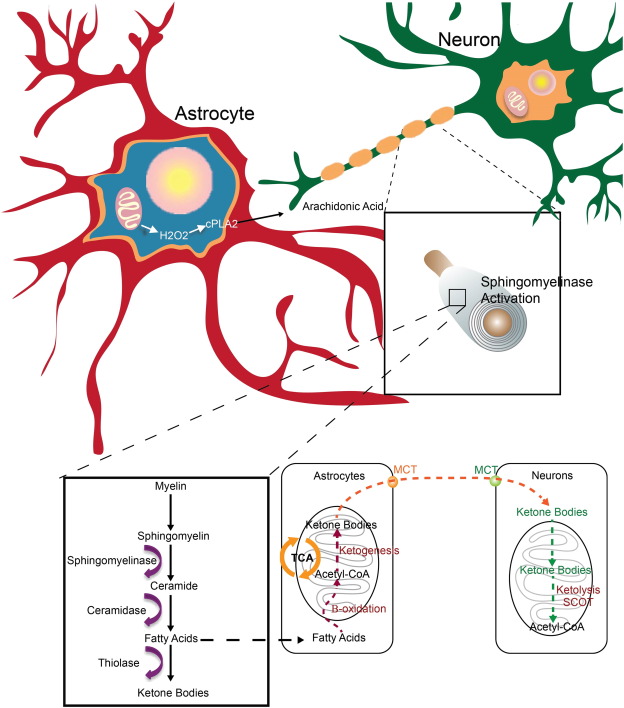
Findings from this study replicate our earlier findings that age of reproductive senescence is associated with decline in mitochondrial respiration, increased H2O2 production and shift to ketogenic metabolism in brain (Yao et al., 2010, Ding et al., 2013, Yin et al., 2015). These well established early age-related changes in mitochondrial function and shift to ketone body utilization in brain, are now linked to a mechanistic pathway that connects early decline in mitochondrial respiration and H2O2 production to activation of the cPLA2-sphingomyelinase pathway to catabolize myelin lipids resulting in WM degeneration (Fig. 12). These lipids are sequestered in lipid droplets for subsequent use as a local source of ketone body generation via astrocyte mediated beta-oxidation of fatty acids. Astrocyte derived ketone bodies can then be transported to neurons where they undergo ketolysis to generate acetyl-CoA for TCA derived ATP generation required for synaptic and cell function (Fig. 12).
Thumbnail image of Fig. 12. Opens large image

http://www.ebiomedicine.com/cms/attachment/2040395791/2053874721/gr12.sml

Fig. 12

Schematic model of mitochondrial H2O2 activation of cPLA2-sphingomyelinase pathway as an adaptive response to provide myelin derived fatty acids as a substrate for ketone body generation: The cPLA2-sphingomyelinase pathway is proposed as a mechanistic pathway that links an early event, mitochondrial dysfunction and H2O2, in the prodromal/preclinical phase of Alzheimer’s with later stage development of pathology, white matter degeneration. Our findings demonstrate that an age dependent deficit in mitochondrial respiration and a concomitant rise in oxidative stress activate an adaptive cPLA2-sphingomyelinase pathway to provide myelin derived fatty acids as a substrate for ketone body generation to fuel an energetically compromised brain.

Biochemical evidence obtained from isolated whole brain mitochondria confirms that during reproductive senescence and in response to estrogen deprivation brain mitochondria decline in respiratory capacity (Yao et al., 2009, Yao et al., 2010, Brinton, 2008a, Brinton, 2008b, Swerdlow and Khan, 2009). A well-documented consequence of mitochondrial dysfunction is increased production of reactive oxygen species (ROS), specifically H2O2 (Boveris and Chance, 1973, Beal, 2005, Yin et al., 2014, Yap et al., 2009). While most research focuses on the damage generated by free radicals, in this case H2O2 functions as a signaling molecule to activate cPLA2, the initiating enzyme in the cPLA2-sphingomyelinase pathway (Farooqui and Horrocks, 2006, Han et al., 2003, Sun et al., 2004). In AD brain, increased cPLA2 immunoreactivity is detected almost exclusively in astrocytes suggesting that activation of the cPLA2-sphingomyelinase pathway is localized to astrocytes in AD, as opposed to the neuronal or oligodendroglial localization that is observed during apoptosis (Sun et al., 2004, Malaplate-Armand et al., 2006, Di Paolo and Kim, 2011, Stephenson et al., 1996,Stephenson et al., 1999). In our analysis, cPLA2 (Sanchez-Mejia and Mucke, 2010) activation followed the age-dependent rise in H2O2 production and was sustained at an elevated level.

Direct and robust activation of astrocytic cPLA2 by physiologically relevant concentrations of H2O2 was confirmed in vitro. Astrocytic involvement in the cPLA2-sphingomyelinase pathway was also indicated by an increase in cPLA2 positive astrocyte reactivity in WM tracts of reproductively incompetent mice. These data are consistent with findings from brains of persons with AD that demonstrate the same striking localization of cPLA2immunoreactivity within astrocytes, specifically in the hippocampal formation (Farooqui and Horrocks, 2004). While neurons and astrocytes contain endogenous levels of cPLA2, neuronal cPLA2 is activated by an influx of intracellular calcium, whereas astrocytic cPLA2 is directly activated by excessive generation of H2O2 (Sun et al., 2004, Xu et al., 2003, Tournier et al., 1997). Evidence of this cell type specific activation was confirmed by the activation of cPLA2 in astrocytes by H2O2 and the lack of activation in neurons. These data support that astrocytic, not neuronal, cPLA2 is the cellular mediator of the H2O2 dependent cPLA2-sphingomyelinase pathway activation and provide associative evidence supporting a role of astrocytic mitochondrial H2O2 in age-related WM catabolism.

The pattern of gene expression during the shift to reproductive senescence in the female mouse hippocampus recapitulates key observations in human AD brain tissue, specifically elevation in cPLA2, sphingomyelinase and ceramidase (Schaeffer et al., 2010, He et al., 2010, Li et al., 2014). Further, up-regulation of myelin synthesis, lipid metabolism and inflammatory genes in reproductively incompetent female mice is consistent with the gene expression pattern previously reported from aged male rodent hippocampus, aged female non-human primate hippocampus and human AD hippocampus (Blalock et al., 2003, Blalock et al., 2004, Blalock et al., 2010, Blalock et al., 2011, Kadish et al., 2009, Rowe et al., 2007). In these analyses of gene expression in aged male rodent hippocampus, aged female non-human primate hippocampus and human AD hippocampus down regulation of genes related to mitochondrial function, and up-regulation in multiple genes encoding for enzymes involved in ketone body metabolism occurred (Blalock et al., 2003, Blalock et al., 2004, Blalock et al., 2010, Blalock et al., 2011, Kadish et al., 2009, Rowe et al., 2007). The comparability across data derived from aging female mouse hippocampus reported herein and those derived from male rodent brain, female nonhuman brain and human AD brain strongly suggest that cPLA2-sphingomyelinase pathway activation, myelin sheath degeneration and fatty acid metabolism leading to ketone body generation is a metabolic adaptation that is generalizable across these naturally aging models and are evident in aged human AD brain. Collectively, these data support the translational relevance of findings reported herein.

Data obtained via immunohistochemistry, electron microscopy and MBP protein analyses demonstrated an age-related loss in myelin sheath integrity. Evidence for a loss of myelin structural integrity emerged in reproductively incompetent mice following activation of the cPLA2-sphingomyelinase pathway. The unraveling myelin phenotype observed following reproductive senescence and aging reported herein is consistent with the degenerative phenotype that emerges following exposure to the chemotherapy drug bortezomib which induces mitochondrial dysfunction and increased ROS generation (Carozzi et al., 2010, Cavaletti et al., 2007,Ling et al., 2003). In parallel to the decline in myelin integrity, lipid droplet density increased. In aged mice, accumulation of lipid droplets declined in parallel to the rise in ketone bodies consistent with the utilization of myelin-derived fatty acids to generate ketone bodies. Due to the sequential relationship between WM degeneration and lipid droplet formation, we posit that lipid droplets serve as a temporary storage site for myelin-derived fatty acids prior to undergoing β-oxidation in astrocytes to generate ketone bodies.

Microstructural alterations in myelin integrity were associated with alterations in the lipid profile of brain, indicative of WM degeneration resulting in release of myelin lipids. Sphingomyelin and galactocerebroside are two main lipids that compose the myelin sheath (Baumann and Pham-Dinh, 2001). Ceramide is common to both galactocerebroside and sphingomyelin and is composed of sphingosine coupled to a fatty acid. Ceramide levels increase in aging, in states of ketosis and in neurodegeneration (Filippov et al., 2012, Blazquez et al., 1999, Costantini et al., 2005). Specifically, ceramide levels are elevated at the earliest clinically recognizable stage of AD, indicating a degree of WM degeneration early in disease progression (Di Paolo and Kim, 2011,Han et al., 2002, Costantini et al., 2005). Sphingosine is statistically significantly elevated in the brains of AD patients compared to healthy controls; a rise that was significantly correlated with acid sphingomyelinase activity, Aβ levels and tau hyperphosphorylation (He et al., 2010). In our analyses, a rise in ceramides was first observed early in the aging process in reproductively incompetent mice. The rise in ceramides was coincident with the emergence of loss of myelin integrity consistent with the release of myelin ceramides from sphingomyelin via sphingomyelinase activation. Following the rise in ceramides, sphingosine and fatty acid levels increased. The temporal sequence of the lipid profile was consistent with gene expression indicating activation of ceramidase for catabolism of ceramide into sphingosine and fatty acid during reproductive senescence. Once released from ceramide, fatty acids can be transported into the mitochondrial matrix of astrocytes via CPT-1, where β-oxidation of fatty acids leads to the generation of acetyl-CoA (Glatz et al., 2010). It is well documented that acetyl-CoA cannot cross the inner mitochondrial membrane, thus posing a barrier to direct transport of acetyl-CoA generated by β-oxidation into neurons. In response, the newly generated acetyl-CoA undergoes ketogenesis to generate ketone bodies to fuel energy demands of neurons (Morris, 2005,Guzman and Blazquez, 2004, Stacpoole, 2012). Because astrocytes serve as the primary location of β-oxidation in brain they are critical to maintaining neuronal metabolic viability during periods of reduced glucose utilization (Panov et al., 2014, Ebert et al., 2003, Guzman and Blazquez, 2004).

Once fatty acids are released from myelin ceramides, they are transported into astrocytic mitochondria by CPT1 to undergo β-oxidation. The mitochondrial trifunctional protein HADHA catalyzes the last three steps of mitochondrial β-oxidation of long chain fatty acids, while mitochondrial ABAD (aka SCHAD—short chain fatty acid dehydrogenase) metabolizes short chain fatty acids. Concurrent with the release of myelin fatty acids in aged female mice, CPT1, HADHA and ABAD protein expression as well as ketone body generation increased significantly. These findings indicate that astrocytes play a pivotal role in the response to bioenergetic crisis in brain to activate an adaptive compensatory system that activates catabolism of myelin lipids and the metabolism of those lipids into fatty acids to generate ketone bodies necessary to fuel neuronal demand for acetyl-CoA and ATP.

Collectively, these findings provide a mechanistic pathway that links mitochondrial dysfunction and H2O2generation in brain early in the aging process to later stage white matter degeneration. Astrocytes play a pivotal role in providing a mechanistic strategy to address the bioenergetic demand of neurons in the aging female brain. While this pathway is coincident with reproductive aging in the female brain, it is likely to have mechanistic translatability to the aging male brain. Further, the mechanistic link between bioenergetic decline and WM degeneration has potential relevance to other neurological diseases involving white matter in which postmenopausal women are at greater risk, such as multiple sclerosis. The mechanistic pathway reported herein spans time and is characterized by a progression of early adaptive changes in the bioenergetic system of the brain leading to WM degeneration and ketone body production. Translationally, effective therapeutics to prevent, delay and treat WM degeneration during aging and Alzheimer’s disease will need to specifically target stages within the mechanistic pathway described herein. The fundamental initiating event is a bioenergetic switch from being a glucose dependent brain to a glucose and ketone body dependent brain. It remains to be determined whether it is possible to prevent conversion to or reversal of a ketone dependent brain. Effective therapeutic strategies to intervene in this process require biomarkers of bioenergetic phenotype of the brain and stage of mechanistic progression. The mechanistic pathway reported herein may have relevance to other age-related neurodegenerative diseases characterized by white matter degeneration such as multiple sclerosis.

Blood. 2015 Oct 15;126(16):1925-9.    http://dx.doi.org:/10.1182/blood-2014-12-617498. Epub 2015 Aug 14.
Targeting the leukemia cell metabolism by the CPT1a inhibition: functional preclinical effects in leukemias.
Cancer cells are characterized by perturbations of their metabolic processes. Recent observations demonstrated that the fatty acid oxidation (FAO) pathway may represent an alternative carbon source for anabolic processes in different tumors, therefore appearing particularly promising for therapeutic purposes. Because the carnitine palmitoyl transferase 1a (CPT1a) is a protein that catalyzes the rate-limiting step of FAO, here we investigated the in vitro antileukemic activity of the novel CPT1a inhibitor ST1326 on leukemia cell lines and primary cells obtained from patients with hematologic malignancies. By real-time metabolic analysis, we documented that ST1326 inhibited FAO in leukemia cell lines associated with a dose- and time-dependent cell growth arrest, mitochondrial damage, and apoptosis induction. Data obtained on primary hematopoietic malignant cells confirmed the FAO inhibition and cytotoxic activity of ST1326, particularly on acute myeloid leukemia cells. These data suggest that leukemia treatment may be carried out by targeting metabolic processes.
Oncogene. 2015 Oct 12.   http://dx.doi.org:/10.1038/onc.2015.394. [Epub ahead of print]
Tumour-suppression function of KLF12 through regulation of anoikis.
Suppression of detachment-induced cell death, known as anoikis, is an essential step for cancer metastasis to occur. We report here that expression of KLF12, a member of the Kruppel-like family of transcription factors, is downregulated in lung cancer cell lines that have been selected to grow in the absence of cell adhesion. Knockdown of KLF12 in parental cells results in decreased apoptosis following cell detachment from matrix. KLF12 regulates anoikis by promoting the cell cycle transition through S phase and therefore cell proliferation. Reduced expression levels of KLF12 results in increased ability of lung cancer cells to form tumours in vivo and is associated with poorer survival in lung cancer patients. We therefore identify KLF12 as a novel metastasis-suppressor gene whose loss of function is associated with anoikis resistance through control of the cell cycle.
Mol Cell. 2015 Oct 14. pii: S1097-2765(15)00764-9. doi: 10.1016/j.molcel.2015.09.025. [Epub ahead of print]
PEPCK Coordinates the Regulation of Central Carbon Metabolism to Promote Cancer Cell Growth.
Phosphoenolpyruvate carboxykinase (PEPCK) is well known for its role in gluconeogenesis. However, PEPCK is also a key regulator of TCA cycle flux. The TCA cycle integrates glucose, amino acid, and lipid metabolism depending on cellular needs. In addition, biosynthetic pathways crucial to tumor growth require the TCA cycle for the processing of glucose and glutamine derived carbons. We show here an unexpected role for PEPCK in promoting cancer cell proliferation in vitro and in vivo by increasing glucose and glutamine utilization toward anabolic metabolism. Unexpectedly, PEPCK also increased the synthesis of ribose from non-carbohydrate sources, such as glutamine, a phenomenon not previously described. Finally, we show that the effects of PEPCK on glucose metabolism and cell proliferation are in part mediated via activation of mTORC1. Taken together, these data demonstrate a role for PEPCK that links metabolic flux and anabolic pathways to cancer cell proliferation.
Mol Cancer Res. 2015 Oct;13(10):1408-20.   http://dx.doi.org:/10.1158/1541-7786.MCR-15-0048. Epub 2015 Jun 16.
Disruption of Proline Synthesis in Melanoma Inhibits Protein Production Mediated by the GCN2 Pathway.
Many processes are deregulated in melanoma cells and one of those is protein production. Although much is known about protein synthesis in cancer cells, effective ways of therapeutically targeting this process remain an understudied area of research. A process that is upregulated in melanoma compared with normal melanocytes is proline biosynthesis, which has been linked to both oncogene and tumor suppressor pathways, suggesting an important convergent point for therapeutic intervention. Therefore, an RNAi screen of a kinase library was undertaken, identifying aldehyde dehydrogenase 18 family, member A1 (ALDH18A1) as a critically important gene in regulating melanoma cell growth through proline biosynthesis. Inhibition of ALDH18A1, the gene encoding pyrroline-5-carboxylate synthase (P5CS), significantly decreased cultured melanoma cell viability and tumor growth. Knockdown of P5CS using siRNA had no effect on apoptosis, autophagy, or the cell cycle but cell-doubling time increased dramatically suggesting that there was a general slowdown in cellular metabolism. Mechanistically, targeting ALDH18A1 activated the serine/threonine protein kinase GCN2 (general control nonderepressible 2) to inhibit protein synthesis, which could be reversed with proline supplementation. Thus, targeting ALDH18A1 in melanoma can be used to disrupt proline biosynthesis to limit cell metabolism thereby increasing the cellular doubling time mediated through the GCN2 pathway.  This study demonstrates that melanoma cells are sensitive to disruption of proline synthesis and provides a proof-of-concept that the proline synthesis pathway can be therapeutically targeted in melanoma tumors for tumor inhibitory efficacy. Mol Cancer Res; 13(10); 1408-20. ©2015 AACR.
SDHB-Deficient Cancers: The Role of Mutations That Impair Iron Sulfur Cluster Delivery.
BACKGROUND:  Mutations in the Fe-S cluster-containing SDHB subunit of succinate dehydrogenase cause familial cancer syndromes. Recently the tripeptide motif L(I)YR was identified in the Fe-S recipient protein SDHB, to which the cochaperone HSC20 binds.
METHODS:   In order to characterize the metabolic basis of SDH-deficient cancers we performed stable isotope-resolved metabolomics in a novel SDHB-deficient renal cell carcinoma cell line and conducted bioinformatics and biochemical screening to analyze Fe-S cluster acquisition and assembly of SDH in the presence of other cancer-causing SDHB mutations.

RESULTS:

We found that the SDHB(R46Q) mutation in UOK269 cells disrupted binding of HSC20, causing rapid degradation of SDHB. In the absence of SDHB, respiration was undetectable in UOK269 cells, succinate was elevated to 351.4±63.2 nmol/mg cellular protein, and glutamine became the main source of TCA cycle metabolites through reductive carboxylation. Furthermore, HIF1α, but not HIF2α, increased markedly and the cells showed a strong DNA CpG island methylator phenotype (CIMP). Biochemical and bioinformatic screening revealed that 37% of disease-causing missense mutations in SDHB were located in either the L(I)YR Fe-S transfer motifs or in the 11 Fe-S cluster-ligating cysteines.

CONCLUSIONS:

These findings provide a conceptual framework for understanding how particular mutations disproportionately cause the loss of SDH activity, resulting in accumulation of succinate and metabolic remodeling in SDHB cancer syndromes.


SR4 Uncouples Mitochondrial Oxidative Phosphorylation, Modulates AMPK-mTOR Signaling, and Inhibits Proliferation of HepG2 Hepatocarcinoma Cells

  1. L. Figarola, J. Singhal, J. D. Tompkins, G. W. Rogers, C. Warden, D. Horne, A. D. Riggs, S. Awasthi and S. S. Singhal.

J Biol Chem. 2015 Nov 3, [epub ahead of print]


CD47 Receptor Globally Regulates Metabolic Pathways That Control Resistance to Ionizing Radiation

  1. W. Miller, D. R. Soto-Pantoja, A. L. Schwartz, J. M. Sipes, W. G. DeGraff, L. A. Ridnour, D. A. Wink and D. D. Roberts.

J Biol Chem. 2015 Oct 9, 290 (41): 24858-74.


Knockdown of PKM2 Suppresses Tumor Growth and Invasion in Lung Adenocarcinoma

  1. Sun, A. Zhu, L. Zhang, J. Zhang, Z. Zhong and F. Wang.

Int J Mol Sci. 2015 Oct 15, 16 (10): 24574-87.


EglN2 associates with the NRF1-PGC1alpha complex and controls mitochondrial function in breast cancer

  1. Zhang, C. Wang, X. Chen, M. Takada, C. Fan, X. Zheng, H. Wen, Y. Liu, C. Wang, R. G. Pestell, K. M. Aird, W. G. Kaelin, Jr., X. S. Liu and Q. Zhang.

EMBO J. 2015 Oct 22, [epub ahead of print]


Mitochondrial Genetics Regulate Breast Cancer Tumorigenicity and Metastatic Potential.

Current paradigms of carcinogenic risk suggest that genetic, hormonal, and environmental factors influence an individual’s predilection for developing metastatic breast cancer. Investigations of tumor latency and metastasis in mice have illustrated differences between inbred strains, but the possibility that mitochondrial genetic inheritance may contribute to such differences in vivo has not been directly tested. In this study, we tested this hypothesis in mitochondrial-nuclear exchange mice we generated, where cohorts shared identical nuclear backgrounds but different mtDNA genomes on the background of the PyMT transgenic mouse model of spontaneous mammary carcinoma. In this setting, we found that primary tumor latency and metastasis segregated with mtDNA, suggesting that mtDNA influences disease progression to a far greater extent than previously appreciated. Our findings prompt further investigation into metabolic differences controlled by mitochondrial process as a basis for understanding tumor development and metastasis in individual subjects. Importantly, differences in mitochondrial DNA are sufficient to fundamentally alter disease course in the PyMT mouse mammary tumor model, suggesting that functional metabolic differences direct early tumor growth and metastatic efficiency. Cancer Res; 75(20); 4429-36. ©2015 AACR.


Cancer Lett. 2015 Oct 29. pii: S0304-3835(15)00656-4.    http://dx.doi.org:/10.1016/j.canlet.2015.10.025. [Epub ahead of print]
Carboxyamidotriazole inhibits oxidative phosphorylation in cancer cells and exerts synergistic anti-cancer effect with glycolysis inhibition.

Targeting cancer cell metabolism is a promising strategy against cancer. Here, we confirmed that the anti-cancer drug carboxyamidotriazole (CAI) inhibited mitochondrial respiration in cancer cells for the first time and found a way to enhance its anti-cancer activity by further disturbing the energy metabolism. CAI promoted glucose uptake and lactate production when incubated with cancer cells. The oxidative phosphorylation (OXPHOS) in cancer cells was inhibited by CAI, and the decrease in the activity of the respiratory chain complex I could be one explanation. The anti-cancer effect of CAI was greatly potentiated when being combined with 2-deoxyglucose (2-DG). The cancer cells treated with the combination of CAI and 2-DG were arrested in G2/M phase. The apoptosis and necrosis rates were also increased. In a mouse xenograft model, this combination was well tolerated and retarded the tumor growth. The impairment of cancer cell survival was associated with significant cellular ATP decrease, suggesting that the combination of CAI and 2-DG could be one of the strategies to cause dual inhibition of energy pathways, which might be an effective therapeutic approach for a broad spectrum of tumors.


Cancer Immunol Res. 2015 Nov;3(11):1236-47.    http://dx.doi.org:/10.1158/2326-6066.CIR-15-0036. Epub 2015 May 29.
Inhibition of Fatty Acid Oxidation Modulates Immunosuppressive Functions of Myeloid-Derived Suppressor Cells and Enhances Cancer Therapies.

Myeloid-derived suppressor cells (MDSC) promote tumor growth by inhibiting T-cell immunity and promoting malignant cell proliferation and migration. The therapeutic potential of blocking MDSC in tumors has been limited by their heterogeneity, plasticity, and resistance to various chemotherapy agents. Recent studies have highlighted the role of energy metabolic pathways in the differentiation and function of immune cells; however, the metabolic characteristics regulating MDSC remain unclear. We aimed to determine the energy metabolic pathway(s) used by MDSC, establish its impact on their immunosuppressive function, and test whether its inhibition blocks MDSC and enhances antitumor therapies. Using several murine tumor models, we found that tumor-infiltrating MDSC (T-MDSC) increased fatty acid uptake and activated fatty acid oxidation (FAO). This was accompanied by an increased mitochondrial mass, upregulation of key FAO enzymes, and increased oxygen consumption rate. Pharmacologic inhibition of FAO blocked immune inhibitory pathways and functions in T-MDSC and decreased their production of inhibitory cytokines. FAO inhibition alone significantly delayed tumor growth in a T-cell-dependent manner and enhanced the antitumor effect of adoptive T-cell therapy. Furthermore, FAO inhibition combined with low-dose chemotherapy completely inhibited T-MDSC immunosuppressive effects and induced a significant antitumor effect. Interestingly, a similar increase in fatty acid uptake and expression of FAO-related enzymes was found in human MDSC in peripheral blood and tumors. These results support the possibility of testing FAO inhibition as a novel approach to block MDSC and enhance various cancer therapies. Cancer Immunol Res; 3(11); 1236-47. ©2015 AACR.


Ionizing radiation induces myofibroblast differentiation via lactate dehydrogenase

  1. L. Judge, K. M. Owens, S. J. Pollock, C. F. Woeller, T. H. Thatcher, J. P. Williams, R. P. Phipps, P. J. Sime and R. M. Kottmann.

Am J Physiol Lung Cell Mol Physiol. 2015 Oct 15, 309 (8): L879-87.


Vitamin C selectively kills KRAS and BRAF mutant colorectal cancer cells by targeting GAPDH

  1. Yun, E. Mullarky, C. Lu, K. N. Bosch, A. Kavalier, K. Rivera, J. Roper, Chio, II, E. G. Giannopoulou, C. Rago, A. Muley, J. M. Asara, J. Paik, O. Elemento, Z. Chen, D. J. Pappin, L. E. Dow, N. Papadopoulos, S. S. Gross and L. C. Cantley.

Science. 2015 Nov 5, [epub ahead of print]


Down-regulation of FBP1 by ZEB1-mediated repression confers to growth and invasion in lung cancer cells

  1. Zhang, J. Wang, H. Xing, Q. Li, Q. Zhao and J. Li.

Mol Cell Biochem. 2015 Nov 6, [epub ahead of print]


J Mol Cell Cardiol. 2015 Oct 23. pii: S0022-2828(15)30073-0.     http://dx.doi.org:/10.1016/j.yjmcc.2015.10.002. [Epub ahead of print]
GRK2 compromises cardiomyocyte mitochondrial function by diminishing fatty acid-mediated oxygen consumption and increasing superoxide levels.

The G protein-coupled receptor kinase-2 (GRK2) is upregulated in the injured heart and contributes to heart failure pathogenesis. GRK2 was recently shown to associate with mitochondria but its functional impact in myocytes due to this localization is unclear. This study was undertaken to determine the effect of elevated GRK2 on mitochondrial respiration in cardiomyocytes. Sub-fractionation of purified cardiac mitochondria revealed that basally GRK2 is found in multiple compartments. Overexpression of GRK2 in mouse cardiomyocytes resulted in an increased amount of mitochondrial-based superoxide. Inhibition of GRK2 increased oxygen consumption rates and ATP production. Moreover, fatty acid oxidation was found to be significantly impaired when GRK2 was elevated and was dependent on the catalytic activity and mitochondrial localization of this kinase. Our study shows that independent of cardiac injury, GRK2 is localized in the mitochondria and its kinase activity negatively impacts the function of this organelle by increasing superoxide levels and altering substrate utilization for energy production.


Br J Pharmacol. 2015 Oct 27. doi: 10.1111/bph.13377. [Epub ahead of print]
All-trans retinoic acid protects against doxorubicin-induced cardiotoxicity by activating the Erk2 signalling pathway.
BACKGROUND AND PURPOSE:

Doxorubicin (Dox) is a powerful antineoplastic agent for treating a wide range of cancers. However, doxorubicin cardiotoxicity of the heart has largely limited its clinical use. It is known that all-trans retinoic acid (ATRA) plays important roles in many cardiac biological processes, however, the protective effects of ATRA on doxorubicin cardiotoxicity remain unknown. Here, we studied the effect of ATRA on doxorubicin cardiotoxicity and underlying mechanisms.

EXPERIMENTAL APPROACHES:

Cellular viability assays, western blotting and mitochondrial respiration analyses were employed to evaluate the cellular response to ATRA in H9c2 cells and primary cardiomyocytes. Quantitative PCR (Polymerase Chain Reaction) and gene knockdown were performed to investigate the underlying molecular mechanisms of ATRA’s effects on doxorubicin cardiotoxicity.

KEY RESULTS:

ATRA significantly inhibited doxorubicin-induced apoptosis in H9c2 cells and primary cardiomyocytes. ATRA was more effective against doxorubicin cardiotoxicity than resveratrol and dexrazoxane. ATRA also suppressed reactive oxygen species (ROS) generation, and restored the expression level of mRNA and proteins in phase II detoxifying enzyme system: Nrf2 (nuclear factor-E2-related factor 2), MnSOD (manganese superoxide dismutase), HO-1 (heme oxygenase1) as well as mitochondrial function (mitochondrial membrane integrity, mitochondrial DNA copy numbers, mitochondrial respiration capacity, biogenesis and dynamics). Both Erk1/2 (extracellular signal-regulated kinase1/2) inhibitor (U0126) and Erk2 siRNA, but not Erk1 siRNA, abolished the protective effect of ATRA against doxorubicin-induced toxicity in H9c2 cells. Remarkably, ATRA did not compromise the anticancer efficacy of doxorubicin in gastric carcinoma cells.

CONCLUSION AND IMPLICATION:

ATRA protected cardiomyocytes against doxorubicin-induced toxicity by activating the Erk2 pathway without compromising the anticancer efficacy of doxorubicin. Therefore, ATRA may be a promising candidate as a cardioprotective agent against doxorubicin cardiotoxicity.


Proteomic and Biochemical Studies of Lysine Malonylation Suggest Its Malonic Aciduria-associated Regulatory Role in Mitochondrial Function and Fatty Acid Oxidation

  1. Colak, O. Pougovkina, L. Dai, M. Tan, H. Te Brinke, H. Huang, Z. Cheng, J. Park, X. Wan, X. Liu, W. W. Yue, R. J. Wanders, J. W. Locasale, D. B. Lombard, V. C. de Boer and Y. Zhao.

Mol Cell Proteomics. 2015 Nov 1, 14 (11): 3056-71.


Foxg1 localizes to mitochondria and coordinates cell differentiation and bioenergetics

  1. Pancrazi, G. Di Benedetto, L. Colombaioni, G. Della Sala, G. Testa, F. Olimpico, A. Reyes, M. Zeviani, T. Pozzan and M. Costa.

Proc Natl Acad Sci U S A. 2015 Oct 27, 112(45): 13910-5.


Evidence of Mitochondrial Dysfunction within the Complex Genetic Etiology of Schizophrenia

  1. E. Hjelm, B. Rollins, F. Mamdani, J. C. Lauterborn, G. Kirov, G. Lynch, C. M. Gall, A. Sequeira and M. P. Vawter.

Mol Neuropsychiatry. 2015 Nov 1, 1 (4): 201-219.


Metabolic Reprogramming Is Required for Myofibroblast Contractility and Differentiation

  1. Bernard, N. J. Logsdon, S. Ravi, N. Xie, B. P. Persons, S. Rangarajan, J. W. Zmijewski, K. Mitra, G. Liu, V. M. Darley-Usmar and V. J. Thannickal.

J Biol Chem. 2015 Oct 16, 290 (42): 25427-38.


J Biol Chem. 2015 Oct 23;290(43):25834-46.    http://dx.doi.org:/10.1074/jbc.M115.658815. Epub 2015 Sep 4.
Kinome Screen Identifies PFKFB3 and Glucose Metabolism as Important Regulators of the Insulin/Insulin-like Growth Factor (IGF)-1 Signaling Pathway.

The insulin/insulin-like growth factor (IGF)-1 signaling pathway (ISP) plays a fundamental role in long term health in a range of organisms. Protein kinases including Akt and ERK are intimately involved in the ISP. To identify other kinases that may participate in this pathway or intersect with it in a regulatory manner, we performed a whole kinome (779 kinases) siRNA screen for positive or negative regulators of the ISP, using GLUT4 translocation to the cell surface as an output for pathway activity. We identified PFKFB3, a positive regulator of glycolysis that is highly expressed in cancer cells and adipocytes, as a positive ISP regulator. Pharmacological inhibition of PFKFB3 suppressed insulin-stimulated glucose uptake, GLUT4 translocation, and Akt signaling in 3T3-L1 adipocytes. In contrast, overexpression of PFKFB3 in HEK293 cells potentiated insulin-dependent phosphorylation of Akt and Akt substrates. Furthermore, pharmacological modulation of glycolysis in 3T3-L1 adipocytes affected Akt phosphorylation. These data add to an emerging body of evidence that metabolism plays a central role in regulating numerous biological processes including the ISP. Our findings have important implications for diseases such as type 2 diabetes and cancer that are characterized by marked disruption of both metabolism and growth factor signaling.


FASEB J. 2015 Oct 19.    http://dx.doi.org:/pii: fj.15-276360. [Epub ahead of print]
Perm1 enhances mitochondrial biogenesis, oxidative capacity, and fatigue resistance in adult skeletal muscle.

Skeletal muscle mitochondrial content and oxidative capacity are important determinants of muscle function and whole-body health. Mitochondrial content and function are enhanced by endurance exercise and impaired in states or diseases where muscle function is compromised, such as myopathies, muscular dystrophies, neuromuscular diseases, and age-related muscle atrophy. Hence, elucidating the mechanisms that control muscle mitochondrial content and oxidative function can provide new insights into states and diseases that affect muscle health. In past studies, we identified Perm1 (PPARGC1- and ESRR-induced regulator, muscle 1) as a gene induced by endurance exercise in skeletal muscle, and regulating mitochondrial oxidative function in cultured myotubes. The capacity of Perm1 to regulate muscle mitochondrial content and function in vivo is not yet known. In this study, we use adeno-associated viral (AAV) vectors to increase Perm1 expression in skeletal muscles of 4-wk-old mice. Compared to control vector, AAV1-Perm1 leads to significant increases in mitochondrial content and oxidative capacity (by 40-80%). Moreover, AAV1-Perm1-transduced muscles show increased capillary density and resistance to fatigue (by 33 and 31%, respectively), without prominent changes in fiber-type composition. These findings suggest that Perm1 selectively regulates mitochondrial biogenesis and oxidative function, and implicate Perm1 in muscle adaptations that also occur in response to endurance exercise.-Cho, Y., Hazen, B. C., Gandra, P. G., Ward, S. R., Schenk, S., Russell, A. P., Kralli, A. Perm1 enhances mitochondrial biogenesis, oxidative capacity, and fatigue resistance in adult skeletal muscle.


A conserved MADS-box phosphorylation motif regulates differentiation and mitochondrial function in skeletal, cardiac, and smooth muscle cells.
Exposure to metabolic disease during fetal development alters cellular differentiation and perturbs metabolic homeostasis, but the underlying molecular regulators of this phenomenon in muscle cells are not completely understood. To address this, we undertook a computational approach to identify cooperating partners of the myocyte enhancer factor-2 (MEF2) family of transcription factors, known regulators of muscle differentiation and metabolic function. We demonstrate that MEF2 and the serum response factor (SRF) collaboratively regulate the expression of numerous muscle-specific genes, including microRNA-133a (miR-133a). Using tandem mass spectrometry techniques, we identify a conserved phosphorylation motif within the MEF2 and SRF Mcm1 Agamous Deficiens SRF (MADS)-box that regulates miR-133a expression and mitochondrial function in response to a lipotoxic signal. Furthermore, reconstitution of MEF2 function by expression of a neutralizing mutation in this identified phosphorylation motif restores miR-133a expression and mitochondrial membrane potential during lipotoxicity. Mechanistically, we demonstrate that miR-133a regulates mitochondrial function through translational inhibition of a mitophagy and cell death modulating protein, called Nix. Finally, we show that rodents exposed to gestational diabetes during fetal development display muscle diacylglycerol accumulation, concurrent with insulin resistance, reduced miR-133a, and elevated Nix expression, as young adult rats. Given the diverse roles of miR-133a and Nix in regulating mitochondrial function, and proliferation in certain cancers, dysregulation of this genetic pathway may have broad implications involving insulin resistance, cardiovascular disease, and cancer biology.


Read Full Post »

Obesity Pharmaceutics

Larry H. Bernstein, MD, FCAP, Curator

LPBI


Battling the Bulge

Weight-loss drugs that target newly characterized obesity-related receptors and pathways could finally offer truly effective fat control.

By Bob Grant | November 1, 2015

http://www.the-scientist.com//?articles.view/articleNo/44322/title/Battling-the-Bulge/

http://www.the-scientist.com/November2015/NovBioBiz2_640px.jpg

Several years ago, antiobesity drug development was not looking so hot. In 2007, Sanofi-Aventis failed to win US Food and Drug Administration (FDA) approval for rimonabant—a pill that successfully helped people shed pounds—because the drug carried risks of depression and suicidal thoughts. Then, in 2008, Merck pulled the plug on its Phase 3 trials of taranabant because it also engendered suicidal thoughts and neurological effects in some participants. And a decade before those late-stage disappointments, a couple of FDA-approved weight-loss drugs were making headlines for carrying dangerous side effects. In 1997, the FDA pulled the obesity medications fenfluramine (of the wildly popular fen-phen drug combination) and dexfenfluramine (Redux) off the market after research turned up evidence of heart valve damage in people taking the drugs.

By 2009, Big Pharma was backing out of the weight-loss market, with Merck and Pfizer abandoning their programs to develop drugs similar to rimonabant and taranabant, which block cannabinoid receptors in the brain. Although the antiobesity drug market was big—according to CDC estimates, about 35 percent of adults in the U.S. are obese—a blockbuster weight-loss pill that didn’t have serious side effects was proving elusive.

But a few firms, including several small biotechs, decided to stick with it. “Some of the prior experience with drugs on the market, like fen-phen and Redux, have likely led large pharma to view the therapeutic space with some conservatism,” says Preston Klassen, executive vice president and head of global development at Orexigen Therapeutics, a small, California-based firm. “And generally, when you have that situation, smaller companies will step into that void when the science makes sense.” And their perseverance is starting to pay off. After a years-long drought in approvals for antiobesity medications, in the past few years the FDA has approved four new drugs specifically for general obesity: Belviq and Qsymia in 2012, and Contrave and Saxenda in late 2014. Three of these four were developed by small companies whose success hinges on one or a few compounds aimed directly at treating general obesity.

The recent burst of antiobesity drug approvals reflects an evolving appreciation for the molecular intricacies of this multifaceted, chronic disease. Today’s antiobesity drugs—including the four recent approvals and several more in development—have traded the blunt cudgel of appetite suppression for more precise targeting of pathways known to play roles in obesity. “With our understanding of the complex biology of obesity and all of the different molecules and receptors involved in the process, we’re much better able to target those molecules and receptors,” says Arya Sharma, chair in obesity research and management at the University of Alberta in Canada. “These are very specific agents that are designed for very specific actions. There is renewed enthusiasm in this field.”

Looking to combos

In the mid-20th century, the FDA approved several weight-loss drugs, starting with the appetite suppressant desoxyephedrine (methamphetamine hydrochloride) in 1947. Like the other appetite-suppressing drugs the FDA later approved through the 1950s and ’60s, desoxyephedrine accomplished short-term weight loss, but the transient benefit did not justify the side effects of long-term use, such as addiction, psychosis, and violent behavior. In 1973, as the nation voiced concern about the overuse of amphetamines, the FDA decreed that all obesity drugs were approved only for short-term use. The most recently approved obesity drugs, on the other hand, all have the FDA’s okay for long-term weight management.

Three of the newly approved drugs, Contrave, Belviq, and Qsymia, also aim to suppress appetite, and like many previous weight-loss therapies, all do so by targeting the hypothalamus, the brain region thought to be the seat of appetite control. Although the precise mechanism of Belviq, which is manufactured by San Diego–based Arena Pharmaceuticals, is unknown, researchers think that the key is its activation of serotonin-binding 5-HT2C receptors in proopiomelanocortin (POMC) neurons in the hypothalamus. When activated, these neurons reduce appetite and increase energy expenditure, according to Orexigen’s Klassen. His company’s Contrave also activates POMC neurons in the hypothalamus, while at the same time inhibiting opioid receptors, which would otherwise work to shut down POMC neuron firing, in the brain’s mesolimbic reward pathway. Contrave achieves this one-two punch because it is a combination therapy, incorporating two different compounds into a single weight-loss pill.

“The concept of a silver or magic bullet whereby one drug meets all of the needs within the obesity space has thus far proven to be inadequate,” says Klassen. “Right now I think the predominant opinion is that combination therapy is an appropriate way to go.”

Vivus’s Qsymia is also a combination drug, composed of phentermine—the other half of fen-phen and an activator of a G protein–coupled receptor called TAAR1—and an extended-release form of topiramate, an anticonvulsant with weight-loss side effects. Novo Nordisk—one of the few Big Pharma firms that stayed in the obesity game as others fled—is also turning its attention to combo therapies, testing its pipeline of investigational weight-loss compounds with Saxenda, its recently approved medicine that mimics glucagon peptide-1 (GLP-1), an appetite and calorie-intake regulator in the brain. “You need to combine at least two molecules to get the optimum effect,” says Novo Nordisk executive vice president and chief scientific officer Mads Krogsgaard Thomsen. The company has five other weight-loss compounds in development, and “we’re actually combining Saxenda with all of these new molecules,” he adds.

The University of Alberta’s Sharma agrees that combination therapies are a smart approach for attacking the multilayered mechanisms at play in obesity. “You’re dealing with a system that is very complex and very redundant. When you block one, other molecules or other parallel systems kick in,” he says. “My prediction for the future is that in order to get good results, one will have to move toward combinations . . . of more-specific and more-novel agents.”

On the horizon

On the heels of the recent FDA approvals, several new compounds with novel mechanisms of action are making their way through the drug-development pipeline. While most antiobesity drugs to date have aimed to suppress appetite by targeting brain regions involved in feelings of hunger and satiety, Boston-based Zafgen (for which Sharma serves as a paid advisor) is going after methionine aminopeptidase 2 (MetAP2) receptors in the liver and adipose tissue. “We’ve been one of the first ones to show that there is a significant and major weight-regulation center that the body has that exists outside the hypothalamus,” says Zafgen chief medical officer Dennis Kim. “Our drug [beloranib] is tapping into that mechanism.”


Zafgen researchers are investigating beloranib’s mechanism of action in patients that became very obese after their hypothalamus was damaged or removed as a result of craniopharyngioma, a type of brain cancer. “In about half of these cases, patients wake up hungry after surgery and it’s unrelenting, and they become morbidly obese very rapidly,” Kim says. Because the hypothalamus is damaged or missing, antiobesity drugs that target this brain region are ineffective. But beloranib “works just as well in these patients compared to patients with intact hypothalamus,” Kim says. As a result, beloranib may work in isolation without the need to combine different compounds, he adds. “If you can target a nodal point that’s much more upstream of simple circuitry-controlled hunger in the hypothalamus, you have the potential to reset the entire system.”

Meanwhile, another Boston-based firm, Rhythm Pharmaceuticals, is conducting clinical trials on obese patients with rare genetic disorders that compromise the melanocortin-4 (MC4) pathway, known to be involved in body weight regulation. Rhythm’s setmelanotide (RM-493) is a first-in-class drug that activates the MC4 pathway. And several companies, including the Japanese pharma firm Shionogi, are developing compounds that block the receptor of a neurotransmitter called neuropeptide Y, which plays a role in appetite stimulation and meal initiation.

Other new antiobesity targets include cyclic nucleotides, second messengers in signaling cascades such as the 3′-5′-cyclic guanosine monophosphate pathway, which conveys feelings of satiety and ramps up thermogenesis; amylin, a peptide hormone that slows gastric emptying and promotes satiety; ghrelin, a gut hormone that stimulates food intake; and a handful of pathways that affect nutrient absorption and metabolism. As more of obesity’s molecular complexities are sorted out, even more new drug targets will present themselves.

“I think we are on the verge of understanding obesity and the mechanisms underlying obesity,” says Novo Nordisk’s Thomsen. “That means that there is going to be a lot of good news for obesity going forward.”


WEIGHT-LOSS DRUG APPROVAL

© ISTOCK.COM/QUISP65Getting a weight-loss treatment approved by the FDA is a little different than the regulatory path taken by other drugs. To earn approval, companies must demonstrate that their drugs afford at least a 5 percent reduction in body weight over a year. And after a therapy reaches the market, companies have to conduct more research, specifically, into the drugs’ safety. Contrave, for example, which was approved in September 2014, is currently subject to rigorous post-marketing surveillance concerning evidence that the drug may lead to suicidal thoughts and behaviors. Other recently approved antiobesity drugs are under similar surveillance regimens.

The FDA also requires companies to test some approved weight-loss drugs specifically for their cardiovascular side effects. “Serious safety concerns have arisen with several obesity drugs in the past, which have informed our approach to drug development,” FDA spokesperson Eric Pahon wrote in an email to The Scientist. “All drugs approved for chronic weight management since 2012 have either had a cardiovascular outcome trial (CVOT) underway at the time of approval or have been required to initiate a CVOT as a post-marketing requirement.”

This additional testing, however, may scare off some drug developers from entering the antiobesity arena, Vivus spokesperson Dana Shinbaum wrote in an email to The Scientist. “The hurdles remain high . . . [and] may discourage innovation in this area.”

But even with the significant regulatory hurdles, it’s tough to deny the potential that exists in the antiobesity drug market. “We view obesity as one of the few remaining untapped therapeutic areas within primary care,” says Preston Klassen of Orexigen Therapeutics. “We think it’s tremendously important from a medical perspective, and we think it’s been well documented that even small reductions in body weight have meaningful and sustained impact on improved health.”


Read Full Post »

Studying Alzheimer’s biomarkers in Down syndrome

Larry H. Bernstein, MD, FCAP, Curator

LPBI


NIH supports new studies to find Alzheimer’s biomarkers in Down syndrome

Groundbreaking initiative will track dementia onset, progress in Down syndrome volunteers

http://www.nih.gov/news-events/news-releases/nih-supports-new-studies-find-alzheimers-biomarkers-down-syndrome


The National Institutes of Health has launched a new initiative to identify biomarkers and track the progression of Alzheimer’s in people with Down syndrome. Many people with Down syndrome have Alzheimer’s-related brain changes in their 30s that can lead to dementia in their 50s and 60s. Little is known about how the disease progresses in this vulnerable group. The NIH Biomarkers of Alzheimer’s Disease in Adults with Down Syndrome Initiative will support teams of researchers using brain imaging, as well as fluid and tissue biomarkers in research that may one day lead to effective interventions for all people with dementia.

The studies will be funded by the National Institute on Aging (NIA) and the Eunice Kennedy Shriver National Institute of Child Health and Human Development (NICHD), both part of NIH. The institutes are jointly providing an estimated $37 million over five years to two highly collaborative projects, which enlist a number of leading researchers to the effort. To advance Alzheimer’s research worldwide, the teams will make their data and samples freely available to qualified researchers.

“This is the first large-scale Alzheimer’s biomarker endeavor to focus on this high-risk group,” said Laurie Ryan, Ph.D., chief of the Dementias of Aging Branch in NIA’s Division of Neuroscience, which leads NIH research on Alzheimer’s.  “Much like the long-established Alzheimer’s Disease Neuroimaging Initiative, the goal of this initiative is to develop biomarker measures that signal the onset and progression of Alzheimer’s in people with Down syndrome. Hopefully, one day, we will also use these biomarkers to determine the effectiveness of promising treatments.”

The link between Alzheimer’s and Down syndrome is well-known. People with Down syndrome are born with an extra copy of chromosome 21, which contains the amyloid precursor protein gene. This gene plays a role in the production of harmful amyloid plaque, sticky clumps that build up outside neurons in Alzheimer’s disease. Having three copies of this gene is a known risk factor for early-onset Alzheimer’s that can occur in people in their 30s, 40s and 50s. By middle age, most but not all adults with Down syndrome develop signs of Alzheimer’s, and a high percentage go on to develop symptoms of dementia as they age into their 70s.

The initiative establishes funding for two research teams that will pool data and standardize procedures, increase sample size, and collectively analyze data that will be made widely available to the research community. The teams will employ an array of biomarkers to identify and track Alzheimer’s-related changes in the brain and cognition for over 500 Down syndrome volunteers, aged 25 and older. The measures include:

  • Positron emission tomography (PET) scans that track levels of amyloid and glucose (energy used by brain cells); MRI of brain volume and function; and levels of amyloid and tau in cerebrospinal fluid and blood;
  • Blood tests to identify biomarkers in blood, including proteins, lipids and markers of inflammation;
  • Blood tests to collect DNA for genome-wide association studies that identify the genetic factors that may confer risk, or protect against, developing Alzheimer’s;
  • Evaluations of medical conditions and cognitive and memory tests to determine levels of function and monitor any changes;
  • For the first time in people with Down syndrome, PET brain scans that detect levels of tau, the twisted knots of protein within brain cells that are a hallmark Alzheimer’s disease.

Aside from earlier onset, Alzheimer’s in people with Down syndrome is similar to Alzheimer’s in others. The first symptom may be memory loss, although people with Down syndrome initially tend to show behavior changes and problems with walking.

“Over the past 30 years, the average lifespan of people with Down syndrome has doubled to 60 years—a  bittersweet achievement when faced with the possibility of developing Alzheimer’s,” said Melissa Parisi, M.D., Ph.D., chief of the NICHD Intellectual and Developmental Disabilities Branch, which leads NIH’s Down syndrome research. “There is much to learn about Alzheimer’s in Down syndrome, and we’re hopeful that these new projects will provide some answers. One mystery we hope to solve is whether or not the disease progresses at a faster rate in this group.”

Parisi noted that research into Alzheimer’s in Down syndrome is a key focus of the National Plan to Address Alzheimer’s Disease(link is external), which calls for improved care for specific populations that are unequally burdened by the disease, including people with Down syndrome, and for increased research that may lead to possible Alzheimer’s therapies.

Benjamin Handen, Ph.D., Department of Psychiatry, University of Pittsburgh, heads a team that involves investigators and data from: Banner Alzheimer’s Institute, Phoenix; Cambridge University, England; Alzheimer’s Disease Cooperative Study, San Diego; Laboratory of Neuro Imaging, University of Southern California, Los Angeles. Nicole Schupf, Ph.D., Columbia University Medical Center, New York City, leads a team involving investigators at: University of California, Irvine; Kennedy Krieger Institute/Johns Hopkins University, Baltimore; Massachusetts General Hospital/Harvard University, Boston; and the University of North Texas Health Sciences Center, Fort Worth.

Learn more about this topic at https://www.nia.nih.gov/alzheimers/publication/alzheimers-disease-people-down-syndrome.

About the Eunice Kennedy Shriver National Institute of Child Health and Human Development (NICHD): The NICHD sponsors research on development, before and after birth; maternal, child, and family health; reproductive biology and population issues; and medical rehabilitation. For more information, visit the Institute’s website at http://www.nichd.nih.gov.

About the National Institute on Aging: The NIA leads the federal government effort conducting and supporting research on aging and the health and well-being of older people. It provides information on age-related cognitive change and neurodegenerative disease specifically at its Alzheimer’s Disease Education and Referral (ADEAR) Center at www.nia.nih.gov/alzheimers.

About the National Institutes of Health (NIH): NIH, the nation’s medical research agency, includes 27 Institutes and Centers and is a component of the U.S. Department of Health and Human Services. NIH is the primary federal agency conducting and supporting basic, clinical, and translational medical research, and is investigating the causes, treatments, and cures for both common and rare diseases. For more information about NIH and its programs, visit www.nih.gov.


NATIONAL PLAN TO ADDRESS ALZHEIMER’S DISEASE: 2015 UPDATE

pdf-document/national-plan-address-alzheimer%E2%80%99s-disease-2015-update (58 PDF pages)

Introduction

Vision Statement

National Alzheimer’s Project Act

Alzheimer’s Disease and Related Dementias

The Challenges

Framework and Guiding Principles

Goals as Building Blocks for Transformation

2015 Update


The Connection between Down Syndrome and Alzheimer’s Disease

Many, but not all, people with Down syndrome develop Alzheimer’s disease when they get older. Alzheimer’s is an irreversible, progressive brain disorder that slowly destroys memory and thinking skills and, eventually, the ability to carry out simple tasks.

Alzheimer’s disease is the most common cause of dementia among older adults. Dementia is the loss of cognitive functioning—thinking, remembering, and reasoning—and behavioral abilities to such an extent that it interferes with a person’s daily life and activities.

People with Down syndrome are born with an extra copy of chromosome 21, which carries the APP gene. This gene produces a specific protein called amyloid precursor protein (APP). Too much APP protein leads to a buildup of protein clumps called beta-amyloid plaques in the brain. By age 40, almost all people with Down syndrome have these plaques, along with other protein deposits, called tau tangles, which cause problems with how brain cells function and increase the risk of developing Alzheimer’s dementia.

However, not all people with these brain plaques will develop the symptoms of Alzheimer’s. Estimates suggest that 50 percent or more of people with Down syndrome will develop dementia due to Alzheimer’s disease as they age into their 70s.

Alzheimer’s Disease Symptoms

Many people with Down syndrome begin to show symptoms of Alzheimer’s disease in their 50s or 60s. But, like in all people with Alzheimer’s, changes in the brain that lead to these symptoms are thought to begin at least 10 years earlier. These brain changes include the buildup of plaques and tangles, the loss of connections between nerve cells, the death of nerve cells, and the shrinking of brain tissue (called atrophy).

The risk for Alzheimer’s disease increases with age, so it’s important to watch for certain changes in behavior, such as:

  • increased confusion
  • short-term memory problems (for example, asking the same questions over and over)
  • reduction in or loss of ability to do everyday activities

Other possible symptoms of Alzheimer’s dementia are:

  • seizures that begin in adulthood
  • problems with coordination and walking
  • reduced ability to pay attention
  • behavior and personality changes, such as wandering and being less social
  • decreased fine motor control
  • difficulty finding one’s way around familiar areas

Currently, Alzheimer’s disease has no cure, and no medications have been approved to treat Alzheimer’s in people with Down syndrome.

Down Syndrome and Alzheimer’s Disease Research

Alzheimer’s can last several years, and symptoms usually get worse over time.  Scientists are working hard to understand why some people with Down syndrome develop dementia while others do not. They want to know how Alzheimer’s disease begins and progresses, so they can develop drugs or other treatments that can stop, delay, or even prevent the disease process.

Research in this area includes:

  • Basic studies to improve our understanding of the genetic and biological causes of brain abnormalities that lead to Alzheimer’s
  • Observational research to measure cognitive changes in people over time
  • Studies of biomarkers (biological signs of disease), brain scans, and other tests that may help diagnose Alzheimer’s—even before symptoms appear—and show brain changes as people with Down syndrome age
  • Clinical trials to test treatments for dementia in adults with Down syndrome. Clinical trials are best the way to find out if a treatment is safe and effective in people.


Alzheimers Disease Neuroimaging Initiative (ADNI)

A public-private partnership, the purpose of ADNI is to develop a multisite, longitudinal, prospective, naturalistic study of normal cognitive aging, mild cognitive impairment (MCI), and early Alzheimer’s disease as a public domain research resource to facilitate the scientific evaluation of neuroimaging and other biomarkers for the onset and progression of MCI and Alzheimer’s disease.

Dr. Laurie Ryan of the NIA gives a brief overview of ADNI in this video:

https://youtu.be/0rBVe0Fwnik

Dr. Thomas Obisesan of Howard University, an ADNI study participant, and a study companion describe ADNI and what it’s like to be involved in the study

https://youtu.be/rK1yWvvHHl8

Learn more about this topic at https://www.nia.nih.gov/alzheimers/publication/alzheimers-disease-people-down-syndrome.

Read Full Post »

Adenosine Receptor Agonist Increases Plasma Homocysteine

Larry H. Bernstein, MD, FCAP, Curator

LPBI


The Adenosine Receptor Agonist 5’-N-Ethylcarboxamide-Adenosine Increases Mouse Serum Total Homocysteine Levels, Which Is a Risk Factor for Cardiovascular Diseases

Spring Zhou Editor at Scientific Research Publishing

I would like to share this paper with you. Any comments on this article are welcome.


An increase in total homocysteine (Hcy) levels (protein-bound and free Hcy in the serum) has been identified as a risk factor for vascular diseases. Hcy is a product of the methionine cycle and is a precursor of glutathione in the transsulfuration pathway. The methionine cycle mainly occurs in the liver, with Hcy being exported out of the liver and subsequently bound to serum proteins. When the non-specific adenosine receptor agonist 5’-N-ethylcarboxamide-adenosine (NECA; 0.1 or 0.3 mg/kg body weight) was intraperitoneally administered to mice that had been fasted for 16 h, total Hcy levels in the serum significantly increased 1 h after its administration. The NECA treatment may have inhibited transsulfuration because glutathione levels were significantly decreased in the liver. After the intraperitoneal administration of a high dose of NECA (0.3 mg/kg body weight), elevations in total Hcy levels in the serum continued for up to 10 h. The mRNA expression of methionine metabolic enzymes in the liver was significantly reduced 6 h after the administration of NECA. NECA-induced elevations in total serum Hcy levels may be maintained in the long term through the attenuated expression of methionine metabolic enzymes.


Comments:

  1.  Is level of protein consumption a factor?
  2. Is reliance on plant food products a factor?
  3. What are the levels of transthyretin?
  4. Is there a concomitant decrease in vitamin A or vitamin D?


The Adenosine Receptor Agonist 5’-N-Ethylcarboxamide-Adenosine Increases Mouse Serum Total Homocysteine Levels, Which Is a Risk Factor for Cardiovascular Diseases

Shigeko Fujimoto Sakata*, Koichi Matsuda, Yoko Horikawa, Yasuto Sasaki     Faculty of Nutrition, Kobe Gakuin University, Kobe, Japan.

http://www.scirp.org/journal/PaperInformation.aspx    DOI: 10.4236/pp.2015.610048

Cite this paper

Sakata, S. , Matsuda, K. , Horikawa, Y. and Sasaki, Y. (2015) The Adenosine Receptor Agonist 5’-N-Ethylcarboxamide-Adenosine Increases Mouse Serum Total Homocysteine Levels, Which Is a Risk Factor for Cardiovascular Diseases. Pharmacology & Pharmacy, 6, 461-470. doi: 10.4236/pp.2015.610048.
An increase in total serum homocysteine levels (total Hcy: serum protein-bound and free Hcy) has been identified as a risk factor for cardiovascular disease [1] [2] and liver fibrosis [3]. The normal range of total Hcy in adults is typically 5 – 15 μM, with the mean level being approximately 10 μM [2]. Plasma Hcy concentrations were previously found to be strongly associated with the presence and number of small infarctions, or infarction of the putamen in elderly diabetic patients [4]. High levels of Hcy have been shown to induce endoplasmic reticulum (ER) stress and increase the production of reactive oxygen species (ROS) [5]. Hcy has strong reducibility and modifies disulfide bonds in proteins. Only 1% to 2% of Hcy occurs as thiol homocysteine in the serum; 75% of Hcy has been suggested to bind to proteins through disulfide bonds with protein cysteines [6]. Hcy is formed as an intermediary in methionine metabolism [7] [8]. Methionine metabolism mainly occurs in the livers of mammals. Methionine receives an adenosine group from ATP to become S-adenosylmethionine (AdoMet) in the methionine cycle. This reaction is catalyzed in the liver by liver-specific methionine adenosyltransferase I/III (MAT I/III), which is encoded by the methionine adenosyltransferase 1A (MAT1A) gene [9]. AdoMet then transfers its methyl group to a large number of compounds, a process that is catalyzed by various methyltransferases (e.g., glycine N-methyltransferase: GNMT; DNA methyltransferase; phosphatidylethanolamine N-methyl- transferase), to produce S-adenosylhomocysteine (AdoHcy). Hcy is formed from AdoHcy by AdoHcy hydrolase (SAHH). The reaction that generates Hcy from AdoHcy is reversible, and AdoHcy from Hcy is shown to be thermodynamically favored over the synthesis of Hcy [10]. A previous study reported that Hcy levels were very low in the liver [11]. This reaction then proceeds toward the synthesis of Hcy when the products (Hcy and adenosine) are removed by further metabolism [12]. Three enzymes metabolize Hcy, with the betaine-homocysteine S-methyltransferase (BHMT) and methionine synthase (MS) reactions both yielding methionine. A large proportion of Hcy in the liver is remethylated by BHMT [3]. The third enzyme, cystathionine β-synthase (CBS) catalyzes Hcy to cystathionine in the transsulfuration pathway. Previous studies of whole body methionine kinetics demonstrated that 62% of Hcy was converted to cystathionine during each cycle in males fed a basal diet, resulting in the production of glutathione (GSH), while 38% of Hcy was remethylated to methionine [13]. Hcy is located at an important regulatory branch point: remethylation to methionine; conversion to cystathionine; export from the cells.
A decrease in intracellular ATP levels, accompanied by the accumulation of 5’-AMP and subsequently adenosine, is known to follow ischemia. Adenosine levels in interstitial fluids were shown to increase 100 – 1000- fold from basal levels (10 – 300 nM) with ischemia [14]. Furthermore, adenosine levels in hepatocytes were increased by a hypoxic challenge, with excess amounts of adenosine being exported out of cells [14]. Adenosine levels were also found to increase 10-fold due to hypoxia, stress, and inflammation [15]. Adenosine has been shown to activate A1, A2a, and A3 receptors with EC50 values in the range of 0.2 – 0.7 μM, and also A2b receptors with an EC50 of 24 μM [16]. A1 and A3 receptors have been classified as adenylate cyclase inhibitory receptors, and A2a and A2b receptors as adenylate cyclase-activating receptors [17]. The activation of adenosine receptors accompanied by ischemia may increase total Hcy levels in the serum because hepatic ischemia is known to decrease the content of GSH and activity of MAT [18].
We previously reported that the non-specific adenosine receptor agonist 5’-N-ethylcarboxamide-adenosine (NECA) increased serum glucose levels and the expression of a glucogenic enzyme (glucose 6-phosphatase) in the liver [19] [20]. Based on the dose of NECA administered in these studies and plasma concentrations after the administration of other adenosine agonists [21], it was inferred that the serum NECA concentration was in the μM range and also that NECA activated adenosine A2b receptors. In the present study, we measured methionine metabolites, including Hcy, in NECA-treated mice in order to determine whether the activation of adenosine receptors increased total Hcy levels in the serum. The results obtained clearly demonstrated that NECA increased total Hcy levels in the serum.
Measurement of Methionine Metabolites AdoMet and AdoHcy levels in the liver were measured using an HPLC method [25] and total GSH in the liver was measured using a microtiter plate assay [26], as described previously [23]. Total Hcy and total cysteine levels (total Cys: free and protein-bound cysteine) in the serum were measured using an HPLC method [27]. Briefly, a mixture of 50 μL of serum, 25 μL of an internal standard, and 25 μL of phosphate-buffered saline (PBS, pH 7.4) was incubated with 10 μL of 100 mg/mL TCEP for 30 min at room temperature in order to reduce and release protein-bound thiols. After this incubation, 90 μL of 100 mg/mL trichloroacetic acid containing 1 mmol/L EDTA was added for deproteinization, centrifuged at 15,000 ×g for 10 min, and 50 μL of the supernatant was added to a tube containing 10 μL of 1.55 mol/L NaOH; 125 μL of 0.125 mol/L borate buffer containing 4 mmol/L EDTA, pH 9.5; and 50 μL of 1 mg/mL SBD-F in the borate buffer. The sample was then incubated for 60 min at 60˚C. HPLC was performed on a Waters M-600 pump equipped with a Waters 2475 Multi λ Fluorescence Detector (385 nm excitation, 515 nm emission). The separation of SBD-derivatized thiols was performed on a μ-BONDASPHERE C18 column (Waters, 5 μm, 100 A, 150 × 3.9 mm) with a 20-μL injection volume and 0.1 mol/L acetate buffer, pH 5.5, containing 30 ml/L methanol as the mobile phase at a flow rate of 1.0 mL/min and column temperature of 29˚C.
3.1. Effects of NECA on Total Hcy and Total Cys Levels in the Serum As shown in Table 1, serum total Hcy and total Cys levels significantly increased after 16 h of fasting. The administration of a low dose of NECA (NECA0.1 group) to mice fasted for 16 h resulted in higher serum total Hcy levels than those in the control group at 1 h (Experiment 1). Serum total Hcy levels were also significantly elevated at 3 h (Experiment 2), but were not significantly different from those in the control group at 6 h (Experiment 3). The administration of a high dose of NECA (NECA0.3 group) resulted in significantly higher serum total Hcy levels than those in the control group at 1 h, 3 h, 6 h, and 10 h (Experiments 4, 5, 6, and 7), gradually increasing Hcy levels to 19.7 μM. The effects of NECA on serum total Cys levels were the same as those on total Hcy levels.
Table 1. Effects of NECA on the content of total homocysteine and total cysteine in the serum.

3.2. Effects of NECA on Other Methionine Metabolite Levels in the Liver We previously reported that fasting for 16 h decreased AdoMet and GSH levels, and increased AdoHcy levels in the livers of mice [23]. In the present study, as shown in Table 2, the administration of a low dose of NECA (NECA0.1 group) to mice fasted for 16 h resulted in lower liver GSH levels than those in the control group at 1 h (Experiment 1). Liver GSH levels were also significantly lower at 3 h (Experiment 2), while GSH levels were not significantly different from those in the control group at 6 h (Experiment 3). The administration of a high dose of NECA (NECA0.3 group) resulted in liver GSH levels that were significantly lower than those in the control group at 1 h, 6 h, and 10 h (Experiments 4, 6, and 7). The effects of NECA on total Hcy levels in the serum and GSH levels in the liver were similar at each dose and time. Furthermore, the low and high doses of NECA both led to significantly higher AdoMet levels than those in the control group at 1 h (Experiments 1 and 4). AdoMet levels at 3 h, 6 h, and 10 h were not significantly different from those in the control group (Experiments 2, 3, 5, 6, and 7). AdoHcy levels were significantly lower in the NECA0.3 group than in the control group 6 h and 10 h after the administration of NECA (Experiments 6 and 7), while the administration of a low dose of NECA had less of an impact on AdoHcy levels.

Table 2. Effects of NECA on the content of methionine metabolites in the liver.

3.3. Effects of NECA on mRNA Expression of Methionine Cycle Enzymes in the Liver Figure 1 shows changes in the mRNA expression of methionine cycle enzymes in Experiments 4, 5, and 6. The expression of methionine cycle enzymes did not significantly change 1 h after the administration of NECA. The expression of MAT1A mRNA was significantly decreased in the liver 6 h after the NECA treatment, while that of MAT2A was increased. The changes observed in the expression of MAT in the present study were consistent with previous findings obtained in ischemic livers [18] or with liver regeneration [28]. The expression of GNMT, which eliminates excess AdoMet, was significantly decreased 6 h after the NECA treatment. The expression of CBS, which converts Hcy to cystathionine through the transsulfuration pathway, and BHMT, which converts Hcy to methionine, was also decreased at 6 h.

Figure 1 shows changes in the mRNA expression of methionine cycle enzymes in Experiments 4, 5, and 6. The expression of methionine cycle enzymes did not significantly change 1 h after the administration of NECA. The expression of MAT1A mRNA was significantly decreased in the liver 6 h after the NECA treatment, while that of MAT2A was increased. The changes observed in the expression of MAT in the present study were consistent with previous findings obtained in ischemic livers [18] or with liver regeneration [28]. The expression of GNMT, which eliminates excess AdoMet, was significantly decreased 6 h after the NECA treatment. The expression of CBS, which converts Hcy to cystathionine through the transsulfuration pathway, and BHMT, which converts Hcy to methionine, was also decreased at 6 h.
Figure 1. Effects of NECA on the mRNA expression of methionine cycle enzymes in the mouse liver. Northern hybridization was performed on the liver RNA of mice in experiments 4, 5, and 6. The mean ± SEM of the ratio of each enzyme mRNA to the level of the 18S rRNA signal is shown as an arbitrary unit. Unpaired Student’s t-tests were used to compare NECA- treated groups with the control groups. *p < 0.05, **p < 0.01: significantly different from each control.
4. Discussion In the present study, an increase in total Hcy levels and AdoMet levels, and decrease in GSH levels occurred 1 h after the NECA treatment. These results were not due to changes in the expression of methionine metabolic enzymes, which remained unchanged 1 h after the NECA treatment (Figure 1). The effects of NECA on methionine metabolism are summarized in Figure 2. No previous study has demonstrated that adenosine has the ability to directly affect CBS; however, the overproduction of carbon monoxide (CO), which is generated by heme oxygenase (HO), is found to inhibit transsulfuration [11]. CO has been shown to inhibit CBS activity and increase AdoMet concentrations [11]. Adenosine and NECA were previously reported to markedly induce HO in macrophages [29]. Hcy, which is a substrate of CBS, may be increased by NECA via the CO-induced inhibition of CBS, and GSH may be decreased by the CO-induced inhibition of transsulfuration. However, the mechanism by which NECA affects transsulfuration in the short term has not yet been elucidated.
Figure 2. Effects of NECA on the methionine metabolic pathway. MAT: methionine adenosyltransferase, GNMT: glycine N-methyltransferase, CBS: cystathionine β-synthase, BHMT: betaine-homocysteine S-methyltransferase, MS: methionine synthase (Map is based on Sakata SF 2005).
GSH was maintained at a low level for up to 10 h by the NECA0.3 treatment and transsulfuration may have been continuously inhibited by the NECA0.3 treatment. Total Hcy levels were also continuously increased for up to 10 h by the NECA0.3 treatment, and decreased AdoHcy levels were observed 6 h and 10 h after the NECA0.3 treatment. Long-term elevations in serum total Hcy levels by NECA may be maintained by attenuating the expression of methionine metabolic enzymes via the following mechanisms: The expression of methionine metabolic enzymes in the liver was reduced 6 h after the NECA0.3 treatment (Figure 1); the flow of the methionine cycle may have been decreased by changes in the expression of MAT (decreased liver-specific MAT1A expression and increased non-liver type MAT2A expression) because MATIII (Km for methionine: 215 μM – 7 mM) is the true liver-specific isoform responsible for methionine metabolism [30] and the generation rate of AdoMet by MATII (non-liver type enzyme) was modest with a low Km (80 μM for methionine) [31]; inhibition of the methyltransferases, BHMT [32] and GNMT [33], induces hyperhomocysteinemia; decreases in AdoHcy levels may be caused by reductions in methyltransferase levels. However, the mechanisms by which NECA continuously increased total Hcy levels have not yet been elucidated in detail. 5. Conclusion The present study confirmed that the non-specific adenosine receptor agonist NECA continuously increased total Hcy levels in the serum. The inhibition of adenosine receptors may decrease the risk of cardiovascular diseases because an increase in serum total Hcy levels is a known risk factor.

References

[1] Antoniades, C., Antonopoulos, A.S., Tousoulis, D., Marinou, K. and Stefanadis, C. (2009) Homocysteine and Coronary Atherosclerosis: from Folate Fortification to the Recent Clinical Trials. European Heart Journal, 30, 6-15.
http://dx.doi.org/10.1093/eurheartj/ehn515
[2] Refsum, H., Ueland, P.M., Nygard, O. and Vollset, S.E. (1998) Homocysteine and Cardiovascular Disease. Annual Review of Medicine, 49, 31-62.
http://dx.doi.org/10.1146/annurev.med.49.1.31
[3] Garcia-Tevijano, E.R., Berasain, C., Rodriguez, J.A., Corrales, F.J., Arias, R., Martin-Duce, A., Caballeria, J., Mato, J.M. and Avila, M.A. (2001) Hyperhomocysteinemia in Liver Cirrhosis: Mechanisms and Role in Vascular and Hepatic Fibrosis. Hypertension, 38, 1217-1221.
http://dx.doi.org/10.1161/hy1101.099499
[4] Araki, A., Ito, H., Majima, Y., Hosoi, T. and Orimo, H. (2003) Association between Plasma Homocysteine Concentrations and Asymptomatic Cerebral Infarction or Leukoaraiosis in Elderly Diabetic Patients. Geriatrics & Gerontology International, 3, 15-23.
http://dx.doi.org/10.1046/j.1444-1586.2003.00051.x
[5] Elanchezhian, R., Palsamy, P., Madson, C.J., Lynch, D.W. and Shinohara, T. (2012) Age-Related Cataracts: Homocysteine Coupled Endoplasmic Reticulum Stress and Suppression of Nrf2-Dependent Antioxidant Protection. Chemico-Biological Interactions, 200, 1-10.
http://dx.doi.org/10.1016/j.cbi.2012.08.017
[6] Mudd, S.H., Finkelstein, J.D., Refsum, H., Ueland, P.M., Malinow, M.R., Lentz, S.R., Jacobsen, D.W., Brattstrom, L., Wilcken, B., Wilcken, D.E., Blom, H.J., Stabler, S.P., Allen, R.H., Selhub, J. and Rosenberg, I.H. (2000) Homocysteine and Its Disulfide Derivatives: A Suggested Consensus Terminology. Arteriosclerosis Thrombosis and Vascular Biology, 20, 1704-1706.
http://dx.doi.org/10.1161/01.ATV.20.7.1704
[7] Finkelstein, J.D. (1990) Methionine Metabolism in Mammals. The Journal of Nutritional Biochemistry, 1, 228-237.
http://dx.doi.org/10.1016/0955-2863(90)90070-2
[8] Stipanuk, M.H. (2004) Sulfur Amino Acid Metabolism: Pathways for Production and Removal of Homocysteine and Cysteine. Annual Review of Nutrition, 24, 539-577.
http://dx.doi.org/10.1146/annurev.nutr.24.012003.132418
[9] Chou, J.Y. (2000) Molecular Genetics of Hepatic Methionine Adenosyltransferase Deficiency. Pharmacology & Therapeutics, 85, 1-9.
http://dx.doi.org/10.1016/s0163-7258(99)00047-9
[10] De La Haba, G. and Cantoni, G.L. (1959) The Enzymatic Synthesis of S-Adenosyl-L-Homocysteine from Adenosine and Homocysteine. The Journal of Biological Chemistry, 234, 603-608.
http://www.jbc.org/content/234/3/603.short

…. more


Read Full Post »

Irreconciliable Dissonance in Physical Space and Cellular Metabolic Conception

Irreconciliable Dissonance in Physical Space and Cellular Metabolic Conception

Curator: Larry H. Bernstein, MD, FCAP

Pasteur Effect – Warburg Effect – What its history can teach us today. 

José Eduardo de Salles Roselino

The Warburg effect, in reality the “Pasteur-effect” was the first example of metabolic regulation described. A decrease in the carbon flux originated at the sugar molecule towards the end of the catabolic pathway, with ethanol and carbon dioxide observed when yeast cells were transferred from an anaerobic environmental condition to an aerobic one. In Pasteur´s studies, sugar metabolism was measured mainly by the decrease of sugar concentration in the yeast growth media observed after a measured period of time. The decrease of the sugar concentration in the media occurs at great speed in yeast grown in anaerobiosis (oxygen deficient) and its speed was greatly reduced by the transfer of the yeast culture to an aerobic condition. This finding was very important for the wine industry of France in Pasteur’s time, since most of the undesirable outcomes in the industrial use of yeast were perceived when yeasts cells took a very long time to create, a rather selective anaerobic condition. This selective culture media was characterized by the higher carbon dioxide levels produced by fast growing yeast cells and by a higher alcohol content in the yeast culture media.

However, in biochemical terms, this finding was required to understand Lavoisier’s results indicating that chemical and biological oxidation of sugars produced the same calorimetric (heat generation) results. This observation requires a control mechanism (metabolic regulation) to avoid burning living cells by fast heat released by the sugar biological oxidative processes (metabolism). In addition, Lavoisier´s results were the first indications that both processes happened inside similar thermodynamics limits. In much resumed form, these observations indicate the major reasons that led Warburg to test failure in control mechanisms in cancer cells in comparison with the ones observed in normal cells.

[It might be added that the availability of O2 and CO2 and climatic conditions over 750 million years that included volcanic activity, tectonic movements of the earth crust, and glaciation, and more recently the use of carbon fuels and the extensive deforestation of our land masses have had a large role in determining the biological speciation over time, in sea and on land. O2 is generated by plants utilizing energy from the sun and conversion of CO2. Remove the plants and we tip the balance. A large source of CO2 is from beneath the earth’s surface.]

Biology inside classical thermodynamics places some challenges to scientists. For instance, all classical thermodynamics must be measured in reversible thermodynamic conditions. In an isolated system, increase in P (pressure) leads to increase in V (volume), all this occurring in a condition in which infinitesimal changes in one affects in the same way the other, a continuum response. Not even a quantic amount of energy will stand beyond those parameters.

In a reversible system, a decrease in V, under same condition, will led to an increase in P. In biochemistry, reversible usually indicates a reaction that easily goes either from A to B or B to A. For instance, when it was required to search for an anti-ischemic effect of Chlorpromazine in an extra hepatic obstructed liver, it was necessary to use an adequate system of increased biliary system pressure in a reversible manner to exclude a direct effect of this drug over the biological system pressure inducer (bile secretion) in Braz. J. Med. Biol. Res 1989; 22: 889-893. Frequently, these details are jumped over by those who read biology in ATGC letters.

Very important observations can be made in this regard, when neutral mutations are taken into consideration since, after several mutations (not affecting previous activity and function), a last mutant may provide a new transcript RNA for a protein and elicit a new function. For an example, consider a Prion C from lamb getting similar to bovine Prion C while preserving  its normal role in the lamb when its ability to change Human Prion C is considered (Stanley Prusiner).

This observation is good enough, to confirm one of the most important contributions of Erwin Schrodinger in his What is Life:

“This little book arose from a course of public lectures, delivered by a theoretical physicist to an audience of about four hundred which did not substantially dwindle, though warned at the outset that the subject matter was a difficult one and that the lectures could not be termed popular, even though the physicist’s most dreaded weapon, mathematical deduction, would hardly be utilized. The reason for this was not that the subject was simple enough to be explained without mathematics, but rather that it was much too involved to be fully accessible to mathematics.”

After Hans Krebs, description of the cyclic nature of the citrate metabolism and after its followers described its requirement for aerobic catabolism two major lines of research started the search for the understanding of the mechanism of energy transfer that explains how ADP is converted into ATP. One followed the organic chemistry line of reasoning and therefore, searched for a mechanism that could explain how the breakdown of carbon-carbon link could have its energy transferred to ATP synthesis. One of the major leaders of this research line was Britton Chance. He took into account that relatively earlier in the series of Krebs cycle reactions, two carbon atoms of acetyl were released as carbon dioxide ( In fact, not the real acetyl carbons but those on the opposite side of citrate molecule). In stoichiometric terms, it was not important whether the released carbons were or were not exactly those originated from glucose carbons. His research aimed at to find out an intermediate proteinaceous intermediary that could act as an energy reservoir. The intermediary could store in a phosphorylated amino acid the energy of carbon-carbon bond breakdown. This activated amino acid could transfer its phosphate group to ADP producing ATP. A key intermediate involved in the transfer was identified by Kaplan and Lipmann at John Hopkins as acetyl coenzyme A, for which Fritz Lipmann received a Nobel Prize.

Alternatively, under possible influence of the excellent results of Hodgkin and Huxley a second line of research appears. The work of Hodgkin & Huxley indicated that the storage of electrical potential energy in transmembrane ionic asymmetries and presented the explanation for the change from resting to action potential in excitable cells. This second line of research, under the leadership of Peter Mitchell postulated a mechanism for the transfer of oxide/reductive power of organic molecules oxidation through electron transfer as the key for the energetic transfer mechanism required for ATP synthesis.
This diverted the attention from high energy (~P) phosphate bond to the transfer of electrons. During most of the time the harsh period of the two confronting points of view, Paul Boyer and followers attempted to act as a conciliatory third party, without getting good results, according to personal accounts (in L. A. or Latin America) heard from those few of our scientists who were able to follow the major scientific events held in USA, and who could present to us later. Paul  Boyer could present how the energy was transduced by a molecular machine that changes in conformation in a series of 3 steps while rotating in one direction in order to produce ATP and in opposite direction in order to produce ADP plus Pi from ATP (reversibility).

However, earlier, a victorious Peter Mitchell obtained the result in the conceptual dispute, over the Britton Chance point of view, after he used E. Coli mutants to show H+ gradients in the cell membrane and its use as energy source, for which he received a Nobel Prize. Somehow, this outcome represents such a blow to Chance’s previous work that somehow it seems to have cast a shadow over very important findings obtained during his earlier career that should not be affected by one or another form of energy transfer mechanism.  For instance, Britton Chance got the simple and rapid polarographic assay method of oxidative phosphorylation and the idea of control of energy metabolism that brings us back to Pasteur.

This metabolic alternative result seems to have been neglected in the recent years of obesity epidemics, which led to a search for a single molecular mechanism required for the understanding of the accumulation of chemical (adipose tissue) reserve in our body. It does not mean that here the role of central nervous system is neglected. In short, in respiring mitochondria the rate of electron transport linked to the rate of ATP production is determined primarily by the relative concentrations of ADP, ATP and phosphate in the external media (cytosol) and not by the concentration of respiratory substrate as pyruvate. Therefore, when the yield of ATP is high as it is in aerobiosis and the cellular use of ATP is not changed, the oxidation of pyruvate and therefore of glycolysis is quickly (without change in gene expression), throttled down to the resting state. The dependence of respiratory rate on ADP concentration is also seen in intact cells. A muscle at rest and using no ATP has a very low respiratory rate.   [When skeletal muscle is stressed by high exertion, lactic acid produced is released into the circulation and is metabolized aerobically by the heart at the end of the activity].

This respiratory control of metabolism will lead to preservation of body carbon reserves and in case of high caloric intake in a diet, also shows increase in fat reserves essential for our biological ancestors survival (Today for our obesity epidemics). No matter how important this observation is, it is only one focal point of metabolic control. We cannot reduce the problem of obesity to the existence of metabolic control. There are numerous other factors but on the other hand, we cannot neglect or remove this vital process in order to correct obesity. However, we cannot explain obesity ignoring this metabolic control. This topic is so neglected in modern times that we cannot follow major research lines of the past that were interrupted by the emerging molecular biology techniques and the vain belief that a dogmatic vision of biology could replace all previous knowledge by a new one based upon ATGC readings. For instance, in order to display bad consequences derived from the ignorance of these old scientific facts, we can take into account, for instance, how ion movements across membranes affects membrane protein conformation and therefore contradicts the wrong central dogma of molecular biology. This change in protein conformation (with unchanged amino acid sequence) and/or the lack of change in protein conformation is linked to the factors that affect vital processes as the heart beats. This modern ignorance could also explain some major pitfalls seen in new drugs clinical trials and in a small scale on bad medical practices.

The work of Britton Chance and of Peter Mitchell have deep and sound scientific roots that were made with excellent scientific techniques, supported by excellent scientific reasoning and that were produced in a large series of very important intermediary scientific results. Their sole difference was to aim at very different scientific explanations as their goals (They have different Teleology in their minds made by their previous experiences). When, with the use of mutants obtained in microorganisms P Mitchell´s goal was found to survive and B Chance to succumb to the experimental evidence, all those excellent findings of B Chance and followers were directed to the dustbin of scientific history as an example of lack of scientific consideration.  [On the one hand, the Mitchell model used a unicellular organism; on the other, Chance’s work was with eukaryotic cells, quite relevant to the discussion.]

We can resume the challenge faced by these two great scientists in the following form: The first conceptual unification in bioenergetics, achieved in the 1940s, is inextricably bound up with the name of Fritz Lipmann. Its central feature was the recognition that adenosine triphosphate, ATP, serves as a universal energy  “currency” much as money serves as economic currency. In a nutshell, the purpose of metabolism is to support the synthesis of ATP. In microorganisms, this is perfect! In humans or mammals, or vertebrates, by the same reason that we cannot consider that gene expression is equivalent to protein function (an acceptable error in the case of microorganisms) this oversimplifies the metabolic requirement with a huge error. However, in case our concern is ATP chemistry only, the metabolism produces ATP and the hydrolysis of ATP pays for the performance of almost, all kinds of works. It is possible to presume that to find out how the flow of metabolism (carbon flow) led to ATP production must be considered a major focal point of research of the two contenders. Consequently, what could be a minor fall of one of the contenders, in case we take into account all that was found during their entire life of research, the real failure in B Chance’s final goal was amplified far beyond what may be considered by reason!

Another aspect that must be taken into account: Both contenders have in the scientific past a very sound root. Metabolism may produce two forms of energy currency (I personally don´t like this expression*) and I use it here because it was used by both groups in order to express their findings. Together with simplistic thermodynamics, this expression conveys wrong ideas): The second kind of energy currency is the current of ions passing from one side of a membrane to the other. The P. Mitchell scientific root undoubtedly have the work of Hodgkin & Huxley, Huxley &  Huxley, Huxley & Simmons

*ATP is produced under the guidance of cell needs and not by its yield. When glucose yields only 2 ATPs per molecule it is oxidized at very high speed (anaerobiosis) as is required to match cellular needs. On the other hand, when it may yield (thermodynamic terms) 38 ATP the same molecule is oxidized at low speed. It would be similar to an investor choice its least money yield form for its investment (1940s to 1972) as a solid support. B. Chance had the enzymologists involved in clarifying how ATP could be produced directly from NADH + H+ oxidative reductive metabolic reactions or from the hydrolysis of an enolpyruvate intermediary. Both competitors had their work supported by different but, sound scientific roots and have produced very important scientific results while trying to present their hypothetical point of view.

Before the winning results of P. Mitchell were displayed, one line of defense used by B. Chance followers was to create a conflict between what would be expected by a restrictive role of proteins through its specificity ionic interactions and the general ability of ionic asymmetries that could be associated with mitochondrial ATP production. Chemical catalyzed protein activities do not have perfect specificity but an outstanding degree of selective interaction was presented by the lock and key model of enzyme interaction. A large group of outstanding “mitochondriologists” were able to show ATP synthesis associated with Na+, K+, Ca2+… asymmetries on mitochondrial membranes and any time they did this, P. Mitchell have to display the existence of antiporters that exchange X for hydrogen as the final common source of chemiosmotic energy used by mitochondria for ATP synthesis.

This conceptual battle has generated an enormous knowledge that was laid to rest, somehow discontinued in the form of scientific research, when the final E. Coli mutant studies presented the convincing final evidence in favor of P. Mitchell point of view.

Not surprisingly, a “wise anonymous” later, pointed out: “No matter what you are doing, you will always be better off in case you have a mutant”

(Principles of Medical Genetics T D Gelehrter & F.S. Collins chapter 7, 1990).

However, let’s take the example of a mechanical wristwatch. It clearly indicates when the watch is working in an acceptable way, that its normal functioning condition is not the result of one of its isolated components – or something that can be shown by a reductionist molecular view.  Usually it will be considered that it is working in an acceptable way, in case it is found that its accuracy falls inside a normal functional range, for instance, one or two standard deviations bellow or above the mean value for normal function, what depends upon the rigor wisely adopted. While, only when it has a faulty component (a genetic inborn error) we can indicate a single isolated piece as the cause of its failure (a reductionist molecular view).

We need to teach in medicine, first the major reasons why the watch works fine (not saying it is “automatic”). The functions may cross the reversible to irreversible regulatory limit change, faster than what we can imagine. Latter, when these ideas about normal are held very clear in the mind set of medical doctors (not medical technicians) we may address the inborn errors and what we may have learn from it. A modern medical technician may cause admiration when he uses an “innocent” virus to correct for a faulty gene (a rather impressive technological advance). However, in case the virus, later shows signals that indicate that it was not so innocent, a real medical doctor will be called upon to put things in correct place again.

Among the missing parts of normal evolution in biochemistry a lot about ion fluxes can be found. Even those oscillatory changes in Ca2+ that were shown to affect gene expression (C. De Duve) were laid to rest since, they clearly indicate a source of biological information that despite the fact that it does not change nucleotides order in the DNA, it shows an opposing flux of biological information against the dogma (DNA to RNA to proteins). Another, line has shown a hierarchy, on the use of mitochondrial membrane potential: First the potential is used for Ca2+ uptake and only afterwards, the potential is used for ADP conversion into ATP (A. L. Lehninger). In fact, the real idea of A. L. Lehninger was by far, more complex since according to him, mitochondria works like a buffer for intracellular calcium releasing it to outside in case of a deep decrease in cytosol levels or capturing it from cytosol when facing transient increase in Ca2+ load. As some of Krebs cycle dehydrogenases were activated by Ca2+, this finding was used to propose a new control factor in addition to the one of ADP (B. Chance). All this was discontinued with the wrong use of calculus (today we could indicate bioinformatics in a similar role) in biochemistry that has established less importance to a mitochondrial role after comparative kinetics that today are seen as faulty.

It is important to combat dogmatic reasoning and restore sound scientific foundations in basic medical courses that must urgently reverse the faulty trend that tries to impose a view that goes from the detail towards generalization instead of the correct form that goes from the general finding well understood towards its molecular details. The view that led to curious subjects as bioinformatics in medical courses as training in sequence finding activities can only be explained by its commercial value. The usual form of scientific thinking respects the limits of our ability to grasp new knowledge and relies on reproducibility of scientific results as a form to surpass lack of mathematical equation that defines relationship of variables and the determination of its functional domains. It also uses old scientific roots, as its sound support never replaces existing knowledge by dogmatic and/or wishful thinking. When the sequence of DNA was found as a technical advance to find amino acid sequence in proteins it was just a technical advance. This technical advance by no means could be considered a scientific result presented as an indication that DNA sequences alone have replaced the need to study protein chemistry, its responses to microenvironmental changes in order to understand its multiple conformations, changes in activities and function. As E. Schrodinger correctly describes the chemical structure responsible for the coded form stored of genetic information must have minimal interaction with its microenvironment in order to endure hundreds and hundreds years as seen in Hapsburg’s lips. Only magical reasoning assumes that it is possible to find out in non-reactive chemical structures the properties of the reactive ones.

For instance, knowledge of the reactions of the Krebs cycle clearly indicate a role for solvent that no longer could be considered to be an inert bath for catalytic activity of the enzymes when the transfer of energy include a role for hydrogen transport. The great increase in understanding this change on chemical reaction arrived from conformational energy.

Again, even a rather simplistic view of this atomic property (Conformational energy) is enough to confirm once more, one of the most important contribution of E. Schrodinger in his What is Life:

“This little book arose from a course of public lectures, delivered by a theoretical physicist to an audience of about four hundred which did not substantially dwindle, though warned at the outset that the subject matter was a difficult one and that the lectures could not be termed popular, even though the physicist’s most dreaded weapon, mathematical deduction, would hardly be utilized. The reason for this was not that the subject was simple enough to be explained without mathematics, but rather that it was much too involved to be fully accessible to mathematics.”

In a very simplistic view, while energy manifests itself by the ability to perform work conformational energy as a property derived from our atomic structure can be neutral, positive or negative (no effect, increased or decreased reactivity upon any chemistry reactivity measured as work)

Also:

“I mean the fact that we, whose total being is entirely based on a marvelous interplay of this very kind, yet if all possess the power of acquiring considerable knowledge about it. I think it possible that this knowledge may advance to little just a short of a complete understanding -of the first marvel. The second may well be beyond human understanding.”

In fact, scientific knowledge allows us to understand how biological evolution may have occurred or have not occurred and yet does not present a proof about how it would have being occurred. It will be always be an indication of possible against highly unlike and never a scientific proven fact about the real form of its occurrence.

As was the case of B. Chance in its bioenergetics findings, we may get very important findings that indicates wrong directions in the future as was his case, or directed toward our past.

The Skeleton of Physical Time – Quantum Energies in Relative Space of S-labs

By Radoslav S. Bozov  Independent Researcher

WSEAS, Biology and BioSystems of Biomedicine

Space does not equate to distance, displacement of an object by classically defined forces – electromagnetic, gravity or inertia. In perceiving quantum open systems, a quanta, a package of energy, displaces properties of wave interference and statistical outcomes of sums of paths of particles detected by a design of S-labs.

The notion of S-labs, space labs, deals with inherent problems of operational module, R(i+1), where an imagination number ‘struggles’ to work under roots of a negative sign, a reflection of an observable set of sums reaching out of the limits of the human being organ, an eye or other foundational signal processing system.

While heavenly bodies, planets, star systems, and other exotic forms of light reflecting and/or emitting objects, observable via naked eye have been deduced to operate under numerical systems that calculate a periodic displacement of one relative to another, atomic clocks of nanospace open our eyes to ever expanding energy spaces, where matrices of interactive variables point to the problem of infinity of variations in scalar spaces, however, defining properties of minute universes as a mirror image of an astronomical system. The first and furthermost problem is essentially the same as those mathematical methodologies deduced by Isaac Newton and Albert Einstein for processing a surface. I will introduce you to a surface interference method by describing undetermined objective space in terms of determined subjective time.

Therefore, the moment will be an outcome of statistical sums of a numerical system extending from near zero to near one. Three strings hold down a dual system entangled via interference of two waves, where a single wave is a product of three particles (today named accordingly to either weak or strong interactions) momentum.

The above described system emerges from duality into trinity the objective space value of physical realities. The triangle of physical observables – charge, gravity and electromagnetism, is an outcome of interference of particles, strings and waves, where particles are not particles, or are strings strings, or  are waves waves of an infinite character in an open system which we attempt to define to predict outcomes of tomorrow’s parameters, either dependent or independent as well as both subjective to time simulations.

We now know that aging of a biological organism cannot be defined within singularity. Thereafter, clocks are subjective to apparatuses measuring oscillation of defined parameters which enable us to calculate both amplitude and a period, which we know to be dependent on phase transitions.

The problem of phase was solved by the applicability of carbon relative systems. A piece of diamond does not get wet, yet it holds water’s light entangled property. Water is the dark force of light. To formulate such statement, we have been searching truth by examining cooling objects where the Maxwell demon is translated into information, a data complex system.

Modern perspectives in computing quantum based matrices, 0+1 =1 and/or 0+0=1, and/or 1+1 =0, will be reduced by applying a conceptual frame of Aladdin’s flying anti-gravity carpet, unwrapping both past and future by sending a photon to both, placing present always near zero. Thus, each parallel quantum computation of a natural system approaching the limit of a vibration of a string defining 0 does not equal 0, and 1 does not equal 1. In any case, if our method 1+1 = 1, yet, 1 is not 1 at time i+1. This will set the fundamentals of an operational module, called labris operator or in simplicity S-labs. Note, that 1 as a result is an event predictable to future, while interacting parameters of addition 1+1 may be both, 1 as an observable past, and 1 as an imaginary system, or 1+1 displaced interactive parameters of past observable events. This is the foundation of Future Quantum Relative Systems Interference (QRSI), taking analytical technologies of future as a result of data matrices compressing principle relative to carbon as a reference matter rational to water based properties.

Goedel’s concept of loops exist therefore only upon discrete relative space uniting to parallel absolute continuity of time ‘lags’. ( Goedel, Escher and Bach: An Eternal Golden Braid. A Metaphorical Fugue on Minds and Machines in the Spirit of Lewis Carroll. D Hofstadter.  Chapter XX: Strange Loops, Or Tangled Hierarchies. A grand windup of many of the ideas about hierarchical systems and self-reference. It is concerned with the snarls which arise when systems turn back on themselves-for example, science probing science, government investigating governmental wrongdoing, art violating the rules of art, and finally, humans thinking about their own brains and minds. Does Gödel’s Theorem have anything to say about this last “snarl”? Are free will and the sensation of consciousness connected to Gödel’s Theorem? The Chapter ends by tying Gödel, Escher, and Bach together once again.)  The fight struggle in-between time creates dark spaces within which strings manage to obey light properties – entangled bozons of information carrying future outcomes of a systems processing consciousness. Therefore, Albert Einstein was correct in his quantum time realities by rejecting a resolving cube of sugar within a cup of tea (Henri Bergson 19th century philosopher. Bergson’s concept of multiplicity attempts to unify in a consistent way two contradictory features: heterogeneity and continuity. Many philosophers today think that this concept of multiplicity, despite its difficulty, is revolutionary.) However, the unity of time and space could not be achieved by deducing time to charge, gravity and electromagnetic properties of energy and mass.

Charge is further deduced to interference of particles/strings/waves, contrary to the Hawking idea of irreducibility of chemical energy carrying ‘units’, and gravity is accounted for by intrinsic properties of   anti-gravity carbon systems processing light, an electromagnetic force, that I have deduced towards ever expanding discrete energy space-energies rational to compressing mass/time. The role of loops seems to operate to control formalities where boundaries of space fluctuate as a result of what we called above – dark time-spaces.

Indeed, the concept of horizon is a constant due to ever expanding observables. Thus, it fails to acquire a rational approach towards space-time issues.

Richard Feynman has touched on issues of touching of space, sums of paths of particle traveling through time. In a way he has resolved an important paradigm, storing information and possibly studying it by opening a black box. Schroedinger’s cat is alive again, but incapable of climbing a tree when chased by a dog. Every time a cat climbs a garden tree, a fruit falls on hedgehogs carried away parallel to living wormholes whose purpose of generating information lies upon carbon units resolving light.

In order to deal with such a paradigm, we will introduce i+1 under square root in relativity, therefore taking negative one ( -1 = sqrt (i+1), an operational module R dealing with Wheelers foam squeezed by light, releasing water – dark spaces. Thousand words down!

What is a number? Is that a name or some kind of language or both? Is the issue of number theory possibly accountable to the value of the concept of entropic timing? Light penetrating a pyramid holding bean seeds on a piece of paper and a piece of slice of bread, a triple set, where a church mouse has taken a drop of tear, but a blood drop. What an amazing physics! The magic of biology lies above egoism, above pride, and below Saints.

We will set up the twelve parameters seen through 3+1 in classic realities:

–              discrete absolute energies/forces – no contradiction for now between Newtonian and Albert Einstein mechanics

–              mass absolute continuity – conservational law of physics in accordance to weak and strong forces

–              quantum relative spaces – issuing a paradox of Albert Einstein’s space-time resolved by the uncertainty principle

–              parallel continuity of multiple time/universes – resolving uncertainty of united space and energy through evolving statistical concepts of scalar relative space expansion and vector quantum energies by compressing relative continuity of matter in it, ever compressing flat surfaces – finding the inverse link between deterministic mechanics of displacement and imaginary space, where spheres fit within surface of triangles as time unwraps past by pulling strings from future.

To us, common human beings, with an extra curiosity overloaded by real dreams, value happens to play in the intricate foundation of life – the garden of love, its carbon management in mind, collecting pieces of squeezed cooling time.

The infinite interference of each operational module to another composing ever emerging time constrains unified by the Solar system, objective to humanity, perhaps answers that a drop of blood and a drop of tear is united by a droplet of a substance separating negative entropy to time courses of a physical realities as defined by an open algorithm where chasing power subdue to space becomes an issue of time.

Jose Eduardo de Salles Roselino

Some small errors: For intance an increase i P leads to a decrease in V ( not an increase in V)..


Radoslav S. Bozov  Independent Researcher

If we were to use a preventative measures of medical science, instruments of medical science must predict future outcomes based on observable parameters of history….. There are several key issues arising: 1. Despite pinning a difference on genomic scale , say pieces of information, we do not know how to have changed that – that is shift methylome occupying genome surfaces , in a precise manner.. 2. Living systems operational quo DO NOT work as by vector gravity physics of ‘building blocks. That is projecting a delusional concept of a masonry trick, who has not worked by corner stones and ever shifting momenta … Assuming genomic assembling worked, that is dealing with inferences through data mining and annotation, we are not in a position to read future in real time, and we will never be, because of the rtPCR technology self restriction into data -time processing .. We know of existing post translational modalities… 3. We don’t know what we don’t know, and that foundational to future medicine – that is dealing with biological clocks, behavior, and various daily life inputs ranging from radiation to water systems, food quality, drugs…

Read Full Post »

Amyloid-Targeting Immunotherapy

Curator: Larry H. Bernstein, MD, FCAP

Possible Reasons Found for Failure of Alzheimer’s Treatment

By Staff Editor

http://www.healthnewsdigest.com/news/Alzheimer_Issues_680/Possible-Reasons-Found-for-Failure-of-Alzheimer-s-Treatment.shtml

(HealthNewsDigest.com) – Agglutinated proteins in the brain, known as amyloid-β plaques, are a key characteristic of Alzheimer’s. One treatment option uses special antibodies to break down these plaques. This approach yielded good results in the animal model, but for reasons that are not yet clear, it has so far been unsuccessful in patient studies. Scientists at the Technical University of Munich (TUM) have now discovered one possible cause: they noticed that, in mice that received one antibody treatment, nerve cell disorders did not improve and were even exacerbated.

Immunotherapies with antibodies that target amyloid-β were long considered promising for treating Alzheimer’s. Experiments with animals showed that they reduced plaques and reversed memory loss. In clinical studies on patients, however, it has not yet been possible to confirm these results. A team of researchers working with Dr. Dr. Marc Aurel Busche, a scientist at the TUM hospital Klinikum rechts der Isar Klinik und Poliklinik für Psychiatrie und Psychotherapie and at the TUM Institute of Neuroscience, and Prof. Arthur Konnerth from the Institute of Neuroscience has now clarified one possible reason for this. The findings were published in Nature Neuroscience.

Immunotherapy Increases Number of Hyperactive Nerve Cells

The researchers used Alzheimer’s mice models for their study. These animals carry a transgene for the amyloid-β precursor protein, which, as in humans, leads to the formation of amyloid-β plaques in the brain and causes memory disorders. The scientists treated the animals with immunotherapy antibodies and then analyzed nerve cell activity using high-resolution two-photon microscopy. They found that, while the plaques disappeared, the number of abnormally hyperactive neurons rose sharply.

“Hyperactive neurons can no longer perform their normal functions and, after some time, wear themselves out. They then fall silent and, later, possibly die off,” says Busche, explaining the significance of their discovery. “This could explain why patients who received the immunotherapy experienced no real improvement in their condition despite the decrease in plaques,” he adds.

Released Oligomers Potential Reason for Hyperactivity

Even in young Alzheimer’s mice, when no plaques were yet detectable in the brain, the antibody treatment led to increased development of hyperactive nerve cells. “Looking at these findings, even using the examined immunotherapies at an early stage, before the plaques appear, would offer little chance of success. As the scientist explains, the treatment already exhibits these side effects here, too.

“We suspect that the mechanism is as follows: The antibodies used in treatment release increasing numbers of soluble oligomers. These are precursors of the plaques and have been considered problematic for some time now. This could cause the increase in hyperactivity,” says Busche.

The work was funded by an Advanced ERC grant to Prof. Arthur Konnerth, the EU FP7 program (Project Corticonic) and the Deutsche Forschungsgemeinschaft (IRTG 1373 and SFB870). Marc Aurel Busche was supported by the Hans und Klementia Langmatz Stiftung.

Publication
Marc Aurel Busche, Christine Grienberger, Aylin D. Keskin, Beomjong Song, Ulf Neumann, Matthias Staufenbiel, Hans Förstl and Arthur Konnerth, Decreased amyloid-β and increased neuronal hyperactivity by immunotherapy in Alzheimer’s models, Nature Neuroscience, November 9, 2015.
DOI: 10.1038/nn.4163
http://www.nature.com/neuro/journal/vaop/ncurrent/full/nn.4163.html

Amyloid-Targeting Immunotherapy Disrupts Neuronal Function

Some antibodies designed to eliminate the plaques prominent in Alzheimer’s disease can aggravate neuronal hyperactivity in mice.

By Karen Zusi | November 9, 2015  http://www.the-scientist.com//?articles.view/articleNo/44435/title/Amyloid-Targeting-Immunotherapy-Disrupts-Neuronal-Function/

http://www.the-scientist.com/images/News/November2015/10_alzheimerbrain_b.jpg

Removing built-up plaques of amyloid-β in the brain is a long-sought therapy for patients with Alzheimer’s disease, but for a variety of reasons, few treatments have succeeded in alleviating symptoms once they reach clinical trials. In a study published today (November 9) in Nature Neuroscience, an international team examined the effects of two amyloid-β antibodies on neuronal activity in a mouse model, finding that the antibodies in fact led to an increase in neuronal dysfunction.

Decreased amyloid-β and increased neuronal hyperactivity by immunotherapy in Alzheimer’s models

Marc Aurel BuscheChristine GrienbergerAylin D KeskinBeomjong SongUlf NeumannMatthias StaufenbielHans Förstl & Arthur Konnerth
Nature Neuroscience (2015)
    http://dx.doi.org:/10.1038/nn.4163

Among the most promising approaches for treating Alzheimer´s disease is immunotherapy with amyloid-β (Aβ)-targeting antibodies. Using in vivo two-photon imaging in mouse models, we found that two different antibodies to Aβ used for treatment were ineffective at repairing neuronal dysfunction and caused an increase in cortical hyperactivity. This unexpected finding provides a possible cellular explanation for the lack of cognitive improvement by immunotherapy in human studies.

Marc Busche, a psychiatrist at Technical University of Munich in Germany, and others had previously found that neuronal hyperactivity is common in mouse models of Alzheimer’s disease. The chronically rapid-firing neurons can interfere with normal brain function in mice. “There’s evidence from human fMRI [functional magnetic resonance imaging] studies that humans will show hyperactivation early in the disease, followed by hypoactivation later on,” Busche told The Scientist. “It’s an early stage of neuronal dysfunction that can later turn into neural silencing.”

To investigate whether certain antibodies would alleviate this Alzheimer’s disease-associated phenotype, Busche and his colleagues first turned to bapineuzumab—a human monoclonal antibody that initially showed promise in treating mice modeling Alzheimer’s disease, but failed in human clinical trials. The dominant hypothesis for bapineuzumab’s failure is that it was administered too late in the disease progression, said Busche. “But it’s still a hypothesis,” he added. “There’s no real explanation for why these antibodies failed.”

The team’s latest experimenters used mice with a genetic mutation that caused them to overexpress the human amyloid-β protein; these engineered mice also displayed neuronal hyperactivity. The researchers injected 3D6, the mouse version of bapineuzumab, into the engineered mice, as well as into wild-type mice that had normal expression levels of the mouse amyloid-β protein. The team observed the effects using two-photon calcium imaging in a blinded study.

As expected, 3D6 decreased the amount of amyloid-β plaques in the engineered mice, while the control mice displayed no reaction to the injected antibodies. However, the mice engineered to overexpress human amyloid-β showed increased neuronal hyperactivity in response to the antibody, regardless of what stage of plaque development they were in. Even mice too young to have developed plaques showed aggravated hyperactive neurons. The team observed the same phenomenon when it tested a second antibody, β1, which went through early stages of drug development but was never used in human clinical trials.

As expected, 3D6 decreased the amount of amyloid-β plaques in the engineered mice, while the control mice displayed no reaction to the injected antibodies. However, the mice engineered to overexpress human amyloid-β showed increased neuronal hyperactivity in response to the antibody, regardless of what stage of plaque development they were in. Even mice too young to have developed plaques showed aggravated hyperactive neurons. The team observed the same phenomenon when it tested a second antibody, β1, which went through early stages of drug development but was never used in human clinical trials.

The results surprised Busche. “When it turned out that the antibody group was worse than the control group, it was unbelievable. But we checked many times and there was no mistake,” he said. “We don’t see this effect in wild-type mice so it must be dependent on the interaction between the antibody and amyloid-β.”

Busche was quick to point out that the mouse model is not the same as a human Alzheimer’s patient. However, he said, “it gives a sense that we don’t understand the antibody’s action, and this might go on in the human brain as well.”

“I fully believe in their results, but I have some hesitation in saying that this result explains the failed clinical trials for amyloid-β immunotherapy,” said Cynthia Lemere, a neurologist and Alzheimer’s disease researcher at the Brigham and Women’s Hospital in Boston. “I think the major reason for clinical trials failing for immunotherapy is that up until now, they’ve been done in people with moderate-to-severe Alzheimer’s disease, and then mild-to-moderate. Now the studies are going further to include people with very early stages of clinical symptoms—and to my knowledge, they haven’t been stopped because patients are getting worse.”

Thomas Wisniewski, a cognitive neurologist at New York University, voiced a similar perspective. “I don’t think this is an explanation for why immunotherapy isn’t working—I think there are other more plausible reasons for that,” he said, citing clinical trials that treated patients during later stages of Alzheimer’s disease progression, as well as those that haven’t addressed tau-related pathologies, or didn’t target the key types of amyloid-β. “[The neuronal hyperactivity] is an interesting phenomenon to be studied,” he added, “but I think it’s a separate issue.”

M.A. Busche et al., “Decreased amyloid-β and increased neuronal hyperactivity by immunotherapy in Alzheimer’s models,” Nature Neuroscience, doi:10.1038/nn.4163, 2015.

Figure 2: Worsening of neuronal dysfunction by anti-Aβ antibodies can occur independently of the effects on Aβ pathology.

Worsening of neuronal dysfunction by anti-A[beta] antibodies can occur independently of the effects on A[beta] pathology.

(a) Top, representative in vivo activity maps in WT (left) as well as isotype-treated (middle) and β1-treated (right) Tg2576 mice. Bottom, Ca2+ transients of neurons indicated above. The further aggravation of neuronal hyperactivity (mi…

http://www.nature.com/neuro/journal/vaop/ncurrent/carousel/nn.4163-F2.jpg

Anti-Aβ treatment aggravates abnormal brain activity in a mouse model of Alzheimer’s disease

Nature Neuroscience   Nov 10, 2015

http://www.natureasia.com/en/research/highlight/10316

Therapies that reduce deposits of amyloid-β (Aβ) in the brain are ineffective at repairing neuronal impairment in mice and actually increase it, finds a study published online in Nature Neuroscience. Aβ deposits aggregate into clumps in the brain which are a pathological hallmark of Alzheimer’s disease.

Expression of mutant human amyloid protein in animals results in deposits of Aβ plaques that induce abnormal increases in neuronal activity and impair the normal function of neuronal circuits.

Arthur Konnerth, Marc Busche and colleagues explored whether they could reverse these impairments by treating mice that overexpress the human mutant amyloid precursor protein with either of two different antibodies targeting Aβ (14 mice) or a control antibody (19 mice). They found that, although treatment with the Aβ targeting antibodies reduced the amount of plaques in the animals’ brains, it also increased the amount of hyperactive neurons.

This was true whether the treatment was given to older mice (14 treated, 19 control) or younger mice in which the accumulation of Aβ had yet to occur (10 treated, 13 control). The same therapies had no effect on neuronal activity in a group of normal mice (5 treated, 3 control), suggesting that the observed exacerbation in mutant mice is dependent on the presence of Aβ and cannot be explained by incidental effects of inflammation in response to the antibodies.

The authors note that, although other research has shown that anti-Aβ treatment can prevent the weakening of neuronal connections and memory impairments in animal models of Alzheimer’s disease, these benefits are not enough to repair neuronal dysfunction.

They suggest that their findings provide a cellular mechanism that may explain, in part, why treatments targeting Aβ in human clinical trials have failed to improve cognitive deficits. However, the authors point out that future studies are needed to determine whether the increase in abnormal neural activity seen in their animal models is related to the poor efficacy of Aβ therapy in patients.


ANAVEX™ 2-73

ANAVEX™ 2-73 is an orally available drug candidate developed to potentially modify Alzheimer’s disease rather than temporarily address its symptoms. It has a clean Phase 1 data profile and shows reversal of memory loss (anti-amnesic properties) and neuroprotection in several models of Alzheimer’s disease.

Successful Phase 1 Clinical Trial

A Phase 1 single ascending dose human clinical trial of ANAVEX 2-73 was successfully completed in healthy human volunteers. It was a randomized, placebo-controlled study. Healthy male volunteers aged 18 to 55 received single, ascending oral doses over the course of the trial. The trial objectives were to define the maximum tolerated dose, assess pharmacokinetics (PK), clinical and lab safety.

Results:

  • Dosing from 1-60 mg.
  • Maximum tolerated dose 55-60 mg; above the equivalent dose shown to have positive effects in mouse models of Alzheimer’s disease.
  • Well tolerated below the 55-60 mg dose with only mild adverse events in some volunteers.
  • Observed adverse events at doses above the maximum tolerated single dose included headache and dizziness, which were moderate in severity and reversible. These side effects are often seen with drugs that target central nervous system (CNS) conditions, including Alzheimer’s disease.
  • No significant changes in blood safety measurements.
  • No changes in ECG.
  • Favorable PK profile.
    • Rapid absorption into blood.
    • Dose proportional kinetics.

The trial was conducted in Germany by ABX-CRO in collaboration with the Technical University of Dresden. ABX-CRO and the Technical University of Dresden are well regarded for their experience with clinical trials and CNS compounds.


ANAVEX 2-73,

Clinical-stage biopharmaceutical company Anavex Life Sciences Corp. is working on an investigational oral treatment for Alzheimer’s disease called ANAVEX 2-73, with full PART A data and preliminary PART B data from its ongoing Phase 2a clinical trial to be presented during the Clinical Trials on Alzheimer’s Disease (CTAD) conference, November 5 and 7 in Barcelona, Spain.

The trial’s Principal Investigator, Stephen Macfarlane, who also serves as director and associate professor at Aged Psychiatry, Caulfield Hospital in Melbourne, Australia, will represent the company and host a late-breaking oral session entitled “New Exploratory Alzheimer’s Drug ANAVEX 2-73: Assessment of Safety and Cognitive Performance in a Phase 2a Study in mild-to-moderate Alzheimer’s Patients.” During the presentation, which will take place Saturday, November 7, at 9:45 a.m. CET, at the Gran Hotel Princesa Sofia, in Barcelona, Macfarlane will focus on the the multicenter Phase 2a clinical trial of ANAVEX 2-73. The study includes two separate phases and includes 32 mild-to-moderate Alzheimer’s patients. While PART A is a simple randomized, open-label, two-period, cross-over, adaptive trial of up to 36 days, PART B is an open-label extension trial for an additional 52 weeks.

The research intends to assess the maximum dose of treatment tolerated by patients, and to explore cognitive efficacy using mini-mental state examination score (MMSE), dose response, bioavailability, Cogstate and electroencephalographic (EEG) activity, including event-related potentials (EEG/ERP), as well as the preformance of ANAVEX 2-73 as an add-on therapy to donepezil (Aricept).

ANAVEX 2-73 is Anavex’s lead investigational treatment for Alzheimer’s disease, in line with the company’s goal of finding effective therapies for Alzheimer’s disease, other central nervous system (CNS) diseases, pain, and various types of cancer. The novel drug targets sigma-1 and muscarinic receptors, which are thought to decrease the amount of protein misfolding, beta amyloid tau and inflammation through upstream actions.

Last November, the biopharmaceutical company presented encouraging results from their phase 1 clinical trial for Anavex 2-73, during the CNS Summit 2014 in Boca Raton, Florida. The phase 1 study demonstrated that the treatment is safe and well tolerated, suggesting a favorable pharmacokinetics profile. During the randomized, double-blind, placebo-controlled study no severe adverse events were registered, while the adverse events reported included moderate and reversible headache and dizziness, which are common symptoms associated with drugs that target central nervous system (CNS) conditions, such as Alzheimer’s.

New Exploratory Alzheimer’s Drug ANAVEX 2-73: Assessment of Safety and Cognitive Performance in a Phase 2a Study in mild-to-moderate Alzheimer’s Patients

Steve Macfarlane, MD1 , Paul Maruff, PhD2 , Marco Cecchi, PhD3 , Dennis Moore, PhD3 , Anastasios Zografidis, PhD4 , Christopher Missling, PhD4 (1)

Caulfield Hospital, Melbourne, Australia (2), Cogstate, Melbourne, Australia (3), Neuronetrix, KY, USA (4), Anavex Life Sciences, Corp., New York, NY, USA

Background: Despite major efforts aimed at finding a treatment for Alzheimer’s disease (AD), progress in developing compounds that can relieve cognitive deficits associated with the disease has been slow. ANAVEX 2-73 is a sigma-1 and muscarinic receptor agonist that in preclinical studies has shown memory-preserving and neuroprotective effects. In our ongoing phase 2a clinical study we are assessing ANAVEX 2-73 safety in subjects with mild-to-moderated AD, and measuring drug effects on MMSE, EEG and Event Related Potentials (ERP) cognitive measures, and Cogstate test batteries to optimize dosing.

Methods: Thirty-two subjects that meet NINCDS-ADRDA criteria for probable AD are being recruited at up to seven clinical sites in Melbourne, Australia. Subjects are between 55 and 85 years of age, and have an MMSE of 16 to 28. In PART A of the study, participants are administered ANAVEX 2-73 orally and IV in an open-label, 2-period, cross-over trial with adaptive study design lasting up to 36 days for each participant. In PART B of the study, all participants are administered ANAVEX 2-73 daily orally. MMSE, EEG/ERP (P300) and Cogstate tests are performed at baseline and subsequently at weeks 12, 26, 38 and 52 of the PART B open label extension.

Results: The primary outcome of the study is safety, and ANAVEX 2-73 was well tolerated. In the secondary outcome endpoints preliminary analysis of data from subjects shows an average improvement of the MMSE score at week 5. A majority of all patients tested so far improved their respective MMSE score. The average EEG/ERP (P300 amplitude) signal also improved and also the average Cogstate test improved across the test batteries.

Conclusions: Data collected so far indicate that ANAVEX 2-73 is safe and well tolerated. Interim results also show improved cognitive performance after drug administration in subjects with mild-to-moderate AD. The current results seem to justify a prospective comparison with current standard of care in a larger clinical trial study. A more complete set of results will be available at the time of the conference.

Read Full Post »

Sequence the Human Genome, Volume 2 (Volume Two: Latest in Genomics Methodologies for Therapeutics: Gene Editing, NGS and BioInformatics, Simulations and the Genome Ontology), Part 1: Next Generation Sequencing (NGS)

Sequence the Human Genome

Curator: Larry H Bernstein, MD, FCAP


Geneticist Craig Venter helped sequence the human genome. Now he wants yours.

By CARL ZIMMER   NOVEMBER 5, 2015   http://www.statnews.com/2015/11/05/geneticist-craig-venter-helped-sequence-the-human-genome-now-he-wants-yours/

If you enter Health Nucleus, a new facility in San Diego cofounded by J. Craig Venter, one of the world’s best-known living scientists, you will get a telling glimpse into the state of medical science in 2015.

Your entire genome will be sequenced with extraordinary resolution and accuracy. Your body will be scanned in fine, three-dimensional detail. Thousands of compounds in your blood will be measured. Even the microbes that live inside you will be surveyed. You will get a custom-made iPad app to navigate data about yourself. Also, your wallet will be at least $25,000 lighter.

Venter, who came to the world’s attention in the 1990s when he led a campaign to produce the first draft of a human genome, launched Health Nucleus last month as part of his new company, Human Longevity. He has made clear that his aim is just as lofty as it was when he and his team sequenced the human genome or built a flu vaccine from a genetic sequence delivered to them over the Internet.

“We’re trying to show the value of actual scientific data that can change people’s lives,” Venter told STAT in some of his most extensive remarks yet about the project. “Our goal is to interpret everything in the genome that we can.”

Still, the initiative is drawing deep suspicion among some doctors who question whether Venter’s existing tests can tell patients anything meaningful at all. In interviews, they said they see Health Nucleus as the latest venture that could lead consumers to believe that more testing means improved health. That notion, they say, could drive customers to get procedures they don’t need, which might even be harmful.

“I think there is absolutely no evidence that any of those tests have any benefit for healthy people,” Dr. Rita Redberg, a cardiologist at the University of California at San Diego and the editor-in-chief of JAMA Internal Medicine, said when asked about Venter’s new project.

Venter has a black belt in media savvy — he can make the details of molecular biology alluring for viewers of 60 Minutes and TED talks alike — but off screen he has earned a reputation even from his critics for serious scientific achievements. His non-profit J. Craig Venter Institute, which he founded in 1992, now has a staff of 300. Scientists at the institute have explored everything from the ocean’s biodiversity to the Ebola virus.

Last year, at age 67, Venter cofounded Human Longevity, a company based in San Diego with branches in Mountain View, Calif., and Singapore that is building the largest human genome-sequencing operation on Earth, equipped with massive computing resources to analyze the data being generated. The firm’s database now contains highly accurate genome sequences from 20,000 people; another 3,000 genomes are being added each month.

Franz Och, the former head of Google Translate and an expert on machine learning, is leading a team that’s teaching computers to recognize patterns in the company’s databases that scientists themselves may not be able to see. To demonstrate the power of this approach, Human Longevity researchers are using machine learning to discover how genetic variations shape the human face.

“We can determine a good resemblance of your photograph straight from your genetic code,” said Venter.

Venter and his colleagues will be publishing the results of that study soon — most likely generating another round of headlines. But headlines don’t pay the bills, and at a company that’s got $70 million in funding from private investors, bills matter. The company is now exploring a number of avenues for generating income from its database. It has partnered with Discovery, an insurance company in England and South Africa, to read the DNA of their clients. For $250 apiece, it will sequence the protein-coding regions of the genome, known as exomes, and offer an interpretation of the data.

Health Nucleus could become yet another source of income for Human Longevity. The San Diego facility can handle eight to 12 people a day. There are plans to open more sites both in the United States and abroad. “You can do the math,” Venter said.

Read Full Post »

« Newer Posts