Feeds:
Posts
Comments

Archive for the ‘Gene Regulation’ Category

Hematologic Malignancies , Table of Contents

Writer and Curator:  Larry H. Bernstein, MD, FCAP

Hematologic Malignancies 

Not excluding lymphomas [solid tumors]

The following series of articles are discussions of current identifications, classification, and treatments of leukemias, myelodysplastic syndromes and myelomas.

2.4 Hematological Malignancies

2.4.1 Ontogenesis of blood elements

Erythropoiesis

White blood cell series: myelopoiesis

Thrombocytogenesis

2.4.2 Classification of hematopoietic cancers

Primary Classification

Acute leukemias

Myelodysplastic syndromes

Acute myeloid leukemia

Acute lymphoblastic leukemia

Myeloproliferative Disorders

Chronic myeloproliferative disorders

Chronic myelogenous leukemia and related disorders

Myelofibrosis, including chronic idiopathic

Polycythemia, including polycythemia rubra vera

Thrombocytosis, including essential thrombocythemia

Chronic lymphoid leukemia and other lymphoid leukemias

Lymphomas

Non-Hodgkin Lymphoma

Hodgkin lymphoma

Lymphoproliferative disorders associated with immunodeficiency

Plasma Cell dyscrasias

Mast cell disease and Histiocytic neoplasms

Secondary Classification

Nuance – PathologyOutlines

2.4.3 Diagnostics

Computer-aided diagnostics

Back-to-Front Design

Realtime Clinical Expert Support

Regression: A richly textured method for comparison and classification of predictor variables

Converting Hematology Based Data into an Inferential Interpretation

A model for Thalassemia Screening using Hematology Measurements

Measurement of granulocyte maturation may improve the early diagnosis of the septic state.

The automated malnutrition assessment.

Molecular Diagnostics

Genomic Analysis of Hematological Malignancies

Next-generation sequencing in hematologic malignancies: what will be the dividends?

Leveraging cancer genome information in hematologic malignancies.

p53 mutations are associated with resistance to chemotherapy and short survival in hematologic malignancies

Genomic approaches to hematologic malignancies

2.4.4 Treatment of hematopoietic cancers

2.4.4.1 Treatments for leukemia by type

2.4.4..2 Acute lymphocytic leukemias

2.4..4.3 Treatment of Acute Lymphoblastic Leukemia

Acute Lymphoblastic Leukemia

Gene-Expression Patterns in Drug-Resistant Acute Lymphoblastic Leukemia Cells and Response to Treatment

Leukemias Treatment & Management

Treatments and drugs

2.4.5 Acute Myeloid Leukemia

New treatment approaches in acute myeloid leukemia: review of recent clinical studies

Novel approaches to the treatment of acute myeloid leukemia.

Current treatment of acute myeloid leukemia

Adult Acute Myeloid Leukemia Treatment (PDQ®)

2.4.6 Treatment for CML

Chronic Myelogenous Leukemia Treatment (PDQ®)

What`s new in chronic myeloid leukemia research and treatment?

4.2.7 Chronic Lymphocytic Leukemia

Chronic Lymphocytic Leukemia Treatment (PDQ®)

Results from the Phase 3 Resonate™ Trial

Typical treatment of chronic lymphocytic leukemia

4.2.8 Lymphoma treatment

4.2.8.1 Overview

4.2.8.2 Chemotherapy

………………………………..

Chapter 6

Total body irradiation (TBI)

Bone marrow (BM) transplantation

Autologous stem cell transplantation

Hematopoietic stem cell transplantation

Supportive Therapies

Blood transfusions

Erythropoietin

G-CSF (granulocyte-colony stimulating factor)

Plasma exchange (plasmapheresis)

Platelet transfusions

Steroids

Read Full Post »

Hematological Cancer Classification

Author and Curator: Larry H. Bernstein, MD, FCAP


Introduction to leukemias and lymphomas


2.4.1 Ontogenesis of the blood elements: hematopoiesis

http://www.britannica.com/EBchecked/topic/69747/blood-cell-formation

Blood cells are divided into three groups: the red blood cells (erythrocytes), the white blood cells (leukocytes), and the blood platelets (thrombocytes). The white blood cells are subdivided into three broad groups: granulocytes, lymphocytes, and monocytes.

Blood cells do not originate in the bloodstream itself but in specific blood-forming organs, notably the marrow of certain bones. In the human adult, the bone marrow produces all of the red blood cells, 60–70 percent of the white cells (i.e., the granulocytes), and all of the platelets. The lymphatic tissues, particularly the thymus, the spleen, and the lymph nodes, produce the lymphocytes (comprising 20–30 percent of the white cells). The reticuloendothelial tissues of the spleen, liver, lymph nodes, and other organs produce the monocytes (4–8 percent of the white cells). The platelets, which are small cellular fragments rather than complete cells, are formed from bits of the cytoplasm of the giant cells (megakaryocytes) of the bone marrow.

In the human embryo, the first site of blood formation is the yolk sac. Later in embryonic life, the liver becomes the most important red blood cell-forming organ, but it is soon succeeded by the bone marrow, which in adult life is the only source of both red blood cells and the granulocytes. Both the red and white blood cells arise through a series of complex, gradual, and successive transformations from primitive stem cells, which have the ability to form any of the precursors of a blood cell. Precursor cells are stem cells that have developed to the stage where they are committed to forming a particular kind of new blood cell.

In a normal adult the red cells of about half a liter (almost one pint) of blood are produced by the bone marrow every week. Almost 1 percent of the body’s red cells are generated each day, and the balance between red cell production and the removal of aging red cells from the circulation is precisely maintained.

Cells-in-the-Bone-Marrow-1024x747

http://interactive-biology.com/wp-content/uploads/2012/07/Cells-in-the-Bone-Marrow-1024×747.png

Erythropoiesis

http://www.interactive-biology.com/3969/erythropoiesis-formation-of-red-blood-cells/

Erythropoiesis – Formation of Red Blood Cells

Because of the inability of erythrocytes (red blood cells) to divide to replenish their own numbers, the old ruptured cells must be replaced by totally new cells. They meet their demise because they don’t have the usual specialized intracellular machinery, which controls cell growth and repair, leading to a short life span of 120 days.

This short life span necessitates the process erythropoiesis, which is the formation of red blood cells. All blood cells are formed in the bone marrow. This is the erythrocyte factory, which is soft, highly cellar tissue that fills the internal cavities of bones.

Erythrocyte differentiation takes place in 8 stages. It is the pathway through which an erythrocyte matures from a hemocytoblast into a full-blown erythrocyte. The first seven all take place within the bone marrow. After stage 7 the cell is then released into the bloodstream as a reticulocyte, where it then matures 1-2 days later into an erythrocyte. The stages are as follows:

  1. Hemocytoblast, which is a pluripotent hematopoietic stem cell
  2. Common myeloid progenitor, a multipotent stem cell
  3. Unipotent stem cell
  4. Pronormoblast
  5. Basophilic normoblast also called an erythroblast.
  6. Polychromatophilic normoblast
  7. Orthochromatic normoblast
  8. Reticulocyte

These characteristics can be seen during the course of erythrocyte maturation:

  • The size of the cell decreases
  • The cytoplasm volume increases
  • Initially there is a nucleus and as the cell matures the size of the nucleus decreases until it vanishes with the condensation of the chromatin material.

Low oxygen tension stimulates the kidneys to secrete the hormone erythropoietin into the blood, and this hormone stimulates the bone marrow to produce erythrocytes.

Rarely, a malignancy or cancer of erythropoiesis occurs. It is referred to as erythroleukemia. This most likely arises from a common myeloid precursor, and it may occur associated with a myelodysplastic syndrome.

Summary of erythrocyte maturation

White blood cell series: myelopoiesis

http://www.nlm.nih.gov/medlineplus/ency/presentations/100151_3.htm

http://www.nlm.nih.gov/medlineplus/ency/images/ency/fullsize/15220.jpg

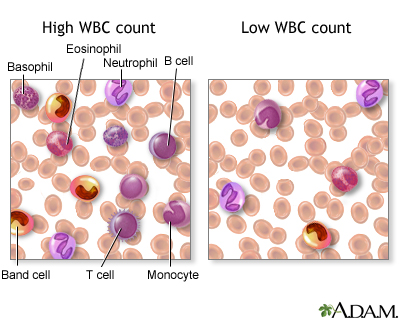
There are various types of white blood cells (WBCs) that normally appear in the blood: neutrophils (polymorphonuclear leukocytes; PMNs), band cells (slightly immature neutrophils), T-type lymphocytes (T cells), B-type lymphocytes (B cells), monocytes, eosinophils, and basophils. T and B-type lymphocytes are indistinguishable from each other in a normal slide preparation. Any infection or acute stress will result in an increased production of WBCs. This usually entails increased numbers of cells and an increase in the percentage of immature cells (mainly band cells) in the blood. This change is referred to as a “shift to the left” People who have had a splenectomy have a persistent mild elevation of WBCs. Drugs that may increase WBC counts include epinephrine, allopurinol, aspirin, chloroform, heparin, quinine, corticosteroids, and triamterene. Drugs that may decrease WBC counts include antibiotics, anticonvulsants, antihistamine, antithyroid drugs, arsenicals, barbiturates, chemotherapeutic agents, diuretics and sulfonamides.   (Updated by: David C. Dugdale, III, MD)

https://www.med-ed.virginia.edu/courses/path/innes/nh/wcbmaturation.cfm

Note that the mature forms of the myeloid series (neutrophils, eosinophils, basophils), all have lobed (segmented) nuclei. The degree of lobation increases as the cells mature.

The earliest recognizable myeloid cell is the myeloblast (10-20m dia) with a large round to oval nucleus. There is fine diffuse immature chromatin (without clumping) and a prominant nucleolus.

The cytoplasm is basophilic without granules. Although one may see a small golgi area adjacent to the nucleus, granules are not usually visible by light microscopy. One should not see blast cells in the peripheral blood.

myeloblast x100b

https://www.med-ed.virginia.edu/courses/path/innes/images/nhjpeg/nh%20myeloblast%20x100b.jpeg

The promyelocyte (10-20m) is slightly larger than a blast. Its nucleus, although similar to a myeloblast shows slight chromatin condensation and less prominent nucleoli. The cytoplasm contains striking azurophilic granules or primary granules. These granules contain myeloperoxidase, acid phosphatase, and esterase enzymes. Normally no promyelocytes are seen in the peripheral blood.

At the point in development when secondary granules can be recognized, the cell becomes a myelocyte.

promyelocyte x100

https://www.med-ed.virginia.edu/courses/path/innes/images/nhjpeg/nh%20promyelocyte%20×100%20a.jpeg

Myelocytes (10-18m) are not normally found in the peripheral blood. Nucleoli may not be seen in the late myelocyte. Primary azurophilic granules are still present, but secondary granules predominate. Secondary granules (neut, eos, or baso) first appear adjacent to the nucleus. In neutrophils this is the “dawn” of neutrophilia.

Metamyelocytes (10-18m) have kidney shaped indented nuclei and dense chromatin along the nuclear membrane. The cytoplasm is faintly pink, and they have secondary granules (neutro, eos, or baso). Zero to one percent of the peripheral blood white cells may be metamyelocytes (juveniles).

metamyelocyte x100

https://www.med-ed.virginia.edu/courses/path/innes/images/nhjpeg/nh%20metamyelocyte%20×100.jpeg

Bands, slightly smaller than juveniles, are marked by a U-shaped or deeply indented nucleus.

band neutrophilx100a

https://www.med-ed.virginia.edu/courses/path/innes/images/nhjpeg/nh%20band%20x100a.jpeg

Segmented (segs) or polymorphonuclear (PMN) leukocytes (average 14 m dia) are distinguished by definite lobation with thin thread-like filaments of chromatin joining the 2-5 lobes. 45-75% of the peripheral blood white cells are segmented neutrophils.

https://www.med-ed.virginia.edu/courses/path/innes/images/nhjpeg/nh%20neutrophil%20×100%20d.jpeg

Thrombocytogenesis

The incredible journey: From megakaryocyte development to platelet formation

Kellie R. Machlus1,2 and Joseph E. Italiano Jr
JCB 2013; 201(6): 785-796
http://dx.doi.org:/10.1083/jcb.201304054

Large progenitor cells in the bone marrow called megakaryocytes (MKs) are the source of platelets. MKs release platelets through a series of fascinating cell biological events. During maturation, they become polyploid and accumulate massive amounts of protein and membrane. Then, in a cytoskeletal-driven process, they extend long branching processes, designated proplatelets, into sinusoidal blood vessels where they undergo fission to release platelets.

megakaryocyte production of platelets

http://dm5migu4zj3pb.cloudfront.net/manuscripts/26000/26891/medium/JCI0526891.f4.jpg

platelets and the immune continuum nri2956-f3

http://www.nature.com/nri/journal/v11/n4/images/nri2956-f3.jpg

2.4.2 Classification of hematological malignancies
Practical Diagnosis of Hematologic Disoreders. 4th edition. Vol 2.
Kjeldsberg CR, Ed.  ASCP Press.  2006. Chicago, IL.

2.4.2.1 Primary Classification

Acute leukemias

Myelodysplastic syndromes

Acute myeloid leukemia

Acute lymphoblastic leukemia

Myeloproliferative Disorders

Chronic myeloproliferative disorders

Chronic myelogenous leukemia and related disorders

Myelofibrosis, including chronic idiopathic

Polycythemia, including polycythemia rubra vera

Thrombocytosis, including essential thrombocythemia

Chronic lymphoid leukemia and other lymphoid leukemias

Lymphomas

Non-Hodgkin Lymphoma

Hodgkin lymphoma

Lymphoproliferative disorders associated with immunodeficiency

Plasma Cell dyscrasias

Mast cell disease and Histiocytic neoplasms

2.4.2.2 Secondary Classification

2.4.2.3 Nuance – PathologyOutlines
Nat Pernick, Ed.

Leukemia – Acute

Primary referencesacute leukemia-generalAML generalAML classificationtransient abnormal myelopoiesis

Recurrent genetic abnormalities: AML with t(6;9)AML with t(8;21)AML with 11q23 abnormalitiesAML with inv(16) or t(16;16)AML with Down syndromeAML with FLT3 mutationsAML with myelodysplastic related changesAML therapy relatedAPL microgranular variantAPL with t(15;17)APL with t(V;17)APL therapy related

AML not otherwise categorized: minimally differentiated (M0)without maturation (M1)with maturation (M2)M3myelomonocyticmonoblastic and monocyticerythroidmegakaryoblasticCD13/CD33 negativebasophilicmyeloid sarcomaacute panmyelosis with myelofibrosiswith Philadelphia chromosomewith pseudo Chediak-Higashi anomalyhypocellular

ALL: generalWHO classificationwith eosinophilia

PreB ALL: generalt(9;22)t(v;11q23)t(1;19)t(5;14)t(12;21)hyperdiploidyhypodiploidymature B ALL/Burkitt

Other ALL: T ALLambiguous lineagemixed phenotype

AML and related malignancies

Acute myeloid leukemias with recurrent genetic abnormalities:

  • AML with t(8;21)(q22;q22); RUNX1-RUNX1T1
  • AML with inv(16)(p13.1;q22) or t(16;16)(p13.1;q22); CBF&beta-MYH11
  • Acute promyelocytic leukemia with t(15;17)(q22;q12); PML/RAR&alpha and variants
  • AML with t(9;11)(p22;q23); MLLT3-MLL
  • AML with t(6;9)(p23;q34); DEK-NUP214
  • AML with inv(3)(q21q26.2) or t(3;3)(q21;q26.2); RPN1-EVI1
  • AML (megakaryoblastic) with t(1;22)(p13;q13); RBM15-MKL1
  • AML with mutated NPM1*
  • AML with mutated CEBPA*

* provisional

Acute myeloid leukemia with myelodysplasia related changes

Therapy related acute myeloid leukemia

  • Alkylating agent related
  • Topoisomerase II inhibitor related (some maybe lymphoid)

Acute myeloid leukemia not otherwise categorized:

  • AML minimally differentiated (M0)
  • AML without maturation (M1)
  • AML with maturation (M2)
  • Acute myelomonocytic leukemia (M4)
  • Acute monoblastic and monocytic leukemia (M5a, M5b)
  • Acute erythroid leukemia (M6)
  • Acute megakaryoblastic leukemia (M7)
  • Acute basophilic leukemia
  • Acute panmyelosis with myelofibrosis

Myeloid Sarcoma

Myeloid proliferations related to Down syndrome:

  • Transient abnormal myelopoeisis
  • Myeloid leukemia associated with Down syndrome

Blastic plasmacytoid dentritic cell neoplasm:

Acute leukemia of ambiguous lineage:

  • Acute undifferentiated leukemia
  • Mixed phenotype acute leukemia with t(9;22)(q34;q11.2); BCR-ABL1
  • Mixed phenotype acute leukemia with t(v;11q23); MLL rearranged
  • Mixed phenotype acute leukemia, B/myeloid, NOS
  • Mixed phenotype acute leukemia, T/myeloid, NOS
  • Mixed phenotype acute leukemia, NOS, rare types
  • Other acute leukemia of ambiguous lineage
  • References: WHO Classification of Tumours of Haematopoietic and Lymphoid Tissue (IARC, 2008), Discovery Medicine 2010, eMedicine

Acute lymphocytic leukemia

General
=================================================================

  • WHO classification system includes former FAB classifications ALL-L1 and L2
    ● FAB L3 is now considered Burkitt lymphoma

WHO classification of acute lymphoblastic leukemia
=================================================================

Precursor B lymphoblastic leukemia / lymphoblastic lymphoma:
● ALL with t(9;22)(q34;q11.2); BCR-ABL (Philadelphia chromosome)
● ALL with t(v;11q23) (MLL rearranged)
● ALL with t(1;19)(q23;p13.3); TCF3-PBX1 (E2A-PBX1)
● ALL with t(12;21)(p13;q22); ETV6-RUNX1 (TEL-AML1)
● Hyperdiploid > 50
● Hypodiploid
● t(5;14)(q31;q32); IL3-IGH

Precursor T lymphoblastic leukemia / lymphoma

Additional references
=================================================================

Mixed phenotype acute leukemia (MPAL)

General
=================================================================

  • De novo acute leukemia containing separate populations of blasts of more than one lineage (bilineal or bilineage), or a single population of blasts co-expressing antigens of more than one lineage (biphenotypic)Excludes:
    ● Acute myeloid leukemia (AML) with recurrent translocations t(8;21), t(15;17) or inv(16)
    ● Leukemias with FGFR1 mutations
    ● Chronic myelogenous leukemia (CML) in blast crisis
    ● Myelodysplastic syndrome (MDS)-related AML and therapy-related AML, even if they have MPAL immunophenotypeCriteria for biphenotypic leukemia:
    ● Score of 2 or more for each of two separate lineages:The European Group for the Immunological Classification of Leukemias (EGIL) scoring system2008 WHO classification of acute leukemias of ambiguous lineage 

Prognosis
=================================================================

  • Poor, overall survival of 18 months
    ● Young age, normal karyotype and ALL induction therapy are associated with favorable survival
    ● Ph+ is a predictor for poor prognosis
    ● Bone marrow transplantation should be considered in first remission

Major Categories

MPAL with t(9;22)(q34;q11.2); BCR-ABL1
=================================================================

  • 20% of all MPAL
    ● Blasts with t(9;22)(q34;q11.2) translocation or BCR-ABL1 rearrangement (Ph+) without history of CML
    ● Majority in adults
    ● High WBC counts● Most of the cases B/myeloid phenotype
    ● Rare T/myeloid, B and T lineage, or trilineage leukemiasMorphology:
    ● Many cases show a dimorphic blast population, one resembling myeloblasts and the other lymphoblastsCytogenetic abnormalities:
    ● Conventional karyotyping for t(9;22), FISH or PCR for BCR-ABL1 translocation
    ● Additional complex karyotypes
    ● Ph+ is a poor prognostic factor for MPAL, with a reported median survival of 8 months
    ● Worse than patients of all other types of MPAL

MPAL with t(v;11q23); MLL rearranged
=================================================================

  • Meeting the diagnostic criteria for MPAL with blasts bearing a translocation involving the 11q23 breakpoint (MLL gene)
    ● MPAL with MLL rearranged rare
    ● More often seen in children and relatively common in infancy
    ● High WBC counts
    ● Poor prognosis
    ● Dimorphic blast population, with one resembling monoblasts and the other resembling lymphoblasts
    ● Lymphoblast population often shows a CD19+, CD10- B precursor immunophenotype, frequently CD15+
    ● Expression of other B markers usually weak
    ● Translocations involving MLL gene include t(4;11)(q21;q23), t(11;19)(q23;p13), and t(9;11)(p22;q23)
    ● Cases with chromosome 11q23 deletion should not be classified in this category

B cell acute lymphoblastic leukemia (ALL) / lymphoblastic lymphoma (LBL)

General

=================================================================

  • Current 2008 WHO classification: B lymphoblastic leukemia / lymphoma, NOS or B lymphoblastic leukemia / lymphoma with recurrent genetic abnormalities
  • See also lymphomas: B cell chapter
  • Also called B cell acute lymphoblastic leukemia / lymphoblastic lymphoma, pre B ALL / LBL
  • Usually children
  • B acute lymphoblastic leukemia presents with pancytopenia due to extensive marrow involvement, stormy onset of symptoms, bone pain due to marrow expansion, hepatosplenomegaly due to neoplastic infiltration, CNS symptoms due to meningeal spread and testicular involvement
  • B acute lymphoblastic lymphoma often presents with cutaneous nodules, bone or nodal involvement, < 25% lymphoblasts in bone marrow and peripheral blood; aleukemic cases are usually asymptomatic
  • Depending on specific leukemia, arises in either hematopoietic stem cell or B-cell progenitor
  • Tumors are derived from pre-germinal center naive B cells with unmutated VH region genes
  • Have multiple immunophenotyping aberrancies relative to normal B cell precursors (hematogones); at relapse, 73% show loss of 1+ aberrance and 60% show new aberrancies (Am J Clin Pathol 2007;127:39)

Prognostic features

=================================================================

  • Favorable prognosis: age 1-10 years, female, white; preB phenotype, hyperdiploidy>50, t(12,21), WBC count at presentation <50×108/L, non-traumatic tap with no blasts in CNS, rapid response to chemotherapy < 5% blasts on morphology on day 15, remission status after induction <5% blasts on morphology and <0.01% blast on flow or PCR, CD10+
  • Intermediate prognosis: hyperdiploidy 47-50, diploid, 6q- and rearrangements of 8q24
  • Unfavorable prognosis: under age 1 (usually have 11q23 translocations) or over age 10; t(9;22) (but not if age 59+ years, Am J Clin Pathol 2002;117:716); male, > 50×108/L WBC at presentation, hypodiploidy, near tetraploidy, 17p- and MLL rearrangements t(v;11q23); CD10-; non-traumatic tap with > 5% blasts or traumatic tap (7%); also increased microvessel staining using CD105 in children (Leuk Res 2007;31:1741), MDR1 expression in children (Oncol Rep 2004;12:1201) and adults (Blood 2002;100:974), 25%+ blasts on morphology on day 15, remission status after induction ≥ 5% blasts on morphology and ≥ 0.1% blasts on flow or PCR

Case reports

=================================================================

  • 12 month old girl and 13 month old boy with mature phenotype but no translocations (Arch Pathol Lab Med 2003;127:1340)
  • 56 year old man with ALL arising from follicular lymphoma (Arch Pathol Lab Med 2002;126:997)
  • 76 year old man with basal cell carcinoma (Diagn Pathol 2007;2:32)
  • With hemophagocytic lymphohistiocytosis (Pediatr Blood Cancer 2008;50:381)

Treatment

================================================================

  • Chemotherapy cures more children than adults; adolescents benefit from intensive regimens (Hematology Am Soc Hematol Educ Program 2005:123)

Micro description

=================================================================

  • Bone marrow smears: small to intermediate blast-like cells with scant, variably basophilic cytoplasm, round / oval or convoluted nuclei, fine chromatin and indistinct nucleoli; frequent mitotic figures; may have “starry sky” appearance similar to Burkitt lymphoma; may have large lymphoblasts with 1-4 prominent nucleoli resembling myeloblasts; usually no sclerosis
  • Bone marrow biopsy: usually markedly hypercellular with reduction of trilinear maturation; cells have minimal cytoplasm, medium sized nuclei that are often convoluted, moderately dense chromatin and indistinct nucleoli, brisk mitotic activity
  • Other tissues: may have “starry sky” appearance similar to Burkitt lymphoma; collagen dissection, periadipocyte growth pattern and single cell linear filing

Chronic Leukemia

Chronic Myeloid Neoplasms

Myelodysplastic syndromes (MDS): general, WHO classification, childhood, refractory anemia, refractory anemia with ringed sideroblasts, refractory cytopenia with multilineage dysplasia, refractory anemia with excess blasts, 5q-syndrome, therapy related, unclassified, arsenic toxicity

Myeloproliferative neoplasms (MPN): general, WHO classification, chronic eosinophilic leukemia, chronic myelogenous leukemia, chronic neutrophilic leukemia, essential thrombocythemia, hypereosinophilic syndrome, mast cell disease, polycythemia vera, primary myelofibrosis, unclassifiable

MDS/MPN: general, WHO classification, atypical CML, chronic myelomonocytic leukemia (CMML), chronic myelomonocytic leukemia with eosinophilia, juvenile myelomonocytic leukemia, unclassifiable

Myeloid neoplasms associated with eosinophilia and abnormalities of PDGFRA, PDGFRB, or FGFR1: PDGFRA, PDGFRB, FGFR1

Miscellaneous: transient myeloproliferative disorder of Downís syndrome

Lymphoma and plasma cell neoplasms

Lymph nodes: normal development-generalB cellsT cellsNK cellsnormal histologygrossing lymph nodesfeatures to report

Molecular testing: theoryFISHnorthern blotPCRsouthern blot

Non-Hodgkin lymphoma: generalcytogeneticsstagingstaging-pediatricmorphologic clueshemophagocytic syndromechemotherapeutic atypia

B cell disorders: generalpost-rituximabbone marrow biopsyclassification-historicalWHO classification

B cell lymphoma subtypes: age-related EBV-associatedALK positive large cellBurkittunclassifiable-intermediate between Burkitt and diffuse large B cell lymphomaCLL
diffuse large B cell: 
diffuse-NOSCD5+T cell / histiocyte richprimary cutaneous-generalprimary cutaneous-legprimary sites-other
follicular: 
generalchildhoodcutaneousGI
hairy cell leukemiaHCL variantintravascular large B celllymphomatoid granulomatosislymphoplasmacyticmantle cell-classicmantle cell-blastoidmarginal zone-generalmarginal zone-MALTMALT-primary sitesmarginal zone-nodalmediastinal (thymic)plasmablasticpre B lymphoblastic leukemia/lymphomaprimary effusionprolymphocytic leukemiapyothorax associatedSLLsplenic marginal zonesplenic lymphoma with villous lymphocytes

Plasma cell neoplasms: generalmyelomaplasmacytomaheavy chain diseaseprimary amyloidosisMGUSOsteosclerotic myeloma (POEMS)cryoglobulinemia

T/NK cell disorders: generalWHO classificationadult T cellaggressive NK cell leukemiaanaplastic large cell ALK+ALK-angioimmunoblastic T cellblastic plasmacytoidchronic lymphoproliferative disorders of NK cellscutaneous CD4+ small/medium sized T cell lymphomacutaneous CD30 positive T cell lymphoproliferative disorderscutaneous gamma delta T cell lymphomaenteropathyepidermotropic CD8+ T cell lymphomahepatosplenicindolent T cell proliferationsmycosis fungoidesNK/T cell lymphoma-nasal typenodal CD8+ cytotoxic T cellnonB nonT lymphoblasticperipheral T cell lymphoma, NOSprimary effusion lymphomaSezary syndromestagingsubcutaneous panniculitis-likeT cell large granular lymphocytic leukemiaT cell lymphoblastic leukemia/lymphomaT cell prolymphocytic leukemia

Hodgkin lymphoma: general/stagingclassiclymphocyte depletedlymphocyte rich classicalmixed cellularitynodular lymphocyte predominantnodular sclerosis

Post-transplantation: generalWHO classificationplasmacytic hyperplasia/IM-like lesionspolymorphic B cell lymphoproliferative disordersmonomorphic B cell lymphoproliferative disordersothergraft versus host disease

Other: AIDS associated-generalAIDS associated-examplesEBV+ T cell lymphoproliferative disorders of childhoodprimary immune disorders related

Myeloproliferative neoplasms (MPN)

WHO 2008 – Myeloproliferative neoplasms (MPN) 

General
=================================================================

  • Chronic myelogenous leukemia
    ● Polycythemia vera
    ● Essential thrombocythemia
    ● Primary myelofibrosis
    ● Chronic neutrophilic leukemia
    ● Chronic eosinophilic leukemia, not otherwise categorized
    ● Mast cell disease
    ● MPNs, unclassifiable

WHO 2001 – Chronic myeloproliferative diseases 

Definition
=================================================================

  • Chronic myelogenous leukemia (Philadelphia chromosome, t(9;22)(q34;q11), BCR-ABL positive)
    ● Chronic neutrophilic leukemia
    ● Chronic eosinophilic leukemia (and the hypereosinophilic syndrome)
    ● Polycythemia vera
    ● Chronic idiopathic myelofibrosis (with extramedullary hematopoiesis)
    ● Essential thrombocythemia
    ● Chronic myeloproliferative disease, unclassifiable

Additional references
=================================================================

The World Health Organization (WHO) classification of the myeloid neoplasms  James W. Vardiman, Nancy Lee Harris, and Richard D. Brunning
Blood 2002; 100(7)  http://dx.doi.org/10.1182/blood-2002-04-1199

Lymphoma – Non B cell neoplasms

T/NK cell disorders/WHO classification (2008)

Principles of classification
=================================================================

  • Based on all available information (morphology, immunophenotype, genetics, clinical)
    ● No one antigenic marker is specific for any neoplasm (except ALK1)
    ● Immune profiling less helpful in subclassification of T cell lymphomas then B cell lymphomas
    ● Certain antigens commonly associated with specific disease entities but not entirely disease specific
    ● CD30: common in anaplastic large cell lymphoma but also classic Hodgkin lymphoma and other B and T cell lymphomas
    ● CD56: characteristic for nasal NK/T cell lymphoma, but also other T cell neoplasms and plasma cell disorders
    ● Variation of immunophenotype within a given disease (hepatosplenic T cell lymphoma: usually γδ but some are αβ)
    ● Recurrent genetic alterations have been identified for many B cell lymphomas but not for most T cell lymphomas
    ● No attempt to stratify lymphoid malignancies by grade
    ● Recognize the existence of grey zone lymphomas
    ● This multiparameter approach has been validated in international studies as highly reproducible

WHO 2008 classification of tumors of hematopoietic and lymphoid tissues (T/NK)
=================================================================

Precursor T-lymphoid neoplasms
● T lymphoblastic leukemia/lymphoma, 9837/3

Mature T cell and NK cell neoplasms
● T cell prolymphocytic leukemia, 9834/3
● T cell large granular lymphocytic leukemia, 9831/3
● Chronic lymphoproliferative disorder of NK cells, 9831/3
● Aggressive NK cell leukemia, 9948/3
● Systemic EBV-positive T cell lymphoproliferative disease of childhood, 9724/3
● Hydroa vacciniforme-like lymphoma, 9725/3
● Adult T cell leukemia/lymphoma, 9827/3
● Extranodal NK/T cell lymphoma, nasal type, 9719/3
● Enteropathy-associated T cell lymphoma, 9717/3
● Hepatosplenic T cell lymphoma, 9716/3
● Subcutaneous panniculitis-like T cell lymphoma, 9708/3
● Mycosis fungoides, 9700/3
● Sézary syndrome, 9701/3
● Primary cutaneous CD30-positive T cell lymphoproliferative disorders
● Lymphomatoid papulosis, 9718/1
● Primary cutaneous anaplastic large cell lymphoma, 9718/3
● Primary cutaneous gamma-delta T cell lymphoma, 9726/3
● Primary cutaneous CD8-positive aggressive epidermotropic cytotoxic T cell lymphoma, 9709/3
● Primary cutaneous CD4-positive small/medium T cell lymphoma, 9709/3
● Peripheral T cell lymphoma, NOS, 9702/3
● Angioimmunoblastic T cell lymphoma, 9705/3
● Anaplastic large cell lymphoma, ALK-positive, 9714/3
● Anaplastic large cell lymphoma, ALK-negative, 9702/3

Chronic Lymphocytic Leukemia

Chronic Lymphocytic Leukemia Staging
Author: Sandy D Kotiah, MD; Chief Editor: Jules E Harris, MD
Medscape Sep 6, 2013
http://emedicine.medscape.com/article/2006578-overview

General considerations in the staging of chronic lymphocytic leukemia (CLL) and the revised Rai (United States) and Binet (Europe) staging systems for CLL are provided below.[1, 2, 3]

See Chronic Leukemias: 4 Cancers to Differentiate, a Critical Images slideshow, to help detect chronic leukemias and determine the specific type present.

General considerations

  • CLL and small lymphocytic lymphoma (SLL) are different manifestations of the same disease; SLL is diagnosed when the disease is mainly nodal, and CLL is diagnosed when the disease is seen in the blood and bone marrow
  • CLL is diagnosed by > 5000 monoclonal lymphocytes/mm3 for longer than 3mo; the bone marrow usually has more than 30% monoclonal lymphocytes and is either normocellular or hypercellular
  • Monoclonal B lymphocytosis is a precursor form of CLL that is defined by a monoclonal B cell lymphocytosis < 5000 monoclonal lymphocytes/mm3; all lymph nodes smaller than 1.5 cm; no anemia; and no thrombocytopenia

Revised Rai staging system (United States)

Low risk (formerly stage 0)[1] :

  • Lymphocytosis, lymphocytes in blood > 15000/mcL, and > 40% lymphocytes in the bone marrow

Intermediate risk (formerly stages I and II):

  • Lymphocytosis as in low risk with enlarged node(s) in any site, or splenomegaly or hepatomegaly or both

High risk (formerly stages III and IV):

  • Lymphocytosis as in low risk and intermediate risk with disease-related anemia (hemoglobin level < 11.0 g/dL or hematocrit < 33%) or platelets < 100,000/mcL

Binet staging system (Europe)

Stage A:

  • Hemoglobin ≥ 10 g/dL, platelets ≥ 100,000/mm3, and < 3 enlarged areas

Stage B:

  • Hemoglobin ≥ 10 g/dL, platelets ≥ 100,000/mm3, and ≥ 3 enlarged areas

Stage C:

  • Hemoglobin < 10 g/dL, platelets < 100,000/mm3, and any number of enlarged areas

Read Full Post »

Optogenetics: The Promise for development of Biological Alternatives to the Electronic Pacemaker: Pacing and Resynchronizing Heartbeat by Activating Light-sensitive Proteins: ion-channel ChR2, overexpressed in Excitable cells in Heart Muscle Cells to modulate their Electrical Activity

Reporter: Aviva Lev-Ari, PhD, RN

Optogenetics for in vivo cardiac pacing and resynchronization therapies

Nature Biotechnology 33, 750–754 (2015) doi:10.1038/nbt.3268
Received
28 February 2014
Accepted
22 May 2015
Published online
22 June 2015

Abnormalities in the specialized cardiac conduction system may result in slow heart rate or mechanical dyssynchrony. Here we apply optogenetics, widely used to modulate neuronal excitability1, 2, 3, 4, for cardiac pacing and resynchronization. We used adeno-associated virus (AAV) 9 to express the Channelrhodopsin-2 (ChR2) transgene at one or more ventricular sites in rats. This allowed optogenetic pacing of the hearts at different beating frequencies with blue-light illumination both in vivo and in isolated perfused hearts. Optical mapping confirmed that the source of the new pacemaker activity was the site of ChR2 transgene delivery. Notably, diffuse illumination of hearts where the ChR2 transgene was delivered to several ventricular sites resulted in electrical synchronization and significant shortening of ventricular activation times. These findings highlight the unique potential of optogenetics for cardiac pacing and resynchronization therapies.

The study was conducted by Dr. Udi Nussinovitch as part of his PhD work in Professor Gepstein’s laboratory at the Technion. Dr. Nussinovitch is currently an intern at the Department of Internal Medicine at Rambam.

The optogenetic technology employed allowed researchers to selectively activate light-sensitive proteins (such as the ion-channel ChR2, first identified in algae), which were overexpressed in excitable cells (such as nerve or muscle cells), in an attempt to modulate (either augment or suppress) their electrical activity. Optogenetics has become an important tool in brain research and the current study is the first to translate this important innovation to pace and resynchronize the heartbeat.

In the study, conducted in rats, the researchers first directed a beam of blue light at an area in the heart where the light-sensitive genes were delivered. This resulted in effective pacing of the heart at different rates as dictated by the frequency of the blue light flashes applied. Subsequently, a more advanced experiment was conducted, in which various locations in the rat hearts expressing ChR2 were activated simultaneously by light, resulting in improved synchronization of the contractions of the ventricles.

Professor Gepstein stresses that this is a preliminary study, and that “in order to translate the aforementioned approach to the clinical arena, we must overcome some significant hurdles. We must

  • improve the penetration of light through the tissues,
  • ensure continuous expression of the protein in the heart for many years, and
  • develop a unique pacing device that will provide the necessary illumination.

But despite all of this, the results of the study demonstrate the unique potential of optogenetics for both

  • cardiac pacing (as an alternative to electronic pacemakers) and
  • resynchronization (for the treatment of heart failure with ventricular dys-synchrony) therapies.”

SOURCES

Nature Biotechnology 33, 750–754 (2015) doi:10.1038/nbt.3268

http://pard.technion.ac.il/2015/06/22/the-illuminated-heart/

Other related articles in this Open Access Online Scientific Journal include the following: 

All Articles in the Electrophysiology Research Category in the Journal

https://pharmaceuticalintelligence.com/wp-admin/edit.php?category_name=electrophysiology

Atrioventricular (AV) Conduction Disease (block): Human Mutations affecting the Voltage Clock

Aviva Lev-Ari, PhD, RN

http://pharmaceuticalintelligence.com/2013/12/18/atrioventricular-av-conduction-disease-block-human-mutations-affecting-the-voltage-clock/

Selective Ion Conduction

Larry H Bernstein, MD, FCAP

http://pharmaceuticalintelligence.com/2013/10/07/selective-ion-conduction/

Genetics of Conduction Disease: Atrioventricular (AV) Conduction Disease (block): Gene Mutations – Transcription, Excitability, and Energy Homeostasis

Aviva Lev-Ari, PhD, RN

http://pharmaceuticalintelligence.com/2013/04/28/genetics-of-conduction-disease-atrioventricular-av-conduction-disease-block-gene-mutations-transcription-excitability-and-energy-homeostasis/

Obesity associated with reduced posterior LA endocardial voltage and infiltration of contiguous posterior LA muscle by epicardial fat, representing a unique substrate for atrial fibrillation (AF)

Aviva Lev-Ari, PhD, RN

http://pharmaceuticalintelligence.com/2015/07/07/obesity-associated-with-reduced-posterior-la-endocardial-voltage-and-infiltration-of-contiguous-posterior-la-muscle-by-epicardial-fat-representing-a-unique-substrate-for-atrial-fibrillation-af/

Diagnostics Industry and Drug Development in the Genomics Era: Mid 80s to Present

Larry H Bernstein, MD, FCAP

http://pharmaceuticalintelligence.com/2014/11/21/diagnostics-industry-and-drug-development-in-the-genomics-era-mid-80s-to-present/

Cardiovascular Biology  – A Bibliography of Research @Technion

Aviva Lev-Ari, PhD, RN

http://pharmaceuticalintelligence.com/2014/05/27/cardiovascular-biology-a-bibliography-of-research-technion/

Summary of Translational Medicine – e-Series A: Cardiovascular Diseases, Volume Four – Part 1

Larry H Bernstein, MD, FCAP and Aviva Lev-Ari, PhD, RN

http://pharmaceuticalintelligence.com/2014/04/28/summary-of-translational-medicine-cardiovascular-diseases-part-1/

Read Full Post »

 Sequencing yourself! and Learn more on Genome Sequencing on Tuesday, November 17, 2015 from 8am-5pm in the Joseph B. Martin Conference Center of the Harvard New Research Building at Harvard Medical School, Volume 2 (Volume Two: Latest in Genomics Methodologies for Therapeutics: Gene Editing, NGS and BioInformatics, Simulations and the Genome Ontology), Part 1: Next Generation Sequencing (NGS)

Sequencing yourself! and Learn more on Genome Sequencing on Tuesday, November 17, 2015 from 8am-5pm in the Joseph B. Martin Conference Center of the Harvard New Research Building at Harvard Medical School

Reporter: Aviva Lev-Ari, PhD, RN

Become one of the first humans to have your entire genome sequenced, while participating in an interactive set of presentations and debates about the promise and limitations of genome sequencing from some of the world’s leading genomic scientists.

The UYG Boston is an invitation-only, interactive symposium in which approximately 60 leaders from the Boston business and academic communities will have the opportunity to undergo whole genome sequencing, and to explore their own genome as part of an all-day educational conference with exciting presentations, debates and comments from some of the most thought-provoking leaders in the field of sequencing, informatics and genomic medicine.

Co-sponsors:

  • Brigham Genome Medicine, Brigham and Women’s Hospital
  • Partners Personalized Medicine and Laboratory for Molecular Medicine
  • Precision Medicine Program at Brigham and Women’s Hospital
  • Department of Pathology at Brigham and Women’s Hospital
  • Analytic and Translational Genetics Unit, Massachusetts General Hospital
  • The Broad Institute of Harvard and MIT
  • Department of Pathology at Massachusetts General Hospital
  • Division of Genetics, Department of Medicine, Brigham and Women’s Hospital

http://uygboston.uygsymposium.com/


Draft Agenda for UYG Agenda, November 17, 2015, NRB Rotunda Room

Registration is still open at this link: http://uygboston.uygsymposium.com

Breakfast and Registration

7:30-8:30

Module 1: Understanding the Basics of Genetics and Genomics


Moderator: __________________________________

8:30 am -9:55 am

(10) Robert Green: Welcome and Introductory Remarks

(20) Stacey Gabriel: Technical Overview of Sequencing, Alignment and Variant Calling

(20) Heidi Rehm: Variant Classification and Lab Reporting: the Good, the Bad and the VUS

(20) Daniel MacArthur: Using Large Datasets to Explore Penetrance

(15) Questions and Discussion

Coffee Break

9:55 am – 10:10 am

Module 2: Sequencing and Informatics in Clinical Care


Moderator: __________________________________

10:10 am-11:30 noon

(20) Dick Maas: Sequencing in Undiagnosed Cases

(20) Kricket Seidman: Sequencing in the Care of Specific Diseases (Cardiomyopathy)

(20) Zak Kohane: Sequencing and Informatics

(20) Discussion

Luncheon: Understand Your Genome®

11:30 noon – 1:00 pm

Pechet Room

Lunch for those who have been sequenced or wish to learn to use the MyGenome web portal with the demo genome (seating is limited to 40 WGS attendees + 10 additional attendees):

(30) Erica Ramos: Clinical Whole Genome Sequencing in a Healthy Population

(30) Erica Ramos: MyGenome Web Portal Revealed

(30) Erica Ramos and Genetic Counselors: Holding and Exploring Your Own Genome

Lunch served separately for those who do not wish to explore MyGenome Web App

Module 3: Sequencing in Research: from Discovery to Patient Care


Moderator: __________________________________

1:00 pm – 2:40 pm

(10) Jeff Flier: Afternoon welcome and remarks

(20) Sek Kathiresan: Developing Medicines that Mimic Natural Genomic Successes

(20) Calum MacRae: Global Phenotyping and the Clinic of the Future

(10) Heidi Rehm: ClinGen and Matchmaker Exchange

(20) Robert Green: Clinical Outcomes Research in Sequencing

(20) Discussion

Module 4: Academic Medical Centers and Personalized/Precision Medicine


Moderator: __________________________________

2:40- 3:35

(15) Betsy Nabel: Direct-to Consumer Sequencing and the Academic Medical Center

(20) Jeff Golden: Precision Medicine, Regulation and Reimbursement

(20) Discussion

Afternoon Break

3:35-3:50

Module 5: Debate on the Benefits, Harms and Costs of Sequencing Health Individuals by Individual Speakers with the Entire Panel of Speakers and the Attendees

3:50-4:55

Five Minute Pro or Con by Each Speaker and Select Audience Members, Followed by Debate


“DNA Team” Captains: “There is Benefit” Jeff Golden/Jeff Flier

“RNA Team” Captains: “There is No Benefit” Sek Kathiresan/Betsy Nabel

Closing Remarks

4:55 – 5:00

(5) Robert Green

Wine and Cheese Reception for Speakers and Attendees

5:00-6:00


Registration

– See more at: http://personalizedmedicine.partners.org/education/personalized-medicine-conference/program.aspx#sthash.cnydkNG1.dpuf

Fee:

Register by July 15th to attend for $3,100!
After July 15th registration will be $3,500.

Pricing includes:

$2,900 TruGenome™ Predisposition Screen plus a conference registration fee

When:

November 17, 2015
General Session: 8am – 5pm
Reception: 5pm – 7pm

Where:

The Joseph B. Martin Conference Center
Harvard Medical School
77 Avenue Louis Pasteur
Boston, MA 02115

Confirmed Speakers

  • George Church, PhD,
    Harvard Medical School
  • Stacey Gabriel, PhD
    The Broad Institute
  • Jeff Golden, MD
    Brigham and Women’s Hospital
  • Robert Green, MD, MPH
    Brigham and Women’s Hospital
  • Sek Kathiresan, MD
    Massachusetts General Hospital
  • Zak Kohane, MD, PhD
    Harvard Medical School
  • Richard Maas, MD, PhD
    Brigham and Women’s Hospital
  • Daniel MacArthur, PhD
    Massachusetts General Hospital
  • Calum MacRae, MD
    Brigham and Women’s Hospital
  • Betsy Nabel, MD
    Brigham and Women’s Hospital
  • Heidi Rehm, PhD
    Laboratory of Molecular Medicine
  • Christine Seidman, MD
    Brigham and Women’s Hospital

SOURCE

From: Robert Green <rcgreen@genetics.med.harvard.edu>

Date: Tuesday, July 7, 2015 at 1:46 PM

Subject: Learn about genome sequencing by sequencing yourself!

Robert C. Green, MD, MPH

Director, G2P Research Program

Associate Director for Research, Partners Center for Personalized Genetic Medicine

Division of Genetics, Department of Medicine

Brigham and Women’s Hospital and Harvard Medical School

EC Alumnae Building, Suite 301, 41 Avenue Louis Pasteur, Boston, MA 02115                                    

(office) 617-264-5834, (fax) 617-264-3018, (cell) 617-966-3216

(email) rcgreen@genetics.med.harvard.edu 

(web) www.genomes2people.org

Dear Colleagues:

We are inviting you, as one of a small group of forward looking thought leaders, to attend an exciting educational and experiential event: the Boston “Understand your Genome” conference. This conference will take place the day before this year’s Partners Personalized Medicine Conference at Harvard Medical School and will have two components.

First, a panel of world-renowned speakers will discuss the current progress and promise of genomic medicine, and debate the controversial issues surrounding the sequencing of healthy individuals for prediction and prevention.

Second, the conference will provide you with the option to become one of the first people on the planet to have your whole genome sequenced at a CLIA facility where a report will be generated by a board certified molecular geneticist on 1,691 genes with well-established associations to 1,232 Mendelian conditions, and 11 genes associated with responses to 16 different medications.

This conference is a non-profit educational event that is sponsored by the Division of Genetics, in the Department of Medicine at Brigham and Women’s Hospital with co-sponsorship by Partners Personalized Medicine and the Laboratory for Molecular Medicine, the Precision Medicine Program at Brigham and Women’s Hospital, the Department of Pathology at Brigham and Women’s Hospital, the Analytic and Translational Genetics Unit at Massachusetts General Hospital, the Department of Pathology at Massachusetts General Hospital and the Broad Institute. Together, we have assembled a remarkable panel of speakers for the first component of the program.

Read Full Post »

Endometrial Cancer: Mutations, Molecular Types and Immune Responses Evoked by Mutation-prone Endometrial, Ovarian Cancer Subtypes

Curator: Aviva Lev-Ari, PhD, RN


This Open Access Online Scientific Journal represents a repository of curated scientific literature on the following types of cancer of relevance to the subject matter of this article. See below the FRONTIER of Research on:

Breast Cancer

http://pharmaceuticalintelligence.com/?s=Breast+Cancer

Ovarian Cancer

http://pharmaceuticalintelligence.com/?s=Ovarian+Cancer

Genomics of Endometriosis

http://pharmaceuticalintelligence.com/?s=Endometriosis+

Reproductive Genomics

http://pharmaceuticalintelligence.com/?s=Reproductive+Genomics

Genomic Endocrinology

http://pharmaceuticalintelligence.com/?s=Endocrinology+Genomic


Endometrial Cancer: Mutations, Molecular Types and Immune Responses Evoked by Mutation-prone Endometrial, Ovarian Cancer Subtypes – New Findings


CONCLUSIONS

  • the team saw an apparent jump in PD-1 representation in the lymphocytes that were infiltrating neighboring tumors in the BRCA1/2-mutated tumors relative to the other ovarian cancers, though staining for the immune checkpoint contributors within tumors themselves appeared similar regardless of the subtype considered.
  • Strickland and his colleagues reasoned that such a feature may partly explain the relatively high progression-free survival and overall survival rates reported in BRCA1/2-mutated ovarian cancers, though they are continuing to study the relationship between BRCA mutations and tumor features.
  • Memorial Sloan Kettering medical oncologist Alexandra Snyder Charen discussed potential implications of the endometrial and ovarian cancer studies, noting that distinct mutation signatures in different tumor types could also affect immune response.
  • While she expressed enthusiasm about potential treatment clues provided by more-or-less mutated endometrial and ovarian cancers, Snyder Charen noted that additional research is needed on additional forms of the disease, since the work described was done using primary tumors.


Recurrent somatic mutations in chromatin-remodeling and ubiquitin ligase complex genes in serous endometrial tumors

http://pharmaceuticalintelligence.com/2012/11/19/recurrent-somatic-mutations-in-chromatin-remodeling-and-ubiquitin-ligase-complex-genes-in-serous-endometrial-tumors/

Testing for Multiple Genetic Mutations via NGS for Patients: Very Strong Family History of Breast & Ovarian Cancer, Diagnosed at Young Ages, & Negative on BRCA Test

http://pharmaceuticalintelligence.com/2013/05/20/testing-for-multiple-genetic-mutations-via-ngs-for-patients-very-strong-family-history-of-breast-ovarian-cancer-diagnosed-at-young-ages-negative-on-brca-test/

TCGA Analysis Uncovers Four Molecular Subtypes for Endometrial Cancer

For tumors from the high-risk serous subtype, meanwhile, they saw genetic and genomic features that resemble those found in serous ovarian cancer and basal-like breast cancer, albeit with more frequent mutations to genes such as PIK3CA, FBXW7, PPP2R1A, and ARID1A.

These and other molecular features identified in the current study could have prognostic and treatment implications, they noted. For instance, survival patterns in the POLE subtype seem to be favorable, despite the rampant mutations present in the genomes of those tumors.

In contrast, individuals with serous or serous-like tumors appear to do much worse, Levine noted.

That, in turn, suggests that there could be a benefit to offering more aggressive treatment to individuals with endometrioid cases falling in the new serous-like category, which is characterized by a higher-than-usual burden of copy number changes coupled with frequent mutations in the TP53 gene, a common cancer culprit.

“Clinicians should carefully consider treating copy-number-altered endometrioid patients with chemotherapy rather than adjuvant radiation,” Levine and his co-authors wrote, “and formally test such hypotheses in prospective clinical trials.”

For their part, researchers involved in the current study recently completed the accrual process for a clinical trial that will involve a little more than 300 endometrial cancer patients being treated with various chemotherapy regimens.

By prospectively collecting and tumors and determining their molecular subtypes, Levine said, it should be possible to track outcomes in relation to the four subtypes identified in the current study and, eventually, to get a better sense of treatment response and survival patterns in each group.

https://www.genomeweb.com/clinical-genomics/tcga-analysis-uncovers-four-molecular-subtypes-endometrial-cancer


Immune Responses Evoked by Mutation-prone Endometrial, Ovarian Cancer Subtypes

researchers from Brigham and Women’s Hospital, Harvard Medical School, and the Dana-Farber Cancer Institute characterized tumor-infiltrating immune cell activity and immune checkpoint contributor expression in dozens of archival endometrial tumors samples from mutation-heavy polymerase epsilon (POLE) mutations and microsatellite instability subtypes, comparing them with patterns in more mutation-light microsatellite stable tumors.

The results suggest endometrial cancers from subtypes prone to more widespread mutation also trigger stronger immune responses that might be further enhanced by drugs that inhibit cancer cells’ immune checkpoints, explained Brooke Howitt, a pathologist at the Brigham and Women’s Hospital, who presented the research at ASCO.

Howitt and her colleagues used immunohistochemistry to profile tumor infiltrating lymphocyte and expression of the immune checkpoint players PD-1 and PD-L1 in four POLE-mutated endometrial cancers, 28 endometrial cancers with microsatellite instability, and 32 microsatellite stable endometrial cancers.

Indeed, their results pointed to more pronounced tumor infiltration by CD3+ , CD4+, and CD8+ lymphocytes in the group of POLE-mutated and microsatellite unstable tumors than in the microsatellite stable subtype, consistent with T-cell activity against the mutation-rich tumors.

When they compared the more mutated endometrial cancer subtypes to the microsatellite stable group, the researchers saw signs of enhanced PD-L1 and PD-1 expression in both infiltrating lymphocytes and in the tumors themselves, hinting that the oft-mutated subtypes may respond to immune-targeting PD-1 inhibitor drugs.

Dana-Farber Cancer Institute researcher Kyle Strickland provided evidence for a similar pattern of bolstered immune activity against extensively mutated tumors.

For their part, though, Strickland and his team focused on BRCA1- and/or BRCA2-mutated, high-grade serous ovarian cancers, using immunohistochemistry to see if the high mutational load found in tumors with hampered BRCA-mediated DNA repair activity might also be a flag for the immune system.

There, researchers compared tumor infiltrating lymphocyte patterns in 37 BRCA1/2-mutated tumor samples and in samples from 16 tumors lacking germline or somatic mutations in BRCA1, BRCA2, or related mutations or expression changes — features verified by high-throughput sequencing.

Results from that comparison suggested that all of the ovarian cancers had comparable levels of certain tumor infiltrating lymphocytes, such as the CD3+ or CD20+ lymphocytes.

But compared with the “homologous recombination intact” tumors, the BRCA1/2-mutated ovarian cancers appeared to be marked by higher CD8+ tumor infiltrating lymphocytes and lower CD4+ tumor infiltrating lymphocytes, Strickland explained.

https://www.genomeweb.com/cancer/asco-session-explores-immune-responses-evoked-mutation-prone-endometrial-ovarian-cancer


Read Full Post »

Nonhematologic Cancer Stem Cells [11.2.3]

Writer and Curator: Larry H. Bernstein, MD, FCAP 

Nonhematologic Stem Cells

11.2.3.1 C8orf4 negatively regulates self-renewal of liver cancer stem cells via suppression of NOTCH2 signalling

Pingping Zhu, Yanying Wang, Ying Du, Lei He, Guanling Huang, et al.
Nature Communications May 2015; 6(7122). http://dx.doi.org:/10.1038/ncomms8122

Liver cancer stem cells (CSCs) harbor self-renewal and differentiation properties, accounting for chemotherapy resistance and recurrence. However, the molecular mechanisms to sustain liver CSCs remain largely unknown. In this study, based on analysis of several hepatocellular carcinoma (HCC) transcriptome datasets and our experimental data, we find that C8orf4 is weakly expressed in HCC tumors and liver CSCs. C8orf4 attenuates the self-renewal capacity of liver CSCs and tumor propagation. We show that NOTCH2 is activated in liver CSCs. C8orf4 is located in the cytoplasm of HCC tumor cells and associates with the NOTCH2 intracellular domain, which impedes the nuclear translocation of N2ICD. C8orf4 deletion causes the nuclear translocation of N2ICD that triggers the NOTCH2 signaling, which sustains the stemness of liver CSCs. Finally, NOTCH2 activation levels are consistent with clinical severity and prognosis of HCC patients. Altogether, C8orf4 negatively regulates the self-renewal of liver CSCs via suppression of NOTCH2 signaling.

Like stem cells, CSCs are characterized by self-renewal and differentiation simultaneously9. Not surprisingly, CSCs share core regulatory genes and developmental pathways with normal tissue stem cells. Accumulating evidence shows that NOTCH, Hedgehog and Wnt signaling pathways are implicated in the regulation of CSC self-renewal4. NOTCH signaling modulates many aspects of metazoan development and tissue stemness1011. NOTCH receptors contain four members (NOTCH1–4) in mammals, which are activated by engagement with various ligands. The aberrant NOTCH signaling was first reported to be involved in the tumorigenesis of human T-cell leukaemia1213. Recently, a number of studies have reported that the NOTCH signaling pathway is implicated in regulating self-renewal of breast stem cells and mammary CSCs1415. However, how the NOTCH signaling regulates the liver CSC self-renewal remains largely unknown.

C8orf4, also called thyroid cancer 1 (TC1), was originally cloned from a papillary thyroid carcinoma and its surrounding normal thyroid tissue16. C8orf4 is ubiquitously expressed across a wide range of vertebrates with the sequence conservation across species. A number of studies have reported that C8orf4 is highly expressed in several tumors and implicated in tumorigenesis171819. In addition, C8orf4 augments Wnt/β-catenin signaling in some cancer cells2021, suggesting it may be involved in the regulation of self-renewal of CSCs. However, the biological function of C8orf4 in the modulation of liver CSC self-renewal is still unknown. Here we show that C8orf4 is weakly expressed in HCC and liver CSCs. NOTCH2 signaling is highly activated in HCC tumors and liver CSCs. C8orf4 negatively regulates the self-renewal of liver CSCs via suppression of NOTCH2 signaling.

C8orf4 is weakly expressed in HCC tissues and liver CSCs

To search for driver genes in the oncogenesis of HCC, we performed genome-wide analyses using several online-available HCC transcriptome datasets by R language and Bioconductor approaches. After analysing gene expression profiles of HCC tumor and peri-tumor tissues, we identified >360 differentially expressed genes from both Park’s cohort (GSE36376; ref. 22) and Wang’s cohort (GSE14520; refs 2324). Of these changed genes, we focused on C8orf4, which was weakly expressed in HCC tumors derived from both Park’s cohort (GSE36376) and Wang’s cohort (GSE14520) (Fig. 1a). Lower expression of C8orf4 was further confirmed in HCC samples by quantitative reverse transcription–PCR (qRT–PCR) and immunoblotting (Fig. 1b,c). In this study, HCC patient samples we used included all subtypes of HCC. In addition, these observations were further validated by immunohistochemical (IHC) staining (Fig. 1d). These data indicate that C8orf4 is weakly expressed in HCC tumor tissues.

C8orf4 is weakly expressed in HCC tumours and liver CSCs

C8orf4 is weakly expressed in HCC tumours and liver CSCs

Figure 1. C8orf4 is weakly expressed in HCC tumours and liver CSCs

http://www.nature.com/ncomms/2015/150519/ncomms8122/images_article/ncomms8122-f1.jpg

(a)C8orf4 is weakly expressed in HCC patients. Using R language and Bioconductor methods, we analyzed C8orf4 expression in HCC tumor and peri-tumor tissues provided by Park’s cohort (GSE36376) and Wang’s cohort (GSE14520) datasets. (b,c) C8orf4 expression levels were verified in HCC patient samples by quantitative RT–PCR (qRT–PCR) (b) and immunoblotting (c). β-actin served as a loading control. 18S: 18S rRNA. (d) HCC samples were assayed by immunohistochemical staining. Scale bar—left: 50 μm; right: 20 μm. (eC8orf4 is weakly expressed in CD13+CD133+ cells sorted from Huh7 cells and primary HCC samples. C8orf4 messenger RNA (mRNA) was measured by qRT–PCR. Six HCC samples got similar results. (fC8orf4 is much more weakly expressed in oncospheres than non-sphere tumor cells. Non-sphere: Huh7 or HCC primary cells that failed to form spheres. (g) HCC sample tissues were co-stained with anti-C8orf4 and anti-CD13 or anti-CD133 antibodies, then counterstained with DAPI for confocal microscopy. White arrows indicate CD13+ or CD133+ cells. Scale bars: 20 μm. For a,b, data are shown as box and whisker plot. Boxes represent interquartile range (IQR); upper and lower edge corresponds to the 75th and 25th percentiles, respectively. Horizontal lines within boxes represent median levels of gene intensity. Whiskers below and above boxes extend to the 5th and 95th percentiles, respectively. For e and f, Student’s t-test was used for statistical analysis, *P<0.05;**P<0.01, data are shown as mean ± standard deviation. Data are representative of at least three independent experiments. P, peri-tumor; T, tumor.


Notably, C8orf4 was also weakly expressed in embryonic stem cells (ESCs) and induced pluripotent stem cells (iPSCs) by analysis of its expression profiles derived from online datasets (GSE14897; ref. 25 and GSE25417; ref. 26) (Supplementary Fig. 1a,b). C8orf4 was also lowly expressed in normal liver stem cells (Supplementary Fig. 1c,d), suggesting that C8orf4 may be involved in the regulation of self-renewal of liver stem cells. Thus, we propose that C8orf4 might play a role in the maintenance of liver CSCs. Since CD13 and CD133 were widely used as liver CSC surface markers, we sorted CD13+CD133+ cells from Huh7 and Hep3B HCC cell lines as well as HCC samples, serving as liver CSCs. We observed that C8orf4 was weakly expressed in liver CSCs enriched from both HCC cell lines and patient samples (Fig. 1e). Six HCC samples were analyzed for these experiments. Similar results were obtained in CD13+CD133+ cells from Hep3B cells. Furthermore, we performed sphere formation experiments using Huh7 cells and HCC primary sample cells, and detected expression levels of C8orf4. We observed that C8orf4 was dramatically reduced in the oncospheres generated by both HCC cell lines and patient samples (Fig. 1f). In addition, we noticed that C8orf4 expression was negatively correlated with liver CSC markers such as CD13 and CD133 in HCC samples (Fig. 1g), suggesting lower expression of C8orf4 in liver CSCs. Moreover, C8orf4 was mainly located in the cytoplasm of tumour cells. Altogether, C8orf4 is weakly expressed in HCC tumor tissues and liver CSCs.

C8orf4 negatively regulates self-renewal of liver CSCs

We then wanted to look at whether C8orf4 plays a critical role in the self-renewal maintenance of liver CSCs. C8orf4 was knocked out in Huh7 cells through a CRISPR/Cas9 system (Fig. 2a). TwoC8orf4-knockout (KO) cell strains were established and C8orf4 was completely deleted in these two strains. C8orf4 deletion dramatically enhanced oncosphere formation (Fig. 2b). We co-stained SOX9, a widely used progenitor marker, and Ki67, a well-known proliferation marker, in C8orf4 KO sphere cells. We found that SOX9 was strongly stained in C8orf4 KO sphere cells (Supplementary Fig. 2a). In contrast, Ki67 staining was not significantly altered in C8orf4 KO sphere cells versus WT sphere cells. We also digested sphere cells and examined the SOX9 and Ki67 expression by flow cytometry. Similar results were achieved (Supplementary Fig. 2b). Importantly, through serial passage of CSC sphere cells, similar observations were obtained in the fourth generation oncosphere assay (Supplementary Fig. 2c,d). These data suggest that C8orf4 is involved in the regulation of liver CSC self-renewal.

(not shown)

Figure 2: C8orf4 knockout enhances self-renewal of liver CSCs.

http://www.nature.com/ncomms/2015/150519/ncomms8122/images_article/ncomms8122-f2.jpg

  • C8orf4-deficient Huh7 cells were established using a CRISPR/Cas9 system. T7 endonuclease I cleavage confirmed the efficiency of sgRNA (left panel, white arrowheads), and C8orf4-knockout efficiency was confirmed by western blot (right panel). Two knockout cell lines were used.  C8KO#1:C8orf4KO#1;  C8KO#2C8orf4KO#2. (bC8orf4-deficient cells enhanced sphere formation activity. Calculated ratios are shown in the right panel. (cC8orf4-deficient or WT Huh7 cells (1 × 10⁶) were injected into BALB/c nude mice. Tumor sizes were observed every 5 days. (dC8orf4 deficiency enhances tumor-initiating capacity. Diluted cell numbers of Huh7 cells were implanted into BALB/c nude mice for tumor initiation. Percentages of tumor-formation mice were calculated (left panel), and frequency of tumor-initiating cells was calculated using extreme limiting dilution analysis (right panel). Error bars represent the 95% confidence intervals of the estimation. (e) Expression levels of CD13 andCD133 were analyzed in C8orf4-knockout Huh7 cells. (f) C8orf4 was silenced in HCC primary cells and C8orf4 depletion enhanced sphere formation activity. Calculated ratios are shown at the right panel. Three HCC specimens obtained similar results. (g) C8orf4-overexpressing Huh7 cells were established (left panel). C8orf4-overexpressing Huh7 cells and control Huh7 cells were cultured for sphere formation. (h,i) Xenograft tumor growth (h) and frequency of tumor-initiating cells (i) for C8orf4-overexpressing Huh7 cells were analyzed as c,d. (j) C8orf4 overexpression reduces expression of CD133 and CD13 in Huh7 cells. (k) C8orf4 was transfected in HCC primary cells and cultured for sphere formation. Three HCC patient samples obtained similar results. Scale bars: b,f,g,k, 500 μm. Student’s t-test was used for statistical analysis,    *P<0.05; **P<0.01; ***P<0.001, data are shown as mean ± standard deviation. Data represent at least three independent experiments. oeC8orf4, overexpression of C8orf4; oeVec, overexpression vector.

In addition, C8orf4-deficient Huh7 cells overtly increased xenograft tumour growth (Fig. 2c). We then performed sphere formation and digested oncospheres formed by C8orf4-deficient or WT cells into single-cell suspension, then subcutaneously implanted 1 × 10⁴, 1 × 10³, 1 × 10² and 10 cells into BALB/c nude mice. Tumour formation was examined for tumour-initiating capacity at the third month. C8orf4 deficiency remarkably enhanced tumour-initiating capacity and liver CSC ratios (Fig. 2d). In addition, C8orf4 deletion significantly enhanced expression levels of the liver CSC markers such as CD13 and CD133 (Fig. 2e). We also silenced C8orf4 in HCC primary cells using a lentivirus infection system and established C8orf4-silenced cells. Two pairs of short hairpin RNA (shRNA) sequences obtained similar knockdown efficiency. C8orf4 knockdown remarkably promoted sphere formation and xenograft tumour growth (Fig. 2f and Supplementary Fig. 2e). These data indicate that C8orf4 deletion potentiates the self-renewal of liver CSCs.
We next overexpressed C8orf4 in Huh7 cells and HCC primary cells using lentivirus infection. We observed that C8orf4 overexpression in Huh7 cells remarkably reduced sphere formation and xenograft tumour growth (Fig. 2g,h). In addition, C8orf4 overexpression remarkably reduced tumour-initiating capacity and expression of liver CSC markers (Fig. 2i,j). Similar results were observed by C8orf4 overexpression in HCC primary cells (Fig. 2k). We tested three HCC samples with similar results. Overall, C8orf4 negatively regulates the maintenance of liver CSC self-renewal and tumour propagation.

C8orf4 suppresses NOTCH2 signaling in liver CSCs

To further determine the underlying mechanism of C8orf4 in the regulation of liver CSCs, we analyzed three major self-renewal signaling pathways, including Wnt/β-catenin, Hedgehog and NOTCH pathways, in C8orf4-deleted Huh7 cells and HCC primary cells. We found that only NOTCH target genes were remarkably upregulated in C8orf4-deficient cells (Fig. 3a), whereasC8orf4 deficiency did not significantly affect the Wnt/β-catenin or the Hedgehog pathway. Given that the NOTCH family receptors have four members, we wanted to determine which NOTCH member was involved in the C8orf4-mediated suppression of liver CSC stemness. We noticed that only NOTCH2 was highly expressed in both Huh7 cells and HCC samples (Fig. 3b). In addition, this result was also confirmed by analysis of NOTCH expression levels derived from Wang’s cohort (GSE14520) and Petel’s cohort (E-TABM-36; ref. 27) (Fig. 3c). Moreover, we analysed expression profiles of C8orf4 and NOTCH target genes using Park’s cohort (GSE36376) and Wurmbach’s cohort (GSE6764; ref. 28). These cohort datasets provided several Notch signaling and its target genes. HEY1NRARP and HES6 genes were highly expressed in HCC tumour tissues (GSE6764; ref. 28), which were further confirmed in HCC samples by real-time PCR (Supplementary Fig. 3a,b). Furthermore, HEY1NRARP and HES6 genes have been reported to be relatively specific NOTCH target genes. We then examined these three genes as the NOTCH2 target genes throughout this study. We found that the C8orf4 expression level was negatively correlated with the expression levels of HEY1 and HES6, suggesting that C8orf4 inhibited NOTCH signaling in HCC patients (Fig. 3d). Finally these results were further confirmed in HCC samples by qRT-PCR (Fig. 3e). To further explore the activation status of NOTCH2 signaling in liver CSCs, we examined the expression levels of NOTCH downstream target genes in oncospheres and CD13+CD133+ cells derived from both Huh7 cells and HCC cells. We observed that NOTCH target genes were highly expressed in liver CSCs (Fig. 3f,g). These observations were verified by immunoblotting (Fig. 3h). In addition, the expression levels of NRARPHES6 and HEY1 were positively related to the expression levels of EpCAM and CD133 derived from Zhang’s cohort (GSE25097; ref. 29) and Wang’s cohort (GSE14520; Supplementary Fig. 3c,d). These data suggest that the NOTCH2 signaling plays a critical role in the maintenance of self-renewal of liver CSCs.

(not shown)

Figure 3: C8orf4 suppresses NOTCH2 signaling in liver CSCs.

http://www.nature.com/ncomms/2015/150519/ncomms8122/images_article/ncomms8122-f3.jpg

(aC8orf4 deficiency or depletion activates NOTCH signaling. The indicated major stemness signalling pathways were analysed in C8orf4-knockout Huh7 cells (left panel) and C8orf4-silenced primary cells of HCC samples (right panel). (b) Four receptor members of NOTCH family were examined in both Huh7 cells (left panel) and 29 pairs of HCC samples (right panel). (cNOTCH receptors were analyzed from Wang’s cohort (left panel) and Petel’s cohort (right panel) datasets. (dHEY1 and HES6 were highly expressed in C8orf4low samples by analysis of Park’s cohort (upper panel) and Wurmbach’s cohort (lower panel). (e) Expression levels of HEY1 and HES6 along with C8orf4 were analysed in HCC samples by qRT–PCR. (f,g) Expression levels of NRARPHEY1 and HES6 in spheres generated by Huh7 cells and HCC primary cells (f) and in CD13+CD133+ cells sorted from Huh7 cells and HCC primary cells (g). Non-sphere: Huh7 cells or HCC cells that failed to form spheres. (h) HEY1, HES6 and NRARP expression in sphere and non-sphere cells was detected by immunoblotting. β-actin was used as a loading control. For c,d, data are shown as box and whisker plot. Box: interquartile range (IQR); horizontal line within box: median; whiskers: 5–95 percentile. For a,b,f,g, Student’s t-test was used for statistical analysis, *P<0.05;**P<0.01; ***P<0.001, data are shown as mean ± standard deviation. Data are representative of at least three independent experiments.

C8orf4 interacts with NOTCH2 that is critical for liver CSCs

On ligand–receptor binding, the NOTCH receptor experiences a proteolytic cleavage by metalloprotease and γ-secretase, releasing a NOTCH extracellular domain (NECD) and a NOTCH intracellular domain (NICD), respectively30. Then the active NICD undergoes nuclear translocation and activates the expression of NOTCH downstream target genes31.Then we constructed the NOTCH2 extracellular domain (N2ECD) and intracellular domain (N2ICD) and examined the interaction with C8orf4 via a yeast two-hybrid approach. Interestingly, we found that C8orf4 interacted with N2ICD, but not N2ECD (Fig. 4a). The interaction was validated by co-immunoprecipitation (Fig. 4b). Through domain mapping, the ankyrin repeat domain of NOTCH2 was essential and sufficient for its association with C8orf4 (Fig. 4c). Taken together, C8orf4 interacts with the N2ICD domain of NOTCH2.

Figure 4: C8orf4 interacts with NOTCH2 that is required for the self-renewal maintenance of liver CSCs.

C8orf4 interacts with NOTCH2 that is required for the self-renewal maintenance of liver CSCs

C8orf4 interacts with NOTCH2 that is required for the self-renewal maintenance of liver CSCs

http://www.nature.com/ncomms/2015/150519/ncomms8122/images_article/ncomms8122-f4.jpg

(a) C8orf4 interacts with N2ICD. Yeast strain AH109 was co-transfected with Gal4 DNA-binding domain (BD) fused C8orf4 and Gal4-activating domain (AD) fused N2ICD. p53 and large T antigen were used as a positive control. (b) Recombinant Flag-N2ICD and GFP–C8orf4 were incubated for co-immunoprecipitation. (c) The ankyrin repeat AR domain is essential and sufficient for the interaction of C8orf4 with N2ICD. Various N2ICD truncation constructs were co-transfected with GFP–C8orf4 for domain mapping. NLS: nuclear location signal. (d) NOTCH2 was knocked down in Huh7 cells and detected by qRT–PCR and immunoblotting. (e) NOTCH2-silenced Huh7 cells were cultured for sphere formation assays. Two pairs of shRNAs against NOTCH2 obtained similar results. (f,g) Xenograft tumor growth (f) and frequency of tumor-initiating cells (g) for NOTCH2-silenced Huh7 cells were analyzed. (h) NOTCH2 was silenced in HCC primary cells and NOTCH2 depletion declined sphere formation activity. Three HCC specimens obtained similar results. (i) Sphere formation capacity was examined in differently treated HCC primary cells. (j) HCC primary cells were treated with indicated lentivirus and implanted into BALB/c nude mice for xenograft tumor growth assays. Scale bars: e,h,i, 500 μm, Student’s t-test was used for statistical analysis, *P<0.05; **P<0.01; ***P<0.001, data are shown as mean ± standard deviation. Data are representative of at least three independent experiments. IB, immunoblotting; IP, immunoprecipitation; NS, not significant.

To further verify the role of NOTCH2 in the maintenance of liver CSC self-renewal, we knocked down NOTCH2 in Huh7 cells and established stably depleted cell lines by two pairs of NOTCH2 shRNAs (Fig. 4d). NOTCH2 knockdown dramatically reduced sphere formation (Fig. 4e), as well as attenuated xenograft tumor growth and tumor-initiating capacity (Fig. 4f,g). Similar observations were achieved in NOTCH2-depleted HCC primary cells (Fig. 4h). In addition, we found that simultaneous knockdown of NOTCH2 and overexpression of C8orf4 failed to reduce sphere formation capacity compared with individual knockdown of NOTCH2 (Fig. 4i), suggesting that NOTCH2 and C8orf4 affected sphere formation through the same pathway. Meanwhile, C8orf4 knockdown failed to rescue the sphere formation ability of NOTCH2-depleted HCC primary cells (Fig. 4i). Similar observations were obtained in Huh7 cells (Supplementary Fig. 4). Finally, NOTCH2 depletion in C8orf4-silenced Huh7 cells or HCC primary cells also abrogated the C8orf4 depletion-mediated enhancement of xenograft tumor growth (Fig. 4j), suggesting that C8orf4 acted as upstream of NOTCH2 signaling. These data suggest that C8orf4 suppresses the liver CSC stemness through inhibiting the NOTCH2 signaling pathway.

C8orf4 blocks nuclear translocation of N2ICD

As shown in Fig. 1g, C8orf4 was mainly localized in the cytoplasm in tumor cells of HCC samples. To confirm these observations, we stained C8orf4 in several HCC cell lines and noticed that C8orf4 also resided in the cytoplasm of Huh7 cells and Hep3B cells (Fig. 5a and Supplementary Fig. 5a). These results were further validated by cellular fractionation (Fig. 5b). Importantly, C8orf4 KO led to nuclear translocation of N2ICD (Fig. 5c). In addition, we also examined the intracellular location of N2ICD in Huh7 spheres. We found that C8orf4 deletion caused complete nuclear translocation of N2ICD in oncosphere cells (Fig. 5d,e), while N2ICD was mainly located in the cytoplasm of WT oncosphere cells. However, we found that C8orf4 KO did not affect subcellular localization of β-catenin (Supplementary Fig. 5b,c). Through luciferase assays, C8orf4 transfection did not significantly influence promoter transcription activity of Wnt target genes such as TCF1, LEF and SOX4 (Supplementary Fig. 5d). These data indicate that C8orf4 resides in the cytoplasm of HCC cells and inhibits nuclear translocation of N2ICD.

C8orf4 deletion causes the nuclear translocation of N2ICD

C8orf4 deletion causes the nuclear translocation of N2ICD

Figure 5: C8orf4 deletion causes the nuclear translocation of N2ICD.

http://www.nature.com/ncomms/2015/150519/ncomms8122/images_article/ncomms8122-f5.jpg

(a) C8orf4 resides in the cytoplasm of Huh7 cells. Huh7 cells were permeabilized and stained with anti-C8orf4 antibody, then counterstained with PI for confocal microscopy. (b) Cellular fractionation was performed and detected by immunoblotting. (c,d) C8orf4 knockout causes the nuclear translocation of N2ICD. C8orf4-deficient Huh7 cells (c) and sphere cells (d) were permeabilized and stained with anti-C8orf4 and anti-N2ICD antibodies, then counterstained with DAPI followed by confocal microscopy. (e) Cellular fractionation was performed in C8orf4-deficient sphere and WT sphere cells followed by immunoblotting. (f) C8orf4-deficient Huh7 cells were implanted into BALB/c nude mice. Xenograft tumors were analyzed by immunohistochemical staining. Red arrowheads denote nuclear translocation of N2ICD. (g) C8orf4-overexpressing Huh7 cells were permeabilized for immunofluorescence staining. (h) Cellular fractionation was performed in C8orf4-overexpressing Huh7 cells for immunoblotting. (i,j) C8orf4 was overexpressed in N2ICD-overexpressing Huh7 cells followed by immunofluorescence staining (i) and immunoblotting (j). (k) NOTCH target genes were measured in cells treated as in i by real-time PCR. Scale bars: a,c,d,g,i, 10 μm; f, 40 μm. Student’s t-test was used for statistical analysis, **P<0.01;***P<0.001, data are shown as mean±s.d.. Data represent at least three independent experiments.

To further determine whether C8orf4 inhibits the NOTCH2 signaling in the propagation of xenograft tumors, we examined the distribution of N2ICD and NOTCH2 target gene activation inC8orf4-deficient xenograft tumor tissues. We found that C8orf4-deficient tumors displayed much more nuclear translocation of N2ICD compared with WT tumors (Fig. 5f). Expectedly, C8orf4-deficient tumors showed elevated expression levels of NOTCH2 target genes such as HEY1, HES6 and NRARP (Supplementary Fig. 5e). Furthermore, C8orf4 overexpression blocked the nuclear translocation of N2ICD (Fig. 5g,h). Consequently, C8orf4-overexpressing tumors showed much less N2ICD nuclear translocation and reduced expression levels of NOTCH2 target genes compared with control tumors (Supplementary Fig. 5f,g). Of note, C8orf4 overexpression in N2ICD-overexpressing Huh7 cells still blocked nuclear translocation of N2ICD (Fig. 5i,j). Consequently, C8orf4 overexpression abolished the activation of Notch2 signaling (Fig. 5k). These results suggest that C8orf4 deletion causes the nuclear translocation of N2ICD leading to activation of NOTCH2 signaling.

NOTCH2 signalling is required for the stemness of liver CSCs

To further verify the role of NRARP and HEY1 in the maintenance of liver CSC self-renewal, we knocked down these two genes in Huh7 cells and established stably depleted cell lines by two pairs of shRNAs. As expected, NRARP knockdown dramatically reduced sphere formation (Fig. 6a,b). NRARP knockdown also attenuated tumor-initiating capacity and liver CSC ratios (Fig. 6c). Similar results were achieved in NRARP-silenced HCC primary cells (Fig. 6d,e). Similarly, HEY1 silencing remarkably reduced sphere formation derived from Huh7 and HCC primary cells (Fig. 6f–i), as well as declined xenograft tumor growth and tumor-initiating capacity (Supplementary Fig. 6a,b). In sum, NOTCH2 signaling is required for the maintenance of liver CSC self-renewal.

(not shown)

Figure 6: Depletion of NRARP and HEY1 impairs stemness of liver CSCs.

http://www.nature.com/ncomms/2015/150519/ncomms8122/images_article/ncomms8122-f6.jpg

(a,b) NRARP-silenced Huh7 cells were established (a) and showed reduced sphere formation capacity (b). Two pairs of shRNAs against NRARP obtained similar results. (c) NRARP-silenced Huh7 cells decline tumour-initiating capacity (left panel) and reduce liver CSC frequency (right panel). Error bars represent the 95% confidence intervals of the estimation. (d,e) NRARP was knocked down in HCC primary cells (d) and sphere formation was detected (e). Three HCC samples were tested with similar results. (f,g) HEY1-silenced Huh7 cells were established (f) and sphere formation was assayed (g). Two pairs of shRNAs against HEY1 obtained similar results. (h,i) HEY1 was knocked down in HCC primary cells (h) and HEY1 depletion impaired sphere formation capacity (i). Three HCC samples were tested with similar results. Scale bars: b,e,g,i, 500 μm. For a,b,di, Student’s t-test was used for statistical analysis, *P<0.05; **P<0.01;  ***P<0.001, data are shown as mean ± standard deviation. Data are representative of at least three independent experiments.

NOTCH2 signaling is correlated with HCC severity

As shown above, the NOTCH2 signaling was highly activated in liver CSCs and involved in the regulation of liver CSC stemness. We further examined the relationship of NOTCH2 signaling with the progression of HCC. First, we analyzed NOTCH2 activation levels in HCC tumor tissues and peri-tumor tissues derived from Park’s cohort (GSE36376). We observed that HEY1HES6 and NRARP were highly expressed in the tumor tissues of HCC patients (Fig. 7a). Consistently, high expression levels of HEY1HES6 and NRARP in HCC tumors were validated by Zhang’s cohort (GSE25097) (Fig. 7b). Importantly, high expression of these three genes was confirmed in HCC samples through quantitative RT–PCR (Fig. 7c), as well as immunoblotting (Fig. 7d). To confirm a causative link between low C8orf4 expression level and nuclear N2ICD, we examined 93 HCC samples (31 peri-tumor, 37 early stage of HCC patients and 25 advanced stage of HCC patients) with immunohistochemistry staining. We observed that nuclear staining of N2ICD appeared in ~10% tumor cells in the majority of early HCC patients we tested (Fig. 7e,f). In advanced HCC patients, nuclear staining of N2ICD in tumor cells increased to ~30% in almost all the advanced HCC patients we examined. Consequently, HEY1 staining existed in ~10% tumor cells with scattered distribution and increased to 30% tumor cells in the advanced HCC patients (Fig. 7e). Consistently, low expression of C8orf4 was well correlated with activation of NOTCH2 signaling (Fig. 7e,f).

NOTCH2 activation levels are consistent with clinical severity and prognosis of HCC patients

NOTCH2 activation levels are consistent with clinical severity and prognosis of HCC patients

Figure 7: NOTCH2 activation levels are consistent with clinical severity and prognosis of HCC patients.

http://www.nature.com/ncomms/2015/150519/ncomms8122/images_article/ncomms8122-f7.jpg

(a,b) NOTCH target genes were highly expressed in HCC tumour tissues derived from Park’s cohort (a) and Zhang’s cohort (b). (c) High expression levels of NOTCH target genes in HCC tumor tissues were verified by qRT–PCR. (d) HEY1 expression in HCC tumor tissues was detected by western blot. (e) IHC staining for N2ICD, C8orf4 and HEY1. These images represent 93 HCC samples. Scale bars, 50 μm. (f) IHC images were calculated using Image-Pro Plus 6. (g) Expression levels of NOTCH target genes were elevated in HCC tumors and advanced HCC patients derived from Wang’s cohort. (hHEY1 expression level was positively correlated with prognosis prediction of HCC patients analyzed by Petel’s cohort and Wang’s cohort. HCC samples were divided into two groups according to HEY1 expression levels followed by Kaplan–Meier survival analysis. For ac, data are shown as box and whisker plot, Box: interquartile range (IQR); horizontal line within box: median; whiskers: 5–95 percentile. For f,g, Student’s t-test was used for statistical analysis, *P<0.05; **P<0.01; ***P<0.001; data are shown as mean ± standard deviation. Experiments were repeated at least three times. aHCC, advanced HCC; CL, cirrhosis liver; eHCC, early HCC; IL, inflammatory liver; NL, normal liver; NS, not significant.

Serial passages of colonies or sphere formation in vitro, as well as transplantation of tumor cells, are frequently used to assess the long-term self-renewal capacities of CSCs32. We used HCC primary cells for serial passage growth in vitro and tested the expression levels of C8orf4HEY1 and SOX9. We found that C8orf4 expression was gradually reduced over serial passages in oncosphere cells (Supplementary Fig. 7a). Consequently, the expression of NOTCH2 targets such as HEY1 and SOX9 was gradually increased in oncosphere cells during serial passages (Supplementary Fig. 7b). In addition, N2ICD nuclear translocation appeared in oncosphere cells with high expression of HEY1 plus low expression of C8orf4 (termed as C8orf4/N2ICDnuc/HEY1+cells) (Supplementary Fig. 7c). These data suggest that the C8orf4/N2ICDnuc/HEY1+ fraction cells represent a subset of liver CSCs.

Through analyzing Wang’s cohort (GSE54238), we noticed that the NOTCH2 activation levels were positively correlated with the development and progression of HCC (Fig. 7g). By contrast, the NOTCH2 pathway was not activated in inflammation liver, cirrhosis liver and normal liver (Fig. 7f). Consistently, similar observations were achieved by analysis of Zhang’s cohort (GSE25097) (Supplementary Fig. 7d). In addition, the NOTCH2 activation levels were consistent with clinicopathological stages of HCC patients derived from Wang’s cohort (GSE14520) (Supplementary Fig. 7e). Finally, HCC patients with higher expression of HEY1 displayed worse prognosis derived from Petel’s cohort (E-TABM-36) and Wang’s cohort (GSE14520) (Fig. 7h). These two cohorts (E-TABM-36 and GSE14520) have survival information of HCC patients. Taken together, the NOTCH2 activation levels in tumor tissues are consistent with clinical severity and prognosis of HCC patients.

Discussion

CSC have been identified in many solid tumors, including breast, lung, brain, liver, colon, prostate and bladder cancers4633. CSCs have similar characteristics associated with normal tissue stem cells, including self-renewal, differentiation and the ability to form new tumors. CSCs may be responsible for cancer relapse and metastasis due to their invasive and drug-resistant capacities34. Thus, targeting CSCs may become a promising therapeutic strategy to deadly malignancies3536. However, it remains largely unknown about hepatic CSC biology. In this study, we used CD13 and CD133 to enrich CD13+CD133+
subpopulation cells as liver CSCs. Based on analysis of several online-available HCC transcriptome datasets, we found that C8orf4 is weakly expressed in HCC tumors as well as in CD13+CD133+ liver CSCs. NOTCH2 signaling is required for the maintenance of liver CSC self-renewal. C8orf4 resides in the cytoplasm of tumor cells and interacts with N2ICD, blocking the nuclear translocation of N2ICD. Lower expression of C8orf4 causes nuclear translocation of N2ICD that activates NOTCH2 signaling in liver CSCs. NOTCH2 activation levels are consistent with clinical severity and prognosis of HCC patients. Therefore, C8orf4 negatively regulates self-renewal of liver CSCs via suppression of NOTCH2 signaling.

Elucidating signaling pathways that maintains self-renewal of liver CSCs is pivotal for the understanding of hepatic CSC biology and the development of novel therapies against HCC. Several signaling pathways, such as Wnt/β-catenin, transforming growth factor-beta, AKT and STAT3 pathways, have been defined to be implicated in the regulation of liver CSCs37. Not surprisingly, some liver CSC subsets and normal tissue stem cells may share core regulatory genes and common signaling pathways. The NOTCH signaling pathway plays an important role in development via cell-fate determination, proliferation and cell survival3839. The NOTCH family receptors contain four members in mammals (NOTCH1–4), which are activated by binding to their corresponding ligands. A large body of evidence provides that NOTCH signaling is implicated in carcinogenesis40. However, the role of NOTCH signaling in liver cancer is controversial. A previous study reported that NOTCH1 signaling suppresses tumor growth of HCC41. Recently, several reports showed that NOTCH signaling enhances liver tumor initiation424344. Importantly, a recent study showed that various NOTCH receptors have differential functions in the development of liver cancer45. Here we demonstrate that NOTCH2 signaling is activated in HCC tumor tissues and liver CSCs, which is required for the maintenance of liver CSC self-renewal.

C8orf4, also known as TC1, was originally cloned from a papillary thyroid cancer16, 46. The copy number variations of C8orf4 are associated with acute myeloid leukemia and other hematological malignancies19, 47. C8orf4 has been reported to be implicated in various cancers. C8orf4 was highly expressed in thyroid cancer, gastric cancer and breast cancer16, 20, 46. C8orf4 has been reported to enhance Wnt/β-catenin signaling in cancer cells that is associated with poor prognosis20, 21. However, C8orf4 is downregulated in colon cancer48. In this study, we show that C8orf4 is weakly expressed in HCC tumor tissues and liver CSCs. Our observations were confirmed by two HCC cohort datasets. Importantly, C8orf4 negatively regulates the NOTCH2 signaling to suppress the self-renewal of liver CSCs. Therefore, C8orf4 may exert distinct functions in the regulation of various malignancies.

NOTCH receptors consist of noncovalently bound extracellular and transmembrane domains. Once binding with membrane-bound Delta or Jagged ligands, the NOTCH receptors undergoes a proteolytic step by metalloprotease and γ-secretase, generating NECD and NICD fragments11, 31. The NICD, a soluble fragment, is released in the cytoplasm on proteolysis. Then the NICD translocates to the nucleus and binds to the transcription initiation complex, leading to activation of NOTCH-associated target genes49. However, it is largely unclear how the NICD is regulated during NOTCH signaling activation. Here we show that N2ICD binds to C8orf4 in the cytoplasm of liver non-CSC tumor cells, which impedes the nuclear translocation of N2ICD. By contrast, in liver CSCs, lower expression of C8orf4 causes the nuclear translocation of N2ICD, leading to activation of NOTCH signaling.

CSCs or tumour-initiating cells, behave like tissue stem cells in that they are capable of self-renewal and of giving rise to hierarchical organization of heterogeneous cancer cells4. Thus, CSCs harbour the stem cell properties of self-renewal and differentiation. Actually, the CSC model cannot account for tumorigenesis in all tumours. CSCs could undergo genetic evolution, and the non-CSCs might switch to CSC-like cells4. These results highlight the dynamic nature of CSCs, suggesting that the clonal evolution and CSC models can act in concert for tumorigenesis. Furthermore, low C8orf4 expression in tumor cells results in overall Notch2 activation, which then may have more of a progenitor signature and be more aggressive. These cells would likely have a growth advantage in non-adherent conditions and express many of the stemness markers. The dynamic nature of CSCs or persistent NOTCH2 activation may contribute to the high number of C8orf4/N2ICDnuc/HEY1+ cells in advanced HCC tumors and correlation in the patient cohort.

A recent study showed that NOTCH2 and its ligand Jag1 are highly expressed in human HCC tumors, suggesting activation of NOTCH2 signaling in HCC45. In addition, inhibiting NOTCH2 or Jag1 dramatically reduces tumor burden and growth. However, suppression of NOTCH3 has no effect on tumor growth. Dill et al.43 reported that Notch2 is an oncogene in HCC. Notch2-driven HCC are poorly differentiated with a high expression level of the progenitor marker Sox9, indicating a critical role of Notch2 signaling in liver CSCs. Here we found that NOTCH2 and its target genes such as NRARP, HEY1 and HES6 are highly expressed in HCC samples. In addition, depletion of NRARP and HEY1 impairs the stemness maintenance of liver CSCs and tumor propagation. Moreover, the expression levels of NRARP, HEY1 and HES6 in tumors are positively correlated with clinical severity and prognosis of HCC patients. Finally, the NOTCH2 activation status is positively related to the clinicopathological stages of HCC patients. Altogether, C8orf4 and NOTCH2 signaling can be detected for the diagnosis and prognosis prediction of HCC patients, as well as used as targets for eradicating liver CSCs for future therapy.

11.2.3.2 Quantifying the Landscape for Development and Cancer from a Core Cancer Stem Cell Circuit

The authors developed a landscape and path theoretical framework to investigate the global natures and dynamics for a core cancer stem cell gene network. The landscape exhibits four basins of attraction, representing cancer stem cell, stem cell, cancer and normal cell states. They also uncovered certain key genes and regulations responsible for determining the switching between different states. [Cancer Res]

Chunhe Li and Jin Wang
Cancer Res May 13, 2015; 75(10).
http://dx.doi.org:/10.1158/0008-5472.CAN-15-0079

Cancer presents a serious threat to human health. The understanding of the cell fate determination during development and tumor genesis remains challenging in current cancer biology. It was suggested that cancer stem cell (CSC) may arise from normal stem cells, or be transformed from normal differentiated cells. This gives hints on the connection between cancer and development. However, the molecular mechanisms of these cell type transitions and the CSC formation remain elusive. We quantified landscape, dominant paths and switching rates between cell types from a core gene regulatory network for cancer and development. Stem cell, CSC, cancer, and normal cell types emerge as basins of attraction on associated landscape. The dominant paths quantify the transition processes among CSC, stem cell, normal cell and cancer cell attractors. Transition actions of the dominant paths are shown to be closely related to switching rates between cell types, but not always to the barriers in between, due to the presence of the curl flux. During the process of P53 gene activation, landscape topography changes gradually from a CSC attractor to a normal cell attractor. This confirms the roles of P53 of preventing the formation of CSC, through suppressing self-renewal and inducing differentiation. By global sensitivity analysis according to landscape topography and action, we identified key regulations determining cell type switchings and suggested testable predictions. From landscape view, the emergence of the CSCs and the associated switching to other cell types are the results of underlying interactions among cancer and developmental marker genes. This indicates that the cancer and development are intimately connected. This landscape and flux theoretical framework provides a quantitative way to understand the underlying mechanisms of CSC formation and interplay between cancer and development. Major Findings: We developed a landscape and path theoretical framework to investigate the global natures and dynamics for a core cancer stem cell gene network. Landscape exhibits four basins of attraction, representing CSC, stem cell, cancer and normal cell states. We quantified the kinetic rate and paths between different attractor states. We uncovered certain key genes and regulations responsible for determining the switching between different states.

11.2.3.3 IMP3 Promotes Stem-Like Properties in Triple-Negative Breast Cancer by Regulating SLUG

Scientists observed that insulin-like growth factor-2 mRNA binding protein 3 (IMP3) expression is significantly higher in tumor initiating than in non-tumor initiating breast cancer cells and demonstrated that IMP3 contributes to self-renewal and tumor initiation, properties associated with cancer stem cells. [Oncogene]

S Samanta, H Sun, H L Goel, B Pursell, C Chang, A Khan, et al.
Oncogene
 , (18 May 2015) |
http://dx.doi.org:/10.1038/onc.2015.164

IMP3 (insulin-like growth factor-2 mRNA binding protein 3) is an oncofetal protein whose expression is prognostic for poor outcome in several cancers. Although IMP3 is expressed preferentially in triple-negative breast cancer (TNBC), its function is poorly understood. We observed that IMP3 expression is significantly higher in tumor initiating than in non-tumor initiating breast cancer cells and we demonstrate that IMP3 contributes to self-renewal and tumor initiation, properties associated with cancer stem cells (CSCs). The mechanism by which IMP3 contributes to this phenotype involves its ability to induce the stem cell factor SOX2. IMP3 does not interact with SOX2 mRNA significantly or regulate SOX2 expression directly. We discovered that IMP3 binds avidly to SNAI2 (SLUG) mRNA and regulates its expression by binding to the 5′ UTR. This finding is significant because SLUG has been implicated in breast CSCs and TNBC. Moreover, we show that SOX2 is a transcriptional target of SLUG. These data establish a novel mechanism of breast tumor initiation involving IMP3 and they provide a rationale for its association with aggressive disease and poor outcome.

11.2.3.4 Type II Transglutaminase Stimulates Epidermal Cancer Stem Cell Epithelial-Mesenchymal Transition

Researchers investigated the role of type II transglutaminase (TG2) in regulating epithelial mesenchymal transition (EMT) in epidermal cancer stem cells. They showed that TG2 knockdown or treatment with TG2 inhibitor, resulted in a reduced EMT marker expression, and reduced cell migration and invasion. [Oncotarget]

ML Fisher, G Adhikary, W Xu, C Kerr, JW Keillor, RL Ecker
Oncotarget May 08, 2015;

Type II transglutaminase (TG2) is a multifunctional protein that has recently been implicated as having a role in ECS cell survival. In the present study we investigate the role of TG2 in regulating epithelial mesenchymal transition (EMT) in ECS cells. Our studies show that TG2 knockdown or treatment with TG2 inhibitor, results in a reduced EMT marker expression, and reduced cell migration and invasion. TG2 has several activities, but the most prominent are its transamidase and GTP binding activity. Analysis of a series of TG2 mutants reveals that TG2 GTP binding activity, but not the transamidase activity, is required for expression of EMT markers (Twist, Snail, Slug, vimentin, fibronectin, N-cadherin and HIF-1α), and increased ECS cell invasion and migration. This coupled with reduced expression of E-cadherin. Additional studies indicate that NFϰB signaling, which has been implicated as mediating TG2 impact on EMT in breast cancer cells, is not involved in TG2 regulation of EMT in skin cancer. These studies suggest that TG2 is required for maintenance of ECS cell EMT, invasion and migration, and suggests that inhibiting TG2 GTP binding/G-protein related activity may reduce skin cancer tumor survival.

Epidermal squamous cell carcinoma (SCC) is among the most common cancers and the frequency is increasing at a rapid rate [1,2]. SCC is treated by surgical excision, but the rate of recurrence approaches 10% and the recurrent tumors are aggressive and difficult to treat [2]. We propose that human epidermal cancer stem (ECS) cells survive at the site of tumor excision, that these cells give rise to tumor regrowth, and that therapies targeted to kill ECS cells constitute a viable anti-cancer strategy. An important goal in this context is identifying and inhibiting activity of key proteins that are essential for ECS cell survival. Working towards this goal, we have developed systems for propagation of human ECS cells [3]. These cells display properties of cancer stem cells including self-renew and high level expression of stem cell marker proteins [3].

In the present study we demonstrate that ECS cells express proteins characteristic of cells undergoing EMT (epithelial-mesenchymal transition). EMT is a morphogenetic process whereby epithelial cells lose epithelial properties and assume mesenchymal characteristics [4]. The epithelial cells lose cell-cell contact and polarity, and assume a mesenchymal migratory phenotype. There are three types of EMT. This first is an embryonic process, during gastrulation, when the epithelial sheet gives rise to the mesoderm [5]. The second is a growth factor and cytokine-stimulated EMT that occurs at sites of tissue injury to facilitate wound repair [6]. The third is associated with epithelial cancer cell acquisition of a mesenchymal migratory/invasive phenotype. This process mimics normal EMT, but is not as well controlled and coordinated [478]. A number of transcription factors (ZEB1, ZEB2, snail, slug, and twist) that are expressed during EMT suppress expression of epithelial makers, including E-cadherin, desmoplakin and claudins [4]. Snail proteins also activate expression of vimentin, fibronectin and metalloproteinases [4]. Snail factors are not present in normal epithelial cells, but are present in the tumor cells and are prognostic factors for poor survival [4].

An important goal is identifying factors that provide overarching control of EMT in cancer stem cells. In this context, several recent papers implicate type II transglutaminase (TG2) as a regulator of EMT [912]. TG2, the best studied transglutaminase, was isolated in 1957 from guinea pig liver extract as an enzyme involved in the covalent crosslinks proteins via formation of isopeptide bonds [13]. However, subsequent studies reveal that TG2 also serves as a scaffolding protein, regulates cell adhesion, and modulates signal transduction as a GTP binding protein that participates in G protein signaling [14]. TG2 is markedly overexpressed in cancer cells, is involved in cancer development [1518], and has been implicated in maintaining and enhancing EMT in breast and ovarian cancer [10121920]. The G protein function may have an important role in these processes [102123].

In the present manuscript we study the role of TG2 in regulating EMT in human ECS cells. Our studies show that TG2 is highly enriched in ECS cells. We further show that these cells express EMT markers and that TG2 is required to maintain EMT protein expression. TG2 knockdown, or treatment with TG2 inhibitor, reduces EMT marker expression and ECS cell survival, invasion and migration. TG2 GTP binding activity is absolutely required for maintenance of EMT protein expression and EMT-related responses. However, in contrast to breast cancer [910], we show that TG2 regulation of EMT is not mediated via NFκB signaling.

TG2 is required for expression of EMT markers

EMT is a property of tumor stem cells that confers an ability to migrate and invade surrounding tissue [2426]. We first examined whether ECS cells express EMT markers. Non-stem cancer cells and ECS cells, derived from the SCC-13 cancer cell line, were analyzed for expression of EMT markers. Fig. 1A shows that a host of EMT transcriptional regulators, including Twist, Snail and Slug, are increased in ECS cells (spheroid) as compared to non-stem cancer cells (monolayer). This is associated with increased levels of vimentin, fibronectin and N-cadherin, which are mesenchymal proteins, and reduced expression of E-cadherin, an epithelial marker. HIF-1α, an additional marker frequently associated with EMT, is also elevated. We next examined whether TG2 is required to maintain EMT marker expression. SCC-13 cell-derived ECS cells were grown in the presence of control- or TG2-siRNA, to reduce TG2, and the impact on EMT marker level was measured. Fig. 1B shows that loss of TG2 is associated with reduced expression of Twist, Snail, vimentin and HIF-1α. To further assess the role of TG2, we utilized SCC13-Control-shRNA and SCC13-TG2-shRNA2 cell lines. These lines were produced by infection of SCC-13 cells with lentiviruses encoding control- or TG2-specific shRNA. Fig. 1C shows that SCC13-TG2-shRNA2 cells express markedly reduced levels of TG2 and that this is associated with reduced expression of EMT associated transcription factors and target proteins, and increased expression of E-cadherin. To confirm this, we grew SCC13-Control-shRNA and SCC13-TG2-shRNA2 cells as monolayer cultures for immunostain detection of EMT markers. As shown in Fig. 2A, TG2 levels are reduced in TG2-shRNA expressing cells, and this is associated with the anticipated changes in epithelial and mesenchymal marker expression.

Tumor cells that express EMT markers display enhanced migration and invasion ability [2426]. We therefore examined the impact of TG2 reduction on these responses. To measure invasion, control-shRNA and TG2-shRNA cells were monitored for ability to move through matrigel. Fig. 2B shows that loss of TG2 reduces movement through matrigel by 50%. We further show that this is associated with a reduction in cell migration using a monolayer culture wound closure assay. The control cells close the wound completely within 14 h, while TG2 knockdown reduces closure rate (Fig. 2C).

TG2 inhibitor reduces EMT marker expression and EMT functional responses

NC9 is a recently developed TG2-specific inhibitor [2728]. We therefore asked whether pharmacologic inhibition of TG2 suppresses EMT. SCC-13 cells were treated with 0 or 20 μM NC9. Fig. 3A shows that NC9 treatment reduces EMT transcription factor (Twist, Snail, Slug) and EMT marker (vimentin, fibronectin, N-cadherin, HIF-1α) levels. Consistent with these changes, the level of the epithelial marker, E-cadherin, is elevated. Fig. 3B and 3C show that pharmacologic inhibition of TG2 activity also reduces EMT biological response. Invasion (Fig. 3B) and cell migration (Fig. 3C) are also reduced.

Identification of TG2 functional domain required for EMT

We next performed studies to identify the functional domains and activities required for TG2 regulation of EMT. TG2 is a multifunctional enzyme that serves as a scaffolding protein, as a transamidase, as a kinase, and as a GTP binding protein [21]. The two best studied functions are the transamidase and GTP binding/G-protein related activities [21]. Transamidase activity is observed in the presence of elevated intracellular calcium, while GTP binding-related signaling is favored by low calcium conditions (reviewed in [21]). To identify the TG2 activity required for EMT, we measured the ability of wild-type and mutant TG2 to restore EMT in SCC13-TG2-shRNA2 cells, which have reduced TG2 expression (Fig. 4A). SCC13-TG2-shRNA2 cells display reduced expression of EMT markers including Twist, Snail, Slug, vimentin, fibronectin, N-cadherin and HIF-1α, and increased expression of the epithelial maker, E-cadherin, as compared to SCC13-Control-shRNA cells. Expression of wild-type TG2, or the TG2-C277S or TG2-W241A mutants, restores marker expression in SCC13-TG2-shRNA2 cells (Fig. 4A). TG2-C277S and TG2-W241A lack transamidase activity [10,2931]. In contrast, TG2-R580A, which lacks G-protein activity [2931], and TG2-Y516F, which retains only partial G-protein activity [30], do not efficiently restore marker expression. These findings suggest that the TG2 GTP binding function is required for EMT.

We next assayed the ability of the TG2 mutants to restore EMT functional responses-invasion and migration. Fig. 4B4C shows that wild-type TG2, TG2-C277S and TG2-W241A restore the ability of SCC13-TG2-shRNA2 cells to invade matrigel, but TG2-R580A and Y516F are less active. Fig. 4D shows a similar finding for cell migration, in that the TG2-R580A and Y517F mutant are only partially able to restore SCC13-TG2-shRNA2 cell migration. These findings suggest that TG2 GTP binding/G-protein related activity is required for EMT-related migration and invasion by skin cancer cells.

Role of TG2 in regulating EMT in A431 cells

The number of available epidermis-derived squamous cell carcinoma cell lines is limited, and so we compared our findings with A431 cells. A431 cells are squamous cell carcinoma cells established from human vulvar skin. A431 cells were grown as monolayer (non-stem cancer cells) and spheroids (ECS cells) and after 10 d the cells were harvested and assayed for expression of TG2 and EMT makers. Fig. 5A shows that TG2 levels are elevated in ECS cells and that this is associated with increased levels of mesenchymal markers, including Twist, Snail, Slug, vimentin, fibronectin, N-cadherin and HIF-1α. In contrast, E-cadherin levels are reduced. We next examined the impact of TG2 knockdown on EMT marker expression. Fig. 5B shows that mesenchymal markers are globally reduced and E-cadherin level is increased. As a biological endpoint of EMT, we examine the impact of TG2 knockdown on spheroid formation and found that TG2 loss leads to reduced spheroid formation (Fig. 5C). We next examined the impact of NC9 treatment on EMT and found a reduction in EMT markers expression associated with an increase in epithelial (E-cadherin) marker level (Fig. 5D). This loss of EMT marker expression is associated with reduced matrigel invasion (Fig. 5E), reduced spheroid formation (Fig. 5F) and reduced cell migration (Fig. 5G).

Role of NFκB

Previous studies in breast [183236], ovarian cancer [123738], and epidermoid carcinoma [11] indicate that NFκB signaling mediates TG2 impact on EMT. We therefore assessed the role of NFκB in skin cancer cells. As shown in Fig. 6A, the increase in TG2 level observed in ECS cells (spheroids) is associated with reduced NFκB level. In addition, NFκB level is increased in TG2 knockdown cells (Fig. 6B). Thus, increased NFκB is not associated with increased TG2. We next assessed the impact of NFκB knockdown on TG2 control of EMT marker expression. Fig. 6C shows that TG2 is required for increased expression of EMT markers (HIF-1α, snail, twist, N-cadherin, vimentin and fibronectin) and reduced expression of the E-cadherin epithelial marker; however, knockdown of NFκB expression does not interfere with TG2 regulation of these endpoints. We next examined the effect of TG2 knockdown on NFκB and IκBα localization. The fluorescence images in Fig. 6D suggest that TG2 knockdown with TG2-siRNA does not alter the intracellular localization of NFκB or IκBα. This is confirmed by subcellular fractionation assay (Fig. 6E) which compares NFκB level in SCC13-TG2-Control and SCC13-TG2-shRNA2 (TG2 knockdown) cells. We also monitored NFκB subcellular distribution following treatment with NC9, the TG2 inhibitor. Fig. 6F shows that cytoplasmic/nuclear distribution of NFκB is not altered by NC9. Finally, we monitored the impact of TG2 expression on NFκB binding to a canonical NFκB-response element. Increased NFκB binding to the response element is a direct measure of NFκB activity [10]. Fig. 6G shows that overall binding is reduced in nuclear (N) extract prepared from ECS cells (spheroids) as compared to non-stem cancer cells (monolayer), and that NFkB binding, as indicated by gel supershift assay, is also slightly reduced in ECS cell extracts. These findings indicate that NFkB binding is slightly reduced in ECS cells, which are TG2-enriched (Fig. 1A).

We next monitored the role of NFκB on biological endpoints of EMT. Fig. 7A and 7B show that TG2 knockdown reduces migration through matrigel, but NFκB knockdown has no impact. Likewise, TG2 knockdown reduces wound closure, but NFκB knockdown does not. These findings suggest that NFκB does not mediate the pro-EMT actions of TG2 in epidermal squamous cell carcinoma.

The metastatic cascade, from primary tumor to metastasis, is a complex process involving multiple pathways and signaling cascades [3941]. Cells that complete the metastatic cascade migrate away from the primary tumor through the blood to a distant site and there form a secondary tumor. Identifying the mechanisms that allow cells to survive this journey and form secondary tumors is an important goal. The processes involved in epithelial-mesenchymal transition (EMT) are important cancer therapy targets, as EMT is associated with enhanced cancer cell migration and stem cell self-renewal. EMT regulators, including Snail, Twist, Slug, are increased in expression in EMT and control expression of genes associated with the EMT phenotype [42].

TG2 is required for EMT

We have characterized a population of ECS cells derived from epidermal squamous cell carcinoma [3]. The present studies show that these cells, which display enhanced migration and invasion, possess elevated levels of TG2. Moreover, these cells are enriched in expression of transcription factors associated with EMT (Snail, Slug, and Twist, HIF-1α) as well as mesenchymal structural proteins including vimentin, fibronectin and N-cadherin. Consistent with a shift to mesenchymal phenotype, E-cadherin, an epithelial marker, is reduced in level. Additional studies show that TG2 knockdown results in a marked reduction in EMT marker expression and that this is associated with reduced ability of the cells to migrate to close a scratch wound and reduced movement in matrigel invasion assays. We also examined the impact of treatment with a TG2 inhibitor. NC9 is an irreversible active site inhibitor of TG2, that locks the enzyme in an open conformation [284345]. NC9 treatment of ECS cells results in decreased levels of Snail, Slug and Twist. These transcription factors suppress E-cadherin expression [46] and their decline in level is associated with increased levels of E-cadherin. NC9 inhibition of TG2 also reduces expression of vimentin, fibronectin and N-cadherin, and these changes are associated with reduced cell migration and reduced invasion through matrigel.

(Figures are not shown)

We also examined the role of TG2 in A431 squamous cell carcinoma cells derived from the vulva epithelium. TG2 is elevated in A431-derived ECS cells, as are EMT markers, and knockdown of TG2, with TG2-siRNA, reduces EMT marker expression and spheroid formation. Studies with NC9 indicate that NC9 inhibits A431 spheroid formation, EMT, migration and invasion. These studies indicate that TG2 is also required for EMT and migration and invasion in A431 cells. Based on these findings we conclude that TG2 is essential for EMT, migration and invasion, and is likely to contribute to metastasis in squamous cell carcinoma.

TG2 GTP binding activity is required for EMT

TG2 is a multifunctional enzyme that can act as a transamidase, GTP binding protein, protein disulfide isomerase, protein kinase, protein scaffold, and DNA hydrolase [21294447]. The two most studied functions are the transamidase and GTP binding functions [294447]. To identify the TG2 activity responsible for induction of EMT, we studied the ability of TG2 mutants to restore EMT in SCC13-TG2-shRNA2 cells, which express low levels of TG2 and do not express elevated levels of EMT markers or display EMT-related biological responses. These studies show that wild-type TG2 restores EMT marker expression and the ability of the cells to migrate on plastic and invade matrigel. TG2 mutants that retain GTP binding activity (TG2-C277S and TG2-W241A) also restore EMT. In contrast, TG2-R580A, which lacks GTP binding function, does not restore EMT. This evidence suggests that the GTP binding function is essential for TG2 induction of the EMT phenotype in ECS cells. Recent reports suggest that the TG2 is important for maintenance of stem cell survival in breast [91017] and ovarian [123848] cancer cells. Moreover, our findings are in agreement of those of Mehta and colleagues who reported that the TG2 GTP binding function, but not the crosslinking function, is required for TG2 induction of EMT in breast cancer cells [10].

TG2, NFκB signaling and EMT

To gain further insight into the mechanism of TG2 mediated EMT, we examined the role of NFκB. NFκB has been implicated as mediating EMT in breast, ovarian, and pancreatic cancer; however, NFκB may have a unique role in epidermal squamous cell carcinoma. In keratinocytes, NFκB has been implicated in keratinocyte dysplasia and hyperproliferation [49]. However, inhibition of NFκB function has also been shown to predispose murine epidermis to cancer [50]. Here we show that TG2 levels are elevated and NFκB levels are reduced in ECS cells as compared to non-stem cancer cells, and that TG2 knockdown is associated with increased NFκB level. In addition, TG2 knockdown, or inhibition of TG2 by treatment with NC9, does not altered the nuclear/cytoplasmic distribution of NFκB. We further show that elevated levels of TG2 in spheroid culture results in a slight reduction in NFκB binding to the NFκB response element, as measured by gel mobility supershift assay. These molecular assays strongly suggest that NFκB does not mediate the action of TG2 in epidermal cancer stem cells. Moreover, knockdown of NFκB-p65 in TG2 positive cells does not result in a reduction in Snail, Slug and Twist, or mesenchymal marker proteins expression, and concurrent knockdown of TG2 and NFκB does not reduce EMT marker protein levels beyond that of TG2 knockdown alone. These findings suggest that NFκB is not an intermediary in TG2-stimulated EMT in ECS cells. This is in contrast to the required role of NFκB in mediating TG2 induction of cell survival and EMT in breast cancer cells [183233] and ovarian cancer [123738] and epidermoid carcinoma [11].

11.2.3.5 CD24+ Ovarian Cancer Cells are Enriched for Cancer Initiating Cells and Dependent on JAK2 Signaling for Growth and Metastasis

Investigators showed that CD24+ and CD133+ cells have increased tumorsphere forming capacity. CD133+ cells demonstrated a trend for increased tumor initiation while CD24+ cells vs CD24– cells, had significantly greater tumor initiation and tumor growth capacity. [Mol Cancer Ther]

D Burgos-OjedaR Wu, K McLean, Yu-Chih Chen, M Talpaz, et al.
Molec Cancer Ther May 12, 2015; 14(5)
http://dx.doi.org:/10.1158/1535-7163.MCT-14-0607

Ovarian cancer is known to be composed of distinct populations of cancer cells, some of which demonstrate increased capacity for cancer initiation and/or metastasis. The study of human cancer cell populations is difficult due to long requirements for tumor growth, inter-patient variability and the need for tumor growth in immune-deficient mice. We therefore characterized the cancer initiation capacity of distinct cancer cell populations in a transgenic murine model of ovarian cancer. In this model, conditional deletion of Apc, Pten, and Trp53 in the ovarian surface epithelium (OSE) results in the generation of high grade metastatic ovarian carcinomas. Cell lines derived from these murine tumors express numerous putative stem cell markers including CD24, CD44, CD90, CD117, CD133 and ALDH. We show that CD24+ and CD133+ cells have increased tumor sphere forming capacity. CD133+ cells demonstrated a trend for increased tumor initiation while CD24+ cells vs CD24- cells, had significantly greater tumor initiation and tumor growth capacity. No preferential tumor initiating or growth capacity was observed for CD44+, CD90+, CD117+, or ALDH+ versus their negative counterparts. We have found that CD24+ cells, compared to CD24- cells, have increased phosphorylation of STAT3 and increased expression of STAT3 target Nanog and c-myc. JAK2 inhibition of STAT3 phosphorylation preferentially induced cytotoxicity in CD24+ cells. In vivo JAK2 inhibitor therapy dramatically reduced tumor metastases, and prolonged overall survival. These findings indicate that CD24+ cells play a role in tumor migration and metastasis and support JAK2 as a therapeutic target in ovarian cancer.

11.2.3.6 EpCAM-Antibody-Labeled Noncytotoxic Polymer Vesicles for Cancer Stem Cells-Targeted Delivery of Anticancer Drug and siRNA

Researchers designed and synthesized a novel anti-epithelial cell adhesion molecule (EpCAM)-monoclonal-antibody-labeled cancer stem cells (CSCs)-targeting, noncytotoxic and pH-sensitive block copolymer vesicle as a nano-carrier of anticancer drug and siRNA. [Biomacromolecules]

Jing Chen , Qiuming Liu , Jiangang Xiao , and Jianzhong Du
Biomacromolecules May 19, 2015. (just published)
http://dx.doi.org:/10.1021/acs.biomac.5b00551

Cancer stem cells (CSCs) have the capability to initiate tumor, to sustain tumor growth, to maintain the heterogeneity of tumor, and are closely linked to the failure of chemotherapy due to their self-renewal and multilineage differentiation capability with an innate resistance to cytotoxic agents. Herein, we designed and synthesized a novel anti-EpCAM (epithelial cell adhesion molecule)-monoclonal-antibody-labeled CSCs-targeting, noncytotoxic and pH-sensitive block copolymer vesicle as a nano-carrier of anticancer drug and siRNA (to overcome CSCs drug resistance by silencing the expression of oncogenes). This vesicle shows high delivery efficacy of both anticancer drug doxorubicin hydrochloride (DOX∙HCl) and siRNA to the CSCs because it is labeled by the monoclonal antibodies to the CSCs-surface-specific marker. Compared to non-CSCs-targeting vesicles, the DOX∙HCl or siRNA loaded CSCs-targeting vesicles exhibited much better CSCs killing and tumor growth inhibition capabilities with lower toxicity to normal cells (IC50,DOX decreased by 80%), demonstrating promising potential applications in nanomedicine.

11.2.3.7 Survival of Skin Cancer Stem Cells Requires the Ezh2 Polycomb Group Protein

Investigators showed that Ezh2 is required for epidermal cancer stem (ECS) cell survival, migration, invasion and tumor formation, and that this is associated with increased histone H3 trimethylation on lysine 27, a mark of Ezh2 action. They also showed that Ezh2 knockdown or treatment with Ezh2 inhibitors, GSK126 or EPZ-6438, reduced Ezh2 level and activity, leading to reduced ECS cell spheroid formation, migration, invasion and tumor growth. [Carcinogenesis]

G Adhikary, D Grun, S Balasubramanian, C Kerr, J Huang and RL Eckert
Carcinogenesis (2015)
http://dx.doi.org:/10.1093/carcin/bgv064

Polycomb group (PcG) proteins, including Ezh2, are important candidate stem cell maintenance proteins in epidermal squamous cell carcinoma. We previously showed that epidermal cancer stem cells (ECS cells) represent a minority of cells in tumors, are highly enriched in Ezh2 and drive aggressive tumor formation. We now show that Ezh2 is required for ECS cell survival, migration, invasion and tumor formation, and that this is associated with increased histone H3 trimethylation on lysine 27, a mark of Ezh2 action. We also show that Ezh2 knockdown or treatment with Ezh2 inhibitors, GSK126 or EPZ-6438, reduces Ezh2 level and activity, leading to reduced ECS cell spheroid formation, migration, invasion and tumor growth. These studies indicate that epidermal squamous cell carcinoma cells contain a subpopulation of cancer stem (tumor-initiating) cells that are enriched in Ezh2, that Ezh2 is required for optimal ECS cell survival and tumor formation, and that treatment with Ezh2 inhibitors may be a strategy for reducing epidermal cancer stem cell survival and suppressing tumor formation.

11.2.3.8 Inhibition of STAT3, FAK and Src mediated signaling reduces cancer stem cell load, tumorigenic potential and metastasis in breast cancer

R Thakur, R Trivedi, N Rastogi, M Singh & DP Mishra
Scientific Reports May 14, 2015; 5(10194)
http://dx.doi.org:/10.1038/srep10194

Cancer stem cells (CSCs) are responsible for aggressive tumor growth, metastasis and therapy resistance. In this study, we evaluated the effects of Shikonin (Shk) on breast cancer and found its anti-CSC potential. Shk treatment decreased the expression of various epithelial to mesenchymal transition (EMT) and CSC associated markers. Kinase profiling array and western blot analysis indicated that Shk inhibits STAT3, FAK and Src activation. Inhibition of these signaling proteins using standard inhibitors revealed that STAT3 inhibition affected CSCs properties more significantly than FAK or Src inhibition. We observed a significant decrease in cell migration upon FAK and Src inhibition and decrease in invasion upon inhibition of STAT3, FAK and Src. Combined inhibition of STAT3 with Src or FAK reduced the mammosphere formation, migration and invasion more significantly than the individual inhibitions. These observations indicated that the anti-breast cancer properties of Shk are due to its potential to inhibit multiple signaling proteins. Shk also reduced the activation and expression of STAT3, FAK and Src in vivo and reduced tumorigenicity, growth and metastasis of 4T1 cells. Collectively, this study underscores the translational relevance of using a single inhibitor (Shk) for compromising multiple tumor-associated signaling pathways to check cancer metastasis and stem cell load.

Breast cancer is the most common endocrine cancer and the second leading cause of cancer-related deaths in women. In spite of the diverse therapeutic regimens available for breast cancer treatment, development of chemo-resistance and disease relapse is constantly on the rise. The most common cause of disease relapse and chemo-resistance is attributed to the presence of stem cell like cells (or CSCs) in tumor tissues12. CSCs represent a small population within the tumor mass, capable of inducing independent tumors in vivo and are hard to eradicate2. Multiple signaling pathways including Receptor Tyrosine Kinase (RTKs), Wnt/β-catenin, TGF-β, STAT3, Integrin/FAK, Notch and Hedgehog signaling pathway helps in maintaining the stem cell programs in normal as well as in cancer cells3456. These pathways also support the epithelial-mesenchymal transition (EMT) and expression of various drug transporters in cancer cells. Cells undergoing EMT are known to acquire stem cell and chemo-resistant traits7. Thus, the induction of EMT programs, drug resistance and stem cell like properties are interlinked7. Commonly used anti-cancer drugs eradicate most of the tumor cells, but CSCs due to their robust survival mechanisms remain viable and lead to disease relapse8. Studies carried out on patient derived tumor samples and in vivo mouse models have demonstrated that the CSCs metastasize very efficiently than non-CSCs91011. Therefore, drugs capable of compromising CSCs proliferation and self-renewal are urgently required as the inhibition of CSC will induce the inhibition of tumor growth, chemo-resistance, metastasis and metastatic colonization in breast cancer.

Shikonin, a natural dietary component is a potent anti-cancer compound1213. Previous studies have shown that Shk inhibits the cancer cell growth, migration, invasion and tumorigenic potential12. Shk has good bioavailability, less toxicity and favorable pharmacokinetic and pharmacodynamic profiles in vivo12. In a recent report, it was shown that the prolonged exposure of Shk to cancer cells does not cause chemo-resistance13.Other studies have shown that it inhibits the expression of various key inflammatory cytokines and associated signaling pathways1214. It decreases the expression of TNFα, IL12, IL6, IL1β, IL2, IFNγ, inhibits ERK1/2 and JNK signaling and reduces the expression of NFκB and STAT3 transcription factors1415. It inhibits proteasome and also modulates the cancer cell metabolism by inhibiting tumor specific pyurvate kinase-M214,1516. Skh causes cell cycle arrest and induces necroptosis in various cancer types14. Shk also inhibits the expression of MMP9, integrin β1 and decreases invasive potential of cancer cells1417. Collectively, Shk modulates various signaling pathways and elicits anti-cancer responses in a variety of cancer types.

In breast cancer, Shk has been reported to induce the cell death and inhibit cell migration, but the mechanisms responsible for its effect are not well studied1819. Signaling pathways modulated by Shk in cancerous and non-cancerous models have previously been shown important for breast cancer growth, metastasis and tumorigenicity20. Therefore in the current study, we investigated the effect of Shk on various hallmark associated properties of breast cancer cells, including migration, invasion, clonogenicity, cancer stem cell load and in vivo tumor growth and metastasis.

Shk inhibits cancer hallmarks in breast cancer cell lines and primary cells

We first examined the effect of Shk on various cancer hallmark capabilities (proliferation, invasion, migration, colony and mammosphere forming potential) in breast cancer cells. MTT assay was used to find out effect of Shk on viability of breast cancer cells. Semi-confluent cultures were exposed to various concentrations of Shk for 24 h. Shk showed specific anti-breast cancer activity with IC50 values ranging from 1.38 μM to 8.3 μM in MDA-MB 231, MDA-MB 468, BT-20, MCF7, T47D, SK-BR-3 and 4T1 cells (Fig. 1A). Whereas the IC50 values in non-cancerous HEK-293 and human PBMCs were significantly higher indicating that it is relatively safe for normal cells (Fig. S1A). Shk was found to induce necroptotic cell death consistent with previous reports (Fig. S1B). Treatment of breast cancer cells for 24 h with 1.25 μM, 2.5 μM and 5.0 μM of Shk significantly reduced their colony forming potential (Fig. 1B). To check the effect of Shk on the heterogeneous cancer cell population, we tested it on patient derived primary breast cancer cells. Shk reduced the viability and colony forming potential of primary breast cancer cells in dose dependent manner (Fig. 1C,D). Further we checked its effects on migration and invasion of breast cancer cells. Shk (2.5 μM) significantly inhibited the migration of MDA-MB 231, MDA-MB 468, MCF7 and 4T1 cells (Fig. 1E). It also inhibited the cell invasion in dose dependent manner (Fig. 1F and S1CS1DS1E,S1F). We further examined its effect on mammosphere formation. MDA-MB 231, MDA-MB 468, MCF7 and 4T1 cell mammosphere cultures were grown in presence or absence of 1.25 μM, 2.5 μM and 5.0 μM Shk for 24 h. After 8 days of culture, a dose dependent decrease in the mammosphere forming potential of these cells was observed (Figs. 1G,H). Collectively, these results indicated that Shk effectively inhibits the various hallmarks associated with aggressive breast cancer.

(not shown)

Figure 1: Shk inhibits multiple cancer hallmarks

Shk reduces cancer stem cell load in breast cancer

As Shk exhibited strong anti-mammosphere forming potential; therefore it was further examined for its anti-cancer stem cell (CSC) properties. Cancer stem cell loads in breast cancer cells were assessed using Aldefluor assay which measures ALDH1 expression. MDA-MB 231 cells with the highest number of ALDH1+ cells were selected for further studies (Fig. S2A). We also checked the correlation between ALDH1 expression and mammosphere formation. Sorted ALDH1+ cells were subjected to mammosphere cultures. ALDH1+ cells formed highest number of mammospheres compared to ALDH1-/low and parent cell population, indicating that ALDH1+ cells are enriched in CSCs (Fig. S2B). Shk reduced the Aldefluor positive cells in MDA-MB 231 cells after 24 h of treatment (Fig. 2A,B). Next, we examined the effect of Shk on the expression of stem cell (Sox2, Oct3/4, Nanog, AldhA1 and c-Myc) and EMT (Snail, Slug, ZEB1, Twist, β-Catenin) markers, associated with the sustenance of breast CSCs. Shk (2.5 μM) treatment for 24 h reduced the expression of these markers (Fig. 2C and S2D). Shk also reduced protein expression of these markers in dose dependent manner (Fig. 2D,E and S2C).

(not shown)

Figure 2: Shk decreases stem cell load in breast cancer cells and enriched CD44+,CD24−/low breast cancer stem cells.

To further confirm anti-CSC properties of Shk, we checked the effect of shikonin on the load of CD44+ CD24− breast CSCs in MCF7 cells grown on matrigel. Shikonin reduced CD44+ CD24− cell load in dose dependent manner after 24 h of treatment (Fig S2E). We also tested its effects on the enriched CSC population. CD44+ CD24− cells were enriched from MCF7 cells using MagCellect CD24− CD44+ Breast CSC Isolation Kit (Fig. S2F). Enriched CSCs formed highest number of mammosphere in comparison to parent MCF7 cell population or negatively selected CD24+ cells (Fig. S2G). Enriched CSCs were treated with indicated doses of Shk (0.625 μM, 1.25 μM and 2.5 μM) for 24 h and were either analyzed for ALDH1 positivity or subjected to colony or mammosphere formation. 2.5 μM dose of Shk reduced ALDH1+ cells by 50% and inhibited colony and mammosphere formation (Fig. S2H2F2G and 2H). Shk also reduced the mRNA expression of CSC markers in CD44+ CD24− cells and patient derived primary cancer cells (Fig. 2I,J). These results collectively indicated that Shk inhibits CSC load and associated programs in breast cancer.

Shk is a potent inhibitor of STAT3 and poorly inhibits FAK and Src

To identify the molecular mechanism responsible for anti-cancer properties of Shk, we used a human phospho-kinase antibody array to study a subset of phosphorylation events in MDA-MB 231 cells after 6h of treatment with 2.5 μM Shk. Amongst the 46 phospho-antibodies spotted on the array, the relative extent of phosphorylation of three proteins decreased to about ≳ 2 fold (STAT3, 3.3 fold; FAK, 2.5 fold and Src, 1.8 fold) upon Shk treatment (Fig. 3A,B). These proteins (STAT3, FAK and Src) are known to regulate CSC proliferation and self renewal212223. Therefore, we focused on these proteins and the result of kinase-array was confirmed by western blotting. Shk effectively inhibits STAT3 at early time point (1 h) while activation of FAK and Src decreased on or after 3 h (Fig. 3C) confirming Shk as a potent inhibitor of STAT3. Shk also reduced the protein expression of STAT3, FAK and Src at 24 h (Fig. 3C).

(not shown)

Figure 3. Shk inhibits STAT3, FAK and Src signaling pathways.

We also observed that Shk does not inhibit JAK2 at initial time-points (Fig. 3C). This raised a possibility that Shk either regulates STAT3 independent of JAK2 or it binds directly to STAT3. To check the first probability, we activated STAT3 by treating the cells with IL6 (100 ng ml−1) for 1 h followed by treatment with Shk (2.5 μM) for 1 h. Both immunofluorescence and western-blotting results showed that Shk inhibited activated STAT3 without inhibiting JAK2 (Fig. S3AS3B) confirming that Shk inhibits JAK2 mediated activation of STAT3 possibly by binding directly to STAT3. For further confirmation, we performed an in silico molecular docking analysis to examine binding of Shk with the STAT3 SH2 domain. In a major conformational cluster, Shk occupied Lys-707, Lys-709 and Phe-710 binding sites in the STAT3 SH2 domain similar to the STAT3 standard inhibitor S3I-201 (Fig. S3C and S3D). The binding energy of Shk to STAT3 was −4.20 kcal mol−1. Collectively, these results showed that Shk potently inhibits STAT3 activation and also attenuates FAK and Src activation.

STAT3, Src and FAK are differentially expressed and activated in breast CSCs (BCSCs)

STAT3 and FAK are known to play an important role in proliferation and self-renewal of CSCs in various cancer types including breast cancer212224. Src also support CSC phenotype in some cancer types, but there are limited reports of its involvement in breast cancer25. Therefore, we checked the expression and activation of STAT3, FAK and Src in CSCs and non-CSCs. Here we used two methods to enrich the CSCs and non-CSCs. In the first method, the MDA-MB 231 cells were subjected to mammosphere formation for 96 h. After 96 h, mammosphere and non-mammosphere forming cells were clearly visible (Fig. 4A). These mammosphere and non-mammosphere forming cells were separated by using a 70 micron cell strainer. Mammospheres were subjected to two subculture cycles to enrich CSCs. With each passage, the viable single cells (non-mammosphere forming cells) and mammospheres were collected in RIPA lysis buffer and western blotting was done (Fig. 4B). We found that the activation and expression of the STAT3, FAK and Src is higher in enriched mammosphere cultures (Fig. 4C). In the second method, CD44+ CD24− cells were isolated from MCF7 cultures using MagCellect Breast CSC Isolation Kit. STAT3, FAK and Src activation and their mRNA and protein expression were assessed in enriched CSCs and were compared to parent MCF7 cell population. STAT3, FAK and Src all were differentially activated in CSCs (Fig. 4E). High mRNA as well as protein expressions of all the three genes was also observed in CSCs (Fig. 4D,E). Collectively, these results indicate that STAT3, FAK and Src are over expressed and activated in BCSCs.

Figure 4: STAT3, FAK and Src are differentially activated and expressed in breast cancer cells.

  • Representative picture indicating mammosphere and single suspended cells. (B) Schematic outline of mammosphere enrichment. (C) Protein expression and activation of STAT3, FAK and Src was determined in single suspended cells (non-mammosphere forming cells) and mammospheres by western blot. The full size blots corresponding to the cropped blot images are given in  S10. (D) Gene expression of STAT3, FAK and Src was determined in MCF7 parent population and CD44+ CD24−/low MCF7 cells using PCR. The full agarose gel images corresponding to the cropped images are given in Fig. S10. (E) Protein expression and activation of STAT3, FAK and Src was in CD44+ 24− cells and parent population.

STAT3, FAK and Src are differentially activated and expressed in breast cancer cells.

STAT3, FAK and Src are differentially activated and expressed in breast cancer cells.

http://www.nature.com/srep/2015/150514/srep10194/images_article/srep10194-f4.jpg

STAT3 is important for mammosphere formation and CSC programs in breast cancer

As our results indicated that the expression and activation of STAT3, FAK and Src is high in BCSCs and Shk is capable of inhibiting these signaling proteins; therefore to find out functional relevance of each protein and associated effects on their pharmacological inhibition by Shk, we used specific inhibitors against these three. Effect of these inhibitors was first tested on the mammosphere forming potential of MDA-MB 231, MDA-MB 468 and MCF7 cells. A drastic reduction in the mammosphere formation was observed upon STAT3 inhibition. FAK and Src inhibition also reduced the primary and secondary mammosphere formation but STAT3 inhibition showed most potent effect (Fig. 5A and S4). Further, we also checked the effect of these inhibitors on the expression of various CSC and EMT related markers in MDA-MB 231 cells. STAT3 inhibition decreased the expression of most of the CSC and EMT markers (Fig. 5B). These two findings indicated that STAT3 inhibition is more effective in reducing mammosphere forming potential and weakens major CSC programs and the anti-CSC potential of Shk is possibly due to its strong STAT3 inhibitory effect.
(not shown)

STAT3, FAK and Src activation status correlates with mammosphere forming potential in breast cancer

STAT3, FAK and Src activation status correlates with mammosphere forming potential in breast cancer

Figure 5: STAT3, FAK and Src activation status correlates with mammosphere forming potential in breast cancer.

http://www.nature.com/srep/2015/150514/srep10194/carousel/srep10194-f5.jpg

(A) Bar graph represents number of mammospheres formed from 2500 cells in presence and absence of indicated treatments. MDA-MB 231, MDA-MB 468 and MCF7 24 h mammosphere cultures were treated with Shk (2.5 μM), FAK inhibitor (FAK inhibitor 14; 2.5 μM), Src inhibitor (AZM 475271; 10 μM) and STAT3 inhibitor (WP1066; 10 μM). After 24 h, treatments were removed and cells were allowed to grow in fresh mammosphere culture media for 8 days. (B) Expression of various stem cell and EMT related transcription factors and markers were detected using western blotting in MDA-MB 231 cells with or without indicated treatments. The full size blots corresponding to the cropped blot images are given in Fig. S10. (C) MDA-MB 231, MDA-MB 468 and MCF7 cells were pre-treated with either IL6 (100 ng ml−1), Fibronectin (1 μg ml−1) or EGF (25 ng ml−1) for two population doublings and subjected to mammosphere formation. Bar graph represents average of three independent experiments. (D) MCF7 cells were pre-treated with either IL6 (100 ng ml−1), Fibronectin (1 μg ml−1) or EGF (25 ng ml−1) for two population doublings and subjected to mammosphere formation. After 24 h, cells were treated with DMSO (untreated) or Shk (treated) as indicated in the bar graph. Data are shown as the mean ±SD. (*) p < 0.05 and (**) p < 0.01.

To further check the involvement of these pathways in CSCs, we cultured MDA-MB 231, MDA-MB 468 and MCF7 cells in the presence of either IL6 (100ng ml−1), EGF (25 ng ml−1) or Fibronectin (1 μg ml−1) coated surface for two population doublings. Cells were then subjected to mammosphere formation. In IL6 pre-treated cultures, there was a sharp rise in mammosphere formation, indicating that the STAT3 activation shifts CSC and non-CSC dynamics towards CSCs (Fig. 5C). IL6 is previously known to induce the conversion of non-CSC to CSC via STAT3 activation26. In MCF7 cells, mammosphere forming potential after IL6 pre-treatment increased nearly by three fold. Therefore, we further checked the effectiveness of Shk on mammosphere forming potential in pre-treated MCF7 cells. It was found that Shk inhibits mammosphere formation most effectively in IL6 pre-treated cultures (Fig. 5D). However, in EGF and Fibronectin pre-treated cultures, Shk was relatively less effective. This was possibly due to its weak FAK and Src inhibitory potential. Collectively, these results illustrated that STAT3 activation is significantly correlated with the mammosphere forming potential of breast cancer cells and its inhibition by a standard inhibitor or Shk potently reduce the mammosphere formation.

Shk inhibit CSCs load by disrupting the STAT3-Oct3/4 axis

In breast cancer, STAT3 mediated expression of Oct3/4 is a major regulator of CSC self-renewal2627. As we observed that both Shk and STAT3 inhibitors decreased the Oct3/4 expression (Figs. 2C and 5B), we further checked the effect of STAT3 activation on ALDH1+ CSCs and Oct3/4 expression. On IL6 pre-treatment, number of ALDH1+ cells increased in all three (MDA-MB 231, MDA-MB 468 and MCF7) cancer cells (Fig. 6A). MCF7 cells showed highest increase. Therefore, to check the effect of STAT3 inhibition on CSC load, we incubated IL6 pre-treated MCF7 cells with Shk and STAT3 inhibitor for 24 h and analyzed for ALDH1 positivity. It was observed that both Shk and STAT3 inhibitor reduced the IL6 induced ALDH1 positivity from 10% to < 2% (Fig. 6B). These results suggested that Shk induced inhibition of STAT3 and decrease in BCSC load is interlinked. We further checked the effect of STAT3 activation status on Oct3/4 expression in MDA-MB 231, MDA-MB 468 and MCF7 cells. We observed that expression of Oct3/4 increases with the increase in STAT3 activation (Fig. 6C–E).

(not shown)

Figure 6: STAT3 activation status and its effect on cancer stem cell load

STAT3 transcriptional activity is important in maintaining CSC programs2829. Therefore, we also examined the effect of Shk on STAT3 promoter activity. STAT3 reporter assay was performed in presence of IL6 and Shk; it was found that Shk reduced the promoter activity of STAT3 in a dose dependent manner (Fig. S5). Collectively, these results showed that Shk mediated STAT3 inhibition are responsible for decrease in CSC load and Oct3/4 associated stem cell programs.

Shk inhibits mammosphere formation, migration and invasion through inhibition of STAT3, FAK and Src in breast cancer cells

As the earlier results (Fig. 1) showed that Shk inhibits cell migration and invasion in breast cancer cells, we further examined the effect of STAT3, FAK and Src inhibitors on cell migration and invasion in MDA-MB 231 cells. It was found that STAT3 inhibitor poorly inhibits cell migration while both Src and FAK inhibitors were effective in reducing cell migration (Fig. 7A). All the three inhibitors decreased the cell invasion and MMP9 expression significantly (Fig. 7B and S6). It was also observed that effect of all these inhibitors, except STAT3 inhibitor on mammosphere formation and FAK inhibitor on cell migration, were not comparable to that of Shk. Shk inhibited all these properties more effectively than individual inhibition of STAT3, FAK and Src. This made us to assume that the ability of Shk to inhibit multiple signaling molecules simultaneously is the reason behind its potent anti-cancer effect. To check this notion, we combined STAT3, FAK and Src inhibitors with each other and examined the effect of combinations on invasion, migration and mammosphere forming potential in MDA-MB 231 cells. We observed further decrease in cell migration and invasion on combining STAT3 and FAK, STAT3 and Src, or FAK and Src (Figs. 7A,B). Combination of FAK and Src was not very effective in inhibiting mammosphere formation in MDA-MB 231 cells and CD44+ CD24− MCF7 CSCs. However, their combination with STAT3 decreased the mammosphere forming potential equivalent to that of Shk (Fig. 7C,D). We also compared the mammosphere forming potential of Shk with Salinomycin (another anti-CSC agent) and found that at 2.5 μM dose of Shk was almost two times more potent than Salinomycin (Fig. S7). Collectively, these results indicated that Shk inhibits multiple signaling proteins (STAT3, FAK and Src) to compromise various aggressive breast cancer hallmarks.

Figure 7: Combination of FAK, Src and STAT3 inhibitors is more potent than individual inhibition against various cancer hallmarks.

combination-of-fak-src-and-stat3-inhibitors-is-more-potent-than-individual-inhibition-against-various-cancer-hallmarks

combination-of-fak-src-and-stat3-inhibitors-is-more-potent-than-individual-inhibition-against-various-cancer-hallmarks

http://www.nature.com/srep/2015/150514/srep10194/images_article/srep10194-f7.jpg

  • Cell migration and (B) cell invasion potential of MDA-MB 231 cells was assessed in the presence of Shk (2.5 μM), FAK inhibitor (FAK inhibitor 14; 2.5 μM), Src inhibitor (AZM 475271; 10 μM) and STAT3 inhibitor (WP1066; 10 μM). Various combinations of these inhibitors were also used STAT3+FAK inhibitor (WP1066; 10 μM + FAK inhibitor 14; 2.5 μM), STAT3 + Src Inhibitor (WP1066; 10 μM + AZM 475271; 10 μM) and FAK+Src Inhibitor (FAK inhibitor 14; 2.5 μM + AZM 475271; 10 μM). Cell migration and cell invasion was assessed through scratch cell migration assay and transwell invasion after 24 h of treatments. (C,D) Mammosphere forming potential of MDA-MB 231 cells and CD44+ CD24−/low enriched MCF7 cells was assessed in presence of similar combination of STAT3+FAK inhibitor (WP1066; 10 μM + FAK inhibitor 14; 2.5 μM), STAT3 + Src Inhibitor (WP1066; 10 μM+ AZM 475271; 10 μM) and FAK + Src Inhibitor (FAK inhibitor 14; 2.5 μM + AZM 475271; 10 μM). Cells were subjected to mammosphere cultures for 24 h and treated with the indicated inhibitors for next 24 h, followed by media change and growth of mammospheres were monitored for next 8 days. Data are shown as the mean ±SD. (**) p < 0.01.

Shk inhibits breast cancer growth, metastasis and decreases tumorigenicity

To explore whether Shk may have therapeutic potential for breast cancer treatment in vivo, we tested Shk against 4T1-induced breast cancer syngenic mouse model. 4T1 cells (mouse breast cancer cells) are capable of growing fast and metastasize efficiently in vivo30. Prior to the in vivo experiments, we checked the effect of Shk on ALDH1 positivity and on activation of STAT3, FAK and Src in 4T1 cells in vitro. Shk effectively decreased the ALDH1+ cells and inhibited STAT3, FAK and Src in 4T1 cells in vitro (Fig. S8A and S8B). For in vivo tumor generation, 1 × 106 cells were injected subcutaneously in the fourth nipple mammary fat pad of BALB/c mice. When the average size of tumors reached around 50 mm3, mice were divided into three groups, vehicle and two Shk treated groups each received either 2.5 mg Kg−1 or 5.0 mg Kg−1 Shk. Shk was administered via the intraperitoneal injection on every alternate day. It significantly suppressed the tumor growth in 4T1 induced syngenic mouse model (Fig. 8A). The average reduction in 4T1 tumor growth was 49.78% and 89.73% in 2.5 mg Kg−1 and 5.0 mg Kg−1 groups respectively compared with the vehicle treated group (Fig. 8A). No considerable change in body weight of the treated group animals was observed (Fig. S9A). We further examined the effect of Shk on the tumor initiating potential of breast cancer cells. 4T1 induced tumors were excised from the control and treatment groups on the second day after 4th dose of Shk was administered. Tumors were dissociated; cells were allowed to adhere and then re-injected into new animals for secondary tumor formation. Growth of secondary tumors was monitored till day 15 post-reinjection. Shk treated groups showed a marked decrease in secondary tumor formation (Fig. 8D). We also observed a drastic reduction in the number of metastatic nodules in the lungs of treatment group animals (Fig. 8F). The reduction in the metastatic load was not proportional to the decrease in tumor sizes; however within the treatment group, some animals with small tumors were carrying higher number of metastatic nodules. As FAK is an important mediator of cancer metastasis and metastatic colonization, we further examined the effects of Shk on metastatic colonization. For this, 1 × 105 4T1 cells were injected to BALB/c mice through tail vein. Animals were divided into three groups, as indicated above. Shk and vehicle were administered through intraperitoneal injections at alternate days starting from the 2nd day post tail vein injections till 33rd day. The average reduction in total number of metastatic nodules was 88.6% – 90.5% in Shk treated mice compared to vehicle control (Fig. 8F). An inset picture (Fig. 8A lower panel) represents lung morphology of vehicle control and treated groups. We further examined the activation and expression status of STAT3, FAK and Src between vehicle control and treated group tumors. There were low expression and activation of STAT3, FAK and Src in treated tumors as compared to the vehicle control (Fig. 8B,C). Similar trend was observed in ALDH1 expressions (Fig. 8B). Further, the mice tumor sections were subjected to immunohistochemistry, immunofluorescence and hematoxylin and eosin (H&E) staining to study histology and expression of key proteins being examined in this study. Fig. 8G shows representative images of H&E staining, proliferating cell nuclear antigen (PCNA), terminal deoxynucleotidyl transferase dUTP nick end labeling (TUNEL), STAT3 and Oct3/4 immunostaining. PCNA expression was low while TUNEL positive cells were high in tumor tissues of Shk treated groups. STAT3 and Oct3/4 expression was low in Shk treated groups. These results collectively demonstrated that Shk modulates the expression and activation of STAT3, FAK and Src in vivo and is effective in suppressing tumorigenic potential and metastasis in syngenic mouse model.

Figure 8: Shk inhibits breast cancer growth, tumorigenicity and metastasis in vivo.

Shk inhibits breast cancer growth, tumorigenicity and metastasis in vivo

Shk inhibits breast cancer growth, tumorigenicity and metastasis in vivo

http://www.nature.com/srep/2015/150514/srep10194/images_article/srep10194-f8.jpg

  • Shk inhibited 4T1 tumor growth. Bar graph represents the average tumor volumes in vehicle control and Shk treated tumor bearing mice (n = 6). (*) p < 0.05 and (**) p < 0.01. Inset picture of upper panel represents tumor sizes and lower pane represents lung morphology in vehicle control and Shk treatment groups. (B) Western blot examination of indicated proteins for their expression and activation in vehicle control and treated tumor groups. The full size blots corresponding to the cropped blot images are given in Fig. S10. (C) Gene expression of stem cell and EMT markers in tumor tissues excised from the vehicle control and Shk treated groups (n = 3). (D) Number of secondary tumors formed after injecting indicated cell dilutions from Vehicle treated and Shk treated 4T1 tumors. (E) Number of lung nodules formed in mice injected with 4T1 mouse mammary tumor cells in the mammary fat pad and administered with 2.5 mg Kg−1 Shk or vehicle control on every alternate day for 3 weeks (n = 6). (F) Number of lung nodules in mice injected with 4T1 mouse mammary tumor cells through tail vein and administered with 2.5 mg Kg−1 Shk or vehicle control on every alternate day for 3 weeks. (n = 8) (G) Representative panel of the histological H&E staining, immunofluorescence staining for the STAT3, Oct3/4, cell proliferation marker PCNA and DNA damage indicator-TUNEL staining of tumor sections from vehicle and treatment groups.

Recent studies have shown that aggressiveness, therapy resistance and disease relapse in breast cancer is attributed to a small population of CSCs involved in continuous self-renewal and differentiation through signaling pathways similar to that of the normal stem cells31. Therapeutic targeting of CSCs therefore, has profound clinical implications for cancer treatment31. Recent studies indicated that therapies / agents targeting both differentiated cancer cells and CSCs may possibly have significant therapeutic advantages32. Therefore, it is imperative to look for novel therapeutic agents with lesser side effects urgently for effective targeting of CSCs. In search of novel, nontoxic anti-CSC agents, attention has been focused on natural agents in recent times33,34. In this study, we have used a natural napthoquinone compound, Shk with established antitumorigenic, favorable pharmacokinetic and toxicity profiles and report for the first time its potent anti-CSC properties. Shk significantly inhibits breast cancer cell proliferation in vitroex vivoand in vivo. It decreases the cell migration and invasion of breast cancer cells in vivo, as well as inhibits tumorigenicity, metastasis and metastatic colonization in a syngenic mouse model of breast cancer in vivo. These finding suggest a strong potential of Shk in breast cancer therapy.

We assessed the effect of Shk on the CSC load in breast cancer cells through various functional assays (tumorsphere in vitro and syngenic mouse model of breast cancer in vivo) and quantification of specific stem cell markers. In breast cancer, CD44+ CD24− cells and ALDH1+ cells are considered to be BCSCs2125. Shk significantly decreased the mammosphere formation (Fig. 1HS1G and 2H), ALDH1+ cell and CD44+ CD24− cell loads in vitro (Fig. 2BS2E and S2H). It also reduced the expression of CSC markers (Oct3/4, Sox2, Nanog, c-Myc and Aldh1) in vivo andin vitro (Fig. 2C,DS2C and S2D). These genes are known to regulate stem cell programs and in cancer, they are established promoters and regulators of CSC phenotype353637383940. Decrease in the expression of these genes on Shk treatment indicates its potential to suppress CSC programs. Tumor initiating potential (tumorigenicity) is the bona fide measure of CSCs. Reduction in the tumorigenic potential of cells isolated form Shk treated tumors indicates in vivoanti-CSC effects of Shk.

We further demonstrated that Shk is a potent inhibitor of STAT3 and it also inhibits FAK and Src (Fig. 3A–C). Its STAT3 inhibitory property was found to be responsible for its anti-CSC effects (Figs. 6B and 7B). STAT3 and FAK inhibitors are previously known to compromise CSC growth41,42. Here, we found that pharmacological inhibition of STAT3 was more effective in compromising CSC load than FAK and Src inhibitions (Fig. 5A). STAT3 activation through IL6 increases mammosphere formation more significantly than Src and FAK activation through EGF and Fibronectin (Fig. 5C). This indicates that IL6-STAT3 axis is a key regulator of BCSC dynamics.

11.2.3.9 Ovatodiolide Sensitizes Aggressive Breast Cancer Cells to Doxorubicin Anticancer Activity, Eliminates Their Cancer Stem Cell-Like Phenotype, and Reduces Doxorubicin-Associated Toxicity

Investigators evaluated the usability of ovatodiolide (Ova) in sensitizing triple negative breast cancer (TNBC) cells to doxorubicin (Doxo), cytotoxicity, so as to reduce Doxo effective dose and consequently its adverse effects. Ova-sensitized TNBC cells also lost their cancer stem cell-like phenotype evidenced by significant dissolution and necrosis of formed mammospheres, as well as their terminal differentiation. [Cancer Lett]

11.2.3.10 Glabridin Inhibits Cancer Stem Cell-Like Properties of Human Breast Cancer Cells: An Epigenetic Regulation of miR-148a/SMAd2 Signaling

The authors report that glabridin (GLA) attenuated the cancer stem cell (CSC)-like properties through microRNA-148a (miR-148a)/transforming growth factor beta-SMAD2 signal pathway in vitro and in vivo. In MDA-MB-231 and Hs-578T breast cancer cell lines, GLA enhanced the expression of miR-148a through DNA demethylation. [Mol Carcinog]

11.2.3.11 Ginsenoside Rh2 Inhibits Cancer Stem-Like Cells in Skin Squamous Cell Carcinoma

The effects of ginsenoside Rh2 (GRh2) on Lgr5-positive cancer stem cells (CSCs) were determined by flow cytometry and by tumor sphere formation. Scientists found that GRh2 dose-dependently reduced skin squamous cell carcinoma viability, possibly through reduced the number of Lgr5-positive CSCs. [Cell Physiol Biochem]

Liu S. Chen M. Li P. Wu Y. Chang C. Qiu Y. Cao L. Liu Z. Jia C.
Cell Physiol Biochem 2015;36:499-508
http://dx.doi.org:/10.1159/000430115

Background/Aims: Treatments targeting cancer stem cells (CSCs) are most effective cancer therapy, whereas determination of CSCs is challenging. We have recently reported that Lgr5-positive cells are cancer stem cells (CSCs) in human skin squamous cell carcinoma (SCC). Ginsenoside Rh2 (GRh2) has been shown to significantly inhibit growth of some types of cancers, whereas its effects on the SCC have not been examined. Methods: Here, we transduced human SCC cells with lentivirus carrying GFP reporter under Lgr5 promoter. The transduced SCC cells were treated with different doses of GRh2, and then analyzed cell viability by CCK-8 assay and MTT assay. The effects of GRh2 on Lgr5-positive CSCs were determined by fow cytometry and by tumor sphere formation. Autophagy-associated protein and β-catenin were measured by Western blot. Expression of short hairpin small interfering RNA (shRNA) for Atg7 and β-catenin were used to inhibit autophagy and β-catenin signaling pathway, respectively, as loss-of-function experiments. Results: We found that GRh2 dose-dependently reduced SCC viability, possibly through reduced the number of Lgr5-positive CSCs. GRh2 increased autophagy and reduced β-catenin signaling in SCC cells. Inhibition of autophagy abolished the effects of GRh2 on β-catenin and cell viability, while increasing β-catenin abolished the effects of GRh2 on autophagy and cell viability. Conclusion: Taken together, our data suggest that GRh2 inhibited SCC growth, possibly through reduced the number of Lgr5-positive CSCs. This may be conducted through an interaction Carcinoma account for more than 80% of all types of cancer worldwide, and squamous cell carcinoma (SCC) is the most frequent carcinoma. Skin SCC causes a lot of mortality yearly, which requires a better understanding of the molecular carcinogesis of skin SCC for developing efficient therapy [1,2]. Ginsenoside Rh2 (GRh2) is a characterized component in red ginseng, and has proven therapeutic effects on inflammation [3] and a number of cancers [4,5,6,7,8,9,10,11,12,13,14], whereas its effects on the skin SCC have not been examined.

Cancer stem cells (CSCs) are cancer cells with great similarity to normal stem cells, e.g., the ability to give rise to various cell types in a particular cancer [15,16]. CSCs are highly tumorigenic, compared to other non-CSCs. CSCs appear to persist in tumors as a distinct population and CSCs are believed to be responsible for cancer relapse and metastasis after primary tumor resection [15,16,17,18]. Recently, the appreciation of the critical roles of CSCs in cancer therapy have been continuously increasing, although the identification of CSCs in a particular cancer is still challenging.

To date, different cell surface proteins have been used to isolate CSCs from a variety of cancers by flow cytometry. Among these markers for identification of CSCs, the most popular ones are prominin-1 (CD133), side population (SP) and increased activity of aldehyde dehydrogenase (ALDH). CD133 is originally detected in hematopoietic stem cells, endothelial progenitor cells and neuronal and glial stem cells. Later on, CD133 has been shown to be expressed in the CSCs from some tumors [19,20,21,22,23], but with exceptions [24]. SP is a sub-population of cells that efflux chemotherapy drugs, which accounts for the resistance of cancer to chemotherapy. Hoechst (HO) has been experimentally used for isolation of SP cells, while the enrichment of CSCs by SP appears to be limited [25]. Increased activity of ALDH, a detoxifying enzyme responsible for the oxidation of intracellular aldehydes [26,27], has also been used to identify CSCs, using aldefluor assay [28,29]. However, ALDH has also been detected in other cell types, which creates doubts on the purity of CSCs using ALDH method [30,31]. Moreover, all these methods appear to be lack of cancer specificity.

The Wnt target gene Lgr5 has been recently identified as a stem cell marker of the intestinal epithelium, and of the hair follicle [32,33]. Recently, we reported that Lgr5 may be a potential CSC marker for skin SCC [34]. We detected extremely high Lgr5 levels in the resected skin SCC specimen from the patients. In vitro, Lgr5-positive SCC cells grew significantly faster than Lgr5-negative cells, and the fold increase in growth of Lgr5-positive vs Lgr5-negative cells is significantly higher than SP vs non-SP, or ALDH-high vs ALDH-low, or CD133-positive vs CD133-negative cells. Elimination of Lgr5-positive SCC cells completely inhibited cancer cell growth in vitro.

Here, we transduced human SCC cells with lentivirus carrying GFP reporter under Lgr5 promoter. The transduced SCC cells were treated with different doses of GRh2, and then analyzed cell viability by CCK-8 assay and MTT assay. The effects of GRh2 on Lgr5-positive CSCs were determined by flow cytometry and by tumor sphere formation. Autophagy-associated protein and β-catenin were measured by Western blot. Expression of short hairpin small interfering RNA (shRNA) for autophagy-related protein 7 (Atg7) and β-catenin were used to inhibit autophagy and β-catenin signaling pathway, respectively, as loss-of-function experiments. Atg7 was identified based on homology to Pichia pastoris GSA7 and Saccharomyces cerevisiae APG7. In the yeast, the protein appears to be required for fusion of peroxisomal and vacuolar membranes. The protein shows homology to the ATP-binding and catalytic sites of the E1 ubiquitin activating enzymes. Atg7 is a mediator of autophagosomal biogenesis, and is a putative regulator of autophagic function [35,36,37,38]. We found that GRh2 dose-dependently reduced SCC viability, possibly through reduced the number of Lgr5-positive CSCs. GRh2 increased autophagy and reduced β-catenin signaling in SCC cells. Inhibition of autophagy abolished the effects of GRh2 on β-catenin and cell viability, while increasing β-catenin abolished the effects of GRh2 on autophagy and cell viability.

Transduction of SCC cells with GFP under Lgr5 promoter

We have recently shown that Lgr5 is CSC marker for skin SCC [34]. In order to examine the role of GRh2 on SCC cells, as well as a possible effect on CSCs, we transduced human skin SCC cells A431 [34] with a lentivirus carrying GFP reporter under Lgr5 promoter (Fig. 1A). The Lgr5-positive cells were green fluorescent in culture (Fig. 1B), and could be analyzed or isolated by flow cytometry, based on GFP (Fig. 1C).

(not shown)

Fig. 1. Transduction of SCC cells with GFP under Lgr5 promoter. (A) The structure of lentivirus carrying GFP reporter under Lgr5 promoter. (B) The pLgr5-GFP-transduced A431 cells in culture. Lgr5-positive cells were green fluorescent. Nuclear staining was done by DAPI. (C) Representative flow chart for analyzing pLgr5-GFP-transduced A431 cells by flow cytometry based on GFP. Gated cells were Lgr5-positive cells. Scar bar is 20µm.

GRh2 dose-dependently inhibits SCC cell growth

Then, we examined the effect of GRh2 on the viability of SCC cells. We gave GRh2 at different doses (0.01mg/ml, 0.1mg/ml and 1mg/ml) to the cultured pLgr5-GFP-transduced A431 cells. We found that from 0.01mg/ml to 1mg/ml, GRh2 dose-dependently deceased the cell viability in either a CCK-8 assay (Fig. 2A), or a MTT assay (Fig. 2B). Next, we questioned whether GRh2 may have a specific effect on CSCs in SCC cells. Thus, we analyzed GFP+ cells, which represent Lgr5-positive CSCs in pLgr5-GFP-transduced A431 cells after GRh2 treatment. We found that GRh2 dose-dependently deceased the percentage of GFP+ cells, by representative flow charts (Fig. 2C), and by quantification (Fig. 2D). We also examined the capability of the GRh2-treated cells in the formation of tumor sphere. We found that GRh2 dose-dependently deceased the formation of tumor sphere-like structure, by quantification (Fig. 2E), and by representative images (Fig. 2F). Together, these data suggest that GRh2 dose-dependently inhibited SCC cell growth, possibly through inhibition of CSCs.

Fig. 2. GRh2 dose-dependently inhibits SCC cell growth. We gave GRh2 at different doses (0.01mg/ml, 0.1mg/ml and 1mg/ml) to the cultured pLgr5-GFP-transduced A431 cells. (A-B) GRh2 dose-dependently deceased the cell viability in either a CCK-8 assay (A), or a MTT assay (B). (C-D) GFP+ cells after GRh2 treatment were analyzed by flow cytometry, showing that GRh2 dose-dependently deceased the percentage of GFP+ cells, by representative flow charts (C), and by quantification (D). The capability of the GRh2-treated cells to form tumor sphere-like structures was examined, shown by quantification (E), and by representative images (F). *p

http://www.karger.com/Article/ShowPic/430115?image=000430115_f02.JPG

GRh2 treatment decreases β-catenin and increases autophagy in SCC cells

We analyzed the molecular mechanisms underlying the cancer inhibitory effects of GRh2 on SCC cells. We thus examined the growth-regulatory proteins in SCC. From a variety of proteins, we found that GRh2 treatment dose-dependently decreases β-catenin, and dose-dependently upregulated autophagy-related proteins Beclin, Atg7 and increased the ratio of LC3 II to LC3 I, by quantification (Fig. 3A), and by representative Western blots (Fig.3B). Since β-catenin signaling is a strong cell-growth stimulator and autophagy can usually lead to stop of cell-growth and cell death, we feel that the alteration in these pathways may be responsible for the GRh2-mediated suppression of SCC growth.

(not shown)

Figure 3. GRh2 treatment decreases β-catenin and increases autophagy in SCC cells.

http://www.karger.com/Article/ShowPic/430115?image=000430115_f03.JPG

Inhibition of autophagy abolishes the effects of GRh2 on β-catenin

In order to find out the relationship between β-catenin and autophagy in this model, we inhibited autophagy using a shRNA for Atg7, and examined its effect on the changes of β-catenin by GRh2. First, the inhibition of Atg7 in A431 cells by shAtg7 was confirmed by RT-qPCR (Fig. 4A), and by Western blot (Fig. 4B). Inhibition of Atg7 resulted in abolishment of the effects of GRh2 on other autophagy-associated proteins (Fig. 4B), and resulted in abolishment of the inhibitory effect of GRh2 on β-catenin (Fig. 4B). Moreover, the effects of GRh2 on cell viability were completely inhibited (Fig. 4C). Together, inhibition of autophagy abolishes the effects of GRh2 on β-catenin. Thus, the regulation of GRh2 on β-catenin needs autophagy-associated proteins.

Fig. 4. Inhibition of autophagy abolishes the effects of GRh2 on β-catenin.

A431 cells were transfected with shRNA for Atg7, or scrambled sequence (scr) as a control. (A) RT-qPCR for Atg7. (B) Quantification of β-catenin, Beclin, Atg7 and LC3 by Western blot. (C) Cell viability by CCK-8 assay. *p

http://www.karger.com/Article/ShowPic/430115?image=000430115_f04.JPG

Overexpression of β-catenin abolishes the effects of GRh2 on autophagy

Next, we inhibited the effects of GRh2 on β-catenin by overexpression of β-catenin in A431 cells. First, the overexpression of β-catenin in A431 cells was confirmed by RT-qPCR (Fig. 5A), and by Western blot (Fig. 5B). Overexpression of β-catenin resulted in abolishment of the effects of GRh2 on autophagy-associated proteins (Fig. 5B). Moreover, the effects of GRh2 on cell viability were completely inhibited (Fig. 5C). Together, inhibition of β-catenin signaling abolishes the effects of GRh2 on autophagy. Thus, the regulation of GRh2 on autophagy needs β-catenin signaling. This model is thus summarized in a schematic (Fig. 6), suggesting that GRh2 may target both β-catenin signaling and autophagy, which interacts with each other in the regulation of SCC cell viability and growth.

http://www.karger.com/Article/ShowPic/430115?image=000430115_f05.JPG

Fig. 5. Overexpression of β-catenin abolishes the effects of GRh2 on autophagy. A431 cells were transfected with β-catenin, or scrambled sequence (scr) as a control. (A) RT-qPCR for β-catenin. (B) Quantification of β-catenin, Beclin, Atg7 and LC3 by Western blot. (C) Cell viability by CCK-8 assay. *p

http://www.karger.com/Article/ShowPic/430115?image=000430115_f06.JPG

Fig. 6. Schematic of the model. GRh2 may target both β-catenin signaling and autophagy, which interacts with each other in the regulation of SCC cell viability and growth.

Understanding the cancer molecular biology of skin SCC and identification of an effective treatment are both critical for improving the current therapy [1]. Lgr5 has been recently identified as a novel stem cell marker of the intestinal epithelium and the hair follicle, in which Lgr5 is expressed in actively cycling cells [32,33]. Moreover, we recently showed that Lgr5-positive are CSCs in skin SCC [34]. Thus, specific targeting Lgr5-positive cells may be a promising therapy for skin SCC.

In the current study, we analyzed the effects of GRh2 on the viability of SCC. Importantly, we not only found that GRh2 dose-dependently decreases SCC cell viability, but also dose-dependently decreased the number of Lgr5-positive CSCs in SCC cells. These data suggest that the CSCs in SCC may be more susceptible for the GRh2 treatment, and the decreases in CSCs may result in the decreased viability in total SCC cells. This point was supported by following mechanism studies. Activated β-catenin signaling by WNT/GSK3β prevents degradation of β-catenin and induces its nuclear translocation [39]. Nuclear β-catenin thus activates c-myc, cyclinD1 and c-jun to promote cell proliferation, and activates Bcl-2 to inhibit apoptosis [39]. High β-catenin levels thus are a signature of CSCs. Therefore, it is not surprising that CSCs are more affected than other cells when GRh2 targets β-catenin signaling.

In addition, GRh2 appears to target autophagy. Although altered metabolism may be beneficial to the cancer cells, it can create an increased demand for nutrients to support cell growth and proliferation, which creates metabolic stress and subsequently induces autophagy, a catabolic process leading to degradation of cellular components through the lysosomal system [40]. Cancer cells use autophagy as a survival strategy to provide essential biomolecules that are required for cell viability under metabolic stress [40]. However, autophagy not only results in a staring in cell growth, but also may result in cell death [40]. Increases in autophagy may substantially decrease cancer cell growth. Thus, GRh2 has its inhibitory effect on skin SCC cells through a combined effect on cell proliferation (by decreasing β-catenin) and autophagy [40].

Interestingly, our data suggest an interaction between β-catenin and autophagy. This finding is consistent with previous reports showing that autophagy negatively modulates Wnt/β-catenin signaling by promoting Dvl instability [41,42], and with other studies showing that β-catenin regulates autophagy [38,43,44].

Of note, we have checked other SCC lines and essentially got same results. Together with our previous reports showing that Lgr5-positive cells are CSCs in skin SCC [34], these findings thus highlight a future engagement of Lgr5-directed GRh2 therapy, which could be performed in a sufficiently frequent manner, to substantially improve the current treatment for skin SCC.

Normal vs Cancer Thyroid Stem Cells: The Road to Transformation
The authors discuss new insights into thyroid stem cells as a potential source of cancer formation in light of the available information on the oncogenic role of genetic modifications that occur during thyroid cancer development. Understanding the fine mechanisms that regulate tumor transformation may provide new ground for clinical intervention in terms of prevention, diagnosis and therapy. [Oncogene] Abstract
Cancer Stem Cells: A Potential Target for Cancer Therapy
The identification of cancer stem cells (CSCs) and a better understanding of the complex characteristics of CSCs will provide invaluable diagnostic, therapeutic and prognostic targets for clinical application. The authors introduce the dysregulated properties of CSCs in cancers and discuss the possible challenges in targeting CSCs for cancer treatment. [Cell Mol Life Sci] Abstract
Targeting Cancer Stem Cells Using Immunologic Approaches
Wicha, M; Chang, A; Yingxin, X; Xiaolian, Z; Ning, N; Liu, Shuang, Q, L; Pan, Q
Stem Cells 2015-04-15 4.15 | Apr 22
Targeting Notch, Hedgehog, and Wnt Pathways in Cancer Stem Cells: Clinical Update
Ivy, P; Takebe, N
Nat Rev Clin Oncol 2015-04-07 4.14 | Apr 15
Hypoxia-Inducible Factors in Cancer Stem Cells and Inflammation
Liu, Y; Peng, G
Trends Pharmacol Sci 2015-04-06 4.14 | Apr 15
NANOG in Cancer Stem Cells and Tumor Development: An Update and Outstanding Questions
Tang, D; Chao, HP; Wang, J; Yang, Tao; Jeter, C
Stem Cells 2015-03-26 4.12 | Apr 1

Two Genes Control Breast Cancer Stem Cell Proliferation and Tumor Properties

Read Full Post »

Cancer Biomarkers [11.3.2.3]

Writer and Curator: Larry H. Bernstein, MD, FCAP

Cancer Biomarkers

This discussion is extracted from the Special Section – Cancer Biomarker Update – in May Arch Pathology and Lab Med.  It is not intended to be complete, but it has quite timely content.  There are three articles I shall cover.

11.3.2.3 Cancer Biomarkers

11.3.2.3.1 Cancer Biomarkers in Structured Data Reporting

11.3.2.3.2 Cancer Biomarkers in Myeloid Malignancies

11.3.2.3.3 National Comprehensive Cancer Network Consensus on Use of Cancer Biomarkers

Cancer Biomarkers – The Role of Structured Data Reporting
Simpson,  RW; Berman, MA; Foulis PR, et al.
Arch Pathol Lab Med. 2015;139:587–593
http://dx.doi.org:/10.5858/arpa.2014-0082-RA

The College of American Pathologists has been producing cancer protocols since 1986 to aid pathologists in the diagnosis and reporting of cancer cases. Many pathologists use the included cancer case summaries as templates for dictation/data entry into the final pathology report. These summaries are now available in a computer-readable format with structured data elements for interoperability, packaged as ‘‘electronic cancer checklists.’’ Most major vendors of anatomic pathology reporting software support this model. Objectives.—To outline the development and advantages of structured electronic cancer reporting using the electronic cancer checklist model, and to describe its extension to cancer biomarkers and other aspects of cancer reporting. Data Sources.—Peer-reviewed literature and internal records of the College of American Pathologists. Conclusions.—Accurate and usable cancer biomarker data reporting will increasingly depend on initial capture of this information as structured data. This process will support the standardization of data elements and biomarker terminology, enabling the meaningful use of these datasets by pathologists, clinicians, tumor registries, and patients.

Narrative Versus Structured Data Reporting Clinical laboratory reports typically consist of discrete data elements with structured qualitative or quantitative information, often using standardized laboratory methods, data elements, and units. When discrete data elements are electronically transmitted to external clinical information systems, the transmitted information may be annotated with one or more terminologies such as Systematized Nomenclature of Medicine Clinical Terms (SNOMED CT)4 and Logical Observation Identifiers Names and Codes (LOINC),5 although the consistent application of such codes to structured laboratory data is not yet an interoperable standard. Because the structure of clinical laboratory data tends to be fixed and standardized before the point of data entry, reporting these data elements in a tabular synoptic format is a relatively simple process. The report output may not include all data collected (eg, methodologic details), but clinically relevant data can be easily extracted by computer algorithm and automatically reported in easily readable format (including custom text, result explanations, and test value trends).

Anatomic pathology reports, by contrast, have traditionally been narrative and recorded as unstructured or partially structured fields of text. Unfortunately, narrative reporting often lacks consistency in organization, content, units, terminology, and completeness.6–8 These structural inconsistencies create difficulties in finding and understanding clinically important data and increase the chance of omitting key data elements and misinterpreting information present in the narrative. This is particularly problematic when clinicians encounter reports from multiple pathology laboratories or when patients receive care at multiple institutions. Narrative reporting has equally negative effects on computer readability; the ability of computers to correctly parse and classify information contained in a narrative report is imperfect even when using advanced natural language processing software designed specifically for anatomic pathology.9,10 Natural language processing–parsed text must always undergo human review, editing, and signoff before release for patient care or research.

Ensuring consistency and readability of cancer and biomarker reports requires a reporting solution integrated into the pathologist workflow that supports entry of standardized data directly into a laboratory information system and/or electronic health record system. These systems can produce highly readable synoptic reports and can include computer-based report validation of standardized data elements to reduce or eliminate the chance of omitting required data elements. With the transition from narrative to synoptic reporting for cancer cases, many laboratories have been using modified CCPs or locally developed templates or macros, which may or may not contain all required data elements. This common mode of data entry fits well into the pathologist workflow and can result in organized, highly readable synoptic reports, but generally results in information stored as text in a single large data field. Even when results are entered as discrete data elements, subsequent storage mechanisms usually result in nonstructured text or nonstandard custom data fields in a local computer system. Unfortunately, narrative and nonstandardized data sets are very difficult to reliably aggregate and analyze for laboratory quality assurance, research, or cancer registry surveillance. Such aggregated data also remain relatively unreliable because of changes in information systems. Many of these issues can be eliminated by entering and reporting structured data with standardized electronic templates.

CAP eCC History, Development, and Adoption Efforts to bring structure to cancer pathology reporting began in the late 1980s and early 1990s1,11,12 with publication of templates that were the precursors of the current CCPs (Table). The primary goal was to improve the care of cancer patients by improving the reporting rate of clinically important data elements. The checklist approach was adopted to help standardize terminology and ensure all relevant data elements are reported. The 66 current CCPs, 3 new cancer biomarker templates,13–16 and 85 eCC templates represent the evolution of the original 1986 CCP model. The CCPs and templates are created and maintained through the ongoing work of the CAP Cancer and Cancer Biomarker Reporting Committees. The CCPs are widely adopted by laboratories and used for accreditation purposes by the American College of Surgeons–Commission on Cancer17 and CAP Laboratory Accreditation Program.18

During the past several years, the CAP has worked to create standardized pathology reporting templates that enable individual pathologists and software vendors to capture, store, retrieve, transmit, and analyze diagnostic cancer pathology information. Electronic versions of these templates, the eCCs, are based on consistent structured data representation, which enables simple yet robust computerization of cancer pathology data elements suitable for patient care, cancer registry transmission, and research. Synoptic reports are not the same as ‘‘structured data.’’ Although synoptic reports are formatted for optimum human readability and understanding, they consist of textbased questions and answers (ideally one pair per line) that present problems for computer readability and interoperability. Structured data, by contrast, refers to representation of data elements in a computer-readable data exchange format such as XML. The structured data model used by eCC XML templates assigns a unique identifier (a composite key) to every question and answer choice, template, section, and note listed in the template. Composite keys are used throughout the entire eCC life cycle to transmit the precise identity of each data element and its origin in a specific version of an eCC template.

The CAP eCC model has been implemented province wide by Cancer Care Ontario through their multiyear synoptic pathology reporting and change-management project.19–21 The Canadian Partnership Against Cancer is also currently working with several other Canadian provinces to implement population-level electronic synoptic reporting based on the CAP eCC. The Cancer Care Ontario project has shown that there is high acceptability among pathologists and clinicians22 and that data are usable for the secondary needs of tumor registries,20 but there remains room for improvement. For instance, both the Reporting Pathology Protocols project reports23–25 and the Cancer Care Ontario implementation reports22 suggest that pathologists require more time to complete the reporting task.

While this may meet quality and data reporting needs, it remains a potential barrier to acceptance. Automated human-readable report generation also could be improved, especially in terms of creating best practice guidelines for report output. Both data entry and report generation have traditionally been supported by laboratory information systems vendors, but the success of implementation has varied, and often significant effort is required to modify the resultant human readable report to satisfy local clinical needs. Because the final report remains most important for patient care, the CAP Diagnostic Intelligence in Health Information Technology and Pathology Electronic Reporting committees have initiated work on creating and promoting a standardized data structure within cancer pathology reports.

Abbreviated CAP eCC History and Milestones

2010–2012 CCO successfully implements population level electronic synoptic reporting in nearly all disease sites based on 2010 CAP eCC standards, which include AJCC 7th edition TNM staging; 97% of labs report using structured data from eCC.20

2010 CAP Laboratory Accreditation Program begins to survey institutions for inclusion of required CCP data elements in AP reports.38

2010 NAACCR Pathology Data Workgroup develops implementation guide to assist with CAP eCC-based transmissions of cancer data to central cancer registries.39

2011 CCO user acceptability data demonstrate high level of acceptance for eCC-derived synoptic reports among clinicians and pathologists.22

2012 CAP forms the multi-organizational Cancer Biomarker Reporting Workgroup, tasked to produce standardized reporting templates for breast, colorectal, and lung cancer biomarkers.40

2013 eCC-based reporting in Ontario is used to improve quality and practice performance.20

2013 The first cancer biomarker templates are produced for breast, colorectal, and lung cancer.13–16 They are available on the http://www.cap.org/cancerprotocols Web site in Word and PDF format (accessed April 28, 2014). The eCC versions are available through CAP.

2013 Launch of CAP eFRM, a software product to aid vendor integration of eCCs into AP-LIS systems or for use as a standalone product.

2014 By December 2013, CAP is maintaining current versions of 66 CCPs, 3 cancer biomarker templates, and 85 corresponding eCC templates.

References

13. Cagle PT, Sholl LM, Lindeman NI, et al. Template for reporting results of biomarker testing of specimens from patients with non–small cell carcinoma of the lung. Arch Pathol Lab Med. 2014; 138(2):171–174. http://dx.doi.org:/10.5858/arpa.2013-0232-CP

14. Cagle PT, Allen TC, Olsen RJ. Lung cancer biomarkers: present status and future developments. Arch Pathol Lab Med. 2013; 137(9):1191–1198.
http://dx.doi.org:/10.5858/arpa.2013-0319-CR

15. Bartley AN, Hamilton SR, Alsabeh R, et al. Template for reporting results of biomarker testing of specimens from patients with carcinoma of the colon and rectum. Arch Pathol Lab Med. 2014; 138(2):166–170.
http://dx.doi.org:/10.5858/arpa.2013-0231-CP

16. Fitzgibbons PL, Dillon DA, Alsabeh R, et al. Template for reporting results of biomarker testing of specimens from patients with carcinoma of the breast. Arch Pathol Lab Med. 2014; 138(5):595–601.
http://dx.doi.org:/10.5858/arpa.2013-0566-CP

20. Srigley J, Lankshear S, Brierley J, et al. Closing the quality loop: facilitating improvement in oncology practice through timely access to clinical performance indicators. J Oncol Pract. 2013; 9(5):e255–e261. http://dx.doi.org:/10.1200/JOP.2012.000818

22. Lankshear S, Srigley J, McGowan T, Yurcan M, Sawka C. Standardized synoptic cancer pathology reports—so what and who cares?: a population-based satisfaction survey of 970 pathologists, surgeons, and oncologists. Arch Pathol Lab Med. 2013; 137(11):1599–1602.
http://dx.doi.org:/10.5858/arpa.2012-0656-OA

38. College of American Pathologists. CAP cancer protocols frequently asked questions. http://www.cap.org/apps//cap.portal
39. Klein WT, Havener LA, eds. Standards for Cancer Registries Volume V: Pathology Laboratory Electronic Reporting, Version 4.0. Springfield, IL: North American Association of Central Cancer Registries; 2011:1–310.
40. Fitzgibbons PL, Lazar AJ, Spencer S. Introducing new College of American Pathologists reporting templates for cancer biomarkers. Arch Pathol Lab Med. 2014; 138(2):157–158. http://dx.doi.org:/10.5858/arpa.2013-0233-ED

41. Amin MB. The 2009 version of the cancer protocols of the College of American Pathologists. Arch Pathol Lab Med. 2010; 134(3):326–330.
http://dx.doi.org:/10. 1043/1543-2165-134.3.326.

Figure 1. (not shown) Narrative versus synoptic versus structured reporting of breast biomarker testing (excerpts). The narrative row shows a portion of a dictated biomarker report. The synoptic row satisfies the College of American Pathologists (CAP) synoptic reporting requirements, but is not computer readable.


Figure 2. (not shown) The College of American Pathologists (CAP) Cancer Protocols (CCPs) are developed by the CAP Cancer Committee. Each CCP is reformulated as question/answer structures, entered into the CAP electronic Cancer Checklist (eCC) Template Editor (not shown), and stored in the eCC template database. The eCC files in XML format are produced from this database and delivered to vendors of anatomic pathology/laboratory information system (LIS) software systems. Vendors convert the eCC files into data entry form implementations using their local technologies. In addition, most vendors create eCC-based templates for creating synoptic reports. When pathologists enter data into the eCC-based data-entry forms, the vendor software is able to run validation checks such as assessing whether all CCP-required data elements are recorded. Synoptic reports are developed from the eCC-derived data and delivered to health care providers for patient care. The eCC-structured data is stored in the vendor database, where it can be transmitted in interoperable format to other computer systems. Secondary uses of eCC-based data include cancer registry reporting, quality assurance, biospecimen annotation, research, decision support, and financial reporting. The horizontal arrows involve the exchange of eCC composite keys, preserving the fidelity of the data as part of an eCC template, providing the foundation for interoperable data transmission formats, and enabling the regeneration of eCC datasets in the exact format in which they were recorded. Activity columns that directly impact health care activities are shaded in light blue. Abbreviation: EHR, electronic health record.

Future The use of standardized, structured data elements is foundational for the development of improved reporting and clinical decision support for biomarker results. Clinicians are currently faced with synthesizing data from multiple narrative reports to decide on treatment options. Often these narrative reports are from different laboratories with very different report formats and include variable methodologic details, all of which hinders understanding of important results. For biomarkers that determine a patient’s eligibility for specific drugs, a computer-generated report that presents test results in a tabular form, similar to antibiotic susceptibility testing, may be desirable. This reporting method would allow for display of biomarker test results over time and could also link to other databases.

Structured data allows for clinical decision support such that the report displays only eligible drugs, or the report displays a note stating that a test result suggests a patient is not eligible for a specific drug. Using standardized terminology allows these rules to be the same between institutions, even if electronic health record system vendors use different means of implementation.

Figure 3. (not shown) College of American Pathologists electronic Cancer Checklist lung cancer biomarker template—anaplastic lymphoma kinase (ALK). Abbreviations: EML4, echinoderm microtubule-associated protein-like 4; KIF5B, kinesin family member 5B; KLC1, kinesin light chain 1; TFG, tropomyosin receptor kinase–fused gene.

Figure 4. (not shown) Examples of tumor biomarker dashboards. Abbreviations: ALK, anaplastic lymphoma kinase; ROS1, ROS proto-oncogene 1, receptor tyrosine kinase.

This system would allow for more efficient, more accurate, and safer methods of providing data for optimizing patient care, with all of the discrete data transmitted electronically and linked to the original tumor report. In Ontario, Canada, this vision is rapidly advancing, as demonstrated by the Cancer Care Ontario successes with eCC implementation and current plans to implement the eCC biomarker templates across the province. Future challenges include the identity and tracking of related tumor samples over time and integration of testing from different laboratories. Because testing on a given specimen can be performed at different times and in different laboratories, a future standard must address the annotation of results with tumor source, procurement dates, and other biospecimen-specific data.30 The relationship of test results from multiple specimens from the same patient needs to be recorded in a standard format so that this parent-child hierarchical relationship can be analyzed over time.

Pathologists are increasingly asked to provide biomarker information for patient care, tumor registries, epidemiologic studies, translational research, and quality improvement activities.20 The eCC model provides a pathway to meet these demands, with efficient and error-free data entry, reporting, and transmission of data elements, and with the ability to produce output that is human readable, efficient to use, and easy to interpret. As the CCPs and eCCs have matured, Ontario pathologists and cancer registries have demonstrated success with large-scale implementations. However, continued improvements are needed. As the field of pathology grows, particularly in the area of biomarkers, structured electronic reporting will become critical to helping physicians provide optimal patient care and will facilitate secondary uses of pathology data.

  1. Robb JA, Gulley ML, Fitzgibbons PL, et al. A call to standardize preanalytic data elements for biospecimens. Arch Pathol Lab Med. 2014; 138(4):526–537.

Molecular Genetic Biomarkers in Myeloid Malignancies
Matynia AP, Szankasi P, Shen W, Kelley TW.
Arch Pathol Lab Med. 2015;139:594–601
http://dx.doi.org:/10.5858/arpa.2014-0096-RA

Recent studies using massively parallel sequencing technologies, so-called next-generation sequencing, have uncovered numerous recurrent, single-gene variants or mutations across the spectrum of myeloid malignancies. Objectives.—To review the recent advances in the understanding of the molecular basis of myeloid neoplasms, including their significance for diagnostic and prognostic purposes and the possible implications for the development of novel therapeutic strategies. Data Sources.—Literature review. Conclusions.—The recurrent mutations found in myeloid malignancies fall into distinct functional categories.

These include (1) cell signaling factors, (2) transcription factors, (3) regulators of the cell cycle, (4) regulators of DNA methylation, (5) regulators of histone modification, (6) RNA-splicing factors, and (7) components of the cohesin complex. As the clinical significance of these mutations and mutation combinations is established, testing for their presence is likely to become a routine part of the diagnostic workup. This review will attempt to establish a framework for understanding these mutations in the context of myeloproliferative neoplasms, myelodysplastic syndromes, and acute myeloid leukemia.

Pathways Affected by Recurrent Mutations in Myeloid Malignancies

Cell Signaling The ability of a cell to respond to diverse physiologic stimuli, including cytokines, chemokines, growth factors, and hormones, or to the presence of bacteria and other microorganisms is mediated via the interaction of specific ligands and their corresponding cell surface receptors. Ligand binding usually results in receptor dimerization and activation of a tyrosine kinase, either intrinsically present in the cytoplasmic domain or as an associated polypeptide. Further propagation of the signal from the cell surface to the nucleus involves the formation of macromolecular complexes and the activation or inactivation of various enzymes. The final outcome of the signal transduction is modulation of the expression of certain genes and their products, which ultimately produces a cellular response. In normal cells, this process is tightly regulated owing to the involvement of negative or inhibitory signals. In tumor cells these processes may be perturbed owing to mutations that impart inappropriate activation or deactivation of enzymatic function. Genes for receptor protein tyrosine kinases, such as FLT3 and KIT, or receptor-associated kinases, such as JAK2, are the most commonly mutated cell-signaling factors in myeloid malignancies. Activating mutations in these proteins occur in narrowly defined hotspots, resulting in ligand-independent dimerization or constitutive kinase activation. An example is the protein tyrosine kinase JAK2, which transduces signals from ligand-bound cell surface receptors for thrombopoietin (TPOR/MPL) and erythropoietin (EPOR).

Activating mutations in JAK2 are commonly found in the myeloproliferative neoplasms (MPNs): polycythemia vera (PV), essential thrombocythemia (ET), and primary myelofibrosis (PMF). These disorders appear to be driven, in large part, by the inappropriate activation of growth factor– signaling pathways, and JAK2 is central to signaling from EPOR and TPOR/MPL via STAT5, STAT3, the RAS-MAP kinase pathway, and the PI-3 kinase–AKT pathway. Many negative regulators of cytokine signaling, such as SH2B adaptor protein 3 (SH2B3, also known as LNK)1,2 and cytokine-inducible SH2-containing protein (CISH, also known as SOCS)3 keep the pathway in balance. Downstream RAS signaling is counteracted by NF1, a protein that stimulates the intrinsic RAS guanosine triphosphatase activity. An effect similar to JAK2 mutations may be achieved through mutations in other proteins involved in these pathways, including activating mutations of a surface receptor (MPL) or loss-of-function mutations in negative regulators (SH2B3, CISH), all of which promote survival, proliferation, and differentiation of committed myeloid progenitors.4 Example genes included in this group: JAK2, MPL, KIT, FLT3, CSF3R, PTPN11, KRAS, NRAS, and NF1.

Transcription Transcription is a tightly regulated process that depends on the formation and assembly of protein and protein-DNA complexes. These complexes, called transcription factors, bind to specific DNA sequences adjacent to the genes they regulate and promote (in the case of an activator) or block (in the case of a repressor) the recruitment of RNA polymerases to those genes. This regulatory activity controls the formation of messenger RNA (mRNA) transcripts. Mutations that block the activity of transcriptional activators may, in certain circumstances, lead to a block in cellular differentiation due to the lack of the necessary gene products. Many of the transcription factors that are recurrently mutated in myeloid malignancies, such as RUNX1, GATA1, GATA2, and CEBPA, are involved in fundamental aspects of myelopoiesis and it is believed that these mutations lead to a block in myeloid differentiation.  Example genes included in this group: RUNX1, CEBPA, GATA1, GATA2, ETV6, and PHF6.

Epigenetic Modifiers: Regulation of DNA Methylation DNA methylation involves the addition of a methyl group to cytosine bases in the context of cytosine-guanine sequences (so-called CpG sites), leading to the creation of 5-methylcytosine. CpG islands are usually located in or near promoter regions. Their methylation is an important epigenetic mechanism for regulating gene expression and, in the context of heritable methylation patterns, underlies the process of genomic imprinting. Additionally, it has been hypothesized that aberrant DNA methylation may contribute to the pathogenesis of cancers,5–8 including myeloid neoplasms. Although cancer genomes tend to be globally hypomethylated, in comparison with normal tissues, hypermethylation of specific CpG islands at tumor suppressor genes, resulting in their inactivation, is common in many tumors.9

ormation of compact, inactive heterochromatin.10 Several factors regulate the process of DNA methylation. Mutations in some of these factors have been found recurrently in myeloid neoplasms.11–13 DNA methyltransferases catalyze the methylation at the 50 position of cytosine. DNMT3A and DNMT3B are involved in de novo methylation, whereas DNMT1 maintains hemimethylated DNA during replication. Once created, 5-methylcytosine can be further modified by a group of methylcytosine dioxygenases (Ten Eleven Translocation dioxygenases: TET1, TET2, and TET3) to 50-hydroxymethylcytosine, a presumed short-lived intermediary that may lead to demethylation of cytosine.

Mutations in both DNMT3A and TET2 likely lead to loss of function of the respective enzyme activities. Recently, mutations in IDH1 and IDH2 have been identified in myeloid neoplasms and other cancers. Interestingly, recurring mutations of an arginine residue in the active site (R132 in IDH1 and R140 in IDH2) prevent the normal catalytic function of the enzyme (conversion of isocitrate to aketoglutarate) and appear to induce a neomorphic enzyme activity resulting in the formation of the rare oncometabolite 2-hydroxyglutarate.14 TET2 belongs to a family of dioxygenases that requires a-ketoglutarate as a cofactor.15,16 It has been shown that 2-hyroxyglutarate acts as a competitive inhibitor of a-ketoglutarate–dependent dioxygenases, which include TET2 and members of the KDM family of histone demethylases, thereby inducing epigenetic changes at both the level of DNA methylation and histone modification.14,17

Therapeutic inhibitors of mutant forms of IDH proteins and the resulting 2-hydroxyglutarate are also under investigation.18 Example genes included in this group: DNMT3A, TET2, IDH1, and IDH2.

Epigenetic Modifiers: Mutations Affecting Histone Function  Histone proteins are involved in the dynamic organization of DNA into zones of active euchromatin and inactive heterochromatin in a process that is regulated, in part, by a complex series of posttranslational modifications to histone tails, including acetylation and methylation. These modifications affect the recruitment of regulatory proteins such as transcription factors, corepressors, and coactivators, as well as histone-modifying enzymes themselves. Trimethylation of the lysine at position 27 in histone H3 (H3K27), one of the more common modifications, generally leads to reduced gene expression and it would be expected that mutations that reduce methylation at H3K27 would activate transcription. Recently, recurrent mutations in several genes encoding histone regulators, including ASXL1, EZH2, SUZ12, and KDM6A (also known as UTX), have been identified.

Perturbations in epigenetic pathways result in global, genome-wide effects and it is often difficult to identify which altered cellular function eventually leads to neoplasia. The same also holds true for perturbations in the RNA splicing machinery and the cohesion complex (see below). Example genes included in this group: ASXL1, EZH2, SUZ12, and KDM6A.

Cohesin Complex Genes  The cohesin complex is a conserved multimeric protein complex that regulates cohesion of sister chromatids during cell division,21 postreplicative DNA repair,22,23 and global gene expression.24–28
Example genes included in this group: STAG2, RAD21, SMC1A, and SMC3.

RNA-Splicing Factors  RNA splicing results in the formation of mature mRNA transcripts derived from exons, the protein coding portion of the genome. Splicing occurs in a macromolecular complex of small nuclear RNAs and proteins assembled de novo on each pre-mRNA strand in a multistep process. This complex is known as the spliceosome. Transcripts may undergo alternative splicing in a tissue, or context-specific manner and the protein products of alternatively spliced transcripts may have altered function.
Example genes included in this group: SF3B1, SRSF2, ZRSR2, and U2AF1.

Cell Cycle Regulators  Example genes included in this group: TP53 and NPM1.

Genetic Biomarkers in Myeloid Malignancies

Myeloproliferative Neoplasms  Myeloproliferative neoplasms encompass a group of clonal stem cell disorders characterized by expansion of 1 or more of the myeloid lineages resulting in bone marrow hypercellularity and increased peripheral blood myeloid cell counts. The MPN category includes chronic myelogenous leukemia, PV, ET, PMF, chronic neutrophilic leukemia, mastocytosis, and others. The underlying genetic landscape of some of these disorders is very well understood, as in the case of chronic myelogenous leukemia with t(9;22), but is much less well understood in many other entities.

The discovery of a recurrent codon 617 activating mutation (V617F) in exon 14 of the tyrosine kinase JAK237–40 and additional mutations in JAK2 exon 1241 provided the first genetic evidence of the importance of dysregulated growth factor signaling in these disorders. The prevalence of JAK2 mutations in classical MPNs varies from 95% to 99% in PV, 50% to 70% in ET, 40% to 50% in PMF,37–41,43 and molecular tests for their detection are available and widely used in clinical practice. Similarly, activating mutations in the MPL gene, encoding the thrombopoietin receptor, are present in approximately 4% of ET cases and approximately 11% of PMF cases.44–47 Recently, calreticulin (CALR), encoding an endoplasmic reticulum chaperone, has also been shown to be important. Somatic CALR mutations are found in 70% to 84% of patients with ET or PMF with wild-type JAK2 and MPL, 8% of MDS cases, and occasionally in other myeloid neoplasms.48 Clonal analyses suggest CALR mutations act as an initiating mutation in some patients.48 In ET and PMF, CALR mutations and JAK2 and MPL mutations are mutually exclusive,49 and CALR mutations appear to be absent in PV.49 CALR mutations appear to be primarily insertion or deletion mutations that result in a frameshift and the subsequent generation of a novel C-terminal peptide.48,49

Many other genes involved in intracellular signaling, such as negative regulators of the JAK2 signaling pathway, are mutated in MPNs. Among these is SH2B3, which negatively regulates JAK2 activation through its SH2 domain. Mutations in SH2B3 during the chronic phase are uncommon, fewer than 5% in ET and PMF50; however, their frequency increases during leukemic transformation, suggesting a role in disease progression.51 Another negative regulator found mutated in MPNs is the Cbl proto-oncogene, E3 ubiquitin protein ligase gene (CBL). CBL acts as a multifunctional adapter with ubiquitin ligase activity and by competitive blockade of signaling.

A shift from a simple, chronic myelogenous leukemia–like model for MPN pathophysiology to a more complex model occurred with the emergence of evidence of a ‘‘pre-JAK2’’ genetic event. This concept is based on the observation that mutations in signaling molecules are not sufficient for disease development and that several cooperating genetic hits appear to be required.4 Mutations in genes involved in epigenetic regulation, including EZH2, ASXL1, and TET2 (also found in many other myeloid neoplasms), are postulated to act as those initialing events, preceding JAK2V617F mutations.55 EZH2 mutations do not occur in ET, but are present in 3% of PVs and 13% of MFs.56 ASXL1 mutations are found in only approximately 7% of patients with ET and PV but more frequently in PMF cases (from 19%–40%).57,58 TET2 mutations occur in approximately 14% of MPNs, ranging from 11% in ETs to 19% in PMFs.59,60 Finally, there are mutations that are rarely found during the chronic phase but which may be present at transformation, and are therefore thought to play a role in disease progression. IDH1 and IDH2 mutations, for example, have a low frequency in the chronic phase (0.8% in ET, 1.9% in PV, and 4.2% in MF) but a much higher frequency in blast phase.61

Myelodysplastic Syndromes and MDS/MPN Overlap Disorders 

The myelodysplastic syndromes are a group of clonal hematopoietic stem cell disorders characterized by ineffective hematopoiesis, morphologic evidence of dysplasia in at least 1 of the myeloid lineages, peripheral cytopenias, bone marrow hypercellularity, and an increased risk of development of AML.74 Clonal cytogenetic abnormalities, including large deletions and chromosome gains, as well as balanced translocations, are observed in approximately 50% of MDS cases by routine methods,74 and their identification aids in establishing the diagnosis and may provide prognostic information.

Acute Myelogenous Leukemia  Acute myeloid leukemia is a genetically heterogeneous disease resulting in the accumulation of myeloblasts in bone marrow with a concomitant reduction in normal hematopoiesis. The diagnosis and subclassification of AML depends on detecting the presence of recurrent cytogenetic abnormalities.74 In many cases, particularly those that are cytogenetically normal (CN-AML), several single-gene mutations further aid in the stratification of disease outcomes. The significance of mutations in genes such as FLT3, NPM1, and CEBPA is well established but nextgeneration sequencing has led to the discovery of numerous additional recurrent mutations, including in TET2,12,59 ASXL1,104 IDH1/IDH2,13,105,106 DNMT3A,11,107 and PHF6.108

Among the most common mutations found in de novo AML are NMP1, FLT3, and DNMT3A mutations, present in 22% to 29%, 22% to 37%, and 15% to 26% of samples, respectively.31,110,111 Other genes less commonly targeted by mutations are IDH1/IDH2 (15%– 20%), KRAS/NRAS (12% combined), RUNX1 (5%–10%),TET2 (8%–14%), TP53 (2%–8%), CEBPA (6%–14%), WT1 (6%–8%), PTPN11 (4%), and KIT (4%–6%).31,110,111

The prognostic significance of a subset of recurrent mutations is well established. In CN-AML, biallelic CEBPA mutations127,128 and NPM1 mutations without FLT3-ITD mutations129–133 are associated with a favorable prognosis. In contrast, FLT3-ITD without NPM1 mutations112,113,129–132 and MLL–partial tandem duplication mutations134–136 portend poor outcome. KIT mutations in AML with t(8;21) or inv(16)131,137 are also associated with unfavorable outcome. The European LeukemiaNet panel138 first proposed a standardized classification according to both cytogenetic and molecular genetic data to allow a better comparison of prognosis among patients with AML. However, only mutations of NPM1, CEBPA, and FLT3 were included in their recommendations. The relevance of more recently discovered mutations, including IDH1, IDH2, WT1, TET2, ASXL1, among others, remains unclear.139–142 The presence of certain mutations may also allow for more targeted therapeutic regimens; for example, FLT kinase inhibitors may be useful in cases with mutations and IDH1 inhibitors are under investigation in patients with IDH1 mutations.143,144

An enormous amount of new information illuminating the genetic complexity of myeloid neoplasms has been generated during the last few years. Much work remains to be done but it is clear that the future role of the pathologist in collecting and interpreting this information will be an essential component of the management of these patients.


The Cancer Genomics Resource List 2014
Zutter MM, Bloom KJ, Cheng L, Hagemann IS, et al.
Arch Pathol Lab Med. http://dx.doi.org:/10.5858/arpa.2014-0330-C

Optimizing the Clinical Utility of Biomarkers in Oncology: The NCCN Biomarkers Compendium
Marian L. Birkeland, Joan S. McClure
Arch Pathol Lab Med. 2015;139:608–611
http://dx.doi.org:/10.5858/arpa.2014-0146-RA

The rapid development of commercial biomarker tests for oncology indications has led to confusion about which tests are clinically indicated for oncology care. By consolidating biomarker testing information recommended within National Comprehensive Cancer Network Clinical Practice Guidelines in Oncology (NCCN Guidelines), the NCCN Biomarkers Compendium aims to ensure that patients have access to appropriate biomarker testing based on the evaluations and recommendations of the expert NCCN panel members.
Objectives.—To present the recently launched NCCN Biomarkers Compendium. Data Sources.—Biomarker testing information recommended within NCCN Clinical Treatment Guidelines as well as published resources for genetic and biological information. Conclusions.—The NCCN Biomarkers Compendium is a continuously updated resource for clinicians who need access to relevant and succinct information about biomarker testing in oncology and is linked directly to the recommendations provided within the NCCN Clinical Practice Guidelines.

Most recommendations contained within the NCCN Guidelines are based upon lower-level evidence and uniform NCCN consensus (category 2A).1 This is not a deficiency of the guidelines, but is rather because high-level evidence is not available for most decisions across the continuum of care. A deeper look at what constitutes a ‘‘recommendation’’ might begin to clarify that issue. A recommendation can include all of the recommended workup, surgical options, options for chemotherapy, and tests recommended for ongoing surveillance. Although many of these options are routinely used as standard of care in clinical practice, there is often not the available body of high-level evidence that supports category 1 recommendations, thus most are category 2A levels of evidence and consensus. In other instances, recommendations for chemotherapy regimens for which there is high-level, randomized clinical trial evidence are listed as category 1.

Several derivative products arise from the NCCN Guidelines. The NCCN Drugs & Biologics Compendium (NCCN Compendium) is a resource outlining appropriate use of drugs and biologics as recommended in the NCCN Guidelines. To be included in the compendium, an agent must first be recommended in at least 1 of the NCCN Guidelines. The compendium is typically used by clinicians and payors to determine appropriate use and as a standard to determine coverage. The rapid development and commercialization of biomarker and companion diagnostic testing in cancer gave rise to the NCCN Biomarkers Compendium, to be used by both payors and clinicians to facilitate identification of biomarker tests recommended for use by NCCN guideline panels. The NCCN uses a broad definition of ‘‘biomarker’’ for the purposes of this compendium. All tests measuring genes or gene products, which are used for diagnosis, screening, monitoring, surveillance, or for providing predictive or prognostic information, are included in the biomarkers compendium. This compendium focuses on the biology of the biomarker itself and its clinical utility in supporting clinical decision making. Information is organized by the biomarker being measured, and not by listing of commercially available tests or test kits. Close to 1000 biomarker testing recommendations are included in the NCCN Biomarkers Compendium.

The NCCN Biomarkers Compendium is presented on the NCCN Web site as a series of drop-down menus, allowing users to pick from menus listing Guideline, Disease, Molecular Abnormality, or Gene Symbol.3 Users can retrieve all recommendations for a particular disease, or can select a gene-based search in order to show which diseases have a validated use for a particular gene test. Additional fields can be displayed by selecting from a series of boxes to the right of the drop-down menus (see Figure 1, which shows default fields for RAS testing in colon cancer). Once records are displayed, the resulting table can be sorted by the information in any of the displayed columns. If a searcher chooses, all records can be displayed and then searched with any text term or sorted by any of the columns for a more comprehensive picture of the contents of the database.

Figure 1. (not shown)  KRAS mutation testing recommendation from the National Comprehensive Cancer Network (NCCN) Biomarkers Compendium.3 Reproduced with permission from the NCCN Biomarkers Compendium [1] 2014 National Comprehensive Cancer Network, Inc. (NCCN.org; accessed February 21, 2014). To view the most recent and complete version of the NCCN Biomarkers Compendium, go online to NCCN.org. National Comprehensive Cancer Network, NCCN, NCCN Guidelines, and all other NCCN content are trademarks owned by the National Comprehensive Cancer Network, Inc.

Disease Description Colon cancer
Specific Indication Metastatic disease
Molecular Abnormality KRAS/NKRAS mutation
Test KRAS/NKRAS
Chromosome 1p13.2, 12p12.1
Gene Symbol KRAS/NKRAS
Test Detects Mutation
Methodology
Category of Evidence 2A
Specimen Types FFPE tumor tissue
Recommendation …Determination of RAS mutations.
Test Purpose Predictive
Guideline Page COL 4 of 5, COL 4, COL 9
Note All patients with metastatic colorectal cancer should be genotyped for RAS mutations. At the very least …

Figure 2. (Table)  Example of PDF file generated from ‘‘print’’ command of National Comprehensive Cancer Network (NCCN) Biomarkers Compendium record. Reproduced with permission from the NCCN Biomarkers Compendium [1] 2014 National Comprehensive Cancer Network, Inc (NCCN.org; accessed February 21, 2014). To view the most recent and complete version of the NCCN Biomarkers Compendium, go online to NCCN.org. National Comprehensive Cancer Network, NCCN, NCCN Guidelines, and all other NCCN content are trademarks owned by the National Comprehensive Cancer Network, Inc.

Table 2. (List) Summary of Testing Types Included in the National Comprehensive Cancer Network Biomarkers Compendiuma,b

Protein expression
Translocation
Mutation
Chromosomal defect
Gene rearrangement
Virus detection
Antigen expression
Serum proteins
Amplification
Short repeated sequences
Promoter methylation
Gene expression pattern
Helicobacter pylori

Table 3. Predictive Tests Used for Treatment Decision Making, Extracted From National Comprehensive Cancer Network Guidelines and Biomarkers Compendiuma,b

Test   Disease
21-gene RT-PCR

BCR-ABL1 translocation

Breast cancer
ABL1 mutation Ph+ acute lymphoblastic leukemia, chronic myelogenous leukemia
ALK rearrangement Non–small cell lung cancer
BRAF mutation Non–small cell lung cancer, melanoma, colon cancer, rectal cancer
EGFR mutation Non–small cell lung cancer
ERBB2 amplification/overexpression Breast cancer, esophageal and esophagogastric junction cancers, gastric cancer
ESR1 expression Breast cancer
KIT mutation Soft tissue sarcoma: GIST
KRAS mutation Colon cancer, rectal cancer, non–small cell lung cancer
MGMT promoter methylation Central nervous system cancers: anaplastic glioma/glioblastoma
MLH1, MSH2, MSH6, PMS2 expression and/or mutation, MSI testing Colon cancer, rectal cancer
PDGFRA mutation Soft tissue sarcoma: GIST
PGR expression Breast cancer
ROS1 rearrangement Non–small cell lung cancer

A large number of tests were grouped for the purposes of this simplified table into the category of gross chromosomal abnormalities. Interestingly, the guidelines so far contain only a single recommendation for the use of a gene expression profiling test, and this is the 21-gene reverse transcription–polymerase chain reaction test recommended within the breast cancer treatment guideline, where the score for this test can be used as part of a decision-making process for chemotherapy recommendations in node negative, hormone receptor–positive, HER2-negative disease.

Table 3 summarizes the biomarker tests included in the NCCN Biomarkers Compendium that are predictive for either responsiveness (eg, BRAF mutation and vemurafenib sensitivity) or nonresponsiveness (eg, KRAS mutation testing and cetuximab or panitumumab insensitivity) to a particular type of therapy. As the number of companion diagnostics and targeted therapies grows, we expect this category of test to become one of the largest categories of testing contained within the Biomarkers Compendium, and it may be surprising to note that only 15 of these types of test are currently recommended within the NCCN Guidelines.

The NCCN Biomarkers Compendium generally avoids recommendations for particular methodologies or test kits to use to assess mutations and translocations. The choice of methodology and supplier for carrying out the recommended biomarker tests remains that of the treating oncologists and pathologists.

The NCCN Biomarkers Compendium may be used by payers as a reference for coverage decisions and by clinicians as a guide to which biomarkers are appropriate to test. The Biomarkers Compendium focuses on the clinical usefulness of biomarker testing rather than specific tests or test kits that identify the presence or absence of the marker. Other groups are continuing to assess clinical and analytic validity for specific biomarker test methodologies. Even the US Food and Drug Administration approval process is limited to clinical and analytic validity, and does not specifically address clinical utility. The NCCN Biomarkers Compendium is complementary to these other efforts. By providing biomarker testing information, the NCCN Biomarkers Compendium aims to ensure that patients have coverage and access to appropriate biomarker testing, based on the evaluations and recommendations of the expert NCCN panel members.

Read Full Post »

Notes On Tumor Heterogeneity: Targets and Mechanisms, from the 2015 AACR Meeting in Philadelphia PA

Reporter: Stephen J. Williams, Ph.D.

The following contain notes from the Sunday April 19, 2015 AACR Meeting (Pennsylvania Convention Center, Philadelphia PA) 1 PM Major Symposium Session on Tumor Heterogeneity: Targets and Mechanism chaired by Dr. Charles Swanton.

Speakers included: Mark J. Smyth, Charles Swanton, René H. Medema, and Catherine J. Wu

Tumor heterogeneity is a common feature of many malignancies, especially the solid tumors and can drive the evolution and adaptation of the growing tumor, complicating therapy and resulting in therapeutic failure, including resistance. This session at AACR described the mechanisms, both genetic and epigenetic, which precipitate intratumor heterogeneity and how mutational processes and chromosomal instability may impact the tumor progression and the origin of driver events during tumor evolution. Finally the session examined possible therapeutic strategies to take advantage of, and overcome, tumor evolution. The session was chaired by Dr. Charles Swanton. For a more complete description of his work, tumor heterogeneity, and an interview on this site please click on the link below:

Issues in Personalized Medicine in Cancer: Intratumor Heterogeneity and Branched Evolution Revealed by Multiregion Sequencing

and

Issues in Personalized Medicine: Discussions of Intratumor Heterogeneity from the Oncology Pharma forum on LinkedIn


Notes from Charles Swanton, Cancer Research UK; Identifying Drivers of Cancer Diversity

Dr. Swanton’s lecture focused on data from two recent papers from his lab by Franseco Favero and Nicholas McGranahan:

  1. Glioblastoma adaptation Traced Through Decline of an IDH1 clonal driver and macro-evolution of a double-minute chromosome (Annals of Oncology, 2015)[1]

This paper described the longitudinal Whole Genome Sequencing (WGS) study of a 35 year old female whose primary glioblastoma (GBM) was followed through temozolomide treatment and ultimately recurrence.

  • In 2008 patient was diagnosed with primary GBM (three biopsies of unrelated sites were Grade II and Grade IV; temozolomide therapy for three years then relapse in 2011
  • WGS of 2 areas of primary tumor showed extensive mutational and copy number heterogeneity; was able to identify clonal TP53 mutations and clonal IDH1 mutation in primary tumor with different patterns of clonality based on grade
  • Amplifications on chromosome 4 and 12 (PDGFRA, KIT, CDK4)
  • After three years of temozolomide multiple translocations found in chromosome 4 and 12 (6 translocations)
  • Clonal IDH1 R132H mutation in primary tumor only at very low frequency in recurrent tumor
  • The WGS on recurrent tumor (sequencing took ONLY 9 days from tumor resection to sequence results) showed mutation cluster in KIT/PDGFRA.PI3K.mTOR axis so patient treated with imatinib
  • However despite rapid sequencing and a personalized approach based on WGS results, tumor progressed and patient died shortly: tumor evolution is HUGE hurdle for personalized medicine

As Dr. Swanton stated:

“we are underestimating the frequency of polyclonal evolution”

  1. Clonal status of actionable driver events and the timing of mutational processes in cancer evolution (Science Translational Medicine, 2015)[2]
  • analyzed nine cancer types to determine the subclonal frequencies of driver events, to time mutational processes during cancer evolution, and to identify drivers of subclonal expansions.
  • identified later subclonal “actionable” mutations, including BRAF (V600E), IDH1 (R132H), PIK3CA (E545K), EGFR (L858R), and KRAS (G12D), which may compromise the efficacy of targeted therapy approaches.
  • > 20% of IDH1 mutations in glioblastomas, and 15% of mutations in genes in the PI3K (phosphatidylinositol 3-kinase)–AKT–mTOR (mammalian target of rapamycin) signaling axis across all tumor types were subclonal
  • Mutations in the RAS–MEK (mitogen-activated protein kinase kinase) signaling axis were less likely to be subclonal than mutations in genes associated with PI3K-AKT-mTOR signaling

Branched chain can converge on single resistance mechanism; clonal resistance (for example to PI3K inhibitors can get multiple PTEN mutations in various metastases

Targeting Tumor Heterogeneity

  • Identify high risk occupants (have to know case history)
  • Mutational landscape interferes with anti-PD1 therapies
  • Low frequency mutations affect outcome

Notes from Dr. Catherine J. Wu, Dana-Farber Cancer Institute: The evolutionary landscape of CLL: Therapeutic implications

  • Clonal evolution a key feature of cancer progression and relapse
  • Hypothesis: evolutionary dynamics (heterogeneity) in chronic lymphocytic leukemia (CLL) contributes to variations in response and disease “tempo”
  • Used whole exome sequencing and copy number data of 149 CLL cases to discover early and late cancer drivers: clonal patterns (Landau et. al, Cell 2013); some drivers correspond to poor clinical outcome
  • Methylation studies suggest that there is epigenetic heterogeneity which may drive CLL clonal evolution
  • Developing methodology to integrate WES to determine mutations with immunogenic potential for development of personalized immunotherapy for CLL and other malignancies

References

  1. Favero F, McGranahan N, Salm M, Birkbak NJ, Sanborn JZ, Benz SC, Becq J, Peden JF, Kingsbury Z, Grocok RJ et al: Glioblastoma adaptation traced through decline of an IDH1 clonal driver and macro-evolution of a double-minute chromosome. Annals of oncology : official journal of the European Society for Medical Oncology / ESMO 2015, 26(5):880-887.
  2. McGranahan N, Favero F, de Bruin EC, Birkbak NJ, Szallasi Z, Swanton C: Clonal status of actionable driver events and the timing of mutational processes in cancer evolution. Science translational medicine 2015, 7(283):283ra254.


Other related articles on Tumor Heterogeneity were published in this Open Access Online Scientific Journal, include the following:


Issues in Personalized Medicine: Discussions of Intratumor Heterogeneity from the Oncology Pharma forum on LinkedIn

Issues in Personalized Medicine in Cancer: Intratumor Heterogeneity and Branched Evolution Revealed by Multiregion Sequencing

CANCER COMPLEXITY: Heterogeneity in Tumor Progression and Drug Response – 2015 Annual Symposium @Koch Institute for Integrative Cancer Research at MIT – W34, 6/12/2015 9:00 AM EDT – 4:30 PM EDT

My Cancer Genome from Vanderbilt University: Matching Tumor Mutations to Therapies & Clinical Trials

Tumor Imaging and Targeting: Predicting Tumor Response to Treatment: Where we stand?

Mitochondrial Isocitrate Dehydrogenase and Variants

War on Cancer Needs to Refocus to Stay Ahead of Disease Says Cancer Expert

Read Full Post »

Sets of co-expressed Genes influence Blood Pressure Regulation: Genome-wide Association and mRNA expression @US National Heart, Lung, and Blood Institute

Reporter: Aviva Lev-Ari, PhD, RN


NHLBI-led Team Untangles Gene Networks Involved in Blood Pressure Regulation

Apr 16, 2015


a GenomeWeb staff reporter

NEW YORK (GenomeWeb) – Using network approaches, researchers from the US National Heart, Lung, and Blood Institute and their colleagues combined genome-wide association and mRNA expression data to home in on sets of co-expressed genes that appear to influence blood pressure regulation.

As they reported in Molecular Systems Biology today, the NHLBI-led team drew on data from more than 3,600 people participating in the Framingham Heart Study to identify four potentially causal gene modules and key driver genes contained within them.

“Our work was able to pinpoint several gene networks closely linked to the regulation of blood pressure,” first author Tianxiao Huan from NHLBI said in a statement.

In addition, Huan and her colleagues traced the function of one key driver gene — SH2B3 — to response to angiotensin II infusion in a mouse model, indicating that this approach may help identify new treatment targets.

For this study, Huan and her colleagues examined the gene expression profiles of 3,679 Framingham Heart Study participants of European descent who were not taking an antihypertensive drug. They correlated gene expression changes they observed in this cohort with systolic blood pressure, diastolic blood pressure, and hypertension and, after accounting for age, BMI, gender, and other factors, came up with 83 associated genes.

At the same time, the researchers constructed gene co-expression networks from that gene expression data to develop gene co-expression network modules that they then also correlated to blood pressure phenotypes. Of these 27 gene co-expression network modules, seven were significantly associated with either systolic or diastolic blood pressure, the researchers said.

While that set of 83 blood pressure-related genes wasn’t significantly enriched for any gene ontology terms, the seven gene co-expression network modules were linked to a variety of functions, including chromatin modification, immune cell-mediated cytotoxicity, inflammatory response, and more. This suggested to the researchers that genes involved in a range of biological processes are tightly co-regulated with respect to blood pressure.

Using a SNP set enrichment analysis approach, the researchers found that four of the gene co-expression network modules appeared to be potentially causal and that more than a dozen genes in those modules appeared to contribute to their association with blood pressure regulation.

For instance, one SNP, dubbed rs3184504, had been linked with blood pressure through a genome-wide association study, and it is linked with the expression of four genes in the set of genetically inferred causal blood pressure genes.

Using blood Bayesian networks and protein-protein interaction networks other groups had developed, Huan and her colleagues further zoomed in on key driver genes by testing whether the surrounding region of each gene in those four gene co-expression network modules was enriched for other potentially causal blood pressure genes.

These top key driver genes, they noted, were involved in subnetworks that appeared to regulate blood pressure-related genes.

For example, a missense SNP in an exon of SH2B3 has been associated with blood pressure and hypertension in a GWAS and is linked to expression changes in 10 other genes the researchers identified. These genes, Huan and her colleagues said, were enriched for activity in the intracellular signaling cascade, T-cell activation, and T-cell differentiation. This SH2B3-subnework was also enriched for genes known to be linked to blood pressure.

Previous work had linked SH2B3 to blood pressure regulation, Huan and her colleagues said, but how it had its effect wasn’t clear.

Mice lacking the SH2B3 gene, they noted, had normal baseline blood pressure, though it became elevated in response to a low dose of angiotensin II, an effect not seen in wild-type mice.

In addition, RNA sequencing of the whole-blood transcriptomes from wild-type and Sh2b3-/- mice indicated that more than 2,240 genes were differentially expressed between the two, especially ones involved in immune and inflammatory response. These genes significantly overlapped with the SH2B3 genetic subnetwork, and those overlapping genes were enriched for ones involved in the intracellular signaling cascade and T-cell activation, the researchers reported.

“Moving forward, it should be possible to study additional key driver genes in this way, which should help in our efforts to identify novel targets for the prevention and treatment of hypertension,” Huan added.


Related Articles

Mar 10, 2015

Researchers Link Innate Immune Function to PTSD Development Risk

Mar 20, 2015

Gene Expression Meta-analysis Leads to Blood Pressure Signature

Jan 23, 2015

Imperial College London-led Team Uncovers Regulator of Epilepsy Gene Network

Mar 05, 2015

Study Links Regulatory Changes during Development to Human Cerebral Cortex Evolution

May 01, 2014

Comparative Genomic Study Underscores Distinct Properties of Specialized Metabolites in Plants

Nov 06, 2014

Tools & Techniques: RNAi Delivery Tech, RNA-seq Co-expression Database

Premium


SOURCE

https://www.genomeweb.com/cardiovascular-disease/nhlbi-led-team-untangles-gene-networks-involved-blood-pressure-regulation


Read Full Post »

Protein-binding, Protein-Protein interactions & Therapeutic Implications

Writer and Curator: Larry H. Bernstein, MD, FCAP 

7.3  Protein-binding, Protein-Protein interactions & Therapeutic Implications

7.3.1 Action at a Distance. Allostery_Delabarre_allostery review

7.3.2 Chemical proteomics approaches to examine novel histone modifications

7.3.3 Misfolded Proteins – from Little Villains to Little Helpers… Against Cancer

7.3.4 Endoplasmic reticulum protein 29 (ERp29) in epithelial cancer

7.3.5 Putting together structures of epidermal growth factor receptors

7.3.6 Complex Relationship between Ligand Binding and Dimerization in the Epidermal Growth Factor Receptor

7.3.7 IGFBP-2.PTEN- A critical interaction for tumors and for general physiology

7.3.8 Emerging-roles-for-the-Ph-sensing-G-protein-coupled-receptor

7.3.9 Protein amino-terminal modifications and proteomic approaches for N-terminal profiling

7.3.10 Protein homeostasis networks in physiology and disease

7.3.11 Proteome sequencing goes deep

7.3.1 Action at a Distance. Allostery_Delabarre_allostery review

DeLaBarre B1Hurov J1Cianchetta G1Murray S1Dang L2.
Chem Biol. 2014 Sep 18; 21(9):1143-61
http://dx.doi.org:/10.1016/j.chembiol.2014.08.007

Cancer cells must carefully regulate their metabolism to maintain growth and division under varying nutrient and oxygen levels. Compelling data support the investigation of numerous enzymes as therapeutic targets to exploit metabolic vulnerabilities common to several cancer types. We discuss the rationale for developing such drugs and review three targets with central roles in metabolic pathways crucial for cancer cell growth: pyruvate kinase muscle isozyme splice variant 2 (PKM2) in glycolysis, glutaminase in glutaminolysis, and mutations in isocitrate dehydrogenase 1 and 2 isozymes (IDH1/2) in the tricarboxylic acid cycle. These targets exemplify the drugging approach to cancer metabolism, with allosteric modulation being the common theme. The first glutaminase and mutant IDH1/2 inhibitors have entered clinical testing, and early data are promising. Cancer metabolism provides a wealth of novel targets, and targeting allosteric sites promises to yield selective drugs with the potential to transform clinical outcomes across many cancer types.

Based on knowledge acquired to date, there is no doubt that cancer metabolism provides a wealth of novel therapeutic targets and multiple innovative ways in which to exploit metabolic vulnerabilities for therapeutic benefit. More comprehensive reviews cover the breadth of metabolic targets that are currently under investigation (Stine and Dang, 2013; Vander Heiden, 2011). The following sections of this review focus on PKM2, glutaminase, and mutated IDH1/2 as exemplary metabolism targets under investigation for development of cancer therapies.
Drugging Glycolysis: Targeting Pyruvate Kinase Muscle Isozyme Alternative Splice Variant 2 PK catalyzes the last step of glycolysis, converting phosphoenolpyruvate (PEP) to pyruvate, while producing one molecule of ATP. The reaction encompasses two chemical steps: the first involves a phosphoryl transfer from PEP to ADP, forming an enolate intermediate and ATP, and the second involves protonation of the enolate intermediate, forming pyruvate (Robinson and Rose, 1972). PKM2 is one of four PK isoforms in humans. PKM1 and PKM2 result from the alternative splicing of exons 9 and 10 of the PKM gene, which encode a stretch of amino acids that differ at 23 positions between PKM1 and PKM2. PKM1 is constitutively active in skeletal muscle and brain tissue, but is not allosterically regulated. PKM2 is expressed in fetal and proliferating tissues, has low basal activity compared with PKM1, and is allosterically regulated. R-type pyruvate kinase (PKR) and L-type pyruvate kinase (PKL) are transcribed via different promoters from the PKLR gene. PKR is expressed in erythrocytes and PKL in the liver. PKR, PKL, and PKM1 exist as stable tetramers,whereas PKM2 forms tetramers (high activity form), dimers (low activity form), and monomers (Mazurek, 2011).

Figure 1. Central Metabolic Pathways Utilized by Cancer Cells *denotes mutated isoenzyme.

Pyruvate Kinase Muscle Isozyme Alternative Splice Variant 2 in Cancer Cell Metabolism Cancer cells predominantly express PKM2, which can be downregulated by tyrosine kinase growth factor signaling pathways, allowing metabolic flexibility. Phosphotyrosine peptides have been shown to suppress PKM2 activity by binding tightly to PKM2, thereby catalyzing the release of fructose 1,6-bisphosphate (FBP), resulting in a switch to the low activity dimer state (Christofk et al., 2008b; Hitosugi et al., 2009). This downregulation is thought to support tumor growth and proliferation by allowing for the shunting of glycolytic intermediates toward other biosynthetic pathways (i.e., pentose phosphate and serine pathways). In keeping with this model, the activation of PKM2 in cancer cells using small molecule agonists resulted in serine auxotrophy (Kung et al., 2012). Consistent with the hypothesis that PKM2 is a critical metabolic switch, there is growing evidence that, depending on the cellular stress environment, PKM2activity canberegulated byposttranslational modification such as acetylation (Lv et al., 2011), phosphorylation (Hitosugi et al., 2009), cysteine oxidation (Anastasiou et al., 2011), and proline hydroxylation (Luo et al., 2011). The utility of PKM2 activators in the clinic has yet to be determined, but recent work with tumor xenografts with a PKM2 activator suggests that this may be a viable approach (Parnell et al., 2013). As PKM2 tetramers show greater than 50-fold higher activity than PKM2 monomers (Anastasiou et al., 2012), one consideration when designing drugs to activate PKM2 for therapeutic means would be the need for small-molecule ligands capable of driving the enzyme toward its optimally active tetrameric form, thus forcing cancer cells into a less flexible metabolic state.

Structure of Pyruvate Kinase Muscle Isozyme Alternative Splice Variant 2 The structure of the PKM2 tetramer is summarized in Figure 2A. PKM2 is allosterically activated in a ‘‘feedforward’’ manner by the upstream glycolytic metabolite, FBP, which induces a shift to the active tetrameric conformation (Christofk et al., 2008b; Dombrauckas et al., 2005). PKM2 can be independently allosterically activated by serine (Chaneton et al., 2012), which binds in a distinct pocket that can also accommodate the inhibitor phenylalanine (Protein Data Bank [PDB] ID: 4FXJ). The binding of phenylalanine results in a tetrameric form distinct from the active conformer (Morgan et al., 2013). It is not clear how the change from serine to phenylalanine elicits such a dramatic change in protein behavior, or whether there is any biological interaction between serine activation and phenylalanine inhibition of PKM2 in cancer cells. Of note, PKM1 and PKL/R are not activated by serine, despite the conservation of the serine binding site in all PK isoforms.
Figure 2. Three Different Metabolic Enzymes and Their Allosteric Inhibitors Protomers are depicted as cartoon ribbons in blue, green, yellow, and cyan. Synthetic allostery is depicted in stick format with red highlight. (A) Structure of tetrameric PKM2:AGI-980 (4:2 complex) from PDB 4G1N. AGI-980 is shown in stick rendering near the center of tetramer. Each PK monomer consists of four domains, usually designated A, B, C, and N (Dombrauckas et al., 2005). The tetramer is a dimer-of-dimers with approximate D2 symmetry. The dimer is formed between the A domains of each monomer, while the tetramer is formed via dimerization along the C subunit interfaces of each dimer. The active site of PKM2 lies within a cleft between the A and B domain, illustrated by a PEP analog (red spheres). The FBP binding pocket is located entirely within the C domain (pink spheres). The natural allosteric site of serine is also shown (black spheres). (B)Tetrameric GAC:BPTES (4:2 complex) from PDB 3UO9. Glutamate molecules are shown as spheres. (C) Dimeric IDH2R140Q:AGI-6780 (2:1 complex) from PDB 4JA8 (Wang et al., 2013). NADP molecules are shown as spheres.
Discovery of Allosteric Activators of Pyruvate Kinase Muscle Isozyme Alternative Splice Variant 2 A number of small molecules that potently activate PKM2 have been discovered by various groups (Table 1). Interestingly, all seven X-rayco-complexescurrentlyavailableshowcompoundsbound at a novel binding pocket distinct from the FBP and serine binding sites, which would otherwise allow cells to overcome negative regulation by phosphotyrosines (Kung et al., 2012). The compounds found in structures 3GQY, 3GR4 (Boxer et al., 2010), 3H6O (Jiang et al., 2010), 3ME3, and 3U2Z (Anastasiou et al., 2012) were identified by screening the NIH Small Molecule Repository, and can be classified into two distinct chemical series, both of which establish very similar interactions with PKM2 (Table 1). Analogues in these two classes selectively activated PKM2 allosterically with good selectivity against PKM1, PKL, and PKR (Anastasiou et al., 2012; Boxer et al., 2010; Jiang et al., 2010). The molecule found in the structure 4JPG (Guo et al., 2013) is similar to the two series described above, where the pyrimidone ring is found between the two Phe26 residues (Table 1). Interestingly, the activator found in the 4G1N structure (Kung et al., 2012) sits in the same pocket as the NIH compounds. However, the interactions are quite different, with the side chains of the two Phe26 that line the pocket assuming distinct conformations. This activator wraps around the two aromatic residues, which pushes it closer to the walls of the pocket, allowing for a richer series of interactions with PKM2 (Table 1). There are two additional series of PKM2 activators that have been reported for which no structural information is available (Table 1)(Parnell et al., 2013; Xu et al., 2014; Yacovan et al., 2012). Members of this series were shown to have an activation level comparable to that of FBP, with selectivity for PKM2 over PKL, PKR, and PKM1. PKM2 offers a very interesting example of an allosterically regulated enzyme. Different allosteric sites have so far been identified for three different types of activator (FBP, serine, and small-molecule ligands) and all activate PKM2 by stabilizing the tetrameric form. It is remarkable that molecules as small as serine can dramatically alter this protein’s conformational landscape and aggregation state and lead to an active enzyme. This unusual allosteric site revealed by the small-molecule ligands is of particular curiosity, largely because neither its function nor its native ligands are known. All of the drug-like activators described above bind at the dimer–dimer interface and seem to act by displacing water from the mainly apolar pocket, thus contributing to the stabilization of the tetramer. While these PKM2 activators show promising preclinical data, none have yet entered clinical development.

Table 1. Biochemical Properties of Small Molecule PKM2 Inhibitors Series PDB ID Ligand Reference Binding Characteristics

Substituted N,N’diarylsulfonamide 3GQY (Boxer et al., 2010)

  •  All completely buried within A-A’ interface, 35A ˚ from FBP pocket
  •  Binding pocket lined with residues equivalent to those of PKM2 molecules forming A-A’ interface
  •  All sandwiched between phenyl rings of the two Phe26 from different monomers
  •  All additionally interact with side chain of Phe26 through slightly distorted T-shaped p-p interactions (two such interactions for substituted N,N0diarylsulfonamides and one for thieno[3,2-b]pyrrole[3,2-] pyridazinones)
  1. 3GR4 (Boxer et al., 2010) 3ME3 (Anastasiou et al., 2012)
  2. Thieno[3,2-b]pyrrole [3,2-d]pyridazinone 3H6O (Jiang et al., 2010)
  3. 3U2Z (Anastasiou et al., 2012)
  4. 2-((1H-benzo[d]imidazol1-yl)methyl)-4H-pyrido [1,2-a]pyrimidin-4-ones
  5. 4JPG (Guo et al., 2013)
  • Pyrimidone ring found between the two Phe26 residues forming p-p interactions with the aromatic rings
  • Carbonyl interacts with a bridging water molecule
  • Benzimidazole reaches a region of the activator pocket that is not occupied in any of the published crystal structures
  • One of the imidazole nitrogens forms an H-bond with Lys311, which is normally part of a salt bridge to Asp354

Quinolone sulfonamides 4G1N (Kung et al., 2012)

  •  Quinoline moiety sits on a flat, mainly apolar surface defined by Phe26, Leu27 and Met30 from chain A and Phe26, Tyr390 and Leu394 from chain A’
  •  One of the two oxygen atoms of the sulfonamide accepts an H bond from the backbone oxygen of Tyr390, the other interacts with a water molecule
  •  The oxygen of the amide moiety forms an H-bond with side-chain nitrogen of Lys311
  •  Terminal aromatic ring sits in the other copy of the quinoline pocket d Aromatic rings of the side chains of the two Phe26 lining the pocket almost perpendicular (not parallel); activator wrapped around the two aromatic residues

3-(trifluoromethyl)-1Hpyrazole-5-carboxamide (Parnell et al., 2013; Xu et al., 2014)

  • Cocrystal structure of one compound bound to tetrameric PKM2 obtained but file not available for download from PDB: described as bound to the allosteric site at the dimer–dimer interface

5-((2,3-dihydrobenzo[b] [1,4]dioxin-6-yl)sulfonyl)-2methyl-1-(methylsulfonyl) indoline scaffold (Yacovan et al., 2012)

  • Cocrystal structure of one compound bound to PKM2 obtained but not available for download from the PDB: described as bound to dimer interface
  • Interactions very similar to those established by thieno [3,2-b]pyrrole[3,2-d]pyridazinone series above

Drugging Glutaminolysis: Targeting the Glutaminase C Variant Glutaminase catalyzes the conversion of glutamine to glutamate and ammonia. Glutamate can be oxidized to a-ketoglutarate (aKG), which then anaplerotically feeds into the TCA cycle as a means of providing proliferating cells with biosynthetic intermediates and ATP (Figure 1); glutamate is also used as a substrate for the generation of glutathione, which provides protection from redox stress (Hensley et al., 2013; Shanware et al., 2011). The ammonia produced during the reaction can be used in certain tissues like the kidney to provide pH homeostasis, and nitrogen derived from glutamine is utilized in nucleotide biosynthetic and glycosylation pathways.

Table 2. Characteristics of Small Molecule Glutaminase Inhibitors

BPTES N-(5–[1,3,4]thiadiazol-2yl)-2-phenylacetamide 6 (Shukla et al., 2012)

  • Similar potency but better water solubility vs. BPTES d Attenuated growth of P493 human lymphoma B cells in vitro d Diminished tumor growth in P493 tumor xenograft SCID mice with no apparent toxicity

CB-839 (Calithera) (Gross et al., 2014)

  • Orally bioavailable d Binds at allosteric sites of GLS1 KGA and GAC d Potent, selective, time-dependent reversible inhibition with slow recovery time
  • Anti-proliferative activity (double-digit nM potency) in cellular proliferation assays in wide range of tumors
  • Currently in Phase I trials of locally-advanced/metastatic refractory solid tumors (triple negative breast cancer, NSCLC, RCC, mesothelioma) and hematological cancers [Clinicaltrials.gov: NCT02071927, NCT02071862, NCT02071888]

Dibenzophenanthridines Compound 968 (Katt et al., 2012; Wang et al., 2010)

  • Modest potency in the low mM concentrations d Loses all inhibitory activity against glutaminase activated by preincubation with inorganic phosphate (phosphate does not affect BPTES potency)
  • Anti-proliferative activity in breast cancer cell line at 10 mmol/L concentration

There are three isoforms of IDH. IDH1 is located in both the peroxisome and the cytosol, whereas IDH2 and IDH3 are located in mitochondria. It is unclear what the relative contributions of the IDH2 and IDH3 isoforms are to overall mitochondrial TCA function. IDH1 and IDH2 are both obligatory homodimeric proteins and use NADP+ as a cofactor, whereas IDH3 uses NAD+ as a cofactor and is a heterotrimeric protein comprising alpha, beta, and gamma subunits. All three isozymes require either Mg2+ or Mn2+ asdivalent metal cofactors for catalysis.The dimeric structure of IDH2 is shown in Figure 2C.

Mutant Isocitrate Dehydrogenase in Cancer Cell Metabolism The role of IDH mutations in cancer metabolism was recognized following the observation of frequent and recurrent mutations of IDH1 and IDH2 in patients with glioma and AML, initially identified by genomic deep sequencing and subsequent comparative genetic analyses (Parsons et al., 2008; Yan et al., 2009). These mutations were originally characterized as loss of function (Mardis etal.,2009; Parsonsetal.,2008; Yanet al.,2009), suggesting that mutated IDH acts as a tumor suppressor due to the loss of catalytic conversion of isocitrate to aKG (Zhaoetal., 2009). However, with the exception of cases of haploinsufficiency, the heterozygous mutation pattern of IDH is more consistent with an oncogene role. Subsequently, IDH mutations were shown to possess the neomorphic activity to generate the oncometabolite, 2-hydroxyglutarate (2HG) (Dang et al., 2009; Gross et al., 2010; Ward et al., 2010). With a single codon substitution, the kinetic properties of the mutant IDH isozyme are significantly altered, resulting in an obligatory sequential ordered reaction in the reverse direction (Rendina et al., 2013). Indeed, the critical kinetic observation of mutant IDH was not only the loss of affinity for isocitrate, but also a dramatic increase in NADPH affinity by three orders of magnitude (Dang et al.,2009), suggesting a substantial change in protein dynamics imparted by the mutation. The only known homeostatic 2HG clearance mechanism is the relatively inefficient reconversion of 2HG back to aKG by D-2hydroxyglutarate dehydrogenase. Therefore, 2HG accumulates when over-produced by mutant IDH. 2HG itself has been shown to be sufficient to drive the malignant phenotype (Rakheja et al., 2013). Abnormally high 2HG levels impair aKG-dependent dioxygenases through competitive inhibition, including those that modify DNA and histones (i.e., Jumonji domain-containing histone demethylases and the ten-eleven translocation (TET) family of 50-methylcytosine hydroxylases) (Chowdhury et al., 2011; Figueroa et al., 2010), as well as EglN prolyl hydroxylase in regulating hypoxia-inducible factor (Losman et al., 2013). This results in altered epigenetic status that blocks cell differentiation. These findings, combined with the inhibitory effects of fumarate and succinate on the same families of aKG-dependent enzymes, highlight a critical and fascinatingnetwork that ties together central metabolic pathways and epigenetic control. Remarkably, mutations in TET2 are mutually exclusive with IDH mutations in AML, strongly suggesting that, in this context, the tumorigenic effects of 2HG are at least in part driven by inhibition of TET2. The precise targets of IDH mutations with associated 2HG production (and TET2 mutations) that promote tumorigenesis are currentlyunknown;however,itisclearthatIDH1/2andTET2mutations lead to a block in hematopoietic cell differentiation (Figueroa et al., 2010; Lu et al., 2012; Moran-Crusio et al., 2011; Wang et al., 2013). To date, no IDH3 mutation associated with cancer has been reported (Krell et al., 2011; Reitman and Yan, 2010), suggesting that the role of IDH1/2 has a greater impact on tumorigenesis. Targeting mutated isoforms of IDH1/2 therefore presents a logical approach to cancer therapy. A consideration in designing suchdrugsistheheterozygoussomaticnatureoftheIDH1/2mutation, which likely yields a mixture of homo- and heterodimers; statistically, heterodimers should be the major species in vivo. Mutant homodimers and wild-type-mutant heterodimers both efficiently catalyze the production of 2HG from aKG (Dang et al., 2009; Rendina et al., 2013). However, the heterodimer is potentially more oncogenic, as it is more efficient at producing 2HG than homodimeric mutants (Pietrak et al., 2011) due to an increased local concentration of substrate while conserving NADPH. The heterodimer as a molecular target therefore becomes an important consideration in this scenario.

Structure of Isocitrate Dehydrogenase Structurally, both IDH1 and IDH2 comprise three main domains: the large domain, the small domain, and the clasp region (Yang et al., 2010). A simplified description of protein motion is provided in Figure 3 (Rendina et al., 2013; Xu et al., 2004). The dynamic of motion may differ slightly between IDH1 and IDH2 mutants. IDH1 mutants appear to open wider than IDH2 mutants to the point of unwinding a helix termed ‘‘seg2’’ (Yang et al., 2010). In contrast, the open form of IDH2 does not involve the melting of any secondary structure, and as a consequence has a much narrower range of motion (Taylor et al., 2008; Wang et al., 2013). This differential in protein dynamics could possibly explain the differential responses of IDH1 and IDH2 to inhibitors. X-ray structures of IDH3 have not yet been reported, but it appears to be distinct from IDH1 and IDH2 in terms of primary sequence and predicted quaternary organization (Kim et al., 1995; Ramachandran and Colman, 1980). There are three arginine residues in the enzyme active site that are predicted to play a central role in electrostatic stabilization and proper geometric orientation of isocitrate via its acidic moieties as the substrate binds in the active site. With the exception of the novel G97D or G97N codon mutation (Ward et al., 2012), virtually all confirmed IDH mutations that generate high levels of 2HG occur in one of these arginines (i.e., IDH1-R132 and IDH2-R172/R140) (Losman and Kaelin, 2013) and have in common a substitution of one of the diffuse positive charges of the respective arginine’s guanidinium moiety.
Discovery of Inhibitors against Mutated Isocitrate Dehydrogenase Several inhibitors of mutant IDH isoforms that block 2HG production in vitro and in vivo have been recently described. The first potent and specific IDH1 inhibitors reported were the phenylglycine series, specifically AGI-5198 (Popovici-Muller et al., 2012; Rohle et al., 2013) and subsequently ML309 (Davis et al., 2014)(Table 3), which were shown to be rapid-equilibrium inhibitors specific for IDH1-R132-codon mutations. These compounds inhibited IDH1-R132H competitively with respect to aKG and uncompetitively with respect to NADPH, suggesting that they preferably bind to the enzyme-NADPH ternary complex. Notably, they do not appreciably cross-react against the IDH2-R140Q mutant isozyme, suggesting a unique binding mode in IDH1-R132 that does not favorably exist in IDH2R140. Because no X-ray co-complex has been reported for this series, the exact mode of binding cannot be ascertained at this time. Preclinical data indicated 2HG inhibition and antitumor effects in vitro and in vivo (Table 3). These phenylglycine compounds appear to be excellent chemical tools for tumor biology investigation, but optimization of their properties is likely required for further therapeutic development. Co-complexes of IDH1-R132H with two different 1-hydroxypyridin-2-one inhibitors have been reported (Zheng et al., 2013), but the quality of the crystal structure data supporting the mechanism of inhibition is poor. AG-120, a selective, potent inhibitor of mutated IDH1, is currently in clinical development for the treatment of cancers with IDH1 mutations (Table 3), but there is currently no published information on this inhibitor. Another inhibitor of mutated IDH1 has been reported recently (Table 3) (Deng et al., 2014). Co-complex X-ray studies revealed that Compound1 binds mutated IDH1 allosterically at the dimer interface resulting in an asymmetric open conformation. Distinctively, Compound 1 displaces the conserved catalytic Tyr139 and further disrupts the Mg2+ binding network, consistent with kinetic results of competitive inhibition with respect to Mg2+, but not with aKG substrate. Others have reported modeling of inhibitors into the active site of IDH1, but experimental evidence is lacking (Chaturvedi et al., 2013; Davis et al., 2014). The first reported potent and selective IDH2 inhibitor was the urea-sulfonamide series, AGI-6780 (Wang et al., 2013), a timedependent slow-tight binder to IDH2-R140Q exhibiting noncompetitive inhibition with respect to substrate and uncompetitive inhibition with respect to NADPH, and nanomolar potency for 2HG inhibition (Table 3). This compound showed good inhibitory selectivity for IDH2-R140Q, with no effect on the closely related IDH1 and IDH1-R132H isozymes. At doses that effectively blocked 2HG to basal levels, AGI-6780 induced differentiation of TF-1 erythroleukemia and primary human AML cells in vitro, suggesting potential to reverse leukemic phenotype in AML tumors harboring the IDH2 mutation. Unlike the case of IDH1 above, the published structure of AGI-6780 co-complexed with IDH2-R140Q allows for detailed analysis of its inhibitory mechanism (Wang et al., 2013). In the X-ray structure, a single molecule
of AGI-6780 binds at the interface of two protomers (Figure 2C). The allosteric inhibition appears to arise from the ability of AGI6780 to keep the IDH2-R140Q mutant enzyme in an open orientation, thereby preventing the NADPH cofactor and substrate aKG from coming close to the catalytic Mg2+ binding site (see Figure 3). The highly symmetric AGI-6780 binding pocket extends deep into the protein interface and is closed over by loops composed of residues 152–167, which also fold over the binding pocket, providing anexplanation for the time-dependent inhibition kinetics. AGI-6780 makes several direct H-bond interactions from its urea group and amide nitrogen to Gln316, but a significant amount of binding energy arises from van der Waals contacts between the protein and hydrophobic surfaces of AGI-6780. The in vivo potential for this compound is not known, since its pharmacokinetic properties were not reported. Nevertheless, this effective mode of inhibition serves as an important molecular model for the design of bioisosteric compounds. OtherIDH2inhibitorsareunderdevelopment,notablyAG-221, a first-in-class, orally available inhibitor (Table 3) which demonstrated a survival advantage in a preclinical study of a primary human IDH2 mutant AML xenograft mouse model (Yen et al., 2013). Early phase I clinical trial data for AG-221 show promise, with meaningful clinical responses in evaluable AML patients harboring IDH2 mutations (Stein et al., 2014). To date, there is no published example of a molecule that inhibits both IDH1 and IDH2 mutant isoforms with equipotency.

Table 3.Characteristics of Small Molecule Inhibitors of Mutant IDH

PhenylglycineAGI-5198 (Popovici-Mulleretal., 2012; Rohleetal.,2013)
N-cyclohexyl-2-(N-(3-fluorophenyl)-2(2-methyl-1H-imidazol-1-yl)acetamido)2-(o-tolyl)acetamide IDH1-R132H

  • Good potency against enzyme and in U87cell line overexpressing R132H mutation (IC50= 70nM)
  • Good oral exposure in rodents at high doses (>300mg/kg), which were likely at levels saturating hepatic clearance mechanisms
  • Plasma 2HG inhibition > 90% (BID dosing) in xenograft model of U87-R132H tumors
  • Promoted differentiation of glioma cells via induced demethylation of histone H3K9me3 and expression of genes associated with gliogenic differentiation at near-complete 2HG inhibition
  • inhibited plasma 2HG and delayed growth of IDH1-mutant but not wild-type glioma xenografts in mice

ML309 (Davis et al.,2014)
2-(2-(1H-benzo[d]imidazol-1-yl)-N-(3fluorophenyl)acetamido)-N-cyclopentyl2-o-tolylacetamide IDH1-R132H IDH1-R132C dIC50=68nM(R132H)

  • Inhibited 2HG production in glioblastoma cell line (IC50 = 250 nM) with minimal cytotoxicity
  • 1-hydroxypyridin2-one Compounds2and3 (Zhengetal.,2013)
    6-substituted1-hydroxypyridin-2-oneIDH1-R132H IDH1-R132C
  • K i= 190 and 280 nM (forR132H)
  • Inhibited production of 2HG in IDH1 mutated cells

Undisclosed
AG-120 (Agios)
Undisclosed
IDH1

  • Orally available, selective, potent inhibitor
  • PhaseI studies ongoing in advanced solid tumors (NCT02073994; NCT02074839)

Allostery as an Approach to Drugging Metabolic Enzymes Is Important in Cancer All enzymes discussed in this article are allosterically targeted by small molecule modulators. With the exception of the enzymes of lipid metabolism, it is striking that there are very few examples of the regulation of metabolic enzymes by drug-like molecules at the catalytic site. We believe that this observation will hold true for the wider set of metabolic enzymes. Metabolic pathways are typically regulated by upstream and downstream metabolites through feedforward and feedback mechanisms. This regulation occurs typically through binding at allosteric sites, which have distinctly different properties relative to active sites. Therefore regulation can come from effectors that may have very different properties to the substrate. This review describes the potential therapeutic impact of specific allosteric regulators of PKM2, glutaminase, and IDH. Additionally, preclinical studies of tool compounds demonstrated that allosteric regulators of other enzymes involved in cancer cell metabolism could provide more therapeutic opportunities (Table 4). Substrates and products of metabolic enzymes tend to be small and very polar, and often include crucial metal ions and their ligands, so it is likely that targeting their catalytic pockets will yield molecules with similar properties. From a drug-discovery point of view, targeting allosteric sites is appealing as hydrophilic substrate-binding sites are generally not hospitable to strong interactions with small molecule drugs, which gain potency to a large extent through hydrophobic interactions. In addition, as activity of most metabolic enzymes is regulated by multimerization, the formation of multimers provides opportunity for binding sites to form at protein–protein interfaces.

Table 4. Examples of Allostery in Cancer Cell Metabolism

TH           Tyrosine hydroxylase         Haloperidol                                           Activator             Catecholamine metabolism               (Casu and Gale, 1981)
PDK1      Pyruvate dehydrogenase
kinase isozyme1                  3,5-diphenylpent-2-enoicacids                         Activator             TCAcycle                                                (Stroba et al., 2009)
BCKDK  Branched chain keto acid
dehydrogenase kinase   (S)-a-chloro-phenylpropionicacid[(S)-CPP]     Inhibitor              Branch-chain amino acid                   (Tso et al., 2013)
ACACA   Acetyl-CoA carboxylase
alpha                                 5-tetradecyloxy-2-furoicacid (TOFA)                  Inhibitor              Fatty acid  synthesis                            (Wang et al.,2009)

FBP1     Fructose-1,6
bisphosphatase1               Benzoxazole benzene sulfonamide1                    Inhibitor              Glycolysis                                        (von Geldern et al., 2006)
ALADA minolevulinate
dehydratase                     wALAD in1 benzimidazoles                                     Inhibitor              Haem synthesis                                    (Lentz et al., 2014)
TYR       Tyrosinase         2,3-dithiopropanol                                                   Inhibitor              Melanin metabolism                    (Wood and Schallreuter, 1991)
DBHD  opamine beta
hydroxylase-2H-phthalazinehydrazone (hydralazine;HYD)
2-1H-pyridinonehydrazone (2-hydrazinopyridine;HP)
2-quinoline-carboxylicacid (QCA)
1H-imidazole-4-aceticacid (imidazole-4-aceticacid;IAA)                             Inhibitor         Neurotransmitter synthesis                    (Townes et al.,1990)
DCTD   dCMP
deaminase        5-iodo-2’-deoxyuridine5’-triphosphate                                 Inhibitor          Nucleotide metabolism                      (Prusoff and Chang, 1968)
TYMP  Thymidine
phosphorylase     5’-O-tritylinosine (KIN59)                                                    Inhibitor          Nucleotide metabolism                         (Casanova et al.,2006)
TYMS Thymidylate
synthase         1,3-propanediphosphonicacid (PDPA)                                     Inhibitor          Nucleotide   metabolism                        (Lovelace et al.,2007)

Figure 3. Simplified Description of IDH Protein Motion The large domain (residues 1–103 and 286–414) forms nearly all of the NADPH cofactor binding residues and roughly half of the substrate binding residues.The small domain(residues 104–136 and 186–285) contains the remaining substrate binding residues and the metal binding residues. The interface between the two protomers is formed by both the small domain and the clasp region (residues 137–185). The large domain moves away from the small domain to facilitate NADPH cofactor exchange and substrate binding. The large domain then closes up against the small domain, thereby completing the substrate binding pocket and bringing the cofactor, substrate, and metal into close contact with each other and with the key catalytic residues to facilitate hydride transfer between substrate and cofactor and enzyme-assisted carboxylation/decarboxylation. Subsequent opening of the large domain from the small domain would enable product release and cofactor exchange to complete the catalytic cycle (Rendina et al., 2013; Xu et al., 2004).

7.3.2 Chemical proteomics approaches to examine novel histone modifications

Xin LiXiang David Li
Current Opinion in Chemical Biology Feb 2015; 24:80–90
http://dx.doi.org/10.1016/j.cbpa.2014.10.015

Highlights

  • A variety of novel histone PTMs have been identified by MS-based methods.
  • Regulatory mechanisms and cellular functions of most novel histone PTMs remain unknown, due to lack of knowledge about their readers, erasers and writers.
  • Chemical proteomics approaches provide valuable tools to characterize novel histone PTMs.
  • The application of photoaffinity probes helps the profiling of histone PTMs’ readers, erasers and writers.

Histone posttranslational modifications (PTMs) play key roles in the regulation of many fundamental cellular processes, such as gene transcription, DNA damage repair and chromosome segregation. Significant progress has been made on the detection of a large variety of PTMs on histones. However, the identification of these PTMs’ regulating enzymes (i.e. ‘writers’ and ‘erasers’) and functional binding partners (i.e. ‘readers’) have been a relatively slow-paced process. As a result, cellular functions and regulatory mechanisms of many histone PTMs, particularly the newly identified ones, remain poorly understood. This review focuses on the recent progress in developing chemical proteomics approaches to profile readers, erasers and writers of histone PTMs. One of such efforts involves the development of the Cross-Linking-Assisted and SILAC-based Protein Identification (CLASPI) approach to examine PTM-mediated protein–protein interactions.

Table 1    Novel histone PTMs                      functions
1             Lysine formylation             Arising from oxidative damage of DNA modification sites overlap with lysine acetylation and methylation, potentially interfere with normal regulation of these PTMs

2      Lysine propionylation  p300,c CREB-binding protein,c Sirt1,c Sirt2,c Sirt3c
Structurally similar with lysine acetylation, regulated by same set of enzymes, H3K23pr may be regulatory for cell metabolism
3    Lysine butyrylation       p300,c CREB-binding protein,c Sirt1,c Sirt2,c Sirt3c
Structurally similar with lysine acetylation, regulated by same set of enzymes
4    Lysine malonylation    Sirt5c
Changing the positively charged lysine to negatively charged residue, likely to affect the chromatin structure
5   Lysine succinylation    Sirt5c
A  mutation to mimic crotonyl lysine that changes lysine to glutamic acid of histone H4K31, reduces cell viability
6  Lysine crotonylation   Sirt1,c Sirt2,c Sirt3
Enriched at active gene promoters potential enhancers in mammalian genomes, male germ cell differentiation
7 Lysine 2-hydroxyiso
butyrylation                     HDAC1-3c
Associated with gene transcription
8  Lysine 4-oxononoylation    Modified by 4-oxo-2-nonenal, generated under oxidative stress, prevents nucleosome assembly in vitro
9 Lysine 5-hydroxylation   JMJD6
suppress lysine acetylation and methylation
10 Glutamine methylation   Nop1  (yeast), fibrillarin (huma)
human histone H2AQ105
11 Serine and
threonine GlcNAcylation  O-GlcNAc transferase
H2BS112 GlcNAcylation promotes K120 monoubiquitination, H3S10 GlcNAcylation suppresses phosphorylation of site
12 Serine and threonine acetylation
13 Serine palmitoylation   Lpcat1
catalyzed H4S47 palmitoylation, Ca2+-dependent, regulates global RNA synthesis
14  Cysteine glutathionylation
H3.2 and H3.3
conserved cysteine, but not H3.1, destabilize the nucleosomal structure
15 Cysteine fatty-acylation
H3.2 C110
16 Tyrosine hydroxylation

Fig. 1. Schematic description of a MS-based method for the identification of novel histone PTMs.

http://ars.els-cdn.com/content/image/1-s2.0-S1367593114001562-gr1.sml

Fig. 2. Chemical proteomics approaches to profile readers and erasers of histone PTMs.
(a) Photo-cross-linking strategy to capture proteins recognizing histone PTMs.
(b) Chemical structure of photoaffinity peptide probes.
Modifications of interest were labeled in green; photo-cross-linkers were labeled in red; chemical handles (alkyne) were labeled in blue; the sequence of probe C and probes 1–5 were derived from the
histone H3 1–15 amino acids residues, the sequence of probe 6 was derived from the histone H4 1–19 amino acids residues.
(c) Schematic for the CLASPI strategy to profile proteins that bind certain histone mark in whole-cell proteomes

http://ars.els-cdn.com/content/image/1-s2.0-S1367593114001562-gr2.sml

Consistent with our findings, Tate and coworkers [57] recently reported the development of a photoaffinity probe based on a succinylated glutamate dehydrogenase (GDH) peptide for capturing Sirt5
as the corresponding desuccinylase. In addition to the application of photo-cross-linking strategy for examining the histone PTMs with known erasers, we recently used CLASPI with a photoaffinity
probe (probe 5, Figure 2b) to profile proteins that recognize a novel histone mark, crotonylation at histone H3K4 (H3K4cr, Table 1, Entry 6) [25], whose erasers were unknown. This study revealed,
for the first time, that Sirt3 can recognize the H3K4cr mark and efficiently catalyze the removal of histone crotonylation marks. More importantly, Sirt3 was found to regulate histone Kcr level in
cells and may potentially modulate gene transcription through its decrotonylase activity [58]. By converting bisubstrate inhibitors of HATs (histone peptides with certain lysine residues covalently
attached to Ac-CoA) to clickable photoaffinity probes (for example, probe 6, Figure 2b), they carried out the first systematic profiling of HATs in whole-cell proteomes [59].  We  anticipate  that  similar methods can be used to search for writers of novel histone PTMs such as Kmal, Ksucc, Kcr and Khib (Table 1) since the corresponding acyl-CoAs are presumed to be the acyl donors.

We have shown, in this review, the applications and recent advances of chemical tools, in combination with MS-based proteomics approaches, for the detection and characterization of histone
PTMs and their readers, erasers and writers.

This article belongs to a special issue

Omics Edited By Benjamin F Cravatt and Thomas Kodadek

Editorial overview: Omics: Methods to monitor and manipulate biological systems: recent advances in ‘omics’

Benjamin F Cravatt, Thomas Kodadek
Current Opinion in Chemical Biology Feb 2015; 24:v–vii
http://dx.doi.org/10.1016/j.cbpa.2014.12.023

7.3.3 Misfolded Proteins – from Little Villains to Little Helpers… Against Cancer

Ansgar Brüning1,* and Julia Jückstock
Front Oncol. 2015; 5: 47
http://dx.doi.org/10.3389.2Ffonc.2015.00047

The application of cytostatic drugs targeting the high proliferation rates of cancer cells is currently the most commonly used treatment option in cancer chemotherapy. However, severe side effects and resistance mechanisms may occur as a result of such treatment, possibly limiting the therapeutic efficacy of these agents. In recent years, several therapeutic strategies have been developed that aim at targeting not the genomic integrity and replication machinery of cancer cells but instead their protein homeostasis. During malignant transformation, the cancer cell proteome develops vast aberrations in the expression of mutated proteins, oncoproteins, drug- and apoptosis-resistance proteins, etc. A complex network of protein quality-control mechanisms, including chaperoning by heat shock proteins (HSPs), not only is essential for maintaining the extravagant proteomic lifestyle of cancer cells but also represents an ideal cancer-specific target to be tackled. Furthermore, the high rate of protein synthesis and turnover in certain types of cancer cells can be specifically directed by interfering with the proteasomal and autophagosomal protein recycling and degradation machinery, as evidenced by the clinical application of proteasome inhibitors. Since proteins with loss of their native conformation are prone to unspecific aggregations and have proved to be detrimental to normal cellular function, specific induction of misfolded proteins by HSP inhibitors, proteasome inhibitors, hyperthermia, or inducers of endoplasmic reticulum stress represents a new method of cancer cell killing exploitable for therapeutic purposes. This review describes drugs – approved, repurposed, or under investigation – that can be used to accumulate misfolded proteins in cancer cells, and particularly focuses on the molecular aspects that lead to the cytotoxicity of misfolded proteins in cancer cells.

Introduction:

How Do Proteins Fold and What Makes Misfolded Proteins Dangerous?

For an understanding of misfolded proteins, it is necessary to understand how cellular proteins attain and then further maintain their native conformation and how mature proteins and unfolded proteins are generated and converted into each other.

The principles and mechanisms of protein folding were one of the major research topics and achievements of biochemical research in the last century. For decades, Anfinsen’s model, which explained protein structure by thermodynamic principles applying to the polypeptide’s inherent amino acid sequence (1), was to be found in the introductory sections of all textbooks in protein biochemistry. According to Anfinsen’s thermodynamic hypothesis, the structure with the lowest conformational Gibbs free energy was finally taken by each single polypeptide due to a thermodynamic and stereochemical selection for side chain relations that form most stable and effective enzymes or structural proteins (1). Beyond this individual selection for the energetically most optimized conformation, evolution also selected for amino acid sequences that energetically allowed the smoothest and most “frustration-free” folding processes via a thermodynamic “folding funnel” (1–3).

Whereas Anfinsen’s model preferred the side chain elements as preferential organizing structures, recent hypotheses have inversely proposed the backbone hydrogen bonds as the driving force behind protein folding (4). According to the former theory, the finally folded protein was assumed to attain a single defined structure and shape (1, 4), and the unfolded conditions were described as being represented by a structureless statistical coil with nearly indefinite conformations – a so-called “featureless energy landscape” (4). The latter model assumes that a protein selects during its folding process from a limited repertoire of stable scaffolds of backbone hydrogen bond-satisfied α-helices and β-strands (4). This also implies that unfolded proteins are not structureless, shoelace-like linear amino acid alignments as often depicted in cartoons for graphical reasons, but actually, at least in part, retain discrete and stable scaffolds.

Once the protein has attained its final conformation, the problem of stabilizing this structure arises. Hydrophobic interactions that press non-polar side chains into the center of the protein are assumed to be a major force in protein stabilization (5, 6). At the protein surface, polar interactions, mainly by hydrogen bonds of polar side chains and backbone structure, are assumed to be of similar importance (6). Salt bridges and covalent disulfide bonds were identified as further forces supporting the stability of proteins (6). Accordingly, all conditions that interfere with these stabilizing forces, including extreme temperature, salt concentrations, and redox conditions, may lead to protein misfolding.

Another aspect that must be taken into account when studying protein folding relates to the very different conditions found in viable cells when compared to test tube conditions. Considering the life-cycle of a protein, each protein begins as a growing polypeptide chain protruding from the ribosomal exit tunnel and with several of its future interacting amino acid binding partners not even yet attached to the growing chain of the nascent polymer. In these ribosomal exit tunnels, first molecular interactions and helical structures are formed, and evidence exists to support the notion that the speed of translation is regulated by slow translating codon sequences just to optimize these first folding processes (7). After leaving the ribosomal tunnel, nascent polypeptides are also directly welcomed by chaperoning protein complexes, which facilitate and further guide the folding process of newly synthesized proteins (8). It is believed that a high percentage of nascent proteins are subject to immediate degradation due to early folding errors (9). Since many nascent proteins are synthesized in parallel at polysomes, the temporal and spatial proximity of unfolded peptides brings the additional risk of protein aggregation (10). Moreover, as mentioned above, even incomplete folding intermediates and partially folded states may form energetically but not physiologically active metastable structures (11, 12). An immediate, perinatal guidance and chaperoning of newborn proteins is therefore essential to creating functional, integrative proteins and to avoiding misfolded, function-less polypeptides with potentially cytotoxic features.

Since protein structure and function are coupled, misfolded proteins are, at first, loss-of-function proteins that might reduce cell viability, in particular when generated in larger quantities. A more dangerous feature of misfolded proteins, however, lies in their strong tendency toward abnormal protein–protein interactions or aggregations, which is reflected by the involvement of misfolded proteins and their aggregates in several amyloidotic diseases, including neurodegenerative syndromes such as Alzheimer’s disease and Parkinson’s disease (13, 14). The fact that several of these intracellular and extracellular protein aggregates contain β-sheet-like structures and form filamentous structures also supports the notion that misfolded proteins are not necessarily structureless protein coils or unspecific aggregates, at least when they are formed by homogenous proteins as in the case of several neurodegenerative diseases (13). Paradoxically, these larger aggregates appear to reflect a cell protective mechanism so as to sequester or segregate smaller, but highly reactive, nucleation cores of condensing protein aggregates (13).

Unspecific hydrophobic interactions, in particular, have been held responsible for protein aggregations that form when terminally folded proteins lose their native conformation and expose buried hydrophobic side chains on their surface (15, 16). These hydrophobic interactions are also believed to be the most problematic issues with newly synthesized polypeptides on single ribosomes or polysomes (12). Once exposed to the surface, the hydrophobic structures will quickly find possible interaction partners. The intracellular milieu can be regarded as a “crowded environment” (17), fully packed with proteins in close contact and near to their solubility limit (8, 12). Thus, misfolded proteins not only aggregate among each other but may also attach to normal native proteins and inhibit their function and activity. Since such misfolding effects and interactions can also include nuclear DNA replication and repair enzymes (18), misfolded proteins may not only exert proteotoxic but also genotoxic effects, thereby endangering the entire cellular “interactome” (19) by interfering both with the integrity of the proteome (proteostasis) and the genome. Therefore, a misfolded protein is not simply a loss-of-function protein but also a promiscuous little villain that might act like a free radical, exerting uncontrolled danger to the cell.

The way in which cells deal with misfolded proteins strongly depends on the nature, strength, length, and location of the damage induced by the various insults. Management of misfolded proteins can be achieved by heat shock protein (HSP)-mediated protein renaturation (repair); proteasomal, lysosomal, or autophagosomal degradation (recycling); intracellular disposal (aggregation); or – in its last consequence if overwhelmed – by programed cell death (despair). In the following paragraphs, the cellular management of misfolded proteins is described and therapeutic options to induce misfolded proteins in cancer cells are presented.

Hsp90 and Hsp90 Inhibitors

The best-known and evolutionarily most-conserved mechanism to protect against protein misfolding is the binding and refolding process mediated by so-called heat shock proteins (HSPs). HSPs recognize unfolded or misfolded proteins and facilitate their restructuring in either an ATP-dependent (large HSPs) or energy-independent manner (low weight HSPs). HSP of 90 kDa (hsp90) is a constitutively expressed HSP and is regarded as the most common and abundantly expressed HSP in eukaryotic cells (20, 21). Although commonly referred to as hsp90, it consists of a variety of isoforms that are encoding for cytosolic (hsp90α1, α2, β), mitochondrial (TRAP1), or endoplasmic reticulum (ER)-resident (GRP94) forms. Its primary function is less that of a stress response protein and more to bind to a certain group of client proteins unable to maintain a stable configuration without being assisted by hsp90 (20, 22, 23). Steroid hormone receptors (estrogen receptor, glucocorticoid receptor), cell cycle regulatory proteins (CDK4, cyclin D, polo-like kinase), and growth factor receptors and their downstream targets (epidermal growth factor receptor 1, HER2, AKT) are among the best-studied client proteins of hsp90 (20–22). Also, several cancer-specific mutations generating otherwise instable oncoproteins, such as mutant p53 or bcr-abl, rely on hsp90 chaperoning to keep them in a soluble form, thereby facilitating the extravagant but vulnerable “malignant lifestyle” of hsp90-addicted cancer cells (21, 24). Accordingly, hsp90 has been assumed to be a prominent target, in particular for hormone-responsive and growth factor receptor amplification-dependent cancer types.

The microbial antibiotics geldanamycin and radicicol are the prototypes of hsp90 inhibitors. Based on intolerable toxicity, these molecules had to be chemically modified for application in humans, and most of the ongoing clinical studies with hsp90 inhibitors are aimed at identifying semi-synthetic derivatives of these lead compounds with an acceptable risk profile. Unfortunately, most recent studies using geldanamycin derivatives have provided disappointing results because of toxicities and insufficient efficacy (22, 25–27). Studies with radicicol (resorcinol) derivatives, in particular with ganetespib, appear to be more promising because of fewer adverse effects (22, 25–27). Liver and ocular (retinal) toxicities have been described as main adverse effects of hsp90 inhibition, and appeared to be experienced less with ganetespib than with most of the first generation hsp90 inhibitors (28).

Since both geldanamycin and radicicol target the highly conserved and unique ATP-binding domain of hsp90, new synthetic inhibitors have also been generated by rational drug design (22, 25–27). However, none of the various natural or synthetic hsp90 inhibitors under investigation have yet provided convincing clinical data, and future studies will show whether hsp90 can eventually be added to the list of effective cancer targets.

Hsp70, Hsp40, Hsp27, and HSF1

Hsp90 is assisted by several other HSPs and non-chaperoning co-factors, finally forming a large protein complex that recruits and releases client proteins in an energy-dependent manner (21, 22, 29). Client proteins for hsp90 are first bound to hsp70, which transfers the prospective client to hsp90 through the mediating help of an hsp70–hsp90 organizing protein (HOP). Binding of potential hsp90 client proteins to hsp70 is facilitated by its co-chaperone hsp40 (23, 30). Exposed hydrophobic amino acids, the typical feature of misfolded proteins, have been described as the main recognition signal for hsp70 proteins (15, 16, 31). Hsp70 proteins are not only supporter proteins for hsp90 but also represent a large chaperone family capable of acting independently of hsp90 and that can be found in all cellular compartments, including cytosol and nucleus (hsp70, hsp72, hsc70), mitochondria (GRP75 = mortalin), and the ER (GRP78 = BiP). Hsp70 chaperones may act on misfolded or nascent proteins either as “holders” or “folders” (31), which means that they prevent protein aggregation either by sheltering these aggregation-prone protein intermediates or by allowing these proteins to fold/refold into their native form in an assisted mechanism within a protected environment (31). Hsc70 (HSPA8) is a constitutively expressed major hsp70 isoform that is an essential factor for normal protein homeostasis even in unstressed cells (16). Misfolded proteins can also be destined by hsp70 proteins for their ultimate degradation. Proteins that expose KFERQ amino acid motifs on their surface during their unfolding process are preferentially bound by hsc70 and can be directed to lysosomes in a process called chaperone-mediated autophagy (CMA) (32, 33). In another mechanism of targeted protein degradation, interaction of hsc70 with the E3 ubiquitin ligase CHIP (carboxyl terminus of Hsc70-interacting protein) leads to ubiquitination of misfolded proteins and thus their destination of the ubiquitin-proteasome protein degradation pathway (34, 35). Since hsc70 is essential for normal protein homeostasis and its knock-out is lethal in mice (16, 36), hsc70 inhibition might not be an optimal target for cancer-specific induction of misfolded proteins. This contrasts with the inducible forms of hsp70 such as hsp72 (HSPA1), which are upregulated in a cell stress-specific manner and are often found to be constitutively overexpressed in cancer tissues (16, 36). Transcriptional activation of these inducible HSPs is mediated by the heat shock factor 1 (HSF1), which also regulates expression of hsp40 and the small HSP hsp27 by sharing a common promoter consensus sequence (heat shock response element) for HSF1 binding (37). HSF1 was also found to be constitutively activated in cancer tissues, modulating several cell cycle- and apoptosis-related pathways via its target genes (38–40). HSF1 itself is kept inactive in the cytosol by binding to hsp90, and the recruitment of hsp90 to misfolded proteins is considered a main activation mechanism to release monomeric HSF1 for its subsequent trimerization, post-translational activation, and nuclear translocation (24, 41). Also, since hsp90 inhibition causes hsp70 induction by HSF1 activation as a compensatory feed-back mechanism (24), combined inhibition of hsp90 and hsp70, or of hsp90 and HSF1 might be a more effective therapeutic approach for cancer treatment than single HSP targeting alone.

Indeed, several small-molecule inhibitors and aptamers for hsp70, hsp40, and hsp27 have been designed (16, 42–44), but most of them remain in pre-clinical development, or are either not applicable in humans or associated with intolerable side effects (16, 42–44). Notably, the natural bioflavonoid quercetin was shown to inhibit phosphorylation and transcriptional activity of the heat shock transcription factor HSF1, thus reducing HSP expression at its most basal level (45–48). This HSP and HSF1 inhibition may also contribute to the observed cancer-preventing effects of a flavonoid-rich diet, which includes fruits and vegetables. However, due to their low bioavailability, the concentrations of flavonoids needed to induce direct cytotoxic effects in cancer cells for (chemo-)therapeutic reasons are obviously not achievable in humans, even when applied as nutritional supplements (49). More effective and clinically more easily applicable inhibitors of HSF1 are therefore urgently sought. Promising HSF1 targeting strategies are currently under development, although are apparently not yet suited for clinical applications (24, 50, 51).

SP Williams Comment:

There is a new hsp90- inhibitor, ganetespib, which is active against ovarian cancer in vitro and in vivo. Clinical trials are looking at this in cisplatin refractory cases. This was identified by a network analysis from a previous siRNA screen on ovarian cancer cells for pathways related to growth inhibition in an effort to find possible targets against CP resistance. The reference ishttp://www.researchgate.net/publication/253647952_Network_analysis_identifies_an_HSP90-central_hub_susceptible_in_ovarian_cancer

Protein Ubiquitination and Proteasomal Degradation

Ubiquitin is a 76 amino acid polypeptide that can covalently be attached via its carboxy-terminus to free (lysyl) amino groups of proteins. Ubiquitination of proteins generates a cellular recognition motif that is involved in various functions ranging from transcription factor and protein kinase activation to DNA repair and protein degradation – depending on the extent and exact location of this post-translational modification (52, 53). Monoubiquitination of peptides of more than 20 amino acids was found to be a minimal requirement for protein degradation, but the canonical fourfold (poly-)ubiquitination with three further lysine (K48) side chain-linked ubiquitins appears to be most apt for an effective and rapid substrate recognition by the proteasome (54). This canonical polyubiquitin structure, as well as several other mixed polyubiquitin structures, can be recognized by the external 19S subunits of the 26S proteasome complex (54, 55). Prior to degradation of ubiquitinated proteins by the proteasomal 20S core subunit, the attached ubiquitin chains are released by the external 19S subunits for recycling, although they can also be co-degraded by the proteasome (56). After first passing the 19S subunit, the proteasomal target proteins are then unfolded in an energy-dependent manner and introduced into the narrow enzymatic cavity of proteasome for degradation. The barrel-shaped 20S proteasomal core complex contains three different proteolytic activities in duplicate (β1: caspase-like-, β2: tryptic-, and β5: chymotryptic activity), which initiate an efficient cleavage of the proteasomal target proteins into smaller peptides (57).

It is important to note that specific ubiquitination and ensuing proteasomal degradation is not an exclusive degradation mechanism of misfolded proteins but is also used to regulate the expression level of several native cell cycle regulatory proteins [cyclins, proliferating cell nuclear antigen (PCNA), p53], signaling pathway molecules (β-catenin, IκB), and survival factors (mcl-1) during the course of normal protein homeostasis and cell cycle progression (53, 55, 57, 58). Moreover, proteasomes are involved in protein maturation, including the processing and maturation of the NF-κB transcription factor subunit p50 and the drug-resistant protein MDR1 (57). Therefore, targeting proteasomal activity has not only been of interest for the generation of misfolded, cytotoxic proteins but also for interfering with the expression of proteins involved in several hallmarks of cancer, including cell cycle progression, signal transduction, and apoptosis.

Proteasome Inhibitors

Bortezomib (PS-341, Velcade ™) has long been known as a paragon of a clinically applicable proteasome inhibitor. Bortezomib has been approved for the treatment of multiple myeloma and mantle cell lymphoma (55, 59, 60). The great expectations of transferring the success of bortezomib to non-hematological solid cancer types have unfortunately not yet been fulfilled. It has been suggested that the high antibody-producing capacity of myeloma cells and thus the need for an efficient proteasomal degradation system to cope with the recycling process of misfolded ER-generated antibodies [ER-associated degradation process (ERAD); see below] might contribute to the high sensitivity of myeloma cells to bortezomib (9, 60, 61). Originally, bortezomib was developed to inhibit the proteasomal degradation of the NF-κB inhibitor IκB, thus targeting the pro-inflammatory, but also cancer-promoting, effect of the NF-κB transcription factor (55, 60, 62). Recent insights indicate that the anti-tumoral effect of bortezomib is not only mediated by its NF-κB inhibitory activity but also by its ability to induce accumulation of misfolded proteins in the cytosol and the ER (60, 62–65). However, the use of bortezomib, even for highly sensitive multiple myeloma, is limited by its strong tendency to induce a proteasome inhibition-independent peripheral neuropathy by acting on neuronal mitochondria (61). Since neurodegenerative diseases are associated with protein misfolding and aggregation, the neuropathological effects of bortezomib might also be assumed to be mediated by the possible proteotoxic effects of bortezomib in neuronal cells. However, although proteasome inhibitor-induced neurodegeneration and inclusion body formation have been described in animal models, similarities between proteasome inhibitor-induced neurodegeneration and Parkinson’s disease-like histopathological features could not be established (66).

Table 1 Drugs described in this review and their mechanism of action (MOA), status of approval, and main adverse effects.

Aggresome Formation and Re-Solubilization: Role of HDAC6

As depicted above, proteasome and HSP inhibition will eventually lead to the accumulation of misfolded and polyubiquitinated proteins. Based on their inherent cohesive properties mediated by their exposed hydrophobic surfaces, both ubiquitinated and non-ubiquitinated misfolded proteins tend to adhere as small aggregates (Figure ​(Figure1).1). Individual ubiquitinated proteins and small ubiquitinated aggregates can be recognized by specific ubiquitin-binding proteins such as HDAC6 via its zinc finger ubiquitin-binding domain. HDAC6 is an unusual histone deacetylase located in the cytosol that regulates microtubule acetylation and is also able to bind ubiquitinated proteins. Based on HDAC6’s additional ability to bind to microtubule motor protein dynein, these aggregates are actively transported along the microtubular system into perinuclear aggregates around the microtubule organizing center (MTOC) (108384). Recognition of small, scattered ubiquitinated aggregates by HDAC6 has been described as being mediated by unanchored ubiquitin chains, which are generated by aggregate-attached ubiquitin ligase ataxin-3 (85). Whereas proteasomal target proteins are primarily tagged by K-48 (lysine-48) linked ubiquitins; K-63 linked ubiquitin chains appear to be a preferential modification for aggresomal targeting by HDAC6 and were assumed to mediate a redirection from proteasomal degradation to aggresome formation in the case of proteasomal inhibition or overload (86). Accordingly, aggresome formation is not an unspecific protein aggregation but a specific, ubiquitin-controlled sorting process. Furthermore, these aggresomes consist not only of misfolded and deposited proteins but have also been shown to contain a large amount of associated HSPs and ubiquitin-binding proteins, including HDAC6 [Figure ​[Figure1;1; (108384)]. Aggresomes contain, and are also surrounded by, large numbers of proteasomes (108384), which help to resolubilize these aggregates not only through their intrinsic proteasomal digestion but also by generating unanchored K63-branched polyubiquitin chains, which then stimulate HDAC6-mediated autophagy, another cellular disposal mechanism in involving HDAC6 (87). Notably, HDAC6 has also been shown to control further maturation of autophagic vesicles by stimulating autophagosome–lysosome fusion (Figure ​(Figure1)1) in a manner different from the normal autophagosome–lysosome fusion process (88).

Figure 1

Drugs that inhibit folding or disposal of misfolded proteins. Native mature proteins, nascent proteins, or misfolded proteins can be prevented from folding or refolding by small and large heat shock protein inhibitors, of which the hsp90 inhibitors based 

The HDAC6 multitalent also exerts its deacetylase activity on hsp90 and modifies hsp90 client binding by facilitating its chaperoning of steroid hormone receptors and HSF1 (8991). Recruitment of HDAC6 to ubiquitinated proteins leads to the dissociation of the repressive HDAC6/hsp90/HSF1 complex (91) and allows the release of transcriptionally active HSF1 to the nucleus. The engagement of HDAC6 at the aggresome–autophagy pathway hence also indirectly facilitates HSF1 activity. p97/VCP (valosin-containing protein), another binding partner of HDAC6 and itself a multi-interactive, ATP-dependent chaperone (9294), is assumed to be involved not only in the specific separation of hsp90 and HSF1 by its “segregase” activity but also in the binding and remodeling of polyubiquitinated proteins before their delivery to the proteasome (9395). Additionally, p97/VCP dissociates polyubiquitinated proteins bound to HDAC6 (91). Accumulation of polyubiquitinated proteins thus leads to HDAC6-dependent HSF1 activation and HSP induction, p97/VCP-dependent recruitment and “preparation” of polyubiquitinated proteins to proteasomes, and, in the case of pharmacological proteasome inhibition or physiological overload, to an HDAC6-dependent detoxification of polyubiquitinated proteins by the aggresome/autophagy pathway.

Pharmacological Inhibition of Aggresome Formation: HDAC6 Inhibitors

The central involvement of HDAC6 in aggresome formation and clearance makes HDAC6 one of the most interesting druggable targets for the induction of proteotoxicity in cancer cells. Also, HDAC6 has been found to be overexpressed in various cancer tissues, associated with advanced cancer stages and increased neoplastic transformation (96). Several pan-histone deacetylase inhibitors have been developed and tested in clinical studies for a variety of diseases, including different types of cancer (9798). Although hematological malignancies responded best to most of the already clinically tested pan-histone deacetylase inhibitors, the efficacy on solid cancer types was disappointingly poor and also associated with intolerable side effects (98). The unforeseeable pleiotropic epigenetic mechanism caused by non-specific (nuclear) histone deacetylase inhibitors may also limit their application for use in cancer treatment or HDAC6 inhibition, and has led to the search for selective HDAC6 inhibitors with no inhibitory effects on transcription modifying histone deacetylases. Through screening of small molecules under the rationale of selecting for tubulin deacetylase inhibitors with no cross-reactive histone deacetylase activity, the HDAC6 inhibitor tubacin was identified, and suggested for use in the treatment of neurodegenerative diseases or to reduce cancer cell migration and angiogenesis (99). Hideshima et al. then proved the hypothesis that the combined use of bortezomib with tubacin leads to an accumulation of non-disposed cytotoxic proteins and aggregates in cancer cells (100). Indeed, a synergistic effect of these two drugs against multiple myeloma cells could be observed with no detectable toxic effect on peripheral blood mononuclear cells (100). This and follow-up studies also revealed the efficacy of tubacin as a single agent against leukemia cells (100101) and a chemo-sensitizing effect on cytotoxic drugs in breast- and prostate-cancer cells (102).

Endoplasmic Reticulum Stress

Besides the cytosol, the ER is a major site for protein synthesis, in particular for those proteins destined for extracellular secretion, the cell membrane, or their retention within the endomembrane system. At the rough ER, nascent proteins are co-translationally transported across the ER membrane into the ER lumen (107), where they immediately encounter ER-resident chaperones, most prominently represented by hsp70 family member BiP/GRP78 and hsp90 family member GRP94 to help proper protein folding (15108). Most of these proteins also undergo post-translational modifications, including N- or O-linked glycosylation or protein disulfide bridge-building (109110), thereby adding further mechanisms of protein stabilization but also challenges for proper protein folding.

Similar to the situation in cytosolic protein biosynthesis, a large proportion of nascent proteins in the ER are assumed to misfold and to go “off-pathway” even under normal physiological conditions. Furthermore, the ER lumen, narrowly sandwiched between two phospholipid membranes, has been described as an even more densely crowded environment than the cytosol, additionally facilitating unspecific protein attachments and aggregations (15). Since, with the exception of bulk reticulophagy, the lumen of the ER contains no endogenous protein degradation system, and the anterograde transport of ER proteins to the Golgi, lysosomes, endosomes, or the extracellular environment requires properly folded proteins, a retrograde transport of ER proteins into the cytosol remains the only possible mechanism of preventing misfolded protein accumulation within the ER. In this ERAD, misfolded proteins are re-exported across the ER membrane by a specific multi protein complex, ubiquitinated by ER membrane-integrated ubiquitin ligases, and finally become degraded by cytosolic proteasomes (111112). Notably, association of the cytosolic p97/VCP protein, an important interacting partner with HDAC6, has also been described as being an essential factor for driving the luminal proteins through the ER membrane pore complex into the cytosol (92,112).

Accordingly, all agents and conditions that interfere with these folding, maturation, and retranslocation processes can lead to protein misfolding and aggregation within this sensitive organelle. Chemicals that act as glycosylation inhibitors (tunicamycin), calcium ionophore inhibitors (A23187, thapsigargin), heavy metal ions (cadmium, lead), reducing agents (dithiothreitol), as well as conditions like hypoxia or oxidative stress, all lead to a phenomenon called ER stress (113116). In the ER-stress response, a triad of ER membrane-resident signaling receptors and transducers, IRE1, ATF6, and PERK1, become activated and lead to the transcriptional activation of cytosolic and ER-resident chaperones to cope with the increasing number of misfolded proteins. Induction of autophagy (reticulophagy; ER-phagy) may also occur and supports the removal of damaged regions of the ER (117). Under very intensive or even unmanageable ER-stress conditions, a variety of pro-apoptotic pathways ensue, including CHOP induction, c-JUN-kinase activation, and caspase cleavage (118120), which eventually prevails over the cytoprotective arm of the ER-stress response and may lead to apoptosis. Targeting of protein folding within the ER is therefore a very promising strategy to induce apoptosis in cancer cells, in particular in those cancer cells characterized by an unphysiologically high protein secretion rate, such as, for example, multiple myeloma cells. Whereas the above-mentioned drugs such as tunicamycin or thapsigargin are valuable tools for cell biology studies, they display unacceptable toxicities in humans and are not suited for therapeutic applications. Interestingly, several already established drugs used for non-cancerous diseases have been described as inducing ER stress at pharmacologically relevant concentrations in humans as an off-target effect (113116). The non-steroidal anti-inflammatory COX-2 inhibitor celecoxib is an approved drug to treat various forms of arthritis and pain, but has also been described as exerting ER stress by functioning as a SERCA (sarco/ER Ca2+ ATPase) inhibitor (113116). However, although well tolerated in humans, the ER-stress-inducing ability of celecoxib seems to be weaker than that of direct SERCA inhibitors such as thapsigargin, and the usefulness of celecoxib against advanced cancer has been questioned (116). Various HIV protease inhibitors have been described as inducing ER stress in human tissue cells as a side effect (121123). In particular the HIV drugs lopinavir, saquinavir, and nelfinavir appear to be potent inducers of the ER-stress reaction, leading to a focused interest in these drugs for the induction of ER stress and apoptosis in cancer cells (116124128). In fact, with currently over 27 clinical studies in cancer patients2, nelfinavir, either used as a single agent or in combination therapy, is on the list of the most promising prospective candidates to induce selective proteotoxicity in cancer cells at pharmacologically relevant concentrations. Although the exact mechanism by which nelfinavir induces ER stress is not yet clear, it was shown that nelfinavir causes the upregulation of cytosolic and ER-resident HSPs, and induces apoptosis in cancer cells associated with caspase activation and induction of the pro-apoptotic transcription factor CHOP (125126). Nelfinavir was also shown to be combinable with bortezomib to enhance its activity on cancer cells (129). Since the retrograde transport of misfolded ER proteins is inhibited by the p97/VCP inhibitor eeyarestatin (130131), we recently tested the combination of eeyarestatin with nelfinavir but found no synergistic effect between these two agents in cervical cancer cells (132). In contrast, eeyarestatin markedly sensitized cervical cancer cells to bortezomib treatment (132), which was also observed in preceding studies in which eeyarestatin was used to augment the ER-stress-inducing ability of bortezomib in leukemia cells (131).

Induction of proteotoxicity through the accumulation of misfolded proteins has evolved as a new treatment modality in the fight against cancer. Clinically approved drugs such as bortezomib and carfilzomib provide evidence of the functionality of this approach. Newly developed agents like the HDAC6 inhibitor ACY-1215 or repurposed drugs like nelfinavir or disulfiram are currently being tested in clinical trials with cancer patients and will hopefully further broaden our arsenal of anti-cancer drugs. Notably, most proteotoxic agents that have been approved or are in clinical trials target the ubiquitin-proteasome-system (UPS) and are mainly effective in multiple myeloma cells, which rely on a functional ER/ERAD/UPS for excessive and proper antibody production. Similarly, it can be assumed that other cancer cell types with a marked secretory phenotype may also be affected by ER/ERAD/UPS inhibitors. In accordance with this notion, a recent dose-escalating Phase Ia study with nelfinavir as a single agent, that covered a large variety of solid cancer entities, revealed response rates primarily in patients with neuroendocrine tumors (140). In most other solid cancer types, however, the chemo-sensitizing or combination effects of proteotoxic drugs may prevail, and have become the focus of an increasing number of very promising clinical and pre-clinical studies.

7.3.4 Endoplasmic reticulum protein 29 (ERp29) in epithelial cancer

Friend or Foe: Endoplasmic reticulum protein 29 (ERp29) in epithelial cancer

Chen S1Zhang D2

FEBS Open Bio. 2015 Jan 30; 5:91-8
http://dx.doi.org:/10.1016/j.fob.2015.01.004

The endoplasmic reticulum (ER) protein 29 (ERp29) is a molecular chaperone that plays a critical role in protein secretion from the ER in eukaryotic cells. Recent studies have also shown that ERp29 plays a role in cancer. It has been demonstrated that ERp29 is inversely associated with primary tumor development and functions as a tumor suppressor by inducing cell growth arrest in breast cancer. However, ERp29 has also been reported to promote epithelial cell morphogenesis, cell survival against genotoxic stress and distant metastasis. In this review, we summarize the current understanding on the biological and pathological functions of ERp29 in cancer and discuss the pivotal aspects of ERp29 as “friend or foe” in epithelial cancer.

The endoplasmic reticulum (ER) is found in all eukaryotic cells and is complex membrane system constituting of an extensively interlinked network of membranous tubules, sacs and cisternae. It is the main subcellular organelle that transports different molecules to their subcellular destinations or to the cell surface [10,85].

The ER contains a number of molecular chaperones involved in protein synthesis and maturation. Of the ER chaperones, protein disulfide isomerase (PDI)-like proteins are characterized by the presence of a thioredoxin domain and function as oxido-reductases, isomerases and chaperones [33]. ERp29 lacks the active-site double-cysteine (CxxC) motif and does not belong to the redox-active PDIs [5,47]. ERp29 is recognized as a characterized resident of the cellular ER, and it is expressed ubiquitously and abundantly in mammalian tissues [50]. Protein structural analysis showed that ERp29 consists of N-terminal and C-terminal domains [5]: N-terminal domain involves dimerization whereas the C-terminal domain is essential for substrate binding and secretion [78]. The biological function of ERp29 in protein secretion has been well established in cells [8,63,67].

ERp29 is proposed to be involved in the unfolded protein response (UPR) as a factor facilitating transport of synthesized secretory proteins from the ER to Golgi [83]. The expression of ERp29 was demonstrated to be increased in cells exposed to radiation [108], sperm cells undergoing maturation [42,107], and in certain cell types both under the pharmacologically induced UPR and under the physiological conditions (e.g., lactation, differentiation of thyroid cells) [66,82]. Under ER stress, ERp29 translocates the precursor protein p90ATF6 from the ER to Golgi where it is cleaved to be a mature and active form p50ATF by protease (S1P and S2P) [48]. In most cases, ERp29 interacts with BiP/GRP78 to exert its function under ER stress [65].

ERp29 is considered to be a key player in both viral unfolding and secretion [63,67,77,78] Recent studies have also demonstrated that ERp29 is involved in intercellular communication by stabilizing the monomeric gap junction protein connexin43 [27] and trafficking of cystic fibrosis transmembrane conductance regulator to the plasma membrane in cystic fibrosis and non-cystic fibrosis epithelial cells [90]. It was recently reported that ERp29 directs epithelial Na(+) channel (ENaC) toward the Golgi, where it undergoes cleavage during its biogenesis and trafficking to the apical membrane [40]. ERp29 expression protects axotomized neurons from apoptosis and promotes neuronal regeneration [111]. These studies indicate a broad biological function of ERp29 in cells.

Recent studies demonstrated a tumor suppressive function of ERp29 in cancer. It was found that ERp29 expression inhibited tumor formation in mice [4,87] and the level of ERp29 in primary tumors is inversely associated with tumor development in breast, lung and gallbladder cancer [4,29].

However, its expression is also responsible for cancer cell survival against genotoxic stress induced by doxorubicin and radiation [34,76,109]. The most recent studies demonstrate other important roles of ERp29 in cancer cells such as the induction of mesenchymal–epithelial transition (MET) and epithelial morphogenesis [3,4]. MET is considered as an important process of transdifferentiation and restoration of epithelial phenotype during distant metastasis [23,52]. These findings implicate ERp29 in promoting the survival of cancer cells and also metastasis. Hence, the current review focuses on the novel functions of ERp29 and discusses its pathological importance as a “friend or foe” in epithelial cancer.

2. ERp29 regulates mesenchymal–epithelial transition

2.1. Epithelial–mesenchymal transition (EMT) and MET

The EMT is an essential process during embryogenesis [6] and tumor development [43,96]. The pathological conditions such as inflammation, organ fibrosis and cancer progression facilitate EMT [16]. The epithelial cells after undergoing EMT show typical features characterized as: (1) loss of adherens junctions (AJs) and tight junctions (TJs) and apical–basal polarity; (2) cytoskeletal reorganization and distribution; and (3) gain of aggressive phenotype of migration and invasion [98]. Therefore, EMT has been considered to be an important process in cancer progression and its pathological activation during tumor development induces primary tumor cells to metastasize [95]. However, recent studies showed that the EMT status was not unanimously correlated with poorer survival in cancer patients examined [92].

In addition to EMT in epithelial cells, mesenchymal-like cells have capability to regain a fully differentiated epithelial phenotype via the MET [6,35]. The key feature of MET is defined as a process of transdifferentiation of mesenchymal-like cells to polarized epithelial-like cells [23,52] and mediates the establishment of distant metastatic tumors at secondary sites [22]. Recent studies demonstrated that distant metastases in breast cancer expressed an equal or stronger E-cadherin signal than the respective primary tumors and the re-expression of E-cadherin was independent of the E-cadherin status of the primary tumors [58]. Similarly, it was found that E-cadherin is re-expressed in bone metastasis or distant metastatic tumors arising from E-cadherin-negative poorly differentiated primary breast carcinoma [81], or from E-cadherin-low primary tumors [25]. In prostate and bladder cancer cells, the nonmetastatic mesenchymal-like cells were interacted with metastatic epithelial-like cells to accelerate their metastatic colonization [20]. It is, therefore, suggested that the EMT/MET work co-operatively in driving metastasis.

2.2. Molecular regulation of EMT/MET

E-cadherin is considered to be a key molecule that provides the physical structure for both cell–cell attachment and recruitment of signaling complexes [75]. Loss of E-cadherin is a hallmark of EMT [53]. Therefore, characterizing transcriptional regulators of E-cadherin expression during EMT/MET has provided important insights into the molecular mechanisms underlying the loss of cell–cell adhesion and the acquisition of migratory properties during carcinoma progression [73].

Several known signaling pathways, such as those involving transforming growth factor-β (TGF-β), Notch, fibroblast growth factor and Wnt signaling pathways, have been shown to trigger epithelial dedifferentiation and EMT [28,97,110]. These signals repress transcription of epithelial genes, such as those encoding E-cadherin and cytokeratins, or activate transcription programs that facilitate fibroblast-like motility and invasion [73,97].

The involvement of microRNAs (miRNAs) in controlling EMT has been emphasized [11,12,18]. MiRNAs are small non-coding RNAs (∼23 nt) that silence gene expression by pairing to the 3′UTR of target mRNAs to cause their posttranscriptional repression [7]. MiRNAs can be characterized as “mesenchymal miRNA” and “epithelial miRNA” [68]. The “mesenchymal miRNA” plays an oncogenic role by promoting EMT in cancer cells. For instance, the well-known miR-21, miR-103/107 are EMT inducer by repressing Dicer and PTEN [44].

The miR-200 family has been shown to be major “epithelial miRNA” that regulate MET through silencing the EMT-transcriptional inducers ZEB1 and ZEB2 [13,17]. MiRNAs from this family are considered to be predisposing factors for cancer cell metastasis. For instance, the elevated levels of the epithelial miR-200 family in primary breast tumors associate with poorer outcomes and metastasis [57]. These findings support a potential role of “epithelial miRNAs” in MET to promote metastatic colonization [15].

2.3. ERp29 promotes MET in breast cancer

The role of ERp29 in regulating MET has been established in basal-like MDA-MB-231 breast cancer cells. It is known that myosin light chain (MLC) phosphorylation initiates to myosin-driven contraction, leading to reorganization of the actin cytoskeleton and formation of stress fibers [55,56]. ERp29 expression in this type of cells markedly reduced the level of phosphorylated MLC [3]. These results indicate that ERp29 regulates cortical actin formation through a mechanism involved in MLC phosphorylation (Fig. 1). In addition to the phenotypic change, ERp29 expression leads to: expression and membranous localization of epithelial cell marker E-cadherin; expression of epithelial differentiation marker cytokeratin 19; and loss of the mesenchymal cell marker vimentin and fibronectin [3] (Fig. 1). In contrast, knockdown of ERp29 in epithelial MCF-7 cells promotes acquisition of EMT traits including fibroblast-like phenotype, enhanced cell spreading, decreased expression of E-cadherin and increased expression of vimentin [3,4]. These findings further substantiate a role of ERp29 in modulating MET in breast cancer cells.

Fig. 1  ERp29 triggers mesenchymal–epithelial transition. Exogenous expression of ERp29 in mesenchymal MDA-MB-231 breast cancer cells inhibits stress fiber formation by suppressing MLC phosphorylation. In addition, the overexpressed ERp29 decreases the 

http://www.ncbi.nlm.nih.gov/pmc/articles/PMC4329646/bin/gr1.gif

2.4. ERp29 targets E-cadherin transcription repressors

The transcription repressors such as Snai1, Slug, ZEB1/2 and Twist have been considered to be the main regulators for E-cadherin expression [19,26,32]. Mechanistic studies revealed that ERp29 expression significantly down-regulated transcription of these repressors, leading to their reduced nuclear expression in MDA-MB-231 cells [3,4] (Fig. 2). Consistent with this, the extracellular signal-regulated kinase (ERK) pathway which is an important up-stream regulator of Slug and Ets1 was highly inhibited [4]. Apparently, ERp29 up-regulates the expressions of E-cadherin transcription repressors through repressing ERK pathway. Interestingly, ERp29 over-expression in basal-like BT549 cells resulted in incomplete MET and did not significantly affect the mRNA or protein expression of Snai1, ZEB2 and Twist, but increased the protein expression of Slug [3]. The differential regulation of these transcriptional repressors of E-cadherin by ERp29 in these two cell-types may occur in a cell-context-dependent manner.

Fig. 2  ERp29 decreases the expression of EMT inducers to promote MET. Exogenous expression of ERp29 in mesenchymal MDA-MB-231 breast cancer cells suppresses transcription and protein expression of E-cadherin transcription repressors (e.g., ZEB2, SNAI1 and Twist), ..

http://www.ncbi.nlm.nih.gov/pmc/articles/PMC4329646/bin/gr2.gif

2.5. ERp29 antagonizes Wnt/ β-catenin signaling

Wnt proteins are a family of highly conserved secreted cysteine-rich glycoproteins. The Wnt pathway is activated via a binding of a family member to a frizzled receptor (Fzd) and the LDL-Receptor-related protein co-receptor (LRP5/6). There are three different cascades that are activated by Wnt proteins: namely canonical/β-catenin-dependent pathway and two non-canonical/β-catenin-independent pathways that include Wnt/Ca2+ and planar cell polarity [84]. Of note, the Wnt/β-catenin pathway has been extensively studied, due to its important role in cancer initiation and progression [79]. The presence of Wnt promotes formation of a Wnt–Fzd–LRP complex, recruitment of the cytoplasmic protein Disheveled (Dvl) to Fzd and the LRP phosphorylation-dependent recruitment of Axin to the membrane, thereby leading to release of β-catenin from membrane and accumulation in cytoplasm and nuclei. Nuclear β-catenin replaces TLE/Groucho co-repressors and recruits co-activators to activate expression of Wnt target genes. The most important genes regulated are those related to proliferation, such as Cyclin D1 and c-Myc [46,94], which are over-expressed in most β-catenin-dependent tumors. When β-catenin is absent in nucleus, the transcription factors T-cell factor/lymphoid enhancer factors (TCF/LEF) recruits co-repressors of the TLE/Groucho family and function as transcriptional repressors.

β-catenin is highly expressed in the nucleus of mesenchymal MDA-MB-231 cells. ERp29 over-expression in this type of cells led to translocation of nuclear β-catenin to membrane where it forms complex with E-cadherin [3] (Fig. 3). This causes a disruption of β-catenin/TCF/LEF complex and abolishes its transcription activity. Indeed, ERp29 significantly decreased the expression of cyclin D1/D2 [36], one of the downstream targets of activated Wnt/β-catenin signaling [94], indicating an inhibitory effect of ERp29 on this pathway. Meanwhile, expression of ERp29 in this cell type increased the nuclear expression of TCF3, a transcription factor regulating cancer cell differentiation while inhibiting self-renewal of cancer stem cells [102,106]. Hence, ERp29 may play dual functions in mesenchymal MDA-MB-231 breast cancer cells by: (1) suppressing activated Wnt/β-catenin signaling via β-catenin translocation; and (2) promoting cell differentiation via activating TCF3 (Fig. 3). Because β-catenin serves as a signaling hub for the Wnt pathway, it is particularly important to focus on β-catenin as the target of choice in Wnt-driven cancers. Though the mechanism by which ERp29 expression promotes the disassociation of β-catenin/TCF/LEF complex in MDA-MB-231 cells remains elusive, activating ERp29 expression may exert an inhibitory effect on the poorly differentiated, Wnt-driven tumors.

Fig. 3  ERp29 over-expression “turns-off” activated Wnt/β-catenin signaling. In mesenchymal MDA-MB-231 cells, high expression of nuclear β-catenin activates its downstream signaling involved in cell cycles and cancer stem cell 

http://www.ncbi.nlm.nih.gov/pmc/articles/PMC4329646/bin/gr3.gif

3. ERp29 regulates epithelial cell integrity

3.1. Cell adherens and tight junctions

Adherens junctions (AJs) and tight junctions (TJs) are composed of transmembrane proteins that adhere to similar proteins in the adjacent cell [69]. The transmembrane region of the TJs is composed mainly of claudins, tetraspan proteins with two extracellular loops [1]. AJs are mediated by Ca2+-dependent homophilic interactions of cadherins [71] which interact with cytoplasmic catenins that link the cadherin/catenin complex to the actin cytoskeleton [74].

The cytoplasmic domain of claudins in TJs interacts with occludin and several zona occludens proteins (ZO1-3) to form the plaque that associates with the cytoskeleton [99]. The AJs form and maintain intercellular adhesion, whereas the TJs serve as a diffusion barrier for solutes and define the boundary between apical and basolateral membrane domains [21]. The AJs and TJs are required for integrity of the epithelial phenotype, as well as for epithelial cells to function as a tissue [75].

The TJs are closely linked to the proper polarization of cells for the establishment of epithelial architecture[86]. During cancer development, epithelial cells lose the capability to form TJs and correct apico–basal polarity [59]. This subsequently causes the loss of contact inhibition of cell growth [91]. In addition, reduction of ZO-1 and occludin were found to be correlated with poorly defined differentiation, higher metastatic frequency and lower survival rates [49,64]. Hence, TJs proteins have a tumor suppressive function in cancer formation and progression.

3.2. Apical–basal cell polarity

The apical–basal polarity of epithelial cells in an epithelium is characterized by the presence of two specialized plasma membrane domains: namely, the apical surface and basolateral surface [30]. In general, the epithelial cell polarity is determined by three core complexes. These protein complexes include: (1) the partitioning-defective (PAR) complex; (2) the Crumbs (CRB) complex; and (3) the Scribble complex[2,30,45,51]. PAR complex is composed of two scaffold proteins (PAR6 and PAR3) and an atypical protein kinase C (aPKC) and is localized to the apical junction domain for the assembly of TJs [31,39]. The Crumbs complex is formed by the transmembrane protein Crumbs and the cytoplasmic scaffolding proteins such as the homologue of Drosophila Stardust (Pals1) and Pals-associated tight junction protein (Patj) and localizes to the apical [38]. The Scribble complex is comprised of three proteins, Scribble, Disc large (Dlg) and Lethal giant larvae (Lgl) and is localized in the basolateral domain of epithelial cells [100].

Fig. 4  ERp29 regulates epithelial cell morphogenesis. Over-expression of ERp29 in breast cancer cells induces the transition from a mesenchymal-like to epithelial-like phenotype and the restoration of tight junctions and cell polarity. Up-regulation and membrane 

http://www.ncbi.nlm.nih.gov/pmc/articles/PMC4329646/bin/gr4.gif

The current data from breast cancer cells supports the idea that ERp29 can function as a tumor suppressive protein, in terms of suppression of cell growth and primary tumor formation and inhibition of signaling pathways that facilitate EMT. Nevertheless, the significant role of ERp29 in cell survival against drugs, induction of cell differentiation and potential promotion of MET-related metastasis may lead us to re-assess its function in cancer progression, particularly in distant metastasis. Hence, it is important to explore in detail the ERp29’s role in cancer as a “friend or foe” and to elucidate its clinical significance in breast cancer and other epithelial cancers. Targeting ERp29 and/or its downstream molecules might be an alternative molecular therapeutic approach for chemo/radio-resistant metastatic cancer treatment

7.3.5 Putting together structures of epidermal growth factor receptors

Bessman NJ, Freed DM, Lemmon MA
Curr Opin Struct Biol. 2014 Dec; 29:95-101
http://dx.doi.org:/10.1016/j.sbi.2014.10.002

Highlights

  • Several studies suggest flexible linkage between extracellular and intracellular regions. • Others imply more rigid connections, required for allosteric regulation of dimers. • Interactions with membrane lipids play important roles in EGFR regulation. • Cellular studies suggest half-of-the-sites negative cooperativity for human EGFR.

Numerous crystal structures have been reported for the isolated extracellular region and tyrosine kinase domain of the epidermal growth factor receptor (EGFR) and its relatives, in different states of activation and bound to a variety of inhibitors used in cancer therapy. The next challenge is to put these structures together accurately in functional models of the intact receptor in its membrane environment. The intact EGFR has been studied using electron microscopy, chemical biology methods, biochemically, and computationally. The distinct approaches yield different impressions about the structural modes of communication between extracellular and intracellular regions. They highlight possible differences between ligands, and also underline the need to understand how the receptor interacts with the membrane itself.

http://ars.els-cdn.com/content/image/1-s2.0-S0959440X14001304-gr1.sml

http://ars.els-cdn.com/content/image/1-s2.0-S0959440X14001304-gr2.sml

Growth factor receptor tyrosine kinases (RTKs) such as the epidermal growth factor receptor (EGFR) have been the subjects of intense study for many years [1,2]. There are 58 RTKs in the deduced human
proteome, and all play key roles in regulating cellular processes such as proliferation, differentiation, cell survival and metabolism, cell migration, and cell cycle control [3].  Importantly, aberrant activation
of RTK signaling by mutation, gene amplification, gene translocation or other mechanisms has been causally linked to cancers, diabetes, inflammation, and other diseases. These observations have prompted
the development of many targeted therapies that inhibit RTKs such as EGFR [4], Kit, VEGFR, or their ligands — typically employing therapeutic antibodies [5] or small molecule tyrosine kinase inhibitors [6].
Following the initial discoveries for EGFR [7] and the platelet-derived growth factor receptor (PDGFR) [8] that ligand-stabilized dimers are essential for RTK signaling, structural studies over the past decade
or so have guided development of quite sophisticated mechanistic views[1]. Each RTK has a ligand-binding extracellular region (ECR) that is linked by a single transmembrane a-helix to an intracellular
tyrosine kinase domain (TKD). Structures of the isolated ECRs and TKDs from several RTKs point to surprising mechanistic diversity across the larger family [1]. Unliganded RTKs exist as an equilibrium
mixture of inactive monomers, inactive dimers and active dimers (Figure 1), except for the extreme case of the insulin receptor (IR), which is covalently dimerized [9]. Extracellular ligand can bind to monomers,
to inactive dimers, or to active dimers — in each case pushing the equilibria shown in Figure 1 towards the central ligand-bound active dimer. Thus, ligand binding can drive receptor dimerization (Figure 1,
upper), or can promote inactive-to-active conformational transitions in dimers (Figure 1, lower). Regardless of pathway, the intracellular TKD of the ligand-stabilized dimer becomes activated either through
trans-autophosphorylation or through induced allosteric changes [1,10]. Roles for other parts of the receptor in RTK activation, including the juxtamembrane (JM) and transmembrane (TM) segments, have
also become clearer. The key current challenge for the field is to assemble data from many studies of isolated RTK parts into coherent views of how the intact receptors are regulated in their native membranes.
We will focus here on recent efforts to do this for the EGFR (or ErbB receptor) family. The missing links in intact RTKs: flexible or rigid? A central goal in extrapolating to the intact RTKs from studies of
isolated soluble domains is to understand how the individual parts of the receptor communicate with one another. The methods that have been used to produce and study the isolated domains inevitably
yield the impression that inter-domain linkers are flexible and disordered. For example, extracellular juxtamembrane regions have typically only been observed as C-terminal extensions of  the soluble ECR.
Similarly, intracellular juxtamembrane regions have been encountered predominantly as N-terminal extensions of TKD constructs, or as short peptides. In each of these contexts, the JM regions are incomplete,
and may appear disordered and flexible simply because key structural restraints have been removed. Nonetheless, this possible artifact has strongly influenced thinking about linkages between the extracellular
and intracellular regions [11], and in turn about mechanisms of RTK signaling. Highly flexible linkages between extracellular and intracellular regions of RTKs are fully consistent with simpler ligand-induced
dimerization models for transmembrane signaling by RTKs. It is more difficult, however, to understand how subtle allosteric communication across the membrane could be achieved if the linkages are truly
flexible. For example, since flexible linkage implies structural independence of the extracellular and intracellular regions, it is difficult to envision how a transition from inactive to active dimer in Figure 1
could be controlled precisely by ligand without more rigid (or restricted) connections.

Recent experimental studies with intact — or nearly intact — EGFR differ in the impressions they provide about how flexibly or rigidly the extracellular and intracellular regions are linked. Springer’s laboratory used cysteine crosslinking and mutagenesis approaches to investigate this issue for EGFR expressed in Ba/F3 cells [12]. They were unable to identify any specific JM or TM region interfaces
that were required for EGFR signaling, leading them to argue that the linkage across the membrane is too flexible to transmit a specific orientation between the extracellular and intracellular regions.
Consistent with this, negative-stain electron microscopy studies of (nearly) full-length EGFR in dodecylmaltoside micelles showed that a given extracellular dimer can be linked to several different
arrangements of the intracellular kinase domain [13,14]. Similarly, dimers driven by inhibitor binding to the intracellular TKD could couple to multiple different ECR conformations [13]. Biochemical
studies are also consistent with such structural independence of the extracellular and intracellular  regions [15,16]. Contrasting with these observations, however, Schepartz and colleagues have
reported that different precise conformations within the EGFR intracellular region can be induced by distinct activating ligands [17]. They used a method called bipartite tetracysteine display that
reports on formation of a chemically detectable tetracysteine motif when two cysteine pairs come together at  the dimer  interface. EGF activation of the receptor led to formation of a  tetracysteine
motif that requires the intracellular JM helix  [18] shown in Figure 2a to form antiparallel coiled-coil dimers  (Figure 2b/c) as proposed by Kuriyan and colleagues [19,20]. Surprisingly, transforming
growth factor-a (TGFa),which also activates EGFR, did not bring these two cysteine pairs together in the same way — arguing that TGFa does not induce formation of the same intracellular antiparallel
coiled-coil. Instead, activation of EGFR with TGFa (but not EGF) stabilized an alternative tetracysteine motif, consistent with a different intracellular JM structure. Evidence for ‘inside-out’ signaling
in EGFR has also been reported, where alterations in the intracellular JM region directly influence allosteric EGF binding to the ECR of the intact receptor analyzed in CHO cells [21–23]. The contradictory
views of flexibility versus rigidity  in linkages between the domains leave the path to understanding the intact receptor unclear, although it seems  reasonable doubt that  the inactive dimers known to
form in the absence of ligand [24–26] could be regulated by extracellular ligand if all linkages are always highly flexible.
Does the membrane hold the key?
All of the studies that support direct conformational communication between the extracellular and intracellular regions of EGFR were performed in cells [17,21,22]. By contrast, most of those that
explicitly suggest otherwise were performed in detergent micelles [13,14,15] — where the potentially important influences of specific membrane lipids (or membrane geometry) are absent. Studies of intact  EGFR in liposomes with defined lipid compositions [27] have shown that the ganglioside GM3 inhibits ligand-independent activation (and dimerization) of the receptor, apparently through interactions with a  site in its extracellular JM region. McLaughlin and colleagues [28,29] also proposed a model in which interaction of the intracellular JM region (and TKD) with anionic phospholipids in the inner leaflet of  the plasma membrane (notably PtdIns(4,5)P2) exerts an inhibitory effect that must be overcome in order for EGFR to signal. Association of the JM and TM regions with specific membrane lipids is likely to  define specific structures in the linkages between the EGFR extracellular and intracellular regions that are more well-defined (and potentially rigid) than is typically appreciated. Recent studies have begun to  shed some structural light on how membrane interactions with the intracellular JM region of EGFR might influence the signaling mechanism. Endres et al. [20] found that simply tethering the complete  intracellular region of EGFR to the inner leaflet of the plasma membrane maintains the TKD in a largely monomeric state and inhibits its kinase activity. Parallel computational studies [30] suggest that this  results from the previously proposed [29] inhibitory interaction of the JM and TKD regions of EGFR with the negatively charged membrane surface. The data of Endres et al. [20] further indicated that TM-mediated dimerization reverses this inhibitory effect. Moreover, NMR studies of a 60-residue peptide containing the TM and part of  the JM region solubilized in lipid bicelles led them to conclude that specific  TM dimerization through an N terminal GxxxG motif stabilizes formation of an antiparallel coiled-coil between the two JM fragments in the dimer — the same JM coiled-coil shown in Figure 2b/c that was  investigated in the bipartite tetracysteine display studies of  intact EGF-bound EGFR described above [17,19]. Independent solid-state NMR studies of a similar TM-JM peptide from the EGFR relative
ErbB2 in vesicles containing acidic phospholipids [31] further suggested that an activating mutation in the TM domain leads to release of  the JM region from the anionic membrane surface. Collectively,
these data suggest that ligand-induced dimerization of the receptor (or reorientation of receptors within a dimer) may engage the TM domain in a specific dimer that promotes both the formation of activating
interactions in the JM region and the disruption of inhibitory interactions between the JM region (and possibly TKD) and the membrane surface.

Negative cooperativity 
A key characteristic of ligand binding at the cell surface to EGFR [36], IR [37], and other receptors [38] is negative cooperativity — which is lost when soluble forms of the ECR from human EGFR [39]
or IR [40] are studied in isolation. Several studies have shown that intracellular and/or transmembrane regions are required for this negative cooperativity to be manifest [21,22,40,41], implying that
these parts of the receptor contribute to breaking the symmetry of the dimer — as required for the two sites to have distinct binding properties [42]. Such propagation of dimer asymmetry across the
membrane would surely require defined structures in the regions that connect extracellular and intracellular regions, and is difficult to reconcile with highly flexible JM linkers.
In brief, binding of one ligand stabilizes a singly-liganded asymmetric dimer in which the unoccupied ligand-binding site is compromised [43]. The binding affinity of the second ligand is thus reduced,
constituting a half-of-the-sites mode of negative cooperativity [44]. Leahy’s group has provided important evidence consistent with a similar mechanism in the cases of human EGFR and ErbB4 [16].
By comparing human ErbB receptor ECR dimer crystal structures with different bound ligands, Leahy and colleagues went on to identify two types of dimer interface [16], a ‘flush’ interface that resembles
the asymmetric (singly-liganded) dimer seen for the Drosophila EGFR [43] and a ‘staggered’ interface seen in the ECRs from EGFR (with bound EGF [12]) and ErbB4 (with bound neuregulin1b[16]).
These observations suggest that the ‘flush’ interface drives the most  stable dimers, which are singly liganded (Figure 2b). Binding of the second ligand is weaker, and also forces the dimer interface
into the less stable ‘staggered’ conformation (Figure 2c). Taken together, these findings suggest both a structural basis for negative cooperativity and a possible structural distinction between singly-liganded
and doubly-liganded ErbB receptor dimers.

A model for EGFR activation
The model shown in Figure 2 summarizes key proposed steps in the activation of human EGFR. In the absence of ligand, the ECR exists in a tethered conformation with the domain II ‘dimerization
arm’ engaged in an intramolecular interaction with domain IV that occludes the dimer interface [49]. The TKDs and the N-terminal portions of each intracellular JM region are thought to be engaged
in autoinhibitory interactions with the membrane surface [20,28,29,30].

Figure 2. More detailed view of EGF-induced activation of EGFR, as described in the text.
In the absence of ligand (a), the ECR adopts a tethered conformation, with an autoinhibitory tether interaction between domains II and IV. The TKD and JM regions lie against the membrane, making what
are believed to be additional autoinhibitory interactions. Domains I and III of the ECR are colored red, and domains II and IV are green. The JM helix is shown as a short cylinder and labeled in magenta.
The N-lobes and C-lobes of the kinase are also labeled, and both helix aC (blue) and the short helix in the activation loop (green) that interacts with aC to inhibit the TKD [50] are shown. The C-tail is
also depicted as a curve bearing 5 tyrosines. As described in the text, binding of a single ligand (b) induces formation of a singly-liganded dimer with a ‘flush’ (presumed asymmetric) ECR dimer interface.
The JM region forms an anti-parallel helix, as labeled in magenta, and the TKDs form an asymmetric dimer in which the activator (grey) allosterically activates the receiver (shown with an amber N-lobe).
It is not clear how the extracellular and intracellular asymmetry is structurally related, if at all. Finally, a second ligand binds to yield a more symmetric dimer with the ‘staggered’ ECR interface (c) described
in the text.

Conclusions Our mechanistic understanding of EGFR and its relatives has advanced dramatically in recent years, and the past year or two has seen substantial progress in putting the results of studies
with isolated domains together into initial views of how the intact receptor works. New insights into the origin of allosteric regulation of EGFR have been gained through a combination of innovative
structural, biochemical, cellular, and computational studies. A self-consistent picture is beginning to emerge. Two key issues remain unclear, however, and represent the current frontiers in studies of EGFR.
The first — for which we describe progress in this review — centers on the influence of specific interactions of the receptor with membrane lipids, which seem likely to define the structural ‘connections’
between extracellular and intracellular regions of the receptor. The second centers on the role of the carboxy-terminal 230 amino acids, which is believed to play a regulatory role for which little detail has
so far been defined [55].
(10PRE4140108).
DMF
is
supported
by

7.3.6 Complex Relationship between Ligand Binding and Dimerization in the Epidermal Growth Factor Receptor

Bessman NJ1Bagchi A2Ferguson KM2Lemmon MA3.
Cell Rep. 2014 Nov 20; 9(4):1306-17.
http://dx.doi.org/10.1016/j.celrep.2014.10.010

Highlights

  • Preformed extracellular dimers of human EGFR are structurally heterogeneous • EGFR dimerization does not stabilize ligand binding
    • Extracellular mutations found in glioblastoma do not stabilize EGFR dimerization • Glioblastoma mutations in EGFR increase ligand-binding affinity

The epidermal growth factor receptor (EGFR) plays pivotal roles in development and is mutated or overexpressed in several cancers. Despite recent advances, the complex allosteric regulation of EGFR remains incompletely understood. Through efforts to understand why the negative cooperativity observed for intact EGFR is lost in studies of its isolated extracellular region (ECR), we uncovered unexpected relationships between ligand binding and receptor dimerization. The two processes appear to compete. Surprisingly, dimerization does not enhance ligand binding (although ligand binding promotes dimerization). We further show that simply forcing EGFR ECRs into preformed dimers without ligand yields ill-defined, heterogeneous structures. Finally, we demonstrate that extracellular EGFR-activating mutations in glioblastoma enhance ligand-binding affinity without directly promoting EGFR dimerization, suggesting that these oncogenic mutations alter the allosteric linkage between dimerization and ligand binding. Our findings have important implications for understanding how EGFR and its relatives are activated by specific ligands and pathological mutations.

http://www.cell.com/cms/attachment/2020816777/2040986303/fx1.jpg

X-ray crystal structures from 2002 and 2003 (Burgess et al., 2003) yielded the scheme for ligand-induced epidermal growth factor receptor (EGFR) dimerization shown in Figure 1. Binding of a single ligand to domains I and III within the same extracellular region (ECR) stabilizes an “extended” conformation and exposes a dimerization interface in domain II, promoting self-association with a KD in the micromolar range (Burgess et al., 2003, Dawson et al., 2005, Dawson et al., 2007). Although this model satisfyingly explains ligand-induced EGFR dimerization, it fails to capture the complex ligand-binding characteristics seen for cell-surface EGFR, with concave-up Scatchard plots indicating either negative cooperativity (De Meyts, 2008, Macdonald and Pike, 2008) or distinct affinity classes of EGF-binding site with high-affinity sites responsible for EGFR signaling (Defize et al., 1989). This cooperativity or heterogeneity is lost when the ECR from EGFR is studied in isolation, as also described for the insulin receptor (De Meyts, 2008).

Figure 1

Structural View of Ligand-Induced Dimerization of the hEGFR ECR

(A) Surface representation of tethered, unliganded, sEGFR from Protein Data Bank entry 1NQL (Ferguson et al., 2003). Ligand-binding domains I and III are green and cysteine-rich domains II and IV are cyan. The intramolecular domain II/IV tether is circled in red.

(B) Hypothetical model for an extended EGF-bound sEGFR monomer based on SAXS studies of an EGF-bound dimerization-defective sEGFR variant (Dawson et al., 2007) from PDB entry 3NJP (Lu et al., 2012). EGF is blue, and the red boundary represents the primary dimerization interface.

(C) 2:2 (EGF/sEGFR) dimer, from PDB entry 3NJP (Lu et al., 2012), colored as in (B). Dimerization arm contacts are circled in red.

http://www.cell.com/cms/attachment/2020816777/2040986313/gr1.sml

Here, we describe studies of an artificially dimerized ECR from hEGFR that yield useful insight into the heterogeneous nature of preformed ECR dimers and into the origins of negative cooperativity. Our data also argue that extracellular structures induced by ligand binding are not “optimized” for dimerization and conversely that dimerization does not optimize the ligand-binding sites. We also analyzed the effects of oncogenic mutations found in glioblastoma patients (Lee et al., 2006), revealing that they affect allosteric linkage between ligand binding and dimerization rather than simply promoting EGFR dimerization. These studies have important implications for understanding extracellular activating mutations found in EGFR/ErbB family receptors in glioblastoma and other cancers and also for understanding specificity of ligand-induced ErbB receptor heterodimerization

Predimerizing the EGFR ECR Has Modest Effects on EGF Binding

To access preformed dimers of the hEGFR ECR (sEGFR) experimentally, we C-terminally fused (to residue 621 of the mature protein) either a dimerizing Fc domain (creating sEGFR-Fc) or the dimeric leucine zipper from S. cerevisiae GCN4 (creating sEGFR-Zip). Size exclusion chromatography (SEC) and/or sedimentation equilibrium analytical ultracentrifugation (AUC) confirmed that the resulting purified sEGFR fusion proteins are dimeric (Figure S1). To measure KD values for ligand binding to sEGFR-Fc and sEGFR-Zip, we labeled EGF with Alexa-488 and monitored binding in fluorescence anisotropy (FA) assays. As shown in Figure 2A, EGF binds approximately 10-fold more tightly to the dimeric sEGFR-Fc or sEGFR-Zip proteins than to monomeric sEGFR (Table 1). The curves obtained for EGF binding to sEGFR-Fc and sEGFR-Zip showed no signs of negative cooperativity, with sEGFR-Zip actually requiring a Hill coefficient (nH) greater than 1 for a good fit (nH = 1 for both sEGFRWT and sEGFR-Fc). Thus, our initial studies argued that simply dimerizing human sEGFR fails to restore the negatively cooperative ligand binding seen for the intact receptor in cells.

One surprise from these data was that forced sEGFR dimerization has only a modest (≤10-fold) effect on EGF-binding affinity. Under the conditions of the FA experiments, isolated sEGFR (without zipper or Fc fusion) remains monomeric; the FA assay contains just 60 nM EGF, so the maximum concentration of EGF-bound sEGFR is also limited to 60 nM, which is over 20-fold lower than the KD for dimerization of the EGF/sEGFR complex (Dawson et al., 2005, Lemmon et al., 1997). This ≤10-fold difference in affinity for dimeric and monomeric sEGFR seems small in light of the strict dependence of sEGFR dimerization on ligand binding (Dawson et al., 2005,Lax et al., 1991, Lemmon et al., 1997). Unliganded sEGFR does not dimerize detectably even at millimolar concentrations, whereas liganded sEGFR dimerizes with KD ∼1 μM, suggesting that ligand enhances dimerization by at least 104– to 106-fold. Straightforward linkage of dimerization and binding equilibria should stabilize EGF binding to dimeric sEGFR similarly (by 5.5–8.0 kcal/mol). The modest difference in EGF-binding affinity for dimeric and monomeric sEGFR is also significantly smaller than the 40- to 100-fold difference typically reported between high-affinity and low-affinity EGF binding on the cell surface when data are fit to two affinity classes of binding site (Burgess et al., 2003, Magun et al., 1980).

Mutations that Prevent sEGFR Dimerization Do Not Significantly Reduce Ligand-Binding Affinity

The fact that predimerizing sEGFR only modestly increased ligand-binding affinity led us to question the extent to which domain II-mediated sEGFR dimerization is linked to ligand binding. It is typically assumed that the domain II conformation stabilized upon forming the sEGFR dimer in Figure 1C optimizes the domain I and III positions for EGF binding. To test this hypothesis, we introduced a well-characterized pair of domain II mutations into sEGFRs that block dimerization: one at the tip of the dimerization arm (Y251A) and one at its “docking site” on the adjacent molecule in a dimer (R285S). The resulting (Y251A/R285S) mutation abolishes sEGFR dimerization and EGFR signaling (Dawson et al., 2005, Ogiso et al., 2002). Importantly, we chose isothermal titration calorimetry (ITC) for these studies, where all interacting components are free in solution. Previous surface plasmon resonance (SPR) studies have indicated that dimerization-defective sEGFR variants bind immobilized EGF with reduced affinity (Dawson et al., 2005), and we were concerned that this reflects avidity artifacts, where dimeric sEGFR binds more avidly than monomeric sEGFR to sensor chip-immobilized EGF.

Surprisingly, our ITC studies showed that the Y251A/R285S mutation has no significant effect on ligand-binding affinity for sEGFR in solution (Table 1). These experiments employed sEGFR (with no Fc fusion) at 10 μM—ten times higher than KD for dimerization of ligand-saturated WT sEGFR (sEGFRWT) (KD ∼1 μM). Dimerization of sEGFRWT should therefore be complete under these conditions, whereas the Y251A/R285S-mutated variant (sEGFRY251A/R285S) does not dimerize at all (Dawson et al., 2005). The KD value for EGF binding to dimeric sEGFRWT was essentially the same (within 2-fold) as that for sEGFRY251A/R285S (Figures 2B and 2C; Table 1), arguing that the favorable Gibbs free energy (ΔG) of liganded sEGFR dimerization (−5.5 to −8 kcal/mol) does not contribute significantly (<0.4 kcal/mol) to enhanced ligand binding. …

Thermodynamics of EGF Binding to sEGFR-Fc

If there is no discernible positive linkage between sEGFR dimerization and EGF binding, why do sEGFR-Fc and sEGFR-Zip bind EGF ∼10-fold more strongly than wild-type sEGFR? To investigate this, we used ITC to compare EGF binding to sEGFR-Fc and sEGFR-Zip (Figures 3A and 3B ) with binding to isolated (nonfusion) sEGFRWT. As shown in Table 1, the positive (unfavorable) ΔH for EGF binding is further elevated in predimerized sEGFR compared with sEGFRWT, suggesting that enforced dimerization may actually impair ligand/receptor interactions such as hydrogen bonds and salt bridges. The increased ΔH is more than compensated for, however, by a favorable increase in TΔS. This favorable entropic effect may reflect an “ordering” imposed on unliganded sEGFR when it is predimerized, such that it exhibits fewer degrees of freedom compared with monomeric sEGFR. In particular, since EGF binding does induce sEGFR dimerization, it is clear that predimerization will reduce the entropic cost of bringing two sEGFR molecules into a dimer upon ligand binding, possibly underlying this effect.

Possible Heterogeneity of Binding Sites in sEGFR-Fc

Close inspection of EGF/sEGFR-Fc titrations such as that in Figure 3A suggested some heterogeneity of sites, as evidenced by the slope in the early part of the experiment. To investigate this possibility further, we repeated titrations over a range of temperatures. We reasoned that if there are two different types of EGF-binding sites in an sEGFR-Fc dimer, they might have different values for heat capacity change (ΔCp), with differences that might become more evident at higher (or lower) temperatures. Indeed, ΔCp values correlate with the nonpolar surface area buried upon binding (Livingstone et al., 1991), and we know that this differs for the two Spitz-binding sites in the asymmetric Drosophila EGFR dimer (Alvarado et al., 2010). As shown in Figure 3C, the heterogeneity was indeed clearer at higher temperatures for sEGFR-Fc—especially at 25°C and 30°C—suggesting the possible presence of distinct classes of binding sites in the sEGFR-Fc dimer. We were not able to fit the two KD values (or ΔH values) uniquely with any precision because the experiment has insufficient information for unique fitting to a model with four variables. Whereas binding to sEGFRWT could be fit confidently with a single-site binding model throughout the temperature range, enforced sEGFR dimerization (by Fc fusion) creates apparent heterogeneity in binding sites, which may reflect negative cooperativity of the sort seen with dEGFR. …

Ligand Binding Is Required for Well-Defined Dimerization of the EGFR ECR

To investigate the structural nature of the preformed sEGFR-Fc dimer, we used negative stain electron microscopy (EM). We hypothesized that enforced dimerization might cause the unliganded ECR to form the same type of loose domain II-mediated dimer seen in crystals of unliganded Drosophila sEGFR (Alvarado et al., 2009). When bound to ligand (Figure 4A), the Fc-fused ECR clearly formed the characteristic heart-shape dimer seen by crystallography and EM (Lu et al., 2010, Mi et al., 2011). Figure 4B presents a structural model of an Fc-fused liganded sEGFR dimer, and Figure 4C shows a calculated 12 Å resolution projection of this model. The class averages for sEGFR-Fc plus EGF (Figure 4A) closely resemble this model, yielding clear densities for all four receptor domains, arranged as expected for the EGF-induced domain II-mediated back-to-back extracellular dimer shown in Figure 1 (Garrett et al., 2002, Lu et al., 2010). In a subset of classes, the Fc domain also appeared well resolved, indicating that these particular arrangements of the Fc domain relative to the ECR represent highly populated states, with the Fc domains occupying similar positions to those of the kinase domain in detergent-solubilized intact receptors (Mi et al., 2011). …

Our results and those of Lu et al. (2012)) argue that preformed extracellular dimers of hEGFR do not contain a well-defined domain II-mediated interface. Rather, the ECRs in these dimers likely sample a broad range of positions (and possibly conformations). This conclusion argues against recent suggestions that stable unliganded extracellular dimers “disfavor activation in preformed dimers by assuming conformations inconsistent with” productive dimerization of the rest of the receptor (Arkhipov et al., 2013). The ligand-free inactive dimeric ECR species modeled by Arkhipov et al. (2013) in their computational studies of the intact receptor do not appear to be stable. The isolated ECR from EGFR has a very low propensity for self-association without ligand, with KD in the millimolar range (or higher). Moreover, sEGFR does not form a defined structure even when forced to dimerize by Fc fusion. It is therefore difficult to envision how it might assume any particular autoinhibitory dimeric conformation in preformed dimers. …

Extracellular Oncogenic Mutations Observed in Glioblastoma May Alter Linkage between Ligand Binding and sEGFR Dimerization

Missense mutations in the hEGFR ECR were discovered in several human glioblastoma multiforme samples or cell lines and occur in 10%–15% of glioblastoma cases (Brennan et al., 2013, Lee et al., 2006). Several elevate basal receptor phosphorylation and cause EGFR to transform NIH 3T3 cells in the absence of EGF (Lee et al., 2006). Thus, these are constitutively activating oncogenic mutations, although the mutated receptors can be activated further by ligand (Lee et al., 2006, Vivanco et al., 2012). Two of the most commonly mutated sites in glioblastoma, R84 and A265 (R108 and A289 in pro-EGFR), are in domains I and II of the ECR, respectively, and contribute directly in inactive sEGFR to intramolecular interactions between these domains that are thought to be autoinhibitory (Figure 5). Domains I and II become separated from one another in this region upon ligand binding to EGFR (Alvarado et al., 2009), as illustrated in the lower part of Figure 5. Interestingly, analogous mutations in the EGFR relative ErbB3 were also found in colon and gastric cancers (Jaiswal et al., 2013).

We hypothesized that domain I/II interface mutations might activate EGFR by disrupting autoinhibitory interactions between these two domains, possibly promoting a domain II conformation that drives dimerization even in the absence of ligand. In contrast, however, sedimentation equilibrium AUC showed that sEGFR variants harboring R84K, A265D, or A265V mutations all remained completely monomeric in the absence of ligand (Figure 6A) at a concentration of 10 μM, which is similar to that experienced at the cell surface (Lemmon et al., 1997). As with WT sEGFR, however, addition of ligand promoted dimerization of each mutated sEGFR variant, with KD values that were indistinguishable from those of WT. Thus, extracellular EGFR mutations seen in glioblastoma do not simply promote ligand-independent ECR dimerization, consistent with our finding that even dimerized sEGFR-Fc requires ligand binding in order to form the characteristic heart-shaped dimer. …

We suggest that domain I is normally restrained by domain I/II interactions so that its orientation with respect to the ligand is compromised. When the domain I/II interface is weakened with mutations, this effect is mitigated. If this results simply in increased ligand-binding affinity of the monomeric receptor, the biological consequence might be to sensitize cells to lower concentrations of EGF or TGF-α (or other agonists). However, cellular studies of EGFR with glioblastoma-derived mutations (Lee et al., 2006, Vivanco et al., 2012) clearly show ligand-independent activation, arguing that this is not the key mechanism. The domain I/II interface mutations may also reduce restraints on domain II so as to permit dimerization of a small proportion of intact receptor, driven by the documented interactions that promote self-association of the transmembrane, juxtamembrane, and intracellular regions of EGFR (Endres et al., 2013, Lemmon et al., 2014, Red Brewer et al., 2009).

Setting out to test the hypothesis that simply dimerizing the EGFR ECR is sufficient to recover the negative cooperativity lost when it is removed from the intact receptor, we were led to revisit several central assumptions about this receptor. Our findings suggest three main conclusions. First, we find that enforcing dimerization of the hEGFR ECR does not drive formation of a well-defined domain II-mediated dimer that resembles ligand-bound ECRs or the unliganded ECR from Drosophila EGFR. Our EM and SAXS data show that ligand binding is necessary for formation of well-defined heart-shaped domain II-mediated dimers. This result argues that the unliganded extracellular dimers modeled by Arkhipov et al. (2013)) are not stable and that it is improbable that stable conformations of preformed extracellular dimers disfavor receptor activation by assuming conformations that counter activating dimerization of the rest of the receptor. Recent work from the Springer laboratory employing kinase inhibitors to drive dimerization of hEGFR (Lu et al., 2012) also showed that EGF binding is required to form heart-shaped ECR dimers. These findings leave open the question of the nature of the ECR in preformed EGFR dimers but certainly argue that it is unlikely to resemble the crystallographic dimer seen for unligandedDrosophila EGFR (Alvarado et al., 2009) or that suggested by computational studies (Arkhipov et al., 2013).

This result argues that ligand binding is required to permit dimerization but that domain II-mediated dimerization may compromise, rather than enhance, ligand binding. Assuming flexibility in domain II, we suggest that this domain serves to link dimerization and ligand binding allosterically. Optimal ligand binding may stabilize one conformation of domain II in the scheme shown in Figure 1 that is then distorted upon dimerization of the ECR, in turn reducing the strength of interactions with the ligand. Such a mechanism would give the appearance of a lack of positive linkage between ligand binding and ECR dimerization, and a good test of this model would be to determine the high-resolution structure of a liganded sEGFR monomer (which we expect to differ from a half dimer). This model also suggests a mechanism for selective heterodimerization over homodimerization of certain ErbB receptors. If a ligand-bound EGFR monomer has a domain II conformation that heterodimerizes with ErbB2 in preference to forming EGFR homodimers, this could explain several important observations. It could explain reports that ErbB2 is a preferred heterodimerization partner of EGFR (Graus-Porta et al., 1997) and might also explain why EGF binds more tightly to EGFR in cells where it can form heterodimers with ErbB2 than in cells lacking ErbB2, where only EGFR homodimers can form (Li et al., 2012).

7.3.7 IGFBP-2/PTEN: A critical interaction for tumours and for general physiology?

IGFBP-2
The insulin-like growth factor family of proteins, together with insulin, form an evolutionarily conserved system that helps to coordinate the metabolic status and activity of organisms with their nutritional environment. When food is abundant, the IGF/insulin signalling pathway is switched on and cell proliferation and other activities are enhanced; while when food is limited, such activities are suppressed to conserve energy and resources [1,2]. The IGF axis consists of two ligands IGF-I and -II, a series of heterotetrameric tyrosine kinase receptors and six high affinity binding proteins IGFBP-1 to-6. These IGFBPs not only regulate the reservoir, availability and functions of IGFs but also have direct actions upon cell behaviour that are independent of IGF-binding [3]. The six IGFBPs are conserved in all placental mammals having evolved from serial duplication of genes that were present throughout vertebrate evolution [4]. Each of the six IGFBPs has evolved unique functions that presumably have conferred some evolutionary advantage and hence have been conserved across mammalian evolution. After IGFBP-3, IGFBP-2 is the second most abundant binding protein in the circulation throughout adult life in humans. While circulating IGFBP-3 levels peak during puberty and decrease thereafter, IGFBP-2 levels are highest in infancy and old age. Together with the other five IGFBPs, IGFBP-2 regulates IGF availability and actions and has pleiotropic effects on normal and neoplastic tissues [3]. One of the clear distinctive structural features of IGFBP-2 is that it contains an Arg-Gly-Asp (RGD) sequence that enables functional interactions with integrin receptors [4]. This structural element is only present in one of the other IGFBPs, IGFBP-1. Although the RGD sequence was only acquired in IGFBP-1 during mammalian evolution it was present within IGFBP-2 from early vertebrate evolution indicating that it has been a long retained functional characteristic of IGFBP-2 [4]. The integrin receptors are critical for the anchorage of cells to the extracellular matrix (ECM) within tissues and hence for maintaining tissue architecture [5,6]. In solid tissue an important safeguard is imposed by linking normal cell functions and proliferation to appropriate cues from the ECM that are mediated by signals from attachment receptors such as the integrin receptors. Anchoragedependent growth is a common feature of normal cells and loss of attachment results in a form of apoptosis called anoikis. The integrin receptors interact with growth factor receptors in an ancillary and permissive manner to ensure that the signals for growth and survival occur in the appropriate setting and not inappropriately in detached cells. It has also become clear that integrin receptors serve many other roles in regulating cell functions and integrating cues from the surrounding ECM [5,6]. Over the last few decades, as the role of IGFBPs as extracellular modulators of IGF-availability and actions has emerged, there has also been a gradual characterization of the intracellular counter-regulatory components that modulate the signals initiated by IGF-receptor activation. There has been considerable progress in charting the signalling cascades initiated from these receptors but it is evident that the reason needs to be mechanisms for inactivating the pathways in intervening periods in preparation for subsequent activation. Throughout the canonical kinase cascades, activated by receptor ligation, at each node there is a corresponding phosphatase that returns the pathway to the inactive state and modulates the signal. The extracellular regulators of these phosphatases have however received much less attention than the activating kinases. That the extracellular counter-regulators may act in synchrony and be linked to the intracellular counter-regulators has only recently started to be revealed. Transgenic over-expression of IGFBP-2 at supra-physiological levels in mice results in reduced somatic growth [7] and this growth deficit is more pronounced when these mice were crossed with mice with raised growth hormone/IGF-I [8] implying that the growth inhibitory effect was due to sequestration of IGF-I. As with most of the IGFBP-family [3], there are also however multiple lines of evidence that IGFBP-2 has cellular actions that are independent of its ability to bind IGFs. There is evidence that IGFBP-2 initiates intrinsic cellular signalling through specific binding of its RGD-motif to integrin receptors, particularly the α5β1 integrin.In addition IGFBP-2 appears to modulate IGF and epidermal growth factor signalling through interactions with α5β3 integrins [9]. A heparin binding domain also exists in IGFBP-2 and it has been shown to bind to glycosaminoglycans [10], heparin [11], and other proteoglycans such as the receptor protein tyrosine phosphatase-β (RPTPβ) [12,13]. In addition,IGFBP-2has been reported to be localized on the cell surface, in the cytoplasm and on the nuclear membrane[14]. Several groups have now reported nuclear localization of IGFBP-2 [15–17]. A functional nuclear localization sequence in the central domain of IGFBP-2 has been reported that appears to interact with importin-α [18]. In the nucleus IGFBP-2 has been reported to regulate the expression of vascular endothelial growth factor [19].
IGFBP-2 and metabolic regulation
Epidemiological studies of human populations have indicated that IGFBP-2 levels are reduced in obesity, metabolic syndrome and type 2 diabetes and are inversely correlated with insulin sensitivity [20]. That these associations were due to a metabolic role for IGFBP-2, rather thanitjustbeingamarkerofdisturbance,hasbeenconfirmedinanumber of animal models. Using a transgenic IGFBP-2 over-expressing mouse model, Wheatcroft and coworkers found that IGFBP-2 was able to protect mice from high-fat/high-energy induced obesity and insulin resistance, and also protected the mice from the age-related development of glucose intolerance and hypertension [21]. Over-expression of IGFBP-2 induced by Leptin in wild type or obese mice similarly resulted in reduced plasma glucose and insulin levels [22]. All these data indicate a metabolic role for IGFBP-2 in glucose homeostasis.
IGFBP-2 and cancer
As indicated above, the early reports had implied that IGFBP-2 was generally a negative regulator of IGF-activity; the systemic growth restriction observed in transgenic mice over-expressing IGFBP-2 was followed by observations that chemically induced colorectal cancers were inhibited in this model [23]. Despite this there has been an accumulation of evidence indicating that IGFBP-2 is positively associated with the malignant progression of a wide range of cancers, as has been reviewed previously [24]. Raised serum levels of IGFBP-2 have been reported and positive associations between tumor IGFBP-2 expression and malignancy or metastasis have been observed for a variety of cancers, including glioma [25], breast [26], prostate [27], lung [28], colon [29] and lymphoid tumor [30]. Subsequent work has generally been consistent with this association between IGFBP-2 and cancer progression. In view of the majority of evidence, indicating that IGFBP-2 interacting with IGFs generally inhibited cell growth, it was suggested thatIGF-independentactionswereprobablyresponsibleforpositiveassociations between IGFBP-2 and tumourgrowth and progression [24]. The explanation for the increased expression of IGFBP-2 that has beenreportedformanydifferentcancersappearstocomefromthefactorsthat have been shown to regulate IGFBP-2 expression.The tumor suppressor gene p53, which is the most mutated gene in many human cancers, has been reported to transcriptionally regulate IGFBP-2 [31].

There also appears to again be reciprocal feedback as p53 mRNA in the breast cancer cell line Hs578T increased significantly after treatment with human recombinant IGFBP-2, suggesting a close interaction between IGFBP-2 and p53 [14]. A number of hormonal regulators of IGFBP-2 expression have been described including hCG, FSH, TGF-β, IL1, estradiol, glucocorticoids, EGF, IGF-I, IGF-II and insulin [24]. The stimulation of IGFBP-2 expression by EGF, IGF-I, IGF-II and insulin has been shown to be via the PI3K/AKT/mTOR pathway in breast cancer cells [32] and in adipocytes [33]. This is one of the most well characterisedsignallingpathwaysactivatedbyinsulinandIGFs.Inaddition the critical counter-regulatory phosphatase that deactivates this pathway the phosphatase and tensin homologue PTEN has been shown to downregulate the expression of IGFBP-2 [34]. This suggests another autoregulatory loop in which activation of the PI3K/AKT/mTOR pathway by IGFs induces the expression of IGFBP-2 that then sequesters the IGFs and modulates the signal. As activating mutations in the PI3K pathway or loss of PTEN are very common across a variety of human cancers, this plus the effect of p53, probably accounts for the common dysregulation of IGFBP-2 observed across many cancers. Using prostate cancer cell lines it has also been shown that local IGFBP-2 expression is metabolically regulated; IGFBP-2 expression was increased in hyperglycemic conditions through acetylation of histones H3 and H4 associated with the IGFBP-2 promoter, furthermore this up-regulation of IGFBP-2 mediated hyperglycemia-induced chemo-resistance [35].

PI3K
The signaling kinase PI3K plays a fundamental role that has been maintained throughout most of evolution. The ability to control growth and development according to the availability of nutrients provides a survival advantage and therefore has been selectively retained throughout evolution. Evidence has accumulated to indicate that the PI3K pathway provides this control in all species from yeast to mammals.Various forms of the PI3K enzyme exist that are classified into three groups (classes I, II, and III). Only one of these forms is present in yeast and is equivalent to mammalian class III PI3K: this acts as a nutrient sensor and is directly activated by the availability of amino acids and then itself activates mTOR/S6K1 to regulate cell growth and development [36]. In mammals class 1API3K has evolved: this form is not directly activated by nutrients but consists of heterodimers comprising a catalytic p110 subunit and a regulatory p85 subunit that enables the enzyme to be controlled by receptor tyrosine kinases, classically the insulin and insulin-like growth factor receptors (IR and IGF-IR) [37]. This enables the regulation of PI3K by social nutritionally dependent signals rather than by nutrients directly. It is not by chance that the insulin/IGF/PI3K pathway plays a fundamental role in regulating both metabolism and growth as it clearly is an advantage to synchronize the set processes and this synchronized control has been maintained throughout evolution.

Phosphatase and tensin homolog (PTEN)
Of all the intracellular counter-regulators of the IGF-pathway the one that has received the most attention in relation to cancer is PTEN. PTEN is a lipid tyrosine phosphatase that negatively regulates the Akt/ PKB signaling pathway by specifically dephosphorylating phosphatidylinositol (3,4,5)-trisphosphate and thereby reduces AKT activation to reduce signals for cell metabolism, proliferation and survival [37]. PTEN is the second most often mutated tumor suppressor in human cancers, after p53[38]. Aberrant PTEN activity occurs due to mutation, homozygous deletion, loss of heterozygosity, or epigenetic silencing. Lost or reduced activity of PTEN has been observed in a great variety of cancers, including breast [39], prostate [40,41], colorectal [42], lung[43], glioblastoma [44], endometrial [45], etc. It has been demonstrated that deregulation of PTEN is involved in tumorigenesis, tumor progression and also the predisposition of many cancers [46]. AsPI3K/Akt signaling is critical for the metabolic effects of insulin. It is clear that PTEN will also play a role in modulating the metabolic actions of insulin. Consistent with this mice genetically modified to have haploinsufficiency of PTEN were observed to be hypersensitive to insulin [47]. Similarly humans with haplo-insufficiency due to mutations in PTEN were found to have enhanced insulin sensitivity [48]. Recently an increase in insulin sensitivity due to suppression of PTEN has been described in grizzly bears in preparation for hibernation, indicating that this is a mechanism for physiological adaptation [49]. Although the genetic defects resulting in PTEN loss in cancers and the intrinsic mechanisms for regulation of PTEN have been well characterised; there have been relatively few reports of external cell regulators. Of interest one of the few extrinsic regulators that has been described is IGF-II [50]. IGF-II is the most abundant growth factor present in most human tissues and activates the PI3K/AKT/mTOR pathway. Just as the induction of IGFBP-2 by activation of the PI3K pathway suggests an autoregulatory feedback loop extrinsic to the cell;the induction of PTEN by IGF-II via PI3K suggests an additional feedback loop that is intrinsic within the cell (Fig. 1). Activation of the pathway by IGF-II induces expression of PTEN that then attenuates the signal; conversely when the pathway is not activated then PTEN expression is reduced making the cell more responsive for when an activation signal is next received.One of the mechanisms that has emerged,to explain this feedback loop, indicates that the signaling output of the PI3K/PTEN pathway is balanced by asynchronous regulation of the activity of both PI3K and PTEN. The p85α regulatory subunit of PI3K that binds to and represses the activity of the p110 catalytic subunit also binds directly to PTEN at a regulatory site within PTEN where serine/threonine phosphorylation occurs to inactivatePTEN.The p85α subunit binds to unphosphorylated PTEN at this site and enhances its lipid phosphatase activity 3-fold [51]. The nature of this feedback loop has been further extended by reports that PTEN can suppress the expression of IGF-II [52,53]. As IGF-II induces PTEN, the ability of PTEN to subsequently reduce IGF-II expression may enable the cell to protect itself from over-stimulation. In contrast loss of PTEN may increase the expression of IGF-II resulting inactivation of the PI3K/AKT/mTOR pathway that is then unopposed.

PTEN/IGFBP-2 interactions
In view of the recognized importance of loss of PTEN for a variety of cancers there has been considerable interest in identifying biomarkers that could be used clinically to indicate loss of PTEN within tumors. An unbiased screen of human prostate cancer xenografts and human glioblastoma samples using microarray-based expression profiling found that the most significant gene was IGFBP-2 and it was confirmed in experimental models that IGFBP-2 was inversely regulated by PTEN [54]. This was consistent with all of the subsequent studies indicating that the expression of IGFBP-2 was regulated by the PI3K/AKT/mTOR pathway. An increase in tumor IGFBP-2 has also been associated with loss of PTEN in human breast cancer samples[55]. In the same year that a screen revealed IGFBP-2 as the best marker for loss of PTEN; the nature of the interaction between these two proteins was extended by the demonstration that at the cellular level IGFBP-2 can inversely regulate PTEN. With human breast cancer cells it was confirmed that IGF-II stimulated PTEN expression and that this was modulated by the binding of IGF-II to IGFBP-2, but when IGFBP-2 was not bound to IGF-II it was able to suppress PTEN via an interaction with cell surface integrin receptors (Fig. 1) [56]. Subsequent work with human prostate cancer cells indicated that the interaction of IGFBP-2 with integrin receptors could also result in PTEN inactivation via increasing its phosphorylation [57].

Fig.1. A proposed autoregulatory feedback loop of IGFBP-2/PTEN interaction. Binding of IGF-II to the IGF-IR activates the PI3K pathway. Induction of PI3K activates Akt and mTOR signaling and leads to cell proliferation and cell survival. The regulatory subunit of PI3K,p85, also binds and activates PTEN through dephosphorylation. This increased PTEN subsequently blocks IGFII production to avoid overstimulation. On the other hand, activated PI3K pathway induces IGFBP-2 expression, which when unbound to IGF-II, suppresses PTEN via an interaction with integrin receptors and/or the receptor protein tyrosine phosphatase β(RPTPβ). Thus the negative control of PTEN on PI3K signaling is counteracted. These feedback loops enable the extrinsic balance between IGF-II and IGFBP-2 to be tightly integrated to the intrinsic balance between PI3K and PTEN.

The ability of IGFBP-2 to regulate PTEN, originally observed in human cancer cell lines has subsequently been confirmed in a variety of normal cell types from different tissues. In IGFBP-2 knock-out mice a decrease in hematopoietic stem cell survival and cycling has been associated with an increase in PTEN and this appeared to be mediated by the heparin binding domain (HBD) within IGFBP-2 as the administration of a peptide analogue could restore the deficit [58]. Similarly a decrease in bone mass in the IGFBP-2 knock-out mice has been attributed to an increase in PTEN and again the use of a peptide analogue appeared to implicate the IGFBP-2HBD [59]. It was subsequently reported that the IGFBP-2HBD mediated an interaction with the RPTPβ resulting in dimerization and consequent inactivation of RPTPβ and that this reduction in phosphatase activity cooperated with IGF-I activation of the IGF-IR to enhance the phosphorylation and inactivation of PTEN [12]. Recently IGFBP-2 has been reported to also suppress PTEN in human skeletal muscle cells [60] and human visceral adipocytes [61] by interacting with integrin receptors. A similar association between IGFBP-2 and PTEN has been implicated as playing a role in murine skeletal muscle cell differentiation, although the functional regulation was not directly investigated in that study [62].

Summary
Evidence from a variety of different sources have indicated a close regulatory feedback loop between IGFBP-2 and PTEN. Work using a variety of different cell types from different tissues and different species has indicated that IGFBP-2 inversely regulates PTEN. There are reports that this is mediated via the IGFBP-2 RGD domain interacting with integrin receptors and by the IGFBP-2 HBD interacting with proteoglycans; the relative involvement of each of these domains and their functional interactions will require further work to elucidate. These studies however suggest a general mechanism that plays a role in a variety of normal physiological processes in addition to having important implications for the progression of many different cancers. The phosphatase PTEN has an important role in determining insulin sensitivity and the extent that IGFBP-2 exerts a metabolic role in regulating PTEN to determine insulin-sensitivity is yet to be examined. The extracellular balance between IGF-II and IGFBP-2 seems tightly linked with the intracellular balance between PI3K and PTEN (Fig. 1). When driving, in order to move forward there is a synchronous application of the accelerator and a removal of the brake. It appears that the cell also synchronizes activation of an essential regulatory pathway with the removal of the tightly linked inactivation pathway.

References
[1] B.C. Melnik, S.M. John, G. Schmitz, Over-stimulation of insulin/IGF-1 signaling by western diet may promote diseases of civilization: lessons learnt from Laron syndrome, Nutr. Metab. (Lond.) 8 (2011) 41. [2] J.M. Holly, C.M. Perks, Insulin-like growth factor physiology: what we have learned from human studies, Endocrinol. Metab. Clin. North. Am. 41 (2012) 249–263.
[3] J.Holly,C.Perks, The role ofinsulin-like growth factor binding proteins, Neuroendocrinology 83 (3–4) (2006) 154–160.
[4] D.O.Daza, etal.,Evolution of the insulin-like growth factor binding protein (IGFBP) family, Endocrinology 152 (6) (2011) 2278–2289.
[5] A.R. Ferreira, J.Felgueiras, M. Fardilha, Signaling pathways inanchoringjunctionsof epithelial cells: cell-to-cell and cell-to-extracellular matrix interactions, J. Recept. Signal Transduct. Res. (2014) 1–9.
[6] S.H. Kim, J. Turnbull, S. Guimond, Extracellular matrix and cell signalling: the dynamic cooperation of integrin, proteoglycan and growth factor receptor, J. Endocrinol. 209 (2) (2011) 139–151.
[7] A.Hoeflich,etal.,Overexpression ofinsulin-like growth factor-bindingprotein-2 in transgenic mice reduces postnatal body weight gain, Endocrinology 140 (12) (1999) 5488–5496.
[8] A. Hoeflich, et al., Growth inhibition in giant growth hormone transgenic mice by overexpression of insulin-like growth factor-binding protein-2, Endocrinology 142 (5) (2001) 1889–1898.
[9] G.K.Wang,etal., Aninteraction betweeninsulin-likegrowthfactor-bindingprotein 2 (IGFBP2) and integrin alpha5 is essential for IGFBP2-induced cell mobility, J. Biol. Chem. 281 (20) (2006) 14085–14091. [10] T.Arai,W.BusbyJr.,D.R.Clemmons,Bindingofinsulin-likegrowthfactor(IGF)IorII to IGF-binding protein-2 enables it to bind to heparin and extracellular matrix, Endocrinology 137 (11) (1996) 4571–4575. [11] J. Lund, et al., Heparin-binding mechanism of the IGF2/IGF-binding protein 2 complex, J. Mol. Endocrinol. 52 (3) (2014) 345–355.
[12] X. Shen, et al., Insulin-like growth factor (IGF) binding protein 2 functions coordinately with receptor protein tyrosinephosphatase βandtheIGF-Ireceptorto regulate IGF-I-stimulated signaling, Mol. Cell. Biol. 32 (20) (2012) 4116–4130.
[13] V.C.Russo, etal.,Insulin-like growth factor binding protein-2 bindingto extracellularmatrixplaysacriticalroleinneuroblastomacellproliferation,migration,andinvasion, Endocrinology 146 (10) (2005) 4445–4455.
[14] K.W. Frommer, etal., IGF-independent effects of IGFBP-2 on the human breast cancer cell line Hs578T, J. Mol. Endocrinol. 37 (1) (2006) 13–23.
[15] K. Miyako, et al., PAPA-1 Is a nuclear binding partner of IGFBP-2 and modulates its growth-promoting actions, Mol. Endocrinol. 23 (2) (2009) 169–175.
[16] X.Terrien,etal.,IntracellularcolocalizationandinteractionofIGF-bindingprotein-2 with the cyclin-dependent kinase inhibitor p21CIP1/WAF1 during growth inhibition, Biochem. J. 392 (Pt 3) (2005) 457–465.
[17] R.M. Villani, et al., Patched1 inhibits epidermal progenitor cell expansion and basal cell carcinoma formation by limiting Igfbp2 activity, Cancer Prev. Res. (Phila.) 3 (10) (2010) 1222–1234.
[18] W.J. Azar, et al., IGFBP-2 nuclear translocation is mediated by a functional NLS sequence and is essential for its pro-tumorigenic actions in cancer cells, Oncogene 33 (5) (2014) 578–588.
[19] W.J.Azar,etal.,IGFBP-2enhancesVEGFgenepromoteractivityandconsequentpromotion of angiogenesis by neuroblastoma cells, Endocrinology 152 (9) (2011) 3332–3342.
[20] S.B. Wheatcroft, M.T. Kearney, IGF-dependent and IGF-independent actions of IGFbinding protein-1 and -2: implications for metabolic homeostasis, Trends Endocrinol. Metab. 20 (4) (2009) 153–162. [21] S.B. Wheatcroft, et al., IGF-binding protein-2 protects against the development of obesity and insulin resistance, Diabetes 56 (2) (2007) 285–294.

7.3.8 Emerging roles for the pH-sensing G protein-coupled receptors in response to acidotic stress

Edward J Sanderlin, Calvin R Justus, Elizabeth A Krewson, Li V Yang
Cell Health & Cytoskel Mar 2015; 2015(7): 99—109
http://www.dovepress.com/emerging-roles-for-the-ph-sensing-g-protein-coupled-receptors-in-respo-peer-reviewed-article-CHC#

Protons (hydrogen ions) are the simplest form of ions universally produced by cellular metabolism including aerobic respiration and glycolysis. Export of protons out of cells by a number of acid transporters is essential to maintain a stable intracellular pH that is critical for normal cell function. Acid products in the tissue interstitium are removed by blood perfusion and excreted from the body through the respiratory and renal systems. However, the pH homeostasis in tissues is frequently disrupted in many pathophysiologic conditions such as in ischemic tissues and tumors where protons are overproduced and blood perfusion is compromised. Consequently, accumulation of protons causes acidosis in the affected tissue. Although acidosis has profound effects on cell function and disease progression, little is known about the molecular mechanisms by which cells sense and respond to acidotic stress. Recently a family of pH-sensing G protein-coupled receptors (GPCRs), including GPR4, GPR65 (TDAG8), and GPR68 (OGR1), has been identified and characterized. These GPCRs can be activated by extracellular acidic pH through the protonation of histidine residues of the receptors. Upon activation by acidosis the pH-sensing GPCRs can transduce several downstream G protein pathways such as the Gs, Gq/11, and G12/13 pathways to regulate cell behavior. Studies have revealed the biological roles of the pH-sensing GPCRs in the immune, cardiovascular, respiratory, renal, skeletal, endocrine, and nervous systems, as well as the involvement of these receptors in a variety of pathological conditions such as cancer, inflammation, pain, and cardiovascular disease. As GPCRs are important drug targets, small molecule modulators of the pH-sensing GPCRs are being developed and evaluated for potential therapeutic applications in disease treatment.

Cellular metabolism produces acid as a byproduct. Metabolism of each glucose molecule by glycolysis generates two pyruvate molecules. Under anaerobic conditions the metabolism of pyruvate results in the production of the glycolytic end product lactic acid, which has a pKa of 3.9. Lactic acid is deprotonated at the carboxyl group and results in one lactate ion and one proton at the physiological pH. Under aerobic conditions pyruvate is converted into acetyl-CoA and CO2 in the mitochondria. CO2in water forms a chemical equilibrium of carbonic acid and bicarbonate, an important physiological pH buffering system. The body must maintain suitable pH for proper physiological functions. Some regulatory mechanisms to control systemic pH are respiration, renal excretion, bone buffering, and metabolism.14 The respiratory system can buffer the blood by excreting carbonic acid as CO2 while the kidney responds to decreased circulatory pH by excreting protons and electrolytes to stabilize the physiological pH. Bone buffering helps maintain systemic pH by Ca2+ reabsorption and mineral dissolution. Collectively, it is clear that several biological systems require tight regulation to maintain pH for normal physiological functions. Cells utilize vast varieties of acid-base transporters for proper pH homeostasis within each biological context.58 Some such transporters are H+-ATPase, Na+/H+exchanger, Na+-dependent HCO3/C1 exchanger, Na+-independent anion exchanger, and monocarboxylate transporters. Cells can also maintain short-term pH homeostasis of the intracellular pH by rapid H+ consuming mechanisms. Some such mechanisms utilize metabolic conversions that move acids from the cytosol into organelles. Despite these cellular mechanisms that tightly maintain proper pH homeostasis, there are many diseases whereby pH homeostasis is disrupted. These pathological conditions are characterized by either local or systemic acidosis. Systemic acidosis can occur from respiratory, renal, and metabolic diseases and septic shock.14,9 Additionally, local acidosis is characterized in ischemic tissues, tumors, and chronically inflamed conditions such as in asthma and arthritis caused by deregulated metabolism and hypoxia.1015

Acidosis is a stress for the cell. The ability of the cell to sense and modulate activity for adaptation to the stressful environment is critical. There are several mechanisms whereby cells sense acidosis and modulate cellular functions to facilitate adaptation. Cells can detect extracellular pH changes by acid sensing ion channels (ASICs) and transient receptor potential (TRP) channels.16 Apart from ASIC and TRP channels, extracellular acidic pH was shown to stimulate inositol polyphosphate formation and calcium efflux.17,18 This suggested the presence of an unknown cell surface receptor that may be activated by a certain functional group, namely the imidazole of a histidine residue. The identity of the acid-activated receptor was later unmasked by Ludwig et al as a family of proton-sensing G protein-coupled receptors (GPCRs). This group identified human ovarian cancer GPCR 1 (OGR1) which upon activation will produce inositol phosphate and calcium efflux through the Gq pathway.19 These pH-sensing GPCR family members, including GPR4, GPR65 (TDAG8), and GPR68 (OGR1), will be discussed in this review (Figure 1). The proton-sensing GPCRs sense extracellular pH by protonation of several histidine residues on their extracellular domain. The activation of these proton-sensing GPCRs facilitates the downstream signaling through the Gq/11, Gs, and G12/13 pathways. Their expression varies in different cell types and play critical roles in sensing extracellular acidity and modulating cellular functions in several biological systems.

Figure 1 Biological roles and G protein coupling of the pH-sensing GPCRs.
Abbreviation: GPCRs, G protein-coupled receptors.

Role for the pH-sensing GPCRs in the immune system and inflammation

Acidic pH is a main characteristic of the inflammatory loci.14,20,21 The acidic microenvironment in inflamed tissue is predominately due to the increased metabolic demand from infiltrating immune cells, such as the neutrophil. These immune cells increase oxygen consumption and glucose uptake for glycolysis and oxidative phosphorylation. When oxygen availability is limited, cells often undergo anaerobic glycolysis. This process generates increasing amounts of lactic acid, thereby creating a local acidic microenvironment within the inflammatory loci.22 This presents a role for the pH-sensing GPCR GPR65 (TDAG8) in inflammation and immune cell function.23 TDAG8 was originally identified by cloning as an orphan GPCR which was observed to be upregulated during thymocyte apoptosis.24,25GPR65 (TDAG8) is predominately expressed in lymphoid tissues such as the spleen, lymph nodes, thymus, and leukocytes.2426 It was demonstrated that GPR65 inhibited pro-inflammatory cytokine secretion, which includes IL-6 and TNF-α, in mouse peritoneal macrophages upon activation by extracellular acidification. This cytokine inhibition was shown to occur through the Gs-cAMP-protein kinase A (PKA) signaling pathway.23,27 Treatment with dexamethasone, a potent glucocorticoid, increased GPR65 expression in peritoneal macrophages. Following dexamethasone treatment, there was an inhibition of TNF-α secretion in a manner dependent on increased expression of GPR65.28Another report provides an anti-inflammatory role for GPR65 in arthritis.29 Type II collagen-induced arthritis was increased in GPR65-null mice in comparison to wild-type mice. These studies taken together suggest GPR65 serves as a negative regulator in inflammation.30 However, one study provided a function for GPR65 as a positive modulator in inflammation.31 GPR65 was reported to increase eosinophil viability in the acidic microenvironment by reducing apoptosis through the cAMP pathway. As eosinophils are central in asthmatic inflammation and allergic airway disease, GPR65 may play a role in increasing asthmatic inflammation.31 On the other hand, GPR65 has shown little involvement in immune cell development. One report indicates that GPR65 knockout mice had normal immune development and function.26 Modulation of inflammation by GPR65 is complex and must be examined within each specific pathology.23

In addition to GPR65, GPR4 is also involved in the inflammatory response. Endothelial cells compose blood vessels that often penetrate acidic tissue microenvironments such as the inflammatory loci. Among the pH-sensing GPCR family, GPR4 has the highest expression in endothelial cells. Response to inflammation by vascular endothelial cells facilitates the induction of inflammatory cytokines that are involved in the recruitment of leukocytes for adherence and transmigration into inflamed tissues. Activation of GPR4 by acidosis in human umbilical vein endothelial cells, among other endothelial cell types, increased the expression of a broad range of pro-inflammatory genes including chemokines, cytokines, PTGS2, NF-κB pathway genes, and adhesion molecules.32 Moreover, human umbilical vein endothelial cells, when treated with acidic pH, increased GPR4-mediated endothelial adhesion to leukocytes.32,33 Altogether, GPR65 and GPR4 provide differential regulation of the inflammatory response through their acid sensing capabilities. GPR65 predominately demonstrates function in the inhibition of the inflammatory response whereas GPR4 activation exacerbates inflammation.

Role for the pH-sensing GPCRs in the cardiovascular system

Taken together, both GPR4 and GPR68 play roles in regulating the function of the cardiovascular system. GPR4 regulates blood vessel stability and endothelial cell function and GPR68 increases cardiomyogenic and pro-survival gene expression while also mediating aortic smooth muscle cell gene expression.

Role for the pH-sensing GPCRs in the renal system

GPR4 is expressed in the kidney cortex, isolated kidney collecting ducts, inner and outer medulla, and in cultured inner and outer medullary collecting duct cells.59 In mice deficient for GPR4, renal acid excretion and the ability to respond to metabolic acidosis was reduced.59 In response to acidosis, inner and outer medullary collecting duct cells produced cAMP, a second messenger for the Gs G-protein pathway, through the GPR4 receptor.59 In renal HEK293 epithelial cells GPR4 overexpression was found to increase the activity of PKA.60 In addition, the protein expression of H+-K+-ATPase α-subunit (HKα2) was increased following GPR4 overexpression dependent on increased PKA activity.60

GPR68 has also been reported to alter proton export of HEK293 cells by stimulating the Na+/H+exchanger and H+-ATPase.58 The activation of GPR68 by acidosis was found to stimulate this effect through a cluster of extracellular histidine residues and the Gq/PKC signaling pathway.58 In GPR68-null mice the expression of the pH-sensitive kinase Pyk2 in the kidney proximal tubules was upregulated which might compensate for GPR68 deficiency.58 Taken together, GPR4 and GPR68 may both be necessary for successful systemic pH buffering by controlling renal acid excretion.

Role for the pH-sensing GPCRs in the respiratory system

Aoki et al demonstrated that GPR68-deficient mice were resistant to asthma along with inhibiting Th2 cytokine and immunoglobulin E production.68 This study concludes that GPR68 in dendritic cells is crucial for the onset of asthmatic responses.68 Moreover, GPR65 has been implicated as having a role in respiratory disorders as it is highly expressed in eosinophils, hallmark cells for asthmatic inflammation.69 Kottyan et al showed that GPR65 increased the viability of eosinophils within an acidic environment through the cAMP pathway in murine asthma models.31 In summary, GPR68 and GPR65 play important roles in the respiratory system and asthma. GPR68 regulates gene expression in airway epithelial, smooth muscle and immune cells while GPR65 enhances the survival of airway eosinophils in response to acidosis.

Role for the pH-sensing GPCRs in the skeletal system

GPR65 has also been reported as a pH sensor in bone. GPR65 is expressed in osteoclasts and its activity may inhibit Ca2+ resorption.81 Disruption of GPR65 gene exacerbated osteoclastic bone resorption in ovariectomized mice.81 The relative bone density of GPR65-null mice was less than control mice.81 In cultured osteoclast cells from mice deficient for GPR65, the normal inhibition of osteoclast formation in response to acidosis was abrogated.81 Taken together, this data suggest that the activation of GPR65 may enhance bone density, thus the GPR65 signaling may be important for disease processes such as osteoporosis and other bone density disorders.

Role for the pH-sensing GPCRs in the endocrine system

GPR68 has also been found to modify insulin production and secretion. In GPR68 knockout mice insulin secretion in response to glucose administration was reduced when compared to wild-type mice although blood glucose was not significantly altered.84 GPR68 deficiency in this respect may reduce insulin secretion but at the same time increase insulin sensitivity. In addition, stimulation of GPR68 in islet cells by acidosis increased the secretion of insulin through the Gq/11 G-protein signaling.84

Role for the pH-sensing GPCRs in the nervous system and nociception

Acidosis causes pain by exciting nociceptors located in sensory neurons. Several types of ion channels and receptors, such as ASICs, TRPV1, and proton-sensing GPCRs, have been identified as nociceptors in response to acidosis. ASICs and TRPV act as proton-gated membrane-bound channels, which are activated by acidic pH and mediate multimodal sensory perception including nociception.8688  GPR65 activation sensitized the response of TRPV1 to capsaicin. The results suggest high accumulation of protons post inflammation may not only stimulate nociceptive ion channels such as TRPV1 to trigger pain, but also activate proton-sensing GPCRs to regulate heightened sensitivity to pain.89 Furthermore, Hang et al demonstrated GPR65 activation elicited cancer-related bone pain through the PKA and phosphorylated CREB (pCREB) signaling pathway in the rat model.90 Collectively, GPR4, GPR65, and GPR68 are all expressed in the dorsal root ganglia; GPR65 is a functional receptor involved in nociception and the nervous system by sensitizing inflammatory pain and the evocation of cancer-related bone pain.

Role for the pH-sensing GPCRs in tumor biology

The tumor microenvironment is highly heterogeneous. Hypoxia, acidosis, inflammation, defective vasculature, poor blood perfusion, and deregulated cancer cell metabolism are hallmarks of the tumor microenvironment.9193 The acidity in the tumor microenvironment is owing to the altered cancer cell metabolism termed the “Warburg Effect”. This metabolic phenotype allows the cancer cells to preferentially utilize glycolysis over oxidative phosphorylation as a primary means of energy production.94 This process occurs even in normoxic tissue environments where sufficient oxygen is available. Due to this phenomenon, the Warburg Effect is often termed “aerobic glycolysis”. This unique metabolic phenotype produces vast quantities of lactic acid, which serve as a proton source for acidification. Upon disassociation of lactic acid to one lactate molecule and one proton, the monocarboxylate transporter and proton transporters export lactate and protons into the extracellular tumor microenvironment.95 The proton-sensing GPCRs are activated by acidic pH and facilitate tumor cell modulation in response to extracellular acidification. GPR4, GPR65, and GPR68 play roles in tumor cell apoptosis, proliferation, metastasis, angiogenesis, and immune cell function.19,27,32,33,44,45,96,97

GPR4 has had conflicting reports in terms of tumor suppressing or promoting activities. One study demonstrated that GPR4 could act as a tumor metastasis suppressor, when overexpressed and activated by acidic pH in B16F10 melanoma cells, by impeding migration and invasion of tumor cells.45 GPR4 overexpression also significantly inhibited the lung metastasis of B16F10 melanoma cells in mice.45 Another study utilizing the B16F10 melanoma cell line which overexpressed GPR4 showed an increase in mitochondrial surface area and a significant reduction in membrane protrusions by quantification of 3D morphology.98 These data point to a decrease in cancer cell migration when GPR4 is overexpressed and provides another example of GPR4 as exhibiting tumor metastasis suppressor function.98 However, in another report GPR4 malignantly transformed immortalized NIH3T3 fibroblasts.99 This presents GPR4 with tumor-promoting capabilities. The conflicting reports seem to indicate the functional ability of GPR4 to act as a tumor promoter and a tumor suppressor depending on the context of certain cell types and biological systems.

Reports with GPR65 involvement in cancer cells provide evidence in favor for cancer cell survival; however, opposing evidences suggest GPR65 functions as a tumor suppressor. In the same report suggesting GPR4 is oncogenic due to GPR4 transforming immortalized NIH3T3 fibroblasts, GPR65 overexpression was able to transform the mouse NMuMG mammary epithelial cell line.99 Another group demonstrated in NCI-H460 human non-small cell lung cancer cells that GPR65 promotes cancer cell survival in an acidic microenvironment.100 Conversely, a recent study showed that GPR65 inhibited c-Myc oncogene expression in human lymphoma cells.101 Furthermore, GPR65 messenger ribonucleic acid expression was reduced by more than 50% in a variety of human lymphoma samples when compared to normal lymphoid tissues, therefore implying GPR65 has a tumor suppressor function in lymphoma.101 GPR65 has also been shown to increase glucocorticoid-induced apoptosis in murine lymphoma cells.102 These reports highlight cell type dependency and biological context for GPR65 activity as a tumor suppressor or promoter.

GPR68 also has roles in tumor biology as a potential tumor suppressor or a tumor promoter. Reports have shown that GPR68 can inhibit cancer metastasis, reduce cancer cell proliferation, and inhibit migration. One study showed that when GPR68 was overexpressed in prostate cancer cells, metastasis to the lungs, diaphragm, and spleen was inhibited.97 When GPR68 was overexpressed in ovarian cancer (HEY) cells, cellular proliferation and migration were significantly reduced, and cell adhesion to the extracellular matrix was increased.96 Another study reported GPR68 expression was critical for the tumor cell induced immunosuppression in myeloid-derived cells. This study proposed that GPR68 promotes M2 macrophage development and inhibits T-cell infiltration, and thereby facilitates tumor development.103 In summary, the biological roles of GPR4, GPR65, and GPR68 in tumor biology are complex and both tumor-suppressing and tumor-promoting functions have been reported, primarily dependent on cell type and biological milieu.

Development of small molecule modulators of the pH-sensing GPCRs

GPCRs are critical receptors for the regulation of many physiological operations. It is of little surprise that GPCRs have become a central focus of pharmaceutical development. In fact, 30%–50% of therapeutics focuses on modulating GPCR activity.104,105 In view of the diverse roles of the pH-sensing GPCRs in the context of multiple biological systems, targeting these receptors with small molecules and other modulators could serve as potential therapeutics for diseases associated with deregulated pH homeostasis. There have been recent developments in the characterization of GPR4 antagonists along with agonists for GPR65 and GPR68.29,32,50,106 The GPR4 antagonist demonstrated effectiveness in vitro to reduce the GPR4-mediated inflammatory response to acidosis in endothelial cells.32 The GPR65 agonist, BTB09089, showed in vitro effects in GPR65 activation of immune cells to inhibit inflammatory response; however, the activity of BTB09089 was not strong enough for the use in animal models in vivo.29 The GPR68 agonist, lsx, exhibited pro-neurogenic activity and induced hippocampal neurogenesis in young mice.107 It was also demonstrated that lsx suppressed the proliferation of malignant astrocytes.108 To date, however, much advancement needs to be done in development of efficacious agonists and antagonists of the pH-sensing GPCRs coupled with a capacity to target specific tissue dysfunction in the midst of systemic drug administration to optimize therapeutic effects and minimize potential adverse effects.

Concluding remarks

Cells encounter acidotic stress in many pathophysiologic conditions such as inflammation, cancer, and ischemia. Intricate molecular mechanisms, including a large array of acid/base transporters and acid sensors, have evolved for cells to sense and respond to acidotic stress. Emerging evidence has demonstrated that a family of the pH-sensing GPCRs can be activated by extracellular acidotic stress and regulate the function of multiple physiological systems (Table 1). The pH-sensing GPCRs also play important roles in various pathological disorders. Agonists, antagonists and other modulators of the pH-sensing GPCRs are being actively developed and evaluated as potential novel treatment for acidosis-related diseases.

Table 1 The main biological functions of the pH-sensing GPCRs

7.3.9 Protein amino-terminal modifications and proteomic approaches for N-terminal profiling

Lai ZW1, Petrera A2, Schilling O3.
Curr Opin Chem Biol. 2015 Feb; 24:71-9
http://dx.doi.org:/10.1016/j.cbpa.2014.10.026

Amino-/N-terminal processing is a crucial post-translational modification affecting almost all proteins. In addition to altering the chemical properties of the N-terminus, these modifications affect protein activation, conversion, and degradation, which subsequently lead to diversified biological functions. The study of N-terminal modifications is of increasing interest; especially since modifications such as proteolytic truncation or pyroglutamate formation have been linked to disease processes. During the past decade, mass spectrometry has played an important role in facilitating the investigation of N-terminal modifications. Continuous progress is being made in the development and application of robust methods for the dedicated analysis of native and modified protein N-termini in a proteome-wide manner. Here we highlight recent progress in our understanding of protein N-terminal biology as well as outlining present enrichment strategies for mass spectrometry-based studies of protein N-termini.

Highlights

    • N-terminal acetylation, pyroglutamate formation, N-degrons and proteolysis are reviewed.• N-terminomics provide comprehensive profiling of modification at protein N-termini in a proteome-wide manner.• We outline a number of established methodologies for the enrichment of protein N-termini through positive and negative selection strategies.• Peptidomics-based approach is beneficial for the study of post-translational processing of protein N-termini.

 Introduction The life of every protein begins at the amino-terminus, also known as the N-terminus. During the initiation of mRNA translation into proteins or polypeptides, newly synthesized amino
acid chains form the N-termini and are the first to exit the ribosomes into the cytosol or the endoplasmic reticulum. The N-termini of these proteins or protein precursors often contain a signaling peptide
sequence proximal to the N-terminus, which may function as a ‘zip-code’ to direct the delivery of a protein to a cellular compartment as well as orchestrating protein maturation via different post-translational
modifications (PTMs) such as acetylation or proteolysis. These modifications often determine protein activity or stability; thus being crucial for the tight regulation of cellular homeostasis (Figure 1).
Mass spectrometry (MS) based analyses of protein N-termini, termed N-terminomics, is a promising tool to tackle these problems. In the past decade, we have witnessed significant progress in the
area of mass spectrometric investigation of post-translational modifications such as phosphorylation or glycosylation [1].  Similarly, MS-based studies of protein N-termini are gaining momentum.
Recent progress in positional proteomics using advanced MS platforms combined with a number of effective enrichment strategies has reinforced significant interest in N-terminomics.
Here we outline some of the most current highlights on proteomics-based studies on N-terminal modifications, including N-acetylation, pyroglutamate formation, proteolysis, and N-terminal degrons
(Figure 2). We also present a number of recent N-terminomic methodologies for the study of protein N-termini.

Acetylation of protein N-termini represents an abundant post-translational modification in eukaryotes, affecting nearly all cytoplasmic proteins. This  modification is catalyzed by the N-terminal
acetyltransferase (Nat) enzyme complex, which transfers an acetyl group to the N-termini of newly synthesized proteins during translation (Figure 2). Initial findings highlighted that N-terminal
acetylation protects proteins from degradation [2–4]. Recent studies however yield a more diverse picture. N-terminal acetylation may also play a role in protein delivery and localization [5–7],
protein complex formation and generation of specific degradation signals in cellular proteins via the N-degron pathway [9,10]. Loss of N-terminal acetylation through inactive acetyltransferases leads to
smaller aggregates of prion proteins [11]. In addition, N-terminal acetyltransferases have been described to also function as N-terminal proprionyltransferases [12].  Genetic mutation in the Naa10 gene,
encoding the NatA catalytic subunit, is known to cause N-terminal acetyltransferase deficient phenotypes. This genetic mutation has also been linked to X-linked disorder of infancy, causing lethality in
male infants[13]. The multifunctional roles of N-acetyltransferases as well as the importance of  N-terminal acetylation have been previously reviewed in [14]. Few MS-based studies have emerged that
specifically investigate acetylated N-termini in a proteome wide manner. The structural and functional integrity of actomyosin fibers depends on active NatB. A novel methodology determines the
extent of N-terminal acetylation in vivo through chemical, stable-isotope coded acetylation of proteins before their mass spectrometric analysis [16].

Pyroglutamate conversion of N-terminal glutamate and glutamine Many proteins and biologically active peptides exhibit an N-terminal pyroglutamic acid (pGlu) residue. This post
translational modification originates from the conversion of N-terminal glutamate and glutamine into pyroglutamic acid by glutaminyl cyclase or isoglutaminyl cyclase (Figure 2). N-terminal
pGlu influences structural stability as well as biological activity of peptides and proteins [17]. pGlu protects proteins from degradation by aminopeptidases [18] as well as regulating the
biological activity of peptide hormones, neuropeptides or chemokines [19]. Examples include thyrotropin releasing hormone (TRH), gonadotropin-releasing hormone, and the human
chemokines MCP-1 and 2. The presence of N-terminal pGlu in some amyloidogenic peptides, such as amyloid-b peptides, increases their hydrophobicity, resulting in an accelerated
aggregation [20]. Modulating the extent of N-terminal pGlu formation through pharmaceutical inhibition of glutaminyl cyclase is considered a promising strategy, for example, to
increase the degradation of inflammatory and neurotoxic peptides. Inhibition of glutaminyl cyclase has alleviated liver inflammation by destabilizing the chemokine MCP1 (CCL2) [21].
Proteolytic degradation of this promigratory chemokine by inhibiting glutaminyl cyclase was also proposed as an attractive novel strategy in preventing thyroid cancer metastasis [22].
Given the functional relevance of N-terminal pGlu in pathological conditions, an MS-based approach to profile this modification may be particularly useful.

N-terminal degrons N-terminal residues have a strong impact on protein stability and half-life. Firstly described in 1986 by Varshavsky and colleagues [25], the N-end rule pathway
has been identified in a broad range of species, from mammals to bacteria, and from yeast to plants [26]. This control of protein degradation in eukaryotes and bacteria is governed
by the formation and recognition of specific sequences at protein N-termini, called N-degrons. The main determinant of an N-degron is an N-terminal destabilizing residue. In eukaryotes,
two N-end rule pathways are being distinguished: the Ac/N-end rule pathway targets proteins through their N-terminally acetylated residues while the Arg/N-rule pathway targets
unacetylated N-terminal residues and involves N-terminal arginylation [26]. Proteolytic processing leading to new protein N-termini is increasingly recognized to play an important
role in the formation of N-degrons. In eukaryotes, N-degron mediated protein degradation occurs through the  ubiquitin–proteasome system. N degrons are recognized by E3
ubiquitin ligases called N-recognins, which induce protein ubiquitylation. Recent studies showed that the N-end rule pathway can be regulated by various mechanisms [26].
Hemin, the ferric (Fe3+) counterpart of heme, and short peptides can bind to components of the N-end rule pathway and impede their functionality [26]. Although the N-end rule
pathway has been molecularly dissected in great detail, numbers of identified physiological substrates undergoing N-end rule degradation have remained limited. A recent study
has expanded the range of substrates targeted by the Arg/N-end rule. Kim and colleagues have shown that N terminal Met followed by a hydrophobic residue functions as an N-degron
[27]. N-terminal Met followed by a small residue is typically removed by aminopeptidases in a cotranslational manner (Figure 2). However, approximately 15% of the genes in mammals
or yeast encode for an N-terminal Met followed by a larger hydrophobic residue. This specific N-degron is targeted by the Ac/N-end rule pathway when the N-terminal Met is acetylated.
The Arg/N-end rule acts instead on the non-acetylated N-terminal Met. As previously mentioned, novel N-degrons can be generated by preceding proteolysis. Piatkov and colleagues
investigated this concept for proteolytic cleavage products that occur during apoptosis [28]. They find that numerous proapoptotic fragments are short lived substrates of Arg/N-end
rule pathway, attributing to this pathway an anti-apoptotic role. Notably, the corresponding N-degron sequences are evolutionary conserved.

Figure 1 Protein N-termini are susceptible to various post-translational modification.
For a more comprehensive overview of all possible N terminal modification, see [60].

Figure 2 Examples of N-terminal mofications: acetylation, pyroglutamate conversion, proteolysis and N-degron processing via deamidation and amino acid conjugation.

Proteolytic processing of N-termini Proteolysis has long been regarded a degradation process. It is now increasingly recognized as an important posttranslational modification
with an array of proteases mediating cellular signaling via the precise processing of bioactive proteins and peptides. The study of cleavage events using N-terminomics is particularly
useful for the identification of proteolytic substrates. Proteolytic cleavage of proteins and polypeptides results in the generation of cleavage fragments with new N-termini and
C-termini. Numerous recent proteomic studies highlighted differential regulation of proteases in different disease settings. MALDI-TOF in combination with enzymatic assays
established reduced levels of dipeptidyl-peptidase (DPP)4 in the serum of patients suffering from metastatic prostate cancer [31]. Another proteomic based study,  using isotope
coded affinity tag (ICAT) labeling showed bacterial leucine aminopeptidase from Plasmodium chabaudi to be significantly upregulated in periodontal disease [32]. Mass spectrometry
was also used for the functional characterization of proteases.

7.3.10 Protein homeostasis networks in physiology and disease

Although most text books of biochemistry describe the process of protein folding to a three dimensional native state as an intrinsic property of the primary sequence, it is becoming increasingly clear that this process can go wrong in an almost infinite number of ways. In fact, many different diseases are caused by the misfolding and aggregation of certain proteins without genetic mutations in the primary sequence. An integrative view of the mechanisms that maintain protein folding homeostasis is emerging, which could be thought as a balanced and dynamic network of interconnected processes tightly regulated by a series of quality control mechanisms. This protein homeostasis network involves families of folding catalysts, co-factors under specific environmental and metabolic conditions. Maintaining protein homeostasis is particularly challenging in specialized secretory cells where the high demand for protein synthesis generates a constant source of stress that could lead to proteotoxicity.

Protein folding is assisted and monitored by diverse interconnected processes that follow a sequential pattern over time. The calnexin/calreticulin cycle ensures the proper folding of glycosylated proteins through the secretory pathway, which establishes the final pattern of disulfide bond formation through interactions with the disulfide isomerase ERp57. Coupled to this cycle is the ER-associated degradation (ERAD) pathway, which translocates terminally misfolded proteins to the cytosol for degradation by proteasomes. In addition, macroautophagy is becoming a relevant mechanism for the clearance of damaged proteins and abnormal protein aggregates through lysosomal hydrolysis, a process also referred to as ERAD-II. The folding status at the ER is constantly monitored by the Unfolded Protein Response (UPR), a specialized signaling pathway initiated by the activation of three types of stress sensors. The process underlying the surveillance of protein folding stress by the UPR is not fully understood, but it may require coupling to key folding mediators such as BiP or the direct recognition of the misfolded peptides by stress sensors. The UPR regulates genes and processs related to almost every folding step in the secretory pathway to reduce the load of misfolded proteins, including protein translation into the ER, translocation, folding, quality control, ERAD, the redox status, and many other related functions. Protein folding stress is observed in many disease conditions such as cancer, diabetes, and neurodegeneration. For example, abnormal protein aggregation and the accumulation of protein inclusions is associated with Parkinson’s and Alzheimer’s Disease, and amyotrophic lateral sclerosis. In those diseases and many others, neuronal dysfunction and disease progression correlates with the presence of a strong ER stress response; however, the direct in vivo role of the UPR in the disease process has been experimentally defined in only a few cases. Therapeutic strategies are currently being developed to increase protein folding and clearance of misfolded proteins, with the goal of alleviating ER stress.

In this issue of Current Opinion in Cell Biology we present a series of focused reviews from recognized experts in the field, that provide an overview of mechanisms underlying protein folding and quality control, and how balance of protein homeostasis is maintained in physiology and deregulated in diseases. Daniela Roth and William Balch integrate the concept of protein homeostasis networks into an interesting model termed FoldFx, showing how the interconnection between different pathways in the context of the cellular proteome determines the energetic barrier required to generate a functional folded peptide. The authors have previously proposed the term Proteostasis to refer to the set of interacting activities that maintain the health of the proteome and the organism (protein homeostasis). The ER is a central subcellular compartment for protein synthesis and quality control in the secretory pathway. Yukio Kimata and Kenji Kohno give an overview of the signaling pathways that control adaptation to ER stress and maintenance of protein folding homeostasis. The authors summarize the models proposed so far for the activation of UPR stress sensors, and discuss how this directly or indirectly relates to the accumulation of unfolded proteins in the ER lumen. Chronic or irreversible ER stress triggers cell death by apoptosis. Gordon Shore, Feroz Papa, and Scott Oakes summarize the complex signaling pathways initiating apoptosis by ER stress, where cross talk between the ER and the mitochondria play a central role. The authors focus on addressing the role of the BCL-2 protein family on the activation of intrinsic mitochondrial apoptosis pathways, highlighting different cytosolic and transcriptional events that determine the transition between adaptive responses to apoptosis programmed by the UPR to eliminate irreversibly injured cells.

Although diverse families of chaperones, foldases and co-factors are expressed at the ER, only a few protein folding networks have been well defined. However, molecular explanations for specific substrate recognition and quality control mechanisms are poorly defined. Here we present a series of reviews covering different aspects of protein maturation. Amy Lee summarizes what is known about the biology of the key ER folding chaperone BiP/Grp78, and its emerging role in diverse pathological conditions including cancer. In two reviews, David B. Williams and Linda M. Hendershot describe the best characterized mechanism of protein quality control at the ER, the calnexin cycle. In addition, they give an overview of the function of a family of ER foldases, the protein disulfide isomerases (PDIs), in folding, quality control and degradation of abnormally folded proteins. PDIs are also becoming key factors in establishing the redox tone of the ER. Riccardo Bernasconi and Maurizio Molinari overview the ERAD process and how this pathway affects the efficiency of the protein folding process at the ER and its relation to pathological conditions.

Lysosomal-mediated degradation is becoming a fundamental process for the control of the haft-life of proteins and the degradation of misfolded, aggregate prone proteins. Ana Maria Cuervo reviews the relevance of Chaperone-mediated autophagy in the selective degradation of soluble cytosolic proteins in lysosomes, and also points out a key role for Chaperone-mediated autophagy in the cellular defense against proteotoxicity. David Rubinsztein and Guido Kroemer present two reviews highlighting the emerging relevance of macroautophagy in maintaining the homeostasis of the nervous system. They also discuss the actual impact of macroautophagy in the clearance of protein aggregates related to neurodegenerative diseases, including Parkinson’s disease, amyotrophic lateral sclerosis, Huntington’s disease among others. In addition, recent evidence suggesting an actual impairment of macroautophagy as a causative factor in aging-related disorders is also discussed.

Alterations in protein homeostasis underlie the etiology of many diseases affecting the nervous system, in addition to cancer and diabetes. Fumiko Urano summarizes the impact of ER stress in β cell dysfunction and death during the progression of type 1 and type 2 diabetes, as well as in genetic forms of diabetes such as Wolfram syndrome. The occurrence of basal ER stress is observed in specialized secretory cells and organs, including plasma B cells. Roberto Sitia covers several aspects of how proteotoxic stresses physiologically contribute to regulate the biogenesis, function and lifespan of B cells, and speculates about the possible impact of ER stress in the treatment of multiple myeloma. Claudio Soto describes the specific role of calcineurin, a key phosphatase in the brain, in the occurrence of synaptic dysfunction and neuronal death in prion-related disorders. We also present provide a review summarizing the emerging role of ER stress and the UPR in most neurodegenerative diseases related to protein misfolding. We also discuss the particular mechanisms currently proposed to be involved in the generation of protein folding stress at the ER in these pathologies, and speculate about possible therapeutic interventions to treat neurodegenerative diseases.

Strategies to increase the efficiency of quality control mechanisms, to reduce protein aggregation and to enhance folding are suggested to be beneficial in the setting of diseases associated with the disruption of protein homeostasis. Finally, Jeffery Kelly overviews recent chemical and biological therapeutic strategies to restore protein homeostasis, which could be achieved by enhancing the biological capacity of the proteostasis network or through small molecule to stabilize misfolding-prone proteins. In summary, this volume ofCurrent Opinion in Cell Biology compiles the most recent advances in understanding the impact of protein folding stress in physiology and disease, and integrates a variety of complex mechanisms that evolved to maintain protein homeostasis in a dynamic way in the context of a changing environment. The biomedical applications of developing strategies to cope with protein folding stress have profound implications for the treatment of the most prevalent diseases in the human population.

7.3.11 Proteome sequencing goes deep
Advances in mass spectrometry (MS) have transformed the scope and impact of protein characterization efforts. Identifying hundreds of proteins from rather simple biological matrices, such as yeast, was a daunting task just a few decades ago. Now, expression of more than half of the estimated ∼20,000 human protein coding genes can be confirmed in record time and from minute sample quantities. Access to proteomic information at such unprecedented depths has been fueled by strides in every stage of the shotgun proteomics workflow-from sample processing to data analysis-and promises to revolutionize our understanding of the causes and consequences of proteome variation.
Highlights
    • Recent MS advances have transformed the depth of coverage of the human proteome.• Expression of half the estimated human protein coding genes can be verified by MS.• MS sample preparation, instrumentation, and data analysis techniques are highlighted.

http://ars.els-cdn.com/content/image/1-s2.0-S1367593114001586-gr1.sml

Mammalian proteomes  are complex [3]. The human proteome contains ~20,300 protein-coding genes; however, non-synonymous single nucleotide polymorphisms (nsSNPs), alternative
splicing events, and post-translational modifications (PTMs) all occur and exponentially increase the number of distinct proteoforms [4–6]. Detection of 5000 proteins in a proteomic
experiment was a considerable achievement just a few years ago [7–9]. More recently, two groups identified over 10,000 protein groups in a single experiment. Through extensive protein
and peptide fractionation (72 fractions) and digestion with multiple enzymes, Nagaraj et al. identified 10,255 protein groups from HeLa cells over 288 hours of instrument analysis [10].
A comparison with paired RNA-Seq data revealed nearly complete overlap between the detected proteins and the expressed transcripts. In that same year, a similar strategy enabled
the identification of 10,006 proteins from the U2OS cell line [11]. Kim and co-workers analyzed 30 human tissues and primary cells over 2000 LC–MS/MS experiments, resulting
in the detection of 293,000 peptides with unique amino acid sequences and evidence for 17,294 gene products [16]. Wilhelm et al. amassed a total of 16,857 LC–MS/MS experiments
from human cell lines, tissues, and body fluids. These experiments produced 946,000 unique peptides, which map to 18,097 protein coding genes [17]. Together, these two studies
provide direct evidence for protein translation of over 90% of  human genes (Figure 2). New developments in mass spectrometer technology have increased the rate at which proteomes
can be analyzed. We describe developments in sample preparation, MS instrumentation, and bioinformatics that have been key to obtaining comprehensive proteomic coverage.
Further, we consider how access to such proteomic detail will impact genomic  research.

Aurelian Udristioiu

Aurelian

Aurelian Udristioiu

Lab Director at Emergency County Hospital Targu Jiu

Mg²+ is critical for maintaining the positional integrity of closely clustered phosphate groups. These clusters appear in numerous and distinct parts of the cell nucleus and cytoplasm. The Mg²+ ion maintains the integrity of nucleic acids, ribosomes and proteins. In addition, this ion acts as an oligo-element with role in energy catalysis. Biological cell membranes and cell walls exhibit poly-anionic charges on the surface. This finding has important implications for the transport of ions, particularly because different membranes preferentially bind different ions. Both Mg²+ and Ca²+ regularly stabilize membranes by cross-linking the carboxylated and phosphorylated head groups of lipids.

Notable document –

Theor Biol Med Model. 2010 Jun 9;7:19.
Native aggregation as a cause of origin of temporary cellular structures needed for all forms of cellular activity, signaling and transformations.
Matveev VV1.
Cell physiologist at Institute of Cytology, Russian Academy of Sciences

According to the hypothesis explored in this paper, native aggregation is genetically controlled (programmed) reversible aggregation that occurs when interacting proteins form new temporary structures through highly specific interactions. It is assumed that Anfinsen’s dogma may be extended to protein aggregation: composition and amino acid sequence determine not only the secondary and tertiary structure of single protein, but also the structure of protein aggregates (associates). Cell function is considered as a transition between two states (two states model), the resting state and state of activity (this applies to the cell as a whole and to its individual structures). In the resting state, the key proteins are found in the following inactive forms: natively unfolded and globular. When the cell is activated, secondary structures appear in natively unfolded proteins (including unfolded regions in other proteins), and globular proteins begin to melt and their secondary structures become available for interaction with the secondary structures of other proteins. These temporary secondary structures provide a means for highly specific interactions between proteins. As a result, native aggregation creates temporary structures necessary for cell activity.”One of the principal objects of theoretical research in any department of knowledge is to find the point of view from which the subject appears in its greatest simplicity.”Josiah Willard Gibbs (1839-1903).

http://www.ncbi.nlm.nih.gov/pmc/articles/instance/2901313/bin/1742-4682-7-19-1.gif

http://www.ncbi.nlm.nih.gov/pmc/articles/instance/2901313/bin/1742-4682-7-19-2.gif

To date, numerous mechanisms, signal pathways, and different factors have been found in the cell. Researchers are naturally eager to find commonalities in the mechanisms of cellular regulation. I would like to propose a substantial approach to problems of cell physiology – the structural ground that produces signals and underlies the diversity of cellular mechanisms.

The methodological basis for the proposed hypothesis results from studies by the scientific schools of Dmitrii Nasonov [1] and Gilbert Ling [26], which have gained new appreciation over the last 20-30 years owing to advances in protein physics [7] in the study of properties of globular proteins, their unfolding and folding, as well as the discovery of novel states of the protein molecule: the natively unfolded and the molten globule. The key statement for the rationale of the present paper is that the specificity of interactions of polypeptide chains with each other (at the intra- and inter-molecular levels) can be provided only by their secondary structures, primarily α-helices and β-sheets.

Nasonov’s school discovered and studied a fundamental phenomenon — the nonspecific reaction of the cell to external actions [1], while works by Ling [5] and his followers allow the mechanisms of this phenomenon to be understood.

The above-mentioned cell reaction has been called nonspecific because diverse physical and chemical factors produce the same complex of structural changes in the cell: an increase in the turbidity and macroscopic viscosity of the cytoplasm and in the adsorption of hydrophobic substances by cytoplasmic proteins. It is of primary importance that the same changes also occur in the cell during its transition into the active state: muscle contraction, action potential, enhancement of secretory activity (for details, see [8]). Hence, from the point of view of structural changes, there is no fundamental difference between the result of action on the cell of hydrostatic pressure and, for instance, muscle contraction. In both cases, proteins are aggregated.

Nasonov called the cause of these changes the stages of cell protein denaturation, as the changes of properties of isolated proteins during denaturation are very similar to the changes in the cytoplasm during the nonspecific reaction. As a result, the denaturational theory of cell excitation and damage was created [1]. The structural changes of protein denaturation were unclear in Nasonov’s time. Nowadays, it is assumed that the denaturation is the destruction of the tertiary and secondary structure of a protein. Below I give two definitions, for the denaturation of natively folded (globular) proteins and for natively unfolded proteins.

A key notion in physiology is the resting state of the cell. This is implicit in the concept of the threshold character of the action of stimuli on the cell, which has played a historical role in the development of physiological science. It is the threshold that is the boundary between two states — rest and activity. But in effect, all our knowledge about cells concerns active cells, not cells in the resting state. It is in the active cell that variable changes occur that can be recorded. Nothing happens in the resting cell, so there is nothing to be recorded in it. Nevertheless, it is obvious that the resting state is the initial cell state, the starting point for all changes occurring in the cell.

What characterizes the structural aspect of the cell in the state of rest? It is only in Ling’s work [5] that I have found a clear answer to this question. The answer can be interpreted as follows: if all resting cell proteins were arranged in one line, it would turn out that most of the peptide bonds in this superpolypeptide would be accessible to solvent (water), while only a few would be included in secondary structures. When the cell is activated, the ratio between the unfolded and folded areas is changed sharply to the opposite: the proportion of peptide bonds accessible to solvent decreases markedly, whereas the proportion included in secondary structures rises significantly. These two extreme states of cell proteins, suggested by Ling, provide a basis for further consideration.

If Ling’s approach is combined with Nasonov’s theory, we obtain several interesting consequences. First of all, it is clear that proteins with maximally unfolded structures form the structural basis of resting cells because they are inactive, i.e., do not interact with other proteins or other macromolecules. The situation changes when an action on the cell exceeds the threshold: completely or partially unfolded key proteins begin to fold when new secondary protein structures are formed. Owing to these new secondary structures, the proteins become capable of reacting, i.e., intramolecular aggregation (folding of individual polypeptides into globules) and intermolecular aggregation (interaction of some proteins with others) begin. A distinguishing feature of these aggregational processes is their absolutely specific character, which is ensured by the amino acid composition, shape, and size of the secondary structures. The structures appearing have physiological meaning, so such aggregation is native and the secondary structures causing it are centers of native aggregation. Another source of secondary structures necessary for native aggregation is the molten globule.

The ability of cells to return to the initial state, the state of rest, means that native aggregation is completely reversible, and the structures appearing in the course of native aggregation are temporary and are disassembled as soon as they cease to be necessary. Native aggregation can involve both the whole cell and individual organelles, compartments, and structures, and activation of proteins is of a threshold rather than a spontaneous character.

The meaning of the proposed hypothesis of native aggregation is that the primary cause of any functional changes in cell is the appearance, as a result of native aggregation, of temporary structures, continually appearing and disintegrating during the life of the cell. Since native aggregation is initiated by external stimuli or regulatory processes and the structures appearing have a temporary character, these structures can be called signal structures.

Signal structures can have different properties: (i) they can be centers of binding of ions, molecules (solutes), and proteins; (ii) they can have enzymatic activity; (iii) they can form channels and intercellular contacts; (iv) they can serve as matrices organizing the interactions of molecules in synthetic and transport processes; (iv) they can serve as receptors for signal molecules; (v) they can serve as the basis for constructing even more complex supramolecular structures. These structures “flash” in the cell space like signal lights, perform their role, and disappear, to appear in another place and at another time. The meaning of the existence of the structural “flashes” is that during transition into the active state the cell needs new resources, functions, mechanisms, regulators, and signals. As soon as the cell changes to the resting state, the need for these structures disappears, and they are disassembled. Extreme examples of native aggregation are muscle contraction, condensation of chromosomes, the appearance of the division spindle, and interactions of ligands with receptors.

Thus, the present paper will consider the meaning and significance of native aggregation as the universal structural basis of the active cell. The basis of pathological states is the inability of the cell to return to the resting state and errors in the formation of signal structures. The presentation of native aggregation is based on three pillars: (i) reversible protein aggregation is a structural basis of cell activity (Nasonov’s School); (ii) the operation of the living cell or its individual structures can be regarded as a repetitive sequence of transitions between two states (active and resting), a key role in which belongs to natively unfolded proteins (Ling’s approach); (iii) the specificity of interactions of separate parts of a single polypeptide chain with each other (folding) or the interaction of separate polypeptide chains among themselves (self-assembly, aggregation) can be provided only by protein secondary structures.

The goal of this paper is the enunciation of principles, rather than a review of facts corresponding to these principles.

Read Full Post »

« Newer Posts - Older Posts »