Feeds:
Posts
Comments

Archive for the ‘Chemical Biology and its relations to Metabolic Disease’ Category

Transform chemistry: The race is on to build a machine that can synthesize any organic compound possible

Reporter: Aviva Lev-Ari, PhD, RN


A lab in 2014 boasts a battery of fume cupboards and analytical instruments — and no one is smoking a pipe. But the essence of what researchers are doing is the same. Organic chemists typically plan their work on paper, sketching hexagons and carbon chains on page after page as they think through the sequence of reactions they will need to make a given molecule. Then they try to follow that sequence by hand — painstakingly mixing, filtering and distilling, stitching together molecules as if they were embroidering quilts. But a growing band of chemists is now trying to free the field from its artisanal roots by creating a device with the ability to fabricate any organic molecule automatically. “I would consider it entirely feasible to build a synthesis machine which could make any one of a billion defined small molecules on demand,” declares Richard Whitby, a chemist at the University of Southampton, UK.


True, even a menu of one billion compounds would encompass just an infinitesimal fraction of the estimated 1060 moderately sized carbon-based molecules that could possibly exist. But it would still be at least ten times the number of organic molecules that have ever been synthesized by humans. Such a device could thus offer an astonishing diversity of compounds for investigation by researchers developing drugs, agrochemicals or materials.


“A synthesis machine would be transformational,” says Tim Jamison, a chemist at the Massachusetts Institute of Technology (MIT) in Cambridge. “I can see challenges in every single area,” he adds, “but I don’t think it’s impossible”.


A British project called Dial-a-Molecule is laying the groundwork. Led by Whitby, the £700,000 (US$1.2-million) project began in 2010 and currently runs until May 2015. So far, it has mostly focused on working out what components the machine would need, and building a collaboration of more than 450 researchers and 60 companies to help work on the idea. The hope, says Whitby, is that this launchpad will help team members to attract the long-term support they need to achieve the vision.

Source: www.nature.com

See on Scoop.itCardiovascular Disease: PHARMACO-THERAPY

Read Full Post »

Carbohydrate Metabolism

Author and Curator: Larry H. Bernstein, MD, FCAP

This is the portion of the discussion in a series of articles that began with signaling and signaling pathways. There are features on the functioning of enzymes and proteins, on sequential changes in a chain reaction, and on conformational changes that we shall return to.  These are critical to developing a more complete understanding of life processes.  I have indicated that many of the protein-protein interactions or protein-membrane interactions and associated regulatory features have been referred to previously, but the focus of the discussion or points made were different.  Even though I considered placing this after the discussion of proteins and how they play out their essential role, I needed to lay out the scope of metabolic reactions and pathways, and their complementary changes. These may not appear to be adaptive, if the circumstances and the duration is not clear. The metabolic pathways map in total is in interaction with environmental conditions – light, heat, external nutrients and minerals, and toxins – all of which give direction and strength to these reactions. I shall again take from Wikipedia, as needed, and also follow mechanisms and examples from the literature, which give insight into the developments in cell metabolism. A developing goal is to discover how views introduced by molecular biology and genomics don’t clarify functional cellular dynamics that are not related to the classical view.  The work is vast.

  1. Signaling and signaling pathways
  2. Signaling transduction tutorial.
  3. Carbohydrate metabolism
  4. Lipid metabolism
  5. Protein synthesis and degradation
  6. Subcellular structure
  7. Impairments in pathological states: endocrine disorders; stress hypermetabolism; cancer.

Carbohydrate metabolism

Carbohydrate metabolism denotes the various biochemical processes responsible for the formation, breakdown and interconversion of carbohydrates in living organisms.

The most important carbohydrate is glucose, a simple sugar (monosaccharide) that is metabolized by nearly all known organisms. Glucose and other carbohydrates are part of a wide variety of metabolic pathways across species: plants synthesize carbohydrates from carbon dioxide and water by photosynthesis storing the absorbed energy internally, often in the form of starch or lipids. Plant components are consumed by animals and fungi, and used as fuel for cellular respiration. Oxidation of one gram of carbohydrate yields approximately 4 kcal of energy and from lipids about 9 kcal. Energy obtained from metabolism (e.g. oxidation of glucose) is usually stored temporarily within cells in the form of ATP.[1] Organisms capable of aerobic respiration metabolize glucose and oxygen to release energy with carbon dioxide and water as byproducts.

Complex carbohydrates contain three or more sugar units linked in a chain, with most containing hundreds to thousands of sugar units. They are digested by enzymes to release the simple sugars.
I shall not go into the digestion, breakdown and absorption of these sugar molecules. Carbohydrates are used for short-term fuel, and the most important is glucose.  Even though they are simpler to metabolize than fats or those amino acids (components of proteins) that can be used for fuel, they do not produce as effect an energy yield measured by ATP.  In animals, The concentration of glucose in the blood is linked to the pancreatic endocrine hormone, insulin.

Carbohydrates are typically stored as long polymers of glucose molecules with glycosidic bonds for structural support (e.g. chitin, cellulose) or for energy storage (e.g. glycogen, starch). However, the strong affinity of most carbohydrates for water makes storage of large quantities of carbohydrates inefficient due to the large molecular weight of the solvated water-carbohydrate complex. In most organisms, excess carbohydrates are regularly catabolised to form acetyl-CoA, which is a feed stock for the fatty acid synthesis pathway; fatty acids, triglycerides, and other lipids are commonly used for long-term energy storage. The hydrophobic character of lipids makes them a much more compact form of energy storage than hydrophilic carbohydrates. However, animals, including humans, lack the necessary enzymatic machinery and so do not synthesize glucose from lipids, though glycerol can be converted to glucose.[6]

Metabolic pathways in eukaryotes

  • Carbon fixation, or photosynthesis, in which CO2 is reduced to carbohydrate.  [omitted]
  • Glycolysis – the metabolism of glucose molecules to obtain ATP and pyruvate[7] by way of first splitting a six-carbon into two three csrbon chains, which are converted to lactic acid from pyruvate in the lactic dehydrogenase reaction. The reverse conversion is by a separate unidirectional reaction back to pyruvate after moving through pyruvate dehydrogenase complex.[8]
  • Krebs, tricarboxylic acic, or citric acid cycle
    • Typically, a breakdown of one molecule of glucose by aerobic respiration (i.e. involving both glycolysis and Kreb’s cycle) is about 33-35 ATP.[1] This is categorized as:
  • Glycogenolysis – the breakdown of glycogen into glucose, which provides a glucose supply for glucose-dependent tissues.
    • Glycogenolysis in liver provides circulating glucose short term.
    • Glycogenolysis in muscle is obligatory for muscle contraction.
    •     Anaerobic breakdown by glycolysis – yielding 8-10 ATP
    •     Aerobic respiration by kreb’s cycle – yielding 25 ATP
  • The pentose phosphate pathway (shunt) converts hexoses into pentoses and regenerates NADPH.[9] NADPH is an essential antioxidant in cells which prevents oxidative damage and acts as precursor for production of many biomolecules.
  • Glycogenesis – the conversion of excess glucose into glycogen as a cellular storage mechanism; achieving low osmotic pressure.
  • Gluconeogenesisde novo synthesis of glucose molecules from simple organic compounds. An example in humans is the conversion of a few amino acids in cellular protein to glucose.
    Metabolic use of glucose is highly important as an energy source for muscle cells and in the brain, and red blood cells.

Glucoregulation

The hormone insulin is the primary glucose regulatory signal in animals. It mainly promotes glucose uptake by the cells,  and causes liver to store excess glucose as glycogen. Its absence turns off glucose uptake, reverses electrolyte adjustments, begins glycogen breakdown and glucose release into the circulation by some cells, begins lipid release from lipid storage cells, etc. The level of circulatory glucose (known informally as “blood sugar”) is the most important signal to the insulin-producing cells. Because the level of circulatory glucose is largely determined by the intake of dietary carbohydrates, diet controls major aspects of metabolism via insulin. In humans, insulin is made by beta cells in the pancreas, fat is stored in adipose tissue cells, and glycogen is both stored and released as needed by liver cells. Regardless of insulin levels, no glucose is released to the blood from internal glycogen stores from muscle cells.

The hormone glucagon, on the other hand, opposes that of insulin, forcing the conversion of glycogen in liver cells to glucose, and then release into the blood. Muscle cells, however, lack the ability to export glucose into the blood. The release of glucagon is precipitated by low levels of blood glucose. Other hormones, notably growth hormone, cortisol, and certain catecholamines (such as epinepherine) have glucoregulatory actions similar to glucagon.  These hormones are referred to as stress hormones because they are released under the influence of catabolic proinflammatory (stress) cytokines – interleukin-1 (IL1) and tumor necrosis factor α (TNFα).

metabolic pathways

metabolic pathways

Glycemic control in DM

Glycemic control in DM

  1. Catabolic proinflammatory cytokines. Argilés JM1López-Soriano FJ. Curr Opin Clin Nutr Metab Care.1998 May;1(3):245-51.
  2. Tumor necrosis factor as a mediator of shock, cachexia and inflammation. Cerami A. Blood Purif. 1993; 11(2):108-17.
  3. Mediators of cytokine-induced insulin resistance in obesity and other inflammatory settings. Marette A. Curr Opin Clin Nutr Metab Care. 2002 Jul; 5(4):377-83.
  4. Inflammation: the link between insulin resistance, obesity and diabetes. Dandona P, Aljada A, Bandyopadhyay A. Trends Immunol. 2004 Jan; 25(1):4-7
  5. Proinflammatory cytokines and skeletal muscle. Späte U1, Schulze PC. Curr Opin Clin Nutr Metab Care. 2004 May;7(3):265-9.
  6. Insulin-like growth factor-1 and muscle wasting in chronic heart failure. Schulze PC, Späte U. Int J Biochem Cell Biol. 2005 Oct; 37(10):2023-35.
  7. IGF-I stimulates muscle growth by suppressing protein breakdown and expression of atrophy-related ubiquitin ligases, atrogin-1 and MuRF1. Sacheck JM, Ohtsuka A, McLary SC, Goldberg AL. Am J Physiol Endocrinol Metab. 2004 Oct; 287(4):E591-601. Epub 2004 Apr 20.

Glycolysis – Animation and Notes

By Sweety Mehta – Sept 20, 2011  in: Animations, Biochemistry Animations, Biochemistry Notes

http://pharmaxchange.info/press/2011/09/glycolysis-animation-and-notes/

Cellular respiration involves breaking the bonds of glucose to produce energy in the form of ATP (adenosine triphosphate). The total energy produced during glucose metabolism is described at Energetics of Cellular Respiration. Glycolysis is the most critical phase in glucose metabolism during cellular respiration. The term “glycolysis” literally means breakdown of glucose and sugars. Biochemically, it involves the breakdown of glucose to pyruvate (or pyruvic acid) via a series of enzymes. Glycolysis does not require molecular oxygen and is hence considered anaerobic. Therefore, it is a common pathway for all living organisms.

Glycolysis is followed by

Kreb’s cycle in the stages of cellular respiration.

Glycolysis is said to occur in two phases:

  1. The Preparatory Phase: From glucose till formation of Glyceraldehyde 3-Phosphate (GADP)
  2. The Pay-off Phase: From Glyceraldehyde-3-Phosphate (GADP) to the final product pyruvate

.

.

glycolysis

The animation below gives an outline of the entire pathway of glucose metabolism by glycolysis

Note – The animation is best played in full screen. To go forward in the animation, press the Play button. To skip the whole section press the forward button. To go back press the rewind button.

The Preparatory Phase

In this stage of the cycle, ATP or energy is actually consumed and is hence also known as the investment phase of glycolysis.

Step 1, involves the conversion of glucose to glucose-6-phosphate (G6P) with the help of the enzyme hexokinase and the consumption of 1 molecule of ATP. This reaction helps keep the concentration of glucose low in the cell, allowing for more absorption of glucose into it. Additionally, G6P is not transported out of the cell as there are no G6P transporters on the cell.

Step 2 involves the rearrangement of glucose-6-phosphate to fructose-6-phosphate (F6P) with the help of the enzyme phosphohexose isomerase in a reversible manner. Fructose can directly enter the glycolysis pathway at this point. This isomerization to a keto-sugar such as fructose is essential for carbanion stabilization required for the next step.

Step 3 involves the phosphorylation of fructose-6-phosphate to fructose-1,6-biphosphate (F1,6BP) by the use of 1 molecule of ATP and the enzyme phosphofructokinase-1 (PPK1). This phosphorylation step destabilizes the molecule and helps drive the next reaction which ensures breakdown of the molecule to a 3-carbon unit.

Step 4 involves the breakdown of fructose-1,6-biphosphate (6 carbons) to two molecules of 3-carbon units i.e. glyceralde 3-phosphate (GADP) and Dihydroxyacetone phosphate (DHAP). The GADP can be interconverted to DHAP by enzyme triose phosphate isomerase.

The Pay-Off Phase

In this stage of the cycle, ATP or energy is produced either in the form of ATP alone or in the form of NADH + H+ which can be later converted to ATP via the electron transport chain (ETS). In this since energy is restored it is known as the pay-off phase of glycolysis. All steps in this phase occur with 2 molecules of the substrates each as indicated in the brackets by the name of the molecules.

Step 1, involves the dehydrogenation of glyceraldehyde-3-phosphate (GADP) to 1,3-biphophoglycerate (1,3BPG) by the use of 2 molecules of inorganic phosphate (Pi) with the production of 2 molecules of NADH + H+ in the presence of the enzyme glyceraldehyde 3-phosphate dehydrogenase.

Step 2, in this step dephosphorylation of 1,3-biphosphoglycerate (1,3BPG) to 3-phospoglycerate (3PG) produces 2 molecules of ATP by the enzyme phosphoglycerate kinase.

Step 3, involves the isomerisation of 3-phosphoglycerate (3PG) to 2-phosphoglycerate (2PG) by the enzyme phosphoglycerate mutase in a reversible manner.

Step 4 involves the enolization of 2-phosphoglycerate (2PG) to phosphoenolpyruvate (PEP) with the loss of one molecule of water in the presence of enzyme enolase.

Step 5 is the final step of the glycolysis pathway and it involves the dephosphorylation of the phosphoenolpyruvate (PEP) to pyruvate by enzyme pyruvate kinase to produce 2 more molecules of ATP.

Net Yield of Glycolysis

  1. The preparatory phase consumes 2 ATP
  2. The pay-off phase produces 4 ATP.
  3. The gross yield of glycolysis is therefore
    4 ATP – 2 ATP = 2 ATP
  4. The pay-off phase also produces 2 molecules of NADH + H+ which can be further converted to a total of 5 molecules of ATP* by the electron transport chain (ETC) during oxidative phosphorylation.
  5. Thus the net yield during glycolysis is 7 molecules of ATP.

* This is calculated assuming one NADH molecule gives 2.5 molecules of ATP during oxidative phosphorylation.

References

  1. David L. Nelson and Michael M. Cox, Lehninger Principles of Biochemistry, 4th Ed.
  2. Jeremy M. Berg, John L. Tymockzo and Luber Stryer, Biochemistry, 7th Ed.

Tags: cellular respiration, electron transport chain, etc, glucose, glycolysis, metabolism, pay-off phase

Kreb’s Cycle or Citric Acid Cycle or Tricarboxylic Acid Cycle (with Animation)

By Sweety Mehta  – Sept 21, 2013  in: Animations, Biochemistry Animations, Biochemistry Notes
http://pharmaxchange.info/press/2013/09/krebs-cycle-citric-acid-cycle-tricarboxylic-acid-cycle-animation/

Introduction

Cellular respiration involves 3 stages for the breakdown of glucose – glycolysis, Kreb’s cycle and the electron transport system. The total energy produced during glucose metabolism is described at Energetics of Cellular Respiration. We have seen the glycolysis pathway with animation previously. The Kreb’s cycle is named after Adolf Krebs who studied the utilization of oxygen in a pigeon. It is also commonly known as the citric acid cycle or the tricarboxylic acid cycle. Kreb’s cycle is a very important step in the metabolic pathway as it produces about 60-70% of ATP for release of energy in the body. It directly or indirectly connects with all the other individual pathways in the body too. It takes place in the mitochondria as all the enzymes and co-enzymes required are present there.

The Kreb’s Cycle occurs in two stages:

1. Conversion of Pyruvate to Acetyl CoA

Glycolysis of 1 molecule of glucose produces 2 molecules of pyruvate. Each pyruvate in the presence of pyruvate dehydrogenase (PDH) complex in the mitochondria gets converted to acetyl CoA which in turn enters the Kreb’s cycle. This reaction is called as oxidative  decarboxylation as the carboxyl group is removed from the pyruvate molecule in the form of CO2 thus yielding 2-carbon acetyl group which along with the coenzyme A forms acetyl CoA.

The pyruvate dehydrogenase complex (PDH) comprises of three enzymes – pyruvate dehydrogenase, dihydrolipoyl transacetylase and dihydrolipoyl dehydrogenase each one playing an important role in the reaction as shown below. The PDH requires the sequential action of five co-factors or co-enzymes for the combined action of dehydrogenation and decarboxylation to take place. These five are TPP (thiamine phosphate), FAD (flavin adenine dinucleotide), NAD (nicotinamide adenine dinucleotide), coenzyme A (denoted as CoA-SH at times to depict role of -SH group) and lipoamide.

Conversion of pyruvate to acetyl CoA by the pyruvate dehydrogenase complex

pyruvate_dehydrogenase_complex_new2

Conversion of pyruvate to acetyl CoA by the pyruvate dehydrogenase complex

Pyruvate reacts with the TPP (Thiamine Phosphate) bound part of pyruvate dehydrogenase and undergoes decarboxylation to give hydroxyethyl-TPP.

This hydroxyethyl-TPP in turn gets oxidised to acetyl lipoamide by the same enzyme pyruvate dehydrogenase by the transfer of two electrons. These electrons then reduce the disulfide bond of the enzyme dihydrolipoyl transacetylase with the transfer of the acetyl group as highlighted in purple.

Dihydrolipoyl transacetylase catalyses the transesterification forming acetyl CoA by transfer of acetyl group to coenzyme A.

When acetyl CoA is being formed, at the same time reduced lipoamide is getting converted to oxidised lipoamide due to enzyme dihydrolipoyl dehydrogenase by the transfer of 2 hydrogen atoms to FAD.

Dihydrolipoyl dehydrogenase transfers the reduced equivalents (2 hydrogen atoms) to FAD thus forming FADH2. FADH2 in turn transfers a hydride ion to NAD+ to form NADH+H+.

2. Acetyl CoA Enters the Kreb’s Cycle

The acetyl CoA produced from the pyruvate dehydrogenase complex enters the Kreb’s cycle.

The animation below describes the Kreb’s cycle in detail followed by the discussion. A static image of the cycle can be found next to the discussion for reference. Press the play button to progress in the animation.

Discussion

Krebs1 cycle

The Kreb’s Cycle or Citric Acid Cycle or Tricarboxylic Acid Cycle in a static image version of the animation.

Acetyl CoA condenses with oxaloacetate (4C) to form a citrate (6C) by transferring its acetyl group in the presence of enzyme citrate synthase. The CoA liberated in this reaction is ready to participate in the oxidative decarboxylation of another molecule of pyruvate by PDH complex.

  • Citrate is then isomerised to Isocitrate by the enzyme aconitase through the formation of the intermediate cis-aconitate. This is a reversible reaction as aconitase has an iron-sulfur center which can promote reversible addition of H2O to the double bond of enzyme-bound cis-aconitate in 2 different ways, one forming citrate and the other isocitrate.
  • Isocitrate undergoes oxidative decarboxylation by the enzyme isocitrate dehydrogenase to form oxalosuccinate (intermediate- not shown) which in turn forms α-ketoglutarate (also known as oxoglutarate) which is a five carbon compound. CO2 and NADH are released in this step.
  • α-ketoglutarate (5C) undergoes oxidative decarboxylation once again to form succinyl CoA (4C) catalysed by the enzyme α-ketoglutarate dehydrogenase complex. α-ketoglutarate dehydrogenase complex is similar to PDH complex and is made up of 3 enzymes and is dependent on five co-enzymes TPP, FAD, NAD, bound lipoate and conenzyme A. In this step once again NADH and CO2 are liberated. So in all 2 molecules of NADH and 2 molecules of CO2 is produced till now.
  • Succinyl CoA is then converted to succinate by succinate thiokinase or succinyl coA synthetase in a reversible manner. This reaction involves an intermediate step in which the enzyme gets phosphorylated and then the phosphoryl group which has a high group transfer potential is transferred to GDP to form GTP. This GTP is converted to ATP by the enzyme nucleoside diphosphate kinase by donating its phosphoryl group to ADP. This reaction which involves the formation of GTP is a substrate level phosphorylation as it happens by using the energy formed by the oxidative decarboxylation of α-ketoglutarate.
  • Succinate then gets oxidised reversibly to fumarate by succinate dehydrogenase. The enzyme contains iron-sulfur clusters and covalently bound FAD which when undergoes electron exchange in the mitochondria causes the production of FADH2.
  • Fumarate is then by the enzyme fumarase converted to malate by hydration(addition of H2O) in a reversible manner.
  • Malate is then reversibly converted to oxaloacetate by malate dehydrogenase which is NAD linked and thus produces NADH.
  • The oxaloacetate produced is now ready to be utilized in the next cycle by the citrate synthase reaction and thus the equilibrium of the cycle shifts to the right.
Schrodingers_cat

Schrodingers_cat

Energetics of the Kreb’s Cycle

Keeping in mind that 1 molecule of glucose would produce 2 molecules of pyruvate via glycolysis. Hence the net energy produced by the Kreb’s cycle for each molecule of pyruvate is doubled for each molecule of glucose. Thus net energy yield in Kreb’s cycle can be summarized as follows for each molecule of glucose:

Reaction                                                              Number of ATP or                                        Number of ATP
reduced coenzyme formed                        ultimately formed

2 Pyruvate → 2 acetyl CoA                                  2 NADH                                                             5

2 Isocitrate → 2 α- ketoglutarate                     2 NADH                                                              5

2 α- ketoglutarate → 2 succinyl CoA             2 NADH                                                               5

2 Succinyl CoA → 2 succinate                           2 ATP                                                                  2

2 Succinate → 2 fumarate                               2 FADH2                                                               3

2 Malate → 2 oxaloacetate                            2 NADH                                                                  5

TOTAL                                                                                                                                                 25 ATP

* Note- This is calculated as 2.5 ATP per NADH and 1.5 ATP per FADH2. This is because there are multiple electron transport shuttle pathways through which these can be broken to ATP.

Regulation of Kreb’s Cycle

The amount of ADP and ATP largely control the citric acid cycle along with the activity of three key enzymes within the cycle:

Availability of ADP: ADP is a key substrate which finally gets converted to ATP that is essential for the energetics of the cell. A drop in ADP levels would result in inhibition of the electron transport system leading to accumulation of NADH and FADH2. These in turn inhibit the enzymes below.

Citrate Synthase: inhibited by ATP, acetyl CoA, NADH, and succinyl CoA.
Isocitrate Dehydrogenase: activated by ADP, and inhibited by NADH and ATP.
α-ketoglutarate dehydrogenase: inhibited by NADH and succinyl CoA.

Recommended Texts

David L. Nelson and Michael M. Cox, Lehninger Principles of Biochemistry 6th Edition
Jeremy M. Berg, John L. Tymockzo and Luber Stryer, Biochemistry 7th Edition

Tags: acetyl coA, animation, cellular respiration, citric acid cycle, energy, kreb’s cycle, pyruvate, pyruvate dehydrogenase, TCA cycle, tricarboxylic acid cycle

Energetics of Cellular Respiration (Glucose Metabolism)

By Sweety Mehta   – Oct 9, 2013 in: Biochemistry Notes, Notes
http://pharmaxchange.info/press/2013/10/energetics-of-cellular-respiration-glucose-metabolism/

energetics-of-cellular-respiration

electron transport chain in the mitochondrion energetics-of-cellular-respiration

Important Note: The NADH formed in the cytosol can yield variable amounts of ATP depending on the shuttle system utilized to transport them into the mitochondrial matrix. This NADH, formed in the cytosol, is impermeable to the mitochondrial inner-membrane where oxidative phosphorylation takes place. Thus to carry this NADH to the mitochondrial matrix there are special shuttle systems in the body. The most active shuttle is the malate-aspartate shuttle via which 2.5 molecules of ATP are generated for 1 NADH molecule. This shuttle is mainly used by the heart, liver and kidneys. The brain and skeletal muscles use the other shuttle known as glycerol 3-phosphate shuttle which synthesizes 1.5 molecules of ATP for 1 NADH.

Note: The above calculations are done considering that one NADH molecules produces 2.5 ATP and one FADH2 molecule produces 1.5 ATP in the ETS cycle (See full reasoning above). This is because the Kreb’s cycle occurs within the mitochondria and therefore does not require any shuttle pathway for the transport of the NADH into the mitochondrial matrix. Hence there is optimal conversion of NADH to ATP.

Development of the acetylation problem: a personal account

FRITZ LI P M A N N  Nobel Prize  1953

After my  apprenticeship with Otto Meyerhof, a first interest on my own became the phenomenon we call the Pasteur effect, this peculiar depression of the wasteful fermentation in the respiring cell. By looking for a chemical explanation of this economy measure on the cellular level, I was prompted into a study of the mechanism of pyruvic acid oxidation, since it is at the pyruvic stage where respiration branches off from fermentation. For this study I chose as a  promising system a relatively simple looking pyruvic acid oxidation enzyme in a certain strain of Lactobacillus delbrueckii1.

The most important event during this whole period, I now feel, was the accidental observation that in the L. delbrueckii system, pyruvic acid oxidation was completely dependent on the presence of inorganic phosphate. This observation was made in the course of attempts to replace oxygen by methylene blue. To measure the methylene blue reduction manometrically,
I had to switch to a bicarbonate buffer instead of the otherwise routinely used In bicarbonate, to my surprise, as shown in Fig. 1, pyruvate oxidation was very slow, but the addition of a little phosphate caused a remarkable increase in rate. The next figure, Fig. 2, shows the phosphate effect more drastically, using a preparation from which all phosphate was removed by washing with acetate buffer. Then it appeared that the reaction was really fully dependent on phosphate.

In spite of such a phosphate dependence, the phosphate balance measured by the ordinary Fiske-Subbarow procedure did not at first indicate any phosphorylative step. Nevertheless, the suspicion remained that phosphate in  some manner was entering into the reaction and that a phosphorylated intermediary was formed. As a first approximation, a coupling of this pyruvate oxidation with adenylic acid phosphorylation was attempted. And,indeed, addition of adenylic acid to the pyruvic oxidation system brought out a net  disappearance of inorganic phosphate, accounted for as adenosine triphosphate (Table 11).

I  now concluded that the missing link in the reaction chain was acetyl phosphate. In partial confirmation it was shown that a crude preparation of acetyl phosphate, synthesized by the old method of Kämmerer and Carius 2 would transfer phosphate to adenylic acid (Table 2). However, it still took quite some time from then on to identify acetyl phosphate definitely as the initial product of the pyruvic oxidation in this system3,4

At the time when these observations were made, about a dozen years ago,there was, to say the least, a tendency to believe that phosphorylation was rather specifically coupled with the glycolytic reaction. Here, however, we had found a coupling of phosphorylation with a respiratory system. This observation immediately suggested a rather sweeping biochemical significance, of transformations of electron transfer potential, respiratory or fermentative, to phosphate bond energy and therefrom to a wide range of biosynthetic reactions7.

There was a further unusual feature in this pyruvate oxidation system in that the product emerging from the process not only carried an energy-rich phosphoryl radical such as already known, but the acetyl phosphate was even more impressive through its energy-rich acetyl. It rather naturally became a contender for the role of “active” acetate, for the widespread existence of which the isotope experience had already furnished extensive evidence. I became, therefore, quite attracted by the possibility that acetyl phosphate could serve two rather different purposes, either to transfer its phosphoryl group into the phosphate pool, or to supply its active acetyl for biosynthesisof carbon structures. Thus acetyl phosphate should be able to serve as acetyldonor as well as phosphoryl donor, transferring, as shown in Fig. 3, on either side of the oxygen center, such as indicated by Bentley’s early experiments on cleavage7a of acetyl phosphate in H218O.

Phosphate dependence of pyruvate oxidation

Phosphate dependence of pyruvate oxidation

These two novel aspects of the energy problem, namely

(1) the emergence of an energy-rich phosphate bond from a purely
respiratory reaction; and

(2) the presumed derivation of a metabolic building-block through this same
reaction, prompted me to propose not only

  • the generalization of the phosphate bond as a versatie energy distributing system, but also to
    aim from there towards
  • a general concept of transfer of activated groupings by carrier as the fundamental reaction in
    biosynthesis8,9.

Although in the related manner the appearance of acetyl phosphate as a
metabolic intermediary first

  •  focused attention to possible mechanisms for the metabolic elaboration of  group activation,

it soon turned out that the relationship between acetyl phosphate and
acetyl transfer was much more complicated than anticipated.

Acetyl phosphate as acetyl and phosphoryl donor.

Although acetylation was found with rabbit liver homogenate, the
reaction was rather weak. In search of a more active system,   Pigeon
liver homogenate was tried and found to harbour an exceedingly potent
acetylation system (Ref. 11, cf. also Ref. 12). This finding of a particularly
active acetylation reaction in cell-free pigeon liver preparations was most
fortunate and played a quite important part in the development of the
acetylation problem.

[portion of lecture]

The pentose phosphate pathway is the major source for the NADPH
required for anabolic processes.
Pentose Phosphate Pathway

http://chemwiki.ucdavis.edu/Biological_Chemistry/Metabolism/Pentose_
Phosphate_Pathway

  • There are three distinct phases each of which has a distinct outcome.
  • Depending on the needs of the organism the metabolites of that outcome
    can be fed into many other pathways.
  • Gluconeogenesis is directly connected to the pentose phosphate pathway.
  • As the need for glucose-6-phosphate (the beginning metabolite in the pentose
    phosphate pathway) increases so does the activity of gluconeogenesis.

 pentose-phosphate-pathway

http://images.tutorvista.com/content/respiration/pentose-phosphate-pathway.jpeg

Introduction

The main molecule in the body that makes anabolic processes possible is NADPH.  Because of the structure of this molecule it readily donates hydrogen ions to metabolites thus reducing them and making them available for energy harvest at a later time. The PPP is the main source of synthesis for NADPH.  The pentose phosphate pathway (PPP) is also responsible for the production of Ribose-5-phosphate which is an important part of nucleic acids. Finally the PPP can also be used to produce glyceraldehyde-3-phosphate which can then be fed into the TCA and ETC cycles allowing for the harvest of energy. Depending on the needs of the cell certain enzymes can be regulated and thus increasing or decreasing the production of desired metabolites. The enzymes reasonable for catalyzing the steps of the PPP are found most abundantly in the liver (the major site of gluconeogenesis) more specifically in the cytosol. The cytosol is where fatty acid synthesis takes place which is a NADPH dependent process.


Oxidation Phase

  • The beginning molecule for the PPP is glucose-6-P which is the second intermediate metabolite in glycolysis. Glucose-6-P is oxidized in the presence of glucose-6-P dehydrogenase and NADP+.  This step is irreversible and is highly regulated.  NADPH and fatty acyl-CoA are strong negative inhibitors to this enzyme.  The purpose of this is to decrease production of NADPH when concentrations are high or the synthesis of fatty acids is no longer necessary.
  • The metabolic product of this step is gluconolactone which is hydrolytrically unstable.  Gluconolactonase causes gluconolactone to undergo a ring opening hydrolysis.  The product of this reaction is the more stable sugar acid, 6-phospho-D-gluconate.
  • 6-phospho-D-gluconate is oxidized by NADP+ in the presence of 6-phosphogluconate dehydrogenase which yields ribulose-5-phosphate.
  • The oxidation phase of the PPP is solely responsible for the production of the NADPH to be used in anabolic processes.

Isomerization Phase

  •  Ribulose-5-phosphate can then be isomerized by phosphopentose isomerase to produce ribose-5-phosphate.  Ribose-5-phosphate is one of the main building blocks of nucleic acids and the PPP is the primary source of production of ribose-5-phosphate.
  • If production of ribose-5-phosphate exceeds the needs of required ribose-5-phosphate in the organism, then phosphopentose epimerase catalyzes a chiralty rearrangement about the center carbon creating xylulose-5-phosphate.
  • The products of these two reactions can then be rearranged to produce many different length carbon chains.  These different length carbon chains have a variety of metabolic fates.

Rearrangement Phase 

  •  There are two main classes of enzymes responsible for the rearrangement and synthesis of the different length carbon chain molecules.  These are transketolase and transaldolase.
  • Transketolase is responsible for the cleaving of a two carbon unit from xylulose-5-P and adding that two carbon unit to ribose-5-P thus resulting in glyceraldehyde-3-P and sedoheptulose-7-P.
  • Transketolase is also responsible for the cleaving of a two carbon unit from xylulose-5-P and adding that two carbon unit to erythrose-4-P resulting in glyceraldehyde-3-P and fructose-6-P.
  • Transaldolase is responsible for cleaving the three carbon unit from sedoheptulose-7-P and adding that three carbon unit to glyceraldehyde-3-P thus resulting in erythrose-4-P and fructose-6-P.
  • The end results of the rearrangement phase is a variety of different length sugars which can be fed into many other metabolic processes.  For example, fructose-6-P is a key intermediate of glycolysis as well as glyceraldehyde-3-P.

References

  1. Garrett, H., Reginald and Charles Grisham. Biochemistry. Boston: Twayne Publishers, 2008.
  2. Raven, Peter. Biology. Boston: Twayne Publishers, 2005.

Glycogen Metabolism

Glycogen is a readily mobilized storage form of glucose. It is a very large, branched polymer of glucose residues (Figure 21.1) that can be broken down to yield glucose molecules when energy is needed. Most of the glucose residues in glycogen are linked by α-1,4-glycosidic bonds. Branches at about every tenth residue are created by α-1,6-glycosidic bonds. Recall that α-glycosidic linkages form open helical polymers, whereas β linkages produce nearly straight strands that form structural fibrils, as in cellulose (Section 11.2.3).

http://www.ncbi.nlm.nih.gov/books/NBK21190/bin/ch21f1.jpg

Figure 21.1

Glycogen Structure ch21f1

Glycogen Structure. In this structure of two outer branches of a glycogen molecule, the residues at the nonreducing ends are shown in red and residue that starts a branch is shown in green. The rest of the glycogen molecule is represented by R.

Glycogen is not as reduced as fatty acids are and consequently not as energy rich. Why do animals store any energy as glycogen? Why not convert all excess fuel into fatty acids? Glycogen is an important fuel reserve for several reasons. The controlled breakdown of glycogen and release of glucose increase the amount of glucose that is available between meals. Hence, glycogen serves as a buffer to maintain blood-glucose levels. Glycogen’s role in maintaining blood-glucose levels is especially important because glucose is virtually the only fuel used by the brain, except during prolonged starvation. Moreover, the glucose from glycogen is readily mobilized and is therefore a good source of energy for sudden, strenuous activity. Unlike fatty acids, the released glucose can provide energy in the absence of oxygen and can thus supply energy for anaerobic activity.

Gluconeogenesis
ChemWiki: The Dynamic Chemistry E-textbook > Biological Chemistry > Metabolism > Gluconeogenesis

Gluconeogenesis is much like glycolysis only the process occurs in reverse. However, there are exceptions. In glycolysis there are three highly exergonic steps (steps 1,3,10). These are also regulatory steps which include the enzymes hexokinase, phosphofructokinase, and pyruvate kinase. Biological reactions can occur in both the forward and reverse direction. If the reaction occurs in the reverse direction the energy normally released in that reaction is now required. If gluconeogenesis were to simply occur in reverse the reaction would require too much energy to be profitable to that particular organism. In order to overcome this problem, nature has evolved three other enzymes to replace the glycolysis enzymes hexokinase, phosphofructokinase, and pyruvate kinase when going through the process of gluconeogenesis:

  1. The first step in gluconeogenesis is the conversion of pyruvate to phosphoenolpyruvic acid (PEP). In order to convert pyruvate to PEP there are several steps and several enzymes required. Pyruvate carboxylase, PEP carboxykinase and malate dehydrogenase are the three enzymes responsible for this conversion. Pyruvate carboxylase is found on the mitochondria and converts pyruvate into oxaloacetate. Because oxaloacetate cannot pass through the mitochondria membranes it must be first converted into malate by malate dehydrogenase. Malate can then cross the mitochondria membrane into the cytoplasm where it is then converted back into oxaloacetate with another malate dehydrogenase. Lastly, oxaloacetate is converted into PEP via PEP carboxykinase. The next several steps are exactly the same as glycolysis only the process is in reverse.
  2. The second step that differs from glycolysis is the conversion of fructose-1,6-bP to fructose-6-P with the use of the enzyme fructose-1,6-phosphatase. The conversion of fructose-6-P to glucose-6-P uses the same enzyme as glycolysis, phosphoglucoisomerase.
  3. The last step that differs from glycolysis is the conversion of glucose-6-P to glucose with the enzyme glucose-6-phosphatase. This enzyme is located in the endoplasmic reticulum.

Glycolysis

File:Glycolysis overview.svg

Regulation

Because it is important for organisms to conserve energy, they have derived ways to regulate those metabolic pathways that require and release the most energy. In glycolysis and gluconeogenesis seven of the ten steps occur at or near equilibrium. In gluconeogenesis the conversion of pyruvate to PEP, the conversion of fructose-1,6-bP, and the conversion of glucose-6-P to glucose all occur very spontaneously which is why these processes are highly regulated. It is important for the organism to conserve as much energy as possible. When there is an excess of energy available, gluconeogenesis is inhibited. When energy is required, gluconeogenesis is activated.

  1. The conversion of pyruvate to PEP is regulated by acetyl-CoA. More specifically pyruvate carboxylase is activated by acetyl-CoA. Because acetyl-CoA is an important metabolite in the TCA cycle which produces a lot of energy, when concentrations of acetyl-CoA are high organisms use pyruvate carboxylase to channel pyruvate away from the TCA cycle. If the organism does not need more energy, then it is best to divert those metabolites towards storage or other necessary processes.
  2. The conversion of fructose-1,6-bP to fructose-6-P with the use of fructose-1,6-phosphatase is negatively regulated and inhibited by the molecules AMP and fructose-2,6-bP. These are reciprocal regulators to glycolysis’ phosphofructokinase. Phosphofructosekinase is positively regulated by AMP and fructose-2,6-bP. Once again, when the energy levels produced are higher than needed, i.e. a large ATP to AMP ratio, the organism increases gluconeogenesis and decreases glycolysis. The opposite also applies when energy levels are lower than needed, i.e. a low ATP to AMP ratio, the organism increases glycolysis and decreases gluconeogenesis.
  3. The conversion of glucose-6-P to glucose with use of glucose-6-phosphatase is controlled by substrate level regulation. The metabolite responsible for this type of regulation is glucose-6-P. As levels of glucose-6-P increase, glucose-6-phosphatase increases activity and more glucose is produced. Thus glycolysis is unable to proceed.


Read Full Post »

Signaling transduction tutorial

Larry H. Bernstein, MD, FCAP, Reporter and Curator
Leaders in Pharmaceutical Intelligence

http://pharmaceuticalintelligence.com/8-10-2014/Signaling transduction tutorial

This portion of the discussion is a series of articles on signaling and signaling pathways. Many of the protein-protein interactions or protein-membrane interactions and associated regulatory features have been referred to previously, but the focus of the discussion or points made were different.  I considered placing this after the discussion of proteins and how they play out their essential role, but this is quite a suitable place for a progression to what follows.  This is introduced by material taken from Wikipedia, which will be followed by a series of mechanisms and examples from the current literature, which give insight into the developments in cell metabolism, with the later goal of separating views introduced by molecular biology and genomics from functional cellular dynamics that are not dependent on the classic view.  The work is vast, and this discussion does not attempt to cover it in great depth.  It is the first in a series.  This discussion, in particular is a tutorial on signaling transduction that was already available, and relevant.  One may note that all of the slides used herein were also used in the previous blog, but in a different construction.  I shall tweak the contents, as I find helpful.

  1. Signaling and signaling pathways
  2. Signaling transduction tutorial.
  3. Carbohydrate metabolism
  4. Lipid metabolism
  5. Protein synthesis and degradation
  6. Subcellular structure
  7. Impairments in pathological states: endocrine disorders; stress hypermetabolism; cancer.


Signal Transduction Tutorial

The goal of this tutorial is for you to gain an understanding of how cell signaling occurs in a cell.  Upon completion of the tutorial,

  • you will have a basic understanding signal transduction and
  • the role of phosphorylation in signal transduction.

You will also have detailed knowledge of

  • the role of Tyrosine kinases and
  • G protein-coupled receptors in cell signaling.
  1. Description of Signal Transduction

As living organisms

  • we are constantly receiving and interpreting signals from our environment.

These signals can come

  • in the form of light, heat, odors, touch or sound.

The cells of our bodies are also

  • constantly receiving signals from other cells.

These signals are important to

  • keep cells alive and functioning as well as
  • to stimulate important events such as
  • cell division and differentiation.

Signals are most often chemicals that can be found

  • in the extracellular fluid around cells.

These chemicals can come

  • from distant locations in the body (endocrine signaling by hormones), from
  • nearby cells (paracrine signaling) or can even
  • be secreted by the same cell (autocrine signaling).
intercellular signaling

intercellular signaling

http://www.hartnell.edu/tutorials/biology/images/intercellularsignaling.jpg

Signaling molecules may trigger any number of cellular responses, including

  • changing the metabolism of the cell receiving the signal or
  • result in a change in gene expression (transcription) within the nucleus of the cell or both.

Overview of Cell Signaling

Cell signaling can be divided into 3 stages.

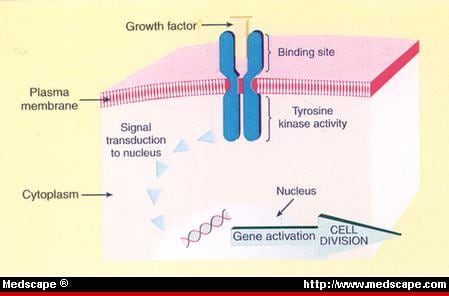
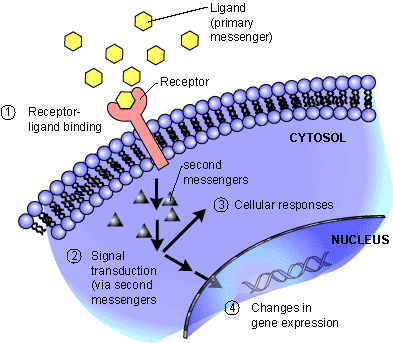
  1. Reception: A cell detects a signaling molecule from the outside of the cell. A signal is detected when the chemical signal (also known as a ligand) binds to a receptor protein on the surface of the cell or inside the cell.
  2. Transduction: When the signaling molecule binds the receptor it changes the receptor protein in some way. This change initiates the process of transduction. Signal transduction is usually a pathway of several steps. Each relay molecule in the signal transduction pathway changes the next molecule in the pathway.
  3. Response: Finally, the signal triggers a specific cellular response.
signal transduction_simple

signal transduction_simple

http://www.hartnell.edu/tutorials/biology/images/signaltransduction_simple.jpg

Reception

Signal Transduction - ligand binds to surface receptor

Signal Transduction – ligand binds to surface receptor


Membrane receptors function by binding the signal molecule (ligand) and causing the production of a second signal (also known as a second messenger) that then causes a cellular response. These types of receptors transmit information from the extracellular environment to the inside of the cell

  • by changing shape or
conformational-rearrangements

conformational-rearrangements

Enzyme_Model  allosterism

Enzyme_Model allosterism

  • by joining with another protein
  • once a specific ligand binds to it.

Examples of membrane receptors include

  • G Protein-Coupled Receptors and
membrane_receptor_g protein

membrane_receptor_g protein


  • Receptor Tyrosine Kinases.
activation of receptor Tyrosine Kinase

activation of receptor Tyrosine Kinase

http://www.hartnell.edu/tutorials/biology/images/membrane_receptor_tk.jpg

Intracellular receptors are found inside the cell, either in the cytopolasm or in the nucleus of the target cell (the cell receiving the signal).

Chemical messengers that are hydrophobic or very small (steroid hormones for example) can

  • pass through the plasma membrane without assistance and
  • bind these intracellular receptors.

Once bound and activated by the signal molecule,

  • the activated receptor can initiate a cellular response, such as a
  • change in gene expression.

Note that this is the first time that change in gene expression is stated.  Is the change in gene expression implication of a change in the genetic information – such as – mutation?  That does not have to be the case in the normal homeostatic case.  This might only be

  • a change in the rate of a transcription or a suppression of expression through RNA.
intracellular_receptor_steroid

intracellular_receptor_steroid

http://www.hartnell.edu/tutorials/biology/images/intracellular_receptor_steroid.jpg

Transduction

Since signaling systems need to be

  • responsive to small concentrations of chemical signals and act quickly,
  • cells often use a multi-step pathway that transmits the signal quickly,
  • while amplifying the signal to numerous molecules at each step.
Signal transduction cascades amplify the signal output

Signal transduction cascades amplify the signal output

Steps in the signal transduction pathway often involve

  • the addition or removal of phosphate groups which results in the activation of proteins.
  • Enzymes that transfer phosphate groups from ATP to a protein are called protein kinases.

Many of the relay molecules in a signal transduction pathway are protein kinases and

  • often act on other protein kinases in the pathway. Often
  • this creates a phosphorylation cascade, where
  • one enzyme phosphorylates another, which then phosphorylates another protein, causing a chain reaction.
phosphorylation-cascade

phosphorylation-cascade

Also important to the phosphorylation cascade are

  • a group of proteins known as protein phosphatases.

Protein phosphatases are enzymes that can rapidly remove phosphate groups from proteins (dephosphorylation) and thus inactivate protein kinases. Protein phosphatases are

  • the “off switch” in the signal transduction pathway.

Phosphorylation Dephosphorylation


Turning the signal transduction pathway off when the signal is no longer present is important

  • to ensure that the cellular response is regulated appropriately.

Dephosphorylation also makes protein kinases

  • available for reuse and
  • enables the cell to respond again when another signal is received.

Kinases are not the only tools used by cells in signal transduction. Small, nonprotein, water-soluble molecules or ions called second messengers (the ligand that binds the receptor is the first messenger) can also

  • relay signals received by receptors on the cell surface
  • to target molecules in the cytoplasm or the nucleus.
membrane protein receptor binds with hormone

membrane protein receptor binds with hormone


insulin receptor and and insulin receptor signaling pathway (IRS)

insulin receptor and and insulin receptor signaling pathway (IRS)


binding-proteins-and-bioavailable-25-hydroxyvitamin-d

binding-proteins-and-bioavailable-25-hydroxyvitamin-d


Examples of second messengers include cyclic AMP (cAMP) and calcium ions.

membrane_receptor_g protein

membrane_receptor_g protein

http://www.hartnell.edu/tutorials/biology/images/membrane_receptor_gprotein.jpg

Response

Cell signaling ultimately leads to the regulation of one or more cellular activities. Regulation of gene expression (turning transcription of specific genes on or off) is a common outcome of cell signaling. A signaling pathway may also

  • regulate the activity of a protein, for example
ion-transporters-and-channels-in-mammalian-choroidal-epithelium

ion-transporters-and-channels-in-mammalian-choroidal-epithelium

Ca(2+) and contraction

Ca(2+) and contraction


transepithelial-electrogenic-ion-transport

transepithelial-electrogenic-ion-transport


calcium release flux

calcium release flux


coupled receptors


  1. opening or closing an ion channel in the plasma membrane or
  2. promoting a change in cell metabolism such as catalyzing the breakdown of glycogen.

Signaling pathways can also lead to important cellular events such as

  • cell division or apoptosis (programmed cell death).
ubiquitylation-is-a-multistep-reaction.

ubiquitylation-is-a-multistep-reaction.


Involvement of VSMCs apoptosis in fibrous plaque rupture.

Involvement of VSMCs apoptosis in fibrous plaque rupture.


G- Protein-Coupled Receptor


membrane_receptor_g protein

membrane_receptor_g protein

Arrestin binding to active GPCR kinase (GRK)-phosphorylated GPCRs blocks G protein coupling

Arrestin binding to active GPCR kinase (GRK)-phosphorylated GPCRs blocks G protein coupling

Signal Transduction Tutorial bDr. Katherine Harris is licensed under a Creative Commons Attribution-NonCommercial-ShareAlike 3.0 Unported License.

Funded by the U.S. Department of Education, College Cost Reduction and Access (CCRAA) grant award # P031C080096.

http://creativecommons.org/licenses/by-nc-sa/3.0/

  • NonCommercial — You may not use the material for commercial purposes.
  • ShareAlike — If you remix, transform, or build upon the material, you must distribute your contributions under the same license as the original.

Adapt — remix, transform, and build upon the material

hormone + receptor signaling

http://home.earthlink.net/~dayvdanls/SignalTrans.gif

Signal-Transduction-Pathway

http://pi-silico.hkbu.edu.hk/wp-content/uploads/2012/12/Signal-Transduction-Pathway.png

http://upload.wikimedia.org/wikipedia/commons/a/a4/1Signal_Transduction_Pathways_Model.jpg

Akt mTOR pathway

Akt mTOR pathway

http://cc.scu.edu.cn/G2S/eWebEditor/uploadfile/20120810155043970.jpg

Quia – 9AP Chapter 11 – Cell Commun

http://www.quia.com/files/quia/users/lmcgee/membranetransport/cell_communication/reception_transduction_resp.gif

http://cc.scu.edu.cn/G2S/eWebEditor/uploadfile/20120810155043970.jpg

HER2 in Breast Cancer–What Does it Mean?

http://img.medscape.com/fullsize/migrated/editorial/clinupdates/2000/681/tu02.fig2.jpg

Protease signalling: the cutting edge

http://emboj.embopress.org/content/embojnl/31/7/1630/F5.large.jpg

Quia – 9AP Chapter 11 – Cell Commun

http://www.quia.com/files/quia/users/lmcgee/membranetransport/cell_communication/phosphorylation-cascade.gif


Signal Transduction in Autism

http://www.mun.ca/biology/desmid/brian/BIOL2060/BIOL2060-14/1403.jpg

The multiple protein-dependent steps in signal transduction

http://www.nature.com/nrm/journal/v1/n2/images/nrm1100_145a_i2.gif

CONVERSING AT THE CELLULAR LEVEL: AN INTRODUCTION TO SIGNAL …

  1. scq.ubc.ca


http://www.scq.ubc.ca/wp-content/uploads/2006/07/transduction.gif


Biology 1710 > Davis > Flashcards > exam 1 | StudyBlue

  1. studyblue.com


http://classconnection.s3.amazonaws.com/602/flashcards/1005602/png/bio101332955375817.png


Read Full Post »

Pathology Emergence in the 21st Century

Author and Curator: Larry Bernstein, MD, FCAP 


This discussion follows the series on DNA and its replication, the code of life, and immediately follows a an up to date survey of RNA, it’s many discovered forms, their function, and the transcription of RNA, intermediate to protein synthesis.  This will comprise a series of articles, including the chemistry, structure, and function of proteins, before turning to the “metabolome”.  This discussion is about the development of the scientific profession of pathology in three notable phases.  The first phase might be considered the gross anatomical discussion developed in Vienna, under Rokitansky, whose greatest student was the Hungarian pathologist, Semelweis, who began the insistence on handwashing prior to visiting the delivery room based on the observation that deliver was safer done by midwifes than by physicians.  This was prior to the great discoveries in microbiology.  The Rokitansky procedure is distinctive in removing organ systems in order to examine postmortem anatomical changes.  His document on the pathology of the organs was monumental.  It was refined by Rudolf Virchow, who removed one organ at a time, but he also had the now developing field of microscopic anatomy (also describing leukemia),


chart1  lymphoma_leukemia


Rudolph Virchow  1821-1902

Rudolph Virchow 1821-1902


that would also be embellished by a generation of histologists who introduced staining techniques.  The most remarkable anatomist to emerge in that period was John Hunter, the Scottish born anatomist and surgeon in London, who taught medical students from England and United States, and who was the physician for Sir David Hume.  When he served in the 30 years war, he pulled wounded soldiers out of the mud to a clearing to care for their wounds.

The 20th century saw the introduction of a new medical school education system under advisement by the Carnegie Commission. [Abraham Flexner Report]  This led to the teaching of basic sciences of anatomy, physiology, pharmacology, pathology, and later genetics and microbiology as prerequisite to clinical teaching.  Moreover, teaching was done by formal systems of disease, which later developed into rotations in Obstetrics and Gynecology, Medicine, and Surgery, Pediatrics, to which endocrinology and neurology and psychiatry were added.  The first great Medical School was actually Johns Hopkins, that paved the groundwork.  Harvard, Cornell, Columbia, and NYU followed, as did the University of California, San Francisco, and the University of Chicago.  This was a period dominated by many important discoveries, and a domination of the Nobel Prizes in Medicine and Physiology, Chemistry and Physics (rivalled only by Germany and United Kingdom).  The Uniqueness of Pathology lies in its placement in the first year of medical school, in preparation for the formal study of medicine, with a foot in both basic sciences and the other in clinical practice.  The pathologist received all tissues removed from surgical procedures, and performed autopsies to determine the cause of death and comorbid conditions.   The development of a substantial knowledge of the kidney gave rise to the specialty of nephrology, and at the same time drew pathologists into a “phase” of molecular biology with the introduction of the electron microscope.  However, the field of immunology developed, and the need for transfusion hastened the emergence of clinical antigen-antibody testing, the crossmatch, blood banking, and later, the emergence of organ transplantation.  In addition, clinical microbiology became a part of clinical pathology, and included fungi and tick-borne diseases, and nemitodes.

We have entered the third phase of pathology with the completion of the human genetic code, and with the development of target pharmaceutical development in the 21st century.


Modern Techniques of Molecular Pathology

A look at clinical laboratory science and its expected progress over the next decade


Molecular Diagnostics    2013; 22 (2), p 35Promising forecasts project great expectations for medical sciences in the year 2013 and beyond. These predictions follow a decade after completion of the Human Genome Project, and are accompanied by immense breakthroughs in computational and applied mathematics. In my view, they are:

  • Genomic and allied -omics technology
  • Innovation in mathematical classification (complexity)
  • Nanotechnology
  • Synthetic chemistry from physics, organic and inorganic chemistry

It is not my intention to go deeply into the exponential group of these advanced and integrative sciences; rather, I want to raise awareness of an emerging new world that will open to the clinical laboratory scientist, and signal the need in the next generation of laboratory personnel to embrace knowledge domains that will be critical for their careers.

All of these breakthroughs are tied together by a search for personalized and integrative medicine. These breakthroughs will reinvent nutritional and pharmaceutical medicine as well as medical devices and restructure clinical laboratory and imaging applications to cardiology, oncology, radiology and anatomical pathology.

Metabolomics

What does metabolomics and metabolic profiling have to do with this? Metabolomics is the measurement of small molecules that interact with membrane receptors1 that are involved with regulation of genomic transcription and cellular regulation and upregulation or downregulation of metabolic processes essential to health. As well, these small molecules may provide targets for disease treatments, and as they are investigated, also provide further “analytes for diagnosis and, moreover, prediction of short-term or long-term outcomes.”2

As a result, the laboratory will become a more significant factor in measuring health and disease and in guiding health or disease maintenance. As our population has reached increased age limits, the laboratory has been a contributor in the public health sphere, and will have a greater role as a result of:

  • Improved tie in with provision of information to not only the healthcare workers, but also the patient
  • Achieve turnaround times for critical results through better workflow
  • Greater control and access to a next generation of point-of-care technology integrated with the laboratory database, and a restructured electronic health record

Despite the hype about the “big data” revolution, this is achievable in the system proposed because there is a published model to achieve this.2

Familiar Methods

Either individually or grouped as a profile, metabolites are detected by nuclear magnetic resonance spectroscopy or mass spectrometry, providing a basis for uses of ­metabolome findings extended to the early detection and diagnosis of cancer and as both a predictive and pharmacodynamics marker of drug effect. We can expect it to become the link between the laboratory and the clinic. The methods used in genomics are microarrays, and for proteomics they are the already familiar chromatographic principles that species migrate at different rates through a column matrix based on their volatility, or carries out a separation as the molecules differ by their adsorption to and elution from a solid matrix, dependent on the binding to the matrix and solubility in the solvent eluate, modified by pH, ionic concentration, and specific conditions needed for recovery. Powerful mathematical tools are used to analyze the data.3

Cardiovascular Disease

Although coronary thrombosis is the final event in acute coronary syndromes, increasing evidence suggests that inflammation also plays a key role in development of atherosclerosis and its clinical manifestations, such as myocardial infarction, stroke and peripheral vascular disease. The inflammatory component was indicated by epidemiological studies of elevated serum levels of high sensitivity C-reactive protein. That eventually led to the demonstration of a benefit from reduction of CRP in individuals without ­characteristic lipidemia in a major clinical trial, which drew a relationship between diabetes, obesity and disordered inflammatory response in the causation of coronary artery disease, aortic valve and artery disease, carotid artery and peripheral vascular disease.

Cancer

Because cancer cells are known to possess a highly unique metabolic phenotype, development of specific biomarkers in oncology is possible and might be used in identifying fingerprints, profiles or signatures to detect the presence of cancer, determine prognosis and/or assess the pharmacodynamic effects of therapy.4

HDM2, a negative regulator of the tumor suppressor p53, is over-expressed in many cancers that retain wild-type p53. Consequently, the effectiveness of chemotherapies that induce p53 might be limited, and inhibitors of the HDM2-p53 interaction are being sought as tumor-selective drugs.5

Coagulation

Blood coagulation plays a key role among numerous mediating systems activated in inflammation. Receptors of the PAR family serve as sensors of serine proteinases of the blood clotting system in the target cells involved in inflammation. Activation of PAR_1 by thrombin and of PAR_2 by factor Xa leads to a rapid expression and exposure on the membrane of endothelial cells of both adhesive proteins that mediate an acute inflammatory reaction and of the tissue factor that initiates the blood coagulation cascade.

The details of evolving methods are avoided in order to build the argument that a very rapid expansion of discovery has been evolving depicting disease, disease mechanisms, disease associations, metabolic biomarkers, study of effects of diet and diet modification, and opportunities for targeted drug development.

  1. Bernstein is CEO of Triplex Medical Science and CSO of Leaders in Pharmaceutical Intelligence. He has been involved in a collaborative project on reducing the noise that exists in complex data and developing a primary evidence-based classification since retiring from a career in pathology supning four decades.

References

1. Bernstein LH. Metabolomics, metabonomics and functional nutrition: The next step in nutritional metabolism and biotherapeutics. Journal of Pharmacy and Nutrition Sciences, 2012;2.

2. David G, Bernstein LH, Coifman RR. Generating evidence-based interpretation of hematology screens via anomaly characterization. The Open Clinical Chemistry Journal 2011;4: 10-16.

3. Grainger DJ. Megavariate statistics meets high data-density analytical methods: The future of medical diagnostics? IRTL Reviews 2003;1:1-6.

4. Spratlin JL, Serkova NJ, Eckhardt SG. Clinical applications of metabolomics in oncology: A review. Clin Cancer Res 2009;15; 15(2): 431-440.

5. Fischer PM, Lane DP. Small molecule inhibitors of thep53 suppressor HDM2: Have protein-protein interactions come of age as drug targets? Trends in Pharm Sci 2004;25(7):343-346.

Directions for Genomics in Personalized Medicine

Author: Larry H. Bernstein, MD, FCAP

Purpose

This discussion will identify the huge expansion of genomic technology in the search for  biopharmacotherapeutic targets that continue to be explored involving different levels and interacting signaling pathways.   There are several methods of analyzing gene expression that will be discussed. Great primary emphasis required investigation of combinations of mutations expressed in different cancer types.


James Watson has proposed a major hypothesis that expresses the need to focus on “central” “driver mutations” that correspond with the regulation of gene expression, cell proliferation, and cell metabolism with a critical rejection of antioxidant benefits.  What hasn’t been know is why drug resistance develops and whether the cellular migration and aerobic glycolysis can be redirected after cell metastasis occurs.  I attempt to bring out the complexities of current efforts.


Introduction

  • This discussion is a continuation of a previous discussion on the role of genomics if discovery of therapeutic targets for cancer, each somewhat different, but all related to:
  • The reversal of carcinoma by targeting a key driver of multiple signaling pathways that activate cell proliferation
  • Pinpointing a stage in a multistage process at which tumor progression links to changes in morphology from basal cells to invasive carcinoma with changes in polarity and loss of glandular architecture
  • Reversal of the carcinoma through using a small molecule that either is covalently bound to a nanoparticle delivery system that blocks or reverses tumor development
  • Synthesis of a small molecule that interacts with the translation of the genome either by substitution of a key driver molecule or by blocking at the mRNA stage of translation
  • Blocking more than one signaling pathway that are links to carcinogenesis and cellular proliferation and invasion

Difficulty of the problem

A problem expressed by James Watson is that the investigations that are ongoing

  • are following a pathway that is not driven by attacking the “primary” driver of carcinogenesis.

He uses the Myc gene as an example, as noted in the previous discussion. The problem may be more complicated than he envisions.

  • The most consistent problem in chemotherapy, irrespective of the design and the target has been cancer remission for a short time followed by recurrence, and then
  • switching to another drug, or combination chemotherapy.

It is common to “clean” the field at the time of resection using radiotherapy before chemotherapy.

  • But the goal is understood to be “palliation”, not cure.

This raises a serious issue in the hypothesis posed by Watson. The issue is

  • whether there is a core locus of genetic regulation that is common to carcinogenesis irrespective of tissue metabolic expression.
  • This is supported by the observation that tissue specific expression is lost in cancer cells by de-differentiation.

Historical Perspective

AEROBIC GLYCOLYSIS

In 1967 Otto Warburg published his view in a paper “The prime cause and prevention of cancer”.
There are primary and secondary causes of all diseases

  • plague – primary: plague bacillus
  • plague – secondary: filth, rats, and fleas

Otto Heinrich Warburg (1883-  )


Otto Heinrich Warburg (Photo credit: Wikipedia)


cancer, above all diseases,

  • has countless seconday causes
  • primary – replacement of respiration of oxygen in normal body tissue by fermentation of glucose with conversion from obligate aerobic to anaerobic, as in bacterial cells

The cornerstone to understanding cancer is in study of the energetics of life

This thinking came out of decades of work in the Dahlem Institute Kaiser Wilhelm pre WWII and Max Planck Institute after WWII, supported by the Rockefeller Foundation.

  • The oxygen- and hydrogen-transferring enzymes were discovered and isolated.
  • The methods were elegant for that time, using a manometer that improved on the method used by Haldane, that did not allow the leakage of O2 or CO2.
  • The interest was initiated by the increased growth of Sea Urchin eggs after fertization, which turned out to be not comparable to the rapid growth of cancer cells.
  • Warburg used both normal and cancer tissue and measured the utilization of O2. He found
    • that the normal tissue did not accumulate lactic acid.
    • Cancer tissue generated lactic acid
    • the rate of O2 consumption the same as normal tissue, but
    • the rate of lactate formation far exceeded any tissue, except the retina.
    • This was a discovery studied by “Pasteur” 60 years earlier (facultative aerobes), which he called thePasteur effect.
    • Hematopoietic cells of bone marrow develop aerobic glycolysis when exposed to a low oxygen condition.

He then followed on an observation by Otto Meyerhoff (Embden-Myerhoff cycle) that in muscle

  • the consumption of one molecule of oxygen generates two molecules of lactate, but in aerobic glycolysis, the relationship disappears.
  • He expressed the effectiveness of respiration by the ‘Meyerhoff quotient’.
  • He found that cancer cells didn’t have a quotient of ’2′

The role of the allosteric enzyme phosphofructokinase (PFK) not then known, would tie together the glycolytic and gluconeogenic pathways.
He used a heavy metal ion chelator ethylcarbylamine to

  • sever the link and turn on aerobic glycolysis.

The explanation for this was provided years later by the work fleshed out by Lynen, Bucher, Lowry, Racker, and Sols.

  • The rate-limiting enzyme, PFK is regulated by the concentrations of ATP, ADP, and inorganic phosphate. The ethylcarbylamide was an ‘uncoupler’ of oxidative phosphorylation.

Warburg understood that when normal cells switched to aerobic glycolysis

  • it is a re-orientation of normal cell expression.
  • this provides the basis for the inference that neoplastic cells become more like each other than their cell of origin.
  • embryonic cells can be transformed into cancer cells under hypoxic conditions
  • re-exposure to higher oxygen did not cause reversion back to normal cells.

Warburg publically expressed the rejected view in 1954 (at age 83) that restriction of chemical wastes, food additives, and air pollution would substantially reduce cancer rates.

His emphasis on the impairment of respiration was inadequate.

  • the prevailing view today is loss of controlled growth of normal cells in cancer cells.

Otto Warburg: Cell Physiologist, Biochemist, and Eccentric. Hans Krebs, in collaboration with Roswitha Schmid. Clarendon Press, Oxford. 1991.ISBN 0-19-858171-8.


A multiphoton fluorescence microscope (MFM) is a specialized optical microscope.

The MFM uses pulsed long-wavelength light to excite fluorophores within the specimen being observed. The fluorophore absorbs the energy from two long-wavelength photons which must arrive simultaneously in order to excite an electron into a higher energy state, from which it can decay, emitting a fluorescence signal. It differs from traditional fluorescence microscopy in which the excitation wavelength is shorter than the emission wavelength, as the summed energies of two long-wavelength exciting photons will produce an emission wavelength shorter than the excitation wavelength.[1]

Multiphoton fluorescence microscopy has similarities to confocal laser scanning microscopy. Both use focused laser beams scanned in a raster pattern to generate images, and both have an optical sectioning effect. Unlike confocal microscopes, multiphoton microscopes do not contain pinhole apertures, which give confocal microscopes their optical sectioning quality. The optical sectioning produced by multiphoton microscopes is a result of the point spread function formed where the pulsed laser beams coincide. The multiphoton point spread function is typically dumbbell-shaped (longer in the x-y plane), compared to the upright rugby-ball shaped point spread function of confocal microscopes. However, in many interesting cases the shape of the spot and its size can be designed to realize specific desired goals.[2]

The longer wavelength, low energy (typically infra-red) excitation lasers of multiphoton microscopes are well-suited to use in imaging live cells as they cause less damage than short-wavelength lasers, so cells may be observed for longer periods with fewer toxic effects. Many researchers are currently working toward better and higher resolution multiphoton imaging developments.

Two-photon excitation microscopy is a fluorescence imaging technique that allows imaging of living tissue up to a very high depth, up to about one millimeter. Being a special variant of the multiphoton fluorescence microscope, it uses red-shifted excitation light which can also excite fluorescent dyes. However, for each excitation, two photons of infrared light are absorbed. Using infrared light minimizes scattering in the tissue. Due to the multiphoton absorption, the background signal is strongly suppressed. Both effects lead to an increased penetration depth for these microscopes. Two-photon excitation can be a superior alternative to confocal microscopy due to its deeper tissue penetration, efficient light detection, and reduced phototoxicity.[1]

Two-photon excitation employs two-photon absorption, a concept first described by Maria Goeppert-Mayer (1906–1972) in her doctoral dissertation in 1931,[2] and first observed in 1961 in a CaF2:Eu2+ crystal using laser excitation by Wolfgang Kaiser.[3] Isaac Abella showed in 1962 in cesium vapor that two-photon excitation of single atoms is possible.[4]

The concept of two-photon excitation is based on the idea that two photons of comparably lower energy than needed for one photon excitation can also excite a fluorophore in one quantum event. Each photon carries approximately half the energy necessary to excite the molecule. An excitation results in the subsequent emission of a fluorescence photon, typically at a higher energy than either of the two excitatory photons. The probability of the near-simultaneous absorption of two photons is extremely low. Therefore a high flux of excitation photons is typically required, usually from a femtosecond laser. The purpose of employing the two-photon effect is that the axial spread of the point-spread-function is substantially lower than for single-photon excitation. As a result, the resolution along the z dimension is improved, allowing for thin optical sections to be cut. In addition, in many interesting cases the shape of the spot and its size can be designed to realize specific desired goals.[5] Two-photon microscopes are less damaging to the sample than a single-photon confocal microscope.

The most commonly used fluorophores have excitation spectra in the 400–500 nm range, whereas the laser used to excite the two-photon fluorescence lies in the ~700–1000 nm (infrared) range. If the fluorophore absorbs two infrared photons simultaneously, it will absorb enough energy to be raised into the excited state. The fluorophore will then emit a single photon with a wavelength that depends on the type of fluorophore used (typically in the visible spectrum). Because two photons are absorbed during the excitation of the fluorophore, the probability for fluorescent emission from the fluorophores increases quadratically with the excitation intensity. Therefore, much more two-photon fluorescence is generated where the laser beam is tightly focused than where it is more diffuse. Effectively, excitation is restricted to the tiny focal volume (~1 femtoliter), resulting in a high degree of rejection of out-of-focus objects. This localization of excitation is the key advantage compared to single-photon excitation microscopes, which need to employ additional elements such as pinholes to reject out-of-focus fluorescence. The fluorescence from the sample is then collected by a high-sensitivity detector, such as a photomultiplier tube. This observed light intensity becomes one pixel in the eventual image; the focal point is scanned throughout a desired region of the sample to form all the pixels of the image. The scan head is typically composed of two mirrors, the angles of which can be rapidly altered with a galvanometer.

.Multiphoton microscopy: a potential “optical biopsy” tool for real-time evaluation of lung tumors without the need for exogenous contrast agents.


Jain M1, Narula N, Aggarwal A, Stiles B, Shevchuk MM, Sterling J, Salamoon B, Chandel V, Webb WW, Altorki NK, Mukherjee S.
From the Departments of Urology (Dr Jain), Pathology and Laboratory Medicine (Drs Narula and Shevchuk), Biochemistry (Drs Aggarwal and Mukherjee, Mr Sterling, and Mr Salamoon), Thoracic Surgery (Drs Stiles and Altorki), and Surgery (Mr Chandel), Weill Cornell Medical College, New York, New York; and the School of Applied and Engineering Physics, Cornell University, Ithaca, New York (Dr Webb). Dr Aggarwal is now with the Department of Science, Borough of Manhattan Community College, New York.
Arch Pathol Lab Med. 2014 Aug;138(8):1037-47.   http://dx.doi.org:/10.5858/arpa.2013-0122-OA. Epub 2013 Nov 7

Context.-Multiphoton microscopy (MPM) is an emerging, nonlinear, optical-biopsy technique, which can generate subcellular-resolution images from unprocessed and unstained tissue in real time.

Objective.-To assess the potential of MPM for lung tumor diagnosis. Design.-Fresh sections from tumor and adjacent nonneoplastic lung were imaged with MPM and then compared with corresponding hematoxylin-eosin slides.

Results.-Alveoli, bronchi, blood vessels, pleura, smokers’ macrophages, and lymphocytes were readily identified with MPM in nonneoplastic tissue. Atypical adenomatous hyperplasia (a preinvasive lesion) was identified in tissue adjacent to the tumor in one case. Of the 25 tumor specimens used for blinded pathologic diagnosis, 23 were diagnosable with MPM. Of these 23 cases, all but one adenocarcinoma (15 of 16; 94%) was correctly diagnosed on MPM, along with their histologic patterns. For squamous cell carcinoma, 4 of 7 specimens (57%) were correctly diagnosed. For the remaining 3 squamous cell carcinoma specimens, the solid pattern was correctly diagnosed in 2 additional cases (29%), but it was not possible to distinguish the squamous cell carcinoma from adenocarcinoma. The other squamous cell carcinoma specimen (1 of 7; 14%) was misdiagnosed as adenocarcinoma because of pseudogland formation. Invasive adenocarcinomas with acinar and solid pattern showed statistically significant increases in collagen. Interobserver agreement for collagen quantification (among 3 observers) was 80%.

Conclusions.-Our pilot study provides a proof of principle that MPM can differentiate neoplastic from nonneoplastic lung tissue and identify tumor subtypes. If confirmed in a future, larger study, we foresee real-time intraoperative applications of MPM, using miniaturized instruments for directing lung biopsies, assessing their adequacy for subsequent histopathologic analysis or banking, and evaluating surgical margins in limited lung resections. PMID: 24199831

Lung cancer is the most common cause of cancer-related mortality worldwide in both men and women, with 226 160 new cases and 160 340 deaths estimated in the United States alone in 2012.1 Lung tumors are currently detected on chest radiography and computed tomography imaging, but definitive diagnosis, especially distinguishing the various subtypes of lung cancer, requires cytologic or histopathologic examination. Although considered the gold standard in establishing diagnosis, histopathology requires time-consuming tissue processing and can sometimes require repeat biopsies if the initial specimen was nondiagnostic. To overcome some of the obstacles associated with histopathologic processing, efforts have been made to develop high-resolution “optical biopsy” imaging techniques.

In this proof-of-principle pilot study, we explored the use of multiphoton microscopy (MPM) as a promising, new optical biopsy tool for the detection and diagnosis of lung tumors in real time.

Multiphoton microscopy relies on the simultaneous absorption of 2 or 3 low-energy (near-infrared) photons to cause a nonlinear excitation, equivalent to that created by a single photon of shorter wavelength light. By using 2-photon excitation in the 700- to 800-nm range, MPM enables both in vivo and ex vivo imaging of fresh, unprocessed, and unstained tissue at histologic resolution via generating intrinsic tissue emissions. Intrinsic tissue emission signals used in this study included autofluorescence and second harmonic generation (SHG).2–4

Twenty-five adult subjects diagnosed with lung cancer and undergoing lobectomies at our institution participated in this Institutional Review Board–approved study.

An Olympus FluoView FV1000MPE imaging system (Olympus America, Center Valley, Pennsylvania) was used for all MPM imaging. For detailed description of MPM imaging conditions, please see Supplementary Methods (supplemental digital content for this article is available at www.archivesofpathology.org in the August 2014 table of contents). Briefly, fresh (unprocessed and unstained) specimens were excited using 780 nm light from a tunable titanium-sapphire laser (Mai Tai DeepSee, Spectra-Physics, Irvine, California). Three distinct intrinsic tissue-emission signals were collected using photomultiplier tubes and were then color coded by using MetaMorph (version 7.0, revision 4, Molecular Devices, Sunnyvale, California) as follows: (1) SHG (360–400 nm, color-coded red), a nonlinear scattering signal originating from tissue collagen; (2) short wavelength autofluorescence (420–490 nm, color-coded green), originating in part from reduced nicotinamide adenine dinucleotide and flavin adenine dinucleotide in normal epithelial, neoplastic, and inflammatory cells, and from elastin in the alveolar septa; and (3) long wavelength autofluorescence (550–650 nm, color-coded blue), originating in part from carbon-laden macrophages.

Arch Path MPM

Arch Path MPM

http://www.archivesofpathology.org/na101/home/literatum/publisher/pinnacle/journals/content/arpa/2014/15432165-138.8/arpa.2013-0122-oa/20140721/images/medium/i1543-2165-138-8-1037-f01.gif

http://www.archivesofpathology.org/na101/home/literatum/publisher/pinnacle/journals/content/arpa/2014/15432165-138.8/arpa.2013-0122-oa/20140721/images/large/i1543-2165-138-8-1037-f01.jpeg

Figure 1. Comparative multiphoton microscopy (MPM) and hematoxylin-eosin images of nonneoplastic and smoker lung. A and B, Low-magnification images show lung parenchyma composed of alveoli (arrows) surrounded by pleura (arrowheads). Inset in MPM shows pleura with collagen (red) and elastin (green) components. C and D, High-magnification images show primarily elastin fibers, with some collagen in the septal wall (arrowheads) of the alveoli (arrows). E and F, Low-magnification images show bronchus (*) with cartilage (arrowheads) and a medium-sized blood vessel (arrows). G and H, High-magnification images show columnar lining of the bronchus (arrows) and underlying connective tissue (arrowheads). I and J, Alveoli filled with carbon-laden macrophages (arrows; blue in MPM) and noncarbon-laden macrophages (arrowheads; green in MPM). K and L, A collection of small lymphocytes (arrowheads and inset), along with smoker’s macrophages (arrows). Some loss and thickening of the alveolar septa is shown (I through L) (MPM, original magnifications ×48 [A and E], ×96 [A inset], ×300 [C, G, I, and K], ×600 [K inset]; hematoxylin-eosin, original magnifications ×40 [B, F] and ×200 [D, H, J, and L]).

To assess the diagnostic potential of MPM, a blinded analysis was conducted. The attending pulmonary pathologist and an attending general surgical pathologist first familiarized themselves to the histologic features seen on MPM images in both nonneoplastic and neoplastic (adenocarcinoma and squamous cell carcinoma [SCC]) lung tissue. Because, in our study, multiple images were acquired from different areas of a given tumor, we used some of those images for the training set and did not include them in the blinded test set. Subsequently, test MPM images from all lung tumor specimens were assessed in a blinded fashion and were categorized according to subtype and pattern using the routine histopathologic criteria.9,10 These diagnoses were then correlated with diagnoses made by the same pathologist, based on the corresponding H&E sections prepared from the same specimens.

Visualizing Lung From Smoker With MPM
Using MPM to Identify Invasive and Preinvasive Adenocarcinoma

Figure 2, A through B, shows an example of a lesion with atypical adenomatous hyperplasia, which was an incidental finding on MPM in “tumor-free” lung tissue. It shows the proliferation of atypical pneumocytes, along the preexisting alveolar wall. Gaps between the cells (discontinuous layer of pneumocytes) support the diagnosis of atypical adenomatous hyperplasia. Adenocarcinoma of lung with lepidic-predominant pattern, in contrast, shows continuous proliferation of tumor cells along the alveolar wall.

Arch Path  progression from atypical lesion to invasive adenocarcinoma

Arch Path progression from atypical lesion to invasive adenocarcinoma

Figure 2. Comparative multiphoton microscopy and hematoxylin-eosin images showing progression from atypical lesion to various patterns of invasive adenocarcinoma of lung. A and B, Images of atypical adenomatous hyperplasia shows a focus of pneumocyte proliferation (cuboidal cells with gaps between them) along the alveolar wall (arrows and insets). C and D, Images of adenocarcinoma of lung with lepidic-predominant pattern (arrows) and a few clusters of free-floating tumor cells (arrowheads). E and F, Images of adenocarcinoma of lung with acinar-predominant pattern (arrows). G and H, Images showing solid pattern (arrows) with suggestion of gland formation (arrowheads). I and J, Images showing papillary pattern (papillae with fibrovascular core; arrows). K and L, Images showing micropapillary pattern, with complete destruction of normal lung parenchyma. The airspace shows small papillary clusters of tumor cells (arrows) lacking true fibrovascular cores (multiphoton microscopy, original magnifications ×300 [A, C, E, G, I, and K] and ×600 [inset]; hematoxylin-eosin, originalmagnifications ×200 [B, D, F, H, J, and L] ×400 [inset]).

Arch Path SCC

Arch Path SCC

http://www.archivesofpathology.org/na101/home/literatum/publisher/pinnacle/journals/content/arpa/2014/15432165-138.8/arpa.2013-0122-oa/20140721/images/medium/i1543-2165-138-8-1037-f02.gif

http://www.archivesofpathology.org/na101/home/literatum/publisher/pinnacle/journals/content/arpa/2014/15432165-138.8/arpa.2013-0122-oa/20140721/images/large/i1543-2165-138-8-1037-f02.jpeg

Adenocarcinoma with a papillary-predominant pattern shows clear papillary projections composed of cuboidal to columnar cells, which line collagen-rich fibrovascular cores (Figure 2, I and J). Micropapillary adenocarcinoma, on the other hand, shows small papillary clusters of malignant cells within the airspace, with no true fibrovascular cores (Figure 2, K and L).

Using MPM to Identify SCC of Lung

Figure 3 shows high-magnification images acquired from the tumor mass in subjects with a diagnosis of SCC. Figure 3, A and B, shows sheets of malignant cells with a complete loss of the normal architecture of the lung parenchyma. These cells are seen as arranged in a pavementlike fashion with a high nuclear to cytoplasmic ratio (indicating a high-grade tumor). Pavementlike arrangement of cells is a characteristic of SCC that helps to differentiate it from the solid-predominant pattern of adenocarcinoma. We also observed an increased amount of stroma and mononuclear inflammatory cells surrounding the tumor (Figure 3, A, inset). These mononuclear inflammatory cells were confirmed as lymphocytes on H&E. This case was correctly diagnosed as SCC on MPM. Figure 3, C and D, shows images from the tumor mass of another subject, also diagnosed with SCC on H&E. However, it was misdiagnosed as adenocarcinoma on MPM, primarily because the central necrosis in the tumor nest was interpreted as gland formation. When the images were reanalyzed with knowledge of the SCC diagnosis, the pavementlike arrangement of cells was identified. We thus expect that, with a larger sample of SCC specimens and more experience, our ability to correctly diagnose SCC will improve significantly. Also, in the future, any specimen with a likely SCC diagnosis will be imaged over a larger area by using image tiling and by taking multiple stacks from various areas in the lesion, so as not to be misled by occasional, spurious, histologic features.

Figure 3. Comparative multiphoton microscopy and hematoxylin-eosin images of squamous cell carcinoma of the lung. A and B, Images of squamous cell carcinoma (SCC) of the lung showing sheets of malignant cells with high nuclear to cytoplasmic ratio (arrows), surrounded by lymphocytes (arrowheads) interspersed in collagen bundles (inset). C and D, Images of SCC of the lung showing pavementlike arrangement of the cells (arrows). Also shown is a nest of squamous cells with focal necrosis (arrowheads) forming pseudoglands, leading to a misdiagnosis of adenocarcinoma (multiphoton microscopy, original magnifications ×300 [A and C] and ×600 [inset]; hematoxylin-eosin, original magnifications ×200 [B and D]).

http://www.archivesofpathology.org/na101/home/literatum/publisher/pinnacle/journals/content/arpa/2014/15432165-138.8/arpa.2013-0122-oa/20140721/images/medium/i1543-2165-138-8-1037-f03.gif

http://www.archivesofpathology.org/na101/home/literatum/publisher/pinnacle/journals/content/arpa/2014/15432165-138.8/arpa.2013-0122-oa/20140721/images/large/i1543-2165-138-8-1037-f03.jpeg

Using MPM to Assess the Degree of Collagen in Lung Carcinoma

Previous studies have reported the amount of collagen as a prognostic factor in small, peripheral lung adenocarcinomas5,6,8 and SCCs.7 In our study, we categorized adenocarcinomas into 3 groups:

(1) well-differentiated, adenocarcinomas with lepidic-predominant patterns;

(2) moderately differentiated, invasive adenocarcinomas with acinar-predominant patterns; and

(3) poorly differentiated, adenocarcinomas with solid-predominant patterns.

A well-preserved lung architecture (Figure 4, A through C), with slight alveolar septal thickening from collagen deposition, was seen in low-magnification images of a well-differentiated adenocarcinoma (with a lepidic-predominant pattern). In contrast, invasive adenocarcinomas with both acinar-predominant (Figure 4, D through F) and solid-predominant (Figure 4, G through I) patterns showed increases in collagen content.

Our proof-of-principle pilot study indicates the potential utility of MPM for differentiating nonneoplastic from neoplastic lung tissue in fresh, ex vivo specimens without the use of exogenous contrast agents. Furthermore, study pathologists successfully identified the histologic subtypes of tumor and recognized inflammatory cells, such as lymphocytes and smoker macrophages. We also performed collagen quantification in adenocarcinomas and demonstrated its correlation with the degree of differentiation.

Indeed, the diagnostic potential of MPM for differentiating malignant from benign/inflammatory lesions has been previously investigated in multiple organ systems in both animal models and human tissues.3,12–19 Specifically, normal and diseased lung have been investigated in both small animals and in ex vivo human tissue using MPM.20–26 However, most studies focused on extracellular matrix remodeling associated with lung pathologies.22,23,25,26 To date, few studies have explored the potential of MPM for differentiating benign lesions from neoplastic ones.

. Our study is the first, to our knowledge, to present not only a detailed histology of normal human lung tissue obtained with MPM but also to show the histologic features that can be used to identify a variety of inflammatory, preneoplastic, and neoplastic lesions, in accordance with World Health Organization10 and International Association for the Study of Lung Cancer9 criteria. Furthermore, we demonstrated the ability of a pulmonary pathologist and a general surgical pathologist to differentiate between lesion subtypes in a blinded fashion with high reliability


The Human Genome Project

j.craigventer


J. Craig Venter (Photo credit: Wikipedia)

The Human Genome Project, driven by Francis Collins at NIH, and by Craig Venterat the Institute for Genome Research (TIGR) had parallel projects to map the human chromosome, completed in 2003. It originally aimed to map the nucleotides contained in a human haploid reference genome (more than three billion). TIGR was the first complete genomic sequencing of a free living organism, Haemophilus influenzae, in 1995. This used a shotgun sequencing technique pioneered earlier, but which had never been used for a whole bacterium.
Venter broke away from the HGP and started Celera in 1998 because of resistance to the shotgun sequency method, and his team completed the genome sequence in three years – seven years’ less time than the HGP timetable (using the gene of Dr. Venter). TIGR eventually sequenced and analyzed more than 50 microbial genomes. Its bioinformatics group developed

  • pioneering software algorithms that were used to analyze these genomes,
  • including the automatic gene finder GLIMMER and
  • the sequence alignment program MUMmer.

In 2002, Venter created and personally funded the J. Craig Venter Institute (JCVI) Joint Technology Center (JTC), which specialized in high throughput sequencing.  The JTC, in the top ranks of scientific institutions worldwide, sequenced nearly 100 million base pairs of DNA per day for its affiliated institutions (JCVI) .

He received his his Ph.D. degree in physiology and pharmacology from the University of California, San Diego in 1975 under biochemist Nathan O. Kaplan. A full professor at the State University of New York at Buffalo, he joined the National Institutes of Health in 1984. There he learned of a technique for rapidly identifying all of the mRNAs present in a cell and began to use it to identify human brain genes. The short cDNA sequence fragments discovered by this method are calledexpressed sequence tags (ESTs), a name coined by Anthony Kerlavage at TIGR.
Venter believed that shotgun sequencing was the fastest and most effective way to get useful human genome data. There was a belief that shotgun sequencing was less accurate than the clone-by-clone method chosen by the HGP, but the technique became widely accepted by the scientific community and is still the de facto standard used today.

References

Shreeve, James (2004). The Genome War: How Craig Venter Tried to Capture the Code of Life and Save the World. Knopf. ISBN 0375406298.
Sulston, John (2002). The Common Thread: A Story of Science, Politics, Ethics and the Human Genome. Joseph Henry Press. ISBN 0309084091.
“The Human Genome Project Race”. Center for Biomolecular Science & Engineering,UC Santa Cruz. Retrieved 20 March 2012.
Venter, J. Craig (2007). A Life Decoded: My Genome: My Life. Viking Adult. ISBN 0670063584.

Use of a Fluorophor Probe

An article has been discussed by Dr.  Tilda Barilya on use of a sensitive fluorescent probe in the near IR spectrum at > 700 nm to identify malignant ovarian cells in-vivo in abdominal exploration

  • by tagging an overexpressed FR-α (folate-FITA)

The author makes the point that:

  • In ovarian cancer, the FR-α appears to constitute a good target because it is overexpressed in 90–95% of malignant tumors, especially serous carcinomas.
  • Targeting ligand, folate, is attractive as it is nontoxic, inexpensive and relatively easily conjugated to a fluorescent dye to create a tumor-specific fluorescent contrast agent.
  • The report is identified as “ the first in-human proof-of-principle of the use of intraoperative tumor-specific fluorescence imaging in staging and debulking surgery for ovarian cancer using the systemically administered targeted fluorescent agent folate-FITC.”

While this does invoke possibilities for prognosis, the decision to perform the surgery,

  • whether laparoscopic or open, is late in the discovery process. However,

it does suggest the possibility that the discovery and the treatment might be combined

  • if the biomarker itself had the fluorescence to identify the overexpression, but
  • it also is combined with a tag to block the overexpession. This hypothetical possibility is now expressed below.

http://pharmaceuticalintelligence.com/2013/01/19/ovarian-cancer-and-fluorescence-guided-surgery-a-report/

Gene Editing

Aviva Lev-Ari, PhD, RD

Aviva Lev-Ari, PhD, RD


Dr. Aviva Lev-Ari reports that a new technique developed at MIT Broad Institute and the Rockefeller University can edit DNA in precise locations

taken from Science News titled Editing Genome With High Precision: New Method to Insert Multiple Genes in Specific Locations, Delete Defective Genes”.

Using this system, scientists can alter

  • several genome sites simultaneously and
  • can achieve much greater control over where new genes are inserted

According to Feng Zhang, this is an improvement beyond splicing the gene in specific locations and

insertion of complexes difficult to assemble known as

transcription activator-like effector nucleases (TALENs).

  • The researchers create DNA-editing complexes
  • using naturally occurring bacterial protein-RNA systems
  • that recognize and snip viral DNA, including
  • a nuclease called Cas9 bound to short RNA sequences.
  • they target specific locations in the genome, and
  • when they encounter a match, Cas9 cuts the DNA.

This approach can be used either to

  • disrupt the function of a gene or
  • to replace it with a new one.
  • To replace the gene, a DNA template for the new gene has to be copied into the genome after the DNA is cut. The method is also very precise –
  • if there is a single base-pair difference between the RNA targeting sequence and the genome sequence, Cas9 is not activated.

In its first iteration, it appears comparable in efficiency to what

zinc finger nucleases and TALENs have to offer.

The research team has deposited the necessary genetic components with a nonprofit called Addgene, and they have also created a website with tips and tools for using this new technique.

The above story is reprinted from materials provided by Massachusetts Institute of Technology.

The original article was written by Anne Trafton. Le Cong, F. Ann Ran, David Cox, Shuailiang Lin, Robert Barretto, Naomi Habib, Patrick D. Hsu, Xuebing Wu, Wenyan Jiang, Luciano Marraffini, and Feng Zhang.

Multiplex Genome Engineering Using CRISPR/Cas Systems.
Science, 3 January 2013   DOI: 10.1126/science.1231143.
http://Science.comEditing genome with high precision: New method to insert multiple genes in specific locations, delete defective genes. ScienceDaily. Retrieved January 20, 2013, from http://www.sciencedaily.com­ /releases/2013/01/130103143205.htm?  goback=%2Egde_4346921_member_205356312.

Dr. Lev-Ari also reports on a study of early detection of breast cancer in “Mechanism involved in Breast Cancer Cell Growth: Function in Early Detection & Treatment“, by Dr. Rotem Karni and PhD student Vered Ben Hur at the Institute for Medical Research Israel-Canada of the Hebrew University.
http://pharmaceuticalintelligence.com/2013/01/17/mechanism-involved-in-breast-cancer-cell-growth-function-in-early-detection-treatment/
These researchers have discovered a new mechanism by which breast cancer cells switch on their aggressive cancerous behavior. The discovery provides a valuable marker for the early diagnosis and follow-up treatment of malignant growths.
The method they use is

  • RNA splicing and insertion.
  • The information needed for the production of a mature protein is encoded in segments called exons .
  • In the splicing process, the non-coding segments of the RNA (introns) are spliced from the pre-mRNA and
  • the exons are joined together.

Alternative splicing is when a specific ”scene” (or exon) is either inserted or deleted from the movie (mRNA), thus changing its meaning.

  • Over 90 percent of the genes in our genome undergo alternative splicing of one or more of their exons, and
  • the resulting changes in the proteins encoded by these different mRNAs are required for normal function.
  • the normal process of alternative splicing is altered in cancer, and
  • ”bad” protein forms are generated that aid cancer cell proliferation and survival.

The researchers reported in online Cell Reports that breast cancer cells

  • change the alternative splicing of an important enzyme, calledS6K1, which is
  • a protein involved in the transmission of information into the cell.
  • when this happens, breast cancer cells start to produce shorter versions of this enzyme and
  • these shorter versions transmit signals ordering the cells to grow, proliferate, survive and invade other tissues (otherwise proliferation is suppressed)

The application to biotherapeutics would be to ”reverse” the alternative splicing of S6K1 in cancer cells back to the normal situation as a novel anti-cancer therapy.


Imaging Mass Cytometry

This literature review shows how researchers used CyTOF mass cytometry to obtain spatial resolution of cell samples.

The authors used mass cytometry to measure heterogeneity in breast cancer tumors using FFPE breast cancer samples. [© Kheng Guan Toh – Fotolia.com]

The integration of mass spectrometry (specifically laser ablation of the sample in combination with inductively coupled plasma mass spectrometry) with flow cytometry instrumentation along with sensitive and rare earth metal labels

  • has enabled multiplexing of up to 32 cell markers (see Assay Drug Dev Technol 2011;9:567 commentary “Flow cytometry goes atomic;” CyTOF system sold by Fluidigm, formerly DVS Sciences).

This process employs typical immunocytochemistry techniques, but the antibodies are tagged with rare earth metal isotopes (predominately lanthanides)

  • that act as specific reporters of cellular proteins.

Comparison of these rare earth–labeled antibodies to typical fluorescent antibody labels supports that

  • these labels do not affect the specificity or sensitivity of the antibodies. In this article the authors* extend this method to obtain spatial resolution of cell samples.


mass cytometry to measure heterogeneity in breast cancer tumors using FFPE

mass cytometry to measure heterogeneity in breast cancer tumors using FFPE


Workflow of imaging mass cytometry.


is correlated with the position of the laser spot as it is scanned across the sample with 1 μm resolution.In the method, the signals from the rare earth reporters following laser ablation of the sample

The limit of detection is determined to be ∼500 molecules. The data can then be plotted based on the position of each ion spot for each rare earth reporter, and these images

  • are then overlaid to create a high-dimensional image that can be analyzed (Figure).

Measurement of a 0.5 mm × 0.5 mm area at 1 μm resolution takes ∼5 h. The system is capable of measuring 100 analytes simultaneously, but only 32 rare earth metal chelates are currently available. The authors applied this method

  • to measure heterogeneity in breast cancer tumors using formalin-fixed, paraffin-embedded (FFPE) breast cancer samples.

A total of 21 FFPE samples were analyzed using 32-plex imaging mass cytometry covering cell markers and phosphoproteins. Differences in expression even within the same tumor sample were noted, and

  • the subpopulations branch points often contained markers used for patient classification. Some exceptions occurred; for example,
  • Her2 was detected and confirmed in one triple-negative case.

This high-dimensional imaging should increase our understanding of tumor biology and pathologies.

*Abstract from Nature Methods 2014, Vol. 11: 403–406

Mass cytometry enables high-dimensional, single-cell analysis of cell type and state. In mass cytometry, rare earth metals are used as reporters on antibodies. Analysis of metal abundances using the mass cytometer

  • allows determination of marker expression in individual cells. Mass cytometry has previously been applied only to cell suspensions.

To gain spatial information, we have coupled

  • immunohistochemical and immunocytochemical methods
  • with high-resolution laser ablation to CyTOF mass cytometry.

This approach enables the simultaneous imaging of 32 proteins and protein modifications at subcellular resolution;

  • with the availability of additional isotopes, measurement of over 100 markers will be possible.

We applied imaging mass cytometry to human breast cancer samples, allowing delineation of cell subpopulations and cell–cell interactions and highlighting tumor heterogeneity. Imaging mass cytometry

  • complements existing imaging approaches.

It will enable basic studies of tissue heterogeneity and function and

  • support the transition of medicine toward individualized molecularly targeted diagnosis and therapies.


Preventing a cellular identity crisis 

http://news.sciencemag.org/sites/default/files/styles/thumb_article_l/public/sn-criticalgenesH.jpg?itok=0wmD-o4a


Staying true.


neural progenitor cells keep their identities

neural progenitor cells keep their identities


Researchers have discovered a molecular signature in the genome that might help cells like these neural progenitor cells keep their identities throughout their lives.

By Mitch Leslie 31 July 2014

Cells rely on different ways to establish who they are and what they do.  A novel mechanism

  • marks the identities of different kinds of cells in the human body—
  • and prevents them from transforming into another type altogether.

Scientists learned decades ago to read the basic genetic code by which cells convert a string of DNA bases into a protein’s amino acids. But for more than 10 years,

  • they’ve been trying to crack what’s known as the histone code, a more complex cipher embedded within organisms’ genomes.

Histones are the proteins that DNA coils around in chromosomes. Chemically tweaking histones in a variety of ways can

  • adjust the activity of genes, turning them up or down. For example,
  • cells shut off genes by attaching three methyl groups to a specific spot on a histone type known as H3.
  • affixing three methyl groups to another H3 location, a modification known as H3K4me3, has a different effect.

Cells typically add the H3K4me3 tags to histones in small sections of the genome, but researchers noticed that

  • sometimes the tag can sprawl across much larger areas,
  • modifying broad swaths of histones.

To find out whether these large blocks of histones carrying H3K4me3 tags convey a message in the histone code, molecular geneticist Anne Brunet of Stanford University in Palo Alto, California, and colleagues

  • traced their occurrence in more than 20 different cell types.

They found that the longest stretches pinpoint different sets of genes in different types of cells. As a result, the researchers realized

  • they could discriminate liver cells from, say, muscle cells or kidney cells
  • based only on the chromosomal locations of the largest H3K4me3 blocks. In addition,
  • they noticed that these stretches tended to mark genes that are crucial for a cell type’s function or
  • that help make it distinct. In embryonic stem cells, for instance,
  • they occur on genes that control the cells’ capacity to specialize.

The researchers further demonstrated that the labels mark cell identity genes by

  • using a technique called RNA interference (RNAi) in adult neural progenitor cells,
  • which can morph into any cell type in the brain.

As the researchers revealed online today in Cell,

  • they applied RNAi to dial down the genes that carried large blocks of H3K4me3 tags and
  • found that it impaired the cells’ ability to reproduce and to spawn neurons. However,
  • the progenitor cells could still divide normally if the researchers quieted genes that had only short sections of H3K4me3 tags or none at all.

The presence of long stretches of H3K4me3 markers

  • might help cells keep their identities for life.
  • “we’ve discovered a new signature,” Brunet says.

Although many other scientists have studied H3K4me3 tags, “the concept that this one mark

  • can distinguish all these cell types
  • the discovery could allow quick identification of cell types,
  • which would be useful in situations such as cancer diagnosis.

Posted in Biology


Gene Deletion Slows Aging and Reduces Cancer Risk

gene deletion

gene deletion


Source: © Gernot Krautberger – Fotolia.com

Scientists at the Wistar Institute say they have discovered that

  • mice lacking a specific protein live longer lives with fewer age-related illnesses.

The mice that lack the TRAP-1 protein, demonstrated less age-related tissue degeneration, obesity, and spontaneous tumor formation when compared to normal mice. Their findings could change how scientists view the metabolic networks within cells. In healthy cells,

TRAP-1 is an important regulator of metabolism and

  •  regulates energy production in mitochondria, organelles that generate chemically useful energy for the cell.

In the mitochondria of cancer cells, TRAP-1 is universally overproduced.

The Wistar team’s report (“Deletion of the Mitochondrial Chaperone TRAP-1 Uncovers Global Reprogramming of Metabolic Networks”), which appears in Cell Reports, shows how ”

  • knockout” mice bred to lack the TRAP-1 protein compensate for this loss by switching to alternative cellular mechanisms for making energy.

“We see this astounding change in TRAP-1 knockout mice, where they show fewer signs of aging and are less likely to develop cancers,” said Dario C. Altieri. M.D.,  director of the Wistar Institute’s National Cancer Institute-designated Cancer Center. “Our findings provide

  • an unexpected explanation for how TRAP-1 and related proteins regulate metabolism within our cells.
  • we didn’t expect to see  healthier mice with fewer tumors.

Dr. Altieri and his colleagues created the TRAP-1 knockout mice as part of their

  • ongoing investigation into the drug Gamitrinib, which targets the protein in the mitochondria of tumor cells.

TRAP-1 is a member of the heat shock 90 (HSP90) protein family, which are

  • chaperone proteins that guide the physical formation of other proteins and
  • serve a regulatory function within mitochondria.
  • Tumors use HSP90 proteins like TRAP-1 to help survive therapeutic attack.

In tumors,

  • the loss of TRAP-1 is devastating, triggering a host of catastrophic defects, including
  • metabolic problems that ultimately result in in death of the tumor cells,, BUT
  • Mice that lack TRAP-1 from the start have three weeks in the womb to compensate for the loss of the protein.”

In the knockout mice, the loss of TRAP-1

  1. causes mitochondrial proteins to misfold, which then
  2. triggers a compensatory response that causes cells to consume more oxygen and metabolize more sugar. which
  3. causes mitochondria in knockout mice to produce deregulated levels of ATP,
  4. the chemical used as an energy source to power all the everyday molecular reactions that allow a cell to function.

This increased mitochondrial activity actually creates a moderate boost in oxidative stress (free radical damage) and the associated DNA damage. While DNA damage may seem counterproductive to longevity and good health,

  • the low level of DNA damage actually reduces cell proliferation—slowing growth down to allow the cell’s natural repair mechanisms to take effect.

“TRAP-1−/− mice are viable and showed reduced incidence of age-associated pathologies including – obesity, inflammatory tissue degeneration, dysplasia, and spontaneous tumor formation,- accompanied by

  • global upregulation of oxidative phosphorylation and glycolysis transcriptomes, causing


  1. deregulated mitochondrial respiration,
  2. oxidative stress,
  3. impaired cell proliferation, and
  4. a switch to glycolytic metabolism in vivo.

These data identify TRAP-1 as

  1. a central regulator of mitochondrial bioenergetics, and
  2. this pathway could contribute to metabolic rewiring in tumors.”

“Our findings strengthen the case

  • for targeting HSP90 in tumor cells, but it
  • may have implications for metabolism and longevity,” explained Dr. Altieri.

GEN News 8-1-2014


The role of the Wnt signaling pathway in cancer stem cells: prospects for drug development

Yong-Mi Kim, Michael Kahn
1Children’s Hospital Los Angeles, Division of Hematology and Oncology, Department of Pediatrics and Pathology, 2Department of Biochemistry and Molecular Biology, Keck School of Medicine of University of Southern California, 3Norris Comprehensive Cancer Research Center, University of Southern California, Los Angeles, CA, USA

Research and Reports in Biochemistry July 2014; 4:1—12
http://dx.doi.org/10.2147/RRBC.S53823

Abstract: Cancer stem cells (CSCs), also known as tumor initiating cells are now considered to be

  • the root cause of most if not all cancers, evading treatment and giving rise to disease relapse.

They have become a central focus in new drug development.

  1. Prospective identification,
  2. understanding the key pathways that maintain CSCs, and
  3. being able to target CSCs, particularly
  • if the normal stem cell population could be spared, could offer an incredible therapeutic advantage.

The Wnt signaling cascade is critically important in stem cell biology, both

  • in homeostatic maintenance of tissues and organs through their respective somatic stem cells and
  • in the CSC/tumor initiating cell population.

Aberrant Wnt signaling is associated with a wide array of tumor types. Therefore, the ability to

  • safely target the Wnt signaling pathway offers enormous promise to target CSCs. However,
  • just like the sword of Damocles, significant risks and concerns regarding targeting such a critical pathway in normal stem cell maintenance and tissue homeostasis remain ever present.

With this in mind, we review recent efforts in modulating the Wnt signaling cascade and critically analyze therapeutic approaches at various stages of development.

Keywords: beta-catenin, CBP, p300, wnt inhibition


A*STAR Scientists Pinpoint Genetic Changes that Spell Cancer: Fruit flies light the way for scientists to uncover genetic changes.

With a new approach, researchers may rapidly distinguish the range of

  • genetic changes that are causally linked to cancer (i.e.“driver” mutations)
  • versus those with limited impact on cancer progression.

This study published in the prestigious journal Genes & Development could pave the way

  • to design more targeted treatment against different cancer types, based on
  • the specific cancer-linked mutations present in the patient,
  • an advance in the development of personalized medicine.

Signaling pathways involved in tumour formation are conserved from fruit flies to humans. In fact, about 75 percent of known human disease genes have a recognizable match in the genome of fruit flies.
Leveraging on their genetic similarities, Dr Hector Herranz, a post-doctorate from the Dr. Stephen Cohen’s team developed an innovative strategy to genetically screen the whole fly genome for “cooperating” cancer genes.

  • These genes appear to have little or no impact on cancer.
  • However, they cooperate with other cancer genes, so that
  • the combination causes aggressive cancer, which
  • neither would cause alone.

In this study, the team was specifically looking for genes that

  • could cooperate withEGFR “driver” mutation,
  • a genetic change commonly associated with breast and lung cancers in humans.
  • SOCS5 (reported in this paper) is one of the several new “cooperating” cancer genes to be identified.

Already, there are indications that levels of SOCS5 expression are

  • reduced in breast cancer, and
  • patients with low levels of SOCS5 have poor prognosis.”

The IMCB team is preparing to explore the use of SOCS5 as a biomarker in diagnosis for cancer.


Probing What Fuels Cancer

http://genes&development.com

‘Altered cellular metabolism is a hallmark of cancer,’ says Dr Patrick Pollard, in the Nuffield Department of Clinical Medicine at Oxford.

Most cancer cells get the energy they need predominantly through

  • a high rate of glycolysis – allowing cancer cells deal with the low oxygen levels that tend to be present in a tumour. But
  • whether dysfunctional metabolism causes cancer, as Warburg believed, or is something that happens afterwards is a different question.
  • In the meantime, gene studies rapidly progressed and indicated that genetic changes occur in cancer.

DNA mutations spring up all the time in the body’s cells, but

  • most are quickly repaired.
  • Alternatively the cell might shut down or be killed off (apoptosis) before any damage is caused. However, the repair machinery is not perfect.
  • If changes occur that bypass parts of the repair machinery or sabotage it,
  • the cell can escape the body’s normal controls on growth and
  • DNA changes can begin to accumulate as the cell becomes cancerous.

Patrick believes certain changes in cells can’t always be accounted for by ‘genetics.’
He is now collaborating with Professor Tomoyoshi Soga’s large lab at Keio University in Japan, which has been at the forefront of developing the technology for metabolomics research over the past couple of decades.

The Japanese lab’s ability to

  • screen samples for thousands of compounds and metabolites at once, and
  • the access to tumour material and cell and animal models of disease
  • enables them to probe the metabolic changes that occur in cancer.

There is reason to believe that

  • dysfunctional cell metabolism is important in cancer.
  • genes with metabolic functions are associated with some cancers
  • changes in the function of a metabolic enzyme have been implicated in the development of gliomas.

These results have led to the idea that

  • some metabolic compounds, or metabolites, when they accumulate in cells, can cause changes to metabolic processes and set cells off on a path towards cancer.

Patrick Pollard and colleagues have now published a perspective article in the journal Frontiers in Molecular and Cellular Oncology that proposes

  • fumarate as such an ‘oncometabolite’. Fumarate is a standard compound involved in cellular metabolism.

The researchers summarize evidence that shows how

  • accumulation of fumarate when an enzyme goes wrong affects various biological pathways in the cell.
  • It shifts the balance of metabolic processes and disrupts the cell in ways that could favour development of cancer.

Patrick and colleagues write in their latest article that the shift in focus of cancer research to include cancer cell metabolism ‘has highlighted how woefully ignorant we are about the complexities and interrelationships of cellular metabolic pathways’.


NATURE GENETICS | BRIEF COMMUNICATION


Recurrent SMARCA4 mutations in small cell carcinoma of the ovary

Nature Genetics (2014); 46: 424–426    http://dx.doi.org:/10.1038/ng.2922


Small cell carcinoma of the ovary, hypercalcemic type (SCCOHT) is a rare, highly aggressive form of ovarian cancer primarily diagnosed in young women. We identified

  • inactivating biallelic SMARCA4 mutations in 100% of the 12 SCCOHT tumors examined.

Protein studies confirmed loss of SMARCA4 expression, suggesting a key role for the SWI/SNF chromatin-remodeling complex in SCCOHT.

At a glance

Figures

Figure 1: SMARCA4 mutations in SCCOHT and TCGA samples.close

SMARCA4 mutations in SCCOHT and TCGA samples.close

SMARCA4 mutations in SCCOHT and TCGA samples.close


(a) Domain structure of the SMARCA4 protein (UniProt, SMCA4_HUMAN) overlaid with the alterations identified in 11 of the 12 SCCOHT cases in this study (case numbers in parentheses; case 103 with exon deletion is not shown). SNF2_N, SNF…

http://www.nature.com/ng/journal/v46/n5/carousel/ng.2922-F1.jpg

Figure 2: Analyses of the splice-site mutation in case 102.close

Analyses of the splice-site mutation in case 102.close

Analyses of the splice-site mutation in case 102.close


(a) Immunoblotting with antibody to the N terminus of SMARCA4. A high-grade serous ovarian cancer cell line (PEO4) and frozen tumor samples from two individuals with high-grade serous ovarian cancer (HGOC) were used as positive control…

http://www.nature.com/ng/journal/v46/n5/carousel/ng.2922-F2.jpg


References


  1. Estel, R., Hackethal, A., Kalder, M. & Munstedt, K.  Gynecol. Obstet.284, 1277–1282(2011).
  2. Young, R.H., Oliva, E. & Scully, R.E.  J. Surg. Pathol.18, 1102–1116 (1994).
  3. Harrison, M.L. et al Oncol.100, 233–238 (2006).
  4. Seidman, J.D.  Oncol.59, 283–287 (1995).
  5. Pautier, P. et al Oncol.18, 1985–1989 (2007).
  6. McCluggage, W.G.  Anat. Pathol.11, 288–296 (2004).
  7. Hendricks, K.B., Shanahan, F. & Lees, E.  Cell. Biol.24, 362–376 (2004).
  8. Napolitano, M.A. et al Cell Sci.120, 2904–2911 (2007).
  9. Kupryjańczyk, J. et al J. Pathol.64, 238–246 (2013).
  10. Longy, M., Toulouse, C., Mage, P., Chauvergne, J. & Trojani, M.  Med. Genet.33, 333–335(1996).
  11. McDonald, J.M. et al Pediatr. Surg.47, 588–592 (2012).
  12. Reisman, D., Glaros, S. & Thompson, E.A. Oncogene28, 1653–1668 (2009).
  13. Wilson, B.G. & Roberts, C.W.  Rev. Cancer11, 481–492 (2011).
  14. Oike, T. et alCancer Res.73, 5508–5518 (2013).
  15. Guan, B., Wang, T.L. & Shih, I.-M. Cancer Res.71, 6718–6727 (2011).
  16. Won, H.H., Scott, S.N., Brannon, A.R., Shah, R.H. & Berger, M.F.  Vis. Exp.80, e50710(2013).
  17. Wagle, N. et alCancer Discov.2, 82–93 (2012).
  18. Li, H. & Durbin, R. Bioinformatics25, 1754–1760 (2009).
  19. DePristo, M.A. et al Genet.43, 491–498 (2011).
  20. Cibulskis, K. et al Biotechnol.31, 213–219 (2013).
  21. Robinson, J.T. et al Biotechnol.29, 24–26 (2011).
  22. Cerami, E. et alCancer Discov.2, 401–404 (2012).
  23. Gao, J. et al Signal.6, pl1 (2013).

Download references

Primary authors


These authors contributed equally to this work.

Petar Jelinic & Jennifer J Mueller, Department of Surgery

Petar Jelinic, Jennifer J Mueller, Narciso Olvera, Fanny Dao & Douglas A Levine
Department of Surgery

Sasinya N Scott, Ronak Shah, Robert A Soslow & Michael F Berger
Department of Pathology,

JianJiong Gao & Nikolaus Schultz
Computational Biology Program,

Mithat Gonen  Department of Epidemiology and Biostatistics, Memorial Sloan-Kettering Cancer Center, New York, New York, USA.

Corresponding author

Douglas A Levine

Supplementary information


Supplementary Figures

  1. Supplementary Figure 1: Sequence analyses forSMARCA4 in SCCOHT cases. (715 KB)

Next-generation sequence coverage demonstrating identified variants (top panels) and validation through Sanger sequencing (bottom panels).

  1. Supplementary Figure 2:SMARCA4 gene expression across TCGA tumors for cases with available mutation and RNA-seq data (RSEM). (366 KB)

A correlation is seen between inactivating SMARCA4 mutations and decreased gene expression across various solid tumors. A two-sided Student’s t test was used to compare samples with non-missense mutations and other samples without mutations or with only missense mutations. For all TCGA samples, the mean RNA-seq RSEM (2,050, s.d. of 1,760) was less in samples with non-missense mutations than in other samples without mutations or with only missense mutations (3,724, s.d. of 1,692; P = 8.7 × 10⁻⁴). For TCGA lung adenocarcinoma samples, the mean RNA-seq RSEM (601, s.d. of 370) was less in samples with non-missense mutations than in other samples without mutations or with only missense mutations (3,330, s.d. of 1,524; P = 2 × 10⁻⁸).

  1. Supplementary Figure 3: Immunohistochemistry for SMARCA4 in SCCOHT cases. (566 KB)

High-grade serous ovarian carcinoma is used as a positive control. Case numbers are indicated in each panel. Immunohistochemistry results are provided in Supplementary Table 1. Note the intense staining of blood vessels and stromal cell nuclei as internal controls.

  1. Supplementary Figure 4: Analysis of homozygous deletion in case 103. (109 KB)

Next-generation sequence coverage demonstrating that exons 25 and 26 are deleted. An electropherogram from Sanger sequencing of cDNA validating that the deletion retains an ORF from exon 24 to exon 27 (Panel A). One-step RT-PCR confirms that tumor tissue yields a single band with primers that span exons 24 and 27 (Panel B; *, nonspecific band). One-step RT-PCR with primers targeting regions upstream and downstream from the deletion site show equal expression, demonstrating continuation of transcription downstream from the deletion (Panel C).

  1. Supplementary Figure 5: Analysis of splice-site variant in case 102. (90 KB)

One-step RT-PCR confirms that the exon-intron band is preferentially expressed over the exon-exon band in tumor tissue (Panel A). One-step RT-PCR with primers targeting regions upstream and downstream from the mutation site show equal expression, demonstrating continuation of transcription downstream from the mutation (Panel B). Immunoblots are shown in Figure 2b. The exon-exon primers detected weaker bands, reflecting loss of expression in tumor tissues compared with normal tissues in cases with splice-site mutations. The exon-intron primers demonstrated equivalent to greater expression of the retained intron in the tumor tissues. As SMARCA4 introns may be retained in non-cancer tissues, some intronic expression is expected in normal tissues. These data taken together indicate preferential intronic expression, as expected, in cDNA sequenced from tumor samples with splice-site mutations.

  1. Supplementary Figure 6: Sequence analyses forSMARCA4 in the H1299 cell line. (134 KB)

An electropherogram from Sanger sequencing of genomic DNA validating a 69-nt deletion in the ORF of this control cell line that results in loss of protein expression, as shown inFigure 2b.

  1. Supplementary Figure 7: SMARCA4 effect on cell proliferation. (131 KB)

SMARCA4 overexpression in H1299 cells. Representative immunoblot from three biologic replicates demonstrates a correlation between increased SMARCA4 and p21 expression (Panel A). Cell growth assessment in H1299 cells overexpressing SMARCA4. Mean cell counts from three biologic replicates (Panel B). Representative immunoblot confirmed SMARCA4 knockdown in 293T cells using shRNA. As a control, shNTC (Non-Targeting Control) was used (Panel C). XTT proliferation assay in 293T cells depleted of SMARCA4. Means represent three independent experiments (Panel D).

  1. Supplementary Figure 8: Overall survival among lung adenocarcinoma TCGA cases based on inactivatingSMARCA4  (174 KB)

Median overall survival was 11.6 months among 6 patients with inactivating SMARCA4mutations compared with 44.6 months for 197 patients without inactivating mutations.

  1. Supplementary Figure 9: Histopathological features of an SCCOHT. (979 KB)

The typical histopathological features of SCCOHT, including a combination of small neoplastic cells forming a pseudofollicular space and larger rhabdoid cells, are visible in a sample obtained from 1 of 12 tumors that were subjected to target capture and massively parallel DNA sequencing (hematoxylin and eosin).

PDF files

  1. Supplementary Text and Figures (5,357 KB)

Supplementary Figures 1–9 and Supplementary Tables 1–5


CRISPR-Cas9 Foundational Technology originated at UC, Berkeley & UCSF, Broad Institute is developing Biotech Applications — Intellectual Property emerging as Legal Potential Dispute

Curator and Reporter: Aviva Lev-Ari, PhD, RN

http://pharmaceuticalintelligence.com/2014/06/18/crispr-cas9-foundational-technology-originated-at-uc-berkeley-ucsf-broad-institute-is-developing-biotech-applications-intellectual-property-emerging-as-legal-potential-dispute/


CRISPR-Cas9 Foundational Technology – The definition of “Prior Art” is at a very high stack, June 2014.

On 6/16/2014 Dr. Aviva Lev-Ari published the following two articles:

Lecture Contents delivered at Koch Institute for Integrative Cancer Research, Summer Symposium 2014: RNA Biology, Cancer and Therapeutic Implications, June 13, 2014 @MIT
http://pharmaceuticalintelligence.com/2014/06/16/lecture-contents-delivered-at-koch-institute-for-integrative-cancer-research-summer-symposium-2014-rna-biology-cancer-and-therapeutic-implications-june-13-2014-mit/
Prediction of the Winner RNA Technology, the FRONTIER of SCIENCE on RNA Biology, Cancer and Therapeutics & The Start Up Landscape in Boston
http://pharmaceuticalintelligence.com/2014/06/16/prediction-of-the-winner-rna-technology-the-frontier-of-science-on-rna-biology-cancer-and-therapeutics-the-start-up-landscape-in-boston/


Other related articles on CRISPR-Cas9 Technology published on this Open Access Online Scientific Journal include the following:

2:15 – 2:45, 6/13/2014, Jennifer Doudna “The biology of CRISPRs: from genome defense to genetic engineering”

http://pharmaceuticalintelligence.com/2014/06/13/215-245-6132014-jennifer-doudna-the-biology-of-crisprs-from-genome-defense-to-genetic-engineering/


Ribozymes and RNA Machines – Work of Jennifer A. Doudna

http://pharmaceuticalintelligence.com/2013/04/15/ribozymes-and-rna-machines-work-of-jennifer-a-doudna/


CRISPR @MIT – Genome Surgery

http://pharmaceuticalintelligence.com/2014/04/21/crispr-mit-genome-surgery/


Gene Therapy and the Genetic Study of Disease: @Berkeley and @UCSF – New DNA-editing technology spawns bold UC initiative as Crispr Goes Global

http://pharmaceuticalintelligence.com/2014/03/27/gene-therapy-and-the-genetic-study-of-disease-berkeley-and-ucsf-new-dna-editing-technology-spawns-bold-uc-initiative-as-crispr-goes-global/

Diagnosing Diseases & Gene Therapy: Precision Genome Editing and Cost-effective microRNA Profiling

http://pharmaceuticalintelligence.com/2013/03/28/diagnosing-diseases-gene-therapy-precision-genome-editing-and-cost-effective-microrna-profiling/

An expanded-DNA Biology from Scripps Research Institute: Beyond A-T and C-G: Applications for new Medicines and Nanotechnology

http://pharmaceuticalintelligence.com/2014/05/11/an-expanded-dna-biology-from-scripps-research-institute-beyond-a-t-and-c-g-applications-for-new-medicines-and-nanotechnology/


Evaluate your Cas9 Gene Editing Vectors: CRISPR/Cas Mediated Genome Engineering – Is your CRISPR gRNA optimized for your cell lines?

http://pharmaceuticalintelligence.com/2014/03/25/evaluate-your-cas9-gene-editing-vectors-crisprcas-mediated-genome-engineering-is-your-crispr-grna-optimized-for-your-cell-lines/


2:15 – 2:45, 6/13/2014,  Jennifer Doudna  “The biology of CRISPRs: from genome defense to genetic engineering” 

http://pharmaceuticalintelligence.com/2014/06/13/215-245-6132014-jennifer-doudna-the-biology-of-crisprs-from-genome-defense-to-genetic-engineering/

About CRISPR “this technology will revolutionize biology in the same way PCR did,” Rudolf Jaenisch introducing Jennifer Doudna

Top CRISPR Related Publications

http://blog.appliedstemcell.com/top-crispr-related-publications/

Capturing key concepts of Prof.  Jennifer Doudna’s Lecture @ KI Symposium:

  • acquired immunity in bacteria
  • three steps:
  1. adaptation
  2. biogenesis
  3. interference


Big Pharma is using its venture cash to outsource early R&D to biotech

July 31, 2014 | By John Carroll

Analysts at Silicon Valley Bank have been crunching the numbers on biotech investing, and they have found that

  • a group of busy corporate venture arms has fundamentally changed the landscape for startups and
  • the entire field of early-stage drug development–
  • with some big implications for the current crop of industry upstarts.

Over the past two years corporate venture funding for biotech companies has surged back to 2008 levels, the bank’s analysts conclude, and

  • it now adds up to a much larger portion of the total amount of investment cash that’s available to biotechs.

Last year these corporate financing arms accounted for slightly

  • more than a third of all the cash that flowed into biotech, according to SVB. And
  • the corporate VCs have a big appetite for investing in early-stage rounds.
Courtesy of Silicon Valley Bank

Courtesy of Silicon Valley Bank


Courtesy of Silicon Valley Bank

“I think we’ve reached a healthy level of funding in the sector right now,” says Jon Norris, the author of the report and managing director at Silicon Valley Bank. He adds that

  • with the IPO window still open to biotechs, a lot of early- or mid-stage companies are now choosing to jump through
  • to the public market rather than make a deal with pharma.

The IPO alternative has also made it possible to drive up the value of biotech assets, which now command record payments.

But that’s a trend that can’t run forever.

“This can’t run out too much longer into 2015,” says Norris. “I can see it starting to close.”

As the window shuts, he adds, you can expect to see the number of M&A deals rise. And the biggest biotech deals will likely be worth more, as big exits–defined as deals with an upfront of $75 million or more–jumped to an average record high of $549 million last year, a 10% spike over 2012.

Courtesy of Silicon Valley Bank 2

Courtesy of Silicon Valley Bank 2


Courtesy of Silicon Valley Bank

In its analysis, Silicon Valley Bank concludes that the early-stage investment gamble now

  • amounts to a strategic move by the top Big Pharma companies to outsource a considerable portion of their early-stage R&D work,
  • priming the cash pump directly through their own venture arms as well as by investing in many of the new venture funds filling up with risk capital. And
  • the change-up is likely to continue to drive partnering as well as Big Pharma
  • forges a new round of development pacts and M&A deals with their venture colleagues involved in biotech.

“We’ve all seen over the last few years the pullback in overall R&D spending by pharma and biotech,” says Norris. “There’s a tendency for these (pharma) folks to outsource their innovation.”

Not surprisingly, experimental

  • cancer drugs are attracting the bulk of Big Pharma’s attention and corporate cash, followed by
  • platform technologies that generate new leads, metabolics, ophthalmology, cardiovascular, CNS, dermatology, GI and inflammation, says SVB.

The leading corporate venture investors in the industry include Novartis ($NVS),Astellas, Pfizer ($PFE), S.R. One ($GSK), Amgen ($AMGN) and J&J Development Corp. ($JNJ). And nearly 90% of top corporate investment deals are directed at Series A or B rounds. More than half of these new investments, says SVB, were in preclinical or Phase I companies.


Extensive Promoter-Centered Chromatin Interactions Provide a Topological Basis for Transcription Regulation
(Li G, Ruan X, Auerbach RK, Sandhu KS, et al.) Cell 2012; 148(1-2): 84-98. http://cell.com

http://FrontiersMolecularCellularOncology.com


Using genome-wide Chromatin Interaction Analysis with Paired-End-Tag sequencing (ChIA-PET),
mapped long-range chromatin interactions associated with RNA polymerase II in human cells
uncovered widespread promoter-centered intragenic, extragenic, and intergenic interactions.

  • These interactions further aggregated into higher-order clusters
  • proximal and distal genes were engaged through promoter-promoter interactions.
  • most genes with promoter-promoter interactions were active and transcribed cooperatively
  • some interacting promoters could influence each other implying combinatorial complexity of transcriptional controls.

Comparative analyses of different cell lines showed that

  • cell-specific chromatin interactions could provide structural frameworks for cell-specific transcription,
  • and suggested significant enrichment of enhancer-promoter interactions for cell-specific functions.
  • genetically-identified disease-associated noncoding elements were spatially engaged with corresponding genes through long-range interactions.

Overall, our study provides insights into transcription regulation by

  • three-dimensional chromatin interactions for both housekeeping and
  • cell-specific genes in human cells.


New Nucleoporin: Regulator of Transcriptional Repression and Beyond.

NJ Sarma and K Willis
Nucleus 2012; 3(6): 1–8;     http://Nucleus.com © 2012 Landes Bioscience


Transcriptional regulation is a complex process that requires the integrated action of many multi-protein complexes.
The way in which a living cell coordinates the action of these complexes in time and space is still poorly understood.

  • nuclear pores, well known for their role in 3′ processing and export of transcripts, also participate in the control of transcriptional initiation.
  • nuclear pores interface with the well-described machinery that regulates initiation.

This work led to the discovery that

  • specific nucleoporins are required for binding of the repressor protein Mig1 to its site in target promoters.
  • Nuclear pores are involved in repressing, as well as activating, transcription.

Here we discuss in detail the main models explaining our result and consider what each implies about the roles that nuclear pores play in the regulation of gene expression.


Computational Design of Targeted Inhibitors of Polo-Like Kinase 1 ( lk1).

(KS Jani and DS Dalafave) Bioinformatics and Biology Insights 2012:6 23–31.
http://dx.doi.org:/10.4137/BBI.S8971

Computational design of small molecule putative inhibitors of Polo-like kinase 1 (Plk1) is presented. Plk1, which regulates the cell cycle, is often over expressed in cancers.

  • Down regulation of Plk1 has been shown to inhibit tumor progression.
  • Most kinase inhibitors interact with the ATP binding site on Plk1, which is highly conserved.
  • This makes the development of Plk1-specific inhibitors challenging, since different kinases have similar ATP sites.

However, Plk1 also contains a unique region called the polo-box domain (PBD), which is absent from other kinases.

  • the PBD site was used as a target for designed Plk1 putative inhibitors.
  • Common structural features of several experimentally known Plk1 ligands were first identified.
  • The findings were used to design small molecules that specifically bonded Plk1.
  • Drug likeness and possible toxicities of the molecules were investigated.
  • Molecules with no implied toxicities and optimal drug likeness values were used for docking studies.
  • Several molecules were identified that made stable complexes only with Plk1 and LYN kinases, but not with other kinases.
  • One molecule was found to bind exclusively the PBD site of Plk1.

Possible utilization of the designed molecules in drugs against cancers with over expressed Plk1 is discussed.

Conclusions

The previous discussions reviewed the status of an evolving personalized medicine multicentered and worldwide enterprise.  It is also clear from these reports that the search for targeted drugs matched to a cancer profile or signature has identified several approaches that show great promise.

  • We know considerably  more about metabolic pathways and linked changes in transcription that occur in neoplastic development.
  • There are several methods used to do highly accurate  insertions in gene sequences that are linked to specific metabolic changes, and
  • some may have significant implications for therapeutics, if
    • the link is a change that is associated with a driver mutation
    • the link can be identified by a fluorescent or other probe
    • the link is tied to a mRNA or peptide product that is a biomarker measured in the circulation
  • We have probes to genetic links to the control of many and interacting signaling pathways.
  • We know more about transcription through mRNA.
  • We are closer to the possibility that metabolic substrates, like ‘fumarate’ (a key intermediate in the TCA cycle), may provide a means to reverse regulate the neoplastic cells.
  • We may also find metabolic channels that drive the cells from proliferation to apoptosis or normal activity.

Summary

This discussion identified the huge expansion of genomic technology in the investigation of biopharmacotherapeutic targets that have been identified involving different levels and interacting signaling pathways.   There are several methods of analyzing gene expression, and a primary emphasis is given to combinations of mutations expressed in different cancer types.  There is a major hypothesis that expresses the need to focus on “central” “driver mutations” that correspond with the regulation of gene expression, cell proliferation, and cell metabolism.  What hasn’t been know is why drug resistance develops and whether the cellular migration and aerobic glycolysis can be redirected after cell metastasis occurs.


mutation in the matched nucleotides

mutation in the matched nucleotides


.

A slight mutation in the matched nucleotides can lead to chromosomal aberrations and unintentional genetic rearrangement. (Photo credit: Wikipedia)


Phosphofructokinase mechanism

Phosphofructokinase mechanism


Deutsch: Regulation der Phosphofructokinase (Photo credit: Wikipedia)

Additional Related articles


Universal Language: The Pistoia Alliance Takes on Indescribable Biology


By Aaron Krol

July 18, 2014 | The Pistoia Alliance, founded after a meeting between members of Pfizer, AstraZeneca, Novartis and GlaxoSmithKline, has come to resemble a United Nations of the life sciences industry. Now in its fifth year, the Alliance’s membership has grown to include nearly all the largest pharma companies (Eli Lilly is the only holdout in the top ten) plus a huge assortment of publishers, IT vendors, small biotechs and academic groups. It makes for a complicated network of business partners and competitors, but they do have some basic needs in common. In particular, the Pistoia Alliance exists to build IT architectures that serve the precompetitive stages of research and development.

“The key to the Pistoia Alliance is that, as time has gone by, most companies have figured out that you can’t go it alone,” says Sergio Rotstein, the Director of Research Business Technologies at Pfizer and a member of the Alliance’s board of directors. “Even the tightest of companies has opened up its walls quite a bit to collaboration… The idea of me asking my buddy from Merck, how did you solve that problem, and by the way would you mind giving me the solution — ten years ago, that would have gotten me laughed out of the room.”

The Pistoia Alliance has previously sponsored new methods for querying databases and the scientific literature, and a more effective algorithm for compressing and sharing genetic sequencing data. Over the past year, another Pistoia project, HELM, has entered the public domain after gradual development by an assortment of Alliance members. An open source language and set of editing tools for working with large biomolecules, HELM has already become a foundational part of research in at least three large pharmaceutical companies.

At the Bio-IT World Best Practices Awards this April, the HELM project won the Pistoia Alliance a top prize in the category of Informatics. These awards recognize advances in information technology and good management strategies at all levels of the biomedical industry. While the Best Practices Awards always seek to highlight programs that could be widely replicated, Bio-IT World rarely has the opportunity to single out a project that has been adopted so quickly across so many organizations as the Pistoia Alliance’s efforts around HELM.

A Loss for Words

HELM addresses a problem at the root level of drug discovery. Pharmaceutical and biotech companies are looking at increasingly complex molecules in the search for new therapeutics, testing out RNA- and peptide-based compounds that tap directly into cellular pathways. The trouble is that these large molecules, which are often hybrids of RNA, amino acids and other chemical structures, are difficult to concisely describe, even when their structures are perfectly known. They are too large and ungainly to represent atom-by-atom, but not uniform enough to be reduced to nucleotides and peptide chains.

“There have been a number of ways to represent small molecules,” says Rotstein. “That’s been the bread and butter of a number of companies for a long time, and that’s the realm of cheminformatics. And there’s been a lot of methodology for dealing with sequence-based entities, like genes and proteins, which is the realm of bioinformatics. The issue is that the types of molecules that we are targeting fall in between these two.”

This isn’t just a semantic issue; not having a standard language for biomolecules has practical consequences. It’s hard to register these molecules in databases, and even harder to conduct searches for them or share their structures with collaborators. The problem has recently come to a head, as growing knowledge of interlocking cellular systems has led researchers to therapies that increasingly resemble the body’s own tangled biology. “It follows the natural progression of science itself,” says Rotstein. “The application of peptides with unnatural amino acids, and the area of antibody -drug conjugates, has been growing a great deal over the past few years. A lot of the companies that traditionally worked in the small molecule space, nowadays are looking for a diverse portfolio.”

In 2008, Rotstein was part of an oligonucleotide unit at Pfizer that set out to build a new language to describe the compounds it was working with. The language would be similar to the small molecule notation SMILES (the Simplified Molecular-Input Line-Entry System), which renders a chemical structure as a continuous string of characters, while using symbols from the ASCII alphabet to resolve properties like where bonds occur and how molecules branch. Instead of using atoms as the smallest units in the chain, however, much larger groups — monomers like nucleotides and amino acids — would receive short, unique IDs that could be strung together into polymers. The amino acid cysteine, for instance, could be represented simply as “C.” New monomers would be registered with new IDs in a central database, and every ID would be linked to a complete description in small molecule notation.

oligonucleotide conplex

oligonucleotide conplex


A complex oligonucleotide peptide conjugate, featuring amino acids, RNA, and other chemical structures. The molecule is rendered as both a monomer graph, and in HELM notation. Reproduced from the Journal of Chemical Information and Modeling with permission of the author

The language was called HELM, the Hierarchical Editing Language for Macromolecules: “hierarchical” because strings of monomers are built into simple polymers, which in turn are joined into complex polymers. HELM was easy to use and unambiguous, and was soon adopted in many more departments at Pfizer. For the first time, it was possible to quickly enter a new macromolecule in Pfizer’s registry, check for uniqueness, and receive a corporate ID to take the project forward.

A Living Language

At the same time that Rotstein’s team was developing HELM at Pfizer, other pharma companies and informatics vendors were struggling with the same problem. The software provider Accelrys (now BIOVIA), for instance, had modified the Molfile chemical table format to deal with hybrid macromolecules, in a system the company called the Self-Contained Sequence Representation (SCSR). There was a danger of proliferating standards, which would not only create redundant work at each company writing its own language, but also threaten the ability of these organizations to share information with each other.

Meanwhile, a member survey at the Pistoia Alliance flagged the representation of complex biomolecules as one of the industry’s top three non-competitive problems. Since Pfizer had already published a paper on HELM and built a software toolkit around the system, the company volunteered to make the entire program open source and continue its development with other members of the Alliance.

“We saw an opportunity for Pfizer,” says Rotstein. “If this did indeed become a standard, and the open source tools continued to evolve through contributions of the whole community, that would help us too.” All told, 24 companies sent volunteers to work on HELM, untangling the code from Pfizer’s internal systems, making it public, and extending the tools that serve the language.

The entire HELM project is now available on GitHub, and uses the permissive MIT open source license, which gives anyone the right to download and modify the code without requiring any contribution back to the project. That should encourage vendors to build commercial software on top of HELM, helping to foster compatibility across the industry.

The basic HELM toolkit includes search functions and uniqueness checks, as well as the HELM Editor, a platform for drawing chemical structures. The HELM Editor lets users plug in or draw monomers, then move up the scale to polymers made from those building blocks. It can be used simply as a translation tool, taking existing structures and giving them names in HELM notation, but Rotstein says it would also be a preferred platform for making new molecules from scratch.


HELM photo of siRNA

HELM photo of siRNA


A screenshot from the HELM Editor, showing a siRNA molecule under construction. Image credit: Pistoia Alliance

Since HELM was released to the public last year, development has continued at various partner organizations. Roche was one of the first adopters, and has been relentlessly adding functionality to the toolkit. “Roche created a custom antibody-drawing capability on top of the HELM Editor, and it’s truly phenomenal,” says Rotstein. “They are now putting the finishing touches on that, and as soon as they’re done, they are pushing it right back out into the open source.”

He adds that Pfizer plans to start using Roche’s antibody drawing tool itself. “That tool alone will probably return our entire investment on externalizing HELM.”

Most recently, this month the Pistoia Alliance released Exchangeable HEL M, another big push for interoperability. While some basic monomers, like the natural amino acids and nucleotides, have universal IDs in HELM, most monomer IDs are unique to each user, stored in an internal database. That’s a necessary feature to make HELM flexible to the needs of every user, but it means that most molecules only make sense in the context of the databases against which they were designed.

Exchangeable HELM provides a file format that includes both the larger HELM sequence of a macromolecule, and separately, the chemical structure of each monomer inside it. That makes it easy for collaborators — say, a large pharma company and a CRO hired for a specific project — to send molecular structures back and forth. Exchangeable HELM also offers a tool to “translate” between databases, if two organizations have different internal IDs for the same monomer.

The Lingua Franca

So far, Pfizer, Roche, and Lundbeck are the largest drug companies to switch their systems over to HELM, and Rotstein says a “robust pipeline of other companies” is preparing to adopt the language. Meanwhile, vendors that serve the drug industry are preparing for a widespread change. NextMove Software and ChemAxon are both working in HELM, and even BIOVIA, which plans to continue using SCSR internally, has made its systems compatible with HELM to more easily share large molecules with clients and partners.

The adoption of HELM will be buoyed by public resources in the life sciences that are turning to the language as the obvious choice for representing complex molecules. One big supporter is the European Bioinformatics Institute, whose ubiquitous ChEMBL database of chemical compounds will include HELM notations in its next release.

Increasingly, says Rotstein, the Pistoia Alliance is speaking of a HELM ecosystem. “We want to have content providers that have structures in HELM format. We want vendors whose software can read and write HELM. We want companies that use HELM as their standard, we want CROs that can use HELM to exchange information with those companies, and next on our list are downstream things like scientific journals and regulatory agencies.” Large publishers and regulators would be especially important adopters, because they are such frequent and public ports of call for companies sending macromolecular structures outside their walls. If the FDA or Nature Publishing Group began accepting HELM structures, it could be a major convenience when applying for clinical trials and publications. “It would be much easier to just send a file that says, ‘here’s exactly what my structure is,’” says Rotstein, “rather than having to verbally explain the structure.”

Having HELM in place as a widely-shared language could also benefit other Pistoia Alliance projects. For example, the Controlled Substance Compliant Services Project is currently building a database of compounds that are regulated or restricted in various countries around the world, so companies can quickly refer to the local legislation affecting compounds they want to work with. If large biomolecules are subject to regulations, HELM would be a convenient way to make those policies searchable.

Like other Pistoia Alliance initiatives, HELM is designed to run smoothly in the background. Defining the structure of macromolecules in a standard format, is not a process that should offer any company an edge in drug discovery, but a basic feature at the foundation of the life sciences. In an ideal world, says Rotstein, “this should be a non-issue. The ability to represent these molecules, and get them in and out of our system so we can store them, search them, and run calculations on them, should be trivial.”


Pathology Practiced Todat

How doctors group non Hodgkin lymphomas

There are many different types of non Hodgkin lymphoma. Doctors estimate that there are more than 60 subtypes. Understanding how the  different types of NHL are grouped, or classified, can be difficult. A variety of systems for classifying lymphomas have been used over the years. The latest is the World Health Organisation classification of 2008. We give a simple description of the groups on this page.

The pathologist will examine the cells to see

Grade of NHL

Doctors put non Hodgkin lymphomas into 2 groups depending on how quickly they are likely to grow and spread

  • Low grade (indolent) – these tend to grow very slowly
  • High grade (aggressive) – these tend to grow more quickly

The different grades of non Hodgkin lymphoma are treated in slightly different ways.

Type of white blood cell

One way of classifying NHL is by the type of white blood cells (lymphocytes) affected – B cells or T cells. Most people with NHL have B cell lymphomas.

What the lymphoma cells look like

Your doctor will be able to give your type of non Hodgkin lymphoma a name depending on the appearance of the lymphoma cells. These names are quite complicated. But they are useful to doctors because the different types can behave differently. Different treatments are used for the different types. So knowing the type helps the doctor know how to treat them. In the laboratory a pathologist looks at the cells to see if they are

  • Large or small
  • Grouped together in structures called follicles (follicular type) or spread out (diffuse type)

Low grade non Hodgkin lymphomas tend to have small cells that are grouped together.

Low grade (slowly growing) NHL

Low grade lymphomas tend to grow very slowly. Doctors call them indolent lymphomas. They include

Small lymphocytic lymphoma

Small lymphocytic lymphoma is also called chronic lymphocytic leukaemia (CLL). It makes up about 6 out of 100 lymphomas in the UK (6%). In theory, lymphoma is an illness that starts in the lymph nodes and leukaemia is an illness of the blood. But leukaemia and lymphoma have many similarities and often affect the body in similar ways. Chronic lymphocytic leukaemia is the term used for this condition if many of the abnormal cells are in the blood. Doctors call it small lymphocytic lymphoma when the disease involves the lymph nodes in particular.

The B-cell lymphomas are types of lymphoma affecting B cells. Lymphomas are “blood cancers” in the lymph glands. They develop more frequently in older adults and in immunocompromised individuals.

B-cell lymphomas include both Hodgkin’s lymphomas and most non-Hodgkins lymphomas. They are often divided into indolent (slow-growing) lymphomas and aggressive lymphomas. Indolent lymphomas respond rapidly to treatment and are kept under control (in remission) with long-term survival of many years, but are not cured. Aggressive lymphomas usually require intensive treatments, but have good prospects for a permanent cure.[1]

Prognosis and treatment depends on the specific type of lymphoma as well as the stage and grade. Treatment includes radiation and chemotherapy. Early-stage indolent B-cell lymphomas can often be treated with radiation alone, with long-term non-reoccurrence. Early-stage aggressive disease is treated with chemotherapy and often radiation, with a 70-90% cure rate.[1] Late-stage indolent lymphomas are sometimes left untreated and monitored until they progress. Late-stage aggressive disease is treated with chemotherapy, with cure rates of over 70%.[1]

Small cell Lymphocytic lymphoma (overlaps with Chronic lymphocytic leukemia)

Indolent NHL. These types of lymphoma grow very slowly. As a result, people with indolent NHL may not need to start treatment when it is first diagnosed. They are followed closely, and treatment is only started when they develop symptoms or the disease begins to change; this is called watchful waiting. When indolent lymphoma is located only in one area (called localized disease, stages I and II; see the Stages section), radiation therapy may eliminate the NHL.


Subtyping

In addition to determining if the NHL is indolent or aggressive and whether it is B-cell, T-cell, of NK-cell lymphoma, it is very important to determine the subtype of NHL because each subtype can behave differently and may require different treatments. There are about 35 subtypes of NHL.

Small lymphocytic lymphoma. This type of lymphoma is very closely related to a disease called B-cell chronic lymphocytic leukemia (CLL), and about 5% of people with NHL have this subtype. It is considered an indolent lymphoma. Patients with small lymphocytic lymphoma may receive a combination of chemotherapy, monoclonal antibodies, and/or radiation therapy, or they may be followed closely with watchful waiting.

Lymphoma – B cell neoplasms

Non-Hodgkin Lymphoma

Cytogenetics
Reviewer: Nikhil Sangle, M.D., University of Utah and ARUP Laboratories (see Reviewers page)
Revised: 17 February 2011, last major update February 2011
Copyright: (c) 2001-2011, PathologyOutlines.com, Inc.

List of translocations
==============================================

Relatively common translocations are listed below
See each topic for more complete lists:

● t(1;14)(p32;q11): SCL (tal-1) and T cell receptor delta/alpha; preT ALL (15-30%)
● deletion of 11q23: CLL (10-20%)
● t(11;14)(q13;q32): bcl1/PRAD1 and IgH; mantle cell lymphoma (90%), B cell prolymphocytic leukemia (20%), myeloma (3%)
● Trisomy 12: B-CLL (30%)
● deletion 13q14: B -CLL (25-50%)
● t(14;19)(q32;q13): IgH and bcl3; B-CLL
● t(16;22);(q23;q11): cmaf and Ig lambda; multiple myeloma
● Trisomy 18: common in marginal zone lymphoma, MALT type


Lymphoma – B cell neoplasms

B cell lymphoma subtypes

Chronic lymphocytic leukemia – features that differ from SLL
Reviewer: Nikhil Sangle, M.D., University of Utah and ARUP Laboratories (see Reviewers page)
Revised: 20 September 2012, last major update February 2011
Copyright: (c) 2001-2012, PathologyOutlines.com, Inc


Terminology
==============================================

  • Leukemic disorder of CD5+ CD23+ tumor cells, usually B cell, that are small, round, low grade, with soccer ball appearance

Terminology
==============================================

  • Called CLL/chronic lymphocytic leukemia if leukemic involvement at diagnosis (5K or more of monoclonal B cell lymphocytosis per microliter)
    ● Less than 5K per microliter is termed monoclonal B lymphocytosis or possibly low stage CLL
    ● CLL with increased prolymphocytes (CLL/prolymphocytic leukemia): 10-55% prolymphocytes
    ● Prolymphocytic leukemia: >55% prolymphocytes


Lymphoma – B cell neoplasms

B cell lymphoma subtypes

Small lymphocytic lymphoma
Reviewer: Nikhil Sangle, M.D., University of Utah and ARUP Laboratories (see Reviewers page)
Revised: 6 February 2012, last major update February 2011
Copyright: (c) 2001-2012, PathologyOutlines.com, Inc


Definition
==============================================

  • Common low grade B cell lymphoma with pseudofollicles composed of mature lymphocytes resembling soccer balls in peripheral blood; cells are CD5+, CD23+

Clinical features
==============================================

  • Usually older patients (median age 60 years), 2/3 male, with disease in bone marrow, lymph nodes, spleen, liver
    ● Often presents with leukemia, although patients may be asymptomatic
    ● SLL may progress to blood (leukemic) involvement, but if so, there is usually less leukocytosis than cases with initial diagnosis of CLL
    ● Almost all cases are B cell origin
    ● Associated with hypogammaglobulinemia, monoclonal immunoglobulin spikes in some, infections; also autoantibodies to red blood cells and platelets causing hemolytic anemia and thrombocytopenia
    ● Median survival 4-6 years; indolent unless it transforms

Poor prognostic factors
==============================================

  • 17p deletions, 11q22-23 deletion, non-mutated immunoglobulin genes, aberrant expression of CD2, CD7, CD10, CD13, CD33 or CD34 (Am J Clin Pathol 2003;119:824)


In 2013, the North American market was valued at $128.9 million and accounted for the largest share of the global digital pathology market, followed by Europe and Asia. The North American market is expected to grow at a healthy growth rate over the next five years. This high growth can be attributed to the favorable reimbursement scenario in the U.S. and the use of digital pathology to improve the quality of cancer diagnosis in Canada. However, lack of FDA approvals for digital pathology to be used for primary diagnosis acts as a major barrier for the North American market.


Other posts related to this discussion were published on this Open Source  Online Scientific Journal from Leaders in Pharmaceutical Business  Intelligence:

Big Data in Genomic Medicine, LHB
http://pharmaceuticalintelligence.com/2012/12/17/big-data-in-genomic-medicine/

A New Therapy for Melanoma, LHB
http://pharmaceuticalintelligence.com/2012/09/15/a-new-therapy-for-melanoma/

BRCA1 a tumour suppressor in breast and ovarian cancer – functions in transcription, ubiquitination and DNA repair,  S Saha
http://pharmaceuticalintelligence.com/2012/12/04/brca1-a-tumour-suppressor-in-breast-and-ovarian-cancer-functions-in-transcription-ubiquitination-and-dna-repair/

Judging ‘Tumor response’-there is more food for thought,  R Saxena
http://pharmaceuticalintelligence.com/2012/12/04/judging-the-tumor-response-there-is-more-food-for-thought/

Computational Genomics Center: New Unification of Computational Technologies at Stanford, A. Lev-Ari
http://pharmaceuticalintelligence.com/2012/12/03/computational-genomics-center-new-unification-of-computational-technologies-at-stanford/

Ovarian Cancer and fluorescence-guided surgery: A report, T.  Barliya
http://pharmaceuticalintelligence.com/2013/01/19/ovarian-cancer-and-fluorescence-guided-surgery-a-report/

Personalized medicine gearing up to tackle cancer ,  R. Saxena
http://pharmaceuticalintelligence.com/2013/01/07/personalized-medicine-gearing-up-to-tackle-cancer/

Exploring the role of vitamin C in Cancer therapy,   R. Saxena
http://pharmaceuticalintelligence.com/2013/01/15/exploring-the-role-of-vitamin-c-in-cancer-therapy/

Differentiation Therapy – Epigenetics Tackles Solid Tumors,    SJ Williams
http://pharmaceuticalintelligence.com/2013/01/03/differentiation-therapy-epigenetics-tackles-solid-tumors/

Mechanism involved in Breast Cancer Cell Growth: Function in Early Detection & Treatment,   A. Lev-Ari
http://pharmaceuticalintelligence.com/2013/01/17/mechanism-involved-in-breast-cancer-cell-growth-function-in-early-detection-treatment/

Personalized Medicine: Cancer Cell Biology and Minimally Invasive Surgery (MIS),  A. Lev-Ari
http://pharmaceuticalintelligence.com/2012/12/01/personalized-medicine-cancer-cell-biology-and-minimally-invasive-surgery-mis/

Role of Primary Cilia in Ovarian Cancer,  A. Awan
http://pharmaceuticalintelligence.com/2013/01/15/role-of-primary-cilia-in-ovarian-cancer-2/

The Molecular Pathology of Breast Cancer Progression,  T. Bailiya`
http://pharmaceuticalintelligence.com/2013/01/10/the-molecular-pathology-of-breast-cancer-progression/

Stanniocalcin: A Cancer Biomarker,   A. Awan
http://pharmaceuticalintelligence.com/2012/12/25/stanniocalcin-a-cancer-biomarker/

Nanotechnology, personalized medicine and DNA sequencing,  T. Barliya
http://pharmaceuticalintelligence.com/2013/01/09/nanotechnology-personalized-medicine-and-dna-sequencing/

Gastric Cancer: Whole-genome reconstruction and mutational signatures,  A. Lev-Ari
http://pharmaceuticalintelligence.com/2012/12/24/gastric-cancer-whole-genome-reconstruction-and-mutational-signatures-2/

Paradigm Shift in Human Genomics – Predictive Biomarkers and Personalized Medicine – Part 1, A. Lev-Ari
http://pharmaceuticalintelligence.com/2013/01/13/paradigm-shift-in-human-genomics-predictive-biomarkers-and-personalized-medicine-part-1/

LEADERS in Genome Sequencing of Genetic Mutations for Therapeutic Drug Selection in Cancer Personalized Treatment: Part 2,  A. Lev-Ari
http://pharmaceuticalintelligence.com/2013/01/13/leaders-in-genome-sequencing-of-genetic-mutations-for-therapeutic-drug-selection-in-cancer-personalized-treatment-part-2/

Personalized Medicine: An Institute Profile – Coriell Institute for Medical Research: Part 3, A. Lev-Ari
http://pharmaceuticalintelligence.com/2013/01/13/personalized-medicine-an-institute-profile-coriell-institute-for-medical-research-part-3/

The Consumer Market for Personal DNA Sequencing: Part 4, A. Lev-Ari

http://pharmaceuticalintelligence.com/2013/01/13/consumer-market-for-personal-dna-sequencing-part-4/

Harnessing Personalized Medicine for Cancer Management, Prospects of Prevention and Cure: Opinions of Cancer Scientific Leaders @http://pharmaceuticalintelligence.com   A. Lev-Ari
http://pharmaceuticalintelligence.com/2013/01/13/7000/

GSK for Personalized Medicine using Cancer Drugs needs Alacris systems biology model to determine the in silico effect of the inhibitor in its “virtual clinical trial”  A Lev-Ari
http://pharmaceuticalintelligence.com/2012/11/14/gsk-for-personalized-medicine-using-cancer-drugs-needs-alacris-systems-biology-model-to-determine-the-in-silico-effect-of-the-inhibitor-in-its-virtual-clinical-trial/

Recurrent somatic mutations in chromatin-remodeling and ubiquitin ligase complex genes in serous endometrial tumors,  S. Saha
http://pharmaceuticalintelligence.com/2012/11/19/recurrent-somatic-mutations-in-chromatin-remodeling-and-ubiquitin-ligase-complex-genes-in-serous-endometrial-tumors/

Metabolic drivers in aggressive brain tumors,  pkandala
http://pharmaceuticalintelligence.com/2012/11/11/metabolic-drivers-in-aggressive-brain-tumors/

Personalized medicine-based cure for cancer might not be far away, R. Saxena
http://pharmaceuticalintelligence.com/2012/11/20/personalized-medicine-based-cure-for-cancer-might-not-be-far-away/

Response to Multiple Cancer Drugs through Regulation of TGF-β Receptor Signaling: a MED12 Control, A. Lev-Ari
http://pharmaceuticalintelligence.com/2012/11/21/response-to-multiple-cancer-drugs-through-regulation-of-tgf-%CE%B2-receptor-signaling-a-med12-control/

Human Variome Project: encyclopedic catalog of sequence variants indexed to the human genome sequence,  A. Lev-Ari
http://pharmaceuticalintelligence.com/2012/11/24/human-variome-project-encyclopedic-catalog-of-sequence-variants-indexed-to-the-human-genome-sequence/

Prostate Cancer Cells: Histone Deacetylase Inhibitors Induce Epithelial-to-Mesenchymal Transition,  SJ Williams
http://pharmaceuticalintelligence.com/2012/11/30/histone-deacetylase-inhibitors-induce-epithelial-to-mesenchymal-transition-in-prostate-cancer-cells/

Tumor Imaging and Targeting: Predicting Tumor Response to Treatment: Where we stand?, R. Saxena
http://pharmaceuticalintelligence.com/2012/12/13/imaging-and-targeting-the-tumor-predicting-tumor-response-where-we-stand/

Nanotechnology: Detecting and Treating metastatic cancer in the lymph node, T. Barliya
http://pharmaceuticalintelligence.com/2012/12/19/nanotechnology-detecting-and-treating-metastatic-cancer-in-the-lymph-node/

Heroes in Medical Research: Barnett Rosenberg and the Discovery of Cisplatin, SJ Williams
http://pharmaceuticalintelligence.com/2013/01/12/heroes-in-medical-research-barnett-rosenberg-and-the-discovery-of-cisplatin/

Inspiration From Dr. Maureen Cronin’s Achievements in Applying Genomic Sequencing to Cancer Diagnostics,  A. Lev-Ari
http://pharmaceuticalintelligence.com/2013/01/10/inspiration-from-dr-maureen-cronins-achievements-in-applying-genomic-sequencing-to-cancer-diagnostics/

The “Cancer establishments” examined by James Watson, co-discoverer of DNA w/Crick, 4/1953,      A. Lev-Ari
http://pharmaceuticalintelligence.com/2013/01/09/the-cancer-establishments-examined-by-james-watson-co-discover-of-dna-wcrick-41953/

Nanotech Therapy for Breast Cancer. T. Barlyia
http://pharmaceuticalintelligence.com/2012/12/09/naotech-therapy-for-breast-cancer/

Dasatinib in Combination With Other Drugs for Advanced, Recurrent Ovarian Cancer,  pkandala
http://pharmaceuticalintelligence.com/2012/12/08/dasatinib-in-combination-with-other-drugs-for-advanced-recurrent-ovarian-cancer/

Squeezing Ovarian Cancer Cells to Predict Metastatic Potential: Cell Stiffness as Possible Biomarker, pkandala
http://pharmaceuticalintelligence.com/2012/12/08/squeezing-ovarian-cancer-cells-to-predict-metastatic-potential-cell-stiffness-as-possible-biomarker/

Hypothesis – following on James Watson,  LHB

http://pharmaceuticalintelligence.com/2013/01/27/novel-cancer-h…ts-are-harmful/

Otto Warburg, A Giant of Modern Cellular Biology, LHB
http://pharmaceuticalintelligence.com/2012/11/02/otto-warburg-a-giant-of-modern-cellular-biology/

Is the Warburg Effect the cause or the effect of cancer: A 21st Century View?  LHB
http://pharmaceuticalintelligence.com/2012/10/17/is-the-warburg-effect-the-cause-or-the-effect-of-cancer-a-21st-century-view/

Remembering a Great Scientist among Mentors,  LHB
http://pharmaceuticalintelligence.com/2013/01/26/remembering-a-great-scientist-among-mentors/

Portrait of a great scientist and mentor: Nathan Oram Kaplan,   LHB
http://pharmaceuticalintelligence.com/2013/01/26/portrait-of-a-great-scientist-and-mentor-nathan-oram-kaplan/

Predicting Tumor Response, Progression, and Time to Recurrence, LHB
http://pharmaceuticalintelligence.com/2012/12/20/predicting-tumor-response-progression-and-time-to-recurrence/

Directions for genomics in personalized medicine,   LHB
http://pharmaceuticalintelligence.com/2013/01/27/directions-for-genomics-in-personalized-medicine/

How mobile elements in “Junk” DNA promote cancer. Part 1: Transposon-mediated tumorigenesis,  Sjwilliams
http://pharmaceuticalintelligence.com/2012/10/31/how-mobile-elements-in-junk-dna-prote-cacner-part1-transposon-mediated-tumorigenesis/

Novel Cancer Hypothesis Suggests Antioxidants Are Harmful, LHB
http://pharmaceuticalintelligence.com/2013/01/27/novel-cancer-hypothesis-suggests-antioxidants-are-harmful/

Mitochondria: Origin from oxygen free environment, role in aerobic glycolysis, metabolic adaptation,  LHB
http://pharmaceuticalintelligence.com/2012/09/26/mitochondria-origin-from-oxygen-free-environment-role-in-aerobic-glycolysis-metabolic-adaptation/

Advances in Separations Technology for the “OMICs” and Clarification of Therapeutic Targets, LHB
http://pharmaceuticalintelligence.com/2012/10/22/advances-in-separations-technology-for-the-omics-and-clarification-of-therapeutic-targets/

Cancer Innovations from across the Web, LHB
http://pharmaceuticalintelligence.com/2012/11/02/cancer-innovations-from-across-the-web/

Mitochondrial Damage and Repair under Oxidative Stress, LHB
http://pharmaceuticalintelligence.com/2012/10/28/mitochondrial-damage-and-repair-under-oxidative-stress/

Mitochondria: More than just the “powerhouse of the cell” R. Saxena
http://pharmaceuticalintelligence.com/2012/07/09/mitochondria-more-than-just-the-powerhouse-of-the-cell/

Mitochondria and Cancer: An overview of mechanisms, R. Saxena
http://pharmaceuticalintelligence.com/2012/09/01/mitochondria-and-cancer-an-overview/

Mitochondrial fission and fusion: potential therapeutic targets?  R. Saxena
http://pharmaceuticalintelligence.com/2012/10/31/mitochondrial-fission-and-fusion-potential-therapeutic-target/

Mitochondrial mutation analysis might be “1-step” away, R. Saxena
http://pharmaceuticalintelligence.com/2012/08/14/mitochondrial-mutation-analysis-might-be-1-step-away/

β Integrin emerges as an important player in mitochondrial dysfunction associated Gastric Cancer,       R. Saxena
http://pharmaceuticalintelligence.com/2012/09/10/%CE%B2-integrin-emerges-as-an-important-player-in-mitochondrial-dysfunction-associated-gastric-cancer/

mRNA interference with cancer expression, LHB
http://pharmaceuticalintelligence.com/2012/10/26/mrna-interference-with-cancer-expression/

What can we expect of tumor therapeutic response?  LHB
http://pharmaceuticalintelligence.com/2012/12/05/what-can-we-expect-of-tumor-therapeutic-response/

Expanding the Genetic Alphabet and linking the genome to the metabolome, LHB
http://pharmaceuticalintelligence.com/2012/09/24/expanding-the-genetic-alphabet-and-linking-the-genome-to-the-metabolome/

Breast Cancer, drug resistance, and biopharmaceutical targets, LHB
http://pharmaceuticalintelligence.com/2012/09/18/breast-cancer-drug-resistance-and-biopharmaceutical-targets/

Breast Cancer: Genomic Profiling to Predict Survival: Combination of Histopathology and Gene Expression Analysis, A. Lev-Ari
http://pharmaceuticalintelligence.com/2012/12/24/breast-cancer-genomic-profiling-to-predict-survival-combination-of-histopathology-and-gene-expression-analysis/

Ubiquinin-Proteosome pathway, autophagy, the mitochondrion, proteolysis and cell apoptosis,   LHB
http://pharmaceuticalintelligence.com/2012/10/30/ubiquinin-proteosome-pathway-autophagy-the-mitochondrion-proteolysis-and-cell-apoptosis/

Identification of Biomarkers that are Related to the Actin Cytoskeleton, LHB
http://pharmaceuticalintelligence.com/2012/12/10/identification-of-biomarkers-that-are-related-to-the-actin-cytoskeleton/

Nitric Oxide has a ubiquitous role in the regulation of glycolysis -with a concomitant influence on mitochondrial function, LHB
http://pharmaceuticalintelligence.com/2012/09/16/nitric-oxide-has-a-ubiquitous-role-in-the-regulation-of-glycolysis-with-a-concomitant-influence-on-mitochondrial-function/

Genomic Analysis: FLUIDIGM Technology in the Life Science and Agricultural Biotechnology,  A. Lev-Ari http://pharmaceuticalintelligence.com/2012/08/22/genomic-analysis-fluidigm-technology-in-the-life-science-and-agricultural-biotechnology/

Nanotechnology: Detecting and Treating metastatic cancer in the lymph node, T. Barliya
http://pharmaceuticalintelligence.com/2012/12/19/nanotechnology-detecting-and-treating-metastatic-cancer-in-the-lymph-node/


Reporter: Aviva Lev-Ari, PhD, RN 

Crohn’s disease driven by inflammation – not genetics, reports study   Aug. 15, 2012

Inflammation — not genetic susceptibility —

  • drives the growth of intestinal bacteria and invasive E. coli linked to Crohn’s disease (CD), reports a new Cornell study.

Scientists have long wondered about the role of bacteria in CD. Recent studies have shown marked changes in the composition of the intestinal bacteria in people

  • with CD, leading researchers to ask: Are microbial abnormalities a direct consequence of genetic abnormalities linked to Crohn’s and precede and initiate inflammation, or does intestinal inflammation bring on the bugs?

This study also reports that a common therapy directed against intestinal inflammation decreases dysbiosis. In addition, the study found that

  • the lack of a receptor that helps recruit T cells, which are needed for cell-mediated immunity, to the gut also decreases inflammation and dysbiosis, offering a new option for therapeutic intervention.Inflammation, in fact,
  • drives microbial imbalances (dysbiosis) and

the proliferation of a specific type of E. coli that is adherent, invasive and found in the ileum, reported Cornell researchers July 31 in PLoS (7[7]).

CD is a chronic debilitating inflammatory bowel disease that involves a complex interaction of

  • host genes,
  • the immune system,
  • the intestinal microbiome and
  • the environment.

To mirror the complex nature of the disease, Simpson’s team designed a study that

  • incorporated inflammatory triggers related to relapse of CD and ileal inflammation.

The team focused on ileal dysbiosis, which is prevalent in 70 percent of CD cases and

  • used a variety of contemporary techniques to generate a comprehensive picture of the composition and spatial distribution of the ileal microbiome.

Particular attention was paid to pinpointing

  1. the number,
  2. pathotype and
  3. location

of E. coli associated with intestinal inflammation in people, dogs and mice.

The findings demonstrate that

  • inflammation drives ileal dysbiosis and proliferation of CD-associated adherent invasive E. coli.
  1. the host genotype and therapeutically blocking inflammation both impact the onset and extent of ileal dysbiosis.

The investigation leveraged the knowledge and resources of researchers in the labs of Erik Denker, Dwight Bowman and Sean McDonough labs. Building on findings in patients with Crohn’s disease evaluated by Dr. Ellen Scherl’s group at Weill Cornell Medical College, this collaboration shed new light on this debilitating disease.

This work was supported by NewYork-Presbyterian Hospital/Weill Cornell Medical Center, the Jill Roberts Center for Inflammatory Bowel Disease and the National Institutes of Health.

http://www.news.cornell.edu/stories/Aug12/Inflammation.html 


Functional Proteomics Related to Energy Metabolism of Synaptosomes

from iTRAQ-Based Quantitative Proteomics Analysis Revealed Alterations of Carbohydrate Metabolism Pathways and Mitochondrial Proteins in a Male Sterile Cybrid Pummelo

Bei-Bei Zheng †, Yan-Ni Fang †, Zhi-Yong Pan †, Li Sun †, Xiu-Xin Deng †, Jude W. Grosser ‡, andWen-Wu Guo *

 Key Laboratory of Horticultural Plant Biology (Ministry of Education), Huazhong Agricultural University, Wuhan 430070, China
 Citrus Research and Education Center, University of Florida, 700 Experiment Station Road, Lake Alfred, Florida 33850, United States

  1. Proteome Res., May 13, 201413(6), pp 2998–3015 http://dx.doi.org:/10.1021/pr500126g


Plant Biochemistry

Comprehensive and quantitative proteomic information on citrus floral bud is significant for understanding

  • male sterility of the cybrid pummelo (G1+HBP) with nuclear genome of HBP and foreign mitochondrial genome of G1.

Scanning electron microscopy and transmission electron microscopy analyses of the anthers showed that

  • the development of pollen wall in G1+HBP was severely defective with a lack of exine and sporopollenin formation.

Proteomic analysis was used to identify the differentially expressed proteins between male sterile G1+HBP and fertile type (HBP)

  • with the aim to clarify their potential roles in another development and male sterility.

On the basis of iTRAQ quantitative proteomics, we identified 2235 high-confidence protein groups, 666 of which showed

  • differentially expressed profiles in one or more stages.

Proteins up- or down-regulated in G1+HBP were mainly involved in

  1. carbohydrate and energy metabolism (e.g., pyruvate dehydrogenase, isocitrate dehydrogenase, ATP synthase, and malate dehydrogenase),
  2. nucleotide binding (RNA-binding proteins),
  3. protein synthesis and degradation (e.g., ribosome proteins and proteasome subunits).

Additionally, the proteins located in mitochondria also showed changed expression patterns. These findings provide a valuable inventory of proteins involved in floral bud development and contribute to elucidate the mechanism of cytoplasmic male sterility in the cybrid pummelo.

Keywords: cybridmale sterilitymitochondriaproteometranscriptomeprimary metabolites


BIMSB Proteomics / Metabolomics

Overview

Within the past decades biochemical data of single processes, metabolic and signaling pathways were collected and advances in technology

  • led to improvements of sensitivity and resolution of bioanalytical techniques.

These achievements build the bases for the so called ‘genome wide biochemistry’. High throughput techniques are the tool for large scale ‘-omics’ studies

  • allowing the obtainment of a nearly complete picture of a determinate cell state, concerning its metabolites, proteins and transcripts.

However, a single level study of a living organism cannot give a complete understanding of the mechanisms regulating biological functions.
The integration of transcriptomics, proteomics and metabolomics data with existing knowledge allows connecting biological processes which were treated as independent so far. In this context the aim of our group is

  1. to apply metabolomics and proteomics techniques for absolute quantification and
  2. to analyze turnover rates of proteins and metabolites using stable isotopes. In addition,
  3. the development of data analysis workflows and integrative strategies are in the focus of our interest.

The central metabolism is the principal source of energy and building blocks for cell growth and survival. It is highly flexible and adjusted to the physiological program of the cell, organ and organism. In a healthy state

  • cellular metabolism is tightly regulated to guarantee physiological function but also efficient usage of available recourses.

Metabolic dys-regulations are cause or response to many diseases. An impaired metabolic activity can lead to

  • the loss of the physiological activity, cell damage or inefficient substrate usage. However,
  • the underlying mechanisms leading to metabolic dys-functions are not well understood.

The regulation of metabolism is complex, because

  • it acts at all biological layers – transcriptional, translational and post-translational.

Thus the metabolic activity of a cell, organ or organism inherits the information of regulatory layers in a multidimensional manner. I guess only the use of integrative mathematical approaches will enable us to decode such complex information.

In this regard, decoding the metabolic composition of biofluids e.g. blood serum

  • may allow to determine a systems status, to identify diseases, predict drug responsiveness and to follow the success of medical treatments. This is a step towards personalized medicine.

http://www.mdc-berlin.de/20902775/en/research/core_facilities/cf_massspectromety_bimsb


Coordination of bacterial proteome with metabolism by cyclic AMP signaling

Conghui You, Hiroyuki Okano, Sheng Hui, Zhongge Zhang, Minsu Kim, et al.

Nature  (15 August 2013);  500, 301–306  http://dx.doi.org:/10.1038/nature12446


The cyclic AMP (cAMP)-dependent catabolite repression effect in Escherichia coli is among the most intensely studied regulatory processes in biology. However,

  • the physiological function(s) of cAMP signalling and its molecular triggers remain elusive.

Here we use a quantitative physiological approach to show that

  • cAMP signalling tightly coordinates the expression of catabolic proteins with biosynthetic and ribosomal proteins,
  • in accordance with the cellular metabolic needs during exponential growth.

The expression of carbon catabolic genes increased linearly

  • with decreasing growth rates upon limitation of carbon influx,
  • but decreased linearly with decreasing growth rate upon limitation of nitrogen or sulphur influx.

In contrast, the expression of biosynthetic genes showed the opposite linear growth-rate dependence as the catabolic genes. A coarse-grained mathematical model provides a quantitative framework for understanding and predicting

  • gene expression responses to catabolic and anabolic limitations.

A scheme of integral feedback control featuring the inhibition of cAMP signalling by metabolic precursors is proposed and validated. These results reveal a key physiological role of

  • cAMP-dependent catabolite repression: to ensure that proteomic resources are spent on distinct metabolic sectors as needed
  • in different nutrient environments.

Our findings underscore the power of quantitative physiology in unravelling the underlying functions of complex molecular signalling networks.


Exosomes from bone marrow mesenchymal stem cells contain a microRNA that promotes dormancy in metastatic breast cancer cells

Makiko Ono1, Nobuyoshi Kosaka1, Naoomi Tominaga1, Yusuke Yoshioka1, Fumitaka Takeshita1,  et al.
Sci. Signal., July 2014;  7(332),  p. ra63    http://dx.doi.org:/10.1126/scisignal.2005231

Breast cancer patients often develop metastatic disease years after resection of the primary tumor. The patients are asymptomatic because the disseminated cells appear to become dormant and are undetectable. Because the proliferation of these cells is slowed, dormant cells are often unresponsive to traditional chemotherapies that exploit the rapid cell cycling of most cancer cells. We generated a bone marrow–metastatic human breast cancer cell line (BM2) by tracking and isolating fluorescent-labeled MDA-MB-231 cells that disseminated to the bone marrow in mice. Coculturing BM2 cells with bone marrow mesenchymal stem cells (BM-MSCs) isolated from human donors revealed that BM-MSCs suppressed the proliferation of BM2 cells, decreased the abundance of stem cell–like surface markers, inhibited their invasion through Matrigel Transwells, and decreased their sensitivity to docetaxel, a common chemotherapy agent. Acquisition of these dormant phenotypes in BM2 cells was also observed by culturing the cells in BM-MSC–conditioned medium or with exosomes isolated from BM-MSC cultures, which were taken up by BM2 cells. Among various microRNAs (miRNAs) increased in BM-MSC–derived exosomes compared with those from adult fibroblasts, overexpression of miR-23b in BM2 cells induced dormant phenotypes through the suppression of a target gene, MARCKS, which encodes a protein that promotes cell cycling and motility. Metastatic breast cancer cells in patient bone marrow had increased miR-23b and decreasedMARCKS expression. Together, these findings suggest that exosomal transfer of miRNAs from the bone marrow may promote breast cancer cell dormancy in a metastatic niche.

Citation:

  1. Ono, N. Kosaka, N. Tominaga, Y. Yoshioka, F. Takeshita, R. Takahashi, M. Yoshida, H. Tsuda, K. Tamura, and T. Ochiya, Exosomes from bone marrow mesenchymal stem cells contain a microRNA that promotes dormancy in metastatic breast cancer cells. Sci. Signal.7, ra63 (2014).


Poly(ADP-ribose) polymerase-dependent energy depletion occurs through inhibition of glycolysis.

Andrabi SA1Umanah GK2Chang C3Stevens DA4Karuppagounder SS2Gagné JP5Poirier GG5Dawson VL6Dawson TM7.

Proc Natl Acad Sci U S A. 2014 Jul 15; 111(28):10209-14. http://dx.doi.org:/10.1073/pnas.1405158111


Excessive poly(ADP-ribose) (PAR) polymerase-1 (PARP-1) activation kills cells via a cell-death process designated “parthanatos” in which PAR induces the mitochondrial release and nuclear translocation of apoptosis-inducing factor to initiate chromatinolysis and cell death. Accompanying the formation of PAR are the reduction of cellular NAD(+) and energetic collapse, which have been thought to be caused by the consumption of cellular NAD(+) by PARP-1. Here we show that the bioenergetic collapse following PARP-1 activation is not dependent on NAD(+) depletion. Instead PARP-1 activation initiates glycolytic defects via PAR-dependent inhibition of hexokinase, which precedes the NAD(+) depletion in N-methyl-N-nitroso-N-nitroguanidine (MNNG)-treated cortical neurons. Mitochondrial defects are observed shortly after PARP-1 activation and are mediated largely through defective glycolysis, because supplementation of the mitochondrial substrates pyruvate and glutamine reverse the PARP-1-mediated mitochondrial dysfunction. Depleting neurons of NAD(+) with FK866, a highly specific noncompetitive inhibitor of nicotinamide phosphoribosyltransferase, does not alter glycolysis or mitochondrial function. Hexokinase, the first regulatory enzyme to initiate glycolysis by converting glucose to glucose-6-phosphate, contains a strong PAR-binding motif. PAR binds to hexokinase and inhibits hexokinase activity in MNNG-treated cortical neurons. Preventing PAR formation with PAR glycohydrolase prevents the PAR-dependent inhibition of hexokinase. These results indicate that bioenergetic collapse induced by overactivation of PARP-1 is caused by PAR-dependent inhibition of glycolysis through inhibition of hexokinase.

PMID:24987120     PMCID: PMC4104885   [Available on 2015/1/15]


Aim24 stabilizes respiratory chain supercomplexes and is required for efficient respiration

Deckers M1Balleininger M1Vukotic M1Römpler K1Bareth B1Juris L1Dudek J2.

FEBS Lett. 2014 Jun 10. pii: S0014-5793(14)00458-X. http://dx.doi.org:/10.1016/j.febslet.2014.06.006


The mitochondrial respiratory chain is essential for the conversion of energy derived from the oxidation of metabolites into the membrane potential, which drives the synthesis of ATP. The electron transporting complexes bc1 complex and the cytochrome c oxidase assemble into large supercomplexes, allowing efficient energy transduction. Currently, we have only limited information about what determines the structure of the supercomplex. Here, we characterize Aim24 in baker’s yeast as a protein, which is integrated in the mitochondrial inner membrane and is required for the structural integrity of the supercomplex. Deletion of AIM24 strongly affects activity of the respiratory chain and induces a growth defect on non-fermentable medium. Our data indicate that Aim24 has a function in stabilizing the respiratory chain supercomplexes.    PMID: 24928273

KEYWORDS: Aim24; Membrane protein; Metabolism; Mitochondria; Respiration; Supercomplex


Read Full Post »

RNA and the Transcription the Genetic Code

Curator: Larry H. Bernstein, MD, FCAP


This portion of the series is a followup on the series on the replication of the genetic code (DNA).  It may be considered alone, or as a tenth article.  Just as DNA has become far more than it was envisioned 60 years ago, the RNA, which was opened to further investigation by Roger Kornberg, Nobel Laureate, and son of the Nobel Laureate, Arthur Kornberg, who studied DNA polymerase, and with his Nobel Associate, attracted the finest minds in biochemistry and built the best academic department of Biochemistry at Stanford University.  RNA is associated with RNA polymerase as DNA is associated with DNA polymerase.  We have already highlighted the several critical reactions involved in the step-by-step replication of DNA.  The classic model has dictated DNA-RNA-protein.  We shall here look at the amazing view that RNA is heterogeneous, and is involved in living processes in health and disease.


Transcription (Wikipedia)

Transcription is the first step of gene expression, in which a particular segment of DNA is copied into RNA

Both RNA and DNA are nucleic acids, which use base pairs of nucleotides as a complementary language

  • that can be converted back and forth from DNA to RNA by the action of the correct enzymes.

During transcription, a DNA sequence is read by an RNA polymerase,

As opposed to DNA replication, transcription results in

  1. an RNA complement that includes the nucleotide uracil (U) in all instances
  • where thymine (T) would have occurred in a DNA complement.

Also unlike DNA replication where DNA is synthesized, transcription does not involve an RNA primer to initiate RNA synthesis.

Eukaryotic transcription is the elaborate process that eukaryotic cells use to copy genetic information stored in DNA into units of RNA replica. Gene transcription occurs in both eukaryotic and prokaryotic cells.
A eukaryotic cell has a nucleus that separates the processes of transcription and translation. Eukaryotic transcription occurs

The complexity of the eukaryotic genome necessitates a great variety and complexity of gene expression control.

Transcription can be reduced to the following steps, each moving like a wave along the DNA.

  1. One or more sigma factors initiate transcription of a gene by enabling binding of RNA polymerase to promoter DNA.
  2. RNA polymerase moves a transcription bubble, like the slider of a zipper, which splits the double helix DNA molecule into two strands of unpaired DNA nucleotides, by breaking the hydrogen bonds between complementary DNA nucleotides.
  3. RNA polymerase adds matching RNA nucleotides that are paired with complementary DNA nucleotides of one DNA strand.
  4. RNA sugar-phosphate backbone forms with assistance from RNA polymerase to form an RNA strand.
  5. Hydrogen bonds of the untwisted RNA + DNA helix break, freeing the newly synthesized RNA strand.
  6. If the cell has a nucleus, the RNA may be further processed (with the addition of a 3’UTR poly-A tail and a 5’UTR cap) and exits to the cytoplasm through the nuclear pore complex.

The stretch of DNA transcribed into an RNA molecule is called a transcription unit and encodes at least one gene. If the gene transcribed encodes a protein, the result of transcription is messenger RNA (mRNA), which will then be used to create that protein via the process of translation. Alternatively, the transcribed gene may encode for either non-coding RNA genes (such as microRNA, lincRNA, etc.) or ribosomal RNA (rRNA) or transfer RNA (tRNA), other components of the protein-assembly process, or other ribozymes.[1]

Making RNA replication of gene in eukaryotic cells

Transcription is the process of copying genetic information stored in a DNA strand into a transportable complementary strand of RNA.[1] Eukaryotic transcription takes place in the nucleus of the cell and proceeds in three sequential stages: initiation, elongation, and termination.[1] The transcriptional machinery that catalyzes this complex reaction has at its core three multi-subunit RNA polymerases.[1]

Protein coding genes are transcribed into messenger RNAs (mRNAs) that carry the information from DNA to the site of protein synthesis.[1] Although mRNAs possess great diversity, they are not the most abundant RNA species made in the cell. The so-called non-coding RNAs account for the large majority of the transcriptional output of a cell.[2] These non-coding RNAs perform a variety of important cellular functions.[2]

RNA Polymerase

Eukaryotes have three nuclear RNA polymerases, each with distinct roles and properties

Name Location Product
RNA Polymerase I (Pol I, Pol A) nucleolus larger ribosomal RNA (rRNA) (28S, 18S, 5.8S)
RNA Polymerase II (Pol II, Pol B) nucleus messenger RNA (mRNA), most small nuclear RNAs (snRNAs), small interfering RNA (siRNAs) and micro RNA (miRNA).
RNA Polymerase III (Pol III, Pol C) nucleus (and possibly the nucleolus-nucleoplasm interface) transfer RNA (tRNA), other small RNAs (including the small 5S ribosomal RNA (5s rRNA), snRNA U6, signal recognition particle RNA (SRP RNA) and other stable short RNAs

RNA polymerase I (Pol I)

  • catalyzes the transcription of all rRNA genes except 5S.[3][4]

These rRNA genes are organized into a single transcriptional unit and are transcribed into a continuous transcript. This precursor is then processed into

  • three rRNAs: 18S, 5.8S, and 28S.

The transcription of rRNA genes

  1. takes place in a specialized structure of the nucleus called the nucleolus,[5] where
  2. the transcribed rRNAs are combined with proteins to form ribosomes.[6]

RNA polymerase II (Pol II)

  • is responsible for the transcription of all mRNAs, some snRNAs, siRNAs, and all miRNAs.[3][4]

Many Pol II transcripts exist transiently as single strand precursor RNAs (pre-RNAs) that

  • are further processed to generate mature RNAs.[1]
  1.  precursor mRNAs (pre-mRNAs)are extensively processed
  2. before exiting into the cytoplasm through the nuclear pore for protein translation.

RNA polymerase III (Pol III) transcribes small non-coding RNAs, including tRNAs, 5S rRNA, U6 snRNA, SRP RNA, and other stable short RNAs such as ribonuclease P RNA.[7]

Structure of eukaryotic RNA polymerase II (light blue) in complex with α-amanitin (red), a strong poison found in death cap mushrooms that targets this vital enzyme

RNA Polymerases I, II, and III contain 14, 12, and 17 subunits, respectively.[8] All three eukaryotic polymerases have five core subunits that exhibit

  • homology with the β, β’, αI, αII, and ω subunits of E. coli RNA polymerase.

An identical ω-like subunit (RBP6) is used by all three eukaryotic polymerases,

  • while the same α-like subunits are used by Pol I and III.

The three eukaryotic polymerases share four other common subunits among themselves. The remaining subunits are unique to each RNA polymerase.

The additional subunits found in Pol I and Pol III relative to Pol II, are

  • homologous to Pol II transcription factors.[8]

Crystal structures of RNA polymerases I[9] and II [10] provide an opportunity to understand the interactions among the subunits and the molecular mechanism of eukaryotic transcription in atomic detail.

The carboxyl terminal domain (CTD) of RPB1, the largest subunit of RNA polymerase II,

  • plays an important role in bringing together the machinery necessary for the synthesis and processing of Pol II transcripts.[11]

Long and structurally disordered, the CTD

  • contains multiple repeats of heptapeptide sequence YSPTSPS
  1. that are subject to phosphorylation and
  2. other posttranslational modifications during the transcription cycle.

These modifications and their regulation constitute

  • the operational code for the CTD to control
  1. transcription initiation,
  2. elongation and
  3. termination and
  • to couple transcription and RNA processing.[11]

A DNA transcription unit encoding for a protein contains

  • not only the sequence that will eventually be directly translated into the protein (the coding sequence)
  • but also regulatory sequences that direct and regulate the synthesis of that protein.

The regulatory sequence before (i.e., upstream from) the coding sequence is called

the sequence following (downstream from) the coding sequence is called

Initiation

The initiation of gene transcription in eukaryotes occurs in specific steps.[1]

First, an RNA polymerase along with general transcription factors binds to the promoter region of the gene

The subsequent transition of the complex from the closed state to the open state results in

  • the melting or separation of the two DNA strands and
  • the positioning of the template strand to the active site of the RNA polymerase.

Without the need of a primer

  1. RNA polymerase can initiate the synthesis of a new RNA chain using the template DNA strand
  2. to guide ribonucleotide selection and polymerization chemistry.[1]

However, many of the initiated syntheses are aborted

  • before the transcripts reach a significant length (~10 nucleotides).

During these abortive cycles, the polymerase keeps making and releasing short transcripts

  • until it is able to produce a transcript that surpasses ten nucleotides in length.

Once this threshold is attained, RNA polymerase escapes the promoter and

  • transcription proceeds to the elongation phase.[1]

Eukaryotic promoters and general transcription factors

Pol II-transcribed genes contain a region

  • in the immediate vicinity of the transcription start site (TSS) that binds and positions the preinitiation complex.

This region is called the core promoter because of its essential role in transcription initiation.[12][13] Different classes

  • of sequence elements are found in the promoters. For example,
  • the TATA box is the highly conserved DNA recognition sequence for the TATA box binding protein,
  • TBP, whose binding initiates transcription complex assembly at many genes.

Eukaryotic genes

  • contain regulatory sequences beyond the core promoter.

These cis-acting control elements

  • bind transcriptional activators or repressors to increase or decrease transcription from the core promoter.

Well-characterized regulatory elements include

These regulatory sequences

  • can be spread over a large genomic distance, sometimes located
  • hundreds of kilobases from the core promoters.[1]

General transcription factors are

  • a group of proteins involved in transcription initiation and regulation.[1]

These factors typically have DNA-binding domains that bind

  1. specific sequence elements of the core promoter and
  2. help recruit RNA polymerase to the transcriptional start site.

General transcription factors for RNA polymerase II include TFIID, TFIIA, TFIIB, TFIIF, TFIIE, and TFIIH.[1][14][15]

Transcription has some proofreading mechanisms

  • but they are fewer and less effective than the controls for copying DNA; therefore, transcription has a lower copying fidelity than DNA replication.[2]

As in DNA replication, DNA is read from 3′ end → 5′ end during transcription. Meanwhile,

  • the complementary RNA is created from the 5′ end → 3′ end direction.

This means its 5′ end is created first in base pairing. Although DNA is arranged as two antiparallel strands in a double helix, only

one of the two DNA strands, called the template strand, is used for transcription.

This is because RNA is only single-stranded, as opposed to double-stranded DNA. The other DNA strand (the non-template strand) is called the coding strand,

  • because its sequence is the same as the newly created RNA transcript (except for the substitution of uracil for thymine).

The use of only the 3′ end → 5′ end strand eliminates the need for the Okazaki fragments seen in DNA replication.[1]

In virology, the term may also be used when referring to mRNA synthesis from a RNA molecule (i.e. RNA replication). For instance,

  • the genome of an negative-sense single-stranded RNA (ssRNA -) virus
  1. may serve as a template to transcribe a positive-sense single-stranded RNA (ssRNA +) molecule,
  • since the positive-sense strand contains the information needed
  • to translate the viral proteins for viral replication afterwards.

This process is catalysed by a viral RNA replicase.

Transcription is divided into pre-initiation, initiation, promoter clearance, elongation and termination.

Pre-initiation

In eukaryotes, RNA polymerase, and therefore the initiation of transcription, requires

  • the presence of a core promoter sequence in the DNA.

Promoters are regions of DNA that promote transcription and, in eukaryotes, are found at -30, -75, and -90 base pairs

  • upstream from the transcription start site (abbreviated to TSS).

Core promoters are sequences within the promoter that are essential for transcription initiation. RNA polymerase is able to

The most characterized type of core promoter in eukaryotes is

  • a short DNA sequence known as a TATA box, found 25-30 base pairs upstream from the TSS.

The TATA box, as a core promoter, is the binding site for

  1. a transcription factor known as TATA-binding protein (TBP), which
  2. is itself a subunit of another transcription factor, called Transcription Factor II D (TFIID).

After TFIID binds to the TATA box via the TBP,

  • five more transcription factors and RNA polymerase combine around the TATA box
  • in a series of stages to form a preinitiation complex.

One transcription factor, Transcription factor II H, has two components

  • with helicase activity and so
  • is involved in the separating of opposing strands of double-stranded DNA
  • to form the initial transcription bubble.

However, only a low, or basal, rate of transcription is driven by the preinitiation complex alone. Other proteins known as

  1. activators and repressors,
  2. along with any associated coactivators or corepressors,
  3. are responsible for modulating transcription rate.

Thus, preinitiation complex contains:

  1. Core Promoter Sequence
  2. Transcription Factors
  3. RNA Polymerase
  4. Activators and Repressors.

The transcription preinitiation in archaea is, in essence, homologous to that of eukaryotes, but is much less complex.[3]

The archaeal preinitiation complex assembles at a TATA-box binding site; however,

  • in archaea, this complex is composed of only RNA polymerase II, TBP, and TFB (the archaeal homologue of eukaryotic transcription factor II B (TFIIB)).[4][5]

Initiation

Simple diagram of transcription initiation. RNAP = RNA polymerase

In bacteria, transcription begins with the binding of RNA polymerase to the promoter in DNA. RNA polymerase is a core enzyme consisting of five subunits: 2 α subunits, 1 β subunit, 1 β’ subunit, and 1 ω subunit. At the start of initiation,

  • the core enzyme is associated with a sigma factor that
  • aids in finding the appropriate -35 and -10 base pairs downstream of promoter sequences.[6]

When the sigma factor and RNA polymerase combine, they form a holoenzyme.

Transcription initiation is more complex in eukaryotes. Eukaryotic RNA polymerase

  • does not directly recognize the core promoter sequences. Instead,
  • a collection of proteins called transcription factors mediate
  • the binding of RNA polymerase and the initiation of transcription.

Only after certain transcription factors are attached to the promoter does the RNA polymerase bind to it. The completed assembly of

  • transcription factors and RNA polymerase bind to the promoter,
  • forming a transcription initiation complex.

Transcription in the archaea domain is similar to transcription in eukaryotes.[7]

Promoter clearance

After the first bond is synthesized, the RNA polymerase must clear the promoter. During this time

  • there is a tendency to release the RNA transcript and produce truncated transcripts. This is called
  • abortive initiation and is common for both eukaryotes and prokaryotes.[8]

In prokaryotes, abortive initiation continues to occur

  • until an RNA product of a threshold length of approximately 10 nucleotides is synthesized,
  • at which point promoter escape occurs and a transcription elongation complex is formed.

The σ factor is released according to a stochastic model.[9] Mechanistically, promoter escape occurs through a scrunching mechanism, where

  • the energy built up by DNA scrunching provides the energy needed to break interactions between RNA polymerase holoenzyme and the promoter.[10]

In eukaryotes, after several rounds of 10nt abortive initiation,

  • promoter clearance coincides with the TFIIH’s phosphorylation of serine 5 on the carboxy terminal domain of RNAP II,
  • leading to the recruitment of capping enzyme (CE).[11][12]

The exact mechanism of how CE induces promoter clearance in eukaryotes is not yet known.

Elongation

Simple diagram of transcription elongation

One strand of the DNA, the template strand (or noncoding strand), is used as a template for RNA synthesis. As transcription proceeds,

  • RNA polymerase traverses the template strand and uses base pairing complementarity with the DNA template to create an RNA copy.

Although RNA polymerase traverses the template strand from 3′ → 5′, the coding (non-template) strand and newly formed RNA can also be used as reference points,

  • so transcription can be described as occurring 5′ → 3′.

This produces an RNA molecule from 5′ → 3′, an exact copy of the coding strand (except that thymines are replaced with uracils, and the nucleotides are composed of a ribose (5-carbon) sugar where DNA has deoxyribose (one fewer oxygen atom) in its sugar-phosphate backbone).

mRNA transcription can involve multiple RNA polymerases on a single DNA template and multiple rounds of transcription (amplification of particular mRNA),

  • so many mRNA molecules can be rapidly produced from a single copy of a gene.

Elongation also involves a proofreading mechanism

  • that can replace incorrectly incorporated bases.

In eukaryotes,

  • short pauses during transcription allow appropriate RNA editing factors to bind.

These pauses may be intrinsic to the RNA polymerase or due to chromatin structure.

Termination

Main article: Terminator (genetics)

Bacteria use two different strategies for transcription termination –

  1. Rho-independent termination and
  2. Rho-dependent termination.

In Rho-independent transcription termination, also called intrinsic termination,

RNA transcription stops when the newly synthesized RNA molecule forms

  1. a G-C-rich hairpin loop followed by a run of Us. When the hairpin forms,
  2. the mechanical stress breaks the weak rU-dA bonds,
  3. now filling the DNA-RNA hybrid. This pulls the poly-U transcript out of the active site of the RNA polymerase,
  4. in effect, terminating transcription.

In the “Rho-dependent” type of termination, a protein factor called “Rho

  • destabilizes the interaction between the template and the mRNA, thus
  • releasing the newly synthesized mRNA from the elongation complex.[13]

Transcription termination in eukaryotes is less understood but involves cleavage of the new transcript followed by template-independent addition of As at its new 3′ end, in a process called polyadenylation.[14]

Inhibitors

Transcription inhibitors can be used as antibiotics against, for example, pathogenic bacteria (antibacterials) and fungi (antifungals). An example of such an antibacterial is

8-Hydroxyquinoline is an antifungal transcription inhibitor.[15] The effects of histone methylation may also work to inhibit the action of transcription.

Transcription factories

Active transcription units are clustered in the nucleus, in discrete sites called transcription factories or euchromatin. Such sites can be visualized by allowing engaged polymerases to extend their transcripts in tagged precursors (Br-UTP or Br-U) and immuno-labeling the tagged nascent RNA. Transcription factories can also be localized using fluorescence in situ hybridization or marked by antibodies directed against polymerases. There are ~10,000 factories in the nucleoplasm of a HeLa cell, among which are ~8,000 polymerase II factories and ~2,000 polymerase III factories. Each polymerase II factory contains ~8 polymerases. As most active transcription units are associated with only one polymerase, each factory usually contains ~8 different transcription units. These units might be associated through promoters and/or enhancers, with loops forming a ‘cloud’ around the factor.[16]

History

A molecule that allows the genetic material to be realized as a protein was first hypothesized by François Jacob and Jacques Monod. Severo Ochoa won a Nobel Prize in Physiology or Medicine in 1959 for developing a process for synthesizing RNA in vitro with polynucleotide phosphorylase, which was useful for cracking the genetic code. RNA synthesis by RNA polymerase was established in vitro by several laboratories by 1965; however, the RNA synthesized by these enzymes had properties that suggested the existence of an additional factor needed to terminate transcription correctly.

In 1972, Walter Fiers became the first person to actually prove the existence of the terminating enzyme.

Roger D. Kornberg won the 2006 Nobel Prize in Chemistry “for his studies of the molecular basis of eukaryotic transcription”.

Reverse transcription

Some viruses (such as HIV, the cause of AIDS), have the ability to transcribe RNA into DNA. HIV has an RNA genome that is reverse transcribed into DNA. The resulting DNA can be merged with the DNA genome of the host cell. The main enzyme responsible for synthesis of DNA from an RNA template is called reverse transcriptase.

Some eukaryotic cells contain an enzyme with reverse transcription activity called telomerase. Telomerase is a reverse transcriptase that lengthens the ends of linear chromosomes. Telomerase carries an RNA template from which it synthesizes a repeating sequence of DNA, or “junk” DNA. This repeated sequence of DNA is called a telomere and can be thought of as a “cap” for a chromosome. It is important because every time a linear chromosome is duplicated, it is shortened. With this “junk” DNA or “cap” at the ends of chromosomes, the shortening eliminates some of the non-essential, repeated sequence rather than the protein-encoding DNA sequence, that is farther away from the chromosome end.

Telomerase is often activated in cancer cells to enable cancer cells to duplicate their genomes indefinitely without losing important protein-coding DNA sequence. Activation of telomerase could be part of the process that allows cancer cells to become immortal. The immortalizing factor of cancer via telomere lengthening due to telomerase has been proven to occur in 90% of all carcinogenic tumors in vivo with the remaining 10% using an alternative telomere maintenance route called ALT or Alternative Lengthening of Telomeres.[20]

RNA-Seq Dissects the Transcriptome

Transcript Targeting  Kathy Liszewski
GEN    Jul 1, 2014 (Vol. 34, No. 13)

With the rapid rise of next-generation sequencing (NGS), one of its technologies, RNA sequencing (RNA-Seq), has taken center stage for analyzing whole transcriptomes.

Although RNA-Seq is still the new kid on the block,

  • this technology has the potential to revolutionize transcriptomics,
  • revealing the architecture of gene expression in unprecedented detail.

RNA-Seq applications are proliferating and include

  • the elucidation of disease processes,
  • targeted drug development, and
  • personalized medicine.

To orient researchers who are unfamiliar with the differences between  RNA-Seq platforms, Kelli Bramlett, R&D scientist, Life Technologies, poses two key questions:

1. Are you interested in pure discovery, in a nonguided fashion, of every RNA species present in your test samples?

2. Are you mainly focused on measuring expression levels of well-annotated coding RNA transcripts?

You might have a set of genes crucial to


  • identifying a disease state, or
  • profiling the stage of a specific type of cancer, or
  • monitoring development in your experimental system,

You then would want to employ a system that

  • “allows you to quickly and efficiently focus on just your genes of interest and screen through many different samples in a short amount of time.”

RNA-Seq allows for true discovery but

  • “requires sequencing depth and
  • requires significant additional time for analysis
  • If a focused panel targeting specific RNAs will better meet your needs, this can be accomplished on systems with
  • much faster turnaround time and less sequencing depth.”( according to Dr. Bramlett)

Enhancing Sensitivity

RNA-Seq has advanced our ability to characterize transcriptomes at high resolution, and the laboratory and data analysis techniques used for this NGS application continue to mature, notes John Tan, Ph.D., senior scientist, Roche NimbleGen. “High sequencing costs combined with the omnipresence of pervasive, abundant transcripts decrease our power to study rare transcripts, decrease throughput, and limit the routine use of this technology.”

For example, notes Dr. Tan, a small number of

  • highly expressed housekeeping genes can be responsible for a large fraction of total sequence reads in an experiment, thus
  • increasing the amount of sequencing required to characterize less abundant transcripts of interest.

To improve the cost-effectiveness, throughput, and sensitivity of RNA-Seq, Dr. Tan and colleagues are developing methods to perform targeted RNA-Seq.
“Targeted enrichment of transcripts of interest

  • circumvents the need to perform separate rRNA depletion or polyA enrichment steps on input RNA,” explains Dr. Tan.

“By targeting their sequencing, researchers can avoid wasting resources on

  • housekeeping transcripts and focus instead on genes or genomic regions of interest.”

Targeted RNA-Seq can allow deeper sequence coverage, increased sensitivity for low-abundance transcripts, less total sequencing per sample, and more samples processed per sequencing instrument run. “Significantly, we observe that the enrichment step also preserves quantitative information very well,” adds Dr. Tan. “These advances will facilitate a more routine use of RNA-Seq technology.”

  • Sample Integrity Issues

“Formalin-fixed, paraffin-embedded (FFPE) patient tissue archives and the clinical data associated with them may provide only limited amounts of sample that may also be degraded,” comments Gary Schroth, Ph.D., distinguished scientist, Illumina. Dr. Schroth says that most labs currently gauge RNA integrity via the RIN (RNA integrity number). but the RIN number from FFPE samples is not a sensitive measure of RNA quality or a good predictor for library preparation. A better predictor is RNA fragment size. We developed the DV200 metric, the percentage of RNA fragments greater than 200 nucleotides, a size needed for accurate construction of libraries.”

Illumina offers its TruSeq® RNA Access Library Preparation Kit especially for FFPE samples. This kit, when used with the DV200 metric, provides cleaner and more accurate library preparation. This new approach allows researchers to start with five-to tenfold less material when making libraries from FFPE samples.

  • Strand Specificity

Most NGS requires initial construction of libraries that may not provide the specificity desired even when prepared from mRNA. “Traditional RNA-Seq library preparation loses the strandedness of transcripts—information that is critical in understanding cellular transcription,” says Jungsoo Park, senior marketing and sales manager, Lexogen.

According to Park, Lexogen tackled this problem

  • by developing a method to generate libraries with greater than 99.9% strand specificity with a simplified process that takes 4.5 hours to complete.

Lexogen’s SENSE mRNA-Seq library kit initially isolates mRNA via

  • the poly A tail and utilizes random hybridization of the transcripts that
  • are bound to the magnetic beads without transcript fragmentation.

“This is a revolutionary method, which keeps high strandedness of the transcripts,” asserts Park.

One of the novel aspects of this approach is the use of starter/stopper heterodimers containing platform-specific linkers that hybridize to the mRNA.
“The starters serve as primers for reverse transcription, which then

  • terminates once the stopper from the next heterodimer is reached,

“At this point, the newly synthesized cDNA and the stopper are ligated while still bound to the RNA template.” According to Park,

  • there is no need for a time-consuming fragmentation step, and library size is determined simply by the protocol itself.

For researchers only intending to see the expression levels, sequencing of the entire mRNA transcript will require subsequent bioinformatics processes such as RPKM, a measure of relative molar RNA concentration.

  RNA-Seq Libraries

NuGEN Technologies offers its Ovation Human Blood RNA-Seq Library System as an end-to-end solution for strand-specific RNA-Seq library construction. NuGEN’s Insert Dependent Adaptor Cleavage (InDA-C) technology can provide targeted depletion of unwanted high-abundance transcripts.
  • Cells possess many thousands of transcripts.
  • uninformative transcript species that can compromise data quality and the cost-effectiveness of sequencing
  • NuGEN Technologies has developed a method for targeted depletion of unwanted transcripts following construction of RNA-Seq libraries. (Insert Dependent Adaptor Cleavage (InDA-C),

employs customized primers that target specific transcripts, such as ribosomal and globin RNAs, to exclude from final RNA-Seq libraries. (hemoglobin RNA derived from blood accounts for at least 60% of transcripts)  “By depleting these two transcript classes, InDA-C quadruples informative reads. and it avoids off-target mRNA cross-hybridization events that can potentially introduce bias. The species and transcript specificity of the workflow relies on the design of InDA-C primers, which can be constructed

  • to target virtually any class of unwanted transcripts for targeted depletion,”  according to Dr. Kain.

NuGEN has developed Single Primer Enrichment Technology, which can be used to prepare targeted NGS libraries from both gDNA or cDNA,

  •  used to identify gene fusion products and alternative splicing patterns from enriched cDNA libraries.

platforms automate the RNA sequencing sample preparation process [Beckman Coulter]

Preparation of libraries for RNA-Seq entails an intensive workflow.  according to Alisa Jackson, senior marketing manager, Genomic Solutions, Beckman Coulter, automation provides four key advantages:

  • Creation of high-quality mRNA libraries. Initial steps in this process include depleting samples of ribosomal RNA. Although it has the greatest abundance, rRNA gives the least amount of information.
  • “We’ve automated this process on our Biomek instruments using popular sample preparation kits from Illumina and New England Biolabs,” notes Jackson. “Accurate pipetting and thorough mixing are critical for this process. The Biomek liquid handler’s 96-channel pipetting head is used in combination with an on-deck orbital shaker to vigorously mix samples. Results show this ‘mix and shake’ approach works well.”
  • Limited exposure to RNAses from human contact. Every scientist’s nemesis when working with RNA is the universal presence of RNA-degrading RNAses. To help overcome this problem, says Jackson, “Biomek consumables such as pipette tips are DNase and RNase-free.”
  • Reduced exposure to toxic chemicals. “An instrument dispenses all reagents involved in the various steps of process.”
  • Enhanced reproducibility. “This is still a very expensive process,” asserts Jackson. “Obtaining accurate results the first time prevents costly repetitions. For this reason, we provide Biomek methods for many NGS library preparation kits. By fully testing these methods with real-life samples, we ensure reliable and repeatable creation of sequence-ready RNA libraries, whether stranded or nonstranded, mRNA or total RNA.”
  • What’s Next?

RNA-seq data analysis

RNA-seq data analysis for target identification. [Boehringer Ingelheim]

  •  “With RNA-Seq, we are closing in on personalized medicine,” suggests Qichao Zhu, Ph.D., principal scientist, Boehringer Ingelheim. “This technology allows more exact identification of patient subgroups. Instead of ‘one drug fits all,’ we can now begin to more appropriately define which drugs will work in which patients. Diseases such as cancer and cystic fibrosis as well as neurodegenerative illnesses have many patient subcategories. Future pharmaceutical drug discovery will be better able to develop targeted therapeutics with the help of RNA-Seq.
  • ”There are still many challenges in the field, however. “A critical aspect is accuracy. Given the large scale set of RNA-Seq, even 99.99% accuracy is not good enough for diagnostics,” insists Dr. Zhu. “Further, as we move forward, we will need to improve many aspects of the technology including
  • disease tissue sample isolation,
  • library construction methodologies, as well as
  • analysis of massive datasets.

“In the future, a patient will go into the doctor’s office and have a whole transcriptome profile test performed.“When PCR technology was discovered, no one knew just how powerful it would become or how many applications it would generate. Now, it is used everywhere. NGS technology and RNA-Seq have a similar potential. ”


Gene Paces microRNAs to Set Developmental Rhythms

Kevin Mayer   Jul 18, 2014   GEN News Highlights

http:/www.genengnews.com/gen-news-highlights/gene-paces-micrornas-to-set-developmental-rhythms/81250124/

Using C. elegans as a model researchers identified LIN-42, a gene that is found in animals across the evolutionary tree, as a potent regulator of numerous developmental processes. [C. Hammell, Cold Spring Harbor Laboratory]

  • Although the how of a gene’s function is important, the when, too, is crucial. The ebb and flow ofgene expression can influence a cell’s fate during development, the maturation of entire organisms, and even the evolution of species—helping to explain how species with very similar gene content can differ so dramatically.

Nature’s developmental clockwork

  • depends on the activation or repression of a specific and unique complement of genes. And these genes, in turn,
  • are regulated by microRNA molecules. And, finally,
  • the microRNAs are also subject to regulation.
  •  one must then study the regulators of the regulators of the regulators.

Little is known of the ultimate regulators—the elements that determine the activities of microRNAs. These elements, however, are presumably as subtle as they are powerful—

  1. subtle because microRNAs defined temporal gene expression and cell lineage patterns in a dosage-dependent manner;
  2. powerful because a single microRNA gene can control hundreds of other genes at once.
  3. as always, timing is everything: If a microRNA turns off genes too early or too late, the organism that depends on them will likely suffer severe developmental defects.

To undertake a search for genes that control developmental timing through microRNAs, a team of researchers at Cold Spring Harbor Laboratory relied on a tried-and-true model of animal development, Caenorhabditis elegans. These worms have a fixed number of cells, and each cell division is precisely timed.  “It enables us to understand

  • exactly how a mutation affects development,
  • whether maturation is precocious or delayed,
  • by directly observing defects in the timing of gene expression.” (said team leader Christopher Hammell, Ph.D.)

The researchers described their work in an article entitled, “LIN-42, the Caenorhabditis elegans PERIOD  homolog, Negatively Regulates MicroRNA Transcription,” which appeared July 17 in PLoS Genetics.

the goal to unveil factors that regulate the expression of microRNAs that control developmental timing –

  • they  identified LIN-42, the C. elegans homolog of the human and Drosophila period gene implicated in circadian gene regulation, as a negative regulator of microRNA expression

“By analyzing the transcriptional expression patterns of representative microRNAs, we found that the transcription of many microRNAs is normally highly dynamic and coupled aspects of post-embryonic growth and behavior.”

“LIN-42 shares a significant amount of similarity to the genes that control circadian rhythms in organisms such as mice and humans,” explained Roberto Perales, Ph.D., one of the lead authors of the study. “These are genes that control the timing of cellular processes on a daily basis for you and me. In the worm, these same genes and mechanisms control development, growth, and behavior. This system will provide us with leverage to understand how all of these things are coordinated.”

  1.  LIN-42 controls the repression of numerous genes in addition to microRNAs.
  2.  levels of the protein encoded by LIN-42 tend to
  • oscillate over the course of development and form a part of a developmental clock.

“LIN-42 provides the organism with a kind of cadence or temporal memory, so that

  1. it can remember that it has completed one developmental step before it moves on to the next,” emphasized Dr. Hammell. “This way, LIN-42 coordinates optimal levels of the genes required throughout development.”


Intracellular RNA-Seq

This literature review highlights a study led by George Church describing FISSEQ, or fluorescent in situ RNA sequencing.

Anton Simeonov, Ph.D.   Jul 25, 2014

http://www.genengnews.com/insight-and-intelligence/intracellular-rna-seq/77900207/


 FISSEQ appears to be sensitive to genes associated with cell type and function, and this in turn could be used for cell typing. [© Alila Medicinal Media – Fotolia.com]

  • Methods such as fluorescence in situ hybridization (FISH) allow gene expression to be observed at the tissue and cellular level; however, only a limited number of genes can be monitored in this manner, making transcriptome-wide studies impractical. George Church’s group* is presenting the further development of their original approach called
  • fluorescent in situ sequencing (FISSEQ) to incorporate a spatially structured sequencing library and an imaging method capable of resolving the amplicons (see Figure 1).

In fixed cells, RNA was reverse transcribed with tagged random hexamers to produce cDNA amplicons.

  1. Aminoallyl deoxyuridine 5-triphosphate (dUTP) was incorporated during reverse transcription and
  2. after the cDNA fragments were circularized before rolling circle amplification (RCA),
  3. an amine-reactive linker was used to cross-link the RCA amplicons containing aminoallyl dUTP.

The team generated RNA sequencing libraries in different cell types, tissue sections, and whole-mount embryos for three-dimensional (3D) visualization that spanned multiple resolution scales (see Figure 1).

Click Image To Enlarge +
Figure 1
  • Figure 1. Construction of 3D RNA-seq libraries in situ. After RT using random hexamers with an adapter sequence in fixed cells, the cDNA is amplified and cross-linked in situ. (A) A fluorescent probe is hybridized to the adapter sequence and imaged by confocal microscopy in human iPS cells (hiPSCs; scale bar: 10 μm) and fibroblasts (scale bar: 25 μm). (B) FISSEQ can localize the total RNA transcriptome in mouse embryo and adult brain sections (scale bar: 1 mm) and whole-mount Drosophila embryos (scale bar: 5 μm), although we have not sequenced these samples. (C) 3D rendering of gene-specific or adapter-specific probes hybridized to cDNA amplicons. 3D, three-dimensional; RT, reverse transcription; FISSEQ, fluorescent in situ sequencing; FISH, fluorescence in situ hybridization.
  • In a proof-of-concept experiment (see Figure 2) the authors sequenced primary fibroblasts in situ after simulating a response to injury, which yielded 156,762 reads, mapped to 8,102 annotated genes. When the 100 highest ranked genes were clustered, cells kept in fetal bovine serum medium were enriched for fibroblast-associated gene hits, while the rapidly dividing cells in epidermal growth factor medium were less fibroblast-like, reaffirming that the FISSEQ platform output reflects the change in transcription status as a function of the cellular environment and stress factors.


  • Figure 2. Overcoming resolution limitations and enhancing the signal-to-noise ratio. Ligation of fluorescent oligonucleotides occurs when the sequencing primer ends are perfectly complementary to the template. Extending sequencing primers by one or more bases, one can randomly sample amplicons at 1/4th, 1/16th, and 1/256th of the original density in fibroblasts (scale bar: 5 μm). N, nucleus; C, cytoplasm.
  • The authors further noted that FISSEQ appears to be sensitive to genes associated with cell type and function, and this in turn could be used for cell typing. It was also speculated that FISSEQ might allow for a combined transcriptome profiling and mutation detection in situ.
  • *Abstract from Science 2014, Vol. 343:1360–1363

Understanding the spatial organization of gene expression with single-nucleotide resolution requires

  • localizing the sequences of expressed RNA transcripts within a cell in situ.

Here, we describe fluorescent in situ RNA sequencing (FISSEQ), in which stably cross-linked complementary DNA (cDNA) amplicons are sequenced within a biological sample.

  1. Using 30-base reads from 8102 genes in situ, we examined RNA expression and localization in human primary fibroblasts with a simulated wound-healing assay.
  2. FISSEQ is compatible with tissue sections and whole-mount embryos and
  3. reduces the limitations of optical resolution and noisy signals on single-molecule detection.

Our platform enables massively parallel detection of genetic elements, including

  • gene transcripts and molecular barcodes, and can be used
  • to investigate cellular phenotype, gene regulation, and environment in situ.

Anton Simeonov, Ph.D., works at the NIH.

ASSAY & Drug Development Technologies, is published by Mary Ann Liebert, Inc.
GEN presents here one article that was analyzed in the “Literature Search and Review” column, a paper published in Science titled “Highly multiplexed subcellular RNA sequencing in situ.” Authors of the paper are Lee JH, Daugharthy ER, Scheiman J, Kalhor R, Yang JL, Ferrante TC, Terry R, … and Church GM.


Completely ablate microRNA genes on the genomic level

  • miR-KOs are transcription activator-like effector (TALE) nucleases that
  • precisely edit specific miRNAs in mammalian cells.
  • SBI designed miR-TALE-nucleases to cleave within the miRNA seed region.

In the absence of HR donor vectors, the cellular machinery repairs such breaks via

  • non-homologous end joining (NHEJ).

This is an error-prone system that typically generates small deletions or insertions (indels) at or near the site of cleavage. Since the seed region (defined as bases 2-8 of the microRNA) directs miRNA binding to its target DNA, indels within the seed region completely abolish miRNA function.


Design of miR-KO TALE Nucleases

The miR-KOs are designed to disrupt the miRNA seed region. Pairing miR-KOs with an HR donor

  • replaces the entire miRNA hairpin structure with an insulated selectable marker cassette.

Sample data for miR-KO 21 Knockout

Selection for HR events by puromycin or by FACS-based sorting for RFP can enrich for properly knocked-out alleles. The enriched cell populations are then

  • genotyped to determine whether the knockout is at a single allele or bi-allelic (as in the case of hsa-miR-21).

Genotyping for HR events is performed via junction PCR of genomic DNA-insert junctions at 5′ and/or 3′ ends of an HR site. PCR primer pairs are designed with one of the primer sequences corresponding to the targeted genomic DNA region and the other corresponding to the HR vector.

Primer design strategy for HR-directed genotyping

Genomic DNA PCR was used to to detect HR integration in one or both alleles of hsa-miR-21. Individual cellular clones that display one HR event typically display mutated seed regions in the other allele. miR-KOs, when combined with HR donor vectors have been shown to be highly efficient in generating double miRNA knockouts. For example, a miR-KO strategy against human miR-21 in HEK293T cells resulted in 30 puromycin-resistant lines out of 96 single cell-derived clones. Subsequent PCR-based genotyping of 23 successful PCR amplifications revealed that ~96% (22/23) were mono-allelic (i.e. one allele with HR and other with NHEJ or WT) and ~4% (1/23) were bi-allelic (e.g. both alleles undergone HR) for HR-induced miR-21 deletion. Furthermore, sequencing of PCR products spanning the targeted seed region of miR-21 revealed that 91% (10/11) were NHEJ-modified.

Taken together, these results show a 87% bi-allelic modification rate (20 out of 23 clones)

  • when the miR-KOs are combined with an HR donor vector.

Validation and phenotypic analysis of miR-KO of hsa-miR-21

To confirm complete loss of miRNA-21 expression, we quantified miR-21 expression in three independent miR-21 double knockouts by qPCR.

  1. Clone #1 and #7 carry one deletion of the miR-21 hairpin structure (via HR) and
  2. one indel within the seed region (via NHEJ);
  3. clone #5 carries bi-allelic deletions of the hairpin structure (bi-allelic HR).

We found complete abolishment of miR-21 expression in all three cell lines.

Growth phenotype uncovered in miR-21 KO cell lines

MicroRNA-21 has been characterized as a cell-promoting OncomiR. The abalation of the genomic hsa-miR-21 in human cells resulted in reduced proliferation in all three miR-21 knockout lines tested. Growth curves were plotted for the parental HEK293 cells as well as the three independent knockout lines.

Increase the ease and efficiency of obtaining KOs with matched HR vectors

While the use of miR-KOs alone can successfully abolish miRNA function,

  • screening for bi-allelic indels can be laborious.

Due to the small changes seen with indels, many clonal lines have to be established through limited dilution or single-cell sorting techniques, and

  • subsequently genomic DNA is PCR-amplified,
  • cloned into vectors and
  • subjected to genotyping by Sanger sequencing.

Since many cells will only have either zero or one alleles modified, tremendous work is often required to obtain bi-allelic indels.

To facilitate the screening process,

  • one may combine miRNA-specific TALE-nucleases with HR donor vectors, which enables positive selection and convenient screening of targeted cells.

Because NHEJ occurs more frequently than HR donor integration,

  • the majority of cells that undergo HR integration on one allele carry an indel in the miRNA seed region of the second allele.

This strategy has been shown to be highly efficient in generating bi-allelic miRNA knockouts. A positive selection strategy reveals puromycin-resistant and RFP-positive single-cell derived colonies, majority of which are double knockouts (i.e. HR event on one allele and indel in seed region of second allele).

Shown above is an overview of miR-KO strategies with miR-KOs alone and in combination with an HR donor vector. The HR donor vector enables positive selection, which allows for simple and efficient generation of cells harboring double knockouts.
Gene Described as Critical to Stem Cell Development

GEN News Highlights  Jul 18, 2014
http://www.genengnews.com/gen-news-highlights/gene-described-as-critical-to-stem-cell-development/81250121/

  • Scientists at Michigan State University say they have found that a gene known as ASF1A could be critical to the development of stem cells. ASF1A is at least one of the genes responsible for the mechanism of cellular reprogramming, a phenomenon that can turn one cell type into another, which is key to the making of stem cells, according to the researchers.

In a paper (“Histone chaperone ASF1A is required for maintenance of pluripotency and cellular reprogramming”) published in Science, the MSU team describes

  • how they analyzed more than 5,000 genes from a human oocyte before determining that
  • the ASF1A, along with another gene known as OCT4 and a helper soluble molecule, were the ones responsible for the reprogramming.

In 2006, an MSU team identified the thousands of genes that reside in the oocyte. In 2007, a team of Japanese researchers found that

  • by introducing four other genes into cells, induced pluripotent stem cells (iPSCs) could be created without the use of a human egg.

The researchers say that the genes ASF1A and OCT4 work in tandem with a ligand,

  • a hormone-like substance that also is produced in the oocyte called GDF9, to facilitate the reprogramming process.
  • overexpression of just ASF1A and OCT4 in hADFs exposed to the oocyte-specific paracrine growth factor GDF9 can reprogram hADFs into pluripotent cells

The report underscores the importance of studying the unfertilized MII [metaphase II human] as a means

  • to understand the molecular pathways governing somatic cell reprogramming.

“We believe that ASF1A and GDF9 are two players among many others that remain to be discovered, which are part of the cellular-reprogramming process,” noted Dr. Cibelli. “We hope that in the near future, with what we have learned here, we will be able to test new hypotheses that will reveal more secrets the oocyte is hiding from us. In turn, we will be able to develop new and safer cell therapy strategies.”

  • Although the how of a gene’s function is important, the when, too, is crucial. The ebb and flow of gene expression can influence a cell’s fate during development, the maturation of entire organisms, and even the evolution of species—helping to explain how species with very similar gene content can differ so dramatically.


Identification and Insilico Analysis of Retinoblastoma Serum microRNA Profile and Gene Targets Towards Prediction of Novel Serum Biomarkers

M Beta, A Venkatesan, M Vasudevan, U Vetrivel, et al. Identification and Insilico Analysis of Retinoblastoma Serum microRNA Profile and Gene Targets Towards Prediction of Novel Serum Biomarkers.

Bioinformatics and Biology Insights 2013:7 21–34.   http://dx.doi.org:/10.4137/BBI.S10501

This study was undertaken

  • to identify the differentially expressed miRNAs in the serum of children with RB in comparison with the normal age matched serum,
  • to analyze its concurrence with the existing RB tumor miRNA profile,
  • to identify its novel gene targets specific to RB, and
  • to study the expression of a few of the identified oncogenic miRNAs in the advanced stage primary RB patient’s serum sample.

MiRNA profiling performed on 14 pooled serum from chil­dren with advanced RB and 14 normal age matched serum samples

  • 21 miRNAs found to be upregulated (fold change > 2.0, P < 0.05) and
  • 24 downregulated (fold change > 2.0, P < 0.05).

Intersection of 59 significantly deregulated miRNAs identified from RB tumor profiles with that of miRNAs detected in serum profile revealed that

  • 33 miRNAs had followed a similar deregulation pattern in RB serum.

Later we validated a few of the miRNAs (miRNA 17-92) identified by microarray in the RB patient serum samples (n = 20) by using qRT-PCR.

Expression of the oncogenic miRNAs, miR-17, miR-18a, and miR-20a by qRT-PCR was significant in the serum samples

  • exploring the potential of serum miRNAs identification as noninvasive diagnosis.

Moreover, from miRNA gene target prediction, key regulatory genes of

  • cell proliferation,
  • apoptosis, and
  • positive and negative regulatory networks

involved in RB progression were identified in the gene expression profile of RB tumors.
Therefore, these identified miRNAs and their corresponding target genes could give insights on

  • potential biomarkers and key events involved in the RB pathway.


Prediction of Breast Cancer Metastasis by Gene Expression Profiles: A Comparison of Metagenes and Single Genes

(M Burton, M Thomassen, Q Tan, and TA Kruse.) Cancer Informatics 2012:11 193–217

http://dx.doi.org:/10.4137/CIN.S10375

The popularity of a large number of microarray applications has in cancer research led to the development of predictive or prognostic gene expression profiles. However, the diversity of microarray platforms has made the full validation of such profiles and their related gene lists across studies difficult and, at the level of classification accuracies, rarely validated in multiple independent datasets. Frequently, while the individual genes between such lists may not match, genes with same function are included across such gene lists. Development of such lists does not take into account the fact that

  • genes can be grouped together as metagenes (MGs) based on common characteristics such as pathways, regulation, or genomic location.

In this study we compared the performance of either metagene- or single gene-based feature sets and classifiers using random forest and two support vector machines for classifier building. The performance

  • within the same dataset,
  • feature set validation perfor­mance, and
  • validation performance of entire classifiers in strictly independent datasets

were assessed by

  • 10 times repeated 10-fold cross validation,
  • leave-one-out cross validation, and
  • one-fold validation, respectively.

To test the significance of the performance difference between MG- and SG-features/classifiers, we used a repeated down-sampled binomial test approach.

MG- and SG-feature sets are transferable and perform well for training and testing prediction of metastasis outcome

  • in strictly independent data sets, both
  • between different and
  • within similar microarray platforms, while
  • classifiers had a poorer performance when validated in strictly independent datasets.

The study showed that MG- and SG-feature sets perform equally well in classifying indepen­dent data. Furthermore, SG-classifiers significantly outperformed MG-classifier

  • when validation is conducted between datasets using similar platforms, while
  • no significant performance difference was found when validation was performed between different platforms.

Prediction of metastasis outcome in lymph node–negative patients by MG- and SG-classifiers showed that SG-classifiers performed significantly better than MG-classifiers when validated in independent data based on the same microarray platform as used for developing the classifier. However, the MG- and SG-classifiers had similar performance when conducting classifier validation in independent data based on a different microarray platform. The latter was also true when only validating sets of MG- and SG-features in independent datasets, both between and within similar and different platforms.


Molecular basis of transcription pausing

Jeffrey W. Roberts

Science 13 June 2014;  344(6189), pp. 1226-1227   http://dx.doi.org:/10.1126/science.1255712

+Author Affiliations

  1. Department of Molecular Biology and Genetics, Cornell University, Ithaca, NY 14853, USA.
  2. E-mail: jwr7@cornell.edu

During RNA synthesis, RNA polymerase moves erratically along DNA,

  1. frequently resting as it produces an RNA copy of the DNA sequence.

Such pausing helps coordinate the appearance of a transcript with its utilization by cellular processes; to this end,

  • the movement of RNA polymerase is modulated by mechanisms that determine its rate. For example,
  1. pausing is critical to regulatory activities of the enzyme such as the termination of transcription. It is also essential
  2. during early modifications of eukaryotic RNA polymerase II that activate the enzyme for elongation.

Two reports analyzing transcription pausing on a global scale in Escherichia coli, by Larson et al. (1) and by Vvedenskaya et al. (2) on page 1285 of this issue, suggest new functions of pausing and reveal important aspects of its molecular basis.

The studies of Larson et al. and Vvedenskaya et al. follow decades of analysis of bacterial transcription that has illuminated

  • the molecular basis of polymerase pausing events that serve critical regulatory functions.

A transcription pause specified by the DNA sequence

  • synchronizes the translation of RNA into protein with
  • the transcription of leader regions of operons (groups of genes transcribed together) for amino acid biosynthesis;
  • this coordination controls amino acid synthesis in response to amino acid availability (3).

A protein-induced pause occurs when the E. coli initiation factor σ70 restrains RNA polymerase

  • by binding a second occurrence of the “−10” promoter element.

This paused polymerase provides a structure for

  1. engaging a transcription antiterminator (the bacteriophage λ Q protein) (4) that,
  2. inhibits transcription pauses, including those essential for transcription termination.

Knowledge about the interactions between nucleic acids and RNA polymerase that induce pausing

  • comes partly from studies on the E. coli histidine biosynthesis operon.

RNA polymerase pauses at the leader region of this cluster of genes (the “his pause”),

  • allowing an essential RNA hairpin structure to form just upstream of the RNA-DNA hybrid
  • where RNA synthesis is templated in the polymerase’s catalytic cleft.

Importantly, however, other sequence elements are required to induce and stabilize the his pause—particularly

  • the nucleotide at the newly formed, growing end of the RNA (pausing is favored by pyrimidines rather than purines) (5), and
  • at the incoming nucleotide position [pausing is favored particularly by guanine (G)] (6), as well as surrounding elements.

Biochemical and structural analyses have identified an endpoint of the pausing process called the “elemental pause” in which

  • the catalytic structure in the active site is distorted, preventing further nucleotide addition (7).

The elemental paused state also involves distinct conformational changes in the polymerase

  1. that may favor transcription termination and
  2. allow the his and related pauses to be stabilized by RNA hairpins (8).

ILLUSTRATION: V. ALTOUNIAN/SCIENCE

Single-molecule analysis of transcribing RNA polymerase, at nearly single-nucleotide resolution, identified many specific pause sites in the E. coli genome (9). Pausing occurs on essentially any DNA, and very frequently—every 100 nucleotides or so. These “ubiquitous” pauses are only partly efficient (i.e., not always recognized as the enzyme transits), and mostly have not been associated with specific functions. However, their existence is consistent with biochemical experiments showing that the progress of RNA polymerase is generally erratic. A consensus sequence for ubiquitous pauses was identified, with two important elements:

  • a preference for pyrimidine [mostly cytosine (C)] at the newly formed RNA end,
  • followed by G to be incorporated next—just as found for the his pause; and
  • a preference for G at position −10 of the RNA (10 nucleotides before the 3′ end), which is
  • at the upstream boundary of the RNA-DNA templating hybrid.

Remarkably, the tendency of a G in this position to induce pausing was recognized earlier, when DNA could be sequenced only through its transcript (10); it was thought that inhibited unwinding of the RNA-DNA hybrid underlies the pause.


Polyymerase, paused.

During transcription, RNA exists in two states as RNA polymerase progresses:

  1. pretranslocated, just after the addition of the last nucleotide [here, cytosine (C)]; and
  2. posttranslocated, after all nucleic acids have shifted in register by one nucleotide relative to the enzyme,
  • exposing the active site for binding of the next substrate molecule [here, guanine (G)].

The pretranslocated state is dominant in the pause. The critical G-C base (RNA-DNA) pair at position −10 in pretranslocated state and

  • the nontemplate DNA strand G bound in the polymerase in the posttranslocated state are marked with an asterisk.

ILLUSTRATION: V. ALTOUNIAN/SCIENCE

This ubiquitous pausing consensus sequence now has been refined and mapped exhaustively in the E. coligenome by Larson et al. and Vvedenskaya et al. (see the figure). In an analysis called native elongating transcript sequencing (NET-Seq) (11), transcripts associated with the whole cellular population of RNA polymerase are isolated from abruptly frozen cells and their growing ends are sequenced, giving a snapshot at nucleotide resolution of global transcription activity; DNA sites that are highly populated by RNA polymerase represent pauses. Larson et al. identified ∼20,000 transcription pause sites in the E. coli genome, including those expected from previous analysis of known sites like the his pause. Their analysis raises interesting questions about the role of such abundant pausing sequences.

Primarily, Larson et al. note that pauses frequently occur

  • exactly at the site of translation initiation, suggesting an important role in gene expression.

This coincidence of events is understandable when you examine the sequences. The consensus sequence in RNA for RNA polymerase pausing is G−10Y−1G+1 [G at position −10 and at the site after the pause; Y denotes either C or uracil (U) at the RNA end] according to Larson et al. and Vvedenskaya et al. The Shine-Dalgarno consensus sequence in RNA that the small-subunit ribosome recognizes is AGGAGG [adenine (A)] providing the G at the −10 position;

  • the downstream initiation codon for RNA translation is AUG, providing (for E. coli) the U at the pause end at position −1, with a following G at position +1.

A slightly modified pausing consensus sequence in the bacterium Bacillus subtilis accommodates the difference in spacing between the Shine-Dalgarno sequence and the initiation codon. What might be the role of a pause exactly at the translation initiation site? Because the ribosome binding site is physically concealed by RNA at the pause,

  • pausing may enable some process that prepares the RNA for translation once RNA polymerase transits the pause site.

Larson et al. suggest that the pause allows upstream RNA secondary structure to resolve in order to present the initiation region properly to the ribosome.

A particularly informative application of NET-Seq that provides new mechanistic information about pausing is based on the discovery of a specific binding site in RNA polymerase [the core recognition element (CRE)] for G in the non-template DNA strand (the strand not transcribed), at position +1 in the “posttranslocated” structure (12).

  • It could be that specific binding of a nucleotide to the enzyme in this position enhances pausing by slowing translocation;

surprisingly, however, Vvedenskaya et al. find the opposite. Cells altered to destroy the G binding site have up to twice as many sites of pausing as in wild-type cells, with

  • a greater preference for G as the incoming nucleotide.

However, this result is understandable in terms of the translocation cycle of RNA polymerase and the ubiquitous pausing sequence that has G at position +1. Binding of G at position +1 to CRE only occurs in the posttranslocated state, which would thus be favored over the pretranslocated state. Hence,

  • if G binding inhibits pausing, then the rate-limiting paused structure must be in the pretranslocated state (a conclusion also made by Larson et al. from biochemical experiments).

This is an important insight into the sequence of protein–nucleic acid interactions that occur in pausing. Vvedenskaya et al. suggest that the actual role of the G binding site is to promote translocation and thus inhibit pausing, to smooth out adventitious pauses in genomic DNA.

The studies by Larson et al. and Vvedenskaya et al. provide a refined and detailed analysis of DNA sequence–induced transcription pausing. As a core process in gene expression, this understanding is relevant not only for the basic biology of transcription, but also has applications in synthetic biology and the design of genetic circuits.

References

    1. H. Larson
    2. et al

., Science 344, 1042 (2014).


Abstract/FREE Full Text

O. Vvedenskaya et al.

,Science 344, 1285 (2014).

Abstract/FREE Full Text

  1. Landick, Turnbough, , C. Yanofsky

, in Escherichia coli and Salmonella, F. Neidhardt , Ed. (American Society for Microbiology, Washington, DC, 1996), vol. 1, pp. 1263–1286.

Google Scholar

  1. A. Perdue, W. Roberts

, J. Mol. Biol. 412, 782 (2011).

CrossRefMedlineGoogle Scholar

  1. L. Chan Landick

, J. Mol. Biol. 233, 25 (1993)

CrossRefMedlineWeb of ScienceGoogle Scholar

  1. N. Lee, Phung,Stewart, Landick

, J. Biol. Chem. 265, 15145 (1990).

Abstract/FREE Full Text

  1. Toulokhonov, Zhang,Palangat, Landick

, Mol. Cell 27, 406 (2007).

CrossRefMedlineWeb of ScienceGoogle Scholar

  1. Weixlbaumer, Leon, Landick, A. Darst

, Cell 152, 431 (2013).

CrossRefMedlineWeb of ScienceGoogle Scholar

9. M. Herbert, et al

., Cell 125, 1083 (2006).

CrossRefMedlineWeb of ScienceGoogle Scholar

10. Gilbert

, in RNA Polymerase, R. L. a. M. J. Chamberl1n , Ed. (Cold Spring Harbor Laboratory, Cold Spring Harbor, NY, 1976), pp. 193–205.

Google Scholar

10. Churchman,, S. Weissman

, Nature 469, 368 (2011).


CrossRefMedlineWeb of ScienceGoogle Scholar

12.Zhan et al

., Science 338, 1076 (2012).


The editors suggest the following Related Resources on Science sites

In Science Magazine

REPORT Interactions between RNA polymerase and the “core recognition element” counteract pausing

Irina O. Vvedenskaya,  Hanif Vahedian-Movahed, Jeremy G. Bird, Jared G. Knoblauch, Seth R. Goldman,

Yu Zhang, Richard H. Ebright, and Bryce E. Nickels

Science 13 June 2014: 1285-1289.


“miR”roring Lupus Control

Angela Colmone

Sci.Signal., 29 July 2014;; 7(336),, p. ec202   http://dx.doi.org:/10.1126/scisignal.2005732

Decreased expression of the B cell signaling inhibitor PTEN may contribute to lupus pathology. Wu et al. found that microRNA (miR)–mediated regulation of PTEN is altered in patients with the autoimmune disease systemic lupus erythematosus (SLE). Patients with SLE have hyperactivated B cells, which results in the production of autoantibodies. The authors found that decreased expression of PTEN in B cells from SLE patients contributes to this B cell hyperactivation. What’s more, they found that PTEN expression in these cells was regulated by miRs and that blocking miR-7 could restore PTEN expression and function to that of healthy controls. These data support exploring miR-7 and PTEN as therapeutic targets for SLE.

X-n. Wu, Y-x. Ye, J-w. Niu, Y. Li, X. Li, X. You, H. Chen, L-d. Zhao, X-f. Zeng, F-c. Zhang, F-l. Tang, W. He, X-t. Cao, X. Zhang, P. E. Lipsky, Defective PTEN regulation contributes to B cell hyperresponsiveness in systemic lupus erythematosus. Sci. Transl. Med. 6, 246ra99 (2014). [Full Text]

Citation:

  1. Colmone, “miR”roring Lupus Control. Sci. Signal.7, ec202 (2014).


Long Noncoding RNA Regulating Apoptosis Discovered

Source: © Dmitry Sunagatov – Fotolia.com

  • Scientists from the University of São Paulo (USP) have identified an RNA molecule known as INXS that, although containing no instructions for the production of a protein, modulates the action of an important gene that impactsapoptosis.

According to Sergio Verjovski-Almeida, Ph.D., professor at the USP Chemistry Institute, INXS expression is generally diminished in cancer cells, and methods that are capable of stimulating the production of this noncoding RNA can be used to treat tumors. In experiments on mice, the USP scientists were able to effect a 10-fold reduction in the volume of subcutaneous malignant tumors by administering local injections of a plasmid containing INXS.

The team’s findings (“Long noncoding RNA INXS is a critical mediator of BCL-XS induced apoptosis”) were published in Nucleic Acids Research.

The group headed by Dr. Verjovski-Almeida at USP has been investigating the regulatory role of so-called intronic nonprotein-coding genes—those found in the same region of the genome as a coding gene but on the opposite DNA strand. INXS, for example, is an RNA expressed on the opposite strand of a gene coding for  the BCL-X protein.

“We were studying several protein-coding genes involved in cell death in search of evidence that one of them was regulated by intronic noncoding RNA. That was when we found the gene for BCL-X, which is located on chromosome 20,” he explained.

BCL-X is present in cells in two different forms: one that inhibits apoptosis (BCL-XL) and one that induces the process of cell death (BCL-XS). The two isoforms act on the mitochondria but in opposite ways. The BCL-XS isoform is considered a tumor suppressor because it activates caspases, which are required for the activation of other genes that cause cell death.

“In a healthy cell, there is a balance between the two BCL-X isoforms. Normally, there is already a smaller number of the pro-apoptotic form (BCL-XS). However, in comparing tumor cells to nontumor cells, we observed that tumor cells contain even fewer of the pro-apoptotic form, as well as reduced levels of INXS. We suspect that one thing affects the other,” continued Dr. Verjovski-Almeida.

To confirm the hypothesis, the group silenced INXS expression in a normal cell lineage and the result, as expected, was an increase in the BCL-XL (anti-apoptotic) isoform. “The rate between the two—which was 0.25—decreased to 0.15; in other words, the pro-apoptotic form that previously represented one fourth of the total began to represent only one sixth,” noted Dr. Verjovski-Almeida.

The opposite occurred when the researchers artificially increased the amount of INXS using plasmid expression in a kidney cancer cell line, with the noncoding RNA being reduced. “The pro-apoptotic form increased, and the anti-apoptotic form decreased,” he added.

“In a mouse xenograft model, intra-tumor injections of an INXS-expressing plasmid caused a marked reduction in tumor weight, and an increase in BCL-XS isoform, as determined in the excised tumors,” wrote the investigators. “We revealed an endogenous lncRNA that induces apoptosis, suggesting that INXS is a possible target to be explored in cancer therapies.


Scientists map one of the most important proteins in life—and cancer

Mon, 07/21/2014

Scientists have revealed the structure of one of the most important and complicated proteins in cell division—a fundamental process in life and the development of cancer—in research published in Nature.

Images of the gigantic protein in unprecedented detail will transform scientists’ understanding of exactly how cells copy their chromosomes and divide, and could reveal binding sites for future cancer drugs.

A team from The Institute of Cancer Research, London, and the Medical Research Council Laboratory of Molecular Biology in Cambridge produced the first detailed images of the anaphase-promoting complex (APC/C).

The APC/C performs a wide range of vital tasks associated with mitosis,

  1. the process during which a cell copies its chromosomes and
  2. pulls them apart into two separate cells.
  3. Mitosis is used in cell division by all animals and plants.

Discovering its structure could ultimately lead to new treatments for cancer, which

  • hijacks the normal process of cell division to make thousands of copies of harmful cancer cells.

In the study, which was funded by Cancer Research UK,

the researchers reconstituted human APC/C and used a combination of electron microscopy and imaging software to visualize it at a resolution of less than a billionth of a meter.

The resolution was so fine that it allowed the researchers to see the secondary structure—

  • the set of basic building blocks which combine to form every protein.

Alpha-helix rods and folded beta-sheet constructions were clearly visible within the 20 subunits of the APC/C, defining the overall architecture of the complex.

Previous studies led by the same research team had shown

  • a globular structure for APC/C in much lower resolution, but
  • the secondary structure had not previously been mapped.

The new study could identify binding sites for potential cancer drugs.

Each of the APC/C’s subunits bond and mesh with other units at different points in the cell cycle,

  1. allowing it to control a range of mitotic processes including the initiation of DNA replication,
  2. the segregation of chromosomes along protein ‘rails’ called spindles, and
  3. the ultimate splitting of one cell into two, called cytokinesis.

Disrupting each of these processes could

  • selectively kill cancer cells or prevent them from dividing.

Dr David Barford, who led the study as Professor of Molecular Biology at The Institute of Cancer Research, London, before taking up a new position at the Medical Research Council Laboratory of Molecular Biology in Cambridge, said:

“It’s very rewarding to finally tie down the detailed structure of this important protein, which is both

  • one of the most important and most complicated found in all of nature.

We hope our discovery will open up whole new avenues of research that increase our understanding of the process of mitosis, and ultimately lead to the discovery of new cancer drugs.”

Professor Paul Workman, Interim Chief Executive of The Institute of Cancer Research, London, said: “The fantastic insights into molecular structure

  • provided by this study are a vivid illustration of the critical role played by fundamental cell biology in cancer research.

“The new study is a major step forward in our understanding of cell division. When this process goes awry

  • it is a critical difference that separates cancer cells from their healthy counterparts.

Understanding exactly how cancer cells divide inappropriately is crucial to

  • the discovery of innovative cancer treatments to improve outcomes for cancer patients.”

Dr Kat Arney, Science Information Manager at Cancer Research UK, said “Figuring out how the fundamental molecular ‘nuts and bolts’ of cells work is vital

  • if we’re to make progress understanding what goes wrong in cancer cells and how to tackle them more effectively.

Revealing the intricate details of biological shapes is a hugely important step towards identifying targets for future cancer drugs.”

Source: The Institute of Cancer Research, London


A cell death avenue evolved from a life-saving path

  1. Harm H. Kampinga

+Author Affiliations

  1. Department of Cell Biology, University Medical Center Groningen, University of Groningen, Groningen, Netherlands.
  2. E-mail: h.kampinga@umcg.nl

Related Resources

In Science Magazine

Science 20 June 2014: 1389-1392.Published online 22 May 2014

In Science Signaling

Sci. Signal. 24 June 2014: ec175.

Yeast metacaspases are the ancestral enzymes of caspases that execute cellular suicide (“programmed cell death”) in multicellular organisms. Studies on metacaspase 1 (Mca1)

  • have suggested that single-cell eukaryotes can also commit programmed cell death (12). However,

on page 1389 of this issue, Malmgren Hill et al. (3) show that

  • Mca1 has positive rather than negative effects on the life span of the budding yeast Saccharomyces cerevisiae,
  • especially when protein homeostasis is impaired.

Mca1 helps to degrade misfolded proteins that accumulate during aging or that are generated by acute stress, and

  • thereby ensures the continuous and healthy generation of daughter cells
  • that are free of insoluble aggregates that otherwise would limit life span.

View larger version:


ILLUSTRATION: V. ALTOUNIAN/SCIENCE

Loss of Mca1 activity has been associated with a reduced appearance of programmed cell death markers (14),

  • implying that its overexpression should decrease the replicative life span of yeast (the number of daughter cells a mother cell can produce throughout its life). Cells lacking Mca1
  • have increased amounts of protein aggregates and oxidized proteins (45).

Malmgren Hill et al. not only show that this is related to decreased survival,

  • but also provide mechanistic insights into the mode of action of Mca1.

Its pro-life action depends on the chaperone heat shock protein 104 (Hsp104), a protein that

  1. can disentangle protein aggregates and
  2. is crucial for the asymmetric segregation of protein aggregates in dividing cells.

Mca1 deficiency does not affect life span of wild-type strains, but

  1. further decreases life span in strains already compromised in protein quality control. In particular,
  2. replicative aging is accelerated in strains lacking the Hsp70 co-chaperone Ydj1.

Mca1 does not improve protein folding but supports

  • degradation of terminally misfolded proteins.

Malmgren Hill et al. show that Mca1 requires proteasomes (protein structures that break down proteins) for all its effects.

The study by Malmgren Hill et al. challenges the idea that

  1. caspases are activated as an altruistic suicide mechanism in single-cell eukaryotes
  2. as a means to provide nutrients for younger and fitter cells in the population (2). Rather,
  3. the data suggest that from an evolutionary perspective, caspase activation is an integrated part of a protective response
  4. to help cells survive toxic stress caused by the accumulation of misfolded proteins.

When, however, activated incorrectly (e.g., in the absence of proteotoxic stress) or too strongly (e.g., in the case of excessive damage to the cell),

  1. the caspase activity may become nonselective and thus
  2. lead to the typical Mca1-dependent hallmarks of programmed cell death (124). Also,
  3. caspase activation in metazoa may function primarily in cell-autonomous protection and cellular remodeling or
  4. pruning. Its role in programmed cell death may also simply reflect overactivation upon severe cellular damage or
  5. hijacking of the caspases in the absence of stress to serve in non–cell-autonomous regulated tissue homeostasis.

View larger version:

Defense against protein damage.

Stress-damaged proteins that form aggregates in cells can be reactivated with the Hsp104-Ssa-Ydj1 chaperone machinery. Mca1 may act

  • in parallel by binding to misfolded proteins during early stages of aggregation for proteasomal degradation (this is independent of Mca1’s enzymatic activity). Alternatively,
  • Mca1 may associate with misfolded proteins formed at late stages of aggregation (together with Hsp104 and Ssa), helping to disentangle
  • the aggregates by its protease cleavage activity before shunting them to the proteasome for degradation.

ILLUSTRATION: V. ALTOUNIAN/SCIENCE

The results of Malmgren Hill et al. also highlight the importance of protein quality control for cellular aging. A collapse of protein homeostasis

  • has been implicated mostly in chronological aging of differentiated cells and, for example,
  • as a cause of neurodegenerative diseases (6).

The authors show that it also plays a prominent role in replicative aging.

  • This supports early findings in yeast (7) and may also be relevant to metazoa,
  • in which stem cells have extremely efficient protein degradation mechanisms (8) and
  • also use asymmetric segregation of protein damage for rejuvenation (9).

The data of Malmgren Hill et al. also suggest the existence of an additional layer of control of protein homeostasis. Beyond the

  • activation and induction of chaperones that assist in protein sorting, refolding, and protein degradation via proteasomes and
  • autophagosomes (membrane structures that deliver proteins to lysosomes for enzymatic destruction) (10),
  • Malmgren Hill et al. show that activation of caspases also belongs to the cell’s repertoire of defense mechanisms against protein damage.
  • Mca1 might act in parallel to the Ssa-Ydj1 machinery. Although
  • Ssa-Ydj1 collaborates with Hsp104 to refold proteins after their aggregation (11),
  • Mca1 primarily supports protein degradation, as its actions require not only Hsp104 but also proteasomal activity (3).

Precisely how Mca1 exerts its effect is yet unclear. It can associate with aggregates independent of other chaperones (35) and

  • independent of its catalytic activity (5), suggesting that
  • it binds directly to misfolded proteins [likely through its amino-terminal “pro-domain”
  • that is rich in glutamine and asparagine repeats].

This interaction may exert chaperone-like activity by keeping unfolded proteins

  • in a proteasome-competent form, which explains why part of Mca1’s protective actions in wild-type strains is independent of its protease activity.

However, the caspase activity of Mca1 is required for protein homeostasis and control of life span in Ydj1-deficient strains. It could be that

  • for more terminally misfolded proteins that accumulate in the absence of Ydj1,
  • protease cleavage may help to dismantle such aggregates in concert with Ssa and Hsp104 (see the figure).

This would also explain why the strongest phenotypes of Mca1 are seen under conditions in which Ydj1 is absent. More biochemical data with purified proteins will be needed to test these ideas.

The study of Malmgren Hill et al. suggests that altruism may not exist among cells. However, life and death seem to be close neighbors, and the things that are life saving may also become lethal. It will therefore be a challenge

  • to make use of these insights into caspase function in order to treat diseases by selectively tipping the balance toward life (e.g., in neurodegenerative diseases) or death (e.g., in cancer).

References

  1. Madeo et al

., Mol. Cell 9, 911 (2002).


CrossRefMedlineWeb of ScienceGoogle Scholar

  1. Herker et al

., J. Cell Biol. 164, 501 (2004).


Abstract/FREE Full Text

  1. Malmgren Hill et al

., Science 344, 1389 (2014).


Abstract/FREE Full Text

  1. A. Khan, . Chock, R. Stadtman

, Proc. Natl. Acad. Sci. U.S.A. 102, 17326 (2005).

Abstract/FREE Full Text

  1. E. Lee, Brunette, G. Puente, A. Megeney

, Proc. Natl. Acad. Sci. U.S.A. 107, 13348(2010).


Abstract/FREE Full Text

  1. E. Balch, I. Morimoto, Dillin, W. Kelly

, Science 319, 916 (2008).


Abstract/FREE Full Text

  1. Aguilaniu, Gustafsson, Rigoulet, Nyström

, Science 299, 1751 (2003).

Abstract/FREE Full Text

  1. Vilchez et al

., Nature 489, 304 (2012).


CrossRefMedlineWeb of ScienceGoogle Scholar

  1. A. Rujano et al

., PLOS Biol. 4, e417 (2006).


CrossRefMedlineGoogle Scholar

  1. H. Kampinga, A. Craig

, Nat. Rev. Mol. Cell Biol. 11, 579 (2010).


CrossRefMedlineWeb of ScienceGoogle Scholar

  1. R. Glover, Lindquist

, Cell 94, 73 (1998).


CrossRefMedlineWeb of ScienceGoogle Scholar

 the following Related Report

Life-span extension by a metacaspase in the yeast Saccharomyces cerevisiae

Sandra Malmgren Hill, Xinxin Hao, Beidong Liu, and Thomas Nyström

Science 20 June 2014: 1389-1392.


Synthetic biology: the many facets of T7 RNA polymerase

David L Shis, Matthew R Bennett
Molecular Systems Biology(2014)10:745   30.07.2014
http://dx.doi.org:/10.15252/msb.20145492


Added 8-2-2014

Split T7 RNA polymerase provides new avenues for creating synthetic gene circuits that are decoupled from host regulatory processes—but how many times can this enzyme be split, yet retain function? New research by Voigt and colleagues (SegallShapiro et al, 2014) indicates that it may be more than you think.

See also: TH Segall‐Shapiro et al (July 2014)

Synthetic gene circuits have become an invaluable tool for studying the design principles of native gene networks and facilitating new biotechnologies (Wayet al2014). Synthetic biologists often strive to build circuits within a framework that enables their consistent and robust operation across a range of hosts and conditions. Currently, however, each circuit must be fastidiously tuned and retuned in order to properly function within a particular host, leading to costly design cycles and esoteric conclusions. As a result, researchers have invested a great deal in developing strategies that

  • decouple synthetic gene circuits from host metabolism and regulation.

In their recent work, Segall‐Shapiro et al (2014) address this problem by

  • expanding the capabilities of orthogonal transcriptional systems in Escherichia coli using fragmented mutants of bacteriophage‐T7 RNA polymerase (T7 RNAP).

T7 RNAP has had a long relationship with biotechnology and

  • is renowned for its compactness and transcriptional activity.

This single subunit polymerase strongly

  • drives transcription from a miniscule 17‐bp promoter
  • that is orthogonally regulated inE. coli.

In this context, orthogonal means that

  • T7 RNAP will not transcribe genes driven by native E. coli promoters, and
  • native polymerases in E. coli will not recognize T7 RNAP’s special promoter—that is
  • the two transcriptional systems leave each other alone.

Interestingly, T7 RNAP drives transcription so strongly that,

  • if left unregulated, it can quickly exhaust cellular resources and lead to cell death.

Because of this, T7 RNAP

  • has been leveraged in many situations calling for protein over‐expression (Studier & Moffatt, 1986).

Additionally, studies examining the binding of T7 RNAP to its promoter have identified

  • a specificity loop within the enzyme that makes direct contact with the promoter
  • between base pairs −11 and −8.

This has led to a number of efforts that have generated T7 RNAP mutants

  • with modified specificities to promoters orthogonal to the original (Chelliserrykattil et al2001).

Given the growing interest in the development of synthetic gene circuits, researchers have taken a renewed interest in T7 RNAP. The orthogonality,

  • transcriptional activity and promoter malleability of T7 RNAP make the enzyme uniquely suited for use in synthetic gene circuits. Importantly,
  • any modifications made to the enzyme increase the possible functionality of circuits. For instance, we recently utilized
  • a split version of T7 RNAP in conjunction with promoter specificity mutants to create a library of transcriptional AND gates (Shis & Bennett, 2013).

The split version of T7 RNAP was originally discovered during purification and shown to be active in vitro (Ikeda & Richardson, 1987). While the catalytic core and DNA‐binding domain

  • are both located on the C‐terminal fragment of split T7 RNAP,
  • the N‐terminal fragment is needed for transcript elongation.

Therefore, if the two halves of split T7 RNAP are placed behind two different inducible promoters,

  1. both inputs must be active in order to form a functional enzyme and
  2. activate a downstream gene.

When the split mutant is combined with promoter specificity mutants,

  • a library of transcriptional AND gates is created.

Segall‐Shapiro et al take the idea of splitting T7 RNAP for novel regulatory architectures one step further. Instead of settling for the one split site already discovered,

  • the authors first streamlined a transposon mutagenesis strategy (Segall‐Shapiro et al2011) to identify four novel cut sites within T7 RNAP.

By expressing T7 RNAP split at two different sites,

  • they create a tripartite T7 RNAP—a polymerase
  • that requires all three subunits for activity.

The authors suggestively designate the fragments of the tripartite enzyme as ‘core’, ‘alpha’, and ‘sigma’ (Fig 1) and they go on to show that

  • tripartite T7 RNAP can not only be used to create 3‐input AND gates, but
  • it also works as a ‘resource allocator’.

In other words, the transcriptional activity of the split polymerase can be regulated

  • by limiting the availability of core and/or alpha fragment, or
  • by expressing additional sigma fragments.

The authors demonstrate strategies to account for common pitfalls in synthetic gene networks

  • such as host toxicity and plasmid copy number variability.


Figure 1. Segall‐Shapiro et al extend previous efforts to engineer split T7 RNAP by fragmenting the enzyme at two novel locations to create a tripartite transcription complex.

Co‐expressing different sigma fragments with the alpha and core fragments enables a network of multi‐input transcriptional AND gates.

The tripartite T7 RNAP presented by Segall‐Shapiro et al

  • expands the utility of T7 RNAP in orthogonal gene circuits.

Until now, while T7 RNAP has been attractive for use in synthetic gene circuits,

  • the inability to regulate its activity has often prevented its use.

Splitting the protein into fragments and regulating the transcription complex by fragment availability

  • brings the regulation of T7 RNAP closer to the regulation of multi‐subunit prokaryotic RNA polymerases.

Sigma fragments direct the activity of the transcription complex much like σ‐factors, and the alpha fragment helps activate transcription

  • in the same way as α‐fragments of prokaryotic polymerases.

For additional regulation, the authors note that the tripartite T7 RNAP can be further split at the previously discovered split site to create a four‐fragment enzyme.

More nuanced regulation using split T7 RNAP may be possible

  • with the addition of heterodimerization domains
  • that can drive the specific association of fragments.

This strategy has been successfully applied to engineer specificity and signal diversity

  • in two‐component signaling pathways (Whitaker et al2012).

The activity of T7 RNAP might also be directed to various promoters

  • by using multiple sigma fragments simultaneously,
  • just as σ‐factors do in E. coli.

Finally, synthetic gene circuits driven primarily by T7 RNAP create the possibility of easily transplantable gene circuits. A synthetic gene circuit driven entirely by fragmented T7 RNAP

  • would depend more on fragment availability than unknown interactions with host metabolism.

This would enable rapid prototyping of synthetic gene circuits in laboratory‐friendly strains or cell‐free systems (Shin & Noireaux, 2012) before transplantation into the desired host.

References

  1. Chelliserrykattil J, Cai G, Ellington AD (2001) A combined in vitro/in vivo selection for polymerases with novel promoter specificities. BMC Biotechnol 1: 13

CrossRefMedline

  1. Ikeda RA, Richardson CC (1987) Interactions of a proteolytically nicked RNApolymerase of bacteriophageT7 with its promoter. J Biol Chem 262: 3800–3808

Abstract/FREE Full Text

  1. SegallShapiro TH, Meyer AJ, Ellington AD, Sontag ED, Voigt CA (2014) A “resource allocator” for transcription based on a highly fragmented T7 RNA polymerase.Mol Syst Biol 10: 742

Abstract/FREE Full Text

  1. SegallShapiro TH, Nguyen PQ, Dos Santos ED, Subedi S, Judd J, Suh J, Silberg JJ(2011) Mesophilic and hyperthermophilic adenylate kinases differ in their tolerance to random fragmentation. J Mol Biol 406: 135–148

CrossRefMedline

  1. Shin J, Noireaux V (2012) An  coli cellfree expression toolbox: application to synthetic gene circuits and artificial cells. Acs Synth Biol 1: 29–41

CrossRefMedlineWeb of Science

  1. Shis DL, Bennett MR (2013) Library of synthetic transcriptional AND gates built with split T7 RNA polymerase mutants. Proc Natl Acad Sci USA 110: 5028–5033

Abstract/FREE Full Text

  1. Studier FW, Moffatt BA (1986) Use of bacteriophageT7 RNApolymerase to direct selective highlevel expression of cloned genes. J Mol Biol 189: 113–130

CrossRefMedlineWeb of Science

  1. Way JC, Collins JJ, Keasling JD, Silver PA (2014) Integrating biological redesign: where synthetic biology came from and where it needs to go. Cell 157: 151–161
  2. Whitaker WR, Davis SA, Arkin AP, Dueber JE (2012) Engineering robust control of twocomponent system phosphotransfer using modular scaffolds. Proc Natl Acad Sci USA 109: 18090–18095

Abstract/FREE Full Text

© 2014 The Authors. Published under the terms of the CC BY 4.0 license


MicroRNA References

Plasma microRNAs serve as biomarkers of therapeutic efficacy and disease progression in hypertension-induced heart failure. Dickinson BA, Semus HM, Montgomery RL, Stack C, Latimer PA, et al. Eur J Heart Fail. 2013 Jun; 15(6):650-9.  http://dx.doi.org:/10.1093/eurjhf/hft018

Circulating microRNAs – Biomarkers or mediators of cardiovascular disease?  S Fichtlscherer, AM Zeiher, S Dimmeler. Arteriosclerosis, Thrombosis, and Vascular Biology. 2011; 31:2383-2390.
http://dx.doi.org:/10.1161/​ATVBAHA.111.226696

Circulating microRNAs as diagnostic biomarkers for cardiovascular diseases. AJ Tijsen, YM Pinto, and EE Creemers. Am J Physiol Heart Circ Physiol 303: H1085–H1095, 2012.  http://dx.doi.org:/10.1152/ajpheart.00191.2012.

MicroRNAs in Patients on Chronic Hemodialysis (MINOS Study). Emilian C, Goretti E, Prospert F, Pouthier D, Duhoux P, et al. Clin J Am Soc Nephrol  (CJASN)2012;  7: 619-623. http://dx.doi.org:/10.2215/CJN.10471011

Plasma microRNAs serve as biomarkers of therapeutic efficacy and disease progression in hypertension-induced heart failure.  BA Dickinson, HM Semus, RL Montgomery, C Stack, PA Latimer, et al. Eur J Heart Fail 2013 Jun 6;15(6):650-9. http://www.pubfacts.com/detail/23388090/Plasma-microRNAs-serve-as-biomarkers-of-therapeutic-efficacy-and-disease-progression-in-hypertension

Circulating MicroRNAs: Novel Biomarkers and Extracellular Communicators in Cardiovascular Disease?  Esther E. Creemers, Anke J. Tijsen, Yigal M. Pinto.  Circulation Research. 2012; 110: 483-495    http://dx.doi.org:/10.1161/​CIRCRESAHA.111.247452

Novel techniques and targets in cardiovascular microRNA research.  Dangwal S, Bang C, Thum T. Cardiovasc Res. 2012 Mar 15; 93(4):545-54.  http://dx.doi.org:/10.1093/cvr/cvr297

Microparticles: major transport vehicles for distinct microRNAs in circulation. Diehl P, Fricke A, Sander L, Stamm J, Bassler N, Htun N, et al.  Cardiovasc Res. 2012 Mar 15; 93(4):633-44. http://dx.doi.org:/10.1093/cvr/cvs007.

Profiling of circulating microRNAs: from single biomarkers to re-wired networks. A  ZampetakiP Willeit, I Drozdov, S Kiechl and M Mayr. Cardiovasc Res 2012; 93 (4): 555-562.  http://dx.doi.org:/10.1093/cvr/cvr266

Small but smart–microRNAs in the centre of inflammatory processes during cardiovascular diseases, the metabolic syndrome, and ageing. Schroen B, Heymans S.
Cardiovasc Res. 2012; 93(4):605-613http://dx.doi.org:/10.1093/cvr/cvr268

Therapeutic Inhibition of miR-208a Improves Cardiac Function and Survival During Heart Failure. RL Montgomery, TG Hullinger, HM Semus, BA Dickinson, AG Seto, et al.
http://dx.doi.org:/10.1161/​CIRCULATIONAHA.111.030932

Circulating microRNAs to identify human heart failure.  Seto AG, van Rooij E.
Eur J Heart Fail. 2012;14(2):118-119http://dx.doi.org:/10.1093/eurjhf/hfr179.

Use of Circulating MicroRNAs to Diagnose Acute Myocardial Infarction. Y Devaux,
M Vausort, E Goretti, PV Nazarov, F Azuaje. Clin Chem. 2012; 58:559-567. http://dx.doi.org:/10.1373/clinchem.2011.173823

Next Steps in Cardiovascular Disease Genomic Research–Sequencing, Epigenetics, and Transcriptomics  RB Schnabel, A Baccarelli, H Lin, PT Ellinor, and EJ Benjamin.
Clin Chem . 2012 Jan; 58(1): 113–126.  http://dx.doi.org:/10.1373/clinchem.2011.170423

MicroRNA-133 Modulates the {beta}1-Adrenergic Receptor Transduction Cascade.  A Castaldi, T Zaglia, V Di Mauro, P Carullo, G Viggiani, et al.  Circ. Res.. 2014; 115:273-283.
http://dx.doi.org:/10.1161/​CIRCRESAHA.115.303252

Development of microRNA therapeutics is coming of age.  E van Rooij, S Kauppinen.  EMBO Mol Med.. 2014; 6:851-864.  http://dx.doi.org:/10.15252/emmm.201100899

Pitx2-microRNA pathway that delimits sinoatrial node development and inhibits predisposition to atrial fibrillation.   J Wang, Y Bai, N Li, W Ye, M Zhang,et al. PNAS 2014; 111: 9181-9186.

MicroRNA-126 modulates endothelial SDF-1 expression and mobilization of Sca-1+/Lin- progenitor cells in ischaemia  Cardiovasc Res. 2011; 92:449-455,

The use of genomics for treatment is another matter, and has several factors, e.g., age, residual function after AMI, comorbidities

Read Full Post »

Risk of Major Cardiovascular Events by LDL-Cholesterol Level (mg/dL): Among those treated with high-dose statin therapy, more than 40% of patients failed to achieve an LDL-cholesterol target of less than 70 mg/dL.

Reporter: Aviva Lev-Ari, PhD, RN

UPDATED on 9/15/2025

Jamal Rana MD FACCJamal Rana MD FACC  

• 2ndVerified • 2ndChair (APIC) Medical Specialties & Interventional Services, People Operations, Professional Development TPMG | Clinician Researcher | Past President California ACC I Professor Department of Clinical Science KPSOMChair (APIC) Medical Specialties & Interventional Services, People Operations, Professional Development TPMG | Clinician Researcher | Past President California ACC I Professor Department of Clinical Science KPSOM4d

•  4 days ago • Visible to anyone on or off LinkedIn

“The Importance of Being Ernest” about #LDL Cholesterol

Our latest paper out in JACC Journals, led by Dr. Peng & Dr. Eugenia Gianos.
LINK: https://lnkd.in/gNqrjzSv

⚡ We asked if cumulative LDL-Cholesterol exposure in individuals with a Coronary artery Calcium hashtag#CAC of 0 associated with higher rates of long-term cardiovascular events?
⚡ We found that despite CAC of 0, long-term cumulative LDL-C exposure is associated with significantly higher CVD risk, highlighting hashtag#early individualized risk factor optimization and hashtag#CVDprevention across the hashtag#lifecourse.
⚡ Although patients with CAC = 0 have overall low CVD risk, their risk is not zero, and that risk increases with cumulative LDL-C exposure.
⚡ Cumulative LDL-C exposure during early adulthood starting in one’s teens to early 20s contributes to increased risk.
⚡ I have started to use the term hashtag#LDLYears more and more. From lifestyle to so many pharmaceutical therapy options, focusing primary prevention is still better than secondary prevention, as many patients do not survive their 1st heart attack!

Original Article

JACC Journals › JACC › Archives › Vol. 86 No. 9

25 August 2025

Impact of LDL-Cholesterol When the Coronary Artery Calcium Score Is 0: Long-Term Cardiovascular Events

Authors: Allison W. PengAlexander C. RazaviJohn T. WilkinsNorrina B. AllenLaurence S. SperlingJamal S. RanaTia BimalSeamus P. WheltonMichael J. BlahaRoger S. Blumenthal, and Eugenia Gianos egianos@northwell.eduAuthors Info & Affiliations

Publication: JACC, Volume 86, Number 9

https://www.jacc.org/doi/abs/10.1016/j.jacc.2025.06.053


@@@@@@@@@

Lower LDL Still Best: Very Low Levels of LDL Linked with Reduced CV Events

July 28, 2014


AMSTERDAM, THE NETHERLANDS — The question of how low LDL-cholesterol levels should be in the present statin era, recently addressed with the new US clinical guidelines, is once again questioned with the new publication of a patient-level meta-analysis of eight clinical trials investigating statin therapy[1].


The new meta-analysis, published July 28, 2014 in the Journal of the American College of Cardiology, suggests that lowering LDL-cholesterol levels to very low levels results in a significant reduction in cardiovascular events. Individuals with LDL-cholesterol levels <50 mg/dL had a significantly lower risk of major cardiovascular events compared with individuals who had higher LDL-cholesterol levels, including those with LDL levels 50 to <75 mg/dL and 75 to <100 mg/dL.


The Results From the Meta-analysis


The investigators, including first author Dr Matthijs Boekholdt (Academic Medical Center), analyzed eight trials and 38 153 patients treated with statin therapy. The studies included some of the landmark statin trials, including AFCAPS-TexCAPS 4S LIPID SPARCL , TNT IDEAL , and JUPITER .


The investigators observed a large degree of interindividual variability in the reductions of LDL cholesterol, non-HDL cholesterol, and apolipoprotein B (apoB) levels with statin therapy. Among those treated with high-dose statin therapy, more than 40% of patients failed to achieve an LDL-cholesterol target of less than 70 mg/dL.


Compared with individuals with LDL-cholesterol levels >175 mg/dL, which served as the reference group, individuals who achieved lower levels of LDL cholesterol had a significantly lower risk of major cardiovascular events. For those with LDL-cholesterol levels <50 mg/dL, 50 to <75 mg/dL, and 75 to <100 mg/dL, the relative reduction in risk was 56%, 49%, and 44%, respectively. Regarding the end point of major coronary events and cerebrovascular events, a similar trend was observed with lower LDL cholesterol levels.


Risk of Major Cardiovascular Events by LDL-Cholesterol Level (mg/dL)


Outcome LDL <50 50 to <75 75 to <100 100 to <125 125 to <150 150 to <175 > 175
Major cardiovascular events 0.44 (0.35–0.55) 0.51 (0.42–0.62) 0.56 (0.46–0.67) 0.58 (0.48–0.69) 0.64 (0.53–0.79) 0.71 (0.56–0.89) 1.00 (ref)


References


  1. Boekholdt SM, Hovingh GK, Mora S, et al. Very low levels of atherogenic lipoprotein and the risk for cardiovascular events. J Am Coll Cardiol 2014; DOI:10.1016.j.jacc.2014.02.615. Available at:http://content.onlinejacc.org/journal.aspx
  2. Ben-Yehuda O, DeMaria AN. LDL-cholesterol after the ACC/AHA 2013 guidelines. J Am Coll Cardiol 2014; DOI:10.1016.j.jacc.2014.05.020. Available at: http://content.onlinejacc.org/journal.aspx

SOURCE

http://www.medscape.com/viewarticle/828967?nlid=62503_2562&src=wnl_edit_medp_card&uac=93761AJ&spon=2


Other related articles published in this Open Access Online Scientific Journal include the following:


  • Endothelium, Angiogenesis, and Disordered Coagulation

What is the Role of Plasma Viscosity in Hemostasis and Vascular Disease Risk? 

Larry H Bernstein, MD, FACP and Aviva Lev-Ari, PhD, RN

Special Considerations in Blood Lipoproteins, Viscosity, Assessment and Treatment 

Larry H Bernstein, MD, FACP  and Aviva Lev-Ari, PhD, RN

Coagulation: Transition from a Familiar Model tied to Laboratory Testing, and the New Cellular-driven Model

Larry H Bernstein, MD, FACP

Telling NO to Cardiac Risk

Stephen J Williams, PhD

Nitric Oxide Function in Coagulation – Part II

Larry H Bernstein, MD, FACP

Nitric Oxide, Platelets, Endothelium and Hemostasis (Coagulation Part II)

Larry H Bernstein, MD, FACP

Peroxisome Proliferator-Activated Receptor (PPAR-gamma) Receptors Activation: PPARγ Transrepression for Angiogenesis in Cardiovascular Disease and PPARγ Transactivation for Treatment of Diabetes 

Aviva Lev-Ari, PhD, RN

  • Hypertension BioMarkers

Hypertension – JNC 8 Guideline: Henry R. Black, MD, Michael A. Weber, MD and Raymond R. Townsend, MD

Aviva Lev-Ari, PhD, RN

Imaging Biomarker for Arterial Stiffness: Pathways in Pharmacotherapy for Hypertension and Hypercholesterolemia Management

Justin D. Pearlman, MD, PhD and Aviva Lev-Ari, PhD, RN

Hypertension and Vascular Compliance: 2013 Thought Frontier – An Arterial Elasticity Focus

Justin D. Pearlman, MD, PhD and Aviva Lev-Ari, PhD, RN

Arterial Hypertension in Young Adults: An Ignored Chronic Problem

Manuela Stoicescu, MD, PhD

An Important Marker of Hypertension in Youth

Manuela Stoicescu, MD, PhD

IF Elevated Pediatric Blood Pressure THEN High Adult Arterial Stiffness

Aviva Lev-Ari, PhD, RN

2014 High Blood Pressure Research Conference, 9/9 – 9/12, 2014 — Hilton SF Union Square, San Francisco, CA

Aviva Lev-Ari, PhD, RN


  • Inflammatory, Atherosclerotic and Heart Failure Markers

Cardiovascular Risk: C-Reactive Protein BioMarker and Plasma Fibrinogen

Aviva Lev-Ari, PhD, RN

Clinical Trials Results for Endothelin System: Pathophysiological role in Chronic Heart Failure, Acute Coronary Syndromes and MI ­Marker of Disease Severity or Genetic Determination?

Aviva Lev-Ari, PhD, RN

The Cardiorenal Syndrome in Heart Failure: Cardiac? Renal? syndrome?

Larry H. Bernstein, MD, FCAP and Aviva Lev-Ari, PhD, RN

Voices from the Cleveland Clinic On Circulating apoA1: A Biomarker for a Proatherogenic Process in the Artery Wall

Aviva Lev-Ari, PhD, RN

Voice from the Cleveland Clinic: On the New Lipid Guidelines and On the ACC/AHA Risk Calculator

Aviva Lev-Ari, PhD, RN

Atherogenesis: Predictor of CVD ­ the Smaller and Denser LDL Particles

Aviva Lev-Ari, PhD, RN

Cardiovascular Risk Inflammatory Marker: Risk Assessment for Coronary Heart Disease and Ischemic Stroke ­ Atherosclerosis.  

Aviva Lev-Ari, PhD, RN

Recombinant Human Lecithin-Cholesterol Acyltransferase (rhLCAT): New Biomarker for Atherosclerosis

Aviva Lev-Ari, PhD, RN

Identification of Biomarkers that are Related to the Actin Cytoskeleton

Larry H Bernstein, MD, FCAP

Leptin Signaling in Mediating the Cardiac Hypertrophy associated with Obesity

Larry H Bernstein, MD, FCAP and Aviva Lev-Ari, PhD, RN

Publications on Heart Failure by Prof. William Gregory Stevenson, M.D.

Aviva Lev-Ari, PhD, RN

CVD Prevention and Evaluation of Cardiovascular Imaging Modalities: Coronary Calcium Score by CT Scan Screening to justify or not the Use of Statin

Aviva Lev-Ari, PhD, RN


Read Full Post »

Writer and curator: Larry H. Bernstein, MD, FCAP and
Curator: Aviva Lev-Ari, PhD, RN

http://pharmaceuticalintelligence.com/2013-01-23/larryhbern/Regulation-of-somatic-stem-cell-function/

There is an explosion of work-in-progress in applications to regenerative medicine using inducible pluripotent stem cells in both endothelial and cardiomyocyte postischemic repair, and also in post bone marrow radiation restoration, with benefits and hazards.  The following article is quite novel in that it deals with stem cell regulation by DNA methylation.  Therefore, it deals with the essentiality of methylation of DNA in epigenetic regulation.

This is the fourth discussion of a several part series leading from the genome, to protein synthesis (1), posttranslational modification of proteins (2), examples of protein effects on metabolism and signaling pathways (3), and leading to disruption of signaling pathways in disease (4), and effects leading to mutagenesis.

1.  A Primer on DNAand DNA Replication

2.  Overview of translational medicine

3.  Genes, proteomes, and their interaction

4. Regulation of somatic stem cell Function

5.  Proteomics – The Pathway to Understanding and Decision-making in Medicine

6.  Genomics, Proteomics and standards

7.  Long Non-coding RNAs Can Encode Proteins After All

8.  Proteins and cellular adaptation to stress

9.  Loss of normal growth regulation


Posttranslational modification is a step in protein biosynthesis. Proteins are created by ribosomes translating mRNA into polypeptide chains. These polypeptide chains undergo
PTM before becoming the mature protein product.

Regulation of somatic stem cell Function by DNA Methylation and Genomic Imprinting

Mo Li1, Na Young Kim1, Shigeo Masuda1 and Juan Carlos izpisua Belmonte1,2 1Salk institute for Biological Studies, 10010 N Torrey Pines Rd, La Jolla, CA 92037, USA. 2Center of Regenerative Medicine in Barcelona, Dr Aiguader, 88, 08003 Barcelona, Spain. Corresponding author email: mli@salk.edu

Cell & Tissue Transplantation & Therapy 2013:5 19–23
http://dx.doi.org/10.4137/CTTT.S12142
This article is available from http://www.la-press.com

Abstract:

Epigenetic regulation is essential for self-renewal and differentiation of somatic stem cells, including

  • hematopoietic stem cells (HSCs) and
  • neural stem cells (NSCs).

The role of DNA methylation, a key epigenetic pathway,

  • in regulating somatic stem cell function
    • under physiological conditions and during aging

has been intensively investigated.

Accumulating evidence highlights the dynamic nature of

  • the DNAmethylome
    • during lineage commitment of somatic stem cells and
  • the pivotal role of DNAmethyltransferases in
    • stem cell self-renewal and differentiation.

Recent studies on genomic imprinting have shed light on

  • the imprinted gene network (IGN) in somatic stem cells,
  1. where a subset of imprinted genes remain expressed and
  2. are important for maintaining self-renewal of these cells.

Together with emerging technologies, elucidation of the epigenetic mechanisms regulating somatic stem cells with normal or pathological functions may contribute to the development of regenerative medicine.

Keywords: somatic stem cells, epigenetics, DNA methylation, genomic imprinting, hematopoietic stem cells, neural stem cells

Introduction

In adult animals, somatic stem cells (also known as adult stem cells) are responsible for maintaining tissue homeostasis and participate in tissue regeneration under injury conditions. Self-renewal and differentiation are two important aspects of somatic stem cell function. Epigenetic mechanisms underlying these processes have been intensively investigated. With the increasing ability

  • to identify and manipulate somatic stem cell populations from diverse tissues,
  • it is possible to dissect the epigenetic pathways that are
  1. either unique for a specific tissue or
  2. universally important in regulating stemness and differentiation.

Epigenetic control of somatic stem cell function exists at various levels, including

  • DNA methylation,
  • histone modification, and
  • higher-order chromatin structure dynamics.

Here, we focus on recent progress in our understanding of how

  • DNA methylation regulates somatic stem cell function.

DNA Methylation and stem cell Function

The role of DNA methylation in somatic stem cell compartments has gained increasing attention. Recent  evidence has shown that

  • DNA methylation is dynamically regulated during somatic stem cell differentiation and aging.1

A study of methylomes of human hematopoietic stem cells (HSCs) and two mature hematopoietic lineages,

  • including B cells and neutrophils, showed that
    • hypomethylated regions of lineage-specific genes often become methylated in opposing lineages, and that
    • progenitors display an intermediate methylation pattern

that is poised for lineage-specific resolution.2

Another study compared genome-wide promoter DNA methylation in human cord blood hematopoietic progenitor cells (HPCs) with

  • that in mobilized peripheral blood HPCs from aged individuals.

It was found that aged HPCs lose DNA methylation in a subset of genes that are hypomethylated in differentiated myeloid cells and

  • gain de novo DNA methylation at polycomb repressive complex 2 (PRC2) target sites.3

It was hypothesized that such epigenetic changes contribute to age-related loss of HSC function, such as a bias toward myeloid lineages. Recently, Beerman et al. studied the global DNA methylation landscape of HSCs in the context of

  • age-associated decline of HSC function.4

Over- all, the DNA methylation landscape remains stable during HSC ontogeny. However, HSCs isolated from old mice display higher global DNA methylation. Interestingly, they observed

  • localized DNA methylation changes in genomic regions associated with hematopoietic lineage differentiation.

These methylation changes preferentially map to genes

  • that are expressed in downstream progenitor and effector cells.

For example, genes that are important for the lymphoid and erythroid lineages

  • become methylated in “old” HSCs,

which is consistent with

  • the decline of lymphopoiesis and erythropoiesis during aging.

Additionally, inducing HSC proliferation by 5-fluorouracil treatment or

  • by limiting the number of transplantedHSCs
    • recapitulates the functional decline and DNA methylation changes during physiological aging.

A closer examination of the overlapping genes with significant DNA methylation changes during aging or enforced proliferation showed

  • an enrichment of DNA hypermethylation at PRC2 target loci,

echoing the observation by Bocker et al. in human HSCs.

Interestingly, a recent report showed that epigenetic alterations such as DNA hypermethylation that are accrued during aging,

  • can be fully reset by somatic reprogramming,

raising an interesting possibility that these aging-related epigenetic defects may be reserved by small molecules.5

Methylation of cytosines at CpG dinucleotides is catalyzed by three key enzymes.

DNA (cytosine-5)- methyltransferase 1 (DNMT1) is responsible for maintaining DNA methylation patterns during DNA replication

  • by methylating the newly synthesized hemi-methylated DNA.

The other two DNA methyltransferases, DNMT3a and DNMT3b,

  • are not DNA replication-dependent and can methylate fully unmethylated DNA de novo.

They are responsible for establishing new DNA methylation patterns during development.

DNMT3a, a gene required for neurogenesis,

  • is expressed in postnatal neural stem cells (NSCs).

In NSCs, DNMT3a methylates non-proximal promoter regions, such as gene bodies and intergenic regions. Surprisingly, rather than silencing gene expression,

DNMT3a-mediated DNA methylation in gene bodies antagonizes Polycomb-dependent repression and

  • facilitates the expression of neurogenic genes.6

The role of DNMT3a in HSCs has also been investigated. Both Dnmt3a and Dnmt3b are expressed in HSCs. An earlier study did not identify any defects in HSC function when Dnmt3a or Dnmt3b was removed.  However,

  • HSCs lackingboth of these de novomethyltransferases
    • fail to self-renew, yet retain the capacity to differentiate.7

A more recent study re-examined

  • the consequences of Dnmt3a loss in HSCs and
  • uncovered a progressive defect in differentiation that is only manifested during serial transplantation.8

At the molecular level, while Dnmt3a loss results in the expected hypomethylation at some loci,

  • it counterintuitively causes hypermethylation in even more regions.8

This seemingly paradoxical result echoes the  unconventional role of Dnmt3a in transcriptional  activation in NSCs (as discussed above). Both cases suggest a more complex regulatory function of DNMT3a that is

  • beyond simply methylating DNA.

In contrast, the loss of Dnmt1 produces more dramatic and immediate phenotypes in HSCs, manifested

  • in premature HSC exhaustion and
  • block of lymphoid differentiation,

highlighting the distinct requirements for different DNA methyltransferases in HSCs.9,10

Genomic Imprinting and stemness

DNA methylation also underlies genomic imprinting, which is an

  • evolutionarily conserved epigenetic mechanism of ensuring appropriate gene dosage during development.

One allele of the imprinted genes is

  • epigenetically marked by DNA methylation to be silenced according to the parental origin.

The pattern of imprinting

  • is established in germ cells and maintained in somatic cells.

Imprinted genes are thought to play critical roles in organismal growth and are relatively downregulated after birth.11 Recently, a series of reports demonstrated that

  • a subset of imprinted genes belonging to the purported imprinted gene network (IGN)12
  • remain expressed in somatic stem cells and
  • are important for maintaining self-renewal of these cells.

Through gene expression profiling, one group identified that several members of the IGN are expressed in

  1. murine muscle,
  2. epidermal, and
  3. long-term hematopoietic stem cells
  4. as well as in human epidermal and hematopoietic stem cells.13

In particular, the paternally expressed gene 3 (Peg3) gene was shown by another group

  • to mark cycling and quiescent stem cells in a wide variety of mouse tissues.14

The role of imprinted genes in regulating somatic stem cell function has been examined in two types of tissues.

In bronchioalveolar stem cells (BASCs), a lung epithelial stem cell population,

  • expression of IGN members is required for their self-renewal.

Bmi1, a polycomb repressive  complex 1 (PRC1) subunit,

  • is essential for controlling the expression of imprinted genes in BASCs without affecting their imprinting status.15

In Bmi1 mutant BASCs,  many members of the IGN become derepressed,

  • including p57, H19, Dlk1, Peg3, Ndn, Mest, Gtl2, Grb10, Plagl1, and Igf2.

Knockdown of p57, which is the most differentially expressed imprinted gene between normal and mutant BASCs,

  • partially rescues the self-renewal defect of lung stem cells.

Interestingly, insufficient levels of p57 also inhibit self-renewal of lung stem cells. Because p57 expression

  • remains monoallelic in Bmi1 knockdown cells,
  • Bmi1 is thought to maintain an appropriate level of expression from the expressed allele of p57.15

Another IGN member- delta-like homologue 1 (Dlk1) has been shown to be important for postnatal neurogenesis. Interestingly, in this context,

  • Dlk1 loses its imprinting in postnatal neural stem cells and niche astrocytes.16

These studies suggest that modulating IGN may represent another

  • epigenetic mechanism for balancing self-renewal and differentiation in somatic stem cells.

Thus, somatic stem cells either co-opt or remodel these developmental pathways involving the IGN

  • to fulfill the needs of tissue homeostasis during the adult stage.

In summary, several factors participate in regulating the epigenome of somatic stem cells.

Perturbations in the epigenome of somatic stem cells,

  • either during organismal aging or under pathological conditions,

will tip the balance between self-renewal and differentiation of somatic stem cells (Fig. 1). A detailed understanding of the mechanisms underlying these changes will likely result in novel therapeutic approaches targeting somatic stem cells.

Figure 1. The epigenome of somatic stem cells is regulated by diverse factors.

Future perspectives The epigenetic mechanisms governing self-renewal and differentiation of somatic stem cells are likely to be complex because of the diverse needs of different tissues. It would be interesting to determine whether a common mechanism, such as the IGN, exists across different somatic stem cells. Additionally, study- ing epigenetic pathways that are specific to one type of somatic stem cell requires the isolation of these cells and their differentiated progeny, which is more practical in model organisms than in humans. Along these lines, developing robust in vitro culture methods for human somatic stem cells and protocols for differentiating these cells into specific lineages are critical for uncovering epigenetic pathways that are unique to human somatic stem cells. In recent years, the field has seen a great improvement in methods of directed differentiation of human embryonic stem cells and induced pluripotent stem cells (iPSCs). For example, it is relatively straightforward to produce high-purity cell populations that resemble neural stem cells or mesenchymal stem cells from iPSCs.17

These methodologies not only are useful for studying the normal function of somatic stem cells, but also provide an exciting opportunity for understanding the role of somatic stem cells in disease pathology and a platform to screen for drugs. A recent study under- scored the usefulness of this approach. Liu et al. studied neural stem cells derived from Parkinson’s disease human iPSCs and uncovered previously unknown defects in nuclear morphology and epigenetic regulation in these derived NSCs.18 The cellular defects only menifest in “aged” neural stem cells, which is consistent with the fact that Parkinson’s disease pri- marily manifests in old age. More  importantly, this study identified neural stem cell as a potential target of therapeutic intervention for Parkinson’s disease.

Targeted modification of the human genome is  another technological advancement that is on the horizon to greatly facilitate the dissection of epige- netic pathways in somatic stem cells. Although gene targeting in somatic stem cells has been historically challenging, there have been encouraging successful reports following development of new genome-e diting technologies, such as Helper-dependent adenovi- ral vectors, TALENs, and CAS9/CRISPR. With the development of these new technologies, it seems that the stage has been set for a new wave of discoveries in epigenetic mechanisms of somatic stem cells.

References

1. Li M, Liu GH, Izpisua Belmonte JC. Navigating the epigenetic landscape of pluripotent stem cells. Nat Rev Mol Cell Biol. 2012;13(8):524–535.

2. Hodges E, Molaro A, Dos Santos CO, et al. Directional DNA methylation changes and complex intermediate states accompany lineage specificity in the adult hematopoietic compartment. Mol Cell. 2011;44(1):17–28.

3. Bocker MT, Hellwig I, Breiling A, Eckstein V, Ho AD, Lyko F. Genome- wide promoter DNA methylation dynamics of human hematopoietic progen- itor cells during differentiation and aging. Blood. 2011;117(19):e182–e189.

4. Beerman I, Bock C, Garrison BS, et al. Proliferation-dependent alterations of the DNA methylation landscape underlie hematopoietic stem cell aging. Cell Stem Cell. 2013;12(4):413–425.

5. Wahlestedt M, Norddahl GL, Sten G, et al. An epigenetic component of hematopoietic stem cell aging amenable to reprogramming into a young state. Blood. 2013;121(21):4257–4264.

6. Wu H, Coskun V, Tao J, et al. Dnmt3a-dependent nonpromoter DNA methylation facilitates transcription of neurogenic genes. Science. 2010; 329(5990):444–448.

7. Tadokoro Y, Ema H, Okano M, Li E, Nakauchi H. De novo DNA meth- yltransferase is essential for self-renewal, but not for differentiation, in hematopoietic stem cells. J Exp Med. 2007;204(4):715–722.

8. Challen GA, Sun D, Jeong M, et al. Dnmt3a is essential for hematopoietic stem cell differentiation. Nat Genet. 2011;44(1):23–31.

9. Broske AM, Vockentanz L, Kharazi S, et al. DNA methylation protects hematopoietic stem cell multipotency from myeloerythroid restriction. Nat Genet. 2009;41(11):1207–1215.

10. Trowbridge JJ, Snow JW, Kim J, Orkin SH. DNA methyltransferase 1 is essential for and uniquely regulates hematopoietic stem and progenitor cells. Cell Stem Cell. 2009;5(4):442–449.

11. Wood AJ, Oakey RJ. Genomic imprinting in mammals: emerging themes and established theories. PLoS Genet. 2006;2(11):e147.

12. Lui JC, Finkielstain GP, Barnes KM, Baron J. An imprinted gene network that controls mammalian somatic growth is down-regulated during postna- tal growth deceleration in multiple organs. Am J Physiol Regul Integr Comp Physiol. 2008;295(1):R189–R196.

13. Berg JS, Lin KK, Sonnet C, et al. Imprinted genes that regulate early mam- malian growth are coexpressed in somatic stem cells. PLoS One. 2011; 6(10):e26410.

14. Besson V, Smeriglio P, Wegener A, et al. PW1 gene/paternally expressed gene 3 (PW1/Peg3) identifies multiple adult stem and progenitor cell popu- lations. Proc Natl Acad Sci U S A. 2011;108(28):11470–11475.

15. Zacharek SJ, Fillmore CM, Lau AN, et al. Lung stem cell self-renewal relies on BMI1-dependent control of expression at imprinted loci. Cell Stem Cell. 2011;9(3):272–281.

16. Ferron SR, Charalambous M, Radford E, et al. Postnatal loss of Dlk1 imprinting in stem cells and niche astrocytes regulates neurogenesis. Nature. 2011;475(7356):381–385.

17. Li W, Sun W, Zhang Y, et al. Rapid induction and long-term self-renewal of primitive neural precursors from human embryonic stem cells by small molecule inhibitors. Proc Natl Acad Sci U S A. 2011;108(20):8299–8304.

18. Liu GH, Qu J, Suzuki K, et al. Progressive degeneration of human neural stem cells caused by pathogenic LRRK2. Nature. 2012;491(7425):603–607.


Additional References in Leaders in Pharmaceutical Intelligence

Proteomics and Biomarker Discovery

http://pharmaceuticalintelligence.com/2012/08/21/proteomics-and-biomarker-discovery/

Developments in the Genomics and Proteomics of Type 2 Diabetes Mellitus and Treatment Targets

http://pharmaceuticalintelligence.com/2013/12/08/developments-in-the-genomics-and-proteomics-of-type-2-diabetes-mellitus-and-treatment-targets/

Immune activation, immunity, antibacterial activity

http://pharmaceuticalintelligence.com/2014/07/06/immune-activation-immunity-antibacterial-activity/

Ubiquitin-Proteosome pathway, Autophagy, the Mitochondrion, Proteolysis and Cell Apoptosis: Part III

http://pharmaceuticalintelligence.com/2013/02/14/ubiquinin-proteosome-pathway-autophagy-the-mitochondrion-proteolysis-and-cell-apoptosis-reconsidered/

Ubiquinin-Proteosome pathway, autophagy, the mitochondrion, proteolysis and cell apoptosis

http://pharmaceuticalintelligence.com/2012/10/30/ubiquinin-proteosome-pathway-autophagy-the-mitochondrion-proteolysis-and-cell-apoptosis/

Research on inflammasomes opens therapeutic ways for treatment of rheumatoid arthritis

http://pharmaceuticalintelligence.com/2014/07/12/research-on-inflammasomes-opens-therapeutic-ways-for-treatment-of-rheumatoid-arthritis/

Update on mitochondrial function, respiration, and associated disorders

http://pharmaceuticalintelligence.com/2014/07/08/update-on-mitochondrial-function-respiration-and-associated-disorders/

MIT Scientists on Proteomics: All the Proteins in the Mitochondrial Matrix identified

http://pharmaceuticalintelligence.com/2013/02/03/mit-scientists-on-proteomics-all-the-proteins-in-the-mitochondrial-matrix-identified/

Mitochondrial Damage and Repair under Oxidative Stress

http://pharmaceuticalintelligence.com/2012/10/28/mitochondrial-damage-and-repair-under-oxidative-stress/

Bzzz! Are fruitflies like us?

http://pharmaceuticalintelligence.com/2014/07/07/bzzz-are-fruitflies-like-us/

Discovery of Imigliptin, a Novel Selective DPP-4 Inhibitor for the Treatment of Type 2 Diabetes

http://pharmaceuticalintelligence.com/2014/06/25/discovery-of-imigliptin-a-novel-selective-dpp-4-inhibitor-for-the-treatment-of-type-2-diabetes/

Molecular biology mystery unravelled

http://pharmaceuticalintelligence.com/2014/06/22/molecular-biology-mystery-unravelled/

Gene Switch Takes Blood Cells to Leukemia and Back Again

http://pharmaceuticalintelligence.com/2014/06/20/gene-switch-takes-blood-cells-to-leukemia-and-back-again/

Wound-healing role for microRNAs in colon offer new insight to inflammatory bowel diseases

http://pharmaceuticalintelligence.com/2014/06/19/wound-healing-role-for-micrornas-in-colon-offer-new-insight-to-inflammatory-bowel-diseases/

Targeting a key driver of cancer

http://pharmaceuticalintelligence.com/2014/06/20/targeting-a-key-driver-of-cancer/

Tang Prize for 2014: Immunity and Cancer

http://pharmaceuticalintelligence.com/2014/06/20/tang-prize-for-2014-immunity-and-cancer/

Confined Indolamine 2, 3 dioxygenase (IDO) Controls the Hemeostasis of Immune Responses for Good and Bad                             Demet Sag, PhD

http://pharmaceuticalintelligence.com/2013/07/31/confined-indolamine-2-3-dehydrogenase-controls-the-hemostasis-of-immune-responses-for-good-and-bad/

3:45 – 4:15, 2014, Scott Lowe “Tumor suppressor and tumor maintenance genes”

12:00 – 12:30, 6/13/2014, John Maraganore “Progress in advancement of RNAi therapeutics”

9:30 – 10:00, 6/13/2014, David Bartel “MicroRNAs, poly(A) tails and post-transcriptional gene regulation.”

10:00 – 10:30, 6/13/2014, Joshua Mendell “Novel microRNA functions in mammalian physiology and cancer”

Aviva Lev-Ari, PhD, RN

http://pharmaceuticalintelligence.com/2014/06/04/koch-institute-for-integrative-cancer-research-mit-summer-symposium-2014-rna-biology-cancer-and-therapeutic-implications-june-13-2014-830am-430pm-kresge-auditorium-mit/

Targeted genome editing by lentiviral protein transduction of zinc-finger and TAL-effector nucleases          Aviva Lev-Ari, PhD, RN

http://pharmaceuticalintelligence.com/2014/06/04/targeted-genome-editing-by-lentiviral-protein-transduction-of-zinc-finger-and-tal-effector-nucleases/

Illana Gozes discovered Novel Protein Fragments that have proven Protective Properties for Cognitive Functioning

Aviva Lev-Ari, PhD, RN

http://pharmaceuticalintelligence.com/2014/06/03/prof-illana-gozes-discovered-novel-protein-fragments-that-have-proven-protective-properties-for-cognitive-functioning/


Read Full Post »

Overview of Posttranslational Modification (PTM)

Curator:  Larry H. Bernstein, MD, FCAP

UPDATED on 4/1/2022

Cited in

https://www.beckman.com/resources/sample-type/bio-molecules/post-translational-modification


This is the second discussion of a several part series leading from the genome, to protein synthesis (1), posttranslational modification of proteins (2), examples of protein effects on metabolism and signaling pathways (3), and leading to disruption of signaling pathways in disease (4), and effects leading to mutagenesis.

1.  A Primer on DNAand DNA Replication

2. Overview of translational medicine

3. Genes, proteomes, and their interaction

4. Regulation of somatic stem cell Function

5.  Proteomics – The Pathway to Understanding and Decision-making in Medicine

6.  Genomics, Proteomics and standards

7.  Long Non-coding RNAs Can Encode Proteins After All

8.  Proteins and cellular adaptation to stress

9.  Loss of normal growth regulation


Posttranslational modification is a step in protein biosynthesis. Proteins are created by ribosomes translating mRNA into polypeptide chains. These polypeptide chains undergo
PTM before becoming the mature protein product.

Protein phosphorylation is one type of post-translational modification. Wikipedia

Explore: Phosphorylation

Glycosylation is a form of co-translational and post-translational modification. Wikipedia

Explore: Glycosylation

Acetylation occurs as a co-translational and post-translational modification of proteins, for example, histones, p53, and tubulins.


Post-Translational Modifications
As noted above, the large number of different PTMs precludes a thorough review of all possible protein modifications. Therefore, this overview only touches on a small number of the most common types of PTMs studied in protein research today. Furthermore, greater focus is placed on phosphorylation, glycosylation and ubiquitination, and therefore these PTMs are described in greater detail on pages dedicated to the respective PTM.
PhosphorylationReversible protein phosphorylation, principally on serine, threonine or tyrosine residues, is one of the most important and well-studied post-translational modifications. Phosphorylation plays critical roles in the regulation of many cellular processes including cell cycle, growth, apoptosis and signal transduction pathways.
GlycosylationProtein glycosylation is acknowledged as one of the major post-translational modifications, with significant effects on protein folding, conformation, distribution, stability and activity. Glycosylation encompasses a diverse selection of sugar-moiety additions to proteins that ranges from simple monosaccharide modifications of nuclear transcription factors to highly complex branched polysaccharide changes of cell surface receptors. Carbohydrates in the form of aspargine-linked (N-linked) or serine/threonine-linked (O-linked) oligosaccharides are major structural components of many cell surface and secreted proteins.
UbiquitinationUbiquitin is an 8-kDa polypeptide consisting of 76 amino acids that is appended to lysine in target proteins via the C-terminal glycine of ubiquitin. A ubiquitin polymer is formed after  initial monoubiquitination. Polyubiquitinated proteins are degraded recycling the ubiquitin.
S-NitrosylationNitric oxide (NO) is produced by three isoforms of nitric oxide synthase (NOS) and is a chemical messenger that reacts with free cysteine residues to form S-nitrothiols (SNOs). S-nitrosylation is a critical PTM used by cells to stabilize proteins, regulate gene expression and provide NO donors, and the generation, localization, activation and catabolism of SNOs are tightly regulated.S-nitrosylation is a reversible reaction, and SNOs have a short half life in the cytoplasm because of the host of reducing enzymes, including glutathione (GSH) and thioredoxin, that denitrosylate proteins. Therefore, SNOs are often stored in membranes, vesicles, the interstitial space and lipophilic protein folds to protect them from denitrosylation (5). For example, caspases, which mediate apoptosis, are stored in the mitochondrial intermembrane space as SNOs. In response to extra- or intracellular cues, the caspases are released into the cytoplasm, and the highly reducing environment rapidly denitrosylates the proteins, resulting in caspase activation and the induction of apoptosis.Only specific cysteine residues are S-nitrosylated. Proteins may contain multiple cysteines and due to the labile nature of SNOs, S-nitrosylated cysteines can be difficult to detect and distinguish from non-S-nitrosylated amino acids. The biotin switch assay, developed by Jaffrey et al., is a common method of detecting SNOs, and the steps of the assay are listed below (6):

  • All free cysteines are blocked.
  • All remaining cysteines (presumably only those that are denitrosylated) are denitrosylated.
  • The now-free thiol groups are then biotinylated.
  • Biotinylated proteins are detected by SDS-PAGE and Western blot analysis or mass spectrometry (7).
MethylationThe transfer of one-carbon methyl groups to nitrogen or oxygen (N- and O-methylation, respectively) to amino acid side chains increases the hydrophobicity of the protein and can neutralize a negative amino acid charge when bound to carboxylic acids. Methylation is mediated by methyltransferases, and S-adenosyl methionine (SAM) is the primary methyl group donor.Methylation occurs so often that SAM has been suggested to be the most-used substrate in enzymatic reactions after ATP (4). Additionally, while N-methylation is irreversible, O-methylation is potentially reversible. Methylation is a well-known mechanism of epigenetic regulation, as histone methylation and demethylation influences the availability of DNA for transcription.
N-AcetylationN-acetylation, or the transfer of an acetyl group to nitrogen, occurs in almost all eukaryotic proteins through both irreversible and reversible mechanisms. N-terminal acetylation requires the cleavage of the N-terminal methionine by methionine aminopeptidase (MAP) before replacing the amino acid with an acetyl group from acetyl-CoA by N-acetyltransferase (NAT) enzymes. This type of acetylation is co-translational, in that N-terminus is acetylated on growing polypeptide chains that are still attached to the ribosome.Acetylation at the ε-NH2 of lysine (termed lysine acetylation) on histone N-termini is a common method of regulating gene transcription. Histone acetylation is a reversible event that reduces chromosomal condensation to promote transcription, and the acetylation of these lysine residues is regulated by transcription factors that contain histone acetyletransferase (HAT) activity. While transcription factors with HAT activity act as transcription co-activators, histone deacetylase (HDAC) enzymes are co-repressors that reverse the effects of acetylation by reducing the level of lysine acetylation and increasing chromosomal condensation.Sirtuins (silent information regulator) are a group of NAD-dependent deacetylases that target histones. As their name implies, they maintain gene silencing by hypoacetylating histones and have been reported to aid in maintaining genomic stability (8).Cytoplasmic proteins may also be acetylated, and therefore acetylation seems to play a greater role in cell biology than simply transcriptional regulation (9). Furthermore, crosstalk between acetylation and other post-translational modifications, including phosphorylation, ubiquitination and methylation, can modify the biological function of the acetylated protein (10).
LipidationLipidation is a method to target proteins to membranes in organelles (endoplasmic reticulum [ER], Golgi apparatus, mitochondria), vesicles (endosomes, lysosomes) and the plasma membrane. The four types of lipidation are:

  • C-terminal glycosyl phosphatidylinositol (GPI) anchor
  • N-terminal myristoylation
  • S-myristoylation
  • S-prenylation

Each type of modification gives proteins distinct membrane affinities, although all types of lipidation increase the hydrophobicity of a protein and thus its affinity for membranes. The different types of lipidation are not mutually exclusive, in that two or more lipids can be attached to a given protein.

GPI anchors tether cell surface proteins to the plasma membrane. These hydrophobic moieties are prepared in the ER, where they are then added to the nascent protein en bloc. GPI-anchored proteins are often localized to cholesterol- and sphingolipid-rich lipid rafts, which act as signaling platforms on the plasma membrane.

N-myristoylation
is a method to give proteins a hydrophobic handle for membrane localization. The myristoyl group is a 14-carbon saturated fatty acid (C14), which gives the protein sufficient hydrophobicity and affinity for membranes, but not enough to permanently anchor the protein in the membrane. N-myristoylation can therefore act as a conformational localization switch, in which protein conformational changes influence the availability of the handle for membrane attachment.

N-myristoylation, facilitated specifically by N-myristoyltransferase (NMT), uses myristoyl-CoA to attach the myristoyl group to the N-terminal glycine. This PTM requires methionine cleavage prior to addition of the myristoyl group because methionine is the N-terminal amino acid of all eukaryotic proteins.

 S-palmitoylation adds a C16 palmitoyl group from palmitoyl-CoA to the thiolate side chain of cysteine residues via palmitoyl acyl transferases (PATs). Because of the longer hydrophobic group, this anchor can permanently anchor the protein to the membrane. S-palmitoylation is used as an on/off switch to regulate membrane localization.

S-prenylation covalently adds a farnesyl (C15) or geranylgeranyl (C20) group to specific cysteine residues within 5 amino acids from the C-terminus via farnesyl transferase (FT) or geranylgeranyl transferases (GGT I and II). All members of the Ras superfamily are prenylated. These proteins have specific 4-amino acid motifs at the C-terminus that determine the type of prenylation at single or dual cysteines. Prenylation occurs in the ER and is often part of a stepwise process of PTMs that is followed by proteolytic cleavage by Rce1 and methylation by isoprenyl cysteine methyltransferase (ICMT).

ProteolysisPeptide bonds are indefinitely stable under physiological conditions, and therefore cells require some mechanism to break these bonds. Proteases comprise a family of enzymes that cleave the peptide bonds of proteins and are critical in antigen processing, apoptosis, surface protein shedding and cell signaling.Degradative proteolysis is critical to remove unassembled protein subunits and misfolded proteins and to maintain protein concentrations at homeostatic concentrations.Proteolysis is a thermodynamically favorable and irreversible reaction. Therefore, protease activity is tightly regulated to avoid uncontrolled proteolysis through temporal and/or spatial control mechanisms including regulation by cleavage in cis or trans and compartmentalization (e.g., proteasomes, lysosomes).


The diverse family of proteases can be classified by the site of action, such as aminopeptidases and carboxypeptidase, which cleave at the amino or carboxy terminus of a protein, respectively. Another type of classification is based on the active site groups of a given protease that are involved in proteolysis. Based on this classification strategy, greater than 90% of known proteases fall into one of four categories as follows:

  • Serine proteases
  • Cysteine proteases
  • Aspartic acid proteases
  • Zinc metalloproteases
References
  1. International Human Genome Sequencing Consortium (2004) Finishing the euchromatic sequence of the human genome. Nature. 431, 931-45.
  2. Jensen O. N. (2004) Modification-specific proteomics: Characterization of post-translational modifications by mass spectrometry. Curr Opin Chem Biol. 8, 33-41.
  3. Ayoubi T. A. and Van De Ven W. J. (1996) Regulation of gene expression by alternative promoters. FASEB J. 10, 453-60.
  4. Walsh C. (2006) Posttranslational modification of proteins : Expanding nature’s inventory. Englewood, Colo.: Roberts and Co. Publishers. xxi, 490 p. p.
  5. Gaston B. M. et al. (2003) S-nitrosylation signaling in cell biology. Mol Interv. 3, 253-63.
  6. Jaffrey S. R. and Snyder S. H. (2001) The biotin switch method for the detection of S-nitrosylated proteins. Sci STKE. 2001, pl1.
  7. Han P. and Chen C. (2008) Detergent-free biotin switch combined with liquid chromatography/tandem mass spectrometry in the analysis of S-nitrosylated proteins. Rapid Commun Mass Spectrom. 22, 1137-45.
  8. Imai S. et al. (2000) Transcriptional silencing and longevity protein SIR2 is an NAD-dependent histone deacetylase. Nature. 403, 795-800.
  9. Glozak M. A. et al. (2005) Acetylation and deacetylation of non-histone proteins. Gene. 363, 15-23.
  10. Yang X. J. and Seto E. (2008) Lysine acetylation: Codified crosstalk with other posttranslational modifications. Mol Cell. 31, 449-61


Protein phosphorylation

From Wikipedia, the free encyclopedia

Protein phosphorylation is a post-translational modification of proteins in which a serine, a threonine or a tyrosine residue is phosphorylated by a protein kinase by the addition of a covalently bound phosphate group. Regulation of proteins by phosphorylation is one of the most common modes of regulation of protein function, and is often termed “phosphoregulation”. In almost all cases of phosphoregulation, the protein switches between a phosphorylated and an unphosphorylated form, and one of these two is an active form, while the other one is an inactive form.

Functions of phosphorylation[edit]

In some reactions, the purpose of phosphorylation is to “activate” or “volatize” a molecule, increasing its energy so it is able to participate in a subsequent reaction with a negativefree-energy change. All kinases require a divalent metal ion such as Mg2+ or Mn2+ to be present, which stabilizes the high-energy bonds of the donor molecule (usually ATP or ATP derivative) and allows phosphorylation to occur.

In other reactions, phosphorylation of a protein substrate can inhibit its activity (as when AKT phosphorylates the enzyme GSK-3). One common mechanism for phosphorylation-mediated enzyme inhibition was demonstrated in the tyrosine kinase called “src” (pronounced “sarc”, see: Src (gene)). When src is phosphorylated on a particular tyrosine, it folds on itself, and thus masks its own kinase domain, and is thus turned “off”.

In still other reactions, phosphorylation of a protein causes it to be bound to other proteins which have “recognition domains” for a phosphorylated tyrosineserine, or threoninemotif. As a result of binding a particular protein, a distinct signaling system may be activated or inhibited.

In the late 1990s it was recognized that phosphorylation of some proteins causes them to be degraded by the ATP-dependent ubiquitin/proteasome pathway. These target proteins become substrates for particular E3 ubiquitin ligases only when they are phosphorylated.


Oxidative phosphorylation

From Wikipedia, the free encyclopedia

Oxidative phosphorylation (or OXPHOS in short) is the metabolic pathway in which the mitochondria in cellsuse their structure, enzymes, and energy released by the oxidation of nutrients to reform ATP. Although the many forms of life on earth use a range of different nutrients, ATP is the molecule that supplies energy tometabolism. Almost all aerobic organisms carry out oxidative phosphorylation. This pathway is probably so pervasive because it is a highly efficient way of releasing energy, compared to alternative fermentationprocesses such as anaerobic glycolysis.

During oxidative phosphorylation, electrons are transferred from electron donors to electron acceptors such as oxygen, in redox reactions. These redox reactions release energy, which is used to form ATP. In eukaryotes, these redox reactions are carried out by a series of protein complexes within the cell’s intermembrane wall mitochondria, whereas, in prokaryotes, these proteins are located in the cells’ intermembrane space.

The electron transport chain in the mitochondrion is the site of oxidative phosphorylation in eukaryotes. The NADH and succinate generated in the citric acid cycle are oxidized, releasing energy to power the ATP synthase.

These linked sets of proteins are called electron transport chains. In eukaryotes, five main protein complexes are involved, whereas in prokaryotes many different enzymes are present, using a variety of electron donors and acceptors.

electron transport chain in the mitochondrion

The energy released by electrons flowing through this electron transport chain is used to transport protons across the inner mitochondrial membrane, in a process called electron transport. This generates potential energy in the form of a pH gradient and an electrical potential across this membrane. This store of energy is tapped by allowing protons to flow back across the membrane and down this gradient, through a large enzymecalled ATP synthase; this process is known as chemiosmosis. This enzyme uses this energy to generate ATP from adenosine diphosphate (ADP), in a phosphorylation reaction. This reaction is driven by the proton flow, which forces the rotation of a part of the enzyme; the ATP synthase is a rotary mechanical motor.

Although oxidative phosphorylation is a vital part of metabolism, it produces reactive oxygen species such assuperoxide and hydrogen peroxide, which lead to propagation of free radicals, damaging cells and contributing to disease and, possibly, aging (senescence). The enzymes carrying out this metabolic pathway are also the target of many drugs and poisons that inhibit their activities.

Additional References in Leaders in Pharmaceutical Intelligence

Proteomics and Biomarker Discovery

http://pharmaceuticalintelligence.com/2012/08/21/proteomics-and-biomarker-discovery/

Developments in the Genomics and Proteomics of Type 2 Diabetes Mellitus and Treatment Targets

http://pharmaceuticalintelligence.com/2013/12/08/developments-in-the-genomics-and-proteomics-of-type-2-diabetes-mellitus-and-treatment-targets/

Immune activation, immunity, antibacterial activity

http://pharmaceuticalintelligence.com/2014/07/06/immune-activation-immunity-antibacterial-activity/

Ubiquitin-Proteosome pathway, Autophagy, the Mitochondrion, Proteolysis and Cell Apoptosis: Part III

http://pharmaceuticalintelligence.com/2013/02/14/ubiquinin-proteosome-pathway-autophagy-the-mitochondrion-proteolysis-and-cell-apoptosis-reconsidered/

Ubiquinin-Proteosome pathway, autophagy, the mitochondrion, proteolysis and cell apoptosis

http://pharmaceuticalintelligence.com/2012/10/30/ubiquinin-proteosome-pathway-autophagy-the-mitochondrion-proteolysis-and-cell-apoptosis/

Research on inflammasomes opens therapeutic ways for treatment of rheumatoid arthritis

http://pharmaceuticalintelligence.com/2014/07/12/research-on-inflammasomes-opens-therapeutic-ways-for-treatment-of-rheumatoid-arthritis/

Update on mitochondrial function, respiration, and associated disorders

http://pharmaceuticalintelligence.com/2014/07/08/update-on-mitochondrial-function-respiration-and-associated-disorders/

Insert – on ETC

Overview of energy transfer by chemiosmosis[edit]

Further information: Chemiosmosis and Bioenergetics

Oxidative phosphorylation works by using energy-releasing chemical reactions to drive energy-requiring reactions: The two sets of reactions are said to be coupled. This means one cannot occur without the other. The flow of electrons through the electron transport chain, from electron donors such as NADH to electron acceptors such as oxygen, is anexergonic process – it releases energy, whereas the synthesis of ATP is an endergonic process, which requires an input of energy. Both the electron transport chain and the ATP synthase are embedded in a membrane, and energy is transferred from electron transport chain to the ATP synthase by movements of protons across this membrane, in a process called chemiosmosis.[1] In practice, this is like a simple electric circuit, with a current of protons being driven from the negative N-side of the membrane to the positive P-side by the proton-pumping enzymes of the electron transport chain. These enzymes are like a battery, as they perform work to drive current through the circuit. The movement of protons creates an electrochemical gradient across the membrane, which is often called the proton-motive force. It has two components: a difference in proton concentration (a H+gradient, ΔpH) and a difference in electric potential, with the N-side having a negative charge.[2]

ATP synthase releases this stored energy by completing the circuit and allowing protons to flow down the electrochemical gradient, back to the N-side of the membrane.[3] This kinetic energy drives the rotation of part of the enzymes structure and couples this motion to the synthesis of ATP.

The two components of the proton-motive force are thermodynamically equivalent: In mitochondria, the largest part of energy is provided by the potential; in alkaliphile bacteria the electrical energy even has to compensate for a counteracting inverse pH difference. Inversely, chloroplasts operate mainly on ΔpH. However, they also require a small membrane potential for the kinetics of ATP synthesis. At least in the case of the fusobacterium P. modestum it drives the counter-rotation of subunits a and c of the FO motor of ATP synthase.[2]

The amount of energy released by oxidative phosphorylation is high, compared with the amount produced by anaerobic fermentationGlycolysis produces only 2 ATP molecules, but somewhere between 30 and 36 ATPs are produced by the oxidative phosphorylation of the 10 NADH and 2 succinate molecules made by converting one molecule of glucoseto carbon dioxide and water,[4] while each cycle of beta oxidation of a fatty acid yields about 14 ATPs. These ATP yields are theoretical maximum values; in practice, some protons leak across the membrane, lowering the yield of ATP.[5]

Electron and proton transfer molecules[edit]

Further information: Coenzyme and Cofactor

The electron transport chain carries both protons and electrons, passing electrons from donors to acceptors, and transporting protons across a membrane. These processes use both soluble and protein-bound transfer molecules. In mitochondria, electrons are transferred within the intermembrane space by the water-soluble electron transfer protein cytochrome c.[6] This carries only electrons, and these are transferred by the reduction and oxidation of an iron atom that the protein holds within a heme group in its structure. Cytochrome c is also found in some bacteria, where it is located within the periplasmic space.[7]

Krebs_Cycler_1402785124Overview of The Electron Transport Chain


Reduction of coenzyme Q from itsubiquinone form (Q) to the reduced ubiquinol form (QH2).


Within the inner mitochondrial membrane, the lipid-soluble electron carrier coenzyme Q10 (Q) carries both electrons and protons by a redox cycle.[8] This small benzoquinone molecule is very hydrophobic, so it diffuses freely within the membrane. When Q accepts two electrons and two protons, it becomes reduced to the ubiquinol form (QH2); when QH2 releases two electrons and two protons, it becomes oxidized back to the ubiquinone (Q) form. As a result, if two enzymes are arranged so that Q is reduced on one side of the membrane and QH2 oxidized on the other, ubiquinone will couple these reactions and shuttle protons across the membrane.[9] Some bacterial electron transport chains use different quinones, such as menaquinone, in addition to ubiquinone.[10]

Within proteins, electrons are transferred between flavin cofactors,[3][11] iron–sulfur clusters, and cytochromes. There are several types of iron–sulfur cluster. The simplest kind found in the electron transfer chain consists of two iron atoms joined by two atoms of inorganic sulfur; these are called [2Fe–2S] clusters. The second kind, called [4Fe–4S], contains a cube of four iron atoms and four sulfur atoms. Each iron atom in these clusters is coordinated by an additional amino acid, usually by the sulfur atom of cysteine. Metal ion cofactors undergo redox reactions without binding or releasing protons, so in the electron transport chain they serve solely to transport electrons through proteins. Electrons move quite long distances through proteins by hopping along chains of these cofactors.[12] This occurs by quantum tunnelling, which is rapid over distances of less than 1.4×10⁻⁹ m.[13]

Eukaryotic electron transport chains[edit]

Further information: Electron transport chain and Chemiosmosis

Many catabolic biochemical processes, such as glycolysis, the citric acid cycle, and beta oxidation, produce the reduced coenzyme NADH. This coenzyme contains electrons that have a high transfer potential; in other words, they will release a large amount of energy upon oxidation. However, the cell does not release this energy all at once, as this would be an uncontrollable reaction. Instead, the electrons are removed from NADH and passed to oxygen through a series of enzymes that each release a small amount of the energy. This set of enzymes, consisting of complexes I through IV, is called the electron transport chain and is found in the inner membrane of the mitochondrion. Succinate is also oxidized by the electron transport chain, but feeds into the pathway at a different point.

In eukaryotes, the enzymes in this electron transport system use the energy released from the oxidation of NADH to pump protons across the inner membrane of the mitochondrion. This causes protons to build up in the intermembrane space, and generates an electrochemical gradient across the membrane. The energy stored in this potential is then used by ATP synthase to produce ATP. Oxidative phosphorylation in the eukaryotic mitochondrion is the best-understood example of this process. The mitochondrion is present in almost all eukaryotes, with the exception of anaerobic protozoa such as Trichomonas vaginalis that instead reduce protons to hydrogen in a remnant mitochondrion called a hydrogenosome.[14]


Typical respiratory enzymes and substrates in eukaryotes.
Respiratory enzyme Redox pair Midpoint potential (Volts)
NADH dehydrogenase NAD+ / NADH −0.32[15]
Succinate dehydrogenase FMN or FAD / FMNH2 or FADH2 −0.20[15]
Cytochrome bc1 complex Coenzyme Q10ox / Coenzyme Q10red +0.06[15]
Cytochrome bc1 complex Cytochrome box / Cytochrome bred +0.12[15]
Complex IV Cytochrome cox / Cytochrome cred +0.22[15]
Complex IV Cytochrome aox / Cytochrome ared +0.29[15]
Complex IV O2 / HO +0.82[15]
Conditions: pH = 7[15]


NADH-coenzyme Q oxidoreductase (complex I)[edit]

NADH-coenzyme Q oxidoreductase, also known as NADH dehydrogenase or complex I, is the first protein in the electron transport chain.[16] Complex I is a giant enzyme with the mammalian complex I having 46 subunits and a molecular mass of about 1,000 kilodaltons (kDa).[17] The structure is known in detail only from a bacterium;[18][19]  in most organisms the complex resembles a boot with a large “ball” poking out from the membrane into the mitochondrion.[20][21]

Complex I or NADH-Q oxidoreductase


Complex I or NADH-Q oxidoreductase. The abbreviations are discussed in the text. In all diagrams of respiratory complexes in this article, the matrix is at the bottom, with the intermembrane space above.

The genes that encode the individual proteins are contained in both the cell nucleus and themitochondrial genome, as is the case for many enzymes present in the mitochondrion.

The reaction that is catalyzed by this enzyme is the two electron oxidation of NADH by coenzyme Q10 or ubiquinone(represented as Q in the equation below), a lipid-soluble quinone that is found in the mitochondrion membrane:

The start of the reaction, and indeed of the entire electron chain, is the binding of a NADH molecule to complex I and the donation of two electrons. The electrons enter complex I via a prosthetic group attached to the complex, flavin mononucleotide (FMN). The addition of electrons to FMN converts it to its reduced form, FMNH2. The electrons are then transferred through a series of iron–sulfur clusters: the second kind of prosthetic group present in the complex.[18] There are both [2Fe–2S] and [4Fe–4S] iron–sulfur clusters in complex I.

As the electrons pass through this complex, four protons are pumped from the matrix into the intermembrane space. Exactly how this occurs is unclear, but it seems to involve conformational changes in complex I that cause the protein to bind protons on the N-side of the membrane and release them on the P-side of the membrane.[22] Finally, the electrons are transferred from the chain of iron–sulfur clusters to a ubiquinone molecule in the membrane.[16] Reduction of ubiquinone also contributes to the generation of a proton gradient, as two protons are taken up from the matrix as it is reduced to ubiquinol (QH2).

Succinate-Q oxidoreductase (complex II)[edit]

Succinate-Q oxidoreductase, also known as complex II or succinate dehydrogenase, is a second entry point to the electron transport chain.[23] It is unusual because it is the only enzyme that is part of both the citric acid cycle and the electron transport chain. Complex II consists of four protein subunits and contains a bound flavin adenine dinucleotide (FAD) cofactor, iron–sulfur clusters, and a hemegroup that does not participate in electron transfer to coenzyme Q, but is believed to be important in decreasing production of reactive oxygen species.[24][25]

Complex II


Complex II: Succinate-Q oxidoreductase.

It oxidizes succinate to fumarate and reduces ubiquinone.As this reaction releases less energy than the oxidation of NADH, complex II does not transport protons across the membrane and does not contribute to the proton gradient.

In some eukaryotes, such as the parasitic worm Ascaris suum, an enzyme similar to complex II, fumarate reductase (menaquinol:fumarate oxidoreductase, or QFR), operates in reverse to oxidize ubiquinol and reduce fumarate. This allows the worm to survive in the anaerobic environment of the large intestine, carrying out anaerobic oxidative phosphorylation with fumarate as the electron acceptor.[26] Another unconventional function of complex II is seen in the malaria parasite Plasmodium falciparum. Here, the reversed action of complex II as an oxidase is important in regenerating ubiquinol, which the parasite uses in an unusual form ofpyrimidine biosynthesis.[27]

Electron transfer flavoprotein-Q oxidoreductase[edit]

Electron transfer flavoprotein-ubiquinone oxidoreductase (ETF-Q oxidoreductase), also known as electron transferring-flavoprotein dehydrogenase, is a third entry point to the electron transport chain. It is an enzyme that accepts electrons from electron-transferring flavoprotein in the mitochondrial matrix, and uses these electrons to reduce ubiquinone.[28] This enzyme contains a flavin and a [4Fe–4S] cluster, but, unlike the other respiratory complexes, it attaches to the surface of the membrane and does not cross the lipid bilayer.[29]

In mammals, this metabolic pathway is important in beta oxidation of fatty acids and catabolism of amino acids and choline, as it accepts electrons from multiple acetyl-CoAdehydrogenases.[30][31] In plants, ETF-Q oxidoreductase is also important in the metabolic responses that allow survival in extended periods of darkness.[32]


Q-cytochrome c oxidoreductase (complex III)[edit]

Q-cytochrome c oxidoreductase is also known as cytochrome c reductasecytochrome bc1 complex, or simply complex III.[33][34] In mammals, this enzyme is a dimer, with each subunit complex containing 11 protein subunits, an [2Fe-2S] iron–sulfur cluster and three cytochromes: one cytochrome c1 and two bcytochromes.[35] A cytochrome is a kind of electron-transferring protein that contains at least one hemegroup. The iron atoms inside complex III’s heme groups alternate between a reduced ferrous (+2) and oxidized ferric (+3) state as the electrons are transferred through the protein.

complex III


The two electron transfer steps in complex III: Q-cytochrome c oxidoreductase. After each step, Q (in the upper part of the figure) leaves the enzyme.

The reaction catalyzed by complex III is the oxidation of one molecule of ubiquinol and the reduction of two molecules of cytochrome c, a heme protein loosely associated with the mitochondrion. Unlike coenzyme Q, which carries two electrons, cytochrome c carries only one electron.

As only one of the electrons can be transferred from the QH2 donor to a cytochrome c acceptor at a time, the reaction mechanism of complex III is more elaborate than those of the other respiratory complexes, and occurs in two steps called the Q cycle.[36] In the first step, the enzyme binds three substrates, first, QH2, which is then oxidized, with one electron being passed to the second substrate, cytochrome c. The two protons released from QH2 pass into the intermembrane space. The third substrate is Q, which accepts the second electron from the QH2 and is reduced to Q.-, which is the ubisemiquinone free radical. The first two substrates are released, but this ubisemiquinone intermediate remains bound. In the second step, a second molecule of QH2 is bound and again passes its first electron to a cytochrome c acceptor. The second electron is passed to the bound ubisemiquinone, reducing it to QH2 as it gains two protons from the mitochondrial matrix. This QH2 is then released from the enzyme.[37]

As coenzyme Q is reduced to ubiquinol on the inner side of the membrane and oxidized to ubiquinone on the other, a net transfer of protons across the membrane occurs, adding to the proton gradient.[3] The rather complex two-step mechanism by which this occurs is important, as it increases the efficiency of proton transfer. If, instead of the Q cycle, one molecule of QH2 were used to directly reduce two molecules of cytochrome c, the efficiency would be halved, with only one proton transferred per cytochrome c reduced.[3]


Cytochrome c oxidase (complex IV)[edit]

For more details on this topic, see cytochrome c oxidase.

Cytochrome c oxidase, also known as complex IV, is the final protein complex in the electron transport chain.[38] The mammalian enzyme has an extremely complicated structure and contains 13 subunits, two heme groups, as well as multiple metal ion cofactors – in all, three atoms of copper, one of magnesium and one of zinc.[39]

This enzyme mediates the final reaction in the electron transport chain and transfers electrons to oxygen, while pumping protons across the membrane.[40] The final electron acceptor oxygen, which is also called the terminal electron acceptor, is reduced to water in this step. Both the direct pumping of protons and the consumption of matrix protons in the reduction of oxygen contribute to the proton gradient. The reaction catalyzed is the oxidation of cytochrome c and the reduction of oxygen:

Complex IV


Complex IV: cytochrome c oxidase.

Organization of complexes[edit]

The original model for how the respiratory chain complexes are organized was that they diffuse freely and independently in the mitochondrial membrane.[17] However, recent data suggest that the complexes might form higher-order structures called supercomplexes or “respirasomes.”[49] In this model, the various complexes exist as organized sets of interacting enzymes.[50] These associations might allow channeling of substrates between the various enzyme complexes, increasing the rate and efficiency of electron transfer.[51] Within such mammalian supercomplexes, some components would be present in higher amounts than others, with some data suggesting a ratio between complexes I/II/III/IV and the ATP synthase of approximately 1:1:3:7:4.[52] However, the debate over this supercomplex hypothesis is not completely resolved, as some data do not appear to fit with this model.[17][53]


Reversible protein phosphorylation, principally on serine, threonine or tyrosine residues, is one of the most important and well-studied post-translational modifications. Phosphorylation plays critical roles in the regulation of many cellular processes including cell cycle, growth, apoptosis and signal transduction pathways.

Phosphorylation is the most common mechanism of regulating protein function and transmitting signals throughout the cell. While phosphorylation has been observed in bacterial proteins, it is considerably more pervasive in eukaryotic cells. It is estimated that one-third of the proteins in the human proteome are substrates for phosphorylation at some point (1). Indeed, phosphoproteomics has been established as a branch of proteomics that focuses solely on the identification and characterization of phosphorylated proteins.

Mechanism of Phosphorylation
While phosphorylation is a prevalent post-translational modification (PTM) for regulating protein function, it only occurs at the side chains of three amino acids, serine, threonine and tyrosine, in eukaryotic cells. These amino acids have a nucleophilic (–OH) group that attacks the terminal phosphate group (γ-PO32-) on the universal phosphoryl donor adenosine triphosphate (ATP), resulting in the transfer of the phosphate group to the amino acid side chain. This transfer is facilitated by magnesium (Mg2+), which chelates the γ- and β-phosphate groups to lower the threshold for phosphoryl transfer to the nucleophilic (–OH) group. This reaction is unidirectional because of the large amount of free energy that is released when the phosphate-phosphate bond in ATP is broken to form adenosine diphosphate (ADP).

Serine Phosphorylation


http://www.piercenet.com/media/Serine%20Phosphorylation.jpg

Diagram of serine phosphorylation. Enzyme-catalyzed proton transfer from the (–OH) group on serine stimulates the nucleophilic attack of the γ-phosphate group on ATP, resulting in transfer of the phosphate group to serine to form phosphoserine and ADP. (—B:) indicates the enzyme base that initiates proton transfer.

For a large subset of proteins, phosphorylation is tightly associated with protein activity and is a key point of protein function regulation. Phosphorylation regulates protein function and cell signaling by causing conformational changes in the phosphorylated protein. These changes can affect the protein in two ways. First, conformational changes regulate the catalytic activity of the protein. Thus, a protein can be either activated or inactivated by phosphorylation. Second, phosphorylated proteins recruit neighboring proteins that have structurally conserved domains that recognize and bind to phosphomotifs. These domains show specificity for distinct amino acids. For example, Src homology 2 (SH2) and phosphotyrosine binding (PTB) domains show specificity for phosphotyrosine (pY), although distinctions in these two structures give each domain specificity for distinct phosphotyrosine motifs (2). Phosphoserine (pS) recognition domains include MH2 and the WW domain, while phosphothreonine (pT) is recognized by forkhead-associated (FHA) domains. The ability of phosphoproteins to recruit other proteins is critical for signal transduction, in which downstream effector proteins are recruited to phosphorylated signaling proteins.

Protein phosphorylation is a reversible PTM that is mediated by kinases and phosphatases, which phosphorylate and dephosphorylate substrates, respectively. These two families of enzymes facilitate the dynamic nature of phosphorylated proteins in a cell. Indeed, the size of the phosphoproteome in a given cell is dependent upon the temporal and spatial balance of kinase and phosphatase concentrations in the cell and the catalytic efficiency of a particular phosphorylation site.

Phosphorylation is a reversible PTM that regulates protein function


http://www.piercenet.com/media/Phosphorylation%20Dephosphorylation.jpg

Phosphorylation is a reversible PTM that regulates protein function. Left panel: Protein kinases mediate phosphorylation at serine, threonine and tyrosine side chains, and phosphatases reverse protein phosphorylation by hydrolyzing the phosphate group. Right panel: Phosphorylation causes conformational changes in proteins that either activate (top) or inactivate (bottom) protein function.

Protein Kinases
Kinases are enzymes that facilitate phosphate group transfer to substrates. Greater than 500 kinases have been predicted in the human proteome; this subset of proteins comprises the human kinome (3). Substrates for kinase activity are diverse and include lipids, carbohydrates, nucleotides and proteins.ATP is the cosubstrate for almost all protein kinases, although guanosine triphosphate is used by a small number of kinases. ATP is the ideal structure for the transfer of α-, β- or γ-phosphate groups for nucleotidyl-, pyrophosphoryl- or phosphoryltransfer, respectively (4). While the substrate specificity of kinases varies, the ATP-binding site is generally conserved (5).Protein kinases are categorized into subfamilies that show specificity for distinct catalytic domains and include tyrosine kinases or serine/threonine kinases. Approximately 80% of the mammalian kinome comprises serine/threonine kinases, and >90% of the phosphoproteome consists of pS and pT. Indeed, studies have shown that the relative abundance ratio of pS:pT:pY in a cell is 1800:200:1 (6). Although pY is not as prevalent as pS and pT, global tyrosine phosphorylation is at the forefront of biomedical research because of its relation to human disease via the dysregulation of receptor tyrosine kinases (RTKs).Protein kinase substrate specificity is based not only on the target amino acid but also on consensus sequences that flank it (7). These consensus sequences allow some kinases to phosphorylate single proteins and others to phosphorylate multiple substrates (>300) (5). Additionally, kinases can phosphorylate single or multiple amino acids on an individual protein if the kinase-specific consensus sequences are available.

Kinases have regulatory subunits that function as activating or autoinhibitory domains and have various regulatory substrates. Phosphorylation of these subunits is a common approach to regulating kinase activity (8). Most protein kinases are dephosphorylated and inactive in the basal state and are activated by phosphorylation. A small number of kinases are constitutively active and are made intrinsically inefficient, or inactive, when phosphorylated. Some kinases, such as Src, require a combination of phosphorylation and dephosphorylation to become active, indicating the high regulation of this proto-oncogene. Scaffolding and adaptor proteins can also influence kinase activity by regulating the spatial relationship between kinases and upstream regulators and downstream substrates.

Signal Transduction Cascades
The reversibility of protein phosphorylation makes this type of PTM ideal for signal transduction, which allows cells to rapidly respond to intracellular or extracellular stimuli. Signal transduction cascades are characterized by one or more proteins physically sensing cues, either through ligand binding, cleavage or some other response, that then relay the signal to second messengers and signaling enzymes. In the case of phosphorylation, these receptors activate downstream kinases, which then phosphorylate and activate their cognate downstream substrates, including additional kinases, until the specific response is achieved. Signal transduction cascades can be linear, in which kinase A activates kinase B, which activates kinase C and so forth. Signaling pathways have also been discovered that amplify the initial signal; kinase A activates multiple kinases, which in turn activate additional kinases. With this type of signaling, a single molecule, such as a growth factor, can activate global cellular programs such as proliferation (9).


Signal Transduction Pathways


http://www.piercenet.com/media/Signal%20Transduction%20Pathways.jpg

Signal transduction cascades amplify the signal output. External and internal stimuli induce a wide range of cellular responses through a series of second messengers and enzymes. Linear signal transduction pathways yield the sequential activation of a discrete number of downstream effectors, while other stimuli elicit signal cascades that amplify the initial stimulus for large-scale or global cellular responses.

Protein Phosphatases
The intensity and duration of phosphorylation-dependent signaling is regulated by three mechanisms (5):

  • Removal of the activating ligand
  • Kinase or substrate proteolysis
  • Phosphatase-dependent dephosphorylation

The human proteome is estimated to contain approximately 150 protein phosphatases, which show specificity for pS/pT and pY residues (10,11). While dephosphorylation is the end goal of these two groups of phosphatases, they do it through separate mechanisms. Serine/threonine phosphatases mediate the direct hydrolysis of the phosphorus atom of the phosphate group using a bimetallic (Fe/Zn) center, while tyrosine phosphatases form a covalent thiophosphoryl intermediate that facilitates removal of the tyrosine residue.


Phosphorylation and Ubiquitylation

Almost all aspects of biology are regulated by reversible protein phosphorylation and ubiquitylation. Abnormalities in these pathways cause numerous diseases including cancer, neurodegeneration and inflammation – all conditions under intense scrutiny in our Unit. Deciphering how disruptions in phosphorylation and ubiquitin networks lead to disease will reveal novel drug targets and improved strategies to treat these maladies in the future.

Protein ubiquitylation is analogous to protein phosphorylation except that ubiquitin molecules are attached covalently to Lys residues, as opposed to phosphate groups becoming covalently attached to one or more Ser, Thr or Tyr residues. Like phosphorylation, ubiquitylation can alter protein properties and functions in every conceivable way. Ubiquitylation is likely to be a more versatile control mechanism than phosphorylation, as ubiquitin molecules can not only be linked to one or more amino acid residues on the same protein, but can also form ubiquitin chains.

Moreover, there are also several ubiquitin-like modifiers (ULMs), such as Nedd8, SUMO1, SUMO2, SUMO3, FAT10 and ISG15, which can become attached to proteins in reactions termed Neddylation, SUMOylation, Tenylation and ISGylation, while poly-SUMO chains (involving SUMO2 and SUMO3) are also formed in cells. Recent research has highlighted an exquisite interplay between phosphorylation and ubiquitin pathways that regulate many physiological systems.

phos_deubuiq


http://www.ppu.mrc.ac.uk/overview/images/phos_deubuiq.jpg

Protein ubiquitylation is an even more versatile control mechanism
than protein phosphorylation

This includes pathways of relevance to understanding innate immunity, Parkinson’s disease and cancer, emphasising the importance of integrating phosphorylation and ubiquitylation research, and not considering these separate areas to be studied in isolation.

Phosphorylation Ubiquitylation
Discovered 1955 Discovered 1978
>500 protein kinases ~10 E1s, ~40 E2s
>600 E3 ligases
140 protein phosphatases ~100 deubiquitylases
Nobel Prize 1992 Nobel Prize 2004
First drug approval
2001 (Gleevec)
First drug approval
2003 (Bortezomib)
16 drugs approved,
>150 in clinical trials
15 drugs in Phase I/II
Current sales of
USS$15 billion p.a.
Current sales of
USS$1.5 billion p.a.
30% of Pharma R&D <<1% of Pharma R&D


History of the development of protein phoshorylation and ubiquitylation

The MRC-PPU research focuses on unravelling the roles of protein phosphorylation and ubiquitylation pathways that have strong links to understanding human disease. This is where we can make the best use of our expertise, grasp opportunities emerging from the golden era of genetic analysis of human disease, and make a significant contribution to medical research.

Our Principal Investigators (PIs) deploy a blend of creativity, curiosity, expertise and state-of-the-art technology to tackle their selected projects. Their aim is to uncover fundamentally new knowledge on how biological systems are controlled, hopefully shedding novel insights into the understanding and treatment of disease. Effective translation of our research will also be impossible without robust interactions with drug discovery units such as the MRC Technology Centre for Therapeutics Discovery, the University of Dundee’s Drug Discovery Unit and close collaboration with pharmaceutical companies.

The latter will be greatly enhanced by major collaborations with the six pharmaceutical companies that support the Division of Signal Transduction Therapy. Access to the exceptional support services available within the MRC-PPU and DSTT also helps to maximise the competitiveness of our research groups and reinforce collaborations with our external partners.

Central questions being addressed by our PIs include understanding how ubiquitin and phosphorylation pathways are organised, characterising the interplay between these pathways, determining how they recognise and respond to signals, and uncovering how disruption of these networks causes disease. The expectation is that the data, reagents and expertise emerging from our research and working effectively with clinicians and pharmaceutical industry will enable us to devise new

MIT Scientists on Proteomics: All the Proteins in the Mitochondrial Matrix identified

http://pharmaceuticalintelligence.com/2013/02/03/mit-scientists-on-proteomics-all-the-proteins-in-the-mitochondrial-matrix-identified/

Mitochondrial Damage and Repair under Oxidative Stress

http://pharmaceuticalintelligence.com/2012/10/28/mitochondrial-damage-and-repair-under-oxidative-stress/

Bzzz! Are fruitflies like us?

http://pharmaceuticalintelligence.com/2014/07/07/bzzz-are-fruitflies-like-us/

Discovery of Imigliptin, a Novel Selective DPP-4 Inhibitor for the Treatment of Type 2 Diabetes

http://pharmaceuticalintelligence.com/2014/06/25/discovery-of-imigliptin-a-novel-selective-dpp-4-inhibitor-for-the-treatment-of-type-2-diabetes/

Molecular biology mystery unravelled

http://pharmaceuticalintelligence.com/2014/06/22/molecular-biology-mystery-unravelled/

Gene Switch Takes Blood Cells to Leukemia and Back Again

http://pharmaceuticalintelligence.com/2014/06/20/gene-switch-takes-blood-cells-to-leukemia-and-back-again/

Wound-healing role for microRNAs in colon offer new insight to inflammatory bowel diseases

http://pharmaceuticalintelligence.com/2014/06/19/wound-healing-role-for-micrornas-in-colon-offer-new-insight-to-inflammatory-bowel-diseases/

Targeting a key driver of cancer

http://pharmaceuticalintelligence.com/2014/06/20/targeting-a-key-driver-of-cancer/

Tang Prize for 2014: Immunity and Cancer

http://pharmaceuticalintelligence.com/2014/06/20/tang-prize-for-2014-immunity-and-cancer/

Confined Indolamine 2, 3 dioxygenase (IDO) Controls the Hemeostasis of Immune Responses for Good and Bad                             Demet Sag, PhD

http://pharmaceuticalintelligence.com/2013/07/31/confined-indolamine-2-3-dehydrogenase-controls-the-hemostasis-of-immune-responses-for-good-and-bad/

3:45 – 4:15, 2014, Scott Lowe “Tumor suppressor and tumor maintenance genes”

12:00 – 12:30, 6/13/2014, John Maraganore “Progress in advancement of RNAi therapeutics”

9:30 – 10:00, 6/13/2014, David Bartel “MicroRNAs, poly(A) tails and post-transcriptional gene regulation.”

10:00 – 10:30, 6/13/2014, Joshua Mendell “Novel microRNA functions in mammalian physiology and cancer”

Aviva Lev-Ari, PhD, RN

http://pharmaceuticalintelligence.com/2014/06/04/koch-institute-for-integrative-cancer-research-mit-summer-symposium-2014-rna-biology-cancer-and-therapeutic-implications-june-13-2014-830am-430pm-kresge-auditorium-mit/

Targeted genome editing by lentiviral protein transduction of zinc-finger and TAL-effector nucleases          Aviva Lev-Ari, PhD, RN

http://pharmaceuticalintelligence.com/2014/06/04/targeted-genome-editing-by-lentiviral-protein-transduction-of-zinc-finger-and-tal-effector-nucleases/

Illana Gozes discovered Novel Protein Fragments that have proven Protective Properties for Cognitive Functioning

Aviva Lev-Ari, PhD, RN

http://pharmaceuticalintelligence.com/2014/06/03/prof-illana-gozes-discovered-novel-protein-fragments-that-have-proven-protective-properties-for-cognitive-functioning/


Read Full Post »

Larry H. Bernstein, MD, FCAP, Author and Curator

http://pharmaceuticalintelligence.com/7/17/2014/Genes, proteomes, and their interaction


This is the third discussion of a several part series leading from the genome, to protein synthesis (1), posttranslational modification of proteins (2), examples of protein effects on metabolism and signaling pathways (3), and leading to disruption of signaling pathways in disease (4), and effects leading to mutagenesis.


1.  A Primer on DNAand DNA Replication


Dna triplex pic

Epigenetic_mechanisms


2. Overview of translational medicine

3. Genes, proteomes, and their interaction

4. Regulation of somatic stem cell Function

5.  Proteomics – The Pathway to Understanding and Decision-making in Medicine

6.  Genomics, Proteomics and standards

7.  Long Non-coding RNAs Can Encode Proteins After All

8.  Proteins and cellular adaptation to stress

9.  Loss of normal growth regulation


This discussion is the beginning of a diversion away from the routine discussion of a specific sequence and pairing of nucleotides in the classic model, to explore the interaction between proteins, or folded proteins and RNA or hidtones that reside in the nucleus and contribute to induction or inactivation of gene expression.  The basic text document is rigid, inflexible, and resides in all cells.  Yet, in bacteria, yeast, and eukaryotic cells, there are models of gene expression, and in eukaryotes, there is the development of expressed organ systems.  These systems have similar proteins or enzymes that are functionally identical, but they have isoforms that bind with proteins, membranes, lipopolysaccharides, and lipoproteins – which has an impact on the catabolic and anabolic activity of the cells, and they are affected by oxidative stress, and they are often dependent on the energy of binding with metal ions,i.e., Mn, Cu, Cd, Zn,..,Fe, and in other cases anionic ligands, such as I, and they may transiently act through a nucleotide or influenced by a hormone.


This will be presented as a group of predetermined articles to follow:

1.   Scientists discover a broad spectrum of alternatively spliced human protein variants within a well-studied family of genes.  

2.  Thyroid Hormone Key to Lipid Kinase Regulation

3.  Mammalian Target of Rapamycin Complex 1 Orchestrates Invariant NKT Cell Differentiation and Effector Function

4   The E3 ligase PARC mediates the degradation of cytosolic cytochrome c to promote survival in neurons and cancer cells

5.  Nf k-beta signaling pathway

6.  P181 cAMP-mediated Rac1 activation regulates the re-establishment of endothelial adherens junctions and barrier restoration during inflammation.

7.  Structure of the DDB1–CRBN E3 ubiquitin ligase in complex with thalidomide

8.  Protein misfolding, congophilia, oligomerization, and defective amyloid processing in preeclampsia

9.  Removing parts of shape-shifting protein explains how blood clots


1.  Added Layers of Proteome Complexity

Scientists discover a broad spectrum of alternatively spliced human protein variants within a well-studied family of genes.  

By Anna Azvolinsky | July 17, 2014

added layers of proteome

added layers of proteome


There may be more to the human proteome than previously thought. Some genes are known to have several different alternatively spliced protein variants, but the Scripps Research Institute’s Paul Schimmel and his colleagues have now uncovered almost 250 protein splice variants of an essential, evolutionarily conserved family of human genes. The results were published today (July 17) in Science.

Focusing on the 20-gene family of aminoacyl tRNA synthetases (AARSs), the team captured AARS transcripts from human tissues—some fetal, some adult—and showed that many of these messenger RNAs (mRNAs) were translated into proteins. Previous studies have identified several splice variants of these enzymes that have novel functions, but uncovering so many more variants was unexpected, Schimmel said. Most of these new protein products lack the catalytic domain but retain other AARS non-catalytic functional domains.

“The main point is that a vast new area of biology, previously missed, has been uncovered,” said Schimmel.

“This is an incredible study that fundamentally changes how we look at the protein-synthesis machinery,” Michael Ibba, a protein translation researcher at Ohio State University who was not involved in the work, told The Scientist in an e-mail. “The unexpected and potentially vast expanded functional networks that emerge from this study have the potential to influence virtually any aspect of cell growth.”

The team—including researchers at the Hong Kong University of Science and Technology, Stanford University, and aTyr Pharma, a San Diego-based biotech company that Schimmel co-founded—comprehensively captured and sequenced the AARS mRNAs from six human tissue types using high-throughput deep sequencing. While many of the transcripts were expressed in each of the tissues, there was also some tissue specificity.

Next, the team showed that a proportion of these transcripts, including those missing the catalytic domain, indeed resulted in stable protein products: 48 of these splice variants associated with polysomes. In vitro translation assays and the expression of more than 100 of these variants in cells confirmed that many of these variants could be made into stable protein products.

The AARS enzymes—of which there’s one for each of the 20 amino acids—bring together an amino acid with its appropriate transfer RNA (tRNA) molecule. This reaction allows a ribosome to add the amino acid to a growing peptide chain during protein translation. AARS enzymes can be found in all living organisms and are thought to be among the first proteins to have originated on Earth.

To understand whether these non-catalytic proteins had unique biological activities, the researchers expressed and purified recombinant AARS fragments, testing them in cell-based assays for proliferation, cell differentiation, and transcriptional regulation, among other phenotypes. “We screened through dozens of biological assays and found that these variants operate in many signaling pathways,” said Schimmel.

“This is an interesting finding and fits into the existing paradigm that, in many cases, a single gene is processed in various ways [in the cell] to have alternative functions,” said­ Steven Brenner, a computational genomics researcher at the University of California, Berkeley.

The team is now investigating the potentially unique roles of these protein splice variants in greater detail—in both human tissue as well as in model organisms. For example, it is not yet clear whether any of these variants directly bind tRNAs.

“I do think [these proteins] will play some biological roles,” said Tao Pan, who studies the functional roles of tRNAs at the University of Chicago. “I am very optimistic that interesting biological functions will come out of future studies on these variants.”

Brenner agreed. “There could be very different biological roles [for some of these proteins]. Biology is very creative that way, [it’s] able to generate highly diverse new functions using combinations of existing protein domains.” However, the low abundance of these variants is likely to constrain their potential cellular functions, he noted.

Because AARSs are among the oldest proteins, these ancient enzymes were likely subject to plenty of change over time, said Karin Musier-Forsyth, who studies protein translational at the Ohio State University. According to Musier-Forsyth, synthetases are already known to have non-translational functions and differential localizations. “Like the addition of post-translational modifications, splicing variation has evolved as another way to repurpose protein function,” she said.

One of the protein variants was able to stimulate skeletal muscle fiber formation ex vivo and upregulate genes involved in muscle cell differentiation and metabolism in primary human skeletal myoblasts. “This was really striking,” said Musier-Forsyth. “This suggests that, perhaps, peptides derived from these splice variants could be used as protein-based therapeutics for a variety of diseases.”

W.S. Lo et al., “Human tRNA synthetase catalytic nulls with diverse functions,” Science,  http://dx.doi.org:/10.1126/science.1252943, 2014.

Tags  tRNAproteomicsprotein synthesis and human proteome project


2. Thyroid Hormone Key to Lipid Kinase Regulation

Published: Jul 16, 2014 | Updated: Jul 17, 2014
By Salynn Boyles, Contributing Writer, MedPage Today
Reviewed by Zalman S. Agus, MD; Emeritus Professor, Perelman School of Medicine at the University of Pennsylvania and
Dorothy Caputo, MA, BSN, RN, Nurse Planner

Action Points

  • Thyroid hormone is an essential regulator of human growth, brain maturation, and adult cognition and metabolism.
  • This study provides evidence that cytoplasmic thyroid hormone signaling through phosphatidylinositol 3-kinase appears to be an essential mechanism underlying normal synaptic maturation and plasticity in the postnatal mouse hippocampus

Thyroid hormones are key for brain development and synaptic maturation, and researchers have identified a specific molecular mechanism for rapid lipid kinase activation by the thyroid hormone receptor beta (TR-beta) that involves a cytoplasmic complex of the gene.

Many effects of the thyroid hormone on mammalian cells in vitro have been shown to be mediated by the phosphatidylinositol 3-kinase (PI3K), but the molecular mechanism of PI3K regulation and its relevance to brain development have not been clear, according to David L. Armstrong, PhD, of the National Institute of Environmental Health and Development in Research Triangle, N.C., and colleagues.

They identified a specific molecular mechanism for rapid PI3 kinase activation by TR-beta which involves a cytoplasmic complex of TR-beta, the p85 regulatory subunit of PI3 kinase and the Src family kinase, Lyn, they wrote in Endocrinology.Armstrong’s co-authors are from Duke University and Loyola University in Chicago.

This complex provides a unique mechanism for integrating growth signals through thyroid hormone and receptor tyrosine kinases, they explained.

“Most everyone agrees that thyroid hormones are essential for brain development and synaptic maturation, but we didn’t know how exactly,” Armstrong told MedPage Today. “We show that nongenomic signaling in TR-beta through PI3 kinase is essential for one of its physiological actions.”

The Role of T3 Hormone

The recognition that many hormones regulate gene expression through receptor proteins that bind to DNA is a major biological discovery over the past 50 years, the researchers noted.

“More recently, it has become clear that in many cases the same hormones produce rapid effects on cell physiology though the same receptors signaling in the cytoplasm,” they wrote. “However, testing the relative importance of the genomic and nongenomic mechanisms in vivo has been prevented by the absence of specific molecular mechanisms for the nongenomic effects that could be blocked by mutation of the receptor without disrupting its direct effects on gene expression.”

The thyroid hormone T3 has been shown to be a regulator of many physiological effects, including human growth, brain maturation, and adult cognition and metabolism.

Many of these effects have been found to be mediated through the regulation of gene expression by zinc-finger nuclear receptor proteins that are encoded by the THRA and THRB genes. But many in vitro effects of T3 are too rapid to be explained by transcriptional regulation, Armstrong and colleagues noted.

In earlier work, they identified PI3 kinase as a key player in these rapid effects. Like thyroid hormone, PI3 kinase activity has been identified as essential for growth, metabolism, and brain development.

PI3 kinase is regulated primarily by receptor tyrosine kinases, and an integrin receptor has been identified that mediates some of the PI3 kinase-dependent effects of thyroxine (T4), the widely circulated precursor of T3.

Both TR-alpha and TR-beta have also been reported to associate with PI3 kinase and stimulate its activity in many cell types. In a 2006 study in the Proceedings of the National Academy of Sciences, Armstrong and colleagues demonstrated that TRis required to reconstitute T3 and PI3 kinase-dependent regulation of Kv11.1 channels in cell-free membrane patches from Chinese hamster ovary (CHO) cells.

Based on that research, they concluded that TR-beta signaling through PI3K “provides a molecular explanation for the essential role of thyroid hormone in human brain development and adult lipid metabolism.”

Measuring PIP3 Production

In the newly reported series of experiments, the researchers used fluorescent PIP3 indicator to directly measure PIP3 production in response to thyroid hormone on the same time scale as the electrophysiological measurements in the CHO cells expressing recombinant human thyroid hormone receptors.

The research revealed that, in the absence of hormone, the nuclear receptor TR-beta forms a cytoplasmic complex with the p85 subunit of PI3 kinase and the Src family tyrosine kinase, Lyn, which depends on two canonical phosphotyrosine motifs in the second zinc finger of TR that are not conserved in  TR-beta

“When hormone is added, [TR-beta] dissociates and moves to the nucleus, and PIP3production goes up rapidly,” the researchers wrote. “Mutating either tyrosine to a phenylalanine prevents rapid signaling through PI3 kinase but does not prevent hormone-dependent transcription of genes with a thyroid hormone response element.”

“It is only when you have both thyroid hormone and phosphotyrosine signaling that you get maximal stimulation of PI3 kinase,” Armstrong said, adding that the novel methodology of the study, which involved serum from thyroidectomized animals, led to the finding.

These experiments led to in vivo research to test the physiological relevance of thyroid hormone signaling through PI3 kinase for brain development in a novel mouse line created by the researchers.

“We reasoned that blocking binding of TR-beta to p85 by mutating Y171 might eliminate any dominant negative effect of the mutant, in much the same way that receptor knockdown proved much less deleterious to the organism than hormone withdrawal, presumably because many of the effects of the receptor on gene expression are mediated by binding of the unliganded receptor,” they wrote.

They created a novel mouse line with a targeted mutation knocked into the THRB gene to substitute phenylalanine for tyrosine at residue 147 of TR-beta-1, which prevents Lyn binding to the mutant receptor.

They confirmed that the mutation did not alter total circulating levels of thyroxine (T4) or T3 by mass spectrometry of serum samples from 4-month-old mice.

“When the rapid signaling mechanism was blocked chronically throughout development in mice by a targeted point mutation in both alleles of THRB, circulating hormone levels, TR-betaexpression, and direct gene regulation by TR-beta in the brain and liver were all unaffected,” the researchers wrote. “The mutation did significantly impair maturation and plasticity of the Schaffer collateral synapses on CA1 pyramidal neurons in the postnatal hippocampus. Thus, phosphotyrosine-dependent association of TR-betawith PI3K provides a potential mechanism for integrating regulation of development and metabolism by thyroid hormone and receptor tyrosine kinases.”

A Novel Finding

The finding that thyroid hormone signaling through PI3 kinase appears to be an essential mechanism underlying normal synaptic maturation and plasticity in the postnatal mouse hippocampus is novel.

The researchers noted that they could not formally exclude some more subtle effects of the mutation on the regulation of an unknown gene that plays as central a role in synaptic development as PI3K, but the added that “our results do categorically rule out a role for other thyroid hormone receptors in this particular aspect of synaptic maturation in the mouse hippocampus.

“In either case, given the importance of thyroid hormone signaling for human brain development and adult metabolism, future studies will need to investigate whether PI3 kinase stimulation by thyroid hormone is also susceptible to disruption by environmental toxicants,” they wrote.

Armstrong also pointed out that the tyrosine motifs in TR-beta, which were shown to be essential for signaling through PI3 kinase, are present in all mammals, but not in other species with known genome data, with the exception of the gecko and the axolotl (Mexican salamander).

“Mammals evolved from reptiles, and the thinking is that they survived by adopting a nocturnal niche,” he said. “This is exactly what thyroid hormone does, so it may be that this mutation contributed to the (evolutionary) success of mammals.”

Primary source: Endocrinology
Source reference: Martin NP, et al “A rapid cytoplasmic mechanism for PI3 kinase regulation by the nuclear thyroid hormone receptor, TR beta, and genetic evidence for its role in the maturation of mouse hippocampal synapses in vivo”

Endocrinology 2014;         http://dx.doi.org:/10.1210/en.2013-2058.


3.  Mammalian Target of Rapamycin Complex 1 Orchestrates Invariant NKT Cell Differentiation and Effector Function.

Lianjun ZhangBenjamin O TschumiStéphanie CorgnacMarkus A Rüegg,Michael N HallJean-Pierre MachPedro RomeroAlena Donda

Journal of immunology (Baltimore, Md. : 1950) 07/2014;     http://dx.doi.org:/10.4049/jimmunol.1400769

Source: PubMed

ABSTRACT Invariant NKT (iNKT) cells play critical roles in bridging innate and adaptive immunity. The Raptor containing mTOR complex 1 (mTORC1) has been well documented to control peripheral CD4 or CD8 T cell effector or memory differentiation. However, the role of mTORC1 in iNKT cell development and function remains largely unknown. By using mice with T cell-restricted deletion of Raptor, we show that mTORC1 is selectively required for iNKT but not for conventional T cell development. Indeed, Raptor-deficient iNKT cells are mostly blocked at thymic stage 1-2, resulting in a dramatic decrease of terminal differentiation into stage 3 and severe reduction of peripheral iNKT cells. Moreover, residual iNKT cells in Raptor knockout mice are impaired in their rapid cytokine production upon αGalcer challenge. Bone marrow chimera studies demonstrate that mTORC1 controls iNKT differentiation in a cell-intrinsic manner. Collectively, our data provide the genetic evidence that iNKT cell development and effector functions are under the control of mTORC1 signaling.


4.  PARC

The E3 ligase PARC mediates the degradation of cytosolic cytochrome c to promote survival in neurons and cancer cells

Vivian Gama1,2, Vijay Swahari1,2, Johanna Schafer1*, Adam J. Kole2, Allyson Evans2, Yolanda Huang2, Anna Cliffe1,2, Brian Golitz3,4, Noah Sciaky3,4, Xin-Hai Pei5,6, Yue Xiong5,6, and Mohanish Deshmukh1,2,5

1 Neuroscience Center, 2 Department of Cell Biology and Physiology, 3 UNC RNAi Screening Facility,4 Department of Pharmacology, 5 Lineberger Comprehensive Cancer Center, 6 Department of Biochemistry and Biophysics, University of North Carolina, Chapel Hill, NC 27599, USA.* Present address: Vanderbilt University, Nashville, TN 37232, USA.  Present address: Cell Press, Cambridge, MA 02139, USA.  Present address: Department of Anesthesiology, Columbia University Medical Center, New York, NY 10032, USA.

Abstract: The ability to withstand mitochondrial damage is especially critical for the survival of postmitotic cells, such as neurons. Likewise, cancer cells can also survive mitochondrial stress. We found that cytochrome c (Cyt c), which induces apoptosis upon its release from damaged mitochondria, is targeted for proteasome-mediated degradation in mouse neurons, cardiomyocytes, and myotubes and in human glioma and neuroblastoma cells, but not in proliferating human fibroblasts. In mouse neurons, apoptotic protease-activating factor 1 (Apaf-1) prevented the proteasome-dependent degradation of Cyt c in response to induced mitochondrial stress. An RNA interference screen in U-87 MG glioma cells identified p53-associated Parkin-like cytoplasmic protein (PARC, also known as CUL9) as an E3 ligase that targets Cyt c for degradation. The abundance of PARC positively correlated with differentiation in mouse neurons, and overexpression of PARC reduced the abundance of mitochondrially-released cytosolic Cyt c in various cancer cell lines and in mouse embryonic fibroblasts. Conversely, neurons from Parc-deficient mice had increased sensitivity to mitochondrial damage, and neuroblastoma or glioma cells in which PARC or ubiquitin was knocked down had increased abundance of mitochondrially-released cytosolic Cyt c and decreased viability in response to stress. These findings suggest that PARC-mediated ubiquitination and degradation of Cyt c is a strategy engaged by both neurons and cancer cells to prevent apoptosis during conditions of mitochondrial stress.
Sci. Signal., 15 July 2014   Vol. 7, Issue 334, p. ra67
http://dx.doi.org:/10.1126/scisignal.2005309

Citation: V. Gama, V. Swahari, J. Schafer, A. J. Kole, A. Evans, Y. Huang, A. Cliffe, B. Golitz, N. Sciaky, X.-H. Pei, Y. Xiong, M. Deshmukh, The E3 ligase PARC mediates the degradation of cytosolic cytochrome c to promote survival in neurons and cancer cells. Sci. Signal. 7, ra67 (2014).

Killing the Killer: PARC/CUL9 Promotes Cell Survival by Destroying Cytochrome c

Jonathan Lopez and Stephen W. G. Tait*
Cancer Research UK Beatson Institute, Institute of Cancer Sciences, University of Glasgow, Garscube Estate, Switchback Road, Glasgow G61 1BD, UK.

Abstract: Balanced amounts of apoptotic cell death are essential for health; its deregulation plays key roles in neurodegeneration, autoimmunity, and cancer. Mitochondria orchestrate apoptosis through a process called mitochondrial outer-membrane permeabilization (MOMP). After MOMP, mitochondrial cytochrome c is released into the cytoplasm, where it binds the adaptor molecule APAF1, triggering caspase protease activation and cell death. In this issue of Science Signaling, Deshmukh and colleagues define a new survival mechanism downstream of mitochondrial permeabilization. Specifically, they identify proteasomal degradation of cytochrome c as a major determinant of cell survival. In an unbiased approach, PARC (also known as CUL9) was found to be the ubiquitin ligase responsible for the ubiquitination and proteasomal degradation of cytochrome c. The consequences of this survival process may be double-edged because both cancer cells and postmitotic cells use PARC/CUL9–mediated cytochrome c degradation to ensure cell survival. Ultimately, differential targeting of this process may promote survival of postmitotic tissue or enhance tumor-specific killing.

Citation: J. Lopez, S. W. G. Tait, Killing the Killer: PARC/CUL9 Promotes Cell Survival by Destroying Cytochrome c. Sci. Signal. 7, pe17 (2014).

Sci. Signal., 15 July 2014  Vol. 7, Issue 334, p. pe17
http://dx.doi.org:/10.1126/scisignal.2005619


4. The WNK-SPAK/OSR1 pathway: Master regulator of cation-chloride cotransporters

Dario R. Alessi1, Jinwei Zhang1, Arjun Khanna2, Thomas Hochdörfer1, Yuze Shang3, and Kristopher T. Kahle2,3*
1 MRC Protein Phosphorylation and Ubiquitylation Unit, College of Life Sciences, University of Dundee, Dundee DD1 5EH, Scotland.
2 Department of Neurosurgery, Massachusetts General Hospital, and Harvard Medical School, 3 Manton Center for Orphan Disease Research, Boston Children’s Hospital, Boston, MA 02115, USA.

Abstract: The WNK-SPAK/OSR1 kinase complex is composed of the kinases WNK (with no lysine) and SPAK (SPS1-related proline/alanine-rich kinase) or the SPAK homolog OSR1 (oxidative stress–responsive kinase 1). The WNK family senses changes in intracellular Cl concentration, extracellular osmolarity, and cell volume and transduces this information to sodium (Na+), potassium (K+), and chloride (Cl) cotransporters [collectively referred to as CCCs (cation-chloride cotransporters)] and ion channels to maintain cellular and organismal homeostasis and affect cellular morphology and behavior. Several genes encoding proteins in this pathway are mutated in human disease, and the cotransporters are targets of commonly used drugs. WNKs stimulate the kinases SPAK and OSR1, which directly phosphorylate and stimulate Cl-importing, Na+-driven CCCs or inhibit the Cl-extruding, K+-driven CCCs. These coordinated and reciprocal actions on the CCCs are triggered by an interaction between RFXV/I motifs within the WNKs and CCCs and a conserved carboxyl-terminal docking domain in SPAK and OSR1. This interaction site represents a potentially druggable node that could be more effective than targeting the cotransporters directly. In the kidney, WNK-SPAK/OSR1 inhibition decreases epithelial NaCl reabsorption and K+ secretion to lower blood pressure while maintaining serum K+. In neurons, WNK-SPAK/OSR1 inhibition could facilitate Clextrusion and promote -aminobutyric acidergic (GABAergic) inhibition. Such drugs could have efficacy as K+-sparing blood pressure–lowering agents in essential hypertension, nonaddictive analgesics in neuropathic pain, and promoters of GABAergic inhibition in diseases associated with neuronal hyperactivity, such as epilepsy, spasticity, neuropathic pain, schizophrenia, and autism.
Citation: D. R. Alessi, J. Zhang, A. Khanna, T. Hochdörfer, Y. Shang, K. T. Kahle, The WNK-SPAK/OSR1 pathway: Master regulator of cation-chloride cotransporters. Sci. Signal. 7, re3 (2014).

Sci. Signal., 15 July 2014  Vol. 7, Issue 334, p. re3
http://dx.doi.org:/10.1126/scisignal.2005365


5. Nf k-beta signaling pathway

Cracking the NF-B Code

Karen E. Tkach, Jennifer E. Oyler, and Grégoire Altan-Bonnet*
ImmunoDynamics Group, Memorial Sloan Kettering Cancer Center, New York, NY 10065, USA.

Abstract: The discovery of feedback loops between signaling and gene expression is ushering in new quantitative models of cellular regulation. In a recent issue of Science Signaling, Sung et al. showed how positive feedback downstream of nuclear factor B (NF-B) signaling enhances the capacity of macrophages to scale their antimicrobial responses to the dose of pathogen-associated molecular cues. This finding stemmed from analysis of cell-to-cell variability and computational modeling of time integration between signaling and transcriptional responses. Ultimately, such quantitative approaches challenge the oft-assumed time separation of “fast” signal transduction followed by “slow” gene expression, and they provide a better understanding of complex biological regulation over long time scales.

Citation: K. E. Tkach, J. E. Oyler, G. Altan-Bonnet, Cracking the NF-B Code. Sci. Signal. 7, pe5 (2014).

Sci. Signal., 18 February 2014  Vol. 7, Issue 313, p. pe5
http://dx.doi.org:/10.1126/scisignal.2005108


Switching of the Relative Dominance Between Feedback Mechanisms in Lipopolysaccharide-Induced Nfk-B Signaling

Myong-Hee Sung1*, Ning Li2, Qizong Lao1, Rachel A. Gottschalk2, Gordon L. Hager1*, and Iain D. C. Fraser2*
1 Laboratory of Receptor Biology and Gene Expression, National Cancer Institute, 2 Laboratory of Systems Biology, National Institute of Allergy and Infectious Diseases, National Institutes of Health, Bethesda, MD 20892, USA.

Abstract: A fundamental goal in biology is to gain a quantitative understanding of how appropriate cell responses are achieved amid conflicting signals that work in parallel. Through live, single-cell imaging, we monitored both the dynamics of nuclear factor B (NF-B) signaling and inflammatory cytokine transcription in macrophages exposed to the bacterial product lipopolysaccharide (LPS). Our analysis revealed a previously uncharacterized positive feedback loop involving induction of the expression of Rela, which encodes the RelA (p65) NF-B subunit. This positive feedback loop rewired the regulatory network when cells were exposed to LPS above a distinct concentration. Paradoxically, this rewiring of NF-B signaling in macrophages (a myeloid cell type) required the transcription factor Ikaros, which promotes the development of lymphoid cells. Mathematical modeling and experimental validation showed that the RelA positive feedback overcame existing negative feedback loops and enabled cells to discriminate between different concentrations of LPS to mount an effective innate immune response only at higher concentrations. We suggest that this switching in the relative dominance of feedback loops (“feedback dominance switching”) may be a general mechanism in immune cells to integrate opposing feedback on a key transcriptional regulator and to set a response threshold for the host.

Citation: M.-H. Sung, N. Li, Q. Lao, R. A. Gottschalk, G. L. Hager, I. D. C. Fraser, Switching of the Relative Dominance Between Feedback Mechanisms in Lipopolysaccharide-Induced NF-B Signaling. Sci. Signal. 7, ra6 (2014).

Sci. Signal., 14 January 2014  Vol. 7, Issue 308, p. ra6
http://dx.doi.org:/10.1126/scisignal.2004764

Drug development in the Alzheimer’s field has been riddled with failures, and most research efforts have focused on pinpointing genetic and environmental factors responsible for causing or accelerating the progression of the disease.

Now, researchers from Montreal’s Douglas Mental Health Institute and McGill University have identified a relatively frequent genetic variant that may provide protection against the devastating neurodegenerative disease.

“We found that specific genetic variants in a gene called HMG CoA reductase which normally regulates cholesterol production and mobilization in the brain can interfere with, and delay the onset of Alzheimer’s disease by nearly four years. This is an exciting breakthrough in a field where successes have been scarce these past few years,” said Dr. Judes Poirier, whose previous research led to the discovery that a genetic variant was formally associated with the common form of Alzheimer’s disease.

This variant may explain why some people who are carriers of predisposing genetic factors for the common form of Alzheimer’s do not develop the disease, living long lives without memory problems until their nineties.


6.  P181 cAMP-mediated Rac1 activation regulates the re-establishment of endothelial adherens junctions and barrier restoration during inflammation.

M AslamH NefC TroidlR SchulzT NollC HammD Guenduez

Cardiovascular research 07/2014; 103(suppl 1):S32.
http://dx.doi.org:/10.1093/cvr/cvu082.117
Source: PubMed

ABSTRACT Inflammatory mediators like thrombin and TNFα disrupt endothelial junctions and barrier integrity, leading to edema formation. This increase in endothelial permeability is followed by slow restoration of the endothelial barrier, which is critical for the maintenance of basal endothelial permeability. However, the molecular mechanism of recovery of the endothelial barrier in response to inflammatory mediators has not yet been well delineated. The aim of the present study was to explore the mechanism of this barrier restoration. Specific emphasis was given to the role of Rac1 GTPase activation, which is an important regulator of endothelial adherens junction (AJ) integrity.


7.  Thalidomide

Structure of the DDB1–CRBN E3 ubiquitin ligase in complex with thalidomide

Eric S. Fischer, Kerstin Böhm, John R. Lydeard, Haidi Yang, Michael B. Stadler, et al.
Nature (2014)     http://dx.doi.org:/10.1038/nature13527

In the 1950s, the drug thalidomide, administered as a sedative to pregnant women, led to the birth of thousands of children with multiple defects. Despite the teratogenicity of thalidomide and its derivatives lenalidomide and pomalidomide, these immunomodulatory drugs (IMiDs) recently emerged as effective treatments for multiple myeloma and 5q-deletion-associated dysplasia. IMiDs target the E3 ubiquitin ligase CUL4–RBX1–DDB1–CRBN (known as CRL4CRBN) and promote the ubiquitination of the IKAROS family transcription factors IKZF1 and IKZF3 by CRL4CRBN. Here we present crystal structures of the DDB1–CRBN complex bound to thalidomide, lenalidomide and pomalidomide. The structure establishes that CRBN is a substrate receptor within CRL4CRBN and enantioselectively binds IMiDs. Using an unbiased screen, we identified the homeobox transcription factor MEIS2 as an endogenous substrate of CRL4CRBN. Our studies suggest that IMiDs block endogenous substrates (MEIS2) from binding to CRL4CRBN while the ligase complex is recruiting IKZF1 or IKZF3 for degradation. This dual activity implies that small molecules can modulate an E3 ubiquitin ligase and thereby upregulate or downregulate the ubiquitination of proteins.

Figure 1: The overall structure of the DDB1–CRBN complex.

http://www.nature.com/nature/journal/vaop/ncurrent/carousel/nature13527-f1.jpg

a, Cartoon representation of the structure of the complex of human DDB1, G. gallus CRBN and thalidomide: DDB1, highlighting the domains BPA (red), BPB (magenta), BPC (orange) and DDB1-CTD (grey); G. gallus CRBN, highlighting the domain…

Figure 2: IMiD binding to CRBN.

http://www.nature.com/nature/journal/vaop/ncurrent/carousel/nature13527-f2.jpg

a, Chemical structure of lenalidomide. b, Chemical structure of pomalidomide. c, Sketch of thalidomide and its interactions with G. gallus CRBN. Hydrogen bonds are shown as dashed lines, and hydrophobic interactions are indicated as gr

Figure 3: CRBN is a substrate receptor in the ligase CRL4CRBN.

http://www.nature.com/nature/journal/vaop/ncurrent/carousel/nature13527-f3.jpg

a, Architecture of the CRL4DDB2 complex bound to DNA (PDB ID 4A0K). b, Model of CRL4CRBN bound to thalidomide. c, Firefly luciferase (Fluc) to Renillaluciferase (Rluc) ratios (Fluc:Rluc) of IKZF1-reporter-plasmid-transfected HEK 293T…


Figure 5: Molecular model of IMiD function.

http://www.nature.com/nature/journal/vaop/ncurrent/carousel/nature13527-f5.jpg

a, Thalidomide binds to CRBN at the canonical substrate-binding site. b, The potent anti-myeloma drug thalidomide and its derivatives lenalidomide and pomalidomide occupy the same site but with different solvent-exposed moieties. c, Bi…


8. Preeclampsia of pregnancyand protein misfolding

Protein misfolding, congophilia, oligomerization, and defective amyloid processing in preeclampsia

Irina A. Buhimschi1,2,*Unzila A. Nayeri2Guomao Zhao1Lydia L. Shook2Anna Pensalfini3, et al.
1Center for Perinatal Research, The Research Institute at Nationwide Children’s Hospital and Department of Pediatrics, 4Depart of ObGyn, The Ohio State University College of Medicine, Columbus, OH
2Depart of ObGyn and Reproductive Sciences, Yale University School of Medicine, New Haven, CT

3Center for Dementia Research, Nathan Kline Institute for Psychiatric Research and Department of Psychiatry, New York University School of Medicine, New York, NY
5Depart of ObGyn and Reproductive Sciences, University of Vermont College of Medicine, Burlington, VT .
6Department of Molecular Biology and Biochemistry, University of California, Irvine, Irvine, CA 92617, USA.
7Department of Biochemistry and Experimental Biochemistry Unit, King Abdulaziz Univ, Jeddah , Saudi Arabia.

Preeclampsia is a pregnancy-specific disorder of unknown etiology and a leading contributor to maternal and perinatal morbidity and mortality worldwide. Because there is no cure other than delivery, preeclampsia is the leading cause of iatrogenic preterm birth. We show that preeclampsia shares pathophysiologic features with recognized protein misfolding disorders. These features include urine congophilia (affinity for the amyloidophilic dye Congo red), affinity for conformational state–dependent antibodies, and dysregulation of prototype proteolytic enzymes involved in amyloid precursor protein (APP) processing. Assessment of global protein misfolding load in pregnancy based on urine congophilia (Congo red dot test) carries diagnostic and prognostic potential for preeclampsia. We used conformational state–dependent antibodies to demonstrate the presence of generic supramolecular assemblies (prefibrillar oligomers and annular protofibrils), which vary in quantitative and qualitative representation with preeclampsia severity. In the first attempt to characterize the preeclampsia misfoldome, we report that the urine congophilic material includes proteoforms of ceruloplasmin, immunoglobulin free light chains, SERPINA1, albumin, interferon-inducible protein 6-16, and Alzheimer’s β-amyloid. The human placenta abundantly expresses APP along with prototype APP-processing enzymes, of which the α-secretase ADAM10, the β-secretases BACE1 and BACE2, and the γ-secretase presenilin-1 were all up-regulated in preeclampsia. The presence of β-amyloid aggregates in placentas of women with preeclampsia and fetal growth restriction further supports the notion that this condition should join the growing list of protein conformational disorders. If these aggregates play a pathophysiologic role, our findings may lead to treatment for preeclampsia.

Citation: I. A. Buhimschi, U. A. Nayeri, G. Zhao, L. L. Shook, A. Pensalfini, E. F. Funai, I. M. Bernstein, C. G. Glabe, C. S. Buhimschi,Protein misfolding, congophilia, oligomerization, and defective amyloid processing in preeclampsia. Sci. Transl. Med. 6, 245ra92 (2014).


9. Blood Clotting

Removing parts of shape-shifting protein explains how blood clots

prothrombin (FII)

prothrombin (FII)


Using x-ray crystallography, SLU researchers published the first image of the important blood-clotting protein prothrombin (coagulation factor II). The protein’s flexible structure is key to the development of blood-clotting.In results recently published in Proceedings of the National Academy of Sciences (PNAS), Saint Louis University scientists have discovered that removal of disordered sections of a protein’s structure reveals the molecular mechanism of a key reaction that initiates blood clotting.

Enrico Di Cera, M.D., chair of the Edward A. Doisy department of biochemistry and molecular biology at Saint Louis University, studies thrombin, a key vitamin K-dependent blood-clotting protein, and its inactive precursor prothrombin (or coagulation factor II).

“Prothrombin is essential for life and is the most important clotting factor,” Di Cera said. “We are proud to report that our lab here at SLU has finally succeeded in crystallizing prothrombin for the first time.”

Blood-clotting has long ensured our survival, stopping blood loss after an injury. However, when triggered in the wrong circumstances, clotting can lead to debilitating or fatal conditions such as a heart attack, stroke or deep vein thrombosis.

Before thrombin becomes active, it circulates throughout the blood in the inactive (zymogen) form called prothrombin. When the active enzyme is needed (after a vascular injury, for example), the coagulation cascade is initiated and prothrombin is converted into the active enzyme thrombin that causes blood to clot.

X-ray crystallography is one tool in scientists’ toolbox for understanding processes at the molecular level. It offers a way to obtain a “snap shot” of a protein’s structure.

In this technique, scientists grow crystals of the protein they want to study, shoot x-rays at them and record data about the way the rays are scattered by crystals. Then they use computer programs to create an image of the protein based on that data.

Once scientists can visualize the three dimensional structure of a molecule, they can begin to piece together the way in which the protein functions and interacts with other molecules in the body, or with drugs.

Last year, Di Cera and colleagues published the first structure of prothrombin. This first structure lacked a domain responsible for interaction with membranes and certain other sections were not detected by x-ray analysis. Though the scientists were able to crystallize the protein, there were disordered regions in the structure that they could not see.

Within prothrombin there are two kringle domains (looped sections of a protein named after the Scandinavian pastry) connected by a “linker” region that intrigued the SLU investigators because of its intrinsic disorder.

“We deleted this linker and crystals grew in a few days instead of months, revealing for the first time the full architecture of prothrombin,” Di Cera said.

In addition to this remarkable discovery, Di Cera and colleagues found that the deleted version of prothrombin is activated to thrombin much faster than the intact prothrombin. The structure without the disordered linker is in fact optimized for conversion to thrombin and reveals key information on the mechanism of prothrombin activation.

For over four decades, scientists have tried to crystallize prothrombin but without success.

“It took us almost two years to discover that the disordered linker was the key,” Di Cera said.  “Finally, prothrombin revealed its secrets and with that the molecular mechanism of a key reaction of blood clotting finally becomes amenable to rational drug design for therapeutic intervention.”

SLU researchers Nicola Pozzi, Ph.D., Zhiwei Chen, Leslie Pelc and Daniel Shropshire also are authors on the paper.

Read Full Post »

Malnutrition in India, High Newborn Death Rate and Stunting of Children Age Under Five Years

Curator: Larry H Bernstein, MD, FCAP


A lead report in the New York Times focuses on a major public health problem in India today, with the irony of high growth rate and malnutrition and stunting of children under age 5 years that occurs in the majority and wealthy Hindu population, but not to any comparable degree in the Muslim population or in Bangladesh.  This is prevalent along the Ganges River, which crosses India below the Himalaya Mountains.  The inference is that the problem is perhaps solely related to poor sanitation, which is to a large degree indisputable, and the disease is related to the gut microbiome (not so stated), that leaves an intestinal mucosa with flattened epithelia, and no observation is made of the submucosal thymic-derived T-cell lymphocyte population, the largest in the human body.

Moreover, I might point out that the turnover of the intestinal epithelium with its large surface area is very high under normal metabolic circumstances.  The result is that the children are malnourished, and they have visceral protein losses as well as somatic protein loss (stunted growth, probably affecting both skeletal muscle and the metaphyseal growth plates of long bones).  This is not quite stated this way.

The irony is that they have sufficient food supply, except that if there is a diarrhea or intestinal malabsorption at an early age, the children just might not eat, except for perhaps soft foods.  So it is not explicitly cleat that their is sufficient animal protein in the diet, which has a S:N ratio that is roughly twice that of an exclusively plant diet.  The distinction is made between marasmus and kwashiorkor in that in kwashiorkor the protein deficiency is in the visceral compartment.  Consequently, there is a reprioriotization of the liver to synthesize acute phase proteins with a decline in albumin, transthyretin, and retinol-binding protein.  This is not insignificant, even though there may also be an inflammatory state, as from repeated infections.

I certainly would be interested in seeing data from the ongoing study that measures the serum protein analytes, and also a measurement of serum red cell Hb, serum cysteine, homocysteine, and glutathione, and perhaps a muscle biopsy.

I go directly to the article at this point.

Poor Sanitation in India May Afflict Well-Fed Children With Malnutrition

By GARDINER HARRIS      JULY 13, 2014
http://www.nytimes.com/2014/07/15/world/asia/poor-sanitation-in-india-may-afflict-well-fed-children-with-malnutrition.html

SHEOHAR DISTRICT, India — He wore thick black eyeliner to ward off the evil eye, but Vivek, a tiny 1-year-old living in a village of mud huts and diminutive people, had nonetheless fallen victim to India’s great scourge of malnutrition.

His parents seemed to be doing all the right things. His mother still breast-fed him. His family had six goats, access to fresh buffalo milk and a hut filled with hundreds of pounds of wheat and potatoes. The economy of the state where he lives has for years grown faster than almost any other. His mother said she fed him as much as he would eat and took him four times to doctors, who diagnosed malnutrition. Just before Vivek was born in this green landscape of small plots and grazing water buffalo near the Nepali border, the family even got electricity.

So why was Vivek malnourished?

‘Bihar grew at 12% last 7 years’

Abhay Singh, TNN | Feb 15, 2014, 02.15AM IST


Bihar's average annual growth rate has been 12% in the last seven fiscal years

Bihar’s average annual growth rate has been 12% in the last seven fiscal years


The report has taken 1999-2006 as the cut-off period to highlight spectacular Bihar turnaround story achieved under CM Nitish Kumar.

PATNA: Bihar’s average annual growth rate has been 12% in the last seven fiscal years, one of the highest among all Indian states, on the back of high growth rate achieved in the agriculture and allied sectors. Besides, advancement has also been made in healthcare and education.

The state’s Economic Survey Report for 2013-14, which was tabled in the assembly on Friday, has concluded this. The summary of the report said, “During 1990-91 to 2005-06, the state’s income at constant prices grew at an annual rate of 5.7%.” It said after that the economy witnessed a turnaround and grew at an annual rate of 12%. “The rate of growth achieved by the economy during 2006-13 is not only much higher, but also one of the highest among all Indian states.”

The report has taken 1999-2006 as the cut-off period to highlight spectacular Bihar turnaround story achieved under CM Nitish Kumar.


Poor Sanitation Linked to Malnutrition in India

New research on malnutrition, which leads to childhood stunting, suggests that a root cause may be an abundance of human waste polluting soil and water, rather than a scarcity of food.

SANITATION - bathing in Ganges River contaminated by human waste

SANITATION – bathing in Ganges River contaminated by human waste


Like almost everyone else in their village, Vivek and his family have no toilet, and the district where they live has the highest concentration of people who defecate outdoors. As a result, children are exposed to a bacterial brew that often sickens them, leaving them unable to attain a healthy body weight no matter how much food they eat.

“These children’s bodies divert energy and nutrients away from growth and brain development to prioritize infection-fighting survival,” said Jean Humphrey, a professor of human nutrition at Johns Hopkins Bloomberg School of Public Health. “When this happens during the first two years of life, children become stunted. What’s particularly disturbing is that the lost height and intelligence are permanent.”

Two years ago, Unicef, the World Health Organization and the World Bank released a major report on child malnutrition that focused entirely on a lack of food. Sanitation was not mentioned. Now, Unicef officials and those from other major charitable organizations said in interviews that they believe that poor sanitation may cause more than half of the world’s stunting problems.

“Our realization about the connection between stunting and sanitation is just emerging,” said Sue Coates, chief of water, sanitation and hygiene at Unicef India. “At this point, it is still just an hypothesis, but it is an incredibly exciting and important one because of its potential impact.”

This research has quietly swept through many of the world’s nutrition and donor organizations in part because it resolves a great mystery: Why are Indian children so much more malnourished than their poorer counterparts in sub-Saharan Africa?

A child raised in India is far more likely to be malnourished than one from the Democratic Republic of Congo, Zimbabwe or Somalia, the planet’s poorest countries. Stunting affects 65 million Indian children under the age of 5, including a third of children from the country’s richest families.

This disconnect between wealth and malnutrition is so striking that economists have concluded that economic growth does almost nothing to reduce malnutrition.

Half of India’s population, or at least 620 million people, defecate outdoors. And while this share has declined slightly in the past decade, an analysis of census data shows that rapid population growth has meant that most Indians are being exposed to more human waste than ever before.

In Sheohar, for instance, a toilet-building program between 2001 and 2011 decreased the share of households without toilets to 80 percent from 87 percent, but population growth meant that exposure to human waste rose by half.

“The difference in average height between Indian and African children can be explained entirely by differing concentrations of open defecation,” said Dean Spears, an economist at the Delhi School of Economics. “There are far more people defecating outside in India more closely to one another’s children and homes than there are in Africa or anywhere else in the world.”


SANITATION-children defecate outside - 162 million malnourished and stunted

SANITATION-children defecate outside – 162 million malnourished and stunted


Not only does stunting contribute to the deaths of a million children under the age of 5 each year, but those who survive suffer cognitive deficits and are poorer and sicker than children not affected by stunting. They also may face increased risks for adult illnesses like diabetes, heart attacks and strokes.

“India’s stunting problem represents the largest loss of human potential in any country in history, and it affects 20 times more people in India alone than H.I.V./AIDS does around the world,” said Ramanan Laxminarayan, vice president for research and policy at the Public Health Foundation of India.

India is an increasingly risky place to raise children. The country’s sanitation and air quality are among the worst in the world. Parasitic diseases and infections like tuberculosis, often linked with poor sanitation, are most common in India. More than one in four newborn deaths occur in India.

Open defecation has long been an issue in India. Some ancient Hindu texts advised people to relieve themselves far from home, a practice that Gandhi sought to curb.

“The cause of many of our diseases is the condition of our lavatories and our bad habit of disposing of excreta anywhere and everywhere,” Gandhi wrote in 1925.

SANITATION-disposing of excreta anywhere and everywhere

SANITATION-disposing of excreta anywhere and everywhere


Other developing countries have made huge strides in improving sanitation. Just 1 percent of Chinese and 3 percent of Bangladeshis relieve themselves outside compared with half of Indians. Attitudes may be just as important as access to toilets. Constructing and maintaining tens of millions of toilets in India would cost untold billions, a price many voters see no need to pay — a recent survey found that many people prefer going to the bathroom outside.

Few rural households build the sort of inexpensive latrines that have all but eliminated outdoor waste in neighboring Bangladesh.

“We need a cultural revolution in this country to completely change people’s attitudes toward sanitation and hygiene,” said Jairam Ramesh, an economist and former sanitation minister.

India’s government has for decades tried to resolve the country’s stubborn malnutrition problems by distributing vast stores of subsidized food. But more and better food has largely failed to reverse early stunting, studies have repeatedly shown.

India now spends about $26 billion annually on food and jobs programs, and less than $400 million on improving sanitation — a ratio of more than 60 to 1.

Lack of food is still an important contributor to malnutrition for some children, and some researchers say the field’s sudden embrace of sanitation has been overdone. “In South Asia, a more important factor driving stunting is diet quality,” said Zulfiqar A. Bhutta, a director of the Center for Global Child Health at the Hospital for Sick Children in Toronto.

Studies are underway in Bangladesh, Kenya and Zimbabwe to assess the share of stunting attributable to poor sanitation. “Is it 50 percent? Ninety percent? That’s a question worth answering,” said Dr. Stephen Luby, a professor of medicine at Stanford University who is overseeing a trial in Bangladesh that is expected to report its results in 2016. “In the meantime, I think we can all agree that it’s not a good idea to raise children surrounded by poop.”

Better sanitation in the West during the 19th and early 20th centuries led to huge improvements in health long before the advent of vaccines and antibiotics, and researchers have long known that childhood environments play a crucial role in child death and adult height.

The present research on gut diseases in children has focused on a condition resulting from repeated bacterial infections that flatten intestinal linings, reducing by a third the ability to absorb nutrients. A recent study of starving children found that they lacked the crucial gut bacteria needed to digest food.

In a little-discussed but surprising finding, Muslim children in India are 17 percent more likely to survive infancy than Hindus, even though Muslims are generally poorer and less educated. This enormous difference in infant mortality is explained by the fact that Muslims are far more likely to use latrines and live next to others also using latrines, a recent analysis found.

So widespread housing discrimination that confines many Muslims to separate slums may protect their children from increased exposure to the higher levels of waste in Hindu communities and, as a result, save thousands of Indian Muslim babies from death each year.

SANITATION-one in 4 newborn deaths related to sanitation

SANITATION-one in 4 newborn deaths related to sanitation


Discussion:

The coexistence of poor sanitation, where has a very large cultural barrier, with serious protein-energy malnutrition, is a toxic mix.  There is the comparison with the Muslim population at the adjoining border of the Ganges River outflow in Bangladesh.  One might also look at the catholic Portuguese population in Goa, the Jewish population in Mumbai and Kochi, and the nearby Catholic population.  There is no malnutrition in those populations, or in the Siiks.  This is undoubtedly a cultural phenomenon of ancient origin.  (The migration of the jews and of the catholics to Kochi occurred around the Indian Ocean at the time of Christ.  The catholic population in Goa was from Portugal.

I don’t think we have enough of the story here.  The Ganges river flows centrally across India, and is not far from the Himalayas.  This has some significance in the sufficiency of animal protein availability, and most importantly, of what I might expect of the tissue S:N ratio, which is critical for availability of methionine, S-adenosyl methionine, and mitochondrial energy reactions.  These are also mediated by transsulfuration reactions and by cystathionine beta-synthase.  Detailed discussions are available elsewhere.   It has been pointed out by Vernon Young and Yve Ingenbleek that sulfur is insufficient in the soil where there is not a lava flow of volcanic ash, which could be the case here.  So it is at best not a good geographic situation, even before compounding the issue.

The relationship to heart attack and stroke is established for elevated homocysteine.

Homocysteine and Vascular Disease
STEVEN E . S. MINER , M.D. , DAVID E .C. COLE *, M.D. , PHD. AND DUNCAN J . STEWART, M.D.
Cardiology Rounds   A U G U S T 1 9 9 6 ;  I(5)

Homocysteine is a naturally occurring, sulfur-containing amino acid. Continuously formed and catabolized in vivo, its metabolism is dependent on a complex interaction of genetics and physiology (Fig. 1). Its relevance is based on the increasing recognition of the correlation between elevated levels of homocysteine and human disease.

Table 1
Selected Determinants of Plasma Homocysteine*
1. Genetic
• Cystathionine-beta-synthase:
heterozygote mutations 0.5-1.5% {451}
• Methionine synthase: rare
• MTHFR: heterozygote mutations
approximately 50% {403}
2. Physiologic
• age: Hcy increases with increasing age {336}
• sex: pre-and post-menopausal women
have lower levels than men {247}
• diet: related to methionine and vitamin cofactor
(folate, vitamins B6 and B12) intake {437}
• alcohol: relationship unclear {375}
3. Pathologic
• vitamin deficiency: increased homocysteine
concentrations {10}
• renal disease: increase correlated
with increasing serum creatinine {81}
• transplantation: increased levels {149, 435}
• post stroke: transiently decreased levels {341}
• severe psoriasis: elevated levels {438}
4. Medications
• oral contraceptives/hormone replacement:
decreased levels {269}
• corticosteriods: increased {159}
• cyclosporine: increased {393}
• smoking: increased {336}

Abstracts of Interest
Serum total homocysteine and coronary heart disease in middleaged
British men.
IJ PERRY, H REFSUM, RW MORRIS, SB EBRAHIM, PM UELAND, AG SHAPER.
D E PA RTMENT OF PRIMARY CARE & POPULATION SCIENCES, ROYAL FREE
H O S P I TAL SCHOOL OF MEDICINE, LONDON, AND DEPA RTMENT OF CLINICAL
B I O L O G Y, UNIVERSITY OF BERGEN, NORWAY.
Serum total homocysteine (tHcy) levels are inversely associated with dietary intake of folic acid and B vitamins. Raised tHcy levels have been linked with coronary heart disease (CHD). We have examined the association between tHcy concentration and the subsequent risk of CHD, using a nested case control study design, within a prospective study of cardiovascular disease in British men. tHcy concentration was measured in serum samples, stored at entry to the study, from 110 incident cases of myocardial infarction and 118 controls. Cases were randomly sampled from events which occured after the first five years of follow-up. Cases and controls were frequency matched by town and age group. Levels of homocysteine [geometric mean (95% CI)] were significantly higher in cases than controls: homocysteine 13.5 (12.6 – 14.3) μmol/L vs 11.9 (11.3 – 12.6) μmol/L; p=0.005. There was a graded increase in the relative risk (odds ratio; OR) of CHD in the 2nd, 3rd and 4th quartile of tHcy (OR 1.4, 1.9, 2.2; trend p=0.006) relative to the first quartile. Adjustment for age, town, social class, body mass index, smoking, physical activity, alcohol intake, hypertensive status, serum cholesterol, and serum creatinine did not attenuate this association, (OR 2.1, 2.3, 2.7; trend p=0.04). tHcy levels were higher at baseline in men with evidence of pre-existing CHD and (as expected) adjustment for this factor attenuated the linear association between tHcy and subsequent events, trend p=0.07. The findings suggest that homocysteine is an independent risk factor for CHD
with no threshold level.
Reprinted from Heart, Volume 75 /Number 5 (Supplement 1), May 1996.
Homocysteine and Coronary Atherosclerosis
ELLEN L. MAYER, MD, DONALD W. JACOBSEN, PHD, KILLIAN ROBINSON, MD,
FACC, CLEVELAND, OHIO
The conventional risk factors for premature coronary artery disease include smoking, hyperlipidemia, hypertension, diabetes and a positive family history. However, many patients have precocious atherosclerosis without having any of these standard risk factors. Identification of other markers that increase the risk of coronary disease may improve our understanding of the pathophysiologic mechanisms of this disorder and allow the development of new preventive or therapeutic measures. An elevated plasma homocysteine level has recently received greater attention as an important risk factor for vascular disease, including coronary atherosclerosis. This review discusses the biochemistry of homocysteine and the related metabolic importance of folate, vitamin B6 (pyridoxine) and B12 (cobalamin) as well as a number of essential enzymes. The major factors that influence homocysteine concentration are genetic, nutritional and pathologic.
There is a large body of experimental and clinical evidence for high plasma homocysteine to be a risk factor for vascular disease, including coronary atherosclerosis.
Excerpted from Journal of the American College of Cardiology 1996;27:517-27

An important meta-analysis by Boushey et al in 1995 further quantified the magnitude of risk. In their analysis of all major studies available at that time, they found a linear, independent risk  for increments in homocysteine. There were no levels above or below which an incremental rise in homocysteine did not affect cardiovascular risk. Specifically, every 5 μmol/L increment in homocysteine was found to be associated with odds ratios of 1.6 for m e n ; (95% Cl 1.4-1.7) and 1.8 for women; (95% CI 1.3-1.9) for coronary artery disease.

Cystathionine beta synthase (CBS) catalyzes the reaction taking homocysteine to cystathionine. This enzyme requires pyridoxine as a co-factor and is an integral part of the transsulfuration or
pyridoxine – dependent pathway. 33 distinct mutations have been identified with heterozygosity occurring at a prevalence of 0.5-1.5%. The majority of heterozygotes will have normal fasting homocysteine levels, but can be detected with a methionine load test.

Hyperhomocysteinemia is a Biomarker of Sulfur-Deficiency in Human Morbidities

Yves Ingenbleek
Laboratory of Nutrition, University Louis Pasteur Strasbourg, France
The Open Clinical Chemistry Journal, 2009, 2, 49-60

Abstract: Methionine (Met) is crucially involved in the synthesis of S-compounds endowed with molecular, structural and functional properties of survival value. Dietary Met may undergo transmethylation processes to release homocysteine (Hcy) which may either be regenerated to Met following remethylation (RM) pathways or catabolized along the transsulfuration
(TS) cascade. The activity of enzymes governing RM and TS pathways is depending on pyridoxine, folate and cobalamin bioavailability. Dietary restriction in any of these watersoluble B-vitamins may lead to hyperhomocysteinemia (HHcy) causing a panoply of cardiovascular disorders. Taken together, the vitamin triad only affords partial account of Hcy variance, prompting the search for additional causal factor(s). Body composition studies demonstrate that nitrogen (N) and sulfur (S) maintain tightly correlated concentrations in tissues of both healthy subjects and diseased patients. Any morbid condition characterized by insufficient N intake or assimilation, as seen in protein malnutrition or intestinal malabsorption, reduces body S accretion rates. Excessive urinary N-losses, as reported in acute or chronic inflammatory disorders, entail proportionate obligatory S-losses. As a result, lean body mass (LBM) undergoes downsizing and concomitant depletion of N and S body stores which depresses the activity of cystathionine-􀀁-synthase, thereby promoting upstream accumulation of Hcy and overstimulation of RM processes. HHcy thus appears as the dark side of efforts developed by S-deprived patients to safeguard Met homeostasis. Irrespective of vitamin-B status, Hcy values are negatively correlated with LBM shrinkage well identified by the serial measurement of plasma transthyretin (TTR). The S deprivation theory fulfills the gap and allows full causal coverage of the metabolic anomaly, hence providing together with vitamin-deficiencies an unifying overview of the main nutritional determinants implicated in HHcy epidemiology.

The Oxidative Stress of Hyperhomocysteinemia Results from Reduced Bioavailability of Sulfur-Containing Reductants

Yves Ingenbleek
Laboratory of Nutrition, Faculty of Pharmacy, University Louis Pasteur Strasbourg, France
The Open Clinical Chemistry Journal, 2011, 4, 34-44

Abstract: Vegetarian subjects consuming subnormal amounts of methionine (Met) are characterized by subclinical protein malnutrition causing reduction in size of their lean body mass (LBM) best identified by the serial measurement of plasma transthyretin (TTR). As a result, the transsulfuration pathway is depressed at cystathionine-beta-synthase (C-b-S) level triggering the upstream sequestration of homocysteine (Hcy) in biological fluids and promoting its conversion to Met. Maintenance of beneficial Met homeostasis is counterpoised by the drop of cysteine (Cys) and glutathione (GSH) values downstream to CbS causing in turn declining generation of hydrogen sulfide (H2S) from enzymatic sources. The biogenesis of H2S via non-enzymatic reduction is further inhibited in areas where earth’s crust is depleted in elemental sulfur (S8) and sulfate oxyanions. Combination of subclinical malnutrition and S8-deficiency thus maximizes the defective production of Cys, GSH and H2S reductants, explaining persistence of unabated oxidative burden. The clinical entity increases the risk of developing cardiovascular diseases (CVD) and stroke in underprivileged plant-eating populations regardless of Framingham criteria and vitamin-B status. Although unrecognized up to now, the nutritional disorder is one of the commonest worldwide, reaching top prevalence in populated regions of Southeastern Asia. Increased risk of hyperhomocysteinemia and oxidative stress may also affect individuals suffering from intestinal malabsorption or westernized communities
having adopted vegan dietary lifestyles.


Read Full Post »

« Newer Posts - Older Posts »