Feeds:
Posts
Comments

Archive for the ‘Conference Coverage with Social Media’ Category

eProceedings for BIO 2019 International Convention, June 3-6, 2019 Philadelphia Convention Center; Philadelphia PA, Real Time Coverage by Stephen J. Williams, PhD @StephenJWillia2


CONFERENCE OVERVIEW

Real Time Coverage of BIO 2019 International Convention, June 3-6, 2019 Philadelphia Convention Center; Philadelphia PA

Reporter: Stephen J. Williams, PhD @StephenJWillia2

https://pharmaceuticalintelligence.com/2019/05/31/real-time-coverage-of-bio-international-convention-june-3-6-2019-philadelphia-convention-center-philadelphia-pa/


LECTURES & PANELS

Real Time Coverage @BIOConvention #BIO2019: Machine Learning and Artificial Intelligence: Realizing Precision Medicine One Patient at a Time, 6/5/2019, Philadelphia PA

Reporter: Stephen J Williams, PhD @StephenJWillia2

https://pharmaceuticalintelligence.com/2019/06/05/real-time-coverage-bioconvention-bio2019-machine-learning-and-artificial-intelligence-realizing-precision-medicine-one-patient-at-a-time/


Real Time Coverage @BIOConvention #BIO2019: Genome Editing and Regulatory Harmonization: Progress and Challenges, 6/5/2019. Philadelphia PA

Reporter: Stephen J Williams, PhD @StephenJWillia2

https://pharmaceuticalintelligence.com/2019/06/05/real-time-coverage-bioconvention-bio2019-genome-editing-and-regulatory-harmonization-progress-and-challenges/


Real Time Coverage @BIOConvention #BIO2019: Precision Medicine Beyond Oncology June 5, 2019, Philadelphia PA

Reporter: Stephen J Williams PhD @StephenJWillia2

https://pharmaceuticalintelligence.com/2019/06/05/real-time-coverage-bioconvention-bio2019-precision-medicine-beyond-oncology-june-5-philadelphia-pa/


Real Time @BIOConvention #BIO2019:#Bitcoin Your Data! From Trusted Pharma Silos to Trustless Community-Owned Blockchain-Based Precision Medicine Data Trials, 6/5/2019, Philadelphia PA

Reporter: Stephen J Williams, PhD @StephenJWillia2

https://pharmaceuticalintelligence.com/2019/06/05/real-time-bioconvention-bio2019bitcoin-your-data-from-trusted-pharma-silos-to-trustless-community-owned-blockchain-based-precision-medicine-data-trials/


Real Time Coverage @BIOConvention #BIO2019: Keynote Address Jamie Dimon CEO @jpmorgan June 5, 2019, Philadelphia, PA

Reporter: Stephen J. Williams, PhD @StephenJWillia2

https://pharmaceuticalintelligence.com/2019/06/05/real-time-coverage-bioconvention-bio2019-keynote-address-jamie-dimon-ceo-jpmorgan-june-5-philadelphia/


Real Time Coverage @BIOConvention #BIO2019: Chat with @FDA Commissioner, & Challenges in Biotech & Gene Therapy June 4, 2019, Philadelphia, PA

Reporter: Stephen J. Williams, PhD @StephenJWillia2

https://pharmaceuticalintelligence.com/2019/06/04/real-time-coverage-bioconvention-bio2019-chat-with-fda-commissioner-challenges-in-biotech-gene-therapy-june-4-philadelphia/


Falling in Love with Science: Championing Science for Everyone, Everywhere June 4 2019, Philadelphia PA

Reporter: Stephen J. Williams, PhD @StephenJWillia2

https://pharmaceuticalintelligence.com/2019/06/04/real-time-coverage-bioconvention-bio2019-falling-in-love-with-science-championing-science-for-everyone-everywhere/


Real Time Coverage @BIOConvention #BIO2019: June 4 Morning Sessions; Global Biotech Investment & Public-Private Partnerships, 6/4/2019, Philadelphia PA

Reporter: Stephen J Williams PhD @StephenJWillia2

https://pharmaceuticalintelligence.com/2019/06/04/real-time-coverage-bioconvention-bio2019-june-4-morning-sessions-global-biotech-investment-public-private-partnerships/


Real Time Coverage @BIOConvention #BIO2019: Understanding the Voices of Patients: Unique Perspectives on Healthcare; June 4, 2019, 11:00 AM, Philadelphia PA

Reporter: Stephen J. Williams, PhD @StephenJWillia2

https://pharmaceuticalintelligence.com/2019/06/04/real-time-coverage-bioconvention-bio2019-understanding-the-voices-of-patients-unique-perspectives-on-healthcare-june-4/


Real Time Coverage @BIOConvention #BIO2019: Keynote: Siddhartha Mukherjee, Oncologist and Pulitzer Author; June 4 2019, 9AM, Philadelphia PA

Reporter: Stephen J. Williams, PhD. @StephenJWillia2

https://pharmaceuticalintelligence.com/2019/06/04/real-time-coverage-bioconvention-bio2019-keynote-siddhartha-mukherjee-oncologist-and-pulitzer-author-june-4-9am-philadelphia-pa/


Real Time Coverage @BIOConvention #BIO2019:  Issues of Risk and Reproduceability in Translational and Academic Collaboration; 2:30-4:00 June 3, 2019, Philadelphia PA

Reporter: Stephen J. Williams, PhD @StephenJWillia2

https://pharmaceuticalintelligence.com/2019/06/03/real-time-coverage-bioconvention-bio2019-issues-of-risk-and-reproduceability-in-translational-and-academic-collaboration-230-400-june-3-philadelphia-pareal-time-coverage-bioconvention-bi/


Real Time Coverage @BIOConvention #BIO2019: What’s Next: The Landscape of Innovation in 2019 and Beyond. 3-4 PM June 3, 2019, Philadelphia PA

Reporter: Stephen J. Williams, PhD @StephenJWillia2

https://pharmaceuticalintelligence.com/2019/06/03/real-time-coverage-bioconvention-bio2019-whats-next-the-landscape-of-innovation-in-2019-and-beyond-3-4-pm-june-3-philadelphia-pa/


Real Time Coverage @BIOConvention #BIO2019: After Trump’s Drug Pricing Blueprint: What Happens Next? A View from Washington; June 3, 2019 1:00 PM, Philadelphia PA

Reporter: Stephen J. Williams, PhD @StephenJWillia2

https://pharmaceuticalintelligence.com/2019/06/03/real-time-coverage-bioconvention-bio2019-after-trumps-drug-pricing-blueprint-what-happens-next-a-view-from-washington-june-3-2019-100-pm-philadelphia-pa/


Real Time Coverage @BIOConvention #BIO2019: International Cancer Clusters Showcase June 3, 2019, Philadelphia PA

Reporter: Stephen J. Williams PhD @StephenJWillia2

https://pharmaceuticalintelligence.com/2019/06/03/real-time-coverage-bioconvention-bio2019-international-cancer-clusters-showcase-june-3-philadelphia-pa/

Read Full Post »

Real Time Coverage @BIOConvention #BIO2019: Machine Learning and Artificial Intelligence: Realizing Precision Medicine One Patient at a Time

Reporter: Stephen J Williams, PhD @StephenJWillia2

The impact of Machine Learning (ML) and Artificial Intelligence (AI) during the last decade has been tremendous. With the rise of infobesity, ML/AI is evolving to an essential capability to help mine the sheer volume of patient genomics, omics, sensor/wearables and real-world data, and unravel the knot of healthcare’s most complex questions.

Despite the advancements in technology, organizations struggle to prioritize and implement ML/AI to achieve the anticipated value, whilst managing the disruption that comes with it. In this session, panelists will discuss ML/AI implementation and adoption strategies that work. Panelists will draw upon their experiences as they share their success stories, discuss how to implement digital diagnostics, track disease progression and treatment, and increase commercial value and ROI compared against traditional approaches.

  • most of trials which are done are still in training AI/ML algorithms with training data sets.  The best results however have been about 80% accuracy in training sets.  Needs to improve
  • All data sets can be biased.  For example a professor was looking at heartrate using a IR detector on a wearable but it wound up that different types of skin would generate a different signal to the detector so training sets maybe population biases (you are getting data from one group)
  • clinical grade equipment actually haven’t been trained on a large set like commercial versions of wearables, Commercial grade is tested on a larger study population.  This can affect the AI/ML algorithms.
  • Regulations:  The regulatory bodies responsible is up to debate.  Whether FDA or FTC is responsible for AI/ML in healtcare and healthcare tech and IT is not fully decided yet.  We don’t have the guidances for these new technologies
  • some rules: never use your own encryption always use industry standards especially when getting personal data from wearables.  One hospital corrupted their system because their computer system was not up to date and could not protect against a virus transmitted by a wearable.
  • pharma companies understand they need to increase value of their products so very interested in how AI/ML can be used.

Please follow LIVE on TWITTER using the following @ handles and # hashtags:

@Handles

@pharma_BI

@AVIVA1950

@BIOConvention

# Hashtags

#BIO2019 (official meeting hashtag)

Read Full Post »

Real Time Coverage @BIOConvention #BIO2019: Genome Editing and Regulatory Harmonization: Progress and Challenges

Reporter: Stephen J Williams, PhD @StephenJWillia2


Genome editing offers the potential of new and effective treatments for genetic diseases. As companies work to develop these treatments, regulators are focused on ensuring that any such products meet applicable safety and efficacy requirements. This panel will discuss how European Union and United States regulators are approaching therapeutic use of genome editing, issues in harmonization between these two – and other – jurisdictions, challenges faced by industry as regulatory positions evolve, and steps that organizations and companies can take to facilitate approval and continued efforts at harmonization.


CBER:  because of the nature of these gene therapies, which are mainly orphan, there is expedited review.  Since they started this division in 2015, they have received over 1500 applications.

Spark: Most of the issues were issues with the primary disease not the gene therapy so they had to make new endpoint tests so had talks with FDA before they entered phase III.   There has been great collaboration with FDA,  now they partnered with Novartis to get approval outside US.  You should be willing to partner with EU pharmas to expedite the regulatory process outside US.  In China the process is new and Brazil is behind on their gene therapy guidance.  However there is the new issue of repeat testing of your manufacturing process, as manufacturing of gene therapies had been small scale before. However he notes that problems with expedited review is tough because you don’t have alot of time to get data together.  They were lucky that they had already done a randomized trial.

Sidley Austin:  EU regulatory you make application with advance therapy you don’t have a national option, the regulation body assesses a committee to see if has applicability. Then it goes to a safety committee.  EU has been quicker to approve these advance therapies. Twenty five percent of their applications are gene therapies.  Companies having issues with manufacturing.  There can be issues when the final application is formalized after discussions as problems may arise between discussions, preliminary applications, and final applications.

Sarepta: They have a robust gene therapy program.  Their lead is a therapy for DMD (Duchenne’s Muscular Dystrophy) where affected males die by 25. Japan and EU have different regulatory applications and although they are similar and data can be transferred there is more paperwork required by EU.  The US uses an IND for application. Global feedback is very challenging, they have had multiple meetings around the world and takes a long time preparing a briefing package….. putting a strain on the small biotechs.  No company wants to be either just EU centric or US centric they just want to get out to market as fast as possible.


Please follow LIVE on TWITTER using the following @ handles and # hashtags:

@Handles

@pharma_BI

@AVIVA1950

@BIOConvention

# Hashtags

#BIO2019 (official meeting hashtag)


Read Full Post »

Real Time @BIOConvention #BIO2019:#Bitcoin Your Data! From Trusted Pharma Silos to Trustless Community-Owned Blockchain-Based Precision Medicine Data Trials

Reporter: Stephen J Williams, PhD @StephenJWillia2
Speakers

As care for lifestyle-driven chronic diseases expands in scope, prevention and recovery are becoming the new areas of focus. Building a precision medicine foundation that will promote ownership of individuals’ health data and allow for sharing and trading of this data could prove a great blockchain.

At its core, blockchain may offer the potential of a shared platform that decentralizes healthcare interactions ensuring access control, authenticity and integrity, while presenting the industry with radical possibilities for value-based care and reimbursement models. Panelists will explore these new discoveries as well as look to answer lingering questions, such as: are we off to a “trustless” information model underpinned by Bitcoin cryptocurrency, where no central authority validates the transactions in the ledger, and anyone whose computers can do the required math can join to mine and add blocks to your data? Would smart contracts begin to incentivize “rational” behaviors where consumers respond in a manner that makes their data interesting?

Moderator:  Cybersecurity is extremely important in the minds of healthcare CEOs.  CEO of Kaiser Permenente has listed this as one of main concerns for his company.

Sanjeey of Singularity: There are Very few companies in this space.  Singularity have collected thousands of patient data.  They wanted to do predictive health care, where a patient will know beforehand what health problems and issues to expect.  Created a program called Virtual Assistant. As data is dynamic, the goal was to provide Virtual Assistant to everyone.

Benefits of blockchain: secure, simple to update, decentralized data; patient can control their own data, who sees it and monetize it.

Nebular Genetics: Company was founded by Dr. George Church, who had pioneered the next generation sequencing (NGS) methodology.  The company goal is to make genomics available to all but this currently is not the case as NGS is not being used as frequently.

The problem is a data problem:

  • data not organized
  • data too parsed
  • data not accessible

Blockchain may be able to alleviate the accessibiltiy problem.  Pharma is very interested in the data but expensive to collect.  In addition many companies just do large scale but low depth sequencing.  For example 23andme (which had recently made a big deal with Lilly for data) only sequences about 1% of genome.

There are two types of genome sequencing companies

  1.  large scale and low depth – like 23andme
  2. smaller scale but higher depth – like DECODE and some of the EU EXOME sequencing efforts like the 1000 Project

Simply Vital Health: Harnesses blockchain to combat ineffeciencies in hospital records. They tackle the costs after acute care so increase the value based care.  Most of healthcare is concentrated on the top earners and little is concentrated on the majority less affluent and poor.  On addressing HIPAA compliance issues: they decided to work with HIPAA and comply but will wait for this industry to catch up so the industry as a whole can lobby to affect policy change required for blockchain technology to work efficiently in this arena.  They will only work with known vendors: VERY Important to know where the data is kept and who are controlling the servers you are using.  With other blockchain like Etherium or Bitcoin, the servers are anonymous.

Encrypgen: generates new blockchain for genomic data and NGS companies.


Please follow LIVE on TWITTER using the following @ handles and # hashtags:

@Handles

@pharma_BI

@AVIVA1950

@BIOConvention

# Hashtags

#BIO2019 (official meeting hashtag)

#blockchain
#bitcoin
#clinicaltrials


Read Full Post »

Real Time Coverage @BIOConvention #BIO2019: Keynote Address Jamie Dimon CEO @jpmorgan June 5 Philadelphia

Reporter: Stephen J. Williams, PhD @StephenJWillia2


  • Dr Janet Woodcock from FDA was given the BIO Heritage award for leading the FDA from safety focus of 90s to the Voice of the Patient. She became a champion for advocacy groups
  • Governor Phil Murphy, Governor of New Jersey, received the Governor of the Year Award.  New Jersey known as medicine chest of the world, have first 3D printed drug on market and number two in biotech and number one on drug approvals.  We must do more to foster stem education.  It will take private and public capital investment.  New Jersey matches federal dollars and had doubled the angel investor tax credit.
  • Dr. Kakkis CEO of Ultragenix wins the Genzyme Henri Termeer Award for visionary work.  Dr. Termeer recently passed.  Dr. Kakkis is awarded for work with patients of rare diseases and help formulating legislation to help patients with rare disease have access to investigational drugs quickly.
  • Dr. Jeremy Levin from OVID named new chair of BIO

Interview with Jamie Dimon, CEO of JPMorgan

  • Mr Dimon had recently survived throat cancer and now has a renewed dedication to improving people’s lives.  With Amazon had embarked on a nonprofit experimental model to streamline healthcare for their employees.  He said the hardest part of going through cancer was telling his parents and children.
  • On the bailout he said it was a lie all banks needed TARP but could not just give to some and not all.  He says the financial system in US is very solid so next downturn will not come from financial sector and never is from geopolitical but trade issues could be a catalyst. Policy usually always does the opposite of what is intended.  He announced no intention of running for President of US.
  • We need to keep a growth agenda which includes education and infrastructure, without these competitive business tax relief does no account for much.  We need a better conversation of how government handles finances
  • Immigration, education very important.  Higher education needs to reduce costs and incentivize the people they bring in to stay here.
  • on healthcare:  JPM had reduced the deductables to zero for workers making $60,000 or less

Please follow LIVE on TWITTER using the following @ handles and # hashtags:

@Handles

@pharma_BI

@AVIVA1950

@BIOConvention

# Hashtags

#BIO2019 (official meeting hashtag)

Other Article on this Open Access Journal on Global Partnerships, Global Investing and JPMorgan Include:


Read Full Post »

Reporter: Stephen J. Williams, PhD @StephenJWillia2

Science and technology bring tremendous value to society in years of life and quality of life, yet the public often perceives science as difficult, irrelevant or even threatening. Moreover, the inspirational and moving stories of scientists and innovators working around the world are often hidden or misrepresented in popular culture. Whose responsibility is it to communicate science and engage the public in supporting the scientific enterprise? Can everyone be a Champion of Science and what are the solutions to enlist and engage more champions of science across generations and geographies? How do we work together to enhance transparency, accessibility and relevance of science for everyone, everywhere? Can science become more inclusive and engage hearts and not only minds?

Join this exciting session as Johnson & Johnson announces the winners of the Champions of Science – BioGENEius Storytelling Challenge, and brings together other key stakeholders in a discussion about the importance of engaging the public to fall in love in science all over again.

Sponsored by: Johnson & Johnson Innovation

Seema: We need to solve the problem of the lack of trust in scientists.  Some of JNJ winners of their acheivement program went on to become Nobel Laureates.   Arthur Horwich and Hans Ullrich won the Jannsen Award for discovering compounds that could refold proteins, including protein chaperones.  Many diseases occur because of protein misfolding like neuro-degenerative diseases.
Seema:  Great science going on in Africa.  JNJ wanted to showcase the great science in Africa. they awarded four individuals with storytelling award (Emily).
Dr. Horwich: got interested in science early on.  Worked on N terminal mitochondrial signal peptides.  also then got interested in how proteins fold and unfold and refold since the 1950s.  He had changed the thinking of how proteins are processed within cells and over many years he had worked on this.
Emily Wang:  Parents and schoolteachers prodded her curiosity in biology. The impact of day to day work of scientists is arduous but the little things can lead to advances that may help people.  If passionate and have a great mentor then can get a foot in the door.  Worked at Stanford in the lab.
Dr. Mukherjee: He likes to cure diseases, physican first, scientist second, writer third but he doesn’t separate this.  In older times scientists wrote to think and true today. How we visualize the word, or use our hands, is similar.  He takes the word translational research very seriously.  Can you say in one sentence how this will help patients in three years?
There are multitude ways of love for science.
Dr. Pinela: loved asking big question and loved storytelling but asking bigger questions. Moved from Columbia and moved to US; loved the freedom and government funding situation at that time.  Need the training and mentorship so mentors are a very big aspect in innovation as it led her to entrepreneurship.  We need to use technology to disrupt and innovate.
Nsikin:  A lot of mentors nurture curiosity.  People like to see them in that story of curiosity.  That is how is bases the PBS science videos: did  a study on engagement and people wants a morality, and a science identity (an inner nerd in all of us i.e. spark the interest).  The feedback if they focus on this has been positive.

Please follow LIVE on TWITTER using the following @ handles and # hashtags:

@Handles

@pharma_BI

@AVIVA1950

@BIOConvention

# Hashtags

#BIO2019 (official meeting hashtag)

Read Full Post »

Real Time Coverage @BIOConvention #BIO2019: June 4 Morning Sessions; Global Biotech Investment & Public-Private Partnerships

Reporter: Stephen J Williams PhD @StephenJWillia2

Each country have their own needs and most important drug cost structure. Must involve patients and providers.
BCI survey: countries output different, who improved who didnt
Is industry having collaboration with government? hardly ten percent by survey and worse vice versa
Transparancy and holistic view important for collaboration
Korea: lack of communication need input from government on pricing; wants global open innovation and enhance RD investments
Tawain: price, price but based on efficacy; pharma needs to talk with doctors hospital patients, find balance
Pitts: we need trust; staff that country offices with people who know that country. Price not defining value
Columbia:  need to attract investors

Please follow LIVE on TWITTER using the following @ handles and # hashtags:

@Handles

@pharma_BI

@AVIVA1950

@BIOConvention

# Hashtags

#BIO2019 (official meeting hashtag)

Read Full Post »

Real Time Coverage @BIOConvention #BIO2019: Understanding the Voices of Patients: Unique Perspectives on Healthcare; June 4 11:00 AM

Reporter: Stephen J. Williams, PhD @StephenJWillia2


Description

The role of the patient has evolved dramatically over the past decade. Not only are patients increasingly more involved in their healthcare decision making, they are also passionate advocates who work tirelessly to advance drug development research and development and secure a public policy environment that is patient-centric. Join a discussion with patient advocates as they discuss their journeys to diagnosis and their viewpoints on our healthcare system. They will share their perspectives on what it means to be a patient and how they are advocating in their own unique ways to achieve a common goal: bringing new treatments to patients.

Speakers
Christopher Anselmo: affected by MS but did not understand why he should be involved in a study at the time or share your story but he saw others who benefited from both of these and now is fervent patient advocate. Each patient is worth their weight in gold as needed for other patient support.  The why needs to be asked of oneself before go out to other patients or into new trials. Might not see through to end if don’t have that discussion of why doing this.
Eve Bukowski:  she had stomach aches, went to hospital, and diagnosed with constipation, but had stage III colon cancer.  She was campaigning for Hillary Clinton but then started to campaign for her life.  She wound up having multiple therapies and even many I/O trials.  Fighting cancer is a mental challenge.   She has been fighting for eleven years but has an amazing strength and will.
Emily Kramer: cystic fibrosis patient.  Advocates for research as she has a mutant allele (nonsense mut) that is not targeted by the current new therapy against known mutants of CFTR.  So started Emily’s Entourage for this orphan of an orphan disease.  Funded $4 million in grants and helped develop a new startup and get early seed funding.  Noticed that the infrastructure to get these drugs to market was broken and also is investing to shore up these breaks in drug pipeline infrastructure for orphan diseases. For progressive diseases she would like drug developers to shift the timelines or speed with which they get to take a chance and try that new possibility. As a patient advocacy org, they want to partner every step of the way with biotech/pharma, they understand co’s and stakeholders can only do so much but let’s break out of convention.
Julie: many patient advocacy groups go person to person and make a support network.

Please follow LIVE on TWITTER using the following @ handles and # hashtags:

@Handles

@pharma_BI

@AVIVA1950

@BIOConvention

# Hashtags

#BIO2019 (official meeting hashtag)

Read Full Post »

Real Time Coverage @BIOConvention #BIO2019: Keynote: Siddhartha Mukherjee, Oncologist and Pulitzer Author; June 4 9AM Philadelphia PA

Reporter: Stephen J. Williams, PhD. @StephenJWillia2

Article ID #268: Real Time Coverage @BIOConvention #BIO2019: Keynote: Siddhartha Mukherjee, Oncologist and Pulitzer Author; June 4 9AM Philadelphia PA. Published on 6/4/2019

WordCloud Image Produced by Adam Tubman


Hematologist and oncologist Siddhartha Mukherjee was born in New Delhi, India. He holds a BS in biology from Stanford University, a DPhil in immunology from Oxford University (where he was a Rhodes Scholar), and an MD from Harvard Medical School. He completed his internal medicine residency and an oncology fellowship at Massachusetts General Hospital. Dr. Murkherjee is an assistant professor of medicine at Columbia University Medical Center. He lives in Manhattan with his wife, artist Sarah Sze, and their two daughters. His Pulitzer Prize-winning book, The Emperor of All Maladies: A Biography of Cancer, tells the story of cancer from its first description in an ancient Egyptian scroll to the gleaming laboratories of modern research institutions. A three-part documentary series based on the book, directed by Barak Goodman and executive produced by Ken Burns, debuts on PBS stations March 30 and continues on March 31 and April 1. The film interweaves a sweeping historical narrative with intimate stories about contemporary patients and an investigation into the latest scientific breakthroughs. He has also written the award winning book “The Gene: An Intimate History” and is Founder of Vor Biopharma, who had just published on their CD33 engineered hematopoetic stem cells as an immunooncology therapy VOR33.

Hon. James C. Greenwood- former Congressional representative and Founder CEO of BIO: moderator

Greenwood: Never have the threats from DC to innovation in the biotech field been so great.  Focused on some great recent innovations and successes in gene therapy.  Although the cost high, father of two LMR retinopathy patients said if his sons had to go through a lifetime of constant care it would cost much more than the gene therapy from Spark cost.  Politicians need to realize that medicines that completely cure diseases are worth much more.  They should meet in the middle with respect to developing a new payer model that will not hurt innovation.

Dr. Mukherjee:  He go into oncology from a virology PhD because he liked to understand the human aspect

of disease.  As an oncologist he gets to interact more closely with patients.  The oncology horizon is always changing.  He likened his view of oncology and cancer as a pyramid with prevention the base, then early detection then therapy at top.

We haven’t found preventable human carcinogens, none that is highly proven causal

This will be the next challenge for cancer researchers, to figure out why we can’t identify these preventable carcinogens.


Please follow on Twitter using these @ handles and # hashtags

@Handles

@DrSidMukherjee

@pharma_BI

@AVIVA1950

@BIOConvention

# Hashtags

#BIO2019 (official meeting hashtag)


Other Articles on this Open Access Journal on Interviews with Scientific Leaders Include:

Medical Scientific Discoveries for the 21st Century & Interviews with Scientific Leaders at https://www.amazon.com/dp/B078313281 – electronic Table of Contents

Jennifer Doudna and NPR science correspondent Joe Palca, several interviews

Practicing Oncology: Medscape Editor-in-Chief Eric J. Topol, MD interviews Siddhartha Mukherjee, MD, PhD

Eric Topol interviews Al Gore on Genomics and Privacy

Dr. Mercola Interviews Dr. Saul About Beta-Blockers

Volume Two: Medical Scientific Discoveries for the 21st Century & Interviews with Scientific Leaders


Read Full Post »

Real Time Coverage @BIOConvention #BIO2019:  Issues of Risk and Reproduceability in Translational and Academic Collaboration; 2:30-4:00 June 3 Philadelphia PA

Reporter: Stephen J. Williams, PhD @StephenJWillia2
Article ID #267: Real Time Coverage @BIOConvention #BIO2019:  Issues of Risk and Reproduceability in Translational and Academic Collaboration; 2:30-4:00 June 3 Philadelphia PA. Published on 6/3/2019
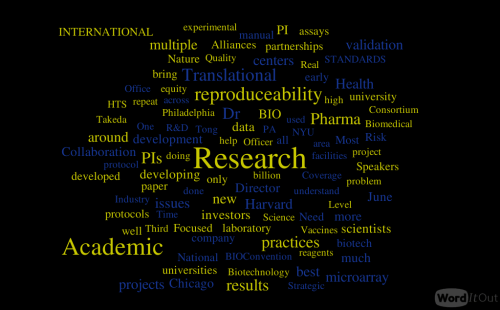
WordCloud Image Produced by Adam Tubman

Derisking Academic Science: The Unmet Need  

Translating academic research into products and new therapies is a very risky venture as only 1% of academic research has been successfully translated into successful products.
Speakers
Collaboration from Chicago area universities like U of Chicago, Northwestern, etc.  First phase was enhance collaboration between universities by funding faculty recruitment and basic research.  Access to core facilities across universities.  Have expanded to give alternatives to company formation.
Half of the partnerships from Harvard and companies have been able to spin out viable startups.
Most academic PI are not as savvy to start a biotech so they bring in biotechs and build project teams as well as developing a team of ex pharma and biotech experts.  Derisk as running as one asset project.  Partner as early as possible.  A third of their pipeline have been successfully partnered.  Work with investors and patent attorneys.
Focused on getting PIs to get to startup.  Focused on oncology and vaccines and I/O.  The result can be liscensing or partnership. Running around 50 to 60 projects. Creating a new company from these US PI partnerships.
Most projects from Harvard have been therapeutics-based.  At Harvard they have a network of investors ($50 million).   They screen PI proposals based on translateability and what investors are interested in.
In Chicago they solicit multiple projects but are agnostic on area but as they are limited they are focused on projects that will assist in developing a stronger proposal to investor/funding mechanism.
NYU goes around university doing due diligence reaching out to investigators. They shop around their projects to wet their investors, pharma appetite future funding.  At Takeda they have five centers around US.  They want to have more input so go into the university with their scientists and discuss ideas.
Challenges:
Takeda: Data Validation very important. Second there may be disconnect with the amount of equity the PI wants in the new company as well as management.  Third PIs not aware of all steps in drug development. Harvard:  Pharma and biotech have robust research and academic does not have the size or scope of pharma.  PIs must be more diligent on e.g. the compounds they get from a screen… they only focus narrowly NYU:  bring in consultants as PIs don’t understand all the management issues.  Need to understand development so they bring in the experts to help them.  Pharma he feels have to much risk aversion and none of their PIs want 100% equity. Chicago:  they like to publish at early stage so publication freedom is a challenge
Dr. Freedman: Most scientists responding to Nature survey said yes a reproduceability crisis.  The reasons: experimental bias, lack of validation techniques, reagents, and protocols etc.
And as he says there is a great ECONOMIC IMPACT of preclinical reproducability issues: to the tune of $56 billion of irreproducable results (paper published in PLOS Biology).  If can find the core drivers of this issue they can solve the problem.  STANDARDS are constantly used in various industries however academic research are lagging in developing such standards.  Just the problem of cell line authentication is costing $4 billion.
Dr. Cousins:  There are multiple high throughput screening (HTS) academic centers around the world (150 in US).  So where does the industry go for best practices in assays?  Eli Lilly had developed a manual for HTS best practices and in 1984 made publicly available (Assay Guidance Manual).  To date there have been constant updates to this manual to incorporate new assays.  Workshops have been developed to train scientists in these best practices.
NIH has been developing new programs to address these reproducability issues.  Developed a method called
Ring Testing Initiative” where multiple centers involved in sharing reagents as well as assays and allowing scientists to test at multiple facilities.
Dr.Tong: Reproduceability of Microarrays:  As microarrays were the only methodology to do high through put genomics in the early 2000s, and although much research had been performed to standardize and achieve best reproduceability of the microarray technology (determining best practices in spotting RNA on glass slides, hybridization protocols, image analysis) little had been done on evaluating the reproducibility of results obtained from microarray experiments involving biological samples.  The advent of Artificial Intelligence and Machine Learning though can be used to help validate microarray results.  This was done in a Nature Biotechnology paper (Nature Biotechnology volume28pages827–838 (2010)) by an international consortium, the International MAQC (Microarray Quality Control) Society and can be found here
However Dr. Tong feels there is much confusion in how we define reproduceability.  Dr. Tong identified a few key points of data reproduceability:
  1. Traceability: what are the practices and procedures from going from point A to point B (steps in a protocol or experimental design)
  2. Repeatability:  ability to repeat results within the same laboratory
  3. Replicatablilty:  ability to repeat results cross laboratory
  4. Transferability:  are the results validated across multiple platforms?
The panel then discussed the role of journals and funders to drive reproduceability in research.  They felt that editors have been doing as much as they can do as they receive an end product (the paper) but all agreed funders need to do more to promote data validity, especially in requiring that systematic evaluation and validation of each step in protocols are performed..  There could be more training of PIs with respect to protocol and data validation.

Other Articles on Industry/Academic Research Partnerships and Translational Research on this Open Access Online Journal Include

Envisage-Wistar Partnership and Immunacel LLC Presents at PCCI

BIO Partnering: Intersection of Academic and Industry: BIO INTERNATIONAL CONVENTION June 23-26, 2014 | San Diego, CA

R&D Alliances between Big Pharma and Academic Research Centers: Pharma’s Realization that Internal R&D Groups alone aren’t enough

Read Full Post »

« Newer Posts - Older Posts »