Feeds:
Posts
Comments

Archive for the ‘Human Immune System in Health and in Disease’ Category

Monoclonal antibody treatment of Multiple Myeloma

Larry H. Bernstein, MD, FCAP, Curator

LPBI


Elotuzumab

by DR ANTHONY MELVIN CRASTO Ph.D


str2

Elotuzumab

A SLAMF7-directed immunostimulatory antibody used to treat multiple myeloma.

(Empliciti®)

HuLuc-63;BMS-901608


http://media4.asco.org/156/9449/107994/107994_video_pvhr.jpg


Elotuzumab (brand name Empliciti, previously known as HuLuc63) is ahumanized monoclonal antibody used in relapsed multiple myeloma.[1] The package insert denotes its mechanism as a SLAMF7-directed (also known as CD 319) immunostimulatory antibody.[2]

Approvals and indications

In May 2014, it was granted “Breakthrough Therapy” designation by the FDA.[3] On November 30, 2015, FDA approved elotuzumab as a treatment for patients with multiple myeloma who have received one to three prior medications.[1] Elotuzumab was labeled for use with lenalidomide anddexamethasone. Each intravenous injection of elotuzumab should be premedicated with dexamethasone, diphenhydramine, ranitidine andacetaminophen.[2]


Elotuzumab is APPROVED for safety and efficacy in combination with lenalidomide and dexamethasone.

Monoclonal antibody therapy for multiple myeloma, a malignancy of plasma cells, was not very clinically efficacious until the development of cell surface glycoprotein CS1 targeting humanized immunoglobulin G1 monoclonal antibody – Elotuzumab. Elotuzumab is currently APPROVED in relapsed multiple myeloma.

Elotuzumab (HuLuc63) binds to CS1 antigens, highly expressed by multiple myeloma cells but minimally present on normal cells. The binding of elotuzumab to CS1 triggers antibody dependent cellular cytotoxicity in tumor cells expressing CS1. CS1 is a cell surface glycoprotein that belongs to the CD2 subset of immunoglobulin superfamily (IgSF). Preclinical studies showed that elotuzumab initiates cell lysis at high rates. The action of elotuzumab was found to be enhanced when multiple myeloma cells were pretreated with sub-therapeutic doses of lenalidomide and bortezomib. The impressive preclinical findings prompted investigation and analysis of elotuzumab in phase I and phase II studies in combination with lenalidomide and bortezomib.

Elotuzumab As Part of Combination Therapy: Clinical Trial Results

Elotuzumab showed manageable side effect profile and was well tolerated in a population of relapsed/refractory multiple myeloma patients, when treated with intravenous elotuzumab as single agent therapy. Lets’ take a look at how elotuzumab fared in combination therapy trials,

In phase I trial of elotuzumab in combination with Velcade/bortezomib in patients with relapsed/refractory myeloma, the overall response rate was 48% and activity was observed in patients whose disease had stopped responding to Velcade previously. The trial results found that elotuzumab enhanced Velcade activity.
A phase I/II trial in combination with lenalidomide and dexamethasone in refractory/relapsed multiple myeloma patients showed that 82% of patients responded to treatment with a partial response or better and 12% of patients showed complete response. Patients who had received only one prior therapy showed 91% response rate with elotuzumab in combination with lenalidomide and dexamethasone.

https://encrypted-tbn3.gstatic.com/images?q=tbn:ANd9GcTRz8CB6gsJ0JgMJ8Gu70Oia9i-Q3NsfRys52uoxiV5maIH785TVQ


Phase I/II trials of the antibody drug has been very impressive and the drug is currently into Phase III trials. Two phase III trials are investigating whether addition of elotuzumab with Revlimid and low dose dexamethasone would increase the time to disease progression. Another phase III trial (ELOQUENT 2) is investigating and comparing safety and efficacy of lenalidomide plus low dose dexamethasone with or without 10mg/kg of elotuzumab in patients with relapsed/refractory multiple myeloma.

Elotuzumab is being investigated in many other trials too. It is being evaluated in combination with Revlimid and low-dose dexamethasone in multiple myeloma patients with various levels of kidney functions, while another phase II study is investigating elotuzumab’s efficacy in patients with high-risk smoldering myeloma.

The main target of multiple myeloma drug development is to satisfy the unmet need for drugs that would improve survival rates. Elotuzumab is an example that mandates much interest in this area and should be followed with diligence.

https://www.dovepress.com/cr_data/article_fulltext/s49000/49780/img/fig2.jpgReferences

References

1 “Press Announcement—FDA approves Empliciti, a new immune-stimulating therapy to treat multiple myeloma”. U.S. Food and Drug Administration. Retrieved 3 December 2015.

2“Empliciti (elotuzumab) for Injection, for Intravenous Use. Full Prescribing Information” (PDF). Empliciti (elotuzumab) for US Healthcare Professionals. Bristol-Myers Squibb Company, Princeton, NJ 08543 USA.

3 “Bristol-Myers Squibb and AbbVie Receive U.S. FDA Breakthrough Therapy Designation for Elotuzumab, an Investigational Humanized Monoclonal Antibody for Multiple Myeloma” (Press release). Princeton, NJ & North Chicago, IL: Bristol-Myers Squibb. 2014-05-19. Retrieved 2015-02-05.

Read Full Post »

Signaling of Immune Response in Colon Cancer, Volume 2 (Volume Two: Latest in Genomics Methodologies for Therapeutics: Gene Editing, NGS and BioInformatics, Simulations and the Genome Ontology), Part 1: Next Generation Sequencing (NGS)

Signaling of Immune Response in Colon Cancer

Larry H. Bernstein, MD, FCAP, Curator

LPBI


Revised 1/13/2016

STING Protein May Serve as Biomarker for Colorectal and Other Cancers

http://www.genengnews.com/gen-news-highlights/sting-protein-may-serve-as-biomarker-for-colorectal-and-other-cancers/81252165/


Scientists at University of Miami Miller School of Medicine’s Sylvester Comprehensive Cancer Center say they have discovered how the stimulator of interferon genes (STING) signaling pathway may play an important role in alerting the immune system to cellular transformation. They believe their finding will shed further light on the immune system’s response to cancer development.

In 2008, Glen N. Barber, Ph.D., leader of the viral oncology program at Sylvester, and professor and chairman of cell biology at the Miller School of Medicine, and colleagues published in Nature (“STING is an endoplasmic reticulum adaptor that facilitates innate immune signalling”) the discovery of STING as a new cellular molecule that recognizes virus and bacteria infection to initiate host defense and immune responses. In the new study, published in Cell Reports (“Deregulation of STING Signaling in Colorectal Carcinoma Constrains DNA Damage Responses and Correlates With Tumorigenesis”), they describe STING’s role in the potential suppression of colorectal cancer.

“Since 2008 we’ve known that STING is crucial for antiviral and antibacterial responses,” said Dr. Barber. “But until now, little had been known about its function in human tumors. In this study we show, for the first time, that STING signaling is repressed in colorectal carcinoma and other cancers, an event which may enable transformed cells to evade the immune system.”

Colorectal cancer currently affects around 1.2 million people in the U.S. and 150,000 new cases are diagnosed every year, making it the third most common cancer in both men and women. Since most colon cancers develop from benign polyps, they can be treated successfully when detected early. However, if the tumor has already spread, survival rates are generally low.

Using disease models of colorectal cancer, the team of Sylvester scientists showed that loss of STING signaling negatively affected the body’s ability to recognize DNA-damaged cells. In particular, certain cytokines that facilitate tissue repair and antitumor priming of the immune system were not sufficiently produced to initiate a significant immune response to eradicate the colorectal cancer.

“We were able to show that impaired STING responses may enable damaged cells to elude the immune system,” continued Dr. Barber. “And if the body doesn’t recognize and attack cancer cells, they will multiply and, ultimately, spread to other parts of the body.”

He and his colleagues suggest evaluating STING signaling as a prognostic marker for the treatment of colorectal as well as other cancers. For example, Dr. Barber’s study showed that cancer cells with defective STING signaling were particularly prone to attack by oncolytic viruses presently being used as cancer therapies.

“Impaired STING responses may enable damaged cells to evade host immunosurveillance processes, although they provide a critical prognostic measurement that could help predict the outcome of effective oncoviral therapy,” wrote the investigators.

STING Protein Could be Used for Cancer Diagnosis

http://www.technologynetworks.com/Proteomics/news.aspx?ID=186674


This is the first detailed examination of how the stimulator of interferon genes (STING) signaling pathway, discovered by Glen N. Barber, Ph.D., Leader of the Viral Oncology Program at Sylvester Comprehensive Cancer Center, may play an important role in alerting the immune system to cellular transformation.

In 2008, Barber, who is also Professor and Chairman of Cell Biology at the University of Miami Miller School of Medicine, and colleagues published in Nature the discovery of STINGas a new cellular molecule that recognizes virus and bacteria infection to initiate host defense and immune responses. In the new study they describe STING’s role in the potential suppression of colorectal cancer.

“Since 2008 we’ve known that STING is crucial for antiviral and antibacterial responses,” said Barber. “But until now, little had been known about its function in human tumors. In this study we show, for the first time, that STING signaling is repressed in colorectal carcinoma and other cancers, an event which may enable transformed cells to evade the immune system.”

Colorectal cancer currently affects around 1.2 million people in the United States and 150.000 new cases are diagnosed every year, making it the third most common cancer in both men and women. Since most colon cancers develop from benign polyps, they can be treated successfully when detected early. However, if the tumor has already spread, survival rates are generally low.

Using disease models of colorectal cancer, the team of Sylvester scientists showed that loss of STING signaling negatively affected the body’s ability to recognize DNA-damaged cells. In particular, certain cytokines – small proteins important for cell signaling – that facilitate tissue repair and anti-tumor priming of the immune system were not sufficiently produced to initiate a significant immune response to eradicate the colorectal cancer.

“We were able to show that impaired STING responses may enable damaged cells to elude the immune system,” added Barber. “And if the body doesn’t recognize and attack cancer cells, they will multiply and, ultimately, spread to other parts of the body.”

Barber and his colleagues suggest evaluating STING signaling as a prognostic marker for the treatment of colorectal as well as other cancers. For example, Barber’s study showed that cancer cells with defective STING signaling were particularly prone to attack by oncolytic viruses presently being used as cancer therapies. Alternate studies with colleagues have also shown that activators of STING signaling are potent stimulators of anti-tumor immune responses. Collectively, the control of STING signaling may have important implications for cancer development as well as cancer treatment.


Every step you take: STING pathway key to tumor immunity

http://sciencelife.uchospitals.edu/2014/11/20/every-step-you-take-sting-pathway-key-to-tumor-immunity/

A recently discovered protein complex known as STING plays a crucial role in detecting the presence of tumor cells and promoting an aggressive anti-tumor response by the body’s innate immune system, according to two separate studies published in the Nov. 20 issue of the journal Immunity.

The studies, both from University of Chicago-based research teams, have major implications for the growing field of cancer immunotherapy. The findings show that when activated, the STING pathway triggers a natural immune response against the tumor. This includes production of chemical signals that help the immune system identify tumor cells and generate specific killer T cells. The research also found that targeted high-dose radiation therapy dials up the activation of this pathway, which promotes immune-mediated tumor control.

These findings could “enlarge the fraction of patients who respond to immunotherapy with prolonged control of the tumor,” according to a commentary on the papers by the University of Verona’s Vincenzo Bronte, MD. “Enhancing the immunogenicity of their cancers might expand the lymphocyte repertoire that is then unleashed by interference with checkpoint blockade pathways,” such as anti-PD-1.

STING, short for STimulator of INterferon Genes complex, is a crucial part of the process the immune system relies on to detect threats — such as infections or cancer cells — that are marked by the presence of DNA that is damaged or in the wrong place, inside the cell but outside the nucleus.

Detection of such “cytosolic” DNA initiates a series of interactions that lead to the STING pathway. Activating the pathway triggers the production of interferon-beta, which in turn alerts the immune system to the threat, helps the system detect cancerous or infected cells, and ultimately sends activated T cells into the battle.

“We have learned

“Innate immune sensing via the host STING pathway is critical for tumor control by checkpoint blockade,” Gajewski’s team noted in their paper. They found promising drugs known as checkpoint inhibitors — such as anti PD-1 or anti PD-L1, which can take the brakes off of an immune response — were not effective in STING-deficient mice. New agents that stimulate the STING pathway are being developed as potential cancer therapeutics.

A second University of Chicago team, led by cancer biologistYang-Xin Fu, MD, PhD, professor of pathology, and Ralph Weichselbaum, MD, chairman of radiation and cellular oncology and co-director of the Ludwig Center for Metastasis Research, found that high-dose radiation therapy not only kills targeted cancer cells but the resulting DNA damage drives a systemic immune response.

a great deal recently about what we call checkpoints, the stumbling blocks that prevent the immune system from ultimately destroying cancers,” said Thomas Gajewski, MD, PhD, professor of medicine and pathology at the University of Chicago and senior author of one of the studies. “Blockade of immune checkpoints, such as with anti-PD-1, is therapeutic in a subset of patients, but many individuals still don’t respond. Understanding the role of the STING pathway provides insights into how we can ‘wake up’ the immune response against tumors. This can be further boosted by checkpoint therapies.”

The two published studies, he said, help move this approach forward.

In a series of experiments in mice, both research teams found tumor cell-derived DNA could initiate an immune response against cancers. But when tested in mice that lacked a functional gene for STING, the immune system did not effectively respond.

“This result unifies traditional studies of DNA damage with newly identified DNA sensing of immune responses,” Fu said.

“This is a previously unknown mechanism,” Weichselbaum added.

In mice that lacked STING, however, there was no therapeutic immune response. The induction of interferons by radiation and consequent cancer cell killing, they conclude, depends on STING-pathway signaling.

They did find that combining cyclic guanosine monophosphate-adenosine monophosphate (cGAMP), an earlier step in the STING pathway, with radiation, could greatly enhance the antitumor efficacy of radiation.

“This opens a new avenue to develop STING-related agonists for patients with radiation-resistant cancers,” Fu said.


STING-Dependent Cytosolic DNA Sensing Mediates Innate Immune Recognition of Immunogenic Tumors

Seng-Ryong Woo1Mercedes B. Fuertes1Leticia Corrales1, …., Maria-Luisa Alegre2Thomas F. Gajewski1, 2   

Immunity 20 Nov 2014; 41(5): 830–842    http://dx.doi.org:/10.1016/j.immuni.2014.10.017


Highlights

• Spontaneous T cell responses against tumors require the host STING pathway in vivo
• Tumor-derived DNA can induce type I interferon production via STING
• Tumor DNA can be identified in host APCs in the tumor microenvironment in vivo

Summary

Spontaneous T cell responses against tumors occur frequently and have prognostic value in patients. The mechanism of innate immune sensing of immunogenic tumors leading to adaptive T cell responses remains undefined, although type I interferons (IFNs) are implicated in this process. We found that spontaneous CD8+ T cell priming against tumors was defective in mice lacking stimulator of interferon genes complex (STING), but not other innate signaling pathways, suggesting involvement of a cytosolic DNA sensing pathway. In vitro, IFN-β production and dendritic cell activation were triggered by tumor-cell-derived DNA, via cyclic-GMP-AMP synthase (cGAS), STING, and interferon regulatory factor 3 (IRF3). In the tumor microenvironment in vivo, tumor cell DNA was detected within host antigen-presenting cells, which correlated with STING pathway activation and IFN-β production. Our results demonstrate that a major mechanism for innate immune sensing of cancer occurs via the host STING pathway, with major implications for cancer immunotherapy.


Image for unlabelled figure

http://ars.els-cdn.com/content/image/1-s2.0-S1074761314003938-fx1.jpg


Immunity Erratum STING-Dependent Cytosolic DNA Sensing Mediates Innate Immune Recognition of Immunogenic Tumors

Seng-Ryong Woo, Mercedes B. Fuertes, Leticia Corrales, Stefani Spranger, Michael J. Furdyna, Michael Y.K. Leung, Ryan Duggan, Ying Wang, Glen N. Barber, Katherine A. Fitzgerald, Maria-Luisa Alegre, and Thomas F. Gajewski* *Correspondence: tgajewsk@medicine.bsd.uchicago.edu http://dx.doi.org/10.1016/j.immuni.2014.12.015 (Immunity 41, 830–842; November 20, 2014)

The original Figure 3C accidentally contained a duplicated panel in the bright-field column, third row down, and this has now been replaced with the correct data. The change does not alter the conclusions of the paper. This mistake has now been corrected online, and the authors regret the error.


Cytosolic DNA Sensors (CDSs): a STING in the tail – Review

November 2012   http://www.invivogen.com/review-cds-ligands

The innate immune system provides the first line of defense against infectious pathogens and serves to limit their early proliferation. It is also vital in priming and activating the adaptive immune system.

Innate immune detection of intracellular DNA derived from viruses and invasive bacteria is important to initiate an effective protective response. This crucial step depends on cytosolic DNA sensors (CDSs), which upon activation trigger the production of type I interferons (IFNs) and the induction of IFN-responsive genes and proinflammatory chemokines.
Although the identity of these CDSs is not fully uncovered, much progress has been made in understanding the signaling pathways triggered by these sensors.

Cytosolic DNA-mediated production of type I IFNs (mainly IFN-β) requires the transcription factor IFN regulatory factor 3 (IRF3), which is activated upon phosphorylation by TANK-binding-kinase-1 (TBK1) [1].

STING in DNA sensing

Recently, a new molecule, STING (stimulator of IFN genes), has been shown to be essential for the TBK1-IRF3- dependent induction of IFN-β by transfected DNA ligands and intracellular DNA produced by pathogens after infection [2, 3].
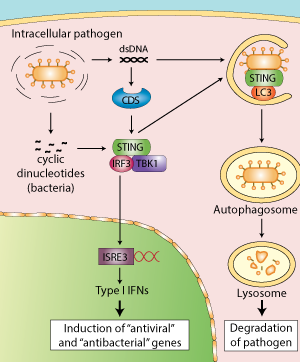
STING (also known as MITA, MPYS and ERIS) is a transmembrane protein that resides in the endoplasmic reticulum (ER) [2-6]. In response to cytosolic DNA, STING forms dimers and translocates from the ER to the Golgi then to punctate cytosolic structures where it colocalizes with TBK-1, leading to the phosphorylation of IRF3.
How STING stimulates TBK1-dependent IRF3 activation was recently elucidated by Tanaka and Chen. They found that, upon cytosolic DNA sensing, the C-terminal tail of STING acts as a scaffold protein to promote the phosphorylation of IRF3 by TBK1 [7].

STING in the host response to intracellular pathogens. Linking type I IFN response and autophagy for better defense

STING in the host response to intracellular pathogens

http://www.invivogen.com/images/STING-autophagy.png


STING activates the IFN response

Until very recently, STING in addition to its role as an adaptor protein was also thought to function as a sensor of cyclic dinucleotides.
Burdette et al. first demonstrated that STING binds directly to the bacterial molecule cyclic diguanylate monophosphate (c-di-GMP) [8]. This finding was confirmed by several teams who examined the structure of STING bound to c-di-GMP [9-11], including Cheng and colleagues, however their data suggest that STING is not the primary sensor of c-di-GMP [12]. Rather, they indicate that DDX41, an identified CDS, functions as a direct receptor for cyclic dinucleotides upstream of STING. The authors hypothesized that DDX41 binds to c-di-GMP then forms a complex with STING to activate the IFN response.

STING induces autophagy

Exciting new developments reveal that STING participates in another aspect of innate immunity, autophagy.
Autophagy plays a critical role in host defense responses to pathogens by promoting the elimination of microbes that enter into the cytosol by their sequestration into autophagosomes and their delivery to the lysosome.


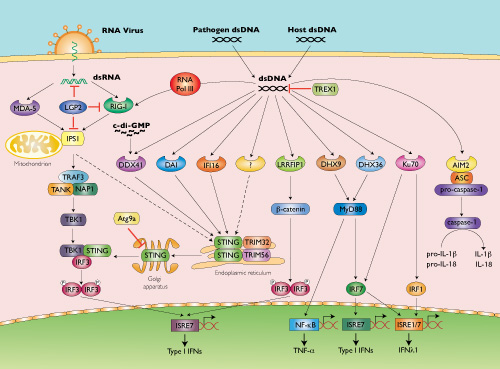
CDS pathway

http://www.invivogen.com/images/STING-CDS_pathway_small.jpg

Recent studies have reported that DNA viruses and intracellular bacteria induce autophagy and that this process is dependent on cytosolic genomic DNA and STING [13-15]. Robust induction of autophagy was also observed after transfection of various double stranded (ds) DNA species, such as poly(dA:dT), poly(dG:dC) or plasmid DNA, but not single stranded (ss) DNA, dsRNA or ssRNA [16].

Interestingly, activated STING was shown to relocate to unidentified membrame-bound compartments where it colocalizes with LC3, a hallmark of autophagy, and ATg9a. The latter protein was reported to regulate the interaction between STING and TBK1 after dsDNA stimulation [16]. The E3 ubiquitin ligases TRIM56 and TRIM32
were also found to regulate STING by mediating its dimerization through K63-linked ubiquitination [17, 18].

Several cytosolic DNA sensors upstream of STING have been proposed.
DNA-dependent activator of IRFs (DAI) was the first CDS discovered based on the ability of transfected poly(dA:dT) to induce IFN-β [19]. However, the role of DAI has been shown to be very cell-type specific and cells derived from DAI-deficient mice responded normally to dsDNA ligands [20].

While analyzing immune responses to dsDNA regions derived from vaccinia virus (VACV-70) or Herpes simplex virus 1 (HSV-60) genomes, Unterholzner et al. identified IFI16 as a DNA binding protein mediating IFN-β induction [21]. Interestingly, IFI16 belongs to a new family of pattern recognition receptors that contain the pyrin and HIN domain (PYHIN), termed AIM2-like receptors (ALRs).

AIM2 is a STING-independent cytosolic DNA sensor that forms an inflammasome with ASC to trigger caspase-1 activation and the secretion of the proinflammatory cytokines IL-1β and IL-18 [20].

Members of the DExD/H-box helicase superfamily have also been reported to function as cytosolic DNA sensors. While DHX36 and DHX9 were identified as STING-independent but MyD88-dependent sensors of CpG-containing DNA in plasmacytoid dendritic cells, DDX41 was found to bind various dsDNA ligands and localize with STING to promote IFN-β expression [22]. Other CDSs have been reported to function independently of STING: RNA Pol III, LRRFIP1 and Ku70 [20].

Unlike cytosolic RNA sensors (RIG-I, MDA-5), which detect structural moieties specific to pathogen RNA, such as 5’-triphosphates, it is not clear whether cytosolic DNA sensors can recognize any particular structural motif of DNA that would discriminate between self and non-self. This suggests that CDSs may have a role not only in anti-microbial innate immune responses but also in autoimmunity. A multitude of CDSs have been described but whether they are all true receptors remains an open question.

1. Stetson DB & Medzhitov R. 2006. Recognition of cytosolic DNA activates an IRF3-dependent innate immune response. Immunity. 24(1):93-103.
2. Ishikawa H. & Barber GN., 2008. STING is an endoplasmic reticulum adaptor that facilitates innate immune signalling. Nature. 455(7213):674-8.
3. Ishikawa H. et al., 2009. STING regulates intracellular DNA-mediated, type I interferon-dependent innate immunity. Nature. 461(7265):788-92.
4. Zhong B. et al., 2008. The adaptor protein MITA links virus-sensing receptors to IRF3 transcription factor activation. Immunity. 29(4):538-50.
5. Jin L. et al., 2008. MPYS, a novel membrane tetraspanner, is associated with major histocompatibility complex class II and mediates transduction of apoptotic signals. Mol Cell Biol. 28(16):5014-26.


UV Light Potentiates STING (Stimulator of Interferon Genes)-dependent Innate Immune Signaling through Deregulation of ULK1 (Unc51-like Kinase 1).

 J Biol Chem. 2015 May 8;290(19):12184-94.  http://dx.doi.org:/10.1074/jbc.M115.649301. Epub 2015 Mar 19.

The mechanism by which ultraviolet (UV) wavelengths of sunlight trigger or exacerbate the symptoms of the autoimmune disorder lupus erythematosus is not known but may involve a role for the innate immune system. Here we show that UV radiation potentiates STING (stimulator of interferon genes)-dependent activation of the immune signaling transcription factor interferon regulatory factor 3 (IRF3) in response to cytosolic DNA and cyclic dinucleotides in keratinocytes and other human cells. Furthermore, we find that modulation of this innate immune response also occurs with UV-mimetic chemical carcinogens and in a manner that is independent of DNA repair and several DNA damage and cell stress response signaling pathways. Rather, we find that the stimulation of STING-dependent IRF3 activation by UV is due to apoptotic signaling-dependent disruption of ULK1 (Unc51-like kinase 1), a pro-autophagic protein that negatively regulates STING. Thus, deregulation of ULK1 signaling by UV-induced DNA damage may contribute to the negative effects of sunlight UV exposure in patients with autoimmune disorders.


STING and the innate immune response to nucleic acids in the cytosol

Dara L Burdette & Russell E Vance

https://mcb.berkeley.edu/labs/vance/Resources/Burdette%20(2013)%20review.pdf

Cytosolic detection of pathogen-derived nucleic acids is critical for the initiation of innate immune defense against diverse bacterial, viral and eukaryotic pathogens. Conversely, inappropriate responses to cytosolic nucleic acids can produce severe autoimmune pathology. The host protein STING has been identified as a central signaling molecule in the innate immune response to cytosolic nucleic acids. STING seems to be especially critical for responses to cytosolic DNA and the unique bacterial nucleic acids called ‘cyclic dinucleotides’. Here we discuss advances in the understanding of STING and highlight the many unresolved issues in the field.

The detection of pathogen-derived nucleic acids is a central strategy by which the innate immune system senses microbes to then initiate protective responses1. Conversely, inappropriate recognition of self nucleic acids can result in debilitating autoimmune diseases such as systemic lupus erythematosus2. It is therefore important to understand the molecular basis of the detection of nucleic acids by the innate immune system. Studies have established that nucleic acids derived from extracellular sources are sensed mainly by endosomal Toll-like receptors (TLRs), such as TLR3, TLR7 and TLR9, whereas cytosolic nucleic acids are detected independently of TLRs by a variety of less-well-characterized mechanisms1.

Studies have identified STING (‘stimulator of interferon genes’; also known as TMEM173, MPYS, MITA and ERIS) as a critical signaling molecule in the innate response to cytosolic nucleic-acid ligands. STING was first described as a protein that interacts with major histocompatibility complex class II molecules3, but the relevance of this interaction remains unclear. Subsequent studies have instead focused on the role of STING in the transcriptional induction of type I interferons and coregulated genes in response to nucleic acids in the cytosol. Several groups have independently isolated STING by screening for proteins able to induce interferon-B (IFN-B) when overexpressed4–6. Studies of STING-deficient mice have subsequently confirmed the essential role of STING in innate responses to cytosolic nucleic-acid ligands, particularly double-stranded DNA (dsDNA) and unique bacterial nucleic acids called ‘cyclic dinucleotides’7–9. Several studies have also linked STING to the interferon response to cytosolic RNA5–7, but this has not been found consistently7,8,10,11; thus, we focus here on the role of STING in response to DNA and cyclic dinucleotides.


Protein Stimulator of interferon genes protein
Gene TMEM173
Organism Homo sapiens (Human)
Facilitator of innate immune signaling that acts as a sensor of cytosolic DNA from bacteria and viruses and promotes the production of type I interferon (IFN-alpha and IFN-beta). Innate immune response is triggered in response to non-CpG double-stranded DNA from viruses and bacteria delivered to the cytoplasm. Acts by recognizing and binding cyclic di-GMP (c-di-GMP), a second messenger produced by bacteria, and cyclic GMP-AMP (cGAMP), a messenger produced in response to DNA virus in the cytosol: upon binding of c-di-GMP or cGAMP, autoinhibition is alleviated and TMEM173/STING is able to activate both NF-kappa-B and IRF3 transcription pathways to induce expression of type I interferon and exert a potent anti-viral state. May be involved in translocon function, the translocon possibly being able to influence the induction of type I interferons. May be involved in transduction of apoptotic signals via its association with the major histocompatibility complex class II (MHC-II). Mediates death signaling via activation of the extracellular signal-regulated kinase (ERK) pathway. Essential for the induction of IFN-beta in response to human herpes simplex virus 1 (HHV-1) infection. Exhibits 2′,3′ phosphodiester linkage-specific ligand recognition. Can bind both 2′-3′ linked cGAMP and 3′-3′ linked cGAMP but is preferentially activated by 2′-3′ linked cGAMP (PubMed:26300263)
Stimulator of interferon genes protein (IPR029158)
Transmembrane protein 173, also known as stimulator of interferon genes protein (STING) or endoplasmic reticulum interferon stimulator (ERIS), is a transmembrane adaptor protein which is involved in innate immune signalling processes. It induces expression of type I interferons (IFN-alpha and IFN-beta) via the NF-kappa-B and IRF3, pathways in response to non-self cytosolic RNA and dsDNA [PMID: 18724357, PMID: 19776740,PMID: 18818105, PMID: 19433799].

Read Full Post »

Neutrophil Serine Proteases in Disease and Therapeutic Considerations

Larry H. Bernstein, MD, FCAP, Curator

LPBI


SERPINB1 Regulates the activity of the neutrophil proteases elastase, cathepsin G, proteinase-3, chymase,
chymotrypsin, and kallikrein-3. Belongs to the serpin family. Ov-serpin subfamily. Note: This description may
include information from UniProtKB.
Chromosomal Location of Human Ortholog: 6p25
Cellular Component: extracellular space; membrane; cytoplasm
Molecular Function: serine-type endopeptidase inhibitor activity
Reference #:  P30740 (UniProtKB)
Alt. Names/Synonyms: anti-elastase; EI; ELANH2; ILEU; LEI; Leukocyte elastase inhibitor; M/NEI; MNEI; Monocyte/neutrophil elastase inhibitor; Peptidase inhibitor 2; PI-2; PI2; protease inhibitor 2 (anti-elastase), monocyte/neutrophil derived; serine (or cysteine) proteinase inhibitor, clade B (ovalbumin), member 1; Serpin B1; serpin peptidase inhibitor, clade B (ovalbumin), member 1; SERPINB1
Gene Symbols: SERPINB1
Molecular weight: 42,742 Da
 

SERPIN PEPTIDASE INHIBITOR, CLADE B (OVALBUMIN), MEMBER 1; SERPINB1

Alternative titles; symbols
PROTEASE INHIBITOR 2, MONOCYTE/NEUTROPHIL DERIVED; ELANH2
ELASTASE INHIBITOR, MONOCYTE/NEUTROPHIL; EI
HGNC Approved Gene Symbol: SERPINB1
Cloning and Expression
Monocyte/neutrophil elastase inhibitor (EI) is a protein of approximately 42,000 Mr with serpin-like functional properties.
Remold-O’Donnell et al. (1992) cloned EI cDNA and identified 3 EI mRNA species of 1.5, 1.9, and 2.6 kb in monocyte-like cells
and no hybridizing mRNA in lymphoblastoid cells lacking detectable EI enzymatic activity. The cDNA open reading frame encoded
a 379-amino acid protein. Its sequence established EI as a member of the serpin superfamily. Sequence alignment indicated that
the reactive center P1 residue is cys-344, consistent with abrogation of elastase inhibitory activity by iodoacetamide and making
EI a naturally occurring cys-serpin.


Mapping

In the course of studying 4 closely linked genes encoding members of the ovalbumin family of serine proteinase inhibitors
(Ov-serpins) located on 18q21.3, Schneider et al. (1995) investigated the mapping of elastase inhibitor. They prepared PCR
primer sets of the gene, and by using the NIGMS monochromosomal somatic cell hybrid panel, showed that the EI gene maps
to chromosome 6.

By amplifying DNA of a somatic cell hybrid panel, Evans et al. (1995) unambiguously localized ELANH2 to chromosome 6.
With the use of a panel of radiation and somatic cell hybrids specific for chromosome 6, they refined the localization to
the short arm telomeric of D6S89, F13A (134570), and D6S202 at 6pter-p24.

http://www.phosphosite.org/getImageAction.do?id=27292293


REFERENCES
Evans, E., Cooley, J., Remold-O’Donnell, E. Characterization and chromosomal localization of ELANH2, the gene encoding human
monocyte/neutrophil elastase inhibitor. Genomics 28: 235-240, 1995. [PubMed: 8530031related citations] [Full Text]
Remold-O’Donnell, E., Chin, J., Alberts, M. Sequence and molecular characterization of human monocyte/neutrophil elastase inhibitor.
Proc. Nat. Acad. Sci. 89: 5635-5639, 1992. [PubMed: 1376927related citations][Full Text]
Schneider, S. S., Schick, C., Fish, K. E., Miller, E., Pena, J. C., Treter, S. D., Hui, S. M., Silverman, G. A. A serine proteinase inhibitor locus at
18q21.3 contains a tandem duplication of the human squamous cell carcinoma antigen gene. Proc. Nat. Acad. Sci. 92: 3147-3151, 1995.
[PubMed: 7724531,related citations] [Full Text]


Leukocyte elastase inhibitor (serpin B1) (IPR015557)

Short name: Serpin_B1

Family relationships

  • Serpin family (IPR000215)
    • Leukocyte elastase inhibitor (serpin B1) (IPR015557)

Description

Leukocyte elastase inhibitor is also known as serpin B1. Serpins (SERine Proteinase INhibitors) belong to MEROPS inhibitor family I4 (clan ID)
[PMID: 14705960].

Serpin B1 regulates the activity of neutrophil serine proteases such as elastase, cathepsin G and proteinase-3 and may play a regulatory role to
limit inflammatory damage due to proteases of cellular origin [PMID: 11747453]. It also functions as a potent intracellular inhibitor of granzyme
H [PMID: 23269243]. In mouse, four different homologues of human serpin B1 have been described [PMID: 12189154].


The neutrophil serine protease inhibitor SerpinB1 protects against inflammatory lung injury and morbidity in influenza virus infection

Dapeng Gong1,2, Charaf Benarafa1,2, Kevan L Hartshorn3 and Eileen Remold-O’Donnell1,2
J Immunol April 2009; 182(Meeting Abstract Supplement) 43.10
http://www.jimmunol.org/cgi/content/meeting_abstract/182/1_MeetingAbstracts/43.10

SerpinB1 is an efficient inhibitor of neutrophil serine proteases. SerpinB1-/- mice fail to clear bacterial lung infection with increased inflammation and neutrophil death. Here, we investigated the role of serpinB1 in influenza virus infection, where infiltrating neutrophils and monocytes facilitate virus clearance but can also cause tissue injury. Influenza virus (H3N2 A/Phil/82) infection caused greater and more protracted body weight loss in serpinB1-/- vs. WT mice (20% vs. 15%; nadir on day 4 vs. day 3). Increased morbidity was not associated with defective virus clearance. Cytokines (IFN, TNF, IL-17, IFN, G-CSF) and chemokines (MIP-1, KC, MIP-2) were increased in serpinB1-/- mice vs. WT on days 2-7 post-infection but not on day 1. In WT mice, histology indicated large infiltration of neutrophils peaking on day 1 and maximal airway injury on day 2 that resolved on day 3 coincident with the influx of monocytes/macrophages. In serpinB1-/- mice, neutrophils also peaked on day 1; epithelial injury was severe and sustained with accumulation of dead cells on day 2 and 3. Immunophenotyping of lung digests on day 2 and 3 showed delayed recruitment of monocytes, macrophages and DC in serpinB1-/- mice, but increase of activated CD4 (day 2-3) and CD8 (day 3) T cells. Our findings demonstrate that serpinB1 protects against morbidity and inflammatory lung injury associated with influenza infection.


The neutrophil serine protease inhibitor serpinb1 preserves lung defense functions in Pseudomonas aeruginosainfection

Charaf Benarafa 1 , 2 Gregory P. Priebe 3 , 4 , and Eileen Remold-O’Donnell 1 , 2
JEM July 30, 2007; 204(8): 1901-1909   http://dx.doi.org:/10.1084/jem.20070494

Neutrophil serine proteases (NSPs; elastase, cathepsin G, and proteinase-3) directly kill invading microbes. However, excess NSPs in the lungs play a central role in the pathology of inflammatory pulmonary disease. We show that serpinb1, an efficient inhibitor of the three NSPs, preserves cell and molecular components responsible for host defense against Pseudomonas aeruginosa. On infection, wild-type (WT) and serpinb1-deficient mice mount similar early responses, including robust production of cytokines and chemokines, recruitment of neutrophils, and initial containment of bacteria. However, serpinb1−/− mice have considerably increased mortality relative to WT mice in association with late-onset failed bacterial clearance. We found that serpinb1-deficient neutrophils recruited to the lungs have an intrinsic defect in survival accompanied by release of neutrophil protease activity, sustained inflammatory cytokine production, and proteolysis of the collectin surfactant protein–D (SP-D). Coadministration of recombinant SERPINB1 with the P. aeruginosa inoculum normalized bacterial clearance inserpinb1−/− mice. Thus, regulation of pulmonary innate immunity by serpinb1 is nonredundant and is required to protect two key components, the neutrophil and SP-D, from NSP damage during the host response to infection.


Neutrophils are the first and most abundant phagocytes mobilized to clear pathogenic bacteria during acute lung infection. Prominent among their antimicrobial weapons, neutrophils carry high concentrations of a unique set of serine proteases in their granules, including neu trophil elastase (NE), cathepsin G (CG), and proteinase-3. These neutrophil serine proteases (NSPs) are required to kill phagocytosed bacteria and fungi (12). Indeed, neutrophils lacking NE fail to kill phagocytosed pathogens, and mice deficient for NE and/or CG have increased mortality after infection with pulmonary pathogens (34). However, NSPs in the lung airspace can have a detrimental effect in severe inflammatory lung disease through degradation of host defense and matrix proteins (57). Thus, understanding of the mechanisms that regulate NSP actions during lung infections associated with neutrophilia will help identify strategies to balance host defense and prevent infection-induced tissue injury.


SERPINB1, also known as monocyte NE inhibitor (8), is an ancestral serpin super-family protein and one of the most efficient inhibitors of NE, CG, and proteinase-3 (910). SERPINB1 is broadly expressed and is at particularly high levels in the cytoplasm of neutrophils (1112). SERPINB1 has been found complexed to neutro phil proteases in lung fluids of cystic fibrosis patients and in a baboon model of bronchopulmonary dysplasia (1314). Although these studies suggest a role for SERPINB1 in regulating NSP activity, it is unclear whether these complexes reflect an important physiological role for SERPINB1 in the lung air space.

RESULTS

To define the physiological importance of SERPINB1 in shaping the outcome of bacterial lung infection, we generated mice deficient for serpinb1 (serpinb1−/−) by targeted mutagenesis in embryonic stem (ES) cells (Fig. 1, A–C). Crossings of heterozygous mice produced WT (+/+), heterozygous (+/−), and KO (−/−) mice for serpinb1 at expected Mendelian ratios (25% +/+, 51% +/−, and 24% −/−; n = 225; Fig. 1 D), indicating no embryonic lethality. Bone marrow neutrophils of serpinb1−/− mice lacked expression of the protein, whereas heterozygous serpinb1+/− mice had reduced levels compared with WT mice (Fig. 1 E). Importantly, levels of the cognate neutrophil proteases NE and CG, measured as antigenic units, were not altered by deletion of serpinb1 (Fig. 1 F). When maintained in a specific pathogen-free environment, serpinb1−/− mice did not differ from WT littermates in growth, litter size, or life span (followed up to 12 mo), and no gross or histopathological defects were observed at necropsy in 8-wk-old mice.

6–8-wk-old animals were intranasally inoculated with the nonmucoid Pseudomonas aeruginosa strain PAO1. Using two infection doses (3 × 10⁶ and 7 × 10⁶ CFU/mouse),serpinb1−/− mice had a significantly lower survival probability and a shorter median survival time compared with WT mice (Fig. 2 A). Further groups of infected mice were used to evaluate bacterial clearance. At 6 h after infection, the bacteria were similarly restricted in mice of the two genotypes, suggesting that the serpinb1−/− mice have a normal initial response to infection. At 24 h, the median bacterial count in the lungs of serpinb1−/− mice was five logs higher than that of the WT mice (P < 0.001), and the infection had spread systemically in serpinb1−/− mice but not in WT mice, as shown by high median CFU counts in the spleen (Fig. 2 B). Histological examination at 24 h after infection revealed abundant neutrophil infiltration in the lungs of both WT and serpinb1−/− mice, and consistent with the bacteriological findings, numerous foci of bacterial colonies and large areas of alveolar exudates were found in serpinb1−/− mice only (Fig. 2 C). When challenged with the mucoid P. aeruginosa clinical strain PA M57-15 isolated from a cystic fibrosis patient, WT mice cleared >99.9% of the inoculum within 24 h, whereas serpinb1-deficient mice failed to clear the infection (Fig. 2 D). Thus, the NSP inhibitor serpinb1 is essential for maximal protection against pneumonia induced by mucoid and nonmucoid strains of P. aeruginosa.

Figure 2.

Serpinb1−/− mice fail to clear P. aeruginosalung infection. (A) Kaplan-Meier survival curves of WT (+/+) and serpinb1-deficient (−/−) mice intranasally inoculated with nonmucoid P. aeruginosa strain PAO1. Increased mortality of serpinb1−/− mice was statistically significant (P = 0.03 at 3 × 10⁶CFU/mouse; P < 0.0001 at 7 × 10⁶CFU/mouse). (B) CFUs per milligram of lung (left) and splenic (right) tissue determined 6 and 24 h after inoculation with 3 × 10⁶ CFUP. aeruginosa PAO1 in WT (+/+, filled circles) and serpinb1−/− (−/−, open circles) mice. Each symbol represents a value for an individual mouse. Differences between median values (horizontal lines) were analyzed by the Mann-Whitney U test. Data below the limit of detection (dotted line) are plotted as 0.5 CFU × dilution factor. (C) Lung sections stained with hematoxylin and eosin show bacterial colonies (arrowheads) and alveolar exudate in lungs of serpinb1−/− mice 24 h after infection with P. aeruginosa PAO1. Bars, 50 μm. (D) Total CFUs in the lung and spleen 24 h after inoculation with 2 × 10⁸ CFU of the mucoid P. aeruginosa strain PA M57-15 in WT (+/+, filled circles) and serpinb1−/− (−/−, open circles) mice. Differences between median values (horizontal lines) were analyzed by the Mann-Whitney U test.

To verify specificity of the gene deletion, we tested whether delivering rSERPINB1 would correct the defective phenotype. Indeed, intranasal instillation of rSERPINB1 to serpinb1−/− mice at the time of inoculation significantly improved clearance of P. aeruginosa PAO1 from the lungs assessed at 24 h and reduced bacteremia compared with infectedserpinb1−/− mice that received PBS instead of the recombinant protein (Fig. S1 A, available at http://www.jem.org/cgi/content/full/jem.20070494/DC1). We have previously demonstrated that rSERPINB1 has no effect on the growth of P. aeruginosa in vitro (15) and does not induce bacterial aggrega tion (16). Also, rSERPINB1 mixed with PAO1 had no effect on adherence of the bacteria to human bronchial epithelial and corneal epithelial cell lines (unpublished data). Therefore, the improved bacterial clearance in treated serpinb1−/− mice is not related to a direct antibacterial role for rSERPINB1 but rather to reducing injury induced by excess neutrophil proteases. In addition, previous in vivo studies in WT rats showed that rSERPINB1 can protect against elastase-induced lung injury (17) and accelerate bacterial clearance two- to threefold in the Pseudomonas agar bead model (15).

Evidence of excess NSP action was examined in the lungs of infected serpinb1−/− mice by measuring surfactant protein–D (SP-D). SP-D, a multimeric collagenous C-type lectin produced by alveolar epithelial cells, is highly relevant as a host defense molecule, because it functions as an opsonin in microbial clearance (18) and acts on alveolar macrophages to regulate pro- and antiinflammatory cytokine production (19). SP-D is also relevant as an NSP target because it is degraded in vitro by trace levels of each of the NSPs (1620). SP-D levels in lung homogenates of WT and serpinb1−/− mice were similar 6 h after P. aeruginosa infection. At 24 h, SP-D levels were reduced in the lungs ofserpinb1−/− mice compared with WT mice, as indicated by immunoblots. A lower molecular mass band indicative of proteolytic degradation is also apparent (Fig. 3 A). Densitometry analysis of the 43-kD SP-D band relative to β-actin indicated that the reduction of SP-D level was statistically significant (+/+, 45 ± 6 [n = 8]; −/−, 10 ± 2 [n = 8]; P < 0.0001 according to the Student’s t test). Furthermore, rSERPINB1 treatment ofP. aeruginosa–infected serpinb1−/− mice partly prevented the degradation of SP-D in lung homogenates compared with nontreated mice (Fig. S1 B). As a further test of the impact of serpinb1 deletion on NSP activity, isolated neutrophils of serpinb1−/− mice were treated with LPS and FMLP and tested for their ability to cleave recombinant rat SP-D (rrSP-D) in vitro. The extent of rrSP-D cleavage by serpinb1−/− neutrophils was fourfold greater than by WT neutrophils, as determined by densitometry. The cleavage was specific for NSPs because it was abrogated by rSERPINB1 and diisopropyl fluorophosphate (Fig. 3 B). Collectively, these findings indicate a direct role for serpinb1 in regulating NSP activity released by neutrophils and in preserving SP-D, an important-host defense molecule.

Efficient clearance of P. aeruginosa infection requires an early cytokine and chemokine response coordinated by both resident alveolar macrophages and lung parenchymal cells (2122). The IL-8 homologue keratinocyte-derived chemokine (KC) and the cytokines TNF-α, IL-1β, and G-CSF were measured in cell-free bronchoalveolar (BAL) samples. Although the tested cytokines were undetectable in sham-infected mice of both genotypes (unpublished data), comparable induc tion of these cytokines was observed in BAL of WT and serpinb1−/− mice at 6 h after infection, demonstrating that there is no early defect in cytokine production in serpinb1−/− mice. At 24 h, levels of TNF-α, KC, and IL-1β were sustained or increased in serpinb1−/− mice and significantly higher than cytokine levels in WT mice. G-CSF levels at 24 h were elevated to a similar extent in BAL of WT and KO mice (Fig. 3 C). However, G-CSF levels were significantly higher in the serum of serpinb1−/− mice (WT, 336 ± 80 ng/ml; KO, 601 ± 13 ng/ml; n = 6 of each genotype; P < 0.01). In addition, serpinb1−/− mice that were treated at the time of infection with rSERPINB1 had cytokine levels in 24-h lung homogenates that were indistinguishable from those of infected WT mice (Fig. S1 C). The increased cytokine production in the lungs of infected serpinb1−/− mice may be caused by failed bacterial clearance but also by excess NSPs, which directly induce cytokine and neutrophil chemokine production in pulmonary parenchymal cells and alveolar macrophages (2324).

Neutrophil recruitment to the lungs was next examined as a pivotal event of the response to P. aeruginosa infection (25). Lung homogenates were assayed for the neutrophil-specific enzyme myeloperoxidase (MPO) to quantify marginating, interstitial, and alveolar neutrophils. Neutrophils in BAL fluid were directly counted as a measure of neutrophil accumulation in the alveolar and airway lumen. MPO in lung homo genates was undetectable in uninfected mice and was comparably increased in mice of both genotypes at 6 h, suggesting normal early serpinb1−/− neutrophil margination and migration into the interstitium. However, by 24 h after infection, MPO levels in lung homogenates remained high in WT mice but were significantly decreased in serpinb1−/− mice (Fig. 4 A). Importantly, the content of MPO per cell was the same for isolated neutrophils of WT andserpinb1−/− mice (+/+, 369 ± 33 mU/106 cells; −/−, 396 ± 27 mU/106 cells). The numbers of neutrophils in BAL were negligible in uninfected mice and were similarly increased in WT and serpinb1−/− mice at 6 h after infection. Neutrophil counts in BAL further increased at 24 h, but the mean BAL neutrophil numbers were significantly lower in serpinb1−/− mice compared with WT mice (Fig. 4 B). The evidence from the 6-h quantitation of MPO in homogenates and neutrophils in BAL strongly suggests that neutrophil recruitment is not defective in infected serpinb1−/− mice. Moreover, the high levels of cytokines and neutrophil chemoattractant KC in serpinb1−/− mice at 24 h (Fig. 3 C) also suggest that, potentially, more neutrophils should be recruited. Therefore, to examine neutrophil recruitment in serpinb1−/− mice, we used a noninfectious model in which neutrophils are mobilized to migrate to the lung after intranasal delivery of P. aeruginosa LPS. MPO levels in lung homogenate and neutrophil numbers in BAL were not statistically different in WT and serpinb1−/− mice 24 h after LPS instillation (Fig. 4, C and D). Furthermore, the number of circulating blood neutrophils and recruited peritoneal neutrophils after injection of sterile irritants glycogen and thioglycollate did not differ in WT and serpinb1−/− mice (unpublished data). Alveolar macrophage numbers were similar in uninfected mice of both genotypes (∼5 × 10⁵ cells/mouse) and did not substantially change upon infection. Collectively, these findings show that neutrophil recruitment to the lungs in response to P. aeruginosa infection is not defective in serpinb1−/− mice, and therefore, the recovery of lower numbers of serpinb1−/− neutrophils at 24 h after infection suggests their decreased survival.

To examine the putative increased death of serpinb1−/− neutrophils in the lungs after P. aeruginosa infection, lung sections were analyzed by immunohistochemistry. Caspase-3–positive leukocytes were more relevant in the alveolar space of serpinb1−/− mice compared with WT mice at 24 h after infection, suggesting increased neutrophil apoptosis (Fig. 5 A). The positive cells were counted in 50 high power fields (hpf’s), and mean numbers of caspase-3–stained cells were increased in the lungs of serpinb1/− mice (1.8 ± 0.2 cells/hpf) compared with WT mice (0.4 ± 0.1 cells/hpf; P < 0.0001). To characterize neutrophils in the alveoli and airways, neutrophils in BAL were identified in flow cytometry by forward scatter (FSC) and side scatter and were stained with annexin V (AnV) and propidium iodide (PI). At 24 h after infection, the proportion of late apoptotic/necrotic neutrophils (AnV+PI+) was increased at the expense of viable neutrophils (AnVPI) in the BAL of serpinb1−/− mice compared with WT mice (Fig. 5 B). Neutrophil fragments in BAL were also identified in flow cytometry by low FSC (FSClow) within the neutrophil population defined by the neutrophil marker Gr-1. The number of neutrophil fragments (FSClow, Gr-1+) relative to intact neutrophils was increased two- to threefold at 24 h after infection for serpinb1−/− compared with WT mice (Fig. 5 C). Moreover, free MPO in BAL supernatants was increased in serpinb1−/− mice compared with WT mice at 24 h after infection, indicating increased PMN lysis or degranulation (Fig. 5 D).

Finally, we questioned whether the enhanced death of serpinb1−/− pulmonary neutrophils was a primary effect of gene deletion or a secondary effect caused by, for example, bacteria or components of inflammation. To address this, neutrophils were collected using the noninfectious LPS recruitment model and were cultured in vitro to allow for spontaneous cell death. After 24 h, the percentages of apoptotic and necrotic neutrophils evaluated by microscopy were increased in serpinb1−/− neutrophils compared with WT neutrophils (Fig. 6, A–C). A similar increase in apoptotic cells was observed using AnV/PI staining and measurements of hypodiploid DNA (unpublished data). Moreover, live cell numbers from serpinb1−/− mice remaining in culture after 24 h were significantly decreased compared with WT mice (Fig. 6 D). The in vitro findings indicate that enhanced death of pulmonary neutrophils of infected serpinb1−/− mice is at least in part a cell-autonomous defect likely mediated by unchecked NSP actions.


In this paper, we have demonstrated that serpinb1, an intracellular serpin family member, regulates the innate immune response and protects the host during lung bacterial infection. Serpinb1 is among the most potent inhibitors of NSPs and is carried at high levels within neutrophils. Serpinb1-deficient mice fail to clear P. aeruginosa PAO1 lung infection and succumb from systemic bacterial spreading. The defective immune function in serpinb1−/− mice stems at least in part from an increased rate of neutrophil necrosis, reducing the number of phagocytes and leading to increased NSP activity in the lungs with proteolysis of SP-D. In addition, serpinb1-deficient mice also have impaired clearance of the mucoid clinical strain PA M57-15. Interestingly, mucoid strains of P. aeruginosa are cleared with a very high efficiency from the lungs of WT and cystic fibrosis transmembrane conductance regulator–deficient mice (26). The phenotype of serpinb1−/− mice reproduces major pathologic features of human pulmonary diseases characterized by excessive inflammation, massive neutrophil recruitment to the air space, and destruction of cellular and molecular protective mechanisms. Importantly, serpinb1 deficiency may be helpful as an alternative or additional model of the inflammatory lung pathology of cystic fibrosis.

The present study documents a key protective role for serpinb1 in regulating NSP actions in the lung. This role has previously been attributed to the NSP inhibitors α1-antitrypsin and secretory leukocyte protease inhibitor, which are found in the airway and alveolar lining fluid (2728). However, patients with α1-antitrypsin deficiency do not present with pulmonary infection secondary to innate immune defects despite increased NSP activity that leads to reduced lung elasticity and emphysema. Moreover, there is so far no evidence that deficiency in secretory leukocyte protease inhibitor results in failure to clear pulmonary infection. Because synthesis and storage of NSPs in granules is an event that exclusively takes place in bone marrow promyelocytes (29), the regulation of NSPs in the lung relies entirely on NSP inhibitors. Thus, the extent of the innate immune defect inserpinb1−/− mice and the normalization of bacterial clearance with topical rSERPINB1 treatment indicate that serpinb1 is required to regulate NSP activity in the airway fluids and that, during acute lung infection associated with high neutrophilic recruitment, there is insufficient compensation by other NSP inhibitors. The devastating effects of NSPs when released in the lungs by degranulating and necrotic neutrophils are well documented in human pulmonary diseases (5630). Therefore, our findings clearly establish a physiological and nonredundant role for serpinb1 in regulating NSPs during pulmonary infection.

NSPs also cleave molecules involved in apoptotic cell clearance, including the surfactant protein SP-D and the phosphatidylserine receptor on macrophages (3132), thereby tipping the balance further toward a detrimental outcome. The increased numbers of leukocytes with active caspase-3 in the alveolar space of P. aeruginosa–infectedserpinb1−/− mice suggest that the removal of apoptotic cells may be inadequate during infection. SP-D has been shown to stimulate phagocytosis of P. aeruginosa by alveolar macrophages in vitro (33), and SP-D–deficient mice were found to have defective early (6-h) clearance of P. aeruginosa from the lung (34). Although the destruction of SP-D alone may not entirely account for the defective phenotype of serpinb1−/− mice, loss of SP-D likely diminishes bacterial clearance and removal of apop totic neutrophils.

Given that NSPs also mediate bacterial killing, why would NSP excess lead to a failed bacterial clearance? In the NE KO mice, the decreased killing activity of neutrophils is a direct consequence of the loss of the bactericidal activity of NE. The absence of an early bacterial clearance defect at 6 h after infection in serpinb1−/− mice suggests that there is initially normal bacterial killing. The current understanding is that the compartmentalization of the NSPs is crucial to the outcome of their actions: on the one hand, NSPs are protective when killing microbes within phagosomes, and on the other hand, extracellular NSPs destroy innate immune defense molecules such as lung collectins, immunoglobulins, and complement receptors. We have shown that the regulation of NSP activity is essential and that cytoplasmic serpinb1 provides this crucial shield. Neutrophils undergoing cell death gradually transition from apoptosis, characterized by a nonpermeable plasma membrane, to necrosis and lysis, where cellular and granule contents, including NSPs, are released. The increased pace of serpinb1−/− neutrophil cell death strongly suggests that unopposed NSPs may precipitate neutrophil demise and, therefore, reduce the neutrophil numbers leading to a late-onset innate immune defect. High levels of G-CSF, a prosurvival cytokine for neutrophils, also indicate that increased cell death is likely independent or downstream of G-CSF.

In conclusion, serpinb1 deficiency unleashes unbridled proteolytic activity during inflammation and thereby disables two critical components of the host response to bacterial infection, the neutrophil and the collectin SP-D. The phenotype of the infectedserpinb1-deficient mouse, characterized by a normal early antibacterial response that degenerates over time, highlights the delicate balance of protease–antiprotease systems that protect the host against its own defenses as well as invading microbes during infection-induced inflammation.


Proteinase 3 and neutrophil elastase enhance inflammation in mice by inactivating antiinflammatory progranulin

K Kessenbrock,1 LFröhlich,2 M Sixt,3 …., A Belaaouaj,5 J Ring,6,7 M Ollert,6 R Fässler,3 and DE. Jenne1
J Clin Invest. 2008 Jul 1; 118(7): 2438–2447.   http://dx.doi.org:/10.1172/JCI34694

Neutrophil granulocytes form the body’s first line of antibacterial defense, but they also contribute to tissue injury and noninfectious, chronic inflammation. Proteinase 3 (PR3) and neutrophil elastase (NE) are 2 abundant neutrophil serine proteases implicated in antimicrobial defense with overlapping and potentially redundant substrate specificity. Here, we unraveled a cooperative role for PR3 and NE in neutrophil activation and noninfectious inflammation in vivo, which we believe to be novel. Mice lacking both PR3 and NE demonstrated strongly diminished immune complex–mediated (IC-mediated) neutrophil infiltration in vivo as well as reduced activation of isolated neutrophils by ICs in vitro. In contrast, in mice lacking just NE, neutrophil recruitment to ICs was only marginally impaired. The defects in mice lacking both PR3 and NE were directly linked to the accumulation of antiinflammatory progranulin (PGRN). Both PR3 and NE cleaved PGRN in vitro and during neutrophil activation and inflammation in vivo. Local administration of recombinant PGRN potently inhibited neutrophilic inflammation in vivo, demonstrating that PGRN represents a crucial inflammation-suppressing mediator. We conclude that PR3 and NE enhance neutrophil-dependent inflammation by eliminating the local antiinflammatory activity of PGRN. Our results support the use of serine protease inhibitors as antiinflammatory agents.


Neutrophils belong to the body’s first line of cellular defense and respond quickly to tissue injury and invading microorganisms (1). In a variety of human diseases, like autoimmune disorders, infections, or hypersensitivity reactions, the underlying pathogenic mechanism is the formation of antigen-antibody complexes, so-called immune complexes (ICs), which trigger an inflammatory response by inducing the infiltration of neutrophils (2). The subsequent stimulation of neutrophils by C3b-opsonized ICs results in the generation of ROS and the release of intracellularly stored proteases leading to tissue damage and inflammation (3). It is therefore important to identify the mechanisms that control the activation of infiltrating neutrophils.

Neutrophils abundantly express a unique set of neutrophil serine proteases (NSPs), namely cathepsin G (CG), proteinase 3 (PR3; encoded by Prtn3), and neutrophil elastase (NE; encoded by Ela2), which are stored in the cytoplasmic, azurophilic granules. PR3 and NE are closely related enzymes, with overlapping and potentially redundant substrate specificities different from those of CG. All 3 NSPs are implicated in antimicrobial defense by degrading engulfed microorganisms inside the phagolysosomes of neutrophils (48). Among many other functions ascribed to these enzymes, PR3 and NE were also suggested to play a fundamental role in granulocyte development in the bone marrow (911).

While the vast majority of the enzymes is stored intracellularly, minor quantities of PR3 and NE are externalized early during neutrophil activation and remain bound to the cell surface, where they are protected against protease inhibitors (1213). These membrane presented proteases were suggested to act as path clearers for neutrophil migration by degrading components of the extracellular matrix (14). This notion has been addressed in a number of studies, which yielded conflicting results (1517). Thus, the role of PR3 and NE in leukocyte extravasation and interstitial migration still remains controversial.

Emerging data suggest that externalized NSPs can contribute to inflammatory processes in a more complex way than by simple proteolytic tissue degradation (18). For instance, recent observations using mice double-deficient for CG and NE indicate that pericellular CG enhances IC-mediated neutrophil activation and inflammation by modulating integrin clustering on the neutrophil cell surface (1920). Because to our knowledge no Prtn3–/– mice have previously been generated, the role of this NSP in inflammatory processes has not been deciphered. Moreover, NE-dependent functions that can be compensated by PR3 in Ela2–/–animals are still elusive.

One mechanism by which NSPs could upregulate the inflammatory response has recently been proposed. The ubiquitously expressed progranulin (PGRN) is a growth factor implicated in tissue regeneration, tumorigenesis, and inflammation (2123). PGRN was previously shown to directly inhibit adhesion-dependent neutrophil activation by suppressing the production of ROS and the release of neutrophil proteases in vitro (23). This antiinflammatory activity was degraded by NE-mediated proteolysis of PGRN to granulin (GRN) peptides (23). In contrast, GRN peptides may enhance inflammation (23) and have been detected in neutrophil-rich peritoneal exudates (24). In short, recent studies proposed PGRN as a regulator of the innate immune response, but the factors that control PGRN function are still poorly defined and its relevance to inflammation needs to be elucidated in vivo.

In the present study, we generated double-deficient Prtn3–/–Ela2–/– mice to investigate the role of these highly similar serine proteases in noninfectious neutrophilic inflammation. We established that PR3 and NE are required for acute inflammation in response to subcutaneous IC formation. The proteases were found to be directly involved in early neutrophil activation events, because isolated Prtn3–/–Ela2–/– neutrophils were poorly activated by ICs in vitro. These defects in Prtn3–/–Ela2–/– mice were accompanied by accumulation of PGRN. We demonstrated that PGRN represents a potent inflammation-suppressing factor that is cleaved by both PR3 and NE. Our data delineate what we believe to be a previously unknown proinflammatory role for PR3 and NE, which is accomplished via the local inactivation of antiinflammatory PGRN.


Generation of Prtn3–/–Ela2–/– mice.

To analyze the role of PR3 and NE in neutrophilic inflammation, we generated a Prtn3–/–Ela2–/– mouse line by targeted gene disruption in embryonic stem cells (see Supplemental Figure 1; supplemental material available online with this article; doi: 10.1172/JCI34694DS1). Positive recombination of the Prtn3/Ela2locus was proven by Southern blotting of embryonic stem cell clones (Figure ​(Figure1A).1A). Prtn3–/–Ela2–/– mice showed no expression of mRNA for PR3 and NE in bone marrow cells, as assessed by RT-PCR (Figure ​(Figure1B).1B). The successful elimination of PR3 and NE was confirmed at the level of proteolytic activity in neutrophil lysates using a PR3/NE-specific chromogenic substrate (Supplemental Figure 3) as well as by casein zymography (Figure ​(Figure1C).1C). The substantially reduced casein degradation by heterozygous neutrophils indicates gene-dosage dependence of PR3/NE activities. Furthermore, PR3 and NE deficiency was proven by Western blotting using cell lysates from bone marrow–derived neutrophils, while other enzymes stored in azurophilic granula, such as CG and myeloperoxidase (MPO), were normally detected (Figure ​(Figure1D).1D). Crossing of heterozygous Prtn3+/–Ela2+/– mice resulted in regular offspring of WT, heterozygous, and homozygous genotype according to the Mendelian ratio. Despite the absence of 2 abundant serine proteases, and in contrast to expectations based on previous reports (911), we found unchanged neutrophil morphology (Figure ​(Figure1E)1E) and regular neutrophil populations in the peripheral blood of the mutant mice, the latter as assessed via flow cytometry to determine the differentiation markers CD11b and Gr-1 (Figure ​(Figure1F)1F) (2526). Moreover, Prtn3–/–Ela2–/– mice demonstrated normal percentages of the leukocyte subpopulations in the peripheral blood, as determined by the Diff-Quick staining protocol and by hemocytometric counting (Supplemental Figure 2, A and B). Hence, the proteases are not crucially involved in granulopoiesis, and ablating PR3 and NE in the germ line represents a valid approach to assess their biological significance in vivo.


Figure 1

Generation and characterization of Prtn3–/–Ela2–/– mice.

PR3 and NE are dispensable for neutrophil extravasation and interstitial migration.

To examine neutrophil infiltration into the perivascular tissue, we applied phorbol esters (croton oil) to the mouse ears. At 4 h after stimulation, we assessed the neutrophil distribution in relation to the extravascular basement membrane (EBM) by immunofluorescence microscopy of fixed whole-mount specimens (Figure ​(Figure2A).2A). We found that Prtn3–/–Ela2–/– neutrophils transmigrated into the interstitium without retention at the EBM (Figure ​(Figure2B),2B), resulting in quantitatively normal and widespread neutrophil influx compared with WT mice (Figure ​(Figure2C).2C). Moreover, we analyzed chemotactic migration of isolated neutrophils through a 3-dimensional collagen meshwork in vitro (Supplemental Video 1) and found unhampered chemotaxis toward a C5a gradient, based on the directionality (Figure ​(Figure2D)2D) and velocity (Figure ​(Figure2E)2E) of Prtn3–/–Ela2–/–neutrophils. These findings led us to conclude that PR3 and NE are not principally required for neutrophil extravasation or interstitial migration.


Figure 2

PR3 and NE are not principally required for neutrophil extravasation and interstitial migration.

Reduced inflammatory response to ICs in Prtn3–/–Ela2–/– mice.

The formation of ICs represents an important trigger of neutrophil-dependent inflammation in many human diseases (2). To determine the role of PR3 and NE in this context, we induced a classic model of subcutaneous IC-mediated inflammation, namely the reverse passive Arthus reaction (RPA) (27). At 4 h after RPA induction, we assessed the cellular inflammatory infiltrates by histology using H&E-stained skin sections (Figure ​(Figure3A).3A). Neutrophils, which were additionally identified by Gr-1 immunohistochemistry, made up the vast majority of all cellular infiltrates (Figure ​(Figure3A).3A). We found that neutrophil infiltration to the sites of IC formation was severely diminished in Prtn3–/–Ela2–/– mice. Indeed, histological quantification revealed significantly reduced neutrophil influx in Prtn3–/–Ela2–/– mice compared with WT mice, while Ela2–/– mice showed marginally reduced neutrophil counts (Figure ​(Figure3B).3B). These results indicate that PR3 and NE fulfill an important proinflammatory function during IC-mediated inflammation.

http://www.ncbi.nlm.nih.gov/pmc/articles/PMC2430496/bin/JCI0834694.f3.jpg

Figure 3

Impaired inflammatory response to locally formed ICs inPrtn3–/–Ela2–/– mice.

(A) Representative photomicrographs of inflamed skin sections 4 h after IC formation. Neutrophils were identified morphologically (polymorphic nucleus) in H&E stainings and by Gr-1 staining (red). The cellular infiltrates were located to the adipose tissue next to the panniculus carnosus muscle (asterisks) and were primarily composed of neutrophil granulocytes. Scale bars: 200 μm. (B) Neutrophil infiltrates in lesions from Prtn3–/–Ela2–/– mice were significantly diminished compared with Ela2–/– mice and WT mice. Neutrophil influx in Ela2–/–mice was slightly, but not significantly, diminished compared with WT mice. Results are mean ± SEM infiltrated neutrophils per HPF. *P < 0.05.

PR3 and NE enhance neutrophil activation by ICs in vitro.

PR3 and NE enhance neutrophil activation by ICs in vitro.

Because PR3 and NE were required for the inflammatory response to IC (Figure ​(Figure3),3), but not to phorbol esters (Figure ​(Figure2),2), we considered the enzymes as enhancers of the neutrophil response to IC. We therefore assessed the oxidative burst using dihydrorhodamine as a readout for cellular activation of isolated, TNF-α–primed neutrophils in the presence of ICs in vitro. While both WT and Prtn3–/–Ela2–/– neutrophils showed a similar, approximately 20-min lag phase before the oxidative burst commenced, the ROS production over time was markedly reduced, by 30%–40%, in the absence of PR3 and NE (Figure ​(Figure4A).4A). In contrast, oxidative burst triggered by 25 nM PMA was not hindered in Prtn3–/–Ela2–/– neutrophils (Figure ​(Figure4B),4B), which indicated no general defect in producing ROS. We also performed a titration series ranging from 0.1 to 50 nM PMA and found no reduction in oxidative burst activity in Prtn3–/–Ela2–/– neutrophils at any PMA concentration used (Supplemental Figure 4). These data are consistent with our in vivo experiments showing that neutrophil influx to ICs was impaired (Figure ​(Figure3),3), whereas the inflammatory response to phorbol esters was normal (Figure ​(Figure2,2, A–C), in Prtn3–/–Ela2–/– mice. To compare neutrophil priming in WT and Prtn3–/–Ela2–/–neutrophils, we analyzed cell surface expression of CD11b after 30 min of incubation at various concentrations of TNF-α and found no difference (Supplemental Figure 5). Moreover, we observed normal neutrophil adhesion to IC-coated surfaces (Supplemental Figure 6A) and unaltered phagocytosis of opsonized, fluorescently labeled E. coli bacteria (Supplemental Figure 6, B and C) in the absence of both proteases. We therefore hypothesized that PR3 and NE enhance early events of adhesion-dependent neutrophil activation after TNF-α priming and binding of ICs. It is important to note that Ela2–/– neutrophils were previously shown to react normally in the same setup (20). Regarding the highly similar cleavage specificities of both proteases, we suggested that PR3 and NE complemented each other during the process of neutrophil activation and inflammation.

http://www.ncbi.nlm.nih.gov/pmc/articles/PMC2430496/bin/JCI0834694.f4.jpg

Figure 4

Impaired oxidative burst and PGRN degradation by IC-activatedPrtn3–/–Ela2–/– neutrophils.

Oxidative burst as the readout for neutrophil activation by ICs was measured over time. (A) While no difference was observed during the initial 20-min lag phase of the oxidative burst, Prtn3–/–Ela2–/– neutrophils exhibited diminished ROS production over time compared with WT neutrophils. (B) Bypassing receptor-mediated activation using 25 nM PMA restored the diminished oxidative burst of Prtn3–/–Ela2–/–neutrophils. Results are presented as normalized fluorescence in AU (relative to maximum fluorescence produced by WT cells). Data (mean ± SD) are representative of 3 independent experiments each conducted in triplicate. (C) Isolated mouse neutrophils were activated by ICs in vitro and tested for PGRN degradation by IB. In the cellular fraction, the PGRN (~80 kDa) signal was markedly increased in Prtn3–/–Ela2–/–cells compared with WT and Ela2–/– neutrophils. Intact PGRN was present in the supernatant (SN) of IC-activated Prtn3–/–Ela2–/–neutrophils only, not of WT or Ela2–/– cells. (D and E) Exogenous administration of 100 nM PGRN significantly reduced ROS production of neutrophils activated by ICs (D), but not when activated by PMA (E). Data (mean ± SD) are representative of 3 independent experiments each conducted in triplicate.

Antiinflammatory PGRN is degraded by PR3 and NE during IC-mediated neutrophil activation.

PGRN inhibits neutrophil activation by ICs in vitro.

Both PR3 and NE process PGRN in vitro.

Figure 5

PR3 and NE are major PGRN processing enzymes of neutrophils.

PGRN inhibits IC-mediated inflammation in vivo.

Figure 6

PGRN is a potent inhibitor of IC-stimulated inflammation in vivo.

PR3 and NE cleave PGRN during inflammation in vivo.

Finally, we aimed to demonstrate defective PGRN degradation in Prtn3–/–Ela2–/– mice during neutrophilic inflammation in vivo. For practical reasons, we harvested infiltrated neutrophils from the inflamed peritoneum 4 h after casein injection and subjected the lysates of these cells to anti-PGRN Western blot. Intact, inhibitory PGRN was detected in Prtn3–/–Ela2–/– neutrophils, but not in WT cells (Figure ​(Figure6D).6D). These data prove that neutrophilic inflammation is accompanied by proteolytic removal of antiinflammatory PGRN and that the process of PGRN degradation is essentially impaired in vivo in the absence of PR3 and NE.


Chronic inflammatory and autoimmune diseases are often perpetuated by continuous neutrophil infiltration and activation. According to the current view, the role of NSPs in these diseases is mainly associated with proteolytic tissue degradation after their release from activated or dying neutrophils. However, recent observations suggest that NSPs such as CG may contribute to noninfectious diseases in a more complex manner, namely as specific regulators of inflammation (18). Here, we demonstrate that PR3 and NE cooperatively fulfilled an important proinflammatory role during neutrophilic inflammation. PR3 and NE directly enhanced neutrophil activation by degrading oxidative burst–suppressing PGRN. These findings support the use of specific serine protease inhibitors as antiinflammatory agents.

Much attention has been paid to the degradation of extracellular matrix components by NSPs. We therefore expected that ablation of both PR3 and NE would cause impaired neutrophil extravasation and interstitial migration. Surprisingly, we found that the proteases were principally dispensable for these processes:Prtn3–/–Ela2–/– neutrophils migrated normally through a dense, 3-dimensional collagen matrix in vitro and demonstrated regular extravasation in vivo when phorbol esters were applied (Figure ​(Figure2).2). This finding is in agreement with recent reports that neutrophils preferentially and readily cross the EBM through regions of low matrix density in the absence of NE (28).

Conversely, we observed that PR3 and NE were required for the inflammatory response to locally formed ICs (Figure ​(Figure3).3). Even isolated Prtn3–/–Ela2–/– neutrophils were challenged in performing oxidative burst after IC stimulation in vitro (Figure ​(Figure4A),4A), showing that the proteases directly enhanced the activation of neutrophils also in the absence of extracellular matrix. However, when receptor-mediated signal transduction was bypassed by means of PMA, neutrophils from Prtn3–/–Ela2–/– mice performed normal oxidative burst (Figure ​(Figure4B),4B), indicating that the function of the phagocyte oxidase (phox) complex was not altered in the absence of PR3 and NE. These findings substantiate what we believe to be a novel paradigm: that all 3 serine proteases of azurophilic granules (CG, PR3, and NE), after their release in response to IC encounter, potentiate a positive autocrine feedback on neutrophil activation.

In contrast to CG, the highly related proteases PR3 and NE cooperate in the effacement of antiinflammatory PGRN, leading to enhanced neutrophil activation. Previous studies already demonstrated that PGRN is a potent inhibitor of the adhesion-dependent oxidative burst of neutrophils in vitro, which can be degraded by NE (23). Here, we showed that PR3 and NE play an equally important role in the regulation of PGRN function. Ela2–/– neutrophils were sufficiently able to degrade PGRN. Only in the absence of both PR3 and NE was PGRN degradation substantially impaired, resulting in the accumulation of antiinflammatory PGRN during neutrophil activation in vitro (Figure ​(Figure4C)4C) and neutrophilic inflammation in vivo (Figure ​(Figure6D).6D). Moreover, we provided in vivo evidence for the crucial role of PGRN as an inflammation-suppressing mediator, because administration of recombinant PGRN potently inhibited the neutrophil influx to sites of IC formation (Figure ​(Figure6,6, A–C). Hence, the cooperative degradation of PGRN by PR3 and NE is a decisive step for the establishment of neutrophilic inflammation.

The molecular mechanism of PGRN function is not yet completely understood, but it seems to interfere with integrin (CD11b/CD18) outside-in signaling by blocking the function of pyk2 and thus dampens adhesion-related oxidative burst even when added after the initial lag phase of oxidase activation (23). PGRN is produced by neutrophils and stored in highly mobile secretory granules (29). It was recently shown that PGRN can bind to heparan-sulfated proteoglycans (30), which are abundant components of the EBM and various cell surfaces, including those of neutrophils. Also, PR3 and NE are known to interact with heparan sulfates on the outer membrane of neutrophils, where the enzymes appear to be protected against protease inhibitors (121331). These circumstantial observations support the notion that PGRN cleavage by PR3 and NE takes place at the pericellular microenvironment of the neutrophil cell surface.

Impaired outside-in signaling most likely reduced the oxidative burst in Prtn3–/–Ela2–/– neutrophils adhering to ICs. In support of this hypothesis, we excluded an altered response to TNF-α priming (Supplemental Figure 5) as well as reduced adhesion to immobilized ICs and defective endocytosis of serum-opsonized E. coli in Prtn3–/–Ela2–/– neutrophils (Supplemental Figure 6). MPO content and processing was also unchanged in Prtn3–/–Ela2–/– neutrophils (Figure ​(Figure1D);1D); hence, the previously discussed inhibitory effect of MPO on phox activity (3233) does not appear to be stronger in neutrophils lacking PR3 and NE. Because there was no difference in the lag phase of the oxidative burst, initial IC-triggered receptor activation was probably not affected by either PRGN or PR3/NE. Our concept is consistent with all these observations and takes into account that PGRN unfolds its suppressing effects in the second phase, when additional membrane receptors, endogenous PGRN, and some PR3/NE from highly mobile intracellular pools are translocated to the cell surface. The decline and cessation of ROS production suggested to us that outside-in signaling was not sustained and that active oxidase complexes were no longer replenished in the absence of PR3 and NE. Our present findings, however, do not allow us to exclude other potential mechanisms, such as accelerated disassembly of the active oxidase complex.


http://www.ncbi.nlm.nih.gov/pmc/articles/PMC2430496/bin/JCI0834694.f7.jpg

Proposed function of PR3 and NE in IC-mediated inflammation.

TNF-α–primed neutrophils extravasate from blood vessels, translocate PR3/NE to the cellular surface, and discharge PGRN to the pericellular environment (i). During transmigration of interstitial tissues (ii), neutrophil activation is initially suppressed by relatively high pericellular levels of antiinflammatory PGRN (green shading), which is also produced locally by keratinocytes and epithelial cells of the skin. Until IC depots are reached, neutrophil activation is inhibited by PGRN. Surface receptors (e.g., Mac-1) recognize ICs, which results in signal transduction (black dotted arrow) and activation of the phox. The molecular pathway of PGRN-mediated inhibition is not completely understood, but it may interfere with integrin signaling after IC encounter (green dotted line inside the cell). Adherence of neutrophils to ICs (iii) further increases pericellular PR3 and NE activity. PR3 and NE cooperatively degrade PGRN in the early stage of neutrophilic activation to facilitate optimal neutrophil activation (red shading), resulting in sustained integrin signaling (red arrow) and robust production of ROS by the phox system. Subsequently, neutrophils release ROS together with other proinflammatory mediators and chemotactic agents, thereby enhancing the recruitment of further neutrophils and establishing inflammation (iv). In the absence of PR3/NE, the switch from inflammation-suppressing (ii) to inflammation-enhancing (iii) conditions is substantially delayed, resulting in diminished inflammation in response to ICs (iv).


NSPs are strongly implicated as effector molecules in a large number of destructive diseases, such as emphysema or the autoimmune blistering skin disease bullous pemphigoid (143537). Normally, PR3/NE activity is tightly controlled by high plasma levels of α1-antitrypsin. This balance between proteases and protease inhibitors is disrupted in patients with genetic α1-antitrypsin deficiency, which represents a high risk factor for the development of emphysema and certain autoimmune disorders (38). The pathogenic effects of NSPs in these diseases have so far been associated with tissue destruction by the proteases after their release from dying neutrophils. Our findings showed that PR3 and NE were already involved in much earlier events of the inflammatory process, because the enzymes directly regulated cellular activation of infiltrating neutrophils by degrading inflammation-suppressing PGRN. This concept is further supported by previous studies showing increased inflammation in mice lacking serine protease inhibitors such as SERPINB1 or SLPI (3940). Blocking PR3/NE activity using specific inhibitors therefore represents a promising therapeutic strategy to treat chronic, noninfectious inflammation. Serine protease inhibitors as antiinflammatory agents can interfere with the disease process at 2 different stages, because they attenuate both early events of neutrophil activation and proteolytic tissue injury caused by released NSPs.


Editorial: Serine proteases, serpins, and neutropenia

David C. Dale

J Leuko Biol July 2011;  90(1): 3-4   http://dx.doi.org:/10.1189/jlb.1010592

Cyclic neutropenia and severe congenital neutropenia are autosomal-dominant diseases usually attributable to mutations in the gene for neutrophil elastase orELANE. Patients with these diseases are predisposed to recurrent and life-threatening infections [1]. Neutrophil elastase, the product of the ELANE gene, is a serine protease that is synthesized and packaged in the primary granules of neutrophils. These granules are formed at the promyelocytes stage of neutrophil development. Synthesis of mutant neutrophil elastase in promyelocytes triggers the unfolded protein response and a cascade of intracellular events, which culminates in death of neutrophil precursors through apoptosis [2]. This loss of cells causes the marrow abnormality often referred to as “maturation arrest” [34].

Neutrophil elastase is one of the serine proteases normally inhibited by serpinB1. In this issue of JLB, Benarafa and coauthors [5] present their intriguing studies of serpinB1 expression in human myeloid cells and their extensive investigations ofSERPINB1−/− mice. They observed that serpinB1 expression parallels protease expression. The peak of serpinB1 expression occurs in promyelocytes. Benarafa et al. [5] found that SERPINB1−/− mice have a deficiency of postmitotic neutrophils in the bone marrow. This change was accompanied by an increase in the plasma levels of G-CSF. The decreased supply of marrow neutrophils reduced the number of neutrophils that could be mobilized to an inflammatory site. Using colony-forming cell assays, they determined that the early myeloid progenitor pool was intact. Separate assays showed that maturing myeloid cells were being lost through accelerated apoptosis of maturing neutrophils in the marrow. The authors concluded that serpinB1 is required for maintenance of a healthy reserve of marrow neutrophils and a normal acute immune response [5].

This paper provides new and fascinating insights for understanding the mechanism for neutropenia. It also suggests opportunities to investigate potential therapies for patients with neutropenia and prompts several questions. As inhibition of the activity of intracellular serine proteases is the only known function of serpinB1, the findings reported by Benarafa et al. [5] suggest that uninhibited serine proteases perturbed neutrophil production severely. The SERPINB1−/− mice used in their work have accelerated apoptosis of myeloid cells, a finding suggesting that uninhibited serine proteases or mutant neutrophil elastase perturb myelopoiesis by similar mechanisms. It is now important to determine whether the defect in the SERPINB1−/− mice is, indeed, attributable to uninhibited activity of normal neutrophil elastase, other neutrophil proteases, or another mechanism. ″Double-knockout″ studies in mice deficient in neutrophil elastase and serpinB1 might provide an answer.

This report provides evidence regarding the intracellular mechanisms for the apoptosis of myeloid cells and indicates that other studies are ongoing. The key antiapoptotic proteins, Mcl-1, Bcl-XL, and A1/Bfl-I, are apparently not involved. A more precise understanding of the mechanisms of cell death is important for development of targeted therapies for neutropenia. It is also important to discover whether only cells of the neutrophil lineage are involved or whether monocytes are also affected. In cyclic and congenital neutropenia, patients failed to produce neutrophils, but they can produce monocytes; in fact, they overproduce monocytes and have significantly elevated blood monocyte counts. Neutropenia with monocytosis is probably attributable to differences in the expression of ELANE in the two lineages. Benarafa et al. [5] reported that human bone marrow monocytes contain substantially less serpinB1 than marrow neutrophils, suggesting that the expression of serpinB1 and the serine proteases are closely coordinated.

This report shows the importance of the marrow neutrophil reserves in the normal response to infections. Compared with humans, healthy mice are always neutropenic, but they have a bigger marrow neutrophil reserve, and their mature neutrophils in the marrow and blood look like human band neutrophils. These differences are well known, but they are critical for considering the clinical inferences that can be made from this report. For example, although theSERPINB1−/− mice were not neutropenic, human SERPINB1−/− might cause neutropenia because of physiological differences between the species. If some but not all mutations in SERPINB1 cause neutropenia, we might gain a better understanding about how serpinB1 normally inhibits the neutrophil’s serine proteases.

We do not know if some or all of the mutant neutrophil elastases can be inhibited by serpinB1. We do not know whether cyclic or congenital neutropenia are attributable to defects in this interaction. However, we do know that there are chemical inhibitors of neutrophil elastase that can abrogate apoptosis of myeloid cells in a cellular model for congenital neutropenia [6]. It would be interesting to see if these chemical inhibitors can replace the natural inhibitor and normalize neutrophil production in the SERPINB1−/− mice. This would provide evidence to support use of chemical protease inhibitors as a treatment for cyclic and congenital neutropenia.

Concerns with the use of G-CSF for the treatment of cyclic and congenital neutropenia are how and why some of these patients are at risk of developing leukemia. Are the SERPINB1−/− mice with a hyperproliferative marrow and high G-CSF levels also at risk of developing myeloid leukemia?

This is a very provocative paper, and much will be learned from further studies of the SERPINB1−/− mice.


SerpinB1 is critical for neutrophil survival through cell-autonomous inhibition of cathepsin G

Mathias Baumann1,2, Christine T. N. Pham3, and Charaf Benarafa1

Blood May 9, 2013; 121(19)   http://www.bloodjournal.org/content/121/19/3900

Key Points

  • Serine protease inhibitor serpinB1 protects neutrophils by inhibition of their own azurophil granule protease cathepsin G.
  • Granule permeabilization in neutrophils leads to cathepsin G–mediated death upstream and independent of apoptotic caspases.

Abstract

Bone marrow (BM) holds a large reserve of polymorphonuclear neutrophils (PMNs) that are rapidly mobilized to the circulation and tissues in response to danger signals. SerpinB1 is a potent inhibitor of neutrophil serine proteases neutrophil elastase (NE) and cathepsin G (CG). SerpinB1 deficiency (sB1−/−) results in a severe reduction of the BM PMN reserve and failure to clear bacterial infection. Using BM chimera, we found that serpinB1 deficiency in BM cells was necessary and sufficient to reproduce the BM neutropenia ofsB1−/− mice. Moreover, we showed that genetic deletion of CG, but not NE, fully rescued the BM neutropenia in sB1−/− mice. In mixed BM chimera and in vitro survival studies, we showed that CG modulates sB1−/− PMN survival through a cell-intrinsic pathway. In addition, membrane permeabilization by lysosomotropic agent L-leucyl-L-leucine methyl ester that allows cytosolic release of granule contents was sufficient to induce rapid PMN death through a CG-dependent pathway. CG-mediated PMN cytotoxicity was only partly blocked by caspase inhibition, suggesting that CG cleaves a distinct set of targets during apoptosis. In conclusion, we have unveiled a new cytotoxic function for the serine protease CG and showed that serpinB1 is critical for maintaining PMN survival by antagonizing intracellular CG activity.

Introduction

Polymorphonuclear neutrophil (PMN) granulocytes are essential components of the innate immune response to infection. PMNs are relatively short-lived leukocytes that originate from hematopoietic stem cells in the bone marrow (BM) in a process called granulopoiesis. Granulopoiesis proceeds through a proliferative phase followed by a maturation phase. After maturation, the BM retains a large reserve of mature PMNs, which includes over 90% of the mature PMNs in the body while only a small proportion (1%-5%) is in the blood.1,2 Even in noninflammatory conditions, granulopoiesis is remarkable as >1011 PMNs are produced daily in an adult human, only to be disposed of, largely unused, a few hours later.3 There is evidence that the majority of PMNs produced never reach circulation and die within the BM.4 Congenital or acquired forms of neutropenia are associated with the highest risks of bacterial and fungal infection,5 indicating a strong evolutionary pressure to maintain granulopoiesis at high levels and sustain a large mobilizable pool of PMNs in the BM.

In steady state, PMNs die by apoptosis, a form of programmed cell death that allows for the safe disposal of aging PMNs and their potentially toxic cargo. Like in other cells, caspases participate in the initiation, amplification, and execution steps of apoptosis in PMNs.6,7 Interestingly, noncaspase cysteine proteases calpain and cathepsin D were reported to induce PMN apoptosis through activation of caspases.811 In addition, PMNs carry a unique set of serine proteases (neutrophil serine proteases [NSPs]) including elastase (NE), cathepsin G (CG), and proteinase-3 (PR3) stored active in primary granules. There is strong evidence for a role of NSPs in killing pathogens and inducing tissue injury when released extracellularly.1214 In contrast, the function of NSPs in PMN homeostasis and cell death remains elusive. In particular, no defects in granulopoiesis or PMN homeostasis have been reported in mice deficient in cathepsin G (CG−/−),15 neutrophil elastase (NE−/−),16,17 or dipeptidylpeptidase I (DPPI−/−), which lack active NSPs.18 We have recently shown that mice lacking the serine protease inhibitor serpinB1 (sB1−/−) have reduced PMN survival in the lungs following Pseudomonas infection and that these mice have a profound reduction in mature PMN numbers in the BM.19,20SerpinB1, also known as monocyte NE inhibitor, is expressed at high levels in the cytoplasm of PMNs and is one of the most potent inhibitors of NE, CG, and PR3.21,22 In this study, we tested the hypothesis that serpinB1 promotes PMN survival by inhibiting 1 or several NSPs, and we discovered a novel regulatory pathway in PMN homeostasis in vivo.


http://d3md5dngttnvbj.cloudfront.net/content/bloodjournal/121/19/3900/F1.medium.gif

Figure 1

Defective PMN reserve in BM chimera depends on serpinB1 deficiency in the hematopoietic compartment. Flow cytometry analysis of major BM leukocyte subsets of lethally irradiated mice was performed 8 to 10 weeks after BM transfer. (A) Irradiated WT (CD45.1) mice were transferred with WT (●) or sB1−/− (○) BM cells. (B) Irradiated WT (●) andsB1−/− (○) mice both CD45.2 were transferred with WT (CD45.1) BM cells. Each circle represents leukocyte numbers for 1 mouse and horizontal line indicates the median. Median subsets numbers were compared by the Mann-Whitney test (*P < .05; ***P < .001).

CG regulates neutrophil numbers in the BM

Because serpinB1 is an efficient inhibitor of NE, CG, and PR3, we then examined PMN numbers in mice deficient in 1 or several NSPs in combination with serpinB1 deletion. As expected, sB1−/− mice had significantly reduced numbers and percentage of mature PMNs in the BM compared with WT and heterozygous sB1+/− mice. In addition, PMN numbers were normal in mice deficient in either DPPI, NE, or CG (Figure 2A). DPPI is not inhibited by serpinB1 but is required for the activation of all NSPs, and no NSP activity is detectable in DPPI−/− mice.18,23 PMN counts in DPPI−/−.sB1−/− BM were significantly higher than in sB1−/− BM, suggesting that 1 or several NSPs contribute to the PMN survival defect. To examine the role of NSPs in this process, we crossed several NSP-deficient strains with sB1−/− mice. We found that NE.CG.sB1−/− mice had normal PMN numbers indicating that these NSPs play a key role in the defective phenotype of sB1−/− PMNs (Figure 2A). Furthermore, CG.sB1−/− mice showed normal PMN numbers whereasNE.sB1−/− mice retained the BM neutropenia phenotype indicating that CG, but not NE, plays a significant role in the death of sB1−/− PMNs (Figure 2A). In addition, the double-deficient NE.sB1−/− mice had significantly lower BM myelocyte numbers than sB1−/− mice while the myelocyte numbers in singly deficient NE−/− and sB1−/− BM were normal (Figure 2B). These results suggest that NE may promote myeloid cell proliferation, an activity that is revealed only when serpinB1 is absent. This complex interaction between sB1 and NE requires further investigation. On the other hand, B-cell and monocyte numbers and relative percentage in the BM were largely similar in all genotypes (supplemental Figure 2). Total numbers of blood leukocytes, erythrocytes, and platelets were normal in mice deficient in NSPs and/or serpinB1 (supplemental Figure 3). PMN numbers in blood were normal insB1−/− mice in steady state and combined deficiency of NSPs did not significantly alter these numbers (Figure 2C). Taken together, our results indicate that serpinB1 likely sustains the survival of postmitotic PMNs through its interaction with CG.

Figure 2

PMN and myelocyte numbers in BM and blood of mice deficient in NSPs and serpinB1.

http://d3md5dngttnvbj.cloudfront.net/content/bloodjournal/121/19/3900/F2.medium.gif

CG-mediated PMN death proceeds independent of caspase activity

Figure 4

sB1−/− PMN death mediated by CG does not require caspase activity

http://d3md5dngttnvbj.cloudfront.net/content/bloodjournal/121/19/3900/F4.medium.gif

Granule membrane permeabilization induces CG-mediated death in PMNs

To test whether granule disruption contributes to the serpinB1-regulated CG-dependent cell death, BM cells were treated with the lysosomotropic agent LLME. LLME accumulates in lysosomes where the acyl transferase activity of DPPI generates hydrophobic (Leu-Leu)n-OMe polymers that induce lysosomal membrane permeabilization (LMP) and cytotoxicity in granule-bearing cells such as cytotoxic T lymphocytes, NK cells, and myeloid cells.29,30

Figure 5

LMP induces CG-mediated death in PMNs

http://d3md5dngttnvbj.cloudfront.net/content/bloodjournal/121/19/3900/F5.medium.gif

G-CSF therapy increases sB1−/− PMN numbers via enhanced granulopoiesis

G-CSF therapy is an effective long-term treatment in many cases of severe congenital neutropenia and it is also used to prevent chemotherapy-induced febrile neutropenia by enhancing PMN production. In addition, G-CSF delays neutrophil apoptosis by differentially regulating proapoptotic and antiapoptotic factors.10 To test whether G-CSF could rescue sB1−/− PMN survival defect, WT and sB1−/− mice were treated with therapeutic doses of G-CSF or saline for 5 days and BM and blood PMNs were analyzed 24 hours after the last injection. Total counts of myelocytes and PMNs were significantly increased in the BM of treated mice compared with their respective untreated genotype controls (Figure 6A-B). The increase in myelocyte numbers was identical in G-CSF–treated WT and sB1−/− mice, indicating that G-CSF–induced granulopoiesis proceeds normally in sB1−/−myeloid progenitors (Figure 6B).

Figure 6

In vivo G-CSF therapy increases PMN numbers in BM of sB1−/− mice.


SerpinB1 is a member of the clade B serpins, a subfamily composed of leaderless proteins with nucleocytoplasmic localization. Clade B serpins are often expressed in cells that also carry target proteases, which led to the hypothesis that intracellular serpins protect against misdirected granule proteases and/or protect bystander cells from released proteases.31 We previously reported that deficiency in serpinB1 is associated with reduced PMN survival in the BM and at inflammatory sites.19,20 The evidence presented here demonstrates that the cytoprotective function of serpinB1 in PMNs is based on the inhibition of granule protease CG. Deficiency in CG was sufficient to rescue the defect of sB1−/− mice as illustrated by normal PMN counts in the BM of double knockout CG.sB1−/− mice. We also showed that the protease-serpin interaction occurred within PMNs. Indeed, WT PMNs had a greater survival over sB1−/− PMNs in mixed BM chimera, whereas the survival of CG.sB1−/− PMNs was similar to WT PMNs after BM transfer. SerpinB1 is an ancestral clade B serpin with a conserved specificity determining reactive center loop in all vertebrates.32 Furthermore, human and mouse serpinB1 have the same specificity for chymotrypsin-like and elastase-like serine proteases.21,22 Likewise, human and mouse CG have identical substrate specificities and the phenotype of CG−/− murine PMN can be rescued by human CG.33 Therefore, it is highly likely that the antagonistic functions of CG and serpinB1 in cellular homeostasis observed in mice can be extended to other species.

Extracellular CG was previously reported to promote detachment-induced apoptosis (anoikis) in human and mouse cardiomyocytes.34 This activity is mediated through the shedding and transactivation of epidermal growth factor receptor and downregulation of focal adhesion signaling.35,36 In our study, exogenous human CG also induced PMN death in vitro but these effects were not enhanced in sB1−/− PMNs and the neutropenia associated with serpinB1 deficiency was principally cell intrinsic. How intracellular CG induces PMN death remains to be fully investigated. However, our studies provide some indications on the potential pathways. Like other NSPs, the expression of CG is transcriptionally restricted to the promyelocyte stage during PMN development and NSPs are then stored in active form in primary azurophil granules.37 Because serpinB1 is equally efficient at inhibiting NE, CG, and PR3, it was surprising that deletion of CG alone was sufficient to achieve a complete reversal of the PMN survival defect in CG.sB1−/− mice. A possible explanation would be that CG gains access to targets more readily than other granule proteases. There is evidence that binding to serglycin proteoglycans differs between NE and CG resulting in altered sorting of NE but not CG into granules of serglycin-deficient PMNs.38 Different interactions with granule matrix may thus contribute to differential release of CG from the granules compared with other NSPs. However, because sB1−/− PMNs have similar levels of CG and NE as WT PMNs20 and because LLME-induced granule permeabilization likely releases all granule contents equally, we favor an alternative interpretation where CG specifically targets essential cellular components that are not cleaved by the other serpinB1-inhibitable granule proteases. Upon granule permeabilization, we found that CG can induce cell death upstream of caspases as well as independent of caspases. CG was previously shown to activate caspase-7 in vitro and it functions at neutral pH, which is consistent with a physiological role in the nucleocytoplasmic environment.39 Cell death induced by lysosomal/granule membrane permeabilization has previously been linked to cysteine cathepsins in other cell types. However, these proteases appear to depend on caspase activation to trigger apoptosis and they function poorly at neutral pH, questioning their potential role as regulators of cell death.40 In contrast, CG-mediated cell death is not completely blocked by caspase inhibition, which is a property reminiscent of granzymes in cytotoxic T cells.41 In fact, CG is phylogenetically most closely related to serine proteases granzyme B and H.42 Granzymes have numerous nuclear, mitochondrial, and cytoplasmic target proteins leading to cell death41 and we anticipate that this may also be the case for CG.

……

G-CSF therapy is successfully used to treat most congenital and acquired neutropenia through increased granulopoiesis, mobilization from the BM, and increased survival of PMNs. Prosurvival effects of G-CSF include the upregulation of antiapoptotic Bcl-2 family members, which act upstream of the mitochondria and the activation of effector caspases. In sB1−/− mice, G-CSF levels in serum are fourfold higher than in WT mice in steady state and this is accompanied by an upregulation of the antiapoptotic Bcl-2 family member Mcl-1 in sB1−/− PMNs.19 Here, G-CSF therapy significantly increased granulopoiesis in both WT and sB1−/− mice. However, the PMN numbers in treated sB1−/− BM and blood were significantly lower than those of treated WT mice, indicating only a partial rescue of the survival defect. This is consistent with our findings that CG-mediated death can proceed independent of caspases and can thus bypass antiapoptotic effects mediated by G-CSF.

CG has largely been studied in association with antimicrobial and inflammatory functions due to its presence in PMNs.1214,49 In this context, we have previously shown that serpinB1 contributes to prevent increased mortality and morbidity associated with production of inflammatory cytokines upon infection with Pseudomonas aeruginosa and influenza A virus.20,50 In this study, we demonstrate that serpinB1 inhibition of the primary granule protease CG in PMNs is essential for PMN survival and this ultimately regulates PMN numbers in vivo. Our findings also extend the roles of CG from antimicrobial and immunoregulatory functions to a novel role in inducing cell death.


Neutrophil Elastase, Proteinase 3, and Cathepsin G as Therapeutic Targets in Human Diseases

Brice KorkmazMarshall S. HorwitzDieter E. Jenne and Francis Gauthier
Pharma Rev Dec 2010; 62(4):726-759  http://dx.doi.org:/10.1124/pr.110.002733

Polymorphonuclear neutrophils are the first cells recruited to inflammatory sites and form the earliest line of defense against invading microorganisms. Neutrophil elastase, proteinase 3, and cathepsin G are three hematopoietic serine proteases stored in large quantities in neutrophil cytoplasmic azurophilic granules. They act in combination with reactive oxygen species to help degrade engulfed microorganisms inside phagolysosomes. These proteases are also externalized in an active form during neutrophil activation at inflammatory sites, thus contributing to the regulation of inflammatory and immune responses. As multifunctional proteases, they also play a regulatory role in noninfectious inflammatory diseases. Mutations in the ELA2/ELANE gene, encoding neutrophil elastase, are the cause of human congenital neutropenia. Neutrophil membrane-bound proteinase 3 serves as an autoantigen in Wegener granulomatosis, a systemic autoimmune vasculitis. All three proteases are affected by mutations of the gene (CTSC) encoding dipeptidyl peptidase I, a protease required for activation of their proform before storage in cytoplasmic granules. Mutations of CTSC cause Papillon-Lefèvre syndrome. Because of their roles in host defense and disease, elastase, proteinase 3, and cathepsin G are of interest as potential therapeutic targets. In this review, we describe the physicochemical functions of these proteases, toward a goal of better delineating their role in human diseases and identifying new therapeutic strategies based on the modulation of their bioavailability and activity. We also describe how nonhuman primate experimental models could assist with testing the efficacy of proposed therapeutic strategies.


Human polymorphonuclear neutrophils represent 35 to 75% of the population of circulating leukocytes and are the most abundant type of white blood cell in mammals (Borregaard et al., 2005). They are classified as granulocytes because of their intracytoplasmic granule content and are characterized by a multilobular nucleus. Neutrophils develop from pluripotent stem cells in the bone marrow and are released into the bloodstream where they reach a concentration of 1.5 to 5 × 10⁹ cells/liter. Their half-life in the circulation is only on the order of a few hours. They play an essential role in innate immune defense against invading pathogens and are among the primary mediators of inflammatory response. During the acute phase of inflammation, neutrophils are the first inflammatory cells to leave the vasculature, where they migrate toward sites of inflammation, following a gradient of inflammatory stimuli. They are responsible for short-term phagocytosis during the initial stages of infection (Borregaard and Cowland, 1997Hampton et al., 1998Segal, 2005). Neutrophils use complementary oxidative and nonoxidative pathways to defend the host against invading pathogens (Kobayashi et al., 2005).

The three serine proteases neutrophil elastase (NE1), proteinase 3 (PR3), and cathepsin G (CG) are major components of neutrophil azurophilic granules and participate in the nonoxidative pathway of intracellular and extracellular pathogen destruction. These neutrophil serine proteases (NSPs) act intracellularly within phagolysosomes to digest phagocytized microorganisms in combination with microbicidal peptides and the membrane-associated NADPH oxidase system, which produces reactive oxygen metabolites (Segal, 2005). An additional extracellular antimicrobial mechanism, neutrophil extracellular traps (NET), has been described that is made of a web-like structure of DNA secreted by activated neutrophils (Papayannopoulos and Zychlinsky, 2009) (Fig. 1). NETs are composed of chromatin bound to positively charged molecules, such as histones and NSPs, and serve as physical barriers that kill pathogens extracellularly, thus preventing further spreading. NET-associated NSPs participate in pathogen killing by degrading bacterial virulence factors extracellularly (Brinkmann et al., 2004;Papayannopoulos and Zychlinsky, 2009).

http://pharmrev.aspetjournals.org/content/62/4/726/F1.small.gif

Fig. 1.

Polymorphonuclear neutrophil. Quiescent (A) and chemically activated (B) neutrophils purified from peripheral blood. C, PMA-activated neutrophils embedded within NET and neutrophil spreading on insoluble elastin.

In addition to their involvement in pathogen destruction and the regulation of proinflammatory processes, NSPs are also involved in a variety of inflammatory human conditions, including chronic lung diseases (chronic obstructive pulmonary disease, cystic fibrosis, acute lung injury, and acute respiratory distress syndrome) (Lee and Downey, 2001Shapiro, 2002Moraes et al., 2003Owen, 2008b). In these disorders, accumulation and activation of neutrophils in the airways result in excessive secretion of active NSPs, thus causing lung matrix destruction and inflammation. NSPs are also involved in other human disorders as a consequence of gene mutations, altered cellular trafficking, or, for PR3, autoimmune disease. Mutations in the ELA2/ELANE gene encoding HNE are the cause of human cyclic neutropenia and severe congenital neutropenia (Horwitz et al., 19992007). Neutrophil membrane-bound proteinase 3 (mPR3) is the major target antigen of anti-neutrophil cytoplasmic autoantibodies (ANCA), which are associated with Wegener granulomatosis (Jenne et al., 1990). All three proteases are affected by mutation of the gene (CTSC) encoding dipeptidyl peptidase I (DPPI), which activates several granular hematopoietic serine proteases (Pham and Ley, 1999Adkison et al., 2002). Mutations of CTSC cause Papillon-Lefèvre syndrome and palmoplantar keratosis (Hart et al., 1999Toomes et al., 1999).

…….

Fully processed mature HNE, PR3, and CG isolated from azurophilic granules contain, respectively, 218 (Bode et al., 1986Sinha et al., 1987), 222 (Campanelli et al., 1990b), and 235 (Salvesen et al., 1987Hof et al., 1996) residues. They are present in several isoforms depending on their carbohydrate content, with apparent mass of 29 to 33 kDa upon SDS-polyacrylamide gel electrophoresis (Twumasi and Liener, 1977Watorek et al., 1993). HNE and PR3 display two sites of N-glycosylation, whereas CG possesses only one. NSPs are stored mainly in neutrophil azurophilic granules, but HNE is also localized in the nuclear envelope, as revealed by immunostaining and electron microscopy (Clark et al., 1980;Benson et al., 2003), whereas PR3 is also found in secretory vesicles (Witko-Sarsat et al., 1999a). Upon neutrophil activation, granular HNE, PR3, and CG are secreted extracellularly, although some molecules nevertheless remain at the cell surface (Owen and Campbell, 1999Owen, 2008a). The mechanism through which NSPs are sorted from the trans-Golgi network to the granules has not been completely defined, even though an intracellular proteoglycan, serglycin, has been identified as playing a role in elastase sorting and packaging into azurophilic granules (Niemann et al., 2007). Unlike HNE and CG, PR3 is constitutively expressed on the membranes of freshly isolated neutrophils (Csernok et al., 1990Halbwachs-Mecarelli et al., 1995). Stimulation of neutrophils at inflammatory sites triggers intracytoplasmic granules to translocate to the phagosomes and plasma membrane, thereby liberating their contents. The first step of the translocation to the target membrane depends on cytoskeleton remodeling and microtubule assembly (Burgoyne and Morgan, 2003). This is followed by a second step of granule tethering and docking, which are dependent on the sequential intervention of SNARE proteins (Jog et al., 2007).

…….

Exposure of neutrophils to cytokines (TNF-α), chemoattractants (platelet-activating factor, formyl-Met-Leu-Phe, or IL-8), or bacterial lipopolysaccharide leads to rapid granule translocation to the cell surface with secretion of HNE, PR3, and CG into the extracellular medium (Owen and Campbell, 1999). A fraction of secreted HNE, PR3, and CG is detected at the surface of activated neutrophils (Owen et al., 1995a1997Campbell et al., 2000). Resting purified neutrophils from peripheral blood express variable amounts of PR3 on their surface. A bimodal, apparently genetically determined, distribution has been observed with two populations of quiescent neutrophils that express or do not express the protease at their surface (Halbwachs-Mecarelli et al., 1995Schreiber et al., 2003). The percentage of mPR3-positive neutrophils ranges from 0 to 100% of the total neutrophil population within individuals. Furthermore, the percentage of mPR3-positive neutrophils remains stable over time and is not affected by neutrophil activation (Halbwachs-Mecarelli et al., 1995).

The mechanism through which HNE and CG are associated with the outer surface of the plasma membrane of neutrophils mainly involves electrostatic interactions with the sulfate groups of chondroitin sulfate- and heparan sulfate-containing proteoglycans (Campbell and Owen, 2007). These two proteases are released from neutrophil cell surfaces by high concentrations of salt (Owen et al., 1995b1997;Korkmaz et al., 2005a) and after treatment with chondroitinase ABC and heparinase (Campbell and Owen, 2007). Membrane PR3 is not solubilized by high salt concentrations, which means that its membrane association is not charge dependant (Witko-Sarsat et al., 1999aKorkmaz et al., 2009). Unlike HNE and CG, PR3 bears at its surface a hydrophobic patch formed by residues Phe166, Ile217, Trp218, Leu223, and Phe224 that is involved in membrane binding (Goldmann et al., 1999Hajjar et al., 2008) (Fig. 3B). Several membrane partners of PR3 have been identified, including CD16/FcγRIIIb (David et al., 2005Fridlich et al., 2006), phospholipid scramblase-1, a myristoylated membrane protein with translocase activity present in lipid rafts (Kantari et al., 2007), CD11b/CD18 (David et al., 2003), and human neutrophil antigen NB1/CD177 (von Vietinghoff et al., 2007Hu et al., 2009), a 58- to 64-kDa glycosyl-phosphatidylinositol anchored surface receptor belonging to the urokinase plasminogen activator receptor superfamily (Stroncek, 2007). NB1 shows a bimodal distribution that superimposes with that of PR3 on purified blood neutrophils (Bauer et al., 2007). Active, mature forms of PR3 but not pro-PR3 can bind to the surface of NB1-transfected human embryonic kidney 293 cells (von Vietinghoff et al., 2008) and Chinese hamster ovary cells (Korkmaz et al., 2008b). Interaction involves the hydrophobic patch of PR3 because specific amino acid substitutions disrupting this patch in the closely related gibbon PR3 prevent binding to NB1-transfected cells (Korkmaz et al., 2008b). Decreased interaction of pro-PR3 with NB1-transfected cells is explained by the topological changes affecting the activation domain containing the hydrophobic patch residues. Together, these results support the hydrophobic nature of PR3-membrane interaction.

……..

Roles in Inflammatory Process Regulation

NSPs are abundantly secreted into the extracellular environment upon neutrophil activation at inflammatory sites. A fraction of the released proteases remain bound in an active form on the external surface of the plasma membrane so that both soluble and membrane-bound NSPs are able to proteolytically regulate the activities of a variety of chemokines, cytokines, growth factors, and cell surface receptors. Secreted proteases also activate lymphocytes and cleave apoptotic and adhesion molecules (Bank and Ansorge, 2001Pham, 2006Meyer-Hoffert, 2009). Thus, they retain pro- and anti-inflammatory activities, resulting in a modulation of the immune response at sites of inflammation.

…….

Processing of Cytokines, Chemokines, and Growth Factors.

Processing and Activation of Cellular Receptors.

Induction of Apoptosis by Proteinase 3.

Physiological Inhibitors of Elastase, Proteinase 3, and Cathepsin G

During phagocytosis and neutrophil turnover, HNE, PR3, and CG are released into the extracellular space as active proteases. The proteolytic activity of HNE, PR3, and CG seems to be tightly regulated in the extracellular and pericellular space to avoid degradation of connective tissue proteins including elastin, collagen, and proteoglycans (Janoff, 1985). Protein inhibitors that belong to three main families, the serpins, the chelonianins, and the macroglobulins, ultimately control proteolytic activity of HNE, PR3, and CG activities. The individual contributions of these families depend on their tissue localization and that of their target proteases. The main characteristics of HNE, PR3, and CG physiological inhibitors are presented in Table 2.


Serine Protease Inhibitors

Serpins are the largest and most diverse family of protease inhibitors; more than 1000 members have been identified in human, plant, fungi, bacteria, archaea, and certain viruses (Silverman et al., 2001Mangan et al., 2008). They share a similar highly conserved tertiary structure and similar molecular weight of approximately 50 kDa. Human serpins belong to the first nine clades (A–I) of the 16 that have been described based on phylogenic relationships (Irving et al., 2000Silverman et al., 2001Mangan et al., 2008). For historical reasons, α1-protease inhibitor (α1-PI) was assigned to the first clade. Clade B, also known as the ov-serpin clan because of the similarity of its members to ovalbumin (a protein that belongs to the serpin family but lacks inhibitory activity), is the second largest clan in humans, with 15 members identified so far. Ov-serpin clan members are generally located in the cytoplasm and, to a lesser extent, on the cell surface and nucleus (Remold-O’Donnell, 1993).

Serpins play important regulatory functions in intracellular and extracellular proteolytic events, including blood coagulation, complement activation, fibrinolysis, cell migration, angiogenesis, and apoptosis (Potempa et al., 1994). Serpin dysfunction is known to contribute to diseases such as emphysema, thrombosis, angioedema, and cancer (Carrell and Lomas, 1997Lomas and Carrell, 2002). Most inhibitory serpins target trypsin-/chymotrypsin-like serine proteases, but some, termed “cross-class inhibitors,” have been shown to target cysteine proteases (Annand et al., 1999). The crystal structure of the prototype plasma inhibitor α1-PI revealed the archetype native serpin fold (Loebermann et al., 1984). All serpins typically have three β-sheets (termed A, B, and C) and eight or nine α-helices (hA–hI) arranged in a stressed configuration. The so-called reactive center loop (RCL) of inhibitory molecules determines specificity and forms the initial encounter complex with the target protease (Potempa et al., 1994Silverman et al., 2001). Serpins inhibit proteases by a suicide substrate inhibition mechanism. The protease initially recognizes the serpin as a potential substrate using residues of the reactive center loop and cleaves it between P1 and P1′ This cleavage allows insertion of the cleaved RCL into the β-sheet A of the serpin, dragging the protease with it and moving it over 71 Å to the distal end of the serpin to form a 1:1 stoichiometric covalent inhibitory complex (Huntington et al., 2000). Such cleavage generates a ∼4-kDa C-terminal fragment that remains noncovalently bound to the cleaved serpin. Displacement of the covalently attached active site serine residue from its catalytic partner histidine explains the loss of catalytic function in the covalent complex. The distortion of the catalytic site structure prevents the release of the protease from the complex, and the structural disorder induces its proteolytic inactivation (Huntington et al., 2000). Covalent complex formation between serpin and serine proteases triggers a number of conformational changes, particularly in the activation domain loops of the bound protease (Dementiev et al., 2006).

………

Pathophysiology of Elastase, Proteinase 3 and Cathepsin G in Human Diseases

In many instances, the initiation and propagation of lung damage is a consequence of an exaggerated inappropriate inflammatory response, which includes the release of proteases and leukocyte-derived cytotoxic products (Owen, 2008b;Roghanian and Sallenave, 2008). Inflammation is a physiological protective response to injury or infection consisting of endothelial activation, leukocyte recruitment and activation, vasodilation, and increased vascular permeability. Although designed to curtail tissue injury and facilitate repair, the inflammatory response sometimes results in further injury and organ dysfunction. Inflammatory chronic lung diseases, chronic obstructive pulmonary disease, acute lung injury, acute respiratory distress syndrome, and cystic fibrosis are syndromes of severe pulmonary dysfunction resulting from a massive inflammatory response and affecting millions of people worldwide. The histological hallmark of these chronic inflammatory lung diseases is the accumulation of neutrophils in the microvasculature of the lung. Neutrophils are crucial to the innate immune response, and their activation leads to the release of multiple cytotoxic products, including reactive oxygen species and proteases (serine, cysteine, and metalloproteases). The physiological balance between proteases and antiproteases is required for the maintenance of the lung’s connective tissue, and an imbalance in favor of proteases results in lung injury (Umeki et al., 1988Tetley, 1993). A number of studies in animal and cell culture models have demonstrated a contribution of HNE and related NSPs to the development of chronic inflammatory lung diseases. Available preclinical and clinical data suggest that inhibition of NSP in lung diseases suppresses or attenuates the contribution of NSP to pathogenesis (Chughtai and O’Riordan, 2004Voynow et al., 2008Quinn et al., 2010). HNE could also participate in fibrotic lung remodeling by playing a focused role in the conversion of latent transforming growth factor-β into its biologically active form (Chua and Laurent, 2006Lungarella et al., 2008).

Anti-Neutrophil Cytoplasmic Autoantibody-Associated Vasculitides

ANCA-associated vasculitides encompasses a variety of diseases characterized by inflammation of blood vessels and by the presence of autoantibodies directed against neutrophil constituents. These autoantibodies are known as ANCAs (Kallenberg et al., 2006). In Wegener granulomatosis (WG), antibodies are mostly directed against PR3. WG is a relatively uncommon chronic inflammatory disorder first described in 1931 by Heinz Karl Ernst Klinger as a variant of polyarteritis nodosa (Klinger, 1931). In 1936, the German pathologist Friedrich Wegener described the disease as a distinct pathological entity (Wegener, 19361939). WG is characterized by necrotizing granulomatous inflammation and vasculitis of small vessels and can affect any organ (Fauci and Wolff, 1973Sarraf and Sneller, 2005). The most common sites of involvement are the upper and lower respiratory tract and the kidneys. WG affects approximately 1 in 20,000 people; it can occur in persons of any age but most often affects those aged 40 to 60 years (Walton, 1958Cotch et al., 1996). Approximately 90% of patients have cold or sinusitis symptoms that fail to respond to the usual therapeutic measures and that last considerably longer than the usual upper respiratory tract infection. Lung involvement occurs in approximately 85% of the patients. Other symptoms include nasal membrane ulcerations and crusting, saddle-nose deformity, inflammation of the ear with hearing problems, inflammation of the eye with sight problems, and cough (with or without hemoptysis).

Hereditary Neutropenias

Neutropenia is a hematological disorder characterized by an abnormally low number of neutrophils (Horwitz et al., 2007). The normal neutrophil count fluctuates across human populations and within individual patients in response to infection but typically lies in the range of 1.5 to 5 × 10⁹ cells/liter. Neutropenia is categorized as severe when the cell count falls below 0.5 × 10⁹ cells/liter. Hence, patients with neutropenia are more susceptible to bacterial infections and, without prompt medical attention, the condition may become life-threatening. Common causes of neutropenia include cancer chemotherapy, drug reactions, autoimmune diseases, and hereditary disorders (Berliner et al., 2004Schwartzberg, 2006).

Papillon-Lefèvre Syndrome

……….

New Strategies for Fighting Neutrophil Serine Protease-Related Human Diseases

Administration of therapeutic inhibitors to control unwanted proteolysis at inflammation sites has been tested as a therapy for a variety of inflammatory and infectious lung diseases (Chughtai and O’Riordan, 2004). Depending on the size and chemical nature of the inhibitors, they may be administered orally, intravenously, or by an aerosol route. Whatever the mode of administration, the access of therapeutic inhibitors to active proteases is often hampered by physicochemical constraints in the extravascular space and/or by the partitioning of proteases between soluble and solid phases.

……….

Concluding Remarks

NSPs were first recognized as protein-degrading enzymes but have now proven to be multifunctional components participating in a variety of pathophysiological processes. Thus, they appear as potential therapeutic targets for drugs that inhibit their active site or impair activation from their precursor. Overall, the available preclinical and clinical data suggest that inhibition of NSPs using therapeutic inhibitors would suppress or attenuate deleterious effects of inflammatory diseases, including lung diseases. Depending on the size and chemical nature of inhibitors, those may be administered orally, intravenously, or by aerosolization. But the results obtained until now have not been fully convincing because of the poor knowledge of the biological function of each protease, their spatiotemporal regulation during the course of the disease, the physicochemical constraints associated with inhibitor administration, or the use of animal models in which NSP regulation and specificity differ from those in human. Two different and complementary approaches may help bypass these putative problems. One is to target active proteases by inhibitors at the inflammatory site in animal models in which lung anatomy and physiology are close to those in human to allow in vitro and in vivo assays of human-directed drugs/inhibitors. The other is to prevent neutrophil accumulation at inflammatory sites by impairing production of proteolytically active NSPs using an inhibitor of their maturation protease, DPPI. Preventing neutrophil accumulation at the inflammatory sites by therapeutic inhibition of DPPI represents an original and novel approach, the exploration of which has just started (Méthot et al., 2008). Thus pharmacological inactivation of DPPI in human neutrophils could well reduce membrane binding of PR3 and, as a consequence, neutrophil priming by pathogenic auto-antibodies in WG. In addition, it has been recognized that the intracellular level of NSPs depends on their correct intracellular trafficking. In the future, pharmacological targeting of molecules specifically involved in the correct intracellular trafficking of each NSP could possibly regulate their production and activity, a feature that could be exploited as a therapeutic strategy for inflammatory diseases.

…….


Read Full Post »

P13K delta-gamma anticancer agent

Larry H. Bernstein, MD, FCAP, Curator

LPBI


RP 6350, Rhizen Pharmaceuticals S.A. and Novartis tieup for Rhizen’s inhaled dual Pl3K-delta gamma inhibitor

by DR ANTHONY MELVIN CRASTO Ph.D


(A)           and                         (Al)                  and                (A2)

(S)-2-(l-(9H-purin-6-ylamino)propyl)-3-(3-fluorophenyl)-4H-chromen-4-one (Compound A1 is RP 6350).


str1


RP 6350, RP6350, RP-6350

(S)-2-(l-(9H-purin-6-ylamino)propyl)-3-(3-fluorophenyl)-4H-chromen-4-one

mw 415

Rhizen Pharmaceuticals is developing RP-6530, a PI3K delta and gamma dual inhibitor, for the potential oral treatment of cancer and inflammation  In November 2013, a phase I trial in patients with hematologic malignancies was initiated in Italy ]\. In September 2015, a phase I/Ib study was initiated in the US, in patients with relapsed and refractory T-cell lymphoma. At that time, the study was expected to complete in December 2016

PATENTS……..WO 11/055215 ,  WO 12/151525.

  • Antineoplastics; Small molecules
  • Mechanism of Action Phosphatidylinositol 3 kinase delta inhibitors; Phosphatidylinositol 3 kinase gamma inhibitors
  • Phase I Haematological malignancies
  • Preclinical Multiple myeloma


Swaroop K. V. S. Vakkalanka,
COMPANY Rhizen Pharmaceuticals Sa

https://clinicaltrials.gov/ct2/show/NCT02017613


PI3K delta/gamma inhibitor RP6530 An orally active, highly selective, small molecule inhibitor of the delta and gamma isoforms of phosphoinositide-3 kinase (PI3K) with potential immunomodulating and antineoplastic activities. Upon administration, PI3K delta/gamma inhibitor RP6530 inhibits the PI3K delta and gamma isoforms and prevents the activation of the PI3K/AKT-mediated signaling pathway. This may lead to a reduction in cellular proliferation in PI3K delta/gamma-expressing tumor cells. In addition, this agent modulates inflammatory responses through various mechanisms, including the inhibition of both the release of reactive oxygen species (ROS) from neutrophils and tumor necrosis factor (TNF)-alpha activity. Unlike other isoforms of PI3K, the delta and gamma isoforms are overexpressed primarily in hematologic malignancies and in inflammatory and autoimmune diseases. By selectively targeting these isoforms, PI3K signaling in normal, non-neoplastic cells is minimally impacted or not affected at all, which minimizes the side effect profile for this agent. Check for active clinical trials using this agent. (NCI Thesaurus)

Company Rhizen Pharmaceuticals S.A.
Description Dual phosphoinositide 3-kinase (PI3K) delta and gamma inhibitor
Molecular Target Phosphoinositide 3-kinase (PI3K) delta ; Phosphoinositide 3-kinase (PI3K) gamma
Mechanism of Action Phosphoinositide 3-kinase (PI3K) delta inhibitor; Phosphoinositide 3-kinase (PI3K) gamma inhibitor
Therapeutic Modality Small molecule


Dual PI3Kδ/γ Inhibition By RP6530 Induces Apoptosis and Cytotoxicity In B-Lymphoma Cells
 Swaroop Vakkalanka, PhD*,1, Srikant Viswanadha, Ph.D.*,2, Eugenio Gaudio, PhD*,3, Emanuele Zucca, MD4, Francesco Bertoni, MD5, Elena Bernasconi, B.Sc.*,3, Davide Rossi, MD, Ph.D.*,6, and Anastasios Stathis, MD*,7
 1Rhizen Pharmaceuticals S A, La Chaux-de-Fonds, Switzerland, 2Incozen Therapeutics Pvt. Ltd., Hyderabad, India, 3Lymphoma & Genomics Research Program, IOR-Institute of Oncology Research, Bellinzona, Switzerland, 4IOSI Oncology Institute of Southern Switzerland, Bellinzona, Switzerland, 5Lymphoma Unit, IOSI-Oncology Institute of Southern Switzerland, Bellinzona, Switzerland, 6Italian Multiple Myeloma Network, GIMEMA, Italy, 7Oncology Institute of Southern Switzerland, Bellinzona, Switzerland

RP6530 is a potent and selective dual PI3Kδ/γ inhibitor that inhibited growth of B-cell lymphoma cell lines with a concomitant reduction in the downstream biomarker, pAKT. Additionally, the compound showed cytotoxicity in a panel of lymphoma primary cells. Findings provide a rationale for future clinical trials in B-cell malignancies.

POSTER SESSIONS
Blood 2013 122:4411; published ahead of print December 6, 2013
Swaroop Vakkalanka, Srikant Viswanadha, Eugenio Gaudio, Emanuele Zucca, Francesco Bertoni, Elena Bernasconi, Davide Rossi, Anastasios Stathis
  • Dual PI3K delta/gamma Inhibition By RP6530 Induces Apoptosis and Cytotoxicity
  • RP6530, a novel, small molecule PI3K delta/gamma
  • Activity and selectivity of RP6530 for PI3K delta and gamma isoforms

Introduction Activation of the PI3K pathway triggers multiple events including cell growth, cell cycle entry, cell survival and motility. While α and β isoforms are ubiquitous in their distribution, expression of δ and γ is restricted to cells of the hematopoietic system. Because these isoforms contribute to the development, maintenance, transformation, and proliferation of immune cells, dual targeting of PI3Kδ and γ represents a promising approach in the treatment of lymphomas. The objective of the experiments was to explore the therapeutic potential of RP6530, a novel, small molecule PI3Kδ/γ inhibitor, in B-cell lymphomas.

Methods Activity and selectivity of RP6530 for PI3Kδ and γ isoforms and subsequent downstream activity was determined in enzyme and cell-based assays. Additionally, RP6530 was tested for potency in viability, apoptosis, and Akt phosphorylation assays using a range of immortalized B-cell lymphoma cell lines (Raji, TOLEDO, KG-1, JEKO, OCI-LY-1, OCI-LY-10, MAVER, and REC-1). Viability was assessed using the colorimetric MTT reagent after incubation of cells for 72 h. Inhibition of pAKT was estimated by Western Blotting and bands were quantified using ImageJ after normalization with Actin. Primary cells from lymphoid tumors [1 chronic lymphocytic leukemia (CLL), 2 diffuse large B-cell lymphomas (DLBCL), 2 mantle cell lymphoma (MCL), 1 splenic marginal zone lymphoma (SMZL), and 1 extranodal MZL (EMZL)] were isolated, incubated with 4 µM RP6530, and analyzed for apoptosis or cytotoxicity by Annexin V/PI staining.

Results RP6530 demonstrated high potency against PI3Kδ (IC50=24.5 nM) and γ (IC50=33.2 nM) enzymes with selectivity over α (>300-fold) and β (>100-fold) isoforms. Cellular potency was confirmed in target-specific assays, namely anti-FcεR1-(EC50=37.8 nM) or fMLP (EC50=39.0 nM) induced CD63 expression in human whole blood basophils, LPS induced CD19+ cell proliferation in human whole blood (EC50=250 nM), and LPS induced CD45R+ cell proliferation in mouse whole blood (EC50=101 nM). RP6530 caused a dose-dependent inhibition (>50% @ 2-7 μM) in growth of immortalized (Raji, TOLEDO, KG-1, JEKO, REC-1) B-cell lymphoma cells. Effect was more pronounced in the DLBCL cell lines, OCI-LY-1 and OCI-LY-10 (>50% inhibition @ 0.1-0.7 μM), and the reduction in viability was accompanied by corresponding inhibition of pAKT with EC50 of 6 & 70 nM respectively. Treatment of patient-derived primary cells with 4 µM RP6530 caused an increase in cell death. Fold-increase in cytotoxicity as evident from PI+ staining was 1.6 for CLL, 1.1 for DLBCL, 1.2 for MCL, 2.2 for SMZL, and 2.3 for EMZL. Cells in early apotosis (Annexin V+/PI-) were not different between the DMSO blank and RP6530 samples.

Conclusions RP6530 is a potent and selective dual PI3Kδ/γ inhibitor that inhibited growth of B-cell lymphoma cell lines with a concomitant reduction in the downstream biomarker, pAKT. Additionally, the compound showed cytotoxicity in a panel of lymphoma primary cells. Findings provide a rationale for future clinical trials in B-cell malignancies.

Disclosures:Vakkalanka:Rhizen Pharmaceuticals, S.A.: Employment, Equity Ownership; Incozen Therapeutics Pvt. Ltd.: Employment, Equity Ownership.Viswanadha:Incozen Therapeutics Pvt. Ltd.: Employment. Bertoni:Rhizen Pharmaceuticals SA: Research Funding.


PI3K Dual Inhibitor (RP-6530)


Therapeutic Area Respiratory , Oncology – Liquid Tumors , Rheumatology Molecule Type Small Molecule
Indication Peripheral T-cell lymphoma (PTCL) , Non-Hodgkins Lymphoma , Asthma , Chronic Obstructive Pulmonary Disease (COPD) , Rheumatoid Arthritis
Development Phase Phase I Rt. of Administration Oral

Description

Rhizen is developing dual PI3K gamma/delta inhibitors for liquid tumors and inflammatory conditions.

Situation Overview

Dual Pl3K inhibition is strongly implicated as an intervention treatment in allergic and non-allergic inflammation of the airways and autoimmune diseases manifested by a reduction in neutrophilia and TNF in response to LPS. Scientific evidence for PI3-kinase involvement in various cellular processes underlying asthma and COPD stems from inhibitor studies and gene-targeting approaches, which makes it a potential target for treatment of respiratory disease. Resistance to conventional therapies such as corticosteroids in several patients has been attributed to an up-regulation of the PI3K pathway; thus, disruption of PI3K signaling provides a novel strategy aimed at counteracting the immuno-inflammatory response. Given the established criticality of these isoforms in immune surveillance, inhibitors specifically targeting the ? and ? isoforms would be expected to attenuate the progression of immune response encountered in most variations of airway inflammation and arthritis.

Mechanism of Action

While alpha and beta isoforms are ubiquitous in their distribution, expression of delta and gamma is restricted to circulating hematogenous cells and endothelial cells. Unlike PI3K-alpha or beta, mice lacking expression of gamma or delta do not show any adverse phenotype indicating that targeting of these specific isoforms would not result in overt toxicity. Dual delta/gamma inhibition is strongly implicated as an intervention strategy in allergic and non-allergic inflammation of the airways and other autoimmune diseases. Scientific evidence for PI3K-delta and gamma involvement in various cellular processes underlying asthma and COPD stems from inhibitor studies and gene-targeting approaches. Also, resistance to conventional therapies such as corticosteroids in several COPD patients has been attributed to an up-regulation of the PI3K delta/gamma pathway. Disruption of PI3K-delta/gamma signalling therefore provides a novel strategy aimed at counteracting the immuno-inflammatory response. Due to the pivotal role played by PI3K-delta and gamma in mediating inflammatory cell functionality such as leukocyte migration and activation, and mast cell degranulation, blocking these isoforms may also be an effective strategy for the treatment of rheumatoid arthritis as well.

Given the established criticality of these isoforms in immune surveillance, inhibitors specifically targeting the delta and gamma isoforms would be expected to attenuate the progression of immune response encountered in airway inflammation and rheumatoid arthritis.


http://www.rhizen.com/images/backgrounds/pi3k%20delta%20gamma%20ii.png

http://www.rhizen.com/images/backgrounds/pi3k%20delta%20gamma%20ii.pngtps:/

Clinical Trials

Rhizen has identified an orally active Lead Molecule, RP-6530, that has an excellent pre-clinical profile. RP-6530 is currently in non-GLP Tox studies and is expected to enter Clinical Development in H2 2013.

In December 2013, Rhizen announced the start of a Phase I clinical trial. The study entitled A Phase-I, Dose Escalation Study to Evaluate Safety and Efficacy of RP6530, a dual PI3K delta /gamma inhibitor, in patients with Relapsed or Refractory Hematologic Malignancies is designed primarily to establish the safety and tolerability of RP6530. Secondary objectives include clinical efficacy assessment and biomarker response to allow dose determination and potential patient stratification in subsequent expansion studies.


Partners by Region

Rhizen’s pipeline consists of internally discovered (with 100% IP ownership) novel small molecule programs aimed at high value markets of Oncology, Immuno-inflammtion and Metabolic Disorders. Rhizen has been successful in securing critical IP space in these areas and efforts are on for further expansion in to several indications. Rhizen seeks partnerships to unlock the potential of these valuable assets for further development from global pharmaceutical partners. At present global rights on all programs are available and Rhizen is flexible to consider suitable business models for licensing/collaboration.

In 2012, Rhizen announced a joint venture collaboration with TG Therapeutics for global development and commercialization of Rhizen’s Novel Selective PI3K Kinase Inhibitors. The selected lead RP5264 (hereafter, to be developed as TGR-1202) is an orally available, small molecule, PI3K specific inhibitor currently being positioned for the treatment of hematological malignancies.

PATENT
WO2014195888, DUAL SELECTIVE PI3 DELTA AND GAMMA KINASE INHIBITORS

This scheme provides a synthetic route for the preparation of compound of formula wherein all the variables are as described herein in above

Figure imgf000094_0001

15 14 10 12 12a

REFERENCES
April 2015, preclinical data were presented at the 106th AACR Meeting in Philadelphia, PA. RP-6530 had GI50 values of 17,028 and 22,014 nM, respectively
December 2014, data were presented at the 56th ASH Meeting in San Francisco, CA.
December 2013, preclinical data were presented at the 55th ASH Meeting in New Orleans, LA.
June 2013, preclinical data were presented at the 18th Annual EHA Congress in Stockholm, Sweden. RP-6530 inhibited PI3K delta and gamma isoforms with IC50 values of 24.5 and 33.2 nM, respectively.
  • 01 Sep 2015 Phase-I clinical trials in Hematological malignancies (Second-line therapy or greater) in USA (PO) (NCT02567656)
  • 18 Nov 2014 Preclinical trials in Multiple myeloma in Switzerland (PO) prior to November 2014
  • 18 Nov 2014 Early research in Multiple myeloma in Switzerland (PO) prior to November 2014


WO2011055215A2 Nov 3, 2010 May 12, 2011 Incozen Therapeutics Pvt. Ltd. Novel kinase modulators
WO2012151525A1 May 4, 2012 Nov 8, 2012 Rhizen Pharmaceuticals Sa Novel compounds as modulators of protein kinases
WO2013164801A1 May 3, 2013 Nov 7, 2013 Rhizen Pharmaceuticals Sa Process for preparation of optically pure and optionally substituted 2- (1 -hydroxy- alkyl) – chromen – 4 – one derivatives and their use in preparing pharmaceuticals
US20110118257 May 19, 2011 Rhizen Pharmaceuticals Sa Novel kinase modulators
US20120289496 May 4, 2012 Nov 15, 2012 Rhizen Pharmaceuticals Sa Novel compounds as modulators of protein kinases
WO 2011055215


Read Full Post »

Nuts and health in aging

Larry H. Bernstein, MD, FCAP, Curator

LPBI


Nut consumption and age-related disease

Giuseppe GrossoRamon Estruch

MATURITAS · OCT 2015     http://dx.doi.org/10.1016/j.maturitas.2015.10.014

Current knowledge on the effects of nut consumption on human health has rapidly increased in recent years and it now appears that nuts may play a role in the prevention of chronic age-related diseases. Frequent nut consumption has been associated with better metabolic status, decreased body weight as well as lower body weight gain over time and thus reduce the risk of obesity. The effect of nuts on glucose metabolism, blood lipids, and blood pressure are still controversial. However, significant decreased cardiovascular risk has been reported in a number of observational and clinical intervention studies. Thus, findings from cohort studies show that increased nut consumption is associated with a reduced risk of cardiovascular disease and mortality (especially that due to cardiovascular-related causes). Similarly, nut consumption has been also associated with reduced risk of certain cancers, such as colorectal, endometrial, and pancreatic neoplasms. Evidence regarding nut consumption and neurological or psychiatric disorders is scarce, but a number of studies suggest significant protective effects against depression, mild cognitive disorders and Alzheimer’s disease. The underlying mechanisms appear to include antioxidant and anti-inflammatory actions, particularly related to their mono- and polyunsaturated fatty acids (MUFA and PUFA, as well as vitamin and polyphenol content. MUFA have been demonstrated to improve pancreatic beta-cell function and regulation of postprandial glycemia and insulin sensitivity. PUFA may act on the central nervous system protecting neuronal and cell-signaling function and maintenance. The fiber and mineral content of nuts may also confer health benefits. Nuts therefore show promise as useful adjuvants to prevent, delay or ameliorate a number of chronic conditions in older people. Their association with decreased mortality suggests a potential in reducing disease burden, including cardiovascular disease, cancer, and cognitive impairments.


Global life expectancy has increased from 65 years in 1990 to about 71 years in 2013 [1]. As life expectancy has increased, the number of healthy years lost due to disability has also risen in most countries, consistent with greater morbidity [2]. Reduction of mortality rates in developed countries has been associated with a shift towards more chronic non-communicable diseases [1]. Cardiovascular diseases (CVDs) and related risk factors, such as hypertension, diabetes mellitus, hypercholesterolemia, and obesity are the top causes of death globally, accounting for nearly one-third of all deaths worldwide [3]. Equally, the estimated incidence, mortality, and disability- adjusted life-years (DALYs) for cancer rose to 14.9 million incident cancer cases, 8.2 million deaths, and 196.3 million DALYs, with the highest impact of prostate and breast cancer in men and women, respectively [4]. Depression is a leading cause of disability worldwide (in terms of total years lost due to disability), especially in high-income countries, increasing from 15th to 11th rank (37% increase) and accounting for 18% of total DALYs (almost 100 million DALYs) [5]. Overall, the global rise in chronic non-communicable diseases is congruent with a similar rise in the elderly population. The proportion of people over the age of 60 is growing faster than any other age group and is estimated to double from about 11% to 22% within the next 50 years [6]. Public health efforts are needed to face this epidemiological and demographic transition, both improving the healthcare systems, as well as assuring a better health in older people. Accordingly, a preventive approach is crucial to dealing with an ageing population to reduce the burden of chronic disease.

In this context, lifestyle behaviors have demonstrated the highest impact for older adults in preventing and controlling the morbidity and mortality due to non- communicable diseases [7]. Unhealthy behaviors, such as unbalanced dietary patterns, lack of physical activity and smoking, play a central role in increasing both cardiovascular and cancer risk [7]. Equally, social isolation and depression in later life may boost health decline and significantly contribute to mortality risk [8]. The role of diet in prevention of disability and death is a well-established factor, which has an even more important role in geriatric populations. Research has focused on the effect of both single foods and whole dietary patterns on a number of health outcomes, including mortality, cardiovascular disease (CVD), cancer and mental health disorders (such as cognitive decline and depression) [9-13]. Plantbased dietary patterns demonstrate the most convincing evidence in preventing chronic non-communicable diseases [14-17]. Among the main components (including fruit and vegetables, legumes and cereals), only lately has attention focused on foods such as nuts. Knowledge on the effect of nut consumption on human health has increased rapidly in recent years. The aim of this narrative review is to examine recent evidence regarding the role of nut consumption in preventing chronic disease in older people.

Tree nuts are dry fruits with an edible seed and a hard shell. The most popular tree nuts are almonds (Prunus amigdalis), hazelnuts (Corylus avellana), walnuts (Juglans regia), pistachios (Pistachia vera), cashews (Anacardium occidentale), pecans (Carya illinoiensis), pine nuts (Pinus pinea), macadamias (Macadamia integrifolia), Brazil nuts (Bertholletia excelsa), and chestnuts (Castanea sativa). When considering the “nut” group, researchers also include peanuts (Arachis hypogea), which technically are groundnuts. Nuts are nutrient dense foods, rich in proteins, fats (mainly unsaturated fatty acids), fiber, vitamins, minerals, as well as a number of phytochemicals, such as phytosterols and polyphenols [18]. Proteins account for about 10-25% of energy, including individual aminoacids, such as L-arginine, which is involved in the production of nitric oxide (NO), an endogenous vasodilatator [19].

The fatty acids composition of nuts involves saturated fats for 415% and unsaturated fatty acids for 30-60% of the content. Unsaturated fatty acids are different depending on the nut type, including monounsaturated fatty acids (MUFA, such as oleic acid in most of nuts, whereas polyunsaturated fatty acids (PUFA, such as alpha-linolenic acid) in pine nuts and walnuts [20]. Also fiber content is similar among most nut types (about 10%), although pine nuts and cashews hold the least content. Vitamins contained in nuts are group B vitamins, such as B6 (involved in many aspects of macronutrient metabolism) and folate (necessary for normal cellular function, DNA synthesis and metabolism, and homocysteine detoxification), as well as tocopherols, involved in anti-oxidant mechanisms [21]. Among minerals contained in vegetables, nuts have an optimal content in calcium, magnesium, and potassium, with an extremely low amount of sodium, which is implicated on a number of pathological conditions, such as bone demineralization, hypertension and insulin resistance[22]. Nuts are also rich in phytosterols, non-nutritive components of certain plant-foods that exert both structural (at cellular membrane phospholipids level) and hormonal (estrogen-like) activities [23]. Finally, nuts have been demonstrated to be a rich source of polyphenols, which account for a key role in their antioxidant and anti-inflammatory effects.


Metabolic disorders are mainly characterized by obesity, hypertension, dyslipidemia, and hyperglycemia/ hyperinsulinemia/type-2 diabetes, all of which act synergistically to increase morbidity and mortality of aging population.

Obesity Increasing high carbohydrate and fat food intake in the last decades has contributed significantly to the rise in metabolic disorders. Nuts are energy-dense foods that have been thought to be positively associated with increased body mass index (BMI). As calorie-dense foods, nuts may contain 160–200 calories per ounce. The recommendation from the American Heart  Association to consume 5 servings per week (with an average recommended serving size of 28 g) corresponds to a net increase of 800–1000 calories per week, which may cause weight gain. However, an inverse relation between the frequency of nut consumption and BMI has been observed in large cohort studies [24]. Pooling the baseline observations of BMI by category of nut consumption in 5 cohort studies found a significant decreasing trend in BMI values with increasing nut intake [24]. While the evidence regarding nut consumption and obesity is limited, findings so far are encouraging [25, 26]. When the association between nut consumption and body weight has been evaluated longitudinally over time, nut intake was associated with a slightly lower risk of weight gain and obesity [25]. In the Nurses’ Health Study II (NHS II), women who eat nuts ≥2 times per week had slightly less weight gain (5.04 kg) than did women who rarely ate nuts (5.55 kg) and marginally significant 23% lower risk of obesity after 9-year follow-up [25]. Further evaluation of the NHS II data and the Physicians’ Health Study (PHS) comprising a total of 120,877 US women and men and followed up to 20 years revealed that 4-y weight change was inversely associated with a 1-serving increment in the intake of nuts (20.26 kg) [27]. In the “Seguimiento Universidad de Navarra” (SUN) cohort study, a significant decreased weight change has been observed over a period of 6 years [26]. After adjustment for potential confounding factors the analysis was no longer significant, but overall no weight gain associated with >2 servings per week of nuts has been observed. Finally, when considering the role of the whole diet on body weight, a meta-analysis of 31 clinical trials led to the conclusion of a null effect of nut intake on body weight, BMI, and waist circumference [28].

Glucose metabolism and type-2 diabetes The association between nut consumption and risk of type-2 diabetes in prospective cohort studies is controversial [29-32]. A pooled analysis relied on the examination of five large cohorts, including the NHS, the Shanghai Women’s Health Study, the Iowa Women’s Health Study, and the PHS, and two European studies conducted in Spain (the PREDIMED trial) and Finland including a total of more than 230,000 participants and 13,000 cases, respectively. Consumption of 4 servings per week was associated with 13% reduced risk of type-2 diabetes without effect modification by age [29]. In contrast, other pooled analyses showed non-significant reduction of risk for increased intakes of nuts, underlying that the inverse association between the consumption of nuts and diabetes was attenuated after adjustment for confounding factors, including BMI [30]. However, results from experimental studies showed promising results. Thus, nut consumption has been demonstrated to exert beneficial metabolic effects due to their action on post-prandial glycemia an insulin sensitivity. A number of RCTs have demonstrated positive effects of nut consumption on post-prandial glycemia in healthy individuals [33-38]. Moreover, a meta-analysis of RCTs on the effects of nut intake on glycemic control in diabetic individuals including 12 trials and a total of 450 participants showed that diets with an emphasis on nuts (median dose = 56 g/d) significantly lowered HbA1c (Mean Difference [MD] : -0.07%; 95% confidence interval [CI]: -0.10, -0.03%; P = 0.0003) and fasting glucose (MD : -0.15 mmol/L; 95% CI: -0.27, -0.02 mmol/L; P = 0.03) compared with control diets [39]. No significant treatment effects were observed for fasting insulin and homeostatic model assessment (HOMA-IR), despite the direction of effect favoring diet regimens including nuts.

Blood lipids and hypertension Hypertension and dyslipidemia are major risk factors for CVD. Diet alone has a predominant role in blood pressure and plasma lipid homeostasis. One systematic review [40] and 3 pooled quantitative analyses of RCTs [41-43] evaluated the effects of nut consumption on lipid profiles. A general agreement was relevant on certain markers, as daily consumption of nuts (mean = 67 g/d) induced a pooled reduction of total cholesterol concentration (10.9 mg/dL [5.1% change]), low-density lipoprotein cholesterol concentration (LDL-C) (10.2 mg/dL [7.4% change]), ratio of LDL-C to high-density lipoprotein cholesterol concentration (HDL-C) (0.22 [8.3% change]), and ratio of total cholesterol concentration to HDL-C (0.24 [5.6% change]) (P <0.001 for all) [42]. All meta-analyses showed no significant effects of nut (including walnut) consumption on HDL cholesterol or triglyceride concentrations in healthy individuals [41], although reduced plasma triglyceride levels were found in individuals with hypertriglyceridemia [42]. Interestingly, the effects of nut consumption were dose related, and different types of nuts had similar effects on blood lipid concentrations.

There is only limited evidence from observational studies to suggest that nuts have a protective role on blood pressure. A pooled analysis of prospective cohort studies on nut consumption and hypertension reported a decreased risk associated with increased intake of nuts [32]. Specifically, only a limited number of cohort studies have been conducted exploring the association between nut consumption and hypertension (n = 3), but overall reporting an 8% reduced risk of hypertension for individuals consuming >2 servings per week (Risk Ratio [RR] = 0.92, 95% CI: 0.87-0.97) compared with never/rare consumers, whereas consumption of nuts at one serving per week had similar risk estimates (RR = 0.97, 95% CI: 0.83, 1.13) [32]. These findings are consistent with results obtained in a pooled analysis of 21 experimental studies reporting the effect of consuming single or mixed nuts (in doses ranging from 30 to 100 g/d) on systolic (SBP) and diastolic blood pressure (DBP) [44]. A pooled analysis found a significant reduction in SBP in participants without type2 diabetes [MD: -1.29 mmHg; 95% CI: -2.35, -0.22; P = 0.02] and DBP (MD: -1.19; 95% CI: -2.35, -0.03; P = 0.04), whereas subgroup analyses of different nut types showed that pistachios, but not other nuts, significantly reduced SBP (MD: -1.82; 95% CI: -2.97, -0.67; P = 0.002) and SBP (MD: -0.80; 95% CI: -1.43, -0.17; P = 0.01) [44].

Nut consumption and CVD risk Clustering of metabolic risk factors occurs in most obese individuals, greatly increasing risk of CVD. The association between nut consumption and CVD incidence [29-31] and mortality [24] has been explored in several pooled analyses of prospective studies. The overall risk calculated for CVD on a total of 8,862 cases was reduced by 29% for individuals consuming 7 servings per week (RR = 0.71, 95% CI: 0.59, 0.85) [30]. A meta-analysis including 9 studies on coronary artery disease (CAD) including 179,885 individuals and 7,236 cases, reporting that 1-serving/day increment would reduce risk of CAD of about 20% (RR = 0.81, 95% CI: 0.72, 0.91) [31]. Similar risk estimates were calculated for ischemic heart disease (IHD), with a comprehensive reduced risk of about 25-30% associated with a daily intake of nuts [29, 30]. Findings from 4 prospective studies have been pooled to estimate the association between nut consumption and risk of stroke, and a non-significant/borderline reduced risk was found [29-31, 45]. CVD mortality was explored in a recent meta-analysis including a total of 354,933 participants, 44,636 cumulative incident deaths, and 3,746,534 cumulative person-years [24]. One serving of nuts per week and per day resulted in decreased risk of CVD mortality (RR = 0.93, 95% CI: 0.88, 0.99 and RR =0.61, 95% CI: 0.42, 0.91, respectively], primarily driven by decreased coronary artery disease (CAD) deaths rather than stroke deaths [24]. Overall, all pooled analyses demonstrated a significant association between nut consumption and cardiovascular health. However, it has been argued that nut consumption was consistently associated with healthier background characteristics reflecting overall healthier lifestyle choices that eventually lead to decreased CVD mortality risk.

Nut consumption and cancer risk Cancer is one of the leading causes of death in the elderly population. After the evaluation of the impact on cancer burden of food and nutrients, it has been concluded that up to one third of malignancies may be prevented by healthy lifestyle choices. Fruit and vegetable intake has been the focus of major attention, but studies on nut consumption and cancer are scarce. A recent metaanalysis pooled together findings of observational studies on cancer incidence, including a total of 16 cohort and 20 casecontrol studies comprising 30,708 cases, compared the highest category of nut consumption with the lowest category and found a lower risk of any cancer of 25% (RR = 0.85, 95% CI: 0.86, 0.95) [46]. When the analysis was conducted by cancer site, highest consumption of nuts was associated with decreased risk of colorectal (RR = 0.76, 95% CI: 0.61, 0.96), endometrial (RR = 0.58, 95% CI: 0.43, 0.79), and pancreatic cancer (RR = 0.71, 95% CI: 0.51, 0.99), with only one cohort study was conducted on the last [46]. The potential protective effects of nut consumption on cancer outcomes was supported also by pooled analysis of 3 cohort studies [comprising the PREDIMED, the NHS, the HPS, and the Health Professionals Follow-Up Study (HPFS) cohorts] showing a decreased risk of cancer death for individuals consuming 3-5 servings of nuts per week compared with never eaters (RR = 0.86, 95% CI: 0.75, 0.98) [24]. The analysis was recently updated by including results from the Netherlands Cohort Study reaching a total of 14,340 deaths out of 247,030 men and women observed, confirming previous results with no evidence of between-study heterogeneity (RR = 0.85, 95% CI: 0.77, 0.93) [47]. However, a dose- response relation showed the non-linearity of the association, suggesting that only moderate daily consumption up to 5 g reduced risk of cancer mortality, and extra increased intakes were associated with no further decreased risk.

Nut consumption and affective/cognitive disorders Age-related cognitive decline is one of the most detrimental health problems in older people. Cognitive decline is a paraphysiological process of aging, but timing and severity of onset has been demonstrated to be affected by modifiable lifestyle factors, including diet. In fact, the nature of the age- related conditions leading to a mild cognitive impairment (MCI) differs by inflammation-related chronic neurodegenerative diseases, such as dementia, Alzheimer’s disease, Parkinson’s disease and depression. Evidence restricted to nut consumption alone is scarce, but a number of studies have been conducted on dietary patterns including nuts as a major component. A pooled analysis synthesizing findings of studies examining the association between adherence to a traditional Mediterranean diet and risk of depression (n = 9), cognitive decline (n = 8), and Parkinson’s disease (n = 1) showed a reduction of risk of depression (RR = 0.68, 95% CI: 0.54, 0.86) and cognitive impairment (RR = 0.60, 95% CI: 0.43, 0.83) in individuals with increased dietary adherence [10].

The study that first found a decreased risk of Alzheimer’s disease in individuals highly adherent to the Mediterranean diet was conducted in over 2,000 individuals in the Washington/Hamilton Heights-Inwood Columbia Aging Project (WHICAP), a cohort of non-demented elders aged 65 and older living in a multi-ethnic community of Northern Manhattan in the US (Hazard Ratio [HR] = 0.91, 95% CI: 0.83, 0.98) [48]. These results have been replicated in further studies on the Mediterranean diet, however nut consumption was not documented [49, 50]. A number of observational studies also demonstrated a significant association between this dietary pattern and a range of other cognitive outcomes, including slower global cognitive decline [51]. However, evidence from experimental studies is limited to the PREDIMED trial, providing interesting insights on the association between the Mediterranean diet supplemented with mixed nuts and both depression and cognitive outcomes. Regarding depression, the nutritional intervention with a Mediterranean diet supplemented with nuts showed a lower risk of about 40% in participants with type-2 diabetes (RR = 0.59, 95% CI: 0.36, 0.98) compared with the control diet [52]. However the effect was not significant in the whole cohort overall [52]. Regarding cognitive outcomes after a mean follow-up of 4.1 years, findings from the same trial showed significant improvements in memory and global cognition tests for individuals allocated to the Mediterranean diet supplemented with nuts [adjusted differences: -0.09 (95% CI: -0.05, 0.23), P = 0.04 and -0.05 (95% CI: -0.27, 0.18), P = 0.04, respectively], compared to control group, showing that Mediterranean diet plus mixed nuts is associated with improved cognitive function [53].


Potential mechanisms of protection of nut consumption Despite the exact mechanisms by which nuts may ameliorate human health being largely unknown, new evidence has allowed us to start to better understand the protection of some high-fat, vegetable, energy-dense foods such as nuts. Non- communicable disease burden related with nutritional habits is mainly secondary to exaggerated intakes of refined sugars and saturated fats, such as processed and fast- foods. Nuts provide a number of nutrient and non-nutrient compounds and it is only recently that scientists have tried to examine their effects on metabolic pathways.

Metabolic and cardiovascular protection With special regard to body weight and their potential effects in decreasing the risk of obesity (or weight gain, in general), nuts may induce satiation (reduction in the total amount of food eaten in a single meal) and satiety (reduction in the frequency of meals) due to their content in fibers and proteins, which are associated with increased release of glucagon-like protein 1 (GLP-1) and cholecystokinin (CCK), gastrointestinal hormones with satiety effects [54, 55]. The content in fiber of nuts may also increase thermogenesis and resting energy expenditure, and reduce post- prandial changes of glucose, thus ameliorating inflammation and insulin resistance. Moreover, the specific content profile of MUFA and PUFA provides readily oxidized fats than saturated or trans fatty acids, leading to reduced fat accumulation [56, 57]. The beneficial effects of nuts toward glucose metabolism may be provided by their MUFA content that improves the efficiency of pancreatic beta-cell function by enhancing the secretion of GLP1, which in turn helps the regulation of postprandial glycemia and insulin sensitivity [58]. MUFA and PUFA are also able to reduce serum concentrations of the vasoconstrictor thromboxane 2, which might influence blood pressure regulation. Together with polyphenols and anti-oxidant vitamins, nuts may also ameliorate inflammatory status at the vascular level, reducing circulating levels of soluble cellular adhesion molecules, such as intercellular adhesion molecule-1 (ICAM-1), vascular cell adhesion molecule-1 (VCAM-1), and E-selectin, which are released from the activated endothelium and circulating monocytes [59]. Moreover, nuts may improve vascular reactivity due to their content in L-arginine, which is a potent precursor of the endogenous vasodilator nitric oxide. Nuts content in microelements is characterized by a mixture that may exert a direct effect in modulating blood pressure, including low content of sodium and richness in magnesium, potassium and calcium, which may interact to beneficially influence blood pressure
Despite the exact mechanisms by which nuts may ameliorate human health being largely unknown, new evidence has allowed us to start to better understand the protection of some high-fat, vegetable, energy-dense foods such as nuts. Non- communicable disease burden related with nutritional habits is mainly secondary to exaggerated intakes of refined sugars and saturated fats, such as processed and fast- foods. Nuts provide a number of nutrient and non-nutrient compounds and it is only recently that scientists have tried to examine their effects on metabolic pathways.

Cancer protection The potential mechanisms of action of nuts that may intervene in the prevention of cancer have not been totally elucidated. Numerous hypotheses have been proposed on the basis of basic research exploring the antioxidant and anti-inflammatory compounds characterizing nuts [61]. Vitamin E can regulate cell differentiation and proliferation, whereas polyphenols (particularly flavonoids such as quercetin and stilbenes such as resveratrol) have been shown to inhibit chemically-induced carcinogenesis [62]. Polyphenols may regulate the inflammatory response and immunological activity by acting on the formation of the prostaglandins and pro-inflammatory cytokines, which may be an important mechanism involved in a number of cancers, including colorectal, gastric, cervical and pancreatic neoplasms [62]. Among other compounds contained in nuts, dietary fiber may exert protective effects toward certain cancers (including, but not limited to colorectal cancer) by the aforementioned metabolic effects as well as increasing the volume of feces and anaerobic fermentation, and reducing the length of intestinal transit. As a result, the intestinal mucosa is exposed to carcinogens for a reduced time and the carcinogens in the colon are diluted [62]. Finally, there is no specific pathway demonstrating the protective effect of PUFA intake against cancer, but their interference with cytokines and prostaglandin metabolism may inhibit a state of chronic inflammation that may increase cancer risk [63].

Cognitive aging and neuro-protection There is no universal mechanism of action for nuts with regard to age-related conditions. A number of systemic biological conditions, such as oxidative stress, inflammation, and reduced cerebral blood flow have been considered as key factors in the pathogenesis of both normal cognitive ageing and chronic neurodegenerative disease [64]. Nuts, alone or as part of healthy dietary patterns, may exert beneficial effects due to their richness in antioxidants, including vitamins, polyphenols and unsaturated fatty acids, that may be protective against the development of cognitive decline and depression [65, 66]. Both animal studies and experimental clinical trials demonstrated vascular benefits of nuts, including the aforementioned lowering of inflammatory markers and improved endothelial function, which all appear to contribute to improved cognitive function [67]. The antioxidant action may affect the physiology of the ageing brain directly, by protecting neuronal and cell-signaling function and maintenance. Moreover, certain compounds contained in nuts may directly interact with the physiology and functioning of the brain. For instance, walnuts are largely composed of PUFA, especially ALA, which have been suggested to induce structural change in brain areas associated with affective experience [66]. Moreover, PUFA have been associated with improved symptoms in depressed patients, suggesting an active role in the underlying pathophysiological mechanisms [68]. Thus, the mechanisms of action of nut consumption on age-related cognitive and depressive disorders are complex, involving direct effects on brain physiology at the neuronal and cellular level and indirect effects by influencing inflammation.


Summary From an epidemiological point of view, nut eaters have been associated with overall healthier lifestyle habits, such as increased physical activity, lower prevalence of smoking, and increased consumption of fruits and vegetables [24]. These variables represent strong confounding factors in determining the effects of nuts alone on human health and final conclusions cannot be drawn. Nevertheless, results from clinical trials are encouraging. Nuts show promise as useful adjuvants to prevent, delay or ameliorate a number of chronic conditions in older people.

Read Full Post »

Role of Inflammation in Disease

Larry H. Bernstein, MD, FCAP, Curator

LPBI


Inflamed  

The debate over the latest cure-all craze.

BY

Medical Dispatch NOVEMBER 30, 2015 ISSUE     http://www.newyorker.com/magazine/2015/11/30/inflamed


The National Institutes of Health recently designated inflammation a priority.


The National Institutes of Health recently designated inflammation a priority.
CREDIT ILLUSTRATION BY CHAD HAGEN


Several years ago, I fell at the gym and ripped two tendons in my wrist. The pain was excruciating, and within minutes my hand had swollen grotesquely and become hot to the touch. I was reminded of a patient I’d seen early in medical school, whose bacterial infection extended from his knee to his toes. Latin was long absent from the teaching curriculum, but, as my instructor examined the leg, he cited the four classic symptoms of inflammation articulated by the Roman medical writer Celsus in the first century: rubor, redness; tumor, swelling; calor, heat; and dolor, pain. In Latin, inflammatio means “setting on fire,” and as I considered the searing pain in my injured hand I understood how the condition earned its name.

Inflammation occurs when the body rallies to defend itself against invading microbes or to heal damaged tissue. The walls of the capillaries dilate and grow more porous, enabling white blood cells to flood the damaged site. As blood flows in and fluid leaks out, the region swells, which can put pressure on surrounding nerves, causing pain; inflammatory molecules may also activate pain fibres. The heat most likely results from the increase in blood flow.
The key white blood cell in inflammation is called a macrophage, and for decades it has been a subject of study in my hematology laboratory and in many others. Macrophages were once cast as humble handmaidens of the immune system, responsible for recognizing microbes or debris and gobbling them up. But in recent years researchers have come to understand that macrophages are able to assemble, within themselves, specialized platforms that pump out the dozens of molecules that promote inflammation. These platforms, called inflammasomes, are like pop-up factories—quickly assembled when needed and quickly dismantled when the crisis has passed.

For centuries, scientists have debated whether inflammation is good or bad for us. Now we believe that it’s both: too little, and microbes fester and spread in the body, or wounds fail to heal; too much, and nearby healthy tissue can be degraded or destroyed. The fire of inflammation must be tightly controlled—turned on at the right moment and, just as critically, turned off. Lately, however, several lines of research have revealed that low-level inflammation can simmer quietly in the body, in the absence of overt trauma or infection, with profound implications for our health. Using advanced technologies, scientists have discovered that heart attacks, diabetes, and Alzheimer’s disease may be linked to smoldering inflammation, and some researchers have even speculated about its role in psychiatric conditions.

As a result, understanding and controlling inflammation has become a central goal of modern medical investigation. The internal research arm of the National Institutes of Health recently designated inflammation a priority, mobilizing several hundred scientists and hundreds of millions of dollars to better define its role in health and disease; in 2013, the journal Science devoted an entire issue to the subject. This explosion in activity has captured the public imagination. In best-selling books and on television and radio talk shows, threads of research are woven into cure-all tales in which inflammation is responsible for nearly every malady, and its defeat is the secret to health and longevity. New diets will counter the inflammation simmering in your gut and restore your mental equilibrium. Anti-inflammatory supplements will lift your depression and ameliorate autism. Certain drugs will tamp down the silent inflammation that degrades your tissues, improving your health and extending your life. Everything, and everyone, is inflamed.

Such claims aside, there is genuine evidence that inflammation plays a role in certain health conditions. In atherosclerosis, blood flow to the heart or the brain is blocked, resulting in a heart attack or a stroke. For a long time, atherosclerosis was thought to result mainly from eating fatty foods, which clogged the arteries. “Atherosclerosis was all about fats and grease,” Peter Libby, a professor at Harvard Medical School and a cardiologist at Brigham and Women’s Hospital, in Boston, told me recently. “Most physicians saw atherosclerosis as a straight plumbing problem.”

During his cardiology training, Libby studied immunology, and he became fascinated with the work of Rudolf Virchow, a nineteenth-century German pathologist. Virchow speculated that atherosclerosis might be an active process, caused by inflamed blood vessels, not one caused simply by the accumulation of fat. In the mid-nineteen-nineties, in studies with mice, Libby, working in parallel with other groups of scientists, found that low-density lipoproteins—LDLs, those particles of “bad” cholesterol—can work their way into the lining of arteries. There, they sometimes trigger an inflammatory response, which can cause blood clots that block the artery. Libby and others began to understand that atherosclerosis wasn’t a mere plumbing problem but also an immune disease—“our body’s defenses turned against ourselves,” he told me.

Paul Ridker, a cardiovascular expert and a colleague of Libby’s at Harvard and Brigham and Women’s, moved the research beyond the laboratory. He found that many patients who’d had heart attacks, despite lacking factors such as high blood pressure, high cholesterol, and a history of smoking, had an elevated level of C-reactive protein, a molecule produced in response to inflammation, in their blood. After demonstrating, in a separate study, that cholesterol-reducing statins could also reduce C-reactive-protein levels, Ridker launched the Jupiter trial, in which people with elevated levels of C-reactive protein but normal cholesterol levels were given a placebo or a statin medication. In 2008, the published results showed that the subjects who received the statin saw their levels of C-reactive protein drop and were less likely three and a half years later to suffer a heart attack. This suggested that elevated cholesterol isn’t the only factor at work in cardiovascular disease, and that in some cases statins, acting as anti-inflammatory agents, could be used to treat the condition.
The benefit was modest: the statin treatment reduced the risk of heart attack in only about one per cent of the patients. Still, that figure is statistically significant, and for one in every hundred patients—a hundred in every ten thousand—it’s meaningful. An independent safety-monitoring board ended the study early, saying that it was unethical to continue once it was clear that statins provided a benefit not available to the subjects on the placebo. (Critics argue that shortening the trial, which was funded by a drug company, exaggerated the potential benefits and underestimated long-term harm, but the researchers strongly disagree.) The N.I.H. and other scientific groups are funding new studies to further explore whether anti-inflammatory drugs—for example, low doses of immunomodulatory agents that are used for treating severe arthritis—can help prevent cardiovascular disease.
Another chronic condition that has been linked to inflammation is Type II diabetes. People with this condition can’t adequately use insulin, a molecule that enables the body’s cells to take glucose out of the bloodstream and derive energy from it. Their organs fail and glucose builds to dangerous levels in the blood. Recently, researchers have found macrophages in the pancreases of people with Type II diabetes. The macrophages release inflammatory molecules that are thought to impair insulin activity. One of these inflammatory molecules is called interleukin-1, and in 2007 the New England Journal of Medicine reported on a clinical trial in which an interleukin-1 blocker proved to be modestly effective at lowering blood-sugar levels in Type II diabetics. This suggests that, by blocking inflammation, it might be possible to restore insulin activity and alleviate some of the symptoms of diabetes.

Alzheimer’s disease, too, seems to show a link to inflammation. Alzheimer’s results from the buildup of amyloid and tau proteins in the brain; specialized cells called glial cells, which are related to macrophages, recognize these proteins as debris and release inflammatory molecules to get rid of them. This inflammation is thought to further impair the working of neurons, worsening Alzheimer’s. The connection is tantalizing, but it’s important to note that it doesn’t mean that inflammation causes Alzheimer’s. Nor is there strong evidence that inflammation contributes to other forms of dementia where the brain isn’t filled with protein debris. And in clinical trials anti-inflammatory drugs like naproxen and ibuprofen have failed to ameliorate or prevent Alzheimer’s.


On September 18, 2015, scientists at the N.I.H. convened a meeting to publicly present their research priorities, one of which is to decipher the consequences of inflammation. It’s increasingly apparent that inflammation plays some role in many health conditions, but scientists are far from grasping the nature of that relationship, the mechanisms involved, or the extent to which treating inflammation is helpful.

“We really don’t know how much inflammation contributes to diabetes, Alzheimer’s, depression, and other disorders,” Michael Gottesman, a director of research at the N.I.H., told me. “We know a lot about the mouse and its immune response. Much, much less is understood in humans. As we learn more, we see how much more we need to learn.” Gottesman pointed out that, of the thousand or so proteins circulating in our bloodstream, about a third are involved in inflammation and in our immune response, so simply detecting their presence doesn’t reveal much about their potential involvement in any particular disease. “Correlation is not causation,” he emphasized. “Because you find an inflammatory protein in a certain disorder, it doesn’t mean that it is causing that disorder.”
This lack of certainty hasn’t dampened the enthusiasm of a growing number of doctors who believe that inflammation is the source of a wide range of conditions, including dementia, depression, autism, A.D.H.D., and even aging. One of the most prominent such voices is that of Mark Hyman, whose books—including “The Blood Sugar Solution 10-Day Detox Diet”—are best-sellers. Hyman serves as a personal health adviser to Bill and Hillary Clinton and to the King and Queen of Jordan. Recently, he was recruited by the Cleveland Clinic with millions of dollars in funding to establish a center based on his ideas. Trained in family medicine, Hyman told me that he considers himself a new type of doctor. “I am a doctor who treats root causes and addresses the body as a dynamic system,” he wrote in an e-mail. “Being an inflammalogist is part of that.”

Studies with human subjects clearly indicate that, in cases where inflammation underlies a chronic condition, the inflammation is local: in the arteries (heart disease); or in the brain (Alzheimer’s); or in the pancreas (diabetes). And though there are associations between various forms of inflammatory disease—for example, people with psoriasis or periodontal disease have a somewhat higher risk of heart disease—it has not been proved that there is a causal connection. Hyman and other doctors, such as the neurologist David Perlmutter, promote a more radical idea: that certain foods and environmental toxins cause smoldering inflammation, which somehow spreads to other areas of the body, including the brain, degrading one’s health, mental acuity, and life span.

The notion of a gut-brain connection seems to derive from studies with mice, including one that showed that introducing a bacterium into a mouse’s gastrointestinal tract led to behavioral changes, such as a reluctance to navigate mazes. But there’s scant evidence that anything similar happens in people, or any rigorous study to show that “anti-inflammatory diets” reduce depression. Earlier this year, the journal Brain, Behavior, and Immunity published a meta-analysis of more than fifty clinical studies that found inflammatory molecules in patients with depression. The paper revealed that there was little consistency from study to study about which molecules correlated to the condition. Steven Hyman, a former director of the National Institute of Mental Health and now the head of the Stanley Center at the Broad Institute (and no relation to Mark Hyman), in Cambridge, Massachusetts, noted that depression is “one of those topics where exuberant theorization vastly outstrips the data.”

Nonetheless, Mark Hyman holds fast to his view. “Inflammation is the final common pathway for pretty much all chronic diseases,” he told me. His recommended solution is an “anti-inflammatory diet”—omitting sugar, caffeine, beans, dairy, gluten, and processed foods, as well as taking a variety of supplements, including probiotics, fish oil, Vitamins C and D, and curcumin, a key molecule in turmeric. Hyman introduced me to one of the patients he had treated with his anti-inflammatory diet and supplements, a forty-seven-year-old hedge-fund manager in Cambridge named Jim Silverman. Two decades ago, Silverman began noticing blood in his stool. A colonoscopy resulted in a diagnosis of ulcerative colitis. In the ensuing years, Silverman was treated by gastroenterologists with aspirin-based medication, anti-inflammatory suppositories, and even corticosteroids, but the problem persisted. Then, five years ago, on a flight home from a business conference, he happened to sit next to Hyman, who told him that he could cure colitis.
“I thought, What a bullshitter,” Silverman said. He travelled anyway to Hyman’s UltraWellness Center, in Lenox, Massachusetts, to consult with him. Hyman told him that dairy was inflaming his bowel. Silverman was skeptical, but he kept track of his diet and bleeding episodes, and ultimately concluded that restricting dairy products resulted in long periods without bleeding. He now thinks that he could be suffering from a dairy allergy. In addition to avoiding dairy products, he continues to follow the anti-inflammatory regimen of supplements prescribed by Hyman. “I’m just taking it because I’m doing well,” he said. “I have no idea if it’s doing anything, but I don’t want to rock the boat.”

I asked Gary Wu, a professor of gastroenterology at the Perelman School of Medicine, at the University of Pennsylvania, and one of the world’s experts on the gut microbiome, about the alleged value of treating inflammatory bowel disease by restricting specific foods. Recently, in the journal Gastroenterology, Wu and his colleagues published a comprehensive review of scientific studies on diet and inflammatory bowel disease. They found only two dietary interventions that had been proved to reduce inflammation: an “elemental diet,” which is a liquid mixture of amino acids, simple sugars, and triglycerides, and a slightly more complex liquid diet. The liquid mixtures are typically administered with a tube placed through the nose. “The diet is not palatable,” Wu said. “And you don’t eat during the day. There is no intake of whole foods at all.”

David Agus, a cancer specialist and a professor of medicine and engineering at the University of Southern California, is equally skeptical of Hyman’s claims for the anti-inflammation diet. Agus, who is perhaps best known for being the doctor on “CBS This Morning,” recently received a multimillion-dollar grant from the National Cancer Institute to study how inflammation may spur the growth of tumors. “This notion that foods cause inflammation and foods can block inflammation, there’s zero data that it changes clinical outcomes,” he told me. “If the idea gets people to eat fruits and vegetables, I love it, but it’s not real.” Agus noted that vitamins don’t counter inflammation, and that it’s been shown, in rigorous clinical trials, that they may increase one’s risk of developing cancer.
Still, Agus views inflammation as a component not only of cancer but also of chronic diseases like diabetes and dementia. Rather than special diets, he supports preventively taking approved anti-inflammatory medications, such as aspirin and statins, and scrupulously scheduling the standard vaccinations in order to prevent infections. In “The End of Illness,” Agus encourages the reader to “reduce your daily dose of inflammation” by, among other things, not wearing high heels, since these can inflame your feet and the inflammation could possibly affect your vital organs. When I pressed him on that suggestion, he told me, “What I meant is that if your feet hurt all day it’s probably not a good thing. The downside is you just wear a different pair of shoes. The upside is it gave you an understanding of inflammation and its role in disease.”

Mark Hyman, at times, acknowledges the possible limits of his paradigm. When I asked him about the alleged link among gut inflammation, diet, and psychological disorders, he conceded that some of his evidence was anecdotal, derived from his own clinical practice. He mentioned the case of a child with asthma, eczema, and A.D.H.D., whom he treated with “an elimination diet, taking him off processed foods, and giving him supplements.” The child’s allergic problems improved and his behavior was markedly better, Hyman said: “It was a light-bulb moment. I saw secondary effects on the brain that came out of treating physical problems.”

He also cited studies of patients with rheumatoid arthritis, a painful and debilitating auto-immune condition that inflames and erodes the joints, who became less depressed after being treated with inflammatory blockers. But had the anti-inflammatory treatment directly lifted their depression, or had their mood improved simply because they were more mobile and in less pain? I told Hyman that it was hard to connect the dots. “For sure,” he said.


Connecting the dots is a challenge even for scientists who are actively involved in inflammation research. One afternoon, I visited Ramnik Xavier, the chair of gastroenterology at Massachusetts General Hospital and an expert in Crohn’s disease and ulcerative colitis. The bowel is inflamed in both conditions: ulcerative colitis affects the colon, whereas Crohn’s disease can affect any part of the digestive system. But the nature of inflammation varies almost from person to person and involves interactions among DNA, many kinds of gastrointestinal cells, and the peculiarities of the gut microbiome. “Lots of cells, lots of genes, lots of bugs,” Xavier said.

Xavier, a compact man with a laconic manner and thick black hair marked by streaks of gray, initially studied the role of specialized white blood cells, known as T-cells and B-cells, in defending the body against the development of colitis. Eventually, with Mark Daly, a geneticist at the Broad Institute, Xavier began to search for genes that predispose people to inflammatory bowel disease and for genes that might protect them against it. The two scientists, as part of an international consortium, have identified at least a hundred and sixty areas of DNA that are associated with an increased risk of inflammatory bowel disease; Xavier’s lab has zeroed in on about two dozen genes within these regions of DNA.
One of the frustrations of treating inflammation is that our weapons against it are so imprecise. Drugs like naproxen and ibuprofen are the equivalent of peashooters. At the other extreme, cannon-like steroids shut down the immune system, raising the risk of infection, eroding the bones, predisposing the patient to diabetes, and causing mood swings. Even the peashooters can cause collateral damage: aspirin may help to protect against colon cancer, heart attack, and stroke, but it also raises the risk of gastrointestinal bleeding. Ibuprofen, naproxen, and similar drugs were labelled by the F.D.A. as increasing the risk of heart attack and stroke in people who’ve never suffered either condition, and clinical trials failed to show that they prevent or ameliorate dementia. (Although these drugs reduce inflammation, they may also alter the lining of blood vessels and increase the risk of clots.) Statins lower the chance of a heart attack, but there is growing concern not only about the side effect of muscle pain but also about increasing the likelihood of diabetes. And the absolute benefits of these preventive medications is slight, measured in single digits.

In the lab at the Broad Institute, Xavier and his team were trying to discover new treatments that can block inflammation in a targeted manner. The day I visited, they were assessing molecules associated with colitis, especially one called interleukin-10, or IL-10, which is known to decrease inflammation. In a cavernous room, I watched as a robotic arm moved among racks of plastic plates, each containing hundreds of small wells in which chemical compounds were being tested. Some people with Crohn’s disease have genetic mutations that disable the salubrious effects of IL-10. Xavier is trying to identify molecules that can compensate for this deficiency, in the hope that such molecules might eventually be turned into drugs to treat this subset of patients.

But other patients suffer from a different manifestation of Crohn’s—they can’t fully clear debris from cells in their gut, so it builds up, triggering inflammation. In a neighboring lab, members of Xavier’s research team were trying to develop drugs for that condition, too. A robotic arm was handling plates that contained genetically engineered cells and moving them under a fluorescent microscope. The images appeared on a computer screen—fields of cells studded with yellow and green dots, like the sky in van Gogh’s “Starry Night.”

On another visit, Xavier took me to his clinic at Mass General. Patients, ranging from the very young to the elderly, were reclining in Barcaloungers as nurses and physicians intravenously administered potent anti-inflammatory drugs. Later, I spoke by phone to one of Xavier’s patients, a forty-nine-year-old woman named Maria Ray, who received a diagnosis of colitis in 1998. She was treated with sulfa drugs and corticosteroids, which controlled the problem for several years, but in 2004, after a series of flare-ups, she underwent surgery to remove her colon. Soon after, she developed ulcers on her skin, arthritis of her knees and elbows, and inflammation in both eyes. Xavier prescribed other drugs, and for two years her condition improved, but lately her skin lesions and eye inflammation have returned. “We hoped surgery would cure her ulcerative colitis,” Xavier said. “But we don’t really understand why there is such an overactive immune system now inflaming these other parts of her body.”
At the very least, the fact that Ray has symptoms in many organs, despite the removal of her colon, complicates the simplistic view that treating the gut will suppress inflammation elsewhere. Moreover, there’s no evidence that patients with Crohn’s or colitis are more likely than average to develop dementia and other cognitive disorders. “What we see in mice is not always reproduced in people,” Xavier said.


Perhaps no aspect of inflammation is more compelling, or illusory, than the idea that it may be responsible for aging. An internist friend in Manhattan told me that healthy patients occasionally come in to her office carrying Mark Hyman’s books, eager to live longer by following his anti-inflammation life style. When I asked Hyman if he could introduce me to someone who follows his longevity regimen, he readily offered himself. “I’m aiming to live to a hundred and twenty,” he said.

The notion stems from grains of evidence, such as studies that have shown an increase in inflammation with age. The genesis of aging is still a mystery. It may occur for a host of reasons—a waning of the energy generated by the mitochondria within cells, the tendency of DNA to grow fragile and more mutation-prone over time—and it’s much too simplistic to attribute the process to inflammation alone. Luigi Ferrucci, the scientific director of the National Institute on Aging, conducted some of the early research on inflammation and aging, and for a while, he told me, he believed the avenue held promise. On the morning we spoke, he had just finished his daily six-mile run. Sixty-one years old, born in Livorno, on the coast of Tuscany, Ferrucci is an animated man with a stubbly beard who favors crew-neck sweaters. In the past four decades, he has studied thousands of people in order to identify the biological processes that result in aging. He measured scores of molecules in the blood, hoping to find clues that would lead him to the cause of aging’s hallmarks, particularly sarcopenia, or loss of muscle mass, and cognitive decline.

His most illuminating studies involved people in late middle age who showed no sign of heart disease, diabetes, dementia, or other conditions that might be associated with inflammation. He found that a single inflammatory molecule, called interleukin-6, was the most powerful predictor of who would eventually become disabled. Healthy patients with high levels of the IL-6 molecule aged more quickly and grew sicker than those without the inflammatory molecule. “I thought I had discovered the cause of aging and was going to win the Nobel Prize,” Ferrucci said, laughing.
But then he found other subjects with no evidence of inflammation, and without elevated levels of IL-6 or other inflammatory molecules, whose bodies nevertheless began to decline. “We are looking at the layer, not at the core of the problem,” he said. “Inflammation may accelerate aging in some people—but it is a manifestation of something that is occurring underneath.” He reiterated the point that correlation is not causation. “If you have the curiosity of the scientist, you can’t stop there, because you want to know why,” he said. “You want to break the toy so you can see how it’s working inside.”

Toward that end, Ferrucci recently organized a large team of collaborators and launched a new clinical study, GESTALT, which stands for Genetic and Epigenetic Signatures of Translational Aging Laboratory Testing. Groups of healthy people will be studied intensively as they age, with detailed analyses of their DNA, RNA, proteins, metabolic capacity, and other sophisticated parameters, every two years for at least a decade. “Then we can say what mechanisms account for increased inflammation with aging, and the loss of muscle mass, or the loss of memory, or the loss of energy capacity or fitness,” Ferrucci said. “These have never really been addressed on a deep level in humans.”

In the meantime, he sticks to a Mediterranean diet, mainly out of fealty to his heritage. (Ferrucci is known among his N.I.H. colleagues as a gourmet Italian cook.) The media recently gave much attention to a study, published in 2013 in the New England Journal of Medicine, on the benefits of a Mediterranean diet in preventing heart attack or stroke. But, as Ferrucci noted, the benefits weren’t clearly related to inflammation and they accrued to a very small percentage of the subjects on the diet. “Believe me, if there were a diet that prevented aging, I would be on it,” he said.

We’d all like a simple solution for complex medical problems. We’re desperate to feel in command of our lives, particularly as we age and see friends and family afflicted by Alzheimer’s, stroke, and heart failure. “My patients, understandably, are very focussed on the foods they eat, wanting control, hoping they won’t have to take immune-suppressive treatments,” Gary Wu, the University of Pennsylvania gastroenterologist, told me.

Some years ago, I became obsessed with a restrictive diet—no bread, cheese, ice cream, cookies—in an attempt to lower my cholesterol levels. (My father died of a heart attack in his fifties, and I was haunted by his fate.) After nearly six months, I’d lost some fifteen pounds, but my cholesterol level had hardly budged, and I’d become so vigilant about everything I ate that I stopped enjoying meals. Gradually, I resumed a balanced and more reasonable diet and regained an appreciation for one of life’s fundamental pleasures.

Scientists may yet discover that inflammation contributes to disease in unexpected ways. But it’s important to remember, too, that inflammation serves a vital role in the body. “We are playing with one of the primary mechanisms selected by nature to maintain the integrity of our body against the thousand environmental attacks that we receive every day,” Ferrucci said. “Inflammation is part of our maintenance and repair system. Without it, we can’t heal.”

Read Full Post »

Ebola therapy breakthrough

Larry H. Bernstein, MD, FCAP, Curator

LPBI


Updated 11/23/2015

Giant Molecules Inhibit Ebola Infection

Nov 11, 2015   http://www.technologynetworks.com/medchem/news.aspx?ID=185080

European researchers have designed a “giant” molecule formed by thirteen fullerenes covered by carbohydrates which, by blocking this receptor, are able to inhibit the cell infection by an artificial ebola virus model.


Different studies have demonstrated that the ebola virus infection process starts when the virus reaches the cellular DC-SIGN receptor to infect the dendritic cells (of the immune system).

In this study researchers from the Universidad Complutense de Madrid/IMDEA-Nanociencia, the Instituto de Investigación Sanitaria Hospital 12 de Octubre (Madrid), and the Instituto de Investigaciones Químicas del CSIC-Universidad de Sevilla have collaborated, together with three european research groups (CNRS/Université de Strasbourg, France and Université de Namur, Belgium).

“Fullerenes are hollow cages exclusively formed by carbon atoms”, explains Nazario Martín, Professor of Organic Chemistry in the UCM and main author of the study. In this work, scientists have employed C60 fullerene, which is formed by 60 carbon atoms and has the shape of a truncated icosahedron, which resembles a football ball.

102815_web.jpg

These molecules decorated with specific carbohydrates (sugars) present affinity by the receptor used as an entry point to infect the cell and act blocking it, thus inhibiting the infection.

Researchers employed an artificial ebola virus by expressing one of its proteins, envelope protein GP1, responsible of its entry in the cells. In a model in vitro, this protein is covering a false virus, which is able of cell infection but not of replication.

“We have employed a cell model previously described in our lab which consists in a cell line of human lymphocytes expressing DC-SIGN receptor, which facilitates the entry of the virus in Dendritic Cells”, points out Rafael Delgado, researcher of the Hospital 12 de Octubre, and other of the authors of the study.

By blocking this receptor and inhibiting the virus infection, the authors think that the dissemination of the virus would decrease and the immune response increase, but this idea has still to be developed with in vivo studies.

The biggest fullerene system in the lab

The system designed by the chemists, based on carbon nanostructures developed in the UCM, mimic the presentation of carbohydrates surrounding virus like ebola or VIH.

The team has achieved an unprecedented success in fullerene chemistry and dendritic growth: connecting in one synthetic step twelve fullerene units, each with ten sugars, to other central fullerene, creating a globular superstructure with 120 sugar moieties on its surface, “this is the fastest dendrimeric growth developed in a laboratory up to now” says Beatriz Illescas, Professor in the UCM and coauthor of the work.

According to scientists, the results highlight the potential of these giant molecules as antiviral agents. “This work open the door to the design and preparation of new systems to inhibit the pathogens infection in cases where the current therapies are not effective or are inexistent, as occurs with the ebola virus”, clarifies Martín.

After these experiments on the cellular level, researchers will study the behavior of these systems in animal models, starting with mice. “We will study, on the one hand, the pharmacokinetics and, on the other, the antiviral activity in vivo” explains Javier Rojo, researcher of the Instituto de Investigaciones Químicas del CSIC and other of the authors of the study. Once the most effective compound has been identified, studies using the true ebola virus could be carried out.


http://www.sciencedirect.com/science/article/pii/S0092867400806935

DCSIGN, which is abundantly expressed by DC both in vitro and in vivo, … Whereas ICAM-3 binding by monocytes is for the greater part LFA-1 … The specificity of this adhesion receptor on DC for ICAM-3 is demonstrated by the ….


http://www.bloodjournal.org/content/100/5/1780.full.pdf

This subset coexpresses CD14, CD16, and CD33 and is thus of myeloid origin. In contrast to. CD14 monocytes, DCSIGN blood cells.


http://www.jimmunol.org/content/168/5/2118.full

Mar 1, 2002 Several receptors expressed by immature DCs belong to the C-type lectin superfamily, … Here, DCSIGN efficiently transmits the virus to T lymphocytes


http://journals.plos.org/plospathogens/article%3Fid%3D10.1371/journal.ppat.0020070

Jul 14, 2006 Although B cells that express DCSIGN do not replicate HIV-1, they serve as … receptors [12–15], with conflicting reports on expression of DCSIGN[16,17]. …..
human herpesvirus 8 infects DC and macrophages via DCSIGN …


http://www.jci.org/articles/view/25105/files/pdf

Results. The effect of human milk on direct HIV-1 infection of CD4+ T lymphocytesexpressing the DCSIGN receptor (Raji-DCSIGN) (8).


An indictment of Ebola response  

Panel calls for reform of global public health system in wake of epidemic

By B. D. Colen, Harvard Staff Writer

http://news.harvard.edu/gazette/story/2015/11/an-indictment-of-ebola-response/


http://media.news.harvard.edu/gazette/wp-content/uploads/2015/11/110515_Ebola_020_605.jpg

“The most egregious failure was by WHO in the delay in sounding the alarm,” said Harvard’s Ashish Jha.

An independent group of 19 international experts, convened by theHarvard Global Health Institute and the London School of Hygiene and Tropical Medicine (LSHTM), today issued a scathing analysis of the global response to the 2014-15 Ebola outbreak in West Africa.

The members of the Harvard-LSHTM Independent Panel on the Global Response to Ebola said that while the 2014-15 Ebola outbreak “engendered acts of understanding, courage, and solidarity,” it also caused “immense human suffering, fear and chaos, largely unchecked by high-level political leadership or reliable and rapid institutional responses.”

The report, published in the prestigious British medical journal The Lancet, is especially hard on the World Health Organization (WHO), which the panel contends failed to provide the leadership and support needed to deal properly with the outbreak of hemorrhagic fever that infected more than 28,000 people and claimed more than 11,000 lives.

The authors of the report, who were affiliated with, but functioned independently from, such disparate organizations as the Council on Foreign Relations, Médecins Sans Frontières, Indiana University law school, and theAIDS Health Care Foundation, reminded readers that the Ebola epidemic “brought national health systems to their knees, rolled back hard-won social and economic gains in a region recovering from civil wars, sparked worldwide panic, and cost at least several billion dollars in short-term control efforts and economic losses.”

“The most egregious failure was by WHO in the delay in sounding the alarm,” said Ashish Jha, director of the Harvard Global Health Institute, K.T. Li Professor of International Health at the Harvard T.H. Chan School of Public Health, and a professor of medicine at Harvard Medical School. “People at WHO were aware that there was an Ebola outbreak that was getting out of control by spring … and it took until August to declare a public health emergency … Those were precious months,” said Jha.

The panel was co-chaired by Professor Peter Piot, director of the LSHTM and co-discoverer of the Ebola virus. Piot said, “We need to strengthen core capacities in all countries to detect, report, and respond rapidly to small outbreaks, in order to prevent them from becoming large-scale emergencies. Major reform of national and global systems to respond to epidemics are not only feasible, but also essential so that we do not witness such depths of suffering, death, and social and economic havoc in future epidemics. The AIDS pandemic put global health on the world’s agenda. The Ebola crisis in West Africa should now be an equal game-changer for how the world prevents and responds to epidemics.”

Liberian Mosoka Fallah of Action Contre la Faim International and a member of the panel said, “The human misery and deaths from the Ebola epidemic in West Africa demand a team of independent thinkers to serve as a mirror of reflection on how and why the global response to the greatest Ebola calamity in human history was late, feeble, and uncoordinated. The threat of infectious disease anywhere is the threat of infectious disease everywhere. The world has become one big village.”

The global response to Ebola is being examined by a number of different panels, Jha said, including a group at WHO and another at the United Nations. During the height of the epidemic in fall, 2014, Jha met with Julio Frenk, then the dean of the Harvard Chan School, and Suerie Moon, research director and co-chair of the Harvard Kennedy School’s Forum on Global Governance for Health, and a Harvard Chan faculty member. Together, they “decided this deserves independent examination; we can’t let this happen again,” Jha said.

“The Ebola outbreak is a stark reminder of the fragility of health security in an interdependent word,” the report reads, “and of the importance of building a more robust global system to protect all people from such risks.

“A more humane, competent, and timely response to future outbreaks requires greater willingness to assist affected populations, and systematic investments to enable the global community to perform four key functions: strengthen core capacities within and among countries to prevent, detect, and respond to outbreaks when and where they occur; mobilize faster and more effective external assistance when countries are unable to prevent an outbreak from turning into a crisis alone; rapidly produce and widely share relevant knowledge, from community mobilization strategies to protective measures for health workers, from rapid diagnostic tools to vaccines; [and] provide stewardship over the whole system, entailing strong leadership, coordination, priority setting, and robust accountability from all involved actors.”

Though it pulls no punches in its criticism of the ways institutions and nations responded to the Ebola crisis, the Harvard-LSHTM report is also a positive document, offering 10 concrete recommendations to strengthen public health systems and future responses.

Those recommendations fall into four areas: preventing major disease outbreaks; responding to outbreaks; producing and sharing data, knowledge, and technologies; and improving the governance of the global health system, “with a focus on the World Health Organization.”

One recommendation is that WHO create a dedicated center “for outbreak response, with strong technical capacity, protected budget, and clear lines of accountability,” and that that center be governed by a separate board independent of the WHO bureaucracy.

“Our primary goal is to convince the high-level political leaders, north and south, to seize the moment to make necessary and enduring changes to better prepare for future outbreaks, while memories of the human health costs of inaction remain vivid and fresh,” the report said.

“There is a high risk here of not learning our lessons,” said Jha. “We’ve had outbreaks like this before, and often you get thoughtful reviews, and august bodies that look at it, and people say, ‘We will get to this right away,’ and then other things draw our attention. I think we owe it to the more than 11,000 people who died in West Africa to see that that doesn’t happen this time.”


The Lancet 2015

http://www.thelancet.com/campaigns/ebola

Ebola—lessons learned: Authors from Harvard’s Global Health Institute and the London School of Hygiene and Tropical Medicine outline 10 proposals to help prevent future health catastrophes, based on experiences from the 2014-15 Ebola outbreak in west Africa.

Timeline infographic

Illustration demonstrating pathogenesis of vascular leak in Ebola virus disease - Copyright: Elsevier
http://www.thelancet.com/pb/assets/raw/pb/assets/raw/lancet/campaigns/ebola/ebola-main-281114.jpg

The current outbreak of Ebola in west Africa is both a public health emergency of international concern and a human tragedy.

The Lancet Ebola Resource Centre contains all related resources from The Lancet family of journals offered with free access to assist health workers and researchers in their important work to bring this outbreak to a close a quickly as possible.

Find out more about Ebola in The Lancet’s Seminar.


WORLD REPORT
Expert panel slams WHO’s poor showing against Ebola
John Maurice
The Lancet, July 13, 2015;Vol. 386, No. 9990, e1

Criticism of WHO’s response to the west African Ebola crisis spawned an expert review that this week proposed several solutions to restore the agency’s performance. John Maurice reports.

WHO suffers from an incapacity “to deliver a full emergency public health response” against a severe epidemic. So concluded a panel of six international health experts in a damning report released on July 7. They prescribed 21 actions aimed at restoring WHO’s “pre-eminence as the guardian of global public health”.

The panel was commissioned by WHO Director-General Margaret Chan in response to widespread criticism that WHO had mishandled its response to the west African Ebola epidemic. The panel corroborated many of the criticisms. Chief among them was the “unjustifiable” time it took WHO to declare the outbreak a “public health emergency of international concern”. Chan made this declaration 5 months after the escalating spread of Ebola had become evident. WHO officials claim that the delay in making the official declaration did not affect its operations involving some 100 staff in the field in the early months of the epidemic.

WHO’s Member States also drew sharp criticism from the panel. Many applied travel bans during the epidemic without WHO authorisation, thereby contravening the International Health Regulations (IHR) and “causing negative political, economic and social consequences for the affected countries”. Perhaps the most damning criticism of WHO came from Médecins sans Frontières (MSF), whose teams were among the first to arrive at the scene of the outbreak in March, 2014. An MSF reportpublished in March, 2015, describes how MSF was unable to convince WHO that the epidemic was out of control. “WHO officials”, the report notes, “called us alarmists”.

Four of the panel’s recommendations stand out: countries should be given incentives to comply with the IHR and disincentives, such as sanctions, when they flout them; a brand-new WHO Centre for Emergency Preparedness and Response should be created; a contingency fund of US$100 million to be used solely to finance outbreak responses should be established; and an intermediate trigger should be set up to alert the health community to a health crisis before it becomes an emergency.

Asked whether the panel’s report meets her concerns, MSF president Joanne Liu tells The Lancet: “It has many strong points for us. But how they will translate into real action on the ground” is unclear. Liu is particularly pleased with the panel’s call for greater community engagement in epidemic response efforts. “As regards an intermediate alert”, she says, “it should be based on the needs of the affected communities, not just on a perceived security risk for other countries. MSF didn’t wait for an official declaration before going into the field.”

David Heymann, head and senior fellow at the Centre on Global Health Security in Chatham House, London, wonders whether the panel’s recommendations for fundamental changes in the decision-making processes can be implemented. “WHO has a flawed structure and I’m not sure its Member States have the will to change that.” He commends the panel’s call for strengthening existing emergency response mechanisms, such as the Global Outbreak Alert and Response Network (GOARN). “This is an agile, sustainable network of epidemiologists, logisticians, and other field-support experts from WHO Member States. It goes immediately into action to prevent outbreaks from becoming emergencies of international concern and has worked extremely well in previous Ebola outbreaks and in the 2003 SARS epidemic.” He believes that the existence of GOARN, with an added external advisory group, obviates the need for the new WHO emergency response centre proposed by the panel.

Will WHO implement the recommendations? “If it doesn’t implement them now”, says Jeremy Farrar, director of the Wellcome Trust, “it will never do so, because the Ebola epidemic has really shocked people and has exposed the structural weaknesses in WHO. Reforming its emergency response capabilities means reducing the bureaucracy and speeding up its capacity to respond. And that means appointing the very best people.” Farrar is enthusiastic about the proposed creation of a new WHO emergency response body. “It should be overseen by an independent board and needs to be outside the influence of politics and truly independent. It also needs to be given the right authority, the right budget, and the right mandate in order to attract the right leadership.”

Rick Brennan, director of WHO’s emergency operations, found the panel’s report constructive. “Work has already begun on several of the recommendations, such as increasing staff and funds for emergency operations and integrating our health security and humanitarian work. I’m convinced that we will implement the rest of the recommendations, including the creation of a new WHO health emergency centre.”

Experts were unanimous on one point made in the report. With 20–30 cases occurring every week, Ebola in west Africa is not over and many eyes are now on WHO’s role in ending it.

EDITORIAL
A plan to protect the world—and save WHO
The Lancet July 11, 2015
The Lancet, Vol. 386, No. 9989, p103

“WHO must reestablish its pre-eminence as the guardian of global public health.” These words resonate throughout the final report of the Ebola Interim Assessment Panel, requested by WHO’s Executive Board, chaired by Dame Barbara Stocking, and published this week. The findings of the panel present a devastating critique of WHO and the chronic inaction of its member states, which together created the conditions for an Ebola virus disease outbreak of unprecedented ferocity and human tragedy. The Stocking Report, as it will come to be known, sets out in agonising detail how the entire global health system fatally let down the people of west Africa.

Stocking reserves her harshest criticism for WHO. The delays in announcing a Public Health Emergency of International Concern (it took 5 months from announcing an “unprecedented outbreak” in April, 2014, to declaring a public health emergency on August 8) was “unjustifiable”. The agency’s culture is unfit to manage an emergency response. Independent and courageous decision-making by the Director-General of WHO and her team “was absent in the early months of the Ebola crisis”. The agency was slow and reactive to events. WHO has lost its position as the authoritative body on health emergencies. It thought it could manage Ebola through polite behind-the-scenes international diplomacy. It failed to recognise that Ebola was a health emergency, not a diplomatic puzzle. And WHO’s communication strategy for Ebola simply “failed”. The agency failed to communicate proactively and it failed to establish itself as the authoritative voice on the Ebola outbreak. Member States of WHO are not spared. They have persistently failed to take the International Health Regulations (IHR, 2005) seriously—a position that is “irresponsible” and “untenable” for global health security. They should adopt the notion of “shared sovereignty”. They need to invest in WHO (the Panel proposes a modest 5% increase in assessed contributions in 2016).

The Panel’s recommendations are clear and forthright. Although WHO was severely criticised, Stocking argues that the agency should still take the lead for emergency health responses. But to do so, WHO must undergo “significant transformation”—not least, adequate funding and a change in culture. It must provide costed plans for establishing core public health capacities as set out in the IHR (2005). It should establish a new WHO Centre for Emergency Preparedness and Response, with an independent board that publishes a report on Global Health Security annually. WHO country and regional offices should be strengthened. The agency should take its role in accelerating the research and development of diagnostics, vaccines, and medicines more seriously. And WHO should do more to coordinate its activities with other parts of the humanitarian community. The IHR Review Committee should examine the value of an intermediate alert for a public health emergency, lowering the threshold at which the world can be warned of a new health risk. And sanctions against countries that violate the IHR should be considered.

The Panel makes clear that global health must be put at the centre of the global security agenda. But while its recommendations are cogent, there are three important omissions that deserve attention. First, the Panel does not address the vicious cycle within which WHO is caught. The reason why WHO is so poorly resourced is that it lacks the confidence of donors. As the agency continues to underperform because of chronic underinvestment, so that lack of confidence (and the resultant unwillingness to invest) only worsens. The Panel presents no way out of this endless circle of failure. Second, one of the most important responsibilities for governments is the preservation of public order and national security. In the context of Ebola (indeed, any health crisis), this means creating resilient health systems to protect populations from unexpected shocks, as explained by Mosoka Fallah and colleagues in a letter from Liberia’s Ministry of Health this week. Universal health coverage should have been emphasised as a crucial instrument in building global health security. Finally, the Panel rightly notes that, “While WHO has already accepted the need for transformation of its organisational culture and delivery, it will need to be held accountable to ensure that this transformation is achieved”. However, nowhere does the Panel recommend the accountability mechanism to monitor and review the implementation of its recommendations. Our fear is that the unique opportunity presented by the Stocking Report will be squandered. We have little confidence that the governing bodies of WHO will deliver on the expectations of Stocking and her team. The responsibility for action therefore falls to WHO’s Director-General. Dr Margaret Chan has 20 months to save her agency from further and possibly irreversible reputational damage.

ReEBOV Antigen Rapid Test kit for point-of-care and laboratory-based testing for Ebola virus disease: a field validation study
Mara Jana Broadhurst, John Daniel Kelly, Ann Miller, Amanda Semper, Daniel Bailey, et al.

The Lancet, June 25, 2015; Vol. 386, No. 9996, p867–874    http://dx.doi.org/10.1016/S0140-6736(15)61042-X    
Background  At present, diagnosis of Ebola virus disease requires transport of venepuncture blood to field biocontainment laboratories for testing by real-time RT-PCR, resulting in delays that complicate patient care and infection control efforts. Therefore, an urgent need exists for a point-of-care rapid diagnostic test for this disease. In this Article, we report the results of a field validation of the Corgenix ReEBOV Antigen Rapid Test kit.
Methods   We performed the rapid diagnostic test on fingerstick blood samples from 106 individuals with suspected Ebola virus disease presenting at two clinical centres in Sierra Leone. Adults and children who were able to provide verbal consent or assent were included; we excluded patients with haemodynamic instability and those who were unable to cooperate with fingerstick or venous blood draw. Two independent readers scored each rapid diagnostic test, with any disagreements resolved by a third. We compared point-of-care rapid diagnostic test results with clinical real-time RT-PCR results (RealStar Filovirus Screen RT-PCR kit 1·0; altona Diagnostics GmbH, Hamburg, Germany) for venepuncture plasma samples tested in a Public Health England field reference laboratory (Port Loko, Sierra Leone). Separately, we performed the rapid diagnostic test (on whole blood) and real-time RT-PCR (on plasma) on 284 specimens in the reference laboratory, which were submitted to the laboratory for testing from many clinical sites in Sierra Leone, including our two clinical centres.
Findings   In point-of-care testing, all 28 patients who tested positive for Ebola virus disease by RT-PCR were also positive by fingerstick rapid diagnostic test (sensitivity 100% [95% CI 87·7–100]), and 71 of 77 patients who tested negative by RT-PCR were also negative by the rapid diagnostic test (specificity 92·2% [95% CI 83·8–97·1]). In laboratory testing, all 45 specimens that tested positive by RT-PCR were also positive by the rapid diagnostic test (sensitivity 100% [95% CI 92·1–100]), and 214 of 232 specimens that tested negative by RT-PCR were also negative by the rapid diagnostic test (specificity 92·2% [88·0–95·3]). The two independent readers agreed about 95·2% of point-of-care and 98·6% of reference laboratory rapid diagnostic test results. Cycle threshold values ranged from 15·9 to 26·3 (mean 22·6 [SD 2·6]) for the PCR-positive point-of-care cohort and from 17·5 to 26·3 (mean 21·5 [2·7]) for the reference laboratory cohort. Six of 16 banked plasma samples from rapid diagnostic test-positive and altona-negative patients were positive by an alternative real-time RT-PCR assay (the Trombley assay); three (17%) of 18 samples from individuals who were negative by both the rapid diagnostic test and altona test were also positive by Trombley.
Interpretation   The ReEBOV rapid diagnostic test had 100% sensitivity and 92% specificity in both point-of-care and reference laboratory testing in this population (maximum cycle threshold 26·3). With two independent readers, the test detected all patients who were positive for Ebola virus by altona real-time RT-PCR; however, this benchmark itself had imperfect sensitivity.
Malaria morbidity and mortality in Ebola-affected countries caused by decreased health-care capacity, and the potential effect of mitigation strategies: a modelling analysis
Patrick G T Walker, Michael T White, Jamie T Griffin, Alison Reynolds, Neil M Ferguson, Azra C Ghani
The Lancet Infectious Diseases, April 23, 2015; Vol. 15, No. 7, p825–832  http://dx.doi.org/10.1016/S1473-3099(15)70124-6    
Background  The ongoing Ebola epidemic in parts of west Africa largely overwhelmed health-care systems in 2014, making adequate care for malaria impossible and threatening the gains in malaria control achieved over the past decade. We quantified this additional indirect burden of Ebola virus disease.
Methods  We estimated the number of cases and deaths from malaria in Guinea, Liberia, and Sierra Leone from Demographic and Health Surveys data for malaria prevalence and coverage of malaria interventions before the Ebola outbreak. We then removed the effect of treatment and hospital care to estimate additional cases and deaths from malaria caused by reduced health-care capacity and potential disruption of delivery of insecticide-treated bednets. We modelled the potential effect of emergency mass drug administration in affected areas on malaria cases and health-care demand.
Findings  If malaria care ceased as a result of the Ebola epidemic, untreated cases of malaria would have increased by 45% (95% credible interval 43–49) in Guinea, 88% (83–93) in Sierra Leone, and 140% (135–147) in Liberia in 2014. This increase is equivalent to 3·5 million (95% credible interval 2·6 million to 4·9 million) additional untreated cases, with 10 900 (5700–21 400) additional malaria-attributable deaths. Mass drug administration and distribution of insecticide-treated bednets timed to coincide with the 2015 malaria transmission season could largely mitigate the effect of Ebola virus disease on malaria.
Interpretation  These findings suggest that untreated malaria cases as a result of reduced health-care capacity probably contributed substantially to the morbidity caused by the Ebola crisis. Mass drug administration can be an effective means to mitigate this burden and reduce the number of non-Ebola fever cases within health systems.

Read Full Post »

Ebola Immune Escape

Larry H. Bernstein, MD, FCAP, Curator

LPBI


Ebola’s Immune Escape

The virus can persist in several tissues where the immune system is less active. Researchers are working to better understand this phenomenon and how it can stall the clearing of Ebola in survivors.

By Ashley P. Taylor | November 3, 2015

http://www.the-scientist.com//?articles.view/articleNo/44403/title/Ebola-s-Immune-Escape/

Even when a person has recovered from Ebola and his or her blood is Ebola-free, the virus can linger in the body. It can remain in semen for months after the initial infection. Late last year, it was found replicating in the eye of Ebola survivor Ian Crozier, an American physician who helped treat patients in Sierra Leone, nine weeks after he recovered from the illness. It has been detected in swabs of the bodies, amniotic fluid, and placentas of stillborn babies whose mothers were infected with and recovered from Ebola while pregnant, said Daniel Bausch, an emerging pathogens expert at Tulane University in New Orleans who worked with the World Health Organization (WHO) during the ongoing Ebola epidemic. Most recently, the virus has been detected in the nervous system of Scottish nurse Pauline Cafferkey, who recovered from Ebola about a year ago, but last month became very ill and developed meningitis—an inflammation of the membranes around the brain and spinal cord—noted Bausch, who consulted on the case.

A commonality among these cases is that they involve the recurrence of Ebola in sites where the immune system is known to be less active—sites of immune privilege. Immune privilege helps protect tissues in which, for various reasons, an immune response could be harmful. Sites of immune privilege include the placenta, the testes, the eye, and the brain.

Doctors have hypothesized that, after a person recovers from an Ebola infection, the virus can hide away in these immune-privileged sites and—as in the cases of Crozier and Cafferkey—later flare up. In such instances, especially when the infected person could not have been infected a second time, “the only possible way that we could surmise that the virus could be present is that it was seeded from the acute original infection and persisted,” Bausch said. “We have very ample and increasing evidence that the virus can persist in some of these sites [of immune privilege],” he added.

Help and harm

The immune system, meant to protect the body, can sometimes cause it harm. In the delicate tissues of the brain and eye, infection-related inflammation could do serious damage, said Boston University’sAndrew Taylor, who studies immune regulation and suppression in the eye. Once damaged, tissues of the eye can be slow to heal, and scarring can impede vision.

Meanwhile, immune privilege of the testes and placenta seems to keep the immune system from destroying the body’s own cells. Before birth, T cells go through a selection process whereby those that recognize antigens of their own body are eliminated. Because this process occurs during infanthood and sperm are not produced until puberty, the immune system considers these gametes foreign and, given the chance, may destroy them, explained Mark Hedger, a reproductive immunologist at the Hudson Institute of Medical Research in Melbourne, Australia.

Immune privilege of the placenta serves a similar purpose. Because the fetus contains genetic contributions from the father, “if the immune system were to detect that, it would actually attack the developing baby,” said Jannette Dufour of the Texas Tech University Health Sciences Center. Instead, “the immune response is controlled so that you can basically allow for development,” she explained. Immune privilege is thought to be a primarily mammalian phenomenon, Dufour said—one that mammalian reproduction depends on.

Probing the mechanism

Immune privilege involves three general components: a structural barrier between the blood, which carries immune cells, and the immune-privileged tissue; the production of immunosuppressive molecules; and the conversion of immune cells that could mount an immune response into ones that keep the immune system in check, explained Hedger.

In the testes, for example, sperm begin their lives in and around a network of tubes, called seminiferous tubules, lined by what are called Sertoli cells. The Sertoli cells are connected by tight junctions that let no cells or molecules through—except the developing germ cells—forming a blood-testis barrier. These undifferentiated germ cells, called spermatogonia, begin outside the Sertoli cells; then, as they develop into sperm, they pass through the Sertoli-cell barrier and move toward the center of the tubule.

Yet these tight junctions alone are not enough to protect developing germ cells, which form outside the blood-testis barrier, where immune cell-rich blood flows, said Hedger. A second layer of protection is provided by molecules produced by Sertoli cells, such as prostaglandins, which destroy activated T cells that could otherwise mount an immune response. As a third means of protection, molecules secreted by testicular cells, such as TGF-β, help convert immune cells—both T cells and macrophages—from those that could spur an immune response to those that are immunoregulatory.

Similar mechanisms of immune suppression also exist in the brain, the eye, and the placenta, said Taylor. “The only difference that I can think [of] is that each immune-privileged tissue has a different set of cells . . . that are actually making the factors—the cells that are regulating the immune response,” he said. “The end result comes out the same.”

Another source of variation among immune-privileged sites lies in their structural barriers, said Dufour. The blood-brain barrier exists at the level of the blood vessel, which has tight junctions in its epithelium. Testicular blood vessels, on the other hand, do not have tight junctions in its epithelium. Testicular blood vessels, on the other hand, do not have tight junctions; the blood-testis barrier is formed instead by the tight junctions of the Sertoli cells, she explained.

That a system set up to protect the body from its own immune system can serve as a hideout for Ebola may be distressing; however, in the study of Ebola persistence in semen, the frequency of Ebola-positive samples decreased with time. These and other data suggest that the body eventually defeats the pathogen.

“It’s just that these are sites where it’s harder for your immune system to get into and so it takes longer for it to get cleared,” said Bausch. “Over time, we do think that everyone who survives Ebola will be completely Ebola-free.”

Meanwhile, the WHO recommends that Ebola survivors abstain from sex or use condoms until their semen has twice tested negative for Ebola.

Read Full Post »

Cancer Companion Diagnostics

Curator: Larry H. Bernstein, MD, FCAP


Companion Diagnostics for Cancer: Will NGS Play a Role?

Patricia Fitzpatrick Dimond, Ph.D.

http://www.genengnews.com/insight-and-intelligence/companion-diagnostics-for-cancer/77900554/

Companion diagnostics (CDx), in vitro diagnostic devices or imaging tools that provide information essential to the safe and effective use of a corresponding therapeutic product, have become indispensable tools for oncologists.  As a result, analysts expect the global CDx market to reach $8.73 billion by 2019, up from from $3.14 billion in 2014.

Use of CDx during a clinical trial to guide therapy can improve treatment responses and patient outcomes by identifying and predicting patient subpopulations most likely to respond to a given treatment.

These tests not only indicate the presence of a molecular target, but can also reveal the off-target effects of a therapeutic, predicting toxicities and adverse effects associated with a drug.

For pharma manufacturers, using CDx during drug development improves the success rate of drugs being tested in clinical trials. In a study estimating the risk of clinical trial failure during non-small cell lung cancer drug development in the period between 1998 and 2012 investigators analyzed trial data from 676 clinical trials with 199 unique drug compounds.

The data showed that Phase III trial failure proved the biggest obstacle to drug approval, with an overall success rate of only 28%. But in biomarker-guided trials, the success rate reached 62%. The investigators concluded from their data analysis that the use of a CDx assay during Phase III drug development substantially improves a drug’s chances of clinical success.

The Regulatory Perspective

According to Patricia Keegen, M.D., supervisory medical officer in the FDA’s Division of Oncology Products II, the agency requires a companion diagnostic test if a new drug works on a specific genetic or biological target that is present in some, but not all, patients with a certain cancer or disease. The test identifies individuals who would benefit from the treatment, and may identify patients who would not benefit but could also be harmed by use of a certain drug for treatment of their disease. The agency classifies companion diagnosis as Class III devices, a class of devices requiring the most stringent approval for medical devices by the FDA, a Premarket Approval Application (PMA).

On August 6, 2014, the FDA finalized its long-awaited “Guidance for Industry and FDA Staff: In Vitro Companion Diagnostic Devices,” originally issued in July 2011. The final guidance stipulates that FDA generally will not approve any therapeutic product that requires an IVD companion diagnostic device for its safe and effective use before the IVD companion diagnostic device is approved or cleared for that indication.

Close collaboration between drug developers and diagnostics companies has been a key driver in recent simultaneous pharmaceutical-CDx FDA approvals, and partnerships between in vitro diagnostics (IVD) companies have proliferated as a result.  Major test developers include Roche Diagnostics, Abbott Laboratories, Agilent Technologies, QIAGEN), Thermo Fisher Scientific, and Myriad Genetics.

But an NGS-based test has yet to make it to market as a CDx for cancer.  All approved tests include PCR–based tests, immunohistochemistry, and in situ hybridization technology.  And despite the very recent decision by the FDA to grant marketing authorization for Illumina’s MiSeqDx instrument platform for screening and diagnosis of cystic fibrosis, “There still seems to be a number of challenges that must be overcome before we see NGS for targeted cancer drugs,” commented Jan Trøst Jørgensen, a consultant to DAKO, commenting on presentations at the European Symposium of Biopathology in June 2013.

Illumina received premarket clearance from the FDA for its MiSeqDx system, two cystic fibrosis assays, and a library prep kit that enables laboratories to develop their own diagnostic test. The designation marked the first time a next-generation sequencing system received FDA premarket clearance. The FDA reviewed the Illumina MiSeqDx instrument platform through its de novo classification process, a regulatory pathway for some novel low-to-moderate risk medical devices that are not substantially equivalent to an already legally marketed device.

Dr. Jørgensen further noted that “We are slowly moving away from the ‘one biomarker: one drug’ scenario, which has characterized the first decades of targeted cancer drug development, toward a more integrated approach with multiple biomarkers and drugs. This ‘new paradigm’ will likely pave the way for the introduction of multiplexing strategies in the clinic using gene expression arrays and next-generation sequencing.”

The future of CDxs therefore may be heading in the same direction as cancer therapy, aimed at staying ahead of the tumor drug resistance curve, and acknowledging the reality of the shifting genomic landscape of individual tumors. In some cases, NGS will be applied to diseases for which a non-sequencing CDx has already been approved.

Illumina believes that NGS presents an ideal solution to transforming the tumor profiling paradigm from a series of single gene tests to a multi-analyte approach to delivering precision oncology. Mya Thomae, Illumina’s vice president, regulatory affairs, said in a statement that Illumina has formed partnerships with several drug companies to develop a universal next-generation sequencing-based oncology test system. The collaborations with AstraZeneca, Janssen, Sanofi, and Merck-Serono, announced in 2014 and 2015 respectively, seek to  “redefine companion diagnostics for oncology  focused on developing a system for use in targeted therapy clinical trials with a goal of developing and commercializing a multigene panel for therapeutic selection.”

On January 16, 2014 Illumina and Amgen announced that they would collaborate on the development of a next-generation sequencing-based companion diagnostic for colorectal cancer antibody Vectibix (panitumumab). Illumina will develop the companion test on its MiSeqDx instrument.

In 2012, the agency approved Qiagen’s Therascreen KRAS RGQ PCR Kit to identify best responders to Erbitux (cetuximab), another antibody drug in the same class as Vectibix. The label for Vectibix, an EGFR-inhibiting monoclonal antibody, restricts the use of the drug for those metastatic colorectal cancer patients who harbor KRAS mutations or whose KRAS status is unknown.

The U.S. FDA, Illumina said, hasn’t yet approved a companion diagnostic that gauges KRAS mutation status specifically in those considering treatment with Vectibix.  Illumina plans to gain regulatory approval in the U.S. and in Europe for an NGS-based companion test that can identify patients’ RAS mutation status. Illumina and Amgen will validate the test platform and Illumina will commercialize the test.

Treatment Options

Foundation Medicine says its approach to cancer genomic characterization will help physicians reveal the alterations driving the growth of a patient’s cancer and identify targeted treatment options that may not have been otherwise considered.

FoundationOne, the first clinical product from Foundation Medicine, interrogates the entire coding sequence of 315 cancer-related genes plus select introns from 28 genes often rearranged or altered in solid tumor cancers.  Based on current scientific and clinical literature, these genes are known to be somatically altered in solid cancers.

These genes, the company says, are sequenced at great depth to identify the relevant, actionable somatic alterations, including single base pair change, insertions, deletions, copy number alterations, and selected fusions. The resultant fully informative genomic profile complements traditional cancer treatment decision tools and often expands treatment options by matching each patient with targeted therapies and clinical trials relevant to the molecular changes in their tumors.

As Foundation Medicine’ s NGS analyses are increasingly applied, recent clinical reports describe instances in which comprehensive genomic profiling with the FoundationOne NGS-based assay result in diagnostic reclassification that can lead to targeted drug therapy with a resulting dramatic clinical response. In several reported instances, NGS found, among the spectrum of aberrations that occur in tumors, changes unlikely to have been discovered by other means, and clearly outside the range of a conventional CDx that matches one drug to a specific genetic change.

TRK Fusion Cancer

In July 2015, the University of Colorado Cancer Center and Loxo Oncology published a research brief in the online edition of Cancer Discovery describing the first patient with a tropomyosin receptor kinase (TRK) fusion cancer enrolled in a LOXO-101 Phase I trial. LOXO-101 is an orally administered inhibitor of the TRK kinase and is highly selective only for the TRK family of receptors.

While the authors say TRK fusions occur rarely, they occur in a diverse spectrum of tumor histologies. The research brief described a patient with advanced soft tissue sarcoma widely metastatic to the lungs. The patient’s physician submitted a tumor specimen to Foundation Medicine for comprehensive genomic profiling with FoundationOne Heme, where her cancer was demonstrated to harbor a TRK gene fusion.

Following multiple unsuccessful courses of treatment, the patient was enrolled in the Phase I trial of LOXO-101 in March 2015. After four months of treatment, CT scans demonstrated almost complete tumor disappearance of the largest tumors.

The FDA’s Elizabeth Mansfield, Ph.D., director, personalized medicine staff, Office of In Vitro Diagnostics and Radiological Health, said in a recent article,  “FDA Perspective on Companion Diagnostics: An Evolving Paradigm” that “even as it seems that many questions about co-development have been resolved, the rapid accumulation of new knowledge about tumor biology and the rapid evolution of diagnostic technology are challenging FDA to continually redefine its thinking on companion diagnostics.” It seems almost inevitable that a consolidation of diagnostic testing should take place, to enable a single test or a few tests to garner all the necessary information for therapeutic decision making.”

Whether this means CDx testing will begin to incorporate NGS sequencing remains to be seen.

Read Full Post »

Blood-Gut Barrier

Larry H Bernstein, MD, FCAP, Curator

PLBI


Blood-Gut Barrier

Scientists identify a barrier in mice between the intestine and its blood supply, and suggest how Salmonella sneaks through it.

By Ruth Williams | November 12, 2015

Salmonella invading an immune cell   WIKIMEDIA, NIAID

http://www.the-scientist.com/images/News/Nov2015/Salmonella.jpg

A person’s gut is full of microbes—some beneficial, some not. Friend or foe, these bacteria must be prevented from accessing the rest of the body, where they could cause harm. In a paper published in Science today (November 12), researchers describe a barrier in mice between the intestine and the adjacent blood vessels that restricts the size of particles that can pass through. The team also shows, however, that Salmonella bacteria can suppress a chemical pathway critical to barrier function, enabling the bugs to invade.

“First of all, [the authors] are really defining and showing the existence of this barrier and in what way it resembles the brain [barrier],” said immunologist Bana Jabri of the University of Chicago who was not involved in the study. “Then they show a pathogen that apparently has evolved to modulate that barrier to its own favor.”

The intestine is lined with epithelial cells covered in mucus. These cells provide both a physical barrier against microbial intrusion—they are tightly packed together—as well as biochemical one—they secrete antimicrobial proteins. In addition, the mucus itself “acts like a rip tide,” continuously washing the bacteria away from the epithelial shore, said gastroenterologist and immunologist Andrew Macpherson of the University of Bern in Switzerland who also did not participate in the work.

Aside from keeping the bacteria at bay, the epithelial cells’ job is to absorb digested food molecules. These nutrients enter the blood vessels adjacent to the intestine and ultimately reach the liver via the hepatic portal vein. What puzzled Maria Rescigno of the European Institute of Oncology in Milan, however, was why commensal bacteria, if they did beat the odds and enter the body, tended to end up in the nearby lymph nodes but were not found in the liver.

“Why would bacteria get to the lymphatics but not into the blood vessels which are very close to the epithelium?” she asked. And she began wondering: “is there something else other than just the epithelial barrier?”

For clues, Rescigno and her colleagues turned to probably the best-characterized barrier in the body: the blood-brain barrier. “We wondered whether the endothelium of the blood vessels [in the gut] would resemble the endothelium of the blood vessels in the brain,” she said.

There were indeed similarities. Endothelial cells of the blood-brain barrier have characteristically strong connections, called tight junctions and adherens junctions, and are surrounded by astrocytes—essential for barrier function. Endothelial cells of mouse intestinal blood vessels on the other hand had their own distinctive tight and adherens junctions, and were surrounded by enteric glial cells, “similar to the astrocytes” said Rescigno. These features also appeared to be present in human intestinal blood vessels, Rescigno’s team showed.

Furthermore the intestinal blood vessels of mice exhibited barrier function: while 4 kilodalton particles injected into the vessels could pass across the endothelium freely, 70 kilodalton particles could not. The blood-brain barrier by comparison prevents passage of any particles bigger than 500 Daltons.

Although this barrier appears to prevent most bacteria from entering the bloodstream, certain pathogenic species—including some Salmonella—are capable of establishing infections in the blood, liver and other organs. Rescigno and colleagues therefore investigated how Salmonella bacteria manage to squeeze through.

It turned out that infection of cultured endothelium with Salmonella suppressed the cells’ Wnt/β-catenin signaling pathway—known to be essential for blood-brain barrier function. Furthermore, the forced overexpression of β-catenin in endothelial cells of live mice, prevented Salmonella bacteria present in the animals’ guts from propagating around their bodies.

Prior to this study, the gut epithelium was considered the extent of the intestinal boundary, explained Macpherson, so “highlighting this vascular barrier is actually a rather important step forward.”

Depending on the species and serotype of Salmonella as well as on the health of the patient, some infections will lead to an acute illness limited to the gastrointestinal tract, while others will disseminate systemically and become chronic. If it were possible to develop treatments that close the vascular barrier, suggested Jabri, it might be possible to give such a drug alongside antibiotics. “In people who get acute infection one could address this barrier problem immediately,” she said, “so that [the infection] could not become chronic.”

I. Spadoni et al., “A gut-vascular barrier controls the systemic dissemination of bacteria,”Science, 350:830-34, 2015.


Read Full Post »

« Newer Posts - Older Posts »