Feeds:
Posts
Comments

Archive for the ‘Gene Regulation’ Category

Article ID #201: Correspondence on Leadership in Genomics and other Gene Curations: Dr. Williams with Dr. Lev-Ari. Published on 2/18/2016

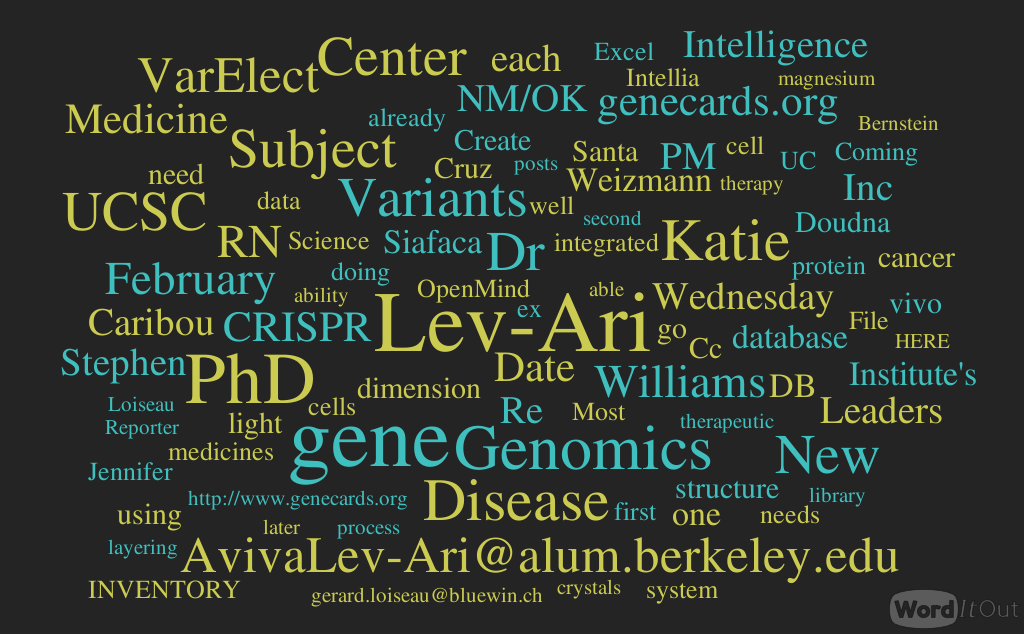
WordCloud Image Produced by Adam Tubman

Correspondence on Leadership in Genomics and other Gene Curations: Dr. Williams with Dr. Lev-Ari, Volume 2 (Volume Two: Latest in Genomics Methodologies for Therapeutics: Gene Editing, NGS and BioInformatics, Simulations and the Genome Ontology), Part 1: Next Generation Sequencing (NGS)

Correspondence on Leadership in Genomics and other Gene Curations: Dr. Williams with Dr. Lev-Ari

Authors: Stephen J Williams, PhD and Aviva Lev-Ari, PhD, RN

RE:

Reporter: Aviva Lev-Ari, PhD, RN

Reporter: Aviva Lev-Ari, PhD, RN

Author: Aviva Lev-Ari, PhD, RN

@@@

From: Aviva Lev-Ari <AvivaLev-Ari@alum.berkeley.edu>

Date: Thursday, February 18, 2016 at 12:39 AM

To: “Dr. Katie Katie Siafaca” <info@newmedinc.com>

Subject: Re: In light of — >>>>>> Leadership in Genomics: VarElect ­ Variants in Disease and UCSC Genome Technology Center | Leaders in Pharmaceutical Business Intelligence

Leadership in Genomics: VarElect ­ Variants in Disease and UCSC Genome Technology Center

http://pharmaceuticalintelligence.com/2016/02/17/leadership-in-genomics-varelect-variants-in-disease-and-ucsc-genome-technology-center/

  • There are important resources in the link above. 
  • Gene therapy is the new trend.
  • In Immune-Oncology – T Cell Reseptor Like (TCRL) is the new trend. 
  • 5th generation is CAR-T

No one said it is not huge task. A very small piece is needed – which one ???

@@@

From: “Dr. Katie Katie Siafaca” <info@newmedinc.com>

Reply-To: “Dr. Katie Katie Siafaca” <info@newmedinc.com>

Date: Wednesday, February 17, 2016 at 11:11 PM

To: Aviva Lev-Ari <AvivaLev-Ari@alum.berkeley.edu>

Subject: re: In light of — >>>>>> Leadership in Genomics: VarElect ­ Variants in Disease and UCSC Genome Technology Center | Leaders in Pharmaceutical Business Intelligence

Hi Aviva,

I am not sure what is being proposed here.  In the cancer area, there are at least 1,200 genes implicated somehow in this disease and new ones are reported every day.  This is a colossal task!

Katie

@@@

From: Aviva Lev-Ari <AvivaLev-Ari@alum.berkeley.edu>

Date: Wednesday, February 17, 2016 at 10:34 PM

To: “Stephen Williams, PhD” <sjwilliamspa@comcast.net>

Cc: “Dr. Larry Bernstein” <larry.bernstein@gmail.com>, Gerard Loiseau <gerard.loiseau@bluewin.ch>, “Dr. Katie Katie Siafaca” <info@newmedinc.com>

Subject: In light of — >>>>>> Leadership in Genomics: VarElect ­ Variants in Disease and UCSC Genome Technology Center | Leaders in Pharmaceutical Business Intelligence

Dear Dr. Williams,

HERE I am thinking LOUD

Is it possible to go to the dashboard, all posts and click on your Name, you will get the Universe of ~200 articles that you published.

HOW one could search or one needs to visually glance at the title of each — so as to pull a subset of posts that are dedicated to a GENE.

Create an Excel File, place each gene inside and go to Weizmann Institute’s genecards.org and pullout from them respective data on that gene

By so doing we will have LPBI’s Gene Inventory which we could reference in the Drug Discovery process, we do more and more, as we are aggregating all Biologics under the Joint Venture with SBH Sciences, Inc.

In light of :

Leadership in Genomics: VarElect ­ Variants in Disease and UCSC Genome Technology Center

http://pharmaceuticalintelligence.com/2016/02/17/leadership-in-genomics-varelect-variants-in-disease-and-ucsc-genome-technology-center/

My Questions are:

1. HOW could we take this “to be create Excel File” to be published a PAGE, Password Protected as your Curation, it needs to have a Parent or a Hierarchy of Nesting in the Website architecture

And subject that to your our search into New Medicine, Inc. NM/OK DB for data complementarity compilation?

2. What Foundation Medicine, Now Roche, does have vs. Weizmann Institute’s genecards.org

 http://www.genecards.org/

I read and I visited genecards.org

Most interesting is

http://www.genecards.org/cgi-bin/carddisp.pl?gene=ALB#drugs_compounds

3. Will Weizmann Institute’s genecards.org be interested in New Medicine, Inc., NM/OK DB?

4. I have explored with Foundation Medicine, Now Roche regarding New Medicine, Inc., NM/OK DB and their reply was that they focus ONLY on Genomics data in Cancer, thus,, no interest in New Medicine, Inc. NM/OK DB, there

5. What is in Weizmann Institute’s genecards.org that is NOT in UC Santa Cruz DBs ?

http://pharmaceuticalintelligence.com/2016/02/17/leadership-in-genomics-varelect-variants-in-disease-and-ucsc-genome-technology-center/

6. If you would take EACH ENTRY in this “to be create Excel File” and supplement it with

6.1 Weizmann Institute’s genecards.org

6.2 UC Santa Cruz Dbs

6.3 New Medicine, Inc., NM/OK DB – given this is a GENE in the cancer implication

6.4 A RECORD of the outputs from 6.1, 6.2, 6.3

7. THEN we could target 6.4 for CRISPR and go to 

http://rna.berkeley.edu/crispr.html

http://rna.berkeley.edu/contact.html

DNA interrogation by the CRISPR RNA-guided endonuclease Cas9

http://www.nature.com/nature/journal/v507/n7490/full/nature13011.html

and

http://rna.berkeley.edu/translation.html

http://alumni.berkeley.edu/california-magazine/winter-2014-gender-assumptions/cracking-code-jennifer-doudna-and-her-amazing

8. Doudna started her professorship at Yale University in 1994. While the group was able to grow high-quality crystals, they struggled with thephase problem due to unspecific binding of the metal ions. One of her early graduate students and later her husband, Jamie Cate decided to soak the crystals in osmium hexamine to imitate magnesium. Using this strategy, they were able to solve the structure, the second solved folded RNA structure since tRNA.[9][10] The magnesium ions would cluster at the center of the ribozyme and would serve as a core for RNA folding similar to that of a hydrophobic core of a protein.[5]

9. In 2015, Doudna gave a TED Talk about the bioethics of using CRISPR[13]

“Jennifer Doudna TED Talk”.

Lastly,

10. Caribou BioSciences

http://cariboubio.com/application-areas/therapeutics

Precision medicines have the ability to transform healthcare and treat a myriad of unmet medical needs. The Caribou technology platform has the ability to generate transformative medicines in multiple different market segments.

Our current therapeutic areas of exploration include anti-microbials, animal health, and therapeutic bioproduction.

Human therapeutics

In 2014, Caribou co-founded Intellia Therapeutics to develop curative medicines utilizing the Caribou CRISPR-Cas9 platform. Rachel Haurwitz, President and Chief Executive Officer of Caribou, is a member of Intellia’s Board of Directors.

Intellia is developing human gene and cell therapies for both ex vivo and in vivo applications using CRISPR-Cas9 gene editing technology. Near-term ex vivo applications include the treatment of blood disorders and cancer. In January 2015, Intellia announced a five-year research and development collaboration with Novartis to accelerate the ex vivo development of new CRISPR-Cas9-based therapies using chimeric antigen receptor T cells (CARTs) and hematopoetic stem cells (HSCs).

Any thoughts for me?

Aviva Lev-Ari, PhD, RN

@@@

From: “Stephen Williams, PhD” <sjwilliamspa@comcast.net>

Date: Wednesday, February 17, 2016 at 6:42 PM

To: Aviva Lev-Ari <AvivaLev-Ari@alum.berkeley.edu>

Subject: Re: Leadership in Genomics: VarElect ­ Variants in Disease and UCSC Genome Technology Center | Leaders in Pharmaceutical Business Intelligence

Every post I do that contains a gene in the post is curated with a link to genecards database so later it not only can be searched but is an integrated knowledge-analysis base integrated with a knowledge and fully integrated Omics database as gene cards . org also contains protein, structure and functional databases. 

This is where I always felt the power of LPBI was in the genomic space, integration of a deep analysis curated database 

@@@

From: AvivaLev-Ari@alum.berkeley.edu

To: mfeldman@stanford.edu

Cc: sjwilliamspa@comcast.net

Sent: 2016-02-17 18:01:03 GMT

Subject: Leadership in Genomics: VarElect ­ Variants in Disease and UCSC Genome Technology Center | Leaders in Pharmaceutical Business Intelligence

Which of them did you use already?

http://pharmaceuticalintelligence.com/2016/02/17/leadership-in-genomics-varelect-variants-in-disease-and-ucsc-genome-technology-center/

Aviva Lev-Ari, PhD, RN

@@@

From: Aviva Lev-Ari <AvivaLev-Ari@alum.berkeley.edu>

Date: Wednesday, February 17, 2016 at 5:59 PM

To: “Stephen Williams, PhD” <sjwilliamspa@comcast.net>

Cc: “Dr. Katie Katie Siafaca” <info@newmedinc.com>

Subject: Fwd: Leadership in Genomics: VarElect – Variants in Disease and UCSC Genome Technology Center | Leaders in Pharmaceutical Business Intelligence

We will use these two platforms

http://pharmaceuticalintelligence.com/2016/02/17/leadership-in-genomics-varelect-variants-in-disease-and-ucsc-genome-technology-center/

Aviva Lev-Ari, PhD, RN

@@@

From: Aviva Lev-Ari <AvivaLev-Ari@alum.berkeley.edu>

Date: Wednesday, February 17, 2016 at 3:42 PM

To: “Stephen Williams, PhD” <sjwilliamspa@comcast.net>

Subject: Re: The Science Coming in 2016 – OpenMind

I read and I visited gene cards.org

Most interesting is

http://www.genecards.org/cgi-bin/carddisp.pl?gene=ALB#drugs_compounds

Aviva Lev-Ari, PhD, RN

@@@

From: “Stephen Williams, PhD” <sjwilliamspa@comcast.net>

Date: Wednesday, February 17, 2016 at 1:46 PM

To: Aviva Lev-Ari <AvivaLev-Ari@alum.berkeley.edu>

Subject: Re: The Science Coming in 2016 – OpenMind

I want you to go to http://www.genecards.org/ then pick a gene and scroll down.  You will see a database there for CRISPR products available from different distributors including Qiagen, Promega, Fisher Scientific, Santa Cruz as well as others.  This seems to be already underway.  It is possible to copy what these companies are already doing but I don’t see the business advantage in that.  Please remember that 3D printing involves layering a of first and second dimension to a third dimension product.  So for instance the cell would be the “first dimension” even though it is three dimensional but the effect of layering MULTIPLE layers of cells is what gives their 3D effect.  The biomaterial you put in each tube is, in essence, your first dimension you are going to layer into a multilayered “3D” structure.

DNA can be made by synthesizers, there is no need to bioprint it, especially short fragments and in fact you wouldn’t.  They can handle even longer material.  Possibly if you want to replace a whole nucleosome but the chemistry is not there.  That is fine working with Jennifer Duodna making a library of small guide RNA’s to be used in CRISPR however it seems to be in process as I said before.  This would need to be done with her system and optimized for her system. You would also need a huge operation to do validation as well.  In addition the number of mutations, SNPs, variants are extremely large and many are not disease specific.

Again each would have to be validated.  In addition, unless you are doing embryo manipulation, you will need to partner with a company that has a good gene delivery system.  This will cost $, probably around 500 million. 

@@@

From: “Aviva Lev-Ari” <avivalev-ari@alum.berkeley.edu>

To: sjwilliamspa@comcast.net

Cc: “Gerard Loiseau” <gerard.loiseau@bluewin.ch>, “Dr. Larry Bernstein” <larry.bernstein@gmail.com>

Sent: Tuesday, February 16, 2016 4:48:54 AM

Subject: The Science Coming in 2016 – OpenMind

This gene fragment in red color — I am suggesting to build with 3D BioPrinting,

at the Oligonucleotide level.

Create a library of fragments for the most common mismatch in transcriptions, as well as on demand for rare deletions.

Per University of California, Santa Cruz, Database of Variations, prepare an INVENTORY of GENE REPAIR PARTS, manage the inventory by Analytics, where each part was implanted and monthly interval monitoring of segment incorporation and new function of protein folding achieved.

Trace the genetic therapy achieved by Gene editing.

Any comments??

bbva-openmind-ciencia-2016-1-genoma

Read Full Post »

Use of CRISPR/CAS9 to Edit Genome of Pigs: Recominetics announces $10M Funding Round, Volume 2 (Volume Two: Latest in Genomics Methodologies for Therapeutics: Gene Editing, NGS and BioInformatics, Simulations and the Genome Ontology), Part 2: CRISPR for Gene Editing and DNA Repair

Gene-editing startup raising $10M to expand staff
Nov 25, 2015

Reporter: Stephen J. Williams,Ph.D.

From the Mineapolis/St. Paul Journal

source from: http://www.bizjournals.com/twincities/news/2015/11/25/gene-editing-startup-raising-10m-to-expand-staff.html 

Katharine Grayson
Staff reporter
Minneapolis / St. Paul Business Journal

Recombinetics Inc. is seeking $10 million in funding as it ramps up sales of its genetically tweaked animals.
The St. Paul-based biotech company’s recent round has already brought in about about $2.8 million from friends and family, said Chief Operating Officer Kyle Dawley. Company officials hope to close out the round within the next two months and add about 10 employees to its staff of 25.


Recombinetics edits pigs' genes for biomedical research purposes

Recombinetics edits pigs’ genes for biomedical research purposes. Photo source: Simone Van Den Berg

Recombinetics uses gene-editing technology to tweak animals for the agribusiness and biomedical markets. It’s biomedical business centers around pigs, which the company modifies for research purposes. That side of the company’s business already generates revenue, Dawley said, though he declined to reveal sales figures.

The company focuses on pigs, touting them as better research subjects than mice when it comes to testing medical devices and drugs for use in humans.

“Pigs are — size-wise and genetically — a lot more like humans than rats and mice,” Dawley said.

One of Recombinetics’ long-term goals is grow human organs inside pigs.

The company aims to modify livestock for food consumption as well. One of its projects calls for creating hornless cattle by taking a gene from one breed and putting into another.

Recombinetics expects food ventures may get a boost from the Food and Drug Administration’s recent approval of a genetically engineered salmon called “AquAdvantage.” The fish grows faster than traditional salmon thanks to the introduction of trout genes.

Recombinetics has raised $15 million since its founding.

Katharine Grayson covers med tech, clean tech, technology, health care and venture capital.


See also Surrogen, Inc., which produces transgenic pigs for purpose of large animal models of disease.

Other posts on this Open Access Journal where I have discussed the utility of the minipig as a large animal model of disease include:

The SCID Pig: How Pigs are becoming a Great Alternate Model for Cancer Research

The SCID Pig II: Researchers Develop Another SCID Pig, And Another Great Model For Cancer Research

Read Full Post »

Regulatory DNA Engineered, Volume 2 (Volume Two: Latest in Genomics Methodologies for Therapeutics: Gene Editing, NGS and BioInformatics, Simulations and the Genome Ontology), Part 2: CRISPR for Gene Editing and DNA Repair

Regulatory DNA engineered

Larry H. Bernstein, MD, FCAP, Curator

LPBI


New Type of CRISPR Screen Probes the Regulatory Genome

Aaron Krol    http://www.bio-itworld.com/2016/2/8/new-type-crispr-screen-probes-regulatory-genome.html

February 8, 2016 | When a geneticist stares down the 3 billion DNA base pairs of the human genome, searching for a clue to what’s gone awry in a single patient, it helps to narrow the field. One of the most popular places to look is the exome, the tiny fraction of our DNA―less than 2%―that actually codes for proteins. For patients with rare genetic diseases, which might be fully explained by one key mutation, many studies sequence the whole exome and leave all the noncoding DNA out. Similarly, personalized cancer tests, which can help bring to light unexpected treatment options, often sequence the tumor exome, or a smaller panel of protein-coding genes.

Unfortunately, we know that’s not the whole picture. “There are a substantial number of noncoding regions that are just as effective at turning off a gene as a mutation in the gene itself,” says Richard Sherwood, a geneticist at Brigham and Women’s Hospital in Boston. “Exome sequencing is not going to be a good proxy for what genes are working.”

Sherwood studies regulatory DNA, the vast segment of the genome that governs which genes are turned on or off in any cell at a given time. It’s a confounding area of genetics; we don’t even know how much of the genome is made up of these regulatory elements. While genes can be recognized by the presence of “start” and “stop” codons―sequences of three DNA letters that tell the cell’s molecular machinery which stretches of DNA to transcribe into RNA, and eventually into protein―there are no definite signs like this for regulatory DNA.

Instead, studies to discover new regulatory elements have been somewhat trial-and-error. If you suspect a gene’s activity might be regulated by a nearby DNA element, you can inhibit that element in a living cell, and see if your gene shuts down with it.

With these painstaking experiments, scientists can slowly work their way through potential regulatory regions―but they can’t sweep across the genome with the kind of high-throughput testing that other areas of genetics thrive on. “Previously, you couldn’t do these sorts of tests in a large form, like 4,000 of them at once,” says David Gifford, a computational biologist at MIT. “You would really need to have a more hypothesis-directed methodology.”

Recently, Gifford and Sherwood collaborated on a paper, published in Nature Biotechnology, which presents a new method for testing thousands of DNA loci for regulatory activity at once. Their assay, called MERA (multiplexed editing regulatory assay), is built on the recent technology boom in CRISPR-Cas9 gene editing, which lets scientists quickly and easily cut specific sequences of DNA out of the genome.

So far, their team, including lead author Nisha Rajagopal from Gifford’s lab, has used MERA to study the regulation of four genes involved in the development of embryonic stem cells. Already, the results have defied the accepted wisdom about regulatory DNA. Many areas of the genome flagged by MERA as important factors in gene expression do not fall into any known categories of regulatory elements, and would likely never have been tested with previous-generation methods.

“Our approach allows you to look away from the lampposts,” says Sherwood. “The more unbiased you can be, the more we’ll actually know.”

A New Kind of CRISPR Screen

In the past three years, CRISPR-Cas9 experiments have taken all areas of molecular biology by storm, and Sherwood and Gifford are far from the first to use the technology to run large numbers of tests in parallel. CRISPR screens are an excellent way to learn which genes are involved in a cellular process, like tumor growth or drug resistance. In these assays, scientists knock out entire genes, one by one, and see what happens to cells without them.

This kind of CRISPR screen, however, operates on too small a scale to study the regulatory genome. For each gene knocked out in a CRISPR screen, you have to engineer a strain of virus to deliver a “guide RNA” into the cellular genome, showing the vicelike Cas9 molecule which DNA region to cut. That works well if you know exactly where a gene lies and only need to cut it once—but in a high-throughput regulatory test, you would want to blanket vast stretches of DNA with cuts, not knowing which areas will turn out to contain regulatory elements. Creating a new virus for each of these cuts is hugely impractical.

The insight behind MERA is that, with the right preparation, most of the genetic engineering can be done in advance. Gifford and Sherwood’s team used a standard viral vector to put a “dummy” guide RNA sequence, one that wouldn’t tell Cas9 to cut anything, into an embryonic stem cell’s genome. Then they grew plenty of cells with this prebuilt CRISPR system inside, and attacked each one with a Cas9 molecule targeted to the dummy sequence, chopping out the fake guide.

Normally, the result would just be a gap in the CRISPR system where the guide once was. But along with Cas9, the researchers also exposed the cells to new, “real” guide RNA sequences. Through a DNA repair mechanism called homologous recombination, the cells dutifully patched over the gaps with new guides, whose sequences were very similar to the missing dummy code. At the end of the process, each cell had a unique guide sequence ready to make cuts at a specific DNA locus—just like in a standard CRISPR screen, but with much less hands-on engineering.

By using a large enough library of guide RNA molecules, a MERA screen can include thousands of cuts that completely tile a broad region of the genome, providing an agnostic look at anywhere regulatory elements might be hiding. “It’s a lot easier [than a typical CRISPR screen],” says Sherwood. “The day the library comes in, you just perform one PCR reaction, and the cells do the rest of the work.”

In the team’s first batch of MERA screens, they created almost 4,000 guide RNAs for each gene they studied, covering roughly 40,000 DNA bases of the “cis-regulatory region,” or the area surrounding the gene where most regulatory elements are thought to lie. It’s unclear just how large any gene’s cis-regulatory region is, but 40,000 bases is a big leap from the highly targeted assays that have come before.

“We’re now starting to do follow-up studies where we increase the number of guide RNAs,” Sherwood adds. “Eventually, what you’d like is to be able to tile an entire chromosome.”

Far From the Lampposts

Sherwood and Gifford tried to focus their assays on regions that would be rich in regulatory elements. To that end, they made sure their guide RNAs covered parts of the genome with well-known signs of regulatory activity, like histone markers and transcription factor binding sites. For many of these areas, Cas9 cuts did, in fact, shut down gene expression in the MERA screens.

But the study also targeted regions around each gene that were empty of any known regulatory features. “We tiled some other regions that we thought might serve as negative controls,” explains Gifford. “But they turned out not to be negative at all.”

The study’s most surprising finding was that several cuts to seemingly random areas of the genome caused genes to become nonfunctional. The authors named these DNA regions “unmarked regulatory elements,” or UREs. They were especially prevalent around the genes Tdgf1 and Zfp42, and in many cases, seemed to be every bit as necessary to gene activity as more predictable hits on the MERA screen.

These results caught the researchers so off guard that it was natural to wonder if MERA screens are prone to false positives. Yet follow-up experiments strongly supported the existence of UREs. Switching the guide RNAs from aTdgf1 MERA screen and a Zfp42 screen, for example, produced almost no positive results: the UREs’ regulatory effects were indeed specific to the genes near them.

In a more specific test, the researchers chose a particular URE connected to Tdgf1, and cut it out of a brand new population of cells for a closer look. “We showed that, if we deleted that region from the genome, the cells lost expression of the gene,” says Sherwood. “And then when we put it back in, the gene became expressed again. Which was good proof to us that the URE itself was responsible.”

From these results, it seems likely that follow-up MERA screens will find even more unknown stretches of regulatory DNA. Gifford and Sherwood’s experiments didn’t try to cover as much ground around their target genes as they might have, because the researchers assumed that MERA would mostly confirm what was already known. At best, they hoped MERA would rule out some suspected regulatory regions, and help show which regulatory elements have the biggest effect on gene expression.

“We tended to prioritize regions that had been known before,” Sherwood says. “Unfortunately, in the end, our datasets weren’t ideally suited to discovering these UREs.”

Getting to Basic Principles

MERA could open up huge swaths of the regulatory genome to investigation. Compared to an ordinary CRISPR screen, says Sherwood, “there’s only upside,” as MERA is cheaper, easier, and faster to run.

Still, interpreting the results is not trivial. Like other CRISPR screens, MERA makes cuts at precise points in the genome, but does not tell cells to repair those cuts in any particular way. As a result, a population of cells all carrying the same guide RNA can have a huge variety of different gaps and scars in their genomes, typically deletions in the range of 10 to 100 bases long. Gifford and Sherwood created up to 100 cells for each of their guides, and sometimes found that gene expression was affected in some but not all of them; only sequencing the genomes of their mutated cells could reveal exactly what changes had been made.

By repeating these experiments many times, and learning which mutations affect gene expression, it will eventually be possible to pin down the exact DNA bases that make up each regulatory element. Future studies might even be able to distinguish between regulatory elements with small and large effects on gene expression. In Gifford and Sherwood’s MERA screens, the target genes were altered to produce a green fluorescent protein, so the results were read in terms of whether cells gave off fluorescent light. But a more precise, though expensive, approach would be to perform RNA sequencing, to learn which cuts reduced the cell’s ability to transcribe a gene into RNA, and by how much.

A MERA screen offers a rich volume of data on the behavior of the regulatory genome. Yet, as with so much else in genetics, there are few robust principles to let scientists know where they should be focusing their efforts. Histone markers provide only a very rough sketch of regulatory elements, often proving to be red herrings on closer examination. And the existence of UREs, if confirmed by future experiments, shows that we don’t yet even know which areas of the genome to rule out in the hunt for regulatory regions.

“Every dataset we get comes closer and closer to computational principles that let us predict these regions,” says Sherwood. As more studies are conducted, patterns may emerge in the DNA sequences of regulatory elements that link UREs together, or reveal which histone markers truly point toward regulatory effects. There might also be functional clues hidden in these sequences, hinting at what is happening on a molecular level as regulatory elements turn genes on and off in the course of a cell’s development.

For now, however, the data is still rough and disorganized. For better and for worse, high-throughput tools like MERA are becoming the foundation for most discoveries in genetics—and that means there is a lot more work to do before the regulatory genome begins to come into focus.

CORRECTED 2/9/16: Originally, this story incorrectly stated that only certain cell types could be assayed with MERA for reasons related to homologous recombination. In fact, the authors see no reason MERA could not be applied to any in vitro cell line, and hope to perform screens in a wide range of cell types. The text has been edited to correct the error.


Read Full Post »

Unlocking the Microbiome

Larry H. Bernstein, MD, FCAP, Curator

LPBI

3.3.11

3.3.11   Unlocking the Microbiome, Volume 2 (Volume Two: Latest in Genomics Methodologies for Therapeutics: Gene Editing, NGS and BioInformatics, Simulations and the Genome Ontology), Part 2: CRISPR for Gene Editing and DNA Repair

Machine-learning technique uncovers unknown features of multi-drug-resistant pathogen

Relatively simple “unsupervised” learning system reveals important new information to microbiologists
January 29, 201   http://www.kurzweilai.net/machine-learning-technique-uncovers-unknown-features-of-pathogen

http://www.kurzweilai.net/images/Pseudomonas-aeruginosa.jpg

According to the CDC, Pseudomonas aeruginosa is a common cause of healthcare-associated infections, including pneumonia, bloodstream infections, urinary tract infections, and surgical site infections. Some strains of P. aeruginosa have been found to be resistant to nearly all or all antibiotics. (illustration credit: CDC)

A new machine-learning technique can uncover previously unknown features of organisms and their genes in large datasets, according to researchers from the Perelman School of Medicine at the University of Pennsylvania and the Geisel School of Medicine at Dartmouth University.

For example, the technique learned to identify the characteristic gene-expression patterns that appear when a bacterium is exposed in different conditions, such as low oxygen and the presence of antibiotics.

The technique, called “ADAGE” (Analysis using Denoising Autoencoders of Gene Expression), uses a “denoising autoencoder” algorithm, which learns to identify recurring features or patterns in large datasets — without being told what specific features to look for (that is, “unsupervised.”)*

Last year,  Casey Greene, PhD, an assistant professor of Systems Pharmacology and Translational Therapeutics at Penn, and his team published, in an open-access paper in the American Society for Microbiology’s mSystems, the first demonstration of ADAGE in a biological context: an analysis of two gene-expression datasets of breast cancers.

Tracking down gene patterns of a multi-drug-resistant bacterium

The new study, published Jan. 19 in an open-access paper in mSystems, was more ambitious. It applied ADAGE to a dataset of 950 gene-expression arrays publicly available at the time for the multi-drug-resistant bacteriumPseudomonas aeruginosa. This bacterium is a notorious pathogen in the hospital and in individuals with cystic fibrosis and other chronic lung conditions; it’s often difficult to treat due to its high resistance to standard antibiotic therapies.

The data included only the identities of the roughly 5,000 P. aeruginosa genes and their measured expression levels in each published experiment. The goal was to see if this “unsupervised” learning system could uncover important patterns in P. aeruginosa gene expression and clarify how those patterns change when the bacterium’s environment changes — for example, when in the presence of an antibiotic.

Even though the model built with ADAGE was relatively simple — roughly equivalent to a brain with only a few dozen neurons — it had no trouble learning which sets of P. aeruginosa genes tend to work together or in opposition. To the researchers’ surprise, the ADAGE system also detected differences between the main laboratory strain of P. aeruginosa and strains isolated from infected patients. “That turned out to be one of the strongest features of the data,” Greene said.

“We expect that this approach will be particularly useful to microbiologists researching bacterial species that lack a decades-long history of study in the lab,” said Greene. “Microbiologists can use these models to identify where the data agree with their own knowledge and where the data seem to be pointing in a different direction … and to find completely new things in biology that we didn’t even know to look for.”

Support for the research came from the Gordon and Betty Moore Foundation, the William H. Neukom Institute for Computational Science, the National Institutes of Health, and the Cystic Fibrosis Foundation.

* In 2012, Google-sponsored researchers applied a similar method to randomly selected YouTube images; their system learned to recognize major recurring features of those images — including cats of course.


Abstract of ADAGE-Based Integration of Publicly Available Pseudomonas aeruginosa Gene Expression Data with Denoising Autoencoders Illuminates Microbe-Host Interactions

The increasing number of genome-wide assays of gene expression available from public databases presents opportunities for computational methods that facilitate hypothesis generation and biological interpretation of these data. We present an unsupervised machine learning approach, ADAGE (analysis using denoising autoencoders of gene expression), and apply it to the publicly available gene expression data compendium for Pseudomonas aeruginosa. In this approach, the machine-learned ADAGE model contained 50 nodes which we predicted would correspond to gene expression patterns across the gene expression compendium. While no biological knowledge was used during model construction, cooperonic genes had similar weights across nodes, and genes with similar weights across nodes were significantly more likely to share KEGG pathways. By analyzing newly generated and previously published microarray and transcriptome sequencing data, the ADAGE model identified differences between strains, modeled the cellular response to low oxygen, and predicted the involvement of biological processes based on low-level gene expression differences. ADAGE compared favorably with traditional principal component analysis and independent component analysis approaches in its ability to extract validated patterns, and based on our analyses, we propose that these approaches differ in the types of patterns they preferentially identify. We provide the ADAGE model with analysis of all publicly available P. aeruginosa GeneChip experiments and open source code for use with other species and settings. Extraction of consistent patterns across large-scale collections of genomic data using methods like ADAGE provides the opportunity to identify general principles and biologically important patterns in microbial biology. This approach will be particularly useful in less-well-studied microbial species.


Abstract of Unsupervised feature construction and knowledge extraction from genome-wide assays of breast cancer with denoising autoencoders

Big data bring new opportunities for methods that efficiently summarize and automatically extract knowledge from such compendia. While both supervised learning algorithms and unsupervised clustering algorithms have been successfully applied to biological data, they are either dependent on known biology or limited to discerning the most significant signals in the data. Here we present denoising autoencoders (DAs), which employ a data-defined learning objective independent of known biology, as a method to identify and extract complex patterns from genomic data. We evaluate the performance of DAs by applying them to a large collection of breast cancer gene expression data. Results show that DAs successfully construct features that contain both clinical and molecular information. There are features that represent tumor or normal samples, estrogen receptor (ER) status, and molecular subtypes. Features constructed by the autoencoder generalize to an independent dataset collected using a distinct experimental platform. By integrating data from ENCODE for feature interpretation, we discover a feature representing ER status through association with key transcription factors in breast cancer. We also identify a feature highly predictive of patient survival and it is enriched by FOXM1 signaling pathway. The features constructed by DAs are often bimodally distributed with one peak near zero and another near one, which facilitates discretization. In summary, we demonstrate that DAs effectively extract key biological principles from gene expression data and summarize them into constructed features with convenient properties.

Read Full Post »

Cancer Causing Enzyme Activity

Larry H. Bernstein, MD, FCAP, Curator

LPBI


Cancer-Causing Enzyme Acts during DNA Replication

GEN News   http://www.genengnews.com/gen-news-highlights/cancer-causing-enzyme-acts-during-dna-replication/81252312/


Scientists at Indiana University (IU) have identified a genetic mechanism that is likely to drive mutations that can lead to cancer. Their E. coli study, published in the Proceedings of the National Academy of Sciences, finds the enzyme APOBEC3G, a known trigger for mutations that occur as benign tumor cells to transform into cancerous malignancies that spread throughout the body, appears to cause these harmful changes by mutating genes during DNA replication.

The study also received support from the Wayne State University School of Medicine, whose researchers provided expertise on APOBEC3G and helped analyze the data. All experiments were carried out at IU.

“Many tumors accumulate mutations during their growth, which lead to the subsequent characteristics that permit metastasis,” said Patricia Foster, Ph.D., the principal investigator on the grant and a professor in the IU Bloomington College of Arts and Sciences’ biology department, senior author on the study. “Based upon the results revealed in bacteria in our study, we believe that the APOBEC family of enzymes creates some of these mutations specifically during the rapid growth of these tumors.”

The results could have implications for personalized medicine. For example, because it is possible to identify tumors potentially vulnerable to the enzyme by using current DNA sequencing technology, a physician treating these tumors might want to explore temporarily suppressing expression of this enzyme, she said.

Normally, the APOBEC family of enzymes plays an important role in the human immune system by driving changes in immune cells that aid in defense against viruses, possibly including the HIV/AIDS virus. The IU scientists found the harmful influence of the enzyme family arises from the complex way that two halves of every double-stranded DNA molecule must unravel to replicate during cellular division—splitting into two temporarily single-stranded DNA chains thousands of links (the four nucleotides) in length to serve as templates for the new copy. As the nucleotides are split in half to be copied, one of the two single-stranded bits of DNA, known as the lagging strand template, is highly vulnerable to genetic mutation, according to Dr. Foster.

This “gap in the armor” occurs because DNA polymerase must repeatedly traverse the nucleobases in the lagging strand template thousands of times during the course of replication, stopping further down the chain from the base pair previously inserted on the loop along the chemical chain. Each of these polymerase “hops” creates a long stretch of DNA that temporarily remains as a single strand.
The complex process introduces more opportunities for errors in the lagging strand template compared to the continuous step-by-step process that replicates the other half of the split strand of DNA, called the leading strand template.

“We’re talking about thousands of bases exposed without a complimentary strand throughout the whole replication cycle,” noted Dr. Foster.  “If I were going to design an organism, I would make two types of copying enzymes. An important organism for studying genes, E. coli allows scientists to observe genetic changes over thousands of generations in a relatively short time span. The results apply to humans as well as bacteria since the basic mechanisms of DNA replication are the same across all species.”

The mechanism by which the APOBEC family of enzymes drives mutation is cytosine deamination, in which a cytosine, the C nucleotide, transforms into uracil, one of the four bases in RNA that doesn’t play a role in DNA replication. But the presence of uracil during DNA replication can cause an error when a thymine, the T nucleotide, replaces a cytosine. APOBEC enzymes specifically target the C’s in single-stranded DNA for deamination.

The disruptive effect of the enzyme on genetic replication in the study was observed in a strain of E. coli, whose ability to remove the dangerous uracils had been switched off. To conduct the experiment, Dr. Foster’s lab observed the effect of APOBEC3G on approximately 50 identical lineages of E. coliover the course of nearly 100 days, with each day encompassing 20 to 30 bacterial generations.

Over time, a unique pattern of nucleotides was detected in the mutated DNA, a chain of three cytosine molecules, the same genetic signature found in other studies of the enzyme family. And these mutations were four times more likely to be found on the lagging-strand template than on the leading-strand template.

“These results strongly suggest that these mutations occur as APOBEC3G attacks cytosines during DNA replication, while they’re most exposed on the lagging strand template,” Dr. Foster said. “This basic mechanism appears to be the same in bacteria and in human tumors cells.”


DNA’s ‘Gap in the Armor’ Allowing Cancer to Develop Pinpointed

Seth Augenstein, Digital Reporter  http://www.biosciencetechnology.com/news/2016/02/dnas-gap-armor-allowing-cancer-develop-pinpointed

Research on the effect of the enzyme APOBEC3G on DNA replication was conducted in the bacteria Escherichia coli. (Photo: Department of Defense)

Research on the effect of the enzyme APOBEC3G on DNA replication was conducted in the bacteria Escherichia coli. (Photo: Department of Defense)

A key group of enzymes could be the “gap in the armor” of all DNA, allowing cancer-causing mutations, according to a new study.

APOBEC3G, which is known to trigger benign mutations, also causes malignant mutations during the DNA replication process, according to the new findings, in the Proceedings of the National Academy of Sciences.

“Many tumors accumulate mutations during their growth, which leads to the subsequent characteristics that permit metastasis,” said Patricia Foster, professor at Indiana University, and senior author. “Based upon the results revealed in bacteria in our study, we believe that the APOBEC family of enzymes create some of these mutations specifically during the rapid growth of these tumors.”

The investigators created and observed the mutations in the bacteria Escherichia coli, which presented the advantage of watching thousands of generations in a relatively short time.

The key process is the movement of DNA polymerase along one of the two DNA single strands, known as the lagging strand template, during the replication process. The lagging strand becomes susceptible to errors. APOBEC can enter into this process, causing cytosine deamination, essentially replacing the intended cytosine on the strand with the thymine nucleobase, causing the mutations.

The scientists turned off the ability to regulate the cytosine deamination in the E. coli replication – and then observed an uptick in the harmful mutations confirming the culprit, they said.

“These results strongly suggest that these mutations occur as APOBEC3G attacks cytosines during DNA replication, while they’re most exposed on the lagging strand template,” said Foster. “This basic mechanism appears to be the same in bacteria and in human tumor cells.”

The study was supported in part of a $6.2 million grant from the U.S. Army Research Office to investigate bacterial evolution, according to the school.


Mouse Apolipoprotein B Editing Complex 3 (APOBEC3) Is Expressed in Germ Cells and Interacts with Dead-End (DND1)

The dead-end (Dnd1) gene is essential for maintaining the viability of germ cells. Inactivation ofDnd1 results in sterility and testicular tumors. The Dnd1 encoded protein, DND1, is able to bind to the 3′-untranslated region (UTR) of messenger RNAs (mRNAs) to displace micro-RNA (miRNA) interaction with mRNA. Thus, one function of DND1 is to prevent miRNA mediated repression of mRNA. We report that DND1 interacts specifically with APOBEC3. APOBEC3 is a multi-functional protein. It inhibits retroviral replication. In addition, recent studies show that APOBEC3 interacts with cellular RNA-binding proteins and to mRNA to inhibit miRNA-mediated repression of mRNA.


Re-editing the paradigm of Cytidine (C) to Uridine (U) RNA editing
Nicolas Fossatab* & Patrick P L Tam
RNA Biology  2014; Volume 11, Issue 10:1233-1237  http://dx.doi.org:/10.1080/15476286.2014.996054

Cytidine (C) to Uridine (U) RNA editing is a post-trancriptional modification that until recently was known to only affect Apolipoprotein b (Apob) RNA and minimally require 2 components of the C to U editosome, the deaminase APOBEC1 and the RNA-binding protein A1CF. Our latest work has identified a novel RNA-binding protein, RBM47, as a core component of the editosome, which can substitute A1CF for the editing of ApoB mRNA. In addition, new RNA species that are subjected to C to U editing have been identified. Here, we highlight these recent discoveries and discuss how they change our view of the composition of the C to U editing machinery and expand our knowledge of the functional attributes of C to U RNA editing.

Derepression of MicroRNA-mediated Protein Translation Inhibition by Apolipoprotein B mRNA-editing Enzyme Catalytic Polypeptide-like 3G (APOBEC3G) and Its Family Members*

Jialing HuangZhihui LiangBin YangHeng TianJin Ma and Hui Zhang1
The Journal of Biological Chemistry, 2007; 282:33632-33640.
  http://dx.doi.org:/10.1074/jbc.M705116200

The apolipoprotein B mRNA-editing enzyme catalytic polypeptide-like 3G (APOBEC3G or A3G) and its fellow cytidine deaminase family members are potent restrictive factors for human immunodeficiency virus type 1 (HIV-1) and many other retroviruses. A3G interacts with a vast spectrum of RNA-binding proteins and is located in processing bodies and stress granules. However, its cellular function remains to be further clarified. Using a luciferase reporter gene and green fluorescent protein reporter gene, we demonstrate that A3G and other APOBEC family members can counteract the inhibition of protein synthesis by various microRNAs (miRNAs) such as mir-10b, mir-16, mir-25, and let-7a. A3G could also enhance the expression level of miRNA-targeted mRNA. Further, A3G facilitated the association of microRNA-targeted mRNA with polysomes rather than with processing bodies. Intriguingly, experiments with a C288A/C291A A3G mutant indicated that this function of A3G is separable from its cytidine deaminase activity. Our findings suggest that the major cellular function of A3G, in addition to inhibiting the mobility of retrotransposons and replication of endogenous retroviruses, is most likely to prevent the decay of miRNA-targeted mRNA in processing bodies.

MicroRNAs (miRNAs)2 are 20-22-nt regulatory RNAs that participate in the regulation of various biological functions in numerous eukaryotic lineages, including plants, insects, vertebrate, and mammals (13). More than 474 miRNAs have been identified in humans so far, and ∼30% of the genes in the human genome are predicted to be subject to miRNA regulation (4). The expression of many miRNAs is usually specific to a tissue or developmental stage, and the miRNA expression pattern is altered during the development of many diseases (3). Mature miRNAs are generated from RNA polymerase II-transcribed primary miRNAs that are processed sequentially by the nucleases Drosha and Dicer. Although miRNA can guide mRNA cleavage, the basic function of miRNA is to mediate inhibition of protein translation (1, 58) through miRNA-induced silencing complexes (miRISCs). The guiding strand of miRNA in a miRISC interacts with a complementary sequence in the 3′-untranslated region (3′-UTR) of its target mRNA by partial sequence complementarities, resulting in translational inhibition (1). A 7-nucleotide “seed” sequence (at positions 2-8 from the 5′-end) in miRNAs seems to be essential for this action (4). The composition of the miRISC is similar to that of the RNA-induced silencing complex (RISC), which is responsible for mRNA cleavage guided by small interfering RNAs (siRNAs) (1, 3, 7). Nevertheless, some differences exist between miRISCs and siRNA RISCs. For example, the major Argonaute protein in siRNA RISC is Ago-2, whereas all four of the Ago proteins (Ago1-4) are found in miRISC (3, 8). Further, the siRNA RISC may be associated with various RNA-binding proteins such as fragile-X mental retardation protein (FMRP), TAR RNA-binding protein (TRBP), and the human homolog of the Drosophilahelicase Armitage, Mov10, possibly in a cell type-specific manner (913).

The miRNA-mediated translational repression consistently correlates with an accumulation of miRNA-bound mRNAs at cytoplasmic foci known as processing bodies (P-bodies) (8). Several lines of evidence have indicated that P-bodies are actively involved in miRNA-mediated mRNA repression (14). The P-body-associated protein GW182 associates directly with Ago-1 (15, 16). Depletion of P-body components such as GW182 and Rck/p54 prevents translational repression of target mRNAs (8, 1419). Furthermore, several miRISC-related components, such as miRNAs, mRNAs repressed by miRNAs, Ago-1, Ago-2, and Mov10, are found in P-bodies (14). P-body formation is a dynamic process that requires continuous accumulation of repressed mRNAs (20). However, P-bodies serve not only as sites for RNA degradation, but also for storage of repressed mRNAs (15). These mRNAs may later return to polysomes to synthesize new proteins (14). In fact, some cellular proteins can facilitate the exit of miRNA-bound mRNAs from P-bodies. For example, a stress situation may induce the relocation of HuR, an AU-rich element-binding protein, from the nucleus to P-bodies in the cytoplasm where it binds to the 3′-UTR of its target mRNA encoding CAT-1 (21). This binding increases the stability of the miR-122-bound mRNA by assisting it to egress from the P-body and return to polysomes. However, the mechanism underlying this reverse transport of miRNA-bound mRNA out of P-bodies remains to be further clarified.

The cellular apolipoprotein B mRNA-editing enzyme catalytic polypeptide-like 3G protein (APOBEC3G or A3G) is a potent antiretroviral factor that belongs to the cytidine deaminase family (22, 23). A3G can be incorporated into HIV-1 particles and cause extensive C to U conversion in the viral minus-stranded DNA during reverse transcription (2426), which can trigger its degradation by virion-associated uracil DNA glycosylase-2 (UNG2) and apurinic/apyrimidinic endonucleases (APE) or lethal hypermutation in the HIV-1 genome (26, 27). However, accumulating evidence indicates that A3G protein carrying mutations in the catalytic domain of the cytidine deaminase retains substantial anti-HIV-1 activity (24, 2831). Interestingly, A3G is found in P-bodies and stress granules (32, 33). It is associated with a high molecular mass structure (>700 kDa) in replicating cells, and this interaction is RNase-sensitive (34, 35). Further studies indicate that A3G interacts with many RNA-binding proteins, among which are several miRNA-related proteins, such as Ago1, Ago2, Mov10, and poly(A)-binding protein 1 (PABP1). These interactions are either partially or completely resistant to RNase A digestion (32, 35, 36).3 Aside from its inhibitory function in relation to endogenous retroviruses and other retrotransposons (3741), the major cellular function of A3G seems to be related to P-body-related RNA processing and metabolism. As recent development has indicated that the function of P-body is closely related to miRNA activity, we therefore investigated the possibility of a connection between A3G and miRNA function.

A3G Counteracts miRNA-mediated Repression of Protein Translation—We first examined the effect of A3G on the expression of miRNAs. Using a miRNA microarray method, we did not find that A3G significantly changed the miRNA expression in 293T cells (supplemental Figs. S1 and S2). A3G also did not significantly change the expression of miRNA processors such as Drosha and Dicer1 or RISC components such as Ago2 and Mov10 (supplemental Fig. S3). Further, A3G also did not change the level of expression of P-body components such as GW182, Xrn1 and Lsm1 (supplemental Fig. S3). Nevertheless, the microarray data did indicate that several miRNAs, such as mir-16, mir-10b, mir-25, and let-7a, are abundant in 293T cells.

To study whether A3G affects the efficiency of miRNA-mediated translational repression, various 293T cell-enriched miRNA-binding sites with perfect or partial complementarity to their corresponding miRNAs were inserted into the 3′-UTR of luciferase (luc) or gfp (Fig. 1a). These plasmids were transfected into 293T cells, which naturally do not express A3G (22, 27), with or without an A3G-HA-expressing plasmid. Fig. 1b shows that the presence of mir-16, mir-10b, or mir-25 miRNA-binding sites in the 3′-UTR of luc gene remarkably inhibited the expression of luciferase. Interestingly, A3G significantly counteracted this inhibition. Similar phenomenon can be observed in HeLa cells (Fig. 1c). To verify this derepression, a dose dependence experiment was performed and derepression was found to correlate with the A3G expression level (Fig. 1d). Real-time PCR data showed that the expression level of luciferase mRNA also substantially increased concomitantly with the expression level of A3G (Fig. 1e). This derepression of miRNA-mediated translational inhibition still occurred when the reporter gene was changed to gfp (Fig. 1f).

FIGURE 1.

A3G counteracts miRNA-mediated repression of protein translation in 293T and HeLa cells. a, sequences of the miRNAs mir-16, mir-25, mir-10b, and let-7a and their target sites used for reporter gene constructs are shown. b and c, 293T cells (b) or HeLa cells (c) were co-transfected with a plasmid expressing A3G (pcDNA-A3G-HA) and a plasmid containing the luciferase reporter gene with binding sites for mir-16, mir-10b, or mir-25 in the 3′-UTR. pcDNA3 and pmir-REPORT were also transfected as controls. At 48-h post-transfection, luciferase activity was measured. d and e, 293T cells were co-transfected with different amounts of A3G-expressing plasmid (ranging from 0 to 0.4 μg) and pmir16-luc. At 48-h post-transfection, luciferase activity (d) was measured, and luciferase mRNA (e) was detected by real-time RT-PCR. The means ± S.D. are shown. f, 293T cells were co-transfected with pcDNA-A3G-HA and a plasmid containing a GFP reporter gene with a binding site for let-7a in the 3′-UTR, pEGFP-c1-let-7a, or pEGFP-c1 as a control. At 48-h post-transfection, GFP expression was analyzed by FACS and the mean fluorescence intensity (MFI) of GFP was determined. The data shown are representative of at least three replicates.

FIGURE 2.

A3G/F-specific siRNA restores miRNA-mediated repression of protein translation in A3G/F-rich T-lymphocytes and macrophages. PHA-activated CD4+ T cells (a) and H9 cells (b) were first transfected with A3G- and A3F-specific siRNAs via Nucleofector (AMAXA). A siRNA for luc was used as a control for transfection. After 48 h, the cells were transfected with pEGFP-c1-let-7a or pEGFP-c1. At 48-h post-transfection, GFP expression was analyzed by FACS. The MFI of GFP from pEGFP-c1 was set as 100%. The means ± S.D. are shown. c, primary monocyte-derived macrophages were first transfected with A3G- and A3F-specific siRNAs. A siRNA for luc was used as a control for transfection. After 48 h, the cells were transfected with pEGFP-c1-let-7a or pEGFP-c1. pcDNA3-A3G-HA (2 μg) was also cotransfected for overexpression experiment. At 48-h post-transfection, GFP expression was analyzed by Western blotting analysis via anti-GFP antibody. The expression of A3G and A3F were also examined by Western blotting.

FIGURE 3.

APOBEC3 family members inhibit miRNA-mediated repression of protein translation. 293T cells were co-transfected with plasmids expressing APOBEC3 family members and pmir16-luc (a) or with plasmids expressing various A3G mutants and pmir16-luc (b). At 48-h post-transfection, luciferase activity was measured. The 4C mutant represents an A3G mutant that has four point mutations: C97A/C100A/C288A/C291A. The means ± S.D. are shown.

Furthermore, to confirm this effect, H9 T-cells, PHA-activated primary CD4+ T-lymphocytes and macrophages, which naturally harbor significant amounts of A3G and another APO-BEC3 protein, A3F, were treated with A3G- and A3F-specific siRNAs. Western blotting showed that expression of A3G and A3F could be effectively decreased by these siRNAs (Fig. 2, a-c). The depletion of A3G and A3F enhanced the efficiency of let-7a miRNA-mediated translational repression in these A3G/F-enriched cells (Fig. 2, a-c). Conversely, overexpression of A3G/F in macrophages can substantially enhance the derepression of miRNA-mediated translational inhibition (Fig. 2c, lane 1).

Other APOBEC3 Family Members Also Inhibit miRNA-mediated Repression of Protein Translation—To test whether other APOBEC3 family members also regulate miRNA repression, vectors expressing the APOBEC3 family members A3B, A3C, and A3F were transfected into 293T cells. All the tested APOBEC3 family members were able to inhibit the miRNA-mediated translational repression (Fig. 3a). Interestingly, a synergistic effect was found between various APOBEC3 family members (Fig. 3a).

FIGURE 4.

A3G enhances the association of mir-16-targeted mRNA with polysomes. 293T cells were co-transfected with pMIR-REPORT and pcDNA3 (a), pMIR-REPORT and pcDNA3-A3G (b), pmir16-luc and pcDNA3 (c), pmir16-luc and pcDNA3-A3G (d), pmir16-luc and anti-mir16 inhibitors (e), or pmir16-luc and anti-mir28 inhibitors (f). At 48-h post-transfection, polysome profile analysis was performed and the distribution of luciferase mRNA and β-tubulin mRNA in the fractions was analyzed by RT-PCR. 293T cells were co-transfected with pmir16-luc and pcDNA3-A3G (g), or pMIR-REPORT alone (h). Prior to collection, the cells were treated with puromycin (0.3 mg/ml) for 30 min. At 48-h post-transfection, polysome profile analysis was performed, and the distribution of luciferase and β-tubulin mRNA in the fractions was analyzed by RT-PCR.

Given that A3G has cytidine deaminase activity, we examined whether this activity is responsible for the A3G inhibitory effect on miRNA translational repression. Mutation in the N-terminal zinc-binding domain of A3G important for virion incorporation and mutation in the C-terminal zinc-binding domain important for cytidine deaminase activity were examined for their possible influence on miRNA-mediated translational repression (2831). The mutations that inactivate the N-terminal domain, C97A and C100A, had a modest effect on miRNA-mediated translational repression, whereas the C-terminal domain C288A and C291A mutations had no significant influence on the inhibitory effect of A3G (Fig. 3b), suggesting that the cytidine deaminase activity is unlikely involved in this effect.

A3G Enhances the Association of miRNA-targeted mRNA with Polysomes—To examine whether the A3G inhibitory effect on mir-16-mediated repression was at the level of translation, a polysome profile analysis was performed (Fig. 4). As shown in Fig. 4c, mir-16 decreased the association of its target mRNA with polysomes, which is consistent with previous reports (45, 46). However, A3G, as well as an antisense anti-mir-16 inhibitor, significantly enhanced the association of the target mRNA with polysomes (Fig. 4, d and e). Puromycin treatment can disrupt this association, further confirming the complex that luciferase mRNA bound with is polysome (Fig. 4g).

A3G Facilitates the Dissociation of miRNA-targeted mRNA from P-bodies—As A3G can be found in P-bodies (32, 33), and can increase the amount of miRNA-targeted mRNA (Fig. 1e), we then investigated whether A3G could be directly associated with GW182, a key component for P-body. We found that A3G can interact with GW182. This interaction is partially resistant to RNase digestion. Mutation at C-terminal catalytic domain of A3G (C288A/C291A) cannot eliminate this interaction (Fig. 5a). Further, we also confirmed that A3G co-localized with GW182 (Fig. 5b) (32, 33). Moreover, we have found that the depletion of GW182 with GW182-specific siRNA had a synergistic effect with A3G in counteracting miRNA-mediated translational repression (Fig. 5c), which is consistent with previous reports regarding the role of GW182 in miRNA function (15, 16).

We then examined whether A3G had any effect on the interaction between miRNA-targeted mRNA and P-bodies by performing in situ hybridization with confocal microscopy, as described (21). The location of luciferase mRNA was detected with a Cy3-conjugated oligonucleotide probe, and the location of P-bodies was visualized with GFP-GW182 (19). The mRNA without miRNA-binding sites did not associate with GW182 (Fig. 6, a and b). In the absence of A3G, mir-16-targeted luciferase mRNA was found associated with GW182 and in P-bodies (Fig. 6c), indicating that miRNAs such as mir-16 mediate the association of mRNA with P-bodies. However, in the presence of A3G, mir-16-targeted luciferase mRNA was not found in the P-body (Fig. 6d), suggesting that A3G either facilitates the exit of miRNA-bound mRNA from P-bodies or prevents miRNA-bound mRNA from entering P-bodies. As a control, an anti-mir-16 antisense inhibitor, which can specifically block the function of mir-16, but not an anti-mir28 inhibitor, also prevented the miRNA-targeted luciferase mRNA from associating with GW182 and P-bodies (Fig. 6, e and f).

FIGURE 5.

Interaction between A3G and GW182. a, 293T cells were transfected with pcDNA3-A3G-HA or pcDNA3-A3G-C97A/C100A-HA. At 48-h post-transfection, cells were collected and lysed. Lysates were treated with and without RNase A, followed by immunoprecipitation with mouse anti-GW182 antibody. The precipitated samples were then subjected to SDS-PAGE electrophoresis. After transferring, A3G was detected with rabbit anti-A3G antibody. b, HeLa cells were co-transfected with pcDNA-A3G-HA and pGFP-GW182delta1 (19). At 48-h post-transfection, the localization of GW182 was visualized with GFP-GW182 fluorescence (green) and A3G was detected with mouse anti-A3G and visualized with Texas Red-conjugated goat anti-mouse antibody (red). c, 293T cells were transfected with GW182-specific siRNA. At 48-h post-transfection, the cells were co-transfected with pcDNA-A3G-HA and pmir16-luc. After another 48 h, a luciferase assay was performed. The means ± S.D. are shown.

FIGURE 6.

A3G facilitates the dissociation of mir-16-targeted mRNA from P-bodies. HeLa cells were co-transfected with pcDNA-A3G-HA, pmir16-luc, pGFP-GW182delta1, or various antisense miRNA inhibitors, as indicated. At 48-h post-transfection, P-bodies were visualized with GFP-GW182 fluorescence (green), and luciferase mRNA was visualized by in situhybridization with Cy3-conjugated oligonucleotide probes (red). DAPI staining of the nuclei is shown inblue. A magnification of the regions enclosed by the boxes is shown in the insets at the upper left corners.

Discussion

Endogenous A3G can be found in various cells such as H9 T-cells, primary CD4 T-cells, macrophages, and many other normal tissues/organs such as spleen, thymus, testis, ovary, small intestine, mucosal lining of colon (22, 47). They can effectively inhibit the replication of vif-defective HIV-1 (22, 48, 49). Although miRNAs are still able to mediate translational inhibition in H9 T-cells, primary CD4 T-cells at a moderate level and in macrophage at a significant level, we believe that their activity has been restricted by endogenous A3G/A3F. As shown in Fig. 2, a-c, A3G/F-specific siRNAs, which effectively deplete A3G/F in these cells, can significantly further enhance the miRNA-mediated translational inhibition, indicating endogenous A3G or A3F are functional to prevent the activity of miRNA. Furthermore, overexpression of A3G/F can effectively counteract the miRNA-mediated inhibitory effect on translation, supporting this argument (Fig. 2c). Nevertheless, the result from overexpression of exogenous A3G/F also suggests that the either quantity or quality of endogenous A3G/F could need to be improved for an efficient counteraction to miRNA activity. Recently, we and others have found that interferon-(IFN)-α/β can significantly enhance the expression of A3G/F in various primary cells such as resting CD4 T-lymphocytes, macrophages, endothelial cells, hepatocytes, myeloid dendritic cells, and plasmacytoid dendritic cells (42, 5054).3 Therefore, it is interesting to further investigate the correlation of IFN regulatory system and the miRNA activity in these primary cells.

Our data demonstrate that A3G facilitates recruitment of miRNA-targeted mRNA to polysomes to synthesize more proteins and drives dissociation of miRNA-targeted mRNA from P-bodies. Given that A3G is associated with mRNA, localizes to P-bodies and stress granules (32, 33, 36), and can substantially enhance the expression of miRNA-targeted mRNA (Fig. 1e), it is unlikely that A3G directly improves the interaction between mRNA and polysomes or inhibits the interaction between miRNA and its target mRNA in miRISC. Instead, A3G may block miRNA-targeted mRNA from entering P-bodies or stress granules, may prevent the miRNA-targeted mRNA from engaging the RNA degradation machinery in P-bodies, or may directly facilitate the egress of miRNA-targeted mRNA from P-bodies and stress granules. By one or more of these approaches, A3G may inhibit the degradation or storage of miRNA-targeted miRNA in P-bodies and stress granules. Subsequently, more of the mRNA could associate with polysomes, and the translation efficiency would therefore be enhanced. However, as the mechanism of the regulation of mRNA degradation and storage in P-bodies or stress granules remains to be clarified and the relationship between miRNA-mediated translational repression and P-bodies is still under intensive investigation, further experiments are required to demonstrate the exact mechanism underlying this cellular function of A3G.

Interestingly, the mutations C228A and C291A inactivated the cytidine deaminase activity of A3G, but A3G was still able to enhance the expression of luciferase when luc was controlled by miRNA (Fig. 3b). Therefore, the derepression of miRNA-mediated inhibition of protein translation by A3G is separable from its cytidine deaminase activity. As described in many reports, the cytidine deaminase activity of A3G is only partially responsible for viral infectivity (24, 2831). It remains to be determined whether this cellular function of A3G in protein translation regulation is related to its cytidine deaminase-independent antiviral activity.

Footnotes
  • 2 The abbreviations used are: miRNA, microRNA; nt, nucleotide; miRISC, miRNA-induced silencing complexe; siRNA, small interfering RNA; UTR, untranslated region; HA, hemagglutinin; PBS, phosphate-buffered saline; RT, reverse transcriptase; FACS, fluorescence-activated cell sorter; PHA, phytohemagglutinin; DAPI, 4′,6-diamidino-2-phenylindole; GFP, green fluorescent protein; APOBEC3G, apolipoprotein B mRNA-editing enzyme catalytic polypeptide-like 3G; HIV-1, human immunodeficiency virus type 1; P-bodies, processing bodies.

  • 3 H. Zhang, unpublished data.

  • * This work was supported in part by National Institutes of Health Grants AI058798 and AI052732 (to H. Z.). The costs of publication of this article were defrayed in part by the payment of page charges. This article must therefore be hereby marked “advertisement” in accordance with 18 U.S.C. Section 1734 solely to indicate this fact.

  • Graphic The on-line version of this article (available athttp://www.jbc.org) contains supplemental Figs. S1-S3 and Table S1.

Articles citing this article

| Table of Contents

This Article

  1. November 16, 2007 The Journal of Biological Chemistry, 282,33632-33640.
  1. PDF including Supp Data
  2. Supplemental Data
  3. All Versions of this Article:

    1. M705116200v1
    2. 282/46/33632 most recent
 First Published on September 11, 2007, doi:10.1074/jbc.M705116200
November 16, 2007 The Journal of Biological Chemistry, 282, 33632-33640.
  1. PDF including Supp Data
  2. Supplemental Data
  3. All Versions of this Article:

    1. M705116200v1
    2. 282/46/33632 most recent

aurelianu2007 commented on Cancer Causing Enzyme Activity

Cancer Causing Enzyme Activity Larry H. Bernstein, MD, FCAP, Curator LPBI Cancer-Causing Enzyme Acts during DNA …

In a tumor cell, a mutation in the Bcl-2 gene results in increased expression will suppress the normal function of the pro-apoptotic proteins BAX and BAK, leading to malignancy. On the other hand, a mutation in the BAX or BAK genes can cause a down-regulation of expression, causing the cell to lose the ability to regulate apoptosis, once again, leading to cancer cells. The inhibitor of apoptosis (IAP) family genes, which encode negative regulatory proteins, can prevent apoptotic cell death.
In the normal cell, the p53 protein binds DNA, stimulating another gene to produce a protein called p21, which interacts with a cell division stimulating protein (cdk2) [11]. When p21 forms a complex with cdk2, the cell cannot pass through to the next stage of cell division, and remains arrested in G1 [7]. The p53 protein product of a TP53 mutant gene cannot bind DNA in an effective way, and as a consequence, the p21 protein is not made available to act as the stop signal for the cell cycle/cell division. Therefore, cells divide uncontrollably and form tumors [4] Not surprisingly, there is an increased frequency in the amplification of the ubiquitin ligases protein (MDM2) involved in the mechanism for the down regulation of p53 activity through ubiquitin-dependent proteosomal degradation of p53 [36].
P53 has been shown to promote hematopietic stem cells (HSCs) quiescence and self-renewal with recent studies showing that deficiency of p53 likely promotes acute myeloid leukemia (AML) by eliminating its ability to limit aberrant self-renewal in hematopoietic progenitors. Micro RNAs (miRNAs) are small non-protein-coding RNAs that regulate gene expression by inhibiting the translation or catalyzing the degradation of target mRNAs. Since the first miRNA, lin-4, was identified in 1993, miRNAs have been shown to play critical roles in the regulation of many biological processes including cell differentiation, proliferation, and apoptosis, with significant influences on normal and malignant hematopoiesis [32].

Read Full Post »

Nanosensors for Protein Recognition and Gene Proteome Interaction

Larry H Bernstein, MD, FCAP, Curator

LPBI


Synthetic Antibody Detects Proteins

http://www.technologynetworks.com/Proteomics/news.aspx?ID=187242

Research could lead to nanosensors that recognize fibrinogen, insulin, or other biomarkers

Using carbon nanotubes, MIT chemical engineers have devised a new method for detecting proteins, including fibrinogen, one of the coagulation factors critical to the blood-clotting cascade.

This approach, if developed into an implantable sensor, could be useful for monitoring patients who are taking blood thinners, allowing doctors to make sure the drugs aren’t interfering too much with blood clotting.

The new method is the first to create synthetic recognition sites (similar to natural antibodies) for proteins and to couple them directly to a powerful nanosensor such as a carbon nanotube. The researchers have also made significant progress on a similar recognition site for insulin, which could enable better monitoring of patients with diabetes. It may also be possible to use this approach to detect proteins associated with cancer or heart disease, says Michael Strano, the Carbon P. Dubbs Professor in Chemical Engineering at MIT.

A targeted search

The new sensor is the latest example of a method developed in Strano’s lab, known asCorona Phase Molecular Recognition (CoPhMoRe).

This technique takes advantage of the interactions between a given polymer and a nanoparticle surface such as that of a fluorescent single-walled carbon nanotube, when the polymer is wrapped around the nanotube.

Certain regions of the polymers latch onto the nanoparticle surface like anchors, while other regions extend outwards into their environment. This outward-facing region, also known as the adsorbed phase or corona, has a 3-D structure that depends on the composition of the polymer.

CoPhMoRe works when a specific polymer adsorbs to the nanoparticle surface and creates a corona that recognizes the target molecule. These interactions are very specific, just like the binding between an antibody and its target. Binding of the target alters the carbon nanotubes’ natural fluorescence, allowing the researchers to measure how much of the target molecule is present.

Strano’s lab has previously used this approach to find recognition sites and develop nansensors for estradiol and riboflavin, among other molecules. The new paper represents their first attempt to identify corona phases that can detect proteins, which are larger, more complex, and more fragile than the molecules identified by their previous sensors.

For this study, Bisker began by screening carbon nanotubes wrapped in 20 different polymers including DNA, RNA, and polyethylene glycol (PEG), a polymer often added to drugs to increase their longevity in the bloodstream.

On their own, none of the polymers had any affinity for the 14 proteins tested, all taken from human blood. However, when the researchers tested polymer-wrapped nanotubes against the same proteins, they turned up a match between one of the modified nanotubes and fibrinogen.

“A chemist or a biologist would not be able to predict ahead of time that there should be any kind of affinity between fibrinogen and this corona phase,” Strano says. “It really is a new kind of molecular recognition.”

Fibrinogen, one of the most abundant proteins in human blood, is part of the blood-clotting cascade. When a blood vessel is damaged, an enzyme called thrombin converts fibrinogen into fibrin, a stringy protein that forms clots to seal the wound.

A sensor for fibrinogen could help doctors determine if patients who are taking blood thinners still have enough clotting capability to protect them from injury, and could allow doctors to calculate more finely tuned dosages. It could also be used to test patients’ blood clotting before they go into surgery, or to monitor wound healing, Bisker says.

Synthetic antibodies

The researchers believe their synthetic molecular recognition agents are an improvement over existing natural systems based on antibodies or DNA sequences known as aptamers, which are more fragile and tend to degrade over time.

“One of the advantages of this is that it’s a completely synthetic system that can have a much longer lifetime within the body,” Bisker says.

In 2013, researchers in Strano’s lab demonstrated that carbon nanotube sensors can remain active in mice for more than a year after being embedded in a polymer gel and surgically implanted under the skin.

In addition to insulin, the researchers are also interested in detecting troponin, a protein that is released by dying heart cells, or detecting proteins associated with cancer, which would be useful for monitoring the success of chemotherapy. These and other protein sensors could become critical components of devices that deliver drugs in response to a sign of illness.

“By measuring therapeutic markers in the human body in real time, we can enable drug delivery systems that are much smarter, and release drugs in precise quantities,” Strano says. “However, measurement of those biomarkers is the first step.”


New Device Uses Carbon Nanotubes to Snag Molecules
Nanotube “forest” in a microfluidic channel may help detect rare proteins and viruses.
Tuesday, December 22, 2015

Nanotube “forest” in a microfluidic channel may help detect rare proteins and viruses.

Engineers at MIT have devised a new technique for trapping hard-to-detect molecules, using forests of carbon nanotubes.

The team modified a simple microfluidic channel with an array of vertically aligned carbon nanotubes — rolled lattices of carbon atoms that resemble tiny tubes of chicken wire. The researchers had previously devised a method for standing carbon nanotubes on their ends, like trees in a forest. With this method, they created a three-dimensional array of permeable carbon nanotubes within a microfluidic device, through which fluid can flow.

Now the researchers have given the nanotube array the ability to trap certain particles. To do this, the team coated the array, layer by layer, with polymers of alternating electric charge.

“You can think of each nanotube in the forest as being concentrically coated with different layers of polymer,” says Brian Wardle, professor of aeronautics and astronautics at MIT. “If you drew it in cross-section, it would be like rings on a tree.”

Depending on the number of layers deposited, the researchers can create thicker or thinner nanotubes and thereby tailor the porosity of the forest to capture larger or smaller particles of interest.

The nanotubes’ polymer coating may also be chemically manipulated to bind specific bioparticles flowing through the forest. To test this idea, the researchers applied an established technique to treat the surface of the nanotubes with antibodies that bind to prostate specific antigen (PSA), a common experimental target. The polymer-coated arrays captured 40 percent more antigens, compared with arrays lacking the polymer coating.

Wardle says the combination of carbon nanotubes and multilayer coatings may help finely tune microfluidic devices to capture extremely small and rare particles, such as certain viruses and proteins.

“There are smaller bioparticles that contain very rich amounts of information that we don’t currently have the ability to access in point-of-care [medical testing] devices like microfluidic chips,” says Wardle, who is a co-author on the paper. “Carbon nanotube arrays could actually be a platform that could target that size of bioparticle.”

The paper’s lead author is Allison Yost, a former graduate student who is currently an engineer at Accion Systems. Others on the paper include graduate student Setareh Shahsavari; postdoc Roberta Polak; School of Engineering Professor of Teaching Innovation Gareth McKinley; professor of materials science and engineering Michael Rubner, and Raymond A. And Helen E. St. Laurent Professor of Chemical Engineering Robert Cohen.

A porous forest

Carbon nanotubes have been a subject of intense scientific study, as they possess exceptional electrical, mechanical, and optical properties. While their use in microfluidics has not been well explored, Wardle says carbon nanotubes are an ideal platform because their properties may be manipulated to attract certain nanometer-sized molecules. Additionally, carbon nanotubes are 99 percent porous, meaning a nanotube is about 1 percent carbon and 99 percent air.

“Which is what you need,” Wardle says. “You need to flow quantities of fluid through this material to shed all the millions of particles you don’t want to find and grab the one you do want to find.”

What’s more, Wardle says, a three-dimensional forest of carbon nanotubes would provide much more surface area on which target molecules may interact, compared with the two-dimensional surfaces in conventional microfluidics.

“The capture efficiency would scale with surface area,” Wardle notes.

A versatile array

The team integrated a three-dimensional array of carbon nanotubes into a microfluidic device by using chemical vapor deposition and photolithography to grow and pattern carbon nanotubes onto silicon wafers. They then grouped the nanotubes into a cylinder-shaped forest, measuring about 50 micrometers tall and 1 millimeter wide, and centered the array within a 3 millimeter-wide, 7-millimeter long microfluidic channel.

The researchers coated the nanotubes in successive layers of alternately charged polymer solutions in order to create distinct, binding layers around each nanotube. To do so, they flowed each solution through the channel and found they were able to create a more uniform coating with a gap between the top of the nanotube forest and the roof of the channel. Such a gap allowed solutions to flow over, then down into the forest, coating each individual nanotube. In the absence of a gap, solutions simply flowed around the forest, coating only the outer nanotubes.

After coating the nanotube array in layers of polymer solution, the researchers demonstrated that the array could be primed to detect a given molecule, by treating it with antibodies that typically bind to prostate specific antigen (PSA). They pumped in a solution containing small amounts of PSA and found that the array captured the antigen effectively, throughout the forest, rather than just on the outer surface of a typical microfluidic element.

Wardle says that the nanotube array is extremely versatile, as the carbon nanotubes may be manipulated mechanically, electrically, and optically, while the polymer coatings may be chemically altered to capture a wide range of particles. He says an immediate target may be biomarkers called exosomes, which are less than 100 nanometers wide and can be important signals of a disease’s progression.

“Science is really picking up on how much information these particles contain, and they’re sort of everywhere, but really hard to find, even with large-scale equipment,” Wardle says. “This type of device actually has all the characteristics and functionality that would allow you to go after bioparticles like exosomes and things that really truly are nanometer scale.”

This research was funded, in part, by the National Science Foundation.


A Natural Light Switch

MIT scientists identify and map the protein behind a light-sensing mechanism.

MIT scientists, working with colleagues in Spain, have discovered and mapped a light-sensing protein that uses vitamin B12 to perform key functions, including gene regulation.

The result, derived from studying proteins from the bacterium Thermus thermophilus, involves at least two findings of broad interest. First, it expands our knowledge of the biological role of vitamin B12, which was already understood to help convert fat into energy, and to be involved in brain formation, but has now been identified as a key part of photoreceptor proteins — the structures that allow organisms to sense and respond to light.

Second, the research describes a new mode of gene regulation, in which the light-sensing proteins play a key role. In so doing, the scientists observe, the bacteria have repurposed existing protein structures that use vitamin B12, and put them to work in new ways.

MIT-Proteins-Light-1_0.jpg

http://www.technologynetworks.com/images/videos/News%20Images/CR/MIT-Proteins-Light-1_0.jpg

“Nature borrowed not just the vitamin, but really the whole enzyme unit, and modified it … and made it a light sensor,” says Catherine Drennan, a professor of chemistry and biology at MIT


The paper describes the photoreceptors in three different states: in the dark, bound to DNA, and after being exposed to light.

“It’s wonderful that we’ve been able to get all the series of structures, to understand how it works at each stage,” Drennan says.

The paper has nine co-authors, including Drennan; graduate students Percival Yang-Ting Chen, Marco Jost, and Gyunghoon Kang of MIT; Jesus Fernandez-Zapata and S. Padmanabhan of the Institute of Physical Chemistry Rocasolano, in Madrid; and Monserrat Elias-Arnanz, Juan Manuel Ortiz-Guerreo, and Maria Carmen Polanco, of the University of Murcia, in Murcia, Spain.

The researchers used a combination of X-ray crystallography techniques and in-vitro analysis to study the bacteria. Drennan, who has studied enzymes that employ vitamin B12 since she was a graduate student, emphasizes that key elements of the research were performed by all the co-authors.

Jost performed crystallography to establish the shapes of the structures, while the Spanish researchers, Drennan notes, “did all of the control experiments to show that we were really thinking about this right,” among other things.

MIT-Proteins-Light-2.jpg

By studying the structures of the photoreceptor proteins in their three states, the scientists developed a more thorough understanding of the structures, and their functions, than they would have by viewing the proteins in just one state.

Microbes, like many other organisms, benefit from knowing whether they are in light or darkness. The photoreceptors bind to the DNA in the dark, and prevent activity pertaining to the genes of Thermus thermophilus. When light hits the microbes, the photoreceptor structures cleave and “fall apart,” as Drennan puts it, and the bacteria start producing carotenoids, which protect the organisms from negative effects of sunlight, such as DNA damage.

The research also shows that the exact manner in which the photoreceptors bind to the DNA is novel. The structures contain tetramers, four subunits of the protein, of which exactly three are bound to the genetic material — something Drennan says surprised her.

“That’s the best part about science,” Drennan says. “You see something novel, then you think it’s not really going to be that novel, but you do the experiments [and it is].”

Other scientists say the findings are significant. “It’s a very exciting development,” says Rowena Matthews, a professor emerita of biological chemistry at the University of Michigan, who has read the paper. Of the newly discovered use of vitamin B12 and a derivative of it, adenosylcobalamin, Matthews adds, “There was very limited knowledge of its versatility.”

Drennan adds that in the long run, the finding could have practical applications, such as the engineering of light-directed control of DNA transcription, or the development of controlled interactions between proteins.

“I would be very interested in … thinking about whether there could be practical applications of this,” Drennan says.


HIV Protein Manipulates Hundreds of Human Genes

Findings search for new or improved treatments for patients with AIDS.

UT Southwestern Medical Center researchers have deciphered how a small protein made by the human immunodeficiency virus (HIV) that causes AIDS manipulates human genes to further its deadly agenda.

The findings, published in the online journal eLife, could aid in the search for new or improved treatments for patients with AIDS, or to the development of preventive strategies.

“We have identified the molecular mechanisms by which the Tat protein made by HIV interacts with the host cell to activate or repress several hundred human genes,” said Dr. Iván D’Orso, Assistant Professor of Microbiology at UT Southwestern and senior author of the study. “The findings clearly suggest that blocking Tat activity may be of therapeutic value to HIV patients.”

It has long been known that HIV causes AIDS by hijacking the body’s immune cells, transforming them into HIV factories and killing other immune cells that normally fight disease. HIV also hides in cells and continues to undermine the host’s immune system despite antiretroviral therapy that has improved the outlook of those with AIDS.

The latest data from the Centers for Disease Control and Prevention (CDC), in 2012, estimated 1.2 million Americans were living with HIV, including 156,300 whose infections had not been diagnosed. About 50,000 people in the U.S. are newly infected with HIV annually, the CDC projects. In 2013, the CDC estimated that over 26,000 Americans had the advanced form of HIV infection, AIDS.

Like all retroviruses, HIV has very few genes of its own and must take over the host’s cellular machinery in order to propagate and spread throughout the body. Although the broad aspects of that cellular hijacking were known, the nuances remain to be explored, Dr. D’Orso said.

“We observed that HIV methodically and precisely manipulates the host’s genes and cellular machinery. We also observed that HIV rewires cellular defensive pathways to benefit survival of the virus,” he added.

The study provides insights into HIV’s ability to survive despite antiretroviral therapy, findings that could lead to new therapeutic targets or ways to make current therapies more effective, he said.

“Our study indicates that this small viral protein, Tat, directly binds to about 400 human genes to generate an environment in which HIV can thrive. Then, this protein precisely turns off the body’s immune defense. It is striking that such a small viral protein has such a large impact,” Dr. D’Orso said. “The human genes and pathways that Tat manipulates correlate well with symptoms observed in these patients, such as immune system hyperactivation, then weakening, and accelerated aging,” Dr. D’Orso said, describing the situation in which HIV infection leads to AIDS.

Italy’s National Institute of Health in Rome recently completed a phase II clinical trial of an experimental vaccine that targets the Tat protein. That trial, which followed 87 HIV-positive patients for up to three years, reported that the vaccine was well-tolerated without significant side effects. However, it will take several years to determine if the vaccine works, Dr. D’Orso said.

Although someone can have HIV for years without showing symptoms, AIDS occurs when HIV blocks the body’s ability to fight off illness. The person then becomes overrun by the opportunistic infections and specific cancers that are hallmarks of AIDS.


New Light Shed on Genetic Regulation

A team of scientists has uncovered greater intricacy in protein signaling than was previously understood, shedding new light on the nature of genetic production.

Christine Vogel, an assistant professor in New York University’s Department of Biology and one of the study’s senior authors, explains that “to make a protein, we need to make a messenger RNA molecule from the gene encoded in the DNA, and then, in a second process, make proteins from these RNA molecules. Both processes are highly regulated and coupled.”

This coupling is similar to the coupling between a moving escalator and a person walking on it at the same time.

The research takes a closer look at how the two coupled processes change in the cell responding to an outside stimulus.

“Until recently, it has been very difficult to study these systems and researchers have thought that the movement of the escalator is most important during the cellular response,” Vogel explains. “We now show that is not necessarily the case, and under some circumstances, the person’s walking determines the overall outcome.”

In biology, this means that both of the processes—to make RNAs and proteins—play important roles, but with different patterns.

In their study, the scientists, who also included researchers from National University Singapore and Berlin’s Max Delbruck Center, took a closer look at how the two processes exactly respond over time.

Their results showed notable distinctions between DNA and mRNA in the nature of their signaling. Notably, the process of making RNA from DNA was pulse-like—a brief messaging over the studied period that returned to the normal levels by the end of the measurements. By contrast, the process of making a protein from RNA was akin to an on/off switch: once started, levels remained constant for consistent periods before reverting back to long stretches of dormancy.

While the reasons for these differences in cell behavior remain unknown, the researchers believe the answer may lie in the nature of the two tasks.

“It is very costly for the cell to make proteins, but making RNA messages from DNA is a relatively low-energy and simple process, so it makes sense that we see frequent, or pulsating, signaling at this stage,” observes Vogel. “By contrast, creating proteins is an intricate undertaking, requiring a great deal of time and energy. This may be why, once you decided to stop production of proteins, you do not turn it back on that easily—and the other way around.”


Where Cancer Cells May Begin

Scientists use fruit fly genetics to understand how things could go wrong in cancer.

Cancer cells are normal cells that go awry by making bad developmental decisions during their lives. In a study involving the fruit fly equivalent of an oncogene implicated in many human leukemias, Northwestern University researchers have gained insight into how developing cells normally switch to a restricted, or specialized, state and how that process might go wrong in cancer.

The fruit fly’s eye is an intricate pattern of many different specialized cells, such as light-sensing neurons and cone cells. Because flies share with humans many of the same cancer-causing genes, scientists use the precisely made compound eye of Drosophila melanogaster (the common fruit fly) as a workhorse to study what goes wrong in human cancer.

retina638.jpg

http://www.technologynetworks.com/images/videos/News%20Images/GT/retina638.jpg

A multidisciplinary team co-led by biologist Richard W. Carthew and engineer Luís A.N. Amaral studied normal cell behavior in the developing eye. The researchers were surprised to discover that the levels of an important protein called Yan start fluctuating wildly when the cell is switching from a more primitive, stem-like state to a more specialized state. If the levels don’t or can’t fluctuate, the cell doesn’t switch and move forward.

“This mad fluctuation, or noise, happens at the time of cell transition,” said Carthew, professor of molecular biosciences in Northwestern’s Weinberg College of Arts and Sciences. “For the first time, we see there is a brief time period as the developing cell goes from point A to point B. The noise is a state of ‘in between’ and is important for cells to switch to a more specialized state. This limbo might be where normal cells take a cancerous path.”

The researchers also found that a molecular signal received by a cell receptor called EGFR is important for turning the noise off. If that signal is not received, the cell remains in an uncontrolled state.

By pinpointing this noise and its “off” switch as important points in the normal process of cell differentiation, the Northwestern researchers provide targets for scientists studying how cells can go out of control and transform into cancer cells.

The “noisy” protein the Northwestern researchers studied is called Yan in the fly and Tel-1 in humans. (The protein is a transcription factor.) The Tel-1 protein instructs cells to turn into white blood cells; the gene that produces the protein, oncogene Tel-1, is frequently mutated in leukemia.

The EGFR protein that turns off the noise in flies is called Her-2 in humans. Her-2 is an oncogene that plays an important role in human breast cancer.

“On the surface, flies and humans are very different, but we share a remarkable amount of infrastructure,” said Carthew, a member of the Robert H. Lurie Comprehensive Cancer Center of Northwestern University. “We can use fruit fly genetics to understand how humans work and how things go wrong in cancer and other diseases.”

Fruit fly cells are small and closely packed together, making study of them challenging. Carthew and Amaral’s team of biologists, chemical and biological engineers, computer scientists and chemists together figured out how to identify and analyze thousands and thousands of individual cells in the flies’ eyes.

“In the past, people have built models of regulatory networks that control cell differentiation mostly by genetically perturbing one or two components of the network at a time and then compiling those results into models,” said Amaral, professor of chemical and biological engineering at the McCormick School of Engineering. “We instead measured the retina as it developed and found the unexpected behavior of the key regulatory factors Yan and EGFR.”

Nicolás Peláez, first author of the study and a Ph.D. candidate in interdisciplinary biological sciences working with Amaral and Carthew, built new tools to study this strange feature of noise in developing flies. His methods enabled the researchers to easily measure both the concentration of the Yan protein and its fluctuation (noise).

It takes 15 to 20 hours for a fruit fly cell to go from being an unrestricted cell to a restricted cell, Carthew said. Peláez determined the Yan protein is noisy, or fluctuating, for six to eight of those hours.

“Studying the dynamics of molecules regulating fly-eye patterning can inform us about human disease,” Peláez said. “Using model organisms such as fruit flies will help us understand quantitatively the basic biological principles governing differentiation in complex animals.”


Mechanism of Tumor Suppressing Gene Uncovered

The most commonly mutated gene in cancer,p53, works to prevent tumor formation by keeping mobile elements in check that otherwise lead to genomic instability, UT Southwestern Medical Center researchers have found.

The p53 gene long has been known to suppress tumor formation, but the mechanisms behind this function – and why disabling the gene allows tumors to form – were not fully understood.

Findings from the study answer some of these questions and could one day lead to new ways of diagnosing and treating cancer, said the study’s senior author, Dr. John Abrams, Professor of Cell Biology at UT Southwestern.

The investigators found that normal p53 gene action restrains transposons, mobile genetic elements called retroelements that can make copies of themselves and move to different positions on chromosomes. But, they discovered, when p53 is disabled by mutation, dramatic eruptions of these mobile elements occur. The study revealed that in mice with cancer and in human samples of two types of cancer (Wilms’ tumors and colon tumors) disabled for p53, transposons became very active.

In a healthy state, certain mechanisms work to keep these retroelements quiet and inactive, explained Dr. Abrams. One of those mechanisms is p53 action. Conversely, when p53 is mutated, retroelements can erupt.

“If you take the gene away, transposons can wreak havoc throughout the genome by causing it to become highly dysregulated, which can lead to disease,” Dr. Abrams said. “Our findings help explain why cancer genomes are so much more fluid and destabilized than normal genomes. They also provide a novel framework for understanding how normal cells become tumors.”

Although much more research is needed, Dr. Abrams said, the potential clinical implications of the team’s findings are significant.

“Understanding how p53 prevents tumors raises the prospect of therapeutic interventions to correct cases in which p53 is disabled,” Dr. Abrams said. “If retroelements are at the heart of certain p53-driven cancers, finding ways to suppress them could potentially allow us to prevent those cancers or intervene to keep them from progressing.”

This understanding also could lead to advances in diagnosing some cancers through biomarkers related to p53 and transposon activity.

“One possibility is that perhaps blood or urine tests could detect dysregulated retroelements that could be indicative of certain types of cancer,” Dr. Abrams said.

Read Full Post »

Immunopathogenesis Advances in Diabetes and Lymphomas

Larry H Bernstein, MD, FCAP, Curator

LPBI


 Science team says they’ve taken another step toward a potential cure for diabetes

Wednesday, January 27, 2016 | By John Carroll
Building on years of work on developing new insulin-producing cells that could one day control glucose levels and cure diabetes, a group of investigators led by scientists at MIT and Boston Children’s Hospital say they’ve developed a promising new gel capsule that protected the cells from an immune system assault.

Dr. Jose Oberholzer, a professor of bioengineering at the University of Illinois at Chicago, tested a variety of chemically modified alginate hydrogel spheres to see which ones would be best at protecting the islet cells created from human stem cells.

The team concluded that 1.5-millimeter spheres of triazole-thiomorphine dioxide (TMTD) alginate were best at protecting the cells and allowing insulin to seep out without spurring an errant immune system attack or the development of scar tissue–two key threats to making this work in humans.

They maintained healthy glucose levels in the rodents for 174 days, the equivalent to decades for humans.

“While this is a very promising step towards an eventual cure for diabetes, a lot more testing is needed to ensure that the islet cells don’t de-differentiate back toward their stem-cell states or become cancerous,” said Oberholzer.

Millions of diabetics have effectively controlled the chronic disease with existing therapies, but there’s still a huge unmet medical need to consider. While diabetes companies like Novo ($NVO) like to cite the fact that a third of diabetics have the disease under control, a third are on meds but don’t control it well and a third haven’t been diagnosed. An actual cure for the disease, which has been growing by leaps and bounds all over the world, would be revolutionary.

Their study was published in Nature Medicine.

– here’s the release
– get the journal abstract


Long-term glycemic control using polymer-encapsulated human stem cell–derived beta cells in immune-competent mice

Arturo J Vegas, Omid Veiseh, Mads Gürtler,…, Robert Langer & Daniel G Anderson

Nature Medicine (2016)   http://dx.doi.org:/10.1038/nm.4030

The transplantation of glucose-responsive, insulin-producing cells offers the potential for restoring glycemic control in individuals with diabetes1. Pancreas transplantation and the infusion of cadaveric islets are currently implemented clinically2, but these approaches are limited by the adverse effects of immunosuppressive therapy over the lifetime of the recipient and the limited supply of donor tissue3. The latter concern may be addressed by recently described glucose-responsive mature beta cells that are derived from human embryonic stem cells (referred to as SC-β cells), which may represent an unlimited source of human cells for pancreas replacement therapy4. Strategies to address the immunosuppression concerns include immunoisolation of insulin-producing cells with porous biomaterials that function as an immune barrier56. However, clinical implementation has been challenging because of host immune responses to the implant materials7. Here we report the first long-term glycemic correction of a diabetic, immunocompetent animal model using human SC-β cells. SC-β cells were encapsulated with alginate derivatives capable of mitigating foreign-body responses in vivo and implanted into the intraperitoneal space of C57BL/6J mice treated with streptozotocin, which is an animal model for chemically induced type 1 diabetes. These implants induced glycemic correction without any immunosuppression until their removal at 174 d after implantation. Human C-peptide concentrations and in vivo glucose responsiveness demonstrated therapeutically relevant glycemic control. Implants retrieved after 174 d contained viable insulin-producing cells.

Subject terms: Regenerative medicine  Type 1 diabetes

Figure 1: SC-β cells encapsulated with TMTD alginate sustain normoglycemia in STZ-treated immune-competent C57BL/6J mice.close

(a) Top, schematic representation of the last three stages of differentiation of human embryonic stem cells to SC-β cells. Stage 4 cells (pancreatic progenitors 2) co-express pancreatic and duodenal homeobox 1 (PDX-1) and NK6 homeobox 1…


Potential Cure for Diabetes Discovered  
http://www.rdmag.com/news/2016/01/potential-cure-diabetes-discovered   01/27/2016

Two new scientific papers published on Monday demonstrated tools that could result in potential therapies for patients diagnosed with type 1 diabetes, a condition in which the immune system limits the production of insulin, typically in adolescents.  See —

Bubble Technique Could Create Type 1 Diabetes Therapy

http://www.dddmag.com/news/2016/01/bubble-technique-could-create-type-1-diabetes-therapy

Two new scientific papers published on Monday demonstrated tools that could result in potential therapies for patients diagnosed with type 1 diabetes, a condition in which the immune system limits the production of insulin, typically in adolescents.

Previous treatments for this disease have involved injecting beta cells from dead donors into patients to help their pancreas generate healthy-insulin cells, writes STAT. However, this method has resulted in the immune system targeting these new cells as “foreign” so transplant recipients have had to take immune-suppressing medications for the rest of their lives.

The first paper published in the journal Nature Biotechnology explained how scientists analyzed a seaweed extract called alginate to gauge its effectiveness in supporting the flow of sugar and insulin between cells and the body. An estimated 774 variations were tested in mice and monkeys in which results indicated only a handful could reduce the body’s response to foreign invaders, explains STAT.

The other paper in the journal Nature Medicine detailed a process where scientists developed small capsules infused with alginate and embryonic stem cells. A six-month observation period revealed this “protective bubble” technique “began to produce insulin in response to blood glucose levels” after transplantation in mice subjects with a condition similar to type 1 diabetes, reports Gizmodo.

Essentially, this cured the mice of their diabetes, and the beta cells worked as well as the body’s own cells, according to the researchers. Human trials could still be a few years away, but this experiment could yield a safer alternative to insulin injections.


Combinatorial hydrogel library enables identification of materials that mitigate the foreign body response in primates

Arturo J Vegas, Omid Veiseh, Joshua C Doloff, et al.

Nature Biotechnology (2016)    http://dx.doi.org:/10.1038/nbt.3462

The foreign body response is an immune-mediated reaction that can lead to the failure of implanted medical devices and discomfort for the recipient1, 2, 3, 4, 5, 6. There is a critical need for biomaterials that overcome this key challenge in the development of medical devices. Here we use a combinatorial approach for covalent chemical modification to generate a large library of variants of one of the most widely used hydrogel biomaterials, alginate. We evaluated the materials in vivo and identified three triazole-containing analogs that substantially reduce foreign body reactions in both rodents and, for at least 6 months, in non-human primates. The distribution of the triazole modification creates a unique hydrogel surface that inhibits recognition by macrophages and fibrous deposition. In addition to the utility of the compounds reported here, our approach may enable the discovery of other materials that mitigate the foreign body response.


Video 1: Intravital imaging of 300 μm SLG20 microcapsules.

Video 2: Intravital imaging of 300 μm Z2-Y12 microcapsules.

Video 3: NHP Laparoscopic procedure for the retrieval of Z2-Y12 spheres.


Clinical Focus on Follicular Lymphoma: CAR T-Cells Active in Relapsed Blood Cancers

MedPage Today

CAR T-Cells Active in Relapsed Blood Cancers

Complete responses in half of patients

by Charles Bankhead

Patients with relapsed and refractory B-cell malignancies have responded to treatment with modified T-cells added to conventional chemotherapy, data from an ongoing Swedish study showed.

Six of the first 11 evaluable patients achieved complete responses with increasing doses of chimeric antigen receptor (CAR)-modified T-cells that target the CD19 antigen, although two subsequently relapsed.

Five of the six responding patients received preconditioning chemotherapy the day before CAR T-cell infusion, in addition to chemotherapy administered up to 90 days before T-cell infusion to reduce tumor-cell burden. The remaining five patients received only the earlier chemotherapy, according to a presentation at the inaugural International Cancer Immunotherapy Conference in New York City.

“The complete responses in lymphoma patients despite the fact that they received only low doses of preconditioning compared with other published data surprised us,” Angelica Loskog, PhD, of Uppsala University in Sweden, said in a statement. “The strategy of both providing tumor-reductive chemotherapy for weeks prior to CAR T-cell infusion combined with preconditioning just before CAR T-cell infusion seems to offer promise.

CAR T-cells have demonstrated activity in a variety of studies involving patients with B-cell malignancies. Much of the work has focused on patients with leukemia, including trials in the U.S. B-cell lymphomas have proven more difficult to treat with CAR T-cells because the diseases are associated with higher concentration of immunosuppressive cells that can inhibit CAR T-cell activity, said Loskog. Moreover, blood-vessel abnormalities and accumulation of fibrotic tissue can hinder tumor penetration by therapeutic T-cells.

Each laboratory has its own process for modifying T-cells. Loskog and colleagues in Sweden and at Baylor College of Medicine in Houston have developed third-generation CAR T-cells that contain signaling domains for CD28 and 4-1BB, which act as co-stimulatory molecules. In preclinical models, third-generation CAR T-cells have demonstrated increased activation and proliferation in response to antigen challenge. Additionally, they have chosen to experiment with tumor burden-reducing chemotherapy, a preconditioning chemotherapy to counter the higher immunosuppressive cell count in lymphoma patients.

Loskog reported details of an ongoing phase I/IIa clinical trial involving patients with relapsed or refractory CD19-positive B-cell malignancies. Altogether, investigators have treated 12 patients with increasing doses (2 x 10⁷ to 2 x 10⁸ cells/m2) of CAR T-cells. One patient (with mixed follicular/Burkitt lymphoma) has yet to be evaluated for response. The remaining 11 included three patients with diffuse large B-cell lymphoma (DLBCL), one with follicular lymphoma transformed to DLBCL, two with chronic lymphocytic leukemia, two with mantle cell lymphoma, and three with acute lymphoblastic leukemia.

All of the patients with lymphoma received standard tumor cell-reducing chemotherapy, beginning 3 to 90 days before administration of CAR T-cells. Beginning with the sixth patient in the cohort, patients also received preconditioning chemotherapy (cyclophosphamide/fludarabine) 1 to 2 days before T-cell infusion to reduce the number and activity of immunosuppressive cells.

Cytokine release syndrome is a common effect of CAR T-cell therapy and occurred in several patients treated. In general, the syndrome has been manageable and has not interfered with treatment or response to the modified T-cells.

On the basis of the data produced thus far, the investigators have proceeded with patient evaluation and enrollment. They have already begun cell production for the next patient that will be treated with autologous CAR T-cells.

Although laboratories have their own cell production techniques, the treatment strategy has broad applicability to the treatment of B-cell malignancies, said Loskog.

“The results using different CARs and different techniques for manufacturing them is very similar in the clinic, in terms of initial complete response,” she told MedPage Today. “By using 4-1BB as a co-stimulator in the CAR intracellular region, it seems possible to achieve long-term complete responses in some patients. However, preconditioning of the patients with chemotherapy to reduce the regulatory immune cells seems crucial for effect.”

In an effort to manage the effect of patients’ immunosuppressive cells, the investigators have begun studying each the immune profile before and after treatment. Preliminary results suggest that the population of immunosuppressive cells increases over time, which has the potential to interfere with CAR T-cell responses.

“Especially for lymphoma, it may be crucial to deplete such cells prior to CAR infusion,” said Loskog. “It may even be necessary with supportive treatment for some time after CAR T-cell infusion. A supportive treatment needs to specifically regulate the suppressive cells while sparing the effect of CARs.”

The immunotherapy conference is jointly sponsored by the American Association for Cancer Research, the Cancer Research Institute, the Association for Cancer Immunotherapy, and the European Academy of Tumor Immunology.


PET-CT Best for FL Response Assessment

PET-CT associated with better progression-free and overall survival rates in follicular lymphoma.

Kay Jackson

PET-CT (PET) rather than contrast-enhanced CT scanning should be considered the new gold standard for response assessment after first-line rituximab therapy for high-tumor burden follicular lymphoma (FL), a pooled analysis of a central review in three multicenter studies indicated.

Read Full Post »

Mindful Discoveries

Larry H. Bernstein, MD, FCAP, Curator

LPBI

Schizophrenia and the Synapse

Genetic evidence suggests that overactive synaptic pruning drives development of schizophrenia.

By Ruth Williams | January 27, 2016 … more follows)

http://www.the-scientist.com/?articles.view/articleNo/45189/title/Schizophrenia-and-the-Synapse/

3.2.4

3.2.4   Mindful Discoveries, Volume 2 (Volume Two: Latest in Genomics Methodologies for Therapeutics: Gene Editing, NGS and BioInformatics, Simulations and the Genome Ontology), Part 2: CRISPR for Gene Editing and DNA Repair

http://www.the-scientist.com/images/News/January2016/Schizophrenia.jpg

C4 (green) at synapses of human neurons

Compared to the brains of healthy individuals, those of people with schizophrenia have higher expression of a gene called C4, according to a paper published inNature today (January 27). The gene encodes an immune protein that moonlights in the brain as an eradicator of unwanted neural connections (synapses). The findings, which suggest increased synaptic pruning is a feature of the disease, are a direct extension of genome-wide association studies (GWASs) that pointed to the major histocompatibility (MHC) locus as a key region associated with schizophrenia risk.

“The MHC [locus] is the first and the strongest genetic association for schizophrenia, but many people have said this finding is not useful,” said psychiatric geneticist Patrick Sullivan of the University of North Carolina School of Medicine who was not involved in the study. “The value of [the present study is] to show that not only is it useful, but it opens up new and extremely interesting ideas about the biology and therapeutics of schizophrenia.”

Schizophrenia has a strong genetic component—it runs in families—yet, because of the complex nature of the condition, no specific genes or mutations have been identified. The pathological processes driving the disease remain a mystery.

Researchers have turned to GWASs in the hope of finding specific genetic variations associated with schizophrenia, but even these have not provided clear candidates.

“There are some instances where genome-wide association will literally hit one base [in the DNA],” explained Sullivan. While a 2014 schizophrenia GWAS highlighted the MHC locus on chromosome 6 as a strong risk area, the association spanned hundreds of possible genes and did not reveal specific nucleotide changes. In short, any hope of pinpointing the MHC association was going to be “really challenging,” said geneticist Steve McCarroll of Harvard who led the new study.

Nevertheless, McCarroll and colleagues zeroed in on the particular region of the MHC with the highest GWAS score—the C4 gene—and set about examining how the area’s structural architecture varied in patients and healthy people.

The C4gene can exist in multiple copies (from one to four) on each copy of chromosome 6, and has four different forms: C4A-short, C4B-short, C4A-long, and C4B-long. The researchers first examined the “structural alleles” of the C4 locus—that is, the combinations and copy numbers of the different C4 forms—in healthy individuals. They then examined how these structural alleles related to expression of both C4Aand C4B messenger RNAs (mRNAs) in postmortem brain tissues.From this the researchers had a clear picture of how the architecture of the C4 locus affected expression ofC4A and C4B. Next, they compared DNA from roughly 30,000 schizophrenia patients with that from 35,000 healthy controls, and a correlation emerged: the alleles most strongly associated with schizophrenia were also those that were associated with the highest C4A expression. Measuring C4A mRNA levels in the brains of 35 schizophrenia patients and 70 controls then revealed that, on average, C4A levels in the patients’ brains were 1.4-fold higher.C4 is an immune system “complement” factor—a small secreted protein that assists immune cells in the targeting and removal of pathogens. The discovery of C4’s association to schizophrenia, said McCarroll, “would have seemed random and puzzling if it wasn’t for work . . . showing that other complement components regulate brain wiring.” Indeed, complement protein C3 locates at synapses that are going to be eliminated in the brain, explained McCarroll, “and C4 was known to interact with C3 . . . so we thought well, actually, this might make sense.”McCarroll’s team went on to perform studies in mice that revealed C4 is necessary for C3 to be deposited at synapses. They also showed that the more copies of the C4 gene present in a mouse, the more the animal’s neurons were pruned.Synaptic pruning is a normal part of development and is thought to reflect the process of learning, where the brain strengthens some connections and eradicates others. Interestingly, the brains of deceased schizophrenia patients exhibit reduced neuron density. The new results, therefore, “make a lot of sense,” said Cardiff University’s Andrew Pocklington who did not participate in the work. They also make sense “in terms of the time period when synaptic pruning is occurring, which sort of overlaps with the period of onset for schizophrenia: around adolescence and early adulthood,” he added.

“[C4] has not been on anybody’s radar for having anything to do with schizophrenia, and now it is and there’s a whole bunch of really neat stuff that could happen,” said Sullivan. For one, he suggested, “this molecule could be something that is amenable to therapeutics.”

A. Sekar et al., “Schizophrenia risk from complexvariation of complement component 4,”Nature,   http://dx.doi.com:/10.1038/nature16549, 2016.     

Tags schizophrenia, neuroscience, gwas, genetics & genomics, disease/medicine and cell & molecular biology

Schizophrenia: From genetics to physiology at last

Ryan S. Dhindsa& David B. Goldstein

Nature (2016)  http://dx.doi.org://10.1038/nature16874

The identification of a set of genetic variations that are strongly associated with the risk of developing schizophrenia provides insights into the neurobiology of this destructive disease.

http://www.nytimes.com/2016/01/28/health/schizophrenia-cause-synaptic-pruning-brain-psychiatry.html

Genetic study provides first-ever insight into biological origin of schizophrenia

Suspect gene may trigger runaway synaptic pruning during adolescence — NIH-funded study

NIH/NATIONAL INSTITUTE OF MENTAL HEALTH

IMAGE

http://media.eurekalert.org/multimedia_prod/pub/web/107629_web.jpg

The site in Chromosome 6 harboring the gene C4 towers far above other risk-associated areas on schizophrenia’s genomic “skyline,” marking its strongest known genetic influence. The new study is the first to explain how specific gene versions work biologically to confer schizophrenia risk.  CREDIT  Psychiatric Genomics Consortium

Versions of a gene linked to schizophrenia may trigger runaway pruning of the teenage brain’s still-maturing communications infrastructure, NIH-funded researchers have discovered. People with the illness show fewer such connections between neurons, or synapses. The gene switched on more in people with the suspect versions, who faced a higher risk of developing the disorder, characterized by hallucinations, delusions and impaired thinking and emotions.

“Normally, pruning gets rid of excess connections we no longer need, streamlining our brain for optimal performance, but too much pruning can impair mental function,” explained Thomas Lehner, Ph.D., director of the Office of Genomics Research Coordination of the NIH’s National Institute of Mental Health (NIMH), which co-funded the study along with the Stanley Center for Psychiatric Research at the Broad Institute and other NIH components. “It could help explain schizophrenia’s delayed age-of-onset of symptoms in late adolescence/early adulthood and shrinkage of the brain’s working tissue. Interventions that put the brakes on this pruning process-gone-awry could prove transformative.”

The gene, called C4 (complement component 4), sits in by far the tallest tower on schizophrenia’s genomic “skyline” (see graph below) of more than 100 chromosomal sites harboring known genetic risk for the disorder. Affecting about 1 percent of the population, schizophrenia is known to be as much as 90 percent heritable, yet discovering how specific genes work to confer risk has proven elusive, until now.

A team of scientists led by Steve McCarroll, Ph.D., of the Broad Institute and Harvard Medical School, Boston, leveraged the statistical power conferred by analyzing the genomes of 65,000 people, 700 postmortem brains, and the precision of mouse genetic engineering to discover the secrets of schizophrenia’s strongest known genetic risk. C4’s role represents the most compelling evidence, to date, linking specific gene versions to a biological process that could cause at least some cases of the illness.

“Since schizophrenia was first described over a century ago, its underlying biology has been a black box, in part because it has been virtually impossible to model the disorder in cells or animals,” said McCarroll. “The human genome is providing a powerful new way in to this disease. Understanding these genetic effects on risk is a way of prying open that block box, peering inside and starting to see actual biological mechanisms.”

McCarroll’s team, including Harvard colleagues Beth Stevens, Ph.D., Michael Carroll, Ph.D., and Aswin Sekar, report on their findings online Jan. 27, 2016 in the journal Nature.

A swath of chromosome 6 encompassing several genes known to be involved in immune function emerged as the strongest signal associated with schizophrenia risk in genome-wide analyses by the NIMH-funded Psychiatric Genomics Consortium over the past several years. Yet conventional genetics failed to turn up any specific gene versions there linked to schizophrenia.

To discover how the immune-related site confers risk for the mental disorder, McCarroll’s team mounted a search for “cryptic genetic influences” that might generate “unconventional signals.” C4, a gene with known roles in immunity, emerged as a prime suspect because it is unusually variable across individuals. It is not unusual for people to have different numbers of copies of the gene and distinct DNA sequences that result in the gene working differently.

The researchers dug deeply into the complexities of how such structural variation relates to the gene’s level of expression and how that, in turn, might relate to schizophrenia. They discovered structurally distinct versions that affect expression of two main forms of the gene in the brain. The more a version resulted in expression of one of the forms, called C4A, the more it was associated with schizophrenia. The more a person had the suspect versions, the more C4 switched on and the higher their risk of developing schizophrenia. Moreover, in the human brain, the C4 protein turned out to be most prevalent in the cellular machinery that supports connections between neurons.

Adapting mouse molecular genetics techniques for studying synaptic pruning and C4’s role in immune function, the researchers also discovered a previously unknown role for C4 in brain development. During critical periods of postnatal brain maturation, C4 tags a synapse for pruning by depositing a sister protein in it called C3. Again, the more C4 got switched on, the more synapses got eliminated.

In humans, such streamlining/pruning occurs as the brain develops to full maturity in the late teens/early adulthood – conspicuously corresponding to the age-of-onset of schizophrenia symptoms.

Future treatments designed to suppress excessive levels of pruning by counteracting runaway C4 in at risk individuals might nip in the bud a process that could otherwise develop into psychotic illness, suggest the researchers. And thanks to the head start gained in understanding the role of such complement proteins in immune function, such agents are already in development, they note.

“This study marks a crucial turning point in the fight against mental illness. It changes the game,” added acting NIMH director Bruce Cuthbert, Ph.D. “Thanks to this genetic breakthrough, we can finally see the potential for clinical tests, early detection, new treatments and even prevention.”

###

VIDEO: Opening Schizophrenia’s Black Box https://youtu.be/s0y4equOTLg

Reference: Sekar A, Biala AR, de Rivera H, Davis A, Hammond TR, Kamitaki N, Tooley K Presumey J Baum M, Van Doren V, Genovese G, Rose SA, Handsaker RE, Schizophrenia Working Group of the Psychiatric Genomics Consortium, Daly MJ, Carroll MC, Stevens B, McCarroll SA. Schizophrenia risk from complex variation of complement component 4.Nature. Jan 27, 2016. DOI: 10.1038/nature16549.

Schizophrenia risk from complex variation of complement component 4

Aswin SekarAllison R. BialasHeather de RiveraAvery DavisTimothy R. Hammond, …., Michael C. CarrollBeth Stevens Steven A. McCarroll

Nature(2016)   http://dx.doi.org:/10.1038/nature16549

Schizophrenia is a heritable brain illness with unknown pathogenic mechanisms. Schizophrenia’s strongest genetic association at a population level involves variation in the major histocompatibility complex (MHC) locus, but the genes and molecular mechanisms accounting for this have been challenging to identify. Here we show that this association arises in part from many structurally diverse alleles of the complement component 4 (C4) genes. We found that these alleles generated widely varying levels of C4A and C4B expression in the brain, with each common C4 allele associating with schizophrenia in proportion to its tendency to generate greater expression of C4A. Human C4 protein localized to neuronal synapses, dendrites, axons, and cell bodies. In mice, C4 mediated synapse elimination during postnatal development. These results implicate excessive complement activity in the development of schizophrenia and may help explain the reduced numbers of synapses in the brains of individuals with schizophrenia.

Figure 1: Structural variation of the complement component 4 (C4) gene.

http://www.nature.com/nature/journal/vaop/ncurrent/carousel/nature16549-f1.jpg

a, Location of the C4 genes within the major histocompatibility complex (MHC) locus on human chromosome 6. b, Human C4 exists as two paralogous genes (isotypes), C4A and C4B; the encoded proteins are distinguished at a key site

http://www.nature.com/nature/journal/vaop/ncurrent/carousel/nature16549-f3.jpg

http://www.nature.com/nature/journal/vaop/ncurrent/carousel/nature16549-sf8.jpg

Gene Study Points Toward Therapies for Common Brain Disorders

University of Edinburgh    http://www.dddmag.com/news/2016/01/gene-study-points-toward-therapies-common-brain-disorders

Scientists have pinpointed the cells that are likely to trigger common brain disorders, including Alzheimer’s disease, Multiple Sclerosis and intellectual disabilities.

It is the first time researchers have been able to identify the particular cell types that malfunction in a wide range of brain diseases.

Scientists say the findings offer a roadmap for the development of new therapies to target the conditions.

The researchers from the University of Edinburgh’s Centre for Clinical Brain Sciences used advanced gene analysis techniques to investigate which genes were switched on in specific types of brain cells.

They then compared this information with genes that are known to be linked to each of the most common brain conditions — Alzheimer’s disease, anxiety disorders, autism, intellectual disability, multiple sclerosis, schizophrenia and epilepsy.

Their findings reveal that for some conditions, the support cells rather than the neurons that transmit messages in the brain are most likely to be the first affected.

Alzheimer’s disease, for example, is characterised by damage to the neurons. Previous efforts to treat the condition have focused on trying to repair this damage.

The study found that a different cell type — called microglial cells — are responsible for triggering Alzheimer’s and that damage to the neurons is a secondary symptom of disease progression.

Researchers say that developing medicines that target microglial cells could offer hope for treating the illness.

The approach could also be used to find new treatment targets for other diseases that have a genetic basis, the researchers say.

Dr Nathan Skene, who carried out the study with Professor Seth Grant, said: “The brain is the most complex organ made up from a tangle of many cell types and sorting out which of these cells go wrong in disease is of critical importance to developing new medicines.”

Professor Seth Grant said: “We are in the midst of scientific revolution where advanced molecular methods are disentangling the Gordian Knot of the brain and completely unexpected new pathways to solving diseases are emerging. There is a pressing need to exploit the remarkable insights from the study.”

Quantitative multimodal multiparametric imaging in Alzheimer’s disease

Qian Zhao, Xueqi Chen, Yun Zhou      Brain Informatics  http://link.springer.com/article/10.1007/s40708-015-0028-9

Alzheimer’s disease (AD) is a progressive neurodegenerative disorder, causing changes in memory, thinking, and other dysfunction of brain functions. More and more people are suffering from the disease. Early neuroimaging techniques of AD are needed to develop. This review provides a preliminary summary of the various neuroimaging techniques that have been explored for in vivo imaging of AD. Recent advances in magnetic resonance (MR) techniques, such as functional MR imaging (fMRI) and diffusion MRI, give opportunities to display not only anatomy and atrophy of the medial temporal lobe, but also at microstructural alterations or perfusion disturbance within the AD lesions. Positron emission tomography (PET) imaging has become the subject of intense research for the diagnosis and facilitation of drug development of AD in both animal models and human trials due to its non-invasive and translational characteristic. Fluorodeoxyglucose (FDG) PET and amyloid PET are applied in clinics and research departments. Amyloid beta (Aβ) imaging using PET has been recognized as one of the most important methods for the early diagnosis of AD, and numerous candidate compounds have been tested for Aβ imaging. Besides in vivo imaging method, a lot of ex vivo modalities are being used in the AD researches. Multiphoton laser scanning microscopy, neuroimaging of metals, and several metal bioimaging methods are also mentioned here. More and more multimodality and multiparametric neuroimaging techniques should improve our understanding of brain function and open new insights into the pathophysiology of AD. We expect exciting results will emerge from new neuroimaging applications that will provide scientific and medical benefits.

Keywords –   Alzheimer’s disease Neuroimaging PET MRI Amyloid beta Multimodal

Alzheimer’s disease (AD) is a progressive neurodegenerative disorder that gradually destroys brain cells, causing changes in memory, thinking, and other dysfunction of brain functions [1]. AD is considered to a prolonged preclinical stage where neuropathological changes precede the clinical symptoms [2]. An estimation of 35 million people worldwide is living with this disease. If effective treatments are not discovered in a timely fashion, the number of AD cases is anticipated to rise to 113 million by 2050 [3].

Amyloid beta (Aβ) and tau are two of the major biomarkers of AD, and have important and different roles in association with the progression of AD pathophysiology. Jack et al. established hypothetical models of the major biomarkers of AD. By renewing and modifying the models, they found that the two major proteinopathies underlying AD biomarker changes, Aβ and tau, may be initiated independently in late onset AD where they hypothesize that an incident Aβ pathophysiology can accelerate an antecedent limbic and brainstem tauopathy [4]. MRI technique was used in the article, which revealed that the level of Aβ load was associated with a shorter time-to-progression of AD [5]. This warrants an urgent need to develop early neuroimaging techniques of AD neuropathology that can detect and predict the disease before the onset of dementia, monitor therapeutic efficacy in halting and slowing down progression in the earlier stage of the disease.

There have been various reports on the imaging assessments of AD. Some measurements reflect the pathology of AD directly, including positron emission tomography (PET) amyloid imaging and cerebrospinal fluid (CSF) beta-amyloid 42 (Aβ42), while others reflect neuronal injury associated with AD indirectly, including CSF tau (total and phosphorylated tau), fluorodeoxy-d-glucose (FDG)-PET, and MRI. AD Neuroimaging Initiative (ADNI) has been to establish the optimal panel of clinical assessments, MRI and PET imaging measures, as well as other biomarkers from blood and CSF, to inform clinical trial design for AD therapeutic development. At the same time, it has been highly productive in generating a wealth of data for elucidating disease mechanisms occurring during early stages of preclinical and prodromal AD [6].

Single neuroimaging often reflects limit information of AD. As a result, multimodal neuroimaging is widely used in neuroscience researches, as it overcomes the limitations of individual modalities. Multimodal multiparametric imaging mean the combination of different imaging techniques, such as PET, MRI, simultaneously or separately. The multimodal multiparametric imaging enables the visualization and quantitative analysis of the alterations in brain structure and function, such as PET/CT, and PET/MRI. [7]. In this review article, we summarize and discuss the main applications, findings, perspectives as well as advantages and challenges of different neuroimaging in AD, especially MRI and PET imaging.

2 Magnetic resonance imaging

MRI demonstrates specific volume loss or cortical atrophy patterns with disease progression in AD patients [810]. There are several MRI techniques and analysis methods used in clinical and scientific research of AD. Recent advances in MR techniques, such as functional MRI (fMRI) and diffusion MRI, depict not only anatomy and atrophy of the medial temporal lobe (MTL), but also microstructural alterations or perfusion disturbance within this region.

2.1 Functional MRI

Because of the cognitive reserve (CR), the relationship between severity of AD patients’ brain damage and corresponding clinical symptoms is not always paralleled [11, 12]. Recently, resting-state fMRI (RS-fMRI) is popular for its ability to map brain functional connectivity non-invasively [13]. By using RS-fMRI, Bozzali et al. reported that the CR played a role in modulating the effect of AD pathology on default mode network functional connectivity, which account for the variable clinical symptoms of AD [14]. Moreover, AD patients with higher educated experience were able to recruit compensatory neural mechanisms, which can be measured using RS-fMRI. Arterial spin-labeled (ASL) MRI is another functional brain imaging modality, which measures cerebral blood flow (CBF) by magnetically labeled arterial blood water following through the carotid and vertebral arteries as an endogenous contrast medium. Several studies have concluded the characteristics of CBF changes in AD patients using ASL-MRI [1517].

At some point in time, sufficient brain damage accumulates to result in cognitive symptoms and impairment. Mild cognitive impairment (MCI) is a condition in which subjects are usually only mildly impaired in memory with relative preservation of other cognitive domains and functional activities and do not meet the criteria for dementia [18], or as the prodromal state AD [19]. MCI patients are at a higher risk of developing AD and up to 15 % convert to AD per year [18]. Binnewijzend et al. have reported the pseudocontinuous ASL could distinguish both MCI and AD from healthy controls, and be used in the early diagnosis of AD [20]. In their continuous study, they used quantitative whole brain pseudocontinuous ASL to compare regional CBF (rCBF) distribution patterns in different types of dementia, and concluded that ASL-MRI could be a non-invasive and easily accessible alternative to FDG-PET imaging in the assessment of CBF of AD patients [21].

2.2 Structure MRI

Structural MRI (sMRI) has already been a reliable imaging method in the clinical diagnosis of AD, characterized as gray matter reduction and ventricular enlargement in standard T1-weighted sequences [9]. Locus coeruleus (LC) and substantia nigra (SN) degeneration was seen in AD. By using new quantitative calculating method, Chen et al. presented a new quantitative neuromelanin MRI approach for simultaneous measurement of locus LC and SN of brainstem in living human subjects [22]. The approach they used demonstrated advantages in image acquisition, pre-processing, and quantitative analysis. Numerous transgenic animal models of amyloidosis are available, which can manipulate a lot of neuropathological features of AD progression from the deposition of β-amyloid [23]. Braakman et al. demonstrated the dynamics of amyloid plaque formation and development in a serial MRI study in a transgenic mouse model [24]. Increased iron accumulation in gray matter is frequently observed in AD. Because of the paramagnetic nature of iron, MRI shows nice potential in the investigating iron levels in AD [25]. Quantitative MRI was shown high sensitivity and specificity in mapping cerebral iron deposition, and helped in the research on AD diagnosis [26].

The imaging patterns are always associated with the pathologic changes, such as specific protein markers. Spencer et al. manifested the relationship between quantitative T1 and T2 relaxation time changes and three immunohistochemical markers: β-amyloid, neuron-specific nuclear protein (a marker of neuronal cell load), and myelin basic protein (a marker of myelin load) in AD transgenic mice [27].

High-field MRI has been successfully applied to imaging plaques in transgenic mice for over a decade without contrast agents [24, 2830]. Sillerud et al. devised a method using blood–brain barrier penetrating, amyloid-targeted, superparamagnetic iron oxide nanoparticles (SPIONs) for better imaging of amyloid plaque [31]. Then, they successfully used this SPION-MRI to assess the drug efficacy on the 3D distribution of Aβ plaques in transgenic AD mouse [32].

2.3 Diffusion MRI

Diffusion-weighted imaging (DWI) is a sensitive tool that allows quantifying of physiologic alterations in water diffusion, which result from microscopic structural changes.

Diffusion tensor imaging (DTI) is a well-established and commonly employed diffusion MRI technique in clinical and research on neuroimaging studies, which is based on a Gaussian model of diffusion processes [33]. In general, AD is associated with widespread reduced fractional anisotropy (FA) and increased mean diffusivity (MD) in several regions, most prominently in the frontal and temporal lobes, and along the cingulum, corpus callosum, uncinate fasciculus, superior longitudinal fasciculus, and MTL-associated tracts than healthy controls [3437]. Acosta-Cabronero et al. reported increased axial diffusivity and MD in the splenium, which were the earliest abnormalities in AD [38]. FA and radial diffusivity (DR) differences in the corpus callosum, cingulum, and fornix were found to separate individuals with MCI who converted to AD from non-converters [39]. DTI was also found to be a better predictor of AD-specific MTL atrophy when compared to CSF biomarkers [40]. These findings suggested the potential clinical utility of DTI as early biomarkers of AD and its progression. However, an increase in MD and DR and a decrease in FA with advancing age in selective brain regions have been previously reported [41, 42]. Diffusion MRI can be also used in the classifying of various stages of AD. Multimodal classification method, which combined fMRI and DTI, separated more MCI from healthy controls than single approaches [43].

In recent years, tau has emerged as a potential target for therapeutic intervention. Tau plays a critical role in the neurodegenerative process forming neurofibrillary tangles, which is a major hallmark of AD and correlates with clinical disease progression. Wells et al. applied multiparametric MRI, containing high-resolution structure MRI (sMRI), a novel chemical exchange saturation transfer (CEST) MRI, DTI, and ASL, and glucose CEST to measure changes of tau pathology in AD transgenic mouse [44].

Besides DWI MRI, perfusion-weighted imaging (PWI) is another advanced MR technique, which could measure the cerebral hemodynamics at the capillary level. Zimny et al. evaluated the correlation of MTL with both DWI and PWI in AD and MCI patients [45].

3 Positron emission tomography

PET is a specific imaging technique applying in researches of brain function and neurochemistry of small animals, medium-sized animals, and human subjects [4648]. As a particular brain imaging technique, PET imaging has become the subject of intense research for the diagnosis and facilitation of drug development of AD in both animal models and human trials due to its non-invasive and translational characteristic. PET with various radiotracers is considered as a standard non-invasive quantitative imaging technique to measure CBF, glucose metabolism, and β-amyloid and tau deposition.

3.1 FDG-PET

To date, 18F-FDG is one of the best and widely used neuroimaging tracers of PET, which employed for research and clinical assessment of AD [49]. Typical lower FDG metabolism was shown in the precuneus, posterior cingulate, and temporal and parietal cortex with progression to whole brain reductions with increasing disease progress in AD brains [50, 51]. FDG-PET imaging reflects the cerebral glucose metabolism, neuronal injury, which provides indirect evidence on cognitive function and progression that cannot be provided by amyloid PET imaging.

Schraml et al. [52] identified a significant association between hypometabolic convergence index and phenotypes using ADNI data. Some researchers also used 18F-FDG-PET to analyze genetic information with multiple biomarkers to classify AD status, predicting cognitive decline or MCI to AD conversion [5355]. Trzepacz et al. [56] reported multimodal AD neuroimaging study, using MRI, 11C-PiB PET, and 18F-FDG-PET imaging to predict MCI conversion to AD along with APOE genotype. Zhang et al. [57] compared the genetic modality single-nucleotide polymorphism (SNP) with sMRI, 18F-FDG-PET, and CSF biomarkers, which were used to differentiate healthy control, MCI, and AD. They found FDG-PET is the best modality in terms of accuracy.

3.2 Amyloid beta PET

Aβ, the primary constituent of senile plaques, and tau tangles are hypothesized to play a primary role in the pathogenesis of AD, but it is still hard to identify the fundamental mechanisms [5860]. Aβ plaque in brain is one of the pathological hallmarks of AD [61,62]. Accumulation of Aβ peptide in the cerebral cortex is considered one cause of dementia in AD [63]. Numerous studies have involved in vivo PET imaging assessing cortical β-amyloid burden [6466].

Aβ imaging using PET has been recognized as one of the most important methods for the early diagnosis of AD [67]. Numerous candidate compounds have been tested for Aβ imaging, such as 11C-PiB [68], 18F-FDDNP [69], 11C-SB-13 [70], 18F-BAY94-9172 [71], 18F-AV-45 [72], 18F-flutemetamol [73, 74], 11C-AZD2184 [75], and 18F-ADZ4694 [76], 11C-BF227 and 18F-FACT [77].

Several amyloid PET studies examined genotypes, phenotypes, or gene–gene interactions. Ramanan et al. [78] reported the GWAS results with 18F-AV-45 reflecting the cerebral amyloid metabolism in AD for the first time. Swaminathan et al. [79] revealed the association between plasma Aβ from peripheral blood and cortical amyloid deposition on 11C-PiB. Hohman et al. [80] reported the relationship between SNPs involved in amyloid and tau pathophysiology with 18F-AV-45 PET.

Among the PET tracers, 11C-PiB, which has a high affinity for fibrillar Aβ, is a reliable biomarker of underlying AD pathology [68, 81]. It shows cortical uptake well paralleled with AD pathology [82, 83], has recently been approved for use by the Food and Drug Administration (FDA, April 2012) and the European Medicines Agency (January 2013). 18F-GE-067 (flutemetamol) and 18F-BAY94-9172 (florbetaben) have also been approved by the US FDA in the last 2 years [84, 85].

18F-Florbetapir (also known as 18F-AV-45) exhibits high affinity specific binding to amyloid plaques. 18F-AV-45 labels Aβ plaques in sections from patients with pathologically confirmed AD [72].

It was reported in several research groups that 18F-AV-45 PET imaging showed a reliability of both qualitative and quantitative assessments in AD patients, and Aβ+ increased with diagnostic category (healthy control < MCI < AD) [82, 86, 87]. Johnson et al. used 18F-AV-45 PET imaging to evaluate the amyloid deposition in both MCI and AD patients qualitatively and quantitatively, and found that amyloid burden increased with diagnostic category (MCI < AD), age, and APOEε4 carrier status [88]. Payoux et al. reported the equivocal amyloid PET scans using 18F-AV-45 associated with a specific pattern of clinical signs in a large population of non-demented older adults more than 70 years old [89].

More and more researchers consider combination and comparison of multiple PET tracers targeting amyloid plaque imaging together. Bruck et al. compared the prognostic ability of 11C-PiB PET, 18F-FDG-PET, and quantitative hippocampal volumes measured with MR imaging in predicting MCI to AD conversion. They found that the FDG-PET and 11C-PiB PET imaging are better in predicting MCI to AD conversion [90]. Hatashita et al. used 11C-PiB and FDG-PET imaging to identify MCI due to AD, 11C-PiB showed a higher sensitivity of 96.6 %, and FDG-PET added diagnostic value in predicting AD over a short period [91].

Besides, new Aβ imaging agents were radiosynthesized. Yousefi et al. radiosynthesized a new Aβ imaging agent 18F-FIBT, and compared the three different Aβ-targeted radiopharmaceuticals for PET imaging, including 18F-FIBT, 18F-florbetaben, and 11C-PiB [92]. 11C-AZD2184 is another new PET tracer developed for amyloid senile plaque imaging, and the kinetic behavior of 11C-AZD2184 is suitable for quantitative analysis and can be used in clinical examination without input function [75,93, 94].

4 Multimodality imaging: PET/MRI

Several diagnostic techniques, including MRI and PET, are employed for the diagnosis and monitoring of AD [95]. Multimodal imaging could provide more information in the formation and key molecular event of AD than single method. It drives the progression of neuroimaging research due to the recognition of the clinical benefits of multimodal data [96], and the better access to hybrid devices, such as PET/MRI [97].

Maier et al. evaluated the dynamics of 11C-PiB PET, 15O-H2O-PET, and ASL-MRI in transgenic AD mice and concluded that the AD-related decline of rCBF was caused by the cerebral Aβ angiopathy [98]. Edison et al. systematically compared 11C-PiB PET and MRI in AD, MCI patients, and controls. They thought that 11C-PiB PET was adequate for clinical diagnostic purpose, while MRI remained more appropriate for clinical research [99]. Zhou et al. investigated the interactions between multimodal PET/MRI in elder patients with MCI, AD, and healthy controls, and confirmed the invaluable application of amyloid PET and MRI in early diagnosis of AD [100]. Kim et al. reported that Aβ-weighted cortical thickness, which incorporates data from both MRI and amyloid PET imaging, is a consistent and objective imaging biomarker in AD [101].

5 Other imaging modalities

Multiphoton non-linear optical microscope imaging systems using ultrafast lasers have powerful advantages such as label-free detection, deep penetration of thick samples, high sensitivity, subcellular spatial resolution, 3D optical sectioning, chemical specificity, and minimum sample destruction [102, 103]. Coherent anti-Stokes–Raman scattering (CARS), two-photon excited fluorescence (TPEF), and second-harmonic generation (SHG) microscopy are the most widely used biomedical imaging techniques [104106].

Quantitative electroencephalographic and neuropsychological investigation of an alternative measure of frontal lobe executive functions: the Figure Trail Making Test

 Paul S. Foster, Valeria Drago, Brad J. Ferguson, Patti Kelly Harrison,David W. Harrison 

Brain Informatis    http://dx.doi.org:/10.1007/s40708-015-0025-z    http://link.springer.com/article/10.1007/s40708-015-0025-z/fulltext.html

The most frequently used measures of executive functioning are either sensitive to left frontal lobe functioning or bilateral frontal functioning. Relatively little is known about right frontal lobe contributions to executive functioning given the paucity of measures sensitive to right frontal functioning. The present investigation reports the development and initial validation of a new measure designed to be sensitive to right frontal lobe functioning, the Figure Trail Making Test (FTMT). The FTMT, the classic Trial Making Test, and the Ruff Figural Fluency Test (RFFT) were administered to 42 right-handed men. The results indicated a significant relationship between the FTMT and both the TMT and the RFFT. Performance on the FTMT was also related to high beta EEG over the right frontal lobe. Thus, the FTMT appears to be an equivalent measure of executive functioning that may be sensitive to right frontal lobe functioning. Applications for use in frontotemporal dementia, Alzheimer’s disease, and other patient populations are discussed.

Keywords – Frontal lobes, Executive functioning, Trail making test, Sequencing, Behavioral speed, Designs, Nonverbal, Neuropsychological assessment, Regulatory control, Effortful control

A recent survey indicated that the vast majority of neuropsychologists frequently assess executive functioning as part of their neuropsychological evaluations [1]. Surveys of neuropsychologists have indicated that the Trail Making Test (TMT), Controlled Oral Word Association Test (COWAT), Wisconsin Card Sorting Test (WCST), and the Stroop Color-Word Test (SCWT) are among the most commonly used instruments [1,2]. Further, the Rabin et al. [1] survey indicated that these same tests are among the most frequently used by neuropsychologists when specifically assessing executive or frontal lobe functioning. The frequent use of the TMT, WCST, and the SCWT, as well as the assumption that they are measures of executive functioning, led Demakis (2003–2004) to conduct a series of meta-analyses to determine the sensitivity of these test to detect frontal lobe dysfunction, particularly lateralized frontal lobe dysfunction. The findings indicated that the SCWT and Part A of the TMT [3], as well as the WCST [4], were all sensitive to frontal lobe dysfunction. However, only the SCWT differentiated between left and right frontal lobe dysfunction, with the worst performance among those with left frontal lobe dysfunction [3].

The finding of the Demakis [4] meta-analysis, that the WCST was not sensitive to lateralized frontal lobe dysfunction, is not surprising given the equivocal findings that have been reported. Whereas performance on the WCST is sensitive to frontal lobe dysfunction [5, 6], demonstration of lateralized frontal dysfunction has been quite problematic. Unilateral left or right dorsolateral frontal dysfunction has been associated with impaired performance on the WCST [6]. Fallgatter and Strik [7] found bilateral frontal lobe activation during performance of the WCST. However, other imaging studies have found right lateralized frontal lobe activation [8] and left lateralized frontal activation [9] in response to performance on the WCST. Further, left frontal lobe alpha power is negatively correlated with performance on the WCST [10]. Finally, patients with left frontal lobe tumors exhibit more impaired performance on the WCST than those with right frontal tumors [11].

Unlike the data for the WCST, more consistent findings have been reported regarding lateralized frontal lobe functioning for the other commonly used measures of executive functioning. For instance, as with the Demakis [3] study, many investigations have found the SCWT to be sensitive to left frontal lobe functioning, although the precise localization within the left frontal lobe has varied. Impaired performance on the SCWT results from left frontal lesions [12] and specifically from lesions localized to the left dorsolateral frontal lobe [13, 14], though bilateral frontal lesions have also yielded impaired performance [13, 14]. Further, studies using neuroimaging to investigate the neural basis of performance on the SCWT have indicated involvement of the left anterior cingulated cortex [15], left lateral prefrontal cortex [16], left inferior precentral sulcus [17], and the left dorsolateral frontal lobe [18].

Wide agreement exists among investigations of the frontal lateralization of verbal or lexical fluency to confrontation. Specifically, patients with left frontal lobe lesions are known to exhibit impaired performance on lexical fluency to confrontation tasks, relative to either patients with right frontal lesions [12, 19, 20] or controls [21]. A recent meta-analysis also indicated that the largest deficits in performance on measures of lexical fluency are associated with left frontal lobe lesions [22]. Troster et al. [23] found that, relative to patients with right pallidotomy, patients with left pallidotomy exhibited more impaired lexical fluency. Several neuroimaging investigations have further supported the role of the left frontal lobe in lexical fluency tasks [15, 2427]. Performance on lexical fluency tasks also varies as a function of lateral frontal lobe asymmetry, as assessed by electroencephalography [28].

The Trail Making Test is certainly among the most widely used tests [1] and perhaps the most widely researched. Various norms exist for the TMT (see [29]), with Tombaugh [30] providing the most recent comprehensive set of normative data. Different methods of analyzing and interpreting the data have also been proposed and used, including error analysis [13, 14, 3133], subtraction scores [13, 14, 34], and ratio scores [13, 14, 35].

Several different language versions of the test have been developed and reported, including Arabic [36], Chinese [37, 38], Greek [39], and Hebrew [40]. Numerous alternative versions of the TMT have been developed to address perceived shortcomings of the original TMT. For instance, the Symbol Trail Making Test [41] was developed to reduce the cultural confounds associated with the use of the Arabic numeral system and English alphabet in the original TMT. The Color Trails Test (CTT; [42]) was also developed to control for cultural confounds, although mixed results have been reported regarding whether the CTT is indeed analogous to the TMT [4345]. A version of the TMT for preschool children, the TRAILS-P, has also been reported [46].

Additionally, the Comprehensive Trail Making Test [47] was developed to control for perceived psychometric shortcomings of the original TMT (for a review see [48] and the Oral Trail Making Test (OTMT; [49]) was developed to reduce confounds associated with motor speed and visual search abilities, with research supporting the OTMT as an equivalent measure [50, 51]. Alternate forms of the TMT have also been developed to permit successive administrations [32, 52] and to assess the relative contributions of the requisite cognitive skills [53].

Delis et al. [54] stated that the continued development of new instrumentation for improving diagnosis and treatment is a critical undertaking in all health-related fields. Further, in their view, the field of neuropsychology has recognized the importance of continually striving to develop new clinical measures. Delis and colleagues developed the extensive Delis-Kaplan Executive Functioning System (D-KEFS; [55]) in the spirit of advancing the instrumentation of neuropsychology. The D-KEFS includes a Trail Making Test consisting of five separate conditions. The Number-Letter Switching condition involves a sequencing procedure similar to that of the classic TMT. The other four conditions are designed to assess the component processes involved in completing the Number-Letter Switching condition so that a precise analysis of the nature of any underlying dysfunction may be accomplished. Specifically, these additional components include Visual Scanning, Number Sequencing, Letter Sequencing, and Motor Speed.

Given that the TMT comprises numbers and letters and is a measure of executive functioning, it may preferentially involve the left frontal lobe. Although the literature is somewhat controversial, neuropsychological and neuroimaging studies seem to provide support for the sensitivity of the TMT to detect left frontal dysfunction [56]. Recent clinically oriented studies investigating frontal lobe involvement of the TMT using transcranial magnetic stimulation (TMS) and near-infrared spectroscopy (NIRS) also support this localization [57]. Performance on Part B of the TMT improved following repetitive TMS applied to the left dorsolateral frontal lobe [57].

With 9–13-year-old boys performing TMT Part B, Weber et al. [58] found a left lateralized increase in the prefrontal cortex in deoxygenated hemoglobin, an indicator of increased oxygen consumption. Moll et al. [59] demonstrated increased activation specific to the prefrontal cortex, especially the left prefrontal region, in healthy controls performing Part B of the TMT. Foster et al. [60] found a significant positive correlation between performance on Part A of the TMT and low beta (13–21 Hz) magnitude (μV) at the left lateral frontal lobe, but not at the right lateral frontal lobe. Finally, Stuss et al. [13, 14] found that patients with left dorsolateral frontal dysfunction evidenced more errors than patients with lesions in other areas of the frontal lobes and those patients with left frontal lesions were the slowest to complete the test.

Taken together, the possibility exists that the aforementioned tests are largely associated with left frontal lobe activity and the TMT, in particular, provides information concerning mental processing speed as well as cognitive flexibility and set-shifting. While some studies have found that deficits in visuomotor set-shifting are specific to the frontal lobe damage [61], others investigators have reported such impairment in patients with posterior brain lesions and widespread cerebral dysfunctions, including cerebellar damage [62] and Alzheimer disease [63]. Thus, it remains unclear whether impairments in visuomotor set-shifting are specific to frontal lobe dysfunction or whether they are non-specific and can result from more posterior or widespread brain dysfunction.

Compared to the collective knowledge we have regarding the cognitive roles of the left frontal lobe, relatively little is known about right frontal lobe contributions to executive functioning. This is likely a result of the dearth of tests that are associated with right frontal activity. The Ruff Figural Fluency Test (RFFT; [64]) is among the few standardized tests of right frontal lobe functioning and was listed as the 14th most commonly used instrument to assess executive functioning in the Rabin et al. [1] survey. The RFFT is known to be sensitive to right frontal lobe functioning [65, 66]; see also [67] pp. 297–298), as is a measure based on the RFFT [19].

The present investigation, with the same intent and spirit as that reported by Delis et al. [54], sought to develop and initially validate a measure of right frontal lobe functioning in an effort to attain a greater understanding of right frontal contributions to executive functioning and to advance the instrumentation of neuropsychology. To meet this objective, a version of the Trail Making Test comprising figures, as opposed to numbers and letters, was developed. The TMT was used as a model for the new test, referred to as the Figure Trail Making Test (FTMT), due to the high frequency of use, the volume of research conducted, and the ease of administration of the TMT. Given that the TMT and the FTMT are both measuring executive functioning, we felt that a moderate correlation would exist between these two measures. Specifically, we hypothesized that performance on the FTMT would be positively correlated with performance on the TMT, in terms of the total time required to complete each part of the tests, an additive and subtractive score, and a ratio score. The total time required to complete each part of the FTMT was also hypothesized to be negatively correlated with the total number of unique designs produced on the RFFT and positively correlated with the number of perseverative errors committed on the RFFT and the perseverative error ratio. We also sought to determine whether the TMT and the FTMT were measuring different constructs by conducting a factor analysis, anticipating that the two tests would load on separate factors.

Additionally, we sought to obtain neurophysiological evidence that the FTMT is sensitive to right frontal lobe functioning. Specifically, we used quantitative electroencephalography (QEEG) to measure electrical activity over the left and right frontal lobes. A previous investigation we conducted found that performance on Part A of the TMT was related to left frontal lobe (F7) low beta magnitude [60]. For the present investigation, we predicted that significant negative correlations would exist between performance on Parts A and B of the TMT and both low and high beta magnitude at the F7 electrode site. We further predicted that significant negative correlations would exist between performance on Parts C and D of the FTMT and both low and high beta magnitude at the F8 electrode site.

3 Discussion

The need for additional measures of executive functions and especially instruments which may provide implications relevant to cerebral laterality is clear. There remains especially a void for neuropsychological instruments using a TMT format, which may provide information pertaining to the functional integrity of the right frontal region. Consistent with the hypotheses forwarded, significant correlations were found between performance on the TMT and the FTMT, in terms of the raw time required to complete each respective part of the tests as well as the additive and subtraction scores. The fact that the ratio scores were not significantly correlated is not surprising given that research has generally indicated a lack of clinical utility for this score [13, 14, 35]. Given the present findings, the TMT and the FTMT appear to be equivalent measures of executive functioning. Further, the present findings not only suggest that the FTMT may be a measure of executive functioning but also extend the realm of executive functioning to the sequencing and set-shifting of nonverbal stimuli.

However, the finding of significant correlations between the TMT and the FTMT represents somewhat of a caveat in that the TMT has been found to be sensitive to left frontal lobe functioning [13, 14, 57, 59]. This would seem to suggest the possibility that the FTMT is also sensitive to left frontal lobe functioning. The possibility that FTMT is related to left frontal lobe functioning is tempered, though, by the fact that the many of the hypothesized correlations between performance on the RFFT and the FTMT were also significant. Performance on the RFFT is related to right frontal lobe functioning [65,66]. Thus, the significant correlations between the RFFT and the FTMT suggest that the FTMT may also be sensitive to right frontal lobe functioning. Additionally, it should also be noted that the TMT was not significantly correlated with performance on the RFFT, with the exception of the significant correlation between performance on the TMT Part A and the total number of unique designs produced on the RFFT. Taken together, the results suggest that the FTMT may be a measure of right frontal executive functioning.

Additional support for the sensitivity of the FTMT to right frontal lobe functioning is provided by the finding of a significant negative correlation between performance on Part D of the FTMT and high beta magnitude. We have previously used QEEG to provide neurophysiological validation of the RFFT [65] and the Rey Auditory Verbal Learning Test [70] and the present findings provide further support for the use of QEEG in validating neuropsychological tests. The lack of significant correlations between the TMT and either low or high beta magnitude may be related to a restricted range of scores on the TMT. As a whole, performance on the FTMT was more variable than performance on the TMT and this relatively restricted range for the TMT may have impacted the obtained correlations. Given the present findings, together with those of the Foster et al. [65, 70] investigations, further support is also provided for the use of EEG in establishing neurophysiological validation for neuropsychological tests.

The results from the factor analysis provide support for the contention that the FMT may be a measure of right frontal lobe activity and also provide initial discriminant validity for the FTMT. Specifically, Parts C and D of the FTMT were found to load on the same factor as the number of designs generated on the RFFT, although the time required to complete Part A of the TMT is also included. Additionally, the number of errors committed on Parts C and D of the FTMT comprises a single factor, separate from either the TMT or the RFFT. Although these results support the FTMT as a measure of nonverbal executive functioning, it would be helpful to conduct an additional factor analysis including additional measures of right frontal functioning, and perhaps other measures of right hemisphere functioning as marker variables.

We sought to develop a measure sensitive to right frontal lobe functioning due to the paucity of such tests and the potentially important uses that right frontal lobe tests may have clinically. Tests of right frontal lobe functioning may, for instance, be useful in identifying and distinguishing left versus right frontotemporal dementia (FTD). Research has indicated that FTD is associated with cerebral atrophy at the right dorsolateral frontal and left premotor cortices [71]. Fukui and Kertesz [72] found right frontal lobe volume reduction in FTD relative to Alzheimer’s disease and progressive nonfluent aphasia. Some have suggested that FTD should not be considered as a unitary disorder and that neuropsychological testing may aid in differentially diagnosing left versus right FTD [73].

Whereas right FTD has been associated with more errors and perseverative responses on the Wisconsin Card Sorting Test (WCST), left FTD has been associated with significantly worse performance on the Boston Naming Test (BNT) and the Stroop Color-Word test [73]. Razani et al. [74] also distinguished between left and right FTD in finding that left FTD performed worse on the BNT and the right FTD patients performed worse on the WCST. However, as noted earlier, the WCST has been associated with left frontal activity [9], right frontal activation [8], and bilateral frontal activation [7]. Further, patients with left frontal tumors perform worse than those with right frontal tumors [11].

Patients with FTD that predominantly involves the right frontotemporal region have behavioral and emotional abnormalities and those with predominantly left frontotemporal region damage have a loss of lexical semantic knowledge. Patients, in whom neural degeneration begins on the left side, often present to the clinicians at an early stage of the disease due to the presence of language abnormalities, but maintain their emotion processing abilities, being preserved the right anterior temporal lobe. However, as this disease advances, the disease may progress to the right frontotemporal regions. Tests sensitive to right frontal lobe functioning may be useful tools to identify in advance the course of the disease, providing immediate and specific treatments and informing the caregivers on the possible prospective frame of the disease.

A potentially more important use of tests sensitive to right frontal lobe functioning, though, may be in predicting dementia patients that will develop significant and disruptive behavioral deficits. Research has found that approximately 92 % of right-sided FTD patients exhibit socially undesirable behaviors as their initial symptom, as compared to only 11 % of left-sided FTD patients [75]. Behavioral deficits in FTD are associated with gray matter loss at the dorsomedial frontal region, particularly on the right [76].

Alzheimer’s disease (AD) is also often associated with significant behavioral disturbances. Even AD patients with mild dementia are noted to exhibit behavioral deficits such as delusions, hallucinations, agitation, dysphoria, anxiety, apathy, and irritability [77]. Indeed, Shimabukuro et al. [77] found that regardless of dementia severity, over half of all AD patients exhibited apathy, delusions, irritability, dysphoria, and anxiety. Delusions in AD patients are associated with relative right frontal hypoperfusion as indicated by SPECT imaging [78, 79]. Further, positron emission tomography (PET) has indicated that AD patients exhibiting delusions exhibit hypometabolism at the right superior dorsolateral frontal and right inferior frontal pole [80].

Although research clearly implicates right frontal lobe dysfunction in the expression of behavioral deficits, data from neuropsychological testing are not as clear. Negative symptoms in patients with AD and FTD have been related to measures of nonverbal and verbal executive functioning as well as verbal memory [81]. Positive symptoms, in contrast, were related to constructional skills and attention. However, Staff et al. [78] failed to dissociate patients with delusions from those without delusions based on neuropsychological test performance, despite significant differences existing in right frontal and limbic functioning as revealed by functional imaging. The inclusion of other measures of right frontal lobe functioning may result in improved neuropsychological differentiation of dementia patients with and without significant behavioral disturbances. Further, it may be possible to predict early in the disease process those patients that will ultimately develop behavioral disturbances with improved measures of right frontal functioning. Predicting those that may develop behavioral problems will permit earlier treatment and will provide the family with more time to prepare for the potential emergence of such difficulties. Certainly, future research needs to be conducted that incorporates measures of right and left frontal lobe functioning in regression analyses to determine the plausibility of such prediction.

Tests sensitive to right frontal lobe functioning may also be useful in identifying more subtle right frontal lobe dysfunction and the cognitive and behavioral changes that follow. The right frontal lobe mediates language melody or prosody and forms a cohesive discourse, interprets abstract communication in spoken and written languages, and interprets the inferred relationships involved in communications. Subtle difficulties in interpreting abstract meaning in communication, comprehending metaphors, and even understanding jokes that are often seen in right frontal lobe stroke patients may not be detected by the family and may also be under diagnosed by clinicians [82]. Further, patients with right frontal lobe lesions are generally more euphoric and unconcerned, often minimizing their symptoms [82] or denying the illness, which may delay referral to a clinician and diagnosis.

Attention deficit hyperactivity disorder (ADHD) is a neurological disease characterized by motor inhibition deficit, problems with cognitive flexibility, social disruption, and emotional disinhibition [83, 84]. Functional MRI studies reveal reduced right prefrontal activation during “frontal tasks,” such as go/no go [85], Stroop [86], and attention task performance [87]. The right frontal lobe deficit hypothesis is further supported by structural studies [88, 89]. Tests of right frontal lobe functioning may be useful in further characterizing the nature of this deficit and in specifying the likely hemispheric locus of dysfunction.

To summarize, we feel that right frontal lobe functioning has been relatively neglected in neuropsychological assessment and that many uses for such tests exist. Our intent was to develop a test purportedly sensitive to right frontal functioning that would be easy and quick to administer in a clinical setting. However, we are certainly not meaning to assert that our FTMT would be applicable in all the aforementioned conditions. Additional research should be conducted to determine the precise clinical utility of the FTMT.

Further validation of the FTMT should also be undertaken. Establishing convergent validation may involve correlating tests measuring the same domain, such as executive functioning. This was initially accomplished in the present investigation through the significant correlations between the TMT and the FTMT. Additionally, convergent validation may also involve correlating tests that purportedly measure the same region of the brain. This was also initially accomplished in the present investigation through the significant correlations between the FTMT and the RFFT. However, additional convergent validation certainly needs to be obtained, as well as validation using patient populations and neurophysiological validation.

We are currently collecting data that hopefully will provide neurophysiological validation of the FTMT. Certainly, though, it is hoped that the present investigation will not only stimulate further research seeking to validate the FTMT and provide more comprehensive normative data, but also stimulate research investigating whether the FTMT or other measures of right frontal lobe functioning may be used to predict patients that will develop behavioral disturbances.

World’s Greatest Literature Reveals Multifractals, Cascades of Consciousness

http://www.scientificcomputing.com/news/2016/01/worlds-greatest-literature-reveals-multifractals-cascades-consciousness

http://www.scientificcomputing.com/sites/scientificcomputing.com/files/Worlds_Greatest_Literature_Reveals_Multifractals_Cascades_of_Consciousness_440.jpg

Multifractal analysis of Finnegan’s Wake by James Joyce. The ideal shape of the graph is virtually indistinguishable from the results for purely mathematical multifractals. The horizontal axis represents the degree of singularity, and the vertical axis shows the spectrum of singularity. Courtesy of IFJ PAN

Arthur Conan Doyle, Charles Dickens, James Joyce, William Shakespeare and JRR Tolkien. Regardless of the language they were working in, some of the world’s greatest writers appear to be, in some respects, constructing fractals. Statistical analysis, however, revealed something even more intriguing. The composition of works from within a particular genre was characterized by the exceptional dynamics of a cascading (avalanche) narrative structure. This type of narrative turns out to be multifractal. That is, fractals of fractals are created.

As far as many bookworms are concerned, advanced equations and graphs are the last things which would hold their interest, but there’s no escape from the math. Physicists from the Institute of Nuclear Physics of the Polish Academy of Sciences (IFJ) in Cracow, Poland, performed a detailed statistical analysis of more than one hundred famous works of world literature, written in several languages and representing various literary genres. The books, tested for revealing correlations in variations of sentence length, proved to be governed by the dynamics of a cascade. This means that the construction of these books is, in fact, a fractal. In the case of several works, their mathematical complexity proved to be exceptional, comparable to the structure of complex mathematical objects considered to be multifractal. Interestingly, in the analyzed pool of all the works, one genre turned out to be exceptionally multifractal in nature.

Fractals are self-similar mathematical objects: when we begin to expand one fragment or another, what eventually emerges is a structure that resembles the original object. Typical fractals, especially those widely known as the Sierpinski triangle and the Mandelbrot set, are monofractals, meaning that the pace of enlargement in any place of a fractal is the same, linear: if they at some point were rescaled x number of times to reveal a structure similar to the original, the same increase in another place would also reveal a similar structure.

Multifractals are more highly advanced mathematical structures: fractals of fractals. They arise from fractals ‘interwoven’ with each other in an appropriate manner and in appropriate proportions. Multifractals are not simply the sum of fractals and cannot be divided to return back to their original components, because the way they weave is fractal in nature. The result is that, in order to see a structure similar to the original, different portions of a multifractal need to expand at different rates. A multifractal is, therefore, non-linear in nature.

“Analyses on multiple scales, carried out using fractals, allow us to neatly grasp information on correlations among data at various levels of complexity of tested systems. As a result, they point to the hierarchical organization of phenomena and structures found in nature. So, we can expect natural language, which represents a major evolutionary leap of the natural world, to show such correlations as well. Their existence in literary works, however, had not yet been convincingly documented. Meanwhile, it turned out that, when you look at these works from the proper perspective, these correlations appear to be not only common, but in some works they take on a particularly sophisticated mathematical complexity,” says Professor Stanislaw Drozdz, IFJ PAN, Cracow University of Technology.

The study involved 113 literary works written in English, French, German, Italian, Polish, Russian and Spanish by such famous figures as Honore de Balzac, Arthur Conan Doyle, Julio Cortazar, Charles Dickens, Fyodor Dostoevsky, Alexandre Dumas, Umberto Eco, George Elliot, Victor Hugo, James Joyce, Thomas Mann, Marcel Proust, Wladyslaw Reymont, William Shakespeare, Henryk Sienkiewicz, JRR Tolkien, Leo Tolstoy and Virginia Woolf, among others. The selected works were no less than 5,000 sentences long, in order to ensure statistical reliability.

To convert the texts to numerical sequences, sentence length was measured by the number of words (an alternative method of counting characters in the sentence turned out to have no major impact on the conclusions). The dependences were then searched for in the data — beginning with the simplest, i.e. linear. This is the posited question: if a sentence of a given length is x times longer than the sentences of different lengths, is the same aspect ratio preserved when looking at sentences respectively longer or shorter?

“All of the examined works showed self-similarity in terms of organization of the lengths of sentences. Some were more expressive — here The Ambassadors by Henry James stood out — while others to far less of an extreme, as in the case of the French seventeenth-century romance Artamene ou le Grand Cyrus. However, correlations were evident and, therefore, these texts were the construction of a fractal,” comments Dr. Pawel Oswiecimka (IFJ PAN), who also noted that fractality of a literary text will, in practice, never be as perfect as in the world of mathematics. It is possible to magnify mathematical fractals up to infinity, while the number of sentences in each book is finite and, at a certain stage of scaling, there will always be a cut-off in the form of the end of the dataset.

Things took a particularly interesting turn when physicists from IFJ PAN began tracking non-linear dependence, which in most of the studied works was present to a slight or moderate degree. However, more than a dozen works revealed a very clear multifractal structure, and almost all of these proved to be representative of one genre, that of stream of consciousness. The only exception was the Bible, specifically the Old Testament, which has, so far, never been associated with this literary genre.

“The absolute record in terms of multifractality turned out to be Finnegan’s Wakeby James Joyce. The results of our analysis of this text are virtually indistinguishable from ideal, purely mathematical multifractals,” says Drozdz.

The most multifractal works also included A Heartbreaking Work of Staggering Genius by Dave Eggers, Rayuela by Julio Cortazar, The US Trilogy by John Dos Passos, The Waves by Virginia Woolf, 2666 by Roberto Bolano, and Joyce’sUlysses. At the same time, a lot of works usually regarded as stream of consciousness turned out to show little correlation to multifractality, as it was hardly noticeable in books such as Atlas Shrugged by Ayn Rand and A la recherche du temps perdu by Marcel Proust.

“It is not entirely clear whether stream of consciousness writing actually reveals the deeper qualities of our consciousness, or rather the imagination of the writers. It is hardly surprising that ascribing a work to a particular genre is, for whatever reason, sometimes subjective. We see, moreover, the possibility of an interesting application of our methodology: it may someday help in a more objective assignment of books to one genre or another,” notes Drozdz.

Multifractal analyses of literary texts carried out by the IFJ PAN have been published in Information Sciences, the journal of computer science. The publication has undergone rigorous verification: given the interdisciplinary nature of the subject, editors immediately appointed up to six reviewers.

Citation: “Quantifying origin and character of long-range correlations in narrative texts” S. Drożdż, P. Oświęcimka, A. Kulig, J. Kwapień, K. Bazarnik, I. Grabska-Gradzińska, J. Rybicki, M. Stanuszek; Information Sciences, vol. 331, 32–44, 20 February 2016; DOI: 10.1016/j.ins.2015.10.023

New Quantum Approach to Big Data could make Impossibly Complex Problems Solvable

David L. Chandler, MIT

http://www.scientificcomputing.com/news/2016/01/new-quantum-approach-big-data-could-make-impossibly-complex-problems-solvable

http://www.scientificcomputing.com/sites/scientificcomputing.com/files/New_Quantum_Approach_to_Big_Data_could_make_Impossibly_Complex_Problems_Solvable_440.jpg

This diagram demonstrates the simplified results that can be obtained by using quantum analysis on enormous, complex sets of data. Shown here are the connections between different regions of the brain in a control subject (left) and a subject under the influence of the psychedelic compound psilocybin (right). This demonstrates a dramatic increase in connectivity, which explains some of the drug’s effects (such as “hearing” colors or “seeing” smells). Such an analysis, involving billions of brain cells, would be too complex for conventional techniques, but could be handled easily by the new quantum approach, the researchers say. Courtesy of the researchers

From gene mapping to space exploration, humanity continues to generate ever-larger sets of data — far more information than people can actually process, manage or understand.

Machine learning systems can help researchers deal with this ever-growing flood of information. Some of the most powerful of these analytical tools are based on a strange branch of geometry called topology, which deals with properties that stay the same even when something is bent and stretched every which way.

Such topological systems are especially useful for analyzing the connections in complex networks, such as the internal wiring of the brain, the U.S. power grid, or the global interconnections of the Internet. But even with the most powerful modern supercomputers, such problems remain daunting and impractical to solve. Now, a new approach that would use quantum computers to streamline these problems has been developed by researchers at MIT, the University of Waterloo, and the University of Southern California.

The team describes their theoretical proposal this week in the journal Nature Communications. Seth Lloyd, the paper’s lead author and the Nam P. Suh Professor of Mechanical Engineering, explains that algebraic topology is key to the new method. This approach, he says, helps to reduce the impact of the inevitable distortions that arise every time someone collects data about the real world.

In a topological description, basic features of the data (How many holes does it have? How are the different parts connected?) are considered the same no matter how much they are stretched, compressed, or distorted. Lloyd explains that it is often these fundamental topological attributes “that are important in trying to reconstruct the underlying patterns in the real world that the data are supposed to represent.”

It doesn’t matter what kind of dataset is being analyzed, he says. The topological approach to looking for connections and holes “works whether it’s an actual physical hole, or the data represents a logical argument and there’s a hole in the argument. This will find both kinds of holes.”

Using conventional computers, that approach is too demanding for all but the simplest situations. Topological analysis “represents a crucial way of getting at the significant features of the data, but it’s computationally very expensive,” Lloyd says. “This is where quantum mechanics kicks in.” The new quantum-based approach, he says, could exponentially speed up such calculations.

Lloyd offers an example to illustrate that potential speedup: If you have a dataset with 300 points, a conventional approach to analyzing all the topological features in that system would require “a computer the size of the universe,” he says. That is, it would take 2300 (two to the 300th power) processing units — approximately the number of all the particles in the universe. In other words, the problem is simply not solvable in that way.

“That’s where our algorithm kicks in,” he says. Solving the same problem with the new system, using a quantum computer, would require just 300 quantum bits — and a device this size may be achieved in the next few years, according to Lloyd.

“Our algorithm shows that you don’t need a big quantum computer to kick some serious topological butt,” he says.

There are many important kinds of huge datasets where the quantum-topological approach could be useful, Lloyd says, for example understanding interconnections in the brain. “By applying topological analysis to datasets gleaned by electroencephalography or functional MRI, you can reveal the complex connectivity and topology of the sequences of firing neurons that underlie our thought processes,” he says.

The same approach could be used for analyzing many other kinds of information. “You could apply it to the world’s economy, or to social networks, or almost any system that involves long-range transport of goods or information,” Lloyd says. But the limits of classical computation have prevented such approaches from being applied before.

While this work is theoretical, “experimentalists have already contacted us about trying prototypes,” he says. “You could find the topology of simple structures on a very simple quantum computer. People are trying proof-of-concept experiments.”

Ignacio Cirac, a professor at the Max Planck Institute of Quantum Optics in Munich, Germany, who was not involved in this research, calls it “a very original idea, and I think that it has a great potential.” He adds “I guess that it has to be further developed and adapted to particular problems. In any case, I think that this is top-quality research.”

The team also included Silvano Garnerone of the University of Waterloo in Ontario, Canada, and Paolo Zanardi of the Center for Quantum Information Science and Technology at the University of Southern California. The work was supported by the Army Research Office, Air Force Office of Scientific Research, Defense Advanced Research Projects Agency, Multidisciplinary University Research Initiative of the Office of Naval Research, and the National Science Foundation.

Beyond Chess: Computer Beats Human in Ancient Chinese Game

http://www.rdmag.com/news/2016/01/beyond-chess-computer-beats-human-ancient-chinese-game

http://www.rdmag.com/sites/rdmag.com/files/rd1601_chess.jpg

A player places a black stone while his opponent waits to place a white one as they play Go, a game of strategy, in the Seattle Go Center, Tuesday, April 30, 2002. The game, which originated in China more than 2,500 years ago, involves two players who take turns putting markers on a grid. The object is to surround more area on the board with the markers than one’s opponent, as well as capturing the opponent’s pieces by surrounding them. A paper released Wednesday, Jan. 27, 2016 describes how a computer program has beaten a human master at the complex board game, marking significant advance for development of artificial intelligence. (AP Photo/Cheryl Hatch)

A computer program has beaten a human champion at the ancient Chinese board game Go, marking a significant advance for development of artificial intelligence.

The program had taught itself how to win, and its developers say its learning strategy may someday let computers help solve real-world problems like making medical diagnoses and pursuing scientific research.

The program and its victory are described in a paper released Wednesday by the journal Nature.

Computers previously have surpassed humans for other games, including chess, checkers and backgammon. But among classic games, Go has long been viewed as the most challenging for artificial intelligence to master.

Go, which originated in China more than 2,500 years ago, involves two players who take turns putting markers on a checkerboard-like grid. The object is to surround more area on the board with the markers than one’s opponent, as well as capturing the opponent’s pieces by surrounding them.

While the rules are simple, playing it well is not. It’s “probably the most complex game ever devised by humans,” Dennis Hassabis of Google DeepMind in London, one of the study authors, told reporters Tuesday.

The new program, AlphaGo, defeated the European champion in all five games of a match in October, the Nature paper reports.

In March, AlphaGo will face legendary player Lee Sedol in Seoul, South Korea, for a $1 million prize, Hassabis said.

Martin Mueller, a computing science professor at the University of Alberta in Canada who has worked on Go programs for 30 years but didn’t participate in AlphaGo, said the new program “is really a big step up from everything else we’ve seen…. It’s a very, very impressive piece of work.”

Biological Origin of Schizophrenia

Excessive ‘pruning’ of connections between neurons in brain predisposes to disease

http://hms.harvard.edu/sites/default/files/uploads/news/McCarroll_C4_600x400.jpg

Imaging studies showed C4 (in green) located at the synapses of primary human neurons. Image: Heather de Rivera, McCarroll lab

 PAUL GOLDSMITH    http://hms.harvard.edu/news/biological-origin-schizophrenia

The risk of schizophrenia increases if a person inherits specific variants in a gene related to “synaptic pruning”—the elimination of connections between neurons—according to a study from Harvard Medical School, the Broad Institute and Boston Children’s Hospital. The findings were based on genetic analysis of nearly 65,000 people.

The study represents the first time that the origin of this psychiatric disease has been causally linked to specific gene variants and a biological process.

Get more HMS news here

It also helps explain two decades-old observations: synaptic pruning is particularly active during adolescence, which is the typical period of onset for symptoms of schizophrenia, and the brains of schizophrenic patients tend to show fewer connections between neurons.

The gene, complement component 4 (C4), plays a well-known role in the immune system. It has now been shown to also play a key role in brain development and schizophrenia risk. The insight may allow future therapeutic strategies to be directed at the disorder’s roots, rather than just its symptoms.

The study, which appears online Jan. 27 in Nature, was led by HMS researchers at the Broad Institute’s Stanley Center for Psychiatric Research and Boston Children’s. They include senior author Steven McCarroll, HMS associate professor of genetics and director of genetics for the Stanley Center; Beth Stevens, HMS assistant professor of neurology at Boston Children’s and institute member at the Broad; Michael Carroll, HMS professor of pediatrics at Boston Children’s; and first author Aswin Sekar, an MD-PhD student at HMS.

The study has the potential to reinvigorate translational research on a debilitating disease. Schizophrenia afflicts approximately 1 percent people worldwide and is characterized by hallucinations, emotional withdrawal and a decline in cognitive function. These symptoms most frequently begin in patients when they are teenagers or young adults.

“These results show that it is possible to go from genetic data to a new way of thinking about how a disease develops—something that has been greatly needed.”

First described more than 130 years ago, schizophrenia lacks highly effective treatments and has seen few biological or medical breakthroughs over the past half-century.

In the summer of 2014, an international consortium led by researchers at the Stanley Center identified more than 100 regions in the human genome that carry risk factors for schizophrenia.

The newly published study now reports the discovery of the specific gene underlying the strongest of these risk factors and links it to a specific biological process in the brain.

“Since schizophrenia was first described over a century ago, its underlying biology has been a black box, in part because it has been virtually impossible to model the disorder in cells or animals,” said McCarroll. “The human genome is providing a powerful new way in to this disease. Understanding these genetic effects on risk is a way of prying open that black box, peering inside and starting to see actual biological mechanisms.”

“This study marks a crucial turning point in the fight against mental illness,” said Bruce Cuthbert, acting director of the National Institute of Mental Health. “Because the molecular origins of psychiatric diseases are little-understood, efforts by pharmaceutical companies to pursue new therapeutics are few and far between. This study changes the game. Thanks to this genetic breakthrough we can finally see the potential for clinical tests, early detection, new treatments and even prevention.”

The path to discovery

The discovery involved the collection of DNA from more than 100,000 people, detailed analysis of complex genetic variation in more than 65,000 human genomes, development of an innovative analytical strategy, examination of postmortem brain samples from hundreds of people and the use of animal models to show that a protein from the immune system also plays a previously unsuspected role in the brain.

Over the past five years, Stanley Center geneticists and collaborators around the world collected more than 100,000 human DNA samples from 30 different countries to locate regions of the human genome harboring genetic variants that increase the risk of schizophrenia. The strongest signal by far was on chromosome 6, in a region of DNA long associated with infectious disease. This caused some observers to suggest that schizophrenia might be triggered by an infectious agent. But researchers had no idea which of the hundreds of genes in the region was actually responsible or how it acted.

Based on analyses of the genetic data, McCarroll and Sekar focused on a region containing the C4 gene. Unlike most genes, C4 has a high degree of structural variability. Different people have different numbers of copies and different types of the gene.

McCarroll and Sekar developed a new molecular technique to characterize the C4 gene structure in human DNA samples. They also measured C4 gene activity in nearly 700 post-mortem brain samples.

They found that the C4 gene structure (DNA) could predict the C4 gene activity (RNA) in each person’s brain. They then used this information to infer C4 gene activity from genome data from 65,000 people with and without schizophrenia.

These data revealed a striking correlation. People who had particular structural forms of the C4 gene showed higher expression of that gene and, in turn, had a higher risk of developing schizophrenia.

Connecting cause and effect through neuroscience

But how exactly does C4—a protein known to mark infectious microbes for destruction by immune cells—affect the risk of schizophrenia?

Answering this question required synthesizing genetics and neurobiology.

Stevens, a recent recipient of a MacArthur Foundation “genius grant,” had found that other complement proteins in the immune system also played a role in brain development. These results came from studying an experimental model of synaptic pruning in the mouse visual system.

“This discovery enriches our understanding of the complement system in brain development and in disease, and we could not have made that leap without the genetics.”

Carroll had long studied C4 for its role in immune disease, and developed mice with different numbers of copies of C4.

The three labs set out to study the role of C4 in the brain.

They found that C4 played a key role in pruning synapses during maturation of the brain. In particular, they found that C4 was necessary for another protein—a complement component called C3—to be deposited onto synapses as a signal that the synapses should be pruned. The data also suggested that the more C4 activity an animal had, the more synapses were eliminated in its brain at a key time in development.

The findings may help explain the longstanding mystery of why the brains of people with schizophrenia tend to have a thinner cerebral cortex (the brain’s outer layer, responsible for many aspects of cognition) with fewer synapses than do brains of unaffected individuals. The work may also help explain why the onset of schizophrenia symptoms tends to occur in late adolescence.

The human brain normally undergoes widespread synapse pruning during adolescence, especially in the cerebral cortex. Excessive synaptic pruning during adolescence and early adulthood, due to increased complement (C4) activity, could lead to the cognitive symptoms seen in schizophrenia.

“Once we had the genetic findings in front of us we started thinking about the possibility that complement molecules are excessively tagging synapses in the developing brain,” Stevens said.

“This discovery enriches our understanding of the complement system in brain development and in disease, and we could not have made that leap without the genetics,” she said. “We’re far from having a treatment based on this, but it’s exciting to think that one day we might be able to turn down the pruning process in some individuals and decrease their risk.”

Opening a path toward early detection and potential therapies

Beyond providing the first insights into the biological origins of schizophrenia, the work raises the possibility that therapies might someday be developed that could turn down the level of synaptic pruning in people who show early symptoms of schizophrenia.

This would be a dramatically different approach from current medical therapies, which address only a specific symptom of schizophrenia—psychosis—rather than the disorder’s root causes, and which do not stop cognitive decline or other symptoms of the illness.

The researchers emphasize that therapies based on these findings are still years down the road. Still, the fact that much is already known about the role of complement proteins in the immune system means that researchers can tap into a wealth of existing knowledge to identify possible therapeutic approaches. For example, anticomplement drugs are already under development for treating other diseases.

“In this area of science, our dream has been to find disease mechanisms that lead to new kinds of treatments,” said McCarroll. “These results show that it is possible to go from genetic data to a new way of thinking about how a disease develops—something that has been greatly needed.”

This work was supported by the Broad Institute’s Stanley Center for Psychiatric Research and by the National Institutes of Health (grants U01MH105641, R01MH077139 and T32GM007753).

Adapted from a Broad Institute news release.


Scientists open the ‘black box’ of schizophrenia with dramatic genetic discovery

Amy Ellis Nutt    https://www.washingtonpost.com/news/speaking-of-science/wp/2016/01/27/scientists-open-the-black-box-of-schizophrenia-with-dramatic-genetic-finding/

Scientists Prune Away Schizophrenia’s Hidden Genetic Mechanisms

http://www.genengnews.com/gen-news-highlights/scientists-prune-away-schizophrenia-s-hidden-genetic-mechanisms/81252297/

https://youtu.be/s0y4equOTLg

A landmark study has revealed that a person’s risk of schizophrenia is increased if they inherit specific variants in a gene related to “synaptic pruning”—the elimination of connections between neurons. The findings represent the first time that the origin of this devastating psychiatric disease has been causally linked to specific gene variants and a biological process.

http://www.genengnews.com/Media/images/GENHighlight/thumb_107629_web2209513618.jpg

The site in Chromosome 6 harboring the gene C4 towers far above other risk-associated areas on schizophrenia’s genomic “skyline,” marking its strongest known genetic influence. The new study is the first to explain how specific gene versions work biologically to confer schizophrenia risk. [Psychiatric Genomics Consortium]

  • A new study by researchers at the Broad Institute’s Stanley Center for Psychiatric Research, Harvard Medical School, and Boston Children’s Hospital genetically analyzed nearly 65,000 people and revealed that an individual’s risk of schizophrenia is increased if they inherited distinct variants in a gene related to “synaptic pruning”—the elimination of connections between neurons. This new data represents the first time that the origin of this psychiatric disease has been causally linked to particular gene variants and a biological process.

The investigators discovered that versions of a gene commonly thought to be involved in immune function might trigger a runaway pruning of an adolescent brain’s still-maturing communications infrastructure. The researchers described a scenario where patients with schizophrenia show fewer such connections between neurons or synapses.

“Normally, pruning gets rid of excess connections we no longer need, streamlining our brain for optimal performance, but too much pruning can impair mental function,” explained Thomas Lehner, Ph.D., director of the Office of Genomics Research Coordination at the NIH’s National Institute of Mental Health (NIMH), which co-funded the study along with the Stanley Center for Psychiatric Research at the Broad Institute and other NIH components. “It could help explain schizophrenia’s delayed age-of-onset of symptoms in late adolescence and early adulthood and shrinkage of the brain’s working tissue. Interventions that put the brakes on this pruning process-gone-awry could prove transformative.”

The gene the research team called into question, dubbed C4 (complement component 4), was associated with the largest risk for the disorder. C4’s role represents some of the most compelling evidence, to date, linking specific gene versions to a biological process that could cause at least some cases of the illness.

The findings from this study were published recently in Nature through an article entitled “Schizophrenia risk from complex variation of complement component 4.”

“Since schizophrenia was first described over a century ago, its underlying biology has been a black box, in part because it has been virtually impossible to model the disorder in cells or animals,” noted senior study author Steven McCarroll, Ph.D., director of genetics for the Stanley Center and an associate professor of genetics at Harvard Medical School. “The human genome is providing a powerful new way into this disease. Understanding these genetic effects on risk is a way of prying open that block box, peering inside and starting to see actual biological mechanisms.”

Dr. McCarroll and his colleagues found that a stretch of chromosome 6 encompassing several genes known to be involved in immune function emerged as the strongest signal associated with schizophrenia risk in genome-wide analyses. Yet conventional genetics failed to turn up any specific gene versions there that were linked to schizophrenia.

In order to uncover how the immune-related site confers risk for the mental disorder, the scientists mounted a search for cryptic genetic influences that might generate unconventional signals. C4, a gene with known roles in immunity, emerged as a prime suspect because it is unusually variable across individuals.

Upon further investigation into the complexities of how such structural variation relates to the gene’s level of expression and how that, in turn, might link to schizophrenia, the team discovered structurally distinct versions that affect expression of two main forms of the gene within the brain. The more a version resulted in expression of one of the forms, called C4A, the more it was associated with schizophrenia. The greater number of copies an individual had of the suspect versions, the more C4 switched on and the higher their risk of developing schizophrenia. Furthermore, the C4 protein turned out to be most prevalent within the cellular machinery that supports connections between neurons.

“Once we had the genetic findings in front of us we started thinking about the possibility that complement molecules are excessively tagging synapses in the developing brain,” remarked co-author Beth Stevens, Ph.D. a neuroscientist and assistant professor of neurology at Boston Children’s Hospital and institute member at the Broad. “This discovery enriches our understanding of the complement system in brain development and disease, and we could not have made that leap without the genetics. We’re far from having a treatment based on this, but it’s exciting to think that one day we might be able to turn down the pruning process in some individuals and decrease their risk.”

“This study marks a crucial turning point in the fight against mental illness. It changes the game,” added acting NIMH director Bruce Cuthbert, Ph.D. “Because the molecular origins of psychiatric diseases are little-understood, efforts by pharmaceutical companies to pursue new therapeutics are few and far between. This study changes the game. Thanks to this genetic breakthrough, we can finally see the potential for clinical tests, early detection, new treatments, and even prevention.”

Connecting cause and effect through neuroscience

But how exactly does C4—a protein known to mark infectious microbes for destruction by immune cells—affect the risk of schizophrenia?

Answering this question required synthesizing genetics and neurobiology.

Stevens, a recent recipient of a MacArthur Foundation “genius grant,” had found that other complement proteins in the immune system also played a role in brain development. These results came from studying an experimental model of synaptic pruning in the mouse visual system.

“This discovery enriches our understanding of the complement system in brain development and in disease, and we could not have made that leap without the genetics.”

Carroll had long studied C4 for its role in immune disease, and developed mice with different numbers of copies of C4.

The three labs set out to study the role of C4 in the brain.

They found that C4 played a key role in pruning synapses during maturation of the brain. In particular, they found that C4 was necessary for another protein—a complement component called C3—to be deposited onto synapses as a signal that the synapses should be pruned. The data also suggested that the more C4 activity an animal had, the more synapses were eliminated in its brain at a key time in development.

The findings may help explain the longstanding mystery of why the brains of people with schizophrenia tend to have a thinner cerebral cortex (the brain’s outer layer, responsible for many aspects of cognition) with fewer synapses than do brains of unaffected individuals. The work may also help explain why the onset of schizophrenia symptoms tends to occur in late adolescence.

The human brain normally undergoes widespread synapse pruning during adolescence, especially in the cerebral cortex. Excessive synaptic pruning during adolescence and early adulthood, due to increased complement (C4) activity, could lead to the cognitive symptoms seen in schizophrenia.

“Once we had the genetic findings in front of us we started thinking about the possibility that complement molecules are excessively tagging synapses in the developing brain,” Stevens said.

“This discovery enriches our understanding of the complement system in brain development and in disease, and we could not have made that leap without the genetics,” she said. “We’re far from having a treatment based on this, but it’s exciting to think that one day we might be able to turn down the pruning process in some individuals and decrease their risk.”

Opening a path toward early detection and potential therapies

Beyond providing the first insights into the biological origins of schizophrenia, the work raises the possibility that therapies might someday be developed that could turn down the level of synaptic pruning in people who show early symptoms of schizophrenia.

This would be a dramatically different approach from current medical therapies, which address only a specific symptom of schizophrenia—psychosis—rather than the disorder’s root causes, and which do not stop cognitive decline or other symptoms of the illness.

The researchers emphasize that therapies based on these findings are still years down the road. Still, the fact that much is already known about the role of complement proteins in the immune system means that researchers can tap into a wealth of existing knowledge to identify possible therapeutic approaches. For example, anticomplement drugs are already under development for treating other diseases.

“In this area of science, our dream has been to find disease mechanisms that lead to new kinds of treatments,” said McCarroll. “These results show that it is possible to go from genetic data to a new way of thinking about how a disease develops—something that has been greatly needed.”

This work was supported by the Broad Institute’s Stanley Center for Psychiatric Research and by the National Institutes of Health (grants U01MH105641, R01MH077139 and T32GM007753).

Adapted from a Broad Institute news release.


https://img.washingtonpost.com/wp-apps/imrs.php?src=https://img.washingtonpost.com/rf/image_908w/2010-2019/WashingtonPost/2011/09/27/Production/Sunday/SunBiz/Images/mental2b.jpg&w=1484

This post has been updated.

For the first time, scientists have pinned down a molecular process in the brain that helps to trigger schizophrenia. The researchers involved in the landmark study, which was published Wednesday in the journal Nature, say the discovery of this new genetic pathway probably reveals what goes wrong neurologically in a young person diagnosed with the devastating disorder.

The study marks a watershed moment, with the potential for early detection and new treatments that were unthinkable just a year ago, according to Steven Hyman, director of the Stanley Center for Psychiatric Research at the Broad Institute at MIT. Hyman, a former director of the National Institute of Mental Health, calls it “the most significant mechanistic study about schizophrenia ever.”

“I’m a crusty, old, curmudgeonly skeptic,” he said. “But I’m almost giddy about these findings.”

The researchers, chiefly from the Broad Institute, Harvard Medical School and Boston Children’s Hospital, found that a person’s risk of schizophrenia is dramatically increased if they inherit variants of a gene important to “synaptic pruning” — the healthy reduction during adolescence of brain cell connections that are no longer needed.

[Schizophrenic patients have different oral bacteria than non-mentally ill individuals]

In patients with schizophrenia, a variation in a single position in the DNA sequence marks too many synapses for removal and that pruning goes out of control. The result is an abnormal loss of gray matter.

The genes involved coat the neurons with “eat-me signals,” said study co-author Beth Stevens, a neuroscientist at Children’s Hospital and Broad. “They are tagging too many synapses. And they’re gobbled up.

The Institute’s founding director, Eric Lander, believes the research represents an astonishing breakthrough. “It’s taking what has been a black box…and letting us peek inside for the first time. And that is amazingly consequential,” he said.

The timeline for this discovery has been relatively fast. In July 2014, Broad researchers published the results of the largest genomic study on the disorder and found more than 100 genetic locations linked to schizophrenia. Based on that research, Harvard and Broad geneticist Steven McCarroll analyzed data from about 29,000 schizophrenia cases, 36,000 controls and 700 post mortem brains. The information was drawn from dozens of studies performed in 22 countries, all of which contribute to the worldwide database called the Psychiatric Genomics Consortium.

[Influential government-appointed panel recommends depression screening for everyone]

One area in particular, when graphed, showed the strongest association. It was dubbed the “Manhattan plot” for its resemblance to New York City’s towering buildings. The highest peak was on chromosome 6, where McCarroll’s team discovered the gene variant. C4 was “a dark corner of the human genome,” he said, an area difficult to decipher because of its “astonishing level” of diversity.

C4 and numerous other genes reside in a region of chromosome 6 involved in the immune system, which clears out pathogens and similar cellular debris from the brain. The study’s researchers found that one of C4’s variants, C4A, was most associated with a risk for schizophrenia.

More than 25 million people around the globe are affected by schizophrenia, according to the World Health Organization, including 2 million to 3 million Americans. Highly hereditable, it is one of the most severe mental illnesses, with an annual economic burden in this country of tens of billions of dollars.

“This paper is really exciting,” said Jacqueline Feldman, associate medical director of the National Alliance on Mental Illness. “We as scientists and physicians have to temper our enthusiasm because we’ve gone down this path before. But this is profoundly interesting.”

There have been hundreds of theories about schizophrenia over the years, but one of the enduring mysteries has been how three prominent findings related to each other: the apparent involvement of immune molecules, the disorder’s typical onset in late adolescence and early adulthood, and the thinning of gray matter seen in autopsies of patients.

[A low-tech way to help treat young schizophrenic patients]

“The thing about this result,” said McCarroll, the lead author, ” it makes a lot of other things understandable. To have a result to connect to these observations and to have a molecule and strong level of genetic evidence from tens of thousands of research participants, I think that combination sets [this study] apart.”

The authors stressed that their findings, which combine basic science with large-scale analysis of genetic studies, depended on an unusual level of cooperation among experts in genetics, molecular biology, developmental neurobiology and immunology.

“This could not have been done five years ago,” said Hyman. “This required the ability to reference a very large dataset . …When I was [NIMH] director, people really resisted collaborating. They were still in the Pharaoh era. They wanted to be buried with their data.”

The study offers a new approach to schizophrenia research, which has been largely stagnant for decades.  Most psychiatric drugs seek to interrupt psychotic thinking, but experts agree that psychosis is just a single symptom — and a late-occurring one at that. One of the chief difficulties for psychiatric researchers, setting them apart from most other medical investigators, is that they can’t cut schizophrenia out of the brain and look at it under a microscope. Nor are there any good animal models.

All that now has changed, according to Stevens. “We now have a strong molecular handle, a pathway and a gene, to develop better models,” he said.

Which isn’t to say a cure is right around the corner.

“This is the first exciting  clue, maybe even the most important we’ll ever have, but it will be decades” before a true cure is found,” Hyman said. “Hope is a wonderful thing. False promise is not.”

Insight Pharma Report

Three neurodegenerative disorders that are heavily focused on in this report include: Alzheimer’s Disease/Mild Cognitive Impairment, Parkinson’s Disease, and Amyotrophic Lateral Sclerosis. Part II of the report will include all three of these disorders, highlighting specifics including background, history, and development of the disease. Deeper into the chapters, the report will unfold biomarkers under investigation, genetic targets, and an analysis of multiple studies investigating these elements.

Experts interviewed in these chapters include:

  • Dr. Jens Wendland, Head of Neuroscience Genetics, Precision Medicine, Clinical Research, Pfizer Worldwide R&D
  • Dr. Howard J. Federoff, Executive Vice President for Health Sciences, Georgetown University
  • Dr. Andrew West, Associate Professor of Neurology and Neurobiology and Co-Director, Center for Neurodegeneration and Experimental Therapeutics
  • Dr. Merit Ester Cudkowicz, Chief of Neurology at Massachusetts General Hospital

Part III of the report makes a shift from neurobiomarkers to neurodiagnostics. This section highlights several diagnostics in play and in the making from a number of companies, identifying company strategies, research underway, hypotheses, and institution goals. Elite researchers and companies highlighted in this part include:

  • Dr. Xuemei Huang, Professor and Vice Chair, Department of Neurology; Professor of Neurosurgery, Radiology,  Pharmacology, and Kinesiology Director; Hershey Brain Analysis Research Laboratory for Neurodegenerative Disorders, Penn State University-Milton, S. Hershey Medical Center Department of Neurology
  • Dr. Andreas Jeromin, CSO and President of Atlantic Biomarkers
  • Julien Bradley, Senior Director, Sales & Marketing, Quanterix
  • Dr. Scott Marshall, Head of Bioanalytics, and Dr. Jared Kohler, Head of Biomarker Statistics, BioStat Solutions, Inc.

Further analysis appears in Part IV. This section includes a survey exclusively conducted for this report. With over 30 figures and graphics and an in depth analysis, this part features insight into targets under investigation, challenges, advantages, and desired features of future diagnostic applications. Furthermore, the survey covers more than just the featured neurodegenerative disorders in this report, expanding to Multiple Sclerosis and Huntington’s Disease.

Finally, Insight Pharma Reports concludes this report with clinical trial and pipeline data featuring targets and products from over 300 companies working in Alzheimer’s Disease, Parkinson’s Disease and Amyotrophic Lateral Sclerosis.

Epigenome Tapped to Understand Rise of Subtype of Brain Medulloblastoma

http://www.genengnews.com/gen-news-highlights/epigenome-tapped-to-understand-rise-of-subtype-of-brain-medulloblastoma/81252294/

Scientists have identified the cells that likely give rise to the brain tumor subtype Group 4 medulloblastoma. [V. Yakobchuk/ Fotolia]

http://www.genengnews.com/Media/images/GENHighlight/thumb_Jan_28_2016_Fotolia_6761569_ColorfulBrain_4412824411.jpg

An international team of scientists say they have identified the cells that likely give rise to the brain tumor subtype Group 4 medulloblastoma. The believe their study (“Active medulloblastoma enhancers reveal subgroup-specific cellular origins”), published in Nature, removes a barrier to developing more effective targeted therapies against the brain tumor’s most common subtype.

Medulloblastoma occurs in infants, children, and adults, but it is the most common malignant pediatric brain tumor. The disease includes four biologically and clinically distinct subtypes, of which Group 4 is the most common. In children, about half of medulloblastoma patients are of the Group 4 subtype. Efforts to improve patient outcomes, particularly for those with high-risk Group 4 medulloblastoma, have been hampered by the lack of accurate animal models.

Evidence from this study suggests Group 4 tumors begin in neural stem cells that are born in a region of the developing cerebellum called the upper rhomic lip (uRL), according to the researchers.

“Pinpointing the cell(s) of origin for Group 4 medulloblastoma will help us to better understand normal cerebellar development and dramatically improve our chances of developing genetically faithful preclinical mouse models. These models are desperately needed for learning more about Group 4 medulloblastoma biology and evaluating rational, molecularly targeted therapies to improve patient outcomes,” said Paul Northcott, Ph.D., an assistant member of the St. Jude department of developmental neurobiology. Dr. Northcott, Stefan Pfister, M.D., of the German Cancer Research Center (DKFZ), and James Bradner, M.D., of Dana-Farber Cancer Institute, are the corresponding authors.

The discovery and other findings about the missteps fueling tumor growth came from studying the epigenome. Researchers used the analytic tool ChiP-seq to identify and track medulloblastoma subtype differences based on the activity of epigenetic regulators, which included proteins known as master regulator transcription factors. They bind to DNA enhancers and super-enhancers. The master regulator transcription factors and super-enhancers work together to regulate the expression of critical genes, such as those responsible for cell identity.

Those and other tools helped investigators identify more than 3,000 super-enhancers in 28 medulloblastoma tumors as well as evidence that the activity of super-enhancers varied by subtype. The super-enhancers switched on known cancer genes, including genes like ALK, MYC, SMO, and OTX2 that are associated with medulloblastoma, the researchers reported.

Knowledge of the subtype super-enhancers led to identification of the transcription factors that regulate their activity. Using computational methods, researchers applied that information to reconstruct the transcription factor networks responsible for medulloblastoma subtype diversity and identity, providing previously unknown insights into the regulatory landscape and transcriptional output of the different medulloblastoma subtypes.

The approach helped to discover and nominate Lmx1A as a master regulator transcription factor of Group 4 tumors, which led to the identification of the likely Group 4 tumor cells of origin. Lmx1A was known to play an important role in normal development of cells in the uRL and cerebellum. Additional studies performed in mice with and without Lmx1A in this study supported uRL cells as the likely source of Group 4 tumors.

“By studying the epigenome, we also identified new pathways and molecular dependencies not apparent in previous gene expression and mutational studies,” explained Dr. Northcott. “The findings open new therapeutic avenues, particularly for the Group 3 and 4 subtypes where patient outcomes are inferior for the majority of affected children.”

For example, researchers identified increased enhancer activity targeting the TGFbeta pathway. The finding adds to evidence that the pathway may drive Group 3 medulloblastoma, currently the subtype with the worst prognosis. The pathway regulates cell growth, cell death, and other functions that are often disrupted in cancer, but it’s role in medulloblastoma is poorly understood.

The analysis included samples from 28 medulloblastoma tumors representing the four subtypes. Researchers believe it is the largest epigenetic study yet for any single cancer type and, importantly, the first to use a large cohort of primary patient tumor tissues instead of cell lines grown in the laboratory. Previous studies have suggested that cell lines may be of limited use for studying the tumor epigenome. The three Group 3 medulloblastoma cell lines used in this study reinforced the observation, highlighting significant differences in epigenetic regulators at work in medulloblastoma cell lines versus tumor samples.

Read Full Post »

Deciphering the Epigenome

Curator: Larry H. Bernstein, MD, FCAP

UPDATED on 1/29/2016

2.2.10

2.2.10   Deciphering the Epigenome, Volume 2 (Volume Two: Latest in Genomics Methodologies for Therapeutics: Gene Editing, NGS and BioInformatics, Simulations and the Genome Ontology), Part 2: CRISPR for Gene Editing and DNA Repair

RNA Epigenetics

DNA isn’t the only decorated nucleic acid in the cell. Modifications to RNA molecules are much more common and are critical for regulating diverse biological processes.

By Dan Dominissini, Chuan He and Gidi Rechavi | January 1, 2016

RNA SOUP: Newly transcribed messenger RNA exiting the nucleus via nuclear pores
© BENJAMIN CAMPILLO/SCIENCE SOURCE
http://www.the-scientist.com/January2016/feature2.jpg

For years, researchers described DNA and RNA as linear chains of four building blocks—the nucleotides A, G, C, and T for DNA; and A, G, C, and U for RNA. But these information molecules are much more than their core sequences. A variety of chemical modifications decorate the nucleic acids, increasing the alphabet of DNA to about a dozen known nucleotide variants. The alphabet of RNA is even more impressive, consisting of at least 140 alternative nucleotide forms. The different building blocks can affect the complementarity of the RNA molecules, alter their structure, and enable the binding of specific proteins that mediate various biochemical and cellular outcomes.

The large size of RNA’s vocabulary relative to that of DNA’s is not surprising. DNA is involved mainly with genetic information storage, while RNA molecules—mRNA, rRNA, tRNA, miRNA, and others—are engaged in diverse structural, catalytic, and regulatory activities, in addition to translating genes into proteins. RNA’s multitasking prowess, at the heart of the RNA World hypothesis implicating RNA as the first molecule of life, likely spurred the evolution of numerous modified nucleotides. This enabled the diversified complementarity and secondary structures that allow RNA species to specifically interact with other components of the cellular machinery such as DNA and proteins.

Methylating RNA

The nucleotide building blocks of RNA contain pyrimidine or purine rings, and each position of these rings can be chemically altered by the addition of various chemical groups. Most frequently, a methyl (–CH3) group is tacked on to the outside of the ring. Other chemical additions such as acetyl, isopentenyl, and threonylcarbamoyl are also found added to RNA bases.

Among the 140 modified RNA nucleotide variants identified, methylation of adenosine at the N6 position (m6A) is the most prevalent epigenetic mark in eukaryotic mRNA. Identified in bacterial rRNAs and tRNAs as early as the 1950s, this type of methylation was subsequently found in other RNA molecules, including mRNA, in animal and plant cells as well. In 1984, researchers identified a site that was specifically methylated—the 3′ untranslated region (UTR) of bovine prolactin mRNA.1 As more sites of m6A modification were identified, a consistent pattern emerged: the methylated A is preceded by A or G and followed by C (A/G—methylated A—C).

The alphabet of RNA consists of at least 140 alternative nucleotide forms.

Although the identification of m6A in RNA is 40 years old, until recently researchers lacked efficient molecular mapping and quantification methods to fully understand the functional implications of the modification. In 2012, we (D.D. and G.R.) combined the power of next-generation sequencing (NGS) with traditional antibody-mediated capture techniques to perform high-resolution transcriptome-wide mapping of m6A, an approach we termed m6A-seq.2 Briefly, the transcriptome is randomly fragmented and an anti-m6A antibody is used to fish out the methylated RNA fragments; the m6A-containing fragments are then sequenced and aligned to the genome, thus allowing us to locate the positions of methylation marks.

Analyzing the human transcriptome in this way, we identified more than 12,000 methylated sites in mRNA molecules derived from approximately 7,000 protein-coding genes. The transcripts of most expressed genes, in a variety of cell types, were shown to be methylated, indicating that m6A modifications are widespread. In addition, about 250 noncoding RNA sequences—including well-characterized long noncoding RNAs (lncRNAs), such as the XIST transcripts that have a key role in X-chromosome inactivation—are decorated by m6A. In almost all cases, the epigenetic mark was found on adenosines embedded in the predicted A/G—methylated A—C sequence. We found that this pattern was consistently preceded by an additional purine (A or G) and followed by a uracil (U), extending the known consensus sequence to A/G—A/G—methylated A—C—U.2

At the macro level, we found that m6A methylation sites were enriched at two distinct landmarks. The highest relative representation of m6A was found in the stop codon–3′ UTR segment of the RNA, with nearly a third of such methylation found in this sequence just beyond a gene’s coding region. Within the coding regions of the RNA molecules, m6A enrichment mapped to unusually long internal exons; 87 percent of the exonic methylation peaks were found in exons longer than 400 nucleotides. (The average human exon is only 145 nucleotides in length). This pattern of decoration of transcribed RNA suggests that m6A is involved in the mediation of splicing of long-exon transcripts. RNAs transcribed from single­-isoform genes were found to be relatively undermethylated, while transcripts that are known to have multiple isoforms, determined by alternative splicing patterns, were hypermethylated.2 Moreover, specific alternative splicing types, such as intron retention, exon skipping, and alternative first or last exon usage, were highly correlated with m6A decoration. And silencing the m6A methylating protein METTL3 affected global gene expression and alternative splicing patterns in both human and mouse cells.2

These findings clearly indicate the importance of m6A decoration in regulating the expression of diverse transcripts. Moreover, our parallel study of the human and mouse methylome by m6A-seq has uncovered a remarkable degree of conservation in both consensus sequence and areas of enrichment, further supporting the importance of m6A function.2 But research into understanding how m6A marks themselves are regulated, and how this affects various cellular processes, is only just beginning.

Writers, erasers, and readers

The accumulating findings regarding the cellular consequences of m6A transcriptome decoration led to the search for the mediators that enable m6A to exert its influence. Epigenetic marks are introduced by enzymes and cofactors known as “writers,” and m6A is no exception. This mark is added to RNA by a large protein complex that includes three well-characterized components: METTL3, METTL14, and WTAP.3,4 (See illustration on opposite page.)

The transcripts of most expressed genes, in a variety of cell types, were shown to be methylated.

The reverse process of RNA demethylation is performed by “erasers.” In 2011, one of us (C.H.) and an international group of colleagues identified the first m6A eraser: the fat mass and obesity–associated protein (FTO).5 Four years earlier, three independent studies had discovered that a single-nucleotide polymorphism in the first intron of Fto was strongly associated with body mass index and obesity risk, and studies of mouse models where Fto was deleted or overexpressed further demonstrated its link with altered body weight. The research from the C.H. group showed that silencing the Fto gene or protein increased total m6A levels, while overexpression decreased levels of the epigenetic mark.5 C.H.’s group later discovered that another protein from the same protein family as FTO, ALKBH5, behaves as an active m6A demethylase.6 In contrast to the ubiquitous expression of Fto in all tissues, the highest expression level of Alkbh5 was demonstrated in mouse testes. Indeed, Alkbh5-null male mice exhibit aberrant spermatogenesis, probably a result of m6A-mediated altered expression of spermatogenesis-related genes.6

RNA METHYLATION DYNAMICS: At least 140 alternative RNA nucleotide forms exist. On mRNA, the most common is the methylation of adenosine on the N6 position (m6A). This epigenetic mark is laid down by a “writer” protein complex that includes three well-characterized components: METTL3, METTL14, and WTAP. The reverse process of RNA demethylation is performed by “erasers,” such as the enzymes FTO and ALKBH5.

http://www.the-scientist.com/January2016/methylation2.jpg

See full infographic: WEB | PDF THE SCIENTIST STAFF
These writers and erasers facilitate the dynamic nature of m6A methylation, which was shown when we (D.D. and G.R.) demonstrated changes in response to environmental stimuli, such as UV irradiation, heat shock, and exposure to interferon gamma or hepatocyte growth factor.2 Once RNA epigenetic modifications are laid down, they are recognized by specific “reader” proteins that bind to the modified nucleotide and mediate enhancement or inhibition of gene expression. In 2012, the G.R. group used methylated and nonmethylated versions of synthetic RNA baits that include the m6A consensus sequence to identify such readers of m6A.2 By preferential binding to the methylated bait, we isolated several specific m6A-binding proteins, including members of the RNA-binding YTH domain family, whose function was previously unknown.2

The finding of the first m6A-binding reader proteins has accelerated the deciphering of the various molecular and cellular processes mediated by m6A marking. In 2014, for example, we (C.H. and colleagues) showed that the human YTH domain family 2 (YTHDF2) reader protein selectively recognizes m6A and mediates mRNA degradation.7 We identified more than 3,000 cellular RNA targets of YTHDF2, most of which are mRNAs. Binding of YTHDF2 to m6A in mRNA results in the translocation of bound mRNA from the translatable pool to mRNA decay sites, such as processing bodies in the cytoplasm where mRNA turnover is regulated.

Recently, C.H. and colleagues identified another m6A reader protein, YTHDF1, with a very different function—stimulating protein synthesis by ramping up the efficiency of translation machinery.8 The dueling functions of YTHDF2 and YTHDF1 provide a mechanism by which cells can adjust gene expression promptly and precisely to environmental stimuli. Finally, G.R. and his group have identified an additional reader protein, the RNA-binding protein heterogeneous nuclear ribonucleoprotein A2B1 (HNRNPA2B1),2 which directly binds a set of m6A decorated transcripts and mediates alternative splicing.9

Clearly, m6A plays diverse roles in regulating cellular function, starting with basic processes such as gene expression, translation, and alternative splicing. As work on this epigenetic mark continues, we will undoubtedly link m6A to numerous phenotypes, and its dysregulation may undergird various diseases and syndromes.

RNA epigenetics in action

Understanding the molecular mechanisms by which m6A regulation controls RNA stability, translation efficiency, and alternative splicing is helping researchers decipher the importance of this new epigenetic mark in physiological and pathological processes. For example, researchers recently showed that translation increases in stressed mice thanks to m6A decoration. In 2015, two studies from Cornell University and Weill Cornell Medical College found increased m6A methylation of specific 5′ UTR adenosines in newly transcribed mRNAs as a result of stress-induced nuclear localization of the m6A YTHDF2 reader. The researchers suggested that the nuclear YTHDF2 preserves the unique 5′ UTR m6A methylation of stress-induced transcripts by limiting the demethylation activity of the FTO eraser. Increased 5′ UTR m6A methylation in turn promotes translation of specific transcripts, such as those for the heat shock protein Hsp70. While conventional mRNA translation starts by binding of the ribosome components to a region of the 5′ UTR marked by the unusual nucleotide 7meG (the “cap”), under stress conditions initiation of translation can start farther downstream.10

DECIDING CELL FATE: Among its many roles in the cell, m6A methylation helps regulate the expression of RNA transcripts that mediate the transition from pluripotency to differentiation. The presence of m6A appears to decrease the stability of transcripts important for maintaining pluripotency, priming the cells for future differentiation. The loss of METTL3, an m6A methlyase component, in mouse embryonic stem cells leads to the cells’ inability to exit the pluripotent state, a lethal outcome in the early embryos.
http://www.the-scientist.com/January2016/feature2_21.jpg

See full infographic: WEB THE SCIENTIST STAFF

In a second study, Weill Cornell Medical College’s Samie Jaffrey, who collaborated on the previous study, led a team that showed m6A-methylated mRNAs can be translated in a cap-independent manner. The researchers showed that a specific 5′ UTR m6A binds the eukaryotic initiation factor 3 (eIF3), which recruits the ribosomal 43S complex and initiates cap-independent translation. This study also demonstrated increased m6A levels in the Hsp70 mRNA that enhanced its cap-independent translation following heat-shock stress.11

Other work has hinted at m6A’s role in the regulation of circadian rhythms. Researchers identified m6A sites on many transcripts of genes involved in the regulation of daily cycles. Inhibition of m6A methylation by silencing of the METTL3 writer led to circadian period elongation, with altered distribution and processing of the transcripts of the clock genes Per2 and Arntl.12

It’s quickly becoming clear that m6A decoration has diverse cellular and physiological functions. But perhaps the best illustration of its critical ability to precisely control processes at the cellular level is its involvement in early embryogenesis. Cell-fate decisions are coordinated by alterations in global gene expression, which are orchestrated by epigenetic regulation. Well-established epigenetic marks, such as DNA methylation and histone modifications, are known to mediate embryonic stem cell (ESC) cell-fate decisions, and it turns out that m6A modification is no different.

Dynamic m6A RNA markings, the new kid on the epigenetic block, herald the era of tripartite epigenetics where modifications of DNA, RNA, and proteins join hands to fine-tune gene expression and to execute prompt and precise responses to environmental stimuli and stresses.

We (G.R. and collaborators) and other groups recently demonstrated that the m6A writer METTL3 is also an essential regulator for termination of mouse embryonic stem cell pluripotency. Knocking out Mettl3 in preimplantation murine epiblasts and in undifferentiated ESCs led to depletion of m6A in mRNAs. Cell viability was not affected, suggesting that m6A decoration is not essential for the maintenance of the ESC naive state, but m6A marks were critical for early differentiation. The loss of this modification led to aberrant and restricted lineage priming at the post-implantation stage, resulting in early embryonic lethality.13 The presence of m6A also decreased mRNA stability, including in those transcripts important for maintaining pluripotency. These findings demonstrated, for the first time, an essential function for an mRNA modification in vivo.14

Beyond mRNA

While m6A methylation is most prevalent on mRNAs, this mark also decorates other RNA species. It is well established, for example, that m6A is abundant on rRNAs, tRNAs, and small nuclear RNAs (snRNAs), which mediate splicing and other RNA processing and protein synthesis reactions.

More recently, researchers found that the reader protein HNRNPA2B1 binds to m6A marks in a subset of primary microRNA (miRNA) transcripts, recruiting the miRNA-microprocessor complex and promoting primary miRNA processing that is essential for mature miRNA biogenesis.9 Not only is the biogenesis of miRNA regulated by m6A marking and recruitment of HNRNPA2B1, miRNAs themselves appear to play a role in the placement of the m6A epigenetic marks. MiRNAs regulate m6A modification in specific transcript sites using a sequence-pairing mechanism where the “seed” sequence of a specific miRNA binds a complementary target sequence in the 3′ UTR of mRNA and directs methylation.15 The interaction is bidirectional: manipulation of miRNA sequence or expression affects m6A modification also by reducing binding of the METTL3 writer to the target mRNA sites.

Similarly, m6A appears to be involved in structural alterations of mRNAs and lncRNAs to facilitate binding of heterogeneous nuclear ribonucleoprotein C (HNRNPC), an abundant RNA-binding protein responsible for mRNA processing. This novel mechanism, termed m6A-switch, was shown to affect alternative splicing and abundance of multiple target mRNAs.16 Taken together, these results demonstrate that m6A is an important mark on diverse RNA species.

Dynamic m6A RNA markings, the new kid on the epigenetic block, herald the era of tripartite epigenetics where modifications of DNA, RNA, and proteins join hands to fine-tune gene expression and to execute prompt and precise responses to environmental stimuli and stresses. Indeed, m6A is just one of 140 modified RNA nucleotides that likely affect the function of the nucleic acid messenger and key cellular actor in diverse ways. Molecular approaches are paving the way for the study of additional RNA modifications.

As the list of RNA epigenetic marks continues to expand, researchers will gain a clearer picture of how diverse cellular processes are regulated. The extremely large repertoire of such modifications is expected to reveal various RNA marks analogous to the known DNA and histone epigenetic marks, and the various modifications of DNA, RNA, and proteins can enrich the language that allows the development, adaptation, and diversity of complex organisms.

Dan Dominissini is a postdoctoral fellow in Chuan He’s group at the University of Chicago. Gidi Rechavi is a pediatric hematologist-oncologist and a researcher in genetics and genomics at the Chaim Sheba Medical Center in Tel Hashomer, Israel, and a Professor of Hematology at the Sackler School of Medicine at Tel Aviv University. Sharon Moshitch-Moshkovitz, a senior researcher in RNA biology at the Chaim Sheba Medical Center, also contributed to this article.

References

  1. S. Horowitz et al., “Mapping of N6-methyladenosine residues in bovine prolactin mRNA,” PNAS, 81:5667-71, 1984.
  2. D. Dominissini et al., “Topology of the human and mouse m6A RNA methylomes revealed by m6A-seq,” Nature, 485:201-06, 2012.
  3. Y. Fu et al., “Gene expression regulation mediated through reversible m6A RNA methylation,” Nat Rev Genet, 15:293-306, 2014.
  4. K.D. Meyer, S.R. Jaffrey, “The dynamic epitranscriptome: N6-methyladenosine and gene expression control,” Nat Rev Mol Cell Biol, 15:313-26, 2014.
  5. G. Jia et al., “N6-methyladenosine in nuclear RNA is a major substrate of the obesity-associated FTO,” Nat Chem Biol, 7:885-87, 2011.
  6. G. Zheng et al., “ALKBH5 is a mammalian RNA demethylase that impacts RNA metabolism and mouse fertility,” Mol Cell, 49:18-29, 2013.
  7. X. Wang et al., “N6-methyladenosine-dependent regulation of messenger RNA stability,” Nature, 505:117-20, 2014.
  8. X. Wang et al., “N6-methyladenosine modulates messenger RNA translation efficiency,” Cell, 161:1388-99, 2015.
  9. C.R. Alarcón et al., “HNRNPA2B1 is a mediator of m6A-dependent nuclear RNA processing events,”Cell, 162:1299-308, 2015.
  10. J. Zhou et al., “Dynamic m6A mRNA methylation directs translational control of heat shock response,” Nature, 526:591-94, 2015.
  11. K.D. Meyer et al. “5′ UTR m6A promotes cap-independent translation,” Cell, 163:999-1010, 2015.
  12. J.-M. Fustin et al., “RNA-methylation-dependent RNA processing controls the speed of the circadian clock,” Cell, 155:793-806, 2013.
  13. S. Geula et al., “m6A mRNA methylation facilitates resolution of naive pluripotency toward differentiation,” Science, 347:1002-06, 2015.
  14. P.J. Batista et al., “m6A RNA modification controls cell fate transition in mammalian embryonic stem cells,” Cell Stem Cell, 15:707-19, 2014.
  15. T. Chen et al., “m6A RNA methylation is regulated by microRNAs and promotes reprogramming to pluripotency,” Cell Stem Cell, 16:289-301, 2015.
  16. N. Liu et al., “N6-methyladenosine-dependent RNA structural switches regulate RNA-protein interactions,” Nature, 518:560-64, 2015.

Tags

RNA methylationRNA epigeneticsrnamethylationepigenetics and epigenetic regulation

Telomerase Overdrive

Two mutations in a gene involved in telomere extension reverse the gene’s epigenetic silencing.

By Ashley P. Taylor | January 1, 2016

http://www.the-scientist.com//?articles.view/articleNo/44768/title/Telomerase-Overdrive/

EPIGENETIC ACTIVATION: A single base-pair mutation (lower allele) leads to epigenetic changes that promote expression of a telomerase gene.COURTESY OF JOSH STERN
http://www.the-scientist.com/January2016/shortlit2.jpg

EDITOR’S CHOICE IN GENETICS & GENOMICS

The paper
J.L. Stern et al., “Mutation of the TERT promoter, switch to active chromatin, and monoallelic TERTexpression in multiple cancers,” Genes Dev, doi:10.1101/gad.269498, 2015.

The foundation
Chromosome ends are slightly shortened with each DNA replication. Terminal repetitive sequences called telomeres buffer coding DNA from this fate. In stem cells, telomerase extends the telomeres so that cell division can continue, perhaps indefinitely. In somatic cells, telomerase is inactive in part because the gene encoding telomerase’s catalytic sub­unit, telomerase reverse transcriptase (TERT), is epigenetically silenced. In most cancers, however, telomerase is again turned on and aids proliferation.

The mutations
In 2013, researchers found two mutations in the TERT promoter that occur frequently in cancer cell lines and are tied with TERT expression.

Regulation
To probe the mechanism of TERT activation, Josh Stern, a postdoctoral fellow in the lab of Thomas Cech at the University of Colorado Boulder, studied cancer cell lines that were heterozygous for one of these TERTmutations. Stern and his colleagues determined that the mutant TERT allele had histone methylation marks associated with gene activation and was transcribed, whereas the wild-type allele bore other histone methylation marks characteristic of gene silencing and was not transcribed.
“It’s very nice biochemical work to show that a single-base-pair mutation in the cancer genome activates the expression of the telomerase gene,” says Dana-Farber Cancer Institute’s Franklin Huang.

Application
“Telomerase is a fantastic therapeutic target for cancers because so many cancers are absolutely reliant on telomerase,” says Stern. “These TERT promoter mutations only occur in cancer, so if we can understand the mechanism, then we can potentially develop a highly specific cancer therapeutic.”

Tags

transcriptiontelomerestelomerasemutationliteraturegenetics & genomicsepigenetics and cancer

CRISPR Fixes Stem Cells Harboring Blindness-Causing Defect

http://www.genengnews.com/gen-news-highlights/crispr-fixes-stem-cells-harboring-blindness-causing-defect/81252293/

Marking yet another CRISPR-related first, scientists have replaced a defective gene associated with a sensory disease in stem cells that were derived from a patient’s tissue. The disease, retinitis pigmentosa (RP), is an inherited condition that degrades the retina and leads to blindness. A patient with the disease supplied a skin sample that was used to generate the stem cells, which were manipulated by means of the CRISPR/Cas9 gene-editing system.

CRISPR/Cas9, which zeroed in on a single disease-causing mutation in the RGPR gene, was able to make the necessary correction in 13% of the stem cells. This correction rate, according to the Columbia University and University of Iowa scientists who announced the results, is indicative of a practical approach—albeit one that still needs work. The Columbia/Iowa team added that they are working to show that their technique does not introduce any unintended genetic modifications in human cells, and that the corrected cells are safe for transplantation.

While the scientists freely acknowledge that their technique needs additional development before any cures are possible, they basked in the success of having accomplished a difficult genetic fix. The RGPR mutation that needed to be repaired sits in a highly repetitive sequence of the gene where it can be tricky to discriminate one region from another. In fact, it was not clear that CRISPR/Cas9 would be able to home in on and correct the point mutation.

The scientists described their work January 27 in the journal Scientific Reports in an article entitled “Precision Medicine: Genetic Repair of Retinitis Pigmentosa in Patient-Derived Stem Cells.”

“Fibroblasts cultured from a skin-punch biopsy of an XLRP patient were transduced to produce [induced pluripotent stem cells (iPSCs)] carrying the patient’s c.3070G > T mutation,” the authors wrote. “The iPSCs were transduced with CRISPR guide RNAs, Cas9 endonuclease, and a donor homology template. Despite the gene’s repetitive and GC-rich sequences, 13% of RPGR gene copies showed mutation correction and conversion to the wild-type allele.”

The authors asserted that theirs was the first report of CRISPR/Cas9 being used to correct a pathogenic mutation in iPSCs derived from a patient with photoreceptor degeneration. This proof-of-concept finding, they added, supports the development of personalized iPSC-based transplantation therapies for retinal disease.

The authors also emphasized that because the corrections are made in cells derived from the patient’s own tissue, doctors can retransplant the cells with fewer fears of rejection by the immune system. Previous clinical trials have shown that generating retinal cells from embryonic stem cells and using them for transplantation is a safe and potentially effective procedure.

Recently, another group has used CRISPR to ablate a disease-causing mutation in rats with retinitis pigmentosa. Going forward, the first clinical use of CRISPR could be for treating an eye disease because compared to other body parts, the eye is easy to access for surgery, readily accepts new tissue, and can be noninvasively monitored.

Edited stem cells offer hope of precision therapy for blindness

http://www.rdmag.com/news/2016/01/edited-stem-cells-offer-hope-precision-therapy-blindness

http://www.rdmag.com/sites/rdmag.com/files/newsletter-ads/RD_stemcells.jpg

Skin cells from a patient with X-linked Retinitis Pigmentosa were transformed into induced pluripotent stem cells and the blindness-causing point mutation in the RPGR gene was corrected using CRISPR/Cas9. Credit: Vinit Mahajan, Univ.of Iowa Health Care

Using a new technology for repairing disease genes–the much-talked-about CRISPR/Cas9 gene editing–Univ. of Iowa researchers working together with Columbia Univ. Medical Center ophthalmologists have corrected a blindness-causing gene mutation in stem cells derived from a patient. The result offers hope that eye diseases might one day be treated by personalized, precision medicine in which patients’ own cells are used to grow replacement tissue.

With the aim of repairing the deteriorating retina in patients with an inherited blinding disease, X-linked Retinitis Pigmentosa (XLRP), Alexander Bassuk, MD, PhD, and Vinit Mahajan, MD, PhD, led a team of researchers who generated stem cells from patient skin cells and then repaired the damaged gene. The editing technique is so precise it corrected a single DNA change that had damaged the RPGR gene. More importantly, the corrected tissue had been derived from the patient’s own stem cells, and so could potentially be transplanted without the need for harmful drugs to prevent tissue rejection. The research was published Jan. 27 in the journal Scientific Reports.

“With CRISPR gene editing of human stem cells, we can theoretically transplant healthy new cells that come from the patient after having fixed their specific gene mutation, ” says Mahajan, clinical assistant professor of ophthalmology and visual sciences in the UI Carver College of Medicine. “And retinal diseases are a perfect model for stem cell therapy, because we have the advanced surgical techniques to implant cells exactly where they are needed.”

The study was a “proof-of-concept” experiment showing it is possible not only to repair a rare gene mutation, but that it can be done in patient stem cells. Use of stem cells is key because they can be re-programmed into retinal cells.

The CRISPR technology was able to correct the RPGR mutation in 13 percent of the stem cells, which is a practically workable correction rate.

Bassuk notes this result is particularly encouraging because the gene mutation sits in a highly repetitive sequence of the RPGR gene where it can be tricky to discriminate one region from another. In fact, initially determining the DNA sequence in this part of the gene was challenging. It was not clear that CRISPR/Cas9 would be able to home in on and correct the “point mutation.”

“We didn’t know before we started if we were going to be able to fix the mutation,” says Bassuk, associate professor in the Stead Family Department of Pediatrics at University of Iowa Children’s Hospital.

Epigenetics Research Reveals a Range of Clinical Possibilities

Advantageously Epigenetic Analyses Can Capture both Genetic Factors and Environmental Exposures

Richard A. Stein, M.D., Ph.D.

http://www.genengnews.com/gen-articles/epigenetics-research-reveals-a-range-of-clinical-possibilities/5650/

  • Over half a century ago, Conrad Hal Waddington introduced his model of the epigenetic landscape. He depicted a differentiating cell as a ball rolling down a landscape of bifurcating valleys and ridges, with each valley representing an alternative developmental path. Just as a ball may roll from valley to valley until it reaches the bottom of the landscape, a cell may progress from one developmental alternative to another until it reaches its fully differentiated state.

The model’s original purpose was to integrate concepts from genetics and developmental biology and to describe mechanisms that connect the genotype to the phenotype. Today, the model remains a compelling metaphor for epigenetics, which has developed into one of the most vibrant biomedical fields. Epigenetics has become indispensable for exploring development, differentiation, homeostasis, and diseases that span virtually every clinical discipline.

  • Analyzing Methylation Patterns

“Modern efforts toward explaining human disease purely based upon sequencing cannot possibly succeed in isolation,” says Andrew P. Feinberg, M.D., professor of medicine and director of the Center for Epigenetics at Johns Hopkins University School of Medicine. “At least half of human disease is caused by exposure to the environment.”

While the contribution of genetic factors to disease is more predictable and easier to study in the case of highly penetrant Mendelian disorders, most medical conditions involve multiple genes that may interact with one another and with environmental factors. Particularly for these conditions, capturing epigenetic changes becomes a crucial aspect of understanding pathogenesis and designing prophylactic and therapeutic interventions.

“In these cases,” notes Dr. Feinberg, “an approach not including epigenetics will be severely limited in what it can accomplish.”

In a recent study, Dr. Feinberg and colleagues reported that large blocks of the human genome are hypomethylated in the epidermis as a result of sun exposure, which together with aging represents a known risk factor for skin cancer. These hypomethylated regions overlap with regions that have methylation changes in patients with squamous cell carcinoma.

This overlap could explain the causal link between sun exposure and the increased risk of malignancy found in many epidemiological studies. Most of the methylation changes were observed in the epidermis, not in the dermis, pointing toward the combination between the genotype and exposure, acting on specific cell types, as a key factor in shaping disease.

“One of the advantages of epigenetic analyses is that they capture both genetic factors and environmental exposures,” explains Dr. Feinberg. In the study of complex diseases, the existence of many distinct genetic variants identified in different individuals makes it challenging to understand their roles in pathogenesis. “But if genetic variants converge on gene regulatory loci, then measuring methylation can still be informative about these variants,” continues Dr. Feinberg, “even if genetic changes are inconsistent across the patients.”

In combining data from genome-wide association analysis and epigenome-wide analysis, Dr. Feinberg and colleagues revealed that two single-nucleotide polymorphisms on human chromosome 11, located 100 kb apart and involved in different aspects of lipid metabolism, controlled DNA methylation at two CpG sites in a bidirectional promoter situated between two genes encoding the fatty acid desaturases FADS1 and FADS2. Genome-wide association studies alone would not capture the convergence of these two single-nucleotide polymorphisms as they regulate DNA methylation in the shared promoter region.

“Measuring DNA methylation,” concludes Dr. Feinberg, “can pick up the fact that these single nucleotide polymorphisms act through DNA methylation to regulate the genes.”

The image shows a cleavage-stage human embryo. This is around the same stage that DNA methylation is ‘set’ at metastable epialleles. [Instituto Bernabeu]

http://www.genengnews.com/Media/images/Article/Jan15_2016_RobertWaterland_CleavageStageHumanEmbryo3202193100.jpg

Identifying Metastable Epialleles

Over the years, genome-wide association studies provided opportunities to establish links between genetic variation and phenotypic changes. For these analyses, genetic material from any of an individual’s cells, such as a peripheral white blood cell, is informative about the individual’s genotype. However, for epigenetic changes, which vary across tissues and within the same tissue among different cells, it is much more challenging to examine associations with disease.

Robert A. Waterland, Ph.D., associate professor of pediatrics and molecular and human genetics at Baylor College of Medicine, thinks that identifying human metastable epialleles will help circumvent some of these challenges. “Getting investigators and the field interested in metastable epialleles is going to be an important first step in helping us understand how epigenetic dysregulation contributes to human disease,” says Dr. Waterland.

The term metastable epialleles refers to genomic loci with differential epigenetic regulation that are variably expressed in genetically identical individuals, and where the epigenetic state is established stochastically in the very early embryo, before gastrulation, and subsequently maintained. This leads to systemic (non-tissue-specific) interindividual epigenetic differences that are not genetically mediated.

The fact that DNA methylation at metastable epialleles is particularly sensitive to environmental influences makes these loci valuable in mechanistically exploring the developmental origins hypothesis, the concept that environmental exposures during critical periods of prenatal and early postnatal development can have long-term implications in the risk of disease. Previous studies have implicated epigenetic modifications as a mechanism by which environmental changes during pregnancy may lead to epigenetic changes that influence health later in life.

In the most recent genome-wide screen meant to identify metastable epialleles in humans, Dr. Waterland teamed up with Dr. Andrew Prentice and colleagues at the London School of Hygiene and Tropical Medicine and used two independent and complementary experimental approaches to identify DNA methylation changes that occur in the cleavage-stage embryo (shortly after the time of conception). The first approach involved a genome-wide screen for DNA methylation in multiple tissues from two healthy Caucasian adults. In parallel, genome-wide DNA methylation profiling was performed in a rural population from The Gambia to examine the link between the season of conception (a proxy for maternal nutritional status) and DNA methylation in the offspring and sought to capture the effect of maternal nutritional status on the epigenetic profile of the offspring.

“We identified the same genomic locus as the top hit in both screens, suggesting that this is likely to be a key indicator of early environmental influences on the epigenome,” explains Dr. Waterland. Both approaches identified VTRNA2-1 as the lead candidate for an environmentally-responsive epiallele.

VTRNA2-1, a genomically imprinted small noncoding RNA and a putative tumor suppressor gene, is preferentially methylated on the maternally inherited allele, and loss of imprinting at this locus promises to link the early embryonic environment to epigenetic changes that shape disease risk later in life. Besides VTRNA2-1, over 100 metastable epialleles were identified in the study.

“At metastable epialleles such as VTRNA2-1, DNA methylation in peripheral blood or in any easily accessible tissue can give an indication about the epigenetic regulation throughout the body,” concludes Dr. Waterland. “That is what is really different.”

http://www.genengnews.com/Media/images/Article/thumb_Jan15_2016_DavidBazettJones_ElectronSpectroscopic1381311078.jpg

Electron spectroscopic image of a region of the nucleus of a mouse embryonic fibroblast. Phosphorus and nitrogen maps allow chromatin (yellow) to be distinguished from protein-based structures (cyan). The arrow indicates the nuclear envelope. The large structure in the middle of the field, a chromocentre, is an accumulation of pericentric heterochromatin. It is surrounded by dispersed chromatin fibers. The heterochromatin mark, trimethlated H3K9, is immunolabelled and visualized with gold tags (white foci). [David Bazett-Jones]

Mapping Heterochromatin Domains

Electron spectroscopic image of a region of the nucleus of a mouse embryonic fibroblast. Phosphorus and nitrogen maps allow chromatin (yellow) to be distinguished from protein-based structures (cyan). The arrow indicates the nuclear envelope. The large structure in the middle of the field, a chromocentre, is an accumulation of pericentric heterochromatin. It is surrounded by dispersed chromatin fibers. The heterochromatin mark, trimethlated H3K9, is immunolabelled and visualized with gold tags (white foci). [David Bazett-Jones]

“For the first time, we found that a histone chaperone is implicated in organizing chromatin at a large scale,” says David Bazett-Jones, Ph.D., professor of biochemistry at the University of Toronto and senior scientist at the Hospital for Sick Children. The discovery and characterization of histone variants has been a vital facet of understanding chromatin organization and dynamics.

One of the most extensively studied histone variants is H3.3. Although H3.3 is 96% identical at the amino acid level to histone H3.1, histones H3.3 and H3.1 are functionally distinct. Histone H3.3 is expressed throughout the cell cycle, and it is enriched in transcriptionally active chromatin and in certain types of post-translational modifications. The death domain-associated protein DAXX, one of the proteins associated with histone H3.3 deposition, was recently identified as its chaperone.

Dr. Bazett-Jones and colleagues, including his graduate student Lindsy Rapkin, revealed that the loss of DAXX led to a global structural change in the chromatin landscape, characterized by genomic regions enriched in the trimethylated H3K9 epigenetic mark that were juxtaposed to large chromatin domains devoid of this modification.

“These major changes probably occur because the boundaries between heterochromatin domains and other regions were not being respected, leading to the inappropriate insertions of histone H3.3, and this exerted quite profound effects,” explains Dr. Bazett-Jones. The loss of DAXX led to the uncoupling of the epigenetic marks from the global chromatin architecture. “This shows that a major global reorganization of the chromatin was taking place,” Dr. Bazett-Jones continues.

To visualize chromatin changes that result from the loss of DAXX, Dr. Bazett-Jones and colleagues used electron spectroscopic imaging, an experimental approach that is based on the principle of electron energy loss spectroscopy. When a biological specimen is targeted with electrons and its atoms become ionized, the ionization energy is equal to the energy that is lost by the incident electrons that generated the event.

The electron microscope technique generates nitrogen and phosphorus maps, which are used to discriminate between nucleic-acid-rich and protein-rich cellular structures. These maps offer high-contrast images of chromatin and its three-dimensional organization in intact cells.

Another component of the DAXX deletion phenotype included the loss of nucleolar structural integrity, resulting in an increased number of cells containing mini-nucleoli, and the dispersal of ribosomal DNA genes outside the nucleolus. Collectively, these findings pointed toward a novel role that DAXX plays in the subnuclear organization of chromatin and in maintaining nucleolar structural integrity.

“Historically, we thought that the well-known epigenetic modifications dictate the compact character of heterochromatin,” notes Dr. Bazett-Jones. “But our findings, and those from other groups, reveal that a heterochromatin domain epigenetically marked with H3K9 trimethylation, for example, can be found in a structurally ‘open’ state, similar to euchromatin.”

This indicates that the boundaries between heterochromatin and euchromatin are much more fluid than previously envisioned, a concept that is crucial for understanding factors that dynamically shape the three-dimensional interaction between epigenetic changes. A key implication of these findings is that the epigenetic marks at a specific genomic locus depend on both the local environment and the three-dimensional context.

“We need to look at what loci come together in specific regions of the nucleus in three dimensions and how they affect each other,” concludes Dr. Bazett-Jones. “This is on top of capturing epigenetic marks, which are on top of the genomic sequences that we need to explore.”

Identifying Druggable Epigenetic Processes

“There is a big gap in understanding the biology of epigenetics,” says Chris J. Burns, Ph.D., laboratory head, Division of Chemical Biology, Walter and Eliza Hall Institute of Medical Research, Melbourne. “And this goes hand in hand with the need to learn how to generate small molecule probes or drugs.”

When interrogating epigenetic processes, researchers find it useful to integrate biological and chemical perspectives. For example, researchers have generated a large body of literature demonstrating that many epigenetic processes involve highly complicated protein complexes.

Historically, genetics studies have typically relied on knocking down or knocking out a gene and its protein product to examine the resulting phenotype. “In contrast, knocking down a protein that is part of a protein complex fundamentally alters that complex, and the phenotype could be quite different from the one that can be seen with a small molecule inhibition of a catalytic component of the protein complex,” notes Dr. Burns. This opens an acute need to identify small molecules that can selectively impact just one particular aspect of these protein complexes.

A major effort in Dr. Burns’ lab is focusing on identifying therapeutic agents that could target epigenetic processes. “Epigenetics in terms of drug discovery and development is still in an early stage,” explains Dr. Burns. While several drugs that target epigenetic processes have become available in recent years—drugs such as HDAC inhibitors and DNA methyl transferase inhibitors—many other drugs are still at early stages of development.

“Some epigenetic processes have not yet been drugged,” Dr. Burns points out. “For some of them, there may not be any therapeutic agents that are particularly good.”

Dr. Burns’ lab has collaborated with investigators led by Carl Walkley, Ph.D., joint head, Stem Cell Regulation Unit, St. Vincent’s Institute of Medical Research, Melbourne. Together, the research teams revealed that several bromodomain inhibitors exert powerful antitumor activity in human osteosarcoma cell lines and in osteosarcoma primary cells from mouse models of the disease.

The researchers’ findings were surprising. JQ1, one the bromodomain inhibitors tested, exerted its antiproliferative activity by inducing apoptosis, and not by mediating cell cycle arrest, as expected. Moreover, even though previous studies identified MYC as an oncogenic driver in osteosarcoma, the activity of JQ1 was exerted independently of MYC downregulation.

At the same time, this work revealed that downregulation of FOSL1, a gene previously implicated in osteoblast differentiation, is an important contributor to the effects of JQ1, marking the first time when this gene was implicated in osteosarcoma.

“Because we used primary cell from animals, these findings reflect the disease process better than cell lines, which may take on a number of other mutations,” concludes Dr. Burns. “This explains why our findings are contrary to previous reports in the literature.”

“We have shown that epigenetic drugs may work not only on protein-coding genes but also on the noncoding part of the genome,” says Claes Wahlestedt, M.D., Ph.D., professor and associate dean for therapeutic innovation at the University of Miami Miller School of Medicine.

A therapeutically promising class of epigenetic compounds consists of bromodomain inhibitors. These compounds have received increasing attention in recent years, and several leads have entered clinical trials for malignancies, atherosclerosis, and type 2 diabetes.

”One of our interests is to see if bromodomain inhibitors could be used for diseases of the nervous system,” notes Dr. Wahlestedt.

Using in vitro and in vivo approaches, investigators in Dr. Wahlestedt’s group, in collaboration with investigators led by Nagi Ayad, Ph.D., found that BET bromodomain inhibitors can inhibit glioblastoma cell proliferation by inducing a cyclin-dependent kinase inhibitor. These findings set the stage for subsequent experiments that used single molecule sequencing to profile long noncoding RNAs (lncRNAs) differentially expressed in glioblastoma multiforme. This helped identify a set of transcripts that are specific for this malignancy and could be regulated by bromodomain inhibitors.

In glioblastoma multiforme cells, the I-BET151 bromodomain inhibitor localized to the promoter of HOTAIR, a tumor-promoting lncRNA that acts as an epigenetic silencer and has been implicated in several cancers, decreased its expression, and restored the expression of several lncRNA species that are downregulated in this malignancy.

In another collaborative endeavor, Dr. Wahlestedt and colleagues conducted a semi-high-throughput gene-expression-based screen to identify small molecules that could increase the expression of C9ORF72. A GGGGCC hexanucleotide repeat expansion in the noncoding region of the C9ORF72 gene is the most common genetic cause for amyotrophic lateral sclerosis. Individuals without this condition harbor 2 to 25 of these repeats, but their number can reach up to several hundreds in ALS patients, reducing C9ORF72 expression, which has been implicated in the pathogenesis of this condition.

The gene-expression-based screen identified, in fibroblasts from affected and unaffected individuals, small interfering RNAs against the BRD3 bromodomain protein and several small molecule bromodomain inhibitors that were able to increase C9ORF72 expression. This effect occurred without changes in promoter CpG hypermethylation and trimethylated H3K9 marks, which are heterochromatin markers of the expanded C9ORF72 alleles.

“The mechanism of action of these compounds is probably broader than we thought before,” concludes Dr. Wahlestedt.

CRISPR Works Well but Needs Upgrades

More Effective and Reliable CRISPR Tools Will Have To Be Developed

MaryAnn Labant

http://www.genengnews.com/gen-articles/crispr-works-well-but-needs-upgrades/5652/

http://www.genengnews.com/Media/images/Article/thumb_UnivIllinois_Cas9DSB1921455173.jpg

In this image, which comes from the University of Illinois at Urbana-Champaign, Cas9 (green) is shown cutting DNA (white and brown) at the target sequence specified by the single guide RNA (red). The image was created from the Protein Data Bank file 4un3.pdb using Pymol, and it was enhanced using Photoshop.

The gene-editing technology known as CRISPR-Cas9 went through a disruptive phase when it first took the research world by storm.

Now, thousands of research articles later, it is starting to raise expectations in the therapeutic realm. In fact, CRISPR-Cas9 and other CRISPR systems are moving so close to therapeutic uses that the technology’s ethical implications are starting to attract notice. For example, people worry that CRISPR could be used to alter human germline cells, introducing genomic changes that could impact future generations.

Before any of that can happen, however, CRISPR will have to overcome a number of practical obstacles. If CRISPR is to be harnessed effectively and leveraged to its full potential, it will have to be better understood. Also, more effective and reliable CRISPR tools will have to be developed.

For example, little progress has been made in the area of targeted integration. “We effectively have the tools to cut, yet we lack efficient tools to paste. How the cells repair the double-strand break created by the RNA-guided nucleases, or RGNs, depends almost exclusively on the cells themselves in that there is no control over the repair mechanism. In addition to the RGNs, we deliver a vector that can function as a repair template, and hope the cells will use it,” explained Pablo Perez-Pinera, M.D., Ph.D., assistant professor, department of bioengineering, University of Illinois at Urbana-Champaign.

Fun with Lego (molecules)

http://www.rdmag.com/news/2016/01/fun-lego-molecules

http://www.rdmag.com/sites/rdmag.com/files/newsletter-ads/RD_legos.jpg

Depending on the relative amounts of different building-block molecules, it is possible to create different sandwich and wheel topologies (shown above in micrographs and below as models). Credit: American Chemical Society. Copyright 2016

A great childhood pleasure is playing with Legos and marveling at the variety of structures you can create from a small number of basic elements. Such control and variety of superstructures is a goal of polymer chemists, but it is hard to regulate their specific size and how the pieces fit together. This week in ACS Central Science, researchers report a simple system to make different nano-architectures with precision.

Using a variety of highly efficient chemical transformations and other techniques to ensure high yields and purity, Stephen Z. D. Cheng, Yiwen Li, Wen-Bin Zhang and coworkers designed systems to create giant molecules with ‘orthogonal’ ends, meaning that they only fit together with a specific partner just like Legos. Depending on the relative amounts of different building-block molecules, these molecules come together in different superstructures — ranging from cubes to wheels and sandwiches. Eventually, they could be employed in device-creation, where it is crucial to have precise control over the positions of the components.

Protein Expression Systems Proliferate

Bioprocessing Assembly Lines Are Being Retooled, Often At the Genomic Scale

Angelo DePalma, Ph.D.

http://www.genengnews.com/Media/images/Article/thumb_iStock_32784234_eColi1930160883.jpg

Despite some bells and whistles, most E. coli production systems have been the same. Now, new systems are being introduced that purport to express proteins more efficiently. [iStock/Scharvik]

Biomanufacturers enjoy a host of tools to optimize the production of therapeutic proteins, including expression systems, media, feeds, and gene-editing tools. Suffice it to say that protein expression is a growth industry.

Industry research firm Future Market Insights (FMI) breaks down the protein expression market into four product areas: competent cells, expression vectors, instruments, and reagents serving demand for research-grade and therapeutic proteins.

FMI has identified noteworthy growth drivers: the rising significance of biologics; innovations in proteomics; and patent expirations among small-molecule drugs. “These demands will boost the overall protein expression market in the coming future,” FMI literature states. “However, [attempts to contain rising costs] in various R&D activities in the fields of biotechnology and pharmaceutical industry as well as market consolidation of a high degree are some restraining factors for this market.”

The largest market for protein expression is expected to emerge in North America, given this region’s “well-established healthcare infrastructure.” North America is followed by Europe, and the Asia-Pacific region shows the highest growth. This information was derived from an FMI report (“Protein Expression Market: Global Industry Analysis and Opportunity Assessment 2015–2025”) that was issued last December.

Landmark Year

Through the efforts of scientists at Thermo Fisher Scientific, 2015 was a landmark year for transient protein production in CHO cells. The company’s ExpiCHO™ transient expression system achieved multiple g/L levels of protein expression previously thought possible only in stable cell lines, according to Jonathan Zmuda, Ph.D., associate director of cell biology at Thermo Fisher Scientific’s Gibco business unit.

“ExpiCHO allows drug developers to obtain meaningful quantities of protein from CHO cells at the very earliest stages of biologics development,” Dr. Zmuda asserts. “It allows CHO-derived protein to be used from discovery day one through the transition to stable cell lines, bioproduction, clinical trials, and product licensing.”

This has had the effect of streamlining drug development by eliminating the risk of starting a program with HEK 293-derived drug candidates, while also providing an alternative high-expressing system for proteins that are difficult to express in HEK 293.

New E. Coli Expression System

http://www.genengnews.com/Media/images/Article/NewEnglandBiolabsFigure28614117612.jpg

New England BioLabs says that its SHuffle T7 E. coli expression system is able to express non-di-sulfide bonded proteins more efficiently than wild-type E. coli. The actual SHuffle strain expressing GFP is shown here.

Since E. coli was recruited for service around 1950, hundreds of thousands of publications have sung the praises of this bedrock expression system. But Mehmet Berkmen, Ph.D., staff scientist at New England BioLabs, notes that no more than a dozen distinct protein production strains exist. When production strains are examined closely, all are found to belong to just two basic strains, E. coli K-12 and E. coli B.

“Some strains have ‘bells and whistles,’ but the basic platform is the same,” Dr. Berkmen points out. “People are still looking for engineered lines that express protein more efficiently.”

Most expression systems are based on E. coli B, but that strain is not engineered specifically for protein production. The B strain is somewhat less domesticated than K-12, which has gone through numerous generations of selection for DNA manipulation. “E. coli B is more wild and tends to make protein better,” Dr. Berkmen notes. “But if you ask people why that is the case, they can’t provide an answer.”

New England BioLabs claims that its SHuffle® T7 E. coli expression system represents a breakthrough for microbial fermentation. The bacteria, which are chemically competent E. coli K-12 cells engineered to form proteins containing disulfide bonds in the cytoplasm, are suitable for T7-promoter-driven protein expression. The company has recently produced full-length antibodies, complete with disulfide bonds, in SHuffle organisms, which Dr. Berkmen calls “a significant step toward engineering and developing novel antibody formats and tools.”

New England BioLabs manufactures more than 500 proteins, 98% of them in E. coli. Perhaps even more interesting is the SHuffle system’s ability to express non-disulfide-bonded proteins more efficiently than wild-type E. coli. “SHuffle,” insists Dr. Berkmen, “represents a new chassis for protein production.”

The E. coli bacterium does not form disulfide bonds in its cytoplasm because two reducing pathways maintain the cytoplasmic proteome in its reduced state. Dr. Berkmen’s group knocked out those pathways and inserted a gene for a disulfide bond isomerase that increases fidelity of disulfide bond formation.

In addition to benefits already mentioned, SHuffle has a greatly diminished reducing capacity, permitting the formation of disulfide bonds for proteins that require it for folding and activity. Additionally, the cells, which are under oxidative stress, produce chaperones that also improve folding. For example, the activity of green fluorescent protein (GFP) expressed in SHuffle is much higher than protein produced in wild-type E. coli B.

It should be noted that a lack of glycosylation machinery persists in SHuffle cells. This problem, however, can be circumvented, as demonstrated in a seminal study carried out by Dr. Berkmen and colleagues. This study, which appeared last year in Nature Communications, described how IgG could be produced in SHuffle cells. Specifically, the investigators introduced mutations into the Fc portion of IgG. This resulted in efficient binding of aglycosylated IgG to its cognate receptor FcγRI.

Even in the absence of such ingenuity, E. coli remains a valuable expression system. It can be used to produce diagnostic and reagent proteins, or proteins for which glycosylation is noncritical.

“A Matter of Trying”

The principal advantages of using E. coli. are time and cost. “It takes basically one day, more or less, to obtain enough protein to suit many applications,” says David Chereau, Ph.D., CSO at Biozilla, a biotechnology contract research organization. As previously noted, the main disadvantages are lack of glycosylation apparatus and inability to support disulfide bond formation.

Workaround strategies can achieve stable disulfide bonds for some proteins. One strategy involves the following steps: Express the protein as an inclusion body, in insoluble form. Isolate the insoluble fraction. Solubilize this fraction with urea or some other suitable agent. Refold the protein.

“The process is relatively straightforward,” observes Dr. Chereau. “It’s much more difficult to find refolding conditions, which are normally determined empirically.” Refolding requires just the right buffer, salt concentrations, and additives. Also, refolding must be done in an oxidizing environment if disulfide bonds are to be achieved or maintained.

Dr. Chereau is philosophical about CHO cells’ inability to glycosylate: “Lack of glycosylation can be seen as an advantage or an inconvenience, depending.” E. coli is definitely out where glycosylation is a sine qua non. “But for the many applications where glycosylation isn’t needed, E. coli can be advantageous,” comments Dr. Chereau. Diagnostics and reagents are two such products. Additionally, obtaining a crystal structure during protein characterization is easier with glycans absent.

As part of its proof-of-concept services, Biozilla performs rapid screens to determine if E. coli is the right expression system for a particular product. Screening resembles design-of-experiment for mammalian cells, varying plasmids and vectors, as well as expression conditions.

Due to the success of CHO cells, bioprocessors tend to dismiss microbial fermentation, particularly for large proteins. “A lot of people think that expressing large proteins in E coli is difficult,” Dr. Chereau states, “but it’s often just a matter of trying. We have recently expressed a protein of 215 kDa in E. coli, which most people will tell you cannot be done. And we achieved it in very high yield.”

Rapid Prototyping

In June 2015, Invenra, a preclinical stage biotech company specializing in next-generation antibodies and antibody derivatives, entered an agreement with Oxford BioTherapeutics (OBT) to identify and characterize fully human therapeutic monoclonal antibodies (mAbs) against a novel cancer target that OBT has identified.

Invenra’s protein expression platform, through which it is capable of producing hundreds of thousands of full-length antibodies, uses cell-free expression to multiplex up to 10,000 protein variants simultaneously.

“We think of our technology as a rapid prototyping tool for proteins,” says Bryan Glaser, Ph.D., Invenra’s R&D director. “Once we have DNA, we can get protein in less than a day.” Invenra’s expression platform is suitable mainly for discovery and rapid protein prototyping. Yields are quite good: up to 500 μg/mL.

Other firms, such as Sutro Biopharma, are working on cell-free expression at much larger scales. Sutro claims that its Express CF™ technology can produce g/L yields in eight hours.

Cell-free expression involves E. coli extracts, typically S30 (used by most cell-free expression systems) and S12. The numbers reflect centrifugation speed. “Our system is based on S12, which is spun at lower speed than S30,” informs Dr. Glaser. “Our extract also does not undergo dialysis. We think of it as a ‘whole grain’ version.”

In addition to E. coli extracts, additives contain varying quantities of supplemental energy sources, nucleotides, and other small molecules that facilitate in vitro transcription and translation. Every vendor has its own unique blend.

Invenra’s standard mix, which is similar to off-the-shelf products from most commercial sources, is optimized for less complex molecules that don’t require disulfide bonds. Another mix has been optimized to include chaperones formulated to help expression and folding of IgGs and IgG-like molecules.

The upshot: fully functional, correctly folded IgGs and some bispecific antibodies, scFvs, and Fabs. More complex molecules are also possible, but each must be investigated independently. It is possible those could be made, but they would need to be optimized structure by structure. Dr. Glaser says expression capability depends to a large extent on amino acid sequence.

“We can fine-tune expression and folding conditions better than is possible in E. coli,” Dr. Glaser asserts. “We have better control over redox environment to facilitate disulfide bond formation, and we can add chaperones that are not present in E. coli organisms.” Still, the more disulfides the more complex the structure, and the lower the yield.

Dr. Glaser adds that antibody frameworks that express well in E. coli express well in cell-free systems, and ones that don’t express well in bacteria or mammalian cells tend not to express well cell-free. “It could be a framework sequence dependency,” he speculates. “It could be how well that framework folds. Perhaps the best-expressing molecules are those that do not require as much assistance from various chaperones and isomerases.”

Invenra’s expression system lends itself well to large-scale parallelism. The company has developed a credit-card-sized nanowell platform that expresses up to 10,000 unique antibodies per nanowell array. Cell-free expression of IgG using the Invenra nanowell platform system enables the incorporation of functional screening very early into the discovery process.

The ability to screen in excess of 100,000 IgG molecules can reduce the antibody display selection steps and preserve a larger diversity of epitope coverage. In addition, large combinations of binding partners can be empirically tested in various bispecific formats with relevant functional assays to identify the best pair and format for activity.

Getting the Bugs Out

Interest is growing for insect cell expression systems transiently transfected through the baculovirus expression vector system (BEVS). More and more clinical candidates are being generated in insect cells, including development-stage products for respiratory syncytial virus, Ebola virus, and norovirus.

A good deal of BEVS’ success is the ability of insect cells to produce multivalent, multisubunit vaccines through virus-like particles. These proteins can be made at large scale with BEVS for structural studies or to elucidate protein function.

Additionally, insect cells are ideal for making proteins that are toxic to mammalian or E. coli expression systems. BEVS shows its flexibility by providing rapid development cycles for treatments like seasonal influenza or pandemic infection vaccines. Because it is a transient system, BEVS allows for rapid turnaround times compared with mammalian cells, from identification of vaccine candidates to production.

Progress toward Therapeutic Epigenetics    

Epigenetic Targets Are Plentiful but Well Camouflaged

Angelo DePalma, Ph.D.

GEN  Jan 15, 2016 (Vol. 36, No. 2)   http://www.genengnews.com/gen-articles/progress-toward-therapeutic-epigenetics/5664/

  • Epigenetics is poised to become a cornerstone of drug development in oncology, diabetes, inflammation, developmental and metabolic disorders, cardiovascular and autoimmune diseases, pain, and neurological disorders.

    According to citations from PubMed Epigenetics, 40% year-on-year increases in epigenetics-related scientific publications occurred during the last decade, accompanied by a substantial increase in research funding. Data from ClinicalTrials.gov indicate that more than 40 different epigenetics-related drugs are undergoing clinical trials. Epigenetics will also likely affect developments in animal, plant, and environmental health.

    Jim Corbett, president of the human health business at PerkinElmer, notes that epigenetics research is currently limited by the number and availability of fully validated targets and preclinical disease models. “Another limitation stems from the relative dearth of fully selective antibodies for some of the writer and eraser targets to elucidate these complex signaling and modification events,” he points out. “Epigenetics research also suffers from a lack of a translational continuum for specific applications and for solutions from bench to bedside.”

    Nevertheless, the field is characterized by a high level of optimism. Research by Mordor Intelligence (“North America and Europe Epigenetics Market Growth, Trends and Forecasts, 2014–2020”) estimates that epigenetics will grow in market reach from approximately $2.9 billion in 2012 to about $12 billion in 2018.

    “I anticipate the development of second-generation epigenetic inhibitors with increased selectivity and targeting potential, standardization of epigenetic assays, and the validation of preclinical disease models leading to an improved understanding of epigenetic targets and mechanisms,” Corbett ventures. “The emergence of selective genome-editing technologies such as CRISPR will also apply in epigenetics and epigenome editing. I envision the future the emergence of personalized epigenetic profiles in patients.”

  • Computer Analogy

    Randy L. Jirtle, Ph.D., professor of epigenetics at North Carolina State University, describes epigenetics as a type of biological software. He explains an embryo’s combination of paternal and maternal genetic information, and eventual differentiation into 200–300 cell types, on the basis of cells running different programs.

    “The cell can be thought of as a programmable computer where the hardware is DNA and the software is the epigenome,” says Dr. Jirtle. “Very shortly after fertilization, this computer tells the cell how to work. And as with actual computers, things can go wrong because of viruses or—in the case of cells—mutations.”

    Dr. Jirtle demonstrated in 2003 that epigenetic modifications in utero may determine adult disease susceptibility, a notion that was not welcomed enthusiastically. “If you think of life as hardware, no known mechanism would explain this [connection],” asserts Dr. Jirtle. “But when you consider the ‘software,’ it becomes understandable.”

    Epigenetics can bring about positive effects as well. Through a process known as hormesis, low doses of a toxic agent or low doses of radiation can be administered strategically to improve an organism’s subsequent health. For example, mice exposed to low levels of ionizing radiation experienced a positive adaptive effect, which flies in the face of prevailing “no safe dosage” logic.

    In one strain of an experimental mouse bred to develop human-like diseases, 1 cGy of exposure—about the dose received from five X-rays—resulted in a decidedly positive hypermethylation of the epigenome. Exposed mice developed obesity, diabetes, and cancer at significantly lower rates than nonexposed mice. Negative effects occur at significantly higher doses as expected.

    Similarly positive epigenetic effects have been observed in plants exposed to very low doses of herbicides.

    Dr. Jirtle believes that the characterization of the repertoire of genes imprinted in humans, and their regulatory elements, the imprintome, will guide epigenome-based therapies. Imprinting is the process by which one parental copy of a gene is silenced. Thus, depending on the effectiveness of silencing, one could have two copies of a gene or none, either of which could potentially be deadly. In some cancers, for example, the inability to silence one parental gene for IGF2, which influences apoptosis, allows cancer cells to grow out of control.

    “There are probably around 150–500 disease-influencing genes that are regulated this way,” Dr. Jirtle points out.

  • Implementation Hurdles

    The connection between dysregulated DNA methylation and cancer is well established. Keith Booher, Ph.D., epigenetic service projects manager at Zymo Research, believes that modifying how methylation patterns change could allow a reset. Essentially, cells destined to become cancerous could be returned to a normal state.

    But significant hurdles block straightforward implementation. For example, getting drugs into cells, particularly solid tumors, is not easy. “It’s no coincidence that DNA methylation inhibitors have proved most successful for blood-based cancers, which are easier to target,” Dr. Booher tells GEN.

    Another hurdle is drug resistance, an issue with nearly all oncology agents. Moreover, drugs that alter the activity of the ubiquitous DNA methyl transferase will have broad activity on normal as well as abnormal cell processes.

    “Normal cells show low and high methylation levels,” Dr. Booher explains. “DNA methylation tends to limit gene expression, so you want to shut down those genes. And where DNA methylation is absent, genes tend to be expressed.

    “Methylation will change across the genome at different development stages, but in adult cells or developing blood cell you want methylation patterns to change in a regulated way. It’s difficult to limit the effect to diseased cells.”

    Finally, the way methylation inhibitors interact with DNA is in itself harmful. The original epigenetics-based drugs tested as broad chemotherapeutics, but their toxicology was high. It was only later, after the understanding the relationship between DNA methylation and carcinogenesis was better established, that the potential to use these agents at much lower doses became possible.

    Diagnostic Relevance

    This Circos plot from Swift Biosciences represents the methylation status of 1 Mb bins across chromo­somes 1–22 for Sample 8 (Metastatic colorectal adenocarcinoma with liver metastasis, 2 cm primary).

    One of the most important advances in epigenetic research is the ability to obtain comprehensive, per-base methylation status of the methylome using next-generation sequencing (NGS). The significant drop in sequencing costs enables both whole-genome bisulfite sequencing and hybridization capture for targeted enrichment of the methylome.

    Initially, notes Laurie Kurihara, Ph.D., director of R&D at Swift Biosciences, these techniques were developed for microgram inputs of genomic DNA that undergo standard NGS library preparation followed by bisulfite conversion, a chemical process that converts nonmethylated cytosines to uracil. Subsequently, the polymerase chain reaction (PCR) process can be used to convert uracil to thymidine. “But the methylated cytosines are protected, thus demarcating methylation status when the DNA sequence is determined,” Dr. Kurihara observes. “The drawback is that bisulfite-induced DNA fragmentation destroys the bulk of the prepared NGS library. Hence the requirement for microgram DNA inputs.”

    To enable lower DNA inputs and improved methylome coverage and uniformity, Swift Biosciences has developed an NGS library preparation performed on bisulfite-converted DNA fragments. The underlying technology, Adaptase, is a proprietary NGS adapter attachment chemistry for single-stranded DNA.

    “By significantly improving sample recovery from bisulfite-converted DNA,” explains Dr. Kurihara, “more complete analysis of clinical samples is possible, particularly cell-free DNA from plasma that is limited to low-nanogram quantities of DNA.”

    Dr. Kurihara cites an example provided by Dennis Lo, M.D., Ph.D., professor of chemical pathology at the Chinese University of Hong Kong. Dr. Lo developed a noninvasive test for cancer by detection of genome-wide hypomethylation of cell-free DNA from patient plasma. Although this “liquid biopsy” does not uncover actionable cancer mutations, it may prove to be a sensitive blood test for early cancer detection as well as treatment monitoring.

    More recently, Dr. Lo’s group mapped the tissue of origin for cell-free plasma DNA using genome-wide bisulfite sequencing after mapping tissue-specific methylation patterns. Such noninvasive testing from blood may identify tissue- or organ-specific pathologies, including cancer, stroke, myocardial infarction, autoimmune disorders, and transplant rejection.

    “Given that advances in epigenetic technologies have enabled per-base methylation status from low DNA input clinical samples, proof of concept has been established that ‘liquid biopsy’ testing of patient blood may be a universal screen for a variety of diseases that may be pinpointed to individual organs or tissues,” Dr. Kurihara tells GEN. “Such universal testing could be particularly advantageous for early detection of cancer and other diseases where noninvasive screening has not previously been possible.”

  • NGS: An Enabling Technology

    The widespread adoption of next-generation genomic sequencing means that for the first time scientists can sequence large numbers of cancer patient genomes. Thus far, these studies have demonstrated that a large proportion of mutated cancer genes may be classified as epigenetic modifying factors.

    “Chromatin remodeling and modifying factors are involved in the regulation of gene expression,” says Ali Shilatifard, Ph.D., chairman of the department of biochemistry and molecular genetics at Northwestern University’s Feinberg School of Medicine. “The DNA methylation factors are highly mutated in most cancers characterized thus far.”

    Dr. Shilatifard provides the example of a family of mixed-lineage leukemia genes within the complexes known as COMPASS (complex proteins associated with Set1), which are highly mutated in a large number of cancers. “We’ve shown that MLL3/4, two members of the COMPASS family, modify regulatory elements known as enhancers,” notes Dr. Shilatifard. “The job of this COMPASS family member is to regulate these cis-regulatory elements during development.”

    It has been shown that MLL3/4 and another component of COMPASS, UTX, are some of the most mutated genes in cancer. “We propose that perhaps these mutations function through enhancer malfunction,” Dr. Shilatifard continues. “And enhancer malfunction through these family members could result in miscommunication of the regulatory elements and promoters and mis-regulation of the expression pattern, resulting in tissue-specific cancers. It’s now very clear that epigenetic regulation and enhancer malfunction are key events in cancer pathogenesis.”

    Dr. Shilatifard believes that over the next several years, academic labs and pharmaceutical companies will increasingly rely on agents that intervene epigenetically. For example, a recent study indicated that approximately 75% of patients with diffuse intrinsic pontine glioma (DIPG), a rare brain cancer in children, carried a single point mutation on histone H3, transforming lysine 27 into methionine. Many copies of histone H3 exist in these patients, but mutation in just one copy is sufficient to cause DIPG.

    After modeling this mutation in Drosophila, Dr. Shilatifard’s laboratory discovered that a single point mutation on one histone was associated with a global loss of histone methylation and an increase in histone acetylation.

    “Epigenetic regulators could be central for treating this disease,” comments Dr. Shilatifard. “Numerous examples in the literature suggest that inhibition of epigenetic regulators and interactors could be very important for treating cancer, and this may work for the treatment of DIPG through the inhibition of factors that bind to hyper-acetylated histones.”

Read Full Post »

Beyond tau and amyloid

Larry H. Bernstein, MD, FCAP, Curator

LPBI


BEYOND AΒ AND TAU: OTHER TOXIC INSULTS AND AD PATHOLOGY


Neurovascular pathways to neurodegeneration in Alzheimer’s disease and other disorders.

Berislav V. Zlokovic

Nature Reviews Neuroscience 12, 723-738 (December 2011) |   http:dx.doi.org:/10.1038/nrn3114

The neurovascular unit (NVU) comprises brain endothelial cells, pericytes or vascular smooth muscle cells, glia and neurons. The NVU controls blood–brain barrier (BBB) permeability and cerebral blood flow, and maintains the chemical composition of the neuronal ‘milieu’, which is required for proper functioning of neuronal circuits. Recent evidence indicates that BBB dysfunction is associated with the accumulation of several vasculotoxic and neurotoxic molecules within brain parenchyma, a reduction in cerebral blood flow, and hypoxia. Together, these vascular-derived insults might initiate and/or contribute to neuronal degeneration. This article examines mechanisms of BBB dysfunction in neurodegenerative disorders, notably Alzheimer’s disease, and highlights therapeutic opportunities relating to these neurovascular deficits.


Summary

The neurovascular unit comprises vascular cells (endothelial cells, pericytes and vascular smooth muscle cells (VSMCs)), glial cells (astrocytes, microglia and oliogodendroglia) and neurons.
Neurodegenerative disorders such as Alzheimer’s disease and amyotrophic lateral sclerosis (ALS) are associated with microvascular dysfunction and/or degeneration in the brain, neurovascular disintegration, defective blood–brain barrier (BBB) function and/or vascular factors.
The interactions between endothelial cells and pericytes are crucial for the formation and maintenance of the BBB. Indeed, pericyte deficiency leads to BBB breakdown and extravasation of multiple vasculotoxic and neurotoxic circulating macromolecules, which can contribute to neuronal dysfunction, cognitive decline and neurodegenerative changes.
Alterations in cerebrovascular metabolic functions can also lead to the secretion of multiple neurotoxic and inflammatory factors.
BBB dysfunction and/or breakdown and cerebral blood flow (CBF) reductions and/or dysregulation may occur in sporadic Alzheimer’s disease and experimental models of this disease before cognitive decline, amyloid-β deposition and brain atrophy. In patients with ALS and in some experimental models of ALS, CBF dysregulation, blood–spinal cord barrier breakdown and spinal cord hypoperfusion have been reported prior to motor neuron cell death.
Several studies in animal models of Alzheimer’s disease and, more recently, in patients with this disorder have shown diminished amyloid-β clearance from brain tissue. The recognition of amyloid-β clearance pathways opens exciting new therapeutic opportunities for this disease.
‘Multiple-target, multiple-action’ agents will stand a better chance of controlling the complex disease mechanisms that mediate neurodegeneration in disorders such as Alzheimer’s disease than will agents that have only one target. According to the vasculo-neuronal-inflammatory triad model of neurodegenerative disorders, in addition to neurons, brain endothelium, VSMCs, pericytes, astrocytes and activated microglia all represent important therapeutic targets.


Neurons depend on blood vessels for their oxygen and nutrient supplies, and for the removal of carbon dioxide and other potentially toxic metabolites from the brain’s interstitial fluid (ISF). The importance of the circulatory system to the human brain is highlighted by the fact that although the brain comprises ~2% of total body mass, it receives up to 20% of cardiac output and is responsible for ~20% and ~25% of the body’s oxygen consumption and glucose consumption, respectively1. To underline this point, when cerebral blood flow (CBF) stops, brain functions end within seconds and damage to neurons occurs within minutes2.

Neurodegenerative disorders such as Alzheimer’s disease and amyotrophic lateral sclerosis (ALS) are associated with microvascular dysfunction and/or degeneration in the brain, neurovascular disintegration, defective blood–brain barrier (BBB) function and/or vascular factors1, 3, 4, 5, 6, 7, 8, 9, 10, 11, 12. Microvascular deficits diminish CBF and, consequently, the brain’s supply of oxygen, energy substrates and nutrients. Moreover, such deficits impair the clearance of neurotoxic molecules that accumulate and/or are deposited in the ISF, non-neuronal cells and neurons. Recent evidence suggests that vascular dysfunction leads to neuronal dysfunction and neurodegeneration, and that it might contribute to the development of proteinaceous brain and cerebrovascular ‘storage’ disorders. Such disorders include cerebral β-amyloidosis and cerebral amyloid angiopathy (CAA), which are caused by accumulation of the peptide amyloid-β in the brain and the vessel wall, respectively, and are features of Alzheimer’s disease1.

In this Review, I will discuss neurovascular pathways to neurodegeneration, placing a focus on Alzheimer’s disease because more is known about neurovascular dysfunction in this disease than in other neurodegenerative disorders. The article first examines transport mechanisms for molecules to cross the BBB, before exploring the processes that are involved in BBB breakdown at the molecular and cellular levels, and the consequences of BBB breakdown, hypoperfusion, and hypoxia and endothelial metabolic dysfunction for neuronal function. Next, the article reviews evidence for neurovascular changes during normal ageing and neurovascular BBB dysfunction in various neurodegenerative diseases, including evidence suggesting that vascular defects precede neuronal changes. Finally, the article considers specific mechanisms that are associated with BBB dysfunction in Alzheimer’s disease and ALS, and therapeutic opportunities relating to these neurovascular deficits.

The neurovascular unit

The neurovascular unit (NVU) comprises vascular cells (that is, endothelium, pericytes and vascular smooth muscle cells (VSMCs)), glial cells (that is, astrocytes, microglia and oliogodendroglia) and neurons1,2, 13 (Fig. 1). In the NVU, the endothelial cells together form a highly specialized membrane around blood vessels. This membrane underlies the BBB and limits the entry of plasma components, red blood cells (RBCs) and leukocytes into the brain. The BBB also regulates the delivery into the CNS of circulating energy metabolites and essential nutrients that are required for proper neuronal and synaptic function. Non-neuronal cells and neurons act in concert to control BBB permeability and CBF. Vascular cells and glia are primarily responsible for maintenance of the constant ‘chemical’ composition of the ISF, and the BBB and the blood–spinal cord barrier (BSCB) work together with pericytes to prevent various potentially neurotoxic and vasculotoxic macromolecules in the blood from entering the CNS, and to promote clearance of these substances from the CNS1.

In the brain, pial arteries run through the subarachnoid space (SAS), which contains the cerebrospinal fluid (CSF). These vessels give rise to intracerebral arteries, which penetrate into brain parenchyma. Intracerebral arteries are separated from brain parenchyma by a single, interrupted layer of elongated fibroblast-like cells of the pia and the astrocyte-derived glia limitans membrane that forms the outer wall of the perivascular Virchow–Robin space. These arteries branch into smaller arteries and subsequently arterioles, which lose support from the glia limitans and give rise to pre-capillary arterioles and brain capillaries. In an intracerebral artery, the vascular smooth muscle cell (VSMC) layer occupies most of the vessel wall. At the brain capillary level, vascular endothelial cells and pericytes are attached to the basement membrane. Pericyte processes encase most of the capillary wall, and they communicate with endothelial cells directly through synapse-like contacts containing connexins and N-cadherin. Astrocyte end-foot processes encase the capillary wall, which is composed of endothelium and pericytes. Resting microglia have a ‘ramified’ shape and can sense neuronal injury.

Figure 2 | Blood–brain barrier transport mechanisms.

Small lipophilic drugs, oxygen and carbon dioxide diffuse across the blood–brain barrier (BBB), whereas ions require ATP-dependent transporters such as the (Na++K+)ATPase. Transporters for nutrients include the glucose transporter 1 (GLUT1; also known as solute carrier family 2, facilitated glucose transporter member 1 (SLC2A1)), the lactate transporter monocarboxylate transporter 1 (MCT1) and the L1 and y+ transporters for large neutral and cationic essential amino acids, respectively. These four transporters are expressed at both the luminal and albuminal membranes. Non-essential amino acid transporters (the alanine, serine and cysteine preferring system (ASC), and the alanine preferring system (A)) and excitatory amino acid transporter 1 (EAAT1), EAAT2 and EAAT3 are located at the abluminal side. The ATP-binding cassette (ABC) efflux transporters that are found in the endothelial cells include multidrug resistance protein 1 (ABCB1; also known as ATP-binding cassette subfamily B member 1) and solute carrier organic anion transporter family member 1C1 (OATP1C1). Finally, transporters for peptides or proteins include the endothelial protein C receptor (EPCR) for activated protein C (APC); the insulin receptors (IRs) and the transferrin receptors (TFRs), which are associated with caveolin 1 (CAV1); low-density lipoprotein receptor-related protein 1 (LRP1) for amyloid-β, peptide transport system 1 (PTS1) for encephalins; and the PTS2 and PTS4–vasopressin V1a receptor (V1AR) for arginine vasopressin.


Transport across the blood–brain barrier. The endothelial cells that form the BBB are connected by tight and adherens junctions, and it is the tight junctions that confer the low paracellular permeability of the BBB1. Small lipophilic molecules, oxygen and carbon dioxide diffuse freely across the endothelial cells, and hence the BBB, but normal brain endothelium lacks fenestrae and has limited vesicular transport.

The high number of mitochondria in endothelial cells reflects a high energy demand for active ATP-dependent transport, conferred by transporters such as the sodium pump ((Na++K+)ATPase) and the ATP-binding cassette (ABC) efflux transporters. Sodium influx and potassium efflux across the abluminal side of the BBB is controlled by (Na++K+)ATPase (Fig. 2). Changes in sodium and potassium levels in the ISF influence the generation of action potentials in neurons and thus directly affect neuronal and synaptic functions1, 12.

Brain endothelial cells express transporters that facilitate the transport of nutrients down their concentration gradients, as described in detail elsewhere1, 14 (Fig. 2). Glucose transporter 1 (GLUT1; also known as solute carrier family 2, facilitated glucose transporter member 1 (SLC2A1)) — the BBB-specific glucose transporter — is of special importance because glucose is a key energy source for the brain.

Monocarboxylate transporter 1 (MCT1), which transports lactate, and the L1 and y+ amino acid transporters are expressed at the luminal and abluminal membranes12, 14. Sodium-dependent excitatory amino acid transporter 1 (EAAT1), EAAT2 and EAAT3 are expressed at the abluminal side of the BBB15 and enable removal of glutamate, an excitatory neurotransmitter, from the brain (Fig. 2). Glutamate clearance at the BBB is essential for protecting neurons from overstimulation of glutaminergic receptors, which is neurotoxic16.

ABC transporters limit the penetration of many drugs into the brain17. For example, multidrug resistance protein 1 (ABCB1; also known as ATP-binding cassette subfamily B member 1) controls the rapid removal of ingested toxic lipophilic metabolites17 (Fig. 2). Some ABC transporters also mediate the efflux of nutrients from the endothelium into the ISF. For example, solute carrier organic anion transporter family member 1C1 (OATP1C1) transports thyroid hormones into the brain. MCT8 mediates influx of thyroid hormones from blood into the endothelium18 (Fig. 2).

The transport of circulating peptides across the BBB into the brain is restricted or slow compared with the transport of nutrients19. Carrier-mediated transport of neuroactive peptides controls their low levels in the ISF20, 21, 22, 23, 24 (Fig. 2). Some proteins, including transferrin, insulin, insulin-like growth factor 1 (IGF1), leptin25, 26, 27 and activatedprotein C (APC)28, cross the BBB by receptor-mediated transcytosis (Fig. 2).

Circumventricular organs. Several small neuronal structures that surround brain ventricles lack the BBB and sense chemical changes in blood or the cerebrospinal fluid (CSF) directly. These brain areas are known as circumventricular organs (CVOs). CVOs have important roles in multiple endocrine and autonomic functions, including the control of feeding behaviour as well as regulation of water and salt metabolism29. For example, the subfornical organ is one of the CVOs that are capable of sensing extracellular sodium using astrocyte-derived lactate as a signal for local neurons to initiate neural, hormonal and behavioural responses underlying sodium homeostasis30. Excessive sodium accumulation is detrimental, and increases in plasma sodium above a narrow range are incompatible with life, leading to cerebral oedema (swelling), seizures and death29.

Vascular-mediated pathophysiology

The key pathways of vascular dysfunction that are linked to neurodegenerative diseases include BBB breakdown, hypoperfusion–hypoxia and endothelial metabolic dysfunction (Fig. 3). This section examines processes that are involved in BBB breakdown at the molecular and cellular levels, and explores the consequences of all three pathways for neuronal function and viability.

Figure 3 | Vascular-mediated neuronal damage and neurodegeneration.

a | Blood–brain barrier (BBB) breakdown that is caused by pericyte detachment leads to leakage of serum proteins and focal microhaemorrhages, with extravasation of red blood cells (RBCs). RBCs release haemoglobin, which is a source of iron. In turn, this metal catalyses the formation of toxic reactive oxygen species (ROS) that mediate neuronal injury. Albumin promotes the development of vasogenic oedema, contributing to hypoperfusion and hypoxia of the nervous tissue, which aggravates neuronal injury. A defective BBB allows several potentially vasculotoxic and neurotoxic proteins (for example, thrombin, fibrin and plasmin) to enter the brain. b | Progressive reductions in cerebral blood flow (CBF) lead to increasing neuronal dysfunction. Mild hypoperfusion, oligaemia, leads to a decrease in protein synthesis, whereas more-severe reductions in CBF, leading to hypoxia, cause an array of detrimental effects.


Blood–brain barrier breakdown. Disruption to tight and adherens junctions, an increase in bulk-flow fluid transcytosis, and/or enzymatic degradation of the capillary basement membrane cause physical breakdown of the BBB.

The levels of many tight junction proteins, their adaptor molecules and adherens junction proteins decrease in Alzheimer’s disease and other diseases that cause dementia1, 9, ALS31, multiple sclerosis32 and various animal models of neurological disease8, 33. These decreases might be partly explained by the fact that vascular-associated matrix metalloproteinase (MMP) activity rises in many neurodegenerative disorders and after ischaemic CNS injury34, 35; tight junction proteins and basement membrane extracellular matrix proteins are substrates for these enzymes34. Lowered expression of messenger RNAs that encode several key tight junction proteins, however, has also been reported in some neurodegenerative disorders, such as ALS31.

Endothelial cell–pericyte interactions are crucial for the formation36, 37and maintenance of the BBB33, 38. Pericyte deficiency can lead to a reduction in expression of certain tight junction proteins, including occludin, claudin 5 and ZO1 (Ref. 33), and to an increase in bulk-flow transcytosis across the BBB, causing BBB breakdown38. Both processes can lead to extravasation of multiple small and large circulating macromolecules (up to 500 kDa) into the brain parenchyma33, 38. Moreover, in mice, an age-dependent progressive loss of pericytes can lead to BBB disruption and microvasular degeneration and, subsequently, neuronal dysfunction, cognitive decline and neurodegenerative changes33. In their lysosomes, pericytes concentrate and degrade multiple circulating exogenous39 and endogenous proteins, including serum immunoglobulins and fibrin33, which amplify BBB breakdown in cases of pericyte deficiency.

BBB breakdown typically leads to an accumulation of various molecules in the brain. The build up of serum proteins such as immunoglobulins and albumin can cause brain oedema and suppression of capillary blood flow8, 33, whereas high concentrations of thrombin lead to neurotoxicity and memory impairment40, and accelerate vascular damage and BBB disruption41. The accumulation of plasmin (derived from circulating plasminogen) can catalyse the degradation of neuronal laminin and, hence, promote neuronal injury42, and high fibrin levels accelerate neurovascular damage6. Finally, an increase in the number of RBCs causes deposition of haemoglobin-derived neurotoxic products including iron, which generates neurotoxic reactive oxygen species (ROS)8, 43(Fig. 3a). In addition to protein-mediated vasogenic oedema, local tissue ischaemia–hypoxia depletes ATP stores, causing (Na++K+)ATPase pumps and Na+-dependent ion channels to stop working and, consequently, the endothelium and astrocytes to swell (known as cytotoxic oedema)44. Upregulation of aquaporin 4 water channels in response to ischaemia facilitates the development of cytotoxic oedema in astrocytes45.

Hypoperfusion and hypoxia. CBF is regulated by local neuronal activity and metabolism, known as neurovascular coupling46. The pial and intracerebral arteries control the local increase in CBF that occurs during brain activation, which is termed ‘functional hyperaemia’. Neurovascular coupling requires intact pial circulation, and for VSMCs and pericytes to respond normally to vasoactive stimuli33, 46, 47. In addition to VSMC-mediated constriction and vasodilation of cerebral arteries, recent studies have shown that pericytes modulate brain capillary diameter through constriction of the vessel wall47, which obstructs capillary flow during ischaemia48. Astrocytes regulate the contractility of intracerebral arteries49, 50.

Progressive CBF reductions have increasingly serious consequences for neurons (Fig. 3b). Briefly, mild hypoperfusion — termed oligaemia — affects protein synthesis, which is required for the synaptic plasticity mediating learning and memory46. Moderate to severe CBF reductions and hypoxia affect ATP synthesis, diminishing (Na++K+)ATPase activity and the ability of neurons to generate action potentials9. In addition, such reductions can lower or increase pH, and alter electrolyte balances and water gradients, leading to the development of oedema and white matter lesions, and the accumulation of glutamate and proteinaceous toxins (for example, amyloid-β and hyperphopshorylated tau) in the brain. A reduction of greater than 80% in CBF results in neuronal death2.

The effect of CBF reductions has been extensively studied at the molecular and cellular levels in relation to Alzheimer’s disease. Reduced CBF and/or CBF dysregulation occurs in elderly individuals at high risk of Alzheimer’s disease before cognitive decline, brain atrophy and amyloid-β accumulation10, 46, 51, 52, 53, 54. In animal models, hypoperfusion can induce or amplify Alzheimer’s disease-like neuronal dysfunction and/or neuropathological changes. For example, bilateral carotid occlusion in rats causes memory impairment, neuronal dysfunction, synaptic changes and amyloid-β oligomerization55, leading to accumulation of neurotoxic amyloid-β oligomers56. In a mouse model of Alzheimer’s disease, oligaemia increases neuronal amyloid-β levels and neuronal tau phosphophorylation at an epitope that is associated with Alzheimer’s disease-type paired helical filaments57. In rodents, ischaemia leads to the accumulation of hyperphosphorylated tau in neurons and the formation of filaments that resemble those present in human neurodegenerative tauopathies and Alzheimer’s disease58. Mice expressing amyloid-β precursor protein (APP) and transforming growth factor β1 (TGFβ1) develop deficient neurovascular coupling, cholinergic denervation, enhanced cerebral and cerebrovascular amyloid-β deposition, and age-dependent cognitive decline59.

Recent studies have shown that ischaemia–hypoxia influences amyloidogenic APP processing through mechanisms that increase the activity of two key enzymes that are necessary for amyloid-β production; that is, β-secretase and γ-secretase60, 61, 62, 63. Hypoxia-inducible factor 1α (HIF1α) mediates transcriptional increase in β-secretase expression61. Hypoxia also promotes phosphorylation of tau through the mitogen-activated protein kinase (MAPK; also known as extracellular signal-regulated kinase (ERK)) pathway64, downregulates neprilysin — an amyloid-β-degrading enzyme65 — and leads to alterations in the expression of vascular-specific genes, including a reduction in the expression of the homeobox protein MOX2 gene mesenchyme homeobox 2 (MEOX2) in brain endothelial cells5 and an increase in the expression of the myocardin gene (MYOCD) in VSMCs66. In patients with Alzheimer’s disease and in models of this disorder, these changes cause vessel regression, hypoperfusion and amyloid-β accumulation resulting from the loss of the key amyloid-β clearance lipoprotein receptor (see below). In addition, hypoxia facilitates alternative splicing of Eaat2 mRNA in Alzheimer’s disease transgenic mice before amyloid-β deposition67 and suppresses glutamate reuptake by astrocytes independently of amyloid formation68, resulting in glutamate-mediated neuronal injury that is independent of amyloid-β.

In response to hypoxia, mitochondria release ROS that mediate oxidative damage to the vascular endothelium and to the selective population of neurons that has high metabolic activity. Such damage has been suggested to occur before neuronal degeneration and amyloid-β deposition in Alzheimer’s disease69, 70. Although the exact triggers of hypoxia-mediated neurodegeneration and the role of HIF1α in neurodegeneration versus preconditioning-mediated neuroprotection remain topics of debate, mitochondria-generated ROS seem to have a primary role in the regulation of the HIF1α-mediated transcriptional switch that can activate an array of responses, ranging from mechanisms that increase cell survival and adaptation to mechanisms inducing cell cycle arrest and death71. Whether inhibition of hypoxia-mediated pathogenic pathways will delay onset and/or control progression in neurodegenerative conditions such as Alzheimer’s disease remains to be determined.

When comparing the contributions of BBB breakdown and hypoperfusion to neuronal injury, it is interesting to consider Meox2+/− mice. Such animals have normal pericyte coverage and an intact BBB but a substantial perfusion deficit5 that is comparable to that found in pericyte-deficient mice that develop BBB breakdown33 Notably, however, Meox2+/− mice show less pronounced neurodegenerative changes than pericyte-deficient mice, indicating that chronic hypoperfusion–hypoxia alone can cause neuronal injury, but not to the same extent as hypoperfusion–hypoxia combined with BBB breakdown.

Endothelial neurotoxic and inflammatory factors. Alterations in cerebrovascular metabolic functions can lead to the secretion of multiple neurotoxic and inflammatory factors72, 73. For example, brain microvessels that have been isolated from individuals with Alzheimer’s disease (but not from neurologically normal age-matched and young individuals) and brain microvessels that have been treated with inflammatory proteins release neurotoxic factors that kill neurons74, 75. These factors include thrombin, the levels of which increase with the onset of Alzheimer’s disease76. Thrombin can injure neurons directly40and indirectly by activating microglia and astrocytes73. Compared with those from age-matched controls, brain microvessels from individuals with Alzheimer’s disease secrete increased levels of multiple inflammatory mediators, such as nitric oxide, cytokines (for example, tumour necrosis factor (TNF), TGFβ1, interleukin-1β (IL-1β) and IL-6), chemokines (for example, CC-chemokine ligand 2 (CCL2; also known as monocyte chemoattractant protein 1 (MCP1)) and IL-8), prostaglandins, MMPs and leukocyte adhesion molecules73. Endothelium-derived neurotoxic and inflammatory factors together provide a molecular link between vascular metabolic dysfunction, neuronal injury and inflammation in Alzheimer’s disease and, possibly, in other neurodegenerative disorders.

Neurovascular changes

This section examines evidence for neurovascular changes during normal ageing and for neurovascular and/or BBB dysfunction in various neurodegenerative diseases, as well as the possibility that vascular defects can precede neuronal changes.

Age-associated neurovascular changes. Normal ageing diminishes brain circulatory functions, including a detectable decay of CBF in the limbic and association cortices that has been suggested to underlie age-related cognitive changes77. Alterations in the cerebral microvasculature, but not changes in neural activity, have been shown to lead to age-dependent reductions in functional hyperaemia in the visual system in cats78 and in the sensorimotor cortex in pericyte-deficient mice33. Importantly, a recent longitudinal CBF study in neurologically normal individuals revealed that people bearing the apolipoprotein E (APOE) ɛ4allele — the major genetic risk factor for late-onset Alzheimer’s disease79, 80, 81 — showed greater regional CBF decline in brain regions that are particularly vulnerable to pathological changes in Alzheimer’s disease than did people without this allele82.

A meta-analysis of BBB permeability in 1,953 individuals showed that neurologically healthy humans had an age-dependent increase in vascular permeability83. Moreover, patients with vascular or Alzheimer’s disease-type dementia and leucoaraiosis — a small-vessel disease of the cerebral white matter — had an even greater age-dependent increase in vascular permeability83. Interestingly, an increase in BBB permeability in brain areas with normal white matter in patients with leukoaraiosis has been suggested to play a causal part in disease and the development of lacunar strokes84. Age-related changes in the permeability of the blood–CSF barrier and the choroid plexus have been reported in sheep85.

Vascular pathology. Patients with Alzheimer’s disease or other dementia-causing diseases frequently show focal changes in brain microcirculation. These changes include the appearance of string vessels (collapsed and acellular membrane tubes), a reduction in capillary density, a rise in endothelial pinocytosis, a decrease in mitochondrial content, accumulation of collagen and perlecans in the basement membrane, loss of tight junctions and/or adherens junctions3, 4, 5, 6, 9,46, 86, and BBB breakdown with leakage of blood-borne molecules4, 6,7, 9. The time course of these vascular alterations and how they relate to dementia and Alzheimer’s disease pathology remain unclear, as no protocol that allows the development of the diverse brain vascular pathology to be scored, and hence to be tracked with ageing, has so far been developed and widely validated87. Interestingly, a recent study involving 500 individuals who died between the ages of 69 and 103 years showed that small-vessel disease, infarcts and the presence of more than one vascular pathological change were associated with Alzheimer’s disease-type pathological lesions and dementia in people aged 75 years of age87. These associations were, however, less pronounced in individuals aged 95 years of age, mainly because of a marked ageing-related reduction in Alzheimer’s disease neuropathology relative to a moderate but insignificant ageing-related reduction in vascular pathology87.

Accumulation of amyloid-β and amyloid deposition in pial and intracerebral arteries results in CAA, which is present in over 80% of Alzheimer’s disease cases88. In patients who have Alzheimer’s disease with established CAA in small arteries and arterioles, the VSMC layer frequently shows atrophy, which causes a rupture of the vessel wall and intracerebral bleeding in about 30% of these patients89, 90. These intracerebral bleedings contribute to, and aggravate, dementia. Patients with hereditary cerebral β-amyloidosis and CAA of the Dutch, Iowa, Arctic, Flemish, Italian or Piedmont L34V type have accelerated VSMC degeneration resulting in haemorrhagic strokes and dementia91. Duplication of the gene encoding APP causes early-onset Alzheimer’s disease dementia with CAA and intracerebral haemorrhage92.

Early studies of serum immunoglobulin leakage reported that patients with ALS had BSCB breakdown and BBB breakdown in the motor cortex93. Microhaemorrhages and BSCB breakdown have been shown in the spinal cord of transgenic mice expressing mutant variants of human superoxide dismutase 1 (SOD1), which in mice cause an ALS-like disease8, 94, 95. In mice with ALS-like disease and in patients with ALS, BSCB breakdown has been shown to occur before motor neuron degeneration or brain atrophy8, 11, 95.

BBB breakdown in the substantia nigra and the striatum has been detected in murine models of Parkinson’s disease that are induced by administration of 1-methyl-4-phenyl-1,2,3,6-tetrahydropyridine (MPTP)96, 97, 98. However, the temporal relationship between BBB breakdown and neurodegeneration in Parkinson’s disease is currently unknown. Notably, the prevalence of CAA and vascular lesions increases in Parkinson’s disease99, 100. Vascular lesions in the striatum and lacunar infarcts can cause vascular parkinsonism syndrome101. A recent study reported BBB breakdown in a rat model of Huntington’s disease that is induced with the toxin 3-nitropropionic acid102.

Several studies have established disruption of BBB with a loss of tight junction proteins during neuroinflammatory conditions such as multiple sclerosis and its murine model, experimental allergic encephalitis. Such disruption facilitates leukocyte infiltration, leading to oliogodendrocyte death, axonal damage, demyelination and lesion development32.

Functional changes in the vasculature. In individuals with Alzheimer’s disease, GLUT1 expression at the BBB decreases103, suggesting a shortage in necessary metabolic substrates. Studies using18F-fluorodeoxyglucose (FDG) positron emission tomography (PET) have identified reductions in glucose uptake in asymptomatic individuals with a high risk of dementia104, 105. Several studies have suggested that reduced glucose uptake across the BBB, as seen by FDG PET, precedes brain atrophy104, 105, 106, 107, 108.

Amyloid-β constricts cerebral arteries109. In a mouse model of Alzheimer’s disease, impairment of endothelium-dependent regulation of neocortical microcirculation110, 111 occurs before amyloid-β accumulation. Recent studies have shown that CD36, a scavenger receptor that binds amyloid-β, is essential for the vascular oxidative stress and diminished functional hyperaemia that occurs in response to amyloid-β exposure112. Neuroimaging studies in patients with Alzheimer’s disease have shown that neurovascular uncoupling occurs before neurodegenerative changes10, 51, 52, 53. Moreover, cognitively normal APOE ɛ4 carriers at risk of Alzheimer’s disease show impaired CBF responses to brain activation in the absence of neurodegenerative changes or amyloid-β accumulation54. Recently, patients with Alzheimer’s disease as well as mouse models of this disease with high cerebrovascular levels of serum response factor (SRF) and MYOCD, the two transcription factors that control VSMC differentiation, have been shown to develop a hypercontractile arterial phenotype resulting in brain hypoperfusion, diminished functional hyperaemia and CAA66, 113. More work is needed to establish the exact role of SRF and MYOCD in the vascular dysfunction that results in the Alzheimer’s disease phenotype and CAA.

PET studies with 11C-verapamil, an ABCB1 substrate, have indicated that the function of ABCB1, which removes multiple drugs and toxins from the brain, decreases with ageing114 and is particularly compromised in the midbrain of patients with Parkinson’s disease, progressive supranuclear palsy or multiple system atrophy115. More work is needed to establish the exact roles of ABC BBB transporters in neurodegeneration and whether their failure precedes the loss of dopaminergic neurons that occurs in Parkinson’s disease.

In mice with ALS-like disease and in patients with ALS, hypoperfusion and/or dysregulated CBF have been shown to occur before motor neuron degeneration or brain atrophy8, 116. Reduced regional CBF in basal ganglia and reduced blood volume have been reported in pre-symptomatic gene-tested individuals at risk for Huntington’s disease117. Patients with Huntington’s disease display a reduction in vasomotor activity in the cerebral anterior artery during motor activation118.

Vascular and neuronal common growth factors. Blood vessels and neurons share common growth factors and molecular pathways that regulate their development and maintenance119, 120. Angioneurins are growth factors that exert both vasculotrophic and neurotrophic activities121. The best studied angioneurin is vascular endothelial growth factor (VEGF). VEGF regulates vessel formation, axonal growth and neuronal survival120. Ephrins, semaphorins, slits and netrins are axon guidance factors that also regulate the development of the vascular system121. During embryonic development of the neural tube, blood vessels and choroid plexus secrete IGF2 into the CSF, which regulates the proliferation of neuronal progenitor cells122. Genetic and pharmacological manipulations of angioneurin activity yielded various vascular and cerebral phenotypes121. Given the dual nature of angioneurin action, these studies have not been able to address whether neuronal dysfunction results from a primary insult to neurons and/or whether it is secondary to vascular dysfunction.

Increased levels of VEGF, a hypoxia-inducible angiogenic factor, were found in the walls of intraparenchymal vessels, perivascular deposits, astrocytes and intrathecal space of patients with Alzheimer’s disease, and were consistent with the chronic cerebral hypoperfusion and hypoxia that were observed in these individuals73. In addition to VEGF, brain microvessels in Alzheimer’s disease release several molecules that can influence angiogenesis, including IL-1β, IL-6, IL-8, TNF, TGFβ, MCP1, thrombin, angiopoietin 2, αVβ3 and αVβ5 integrins, and HIF1α73. However, evidence for increased vascularity in Alzheimer’s disease is lacking. On the contrary, several studies have reported that focal vascular regression and diminished microvascular density occur in Alzheimer’s disease4, 5, 73 and in Alzheimer’s disease transgenic mice123. The reason for this discrepancy is not clear. The anti-angiogenic activity of amyloid-β, which accumulates in the brains of individuals with Alzheimer’s disease and Alzheimer’s disease models, may contribute to hypovascularity123. Conversely, genome-wide transcriptional profiling of brain endothelial cells from patients with Alzheimer’s disease revealed that extremely low expression of vascular-restricted MEOX2 mediates aberrant angiogenic responses to VEGF and hypoxia, leading to capillary death5. This finding raises the interesting question of whether capillary degeneration in Alzheimer’s disease results from unsuccessful vascular repair and/or remodelling. Moreover, mice that lack one Meox2 allele have been shown to develop a primary cerebral endothelial hypoplasia with chronic brain hypoperfusion5, resulting in secondary neurodegenerative changes33.

Does vascular dysfunction cause neuronal dysfunction? In summary, the evidence that is discussed above clearly indicates that vascular dysfunction is tightly linked to neuronal dysfunction. There are many examples to illustrate that primary vascular deficits lead to secondary neurodegeneration, including CADASIL (cerebral autosomal dominant arteriopathy with subcortical infarcts), an hereditary small-vessel brain disease resulting in multiple small ischaemic lesions, neurodegeneration and dementia124; mutations in SLC2A1 that cause dysfunction of the BBB-specific GLUT1 transporter in humans resulting in seizures; cognitive impairment and microcephaly125; microcephaly and epileptiform discharges in mice with genetic deletion of a single Slc2a1allele126; and neurodegeneration mediated by a single Meox2 homebox gene deletion restricted to the vascular system33. Patients with hereditary cerebral β-amyloidosis and CAA of the Dutch, Iowa, Arctic, Flemish, Italian or Piedmont L34V type provide another example showing that primary vascular dysfunction — which in this case is caused by deposition of vasculotropic amyloid-β mutants in the arterial vessel wall — leads to dementia and intracerebral bleeding. Moreover, as reviewed in the previous sections, recent evidence suggests that BBB dysfunction and/or breakdown, and CBF reductions and/or dysregulation may occur in sporadic Alzheimer’s disease and experimental models of this disease before cognitive decline, amyloid-β deposition and brain atrophy. In patients with ALS and in some experimental models of ALS, CBF dysregulation, BSCB breakdown and spinal cord hypoperfusion have been reported to occur before motor neuron cell death. Whether neurological changes follow or precede vascular dysfunction in Parkinson’s disease, Huntington’s disease and multiple sclerosis remains less clear. However, there is little doubt that vascular injury mediates, amplifies and/or lowers the threshold for neuronal dysfunction and loss in several neurological disorders.

Disease-specific considerations

This section examines how amyloid-β levels are kept low in the brain, a process in which the BBB has a central role, and how faulty BBB-mediated clearance mechanisms go awry in Alzheimer’s disease. On the basis of this evidence and the findings discussed elsewhere in the Review, a new hypothesis for the pathogenesis of Alzheimer’s disease that incorporates the vascular evidence is presented. ALS-specific disease mechanisms relating to the BBB are then examined.

Alzheimer’s disease. Amyloid-β clearance from the brain by the BBB is the best studied example of clearance of a proteinaceous toxin from the CNS. Multiple pathways regulate brain amyloid-β levels, including its production and clearance (Fig. 4). Recent studies127, 128, 129 have confirmed earlier findings in multiple rodent and non-human primate models demonstrating that peripheral amyloid-β is an important precursor of brain amyloid-β130, 131, 132, 133, 134, 135, 136. Moreover, peripheral amyloid-β sequestering agents such as soluble LRP1 (ref.137), anti-amyloid-β antibodies138, 139, 140, gelsolin and the ganglioside GM1 (Ref. 141), or systemic expression of neprilysin142, 143have been shown to reduce the amyloid burden in Alzheimer’s disease mice by eliminating contributions of the peripheral amyloid-β pool to the total brain pool of this peptide.

Figure 4 | The role of blood–brain barrier transport in brain homeostasis of amyloid-β.

Amyloid-β (Aβ) is produced from the amyloid-β precursor protein (APP), both in the brain and in peripheral tissues. Clearance of amyloid-β from the brain normally maintains its low levels in the brain. This peptide is cleared across the blood–brain barrier (BBB) by the low-density lipoprotein receptor-related protein 1 (LRP1). LRP1 mediates rapid efflux of a free, unbound form of amyloid-β and of amyloid-β bound to apolipoprotein E2 (APOE2), APOE3 or α2-macroglobulin (not shown) from the brain’s interstitial fluid into the blood, and APOE4 inhibits such transport. LRP2 eliminates amyloid-β that is bound to clusterin (CLU; also known as apolipoprotein J (APOJ)) by transport across the BBB, and shows a preference for the 42-amino-acid form of this peptide. ATP-binding cassette subfamily A member 1 (ABCA1; also known as cholesterol efflux regulatory protein) mediates amyloid-β efflux from the brain endothelium to blood across the luminal side of the BBB (not shown). Cerebral endothelial cells, pericytes, vascular smooth muscle cells, astrocytes, microglia and neurons express different amyloid-β-degrading enzymes, including neprilysin (NEP), insulin-degrading enzyme (IDE), tissue plasminogen activator (tPA) and matrix metalloproteinases (MMPs), which contribute to amyloid-β clearance. In the circulation, amyloid-β is bound mainly to soluble LRP1 (sLRP1), which normally prevents its entry into the brain. Systemic clearance of amyloid-β is mediated by its removal by the liver and kidneys. The receptor for advanced glycation end products (RAGE) provides the key mechanism for influx of peripheral amyloid-β into the brain across the BBB either as a free, unbound plasma-derived peptide and/or by amyloid-β-laden monocytes. Faulty vascular clearance of amyloid-β from the brain and/or an increased re-entry of peripheral amyloid-β across the blood vessels into the brain can elevate amyloid-β levels in the brain parenchyma and around cerebral blood vessels. At pathophysiological concentrations, amyloid-β forms neurotoxic oligomers and also self-aggregates, which leads to the development of cerebral β-amyloidosis and cerebral amyloid angiopathy.


The receptor for advanced glycation end products (RAGE) mediates amyloid-β transport in brain and the propagation of its toxicity. RAGE expression in brain endothelium provides a mechanism for influx of amyloid-β144, 145 and amyloid-β-laden monocytes146 across the BBB, as shown in Alzheimer’s disease models (Fig. 4). The amyloid-β-rich environment in Alzheimer’s disease and models of this disorder increases RAGE expression at the BBB and in neurons147, 148, amplifying amyloid-β-mediated pathogenic responses. Blockade of amyloid-β–RAGE signalling in Alzheimer’s disease is a promising strategy to control self-propagation of amyloid-β-mediated injury.

Several studies in animal models of Alzheimer’s disease and, more recently, in patients with this disorder149 have shown that diminished amyloid-β clearance occurs in brain tissue in this disease. LRP1 plays an important part in the three-step serial clearance of this peptide from brain and the rest of the body150 (Fig. 4). In step one, LRP1 in brain endothelium binds brain-derived amyloid-β at the abluminal side of the BBB, initiating its clearance to blood, as shown in many animal models151, 152, 153, 154, 155, 156 and BBB models in vitro151, 157,158. The vasculotropic mutants of amyloid-β that have low binding affinity for LRP1 are poorly cleared from the brain or CSF151, 159, 160. APOE4, but not APOE3 or APOE2, blocks LRP1-mediated amyloid-β clearance from the brain and, hence, promotes its retention161, whereas clusterin (also known as apolipoprotein J (APOJ)) mediates amyloid-β clearance across the BBB via LRP2 (Ref. 153). APOE and clusterin influence amyloid-β aggregation162, 163. Reduced LRP1 levels in brain microvessels, perhaps in addition to altered levels of ABCB1, are associated with amyloid-β cerebrovascular and brain accumulation during ageing in rodents, non-human primates, humans, Alzheimer’s disease mice and patients with Alzheimer’s disease66, 151, 152, 164, 165, 166. Moreover, recent work has shown that brain LRP1 is oxidized in Alzheimer’s disease167, and may contribute to amyloid-β retention in brain because the oxidized form cannot bind and/or transport amyloid-β137. LRP1 also mediates the removal of amyloid-β from the choroid plexus168.

In step two, circulating soluble LRP1 binds more than 70% of plasma amyloid-β in neurologically normal humans137. In patients with Alzheimer’s disease or mild cognitive impairment (MCI), and in Alzheimer’s disease mice, amyloid-β binding to soluble LRP1 is compromised due to oxidative changes137, 169, resulting in elevated plasma levels of free amyloid-β isoforms comprising 40 or 42 amino acids (amyloid-β1–40 and amyloid-β1–42). These peptides can then re-enter the brain, as has been shown in a mouse model of Alzheimer’s disease137. Rapid systemic removal of amyloid-β by the liver is also mediated by LRP1 and comprises step three of the clearance process170.

In brain, amyloid-β is enzymatically degraded by neprilysin171, insulin-degrading enzyme172, tissue plasminogen activator173 and MMPs173,174 in various cell types, including endothelial cells, pericytes, astrocytes, neurons and microglia. Cellular clearance of this peptide by astrocytes and VSMCs is mediated by LRP1 and/or another lipoprotein receptor66, 175. Clearance of amyloid-β aggregates by microglia has an important role in amyloid-β-directed immunotherapy176 and reduction of the amyloid load in brain177. Passive ISF–CSF bulk flow and subsequent clearance through the CSF might contribute to 10–15% of total amyloid-β removal152, 153, 178. In the injured human brain, increasing soluble amyloid-β concentrations in the ISF correlated with improvements in neurological status, suggesting that neuronal activity might regulate extracellular amyloid-β levels179.

The role of BBB dysfunction in amyloid-β accumulation, as discussed above, underlies the contribution of vascular dysfunction to Alzheimer’s disease (see Fig. 5 for a model of vascular damage in Alzheimer’s disease). The amyloid hypothesis for the pathogenesis of Alzheimer’s disease maintains that this peptide initiates a cascade of events leading to neuronal injury and loss and, eventually, dementia180, 181. Here, I present an alternative hypothesis — the two-hit vascular hypothesis of Alzheimer’s disease — that incorporates the vascular contribution to this disease, as discussed in this Review (Box 1). This hypothesis states that primary damage to brain microcirculation (hit one) initiates a non-amyloidogenic pathway of vascular-mediated neuronal dysfunction and injury, which is mediated by BBB dysfunction and is associated with leakage and secretion of multiple neurotoxic molecules and/or diminished brain capillary flow that causes multiple focal ischaemic or hypoxic microinjuries. BBB dysfunction also leads to impairment of amyloid-β clearance, and oligaemia leads to increased amyloid-β generation. Both processes contribute to accumulation of amyloid-β species in the brain (hit two), where these peptides exert vasculotoxic and neurotoxic effects. According to the two-hit vascular hypothesis of Alzheimer’s disease, tau pathology develops secondary to vascular and/or amyloid-β injury.

Figure 5 | A model of vascular damage in Alzheimer’s disease.

a | In the early stages of Alzheimer’s disease, small pial and intracerebral arteries develop a hypercontractile phenotype that underlies dysregulated cerebral blood flow (CBF). This phenotype is accompanied by diminished amyloid-β clearance by the vascular smooth muscle cells (VSMCs). In the later phases of Alzheimer’s disease, amyloid deposition in the walls of intracerebral arteries leads to cerebral amyloid angiopathy (CAA), pronounced reductions in CBF, atrophy of the VSMC layer and rupture of the vessels causing microbleeds. b | At the level of capillaries in the early stages of Alzheimer’s disease, blood–brain barrier (BBB) dysfunction leads to a faulty amyloid-β clearance and accumulation of neurotoxic amyloid-β oligomers in the interstitial fluid (ISF), microhaemorrhages and accumulation of toxic blood-derived molecules (that is, thrombin and fibrin), which affect synaptic and neuronal function. Hyperphosphorylated tau (p-tau) accumulates in neurons in response to hypoperfusion and/or rising amyloid-β levels. At this point, microglia begin to sense neuronal injury. In the later stages of the disease in brain capillaries, microvascular degeneration leads to increased deposition of basement membrane proteins and perivascular amyloid. The deposited proteins and amyloid obstruct capillary blood flow, resulting in failure of the efflux pumps, accumulation of metabolic waste products, changes in pH and electrolyte composition and, subsequently, synaptic and neuronal dysfunction. Neurofibrillary tangles (NFTs) accumulate in response to ischaemic injury and rising amyloid-β levels. Activation of microglia and astrocytes is associated with a pronounced inflammatory response. ROS, reactive oxygen species.


Amyotrophic lateral sclerosis. The cause of sporadic ALS, a fatal adult-onset motor neuron neurodegenerative disease, is not known182. In a relatively small number of patients with inherited SOD1 mutations, the disease is caused by toxic properties of mutant SOD1 (Ref. 183). Mutations in the genes encoding ataxin 2 and TAR DNA-binding protein 43 (TDP43) that cause these proteins to aggregate have been associated with ALS182, 184. Some studies have suggested that abnormal SOD1 species accumulate in sporadic ALS185. Interestingly, studies in ALS transgenic mice expressing a mutant version of human SOD1 in neurons, and in non-neuronal cells neighbouring these neurons, have shown that deletion of this gene from neurons does not influence disease progression186, whereas deletion of this gene from microglia186 or astrocytes187 substantially increases an animal’s lifespan. According to an emerging hypothesis of ALS that is based on studies in SOD1 mutant mice, the toxicity that is derived from non-neuronal neighbouring cells, particularly microglia and astrocytes, contributes to disease progression and motor neuron degeneration186, 187, 188, 189, 190, whereas BBB dysfunction might be critical for disease initiation8, 43, 94, 95. More work is needed to determine whether this concept of disease initiation and progression may also apply to cases of sporadic ALS.

Human data support a role for angiogenic factors and vessels in the pathogenesis of ALS. For example, the presence of VEGF variations (which were identified in large meta-analysis studies) has been linked to ALS191. Angiogenin is another pro-angiogenic gene that is implicated in ALS because heterozygous missense mutations in angiogenin cause familial and sporadic ALS192. Moreover, mice with a mutation that eliminates hypoxia-responsive induction of the Vegf gene (Vegfδ/δ mice) develop late-onset motor neuron degeneration193. Spinal cord ischaemia worsens motor neuron degeneration and functional outcome in Vegfδ/δmice, whereas the absence of hypoxic induction of VEGF in mice that develop motor neuron disease from expression of ALS-linked mutant SOD1G93A results in substantially reduced survival191.

Therapeutic opportunities

Many investigators believe that primary neuronal dysfunction resulting from an intrinsic neuronal disorder is the key underlying event in human neurodegenerative diseases. Thus, most therapeutic efforts for neurodegenerative diseases have so far been directed at the development of so-called ‘single-target, single-action’ agents to target neuronal cells directly and reverse neuronal dysfunction and/or protect neurons from injurious insults. However, most preclinical and clinical studies have shown that such drugs are unable to cure or control human neurological disorders2, 181, 183, 194, 195. For example, although pathological overstimulation of glutaminergic NMDA receptors (NMDARs) has been shown to lead to neuronal injury and death in several disorders, including stroke, Alzheimer’s disease, ALS and Huntington’s disease16, NMDAR antagonists have failed to show a therapeutic benefit in the above-mentioned human neurological disorders.

Recently, my colleagues and I coined the term vasculo-neuronal-inflammatory triad195 to indicate that vascular damage, neuronal injury and/or neurodegeneration, and neuroinflammation comprise a common pathological triad that occurs in multiple neurological disorders. In line with this idea, it is conceivable that ‘multiple-target, multiple-action’ agents (that is, drugs that have more than one target and thus have more than one action) will have a better chance of controlling the complex disease mechanisms that mediate neurodegeneration than agents that have only one target (for example, neurons). According to the vasculo-neuronal-inflammatory triad model, in addition to neurons, brain endothelium, VSMCs, pericytes, astrocytes and activated microglia are all important therapeutic targets.

Here, I will briefly discuss a few therapeutic strategies based on the vasculo-neuronal-inflammatory triad model. VEGF and other angioneurins may have multiple targets, and thus multiple actions, in the CNS120. For example, preclinical studies have shown that treatment of SOD1G93A rats with intracerebroventricular VEGF196 or intramuscular administration of a VEGF-expressing lentiviral vector that is transported retrogradely to motor neurons in SOD1G93A mice197 reduced pathology and extended survival, probably by promoting angiogenesis and increasing the blood flow through the spinal cord as well as through direct neuronal protective effects of VEGF on motor neurons. On the basis of these and other studies, a phase I–II clinical trial has been initiated to evaluate the safety of intracerebroventricular infusion of VEGF in patients with ALS198. Treatment with angiogenin also slowed down disease progression in a mouse model of ALS199.

IGF1 delivery has been shown to promote amyloid-β vascular clearance and to improve learning and memory in a mouse model of Alzheimer’s disease200. Local intracerebral implantation of VEGF-secreting cells in a mouse model of Alzheimer’s disease has been shown to enhance vascular repair, reduce amyloid burden and improve learning and memory201. In contrast to VEGF, which can increase BBB permeability, TGFβ, hepatocyte growth factor and fibroblast growth factor 2 promote BBB integrity by upregulating the expression of endothelial junction proteins121 in a similar way to APC43. However, VEGF and most growth factors do not cross the BBB, so the development of delivery strategies such as Trojan horses is required for their systemic use25.

A recent experimental approach with APC provides an example of a neurovascular medicine that has been shown to favourably regulate multiple pathways in non-neuronal cells and neurons, resulting in vasculoprotection, stabilization of the BBB, neuroprotection and anti-inflammation in several acute and chronic models of the CNS disorders195 (Box 2).

The recognition of amyloid-β clearance pathways (Fig. 4), as discussed above, opens exciting new therapeutic opportunities for Alzheimer’s disease. Amyloid-β clearance pathways are promising therapeutic targets for the future development of neurovascular medicines because it has been shown both in animal models of Alzheimer’s disease1 and in patients with sporadic Alzheimer’s disease149 that faulty clearance from brain and across the BBB primarily determines amyloid-β retention in brain, causing the formation of neurotoxic amyloid-β oligomers56 and the promotion of brain and cerebrovascular amyloidosis3. The targeting of clearance mechanisms might also be beneficial in other diseases; for example, the clearance of extracellular mutant SOD1 in familial ALS, the prion protein in prion disorders and α-synuclein in Parkinson’s disease might all prove beneficial. However, the clearance mechanisms for these proteins in these diseases are not yet understood.

Conclusions and perspectives

Currently, no effective disease-modifying drugs are available to treat the major neurodegenerative disorders202, 203, 204. This fact leads to a question: are we close to solving the mystery of neurodegeneration? The probable answer is yes, because the field has recently begun to recognize that, first, damage to neuronal cells is not the sole contributor to disease initiation and progression, and that, second, correcting disease pathways in vascular and glial cells may offer an array of new approaches to control neuronal degeneration that do not involve targeting neurons directly. These realizations constitute an important shift in paradigm that should bring us closer to a cure for neurodegenerative diseases. Here, I raise some issues concerning the existing models of neurodegeneration and the new neurovascular paradigm.

The discovery of genetic abnormalities and associations by linkage analysis or DNA sequencing has broadened our understanding of neurodegeneration204. However, insufficient effort has been made to link genetic findings with disease biology. Another concern for neurodegenerative research is how we should interpret findings from animal models202. Genetically engineered models of human neurodegenerative disorders in Drosophila melanogaster andCaenorhabditis elegans have been useful for dissecting basic disease mechanisms and screening compounds. However, in addition to having much simpler nervous systems, insects and avascular species do not have cerebrovascular and immune systems that are comparable to humans and, therefore, are unlikely to replicate the complex disease pathology that is found in people.

For most neurodegenerative disorders, early steps in the disease processes remain unclear, and biomarkers for these stages have yet to be identified. Thus, it is difficult to predict whether mammalian models expressing human genes and proteins that we know are implicated in the intermediate or later stages of disease pathophysiology, such as amyloid-β or tau in Alzheimer’s disease7, 181, will help us to discover therapies for the early stages of disease and for disease prevention, because the exact role of these pathological accumulations during disease onset remains uncertain. According to the two-hit vascular hypothesis of Alzheimer’s disease, incorporating vascular factors that are associated with Alzheimer’s disease into current models of this disease may more faithfully replicate dementia events in humans. Alternatively, by focusing on the comorbidities and the initial cellular and molecular mechanisms underlying early neurovascular dysfunction that are associated with Alzheimer’s disease, new models of dementia and neurodegeneration may be developed that do not require the genetic manipulation of amyloid-β or tau expression.

The proposed neurovascular triad model of neurodegenerative diseases challenges the traditional neurocentric view of such disorders. At the same time, this model raises a set of new important issues that require further study. For example, the molecular basis of the neurovascular link with neurodegenerative disorders is poorly understood, in terms of the adhesion molecules that keep the physical association of various cell types together, the molecular crosstalk between different cell types (including endothelial cells, pericytes and astrocytes) and how these cellular interactions influence neuronal activity. Addressing these issues promises to create new opportunities not only to better understand the molecular basis of the neurovascular link with neurodegeneration but also to develop novel neurovascular-based medicines.

The construction of a human BBB molecular atlas will be an important step towards understanding the role of the BBB and neurovascular interactions in health and disease. Achievement of this goal will require identifying new BBB transporters by using genomic and proteomic tools, and by cloning some of the transporters that are already known. Better knowledge of transporters at the human BBB will help us to better understand their potential as therapeutic targets for disease.

Development of higher-resolution imaging methods to evaluate BBB integrity, key transporters’ functions and CBF responses in the microregions of interest (for example, in the entorhinal region of the hippocampus) will help us to understand how BBB dysfunction correlates with cognitive outcomes and neurodegenerative processes in MCI, Alzheimer’s disease and related disorders.

The question persists: are we missing important therapeutic targets by studying the nervous system in isolation from the influence of the vascular system? The probable answer is yes. However, the current exciting and novel research that is based on the neurovascular model has already begun to change the way that we think about neurodegeneration, and will continue to provide further insights in the future, leading to the development of new neurovascular therapies.

References

  1. Zlokovic, B. V. The blood–brain barrier in health and chronic neurodegenerative disorders. Neuron 57, 178–201 (2008).

  2. Moskowitz, M. A., Lo, E. H. & Iadecola, C. The science of stroke: mechanisms in search of treatments. Neuron 67, 181–198 (2010).
    A comprehensive review describing mechanisms of ischaemic injury to the neurovascular unit.

  3. Zlokovic, B. V. Neurovascular mechanisms of Alzheimer’s neurodegeneration. Trends Neurosci. 28, 202–208 (2005).

  4. Brown, W. R. & Thore, C. R. Review: cerebral microvascular pathology in ageing and neurodegeneration. Neuropathol. Appl. Neurobiol. 37, 56–74 (2011).

  5. Wu, Z. et al. Role of the MEOX2 homeobox gene in neurovascular dysfunction in Alzheimer disease. Nature Med. 11, 959–965 (2005).
    A study demonstrating that low expression of MEOX2 in brain endothelium leads to aberrant angiogenesis and vascular regression in Alzheimer’s disease.

  6. Paul, J., Strickland, S. & Melchor, J. P. Fibrin deposition accelerates neurovascular damage and neuroinflammation in mouse models of Alzheimer’s disease. J. Exp. Med. 204, 1999–2008 (2007).
    A study showing BBB breakdown in models of Alzheimer’s disease.

  7. Zipser, B. D. et al. Microvascular injury and blood–brain barrier leakage in Alzheimer’s disease. Neurobiol. Aging 28, 977–986 (2007).

  8. Zhong, Z. et al. ALS-causing SOD1 mutants generate vascular changes prior to motor neuron degeneration. Nature Neurosci. 11, 420–422 (2008).
    A study demonstrating that BSCB defects precede motor neuron degeneration in mice that develop an ALS-like disease.

  9. Kalaria, R. N. Vascular basis for brain degeneration: faltering controls and risk factors for dementia. Nutr. Rev. 68, S74–S87 (2010).

  10. Knopman, D. S. & Roberts, R. Vascular risk factors: imaging and neuropathologic correlates. J. Alzheimers Dis. 20, 699–709 (2010).

  11. Miyazaki, K. et al. Disruption of neurovascular unit prior to motor neuron degeneration in amyotrophic lateral sclerosis. J. Neurosci. Res. 89, 718–728 (2011).

  12. Neuwelt, E. A. et al. Engaging neuroscience to advance translational research in brain barrier biology. Nature Rev. Neurosci. 12, 169–182 (2011).

  13. Guo, S. & Lo, E. H. Dysfunctional cell–cell signaling in the neurovascular unit as a paradigm for central nervous system disease.Stroke 40, S4–S7 (2009).

  14. Redzic, Z. Molecular biology of the blood–brain and the blood–cerebrospinal fluid barriers: similarities and differences. Fluids Barriers CNS 8, 3 (2011).

  15. O’Kane, R. L., Martinez-Lopez, I., DeJoseph, M. R., Vina, J. R. & Hawkins, R. A. Na+-dependent glutamate transporters (EAAT1, EAAT2, and EAAT3) of the blood–brain barrier. A mechanism for glutamate removal. J. Biol. Chem. 274, 31891–31895 (1999).

………   212

Author affiliations

  1. Department of Physiology and Biophysics, and Center for Neurodegeneration and Regeneration at the Zilkha Neurogenetic Institute, University of Southern California, Keck School of Medicine, 1501 San Pablo Street, Los Angeles, California 90089, USA.
    Email: bzlokovi@usc.edu


Retromer in Alzheimer disease, Parkinson disease and other neurological disorders.

Scott A. Small and Gregory A. Petsko

Nature Reviews Neuroscience  2015; 16:126-132.   http://dx.doi.org:/10.1038/nrn3896


Retromer is a protein assembly that has a central role in endosomal trafficking, and retromer dysfunction has been linked to a growing number of neurological disorders. First linked to Alzheimer disease, retromer dysfunction causes a range of pathophysiological consequences that have been shown to contribute to the core pathological features of the disease. Genetic studies have established that retromer dysfunction is also pathogenically linked to Parkinson disease, although the biological mechanisms that mediate this link are only now being elucidated. Most recently, studies have shown that retromer is a tractable target in drug discovery for these and other disorders of the nervous system.

Yeast has proved to be an informative model organism in cell biology and has provided early insight into much of the molecular machinery that mediates the intracellular transport of proteins1,2. Indeed, the term ‘retromer’ was first introduced in a yeast study in 1998 (Ref. 3). In this study, retromer was referred to as a complex of proteins that was dedicated to transporting cargo in a retrograde direction, from the yeast endosome back to the Golgi.

By 2004, a handful of studies had identified the molecular4 and the functional5, 6 homologies of the mammalian retromer, and in 2005 retromer was linked to its first human disorder, Alzheimer disease (AD)7. At the time, the available evidence suggested that the mammalian retromer might match the simplicity of its yeast homologue. Since then, a dramatic and exponential rise in research focusing on retromer has led to more than 300 publications. These studies have revealed the complexity of the mammalian retromer and its functional diversity in endosomal transport, and have implicated retromer in a growing number of neurological disorders.

New evidence indicates that retromer is a ‘master conductor’ of endosomal sorting and trafficking8. Synaptic function heavily depends on endosomal trafficking, as it contributes to the presynaptic release of neurotransmitters and regulates receptor density in the postsynaptic membrane, a process that is crucial for neuronal plasticity9. Therefore, it is not surprising that a growing number of studies are showing that retromer has an important role in synaptic biology10, 11, 12, 13. These observations may account for why the nervous system seems particularly sensitive to genetic and other defects in retromer. In this Progress article, we briefly review the molecular organization and the functional role of retromer, before discussing studies that have linked retromer dysfunction to several neurological diseases — notably, AD and Parkinson disease (PD).

Function and organization

The endosome is considered a hub for intracellular transport. From the endosome, transmembrane proteins can be actively sorted and trafficked to various intracellular sites via distinct transport routes (Fig. 1a). Studies have shown that the mammalian retromer mediates two of the three transport routes out of endosomes. First, retromer is involved in the retrieval of cargos from endosomes and in their delivery, in a retrograde direction, to the trans-Golgi network (TGN)5,6. Retrograde transport has many cellular functions but, as we describe, it is particularly important for the normal delivery of hydrolases and proteases to the endosomal–lysosomal system. The second transport route in which retromer functions is the recycling of cargos from endosomes back to the cell surface14, 15 (Fig. 1a). It is this transport route that is particularly important for neurons, as it mediates the normal delivery of glutamate and other receptors to the plasma membrane during synaptic remodelling and plasticity10, 11, 12, 13.

Figure 1: Retromer’s endosomal transport function and molecular organization.
Retromer's endosomal transport function and molecular organization.

a | Retromer mediates two transport routes out of endosomes via tubules that extend out of endosomal membranes. The first is the retrograde pathway in which cargo is retrieved from the endosome and trafficked to the trans-Golgi network (TGN). The second is the recycling pathway in which cargo is trafficked back from the endosome to the cell surface. The degradation pathway, which is not mediated by retromer, involves the trafficking of cargo from endosomes to lysosomes for degradation. b | The retromer assembly of proteins can be organized into distinct functional modules, all of which work together as part of retromer’s transport role. The ‘cargo-recognition core’ is the central module of the retromer assembly and comprises a trimer of proteins, in which vacuolar protein sorting-associated protein 26 (VPS26) and VPS29 bind VPS35. The ‘tubulation’ module includes protein complexes that bind the cargo-recognition core and aid in the formation and stabilization of tubules that extend out of endosomes, directing the transport of cargos towards their final destinations. The ‘membrane-recruiting’ proteins recruit the cargo-recognition core to the endosomal membrane. The WAS protein family homologue (WASH) complex of proteins also binds the cargo-recognition core and is involved in endosomal ‘actin remodelling’ to form actin patches, which are important for directing cargos towards retromer’s transport pathways. Retromer cargos includes a range of receptors — which bind the cargo-recognition core — and their ligands. PtdIns3P, phosphatidylinositol-3-phosphate.

As well as extending the endosomal transport routes, recent studies have considerably expanded the number of molecular constituents and what is known about the functional organization of the mammalian retromer. Following this expansion in knowledge of the molecular diversity and organizational complexity, retromer might be best described as a multimodular protein assembly. The protein or group of proteins that make up each module can vary, but each module is defined by its distinct function, and the modules work in unison in support of retromer’s transport role.

Two modules are considered central to the retromer assembly. First and foremost is a trimeric complex that functions as a ‘cargo-recognition core’, which selects and binds to the transmembrane proteins that need to be transported and that reside in endosomal membranes5, 6. This trimeric core comprises vacuolar protein sorting-associated protein 26 (VPS26), VPS29 and VPS35; VPS35 functions as the core’s backbone to which the other two proteins bind16. VPS26 is the only member of the core that has been found to have two paralogues, VPS26a and VPS26b17,18, and studies suggest that VPS26b might be differentially expressed in the brain19, 20. Some studies suggest that VPS26a and VPS26b are functionally redundant21, whereas others suggest that they might form distinct cargo-recognition cores20, 22.

The second central module of the retromer assembly is the ‘tubulation’ module, which is made up of proteins that work together in the formation and the stabilization of tubules that extend out of endosomes and that direct the transport of cargo towards its final destination (Fig. 1b). The proteins in this module, which directly binds the cargo-recognition core, are members of the subgroup of the sorting nexin (SNX) family that are characterized by the inclusion of a carboxy-terminal BIN–amphiphysin–RVS (BAR) domain23. These members include SNX1, SNX2, SNX5 and SNX6 (Refs 24,25). As part of the tubulation module, these SNX-BAR proteins exist in different dimeric combinations, but typically SNX1 interacts with SNX5 or SNX6, and SNX2 interacts with SNX5 or SNX6 (Refs 26,27). The EPS15-homology domain 1 (EHD1) protein can be included in this module, as it is involved in stabilizing the tubules formed by the SNX-BAR proteins28.

A third module of the retromer assembly functions to recruit the cargo-recognition core to endosomal membranes and to stabilize the core once it is there (Fig. 1b). Proteins that are part of this ‘membrane-recruiting’ module include SNX3 (Ref. 29), the RAS-related protein RAB7A30, 31,32 and TBC1 domain family member 5 (TBC1D5), which is a member of the TRE2–BUB2–CDC16 (TBC) family of RAB GTPase-activating proteins (GAPs)28. In addition, the lipid phosphatidylinositol-3-phosphate (PtdIns3P), which is found on endosomal membranes, contributes to recruiting most of the retromer-related SNXs through their phox homology domains33. Interestingly, another SNX with a phox homology domain, SNX27, was recently linked to retromer and its function15, 34. SNX27 functions as an adaptor for binding to PDZ ligand-containing cargos that are destined for transport to the cell surface via the recycling pathway. Thus, according to the functional organization of the retromer assembly, SNX27 belongs to the module that engages in cargo recognition and selection.

Recent studies have identified a fourth module of the retromer assembly. The five proteins in this module — WAS protein family homologue 1 (WASH1), FAM21, strumpellin, coiled-coil domain-containing protein 53 (CCDC53) and KIAA1033 (also known as WASH complex subunit 7) — form the WASH complex and function as an ‘actin-remodelling’ module28, 35, 36 (Fig. 1b). Specifically, the WASH complex functions in the rapid polymerization of actin to create patches of actin filaments on endosomal membranes. The complex is recruited to endosomal membranes by binding VPS35 (Ref. 28), and together they divert cargo towards retromer transport pathways and away from the degradation pathway.

The cargos that are transported by retromer include the receptors that directly bind the cargo-recognition core and the ligands of these receptors that are co-transported with the receptors. The receptors that are transported by retromer that have so far been identified to be the most relevant to neurological diseases are the family of VPS10 domain-containing receptors (including sortilin-related receptor 1 (SORL1; also known as SORLA), sortilin, and SORCS1, SORCS2 and SORCS3)7; the cation-independent mannose-6-phosphate receptor (CIM6PR)6, 5; glutamate receptors10; and phagocytic receptors that mediate the clearing function of microglia37. The most disease-relevant ligand to be identified that is trafficked as retromer cargo is the β-amyloid precursor protein (APP)7, 38, 39, 40, 41, which binds SORL1 and perhaps other VPS10 domain-containing receptors42 at the endosomal membrane.

Retromer dysfunction

Guided by retromer’s established function, and on the basis of empirical evidence, there are three well-defined pathophysiological consequences of retromer dysfunction that have proven to be relevant to AD and nervous system disorders. First, retromer dysfunction can cause cargos that typically transit rapidly through the endosome to reside in the endosome for longer than normal durations, such that they can be pathogenically processed into neurotoxic fragments (for example, APP, when stalled in the endosome, is more likely to be processed into amyloid-β, which is implicated in AD43 (Fig. 2a)). Second, by reducing endosomal outflow via impairment of the recycling pathway, retromer dysfunction can lead to a reduction in the number of cell surface receptors that are important for brain health (for example, microglia phagocytic receptors37 (Fig. 2b)).

Figure 2: The pathophysiology of retromer dysfunction.
The pathophysiology of retromer dysfunction.

Retromer dysfunction has three established pathophysiological consequences. In the examples shown, the left graphic represents a cell with normal retromer function and the right graphic represents a cell with a deficit in retromer function. a | Retromer dysfunction causes increased levels of cargo to reside in endosomes. For example, in primary neurons, retromer transports the β-amyloid precursor protein (APP) out of endosomes. Accordingly, retromer dysfunction increases APP levels in endosomes, leading to accelerated APP processing, resulting in an accumulation of neurotoxic fragments of APP (namely, β-carboxy-terminal fragment (βCTF) and amyloid-β) that are pathogenic in Alzheimer disease. b | Retromer dysfunction causes decreased cargo levels at the cell surface. For example, in microglia, retromer mediates the transport of phagocytic receptors to the cell surface and retromer dysfunction results in a decrease in the delivery of these receptors. Studies suggest that this cellular phenotype might have a pathogenic role in Alzheimer disease. c | Retromer dysfunction causes decreased delivery of proteases to the endosome. Retromer is required for the normal retrograde transport of the cation-independent mannose-6-phosphate receptor (CIM6PR) from the endosome back to the trans-Golgi network (TGN). It is in the TGN that this receptor binds cathepsin D and other proteases, and transports them to the endosome, to support the normal function of the endosomal–lysosomal system. By impairing the retrograde transport of the receptor, retromer dysfunction ultimately leads to reduced delivery of cathepsin D to this system. Cathepsin D deficiency has been shown to disrupt the endosomal–lysosomal system and to trigger tau pathology either within endosomes or secondarily in the cytosol.

The third consequence (Fig. 2c) is a result of the established role that retromer has in the retrograde transport of receptors, such as CIM6PR5, 6 or sortilin44, after these receptors transport proteases from the TGN to the endosome. Once at the endosome, the proteases disengage from the receptors, are released into endosomes and migrate to lysosomes. These proteases function in the endosomal–lysosomal system to degrade proteins, protein oligomers and aggregates45. Retromer functions to transfer the ‘naked’ receptor from the endosome back to the TGN via the retrograde pathway5, 6, allowing the receptors to continue in additional rounds of protease delivery. Accordingly, by reducing the normal retrograde transport of these receptors, retromer dysfunction has been shown to reduce the proper delivery of proteases to the endosomal–lysosomal system5,6, which, as discussed below, is a pathophysiological state linked to several brain disorders.

Although requiring further validation, recent studies suggest that retromer dysfunction might be involved in two other mechanisms that have a role in neurological disease. One study suggested that retromer might be involved in trafficking the transmembrane protein autophagy-related protein 9A (ATG9A) to recycling endosomes, from where it can then be trafficked to autophagosome precursors — a trafficking step that is crucial in the formation and the function of autophagosomes46. Autophagy is an important mechanism by which neurons clear neurotoxic aggregates that accumulate in numerous neurodegenerative diseases47. A second study has suggested that retromer dysfunction might enhance the seeding and the cell-to-cell spread of intracellular neurotoxic aggregates48, which have emerged as novel pathophysiological mechanisms that are relevant to AD49, PD50 and other neurodegenerative diseases.

Alzheimer disease

Retromer was first implicated in AD in a molecular profiling study that relied on functional imaging observations in patients and animal models to guide its molecular analysis7. Collectively, neuroimaging studies confirmed that the entorhinal cortex is the region of the hippocampal circuit that is affected first in AD, even in preclinical stages, and suggested that this effect was independent of ageing (as reviewed in Ref. 51). At the same time, neuroimaging studies identified a neighbouring hippocampal region, the dentate gyrus, that is relatively unaffected in AD52. Guided by this information, a study was carried out in which the two regions of the brain were harvested post mortem from patients with AD and from healthy individuals, intentionally covering a broad range of ages. A statistical analysis was applied to the determined molecular profiles of the regions that was designed to address the following question: among the thousands of profiled molecules, which are the ones that are differentially affected in the entorhinal cortex versus the dentate gyrus, in patients versus controls, but that are not affected by age? The final results led to the determination that the brains of patients with AD are deficient in two core retromer proteins — VPS26 and VPS35 (Ref. 7).

Little was known about the receptors of the neuronal retromer, so to understand how retromer deficiency might be mechanistically linked to AD, an analysis was carried out on the molecular data set that looked for transmembrane molecules for which expression levels correlated with VPS35 expression. The top ‘hit’ was the transcript encoding the transmembrane protein SORL1 (Ref. 43). As SORL1 belongs to the family of VPS10-containing receptors and as VPS10 is the main retromer receptor in yeast3, it was postulated that SORL1 and the family of other VPS10-containing proteins (sortillin, SORCS1, SORCS2 and SORCS3) might function as retromer receptors in neurons7. In addition, SORL1 had recently been reported to bind APP53, so if SORL1 was assumed to be a receptor that is trafficked by retromer, then APP might be the cargo that is co-trafficked by retromer. This led to a model in which retromer traffics APP out of endosomes7, which are the organelles in which APP is most likely to be cleaved by βAPP-cleaving enzyme 1 (BACE1; also known as β-secretase 1)43; this is the initial enzymatic step in the pathogenic processing of APP.

Subsequent studies were required to further establish the pathogenic link between retromer and AD, and to test the proposed model. The pathogenic link was further supported by human genetic studies. First, a genetic study investigating the association between AD, the genes encoding the components of the retromer cargo-recognition core and the family of VPS10-containing receptors found that variants of SORL1 increase the risk of developing AD38. This finding was confirmed by numerous studies, including a recent large-scale AD genome-wide association study54. Other genetic studies identified AD-associated variants in genes encoding proteins that are linked to nearly all modules of the retromer assembly55, including genes encoding proteins of the retromer tubulation module (SNX1), genes encoding proteins of the retromer membrane-recruiting module (SNX3 and RAB7A) and genes encoding proteins of the retromer actin-remodelling module (KIAA1033). In addition, nearly all of the genes encoding the family of VPS10-containing retromer receptors have been found to have variants that associate with AD56. Finally, a study found that brain regions that are differentially affected in AD are deficient in PtdIns3P, which is the phospholipid required for recruiting many sorting nexins to endosomal membranes57. Thus, together with the observation that the brains of patients with AD are deficient in VPS26a and VPS35 (Refs 7,37), all modules in the retromer assembly are implicated in AD.

Studies in mice39, 58, 59, flies39 and cells in culture34, 40, 41, 60, 61 have investigated how retromer dysfunction leads to the pathogenic processing of APP. Although rare discrepancies have been observed among these studies62, when viewed in total, the most consistent findings are that retromer dysfunction causes increased pathogenic processing of APP by increasing the time that APP resides in endosomes. Moreover, these studies have confirmed that SORL1 and other VPS10-containing proteins function as APP receptors that mediate APP trafficking out of endosomes.

Retromer has unexpectedly been linked to microglial abnormalities37 — another core feature of AD — which, on the basis of recent genetic findings, seem to have an upstream role in disease pathogenesis54, 63. A recent study found that microglia harvested from the brains of individuals with AD are deficient in VPS35 and provided evidence suggesting that retromer’s recycling pathway regulates the normal delivery of various phagocytic receptors to the cell surface of microglia37, including the phagocytic receptor triggering receptor expressed on myeloid cells 2 (TREM2) (Fig. 2b). Mutations in TREM2 have been linked to AD63, and a recent study indicates that these mutations cause a reduction in its cell surface delivery and accelerate TREM2 degradation, which suggests that the mutations are linked to a recycling defect64. While they are located at the microglial cell surface, these phagocytic receptors function in the clearance of extracellular proteins and other molecules from the extracellular space65. Taken together, these recent studies suggest that defects in the retromer’s recycling pathway can, at least in part, account for the microglial defects observed in the disease.

The microtubule-associated protein tau is the key element of neurofibrillary tangles, which are the other hallmark histological features of AD. Although a firm link between retromer dysfunction and tau toxicity remains to be established, recent insight into tau biology suggests several plausible mechanisms that are worth considering. Tau is a cytosolic protein, but nonetheless, through mechanisms that are still undetermined, it is released into the extracellular space from where it gains access to neuronal endosomes via endocytosis66, 67. In fact, recent studies suggest that the pathogenic processing of tau is triggered after it is endocytosed into neurons and while it resides in endosomes67. Of note, it still remains unknown which specific tau processing step — its phosphorylation, cleavage or aggregation — is an obligate step towards tau-related neurotoxicity. Accordingly, if defects in microglia or in other phagocytic cells reduce their capacity to clear extracellular tau, this would accelerate tau endocytosis in neurons and its pathogenic processing.

A second possibility comes from the established role retromer has in the proper delivery of cathepsin D and other proteases to the endosomal–lysosomal system via CIM6PR or sortilin (Fig. 2c). Studies in sheep, mice and flies68 have shown that cathepsin D deficiency can enhance tau toxicity and that this is mediated by a defective endosomal–lysosomal system68. Whether this mechanism leads to abnormal processing of tau within endosomes or in the cytosol via caspase activation68 remains unclear. As discussed above, retromer dysfunction will lead to a decrease in the normal delivery of cathepsin D to the endosome and will result in endosomal–lysosomal system defects. Retromer dysfunction can therefore be considered as a functional phenocopy of cathepsin D deficiency, which suggests a plausible link between retromer dysfunction and tau toxicity. Nevertheless, although these recent insights establish plausibility and support further investigation into the link between retromer and tau toxicity, whether this link exists and how it may be mediated remain open and outstanding questions.

Parkinson disease

The pathogenic link between retromer and PD is singular and straightforward: exome sequencing has identified autosomal-dominant mutations in VPS35 that cause late-onset PD69, 70, one of a handful of genetic causes of late-onset disease. However, the precise mechanism by which these mutations cause the disease is less clear.

Among a group of recent studies, all46, 48, 71, 72, 73, 74, 75, 76 but one77 strongly suggest that these mutations cause a loss of retromer function. At the molecular level, the mutations do not seem to disrupt mutant VPS35 from interacting normally with VPS26 and VPS29, and from forming the cargo-recognition core. Rather, two studies suggest that the mutations have a restricted effect on the retromer assembly but reduce the ability of VPS35 to associate with the WASH complex46, 75. Studies disagree about the pathophysiological consequences of the mutations. Four studies suggest that the mutations affect the normal retrograde transport of CIM6PR71, 73, 75, 76 from the endosome back to the TGN (Fig. 2c). In this scenario, the normal delivery of cathepsin D to the endosomal–lysosomal system should be reduced and this has been empirically shown73. Cathepsin D has been shown to be the dominant endosomal–lysosomal protease for the normal processing of α-synuclein76, and mutations could therefore lead to abnormal α-synuclein processing and to the formation of α-synuclein aggregates, which are thought to have a key pathogenic role in PD.

A separate study suggested that the mutation might cause a mistrafficking of ATG9, and thereby, as discussed above, reduce the formation and the function of autophagosomes46. Autophagosomes have also been implicated as an intracellular site in which α-synuclein aggregates are cleared. Thus, although future studies are needed to resolve these discrepant findings (which may in fact not be mutually exclusive), these studies are generally in agreement that retromer defects will probably increase the neurotoxic levels of α-synuclein aggregates48.

Several studies in flies71, 74 and in rat neuronal cultures71 provide strong evidence that increasing retromer function by overexpressing VPS35 rescues the neurotoxic effects of the most common PD-causing mutations in leucine-rich repeat kinase 2 (LRRK2). Moreover, a separate study has shown that increasing retromer levels rescues the neurotoxic effect of α-synuclein aggregates in a mouse model48. These findings have immediate therapeutic implications for drugs that increase VPS35 and retromer function, as discussed in the next section, but they also offer mechanistic insight. LRRK2 mutations were found to phenocopy the transport defects caused either by theVPS35 mutations or by knocking down VPS35 (Ref. 71). Together, this and other studies78suggest that LRRK2 might have a role in retromer-dependent transport, but future studies are required to clarify this role.

Other neurological disorders

Besides AD and PD, in which a convergence of findings has established a strong pathogenic link, retromer is being implicated in an increasing number of other neurological disorders. Below, we briefly review three disorders for which the evidence of the involvement of retromer in their pathophysiology is currently the most compelling.

The first of these disorders is Down syndrome (DS), which is caused by an additional copy of chromosome 21. Given the hundreds of genes that are duplicated in DS, it has been difficult to identify which ones drive the intellectual impairments that characterize this condition. A recent elegant study provides strong evidence that a deficiency in the retromer cargo-selection protein SNX27 might be a primary driver for some of these impairments79. This study found that the brains of individuals with DS were deficient in SNX27 and that this deficiency may be caused by an extra copy of a microRNA (miRNA) encoded by human chromosome 21 (the miRNA is produced at elevated levels and thereby decreases SNX27 expression). Consistent with the known role of SNX27 in retromer function, decreased expression of this protein in mice disrupted glutamate receptor recycling in the hippocampus and led to dendritic dysfunction. Importantly, overexpression of SNX27 rescued cognitive and other defects in animal models79, which not only strengthens the causal link between retromer dysfunction and cognitive impairment in DS but also has important therapeutic implications.

Hereditary spastic paraplegia (HSP) is another disorder linked to retromer. HSP is caused by genetic mutations that affect upper motor neurons and is characterized by progressive lower limb spasticity and weakness. Although there are numerous mutations that cause HSP, most are unified by their effects on intracellular transport80. One HSP-associated gene in particular encodes strumpellin81, which is a member of the WASH complex.

The third disorder linked to retromer is neuronal ceroid lipofuscinosis (NCL). NCL is a young-onset neurodegenerative disorder that is part of a larger family of lysosomal storage diseases and is caused by mutations in one of ten identified genes — nine neuronal ceroid lipofuscinosis (CLN) genes and the gene encoding cathepsin D82. Besides cathepsin D, for which the link to retromer has been discussed above, CLN3 seems to function in the normal trafficking of CIM6PR83. However, the most direct link to retromer has been recently described for CLN5, which seems to function, at least in part, as a retromer membrane-recruiting protein84.

Retromer as a therapeutic target

As suggested by the first study implicating retromer in AD7, and in several subsequent studies71,85, increasing the levels of retromer’s cargo-recognition core enhances retromer’s transport function. Motivated by this observation and after a decade-long search86, we identified a novel class of ‘retromer pharmacological chaperones’ that can bind and stabilize retromer’s cargo-recognition core and increase retromer levels in neurons61.

Validating the motivating hypothesis, the chaperones were found to enhance retromer function, as shown by the increased transport of APP out of endosomes and a reduction in the accumulation of APP-derived neurotoxic fragments61. Although there are numerous other pharmacological approaches for enhancing retromer function, this success provides the proof-of-principle that retromer is a tractable therapeutic target.

As retromer functions in all cells, a general concern is whether enhancing its function will have toxic adverse effects. However, studies have found that in stark contrast to even mild retromer deficiencies, increasing retromer levels has no obvious negative consequences in yeast, neuronal cultures, flies or mice40, 48, 61, 71. This might make sense because unlike drugs that, for example, function as inhibitors, simply increasing the normal flow of transport through the endosome might not be cytotoxic.

If retromer drugs are safe and can effectively enhance retromer function in the nervous system — which are still outstanding issues — there are two general indications for considering their clinical application. One rests on the idea that these agents will only be efficacious in patients who have predetermined evidence of retromer dysfunction. The most immediate example is that of individuals with PD that is caused by LRRK2 mutations. As discussed above, several ‘preclinical’ studies in flies and neuronal cultures have already established that increasing retromer levels71, 74can reverse the neurotoxic effects of such mutations and, thus, if this approach is proven to be safe, LRRK2-linked PD might be an appropriate indication for clinical trials.

Alternatively, the pathophysiology of a disease might be such that retromer-enhancing drugs would be efficacious regardless of whether there is documented evidence of retromer dysfunction. AD illustrates this point. As reviewed above, current evidence suggests that retromer-enhancing drugs will, at the very least, decrease pathogenic processing of APP in neurons and enhance microglial function, even if there are no pre-existing defects in retromer.

More generally, histological studies comparing the entorhinal cortex of patients with sporadic AD to age-matched controls have documented that enlarged endosomes are a defining cellular abnormality in AD87, 88. Importantly, enlarged endosomes are uniformly observed in a broad range of patients with sporadic AD, which suggests that enlarged endosomes reflect an intracellular site at which molecular aetiologies converge87. In addition, because they are observed in early stages of the disease in regions of the brain without evidence of amyloid pathology87, enlarged endosomes are thought to be an upstream event. Mechanistically, the most likely cause of enlarged endosomes is either too much cargo flowing into endosomes — as occurs, for example, with apolipoprotein E4 (APOE4), which has been shown to accelerate endocytosis89, 90 — or too little cargo flowing out, as observed in retromer dysfunction40, 61 and related transport defects57. By any mechanism, retromer-enhancing drugs might correct this unifying cellular defect and might be expected to be beneficial regardless of the specific aetiology.

Conclusions

The fact that retromer defects, including those derived from bona fide genetic mutations, seem to differentially target the nervous system suggests that the nervous system is differentially dependent on retromer for its normal function. We think that this reflects the unique cellular properties of neurons and how synaptic biology heavily depends on endosomal transport and trafficking. Although plausible, future studies are required to confirm and to test the details of this hypothesis.

However, currently, it is the clinical rather than the basic neuroscience of retromer that is much better understood, with the established pathophysiological consequences of retromer dysfunction providing a mechanistic link to the disorders in which retromer has been implicated. Nevertheless, many questions remain. The two most interesting questions, which are in fact inversions of each other, relate to regional vulnerability in the nervous system. First, why does retromer dysfunction target specific neuronal populations? Second, how can retromer dysfunction cause diseases that target different regions of the nervous system? Recent evidence hints at answers to both questions, which must somehow be rooted in the functional and molecular diversity of retromer.

The type and the extent of retromer defects linked to different disorders might provide pathophysiological clues as well as reasons for differential vulnerability. As discussed, in AD there seem to be across-the-board defects in retromer, such that each module of the retromer assembly as well as multiple retromer cargos have been pathogenically implicated. By contrast, the profile of retromer defects in PD seems to be more circumscribed, involving selective disruption of the interaction between VPS35 and the WASH complex. These insights might agree with histological87, 88 and large-scale genetic studies54 that suggest that endosomal dysfunction is a unifying focal point in the cellular pathogenesis of AD. In contrast, genetics and other studies91suggest that the cellular pathobiology of PD is more distributed, implicating the endosome but other organelles as well, in particular the mitochondria.

Interestingly, studies suggest that the entorhinal cortex — a region that is differentially vulnerable to AD — has unique dendritic structure and function92, which are highly dependent on endosomal transport. We speculate that it is the unique synaptic biology of the entorhinal cortex that can account for why it might be particularly sensitive to defects in endosomal transport in general and retromer dysfunction in particular, and for why this region is the early site of disease. Future studies are required to investigate this hypothesis, as well as to understand why the substantia nigra or other regions that are differentially vulnerable to PD would be particularly sensitive to the more circumscribed defect in retromer.

Perhaps the most important observation for clinical neuroscience is the now well-established fact that increasing levels of retromer proteins enhances retromer function and has already proved capable of reversing defects associated with AD, PD and DS in either cell culture or in animal models. The relationships between protein levels and function are not always simple, but emerging pharmaceutical technologies that selectively and safely increase protein levels are now a tractable goal in drug discovery93. With the evidence mounting that retromer has a pathogenic role in two of the most common neurodegenerative diseases, we think that targeting retromer to increase its functional activity is an important goal that has strong therapeutic promise.

References

  • Schekman, R. Charting the secretory pathway in a simple eukaryote. Mol. Biol. Cell 21,37813784 (2010).
  • Henne, W. M., Buchkovich, N. J. & Emr, S. D. The ESCRT pathway. Dev. Cell 21, 7791(2011).
  • Seaman, M. N., McCaffery, J. M. & Emr, S. D. A membrane coat complex essential for endosome-to-Golgi retrograde transport in yeast. J. Cell Biol. 142, 665681 (1998).
  • Haft, C. R.et al. Human orthologs of yeast vacuolar protein sorting proteins Vps26, 29, and 35: assembly into multimeric complexes. Mol. Biol. Cell 11, 41054116 (2000).
  • Seaman, M. N. Cargo-selective endosomal sorting for retrieval to the Golgi requires retromer. J. Cell Biol. 165, 111122 (2004).
  • Arighi, C. N., Hartnell, L. M., Aguilar, R. C., Haft, C. R. & Bonifacino, J. S. Role of the mammalian retromer in sorting of the cation-independent mannose 6-phosphate receptor. J. Cell Biol. 165, 123133 (2004).
  • Small, S. A.et al. Model-guided microarray implicates the retromer complex in Alzheimer’s disease. Ann. Neurol. 58, 909919 (2005).
  • Burd, C. & Cullen, P. J. Retromer: a master conductor of endosome sorting. Cold Spring Harb. Perspect. Biol. 6, a016774 (2014).
  • Carroll, R. C., Beattie, E. C., von Zastrow, M. & Malenka, R. C. Role of AMPA receptor endocytosis in synaptic plasticity. Nature Rev. Neurosci. 2, 315324 (2001).
  • Choy, R. W.et al. Retromer mediates a discrete route of local membrane delivery to dendrites. Neuron 82, 5562 (2014).
  • Zhang, D.et al. RAB-6.2 and the retromer regulate glutamate receptor recycling through a retrograde pathway. J. Cell Biol. 196, 85101 (2012).
  • Hussain, N. K., Diering, G. H., Sole, J., Anggono, V. & Huganir, R. L. Sorting nexin 27 regulates basal and activity-dependent trafficking of AMPARs. Proc. Natl Acad. Sci. USA111, 1184011845 (2014).
  • Loo, L. S., Tang, N., Al-Haddawi, M., Dawe, G. S. & Hong, W. A role for sorting nexin 27 in AMPA receptor trafficking. Nature Commun. 5, 3176 (2014).
  • Feinstein, T. N.et al. Retromer terminates the generation of cAMP by internalized PTH receptors. Nature Chem. Biol. 7, 278284 (2011).
  • Temkin, P.et al. SNX27 mediates retromer tubule entry and endosome-to-plasma membrane trafficking of signalling receptors. Nature Cell Biol. 13, 715721 (2011).
  • Seaman, M. N. Recycle your receptors with retromer. Trends Cell Biol. 15, 6875 (2005).
  • Kerr, M. C.et al. A novel mammalian retromer component, Vps26B. Traffic 6, 9911001(2005).
  • Collins, B. M.et al. Structure of Vps26B and mapping of its interaction with the retromer protein complex. Traffic 9, 366379 (2008).
  • Kim, E.et al. Identification of novel retromer complexes in the mouse testis. Biochem. Biophys. Res. Commun. 375, 1621 (2008).
  • Bugarcic, A.et al. Vps26A and Vps26B subunits define distinct retromer complexes. Traffic12, 17591773 (2011).

……. 93

Affiliations   

Taub Institute for Research on Alzheimer’s Disease and the Ageing Brain, Departments of Neurology, Radiology, and Psychiatry, Columbia University College of Physicians and Surgeons, New York, New York 10032, USA.

Scott A. Small

Helen and Robert Appel Alzheimer’s Disease Research Institute, Department of Neurology and Feil Family Brain and Mind Research Institute, Weill Cornell Medical College, New York, New York 10065, USA.

Gregory A. Petsko


See also:

Neurobiol Aging. 2011 Nov;32(11):2109.e1-14. doi: 10.1016/j.neurobiolaging.2011.05.025.
Altered intrinsic neuronal excitability and reduced Na+ currents in a mouse model of Alzheimer’s disease.
Brown JT, Chin J, Leiser SC, Pangalos MN, Randall AD.

Trends Neurosci. 2013 Jun;36(6):325-35. doi: 10.1016/j.tins.2013.03.002.
Why size matters – balancing mitochondrial dynamics in Alzheimer’s disease.
DuBoff B, Feany M, Götz J.

Neuron. 2014 Dec 3;84(5):1023-33. doi: 10.1016/j.neuron.2014.10.024.
Dendritic structural degeneration is functionally linked to cellular hyperexcitability in a mouse model of Alzheimer’s disease.
Šišková Z, Justus D, Kaneko H, Friedrichs D, Henneberg N, Beutel T, Pitsch J, Schoch S, Becker A, von der Kammer H, Remy S.


Video: How can we tease out the role of other toxic insults in AD pathogenesis?

https://neuroalzheimerscommunity.nature.com/videos/3896-other-toxic-insults/download.mp4


Read Full Post »

« Newer Posts - Older Posts »