Feeds:
Posts
Comments

Archive for the ‘Stem Cells for Regenerative Medicine’ Category

Electronic Proceedings for 10th US-India BioPharma & Healthcare Summit, June 2, 2016, Marriott Cambridge, MA


Curator: Aviva Lev-Ari, PhD, RN


LIVE — 9AM-noon US-India BioPharma & Healthcare Summit, June 2, 2016, Marriott Cambridge, MA

https://pharmaceuticalintelligence.com/2016/06/02/live-9am-noon-us-india-biopharma-healthcare-summit-june-2-2016-marriott-cambridge-ma/


LIVE 11:45AM – 2:40PM US-India BioPharma & Healthcare Summit, June 2, 2016, Marriott Cambridge, MA

https://pharmaceuticalintelligence.com/2016/06/02/1145am-240pm-us-india-biopharma-healthcare-summit-june-2-2016-marriott-cambridge-ma/


LIVE 3:15PM – 5:00PM US-India BioPharma & Healthcare Summit, June 2, 2016, Marriott Cambridge, MA

https://pharmaceuticalintelligence.com/2016/06/02/315pm-500pm-us-india-biopharma-healthcare-summit-june-2-2016-marriott-cambridge-ma/


Read Full Post »

FDA Approved Roche CMV Test for Hematopoietic Stem Cell Transplants

Reporter: Aviva Lev-Ari, PhD, RN


Roche CMV Test for Hematopoietic Stem Cell Transplants Gets FDA OK

NEW YORK (GenomeWeb) – Roche today announced that that the US Food and Drug Administration has approved the firm’s cytomegalovirus (CMV) test for use with hematopoietic stem cell transplant recipients.

The real-time PCR-based Cobas AmpliPrep/Cobas TaqMan CMV test is the first to received FDA approval for that use case and is now available for all transplant patients, Roche said in a statement. The firm added that the test is already the leading in vitro diagnostic for solid organ transplant recipients in the US.

The CMV assay assists in the management of transplant recipients undergoing anti-CMV therapy. It detects viral DNA to help assess virological response to treatment, and runs on Roche’s Cobas AmpliPrep/Cobas TaqMan system.

“Cytomegalovirus is the most important viral infection in hematopoietic stem cell transplant patients,” Uwe Oberlaender, head of Roche Molecular Diagnostics, said in a statement. “With this new FDA approval, hematopoietic stem cell transplant clinicians and patients have another tool to help fight CMV.”

The Cobas CMV assay also conforms to the World Health Organization International Standard, enabling labs worldwide to compare results.

The FDA awarded Roche premarket approval for the test in 2012. In 2014,  Roche landed CE marking for its CMV viral load assay for the Cobas 6800/8800 PCR platforms.

SOURCE

https://www.genomeweb.com/molecular-diagnostics/roche-cmv-test-hematopoietic-stem-cell-transplants-gets-fda-ok?utm_source=SilverpopMailing&utm_medium=email&utm_campaign=Daily%20News:%20Roche%20CMV%20Test%20for%20Hematopoietic%20Stem%20Cell%20Transplants%20Gets%20FDA%20OK%20-%2005/25/2016%2011:25:00%20AM

Read Full Post »

Embryonic Stem Cell differentiation

Larry H. Bernstein, MD, FCAP, Curator

LPBI


Plant Homeo Domain Finger Protein 8 Regulates Mesodermal and Cardiac Differentiation of Embryonic Stem Cells Through Mediating the Histone Demethylation of pmaip1

Yan Tang1, Ya-Zhen Hong1, Hua-Jun Bai1, Qiang Wu1, Charlie Degui Chen2, Jing-Yu Lang1, Kenneth R. Boheler3 and Huang-Tian Yang1,4,*

STEM CELLS: 18 APR 2016     http://dx.doi.org:/10.1002/stem.2333

Histone demethylases have emerged as key regulators of biological processes. The H3K9me2 demethylase plant homeo domain finger protein 8(PHF8), for example, is involved in neuronal differentiation, but its potential function in the differentiation of embryonic stem cells (ESCs) to cardiomyocytes is poorly understood. Here, we explored the role of PHF8 during mesodermal and cardiac lineage commitment of mouse ESCs (mESCs). Using a phf8 knockout (ph8-/Y) model, we found that deletion ofphf8 in ESCs did not affect self-renewal, proliferation or early ectodermal/endodermal differentiation, but it did promote the mesodermal lineage commitment with the enhanced cardiomyocyte differentiation. The effects were accompanied by a reduction in apoptosis through a caspase 3-independent pathway during early ESC differentiation, without significant differences between differentiating wide-type (ph8+/Y) and ph8-/Y ESCs in cell cycle progression or proliferation. Functionally, PHF8 promoted the loss of a repressive mark H3K9me2 from the transcription start site of a proapoptotic gene pmaip1 and activated its transcription. Furthermore, knockdown ofpmaip1 mimicked the phenotype of ph8-/Y by showing the decreased apoptosis during early differentiation of ESCs and promoted mesodermal and cardiac commitment, while overexpression of pmaip1 or phf8 rescued the phenotype of ph8-/Y ESCs by increasing the apoptosis and weakening the mesodermal and cardiac differentiation. These results reveal that the histone demethylase PHF8 regulates mesodermal lineage and cell fate decisions in differentiating mESCs through epigenetic control of the gene critical to programmed cell death pathways. Stem Cells2016


Significance Statement

Embryonic stem cells (ESCs) have the unique ability to differentiate into derivatives of all three germ layers both in vitro and in vivo. Thus, ESCs provide a unique model for the study of early embryonic development. We report here previously unrecognized effects of histone demethylase plant homeo domain finger protein 8 (PHF8) on mesodermal and early cardiac differentiation. This effect is resulted from the regulation of PHF8 on apoptosis through activating the transcription of pro-apoptotic gene pmaip1. These findings extend the knowledge in understanding of the epigenetic modification in apoptosis during ESC differentiation and of the link between apoptosis and cell lineage decision as well as cardiogenesis.


Embryonic stem cells (ESCs) have the unique ability to differentiate into derivatives of all three germ layers both in vitro and in vivo. Due to this plasticity, mechanisms controlling cell autonomous and regulatory events critical to in vivo mammalian development have benefitted from the in vitro study of differentiating ESCs [1, 2]. Early embryogenesis and cavity formation as well as early ESC differentiation, for example, are accompanied by a reduction in proliferation and increased apoptosis [3-5]. Withdrawal of leukemia inhibitory factor (LIF) from mouse embryonic stem cells (mESCs) cultivated in vitro causes approximately 20%-30% of the cells to die by spontaneous (constitutive) apoptosis [4, 5]. This occurs secondary to the induction of cleaved caspase 3 [3] and apoptosis-inducing factor (AIF)-complex proteins [6]. Blockade of spontaneous apoptosis in vitro by a p38 mitogen-activated protein kinase (MAPK) inhibitor alters the differentiation markers and increases the abundance of both antiapoptotic proteins (Bcl-2, Bcl-XL) and Ca2+-binding proteins [4, 7]. In addition, Ca2+ released from type 3 inositol 1, 4, 5-trisphosphate receptors (IP3R3) negatively regulates this apoptotic response, which in turn modulates the mesodermal lineage commitment of early differentiating mESCs [5]. These findings explain, in part, how apoptosis contributes to specific lineage commitment during early development. However, in contrast to the relatively advanced knowledge of signaling pathways [8], little is known about the contribution of epigenetic regulators, especially, histone lysine demethylases (KDMs), in the regulation of apoptosis during ESC differentiation and how the affected programmed cell death by KDMs contributes to the lineage commitment.

Epigenetic regulators and dynamic histone modifications by KDMs are emerging as important players in ESC fate decisions [9]. Histone modifications coordinate transient changes in gene transcription and help maintaining differential patterns of gene expression during differentiation [10-13]. The molecular and biological functions of many KDMs, however, remain enigmatic during ESC differentiation. PHF8, an X-linked gene encoding an evolutionarily conserved histone demethylase harboring an N-terminal plant homeo domain (PHD) and an active jumonji-C domain (JmjC), is able to catalyze demethylation from histones [14, 15]. It is actively recruited to and enriched in the promoters of transcriptionally active genes [14], and it functions to maintain the active state of rRNA through the removal of the repressive H3K9me2 methylation mark at the active rRNA promoters. Mutation of PHF8 is associated with X-linked mental retardation with cleft lip/cleft palate in human [16-18]. Knockdown of phf8 in mouse embryonic carcinoma P19 cells impairs neuronal differentiation [19] and leads to brain defects in zebrafish by directly regulating the expression of the homeo domain transcription factor MSX1/MSXB [20]. However, the precise function of PHF8 in the regulation of lineage differentiation derived from other germ layers remains to be identified.

Here, we report previously unrecognized effects of the PHF8 histone demethylase on germ layer commitment and differentiation of mESCs. The results are based on an assessment of early steps of differentiation to mesodermal lineages and cardiomyocytes using phf8 knockout (phf8-/Y) and wild-type (phf8+/Y) mESCs. The data show that PHF8 regulates gene transcription of a proapoptotic gene pmaip1 (also named Noxa) [21]. Activation or repression of pmaip1 controlled by PHF8 ultimately determines mESC lineage commitment through the regulation of caspase 3-independent apoptosis during mesodermal and cardiac differentiation. Our data reveal that PHF8-mediated the demethylation of histone proteins coordinates ESC lineage commitment through the regulation of apoptosis in early differentiating ESCs.


Deletion of phf8 Promotes Mesodermal and Cardiac Lineage Commitment

The PHF8 protein was detectable in undifferentiated ESCs, but its abundance significantly increased within one day of LIF withdrawal. Then it gradually decreased to a level at day 5 lower than that observed in the undifferentiated ESCs (Fig. 1A).    http://onlinelibrary.wiley.com/store/10.1002/stem.2333/asset/image_t/stem2333-fig-0001-t.gif


Figure 1. Plant homeo domain finger protein 8 (PHF8) regulates the mesodermal and early cardiac differentiation of mouse embryonic stem cells (mESCs). (A): Western blot analysis of PHF8 expression in undifferentiated and differentiating ESCs. n = 3. (B): quantitative RT-PCR (qRT-PCR) analysis of pluripotency markers nanog, rex1, sox2, and oct4. n = 8. (C): qRT-PCR analysis of gene expression of pluripotency marker oct4; early mesodermal markers brachyury (T), gsc, eomes, and mesp1; cardiovascular progenitor markers flk-1 and nrp1; and the cardiac transcription factors hand1, tbx5, and mef2c during ESC differentiation. n = 5. (D): qRT-PCR analysis of the early ectodermal markersnestin and fgf5 during ESC differentiation. n = 3. (E): qRT-PCR analysis of early endodermal markers afp, foxa2, sox17, and gata4 during ESC differentiation. n = 3. Data are presented as mean ± SEM *, p < .05; **, p < .01; ***, p < .001 compared with the corresponding phf8+/Y value.

To determine the significance of phf8 gene expression on ESC fate decision, we knocked out the X-chromosome-encoded phf8 gene in one allele of male SCR012 ESCs by deletion of exons 7 and 8 through Cre-mediated recombination (Supporting Information Fig. S1A). Gene inactivation was confirmed by the lack of Phf8 mRNA and PHF8 protein expression in these targeted ESCs (Supporting Information Fig. S1B). Transcripts for pluripotency marker genes nanog, rex1 (zfp42), sox2, and oct4 (pou5f1) were not significantly different between phf8+/Y and phf8-/Y ESCs (Fig. 1B). No significant difference was observed in cell morphology (Supporting Information Fig. S1C) of undifferentiated phf8+/Y and phf8-/Y ESCs or in alkaline phosphatase activity (Supporting Information Fig. S1D). Immunofluorescence staining confirmed that the expression of pluripotency marker SOX2 and SSEA-1 did not differ between the phf8+/Y and phf8-/Y ESCs (Supporting Information Fig. S1E). These results indicate that phf8 may be dispensable for normal growth and maintenance of mESCs.

We then analyzed the role of PHF8 in the mesodermal and cardiac lineage commitment. By microarray analysis of differentiating phf8+/Y and phf8-/Y cells from days 0, 1, to 3.5, we found a significant decrease in transcripts for pluripotency markers, accompanied by a significant increase in transcripts for ectoderm, mesoderm and endoderm, while in phf8-/Y cells some transcripts for mesodermal and cardiac lineage commitment were significantly enhanced compared with those in phf8+/Y cells (Supporting Information Fig. S2A). These differentiation-dependent changes in transcript abundance were confirmed by qRT-PCR for early mesodermal markers brachyury (T) [28], goosecoid (gsc),eomes[29], and mesp1[30], cardiovascular progenitor marker flk-1[31, 32] and neuropilin 1 (nrp1) [33]. Early cardiac transcription factors, including myocyte enhancer factor 2C (mef2c) [34], hand1[35], and tbx5[36, 37] were also up-regulated in phf8-/Y cells at differentiation day 5, while no difference in the expression levels of pluripotent markersoct4 (Fig. 1C), rex1, and nanog (Supporting Information Fig. S2B) were detected between phf8+/Y and phf8-/Y cells at the time points examined.

Because mESCs can differentiate into all three germ layers, we also examined whether phf8 affected ectodermal and endodermal differentiation. qRT-PCR analysis did not show any significantly difference in the expression of early ectodermal markers nestin and fgf5 between the phf8+/Y and phf8-/Y cells (Fig. 1D). Moreover, in the induced early ectodermal differentiation system [23], the expression of ectodermal markers nestin, fgf5, and pax6 were comparable between the phf8+/Y and phf8-/Y cells (Supporting Information Fig. S3A). Besides, the expression of endodermal markers afp, foxa2, sox17, and gata4 were not significantly different between the phf8+/Y and phf8-/Y cells (Fig.1E). Consistently, the expression of endodermal markers foxa2, sox17, and gata4 were comparable during induced endodermal differentiation [24] between the phf8+/Y andphf8-/Y cells (Supporting Information Fig. S3B). Thus, phf8 appears not to affect early ectodermal and endodermal differentiation.

The increased mesodermal and cardiac marker expressions were associated with a significant increase in the total number of cardiac progenitors and cardiomyocytes in differentiating phf8-/Y cells. By flow cytometry analysis, marked increases in the population of FLK-1 positive (FLK-1+) cells were detected in phf8-/Y cells at differentiation day 3 and day 4 (Fig. 2A). Consistently, the percentage of contracting EBs was higher in phf8-/Y cells than in phf8+/Y cells (Fig. 2B). The transcripts for progenitor marker nrp1, early cardiac transcription factor tbx5, and cardiac specific genes tnnt2, myh6, myl2, and gja1 were higher in phf8-/Y EBs than those in phf8+/Y ones (Fig. 2C). The areas of immunostained EBs positive for the cardiac cytoskeletal and myofilamental proteins α-actinin and TNNT2 were also greater in phf8-/Y than in phf8+/Y EBs (Fig. 2D). Flow cytometry analysis of MYH6+ (Fig. 2E) and TNNT2+ (Fig. 2F) cells at differentiation day 9 further confirmed the increase of cardiomyocytes in phf8-/Y cells. Taken together, these data indicate that the phf8 deletion facilitates the differentiation of mesodermal and cardiac linage commitment.

Figure 2. phf8 deletion promotes cardiac differentiation of mouse embryonic stem cells (mESCs). (A): Left, representative flow cytometry plots showing FLK-1 expression at differentiation day 3 (n = 6), day 4 and day 5 (n = 3 each). Right, the quantification of flow cytometry data. (B): Differentiation profile of cardiomyocytes during embryoid bodies (EB) outgrowth. n = 6. (C): qRT-PCR analysis of ESCs for the expression of cardiac markers at differentiation day 14. n = 3. (D): Immunofluorescence analysis of TNNT2 and α-actinin in day 14 EBs. Scale bars = 400 μm. (E) Flow cytometry analysis of MYH6 positive cells and (F) TNNT2 positive cells in day 9 EBs. n = 3 each. Data are presented as mean ± SEM *, p < .05; **, p < .01; ***, p < .001 compared with the corresponding phf8+/Y value.   http://onlinelibrary.wiley.com/store/10.1002/stem.2333/asset/image_t/stem2333-fig-0002-t.gif

PHF8 Inactivation Increases Cell Viability but not Proliferation of the Differentiating ESCs

Differentiation of both phf8+/Y and phf8-/Y ESCs via EB formation produced normal round shaped EBs but, by day 3, phf8-/Y EBs were larger than those generated from phf8+/YESCs, and the size differences were visibly obvious at differentiation days 5 and 7 (Fig. 3A). Although no significant differences in cell viability could be demonstrated between undifferentiated phf8+/Y and phf8-/Y ESCs (Fig. 3B), the viability of phf8-/Y cells was significantly greater than that in phf8+/Y cells at differentiation days 3 to 7 (Fig. 3C). However, no significant change in BrdU staining was detected by flow cytometry between phf8+/Y and phf8-/Y ESCs at differentiation days 0, 3, or 5 (Fig. 3D). Moreover, no significant difference in the cell cycle distribution between the differentiating Phf8+/Y and Phf8-/Y ESCs was detected, although the percentage of cells in S phase gradually decreased while those in G1 phase increased upon differentiation (Fig. 3E). Knockout of phf8 thus increases cell numbers in the early differentiating ESCs through the improvement of cell viability without changes in cell proliferation or cell cycle progression.

Figure 3. phf8 deletion increases cell viability in differentiating mouse embryonic stem cells (mESCs) without affecting cell proliferation. (A): Left, phase-contrast images of embryoid bodies (EB) morphology during EB formation from ESCs. Scale bar = 200 μm. Right, the diameter of EB formed from ESCs. (B): Cell viability of undifferentiated and (C): differentiating ESCs analyzed by MTT assay for seven consecutive days. n = 3. (D): Flow cytometry analysis of BrdU positive proportion of undifferentiated (n = 4) and differentiating ESCs at day 3 and day 5.n = 5 each. (E): Flow cytometry analysis of cell cycle distribution by propidium iodide (PI) staining at differentiation day 3 (n = 6) and day 5 (n = 3). Data are presented as mean ± SEM *, p < .05; ***, p < .001 compared with the corresponding phf8+/Y value.   http://onlinelibrary.wiley.com/store/10.1002/stem.2333/asset/image_t/stem2333-fig-0003-t.gif

PHF8 Regulates Apoptosis During the Early Stage of Cardiac Lineage Commitment

We then examined whether cell death might account for the differences in the cell viability observed between the differentiating phf8+/Y and phf8-/Y ESCs. In undifferentiated ESCs, no significant difference was demonstrated with Annexin V (an early apoptosis marker) staining, TUNEL assay, total DNA fragmentation or caspase 3 protein cleavage between phf8+/Y and phf8-/Y cells (Fig. 4A–4C, 4E). In contrast, Annexin V staining (Fig. 4A) and TUNEL assay (Fig. 4B) showed significant decreases in the number of apoptotic cells in phf8-/Y ESCs at differentiation days 3 and 5 compared with those in phf8+/Y cells. Genomic DNA fragmentation with a pattern typical for apoptosis was detected in phf8+/Y cells at differentiation days 3 and 5, but it was reduced in phf8-/Y cells at the same time points (Fig. 4C). Moreover, approximately 35% of Annexin V+ cells were present in FLK-1+/phf8+/Y cells at differentiation day 4, whereas only 9% of the cells were Annexin V+ in FLK-1+/phf8-/Y cells (Fig. 4D). The ratio of TUNEL+ to either NESTIN+ (ectoderm) or SOX17+ (endoderm) cells did not differ between the phf8+/Y and phf8-/Y cells (Supporting Information Fig. S3C, S3D). In addition, phf8+/Y ESCs at differentiation days 3 and 5 increased the caspase 3 cleavage (Fig. 4E, upper and lower left panels) and the ratio of cleaved caspase 3 to total caspase 3 protein (Fig. 4E, lower right panel). Unexpectedly, the ratio of cleaved caspase 3 to total caspase 3 in phf8-/Y ESCs did not significantly differ from that observed in phf8+/Y ones. Consistently, a significant enhancement of the downstream target PARP1 cleavage [38, 39] was observed at differentiation days 3 and 5, but it was comparable between the phf8+/Y andphf8-/Y cells (Fig. 4F). These data suggest that the cell death associated with phf8 function does not operate through the conventional caspase 3-mediated apoptosis.

Figure 4. Plant homeo domain finger protein 8 (PHF8) regulates apoptosis during the early mouse embryonic stem cells (mESC) differentiation. (A): Left, representative flow cytometry plots showing Annexin V (x-axis), and PI (y-axis) staining in ECSs at differentiation day 0 (n = 4), day 3 (n = 3) and day 5 (n = 7). Right, the quantification of flow cytometry data. (B): Flow cytometry detection of apoptotic responses of TUNEL positive cells at differentiation day 0 (n = 3), day 3 (n = 4), and day 5 (n = 4). (C): DNA laddering analysis at differentiation days 0, 3, and 5. n = 6 each. (D): Cells double stained with FLK-1 and Annexin V were analyzed by flow cytometry at differentiation day 4. n = 3. (E): Western blot analysis of caspase 3 during the mESC differentiation. β-actin was used as a loading control. n = 4. (F): Western blot analysis of PARP1 expression during the differentiation. β-actin was used as a loading control. n = 4. Data are presented as mean ± SEM *, p < .05; ***, p < .001 compared with the corresponding phf8+/Yvalue; #, p < .05; ##, p < .01 compared with the corresponding d0 value.  http://onlinelibrary.wiley.com/store/10.1002/stem.2333/asset/image_t/stem2333-fig-0004-t.gif

pmaip1 is a Direct Target Gene of PHF8 in the Early Differentiating ESCs

To understand how PHF8 might regulate apoptosis during early ESC differentiation, we compared the profiles of apoptosis-related gene transcripts in undifferentiated and early differentiating phf8+/Y and phf8-/Y ESCs using gene expression microarrays. Among the apoptosis-related genes, the transcript to pmaip1, a proapoptotic Bcl-2 family member crucial in fine-turning the cell death decision [21, 40-42], was markedly increased during early differentiation of phf8+/Y cells but it was reduced in phf8-/Y cells at differentiation days 1 and 3.5 (Fig. 5A). These expression patterns were confirmed by qRT-PCR during cardiac differentiation (Fig. 5B), and the results were consistent with the apoptotic pattern observed during the early ESC differentiation (Fig. 4A–4C). In addition, qRT-PCR analysis showed that the expression of pmaip1 did not show any significant difference between the phf8+/Y and phf8-/Y cells during the induced ectodermal (Supporting Information Fig. S3E) or endodermal (Supporting Information Fig. S3F) differentiation.

Figure 5. pmaip1 is a direct target gene of plant homeo domain finger protein 8 (PHF8) in mouse embryonic stem cells (mESCs). (A): Microarray gene expression heat map depicting the expression of apoptosis-related genes at differentiation days 0, 1 and 3.5 in phf8+/Y and phf8-/Y ESCs. The expression values in log2 scale were calculated and presented on the heat map with red representing highly abundant transcripts and green representing poorly abundant transcripts. n = 3. (B): qRT-PCR analysis of pmaip1 during the ESC differentiation. (C): ChIP assay of PHF8 around the TSS of pmaip1 in phf8+/Y andphf8-/Y ESCs at differentiation days 0 and 3. n = 4 each. (D): Western blot analysis of H3K9me2 and H3 in phf8+/Y and phf8-/Y ESCs during the differentiation. H3 was used as a loading control. n = 9. (E): H3K9me2 staining inphf8+/Y and phf8-/Y embryoid bodies (EBs) at differentiation day 1. Scale bars = 25 μm. (F): ChIP assay of H3K9me2 around the TSS of pmaip1 in phf8+/Y andphf8-/Y ESCs at differentiation day 3. n = 4. Data are presented as mean ± SEM. *, p < .05; **, p < .01; ***, p < .001 compared with the corresponding phf8+/Y value or d0.  http://onlinelibrary.wiley.com/store/10.1002/stem.2333/asset/image_t/stem2333-fig-0005-t.gif

A direct link between the PHF8 and pmaip1 was then confirmed by ChIP analysis. We detected the endogenous binding of PHF8 at the transcription start site (TSS, from −45 bp to 104 bp) of pmaip1 in phf8+/Y ESCs and determined that binding was enhanced at differentiation day 3. The binding of PHF8 was not detectable above the IgG control levels in phf8-/Y cells (Fig. 5C). Global methylation (H3K9me2 normalized to H3) was unchanged at differentiation days 3 and 5, but it was significantly enhanced at differentiation day 1 in phf8-/Y cells (Fig. 5D). The augmentation of H3K9me2 methylation in phf8-/Y ESCs was then confirmed by immunostaining at differentiation day 1 (Fig.5E). An increase in the repressive mark of H3K9me2 was also observed at the TSS of pmaip1 in the early differentiating phf8-/Y ESCs (Fig. 5F), indicating that the PHF8 demethylase activity is actively involved in the regulation of pmaip1 gene.

Transient Knockdown of pmaip1 Decreases Apoptosis and Promotes Mesodermal and Cardiac Differentiation

To clarify the role of pmaip1 in mESC differentiation, we transfected specific siRNAs against pmaip1 (si-Pmaip1) into phf8+/Y ESCs followed by EB formation. The negative control siRNA (si-NC) did not alter pmaip1 transcript levels compared with untreated (NT) cells, while si-Pmaip1 significantly inhibited pmaip1 transcripts by 74%-76% at differentiation days 0 and 1 (Fig. 6A-a). si-Pmaip1 cells had fewer TUNEL+ cells compared with the NT and si-NC cells at differentiation day 3 in both phf8+/Y and phf8-/Y cells (Fig. 6A-b). We then examined whether the pmaip1 knockdown influences mesodermal and early cardiac differentiation. As shown in Figure 6B, the apoptosis of FLK-1+ cells was significantly decreased in si-Pmaip1 mESCs (Fig. 6B). The expression of T and gsc as well as nrp1 and flk-1 were increased in si-Pmaip1 cells compared with those in NT and si-NC cells at differentiation day 3. In addition, the expression of cardiac transcript factors mef2c and tbx5 was up-regulated at differentiation day 5, and myh6 andtnnt2 were up-regulated at differentiation day 9 (Fig. 6C). We also transfected si-Pmaip1 into phf8-/Y ESCs. The expression of pmaip1 was downregulated at differentiation day 0 and day 1 in phf8-/Y ESCs with si-Pmaip1 (Supporting Information as Fig. S4A-a), accompanied by a decrease in TUNEL+ cells compared with NT and si-NC (Fig. 6A-b), while Annexin V remained unchanged (Supporting Information Fig. S4A-b). The expression of nrp1 and flk1 did not significantly change in phf8-/Y ESCs with si-Pmaip1 at differentiation day 3, while mef2c was upregulated at differentiation day 5, and myh6 was upregulated at differentiation day 9 (Supporting Information as Fig. S4B). These results suggest that downregulation of pmaip1 in phf8-/Y ESCs may not lead to as robust of a phenotype as it did in phf8+/Y ESCs. This difference is likely due to the level ofpmaip1 during early differentiation of phf8-/Y ESCs was already decreased to a low level similar to that observed in the undifferentiated cells (Fig. 5B). Taken together, these data demonstrate that the decreased apoptosis via down-regulation of pmaip1 contributes, at least partially, to the phf8-/Y-facilitated mesodermal and cardiomyocyte commitment.

Figure 6. Plant homeo domain finger protein 8 (PHF8) regulates the mesodermal and cardiac differentiation through pmaip1. (A-a): qRT-PCR analysis of thepmaip1 expression in phf8+/Y ESCs after being transiently transfected with si-NC or si-Pmaip1. n = 4. (A-b): Apoptosis cells were quantified by flow cytometry analysis of TUNEL assay at differentiation day 3 in phf8+/Y and phf8-/Y ESCs after transient transfection with si-NC or si-Pmaip1. n = 3. (B): Cells double stained with FLK-1 and Annexin V were analyzed by flow cytometry at differentiation day 4. n = 4. (C): qRT-PCR analysis of the expression of T, gsc, flk-1, nrp1, tbx5, mef2c, myh6, and tnnt2 in phf8+/Y ESCs after transient transfection with si-NC or si-Pmaip1. n = 5. (D): Flow cytometry detection of TUNEL positive cells at differentiation day 3, Annexin V positive cells and double stained FLK-1 and Annexin V at differentiation day 4 in phf8-/Y, phf8-NC-/+, phf8-pmaip1-/+, and phf8-hPHF8-/+ mouse embryonic stem cells (mESCs). n = 4. (E): qRT-PCR analysis of the expression of T, gsc, flk-1, nrp1, tbx5, mef2c, myh6, and tnnt2 in phf8-/Y, phf8-NC-/+, phf8-pmaip1-/+, and phf8-hPHF8-/+ mESCs. n = 3. Data are presented as mean ± SEM. *, p < .05; **, p < .01; ***, p < .001 compared with the corresponding phf8+/Y or phf8-/Y value.
http://onlinelibrary.wiley.com/store/10.1002/stem.2333/asset/image_t/stem2333-fig-0006-t.gif

Overexpression of pmaip1 or hPHF8 in phf8-/Y ESCs Increases Apoptosis and Weakens Mesodermal and Cardiac Differentiation

To further determine whether PHF8 contributes to mesoderm and cardiac cell commitment through the regulation of apoptosis via targeting pmaip1, we rescued the expression of pmaip1 and phf8 in phf8-/Y ESCs by generating pmaip1-ovexpressing phf8-/Y mESCs (phf8-pmaip1-/+ mESCs) and hPHF8-overexpressing phf8-/Y mESCs (phf8-hPHF8-/+ mESCs). The qRT-PCR analysis confirmed that the expression of hPHF8 or pmaip1 was significantly upregulated in the respective overexpressing cell lines (Supporting Information Fig. S4C). The expression of pmaip1 in undifferentiated phf8-/Y mESCs was not affected by hPHF8 overexpression. However, Pmaip1 transcripts increased by differentiation day 3 in overexpressing cells (Supporting Information Fig. S4D), indicating that PHF8 does regulate the expression of pmaip1 during differentiation. Both TUNEL and Annexin V analysis revealed significant increases of apoptosis in phf8-pmaip1-/+ and phf8-hPHF8-/+ mESCs compared with the phf8-/Y andphf8-NC-/+ mESCs at differentiation day 3 or day 4, accompanied by a higher apoptosis ratio in FLK-1+ cells (Fig. 6D). Moreover, the expression of T and gsc as well as nrp1and flk-1 were significantly decreased in phf8-pmaip1-/+ and phf8-hPHF8-/+ mESCs at differentiation day 3, followed by a down-regulation of mef2c and tbx5 at differentiation day 5, and myh6 and tnnt2 at differentiation day 9 (Fig. 6E). In addition, TUNEL analysis showed no changes in the apoptotic responses either through knockout or overexpression of phf8 compared with the corresponding wild-type cells or phf8+/Y cells during induced ectodermal differentiation (Supporting information Fig. S4E). These data are consistent with a regulatory role of phf8 on mesodermal and cardiac differentiation through targeting of pmaip1

Discussion

This is the first study to unravel a regulatory role of histone demethylase in the differentiation of ESCs through the control of apoptosis and subsequent effects on cell lineage commitment. The role of PHF8 in the regulation of ESC differentiation to the mesodermal lineage and cardiac differentiation is supported by selective changes in RNA markers for mesodermal lineages, and an increase in cardiomyocyte progenitors and cardiomyocytes (Figs. 1C, 2C). Moreover, deletion of phf8 specifically inhibits apoptosis of Flk-1+ mesodermal cells with a concomitant reduction in Annexin V+ staining (Fig. 4D) and cardiac differentiation (Fig. 2B–E), while the ratio of TUNEL+ to either NESTIN+(ectodermal cells) or SOX17+ (endodermal cells) cells does not differ between the phf8+/Y and phf8-/Y lines (Supporting Information Fig. S3C, S3D). Consistently, the proportion of early apoptotic cells (Annexin V+) in pmaip1-knockdown (Fig. 6B) is also decreased, while pmaip1-overexpression or hPHF8-overexpression in phf8-/Y cells increase the proportion of TUNEL+ and Annexin V+ cells simultaneously with a reduction in mesodermal and cardiac differentiation (Fig. 6D, 6E). These findings indicate that the PHF8 functions, at least partially, through regulation of apoptosis.

It is well known that the regulation of apoptosis is of critical importance for proper ESC differentiation and embryo development [8, 43]. ESC differentiation is regulated by apoptosis induced by MAPK activation [7] and IP3R3-regulated Ca2+ release [5]. Previously only histone 3 lysine 4 methyltransferase MLL2 had been shown to activate the antiapoptotic gene bcl2 to inhibit apoptosis during ESC differentiation [44]. The data presented, here, extends and reveals the importance of epigenetic controls in the activation of proapoptotic gene associated with ESC differentiation.

Mesodermal and cardiac differentiation have been shown to be regulated by the histone demethylase ubiquitously transcribed tetratricopeptide repeat, X chromosome (UTX)[13, 45] and jumonji domain–containing protein 3 (JMJD3) [12] through transcriptional activation of mesodermal and cardiac genes. These findings together with those presented in this paper support the critical role of histone demethylases in lineage commitment through regulatory mechanisms that control the expression of core lineage specific transcription factors and apoptotic genes. The decrease in apoptosis through deletion of phf8 can be attributed to the maintenance of repressive H3K9me2 mark on the TSS of pmaip1 after phf8 deletion, resulting in a ∼70% downregulation of pmaip1 at differentiation day 3 in the phf8-/Y cells (Fig. 5B). The pro-apoptotic gene pmaip1 is, therefore, epigenetically regulated by the histone demethylase, which subsequently affects the mesodermal and cardiac differentiation.

PMAIP1 is a Bcl2 homology domain 3 (BH3)-only protein that acts as an important mediator of apoptosis [46]. Its expression is regulated transcriptionally by various transcription factors and, when present, it acts to promote cell death in a variety of ways [21] including caspase 3 dependent [47] and independent apoptosis [48] and autophagy [40]. Here, we find that PHF8 and its regulation on the pmaip1 promote DNA fragmentation and cell death most likely through a caspase 3-independent pathway. This conclusion is based on the observation that neither the ratio of cleaved caspase 3 to total caspase 3 [49, 50] nor PARP1, a downstream target of caspase 3, is significantly affected. While this may be explained as the inhibitor of apoptosis proteins can counteract the function of caspase 3 [51, 52], the exact mechanisms we observed here need to be further explored.

Read Full Post »

Colon cancer and organoids

Larry H. Bernstein, MD, FCAP, Curator

LPBI


Guts and Glory

An open mind and collaborative spirit have taken Hans Clevers on a journey from medicine to developmental biology, gastroenterology, cancer, and stem cells.

By Anna Azvolinsky    http://www.the-scientist.com/?articles.view/articleNo/45580/title/Guts-and-Glory

Ihave had to talk a lot about my science recently and it’s made me think about how science works,” says Hans Clevers. “Scientists are trained to think science is driven by hypotheses, but for [my lab], hypothesis-driven research has never worked. Instead, it has been about trying to be as open-minded as possible—which is not natural for our brains,” adds the Utrecht University molecular genetics professor. “The human mind is such that it tries to prove it’s right, so pursuing a hypothesis can result in disaster. My advice to my own team and others is to not preformulate an answer to a scientific question, but just observe and never be afraid of the unknown. What has worked well for us is to keep an open mind and do the experiments. And find a collaborator if it is outside our niche.”

“One thing I have learned is that hypothesis-driven research tends not to be productive when you are in an unknown territory.”

Clevers entered medical school at Utrecht University in The Netherlands in 1978 while simultaneously pursuing a master’s degree in biology. Drawn to working with people in the clinic, Clevers had a training position in pediatrics lined up after medical school, but then mentors persuaded him to spend an additional year converting the master’s degree to a PhD in immunology. “At the end of that year, looking back, I got more satisfaction from the research than from seeing patients.” Clevers also had an aptitude for benchwork, publishing four papers from his PhD year. “They were all projects I had made up myself. The department didn’t do the kind of research I was doing,” he says. “Now that I look back, it’s surprising that an inexperienced PhD student could come up with a project and publish independently.”

Clevers studied T- and B-cell signaling; he set up assays to visualize calcium ion flux and demonstrated that the ions act as messengers to activate human B cells, signaling through antibodies on the cell surface. “As soon as the experiment worked, I got T cells from the lab next door and did the same experiment. That was my strategy: as soon as something worked, I would apply it elsewhere and didn’t stop just because I was a B-cell biologist and not a T-cell biologist. What I learned then, that I have continued to benefit from, is that a lot of scientists tend to adhere to a niche. They cling to these niches and are not that flexible. You think scientists are, but really most are not.”

Here, Clevers talks about promoting a collaborative spirit in research, the art of doing a pilot experiment, and growing miniature organs in a dish.

Clevers Creates

Re-search? Clevers was born in Eindhoven, in the south of The Netherlands. The town was headquarters to Philips Electronics, where his father worked as a businessman, and his mother took care of Clevers and his three brothers. Clevers did well in school but his passion was sports, especially tennis and field hockey, “a big thing in Holland.” Then in 1975, at age 18, he moved to Utrecht University, where he entered an intensive, biology-focused program. “I knew I wanted to be a biology researcher since I was young. In Dutch, the word for research is ‘onderzoek’ and I knew the English word ‘research’ and had wondered why there was the ‘re’ in the word, because I wanted to search but I didn’t want to do re-search—to find what someone else had already found.”

Opportunity to travel. “I was very disappointed in my biology studies, which were old-fashioned and descriptive,” says Clevers. He thought medicine might be more interesting and enrolled in medical school while still pursuing a master’s degree in biology at Utrecht. For the master’s, Clevers had to do three rotations. He spent a year at the International Laboratory for Research on Animal Diseases (ILRAD) in Nairobi, Kenya, and six months in Bethesda, Maryland, at the National Institutes of Health. “Holland is really small, so everyone travels.” Clevers saw those two rotations more as travel explorations. In Nairobi, he went on safaris and explored the country in Land Rovers borrowed from the institute. While in Maryland in 1980, Clevers—with the consent of his advisor, who thought it was a good idea for him to get a feel for the U.S.—flew to Portland, Oregon, and drove back to Boston with a musician friend along the Canadian border. He met the fiancé of political activist and academic Angela Davis in New York City and even stayed in their empty apartment there.

Life and lab lessons. Back in Holland, Clevers joined Rudolf Eugène Ballieux’s lab at Utrecht University to pursue his PhD, for which he studied immune cell signaling. “I didn’t learn much science from him, but I learned that you always have to create trust and to trust people around you. This became a major theme in my own lab. We don’t distrust journals or reviewers or collaborators. We trust everyone and we share. There will be people who take advantage, but there have only been a few of those. So I learned from Ballieux to give everyone maximum trust and then change this strategy only if they fail that trust. We collaborate easily because we give out everything and we also easily get reagents and tools that we may need. It’s been valuable to me in my career. And it is fun!”

Clevers Concentrates

On a mission. “Once I decided to become a scientist, I knew I needed to train seriously. Up to that point, I was totally self-trained.” From an extensive reading of the immunology literature, Clevers became interested in how T cells recognize antigens, and headed off to spend a postdoc studying the problem in Cox Terhorst’s lab at Dana-Farber Cancer Institute in Boston. “Immunology was young, but it was very exciting and there was a lot to discover. I became a professional scientist there and experienced how tough science is.” In 1988, Clevers cloned and characterized the gene for a component of the T-cell receptor (TCR) called CD3-epsilon, which binds antigen and activates intracellular signaling pathways.

On the fast track in Holland. Clevers returned to Utrecht University in 1989 as a professor of immunology. Within one month of setting up his lab, he had two graduate students and a technician, and the lab had cloned the first T cell–specific transcription factor, which they called TCF-1, in human T cells. When his former thesis advisor retired, Clevers was asked, at age 33, to become head of the immunology department. While the appointment was high-risk for him and for the department, Clevers says, he was chosen because he was good at multitasking and because he got along well with everyone.

Problem-solving strategy. “My strategy in research has always been opportunistic. One thing I have learned is that hypothesis-driven research tends not to be productive when you are in an unknown territory. I think there is an art to doing pilot experiments. So we have always just set up systems in which something happens and then you try and try things until a pattern appears and maybe you formulate a small hypothesis. But as soon as it turns out not to be exactly right, you abandon it. It’s a very open-minded type of research where you question whether what you are seeing is a real phenomenon without spending a year on doing all of the proper controls.”

Trial and error. Clevers’s lab found that while TCF-1 bound to DNA, it did not alter gene expression, despite the researchers’ tinkering with promoter and enhancer assays. “For about five years this was a problem. My first PhD students were leaving and they thought the whole TCF project was a failure,” says Clevers. His lab meanwhile cloned TCF homologs from several model organisms and made many reagents including antibodies against these homologs. To try to figure out the function of TCF-1, the lab performed a two-hybrid screen and identified components of the Wnt signaling pathway as binding partners of TCF-1. “We started to read about Wnt and realized that you study Wnt not in T cells but in frogs and flies, so we rapidly transformed into a developmental biology lab. We showed that we held the key for a major issue in developmental biology, the final protein in the Wnt cascade: TCF-1 binds b-catenin when b-catenin becomes available and activates transcription.” In 1996, Clevers published the mechanism of how the TCF-1 homolog in Xenopus embryos, called XTcf-3, is integrated into the Wnt signaling pathway.

Clevers Catapults

COURTESY OF HANS CLEVERS AND JEROEN HUIJBEN, NYMUS

3DCrypt building and colon cancer.

Clevers next collaborated with Bert Vogelstein’s lab at Johns Hopkins, linking TCF to Wnt signaling in colon cancer. In colon cancer cell lines with mutated forms of the tumor suppressor gene APC, the APC protein can’t rein in b-catenin, which accumulates in the cytoplasm, forms a complex with TCF-4 (later renamed TCF7L2) in the nucleus, and caninitiate colon cancer by changing gene expression. Then, the lab showed that Wnt signaling is necessary for self-renewal of adult stem cells, as mice missing TCF-4 do not have intestinal crypts, the site in the gut where stem cells reside. “This was the first time Wnt was shown to play a role in adults, not just during development, and to be crucial for adult stem cell maintenance,” says Clevers. “Then, when I started thinking about studying the gut, I realized it was by far the best way to study stem cells. And I also realized that almost no one in the world was studying the healthy gut. Almost everyone who researched the gut was studying a disease.” The main advantages of the murine model are rapid cell turnover and the presence of millions of stereotypic crypts throughout the entire intestine.

Against the grain. In 2007, Nick Barker, a senior scientist in the Clevers lab, identified the Wnt target gene Lgr5 as a unique marker of adult stem cells in several epithelial organs, including the intestine, hair follicle, and stomach. In the intestine, the gene codes for a plasma membrane protein on crypt stem cells that enable the intestinal epithelium to self-renew, but can also give rise to adenomas of the gut. Upon making mice with adult stem cell populations tagged with a fluorescent Lgr5-binding marker, the lab helped to overturn assumptions that “stem cells are rare, impossible to find, quiescent, and divide asymmetrically.”

On to organoids. Once the lab could identify adult stem cells within the crypts of the gut, postdoc Toshiro Sato discovered that a single stem cell, in the presence of Matrigel and just three growth factors, could generate a miniature crypt structure—what is now called an organoid. “Toshi is very Japanese and doesn’t always talk much,” says Clevers. “One day I had asked him, while he was at the microscope, if the gut stem cells were growing, and he said, ‘Yes.’ Then I looked under the microscope and saw the beautiful structures and said, ‘Why didn’t you tell me?’ and he said, ‘You didn’t ask.’ For three months he had been growing them!” The lab has since also grown mini-pancreases, -livers, -stomachs, and many other mini-organs.

Tumor Organoids. Clevers showed that organoids can be grown from diseased patients’ samples, a technique that could be used in the future to screen drugs. The lab is also building biobanks of organoidsderived from tumor samples and adjacent normal tissue, which could be especially useful for monitoring responses to chemotherapies. “It’s a similar approach to getting a bacterium cultured to identify which antibiotic to take. The most basic goal is not to give a toxic chemotherapy to a patient who will not respond anyway,” says Clevers. “Tumor organoids grow slower than healthy organoids, which seems counterintuitive, but with cancer cells, often they try to divide and often things go wrong because they don’t have normal numbers of chromosomes and [have] lots of mutations. So, I am not yet convinced that this approach will work for every patient. Sometimes, the tumor organoids may just grow too slowly.”

Selective memory. “When I received the Breakthrough Prize in 2013, I invited everyone who has ever worked with me to Amsterdam, about 100 people, and the lab organized a symposium where many of the researchers gave an account of what they had done in the lab,” says Clevers. “In my experience, my lab has been a straight line from cloning TCF-1 to where we are now. But when you hear them talk it was ‘Hans told me to try this and stop this’ and ‘Half of our knockout mice were never published,’ and I realized that the lab is an endless list of failures,” Clevers recalls. “The one thing we did well is that we would start something and, as soon as it didn’t look very good, we would stop it and try something else. And the few times when we seemed to hit gold, I would regroup my entire lab. We just tried a lot of things, and the 10 percent of what worked, those are the things I remember.”

Greatest Hits

  • Cloned the first T cell–specific transcription factor, TCF-1, and identified homologous genes in model organisms including the fruit fly, frog, and worm
  • Found that transcriptional activation by the abundant β-catenin/TCF-4 [TCF7L2] complex drives cancer initiation in colon cells missing the tumor suppressor protein APC
  • First to extend the role of Wnt signaling from developmental biology to adult stem cells by showing that the two Wnt pathway transcription factors, TCF-1 and TCF-4, are necessary for maintaining the stem cell compartments in the thymus and in the crypt structures of the small intestine, respectively
  • Identified Lgr5 as an adult stem cell marker of many epithelial stem cells including those of the colon, small intestine, hair follicle, and stomach, and found that Lgr5-expressing crypt cells in the small intestine divide constantly and symmetrically, disproving the common belief that stem cell division is asymmetrical and uncommon
  • Established a three-dimensional, stable model, the “organoid,” grown from adult stem cells, to study diseased patients’ tissues from the gut, stomach, liver, and prostate
 Regenerative Medicine Comes of Age   
“Anti-Aging Medicine” Sounds Vaguely Disreputable, So Serious Scientists Prefer to Speak of “Regenerative Medicine”
  • Induced pluripotent stem cells (iPSCs) and genome-editing techniques have facilitated manipulation of living organisms in innumerable ways at the cellular and genetic levels, respectively, and will underpin many aspects of regenerative medicine as it continues to evolve.

    An attitudinal change is also occurring. Experts in regenerative medicine have increasingly begun to embrace the view that comprehensively repairing the damage of aging is a practical and feasible goal.

    A notable proponent of this view is Aubrey de Grey, Ph.D., a biomedical gerontologist who has pioneered an regenerative medicine approach called Strategies for Engineered Negligible Senescence (SENS). He works to “develop, promote, and ensure widespread access to regenerative medicine solutions to the disabilities and diseases of aging” as CSO and co-founder of the SENS Research Foundation. He is also the editor-in-chief of Rejuvenation Research, published by Mary Ann Liebert.

    Dr. de Grey points out that stem cell treatments for age-related conditions such as Parkinson’s are already in clinical trials, and immune therapies to remove molecular waste products in the extracellular space, such as amyloid in Alzheimer’s, have succeeded in such trials. Recently, there has been progress in animal models in removing toxic cells that the body is failing to kill. The most encouraging work is in cancer immunotherapy, which is rapidly advancing after decades in the doldrums.

    Many damage-repair strategies are at an  early stage of research. Although these strategies look promising, they are handicapped by a lack of funding. If that does not change soon, the scientific community is at risk of failing to capitalize on the relevant technological advances.

    Regenerative medicine has moved beyond boutique applications. In degenerative disease, cells lose their function or suffer elimination because they harbor genetic defects. iPSC therapies have the potential to be curative, replacing the defective cells and eliminating symptoms in their entirety. One of the biggest hurdles to commercialization of iPSC therapies is manufacturing.

  • Building Stem Cell Factories

    Cellular Dynamics International (CDI) has been developing clinically compatible induced pluripotent stem cells (iPSCs) and iPSC-derived human retinal pigment epithelial (RPE) cells. CDI’s MyCell Retinal Pigment Epithelial Cells are part of a possible therapy for macular degeneration. They can be grown on bioengineered, nanofibrous scaffolds, and then the RPE cell–enriched scaffolds can be transplanted into patients’ eyes. In this pseudo-colored image, RPE cells are shown growing over the nanofibers. Each cell has thousands of “tongue” and “rod” protrusions that could naturally support rod and cone cells in the eye.

    “Now that an infrastructure is being developed to make unlimited cells for the tools business, new opportunities are being created. These cells can be employed in a therapeutic context, and they can be used to understand the efficacy and safety of drugs,” asserts Chris Parker, executive vice president and CBO, Cellular Dynamics International (CDI). “CDI has the capability to make a lot of cells from a single iPSC line that represents one person (a capability termed scale-up) as well as the capability to do it in parallel for multiple individuals (a capability termed scale-out).”

    Minimally manipulated adult stem cells have progressed relatively quickly to the clinic. In this scenario, cells are taken out of the body, expanded unchanged, then reintroduced. More preclinical rigor applies to potential iPSC therapy. In this case, hematopoietic blood cells are used to make stem cells, which are manufactured into the cell type of interest before reintroduction. Preclinical tests must demonstrate that iPSC-derived cells perform as intended, are safe, and possess little or no off-target activity.

    For example, CDI developed a Parkinsonian model in which iPSC-derived dopaminergic neurons were introduced to primates. The model showed engraftment and enervation, and it appeared to be free of proliferative stem cells.

    • “You will see iPSCs first used in clinical trials as a surrogate to understand efficacy and safety,” notes Mr. Parker. “In an ongoing drug-repurposing trial with GlaxoSmithKline and Harvard University, iPSC-derived motor neurons will be produced from patients with amyotrophic lateral sclerosis and tested in parallel with the drug.” CDI has three cell-therapy programs in their commercialization pipeline focusing on macular degeneration, Parkinson’s disease, and postmyocardial infarction.

    • Keeping an Eye on Aging Eyes

      The California Project to Cure Blindness is evaluating a stem cell–based treatment strategy for age-related macular degeneration. The strategy involves growing retinal pigment epithelium (RPE) cells on a biostable, synthetic scaffold, then implanting the RPE cell–enriched scaffold to replace RPE cells that are dying or dysfunctional. One of the project’s directors, Dennis Clegg, Ph.D., a researcher at the University of California, Santa Barbara, provided this image, which shows stem cell–derived RPE cells. Cell borders are green, and nuclei are red.

      The eye has multiple advantages over other organ systems for regenerative medicine. Advanced surgical methods can access the back of the eye, noninvasive imaging methods can follow the transplanted cells, good outcome parameters exist, and relatively few cells are needed.

      These advantages have attracted many groups to tackle ocular disease, in particular age-related macular degeneration, the leading cause of blindness in the elderly in the United States. Most cases of age-related macular degeneration are thought to be due to the death or dysfunction of cells in the retinal pigment epithelium (RPE). RPE cells are crucial support cells for the rods, cones, and photoreceptors. When RPE cells stop working or die, the photoreceptors die and a vision deficit results.

      A regenerated and restored RPE might prevent the irreversible loss of photoreceptors, possibly via the the transplantation of functionally polarized RPE monolayers derived from human embryonic stem cells. This approach is being explored by the California Project to Cure Blindness, a collaborative effort involving the University of Southern California (USC), the University of California, Santa Barbara (UCSB), the California Institute of Technology, City of Hope, and Regenerative Patch Technologies.

      The project, which is funded by the California Institute of Regenerative Medicine (CIRM), started in 2010, and an IND was filed early 2015. Clinical trial recruitment has begun.

      One of the project’s leaders is Dennis Clegg, Ph.D., Wilcox Family Chair in BioMedicine, UCSB. His laboratory developed the protocol to turn undifferentiated H9 embryonic stem cells into a homogenous population of RPE cells.

      “These are not easy experiments,” remarks Dr. Clegg. “Figuring out the biology and how to make the cell of interest is a challenge that everyone in regenerative medicine faces. About 100,000 RPE cells will be grown as a sheet on a 3 × 5 mm biostable, synthetic scaffold, and then implanted in the patients to replace the cells that are dying or dysfunctional. The idea is to preserve the photoreceptors and to halt disease progression.”

      Moving therapies such as this RPE treatment from concept to clinic is a huge team effort and requires various kinds of expertise. Besides benefitting from Dr. Clegg’s contribution, the RPE project incorporates the work of Mark Humayun, M.D., Ph.D., co-director of the USC Eye Institute and director of the USC Institute for Biomedical Therapeutics and recipient of the National Medal of Technology and Innovation, and David Hinton, Ph.D., a researcher at USC who has studied how actvated RPE cells can alter the local retinal microenvironment.

Read Full Post »

3D revolution and tissue repair

Curator: Larry H. Bernstein, MD, FCAP


Berkeley Lab captures first high-res 3D images of DNA segments

DNA segments are targeted to be building blocks for molecular computer memory and electronic devices, nanoscale drug-delivery systems, and as markers for biological research and imaging disease-relevant proteins

In a Berkeley Lab-led study, flexible double-helix DNA segments (purple, with green DNA models) connected to gold nanoparticles (yellow) are revealed from the 3D density maps reconstructed from individual samples using a Berkeley Lab-developed technique called individual-particle electron tomography (IPET). Projections of the structures are shown in the green background grid. (credit: Berkeley Lab)

An international research team working at the Lawrence Berkeley National Laboratory (Berkeley Lab) has captured the first high-resolution 3D images of double-helix DNA segments attached at either end to gold nanoparticles — which could act as building blocks for molecular computer memory and electronic devices (see World’s smallest electronic diode made from single DNA molecule), nanoscale drug-delivery systems, and as markers for biological research and for imaging disease-relevant proteins.

The researchers connected coiled DNA strands between polygon-shaped gold nanoparticles and then reconstructed 3D images, using a cutting-edge electron microscope technique coupled with a protein-staining process and sophisticated software that provided structural details at the scale of about 2 nanometers.

“We had no idea about what the double-strand DNA would look like between the gold nanoparticles,” said Gang “Gary” Ren, a Berkeley Lab scientist who led the research. “This is the first time for directly visualizing an individual double-strand DNA segment in 3D,” he said.

The results were published in an open-access paper in the March 30 edition of Nature Communications.

The method developed by this team, called individual-particle electron tomography (IPET), had earlier captured the 3-D structure of a single protein that plays a key role in human cholesterol metabolism. By grabbing 2D images of an object from different angles, the technique allows researchers to assemble a 3D image of that object.

The team has also used the technique to uncover the fluctuation of another well-known flexible protein, human immunoglobulin 1, which plays a role in the human immune system.

https://youtu.be/lQrbmg9ry90
Berkeley Lab | 3-D Reconstructions of Double strand DNA and Gold Nanoparticle Structures

For this new study of DNA nanostructures, Ren used an electron-beam study technique called cryo-electron microscopy (cryo-EM) to examine frozen DNA-nanogold samples, and used IPET to reconstruct 3-D images from samples stained with heavy metal salts. The team also used molecular simulation tools to test the natural shape variations (“conformations”) in the samples, and compared these simulated shapes with observations.

First visualization of DNA strand dynamics without distorting x-ray crystallography

Ren explained that the naturally flexible dynamics of samples, like a man waving his arms, cannot be fully detailed by any method that uses an average of many observations.

A popular way to view the nanoscale structural details of delicate biological samples is to form them into crystals and zap them with X-rays, but that destroys their natural shape, especially fir the DNA-nanogold samples in this study, which the scientists say are incredibly challenging to crystallize. Other common research techniques may require a collection of thousands of near-identical objects, viewed with an electron microscope, to compile a single, averaged 3-D structure. But an averaged 3D image may not adequately show the natural shape fluctuations of a given object.

The samples in the latest experiment were formed from individual polygon gold nanostructures, measuring about 5 nanometers across, connected to single DNA-segment strands with 84 base pairs. Base pairs are basic chemical building blocks that give DNA its structure. Each individual DNA segment and gold nanoparticle naturally zipped together with a partner to form the double-stranded DNA segment with a gold particle at either end.

https://youtu.be/RDOpgj62PLU
Berkeley Lab | These views compare the various shape fluctuations obtained from different samples of the same type of double-helix DNA segment (DNA renderings in green, 3D reconstructions in purple) connected to gold nanoparticles (yellow).

The samples were flash-frozen to preserve their structure for study with cryo-EM imaging. The distance between the two gold nanoparticles in individual samples varied from 20 to 30 nanometers, based on different shapes observed in the DNA segments.

Researchers used a cryo-electron microscope at Berkeley Lab’s Molecular Foundry for this study. They collected a series of tilted images of the stained objects, and reconstructed 14 electron-density maps that detailed the structure of individual samples using the IPET technique.

Sub-nanometer images next

Ren said that the next step will be to work to improve the resolution to the sub-nanometer scale.

“Even in this current state we begin to see 3-D structures at 1- to 2-nanometer resolution,” he said. “Through better instrumentation and improved computational algorithms, it would be promising to push the resolution to that visualizing a single DNA helix within an individual protein.”

In future studies, researchers could attempt to improve the imaging resolution for complex structures that incorporate more DNA segments as a sort of “DNA origami,” Ren said. Researchers hope to build and better characterize nanoscale molecular devices using DNA segments that can, for example, store and deliver drugs to targeted areas in the body.

“DNA is easy to program, synthesize and replicate, so it can be used as a special material to quickly self-assemble into nanostructures and to guide the operation of molecular-scale devices,” he said. “Our current study is just a proof of concept for imaging these kinds of molecular devices’ structures.”

The team included researchers at UC Berkeley, the Kavli Energy NanoSciences Institute at Berkeley Lab and UC Berkeley, and Xi’an Jiaotong University in China. This work was supported by the National Science Foundation, DOE Office of Basic Energy Sciences, National Institutes of Health, the National Natural Science Foundation of China, Xi’an Jiaotong University in China, and the Ministry of Science and Technology in China. View more about Gary Ren’s research group here.


Abstract of Three-dimensional structural dynamics and fluctuations of DNA-nanogold conjugates by individual-particle electron tomography

DNA base pairing has been used for many years to direct the arrangement of inorganic nanocrystals into small groupings and arrays with tailored optical and electrical properties. The control of DNA-mediated assembly depends crucially on a better understanding of three-dimensional structure of DNA-nanocrystal-hybridized building blocks. Existing techniques do not allow for structural determination of these flexible and heterogeneous samples. Here we report cryo-electron microscopy and negative-staining electron tomography approaches to image, and three-dimensionally reconstruct a single DNA-nanogold conjugate, an 84-bp double-stranded DNA with two 5-nm nanogold particles for potential substrates in plasmon-coupling experiments. By individual-particle electron tomography reconstruction, we obtain 14 density maps at ~2-nm resolution. Using these maps as constraints, we derive 14 conformations of dsDNA by molecular dynamics simulations. The conformational variation is consistent with that from liquid solution, suggesting that individual-particle electron tomography could be an expected approach to study DNA-assembling and flexible protein structure and dynamics.


World’s smallest electronic diode made from single DNA molecule

Electronic components 1,000 times smaller than with silicon may be possible
http://www.kurzweilai.net/worlds-smallest-electronic-diode-made-from-single-dna-molecule
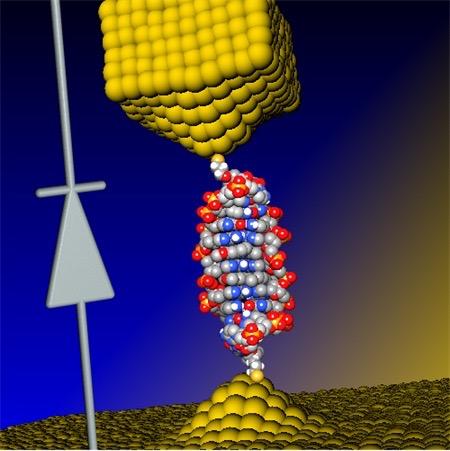
By inserting a small “coralyne” molecule into DNA, scientists were able to create a single-molecule diode (connected here by two gold electrodes), which can be used as an active element in future nanoscale circuits. The diode circuit symbol is shown on the left. (credit: University of Georgia and Ben-Gurion University)

Nanoscale electronic components can be made from single DNA molecules, as researchers at the University of Georgia and at Ben-Gurion University in Israel have demonstrated, using a single molecule of DNA to create the world’s smallest diode.

DNA double helix with base pairs (credit: National Human Genome Research Institute)

A diode is a component vital to electronic devices that allows current to flow in one direction but prevents its flow in the other direction. The development could help stimulate development of DNA components for molecular electronics.

As noted in an open-access Nature Chemistry paper published this week, the researchers designed a 11-base-pair (bp) DNA molecule and inserted a small molecule named coralyne into the DNA.*

They found, surprisingly, that this caused the current flowing through the DNA to be 15 times stronger for negative voltages than for positive voltages, a necessary feature of a diode.

Electronic elements 1,00o times smaller than current components

“Our discovery can lead to progress in the design and construction of nanoscale electronic elements that are at least 1,000 times smaller than current components,” says the study’s lead author, Bingqian Xu an associate professor in the UGA College of Engineering and an adjunct professor in chemistry and physics.

The research team plans to enhance the performance of the molecular diode and construct additional molecular devices, which may include a transistor (similar to a two-layer diode, but with one additional layer).

A theoretical model developed by Yanantan Dubi of Ben-Gurion University indicated the diode-like behavior of DNA originates from the bias voltage-induced breaking of spatial symmetry inside the DNA molecule after the coralyne is inserted.

The research is supported by the National Science Foundation.

*“We prepared the DNA–coralyne complex by specifically intercalating two coralyne molecules into a custom-designed 11-base-pair (bp) DNA molecule (5′-CGCGAAACGCG-3′) containing three mismatched A–A base pairs at the centre,” according to the authors.

UPDATE April 6, 2016 to clarify the coralyne intercalation (insertion) into the DNA molecule.


Abstract of Molecular rectifier composed of DNA with high rectification ratio enabled by intercalation

The predictability, diversity and programmability of DNA make it a leading candidate for the design of functional electronic devices that use single molecules, yet its electron transport properties have not been fully elucidated. This is primarily because of a poor understanding of how the structure of DNA determines its electron transport. Here, we demonstrate a DNA-based molecular rectifier constructed by site-specific intercalation of small molecules (coralyne) into a custom-designed 11-base-pair DNA duplex. Measured current–voltage curves of the DNA–coralyne molecular junction show unexpectedly large rectification with a rectification ratio of about 15 at 1.1 V, a counter-intuitive finding considering the seemingly symmetrical molecular structure of the junction. A non-equilibrium Green’s function-based model—parameterized by density functional theory calculations—revealed that the coralyne-induced spatial asymmetry in the electron state distribution caused the observed rectification. This inherent asymmetry leads to changes in the coupling of the molecular HOMO−1 level to the electrodes when an external voltage is applied, resulting in an asymmetric change in transmission.


A stem-cell repair system that can regenerate any kind of human tissue …including disease and aging; human trials next year
http://www.kurzweilai.net/a-stem-cell-repair-system-that-can-regenerate-any-kind-of-human-tissue

http://www.kurzweilai.net/images/spinal_disc_regeneration.jpg

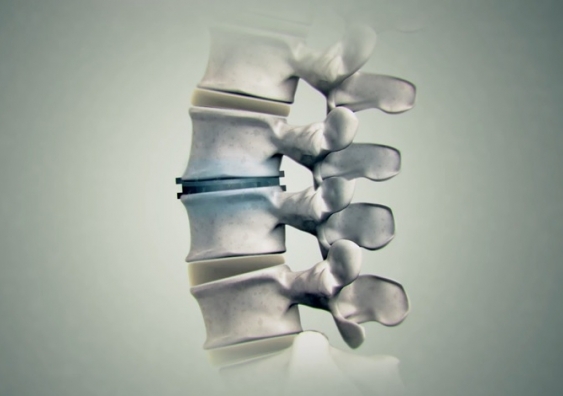
UNSW researchers say the therapy has enormous potential for treating spinal disc injury and joint and muscle degeneration and could also speed up recovery following complex surgeries where bones and joints need to integrate with the body (credit: UNSW TV)

A stem cell therapy system capable of regenerating any human tissue damaged by injury, disease, or aging could be available within a few years, say University of New South Wales (UNSW Australia) researchers.

Their new repair system*, similar to the method used by salamanders to regenerate limbs, could be used to repair everything from spinal discs to bone fractures, and could transform current treatment approaches to regenerative medicine.

The UNSW-led research was published this week in the Proceedings of the National Academy of Sciences journal.

Reprogramming bone and fat cells

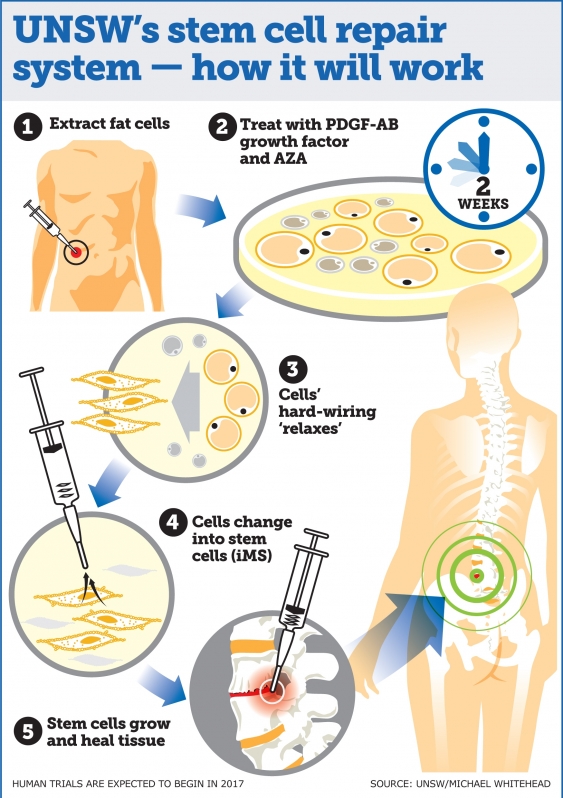
The system reprograms bone and fat cells into induced multipotent stem cells (iMS), which can regenerate multiple tissue types and has been successfully demonstrated in mice, according to study lead author, haematologist, and UNSW Associate Professor John Pimanda.

“This technique is a significant advance on many of the current unproven stem cell therapies, which have shown little or no objective evidence they contribute directly to new tissue formation,” Pimanda said. “We have taken bone and fat cells, switched off their memory and converted them into stem cells so they can repair different cell types once they are put back inside the body.”

“We are currently assessing whether adult human fat cells reprogrammed into iMS cells can safely repair damaged tissue in mice, with human trials expected to begin in late 2017.”

http://www.kurzweilai.net/images/UNSW-stem-cell-repair.jpg

Advantages over stem-cell types

There are different types of stem cells including embryonic stem (ES) cells, which during embryonic development generate every type of cell in the human body, and adult stem cells, which are tissue-specific, but don’t regenerate multiple tissue types. Embryonic stem cells cannot be used to treat damaged tissues because of their tumor forming capacity. The other problem when generating stem cells is the requirement to use viruses to transform cells into stem cells, which is clinically unacceptable, the researchers note.

Research shows that up to 20% of spinal implants either don’t heal or there is delayed healing. The rates are higher for smokers, older people and patients with diseases such diabetes or kidney disease.

Human trials are planned next year once the safety and effectiveness of the technique using human cells in mice has been demonstrated.

* The technique involves extracting adult human fat cells and treating them with the compound 5-Azacytidine (AZA), along with platelet-derived growth factor-AB (PDGF-AB) for about two days. The cells are then treated with the growth factor alone for a further two-three weeks.

AZA is known to induce cell plasticity, which is crucial for reprogramming cells. The AZA compound relaxes the hard-wiring of the cell, which is expanded by the growth factor, transforming the bone and fat cells into iMS cells. When the stem cells are inserted into the damaged tissue site, they multiply, promoting growth and healing.

The new technique is similar to salamander limb regeneration, which is also dependent on the plasticity of differentiated cells, which can repair multiple tissue types, depending on which body part needs replacing.

Along with confirming that human adult fat cells reprogrammed into iMS stem cells can safely repair damaged tissue in mice, the researchers said further work is required to establish whether iMS cells remain dormant at the sites of transplantation and retain their capacity to proliferate on demand.

https://youtu.be/zAMCBNujzzw

Abstract of PDGF-AB and 5-Azacytidine induce conversion of somatic cells into tissue-regenerative multipotent stem cells

Current approaches in tissue engineering are geared toward generating tissue-specific stem cells. Given the complexity and heterogeneity of tissues, this approach has its limitations. An alternate approach is to induce terminally differentiated cells to dedifferentiate into multipotent proliferative cells with the capacity to regenerate all components of a damaged tissue, a phenomenon used by salamanders to regenerate limbs. 5-Azacytidine (AZA) is a nucleoside analog that is used to treat preleukemic and leukemic blood disorders. AZA is also known to induce cell plasticity. We hypothesized that AZA-induced cell plasticity occurs via a transient multipotent cell state and that concomitant exposure to a receptive growth factor might result in the expansion of a plastic and proliferative population of cells. To this end, we treated lineage-committed cells with AZA and screened a number of different growth factors with known activity in mesenchyme-derived tissues. Here, we report that transient treatment with AZA in combination with platelet-derived growth factor–AB converts primary somatic cells into tissue-regenerative multipotent stem (iMS) cells. iMS cells possess a distinct transcriptome, are immunosuppressive, and demonstrate long-term self-renewal, serial clonogenicity, and multigerm layer differentiation potential. Importantly, unlike mesenchymal stem cells, iMS cells contribute directly to in vivo tissue regeneration in a context-dependent manner and, unlike embryonic or pluripotent stem cells, do not form teratomas. Taken together, this vector-free method of generating iMS cells from primary terminally differentiated cells has significant scope for application in tissue regeneration.


First transistors made entirely of nanocrystal ‘inks’ in simplified process

Transistors and other electronic components to be built into flexible or wearable applications; 3D printing planned
http://www.kurzweilai.net/first-transistors-made-entirely-of-nanocrystal-inks
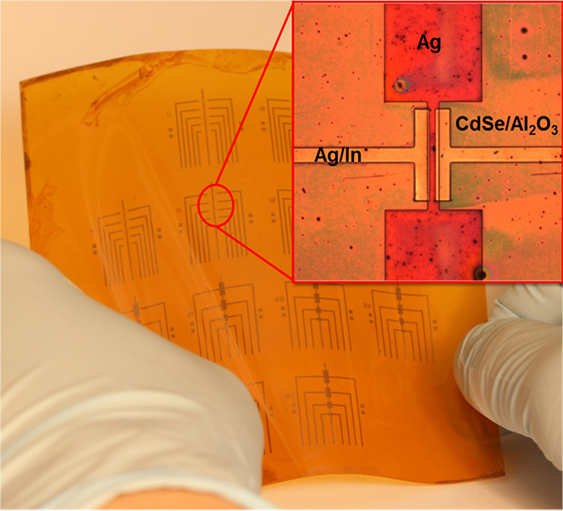
Because this process works at relatively low temperatures, many transistors can be made on a flexible backing at once. (credit: University of Pennsylvania)

University of Pennsylvania engineers have developed a simplified new approach for making transistors by sequentially depositing their components in the form of liquid nanocrystal “inks.” The new process open the door for transistors and other electronic components to be built into flexible or wearable applications. It also avoids the highly complex current process for creating transistors, which requires high-temperature, high-vacuum equipment. Also, the new lower-temperature process is compatible with a wide array of materials and can be applied to larger areas.

Transistors patterned on plastic backing

The researchers’ nanocrystal-based field effect transistors were patterned onto flexible plastic backings using spin coating, but could eventually be constructed by additive manufacturing systems, like 3D printers.

Published in the journal Science,  the study was lead by Cherie Kagan, the Stephen J. Angello Professor in the School of Engineering and Applied Science, and Ji-Hyuk Choi, then a member of her lab, now a senior researcher at the Korea Institute of Geoscience and Mineral Resources. Researchers at Korea University Korea’s Yonsei University were also involved.

[+]

Kagan’s group developed four nanocrystal inks that comprise the transistor, then deposited them on a flexible backing. (credit: University of Pennsylvania)

The researchers began by dispersing a specific type of nanocrystals in a liquid, creating nanocrystal inks. They developed a library of four of these inks: a conductor (silver), an insulator (aluminum oxide), a semiconductor (cadmium selenide), and a conductor combined with a dopant (a mixture of silver and indium). (“Doping” the semiconductor layer of a transistor with impurities controls whether the device creates a positive or negative charge.)

“These materials are colloids just like the ink in your inkjet printer,” Kagan said, “but you can get all the characteristics that you want and expect from the analogous bulk materials, such as whether they’re conductors, semiconductors or insulators.” Although the electrical properties of several of these nanocrystal inks had been independently verified, they had never been combined into full devices. “Our question was whether you could lay them down on a surface in such a way that they work together to form functional transistors.”

Laying down patterns in layers

Such a process entails layering or mixing them in precise patterns.

First, the conductive silver nanocrystal ink was deposited from liquid on a flexible plastic surface that was treated with a photolithographic mask, then rapidly spun to draw it out in an even layer. The mask was then removed to leave the silver ink in the shape of the transistor’s gate electrode.

The researchers followed that layer by spin-coating a layer of the aluminum oxide nanocrystal-based insulator, then a layer of the cadmium selenide nanocrystal-based semiconductor and finally another masked layer for the indium/silver mixture, which forms the transistor’s source and drain electrodes. Upon heating at relatively low temperatures, the indium dopant diffused from those electrodes into the semiconductor component.

“The trick with working with solution-based materials is making sure that, when you add the second layer, it doesn’t wash off the first, and so on,” Kagan said. “We had to treat the surfaces of the nanocrystals, both when they’re first in solution and after they’re deposited, to make sure they have the right electrical properties and that they stick together in the configuration we want.”

Because this entirely ink-based fabrication process works at lower temperatures than existing vacuum-based methods, the researchers were able to make several transistors on the same flexible plastic backing at the same time.

[+]

The inks’ specialized surface chemistry allowed them to stay in configuration without losing their electrical properties. (credit: University of Pennsylvania)

“Making transistors over larger areas and at lower temperatures have been goals for an emerging class of technologies, when people think of the Internet of things, large area flexible electronics and wearable devices,” Kagan said. “We haven’t developed all of the necessary aspects so they could be printed yet, but because these materials are all solution-based, it demonstrates the promise of this materials class and sets the stage for additive manufacturing.”

Because this entirely ink-based fabrication process works at lower temperatures than existing vacuum-based methods, the researchers were able to make several transistors on the same flexible plastic backing at the same time.

3D-printing transistors for wearables

“This is the first work,” Choi said, “showing that all the components, the metallic, insulating, and semiconducting layers of the transistors, and even the doping of the semiconductor, could be made from nanocrystals.”

“Making transistors over larger areas and at lower temperatures have been goals for an emerging class of technologies, when people think of the Internet of things, large area flexible electronics and wearable devices,” Kagan said. “We haven’t developed all of the necessary aspects so they could be printed yet, but because these materials are all solution-based, it demonstrates the promise of this materials class and sets the stage for additive manufacturing.”

The research was supported by the National Science Foundation, the U.S. Department of Energy, the Office of Naval Research, and the Korea Institute of Geoscience and Mineral Resources funded by the Ministry of Science, ICT, and Future Planning of Korea.


Abstract of Exploiting the colloidal nanocrystal library to construct electronic devices

Synthetic methods produce libraries of colloidal nanocrystals with tunable physical properties by tailoring the nanocrystal size, shape, and composition. Here, we exploit colloidal nanocrystal diversity and design the materials, interfaces, and processes to construct all-nanocrystal electronic devices using solution-based processes. Metallic silver and semiconducting cadmium selenide nanocrystals are deposited to form high-conductivity and high-mobility thin-film electrodes and channel layers of field-effect transistors. Insulating aluminum oxide nanocrystals are assembled layer by layer with polyelectrolytes to form high–dielectric constant gate insulator layers for low-voltage device operation. Metallic indium nanocrystals are codispersed with silver nanocrystals to integrate an indium supply in the deposited electrodes that serves to passivate and dope the cadmium selenide nanocrystal channel layer. We fabricate all-nanocrystal field-effect transistors on flexible plastics with electron mobilities of 21.7 square centimeters per volt-second.

Best textile manufacturing methods for creating human tissues with stem cells
Bioengineers determine three best processes for engineering tissues needed for organ and tissue repair
http://www.kurzweilai.net/best-textile-manufacturing-methods-for-creating-human-tissues-with-stem-cells
All four textile manufacturing processes and corresponding scaffold (structure) types studied exhibited the presence of lipid vacuoles (small red spheres, right column, indicating stem cells undergoing random differentiation), compared to control (left). Electrospun scaffolds (row a) exhibited only a monolayer of lipid vacuoles in a single focal plane, while meltblown, spunbond, and carded scaffolds (rows b, c, d) exhibited vacuoles in multiple planes throughout the fabric thickness. Scale bars: 100 μm (credit: S. A. Tuin et al./Biomedical Materials)

Elizabeth Loboa, dean of the Missouri University College of Engineering, and her team have tested new tissue- engineering methods (based on textile manufacturing) to find ones that are most cost-effective and can be produced in larger quantities.

Tissue engineering is a process that uses novel biomaterials seeded with stem cells to grow and replace missing tissues. When certain types of materials are used, the “scaffolds” that are created to hold stem cells eventually degrade, leaving natural tissue in its place. The new tissues could help patients suffering from wounds caused by diabetes and circulation disorders, patients in need of cartilage or bone repair, and women who have had mastectomies by replacing their breast tissue. The challenge is creating enough of the material on a scale that clinicians need to treat patients.

Comparing textile manufacturing techniques

http://www.kurzweilai.net/images/electrospinning.png

Electrospinning experiment: nanofibers are collected into an ethanol bath and removed at predefined time intervals (credit: J. M. Coburn et al./The Johns Hopkins University/PNAS)

In typical tissue engineering approaches that use fibers as scaffolds, non-woven materials are often bonded together using an electrostatic field. This process, called electrospinning (see Nanoscale scaffolds and stem cells show promise in cartilage repair and Improved artificial blood vessels), creates the scaffolds needed to attach to stem cells.

However, large-scale production with electrospinning is not cost-effective. “Electrospinning produces weak fibers, scaffolds that are not consistent, and pores that are too small,” Loboa said. “The goal of ‘scaling up’ is to produce hundreds of meters of material that look the same, have the same properties, and can be used in clinical settings. So we investigated the processes that create textiles, such as clothing and window furnishings like drapery, to scale up the manufacturing process.”

The group published two papers using three industry-standard, high-throughput manufacturing techniques — meltblowing, spunbonding, and carding — to determine if they would create the materials needed to mimic native tissue.

Meltblowing is a technique during which nonwoven materials are created using a molten polymer to create continuous fibers. Spunbond materials are made much the same way but the fibers are drawn into a web while in a solid state instead of a molten one. Carding involves the separation of fibers through the use of rollers, forming the web needed to hold stem cells in place.

http://www.kurzweilai.net/images/carded-scaffold-fabrication.jpg

Schematic of gilled fiber multifilament spinning and carded scaffold fabrication (credit: Stephen A. Tuin et al./Acta Biomaterialia)

Cost-effective methods

Loboa and her colleagues tested these techniques to create polylactic acid (PLA) scaffolds (a Food and Drug Administration-approved material used as collagen fillers), seeded with human stem cells. They then spent three weeks studying whether the stem cells remained healthy and if they began to differentiate into fat and bone pathways, which is the goal of using stem cells in a clinical setting when new bone and/or new fat tissue is needed at a defect site. Results showed that the three textile manufacturing methods proved as viable if not more so than electrospinning.

“These alternative methods are more cost-effective than electrospinning,” Loboa said. “A small sample of electrospun material could cost between $2 to $5. The cost for the three manufacturing methods is between $.30 to $3.00; these methods proved to be effective and efficient. Next steps include testing how the different scaffolds created in the three methods perform once implanted in animals.”

Researchers at North Carolina State University and the University of North Carolina at Chapel Hill were also involved in the two studies, which were published in Biomedical Materials (open access) and Acta Biomaterialia. The National Science Foundation, the National Institutes of Health, and the Nonwovens Institute provided funding for the studies.


Abstract of Creating tissues from textiles: scalable nonwoven manufacturing techniques for fabrication of tissue engineering scaffolds

Electrospun nonwovens have been used extensively for tissue engineering applications due to their inherent similarities with respect to fibre size and morphology to that of native extracellular matrix (ECM). However, fabrication of large scaffold constructs is time consuming, may require harsh organic solvents, and often results in mechanical properties inferior to the tissue being treated. In order to translate nonwoven based tissue engineering scaffold strategies to clinical use, a high throughput, repeatable, scalable, and economic manufacturing process is needed. We suggest that nonwoven industry standard high throughput manufacturing techniques (meltblowing, spunbond, and carding) can meet this need. In this study, meltblown, spunbond and carded poly(lactic acid) (PLA) nonwovens were evaluated as tissue engineering scaffolds using human adipose derived stem cells (hASC) and compared to electrospun nonwovens. Scaffolds were seeded with hASC and viability, proliferation, and differentiation were evaluated over the course of 3 weeks. We found that nonwovens manufactured via these industry standard, commercially relevant manufacturing techniques were capable of supporting hASC attachment, proliferation, and both adipogenic and osteogenic differentiation of hASC, making them promising candidates for commercialization and translation of nonwoven scaffold based tissue engineering strategies.


Abstract of Fabrication of novel high surface area mushroom gilled fibers and their effects on human adipose derived stem cells under pulsatile fluid flow for tissue engineering applications

The fabrication and characterization of novel high surface area hollow gilled fiber tissue engineering scaffolds via industrially relevant, scalable, repeatable, high speed, and economical nonwoven carding technology is described. Scaffolds were validated as tissue engineering scaffolds using human adipose derived stem cells (hASC) exposed to pulsatile fluid flow (PFF). The effects of fiber morphology on the proliferation and viability of hASC, as well as effects of varied magnitudes of shear stress applied via PFF on the expression of the early osteogenic gene marker runt related transcription factor 2 (RUNX2) were evaluated. Gilled fiber scaffolds led to a significant increase in proliferation of hASC after seven days in static culture, and exhibited fewer dead cells compared to pure PLA round fiber controls. Further, hASC-seeded scaffolds exposed to 3 and 6 dyn/cm2 resulted in significantly increased mRNA expression of RUNX2 after one hour of PFF in the absence of soluble osteogenic induction factors. This is the first study to describe a method for the fabrication of high surface area gilled fibers and scaffolds. The scalable manufacturing process and potential fabrication across multiple nonwoven and woven platforms makes them promising candidates for a variety of applications that require high surface area fibrous materials.

Statement of Significance

We report here for the first time the successful fabrication of novel high surface area gilled fiber scaffolds for tissue engineering applications. Gilled fibers led to a significant increase in proliferation of human adipose derived stem cells after one week in culture, and a greater number of viable cells compared to round fiber controls. Further, in the absence of osteogenic induction factors, gilled fibers led to significantly increased mRNA expression of an early marker for osteogenesis after exposure to pulsatile fluid flow. This is the first study to describe gilled fiber fabrication and their potential for tissue engineering applications. The repeatable, industrially scalable, and versatile fabrication process makes them promising candidates for a variety of scaffold-based tissue engineering applications.

Read Full Post »

Brain Biobank and studies of disease structure correlates

Larry H. Bernstein, MD, FCAP, Curator

LPBI


Unveiling Psychiatric Diseases

Researchers create neuropsychiatric cellular biobank

Image: iStock/mstroz
Researchers from Harvard Medical School and Massachusetts General Hospital have completed the first stage of an important collaboration aimed at understanding the intricate variables of neuropsychiatric disease—something that currently eludes clinicians and scientists.

The research team, led by Isaac Kohane at HMS and Roy Perlis at Mass General, has created a neuropsychiatric cellular biobank—one of the largest in the world.

It contains induced pluripotent stem cells, or iPSCs, derived from skin cells taken from 100 people with neuropsychiatric diseases such as schizophrenia, bipolar disorder and major depression, and from 50 people without neuropsychiatric illness.

In addition, a detailed profile of each patient, obtained from hours of in-person assessment as well as from electronic medical records, is matched to each cell sample.

As a result, the scientific community can now for the first time access cells representing a broad swath of neuropsychiatric illness. This enables researchers to correlate molecular data with clinical information in areas such as variability of drug reactions between patients. The ultimate goal is to help treat, with greater precision, conditions that often elude effective management.

The cell collection and generation was led by investigators at Mass General, who in collaboration with Kohane and his team are working to characterize the cell lines at a molecular level. The cell repository, funded by the National Institutes of Health, is housed at Rutgers University.

“This biobank, in its current form, is only the beginning,” said Perlis, director of the MGH Psychiatry Center for Experimental Drugs and Diagnostics and HMS associate professor of psychiatry. “By next year we’ll have cells from a total of four hundred patients, with additional clinical detail and additional cell types that we will share with investigators.”

A current major limitation to understanding brain diseases is the inability to access brain biopsies on living patients. As a result, researchers typically study blood cells from patients or examine post-mortem tissue. This is in stark contrast with diseases such as cancer, for which there are many existing repositories of highly characterized cells from patients.

The new biobank offers a way to push beyond this limitation.


A Big Step Forward

While the biobank is already a boon to the scientific community, researchers at MGH and the HMS Department of Biomedical Informatics will be adding additional layers of molecular data to all of the cell samples. This information will include whole genome sequencing and transcriptomic and epigenetic profiling of brain cells made from the stem cell lines.

Collaborators in the HMS Department of Neurobiology, led by Michael Greenberg, department chair and Nathan Marsh Pusey Professor of Neurobiology,  will also work to examine characteristics of other types of neurons derived from these stem cells.

“This can potentially alter the entire way we look at and diagnose many neuropsychiatric conditions,” said Perlis.

One example may be to understand how the cellular responses to medication correspond to the patient’s documented responses, comparing in vitro with in vivo. “This would be a big step forward in bringing precision medicine to psychiatry,” Perlis said.

“It’s important to recall that in the field of genomics, we didn’t find interesting connections to disease until we had large enough samples to really investigate these complex conditions,” said Kohane, chair of the HMS Department of Biomedical Informatics.

“Our hypothesis is that here we will require far fewer patients,” he said. “By measuring the molecular functioning of the cells of each patient rather than only their genetic risk, and combining that all that’s known of these people in terms of treatment response and cognitive function, we will discover a great deal of valuable information about these conditions.”

Added Perlis, “In the early days of genetics, there were frequent false positives because we were studying so few people. We’re hoping to avoid the same problem in making cellular models, by ensuring that we have a sufficient number of cell lines to be confident in reporting differences between patient groups.”

The generation of stem cell lines and characterization of patients and brain cell lines is funded jointly by the the National Institute of Mental Health, the National Human Genome Research Institute and a grant from the Centers of Excellence in Genomic Science program.


On C.T.E. and Athletes, Science Remains in Its Infancy

Se Hoon ChoiYoung Hye KimMatthias Hebisch, et al.

http://www.nature.com/articles/nature13800.epdf

Alzheimer’s disease is the most common form of dementia, characterized by two pathological hallmarks: amyloid-β plaques and neurofibrillary tangles1. The amyloid hypothesis of Alzheimer’s disease posits that the excessive accumulation of amyloid-β peptide leads to neurofibrillary tangles composed of aggregated hyperphosphorylated tau2, 3. However, to date, no single disease model has serially linked these two pathological events using human neuronal cells. Mouse models with familial Alzheimer’s disease (FAD) mutations exhibit amyloid-β-induced synaptic and memory deficits but they do not fully recapitulate other key pathological events of Alzheimer’s disease, including distinct neurofibrillary tangle pathology4, 5. Human neurons derived from Alzheimer’s disease patients have shown elevated levels of toxic amyloid-β species and phosphorylated tau but did not demonstrate amyloid-β plaques or neurofibrillary tangles6, 7, 8, 9, 10, 11. Here we report that FAD mutations in β-amyloid precursor protein and presenilin 1 are able to induce robust extracellular deposition of amyloid-β, including amyloid-β plaques, in a human neural stem-cell-derived three-dimensional (3D) culture system. More importantly, the 3D-differentiated neuronal cells expressing FAD mutations exhibited high levels of detergent-resistant, silver-positive aggregates of phosphorylated tau in the soma and neurites, as well as filamentous tau, as detected by immunoelectron microscopy. Inhibition of amyloid-β generation with β- or γ-secretase inhibitors not only decreased amyloid-β pathology, but also attenuated tauopathy. We also found that glycogen synthase kinase 3 (GSK3) regulated amyloid-β-mediated tau phosphorylation. We have successfully recapitulated amyloid-β and tau pathology in a single 3D human neural cell culture system. Our unique strategy for recapitulating Alzheimer’s disease pathology in a 3D neural cell culture model should also serve to facilitate the development of more precise human neural cell models of other neurodegenerative disorders.


Figure 2: Robust increases of extracellular amyloid-β deposits in 3D-differentiated hNPCs with FAD mutations.close

Robust increases of extracellular amyloid-[bgr] deposits in 3D-differentiated hNPCs with FAD mutations.

a, Thin-layer 3D culture protocol. HC, histochemistry; IF, immunofluorescence; IHC, immunohistochemistry. b, Amyloid-β deposits in 6-week differentiated control and FAD ReN cells in 3D Matrigel (green, GFP; blue, 3D6; scale bar, …


Stem Cell-Based Spinal Cord Repair Enables Robust Corticospinal Regeneration


Novel use of EPR spectroscopy to study in vivo protein structure

http://www.news-medical.net/whitepaper/20160315/Novel-use-of-EPR-spectroscopy-to-study-in-vivo-protein-structure.aspx

α-synuclein

α-synuclein is a protein found abundantly throughout the brain. It is present mainly at the neuron ends where it is thought to play a role in ensuring the supply of synaptic vesicles in presynaptic terminals, which are required for the release of neurotransmitters to relay signals between neurons. It is critical for normal brain function.

However, α-synuclein is also the primary protein component of the cerebral amyloid deposits characteristic of Parkinson’s disease and its precursor is found in the amyloid plaques of Alzheimer’s disease. Although α-synuclein is present in all areas of the brain, these disease-state amyloid plaques only arise in distinct areas.

Alpha-synuclein protein. May play role in Parkinson’s and Alzheimer’s disease.  © molekuul.be / Shutterstock.com

Imaging of isolated samples of α-synuclein in vitro indicate that it does not have the precise 3D folded structure usually associated with proteins. It is therefore classed as an intrinsically disordered protein. However, it was not known whether the protein also lacked a precise structure in vivo.

There have been reports that it can form helical tetramers. Since the 3D structure of a biological protein is usually precisely matched to the specific function it performs, knowing the structure of α-synuclein within a living cell will help elucidate its role and may also improve understanding of the disease states with which it is associated.

If α-synuclein remains disordered in vivo, it may be possible for the protein to achieve different structures, and have different properties, depending on its surroundings.

Techniques for determining protein structure

It has long been known that elucidating the structure of a protein at an atomic level is fundamental for understanding its normal function and behavior. Furthermore, such knowledge can also facilitate the development of targeted drug treatments. Unfortunately, observing the atomic structure of a protein in vivo is not straightforward.

X-ray diffraction is the technique usually adopted for visualizing structures at atomic resolution, but this requires crystals of the molecule to be produced and this cannot be done without separating the molecules of interest from their natural environment. Such processes can modify the protein from its usual state and, particularly with complex structures, such effects are difficult to predict.

The development of nuclear magnetic resonance (NMR) spectroscopy improved the situation by making it possible for molecules to be analyzed under in vivo conditions, i.e. same pH, temperature and ionic concentration.

More recently, increases in the sensitivity of NMR and the use of isotope labelling have enabled determinations of the atomic level structure and dynamics of proteins to be determined within living cells1. NMR has been used to determine the structure of a bacterial protein within living cells2 but it is difficult to achieve sufficient quantities of the required protein within mammalian cells and to keep the cells alive for NMR imaging to be conducted.

Electron paramagnetic resonance (EPR) spectroscopy for determining protein structure

Recently, researchers have managed to overcome these obstacles by using in-cell NMR and electron paramagnetic resonance (EPR) spectroscopy. EPR spectroscopy is a technique that is similar to NMR spectroscopy in that it is based on the measurement and interpretation of the energy differences between excited and relaxed molecular states.

In EPR spectroscopy it is electrons that are excited, whereas in NMR signals are created through the spinning of atomic nuclei. EPR was developed to measure radicals and metal complexes, but has also been utilized to study the dynamic organization of lipids in biological membranes3.

EPR has now been used for the first time in protein structure investigations and has provided atomic-resolution information on the structure of α-synuclein in living mammalians4,5.

Bacterial forms of the α-synuclein protein labelled with 15N isotopes were introduced into five types of mammalian cell using electroporation. Concentrations of α-synuclein close to those found in vivo were achieved and the 15N isotopes allowed the protein to be clearly defined from other cellular components by NMR. The conformation of the protein was then determined using electron paramagnetic resonance (EPR).

The results showed that within living mammalian cells α-synuclein remains as a disordered and highly dynamic monomer. Different intracellular environments did not induce major conformational changes.

Summary

The novel use of EPR spectroscopy has resolved the mystery surrounding the in vivo conformation of α-synuclein. It showed that α-synuclein maintains its disordered monomeric form under physiological cell conditions. It has been demonstrated for the first time that even in crowded intracellular environments α-synuclein does not form oligomers, showing that intrinsic structural disorder can be sustained within mammalian cells.

References

  1. Freedberg DI and Selenko P. Live cell NMR Annu. Rev. Biophys. 2014;43:171–192.
  2. Sakakibara D, et al. Protein structure determination in living cells by in-cell NMR spectroscopy. Nature 2009;458:102–105.
  3. Yashroy RC. Magnetic resonance studies of dynamic organisation of lipids in chloroplast membranes. Journal of Biosciences 1990;15(4):281.
  4. Alderson TA and Bax AD. Parkinson’s Disease. Disorder in the court. Nature 2016; doi:10.1038/nature16871.
  5. Theillet FX, et al. Structural disorder of monomeric α-synuclein persists in mammalian cells. Nature 2016; doi:10.1038/nature16531.


Read Full Post »

The late Cambridge Mayor Alfred Vellucci welcomed Life Sciences Labs to Cambridge, MA – June 1976

Reporter: Aviva Lev-Ari, PhD, RN

How Cambridge became the Life Sciences Capital

Worth watching is the video below, which captures the initial Cambridge City Council hearing on recombinant DNA research from June 1976. The first speaker is the late Cambridge mayor Alfred Vellucci.

Vellucci hoped to pass a two-year moratorium on gene splicing in Cambridge. Instead, the council passed a three-month moratorium, and created a board of nine Cambridge citizens — including a nun and a nurse — to explore whether the work should be allowed, and if so, what safeguards would be necessary. A few days after the board was created, the pro and con tables showed up at the Kendall Square marketplace.

At the time, says Phillip Sharp, an MIT professor, Cambridge felt like a manufacturing town that had seen better days. He recalls being surrounded by candy, textile, and leather factories. Sharp hosted the citizens review committee at MIT, explaining what the research scientists there planned to do. “I think we built a relationship,” he says.

By early 1977, the citizens committee had proposed a framework to ensure that any DNA-related experiments were done under fairly stringent safety controls, and Cambridge became the first city in the world to regulate research using genetic material.


WATCH VIDEO

http://www.betaboston.com/news/2016/03/17/how-cambridge-became-the-life-sciences-capital/

Scott Kirsner can be reached at kirsner@pobox.com. Follow him on Twitter@ScottKirsner and on betaboston.com.

SOURCE

How Cambridge became the life sciences capital

http://www.betaboston.com/news/2016/03/17/how-cambridge-became-the-life-sciences-capital/

Read Full Post »

Blood forming precursors in bone marrow

Larry H. Bernstein, MD, FCAP, Curator

LPBI


Blood stem cells study could pave the way for new cancer therapy

UNIVERSITY OF EDINBURGH

IMAGE

http://media.eurekalert.org/multimedia_prod/pub/web/110842_web.jpg

This image shows the formation of blood stem cells inside the embryonic vessel called dorsal aorta. In green is shown secreted molecule called NOGGIN, which plays an important role in this process. The University of Edinburgh

People with leukaemia could be helped by new research that sheds light on how the body produces its blood supply.

Scientists are a step closer to creating blood stem cells that could reduce the need for bone marrow transplants in patients with cancer or blood disorders.

Enabling scientists to grow the stem cells artificially from pluripotent stem cells could also lead to the development of personalised blood therapies, researchers say.

Blood stem cells are found in bone marrow and produce all blood cells in the body. These cells – known as haematopoietic stem cells (HSCs) – help to restore blood supply in patients who have been treated for leukaemia.

Researchers used a mouse model to pinpoint exactly how HSCs develop in the womb. They showed for the first time how three key molecules interact together to generate the cells, which are later found in adult bone marrow.

The discovery could help scientists to recreate this process in the lab, in the hope that HSCs could one day be developed for clinical use.

Scientists say this fundamental understanding of early development may also have an impact on other diseases that affect blood formation and supply.

###

The research has been published in Nature Communications.

Professor Alexander Medvinsky, of the University of Edinburgh’s MRC Centre for Regenerative Medicine said: “There is a pressing need to improve treatments for diseases like leukaemia and this type of research brings us a step closer to that milestone. The more we understand about how embryos develop these blood stem cells, the closer we come to being able to make them in the lab.”

http://www.ed.ac.uk/news/2016/stem-cells-100316

Céline Souilhol, Christèle Gonneau, Javier G. Lendinez, Antoniana Batsivari, Stanislav Rybtsov, Heather Wilson, Lucia Morgado-Palacin, David Hills, Samir Taoudi, Jennifer Antonchuk, Suling Zhao, Alexander Medvinsky. Inductive interactions mediated by interplay of asymmetric signalling underlie development of adult haematopoietic stem cells. Nature Communications, 2016; 7: 10784 DOI: 10.1038/ncomms10784

During embryonic development, adult haematopoietic stem cells (HSCs) emerge preferentially in the ventral domain of the aorta in the aorta–gonad–mesonephros (AGM) region. Several signalling pathways such as Notch, Wnt, Shh and RA are implicated in this process, yet how these interact to regulate the emergence of HSCs has not previously been described in mammals. Using a combination of ex vivo and in vivo approaches, we report here that stage-specific reciprocal dorso–ventral inductive interactions and lateral input from the urogenital ridges are required to drive HSC development in the aorta. Our study strongly suggests that these inductive interactions in the AGM region are mediated by the interplay between spatially polarized signalling pathways. Specifically, Shh produced in the dorsal region of the AGM, stem cell factor in the ventral and lateral regions, and BMP inhibitory signals in the ventral tissue are integral parts of the regulatory system involved in the development of HSCs.

Haematopoietic stem cells (HSCs) lie at the foundation of the adult haematopoietic system, and give rise to cells of all blood lineages throughout the lifespan of an organism. An important property of adult (definitive) haematopoietic stem cells (dHSCs) is that they are capable of long-term reconstitution of the haematopoietic system upon transplantation into irradiated recipients. In the mouse, such cells develop by embryonic stages E10–E11 in the aorta–gonad–mesonephros (AGM) region1, 2, 3, 4. An ex vivo approach showed that the AGM region has a robust autonomous capacity to generate dHSCs1. The AGM region comprises the dorsal aorta flanked on both sides by the urogenital ridges (UGRs), which contain embryonic rudiments of kidney and mesonephros. HSCs develop in a polarized manner, predominantly in the ventral floor of the dorsal aorta (AoV), more rarely in the dorsal domain of the dorsal aorta (AoD), and are absent in the UGRs2, 5, 6, 7. Localization of dHSCs to the AoV in mouse and human embryos was shown by long-term reconstitution experiments5, 6.

Abundant evidence indicates that during development, a specialized embryonic endothelial compartment known as haematogenic (or haemogenic) endothelium gives rise to haematopoietic stem and progenitors cells7, 8, 9, 10. The haematopoietic programme in various vertebrate models is executed predominantly in the AoV, and is recognized by the expression of essential haematopoietic transcription factors, for example, Runx1 and cKit, and the appearance of clusters of haematopoietic cells budding from the endothelium of the dorsal aorta6, 8, 9, 11, 12, 13, 14.

It is broadly accepted that HSCs develop from the haematogenic endothelium within intra-aortic clusters. This transition involves several consecutive maturation steps of HSC precursors: pro-HSCsright arrowpre-HSC type Iright arrowpre-HSC type IIright arrowdHSC15, 16, 17. All these precursors express endothelial markers, such as vascular-endothelial cadherin (VC) and CD31, and sequentially upregulate haematopoietic surface markers: CD41 (pro-HSCs), CD43 (pre-HSC type I) and finally CD45 (pre-HSC type II). This maturation process occurs in the dorsal aorta between E9 and E11. Specifically, pro-HSCs emerge at E9, pre-HSCs Type I appear at E10 and pre-HSCs type II predominantly at E11. Unlike dHSCs, pre-HSCs cannot reconstitute the adult haematopoietic system by direct transplantation and require prior maturation in an embryonic or neonatal environment15, 16, 17, 18,19.

A number of signalling pathways (Notch, Wnt, retinoic acid, interleukin-3 and inflammatory) have been implicated in HSC development; however, a coherent picture is yet to be elucidated15, 17, 20,21, 22, 23, 24, 25, 26, 27, 28, 29, 30, 31. HSC precursors (pro-HSCs, pre-HSCs type I and pre-HSCs type II) express cKit17 from early developmental stages. A recent study has shown that the cKit ligand, known as stem cell factor (SCF), is a key regulator driving maturation of these HSC precursors into dHSCs in the AGM region17, which is in agreement with the marked decline of HSC activity in SCF mutant mice32, 33. In the adult, SCF is critically important for HSC maintenance in the bone marrow niche, mainly in the endothelial compartment32. Sonic Hedgehog (Shh) and bone morphogenetic protein 4 (BMP4) pathways are also important mediators; in zebrafish, these two morphogenes are involved in arterial specification and haematopoietic patterning, respectively34,35. In the mouse, subaortic BMP4 and Shh/Indian Hedgehog derived from gut were also proposed to be responsible for HSC development36, 37.

During development, interactions between spatially segregated compartments are essential for tissue patterning and specification, and are often mediated by gradients of secreted molecules38,39, 40. Molecules secreted by distant tissues, such as somites, can influence HSC development in the AGM region41, 42, 43, 44, 45. Developing HSCs are embedded in the complex AGM microenvironment, suggesting that HSC development may require signals derived from different compartments of the AGM region. We sought to test this hypothesis. However, the analysis of HSC development in vivo is significantly hampered by low accessibility of embryos developing in utero, fast maturation of dHSCs, lack of uniquely specific markers for HSC precursors and their low numbers in the AGM region. Therefore, we employed here a robust ex vivo culture system that models HSC development in the embryo in combination with functional HSC analysis using in vivolong-term reconstitution assay15, 16, 17. Specifically, to study interactions between AGM subregions, we took advantage of the in vitro reaggregation system that enables close juxtaposition of cell types15.

We show that interactions between three compartments of the AGM, the AoV, the AoD and the UGRs, are necessary for efficient generation of dHSCs. First, we show that dHSC activity in the isolated E10.5 AoV is limited but can be significantly enhanced by co-culture with the AoD, and that this is mediated at least partly by Shh, secreted dorsally in vivo. Second, while HSC activity in isolated E11.5 AoD is limited, co-culture with a competent AoV microenvironment activates dHSC generation in the AoD. We found that this effect is mediated by SCF, which is secreted abundantly by the AoV stroma in vivo as shown here. Third, we show that downregulation of BMP4 signalling by BMP antagonist Noggin, which is present at high levels in the AoV and especially in intra-aortic clusters as revealed here by in vivo observations, is required for HSC development. Fourth, UGRs, which express high levels of SCF, also enhance HSC development in the dorsal aorta.

Our results based on in vivo observations and ex vivo modelling strongly suggest that juxtaposed, anatomically distinct domains within the AGM region create a complex landscape of interactive signals that underpins HSC development.

Pre-HSCs localize preferentially to the AoV

As dHSCs mature from pre-HSCs, we investigated whether the emergence of dHSC predominantly in the AoV6 is a result of asymmetric (ventralized) distribution of pre-HSCs. Dorsal aortae were separated from UGRs and bisected into AoV and AoD (including notochord) as described previously6 (Supplementary Fig. 1a). The different domains were then directly transplanted into irradiated mice to detect dHSCs. We first confirmed our previous observation that at E11.5 dHSCs appear almost exclusively in the AoV, although some dHSCs were in the AoD and engrafted few recipients at high level (Supplementary Fig. 1b). Limiting dilution analysis showed that dHSCs are approximately four times more frequent in the AoV compared with AoD. UGRs did not contain HSCs in line with previous reports2, 6.

We then investigated the spatial distribution of pre-HSCs type I and pre-HSCs type II in E10.5–E11.5 embryos using the OP9 co-culture system supplemented with Il3+SCF+Flt3 (termed 3GF), which allows pre-HSCs (which do not engraft by direct transplantation) to mature into dHSC that become detectable by long-term repopulation assay as described previously16. Doses of transplanted cells (expressed in embryo equivalents, e.e.) were chosen based on the requirements of individual experiments (explained in Methods section). In these experiments (Fig. 1), the dose injected was high (1–2e.e.) to detect potentially low dHSC numbers in AoD and UGRs.

Figure 1: Localization of pre-HSCs in the AGM region.

Localization of pre-HSCs in the AGM region.

(a) E10.5 AoV, AoD and UGRs were co-aggregated with OP9 and cultured for 5 days, and the formation of dHSCs was then tested by transplantation into irradiated mice (2e.e. per recipient; AoV: six independent experiments; AoD: four independent experiments; UGRs: two independent experiments). Dashed line indicates the cutoff for high-level engraftment (>70% donor chimaerism). (b) E11.5 aortas and UGRs were transplanted after reaggregate culture (Ao: 0.2e.e. per recipient and UGRs: 1e.e. per recipient; two independent experiments). (c,d) Pre-HSCs type I (VC+CD45) (c) or type II (VC+CD45+) (d) sorted from E11.5 AoV and AoD were co-aggregated with OP9 cells and transplanted after culture (1e.e. per recipient; two independent experiments). (ad) Levels of engraftment are plotted, and number of repopulated versus total number of transplanted mice are shown in brackets. Number of embryo equivalents (ee) injected in each experiment are indicated on the graphs. (*P<0.05; ***P<0.005; Mann–Whitney U-test). In all these experiments, tissues were cultured with three growth factors (Flt3I, Il3 and SCF). AGM, aorta–gonad–mesonephros region; Ao, dorsal Aorta; AoV, ventral domain of the dorsal aorta; AoD, dorsal domain of the dorsal aorta; UGRs, urogenital ridges.

We have shown previously that E10.5 AGM region mainly contains type I pre-HSCs, whereas at E11.5, type I and type II pre-HSCs co-exist16. Dissected E10.5 AGM regions co-cultured with OP9 in 3GF for 5 days were transplanted into adult irradiated recipients. Out of 21 recipients that received cultured AoV, 20 showed high levels (>70%) of donor-derived long-term haematopoietic chimerism (Fig. 1a). In contrast, only 7 out of 16 recipients of cultured AoD were repopulated at high levels (>70%), while the remaining recipients showed lower or no repopulation (7 and 2, respectively). Cultured UGRs did not produce dHSCs (Fig. 1a). Thus, we conclude that the E10.5 AoD does contain pre-HSCs but at significantly lower numbers than the AoV.

We then investigated whether pre-HSCs localization changes in E11.5 embryos and found that pre-HSCs were still exclusively localized to the dorsal aorta; UGRs carefully separated from the lateral mesenchyme adjacent to the dorsal aorta did not give any repopulation after culture (Fig. 1b). To establish the location of pre-HSCs within the E11.5 dorsal aorta, cell populations enriched for pre-HSCs type I (VC+CD45) and pre-HSCs type II (VC+CD45+) were sorted from AoV and AoD, and co-cultured with OP9 stromal cells in the presence of 3GF as described previously16. We again were able to detect pre-HSC activity in AoD although at lower levels than in AoV. After maturation ex vivo, pre-HSCs type I from AoV and AoD repopulated 7 of 11 and 2 of 8 recipients, respectively (Fig. 1c). Similarly, cultured pre-HSCs type II from AoV and AoD repopulated 11 out of 12 and 4 out of 10 recipients, respectively (Fig. 1d). In all cases, multilineage engraftment was confirmed (Supplementary Fig. 2). These data show that pre-HSCs are significantly enriched in AoV.

Reciprocal inductive interactions between AoD and AoV

To explore hypothetical interactions between AoD and AoV, we made use of a dissociation–reaggregation system that recapitulates HSC development ex vivo15. This system allowed us to integrate AGM domains in a three-dimensional tissue-like organoid15 and study their interactions in HSC development. To track the origin of dHSCs, AoV and AoD from wild-type (WT) and green fluorescent protein (GFP) embryos with constitutive expression of GFP46 were co-aggregated (termed AoV//AoD co-aggregates) and cultured for 5 days in the presence of 3GF before transplantation (Fig. 2a). Mice transplanted with AoV//AoD co-aggregates can be reconstituted by dHSCs coming from AoD and AoV. The presence of GFP allowed the individual contributions of AoV and AoD to the total repopulation level within the same mouse to be assessed (Fig. 2b,c). This is presented in two separate columns in the graph. Namely, while columns 1 and 3 represent the same recipient mice, the former shows exclusively the contribution of the AoD and the latter shows exclusively the contribution of the AoV into each recipient. To assess the influence of AoD and AoV interaction on HSC development, the repopulation by co-aggregated AoD (column 1) or AoV (column 3) can then be compared with repopulation by independently cultured AoD (column 2) or AoV (column 4). All experiments included reciprocal use of WT and GFP tissues in AoV//AoD co-aggregates, and we observed no difference in repopulation properties between WT and GFP embryos. Homotypic AoV//AoV and AoD//AoD co-aggregates were always used as controls. Note that in these experiments, only 0.2e.e. were injected per recipient, to ensure that the repopulation levels were not saturated and to allow any inductive effects to be revealed.

Figure 2: Inductive interactions between AoV, AoD and UGRs as revealed by an ex vivomodel system.

Inductive interactions between AoV, AoD and UGRs as revealed by an ex vivo model system.

(a) Experimental design: the ventral domain (AoV) and the dorsal domain (AoD) of the aorta, and the urogenital ridges (UGRs) from wild-type (WT) and GFP+ embryos were subdissected, and chimeric reaggregates from tissues of these two genotypes were generated. Left column: to test interactions between AoV and AoD, chimeric AoV//AoD reaggregates were generated and transplanted into irradiated recipients after 4–5 days of culture (b,c). Right column: to test interactions between Ao and UGRs, chimeric Ao//UGR reaggregates were generated and transplanted into irradiated recipients after 4–5 days culture (d). GFP+ and/or GFP− donor-derived long-term repopulation allowed us to conclude whether dHSCs originated from AoV, AoD or UGRs. Accordingly, the tissue of origin of donor dHSCs is indicated below each graph. (b) E10.5 aortas from WT and GFP embryos were used to generate chimeric reaggregates as depicted schematically above plots. The reciprocal combination of WT and GFP tissues was used to generate AoV//AoD reaggregates. The tissue source of dHSCs is shown separately in the leftmost (AoD) and rightmost (AoV) columns as indicated below the plot (0.2e.e. per recipient; two independent experiments). (c) E11.5 aortas from WT and GFP embryos were used to generate chimeric reaggregates. The tissue source of dHSCs is shown separately in the leftmost (AoD) and rightmost (AoV) columns as indicated below the plot (0.2e.e. per recipient; two independent experiments). (d) E11.5 aortas (Ao) and UGRs from WT and GFP embryos were used to generate Ao//UGR chimeric reaggregates. As depicted schematically above the plot, the reciprocal combination of WT and GFP tissues was used to generate Ao//UGR reaggregates. The tissue source of dHSCs is shown separately in left (Ao) and right (UGRs) columns as indicated below the plot (0.01e.e. per recipient; six independent experiments). (e) Reaggregation of WT Ao with UGRs generate more dHSCs than Ao alone (0.05e.e. per recipient; two independent experiments). (be) In all these experiments, tissues were cultured with three growth factors.

Using this approach, we found that the E10.5 AoV generates more dHSCs when combined with AoD than on its own (Fig. 2b, compare two rightmost columns). One day later, E11.5 AoD had no positive influence on dHSC generation by AoV (Fig. 2c, compare two rightmost columns). Conversely, the E11.5 AoD produced more HSCs when reaggregated with the AoV than on its own (Fig. 2c, compare two leftmost columns). This inductive effect of AoV on AoD was not observed at E10.5 (Fig. 2b, compare two leftmost columns). These ex vivo modelling experiments revealed reciprocal stage-specific effects of AoV and AoD on HSC development, which could be explained by the differential release of factors by the two regions and/or by differences in the competency of the target cells to respond to signals.

UGRs enhance HSC development in the dorsal aorta  

SCF expression is involved in polarized HSC development

Figure 3: Involvement of polarized stem cell factor in HSC development.

Involvement of polarized stem cell factor in HSC development.

(a) qRT–PCR on fresh AoV, AoD and UGRs at E10.5 and E11.5 showed high expression levels of stem cell factor (SCF) in AoV and UGRs, compared with AoD (data are mean±s.e.m; *P<0.05, **P<0.01, t-test; three independent experiments). No significant difference was observed between E10.5 and E11.5 expression level in any of the tissues. (b) Expression of SCF-GFP and CD31 determined by immunostaining on thick section (300μm) of SCF-GFP-positive E10.5 AGM region and on SCF-GFP-negative control. Bars, 50μm. (c) Expression of SCF in sorted populations from fresh E10.5–E11.5 AoV (V) and AoD (D) determined by qRT–PCR. Endo, endothelial population (VC+CD45CD43); type I, pre-HSCs type I (VC+CD45CD43+); type II, pre-HSCs type II (VC+CD45+); stroma, stromal population (VCCD45CD43). (*P<0.05, t-test; five independent experiments). (d) E10.5 AoD were cultured as reaggregates in the presence of Il3 and Flt3L with or without SCF and human SCF antagonist (SCF-Rh). (0.5e.e. per recipient; three independent experiments). (e,f) E11.5 AoD (two independent experiments) (e) and E10.5 AoV (two independent experiments) (f) were cultured as explants with or without SCF (no other cytokines); (0.2e.e. per recipient).


Shh signalling enhances dHSC generation


Figure 4: Sonic Hedgehog is a positive modulator of pre-HSC type I.

Sonic Hedgehog is a positive modulator of pre-HSC type I.

(a) Expression level of Sonic Hedgehog (Shh) in E10.5 and E11.5 AGM region determined by qRT–PCR. (data are mean±s.e.m; *P<0.05, t-test; E10.5: three independent experiments and E11.5: two independent experiments). (b) Patched1 and Gli1 expression in endothelial cells (endo: VC+CD45CD43), pre-HSCs type I (I: VC+CD45CD43+) and type II (II: VC+CD45+) sorted from E11.5 AoV and AoD (two independent experiments). (c) E10.5 AoV and AoD explants were cultured in presence of Shh recombinant protein before transplantation (AoV: 0.1e.e. per recipient; two independent experiments and AoD: 0.2e.e. per recipient; three independent experiments). (d) E10.5 AoV and doxycyline-inducible OP9-Shh were co-aggregated and cultured in presence or absence of doxycycline and/or Hedgehog (Hh) antagonist (200nM) before transplantation (0.2e.e. per recipient; two independent experiments). (e) 10.5 AoV and AoD co-aggregated with OP9 were cultured in presence of three growth factors with Hh antagonist before transplantation; (0.2e.e. per recipient; two independent experiments). (f) E11.5 AoV explants were cultured in presence of Shh recombinant protein before transplantation; (0.2e.e. per recipient; two independent experiments). (g): E11.5 AGM reaggregates were cultured in presence of Hh antagonist before transplantation; (0.1e.e. per recipient; two independent experiments). (c,d,f,g) In all these experiments, tissues were cultured without cytokines. Hh anta, Hh antagonist; Dox, doxycycline.


BMP signalling is downregulated in the dHSC lineage

Figure 5: Bone morphogenetic protein signalling is downregulated in dHSC lineage.

Bone morphogenetic protein signalling is downregulated in dHSC lineage.

(a) Expression of bone morphogenetic protein 4 (BMP4) at E10.5 determined by qRT–PCR; (data are mean±s.e.m.; *P<0.05, t-test; three independent experiments). (b) Expression of BMP4 in the E10.5 AGM region determined by immunostaining on frozen sections. Bars, 50μm. Zoomed image shows the subendothelial localization of BMP4 (arrowheads). Bars, 10μm. (c) Expression of phosphorylated-Smad (P-Smad) in the E10.5 AGM region determined by immunostaining on frozen sections. Bars, 50μm. (d) Id genes expression in endothelial cells, pre-HSCs type I and type II directly isolated from E10.5 and E11.5 AoV determined by qRT–PCR. Endo, endothelial population (VC+CD45CD43); type I, pre-HSCs type I (VC+CD45CD43+); type II, pre-HSCs type II (VC+CD45+); stroma, stromal population (VCCD45CD43). (Data are mean±s.e.m.; *P<0.05, **P<0.01; t-test; five independent experiments). (eg) Expression of P-Smad, CD31 and CD45 in the endothelium and haematopoietic clusters of E10.5 dorsal aorta. White arrowheads indicate cells with pre-HSC type II phenotype (CD31+CD45+); green arrows show (CD31+CD45−/low) cells budding out of the dorsal aorta and expressing P-Smad; asterisks indicate CD31+CD45 cells expressing P-Smad within the endothelium. Bars, 10μm. A positive control showing P-Smad staining in the dorsal part of the neural tube can be found in h.


Figure 6: Haematopoietic clusters are exposed to low concentration of BMP4 and high levels of Noggin.

Haematopoietic clusters are exposed to low concentration of BMP4 and high levels of Noggin.

(a) Expression of BMP antagonists at E10.5 determined by qRT–PCR (data are mean±s.e.m.; *P<0.05,***P<0.005; t-test; three independent experiments). (b) Expression of Noggin in the E10.5 AGM region determined by immunostaining on frozen sections. Note the expression of Noggin in the notochord (Nt) as expected. Bar, 50μm. (c) Expression of Noggin and BMP4 in intra-aortic clusters characterized by cKit and CD31 expression. Note that BMP4 is mainly expressed underneath the dorsal aorta (arrowheads), while Noggin is expressed in the cluster (arrows). Bars, 10μm. (d) Expression of Noggin in isolated populations from E10.5 and E11.5 AoV (V) and AoD (D) determined by qRT–PCR. (*P<0.05, t-test; five independent experiments). (e) Model showing downregulation of BMP activity in dHSC lineage. BMP4 is mainly expressed in the ventral mesenchyme, while Noggin is found in haematopoeitic clusters. Accordingly, BMP activity, assessed by the phosphorylation of Smad1,5 and 8 (P-Smad), is high in mesenchymal cells underneath the aortic endothelium and in some endothelial cells (CD31+CD45) of the aortic endothelium and decreases in the haematopoeitic clusters. While some pre-HSC type I cells (CD31+CD45−/low) exhibit BMP signalling at a low level, acquisition of CD45 (shown in red) is accompanied by a complete loss of BMP activity. EC, endothelial cells; MC, mesenchymal cells; I, pre-HSC type I; II, pre-HSC type II.


BMP signalling inhibits HSC development

http://www.nature.com/ncomms/2016/160308/ncomms10784/images_article/ncomms10784-f7.jpg


Interactions between SCF, Shh and BMP signalling pathways

Interplay between SCF, Shh and BMP pathways underpins inductive interactions in the AGM.


We have shown previously that during murine embryo development definitive HSCs emerge predominantly in the ventral domain of the dorsal aorta (AoV)6. This spatially polarized production of HSCs might be explained by different origins of dorsal and ventral endothelium and/or by asymmetric production of key factors involved in HSC development37, 52, 53 and we reasoned that directional inductive interactions between AGM compartments could be involved. Great insight into inductive interactions in various organs has previously been obtained through in vitro modelling39. Here we modelled interactions between AGM domains in a co-culture system, which supports HSC development15. Using this ex vivo system, we demonstrate that at early stages (E10.5) HSC maturation in the AoV region is enhanced by the presence of the AoD. One day later (E11.5), the AoV microenvironment is able to induce HSC development in the AoD, previously thought to be mostly devoid of HSC activity6. We also found that UGRs can enhance HSC production from the dorsal aorta, but cannot generate dHSCs themselves, even under influence of the dorsal aorta. Thus, our data strongly suggest that reciprocal stage-specific inductive AoD//AoV interactions and involvement of UGRs are required for execution of the robust development of HSCs in vivo.

Our data indicate that previously established dorso–ventrally polarized HSC development6 is defined by two main factors. First, our current data show that although the AoD contains pre-HSCs (both type I and type II), their numbers are lower than in AoV, in line with lower intra-aortic cluster formation previously described in mouse AoD6, 13. Second, as shown here, dHSCs can be induced in the AoD by the AoV, and therefore the dHSCs deficiency in AoD cannot be explained solely by asymmetric pre-HSC distribution, but may also be influenced by differences in the microenvironment.

To study this, we focused on SCF, Shh and BMP4, whose expressions are dorso–ventrally polarized in the AGM region36, 47, 49 (and current data). We found that SCF is an inductive signal that is expressed at high levels in the AoV and UGRs, and can stimulate HSC development in isolated AoD, a region which had previously been considered to be mostly devoid of HSC activity. This is in agreement with a key role of SCF in HSC maturation17. We found that the aortic endothelial compartment expresses high levels of SCF, suggesting its important role in HSC development comparable to the bone marrow microenvironment of adult HSCs32. Importantly, we found that the pre-HSC type I population expresses SCF suggesting a positive-autocrine loop, which could promote HSC development.

Shh signalling in zebrafish is required for aortic angioblast migration and subsequent arterial specification of the dorsal aorta34, 54. We found that in mouse Shh stimulates and a Hh antagonist inhibits the development of HSCs at E10.5 but not at E11.5, in keeping with a previous study37. The induction of dHSCs in AoV by AoD is also limited to the E10.5 stage. Since Shh is secreted by the notochord (which is included in AoD-dissected tissue), this stage specificity is likely defined by the predominant presence of pre-HSCs type I at E10.5, which express higher levels of Shh signalling components (Ptch1 and Gli1) compared with pre-HSCs type II. By E11.5, the pre-HSC population is mainly represented by type II cells15. Stage-specific loss of sensitivity to Hh signalling was also described in the developing neural tube55. Notably, the poor ability of AoD to develop HSCs despite abundant presence of Shh can also be explained by lower levels of Ptch1 and Gli1 detected in AoD- compared with AoV-derived pre-HSC type I. Our ex vivo modelling data indicate that AoD-derived Shh is an active inducer of HSC development in the AGM region. This conclusion does not exclude the possibility that Shh secreted by the gut could also reach the dorsal aorta37, although by E10.5 these sites are separated by an extended mesentery.

BMP4 signalling is a key factor involved during differentiation of ventral mesoderm and its further specification into haematopoietic cells. In zebrafish, BMP signalling is clearly required during the patterning of the dorsal aorta and for the emergence of dHSCs in the ventral wall34. Its role in mouse is less clear due to the early lethality of BMP mutants56. Several lines of evidence point to BMP4 as a good candidate regulating HSC development. Indeed, BMP4 is highly expressed in the ventral mesenchyme underneath the dorsal aorta34, 36, 49; some reports suggested its role in controlling dHSC emergence36, 57, 58. However, the in vitro systems used likely assayed the maintenance of dHSCs, rather than their maturation. It was also reported that BMP4 signalling can define their differentiation potential59. BMP4 is also involved in the regulation of essential haematopoietic transcription factors such as Scl/Gata2/Fli1 and Runx1 (refs 60, 61). Here we analysed BMP signalling activity in the dHSC lineage in the AGM region. We show that in vivo the pre-HSC type I to type II transition is accompanied by a downregulation of BMP targets (Id genes). This correlates with our data demonstrating that BMP activity is downregulated in intra-aortic clusters and the observations of others that Runx1 expression is attenuating in the developing HSC lineage60, 62, 63. How is this decrease of BMP activity achieved in vivo, despite the presence of BMP4 in AoV? It has previously been noted that in amphibian embryos several BMP inhibitors are also expressed in AoV34. Similarly, our analysis of the embryo showed high expression of a number of BMP antagonists as well as inhibitory Smad6 and Smad7 in mouse AoV that may counteract BMP4 action in HSC lineage. Furthermore, we found that in the AGM region BMP4 and Noggin are spatially segregated: Noggin being present in haematopoietic clusters and BMP4 being mainly expressed underneath the aortic endothelium. Therefore, maturing HSCs in clusters are exposed to low BMP4 concentration and high concentration of the BMP antagonist Noggin. Furthermore, our qRT–PCR analysis shows that the pre-HSC type I population expresses Noggin, which possibly creates a very effective shield that protects them from BMP4. Accordingly, our ex vivo analysis strongly suggests that downregulation of BMP signalling is functionally important for HSC development in the embryo. Indeed, forced BMP signalling activation by the addition of BMP4, strongly inhibits HSC development, and conversely the addition of Noggin stimulates HSC development in E10.5–E11.5 AGM cultures. These results are in line with recent observation that deletion of Smad4, a common transducer for BMP4/TGFβ signalling, markedly augments the formation of intra-aortic clusters64. Our data do not exclude the possibility that BMP4 is essential for specification of mouse dHSCs at earlier stages, as described in the zebrafish model, where BMP signalling is required for HSC development at stages closer to mouse E8.5 (ref. 34).

Our analysis indicates that all three signalling pathways studied can cooperate for HSC development (Fig. 8c). Notably, the interplay of Shh and BMP pathways is broadly involved in development. For example, counter gradients of polarized Shh and BMP signalling in the developing spinal cord specify neuronal subsets along the dorso–ventral axis65, and the dorsal aorta resembles the neural tube with inverse orientation of Shh- and BMP-secreting centres34. However, we detected an antagonistic relationship between Shh and BMP pathways. At the molecular level, Shh can induce Noggin and Smad6 expression, thus inhibiting BMP4 signalling. In turn, BMP4 suppresses and, accordingly, Noggin enhances Shh signalling. Cooperation between Shh and Noggin has been previously described as critically important for developmental specification of somitic, neural and hair follicle cells66, 67, 68. Our in vitro data suggest that the feed-forward loop Shhright arrowNoggin/Nogginright arrowShh is also involved in HSC development in vivo.

We propose a model where the polarized secreted factors form complex fields of gradients in vivo, which define an effector zone for optimal HSC development in the dorsal aorta and lead to the ventrally shifted appearance of dHSCs (Fig. 8c). Of interest, intra-aortic clusters are abundant in ventro–lateral positions69, which may reflect the position of this zone. The dissection close to such a zone could lead to accidental inclusion of powerful dHSCs in AoD samples observed here. Furthermore, it is possible that spatial segregation of co-operating and spatial overlap of antagonizing factors may also be important for adjustment of HSC development in vivo. Indeed, although the pool of pre-HSCs in the AGM region markedly expands during E9.5–11.5 (Rybtsov et al., submitted), complete maturation of the HSC pool is limited: while the majority of cells reach the pre-HSC type II stage, only one or two dHSCs are generated by the end of E11. Such controlled dynamics of HSC development may be needed to prevent a burst of active haematopoiesis in the AGM region. How exactly HSC maturation dynamics depend on overlapping concentrations of factors requires further analysis. Although ex vivo modelling is a powerful tool to dissect mechanisms of HSC development in vivo, there will likely be some variation in details. For example, spatial polarization in the developing HSC niche may define kinetics of HSC development in vivo.While we have demonstrated spatial polarization in vivo of the factors driving HSC development in our model system, it is currently unclear whether any factors become expressed in a polarized manner within the reaggregates and as such, whether polarization is also a pre-requisite for HSC maturation. Alternatively, if polarization is not required, the entire reaggregate may replicate the optimal zone for HSC development, resulting in massive generation of dHSCs. The distinction between these two scenarios will require further investigation.

In summary, our ex vivo modelling experiments suggest that HSC development in the embryo involves stage-dependent interactions between dorsal, ventral and lateral domains of the AGM region, mediated at least partly by the interplay of SCF, Shh, BMP4 and Noggin. Further detailed analysis will be required to better understand the complexity of the AGM signalling landscape in which HSC development takes place. Such knowledge may lead to development of novel protocols for the generation of definitive HSCs in vitro for clinical applications.

Integrated genomic DNA/RNA profiling of hematologic malignancies in the clinical setting

Jie He1Omar Abdel-Wahab2Michelle K. Nahas1Kai Wang1Raajit K. Rampal3Andrew M. Intlekofer4, et al.
http://www.bloodjournal.org/content/early/2016/03/10/blood-2015-08-664649March 10, 2016

Key Points

  • Novel clinically-available comprehensive genomic profiling of both DNA and RNA in hematologic malignancies.

  • Profiling of 3696 clinical hematologic tumors identified somatic alterations that impact diagnosis, prognosis, and therapeutic selection

The spectrum of somatic alterations in hematologic malignancies includes substitutions, insertions/deletions (indels), copy number alterations (CNAs) and a wide range of gene fusions; no current clinically available single assay captures the different types of alterations. We developed a novel next-generation sequencing-based assay to identify all classes of genomic alterations using archived formalin-fixed paraffin-embedded (FFPE), blood and bone marrow samples with high accuracy in a clinically relevant timeframe, which is performed in our CLIA-certified CAP-accredited laboratory. Targeted capture of DNA/RNA and next-generation sequencing reliably identifies substitutions, indels, CNAs and gene fusions, with similar accuracy to lower-throughput assays which focus on specific genes and types of genomic alterations. Profiling of 3696 samples identified recurrent somatic alterations that impact diagnosis, prognosis and therapy selection. This comprehensive genomic profiling approach has proved effective in detecting all types of genomic alterations, including fusion transcripts, which increases the ability to identify clinically-relevant genomic alterations with therapeutic relevance.

Cohesin Ring Rules Blood Stem Cells, Binds Them to Renewal or Expansion

GEN News    http://www.genengnews.com/gen-news-highlights/cohesin-ring-rules-blood-stem-cells-binds-them-to-renewal-or-expansion/81252512/

A genome-wide RNAi screen was used to assess the effects of 15,000 genes on the balance between self-renewal and differentiation of human hematopoietic stem cells (HSCs). The screen identified candidate genes whose knockdown maintained the HSC phenotype during culture. Such findings could lead to better protocols to grow these cells outside the body, potentially making bone marrow transplants more available to patients suffering blood cancers, or even identifying novel genes to target during the treatment of leukemia (left and right panels). Four genes in particular implicated cohesin, a ring-like protein complex that binds to the DNA in all of our cells, in the control of self-renewal versus differentiation in HSCs. Deficiency of cohesin causes an increase in self-renewal and a decrease in differentiation of HSCs. [Cell Reports]

Best known for its ability to regulate the separation of sister chromatids during cell division, the cohesin protein complex, a ring-shaped structure, has shown that it has other powers, such as the facilitation of DNA repair and the modification of transcription. And now, according to scientists based at Lund University, there is evidence that the cohesin complex controls the growth of blood stem cells. More to the point, the cohesin complex determines whether blood stem cells self-renew or differentiate.

The new finding is significant because it can help scientists improve the expansion of blood stem cells outside the body, thus increasing the supply of blood stem cells to patients suffering leukemia or hereditary blood disorders. Besides making bone marrow transplant material more available, the new finding could point scientists to new points of attack for the treatment of blood cancer, which is a disruption between blood stem cell multiplication and maturation.

The Lund University scientists, led by Jonas Larsson, presented their results March 17 in the journal Cell Reports, in an article entitled “Genome-wide RNAi Screen Identifies Cohesin Genes as Modifiers of Renewal and Differentiation in Human HSCs.” The article describes how a genome-wide RNA interference (RNAi) screen was performed in primary human CD34+ cells. This screen enabled the scientists to identify candidate genes whose knockdown maintained the HSC phenotype during culture.

“A striking finding was the identification of members of the cohesin complex (STAG2, RAD21, STAG1, and SMC3) among the top 20 genes from the screen,” wrote the authors. “Upon individual validation of these cohesin genes, we found that their knockdown led to an immediate expansion of cells with an HSC phenotype in vitro.”

A similar expansion, the authors added, was observed in vivo following transplantation to immunodeficient mice.

“Transcriptome analysis of cohesin-deficient CD34+ cells showed an upregulation of HSC-specific genes,” the authors continued. This finding, the authors asserted, demonstrates that when cohesin is deficient, transcription shifts to a more stem cell–like pattern.

“The research is unique as the study of so many genes alongside one another is unprecedented,” said Dr. Larsson. “In addition, we have used human blood stem cells, which is difficult in itself as it is requires the gathering of a large amount of material.”

Of the 15,000 genes that were tested, the Lund team found around 20 candidates with a strong capacity to affect the balance of growth in the blood stem cells. What was striking was that four of these 20 genes were physically connected through cooperation in a protein complex.

“The discovery showed that this protein complex is crucial and has an overarching function in the growth of the blood stem cells,” emphasized Dr. Larsson.

The cohesin complex acts as a sort of brace that holds different parts of the DNA strand together in the cell. The researchers believe that this allows the cohesin complex to control access to the “on/off switches” in DNA and to change the impulses the blood stem cells receive from various genes, thereby affecting cell division. The blood stem cell either multiplies or matures to become a specialized cell with other tasks.

Independently of the Lund researchers’ discovery, other research in the field of blood cancer has recently identified mutations in exactly the same four genes in patients with various forms of blood cancer.

“This is incredibly exciting! Together with the results from our study, this indicates that the cohesin genes are directly and crucially significant in the development of blood cancer,” exclaimed the study’s lead author, Ph.D. candidate Roman Galeev. “Our findings entail a new understanding of how the expansion of blood stem cells is controlled. Eventually, this can lead to new ways of affecting the process, either to prevent the development of cancer or to expand the stem cells for transplant.”

UNPRECEDENTED PRECISION STUDY IDENTIFIES THE FOUR GENES RESPONSIBLE FOR BLOOD STEM CELL DEVELOPMENT.

  • A genome-wide RNAi screen was performed in primary human CD34+ cells
  • Several cohesin genes were identified as modifiers of renewal and differentiation
  • Cohesin-deficient HSCs show enhanced reconstitution capacity in vivo
  • Cohesin deficiency induces immediate HSC-specific transcriptional programs

Summary

To gain insights into the regulatory mechanisms of hematopoietic stem cells (HSCs), we employed a genome-wide RNAi screen in human cord-blood derived cells and identified candidate genes whose knockdown maintained the HSC phenotype during culture. A striking finding was the identification of members of the cohesin complex (STAG2, RAD21, STAG1, andSMC3) among the top 20 genes from the screen. Upon individual validation of these cohesin genes, we found that their knockdown led to an immediate expansion of cells with an HSC phenotype in vitro. A similar expansion was observed in vivo following transplantation to immunodeficient mice. Transcriptome analysis of cohesin-deficient CD34+ cells showed an upregulation of HSC-specific genes, demonstrating an immediate shift toward a more stem-cell-like gene expression signature upon cohesin deficiency. Our findings implicate cohesin as a major regulator of HSCs and illustrate the power of global RNAi screens to identify modifiers of cell fate.

Figure thumbnail fx1

Human hematopoiesis is maintained by a small number of hematopoietic stem cells (HSCs) that are capable of generating all blood cell lineages at an extremely rapid pace for the entire lifespan of a human being (Orkin and Zon, 2008). HSCs have been studied extensively during the last four decades and are probably the best functionally characterized adult stem cells. However, despite this, the regulatory mechanisms that govern different cellular fate options in HSCs have remained incompletely defined. In particular, it has been challenging to understand the molecular basis of the inherent ability of HSCs to self-renew and preserve their undifferentiated state, which has hampered efforts to expand HSCs ex vivo for therapeutic benefit (Dahlberg et al., 2011). Ex vivo expansion of HSCs would allow for critical improvements of bone marrow transplantation procedures in treatment of malignant and inherited hematological diseases (Chou et al., 2010). Defining the genetic and molecular basis of self-renewal of HSCs is thus important to enhance current cell-therapy strategies, but it is also essential in order to better understand mechanisms behind dysregulated hematopoiesis that may cause leukemia. Genes and pathways balancing cell-fate options between renewal and differentiation in stem cells are often key players in cancer development (Orkin and Zon, 2008).

Thumbnail image of Figure 1. Opens large image

Figure 1

Genome-wide RNAi Screen in Primitive Human Hematopoietic Cells Defines Genes and Pathways Associated with Cancer Progression and Cell Proliferation

(A) Overview of the experimental outline for the primary screen. 60 million cord blood-derived CD34+ cells were transduced with a pooled lentiviral library containing 75,000 shRNAs across six transduction replicates in total. A fraction of the cells were isolated after 72 hr, and proviral inserts were deep sequenced to determine the initial library distribution. Following 20 days of culture, CD34+ cells were magnetically isolated and proviral inserts were sequenced again to determine the changes in distribution for all shRNAs.

(B) Relative distribution of shRNAs following 20 days of in vitro culture, ranked from the most enriched to the most depleted. The y axis shows the average enrichment value across six replicate screens.

(C) Gene ontology analysis for all genes represented by multiple shRNAs in the most enriched (10%) fraction.

(D) KEGG pathway analysis showing strong enrichment for cancer-associated pathways among the top-scoring genes.

See also Figure S1 and Table S1.

We report here on the successful development of a genome-wide RNAi screening approach targeted to primary human hematopoietic stem and progenitor cells to define genes and pathways associated with self-renewal and differentiation. Based on findings from the screen, we implicate the cohesin complex as a crucial regulator of cell-fate decisions influencing self- renewal and differentiation in HSCs both in vitro and in vivo.

These efforts represent a genome-wide RNAi screen targeted to primary human HSPCs. The main limiting factor when performing functional screens in primary human cells is cell number. This obviously becomes even more challenging when rare cell subsets, such as stem and progenitor cells, are studied. Through unique access to cord blood with daily deliveries from several local hospitals, we were able to gather the necessary quantities to perform a screen in enriched primary HSPCs with reasonable coverage (300X).


Read Full Post »

Photo-Receptor Production

Curator: Larry H. Bernstein, MD, FCAP


Using Zinc Finger Nuclease Technology to Generate CRX-Reporter Human Embryonic Stem Cells as a Tool to Identify and Study the Emergence of Photoreceptors Precursors During Pluripotent Stem Cell Differentiation

Joseph Collin1, Carla B Mellough1, Birthe Dorgau1, Stefan Przyborski2, Inmaculada Moreno-Gimeno3 and Majlinda Lako1,*

STEM CELLS Feb 2016  34(2), pages 311–321,    http://dx.doi.org:/10.1002/stem.2240


The purpose of this study was to generate human embryonic stem cell (hESC) lines harboring the green fluorescent protein (GFP) reporter at the endogenous loci of the Cone-Rod Homeobox (CRX) gene, a key transcription factor in retinal development. Zinc finger nucleases (ZFNs) designed to cleave in the 3′ UTR of CRX were transfected into hESCs along with a donor construct containing homology to the target region, eGFP reporter, and a puromycin selection cassette. Following selection, polymerase chain reaction (PCR) and sequencing analysis of antibiotic resistant clones indicated targeted integration of the reporter cassette at the 3′ of the CRX gene, generating a CRX-GFP fusion. Further analysis of a clone exhibiting homozygote integration of the GFP reporter was conducted suggesting genomic stability was preserved and no other copies of the targeting cassette were inserted elsewhere within the genome. This clone was selected for differentiation towards the retinal lineage. Immunocytochemistry of sections obtained from embryoid bodies and quantitative reverse transcriptase PCR of GFP positive and negative subpopulations purified by fluorescence activated cell sorting during the differentiation indicated a significant correlation between GFP and endogenous CRX expression. Furthermore, GFP expression was found in photoreceptor precursors emerging during hESC differentiation, but not in the retinal pigmented epithelium, retinal ganglion cells, or neurons of the developing inner nuclear layer. Together our data demonstrate the successful application of ZFN technology to generate CRX-GFP labeled hESC lines, which can be used to study and isolate photoreceptor precursors during hESC differentiation. Stem Cells 2016;34:311–321


A New Tool for Photoreceptor Production to Treat Vision Loss


Review of “Using Zinc Finger Nuclease Technology to Generate CRX-Reporter Human Embryonic Stem Cells as a Tool to Identify and Study the Emergence of Photoreceptors Precursors during Pluripotent Stem Cell Differentiation” from Stem Cells by Stuart P. Atkinson

The production of replacement cells from human pluripotent stem cell (hPSC) sources has great potential for the treatment of certain forms of vision impairment and blindness. The production of functional stem cell-derived retinal-pigmented epithelium (RPE) is already a notable success, although the equivalent success in photoreceptor cell production has so far lagged behind, due partly to the lack of robust human cell surface markers to allow their purification.

To get round this problem, canny researchers from the laboratory of Majlinda Lako (Newcastle University, United Kingdom) have used zinc finger nuclease (ZFN) gene editing technology to create a reporter embryonic stem cell (ESC) line suitable for the enhanced production of photoreceptor cells [1].

The authors targeted a green fluorescent protein (GFP) reporter into the endogenous locus of the Cone-Rod Homeobox (CRX) transcription factor gene which is known to be selectively expressed post-mitotic retinal photoreceptor precursors. The integration of this reporter into hESCs did not negatively affect genomic stability or pluripotency and, following 3D differentiation to form laminated neural retina [2], GFP expression faithfully mimicked the known expression patterns of CRX (See Figure).

In-depth expression analysis of CRX-positive cells then demonstrated the restriction of GFP-CRX to only two cell types within the 90-day differentiation protocol: RECOVERIN-expressing photoreceptor precursors situated in the developing outer nuclear layer of the optic cup and a subpopulation of non-proliferative retinal progenitors. Importantly, the study detected the expression of genes known to be activated by CRX, so suggesting that GFP-targeting does not affect the functionality of the transcription factor.

In conclusion, the authors have created a CRX-GFP-labeled hESC line which can be used to identify, purify, and study photoreceptor precursors during hESC differentiation, in the hope of improving differentiation protocols, discovering cell surface markers, and developing clinically applicable strategies for transplantation. A great tool for those working towards generating treatments for vision impairment and blindness.

References

  1. Collin J, Mellough CB, Dorgau B, et al. Using Zinc Finger Nuclease Technology to Generate CRX-Reporter Human Embryonic Stem Cells as a Tool to Identify and Study the Emergence of Photoreceptors Precursors During Pluripotent Stem Cell Differentiation. STEM CELLS 2016;34:311-321.
  2. Mellough CB, Collin J, Khazim M, et al. IGF-1 Signaling Plays an Important Role in the Formation of Three-Dimensional Laminated Neural Retina and Other Ocular Structures From Human Embryonic Stem Cells. Stem Cells 2015;33:2416-2430.


Read Full Post »

JNK/SAPK Signaling and iPSC

Larry H Bernstein, MD, FCAP, Curator

LPBI


JNK/SAPK Signaling is Essential for Efficient Reprogramming of Human Fibroblasts to Induced Pluripotent Stem Cells

Irina Neganova1, Evgenija Shmeleva1, Jennifer Munkley1, Valeria Chichagova1,…, David J. Elliott1, Lyle Armstrongand Majlinda Lako1,*

Stem Cells  4 MAR 2016    http://dx.doi.org:/10.1002/stem.2327

Reprogramming of somatic cells to the phenotypic state termed “induced pluripotency” is thought to occur through three consecutive stages: initiation, maturation, and stabilisation. The initiation phase is stochastic but nevertheless very important as it sets the gene expression pattern that permits completion of reprogramming; hence a better understanding of this phase and how this is regulated may provide the molecular cues for improving the reprogramming process. c-Jun N-terminal kinase (JNK)/stress-activated protein kinase (SAPKs) are stress activated MAPK kinases that play an essential role in several processes known to be important for successful completion of the initiation phase such as cellular proliferation, mesenchymal to epithelial transition (MET) and cell cycle regulation. In view of this, we postulated that manipulation of this pathway would have significant impacts on reprogramming of human fibroblasts to induced pluripotent stem cells. Accordingly, we found that key components of the JNK/SAPK signaling pathway increase expression as early as day 3 of the reprogramming process and continue to rise in reprogrammed cells throughout the initiation and maturation stages. Using both chemical inhibitors and RNA interference of MKK4, MKK7 and JNK1, we tested the role of JNK/SAPK signaling during the initiation stage of neonatal and adult fibroblast reprogramming. These resulted in complete abrogation of fully reprogrammed colonies and the emergence of partially reprogrammed colonies which disaggregated and were lost from culture during the maturation stage. Inhibition of JNK/SAPK signaling resulted in reduced cell proliferation, disruption of MET and loss of the pluripotent phenotype, which either singly or in combination prevented establishment of pluripotent colonies. Together these data provide new evidence for an indispensable role for JNK/SAPK signaling to overcome the well-established molecular barriers in human somatic cell induced reprogramming.

Our research group has a long standing interest in understanding the molecular mechanisms underpinning the induction of pluripotency which may be essential for enhancing the reprogramming process. In this manuscript, we have focused our attention on the c-Jun N-terminal kinase (JNK) signaling, a pathway which has been extensively studied in somatic and cancer cells, but it has been relatively unexplored in human pluripotent stem cells. Through a combination of techniques, we have been able to show that JNK/SAPK signaling is indispensable for overcoming several well described molecular barriers occurring in the initial stage of reprogramming, thus providing for the first time clear insights on the role of this pathway on human somatic cell induced reprogramming.


Since 2007, it has been possible to reprogram human somatic cells back to an embryonic stem cell (ESC) like stage via introduction of four transcription factors, namely OCT3/4, SOX2, KLF4, and c-MYC (referred as OSKM; [1]). The reprogrammed cells termed human induced pluripotent stem cells (hiPSCs), akin to human embryonic stem cells (hESCs) are characterized by the ability to proliferate indefinitely and have the potential to give rise to all cell types found in the adult organism [2]. The aforementioned pluripotency factors have also been implicated in the initiation of tumorigenesis in various tissues [3-5] and are considered as potent oncogenes. The risk associated with the introduction of these oncogenes in normal human somatic cells is the likely activation of anti-oncogenic pathways through a process named oncogenic stress which can often result in cell cycle arrest as a means of protection from tumorigenesis [6]. Activation of cell cycle arrest, p53 activation and reduced cellular proliferation have been described as molecular barriers to efficient reprogramming [7-9]. In view of these findings, we hypothesised that transduction of dermal skin (Fibroblasts: Lonza Group Ltd, Basel, Switzerland; Lonza:http://www.lonza.com/) with OSKM would activate oncogenic stress and induce growth arrest thus providing an additional barrier to reprogramming. Hence inhibition of key sensors of this pathway could provide useful targets for removing this barrier and increasing its efficiency.

Stress activated MAP kinase signaling pathways are important mediators of cellular responses to intra- and extracellular signals such as growth factors, hormones, and environmental stresses. These pathways consist of triple kinase cascades comprising the MAP kinases which are phosphorylated and activated by MAP kinase kinases (MKKs) and then further phosphorylated and activated by MAP kinase kinase kinases (MKKKs) [10]. In mammals, three distinct MAP kinase pathways have been identified resulting in activation of ERK, c-Jun N-terminal kinase (JNK) and p38 [10]. One of the key sensors of oncogenic stress is the JNK signaling pathway which responds by phosphorylating and stabilising p53 via its downstream mediator MKK7 [11]. The JNK pathway, also named stress-activated protein kinase pathway (SAPK) is essential for providing a cellular response to extracellular changes such as ultraviolet and reactive oxygen species induced damage, mechanical stress and osmolarity changes. For the JNK/SAPK pathway 14 different MKKs have been described to date [12]. MKK7 exclusively activates JNKs and MKK4 is unique in its ability to phosphorylate and activate two MAP kinase groups: JNKs and p38. Both MKK4 and MKK7 are responsible for phosphorylation of JNK/SAPKs at Tyrosine (Tyr) and Threonine (Thr) residues located at the activation loop. In murine embryonic stem cells (mESCs), MKK4 is shown to phosphorylate JNK/SAPKs at Tyr 185 residue, while MKK7 phosphorylates the Thr 183 residue, and together they cause dual phosphorylation of JNK/SAPKs, thus leading to its optimal activation [13].

Most of the data on JNK/SAPK signaling and activation of its targets has been obtained from work performed in somatic and cancer cells [14]; however in the last few years there have been a number of publications describing the role of this signaling pathway during embryonic development and in ESC function. Some of these have shown that MKK4 and MKK7 null mice die before E.12.5, highlighting the necessity of JNK/SAPK signaling pathway during embryonic development and suggesting that other pathways cannot substitute for MKK4 and MKK7 [15, 16]. Furthermore, JNK1 and JNK2 have been shown to play a negative role in the reprogramming of murine fibroblasts by suppressing Klf4 activity [17]. In contrast, hESCs are characterized by high levels of JNK/SAPK activity which is important for maintenance of pluripotency; however a role for this signaling pathway during reprogramming of human somatic cells has not been described previously and forms the main focus of this manuscript. We report herein that transduction of human fibroblasts with OSKM (both as single and polycistronic Sendai based viruses) induces the activation of JNK/SAPK signaling during the initiation and maturation stage of reprogramming. Downregulation of JNK/SAPK with a specific chemical inhibitor or by RNA interference (RNAi) leads to the emergence of only partially reprogrammed colonies which disaggregate and are lost during the maturation stage of reprogramming. Our data suggest that JNK/SAPK signaling plays an important role in several key processes that are shown to be important during cellular reprogramming namely the induction of mesenchymal to epithelial transition (MET), activation of cellular proliferation as well the maintenance of the pluripotent phenotype. Hence lack of hiPSC colonies and loss of partially reprogrammed cells can be attributed to one or more of these three cellular processes which are tightly regulated by JNK/SAPK signaling.


NK/SAPKs Kinases are Activated During the Course of Reprogramming

To understand the role of JNK/SAPKs during the generation of hiPSCs we assessed the expression of JNK1 and JNK2 and their upstream activators MKK4 and MKK7 in two different primary dermal skin fibroblasts (Neonatal/Neo1 and Adult/Ad3), several hiPSCs clones derived therefrom (Fig. 1A, 1B, Supporting Information Fig. 1B) and hESCs (H9). Human ESCs are characterised by high levels of JNK/SAPK activity which has been shown to be important for maintenance of the pluripotent stem cell state [19]. In accordance with this, we found the highest levels of mRNA JNK1 expression in hESCs when compared to several hiPSCs clones derived from two adult fibroblast samples (Fig. 1A, 1B, Supporting Information Fig. 1B); however these differences were not maintained at the protein level across the iPSC clones examined (Fig. 1B). We also observed that neonatal fibroblasts had lower expression of all four kinases examined when compared to adult fibroblasts (Fig. 1A, 1B). These differences were in part maintained in the respective hiPSC lines with the adult derived hiPSC clones showing higher expression of JNK1 when compared to neonatal derived hiPSCs at both transcript and protein level (Fig. 1A, 1B, Supporting Information Fig. 1A, 1B).

http://onlinelibrary.wiley.com/store/10.1002/stem.2327/asset/image_n/stem2327-fig-0001.png

Figure 1. JNK/SAPK signaling is activated during the initiation and maturation stage of reprogramming. (A): Real-time PCR analysis of MKK4, MKK7, JNK1and JNK2 expression in H9 (p36), neonatal human fibroblasts (Neo1), adult human fibroblasts (Ad3) and human induced pluripotent stem cell (hiPSC) generated therefrom (Neo1cl1iPSC and Ad3cl1iPSC, respectively). Data represent relative expression to GAPDH and normalized against H9. Data are presented as mean ± SEM. (B): Western blot analysis showing expression of MKK4, MKK7, JNK/SAPKs, pSAPK(Thr183/Tyr185) and pSAPK (Ser63) in hESC (H9), human neonatal fibroblasts (Neo1), human adult fibroblasts (Ad3) at Day 0 and hiPSC derived therefrom (Neo1cl1iPSC and Ad3cl1iPSC, respectively). (C): Western blot analysis of protein expression of MKK4, MKK7, JNK/SAPKs, pSAPK(Thr183/Tyr185) and pSAPK (Ser63) during the reprogramming of Neo1 fibroblasts. Days of transduction are indicated as D3—Day 3 and so on, correspondently. GAPDH served as loading control. Images are representative of at least three independent experiments. (D): Flow cytometric analysis of the distribution of TRA1-60+/CD44-, TRA1-60+/CD44 + and TRA1-60-/CD44 + populations during time course of reprogramming of neonatal (Neo1) and adult fibroblasts (Ad3). This is a representative example of at least three independent experiments. (E): Neo1 fibroblasts undergoing reprogramming were sorted in all four different subpopulation by FACS at day 13 of reprogramming and replated. The resulting colonies were stained by alkaline phosphatase at day 28. TRA1-60 + /CD44– cells formed numerous AP + colonies (upper panel), while TRA1-60+/CD44 + cells (lower panel) generated partly reprogrammed colonies. (F): Representative examples of flow cytometric analysis showing the distribution of pSAPK + cells among TRA1-60+/CD44-, TRA1-60+/CD44 + and TRA1-60-/CD44 + populations at day 10 of reprogramming of Neo1 fibroblasts. (G): Graphic representation of the percentage of p-SAPK + cells at different cells populations (TRA1-60+/CD44-, TRA1-60+/CD44 + and TRA1-60-/CD44+) during the reprogramming of Neo1 fibroblasts assessed by flow cytometric analysis. Data are presented as mean ± SEM. Abbreviations: FACS, Fluorescence-activated cell sorting; hESC, human embryonic stem cell; iPSC, induced pluripotent stem cell; JNK, c-Jun N-terminal kinase; MKK, MAP kinase kinases; SAPK, stress-activated protein kinase.

Transduction of OSKM caused a significant increase in JNK1 expression in adult fibroblasts and a dual increase in JNK1 and JNK2 expression in neonatal fibroblasts as early as day 3 of reprogramming (Fig. 1A-1C, Supporting Information Fig. 1A). This was followed by an increase in expression of pSAPK [Tyr 185/Thr 183SAPK)] from day 6 to day 21 in neonatal fibroblasts (Fig. 1B, 1C) and from day 12 to day 21 in adult fibroblasts (Fig. 1B, Supporting Information Fig. 1A). The expression of pSAPK (Ser63) was increased as early as day 3 continuing till day 21 of reprogramming in both neonatal and adult fibroblasts (Fig. 1B, 1C, Supporting Information Fig. 1A). Together these data suggest an increased JNK/SAPK activity during the initiation and maturation stage of reprogramming.

To determine how the four transcription factors (OSKM) individually contribute to JNK/SAPK activation during reprogramming, we performed transduction with each single factor in neonatal fibroblasts and substituted the rest of the factors with an equivalent number of control-GFP virus particles (Supporting Information Fig. 1C). Transduction withOCT4, KLF4 and c-MYC contributed mostly to an increase in JNK2 expression, while introduction of SOX2 increased both JNK1 and JNK2 expression with a preference for JNK1. Transduction with control viral particles alone did not lead to increased JNK1/JNK2 expression or their phosphorylated form (data not shown), indicating that activation of JNK/SAPK pathway during reprogramming is not related to the transduction event, but specifically to introduction of OSKM in somatic cells.

To further confirm the increase in p-JNK/SAPK expression at a cellular level, we used flow cytometric analysis as described previously [20]. This enabled us to follow three cellular subpopulations during the course of reprogramming; fully reprogrammed cells (TRA-1-60+CD44-), partially reprogrammed cells (TRA-1-60+CD44+) and fibroblasts (TRA-1-60-CD44+; Fig. 1D, 1E). pSAPK was expressed in all three subpopulations (Fig. 1F, 1G). It is interesting to note that the partially reprogrammed cells showed the highest percentage of pSAPK + expressing cells; however this declined toward the end of the reprogramming period (Fig. 1G). Furthermore, the percentage of pSAPK expressing cells increased in the fully reprogrammed subpopulation from day 14 to day 18 (Fig. 1G) then decreased by day 28, corroborating the Western blotting analysis (Fig. 1B, 1C, Supporting Information Fig. 1A). We obtained the same profile of emergence of the three cellular subpopulations and the same trend of pSAPK activation (Supporting Information Fig. 2A, 2B) upon application of a polycistronic Sendai vector (Cytotune 2.0), demonstrating that activation of JNK/SAPK is independent of hiPSC transduction protocol. Together these data suggest an important role for the activity of JNK/SAPK in fully reprogrammed cells during the maturation stage of reprogramming.


Inhibition of JNK/SAPK Activation with Chemical Inhibitors Causes Disaggregation and Loss of hiPSC Colonies During Maturation Stage

To test the function of JNK/SAPKs in generation of hiPSCs we used a small molecule SP600125, which has been shown to significantly inhibit expression of all three JNKgenes namely JNK1, JNK2, and JNK3 [21]. Our data show that 5 µM SP600125 (named SAPKi thereafter) is sufficient to downregulate the expression of JNK1 and JNK2 in hESCs (Fig. 2A) corroborating previous data published in mouse ESCs [22]. To investigate the impact of JNK/SAPK inhibition in the reprogramming process, we used SAPKi for 24 hours at different time points as summarized in Figure 2B and Supporting Information Figure 3. Our results indicate that application of SAPKi had a detrimental effect on hiPSC generation regardless of the time of application, for no hiPSC colonies were obtained at the end of the transduction period from either adult or neonatal fibroblasts (Fig.2F-2J, Supporting Information Fig. 3). In all cases, flow cytometric analysis indicated a significant decrease in the percentage of emerging hiPSCs (TRA-1-60+CD44-; Fig. 2B-2D). Furthermore, SAPKi application affected the TRA1-60 + populations specifically (partially reprogrammed and fully reprogrammed distinguished by presence or absence of CD44 respectively, Fig. 2C, 2D) as no reduction in the TRA-1-60-CD44 + population of dermal skin fibroblasts was observed (Fig. 2D). In control cultures (treated with DMSO vehicle only) we observed morphological changes (cells rounding up, starting to group together and showing morphology typical of pluripotent stem cells) which led to the emergence of hiPSC colonies with clear compact edges as early as day 16 (Fig. 2E, Supporting Information Fig. 3). In SAPKi treated cultures, we observed formation of colonies with morphology typical of partially reprogrammed cells; however most of these started to disintegrate as early as day 16 (Fig. 2E, 2D) and by day 18 all these partially reprogrammed colonies were lost from the culture (Fig. 2E).Thus, formation of hiPSCs colonies showing morphological features of pluripotent stem cells was not observed in the presence of SAPKi. Assessment of total colony number at the mid-point (day 16) as well as hiPSC colonies at day 28 (identified by alkaline phosphatase staining) corroborated the morphological and flow cytometric analysis and indicated no viable hiPSC colonies upon application of SAPKi (Fig. 2F, 2J), suggesting that JNK/SAPK activity is important for generation of hiPSCs colonies.

http://onlinelibrary.wiley.com/store/10.1002/stem.2327/asset/image_n/stem2327-fig-0002.png

Figure 2. Application of JNK/SAPKs inhibitor (SP60015) abrogates human induced pluripotent stem cell generation. (A): Western blot analysis of JNK/SAPKs downregulation by SP60015 (SAPKi) in hESCs (H9). GAPDH used as a loading control. Images are representative of at least three independent experiments. (B): Schematic representation of inhibitor application (SAPKi) at day 8 during the reprogramming process. (C): Graphic representation of flow cytometric analysis data (day 13) indicating a significant impact of SAPKi application (applied at day 8 for 24 hours) on the percentage of TRA1-60+/CD44- cells. Results are presented as mean ± SEM (n = 3). (D): Graphic representation of flow cytometric analysis data (day 13) demonstrating a significant impact of SAPKi application on TRA1-60+/CD44- and TRA1-60+/CD44 + subpopulations generated during reprogramming of Neo1 fibroblasts. Results are presented as mean ± SEM (n = 3). (E): Phase–contrast observation showing the morphology of partially reprogrammed colonies arising during the reprogramming of Neo1 and Ad3 fibroblasts treated with DMSO or SAPKi for 24 hours at day 8, scale bars = 100 µm. (F): Graphic representation of total colony numbers at day 16 and 28 of reprogramming in SAPKi and DMSO treated Neo1 and Ad3 fibroblasts. Data are presented as mean ± SEM (n = 3). (J): Alkaline phosphatase staining at day 28 confirmed the absence of true AP + colonies from neonatal and adult fibroblasts undergoing reprogramming and treated with SAPKi at day 8 of transduction for 24 hours. (C, D, F): *, p < .05. Abbreviations: AP, Alkaline phosphatase; DMSO, Dimethyl sulfoxide; FCM, Flow Cytometric and Morphological Analysis; JNK, c-Jun N-terminal kinase; SAPK, stress-activated protein kinase.


MKK4, MKK7 and JNK1/SAPK1 are Indispensable for hiPSC Generation

Impact of JNK/SAPK Downregulation on Pluripotent Stem Cells

Impact of JNK/SAPK Downregulation on Cellular Proliferation and Cell Cycle Regulation in Somatic Cells

Importance of JNK/SAPK Signaling for the MET

MET is an important process during somatic cell reprogramming and is orchestrated by the suppression of pro-epithelial to mesenchymal transition (EMT) signals and activation of an epithelial signature in reprogrammed cells [27]. During this process, two of the key reprogramming factors SOX2 and OCT4 suppress the EMT mediator SNAIL, while KLF4 induces epithelial gene expression including E-cadherin [27]. Ultrastructural visualization of this process has shown that until day 6 of reprogramming, human fibroblasts retain their mesenchymal characteristics. The MET occurs between days 6 and 12 and this is followed by maturation of the epithelial phenotype from day 12 to day 18 [28]. Although traditionally JNKs have been thought to be activated in response to apoptotic, proliferation and stress signals, more recently it has been shown that they can also act as cell junction regulators [29] and can be involved in cell migration which is tightly linked to dynamic formation as well as dissolution of cell-cell junctions[29, 30]. Given the importance of MET in hiPSC formation we asked whether inhibition of JNK/SAPK signaling leads to loss of E-cadherin expression-dependent adhesion, followed by loss of cell-to-cell communication resulting in disintegration of partially reprogrammed colonies and their loss from culture. Immunocytochemical analysis of OSKM treated control fibroblasts indicated formation of a bright network of E-cadherin and β-catenin plasma membrane staining in TRA-1-60 positive cells (Fig. 6A, 6B), indicating formation of adherent junctions between the cells. In contrast, E-cadherin and β-catenin staining was observed in very few of the cells present in the partially reprogrammed TRA-1-60 positive colonies obtained from reprogramming of JNK1 shRNA treated fibroblasts (Fig. 6A, 6B). Furthermore, the bright E-cadherin and β-catenin networks which ensure the cell-cell adhesion and communication were missing in reprogrammed JNK1 shRNA treated fibroblasts. Assessment of N-cadherin expression, a marker of fibroblasts that fail to undergo MET and further convert into hiPSC [31] indicated a higher number of expressing cells in JNK deficient cells (Fig. 6C), further supporting the disruption of MET during the reprogramming of JNK deficient samples. Quantitative RT-PCR analysis indicated downregulation of epithelial marker (E-cadherin) and upregulation of mesenchymal markers (SNAIL, N-cadherin, TWIST, VIMENTIN, ZEB1 and SLUG) under both Cytotune 1 and 2 Sendai reprogramming (Fig. 6D, Supporting Information Fig. 8), further supporting the disruption of MET during the reprogramming of JNK deficient samples.


In this manuscript, we investigated the expression of key components of JNK/SAPK signaling and found that this pathway is activated as early as day 3 of reprogramming with both partially reprogrammed cells (TRA-1-60+CD44+) and fully reprogrammed cell populations (TRA-1-60+CD44-) showing an increase in the number of pSAPK expressing cells until day 18, regardless of the reprogramming protocol used. In contrary to our first expectations, we found that inhibition of JNK/SAPK signaling pathway either by chemical inhibitors or RNAi mediated downregulation of MKK4, MKK7 or JNK1 resulted in the complete abrogation of hiPSC colony formation and emergence of partially reprogrammed cells which were lost during the maturation stage of reprogramming. Together these data highlight the importance of this signaling pathway in human somatic cell induced reprogramming which to the best of our knowledge has not been reported previously. In contrast to our findings, it has been reported that Jnk1-/- and Jnk2-/- murine fibroblasts exhibit a greater potency for reprogramming due to increased Klf4 activity which is phosphorylated by Jnk1 and Jnk2 through inhibitory phosphorylation at Thr residues 224 and 225 [17]. These differences in the role of JNK signaling during the reprogramming of mouse versus human somatic cells can reflect different modes of actions for this pathway in each species; however this needs to be investigated further. We were also surprised to see the lack of functional redundancy between various components of key signaling molecules involved in JNK signaling as downregulation of MKK4, MKK7 and JNK1 in fibroblasts led in all cases to complete absence of hiPSC colonies. Notwithstanding this, we would like to point out that all single component downregulation by RNAi led to further changes in the expression of additional components of this pathway (e.g., MKK4 shRNA resulted in downregulation of MKK7 and JNK1) and/or parallel pathways such as p38, thus outlining the complexity of regulation of this pathway which has been reported previously and must be taken into account when investigating the function of separate signaling components [32-34]. Furthermore, we observed some differences in the expression of key components of JNK/SAPK signaling between neonatal and adult fibroblasts as well as their response to JNK/SAPK inhibition which indicates differences in the mode of operation of this pathway in these two cell types. Nevertheless, the activation window of JNK/SAPK signaling during the reprogramming process and the outcome of JNK/SAPK downregulation in the reprogramming of both cell types were very similar, suggesting that at least the JNK/SAPK functions related to reprogramming are likely to be conserved in both cell types. Human cord blood and hair follicle epithelial cells have emerged as new sources of somatic cells for reprogramming because of their accessibility. Recent reports suggest that JNK/SAPK signaling is required in cord blood cells to prevent the onset of senescence [35], while regulating apoptosis in hair follicle epithelial cells [36]. While our experiments have only been performed in dermal skin neonatal and adult fibroblasts thus preventing to make sound conclusions about the applicability of our findings in other cell types, the well-known role of JNK/SAPK signaling in maintaining cell survival and proliferation may suggest a critical role for this pathway during the reprogramming process; however this has to be further investigated experimentally.

The functions of JNK/SAPK signaling are complex and encompass a wide range of cellular processes which yield different outcomes in specific cell types [37]. Given the increased expression of key components of JNK/SAPK signaling during the initiation and maturation phases of reprogramming, we sought to identify its involvement in several processes shown to be important during this time window namely induction of MET [38], silencing of tumor suppressor and cell cycle inhibitor genes [8], induction of apoptosis [39] and induction of cell proliferation [40, 41]. Consistent with previous reports [42], we found that inhibition of JNK signaling did not have any impact on the apoptosis of fibroblasts undergoing reprogramming (data not shown); hence the link between apoptosis induction and JNK signaling can be excluded. JNK signaling has been shown to be required for the expression of c-Jun and JunD, two essential components of the AP1 transcription factor which is essential for cell proliferation and prevention of senescence often associated with impaired JNK signaling [43]. Despite repeated investigations, we did not observe expression of senescence associated β-galactosidase in fibroblasts with deficient JNK signaling achieved through chemical inhibition or RNAi. Neither did we see an increase in the expression of cell cycle inhibitors including p15, p16, p19 which have been linked to onset of senescence in various cell types [44, 45]. These findings could reflect differences in JNK outcomes in vivo versus in vitro experiments (tissue culture) which have been reported previously, or the time lag that is needed from cell cycle arrest to detectable expression of these markers. Despite lack of senescence marker expression, we observed a significant decrease in cellular proliferation, increased percentage of cells in G1 phase of the cell cycle at the expense of S phase and reduced expression of key cell cycle components involved in G1/S transition (such as CDK6, CDK2, CDK1, CCDN1) and S phase progression and G2/M transition (e.g., CCNB1). It is important to note that such expression changes were specific for each component of the JNK signaling pathway downregulated; however in all cases simultaneous downregulation of at least one CDK and one partnering Cyclin, an event that has been shown to be important for efficient reprogramming [40] was observed. These findings were further corroborated by decreased expression of cellular proliferation markers c-Jun, E2F2 and ATF2 in all three shRNA treated samples consistent with previous reports indicating an important role for MKK4, MKK7 and JNK1 for cell cycle progression [16, 46]. High cellular proliferation rate akin to ESC state is an important early event for cellular reprogramming [40]. This leads us to suggest that suppressed cellular proliferation and cell accumulation at the G1 phase (both known as reprogramming barriers; [47]) at the onset of reprogramming of JNK1, MKK4 and MKK7 deficient neonatal and adult fibroblasts is a key reason for the complete lack of hiPSC observed during reprogramming of these samples.

The efficiency of reprogramming can be promoted by the onset of epithelial expression markers concomitantly with the repression of mesenchymal markers in cells undergoing reprogramming during the 6th until the 12th day of reprogramming, known as initiation phase [48, 49]. This is precisely the window during which the JNK signaling is activated; hence we asked the question of whether MET transition is affected in JNK deficient cells. Our data suggest that while control cells showed well organized TRA-1-60 + colonies characterized by plasma membrane staining of E-cadherin and β-catenin indicating formation of adherent junctions typical of epithelial cells, JNK deficient cells displayed a reduced percentage of cells expressing these markers at both cellular and mRNA levels, which suggests that fewer cells are able to undergo MET transition, thus leading to inefficient reprogramming. Furthermore, the cellular networks that guarantee cell-cell communication while present and well organized in control cells were lacking in JNK/SAPK deficient fibroblasts. It has been suggested that expression of E-cadherin and the presence of intact adherent junctions are essential for maintenance of pluripotency in hESC by ensuring access to critical autocrine signals and by promoting cell-cell exchange of signals through the gap junctions [49, 50]. In this context, it is interesting to note that all colonies that emerged during reprogramming of JNK/SAPK deficient fibroblasts were partially reprogrammed and completely disaggregated and subsequently lost during the maturation stage of reprogramming thus leading us to suggest that deficient JNK/SAPK signaling followed by impaired cell to cell contact is likely to be one of the causative factor that counts for the partially reprogrammed phenotype and for the loss of colonies.

Our inhibition experiments were performed during the initiation stage of reprogramming. In all cases despite the time of JNK/SAPK downregulation we obtained no hiPSC colonies. However, we did not perform JNK/SAPK downregulation studies at the stabilization stage where hiPSC colonies are present and continue to grow and develop. There were two main reasons behind this decision: (1) JNK/SAPK activation occurs during the initiation and maturation stage and shows a drop during the stabilization stage and (2) our data presented in this manuscript together with published reports indicate loss of pluripotency in hESCs upon JNK downregulation [19], which would suggest that downregulation of JNK/SAPK signaling after the emergence of hiPSC colonies would result in their differentiation and thus provide a further push toward loss of true bona fide hiPSC colonies.


Together our data indicate an increase in JNK/SAPK activity during the initiation and maturation phases of reprogramming regardless of the reprogramming protocol and an indispensable role for the generation of hiPSC colonies. Furthermore, we have shown that inhibition of JNK/SAPK signaling results in reduced cell proliferation, disruption of MET and loss of pluripotent phenotype which either singly or in combination prevent establishment of pluripotent colonies as shown in the summary (Fig. 7).

http://onlinelibrary.wiley.com/store/10.1002/stem.2327/asset/image_t/stem2327-fig-0007-t.gif


Figure 7. Schematic summary showing the impacts of MKK4, MKK7 and JNK1 signaling on hiPSC generation. Abbreviations: hiPSC, human induced pluripotent stem cell; JNK, c-Jun N-terminal kinase; MET, mesenchymal to epithelial transition; MKK, MAP kinase kinases; SAPK, stress-activated protein kinase.


sjwilliamspa commented on JNK/SAPK Signaling and iPSC

JNK/SAPK Signaling and iPSC Larry H Bernstein, MD, FCAP, Curator LPBI JNK/SAPK Signaling is Essential for …

This seems like a resulting effect rather than an initial event as it would have been better to use a JNK isoform Knockdown or knockout to determine JNK/STAT requirement. However would be interesting to see if inhibitor washout would reverse phenotype then cold control the process better. JNK activation has been linked to certain tumorigenesis including leukemias as well as breast ovarian and some myelodysplastic syndromes.

Read Full Post »

« Newer Posts - Older Posts »