Feeds:
Posts
Comments

Archive for the ‘Biological Networks, Gene Regulation and Evolution’ Category

Neuroprotective Therapies: Pharmacogenomics vs Psychotropic drugs and Cholinesterase Inhibitors

Reporter: Aviva Lev-Ari, PhD, RN

Article ID #3: Neuroprotective Therapies: Pharmacogenomics vs Psychotropic drugs and Cholinesterase Inhibitors. Published on 11/23/2012

WordCloud Image Produced by Adam Tubman

Featured Researcher:

Prof. Beth Murinson, MD, PhD   of Technion’s Rappaport Faculty of Medicine came to Technion after being a professor at Johns Hopkins Medical School. She discusses her research in the field of Neurology and pain management.

Prof. Beth Murinson, MD, PhD, at Technion’s Rappaport Faculty of Medicine, has been a very busy person since coming to Israel in 2010 with her husband and two children. Before Technion she was an associate professor at Johns Hopkins Medical School. A neurologist who specializes in injury to the peripheral nerve, these days Murinson can be found in her laboratory and at Rambam hospital. She conducts research and works on educational projects that are designed to treat patients with acute and persistent pain; teaches medical students, both the Israeli students and those from the USA who are in TeAMS – Technion’s American medical school program; advises medical students in the USA; is an attending neurologist in the Department of Neurology at Rambam Health Care Campus and runs an outpatient clinic specializing in peripheral nerve injuries, chronic neuropathic pain and back injuries.

Murinson’s research is focused on chemotoxic and traumatic injuries to the nerve. Her two main research models address the response of growing peripheral nerve cells to exposure to a common pharmacological agent and deal with nerve injury. She is trying to determine what is the least amount of injury that will produce neuropathic pain; it is important to understand what injuries are painful and which injuries are not. Her goal is to find methodology or treatments that will help prevent induced nerve injury. There are some drugs that are widely used and taken by millions of people that have the potential to harm nerves. She also works in collaboration with the oncology group at Rambam.

VIEW VIDEO

researchStory1.asp

“To find methodology or treatments that will help prevent induced nerve injury.”

Murinson’s academic credentials are impressive; she got an early start by graduating high school early and proceeding to receive her Bachelor’s degree in mathematics from Johns Hopkins, a Master’s from UCLA in biomathematics, and an MD/Phd (in physiology) from the University of Maryland, graduating with honors. After, she did her residency in neurology at Yale and she finished her education with a fellowship in neuroelectrophysiology back at Johns Hopkins.

It’s a wonder she found time to write a book.

Take Back Your Back is the volume to read if you are suffering from back pain. The book lets patients know everything they can do to regain control over their lives after a back injury. It provides a wealth of information on what can go wrong with the back and how patients can take charge of their own recovery.

SOURCE:

http://www.focus.technion.ac.il/Oct12/researchStory1.asp

Flaviogeranin, a new neuroprotective compound from Streptomyces sp.

Yoichi Hayakawa, Yumi Yamazaki, Maki Kurita, Takashi Kawasaki, Motoki Takagi and Kazuo Shin-ya

Abstract

Cerebral ischemic disorders are one of the main causes of death. In brain ischemia, blood flow disruptions limit the supply of oxygen and glucose to neurons, initiating excitotoxic events.

Unfortunately we are unable to provide accessible alternative text for this. If you require assistance to access this image, please contact help@nature.com or the author
The Journal of Antibiotics 63, 379-380 (July 2010) | doi:10.1038/ja.2010.49

Sarcophytolide: a new neuroprotective compound from the soft coral Sarcophyton glaucum.

F A BadriaA N GuirguisS PerovicR SteffenW E MüllerH C Schröder

Pharmacognosy Department, Faculty of Pharmacy, Mansoura University, Egypt.
Toxicology (impact factor: 3.68). 12/1998; 131(2-3):133-43.
Bioactivity-guided fractionation of an alcohol extract of the soft coral Sarcophyton glaucum collected from the intertidal areas and the fringing coral reefs near Hurghada, Red Sea, Egypt resulted in the isolation of a new lactone cembrane diterpene, sarcophytolide. The structure of this compound was deduced from its spectroscopic data and by comparison of the spectral data with those of known closely related cembrane-type compounds. In antimicrobial assays, the isolated compound exhibited a good activity towards Staphylococcus aureus, Pseudomonas aeruginosa, and Saccharomyces cerevisiae. Sarcophytolide was found to display a strong cytoprotective effect against glutamate-induced neurotoxicity in primary cortical cells from rat embryos. Preincubation of the neurons with 1 or 10 microg/ml of sarcophytolide resulted in a significant increase of the percentage of viable cells from 33 +/- 4% (treatment of the cells with glutamate only) to 44 +/- 4 and 92 +/- 6%, respectively. Administration of sarcophytolide during the post-incubation period following glutamate treatment did not prevent neuronal cell death. Pretreatment of the cells with sarcophytolide for 30 min significantly suppressed the glutamate-caused increase in the intracellular Ca2+ level ([Ca2+]i). Evidence is presented that the neuroprotective effect of sarcophytolide against glutamate may be partially due to an increased expression of the proto-oncogene bcl-2. The coral secondary metabolite, sarcophytolide, might be of interest as a potential drug for treatment of neurodegenerative disorders.

Pharmacological treatment of Alzheimer disease: From psychotropic drugs and cholinesterase inhibitors to pharmacogenomics

Cacabelos, R., et al.

Drugs Today 2000, 36(7): 415
ISSN 1699-3993
Copyright 2000 Prous Science
CCC: 1699-3993

For the past 20 years the scientific community and the pharmaceutical industry have been searching for treatments to neutralize the devastating effects of Alzheimer disease (AD). During this period important changes in the etiopathogenic concept of AD have occurred and, as a consequence, the pharmacological approach for treating AD has also changed. During the past 2 decades only 3 drugs for AD have been formally approved by the FDA, although in many countries there are several drugs which are currently used as neuroprotecting agents in dementia alone or in combination with cholinesterase inhibitors. The interest of the pharmaceutical industry has also shifted from the cholinergic hypothesis which led to the development of cholinesterase inhibitors to enhance the bioavailability of acetylcholine at the synaptic cleft to a more “molecular approach” based on new data on the pathogenic events underlying neurodegeneration in AD.

In our opinion, the pharmacological treatment of AD should rely on a better understanding of AD etiopathogenesis in order to use current drugs that protect the AD brain against deleterious events and/or to develop new drugs specifically designed to inhibit and/or regulate those factors responsible for premature neuronal death in AD. The most relevant pathogenic events in AD can be classified into 4 main categories:

  • primary events (genetic factors, neuronal apoptosis),
  • secondary events (beta-amyloid deposition in senile plaques and brain vessels, neurofibrillary tangles due to hyperphosphorylation of tau proteins, synaptic loss),
  • tertiary events (neurotransmitter deficits, neurotrophic alterations, neuroimmune dysfunction, neuroinflammatory reactions) and
  • quaternary events (excitotoxic reactions, calcium homeostasis miscarriage, free radical formation, primary and/or reactive cerebrovascular dysfunction).

All of these pathogenic events are potential targets for treatment in AD. Potential therapeutic strategies for AD treatment include palliative treatment with nonspecific neuroprotecting agents, symptomatic treatment with psychotropic drugs for noncognitive symptoms, cognitive treatment with cognition enhancers, substitutive treatment with cholinergic enhancers to improve memory deficits, multifactorial treatment using several drugs in combination and etiopathogenic treatment designed to regulate molecular factors potentially associated with AD pathogenesis.

This review discusses the conventional cholinergic enhancers (cholinesterase inhibitors, muscarinic agonists), noncholinergic strategies that have been developed with other compounds, novel combination drug strategies and future trends in drug development for AD treatment.

  • Stem-cell activation,
  • genetically manipulated cell transplantation,
  • gene therapy and
  • antisense oligonucleotide technology

constitute novel approaches for the treatment of gene-related brain damage and neuroregeneration.

The identification of an increasing number of genes associated with neuronal dysfunction along the human genome together with the influence of specific allelic associations and polymorphisms indicate that pharmacogenomics will become a preferential procedure for drug development in polygenic complex disorders. Furthermore, genetic screening of the population at risk will help to identify candidates for prevention among first-degree relatives in families with transgenerational dementia.

SOURCE:

http://journals.prous.com/journals/servlet/xmlxsl/pk_journals.xml_summary_pr?p_JournalId=4&p_RefId=589153&p_IsPs=N

Dementia is a major problem of health in developed countries. Alzheimer’s disease (AD) is the main cause of dementia, accounting for 50–70% of the cases, followed by vascular dementia (30–40%) and mixed dementia (15–20%). Approximately 10–15% of direct costs in dementia are attributed to pharmacological treatment, and only 10–20% of the patients are moderate responders to conventional anti-dementia drugs, with questionable cost-effectiveness. Primary pathogenic events underlying the dementia process include genetic factors in which more than 200 different genes distributed across the human genome are involved, accompanied by progressive cerebrovascular dysfunction and diverse environmental factors. Mutations in genes directly associated with the amyloid cascade (APP, PS1, PS2) are only present in less than 5% of the AD population; however, the presence of the APOE-4 allele in the apolipoprotein E (APOE) gene represents a major risk factor for more than 40% of patients with dementia. Genotype–phenotype correlation studies and functional genomics studies have revealed the association of specific mutations in primary loci (APP, PS1, PS2) and/or APOE-related polymorphic variants with the phenotypic expression of biological traits. It is estimated that genetics accounts for 20–95% of variability in drug disposition and pharmacodynamics. Recent studies indicate that the therapeutic response in AD is genotype-specific depending upon genes associated with AD pathogenesis and/or genes responsible for drug metabolism (CYPs). In monogenic-related studies, APOE-4/4 carriers are the worst responders. In trigenic (APOE-PS1-PS2 clusters)-related studies the best responders are those patients carrying the 331222-, 341122-, 341222-, and 441112- genomic profiles. The worst responders in all genomic clusters are patients with the 441122+ genotype, indicating the powerful, deleterious effect of the APOE-4/4 genotype on therapeutics in networking activity with other AD-related genes. Cholinesterase inhibitors of current use in AD are metabolized via CYP-related enzymes. These drugs can interact with many other drugs which are substrates, inhibitors or inducers of the cytochrome P-450 system; this interaction elicits liver toxicity and other adverse drug reactions. CYP2D6-related enzymes are involved in the metabolism of more than 20% of CNS drugs. The distribution of the CYP2D6 genotypes differentiates four major categories of CYP2D6-related metabolyzer types: (a) Extensive Metabolizers (EM)(*1/*1, *1/*10)(51.61%); (b) Intermediate Metabolizers (IM) (*1/*3, *1/*4, *1/*5, *1/*6, *1/*7, *10/*10, *4/*10, *6/*10, *7/*10) (32.26%); (c) Poor Metabolizers (PM) (*4/*4, *5/*5) (9.03%); and (d) Ultra-rapid Metabolizers (UM) (*1xN/*1, *1xN/*4, Dupl) (7.10%). PMs and UMs tend to show higher transaminase activity than EMs and IMs. EMs and IMs are the best responders, and PMs and UMs are the worst responders to pharmacological treatments in AD. It seems very plausible that the pharmacogenetic response in AD depends upon the interaction of genes involved in drug metabolism and genes associated with AD pathogenesis. The establishment of clinical protocols for the practical application of pharmacogenetic strategies in AD will foster important advances in drug development, pharmacological optimization and cost-effectiveness of drugs, and personalized treatments in dementia.

Key words  dementia – Alzheimer’s disease – APOE – CYP2D6 – pharmacogenetics – pharmacogenomics – multifactorial treatments

SOURCE:

Psychopharmacological Neuroprotection in Neurodegenerative Disease: Assessing the Preclinical Data

Edward C. Lauterbach; Jeff Victoroff; Kerry L. Coburn; Samuel D. Shillcutt; Suzanne M. Doonan; Mario F. Mendez

Abstract

This manuscript reviews the preclinical in vitro, ex vivo, and nonhuman in vivo effects of psychopharmacological agents in clinical use on cell physiology with a view toward identifying agents with neuroprotective properties in neurodegenerative disease. These agents are routinely used in the symptomatic treatment of neurodegenerative disease. Each agent is reviewed in terms of its effects on pathogenic proteins, proteasomal function, mitochondrial viability, mitochondrial function and metabolism, mitochondrial permeability transition pore development, cellular viability, and apoptosis. Effects on the metabolism of the neurodegenerative disease pathogenic proteins alpha-synuclein, beta-amyloid, and tau, including tau phosphorylation, are particularly addressed, with application to Alzheimer’s and Parkinson’s diseases. Limitations of the current data are detailed and predictive criteria for translational clinical neuroprotection are proposed and discussed. Drugs that warrant further study for neuroprotection in neurodegenerative disease include pramipexole, thioridazine, risperidone, olanzapine, quetiapine, lithium, valproate, desipramine, maprotiline, fluoxetine, buspirone, clonazepam, diphenhydramine, and melatonin. Those with multiple neuroprotective mechanisms include pramipexole, thioridazine, olanzapine, quetiapine, lithium, valproate, desipramine, maprotiline, clonazepam, and melatonin. Those best viewed circumspectly in neurodegenerative disease until clinical disease course outcomes data become available, include several antipsychotics, lithium, oxcarbazepine, valproate, several tricyclic antidepressants, certain SSRIs, diazepam, and possibly diphenhydramine. A search for clinical studies of neuroprotection revealed only a single study demonstrating putatively positive results for ropinirole. An agenda for research on potentially neuroprotective agent is provided.

The most important detailed findings for each drug are briefly summarized in Table 1, Table 2, Table 3, and Table 4 (located online at http://neuro.psychiatryonline.org/cgi/content/full/22/1/8/DCI). The recently discovered TDP-43 was also considered while this project was underway, but no relevant articles were evident for this protein.

It is evident from the above that there is significant variation in degree of investigation, cell lines studied, and methodological approaches. Other limitations include the varying use of neural tissues, variance in the neuronal types studied, use of neuroblastoma lines instead of neurons, study of immature or poorly differentiated cells that may be more prone to apoptosis than more mature cells, and the infrequent characterization of effects on αSyn, tau, and Aβ. Such deficiencies in the data significantly confound the ability to draw definitive conclusions. In particular, the deficiencies in the data raise the question as to the most valid, clinically relevant, and appropriate standards of evidence to apply in determining which preclinical findings will predictably translate into clinical neuroprotection in patients with neurodegenerative diseases.

A number of concerns impact the selection of an appropriate standard of evidence. First, there are no established general criteria for judging preclinical neuroprotective data across the diversity of neurodegenerative diseases. Second, unlike clinical evidence-based medicine (EBM) standards, there do not appear to be established uniform criteria for judging the diversity of preclinical findings. From an EBM perspective, the data considered here are even less compelling than Class II or IV18 or Level C19clinical case reports since they generally do not pertain to findings in human patients. Third, there are considerable variabilities across the present preclinical findings with respect to intra- and extramodel replication, replications in neural tissue, the specific neural tissues studied, and the specific brain locus even when neurons are consistently studied. These are summarized in Table 5. Fourth, replications are still needed using the same physiological dose range, particularly because some have observed bell—shaped rather than sigmoid—shaped neuroprotective dose—response curves.20,21 Fifth, some drugs have mixed actions, simultaneously possessing some neuroprotective actions and other neurodegenerative actions. It is not yet clear whether the various actions should receive equal weight or whether one may trump others (for example, effects on apoptotic measures may be more determinative in importance than effects on more “upstream” processes such as mitochondrial potential or proteasomal function). Sixth, there is no gold-standard preclinical model but, instead, a diversity of models that each have their own select benefits and limitations. These and other factors likely contribute to the current disconnect between preclinical findings and neuroprotective clinical trial results.

Some criteria for considering neuroprotective candidate agents have been elaborated in Parkinson’s disease22 and stroke.23 In Parkinson’s disease, scientific rationale, penetration of the blood-brain barrier, safety and tolerability, and efficacy in relevant animal models of the disease or an indication of benefit in human clinical studies constitute criteria.22 In the case of FDA-approved psychotropics reviewed here, which essentially meet most of these criteria (with the exception of systematic, consistent application in relevant neurodegenerative disease models), the question then becomes: how good is the available preclinical evidence of neuroprotection? Ravina et al.22 noted that the most problematic issue in Parkinson’s disease was evaluating animal data given the many different models that were of uncertain value in predicting results in humans and noted further that a clinical trial would actually be needed to demonstrate the predictive validity of any preclinical model. Similarly, it is not possible to judge the quality of the present preclinical findings by the models used because the predictive validities of the models remain unclear. In stroke,23 potentially successful drug candidates have been considered to be inferable from preclinical data by the following criteria: (a) adequately defined dose-response relations; (b) time window studies showing a benefit period; (c) adequate physiological monitoring in unbiased, replicated, randomized, blinded animal studies; (d) lesion volume and functional outcome measures determined acutely and at longer term followup; (e) demonstration in two animal species; (f) submission of findings to a peer-reviewed journal. However, even with these criteria, Gladstone et al.24 have pointed out that translation of preclinical findings to clinical efficacy has been hampered by a lack of functional outcomes, long-term end points, permanent ischemia models, extended time windows, and selective white matter evaluation in preclinical models whereas clinical studies are plagued by insensitive outcome measures, lack of stroke subtype specificity, and inattention to the ischemic penumbra, among other concerns. Ford25 has also pointed out that a number of compounds fulfilling these stroke neuroprotectant criteria have failed to afford translational clinical neuroprotection. Analogous concerns obtain for neurodegenerative disease preclinical models and clinical methods, particularly whether putative criteria will reliably predict translation to clinical neuroprotection. Additionally, a nearly endless array of clinical variables including gender, age, pharmacogenomics, medical history, coadministered drugs, and other factors may contribute to an inability to predict clinical neuroprotection despite preclinical success. Thus, predictive criteria remain in need of development.

Reflection upon these translational issues in regard to psychotropic neuroprotection in neurodegenerative diseases first suggests the need for replication within and between specific preclinical models in specific neurons at specific loci to elucidate physiological dose-response relations that should then themselves be replicated as a first step. Additionally, other issues seem relevant to the problem of determining which candidate drugs may be most likely to effect clinical neuroprotection. We suggest preliminary neuroprotective drug selection criteria for assessing the likelihood of translational clinical neuroprotection in neurodegenerative diseases (Table 6). These criteria, including preclinical (at least two replicated neuroprotective actions at physiological doses in an established neuroprotective model, neural tissue, and disease-specific animal model in excess of the number of known neurodegenerative actions) and clinical (delayed progression on clinical markers and unexpected benign disease course not accounted for by symptomatic properties) criteria, can be evaluated over time and modified as future data indicate. Given the lack of information regarding the utility of specific preclinical paradigms in predicting clinical neuroprotective effects, it is premature to rank or weight these criteria. Rather, recent concerns26 notwithstanding and until a better study methodology is developed, we suspect that the greater the number of criteria met by a candidate drug, the greater the likelihood of demonstrating translational clinical neuroprotective efficacy in a randomized, double-blind, placebo-controlled, delayed-start or randomized-withdrawal clinical trial.27 Such trials are needed because agents deemed promising based upon preclinical data often fail to demonstrate neuroprotection in clinical trials for reasons identified in the above paragraph. At present, preclinical demonstration of replicable neuroprotective effects in neural tissues at clinically-relevant doses does not assure a positive result in a clinical trial, nor does the absence of such evidence necessarily exclude clinical neuroprotective benefits. Until such clinical findings obtain, it is impossible to identify preclinical determinants predictive of translational clinical success and ascertain whether patients are actually being helped or harmed in a neuroprotective sense by the use of these drugs.

Beyond the methodological concerns expressed above, a practical assessment of these preclinical findings is still possible. Given the relative infancy of this field of research, the present state of the literature, the limitations of the data described above, and our current ignorance of preclinical evidence predictive of successful clinical translation, there is the very real possibility of prematurely disregarding findings that may ultimately prove to be of clinical significance with further research (a “type II” error) by applying an overly stringent standard of evidence. It seems that, at the present time, the proper approach is to instead look at the preponderance of the available findings and attempt some generalizations that constitute general impressions to be tested in future research, similar to the process of developing and refining clinical diagnostic criteria. Accordingly, the following observations are drawn from looking at all of the studies, without any exclusions, except where there are clearly contradictory data. As noted, many of the findings have not yet been independently replicated in the same model despite apparent replication in a different model (Table 5). Until the state of the literature develops to the point where independent replications in the same model are routinely observed, appropriate assessment criteria must be very liberal, resulting in conclusions that can only be viewed as preliminary. Adopting this approach with its attending caveats, some preliminary observations can be gleaned from the data. Below, we first consider drugs with respect to their neuroprotective potentials, distinguishing drugs meriting further study from those that have limitations dissuading further investigation and those for which too little data are available to form any conclusions. (We also summarize neuroprotective effects by drug class in Appendix 1 and drugs by neuroprotective actions in Appendix 2 [located online at http://neuro.psychiatryonline.org/cgi/content/full/22/1/8/DCI%5D; Part 2 of this report focuses on the broader neuroprotective aspects of selected psychopharmacological classes.) Next, we assess the general properties of the various classes of psychotropics. We then consider each investigated cellular function with regard to the drugs that influence them. Finally, we detail a research agenda for drugs of interest and consider the progress made in clinical neuroprotective trials thus far, recommending a next step in their development.

Drugs of Neuroprotective Interest

Drugs meriting further study include:

  • pramipexole,
  • thioridazine,
  • risperidone,
  • olanzapine,
  • quetiapine,
  • lithium,
  • valproate,
  • nortriptyline,
  • desipramine,
  • maprotiline,
  • fluoxetine,
  • paroxetine,
  • buspirone,
  • clonazepam,
  • diphenhydramine, and
  • melatonin.

These are drugs with at least one significant neuroprotective action and relatively negligible countervailing neurodegeneration—promoting effects, as summarized in Table 1, Table 2, and Table 3 (especially the “Comments” column summarizing the data), and particularly Table 7 (tables located online at http://neuro.psychiatryonline.org/cgi/content/full/22/1/8/DCI).

Drugs that are not recommended for further study at the present time due to more significant limiting issues (see Table 1, Table 2, and Table 3, especially “Comments” column summarizing the data). Haloperidol does not warrant further study because of tau hyperphosphorylation, reduced cell viability, and multiple proapoptotic actions, especially in hippocampus, cortex, striatum, and nigra. Fluphenazine, chlorpromazine, and clozapine, probably do not warrant further study because of multiple proapoptotic actions, and chlorpromazine inhibits tau dephosphorylation. Carbamazepine has variable neuroprotective properties. Oxcarbazepine promotes apoptosis. Clomipramine also generally promotes apoptosis. Diazepam has mixed effects on neural apoptosis, but uncouples oxidative phosphorylation, releases cytochrome c, and promotes apoptosis in a number of neuronal models, although it promoted ATP recovery and prevented cytochrome c release in a single study of ischemic hippocampal slices.

It should be emphasized that there are no convincing clinical data at present to indicate that these drugs are unsafe for clinical use due to neurodegenerative effects, only preclinical evidence to temper enthusiasm for clinical trial application as a neuroprotectant. Until such data become available, the use of these drugs continues to be guided by clinical symptomatic indications. The limiting actions described above are considered to be significant enough to likely detract from an overall neuroprotective effect, making positive findings less likely, hence our inability to recommend them at present. It must also be recognized that some of these limitations still await replication (Table 5), and that it is presently unknown precisely which neuroprotective modes of action are positively and negatively predictive of clinical neuroprotection.

Drugs for Which Limited Data Do Not Allow Recommendations

There are currently insufficient data for ropinirole, amantadine, thiothixene, aripiprazole, ziprasidone, amitriptyline, imipramine, trimipramine, doxepin, protriptyline, bupropion, sertraline, fluvoxamine, citalopram, trazodone, nefazodone, venlafaxine, duloxetine, mirtazapine, chlordiazepoxide, flurazepam, temazepam, chlorazepate, lorazepam, oxazepam, alprazolam, zolpidem, cyproheptadine, hydroxyzine, modafinil, ramelteon, benztropine, trihexyphenidyl, and biperiden.

Briefly, regarding the neuroprotective effects of psychopharmacological classes, certain generalizations are apparent (see Appendix 1 for details). There is some evidence to suggest that D2 agonists, lithium, some SSRIs, and melatonin reduce . D2 agonists, certain atypical antipsychotics and antidepressants, and melatonin suppress . Neuroleptics, lithium, certain heterocyclic antidepressants, the central benzodiazepine receptor agonist clonazepam, and melatonin inhibit . D2 agonists, atypical antipsychotics, lithium, antidepressants, the 5HT1a agonist buspirone, and melatonin inhibit , whereas the peripheral benzodiazepine receptor agonist diazepam promotes apoptosis. These, however, are gross generalizations, which are better explained in Appendix 1 and Appendix 2. Moreover, it is potentially erroneous to project neuroprotective effects upon a pharmacological class because neuroprotective properties may not relate to their currently recognized pharmacodynamic effects.

Above, we have indicated which drugs merit further study, those which cannot be recommended due to significant limiting issues, and those with inadequate data to allow assessment. Among drugs meriting further study, Table 8 discloses the various agents along with evidential weights for their various neuroprotective actions. It can be seen that drugs that inhibit apoptosis and have at least one other general antiapoptotic action (each demonstrated by a net of two or more studies supporting a neuroprotective action, without consideration of their effects on specific proteins) include pramipexole, olanzapine, lithium, desipramine, and melatonin. The remaining agents have less robust findings supporting general neuroprotective actions. Considering the effects of these drugs on proteins and at least one other neuroprotective action in a disease-specific model, the most promising drugs in Alzheimer’s disease would include olanzapine, lithium, and melatonin while drugs with less robust support in Alzheimer’s disease include pramipexole, quetiapine, valproate, and desipramine. Applying the same criteria, drugs of promise in Parkinson’s disease include pramipexole and melatonin, while drugs with less robust support in Parkinson’s disease include olanzapine, lithium, valproate, desipramine and clonazepam. Similarly, in Huntington’s disease, desipramine is the most promising, with less robust support for lithium, valproate, nortriptyline, and maprotiline. There is some support for pramipexole, olanzapine, lithium, and nortriptyline in amyotrophic lateral sclerosis. However, as we have pointed out above, it is premature to draw any clinical conclusions from these data because of the limitations we have described and because more data will be forthcoming.

Directions for Future Research

Given this inability to draw clinical conclusions, we provide the next steps that should be undertaken in developing psychotropic research to the point that results can guide the clinical application of these drugs for neuroprotection. While it is not clear what the most predictive models of clinical neuroprotection are, and what the most important neuroprotective mechanisms are, it is apparent that some drugs are further along in their preclinical research than others. It is also clear that some seemingly paradoxical neuroprotective outcomes are seen, such as modafinil’s ability to increase glutamate release and yet reduce glutamate toxicity, and paroxetine’s ability to reduce hippocampal Aβ production in Alzheimer’s disease transgenic mice despite its anticholinergic properties that would otherwise tend to increase Aβ production. These seeming contradictions point to the need to focus on research findings rather than our current limited theoretical understanding. Thus, we outline the next research steps to be taken to elaborate findings that will move us toward establishing neuroprotective drugs that can be applied by clinicians.

Apathy Treatments

It would be of interest to investigate pramipexole in normal neurons, especially dopaminergic and cholinergic neurons.

Pramipexole should be better characterized as to its effects on αSyn, Aβ, tau, and Aβ fibril and oligomer-induced reactive oxygen species formation as well as on the proteasome and on mitochondrial metabolism. It then should be investigated in clinical neuroprotection paradigms in neurodegenerative disease, particularly Parkinson’s disease.

The next step for amantadine involves investigations in neurons.

Antipsychotics

Risperidone needs more study to determine its neuroprotective potential. Its ability to reduce Complex I activity in regions of the brain, albeit not in the midbrain, indicates the need for further research as to its long-term safety in neurodegenerative diseases affecting the hippocampus, frontal lobe, and striatum, including Alzheimer’s disease, frontotemporal lobar degeneration, and Huntington’s disease. Clinical effects tend to contraindicate its use in Parkinson’s disease.

Although olanzapine should be better characterized as to its multiple neuroprotective effects (especially on the proteasome and mitochondrial permeability transition pore development), antimuscarinic and parkinsonian clinical properties argue against its application in Alzheimer’s disease and Parkinson’s disease.

Quetiapine should be better characterized as to its effects on αSyn, Aβ, tau, the proteasome, and protection against rotenone toxicity. Further studies using Aβ and initial studies using MPP+ should be carried out, with subsequent disease-modification studies in Alzheimer’s disease and Parkinson’s disease if the preceding studies indicate safety, although antihistaminic and anticholinergic clinical properties can constitute a limitation to use in Alzheimer’s disease.

Trifluoperazine, chlorpromazine, and thioridazine might be further studied in situations where inhibition of mitochondrial permeability transition pore development is of utility.

Aripiprazole and ziprasidone should be studied for their neuroprotective properties, given their low proclivities to induce extrapyramidal side effects in people with neurodegenerative disease.

Mood Stabilizers

Lithium should be studied for neuroprotection in patients with Parkinson’s disease, Huntington’s disease, amyotrophic lateral sclerosis, and cerebral ischemia. A clinical trial in Alzheimer’s disease is currently under way.

Investigation of valproate’s ability to induce mitochondrial permeability transition pore development but not mitochondrial membrane depolarization or cytochrome c release may yield information that may help develop neuroprotective mitochondrial strategies.

Valproate might be investigated in patients with Parkinson’s disease and oncological diseases for its antiapoptotic effects in the former and proapoptotic effects in microglia and the latter. Valproate’s ability to increase αSyn concentrations may be either beneficial or detrimental in Parkinson’s disease and other synucleinopathies, and further research is needed. Activated microglia appear to be of importance in neurodegenerative diseases, especially Alzheimer’s disease. Results of a recent clinical trial in Alzheimer’s disease are not yet available.

Antidepressants

Desipramine, nortriptyline, and maprotiline should be studied in other models of Huntington’s disease. If effective, they might be tried in other neurodegenerative disease models and in depressed patients with Huntington’s disease. Nortriptyline’s effects in Huntington’s disease yeast and amyotrophic lateral sclerosis mouse models deserve replication.

Fluoxetine has inhibited neural stem cell apoptosis, hippocampal apoptosis in newborn mice and rats and serotonin-induced apoptosis. Although it has some proapoptotic properties, fluoxetine should be studied further as a neuroprotectant in Alzheimer’s disease.

Paroxetine should be studied further for neuroprotective properties, especially in regard to reductions in Aβ and hyperphosphorylated tau.

Anxiolytics and Hypnotics

Buspirone has inhibited apoptosis in several neuronal models and now deserves study in regard to other related characteristics. If further studies indicate safety, studies in patients with neurodegenerative disease should then be undertaken.

Which types of GABA-A agonists protect against Aβ neurotoxicity and which do not requires clarification.

Clonazepam should be studied further for its restorative properties in Complex I deficiency, and should be better characterized in regard to apoptotic effects in neuronal models, especially on frontal lobe apoptosis in mature animals. If favorable results are forthcoming, it might then be tried in patients with neurodegenerative disease, especially Parkinson’s disease, although its association with falls in the elderly is a limitation.

Diphenhydramine should be further characterized in inflammatory, malignant, hypoxic, and other models where histamine plays a role.

Melatonin might now be investigated in patients with Alzheimer’s disease and in those with Parkinson’s disease.

Comprehensive Strategies

Deficiencies detailed in Table 5 deserve to be addressed in future studies. Validation of Table 6 translational predictive criteria awaits investigation. The relative predictive weightings of the various criteria also await outcome studies.

Combination therapies of psychotropics with differing profiles of neuroprotective actions may yield greater clinical impact than monotherapies. These varying profiles are depicted in Table 8. For example, across neurodegenerative diseases, the combination of lithium and melatonin might provide neuroprotective synergies, as might pramipexole, olanzapine, lithium, and nortriptyline in amyotrophic lateral sclerosis, lithium, and desipramine in Huntington’s disease, and pramipexole, lithium, desipramine, and melatonin in Alzheimer’s disease (Table 8). In Alzheimer’s disease, lithium and melatonin together might synergize efficacy at Aβ, hyperphosphorylated tau, reactive oxygen species, transition pore development, and apoptosis, with lithium perhaps improving ubiquitylation. In Parkinson’s disease, this combination plus pramipexole may synergize benefits to reactive oxygen species, transition pore, and apoptosis, with lithium perhaps improving ubiquitylation and pramipexole and melatonin perhaps synergizing efficacy on αSyn. It should be remembered, however, that some combination therapies, applied in cancer chemotherapy, have sometimes resulted in a reduced efficacy of all drugs and an increase in side-effects.28 Animal trials of proposed combinations would be a first step in evaluating their safety and efficacy.

Progress Thus Far: Clinical Trials

So far, some preliminary progress has been made in identifying the clinical neuroprotective properties of some of these agents. A search performed on October 9, 2007 using the search terms “randomized clinical trial AND (neuroprotection OR disease-modifying OR disease-modification OR disease modifying OR disease modification) for each drug revealed only one clinical neuroprotection study (ropinirole versus -dopa), and two studies evaluating glutathione reductase and a gamma interferon, relevant to disease progression, but without evaluating actual indices of clinical neuroprotection. A 6-18F-fluorodopa PET study of 186 patients with Parkinson’s disease randomized to either ropinirole or -dopa revealed a significant one third reduction in the rate of loss of dopamine terminals in subjects treated with ropinirole.29 A study of valproate plus placebo versus valproate plus melatonin in patients with epilepsy demonstrated a significant increase in glutathione reductase in the melatonin group, but no clinical indices of actual neuroprotection were evaluated in that study.30 A study in patients with relapsing-remitting multiple sclerosis identified a relationship between sertraline treatment of depression and attenuation of proinflammatory cytokine IFN-gamma, but again, actual indices of clinical neuroprotection were not assessed.31 In addition to the findings of the search, the CALM-Parkinson’s disease study involving the dopamine agonist pramipexole in Parkinson’s disease found faster progression (or at least less improvement on total UPDRS score) but slower dopamine transporter signal loss than with -dopa over 46 months,32 although the study has been criticized for lack of a placebo, group heterogeneity, and confounding influences on dopamine transporters. In contrast, a 2-year study of ropinirole found no significant difference in fluorodopa uptake compared to -dopa treatment (−13% versus −18%).33

A search of clinical trials (www.clinicaltrials.gov) on October 9, 2007 using the terms (neuroprotection OR disease-modifying OR disease-modification OR disease modifying OR disease modification) and neurodegenerative diseases revealed only a few studies in progress. These included pramipexole in amyotrophic lateral sclerosis, early versus delayed pramipexole in Parkinson’s disease, and valproate in spinal muscular atrophy. Since that time, as of February 1, 2009, additional studies have been registered. In Alzheimer’s disease, these include a short-term study of CSF tau epitopes with lithium, brain volume and clinical progression with valproate, and hippocampal volume, brain volume, and clinical progression with escitalopram. In frontotemporal dementia, there is a single study of CSF and brain volume with quetiapine versus D-amphetamine. In Huntington’s disease, there is a study of CSF BDNF levels with lithium versus valproate. In dementia with Lewy bodies and Parkinson’s disease dementia (PDD), there is a study of clinical progression with ramelteon. In Parkinson’s disease, there is a study of striatal dopamine transporter by β-CIT SPECT with pramipexole versus -dopa while an 8 year study of disability with pramipexole has been terminated. Only the spinal muscular atrophy and dementia with Lewy bodies/PDD studies employ clinical neuroprotective designs (delayed-start paradigm), and the validity of biomarker correlates, particularly dopamine transporter measures in Parkinson’s disease, continues to be studied.

The discussion above relies on multiple investigative approaches using a number of different psychotropics in a variety of models and a diversity of cell lines. A major caveat is that preclinical results do not necessarily translate into clinical realities. For example, favorable preclinical findings for the neuroprotectant minocycline exist in Parkinson’s disease, amyotrophic lateral sclerosis, Huntington’s disease, stroke, spinal cord injury, and MS models, but a recent phase III trial in patients with amyotrophic lateral sclerosis was halted because of a 25% faster rate of neurological progression with the active drug than with placebo.34 Nevertheless, some generalizations seem possible at this stage. The considerations above are offered in hopes of stimulating the identification and development of pharmaceuticals that are useful both for symptomatic improvement and for long-term neuroprotection in neurodegenerative disease. Pursuit of the directions for research suggested above may contribute to that development.


Read Full Post »

Overview of New Strategy for Treatment of T2DM: SGLT2 Inhibiting Oral Antidiabetic Agents


Author and Curator: Aviral Vatsa, PhD, MBBS

Type 2 diabetes mellitus (T2DM) is a chronic disease, which is affecting widespread populations in epidemic proportions across the globe 1. It is characterised by hyperglycemia, which if not controlled adequately, eventually leads to microvascular and metabolic complications (Fig 1). Traditionally, T2DM management includes alteration in lifestyle, oral hypoglycemic agents and/or insulin. The present pharmacological approaches predominantly target glucose metabolism by compensating for reduction in insulin secretion and/or insulin action. However, these approaches are often limited by inadequate glucose control and the the possibility of severe adverse effects such as hypoglycemia, weight gain, nausea, and sometimes lactic acidosis 2–4 (Fig 1). Hence the search for new drugs with different mechanism of action and with little side affects is key in providing better glycemic control in T2DM patients and hence offering better prognosis with reduced morbidity and mortality.

Figure 1 (credit: aviral vatsa): Short overview of Type 2 diabetes mellitus (T2DM): complications, present therapeutic approaches and their limitations.

Along with pancreas, our kidneys play a vital role in regulating glucose levels in the plasma. Under physiological conditions, kidneys absorb 99% of the plasma glucose filtered through the renal glomeruli tubules. Majority i.e. 80-90% of this renal glucose resorbtion is mediated via the sodium glucose co-transporter 2 (SGLT2) 5,6. SGLT2 is a high-capacity low-affinity transporter that is mainly located in the proximal segment S1 of the proximal convoluted tubule 6. Inhibition of SGLT2 activity can thus induce glucosuria which inturn can lower blood glucose levels without targeting insulin resistance and insulin secretion pathways of glucose modulation (Fig 2).

Figure 2 (credit: aviral vatsa): Schematic overview of regulation of plasma glucose by sodium glucose co-transporter (SGLT).

Thus inhibition of SGLT2 provides a novel way to modulate blood glucose levels and consequently limit long term complications of hyperglycemia 7,8. Moreover, SGLT2 inhibitors will selectively target the renal glucose transportation and spare the counter regulatory hormones involved in glucose metabolism because SGLT2 is almost exclusively located in the kidneys. This novel way of glucose modulation will likely avoid severe side affects, e.g. hypoglycemia and weight gain, that are seen with present antidiabetic pharmacological agents.

Agents currently under development

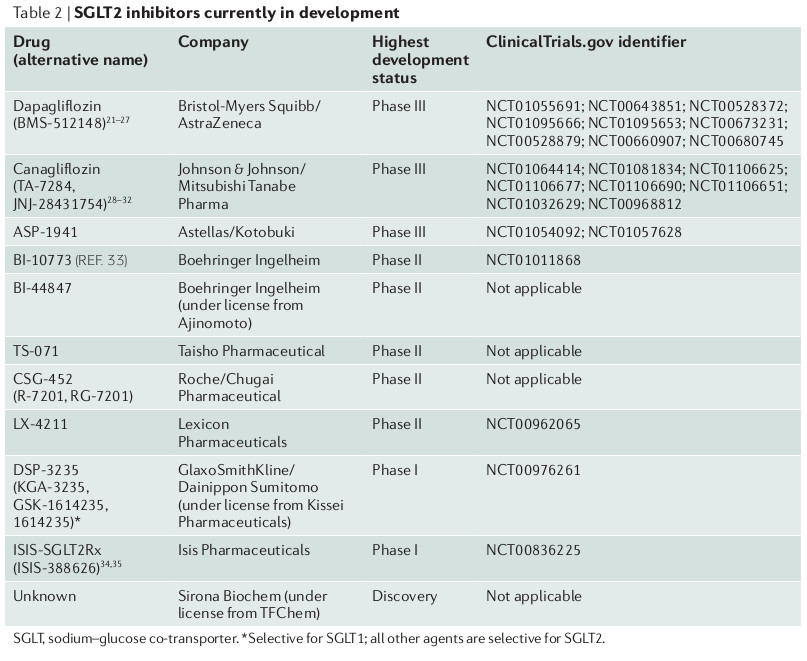
Table below gives an overview of the SGLT2 inhibotors in development.

(Credit: Chao et al 2010)


In summary, increasing urinary glucose excretion represents a new approach to addressing the challenge of hyperglycaemia. SGLT2 inhibitors may have indications both in the prevention and treatment of T2DM, and perhaps T1DM, with a possible application in obesity. Further studies in large numbers of human subjects are necessary to delineate efficacy, safety and how to most effectively use these agents in the treatment of diabetes.

Bibliography

  1. Diabetes Atlas. International Diabetes Federation, (2009) at <www.diabetesatlas.org>
  2. Intensive blood-glucose control with sulphonylureas or insulin compared with conventional treatment and risk of complications in patients with type 2 diabetes (UKPDS 33). UK Prospective Diabetes Study (UKPDS) Group. Lancet 352, 837–853 (1998).
  3. Buse, J. B. et al. Effects of exenatide (exendin-4) on glycemic control over 30 weeks in sulfonylurea-treated patients with type 2 diabetes. Diabetes Care 27, 2628–2635 (2004).
  4. Inzucchi, S. E. Oral antihyperglycemic therapy for type 2 diabetes: scientific review. JAMA 287, 360–372 (2002).
  5. Brown, G. K. Glucose transporters: Structure, function and consequences of deficiency. Journal of Inherited Metabolic Disease 23, 237–246 (2000).
  6. Wright, E. M. Renal Na+-glucose cotransporters. Am J Physiol Renal Physiol 280, F10–F18 (2001).
  7. Chao, E. C. & Henry, R. R. SGLT2 inhibition — a novel strategy for diabetes treatment. Nature Reviews Drug Discovery 9, 551–559 (2010).
  8. Ferrannini, E. & Solini, A. SGLT2 inhibition in diabetes mellitus: rationale and clinical prospects. Nature Reviews Endocrinology 8, 495–502 (2012).


Read Full Post »

Curator & Author: Larry H. Bernstein, MD, FCAP

Leaders in Pharmaceutical Intelligence

Subtitle: Nitric Oxide, Peroxinitrite, and NO donors in Renal Function Loss

Summary: The criticality of renal function is traced to the emergence of animal forms from the sea to land. It also becomes acutely and/or chronically dysfunctional in metabolic, systemic inflammatory and immunological diseases of man. We have already described the key role that nitric oxide and the NO synthases play in reduction of oxidative stress, and we have seen that a balance has to be struck between pro- and anti-oxidative as well as inflammatory elements for avoidance of diseases, specifically involving the circulation, but effectively not limited to any organ system. In this discussion we shall look at kidney function, NO and NO donors. This is an extension of a series of posts on NO and NO related disorders.

__________________________________________________________________________________________________________________________________________________________

Part I. The evolution of kidney structure and Function Evolution of kidney function

In fish the nerves that activate breathing take a short journey from an ancient part of the brain, the brain stem, to the throat and gills. For the ancient tadpole, the nerve controlling a reflex related to hiccup in man served a useful purpose, allowing the entrance to the lung to remain open when breathing air but closing it off when gulping water – which would then be directed only to the gills.

For humans and other mammals it provides a bit of evidence of our common ancestry. DNA evidence has pinned iguanas and chameleons as the closest relatives to snakes. In utero, we develop three separate kidneys in succession, absorbing the first two before we wind up with the embryonic kidney that will become our adult kidney. The first two of these reprise embryonic kidneys of ancestral forms, and in the proper evolutionary order.

The pronephric kidney does not function in human and other mammalian embryos. It disappears and gives rise to the Mesonephric kidney. This kidney filters wastes from the blood and excretes them to the outside of the body via a pair of tubes called the mesonephric ducts (also “Wolffian ducts”). The mesonephric kidney goes on to develop into the adult kidney of fish and amphibians.

This kidney does function for a few weeks in the human embryo, but then disappears as our final kidney forms, which is the Metanephric kidney. This begins developing about five weeks into gestation, and consists of an organ that filters wastes from the blood and excretes them to the outside through a pair ureters. In the embryo, the wastes are excreted directly into the amniotic fluid. The metanephric kidney is the final adult kidney of reptiles, birds, and mammals.

The first two kidneys resemble, in order, those of primitive aquatic vertebrates (lampreys and hagfish) and aquatic or semiaquatic vertebrates (fish and amphibians): an evolutionary order.

The explanation, then, is that we go through developmental stages that show organs resembling those of our ancestors. Take a step back and we see that fresh water fish have glomerular filtration. Cardiac contraction provides the pressure to force the water, small molecules, and ions into the glomerulus as nephric filtrate. The essential ingredients are then reclaimed by the tubules, returning to the blood in the capillaries surrounding the tubules. The amphibian kidney also functions chiefly as a device for excreting excess water.

But the problem is to conserve water, not eliminate it. The frog adjusts to the varying water content of its surroundings by adjusting the rate of filtration at the glomerulus. When blood flow through the glomerulus is restricted, a renal portal system is present to carry away materials reabsorbed through the tubules. Bird kidneys function like those of reptiles (from which they are descended). Uric acid is also their chief nitrogenous waste. All mammals share our use of urea as their chief nitrogenous waste. Urea requires much more water to be excreted than does uric acid. Mammals produce large amounts of nephric filtrate but are able to reabsorb most of this in the tubules. But even so, humans lose several hundred ml each day in flushing urea out of the body.

In his hypothesis of the evolution of renal function Homer Smith proposed that the formation of glomerular nephron and body armor had been adequate for the appearance of primitive vertebrates in fresh water and that the adaptation of homoiotherms to terrestrial life was accompanied by the appearance of the loop of Henle.

In the current paper, the increase in the arterial blood supply and glomerular filtration rate and the sharp elevation of the proximal reabsorption are viewed as important mechanisms in the evolution of the kidney. The presence of glomeruli in myxines and of nephron loops in lampreys suggests that fresh water animals used the preformed glomerular apparatus of early vertebrates, while mechanisms of urinary concentration was associated with the subdivision of the kidney into the renal cortex and medulla. The principles of evolution of renal functions can be observed at several levels of organizations in the kidney.

Natochin YV. Evolutionary aspects of renal function. Kidney International 1996; 49: 1539–1542; doi:10.1038/ki.1996.220. Smith HW: From Fish to Philosopher. Boston, Little, Brown, 1953.

___________________________________________________________________________________________________________________________________________________________

The Kidney: Anatomy and Physiology

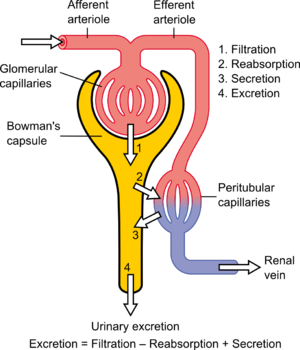
The kidney lies in the lower abdomen capped by the adrenal glands. It has an outer cortex and an inner medulla. The basic unit is the nephron, which filters blood at the glomerulus, and not only filters urine eliminating mainly urea, also uric acid, and other nitrogenous waste, but also reabsorbs Na+ in exchange for H+/(reciprocal K+) through the carbonic anhydrase of the epithelium. In addition, it serves as a endocrine organ and receptor through the renin-angiotensin/aldosterone system, sensitivity to water loss controlled by antidiuretic hormone, and is sensitive to the natriuretic peptides of the heart. The kidney is an elegant structure with a high concentration of glomeruli in the cortex, and in the medulla one finds a U-shaped tube that is critical in a countercurrent multiplier system with a descending limb, Loop of Henley, and ascending limb.

As the filtrate flows through the glomerulus into the descending limb, there is reabsorption of glucose and of H+ by the carbonic anhydrase conversion to water and CO2, except with serious acidemia, in which K+ is reabsorbed with H+ loss to the filtrate, resulting in a hyperkalemia. In the descending limb Na+ is absorbed into the interstitium, and the hypertonic interstitium draws water back for circulation, regulated by the action of ADH on the epithelium of the ascending limb. The result in terms of basic urinary clearance, the volume of urine loss is moderated by the amount needed for circulation (10 units of whole blood) without dehydration, and an amount sufficient for metabolite loss (including drug metabolites). The urine flows into the kidney pelvis and flow down the ureters.

The renal blood flow needs mention. The blood reaches the glomerulus by way of the afferent arteriole and leaves by way of the efferent arteriole. In a book by the Harvard Pathologist Shields Warren on diabetes he made a distinction between hypertension and diabetes in that efferent arteriolar sclerosis is present in both, but diabetes is uniquely identified by afferent arteriolar sclerosis. In diabetes you also have a typical glomerulosclerosis, which might be related to the same hyalinization found in the pancreatic islets – a secondary amyloidosis.

______________________________________________________________________________________________________________________________________________________________

English: Nephron, Diagram of the urine formati...

English: Nephron, Diagram of the urine formation. The number inside tubular urin concentration in mOsm/l – when ADH acts Polski: Nefron, Schemat tworzenia moczu. Cyfry wewnątrz kanalików oznaczają lokalne stężenie w mOsm/l – gdy działa ADH (dochodzi do zagęszczania moczu). (Photo credit: Wikipedia)
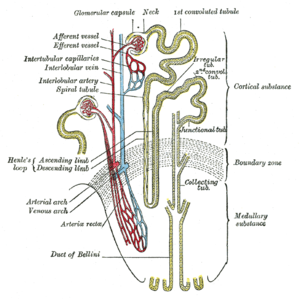
Loop of Henle (Grey's Anatomy book)

Loop of Henle (Grey’s Anatomy book) (Photo credit: Wikipedia)

Frontal section through the kidney

Frontal section through the kidney (Photo credit: Wikipedia)

_____________________________________________________________________________________________________________________________________________________________
_ Part IIa. Nitric Oxide role in renal tubular epithelial cell function Tubulointerstitial Nephritides

As part of the exponential growth in our understanding of nitric oxide (NO) in health and disease over the past 2 decades, the kidney has become appreciated as a major site where NO may play a number of important roles. Although earlier work on the kidney focused more on effects of NO at the level of larger blood vessels and glomeruli, there has been a rapidly growing body of work showing critical roles for NO in tubulointerstitial disease. In this review we discuss some of the recent contributions to this important field.

Mattana J, Adamidis A, Singhal PC. Nitric oxide and tubulointerstitial nephritides. Seminars in Nephrology 2004; 24(4):345-353.

Nitric oxide donors and renal tubular (subepithelial) matrix

Nitric oxide (NO) and its metabolite, peroxynitrite (ONOO-), are involved in renal tubular cell injury. If NO/ONOO- has an effect to reduce cell adhesion to the basement membrane, does this effect contribute to tubular obstruction and would it be partially responsible for the harmful effect of NO on the tubular epithelium during acute renal failure (ARF)?

Wangsiripaisan A, et al. examined the effect of the NO donors

  • [1] (z)-1-[2-(2-aminoethyl)-N-(2-ammonioethyl)amino]diazen-1- ium-1, 2-diolate (DETA/NO),
  • [2] spermine NONOate (SpNO), and
  • [3] the ONOO- donor 3-morpholinosydnonimine (SIN-1) on

cell-matrix adhesion to collagen types I and IV, and also fibronectin using three renal tubular epithelial cell lines:

  • [1] LLC-PK1,
  • [2] BSC-1, and
  • [3] OK.

It was only the exposure to SIN-1 that caused a dose-dependent impairment in cell-matrix adhesion.

Similar results were obtained in the different cell types and matrix proteins. The effect of SIN-1 (500 microM) on LLC-PK1 cell adhesion was not associated with either cell death or alteration of matrix protein and was attenuated by either

  • [1] the NO scavenger 2-(4-carboxyphenyl)-4,4,5,5-tetramethylimidazoline-1-oxyl-3-oxide,
  • [2] the superoxide scavenger superoxide dismutase, or
  • [3] the ONOO- scavenger uric acid in a dose-dependent manner.

These investigators concluded in this seminal paper that ONOO- generated in the tubular epithelium during ischemia/reperfusion has the potential to impair the adhesion properties of tubular cells, which then may contribute to the tubular obstruction in ARF.

Wangsiripaisan A, Gengaro PE, Nemenoff RA, Ling H, et al. Effect of nitric oxide donors on renal tubular epithelial cell-matrix adhesion. Kidney Int 1999; 55(6):2281-8.

Coexpressed Nitric Oxide Synthase and Apical β1 Integrins

In sepsis-induced acute renal failure, actin cytoskeletal alterations result in shedding of proximal tubule epithelial cells (PTEC) and tubular obstruction.

This study examined the hypothesis that inflammatory cytokines, released early in sepsis, cause PTEC cytoskeletal damage and alter integrin-dependent cell-matrix adhesion. The question of whether the intermediate nitric oxide (NO) modulates these cytokine effects was also examined. After exposure of human PTEC to tumor necrosis factor-α, interleukin-1α, and interferon-γ, the actin cytoskeleton was disrupted and cells became elongated, with extension of long filopodial processes.

Cytokines induced shedding of viable, apoptotic, and necrotic PTEC, which was dependent on NO synthesized by inducible NO synthase (iNOS) produced as a result of cytokine actions on PTEC. Basolateral exposure of polarized PTEC monolayers to cytokines induced maximal NO-dependent cell shedding, mediated in part through NO effects on cGMP. Cell shedding was accompanied by dispersal of basolateral β1 integrins and E-cadherin, with corresponding upregulation of integrin expression in clusters of cells elevated above the epithelial monolayer.

These cells demonstrated coexpression of iNOS and apically redistributed β1 integrins. These authors point out that the major ligand involved in cell anchorage was laminin, probably through interactions with the integrin α3β1.

This interaction was downregulated by cytokines but was not dependent on NO. They posulate a mechanism by which inflammatory cytokines induce PTEC damage in sepsis, in the absence of hypotension and ischemia.

Glynne PA, Picot J and Evans TJ. Coexpressed Nitric Oxide Synthase and Apical β1 Integrins Influence Tubule Cell Adhesion after Cytokine-Induced Injury. JASN 2001; 12(11): 2370-2383.

Potentiation by Nitric Oxide of Apoptosis in Renal Proximal Tubule Cells

Proximal tubular epithelial cells (PTEC) exhibit a high sensitivity to undergo apoptosis in response to proinflammatory stimuli and immunosuppressors and participate in the onset of several renal diseases. This study examined the expression of inducible nitric oxide (NO) synthase after challenge of PTEC with bacterial cell wall molecules and inflammatory cytokines and analyzed the pathways that lead to apoptosis in these cells by measuring changes in the mitochondrial transmembrane potential and caspase activation.

The data show that the apoptotic effects of proinflammatory stimuli mainly were due to the expression of inducible NO synthase. Cyclosporin A and FK506 inhibited partially NO synthesis.

However, both NO and immunosuppressors induced apoptosis, probably through a common mechanism that involved the irreversible opening of the mitochondrial permeability transition pore. Activation of caspases 3 and 7 was observed in cells treated with high doses of NO and with moderate concentrations of immunosuppressors.

The conclusion is that the cooperation between NO and immunosuppressors that induce apoptosis in PTEC might contribute to the renal toxicity observed in the course of immunosuppressive therapy.

Hortelano S, Castilla M, Torres AM, Tejedor A, and Bosca L.  Potentiation by Nitric Oxide of Cyclosporin A and FK506- Induced Apoptosis in Renal Proximal Tubule Cells. J Am Soc Nephrol 2000; 11: 2315–2323.

___________________________________________________________________________________________________________________________________________________________

Part IIb. Related studies with ROS and/or RNS on nonrenal epithelial cells

Reactive nitrogen species block cell cycle re-entry Endogenous sources of reactive nitrogen species (RNS) act as second messengers in a variety of cell signaling events, whereas environmental sources of RNS like nitrogen dioxide (NO2) inhibit cell survival and growth through covalent modification of cellular macromolecules. Murine type II alveolar cells arrested in G0 by serum deprivation were exposed to either NO2 or SIN-1, a generator of RNS, during cell cycle re-entry.

In serum-stimulated cells, RNS blocked cyclin D1 gene expression, resulting in cell cycle arrest at the boundary between G0 and G1. Dichlorofluorescin diacetate (DCF) fluorescence indicated that RNS induced sustained production of intracellular hydrogen peroxide (H2O2), which normally is produced only transiently in response to serum growth factors.

Loading cells with catalase prevented enhanced DCF fluorescence and rescued cyclin D1 expression and S phase entry.

These studies indicate environmental RNS interfere with cell cycle re-entry through an H2O2-dependent mechanism that influences expression of cyclin D1 and progression from G0 to the G1 phase of the cell cycle.

Yuan Z, Schellekens H, Warner L, Janssen-Heininger Y, Burch P, Heintz NH. Reactive nitrogen species block cell cycle re-entry through sustained production of hydrogen peroxide. Am J Respir Cell Mol Biol. 2003;28(6):705-12. Epub 2003 Jan 10.

Peroxynitrite modulates MnSOD gene expression

Peroxynitrite (ONOO-) is a strong oxidant derived from nitric oxide (‘NO) and superoxide (O2.-), reactive nitrogen (RNS) and oxygen species (ROS) present in inflamed tissue. Other oxidant stresses, e.g., TNF-alpha and hyperoxia,   induce mitochondrial, manganese-containing superoxide dismutase (MnSOD) gene expression.   3-morpholinosydnonimine HCI (SIN-1) (10 or 1000 microM) increased MnSOD mRNA, but did not change hypoxanthine guanine phosphoribosyl transferase (HPRT) mRNA.   Authentic peroxynitrite (ONOO ) (100-500 microM) also increased MnSOD mRNA but did not change constitutive HPRT mRNA expression.   ONOO stimulated luciferase gene expression driven by a 2.5 kb fragment of the rat MnSOD gene 5′ promoter region.

MnSOD gene induction due to ONOO- was

  • [1] inhibited effectively by L-cysteine (10 mM) and
  • [2] partially inhibited by N-acetyl cysteine (NAC)(50 mM) or
  • [3] pyrrole dithiocarbamate (10 mM).

.NO from 1-propanamine, 3-(2-hydroxy-2-nitroso-1-propylhydrazine) (PAPA NONOate) (100 or 1000 microM) did not change MnSOD or HPRT mRNA, nor did either H202 or NO2-, breakdown products of SIN-1 and ONOO, have any effect on MnSOD mRNA expression; ONOO- and SIN-1 also did not increase detectable MnSOD protein content or increase MnSOD enzymatic activity.

Nevertheless, increased steady state [O2.-] in the presence of .NO yields ONOO , and ONOO has direct, stimulatory effects on MnSOD transcript expression driven at the MnSOD gene 5′ promoter region inhibited completely by L-cysteine and partly by N-acetyl cysteine in lung epithelial cells. This raises a question of whether the same effect is seen in renal tubular epithelium.

Jackson RM, Parish G, Helton ES. Peroxynitrite modulates MnSOD gene expression in lung epithelial cells. Free Radic Biol Med. 1998; 25(4-5):463-72.

Comparative impacts of glutathione peroxidase-1 gene knockout on oxidative stress

Selenium-dependent glutathione peroxidase-1 (GPX1) protects against reactive-oxygen-species (ROS)-induced oxidative stress in vivo, but its role in coping with reactive nitrogen species (RNS) is unclear. Primary hepatocytes were isolated from GPX1-knockout (KO) and wild-type (WT) mice to test protection of GPX1 against cytotoxicity of

  • [1] superoxide generator diquat (DQ),
  • [2]NO donor S-nitroso-N-acetyl-penicillamine (SNAP) and
  • [3] peroxynitrite generator 3-morpholinosydnonimine (SIN-1).

Treating cells with SNAP in addition to DQ produced synergistic cytotoxicity that minimized differences in apoptotic cell death and oxidative injuries between the KO and WT cells. Less protein nitrotyrosine was induced by 0.05-0.5 mM DQ+0.25 mM SNAP in the KO than in the WT cells.

Total GPX activity in the WT cells was reduced by 65 and 25% by 0.5 mM DQ+0.1 mM SNAP and 0.5 mM DQ, respectively. Decreases in Cu,Zn-superoxide dismutase (SOD) activity and increases in Mn-SOD activity in response to DQ or DQ+SNAP were greater in the KO cells than in the WT cells.

The study indicates GPX1 was more effective in protecting hepatocytes against oxidative injuries mediated by ROS alone than by ROS and RNS together, and knockout of GPX1 did not enhance cell susceptibility to RNS-associated cytotoxicity. Instead, it attenuated protein nitration induced by DQ+SNAP.

To better understand the mechanism(s) underlying nitric oxide (. NO)-mediated toxicity, in the presence and absence of concomitant oxidant exposure, postmitotic terminally differentiated NT2N cells (which are incapable of producing . NO) were exposed to [1]PAPA-NONOate (PAPA/NO) and [2] 3-morpholinosydnonimine (SIN-1).

Exposure to SIN-1, which generated peroxynitrite (ONOO) in the range of 25-750 nM/min, produced a concentration- and time-dependent delayed cell death.   In contrast, a critical threshold concentration (>440 nM/min) was required for . NO to produce significant cell injury.   There is a largely necrotic lesion after ONOO exposure and an apoptotic-like morphology after . NO exposure.

Cellular levels of reduced thiols correlated with cell death, and pretreatment with N-acetylcysteine (NAC) fully protected from cell death in either PAPA/NO or SIN-1 exposure. NAC given within the first 3 h posttreatment further delayed cell death and increased the intracellular thiol level in SIN-1 but not . NO-exposed cells.

Cell injury from . NO was independent of cGMP, caspases, and superoxide or peroxynitrite formation.   Overall, exposure of non-. NO-producing cells to . NO or peroxynitrite results in delayed cell death, which, although occurring by different mechanisms,   appears to be mediated by the loss of intracellular redox balance.

Gow AJ, Chen Q, Gole M, Themistocleous M, Lee VM, Ischiropoulos H. Two distinct mechanisms of nitric oxide-mediated neuronal cell death show thiol dependency. Am J Physiol Cell Physiol. 2000; 278(6):C1099-107.

NO2 effect on phosphatidyl choline   Nitrogen dioxide (NO2) inhalation affects the extracellular surfactant as well as the structure and function of type II pneumocytes.

The studies had differences in oxidant concentration, duration of exposure, and mode of NO2 application. This study evaluated the influence of the NO2 application mode on the phospholipid metabolism of type II pneumocytes. Rats were exposed to identical NO2 body doses (720 ppm x h), which were applied continuously (10 ppm for 3 d), intermittently (10 ppm for 8 h per day, for 9 d), and repeatedly (10 ppm for 3 d, 28 d rest, and then 10 ppm for 3 d). Immediately after exposure, type II cells were isolated and evaluated for cell yield, vitality, phosphatidylcholine (PC) synthesis, and secretion.

Type II pneumocyte cell yield was only increased from animals that had been continuously exposed to NO2, but vitality of the isolated type II pneumocytes was not affected by the NO2 exposure modes. Continuous application of 720 ppm x h NO2 resulted in increased activity of the cytidine-5-diphosphate (CDP)-choline pathway.   After continuous NO2 application,

  • [1] specific activity of choline kinase,
  • [2] cytidine triphosphate (CTP):cholinephosphate cytidylyltransferase,
  • [3] uptake of choline, and
  • [4] pool sizes of CDP-choline and PC   were significantly increased over those of controls.

Intermittent application of this NO2 body dose provoked less increase in PC synthesis and the synthesis parameters were comparable to those for cells from control animals after repeated exposure. Whereas PC synthesis in type II cells was stimulated by NO2, their secretory activity was reduced.   Continuous exposure reduced the secretory activity most, whereas intermittent exposure nonsignificantly reduced this activity as compared with that of controls. The repeated application of NO2 produced no differences.

The authors conclude that…. type II pneumocytes adapt to NO2 atmospheres depending on the mode of its application, at least for the metabolism of PC and its secretion from isolated type II pneumocytes.

The reader asks whether this effect could also be found in renal epithelial cells, for which PC is not considered vital as for type II pneumocytes and possibly related to surfactant activity in the lung.

Müller B, Seifart C, von Wichert P, Barth PJ. Adaptation of rat type II pneumocytes to NO2: effects of NO2 application mode on phosphatidylcholine metabolism. Am J Respir Cell Mol Biol. 1998; 18(5): 712-20.

iNOS involved in immediate response to anaphylaxis

The generation of large quantities of nitric oxide (NO) is implicated in the pathogenesis of anaphylactic shock. The source of NO, however, has not been established and conflicting results have been obtained when investigators have tried to inhibit its production in anaphylaxis.

This study analyzed the expression of inducible nitric oxide synthase (iNOS) and endothelial nitric oxide synthase (eNOS) in a mouse model of anaphylaxis.   BALB/c mice were sensitized and challenged with ovalbumin to induce anaphylaxis. Tissues were removed from the heart and lungs, and blood was drawn at different time points during the first 48 hours after induction of anaphylaxis. The Griess assay was used to measure nitric oxide generation.

Nitric oxide synthase expression was examined by reverse transcriptase polymerase chain reaction and immunohistochemistry. A significant increase in iNOS mRNA expression and nitric oxide production was evident as early as 10 to 30 minutes after allergen challenge in both heart and lungs.

In contrast, expression of eNOS mRNA was not altered during the course of the experiment. The results support involvement of iNOS in the immediate physiological response of anaphylaxis.

Sade K, Schwartz IF, Etkin S, Schwartzenberg S, et al. Expression of Inducible Nitric Oxide Synthase in a Mouse Model of Anaphylaxis. J Investig Allergol Clin Immunol 2007; 17(6):379-385.

________________________________________________________________________________________________________________________________________________________

Part IIc. Additional Nonrenal Related NO References

1. Nitrogen dioxide induces death in lung epithelial cells in a density-dependent manner. Persinger RL, Blay WM, Heintz NH, Hemenway DR, Janssen-Heininger YM. Am J Respir Cell Mol Biol. 2001 May;24(5):583-90. PMID: 11350828 [PubMed – indexed for MEDLINE] Free Article

2. Molecular mechanisms of nitrogen dioxide induced epithelial injury in the lung. Persinger RL, Poynter ME, Ckless K, Janssen-Heininger YM. Mol Cell Biochem. 2002 May-Jun;234-235(1-2):71-80. Review. PMID: 12162462 [PubMed – indexed for MEDLINE]

3. Nitric oxide and peroxynitrite-mediated pulmonary cell death. Gow AJ, Thom SR, Ischiropoulos H. Am J Physiol. 1998 Jan;274(1 Pt 1):L112-8. PMID: 9458808 [PubMed – indexed for MEDLINE] Free Article

4. Mitogen-activated protein kinases mediate peroxynitrite-induced cell death in human bronchial epithelial cells. Nabeyrat E, Jones GE, Fenwick PS, Barnes PJ, Donnelly LE. Am J Physiol Lung Cell Mol Physiol. 2003 Jun;284(6):L1112-20. Epub 2003 Feb 21. PMID: 12598225 [PubMed – indexed for MEDLINE] Free Article

5. Peroxynitrite inhibits inducible (type 2) nitric oxide synthase in murine lung epithelial cells in vitro. Robinson VK, Sato E, Nelson DK, Camhi SL, Robbins RA, Hoyt JC. Free Radic Biol Med. 2001 May 1;30(9):986-91. PMID: 11316578 [PubMed – indexed for MEDLINE]

6. Nitric oxide-mediated chondrocyte cell death requires the generation of additional reactive oxygen species. Del Carlo M Jr, Loeser RF. Arthritis Rheum. 2002 Feb;46(2):394-403. PMID: 11840442 [PubMed – indexed for MEDLINE]

7. Colon epithelial cell death in 2,4,6-trinitrobenzenesulfonic acid-induced colitis is associated with increased inducible nitric-oxide synthase expression and peroxynitrite production.

Yue G, Lai PS, Yin K, Sun FF, Nagele RG, Liu X, Linask KK, Wang C, Lin KT, Wong PY. J Pharmacol Exp Ther. 2001 Jun;297(3):915-25. PMID: 11356911 [PubMed – indexed for MEDLINE] Free Article

__________________________________________________________________________________________________________________________________________________________

Part IIIa. Acute renal failure   Acute renal failure (ARF), characterized by sudden loss of the ability of the kidneys to [1] excrete wastes, [2] concentrate urine, [3] conserve electrolytes, and [4] maintain fluid balance, is a frequent clinical problem, particularly in the intensive care unit, where it is associated with a mortality of between 50% and 80%.

This clinical entity was described as an acute loss of kidney function that occurred in severely injured crush victims because of histological evidence for patchy necrosis of renal tubules at autopsy. In the clinical setting, the terms ATN and acute renal failure (ARF) are frequently used interchangeably. However, ARF does not include increases in blood urea due to [1] reversible renal vasoconstriction (prerenal azotemia) or [2] urinary tract obstruction (postrenal azotemia). Acute hemodialysis was first used clinically during the Korean War in 1950 to treat military casualties, and this led to a decrease in mortality of the ARF clinical syndrome from about 90% to about 50%.   In the half century that has since passed, much has been learned about the pathogenesis of ischemic and nephrotoxic ARF in experimental models, but there has been very little improvement in mortality. This may be explained by changing demographics: [1] the age of patients with ARF continues to rise, and [2] comorbid diseases are increasingly common in this population. Both factors may obscure any increased survival related to improved critical care. Examining the incidence of ARF in several military conflicts does, however, provide some optimism. The incidence of ARF in seriously injured casualties decreased between World War II and the Korean War, and again between that war and the Vietnam War, despite the lack of any obvious difference in the severity of the injuries. What was different was the rapidity of the fluid resuscitation of the patients? Fluid resuscitation on the battlefield with the rapid evacuation of the casualties to hospitals by helicopter began during the Korean War and was optimized further during the Vietnam War. For seriously injured casualties the incidence of ischemic ARF was one in 200 in the Korean War and one in 600 in the Vietnam War. This historical sequence of events suggests that early intervention could prevent the occurrence of ARF, at least in military casualties.   In experimental studies it has been shown that progression from an azotemic state associated with renal vasoconstriction and intact tubular function (prerenal azotemia) to established ARF with tubular dysfunction occurs if the renal ischemia is prolonged. Moreover, early intervention with fluid resuscitation was shown to prevent the progression from prerenal azotemia to established ARF. Diagnostic evaluation of ARF One important question, therefore, is how to assure that an early diagnosis of acute renal vasoconstriction can be made prior to the occurrence of tubular dysfunction, thus providing the potential to prevent progression to established ARF. In this regard, past diagnostics relied on observation of the patient response to a fluid challenge: [1] decreasing levels of blood urea nitrogen (BUN) indicated the presence of reversible vasoconstriction, [2] while uncontrolled accumulation of nitrogenous waste products, i.e., BUN and serum creatinine, indicated established ARF.

This approach, however, frequently led to massive fluid overload in the ARF patient with resultant

  • [1] pulmonary congestion,
  • [2] hypoxia, and
  • [3] premature need for mechanical ventilatory support and/or hemodialysis.

On this background the focus turned to an evaluation of urine sediment and urine chemistries to differentiate between renal vasoconstriction with intact tubular function and established ARF.

It was well established that if tubular function was intact, renal vasoconstriction was associated with enhanced tubular sodium reabsorption. Specifically, the fraction of filtered sodium that is rapidly reabsorbed by normal tubules of the vasoconstricted kidney is greater than 99%.

Thus, when nitrogenous wastes, such as creatinine and urea, accumulate in the blood due to a fall in glomerular filtration rate (GFR) secondary to renal vasoconstriction with intact tubular function, the fractional excretion of filtered sodium (FENa = [(urine sodium × plasma creatinine) / (plasma sodium × urine creatinine)]) is less than 1%. An exception to this physiological response of the normal kidney to vasoconstriction is when the patient is receiving a diuretic, including mannitol, or has glucosuria, which decreases tubular sodium reabsorption and increases FENa.

It has recently been shown in the presence of diuretics that a rate of fractional excretion of urea (FEurea) of less than 35 indicates intact tubular function, thus favoring renal vasoconstriction rather than established ARF as a cause of the azotemia.

___________________________________________________________________________________________________________________________________________________________

English: Physiology of Nephron

English: Physiology of Nephron (Photo credit: Wikipedia)
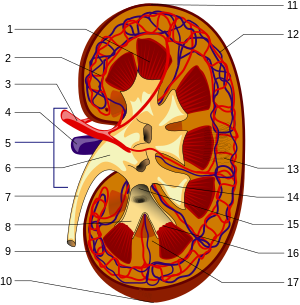
Structures of the kidney: 1.Renal pyramid 2.In...

Structures of the kidney: 1.Renal pyramid 2.Interlobar artery 3.Renal artery 4.Renal vein 5.Renal hilum 6.Renal pelvis 7.Ureter 8.Minor calyx 9.Renal capsule 10.Inferior renal capsule 11.Superior renal capsule 12.Interlobar vein 13.Nephron 14.Minor calyx 15.Major calyx 16.Renal papilla 17.Renal column (no distinction for red/blue (oxygenated or not) blood, arteriole is between capilaries and larger vessels (Photo credit: Wikipedia)

_

______________________________________________________________________________________________________________________________________________________

Mechanisms of ARF

Based on the foregoing comments, this discussion of mechanisms of ARF will not include nitrogenous-waste accumulation due to renal vasoconstriction with intact tubular function (prerenal azotemia) or urinary tract obstruction (postrenal azotemia). The mechanisms of ARF involve both vascular and tubular factors. An ischemic insult to the kidney will in general be the cause of the ARF. While a decrease in renal blood flow with diminished oxygen and substrate delivery to the tubule cells is an important ischemic factor, it must be remembered that a relative increase in oxygen demand by the tubule is also a factor in renal ischemia.

Approximately 30–70% of these shed epithelial tubule cells in the urine are viable and can be grown in culture. Recent studies using cellular and molecular techniques have provided information relating to the structural abnormalities of injured renal tubules that occur both in vitro and in vivo. In vitro studies using chemical anoxia have revealed abnormalities in the proximal tubule cytoskeleton that are associated with translocation of Na+/K+-ATPase from the basolateral to the apical membrane.

A comparison of cadaveric transplanted kidneys with delayed versus prompt graft function has also provided important results regarding the role of Na+/K+-ATPase in ischemic renal injury. This study demonstrated that, compared with kidneys with prompt graft function, those with delayed graft function had a significantly greater cytoplasmic concentration of Na+/K+-ATPase and actin-binding proteins — spectrin (also known as fodrin) and ankyrin — that had translocated from the basolateral membrane to the cytoplasm.

Such a translocation of Na+/K+-ATPase from the basolateral membrane to the cytoplasm could explain the decrease in tubular sodium reabsorption that occurs with ARF. An important focus of research is the mechanisms whereby the critical residence of Na+/K+-ATPase in the basolateral membrane (which facilitates vectorial sodium transport) is uncoupled by hypoxia or ischemia.  The actin-binding proteins,

  • spectrin and
  • ankyrin,

serve as substrates for the calcium-activated cysteine protease calpain.

________________________________________________________________________________________________________________________________________________________

In vitro studies in proximal tubules have shown a rapid rise in cytosolic calcium concentration during acute hypoxia, which antedates the evidence of tubular injury as assessed by lactic dehydrogenase (LDH) release. There is further evidence to support the importance of the translocation of Na+/K+-ATPase from the basolateral membrane to the cytoplasm during renal ischemia/reperfusion.

Specifically, calpain-mediated breakdown products of the actin-binding protein spectrin occur with renal ischemia. Calpain activity was demonstrated to increase during hypoxia in isolated proximal tubules. Measurement of LDH release following calpain inhibition indicated attenuation of hypoxic damage to proximal tubules. There was no evidence of an increase in cathepsin, a (cysteine protease) in proximal tubules during hypoxia , but there is a calcium-independent pathway for calpain activation during hypoxia.

Calpastatin, an endogenous cellular inhibitor of calpain activation, was shown to be diminished during hypoxia in association with the rise in another cysteine protease, caspase.

This effect of diminished calpastatin activity could be reversed by caspase inhibition. Proteolytic pathways appear to be involved in calpain-mediated proximal tubule cell injury during hypoxia. Calcium activation of phospholipase A has also been shown to contribute to renal tubular injury during ischemia.

________________________________________________________________________________________________________________________________________________________

Tubular obstruction during ARF

The existence of proteolytic pathways involving cysteine proteases, namely calpain and caspases, may therefore explain

  • the decrease in proximal tubule sodium reabsorption and
  • increased FENa

secondary to proteolytic uncoupling of Na+/K+-ATPase from its basolateral membrane anchoring proteins.

This tubular perturbation alone, however, does not explain the fall in GFR that leads to nitrogenous-waste retention and thus the rise in BUN and serum creatinine.   Decreased proximal tubule sodium reabsorption may lead to a decreased GFR during ARF. First of all, brush border membranes and cellular debris could provide the substrate for intraluminal obstruction in the highly resistant portion of distal nephrons.

In fact, microdissection of individual nephrons of kidneys from patients with ARF demonstrated obstructing casts in distal tubules and collecting ducts. This observation could explain the dilated proximal tubules that are observed upon renal biopsy of ARF kidneys. The intraluminal casts in ARF kidneys stain prominently for Tamm-Horsfall protein (THP), which is produced in the thick ascending limb. Importantly, THP is secreted into tubular fluid as a monomer but subsequently may become a polymer that forms a gel-like material in the presence of increased luminal Na+ concentration, as occurs in the distal nephron during clinical ARF with the decrease in tubular sodium reabsorption.

Thus, the THP polymeric gel in the distal nephron provides an intraluminal environment for distal cast formation involving viable, apoptotic, and necrotic cells.

The loss of the tubular epithelial cell barrier and/or the tight junctions between viable cells during acute renal ischemia could lead to a leak of glomerular filtrate back into the circulation. (If this occurs and normally non-reabsorbable substances, such as inulin, leak back into the circulation, then a falsely low GFR will be measured as inulin clearance. It should be noted, however, that the degree of extensive tubular damage observed in experimental studies demonstrating tubular fluid backleak is rarely observed with clinical ARF in humans). Moreover, dextran sieving studies in patients with ARF demonstrated that, at best, only a 10% decrease in GFR could be explained by backleak of filtrate. Cadaveric transplanted kidneys with delayed graft function, however, may have severe tubular necrosis, and thus backleak of glomerular filtration may be more important in this setting.

Inflammation and NO

There is now substantial evidence for the involvement of inflammation in the pathogenesis of the decreased GFR associated with acute renal ischemic injury. In this regard, there is experimental evidence that iNOS may contribute to tubular injury during ARF. Hypoxia in isolated proximal tubules has been shown to increase NO release, and there is increased iNOS protein expression in ischemic kidney homogenates. An antisense oligonucleotide was shown to block the upregulation of iNOS and afford functional protection against acute renal ischemia. Moreover, when isolated proximal tubules from iNOS, eNOS, and neuronal NO synthase (nNOS) knockout mice were exposed to hypoxia, only the tubules from the iNOS knockout mice were protected against hypoxia, as assessed by LDH release. The iNOS knockout mice were also shown to have lower mortality during ischemia/reperfusion than wild-type mice.  The scavenging of NO by oxygen radicals produces peroxynitrite causing tubule damage during ischemia. While iNOS may contribute to ischemic injury of renal tubules,  the vascular effect of eNOS in the glomerular afferent arteriole is protective against ischemic injury. In this regard, eNOS knockout mice are more sensitive to endotoxin-related injury than normal mice.

Moreover, the protective role of vascular eNOS may be more important than the deleterious effect of iNOS at the tubule level during renal ischemia.   This is because treatment of mice with the nonspecific NO synthase (NOS) inhibitor L-NAME, which blocks both iNOS and eNOS, worsens renal ischemic injury. NO may downregulate eNOS and is a potent inducer of heme oxygenase-1, which has been shown to be cytoprotective against renal injury. The MAPK pathway also appears to be involved in renal oxidant injury. Activation of extracellular signal–regulated kinase (ERK) or inhibition of JNK ameliorates oxidant injury–induced necrosis in mouse renal proximal tubule cells in vitro. Upregulation of ERK may also be important in the effect of preconditioning whereby early ischemia affords protection against a subsequent ischemia/reperfusion insult. Alterations in cell cycling are also involved in renal ischemic injury. Upregulation of p21, which inhibits cell cycling, appears to allow cellular repair and regeneration, whereas homozygous p21 knockout mice demonstrate enhanced cell necrosis in response to an ischemic insult.

Prolonged duration of the ARF clinical course and the need for dialysis are major factors projecting a poor prognosis. Patients with ARF who require dialysis have a 50–70% mortality rate. Infection and cardiopulmonary complications are the major causes of death in patients with ARF. Excessive fluid administration in patients with established ARF may lead to pulmonary congestion, hypoxia, the need for ventilatory support, pneumonia, and multiorgan dysfunction syndrome, which has an 80–90% mortality rate. Until means to reverse the diminished host defense mechanisms in azotemic patients with clinical ARF are available, every effort should be made to avoid invasive procedures such as the placement of bladder catheters, intravenous lines, and mechanical ventilation. Over and above such supportive care, it may be that combination therapy will be necessary to prevent or attenuate the course of ARF. Such combination therapy must involve agents with potential beneficial effects on vascular tone, tubular obstruction, and inflammation.

Schrier RW, Wang W, Poole B, and Mitra A. Acute renal failure: definitions, diagnosis, pathogenesis, and therapy. The Journal of Clinical Investigation 2004; 114(1):5-14. http://www.jci.org

______________________________________________________________________________________________________________________________________________________

Part IIIb. Additional Related References on NO, oxidative stress and Kidney

Shelgikar PJ, Deshpande KH, Sardeshmukh AS, Katkam RV, Suryakarl AN. Role of oxidants and antioxidants in ARF patients undergoing hemodialysis. Indian J Nephrol 2005;15: 73-76.

Lee JW. Renal Dysfunction in Patients with Chronic Liver Disease. Electrolytes Blood Press 7:42-50, 2009ㆍdoi: 10.5049/EBP.2009.7.2.42.

Saadat H, et al. Endothelial Nitric Oxide Function and Tubular Injury in Premature Infants. Int J App Sci and Technol 2012; 7(6): 77-81. http://www.ijastnet.com.

Amerisan MS. Cardiovascular disease in chronic kidney disease. Indian J Nephrol 2005;15: 1-7.

___________________________________________________________________________________________________________________________________________________________

Traditional risk factors for CVD in CKD

  • Hypertension
  • Older Age
  • Diabetes Mellitus
  • Male gender
  • High LDL
  • White Race
  • Low HDL
  • Physical inactivity
  • Smoking
  • Menopause
  • LVH

CKD Related CV Risk Factors

  • Blood Pressure
  • ? Homocysteinemia
  • Anemia
  • ? Inflammation
  •   Ca++ x P++
  • ? NO synthesis
  • Na+ Retention
  • ? Lp (a)
  • Hypervolemia
  • ? Insulin Resistance
  • Proteinuria & Hypoalbuminemia
  • Iron over load
  • ? Adeponectin
  • ??Vit. C or E
  • ? 5 Lipoxygenase
  • ROS
  • Genetic factors
  • ADMA (Asymmetric Dimethyl Arginine)

S Vikrant, SC Tiwari. Essential Hypertension – Pathogenesis and Pathophysiology. J Indian Acad Clinical Medicine 2001; 2(3):141-161. Scheme for pathogenesis of salt dependent hypertension.

The hypothesis proposes that early hypertension is episodic and is mediated by a hyperactive sympathetic nervous system or activated renin-angiotensin system.

Cell membrane alterations

Hypotheses linking abnormal ionic fluxes to increased peripheral resistance through increase in cell sodium, calcium, or pH.   The hypertension that is more common in obese people may arise in large part from the insulin resistance and resultant hyperinsulinaemia that results from the increased mass of fat. However, rather unexpectedly, insulin resistance may also be involved in hypertension in non-obese people.

Overall scheme for the mechanisms by which obesity, if predominantly upper body or visceral in location, could promote

________________________________________________________________________________________________________________________________________________________

  • diabetes,
  • dyslipidemia and
  • hypertension via hyperinsulinemia.

The explanation for insulin resistance found in as many as half of nonobese hypertensive is not obvious and may involve one or more aspects of insulin’s action

__________________________________________________________________________________________________________________________________________________________

Proposed mechanisms by which insulin resistance and/or hyperinsulinemia may lead to increased blood pressure.

  1. Enhanced renal sodium and water reabsorption.
  2. Increased blood pressure sensitivity to dietary salt intake
  3. Augmentation of the pressure and
  4. aldosterone responses to AII
  5. Changes in transmembrane electrolyte transport
  • a. Increased intracellular sodium
  • b. Decreased Na+/K+ – ATPase activity
  • c. Increased intracellular Ca2+ pump activity
  • d. Increased intracellular Ca2+ accumulation
  • e. Stimulation of growth factors

___________________________________________________________________________________________________________________________________________________________

Part IV. New Insights on NO donors

This study investigated the involvement of nitric oxide (NO) into the irradiation-induced increase of cell attachment. These experiments explored the cellular mechanisms of low-power laser therapy. HeLa cells were irradiated with a monochromatic visible-tonear infrared radiation (600–860 nm, 52 J/m2) or with a diode laser (820 nm, 8–120 J/m2) and the number of cells attached to a glass matrix was counted after 30 minute incubation at 37oC. The NO donors

  1. sodium nitroprusside (SNP),
  2. glyceryl trinitrate (GTN), or
  3. sodium nitrite (NaNO2)

were added to the cellular suspension before or after irradiation. The action spectra and the concentration and fluence dependencies obtained were compared and analyzed.

The well-structured action spectrum for the increase of the adhesion of the cells, with maxima at 619, 657, 675, 740, 760, and 820 nm, points to the existence of a photoacceptor responsible for the enhancement of this property (supposedly cytochrome c oxidase, the terminal respiratory chain enzyme), as well as signaling pathways between the cell mitochondria, plasma membrane, and nucleus.

Treating the cellular suspension with SNP before irradiation significantly modifies the action spectrum for the enhancement of the cell attachment property (band maxima at 642, 685, 700, 742, 842, and 856 nm). The action of SNP, GTN, andNaNO2 added before or after irradiation depends on their concentration and radiation fluence.

The NO donors added to the cellular suspension before irradiation eliminate the radiation induced increase in the number of cells attached to the glass matrix, supposedly by way of binding NO to cytochrome c oxidase. NO added to the suspension after irradiation can also inhibit the light-induced signal downstream. Both effects of NO depend on the concentration of the NO donors added.

The results indicate that NO can control the irradiation-activated reactions that increase the attachment of cells.

Karu TI, Pyatibrat LV, and Afanasyeva NI. Cellular Effects of Low Power Laser Therapy Can be Mediated by Nitric Oxide. Lasers Surg. Med 2005; 36:307–314.

IFNa-2b (IFN-a) effect on barrier function of renal tubular epithelium

IFNa treatment can be accompanied by impaired renal function and capillary leak. This study shows IFNa produced dose-dependent and time-dependent decrease in transepithelial resistance (TER) ameliorated by tyrphostin, an inhibitor of phosphotyrosine kinase with increased expression of occludin and E-cadherin. In conclusion, IFNa can directly affect barrier function in renal epithelial cells via ovewrexpression or missorting of the junctional proteins occludin and E-cadherin.

Lechner J, Krall M, Netzer A, Radmayr C, et al. Effects of interferon a-2b on barrier function and junctional complexes of renal proximal tubulat LLC-pK1 cells. Kidney Int 1999; 55:2178-2191.

Ischemia-reperfusion injury

The pathophysiology of acute renal failure (ARF) is complex and not well understood. Numerous models of ARF suggest that oxygen-derived reactive species are important in renal ischemia-reperfusion (I-R) injury, but the nature of the mediators is still controversial. Treatment with oxygen radical scavengers, antioxidants, and iron chelators such as

  • superoxide dismutase,
  • dimethylthiourea,
  • allopurinol, and
  • deferoxamine

are protective in some models, and suggest a role for the hydroxyl radical formation. However, these compounds are not protective in all models of I-R injury, and direct evidence for the generation of hydroxyl radical is absent. Furthermore, these inhibitors have another property in common.

They all directly scavenge or inhibit the formation of peroxynitrite (ONOO−), a highly toxic species derived from nitric oxide (NO) and superoxide. Thus, the protective effects seen with these inhibitors may be due in part to their ability to inhibit ONOO− formation. Even though reactive oxygen species are thought to participate in ischemia-reperfusion (I-R) injury, induction of and production of high levels of  inducible nitric oxide (NO)  also contribute to this injury.

NO combines with superoxide to form the potent oxidant peroxynitrite (ONOO−). NO and ONOO− were investigated in a rat model of renal I-R injury using the selective iNOS inhibitor L-N6-(1-iminoethyl)lysine (L-NIL).

I-R surgery significantly increased plasma creatinine levels to 1.9 ± 0.3 mg/dl (P < .05) and caused renal cortical necrosis. L-NIL administration (3 mg/kg) in animals subjected to I-R significantly decreased plasma creatinine levels to 1.2 ± 0.10 mg/dl (P < .05 compared with I-R) and reduced tubular damage.

ONOO− formation was evaluated by detecting 3-nitrotyrosine-protein adducts (3NTyPAs), a stable biomarker of ONOO− formation.   The kidneys from I-R animals had increased levels of 3NTyPAs compared with control animals   L-NIL-treated rats (3 mg/kg) subjected to I-R showed decreased levels of 3NTyPAs.

These results suggests that iNOS-generated NO mediates damage in I-R injury possibly through ONOO− formation.

______________________________________________________________________________________________________________________________________________________

In summary,

  1. 3-nitrotyrosine-protein adducts were detected in renal tubules after I-R injury.
  2. Selective inhibition of iNOS by L-NIL decreased injury, improved renal function, and decreased apparent ONOO− formation.
  3. Reactive nitrogen species should be considered potential therapeutic targets in the prevention and treatment of renal I-R injury.

_______________________________________________________________________________________________________________________________________________________

Walker LM, Walker PD, Imam SZ, et al. Evidence for Peroxynitrite Formation in Renal Ischemia-Reperfusion Injury: Studies with the Inducible Nitric Oxide Synthase InhibitorL-N6-(1-Iminoethyl)lysine1. 2000.

Role of TNFa independent of iNOS Renal failure is a frequent complication of sepsis, mediated by renal vasoconstrictors and vasodilators. Endotoxin induces several proinflammatory cytokines, among which tumor necrosis factor (TNF) is thought to be of major importance. Tumor necrosis factor (TNF) has been suggested to be a factor in the acute renal failure in sepsis or endotoxemia. Passive immunization by anti-TNFa prevented development of septic shock in animal experiments.The development of ARF involves excessive intrarenal vasoconstriction. Involvement of nitric oxide (NO), generated by inducible NO synthase (iNOS), is still a factor in the pathogenesis of endotoxin-induced renal failure. TNF-a leads to a decrease in glomerular filtration rate (GFR).

This study tested the hypothesis that the role of TNF-a in endotoxic shock related ARF is mediated by iNOS-derived NO.   An injection of lipopolysaccharide (LPS) constituent of gram-negative bacteria to wild-type mice resulted in a 70% decrease in glomerular filtration rate (GFR) and in a 40% reduction in renal plasma flow (RPF) 16 hours after the injection.   The results occurred independent of hypotension, morphological changes, apoptosis, and leukocyte accumulation. In mice pretreated with TNFsRp55, only a 30% decrease in GFR was observed without a significant change in RPF as compared with controls. Pretreatment with TNKsRp55 on renal function Wild-type mice were pretreated with TNFsRp55(10 mg/kg IP)  for one hour before the administration of 5 mg/kg intraperitoneal endotoxin. GFR and RPF were determined 16 hours thereafter. Data are expressed as mean 6, SEM, N 5 6. *P , 0.05 vs. Control; §P , 0.05 vs. LPS, by ANOVA.

The serum NO concentration was significantly lower in endotoxemic wild-type mice pretreated with TNFsRp55, as compared with untreated endotoxemic wild-type mice. In LPS-injected iNOS knockout mice and wild-type mice treated with a selective iNOS inhibitor, 1400W, the development of renal failure was similar to that in wild-type mice. As in wild-type mice,TNFsRp55 significantly attenuated the decrease in GFR (a 33% decline, as compared with 75% without TNFsRp55) without a significant change in RPF in iNOS knockout mice given LPS. These results demonstrate a role of TNF in the early renal dysfunction (16 h) in a septic mouse model independent of iNOS,

  • hypotension,
  • apoptosis,
  • leukocyte accumulation,and
  • morphological alterations,

thus suggesting renal hypoperfusion secondary to an imbalance between, as yet to be defined renal vasoconstrictors and vasodilators.

Knotek M, Rogachev B, Wang W,….., Edelstein CL, Dinarello CA, and Schrier RW. Endotoxemic renal failure in mice: Role of tumor necrosis factor independent of inducible nitric oxide synthase. Kidney International 2001; 59:2243–2249

Ischemic acute renal failure

Inflammation plays a major role in the pathophysiology of acute renal failure resulting from ischemia. This review discusses the contribution of

  • endothelial
  • epithelial cells and
  • leukocytes

to this inflammatory response. The roles of cytokines/chemokines in the injury and recovery phase are reviewed. The protection of mouse kidney prior to exposure to ischemia or urinary tract obstruction is  a potential model to  search for pharmacologic agents to protect the kidney against injury by inflammatory mediators produced by tubular epithelial cells and activated leukocytes in renal ischemia/reperfusion (I/R) injury. Tubular epithelia produce

  • TNF-a,
  • IL-1,
  • IL-6,
  • IL-8,
  • TGF-b,
  • MCP-1,
  • ENA-78,
  • RANTES, and
  • fractalkines,

whereas leukocytes produce

  • TNF-a,
  • IL-1,
  • IL-8,
  • MCP-1,
  • ROS, and
  • eicosanoids.

The release of these chemokines and cytokines serve as effectors for a positive feedback pathway enhancing inflammation and cell injury, the cycle of tubular epithelial cell injury and repair following renal ischemia/reperfusion.   Tubular epithelia are typically cuboidal in shape and apically-basally polarized; the Na+/K+-ATPase localizes to basolateral plasma membranes, whereas cell adhesion molecules, such as integrins localize basally. In response to ischemia reperfusion,

  • the Na+/K+-ATPase appears apically, and
  • integrins are detected on lateral and basal plasma membranes.

Some of the injured epithelial cells undergo necrosis and/or apoptosis detaching from the underlying basement membrane into the tubular space where they contribute to tubular occlusion. Viable cells that remain attached, dedifferentiate, spread, and migrate to repopulate the denuded basement membrane. With cell proliferation, cell-cell and cell-matrix contacts are restored, and the epithelium redifferentiates and repolarizes, forming a functional, normal epithelium Inflammation is a significant component of renal I/R injury, playing a considerable role in its pathophysiology.

Although significant progress has been made in defining the major components of this process, the complex cross-talk between endothelial cells, inflammatory cells, and the injured epithelium with each generating and often responding to cytokines and chemokines is not well understood. In addition, we have not yet taken full advantage of the large body of data on inflammation in other organ systems.

Furthermore, preconditioning the kidney to afford protection to subsequent bouts of ischemia may serve as a useful model challenging us to therapeutically mimic endogenous mechanisms of protection.

Understanding the inflammatory response prevalent in ischemic kidney injury will facilitate identification of molecular targets for therapeutic intervention.

Bonventre JV and Zuk A. Ischemic acute renal failure: An inflammatory disease? Forefronts in Nephrology 2002;.. :480-485

Gene expression profiles in renal proximal tubules In kidney disease renal proximal tubular epithelial cells (RPTEC) actively contribute to the progression of tubulointerstitial fibrosisby mediating both

  • an inflammatory response and
  • via epithelial-to-mesenchymal transition.

Using laser capture microdissection we specifically isolated RPTEC from cryosections of the healthy parts of kidneys removed owing to renal cell carcinoma and from kidney biopsies from patients with proteinuric nephropathies. RNA was extracted and hybridized to complementary DNA microarrays after linear RNA amplification. Statistical analysis identified 168 unique genes with known gene ontology association, which separated patients from controls. Besides distinct alterations in signal-transduction pathways (e.g. Wnt signalling), functional annotation revealed a significant upregulation of genes involved in

_________________________________________________________________________________________________________________________________________________________

  • cell proliferation and cell cycle control (like insulin-like growth factor 1 or cell division cycle 34),
  • cell differentiation (e.g. bone morphogenetic protein 7),
  • immune response,
  • intracellular transport and
  • metabolism

__________________________________________________________________________________________________________________________________________________________

in RPTEC from patients.

The study also revealed differential expression of a number of genes responsible for cell adhesion (like BH-protocadherin) with a marked downregulation of most of these transcripts. In summary, the results obtained from RPTEC revealed a differential regulation of genes, which are likely to be involved in either pro-fibrotic or tubulo-protective mechanisms in proteinuric patients at an early stage of kidney disease.

Rudnicki M, Eder S, Perco P, Enrich J, et al. Gene expression profiles of human proximal tubular epithelial cells in proteinuric nephropathies. Kidney International 2006; xx:1-11. Kidney International advance online publication, 20 December 2006; doi:10.1038/sj.ki.5002043. http://www.kidney-international.org

Oxidative stress involved with diabetic nephropathy

Diabetic Nephropathy (DN) poses a major health problem. There is strong evidence for a potential role of the eNOS gene. This case control study investigated the possible role of genetic variants of the endothelial Nitric Oxide Synthase (eNOS) gene and oxidative stress in the pathogenesis of nephropathy in patients with diabetes mellitus. The study included 124 diabetic patients;

  1. 68 of these patients had no diabetic nephropathy (group 1) while
  2. 56 patients exhibited symptoms of diabetic nephropathy (group 2).
  3. Sixty two healthy non-diabetic individuals were also included as a control group.

Blood samples from subjects and controls were analyzed to investigate the eNOS genotypes and to estimate

  • the lipid profile and
  • markers of oxidative stress such as malondialdehyde (MDA) and nitric oxide (NO).

No significant differences were found in the frequency of eNOS genotypes between diabetic patients (either in group 1 or group 2) and controls (p >0.05). Also, no significant differences were found in the frequency of eNOS genotypes between group 1 and group 2 (p >0.05). Both group 1 and group 2 had significantly higher levels of nitrite and MDA when compared with controls (all p = 0.0001). Also group 2 patients had significantly higher levels of nitrite and MDA when compared with group 1 (p = 0.02, p = 0.001 respectively).

The higher serum level of the markers of oxidative stress in diabetic patients particularly those with diabetic nephropathy suggest that oxidative stress and not the eNOS gene polymorphism is involved in the pathogenesis of the diabetic nephropathy in this subset of patients

Badawy A, Elbaz R, Abbas AM, Ahmed Elgendy A, et al. Oxidative stress and not endothelial Nitric Oxide Synthase gene polymorphism involved in diabetic nephropathy. Journal of Diabetes and Endocrinology 2011; 2(3): 29-35.

Metformin in renal ischemia reperfusion

Renal ischemia plays an important role in renal impairment and transplantation. Metformin is a biguanide used in type 2 diabetes, it inhibits hepatic glucose production and increases peripheral insulin sensitivity. While the mode of action of metformin is incompletely understood, it appears to have anti-inflammatory and antioxidant effects involved in its beneficial effects on insulin resistance.   Control, Sham, ischemia/reperfusion (I/R) and Metformin treated I /R groups   A renal I/R injury was done by a left renal pedicle occlusion to induce ischemia for 45 min followed by 60 min of reperfusion with contralateral nephrectomy. Metformin pretreated I/R rats in a dose of 200 mg/kg/day for three weeks before ischemia induction.

  • Nitric oxide (NO),
  • tumor necrosis factor alpha (TNF α) ,
  • catalase (CAT) and
  • reduced glutathione (GSH) activities

were determined in renal tissue, while

  • creatinine clearance (CrCl) ,
  • blood urea nitrogen (BUN) were measured and

5 hour urinary volume and electrolytes were estimated . BUN and CrCl levels in the I/R group were significantly higher than in control rats (p<0.05) table (1).

__________________________________________________________________________________________________________________________________

Table 1: Creatinine clearance (Cr Cl) and blood urea nitrogen (BUN) levels in control and test groups.
(Mean ± SD)

Groups CrCl   (ml/min) BUN (mg/dl)
Control group 1.30 ±0.11 14.30±0.25
Sham group+ metformin 1.27±0.09 15.70±0.19
I/R group (P1) 1.85±0.25 (<0.001 ) 28.00±0.62 (<0.001)
I/R+ metformin group (P2,P3) 1.55±0.22 (0.001, 0.028) 18.10±1.00 (<0.001, <0.001)
  • P1: Statistical significance between control
    group and saline treated I/R group.
  • P2 Statistical significance between control
    group and Metformin treated I/R group.
  • P3 Statistical significance between saline treated
    I/R group and Metformin treated I/R group

_______________________________________________________________________________________________________________________________________________________

When metformin was administered before I/R, BUN and CrCl levels were still significantly higher than control group but their elevation were significantly lower in comparison to I/R group alone (P<0.05).   TNF α and NO levels were significantly higher in the I/R group than those of the control group (Table 2). Pre-treatment with metformin significantly lowered their levels in comparison to I/R group (P<0.05).

________________________________________________________________________________________________________________________________________________________

Table 2: Tumor necrosis factor α (TNF α) and inducible nitric oxide (iNO) levels in control and test groups.
(Mean ± SD)

Groups TNF α (pmol/mg tissue) iNO (nmol/ mg tissue)
Control group 1 7.60 ±5.98 2.54 ± 0.82
Sham group+ metformin 16.70 ±5.50 2.35 ±0.80
I/R group (P1) 54. 00±6.02 (<0.001) 4.50±0.89 (<0.001)
I/R+metformin group (P2,P3) 39 ± 14.01 (<0.001, 0.006) 3.53±0.95 (0.02, 0.03)


  • P1: Statistical significance between control group
    and saline treated I/R group.
  • P2 Statistical significance between control group
    and Metformin treated I/R group.
  • P3 Statistical significance between saline treated
    I/R group and Metformin treated I/R group

_________________________________________________________________________________________________________________________________________________________

These results showed significant increase in NO,TNF α, BUN , CrCl and significant decrease in urinary volume , electrolytes, CAT and GSH activities in the I/R group than those in the control group. Metformin decreased significantly NO, TNF α, BUN and CrCl while increased urinary volume, electrolytes, CAT and GSH activities.   Lipid peroxidation is related to I/R induced tissue injury. Production of inducible NO synthase (NOS) under lipid peroxidation and inflammatory conditions results in the induction of NO which react with O2 liberating peroxynitrite (OONO-). NO itself inactivates the antioxidant enzyme system CAT and GSH. Alteration in NO synthesis have been observed in other kidney injuries as nephrotoxicity and acute renal failure induced by endotoxins.

Treatment with iNOS inhibitors improved renal function and decreased peroxynitrite radical which is believed to be responsible for the shedding of proximal convoluted tubules in I/R.   Metformin produced anti-inflammatory renoprotective effect on CrCl and diuresis in renal I/R injury.

Malek HA. The possible mechanism of action of metformin in renal ischemia reperfusion in rats. The Pharma Research Journal 2011; 6(1):42-49.

Possible role of NO donors in ARFThe L-arginine-nitric oxide (NO) pathway has been implicated in many physiological functions in the kidney, including

  • regulation of glomerular hemodynamics,
  • mediation of pressure-natriuresis,
  • maintenance of medullary perfusion,
  • blunting of tubuloglomerular feedback (TGF),
  • inhibition of tubular sodium reabsorption and
  • modulation of renal sympathetic nerve activity

Its net effect in the kidney is to promote natriuresis and diuresis, contributing to adaptation to variations of dietary salt intake and maintenance of normal blood pressure. Nitric oxide has been implicated in many physiologic processes that influence both acute and long-term control of kidney function. Its net effect in the kidney is to promote natriuresis and diuresis, contributing to adaptation to variations of dietary salt intake and maintenance of normal blood pressure. A pretreatment with nitric oxide donors or L-arginine may prevent the ischemic acute renal injury. In chronic kidney diseases, the systolic blood pressure is correlated with the plasma level of asymmetric dimethylarginine, an endogenous inhibitor of nitric oxide synthase. A reduced production and biological action of nitric oxide is associated with an elevation of arterial pressure, and conversely, an exaggerated activity may represent a compensatory mechanism to mitigate the hypertension.

JongUn Lee. Nitric Oxide in the Kidney : Its Physiological Role and Pathophysiological Implications. Electrolyte & Blood Pressure 2008; 6:27-34.

Renal Hypoxia and Dysoxia following Reperfusion

Acute renal failure (ARF) is a common condition which develops in 5% of hospitalized patients. Of the patients who develop ARF, ~10% eventually require renal replacement therapy. Among critical care patients who have acute renal failure and survive, 2%-10% develop terminal renal failure and require long-term dialysis.   The kidneys are particularly susceptible to ischemic injury in many clinical conditions such as renal transplantation, treatment of suprarenal aneurysms, renal artery reconstructions, contrast-agent induced nephropathy, cardiac arrest, and shock. One reason for renal sensitivity to ischemia is that the kidney microvasculature is highly complex and must meet a high energy demand.

Under normal, steady state conditions, the oxygen (O2) supply to the renal tissues is well in excess of oxygen demand.   Under pathological conditions, the delicate balance of oxygen supply versus demand is easily disturbed due to the unique arrangement of the renal microvasculature and its increasing numbers of diffusive shunting pathways.  

The renal microvasculature is serially organized, with almost all descending vasa recta emerging from the efferent arterioles of the juxtamedullary glomeruli. Adequate tissue oxygenation is thus partially dependent on the maintenance of medullary perfusion by adequate cortical perfusion. This, combined with the low amount of medullary blood flow (~10% of total renal blood flow) in the U-shaped microvasculature of the medulla allows O2 shunting between the descending and ascending vasa recta and contributes to the high sensitivity of the medulla and cortico-medullary junction to decreased O2 supply.

Whereas past investigations have focused mainly on tubular injury as the main cause of ischemia-related acute renal failure, increasing evidence implicates alterations in the intra-renal microcirculation pathway and in the O2 handling. Indeed, although acute tubular necrosis (ATN) has classically been believed to be the leading cause of ARF, data from biopsies in patients with ATN have shown few or no changes consistent with tubular necrosis.

The role played by microvascular dysfunction, however, has generated increasing interest. The complex pathophysiology of ischemic ARF includes the inevitable

  • reperfusion phase associated with oxidative stress,
  • cellular dysfunction and
  • altered signal transduction.

During this process, alterations in oxygen transport pathways can result in cellular hypoxia and/or dysoxia. In this context, the distinction between hypoxia and dysoxiais that

  • cellular hypoxia refers to the condition of decreased availability of oxygen due to inadequate convective delivery from the microcirculation.
  • Cellular dysoxia, in contrast, refers to a pathological condition where the ability of mitochondria to perform oxidative phosphorylation is limited, regardless of the amount of available oxygen.

_______________________________________________________________________________________________________________________________________________________

The latter condition is associated with mitochondrial failure and/or activation of alternative pathways for oxygen consumption. Thus, we would expect that an optimal balance between oxygen supply and demand is essential to reducing damage from renal ischemia-reperfusion (I/R) injury. Complex interactions exist between

  • tubular injury,
  • microvascular injury, and
  • inflammation after renal I/R.

On the one hand, insults to the tubule cells promotes the liberation of a number of inflammatory mediators, such as TNF-á, IL-6, TGF-â, and chemotactic cytokines(RANTES, monocyte chemotactic protein-1, ENA-78, Gro-á, and IL-8). On the other hand, chemokine production can promote

  • leukocyte-endothelium interactions and
  • leukocyte activation,

resulting in…..

  • renal blood flow impairment and
  • the expansion of tubular damage
  • impaired renal hemodynamics and
  • electrolyte reabsorption

Adequate medullary tissue oxygenation, in terms of balanced oxygen supply and demand, is dependent on the maintenance of medullary perfusion by adequate cortical perfusion and also on the high rate of O2 consumption required for active electrolyte transport. Furthermore, renal blood flow is closely associated with renal sodium transport, mitochondrial activity and NO-mediated O2 consumption In addition to having a limited O2 supply due to the anatomy of the microcirculation anatomy, the sensitivity of the medulla to hypoxic conditions results from this high O2 consumption.

Renal sodium transport is the main O2-consuming function of the kidney and is closely linked to renal blood flow for sodium transport, particularly in the thick ascending limbs of the loop of Henle and the S3 segments of the proximal tubules. Medullary renal blood flow is also highly dependent on cortical perfusion, with almost all descending vasa recta emerging from the efferent arteriole of juxta medullary glomeruli. A profound reduction in cortical perfusion can disrupt medullary blood flow and lead to an imbalance between O2 supply and O2 consumption. On theother hand, inhibition of tubular reabsorption by diuretics increases medullary pO2 by decreasing the activity of Na+/K+-ATPases and local O2 consumption.

Mitochondrial activity and NO-mediated O2 consumption

The medulla has been found to be the main site of production of NO in the kidney. In addition to the actions described above, NO appears to be a key regulator of renal tubule cell metabolism by inhibiting the activity of the Na+-K+-2Cl- cotransporter and reducing Na+/H+ exchange. Since superoxide (O2-) is required to inhibit solute transport activity, it was assumed that these effects were mediated by peroxynitrite (OONO-). Indeed, mitochondrial nNOS upregulation, together with an increase in NO production, has been shown to increase mitochondrial peroxynitrite generation, which in turn, can induce cytochrome c release and promote apoptosis. NO has also been shown to directly compete with O2 at the mitochondrial level. These findings support the idea that NO acts as an endogenous regulator to match O2 supply to O2 consumption, especially in the renal medulla.   NO reversibly binds to the O2 binding site of cytochrome oxidase, and acts as a potent, rapidMitochondrial activity and NO-mediated O2 consumption, and reversible inhibitor of cytochrome oxidase in competition with molecular O2. This inhibition could be dependent on the O2 level, since the IC50 (the concentration of NO that reduces the specified response by half) decreases with reduction in O2 concentration. The inhibition of electron flux at the cytochrome oxidase level switches the electron transport chain to a reduced state, and consequently leads to depolarization of the mitochondrial membrane potential and electron leakage.

To summarize, while the NO/O2 ratio can act as a regulator of cellular O2 consumption by matching decreases in O2 delivery to decreases in cellular O2 cellular, the inhibitory effect of NO on mitochondrial respiration under hypoxic conditions further impairs cellular aerobic metabolism. This leads to a state of “cytopathic hypoxia,” as described in the sepsis literature.   Only cell-secreted NO competes with O2 and to regulate mitochondrial respiration. In addition to the 3 isoforms (eNOS, iNOS, cnNOS), an α-isoform of neuronal NOS, the mitochondrial isoform (mNOS) located in the inner mitochondrial membrane, has also been shown to regulate mitochondrial respiration. These data support a role for NO in the balanced regulation of renal O2 supply and O2 consumption after renal I/R However, the relationships between the determinants of O2 supply, O2 consumption, and renal function, and their relation to renal damage remain largely unknown.

Sustained endothelial activation Ischemic renal failure leads to persistent endothelial activation, mainly in the form of endothelium-leukocyte interactions and the activation of adhesion molecules. This persistent activation can compromise renal blood flow, prevent the recovery of adequate tissue oxygenation, and jeopardize tubular cell survival despite the initial recovery of renal tubular function. A 30-50% reduction in microvascular density was seen 40 weeks after renal ischemic injury in a rat model. Vascular rarefaction has been proposed to induce chronic hypoxia resulting in tubulointerstitial fibrosis via the molecular activation of fibrogenic factors such as transforming growth factor (TGF)-β, collagen, and fibronectin, all of which may play an important role in the progression of chronic renal disease.

Adaptation to hypoxia Over the last decade, the role of hypoxia-inducible factors (HIFs) in O2 supply and adaptation to hypoxic conditions has found increasing support. HIFs are O2-sensitive transcription factors involved in O2-dependent gene regulation that mediate cellular adaptation to O2 deprivation and tissue protection under hypoxic conditions in the kidney.   NO generation can promote HIF-1α accumulation in a cGMP-independent manner. However, Hagen et al. (2003) showed that NO may reduce the activation of HIF in hypoxia via the inhibitory effect of NO on cytochrome oxidase.

Therefore, it seems that NO has pleiotropic effects on HIF expression, with various responses related to different pathways. HIF-1α upregulates a number of factors implicated in cytoprotection, including angiogenic growth factors, such as vascular endothelial growth factors (VEGF), endothelial progenitor cell recruitment via the endothelial expression of SDF-1, heme-oxygenase-1 (HO-1), and erythropoietin (EPO), and vasomotor regulation.

HO-1 produces carbon monoxide (a potent vasodilator) while degrading heme, which may preserve tissue blood flow during reperfusion. Thus, it has been suggested that the induction of HO-1 can protect the kidney from ischemic damage by decreasing oxidative damage and NO generation.

Finally, in addition to its anti-apoptotic properties, EPO may protect the kidney from ischemic damage by restoring the renal microcirculation by stimulating the mobilization and differentiation of progenitor cells toward an endothelial phenotype and by inducing NO release from eNOS.

Pharmacological interventions

Use of pharmacological interventions which act at the microcirculatory level may be a successful strategy to overcome ischemia-induced vascular damage and prevent ARF. Activated protein C (APC), an endogenous vitamin K-dependent serine protease with multiple biological activities, may meet these criteria. Along with antithrombotic and profibrinolytic properties, APC can reduce the chemotaxis and interactions of leukocytes with activated endothelium.

However, renal dysfunction was not improved in the largest study published so far. In addition, APC has been discontinued by Lilly for the use intended in severe sepsis. Moreover, neither drugs with renal vasodilatory effects (i.e., dopamine, fenoldopam, endothelin receptors blockers, adenosine antagonists) nor agents that decrease renal oxygen consumption (i.e., loop diuretics) have been shown to protect the kidney from ischemic damage. We have to bear in mind that a magic bullet to treat the highly complex condition of which is renal I/R is not in sight.

We can expect that understanding the balance between O2 delivery and O2 consumption, as well as the function of O2-consuming pathways (i.e., mitochondrial function, reactive oxygen species generation) will be central to this treatment strategy.

Take home point

The deleterious effects of NO are thought to be associated with the NO generated by the induction of iNOS and its contribution to oxidative stress both resulting in vascular dysfunction and tissue damage. Ischemic injury also leads to structural damage to the endothelium and leukocyte infiltration. Consequently, renal tissue hypoxia is proposed to promote the initial tubular damage, leading to acute organ dysfunction.   Comment: I express great appreciation for refeering to this work, which does provide enormous new insights into hypoxia-induced acute renal failure, and ties together the anatomy, physiology, and gene regulation through signaling pathways.

Ince C, Legrand M, Mik E , Johannes T, Payen D. Renal Hypoxia and Dysoxia following Reperfusion of the Ischemic Kidney. Molecular Medicine (Proof) 2008; pp36. http://www.molmed.org

Nitric oxide and non-hemodynamic functions of the kidney

One of the major scientific advances in the past decade in understanding of the renal function and disease is the prolific growth of literature incriminating nitric oxide (NO) in renal physiology and pathophysiology. NO was first shown to be identical with endothelial derived relaxing factor (EDRF) in 1987 and this was followed by a rapid flurry of information defining the significance of NO in not only vascular physiology and hemodynamics but also in neurotransmission, inflammation and immune defense systems. Although most actions of NO are mediated by cyclic guanosine monophosphate (cGMP) signaling, S-nitrosylation of cysteine residues in target proteins constitutes another well defined non-cGMP dependent mechanism of NO effects. Recent years have witnessed a phenomenal scientific interest in the vascular biology, particularly the relevance of nitric oxide (NO) in cardiovascular and renal physiology and pathophysiology. Although hemodynamic actions of NO received initial attention, a variety of non-hemodynamic actions are now known to be mediated by NO in the normal kidney, which include

  • tubular transport of electrolyte and water,
  • maintenance of acid-base homeostasis,
  • modulation of glomerular and interstitial functions,
  • renin-angiotensin activation and
  • regulation of immune defense mechanism in the kidney.

____________________________________________________________________________________________________________________________________________________________

Table 1 : Functions of NO in the kidney

  • 1. Renal macrovascular and microvascular dilatation (afferent > efferent)
  • 2. Regulation of mitochondrial respiration.
  • 3. Modulation renal medullary blood flow
  • 4. Stimulation of fluid, sodium and HCO3 – reabsorption in the proximal tubule
  • 5. Stimulation of renal acidification in proximal tubule by stimulation of NHE activity
  • 6. Inhibition of Na+, Cl- and HCO3 – reabsorption in the mTALH
  • 7. Inhibition of Na+ conductance in the CCD
  • 8. Inhibition of H+-ATPase in CCD

_____________________________________________________________________________________________________________________________________________________________

One of the renal regulatory mechanisms related to maintenance of arterial blood pressure involves the phenomenon of pressure-natriuresis in response to elevation of arterial pressure. This effect implies inhibition of tubular sodium reabsorption resulting in natriuresis, in an effort to lower arterial pressure. Experimental evidence from indicates that intra-renal NO modulates pressure natriuresis.

Furthermore many studies have confirmed the role of intra renal NO in mediating tubulo-glomerular feedback (TGF). In vivo micropuncture studies have shown that NO derived from nNOS in macula densa specifically inhibits the TGF responses leading to renal afferent arteriolar vasoconstriction in response to sodium reabsorption in the distal tubule. Other recent studies support the inhibitory role of NO from eNOS and iNOS in mTALH segment on TGF effects.

Recent observations in vascular biology have yielded new information that endothelial dysfunction early in the course might contribute to the pathophysiology of acute renal failure.  Structural and functional changes in the vascular endothelium are demonstrable in early ischemic renal failure. Altered NO production and /or decreased bioavailability of NO comprise the endothelial function in acute renal failure.

Several studies have indicated imbalance of NOS activity with enhanced expression and activity of iNOS and decreased eNOS in ischemic kidneys.

The imbalance results from enhanced iNOS activity and attenuated eNOS activity in the kidney.  

Many experimental studies support a contributory role for NO in glomerulonephritis (GN). Evidence from recent studies pointed out that NO may be involved in peroxynitrite formation, pro-inflammatory chemokines and signaling pathways in addition to direct glomerular effects that promote albumin permeability in GN. Although originally macrophages and other leukocytes were first considered as the source renal NO production in GN, it is now clear iNOS derived NO from glomerular mesangial cells are the primary source of NO in GN.

In most pathological states, the role of NO is dependent by the stage of the disease, the nitric oxide synthase (NOS) isoform involved and the presence or absence of other modifying intrarenal factors. Additionally NO may have a dual role in several disease states of the kidney such as acute renal failure, inflammatory nephritides, diabetic nephropathy and transplant rejection.

A rapidly growing body of evidence supports a critical role for NO in tubulointerstitial nephritis (TIN). In the rat model of autoimmune TIN, Gabbai et al. demonstrated increased iNOS expression in the kidney and NO metabolites in urine and plasma. However the effects of iNOS on renal damage in TIN seem to have a biphasic effect- since iNOS specific inhibitors (eg. L-Nil) are renoprotective in the acute phase while they actually accelerated the renal damage in the chronic phase.

Thus chronic NOS inhibition is used to induce chronic tubulointerstitial injury and fibrosis along with mild glomerulosclerosis and hypertension.

Major pathways of L-arginine metabolism.

L-arginine may be metabolized by the urea cycle enzyme arginase to L-ornithine and urea by arginine decarboxylase to agmatine and CO2 or by NOS to nitric oxide (NO) and L-citrulline.

Adapted from Klahr S: Can L-arginine manipulation reduce renal disease? Semin Nephrol 1999; 61:304-309.

It is obvious that kidney is not only a major source of arginine and nitric oxide but NO plays an important role in the water and electrolyte balance and acid-base physiology and many other homeostatic functions in the kidney. Unfortunately we are far from a precise understanding of the significance of NO alterations in various disease states primarily due to conflicting data from the existing literature.

Therapeutic potential for manipulation of L-arginine- nitric oxide axis in renal disease states has been discussed. More studies are required to elucidate the abnormalities in NO metabolism in renal diseases and to confirm the therapeutic potential of L-arginine.

Sharma SP. Nitric oxide and the kidney. Indian J Nephrol 2004;14: 77-84

Inhibition of Constitutive Nitric Oxide Synthase

Excess NO generation plays a major role in the hypotension and systemic vasodilatation characteristic of sepsis. Yet the kidney response to sepsis is characterized by vasoconstriction resulting in renal dysfunction. We have examined the roles of inducible nitric oxide synthase (iNOS) and endothelial NOS (eNOS) on the renal effects of lipopolysaccharide administration by comparing the effects of specific iNOS inhibition, L-N6-(1-iminoethyl)lysine (L-NIL), and 2,4-diamino-6-hydroxy-pyrimidine vs. nonspecific NOS inhibitors (nitro-L-arginine-methylester). cGMP responses to carbamylcholine (CCh) (stimulated, basal) and sodium nitroprusside in isolated glomeruli were used as indices of eNOS and guanylate cyclase (GC) activity, respectively. LPS significantly decreased blood pressure and GFR (P =0.05) and inhibited the cGMP response to CCh.

GC activity was reciprocally increased. L-NIL and 2,4-diamino-6-hydroxy-pyrimidine administration prevented the decrease in GFR, restored the normal response to CCh, and GC activity was normalized. In vitro application of L-NIL also restored CCh responses in LPS glomeruli. Neuronal NOS inhibitors verified that CCh responses reflected eNOS activity.

L-NAME, a nonspecific inhibitor, worsened GFR, a reduction that was functional and not related to glomerular thrombosis, and eliminated the CCh response. No differences were observed in eNOS mRNA expression among the experimental groups. Selective iNOS inhibition prevents reductions in GFR, whereas nonselective inhibition of NOS further decreases GFR.

These findings suggest that the decrease in GFR after LPS is due to local inhibition of eNOS by iNOS, possibly via NO autoinhibition.

Schwartz D, Mendonca M, Schwartz I, Xia Y, et al. Inhibition of Constitutive Nitric Oxide Synthase (NOS) by Nitric Oxide Generated by Inducible NOS after Lipopolysaccharide Administration Provokes Renal Dysfunction in Rats. J. Clin. Invest. 1997; 100:439–448.

Salt-Sensitivity and Hypertension Renin-angiotensin system (RAS) plays a key role in the regulation of renal function, volume of extracellular fluid and blood pressure. The activation of RAS also induces oxidative stress, particularly superoxide anion (O2-) formation.

Although the involvement of O2 – production in the pathology of many diseases is known for long, recent studies also strongly suggest its physiological regulatory function of many organs including the kidney. However, a marked accumulation of O2- in the kidney alters normal regulation of renal function and may contribute to the development of salt-sensitivity and hypertension.

In the kidney, O2- acts as vasoconstrictor and enhances tubular sodium reabsoption. Nitric oxide (NO), another important radical that exhibits opposite effects than O2 -, is also involved in the regulation of kidney function. O2- rapidly interacts with NO and thus, when O2- production increases, it diminishes the bioavailability of NO leading to the impairment of organ function. As the activation of RAS, particularly the enhanced production of angiotensin II, can induce both O2- and NO generation, it has been suggested that physiological interactions of

  • RAS,
  • NO and
  • O2-

provide a coordinated regulation of kidney function.   The imbalance of these interactions is critically linked to the pathophysiology of salt-sensitivity and hypertension.

Kopkan L, Červenka L. Renal Interactions of Renin-Angiotensin System, Nitric Oxide and Superoxide Anion: Implications in the Pathophysiology of Salt-Sensitivity and Hypertension. Physiol. Res. 2009; 58 (Suppl. 2): S55-S67.

Epicrisis

In this review I attempted to evaluate complex and still incomplete and conflicting conclusions from many studies. I thus broke the report into three major portions:

___________________________________________________________________________________________________________________________________________________________

  • 1 The kidney and its anatomy, physiology, and ontogeny.
  • 2 The pathological disease variation affecting the kidney
  • a: a tie in to eNON and iNos, nitric oxide, cGMP and glutaminase – in acute renal failure, hypertension, chronic renal failure, dialysis the pathology of acute tubular necrosis, glomerular function, efferent arteriolar and kidney medullary circulatory impairment, and cast formation related to Tamm Horsfall protein
  • b :The role of NO, eNOS and iNOS in disorders of the lund alveolar cell and subendothelial matrix, and of liver disease also affecting the kidney, and the heart. c Additional references
  • 3.     a Acute renal failure, oxidate stress, ischemia-reperfusion injury, tubulointerstitial chronic inflammation
  • 3       b Additional references 4. Nitric oxide donors – opportunities for therapeutic targeting? As we see this in as full a context as possible, it is hard to distinguish the cart from the horse.

___________________________________________________________________________________________________________________________________________________________

We know that there is an unquestionable role of NO, and a competing balance to be achieved between eNOS, iNOS, an effect on tubular water and ion-cation reabsorptrion, a role of TNFa, and consequently an important role in essential/malignant hypertension, with the size of the effect related to the stage of disorder, the amount of interstitial fibrosis, the remaining nephron population, the hypertonicity of the medulla, the vasodilation of the medullary circulation, and the renin-angiotensin-aldosterone system. Substantial data and multiple patients with many factors per patient would be need to extract the best model using a supercomputer.

Read Full Post »

Recurrent somatic mutations in chromatin-remodeling and ubiquitin ligase complex genes in serous endometrial tumors

Reporter and Curator: Dr. Sudipta Saha, Ph.D.

Endometrial cancer is the sixth most commonly diagnosed cancer in women worldwide, causing ~74,000 deaths annually1. Serous endometrial cancers are a clinically aggressive subtype with a poorly defined genetic etiology2–4.

Whole-exome sequencing was used to comprehensively search for somatic mutations within ~22,000 protein-encoding genes in 1 13 primary serous endometrial tumors. Subsequently 18 genes were resequenced, which were mutated in more than 1 1 1 tumor and/or were components of an enriched functional grouping, from 40 additional serous tumors. High frequencies of somatic mutations in CHD4 (17%), EP300 (8%), ARID1A (6%), TSPYL2 (6%), FBXW7 (29%), SPOP (8%), MAP3K4 (6%) and ABCC9 (6%) were identified. Overall, 36.5% of serous tumors had a mutated chromatin-remodeling gene, and 35% had a mutated ubiquitin ligase complex gene, implicating frequent mutational disruption of these processes in the molecular pathogenesis of one of the deadliest forms of endometrial cancer.

The study provides new insights into the somatic mutations present in serous endometrial cancer exomes. However, it is important to acknowledge that this discovery screen is underpowered to detect all somatically mutated genes that drive serous tumors. For example, PIK3R1, which was previously found to be somatically mutated in 8% of serous endometrial tumors58, was not somatically mutated in the tumors that formed this discovery screen.

It was estimated that, for genes that are mutated in 8% of all serous endometrial cancers, a discovery screen of 12 tumors has 25% power to detect 2 mutated tumors and 63% power to detect 1 mutated tumor; for genes that are mutated in 20% of all serous endometrial cancers, the discovery screen had an estimated 72.5% power to detect 2 mutated tumors and 93% power to detect 1 mutated tumor.

Massively parallel sequencing of additional cases will undoubtedly yield deeper insights into the mutational landscape of serous endometrial cancer. Here, it was reported one of the first exome sequencing analyses of serous endometrial cancers, which are clinically aggressive tumors that have been poorly characterized genomically.

The findings implicate the disruption of chromatin-remodeling and ubiquitin ligase complex genes in

  • 50% of serous endometrial tumors and
  • 35% of clear-cell endometrial tumors.

The high frequency and specific distributions of mutations in CHD4, FBXW7 and SPOP strongly suggest that these are likely to be driver events in serous endometrial cancer.

Source References:

http://www.ncbi.nlm.nih.gov/pubmed?term=Exome%20sequencing%20of%20serous%20endometrial%20tumors%20identifies%20recurrent%20somatic%20mutations%20in%20chromatin-remodeling%20and%20ubiquitin%20ligase%20complex%20genes


Read Full Post »

GSK for Personalized Medicine using Cancer Drugs needs Alacris systems biology model to determine the in silico effect of the inhibitor in its “virtual clinical trial”

Reporter: Aviva Lev-Ari, PhD, RN

German firm Alacris Theranostics today announced a deal with GlaxoSmithKline for the application of Alacris’ Modcell System for drug stratification.

The technology, which was developed at the Max Planck Institute for Molecular Genetics and is licensed exclusively to Alacris, will be used by GSK for early stage cancer drug discovery. GSK will provide Alacris with preclinical biology data from a cancer drug discovery project. Alacris will apply its systems biology model to determine the in silico effect of the inhibitor in its “virtual clinical trial,” and then suggest cancer cell lines, as well as cancers, that may be likely responders to the inhibitor.

The process will be based on whole-genome and transcriptome data integrated in Alacris’ cancer model ModCell.

Financial terms of the deal were not disclosed.

Based in Berlin, Alacris develops personalized medicine approaches directed at cancer. Its ModCell approach is based on next-generation sequencing and kinetic pathway information, as well as mutation and drug databases.

SOURCE:

http://www.genomeweb.com//node/1153161?hq_e=el&hq_m=1408239&hq_l=2&hq_v=e1df6f3681

What is the strategy of the Competition

Foundation Medicine, AstraZeneca to ID Genetic Mutations for Cancer Drug Development

November 12, 2012

NEW YORK (GenomeWeb News) – Foundation Medicine today announced a deal with AstraZeneca aimed at predicting a patient’s response or resistance to targeted medicines.

The firms are partnering to identify genomic mutations in cancer-related tumor genes that may prove helpful to AstraZeneca in developing new therapies for patients. Foundation Medicine also was granted right of first negotiation for developing potential diagnostic products.

According to Susan Galbraith, vice president and head of the AstraZeneca Oncology Innovative Medicines Unit, the collaboration will allow the drug firm to “identify tumor-specific defects and alterations that can be used for patient segmentation.”

Financial and other terms of the agreement were not disclosed.

“We are helping companies like AstraZeneca achieve deeper insight into their programs and trials with our unique cancer expertise and our ability to provide genomic information that can impact clinical treatment decisions,” Michael Pellini, president and CEO of Foundation Medicine, said in a statement. “Together, we expect to enable a more individualized, targeted approach to cancer drug development and clinical trials.”

The partnership is the most recent in a string of deals that Cambridge, Mass.-based Foundation Medicine has forged in recent months with drug firms. It follows a collaboration with Eisai last month, Clovis Oncologyin August, and Novartis in June.

SOURCE:


Life Tech to Partner with Bristol-Myers Squibb for CDx Development

September 17, 2012
 

NEW YORK (GenomeWeb News) – Life Technologies said today that it would collaborate with Bristol-Myers Squibb to develop companion diagnostics. Initially, the companies will partner on an oncology project with the option to expand collaborative efforts across a range of disease areas.

Life Tech will utilize a variety of its technology platforms including both next-generation and Sanger sequencing instruments, qPCR, flow cytometry, and immuno-histochemistry.

“The pharmaceutical industry is increasingly turning its focus to discovering and delivering targeted, personalized medications,” Life Tech’s President of Medical Sciences, Ronnie Andrews, said in a statement. “As more and more targeted drugs come onto the market in the next decade, there will be a growing need for diagnostics that can help predict which patients will benefit from which drugs.”

The agreement is part of Life Tech’s strategy to expand and develop its diagnostic business through both internal development and also partnerships and acquisitions.

Internally, the company has said that it plans to build out its medical sciences business across multiple technologies and develop assays across five disease areas: oncology, inherited disease, neurological disorders, transplant diagnostics, and infectious diseases.

In addition, in July it acquired direct-to-consumer genomic testing company Navigenics, which gave Life Tech access to its CLIA certified laboratory.

SOURCE:

http://www.genomeweb.com/sequencing/life-tech-partner-bristol-myers-squibb-cdx-development

Life Tech, Boston Children’s Hospital to Develop Sequencing Workflows on Ion Proton in CLIA Lab

June 20, 2012
 

NEW YORK (GenomeWeb News) – Life Technologies said today that it will collaborate with Boston Children’s Hospital to develop next-generation sequencing workflows in a CLIA and CAP certified laboratory.

As part of the collaboration, the hospital plans to purchase Life Tech’s Ion Proton, a benchtop, semiconductor sequencing machine.

David Margulies, director of the Gene Partnership Program at Boston Children’s Hospital, said in statement that the deal is an “important first step toward providing informed, personalized care for patients whose conditions are difficult to treat.”

The deal is Life Tech’s second announced this week to develop sequencing protocols for the Ion Proton in collaboration with a children’s hospital. Earlier this week, it said it would work with the Hospital for Sick Children in Toronto, which has launched a new Centre for Genetic Medicine and plans to install four Proton machines.

Paul Billings, Life Tech’s chief medical officer, commented in a statement that these kinds of partnerships are “essential to our medical sciences strategy as we seek to assist researchers in discovering improved diagnostics and treatments for genetic conditions.”

In a separate announcement today, Life Tech said that it is collaborating with the University of North Texas Health Science Center’s Institute of Applied Genetics to use the firm’s Ion Personal Genome Machine system to further the center’s forensic DNA research. Life Tech said that it will collaborate with the center to train forensic analysts in applying next-gen sequencing to their research.

Foundation Medicine, Novartis Ink New Deal for Clinical Oncology Programs

June 07, 2012
 

NEW YORK (GenomeWeb News) – Foundation Medicine today said it and Novartis have reached a new agreement to use Foundation’s clinical grade, next-generation sequencing to support the drug firm’s clinical oncology programs.

The three-year agreement builds on a 2011 deal between the firms and calls for the use of Foundation Medicine’s molecular information platform across many of Novartis’ Phase 1 and Phase 2 oncology clinical programs. The initial collaboration generated “very interesting” data, and this type of tumor genomic profiling has become an important part of Novartis’ clinical trials, Foundation Medicine said.

Foundation Medicine’s sequencing capabilities allow for the rapid analysis of hundreds of cancer-related genes from formalin-fixed, paraffin-embedded tumor samples, and earlier this year its laboratory in Cambridge, Mass., gained Clinical Laboratory Improvement Amendments certification. Novartis plans to use the technology to align clinical trial enrollment and outcome analysis with the genomic profile of patient tumors, accelerating the development of Novartis’ portfolio of targeted cancer therapeutics and expanding treatment options for patients.

Foundation Medicine added that it may develop additional diagnostic products from the partnership.

“The comprehensive molecular assessment of Novartis’ Oncology clinical trial samples is expected to help to bring potentially lifesaving therapies to the right patients more quickly, and we expect that the wealth of molecular information will help fundamentally improve the way cancer is understood and treated,” Michael Pellini, president and CEO of Foundation Medicine, said in a statement.

Financial and other terms of the deal were not disclosed.

SOURCE:


Carestream Teams with Beatson Institute on Molecular Imaging Efforts

May 14, 2012
NEW YORK (GenomeWeb News) – Carestream Molecular Imaging announced today that it will collaborate with the Beatson Institute for Cancer Research on preclinical imaging approaches in oncology.

The partners will use Carestream’s Alibri trimodal imaging system, which combines PET, SPECT, and CT modalities in one platform. The system is being used by the Beatson Institute in its research into cancer cell behavior, as well as the development of new therapeutic, diagnostic, and prognostic tools.

The Beatson Institute, which is a core-funded institute of Cancer Research UK and is based in Glasgow, Scotland, said the Carestream technology would be used by its own researchers, as well as its close collaborators including the West of Scotland Cancer Center.

“The combination of PET, SPECT, and CT technologies in one instrument provides investigators at our institutions the flexibility to support research programs across many areas of cancer research such as biomarker, theranostics, and drug development,” Kurt Anderson, research professor and director of the Beatson Advanced Imaging Resource, said in a statement.


Read Full Post »

Peroxisome proliferator-activated receptor (PPAR-gamma) Receptors Activation: PPARγ transrepression for Angiogenesis in Cardiovascular Disease and PPARγ transactivation for Treatment of Diabetes

Peroxisome proliferator-activated receptor (PPAR-gamma) Receptors Activation: PPARγ transrepression  for Angiogenesis in Cardiovascular Disease and PPARγ transactivation for Treatment of Diabetes


UPDATED on 11/27/2018

A new combination drug therapy for CVD patients with co-morbidity of DM2 is presented in the following article, representing different mechanism of actions, pathways and a novel treatment proposed in 2018:

Cardiovascular (CV) Disease and Diabetes: New ACC Guidelines for use of two major new classes of diabetes drugs — sodium-glucose cotransporter type 2 (SGLT2) inhibitors and glucagon-like peptide 1 receptor agonists (GLP-1RAs) for reduction of adverse outcomes

https://pharmaceuticalintelligence.com/2018/11/27/cardiovascular-cv-disease-and-diabetes-new-acc-guidelines-for-use-of-two-major-new-classes-of-diabetes-drugs-sodium-glucose-cotransporter-type-2-sglt2-inhibitors-and-glucagon-like/

The title of this article

Peroxisome proliferator-activated receptor (PPAR-gamma) Receptors Activation: PPARγ transrepression  for Angiogenesis in Cardiovascular Disease and PPARγ transactivation for Treatment of Diabetes

represents an explanation for pathways and mechanism of actions of combination drug therapy novel in its conceptualization in 2013.


The research is presented in the following three parts. References for each part are at the end.


PART I:             Genetics and Biochemistry of Peroxisome proliferator-activated receptor

Reporter: Aviva Lev-Ari, PhD, RN

PART II:             Peroxisome proliferator-activated receptors as stimulants of angiogenesis in cardiovascular disease and diabetes

Reporter: Aviva Lev-Ari, PhD, RN

PART III:            PPAR-gamma Role in Activation of eNOS: The Cardiovascular Benefit

Author and Curator: Aviva Lev-Ari, PhD, RN


PART I:

Genetics and Biochemistry of Peroxisome proliferator-activated receptor

PPAR -alpha and -gamma pathways

In the field of molecular biology, the peroxisome proliferator-activated receptors (PPARs) are a group of nuclear receptor proteins that function as transcription factors regulating the expression of genes.[1] PPARs play essential roles in the regulation of cellular differentiation, development, and metabolism (carbohydrate, lipid, protein), and tumorigenesis[2] of higher organisms.[3][4]

Three types of PPARs have been identified: alpha, gamma, and delta (beta):[3]

Physiological function

All PPARs heterodimerize with the retinoid X receptor (RXR) and bind to specific regions on the DNA of target genes. These DNA sequences are termed PPREs (peroxisome proliferator hormone response elements). The DNA consensus sequence is AGGTCANAGGTCA, with N being a random nucleotide. In general, this sequence occurs in the promotor region of a gene, and, when the PPAR binds its ligand, transcription of target genes is increased or decreased, depending on the gene. The RXR also forms a heterodimer with a number of other receptors (e.g., vitamin D and thyroid hormone).

The function of PPARs is modified by the precise shape of their ligand-binding domain (see below) induced by ligand binding and by a number of coactivator and corepressor proteins, the presence of which can stimulate or inhibit receptor function, respectively.[9]

Endogenous ligands for the PPARs include free fatty acids and eicosanoids. PPARγ is activated by PGJ2 (a prostaglandin). In contrast, PPARα is activated by leukotriene B4. PPARγ activation by agonist RS5444 may inhibit anaplastic thyroid cancer growth.[10]

Peroxisome proliferator-activated receptor

Peroxisome proliferator-activated receptor (Photo credit: Wikipedia)

Genetics

The three main forms are transcribed from different genes:

  •                PPARα – chromosome 22q12-13.1 (OMIM 170998)
  •                PPARβ/δ – chromosome 6p21.2-21.1 (OMIM 600409)
  •                PPARγ – chromosome 3p25 (OMIM 601487).

Hereditary disorders of all PPARs have been described, generally leading to a loss in function and concomitant lipodystrophy, insulin resistance, and/or acanthosis nigricans.[11] Of PPARγ, a gain-of-function mutation has been described and studied (Pro12Ala) which decreased the risk of insulin resistance; it is quite prevalent (allele frequency 0.03 – 0.12 in some populations).[12] In contrast, pro115gln is associated with obesity. Some other polymorphisms have high incidence in populations with elevated body mass indexes.

SOURCE:

http://en.wikipedia.org/wiki/Peroxisome_proliferator-activated_receptor


Mechanism of action

Thiazolidinediones or TZDs act by activating PPARs (peroxisome proliferator-activated receptors), a group of nuclear receptors with greatest specificity for PPARγ (gamma). The endogenous ligands for these receptors are free fatty acids (FFAs) and eicosanoids. When activated, the receptor binds to DNA in complex with the retinoid X receptor (RXR), another nuclear receptor, increasing transcription of a number of specific genes and decreasing transcription of others.

PPARγ transactivation

Thiazolidinedione ligand dependent transactivation is responsible for the majority of anti-diabetic effects.

The activated PPAR/RXR dimer binds to peroxisome proliferator hormone response elements upstream of target genes in complex with a number of coactivators such as nuclear receptor coactivator 1 and CREB binding protein, this causes upregulation of genes (for a full list see PPARγ:

TZDs also increase the synthesis of certain proteins involved in fat and glucose metabolism, which reduces levels of certain types of lipids, and circulating free fatty acids. TZDs generally decrease triglycerides and increase high-density lipoprotein cholesterol (HDL-C) and low-density lipoprotein cholesterol (LDL-C). Although the increase in LDL-C may be more focused on the larger LDL particles, which may be less atherogenic, the clinical significance of this is currently unknown. Nonetheless, rosiglitazone, a certain glitazone, was suspended from allowed use by medical authorities in Europe, as it has been linked to an increased risk of heart attack and stroke.[3]

PPARγ transrepression

Thiazolidinedione ligand dependent transrepression mediates the majority of anti-inflammatory effects.

Binding of PPARγ to coactivators appears to reduce the levels of coactivators available for binding to pro-inflammatory transcription factors such as NF-κB, this causes a decrease in transcription of a number of pro inflammatory genes, including various interleukins and tumour necrosis factors.

SOURCE:

http://en.wikipedia.org/wiki/Thiazolidinedione

 1. Waki H, Yamauchi T, Kadowaki T (February 2010). “[Regulation of differentiation and hypertrophy of adipocytes and adipokine network by PPARgamma]” (in Japanese). Nippon Rinsho 68 (2): 210–6. PMID 20158086.

2. Panigrahy D, Singer S, Shen LQ, et al. (2002). “PPARγ ligands inhibit primary tumor growth and metastasis by inhibiting angiogenesis”. J. Clin. Invest. 110 (7): 923–32. doi:10.1172/JCI15634. PMC 151148. PMID 12370270.

3. NHS: Avandia diabetes drug suspended, Friday 24th September 2010


Members of the class

The chemical structure of thiazolidinedione

Chemically, the members of this class are derivatives of the parent compound thiazolidinedione, and include:

  •                Rosiglitazone (Avandia), which was put under selling restrictions in the US and withdrawn from the market in            Europe due to an increased risk of cardiovascular events.
  •                Pioglitazone (Actos), France and Germany have suspended the sale of the diabetes drug Actos after a study suggested the drug, also known as pioglitazone, could raise the risk of bladder cancer.[4]
  •                Troglitazone (Rezulin), which was withdrawn from the market due to an increased incidence of drug-induced hepatitis.

Experimental agents include netoglitazone, an antidiabetic agent, rivoglitazone, and the early non-marketed thiazolidinedione ciglitazone.

Replacing one oxygen atom in a thiazolidinedione with an atom of sulfur gives a rhodanine.

SOURCE:

http://en.wikipedia.org/wiki/Thiazolidinedione

PART II:

Peroxisome proliferator-activated receptors as Stimulants of Angiogenesis in Cardiovascular Disease and Diabetes

In 2009 in Diabetes Metab Syndr Obes a seminal paper was published on the topic by  Desouza, Rentschler and Fonseca. (2009). This work constitutes Part II. http://www.ncbi.nlm.nih.gov/pmc/articles/PMC3048019/

Mechanisms by which PPARs may stimulate angiogenesis

PPARs seem to have a protective role in ischemic tissues, including brain, cardiac and skin. A part of this may be by stimulating angiogenesis and improving blood supply. Hypoxia is a trigger for the development of angiogenesis. One of the key mediators in hypoxia-induced angiogenesis is hypoxia inducible factor (HIF-1), which is induced in hypoxic cells and binds to hypoxia response element (HRE). HIF-1 mediates the transcriptional activation of several genes that promote angiogenesis, including VEGF, angiopoeitin (Ang-1, Ang-2), and matrix metalloproteinases (MMP-2, MMP-9).55 15-deoxy-delta(12, 14)-prostaglandin J(2) (15d-PGJ(2)), a PPAR-γ agonist, has been shown to induce HIF-1 expression and thereby angiogenesis (Figure 1).34 However pioglitazone has been shown to suppress the induction of HIF-1.56 Conditions that influence the stimulation or suppression of HIF activation by PPAR-γ are largely unknown.

Several studies suggest that eNOS synthase activation is required for angiogenesis that may be protective under certain conditions.5759 In one study pioglitazone reduced the myocardial infarct size in part via activation of eNOS.60 PPAR-α activation has also been shown to protect the type 2 diabetic rat myocardium against ischemia-reperfusion injury via the activation of the NO pathway (Table 1, Figure 1).61 However, stimulation of the inducible nitric oxide (iNOS) pathway can lead to undesirable angiogenesis that may be contribute to pathological states such as proliferative retinopathy. PPARs in fact have been shown to suppress iNOS expression, thereby suppressing undesirable angiogenesis.62,63 Here again the factors that allow for activation of eNOS and suppression of iNOS is largely unknown.

The most studied pathway by which PPARs may stimulate angiogenesis is the VEGF pathway. VEGF can stimulate angiogenesis via stimulation of the ERK1/2 pathway. PPAR-β/δ activation has been shown to increase VEGF expression and thereby stimulate angiogenesis (Figure 1).26 In some studies PPAR-α and PPAR-γ have also been shown to increase VEGF expression.47,48 However the majority of studies still show that PPAR activation suppresses VEGF expression. The end result of whether PPAR activation suppresses or stimulates VEGF expression seems to lie in the pathological condition in which its actions are observed (Figure 1). It is likely that PPAR activation results in increased VEGF expression in conditions where new blood vessel formation is required, such as ischemic skin flaps, brain, or cardiac tissue ischemia. On the other hand, pathological angiogenesis such as in the eye or within an atherosclerotic plaque is suppressed by PPAR activation via a suppression of VEGF (Figure 1).

An external file that holds a picture, illustration, etc.<br /><br /><br /><br /><br /><br /><br /> Object name is dmso-2-165f1.jpg Object name is dmso-2-165f1.jpg

Mechanisms by which PPARs effect angiogenesis.

Table 1

Effect of PPARs on angiogenesis

Recently some studies indicate that PPARs may increase the expression and activation of the phosphatidylinositol-3-kinase (PI3K/AKT) pathway.61,64 The PI3K/AKT pathway stimulates angiogenesis.59,65 Again the majority of studies show that PPAR activation inhibits PI3K/AKT activation.

It is very likely that a large amount of variation found in different studies is due to the use of agonists and antagonists of the PPAR receptors that exhibit direct PPAR-independent effects. Most study designs do not distinguish between direct effects and indirect effects of various pharmacological agonists/antagonist used. Fibrates and TZDs have both been shown to have direct independent effects on inflammation, proliferation and angiogenesis. Hence it is difficult to conclude that all the pro and antiangiogenic effects seen in various studies are a result of PPAR activation exclusively.

Clinical significance and conclusions

Some compounds such as TZDs and fibrates are routinely used in patients with diabetes, dyslipidemia, and cardiovascular disease. Other compounds such as partial agonists or dual agonists of PPAR-α and PPAR-γ are in development. The effects of these newer compounds, on angiogenesis and cardiovascular disease are yet to be determined. Current evidence from clinical trials suggest a mixed picture. TZD treatment in patients with type 2 diabetes has been shown to be associated with macular edema. On the other hand, the FIELD study using fenofibrate showed a decrease in the need for laser treatments in patients with diabetic retinopathy. The PROACTIVE study showed that pioglitazone trended to decrease certain cardiovascular endpoints. In some studies, rosiglitazone increased the risk of cardiovascular events. In other studies such as ACCORD and VADT, TZD treatment was not associated with increased cardiovascular event risk. Several factors, including the study design, PPAR receptor affinity, and the PPAR-independent actions of these compounds, possibly play a role in the differences in results seen. The duration of the pathological state and the vasculature of the effected organ likely play a role in whether PPARs prove beneficial or harmful. In conclusion it may be prudent to summarize that at this point the evidence suggests that PPARs can either stimulate or inhibit angiogenesis, depending on the biological context and pathological process.

Clinical Trials: Controversial Research Results

Peroxisome proliferator-activated receptors (PPARs) are a group of nuclear hormone receptors that regulate lipid and glucose metabolism. PPAR-α agonists such as fenofibrate and PPAR-γ agonists such as the thiozolidinediones have been used to treat dyslipidemia and insulin resistance in diabetes. Over the past few years research has discovered the role of PPARs in the regulation of inflammation, proliferation, and angiogenesis. Clinical trials looking at the effect of PPAR agonists on cardiovascular outcomes have produced controversial results. Studies looking at angiogenesis and proliferation in various animal models and cell lines have shown a wide variation in results. This may be due to the differential effects of PPARs on proliferation and angiogenesis in various tissues and pathologic states. This review discusses the role of PPARs in stimulating angiogenesis. It also reviews the settings in which stimulation of angiogenesis may be either beneficial or harmful.

affect inflammation, proliferation, immune function and angiogenesis.3 There are three PPAR isotypes, PPAR-α, PPAR-β/δ, and PPAR-γ. They form heterodimers with the retinoid X receptors and bind to specific DNA sequences, called peroxisome proliferator response elements (PPRE), in the promoter regions of their target genes. PPARs exhibit isotype-specific tissue expression patterns. PPAR-α is primarily expressed in organs with significant fatty acid catabolism. PPAR-β/δ is expressed in nearly all cell types and the level of expression seems to depend on the amount of angiogenesis, cell proliferation, and differentiation occurring in that specific tissue.4 PPAR-γ is found in adipose tissue and at lower levels in immune cells vascular tissue and some organs. PPAR-γ exists in two protein isoforms, PPAR-γ1 and PPAR-γ2, with different lengths of the N-terminal. The PPAR-γ2 isoform is predominantly expressed in adipose tissue, whereas PPAR-γ1 is relatively widely expressed.5 Expression of each isoform is driven by a specific promoter that confers the distinct tissue expression patterns. There are also two other mRNA variants of PPAR-γ, proteins identical to PPAR-γ1: PPAR-γ3, which is restricted to macrophages, adipose tissue, and colon, and PPAR-γ4, the tissue distribution of which is unclear at this time.5 Human PPAR-γ plays a critical physiological role as a central transcriptional regulator of both adipogenic and lipogenic programs. Its transcriptional activity is induced by the binding of endogenous and synthetic lipophilic ligands, which has led to the determination of many roles for PPAR-γ in pathological states such as type 2 diabetes, atherosclerosis, inflammation, and cancer.

The role of PPARs has traditionally been recognized as antiproliferative and antiangiogenic in a large number of disease states including cancer and cardiovascular disease.4 These studies have led to clinical trials with PPAR agonists to evaluate their benefits in cancer and cardiovascular disease. The results of some of these trials especially in cardiovascular disease have been mixed and hence controversial.

The results obtained with a PPAR-γ agonist pioglitazone do suggest a better impact on the lipid profile compared to rosiglitazone (the former lowers triglyceride significantly and has less adverse effects on low-density lipoprotein [LDL] cholesterol), and at least a mixed result (the primary composite endpoint was not reduced significantly but myocardial infarction, stroke, and death were reduced by 16%), in an outcome trial – PROspective pioglitAzone Clinical Trial In macroVascular Events (PROACTIVE).6 Rosiglitazone on the other hand was found to increase cardiovascular events in a large restrospective analysis study.7

This has led to a lot of recent research into PPARs that is contrary to the traditional literature in their role as inhibitors of angiogenesis. This review will examine the role and evidence of PPARs as promoters of angiogenesis, the mechanisms involved, and the implications thereof.

SOURCE:

 Desouza, Rentschler and Fonseca. (2009).

Angiogenesis is described as the formation of new capillaries from the existing vasculature. This process involves the breakdown of the extracellular matrix and formation of an endothelial tube. Angiogenesis is an important physiologic process in the female reproductive cycle, wound healing, and bone formation. Angiogenesis is also a crucial step in several disease states including cancer, diabetic retinopathy, rheumatoid arthritis, stroke, and ischemic coronary artery disease.810 Neoangiogenesis has harmful as well as beneficial effects in the setting of type 2 diabetes and cardiovascular disease.10 In the setting of diabetes, there is abnormal regulation and signaling of vascular endothelial growth factor (VEGF) and its receptor Flk-1.11 This may lead to increased levels of circulating VEGF, resulting in increased permeability of vascular structures throughout the body. In the retina, this results in the formation of protein-rich exudates containing VEGF that induces a local inflammatory response resulting in capillary sprouting. A similar process might take place in the arterial wall, thereby promoting capillary sprouting and plaque destabilization.12 At the same time, the lack of Flk-1 activation in endothelial cells and abnormal VEGF-dependent activation of monocytes impair the arteriogenic response that requires monocyte recruitment, and monocyte and endothelial cell migration and proliferation.11 This could lead to a deficient angiogenic response in ischemic tissue. VEGF/Flk-1 signaling may also be required for bone marrow release of circulating endothelial progenitor cells that play a role in endothelial function and arteriogenesis.13 The abnormal release of endothelial progenitors could further reduce arteriogenic response. This has therapeutic implications in terms of vascularization and survival of skin grafts in patients with diabetes as well as vascularization of the ischemic myocardium. An important mechanism by which PPARs seem to regulate angiogenesis is via VEGF.11,12 It would therefore appear that PPARs have a role in regulating both beneficial and harmful effects of angiogenesis thereby leading to controversial results (Figure 1).

The other factor influencing the results of angiogenesis studies is the use of PPAR agonists that have pleotropic effects. PPAR-α agonists such as fibrates stimulate pathways that do not depend on PPAR-α.14 PPAR-γ agonists such as thiozolidinediones (TZDs) have PPARγ independent actions on proliferative and inflammatory pathways.14 Therefore to conclude that the effects of commonly used PPAR agonists on angiogenesis are specifically due to PPAR activation is at best controversial.15

Although the majority of studies point towards the antiproliferative, antiangiogenic properties of PPAR-α, this may be due to the use of fibrates as agonists in these experiments. A lot more research needs to be done using methods such as spontaneous PPAR-α activation, overexpression, silencing and knockout mice, rather than using chemical agonists and antagonists which might have pleotropic effects unrelated to PPAR-α.


PPAR-γ and angiogenesis

PPAR-γ is probably the most studied PPAR, likely due to the use and development of several PPAR-γ agonists such as thiozolidinediones in the treatment of type 2 diabetes. Endogenous ligands for PPAR-γ include long chain polyunsaturated fatty acids and their derivatives, 15-deoxy-Δ12, 14-prostaglandin J2 (15d-PGJ2).4 Other natural ligands include nitrolinoleic acids. 15d-PGJ2 has been found to upregulate the expression of PPAR-γ and also the DNA binding and transcriptional activity.34 Synthetic ligands include TZDs and various nonsteroidal anti-inflammatory drugs.35

Studies supporting antiproliferative properties of PPAR-γ

PPAR-γ has widespread effects involving, inflammation, atherosclerosis, obesity, diabetes, and cancer.36 PPAR-γ agonists directly inhibit tumor cell growth, induce cell differentiation, and apoptosis in various cancer types (Table 1).37 TZDs have been shown to decrease post angioplasty neointimal hyperplasia in both animals and humans (Table 1).38,39 PPAR-γ ligands have been shown to inhibit and stimulate angiogenesis (Table 1). Inhibition by PPAR-γ ligands can occur through direct effects on the endothelium or through indirect effects on the net balance of proangiogenic and antiangiogenic mediators.37 PPAR-γ expressed in choroidal endothelial cells inhibits the differentiation and proliferation of those cells.38,39 Rosiglitazone inhibited endothelial cell proliferation and migration and decreased VEGF-induced tubule formation in human umbilical vein endothelial cells.40,41 In another study PPAR-γ ligands stimulated endothelial cell caspase-mediated apoptosis.42 15d-PGJ2, an endogenous ligand of PPAR-γ, induces growth inhibition, differentiation, and apoptosis of tumor cells.43 PPAR-γ activation interrupts NF-kβ signaling with subsequent blockade of proinflammatory gene expression.43 Pioglitazone and rosiglitazone inhibit the effects of growth factors such as bFGF and VEGF. Endothelial cell migration is also inhibited by both compounds.44 Thus natural and synthetic ligands of PPAR-γ exhibit antiangiogenic properties under certain conditions.

Studies supporting proangiogenic role of PPAR-γ

However, PPAR- ligands have also been shown to stimulate the angiogenic pathway (Table 1). In bovine aortic endothelial cells, prolonged treatment with troglitazone increased VEGF and endothelial nitric oxide (NO) production with no change in endothelial nitric oxide synthase (eNOS) expression.45 In cultured rat myofibroblasts, activation of PPAR-γ by troglitazone and 15-dPGJ2 induced VEGF expression and augmented tubule formation.46 In mice treated with rosiglitazone, angiogenesis was stimulated in adipose tissue with increased expression of VEGF and angiopoeitin-4 (Ang-4). Ang-4 stimulated endothelial cell growth and tubule formation. 47 In rats with focal cerebral ischemia, rosiglitazone treatment enhanced neurologic improvement and reduced the infarct size by reducing caspase-3 activity, increasing the number of endothelial cells, and increasing eNOS expression.48 In the setting of diabetes, PPAR-γ agonists may promote revascularization of ischemic tissue. Diabetic mice with induced unilateral hind limb ischemia, when treated with pioglitazone showed normalization of VEGF, upregulation of eNOS activity, and partial restoration of blood flow recovery.49 In mice treated with pioglitazone, VEGR-receptor-2 positive EPCs were upregulated and migratory capacity was increased. In vivo angiogenesis was increased 2-fold.50 In an endothelial/interstitial cell co-culture assay, treatment with PPAR-γ agonists stimulated production of VEGF. In the same study, corneas treated with the same PPAR-γ agonists increased phosphorylation of eNOS.20

Few studies have evaluated angiogenesis in humans. Pioglitazone treatment has been shown to increase serum VEGF, IL-8, and angiogenin levels in patients with type 2 diabetes.51 In another study thiozolidinedione use in patients with type 2 diabetes was associated with diabetic macular edema.52

PGC-1α and angiogenesis

Peroxisome proliferator-activated receptor (PPAR)-gamma coactivator 1alpha (PGC-1α) is a nuclear transcriptional coactivator that regulates several important metabolic processes, including mitochondrial biogenesis, adaptive thermogenesis, respiration, insulin secretion and gluconeogenesis. 53 PGC-1α also co-activates PPAR-α, PPAR-β/δ, and PPAR-γ which are important transcription factors of genes regulating lipid and glucose metabolism.53 Recently Arany and colleagues have shown that PGC-1α stimulates angiogenesis in ischemic tissues. Using a combination of muscle cell assays and genetically modified mice that over or underexpess PGC-1α, they showed that PGC-1α is a powerful inducer of VEGF expression. PGC-1α did not involve HIF-1 but activated the nuclear receptor, estrogen-related receptor-α (ERR-α).33 PGC-1α−/− mice are viable, suggesting that PGC-1α is not essential in embryonic vascularization but they show a striking failure to reconstitute blood flow in a normal manner to the limb after an ischaemic insult.54 Transgenic expression of PGC-1α in skeletal muscle is protective against ischemic insults. This suggests that PGC-1α plays a more important role in a disease state rather than a physiologically healthy state.


PART III: PPAR-gamma Role in Activation of eNOS: The Cardiovascular Benefit

Author and Curator: Aviva Lev-Ari, PhD, RN


Mechanism of Action (MOA) for ElectEagle‘s component 3

Treatment Regime with PPAR-gamma agonists (TZDs)

For ElectEagle‘s component 1:


Lev-Ari, A., (2012 X). Clinical Trials Results for Endothelin System: Pathophysiological role in Chronic Heart Failure, Acute Coronary Syndromes and MI – Marker of Disease Severity or Genetic Determination?

http://pharmaceuticalintelligence.com/2012/10/19/clinical-trials-results-for-endothelin-system-pathophysiological-role-in-chronic-heart-failure-acute-coronary-syndromes-and-mi-marker-of-disease-severity-or-genetic-determination/


Lev-Ari, A., (2012W). Endothelin Receptors in Cardiovascular Diseases: The Role of eNOS Stimulation

http://pharmaceuticalintelligence.com/2012/10/04/endothelin-receptors-in-cardiovascular-diseases-the-role-of-enos-stimulation/


Lev-Ari, A., (2012V). Inhibition of ET-1, ETA and ETA-ETB, Induction of NO production, stimulation of eNOS and Treatment Regime with PPAR-gamma agonists (TZD): cEPCs Endogenous Augmentation for Cardiovascular Risk Reduction – A Bibliography

http://pharmaceuticalintelligence.com/2012/10/04/inhibition-of-et-1-eta-and-eta-etb-induction-of-no-production-and-stimulation-of-enos-and-treatment-regime-with-ppar-gamma-agonists-tzd-cepcs-endogenous-augmentation-for-cardiovascular-risk-reduc/

For ElectEagle‘s component 2:


Lev-Ari, A. (2012L).. Cardiovascular Disease (CVD) and the Role of agent alternatives in endothelial Nitric Oxide Synthase (eNOS) Activation and Nitric Oxide Production

http://pharmaceuticalintelligence.com/2012/07/19/cardiovascular-disease-cvd-and-the-role-of-agent-alternatives-in-endothelial-nitric-oxide-synthase-enos-activation-and-nitric-oxide-production/

Lev-Ari, A. (2012i). Bystolic’s generic Nebivolol – positive effect on circulating Endothelial Proginetor Cells endogenous augmentation

http://pharmaceuticalintelligence.com/2012/07/16/bystolics-generic-nebivolol-positive-effect-on-circulating-endothilial-progrnetor-cells-endogenous-augmentation/

Three indications for PPAR-gamma agonist (TZD): Experimental agents include netoglitazone, an antidiabetic agent, rivoglitazone, and the early non-marketed thiazolidinedione ciglitazone

  •                Antisclerosis, angiogenic progenitor cell differentiation and endogenous augmentation of cEPCs
  •                Stimulation of eNOS
  •                Decrease insulin resistance

Classic indication: action to decrease insulin resistance. PPAR-gamma receptors are complex and modulate the expression of the genes involved in lipid and glucose metabolism, insulin signal transduction and adipocyte and other tissue differentiation. TZDs have significant effects on vascular endothilium, the immune system, the ovaries, and tumor cells. Some of these responses may be independent of the PPAR-gamma pathway (Nolte and Karam, 2004). TZDs are ligands of PPAR-gamma receptors part of the steroid (estrogen receptor ligands) and thyroid superfamily of nuclear receptors found in muscle, liver and adipocytes. In the gold standard of all pharmacology books, the cardinal indication for TZDs is action to decrease insulin resistance (Nolte and Karam, 2004 in Katzung). However, the recent research has proposed two new indications for Rosiglitazone in addition to the original insulin sensitivity reduction indication.

As implied in Part I of the ElectEagle Project, TDZs were selected for a new indication in the domain of modulation of atherosclerosis (Verma and Szmitko, 2006), (Li et al., 2004)and facilitation of the differentiation of angiogenic progenitor cells, inhibition of vascular smooth muscle, proliferation and migration to improve endothelial function (Wang et al., 2004).

The following three seminal papers on the function of TDZs in modulation of vascular disease served as an inspiration for our extension of their new indication for TDZs in the anti-atherosclerosis domain into the cEPCs endogenous augmentation proposed treatment area.

Verma S, Szmitko, PE, (2006). The vascular biology of peroxisome proliferator-activated receptors: Modulation of atherosclerosis. Can J Cardiol, 22 (Suppl B):12B-17B.

Wang C-H, Ciliberti N, Li S-H, Szmitko PE, Weisel RD, Fedak PWM, Al-Omran M, Cherng W-J, Li R-K, Stanford WL, Verma S., (2004). Rosiglitazone facilitates angiogenic progenitor cell differentiation toward endothelial lineage: a new paradigm in glitazone pleiotropy. Circulation, 109:1392-1400.

Li AC, Binder CJ, Gutierrez A, Brown KK, Plotkin CR, Pattison JW, Valledor AF, Davis RA, Wilson TM, Wizttum JL, Palinski W, Glass CK., (2004). Differential inhibition of macrophage foam-cell formation and atherosclerosis in mice by PPAR alpha, beta/delta, and gamma. J. Clin. Invest., 114:1564-1576.

Namely, in the ElectEagleProject, a finely tuned interpretation is provided. We assume that TZDs may have a potential therapeutic effect on augmentation of cEPCs in a significant way should a combination drug therapy be designed to include Rosiglitazoneand two other drugsonewhich inhibits receptors ETA and ETA-ETB and the other which induces eNOS. TDZs were selected for a new indication related to anti-atherosclerosis, however, we extend and emphasize TZDs function in cell differentiation and cell migration of EPCs following encouraging results by Wang et al., (2004). Thus, we are shifting the indication from atherosclerosis and peripheral vascular disease to cardiovascular and CAD.

In 2005 a new indication for TZDs emerged from new finding about the PPAR-gamma receptors function in cell nitric oxide (NO) release without increasing the expression of endothelial nitric oxide synthase (eNOS) (Polikandriotis et al., 2005). This is an important finding for the drug combination components selected for ElectEagleProject. This subject is covered in the following section, Role of PPAR-gamma in eNOS stimulation.

Mechanism of action (MOA) for ElectEagle‘s components 2 & 3

Role of PPAR-gamma in eNOS stimulation

Polikandriotis et al. (2005), recently reported that the peroxisome proliferator-activated receptor gamma (PPARgamma) ligands 15-deoxy-Delta(12,14)-prostaglandin J2 (15d-PGJ2) and ciglitazone increased cultured endothelial cell nitric oxide (NO) release without increasing the expression of endothelial nitric oxide synthase (eNOS). Their study was designed to characterize further the molecular mechanisms underlying PPARgamma-ligand-stimulated increases in endothelial cell NO production.

Their methods and Results: Treating human umbilical vein endothelial cells (HUVEC) with PPARgamma ligands (10 micromol/L 15d-PGJ2, ciglitazone, or rosiglitazone) for 24 hours increased NOS activity and NO release. In selected studies, HUVEC were treated with PPARgamma ligands and with the PPARgamma antagonist GW9662 (2 micromol/L), which fully inhibited stimulation of a luciferase reporter gene, or with small interfering RNA to PPARgamma, which reduced HUVEC PPARgamma expression. Treatment with either small interfering RNA to PPARgamma or GW9662 inhibited 15d-PGJ2-, ciglitazone-, and rosiglitazone-induced increases in endothelial cell NO release. Rosiglitazone and 15d-PGJ2, but not ciglitazone, increased heat shock protein 90-eNOS interaction and eNOS ser1177 phosphorylation. The heat shock protein 90 inhibitor geldanamycin attenuated 15d-PGJ2- and rosiglitazone-stimulated NOS activity and NO production. Their Conclusion: These findings further clarify mechanisms involved in PPARgamma-stimulated endothelial cell NO release and emphasize that individual ligands exert their effects through distinct PPARgamma-dependent mechanisms

Originally, Rosiglitazone was indicated as an adjunct to diet and exercise to improve glycemic control in patients with type 2 diabetes mellitus who are already treated with combination rosiglitazone and metformin or who are not adequately controlled on metformin alone. As a result of the FDA drug recall of Rosiglitazone, we suggest here several alternatives: Experimental agents include netoglitazone, an antidiabetic agent, rivoglitazone, and the early non-marketed thiazolidinedione ciglitazone

In the ElectEagle project, Rosiglitazone was identified for a new indication – as a PPAR-gamma agonist implicated with efficacy for endogenous augmentation of cEPCs which serves as a biomarker for CVD risk reduction — an extension of the anti-atherosclerosis indication or the confinement to perileral vascular endothelium (Verma & Szmitko), (Wang et al., 2004), (Li et al., 2004).

Polikandriotis et al. (2005) is a very import publication for ElectEagle project for the following critical five reasons:

  •                Polikandriotis et al. (2005) clarify the mechanism of action of PPAR-gamma agonists at the protein level in a set of novel experiments, thus contributes to the understanding of the physiological process of the mechanism of action of PPAReceptor-gamma and its relations to L-arginine: NO pathway and its impact in many areas of research, notably vascular biology.
  •                Polikandriotis et al. (2005) compare two PPAR-gamma agonist agents and confirm Rosiglitazone to be the more potent among the two for the experiments described above
  •                Polikandriotis et al. (2005) identify Rosiglitazone capability to stimulate endothelial cell NO release, which is a third indication for Rosiglitazone.
  •                The combination drug therapy selected in May 2006, for the ElectEagle project involved three drugs. Two of which where a PPAR-gamma agonist, specifically, Rosiglitazone. The other drug was an eNOS agonist to stimulate NO production and reuptake. By identifying Rosiglitazone capability to stimulate endothelial cell NO release, Polikandriotis et al. (2005) offer reassurance for the selection of Rosiglitazone in the first place, and further more we became aware that it will exert synergies with the drug chosen as an eNOS agonist.
  •                In the ElectEagle project, a new experiment is called for following Polikandriotis et al. (2005) findings on Rosiglitazone impact on NO release. It will be needed to measure the incremental induction of NO release resulting from a combination therapy which includes an eNOS agonist and a PPAR-gamma agonist implicated in 2005 with stimulant effects on the release NO.

Moncada & Higgs, (2006) explain that the low concentrations of NO generated by eNOS protect against atherosclerosis by promoting vasodilatation, inhibiting leucocyte and platelet adhesion and/or aggregation and smooth muscle cell proliferation. However, higher concentrations of NO generated by iNOS promote atherosclerosis, either directly or via the formation of NO adducts, such as peroxynitrite. Such a paradox in the action of NO was apparent from their experiments some years ago, in which they found that the acute vascular injury in the ileum and colon following administration of lipopolysaccharide is aggravated by early treatment with a NO synthase inhibitor, whereas delayed administration of such a compound provides protection against the damage to the intestinal vasculature (Laszlo et al., 1994). A prominent example of this comes from experiments in Apo-Emutant mice in which the concomitant knocking out of eNOS leads to an increase in atherosclerosis, while the knocking out of iNOS reduces atherosclerosis (Moncada, 2005).

Research Goals in characterization of ElectEagle Version I


Provided rationale for agent selection for

ElectEagle Version I – Component 3: Treatment Regime with PPAR-gamma agonists (TZD)

agent selection: Rosiglitazone

As a result of the FDA drug recall of Rosiglitazone, we suggest here several alternatives: Experimental agents include netoglitazone, an antidiabetic agentrivoglitazone, and the early non-marketed thiazolidinedione ciglitazone


Retionale:            See discussion on TZDs MOA, above

a-priori postulates presented in Part I for Component 3: PPAR-gamma

  • dose concentration dependence on PPAReceptor-gamma – confirmed by a study for Rosiglitazone and a study for Ciglitazone
PPAReceptor-gamma agonists time concentration dependence manner dose concentration dependencemanner time and dose dose 
Rosiglitazone Polikandriotis et al., (2005) maximum recommended daily dose of 8 mg to 2,000 mg.
Ciglitazone   Polikandriotis et al., (2005)


Proposed integration plan for ElectEagle’s Version I with CVD patients current medication regimen for selective medical diagnoses

Blood Pressure Medicine:

Beta blockers, Verapamil (Calan), Reserpine (Hydropes), Clonidine (Catapres), Methyldopa (Aldomet)

Diuretics:

Thiazides, Spironolactone (Aldactone), Hydralazine

Antidepressants:

Prozac, Lithium, MOA’s, Tricyclics

Stomach Medicine:

Tagamet and Zantac, plus other compounds containing Cimetidine and Ranitidine or associated compounds in Anticholesterol Drugs

Antipsychotics:

Chlorpromazine (Thorazine), Pimozide (Orap), Thiothixine (Navane), Thiordazine (Mellaril), Sulpiride, Haloperidol (haldol), Fluphenazine (Modecate, Prolixin)

Heart Medicine:

Clofibrate (Atromid), Gemfibrozil, Diagoxin

Hormones:

Estrogen, Progesterone, Proscar, Casodex, Eulexin, Corticosteroids Gonadotropin releasing antagonists: Zoladex and Lupron

Cytotoxic agents:

Cyclophosphamide, Methotrexate, Roferon Non-steroidal anti-inflammatories

Others-

Alprazolam, Amoxapine, Chlordiazepoxide, Sertraline, Paroxetine, Clomipramine, Fluvoxamine, Fluoxetine, Imipramine, Doxepine, Desipramine, Clorprothixine, Bethanidine, Naproxen, Nortriptyline, Thioridazine, Tranylcypromine, Venlafaxine, Citalopram.

INTERACTIONS for Nebivolol – Component 2

Calcium Antagonists:

Caution should be exercised when administering beta-blockers with calcium antagonists of the verapamil or diltiazem type because of their negative effect on contractility and atrio-ventricular conduction. Exaggeration of these effects can occur particularly in patients with impaired ventricular function and/or SA or AV conduction abnormalities. Neither medicine should therefore be administered intravenously within 48 hours of discontinuing the other.

Anti-arrhythmics:

Caution should be exercised when administering beta-blockers with Class I anti-arrhythmic drugs and amiodarone as their effect on atrial conduction time and their negative inotropic effect may be potentiated. Such interactions can have life threatening consequences.

Clonidine:

Beta-blockers increase the risk of rebound hypertension after sudden withdrawal of chronic clonidine treatment.

Digitalis:

Digitalis glycosides associated with beta-blockers may increase atrio-ventricular conduction times. Nebivolol does not influence the kinetics of digoxin & clinical trials have not shown any evidence of an interaction.

Special note: Digitalisation of patients receiving long term beta-blocker therapy may be necessary if congestive cardiac failure is likely to develop. The combination can be considered despite the potentiation of the negative chronotropic effect of the two medicines. Careful control of dosages and of individual patient’s response (notably pulse rate) is essential in this situation.

Insulin & Oral Antidiabetic drugs:

Glucose levels are unaffected, however symptoms of hypoglycemia may be masked.

Anaesthetics:

Concomitant use of beta-blockers & anaesthetics e.g. ether, cyclopropane & trichloroethylene may attenuate reflex tachycardia & increase the risk of hypotension

Medical Diagnoses Current medication regiment ET-1, ETA and ETA-ETBinhibition eNOS agonistsproduction stimulation of NO PPAR-gamma agonist (TZD) PPAR-gamma agonist (TZD) as eNOS stimulant
CAD patients Beta blockers, ACEI, ARB, CCB, Diagoxin, Coumadin yes yes yes
Endothelial Dysfunction in DM patients with or without Erectile Dysfunction Insulin yes yes yes yes
Atherosclerosis patients: Arteries and or veins AntihypertensiveCoumadin yes yes yes yes
pre-stenting treatment phase Beta blockers, Verapamil (Calan), Reserpine (Hydropes), Clonidine (Catapres), Methyldopa (Aldomet) yes yes yes
post-stenting treatment phase Antiplatelets yes yes
if stent is a Bare Mesh stent (BMS) CoumadinBeta blockers yes yes
if stent is Drug Eluting stent (DES) antibiotics yes
if stent is EPC antibody coated yes yes
post CABG patients CoumadinBeta blockers, Verapamil(Calan), Reserpine (Hydropes), Clonidine (Catapres), Methyldopa (Aldomet) yes yes
CVD patients on blood thinner Coumadin yes yes yes

Conclusions

  •       Most favorable and unexpected to us was finding in the literature new indications for TDZs as stimulators of eNOS, in addition to the new indication for atherosclerosis besides the classic indication in pharmacology books, being in the reduction of insulin resistance. Reassuring our selection of Rosiglitazone. As a result of the FDA recoll, the drug substitute will be an Experimental agents include netoglitazone, an antidiabetic agentrivoglitazone, and the early non-marketed thiazolidinedione ciglitazone 
  •       Most favorable and unexpected to us was finding in the literature new indications for beta blockers as NO stimulant, nebivolol, a case in point, thus, fulfilling two indications in one drug along the direction of the study to identify eNOS agonists.
  •       The following combination of drugs was selected for ElectEagle Version I

Bosentan (Tracleer), Oral: 62.5 mg tablets

Nebivolol, Oral: 5mg once daily

Experimental agents include netoglitazone, an antidiabetic agent, rivoglitazone, and the early non-marketed thiazolidinedione ciglitazone

  •       We confirmed time and dose concentrations postulating apriori in most cases. Additional literature searches will benefit the project for the three drugs selected
  •       We have identified Inhibition of ET-1, ETA and ETA-ETB as one of the agent in the drug combination. The entire literature on cEPCs does not implicate Endothelin with impact on eEPCs while it is known that mechanical stress increase its secretion, this type of stress is implicated with hypertension. To leave out ET-1 from the cEPCs function in CVD risk equates to leaving out Thrombin from the coagulation cascade. ElectEagle Version I corrects that ommission.

REFERENCES for PART I:

1. Michalik L, Auwerx J, Berger JP, Chatterjee VK, Glass CK, Gonzalez FJ, Grimaldi PA, Kadowaki T, Lazar MA, O’Rahilly S, Palmer CN, Plutzky J, Reddy JK, Spiegelman BM, Staels B, Wahli W (2006). “International Union of Pharmacology. LXI. Peroxisome proliferator-activated receptors”. Pharmacol. Rev. 58 (4): 726–41. doi:10.1124/pr.58.4.5. PMID 17132851.

2. Belfiore A, Genua M, Malaguarnera R (2009). “PPAR-gamma Agonists and Their Effects on IGF-I Receptor Signaling: Implications for Cancer”. PPAR Res 2009: 830501. doi:10.1155/2009/830501. PMC 2709717. PMID 19609453.

3.a b Berger J, Moller DE (2002). “The mechanisms of action of PPARs”. Annu. Rev. Med. 53: 409–35. doi:10.1146/annurev.med.53.082901.104018. PMID 11818483.

4 Feige JN, Gelman L, Michalik L, Desvergne B, Wahli W (2006). “From molecular action to physiological outputs: peroxisome proliferator-activated receptors are nuclear receptors at the crossroads of key cellular functions”. Prog. Lipid Res. 45 (2): 120–59. doi:10.1016/j.plipres.2005.12.002. PMID 16476485.

5 Tyagi S, Gupta P, Saini AS, Kaushal C, Sharma S (October 2011). “The peroxisome proliferator-activated receptor: A family of nuclear receptors role in various diseases”. J Adv Pharm Technol Res 2 (4): 236–40. doi:10.4103/2231-4040.90879. PMC 3255347. PMID 22247890.

6 Dreyer C, Krey G, Keller H, Givel F, Helftenbein G, Wahli W (1992). “Control of the peroxisomal beta-oxidation pathway by a novel family of nuclear hormone receptors”. Cell 68 (5): 879–87. doi:10.1016/0092-8674(92)90031-7. PMID 1312391.

7 Issemann I, Green S (1990). “Activation of a member of the steroid hormone receptor superfamily by peroxisome proliferators”. Nature 347 (6294): 645–50. doi:10.1038/347645a0. PMID 2129546.

8 Schmidt A, Endo N, Rutledge SJ, Vogel R, Shinar D, Rodan GA (1992). “Identification of a new member of the steroid hormone receptor superfamily that is activated by a peroxisome proliferator and fatty acids”. Mol. Endocrinol. 6 (10): 1634–41. doi:10.1210/me.6.10.1634. PMID 1333051.

9 Yu S, Reddy JK (2007). “Transcription coactivators for peroxisome proliferator-activated receptors”. Biochim. Biophys. Acta 1771 (8): 936–51. doi:10.1016/j.bbalip.2007.01.008. PMID 17306620.

10 Marlow LA, Reynolds LA, Cleland AS, Cooper SJ, Gumz ML, Kurakata S, Fujiwara K, Zhang Y, Sebo T, Grant C, McIver B, Wadsworth JT, Radisky DC, Smallridge RC, Copland JA (February 2009). “Reactivation of suppressed RhoB is a critical step for the inhibition of anaplastic thyroid cancer growth”. Cancer Res. 69 (4): 1536–44. doi:10.1158/0008-5472.CAN-08-3718. PMC 2644344. PMID 19208833.

11 Meirhaeghe A, Amouyel P (2004). “Impact of genetic variation of PPARgamma in humans”. Mol. Genet. Metab. 83 (1-2): 93–102. doi:10.1016/j.ymgme.2004.08.014. PMID 15464424.

12 Buzzetti R, Petrone A, Ribaudo MC, Alemanno I, Zavarella S, Mein CA, Maiani F, Tiberti C, Baroni MG, Vecci E, Arca M, Leonetti F, Di Mario U (2004). “The common PPAR-gamma2 Pro12Ala variant is associated with greater insulin sensitivity”. Eur. J. Hum. Genet. 12 (12): 1050–4. doi:10.1038/sj.ejhg.5201283. PMID 15367918.

13 Zoete V, Grosdidier A, Michielin O (2007). “Peroxisome proliferator-activated receptor structures: ligand specificity, molecular switch and interactions with regulators”. Biochim. Biophys. Acta 1771 (8): 915–25. doi:10.1016/j.bbalip.2007.01.007. PMID 17317294.

REFERENCES for PART II:

Part II is based on the following:

Cyrus V Desouza, Lindsey Rentschler, and Vivian Fonseca

Peroxisome proliferator-activated receptors as stimulants of angiogenesis in cardiovascular disease and diabetes Diabetes Metab Syndr Obes. 2009; 2: 165–172. Published online 2009 September 25 PMCID: PMC3048019

http://www.ncbi.nlm.nih.gov/pmc/articles/PMC3048019/

1. Wee CC, Hamel MB, Huang A, Davis RB, Mittleman MA, McCarthy EP. Obesity and undiagnosed diabetes in the US. Diabetes Care. 2008;31:1813–1815. [PMC free article] [PubMed]

2. Westphal SA. Obesity, abdominal obesity, and insulin resistance. Clin Cornerstone. 2008;9:23–31. [PubMed]

3. Calkin AC, Thomas MC. PPAR agonists and cardiovascular disease in diabetes. PPAR Res. 2008;245410

4. Duan SZ, Ivashchenko CY, Usher MG, Mortensen RM. PPAR-gamma in the cardiovascular system. PPAR Res. 2008;745804

5. Knouff C, Auwerx J. Peroxisome proliferator-activated receptor-gamma calls for activation in moderation: lessons from genetics and pharmacology. Endocr Rev. 2004;25:899–918. [PubMed]

6. Erdmann E, Dormandy J, Wilcox R, Massi-Benedetti M, Charbonnel B. PROactive 07: pioglitazone in the treatment of type 2 diabetes: results of the PROactive study. Vasc Health Risk Manag. 2007;3:355–370. [PMC free article] [PubMed]

7. Nissen SE, Wolski K. Effect of rosiglitazone on the risk of myocardial infarction and death from cardiovascular causes. N Engl J Med. 2007;356:2457–2471. [PubMed]

8. Folkman J. Angiogenesis in cancer, vascular, rheumatoid and other disease. Nat Med. 1995;1:27–31. [PubMed]

9. Carmeliet P, Baes M. Metabolism and therapeutic angiogenesis. N Engl J Med. 2008;358:2511–2512. [PubMed]

10. Martin A, Komada MR, Sane DC. Abnormal angiogenesis in diabetes mellitus. Med Res Rev. 2003;23:117–145. [PubMed]

11. Simons M. Angiogenesis, arteriogenesis, and diabetes: paradigm reassessed? J Am Coll Cardiol. 2005;46:835–837. [PubMed]

12. Qaum T, Xu Q, Joussen AM, et al. VEGF-initiated blood-retinal barrier breakdown in early diabetes. Invest Ophthalmol Vis Sci. 2001;42:2408–2413. [PubMed]

13. Pitchford SC, Furze RC, Jones CP, Wengner AM, Rankin SM. Differential mobilization of subsets of progenitor cells from the bone marrow. Cell Stem Cell. 2009;4:62–72. [PubMed]

14. Jandeleit-Dahm KA, Calkin A, Tikellis C, Thomas M. Direct antiatherosclerotic effects of PPAR agonists. Curr Opin Lipidol. 2009;20:24–29. [PubMed]

15. Pozzi A, Ibanez MR, Gatica AE, et al. Peroxisomal proliferator-activated receptor-alpha-dependent inhibition of endothelial cell proliferation and tumorigenesis. J Biol Chem. 2007;282:17685–17695. [PubMed]

16. Grabacka M, Reiss K. Anticancer properties of PPARalpha – effects on cellular metabolism and inflammation. PPAR Res. 2008;930705

17. Scott R, O’Brien R, Fulcher G, et al. Effects of fenofibrate treatment on cardiovascular disease risk in 9,795 individuals with type 2 diabetes and various components of the metabolic syndrome: the Fenofibrate Intervention and Event Lowering in Diabetes (FIELD) study. Diabetes Care. 2009;32:493–498. [PMC free article] [PubMed]

18. Kasai T, Miyauchi K, Yokoyama T, Aihara K, Daida H. Efficacy of peroxisome proliferative activated receptor (PPAR)-alpha ligands, fenofibrate, on intimal hyperplasia and constrictive remodeling after coronary angioplasty in porcine models. Atherosclerosis. 2006;188:274–280. [PubMed]

19. Gizard F, Amant C, Barbier O, et al. PPAR alpha inhibits vascular smooth muscle cell proliferation underlying intimal hyperplasia by inducing the tumor suppressor p16INK4a. J Clin Invest. 2005;115:3228–3238. [PMC free article] [PubMed]

20. Biscetti F, Gaetani E, Flex A, et al. Selective activation of peroxisome proliferator-activated receptor (PPAR)alpha and PPAR gamma induces neoangiogenesis through a vascular endothelial growth factor-dependent mechanism. Diabetes. 2008;57:1394–1404. [PubMed]

21. Biscetti F, Gaetani E, Flex A, et al. Peroxisome proliferator-activated receptor alpha is crucial for iloprost-induced in vivo angiogenesis and vascular endothelial growth factor upregulation. J Vasc Res. 2009;46:103–108. [PubMed]

22. Fauconnet S, Lascombe I, Chabannes E, et al. Differential regulation of vascular endothelial growth factor expression by peroxisome proliferator-activated receptors in bladder cancer cells. J Biol Chem. 2002;277:23534–23543. [PubMed]

23. Wang N. PPAR-delta in Vascular Pathophysiology. PPAR Res. 2008;164163

24. Berry DC, Noy N. All-trans-retinoic acid represses obesity and insulin resistance by activating both PPAR{beta}/{delta} and RAR. Mol Cell Biol. 2009;29:3286–3296. [PMC free article] [PubMed]

25. Stephen RL, Gustafsson MC, Jarvis M, et al. Activation of peroxisome proliferator-activated receptor delta stimulates the proliferation of human breast and prostate cancer cell lines. Cancer Res. 2004;64:3162–3170. [PubMed]

26. Piqueras L, Reynolds AR, Hodivala-Dilke KM, et al. Activation of PPARbeta/delta induces endothelial cell proliferation and angiogenesis. Arterioscler Thromb Vasc Biol. 2007;27:63–69. [PubMed]

27. Gaudel C, Schwartz C, Giordano C, Abumrad NA, Grimaldi PA. Pharmacological activation of PPARbeta promotes rapid and calcineurin-dependent fiber remodeling and angiogenesis in mouse skeletal muscle. Am J Physiol Endocrinol Metab. 2008;295:E297–E304. [PubMed]

28. Yoshinaga M, Kitamura Y, Chaen T, et al. The simultaneous expression of peroxisome proliferator-activated receptor delta and cyclooxygenase-2 may enhance angiogenesis and tumor venous invasion in tissues of colorectal cancers. Dig Dis Sci. 2009;54:1108–1114. [PubMed]

29. He T, Lu T, d’Uscio LV, Lam CF, Lee HC, Katusic ZS. Angiogenic function of prostacyclin biosynthesis in human endothelial progenitor cells. Circ Res. 2008;103:80–88. [PMC free article] [PubMed]

30. Muller-Brusselbach S, Komhoff M, Rieck M, et al. Deregulation of tumor angiogenesis and blockade of tumor growth in PPARbeta-deficient mice. Embo J. 2007;26:3686–3698. [PMC free article] [PubMed]

31. Muller R, Komhoff M, Peters JM, Muller-Brusselbach S. A Role for PPARbeta/delta in Tumor Stroma and Tumorigenesis. PPAR Res. 2008;534294

32. Wang D, Wang H, Guo Y, et al. Crosstalk between peroxisome proliferator-activated receptor delta and VEGF stimulates cancer progression. Proc Natl Acad Sci U S A. 2006;103:19069–19074. [PMC free article] [PubMed]

33. Hollingshead HE, Killins RL, Borland MG, et al. Peroxisome proliferator-activated receptor-beta/delta (PPARbeta/delta) ligands do not potentiate growth of human cancer cell lines. Carcinogenesis. 2007;28:2641–2649. [PubMed]

34. Kim EH, Surh YJ. 15-deoxy-Delta12, 14-prostaglandin J2 as a potential endogenous regulator of redox-sensitive transcription factors. Biochem Pharmacol. 2006;72:1516–1528. [PubMed]

35. Lehmann JM, Lenhard JM, Oliver BB, Ringold GM, Kliewer SA. Peroxisome proliferator-activated receptors alpha and gamma are activated by indomethacin and other non-steroidal anti-inflammatory drugs. J Biol Chem. 1997;272:3406–3410. [PubMed]

36. Pershadsingh HA. Peroxisome proliferator-activated receptor-gamma: therapeutic target for diseases beyond diabetes: quo vadis? Expert Opin Investig Drugs. 2004;13:215–228.

37. Giaginis C, Tsantili-Kakoulidou A, Theocharis S. Peroxisome proliferator-activated receptor-gamma ligands: potential pharmacological agents for targeting the angiogenesis signaling cascade in cancer. PPAR Res. 2008;431763

38. Rosmarakis ES, Falagas ME. Effect of thiazolidinedione therapy on restenosis after coronary stent implantation: a meta-analysis of randomized controlled trials. Am Heart J. 2007;154:144–150. [PubMed]

39. Desouza CV, Gerety M, Hamel FG. Long-term effects of a PPAR-gamma agonist, pioglitazone, on neointimal hyperplasia and endothelial regrowth in insulin resistant rats. Vascul Pharmacol. 2007;46:188–194. [PubMed]

40. Panigrahy D, Singer S, Shen LQ, et al. PPARgamma ligands inhibit primary tumor growth and metastasis by inhibiting angiogenesis. J Clin Invest. 2002;110:923–932. [PMC free article] [PubMed]

41. Sheu WH, Ou HC, Chou FP, Lin TM, Yang CH. Rosiglitazone inhibits endothelial proliferation and angiogenesis. Life Sci. 2006;78:1520–1528. [PubMed]

42. Bishop-Bailey D, Hla T. Endothelial cell apoptosis induced by the peroxisome proliferator-activated receptor (PPAR) ligand 15-deoxy-Delta12, 14-prostaglandin J2. J Biol Chem. 1999;274:17042–17048. [PubMed]

43. Giri S, Rattan R, Singh AK, Singh I. The 15-deoxy-delta12,14-prostaglandin J2 inhibits the inflammatory response in primary rat astrocytes via down-regulating multiple steps in phosphatidylinositol 3-kinase-Akt-NF-kappaB- p300 pathway independent of peroxisome proliferator-activated receptor gamma. J Immunol. 2004;173:5196–5208. [PubMed]

44. Aljada A, O’Connor L, Fu YY, Mousa SA. PPAR gamma ligands, rosiglitazone and pioglitazone, inhibit bFGF- and VEGF-mediated angiogenesis. Angiogenesis. 2008;11:361–367. [PubMed]

45. Cho DH, Choi YJ, Jo SA, Jo I. Nitric oxide production and regulation of endothelial nitric-oxide synthase phosphorylation by prolonged treatment with troglitazone: evidence for involvement of peroxisome proliferator-activated receptor (PPAR) gamma-dependent and PPARgamma-independent signaling pathways. J Biol Chem. 2004;279:2499–2506. [PubMed]

46. Chintalgattu V, Harris GS, Akula SM, Katwa LC. PPAR-gamma agonists induce the expression of VEGF and its receptors in cultured cardiac myofibroblasts. Cardiovasc Res. 2007;74:140–150. [PubMed]

47. Gealekman O, Burkart A, Chouinard M, Nicoloro SM, Straubhaar J, Corvera S. Enhanced angiogenesis in obesity and in response to PPAR-gamma activators through adipocyte VEGF and ANGPTL4 production. Am J Physiol Endocrinol Metab. 2008;295:E1056–E1064. [PMC free article] [PubMed]

48. Chu K, Lee ST, Koo JS, et al. Peroxisome proliferator-activated receptor-gamma-agonist, rosiglitazone, promotes angiogenesis after focal cerebral ischemia. Brain Res. 2006;1093:208–218. [PubMed]

49. Huang PH, Sata M, Nishimatsu H, Sumi M, Hirata Y, Nagai R. Pioglitazone ameliorates endothelial dysfunction and restores ischemia-induced angiogenesis in diabetic mice. Biomed Pharmacother. 2008;62:46–52. [PubMed]

50. Gensch C, Clever YP, Werner C, Hanhoun M, Bohm M, Laufs U. The PPAR-gamma agonist pioglitazone increases neoangiogenesis and prevents apoptosis of endothelial progenitor cells. Atherosclerosis. 2007;192:67–74. [PubMed]

51. Vijay SK, Mishra M, Kumar H, Tripathi K. Effect of pioglitazone and rosiglitazone on mediators of endothelial dysfunction, markers of angiogenesis and inflammatory cytokines in type-2 diabetes. Acta Diabetol. 2009;46:27–33. [PubMed]

52. Fong DS, Contreras R. Glitazone use associated with diabetic macular edema. Am J Ophthalmol. 2009;147:583–586. e1. [PubMed]

53. Finck BN, Kelly DP. Peroxisome proliferator-activated receptor gamma coactivator-1 (PGC-1) regulatory cascade in cardiac physiology and disease. Circulation. 2007;115:2540–2548. [PubMed]

54. Arany Z, Foo SY, Ma Y, et al. HIF-independent regulation of VEGF and angiogenesis by the transcriptional coactivator PGC-1alpha. Nature. 2008;451:1008–1012. [PubMed]

55. Hickey MM, Simon MC. Regulation of angiogenesis by hypoxia and hypoxia-inducible factors. Curr Top Dev Biol. 2006;76:217–257. [PubMed]

56. Lee KS, Kim SR, Park SJ, et al. Peroxisome proliferator activated receptor-gamma modulates reactive oxygen species generation and activation of nuclear factor-kappaB and hypoxia-inducible factor 1alpha in allergic airway disease of mice. J Allergy Clin Immunol. 2006;118:120–127. [PubMed]

57. Chen J, Cui X, Zacharek A, Roberts C, Chopp M. eNOS mediates TO90317 treatment-induced angiogenesis and functional outcome after stroke in mice. Stroke. 2009;40:2532–2538. [PMC free article] [PubMed]

58. Howell K, Costello CM, Sands M, Dooley I, McLoughlin P. L-arginine promotes angiogenesis in the chronically hypoxic lung: a novel mechanism ameliorating pulmonary hypertension. Am J Physiol Lung Cell Mol Physiol. 2009;296:L1042–L1050. [PubMed]

59. Namkoong S, Kim CK, Cho YL, et al. Forskolin increases angiogenesis through the coordinated cross-talk of PKA-dependent VEGF expression and Epac-mediated PI3K/Akt/eNOS signaling. Cell Signal. 2009;21:906–915. [PubMed]

60. Yasuda S, Kobayashi H, Iwasa M, et al. Antidiabetic drug pioglitazone protects the heart via activation of PPAR-{gamma} receptors, PI3-kinase, Akt, and eNOS pathway in a rabbit model of myocardial infarction. Am J Physiol Heart Circ Physiol. 2009;296:H1558–H1565. [PubMed]

61. Bulhak AA, Jung C, Ostenson CG, Lundberg JO, Sjoquist PO, Pernow J. PPAR-alpha activation protects the type 2 diabetic myocardium against ischemia-reperfusion injury: involvement of the PI3-Kinase/Akt and NO pathway. Am J Physiol Heart Circ Physiol. 2009;296:H719–H727. [PubMed]

62. Cuzzocrea S, Pisano B, Dugo L, et al. Rosiglitazone, a ligand of the peroxisome proliferator-activated receptor-gamma, reduces acute inflammation. Eur J Pharmacol. 2004;483:79–93. [PubMed]

63. Tao L, Liu HR, Gao E, et al. Antioxidative, antinitrative, and vasculoprotective effects of a peroxisome proliferator-activated receptor-gamma agonist in hypercholesterolemia. Circulation. 2003;108:2805–2811. [PubMed]

64. Pedchenko TV, Gonzalez AL, Wang D, DuBois RN, Massion PP. Peroxisome proliferator-activated receptor beta/delta expression and activation in lung cancer. Am J Respir Cell Mol Biol. 2008;39:689–696. [PMC free article] [PubMed]

65. Ma J, Sawai H, Ochi N, et al. PTEN regulate angiogenesis through PI3K/Akt/VEGF signaling pathway in human pancreatic cancer cells. Mol Cell Biochem. 2009 May 13; Epub ahead of print.

66. Panigrahy D, Kaipainen A, Huang S, et al. PPARalpha agonist fenofibrate suppresses tumor growth through direct and indirect angiogenesis inhibition. Proc Natl Acad Sci U S A. 2008;105:985–990. [PMC free article] [PubMed]

67. Minutoli L, Antonuccio P, Polito F, et al. Peroxisome proliferator activated receptor beta/delta activation prevents extracellular regulated kinase 1/2 phosphorylation and protects the testis from ischemia and reperfusion injury. J Urol. 2009;181:1913–1921. [PubMed]

68. Lim HJ, Lee S, Park JH, et al. PPAR delta agonist L-165041 inhibits rat vascular smooth muscle cell proliferation and migration via inhibition of cell cycle. Atherosclerosis. 2009;202:446–454. [PubMed]

69. Borland MG, Foreman JE, Girroir EE, et al. Ligand activation of peroxisome proliferator-activated receptor-beta/delta inhibits cell proliferation in human HaCaT keratinocytes. Mol Pharmacol. 2008;74:1429–1442. [PMC free article] [PubMed]

70. Piqueras L, Sanz MJ, Perretti M, et al. Activation of PPAR{beta}/{delta} inhibits leukocyte recruitment, cell adhesion molecule expression, and chemokine release. J Leukoc Biol. 2009;86:115–122. [PubMed]

REFERENCES for PART III:


Inhibition of ET-1, ETA and ETA-ETB, Induction of NO production, stimulation of eNOS and Treatment Regime with PPAR-gamma agonists (TZD): cEPCs Endogenous Augmentation for Cardiovascular Risk Reduction – A Bibliography

http://pharmaceuticalintelligence.com/2012/10/04/inhibition-of-et-1-eta-and-eta-etb-induction-of-no-production-and-stimulation-of-enos-and-treatment-regime-with-ppar-gamma-agonists-tzd-cepcs-endogenous-augmentation-for-cardiovascular-risk-reduc/


Additional References to Studies on PPAR-Gamma


Repository on BioInfoBank Library on Peroxisome proliferator-activated receptor

http://lib.bioinfo.pl/paper:11030710


Repository on Science.gov on Peroxisome proliferator-activated receptor

http://www.science.gov/topicpages/e/exhibits+ppargamma+ligand.html


On this Open Access OnLine Scientific Journal, Dr. Lev-Ari’s research on Pharmaco-Therapy of Cardiovascular Diseases includes the following:


Lev-Ari, A., (2012 X). Clinical Trials Results for Endothelin System: Pathophysiological role in Chronic Heart Failure, Acute Coronary Syndromes and MI – Marker of Disease Severity or Genetic Determination?

http://pharmaceuticalintelligence.com/2012/10/19/clinical-trials-results-for-endothelin-system-pathophysiological-role-in-chronic-heart-failure-acute-coronary-syndromes-and-mi-marker-of-disease-severity-or-genetic-determination/


Lev-Ari, A., (2012W). Endothelin Receptors in Cardiovascular Diseases: The Role of eNOS Stimulation

http://pharmaceuticalintelligence.com/2012/10/04/endothelin-receptors-in-cardiovascular-diseases-the-role-of-enos-stimulation/


Lev-Ari, A., (2012V). Inhibition of ET-1, ETA and ETA-ETB, Induction of NO production, stimulation of eNOS and Treatment Regime with PPAR-gamma agonists (TZD): cEPCs Endogenous Augmentation for Cardiovascular Risk Reduction – A Bibliography

http://pharmaceuticalintelligence.com/2012/10/04/inhibition-of-et-1-eta-and-eta-etb-induction-of-no-production-and-stimulation-of-enos-and-treatment-regime-with-ppar-gamma-agonists-tzd-cepcs-endogenous-augmentation-for-cardiovascular-risk-reduc/


Lev-Ari, A., (2012U). Cardiovascular Outcomes: Function of circulating Endothelial Progenitor Cells (cEPCs): Exploring Pharmaco-therapy targeted at Endogenous Augmentation of cEPCs

http://pharmaceuticalintelligence.com/2012/08/28/cardiovascular-outcomes-function-of-circulating-endothelial-progenitor-cells-cepcs-exploring-pharmaco-therapy-targeted-at-endogenous-augmentation-of-cepcs/

Lev-Ari, A., (2012T). Endothelial Dysfunction, Diminished Availability of cEPCs, Increasing CVD Risk for Macrovascular Disease – Therapeutic Potential of cEPCs

http://pharmaceuticalintelligence.com/2012/08/27/endothelial-dysfunction-diminished-availability-of-cepcs-increasing-cvd-risk-for-macrovascular-disease-therapeutic-potential-of-cepcs/

Lev-Ari, A., (2012S). Vascular Medicine and Biology: CLASSIFICATION OF FAST ACTING THERAPY FOR PATIENTS AT HIGH RISK FOR MACROVASCULAR EVENTS Macrovascular Disease – Therapeutic Potential of cEPCs

http://pharmaceuticalintelligence.com/2012/08/24/vascular-medicine-and-biology-classification-of-fast-acting-therapy-for-patients-at-high-risk-for-macrovascular-events-macrovascular-disease-therapeutic-potential-of-cepcs/

Lev-Ari, A. (2012L).. Cardiovascular Disease (CVD) and the Role of agent alternatives in endothelial Nitric Oxide Synthase (eNOS) Activation and Nitric Oxide Production

http://pharmaceuticalintelligence.com/2012/07/19/cardiovascular-disease-cvd-and-the-role-of-agent-alternatives-in-endothelial-nitric-oxide-synthase-enos-activation-and-nitric-oxide-production/

Lev-Ari, A. (2012a). Resident-cell-based Therapy in Human Ischaemic Heart Disease: Evolution in the PROMISE of Thymosin beta4 for Cardiac Repair

http://pharmaceuticalintelligence.com/2012/04/30/93/

Lev-Ari, A. (2012b). Triple Antihypertensive Combination Therapy Significantly Lowers Blood Pressure in Hard-to-Treat Patients with Hypertension and Diabetes

http://pharmaceuticalintelligence.com/2012/05/29/445/

Lev-Ari, A. (2012h). Macrovascular Disease – Therapeutic Potential of cEPCs: Reduction Methods for CV Risk

http://pharmaceuticalintelligence.com/2012/07/02/macrovascular-disease-therapeutic-potential-of-cepcs-reduction-methods-for-cv-risk/

Lev-Ari, A. (2012j) Mitochondria Dysfunction and Cardiovascular Disease – Mitochondria: More than just the “powerhouse of the cell”

http://pharmaceuticalintelligence.com/2012/07/09/mitochondria-more-than-just-the-powerhouse-of-the-cell/

Lev-Ari, A. (2012i). Bystolic’s generic Nebivolol – positive effect on circulating Endothelial Proginetor Cells endogenous augmentation

http://pharmaceuticalintelligence.com/2012/07/16/bystolics-generic-nebivolol-positive-effect-on-circulating-endothilial-progrnetor-cells-endogenous-augmentation/


Electronic versions NOT available for:

Lev-Ari, A. & Abourjaily, P. (2006a) “An Investigation of the Potential of circulating Endothelial Progenitor Cells (cEPC) as a Therapeutic Target for Pharmacologic Therapy Design for Cardiovascular Risk Reduction.”Part I: Macrovascular Disease – Therapeutic Potential of cEPCs – Reduction methods for CV risk. Part II: (2006b) Therapeutic Strategy for cEPCs Endogenous Augmentation: A Concept-based Treatment Protocol for a Combined Three Drug Regimen. Part III: (2006c) Biomarker for Therapeutic Targets of Cardiovascular Risk Reduction by cEPCs Endogenous Augmentation using New Combination Drug Therapy of Three Drug Classes and Several Drug Indications. Northeastern University, Boston, MA 02115

Lev-Ari, A. (2007) Heart Vasculature Regeneration and Protection of Coronary Artery Endothelium and Smooth Muscle: A Concept-based Pharmacological Therapy of a Combined Three Drug Regimen. Bouve College of Health Sciences, Northeastern University, Boston, MA 02115


Read Full Post »

Reporter and Curator: Dr. Sudipta Saha, Ph.D.

Genetics and Male Endocrinology

Image Source: Created by Noam Steiner Tomer 8/10/2020

Male sexual differentiation and development proceed under direct control of androgens.  Androgen action is mediated by the intracellular androgen receptor, which belongs to the superfamily of ligand-dependent transcription factors. Mutations in the androgen receptor gene cause phenotypic abnormalities of male sexual development that range from a:

  • female phenotype (complete testicular feminization), to that of
  • under-virilized or infertile men.

Using the tools of molecular biology, it was analyzed androgen receptor gene mutations in 31 unrelated subjects with androgen resistance syndromes. Most of the defects are due to nucleotide changes that cause premature termination codons or single amino acid substitutions within the open reading frame encoding the androgen receptor, and the majority of these substitutions are localized in three regions of the androgen receptor:

Less frequently, partial or complete gene deletions have been identified. Functional studies and immunoblot assays of the androgen receptors in patients with androgen resistance indicate that in most cases the phenotypic abnormalities are the result of impairment of receptor function or decreases in receptor abundance or both.

In the X-linked androgen insensitivity syndrome, defects in the androgen receptor gene have prevented the normal development of both internal and external male structures in 46, XY individuals.

The complete form of androgen insensitivity syndrome is characterized by

  • 46, XY karyotype,
  • external female phenotype,
  • intra-abdominal testes,
  • absence of uterus and ovaries,
  • blindly ending vagina, and
  • gynecomastia.

There is also a group of disorders of androgen action that result from partial impairment of androgen receptor function. Clinical indications can be abnormal sexual development of individuals with a

  • predominant male phenotype with
  • severe hypospadias and micropenis or of individuals with a
  • predominantly female phenotype with cliteromegaly,
  • ambiguous genitalia, and
  • gynecomastia.

Complete or gross deletions of the androgen receptor gene have not been frequently found in persons with the complete androgen insensitivity syndrome, whereas point mutations at several different sites in exons 2-8 encoding the DNA- and androgen-binding domain have been reported in both partial and complete forms of androgen insensitivity, with a relatively high number of mutations in two clusters in exons 5 and 7.

The number of mutations in exon 1 is extremely low, and no mutations have been reported in the hinge region, located between the DNA-binding domain and the ligand-binding domain.

The X-linked condition of spinal and bulbar muscle atrophy (Kennedy’s disease) is characterized by a progressive motor neuron degeneration associated with signs of androgen insensitivity and infertility. The molecular cause of spinal and bulbar muscle atrophy is an expanded length (> 40 residues) of one of the polyglutamine stretches in the N-terminal domain of the androgen receptor.

Source References:

http://www.ncbi.nlm.nih.gov/pubmed/8421085

http://www.ncbi.nlm.nih.gov/pubmed/8732995

Read Full Post »

Metabolic drivers in aggressive brain tumors

Reporter: Prabodh Kandala, PhD


Delineation of metabolic pathways are leading to novel insights into the way cancer cells behave. A recent study demonstrated the metabolic programs that drive glioblastoma, most aggressive form of glioma. Dr. Prakash Chinnaiyan’s group from Moffitt Cancer Center identified metabolic signatures that may pave a way for personalized therapy in glioma. They presented their findings in Cancer Research, the premier journal of American Association of Cancer Research.

This study used metabolomics,  which is the global quantitative assessment of metabolites within a biological system, to identify some of the central metabolic pathways that allow for these tumors to grow. These findings provide a unique insight into the underlying biology of glioma and appear to have prognostic significance.

These studies conducted global metabolomic profiling on patient-derived glioma specimens and identified specific metabolic programs differentiating low- and high-grade tumors, with the metabolic signature of glioblastoma reflecting accelerated anabolic metabolism. When coupled with transcriptional profiles, Dr. Chinnaiyan’s group identified the metabolic phenotype of the mesenchymal subtype to consist of accumulation of the glycolytic intermediate phosphoenolpyruvate and decreased pyruvate kinase activity. Unbiased hierarchical clustering of metabolomic profiles identified three subclasses, which they termed energetic, anabolic, and phospholipid catabolism with prognostic relevance. These studies represent the first global metabolomic profiling of glioma, offering a previously undescribed window into their metabolic heterogeneity, and provide the requisite framework for strategies designed to target metabolism in this rapidly fatal malignancy.

Ref:

1. H. Lee Moffitt Cancer Center & Research Institute. “Novel metabolic programs found driving aggressive brain tumors.” ScienceDaily, 9 Nov. 2012. Web. 11 Nov. 2012.

2. P. Chinnaiyan, E. Kensicki, G. Bloom, A. Prabhu, B. Sarcar, S. Kahali, S. Eschrich, X. Qu, P. Forsyth, R. Gillies. The Metabolomic Signature of Malignant Glioma Reflects Accelerated Anabolic MetabolismCancer Research, 2012; DOI: 10.1158/0008-5472.CAN-12-1572-T


Read Full Post »

Interview with the co-discoverer of the structure of DNA: Watson on The Double Helix and his changing view of Rosalind Franklin

Curator: Aviva Lev-Ari, PhD. RN

Article ID #2: Interview with the co-discoverer of the structure of DNA: Watson on The Double Helix and his changing view of Rosalind Franklin. Published on 11/9/2012

WordCloud Image Produced by Adam Tubman


As a new edition of The Double Helix hits bookshelves, Boing-Boing‘s Maggie Koerth-Baker takes the opportunity to interview James Watson about his characterization of Rosalind Franklin, who, Koerth-Baker says, “is unfairly maligned in the book as a haggy, naggy, old maid caricature” and referred to throughout as “Rosy,” even though that was not a nickname she used.

Reconsideration of Rosalind Franklin by James Watson

As a new edition of The Double Helix hits bookshelves, Boing-Boing’s Maggie Koerth-Baker takes the opportunity to interview James Watson about his characterization of Rosalind Franklin, who, Koerth-Baker says, “is unfairly maligned in the book as a haggy, naggy, old maid caricature” and referred to throughout as “Rosy,” even though that was not a nickname she used.

Answering questions by email, Watson admits that his perception of Franklin was “colored” by his friendship with Maurice Wilkins, who was openly hostile toward her.

As the new edition of the book illustrates, the friction between Franklin and Wilkins was largely due to miscommunication. While Wilkins believed Franklin was hired to be his assistant, a letter from their department head, John Randall, published in the new edition indicates that she was actually hired to lead the DNA project.

“Reading Watson’s perspective alongside the letter and a footnote explaining how Wilkins saw the situation, it becomes clear that one of the most famous conflicts in the history of science started because the department head wasn’t communicating very well with either Franklin or Wilkins,” Koerth-Baker says.

Watson tells her that the Randall letter “makes me think even more what a tragic situation Wilkins and Franklin found themselves in. Wilkins had begun the DNA work at King’s and had it taken away from him and given to Franklin, without understanding why — that Randall had made the arrangements described in this letter. The situation would have been intolerable for anyone, let alone two such incompatible characters as Wilkins and Franklin.”

Would Watson portray Franklin any differently if he were to write the book today?

“I am not an historian and wouldn’t want to write the book you describe,” he tells Koerth-Baker. “But if I were to do so, I would, of course, refer to the Randall letter and show how it set up the misunderstanding. I would write more sympathetically about the plight of both Wilkins and Franklin.”

In addition, he says, “I would also be able to write about her views of life at King’s College, including her dislike of her colleagues, in particular Maurice,” which is “made vivid” in another letter reproduced in the book.

SOURCE:

The Turn of the Screw: James Watson on The Double Helix and his changing view of Rosalind Franklin

 at 7:57 am Thu, Nov 8

The Double Helix is a famous book. It’s also an infamous one. Written by James Watson in 1968, it tells the story of how he and Francis Crick figured out the structure of DNA. The catch is that Watson chose to write that story in what was, at the time, a damn-near unprecedented way. He didn’t write a history. He didn’t exactly write an autobiography, either. Instead, The Double Helix is a bookabout history, told in story form, where everything is seen through the eyes of a single narrator — the 25-year-old James Watson.

He is not the world’s most likable narrator. Nor the most reliable one. I mean that in the sense of the “unreliable narrator” from fiction. We see this world through young Watson’s eyes, and his perspective isn’t always accurate. The story is shaped by his prejudices and his personality, and it can’t really be read as THE account of what actually happened. That’s a good thing, because the choice of style allowed Watson to really capture the back-room conflict (and cooperation), and the sense of urgency, that drives scientific discovery. It’s a bad thing because it’s far too easy to forget that The Double Helix has more in common with Truman Capote’s In Cold Blood than, say, The Decline and Fall of the Roman Empire. It’s not a scholarly history. It’s more like memoir crossed with narrative non-fiction. You can’t walk away from it thinking that Watson’s narration represents some kind of objective truth.

The new, annotated and illustrated edition of The Double Helix — published this month by Simon and Schuster — makes that fact abundantly clear. Full of photographs, letters, handwritten notes, and commentary from other people involved in the history of DNA, this edition gives you glimpses of other perspectives — of a story much bigger than the one told in The Double Helix, itself.

It also made me wonder about James Watson’s reaction to documents that completely upend the story as he told it — especially documents relating to Rosalind Franklin, a scientist whose work was instrumental in deciphering DNA’s structure and who is unfairly maligned in the book as a haggy, naggy, old maid caricature.

So I asked him about it.

I should clarify that I wasn’t able to talk to James Watson by phone. This interview was done via email, and that’s not my favorite way to work. With email (and you’ll see this) it’s far too easy to end up with one-sentence answers to complicated questions. Worse, there’s no opportunity for follow-ups. But I do appreciate the Watson took the time to write some good answers to my questions about Franklin, and I wanted to share those with you.

First, though, a little background. Rosalind Franklin was a biophysicist who worked primarily with x-ray crystallography, a method of determining the shape and structure of things that we can’t see with our own eyes. Imagine that you have captured Wonder Woman’s invisible airplane. You can’t see it. But you know it’s there because when you throw a rubber ball at the space, the ball bounces back to you. If you could throw enough rubber balls, from all different sides, and measure their trajectory and speed as they bounced back, you could probably get a pretty good idea of the shape of the plane.

That’s basically what x-ray crystallography does. You shoot x-rays at a crystalline structure, like a molecule of DNA. Those beams hit the molecule and bounce off and you use the patterns of diffraction to learn something about the molecule’s shape.

In the early 1950s, James Watson and Francis Crick were attempting to figure out the structure of DNA, but they weren’t the only ones. In fact, Crick had avoided getting involved with DNA for several years because his friend, Maurice Wilkins, was also studying it. This is where Franklin comes in.

In 1950, the head of Wilkins department hired Rosalind Franklin. Wilkins — and his friends Crick and Watson — were under the impression that Franklin was supposed to be Wilkins’ assistant. But she didn’t act like his assistant. She acted like his colleague or, perhaps, his competitor. And that disconnect between who Wilkins thought Franklin was supposed to be and who she thought she was created a really shitty working environment. Wilkins was angry at Franklin, and his anger seems to have rubbed off on how his friends perceived her. Mix that with a little sexism and you get some of The Double Helix‘s most controversial parts. Here’s an excerpt from James Watson’s initial description of Franklin:

I suspect that in the beginning Maurice hoped that Rosy would calm down. Yet mere inspection suggested that she would not easily bend. By choice she did not emphasize her feminine qualities. Though her features were strong, she was not unattractive and might have been quite stunning had she taken even a mild interest in clothes. This she did not. There was never lipstick to contrast with her straight black hair, while at the age of thirty-one her dresses showed all the imagination of English blue-stocking adolescents. So it was quite easy to imagine her the product of an unsatisfied mother who unduly stressed the desirability of professional careers that could save bright girls from marriages to dull men.

It goes without saying that Watson was not particularly concerned with the fashion choices of his male colleagues. Likewise, the nickname “Rosy” isn’t one that Franklin ever used. It was bestowed on her, and really only behind her back. Throughout The Double Helix, Watson refers to her as Rosy, even while calling other people by their formal last names. Or, at least, by names they would have called themselves.

But one of the interesting things this edition of The Double Helix does is shine some light on the initial conflict. On the page opposite the description I quoted above, you can see a photocopy of a letter, sent to Franklin by the department head, where he basically tells her that she’s been hired to lead the DNA project — not to work for Maurice Wilkins.

Basically, Franklin was right in thinking that she wasn’t Wilkins’ assistant.

Reading Watson’s perspective alongside the letter and a footnote explaining how Wilkins saw the situation, it becomes clear that one of the most famous conflicts in the history of science started because the department head wasn’t communicating very well with either Franklin orWilkins. In this reading, Watson kind of becomes the catty best friend, attacking somebody his pal was angry with even though he didn’t know all the details of what was going on. It’s Facebook drama in the laboratory.

And that brings me to the questions I asked Watson.

Maggie Koerth-Baker: I very much enjoyed this edition of the book, and the fact that it contained all these documents that provided some contrasting viewpoints and added to the depth of your perspective. And it seems like, in some cases, you’d originally written the book without having seen certain documents that end up significantly changing the story. In particular, I’m thinking of the letter from John Randall to Rosalind Franklin showing that she was right in thinking she hadn’t been hired to be Maurice Wilkins’ assistant, but rather his colleague. I’m curious about when you finally found out about that letter and what you thought about it. Did it change your perspective on the conflicts between Wilkins and Franklin?

James Watson: The Randall letter was discussed in Brenda Maddox’s biography of Franklin [in 2003] and that’s probably where I first became aware of it. But in this edition, Alex and Jan reproduce the whole letter – one of the pleasures of this edition is the number of letters and other documents they reproduce as facsimiles. Its fun to see letters just as their recipients saw them.

This letter makes me think even more what a tragic situation Wilkins and Franklin found themselves in. Wilkins had begun the DNA work at King’s and had it taken away from him and given to Franklin, without understanding why–that Randall had made the arrangements described in this letter. The situation would have been intolerable for anyone, let alone two such incompatible characters as Wilkins and Franklin.

MKB: I’d like to ask you a question about your treatment of Franklin, given that it’s one of the things The Double Helix is rather famous for. Or, perhaps, infamous. You set out to write a book that captured your thoughts and feelings and viewpoint as a young man, in this specific time period, in an often-contentious working environment. But I’m curious about how your perspective on those events has changed over time. If you were to sit down and write about the events in this book now, not through your at-the-time perspective, but as you think about the past today, would it change the way that you portrayed Dr. Franklin? How has the way you think about her changed as you’ve gotten older?

JW: We didn’t know Franklin well–I only met her perhaps three times and Francis once in this period. So, my view of her was inevitably colored by our friendship with Wilkins and what he told us about her.

I am not an historian and wouldn’t want to write the book you describe. But if I were to do so, I would, of course, refer to the Randall letter and show how it set up the misunderstanding. I would write more sympathetically about the plight of both Wilkins and Franklin. I would also be able to write about her views of life at King’s College, including her dislike of her colleagues, in particular Maurice. This is made vivid in her correspondence, especially in one letter reproduced in the book.

In this new edition, I notice that Ray [Gosling – her student] has rather a good line in response to my comments about her appearance. He notes that I never saw her dressed up to go out in the evening, and that she had an elegance that I probably never saw.

I mentioned that Francis and I hardly knew Franklin at this time. Later, of course, we both saw more of her, as she was very much part of the elite structural biology community – her excellent work on TMV ensured that (though is often over-looked in popular accounts of her life). [He’s referring to her work with tobacco mosaic virus, which she spent the last few years of her life studying. TMV was the first virus ever discovered and Franklin’s work was instrumental in our understanding of RNA viruses. Franklin died in 1958 from ovarian cancer. — MKB]

************************
Rosalind Franklin’s Photo 51, an x-ray crystallography image of DNA.

There’s a bit more to the Franklin-Watson/Crick story than just office squabbling. One of the most controversial points concerns a particular x-ray crystallography image that she took, which was shown to Watson without Franklin’s knowledge or permission. That image ended up playing an important role in Watson’s and Crick’s ability to figure out the structure of DNA. But this edition of the book — and Watson’s answers — provide a deeper view of what was going on in the background — how a personality conflict and bad management led to a much bigger controversy that people are still arguing about today.

I asked James Watson three other questions about the book, as well. His answers to these were less substantive, but you can read them below. In general, I’d definitely recommend this edition of The Double Helix. If you’re going to read the book, this is the way it ought to be read. As James Watson’s limited view of his own life, it’s interesting. But the history really comes alive when you can see more of what everybody around him was thinking, as well. Among the gems: three pages of Francis Crick’s six-page letter urging Watson to not publish The Double Helix, to begin with.

************************

MKB: I’m curious about what got you interested in writing a book like The Double Helix to begin with. At the time, it was far out of the norm for the way that scientists wrote about science and, in fact, it was fairly far out of the norm for the way anyone wrote about anything. Narrative non-fiction was still a developing field, even from the perspective of journalists. What influenced your desire to write a story this way and what did you look to for inspiration?

James Watson: The story was too good not to be told as it actually happened!

MKB: One of the things that stands out to me in the book is your frustration with stuffy and bureaucratic social expectations within the scientific community. In particular, I’m thinking about some of the early chapters, where you talk about Francis Crick being unable to study DNA because Maurice Wilkins already was and it would have been poor form for another English scientist to try and “scoop” him, as it were. How have you seen this aspect of science change in the years since you wrote The Double Helix? Have some of those formalities fallen away? What are the new social twists you see young scientists having to navigate?

JW: Friendships almost have to evaporate when a scientist chooses unilaterally to work toward a scientific objective also pursued by a friend.

MKB: I was really struck by your description of Linus Pauling and the way he announced his findings in theatrical lectures. It reminded me a bit of some of the more theatrical, hyped-up scientific pronouncements of recent years, especially the now-discredited findings like arsenic life and faster-than-light neutrinos. In the wake of those events, there was a lot of hand-wringing about how this was so outside the norm for scientists, but it doesn’t seem much different from Pauling’s tactics. It’s just that he was usually right. I’m curious about your thoughts on this. Do you see more theatrics in science today? How do you think the increased media spotlight has influenced the way scientists announce their work to the public? And how do you see your role in that, given the fact that The Double Helix was a major part of popularizing science and making it something more breathless and story-driven?

JW: I find theatrical performances even rarer than when Pauling lived. Almost no one now risks offending pompous individuals in the audience who later might review either their research articles or judge their applications for research money. Today’s science stifles individuality.

• The annotated and illustrated edition of The Double Helixby James Watson is available in hardcoverKindle, and eBook.

Maggie Koerth-Baker is the science editor at BoingBoing.net. She writes a monthly column for The New York Times Magazine and is the author of Before the Lights Go Out, a book about electricity, infrastructure, and the future of energy. You can find Maggie on Twitter and Facebook

SOURCE:

http://boingboing.net/2012/11/08/the-turn-of-the-screw-james-w.html

Shining a Light on the ‘Dark Lady of DNA’

By Josh Fischman
Posted Sunday, August 6, 2006

Four people in England, back in 1953, gazed at the mysterious image called Photo 51. It wasn’t much–a grainy picture showing a black X. But three of these people won the Nobel Prize for figuring out what the photo really showed–the shape of DNA, the basic unit of life on Earth. The discovery brought fame and fortune to scientists James Watson, Francis Crick, and Maurice Wilkins. The fourth, the one who actually made the picture, was left out.

Her name was Rosalind Franklin. “She should have been up there,” says Mary Ellen Bowden, a historian at the Chemical Heritage Foundation in Philadelphia. “If her images hadn’t been there, the others couldn’t have come up with the structure.” One reason Franklin was missing was that she had died of cancer four years before the Nobel decision, and it can’t be awarded after death. But there is a growing suspicion among scholars that Franklin was not only robbed of her life by disease but robbed of credit by her competitors. She, as much as the men around her, was first in the race to understand DNA.

Scientists knew, in the 1940s, that DNA was the thing carrying hereditary information from an organism to its descendants. But because it was too small to see directly, they had no idea how the molecule performed this feat.

Cutouts. So at Cambridge University in the 1950s, Watson and Crick went at it indirectly, by making models; they cut up shapes of DNA’s constituents and tried to piece them together. Meanwhile, at King’s College in London, Franklin and Wilkins shined X-rays at the molecule. The rays produced patterns reflecting the shape.

But Wilkins and Franklin’s relationship was a lot rockier than the celebrated teamwork of Watson and Crick. Wilkins thought Franklin was hired to be his assistant. But the college actually brought her on to take over the DNA imaging project.

Which is what she did, producing X-ray pictures that, among other things, told Watson and Crick that one of their early models was inside out. And she was not shy about saying so. That antagonized Watson, who lambasted her in his 1968 book, The Double Helix: “Mere inspection suggested that she would not easily bend. By choice she did not emphasize her feminine qualities. … Clearly Rosy had to go or be put in her place.” (Other colleagues remember her as a supportive and highly skillful scientist.)

As Franklin’s rivals, Watson and Wilkins had much to gain by cutting her out of the clubby little group of researchers, says science historian Pnina Abir-Am of Brandeis University. Exclusion was made easy by her gender–King’s banned women from important dining rooms. And Wilkins grew closer to Watson. Close enough to show to Watson, casually, Franklin’s Photo 51. “My mouth fell open,” Watson wrote. That X shape was in fact a double helix, two strands wrapped around one another but running in opposite directions. This made it a biological copying machine, able to transmit mirror images of information from one cell to a daughter cell, from a parent to a child.

Watson and Crick, Wilkins, and Franklin published separate papers describing this code of life in the same 1953 issue of Nature. Franklin went on to study viruses, and then took sick, and in 1962 the others took to the Nobel podium. Wilkins gave a speech in which he thanked 13 colleagues by name before he mentioned Franklin. Watson wrote his book deriding her. Crick wrote in 1974 that “Franklin was only two steps away from the solution.”

No, says Abir-Am: Franklin was the solution. “She contributed more than any other player to solving the structure of DNA. She must be considered a codiscoverer.” Lynne Osman Elkin, a biographer of Franklin, agrees, saying that Franklin’s notebooks show she was on to the double helix–a claim backed up by Aaron Klug, who worked with Franklin on viruses and later won a Nobel Prize himself. Once described as the “Dark Lady of DNA,” Franklin is finally coming into the light.


This story appears in the August 14, 2006 print edition of U.S. News & World Report. Article available online: <http://www.usnews.com/usnews/news/articles/060806/14dna.htm>

SOURCE:

http://pgabiram.scientificlegacies.org/dna-at-50/usnews-rosalind-franklin

Photo 51—A Recent Addition to History-of-Science-Inspired Theatre

Pnina G. Abir-Am, PhD, Brandeis University

The play Photograph 51, named after the sharpest image in a series of DNA X-ray photos taken by Rosalind Franklin (1920–1958) in a biophysics lab at King’s College, London in 1952, played this past spring at the Central Square Theatre1 in Cambridge, MA.

This Theatre is fittingly located between M.I.T. (which co-sponsors it) and Harvard, two institutions still recovering from a few scandals on the under-representation of women in science. The play is thus timely, coming as it does on the heels of “Barriers and Bias,” the National Academy of Science Reports (2006, 2007, 2009) that try to address the persisting gender inequality in science. But the play has a wider connection to the history of science because it deals not only with gender bias in science, but also with the paramount issue of credit allocation in scientific discovery.

HSS Newsletter readers may recall that the 2003 HSS Annual Meeting2 (incidentally held in Cambridge, MA. not too far from this Theatre) featured two sessions on “DNA at 50” which explored new perspectives on the discovery of DNA structure at its 50th anniversary. But unlike our HSS speakers who explored archival material, (in the regular session) or their own memories (in the panel at which attendees, including former HSS President Gerald Holton, posed questions to local DNA luminaries, Paul Doty, Wally Gilbert, and Alex Rich), this well-received play relies mainly on biographies,3 and on a namesake PBS documentary, aired in 2003: “DNA: Secret of Photo 51.”

The discovery of DNA’s structure, having been embroiled in controversy for decades,4 provides a perfect opportunity for playwrights to apply their dramatic license. The controversy revolves around the unacknowledged use of Rosalind Franklin’s work in the famous paper announcing the double helix conformation of DNA. Franklin’s premature death enabled others to both obscure her role and take all the credit for themselves,5 much as the premature death of the discoverer of the Nile’s origins provided an opportunity for another “colleague” to claim all the credit for himself.6

It is thus impossible to grasp the importance of a play7such as Photograph 51, that “succeeds in focusing a long-overdue spotlight on Rosalind Franklin…the playwright makes Franklin seem worthy of that spotlight, not just as a neglected figure of science but as a compelling character,”8 without recalling the insightful “cultural background” that precedes the play. According to The Double Helix, which is included on the reading lists of many courses and remains the only “source” most theatre goers would have read, Crick and Watson had to leave their official scientific missions in protein and virus structure, respectively, so as to rescue scientific progress in DNA from its blockage at the hands of Rosalind Franklin. She is portrayed as a recalcitrant woman scientist who refused to collaborate with their friend, the more-veteran lab member Wilkins, even though she was presumably unable to interpret her own results because of her supposed “anti-helical” bias. Consequently, the three men had no choice but to obtain the golden data by whatever means they could. (Those means were still debated half a century later.)

Though the transition from Photo 51 to the model of the double helix raises interesting questions on the relationship between the context of discovery and the context of justification, which could have been pursued in the manner of Copenhagen,9 Photograph 51 opts for interrogating the role of gender bias in preventing Franklin from both completing the discovery of DNA structure on her own, as well as in not getting credit for it. This “take” is justified by the fact that in addition to her “scientific sins,” (i.e. not being content in the role of an assistant and making discoveries on her own) Franklin was further demonized as “Rosy.” That nickname, used behind her back, captured a female character as negative as the male imagination of the early 1950s could sustain, i.e. a glasses-wearing bluestocking, poorly dressed, ignorant of lipstick, lashing at more veteran men, asocial and hence lonely, and last, but not least, lacking romantic prospects at the ripe age of 31. That “Rosy” was the very opposite of historical reality did not seem to matter to its “creators” who openly pandered to their audience’s sexism.

Photograph 51 thus revolves around the sensible idea that if there was a failure to collaborate, then the blame for it must be shared more equitably among the involved parties. Since the charge that Franklin was uncooperative originated with Wilkins, the play focuses on the role of gender in poisoning the work relationships between him and Franklin. But the play is unable to project a “balance of blame,” not for lack of talent on the part of the playwright whose dialogues are crisp and punchy, but rather because our culture remains so suffused with gender stereotypes that a mere balancing effort is not sufficient to better distribute blame across the gender divide. For example, Wilkins’ portrayal as smug and entitled does not strike the audience as so bad when compared to its portrayal of Franklin as a combative, fierce, unbendingly serious, and uncompromising female character.

However, the play’s portrayal of Wilkins as a captive of sexism who persists in regarding his colleague first and foremost as a woman whom he must date instead of seeing in her a scientist with complementary skills with whom he might collaborate, evokes well the predicament of women scientists in an era of “unmitigated sexism.” One scene revolves around a box of chocolate that Wilkins tries to force on Franklin who, to his endless surprise, declines it firmly. Women such as Franklin who chose not to surrender their bodies, were expected at the very least to surrender their body of work; if they refused, then the work was snatched anyway. The pretext that she was uncooperative was invented to justify such a scenario.10

By focusing on Franklin and her diverse relationships with men colleagues, (bad with Wilkins, but great with the graduate student Ray Gosling, and would-be boyfriend, scientist Don Caspar) Photograph 51 relegates the better-known saviors of scientific progress, Watson and Crick, further portrayed as a comic duo, to the margins, which is the way they must have looked in Franklin’s eyes. The play further contrasts the work ethics of seriousness of purpose and dedication on the part of Rosalind Franklin with the three men constantly bonding over drinks and having fun as they relax in gender-segregated dining halls. Since they spend so much time socializing and have no results of their own, they seem aware that their only way to fame is to “sniff” Franklin’s crucial data. I borrow this term from a theatre reviewer who also observed: “Franklin…is the clear intellectual hero. She is the purest, most genuinely curious scientist. The men, a casual bunch next to the burning, all-business Franklin, tend to be various strains of pig—ambitious, sexist, anti-Semitic, etc.”11

Indeed, this play dramatizes not only gender bias but also racial bias. In dialogues between Wilkins and Watson, Jews are referred to as difficult people or “ornerous,” whose loyalty to England should be questioned. There is enough in the play to suggest that race/ethnicity, as well as gender, were factors in Franklin’s decision to move to another lab. But perhaps both factors were even more important in providing the men with culturally endorsed motives for “blaming” her for their own problems, scientific and otherwise, thus paving the way for justifying their eventual “acquisition” of her data, data that she refused to surrender. In my own studies of the interaction between British science policy makers and Franklin’s lab, I came across references to “Jews and foreigners” as an undesirable trait of the lab. Apparently that trait was sufficient to require a special oversight committee over the lab, which ironically became yet another avenue for leaking Franklin’s results.12

Photo 51 does not explore another major component of the politics of identity that also played a key role in the discovery of DNA structure, that of class. This is an odd omission since in the predominantly British context of the play, class may well have been more crucial than either gender or race/ethnicity in explaining behavior (still, the sheer combination of all three variables over-determined this case). As it “happened,” all three men who sniffed Franklin’s data belonged to families that lost their middle class status during the Great Depression and hence, became obsessed with regaining their prior social respectability. For all three, the only way up at the time meant an association with a major scientific breakthrough.

By contrast, Franklin belonged to an upper-class family with a distinguished record in both civic affairs and philanthropy. One great-uncle, Viscount Herbert Samuel, was Head of the Liberal Party before WW1. Another was Lord Mayor of London.13 This social background, further coupled with gossip that her family was wealthy, (Lord Rothschild, a scientist whose namesake Report played a major role in British science policy in the 1970s was a second cousin) and that she had an allowance (though she insisted on living mainly from her modest salary) would have positioned Rosalind Franklin in the mind of these three men, all resentful at being demoted to the verge of genteel poverty, as a perfect target for revenge.

If we further recall that Wilkins and Crick were left by their first wives, (the play includes a line to that effect) and that Wilkins and Watson constantly solicited help from Crick (who lived in an open marriage with his second wife, an artist) in “finding women,” a vexing subject discussed endlessly; (apparently the women did not stick around since Wilkins and Watson continued to search for them until age 40) then, the unavailable Franklin was a constant reminder of their own far-from-shining predicament. No wonder they obsessed about her all the time and projected upon her their own social and scientific anxieties. The three men would have almost had to step outside their culture and society not to take advantage of an opportunity to become famous at the expense of a well to do, or “rich” in common parlance, Jewish woman who in their opinion didn’t even “need” a career in science. Class, race, gender, and sexuality melted any moral or ethical dilemma they might have faced. How could the playwright miss an opportunity to make more of the class, race and sex aspects of such material?!

Most of the reviews I have seen14 were appreciative of the production. (The sleek lab set is often praised, as well as the direction, and the acting.) To my delight they were also receptive of the main idea that a woman scientist with a compelling character, commitment to her vocation, and major scientific achievement was robbed of her share of glory by three men: her “emotionally constipated, professionally unsupportive colleague Maurice Wilkins,” a “bluff, worldly Crick” and an “intensely disagreeable Watson.”15 But at least one theatre critic, was sufficiently troubled by what he calls an “ideological version of her story” in this play to conduct his own research.16 Though he praises the playwright for treading “a mostly sure-footed middle ground between the ideological version of the story and the more prosaic historical one,” the critic believes that his own research lowers the play’s dramatic impact (which revolves around the disparity of fortune between those who do the work and those who take the credit). That critic, who kept the nature of his “research” to himself, tries to salvage the status quo (i.e. that the distribution of credit for this discovery is problematic but it does not require major revision17) by invoking Franklin’s departure from King’s, among related insights. I omit them here not only for reason of space but also because they are already known to historians of science to be factually incorrect.

By highlighting the profound dependence of the double helix model upon Franklin’s work, the play joins those who raised questions as to why the scientific community continues to misallocate credit for this discovery for half a century. Though not as dramatic as “Proof,” David Auburn’s Pulitzer and Tony award winning play, at which audiences of hundreds gasp at once when the mathematician’s daughter tells his male student heirs “I did not find the proof in my father’s drawer; I wrote it,” Photograph 51 exposes the audience to the perspective of a woman scientist who made a major discovery on her own, not as the daughter, wife, or relative of a male scientist. The play also caters to post-feminist sensibilities by suggesting that even a woman who prioritized a career in science over marriage can eventually meet a man who can both understand her passion for discovery and be romantically involved with her; this is so, especially if she is smart enough to look at younger men.

Finally, Photo 51 also raises more general questions on the usefulness of such theatrical dramatizations for STEM initiatives, along with stimulating historians of science to reexamine a historiography that has accepted too easily the scientists’ version of discovery. In conclusion, despite its dependence on historiographically outdated material (the lack of collaboration between Franklin and Wilkins, or these materials’ key role in the case of Crick and Watson, pillars of the play and of the received view, are both red herrings, invoked to justify problematic outcomes) and its avoidance of many other key issues in the discovery of DNA structure, as a comparison with the BBC movie Life Story, (1987) can easily reveal, this play can be seen as breaking new ground by calling attention to the key role of gender in the process and outcome of a major discovery.

From a more personal perspective, I hope that the play will prove useful in preparing the public, including historians of science and scientists, for a new, more radical interpretation of the history of the discovery of DNA structure. Soon audiences will need to cope with the historical evidence that I have been assembling for my book DNA at 50, evidence that is bound to surprise those who believe that we already know how the discovery of DNA’s structure was made. Unlike the playwright, I do not need to use artistic license for the simple reason that the actual history of this discovery proved to be dramatic in its own right.

Footnotes

1 The play’s run was February 9 to March 18, 2012; for information on the playwright, director, and actors in this production see CentralSquareTheatre.org; see also the review in the Boston Globe, http://www.bostonglobe.com/arts/
2012/02/15/picture-scientific-and-human-complexity-photograph/
h97DSsvBapHTJFHmJy4viN/story.html
. The play had previously been staged in LA and WDC, where it was also well received.

2 http://www.hssonline.org/Meeting/oldmeetings/archiveprogs/
2003archiveprogs/2003cambridgemeeting.pdf
 [co-organized with Bill Summers of Yale]

3 Rosalind Franklin, The Dark Lady of DNA, by Brenda Maddox, 2003, was better received than Rosalind Franklin and DNA; (Anne Sayre, 1975) the latter was initially dismissed as a “feminist plot,” but was reissued in 2000. One of the speakers in our HSS session in 2003, Lynn Osman Elkin, a Professor of Biology at UC-Berkeley, is transforming Sayre’s book into an educational manual. Her talk was based on her essay, “Rosalind Franklin and the Double Helix,” Physics Today, March 2003, 42-48. She also served as a consultant to the namesake PBS documentary.

4 For example, Francis Crick and Maurice Wilkins, who shared the 1962 Nobel Prize in Physiology with James D. Watson for their work on DNA, succeeded in blocking the latter’s The Double Helix, A Personal Account of the Discovery of DNA Structure from being published by Harvard University Press but they did not object to a commercial press. Crick referred to it as a “pack of nonsense.” But the pertinent correspondence on the controversy surrounding the 1968 publication became available at a much later time.

5 Elkin 2003, Maddox 2003, Sayre 1975, op.cit. These authors were concerned to establish Franklin’s centrality rather than providing a full historical account of the discovery of DNA structure. I aim to provide such an account in my forthcoming book, DNA at 50: From Memory to History, which reexamines all the various players, both known and unknown, in the discovery of DNA structure, including Franklin, in light of new archival sources.

6 The discoverer, John H. Spelke died accidentally on the day of a projected debate with Francis F. Burton, who then proceeded to claim the discovery for himself. To this day Burton is known as the Victorian explorer who solved a riddle that preoccupied civilization since ancient Greek and Roman times, while the actual discoverer remained obscured for a century and a half. See Tim Jeal, Explorers of the Nile: The Triumph and Tragedy of a Great Victorian Adventure. (2011)

7 Photo 51 is so far the more successful among several plays written on Rosalind Franklin. Commissioned in 2008 it won the STAGE prize for plays on science and technology.

8 Dan Aucoin, The Boston Globe, 2-15-2012 (bostonglobe.com/arts/2012/02/15)

9 By Michael Frayn. (London: Methuen Drama, 1998) For its resonance among historians of science see “Copenhagen and Beyond: The Interconnections between Science, Drama, and History,” Seminar at the Niels Bohr Institute (NBI) organized by Finn Aaserud, Director of NBI Archive, November 19, 1999; “Drama Meets History of Science,” Symposium, NBI Archive, September 22-23, 2001. Mara Beller, Cathy Carson, Mathias Dorries, Robert Friedman, Jan Golinsky, Klaus Henschel, among others, address the issue of “blurred genres” in the dramatization of episodes from the history of science in ways that are suggestive for my analysis of Photo 51. See also “Creating Copenhagen, A Symposium Exploring Scientific, Historical, and Theatrical Perspectives Surrounding the Events of the Acclaimed Play ‘Copenhagen’, GC-CUNY, New York City, March 27, 2000, Chris Smith and Brian B. Schwartz, “producers.”

10 For other such cases see, for example, that of a woman scientist at an Ivy League university in the Northeast who complained that she felt mugged when the lab director put his name, as well as those of his three male protégées, on a discovery that she had made and was trying to publish; she was told to be content since she had not been raped; for further details see Catherine Brady, Elizabeth Blackburn and the Story of Telomeres, (The MIT Press, 2007) p. 43. The issue of misallocation of scientific credit affects of course both women and men, but this play deals with misallocation affecting a woman.

11 Nelson Pressley, “Theater Review: ‘Photograph 51’ at Theater J,” The Washington Post, April 4, 2011.

12 Nature Reviews – Molecular Cell Biology, 3, January 2002, 65-70.

13 See Maddox 2003 for information on Franklin’s many relatives in public life.

14 E.g. The Boston Globe, 2-15-2012; The Washington Post, 4-4-2011; Los Angeles Chronicle, 3-31-2009; among other theatre specific outlets, e.g. DC Theatre Scene, see note 16.

15 Trey Graham, “Theatre J discovers DNA”, Washingtoncitypaper.com (4-1-11)

16 Steven McKnight, dctheatrescene.com, 3-31-11.

17 In 2003, the British government marked the 50th anniversary of the discovery of DNA’s structure as “50 years of excellence in British science” and included Rosalind Franklin among the (now four) discoverers. In my above-mentioned book I also include Rosalind Franklin as a discoverer, a conclusion that differs from the current historiographic status-quo, as to the number of discoverers.

SOURCES:


Photo 51—A Recent Addition to History-of-Science-Inspired Theatre

Pnina G. Abir-Am, Brandeis University Newsletter of the History of Science Society, Vol. 41, No. 3, July 2012

http://www.hssonline.org/publications/Newsletter2012/July-Photo-51.html

Read Full Post »

Author and Reporter: Anamika Sarkar, Ph.D.

Nitric Oxide (NO) is highly regulated in the blood such that it can be released as vasodilator when needed. The importance and pathway of Nitric Oxide has been nicely reviewed by. “Discovery of NO and its effects of vascular biology”. Other articles which are good readings for the importance of NO are  – a) regulation of glycolysis b) NO in cardiovascular disease c) NO and Immune responses Part I and Part II d) NO signaling pathways. The  effects of NO in diseased states have been reviewed by the articles – “Crucial role of Nitric Oxide in Cancer”, “Nitric Oxide and Sepsis, Hemodynamic Collapse, and the Search for Therapeutic Options”.. (Also, please see Source for more articles on NO and its significance).

Computational models are very efficient tools to understand complex reactions like NO towards physiological conditions. Among them wall shear stress is one of the major factors which is reviewed in the article – “Differential Distribution of Nitric Oxide – A 3-D Mathematical Model”.

Moreover, decrease in availability of NO can lead to many complications like pulmonary hypertension. Some of the causes of decrease in NO have been identified as clinical hypertension, right ventricular overload which can lead to cardiac heart failure, low levels of zinc and high levels of cardiac necrosis.

Sickle Cell disease patients, a hereditary disease, are also known to have decreased levels of NO which can become physiologically challenging. In USA alone, there are 90,000 people who are affected by Sickle cell disease.

Sickle cell disease is breakage of red blood cells (RBC) membrane and resulting release of the hemoglobin (Hb) into blood plasma. This process is also known as Hemolysis. Sickle cell disease is caused by single mutation of Hb which changes RBC from round shape to sickle or crescent shapes (Figure 1).

Image

Figure 1 (A) shows normal red blood cells flowing freely through veins. The inset shows a cross section of a normal red blood cell with normal hemoglobin. Figure 1 (B) shows abnormal, sickled red blood cells The inset image shows a cross-section of a sickle cell with long polymerized HbS strands stretching and distorting the cell shape. Image Source: http://en.wikipedia.org/wiki/Sickle-cell_disease

Sickle Cell RBCs has much shorter life span of 10-20 days when compared with normal RBCs 100-120 days lifespan. Shorter life span of Sickle cell disease RBC’s are compensated by bone marrow generation of new RBCs. However, many times new blood generation cannot cope with the small life span of Sickle cell RBCs and causes pathological condition of Anemia.

RBCs generally breakdown and release Hbs in blood plasma after they reach their end of life span. Thus, in case of Sickle cell disease, there is more cell free Hb than normal. Furthermore, it is known that NO has a very high affinity towards Hbs, which is one of the ways free NO is regulated in blood. As a result presence of larger amounts of cell free Hb in Sickle cell disease lead to less availability of NO.

However, the question remained “what is the quantitative relationship between cell free Hb and depletion of NO. Deonikar and Kavdia (J. Appl. Physiol., 2012) addressed this question by developing a 2 dimensional Mathematical Model of a single idealized arteriole, with different layers of blood vessels diffusing nutrients to tissue layers (Figure 2:  Deonikar and Kavdia Figure 1).

Image

cell free Hb in 2 dimensional representations of blood vessels.

The authors used steady state partial differential equation of circular geometry to represent diffusion of NO in blood and in tissues. They used first and second order biochemical reactions to represent the reactions between NO and RBC and NO autooxidation processes. Some of their reaction model parameters were obtained from literature, rest of them were fitted to experimental results from literature. The model and its parameters are explained in the previously published paper by same authors Deonikar and Kavdia, Annals of Biomed., 2010. The authors found that the reaction rate between NO and RBC is 0.2 x 10⁵, M-1 s-1 than 1.4 x 10⁵, M-1 s-1 as reported before by Butler et.al., Biochim. Biophys. Acta, 1998.

Their results show that even small increase in cell free Hb, 0.5uM, can decrease NO concentrations by 3-7 folds approximately (comparing Fig1(b) and 1(d) of Deonikar and Kavdia, 2012, as shown in Figure 2 of this article). Moreover, their mathematical analysis shows that the increase in diffusion resistance of NO from vascular lumen to cell free zone has no effect on NO distribution and concentration with available levels of cell free Hb.

Deonikar and Kavdia’s mathematical model is a simple representation of actual physiological scenario. However, their model results show that for Sickle cell disease patients, decrease in levels of bioavailable NO is an attribute to cell free Hb, which is in abundant for these patients. Their results show that small increase by 0.5 uM in cell free Hb can cause large decrease in NO concentrations.

These interesting insights from the model can help in further understanding in the context of physiological conditions, by replicating experiments in-vivo and then relating them to other known diseases of Sickle cell disease patients like Anemia, Pulmonary Hypertension. Further, drugs can be targeted towards decreasing free cell Hbs to keep balance in availability of NO, which in turn may help in other related disease like Pulmonary Hypertension of Sickle Cell disease patients.

Sources:

Deonikar and Kavdia (2012) :http://www.ncbi.nlm.nih.gov/pubmed/22223452

Previous model explaining mathematical representation and parameters used in the model :Deonikar and Kavdia, Annals of Biomed., 2010.

Previous paper stating reaction rate of Hb and NO: Butler et.al., Biochim. Biophys. Acta, 1998.

Causes of decrease in NO

Clinical Hypertension : http://www.ncbi.nlm.nih.gov/pubmed/11311074

Right ventricular overload : http://www.ncbi.nlm.nih.gov/pubmed/9559613

Low levels of zinc and high levels of cardiac necrosis : http://www.ncbi.nlm.nih.gov/pubmed/11243421

Sickle Cell Source:

http://en.wikipedia.org/wiki/Sickle-cell_disease

http://www.nhlbi.nih.gov/health/health-topics/topics/sca/

NO Source:

Differential Distribution of Nitric Oxide – A 3-D Mathematical Model:

Discovery of NO and its effects of vascular biology

Nitric Oxide has a ubiquitous role in the regulation of glycolysis -with a concomitant influence on mitochondrial function

Nitric oxide: role in Cardiovascular health and disease

NO signaling pathways

Nitric Oxide and Immune Responses: Part 1

Nitric Oxide and Immune Responses: Part 2

Statins’ Nonlipid Effects on Vascular Endothelium through eNOS Activation

http://pharmaceuticalintelligence.com/2012/10/08/statins-nonlipid-effects-on-vascular-endothelium-through-enos-activation/

Inhibition of ET-1, ETA and ETA-ETB, Induction of NO production, stimulation of eNOS and Treatment Regime with PPAR-gamma agonists (TZD): cEPCs Endogenous Augmentation for Cardiovascular Risk Reduction – A Bibliography

Nitric Oxide, Platelets, Endothelium and Hemostasis

Crucial role of Nitric Oxide in Cancer

The rationale and use of inhaled NO in Pulmonary Artery Hypertension and Right Sided Heart Failure

Nitric Oxide and Sepsis, Hemodynamic Collapse, and the Search for Therapeutic Options

NO Nutritional remedies for hypertension and atherosclerosis. It’s 12 am: do you know where your electrons are?

Clinical Trials Results for Endothelin System: Pathophysiological role in Chronic Heart Failure, Acute Coronary Syndromes and MI – Marker of Disease Severity or Genetic Determination?

Endothelial Function and Cardiovascular Disease

Interaction of Nitric Oxide and Prostacyclin in Vascular Endothelium

Endothelial Dysfunction, Diminished Availability of cEPCs,  Increasing  CVD Risk – Macrovascular Disease – Therapeutic Potential of cEPCs

Cardiovascular Disease (CVD) and the Role of agent alternatives in endothelial Nitric Oxide Synthase (eNOS) Activation and Nitric Oxide Production


Read Full Post »

« Newer Posts - Older Posts »