Feeds:
Posts
Comments

Archive for the ‘Clinical Genomics’ Category

CRISPR/Cas9 and HIV1, Volume 2 (Volume Two: Latest in Genomics Methodologies for Therapeutics: Gene Editing, NGS and BioInformatics, Simulations and the Genome Ontology), Part 2: CRISPR for Gene Editing and DNA Repair

CRISPR/Cas9 and HIV1

Larry H. Bernstein, MD, FCAP, Curator

LPBI

Harnessing the CRISPR/Cas9 system to disrupt latent HIV-1 provirus

Hirotaka EbinaNaoko MisawaYuka Kanemura & Yoshio Koyanagi

Scientific Reports 2013; 2510(3)   http://dx.doi.org:/10.1038/srep02510

Even though highly active anti-retroviral therapy is able to keep HIV-1 replication under control, the virus can lie in a dormant state within the host genome, known as a latent reservoir, and poses a threat to re-emerge at any time. However, novel technologies aimed at disrupting HIV-1 provirus may be capable of eradicating viral genomes from infected individuals. In this study, we showed the potential of the CRISPR/Cas9 system to edit the HIV-1 genome and block its expression. When LTR-targeting CRISPR/Cas9 components were transfected into HIV-1 LTR expression-dormant and -inducible T cells, a significant loss of LTR-driven expression was observed after stimulation. Sequence analysis confirmed that this CRISPR/Cas9 system efficiently cleaved and mutated LTR target sites. More importantly, this system was also able to remove internal viral genes from the host cell chromosome. Our results suggest that the CRISPR/Cas9 system may be a useful tool for curing HIV-1 infection.


Integration of reverse transcribed viral DNA into the host cell genome is an essential step during the HIV-1 life cycle1. The integrated retroviral DNA is termed a provirus, which serves as the fundamental source of viral protein production. HIV-1 gene expression is regulated by LTR promoter and enhancer activities, where cellular transcription factors such as NF-κB, SP-1 and TBP bind to promote RNA polymerase II processivity. Subsequently, Tat protein is expressed from early double-spliced transcripts and binds to the trans activation response (TAR) region of HIV-1 RNA for its efficient elongation2.

Latent infection occurs when the HIV-1 provirus becomes transcriptionally inactive, resulting in a latent reservoir that has become the main obstacle in preventing viral eradication from HIV-1 infected individuals. However, the mechanisms of viral silencing and reactivation remain incompletely understood3. Previous studies have suggested that the position of the integration site strongly influences viral gene expression and may be one of the determinants of HIV-1 latency4. While highly active anti-retroviral therapy (HARRT) has dramatically decreased mortality from HIV-1 infection, there is currently no effective strategy to target the latent form of HIV-1 proviruses5.

Over the last decade, novel genome-editing methods that utilize artificial nucleases such as zinc finger nucleases (ZFNs)6 and transcription activator like-effector nucleases (TALENs)7 have been developed. These molecularly engineered nucleases recognize and cleave specific nucleotide sequences in target genomes for digestion, resulting in various mutations such as substitutions, deletions and insertions induced by host DNA repair machinery. These technologies have enabled the production of genome-manipulated animals in a wide range of species such as Drosophila8, Zebrafish9 and Rat10. However, ZFNs or TALENs remain somewhat difficult and time-consuming to design, develop, and empirically test in a cellular context11. Recently, a third genome-editing method was developed based on clustered regularly interspaced short palindromic repeat (CRISPR) systems. CRISPR systems were originally identified in bacteria and archaea12 as part of an adaptive immune system, dependent on a complex consisting of CRISPR RNAs (crRNAs) and CRISPR-associated (Cas) proteins to degrade complimentary sequences of invading viral and plasmid DNA. Mali et al. created a novel version of the genome-editing tool applicable to mammalian cells, termed the CRISPR/Cas9 system, which is based on modifications of the Streptococcus pyogenes type II CRISPR system in crRNA fused to trans-encoded tracrRNA13. This CRISPR/Cas9 system is composed of guide RNA (gRNA) and a human codon-optimized Cas9 nuclease that forms an RNA-protein complex to digest unique target sequences matching those of gRNA. The CRISPR/Cas9 system can be utilized by simple transfection of designed gRNA and a humanized Cas9 (hCas9) expression plasmid into target mammalian cells, making it a promising tool for various applications.

In this study, we tested the ability of the CRISPR/Cas9 system to suppress HIV-1 expression by editing HIV-1 integrated proviral DNA. Cas9 and gRNA, designed to target HIV-1 LTR, were transfected and significantly inhibited LTR-driven expression under the control of Tat. This LTR-targeted CRISPR/Cas9 system can also excise provirus from the cellular genome.


http://www.nature.com/article-assets/npg/srep/2013/130826/srep02510/images_hires/w926/srep02510-f2.jpg

CRISPR/Cas9 system can target the latent form of HIV-1 provirus in Jurkat cell

Because the putative latently infected cells are CD4+ T cells, we next tested the genome editing potential of the CRISPR/Cas9 system in these cells.

…..


In this study, we successfully disrupted the expression of HIV-1 provirus utilizing the CRISPR/Cas9 system (Fig. 1). Importantly, this disruption not only restricted transcriptionally active provirus, it also blocked the expression of latently integrated provirus (Fig. 3). Cas9 proteins are predicted to contain RuvC and HNH motifs15, which possess autonomous ssDNA cleavage activity. Interestingly, mutants lacking one of the motifs become nicking endonucleases16. It is plausible that the independent nicking activity of each domain may enhance efficient access to the heterochromatin state of latently integrated provirus. Another possibility is that Cas9 has a highly efficient target surveillance system similar to what has been previously reported for the Cas3 system17.

T6 gRNA that targeted the NF-κB binding site, also strongly suppressed the LTR promoter activity (Fig. 1). However, the effect was weaker than that of T5 gRNA. In this study we used an LTIG vector modified from the LTR of HIV-1 strain NL4-3 that possesses two adjacent NF-κB binding sites18. The T6 target site is at the end of the 5′ NF-κB binding site, meaning that mutations may not completely render transcription inactive since the 3′ NF-κB binding site may remain functional. On the other hand, T5 gRNA that targeted TAR, is profoundly effective in disrupting HIV-1 gene expression. The putative cleavage site was positioned at the neck of the stem loop region of TAR, which is critical for Cyclin T1-Tat-TAR ternary complex formation19. Therefore, the TAR sequence may be one of the best targets for blocking HIV-1 provirus expression. Target specificity of the CRISPR/Cas system is very high and a single mutation can disrupt targeting20, meaning that some provirus may escape from this genome-editing machinery if mutations arise in target sequences. However, given that the TAR region is relatively conserved and there is little variation among HIV-1 subtypes21, it could still be an appropriate target for the elimination of latently infected provirus.

Perhaps the most important finding in this study is that we could excise provirus from the host genome of HIV-1 infected cells, which may provide a ray of hope to eradicate HIV-1 from infected individuals. However, there are numerous hurdles that must be cleared before utilizing genome editing for HIV-1 eradication therapies such as gene therapy. First, the efficiency of genome-editing and/or proviral excision should be quantified in HIV infected primary cells, including latently infected CD4+ quiescent T cells. Second, an efficient delivery system must be developed. Fortunately, the CRISPR/Cas9 system has the advantage in size compared with TALENs22. Thus, the CRISPR system has the potential to be delivered by lentivirus vectors, whereas TALENs do not because of their large size and repeat sequences23. The final hurdle concerns possible off-target effects, which are pertinent concerns for all genome-editing strategies that may lead to nonspecific gene modification events. If Cas9 has off-target effects, then removal of the off-target activity may be the best approach before utilizing CRISPR/Cas system for anti-HIV treatment.


Elimination of HIV-1 Genomes from Human T-lymphoid Cells by CRISPR/Cas9 Gene Editing

Rafal KaminskiYilan ChenTracy FischerEllen TedaldiAlessandro Napoli,Yonggang ZhangJonathan KarnWenhui Hu & Kamel Khalili

Scientific Reports 6, Article number: 22555 (2016)   http://dx.doi.org:/10.1038/srep22555


We employed an RNA-guided CRISPR/Cas9 DNA editing system to precisely remove the entire HIV-1 genome spanning between 5′ and 3′ LTRs of integrated HIV-1 proviral DNA copies from latently infected human CD4+ T-cells. Comprehensive assessment of whole-genome sequencing of HIV-1 eradicated cells ruled out any off-target effects by our CRISPR/Cas9 technology that might compromise the integrity of the host genome and further showed no effect on several cell health indices including viability, cell cycle and apoptosis. Persistent co-expression of Cas9 and the specific targeting guide RNAs in HIV-1-eradicated T-cells protected them against new infection by HIV-1. Lentivirus-delivered CRISPR/Cas9 significantly diminished HIV-1 replication in infected primary CD4+ T-cell cultures and drastically reduced viral load in ex vivo culture of CD4+ T-cells obtained from HIV-1 infected patients. Thus, gene editing using CRISPR/Cas9 may provide a new therapeutic path for eliminating HIV-1 DNA from CD4+ T-cells and potentially serve as a novel and effective platform toward curing AIDS.


AIDS remains a major public health problem, as over 35 million people worldwide are HIV-1-infected and new infections continue at steady rate of greater than two million per year. Antiretroviral therapy (ART) effectively controls viremia in virtually all HIV-1 patients and partially restores the primary host cell (CD4+ T-cells), but fails to eliminate HIV-1 from latently-infected T-cells1,2. In latently-infected CD4+ T cells, integrated proviral DNA copies persist in a dormant state, but can be reactivated to produce replication-competent virus when T-cells are activated, resulting in rapid viral rebound upon interruption of antiretroviral treatment3,4,5,6,7,8. Therefore, most HIV-1-infected individuals, even those who respond very well to ART, must maintain life-long ART due to persistence of HIV-1-infected reservoir cells. During latency HIV infected cells produce little or no viral protein, thereby avoiding viral cytopathic effects and evading clearance by the host immune system. Because the resting CD4+ memory T-cell compartment9is thought to be the most prominent latently-infected cell pool, it is a key focus of research aimed at eradicating latent HIV-1 infection.

Recent efforts to eradicate HIV-1 from this cell population have used primarily a “shock and kill” approach, with the rationale that inducing HIV reactivation in CD4+ memory T-cells may trigger elimination of virus-producing cells by cytolysis or host immune responses. For example, epigenetic modification of chromatin structure is critical for establishing viral reactivation. Consequently, inhibition of histone deacetylase (HDAC) by Trichostatin A (TSA) and vorinostat (SAHA) led to reactivation of latent virus in cell lines10,11,12. Accordingly, other HDACi, including vorinostat, valproic acid, panobinostat and rombidepsin have been tested ex vivo and have led, in the best cases, to transient increases in viremia13,14. Similarly, protein kinase C agonists, can potently reactivate HIV either singly or in combination with HDACi15,16. However, there are multiple limitations of this approach: (i) since a large fraction of HIV genomes in this reservoir are non-functional, not all integrated provirus can produce replication-competent virus17; (ii) total numbers of CD4+ T cells reactivated from resting CD4+ T cell HIV-1 reservoirs, has been found by viral outgrowth assays to be much smaller than the numbers of cells infected, as detected by PCR-based assays, suggesting that not all cells within this reservoir are reactivated18; (iii) the cytotoxic T lymphocyte (CTL) immune response is not sufficiently robust to eliminate the reactivated infected cells19 and (iv) uninfected T-cells are not protected from HIV infection and can therefore sustain viral rebound.

These observations suggest that a cure strategy for HIV-1 infection should include methods that directly eliminate the proviral genome from the majority of HIV-1-positive cells, including CD4+ T-cells, and protect cells from future infection, with little or no harm to the host. The clustered, regularly-interspaced, short palindromic repeats (CRISPR)/CRISPR-associated 9 (Cas9) nuclease has wide utility for genome editing in a broad range of organisms including yeast, Drosophila, zebrafish, C. elegans, and mice, and has been applied in a broad range of in vivo and in vitro studies toward human diseases20,21,22,23,24. Recently we modified the CRISPR/Cas9 system to enable recognition of specific DNA sequences positioned within the HIV-1 promoter spanning the 5′ long terminal sequence (LTR)25,26. Using this modified system, we now demonstrate excision of integrated copies of the proviral DNA fragment from a latently HIV-1-infected human T-lymphoid cell line, completely eliminating HDAC inhibition-elicited viral production. Results of whole-genome sequencing and comprehensive bioinformatic analysis ruled out any genotoxicity to host cell DNA. Further, we found that lentivirally-delivered CRISPR/Cas9 reduces viral replication upon HIV-1 infection of primary cultured CD4+ T-cells. The results point toward this approach as a promising potential therapeutic avenue to eradicating HIV-1 from T reservoir cells of host patients, to prevent AIDS re-emergence.


Despite its remarkable therapeutic success and efficacy, ART treatment is unable to eradicate HIV-1 from infected patients who must therefore undergo life-long treatment. A new therapeutic strategy is thus needed in order to achieve permanent remission allowing patients to stop ART and reduce it’s attendant costs and potential long-term side effects. Our findings address key barriers to this goal, as we developed CRISPR/Cas9 techniques that eradicated integrated copies of HIV-1 from human CD4+ T-cells, inhibited HIV-1 infection in primary cultured human CD4+ T-cells, and suppressed viral replication ex vivo in peripheral blood mononuclear cells (PBMCs) and CD4+ T-cells of HIV-1+ patients. They also address a further key issue, providing evidence that such gene editing effectively impedes viral replication without causing genotoxicity to host DNA or eliciting destructive effects via host cell pathways. Prior studies using gene editing based on zinc finger nuclease (ZFN), transcription activator-like effector nuclease (TALEN), and CRISPR/Cas9 systems prompted much interest in their potential abilities to suppress viral infection, either by altering virus receptors or introducing mutations in the viral genome (for review see26,30). All these studies suggest that gene editing strategies can be engineered for targeting specific regions of the viral genome and once efficiently delivered to infected cells, their robust antiviral activity effectively suppresses viral replication. However, there are several important issues that require close attention including the careful design of the targeting strategy that achieves the highest levels of specificity and safety with optimum efficiency of editing.

In this study, due to the complexity associated with determination of the sites and numbers of randomly integrated proviral HIV-1 DNA in in vitro infected primary cell culture and the difficulty in full scale characterization of the InDel/Excision by Cas9/gRNAs in these cells, as a first step, we chose to use the clonal 2D10 cell line as a human T-cell latency model to establish: (i) the ability of Cas9/gRNA in removing the entire coding sequence of the integrated copies of the HIV-1 DNA using ultradeep whole genome sequencing and (ii) investigate its safely related to off-target effects and cell viability. Once these goals were accomplished, we shifted our attention to primary cell culture as well as patient samples to examine the efficiency of the CRISPR/Cas9 in affecting viral DNA load in a laboratory setting.

We found that CRISPR/Cas9 edited multiple copies of viral DNA scattered among the chromosomes. Combined treatment of latently-infected T cells with Cas9 plus gRNAs A and B that recognize specific DNA motifs within the LTR U3 region efficiently eliminated the entire viral DNA fragment spanning between the two LTRs. The remaining 5′ LTR and 3′ LTR cleavage sites by Cas9 and gRNA B in chromosome 1, and by Cas9 and gRNAs A and B in chromosome 16, were joined by host DNA repair at sites located precisely three nucleotides upstream of the PAM. Genome-wide assessment of CRISPR/Cas9-treated HIV-1-infected 2D10 cells clearly verified complete excision of the integrated copies of viral DNA from the second intron of RSBN1 and exon 2 of MSRB1 genes. To address the critical issue related to its specificity and potential off-target and adverse effects, we analyzed this comprehensively and at an unprecedented level of detail, by whole-genome sequencing and bioinformatic analyses. These revealed many naturally-occurring mutations in the genomes of control cells and gRNAs A- and B-mediated HIV-1 DNA eradication. The mutations discovered included naturally-occurring InDels, base excisions, and base substitutions, all of which are, more or less, expected in rapidly growing cells in culture, including Jurkat 2D10 cells. The critical issue is our discovery that none of these mutations resulted from our gene-editing system, as we identified no sequence identities with either gRNA A or B within 1200 nucleotides of any such mutation site. Further, our method of HIV-1 DNA excision had no adverse effects on proximal or distal cellular genes and showed no impact on cell viability, cell cycle progression or proliferation, and did not induce apoptosis, thus strongly supporting its safety at this translational phase, by all in vitromeasures assessed in cultured cells. We found that the expression levels of Cas9 and the gRNAs diminished after several passages and eventually disappeared, but as long as Cas9 and single or multiplex gRNAs were present, cells remained protected against new HIV-1infection.

Another key translational feasibility question we addressed is whether CRISPR/Cas9-mediated HIV-1 eradication can prevent or suppress HIV-1 infection in the most relevant human and patient target cell populations. We provide a critical new advance, by observing in PBMCs and CD4+ T-cells from HIV-1 infected patients that lentivirally-delivered Cas9/gRNAs A/B significantly decreased viral copy numbers and protein levels. Using primer sets directed within the LTR, we amplified and detected residual viral DNA fragments that were not completely deleted in these cells, yet were affected by Cas9/gRNAs and contained InDel mutants near the PAM sequence. These findings verified that CRISPR/Cas9 exerted efficacious antiviral activity in the PBMCs of HIV-1 patients. We also found that introducing Cas9/gRNAs A/B via lentiviral delivery into primary cultured human CD4+ HIV-1JRFL– or HIV-1NL4-3-infected T-cells significantly reduced viral copy numbers, corroborating earlier findings by us and others that stably-integrated HIV-1-directed Cas9 and gRNAs (distinct from our gRNAs A and B used presently) conferred resistance to HIV-1 infection in cell lines31,32. With the notion that CRISPR/Cas9 can target both integrated, as well as episomal DNA sequences, as evidenced by its editing ability of various human viruses as well as plasmid DNAs in either configuration31,32,33,34,35,36, it is likely that both the integrated as well as pre-integrated, free-floating intracellular HIV-1 DNA are edited by Cas9/gRNA.

As noted, during the course of our studies no ART was included prior to the treatment with CRISPR/Cas9 as our goal in this study was to determine the extent of viral suppression during the productive stage of viral infection. We observed a significant level of suppression suggesting that CRISPR/Cas9 may effectively disable expression of the functionally active integrated copies of HIV-1 DNA in the host chromosome. This notion is supported by our observations using 2D10 CD4+ T-cells where the latent copies of HIV-1 that are integrated in chromosomes 1 and 16 were effectively eliminated by CRISPR/Cas9. Our future studies are aimed to address the impact of CRISPR/Cas9 in in vitro infected CD4+ T-cells where the virus is controlled by ART and a cohort of naïve and ART-treated patient CD4+ T-cells. Results from these studies should determine whether or not, in the context of ART, the virus enters into the latent stage and remains responsive to CRISPR/Cas9. Of note, results from these ex vivo studies using ART treated patient PBMCs and CD4+ T-cells show that CRISPR/Cas9 effectively suppresses viral replication by introducing InDel mutations.

Our findings show comprehensively and conclusively that the entire coding sequence of host-integrated HIV-1 was eradicated in human 2D10 T cells, providing a strong first step of support for potential translatability of such a system to T-cell-directed HIV-1 therapies in patients. The complete absence of genomic and off-target functional effects in all assays also provides critical support for the promise of developing this approach for future therapeutic applications.

When evaluating a therapeutic strategy based on CRISPR/Cas9, it is critical to understand that not only will HIV-1 be eliminated from latently infected cells, but the majority of uninfected cells will become resistant to HIV infection. Thus, there is a high likelihood that rebounding viral infections will be contained by the resistant cells. Still, some formidable challenges remain before this type of strategy can be implemented. First, it will be important to maximize elimination of viral sequences from patients. This will require analysis of the HIV-1 quasi-species harbored by patients’ CD4+ T-cells and design of suitable, i.e. personalized CRISPRs. Second, improved delivery of CRISPR/Cas9 will be required to target the majority of circulating T-cells. In summary, our novel ex vivo findings that our lentiviral delivery-based approach reduced HIV-1 DNA copy numbers and protein levels in PBMCs of HIV-1 infected patients provides strong proof-of-concept evidence that CRISPR/Cas9 can be effectively utilized as part of HIV Cure strategies.


The therapeutic application of CRISPR/Cas9 technologies for HIV    PreviewFull text HTML   PDF

Sheena SaaymanabStuart A AlibKevin V MorrisacMarc S Weinberg*abd

Expert Opinion on Biological Therapy 2015;  15(6): 819-830    http://dx.doi.org:/10.1517/14712598.2015.1036736

Introduction: The use of antiretroviral therapy has led to a significant decrease in morbidity and mortality in HIV-infected individuals. Nevertheless, gene-based therapies represent a promising therapeutic paradigm for HIV-1, as they have the potential for sustained viral inhibition and reduced treatment interventions. One new method amendable to a gene-based therapy is the clustered regularly interspaced short palindromic repeats (CRISPR)-associated protein-9 nuclease (Cas9) gene editing system.

Areas covered: CRISPR/Cas9 can be engineered to successfully modulate an array of disease-causing genetic elements. We discuss the diverse roles that CRISPR/Cas9 may play in targeting HIV and eradicating infection. The Cas9 nuclease coupled with one or more small guide RNAs can target the provirus to mediate excision of the integrated viral genome. Moreover, a modified nuclease-deficient Cas9 fused to transcription activation domains may induce targeted activation of proviral gene expression allowing for the purging of the latent reservoirs. These technologies can also be exploited to target host dependency factors such as the co-receptor CCR5, thus preventing cellular entry of the virus.

Expert opinion: The diversity of the CRISPR/Cas9 technologies offers great promise for targeting different stages of the viral life cycle, and have the capacity for mediating an effective and sustained genetic therapy against HIV.

Genetic therapy for HIV/AIDS

Ananthalakshmi PoluriMarc van Maanen & Richard E Sutton

Expert Opinion on Biological Therapy Sept 2003; 3(6):951-963


Towards a durable RNAi gene therapy for HIV-AIDS

Ben Berkhout & Olivier ter Brake

Expert Opinion on Biological Therapy  Feb 2009; 9(2): 161-170


Read Full Post »

Fat Cells Reprogrammed to Make Insulin

Curator: Larry H. Bernstein, MD, FCAP


A New Use for Love Handles, Insulin-Producing Beta Cells

http://www.genengnews.com/gen-news-highlights/a-new-use-for-love-handles-insulin-producing-beta-cells/81252612/

http://www.genengnews.com/Media/images/GENHighlight/112856_web9772135189.jpg


Scientists at the Swiss Federal Institute of Technology (ETH) in Zurich have found an exciting new use for the cells that reside in the undesirable flabby tissue—creating pancreatic beta cells. The ETH researchers extracted stem cells from a 50-year-old test subject’s fatty tissue and reprogrammed them into mature, insulin-producing beta cells.

The findings from this study were published recently in Nature Communications in an article entitled “A Programmable Synthetic Lineage-Control Network That Differentiates Human IPSCs into Glucose-Sensitive Insulin-Secreting Beta-Like Cells.”

The investigators added a highly complex synthetic network of genes to the stem cells to recreate precisely the key growth factors involved in this maturation process. Central to the process were the growth factors Ngn3, Pdx1, and MafA; the researchers found that concentrations of these factors change during the differentiation process.

For instance, MafA is not present at the start of maturation. Only on day 4, in the final maturation step, does it appear, its concentration rising steeply and then remaining at a high level. The changes in the concentrations of Ngn3 and Pdx1, however, are very complex: while the concentration of Ngn3 rises and then falls again, the level of Pdx1 rises at the beginning and toward the end of maturation.

Senior study author Martin Fussenegger, Ph.D., professor of biotechnology and bioengineering at ETH Zurich’s department of biosystems science and engineering stressed that it was essential to reproduce these natural processes as closely as possible to produce functioning beta cells, stating that “the timing and the quantities of these growth factors are extremely important.”

The ETH researchers believe that their work is a real breakthrough, in that a synthetic gene network has been used successfully to achieve genetic reprogramming that delivers beta cells. Until now, scientists have controlled such stem cell differentiation processes by adding various chemicals and proteins exogenously.

“It’s not only really hard to add just the right quantities of these components at just the right time, but it’s also inefficient and impossible to scale up,” Dr. Fussenegger noted.

While the beta cells not only looked very similar to their natural counterparts—containing dark spots known as granules that store insulin—the artificial beta cells also functioned in a very similar manner. However, the researchers admit that more work needs to be done to increase the insulin output.

“At the present time, the quantities of insulin they secrete are not as great as with natural beta cells,” Dr. Fussenegger stated. Yet, the key point is that the researchers have for the first time succeeded in reproducing the entire natural process chain, from stem cell to differentiated beta cell.

In future, the ETH scientists’ novel technique might make it possible to implant new functional beta cells in diabetes sufferers that are made from their adipose tissue. While beta cells have been transplanted in the past, this has always required subsequent suppression of the recipient’s immune system—as with any transplant of donor organs or tissue.

“With our beta cells, there would likely be no need for this action since we can make them using endogenous cell material taken from the patient’s own body,” Dr. Fussenegger said. “This is why our work is of such interest in the treatment of diabetes.”

A programmable synthetic lineage-control network that differentiates human IPSCs into glucose-sensitive insulin-secreting beta-like cells

Pratik SaxenaBoon Chin HengPeng BaiMarc FolcherHenryk Zulewski & Martin Fussenegger
Nature Communications7,Article number:11247
         doi:10.1038/ncomms11247

Synthetic biology has advanced the design of standardized transcription control devices that programme cellular behaviour. By coupling synthetic signalling cascade- and transcription factor-based gene switches with reverse and differential sensitivity to the licensed food additive vanillic acid, we designed a synthetic lineage-control network combining vanillic acid-triggered mutually exclusive expression switches for the transcription factors Ngn3 (neurogenin 3; OFF-ON-OFF) and Pdx1 (pancreatic and duodenal homeobox 1; ON-OFF-ON) with the concomitant induction of MafA (V-maf musculoaponeurotic fibrosarcoma oncogene homologue A; OFF-ON). This designer network consisting of different network topologies orchestrating the timely control of transgenic and genomic Ngn3, Pdx1 and MafA variants is able to programme human induced pluripotent stem cells (hIPSCs)-derived pancreatic progenitor cells into glucose-sensitive insulin-secreting beta-like cells, whose glucose-stimulated insulin-release dynamics are comparable to human pancreatic islets. Synthetic lineage-control networks may provide the missing link to genetically programme somatic cells into autologous cell phenotypes for regenerative medicine.

Cell-fate decisions during development are regulated by various mechanisms, including morphogen gradients, regulated activation and silencing of key transcription factors, microRNAs, epigenetic modification and lateral inhibition. The latter implies that the decision of one cell to adopt a specific phenotype is associated with the inhibition of neighbouring cells to enter the same developmental path. In mammals, insights into the role of key transcription factors that control development of highly specialized organs like the pancreas were derived from experiments in mice, especially various genetically modified animals1, 2, 3, 4. Normal development of the pancreas requires the activation of pancreatic duodenal homeobox protein (Pdx1) in pre-patterned cells of the endoderm. Inactivating mutations of Pdx1 are associated with pancreas agenesis in mouse and humans5, 6. A similar cell fate decision occurs later with the activation of Ngn3 that is required for the development of all endocrine cells in the pancreas7. Absence of Ngn3 is associated with the loss of pancreatic endocrine cells, whereas the activation of Ngn3 not only allows the differentiation of endocrine cells but also induces lateral inhibition of neighbouring cells—via Delta-Notch pathway—to enter the same pancreatic endocrine cell fate8. This Ngn3-mediated cell-switch occurs at a specific time point and for a short period of time in mice9. Thereafter, it is silenced and becomes almost undetectable in postnatal pancreatic islets. Conversely, Pdx1-positive Ngn3-positive cells reduce Pdx1 expression, as Ngn3-positive cells are Pdx1 negative10. They re-express Pdx1, however, as they go on their path towards glucose-sensitive insulin-secreting cells with parallel induction of MafA that is required for proper differentiation and maturation of pancreatic beta cells11. Data supporting these expression dynamics are derived from mice experiments1, 11, 12. A synthetic gene-switch governing cell fate decision in human induced pluripotent stem cells (hIPSCs) could facilitate the differentiation of glucose-sensitive insulin-secreting cells.

In recent years, synthetic biology has significantly advanced the rational design of synthetic gene networks that can interface with host metabolism, correct physiological disturbances13 and provide treatment strategies for a variety of metabolic disorders, including gouty arthritis14, obesity15 and type-2 diabetes16. Currently, synthetic biology principles may provide the componentry and gene network topologies for the assembly of synthetic lineage-control networks that can programme cell-fate decisions and provide targeted differentiation of stem cells into terminally differentiated somatic cells. Synthetic lineage-control networks may therefore provide the missing link between human pluripotent stem cells17 and their true impact on regenerative medicine18, 19, 20. The use of autologous stem cells in regenerative medicine holds great promise for curing many diseases, including type-1 diabetes mellitus (T1DM), which is characterized by the autoimmune destruction of insulin-producing pancreatic beta cells, thus making patients dependent on exogenous insulin to control their blood glucose21, 22. Although insulin therapy has changed the prospects and survival of T1DM patients, these patients still suffer from diabetic complications arising from the lack of physiological insulin secretion and excessive glucose levels23. The replacement of the pancreatic beta cells either by pancreas transplantation or by transplantation of pancreatic islets has been shown to normalize blood glucose and even improve existing complications of diabetes24. However, insulin independence 5 years after islet transplantation can only be achieved in up to 55% of the patients even when using the latest generation of immune suppression strategies25, 26. Transplantation of human islets or the entire pancreas has allowed T1DM patients to become somewhat insulin independent, which provides a proof-of-concept for beta-cell replacement therapies27, 28. However, because of the shortage of donor pancreases and islets, as well as the significant risk associated with transplantation and life-long immunosuppression, the rational differentiation of stem cells into functional beta-cells remains an attractive alternative29, 30. Nevertheless, a definitive cure for T1DM should address both the beta-cell deficit and the autoimmune response to cells that express insulin. Any beta-cell mimetic should be able to store large amounts of insulin and secrete it on demand, as in response to glucose stimulation29, 31. The most effective protocols for the in vitro generation of bonafide insulin-secreting beta-like cells that are suitable for transplantation have been the result of sophisticated trial-and-error studies elaborating timely addition of complex growth factor and small-molecule compound cocktails to human pancreatic progenitor cells32, 33, 34. The differentiation of pancreatic progenitor cells to beta-like cells is the most challenging part as current protocols provide inconsistent results and limited success in programming pancreatic progenitor cells into glucose-sensitive insulin-secreting beta-like cells35, 36, 37. One of the reasons for these observations could be the heterogeneity in endocrine differentiation and maturation towards a beta cell phenotype. Here we show that a synthetic lineage-control network programming the dynamic expression of the transcription factors Ngn3, Pdx1 and MafA enables the differentiation of hIPSC-derived pancreatic progenitor cells to glucose-sensitive insulin-secreting beta-like cells (Supplementary Fig. 1).


Vanillic acid-programmable positive band-pass filter

The differentiation pathway from pancreatic progenitor cells to glucose-sensitive insulin-secreting pancreatic beta-cells combines the transient mutually exclusive expression switches of Ngn3 (OFF-ON-OFF) and Pdx1 (ON-OFF-ON) with the concomitant induction of MafA (OFF-ON) expression10,11. Since independent control of the pancreatic transcription factors Ngn3, Pdx1 and MafA by different antibiotic transgene control systems responsive to tetracycline, erythromycin and pristinamycin did not result in the desired differential control dynamics (Supplementary Fig. 2), we have designed a vanillic acid-programmable synthetic lineage-control network that programmes hIPSC-derived pancreatic progenitor cells to specifically differentiate into glucose-sensitive insulin-secreting beta-like cells in a seamless and self-sufficient manner. The timely coordination of mutually exclusive Ngn3 and Pdx1 expression with MafA induction requires the trigger-controlled execution of a complex genetic programme that orchestrates two overlapping antagonistic band-pass filter expression profiles (OFF-ON-OFF and ON-OFF-ON), a positive band-pass filter for Ngn3 (OFF-ON-OFF) and a negative band-pass filter, also known as band-stop filter, for Pdx1 (ON-OFF-ON), the ramp-up expression phase of which is linked to a graded induction of MafA (OFF-ON).

The core of the synthetic lineage-control network consists of two transgene control devices that are sensitive to the food component and licensed food additive vanillic acid. These devices are a synthetic vanillic acid-inducible (ON-type) signalling cascade that is gradually induced by increasing the vanillic acid concentration and a vanillic acid-repressible (OFF-type) gene switch that is repressed in a vanillic acid dose-dependent manner (Fig. 1a,b). The designer cascade consists of the vanillic acid-sensitive mammalian olfactory receptor MOR9-1, which sequentially activates the G protein Sα (GSα) and adenylyl cyclase to produce a cyclic AMP (cAMP) second messenger surge38 that is rewired via the cAMP-responsive protein kinase A-mediated phospho-activation of the cAMP-response element-binding protein 1 (CREB1) to the induction of synthetic promoters (PCRE) containing CREB1-specific cAMP response elements (CRE; Fig. 1a). The co-transfection of pCI-MOR9-1 (PhCMV-MOR9-1-pASV40) and pCK53 (PCRE-SEAP-pASV40) into human mesenchymal stem cells (hMSC-TERT) confirmed the vanillic acid-adjustable secreted alkaline phosphatase (SEAP) induction of the designer cascade (>10nM vanillic acid; Fig. 1a). The vanillic acid-repressible gene switch consists of the vanillic acid-dependent transactivator (VanA1), which binds and activates vanillic acid-responsive promoters (for example, P1VanO2) at low and medium vanillic acid levels (<2μM). At high vanillic acid concentrations (>2μM), VanA1 dissociates from P1VanO2, which results in the dose-dependent repression of transgene expression39 (Fig. 1b). The co-transfection of pMG250 (PSV40-VanA1-pASV40) and pMG252 (P1VanO2-SEAP-pASV40) into hMSC-TERT corroborated the fine-tuning of the vanillic acid-repressible SEAP expression (Fig. 1b).

Figure 1: Design of a vanillic acid-responsive positive band-pass filter providing an OFF-ON-OFF expression profile.

Design of a vanillic acid-responsive positive band-pass filter providing an OFF-ON-OFF expression profile.

http://www.nature.com/ncomms/2016/160411/ncomms11247/images_article/ncomms11247-f1.jpg

a) Vanillic acid-inducible transgene expression. The constitutively expressed vanillic acid-sensitive olfactory G protein-coupled receptor MOR9-1 (pCI-MOR9-1; PhCMV-MOR9-1-pA) senses extracellular vanillic acid levels and triggers G protein (Gs)-mediated activation of the membrane-bound adenylyl cyclase (AC) that converts ATP into cyclic AMP (cAMP). The resulting intracellular cAMP surge activates PKA (protein kinase A), whose catalytic subunits translocate into the nucleus to phosphorylate cAMP response element-binding protein 1 (CREB1). Activated CREB1 binds to synthetic promoters (PCRE) containing cAMP-response elements (CRE) and induces PCRE-driven expression of human placental secreted alkaline phosphatase (SEAP; pCK53, PCRE-SEAP-pA). Co-transfection of pCI-MOR9-1 and pCK53 into human mesenchymal stem cells (hMSC-TERT) grown for 48h in the presence of increasing vanillic acid concentrations results in a dose-inducible SEAP expression profile. (b) Vanillic acid-repressible transgene expression. The constitutively expressed, vanillic acid-dependent transactivator VanA1(pMG250, PSV40-VanA1-pA, VanA1, VanR-VP16) binds and activates the chimeric promoter P1VanO2 (pMG252, P1VanO2-SEAP-pA) in the absence of vanillic acid. In the presence of increasing vanillic acid concentrations, VanA1 is released from P1VanO2, and transgene expression is shut down. Co-transfection of pMG250 and pMG252 into hMSC-TERT grown for 48h in the presence of increasing vanillic acid concentrations results in a dose-repressible SEAP expression profile. (c) Positive band-pass expression filter. Serial interconnection of the synthetic vanillic acid-inducible signalling cascade (a) with the vanillic acid-repressible transcription factor-based gene switch (b) by PCRE-mediated expression of VanA1 (pSP1, PCRE-VanA1-pA) results in a two-level feed-forward cascade. Owing to the opposing responsiveness and differential sensitivity to vanillic acid, this synthetic gene network programmes SEAP expression with a positive band-pass filter profile (OFF-ON-OFF) as vanillic acid levels are increased. Medium vanillic acid levels activate MOR9-1, which induces PCRE-driven VanA1 expression. VanA1remains active and triggers P1VanO2-mediated SEAP expression in feed-forward manner, which increases to maximum levels. At high vanillic acid concentrations, MOR9-1 maintains PCRE-driven VanA1 expression, but the transactivator dissociates from P1VanO2, which shuts SEAP expression down. Co-transfection of pCI-MOR9-1, pSP1 and pMG252 into hMSC-TERT grown for 48h in the presence of increasing vanillic acid concentrations programmes SEAP expression with a positive band-pass profile (OFF-ON-OFF). Data are the means±s.d. of triplicate experiments (n=9).

The opposing responsiveness and differential sensitivity of the control devices to vanillic acid are essential to programme band-pass filter expression profiles. Upon daisy-chaining the designer cascade (pCI-MOR9-1; PhCMV-MOR9-1-pASV40; pSP1, PCRE-VanA1-pASV40) and the gene switch (pSP1, PCRE-VanA1-pASV40; pMG252, P1VanO2-SEAP-pASV40) in the same cell, the network executes a band-pass filter SEAP expression profile when exposed to increasing concentrations of vanillic acid (Fig. 1c). Medium vanillic acid levels (10nM to 2μM) activate MOR9-1, which induces PCRE-driven VanA1 expression. VanA1 remains active within this concentration range and, in a feed-forward amplifier manner, triggers P1VanO2-mediated SEAP expression, which gradually increases to maximum levels (Fig. 1c). At high vanillic acid concentrations (2μM to 400μM), MOR9-1 maintains PCRE-driven VanA1 expression, but the transactivator is inactivated and dissociates from P1VanO2, which results in the gradual shutdown of SEAP expression (Fig. 1c).

Vanillic acid-programmable lineage-control network

For the design of the vanillic acid-programmable synthetic lineage-control network, constitutive MOR9-1 expression and PCRE-driven VanA1 expression were combined with pSP12 (pASV40-Ngn3cm←P3VanO2right arrowmFT-miR30Pdx1g-shRNA-pASV40) for endocrine specification and pSP17(PCREm-Pdx1cm-2A-MafAcm-pASV40) for maturation of developing beta-cells (Fig. 2a,b). ThepSP12-encoded expression unit enables the VanA1-controlled induction of the optimized bidirectional vanillic acid-responsive promoter (P3VanO2) that drives expression of a codon-modified Ngn3cm, the nucleic acid sequence of which is distinct from its genomic counterpart (Ngn3g) to allow for quantitative reverse transcription–PCR (qRT–PCR)-based discrimination. In the opposite direction, P3VanO2 transcribes miR30Pdx1g-shRNA, which exclusively targets genomicPdx1 (Pdx1g) transcripts for RNA interference-based destruction and is linked to the production of a blue-to-red medium fluorescent timer40 (mFT) for precise visualization of the unit’s expression dynamics in situ. pSP17 contains a dicistronic expression unit in which the modified high-tightness and lower-sensitivity PCREm promoter (see below) drives co-cistronic expression of Pdx1cm andMafAcm, which are codon-modified versions producing native transcription factors that specifically differ from their genomic counterparts (Pdx1g, MafAg) in their nucleic acid sequence. After individual validation of the vanillic acid-controlled expression and functionality of all network components (Supplementary Figs 2–9), the lineage-control network was ready to be transfected into hIPSC-derived pancreatic progenitor cells. These cells are characterized by high expression of Pdx1g and Nkx6.1 levels and the absence of Ngn3g and MafAg production32, 33, 34 (day 0:Supplementary Figs 10–16).


Figure 2: Synthetic lineage-control network programming differential expression dynamics of pancreatic transcription factors.

Synthetic lineage-control network programming differential expression dynamics of pancreatic transcription factors.


http://www.nature.com/ncomms/2016/160411/ncomms11247/images/ncomms11247-f2.jpg

(a) Schematic of the synthetic lineage-control network. The constitutively expressed, vanillic acid-sensitive olfactory G protein-coupled receptor MOR9-1 (pCI-MOR9-1; PhCMV-MOR9-1-pA) senses extracellular vanillic acid levels and triggers a synthetic signalling cascade, inducing PCRE-driven expression of the transcription factor VanA1 (pSP1, PCRE-VanA1-pA). At medium vanillic acid concentrations (purple arrows), VanA1 binds and activates the bidirectional vanillic acid-responsive promoter P3VanO2 (pSP12, pA-Ngn3cm←P3VanO2right arrowmFT-miR30Pdx1g-shRNA-pA), which drives the induction of codon-modified Neurogenin 3 (Ngn3cm) as well as the coexpression of both the blue-to-red medium fluorescent timer (mFT) for precise visualization of the unit’s expression dynamics and miR30pdx1g-shRNA (a small hairpin RNA programming the exclusive destruction of genomic pancreatic and duodenal homeobox 1 (Pdx1g) transcripts). Consequently, Ngn3cm levels switch from low to high (OFF-to-ON), and Pdx1g levels toggle from high to low (ON-to-OFF). In addition, Ngn3cm triggers the transcription of Ngn3g from its genomic promoter, which initiates a positive-feedback loop. At high vanillic acid levels (orange arrows), VanA1 is inactivated, and both Ngn3cm and miR30pdx1g-shRNA are shut down. At the same time, the MOR9-1-driven signalling cascade induces the modified high-tightness and lower-sensitivity PCREm promoter that drives the co-cistronic expression of the codon-modified variants of Pdx1 (Pdx1cm) and V-maf musculoaponeurotic fibrosarcoma oncogene homologue A (MafAcm; pSP17, PCREm-Pdx1cm-2A-MafAcm-pA). Consequently, Pdx1cm and MafAcm become fully induced. As Pdx1cm expression ramps up, it initiates a positive-feedback loop by inducing the genomic counterparts Pdx1g and MafAg. Importantly, Pdx1cm levels are not affected by miR30Pdx1g-shRNA because the latter is specific for genomic Pdx1g transcripts and because the positive feedback loop-mediated amplification of Pdx1gexpression becomes active only after the shutdown of miR30Pdx1g-shRNA. Overall, the synthetic lineage-control network provides vanillic acid-programmable, transient, mutually exclusive expression switches for Ngn3 (OFF-ON-OFF) and Pdx1 (ON-OFF-ON) as well as the concomitant induction of MafA (OFF-ON) expression, which can be followed in real time (Supplementary Movies 1 and 2). (b) Schematic illustrating the individual differentiation steps from human IPSCs towards beta-like cells. The colours match the cell phenotypes reached during the individual differentiation stages programmed by the lineage-control network shown in a.

Following the co-transfection of pCI-MOR9-1 (PhCMV-MOR9-1-pASV40), pSP1 (PCRE-VanA1-pASV40), pSP12 (pASV40-Ngn3cm←P3VanO2right arrowmFT-miR30Pdx1g-shRNA-pASV40) and pSP17(PCREm-Pdx1cm-2A-MafAcm-pASV40) into hIPSC-derived pancreatic progenitor cells, the synthetic lineage-control network should override random endogenous differentiation activities and execute the pancreatic beta-cell-specific differentiation programme in a vanillic acid remote-controlled manner. To confirm that the lineage-control network operates as programmed, we cultivated network-containing and pEGFP-N1-transfected (negative-control) cells for 4 days at medium (2μM) and then 7 days at high (400μM) vanillic acid concentrations and profiled the differential expression dynamics of all of the network components and their genomic counterparts as well as the interrelated transcription factors and hormones in both whole populations and individual cells at days 0, 4, 11 and 14 (Figs 2 and 3 and Supplementary Figs 11–17).


Figure 3: Dynamics of the lineage-control network.

Dynamics of the lineage-control network.

http://www.nature.com/ncomms/2016/160411/ncomms11247/images/ncomms11247-f3.jpg

(a,b) Quantitative RT–PCR-based expression profiling of the pancreatic transcription factors Ngn3cm/g, Pdx1cm/g and MafAcm/g in hIPSC-derived pancreatic progenitor cells containing the synthetic lineage-control network at days 4 and 11. Data are the means±s.d. of triplicate experiments (n=9). (cg) Immunocytochemistry of pancreatic transcription factors Ngn3cm/g, Pdx1cm/g and MafAcm/g in hIPSC-derived pancreatic progenitor cells containing the synthetic lineage-control network at days 4 and 11. hIPSC-derived pancreatic progenitor cells were co-transfected with the lineage-control vectors pCI-MOR9-1 (PhCMV-MOR9-1-pA), pSP1 (PCRE-VanA1-pA), pSP12 (pA-Ngn3cm←P3VanO2right arrowmFT-miR30Pdx1g-shRNA-pA) and pSP17 (PCREm-Pdx1cm-2A-MafAcm) and immunocytochemically stained for (c) VanA1 and Pdx1 (day 4), (d) VanA1 and Ngn3 (day 4), (e) VanA1 and Pdx1 (day 11), (f) MafA and Pdx1 (day 11) as well as (g) VanA1 and insulin (C-peptide) (day 11). The cells staining positive for VanA1 are containing the lineage-control network. DAPI, 4′,6-diamidino-2-phenylindole. Scale bar, 100μm.

…….

Multicellular organisms, including humans, consist of a highly structured assembly of a multitude of specialized cell phenotypes that originate from the same zygote and have traversed a preprogrammed multifactorial developmental plan that orchestrates sequential differentiation steps with high precision in space and time19, 51. Because of the complexity of terminally differentiated cells, the function of damaged tissues can for most medical indications only be restored via the transplantation of donor material, which is in chronically short supply52.

Despite significant progress in regenerative medicine and the availability of stem cells, the design of protocols that replicate natural differentiation programmes and provide fully functional cell mimetics remains challenging29, 53. For example, efforts to generate beta-cells from human embryonic stem cells (hESCs) have led to reliable protocols involving the sequential administration of growth factors (activin A, bone morphogenetic protein 4 (BMP-4), basic fibroblast growth factor (bFGF), FGF-10, Noggin, vascular endothelial growth factor (VEGF) and Wnt3A) and small-molecule compounds (cyclopamine, forskolin, indolactam V, IDE1, IDE2, nicotinamide, retinoic acid, SB−431542 and γ-secretase inhibitor) that modulate differentiation-specific signalling pathways31, 54, 55. In vitro differentiation of hESC-derived pancreatic progenitor cells into beta-like cells is more challenging and has been achieved recently by a complex media formulation with chemicals and growth factors32, 33, 34.

hIPSCs have become a promising alternative to hESCs; however, their use remains restricted in many countries56. Most hIPSCs used for directed differentiation studies were derived from a juvenescent cell source that is expected to show a higher degree of differentiation potential compared with older donors that typically have a higher need for medical interventions37, 57, 58. We previously succeeded in producing mRNA-reprogrammed hIPSCs from adipose tissue-derived mesenchymal stem cells of a 50-year-old donor, demonstrating that the reprogramming of cells from a donor of advanced age is possible in principle59.

Recent studies applying similar hESC-based differentiation protocols to hIPSCs have produced cells that release insulin in response to high glucose32, 33, 34. This observation suggests that functional beta-like cells can eventually be derived from hIPSCs32, 33. In our hands, the growth-factor/chemical-based technique for differentiating human IPSCs resulted in beta-like cells with poor glucose responsiveness. Recent studies have revealed significant variability in the lineage specification propensity of different hIPSC lines35, 60 and substantial differences in the expression profiles of key transcription factors in hIPSC-derived beta-like cells33. Therefore, the growth-factor/chemical-based protocols may require further optimization and need to be customized for specific hIPSC lines35. Synthetic lineage-control networks providing precise dynamic control of transcription factor expression may overcome the challenges associated with the programming of beta-like cells from different hIPSC lines.

Rather than exposing hIPSCs to a refined compound cocktail that triggers the desired differentiation in a fraction of the stem cell population, we chose to design a synthetic lineage-control network to enable single input-programmable differentiation of hIPSC-derived pancreatic progenitor cells into glucose-sensitive insulin-secreting beta-like cells. In contrast with the use of growth-factor/chemical-based cocktails, synthetic lineage-control networks are expected to (i) be more economical because of in situ production of the required transcription factors, (ii) enable simultaneous control of ectopic and chromosomally encoded transcription factor variants, (iii) tap into endogenous pathways and not be limited to cell-surface input, (iv) display improved reversibility that is not dependent on the removal of exogenous growth factors via culture media replacement, (v) provide lateral inhibition, thereby reducing the random differentiation of neighbouring cells and (vi) enable trigger-programmable and (vii) precise differential transcription factor expression switches.

The synthetic lineage-control network that precisely replicates the endogenous relative expression dynamics of the transcription factors Pdx-1, Ngn3 and MafA required the design of a new network topology that interconnects a synthetic signalling cascade and a gene switch with differential and opposing sensitivity to the food additive vanillic acid. This differentiation device provides different band-pass filter, time-delay and feed-forward amplifier topologies that interface with endogenous positive-feedback loops to orchestrate the timely expression and repression of heterologous and chromosomally encoded Ngn3, Pdx1 and MafA variants. The temporary nature of the engineering intervention, which consists of transient transfection of the genetic lineage-control components in the absence of any selection, is expected to avoid stable modification of host chromosomes and alleviate potential safety concerns. In addition, the resulting beta-cell mass could be encapsulated inside vascularized microcontainers28, a proven containment strategy in prototypic cell-based therapies currently being tested in animal models of prominent human diseases14, 15, 16, 61, 62 as well as in human clinical trials28.

The hIPSC-derived beta-like cells resulting from this trigger-induced synthetic lineage-control network exhibited glucose-stimulated insulin-release dynamics and capacity matching the human physiological range and transcriptional profiling, flow cytometric analysis and electron microscopy corroborated the lineage-controlled stem cells reached a mature beta-cell phenotype. In principle, the combination of hIPSCs derived from the adipose tissue of a 50-year-old donor59 with a synthetic lineage-control network programming glucose-sensitive insulin-secreting beta-like cells closes the design cycle of regenerative medicine63. However, hIPSCs that are derived from T1DM patients, differentiated into beta-like cells and transplanted back into the donor would still be targeted by the immune system, as demonstrated in the transplantation of segmental pancreatic grafts from identical twins64. Therefore, any beta-cell-replacement therapy will require complementary modulation of the immune system either via drugs30, 65, engineering or cell-based approaches66, 67 or packaging inside vascularizing, semi-permeable immunoprotective microcontainers28.

Capitalizing on the design principles of synthetic biology, we have successfully constructed and validated a synthetic lineage-control network that replicates the differential expression dynamics of critical transcription factors and mimicks the native differentiation pathway to programme hIPSC-derived pancreatic progenitor cells into glucose-sensitive insulin-secreting beta-like cells that compare with human pancreatic islets at a high level. The design of input-triggered synthetic lineage-control networks that execute a preprogrammed sequential differentiation agenda coordinating the timely induction and repression of multiple genes could provide a new impetus for the advancement of developmental biology and regenerative medicine.

Other related articles published in this Open Access Online Scientific Journal include the following:

Adipocyte Derived Stroma Cells: Their Usage in Regenerative Medicine and Reprogramming into Pancreatic Beta-Like Cells

Curator: Evelina Cohn, Ph.D.

https://pharmaceuticalintelligence.com/2016/03/03/adipocyte-derived-stroma-cells-their-usage-in-regenerative-medicine-and-reprogramming-into-pancreatic-beta-like-cells/

Read Full Post »

Genomics and epigenetics link to DNA structure, Volume 2 (Volume Two: Latest in Genomics Methodologies for Therapeutics: Gene Editing, NGS and BioInformatics, Simulations and the Genome Ontology), Part 1: Next Generation Sequencing (NGS)

Genomics and epigenetics link to DNA structure

Larry H. Bernstein, MD, FCAP, Curator

LPBI


Sequence and Epigenetic Factors Determine Overall DNA Structure

http://www.genengnews.com/gen-news-highlights/sequence-and-epigenetic-factors-determine-overall-dna-structure/81252592/

http://www.genengnews.com/Media/images/GENHighlight/Atomiclevelsimulationsshowingelectrostaticforcesbetweeneachatom1259202113.jpg

Atomic-level simulations show electrostatic forces between each atom. [Alek Aksimentiev, University of Illinois at Urbana-Champaign]


The traditionally held hypothesis about the highly ordered organization of DNA describes the interaction of various proteins with DNA sequences to mediate the dynamic structure of the molecule. However, recent evidence has emerged that stretches of homologous DNA sequences can associate preferentially with one another, even in the absence of proteins.

Researchers at the University of Illinois Center for the Physics of Living Cells, Johns Hopkins University, and Ulsan National Institute of Science and Technology (UNIST) in South Korea found that DNA molecules interact directly with one another in ways that are dependent on the sequence of the DNA and epigenetic factors, such as methylation.

The researchers described evidence they found for sequence-dependent attractive interactions between double-stranded DNA molecules that neither involve intermolecular strand exchange nor are mediated by DNA-binding proteins.

“DNA molecules tend to repel each other in water, but in the presence of special types of cations, they can attract each other just like nuclei pulling each other by sharing electrons in between,” explained lead study author Hajin Kim, Ph.D., assistant professor of biophysics at UNIST. “Our study suggests that the attractive force strongly depends on the nucleic acid sequence and also the epigenetic modifications.”

The investigators used atomic-level supercomputer simulations to measure the forces between a pair of double-stranded DNA helices and proposed that the distribution of methyl groups on the DNA was the key to regulating this sequence-dependent attraction. To verify their findings experimentally, the scientists were able to observe a single pair of DNA molecules within nanoscale bubbles.

“Here we combine molecular dynamics simulations with single-molecule fluorescence resonance energy transfer experiments to examine the interactions between duplex DNA in the presence of spermine, a biological polycation,” the authors wrote. “We find that AT-rich DNA duplexes associate more strongly than GC-rich duplexes, regardless of the sequence homology. Methyl groups of thymine act as a steric block, relocating spermine from major grooves to interhelical regions, thereby increasing DNA–DNA attraction.”

The findings from this study were published recently in Nature Communications in an article entitled “Direct Evidence for Sequence-Dependent Attraction Between Double-Stranded DNA Controlled by Methylation.”

After conducting numerous further simulations, the research team concluded that direct DNA–DNA interactions could play a central role in how chromosomes are organized in the cell and which ones are expanded or folded up compactly, ultimately determining functions of different cell types or regulating the cell cycle.

“Biophysics is a fascinating subject that explores the fundamental principles behind a variety of biological processes and life phenomena,” Dr. Kim noted. “Our study requires cross-disciplinary efforts from physicists, biologists, chemists, and engineering scientists and we pursue the diversity of scientific disciplines within the group.”

Dr. Kim concluded by stating that “in our lab, we try to unravel the mysteries within human cells based on the principles of physics and the mechanisms of biology. In the long run, we are seeking for ways to prevent chronic illnesses and diseases associated with aging.”


Direct evidence for sequence-dependent attraction between double-stranded DNA controlled by methylation

Jejoong Yoo, Hajin Kim, Aleksei Aksimentiev, and Taekjip Ha
Nature Communications 7 11045 (2016)    DOI:10.1038/ncomms11045BibTex

http://bionano.physics.illinois.edu/sites/default/files/styles/large/public/telepathy_figures_0.png?itok=VUJIHX2_

Although proteins mediate highly ordered DNA organization in vivo, theoretical studies suggest that homologous DNA duplexes can preferentially associate with one another even in the absence of proteins. Here we combine molecular dynamics simulations with single-molecule fluorescence resonance energy transfer experiments to examine the interactions between duplex DNA in the presence of spermine, a biological polycation. We find that AT-rich DNA duplexes associate more strongly than GC-rich duplexes, regardless of the sequence homology. Methyl groups of thymine acts as a steric block, relocating spermine from major grooves to interhelical regions, thereby increasing DNA–DNA attraction. Indeed, methylation of cytosines makes attraction between GC-rich DNA as strong as that between AT-rich DNA. Recent genome-wide chromosome organization studies showed that remote contact frequencies are higher for AT-rich and methylated DNA, suggesting that direct DNA–DNA interactions that we report here may play a role in the chromosome organization and gene regulation.

Formation of a DNA double helix occurs through Watson–Crick pairing mediated by the complementary hydrogen bond patterns of the two DNA strands and base stacking. Interactions between double-stranded (ds)DNA molecules in typical experimental conditions containing mono- and divalent cations are repulsive1, but can turn attractive in the presence of high-valence cations2. Theoretical studies have identified the ion–ion correlation effect as a possible microscopic mechanism of the DNA condensation phenomena3, 4, 5. Theoretical investigations have also suggested that sequence-specific attractive forces might exist between two homologous fragments of dsDNA6, and this ‘homology recognition’ hypothesis was supported by in vitro atomic force microscopy7 and in vivo point mutation assays8. However, the systems used in these measurements were too complex to rule out other possible causes such as Watson–Crick strand exchange between partially melted DNA or protein-mediated association of DNA.

Here we present direct evidence for sequence-dependent attractive interactions between dsDNA molecules that neither involve intermolecular strand exchange nor are mediated by proteins. Further, we find that the sequence-dependent attraction is controlled not by homology—contradictory to the ‘homology recognition’ hypothesis6—but by a methylation pattern. Unlike the previous in vitro study that used monovalent (Na+) or divalent (Mg2+) cations7, we presumed that for the sequence-dependent attractive interactions to operate polyamines would have to be present. Polyamine is a biological polycation present at a millimolar concentration in most eukaryotic cells and essential for cell growth and proliferation9, 10. Polyamines are also known to condense DNA in a concentration-dependent manner2, 11. In this study, we use spermine4+(Sm4+) that contains four positively charged amine groups per molecule.

Sequence dependence of DNA–DNA forces

To characterize the molecular mechanisms of DNA–DNA attraction mediated by polyamines, we performed molecular dynamics (MD) simulations where two effectively infinite parallel dsDNA molecules, 20 base pairs (bp) each in a periodic unit cell, were restrained to maintain a prescribed inter-DNA distance; the DNA molecules were free to rotate about their axes. The two DNA molecules were submerged in 100mM aqueous solution of NaCl that also contained 20 Sm4+molecules; thus, the total charge of Sm4+, 80 e, was equal in magnitude to the total charge of DNA (2 × 2 × 20 e, two unit charges per base pair; Fig. 1a). Repeating such simulations at various inter-DNA distances and applying weighted histogram analysis12 yielded the change in the interaction free energy (ΔG) as a function of the DNA–DNA distance (Fig. 1b,c). In a broad agreement with previous experimental findings13, ΔG had a minimum, ΔGmin, at the inter-DNA distance of 25−30Å for all sequences examined, indeed showing that two duplex DNA molecules can attract each other. The free energy of inter-duplex attraction was at least an order of magnitude smaller than the Watson–Crick interaction free energy of the same length DNA duplex. A minimum of ΔG was not observed in the absence of polyamines, for example, when divalent or monovalent ions were used instead14, 15.

Figure 1: Polyamine-mediated DNA sequence recognition observed in MD simulations and smFRET experiments.
Polyamine-mediated DNA sequence recognition observed in MD simulations and smFRET experiments.

(a) Set-up of MD simulations. A pair of parallel 20-bp dsDNA duplexes is surrounded by aqueous solution (semi-transparent surface) containing 20 Sm4+ molecules (which compensates exactly the charge of DNA) and 100mM NaCl. Under periodic boundary conditions, the DNA molecules are effectively infinite. A harmonic potential (not shown) is applied to maintain the prescribed distance between the dsDNA molecules. (b,c) Interaction free energy of the two DNA helices as a function of the DNA–DNA distance for repeat-sequence DNA fragments (b) and DNA homopolymers (c). (d) Schematic of experimental design. A pair of 120-bp dsDNA labelled with a Cy3/Cy5 FRET pair was encapsulated in a ~200-nm diameter lipid vesicle; the vesicles were immobilized on a quartz slide through biotin–neutravidin binding. Sm4+ molecules added after immobilization penetrated into the porous vesicles. The fluorescence signals were measured using a total internal reflection microscope. (e) Typical fluorescence signals indicative of DNA–DNA binding. Brief jumps in the FRET signal indicate binding events. (f) The fraction of traces exhibiting binding events at different Sm4+ concentrations for AT-rich, GC-rich, AT nonhomologous and CpG-methylated DNA pairs. The sequence of the CpG-methylated DNA specifies the methylation sites (CG sequence, orange), restriction sites (BstUI, triangle) and primer region (underlined). The degree of attractive interaction for the AT nonhomologous and CpG-methylated DNA pairs was similar to that of the AT-rich pair. All measurements were done at [NaCl]=50mM and T=25°C. (g) Design of the hybrid DNA constructs: 40-bp AT-rich and 40-bp GC-rich regions were flanked by 20-bp common primers. The two labelling configurations permit distinguishing parallel from anti-parallel orientation of the DNA. (h) The fraction of traces exhibiting binding events as a function of NaCl concentration at fixed concentration of Sm4+ (1mM). The fraction is significantly higher for parallel orientation of the DNA fragments.

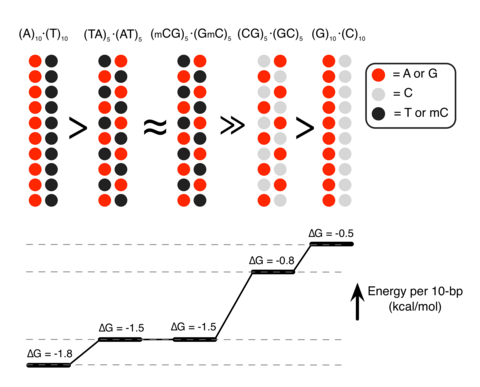
Unexpectedly, we found that DNA sequence has a profound impact on the strength of attractive interaction. The absolute value of ΔG at minimum relative to the value at maximum separation, |ΔGmin|, showed a clearly rank-ordered dependence on the DNA sequence: |ΔGmin| of (A)20>|ΔGmin| of (AT)10>|ΔGmin| of (GC)10>|ΔGmin| of (G)20. Two trends can be noted. First, AT-rich sequences attract each other more strongly than GC-rich sequences16. For example, |ΔGmin| of (AT)10 (1.5kcalmol−1 per turn) is about twice |ΔGmin| of (GC)10 (0.8kcalmol−1 per turn) (Fig. 1b). Second, duplexes having identical AT content but different partitioning of the nucleotides between the strands (that is, (A)20 versus (AT)10 or (G)20 versus (GC)10) exhibit statistically significant differences (~0.3kcalmol−1 per turn) in the value of |ΔGmin|.

To validate the findings of MD simulations, we performed single-molecule fluorescence resonance energy transfer (smFRET)17 experiments of vesicle-encapsulated DNA molecules. Equimolar mixture of donor- and acceptor-labelled 120-bp dsDNA molecules was encapsulated in sub-micron size, porous lipid vesicles18 so that we could observe and quantitate rare binding events between a pair of dsDNA molecules without triggering large-scale DNA condensation2. Our DNA constructs were long enough to ensure dsDNA–dsDNA binding that is stable on the timescale of an smFRET measurement, but shorter than the DNA’s persistence length (~150bp (ref. 19)) to avoid intramolecular condensation20. The vesicles were immobilized on a polymer-passivated surface, and fluorescence signals from individual vesicles containing one donor and one acceptor were selectively analysed (Fig. 1d). Binding of two dsDNA molecules brings their fluorescent labels in close proximity, increasing the FRET efficiency (Fig. 1e).

FRET signals from individual vesicles were diverse. Sporadic binding events were observed in some vesicles, while others exhibited stable binding; traces indicative of frequent conformational transitions were also observed (Supplementary Fig. 1A). Such diverse behaviours could be expected from non-specific interactions of two large biomolecules having structural degrees of freedom. No binding events were observed in the absence of Sm4+ (Supplementary Fig. 1B) or when no DNA molecules were present. To quantitatively assess the propensity of forming a bound state, we chose to use the fraction of single-molecule traces that showed any binding events within the observation time of 2min (Methods). This binding fraction for the pair of AT-rich dsDNAs (AT1, 100% AT in the middle 80-bp section of the 120-bp construct) reached a maximum at ~2mM Sm4+(Fig. 1f), which is consistent with the results of previous experimental studies2, 3. In accordance with the prediction of our MD simulations, GC-rich dsDNAs (GC1, 75% GC in the middle 80bp) showed much lower binding fraction at all Sm4+ concentrations (Fig. 1b,c). Regardless of the DNA sequence, the binding fraction reduced back to zero at high Sm4+ concentrations, likely due to the resolubilization of now positively charged DNA–Sm4+ complexes2, 3, 13.

Because the donor and acceptor fluorophores were attached to the same sequence of DNA, it remained possible that the sequence homology between the donor-labelled DNA and the acceptor-labelled DNA was necessary for their interaction6. To test this possibility, we designed another AT-rich DNA construct AT2 by scrambling the central 80-bp section of AT1 to remove the sequence homology (Supplementary Table 1). The fraction of binding traces for this nonhomologous pair of donor-labelled AT1 and acceptor-labelled AT2 was comparable to that for the homologous AT-rich pair (donor-labelled AT1 and acceptor-labelled AT1) at all Sm4+ concentrations tested (Fig. 1f). Furthermore, this data set rules out the possibility that the higher binding fraction observed experimentally for the AT-rich constructs was caused by inter-duplex Watson–Crick base pairing of the partially melted constructs.

Next, we designed a DNA construct named ATGC, containing, in its middle section, a 40-bp AT-rich segment followed by a 40-bp GC-rich segment (Fig. 1g). By attaching the acceptor to the end of either the AT-rich or GC-rich segments, we could compare the likelihood of observing the parallel binding mode that brings the two AT-rich segments together and the anti-parallel binding mode. Measurements at 1mM Sm4+ and 25 or 50mM NaCl indicated a preference for the parallel binding mode by ~30% (Fig. 1h). Therefore, AT content can modulate DNA–DNA interactions even in a complex sequence context. Note that increasing the concentration of NaCl while keeping the concentration of Sm4+ constant enhances competition between Na+ and Sm4+ counterions, which reduces the concentration of Sm4+ near DNA and hence the frequency of dsDNA–dsDNA binding events (Supplementary Fig. 2).

Methylation determines the strength of DNA–DNA attraction

Analysis of the MD simulations revealed the molecular mechanism of the polyamine-mediated sequence-dependent attraction (Fig. 2). In the case of the AT-rich fragments, the bulky methyl group of thymine base blocks Sm4+ binding to the N7 nitrogen atom of adenine, which is the cation-binding hotspot21, 22. As a result, Sm4+ is not found in the major grooves of the AT-rich duplexes and resides mostly near the DNA backbone (Fig. 2a,d). Such relocated Sm4+ molecules bridge the two DNA duplexes better, accounting for the stronger attraction16, 23, 24, 25. In contrast, significant amount of Sm4+ is adsorbed to the major groove of the GC-rich helices that lacks cation-blocking methyl group (Fig. 2b,e).

Figure 2: Molecular mechanism of polyamine-mediated DNA sequence recognition.
Molecular mechanism of polyamine-mediated DNA sequence recognition.

(ac) Representative configurations of Sm4+ molecules at the DNA–DNA distance of 28Å for the (AT)10–(AT)10 (a), (GC)10–(GC)10 (b) and (GmC)10–(GmC)10 (c) DNA pairs. The backbone and bases of DNA are shown as ribbon and molecular bond, respectively; Sm4+ molecules are shown as molecular bonds. Spheres indicate the location of the N7 atoms and the methyl groups. (df) The average distributions of cations for the three sequence pairs featured in ac. Top: density of Sm4+ nitrogen atoms (d=28Å) averaged over the corresponding MD trajectory and the z axis. White circles (20Å in diameter) indicate the location of the DNA helices. Bottom: the average density of Sm4+ nitrogen (blue), DNA phosphate (black) and sodium (red) atoms projected onto the DNA–DNA distance axis (x axis). The plot was obtained by averaging the corresponding heat map data over y=[−10, 10] Å. See Supplementary Figs 4 and 5 for the cation distributions at d=30, 32, 34 and 36Å.

If indeed the extra methyl group in thymine, which is not found in cytosine, is responsible for stronger DNA–DNA interactions, we can predict that cytosine methylation, which occurs naturally in many eukaryotic organisms and is an essential epigenetic regulation mechanism26, would also increase the strength of DNA–DNA attraction. MD simulations showed that the GC-rich helices containing methylated cytosines (mC) lose the adsorbed Sm4+ (Fig. 2c,f) and that |ΔGmin| of (GC)10 increases on methylation of cytosines to become similar to |ΔGmin| of (AT)10 (Fig. 1b).

To experimentally assess the effect of cytosine methylation, we designed another GC-rich construct GC2 that had the same GC content as GC1 but a higher density of CpG sites (Supplementary Table 1). The CpG sites were then fully methylated using M. SssI methyltransferase (Supplementary Fig. 3; Methods). As predicted from the MD simulations, methylation of the GC-rich constructs increased the binding fraction to the level of the AT-rich constructs (Fig. 1f).

The sequence dependence of |ΔGmin| and its relation to the Sm4+ adsorption patterns can be rationalized by examining the number of Sm4+ molecules shared by the dsDNA molecules (Fig. 3a). An Sm4+ cation adsorbed to the major groove of one dsDNA is separated from the other dsDNA by at least 10Å, contributing much less to the effective DNA–DNA attractive force than a cation positioned between the helices, that is, the ‘bridging’ Sm4+ (ref. 23). An adsorbed Sm4+ also repels other Sm4+ molecules due to like-charge repulsion, lowering the concentration of bridging Sm4+. To demonstrate that the concentration of bridging Sm4+ controls the strength of DNA–DNA attraction, we computed the number of bridging Sm4+ molecules, Nspm (Fig. 3b). Indeed, the number of bridging Sm4+ molecules ranks in the same order as |ΔGmin|: Nspm of (A)20>Nspm of (AT)10Nspm of (GmC)10>Nspm of (GC)10>Nspm of (G)20. Thus, the number density of nucleotides carrying a methyl group (T and mC) is the primary determinant of the strength of attractive interaction between two dsDNA molecules. At the same time, the spatial arrangement of the methyl group carrying nucleotides can affect the interaction strength as well (Fig. 3c). The number of methyl groups and their distribution in the (AT)10 and (GmC)10 duplex DNA are identical, and so are their interaction free energies, |ΔGmin| of (AT)10Gmin| of (GmC)10. For AT-rich DNA sequences, clustering of the methyl groups repels Sm4+ from the major groove more efficiently than when the same number of methyl groups is distributed along the DNA (Fig. 3b). Hence, |ΔGmin| of (A)20>|ΔGmin| of (AT)10. For GC-rich DNA sequences, clustering of the cation-binding sites (N7 nitrogen) attracts more Sm4+ than when such sites are distributed along the DNA (Fig. 3b), hence |ΔGmin| is larger for (GC)10 than for (G)20.

Figure 3: Methylation modulates the interaction free energy of two dsDNA molecules by altering the number of bridging Sm4+.
Methylation modulates the interaction free energy of two dsDNA molecules by altering the number of bridging Sm4+.

(a) Typical spatial arrangement of Sm4+ molecules around a pair of DNA helices. The phosphates groups of DNA and the amine groups of Sm4+ are shown as red and blue spheres, respectively. ‘Bridging’ Sm4+molecules reside between the DNA helices. Orange rectangles illustrate the volume used for counting the number of bridging Sm4+ molecules. (b) The number of bridging amine groups as a function of the inter-DNA distance. The total number of Sm4+ nitrogen atoms was computed by averaging over the corresponding MD trajectory and the 10Å (x axis) by 20Å (y axis) rectangle prism volume (a) centred between the DNA molecules. (c) Schematic representation of the dependence of the interaction free energy of two DNA molecules on their nucleotide sequence. The number and spatial arrangement of nucleotides carrying a methyl group (T or mC) determine the interaction free energy of two dsDNA molecules.

Genome-wide investigations of chromosome conformations using the Hi–C technique revealed that AT-rich loci form tight clusters in human nucleus27, 28. Gene or chromosome inactivation is often accompanied by increased methylation of DNA29 and compaction of facultative heterochromatin regions30. The consistency between those phenomena and our findings suggest the possibility that the polyamine-mediated sequence-dependent DNA–DNA interaction might play a role in chromosome folding and epigenetic regulation of gene expression.

  1. Rau, D. C., Lee, B. & Parsegian, V. A. Measurement of the repulsive force between polyelectrolyte molecules in ionic solution: hydration forces between parallel DNA double helices. Proc. Natl Acad. Sci. USA 81, 26212625 (1984).
  2. Raspaud, E., Olvera de la Cruz, M., Sikorav, J. L. & Livolant, F. Precipitation of DNA by polyamines: a polyelectrolyte behavior. Biophys. J. 74, 381393 (1998).
  3. Besteman, K., Van Eijk, K. & Lemay, S. G. Charge inversion accompanies DNA condensation by multivalent ions. Nat. Phys. 3, 641644 (2007).
  4. Lipfert, J., Doniach, S., Das, R. & Herschlag, D. Understanding nucleic acid-ion interactions.Annu. Rev. Biochem. 83, 813841 (2014).
  5. Grosberg, A. Y., Nguyen, T. T. & Shklovskii, B. I. The physics of charge inversion in chemical and biological systems. Rev. Mod. Phys. 74, 329345 (2002).
  6. Kornyshev, A. A. & Leikin, S. Sequence recognition in the pairing of DNA duplexes. Phys. Rev. Lett. 86, 36663669 (2001).
  7. Danilowicz, C. et al. Single molecule detection of direct, homologous, DNA/DNA pairing.Proc. Natl Acad. Sci. USA 106, 1982419829 (2009).
  8. Gladyshev, E. & Kleckner, N. Direct recognition of homology between double helices of DNA in Neurospora crassa. Nat. Commun. 5, 3509 (2014).
  9. Tabor, C. W. & Tabor, H. Polyamines. Annu. Rev. Biochem. 53, 749790 (1984).
  10. Thomas, T. & Thomas, T. J. Polyamines in cell growth and cell death: molecular mechanisms and therapeutic applications. Cell. Mol. Life Sci. 58, 244258 (2001).

Read Full Post »

Y chromosome

Larry H. Bernstein, MD, FCAP, Curator

LPBI


Y Chromosome Is More Than a Sex Switch


Here to stay. The Y chromosome is small compared with the X, but is required to keep levels of some genes high enough for mammals to survive.

http://www.sciencemag.org/sites/default/files/styles/article_main_small/public/images/sn-genes.jpg?itok=7mnkSPKy&timestamp=1398272995

Here to stay. The Y chromosome is small compared with the X, but is required to keep levels of some genes high enough for mammals to survive.

Andrew Syred/Science Source

The small, stumpy Y chromosome—possessed by male mammals but not females, and often shrugged off as doing little more than determining the sex of a developing fetus—may impact human biology in a big way. Two independent studies have concluded that the sex chromosome, which shrank millions of years ago, retains the handful of genes that it does not by chance, but because they are key to our survival. The findings may also explain differences in disease susceptibility between men and women.

“The old textbook description says that once maleness is determined by a few Y chromosome genes and you have gonads, all other sex differences stem from there,” says geneticist Andrew Clark of Cornell University, who was not involved in either study. “These papers open up the door to a much richer and more complex way to think about the Y chromosome.”

The sex chromosomes of mammals have evolved over millions of years, originating from two identical chromosomes. Now, males possess one X and one Y chromosome and females have two Xs. The presence or absence of the Y chromosome is what determines sex—the Y chromosome contains several genes key to testes formation. But while the X chromosome has remained large throughout evolution, with about 2000 genes, the Y chromosome lost most of its genetic material early in its evolution; it now retains less than 100 of those original genes. That’s led some scientists to hypothesize that the chromosome is largely indispensable and could shrink away entirely.

To determine which Y chromosome genes are shared across species, Daniel Winston Bellott, a biologist at the Whitehead Institute for Biomedical Research in Cambridge, Massachusetts, and colleagues compared the Y chromosomes of eight mammals, including humans, chimpanzees, monkeys, mice, rats, bulls, and opossums. The overlap, they found, wasn’t just in those genes known to determine the sex of an embryo. Eighteen diverse genes stood out as being highly similar between the species. The genes had broad functions including controlling the expression of genes in many other areas of the genome. The fact that all the species have retained these genes, despite massive changes to the overall Y chromosome, hints that they’re vital to mammalian survival.

“The thing that really came home to us was that these ancestral Y chromosome genes—these real survivors of millions of years of evolution—are regulators of lots of different processes,” Bellott says.

Bellott and his colleagues looked closer at the properties of the ancestral Y chromosome genes and found that the majority of them were dosage-dependent—that is, they required two copies of the gene to function. (For many genes on the sex chromosomes, only one copy is needed; in females, the copy on the second X chromosome is turned off and in males, the gene is missing altogether.) But with these genes, the female has one on each X chromosome and the male has a copy on both the X and Y chromosomes. Thus, despite the disappearance of nearby genes, these genes have persisted on the Y chromosome, the team reports online today in Nature.

“The Y chromosome doesn’t just say you’re a male; it doesn’t just say you’re a male and you’re fertile. It says that you’re a male, you’re fertile, and you’re going to survive,” Bellott explains. His group next plans to look in more detail at what the ancestral Y chromosome genes do, where they’re expressed in the body, and which are required for an organism’s survival.

In a second Nature paper, also published online today, another group of researchers used a different genetic sequencing approach, and a different set of mammals, to ask similar questions about the evolution of the Y chromosome. Like Bellott’s paper, the second study concluded that one reason that the Y chromosome has remained stable over recent history is the dosage dependence of the remaining genes.

“Knowing now that the Y chromosome can have effects all over the genome, I think it becomes even more important to look at its implications on diseases,” Clark says. “The chromosome is clearly much more than a single trigger that determines maleness.” Because genes on the Y chromosome often vary slightly in sequence—and even function—from the corresponding genes on the X, males could have slightly different patterns of gene expression throughout the body compared with females, due to not only their hormone levels, but also their entire Y chromosome. These gene expression variances could explain the differences in disease risks, or disease symptoms, between males and females, Clark says.

 
(1) http://www.sciencemag.org/news/2014/04/y-chromosome-more-sex-switch
https://docs.google.com/viewer?a=v&pid=sites&srcid=ZGVmYXVsdGRvbWFpbnxuYWxsYXNldGhmc3xneDo0MTI4NzdjNWZiNTBmNDFk
(2) https://docs.google.com/viewer?a=v&pid=sites&srcid=ZGVmYXVsdGRvbWFpbnxuYWxsYXNldGhmc3xneDoxZTJiYjc1OTU5ODFmZmJh
(3) https://docs.google.com/viewer?a=v&pid=sites&srcid=ZGVmYXVsdGRvbWFpbnxuYWxsYXNldGhmc3xneDo0ZTNmYjQwODA2M2JhY2E
(4) https://docs.google.com/viewer?a=v&pid=sites&srcid=ZGVmYXVsdGRvbWFpbnxuYWxsYXNldGhmc3xneDo1MzU2YzczNzgxNTI5YmEz

Read Full Post »

Lipids link to breast cancer

Larry H. Bernstein, MD, FCAP, Curator

LPBI


Lipids Found Critical to Breast Cancer Cell Proliferation

http://www.genengnews.com/gen-news-highlights/lipids-found-critical-to-breast-cancer-cell-proliferation/81252572/

http://www.genengnews.com/Media/images/GENHighlight/112523_webApr6_2016_IRBBarcelona_BreastTumorsLIPD3119618425.jpg


Scientists in Spain report finding that breast cancer cells need to take up lipids from the extracellular environment so that they can continue to proliferate. The main protein involved in this process is LIPG, an enzyme found in the cell membrane and without which tumor cell growth is arrested. Analyses of more than 500 clinical samples from patients with various kinds of breast tumors reveal that 85% have high levels of LIPG expression.

The research (“FoxA and LIPG Endothelial Lipase Control the Uptake of Extracellular Lipids for Breast Cancer Growth”) is published in Nature Communications.

In Spain, breast cancer is the most common tumor in women and the fourth most common type in both sexes (data from the Spanish Society of Medical Oncology, 2012), registering more than 25,000 new diagnoses each year. According to figures from the World Health Organization, every year 1.38 million new cases of breast cancer are diagnosed and 458,000 people die from this disease (International Agency for Research on Cancer Globocan, 2008).

It was already known that cancer cells require extracellular glucose to grow and that they reprogram their internal machinery to produce greater amounts of lipids. The relevance of this study is that it reveals for the first time that tumor cells must import extracellular lipids to grow.

“This new knowledge related to metabolism could be the Achilles heel of breast cancer,” explains ICREA researcher and Institute for Research in Biomedicine–Barcelona group leader Roger Gomis, Ph.D., co-leader of the study together with Joan J. Guinovart, Ph.D., director of IRB Barcelona and professor at the University of Barcelona. Using animal models and cancer cell cultures, the scientists have demonstrated that blocking of LIPG activity arrests tumor growth.

“What is promising about this new therapeutic target is that LIPG function does not appear to be indispensable for life, so its inhibition may have fewer side effects than other treatments,” explains the first author of the study, Felipe Slebe, a Ph.D. Fellow at IRB Barcelona.

According to Dr. Guinovart, “because LIPG is a membrane protein, it is potentially easier to design a pharmacological agent to block its activity.”

“If a drug were found to block its activity, it could be used to develop more efficient chemotherapy treatments that are less toxic than those currently available,” adds Dr. Gomis.

The scientists are now looking into international collaborations for developing LIPG inhibitors.

FoxA and LIPG endothelial lipase control the uptake of extracellular lipids for breast cancer growth

Felipe SlebeFederico RojoMaria Vinaixa,…Joan AlbanellJoan J. Guinovart & Roger R. Gomis

Nature Communications7,Article number:11199      http://dx.doi.org:/10.1038/ncomms11199

The mechanisms that allow breast cancer (BCa) cells to metabolically sustain rapid growth are poorly understood. Here we report that BCa cells are dependent on a mechanism to supply precursors for intracellular lipid production derived from extracellular sources and that the endothelial lipase (LIPG) fulfils this function. LIPG expression allows the import of lipid precursors, thereby contributing to BCa proliferation. LIPG stands out as an essential component of the lipid metabolic adaptations that BCa cells, and not normal tissue, must undergo to support high proliferation rates. LIPG is ubiquitously and highly expressed under the control of FoxA1 or FoxA2 in all BCa subtypes. The downregulation of either LIPG or FoxA in transformed cells results in decreased proliferation and impaired synthesis of intracellular lipids.

FoxA1 and FoxA2 in BCa growth

The importance of FoxA1 in BCa cells differentiation and its contribution to controlling the expression of metabolic genes in several other tissues makes this transcription factor a highly attractive target to explain the metabolic alterations reported in BCa. For these reason, we decided to ascertain the metabolic processes controlled by FoxA1 in BCa. We first confirmed the association between high FoxA1 expression (mRNA and protein) and luminal subtype (Fig. 1a). To this end, we used two cohorts of primary breast tumours with annotated clinical features and follow-up. The MSKCC/EMC BCa data set is based on gene expression profiles from an original series of 560 cases10, whereas the Spanish BCa data set (n=439) is a tissue microarray of formalin-fixed paraffin-embedded stage I–III breast tumour specimens11 (details provided in Methods Section). High FoxA1 gene expression significantly correlated with high expression of well-established luminal markers, such as GATA3 and ESR1, in primary tumours (Supplementary Fig. 1a). Next we explored FoxA1 expression beyond the luminal subtype. Lower FoxA1 expression was observed in non-luminal tumours (Fig. 1a,b); however, a subset also expressed higher FoxA1 levels (Supplementary Fig. 1b and Supplementary Table 1). Given that FoxA2, in conjunction with FoxA1, is also involved in the regulation of several metabolic pathways, we determined the expression of this factor in BCa samples. Unfortunately, no FoxA2 probes in the Affymetrix platform used in the MSKCC/EMC data set provided a reliable interpretation. To overcome this limitation, we used tissue arrays of early BCa samples (Spanish BCa set). Histological examination of FoxA2-stained tissue microarray slides from the Spanish BCa set revealed the expression of this factor in six non-luminal samples, which were scored as FoxA1 (examples in Fig. 1b and summarized inSupplementary Table 1). Collectively, the number of FoxA+ BCa samples detected by immunohistochemistry accounted for 81.3% of all samples in the Spanish BCa set (Supplementary Table 1), which represent a significant proportion of BCa and point to the participation of FoxA in this disease, beyond to its involvement in differentiation and control of hormonal responses.

Figure 1: FoxA1 and FoxA2 in BCa growth.

http://www.nature.com/ncomms/2016/160405/ncomms11199/images_article/ncomms11199-f1.jpg

(a, top) FoxA1 mRNA expression in the MSKCC/EMC set. BCa samples were stratified in Luminal A, Luminal B, Her2, triple negative and unknown subgroups. The unknown group represents specimens that were not classified in any group. (bottom) FoxA1 protein levels by IHC staining in Luminal, Her2 and triple negative samples in the Spanish BCa set (cohort of 439 BCa patients). Data is average±s.d. (b) FoxA1 and FoxA2 IHC staining in FFPE human specimens representative of the different BCa subtypes. Six independent cases are depicted. FoxA1 and FoxA2 are expressed mainly in the nuclei of tumour cells. Scale bar, 50μm. (c) FoxA1 and FoxA2 mRNA expression analysis by qRT-PCR and protein expression by western blot in human BCa cell lines compared with HMECs. T-test was used. Data are average±s.e.m.; n= 3. Of note, MDA435 are of melanoma origin. (d) FoxA1 and FoxA2 expression in MCF7, MDA231 and their derivatives cells by qRT-PCR and western blot. FoxA1 and FoxA2 depletion was achieved with a doxycycline-inducible short hairpin vector. FoxA-depleted cells were rescued by expression of FoxA2 in MCF7 cells or FoxA1 in MDA231 cells. Cell populations were cultured in the presence or absence of doxycycline for 6 days. P value is the result of T-test. Data are average±s.e.m.;n=3. *P≤0.05, ***P≤0.001 (e, left) Schematic representation of MDA231 and MCF7 cells grown without doxycycline and inoculated in Balb/c nude mice treated with or without doxycycline to induce the expression of the indicated FoxA short hairpins. All tumour cell lines have GFP constitutive expression, and tRFP concomitantly with the short hairpin were expressed in doxycycline treated tumours. (right) Tumour growth of the indicated cell populations inoculated in Balb/c nude mice are determined at the indicated time points. P value is the result of T-test. Data are average±s.e.m.; n= 5–8 tumours. *P≤0.05,**P≤0.01, ***P≤0.001. FFPE, formalin-fixed paraffin-embedded.

Next, we extended our analysis to BCa cell lines for further mechanistic studies. We compared FoxA1 and FoxA2 mRNA expression in four estrogen receptor positive (ER+) (MCF7, T47D, BT474 and ZR75) and four estrogen receptor negative (ER−) (SKBR3, MDA468, BT20 and MDA231) BCa cell lines, a cell line of melanoma origin (MDA435), and human mammary epithelial cells (HMECs). Of note, two of the BCa lines tested were HER2+ (BT474 and SKBR3) (Fig. 1c). All ER+ BCa cells (MCF7, T47D, BT474 and ZR75), the ER−/HER2+ SKBR3 and both triple negative-like MDA468 and BT20 cell lines expressed FoxA1. Interestingly, MDA231 triple negative-like cells expressed high levels of FoxA2 but not FoxA1, and the non-tumour HMECs did not express these factors (Fig. 1c). No BCa cells co-expressed these two proteins (Fig. 1c). Our results suggest that the expression of FoxA transcription factors is a common feature of breast tumours, as well as of BCa cell lines. This notion implies that FoxA factors play a major role in BCa growth, independently of luminal fate specification.

To examine the molecular basis of the contribution of FoxA1 and FoxA2 to BCa growth, we engineered constitutive GFP-luciferase-expressing MCF7 and MDA231 cells with a doxycycline-inducible short-hairpin RNA (sh-RNA) vector targeting either FoxA1 or FoxA2. Doxycycline addition to the cell culture media decreased FoxA expression in both cell lines compared with control cells (ShControl (Dox+) and Sh FoxA1 or Sh FoxA2 (Dox−))(Fig. 1d), with the concomitant expression of tRFP (Supplementary Fig. 1c). Of note, there was no gain of expression of FoxA2 in FoxA1-depleted cells or vice versa (Fig. 1d). Interestingly, cancer cell proliferation was impaired in vitroupon depletion of either FoxA1 or FoxA2 in MCF7 and MDA231 cells, respectively (Supplementary Fig. 1d,e). Similarly, when Balb/c nude mice implanted with xenograft tumours from the above described cellular populations were treated with doxycycline and the short hairpins were induced, striking differences in tumour growth were observed. FoxA1-depleted MCF7 and FoxA2-depleted MDA231 tumour growth was blunted (Fig. 1e and additional controls in Supplementary Fig. 1f. Experimental details in the Supplementary Methods Section). Collectively, these observations confirm that FoxA1 or FoxA2 expression is required for BCa growth.

Previous studies indicate that FoxA1 and FoxA2 transcriptionally regulate common genes in the liver and pancreas that are central to development and metabolism. We therefore hypothesized that crossed expression of FoxA factors could rescue tumour growth by restoring the expression of essential metabolic genes. To this end, we engineered doxycycline-driven shFoxA1 MCF7 cells to express exogenous FoxA2 and doxycycline-driven shFoxA2 MDA231 cells to express exogenous FoxA1 (Fig. 1d). Interestingly, when these BCa modified cells were implanted in Balb/c nude mice and FoxA depletion was induced with doxycycline, the sustained expression of another FoxA factor (FoxA2 in MCF7 and FoxA1 in MDA231 cells) was sufficient for tumours to continuously grow (Fig. 1e and additional controls in Supplementary Fig. 1f). Quantitative real-time PCR (qRT-PCR) analysis confirmed FoxA expression in the distinct tumour populations ex-vivo (Supplementary Fig. 1g). These results showed that retention of minimal levels of FoxA1 or FoxA2 expression is necessary for BCa cell growth.

FoxA1- and FoxA2-regulated transcripts for BCa growth

Figure 2: A genomic approach to identify FoxA1- and FoxA2-regulated transcripts in MCF7 and MDA231 cells.

http://www.nature.com/ncomms/2016/160405/ncomms11199/images_article/ncomms11199-f2.jpg

(a) FACS profiling of MCF7 and MDA231 cells derived from tumours isolated from mice on the basis of the expression of GFP+ and RFP− (control group) or GFP+ and tRFP+ (knockdown and rescue groups). (b) Representation of the transcripts up- and downregulated by FoxA in MCF7 and MDA231 cells isolated from tumours. Up- and downregulated transcripts present a Bayesian false discovery rate below 5% and fold change >2.5. (c) LIPG, Bcl2 and Cdh11OB mRNA levels of the indicated genetically modified MCF7 and MDA231 tumour xenografts analysed by qRT-PCR. P value is the result of T-test. Data are average±s.e.m.; n= 5–8 tumours. *P≤0.05, ***P≤0.001. (d) LIPG protein expression in constitutive shFoxA1 MCF7 or shFoxA2 MDA231 cells. (e) Promoter reporter assay in HEK 293 cells. Cells were transfected with LIPG promoter reporter and FoxA1 or FoxA2 expressing vectors when indicated. P value is the result of T-test. Data are average±s.e.m.; n=3. ****P≤0.0001.

LIPG expression in BCa

Next, we showed that LIPG expression in primary tumours was specific to BCa tumour cells and not to other stroma cellular entities (Fig. 3a). Subsequently, we tested LIPG expression in normal breast epithelia and interrogated 20 samples from mammoplasty reductions. Normal breast epithelial cells showed a lower expression of LIPG than cells from tumour specimens (Fig. 3b). Similar results were obtained for LIPG protein levels in a panel from BCa lines compared with HMEC cells. Of the cellular populations tested, the eight BCa cell lines expressing FoxA1 or FoxA2 had very high levels of LIPG protein compared with the melanoma MDA435 cell line and the human epithelial cell (Fig. 3c). Consistent with this observation, 83.8% of BCa samples in the Spanish tumour cohort were LIPG+ (Fig. 3d and Supplementary Table 3), and LIPG expression correlated with FoxA expression (Spearman correlation; r=0.477, P=0.000001; Fig. 3e). Further analysis showed that LIPG expression levels in primary tumours do not have the capacity to stratify patients for differential risk of overall or disease-free survival (Supplementary Fig. 2a) and are not dependent on estrogen signalling (Supplementary Fig. 2b), thus reinforcing the notion that LIPG is essential for BCa growth.

Figure 3: LIPG contributes to BCa growth.

http://www.nature.com/ncomms/2016/160405/ncomms11199/images_article/ncomms11199-f3.jpg

a) Representative LIPG IHC staining on primary BCa tissues (cohort of 439 BCa patients). LIPG is expressed in the cytoplasm of tumour cells. Faint staining is also detected in the extracellular area. Scale bar, 50μm. (b) Representative LIPG IHC staining in normal breast tissue from mammoplasty reductions. Weak LIPG expression occurs in epithelial cells from ducts and lobuli. Scale bar, 50μm. (c) LIPG protein expression in human cancer cell lines compared with HMECs. Actin was used as loading control.*Unspecific band. Of note, MDA435 are of melanoma origin. (d) LIPG protein levels by IHC staining in Luminal, Her2, and triple negative samples in the Spanish BCa set (cohort of 439 BCa patients). Data is average±s.d. (e) Spearman correlation (P=0.000001) between FoxA and LIPG IHC staining intensities in Spanish BCa set (cohort of 439 BCa patients). (f) Left panel, in vitro proliferation curves of MCF7 and MDA231 cells transduced with a control or a LIPG short hairpin. Data are average±s.e.m.; n=3. (right) LIPG protein expression in shLIPG MCF7 and shLIPG MDA231 cells. The blot shown is representative of three independent experiments. P value is the result of T-test.**P≤0.01, ***P≤0.001. (g) Tumour growth of the indicated cell populations inoculated in Balb/c nude mice are determined at the indicated time points.P value is the result of T-test. Data are average±s.e.m.; n= 6–8 tumours. *P≤0.05.

LIPG is a phospholipase located in the cytosol and cellular membrane and has been shown to hydrolyse extracellular phospholipids from high-density lipoprotein that are afterwards incorporated into intracellular lipid species thus providing lipid precursors of cell metabolism17, 18. Thus we questioned whether LIPG regulates essential lipid intake in BCa and whether it is necessary for proliferation. To validate this hypothesis, we genetically downregulated the expression of this protein in MCF7 and MDA231 cells by means of sh-RNA (Fig. 3f and Supplementary Fig. 2c). LIPG depletion blunted BCa cell capacity to proliferate in vitro (Fig. 3f), as previously observed in FoxA-depleted cells (Supplementary Fig. 1d,e), and caused a reduction in invasion and self-renewal properties (Supplementary Fig. 3a–d). Similarly, LIPG-depleted cells were unable to grow tumours in vivo (Fig. 3g).

LIPG induces BCa cells lipid metabolic reprograming

Figure 4: LIPG regulates the uptake of lipids in BCa cells inducing a lipid metabolic reprograming.

LIPG regulates the uptake of lipids in BCa cells inducing a lipid metabolic reprograming.

http://www.nature.com/ncomms/2016/160405/ncomms11199/images_article/ncomms11199-f4.jpg

(a) Schematic representation of LIPG action. (b) Heat map representation of the downregulated (blue) lipids identified by MS/MS in the cell homogenates of MCF7 or MDA231 LIPG-depleted cells compared with shControl cells. Depicted lipids have a fold change >1.5 and P value<0.05 using the Welch’s t-testn=5. (c) Downregulated lipid species (previously identified in b) that are common to LIPG-depleted MCF7 and LIPG-depleted MDA231 cells. ShControl cells (red box), and shLIPG (blue box). P values are <0.05 and calculated using Welch’s t-test, n=5. Whiskers extend to a maximum of 1.5 × IQR beyond the box. (d) Heat map representation of the upregulated (red) lipids identified by MS/MS in the media of MCF7 or MDA231 LIPG-depleted cells compared with the corresponding shControl cells. Characterized lipids have a fold change >1.5 and P value<0.05 using the Welch’s t-test n=5. (e) Upregulated lipid species in the media (previously identified in d) that are common to LIPG-depleted MCF7 and LIPG-depleted MDA231 cells. ShControl cells (red box), and shLIPG cells (blue box). P values are <0.05 and calculated using Welch’s t-test, n=5. Whiskers extend to a maximum of 1.5 × IQR beyond the box. (f) Heat map representation of the MS/MS downregulated (blue) lipids in the cell media of MCF7/MDA231 LIPG-depleted or shControl cells (as described in d) compared with fresh medium (without cell incubation). Depicted lipid species have a log2 fold change>1.5 and P value<0.05 using the Welch’s t-test n=5. (g) MDA231 and MCF7 cell growth for 48h in complete medium: medium containing 10% FBS 10%); lipoprotein-free medium: medium containing 10% free lipoprotein FBS; and LPC (18:0): medium containing 10% free lipoprotein FBS and 20μM of LPC (18:0). P value is the result of T-test. Data are average±s.e.m.; n=3. **P≤0.01, ***P≤0.001, ****P≤0.0001. (h) Above, schematic representation of the experimental protocol used. (bottom) Tumour growth of the indicated cell populations inoculated in Balb/c nude mice treated with high-fat diet (HFD) are determined at the indicated time points. P value is the result of T-test. Data are average±s.e.m.; n= 6–8 tumours. *P≤0.05, **P≤0.01. Inside graph, plasma cholesterol levels of animals treated with standard diet (SD) or HFD. P value is the result of T-test. Data are average±s.e.m.; n= 4 animals per group. **P≤0.01, ***P≤0.001.

LIPG location has been shown to be functional on the outer face of the cellular membrane (Fig. 4a)18, thus we postulated the possibility that BCa cells are dependent on LIPG function to access extracellular lipids to support their growth needs. To test this notion, we profiled the media of control and LIPG-depleted MCF7 and MDA231 cells following the same liquid chromatography-mass spectrometry-based untargeted lipidomic approach as for cell homogenates. LIPG depletion prevented the absorption of particular lipids from the media (Supplementary Fig. 4a). The structural identification of the lipids by MS/MS confirms the absence of degradation of glycerophospholipids belonging to the LPC class in both MCF7 and MDA231 cells, which is depicted by higher levels in the media of these species in LIPG-depleted when compared with control cells (Fig. 4d,e). Interestingly when we analysed the LPCs species in the media of control and LIPG-depleted cells and compared with fresh media (without cells), all LPC species from control cell media were decreased. This reduction was weaker in the media of Sh LIPG cells, indicating that LIPG-depleted cells have a defect in processing and importing of pre-existing lipid species from the medium (Fig. 4f).

Finally, we evaluated which of the commonly identified potential substrates of LIPG sustains BCa cell proliferation. Initially, we confirmed that the growth of MCF7 and MDA231 cells is impaired when grown in vitro in lipoprotein-depleted media (Fig. 4g). Next we tested the capacity of LPC (18:0) to rescue BCa cell growth in the absence of lipoproteins and confirmed that this lysophosphatidylcholine was able to restore the cells’ capacity to proliferate (Fig. 4g). In accordance, this process was dependent on LIPG expression (Fig. 4g). Similarly, LIPG-depleted cells were not able to grow in vivo in animals fed with high-fat diet (Fig. 4h) indicating that LIPG is indispensable to process the extracellular lipids and mediate their uptake by the cells, irrespectively of the concentration of lipid substrates in circulation, a phenotype also observed in FoxA-depleted cells (Fig. 4h).

LIPG activity supports BCa growth

Figure 5: LIPG activity is essential for BCa growth.

LIPG activity is essential for BCa growth.

http://www.nature.com/ncomms/2016/160405/ncomms11199/images_article/ncomms11199-f5.jpg

(a, top) Homology 3D structural model of LIPG (backbone coloured according to the QMEANlocal parameter values; red residues with low error). The heavy atoms of the three catalytic residues are shown explicitly and the residue mutated in this study is shown in green (Asp 193). (b) FoxA1, FoxA2 and LIPG protein expression in MCF7, MDA231 and their derivative cells determine by western blot. FoxA1 and FoxA2 depletion was achieved with a doxycycline-inducible short hairpin vector. FoxA-depleted cells were rescued by expression of a WT or Inactive LIPG. Cell populations were cultured in the presence or absence of doxycycline for 6 days. *blots represent different exposition times. (c) Tumour growth of the indicated cell populations inoculated in Balb/c nude mice are determined at the indicated time points. Pvalue is the result of T-test. Data are average±s.e.m.; n=5–8 tumours. *P≤0.05, **P≤0.01. (d) MDA231 and MCF7 cell growth for 48h treated with DMSO (control), FAS inhibitor (C75) and/or lipase inhibitor (Orlistat). For MDA231 cells C75 was used at a final concentration of 10μgml−1 and for MCF7 cells 8μgml−1. Orlistat was used at a final concentration of 30 or 10μgml−1 in MCF7 or MD231 respectively. Pvalue is the result of T-test. Data are average±s.e.m.; n=3.*P≤0.05, **P≤0.01, ***P≤0.001. (e) Forty-eight hours cell growth of MDA231 or MCF7 cells overexpressing exogenous WT or Inactive LIPG. Cells were treated with DMSO (control) and FAS inhibitor (C75) at a final concentration of 20μgml−1. P value is the result of T-test. Data are average±s.e.m.; n=3.***P≤0.001, ****P≤0.0001 (f) Schematic representation showing how FoxA controls LIPG and lipid metabolism to support tumour growth.

As previous reports showed that de novo lipid metabolism is necessary for BCa growth3, 22, we next questioned whether this lipid synthesis was sufficient or, instead, whether exogenous sources are also required to support BCa cell growth and proliferation, as suggested by our experimental data. To this end, we inhibited the activity of fatty acid synthase (FAS) in BCa cells by means of the chemical inhibitor C75 (ref. 23). FAS activity is crucial for de novo lipid synthesis in cancer cells3,22. To test the complementarity of both de novo and/or exogenous lipid supplies, we used a C75 concentration causing a 50% reduction in BCa cell growth in vitro 48h post incubation (Fig. 5d andSupplementary Fig. 5d). Similarly, we tested the contribution of LIPG inhibition by means of treatment with a lipase inhibitor, Orlistat21. A specific dose causing a 50% reduction in the growth of each BCa cell line was further used (Fig. 5d and Supplementary Fig. 5d). Interestingly, concomitant treatment with FAS and LIPG inhibitors caused an additive effect, blunting BCa cell growth (Fig. 5d). Next, we evaluated whether LIPG activity was sufficient to rescue the chemical inhibition of FAS. To this end, we overexpressed WT and inactive LIPG and grew MCF7 and MDA231 cells in the presence or absence of a high dose of C75 (20mgml−1), which blocks cell growth (Supplementary Fig. 5d). Complete blockade of FAS was not rescued by LIPG (Fig. 5e). Collectively, our results suggest that both exogenous lipid precursors provided by means of LIPG activity and de novo lipid synthesis mediated by FAS are necessary for BCa cell growth.


Here we reveal that FoxA factors provide a central metabolic growth function by specifically regulating LIPG expression, thereby allowing the acquisition of indispensable extracellular lipids for BCa tumour proliferation. FoxA family of transcription factors are expressed in the vast majority of BCa and FoxA1 is expressed across various BCa subtypes. Moreover we show that, in some cases, its absence is associated with the expression of FoxA2. Interestingly, in addition of FoxA1 contribution to luminal commitment24, 25, 26, 27 the factor may drive BCa growth by specifically regulating LIPG levels.

The catalytic activity of LIPG generates extracellular lipid precursors that are imported to fulfill the intracellular production of lipid species (Fig. 5f). LIPG downregulation blocks BCa cell growth, thereby indicating that the import of extracellular lipid precursors is important for the proliferation of these cells. This is a striking observation given that it is generally believed that de novo fatty acid synthesis is the main driver of tumour growth22. Indeed, our experimental data with LIPG-depleted BCa cells revealed a massive decrease of most intracellular glycerolipid intermediates in the synthesis of TG (PC, PE, PG and DG) and their derivatives (LPC and LPE). Accordingly, certain lipid species (LPC) in the media were not decreased in LIPG-depleted cells as much as in control cells, thus indicating that extracellular lipids are the substrates for intracellular lipid production. In particular, we demonstrate the relevance of extracellular LPC (18:0) for BCa cell proliferation in a lipoprotein-depleted medium, a process dependent on LIPG. In this context, a high-fat diet was shown to rescue the absence of a critical intracellular lipase, Monoacylglycerol lipase, for cancer pathogenesis given cancer cells ability to uptake lipids from the extracellular compartment was functional19. Herein, we showed that this rescue mechanism is not functional in BCa cells in the absence of FoxA2 or LIPG. In support of this notion, it is worth noting that extracellular LIPG activity releases fatty acids from high-density lipoprotein phospholipids and these acids are further employed for intracellular lipid production in the human hepatic cell line HepG2 (refs 28, 29).

In conclusion, BCa cells are dependent on a mechanism to supply precursors derived from extracellular sources for intracellular lipid production, and LIPG fulfills this function. Therefore, LIPG stands out as an important component of the lipid metabolic adaptations that BCa cells, and not normal tissue, must undergo to support high proliferation rates. Our results also suggest thatde novo lipid synthesis is necessary but not sufficient to support lipid production for BCa tumour growth. Accordingly, recent clinical studies demonstrate the association between lipids and lipoproteins in circulation and risk of BCa in women with extensive mammographic density. This observation implies that interventions aimed to reduce them may have effect on BCa risk30. All together, these observations make LIPG activity an Achilles heel of luminal and, more importantly, of triple negative/basal-like breast tumours, for which limited therapeutic options are currently available.

In normal cells, the glucose carbon flow is directed into a de novo lipogenic pathway that is regulated, in part, via phosphoinositide-3 kinase (PI-3K)-dependent activation of ATP citrate lyase (ACL), a key rate-limiting, enzyme in de novo lipogenesis. ACL is a cytosolic enzyme that catalyzes the generation of acetyl CoA from citrate. Inhibition of ACL results in a loss of B-cell growth and cell viability [10] .
The plasma membrane and its constituent phosphoinositides form the basis of the phosphatidylinositol 3-kinase (PI3-K) signaling pathway, which is crucial for cell proliferation and survival. Phosphatase and tensin-homolog deleted on chromosome 10 (PTEN) is a tumor-suppressor protein that regulates phosphatidylinositol 3-kinase (PI3-K) signaling by binding to the plasma membrane and hydrolyzing the 3′ phosphate from phosphatidylinositol (3,4,5)-trisphosphate (PI(3,4,5)P3) to form phosphatidylinositol (4,5)-bisphosphate (PI(4,5)P2). Several loss-of-function mutations in PTEN that impair lipid phosphatase activity and membrane binding are oncogenic, leading to the development of a variety of cancers. Of these three residues, R335 was observed to interact with the membrane to the greatest extent across all of the simulations. R335L, in common with several other germline mutations, has been associated with the inherited cancer [11] .
ACLY is up-regulated or activated in several types of cancers, and its inhibition is known to induce proliferation arrest in cancer cells both in vitro and in vivo. The last studies were showed that BCR-mediated signaling is regulated in part by the amount of membrane cholesterol. It was observed that statins (Lovostatin), the pharmacological inhibitors of cholesterol synthesis, induce apoptosis of CLL cells in vitro and in vivo. Also the ectopic expression of CD5 in a B-cell line stimulates the transcription of genes involved in the synthesis of cholesterol [12] .

[10] Zaidi N, Swinnen JV, Smans K. ATP-citrate lyase: a key player in cancer metabolism Cancer Res; 2012 (11): 3709-14.

[11] Craig N, Mark S.P. Sansom. Defining the Membrane-Associated State of the PTEN Tumor Suppressor Protein. Biophys J 2013; 5; 104(3: 613–21.

[12] Tomowiak C, Kennel A, Gary-Gouy, Hadife N. High Membrane Cholesterol in CLL B-Cells and Differential Expression of Cholesterol Synthesis Genes in IG GENE Unmutated vs Mutated Cells. British Journal of Medicine & Medical Research 2012; 2(3): 313-26.


Cancer’s Vanguard

Exosomes are emerging as key players in metastasis.

By Catherine Offord | April 1, 2016   http://www.the-scientist.com/?articles.view/articleNo/45577/title/Cancer-s-Vanguard/

http://www.the-scientist.com/images/April2016/AprLongLit_640px.jpg

PREPARING THE TURF: Before tumor cells arrive at their metastatic destination, part of the site is readied for them. One recent study of liver metastasis in mice found that resident macrophages called Kupffer cells take up exosomes from the original tumor (1). Additionally, macrophages from the bone marrow show up upon the release of fibronectin by other liver cells called stellate cells (2). A current proposal for additional steps in metastatic niche development includes the recruitment of epithelial cells and fibroblasts, which contribute to angiogenesis, and, finally, the arrival of tumor cells themselves (3).© IKUMI KAYAMA/STUDIO KAYAMA

In 2005, David Lyden noticed something unexpected. He and his colleagues at Weill Cornell Medical College had been researching metastasis—the spread of cancer from one part of the body to another. The team had shown that bone marrow–derived cells (BMDCs) were recruited to future metastatic sites before the arrival of tumor cells, confirming that metastasis occurred after a habitable microenvironment, or “premetastatic niche,” had been prepared.1

But carefully studying images of this microenvironment in the lung tissue of mice, Lyden saw something else. Amongst the BMDCs, the micrographs showed tiny specks, far too small to be cells, gathering at the future site of metastasis. “I said, ‘What are these viruses doing here?’” recalls Lyden. “I had no idea about exosomes, microvesicles, and microparticles.”

Those specks, Lyden would come to realize, were in fact primary tumor–derived exosomes. These membrane-enclosed vesicles packed full of molecules are now attracting growing attention as important mediators of intercellular communication, particularly when it comes to cancer’s insidious capacity to spread from one organ to another.

Preparing the ground

Tumors require a community of support cells, including fibroblasts, BMDCs, and endothelial cells, to provide functional and structural assistance and to modulate immune system behavior. Bringing together the first members of this community before the arrival of tumor cells is all part of cancer’s survival strategy, says Joshua Hood, a cancer researcher at the University of Louisville.

“It wouldn’t be efficient for tumor cells to strike out on their own, and just say, ‘Oh, here we are!’” he says. “They would run the risk of being destroyed.” Preparing a “nest” in advance makes the process much safer. “Then the tumor can just efficiently come along and set up shop without ever having to fight much of a battle with the immune system.”

But although Lyden’s group had shown that this preparation was taking place, it remained unclear how such a process might be regulated. For the next few years, many cancer researchers believed that tumor cells must communicate with the premetastatic niche primarily through tumor-secreted signaling molecules such as cytokines.

Meanwhile, research into extracellular vesicles, previously considered biological garbage bags, was revealing new modes of intercellular communication. In 2007, a group of scientists in Sweden discovered that exosomes, tiny vesicles measuring just 30 nanometers to 100 nanometers across, transport mRNA and microRNAs intercellularly, with the potential to effect changes in protein synthesis in recipient cells.2 A new means for tumors to regulate distant cellular environments came into focus, and research on exosomes exploded. In 2011, Hood and his colleagues showed that exosomes facilitate melanoma metastasis through the lymphatic system.3 The following year, Lyden’s group demonstrated that tumor-derived exosomes can direct BMDCs to one of melanoma’s most common sites of metastasis, the lung.4 Exosomes, it seemed, had been underestimated.

Tiny terraformers

Armed with the knowledge that exosomes are involved in multiple stages of melanoma metastasis, Lyden’s lab went searching for the vesicles’ potential role in the metastasis of other cancers. Turning to pancreatic ductal adenocarcinoma (PDAC)—one of the most lethal cancers in humans—postdoctoral researcher Bruno Costa-Silva led a series of exhaustive in vitro and in vivo experiments in mouse models to detail the process of premetastatic niche formation in the liver, PDAC’s most common destination. The team’s results, published last May, reveal an intricate series of sequential steps—mediated by PDAC-derived exosomes (Nature Cell Biol, 17:816-26, 2015).

Using fluorescence labeling, Lyden’s group observed that PDAC-derived exosomes are taken up by Kupffer cells, specialized macrophages lining the outer walls of blood vessels in the liver. There, the exosomes trigger the cells’ secretion of transforming growth factor β (a type of cytokine involved in cell proliferation), plus the production of fibronectin by neighboring hepatic stellate cells, and the recruitment of BMDCs.

The researchers also showed that this cascade of events could be inhibited by depleting exosomal macrophage migratory inhibitory factor (MIF), an abundant protein in PDAC exosomes. “If you target the specific proteins of exosomes, you can reduce metastasis,” explains coauthor Héctor Peinado, leader of the microenvironment and metastasis group at the Spanish National Cancer Research Center.

For Hood, the findings add to a developing picture of exosomes’ vital role as “vanguard” in the progression of cancer. “It’s like the colonization of a new planet,” he says. “They’re terraforming the environment to make it hospitable.”

MOLECULAR & CELLULAR BIOLOGY

THE PAPERS

  • B. Costa-Silva et al., “Pancreatic cancer exosomes initiate pre-metastatic niche formation in the liver,”Nature Cell Biol, 17:816-26, 2015.
  • A. Hoshino et al., “Tumour exosome integrins determine organotropic metastasis,” Nature, 527:329-35, 2015.
  • L. Zhang et al., “Microenvironment-induced PTEN loss by exosomal microRNA primes brain metastasis outgrowth,”Nature, 527:100-04, 2015.

Internal mail

Although research was revealing the steps involved in forming premetastatic sites, it was less clear how these sites were being selected. “This has always been a great mystery in cancer,” says Ayuko Hoshino, a research associate in Lyden’s lab. “Why do certain cancers metastasize to certain organs?”

One theory, proposed in 1928 by pathologist James Ewing, suggested that anatomical and mechanical factors explained organ specificity in metastasis. The premetastatic niche, then, might form wherever exosomes are likely to land. But this couldn’t be the whole story, says Hoshino. “For instance, there’s eye melanoma. Thinking about that site, you could imagine it metastasizing to the brain. But actually, it almost only metastasizes to the liver.”

Because exosomes arrive at metastatic sites before tumor cells, the team reasoned, perhaps the exosomes themselves were organotropic (i.e., attracted to particular organs or tissues). Sure enough, Lyden says, when Hoshino and Costa-Silva began injecting tumor-derived exosomes into mice, “their preliminary findings were that wherever they injected the exosomes, the pancreatic cancer ones were ending up in the liver and the breast metastasis exosomes would end up in the lung.”

Using mass spectrometry, the researchers analyzed the protein content of exosomes from lung-tropic, liver-tropic, and brain-tropic tumors. They found that the composition of exosomes’ integrins—membrane proteins involved in cell adhesion—was destination-specific (Nature, 527:329-35, 2015). Exosomes bearing integrin α6β4, for example, were directed to the lung, where they could prepare a premetastatic niche potent enough even for normally bone-tropic tumor cells to colonize. Integrin αvβ5, meanwhile, directed metastasis to the liver.

The researchers also showed that exosomal integrins didn’t necessarily correspond to the parent-cell proteins, making exosomes potentially better indicators of where a cancer will spread than the tumor cells themselves. “We can show that an integrin that’s high in the tumor cell might be completely absent in the tumor exosome or vice versa,” says Lyden, adding that, taken together, the results point to a role for exosomes in “dictating the future sites of metastasis.”

“It’s a beautiful story,” says Dihua Yu, a molecular and cellular oncologist at the University of Texas MD Anderson Cancer Center. “This is a very novel finding that gives really good indicators for potential strategies to intervene in metastasis.”

Metastatic crosstalk

In the same month that Lyden’s group published its work on organotropism, Yu’s own lab published a different exosome study—one that told another side of the story.

Yu and her colleagues had found that when tumor cells in mice metastasized to the brain, they downregulated expression of a tumor suppressor gene called PTEN, and became primed for growth at the metastatic site. When the tumor cells were taken out of the microenvironment and put in culture, however, they restored normal PTEN expression.

The researchers demonstrated that a microRNA from astrocytes—star-shape glial cells in the brain—reversibly downregulated the levels of PTEN transcripts in the tumor cells, but they couldn’t figure out how the microRNA was getting into the tumor. Blocking “obvious signaling pathways,” such as gap junctions, failed to have an effect, Yu says.

Scrutinizing astrocyte-conditioned media using electron microscopy, the researchers identified spherical vesicles between 30 nanometers and 100 nanometers in diameter—the defining size of exosomes. Exposing mouse tumor cells to these vesicles increased cell microRNA content and reduced PTENexpression (Nature, 527:100-04, 2015). The study revealed yet another role for exosomes in the communication between tumors and their microenvironment.

The findings were a surprise, says Yu, not least because they showed a different perspective from the bulk of recent research. “We’re talking about astrocytes in the brain secreting exosomes to give welcome help to the cancer cells,” she says.

“I find it an extremely interesting paper because it shows that the astrocytes can change the whole phenotype of the tumor in the brain,” says Lyden. He adds that the results underline the importance of studying the mutational status of tumors at various sites. “All this work in exosomes, it adds to the complexity,” he says. “We can’t just target tumor cells at the primary site. We’ll have to understand all the details of metastasis if we’re really going to tackle it.”

What’s next?

The discovery of multiple roles for exosomes in metastasis has generated excitement about the potential for their use in diagnostics and treatment. As protective containers of tumor-derived genetic material, exosomes could provide information about the status of cancer progression. And as mediators of premetastatic niche formation, they make obvious targets for inhibition. (See “Banking on Blood Tests,”here.)

Exosomes might even be useful as vehicles to deliver drugs because they’re patient-matched and “naturally designed to function in a biocompatible way with living systems,” says Hood. “You could take them out of people, and at some point down the road try to have patients be their own nanofactory, using their own particles for treatment purposes.”

Pancreatic cancer exosomes initiate pre-metastatic nihe formation in the liver

Bruno Costa-SilvaNicole M. AielloAllyson J. Ocean, et al.   Nature Cell Biology 2015; 17,816–826   http://dx.doi.org:/10.1038/ncb3169

Pancreatic ductal adenocarcinomas (PDACs) are highly metastatic with poor prognosis, mainly due to delayed detection. We hypothesized that intercellular communication is critical for metastatic progression. Here, we show that PDAC-derived exosomes induce liver pre-metastatic niche formation in naive mice and consequently increase liver metastatic burden. Uptake of PDAC-derived exosomes by Kupffer cells caused transforming growth factor β secretion and upregulation of fibronectin production by hepatic stellate cells. This fibrotic microenvironment enhanced recruitment of bone marrow-derived macrophages. We found that macrophage migration inhibitory factor (MIF) was highly expressed in PDAC-derived exosomes, and its blockade prevented liver pre-metastatic niche formation and metastasis. Compared with patients whose pancreatic tumours did not progress, MIF was markedly higher in exosomes from stage I PDAC patients who later developed liver metastasis. These findings suggest that exosomal MIF primes the liver for metastasis and may be a prognostic marker for the development of PDAC liver metastasis.

Ayuko HoshinoBruno Costa-SilvaTang-Long ShenGoncalo RodriguesAyako HashimotoMilica Tesic Mark, et al. Nature Nov 2015; 527,329–335  http://dx.doi.org:/10.1038/nature15756

Ever since Stephen Paget’s 1889 hypothesis, metastatic organotropism has remained one of cancer’s greatest mysteries. Here we demonstrate that exosomes from mouse and human lung-, liver- and brain-tropic tumour cells fuse preferentially with resident cells at their predicted destination, namely lung fibroblasts and epithelial cells, liver Kupffer cells and brain endothelial cells. We show that tumour-derived exosomes uptaken by organ-specific cells prepare the pre-metastatic niche. Treatment with exosomes from lung-tropic models redirected the metastasis of bone-tropic tumour cells. Exosome proteomics revealed distinct integrin expression patterns, in which the exosomal integrins α6β4 and α6β1 were associated with lung metastasis, while exosomal integrin αvβ5 was linked to liver metastasis. Targeting the integrins α6β4 and αvβ5 decreased exosome uptake, as well as lung and liver metastasis, respectively. We demonstrate that exosome integrin uptake by resident cells activates Src phosphorylation and pro-inflammatory S100 gene expression. Finally, our clinical data indicate that exosomal integrins could be used to predict organ-specific metastasis.

  1. Paget, S. The distribution of secondary growths in cancer of the breast. 1889. Cancer Metastasis Rev. 8, 98101 (1989)
  2. Hart, I. R. & Fidler, I. J. Role of organ selectivity in the determination of metastatic patterns of B16 melanoma. Cancer Res. 40, 22812287 (1980)
  3. Müller, A. et al. Involvement of chemokine receptors in breast cancer metastasis. Nature410, 5056 (2001)
  4. Weilbaecher, K. N., Guise, T. A. & McCauley, L. K. Cancer to bone: a fatal attraction. Nature Rev. Cancer 11, 411425 (2011)
  5. Zhou, W. et al. Cancer-secreted miR-105 destroys vascular endothelial barriers to promote metastasis. Cancer Cell 25, 501515 (2014)
  6. Chang, Q. et al. The IL-6/JAK/Stat3 feed-forward loop drives tumorigenesis and metastasis.Neoplasia 15, 848862 (2013)
  7. Lu, X. & Kang, Y. Organotropism of breast cancer metastasis. J. Mammary Gland Biol. Neoplasia 12, 153162 (2007)

…….

Microenvironment-induced PTEN loss by exosomal microRNA primes brain metastasis outgrowth

Lin ZhangSiyuan ZhangJun YaoFrank J. LoweryQingling ZhangWen-Chien Huang, et al.  Nature  Nov 2015; 527,100–104   http://dx.doi.org:/10.1038/nature15376

The development of life-threatening cancer metastases at distant organs requires disseminated tumour cells’ adaptation to, and co-evolution with, the drastically different microenvironments of metastatic sites1. Cancer cells of common origin manifest distinct gene expression patterns after metastasizing to different organs2. Clearly, the dynamic interaction between metastatic tumour cells and extrinsic signals at individual metastatic organ sites critically effects the subsequent metastatic outgrowth3, 4. Yet, it is unclear when and how disseminated tumour cells acquire the essential traits from the microenvironment of metastatic organs that prime their subsequent outgrowth. Here we show that both human and mouse tumour cells with normal expression of PTEN, an important tumour suppressor, lose PTEN expression after dissemination to the brain, but not to other organs. The PTEN level in PTEN-loss brain metastatic tumour cells is restored after leaving the brain microenvironment. This brain microenvironment-dependent, reversible PTEN messenger RNA and protein downregulation is epigenetically regulated by microRNAs from brain astrocytes. Mechanistically, astrocyte-derived exosomes mediate an intercellular transfer of PTEN-targeting microRNAs to metastatic tumour cells, while astrocyte-specific depletion of PTEN-targeting microRNAs or blockade of astrocyte exosome secretion rescues the PTEN loss and suppresses brain metastasis in vivo. Furthermore, this adaptive PTEN loss in brain metastatic tumour cells leads to an increased secretion of the chemokine CCL2, which recruits IBA1-expressing myeloid cells that reciprocally enhance the outgrowth of brain metastatic tumour cells via enhanced proliferation and reduced apoptosis. Our findings demonstrate a remarkable plasticity of PTEN expression in metastatic tumour cells in response to different organ microenvironments, underpinning an essential role of co-evolution between the metastatic cells and their microenvironment during the adaptive metastatic outgrowth. Our findings signify the dynamic and reciprocal cross-talk between tumour cells and the metastatic niche; importantly, they provide new opportunities for effective anti-metastasis therapies, especially of consequence for brain metastasis patients.

  1. Quail, D. F. & Joyce, J.A. Microenvironmental regulation of tumor progression and metastasis. Nature Med. 19, 14231437 (2013)
  2. Park, E. S. et al. Cross-species hybridization of microarrays for studying tumor transcriptome of brain metastasis. Proc. Natl Acad. Sci. USA 108, 1745617461 (2011)
  3. Joyce, J. A. & Pollard, J. W. Microenvironmental regulation of metastasis. Nature Rev. Cancer 9, 239252 (2009)
  4. Vanharanta, S. & Massagué, J. Origins of metastatic traits. Cancer Cell 24, 410421 (2013)
  5. Gray, J. Cancer: genomics of metastasis. Nature 464, 989990 (2010)
  6. Friedl, P. & Alexander, S. Cancer invasion and the microenvironment: plasticity and reciprocity. Cell 147, 9921009 (2011)

Banking on Blood Tests

How close are liquid biopsies to replacing current diagnostics?

By Jyoti Madhusoodanan | April 1, 2016  http://www.the-scientist.com/?articles.view/articleNo/45584/title/Banking-on-Blood-Tests/

No matter where a tumor lurks in the body, its secrets circulate in the blood. Stray tumor cells begin metastatic migrations by slipping into the vasculature. Vesicles secreted by cancer cells and free-floating DNA are also released into the bloodstream. Because these bits of cellular debris are a grab-bag of biomarkers that could both signal a cancer’s presence and predict its progression and response to treatment, the use of blood-based tests, or liquid biopsies, to detect and evaluate them is now drawing significant commercial interest.

Last year, San Diego–based Pathway Genomics began advertising a screen “for the early detection of up to 10 different cancer types in high-risk populations.” But the screen had only been tested in already-diagnosed patients, not in at-risk individuals, and within weeks of making it commercially available, the company received an FDA notice to provide more information about their promotional claims before further marketing. “We . . . have not found any published evidence that this test or any similar test has been clinically validated as a screening tool for early detection of cancer in high risk individuals,” the agency wrote.

The Forces of Cancer

A tumor’s physical environment fuels its growth and causes treatment resistance.

By Lance L. Munn and Rakesh K. Jain | April 1, 2016   http://www.the-scientist.com/?articles.view/articleNo/45603/title/The-Forces-of-Cancer/

Ahelium balloon tugs gently at the end of its string. The tension in the string resists the buoyant force of the helium, and the elastic nature of the balloon’s rubber contains the helium gas as it tries   to expand. Cutting the string or poking the rubber with a pin reveals the precarious balance between the forces, upsets the equilibrium, and sets the system into motion.

Some biological tissues also exist in such a state of offsetting forces. The most familiar example is the balance between blood pressure and the elastic tension in the cardiovascular system that contains and conveys blood without bursting or collapsing. And in tumors, both solid and fluid forces are generated that make the cancerous tissue a lot like that helium balloon: cut a tumor with a scalpel and it rapidly swells and deforms as pent-up forces break free from structural elements that are severed.1

One force that is notably higher in tumors than in healthy tissues is fluid pressure, resulting from hyperpermeable, leaky blood vessels and a dearth of draining lymphatic vessels. Researchers have known since the 1950s that tumors exhibit elevated fluid pressure, but the implications for tumor progression and drug delivery were not realized until the late 1980s. That was when we (R.K.J. and colleagues) used a mathematical model to predict—and subsequently validate in animal and human tumors—that a precipitous drop in fluid pressure at the tumor–normal tissue interface causes interstitial fluid to ooze out of the tumor.2 This seeping fluid pushes drugs, growth factors, and cancer cells into the surrounding tissue and lymphatics, reducing drug delivery and facilitating local tumor invasion and distant metastasis.

Based on this insight, we suggested in 2001 that anti-angiogenic drugs could be used to lower a tumor’s fluid pressure and improve treatment outcome.3 This hypothesis changed the thinking about how existing anti-angiogenesis therapies actually work and spurred research into other physical forces acting in cancer.4 In the last 15 years, researchers have identified diverse sources of increased pressure in tumors, which may serve as possible targets for cancer therapy.5 For example, solid forces exerted by the extracellular matrix can be reduced by treatment with drugs approved by the US Food and Drug Administration (FDA) for controlling hypertension (angiotensin blockers) or diabetes (metformin). Retrospective clinical studies have found improved survival in cancer patients who were treated with these agents, which are now being tested in prospective trials for a variety of solid tumors.6,7

Tumors under pressure

In vitro experiments showing that cancer cells actively migrate in response to fluid flow have supported the hypothesis that fluid escaping from the boundary of a tumor may guide the invasive migration of cancer cells toward lymphatic or blood vessels, potentially encouraging metastasis. There remains controversy over how the fluid forces induce the migration; the cells may respond to chemical gradients created by the cells and distorted by the flowing fluid,8 or the fluid may activate cell mechanosensors.9 Because of the potential for new therapeutic interventions, the transduction of mechanical fluid forces into biochemical signals by cell mechanosensors is an active area of investigation. In a more direct manner, the fluid flow can physically carry cancer cells to lymph nodes.

Fluid forces may also promote tumor progression by recruiting blood vessels into the cancerous mass.10 Because tumor blood vessels are leaky, plasma can pass freely between vessels that have different pressures. When this happens at the periphery of a tumor, where angiogenic growth factors are prevalent, there can be synergistic induction of new vessel sprouts.

UNDER PRESSURE    See full infographic: WEB | PDF© N.R.FULLER, SAYO-ART LLC

And fluid pressure is just one of the many forces in a tumor that can influence its development and progression. Tumors also develop increased solid pressure, as compared with normal tissue, stemming from the uncontrolled division of cancer cells and from the infiltration and proliferation of stromal and immune cells from the surrounding tissue and circulation. High-molecular-weight polysaccharides known as hydrogels found in the extracellular matrix (ECM) also add pressure on a tumor. The most well-studied of these hydrogels is hyaluronan; when the polysaccharide absorbs water, it swells, pressing on surrounding cells and structural elements of the tissue.

The ECM contains a highly interconnected network of collagen and other fibers and is normally very good at resisting and containing such tension. It also has support from infiltrating myofibroblasts, which detect areas where the ECM density or tension is not normal and initiate actomyosin-based contraction of collagen and elastin matrix structures to restore tensional homeostasis. But while this repair effort is typically effective in healthy tissues, uncooperative tumor cells interfere with these efforts, both by themselves generating pressure and by hyperactivating cancer-associated fibroblasts to produce more ECM and thus produce even more force.11

Because cell growth and ECM composition are not spatially uniform in cancer, tumors are subjected to multiple, dispersed sources of pressure associated with matrix “containers” of various sizes. This solid pressure from within the tumor deforms the surrounding normal tissue, potentially facilitating the metastatic escape of cancer cells. The physical forces also compress blood vessels and lymphatic vessels in the tumor and adjacent normal tissue,12 increasing the fluid pressure in the tumor13  and interrupting the delivery of nutrients, removal of waste, and entry of tumor-targeted drugs via the blood.4 Insufficient blood flow also results in poor oxygenation, which has been linked to immunosuppression, inflammation, invasion, and metastasis, as well as lowered efficacy of chemo-, radio-, and immunotherapies.4 These are all indirect consequences of solid stresses in and on tumors.

Such forces can also have direct effects on cancer cells, and may serve as independent triggers for tumor invasion. Mechanical forces are central to many of our sense systems, such as hearing, touch, and pain, and to tissue maintenance programs, such as bone regeneration and blood vessel remodeling. In these systems, mechanical forces are transduced by mechanosensors to activate downstream biochemical and genetic pathways. (See “Full Speed Ahead,” The Scientist, December 2009.) Cancer cells may similarly be able to sense and respond to dynamic forces in tumors. We have shown, for example, that metastatic cancer cells exposed to compressive stresses in a culture dish undergo a phenotypic transformation to become more invasive,14 and others have shown that compressive forces applied in vivo can also induce oncogenes in normal epithelium of the mouse colon.15

It is thus becoming quite clear that the physical environment can influence a tumor’s development and spread, and it may even be possible for physical forces to kick-start cancerous growth.

…..

Full Speed Ahead

Physical forces acting in and around cells are fast—and making waves in the world of molecular biology.

By Jef Akst | December 1, 2009    http://www.the-scientist.com/?articles.view/articleNo/27816/title/Full-Speed-Ahead/

When it comes to survival, few things are more important than being able to respond quickly to a change of circumstances. And when it comes to fast-acting indicators, it turns out that signals induced by physical forces acting in and around cells, appropriately dubbed biomechanical signals, are the champions of the cellular world.

“If you look at this mechanical signaling, it’s about 30 meters per second—that’s very fast,” says bioengineer Ning Wang of the University of Illinois at Urbana-Champaign. That’s faster than most family-owned speedboats, and second only to electrical (e.g., nerve) impulses in biological signaling. By comparison, small chemicals moving by diffusion average a mere 2 micrometers per second—a speed even the slowest row boater could easily top.

Indeed, when the two signal types were pitted against each other in a cellular race last year, the mechanical signals left chemical signals in their wake, activating proteins at distant sites in the cytoplasm in just a fraction of a second, at least 40 times faster than their growth factor opponent.1 Mechanical signals are so fast, Wang adds, they are “beyond our resolution,” meaning that current imaging techniques cannot capture the very first cellular changes that result from mechanical stress, which occur within nanoseconds.

For centuries, scientists have scrutinized the molecular inner workings of the body, with little or no regard to the physical environment in which these biological reactions take place. But the growing realization that physical forces have a pervasive presence in physiology (operating in a variety of bodily systems in thebone, blood, kidney, and ear, for instance), and act with astonishing speed, has caused many to consider the possibility that mechanical signaling may be just as important as chemical communication in the life of a cell.

“Biologists have traditionally ignored the role of mechanics in biology,” says biomechanical engineer Mohammad Mofrad of the University of California, Berkley, “[but] biomechanics is becoming increasingly accepted, and people are recognizing its role in development, in disease, and in general cellular and tissue function.”

The wave within: Mechanical forces acting inside the cell

Once believed to be little more than sacks of chemically active goop, cells didn’t seem capable of transmitting physical forces into their depths, and researchers largely limited their search for molecules or structures that respond to physical forces, or mechanosensors, to the plasma membrane.

Mechanical signaling may be just as important as chemical communication in the life of a cell.

In the late 1990s, however, closer examination revealed that the cell’s interior is in fact a highly structured environment, composed of a network of filaments.2 Pull on one side of the cell, and these filaments will transmit the force all the way to other side, tugging on and bumping into a variety of cellular structures along the way—similar to how a boat’s wake sends a series of small waves lapping up on a distant and otherwise peaceful shoreline. Scientists are now realizing the potential of such intracellular jostling to induce molecular changes throughout the cell, and the search for mechanosensing molecules has escalated dramatically in scope, including, for example, several proteins of the nucleus.

It’s a search that will likely last a while, predicts cell biologist Donald Ingber, director of the Wyss Institute for Biologically Inspired Engineering at Harvard University. “To try to find out what’s the mechanosensor is kind of crazy at this point,” he says. As scientists are now learning, “the whole cell is the mechanosensor.”

A key player, most agree, is the cytoskeleton, which is comprised of a variety of microfilaments, including rigid actin filaments and active myosin motors—the two principle components of muscle. Activation of the so-called nonmuscle myosins causes the cytoskeleton to contract, much like an arm muscle does when it lifts a heavy object.

The first intimation that the cytoskeleton could go beyond its established inner-cell duties (molecule transport and cell movement and division) came in 1997, when Ingber did the logical (in hindsight, at least) experiment of pulling on the cells to see what happened inside.2 Using a tiny glass micropipette coated in ligands, Ingber and his team gently probed the surface proteins known as integrins, which secure the cell to the extracellular matrix. When they quickly pulled the micropipette away, they saw an immediate cellular makeover: cytoskeletal elements turned 90 degrees, the nucleus distorted, and the nucleolus—a small, dense structure within the nucleus that functions primarily in ribosome assembly—aligned itself with the direction of the applied force.

“That kind of blew people away,” Ingber recalls. “It revealed that cells have incredible levels of structure not only in the cytoplasm but in the nucleus as well.”

Wang (once a postdoc in Ingber’s lab at the Harvard School of Public Health) and other collaborators combined a similar technique with fluorescent imaging technology to visualize how these forces were channeled within the cell’s interior. Upping the resolution and further refining these techniques, Wang began mapping these intracellular forces as they made their way through the cell. In 2005, the maps confirmed the physical connection between the cell-surface integrins and the nucleus, and showed that these external forces follow a nonrandom path dictated by the tension of the cytoskeletal elements.3

“Biomechanics is becoming increasingly accepted, and people are recognizing its role in development, in disease, and in general cellular and tissue function.”
–Mohammad Mofrad

The end point of these mechanical pathways is likely a mechanosensitive protein, which changes shape in response to the force, thereby exposing new binding areas or otherwise changing the protein’s function. In mitochondria, for example, mechanical forces may trigger the release of reactive oxygen species and activation of signaling molecules that contribute to inflammation and atherosclerosis.

Similarly, proteins on the nuclear membrane may pass mechanical signals into the nucleus by way of a specialized structure known as LINC (linker of nucleoskeleton and cytoskeleton), which physically links the actin cytoskeleton to proteins important in nuclear organization and gene function. To determine if mechanical forces directly affect gene expression, last year scientists began exploiting the increasingly popular fluorescence resonance energy transfer (FRET) technology,1 in which energy emitted by one fluorescent molecule can stimulate another, resulting in a visible energy transfer that can track enzymatic activities in live cells. By combining FRET technology with the techniques that apply physical forces to specific cell membrane proteins, scientists can visualize entire mechanochemical transduction pathways, Wang says.

“The big issue right now in the field of mechanotransduction is whether the genes in the nucleus can be directly activated by forces applied to the cell surface,” Wang explains. While the physical maps of the cytoskeleton tentatively sketch out a path that supports this possibility, confirmatory data is lacking. This combination of new technologies will be “tremendously” helpful in answering that question, he says, and “push the field” towards a more complete understanding of how mechanical forces can influence cellular life.

An early start: Mechanical forces in development

In the world of developmental biology, the cytoskeleton’s role in biomechanics really comes into its own. As the embryo develops, the cells themselves are the force generators, and by contracting at critical times, the cytoskeleton can initiate many key developmental steps, from invagination and gastrulation to proliferation and differentiation, and overall cellular organization.

The idea that physical forces play a role in development is not a new one. In the early 20th century, back when Albert Einstein was first developing the molecular basis of viscosity and scientists were realizing molecules are distinct particles, biologist and mathematician D’Arcy Thompson of the University of Dundee in Scotland suggested that mechanical strain is a key player in morphogenesis. Now, nearly a century later, biologists are finally beginning to agree.

Because Thompson “couldn’t measure [the forces] at that time, that kind of thinking got pushed to the wayside as genetic thinking took over biology,” says bioengineer Christopher Chen of the University of Pennsylvania. That is, until 2003, when Emmanuel Farge of the Curie Institute in France squeezedDrosophila embryos to mimic the compression experienced during early development and activated twist—a critical gene in the formation of the digestive tract.4 These results gave weight to Thompson’s idea that stress in the embryo stimulates development and growth, and inspired developmental scientists to begin considering mechanical effects, Chen says. “Now we’re at the stage where there’s a lot of interest and willingness to consider the fact that mechanical forces are not only shaping the embryo, but are linked to the differentiation programs that are going on.”

Again, the cytoskeleton is a key player in this process. In fruit flies and frogs, for example, nonmuscle myosins contract the actin filaments to generate the compressive forces necessary for successful gastrulation—the first major shape-changing event of development. Myosins similarly influence proliferation in the development of the Drosophila egg chamber, with increased myosin activity resulting in increased cell division.

Cytoskeleton contractility also appears to direct stem cell differentiation. In 2006, Dennis Discher of the University of Pennsylvania demonstrated that the tension of the substrate on which cells are grown in culture is important for determining what type of tissue the cells will form.5 Cells grown on soft matrices that mimic brain tissue tended to grow into neural cells, while cells grown on stiffer matrices grew into muscle cell precursors, and hard matrices yielded bone. In this case, it seems that stiffer substrates increased the expression of nonmuscle myosin, generating greater tension in the actin cytoskeleton and affecting differentiation. (Altering or inhibiting myosin contraction can also affect differentiation.)

“To try to find out what’s the mechanosensor is kind of crazy at this point. As scientists are now learning, the whole cell is the mechanosensor.”
–Donald Ingber
……..
Shaping a tumor

In addition to the influence of physical forces on cancer growth and invasion, forces can alter a tumor’s mechanical properties, and vice versa. Tumors are more rigid, or stiffer, than surrounding tissues, usually because they contain excess collagen in the ECM,5 and this can contain and amplify local forces produced by proliferating cancer cells. On the other hand, tumor rigidity can be further enhanced if the cells exert tension on ECM collagen fibers by pulling on them, or by stretching them, as occurs when tumors grow uncontrollably. Fluid forces can also influence the assembly of collagen fibers within and around tumors,8potentially increasing stiffness.

Importantly, tumor stiffness tends to be associated with poor prognoses, though the reasons for this are not fully understood. Cells are known to differentiate into different lineages depending on the local rigidity;16 for example, stem cells differentiate into bone on stiff substrates, but make adipose (fat) cells on softer substrates. Similar mechanisms are thought to affect tumor progression when the ECM changes rigidity, inducing cancer cells to become more invasive as well as more likely to metastasize. Indeed, longer collagen fibers in the matrix are associated with increased invasion and metastasis, as well as reduced survival, in mice.17

In addition, the abnormal ECM in tumors can affect cancer progression by activating normal stromal cells, such as macrophages and fibroblasts, that accelerate tumor growth and treatment resistance. These activated stromal cells further strengthen and stretch the ECM, causing a snowball effect.

The biochemical composition and organization of the ECM also influences tumor biology. Dysregulation of normal matrix signals can lead to tumor progression, characterized by excessive cell proliferation, immortality, enhanced migration, changes in metabolism, and evasion of the immune response. More research is needed to dissect the relationships between the ECM’s mechanical properties, forces, and cell signaling pathways.

Targeting the ECM

Because unchecked proliferation of cancer cells increases solid stress in the tumor, anticancer therapies should decrease the compressive forces in tumors and reopen collapsed blood and lymphatic vessels.11 This is exactly what happens when tumors are treated with certain doses of paclitaxel or docetaxel, two widely used cancer drugs. Shrinking tumors increases blood flow and allows more efficient fluid movement through the extravascular space, lowering the tumor interstitial fluid pressure in mouse models and in patients with breast cancer.5 However, cancer cells invariably develop resistance to treatment and begin to regrow, increasing solid stress again. As a result, other targets for reducing solid stresses are needed.

Because of its role in containing and concentrating the forces in a tumor, the collagen matrix within and around the tumor is another potential target for relieving tumor-related stresses. Indeed, solid stress in tumors can be reduced by drugs that selectively reprogram activated fibroblasts or modify the assembly of matrix components such as collagen and hyaluronan. In rodent studies, targeting these force-altering components in the tumor microenvironment has been shown to decrease solid stress, improve blood perfusion and drug delivery, and improve tumor response to chemotherapy and animal survival.6 We have found, for example, that injecting tumors with a collagen-digesting enzyme increases the diffusion of antibodies and viral particles and improves drug penetration in the tumor. Similarly, treatments that target transforming growth factor–beta (TGF-β), which controls the production of collagen by myofibroblasts, increase perfusion, improve the delivery of drugs of all sizes in mammary tumors, and improve treatment outcomes in mice.5

A class of drugs that is widely used to control blood pressure in hypertensive patients also blocks the TGF-β pathway. These drugs, known as angiotensin receptor 1 blockers, can reduce collagen production in and around the tumor by reducing the activity of TGF-β, as well as by blocking the function of connective tissue growth factor (CTGF), which is involved in stabilizing collagen and inducing resistance to chemotherapy.6Losartan and other angiotensin inhibitors reduce levels of collagen in various experimental models of fibrosis, and decrease renal and cardiac fibrosis in hypertensive patients. When given to mice with one of four different types of tumors characterized by high levels of cancer-associated fibroblasts (CAFs) and excess extracellular matrix—pancreatic ductal adenocarcinoma, breast cancer, sarcoma, and melanoma—losartan treatment caused a decrease in collagen content in a dose-dependent manner, enhanced penetration of nanoparticles into the tumor, and improved efficacy of diverse anticancer drugs. This is supported by a number of retrospective studies in patients with pancreatic, lung, and kidney cancers.6Researchers at Massachusetts General Hospital are now running a Phase 1/2 clinical trial to test losartan in pancreatic cancer patients.

http://www.the-scientist.com/images/April2016/forces_cancer_2.jpg

THE TUMOR ENVIRONMENT: The extracellular matrix and stromal cells within a tumor’s microenvironment influence the physical forces a tumor experiences. Left: The immunofluorescent image shows stromal cells (red and green) surrounding tumor cells (red cluster with blue nuclei); the cells were isolated from a mouse model of lung adenocarcinoma. Right: In this immunofluorescent image of triple-negative breast cancer, tumor cells (blue) are in close contact with matrix collagen (purple). Immune cells are labeled in red and green.VASILENA GOCHEVA, JACKS LAB, KOCH INSTITUTE AT MIT; DONGMEI ZUO, LABORATORY DR. MORAG PARK

Another potential cancer treatment target is hyaluronan, which is abundant in 20 percent to 30 percent of human tumors, most notably breast, colon, and prostate cancers. In addition to its role as a pressure-creating gel, hyaluronan can sequester growth factors and inhibit interstitial fluid movement within the tumor. Hyaluronidase, an enzyme that digests hyaluronan, reduces mechanical stress in tumors grown in mice.1 And San Diego–based Halozyme Therapeutics’s PEGPH20, a formulation of hyaluronidase coated with polyethylene glycol to enhance bioavailability, can decompress blood vessels and improve treatment outcome in genetically engineered mouse models of pancreatic ductal adenocarcinoma. Based on these studies, Halozyme researchers are now testing PEGPH20 in a randomized clinical trial of pancreatic cancer patients. Another matrix-altering drug is the widely-prescribed antidiabetic drug metformin, which has been shown to decrease collagen and hyaluronan levels in pancreatic tumors in obese mice and patients.7 Metformin is currently being tested in more than 200 clinical trials worldwide as a treatment for different types of cancer.

Clearly, tumors should be studied not only in light of their biochemical processes and genetic underpinnings, but also for the specific physical forces and mechanical properties that may influence progression. Understanding the physical microenvironment of tumors, as well as its interplay with the biochemical environment, is necessary to improve cancer detection, prevention, and treatment.

  1. T. Stylianopoulos et al., “Causes, consequences, and remedies for growth-induced solid stress in murine and human tumors,” PNAS, 109:15101-08, 2012.
  2. R.K. Jain, L.T. Baxter, “Mechanisms of heterogeneous distribution of monoclonal antibodies and other macromolecules in tumors: Significance of elevated interstitial pressure,” Cancer Res, 48:7022-32, 1988.
  3. R.K. Jain, “Normalization of tumor vasculature: An emerging concept in antiangiogenic therapy,”Science, 307:58-62, 2005.
  4. R.K. Jain, “Antiangiogenesis strategies revisited: From starving tumors to alleviating hypoxia,”Cancer Cell, 26:605-22, 2014.
  5. R.K. Jain et al., “The role of mechanical forces in tumor growth and therapy,” Annu Rev Biomed Eng, 16:321-46, 2014.
  6. V.P. Chauhan et al., “Angiotensin inhibition enhances drug delivery and potentiates chemotherapy by decompressing tumour blood vessels,” Nat Commun, 4:2516, 2013.
  7. J. Incio et al., “Metformin reduces desmoplasia in pancreatic cancer by reprogramming stellate cells and tumor-associated macrophages,” PLOS ONE, 10:e0141392, 2015.
  8. M.A. Swartz, A.W. Lund, “Lymphatic and interstitial flow in the tumour microenvironment: linking mechanobiology with immunity,” Nat Rev Cancer, 12:210-19, 2012.
  9. H. Qazi et al., “Cancer cell glycocalyx mediates mechanotransduction and flow-regulated invasion,”Integr Biol, 5:1334-43, 2013.
  10. J.W. Song, L.L. Munn, “Fluid forces control endothelial sprouting,” PNAS, 108:15342-47, 2011.

Read Full Post »

Microbe meets cancer

Larry H. Bernstein, MD, FCAP, Curator

LPBI


Microbes Meet Cancer

Understanding cancer’s relationship with the human microbiome could transform immune-modulating therapies.

By Kate Yandell | April 1, 2016  http://www.the-scientist.com/?articles.view/articleNo/45616/title/Microbes-Meet-Cancer

 © ISTOCK.COM/KATEJA_FN; © ISTOCK.COM/FRANK RAMSPOTT  http://www.the-scientist.com/images/April2016/feature1.jpg

In 2013, two independent teams of scientists, one in Maryland and one in France, made a surprising observation: both germ-free mice and mice treated with a heavy dose of antibiotics responded poorly to a variety of cancer therapies typically effective in rodents. The Maryland team, led by Romina Goldszmidand Giorgio Trinchieri of the National Cancer Institute, showed that both an investigational immunotherapy and an approved platinum chemotherapy shrank a variety of implanted tumor types and improved survival to a far greater extent in mice with intact microbiomes.1 The French group, led by INSERM’s Laurence Zitvogel, got similar results when testing the long-standing chemotherapeutic agent cyclophosphamide in cancer-implanted mice, as well as in mice genetically engineered to develop tumors of the lung.2

The findings incited a flurry of research and speculation about how gut microbes contribute to cancer cell death, even in tumors far from the gastrointestinal tract. The most logical link between the microbiome and cancer is the immune system. Resident microbes can either dial up inflammation or tamp it down, and can modulate immune cells’ vigilance for invaders. Not only does the immune system appear to be at the root of how the microbiome interacts with cancer therapies, it also appears to mediate how our bacteria, fungi, and viruses influence cancer development in the first place.

“We clearly see shifts in the [microbial] community that precede development of tumors,” says microbiologist and immunologist Patrick Schloss, who studies the influence of the microbiome on colon cancer at the University of Michigan.

But the relationship between the microbiome and cancer is complex: while some microbes promote cell proliferation, others appear to protect us against cancerous growth. And in some cases, the conditions that spur one cancer may have the opposite effect in another. “It’s become pretty obvious that the commensal microbiota affect inflammation and, through that or through other mechanisms, affect carcinogenesis,” says Trinchieri. “What we really need is to have a much better understanding of which species, which type of bug, is doing what and try to change the balance.”

Gut feeling

In the late 1970s, pathologist J. Robin Warren of Royal Perth Hospital in Western Australia began to notice that curved bacteria often appeared in stomach tissue biopsies taken from patients with chronic gastritis, an inflammation of the stomach lining that often precedes the development of stomach cancer. He and Barry J. Marshall, a trainee in internal medicine at the hospital, speculated that the bacterium, now called Helicobacter pylori, was somehow causing the gastritis.3 So committed was Marshall to demonstrating the microbe’s causal relationship to the inflammatory condition that he had his own stomach biopsied to show that it contained no H. pylori, then infected himself with the bacterium and documented his subsequent experience of gastritis.4 Scientists now accept that H. pylori, a common gut microbe that is present in about 50 percent of the world’s population, is responsible for many cases of gastritis and most stomach ulcers, and is a strong risk factor for stomach cancer.5 Marshall and Warren earned the 2005 Nobel Prize in Physiology or Medicine for their work.

H. pylori may be the most clear-cut example of a gut bacterium that influences cancer development, but it is likely not the only one. Researchers who study cancer in mice have long had anecdotal evidence that shifts in the microbiome influence the development of diverse tumor types. “You have a mouse model of carcinogenesis. It works beautifully,” says Trinchieri. “You move to another institution. It works completely differently,” likely because the animals’ microbiomes vary with environment.

IMMUNE INFLUENCE: In recent years, research has demonstrated that microbes living in and on the mammalian body can affect cancer risk, as well as responses to cancer treatment. Although the details of this microbe-cancer link remain unclear, investigators suspect that the microbiome’s ability to modulate inflammation and train immune cells to react to tumors is to blame.
See full infographic: WEB | PDF
© AL GRANBERG

Around the turn of the 21st century, cancer researchers began to systematically experiment with the rodent microbiome, and soon had several lines of evidence linking certain gut microbes with a mouse’s risk of colon cancer. In 2001, for example, Shoichi Kado of the Yakult Central Institute for Microbiological Research in Japan and colleagues found that a strain of immunocompromised mice rapidly developed colon tumors, but that germ-free versions of these mice did not.6 That same year, an MIT-based group led by the late David Schauer demonstrated that infecting mice with the bacterium Citrobacter rodentium spurred colon tumor development.7 And in 2003, MIT’s Susan Erdman and her colleagues found that they could induce colon cancer in immunocompromised mice by infecting them with Helicobacter hepaticus, a relative of? H. pylori that commonly exists within the murine gut microbiome.8

More recent work has documented a similar link between colon cancer and the gut microbiome in humans. In 2014, a team led by Schloss sequenced 16S rRNA genes isolated from the stool of 90 people, some with colon cancer, some with precancerous adenomas, and still others with no disease.9 The researchers found that the feces of people with cancer tended to have an altered composition of bacteria, with an excess of the common mouth microbes Fusobacterium or Porphyromonas. A few months later, Peer Bork of the European Molecular Biology Laboratory performed metagenomic sequencing of stool samples from 156 people with or without colorectal cancer. Bork and his colleagues found they could predict the presence or absence of cancer using the relative abundance of 22 bacterial species, including Porphyromonas andFusobacterium.10 They could also use the method to predict colorectal cancer with about the same accuracy as a blood test, correctly identifying about 50 percent of cancers while yielding false positives less than 10 percent of the time. When the two tests were combined, they caught more than 70 percent of cancers.

Whether changes in the microbiota in colon cancer patients are harbingers of the disease or a consequence of tumor development remained unclear. “What comes first, the change in the microbiome or tumor development?” asks Schloss. To investigate this question, he and his colleagues treated mice with microbiome-altering antibiotics before administering a carcinogen and an inflammatory agent, then compared the outcomes in those animals and in mice that had received only the carcinogenic and inflammatory treatments, no antibiotics. The antibiotic-treated animals had significantly fewer and smaller colon tumors than the animals with an undisturbed microbiome, suggesting that resident bacteria were in some way promoting cancer development. And when the researchers transferred microbiota from healthy mice to antibiotic-treated or germ-free mice, the animals developed more tumors following carcinogen exposure. Sterile mice that received microbiota from mice already bearing malignancies developed the most tumors of all.11

Most recently, Schloss and his colleagues showed that treating mice with seven unique combinations of antibiotics prior to exposing them to carcinogens yielded variable but predictable levels of tumor formation. The researchers determined that the number of tumors corresponded to the unique ways that each antibiotic cocktail modulated the microbiome.12

“We’ve kind of proven to ourselves, at least, that the microbiome is involved in colon cancer,” says Schloss, who hypothesizes that gut bacteria–driven inflammation is to blame for creating an environment that is hospitable to tumor development and growth. Gain or loss of certain components of the resident bacterial community could lead to the release of reactive oxygen species, damaging cells and their genetic material. Inflammation also involves increased release of growth factors and blood vessel proliferation, potentially supporting the growth of tumors. (See illustration above.)

Recent research has also yielded evidence that the gut microbiota impact the development of cancer in sites far removed from the intestinal tract, likely through similar immune-modulating mechanisms.

Systemic effects

In the mid-2000s, MIT’s Erdman began infecting a strain of mice predisposed to intestinal tumors withH. hepaticus and observing the subsequent development of colon cancer in some of the animals. To her surprise, one of the mice developed a mammary tumor. Then, more of the mice went on to develop mammary tumors. “This told us that something really interesting was going on,” Erdman recalls. Sure enough, she and her colleagues found that mice infected with H. hepaticus were more likely to develop mammary tumors than mice not exposed to the bacterium.13The researchers showed that systemic immune activation and inflammation could contribute to mammary tumors in other, less cancer-prone mouse models, as well as to the development of prostate cancer.

MICROBIAL STOWAWAYS: Bacteria of the human gut microbiome are intimately involved in cancer development and progression, thanks to their interactions with the immune system. Some microbes, such as Helicobacter pylori, increase the risk of cancer in their immediate vicinity (stomach), while others, such as some Bacteroides species, help protect against tumors by boosting T-cell infiltration.© EYE OF SCIENCE/SCIENCE SOURCE
http://www.the-scientist.com/images/April2016/immune_2.jpg


© DR. GARY GAUGLER/SCIENCE SOURCE  http://www.the-scientist.com/images/April2016/immune3.jpg

At the University of Chicago, Thomas Gajewski and his colleagues have taken a slightly different approach to studying the role of the microbiome in cancer development. By comparing Black 6 mice coming from different vendors—Taconic Biosciences (formerly Taconic Farms) and the Jackson Laboratory—Gajewski takes advantage of the fact that the animals’ different origins result in different gut microbiomes. “We deliberately stayed away from antibiotics, because we had a desire to model how intersubject heterogeneity [in cancer development] might be impacted by the commensals they happen to be colonized with,” says Gajewski in an email to The Scientist.

Last year, the researchers published the results of a study comparing the progression of melanoma tumors implanted under the mice’s skin, finding that tumors in the Taconic mice grew more aggressively than those in the Jackson mice. When the researchers housed the different types of mice together before their tumors were implanted, however, these differences disappeared. And transferring fecal material from the Jackson mice into the Taconic mice altered the latter’s tumor progression.14

Instead of promoting cancer, in these experiments the gut microbiome appeared to slow tumor growth. Specifically, the reduced tumor growth in the Jackson mice correlated with the presence of Bifidobacterium, which led to the greater buildup of T?cells in the Jackson mice’s tumors. Bifidobacteriaactivate dendritic cells, which present antigens from bacteria or cancer cells to T?cells, training them to hunt down and kill these invaders. Feeding Taconic mice bifidobacteria improved their response to the implanted melanoma cells.

“One hypothesis going into the experiments was that we might identify immune-suppressive bacteria, or commensals that shift the immune response towards a character that was unfavorable for tumor control,” says Gajewski.  “But in fact, we found that even a single type of bacteria could boost the antitumor immune response.”

http://www.the-scientist.com/images/April2016/immune4.jpg


Drug interactions

Ideally, the immune system should recognize cancer as invasive and nip tumor growth in the bud. But cancer cells display “self” molecules that can inhibit immune attack. A new type of immunotherapy, dubbed checkpoint inhibition or blockade, spurs the immune system to attack cancer by blocking either the tumor cells’ surface molecules or the receptors on T?cells that bind to them.

CANCER THERAPY AND THE MICROBIOME

In addition to influencing the development and progression of cancer by regulating inflammation and other immune pathways, resident gut bacteria appear to influence the effectiveness of many cancer therapies that are intended to work in concert with host immunity to eliminate tumors.

  • Some cancer drugs, such as oxaliplatin chemotherapy and CpG-oligonucleotide immunotherapy, work by boosting inflammation. If the microbiome is altered in such a way that inflammation is reduced, these therapeutic agents are less effective.
  • Cancer-cell surface proteins bind to receptors on T cells to prevent them from killing cancer cells. Checkpoint inhibitors that block this binding of activated T cells to cancer cells are influenced by members of the microbiota that mediate these same cell interactions.
  • Cyclophosphamide chemotherapy disrupts the gut epithelial barrier, causing the gut to leak certain bacteria. Bacteria gather in lymphoid tissue just outside the gut and spur generation of T helper 1 and T helper 17 cells that migrate to the tumor and kill it.

As part of their comparison of Jackson and Taconic mice, Gajewski and his colleagues decided to test a type of investigational checkpoint inhibitor that targets PD-L1, a ligand found in high quantities on the surface of multiple types of cancer cells. Monoclonal antibodies that bind to PD-L1 block the PD-1 receptors on T?cells from doing so, allowing an immune response to proceed against the tumor cells. While treating Taconic mice with PD-L1–targeting antibodies did improve their tumor responses, they did even better when that treatment was combined with fecal transfers from Jackson mice, indicating that the microbiome and the immunotherapy can work together to take down cancer. And when the researchers combined the anti-PD-L1 therapy with a bifidobacteria-enriched diet, the mice’s tumors virtually disappeared.14

Gajewski’s group is now surveying the gut microbiota in humans undergoing therapy with checkpoint inhibitors to better understand which bacterial species are linked to positive outcomes. The researchers are also devising a clinical trial in which they will give Bifidobacterium supplements to cancer patients being treated with the approved anti-PD-1 therapy pembrolizumab (Keytruda), which targets the immune receptor PD-1 on T?cells, instead of the cancer-cell ligand PD-L1.

Meanwhile, Zitvogel’s group at INSERM is investigating interactions between the microbiome and another class of checkpoint inhibitors called CTLA-4 inhibitors, which includes the breakthrough melanoma treatment ipilimumab (Yervoy). The researchers found that tumors in antibiotic-treated and germ-free mice had poorer responses to a CTLA-4–targeting antibody compared with mice harboring unaltered microbiomes.15 Particular Bacteroides species were associated with T-cell infiltration of tumors, and feedingBacteroides fragilis to antibiotic-treated or germ-free mice improved the animals’ responses to the immunotherapy. As an added bonus, treatment with these “immunogenic” Bacteroides species decreased signs of colitis, an intestinal inflammatory condition that is a dangerous side effect in patients using checkpoint inhibitors. Moreover, Zitvogel and her colleagues showed that human metastatic melanoma patients treated with ipilimumab tended to have elevated levels of B. fragilis in their microbiomes. Mice transplanted with feces from patients who showed particularly strong B. fragilis gains did better on anti-CTLA-4 treatment than did mice transplanted with feces from patients with normal levels of B. fragilis.

“There are bugs that allow the therapy to work, and at the same time, they protect against colitis,” says Trinchieri. “That is very exciting, because not only [can] we do something to improve the therapy, but we can also, at the same time, try to reduce the side effect.”

And these checkpoint inhibitors aren’t the only cancer therapies whose effects are modulated by the microbiome. Trinchieri has also found that an immunotherapy that combines antibodies against interleukin-10 receptors with CpG oligonucleotides is more effective in mice with unaltered microbiomes.1He and his NCI colleague Goldszmid further found that the platinum chemotherapy oxaliplatin (Eloxatin) was more effective in mice with intact microbiomes, and Zitvogel’s group has shown that the chemotherapeutic agent cyclophosphamide is dependent on the microbiota for its proper function.

Although the mechanisms by which the microbiome influences the effectiveness of such therapies remains incompletely understood, researchers once again speculate that the immune system is the key link. Cyclophosphamide, for example, spurs the body to generate two types of T?helper cells, T?helper 1 cells and a subtype of T?helper 17 cells referred to as “pathogenic,” both of which destroy tumor cells. Zitvogel and her colleagues found that, in mice with unaltered microbiomes, treatment with cyclophosphamide works by disrupting the intestinal mucosa, allowing bacteria to escape into the lymphoid tissues just outside the gut. There, the bacteria spur the body to generate T?helper 1 and T?helper 17 cells, which translocate to the tumor. When the researchers transferred the “pathogenic” T?helper 17 cells into antibiotic-treated mice, the mice’s response to chemotherapy was partly restored.

Microbiome modification

As the link between the microbiome and cancer becomes clearer, researchers are thinking about how they can manipulate a patient’s resident microbial communities to improve their prognosis and treatment outcomes. “Once you figure out exactly what is happening at the molecular level, if there is something promising there, I would be shocked if people don’t then go in and try to modulate the microbiome, either by using pharmaceuticals or using probiotics,” says Michael Burns, a postdoc in the lab of University of Minnesota genomicist Ran Blekhman.

Even if researchers succeed in identifying specific, beneficial alterations to the microbiome, however, molding the microbiome is not simple. “It’s a messy, complicated system that we don’t understand,” says Schloss.

So far, studies of the gut microbiome and colon cancer have turned up few consistent differences between cancer patients and healthy controls. And the few bacterial groups that have repeatedly shown up are not present in every cancer patient. “We should move away from saying, ‘This is a causal species of bacteria,’” says Blekhman. “It’s more the function of a community instead of just a single bacterium.”

But the study of the microbiome in cancer is young. If simply adding one type of microbe into a person’s gut is not enough, researchers may learn how to dose people with patient-specific combinations of microbes or antibiotics. In February 2016, a team based in Finland and China showed that a probiotic mixture dubbed Prohep could reduce liver tumor size by 40 percent in mice, likely by promoting an anti-inflammatory environment in the gut.16

“If it is true that, in humans, we can alter the course of the disease by modulating the composition of the microbiota,” says José Conejo-Garcia of the Wistar Institute in Philadelphia, “that’s going to be very impactful.”

Kate Yandell has been a freelance writer living Philadelphia, Pennsylvania. In February she became an associate editor at Cancer Today.

GENETIC CONNECTION

The microbiome doesn’t act in isolation; a patient’s genetic background can also greatly influence response to therapy. Last year, for example, the Wistar Institute’s José Garcia-Conejo and Melanie Rutkowski, now an assistant professor at the University of Virginia, showed that a dominant polymorphism of the gene for the innate immune protein toll-like receptor 5 (TLR5) influences clinical outcomes in cancer patients by changing how the patients’ immune cells interact with their gut microbes (Cancer Cell, 27:27-40, 2015).

More than 7 percent of people carry a specific mutation in TLR5 that prevents them from mounting a full immune response when exposed to bacterial flagellin. Analyzing both genetic and survival data from the Cancer Genome Atlas, Conejo-Garcia, Rutkowski, and their colleagues found that estrogen receptor–positive breast cancer patients who carry the TLR5 mutation, called the R392X polymorphism, have worse outcomes than patients without the mutation. Among patients with ovarian cancer, on the other hand, those with the TLR5 mutation were more likely to live at least six years after diagnosis than patients who don’t carry the mutation.

Investigating the mutation’s contradictory effects, the researchers found that mice with normal TLR5produce higher levels of the cytokine interleukin 6 (IL-6) than those carrying the mutant version, which have higher levels of a different cytokine called interleukin 17 (IL-17). But when the researchers knocked out the animals’ microbiomes, these differences in cytokine production disappeared, as did the differences in cancer progression between mutant and wild-type animals.

“The effectiveness of depleting specific populations or modulating the composition of the microbiome is going to affect very differently people who are TLR5-positive or TLR5-negative,” says Conejo-Garcia. And Rutkowski speculates that many more polymorphisms linked to cancer prognosis may act via microbiome–immune system interactions. “I think that our paper is just the tip of the iceberg.”

References

  1. N. Iida et al., “Commensal bacteria control cancer response to therapy by modulating the tumor microenvironment,” Science, 342:967-70, 2013.
  2. S. Viaud et al., “The intestinal microbiota modulates the anticancer immune effects of cyclophosphamide,” Science, 342:971-76, 2013.
  3. J.R. Warren, B. Marshall, “Unidentified curved bacilli on gastric epithelium in active chronic gastritis,”Lancet, 321:1273-75, 1983.
  4. B.J. Marshall et al., “Attempt to fulfil Koch’s postulates for pyloric Campylobacter,” Med J Aust, 142:436-39, 1985.
  5. J. Parsonnet et al., “Helicobacter pylori infection and the risk of gastric carcinoma,” N Engl J Med, 325:1127-31, 1991.
  6. S. Kado et al., “Intestinal microflora are necessary for development of spontaneous adenocarcinoma of the large intestine in T-cell receptor β chain and p53 double-knockout mice,” Cancer Res, 61:2395-98, 2001.
  7. J.V. Newman et al., “Bacterial infection promotes colon tumorigenesis in ApcMin/+ mice,” J Infect Dis, 184:227-30, 2001.
  8. S.E. Erdman et al., “CD4+ CD25+ regulatory T lymphocytes inhibit microbially induced colon cancer in Rag2-deficient mice,” Am J Pathol, 162:691-702, 2003.
  9. J.P. Zackular et al., “The human gut microbiome as a screening tool for colorectal cancer,” Cancer Prev Res, 7:1112-21, 2014.
  10. G. Zeller et al., “Potential of fecal microbiota for early-stage detection of colorectal cancer,” Mol Syst Biol, 10:766, 2014.
  11. J.P. Zackular et al., “The gut microbiome modulates colon tumorigenesis,” mBio, 4:e00692-13, 2013.
  12. J.P. Zackular et al., “Manipulation of the gut microbiota reveals role in colon tumorigenesis,”mSphere, doi:10.1128/mSphere.00001-15, 2015.
  13. V.P. Rao et al., “Innate immune inflammatory response against enteric bacteria Helicobacter hepaticus induces mammary adenocarcinoma in mice,” Cancer Res, 66:7395, 2006.
  14. A. Sivan et al., “Commensal Bifidobacterium promotes antitumor immunity and facilitates anti-PD-L1 efficacy,” Science, 350:1084-89, 2015.
  15. M. Vétizou et al., “Anticancer immunotherapy by CTLA-4 blockade relies on the gut microbiota,”Science, 350:1079-84, 2015.

……..


Microbially Driven TLR5-Dependent Signaling Governs Distal Malignant Progression through Tumor-Promoting Inflammation

Melanie R. Rutkowski, Tom L. Stephen, Nikolaos Svoronos, …., Julia Tchou,  Gabriel A. Rabinovich, Jose R. Conejo-Garcia
Cancer cell    12 Jan 2015; Volume 27, Issue 1, p27–40  http://dx.doi.org/10.1016/j.ccell.2014.11.009
Figure thumbnail fx1
  • TLR5-dependent IL-6 mobilizes MDSCs that drive galectin-1 production by γδ T cells
  • IL-17 drives malignant progression in IL-6-unresponsive tumors
  • TLR5-dependent differences in tumor growth are abrogated upon microbiota depletion
  • A common dominant TLR5 polymorphism influences the outcome of human cancers

The dominant TLR5R392X polymorphism abrogates flagellin responses in >7% of humans. We report that TLR5-dependent commensal bacteria drive malignant progression at extramucosal locations by increasing systemic IL-6, which drives mobilization of myeloid-derived suppressor cells (MDSCs). Mechanistically, expanded granulocytic MDSCs cause γδ lymphocytes in TLR5-responsive tumors to secrete galectin-1, dampening antitumor immunity and accelerating malignant progression. In contrast, IL-17 is consistently upregulated in TLR5-unresponsive tumor-bearing mice but only accelerates malignant progression in IL-6-unresponsive tumors. Importantly, depletion of commensal bacteria abrogates TLR5-dependent differences in tumor growth. Contrasting differences in inflammatory cytokines and malignant evolution are recapitulated in TLR5-responsive/unresponsive ovarian and breast cancer patients. Therefore, inflammation, antitumor immunity, and the clinical outcome of cancer patients are influenced by a common TLR5 polymorphism.

see also… Immune Influence

In recent years, research has demonstrated that microbes living in and on the mammalian body can affect cancer risk, as well as responses to cancer treatment.

By Kate Yandell | April 1, 2016

http://www.the-scientist.com/?articles.view/articleNo/45644/title/Immune-Influence

Although the details of this microbe-cancer link remain unclear, investigators suspect that the microbiome’s ability to modulate inflammation and train immune cells to react to tumors is to blame. Here are some of the hypotheses that have come out of recent research in rodents for how gut bacteria shape immunity and influence cancer.

HOW THE MICROBIOME PROMOTES CANCER

Gut bacteria can dial up inflammation locally in the colon, as well as in other parts of the body, leading to the release of reactive oxygen species, which damage cells and DNA, and of growth factors that spur tumor growth and blood vessel formation.

http://www.the-scientist.com/images/April2016/ImmuneInfluence1_640px.jpg

http://www.the-scientist.com/images/April2016/ImmuneInfluence2_310px1.jpg

Helicobacter pylori can cause inflammation and high cell turnover in the stomach wall, which may lead to cancerous growth.

HOW THE MICROBIOME STEMS CANCER

Gut bacteria can also produce factors that lower inflammation and slow tumor growth. Some gut bacteria (e.g., Bifidobacterium)
appear to activate dendritic cells,
which present cancer-cell antigens to T cells that in turn kill the cancer cells.

http://www.the-scientist.com/images/April2016/ImmuneInfluence3_310px1.jpg

http://www.the-scientist.com/images/April2016/ImmuneInfluence4_310px1.jpg

Read the full story.


Read Full Post »

Pull at Cancer’s Levers, Volume 2 (Volume Two: Latest in Genomics Methodologies for Therapeutics: Gene Editing, NGS and BioInformatics, Simulations and the Genome Ontology), Part 1: Next Generation Sequencing (NGS)

Pull at Cancer’s Levers

Curator: Larry H. Bernstein, MD, FCAP


Driving Cancer Immunotherapy 

The Stakes in Immuno-Oncology Are Too High for Researchers to Pull at Cancer’s Levers Blindly. Researchers Need a System.

  • Within the past decade or so, a revolutionary idea has emerged in the minds of scientists, physicians, and medical experts. Instead of using man-made chemicals to treat cancer, let us instead unleash the power of our own bodies upon the malignancy.

    This idea is the inspiration behind cancer immunotherapy, which is, according to most experts, a therapeutic approach that involves training the immune system to fight off cancer. In the words of one expert, cancer immunotherapy means “taking the immune system’s inherent properties and turbo charging those to fight cancer.”

    Cancer immunotherapy technologies are being developed to accomplish
    several tasks:

    • Enhance the molecular targeting of cancer cells
    • Report the rate of killing by specific immune agents
    • Direct immune cells toward tumor destruction.

    Since its inception, the field has evolved, and it continues to do so. It began with in vivo investigations of tumor growth and development, and it progressed through laboratory investigations of cellular morphology and survival curves. And now it is adopting pathway analysis to guide therapeutic development and improve patient care.

    To begin to understand cancer immunotherapy, one must understand how the immune system targets tumor cells. One of the prominent adaptive components of the immune system is the T cell, which responds to perceived threats through the massive increase in clonal T cells targeted in some way toward the diseased cell or pathogen.

  • The T-Cell Repertoire

    Adaptive Biotechnologies’ immunoSEQ Assay, a high-throughput research platform for immune system profiling, is designed to generate sequencer-ready libraries using highly optimized primer sets in a multiplex PCR format that targets T- and B-cell receptor genes. This image depicts how the assay’s two-step PCR process can be used to quantify the clonal diversity of immune cells.

    Immunologists call this process VJD rearrangement. It happens during T-lymphocyte development and affects three gene regions, the variable (V), the diversity (D), and the joining (J) regions. This rearrangement of the genetic code allow for the structural diversity in T-cell receptors responsible for antigenic specificity including antigenic targets on tumor cells. In the case of cancer, specificity is complicated because the tumor is actually part of the body itself, one of the reasons cancers naturally evade detection.

    The specificity problem would always hinder attempts to goad the immune system into attacking cancer, scientists realized, unless technologies emerged that could efficiently track the clonal diversity of T cells inside patients. Existing technologies, such as spectratyping, were inadequate.  In 2007, when Dr. Robins and his collaborators began developing the technology, only 10,000 T-cell receptor sequences had been reported in all the literature using older methodologies.

    “The immunology field of the time had no connection with high-throughput sequencing,” notes Dr. Robins, recalling his days as a computational biologist for the Fred Hutchinson Cancer Research Center. “It became clear that instead of using this old technology to look at T-cell receptors, we could just directly sequence them—if we could amplify them correctly.”

    With its first experiment, Dr. Robins’ team ended up with six million T-cell receptor sequences. “Our approach,” Dr. Robins modestly suggests, “kind of changed the scale of what we were able to do.” The team went on to develop advanced multiplex sequencing technology, doing work that essentially started the field of immune sequencing. “Previously,” maintains Dr. Robins, “no one had ever been able to quantitatively do a multiplex PCR.”

    Adaptive Biotechnologies’ product, the ImmunoSEQ® assay, uses several hundred primer pairs to quantify the clonal diversity of T cells. Using this technology, researchers and clinicians can focus on T-cell clones that are expanded specifically in or near a tumor or that are circulating in the blood stream.

    “You obviously can’t get a serial sample of the tumor,” explains Dr. Robins, “but you can get serial samples of blood,” allowing for immune cell repertoire tracking during the progression of a disease. The technology is already being used to assess leukemias in the clinic, directly tracking the leukemia itself based on the massive clonal expansion of a single cancerous B or T cell.

    Eventually, Dr. Robins’ team hopes to monitor serial changes in T cell clones before, during, and after therapeutic intervention. The team has even developed a tumor infiltrating lymphocyte (TIL) assay to examine clones that are attracted to tumors.


Circulating Tumor Cells

“Years ago, they were just interested in what was happening in the tumor,” says Daniel Adams, senior research scientist at Creatv MicroTech. “Now people have realized that the immune system is reacting to the tumor.”

Scientists such as Adams have been tracking tumor cells and tumor-modified stromal cells, as well as components of the non-adaptive immune system, directly within the bloodstream to examine changes that occur over time.

“We can’t go back in to re-biopsy the patient every year, or every time there is a recurrence,” says Adams, “It’s just not feasible.”

That is why Creatv MicroTech, with locations in Maryland and New Jersey, has developed the CellSieve, a mechanical cell filter. The CellSieve, which improves on older technology through better polymers and engineering, isolates circulating tumor cells (CTCs) and stromal cells in order to capture them for further clinical analysis.

Isolation, culture and expansion of cells isolated on CellSieve™. (A) MCF-7 cells spiked into vacutainers, isolated by filtration and cultured on CellSieve for 2-3 weeks. A 3 dimensional cluster attributed to this cell line is seen on the filter. (green=anti-cytokeratin, blue=DAPI) (B) PANC-1 cells spiked into vacutainers, isolated by filtration and grown on CellSieve for 2-3 weeks. PANC-1 is seen growing as a monolayer on the filter. (C) SKBR3 cells are spiked into blood, filtered by CellSieve. The CTCs are identified by presence of anti-cytokeratin and anti-EpCAM, and absence of anti-CD45. After CTCs are counted, cells are subtyped by HER2 FISH. (D) SKBR3 cells are spiked into vacutainers, isolated by filtration and grown on CellSieve for 2-3 weeks. Expanded colonies were directly analyzed as a whole colony and as individual cells, molecularly by HER2/CR17 FISH probes. (E) Circulating stromal cell, e.g. a 70 µm giant cancer associated macrophage can be identified for clinical use, myeloid marker in red. (F) A cell of interest can be identified and restained with immunotherapeutic biomarkers, e.g. PD-L1 (green) and PD-1 (purple). (G) After filtration, cells were identified with histopathological stains (e.g. H&E) for cytological analysis. (H) After H&E, external cell structures were analyzed by SEM. [Creatv MicroTech].


“As a patient goes through therapy, the patient’s resistance builds, and the cancer recurs in different subpopulations,” states Adams. “And after a few years, the original tumor mass is no longer applicable to what is growing in the patient farther down the road.”

Although CTCs are exceedingly rare in the bloodstream, with just one or two in every 5 to 10 mL of blood, and although these cells have a very low viability, the surviving CTCs have a high prognostic value.

“We looked at 30 to 40 breast cancer patients over two years,” reports Adams. “And we showed that if you have a dividing CTC, you have a 90% chance of dying in two years and a 100% chance of dying within two and half years.”

Furthermore, the immune system response can be tracked, says Adams, by examining stromal cells, which can also be collected with the CellSieve filtration device. That is, these cells can be collected serially. Much recent evidence supports the conclusion that stromal cells in the tumor environment co-evolve with the tumor, suggesting that stromal marker changes reflect tumor changes.

“There is this plethora of stromal cells and tumor cells out there in the circulation for you to look at,” declares Adams. “Once the cells are isolated, you can subject them to pathological approaches, biomarker approaches, or molecular approaches—or all of the above.”

A MicroTech Creatv study published in the Royal Society of Chemistry showed the efficacy of following up CTC isolation with techniques such as fluorescence in situ hybridization (FISH), histopathological analysis, and cell culture.

Cancer-Killing Assays

Diverse mechanisms are at play in cancer biology. Our understanding of these mechanisms contributes to a couple of virtuous cycles. It strengthens and is strengthened by diagnostic approaches, such as immune- and tumor-cell monitoring. The same could be said of therapeutic approaches. Cancer biology will inform and be informed by cancer immunotherapies such as adoptive cell transfer. To maintain the virtuous cycle, however, it will be necessary to conduct in vitro testing.

“There is no doubt that immunotherapy is going to play a major role in the treatment of cancer,” says Brandon Lamarche, Ph.D., technical communicator and scientist at ACEA Biosciences. “Regardless of what the route is, what is going to have to happen in terms of the research area is that you need an effective cell-killing assay.”

ACEA Biosciences, a San Diego-based company, has developed a microtiter plate that is coated with gold electrodes across 75% of the well bottoms. When the microtiter plates are placed in the company’s xCELLigence plate reader, the electrodes enable the detection of changes in cell morphology and viability through electrical impedance.

“The instrument provides a weak electric potential to the electrodes on the plate, so you get electrons flowing between these electrodes,” explains Dr. Lamarche. Researchers can then apply reagents or non-adherent immune cell suspensions to adherent cancer cells and examine the effect.

Dr. Lamarche asserts that the xCELLigence system overcomes problems that bedevil competing cell-killing assays. These problems include leaky and radioactive labels, such as chromium 51, and assays that can only provide users with an endpoint for cell killing. “With xCELLigence,” he insists, “you’re getting the full spectrum of what’s happening, and there’s all kinds of subtleties in the cell-killing curves that are very informative in terms of the biology.”

ACEA would like to see the xCELLigence system become the new standard in cell-killing assays from standard research to clinical testing on patient tumors. Dr. Lamarche envisions a day when patient tumor cells are quickly screened with therapeutic scenarios to determine the most efficacious killing option. “xCELLigence technology,” he suggests, “enables you to quickly sample a broad spectrum of conditions with a very simple workflow.”

Bioinformatics of Immuno-Oncology

From monitoring to treatment modalities, the field of cancer immunotherapy is aided by bioinformatics-minded data-mining experts, such as the analysts at Thompson-Reuters who are compiling data archives and applying advanced analytics to find new targets. “Essentially,” says Richard Harrison Ph.D., the company’s chief scientific officer for the life science division, “for every stage within pharmaceutical drug development, we have a database associated with that.”

The analysts at Thompson-Reuters curate and compile databases such as MedaCore and Cortellis, which they provide to their clients to help them with their research and clinical studies. “We can take customer data, and using our tools and our pathway maps, we can help them understand what their data is telling them,” explains Dr. Harrison.

Matt Wampole, Ph.D., a solutions scientist at Thompson-Reuters, spends his days reaching out and working with customers to help them understand and better use the company’s products. “Bench researchers,” he points out, “don’t necessarily know what is upstream of whatever expression change might be leading to a particular change in regulation.” Dr. Wampole indicates that he is part of a “solution team” that aids clients in determining important signaling cascades, regulators, and so on.

“We have a group of individuals who are very ‘skilling’ experts in the field,” Dr. Wampole continues, “including experts in the areas such as biostatistics, data curation, and data analytics. These experts help clients identify models, stratify patients, understand mechanisms, and look into disease mechanisms.”

Dr. Harrison sums up the Thompson-Reuters approach as follows: “We look for master regulators that can serve as both targets and biomarkers.” By examining the gene signatures from both the patient and from curated datasets, in the case of cancer immunotherapy, they hope to segregate patients according to what drugs will work best for them.

  • “We are working with a number of pharmaceutical companies to put our approach into practice for clinical trials,” informs Dr. Harrison. The approach has already been applied in several studies, including one that used data analysis of cell lines to help predict drug response in patients. Another study helped stratify glioblastoma patients.

  • Tumor-Targeted Delivery Platform

    PsiOxus Therapeutics, which is focused on immune therapeutics in oncology, has developed a patented platform for tumor-targeted delivery based on its oncolytic vaccine, Enadenotucirev (EnAd), which can be delivered systemically via intravenous administration.

    According to company officials, EnAd’s anti-cancer scope can be expanded by adding new genes, thereby enabling the creation of a broad range of unique immuno-oncology therapeutics. In a recent study conducted at the University of Oxford, researchers led by Philip G. Jakeman, Ph.D., sought to improve the models for evaluating cancer therapeutics by introducing ex vivo methodologies for research into colorectal cancer.

    The ex vivo approach utilized was able to exploit a major advantage by preserving the three-dimensional architecture of the tumor and its associated compartments, including immune cells. The study, which was presented at the International Summit on Oncolytic Viral Therapeutics in Quebec, showed the tissue slice model can provide a novel means to assessing an oncolytic vaccine in a system that more accurately recapitulates human tumors, provide a more stringent test for oncolytic viruses, such as EnAd, and allow study of the human immune cells within the tumor 3D context.

    By maintaining the components of the tumor immune microenvironment, this new methodology could become useful in analyzing anti-viral responses within tumors, or even in evaluating therapeutics that target immunosuppressive tumor micro-environments, noted the Oxford team.


Deciphering the Cancer Transcriptome

A Rogue’s Gallery of Malignant Outliers May Hide in Transcriptome Profiles That Emphasize Averages

http://www.genengnews.com/gen-articles/deciphering-the-cancer-transcriptome/5729/


The key link between genomic instability and cancer progression is transcriptome dynamics. The shifts in transcriptome dynamics that contribute to cancer evolution may come down to statistical outliers. [iStock/zmeel]

  • In recent years, scientists have adopted a gene-centric view of cancer, a tendency to see each malignant transformation as the consequence of alterations in a discrete number of genes or pathways. These alterations are, fortunately, absent from healthy cells, but they pervert malignant cells.

    The gene-centric view takes in molecular landscapes illuminated by genomic and transcriptomic technologies. For example, genomes can be cost-effectively sequenced within hours. Such capabilities have made it possible to interrogate associations between genotypes and phenotypes for increasing numbers of conditions, and to collect data from progressively larger patient groups.

    As genomic and transcriptomic technologies rise, they reveal much—but much remains hidden, too. Perhaps these technologies are less like the sun and more like the proverbial streetlight, the one that narrows our searches because we’re inclined to stay in the light, even though what we hope to find may lie in the shadows.

    “Each individual study that looks at the cancer transcriptome is impressive and tells a convincing story, but if we put several high-quality papers together, there are very few genes that overlap,” says Henry H. Heng, Ph.D., professor of molecular medicine, genetics, and pathology at Wayne State University. “This shows that something is wrong.”

  • Distinct Karyotypes

    One of the major observations in Dr. Heng’s lab is that the intra- and intertumor cellular heterogeneity results in nearly every cancer cell having a unique, distinct karyotype, that is, an important but often ignored genotype. “Biological systems need a lot of heterogeneity,” notes Dr. Heng. “People like to think that this is noise, but heterogeneity is a fundamental buffer system for biological function to be achievable. Moreover, it is the key agent for cellular adaptation.”

    To capture the degree of genomic heterogeneity at the genome level and its impact on cancer cell growth, Dr. Heng and colleagues performed serial dilutions to isolate single mouse ovarian surface epithelial cells that had undergone spontaneous transformation. Spectral karyotyping revealed that within a short timeframe each of these unstable cells exhibited a very distinct karyotype. In these unstable cells, cloning at the level of the karyotype was not possible.

    Stable cells exhibited a normal growth distribution, i.e., no subset of stable cells contributed disproportionately to the overall growth of the cell population. In contrast, unstable cell populations showed a non-normal growth distribution, with few cells contributing most to the cell population’s growth. For example, a single unstable colony contributed more than 70% to the cell population’s growth. This finding suggests that although average profiles can be used to describe non-transformed cells, they cannot be taken to represent the biology of malignant cells.

    “Most people who study the transcriptome want to get rid of the noise, but the noise is in fact the strategy that cancer uses to be successful,” explains Dr. Heng. “Each individual cancer cell is very weak but together the entity becomes very robust.”

    In a recent model that Dr. Heng and colleagues proposed, system inheritance visualizes chromosomes not merely as the vehicle for transmitting genetic information, but as the genetic network organizer that shapes the physical interactions between genes in the three-dimensional space. Based on this model, individual genes represent parts of the system. The same genes can be reorganized to form different systems, and chromosomal instability becomes more important than the contribution of individual genes and pathways to cancer biology.

    The vital link between genomic instability and cancer progression is transcriptome dynamics, and the shifts in those dynamics that contribute to cancer evolution may come down to statistical outliers.

    “Transcriptome studies rarely focus on single-cell analyses, which means important outliers are frequently ignored,” declares Dr. Heng. “This preoccupation with uninformative averages explains why we have learned so little despite having examined so many transcriptomes.”

  • Chimeras and Fusion Genes

    “Our focus is on chimeric RNA molecules,” says Laising Yen, Ph.D, assistant professor of pathology at Baylor College of Medicine. “This category of RNAs is very special because their sequences come from different genes.”

    In a study that was designed to capture chimeric RNAs in prostate cancer, Dr. Yen and his colleagues performed high-throughput sequencing of the transcriptomes from human prostate cancer samples. “We found far more chimeric RNAs, in terms of abundance, and a number of species that are not seen in normal tissue,” reports Dr. Yen. This approach identified over 2,300 different chimeric RNA species. Some of these chimeras were present in prostate cancer cell lines, but not in primary human prostate epithelium cells, which points toward their relevance in cancer.

    “Most of these chimeric RNAs do not have a genomic counterpart, which means that they could be produced by trans-splicing,” explains Dr. Yen. During trans-splicing, individual RNAs are generated and trans-spliced together as a single RNA, which provides a mechanism for generating a chimera.

    “The other possibility is that in cancer cells, where gene–gene boundaries are known to become broken, chimeras can be formed by cis-splicing from a very long transcript that encodes several neighboring genes located on the same chromosome,” informs Dr. Yen. Chimeric RNAs formed by either of these two mechanisms can potentially translate into fusion proteins, and these aberrant proteins may have oncogenic consequences.

    Another effort in Dr. Yen’s laboratory focuses on chromosomal aberrations in ovarian cancer. One of the hallmarks of ovarian cancer is the high degree of genomic rearrangement and the increased genomic instability.

    “When we looked at ovarian cancers, we did not find as many chimeric RNAs,” notes Dr. Yen. “But we found many fusion genes.” Gene fusions, similarly to chimeric RNAs, increase the diversity of the cellular proteome, which could be used selectively by cancer cells to increase their rates of proliferation, survival, and migration.

    A recent study in Dr. Yen’s lab identified BCAM-AKT2, a recurrent fusion gene that is specific and unique to high-grade serous ovarian cancer. BCAM-AKT2 is the only fusion gene in this malignancy that was proved to be translated into a fusion kinase in patients, which points toward its functional significance and potential therapeutic value.

    “Recurrent fusion genes, which are repeatedly found in many patients in precisely made forms, indicate that there is a reason that they are present,” concludes Dr. Yen. “This might have important therapeutic implications.”

  • Context-Specific Patterns

    “We contributed to a study of tumor gene expresssion that we are currently revisiting because so much more data has become available,” says Barbara Stranger, Ph.D., assistant professor, Institute for Genomics and Systems Biology, University of Chicago. “The data is being processed in homogenized analytic pipelines, and we can look at many more tumor types across the Cancer Genome Atlas than a few years ago.”

    Previously, Dr. Stranger and colleagues performed expression quantitative trait loci (eQTL) analyses to examine mRNA and miRNA expression in breast, colon, kidney, lung, and prostate cancer samples. This approach identified 149 known cancer risk loci, 42 of which were significantly associated with expression of at least one transcript.

    Causal alleles are being prioritized using a fine-mapping strategy that integrated the eQTL analysis with genome-wide DNAseI hypersensitivity profiles obtained from ENCODE data. These analyses are focusing on capturing differences across tumors and on performing comparisons with normal tissue, and one of the challenges is the lack of normal tissue from the same patients.

    “But still there is a lot of power in these analyses because they are based on large-scale genomic datasets. Also, these tumor datasets can be compared with large-scale normal tissue genomics datasets, such as the NIH’s Genotype-Tissue Expression (GTEx) project,” clarifies Dr. Stranger. “This helps us characterize differences between those tumors and normal tissue in terms of the genetics of gene regulation.”

    An ongoing effort in Dr. Stranger’s laboratory involves elucidating how the effect of genetic polymorphisms is shaped by context. Stimulated cellular states, cell-type differences, cellular senescence, and disease are some of the contexts that are known to impact genetic polymorphisms.

    “We have seen a lot of context specificity,” states Dr. Stranger. “Our observations suggest that a genetic polymorphism can have a specific effect in regulating a particular gene or transcript in one context, and another effect in another context.”

    Another example of cellular context is sex, and an active area of investigation in Dr. Stranger’s lab proposes to dissect the manner in which sex differences shape the regulatory effects of genetic polymorphisms.

    “Thinking about sex-specific differences is not very different from thinking about a different cellular environment,” notes Dr. Stranger.

    The expression of specific transcription factors can be determined by sex; consequently, a polymorphism that interacts with a transcription factor may have functional outcomes that can be seen in only one of the sexes.

    “There are gene-level and gene-splicing differences that we see in normal tissues between males and females, and we want to take the same approach and look at the cancer context to see whether the genetic regulation of gene expression and transcript splicing is different between individuals and whether it has a sex bias,” concludes Dr. Stranger. “Finally, we want to see how that differs in cancer relative to normal tissues.”

    Early Clinical Impact

An increasing number of clinicians are adding the cancer transcriptome to their precision medicine program. They have found that the transcriptome is important in identifying clinically impactful results. [iStock/DeoSum]

“Over the last two years,” says Andrew Kung, M.D., Ph.D., chief of the Division of Pediatric Hematology, Oncology, and Stem Cell Transplantation at Columbia University Medical Center, “we have included the cancer transcriptome as part of our precision medicine program.” Dr. Kung and colleagues developed a clinical genomics test that includes whole-exome sequencing of tumors and normal tissue and RNA-seq of the tumor.

“Our results show that the transcriptome is very important in identifying clinically impactful results,” asserts Dr. Kung. “The technology has really moved from a research tool to real clinical application.” In fact, the test has been approved by New York State for use in cancer patients.

The data from transcriptome profiling has enabled identification of translocations, verification of somatic alterations, and assessment of expression levels of cancer genes.  Dr. Kung and his colleagues are using genomic information for initial diagnosis and prognostic decisions, as well as the investigation of potentially actionable alterations and the monitoring of disease response.

To gain insight into gene-expression changes, transcriptome analysis usually compares two different types of tissues or cells. For example, analyses may attempt to identify differentially expressed genes in cancer cells and normal cells.

“In patients with cancer, we usually do not have access to the normal cell of origin, making it harder to identify the genes that are over- or under-expressed,” explains Dr. Kung. “Fortunately, the vast amounts of existing gene-expression data allow us to identify genes whose expression are most changed relative to models built on the expression data aggregated across large existing datasets.”

These genomic technologies were first used to augment the care of pediatric patients at Columbia. The technologies were so successful that they attracted philanthropic funding, which is being used to expand access to genomic testing to all children with high-risk cancer across New York City.

Other related articles published in this Open Access Online Scientific Journal include the following:

Immunotherapy in Combination, 2016 MassBio Annual Meeting  03/31/2016 8:00 AM – 04/01/2016 3:00 PM Royal Sonesta Hotel, Cambridge, MA

Live Press Coverage: Aviva Lev-Ari, PhD, RN

http://pharmaceuticalintelligence.com/2016/04/01/plenary-session-immunotherapy-in-combination-2016-massbio-annual-meeting-03312016-800-am-04012016-300-pm-royal-sonesta-hotel-cambridge-ma/


Read Full Post »

Curbing Cancer Cell Growth & Metastasis-on-a-Chip’ Models Cancer’s Spread, Volume 2 (Volume Two: Latest in Genomics Methodologies for Therapeutics: Gene Editing, NGS and BioInformatics, Simulations and the Genome Ontology), Part 1: Next Generation Sequencing (NGS)

Curbing Cancer Cell Growth & Metastasis-on-a-Chip’ Models Cancer’s Spread

Curator: Larry H. Bernstein, MD, FCAP


New Approach to Curbing Cancer Cell Growth

http://www.technologynetworks.com/Metabolomics/news.aspx?ID=189342

Using a new approach, scientists at The Scripps Research Institute (TSRI) and collaborating institutions have discovered a novel drug candidate that could be used to treat certain types of breast cancer, lung cancer and melanoma.

The new study focused on serine, one of the 20 amino acids (protein building blocks) found in nature. Many types of cancer require synthesis of serine to sustain rapid, constant and unregulated growth.

To find a drug candidate that interfered with this pathway, the team screened a large library of compounds from a variety of sources, searching for molecules that inhibited a specific enzyme known as 3-phosphoglycerate dehydrogenase (PHGDH), which is responsible for the first committed step in serine biosynthesis.

“In addition to discovering an inhibitor that targets cancer metabolism, we also now have a tool to help answer interesting questions about serine metabolism,” said Luke L. Lairson, assistant professor of chemistry at TSRI and principal investigator of cell biology at the California Institute for Biomedical Research (CALIBR).

Lairson was senior author of the study, published recently in the Proceedings of the National Academy of Sciences (PNAS), with Lewis Cantley of Weill Cornell Medical College and Costas Lyssiotis of the University of Michigan.

Addicted to Serine

Serine is necessary for nucleotide, protein and lipid biosynthesis in all cells. Cells use two main routes for acquiring serine: through import from the extracellular environment or through conversion of 3-phosphoglycerate (a glycolytic intermediate) by PHGDH.

“Since the late 1950s, it has been known that cancer cells use the process of aerobic glycolysis to generate metabolites needed for proliferative growth,” said Lairson.

This process can lead to an overproduction of serine. The genetic basis for this abundance had remained mysterious until recently, when it was demonstrated that some cancers acquire mutations that increased the expression of PHGDH; reducing PHGDH in these “serine-addicted” cancer cells also inhibited their growth.

The labs of Lewis C. Cantley at Weill Cornell Medical College (in work published in Nature Genetics) and David Sabatini at the Whitehead Institute (in work published in Nature) suggested PHGDH as a potential drug target for cancer types that overexpress the enzyme.

Lairson and colleagues hypothesized that a small molecule drug candidate that inhibited PHGDH could interfere with cancer metabolism and point the way to the development of an effective cancer therapeutic. Importantly, this drug candidate would be inactive against normal cells because they would be able to import enough serine to support ordinary growth.

As Easy as 1-2-800,000

Lairson, in collaboration with colleagues including Cantley, Lyssiotis, Edouard Mullarky of Weill Cornell and Harvard Medical School and Natasha Lucki of CALIBR, screened through a library of 800,000 small molecules using a high-throughput in vitro enzyme assay to detect inhibition of PHGDH. The group identified 408 candidates and further narrowed this list down based on cell-type specific anti-proliferative activity and by eliminating those inhibitors that broadly targeted other dehydrogenases.

With the successful identification of seven candidate inhibitors, the team sought to determine if these molecules could inhibit PHGDH in the complex cellular environment. To do so, the team used a mass spectrometry-based assay (test) to measure newly synthesized serine in a cell in the presence of the drug candidates.

One of the seven small molecules tested, named CBR-5884, was able to specifically inhibit serine synthesis by 30 percent, suggesting that the molecule specifically targeted PHGDH. The group went on to show that CBR-5884 was able to inhibit cell proliferation of breast cancer and melanoma cells lines that overexpress PHGDH.

As expected, CBR-5884 did not inhibit cancer cells that did not overexpress PHGDH, as they can import serine; however, when incubated in media lacking serine, the presence of CBR-5884 decreased growth in these cells.

The group anticipates much optimization work before this drug candidate can become an effective therapeutic. In pursuit of this goal, the researchers plan to take a medicinal chemistry approach to improve potency and metabolic stability.


How Cancer Stem Cells Thrive When Oxygen Is Scarce

(Image: Shutterstock)
image: Shutterstock

Working with human breast cancer cells and mice, scientists at The Johns Hopkins University say new experiments explain how certain cancer stem cells thrive in low oxygen conditions. Proliferation of such cells, which tend to resist chemotherapy and help tumors spread, are considered a major roadblock to successful cancer treatment.

The new research, suggesting that low-oxygen conditions spur growth through the same chain of biochemical events in both embryonic stem cells and breast cancer stem cells, could offer a path through that roadblock, the investigators say.

“There are still many questions left to answer but we now know that oxygen poor environments, like those often found in advanced human breast cancers serve as nurseries for the birth of cancer stem cells,” said Gregg Semenza, M.D., Ph.D., the C. Michael Armstrong Professor of Medicine and a member of the Johns Hopkins Kimmel Cancer Center. “That gives us a few more possible targets for drugs that diminish their threat in human cancer.”

A summary of the findings was published online March 21 in the Proceedings of the National Academy of Sciences.

“Aggressive cancers contain regions where the cancer cells are starved for oxygen and die off, yet patients with these tumors generally have the worst outcome. Our new findings tell us that low oxygen conditions actually encourage certain cancer stem cells to multiply through the same mechanism used by embryonic stem cells.”

All stem cells are immature cells known for their ability to multiply indefinitely and give rise to progenitor cells that mature into specific cell types that populate the body’s tissues during embryonic development. They also replenish tissues throughout the life of an organism. But stem cells found in tumors use those same attributes and twist them to maintain and enhance the survival of cancers.

Recent studies showed that low oxygen conditions increase levels of a family of proteins known as HIFs, or hypoxia-inducible factors, that turn on hundreds of genes, including one called NANOG that instructs cells to become stem cells.

Studies of embryonic stem cells revealed that NANOG protein levels can be lowered by a chemical process known as methylation, which involves putting a methyl group chemical tag on a protein’s messenger RNA (mRNA) precursor. Semenza said methylation leads to the destruction of NANOG’s mRNA so that no protein is made, which in turn causes the embryonic stem cells to abandon their stem cell state and mature into different cell types.

Zeroing in on NANOG, the scientists found that low oxygen conditions increased NANOG’s mRNA levels through the action of HIF proteins, which turned on the gene for ALKBH5, which decreased the methylation and subsequent destruction of NANOG’s mRNA. When they prevented the cells from making ALKBH5, NANOG levels and the number of cancer stem cells decreased. When the researchers manipulated the cell’s genetics to increase levels of ALKBH5 without exposing them to low oxygen, they found this also decreased methylation of NANOG mRNA and increased the numbers of breast cancer stem cells.

Finally, using live mice, the scientists injected 1,000 triple-negative breast cancer cells into their mammary fat pads, where the mouse version of breast cancer forms. Unaltered cells created tumors in all seven mice injected with such cells, but when cells missing ALKBH5 were used, they caused tumors in only 43 percent (six out of 14) of mice. “That confirmed for us that ALKBH5 helps preserve cancer stem cells and their tumor-forming abilities,” Semenza said.

How cancer stem cells thrive when oxygen is scarce    https://www.sciencedaily.com/releases/2016/03/160328100159.htm

The new research, suggesting that low-oxygen conditions spur growth through the same chain of biochemical events in both embryonic stem cells and breast cancer stem cells, could offer a path through that roadblock, the investigators say.

“There are still many questions left to answer but we now know that oxygen poor environments, like those often found in advanced human breast cancers serve as nurseries for the birth of cancer stem cells,” says Gregg Semenza, M.D., Ph.D., the C. Michael Armstrong Professor of Medicine and a member of the Johns Hopkins Kimmel Cancer Center.

Chuanzhao Zhang, Debangshu Samanta, Haiquan Lu, John W. Bullen, Huimin Zhang, Ivan Chen, Xiaoshun He, Gregg L. Semenza.
Hypoxia induces the breast cancer stem cell phenotype by HIF-dependent and ALKBH5-mediated m6A-demethylation of NANOG mRNA.
Proceedings of the National Academy of Sciences, 2016; 201602883     DOI: 10.1073/pnas.1602883113

Significance

Pluripotency factors, such as NANOG, play a critical role in the maintenance and specification of cancer stem cells, which are required for primary tumor formation and metastasis. In this study, we report that exposure of breast cancer cells to hypoxia (i.e., reduced O2 availability), which is a critical feature of the tumor microenvironment, induces N6-methyladenosine (m6A) demethylation and stabilization of NANOG mRNA, thereby promoting the breast cancer stem cell (BCSC) phenotype. We show that inhibiting the expression of AlkB homolog 5 (ALKBH5), which demethylates m6A, or the hypoxia-inducible factors (HIFs) HIF-1α and HIF-2α, which activate ALKBH5 gene transcription in hypoxic breast cancer cells, is an effective strategy to decrease NANOG expression and target BCSCs in vivo.

N6-methyladenosine (m6A) modification of mRNA plays a role in regulating embryonic stem cell pluripotency. However, the physiological signals that determine the balance between methylation and demethylation have not been described, nor have studies addressed the role of m6A in cancer stem cells. We report that exposure of breast cancer cells to hypoxia stimulated hypoxia-inducible factor (HIF)-1α- and HIF-2α–dependent expression of AlkB homolog 5 (ALKBH5), an m6A demethylase, which demethylated NANOG mRNA, which encodes a pluripotency factor, at an m6A residue in the 3′-UTR. Increased NANOG mRNA and protein expression, and the breast cancer stem cell (BCSC) phenotype, were induced by hypoxia in an HIF- and ALKBH5-dependent manner. Insertion of the NANOG 3′-UTR into a luciferase reporter gene led to regulation of luciferase activity by O2, HIFs, and ALKBH5, which was lost upon mutation of the methylated residue. ALKBH5 overexpression decreased NANOG mRNA methylation, increased NANOG levels, and increased the percentage of BCSCs, phenocopying the effect of hypoxia. Knockdown of ALKBH5 expression in MDA-MB-231 human breast cancer cells significantly reduced their capacity for tumor initiation as a result of reduced numbers of BCSCs. Thus, HIF-dependent ALKBH5 expression mediates enrichment of BCSCs in the hypoxic tumor microenvironment.

Specific Proteins Found to Jump Start Spread of Cancer Cells

http://www.genengnews.com/gen-news-highlights/specific-proteins-found-to-jump-start-spread-of-cancer-cells/81252417/

Metastatic breast cancer cells. [National Cancer Institute]
http://www.genengnews.com/Media/images/GENHighlight/thumb_Feb29_2016_NCI_MetastaticBreastCancerCells1797514764.jpg

Scientists at the University of California, San Diego School of Medicine and Moores Cancer Center, with colleagues in Spain and Germany, have discovered how elevated levels of particular proteins in cancer cells trigger hyperactivity in other proteins, fueling the growth and spread of a variety of cancers. Their study (“Prognostic Impact of Modulators of G Proteins in Circulating Tumor Cells from Patients with Metastatic Colorectal Cancer”) is published in Scientific Reports.

Specifically, the international team, led by senior author Pradipta Ghosh, M.D., associate professor at the University of California San Diego School of Medicine, found that increased levels of expression of some members of a protein family called guanine nucleotide exchange factors (GEFs) triggered unsuspected hyperactivation of G proteins and subsequent progression or metastasis of cancer.

The discovery suggests GEFs offer a new and more precise indicator of disease state and prognosis. “We found that elevated expression of each GEF is associated with a shorter, progression-free survival in patients with metastatic colorectal cancer,” said Dr. Ghosh. “The GEFs fared better as prognostic markers than two well-known markers of cancer progression, and the clustering of all GEFs together improved the predictive accuracy of each individual family member.”

In recent years, circulating tumor cells (CTCs), which are shed from primary tumors into the bloodstream and act as seeds for new tumors taking root in other parts of the body, have become a prognostic and predictive biomarker. The presence of CTCs is used to monitor the efficacy of therapies and detect early signs of metastasis.

But counting CTCs in the bloodstream has limited utility, said Dr. Ghosh. “Enumeration alone does not capture the particular characteristics of CTCs that are actually tumorigenic and most likely to cause additional malignancies.”

Numerous efforts are underway to improve the value and precision of CTC analysis. According to Dr. Ghosh the new findings are a step in that direction. First, GEFs activate trimeric G proteins, and second, G protein signaling is involved in CTCs. G proteins are ubiquitous and essential molecular switches involved in transmitting external signals from stimuli into cells’ interiors. They have been a subject of heightened scientific interest for many years.

Dr. Ghosh and colleagues found that elevated expression of nonreceptor GEFs activates Gαi proteins, fueling CTCs and ultimately impacting the disease course and survival of cancer patients.

“Our work shows the prognostic impact of elevated expression of individual and clustered GEFs on survival and the benefit of transcriptome analysis of G protein regulatory proteins in cancer biology,” said Dr. Ghosh. “The next step will be to carry this technology into the clinic where it can be applied directly to deciphering a patient’s state of cancer and how best to treat.”

Metastasis-on-a-Chip’ Models Cancer’s Spread

http://www.mdtmag.com/news/2016/03/metastasis-chip-models-cancers-spread?et_cid=5200644&et_rid=461755519

In the journal Biotechnology Bioengineering, the team reports on its “metastasis-on-a-chip” system believed to be one of the first laboratory models of cancer spreading from one 3D tissue to another.

The current version of the system models a colorectal tumor spreading from the colon to the liver, the most common site of metastasis. Skardal said future versions could include additional organs, such as the lung and bone marrow, which are also potential sites of metastasis. The team also plans to model other types of cancer, such as the deadly brain tumor glioblastoma

To create the system, researchers encapsulated human intestine and colorectal cancer cells inside a biocompatible gel-like material to make a mini-organ. A mini-liver composed of human liver cells was made in the same way. These organoids were placed in a “chip” system made up of a set of micro-channels and chambers etched into the chip’s surface to mimic a simplified version of the body’s circulatory system. The tumor cells were tagged with fluorescent molecules so their activity could be viewed under a microscope.

To test whether the system could model metastasis, the researchers first used highly aggressive cancer cells in the colon organoid. Under the microscope, they saw the tumor grow in the colon organoid until the cells broke free, entered the circulatory system and then invaded the liver tissue, where another tumor formed and grew. When a less aggressive form of colon cancer was used in the system, the tumor did not metastasize, but continued to grow in the colon.

To test the system’s potential for screening drugs, the team introduced Marimastat, a drug used to inhibit metastasis in human patients, into the system and found that it significantly prevented the migration of metastatic cells over a 10-day period. Likewise, the team also tested 5-fluorouracil, a common colorectal cancer drug, which reduced the metabolic activity of the tumor cells.

“We are currently exploring whether other established anti-cancer drugs have the same effects in the system as they do in patients,” said Skardal. “If this link can be validated and expanded, we believe the system can be used to screen drug candidates for patients as a tool in personalized medicine. If we can create the same model systems, only with tumor cells from an actual patient, then we believe we can use this platform to determine the best therapy for any individual patient.”

The scientists are currently working to refine their system. They plan to use 3D printing to create organoids more similar in function to natural organs. And they aim to make the process of metastasis more realistic. When cancer spreads in the human body, the tumor cells must break through blood vessels to enter the blood steam and reach other organs. The scientists plan to add a barrier of endothelial cells, the cells that line blood vessels, to the model.

This concept of modeling the body’s processes on a miniature level is made possible because of advances in micro-tissue engineering and micro-fluidics technologies. It is similar to advances in the electronics industry made possible by miniaturizing electronics on a chip.

Scientists Synthesize Anti-Cancer Agent

A schematic shows a trioxacarcin C molecule, whose structure was revealed for the first time through a new process developed by the Rice lab of synthetic organic chemist K.C. Nicolaou. Trioxacarcins are found in bacteria but synthetic versions are needed to study them for their potential as medications. Trioxacarcins have anti-cancer properties. Source: Nicolaou Group/Rice University
A schematic shows a trioxacarcin C molecule, whose structure was revealed for the first time through a new process developed by the Rice lab of synthetic organic chemist K.C. Nicolaou. Trioxacarcins are found in bacteria but synthetic versions are needed to study them for their potential as medications. Trioxacarcins have anti-cancer properties. Source: Nicolaou Group/Rice University  http://www.dddmag.com/sites/dddmag.com/files/ddd1603_rice-anticancer.jpg

A team led by Rice University synthetic organic chemist K.C. Nicolaou has developed a new process for the synthesis of a series of potent anti-cancer agents originally found in bacteria.

The Nicolaou lab finds ways to replicate rare, naturally occurring compounds in larger amounts so they can be studied by biologists and clinicians as potential new medications. It also seeks to fine-tune the molecular structures of these compounds through analog design and synthesis to improve their disease-fighting properties and lessen their side effects.

Such is the case with their synthesis of trioxacarcins, reported this month in the Journal of the American Chemical Society.

“Not only does this synthesis render these valuable molecules readily available for biological investigation, but it also allows the previously unknown full structural elucidation of one of them,” Nicolaou said. “The newly developed synthetic technologies will allow us to construct variations for biological evaluation as part of a program to optimize their pharmacological profiles.”

At present, there are no drugs based on trioxacarcins, which damage DNA through a novel mechanism, Nicolaou said.

Trioxacarcins were discovered in the fermentation broth of the bacterial strain Streptomyces bottropensis. They disrupt the replication of cancer cells by binding and chemically modifying their genetic material.

“These molecules are endowed with powerful anti-tumor properties,” Nicolaou said. “They are not as potent as shishijimicin, which we also synthesized recently, but they are more powerful than taxol, the widely used anti-cancer drug. Our objective is to make it more powerful through fine-tuning its structure.”

He said his lab is working with a biotechnology partner to pair these cytotoxic compounds (called payloads) to cancer cell-targeting antibodies through chemical linkers. The process produces so-called antibody-drug conjugates as drugs to treat cancer patients. “It’s one of the latest frontiers in personalized targeting chemotherapies,” said Nicolaou, who earlier this year won the prestigious Wolf Prize in Chemistry.

Fluorescent Nanoparticle Tracks Cancer Treatment’s Effectiveness in Hours

Bevin Fletcher, Associate Editor    http://www.biosciencetechnology.com/news/2016/03/fluorescent-nanoparticle-tracks-cancer-treatments-effectiveness-hours

Using reporter nanoparticles loaded with either a chemotherapy or immunotherapy, researchers could distinguish between drug-sensitive and drug-resistant tumors in a pre-clinical model of prostate cancer. (Source: Brigham and Women's Hospital)

Using reporter nanoparticles loaded with either a chemotherapy or immunotherapy, researchers could distinguish between drug-sensitive and drug-resistant tumors in a pre-clinical model of prostate cancer. (Source: Brigham and Women’s Hospital)

Bioengineers at Brigham and Women’s Hospital have developed a new technique to help determine if chemotherapy is working in as few as eight hours after treatment. The new approach, which can also be used for monitoring the effectiveness of immunotherapy, has shown success in pre-clinical models.

The technology utilizes a nanoparticle, carrying anti-cancer drugs, that glows green when cancer cells begin dying. Researchers, using  the “reporter nanoparticles” that responds to a particular enzyme known as caspase, which is activated when cells die, were able to distinguish between a tumor that is drug-sensitive or drug-resistant much faster than conventional detection methods such as PET scans, CT and MRI.  The findings were published online March 28 in the Proceedings of the National Academy of Sciences.

“Using this approach, the cells light up the moment a cancer drug starts working,” co-corresponding author Shiladitya Sengupta, Ph.D., principal investigator in BWH’s Division of Bioengineering, said in a prepared statement.  “We can determine if a cancer therapy is effective within hours of treatment.  Our long-term goal is to find a way to monitor outcomes very early so that we don’t give a chemotherapy drug to patients who are not responding to it.”

Cancer killers send signal of success

Nanoparticles deliver drug, then give real-time feedback when tumor cells die   BY   SARAH SCHWARTZ

New lab-made nanoparticles deliver cancer drugs into tumors, then report their effects in real time by lighting up in response to proteins produced by dying cells. More light (right, green) indicates a tumor is responding to chemotherapy.

Tiny biochemical bundles carry chemotherapy drugs into tumors and light up when surrounding cancer cells start dying. Future iterations of these lab-made particles could allow doctors to monitor the effects of cancer treatment in real time, researchers report the week of March 28 in theProceedings of the National Academy of Sciences.

“This is the first system that allows you to read out whether your drug is working or not,” says study coauthor Shiladitya Sengupta, a bioengineer at Brigham and Women’s Hospital in Boston.

Each roughly 100-nanometer-wide particle consists of a drug and a fluorescent dye linked to a coiled molecular chain. Before the particles enter cells, the dye is tethered to a “quencher” molecule that prevents it from lighting up. When injected into the bloodstream of a mouse with cancer, the nanoparticles accumulate in tumor cells and release the drug, which activates a protein that tears a cancer cell apart. This cell-splitting protein not only kills the tumor cell, but also severs the link between the dye and the quencher, allowing the nanoparticles to glow under infrared light.

Reporter nanoparticle that monitors its anticancer efficacy in real time

Ashish Kulkarnia,b,1,Poornima Raoa,b,Siva Natarajana,b,Aaron Goldman, et al.
http://www.pnas.org/content/early/2016/03/28/1603455113.abstract

The ability to identify responders and nonresponders very early during chemotherapy by direct visualization of the activity of the anticancer treatment and to switch, if necessary, to a regimen that is effective can have a significant effect on the outcome as well as quality of life. Current approaches to quantify response rely on imaging techniques that fail to detect very early responses. In the case of immunotherapy, the early anatomical readout is often discordant with the biological response. This study describes a self-reporting nanomedicine that not only delivers chemotherapy or immunotherapy to the tumor but also reports back on its efficacy in real time, thereby identifying responders and nonresponders early on

The ability to monitor the efficacy of an anticancer treatment in real time can have a critical effect on the outcome. Currently, clinical readouts of efficacy rely on indirect or anatomic measurements, which occur over prolonged time scales postchemotherapy or postimmunotherapy and may not be concordant with the actual effect. Here we describe the biology-inspired engineering of a simple 2-in-1 reporter nanoparticle that not only delivers a cytotoxic or an immunotherapy payload to the tumor but also reports back on the efficacy in real time. The reporter nanoparticles are engineered from a novel two-staged stimuli-responsive polymeric material with an optimal ratio of an enzyme-cleavable drug or immunotherapy (effector elements) and a drug function-activatable reporter element. The spatiotemporally constrained delivery of the effector and the reporter elements in a single nanoparticle produces maximum signal enhancement due to the availability of the reporter element in the same cell as the drug, thereby effectively capturing the temporal apoptosis process. Using chemotherapy-sensitive and chemotherapy-resistant tumors in vivo, we show that the reporter nanoparticles can provide a real-time noninvasive readout of tumor response to chemotherapy. The reporter nanoparticle can also monitor the efficacy of immune checkpoint inhibition in melanoma. The self-reporting capability, for the first time to our knowledge, captures an anticancer nanoparticle in action in vivo.


Cancer Treatment’s New Direction  
Genetic testing helps oncologists target tumors and tailor treatments
http://www.wsj.com/articles/cancer-treatments-new-direction-1459193085

Evan Johnson had battled a cold for weeks, endured occasional nosebleeds and felt so fatigued he struggled to finish his workouts at the gym. But it was the unexplained bruises and chest pain that ultimately sent the then 23-year-old senior at the University of North Dakota to the Mayo Clinic. There a genetic test revealed a particularly aggressive form of acute myeloid leukemia. That was two years ago.

The harrowing roller-coaster that followed for Mr. Johnson and his family highlights new directions oncologists are taking with genetic testing to find and attack cancer. Tumors can evolve to resist treatments, and doctors are beginning to turn such setbacks into possible advantages by identifying new targets to attack as the tumors change.

His course involved a failed stem cell transplant, a half-dozen different drug regimens, four relapses and life-threatening side effects related to his treatment.

Nine months in, his leukemia had evolved to develop a surprising new mutation. The change meant the cancer escaped one treatment, but the new anomaly provided doctors with a fresh target, one susceptible to drugs approved for other cancers. Doctors adjusted Mr. Johnson’s treatment accordingly, knocked out the disease and paved the way for a second, more successful stem cell transplant. He has now been free of leukemia for a year.

Now patients with advanced cancer who are treated at major centers can expect to have their tumors sequenced, in hopes of finding a match in a growing medicine chest of drugs that precisely target mutations that drive cancer’s growth. When they work, such matches can have a dramatic effect on tumors. But these “precision medicines” aren’t cures. They are often foiled when tumors evolve, pushing doctors to take the next step to identify new mutations in hopes of attacking them with an effective treatment.

Dr. Kasi and his Mayo colleagues—Naseema Gangat, a hematologist, and Shahrukh Hashmi, a transplant specialist—are among the authors of an account of Mr. Johnson’s case published in January in the journal Leukemia Research Reports.

Before qualifying for a transplant, a patient’s blasts need to be under 5%.

To get under 5%, he started on a standard chemotherapy regimen and almost immediately, things went south. His blast cells plummeted, but “the chemo just wiped out my immune system,”

Then as mysteriously as it began, a serious mycotic throat infection stopped. But Mr. Johnson couldn’t tolerate the chemo, and his blast cells were on the rise. A two-drug combination that included the liver cancer drug Nexavar, which targets the FLT3 mutation, knocked back the blast cells. But the stem cell transplant in May, which came from one of his brothers, failed to take, and he relapsed after 67 days, around late July.

He was put into a clinical trial of an experimental AML drug being developed by Astellas Pharma of Japan. He started to regain weight. In November 2014, doctors spotted the initial signs in blood tests that Mr. Johnson’s cancer was evolving to acquire a new mutation. By late January, he relapsed again , but there was a Philadelphia chromosome mutation,  a well-known genetic alteration associated with chronic myeloid leukemia. It also is a target of the blockbuster cancer drug Gleevec and several other medicines.

Clonal evolution of AML on novel FMS-like tyrosine kinase-3 (FLT3) inhibitor therapy with evolving actionable targets

Naseema GangatMark R. LitzowMrinal M. PatnaikShahrukh K. HashmiNaseema Gangat

Highlights
•   The article reports on a case of AML that underwent clonal evolution.
•   We report on novel acquisition of the Philadelphia t(9;22) translocation in AML.
•   Next generation sequencing maybe helpful in these refractory/relapse cases.
•   Novel FLT3-inhibitor targeted therapies are another option in patients with AML.
•   Personalizing cancer treatment based on evolving targets is a viable option.

For acute myeloid leukemia (AML), identification of activating mutations in the FMS-like tyrosine kinase-3 (FLT3) has led to the development of several FLT3-inhibitors. Here we present clinical and next generation sequencing data at the time of progression of a patient on a novel FLT3-inhibitor clinical trial (ASP2215) to show that employing therapeutic interventions with these novel targeted therapies can lead to consequences secondary to selective pressure and clonal evolution of cancer. We describe novel findings alongside data on treatment directed towards actionable aberrations acquired during the process. (Clinical Trial: NCT02014558; registered at: 〈https://clinicaltrials.gov/ct2/show/NCT02014558〉)

The development of kinase inhibitors for the treatment of leukemia has revolutionized the care of these patients. Since the introduction of imatinib for the treatment of chronic myeloid leukemia, multiple other tyrosine kinase inhibitors (TKIs) have become available[1]. Additionally, for acute myeloid leukemia (AML), identification of activating mutations in the FMS-like tyrosine kinase-3 (FLT3) has led to the development of several FLT3-inhibitors [2], [3], [4] and [5]. The article herein reports a unique case of AML that underwent clonal evolution while on a novel FLT3-inhibitor clinical trial.

Our work herein presents clinical and next generation sequencing data at the time of progression to illustrate these important concepts stemming from Darwinian evolution [6]. We describe novel findings alongside data on treatment directed towards actionable aberrations acquired during the process.

Our work focuses on a 23-year-old male who presented with 3 months history of fatigue and easy bruising, a white blood count of 22.0×10⁹/L with 51% circulating blasts, hemoglobin 7.6 g/dL, and a platelet count of 43×109/L. A bone marrow biopsy confirmed a diagnosis of AML. Initial cytogenetic studies identified trisomy 8 in all the twenty metaphases examined. Mutational analysis revealed an internal tandem duplication of the FLT3 gene (FLT3-ITD).

He received standard induction chemotherapy (7+3) with cytarabine (ARA-C; 100 mg/m2for 7 days) and daunorubicin (DNM; 60 mg/m2 for 3 days). His induction chemotherapy was complicated by severe palatine and uvular necrosis of indeterminate etiology (possible mucormycosis).

Bone marrow biopsy at day 28 demonstrated persistent disease with 10% bone marrow blasts (Fig. 1). Due to his complicated clinical course and the presence of a FLT3-ITD, salvage therapy with 5-azacitidine (5-AZA) and sorafenib (SFN) was instituted. Table 1.
The highlighted therapies were employed in this particular case at various time points as shown in Fig. 1.

http://ars.els-cdn.com/content/image/1-s2.0-S221304891530025X-gr1.jpg

References

    • [1]
    • J.E. Cortes, D.W. Kim, J. Pinilla-Ibarz, et al.
    • A phase 2 trial of ponatinib in Philadelphia chromosome-positive leukemias
    • New Engl. J. Med., 369 (19) (2013), pp. 1783–1796
    • [2]
    • F. Ravandi, M.L. Alattar, M.R. Grunwald, et al.
    • Phase 2 study of azacytidine plus sorafenib in patients with acute myeloid leukemia and FLT-3 internal tandem duplication mutation
    • Blood, 121 (23) (2013), pp. 4655–4662
    • [3]
    • N.P. Shah, M. Talpaz, M.W. Deininger, et al.
    • Ponatinib in patients with refractory acute myeloid leukaemia: findings from a phase 1 study
    • Br. J. Haematol., 162 (4) (2013), pp. 548–552
    • [4]
    • Y. Alvarado, H.M. Kantarjian, R. Luthra, et al.
    • Treatment with FLT3 inhibitor in patients with FLT3-mutated acute myeloid leukemia is associated with development of secondary FLT3-tyrosine kinase domain mutations
    • Cancer, 120 (14) (2014), pp. 2142–2149
    • [5]
    • C.C. Smith, C. Zhang, K.C. Lin, et al.
    • Characterizing and overriding the structural mechanism of the Quizartinib-Resistant FLT3 “Gatekeeper” F691L mutation with PLX3397
    • Cancer Discov. (2015)
    • [6]
    • M. Greaves, C.C. Maley
    • Clonal evolution in cancer
    • Nature, 481 (7381) (2012), pp. 306–313


Read Full Post »

PrecisionFDA Consistency Challenge supports projects to validate and increase reproduceability of genomic testing methods

Reporter: Stephen J. Williams, Ph.D.


PrecisionFDA
Consistency Challenge

Engage and improve DNA test results with our first community challenge

JOIN THE CHALLENGE

ABOUT 1 MONTH REMAINING
PrecisionFDA Consistency Challenge
The Food and Drug Administration (FDA) calls on the genomics community to further assess, compare, and improve techniques used in DNA testing by launching the first precisionFDA challenge.

President Obama’s Precision Medicine Initiative envisions a day when an individual’s medical care will be tailored in part based on their unique characteristics and genetic make-up.

The goal of the FDA’s first precisionFDA challenge is to engage the genomics community in advancing the quality standards in order to achieve more consistent results in the context of genetic tests (related to whole human genome sequencing), advancing the goal of better personalized care.

PrecisionFDA invites all innovators to take the challenge and assess their software on the supplied reference human datasets. Participation is voluntary, but instrumental in helping the community prepare for the coming genomic data revolution.


Challenge Time Period

February 25, 2016 through April 25, 2016


AT A GLANCE

In the context of whole human genome sequencing, software pipelines typically rely on mapping sequencing reads to a reference genome and subsequently identifying variants (differences). One way of assessing the performance of such pipelines is by using well-characterized datasets such as Genome in a Bottle’s NA12878.

By supplying NA12878 whole-genome sequencing read datasets (FASTQ), and a framework for comparing variant call format (VCF) results, this challenge provides a common frame of reference for measuring some of the aspects of reproducibility and accuracy of participants’ pipelines.


PrecisionFDA Consistency Challenge

The challenge begins with two precisionFDA-provided input datasets, corresponding to whole-genome sequencing of the NA12878 human sample at two different sequencing sites. Your mission is to process these FASTQ files through your mapping and variation calling pipeline and create VCF files. For one of the datasets, you are required to do a rerun of your pipeline and obtain a rerun VCF as well. You can generate those results on your own environment, and upload them to precisionFDA, or you can reconstruct your pipeline on precisionFDA and run it on the cloud.

Regardless of how you generate your VCF files, you will subsequently use the precisionFDA comparison framework to conduct several pairwise comparisons:

  • By comparing the rerun VCF to the original one, you will evaluate your pipeline’s reproducibility with respect to the same exact input file.
  • By comparing the VCF files of the two datasets, you will evaluate reproducibility on the same sample across different sites.
  • By comparing each of your three VCF files to the NIST (Genome in a Bottle) benchmark VCF, you will get estimates for accuracy.

The complete set of these five comparisons constitutes your submission entry to the challenge. Each comparison outputs several metrics (such as precision*, recall*, f-measure, or number of non-common variants). Selected participants and winners** will be recognized on the precisionFDA website. Therefore, we hope you are willing to share your experience with others to further enhance the community’s effort to ensure consistency of tests.

The challenge runs until April 25, 2016.


CHALLENGE DETAILS

Last updated: March 2nd, 2016

If you do not yet have a contributor account on precisionFDA, file an access request with your complete information, and indicate that you are entering the challenge. The FDA acts as steward to providing the precisionFDA service to the community and ensuring proper use of the resources, so your request will be initially pending. In the meantime, you will receive an email with a link to access the precisionFDA website in browse (guest) mode. Once approved, you will receive another email with your contributor account information.

With your contributor account you can use the features required to participate in the challenge (such as transfer files or run comparisons). Everything you do on precisionFDA is initially private to you (not accessible to the FDA or the rest of the community) until you choose to publicize it. So you can immediately start working on the challenge in private, and whenever you are ready you can officially publish your results as your challenge entry.


Footnotes

* The terminology currently used in the precisionFDA comparison output (such as “precision” and “recall”) is not necessarily harmonized with definitions used by ISO, CLSI, or FDA, but are terms commonly used by NGS software developers.

** Winning a precisionFDA challenge is an acknowledgement by the precisionFDA community and does not imply FDA endorsement of any organization, tool, software, etc.

Read Full Post »

Cambridge Healthtech Institute’s Third Annual

Clinical NGS Assays

Addressing Validation, Standards, and Clinical Relevance for Improved Outcomes

August 23-24, 2016 | Grand Hyatt Hotel | Washington, DC

Reporter: Stephen J. Williams, PhD


View Preliminary Agenda
 

Molecular diagnostics, particularly next-generation sequencing (NGS), have become an integral component of disease diagnosis. Still, there is work to be done to establish these tools as the standard of care. The Third Annual Clinical NGS Assays event will address NGS assay validation, establishing NGS standards, and determining clinical relevance. The pros and cons of various techniques such as gene panels, whole exome, and whole genome sequencing will also be debated with regards to depth of coverage, clinical utility, and reimbursement. Overall, this event will address the needs of both researchers and clinicians while exploring strategies to increase collaboration for improved patient outcomes.

Special Early Registration Savings Available
Register Now to Save up to $450

Preliminary Agenda

ASSAY VALIDATION AND ANALYSIS

Best Practices for Using Genome in a Bottle Reference Materials to Benchmark Variant Calls
Justin Zook, National Institute of Standards and Technology

NGS in Clinical Diagnosis: Aspects of Quality Management
Pinar Bayrak-Toydemir, M.D., Ph.D., FACMG, Associate Professor, Pathology, University of Utah; Medical Director, Molecular Genetics and Genomics, ARUP Laboratories

Thorough Validation and Implementation of Preimplantation Genetic Screening for Aneuploidy by NGS
Rebekah Zimmerman, Ph.D., Laboratory Director, Clinical Genetics, Foundation for Embryonic Competence

EXOME INTERPRETATION CHALLENGES

Are We There Yet? The Odyssey of Exome Analysis and Interpretation
Avni B. Santani, Ph.D., Director, Genomic Diagnostics, Pathology and Lab Medicine, The Children’s Hospital of Philadelphia

Challenges in Exome Interpretation: Intronic Variants
Rong Mao, M.D., Associate Professor, Pathology, University of Utah; Medical Director, Molecular Genetics and Genomics, ARUP Laboratories

Exome Sequencing: Case Studies of Diagnostic and Ethical Challenges
Lora J. H. Bean, Ph.D., Assistant Professor, Human Genetics, Emory University

ESTABLISHING STANDARDS

Implementing Analytical and Process Standards
Karl V. Voelkerding, M.D., Professor, Pathology, University of Utah; Medical Director for Genomics and Bioinformatics, ARUP Laboratories

Assuring the Quality of Next-Generation Sequencing in Clinical Laboratory Practice
Shashikant Kulkarni, M.S., Ph.D., Professor, Pathology and Immunology; Head of Clinical Genomics, Genomics and Pathology Services; Director, Cytogenomics and Molecular Pathology, Washington University at St. Louis

Sponsored Presentation to be Announced by Genection

PANEL DISCUSSION: GENE PANEL VS. WHOLE EXOME VS. WHOLE GENOME

Panelists:
John Chiang, Ph.D., Director, Casey Eye Institute, Oregon Health & Science University
Avni B. Santani, Ph.D., Director, Genomic Diagnostics, Pathology and Lab Medicine, The Children’s Hospital of Philadelphia
Additional Panelist to be Announced

DETERMINING CLINICAL SIGNIFICANCE AND RETURNING RESULTS

Utility of Implementing Clinical NGS Assays as Standard-of-Care in Oncology
Helen Fernandes, Ph.D., Pathology & Laboratory Medicine, Weill Cornell Medical College

An NGS Inter-Laboratory Study to Assess Performance and QC – Sponsored by Seracare
Andrea Ferreira-Gonzalez, Ph.D., Chair, Molecular Diagnostics Division, Pathology, Virginia Commonwealth University Medical School

This conference is part of the Eighth Annual Next-Generation Dx Summit.


Track Sponsor: SeraCare


For exhibit & sponsorship opportunities, please contact:

Joseph Vacca, M.Sc.
Associate Director, Business Development
Cambridge Healthtech Institute
T: (+1) 781-972-5431
E: jvacca@healthtech.com

Read Full Post »

« Newer Posts - Older Posts »