Feeds:
Posts
Comments

Posts Tagged ‘India’

Real Time Conference Coverage: Advancing Precision Medicine Conference, Afternoon Session October 4 2025

Real Time Conference Coverage: Advancing Precision Medicine Conference, Afternoon Session  October 4 2025

Reporter: Stephen J. Williams, PhD

Leaders in Pharmaceutical Business Intellegence will be covering this conference LIVE over X.com at

@pharma_BI

@StephenJWillia2

@AVIVA1950

@AdvancingPM

using the following meeting hashtags

#AdvancingPM #precisionmedicine #WINSYMPO2025

1:40 – 2:30

AI in Precision Medicine

Dr. Ganhui Lan
Dr. Xiaoyan Wang
Dr. Ahmad P. Tafti
Jen Gilburg

Jen Gilburg (moderator)Deputy Secretary of Technology and Entrepreneurship, Dept. of Community and Economic Development, Commonwealth of Pennsylvania

  • AI will help reduce time for drug development especially in early phase of discovery but eventually help in all phases
  • Ganhui: for drug regulators might be more amenable to AI in clinical trials; AI may be used differently by clinicians
  • nonprofit in Philadelphia using AI to repurpose drugs (this site has posted on this and article will be included here)
  • Ganhui: top challenge of AI in Pharma; rapid evolution of AI and have to have core understanding of your needs and dependencies; realistic view of what can be done; AI has to have iterative learning; also huge vertical challenge meaning how can we allign the use of AI through the healthcare vertical layer chain like clinicians, payers, etc.
  • Ganhui sees a challenge for health companies to understand how to use AI in business to technology; AI in AI companies is different need than AI in healthcare companies
  • 95% of AI projects not successful because most projects are very discrete use

2:00-2:20

Building Precision Oncology Infrastructure in Low- and Middle-Income Countries

Razelle Kurzrock, MD

Sewanti Limaye, MD, Director, Medical & Precision Oncology; Director Clinical and Translational Oncology Research, Sir HN Reliance Foundation Hospital & Research Centre, Mumbai, India; Founder, Nova Precision AI; Co-Founder, Iylon Precision Oncology; Co-Chair, Asia Pacific Coalition Against Lung Cancer; Co-Chair,  Asia Pacific Immuno-Oncology; Member,  WIN Consortium

  • globally 60 precision initiatives but there really are because many in small countries
  • three out of five individuals in India die of cancer
  • precision medicine is a must and a hub and spoke model is needed in these places; Italy does this hub and spoke; spokes you enable the small places and bring them into the network so they know how and have access to precision medicine
  • in low income countries the challenge starts with biopsy: then diagnosis and biomarker is issue; then treatment decision a problem as they may not have access to molecular tumor boards
  • prevention is always a difficult task in LMICs (low income)
  • you have ten times more patients in India than in US (triage can be insurmountable)
  • ICGA Foundation: Indian Cancer Genome Atlas
  • in India mutational frequencies vary with geographical borders like EGFR mutations or KRAS mutations
  • genomic landscape of ovarian cancer in India totally different than in TCGA data
  • even different pathways are altered in ovarian cancer seen in North America than in India
  • MAY mean that biomarker panels need to be adjusted based on countries used in
  • the molecular data has to be curated for the India cases to be submitted to a tumor board
  • twenty diagnostic tests in market like TruCheck for Indian market; uses liquid biopsy
  • they are also tailoring diagnostic and treatment for India getting FDA fast track approvals

2:20-2:40

Co-targeting KIT/PDGRFA and Genomic Integrity in Gastrointestinal Stromal Tumors

Razelle Kurzrock, MD

Lori Rink, PhD, Associate ProfessorFox Chase Cancer Center

  • GIST are most common nesychymal tumor in GI tract
  • used to be misdiagnosed; was considered a leimyosarcoma
  • very asymptomatic tumors and not good prognosis
  • very refractory to genotoxic therapies
  • RTK KIT/PDGFRA gain of function mutations
  • Gleevec imatinib for unresectable GIST however vast majority of even responders become resistant to therapy and cancer returns
  • there is a mutation map for hotspot mutations and sensitivity for gleevec
  • however resistance emerged to ripretinib; in ATP binding pocket
  • over treatment get a polyclonal resistance
  • performed a kinome analysis; Wee1 looked like a potential target
  • mouse studies (80 day) showed good efficacy
  • avapiritinib ahs some neurotox and used in PDGFRA mut GIST model which is resistant to imitinib
  • but if use Wee1 inhibitor with TKI can lower dose of avapiritinib
  • cotargeting KIT/PDGFRA and WEE1 increases replicative stress
  • they are using PDX models to test these combinations
  • combination creates genomic instability


Read Full Post »

SNU-BioTalk 2025: Symphony of Cellular Signals in Metabolism and Immune Response – International Conference at Sister Nivedita University, Kolkata, India on 16 & 17 January 2025

SNU-BioTalk 2025: Symphony of Cellular Signals in Metabolism and Immune Response – International Conference at Sister Nivedita University, Kolkata, India on 16 & 17 January 2025

Joint Convenor: Dr. Sudipta Saha (Member of LPBI since 2012)

About the Conference:

The International Conference on ‘Symphony of Cellular Signals in Metabolism and Immune Response’ focuses on the complex signalling pathways governing cellular functions in health and disease. It will explore the cellular mechanisms that regulate metabolism, immune responses, and survival, highlighting advances in medical science and biotechnology. Bringing together leading experts and emerging researchers, the conference will feature keynote lectures, panel discussions, research presentations, and interactive sessions, all designed to foster collaboration and innovation. By promoting an exchange of ideas, the event aims to drive transformative insights and solutions that impact human health and sustainable healthcare practices.

The conference will also be livestreamed on YouTube and Facebook

This programme will also host I-STEM: Indian Science, Technology and Engineering facilities Map (I-STEM) is a dynamic and interactive national portal for research cooperation.

Thrust areas:

  • Intracellular signalling processes of cellular metabolism
  • Signalling pathways in physiological and pathological processes
  • Signalling in innate and adaptive immunity

Conference Webpage: https://www.snuniv.ac.in/snu-biotalk-2025/

NU-BioTalk 2025 Abstract Submission Form: https://forms.gle/ygdGqtuBGa7DEhDFA

SNU-BioTalk 2025 Registration Form: https://forms.gle/unasPpByLmYwrRBM6

Programme Schedule:

YouTube Links of Live Telecast:

Day 1:

Day 2:

Media:

Newspaper:

The Telegraph – Click to View


Abstract Book

Scan to Download:

Click: 

Abstract Book

Read Full Post »

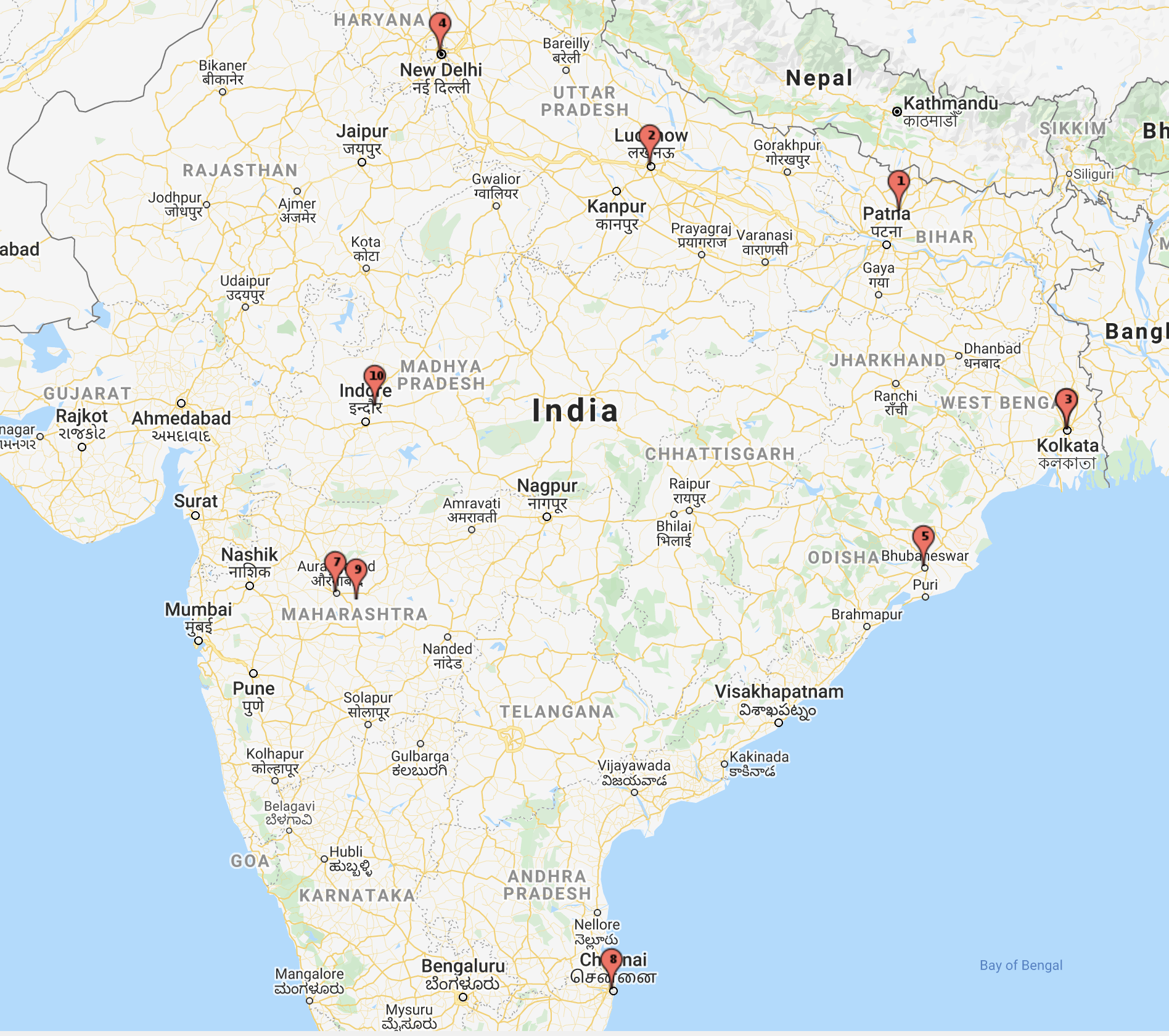
Standard Operating Procedures for Updating the Map of LPBI India

Author: Srinivas Sriram

Co-Author: Abhisar Anand 

To update the map of LPBI India, there are two major steps that are involved that use two different softwares. The softwares are:

  1. Zee Maps (For actually Creating the Map with Landmarks)
  2. Google Slides (For processing the map and making it look nice and downloadable as JPG). 

This SOP Article will delve into how to update the map of LPBI India that is currently created on these softwares in the case that the map needs to be updated for new members of LPBI India or members who leave LPBI India. 

  1. Go to https://www.zeemaps.com/
  2. Click on the “Sign In” button on the Top Right Corner:
  1. Sign in to Zee Maps with the following credentials:
    1. Email: lpbimap@gmail.com
    2. Password: (Get the Password from Dr. Lev-Ari)
  2. Once you are signed in, Click on the “MyMaps” page:
  3. Click on “LPBI India Map” to edit the Map:
  1. Now, you are in the Map. To see all the current landmarks of LPBI India Members, Click on the Side Bar at the very right of the page.

  1. Now, you can see all the current members of LPBI India who are on the Map. 
  2. To add a new person to the map, do the following:
    1. Click on the “Additions” section in the menu on the Left Side of the Page.
    2. Click on “Add Marker – Simple”.
    3. For Entry Name, Give the Name of the Person whom you are trying to add to the Map. 
    4. For Location, provide the Location of the Person whom you are trying to add (Just give the City Name and the Map should auto-complete a suggestion that is the correct location). 
    5. Then, you can click “Preview” to see how the new addition would look on the map, “Reset” to reset your changes, or “Close” to close the entry without saving it. If you are happy with the Entry, you can add the marker by clicking the “Submit” button at the bottom of the entry. 
    6. You have now added someone to the map, and you can see them on the table to the right. 
  1. To delete a person from the map, do the following:
    1. Click the person you would like to delete on the map, and then click the trash can button (as shown in the screenshot).
    2. Now, you have successfully removed someone from the Map, and they will no longer be visible on the table to the right. 
  2. Once you have updated the map per your liking, you now have to move on to the next step of the process. 
    1. First, take a screenshot of the updated map region similar to the example shown below and save it to your local computer. 
  1. You now need to access the Google Slide Document that makes the Map look better. Click on the link below to access the current LPBI India Map. 
    1. https://docs.google.com/presentation/d/1Jszv7_v7_ObjCHdSRIeygr6U9EZ0AwF_8Ud1Mh9R33o/edit?usp=sharing
  2. This Google Slide has:
    1. A screenshot of the Zee Maps Map with text boxes to make the numbers easier to read. 
    2. A table (the same as the table seen on the Zee Maps Screen) that contains the name of the LPBI India Member and the number on the map that corresponds with that LPBI India Member. 
  3. Insert your new screenshot of the Map you just took into the Google Slide Document, and then change the table on the right to make sure that it matches the table shown on Zee Maps. Make sure that for the map, the text boxes that make the numbers look larger match up the locations of the individual people on the map. 
  4. Edge Case: If two people have the same location, you cannot see both of the markers at the same location. This is why in the current map, numbers 3 and 6 and numbers 7 and 9 are on the same marker. Make sure that all the numbers match up and put the multiple numbers on the map if necessary. 
  5. Once you are satisfied with the updated LPBI India Map, you can download the Map in a variety of formats. Follow the instructions below to download the Map in the format that suits your needs. 
    1. On the top left corner, click on “File” (as shown in the screenshot)
    2. Click on “Download”. A variety of formats show up. Click on the format that suits your needs (ex. .jpg, .png, .pptx, etc.). Then, the map should download on your local machine. 
  6. Now, you have successfully updated the map of LPBI India and downloaded it on your local machine! Send the updated map to Dr. Lev-Ari (if someone else is performing the map updates), and this can be used for LPBI India!

Read Full Post »


Reporter: Aviva Lev-Ari, PhD, RN

Gordon H. Sun, M.D., Jeffrey D. Steinberg, Ph.D., and Reshma Jagsi, M.D., D.Phil.

N Engl J Med 2012; 367:687-690   August 23, 2012

Since the founding of the National Institutes of Health (NIH) and the National Science Foundation (NSF) more than six decades ago, the United States has maintained a preeminent position as a government sponsor of medical research. That primacy is being tested, however, by potent economic challenges. The NIH’s proposed budget for fiscal year 2013 would freeze baseline funding at 2012 levels, continuing a decade-long failure to keep pace with the rising costs of conducting medical research. Across-the-board cuts mandated by the Budget Control Act (BCA) of 2011 will also affect medical research, with the NIH, NSF, and other federal research sponsors sustaining budgetary reductions of about 8% next year.

Cuts to government-funded research will have adverse long-term effects on the health care system and the economy and may irreversibly compromise the work of laboratories long accustomed to receiving stable federal support. Moreover, many medical researchers could transfer their knowledge and resources abroad. In fact, five emerging Asian economic or technological powers — China, India, South Korea, Taiwan, and Singapore — already have medical research policies in place that are filling the void being created by ever more restrictive U.S. funding.

Several U.S.-based economists have justified increasing research budgets on the premise that medical discoveries have intrinsically high economic value. For example, Murphy and Topel have suggested that eliminating deaths related to heart disease had an estimated worth of $48 trillion, and a 1% reduction in cancer-related mortality could save $500 billion.1 Beyond these ambitious goals, however, are more practical arguments favoring support for medical research.

Local and regional economic benefits are one example. A June 2008 analysis by Families USA showed that during the NIH’s fiscal year 2007, nearly $23 billion in grants and contracts supported more than 350,000 jobs, with each dollar generating more than twice as much in direct state economic output in the form of goods and services. The NIH reported that almost 1 million Americans worked in for-profit medical businesses in 2008, earning $84 billion and generating $90 billion in goods and services, reinforcing the importance of preserving the U.S. position as a “knowledge hub” for medical research.2 Nevertheless, BCA cuts next year could result in at least 2500 fewer NIH grants, 33,000 fewer jobs, and a $4.5 billion loss in economic activity.3 Since the NIH’s budget represents less than 1% of overall federal spending, policymakers must reconsider whether shaving 8% from NIH outlays will have a noticeable positive effect on the national deficit or economy.

Fallout from funding cuts could include shifts in the U.S. medical research workforce. In 2000, the National Research Council noted both an overall shortage of medical researchers and inadequate funding for scientists working in the United States, which coincided with a decline in the number of funded NIH grant applications from 31% in fiscal year 2002 to 19% in 2010. This change is particularly critical for postdoctoral researchers, who represent the majority of the U.S. biomedical science workforce. According to the NSF, nearly half the 14,601 new postdoctoral-level researchers who were trained in the United States in 2009 were not U.S. citizens or permanent residents. If U.S. institutions are willing to devote money, training, and infrastructure to support talented, committed researchers, it would be an illogical waste of resources and poor long-term strategy to reduce federal grant mechanisms and wipe out potential job opportunities. Indeed, declining financial support may well encourage medical researchers to seek employment elsewhere.

As compared with the United States, China, India, South Korea, Taiwan, and Singapore have taken a sharply different view of medical research and have developed policies that foster medical research as an engine for economic growth and intellectual innovation (see tableMajor Government Agencies in Asia and Their Budgets for Medical Research.). Their national budgets are heavily based on scientific research and development, and funding is increasing, with budgetary targets ranging from 2 to 5% of their gross domestic products (GDPs). India’s funding goal for medical research alone is 2% of its GDP.

Increased funding for research infrastructure attracts scientists and organizations interested in high-quality research, including clinical trials. During the past two decades, increasing numbers of clinical trials have moved overseas, where benefits can include decreased costs of doing business, fewer administrative regulations, and greater enrichment of international relationships among researchers. The average annual rate of growth in clinical trials has been highest in China — 47% — while the number conducted in the United States has decreased by an average of 6.5% annually.4 In addition, the increased attention paid to Asia by private firms and other nongovernmental organizations has spurred rapid policy-level responses to concerns about the lack of informed consent, transparency, and other ethical issues, thus further strengthening the appeal of conducting research in the region.

Asian policies reflect a recognition of the extrinsic economic benefits of medical research. China and India have advocated for more government-funded medical research to improve health-related outcomes. China has espoused increased spending as part of achieving xiaokang, a Confucian term meaning a moderately prosperous society. In 2007, India inaugurated its Department of Health Research, which coordinates biomedical science and health-services research programs and translates their findings to address public health concerns. Since the signing of the Korean War Armistice Agreement in 1953, South Korea has leaned heavily on government-funded research to reduce poverty, allowing the country to gradually acquire advanced technologies and expertise. Medical research is part of at least two core technology areas in South Korea’s “577 Initiative”: medical technologies, such as neuroimaging, to address the needs of an aging population and research on issues pertaining to national safety and public health, such as infectious-disease preparedness and food safety.

National research and development programs have been a fundamental component of Taiwan’s economic policy for at least five decades. In 2005, the country began developing “intelligent medical care” — similar to earlier U.S. initiatives — which integrates medical information technology with quality-improvement measures. In Singapore, medical research and economic oversight are administratively linked. For example, the Biomedical Sciences Group of the Economic Development Board supports researchers financially and designs strategies that enhance Singapore’s status as a knowledge center, and the private firm Bio*One Capital invests directly in promising medical technologies.

The diverse strategies outlined above allow Asian countries to systematically recruit medical researchers from both home and abroad. China is particularly proactive in enticing Chinese-born, U.S.-educated researchers to return to their native country by offering generous financial and material incentives under its Knowledge Innovation Program. As the vice president of the Chinese Academy of Sciences stated more than a decade ago, modern “research and development is actually a war for more talented people.”5 In 2000, Singapore jump-started its Biomedical Sciences Initiative to attract medical researchers worldwide with a direct $2 billion investment, as well as with tax incentives for internal biotechnology start-ups and global pharmaceutical firms. In Singapore and India, English is the primary language for scientific communications, which alleviates concerns about language barriers.

For two decades, emerging Asian countries have been designing long-term strategies to reap the benefits of medical research. Meanwhile, the United States is relying on short-term solutions to support its medical research infrastructure, such as those offered by the Patient Protection and Affordable Care Act and the American Recovery and Reinvestment Act. Decreased investment in U.S. medical research could lead to long-term economic damage for the United States and the loss of its stature as a global leader in the field. Powerful incentives that can retain an elite biomedical-research workforce are necessary to strengthen the U.S. health care system and economy.

The views expressed in this article are those of the authors and do not necessarily reflect those of the Robert Wood Johnson Foundation, the Department of Veterans Affairs, or the Agency for Science, Technology, and Research.

Disclosure forms provided by the authors are available with the full text of this article at NEJM.org.

SOURCE INFORMATION

From the Robert Wood Johnson Foundation Clinical Scholars Program (G.H.S., R.J.), the Department of Otolaryngology (G.H.S.), and the Department of Radiation Oncology (R.J.), University of Michigan, and the Health Services Research and Development Service, VA Ann Arbor Healthcare System (G.H.S.) — both in Ann Arbor, MI; and the Singapore Bioimaging Consortium, Agency for Science, Technology, and Research, Singapore (J.D.S.).

http://www.nejm.org/doi/full/10.1056/NEJMp1206643?query=TOC


Read Full Post »