Feeds:
Posts
Comments

Archive for the ‘Population Health Management, Nutrition and Phytochemistry’ Category

Reporter and Curator: Dr. Sudipta Saha, Ph.D.

Hepatocellular carcinoma is one of the most common malignancies worldwide, and it has a poor prognosis due to its rapid development and early metastasis. An understanding of tumor metabolism would be helpful for the clinical diagnosis and therapy of hepatocellular carcinoma. Chronic hepatitis B virus infection is the primary risk factor for hepatocellular carcinoma, and the majority of hepatocellular carcinoma cases develop from hepatitis infections and subsequent cirrhosis. Rapid development and early metastasis are the typical characteristics of hepatocellular carcinoma, which always results in a poor prognosis. Therefore, investigating the hepatocarcinogenesis mechanism is very important for decreasing the incidence and mortality of hepatocellular carcinoma. The abnormal metabolism of cancer has been considered an important characteristic of tumors, which could clarify the pathogenesis and provide potential therapeutic targets for clinical treatments. According to the Warburg effect, the deregulated energy metabolism of cancer cells may also modify many related metabolic pathways that influence various biological processes, such as cell proliferation and apoptosis. As a common characteristic of cancer cells, modified metabolism has been the focus of cancer research.

Because of its asymptomatic nature, hepatocellular carcinoma is usually diagnosed at late and advanced stages, for which there are no effective therapies. Thus, biomarkers for early detection and molecular targets for treating hepatocellular carcinoma are urgently needed. Emerging high-throughput metabolomics technologies have been widely applied, aiming at the discovery of candidate biomarkers for cancer staging, prediction of recurrence and prognosis, and treatment selection. Tissue metabolomics is a useful tool for studying the abnormal metabolisms of diseases, and it can provide information about the metabolic modifications and the upstream regulative mechanism in diseases. More importantly, the systemic metabolic characteristics of tissues could provide opportunities for exploring novel diagnostic markers or therapeutic targets for clinical applications. Tissue metabolomics is conducted using a pairwise comparison of different parts of tissue from each patient, which can remove individual differences, such as age, sex, region, etc. The differences between the tumor cells and their surrounding host cells may reflect the interactions of the tumor and the host, which are important clues for studying the invasion and metastasis of tumors. Metabolic profiles, which are affected by many physiological and pathological processes, may provide further insight into the metabolic consequences of this severe liver disease. Small-molecule metabolites have an important role in biological systems and represent attractive candidates to understand hepatocellular carcinoma phenotypes. The power of metabolomics allows an unparalleled opportunity to query the molecular mechanisms of hepatocellular carcinoma.

Source References:

http://www.ncbi.nlm.nih.gov/pubmed/23824744

http://www.ncbi.nlm.nih.gov/pubmed/23150189

http://onlinelibrary.wiley.com/doi/10.1002/hep.26350/abstract

http://www.ncbi.nlm.nih.gov/pubmed/21114800

http://www.ncbi.nlm.nih.gov/pubmed/19305372

Read Full Post »

Reporter and Curator: Dr. Sudipta Saha, Ph.D.

Molecular biomarkers could detect biochemical changes associated with disease processes. The key metabolites have become an important part for improving the diagnosis, prognosis, and therapy of diseases. Because of the chemical diversity and dynamic concentration range, the analysis of metabolites remains a challenge. Assessment of fluctuations on the levels of endogenous metabolites by advanced NMR spectroscopy technique combined with multivariate statistics, the so-called metabolomics approach, has proved to be exquisitely valuable in human disease diagnosis. Because of its ability to detect a large number of metabolites in intact biological samples with isotope labeling of metabolites using nuclei such as H, C, N, and P, NMR has emerged as one of the most powerful analytical techniques in metabolomics and has dramatically improved the ability to identify low concentration metabolites and trace important metabolic pathways. Multivariate statistical methods or pattern recognition programs have been developed to handle the acquired data and to search for the discriminating features from biosample sets. Furthermore, the combination of NMR with pattern recognition methods has proven highly effective at identifying unknown metabolites that correlate with changes in genotype or phenotype. The research and clinical results achieved through NMR investigations during the first 13 years of the 21st century illustrate areas where this technology can be best translated into clinical practice.

In the last decade, proteomics and metabolomics have contributed substantially to our understanding of cardiovascular diseases. The unbiased assessment of pathophysiological processes without a priori assumptions complements other molecular biology techniques that are currently used in a reductionist approach. A discrete biological function is very rarely attributed to a single molecule; more often it is the combined input of many proteins. In contrast to the reductionist approach, in which molecules are studied individually, “omics” platforms allow the study of more complex interactions in biological systems. Combining proteomics and metabolomics to quantify changes in metabolites and their corresponding enzymes will advance our understanding of pathophysiological mechanisms and aid the identification of novel biomarkers for cardiovascular disease.

Marginal deficiency of vitamin B-6 is common among segments of the population worldwide. Because pyridoxal 5′-phosphate serves as a coenzyme in the metabolism of amino acids, carbohydrates, organic acids, and neurotransmitters, as well as in aspects of one-carbon metabolism, vitamin B-6 deficiency could have many effects. NMR spectral features of selected metabolites indicated that vitamin B-6 restriction significantly increased the ratios of glutamine/glutamate and 2-oxoglutarate/glutamate and tended to increase concentrations of acetate, pyruvate, and trimethylamine-N-oxide. Tandem MS showed significantly greater plasma proline after vitamin B-6 restriction, but there were no effects on the profile of 14 other amino acids and 45 acylcarnitines. These findings demonstrate that marginal vitamin B-6 deficiency has widespread metabolic perturbations and illustrate the utility of metabolomics in evaluating complex effects of altered vitamin B-6 intake.

Hepatocellular carcinoma is one of the most common malignancies worldwide, and it has a poor prognosis due to its rapid development and early metastasis. An understanding of tumor metabolism would be helpful for the clinical diagnosis and therapy of hepatocellular carcinoma. To investigate the metabolic features of hepatocellular carcinoma, a non-targeted metabolic profiling strategy based on liquid chromatography-mass spectrometry was performed. The results revealed multiple metabolic changes in the tumor, and the principal changes included elevated glycolysis, inhibition of the tricarboxylic acid cycle, accelerated gluconeogenesis and β-oxidation for energy supply and down-regulated Δ-12 desaturase. Furthermore, increased levels of anti-oxidative molecules, such as glutathione, and decreased levels of inflammatory-related polyunsaturated fatty acids and the phospholipase A2 enzyme were also observed. The differential metabolites found in the tissue were tested in serum samples from the chronic hepatitis, cirrhosis and hepatocellular carcinoma patients. The combination of betaine and propionylcarnitine was confirmed to have a good diagnostic potential to distinguish hepatocellular carcinoma from chronic hepatitis and cirrhosis. External validation of cirrhosis and hepatocellular carcinoma serum samples further shows the combination biomarker is useful for hepatocellular carcinoma diagnosis.

Current diagnostic techniques have increased the detection of prostate cancer; however, these tools inadequately stratify patients to minimize mortality. Recent studies have identified a biochemical signature of prostate cancer metastasis, including increased sarcosine abundance. Prostate tumors had significantly altered metabolite profiles compared to cancer-free prostate tissues, including biochemicals associated with cell growth, energetics, stress, and loss of prostate-specific biochemistry. Many metabolites were further associated with clinical findings of aggressive disease. Aggressiveness-associated metabolites stratified prostate tumor tissues with high abundances of compounds associated with normal prostate function (e.g., citrate and polyamines) from more clinically advanced prostate tumors. These aggressive prostate tumors were further subdivided by abundance profiles of metabolites including NAD+ and kynurenine. When added to multiparametric nomograms, metabolites improved prediction of organ confinement and 5-year recurrence. These findings support and extend earlier metabolomic studies in prostate cancer and studies where metabolic enzymes have been associated with carcinogenesis and/or outcome. Furthermore, it suggests that panels of analytes may be valuable to translate metabolomic findings to clinically useful diagnostic tests.

Source References:

http://www.ncbi.nlm.nih.gov/pubmed/23828598

http://www.ncbi.nlm.nih.gov/pubmed/23827455

http://www.ncbi.nlm.nih.gov/pubmed/23776431

http://www.ncbi.nlm.nih.gov/pubmed/23824744

http://www.ncbi.nlm.nih.gov/pubmed/23824564

Published related articles on this open access online scientific journal:


World of Metabolites: Lawrence Berkeley National Laboratory developed Imaging Technique for their Capturing


Aviva Lev-Ari, PhD, RN 06/13/2013


http://pharmaceuticalintelligence.com/2013/06/13/world-of-metabolites-lawrence-berkeley-national-laboratory-developed-imaging-technique-for-their-capturing/


Metabolite Identification Combining Genetic and Metabolic Information: Genetic association links unknown metabolites to functionally related genes


Aviva Lev-Ari, PhD, RN 10/22/2012


http://pharmaceuticalintelligence.com/2012/10/22/metabolite-identification-combining-genetic-and-metabolic-information-genetic-association-links-unknown-metabolites-to-functionally-related-genes/


Metabolomics: its applications in food and nutrition research


Dr. Sudipta Saha, Ph.D., RN 05/12/2013


http://pharmaceuticalintelligence.com/2013/05/12/metabolomics-its-applications-in-food-and-nutrition-research/


Increased Cardiovascular Risk: Intestinal Microbial Metabolism


Aviva Lev-Ari, PhD, RN 05/07/2013


http://pharmaceuticalintelligence.com/2013/05/07/increased-cardiovascular-risk-intestinal-microbial-metabolism/


Late Onset of Alzheimer’s Disease and One-carbon Metabolism


Dr. Sudipta Saha, Ph.D., RN 05/06/2013


http://pharmaceuticalintelligence.com/2013/05/06/alzheimers-disease-and-one-carbon-metabolism/


Importance of Omega-3 Fatty Acids in Reducing Cardiovascular Disease


Dr. Sudipta Saha, Ph.D., RN 04/29/2013


http://pharmaceuticalintelligence.com/2013/04/29/importance-of-omega-3-fatty-acids-in-reducing-cardiovascular-disease/


Mitochondrial Metabolism and Cardiac Function


Larry H Bernstein, MD, FACP, RN 04/14/2013


http://pharmaceuticalintelligence.com/2013/04/14/mitochondrial-metabolism-and-cardiac-function/


How Methionine Imbalance with Sulfur-Insufficiency Leads to Hyperhomocysteinemia


Larry H Bernstein, MD, FACP, RN 04/04/2013


http://pharmaceuticalintelligence.com/2013/04/04/sulfur-deficiency-and-hyperhomocusteinemia/


Ca2+ Signaling: Transcriptional Control


Larry H Bernstein, MD, FACP, RN 03/06/2013


http://pharmaceuticalintelligence.com/2013/03/06/ca2-signaling-transcriptional-control/


Calcium (Ca) supplementation (>1400 mg/day): Higher Death Rates from all Causes and Cardiovascular Disease in Women


Aviva Lev-Ari, PhD, RN 02/19/2013


http://pharmaceuticalintelligence.com/2013/02/19/calcium-ca-supplementation-1400-mgday-higher-death-rates-from-all-causes-and-cardiovascular-disease-in-women/


A Second Look at the Transthyretin Nutrition Inflammatory Conundrum


Larry H Bernstein, MD, FACP, RN 12/03/2013


http://pharmaceuticalintelligence.com/2012/12/03/a-second-look-at-the-transthyretin-nutrition-inflammatory-conundrum/


Pancreatic Cell News: Beta cell dysfunction attributed to saturated non-esterified fatty acid palmitate


Aviva Lev-Ari, PhD, RN 11/27/2012


http://pharmaceuticalintelligence.com/2012/11/27/pancreatic-cell-news-beta-cell-dysfunction-attributed-to-saturated-non-esterified-fatty-acid-palmitate/


Metabolic drivers in aggressive brain tumors


Prabodh Kandala, PhD, RN 11/11/2012


http://pharmaceuticalintelligence.com/2012/11/11/metabolic-drivers-in-aggressive-brain-tumors/


Advances in Separations Technology for the “OMICs” and Clarification of Therapeutic Targets


Larry H Bernstein, MD, FACP, RN 10/22/2012


http://pharmaceuticalintelligence.com/2012/10/22/advances-in-separations-technology-for-the-omics-and-clarification-of-therapeutic-targets/


Expanding the Genetic Alphabet and Linking the Genome to the Metabolome


Larry H Bernstein, MD, FACP, RN 09/24/2012


http://pharmaceuticalintelligence.com/2012/09/24/expanding-the-genetic-alphabet-and-linking-the-genome-to-the-metabolome/


Risks of Hypoglycemia in Diabetics with CKD


Larry H Bernstein, MD, FACP, RN 08/01/2012


http://pharmaceuticalintelligence.com/2012/08/01/risks-of-hypoglycemia-in-diabetics-with-ckd/


Nitric Oxide in bone metabolism


Aviral Vatsa, PhD, MBBS, RN 07/16/2012


http://pharmaceuticalintelligence.com/2012/07/16/nitric-oxide-in-bone-metabolism/


Read Full Post »

Reporter and Curator: Dr. Sudipta Saha, Ph.D.

WC 10

WordCloud by Zach Day; Article Title: Interaction of enzymes and hormones

The majority of living forms depend for their functioning upon two classes of biocatalysts, the enzymes and the hormones. These biocatalysts permit the diverse chemical reactions of the organism to proceed at 38°C with specificity and at rates frequently unattainable in vitro at elevated temperatures with similar reactants. The physiologic importance of enzymes and hormones is evident not only under normal circumstances, but is reflected clinically in the diverse descriptions of errors of metabolism, due to lack or deficiency of one or more enzymes, and the numerous hypo and hyper functioning states resulting from imbalance of hormonal supply.

In as much as both enzymes and hormones function, with rare exception, to accelerate the rates of processes in cells, investigators have sought possible interrelationships and interactions of enzymes and hormones, particularly as a basis for the mechanism of hormonal action. It has seemed logical to hypothesize that hormones, while not essential for reactions to proceed but never the less affecting the rates of reactions, may function by altering either the concentration or activity of the prime cellular catalysts, the enzymes. This proposed influence of hormones on enzymatic activity might be a primary, direct effect achieved by the hormone participating as an integral part of an enzyme system, or an indirect influence based upon the hormone altering the concentration of available enzyme and/or substrate utilized by a particular enzyme. Many publications have described alterations in the activity of enzymes in various tissues following administration in vivo of diverse hormonal preparations. However, it is not possible to judge, in the in vivo experiments, whether the reported effects are examples of direct enzyme-hormone interaction, or an indirect influence of the hormone mediated via one or more metabolic pathways, and therefore other enzyme systems whose activities are not being measured. Data from in-vivo studies of this type are thus not pertinent to a discussion of direct hormone-enzyme interaction.

Enzyme hormone interaction, as seen, for example, in the profound role of the enzymes of the liver in the metabolism of certain hormones, is of paramount importance in determining the effectiveness of these hormones. The ability of the organic chemist to prepare synthetic hormonal derivatives which are relatively resistant to enzymatic processes in the liver has been of outstanding value for approaches to oral hormonal therapy. Largely unexplored as yet is the possibility that enzyme-hormone interactions may lead to the production of physiologically more active substances from compounds normally synthesized and secreted by a particular endocrine gland. It may be said at the outset that in no instance has a hormone been demonstrated to influence the rate of a cellular reaction by functioning as a component of an enzyme system.

It is plausible that enzymes in a pathway might be structurally conserved because of their similar substrates and products for linked metabolic steps. However, this is not typically observed, and sequence analysis confirms the lack of convergent or divergent evolution. One might postulate that, if the folds or overall structures of the enzymes in a pathway are not conserved, then perhaps at least pathway-related active site similarities would exist. It is true that metal-binding sites and nucleotide-binding sites are structurally conserved. For example, cofactor-binding motifs for zinc, ATP, biopterin and NAD have been observed and biochemically similar reactions appear to maintain more structural similarity than pathway-related structural motifs. In general, ‘horizontal’ structural equivalency is prevalent in that chemistry-related structural similarities exist, but ‘vertical’ pathway-related structural similarities do not hold.

For metabolic pathways, protein fold comparisons and corresponding active site comparisons are sometimes possible if structural and functional homology exists. Unfortunately, with the current structural information available, the majority of active sites that can be structurally characterized are not similar within a metabolic pathway. Other examples exist of nearly completed pathways, for example, the tricarboxylic acid (TCA) cycle, and similar observations are observed. Situations in which different metals are incorporated in enzyme active sites lead to inherently different catalytic portions of the active sites. Slight differences in the ligand-binding portions of the respective active sites must lead to the observed differences in pathway-related enzyme specificities. These modifications in enzymatic activity are similar to what Koshland and co-workers previously observed. They showed that very minor active site perturbations to isocitrate dehydrogenase had drastic effects on catalysis.

Molecular level understanding of chemical and biological processes requires mechanistic details and active site information. The current knowledge regarding enzyme active sites is incomplete. Even in situations in which ATP-, ADP- or NAD(P)+-binding domains are observed or in situations in which similar folds are found (e.g. even for related kinases or for proteins involved in the immune system), structural comparisons do not yield specific details about active sites and it is not possible to predict where the substrate binds or to identify determinants of active site substrate specificity. Therefore, in this era of structural genomics, there should be major continued emphasis on completing structural information for important metabolic pathways. This will require improved efforts to obtain structures for enzyme complexes with appropriate cofactors, substrates or substrate analogs, as well as with inhibitors and regulators of activity. Then and only then will we have complete structural knowledge and facilitated structure-based drug design efforts. Structural genomics efforts promise to provide structural data in a high-throughput mode. However, we need to ensure that much of this focus is placed on completing the picture of metabolic pathways and enzyme active sites.

The availability of the human genomic sequence is changing the way in which biological questions are addressed. Based on the prediction of genes from nucleotide sequences, homologies among their encoded amino acids can be analyzed and used to place them in distinct families. This serves as a first step in building hypotheses for testing the structural and functional properties of previously uncharacterized paralogous genes. As genomic information from more organisms becomes available, these hypotheses can be refined through comparative genomics and phylogenetic studies. Instead of the traditional single-gene approach in endocrine research, we are beginning to gain an understanding of entire mammalian genomes, thus providing the basis to reveal subfamilies and pathways for genes involved in ligand signaling. The present review provides selective examples of postgenomic approaches in the analysis of novel genes involved in hormonal signaling and their chromosomal locations, polymorphisms, splicing variants, differential expression, and physiological function. In the postgenomic era, scientists will be able to move from a gene-by-gene approach to a reconstructionistic one by reading the encyclopedia of life from a global perspective. Eventually, a community-based approach will yield new insights into the complexity of intercellular communications, thereby offering us an understanding of hormonal physiology and pathophysiology. Many cellular signaling pathways ultimately control specific patterns of gene expression in the nucleus through a variety of signal-regulated transcription factors, including nuclear hormone receptors. The advent of genomic technologies for examining signal-regulated transcriptional responses and transcription factor binding on a genomic scale has dramatically increased our understanding of the cellular programs that control hormonal signaling and gene regulation. Studies of transcription factors, especially nuclear hormone receptors, using genomic approaches have revealed novel and unexpected features of hormone-regulated transcription, and a global view is beginning to emerge.

Source References:

http://pediatrics.aappublications.org/content/26/3/476.abstract

http://www.ncbi.nlm.nih.gov/pubmed/13499378

http://endo.endojournals.org/content/54/5/591.long

http://www.ncbi.nlm.nih.gov/pmc/articles/PMC528661/

http://www.ncbi.nlm.nih.gov/pmc/articles/PMC1196745/

http://www.ncbi.nlm.nih.gov/pubmed/11114510

http://www.ncbi.nlm.nih.gov/pubmed/23516625

http://www.annualreviews.org/doi/abs/10.1146/annurev.bi.50.070181.002341

http://www.sciencedirect.com/science/article/pii/S0016648098971258#

http://www.interactive-biology.com/3931/basics-of-hormone-classification/

http://en.wikipedia.org/wiki/Category:Hormones_by_chemical_structure

http://www.annualreviews.org/doi/abs/10.1146/annurev-physiol-021909-135840

http://www.ncbi.nlm.nih.gov/pubmed/16423812

http://edrv.endojournals.org/content/23/3/381.full.pdf

Read Full Post »

Treatment for Endocrine Tumors and Side Effects

Reporter and Curator: Dr. Sudipta Saha, Ph.D.

Surgery

The purpose of surgery is typically to remove the entire tumor, along with some of the healthy tissue around it, called the margin. If the tumor cannot be removed entirely, “debulking” surgery may be performed. Debulking surgery is a procedure in which the goal is to remove as much of the tumor as possible. Side effects of surgery include weakness, fatigue, and pain for the first few days following the procedure.

Chemotherapy

Chemotherapy is the use of drugs to kill tumor cells, usually by stopping the cells’ ability to grow and divide. Systemic chemotherapy is delivered through the bloodstream to reach tumor cells throughout the body. A chemotherapy regimen (schedule) usually consists of a specific number of cycles given over a set period of time. A patient may receive one drug at a time or combinations of different drugs at the same time. The side effects of chemotherapy depend on the individual and the dose used, but they can include fatigue, risk of infection, nausea and vomiting, loss of appetite, and diarrhea. These side effects usually go away once treatment is finished.

Radiation therapy

Radiation therapy is the use of high-energy x-rays or other particles to kill tumor cells. The most common type of radiation treatment is called external-beam radiation therapy, which is radiation given from a machine outside the body. When radiation treatment is given using implants, it is called internal radiation therapy or brachytherapy. A radiation therapy regimen usually consists of a specific number of treatments given over a set period of time. Side effects from radiation therapy may include fatigue, mild skin reactions, upset stomach, and loose bowel movements. Most side effects go away soon after treatment is finished.

Hormone therapy

The goal of hormone therapy is often to lower the levels of hormones in the body. Hormone therapy may be given to help stop the tumor from growing or to relieve symptoms caused by the tumor. In addition, for thyroid cancer, hormone therapy will be given if the thyroid gland has been removed, to replace the hormone that is needed by the body to function properly.

Immunotherapy

Immunotherapy (also called biologic therapy) is designed to boost the body’s natural defenses to fight the tumor. It uses materials made either by the body or in a laboratory to bolster, target, or restore immune system function. Examples of immunotherapy include cancer vaccines, monoclonal antibodies, and interferons. Alpha interferon is a form of biologic therapy given as an injection under the skin. This is sometimes used to help relieve symptoms caused by the tumor, but it can have severe side effects including fatigue, depression, and flu-like symptoms.

Targeted therapy

Targeted therapy is a treatment that targets the tumor’s specific genes, proteins, or the tissue environment that contributes to cancer growth and survival. This type of treatment blocks the growth and spread of tumor cells while limiting damage to normal cells, usually leading to fewer side effects than other cancer medications.

Recent studies show that not all tumors have the same targets. To find the most effective treatment, the doctor may run tests to identify the genes, proteins, and other factors in the tumor. As a result, doctors can better match each patient with the most effective treatment whenever possible.

Depending on the type of endocrine tumor, targeted therapy may be a possible treatment option. For instance, targeted therapies, such as sunitinib (Sutent) and everolimus (Afinitor), have been approved for treating advanced islet cell tumors. Early results of clinical trials (research studies) with targeted therapy drugs for other types of endocrine tumors are promising, but more research is needed to prove they are effective.

Recurrent endocrine tumor

Once the treatment is complete and there is a remission (absence of symptoms; also called “no evidence of disease” or NED). Many survivors feel worried or anxious that the tumor will come back. If the tumor does return after the original treatment, it is called a recurrent tumor. It may come back in the same place (called a local recurrence), nearby (regional recurrence), or in another place (distant recurrence). When this occurs, a cycle of testing will begin again to learn as much as possible about the recurrence. Often the treatment plan will include the therapies described above (such as surgery, chemotherapy, and radiation therapy) but may be used in a different combination or given at a different pace. People with a recurrent tumor often experience emotions such as disbelief or fear. Patients are encouraged to talk with their health care team about these feelings and ask about support services to help them cope.

Metastatic endocrine tumor

If a cancerous tumor has spread to another location in the body, it is called metastatic cancer. A treatment plan that includes a combination of surgery, chemotherapy, radiation therapy, hormone therapy, immunotherapy, or targeted therapy may be recommended if required.

In addition to treatment to slow, stop, or eliminate the cancer (also called disease-directed treatment), an important part of cancer care is relieving a person’s symptoms and side effects. It includes supporting the patient with his or her physical, emotional, and social needs, an approach called palliative or supportive care. People often receive disease-directed therapy and treatment to ease symptoms at the same time.

Source References:

http://www.cancer.net/cancer-types/endocrine-tumor/treatment


http://www.macmillan.org.uk/Cancerinformation/Cancertypes/Endocrine/Endocrinetumours.aspx


http://cancer.osu.edu/patientsandvisitors/cancerinfo/cancertypes/endocrine/Pages/index.aspx


http://cancer.northwestern.edu/cancertypes/cancer_type.cfm?category=8


http://www.cancervic.org.au/about-cancer/cancer_types/endocrine_cancer


http://www.oncolink.org/types/types1.cfm?c=4

Read Full Post »

Reporter and Curator: Dr. Sudipta Saha, Ph.D.

  • Multiple important and complex interactions exist between the endocrine and other systems (e.g. immune, nervous).
  • Definition of hormones: circulating molecules with a site of action distant from site of origin with ability to bind to cellular receptors and initiate signal transduction via conformational changes in the receptor.
  • Hormones participate in growth and development, reproduction, energy metabolism and maintenance of the internal environment.
  • In general, hormones are protein-derived molecules that bind to cell surface receptors or steroid hormones that bind to nuclear receptors. An exemption is thyroid hormone, a modified amino acid that binds to nuclear receptors.
  • Integrated feedback loops are very characteristic to the endocrine system and critical in maintaining normal hormonal function. Two major types of control exist: the hypothalamic-pituitary-peripheral organ unit and the free standing endocrine gland.
  • Pathology in endocrinology is due to abnormal hormone activity or neoplasms, leading to endocrine hyperfunction/hyperfunction or structural abnormalities.

Endocrine pathology is derived from defects found at any point in the hormonal synthesissecretiontransportaction, or regulatory control of a hormone. Endocrine pathology often occurs in one of the following broad categories:

  1. Abnormal Hormone Activity which can be subdivided into:
    • Endocrine organ hypofunction
      • Primary endocrine organ failure can be genetic or acquired
        • Endocrine organ agenesis (absence)
        • Genetic defect in hormone biosynthetic pathway (e.g. adrenal insufficiency due to 21-hydroxylase deficiency)
        • Destruction due to
          • Autoimmune disease (e.g. Hashimoto’s hypothyroidism)
          • A tumor, infection or hemorrhage
        • Deficiency of precursor (e.g. iodine deficiency leading to decreased thyroid hormone synthesis)
      • Production of abnormal hormone resulting in hypofunction (e.g. abnormal glycosylation of TSH). Secondary endocrine organ failure (e.g. hypothyroidism due to hypopituitarism)
    • Endocrine organ hyperfunction
      • Primary endocrine organ process due to a benign condition (e.g. autoimmune thyroid gland stimulation in Graves’ disease) or benign neoplasm (e.g. primary hyperparathyroidism causing hypercalcemia). Endocrine cancers are rare but they may also release hormones that cause endocrine hyperfunction (e.g. adrenocortical carcinoma secreting excessive androgens causing virilization).
        • Benign condition (e.g. thyroid gland stimulation in Graves’ disease by autoantibodies against the TSH receptor)
        • Benign neoplasm (e.g. primary hyperparathyroid adenoma secreting excessive PTH causing hypercalcemia).
        • Endocrine cancers (e.g. adrenocortical carcinoma secreting excessive androgens causing virilization).
      • Secondary due to stimulation by a trophic/stimulatory hormone, most often due to a benign neoplasm (e.g. hypersecretion of cortisol from adrenal cortex due to and ACTH-secreting pituitary adenoma).
      • Less commonly, ectopic production of a hormone may lead to endocrine hyperfunction (e.g. ACTH released from small cell lung cancer cause hypersecretion of cortisol by adrenal glands).
    • Abnormality in hormone transport or metabolism (e.g. genetic defects of abnormal thyroid binding globulin)
    • Abnormal hormone receptor binding and/or signal transduction. Most often causing endocrine hypofunction due to resistance to the action of hormone. The receptor itself being unable to bind the hormone (e.g. thyroid hormone resistance) or there may be a defect in post-receptor signal transduction (e.g. type 2 diabetes mellitus). Occasionally, abnormal hormone signaling may lead to endocrine hyperfunction (e.g. Gs protein mutation leading to unregulated secretion of Growth Hormone).
  2. Neoplasms. They can be both benign or malignant. Symptoms develop either due to
    • Overproduction of hormone by the tumor (e.g. ACTH producing pituitary adenoma causing hypersecretion of cortisol)
    • Underproduction of nearby hormones due to mass effect (e.g. pituitary hormone production is often affected by large pituitary tumors)
    • Structural damage (e.g. hypothalamic-pituitary tumors causing headache, visual problems).
  3. Iatrogenic. Most common iatrogenic cause of endocrine abnormality is exogenous administration of glucocorticoids (give to treat non-endocrine conditions, e.g. rheumatoid arthritis)

Source References:

http://www.vivo.colostate.edu/hbooks/pathphys/endocrine/

http://ocw.tufts.edu/Content/14/lecturenotes/265876

http://intranet.tdmu.edu.ua/data/kafedra/internal/magistr/classes_stud/English/First%20year/Clinical%20Pathophysiology%20of%20Diseases/CLINICAL%20PATHOPHYSIOLOGY%20OF%20THE%20ENDOCRINE%20SYSTEM.htm

Greenspan FS and Gardner DG. Basic and Clinical Endocrinology, 6th edition. Lange Medical Books, McGraw-Hill, 2001.

Wilson, JD, Foster, DW, Kronenberg, HM, and Larsen, PR. Principles of Endocrinology. In: Williams Textbook of Endocrinology, 9th edition, W.B. Saunders, Philadelphia, 1998.

Read Full Post »

Reporter and Curator: Dr. Sudipta Saha, Ph.D.

Screen Shot 2021-07-19 at 6.17.32 PM

Word Cloud By Danielle Smolyar

Cancer is one of the most devastating and widespread diseases today. The development of cancer is a multi-step process involving genetic or epigenetic changes often occurring over a longer period of time. Moreover, cancer occurs in more or less all organs and tissues and is characterized by extensive heterogeneity both concerning the type and aggressiveness of the disease. Although some substantial progress in some areas has been made, there are still huge unmet needs in treatment methods and the efficacy of currently available drugs. The pharmaceutical industry has struggled with the ever increasing costs in drug development and unfortunately novel drugs have not seldom demonstrated only marginal improvement in efficacy often at the cost of quality of life of the patients. For these reasons, new approaches are focusing on disease prevention instead of only treating the symptoms. Recently, much attention has been paid to prevention of the disease in parallel to continuous drug discovery.

Intervention in food intake has been demonstrated to play an enormous role in both prevention as well as treatment of diseases. Numerous studies indicate a clear link between cancer and diet. The substantial development of sequencing technologies has resulted in access to enormous amounts of genomics information, which resulted in the establishment of nutrigenomics as an emerging approach to link genomics research to studies on nutrition. Increased understanding has demonstrated how nutrition can influence human health both at genetic and epigenetic levels. It investigates the effects of nutrition and bioactive food compounds on gene expression. This approach has allowed the investigation of the effect on nutrition on individuals with specific genetic features. Moreover, it has provided the basis for nutritional intervention in prevention and treatment of disease and the inauguration of personalized nutrition. However, differences in types of cancer, the level of aggressiveness, and their occurrence at different stages of life have seriously complicated the understanding of the effect of nutrition on cancer prevention and treatment. Other individual variations such as the amounts of food consumed, digestion, metabolism and other factors like geographical, ethnic and sociological diversity has hampered the identification of which food components are most important for human health. Dramatic dietary modifications have proven essential in reducing risk and even prevention of cancer. Moreover, intense revision of diet in cancer patients has revealed significant changes in gene expression and also has provided therapeutic efficacy even after short-term application.

Obviously, a multitude of diets have been evaluated, but probably the common factor for achieving both prophylactic and therapeutic responses is to consume predominantly diets rich in fruits, vegetables, fish and fibers and reduced quantities of especially red meat. There are numerous examples of how dietary intake can promote health on both a preventive as well as therapeutic level. Radical change in diet has resulted in dramatic changes in gene expression in prostate cancer patients revealing that many of those genes involved in cancer development were down-regulated. The importance of nutrigenomics as a multi-task approach involving genomics, proteomics, metabolomics, et cetera has further provided novel possibilities to address the effect of nutrition on human health. Despite encouraging findings on how dietary modifications can prevent disease and restore health, there are a number of factors which complicate the outcome. There are variations in response to dietary changes depending on age and gender. However, the vast amount of accumulated nutrigenomics data should not overshadow the needs to take into account other important factors such as lifestyle, social, geographical and economic factors affecting diet and health.

Source References:

http://www.lifescienceglobal.com/home/cart?view=product&id=121

http://www.frontiersin.org/Nutrigenomics/10.3389/fgene.2011.00091/abstract

http://www.sciencedirect.com/science/article/pii/S0002822308021871

http://ajcn.nutrition.org/content/89/5/1553S

http://www.sciencedirect.com/science/article/pii/S030438350800390X

Read Full Post »

Reporter and Curator: Dr. Sudipta Saha, Ph.D.

Antioxidant micronutrients, such as vitamins and carotenoids, exist in abundance in fruit and vegetables and have been known to contribute to the body’s defence against reactive oxygen species. Numerous epidemiological studies have demonstrated that a high dietary consumption of fruit and vegetables rich in carotenoids or with high serum carotenoid concentrations results in lower risks of certain cancers, diabetes and cardiovascular disease. These epidemiological studies have suggested that antioxidant carotenoids may have a protective effect against diabetes or cardiovascular disease. However, the consumption of carotenoids in pharmaceutical forms for the treatment or prevention of these chronic diseases cannot be recommended, because some large randomized controlled trials did not reveal any reduction in cardiovascular events or type 2 diabetes with b-carotene. High doses of carotenoids used in the supplementation studies could have a pro-oxidant effect. Therefore, it is favourable to intake carotenoids from foods through the combination of other nutrients such as vitamins, minerals or phytochemicals, not by supplements.

The metabolic syndrome is a clustering of metabolic abnormalities that increase the risk for diabetes and cardiovascular disease. Typically, it includes excess weight, hyperglycaemia, evaluated blood pressure, low concentration of HDL-cholesterol, and hypertriacylglycerolaemia. This syndrome is emerging as one of the major medical and public health problems in Japan, and persons with this syndrome have an increased risk of morbidity and mortality due to cardiovascular disease and diabetes. Recently, many studies have examined the associations of dietary patterns with the metabolic syndrome and shown that diets rich in fruit and vegetables have been inversely associated with the metabolic syndrome. These previous reports suggest that a high intake of fruit and vegetables may reduce the risk of the metabolic syndrome through the beneficial combination of antioxidants, fibre, minerals, and other phytochemicals. Some recent cross-sectional and case–control studies have shown the associations of serum antioxidant status with the metabolic syndrome. Ford et al. reported that low intake and/or low serum concentrations of vitamins and carotenoids were associated with the risk of the metabolic syndrome. Although very few data are available about the associations of antioxidant carotenoids with the metabolic syndrome, people who have the metabolic syndrome are more likely to have increased oxidative stress than people who do not have this syndrome.

In some recent studies, it has been reported that oxidative stress, which is an imbalance between pro-oxidants and antioxidants, occurs more frequently in metabolic syndrome subjects than in non-metabolic syndrome subjects. Oxidative stress may play a key role in the pathophysiology of diabetes and cardiovascular disease. On the other hand, smoking is a potent oxidative stress in man. This increment of oxidative stress induced by smoking may develop insulin resistance, and increased insulin resistance may result in the clustering of the metabolic abnormality. Therefore, antioxidants could have a beneficial effect on reducing the risk of these conditions in smokers. However, there is limited information about the interaction of serum antioxidant carotenoids and the metabolic syndrome with smoking habit. This study was aimed to investigate the interaction of serum carotenoid concentrations and the metabolic syndrome with smoking. The association of the concentrations of six serum carotenoids, i.e. lutein, lycopene, a-carotene, b-carotene, b-cryptoxanthin and zeaxanthin, with metabolic syndrome status stratified by smoking status was evaluated crosssectionally.

In this study, the associations of the serum carotenoids with the metabolic syndrome stratified by smoking habit were evaluated cross-sectionally. A total of 1073 subjects (357 male and 716 female) who had received health examinations in the town of Mikkabi, Shizuoka Prefecture, Japan, participated in the study. Inverse associations of serum carotenoids with the metabolic syndrome were more evident among current smokers than non-smokers. These results support that antioxidant carotenoids may have a protective effect against development of the metabolic syndrome, especially in current smokers who are exposed to a potent oxidative stress.

Source References:

http://www.ncbi.nlm.nih.gov/pubmed/18445303

http://www.ncbi.nlm.nih.gov/pubmed/19450371

http://www.ncbi.nlm.nih.gov/pubmed/21216053

http://www.ncbi.nlm.nih.gov/pubmed/19631019

http://www.ncbi.nlm.nih.gov/pubmed/12324189

http://www.ncbi.nlm.nih.gov/pubmed/18689373

Read Full Post »

Personalized Medicine and Colon Cancer

Author: Tilda Barliya, PhD

According to Dr. Neil Risch a leading expert in statistical genetics and the director of the UCSF Institute for Human Genetics,  “Personalized medicine, in which a suite of molecules measured in a patient’s lab tests can inform decisions about preventing or treating diseases, is becoming a reality” (7).

Colorectal cancer (CRC) is the third most common cancer and the fourth-leading cause of cancer death worldwide despite advances in screening, diagnosis, and treatment. Staging is the only prognostic classification used in clinical practice to select patients for adjuvant chemotherapy. However, pathological staging fails to predict recurrence accurately in many patients undergoing curative surgery for localized CRC (1,2). Most of the patients who are not eligible for surgery need adjuvant chemotherapy in order to avoid relapse or to increase survival. Unfortunately, only a small portion of them shows an objective response to chemotherapy, becoming problematic to correctly predict patients’ clinical outcome (3).

CRC patients are normally being tested for several known biomarkers which falls into 4 main categories (5):

  1. Chromosomal Instability (CIN)
  2. Microsatellite Instability (MSI)
  3. CpG Island methylator phynotype (CIMP)
  4. Global DNA hypomethylation

In the past few years many studies have exploited microarray technology to investigate gene expression profiles (GEPs) in CRC, but no established signature has been found that is useful for clinical practice, especially for predicting prognosis.  Only a subset of CRC patients with MSI tumors have been shown to have better prognosis and probably respond differently to adjuvant chemotherapy compared to microsatellite stable (MSS) cancer patients (6).

Pritchard & Grady have summarized the selected biomarkers that have been evaluated in colon cancer patients (10).

Table 1

Selected Biomarkers That Have Been Evaluated in Colorectal Cancer

Biomarker Molecular Lesion Frequency
in CRC
Prediction Prognosis Diagnosis
KRAS Codon 12/13 activating
mutations; rarely codon
61, 117,146
40% Yes Possible
BRAF V600E activating
mutation
10% Probable Probable Lynch
Syndrome
PIK3CA Helical and kinase
domain mutations
20% Possible Possible
PTEN Loss of protein by IHC 30% Possible
Microsatellite Instability (MSI) Defined as >30%
unstable loci in the NCI
consensus panel or
>40% unstable loci in a
panel of mononucleotide
microsatellite repeats9
15% Probable Yes Lynch
Syndrome
Chromosome Instability (CIN) Aneuploidy 70% Probable Yes
18qLOH Deletion of the long arm
of chromosome 18
50% Probable Probable
CpG Island Methylator
Phenotype (CIMP)
Methylation of at least
three loci from a selected
panel of five markers
15% +/− +/−
Vimentin (VIM) Methylation 75% Early
Detection
TGFBR2 Inactivating Mutations 30%
TP53 Mutations Inactivating Mutations 50%
APC Mutations Inactivating Mutations 70% FAP
CTNNB1 (β-Catenin) Activating Mutations 2%
Mismatch Repair Genes Loss of protein by IHC;
methylation; inactivating
mutations
1–15% Lynch
Syndrome

CRC- colorectal cancer; IHC- immunohistochemistry; FAP- Familial Adenomatous Polyposis

Examples for the great need of personalized medicine tailored according to the patients’ genetics is clearly seen with two specific drugs for CRC:  Cetuximab and panitumumab are two antibodies that were developed to treat colon cancer. However, at first it seemed as if they were a failure because they did not work in many patients. Then, it was discovered that if a cancer cell has a specific genetic mutation, known as K-ras, these drugs do not work.  This is an excellent example of using individual tumor genetics to predict whether or not treatment will work (8).

According to Marisa L et al, however, the molecular classification of CC currently used, which is based on a few common DNA markers as mentioned above (MSI, CpG island methylator phenotype [CIMP], chromosomal instability [CIN], and BRAF and KRAS mutations), needs to be refined.

Genetic Expression Profiles (GEP)

CRC is composed of distinct molecular entities that may develop through multiple pathways on the basis of different molecular features, as a consequence, there may be several prognostic signatures for CRC, each corresponding to a different entity. GEP studies have recently identified at least three distinct molecular subtypes of CC (4). Dr. Marisa Laetitia and her colleagues from the Boige’s lab however, have conducted a very thorough study and identifies 6 distinct clusters for CC patients. Herein, we’ll describe the majority of this study and their results.

Study  Design:

Marisa L et al (1) performed a consensus unsupervised analysis (using an Affymertix chip) of the GEP on tumor tissue sample from 750 patients with stage I to IV CC. Patients were staged according to the American Joint Committee on Cancer tumor node metastasis (TNM) staging system. Of the 750 tumor samples of the CIT cohort, 566 fulfilled RNA quality requirements for GEP analysis. The 566 samples were split into a discovery set (n = 443) and a validation set (n = 123).

Several known mutations were used as internal controls, including:

  • The seven most frequent mutations in codons 12 and 13 of KRAS .
  • The BRAF c.1799T>A (p.V600E)
  • TP53mutations (exons 4–9)
  • MSI was analyzed using a panel of five different microsatellite loci from the Bethesda reference panel
  • CIMP status was determined using a panel of five markers (CACNA1G, IGF2, NEUROG1, RUNX3, and SOCS1)

Results:

The results revealed six clusters of samples based on the most variant probe sets. The consensus matrix showed that C2, C3, C4, and C6 appeared as well-individualized clusters, whereas there was more classification overlap between C1 and C5. In other words:

  • Tumors classified as C1, C5, and C6 were more frequently CIN+, CIMP−TP53 mutant, and distal (p<0.001), without any other molecular or clinicopathological features able to discriminate these three clusters clearly.
  • Tumors classified as C2, C4, and C3 were more frequently CIMP+ (59%, 34%, and 18%, respectively, versus <5% in other clusters) and proximal.
  • C2 was enriched for dMMR (68%) and BRAF- mutant tumors (40%).
  • C3 was enriched for KRAS- mutant tumors (87%).

Note: No association between clusters and TNM stage (histopathology) was found, except enrichment for metastatic (31%) tumors in C4.

Figure: These signaling pathways associated with the molecular subtype (by cluster)

Figure 2 Signaling pathways associated with each molecular subtype.

Marisa L et al. Signaling pathways associated with each molecular subtype

These clusters fall into several signaling pathways:

  • up-regulated immune system and cell growth pathways were found in C2, the subtype enriched for dMMR tumors
  • C4 and C6 both showed down-regulation of cell growth and death pathways and up-regulation of the epithelial–mesenchymal transition/motility pathways. displaying “stem cell phenotype–like” GEPs (91%)
  • Most signaling pathways were down-regulated in C1 and C3.
  • In C1, cell communication and immune pathways were down-regulated.
  • In C5, cell communication, Wnt, and metabolism pathways were up-regulated.

These results are further summarized in table 2:

Figure 3 Summary of the main characteristics of the six subtypes.

Marisa L et al. Gene Expression Classification of Colon Cancer into Molecular Subtypes

The authors have identified six robust molecular subtypes of CC individualized by distinct clinicobiological characteristics (as summarized in table 2).

This classification successfully identified the dMMR tumor subtype, and also individualized five other distinct subtypes among pMMR tumors, including three CIN+ CIMP− subtypes representing slightly more than half of the tumors. As expected, mutation of BRAF was associated with the dMMR subtype, but was also frequent in the C4 CIMP+ poor prognosis subtype. TP53– andKRAS-mutant tumors were found in all the subtypes; nevertheless, the C3 subtype, highly enriched in KRAS-mutant CC, was individualized and validated, suggesting a specific role of this mutation in this particular subgroup of CC.

Current Treatments for colon cancer- Table 3 (11) .

Constant S et al. Colon Cancer: Current Treatments and Preclinical Models for the Discovery and Development of New Therapies

Exploratory analysis of each subtype GEP with previously published supervised signatures and relevant deregulated signaling pathways improved the biological relevance of the classification.

The biological relevance of our subtypes was highlighted by significant differences in prognosis. In our unsupervised hierarchical clustering, patients whose tumors were classified as C4 or C6 had poorer RFS than the other patients.

Prognostic analyses based solely on common DNA alterations can distinguish between risk groups, but are still inadequate, as most CCs are pMMR CIMP− BRAFwt.

The markers BRAF-mutant, CIMP+, and dMMR may be useful for classifying a small proportion of cases, but are uninformative for a large number of patients.

Unfortunately, 5 of the 9 anti-CRC drugs approved by the FDA today are basic cytotoxic chemotherapeutics that attack cancer cells at a very fundamental level (i.e. the cell division machinery) without specific targets, resulting in poor effectiveness and strong side-effects (Table 3) (11).

An example for side effects induction mechanisms have also been reported in CRC for the BRAF(V600E) inhibitor Vemurafenib that triggers paradoxical EGFR activation (12).

Summary:

The authors of this study “report a new classification of CC into six robust molecular subtypes that arise through distinct biological pathways and represent novel prognostic subgroups. Our study clearly demonstrates that these gene signatures reflect the molecular heterogeneity of CC. This classification therefore provides a basis for the rational design of robust prognostic signatures for stage II–III CC and for identifying specific, potentially targetable markers for the different subtypes”.

These results further underline the urgent need to expand the standard therapy options by turning to more focused therapeutic strategies: a targeted therapy-for specific subtype profile.. Accordingly, the expansion and the development of new path of therapy, like drugs specifically targeting the self-renewal of intestinal cancer stem cells – a tumor cell population from which CRC is supposed to relapse, remains relevant.

Therefore, the complexity of these results supports the arrival of a personalized medicine, where a careful profiling of tumors will be useful to stratify patient population in order to test drugs sensitivity and combination with the ultimate goal to make treatments safer and more effective.

References:

1. Marisa L,  de Reyniès A, Alex Duval A,  Selves J, Pierre Gaub M, Vescovo L, Etienne-Grimaldi MC, Schiappa R, Guenot D, Ayadi M, Kirzin S, Chazal M, Fléjou JF…Boige V. Gene Expression Classification of Colon Cancer into Molecular Subtypes: Characterization, Validation, and Prognostic Value. PLoS Med May 2013 10(5): e1001453. doi:10.1371. http://www.plosmedicine.org/article/info%3Adoi/10.1371/journal.pmed.1001453

2. Villamil BP, Lopez AR, Prieto SH, Campos GL, Calles A, Lopez- Asenjo JA, Sanz Ortega J, Perez CF, Sastre J, Alfonso R, Caldes T, Sanchez FM and Rubio ED. Colon cancer molecular subtypes identified by expression profiling and associated to stroma, mucinous type and different clinical behavior. BMC Cancer 2012, 12:260.  http://www.biomedcentral.com/1471-2407/12/260/

3. Diaz-Rubio E, Tabernero J, Gomez-Espana A, Massuti B, Sastre J, Chaves M, Abad A, Carrato A, Queralt B, Reina JJ, et al.: Phase III study of capecitabine plus oxaliplatin compared with continuous-infusion fluorouracil plus oxaliplatin as first-line therapy in metastatic colorectal cancer: final report of the Spanish Cooperative Group for the Treatment of Digestive Tumors Trial. J Clin Oncol 2007, 25(27):4224-4230. http://jco.ascopubs.org/content/25/27/4224.long

4. Salazar R, Roepman P, Capella G, Moreno V, Simon I, et al. (2011) Gene expression signature to improve prognosis prediction of stage II and III colorectal cancer. J Clin Oncol 29: 17–24. http://www.ncbi.nlm.nih.gov/pubmed?cmd=Search&doptcmdl=Citation&defaultField=Title%20Word&term=Salazar%5Bauthor%5D%20AND%20Gene%20expression%20signature%20to%20improve%20prognosis%20prediction%20of%20stage%20II%20and%20III%20colorectal%20cancer

5.  By: Global Genome Knowledge. Colorectal Cancer- Personalized Medicine, Now a Clinical Reality.  http://www.srlworld.com/innersense/Voice-135-Colorectal-Cancer-Sept-2012-IS.pdf

6. Popat S, Hubner R and Houlston RS. Systematic review of microsatellite instability and colorectal cancer prognosis. J Clin Oncol. 2005 Jan 20;23(3):609-618. http://www.ncbi.nlm.nih.gov/pubmed/15659508

7. By: Jeffrey Norris. Value of Genomics and Personalized Medicine Is Wrongly Downplayed.http://www.ucsf.edu/news/2012/04/11864/value-genomics-and-personalized-medicine-wrongly-downplayed

8. By: James C Salwitz. The Future is now: Personalized Medicine. http://www.cancer.org/cancer/news/expertvoices/post/2012/04/18/the-future-is-now-personalized-medicine.aspx

9. Jeffrey A. Meyerhardt., and Robert J. Mayer. Systemic Therapy for Colorectal Cancer. N Engl J Med 2005;352:476-487. http://www.med.upenn.edu/gastro/documents/NEJMchemotherapycolorectalcancer.pdf

10. Pritchard CC and Grady WM. Colorectal Cancer Molecular Biology Moves Into Clinical Practice. Gut. Jan 2011 60(1): 116-129.  Gut. 2011 January; 60(1): 116–129http://www.ncbi.nlm.nih.gov/pmc/articles/PMC3006043/

11. Constant S, Huang S, Wiszniewski L andMas C. Colon Cancer: Current Treatments and Preclinical Models for the Discovery and Development of New Therapies.  Pharmacology, Toxicology and Pharmaceutical Science » “Drug Discovery”, book edited by Hany A. El-Shemy, ISBN 978-953-51-0906-8.  http://www.intechopen.com/books/drug-discovery/colon-cancer-current-treatments-and-preclinical-models-for-the-discovery-and-development-of-new-ther

12. Prahallad, C. Sun, S. Huang, F. Di Nicolantonio, R. Salazar, D. Zecchin, R. L. Beijersbergen, A. Bardelli, R. Bernards, 2012 Unresponsiveness of colon cancer to BRAF(V600E) inhibition through feedback activation of EGFR. Nature Jan 2012 483 (7387): 100-103. http://www.nature.com/nature/journal/v483/n7387/full/nature10868.html

Other related articles on this Open Access Online Scientific Journal include the following:

*. By Tilda Barliya PhD. Colon Cancer. http://pharmaceuticalintelligence.com/2013/04/30/colon-cancer/

**. By: Tilda Barliya PhD. CD47: Target Therapy for Cancer. http://pharmaceuticalintelligence.com/2013/05/07/cd47-target-therapy-for-cancer/

I. By: Aviva Lev-Ari, PhD, RNCancer Genomic Precision Therapy: Digitized Tumor’s Genome (WGSA) Compared with Genome-native Germ Line: Flash-frozen specimen and Formalin-fixed paraffin-embedded Specimen Needed. http://pharmaceuticalintelligence.com/2013/04/21/cancer-genomic-precision-therapy-digitized-tumors-genome-wgsa-compared-with-genome-native-germ-line-flash-frozen-specimen-and-formalin-fixed-paraffin-embedded-specimen-needed/

II. By: Aviva Lev-Ari, PhD, RN. Critical Gene in Calcium Reabsorption: Variants in the KCNJ and SLC12A1 genes – Calcium Intake and Cancer Protection. http://pharmaceuticalintelligence.com/2013/04/12/critical-gene-in-calcium-reabsorption-variants-in-the-kcnj-and-slc12a1-genes-calcium-intake-and-cancer-protection/

III.  By: Stephen J. Williams, Ph.DIssues in Personalized Medicine in Cancer: Intratumor Heterogeneity and Branched Evolution Revealed by Multiregion Sequencing. http://pharmaceuticalintelligence.com/2013/04/10/issues-in-personalized-medicine-in-cancer-intratumor-heterogeneity-and-branched-evolution-revealed-by-multiregion-sequencing/

IV. By: Ritu Saxena, Ph.DIn Focus: Targeting of Cancer Stem Cells. http://pharmaceuticalintelligence.com/2013/03/27/in-focus-targeting-of-cancer-stem-cells/

V.  By: Ziv Raviv PhD. Cancer Screening at Sourasky Medical Center Cancer Prevention Center in Tel-Aviv. http://pharmaceuticalintelligence.com/2013/03/25/tel-aviv-sourasky-medical-center-cancer-prevention-center-excellent-example-for-adopting-prevention-of-cancer-as-a-mean-of-fighting-it/

VI. By: Ritu Saxena, PhD. In Focus: Identity of Cancer Stem Cells. http://pharmaceuticalintelligence.com/2013/03/22/in-focus-identity-of-cancer-stem-cells/

VII. By: Dror Nir, PhD. State of the art in oncologic imaging of Colorectal cancers. http://pharmaceuticalintelligence.com/2013/02/02/state-of-the-art-in-oncologic-imaging-of-colorectal-cancers/

Read Full Post »

Imaging Biomarker for Arterial Stiffness: Pathways in Pharmacotherapy for Hypertension and Hypercholesterolemia Management

Author, and Content Consultant to e-SERIES A: Cardiovascular Diseases: Justin Pearlman, MD, PhD, FACC

and

Article Curator: Aviva Lev-Ari, PhD, RN

This article has Four Parts:

Part 1:

Quantification of Arterial Stiffness selected for its Predictive Value for Cardiovascular (CV) Events.

Arterial stiffness can predict cardiovascular adverse events such as stroke and heart attack. While there are various ways to define and estimate arterial stiffness, relatively simple surrogates have clinical advantages and favorable reports regarding predictive accuracy. This article will review in particular carotid-femoral pulse wave velocity (cfPWV) as an imaging-based biomarker of arterial stiffness.

Part II:

Results for Advances and Recent Clinical Trials in Hypertension Management

Caution is required in the interpretation of trial results, due to the Hawthorne Effect: participation in a trial confers benefits to all groups. Usually the Hawthorne effect is attributed to the close attention and is considered transient, but it can have lasting impact. In a retrospective cohort study, the benefits of participation in clinical trials irrespective of the treatment allocation were illustrated by better persistence and adherence to prescribed medication long term.

  • Participation in a clinical trial enhances adherence and persistence to treatment: a retrospective cohort study.

Hypertension . 2011 ; 58 : 573 – 578 .

  • It is proving more and more difficult to show incremental benefit of new therapies over standard therapy in control groups that are on background therapy marked by high statin, antiplatelet, and other antihypertensive therapy rates, as well as more overweight and obesity and less tobacco use than in the past.

Participation in a Clinical Trial Enhances Adherence and Persistence to Treatment, A Retrospective Cohort Study Chronobiol Int . 2011 ; 28 : 601 – 610.

 Cardiorenal end points in a trial of Aliskiren for type 2 diabetes. N Engl J Med . 2012 ; 367 : 2204 – 2213.

Part III:

Pharmacotherapy for Hypertension and Hypercholesterolemia Management: Mechanism of Action of Top 10 Cardio Drugs 2012, published on May 16, 2013. FiercePharma reports the top 10 drugs from expenditure standpoint:

Part IV: Management Aspects of the Global Pharmaceutical Industry

The 20 Highest-Paid Biopharma CEOs of 2012 are also reported by FiersePharma.

Part 1:

Quantification of Arterial Stiffness selected for its Predictive Value for Cardiovascular (CV) Events.

based on

Stéphane Laurent, Elie Mousseaux and Pierre Boutouyrie, Arterial Stiffness as an Imaging Biomarker : Are All Pathways Equal?

http://hyper.ahajournals.org/content/early/2013/05/20/HYPERTENSIONAHA.113.01372.citation

In a recent meta-analysis,2 Seventeen longitudinal studies totalizing 15,877 subjects with a mean follow-up of 7.7 years showed, for 1 SD increase in PWV, a risk ratio of 1.47 (1.31–1.64) for total mortality, 1.47 (1.29–1.66) for CV mortality, and 1.42 (1.29–1.58) for all-cause mortality.

Aortic stiffness, measured through cfPWV, can thus be considered as a novel imaging biomarker for predicting CV events, although its value as a true surrogate end point requires a large intervention trial to demonstrate that the reduction in arterial stiffness translates into a reduction in CV events.

Prediction of Occurrence of Cardiovascular Events Independently of Left Ventricular Mass in Hypertensive Patients: Monitoring of Timing of Korotkoff Sounds as Indicator of Arterial Stiffness

In this article by Gosse et al7 published in the present issue of Hypertension, the Authors provides an important contribution with regard to the predictive value of arterial stiffness for CV events for the following reasons:

  • First, the authors reported that arterial stiffness, measured in a population of 793 patients with hypertension with a mean follow-up of 97 months, was independently related to all CV events, major CV events, and total mortality. Interestingly, the predictive value was significant in all subgroups of CV risk, defined by a low, medium, or high SCORE risk. These findings confirmed those of previous studies.
  • Second, the authors took advantage of the simultaneous measurement of 24-hour blood pressure (BP) to include 24-hour mean BP in the multivariate Cox analysis, and this is a novelty. Thus, they were able to provide the demonstration that the predictive value of arterial stiffness is not only independent of office BP, as shown in most epidemiological studies, but also of 24-hour mean BP and pulse pressure (or alternatively 24-hour systolic and diastolic BPs) simultaneously measured.
  • Third, among the 793 patients, 519 patients had baseline measurements of arterial stiffness before any antihypertensive treatment, and the remaining 274 patients had measurement during the follow- up period. The independent predictive value of arterial stiffness was significant whether measured before or after the administration of antihypertensive treatment.
  • Finally, Gosse et al 7 showed, in a subgroup of 523 patients who had a measurement of left ventricular mass index, that the predictive value of arterial stiffness for major CV events was independent of left ventricular mass index. The authors thus confirmed the very few epidemiological studies which analyzed the predictive value of biomarkers of target organ damages (ie, left ventricular mass index, urinary albumin excretion rate, carotid intimamedia thickness, and arterial stiffness) and found that arterial stiffness retained a significant predictive value when adjusted either to left ventricular mass index6 or carotid intima-media thickness.5
  • The method which has been used to determine arterial stiffness. Indeed, Gosse et al 8 proposed, 2 decades ago, to take advantage of an ambulatory measurement of BP and continuous monitoring of ECG >24 hours, to calculate the QKD interval. QKD is the time between the onset of the QRS on the ECG and the detection of the last Korotkoff sound by the microphone placed on the brachial artery. It has 2 components:
  1. the pre-ejection time, which is influenced by heart rate and
  2. the pulse transmission time, which is inversely related to PWV, and arterial stiffness.
  • BP and QKD are measured repeatedly, and a stiffness parameter is derived from the linear regression of all the measurements of QKD, heart rate, and systolic BP >24 hours. The QKD interval is calculated for a 100-mm Hg BP, thus it gives an isobaric value of arterial stiffness, and for a 60-beats/min heart rate to reduce the influence of the pre-ejection time.
  • Most importantly, the arterial pathway of pulse wave transmission includes the ascending aorta, the aortic arch, and muscular arteries (subclavian and brachial), and thus,
  • differs from the carotid-femoral pathway of the cfPWV measurement, considered as gold standard for arterial stiffness.9
  • cfPWV is calculated as the ratio of the transit time between the feet of the carotid and femoral pressure waveforms, and the carotid-femoral distance, a ratio which is undisputedly recognized as a stiffness parameter. Several studies and a consensus statement have determined the correction factor, which should be applied to the carotid-femoral distance, to take into account the fact that, when the pressure wave is recorded at the carotid level, it has already reached the descending thoracic aorta.
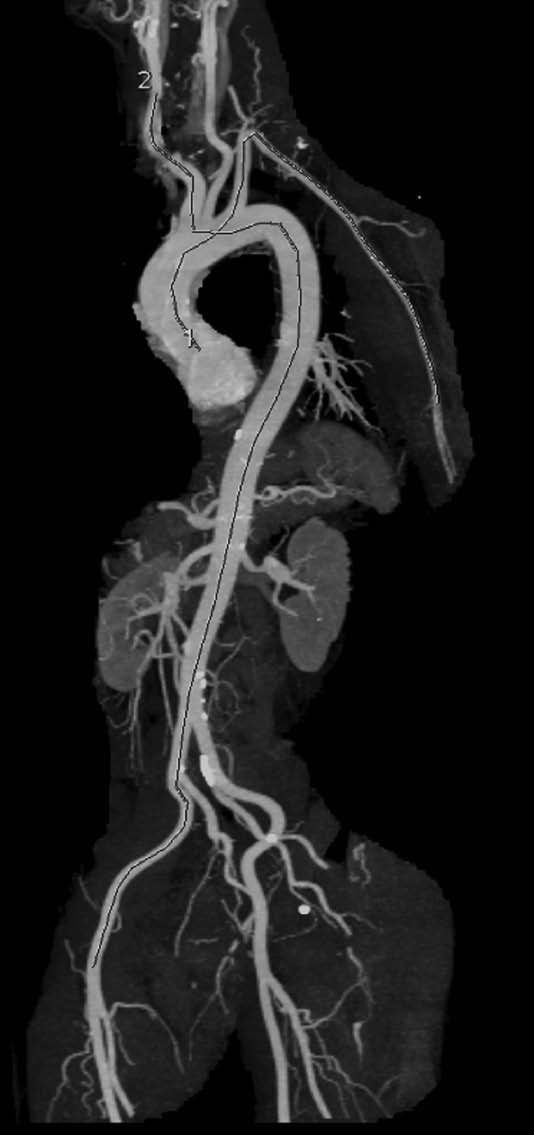
  • The pressure wave travels mostly along an aortic segment, including the thoracic descending aorta and the abdominal aorta, and ultimately travels along the iliac and common femoral arteries. This is well exemplified by the Figure, which superimposes the trajectory of the pressure pulse wave on a normal angiogram obtained by magnetic resonance imaging.

VIEW FIGURE

The trajectories of the pressure pulse waves along the arterial segments are superimposed onto an angiogram obtained by computed tomography scan (left anterior oblique). The carotid-femoral pathway is described as dotted line, and the QKD pathway is described as dashed line.

pap62

FIGURE SOURCE:

http://hyper.ahajournals.org/content/early/2013/05/20/HYPERTENSIONAHA.113.01372.citation

The method developed by Gosse et al 7,8 measures the time delay between the onset of the QRS on the ECG and the detection of the last Korotkoff sound by the microphone placed on the brachial artery. Thus, the pressure pulse wave travels first along the ascending aorta and the aortic arch (ie, a short pathway of elastic arteries) and then along the subclavian and brachial arteries (ie, a much longer pathway of muscular arteries).

Because the stiffness of muscular arteries is little influenced by age and hypertension, Gosse et al8 attributed the difference in QKD duration to ascending aorta and aortic arch. However, a closer look at the Figure shows that the length of the ascending and aortic arch pathway represents a very small part of the total pathway and casts doubt about this statement.

Furthermore, in magnetic resonance imaging studies, the transit time of flow wave along the aortic arch (average 120 mm length) is often found ≈35 ms in young healthy subjects,10 a value which is far from the mean 206 ms QKD duration found in the present study. Thus, part of that QFD duration has to be further explained by both the preejection period and the transit time within muscular arteries.

Alternative Devices

  • 2008 – The arteriograph system estimates PWV from a single-site determination of the suprasystolic waveform at the brachial artery site, and measures the time elapsed between the first wave ejected from the left ventricle to the aortic root, and its reflection from the bifurcation as the second systolic wave, with subtraction of the brachial artery transit time.
  • 2010 – The Mobil-O-Graph system uses oscillometric recording of brachial artery pressure waveform and reconstructs the central pulse wave by applying a transfer function. Central pulse wave is then decomposed into forward and backward waves, and PWV isestimated from their time difference.
  • Device |Method |Arterial Pathway |Predictive Value for CV Events | (Year of First Publication)

1984 Complior Mechanotransducer Carotid-femoral Yes (1999)

1990 Sphygmocor Tonometer Carotid-femoral Yes (2011)

1994 QKD ECG + Korotkoff sounds Aorta + brachial Yes (2005)

1997 Cardiov. Eng. Inc Tonometer Carotid-femoral Yes (2010)

2002 Doppler probes Doppler probe Aortic arch + descending aorta Yes (2002)

2002 VP-1000 Omron Brachial and ankle pressure cuffs Aorta + brachial + lower limbs Yes (2005)

2004 PulsePen Tonometer Carotid-femoral No

2006 CAVI-VaSera ECG + Brachial and ankle pressure cuffs Aorta + brachial + lower limbs No

2008 Arteriograph Arm pressure cuff Aorta + brachial No

2009 MRI-ArtFun MRI Aortic arch No

2009 Vicorder Cuffs Carotid-femoral No

2010 Mobil-O-Graph Arm pressure cuff Aorta No

Conclusions

The measurement of arterial stiffness is increasingly popular among physicians and researchers mainly because its predictive value for cardiovascular (CV) events has been well demonstrated. The largest amount of evidence has been given for aortic stiffness, measured through carotid-femoral pulse wave velocity (cfPWV). This has been initially reported in the late 1990s or early 2000s.1

Aortic stiffness is an independent predictor of all-cause and cardiovascular mortality in hypertensive patientsHypertension. 2001;37:1236–1241.

European Network for Non-invasive Investigation of Large Arteries. Expert consensus document on arterial stiffness: methodological issues and clinical applicationsEur Heart J. 2006;27:2588–2605.

Arterial Stiffness as an Imaging Biomarker : Are All Pathways Equal? http://hyper.ahajournals.org/content/early/2013/05/20/HYPERTENSIONAHA.113.01372.citation

References for Imaging Biomarker for Arterial Stiffness, at the end of the paper

Part II:

Results for Advances and Recent Clinical Trials in Hypertension Management

Based on

Garry L.R. Jennings, Recent Advances in Hypertension:Recent Clinical Trials of Hypertension Management http://hyper.ahajournals.org/content/early/2013/05/20/HYPERTENSIONAHA.113.00863.citation

Trends: tended to drive interest toward equivalence rather than efficacy studies (ie, trials designed to show an investigational agent is as good as, not better than, existing treatment), surrogate end points, including new blood pressure (BP) variables, and studies of combinations and algorithms rather than single interventions. Population studies around the world, however, continue to show that large numbers of people have hypertension that is not treated satisfactorily and are not achieving the goals set by the major national guidelines. These guidelines themselves are under continual scrutiny on the basis of recent data casting doubt on the validity of present BP goals. Guideline committees also face the issue that evidence based on expensive large-scale clinical trials is more often funded by the pharmaceutical or device industries than by government, leaving large evidence gaps in areas of public importance but no direct interest to industry funders. The purpose of the present article is to briefly review clinical trials of interventions in hypertension during the past 2 years.

Subject categories of Last Decade Clinical Trials on Hypertension

  • Resistant Hypertension
  • Resistant Hypertension and the Sympathetic
  • Nervous System
  • Trials of Pharmacotherapy
  • Old Ground, New Findings
  • Are Chlorthalidone and Nonthiazides the Best Diuretics for Treatment of Hypertension?
  • BP Targets and Treatment
  • Lifestyle and Nonpharmacological Approaches to Hypertension
  1.  Sodium
  2. Trials of Nutrition and BP
  • Resistance Exercise and BP

What Can Be Learned From Clinical Trials Reported in the Present Decade?

  • Systems for blood pressure management in the community can be improved because a large treatment gap remains.
  • Drug combinations from different classes with different modes of action are useful.
  • Drug combinations that include drugs with similar mode of action do not generally enhance efficacy and come at a cost in adverse events.
  • Small but important nutritional effects on blood pressure demand further examination.
  • The sympathetic nervous system has returned as an important target for therapy of hypertension.
  • Blood pressure targets and goals need refining, preferably on the basis of specifically designed clinical trials.

The scene for clinical trials of hypertension management is in transition. The era of mega trials may not be over but is certainly in decline, and in the past 2 years there have been no studies reporting primary outcome data the scale of the

  • Antihypertensive and
  • Lipid-Lowering Treatment
  1. Lipid-Lowering Treatment to Prevent Heart Attack Trial (ALLHAT),
  2. The ONgoing Telmisartan Alone and in combination with Ramipril Global Endpoint Trial (ONTARGET),
  3. Anglo-Scandinavian Cardiac Outcomes Trial (ASCOT), and other
  4. major studies that marked clinical trial activity and informed guideline committees during the past 2 to 3 decades.

This reflects in part the view that the

  • present benchmark pharmacological agents for treating hypertension are difficult to improve,
  • some systemic issues affecting the pharmaceutical industry influencing the ability to make the large investment required to perform mega trials and
  • the quality of the antihypertensive drug pipeline.

http://hyper.ahajournals.org/content/early/2013/05/20/HYPERTENSIONAHA.113.00863.citation

References for Clinical Trial on Hypertension, at the end of the paper

Part III:

Mechanism of Action of Top 10 Cardio Drugs 2012, published on May 16, 2013

The top 10 Cardio Drugs in 2012 belong to two drug classes

  • Antihypertensive and
  • Lipid-Lowering Treatment

Sales % Change 2012 vs 2011 by Drug Class

MOA

By

Drug Class

Drug Name

2011 Sales billion

2012 Sales billion

% change

Statins

Crestor

6.622

6.253

-6%

Lipitor

9.577

3.948

-59%

Zetia

2.428

2.567

+6%

Vytorin

1.882

1.747

-7%

Total Sales and % change Statins

 20,509  14,515  -29.2%

ARB

Diovan

5.665

4.417

-22%

ACEII

Benicar

2.602

2.446

-6%

ACEI

Micardis

2.217

2.098

-5%

ARB

Avapro

1.797

1.422

-30% (BMS)

ARB

Blopress

1.808

1.643

-9%

PAH

Tracleer

1.721

1.6

-7%

Total Sales and % change AntiHTN

 15,810  13,626  -13.8%

Data Source:

http://www.fiercepharma.com/special-reports/top-10-cardio-drugs-2012#ixzz2U9Axh8X4 

1 Crestor

Crestor (AstraZeneca)
Patent expiry: July 2016

2012 sales: $6.253 billion
2011 sales: $6.622 billion
Change: (6%)

Crestor – FiercePharma http://www.fiercepharma.com/special-reports/crestor-0#ixzz2UACLZyaa 

(rosuvastatin calcium) is indicated as an adjunct to diet to reduce elevated Total-C, LDL-C, ApoB, non-HDL-C, and triglycerides, and to increase HDL-C in adult patients with primary hyperlipidemia or mixed dyslipidemia and to slow the progression of atherosclerosis in adult patients as part of a treatment strategy to lower Total-C and LDL-C to target levels.1

Diovan

Diovan (Novartis)
Patent expiry: September 2012

2012 sales: $4.417 billion
2011 sales: $5.665 billion
Change: (22%)

Diovan – FiercePharma http://www.fiercepharma.com/special-reports/diovan#ixzz2UACdBCtZ 

Valsartan (Angiotan or Diovan) is an angiotensin II receptor antagonist (more commonly called an “ARB”, or angiotensin receptor blocker), with particularly high affinity for the type I (AT1) angiotensin receptor. By blocking the action of angiotensin, valsartan dilates blood vessels and reduces blood pressure.[1] In the U.S., valsartan is indicated for treatment of high blood pressurecongestive heart failure (CHF), or post-myocardial infarction (MI).[2]

3 Lipitor

Lipitor (Pfizer)
Patent expiry: November 2011

2012 sales: $3.948 billion
2011 sales: $9.577 billion
Change: (59%)

Lipitor – FiercePharma http://www.fiercepharma.com/special-reports/lipitor-2#ixzz2UACsJ2Y2 

(atorvastatin calcium) tablets are a prescription medicine that is used along with a low-fat diet. It lowers the LDL (“bad”) cholesterol and triglycerides in your blood. It can raise your HDL (“good”) cholesterol as well. LIPITOR can lower the risk for heart attack, stroke, certain types of heart surgery, and chest pain in patients who have heart disease or risk factors for heart disease such as age, smoking, high blood pressure, low HDL, or family history of early heart disease. LIPITOR can lower the risk for heart attack or stroke in patients with diabetes and risk factors such as diabetic eye or kidney problems, smoking, or high blood pressure.

LIPITOR is a member of the drug class known as statins, used for lowering blood cholesterol. It also stabilizes plaque and prevents strokes through anti-inflammatory and other mechanisms. Like all statins, atorvastatin works by inhibiting HMG-CoA reductase, an enzyme found in liver tissue that plays a key role in production of cholesterol in the body.

Atorvastatin was first synthesized in 1985 by Bruce Roth of Parke-Davis Warner-Lambert Company (now Pfizer). The best selling drug in pharmaceutical history, sales of Lipitor since it was approved in 1996 exceed US$125 billion, and the drug has topped the list of best-selling branded pharmaceuticals in the world for nearly a decade

4 Zetia

Zetia (Merck)
Patent expiry: December 2016

2012 sales: $2.567 billion
2011 sales: $2.428 billion
Change: 6%

Zetia – FiercePharma http://www.fiercepharma.com/special-reports/zetia#ixzz2UADFaGJ0 

Ezetimibe (pron.: /ɛˈzɛtɨmɪb/) is a drug that lowers plasma cholesterol levels. It acts by decreasing cholesterol absorption in the intestine. It may be used alone (marketed as Zetia or Ezetrol), when other cholesterol-lowering medications are not tolerated, or together withstatins (e.g., ezetimibe/simvastatin, marketed as Vytorin and Inegy) when statins alone do not control cholesterol.

Ezetimibe decreases cholesterol levels, but has not been shown to improve outcomes in cardiovascular disease patients by decreasing atherosclerotic or vascular events compared to placebo. Ezetimibe is endorsed in the Canadian Lipid Guidelines and is considered a well-tolerated option for an add-on agent to statin, to help patients achieve their LDL (or bad cholesterol) targets. [1] Ezetimibe is the only add-on to statin therapy that has successfully shown cardiovascular benefit when combined with statin, but has not been proven to have an incremental benefit compared to statins alone. [2] Britain’s NICE statement, published in 2007, endorses its use for monotherapy if statins are not tolerated or as add-on therapy.[3]

5 Benicar

Benicar (Daiichi Sankyo)
Patent expiry: October 2016

2012 sales: $2.446 billion
2011 sales: $2.602 billion
Change: (6%)

Benicar – FiercePharma http://www.fiercepharma.com/special-reports/benicar#ixzz2UADYvld5 

BENICAR and BENICAR HCT are prescription medicines used to lower high blood pressure (hypertension). They may be used alone or with other medicines used to treat high blood pressure. BENICAR HCT is not for use as the first medicine to treat high blood pressure.

 Olmesartan medoxomil is an angiotensin II receptor antagonistused to treat high blood pressure.

Olmesartan is a prodrug that works by blocking the binding of angiotensin II to the AT1 receptors in vascular muscle; it is therefore independent of angiotensin II synthesis pathways, unlike ACE inhibitors. By blocking the binding rather than the synthesis of angiotensin II, olmesartan inhibits the negative regulatory feedback on renin secretion. As a result of this blockage, olmesartan reduces vasoconstriction and the secretion of aldosterone. This lowers blood pressure by producing vasodilation, and decreasing peripheral resistance.

6 Micardis

Micardis (Boehringer Ingelheim)
Patent Expiry: January 2014

2012 Sales: $2.098 billion
2011 Sales: $2.217 billion
Change: (5%)

Micardis – FiercePharma http://www.fiercepharma.com/special-reports/micardis#ixzz2UADpDZeO 

Micardis® (telmisartan) tablets are a prescription medicine used to treat high blood pressure (hypertension). Additionally, MICARDIS 80 mg tablets are used in certain high-risk people aged 55 years and older who are unable to take a medicine called an angiotensin converting enzyme inhibitor (ACE-I) to help lower their risk of having certain cardiovascular problems such as stroke, heart attack, or death.

Micardis® (telmisartan) tablets are a prescription medicine used to treat high blood pressure (hypertension).

Telmisartan (INN) (pron.: /tɛlmɪˈsɑrtən/) is an angiotensin II receptor antagonist (angiotensin receptor blocker, ARB) used in the management of hypertension. It is marketed under thetrade name Micardis (by Boehringer Ingelheim), among others.

Telmisartan is an angiotensin II receptor blocker that shows high affinity for the angiotensin II receptor type 1 (AT1), with a binding affinity 3000 times greater for AT1 than AT2. It has the longest half-life of any ARB (24 hours)[1][4] and the largest volume of distribution.

In addition to blocking the RAs, telmisartan acts as a selective modulator of peroxisome proliferator-activated receptor gamma (PPAR-γ), a central regulator of insulin and glucose metabolism. It is believed that telmisartan’s dual mode of action may provide protective benefits against the vascular and renal damage caused by diabetes and cardiovascular disease (CVD).[4]

Telmisartan’s activity at the PPAR-γ receptor has prompted speculation around its potential as a sport doping agent as an alternative to GW 501516.[5] Telmisartan activates PPARδ receptors in several tissues. [6][7][8][9]

7 Avapro

Avapro (Sanofi)
Patent expiry: March 2012

Total 2012 sales: $1.925 billion
2012 sales Sanofi: $1.422 billion
2012 sales BMS: $503 million

Total 2011 sales: $2.749 billion
2011 sales Sanofi: $1.797 billion
2011 sales BMS: $952 million
Total Change: (30%)

Avapro – FiercePharma http://www.fiercepharma.com/special-reports/avapro#ixzz2UAE9iB2E 

rbesartan (INN) (pron.: /ɜrbəˈsɑrtən/) is an angiotensin II receptor antagonist used mainly for the treatment of hypertension. Irbesartan was developed by Sanofi Research (now part ofsanofi-aventis). It is jointly marketed by sanofi-aventis and Bristol-Myers Squibb under the trade names AprovelKarvea, and Avapro.

As with all angiotensin II receptor antagonists, irbesartan is indicated for the treatment ofhypertension. Irbesartan may also delay progression of diabetic nephropathy and is also indicated for the reduction of renal disease progression in patients with type 2 diabetes,[1]hypertension and microalbuminuria (>30 mg/24 hours) or proteinuria (>900 mg/24 hours).[2]

 A large randomized trial following 4100+ men and women with heart failure and normal ejection fraction (>=45%) over 4+ years found no improvement in study outcomes or survival with irbesartan as compared to placebo.[3]

8 Vytorin

Vytorin (Merck)
Patent Expiry: April 2017

2012 sales: $1.747 billion
2011 sales: $1.882 billion
Change: (7%)

Vytorin – FiercePharma http://www.fiercepharma.com/special-reports/vytorin#ixzz2UAEQVcQr 

Ezetimibe/simvastatin (pron.: /ɛˈzɛtɨmɪb ˌsɪmvəˈstætɨn/) is a drug combination used for the treatment of dyslipidemia. It is a combination of ezetimibe (best known as Zetia in the United States and Ezetrol elsewhere) and the statin drug simvastatin (best known as Zocor in the U.S.). The combination preparation is marketed by Merck & Co./Schering-PloughPharmaceuticals (joint venture) under the trade names Vytorin and Inegy.

Ezetimibe reduces blood cholesterol by inhibiting absorption of cholesterol by the small intestine by acting at the brush border of the small intestine and inhibits the absorption of cholesterol, leading to a decrease in the delivery of intestinal cholesterol to the liver.

Simvastatin is an HMG-CoA reductase inhibitor or statin. It works by blocking an enzymethat is necessary for the body to make cholesterol.

Even though ezetimibe decreases cholesterol levels, as of 2009 it has not been found to lead to improvement in real world outcomes.[1] The combination of simvastatin and ezetimibe has not been found to be any better than simvastatin alone. A panel of experts thus concluded in 2008 that it should “only be used as a last resort”.[2]

9 Blopress

Blopress (Takeda Pharmaceutical)
Patent expiry: June 2012

2012 sales: $1.643 billion
2011 sales: $1.808 billion
Change: (9%)

Blopress – FiercePharma http://www.fiercepharma.com/special-reports/blopress#ixzz2UAEnxyWy

Candesartan (rINN) (pron.: /ˌkændɨˈsɑrtən/) is an angiotensin II receptor antagonist used mainly for the treatment of hypertension. The prodrug candesartan cilexetil is marketed by AstraZeneca and Takeda Pharmaceuticals, commonly under the trade names Blopress,AtacandAmias, and Ratacand

As all angiotensin II receptor antagonists, candesartan is indicated for the treatment of hypertension. Results from the CHARM study in the early 2000s demonstrated the morbidity and mortality reduction benefits of candesartan therapy in congestive heart failure.[1] Thus, while ACE inhibitors are still considered first-line therapy in heart failure, candesartan can be used in combination with an ACE to achieve improved mortality and morbidity vs. an ACE alone and additionally is an alternative in patients intolerant of ACE inhibitor therapy.

Prehypertension

In a four-year randomized controlled trial, candesartan was compared to placebo to see whether it could prevent or postpone the development of full-blown hypertension in people with so-called prehypertension. During the first two years of the trial, half of participants were given candesartan, and the others received placebo; candesartan reduced the risk of developing hypertension by nearly two-thirds during this period. In the last two years of the study, all participants were switched to placebo. By the end of the study, candesartan hadsignificantly reduced the risk of hypertension, by more than 15%. Serious side effects were actually more common among participants receiving placebo than in those given candesartan.[2]

Candesartan is also available in a combination formulation with a low dose thiazide diuretic, invariably hydrochlorothiazide, to achieve an additive antihypertensive effect. Candesartan/hydrochlorothiazide combination preparations are marketed under various trade names including Atacand HCTHytacandBlopress Plus, Advantec and Ratacand Plus.

10 Tracleer

Tracleer (Actelion)
Patent expiry: November 2015   

2012 sales: $1.600 billion
2011 sales: $1.721 billion
Change: (7%)

Tracleer – FiercePharma http://www.fiercepharma.com/special-reports/tracleer#ixzz2UAF2iIJB 

Bosentan is a dual endothelin receptor antagonist used in the treatment of pulmonary artery hypertension (PAH). It is licensed in the United States, the European Union and other countries by Actelion Pharmaceuticals for the management of PAH under the trade name Tracleer.

Bosentan is a competitive antagonist of endothelin-1 at the endothelin-A (ET-A) and endothelin-B (ET-B) receptors. Under normal conditions, endothelin-1 binding of ET-A or ET-B receptors causes pulmonary vasoconstriction. By blocking this interaction, bosentan decreases pulmonary vascular resistance. Bosentan has a slightly higher affinity for ET-A than ET-B.

Clinical uses 

Bosentan is indicated mainly for the treatment of pulmonary hypertension. In 2007, bosentan was approved in the European Union also for reducing the number of new digital ulcers in patients with systemic sclerosis and ongoing digital ulcer disease.

In the United States, bosentan is indicated for the treatment of pulmonary arterial hypertension (WHO Group I) in patients with WHO Class II-IV symptoms, to improve exercise capacity and decrease the rate of clinical worsening.[1]

http://www.fiercepharma.com/special-reports/top-10-cardio-drugs-2012

For years, cardio was king. The world’s all-time best-selling drug, Pfizer’s ($PFELipitor, after all, is an antihyperlipidemic drug. Cardio drugs have traditionally made up one of the largest categories of therapeutic treatment in the drug universe.

According to EvaluatePharma‘s World Preview 2018 report, combined sales of antihypertensive drugs and antihyperlipidemics were more than $70 billion in 2011. That would put them at the top of the heap. Sales of antihypertensive drugs alone were more than $40 billion that year, making them the second-largest therapy area defined by the report, behind oncology drugs at $64.4 billion. The list, compiled by EvaluatePharma, includes the theraputic areas categorized as cardio, so it does not include some products sometimes used for heart disease but not in that therapeutic area, including blood thinners like Plavix.

But many of the top cardio drugs are long in the tooth, and generics are now eating their lunch. Did I mention Lipitor? Sales cratered last year, falling nearly 60%. Despite that, the drug placed third among the top 10 cardio drugs of 2012, a reminder of the stature it had achieved. Four of the top 10 have lost patent protection in the last two years, and most will be off patent by 2016, with only Merck’s ($MRKVytorin protected until 2017.

Last year, the top 10 cardio drugs racked up sales of $28.644 billion, down 23% from the $37.271 billion they sold in 2011. Still, the group has made a lot of money for its companies for years and, in some cases, completely changed the treatment of heart disease.

It is an interesting list. Only Merck has two drugs in the top 10. The other drugmakers make up a broad swath of the pharma industry. Read our report below, and if you have some insights you would like to share, please do.

Top 10 Cardio Drugs 2012 – FiercePharma http://www.fiercepharma.com/special-reports/top-10-cardio-drugs-2012#ixzz2UAByWR7s 

Part IV:

20 Highest-Paid Biopharma CEOs of 2012

Call it a rite of spring. Every year about this timeFiercePharma takes a look at executive compensation in the industry, and we rank the highest-paid CEOs. If you’re a regular reader, you’ll notice that this year’s list is longer than previous editions. And there’s a reason for that: curiosity.

As we were beginning to gather numbers from biopharma companies’ proxy statements and annual reports, news surfaced that Valeant Pharmaceuticals ($VRX) and Actavis ($ACT) had been in merger talks. The former CEO of Mylan ($MYL), one of Actavis’ rivals, regularly appeared on our highest-paid executives list, so we looked up the numbers on Actavis. No dice; CEO Paul Bisaro may have pulled off his biggest merger ever last year, but $8.66 million in compensation still didn’t qualify him for our ranking.

Then, we pulled out Valeant’s proxy statement. And while CEO Michael Pearson didn’t earn enough in 2012 to make the cutoff–his compensation just surpassed $6 million–he should have been at the top of the list last year. Pearson’s 2011 pay package broke $36 million. He collected more than $18 million in stock and option awards, plus a special $13.7 million dividend payment, stemming from agreements negotiated years before.

We hate to miss a scoop. Naturally. So, we vowed to avoid making the same mistake this time around. Rather than limit our executive-pay search to the biggest pharma companies and biotechs, plus the usual suspects who often make CEO-pay rankings, we used a bigger net. We collected compensation information from 50 companies, including numbers for CEOs, CFOs, R&D chiefs and other top executives.

Partly because of this search, but mostly because of big bonuses and awards at fast-growing Regeneron ($REGN), we have a brand-new No. 1 on our list. That’s Regeneron CEO Leonard Schleifer, whose 2012 compensation totaled $30.047 million. You’ll notice some other newbies, such as Leonard Bell from Alexion ($ALXN), whose pay bump put him in 12th place. And then there are familiar faces, such as Pfizer ($PFE) CEO Ian Read; Johnson & Johnson’s ($JNJ) former chairman and CEO, William Weldon; and Eli Lilly ($LLY) CEO John Lechleiter, who hung on in 10th place.

Many of the companies we researched pay their top people far less than the $10 million that served as our cutoff figure. Novo Nordisk ($NVO) CEO Lars Sorensen, who has presided over double-digit growth there for several years, collected a package of cash and stock awards worth about $5 million for 2012. GlaxoSmithKline ($GSK) CEO Andrew Witty made less than $6 million himself; he took a pay cut for the year because of Glaxo’s shortfall on certain performance targets.

And then there are others who would have made the list, had their titles been different. There’s Regeneron R&D chief George Yancopoulos, whose extraordinary $81 million in compensation shows how much the company appreciates its newly minted blockbuster, Eylea. There’s Mylan Chairman Robert Coury, who used to be a fixture on our list until Heather Bresch took over as CEO; he made more than $28 million last year. Novartis’ ($NVS) former chairman Daniel Vasella could have qualified for 12th place with his $13.98 million in compensation.

Vasella, then, gives us a quick segue to the ongoing debate over executive pay. In Switzerland, populist dismay at some high-profile compensation figures led to a public vote earlier this year. Citizens voted in new restrictions on common bonuses, such as golden parachutes, and gave shareholders a binding vote on executive pay. And local analysts figure that late-breaking news of Vasella’s behind-the-scenes noncompete agreement–worth some $78 million over 5 years–helped pay activists to get out the vote. (Vasella ended up refusing the deal, by the way.)

In the U.S., where executives are paid more than anywhere else in the world, shareholders at some companies have successfully lobbied for a greater emphasis on performance pay and against extraordinary bonuses, such as change-in-control payments that send top executives on their way with tens of millions after a merger. Other companies have instituted “say-on-pay” advisory votes for shareholders, but those often end up as rubber stamps for the status quo.

Now, we’re interested in what you have to say about executive compensation. Are the CEOs on this list worth their price? What’s a supersuccessful new drug worth? Should CEO pay be docked for R&D failures? What about failed launches? Should other, lower-paid executives earn more? Tweet your opinions to @FiercePharma using the hashtag #FPexecpay, leave your comments below or email us. We’ll collect your thoughts in a future article.

As always, feel free to send us your thoughts on our coverage. And if we missed a well-paid CEO, be sure to let us know.

— Tracy Staton (email | Twitter)

For more:
Top 10 Biotech CEO Pay Packages of 2012
Top 10 Pharma CEO salaries of 2010
Top 10 Pharma CEO salaries of 2009
2012’s 10 highest-paid Med Tech CEOs
Top 10 Medical Device Industry CEO Salaries for 2011


20 Highest-Paid Biopharma CEOs of 2012 – FiercePharma http://www.fiercepharma.com/special-reports/20-highest-paid-biopharma-ceos-2012#ixzz2UAGAlHay 

REFERENCES FOR Part I: Arterial Stiffness

1. Laurent S, Boutouyrie P, Asmar R, Gautier I, Laloux B, Guize L,

Ducimetiere P, Benetos A. Aortic stiffness is an independent predictor

of all-cause and cardiovascular mortality in hypertensive patients.

Hypertension. 2001;37:1236–1241.

2. Vlachopoulos C, Aznaouridis K, Stefanadis C. Prediction of cardiovascular

events and all-cause mortality with arterial stiffness: a systematic

review and meta-analysis. J Am Coll Cardiol. 2010;55:1318–1327.

3. Boutouyrie P, Tropeano AI, Asmar R, Gautier I, Benetos A, Lacolley P,

Laurent S. Aortic stiffness is an independent predictor of primary coronary

events in hypertensive patients: a longitudinal study. Hypertension.

2002;39:10–15.

4. Mattace-Raso FU, van der Cammen TJ, Hofman A, van Popele NM, Bos

ML, Schalekamp MA, Asmar R, Reneman RS, Hoeks AP, Breteler MM,

Witteman JC. Arterial stiffness and risk of coronary heart disease and

stroke: the Rotterdam Study. Circulation. 2006;113:657–663.

5. Sehestedt T, Jeppesen J, Hansen TW, Rasmussen S, Wachtell K, Ibsen H,

Torp-Pedersen C, Olsen MH. Risk stratification with the risk chart from

the European Society of Hypertension compared with SCORE in the general

population. J Hypertens. 2009;27:2351–2357.

6. Mitchell GF, Hwang SJ, Vasan RS, Larson MG, Pencina MJ,

Hamburg NM, Vita JA, Levy D, Benjamin EJ. Arterial stiffness and

cardiovascular events: the Framingham Heart Study. Circulation. 2010;

121:505–511.

7. Gosse P, Cremer A, Papaioannou G, Yeim S. Arterial stiffness from monitoring

of timing of Korotkoff sounds predicts the occurrence of cardiovascular

events independently of left ventricular mass in hypertensive

patients. HYPERTENSIONAHA.113.01039 Published online before print May 20, 2013,doi: 10.1161/​HYPERTENSIONAHA.113.01039

Hypertension. 2013;62:XX–XX.

http://hyper.ahajournals.org/content/early/2013/05/20/HYPERTENSIONAHA.113.01039.abstract.html?papetoc

8. Gosse P, Guillo P, Ascher G, Clementy J. Assessment of arterial distensibility

by monitoring the timing of Korotkoff sounds. Am J Hypertens.

1994;7:228–233.

9. Laurent S, Cockcroft J, Van Bortel L, Boutouyrie P, Giannattasio C,

Hayoz D, Pannier B, Vlachopoulos C, Wilkinson I, Struijker-Boudier

H; European Network for Non-invasive Investigation of Large Arteries.

Expert consensus document on arterial stiffness: methodological issues

and clinical applications. Eur Heart J. 2006;27:2588–2605.

10. Dogui A, Redheuil A, Lefort M, DeCesare A, Kachenoura N, Herment A,

Mousseaux E. Measurement of aortic arch pulse wave velocity in cardiovascular

MR: comparison of transit time estimators and description of a

new approach. J Magn Reson Imaging. 2011;33:1321–1329.

downloaded from

http://hyper.ahajournals.org/content/early/2013/05/20/HYPERTENSIONAHA.113.01372.citation

REFERENCES for Part II: Clinical Trials of Hypertension Management

1. Hanselin MR , Saseen JJ , Allen RR , Marrs JC , Nair KV . Description of

antihypertensive use in patients with resistant hypertension prescribed

four or more agents. Hypertension . 2011 ; 58 : 1008 – 1013 .

2. Bakris GL , Lindholm LH , Black HR , Krum H , Linas S , Linseman JV ,

Arterburn S , Sager P , Weber M . Divergent results using clinic and ambulatory

blood pressures: report of a darusentan-resistant hypertension trial.

Hypertension . 2010 ; 56 : 824 – 830 .

3. Smithwick RH , Thompson JE . Splanchnicectomy for essential hypertension;

results in 1,266 cases. J Am Med Assoc . 1953 ; 152 : 1501 – 1504 .

4. Esler M , Ferrier C , Lambert G , Eisenhofer G , Cox H , Jennings G .

Biochemical evidence of sympathetic hyperactivity in human hypertension.

Hypertension . 1991 ; 17 ( 4 Suppl ): III29 – III35 .

5. Esler MD , Krum H , Sobotka PA , Schlaich MP , Schmieder RE , Bohm

M . Symplicity HTN-2 investigators. Renal sympathetic denervation in

patients with treatment-resistant hypertension: a randomized controlled

trial. Lancet 2010 ; 376 : 1903 – 1909 .

6. Brinkmann J , Heusser K , Schmidt BM , Menne J , Klein G , Bauersachs J ,

Haller H , Sweep FC , Diedrich A , Jordan J , Tank J . Catheter-based renal

nerve ablation and centrally generated sympathetic activity in diffi cultto-

control hypertensive patients: prospective case series. Hypertension .

2012 ; 60 : 1485 – 1490 .

7. Mahfoud F , Cremers B , Janker J , et al . Renal hemodynamics and renal

function after catheter-based renal sympathetic denervation in patients

with resistant hypertension. Hypertension . 2012 ; 60 : 419 – 424 .

8. Lambert GW , Hering D , Esler MD , Marusic P , Lambert EA , Tanamas

SK , Shaw J , Krum H , Dixon JB , Barton DA , Schlaich MP . Health-related

quality of life after renal denervation in patients with treatment-resistant

hypertension. Hypertension . 2012 ; 60 : 1479 – 1484 .

9. Daugherty SL , Powers JD , Magid DJ , Masoudi FA , Margolis KL ,

O ’ Connor PJ , Schmittdiel JA , Ho PM . The association between medication

adherence and treatment intensifi cation with blood pressure control

in resistant hypertension. Hypertension . 2012 ; 60 : 303 – 309 .

10. Bobrie G , Frank M , Azizi M , Peyrard S , Boutouyrie P , Chatellier G ,

Laurent S , Menard J , Plouin PF . Sequential nephron blockade versus

sequential renin-angiotensin system blockade in resistant hypertension:

a prospective, randomized, open blinded endpoint study. J Hypertens .

2012 ; 30 : 1656 – 1664 .

11. Mancia G . Additional drug treatment in resistant hypertension: need for

randomized studies. J Hypertens . 2012 ; 30 : 1514 – 1515 .

12. Hermida RC , Ayala DE , Moj ó n A , Fontao MJ , Fern á ndez JR .

Chronotherapy with valsartan/hydrochlorothiazide combination in essential

hypertension: improved sleep-time blood pressure control with bedtime

dosing. Chronobiol Int . 2011 ; 28 : 601 – 610 .

13. Persu A , Renkin J , Thijs L , Staessen JA . Renal denervation: ultima

ratio or standard in treatment-resistant hypertension. Hypertension .

2012 ; 60 : 596 – 606 .

14. Lohmeier TE , Iliescu R . Chronic lowering of blood pressure by carotid

barorefl ex activation: mechanisms and potential for hypertension therapy.

Hypertension . 2011 ; 57 : 880 – 886 .

15. Bisognano JD , Bakris G , Nadim MK , Sanchez L , Kroon AA , Schafer J ,

de Leeuw PW , Sica DA . Barorefl ex activation therapy lowers blood pressure

in patients with resistant hypertension: results from the double-blind,

randomized, placebo-controlled rheos pivotal trial. J Am Coll Cardiol .

2011 ; 58 : 765 – 773 .

16. Parving HH , Brenner BM , McMurray JJ , de Zeeuw D , Haffner SM ,

Solomon SD , Chaturvedi N , Persson F , Desai AS , Nicolaides M , Richard

A , Xiang Z , Brunel P , Pfeffer MA ; ALTITUDE Investigators . Cardiorenal

end points in a trial of aliskiren for type 2 diabetes. N Engl J Med .

2012 ; 367 : 2204 – 2213 .

17. The ONTARGET Investigators . Telmisartan, ramipril, or both in patients

at high risk for vascular events. N Engl J Med . 2008 ; 358 : 1547 – 1559 .

18. Mancia G , Parati G , Bilo G , et al . Ambulatory blood pressure values in

the Ongoing Telmisartan Alone and in Combination with Ramipril Global

Endpoint Trial (ONTARGET). Hypertension . 2012 ; 60 : 1400 – 1406 .

19. Roush GC , Holford TR , Guddati AK . Chlorthalidone compared with

hydrochlorothiazide in reducing cardiovascular events: systematic review

and network meta-analyses. Hypertension . 2012 ; 59 : 1110 – 1117 .

20. Cushman WC , Bakris GL , White WB , Weber MA , Sica D , Roberts A ,

Lloyd E , Kupfer S . Azilsartan medoxomil plus chlorthalidone reduces

blood pressure more effectively than olmesartan plus hydrochlorothiazide

in stage 2 systolic hypertension. Hypertension . 2012 ; 60 : 310 – 318 .

21. Alderman MH , Piller LB , Ford CE , Probstfi eld JL , Oparil S , Cushman WC ,

Einhorn PT , Franklin SS , Papademetriou V , Ong ST , Eckfeldt JH , Furberg

CD , Calhoun DA , Davis BR ; Antihypertensive and Lipid-Lowering

Treatment to Prevent Heart Attack Trial Collaborative Research Group .

Clinical signifi cance of incident hypokalemia and hyperkalemia in treated

hypertensive patients in the antihypertensive and lipid-lowering treatment

to prevent heart attack trial. Hypertension . 2012 ; 59 : 926 – 933 .

22. Kostis WJ , Thijs L , Richart T , Kostis JB , Staessen JA . Persistence of mortality

reduction after the end of randomized therapy in clinical trials of

blood pressure-lowering medications. Hypertension . 2010 ; 56 : 1060 – 1068 .

23. van Onzenoort HA , Menger FE , Neef C , Verberk WJ , Kroon AA , de

Leeuw PW , van der Kuy PH . Participation in a clinical trial enhances

adherence and persistence to treatment: a retrospective cohort study.

Hypertension . 2011 ; 58 : 573 – 578 .

24. Sever PS . The Anglo-Scandinavian Cardiac Outcomes Trial: implications

and further outcomes. Hypertension . 2012 ; 60 : 248 – 259 .

25. Larstorp AC , Ariansen I , Gjesdal K , Olsen MH , Ibsen H , Devereux RB ,

Okin PM , Dahl ö f B , Kjeldsen SE , Wachtell K . Association of pulse pressure

with new-onset atrial fi brillation in patients with hypertension and

left ventricular hypertrophy: the Losartan Intervention For Endpoint

(LIFE) reduction in hypertension study. Hypertension . 2012 ; 60 : 347 – 353 .

26. Rossignol P , Cridlig J , Lehert P , Kessler M , Zannad F . Visit-to-visit blood

pressure variability is a strong predictor of cardiovascular events in hemodialysis:

insights from FOSIDIAL. Hypertension . 2012 ; 60 : 339 – 346 .

27. Matsui Y , O ’ Rourke MF , Hoshide S , Ishikawa J , Shimada K , Kario

K . Combined Effect of Angiotensin II Receptor Blocker and Either a

Calcium Channel Blocker or Diuretic on Day-by-Day Variability of Home

Blood Pressure: The Japan Combined Treatment With Olmesartan and a

Calcium-Channel Blocker Versus Olmesartan and Diuretics Randomized

Effi cacy Study. Hypertension . 2012 ; 59 : 1132 – 1138 .

28. Jennings GL , Sudhir K . Initial therapy of primary hypertension. Med J

Aust . 1990 ; 152 : 198 – 203 .

29. Egan BM , Bandyopadhyay D , Shaftman SR , Wagner CS , Zhao Y ,

Yu-Isenberg KS . Initial monotherapy and combination therapy and hypertension

control the fi rst year. Hypertension . 2012 ; 59 : 1124 – 1131 .

30. Bavry AA , Pepine CJ . Treatment of hypertension: lower is better, or is it?

Hypertension . 2012 ; 60 : 281 – 282 .

31. Mizuno R , Fujimoto S , Saito Y , Okamoto Y . Optimal antihypertensive

level for improvement of coronary microvascular dysfunction: the lower,

the better? Hypertension . 2012 ; 60 : 326 – 332 .

32. Roman MJ , Howard BV , Howard WJ , Mete M , Fleg JL , Lee ET ,

Devereux RB . Differential impacts of blood pressure and lipid lowering

on regression of ventricular and arterial mass: the Stop Atherosclerosis in

Native Diabetics Trial. Hypertension . 2011 ; 58 : 367 – 371 .

33. Bertoia ML , Waring ME , Gupta PS , Roberts MB , Eaton CB . Implications

of new hypertension guidelines in the United States. Hypertension .

2012 ; 60 : 639 – 644 .

34. Stewart S , Carrington MJ , Swemmer CH , et al .; VIPER-BP Study

Investigators . Effect of intensive structured care on individual blood pressure

targets in primary care: multicentre randomised controlled trial. BMJ .

2012 ; 345 : e7156 .

35. Dickinson BD , Havas S ; Council on Science and Public Health, American

Medical Association . Reducing the population burden of cardiovascular

disease by reducing sodium intake: a report of the Council on Science and

Public Health. Arch Intern Med . 2007 ; 167 : 1460 – 1468 .

36. O ’ Donnell MJ , Yusuf S , Mente A , Gao P , Mann JF , Teo K , McQueen M ,

Sleight P , Sharma AM , Dans A , Probstfi eld J , Schmieder RE . Urinary

sodium and potassium excretion and risk of cardiovascular events. JAMA .

2011 ; 306 : 2229 – 2238 .

37. Hummel SL , Seymour EM , Brook RD , Kolias TJ , Sheth SS , Rosenblum

HR , Wells JM , Weder AB . Low-sodium dietary approaches to stop

hypertension diet reduces blood pressure, arterial stiffness, and oxidative

stress in hypertensive heart failure with preserved ejection fraction.

Hypertension . 2012 ; 60 : 1200 – 1206 .

38. Soedamah-Muthu SS , Verberne LD , Ding EL , Engberink MF , Geleijnse JM .

Dairy consumption and incidence of hypertension: a dose-response metaanalysis

of prospective cohort studies. Hypertension . 2012 ; 60 : 1131 – 1137 .

39. West SG , Gebauer SK , Kay CD , Bagshaw DM , Savastano DM ,

Diefenbach C , Kris-Etherton PM . Diets containing pistachios reduce systolic

blood pressure and peripheral vascular responses to stress in adults

with dyslipidemia. Hypertension . 2012 ; 60 : 58 – 63 .

40. Zhang X , Qi Q , Liang J , Hu FB , Sacks FM , Qi L . Neuropeptide Y promoter

polymorphism modifi es effects of a weight-loss diet on 2-year

changes of blood pressure: the preventing overweight using novel dietary

strategies trial. Hypertension . 2012 ; 60 : 1169 – 1175 .

41. Meredith IT , Friberg P , Jennings GL , Dewar EM , Fazio VA , Lambert GW ,

Esler MD . Exercise training lowers resting renal but not cardiac sympathetic

activity in humans. Hypertension . 1991 ; 18 : 575 – 582 .

42. Cornelissen VA , Fagard RH , Coeckelberghs E , Vanhees L . Impact of resistance

training on blood pressure and other cardiovascular risk factors: a metaanalysis

of randomized, controlled trials. Hypertension . 2011 ; 58 : 950 – 958 .

Downloaded from

http://hyper.ahajournals.org/content/early/2013/05/20/HYPERTENSIONAHA.113.00863.citation

RELATED SOURCES:

Aortic pulse pressure is associated with the localization of coronary artery disease based on coronary flow lateralization. American journal of hypertension, 25(10), 1055-1063.

  1. Georges Khoueiry1,
  2. Basem Azab2,
  3. Estelle Torbey2,
  4. Nidal Abi Rafeh1,
  5. Jean-Paul Atallah2,
  6. Kathleen Ahern2,
  7. James Malpeso1,
  8. Donald McCord1 and
  9. Elie R. Chemaly3

Author Affiliations


  1. 1Department of Cardiology, Staten Island University Hospital, Staten Island, New York, USA

  2. 2Department of Internal Medicine, Staten Island University Hospital, Staten Island, New York, USA

  3. 3Cardiovascular Institute, Mount Sinai School of Medicine, New York, New York, USA

Elie R. Chemaly (elie.chemaly@mssm.edu)

Abstract

Background Aortic pulse pressure (APP) is related to arterial stiffness and associated with the presence and extent of coronary artery disease (CAD). Besides, the left coronary artery (LCA) has a predominantly diastolic flow while the right coronary artery (RCA) receives systolic and diastolic flow. Thus, we hypothesized that increased systolic–diastolic pressure difference had a greater atherogenic effect on the RCA than on the LCA.

Methods A random sample of 433 CAD patients (145 females, 288 males, mean age 65.0 ± 11.1 years) undergoing coronary angiography at Staten Island University Hospital between January 2005 and May 2008 was studied. Coronary lesion was defined as a ≥50% luminal stenosis. Patients were divided into three groups, with isolated LCA lesions (n = 154), isolated RCA lesions (n = 36) or mixed LCA and RCA lesions (n = 243).

Results APP differed significantly between groups, being highest when the RCA alone was affected (67.6 ± 20.3 mm Hg for LCA vs. 78.8 ± 22.0 for RCA vs. 72.7 ± 22.6 for mixed, P = 0.008 for analysis of variance (ANOVA)). Age and gender were not associated with CAD location. Heart rate was associated with CAD location, lowest in RCA group, and negatively correlated with APP. However, left ventricular ejection fraction (LVEF) was lower in the mixed CAD group and positively correlated with APP. The association between APP and right-sided CAD persisted in multivariate logistic regression adjusting for confounders, including heart rate, LVEF and medication use. A similar but less significant pattern was seen with brachial arterial pressures.

Conclusions Aortic pulse pressure may affect CAD along with coronary flow phasic patterns.

American Journal of Hypertension, advance online publication 28 June 2012; doi:10.1038/ajh.2012.87

The Relationship Between Diastolic Pressure and Coronary Collateral Circulation in Patients With Stable Angina Pectoris and Chronic Total OcclusionAm J Hypertens (2013)doi: 10.1093/ajh/hps096 

First published online: February 7, 2013

  1. Wang Shu1,
  2. Jing jing1,
  3. Liu Chang Fu1,
  4. Jiang Tie Min2,
  5. Yang Xiao Bo1,
  6. Zhou Ying1and
  7. Chen Yun Dai1,*
  1. 1 The Cardiovascular Medical Department of the General Hospital of the Chinese People’s Liberation Army, Beijing, China;

  2. 2 The Cardiovascular Medical Department of the Affiliated Hospital of the Chinese People’s Armed Police Logistics College, Tianjin, China.
  1. Correspondence: Chen Yun Dai (chenyundai2002@163.com).

Abstract

BACKGROUND The most important biomechanical source of activation of the coronary collateral circulation (CCC) is increased tangential fluid shear stress at the arterial endothelial surface. The coronary circulation is unique in that most coronary blood flow occurs in diastole. Consequently, the diastolic blood pressure (DBP) may influence the tangential fluid shear stress on the arterial endothelial surface in diastole, therebyaffecting development of the CCC.

METHODS To investigate this, we conducted a study of 222 patients with stable angina pectoris and chronic total occlusion of coronary arteries. All of the patients had no history of coronary artery interventional therapy, coronary artery bypass surgery, cardiomyopathy, or congenital heart disease. The extent of the collateral vasculature of the area perfused by the artery affected by chronic total occlusion was graded as poor or well-developed according to Rentrop’s classification.

RESULTS Univariate analysis showed a significant difference between the study subgroup with poorly developed collaterals and that with well-developed collaterals in terms of high diastolic blood pressure (DBP) and mean DBP. Multivariate analysis revealed high DBP as the only independent positive predictor of a well-developed collateral circulation.

CONCLUSIONS High DBP is positively related to a well-developed CCC. Differences in development of the CCC may be one of the pathophysiologic mechanisms responsible for the J-curve phenomenon in the relationship between DBP and cardiovascular risk.

http://ajh.oxfordjournals.org/content/early/2013/02/06/ajh.hps096.abstract

Other related articles that were published on this Open Access Online Scientific Journal, include the following:

Synthetic Biology: On Advanced Genome Interpretation for Gene Variants and Pathways: What is the Genetic Base of Atherosclerosis and Loss of Arterial Elasticity with Aging

Aviva Lev-Ari, PhD, RN May 17, 2013

http://pharmaceuticalintelligence.com/2013/05/17/synthetic-biology-on-advanced-genome-interpretation-for-gene-variants-and-pathways-what-is-the-genetic-base-of-atherosclerosis-and-loss-of-arterial-elasticity-with-aging/

Artherogenesis: Predictor of CVD – the Smaller and Denser LDL Particles

Aviva Lev-Ari, PhD, RN 11/15/2012

http://pharmaceuticalintelligence.com/2012/11/15/artherogenesis-predictor-of-cvd-the-smaller-and-denser-ldl-particles/

Cardiovascular Diseases: Causes, Risks and Management, Volume Two, Risks of Cardiovascular Diseases

Justin D. Pearlman MD ME PhD MA FACC, Editor

http://pharmaceuticalintelligence.com/biomed-e-books/cardiovascular-diseases-risks-and-management/cvd-2-risk-assessment-of-cardiovascular-diseases/

Genetics of Conduction Disease: Atrioventricular (AV) Conduction Disease (block): Gene Mutations – Transcription, Excitability, and Energy Homeostasis

Aviva Lev-Ari, PhD, RN 4/28/2013

http://pharmaceuticalintelligence.com/2013/04/28/genetics-of-conduction-disease-atrioventricular-av-conduction-disease-block-gene-mutations-transcription-excitability-and-energy-homeostasis/

Genomics & Genetics of Cardiovascular Disease Diagnoses: A Literature Survey of AHA’s Circulation Cardiovascular Genetics, 3/2010 – 3/2013

Aviva Lev-Ari, PhD, RN and Larry H. Bernstein, MD, FCAP 3/7/2013

http://pharmaceuticalintelligence.com/2013/03/07/genomics-genetics-of-cardiovascular-disease-diagnoses-a-literature-survey-of-ahas-circulation-cardiovascular-genetics-32010-32013/

Hypertriglyceridemia concurrent Hyperlipidemia: Vertical Density Gradient Ultracentrifugation a Better Test to Prevent Undertreatment of High-Risk Cardiac Patients

Aviva Lev-Ari, PhD, RN 4/4/2013

http://pharmaceuticalintelligence.com/2013/04/04/hypertriglyceridemia-concurrent-hyperlipidemia-vertical-density-gradient-ultracentrifugation-a-better-test-to-prevent-undertreatment-of-high-risk-cardiac-patients/

Hypertension and Vascular Compliance: 2013 Thought Frontier – An Arterial Elasticity Focus

Justin D. Pearlman, MD, PhD and Aviva Lev-Ari, PhD, RN 5/11/2013

http://pharmaceuticalintelligence.com/2013/05/11/arterial-elasticity-in-quest-for-a-drug-stabilizer-isolated-systolic-hypertension-caused-by-arterial-stiffening-ineffectively-treated-by-vasodilatation-antihypertensives/

Read Full Post »

Cardio-Metabolic Drug Targets, Inaugural, September 25 – 26, 2013, Westin Waterfront | Boston, Massachusetts  


Reporter: Aviva Lev-Ari, PhD, RN

Article ID #57:Cardio-Metabolic Drug Targets, Inaugural, September 25 – 26, 2013, Westin Waterfront | Boston, Massachusetts. Published on 5/23/2013

WordCloud Image Produced by Adam Tubman


ABOUT THIS CONFERENCE

Cardiovascular disease, diabetes, obesity and dyslipidemia, though traditionally treated as separate entities, are often conditions that appear together in individuals because of defects in underlying metabolic processes. Researchers are therefore now seeking compounds that target biological points of intersection of these related diseases in the hopes of ‘killing more birds with one stone.’ Or they are approaching drug development of a compound for a specific disease with a greater awareness of the backdrop of related conditions.

Join fellow biomedical researchers from academia and industry at our day and a half conference, Cardio-Metabolic Drug Targets to discuss the impact of this paradigm change in the way drugs are discovered and developed in the cardio-metabolic arena and to stay abreast of the latest targets and drug development candidates in the pipeline.

SUGGESTED EVENT PACKAGE:

September 23: Allosteric Modulators of GPCRs Short Course 
September 24 – 25: Novel Strategies for Kinase Inhibitors Conference
September 25: Setting Up Effective Functional Screens Using 3D Cell Cultures Dinner Short Course
September 25 – 26: Cardio-Metabolic Drug Targets Conference

Scientific Advisory Board:

Jerome J. Schentag, Pharm.D., Professor of Pharmaceutical Sciences, University at Buffalo

Rebecca Taub, M.D., Ph.D., CEO, Madrigal Pharmaceuticals

Preliminary Agenda

BEYOND STATINS: NEW APPROACHES FOR REGULATING LIPID METABOLISM AND ATHEROSCLEROSIS

Macrophage ABC Transporters: Novel Targets to Promote Atherosclerotic Plaque Regression by Inducing Reverse Cholesterol Transport (RCT) Mechanism

Eralp “Al” Bellibas, M.D., Senior Director, Head, Clinical Pharmacology, The Medicines Company

Targeting PCSK9 for Hypercholesterolemia and Atherosclerosis

Hong Liang, Ph.D., Associate Research Fellow, Rinat Research Unit, Pfizer

Novel Treatment for Dyslipidemia: Liver-Directed Thyroid Hormone Receptor-ß Agonist

Rebecca Taub, M.D., Ph.D., CEO, Madrigal Pharmaceuticals

CARDIO-METABOLIC THERAPEUTIC CANDIDATES

Oral Mimetics of RYGB and GLP-1 in Metabolic Syndromes

Jerome J. Schentag, Pharm.D., Professor of Pharmaceutical Sciences, University at Buffalo

FGF21-Mimetic Antibodies for Type 2 Diabetes

Jun Sonoda, Ph.D., Group Leader, Scientist, Molecular Biology, Genentech

NEW CARDIO-METABOLIC TARGETS

Blockade of Delta-Like Ligand 4 (Dll4)-Notch Signaling Reduces Macrophage Activation and Attenuates Atherosclerotic Vascular Diseases and Metabolic Disorders

Masanori Aikawa, Ph.D., Assistant Professor, Department of Medicine, Brigham and Women’s Hospital and Harvard Medical

Modulating Glycerolipid Metabolism in Myeloid Cells for Cardiometabolic Benefit

Suneil K. Koliwad, M.D., Ph.D., Assistant Professor, Diabetes Center/Department of Medicine, University of California San Francisco

AMPK as a Target in Lipid and Carbohydrate Metabolism

Ajit Srivastava, Ph.D., Adjunct Professor, Pharmacology, Drexel University; Independent Consultant, Integrated Pharma Solutions, LLC

 http://www.discoveryontarget.com/Cardio-Drug-Targets

Inaugural n September 25 – 26, 2013

Cardio-Metabolic Drug Targets

Targeting One, Treating More

»»Suggested Event Package

September 23: Allosteric Modulators of GPCRs Short Course 4

September 24-25: Novel Strategies for Kinase Inhibitors

Conference

September 25: Setting Up Effective Functional Screens Using 3D

Cell Cultures Dinner Short Course 9

September 25-26: Cardio-Metabolic Drug Targets Conference

Wednesday, September 25

11:50 am Registration

BEYOND STATINS: NEW APPRO ACHES FOR

REGULATING LIPID METABOLISM AND

ATHERO SCLERO SIS

1:30 pm Chairperson’s Opening Remarks

1:40 PLENARY KEYNOTE PRESENTATION: Towards a Patient-

Based Drug Discovery

Stuart L. Schreiber, Ph.D., Director, Chemical Biology and Founding Member, Broad

Institute of Harvard and MIT; Howard Hughes Medical Institute Investigator; Morris

Loeb Professor of Chemistry and Chemical Biology, Harvard University

3:10 Refreshment Break in the Exhibit Hall with Poster Viewing

4:00 FEATURED SPEAKER: Atherosclerosis and Cardio-

Metabolism Research Overview: Promising Targets

Margrit Schwarz, Ph.D., MBA, formerly Director of Research, Dyslipidemia and

Atherosclerosis, Amgen; currently President, MS Consulting, LLC

4:30 Sponsored Presentations (Opportunities Available)

5:00 Novel Treatment for Dyslipidemia: Liver-Directed Thyroid

Hormone Receptor-ß Agonist

Rebecca Taub, M.D., Ph.D., CEO, Madrigal Pharmaceuticals

5:30 Modulating Glycerolipid Metabolism in Myeloid Cells for

Cardiometabolic Benefit

Suneil K. Koliwad, MD., Ph.D. Assistant Professor, Diabetes Center/Department

of Medicine, University of California San Francisco (UCSF)

6:00 Targeting PCSK9 for Hypercholesterolemia and

Atherosclerosis

Hong Liang, Ph.D., Associate Research Fellow, Rinat Research Unit, Pfizer

6:30 Close of Day

Thursday, September 26

7:30 am Registration

NEW ARTHERO /LIPID/CARDIO-METABOLIC

DRUG TARGETS

8:00 Breakfast Interactive Breakout Discussion Groups

9:05 Chairperson’s Opening Remarks

9:10 ApoE derived ABCA1 agonists for the Treatment of

Cardiovascular Disease

Jan Johansson, M.D., Ph.D., CEO, Artery Therapeutics, Inc.

9:40 Blockade of Delta-Like Ligand 4 (Dll4)-Notch Signaling

Reduces Macrophage Activation and Attenuates Atherosclerotic

Vascular Diseases and Metabolic Disorders

Masanori Aikawa, Ph.D., Assistant Professor, Department of Medicine,

Brigham and Women’s Hospital and Harvard Medical

10:10 Coffee Break in the Exhibit Hall with Poster Viewing

10:55 AMPK as a Target in Lipid and Carbohydrate Metabolism

Ajit Srivastava, Ph.D., Adjunct Professor, Department of Pharmacology, Drexel

University; Independent Consultant, Integrated Pharma Solutions, LLC

11:25 Macrophage ABC Transporters: Novel Targets to Promote

Atherosclerotic Plaque Regression by Inducing Reverse

Cholesterol Transport (RCT) Mechanism

Eralp “Al” Bellibas, M.D., Senior Director, Head, Clinical Pharmacology, The

Medicines Company

11:55 Targeting Ubiquitin Signaling Mediated Disease Pathology

of LDL Receptors

Udo Maier, Ph.D., Head of Target Discovery Research, Boehringer Ingelheim

Pharma

12:25 pm Sponsored Presentation (Opportunity Available)

12:55 Luncheon Presentation (Sponsorship Opportunity Available) or

Lunch on Your Own

Cardio-Metab olic Mimetics

2:25 Chairperson’s Opening Remarks

2:30 Oral Mimetics of RYGB and GLP-1 in Metabolic Syndromes

Jerome J. Schentag, PharmD, Professor of Pharmaceutical Sciences, University

at Buffalo

3:00 FGF21-Mimetic Antibodies for Type 2 Diabetes

Jun Sonoda, Ph.D., Group Leader, Scientist, Molecular Biology, Genentech

3:30 Ice Cream Refreshment Break in the Exhibit Hall with Poster

Viewing

gpCrS IN METABOLIC DISEASES

4:00 Targeting the Ghrelin Receptor with an Oral, Macrocyclic

Agonist

Helmut Thomas, Ph.D., Senior Vice President, Research and Preclinical

Development, Tranzyme Pharma

4:30 Presentation to be Announced

5:00 Lactate Receptor, GPR81/HCA1, as a Novel Target for

Metabolic Disorders

Changlu Liu, Ph.D., Scientific Director, Janssen Fellow, Head of Molecular

Innovation, Neuroscience, Janssen Research & Development, LLC

5:30 Targeting GPR55 in Cancer and Diabetes

Marco Falasca, Ph.D., Professor of Molecular Pharmacology, Queen Mary

University of London

6:00 Close of Conference

Read Full Post »

« Newer Posts - Older Posts »