Feeds:
Posts
Comments

Archive for the ‘Drug Development Process’ Category

Drug Repurposing Hub Library @broadinstitute @MIT @Harvard

Reporter: Aviva Lev-Ari, PhD, RN and Irina Robu, PhD

CLAIMER: most valuable information for Drug Repurposing is found in the following LPBI Group three Intellectual Property Asset Classes

Our intellectual property “IP” consists of three classes of assets as described in detail within live links in the below, listed article.

  • First, the Journal, an ongoing journal of curated, current biomedical research;
  • Second, the books, a collection of 16 volumes of e-books available via Amazon in five specialties of Medicine: Cardiovascular, Genomics, Cancer, Immunology and Precision Medicine; and
  • Third, real-time curation of biotech and medical conferences yielding an e-Proceedings at the end of the conference in One-click operation.

These three IP asset classes are described in details with live links in

eScientific Publishing a Case in Point: Evolution of Platform Architecture Methodologies and of Intellectual Property Development (Content Creation by Curation) Business Model

https://pharmaceuticalintelligence.com/2019/02/04/escientific-publishing-a-case-in-point-evolution-of-platform-architecture-methodologies-and-of-intellectual-property-development-content-creation-by-curation-business-model/


The Drug Repurposing Hub: A next-generation drug library and information resource

M Corsello, Steven & A Bittker, Joshua & Liu, Zihan & Gould, Joshua & McCarren, Patrick & E Hirschman, Jodi & E Johnston, Stephen & Vrcic, Anita & Wong, Bang & Khan, Mariya & Asiedu, Jacob & Narayan, Rajiv & C Mader, Christopher & Subramanian, Aravind & R Golub, Todd. (2017). The Drug Repurposing Hub: A next-generation drug library and information resource. Nature Medicine. 23. 405-408. 10.1038/nm.4306.

… Published on January 3, 2018 as DOI: 10.1124/mol.117. Downloaded from additional source, we used data from the Broad repurposing hub ( Corsello et al, 2017), which employed high throughput screening to characterize drug-target interactions of approved drugs, natural products and nutraceuticals along with other entities. Our analysis yielded a list of currently ‘druggable’ GPCRs and the drugs that target them. …
… Using a range of ~500 (conservative estimate) to ~700 GPCR-targeted drugs, we estimate that between ~25% and ~36% of approved drugs target GPCRs, with the upper figure the more likely. As additional studies such as the Broad repurposing initiative ( Corsello et al, 2017) characterize GPCR-drug interactions in more detail, we anticipate a growth in this number, as secondary interactions between GPCRs and drugs are defined ( Allen and Roth, 2011). IUPHAR lists more druggable GPCRs than CHEMBL or DRUGBANK but has the smallest number of GPCR-related and overall approved drugs ( Figure 3C shows the number of GPCR-targeted drugs based on target-ligand interactions annotated by either IUPHAR or CHEMBL; of the 476 such drugs listed in one or both sources, only a portion are common to both (50%). …


Drug Repurposing Hub Library @broadinstitute  @MIT @Harvard

To date there has not been a systematic effort to identify such opportunities, limited in part by the lack of a comprehensive library of clinical compounds suitable for testing. To address this challenge, we hand-curated a collection of 4,707 compounds, experimentally confirmed their identity, and annotated them with literature-reported targets. The collection includes 3,422 drugs that are marketed around the world or that have been tested in human clinical trials. Compounds were obtained from more than 50 chemical vendors and the purity of each sample was established. We have thus established a blueprint for others to easily assemble such a repurposing library, and we have created an online Drug Repurposing Hub (www.broadinstitute.org/repurposing) containing detailed annotation for each of the compounds.

SOURCE

https://www.ncbi.nlm.nih.gov/pmc/articles/PMC5568558/

. Author manuscript; available in PMC 2017 Aug 23.
Published in final edited form as:
PMCID: PMC5568558
NIHMSID: NIHMS893143
PMID: 28388612

The Drug Repurposing Hub: a next-generation drug library and information resource

SOURCE
Other Resources

Read Full Post »

Record Innovations in Drug Discovery by Koch Institute @MIT Members and Affiliates

Reporter: Aviva Lev-Ari, PhD, RN


In Good Company

Trovagene announced a new patent for the use of the drug onvansertib in combination with other anti-androgen drugs for the treatment of prostate cancer. Last fall, Trovagene secured exclusive rights to develop combination therapies and clinical biomarkers for prostate cancer based in part on Bridge Project-funded research. Read more.

Lyndra Therapeutics, co-founded by KI member Bob Langer, raised $55 million in its Series B round, with new investors including the Bill and Melinda Gates Foundation and Gilead Sciences. Phase 2 trials for its ultra long-acting drug delivery capsule are expected to begin next year. Read more.

Dragonfly Therapeutics, co-founded by KI director Tyler Jacks, has committed $10 million to launch the first clinical studies of its TriNKETs (Tri-specific, NK cell Engager Therapies) platform for both solid tumor and hematological cancers. Read more.

Following its record-breaking IPO, Moderna Therapeutics (co-founded by KI member Bob Langer) published preclinical data in Science Translational Medicine demonstrating the promise of its mRNA-2752 program in several cancers. Read more.

Dewpoint Therapeutics launched with a $60 million Series A, aims to translate recent insights into biomolecular condensates from the laboratory of co-founder and KI member Rick Young to drug discovery. Read more.

KI member Bob Langer and collaborator Omid Farokhzad co-founded Seer— combining nanotechnology, protein chemistry, and machine learning—to develop liquid biopsy tests for the early detection of cancer and other diseases. Read more.

Epizyme, co-founded by KI member Bob Horvitz, is submitting a New Drug Application to gain accelerated approval of tazemetostat for patients with relapsed or refractory follicular lymphoma. Read more.

Ribon Therapeutics, founded by former KI member Paul Chang, launched with $65 million in a Series B funding round with Victoria Richon, a veteran of Sanofi and Epizyme, at the helm. Ribon focuses on developing PARP7 inhibitors for cancer treatment. Read more.

SOURCE

From: MIT Koch Institute for Integrative Cancer Research <cancersolutions=mit.edu@cmail19.com> on behalf of MIT Koch Institute for Integrative Cancer Research <cancersolutions@mit.edu>

Reply-To: <ki-communications@mit.edu>

Date: Wednesday, February 6, 2019 at 3:15 PM

To: Aviva Lev-Ari <AvivaLev-Ari@alum.berkeley.edu>

Subject: Lung Microbiome Corrupted in Cancer; Angelika Amon wins 2019 Vilcek Award; Lunch Lines of Inquiry

Read Full Post »

From Thalidomide to Revlimid: Celgene to Bristol Myers to possibly Pfizer; A Curation of Deals, Discovery and the State of Pharma


Curator: Stephen J. Williams, Ph.D.

Updated 6/24/2019

Updated 4/12/2019

Updated 2/28/2019

Lenalidomide (brand name Revlimid) is an approved chemotherapeutic used to treat multiple myeloma, mantle cell lymphoma, and certain myedysplastic syndromes.  It is chemically related to thalidomide analog with potential antineoplastic activity. Lenalidomide inhibits TNF-alpha production, stimulates T cells, reduces serum levels of the cytokines vascular endothelial growth factor (VEGF) and basic fibroblast growth factor (bFGF), and inhibits angiogenesis. This agent also promotes G1 cell cycle arrest and apoptosis of malignant cells.  It is usually given with dexamethasone for multiple myeloma. Revlimid was developed and sold by Celgene Corp.  However, recent news of deals with Bristol Myers Squib


Revlimid Approval History

FDA Approved: Yes (First approved December 27, 2005)
Brand name: Revlimid
Generic name: lenalidomide
Dosage form: Capsules
Company: Celgene Corporation
Treatment for: Myelodysplastic SyndromeMultiple MyelomaLymphoma

Revlimid (lenalidomide) is an immunomodulatory drug indicated for the treatment of patients with multiple myeloma, transfusion-dependent anemia due myelodysplastic syndromes (MDS), and mantle cell lymphoma.

Development History and FDA Approval Process for Revlimid

Date Article
Feb 22, 2017  FDA Expands Indication for Revlimid (lenalidomide) as a Maintenance Treatment for Patients with Multiple Myeloma Following Autologous Hematopoietic Stem Cell Transplant (auto-HSCT)
Feb 18, 2015  FDA Expands Indication for Revlimid (lenalidomide) in Combination with Dexamethasone to Include Patients Newly Diagnosed with Multiple Myeloma
Jun  5, 2013  FDA Approves Revlimid (lenalidomide) for the Treatment of Patients with Relapsed or Refractory Mantle Cell Lymphoma
Oct  3, 2005 Revlimid PDUFA Date Extended Three Months By FDA
Sep 14, 2005 FDA Oncologic Drugs Advisory Committee Recommends Revlimid for Full Approval
Sep 13, 2005 FDA and Celgene Revlimid Briefing Documents for Advisory Committee Meeting Available Online
Jun 21, 2005 FDA Grants Priority Review for Revlimid NDA for Treatment of Low- and Intermediate- Risk MDS With Deletion 5q Chromosomal Abnormality
Jun  7, 2005 Revlimid (lenalidomide) New Drug Application Accepted for Review by FDA
Apr  8, 2005 Revlimid New Drug Application Submitted to FDA for Review


M&A Deals Now and On The Horizon

  1. Right before the 2019 JP Morgan Healthcare Conference and a month before Bristol Myers quarterly earings reports, Bristol Myers Squib (BMY) announes a $74 Billion offer for Celgene Corp.  From the Bristol Myers website press realease:

Bristol-Myers Squibb to Acquire Celgene to Create a Premier Innovative Biopharma Company

  • Highly Complementary Portfolios with Leading Franchises in Oncology, Immunology and Inflammation and Cardiovascular Disease
  • Significantly Expands Phase III Assets with Six Expected Near-Term Product Launches, Representing Greater Than $15 Billion in Revenue Potential
  • Registrational Trial Opportunities and Early-Stage Pipeline Position Combined Company for Sustained Leadership Underpinned by Cutting-Edge Technologies and Discovery Platforms
  • Strong Combined Cash Flows, Enhanced Margins and EPS Accretion of Greater Than 40% in First Full Year
  • Approximately $2.5 Billion of Expected Run-Rate Cost Synergies to Be Achieved by 2022
THURSDAY, JANUARY 3, 2019 6:58 AM EST

NEW YORK & SUMMIT, N.J.,–(BUSINESS WIRE)–Bristol-Myers Squibb Company (NYSE:BMY) and Celgene Corporation (NASDAQ:CELG) today announced that they have entered into a definitive merger agreement under which Bristol-Myers Squibb will acquire Celgene in a cash and stock transaction with an equity value of approximately $74 billion. Under the terms of the agreement, Celgene shareholders will receive 1.0 Bristol-Myers Squibb share and $50.00 in cash for each share of Celgene. Celgene shareholders will also receive one tradeable Contingent Value Right (CVR) for each share of Celgene, which will entitle the holder to receive a payment for the achievement of future regulatory milestones. The Boards of Directors of both companies have approved the combination.

The transaction will create a leading focused specialty biopharma company well positioned to address the needs of patients with cancer, inflammatory and immunologic disease and cardiovascular disease through high-value innovative medicines and leading scientific capabilities. With complementary areas of focus, the combined company will operate with global reach and scale, maintaining the speed and agility that is core to each company’s strategic approach.

Based on the closing price of Bristol-Myers Squibb stock of $52.43 on January 2, 2019, the cash and stock consideration to be received by Celgene shareholders at closing is valued at $102.43 per Celgene share and one CVR (as described below). When completed, Bristol-Myers Squibb shareholders are expected to own approximately 69 percent of the company, and Celgene shareholders are expected to own approximately 31 percent.

“Together with Celgene, we are creating an innovative biopharma leader, with leading franchises and a deep and broad pipeline that will drive sustainable growth and deliver new options for patients across a range of serious diseases,” said Giovanni Caforio, M.D., Chairman and Chief Executive Officer of Bristol-Myers Squibb. “As a combined entity, we will enhance our leadership positions across our portfolio, including in cancer and immunology and inflammation. We will also benefit from an expanded early- and late-stage pipeline that includes six expected near-term product launches. Together, our pipeline holds significant promise for patients, allowing us to accelerate new options through a broader range of cutting-edge technologies and discovery platforms.”

Dr. Caforio continued, “We are impressed by what Celgene has accomplished for patients, and we look forward to welcoming Celgene employees to Bristol-Myers Squibb. Our new company will continue the strong patient focus that is core to both companies’ missions, creating a shared organization with a goal of discovering, developing and delivering innovative medicines for patients with serious diseases. We are confident we will drive value for shareholders and create opportunities for employees.”

“For more than 30 years, Celgene’s commitment to leading innovation has allowed us to deliver life-changing treatments to patients in areas of high unmet need. Combining with Bristol-Myers Squibb, we are delivering immediate and substantial value to Celgene shareholders and providing them meaningful participation in the long-term growth opportunities created by the combined company,” said Mark Alles, Chairman and Chief Executive Officer of Celgene. “Our employees should be incredibly proud of what we have accomplished together and excited for the opportunities ahead of us as we join with Bristol-Myers Squibb, where we can further advance our mission for patients. We look forward to working with the Bristol-Myers Squibb team as we bring our two companies together.”

Compelling Strategic Benefits

  • Leading franchises with complementary product portfolios provide enhanced scale and balance. The combination creates:
    • Leading oncology franchises in both solid tumors and hematologic malignancies led by Opdivo and Yervoy as well as Revlimid and Pomalyst;
    • A top five immunology and inflammation franchise led by Orencia and Otezla; and
    • The #1 cardiovascular franchise led by Eliquis.

The combined company will have nine products with more than $1 billion in annual sales and significant potential for growth in the core disease areas of oncology, immunology and inflammation and cardiovascular disease.

  • Near-term launch opportunities representing greater than $15 billion in revenue potential. The combined company will have six expected near-term product launches:
    • Two in immunology and inflammation, TYK2 and ozanimod; and
    • Four in hematology, luspatercept, liso-cel (JCAR017), bb2121 and fedratinib.

These launches leverage the combined commercial capabilities of the two companies and will broaden and enhance Bristol-Myers Squibb’s market position with innovative and differentiated products. This is in addition to a significant number of lifecycle management registrational readouts expected in Immuno-Oncology (IO).

  • Early-stage pipeline builds sustainable platform for growth. The combined company will have a deep and diverse early-stage pipeline across solid tumors and hematologic malignancies, immunology and inflammation, cardiovascular disease and fibrotic disease leveraging combined strengths in innovation. The early-stage pipeline includes 50 high potential assets, many with important data readouts in the near-term. With a significantly enhanced early-stage pipeline, Bristol-Myers Squibb will be well positioned for long-term growth and significant value creation.
  • Powerful combined discovery capabilities with world-class expertise in a broad range of modalities. Together, the Company will have expanded innovation capabilities in small molecule design, biologics/synthetic biologics, protein homeostasis, antibody engineering and cell therapy. Furthermore, strong external partnerships provide access to additional modalities.

Compelling Financial Benefits

  • Strong returns and significant immediate EPS accretion. The transaction’s internal rate of return is expected to be well in excess of Celgene’s and Bristol-Myers Squibb’s cost of capital. The combination is expected to be more than 40 percent accretive to Bristol-Myers Squibb’s EPS on a standalone basis in the first full year following close of the transaction.
  • Strong balance sheet and cash flow generation to enable significant investment in innovation. With more than $45 billion of expected free cash flow generation over the first three full years post-closing, the Company is committed to maintaining strong investment grade credit ratings while continuing its dividend policy for the benefit of Bristol-Myers Squibb and Celgene shareholders. Bristol-Myers Squibb will also have significant financial flexibility to realize the full potential of the enhanced late- and early-stage pipeline.
  • Meaningful cost synergies. Bristol-Myers Squibb expects to realize run-rate cost synergies of approximately $2.5 billion by 2022. Bristol-Myers Squibb is confident it will achieve efficiencies across the organization while maintaining a strong, core commitment to innovation and delivering the value of the portfolio.

Terms and Financing

Based on the closing price of Bristol-Myers Squibb stock on January 2, 2019, the cash and stock consideration to be received by Celgene shareholders is valued at $102.43 per share. The cash and stock consideration represents an approximately 51 percent premium to Celgene shareholders based on the 30-day volume weighted average closing stock price of Celgene prior to signing and an approximately 54 percent premium to Celgene shareholders based on the closing stock price of Celgene on January 2, 2019. Each share also will receive one tradeable CVR, which will entitle its holder to receive a one-time potential payment of $9.00 in cash upon FDA approval of all three of ozanimod (by December 31, 2020), liso-cel (JCAR017) (by December 31, 2020) and bb2121 (by March 31, 2021), in each case for a specified indication.

The transaction is not subject to a financing condition. The cash portion will be funded through a combination of cash on hand and debt financing. Bristol-Myers Squibb has obtained fully committed debt financing from Morgan Stanley Senior Funding, Inc. and MUFG Bank, Ltd. Following the close of the transaction, Bristol-Myers Squibb expects that substantially all of the debt of the combined company will be pari passu.

Accelerated Share Repurchase Program

Bristol-Myers Squibb expects to execute an accelerated share repurchase program of up to approximately $5 billion, subject to the closing of the transaction, market conditions and Board approval.

Corporate Governance

Following the close of the transaction, Dr. Caforio will continue to serve as Chairman of the Board and Chief Executive Officer of the company. Two members from Celgene’s Board will be added to the Board of Directors of Bristol-Myers Squibb. The combined company will continue to have a strong presence throughout New Jersey.

Approvals and Timing to Close

The transaction is subject to approval by Bristol-Myers Squibb and Celgene shareholders and the satisfaction of customary closing conditions and regulatory approvals. Bristol-Myers Squibb and Celgene expect to complete the transaction in the third quarter of 2019.

Advisors

Morgan Stanley & Co. LLC is serving as lead financial advisor to Bristol-Myers Squibb, and Evercore and Dyal Co. LLC are serving as financial advisors to Bristol-Myers Squibb. Kirkland & Ellis LLP is serving as Bristol-Myers Squibb’s legal counsel. J.P. Morgan Securities LLC is serving as lead financial advisor and Citi is acting as financial advisor to Celgene. Wachtell, Lipton, Rosen & Katz is serving as legal counsel to Celgene.

Bristol-Myers Squibb 2019 EPS Guidance

In a separate press release issued today, Bristol-Myers Squibb announced its 2019 EPS guidance for full-year 2019, which is available on the “Investor Relations” section of the Bristol-Myers Squibb website at https://www.bms.com/investors.html.

Conference Call

Bristol-Myers Squibb and Celgene will host a conference call today, at 8:00 a.m. ET to discuss the transaction. The conference call can be accessed by dialing (800) 347-6311 (U.S. / Canada) or (786) 460-7199 (International) and giving the passcode 4935567. A replay of the call will be available from January 3, 2019 until January 17, 2019 by dialing (888) 203-1112 (U.S. / Canada) or (719) 457-0820 (International) and giving the passcode 4935567.

A live webcast of the conference call will be available on the investor relations section of each company’s website at Bristol-Myers Squibb https://www.bms.com/investors.html and Celgene https://ir.celgene.com/investors/default.aspx.

Presentation and Infographic

Associated presentation materials and an infographic regarding the transaction will be available on the investor relations section of each company’s website at Bristol-Myers Squibb https://www.bms.com/investors.html and Celgene https://ir.celgene.com/investors/default.aspx as well as a joint transaction website at www.bestofbiopharma.com.

2.  Then through news on Bloomberg and some other financial sites on a possible interest of a merged Celgene-Bristol Myers from Pfizer as well as other pharma groups

Here’s How John Paulson Is Positioning His Celgene/Bristol Trade

Billionaire John Paulson sees a 10 percent to 20 percent chance that Bristol-Myers Squibb Co. receives a takeover bid and he’s positioning his Celgene Corp. trade based on that risk, he said in an interview on Mike Samuels’ “According to Sources” podcast.

Bristol-Myers “is vulnerable and it has an attractive pipeline to several potential acquirers,” Paulson said in the podcast released Monday. “It’s a reasonable probability,” he said. “You have to be prepared someone may show up. It’s an attractive spread, but you can’t take that big a position.”

John Paulson

Photographer: Jin Lee/Bloomberg

Paulson has the Celgene/Bristol-Myers trade as a 3 percent portfolio position, though his firm is short a pharma index rather than Bristol-Myers for about half of the position. If an activist did show up, it would likely blow out the spread from its current $13.85 to probably $20 and, if an actual bid arrived, he said the spread could move out to $40.

“I just don’t feel comfortable being short Bristol in this environment,” Paulson said. “You can sort of get the same economics by shorting an index, maybe even do better because, since Bristol came down, if the pharma sector goes up, Bristol may go up more than the pharma sector, which would increase the profitability on the Celgene. ”

Celgene fell as much as 2.2 percent on Tuesday, its biggest intraday drop since Dec. 27. Bristol-Myers also sank as much as 2.2 percent, the most since Jan. 9.

The question of whether Bristol-Myers receives a hostile takeover offerhas been the top issue for investors since the Celgene deal was announced. The drugmaker was pressured in February 2017 to add three new directors after holding talks with activist hedge fund Jana Partners LLC. The same month, the Wall Street Journal reported that Carl Icahn had taken a stake and saw Bristol-Myers as a takeover target.

Pfizer Inc., AbbVie Inc. or Amgen Inc. “make varying amounts of sense as suitors, though we see many barriers to someone making an offer,” Credit Suisse analyst Vamil Divan wrote in a note earlier this month. AbbVie and Amgen “have the balance sheet strength and could look to beef up their oncology presence.”

CNBC’s David Faber said Jan. 3 — the day the Celgene deal was announced — that there had been “absolutely” no talks between Bristol-Myers and potential acquirers.

Jefferies analyst Michael Yee wrote in note Tuesday that he doesn’t expect an unsolicited offer for Bristol-Myers to “thwart” its Celgene purchase. He sees the deal spread as “quite attractive” again at the current range of 18 percent to 20 percent after it had earlier narrowed to 11 percent to 12 percent.

Paulson managed about $8.7 billion at the the beginning of November.

From StatNews.com at https://www.statnews.com/2019/01/22/celgene-legacy-chutzpah-science-drug-pricing/


Nina Kjellson was just two years out of college, working as a research associate at Oracle Partners, a hedge fund in New York, when a cabbie gave her a stock tip. There was a company in New Jersey, he told her, trying to resurrect thalidomide, a drug that was infamous for causing severe birth defects, as a treatment for cancer.

Kjellson was born in Finland, where the memory of thalidomide, which was given to mothers to treat morning sickness but led to babies born without arms or legs, was particularly raw because the drug hit Northern Europe hard. But she was on the hunt for new cancer drugs, and her interest was piqued. She ended up investing a small amount of her own money in Celgene. That was 1999.

Since then, Celgene shares have risen more than 100-fold; the company became one of the largest biotechnology firms in the world. Earlier this month, rival Bristol-Myers Squibb announced plans to purchase Celgene for $74 billion in cash and stock.

Reflecting on a company she watched for two decades, Kjellson, now a venture capitalist at Canaan Partners in San Francisco, marveled at the “grit and chutzpah” that it took to push thalidomide back onto the market. “The company started taking off,” she remembered, “but not without an incredible reversal.” Celgene faced resistance from some thalidomide victims, and the Food and Drug Administration was lobbied not to revive the drug. In the end, she said, it built a golden egg and became a favorite partner of smaller biotech companies like the ones she funds. And it populated the rest of the pharmaceutical industry with its alumni. “If I had a nickel for every company that says we want to do Celgene-like deals,” she said, “I’d have better returns than from my venture career.”

But there’s another side to Celgene. When the company launched thalidomide as a treatment for leprosy in 1998, it cost $6 a pill. As it became clear that it was also an effective cancer drug, Celgene slowly raised the price, quadrupling it by the time it received approval for an improved molecule, Revlimid. Then, it slowly increased the price of Revlimid by a total of 145 percent, according to Sector & Sovereign LLC, a pharmaceutical consultancy.

Revlimid now costs $693 a pill. In 2017, Revlimid and another thalidomide-derived cancer drug represented 76 percent of Celgene’s $12.9 billion in annual sales. Kjellson gives the company credit for guts in science, for taking a terrible drug and resurrecting it. But it also had chutzpah when it came to what it charged.

A pioneer in ‘modern pricing’

How did the price of thalidomide, and then Revlimid, increase so much? Celgene explained it in a 2004 front-page story in the Wall Street Journal. “When we launched it, it was going to be an AIDS-wasting drug,” Celgene’s chief executive at the time, John Jackson, said. “We couldn’t charge more or there would have been demonstrations outside the company.” But once Celgene realized that the drug was a cancer treatment, the company decided to slowly bring thalidomide’s price more in line with other cancer medicines, such as Velcade, a rival medicine now sold by the Japanese drug giant Takeda. In 2003, it cost more than twice as much as thalidomide. “By bringing [the price] up every year, it was heading toward where it should be as a cancer drug,” Jackson told the Journal.

Thalidomide was not actually approved as a myeloma treatment until 2006. That same year, Revlimid, which causes less sleepiness and nerve pain than thalidomide, was approved, and Barer, the chemist behind Celgene’s thalidomide strategy, took over as chief executive. He made good on thalidomide’s promise, churning out one blockbuster after another. In 2017 Revlimid generated $8.2 billion. Another cancer drug derived from thalidomide, Pomalyst, generated $1.6 billion. Otezla, a very different drug also based on thalidomide’s chemistry, treats psoriasis and psoriatic arthritis. Its 2017 sales: $1.3 billion.

With persistent price increases, quarter after quarter, Celgene pioneered something else: what Wall Street calls “modern pricing.” Cancer drug prices have risen inexorably.


Updated 2/28/2019

From FiercePharma.com

BMS’ largest investor condemns Celgene deal—and it’s music to activists’ ears

Activist investor Starboard Value is officially rallying the troops against Bristol-Myers Squibb’s $74 billion Celgene deal, and thanks to a big investor’s thumbs-down, it’ll have more support than some expected. But the question is whether it’ll be enough to scuttle the merger.

Starboard CEO Jeffrey Smith penned a letter (PDF) to Bristol-Myers’ shareholders on Thursday labeling the transaction “poorly conceived and ill-advised.” It intends to vote its shares—which number 1.63 million, though the hedge fund is seeking more—against the deal, and it wants to see other shareholders do the same. It’ll be filing proxy materials “in the coming days” to solicit “no” votes from BMS investors, Smith said.

Starboard picked up its stake early this year after the deal was announced, BMS confirmed last week, but until now, the activist fund hasn’t been forthcoming about its intentions. But the timing of its reveal is likely no coincidence; just Wednesday, Wellington Management—which owns about 8% of Bristol-Myers’ shares and ranked as its largest institutional shareholder as of earlier this week—came out publicly against the “risky” buyout.

But while “we believe it is possible at least one other long-term top-five [shareholder] may disagree with the transaction, too,” RBC Capital Markets’ Michael Yee wrote in his own investor note, he—as many of his fellow analysts do—still expects to see the deal go through. “We think the vast majority of the acquirer holder base that would not like the deal already voted by selling their shares earlier, leaving investors who are mostly supportive of the deal,” he wrote.

Meanwhile, Starboard has been clear about one other thing: It wants board seats. It’s nominated five new directors, including CEO Smith, and investors will vote on that group at an as-yet-unscheduled meeting. Thing is, that meeting will take place after BMS investors vote on the Celgene deal in April, so Starboard will have to rally sufficient support against the deal if it wants to see them installed.

The “probability of a third-party buyer for Bristol-Myers Squibb” before the April vote is “very low,” BMO Capital Markets analysts wrote recently, adding that “we do not believe a potential activist can change that.” Barclays analysts agreed Wednesday, pointing to a “lack of realistic, potential alternatives that could collectively provide a similar level of upside.”

Updated 4/12/2019

Bristol-Myers Squibb Shareholders Approve Celgene Tie-Up

Three quarters of Bristol-Myers Squibb shareholders vote to approve the deal with Celgene, paving the way for the largest pharmaceutical takeover in history.

Bristol-Myers Squibb (BMY – Get Report) on Friday announced that it had secured enough shareholder votes to approve its roughly $74 billion takeover of Celgene (CELG – Get Report) , putting the company closer to finalizing the largest pharmaceutical merger in history.

More than 75% of Bristol-Myers shareholders voted to approve the deal, according to a preliminary tally announced by Bristol-Myers on Friday.

Bristol-Myers’ position took a positive turn in late March after an influential shareholder advisory group recommended investors vote in favor of the cancer drug specialist’s takeover,  and a key activist dropped its opposition to the deal.

Institutional Shareholder Services recommended the deal, which had been challenged by key Bristol-Myers shareholders Starboard Value and Wellington Management, ahead of Friday’s vote.


Updated 6/24/2019

Bristol Myers agrees to sell off Celgene blockbuster psoriasis and arthritis drug Otezla to satisfy FTC in hopes to speed up merger

By SY MUKHERJEE

June 24, 2019

Happy Monday, readers!

Bristol-Myers Squibb hasn’t exactly had a pristine path to its proposed acquisition of Celgene. Sure, the legacy pharma giant racked up more than 75% of shareholder votes to approve the $74 billion acquisition following a quickly-quashed rebellion from some activist naysayers. But the company hit another hurdle in its Celgene acquisition quest that sent Bristol Myers stock tumbling nearly 7.5%, a $6 billion erasure in market value.

The reason(s)? For one, Bristol-Myers Squibb reported an unfortunate clinical trial result from a late-stage study of its cancer immunotherapy superstar Opdivo in liver cancer. For another—BMS made a somewhat surprising announcement that it would spin off Celgene’s blockbuster psoriasis and arthritis drug Otezla, slated to rake in nearly $2 billion in sales this year alone, in order to address Federal Trade Commission (FTC) antitrust concerns over the M&A.

That means the Bristol-Myers Celgene deal may not close until early 2020, rather than the originally expected timeline by the end of this year.

“Bristol-Myers Squibb reaffirms the significant value creation opportunity of the acquisition of Celgene,” the firm said in a statement. “Together with $2.5 billion of cost synergies, a compelling pipeline and a strong portfolio of marketed products, the company continues to expect growth in sales and earnings through 2025.”

Investors can be a fickle bunch. For now, though, they don’t seem particularly pleased at the decision to lop off one of Celgene’s tried and true cash cows.


Additional posts on Pharma Mergers and Deals on this Open Access Journal include:

Live Conference Coverage Medcity Converge 2018 Philadelphia: Clinical Trials and Mega Health Mergers

First Annual FierceBiotech Drug Development Forum (DDF). Event covers the drug development process from basic research through clinical trials. InterContinental Hotel, Boston, September 19-21, 2016.

Pfizer Near Allergan Buyout Deal But Will Fed Allow It?

New Values for Capital Investment in Technology Disruption: Life Sciences Group @Google and the Future of the Rest of the Biotech Industry

Mapping the Universe of Pharmaceutical Business Intelligence: The Model developed by LPBI and the Model of Best Practices LLC


Read Full Post »

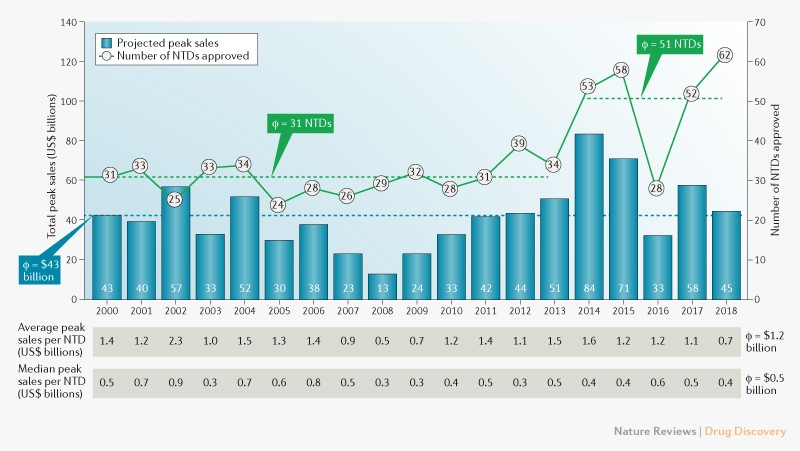
In 2018, FDA approved an all-time record of 62 new therapeutic drugs (NTDs) [Not including diagnostic imaging agents, included are combination products with at least one new molecular entity as an active ingredient] with average Peak Sales per NTD $1.2Billion.


Reporter: Aviva Lev-Ari, PhD, RN

BIOBUSINESS BRIEFS

2018 FDA approvals hit all-time high — but average value slips again

In 2018, the FDA approved an all-time record of 62 new therapeutic drugs (NTDs; see Fig. 1 for the definition and the difference compared with new molecular entities). This is consistent with the increase we predicted last year (Nat. Rev. Drug Discov. 17, 87; 2018) and the overall resurgence of R&D in the last 5 years, with an average of 51 approvals per year in this period even with a low count in 2016. This is substantially more than the average of 31 approvals per year in the period 2000–2013 (Fig. 1).

Fig. 1 | FDA approvals of new therapeutic drugs and aggregate projected peak global annual sales: 2000–2018. We analysed 2018 FDA approvals of new therapeutic drugs (NTDs), defined as new molecular entities approved by the FDA’s Center for Drug Evaluation and Research (CDER) and Center for Biologics Evaluation and Research (CBER), but with two adjustments: first, we excluded diagnostic imaging agents; and second, we included combination products with at least one new molecular entity as an active ingredient. The analysis is based exclusively on approvals by the FDA and the year in which the first indication approval took place. All peak sales values were obtained from EvaluatePharma and were inflation-adjusted to 2018 using standard global GDP-based inflators sourced from the Economist Intelligence Unit. To arrive at peak sales for each NTD, we reviewed both historical actual sales as well as the full range of forecast sales that are available from EvaluatePharma and selected the highest value. Sources: EvaluatePharma, FDA and Boston Consulting Group analysis.

SOURCE

https://www.nature.com/articles/d41573-019-00004-z

Read Full Post »

37th Annual J.P. Morgan HEALTHCARE CONFERENCE: News at #JPM2019 for Jan. 10, 2019: Deals and Announcements

Reporter: Stephen J. Williams, Ph.D.

From Biospace.com


JP Morgan Healthcare Conference Update: Sage, Mersana, Shutdown Woes and Babies

Speaker presenting to audience at a conference

With the J.P. Morgan Healthcare Conference winding down, companies remain busy striking deals and informing investors about pipeline advances. BioSpace snagged some of the interesting news bits to come out of the conference from Wednesday.

SAGE Therapeutics – Following a positive Phase III report that its postpartum depression treatment candidate SAGE-217 hit the mark in its late-stage clinical trial, Sage Therapeutics is eying the potential to have multiple treatment options available for patients. At the start of J.P. Morgan, Sage said that patients treated with SAGE-217 had a statistically significant improvement of 17.8 points in the Hamilton Rating Scale for Depression, compared to 13.6 for placebo. The company plans to seek approval for SAGE-2017, but before that, the FDA is expected to make a decision on Zulresso in March. Zulresso already passed muster from advisory committees in November, and if approved, would be the first drug specifically for postpartum depression. In an interview with the Business Journal, Chief Business Officer Mike Cloonan said the company believes there is room in the market for both medications, particularly since the medications address different patient populations.


Mersana Therapeutics – After a breakup with Takeda Pharmaceutical and the shelving of its lead product, Cambridge, Mass.-based Mersana is making a new path. Even though a partial clinical hold was lifted following the death of a patient the company opted to shelve development of XMT-1522. During a presentation at JPM, CEO Anna Protopapas noted that many other companies are developing therapies that target the HER2 protein, which led to the decision, according to the Boston Business Journal. Protopapas said the HER2 space is highly competitive and now the company will focus on its other asset, XMT-1536, an ADC targeting NaPi2b, an antigen highly expressed in the majority of non-squamous NSCLC and epithelial ovarian cancer. XMT-1536 is currently in Phase 1 clinical trials for NaPi2b-expressing cancers, including ovarian cancer, non-small cell lung cancer and other cancers. Data on XMT-1536 is expected in the first half of 2019.

Novavax – During a JPM presentation, Stan Erck, CEO of Novavax, pointed to the company’s RSV vaccine, which is in late-stage development. The vaccine is being developed for the mother, in order to protect an infant. The mother transfers the antibodies to the infant, which will provide the baby with protection from RSV in its first six months. Erck called the program historic. He said the Phase III program is in its fourth year and the company has vaccinated 4,636 women. He said they are tracking the women and the babies. Researchers call the mothers every week through the first six months of the baby’s life to acquire data. Erck said the company anticipates announcing trial data this quarter. If approved, Erck said the market for the vaccine could be a significant revenue driver.

“You have 3.9 million birth cohorts and we expect 80 percent to 90 percent of those mothers to be vaccinated as a pediatric vaccine and in the U.S. the market rate is somewhere between $750 million and a $1 billion and then double that for worldwide market. So it’s a large market and we will be first to market in this,” Erck said, according to a transcript of the presentation.

Denali Therapeutics – Denali forged a collaboration with Germany-based SIRION Biotech to develop gene therapies for central nervous disorders. The two companies plan to develop adeno-associated virus (AAV) vectors to enable therapeutics to cross the blood-brain barrier for clinical applications in neurodegenerative diseases including Parkinson’s, Alzheimer’s disease, ALS and certain other diseases of the CNS.

AstraZeneca – Pharma giant AstraZeneca reported that in 2019 net prices on average across the portfolio will decrease versus 2018. With a backdrop of intense public and government scrutiny over pricing, Market Access head Rick Suarez said the company is increasing its pricing transparency. Additionally, he said the company is looking at new ways to price drugs, such as value-based reimbursement agreements with payers, Pink Sheet reported.

Amarin Corporation – As the company eyes a potential label expansion approval for its cardiovascular disease treatment Vascepa, Amarin Corporation has been proactively hiring hundreds of sales reps. In the fourth quarter, the company hired 265 new sales reps, giving the company a sales team of more than 400, CEO John Thero said. Thero noted that is a label expansion is granted by the FDA, “revenues will increase at least 50 percent over what we did in the prior year, which would give us revenues of approximate $350 million in 2019.”

Government Woes – As the partial government shutdown in the United States continues into its third week, biotech leaders at JPM raised concern as the FDA’s carryover funds are dwindling. With no new funding coming in, reviews of New Drug Applications won’t be able to continue past February, Pink Sheet said. While reviews are currently ongoing, no New Drug Applications are being accepted by the FDA at this time. With the halt of NDA applications, that has also caused some companies to delay plans for an initial public offering. It’s hard to raise potential investor excitement without the regulatory support of a potential drug approval. During a panel discussion, Jonathan Leff, a partner at Deerfield Management, noted that the ongoing government shutdown is a reminder of how “overwhelmingly dependent the whole industry of biotech and drug development is on government,” Pink Sheet said.

Other posts on the JP Morgan 2019 Healthcare Conference on this Open Access Journal include:

#JPM19 Conference: Lilly Announces Agreement To Acquire Loxo Oncology

36th Annual J.P. Morgan HEALTHCARE CONFERENCE January 8 – 11, 2018

37th Annual J.P. Morgan HEALTHCARE CONFERENCE: #JPM2019 for Jan. 8, 2019; Opening Videos, Novartis expands Cell Therapies, January 7 – 10, 2019, Westin St. Francis Hotel | San Francisco, California

37th Annual J.P. Morgan HEALTHCARE CONFERENCE: News at #JPM2019 for Jan. 8, 2019: Deals and Announcements


Read Full Post »

In 2018 Cardiovascular PharmacoTherapy Market: Anti-thrombotic Drug Class Segment will continue to bring in the biggest profit and dominate production

Reporter: Aviva Lev-Ari, PhD, RN

Who were the top players in cardiovascular disease in 2017?

Read Full Post »

CHI’s Discovery on Target, Sheraton Boston, Sept. 25-28, 2018

Reporter: Aviva Lev-Ari, PhD, RN


ANNOUNCEMENT

Leaders in Pharmaceutical Business Intelligence (LPBI) Group is a selected CHI Business Partner for Media Communication for this event as well a provider of REAL TIME PRESS COVERAGE for this cardinal event in the domain of  Drug Discovery and Drug Delivery.

Dr. Aviva Lev-Ari, PhD, RN, Editor-in-Chief, PharmaceuticalIntelligence.com  will be in attendance covering this event for the Press using Social Media via 12 Channels

LOGO of LPBI Group

Follow us on ALL our Media Communication Channels:

Channels for e-Marketing of Biotech Conferences

  • Our Journal has 1,373,977  eReaders on 1/29/2018, for All Time and 7,283 Scientific Comments

http://pharmaceuticalintelligence.com

  • Aviva’s – +6,430 BIOTECH Followers on LinkedIn

http://www.linkedin.com/in/avivalevari

  • Aviva is a Member of +60 LinkedIn Groups in Biotech related fields

https://www.linkedin.com/groups/my-groups

  • LPBI Group’s FaceBook Page

http://www.facebook.com/LeadersInPharmaceuticalBusinessIntelligence

  • LPBI Group’s Twitter Account

http://twitter.com/pharma_BI

  • LPBI Group’s Company’s Page on LinkedIn

https://www.linkedin.com/company/9325543?trk=tyah&trkInfo=clickedVertical%3Acompany%2CclickedEntityId%3A9325543%2Cidx%3A1-1-1%2CtarId%3A1439226813927%2Ctas%3ALeaders%20in%20Pharmaceutica


For UPDATES on this Cardinal Conference and for REGISTRATION, go to 

http://www.discoveryontarget.com/?utm_source=partner


For PROGRAMS, go to 

http://www.discoveryontarget.com/programs

What is the Role of the Editor-in-Chief at PharmaceuticalIntelligence.com 

Editor-in-Chief’s Roles and Accomplishments

1        Curation Methodology Development

Leadership we provide on curation of scientific findings in the eScientific publishing for Medical Education contents.

In Section 1, the Leadership we provide on curation of scientific findings in the eScientific publishing for Medical Education contents is demonstrated by a subset of several outstanding curations with high electronic Viewer volume. Each article included presents unique content contribution to Medical Clinical Education.

·       These articles are extracted from the list of all Journal articles with >1,000 eReaders, 4/28/2012 to 1/29/2018.

Article Title,         # of electronic Viewers,         Author(s) Name

Is the Warburg Effect the Cause or the Effect of Cancer: A 21st Century View?                      16,114 Larry H. Bernstein, MD, FCAP

Do Novel Anticoagulants Affect the PT/INR? The Cases of XARELTO (rivaroxaban) and PRADAXA (dabigatran) 11,606 Vivek Lal, MBBS, MD, FCIR,

Justin D. Pearlman, MD, PhD, FACC and

Aviva Lev-Ari, PhD, RN

Clinical Indications for Use of Inhaled Nitric Oxide (iNO) in the Adult Patient Market: Clinical Outcomes after Use, Therapy Demand and Cost of Care


 5,865 Aviva Lev-Ari, PhD, RN
Peroxisome proliferator-activated receptor (PPAR-gamma) Receptors Activation: PPARγ transrepression for Angiogenesis in Cardiovascular Disease and PPARγ transactivation for Treatment of Diabetes                  1,919 Aviva Lev-Ari, PhD, RN  


Bystolic’s generic Nebivolol – Positive Effect on circulating Endothelial Progenitor Cells Endogenous Augmentation  1,059 Aviva Lev-Ari, PhD, RN


Triple Antihypertensive Combination Therapy Significantly Lowers Blood Pressure in Hard-to-Treat Patients with Hypertension and Diabetes  1,339 Aviva Lev-Ari, PhD, RN


Clinical Trials Results for Endothelin System: Pathophysiological role in Chronic Heart Failure, Acute Coronary Syndromes and MI – Marker of Disease Severity or Genetic Determination?  1,472 Aviva Lev-Ari, PhD, RN
Treatment of Refractory Hypertension via Percutaneous Renal Denervation  1,085 Aviva Lev-Ari, PhD, RN

2        Content Creation and Key Opinion Leader (KOL) Recognition

2.1     Volume of Articles in the Journal and in the 16 Volume-BioMed e-Series

Select

Aviva Lev-Ari, PhD, RN 2012pharmaceutical

3,064 Articles

·       All  (5,288)

avivalev-ari@alum.berkeley.edu Administrator 3064

2.1     Volume of Articles in the Journal and in the 16 Volume-BioMed e-Series

1.   Volume of Articles in the Journal since Journal inception on 4/28/2012:

·       Total articles by ALL authors in Journal Archive on 1/29/2018 = 5,288

·       ALL articles/posts Authored, Curated, Reported by Aviva Lev-Ari, PhD, RN = 3,064

2.   Volume of Articles in the 16 Volume-BioMed e-Series

·    Editorial & Publication of Articles in e-Books by Leaders in Pharmaceutical Business Intelligence: Contributions of Aviva Lev-Ari, PhD, RN

https://pharmaceuticalintelligence.com/2014/10/16/editorial-publication-of-articles-in-e-books-by-leaders-in-pharmaceutical-business-intelligence-contributions-of-aviva-lev-ari-phd-rn/

·       LPBI Group’s Founder: Biography and Bibliographies – Aviva Lev-Ari, PhD, RN

https://pharmaceuticalintelligence.com/founder/


2.2     Digital Presence measured by eViews: Clicks on article by Author Name

Top Authors for all days ending 2018-01-29 (Summarized)

All Time

Author Name electronic Views
Aviva Lev-Ari, PhD, RN [2012pharmaceutical]

352,153


Our TEAM 5,934  


Founder 3,257
BioMed e-Series 3,140


Journal PharmaceuticalIntelligence.com 2,214
About 2,054
  VISION   2,803  


LPBI Group
            1,201

2.3     Digital KOL Parameters

Key Opinion Leader (KOL) – Aviva Lev-Ari, PhD, RN, as Evidenced by

https://pharmaceuticalintelligence.com/2016/07/21/key-opinion-leader-kol-aviva-lev-ari-phd-rn-as-evidenced-by/


3        Team building: Editors and Expert, Authors, Writers

Our Team

Selection of Journal’s Chief Scientific Officer (CSO) and BioMed e-Series Content Consultant (CC): Series B, C, D, E

L.H. Bernstein, MD, FCAP

Editorial & Publication of Articles in e-Books by  Leaders in Pharmaceutical Business Intelligence:  Contributions of Larry H Bernstein, MD, FCAP

https://pharmaceuticalintelligence.com/2014/10/16/editorial-publication-of-articles-in-e-books-by-leaders-in-pharmaceutical-business-intelligence-contributions-of-larry-h-bernstein-md-fcap/

4        Book Title Generation and Cover Page Design

As BioMed e-Series Editor–in-Chief, I was responsible for the following functions of product design and product launch

·       16 Title creations for e-Books

·       Designed 16 Cover Pages for a 16-Volume e-Books e-Series in BioMed

·       Designed Series A eTOCs and approved of all 16 electronic Table of Contents (eTOCs), working in tandem with all the Editors of each volume and all the Author contributors of article contents in the Journal.

·       Commissioned Articles by Authors/Curators per Author’s expertise on a daily basis


Below, see Volume Titles and Cover Pages:

13 LIVE results for Kindle Store: “Aviva Lev-Ari”


The VOICES of Patients, Hospitals CEOs, Health Care Providers, Caregivers and Families: Personal Experience with Critical Care and Invasive Medical Procedures … E: Patient-Centered Medicine Book 1)

Oct 16, 2017 | Kindle eBook

by Larry H. Bernstein and Aviva Lev-Ari

$0.00

Subscribers read for free.

Read for Free

$49.00$ 49 00 to buyKindle Edition

Get it TODAY, Jan 29

Sold by: Amazon Digital Services LLC

Cancer Therapies: Metabolic, Genomics, Interventional, Immunotherapy and Nanotechnology in Therapy Delivery (Series C Book 2)

May 13, 2017 | Kindle eBook

by Larry H. Bernstein and Demet Sag

$0.00

Subscribers read for free.

Read for Free

$100.00$ 100 00 to buyKindle Edition

Get it TODAY, Jan 29

Sold by: Amazon Digital Services LLC

The Immune System, Stress Signaling, Infectious Diseases and Therapeutic Implications: VOLUME 2: Infectious Diseases and Therapeutics and VOLUME 3: The … (Series D: BioMedicine & Immunology)

Sep 4, 2017 | Kindle eBook

by Larry H. Bernstein and Aviva Lev-Ari

$0.00

Subscribers read for free.

Read for Free

$115.00$ 115 00 to buyKindle Edition

Get it TODAY, Jan 29

Sold by: Amazon Digital Services LLC

Perspectives on Nitric Oxide in Disease Mechanisms (Biomed e-Books Book 1)

Jun 20, 2013 | Kindle eBook

by Margaret Baker PhD and Tilda Barliya PhD

$0.00

Subscribers read for free.

Read for Free

$75.00$ 75 00 to buyKindle Edition

Get it TODAY, Jan 29

5 out of 5 stars 6

Sold by: Amazon Digital Services LLC

Medical Scientific Discoveries for the 21st Century & Interviews with Scientific Leaders (Series E)

Dec 9, 2017 | Kindle eBook

by Larry H. Bernstein and Aviva Lev-Ari

$0.00

Subscribers read for free.

Read for Free

$75.00$ 75 00 to buyKindle Edition

Get it TODAY, Jan 29

Sold by: Amazon Digital Services LLC

Etiologies of Cardiovascular Diseases: Epigenetics, Genetics and Genomics

Nov 28, 2015 | Kindle eBook

by Justin D. Pearlman MD ME PhD MA FACC and Stephen J. Williams PhD

$0.00

Subscribers read for free.

Read for Free

$75.00$ 75 00 to buyKindle Edition

Get it TODAY, Jan 29

Sold by: Amazon Digital Services LLC

Cardiovascular Original Research: Cases in Methodology Design for Content Co-Curation: The Art of Scientific & Medical Curation

Nov 29, 2015 | Kindle eBook

by Larry H. Bernstein MD FCAP and Aviva Lev-Ari PhD RN

$0.00

Subscribers read for free.

Read for Free

$75.00$ 75 00 to buyKindle Edition

Get it TODAY, Jan 29

Sold by: Amazon Digital Services LLC

Medical 3D BioPrinting – The Revolution in Medicine Technologies for Patient-centered Medicine: From R&D in Biologics to New Medical Devices (Series E: Patient-Centered Medicine Book 4)

Dec 30, 2017 | Kindle eBook

by Larry H. Bernstein and Irina Robu

$0.00

Subscribers read for free.

Read for Free

$75.00$ 75 00 to buyKindle Edition

Get it TODAY, Jan 29

Sold by: Amazon Digital Services LLC

Metabolic Genomics & Pharmaceutics (BioMedicine – Metabolomics, Immunology, Infectious Diseases Book 1)

Jul 21, 2015 | Kindle eBook

by Larry H. Bernstein MD FCAP and Prabodah Kandala PhD

$0.00

Subscribers read for free.

Read for Free

$75.00$ 75 00 to buyKindle Edition

Get it TODAY, Jan 29

5 out of 5 stars 1

Sold by: Amazon Digital Services LLC

Cancer Biology and Genomics for Disease Diagnosis (Series C: e-Books on Cancer & Oncology Book 1)

Aug 10, 2015 | Kindle eBook

by Larry H Bernstein MD FCAP and Prabodh Kumar Kandala PhD

$0.00

Subscribers read for free.

Read for Free

$75.00$ 75 00 to buyKindle Edition

Get it TODAY, Jan 29

Sold by: Amazon Digital Services LLC

Genomics Orientations for Personalized Medicine (Frontiers in Genomics Research Book 1)

Nov 22, 2015 | Kindle eBook

by Sudipta Saha PhD and Ritu Saxena PhD

$0.00

Subscribers read for free.

Read for Free

$75.00$ 75 00 to buyKindle Edition

Get it TODAY, Jan 29

Sold by: Amazon Digital Services LLC

Milestones in Physiology: Discoveries in Medicine, Genomics and Therapeutics (Series E: Patient-Centered Medicine Book 3)

Dec 26, 2015 | Kindle eBook

by Larry H. Bernstein MD FACP and Aviva Lev-Ari PhD RN

$0.00

Subscribers read for free.

Read for Free

$75.00$ 75 00 to buyKindle Edition

Get it TODAY, Jan 29

Sold by: Amazon Digital Services LLC

Regenerative and Translational Medicine: The Therapeutic Promise for Cardiovascular Diseases

Dec 26, 2015 | Kindle eBook

by Justin D. Pearlman MD ME PhD MA FACC and Ritu Saxena PhD

$0.00

Subscribers read for free.

Read for Free

$75.00$ 75 00 to buyKindle Edition

Get it TODAY, Jan 29

Sold by: Amazon Digital Services LLC

5        Style Setting: Instruction manuals for Journal, Articles, Books

As BioMed e-Series Editor–in-Chief, Aviva Lev-Ari, PhD, RN was responsible for

·       All the documentation (Instruction manuals) on Style setting, and for

·       Training all team members

·       Journal Articles Format

·       Journal Comment Exchange Format

·       e-Books Production Process:

1.               Volume creation from Journal’s Article Archive,

2.               Format Translation from HTML to .mobi for Kindle devices,

3.               Proof reading process,

4.               Title release,

5.               Book electronic Upload to Amazon.com Cloud.

6.               Connection of all articles and e-Books to Social Media, Ping back generation by mentioning other related articles published in the Journal


Lastly, 6, below

6        Annual Workflow Management of Multiple eTOCs – Multi-year Book Publishing Scheduling Plan, 2013 – Present


Title Date of Publication Number of Pages
Perspectives on Nitric Oxide in Disease Mechanisms 6/21/2013 895
Cardiovascular Original Research: Cases in Methodology Design for Content Co-Curation 11/30/2015 11039 KB
Etiologies of Cardiovascular Diseases: Epigenetics, Genetics and Genomics 11/29/2015 12333 KB
Regenerative and Translational Medicine: The Therapeutics Promise for Cardiovascular Diseases 12/26/2015 11668 KB
Genomics Orientations for Personalized Medicine 11/23/2015 11724 KB
Cancer Biology & Genomics for Disease Diagnosis 8/11/2015 13744 KB
Cancer Therapies: Metabolic, Genomics, Interventional, Immunotherapy and Nanotechnology in Therapy Delivery 5/18/2017 5408 pages
Metabolic Genomics and Pharmaceutics 7/21/2015 13927 KB
The Immune System, Stress    Signaling, Infectious Diseases and Therapeutic Implications 9/4/2017 3747 pages
The VOICES of Patients, Hospitals CEOs, Health Care Providers, Caregivers and Families: Personal Experience with Critical Care and Invasive Medical Procedures 10/16/2017 826 pages
Medical Scientific Discoveries for the 21st Century & Interviews with Scientific Leaders 12/9/2017 2862 pages
Milestones in Physiology: Discoveries in Medicine, Genomics and Therapeutics 12/27/2015 11125 KB
Medical 3D BioPrinting – The Revolution in Medicine, Technologies for Patient-centered Medicine: From R&D in Biologics to New Medical Devices 12/30/2017 1005 pages
Pharmacological Agents in Treatment of Cardiovascular Disease


Work-in-Progress, Expected Publishing date in 2018 ???
Interventional Cardiology and Cardiac Surgery for Disease Diagnosis and Guidance of Treatment Work-in-Progress, Expected Publishing date in 2018


???


Read Full Post »

Novartis’ Kymriah (tisagenlecleucel), FDA approved genetically engineered immune cells, would charge $475,000 per patient, will use Programs that Payers will pay only for Responding Patients

Curator: Aviva Lev-Ari, PhD, RN


UPDATED on 9/1/2017:

This Pioneering $475,000 Cancer Drug Comes With A Money-Back Guarantee

Novartis defends the eye-popping price of its pioneering gene therapy with arguments about its $1 billion expenditure—and novel “value-based” pricing.

https://www.fastcompany.com/40461214/how-novartis-is-defending-the-record-475000-price-of-its-pioneering-gene-therapy-cancer-drug-car-t-kymriah


On 8/30/2017 we wrote:

FDA has approved the world’s first CAR-T therapy, Novartis for Kymriah (tisagenlecleucel) and Gilead’s $12 billion buy of KitePharma, no approved drug and Canakinumab for Lung Cancer (may be?)

Curator: Aviva Lev-Ari, PhD, RN

https://pharmaceuticalintelligence.com/2017/08/30/fda-has-approved-the-worlds-first-car-t-therapy-novartis-for-kymriah-tisagenlecleucel-and-gileads-12-billion-buy-of-kite-pharma-no-approved-drug-and-canakinumab-for-lung-cancer-may-be/


The Price for the Treatment was published on 8/31/2017, a Value-based Pricing Payment Model of a $475,000 per patient charge for the responding patients after ONE month of treatment. Novartis says it takes an average of 22 days to create the therapy, from the time a patient’s cells are removed to when they are infused back into the patient. Kymriah will initially be available at 20 U.S. hospitals within a month, Novartis says. Eventually, 32 total sites will offer the therapy. 

CAR-T gained national attention three years ago when Carl June, a researcher at the University of Pennsylvania, used to put a young girl’s acute lymphoblastic leukemia. Genetically altering the girl’s immune cells had made her deathly ill, but June had used a Roche drug, Actemra, to treat the side effects. She lived, and the results were published in The New England Journal of Medicine. Novartis bought the rights to the Penn treatment for just $20 million up front.

Pharma Buying the right to use from an Academic Institution is a known route to leap frog the R&D lengthy process of Drug discovery.

“I’ve told the team that resources are not an issue. Speed is the issue,” says Novartis’ Chief Executive Joseph Jimenez, told Forbes in a cover story about the work then.

The FDA calls this CAR-T therapy treatment, made by Novartis, the “first gene therapy” in the U.S. The therapy is designed to treat an often-lethal type of blood and bone marrow cancer that affects children and young adults. The FDA defines gene therapy as a medicine that “introduces genetic material into a person’s DNA to replace faulty or missing genetic material” to treat a disease or medical condition. This is the first such therapy to be available in the U.S., according to the FDA.

Two gene therapies for rare, inherited diseases have already been approved in Europe.

To further evaluate the long-term safety, Novartis is also required to conduct a post-marketing observational study involving patients treated with Kymriah.

The FDA granted Kymriah Priority Review and Breakthrough Therapy designations. The Kymriah application was reviewed using a coordinated, cross-agency approach. The clinical review was coordinated by the FDA’s Oncology Center of Excellence, while CBER conducted all other aspects of review and made the final product approval determination.

The FDA granted approval of Kymriah to Novartis Pharmaceuticals Corp. The FDA granted the expanded approval of Actemra to Genentech Inc.

FDA commissioner Scott Gottlieb in a statement.

“We’re entering a new frontier in medical innovation with the ability to reprogram a patient’s own cells to attack a deadly cancer,” 

“Kymriah is a first-of-its-kind treatment approach that fills an important unmet need for children and young adults with this serious disease,” said Peter Marks, M.D., Ph.D., director of the FDA’s Center for Biologics Evaluation and Research (CBER). “Not only does Kymriah provide these patients with a new treatment option where very limited options existed, but a treatment option that has shown promising remission and survival rates in clinical trials.”

https://www.fda.gov/NewsEvents/Newsroom/PressAnnouncements/ucm574058.htm

The Protocol

A patient’s T cells are extracted and cryogenically frozen so that they can be transported to Novartis’s manufacturing center in New Jersey. There, the cells are genetically altered to have a new gene that codes for a protein—called a chimeric antigen receptor, or CAR. This protein directs the T cells to target and kill leukemia cells with a specific antigen on their surface. The genetically modified cells are then infused back into the patient.

In a clinical trial of 63 children and young adults with a type of acute lymphoblastic leukemia, 83 percent of patients that received the CAR-T therapy had their cancers go into remission within three months. At six months, 89 percent of patients who received the therapy were still living, and at 12 months, 79 percent had survived.

https://www.technologyreview.com/s/608771/the-fda-has-approved-the-first-gene-therapy-for-cancer/?utm_campaign=add_this&utm_source=email&utm_medium=post

CAR-T Therapies: Product/Molecules/MOA under Development:

  • Similar CAR-T treatments were being developed at other institutions including
  • Memorial Sloan-Kettering Cancer Center,
  • Seattle Children’s Hospital, and
  • The National Cancer Institute.
  • The Memorial and Seattle work was spun off into a startup called Juno Therapeutics, which has fallen behind. Juno Therapeutics ended a CAR-T study earlier this year after patients died from cerebral edema, or swelling in the brain.
  • The NCI work became the basis for the product being developed by Kite Pharma. Kite Pharma, which is awaiting FDA approval for its CAR-T therapy to treat a form of blood cancer in adults, was this week bought out by Gilead in a deal worth $11.9 billion.

On Cambridge Healthtech Institute’s 4th Annual Adoptive T Cell Therapy, Delivering CAR, TCR, and TIL from Research to Reality, August 29 – 30, 2017 | Sheraton Boston | Boston, MA

TUESDAY, AUGUST 29 – I covered in Real Time the talk on Juno Therapeutics: Building Better T Cell Therapies: The Power of Molecular Profiling by Mark Bonyhadi, Ph.D., Head, Research and Academic Affairs, Juno Therapeutics

https://pharmaceuticalintelligence.com/2017/08/29/live-829-chis-oncolytic-virus-immunotherapy-and-adoptive-cell-therapy-august-28-29-2017-sheraton-boston-hotel-boston-ma/


Precision Medicine is Costly and not a Rapid manufacturing process

All of the CAR-T products are expensive to make, and must be manufactured on an individual basis for each new patient from the patient’s own T-cells, a type of white blood cells, a process that takes weeks.

  • How quickly companies can speed up manufacturing.
  • Kymriah will be manufactured at a facility in Morris Plains, N.J.
  • CAR-T technology, which has so far been used only in patients with blood cancers that have not been cured by other treatments, can be used earlier in the disease or for solid tumors: Breast, Prostate, Melanomas.

https://www.forbes.com/sites/matthewherper/2017/08/30/fda-approves-novartis-treatment-that-alters-patients-cells-to-fight-cancer/#2aecb25b4400

Prediction How Patients will Far Well – Researchers use a big-data approach to find links between different genes and patient survival.

https://www.technologyreview.com/s/608666/a-cancer-atlas-to-predict-how-patients-will-fare/?set=

A pathology atlas of the human cancer transcriptome

+ See all authors and affiliations

Science  18 Aug 2017:
Vol. 357, Issue 6352, eaan2507
DOI: 10.1126/science.aan2507

Modeling the cancer transcriptome

Recent initiatives such as The Cancer Genome Atlas have mapped the genome-wide effect of individual genes on tumor growth. By unraveling genomic alterations in tumors, molecular subtypes of cancers have been identified, which is improving patient diagnostics and treatment. Uhlen et al. developed a computer-based modeling approach to examine different cancer types in nearly 8000 patients. They provide an open-access resource for exploring how the expression of specific genes influences patient survival in 17 different types of cancer. More than 900,000 patient survival profiles are available, including for tumors of colon, prostate, lung, and breast origin. This interactive data set can also be used to generate personalized patient models to predict how metabolic changes can influence tumor growth.

Read Full Post »

FDA has approved the world’s first CAR-T therapy, Novartis for Kymriah (tisagenlecleucel) and Gilead’s $12 billion buy of Kite Pharma, no approved drug and Canakinumab for Lung Cancer (may be?)

Curator: Aviva Lev-Ari, PhD, RN


UPDATED on 12/10/2019

For an ‘acquisitive’ Gilead, 2020 will be key test for CAR-T plans

Success for Kite, which O’Day made an independent unit, is critical for Gilead. Not only did the California biotech invest a large sum to buy the CAR-T specialist, it’s the most notable bet made on a future outside of drugs for HIV and hepatitis C.

Sentiment on Wall Street has begun to turn against the wisdom of Gilead’s choice, doubting CAR-T will live up to the promise envisioned by O’Day’s predecessors. One analyst went so far as to include the acquisition among the five most value-destroying biopharma deals of the past decade.

Commercially, sales of Yescarta have grown to $334 million through the first nine months of the year, up from $183 million during the same period last year. Still, marketing CAR-T has proved challenging, with hurdles in reimbursement and in-hospital administration particularly acute.

The coming year could prove consequential in shifting Kite’s trajectory higher.

Within the next few weeks, Gilead will ask regulators to approve its second CAR-T cell therapy, a variation of its currently cleared leukemia and lymphoma treatment Yescarta that’s manufactured differently.

new site in Europe coming online next year could substantially cut times down for Yescarta delivery there, Shaw said. (Globally, Novartis appears better positioned, with sites in Switzerland and France as well as partnerships in China, Japan and Australia.)

Automation of what’s now a mostly manual process will play an important role in CAR-T’s future too, according to Shaw.

“If we get our autologous cell therapy automated very well, you could imagine one day it could be at point of care,” she said. “We don’t want to be disrupted by someone else doing that.”

Disruption could also come in the form of allogeneic cell therapies, which are constructed using donor T cells rather than autologous treatments that use a patient’s own. Numerous clinical hurdles have made that approach more difficult but companies like Allogene — founded by former Kite executives — are moving ahead.

SOURCE

https://www.biopharmadive.com/news/gilead-kite-car-t-christi-shaw-dealmaking/568767/


UPDATED on 5/3/2019

Gilead Sciences tapped new CEO Daniel O’Day in part because of his cancer expertise. But he’s not planning to lead the company’s oncology ramp-up alone.

The Roche veteran intends to bring on a CEO for Gilead’s Kite unit, responsible for key CAR-T drug Yescarta. The new chief will report to O’Day and operate Kite as a separate business unit, JPMorgan analyst Cory Kasimov wrote in a Thursday note to clients.

RELATED: Gilead, looking for cancer sales, swipes Roche pharma chief Daniel O’Day for CEO post

Gilead acquired Kite in 2017 for $12 billion as its hepatitis C revenues, once its bread and butter, crashed. But so far, both Yescarta and Novartis’ rival CAR-T player, Kymriah, have struggled, thanks to a mix of reimbursement and manufacturing challenges.

Kite underperformed expectations once again in the first quarter, with Yescarta’s $96 million in sales for the period checking in below Wall Street consensus of $105 million.

O’Day doesn’t expect to see that trend continue, though. On Gilead’s earnings conference call, he “proclaimed his confidence in cell therapy, noting that it was a critical element of the company’s long term strategy,” Kasimov wrote.

Getting Gilead’s commercial business in order is just one of O’Days three main priorities as he settles into the CEO role, though. After taking the reins March 1, he decided to zero in on strengthening Gilead’s pipeline, in part through M&A. And he’ll also be making organizational tweaks to “ensure the right people are in the right place,” as Kasimov put it.

Gilead is “continuing to scan the entirety” of the M&A landscape and “acknowledges they will continue to ‘look at late stage pipeline,’” while keeping an eye on the company’s areas of expertise—oncology, HIV and hepatitis B and nonalcoholic steatohepatitis, Jefferies analyst Michael Yee wrote to his own clients. And the Big Biotech will be “accelerating internal” candidates in addition to adding bolt-on buys.

RELATED: Gilead executives predict patience—and some deal scouting—from new CEO Daniel O’Day

Unsurprisingly, analysts trained their attention on the call to O’Day’s strategy comments, and “there were literally minimal to no questions about financials,” Yee noted. But that doesn’t mean Gilead turned in a bad quarter. On the contrary, the first quarter was “fairly clean,” he wrote, with revenues of $5.28 billion meeting expectations and earnings per share of $1.76 topping forecasts by 15 cents.

New HIV hotshot Biktarvy stole the show on the revenue side, blowing the $648 million consensus prediction out of the water with $793 million in quarterly sales.

In the quarter, “about 80% of Biktarvy revenue came from switches with 25% from dolutegravir-containing regimens in the U.S.,” Kasimov wrote, referencing key combinations from Gilead’s HIV archrival, GlaxoSmithKline.

SOURCE


UPDATED on 9/7/2017

Here’s the inside account of Gilead’s 11-week sprint to its $12B Kite buyout – ENDPOINTS NEWS

UPDATED on 8/31/2017

Gilead-Kite: A New Transformative Deal For Biotech, AUG 30, 2017

Gilead has made a big bet on new technology in Kite’s immunotherapy platforms and has reduced the number of credible large players in the space.

With a reputation for intense diligence and dynamism in its business development efforts, Gilead’s management team will only bolster the immunotherapy field as it prepares to face off with Novartis, its immediate competitor, and enters squarely in the province of Merck and Bristol Myers Squibb, two of the leaders in immuno-oncology.

Gilead has reinvented the transformative transaction for the sector.

https://www.forbes.com/sites/stephenbrozak/2017/08/30/gilead-kite-a-new-transformative-deal-and-maybe-the-new-future-of-healthcare-deals/#fc64fca65d49


I attended this week the Cambridge Healthtech Institute’s 4th Annual

Adoptive T Cell Therapy

Delivering CAR, TCR, and TIL from Research to Reality
August 29 – 30, 2017 | Sheraton Boston | Boston, MA


The following talks on 8/29/2017 presented the frontier of CAR-T Therapies and Technologies from lab to bed side:

  • Building Better T Cell Therapies: The Power of Molecular Profiling

Mark Bonyhadi, Ph.D., Head, Research and Academic Affairs, Juno Therapeutics

  • Tricked-Out Cars, the Next Generation of CAR T Cells

Richard Morgan, Ph.D., Vice President, Immunotherapy, Bluebird Bio

  • The Generation of Lentiviral Vector-Modified CAR-T Cells Using an Automated Process

Boro Dropulic, Ph.D., General Manager and CSO, Lentigen Technology, Inc.

I covered this event in Real Time for the Press

LIVE – 8/29 – CHI’s Oncolytic Virus Immunotherapy and ADOPTIVE CELL THERAPY, August 28-29, 2017 Sheraton Boston Hotel | Boston, MA

https://pharmaceuticalintelligence.com/2017/08/29/live-829-chis-oncolytic-virus-immunotherapy-and-adoptive-cell-therapy-august-28-29-2017-sheraton-boston-hotel-boston-ma/


One year ago we published the following:

What does this mean for Immunotherapy? FDA put a temporary hold on Juno’s JCAR015, Three Death of Celebral Edema in CAR-T Clinical Trial and Kite Pharma announced Phase II portion of its CAR-T ZUMA-1 trial

https://pharmaceuticalintelligence.com/2016/07/09/what-does-this-mean-for-immunotherapy-fda-put-a-temporary-hold-on-jcar015-three-death-of-celebral-edema-in-car-t-clinical-trial-and-kite-pharma-announced-phase-ii-portion-of-its-car-t-zuma-1-trial/


SOURCE

Is Canakinumab the Next Viagra?

In this Revolution and Revelation, Milton Packer explains how safety data can sometimes trump a primary endpoint

by Milton PackerAugust 30, 2017

https://www.medpagetoday.com/Blogs/RevolutionandRevelation/67605

Read Full Post »

Genomic Diagnostics: Three Techniques to Perform Single Cell Gene Expression and Genome Sequencing Single Molecule DNA Sequencing

Curator: Aviva Lev-Ari, PhD, RN

4.2.3

4.2.3   Genomic Diagnostics: Three Techniques to Perform Single Cell Gene Expression and Genome Sequencing Single Molecule DNA Sequencing, Volume 2 (Volume Two: Latest in Genomics Methodologies for Therapeutics: Gene Editing, NGS and BioInformatics, Simulations and the Genome Ontology), Part 4: Single Cell Genomics

This article presents Three Techniques to Perform Single Cell Gene Expression and Genome Sequencing Single molecule DNA sequencing

Read Full Post »

« Newer Posts - Older Posts »