Feeds:
Posts
Comments

Archive for the ‘Nutritional Supplements: Atherogenesis, lipid metabolism’ Category

Larry H Bernstein, MD, Writer, Curator
http://pharmaceutical intelligence.com/2013/06/22/ Demythologizing sharks, cancer, and shark fins/lhbern

Screen Shot 2021-07-19 at 6.26.48 PM

Word Cloud By Danielle Smolyar

Sharks have survived some 400 million years on Earth. Could their longevity be due in part to an extraordinary resistance to cancer and other diseases? If so, humans might someday benefit from the shark’s secrets—but leading researchers caution that today’s popular shark cartilage “cancer cures” aren’t part of the solution.

The belief that sharks do not get cancer is not supported in fact, but it is the basis for decimating a significant part of the shark population for shark fins, and for medicinal use.  The unfortunate result is that there is no benefit.

A basis for this thinking is that going back to the late 1800s, sharks have been fished commercially and there have been few reports of anything out of the ordinary when removing internal organs or preparing meat for the marketplace.  In addition, pre-medical students may have dissected dogfish sharks in comparative anatomy, but you don’t see reports of cancerous tumors.

Carl Luer of the MOTE Marine Laboratory’s Center for Shark Research in Sarasota, Florida, has been studying sharks’ cancer resistance for some 25 years.  Systematic surveys of sharks are difficult to conduct, as capturing the animals in large numbers is time-consuming, and cancer tests would likely require the deaths of large numbers of sharks. Of the thousands of fish tumors in the collections of the Smithsonian Institution, only about 15 are from elasmobranchs, and only two of these are thought to have been malignant.

Scientists have been studying cancerous tumors in sharks for 150 years.

The first chondrichthyes’ (cartilaginous fishes, including sharks) tumor was found on a skate and recorded by Dislonghamcps in 1853. The first shark tumor was recorded in 1908. Scientists have since discovered benign and cancerous tumors in 18 of the 1,168 species of sharks. Scarcity of studies on shark physiology has perhaps allowed this myth to be accepted as fact for so many years.

In April 2000, John Harshbarger and Gary Ostrander countered this shark myth with a presentation on 40 benign and cancerous tumors known to be found in sharks, and soon after a blue shark was found with cancerous tumors in both its liver and testes. Several years later a cancerous gingival tumor was removed from the mouth of a captive sand tiger shark, Carcharias Taurus. Advances in shark research continue to produce studies on types of cancer found in various species of shark.  Sharks, like fish, encounter and take in large quantities of environmental pollutants, which may actually make them more susceptible to tumorous growth. Despite recorded cases of shark cancer and evidence that shark cartilage has no curative powers against cancer sharks continue to be harvested for their cartilage.

Sharks and their relatives, the skates and rays, have enjoyed tremendous success during their nearly 400 million years of existence on earth, according to Dr. Luer. He points out that one reason for this certainly is their uncanny ability to resist disease. Sharks do get sick, but their incidence of disease is much lower than among the other fishes. While statistics are not available on most diseases in fishes, reptiles, amphibians, and invertebrates, tumor incidence in these animals is carefully monitored by the Smithsonian Institution in Washington, D.C.

The Smithsonian’s enormous database, called the Registry of Tumors in Lower Animals, catalogs tissues suspected of being tumorous, including cancers, from all possible sources throughout the world. Of the thousands of tissues in the Registry, most of them are from fish but only a few are from elasmobranchs. Only 8 to 10 legitimate tumors are among all the shark and ray tissues examined, and only two of these are thought to have been malignant.

An observation by Gary Ostrander, a Professor at Johns Hopkins University, is that there may be fundamental differences in shark immune systems so that they aren’t as prone to cancer.  The major thrust of the Motes research focuses on the immunity of sharks and their relatives the skates and rays. While skates aren’t as interesting to the public as their shark relatives, their similar biochemical immunology and their ability to breed in captivity make them perhaps more vital to Luer’s lab work.   The result is to study the differences and similarities to the higher animals, and what might possibly be the role of the immune system in their low incidence of disease.

This low incidence of tumors among the sharks and their relatives has prompted biochemists and immunologists at Mote Marine Laboratory (MML) to explore the mechanisms that may explain the unusual disease resistance of these animals. To do this, they established the nurse shark and clearnose skate as laboratory animals. They designed experiments to see whether tumors could be induced in the sharks and skates by exposing them to potent carcinogenic (cancer-causing) chemicals, and then monitored pathways of metabolism or detoxification of the carcinogens in the test animals. While there were similarities and differences in the responses when compared with mammals, no changes in the target tissues or their genetic material ever resulted in cancerous tumor formation in the sharks or skates.

The chemical exposure studies led to investigations of the shark immune system. As with mammals, including humans, the immune system of sharks probably plays a vital role in the overall health of these animals. But there are some important differences between the immune arsenals of mammals and sharks. The immune system of mammals typically consists of two parts which utilize a variety of immune cells as well as several classes of proteins called immunoglobulins (antibodies).

Compared to the mammalian system, which is quite specialized, the shark immune system appears primitive but remarkably effective. Sharks apparently possess immune cells with the same functions as those of mammals, but the shark cells appear to be produced and stimulated differently. Furthermore, in contrast to the variety of immunoglobulins produced in the mammalian immune system, sharks have only one class of immunoglobulin (termed IgM). This Immunoglobulin normally circulates in shark blood at very high levels and appears to be ready to attack invading substances at all times.

Another difference lies in the fact that sharks, skates, and rays lack a bony skeleton, and so do not have bone marrow. In mammals, immune cells are produced and mature in the bone marrow and other sites, and, after a brief lag time, these cells are mobilized to the bloodstream to fight invading substances. In sharks, the immune cells are produced in the spleen, thymus and unique tissues associated with the gonads (epigonal organ) and esophagus (Leydig organ). Some maturation of these immune cells occurs at the sites of cell production, as with mammals. But a significant number of immune cells in these animals actually mature as they circulate in the bloodstream. Like the ever-present IgM molecule, immune cells already in the shark’s blood may be available to respond without a lag period, resulting in a more efficient immune response.

Research was being carried out during the 1980’s at the Massachusetts Institute of Technology (MIT) and at Mote Marine Laboratory designed to understand how cartilage is naturally able to resist penetration by blood capillaries. If the basis for this inhibition could be identified, it was reasoned, it might lead to the development of a new drug therapy. Such a drug could control the spread of blood vessels feeding a cancerous tumor, or the inflammation associated with arthritis.

The results of the research showed only that a very small amount of an active material, with limited ability to control blood vessel growth, can be obtained from large amounts of raw cartilage. The cartilage must be subjected to several weeks of harsh chemical procedures to extract and concentrate the active ingredients. Once this is done, the resulting material is able to inhibit blood vessel growth in laboratory tests on animal models, when the concentrated extract is directly applied near the growing blood vessels.  One cannot assume that comparable material in sufficient amount and strength is released passively from cartilage when still in the animal to inhibit blood vessel growth anywhere in the body.

Tumors release chemicals stimulating the capillary growth so a nutrient-rich blood supply is created to feed the tumorous cells. This process is called angiogenesis. If scientists can control angiogenesis, they could limit tumor growth. Cartilage lacks capillaries running through it. Why should this be a surprise?  Cartilage cells are called chondrocytes, and they fuction to produce a acellular interstitial matrix consisting of hyaluronan (complex carbohydrate formed from hyaluronic acid and chondroitin sulfate) which is protective of interlaced collagen.   Early research into the anti-angiogenesis properties of cartilage revealed that tiny amounts of proteins could be extracted from cartilage, and, when applied in concentration to animal tumors, the formation of capillaries and the spread of tumors was inhibited.

Henry Brem and Judah Folkman from the Johns Hopkins School of Medicine first noted that cartilage prevented the growth of new blood vessels into tissues in the 1970s. The creation of a blood supply, called angiogenesis, is a characteristic of malignant tumors, as the rapidly dividing cells need lots of nutrients to continue growing.  It is valuable to consider that these neovascular generating cells are not of epithelial derivation, but are endothelial and mesenchymal. To support their very high metabolism, tumors secrete a hormone called ‘angiogenin’ which causes nearby blood vessels to grow new branches that surround the tumor, bringing in nutrients and carrying away waste products

Brem and Folkman began studying cartilage to search for anti-angiogenic compounds. They reasoned that since all cartilage lacks blood vessels, it must contain some signaling molecules or enzymes that prevent capillaries from forming. They found that inserting cartilage from baby rabbits alongside tumors in experimental animals completely prevented the tumors from growing. Further research showed calf cartilage, too, had anti-angiogenic properties.

A young researcher by the name of Robert Langer repeated the initial rabbit cartilage experiments, except this time using shark cartilage. Indeed, shark cartilage, like calf and rabbit cartilage, inhibited blood vessels from growing toward tumors. Research by Dr. Robert Langer of M.I.T. and other workers revealed a promising anti-tumor agent obtainable in quantity from shark cartilage. The compound antagonistic to the effects of angiogenin, called ‘angiogenin inhibitor’, inhibits the formation of new blood vessels, neovascularization, that is essential for supporting cancer growth.

The consequence of the”shark myth” is not surprising. An inhabitant of the open ocean, the Silky Shark is ‘hit’ hard by the shark fin and shark cartilage industries – away from the prying eyes of a mostly land bound public. As a consequence of this ‘invisibility’, mortality of Silkies is difficult to estimate or regulate.  North American populations of sharks have decreased by up to 80% in the past decade, as cartilage companies harvest up to 200,000 sharks every month in US waters to create their products. One American-owned shark cartilage plant in Costa Rica is estimated to destroy 2.8 million sharks per year. Sharks are slow growing species compared to other fish, and simply cannot reproduce fast enough to survive such sustained, intense fishing pressure. Unless fishing is dramatically decreased worldwide, a number of species of sharks will go extinct before we even notice.

Sources:
1.  National Geographic News: NATIONALGEOGRAPHIC.COM/NEWS

2. Do Sharks Hold Secret to Human Cancer Fight?
by Brian Handwerk for National Geographic News.  August 20, 2003

3. Busting Marine Myths: Sharks DO Get Cancer!
by Christie Wilcox   November 9th 2009

Sand tiger shark (Carcharias taurus) at the Ne...

Sand tiger shark (Carcharias taurus) at the Newport Aquarium. (Photo credit: Wikipedia)

Angiogenesis

Angiogenesis (Photo credit: Wikipedia)

The immune response

The immune response (Photo credit: Wikipedia)

Read Full Post »

Imaging Biomarker for Arterial Stiffness: Pathways in Pharmacotherapy for Hypertension and Hypercholesterolemia Management

Author, and Content Consultant to e-SERIES A: Cardiovascular Diseases: Justin Pearlman, MD, PhD, FACC

and

Article Curator: Aviva Lev-Ari, PhD, RN

This article has Four Parts:

Part 1:

Quantification of Arterial Stiffness selected for its Predictive Value for Cardiovascular (CV) Events.

Arterial stiffness can predict cardiovascular adverse events such as stroke and heart attack. While there are various ways to define and estimate arterial stiffness, relatively simple surrogates have clinical advantages and favorable reports regarding predictive accuracy. This article will review in particular carotid-femoral pulse wave velocity (cfPWV) as an imaging-based biomarker of arterial stiffness.

Part II:

Results for Advances and Recent Clinical Trials in Hypertension Management

Caution is required in the interpretation of trial results, due to the Hawthorne Effect: participation in a trial confers benefits to all groups. Usually the Hawthorne effect is attributed to the close attention and is considered transient, but it can have lasting impact. In a retrospective cohort study, the benefits of participation in clinical trials irrespective of the treatment allocation were illustrated by better persistence and adherence to prescribed medication long term.

  • Participation in a clinical trial enhances adherence and persistence to treatment: a retrospective cohort study.

Hypertension . 2011 ; 58 : 573 – 578 .

  • It is proving more and more difficult to show incremental benefit of new therapies over standard therapy in control groups that are on background therapy marked by high statin, antiplatelet, and other antihypertensive therapy rates, as well as more overweight and obesity and less tobacco use than in the past.

Participation in a Clinical Trial Enhances Adherence and Persistence to Treatment, A Retrospective Cohort Study Chronobiol Int . 2011 ; 28 : 601 – 610.

 Cardiorenal end points in a trial of Aliskiren for type 2 diabetes. N Engl J Med . 2012 ; 367 : 2204 – 2213.

Part III:

Pharmacotherapy for Hypertension and Hypercholesterolemia Management: Mechanism of Action of Top 10 Cardio Drugs 2012, published on May 16, 2013. FiercePharma reports the top 10 drugs from expenditure standpoint:

Part IV: Management Aspects of the Global Pharmaceutical Industry

The 20 Highest-Paid Biopharma CEOs of 2012 are also reported by FiersePharma.

Part 1:

Quantification of Arterial Stiffness selected for its Predictive Value for Cardiovascular (CV) Events.

based on

Stéphane Laurent, Elie Mousseaux and Pierre Boutouyrie, Arterial Stiffness as an Imaging Biomarker : Are All Pathways Equal?

http://hyper.ahajournals.org/content/early/2013/05/20/HYPERTENSIONAHA.113.01372.citation

In a recent meta-analysis,2 Seventeen longitudinal studies totalizing 15,877 subjects with a mean follow-up of 7.7 years showed, for 1 SD increase in PWV, a risk ratio of 1.47 (1.31–1.64) for total mortality, 1.47 (1.29–1.66) for CV mortality, and 1.42 (1.29–1.58) for all-cause mortality.

Aortic stiffness, measured through cfPWV, can thus be considered as a novel imaging biomarker for predicting CV events, although its value as a true surrogate end point requires a large intervention trial to demonstrate that the reduction in arterial stiffness translates into a reduction in CV events.

Prediction of Occurrence of Cardiovascular Events Independently of Left Ventricular Mass in Hypertensive Patients: Monitoring of Timing of Korotkoff Sounds as Indicator of Arterial Stiffness

In this article by Gosse et al7 published in the present issue of Hypertension, the Authors provides an important contribution with regard to the predictive value of arterial stiffness for CV events for the following reasons:

  • First, the authors reported that arterial stiffness, measured in a population of 793 patients with hypertension with a mean follow-up of 97 months, was independently related to all CV events, major CV events, and total mortality. Interestingly, the predictive value was significant in all subgroups of CV risk, defined by a low, medium, or high SCORE risk. These findings confirmed those of previous studies.
  • Second, the authors took advantage of the simultaneous measurement of 24-hour blood pressure (BP) to include 24-hour mean BP in the multivariate Cox analysis, and this is a novelty. Thus, they were able to provide the demonstration that the predictive value of arterial stiffness is not only independent of office BP, as shown in most epidemiological studies, but also of 24-hour mean BP and pulse pressure (or alternatively 24-hour systolic and diastolic BPs) simultaneously measured.
  • Third, among the 793 patients, 519 patients had baseline measurements of arterial stiffness before any antihypertensive treatment, and the remaining 274 patients had measurement during the follow- up period. The independent predictive value of arterial stiffness was significant whether measured before or after the administration of antihypertensive treatment.
  • Finally, Gosse et al 7 showed, in a subgroup of 523 patients who had a measurement of left ventricular mass index, that the predictive value of arterial stiffness for major CV events was independent of left ventricular mass index. The authors thus confirmed the very few epidemiological studies which analyzed the predictive value of biomarkers of target organ damages (ie, left ventricular mass index, urinary albumin excretion rate, carotid intimamedia thickness, and arterial stiffness) and found that arterial stiffness retained a significant predictive value when adjusted either to left ventricular mass index6 or carotid intima-media thickness.5
  • The method which has been used to determine arterial stiffness. Indeed, Gosse et al 8 proposed, 2 decades ago, to take advantage of an ambulatory measurement of BP and continuous monitoring of ECG >24 hours, to calculate the QKD interval. QKD is the time between the onset of the QRS on the ECG and the detection of the last Korotkoff sound by the microphone placed on the brachial artery. It has 2 components:
  1. the pre-ejection time, which is influenced by heart rate and
  2. the pulse transmission time, which is inversely related to PWV, and arterial stiffness.
  • BP and QKD are measured repeatedly, and a stiffness parameter is derived from the linear regression of all the measurements of QKD, heart rate, and systolic BP >24 hours. The QKD interval is calculated for a 100-mm Hg BP, thus it gives an isobaric value of arterial stiffness, and for a 60-beats/min heart rate to reduce the influence of the pre-ejection time.
  • Most importantly, the arterial pathway of pulse wave transmission includes the ascending aorta, the aortic arch, and muscular arteries (subclavian and brachial), and thus,
  • differs from the carotid-femoral pathway of the cfPWV measurement, considered as gold standard for arterial stiffness.9
  • cfPWV is calculated as the ratio of the transit time between the feet of the carotid and femoral pressure waveforms, and the carotid-femoral distance, a ratio which is undisputedly recognized as a stiffness parameter. Several studies and a consensus statement have determined the correction factor, which should be applied to the carotid-femoral distance, to take into account the fact that, when the pressure wave is recorded at the carotid level, it has already reached the descending thoracic aorta.
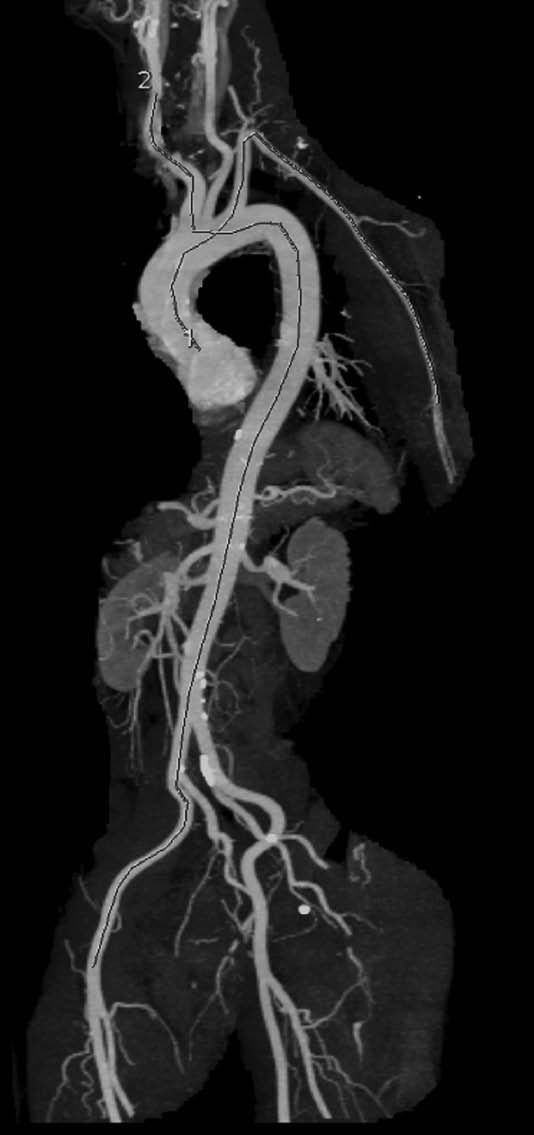
  • The pressure wave travels mostly along an aortic segment, including the thoracic descending aorta and the abdominal aorta, and ultimately travels along the iliac and common femoral arteries. This is well exemplified by the Figure, which superimposes the trajectory of the pressure pulse wave on a normal angiogram obtained by magnetic resonance imaging.

VIEW FIGURE

The trajectories of the pressure pulse waves along the arterial segments are superimposed onto an angiogram obtained by computed tomography scan (left anterior oblique). The carotid-femoral pathway is described as dotted line, and the QKD pathway is described as dashed line.

pap62

FIGURE SOURCE:

http://hyper.ahajournals.org/content/early/2013/05/20/HYPERTENSIONAHA.113.01372.citation

The method developed by Gosse et al 7,8 measures the time delay between the onset of the QRS on the ECG and the detection of the last Korotkoff sound by the microphone placed on the brachial artery. Thus, the pressure pulse wave travels first along the ascending aorta and the aortic arch (ie, a short pathway of elastic arteries) and then along the subclavian and brachial arteries (ie, a much longer pathway of muscular arteries).

Because the stiffness of muscular arteries is little influenced by age and hypertension, Gosse et al8 attributed the difference in QKD duration to ascending aorta and aortic arch. However, a closer look at the Figure shows that the length of the ascending and aortic arch pathway represents a very small part of the total pathway and casts doubt about this statement.

Furthermore, in magnetic resonance imaging studies, the transit time of flow wave along the aortic arch (average 120 mm length) is often found ≈35 ms in young healthy subjects,10 a value which is far from the mean 206 ms QKD duration found in the present study. Thus, part of that QFD duration has to be further explained by both the preejection period and the transit time within muscular arteries.

Alternative Devices

  • 2008 – The arteriograph system estimates PWV from a single-site determination of the suprasystolic waveform at the brachial artery site, and measures the time elapsed between the first wave ejected from the left ventricle to the aortic root, and its reflection from the bifurcation as the second systolic wave, with subtraction of the brachial artery transit time.
  • 2010 – The Mobil-O-Graph system uses oscillometric recording of brachial artery pressure waveform and reconstructs the central pulse wave by applying a transfer function. Central pulse wave is then decomposed into forward and backward waves, and PWV isestimated from their time difference.
  • Device |Method |Arterial Pathway |Predictive Value for CV Events | (Year of First Publication)

1984 Complior Mechanotransducer Carotid-femoral Yes (1999)

1990 Sphygmocor Tonometer Carotid-femoral Yes (2011)

1994 QKD ECG + Korotkoff sounds Aorta + brachial Yes (2005)

1997 Cardiov. Eng. Inc Tonometer Carotid-femoral Yes (2010)

2002 Doppler probes Doppler probe Aortic arch + descending aorta Yes (2002)

2002 VP-1000 Omron Brachial and ankle pressure cuffs Aorta + brachial + lower limbs Yes (2005)

2004 PulsePen Tonometer Carotid-femoral No

2006 CAVI-VaSera ECG + Brachial and ankle pressure cuffs Aorta + brachial + lower limbs No

2008 Arteriograph Arm pressure cuff Aorta + brachial No

2009 MRI-ArtFun MRI Aortic arch No

2009 Vicorder Cuffs Carotid-femoral No

2010 Mobil-O-Graph Arm pressure cuff Aorta No

Conclusions

The measurement of arterial stiffness is increasingly popular among physicians and researchers mainly because its predictive value for cardiovascular (CV) events has been well demonstrated. The largest amount of evidence has been given for aortic stiffness, measured through carotid-femoral pulse wave velocity (cfPWV). This has been initially reported in the late 1990s or early 2000s.1

Aortic stiffness is an independent predictor of all-cause and cardiovascular mortality in hypertensive patients. Hypertension. 2001;37:1236–1241.

European Network for Non-invasive Investigation of Large Arteries. Expert consensus document on arterial stiffness: methodological issues and clinical applications. Eur Heart J. 2006;27:2588–2605.

Arterial Stiffness as an Imaging Biomarker : Are All Pathways Equal? http://hyper.ahajournals.org/content/early/2013/05/20/HYPERTENSIONAHA.113.01372.citation

References for Imaging Biomarker for Arterial Stiffness, at the end of the paper

Part II:

Results for Advances and Recent Clinical Trials in Hypertension Management

Based on

Garry L.R. Jennings, Recent Advances in Hypertension:Recent Clinical Trials of Hypertension Management http://hyper.ahajournals.org/content/early/2013/05/20/HYPERTENSIONAHA.113.00863.citation

Trends: tended to drive interest toward equivalence rather than efficacy studies (ie, trials designed to show an investigational agent is as good as, not better than, existing treatment), surrogate end points, including new blood pressure (BP) variables, and studies of combinations and algorithms rather than single interventions. Population studies around the world, however, continue to show that large numbers of people have hypertension that is not treated satisfactorily and are not achieving the goals set by the major national guidelines. These guidelines themselves are under continual scrutiny on the basis of recent data casting doubt on the validity of present BP goals. Guideline committees also face the issue that evidence based on expensive large-scale clinical trials is more often funded by the pharmaceutical or device industries than by government, leaving large evidence gaps in areas of public importance but no direct interest to industry funders. The purpose of the present article is to briefly review clinical trials of interventions in hypertension during the past 2 years.

Subject categories of Last Decade Clinical Trials on Hypertension

  • Resistant Hypertension
  • Resistant Hypertension and the Sympathetic
  • Nervous System
  • Trials of Pharmacotherapy
  • Old Ground, New Findings
  • Are Chlorthalidone and Nonthiazides the Best Diuretics for Treatment of Hypertension?
  • BP Targets and Treatment
  • Lifestyle and Nonpharmacological Approaches to Hypertension
  1.  Sodium
  2. Trials of Nutrition and BP
  • Resistance Exercise and BP

What Can Be Learned From Clinical Trials Reported in the Present Decade?

  • Systems for blood pressure management in the community can be improved because a large treatment gap remains.
  • Drug combinations from different classes with different modes of action are useful.
  • Drug combinations that include drugs with similar mode of action do not generally enhance efficacy and come at a cost in adverse events.
  • Small but important nutritional effects on blood pressure demand further examination.
  • The sympathetic nervous system has returned as an important target for therapy of hypertension.
  • Blood pressure targets and goals need refining, preferably on the basis of specifically designed clinical trials.

The scene for clinical trials of hypertension management is in transition. The era of mega trials may not be over but is certainly in decline, and in the past 2 years there have been no studies reporting primary outcome data the scale of the

  • Antihypertensive and
  • Lipid-Lowering Treatment
  1. Lipid-Lowering Treatment to Prevent Heart Attack Trial (ALLHAT),
  2. The ONgoing Telmisartan Alone and in combination with Ramipril Global Endpoint Trial (ONTARGET),
  3. Anglo-Scandinavian Cardiac Outcomes Trial (ASCOT), and other
  4. major studies that marked clinical trial activity and informed guideline committees during the past 2 to 3 decades.

This reflects in part the view that the

  • present benchmark pharmacological agents for treating hypertension are difficult to improve,
  • some systemic issues affecting the pharmaceutical industry influencing the ability to make the large investment required to perform mega trials and
  • the quality of the antihypertensive drug pipeline.

http://hyper.ahajournals.org/content/early/2013/05/20/HYPERTENSIONAHA.113.00863.citation

References for Clinical Trial on Hypertension, at the end of the paper

Part III:

Mechanism of Action of Top 10 Cardio Drugs 2012, published on May 16, 2013

The top 10 Cardio Drugs in 2012 belong to two drug classes

  • Antihypertensive and
  • Lipid-Lowering Treatment

Sales % Change 2012 vs 2011 by Drug Class

MOA

By

Drug Class

Drug Name

2011 Sales billion

2012 Sales billion

% change

Statins

Crestor

6.622

6.253

-6%

Lipitor

9.577

3.948

-59%

Zetia

2.428

2.567

+6%

Vytorin

1.882

1.747

-7%

Total Sales and % change Statins

 20,509  14,515  -29.2%

ARB

Diovan

5.665

4.417

-22%

ACEII

Benicar

2.602

2.446

-6%

ACEI

Micardis

2.217

2.098

-5%

ARB

Avapro

1.797

1.422

-30% (BMS)

ARB

Blopress

1.808

1.643

-9%

PAH

Tracleer

1.721

1.6

-7%

Total Sales and % change AntiHTN

 15,810  13,626  -13.8%

Data Source:

http://www.fiercepharma.com/special-reports/top-10-cardio-drugs-2012#ixzz2U9Axh8X4 

1 Crestor

Crestor (AstraZeneca)
Patent expiry: July 2016

2012 sales: $6.253 billion
2011 sales: $6.622 billion
Change: (6%)

Crestor – FiercePharma http://www.fiercepharma.com/special-reports/crestor-0#ixzz2UACLZyaa 

(rosuvastatin calcium) is indicated as an adjunct to diet to reduce elevated Total-C, LDL-C, ApoB, non-HDL-C, and triglycerides, and to increase HDL-C in adult patients with primary hyperlipidemia or mixed dyslipidemia and to slow the progression of atherosclerosis in adult patients as part of a treatment strategy to lower Total-C and LDL-C to target levels.1

2 Diovan

Diovan (Novartis)
Patent expiry: September 2012

2012 sales: $4.417 billion
2011 sales: $5.665 billion
Change: (22%)

Diovan – FiercePharma http://www.fiercepharma.com/special-reports/diovan#ixzz2UACdBCtZ 

Valsartan (Angiotan or Diovan) is an angiotensin II receptor antagonist (more commonly called an “ARB”, or angiotensin receptor blocker), with particularly high affinity for the type I (AT1) angiotensin receptor. By blocking the action of angiotensin, valsartan dilates blood vessels and reduces blood pressure.[1] In the U.S., valsartan is indicated for treatment of high blood pressure, congestive heart failure (CHF), or post-myocardial infarction (MI).[2]

3 Lipitor

Lipitor (Pfizer)
Patent expiry: November 2011

2012 sales: $3.948 billion
2011 sales: $9.577 billion
Change: (59%)

Lipitor – FiercePharma http://www.fiercepharma.com/special-reports/lipitor-2#ixzz2UACsJ2Y2 

(atorvastatin calcium) tablets are a prescription medicine that is used along with a low-fat diet. It lowers the LDL (“bad”) cholesterol and triglycerides in your blood. It can raise your HDL (“good”) cholesterol as well. LIPITOR can lower the risk for heart attack, stroke, certain types of heart surgery, and chest pain in patients who have heart disease or risk factors for heart disease such as age, smoking, high blood pressure, low HDL, or family history of early heart disease. LIPITOR can lower the risk for heart attack or stroke in patients with diabetes and risk factors such as diabetic eye or kidney problems, smoking, or high blood pressure.

LIPITOR is a member of the drug class known as statins, used for lowering blood cholesterol. It also stabilizes plaque and prevents strokes through anti-inflammatory and other mechanisms. Like all statins, atorvastatin works by inhibiting HMG-CoA reductase, an enzyme found in liver tissue that plays a key role in production of cholesterol in the body.

Atorvastatin was first synthesized in 1985 by Bruce Roth of Parke-Davis Warner-Lambert Company (now Pfizer). The best selling drug in pharmaceutical history, sales of Lipitor since it was approved in 1996 exceed US$125 billion, and the drug has topped the list of best-selling branded pharmaceuticals in the world for nearly a decade

4 Zetia

Zetia (Merck)
Patent expiry: December 2016

2012 sales: $2.567 billion
2011 sales: $2.428 billion
Change: 6%

Zetia – FiercePharma http://www.fiercepharma.com/special-reports/zetia#ixzz2UADFaGJ0 

Ezetimibe (pron.: /ɛˈzɛtɨmɪb/) is a drug that lowers plasma cholesterol levels. It acts by decreasing cholesterol absorption in the intestine. It may be used alone (marketed as Zetia or Ezetrol), when other cholesterol-lowering medications are not tolerated, or together withstatins (e.g., ezetimibe/simvastatin, marketed as Vytorin and Inegy) when statins alone do not control cholesterol.

Ezetimibe decreases cholesterol levels, but has not been shown to improve outcomes in cardiovascular disease patients by decreasing atherosclerotic or vascular events compared to placebo. Ezetimibe is endorsed in the Canadian Lipid Guidelines and is considered a well-tolerated option for an add-on agent to statin, to help patients achieve their LDL (or bad cholesterol) targets. [1] Ezetimibe is the only add-on to statin therapy that has successfully shown cardiovascular benefit when combined with statin, but has not been proven to have an incremental benefit compared to statins alone. [2] Britain’s NICE statement, published in 2007, endorses its use for monotherapy if statins are not tolerated or as add-on therapy.[3]

5 Benicar

Benicar (Daiichi Sankyo)
Patent expiry: October 2016

2012 sales: $2.446 billion
2011 sales: $2.602 billion
Change: (6%)

Benicar – FiercePharma http://www.fiercepharma.com/special-reports/benicar#ixzz2UADYvld5 

BENICAR and BENICAR HCT are prescription medicines used to lower high blood pressure (hypertension). They may be used alone or with other medicines used to treat high blood pressure. BENICAR HCT is not for use as the first medicine to treat high blood pressure.

 Olmesartan medoxomil is an angiotensin II receptor antagonistused to treat high blood pressure.

Olmesartan is a prodrug that works by blocking the binding of angiotensin II to the AT1 receptors in vascular muscle; it is therefore independent of angiotensin II synthesis pathways, unlike ACE inhibitors. By blocking the binding rather than the synthesis of angiotensin II, olmesartan inhibits the negative regulatory feedback on renin secretion. As a result of this blockage, olmesartan reduces vasoconstriction and the secretion of aldosterone. This lowers blood pressure by producing vasodilation, and decreasing peripheral resistance.

6 Micardis

Micardis (Boehringer Ingelheim)
Patent Expiry: January 2014

2012 Sales: $2.098 billion
2011 Sales: $2.217 billion
Change: (5%)

Micardis – FiercePharma http://www.fiercepharma.com/special-reports/micardis#ixzz2UADpDZeO 

Micardis® (telmisartan) tablets are a prescription medicine used to treat high blood pressure (hypertension). Additionally, MICARDIS 80 mg tablets are used in certain high-risk people aged 55 years and older who are unable to take a medicine called an angiotensin converting enzyme inhibitor (ACE-I) to help lower their risk of having certain cardiovascular problems such as stroke, heart attack, or death.

Micardis® (telmisartan) tablets are a prescription medicine used to treat high blood pressure (hypertension).

Telmisartan (INN) (pron.: /tɛlmɪˈsɑrtən/) is an angiotensin II receptor antagonist (angiotensin receptor blocker, ARB) used in the management of hypertension. It is marketed under thetrade name Micardis (by Boehringer Ingelheim), among others.

Telmisartan is an angiotensin II receptor blocker that shows high affinity for the angiotensin II receptor type 1 (AT1), with a binding affinity 3000 times greater for AT1 than AT2. It has the longest half-life of any ARB (24 hours)[1][4] and the largest volume of distribution.

In addition to blocking the RAs, telmisartan acts as a selective modulator of peroxisome proliferator-activated receptor gamma (PPAR-γ), a central regulator of insulin and glucose metabolism. It is believed that telmisartan’s dual mode of action may provide protective benefits against the vascular and renal damage caused by diabetes and cardiovascular disease (CVD).[4]

Telmisartan’s activity at the PPAR-γ receptor has prompted speculation around its potential as a sport doping agent as an alternative to GW 501516.[5] Telmisartan activates PPARδ receptors in several tissues. [6][7][8][9]

7 Avapro

Avapro (Sanofi)
Patent expiry: March 2012

Total 2012 sales: $1.925 billion
2012 sales Sanofi: $1.422 billion
2012 sales BMS: $503 million

Total 2011 sales: $2.749 billion
2011 sales Sanofi: $1.797 billion
2011 sales BMS: $952 million
Total Change: (30%)

Avapro – FiercePharma http://www.fiercepharma.com/special-reports/avapro#ixzz2UAE9iB2E 

rbesartan (INN) (pron.: /ɜrbəˈsɑrtən/) is an angiotensin II receptor antagonist used mainly for the treatment of hypertension. Irbesartan was developed by Sanofi Research (now part ofsanofi-aventis). It is jointly marketed by sanofi-aventis and Bristol-Myers Squibb under the trade names Aprovel, Karvea, and Avapro.

As with all angiotensin II receptor antagonists, irbesartan is indicated for the treatment ofhypertension. Irbesartan may also delay progression of diabetic nephropathy and is also indicated for the reduction of renal disease progression in patients with type 2 diabetes,[1]hypertension and microalbuminuria (>30 mg/24 hours) or proteinuria (>900 mg/24 hours).[2]

 A large randomized trial following 4100+ men and women with heart failure and normal ejection fraction (>=45%) over 4+ years found no improvement in study outcomes or survival with irbesartan as compared to placebo.[3]

8 Vytorin

Vytorin (Merck)
Patent Expiry: April 2017

2012 sales: $1.747 billion
2011 sales: $1.882 billion
Change: (7%)

Vytorin – FiercePharma http://www.fiercepharma.com/special-reports/vytorin#ixzz2UAEQVcQr 

Ezetimibe/simvastatin (pron.: /ɛˈzɛtɨmɪb ˌsɪmvəˈstætɨn/) is a drug combination used for the treatment of dyslipidemia. It is a combination of ezetimibe (best known as Zetia in the United States and Ezetrol elsewhere) and the statin drug simvastatin (best known as Zocor in the U.S.). The combination preparation is marketed by Merck & Co./Schering-PloughPharmaceuticals (joint venture) under the trade names Vytorin and Inegy.

Ezetimibe reduces blood cholesterol by inhibiting absorption of cholesterol by the small intestine by acting at the brush border of the small intestine and inhibits the absorption of cholesterol, leading to a decrease in the delivery of intestinal cholesterol to the liver.

Simvastatin is an HMG-CoA reductase inhibitor or statin. It works by blocking an enzymethat is necessary for the body to make cholesterol.

Even though ezetimibe decreases cholesterol levels, as of 2009 it has not been found to lead to improvement in real world outcomes.[1] The combination of simvastatin and ezetimibe has not been found to be any better than simvastatin alone. A panel of experts thus concluded in 2008 that it should “only be used as a last resort”.[2]

9 Blopress

Blopress (Takeda Pharmaceutical)
Patent expiry: June 2012

2012 sales: $1.643 billion
2011 sales: $1.808 billion
Change: (9%)

Blopress – FiercePharma http://www.fiercepharma.com/special-reports/blopress#ixzz2UAEnxyWy

Candesartan (rINN) (pron.: /ˌkændɨˈsɑrtən/) is an angiotensin II receptor antagonist used mainly for the treatment of hypertension. The prodrug candesartan cilexetil is marketed by AstraZeneca and Takeda Pharmaceuticals, commonly under the trade names Blopress,Atacand, Amias, and Ratacand

As all angiotensin II receptor antagonists, candesartan is indicated for the treatment of hypertension. Results from the CHARM study in the early 2000s demonstrated the morbidity and mortality reduction benefits of candesartan therapy in congestive heart failure.[1] Thus, while ACE inhibitors are still considered first-line therapy in heart failure, candesartan can be used in combination with an ACE to achieve improved mortality and morbidity vs. an ACE alone and additionally is an alternative in patients intolerant of ACE inhibitor therapy.

Prehypertension

In a four-year randomized controlled trial, candesartan was compared to placebo to see whether it could prevent or postpone the development of full-blown hypertension in people with so-called prehypertension. During the first two years of the trial, half of participants were given candesartan, and the others received placebo; candesartan reduced the risk of developing hypertension by nearly two-thirds during this period. In the last two years of the study, all participants were switched to placebo. By the end of the study, candesartan hadsignificantly reduced the risk of hypertension, by more than 15%. Serious side effects were actually more common among participants receiving placebo than in those given candesartan.[2]

Candesartan is also available in a combination formulation with a low dose thiazide diuretic, invariably hydrochlorothiazide, to achieve an additive antihypertensive effect. Candesartan/hydrochlorothiazide combination preparations are marketed under various trade names including Atacand HCT, Hytacand, Blopress Plus, Advantec and Ratacand Plus.

10 Tracleer

Tracleer (Actelion)
Patent expiry: November 2015   

2012 sales: $1.600 billion
2011 sales: $1.721 billion
Change: (7%)

Tracleer – FiercePharma http://www.fiercepharma.com/special-reports/tracleer#ixzz2UAF2iIJB 

Bosentan is a dual endothelin receptor antagonist used in the treatment of pulmonary artery hypertension (PAH). It is licensed in the United States, the European Union and other countries by Actelion Pharmaceuticals for the management of PAH under the trade name Tracleer.

Bosentan is a competitive antagonist of endothelin-1 at the endothelin-A (ET-A) and endothelin-B (ET-B) receptors. Under normal conditions, endothelin-1 binding of ET-A or ET-B receptors causes pulmonary vasoconstriction. By blocking this interaction, bosentan decreases pulmonary vascular resistance. Bosentan has a slightly higher affinity for ET-A than ET-B.

Clinical uses 

Bosentan is indicated mainly for the treatment of pulmonary hypertension. In 2007, bosentan was approved in the European Union also for reducing the number of new digital ulcers in patients with systemic sclerosis and ongoing digital ulcer disease.

In the United States, bosentan is indicated for the treatment of pulmonary arterial hypertension (WHO Group I) in patients with WHO Class II-IV symptoms, to improve exercise capacity and decrease the rate of clinical worsening.[1]

http://www.fiercepharma.com/special-reports/top-10-cardio-drugs-2012

For years, cardio was king. The world’s all-time best-selling drug, Pfizer’s ($PFE) Lipitor, after all, is an antihyperlipidemic drug. Cardio drugs have traditionally made up one of the largest categories of therapeutic treatment in the drug universe.

According to EvaluatePharma‘s World Preview 2018 report, combined sales of antihypertensive drugs and antihyperlipidemics were more than $70 billion in 2011. That would put them at the top of the heap. Sales of antihypertensive drugs alone were more than $40 billion that year, making them the second-largest therapy area defined by the report, behind oncology drugs at $64.4 billion. The list, compiled by EvaluatePharma, includes the theraputic areas categorized as cardio, so it does not include some products sometimes used for heart disease but not in that therapeutic area, including blood thinners like Plavix.

But many of the top cardio drugs are long in the tooth, and generics are now eating their lunch. Did I mention Lipitor? Sales cratered last year, falling nearly 60%. Despite that, the drug placed third among the top 10 cardio drugs of 2012, a reminder of the stature it had achieved. Four of the top 10 have lost patent protection in the last two years, and most will be off patent by 2016, with only Merck’s ($MRK) Vytorin protected until 2017.

Last year, the top 10 cardio drugs racked up sales of $28.644 billion, down 23% from the $37.271 billion they sold in 2011. Still, the group has made a lot of money for its companies for years and, in some cases, completely changed the treatment of heart disease.

It is an interesting list. Only Merck has two drugs in the top 10. The other drugmakers make up a broad swath of the pharma industry. Read our report below, and if you have some insights you would like to share, please do.

Top 10 Cardio Drugs 2012 – FiercePharma http://www.fiercepharma.com/special-reports/top-10-cardio-drugs-2012#ixzz2UAByWR7s 

Part IV:

20 Highest-Paid Biopharma CEOs of 2012

Call it a rite of spring. Every year about this time, FiercePharma takes a look at executive compensation in the industry, and we rank the highest-paid CEOs. If you’re a regular reader, you’ll notice that this year’s list is longer than previous editions. And there’s a reason for that: curiosity.

As we were beginning to gather numbers from biopharma companies’ proxy statements and annual reports, news surfaced that Valeant Pharmaceuticals ($VRX) and Actavis ($ACT) had been in merger talks. The former CEO of Mylan ($MYL), one of Actavis’ rivals, regularly appeared on our highest-paid executives list, so we looked up the numbers on Actavis. No dice; CEO Paul Bisaro may have pulled off his biggest merger ever last year, but $8.66 million in compensation still didn’t qualify him for our ranking.

Then, we pulled out Valeant’s proxy statement. And while CEO Michael Pearson didn’t earn enough in 2012 to make the cutoff–his compensation just surpassed $6 million–he should have been at the top of the list last year. Pearson’s 2011 pay package broke $36 million. He collected more than $18 million in stock and option awards, plus a special $13.7 million dividend payment, stemming from agreements negotiated years before.

We hate to miss a scoop. Naturally. So, we vowed to avoid making the same mistake this time around. Rather than limit our executive-pay search to the biggest pharma companies and biotechs, plus the usual suspects who often make CEO-pay rankings, we used a bigger net. We collected compensation information from 50 companies, including numbers for CEOs, CFOs, R&D chiefs and other top executives.

Partly because of this search, but mostly because of big bonuses and awards at fast-growing Regeneron ($REGN), we have a brand-new No. 1 on our list. That’s Regeneron CEO Leonard Schleifer, whose 2012 compensation totaled $30.047 million. You’ll notice some other newbies, such as Leonard Bell from Alexion ($ALXN), whose pay bump put him in 12th place. And then there are familiar faces, such as Pfizer ($PFE) CEO Ian Read; Johnson & Johnson’s ($JNJ) former chairman and CEO, William Weldon; and Eli Lilly ($LLY) CEO John Lechleiter, who hung on in 10th place.

Many of the companies we researched pay their top people far less than the $10 million that served as our cutoff figure. Novo Nordisk ($NVO) CEO Lars Sorensen, who has presided over double-digit growth there for several years, collected a package of cash and stock awards worth about $5 million for 2012. GlaxoSmithKline ($GSK) CEO Andrew Witty made less than $6 million himself; he took a pay cut for the year because of Glaxo’s shortfall on certain performance targets.

And then there are others who would have made the list, had their titles been different. There’s Regeneron R&D chief George Yancopoulos, whose extraordinary $81 million in compensation shows how much the company appreciates its newly minted blockbuster, Eylea. There’s Mylan Chairman Robert Coury, who used to be a fixture on our list until Heather Bresch took over as CEO; he made more than $28 million last year. Novartis’ ($NVS) former chairman Daniel Vasella could have qualified for 12th place with his $13.98 million in compensation.

Vasella, then, gives us a quick segue to the ongoing debate over executive pay. In Switzerland, populist dismay at some high-profile compensation figures led to a public vote earlier this year. Citizens voted in new restrictions on common bonuses, such as golden parachutes, and gave shareholders a binding vote on executive pay. And local analysts figure that late-breaking news of Vasella’s behind-the-scenes noncompete agreement–worth some $78 million over 5 years–helped pay activists to get out the vote. (Vasella ended up refusing the deal, by the way.)

In the U.S., where executives are paid more than anywhere else in the world, shareholders at some companies have successfully lobbied for a greater emphasis on performance pay and against extraordinary bonuses, such as change-in-control payments that send top executives on their way with tens of millions after a merger. Other companies have instituted “say-on-pay” advisory votes for shareholders, but those often end up as rubber stamps for the status quo.

Now, we’re interested in what you have to say about executive compensation. Are the CEOs on this list worth their price? What’s a supersuccessful new drug worth? Should CEO pay be docked for R&D failures? What about failed launches? Should other, lower-paid executives earn more? Tweet your opinions to @FiercePharma using the hashtag #FPexecpay, leave your comments below or email us. We’ll collect your thoughts in a future article.

As always, feel free to send us your thoughts on our coverage. And if we missed a well-paid CEO, be sure to let us know.

— Tracy Staton (email | Twitter)

For more:
Top 10 Biotech CEO Pay Packages of 2012
Top 10 Pharma CEO salaries of 2010
Top 10 Pharma CEO salaries of 2009
2012’s 10 highest-paid Med Tech CEOs
Top 10 Medical Device Industry CEO Salaries for 2011


20 Highest-Paid Biopharma CEOs of 2012 – FiercePharma http://www.fiercepharma.com/special-reports/20-highest-paid-biopharma-ceos-2012#ixzz2UAGAlHay 

REFERENCES FOR Part I: Arterial Stiffness

1. Laurent S, Boutouyrie P, Asmar R, Gautier I, Laloux B, Guize L,

Ducimetiere P, Benetos A. Aortic stiffness is an independent predictor

of all-cause and cardiovascular mortality in hypertensive patients.

Hypertension. 2001;37:1236–1241.

2. Vlachopoulos C, Aznaouridis K, Stefanadis C. Prediction of cardiovascular

events and all-cause mortality with arterial stiffness: a systematic

review and meta-analysis. J Am Coll Cardiol. 2010;55:1318–1327.

3. Boutouyrie P, Tropeano AI, Asmar R, Gautier I, Benetos A, Lacolley P,

Laurent S. Aortic stiffness is an independent predictor of primary coronary

events in hypertensive patients: a longitudinal study. Hypertension.

2002;39:10–15.

4. Mattace-Raso FU, van der Cammen TJ, Hofman A, van Popele NM, Bos

ML, Schalekamp MA, Asmar R, Reneman RS, Hoeks AP, Breteler MM,

Witteman JC. Arterial stiffness and risk of coronary heart disease and

stroke: the Rotterdam Study. Circulation. 2006;113:657–663.

5. Sehestedt T, Jeppesen J, Hansen TW, Rasmussen S, Wachtell K, Ibsen H,

Torp-Pedersen C, Olsen MH. Risk stratification with the risk chart from

the European Society of Hypertension compared with SCORE in the general

population. J Hypertens. 2009;27:2351–2357.

6. Mitchell GF, Hwang SJ, Vasan RS, Larson MG, Pencina MJ,

Hamburg NM, Vita JA, Levy D, Benjamin EJ. Arterial stiffness and

cardiovascular events: the Framingham Heart Study. Circulation. 2010;

121:505–511.

7. Gosse P, Cremer A, Papaioannou G, Yeim S. Arterial stiffness from monitoring

of timing of Korotkoff sounds predicts the occurrence of cardiovascular

events independently of left ventricular mass in hypertensive

patients. HYPERTENSIONAHA.113.01039 Published online before print May 20, 2013,doi: 10.1161/​HYPERTENSIONAHA.113.01039

Hypertension. 2013;62:XX–XX.

http://hyper.ahajournals.org/content/early/2013/05/20/HYPERTENSIONAHA.113.01039.abstract.html?papetoc

8. Gosse P, Guillo P, Ascher G, Clementy J. Assessment of arterial distensibility

by monitoring the timing of Korotkoff sounds. Am J Hypertens.

1994;7:228–233.

9. Laurent S, Cockcroft J, Van Bortel L, Boutouyrie P, Giannattasio C,

Hayoz D, Pannier B, Vlachopoulos C, Wilkinson I, Struijker-Boudier

H; European Network for Non-invasive Investigation of Large Arteries.

Expert consensus document on arterial stiffness: methodological issues

and clinical applications. Eur Heart J. 2006;27:2588–2605.

10. Dogui A, Redheuil A, Lefort M, DeCesare A, Kachenoura N, Herment A,

Mousseaux E. Measurement of aortic arch pulse wave velocity in cardiovascular

MR: comparison of transit time estimators and description of a

new approach. J Magn Reson Imaging. 2011;33:1321–1329.

downloaded from

http://hyper.ahajournals.org/content/early/2013/05/20/HYPERTENSIONAHA.113.01372.citation

REFERENCES for Part II: Clinical Trials of Hypertension Management

1. Hanselin MR , Saseen JJ , Allen RR , Marrs JC , Nair KV . Description of

antihypertensive use in patients with resistant hypertension prescribed

four or more agents. Hypertension . 2011 ; 58 : 1008 – 1013 .

2. Bakris GL , Lindholm LH , Black HR , Krum H , Linas S , Linseman JV ,

Arterburn S , Sager P , Weber M . Divergent results using clinic and ambulatory

blood pressures: report of a darusentan-resistant hypertension trial.

Hypertension . 2010 ; 56 : 824 – 830 .

3. Smithwick RH , Thompson JE . Splanchnicectomy for essential hypertension;

results in 1,266 cases. J Am Med Assoc . 1953 ; 152 : 1501 – 1504 .

4. Esler M , Ferrier C , Lambert G , Eisenhofer G , Cox H , Jennings G .

Biochemical evidence of sympathetic hyperactivity in human hypertension.

Hypertension . 1991 ; 17 ( 4 Suppl ): III29 – III35 .

5. Esler MD , Krum H , Sobotka PA , Schlaich MP , Schmieder RE , Bohm

M . Symplicity HTN-2 investigators. Renal sympathetic denervation in

patients with treatment-resistant hypertension: a randomized controlled

trial. Lancet 2010 ; 376 : 1903 – 1909 .

6. Brinkmann J , Heusser K , Schmidt BM , Menne J , Klein G , Bauersachs J ,

Haller H , Sweep FC , Diedrich A , Jordan J , Tank J . Catheter-based renal

nerve ablation and centrally generated sympathetic activity in diffi cultto-

control hypertensive patients: prospective case series. Hypertension .

2012 ; 60 : 1485 – 1490 .

7. Mahfoud F , Cremers B , Janker J , et al . Renal hemodynamics and renal

function after catheter-based renal sympathetic denervation in patients

with resistant hypertension. Hypertension . 2012 ; 60 : 419 – 424 .

8. Lambert GW , Hering D , Esler MD , Marusic P , Lambert EA , Tanamas

SK , Shaw J , Krum H , Dixon JB , Barton DA , Schlaich MP . Health-related

quality of life after renal denervation in patients with treatment-resistant

hypertension. Hypertension . 2012 ; 60 : 1479 – 1484 .

9. Daugherty SL , Powers JD , Magid DJ , Masoudi FA , Margolis KL ,

O ’ Connor PJ , Schmittdiel JA , Ho PM . The association between medication

adherence and treatment intensifi cation with blood pressure control

in resistant hypertension. Hypertension . 2012 ; 60 : 303 – 309 .

10. Bobrie G , Frank M , Azizi M , Peyrard S , Boutouyrie P , Chatellier G ,

Laurent S , Menard J , Plouin PF . Sequential nephron blockade versus

sequential renin-angiotensin system blockade in resistant hypertension:

a prospective, randomized, open blinded endpoint study. J Hypertens .

2012 ; 30 : 1656 – 1664 .

11. Mancia G . Additional drug treatment in resistant hypertension: need for

randomized studies. J Hypertens . 2012 ; 30 : 1514 – 1515 .

12. Hermida RC , Ayala DE , Moj ó n A , Fontao MJ , Fern á ndez JR .

Chronotherapy with valsartan/hydrochlorothiazide combination in essential

hypertension: improved sleep-time blood pressure control with bedtime

dosing. Chronobiol Int . 2011 ; 28 : 601 – 610 .

13. Persu A , Renkin J , Thijs L , Staessen JA . Renal denervation: ultima

ratio or standard in treatment-resistant hypertension. Hypertension .

2012 ; 60 : 596 – 606 .

14. Lohmeier TE , Iliescu R . Chronic lowering of blood pressure by carotid

barorefl ex activation: mechanisms and potential for hypertension therapy.

Hypertension . 2011 ; 57 : 880 – 886 .

15. Bisognano JD , Bakris G , Nadim MK , Sanchez L , Kroon AA , Schafer J ,

de Leeuw PW , Sica DA . Barorefl ex activation therapy lowers blood pressure

in patients with resistant hypertension: results from the double-blind,

randomized, placebo-controlled rheos pivotal trial. J Am Coll Cardiol .

2011 ; 58 : 765 – 773 .

16. Parving HH , Brenner BM , McMurray JJ , de Zeeuw D , Haffner SM ,

Solomon SD , Chaturvedi N , Persson F , Desai AS , Nicolaides M , Richard

A , Xiang Z , Brunel P , Pfeffer MA ; ALTITUDE Investigators . Cardiorenal

end points in a trial of aliskiren for type 2 diabetes. N Engl J Med .

2012 ; 367 : 2204 – 2213 .

17. The ONTARGET Investigators . Telmisartan, ramipril, or both in patients

at high risk for vascular events. N Engl J Med . 2008 ; 358 : 1547 – 1559 .

18. Mancia G , Parati G , Bilo G , et al . Ambulatory blood pressure values in

the Ongoing Telmisartan Alone and in Combination with Ramipril Global

Endpoint Trial (ONTARGET). Hypertension . 2012 ; 60 : 1400 – 1406 .

19. Roush GC , Holford TR , Guddati AK . Chlorthalidone compared with

hydrochlorothiazide in reducing cardiovascular events: systematic review

and network meta-analyses. Hypertension . 2012 ; 59 : 1110 – 1117 .

20. Cushman WC , Bakris GL , White WB , Weber MA , Sica D , Roberts A ,

Lloyd E , Kupfer S . Azilsartan medoxomil plus chlorthalidone reduces

blood pressure more effectively than olmesartan plus hydrochlorothiazide

in stage 2 systolic hypertension. Hypertension . 2012 ; 60 : 310 – 318 .

21. Alderman MH , Piller LB , Ford CE , Probstfi eld JL , Oparil S , Cushman WC ,

Einhorn PT , Franklin SS , Papademetriou V , Ong ST , Eckfeldt JH , Furberg

CD , Calhoun DA , Davis BR ; Antihypertensive and Lipid-Lowering

Treatment to Prevent Heart Attack Trial Collaborative Research Group .

Clinical signifi cance of incident hypokalemia and hyperkalemia in treated

hypertensive patients in the antihypertensive and lipid-lowering treatment

to prevent heart attack trial. Hypertension . 2012 ; 59 : 926 – 933 .

22. Kostis WJ , Thijs L , Richart T , Kostis JB , Staessen JA . Persistence of mortality

reduction after the end of randomized therapy in clinical trials of

blood pressure-lowering medications. Hypertension . 2010 ; 56 : 1060 – 1068 .

23. van Onzenoort HA , Menger FE , Neef C , Verberk WJ , Kroon AA , de

Leeuw PW , van der Kuy PH . Participation in a clinical trial enhances

adherence and persistence to treatment: a retrospective cohort study.

Hypertension . 2011 ; 58 : 573 – 578 .

24. Sever PS . The Anglo-Scandinavian Cardiac Outcomes Trial: implications

and further outcomes. Hypertension . 2012 ; 60 : 248 – 259 .

25. Larstorp AC , Ariansen I , Gjesdal K , Olsen MH , Ibsen H , Devereux RB ,

Okin PM , Dahl ö f B , Kjeldsen SE , Wachtell K . Association of pulse pressure

with new-onset atrial fi brillation in patients with hypertension and

left ventricular hypertrophy: the Losartan Intervention For Endpoint

(LIFE) reduction in hypertension study. Hypertension . 2012 ; 60 : 347 – 353 .

26. Rossignol P , Cridlig J , Lehert P , Kessler M , Zannad F . Visit-to-visit blood

pressure variability is a strong predictor of cardiovascular events in hemodialysis:

insights from FOSIDIAL. Hypertension . 2012 ; 60 : 339 – 346 .

27. Matsui Y , O ’ Rourke MF , Hoshide S , Ishikawa J , Shimada K , Kario

K . Combined Effect of Angiotensin II Receptor Blocker and Either a

Calcium Channel Blocker or Diuretic on Day-by-Day Variability of Home

Blood Pressure: The Japan Combined Treatment With Olmesartan and a

Calcium-Channel Blocker Versus Olmesartan and Diuretics Randomized

Effi cacy Study. Hypertension . 2012 ; 59 : 1132 – 1138 .

28. Jennings GL , Sudhir K . Initial therapy of primary hypertension. Med J

Aust . 1990 ; 152 : 198 – 203 .

29. Egan BM , Bandyopadhyay D , Shaftman SR , Wagner CS , Zhao Y ,

Yu-Isenberg KS . Initial monotherapy and combination therapy and hypertension

control the fi rst year. Hypertension . 2012 ; 59 : 1124 – 1131 .

30. Bavry AA , Pepine CJ . Treatment of hypertension: lower is better, or is it?

Hypertension . 2012 ; 60 : 281 – 282 .

31. Mizuno R , Fujimoto S , Saito Y , Okamoto Y . Optimal antihypertensive

level for improvement of coronary microvascular dysfunction: the lower,

the better? Hypertension . 2012 ; 60 : 326 – 332 .

32. Roman MJ , Howard BV , Howard WJ , Mete M , Fleg JL , Lee ET ,

Devereux RB . Differential impacts of blood pressure and lipid lowering

on regression of ventricular and arterial mass: the Stop Atherosclerosis in

Native Diabetics Trial. Hypertension . 2011 ; 58 : 367 – 371 .

33. Bertoia ML , Waring ME , Gupta PS , Roberts MB , Eaton CB . Implications

of new hypertension guidelines in the United States. Hypertension .

2012 ; 60 : 639 – 644 .

34. Stewart S , Carrington MJ , Swemmer CH , et al .; VIPER-BP Study

Investigators . Effect of intensive structured care on individual blood pressure

targets in primary care: multicentre randomised controlled trial. BMJ .

2012 ; 345 : e7156 .

35. Dickinson BD , Havas S ; Council on Science and Public Health, American

Medical Association . Reducing the population burden of cardiovascular

disease by reducing sodium intake: a report of the Council on Science and

Public Health. Arch Intern Med . 2007 ; 167 : 1460 – 1468 .

36. O ’ Donnell MJ , Yusuf S , Mente A , Gao P , Mann JF , Teo K , McQueen M ,

Sleight P , Sharma AM , Dans A , Probstfi eld J , Schmieder RE . Urinary

sodium and potassium excretion and risk of cardiovascular events. JAMA .

2011 ; 306 : 2229 – 2238 .

37. Hummel SL , Seymour EM , Brook RD , Kolias TJ , Sheth SS , Rosenblum

HR , Wells JM , Weder AB . Low-sodium dietary approaches to stop

hypertension diet reduces blood pressure, arterial stiffness, and oxidative

stress in hypertensive heart failure with preserved ejection fraction.

Hypertension . 2012 ; 60 : 1200 – 1206 .

38. Soedamah-Muthu SS , Verberne LD , Ding EL , Engberink MF , Geleijnse JM .

Dairy consumption and incidence of hypertension: a dose-response metaanalysis

of prospective cohort studies. Hypertension . 2012 ; 60 : 1131 – 1137 .

39. West SG , Gebauer SK , Kay CD , Bagshaw DM , Savastano DM ,

Diefenbach C , Kris-Etherton PM . Diets containing pistachios reduce systolic

blood pressure and peripheral vascular responses to stress in adults

with dyslipidemia. Hypertension . 2012 ; 60 : 58 – 63 .

40. Zhang X , Qi Q , Liang J , Hu FB , Sacks FM , Qi L . Neuropeptide Y promoter

polymorphism modifi es effects of a weight-loss diet on 2-year

changes of blood pressure: the preventing overweight using novel dietary

strategies trial. Hypertension . 2012 ; 60 : 1169 – 1175 .

41. Meredith IT , Friberg P , Jennings GL , Dewar EM , Fazio VA , Lambert GW ,

Esler MD . Exercise training lowers resting renal but not cardiac sympathetic

activity in humans. Hypertension . 1991 ; 18 : 575 – 582 .

42. Cornelissen VA , Fagard RH , Coeckelberghs E , Vanhees L . Impact of resistance

training on blood pressure and other cardiovascular risk factors: a metaanalysis

of randomized, controlled trials. Hypertension . 2011 ; 58 : 950 – 958 .

Downloaded from

http://hyper.ahajournals.org/content/early/2013/05/20/HYPERTENSIONAHA.113.00863.citation

RELATED SOURCES:

Aortic pulse pressure is associated with the localization of coronary artery disease based on coronary flow lateralization. American journal of hypertension, 25(10), 1055-1063.

  1. Georges Khoueiry1,
  2. Basem Azab2,
  3. Estelle Torbey2,
  4. Nidal Abi Rafeh1,
  5. Jean-Paul Atallah2,
  6. Kathleen Ahern2,
  7. James Malpeso1,
  8. Donald McCord1 and
  9. Elie R. Chemaly3⇓

Author Affiliations


  1. 1Department of Cardiology, Staten Island University Hospital, Staten Island, New York, USA

  2. 2Department of Internal Medicine, Staten Island University Hospital, Staten Island, New York, USA

  3. 3Cardiovascular Institute, Mount Sinai School of Medicine, New York, New York, USA

Elie R. Chemaly (elie.chemaly@mssm.edu)

Abstract

Background Aortic pulse pressure (APP) is related to arterial stiffness and associated with the presence and extent of coronary artery disease (CAD). Besides, the left coronary artery (LCA) has a predominantly diastolic flow while the right coronary artery (RCA) receives systolic and diastolic flow. Thus, we hypothesized that increased systolic–diastolic pressure difference had a greater atherogenic effect on the RCA than on the LCA.

Methods A random sample of 433 CAD patients (145 females, 288 males, mean age 65.0 ± 11.1 years) undergoing coronary angiography at Staten Island University Hospital between January 2005 and May 2008 was studied. Coronary lesion was defined as a ≥50% luminal stenosis. Patients were divided into three groups, with isolated LCA lesions (n = 154), isolated RCA lesions (n = 36) or mixed LCA and RCA lesions (n = 243).

Results APP differed significantly between groups, being highest when the RCA alone was affected (67.6 ± 20.3 mm Hg for LCA vs. 78.8 ± 22.0 for RCA vs. 72.7 ± 22.6 for mixed, P = 0.008 for analysis of variance (ANOVA)). Age and gender were not associated with CAD location. Heart rate was associated with CAD location, lowest in RCA group, and negatively correlated with APP. However, left ventricular ejection fraction (LVEF) was lower in the mixed CAD group and positively correlated with APP. The association between APP and right-sided CAD persisted in multivariate logistic regression adjusting for confounders, including heart rate, LVEF and medication use. A similar but less significant pattern was seen with brachial arterial pressures.

Conclusions Aortic pulse pressure may affect CAD along with coronary flow phasic patterns.

American Journal of Hypertension, advance online publication 28 June 2012; doi:10.1038/ajh.2012.87

The Relationship Between Diastolic Pressure and Coronary Collateral Circulation in Patients With Stable Angina Pectoris and Chronic Total Occlusion. Am J Hypertens (2013)doi: 10.1093/ajh/hps096 

First published online: February 7, 2013

  1. Wang Shu1,
  2. Jing jing1,
  3. Liu Chang Fu1,
  4. Jiang Tie Min2,
  5. Yang Xiao Bo1,
  6. Zhou Ying1and
  7. Chen Yun Dai1,*
  1. 1 The Cardiovascular Medical Department of the General Hospital of the Chinese People’s Liberation Army, Beijing, China;

  2. 2 The Cardiovascular Medical Department of the Affiliated Hospital of the Chinese People’s Armed Police Logistics College, Tianjin, China.
  1. ↵Correspondence: Chen Yun Dai (chenyundai2002@163.com).

Abstract

BACKGROUND The most important biomechanical source of activation of the coronary collateral circulation (CCC) is increased tangential fluid shear stress at the arterial endothelial surface. The coronary circulation is unique in that most coronary blood flow occurs in diastole. Consequently, the diastolic blood pressure (DBP) may influence the tangential fluid shear stress on the arterial endothelial surface in diastole, therebyaffecting development of the CCC.

METHODS To investigate this, we conducted a study of 222 patients with stable angina pectoris and chronic total occlusion of coronary arteries. All of the patients had no history of coronary artery interventional therapy, coronary artery bypass surgery, cardiomyopathy, or congenital heart disease. The extent of the collateral vasculature of the area perfused by the artery affected by chronic total occlusion was graded as poor or well-developed according to Rentrop’s classification.

RESULTS Univariate analysis showed a significant difference between the study subgroup with poorly developed collaterals and that with well-developed collaterals in terms of high diastolic blood pressure (DBP) and mean DBP. Multivariate analysis revealed high DBP as the only independent positive predictor of a well-developed collateral circulation.

CONCLUSIONS High DBP is positively related to a well-developed CCC. Differences in development of the CCC may be one of the pathophysiologic mechanisms responsible for the J-curve phenomenon in the relationship between DBP and cardiovascular risk.

http://ajh.oxfordjournals.org/content/early/2013/02/06/ajh.hps096.abstract

Other related articles that were published on this Open Access Online Scientific Journal, include the following:

Synthetic Biology: On Advanced Genome Interpretation for Gene Variants and Pathways: What is the Genetic Base of Atherosclerosis and Loss of Arterial Elasticity with Aging

Aviva Lev-Ari, PhD, RN May 17, 2013

http://pharmaceuticalintelligence.com/2013/05/17/synthetic-biology-on-advanced-genome-interpretation-for-gene-variants-and-pathways-what-is-the-genetic-base-of-atherosclerosis-and-loss-of-arterial-elasticity-with-aging/

Artherogenesis: Predictor of CVD – the Smaller and Denser LDL Particles

Aviva Lev-Ari, PhD, RN 11/15/2012

http://pharmaceuticalintelligence.com/2012/11/15/artherogenesis-predictor-of-cvd-the-smaller-and-denser-ldl-particles/

Cardiovascular Diseases: Causes, Risks and Management, Volume Two, Risks of Cardiovascular Diseases

Justin D. Pearlman MD ME PhD MA FACC, Editor

http://pharmaceuticalintelligence.com/biomed-e-books/cardiovascular-diseases-risks-and-management/cvd-2-risk-assessment-of-cardiovascular-diseases/

Genetics of Conduction Disease: Atrioventricular (AV) Conduction Disease (block): Gene Mutations – Transcription, Excitability, and Energy Homeostasis

Aviva Lev-Ari, PhD, RN 4/28/2013

http://pharmaceuticalintelligence.com/2013/04/28/genetics-of-conduction-disease-atrioventricular-av-conduction-disease-block-gene-mutations-transcription-excitability-and-energy-homeostasis/

Genomics & Genetics of Cardiovascular Disease Diagnoses: A Literature Survey of AHA’s Circulation Cardiovascular Genetics, 3/2010 – 3/2013

Aviva Lev-Ari, PhD, RN and Larry H. Bernstein, MD, FCAP 3/7/2013

http://pharmaceuticalintelligence.com/2013/03/07/genomics-genetics-of-cardiovascular-disease-diagnoses-a-literature-survey-of-ahas-circulation-cardiovascular-genetics-32010-32013/

Hypertriglyceridemia concurrent Hyperlipidemia: Vertical Density Gradient Ultracentrifugation a Better Test to Prevent Undertreatment of High-Risk Cardiac Patients

Aviva Lev-Ari, PhD, RN 4/4/2013

http://pharmaceuticalintelligence.com/2013/04/04/hypertriglyceridemia-concurrent-hyperlipidemia-vertical-density-gradient-ultracentrifugation-a-better-test-to-prevent-undertreatment-of-high-risk-cardiac-patients/

Hypertension and Vascular Compliance: 2013 Thought Frontier – An Arterial Elasticity Focus

Justin D. Pearlman, MD, PhD and Aviva Lev-Ari, PhD, RN 5/11/2013

http://pharmaceuticalintelligence.com/2013/05/11/arterial-elasticity-in-quest-for-a-drug-stabilizer-isolated-systolic-hypertension-caused-by-arterial-stiffening-ineffectively-treated-by-vasodilatation-antihypertensives/

Read Full Post »

Cardio-Metabolic Drug Targets, Inaugural, September 25 – 26, 2013, Westin Waterfront | Boston, Massachusetts  


Reporter: Aviva Lev-Ari, PhD, RN

Article ID #57:Cardio-Metabolic Drug Targets, Inaugural, September 25 – 26, 2013, Westin Waterfront | Boston, Massachusetts. Published on 5/23/2013

WordCloud Image Produced by Adam Tubman


ABOUT THIS CONFERENCE

Cardiovascular disease, diabetes, obesity and dyslipidemia, though traditionally treated as separate entities, are often conditions that appear together in individuals because of defects in underlying metabolic processes. Researchers are therefore now seeking compounds that target biological points of intersection of these related diseases in the hopes of ‘killing more birds with one stone.’ Or they are approaching drug development of a compound for a specific disease with a greater awareness of the backdrop of related conditions.

Join fellow biomedical researchers from academia and industry at our day and a half conference, Cardio-Metabolic Drug Targets to discuss the impact of this paradigm change in the way drugs are discovered and developed in the cardio-metabolic arena and to stay abreast of the latest targets and drug development candidates in the pipeline.

SUGGESTED EVENT PACKAGE:

September 23: Allosteric Modulators of GPCRs Short Course 
September 24 – 25: Novel Strategies for Kinase Inhibitors Conference
September 25: Setting Up Effective Functional Screens Using 3D Cell Cultures Dinner Short Course
September 25 – 26: Cardio-Metabolic Drug Targets Conference

Scientific Advisory Board:

Jerome J. Schentag, Pharm.D., Professor of Pharmaceutical Sciences, University at Buffalo

Rebecca Taub, M.D., Ph.D., CEO, Madrigal Pharmaceuticals

Preliminary Agenda

BEYOND STATINS: NEW APPROACHES FOR REGULATING LIPID METABOLISM AND ATHEROSCLEROSIS

Macrophage ABC Transporters: Novel Targets to Promote Atherosclerotic Plaque Regression by Inducing Reverse Cholesterol Transport (RCT) Mechanism

Eralp “Al” Bellibas, M.D., Senior Director, Head, Clinical Pharmacology, The Medicines Company

Targeting PCSK9 for Hypercholesterolemia and Atherosclerosis

Hong Liang, Ph.D., Associate Research Fellow, Rinat Research Unit, Pfizer

Novel Treatment for Dyslipidemia: Liver-Directed Thyroid Hormone Receptor-ß Agonist

Rebecca Taub, M.D., Ph.D., CEO, Madrigal Pharmaceuticals

CARDIO-METABOLIC THERAPEUTIC CANDIDATES

Oral Mimetics of RYGB and GLP-1 in Metabolic Syndromes

Jerome J. Schentag, Pharm.D., Professor of Pharmaceutical Sciences, University at Buffalo

FGF21-Mimetic Antibodies for Type 2 Diabetes

Jun Sonoda, Ph.D., Group Leader, Scientist, Molecular Biology, Genentech

NEW CARDIO-METABOLIC TARGETS

Blockade of Delta-Like Ligand 4 (Dll4)-Notch Signaling Reduces Macrophage Activation and Attenuates Atherosclerotic Vascular Diseases and Metabolic Disorders

Masanori Aikawa, Ph.D., Assistant Professor, Department of Medicine, Brigham and Women’s Hospital and Harvard Medical

Modulating Glycerolipid Metabolism in Myeloid Cells for Cardiometabolic Benefit

Suneil K. Koliwad, M.D., Ph.D., Assistant Professor, Diabetes Center/Department of Medicine, University of California San Francisco

AMPK as a Target in Lipid and Carbohydrate Metabolism

Ajit Srivastava, Ph.D., Adjunct Professor, Pharmacology, Drexel University; Independent Consultant, Integrated Pharma Solutions, LLC

 http://www.discoveryontarget.com/Cardio-Drug-Targets

Inaugural n September 25 – 26, 2013

Cardio-Metabolic Drug Targets

Targeting One, Treating More

»»Suggested Event Package

September 23: Allosteric Modulators of GPCRs Short Course 4

September 24-25: Novel Strategies for Kinase Inhibitors

Conference

September 25: Setting Up Effective Functional Screens Using 3D

Cell Cultures Dinner Short Course 9

September 25-26: Cardio-Metabolic Drug Targets Conference

Wednesday, September 25

11:50 am Registration

BEYOND STATINS: NEW APPRO ACHES FOR

REGULATING LIPID METABOLISM AND

ATHERO SCLERO SIS

1:30 pm Chairperson’s Opening Remarks

1:40 PLENARY KEYNOTE PRESENTATION: Towards a Patient-

Based Drug Discovery

Stuart L. Schreiber, Ph.D., Director, Chemical Biology and Founding Member, Broad

Institute of Harvard and MIT; Howard Hughes Medical Institute Investigator; Morris

Loeb Professor of Chemistry and Chemical Biology, Harvard University

3:10 Refreshment Break in the Exhibit Hall with Poster Viewing

4:00 FEATURED SPEAKER: Atherosclerosis and Cardio-

Metabolism Research Overview: Promising Targets

Margrit Schwarz, Ph.D., MBA, formerly Director of Research, Dyslipidemia and

Atherosclerosis, Amgen; currently President, MS Consulting, LLC

4:30 Sponsored Presentations (Opportunities Available)

5:00 Novel Treatment for Dyslipidemia: Liver-Directed Thyroid

Hormone Receptor-ß Agonist

Rebecca Taub, M.D., Ph.D., CEO, Madrigal Pharmaceuticals

5:30 Modulating Glycerolipid Metabolism in Myeloid Cells for

Cardiometabolic Benefit

Suneil K. Koliwad, MD., Ph.D. Assistant Professor, Diabetes Center/Department

of Medicine, University of California San Francisco (UCSF)

6:00 Targeting PCSK9 for Hypercholesterolemia and

Atherosclerosis

Hong Liang, Ph.D., Associate Research Fellow, Rinat Research Unit, Pfizer

6:30 Close of Day

Thursday, September 26

7:30 am Registration

NEW ARTHERO /LIPID/CARDIO-METABOLIC

DRUG TARGETS

8:00 Breakfast Interactive Breakout Discussion Groups

9:05 Chairperson’s Opening Remarks

9:10 ApoE derived ABCA1 agonists for the Treatment of

Cardiovascular Disease

Jan Johansson, M.D., Ph.D., CEO, Artery Therapeutics, Inc.

9:40 Blockade of Delta-Like Ligand 4 (Dll4)-Notch Signaling

Reduces Macrophage Activation and Attenuates Atherosclerotic

Vascular Diseases and Metabolic Disorders

Masanori Aikawa, Ph.D., Assistant Professor, Department of Medicine,

Brigham and Women’s Hospital and Harvard Medical

10:10 Coffee Break in the Exhibit Hall with Poster Viewing

10:55 AMPK as a Target in Lipid and Carbohydrate Metabolism

Ajit Srivastava, Ph.D., Adjunct Professor, Department of Pharmacology, Drexel

University; Independent Consultant, Integrated Pharma Solutions, LLC

11:25 Macrophage ABC Transporters: Novel Targets to Promote

Atherosclerotic Plaque Regression by Inducing Reverse

Cholesterol Transport (RCT) Mechanism

Eralp “Al” Bellibas, M.D., Senior Director, Head, Clinical Pharmacology, The

Medicines Company

11:55 Targeting Ubiquitin Signaling Mediated Disease Pathology

of LDL Receptors

Udo Maier, Ph.D., Head of Target Discovery Research, Boehringer Ingelheim

Pharma

12:25 pm Sponsored Presentation (Opportunity Available)

12:55 Luncheon Presentation (Sponsorship Opportunity Available) or

Lunch on Your Own

Cardio-Metab olic Mimetics

2:25 Chairperson’s Opening Remarks

2:30 Oral Mimetics of RYGB and GLP-1 in Metabolic Syndromes

Jerome J. Schentag, PharmD, Professor of Pharmaceutical Sciences, University

at Buffalo

3:00 FGF21-Mimetic Antibodies for Type 2 Diabetes

Jun Sonoda, Ph.D., Group Leader, Scientist, Molecular Biology, Genentech

3:30 Ice Cream Refreshment Break in the Exhibit Hall with Poster

Viewing

gpCrS IN METABOLIC DISEASES

4:00 Targeting the Ghrelin Receptor with an Oral, Macrocyclic

Agonist

Helmut Thomas, Ph.D., Senior Vice President, Research and Preclinical

Development, Tranzyme Pharma

4:30 Presentation to be Announced

5:00 Lactate Receptor, GPR81/HCA1, as a Novel Target for

Metabolic Disorders

Changlu Liu, Ph.D., Scientific Director, Janssen Fellow, Head of Molecular

Innovation, Neuroscience, Janssen Research & Development, LLC

5:30 Targeting GPR55 in Cancer and Diabetes

Marco Falasca, Ph.D., Professor of Molecular Pharmacology, Queen Mary

University of London

6:00 Close of Conference

Read Full Post »

Reporter and Curator: Dr. Sudipta Saha, Ph.D.


Abbreviations:

CVD: Cardiovascular Disease

HHcy: Hyperhomocysteinemia

Hcy: Homocysteine

SAAs: Sulfur Amino Acids

Cys: Cysteine

GSH: Glutathione

S8: Elemental Sulfur

LBM: Lean Body Mass


According to World Health Organization estimates, 16.7 million deaths are attributable to cardiovascular disease (CVD) each year, accounting for 30% of all deaths worldwide and constituting an international pandemic. More than half of these deaths occur in developing countries where vegetarian diets consisting of several varieties of legumes and starchy foods have prevailed for millennia. The beneficial health effects of such regimens in the prevention of chronic disorders such as CVD, diabetes, and cancer have been documented by many investigators and, explaining their growing popularity in Westernized countries during the past several decades. It is estimated that about 2% to 5% of individuals living in developed countries have adopted vegetarianism as a lifestyle choice.

Plant-based regimens, however, do not optimally fulfill the nutritional requirements of population groups living in developing countries, as illustrated by the increasing incidence of hyperhomocysteinemia (HHcy) states, now recognized as a critical factor in occurrence of CVD and stroke. HHcy was originally associated with the pathogenesis of atherosclerosis by the study of the vascular pathology of children with inherited disorders of methionine (Met) metabolism. Dietary insufficiency or malabsorption of any of three water-soluble B vitamins (B6, pyridoxal-5′-phosphate; B9, folates; or B12, cobalamins) regulating the Met–homocysteine (Hcy) cycle are regarded as key determinants of acquired HHcy. In particular, cobalamin deficiency constitutes a worldwide problem and is currently regarded as the principal causal factor of HHcy in vegetarian populations and because vitamin B12 is almost totally absent from plant foods. In contrast, folates are abundant in plant foods, and pyridoxal-5′-phosphate is ubiquitous in unprocessed foods from plant and animal sources. Nevertheless, some studies undertaken in developing areas have shown that HHcy status may develop despite normal B12 status, prompting the search for alternative explanations.

A possible causal factor for HHcy in vegetarian populations is related to the observation that most plant foods contain lower concentrations of protein and essential amino acids, especially lysine and Met, than animal foods. White beans, for example, contain about half the sulfur amino acids (SAAs; 422 mg/100 g of edible portion) contained in bovine meat (930 mg/100 g). As a result, the Met provided by vegetarian diets does not meet the tissue requirements of mammalian species. Clinical investigations conducted in subclinically malnourished patients and recent experimental studies of the mouse and rat models have revealed that restriction of dietary Met intake inhibits the trans-sulfuration cascade and leads to HHcy, irrespective of cobalamin status. The present field study was undertaken to investigate the importance of dietary vitamin B12 and Met deficiency in the development of HHcy. The results explain how the altered body composition of vegetarian subjects affects SAA metabolism and produces HHcy, a risk factor for CVD in vegetarian populations.

The discovery that Cys (Cysteine)and GSH (Glutathione) participate in the non-enzymatic conversion of elemental sulfur (S8) into H2S is also important. This converting process may be impeded in the case of insufficient dietary S8 intake and underlying malnutrition, causing decreased Cys and GSH bioavailability. Pedologists and agronomists have demonstrated for many decades that S8 is an essential element in plant nutrition, because deficiency of S8 produces growth retardation, decreased chlorophyll synthesis, and decreases in fertility and crop yields. Because plant foods supply inadequate SAAs for mammalian tissue requirements, consumption of foods with imbalanced nitrogen:sulfur ratios grown in S8-deficient agricultural soils will exacerbate protein malnutrition. S8 deficiency is a worldwide soil problem affecting more than half the countries producing mainly foodstuffs of plant origin, including rice, soybeans, wheat, maize, and oilseeds.

The status of plant agronomy, the mammalian requirements for elemental S8 are presently unknown. Only very recently has the essentiality of sulfur has been recognized in human nutrition, causing Hcy elevation in deficient subjects. The Indian subcontinent, notably the northern region extending from Pakistan to Bangladesh, is one of the areas with soil that is most severely deficient in S8, contributing to the public health problem of CVD. More than 40% of Indian patients with HHcy-induced CVD are refractory to combined administration of folates and cobalamins, supporting the concept of S8 deficiency as the key etiologic factor. The concept of sulfur deficiency may explain why many clinical trials using B vitamin interventions have proved ineffective in the prevention of recurrent vascular disease in patients with advanced CVD, cerebrovascular disease, renal failure, and inflammatory disorders. Many other countries in southeastern Asia with vegetarian lifestyles, such as China, Taiwan, Indonesia, Philippines, Pakistan, and Sri Lanka, are also affected by increasing CVD morbidity and mortality. These developments call attention to the need to redefine CVD risk factors in South Asia and explain why cardiologists from five of these countries, Bangladesh, India, Pakistan, Nepal, and Sri Lanka, have exhorted their governments to focus more attention on CVD epidemiology.

In conclusion, the investigation shows that a vegetarian population consuming a diet deficient in SAAs is characterized by normal B vitamin status, normal serum lipids, subclinical protein malnutrition, and decreased LBM (Lean Body Mass), leading to an adaptive downregulation of the trans-sulfuration pathway, HHcy, and oxidative stress, thereby increasing the vulnerability to CVD.


Source References:

http://www.nutritionandmetabolism.com/content/9/1/80

http://www.ncbi.nlm.nih.gov/pubmed/9155227

http://journals.cambridge.org/action/displayAbstract?fromPage=online&aid=814540

http://ajcn.nutrition.org/content/59/5/1203S.abstract

http://www.eurekaselect.com/59886/article


Other related articles were published in this Open Access Online Scientific Journal:

Coming Soon (section under preparation)


Clinical Trials:

Study 1:

Title: Examining B12 Deficiency Associated With C677T Mutation on MTHFR Gene in Terms of Commonness and Endothelial Function

Recruitment:  Active, not recruiting

Study Results: No Results Available

Conditions: B12 Deficiency Combined With C677T Mutation on MTHFR Gene

Interventions: Dietary Supplement: B12 Vitamin|Dietary Supplement: Vitamin B12 + Folic Acid

URL: http://ClinicalTrials.gov/show/NCT00730574

Study 2:

Title: Long-term Use of Proton Pump Inhibitors May Cause Vitamin B12 Deficiency in the Institutionalized Elderly

Recruitment: Completed

Study Results: No Results Available

Conditions: Vitamin B12 Deficiency

Interventions: Other: blood collection|Drug: treatment (cyanocobalamin nasal spray)

URL: http://ClinicalTrials.gov/show/NCT00843453

Study 3:

Title: Oral Vitamin B12 Administration for Vitamin B12 Deficiency After Total Gastrectomy

Recruitment: Completed

Study Results: No Results Available

Conditions: Vitamin B12 Deficiency

Interventions: Drug: mecobalamin

URL: http://ClinicalTrials.gov/show/NCT00699478

Study 4:

Title: Metformin Use and Vitamin B12 Deficiency

Recruitment: Completed

Study Results: No Results Available

Conditions: Vitamin B12 Deficiency|Type 2 Diabetes Mellitus

Interventions:

URL: http://ClinicalTrials.gov/show/NCT01136512

Study 5:

Title: Vitamin B12 Supplementation Study

Recruitment: Completed

Study Results: No Results Available

Conditions: Vitamin B12 Deficiency

Interventions: Dietary Supplement: Vitamin B12

URL: http://ClinicalTrials.gov/show/NCT00826657

Study 6:

Title: Can Recombinant Human Intrinsic Factor Be Used for Evaluation of the Vitamin B12 Absorption?

Recruitment: Completed

Study Results: No Results Available

Conditions: Vitamin B12 Deficiency

Interventions: Drug: Recombinant human intrinsic factor

URL: http://ClinicalTrials.gov/show/NCT00279552

Study 7:

Title: How Many Patients Are in Need of Vitamin B12 Injections?

Recruitment: Active, not recruiting

Study Results: No Results Available

Conditions: Vitamin B12 Deficiency

Interventions: Drug: vitamin B12

URL: http://ClinicalTrials.gov/show/NCT00326833

Study 8:

Title: The Association Between Religious Origin and Age, and Vitamin B12 and Folic Acid Plasma Levels in Non Jewish Population in Western Galilee

Recruitment: Completed

Study Results: No Results Available

Conditions: Vitamin B12 Deficiency|Folic Acid Deficiency

Interventions: Other: Blood Sample

URL: http://ClinicalTrials.gov/show/NCT01297361

Study 9:

Title: The Role of Methycobalamin in Early Dementia Patients With Vitamin B12 Deficiency and Hyperhomocysteinaemia.

Recruitment: Completed

Study Results: No Results Available

Conditions: Dementia With Vitamin B12 Deficiency

Interventions: Drug: Mecobalamin

URL: http://ClinicalTrials.gov/show/NCT00165711

Study 10:

Title: The Role of Methylcobalamin in Early Dementia Patients With Vitamin B12 Deficiency and Hyperhomocysteinaemia ?

Recruitment: Completed

Study Results: No Results Available

Conditions: Dementia

Interventions: Drug: methylcobal

URL: http://ClinicalTrials.gov/show/NCT00164983

Study 11:

Title: Oral/Intramuscular B12 to Treat Cobalamin Deficiency

Recruitment: Not yet recruiting

Study Results: No Results Available

Conditions: Vitamin B 12 Deficiency

Interventions: Drug: oral Cobalamin (vitamin B12)|Drug: intramuscular Cobalamin (vitamin B12)

URL: http://ClinicalTrials.gov/show/NCT01476007

Study 12:

Title: Impact of Vitamin b12 Replacement on Epogen Requirements in Hemodialysis Patients and Impact on Quality of Life

Recruitment: Completed

Study Results: No Results Available

Conditions: Vitamin B 12 Deficiency|End Stage Renal Disease

Interventions: Drug: Vitamin B12 injections monthly

URL: http://ClinicalTrials.gov/show/NCT01360983

Study 13:

Title: Cobalamin Status in Young Children With Developmental Delay

Recruitment: Completed

Study Results: No Results Available

Conditions: Vitamin B 12 Deficiency

Interventions: Dietary Supplement: Hydroxycobalamin (Vitamin B12 Depot, Nycomed Pharma)

URL: http://ClinicalTrials.gov/show/NCT00710138

Study 14:

Title: Cobalamin Status in Young Children With Gastrointestinal Symptoms or Feeding Problems

Recruitment: Completed

Study Results: No Results Available

Conditions: Vitamin B 12 Deficiency

Interventions: Dietary Supplement: Hydroxycobalamin (Vitamin B12 Depot, Nycomed Pharma)

URL: http://ClinicalTrials.gov/show/NCT00710359

Study 15:

Title: Cobalamin Supplementation During Infancy; Effect on B-Vitamin Status, Growth and Psychomotor Development

Recruitment: Completed

Study Results: No Results Available

Conditions: Vitamin B 12 Deficiency

Interventions: Drug: Hydroxycobalamin (Vitamin B12 Depot, Nycomed Pharma)

URL: http://ClinicalTrials.gov/show/NCT00479479

Study 16:

Title: Supplementary Vitamin B12 Affects on Elevated Homocysteine Levels of Vegetarians – Clinical Trial

Recruitment: Recruiting

Study Results: No Results Available

Conditions: Vitamin B12 Deficiency

Interventions: Dietary Supplement: Inactive lozenge|Dietary Supplement: Methylcobalamin

URL: http://ClinicalTrials.gov/show/NCT01661309

Study 17:

Title: Vitamin B12 Acceptance and Biomarker Response Study

Recruitment: Not yet recruiting

Study Results: No Results Available

Conditions: Vitamin B 12 Deficiency

Interventions: Drug: Oral administration of vitamin B12|Drug: i.m. injection of vitamin B12

URL: http://ClinicalTrials.gov/show/NCT01832129

Study 18:

Title: Efficacy and Safety Study of Oral Eligen® B12 in Subjects With Low Serum Cobalamin

Recruitment: Completed

Study Results: No Results Available

Conditions: Vitamin B 12 Deficiency

Interventions: Other: Vitamin B12 (cyanocobalamin)

URL: http://ClinicalTrials.gov/show/NCT01312831

Study 19:

Title: Holotranscobalamin Remains Unchanged During Pregnancy

Recruitment: Completed

Study Results: No Results Available

Conditions: Vitamin B12 Deficiency

Interventions:

URL: http://ClinicalTrials.gov/show/NCT00467623

Study 20:

Title: Relative Bioavailability of Folic Acid and L-5-Methlytetrahydrofolate

Recruitment: Completed

Study Results: No Results Available

Conditions: Vitamin B12 Deficiency

Interventions: Dietary Supplement: L-5-methyltetrahydrofolate (Metafolin ®)|Dietary Supplement: folic acid|Dietary Supplement: Placebo

URL: http://ClinicalTrials.gov/show/NCT01584050

Study 21:

Title: Cobalamin Absorption From Fortified Food

Recruitment: Recruiting

Study Results: No Results Available

Conditions: Vitamin B-12 Deficiency|Achlorhydria

Interventions:  Other: 14C-B12 fortified bread

URL: http://ClinicalTrials.gov/show/NCT01399164

Study 22:

Title: Vitamin B12 Supplementation During Pregnancy

Recruitment: Active, not recruiting

Study Results: No Results Available

Conditions: Nutritional Anemia in Mothers.|Nutritional Anemia in Infants.

Interventions: Dietary Supplement: Vitamin B12|Dietary Supplement: Placebo

URL: http://ClinicalTrials.gov/show/NCT01795131

Study 23:

Title: Oral Vitamin B12 Supplementation and Cognitive Performance in Elderly People

Recruitment: Completed

Study Results: No Results Available

Conditions: Cognitive Decline|Cognitive Symptoms

Interventions: Behavioral: vitamin B12 supplementation|Behavioral: vitamin B12 + folic acid combined supplementation

URL: http://ClinicalTrials.gov/show/NCT00111267

Study 24:

Title: Postoperative Vitamin Supplementation in Morbidly Obese Patient (VITAAL Study)

Recruitment: Recruiting

Study Results: No Results Available

Conditions: Obesity|Vitamin Deficiency

Interventions: Dietary Supplement: Fit For me|Dietary Supplement: Davitamon

URL: http://ClinicalTrials.gov/show/NCT01609387

Study 25:

Title: The Bread Trial: Effects of Bread Fortified With Folic Acid and Vitamin B12

Recruitment: Completed

Study Results: No Results Available

Conditions: Healthy

Interventions: Procedure: consumption of fortified bread

URL: http://ClinicalTrials.gov/show/NCT00353353

Study 26:

Title: Comparison of Vitamin B12 Supplementation to Selective Serotonin Reuptake Inhibitor (SSRI) Versus SSRI Antidepressant Treatment Alone

Recruitment: Active, not recruiting

Study Results: No Results Available

Conditions: Major Depressive Disorder

Interventions: Dietary Supplement: Vitamin B12

URL: http://ClinicalTrials.gov/show/NCT00939718

Study 27:

Title: NAC-003 P.L.U.S. Program (Progress Through Learning Understanding & Support)

Recruitment: Active, not recruiting

Study Results: No Results Available

Conditions: Early Memory Loss|Mild Cognitive Impairment|Alzheimer’s Disease|Vascular Dementia

Interventions: Other: CerefolinNAC®

URL: http://ClinicalTrials.gov/show/NCT01370954

Study 28:

Title: Evaluation of Holotranscobalamin as an Indicator of Vitamin B12 Absorption

Recruitment: Completed

Study Results: Has Results

Conditions: Disorder of Vitamin B12

Interventions: Dietary Supplement: Vitamin B12

URL: http://ClinicalTrials.gov/show/NCT00235573

Study 29:

Title: Evaluation of the Efficacy in Decreasing Iron Absorption in Patients With Congenital Dyserythropoietic Anemia Type I by Treatment With LOSEC

Recruitment: Not yet recruiting

Study Results: No Results Available

Conditions: CDA Type I

Interventions: Drug: omeprazole

URL: http://ClinicalTrials.gov/show/NCT01795794

Study 30:

Title: WENBIT – Western Norway B Vitamin Intervention Trial

Recruitment: Completed

Study Results: No Results Available

Conditions: Coronary Artery Disease|Myocardial Infarction|Cerebrovascular Stroke

Interventions: Drug: folic acid, vitamin B12 (cyanocobalamin), vitamin B6 (pyridoxine)|Drug: folic acid, vitamin B12 (cyanocobalamin)|Drug: vitamin B6 (pyridoxine)|Drug: placebo

URL: http://ClinicalTrials.gov/show/NCT00354081

Study 31:

Title: The Norwegian Vitamin Trial (NORVIT)

Recruitment: Completed

Study Results: No Results Available

Conditions: Acute Myocardial Infarction

Interventions: Drug: Folic acid|Drug: Vitamin B12|Drug: Vitamin B6

URL: http://ClinicalTrials.gov/show/NCT00266487

Study 32:

Title: Efficacy of a Novel Multivitamin-Mineral Supplement in Preventing Vitamin Deficiency in Postoperative Bariatric Patients

Recruitment: Recruiting

Study Results: No Results Available

Conditions: Bariatric Surgery Candidate

Interventions: Dietary Supplement: AquaVanta Chewable Tablet|Dietary Supplement: Flinstones Complete|Dietary Supplement: Nature Made Calcium Softgels|Dietary Supplement: Nature Made Calcium Softgels|Dietary Supplement: Twin Labs Iron Caps|Dietary Supplement: Rexall Vitamin B12 Tablet

URL: http://ClinicalTrials.gov/show/NCT01475617

Study 33:

Title: Multiple Nutritional Deficiencies Causing Dementia of the Alzheimer Type

Recruitment: Not yet recruiting

Study Results: No Results Available

Conditions: Mild Cognitive Impairment|Alzheimers Disease

Interventions:

URL: http://ClinicalTrials.gov/show/NCT01479855

Study 34:

Title: Effect of Prenatal Nutritional Supplementation on Birth Outcome in Hounde District, Burkina Faso

Recruitment: Completed

Study Results: No Results Available

Conditions: Intrauterine Growth Retardation|Low Birth Weight

Interventions: Dietary Supplement: UNIMMAP – multiple micronutrients|Dietary Supplement: Food supplement enriched with multiple micronutrients

URL: http://ClinicalTrials.gov/show/NCT00909974

Study 35:

Title: Assessment of Nutritional Consequences of Sleeve Gastrectomy

Recruitment: Not yet recruiting

Study Results: No Results Available

Conditions: Obesity

Interventions: Procedure: Longitudinal sleeve gastrectomy

URL: http://ClinicalTrials.gov/show/NCT01475903

Study 36:

Title: A Retrospective Analysis of Neevo®/Neevo®DHA Compared to a Standard Prenatal Vitamin in Anemia During Pregnancy

Recruitment: Completed

Study Results: No Results Available

Conditions: Anemia in Pregnancy|Preeclampsia

Interventions: Other: Neevo® (a medical food)|Other: Prenatal vitamins (≤1mg folic acid, 27 – 35mg iron, and ≤12mcg vitamin B12)

URL: http://ClinicalTrials.gov/show/NCT01062958

Study 37:

Title: Interaction of Cobalamin Status With Nitrous Oxide in Relation to Postoperative Cognitive Changes in the Elderly

Recruitment: Completed

Study Results: No Results Available

Conditions: Avitaminosis|Delirium, Dementia, Amnestic, Cognitive Disorders

Interventions: Drug: general anesthesia

URL: http://ClinicalTrials.gov/show/NCT00212147

Study 38:

Title: A Retrospective Analysis of Neevo® and NeevoDHA® Compared to a Standard Prenatal Vitamin in Anemia During Pregnancy

Recruitment: Terminated

Study Results: No Results Available

Conditions: Anemia in Pregnancy|Pre-eclampsia

Interventions: Other: Neevo®|Other: Prenatal vitamins

URL: http://ClinicalTrials.gov/show/NCT01193192

Study 39:

Title: Efficacy Trial to Examine Efficacy of Multimicronutrient Home Supplementation in Infants

Recruitment: Completed

Study Results: No Results Available

Conditions: Iron Deficiency Anemia|Infectious Diseases|Undernutrition

Interventions: Dietary Supplement: Sprinkles|Dietary Supplement: Ferripel-3, Vitamins A&D drops

URL: http://ClinicalTrials.gov/show/NCT00276198

Study 40:

Title: B Vitamin Status in Premature and Small for Gestational Age(SGA) Infants

Recruitment: Completed

Study Results: No Results Available

Conditions: Biochemical Cobalamin Status|Motor Neurodevelopment

Interventions: Dietary Supplement: Hydroxycobalamin|Dietary Supplement: Sham injection

URL: http://ClinicalTrials.gov/show/NCT01201005

Study 41:

Title: Effect of Zinc and Vitamin A Supplementation on Diarrhea, Physical Growth and Immune Response in Malnourished Children

Recruitment: Completed

Study Results: No Results Available

Conditions: Diarrhea|Pneumonia|Acute Respiratory Tract Infection

Interventions: Drug: Zinc and vitamin A single dose at enrollment|Drug: Placebo and vitamin A single dose at enrollment

URL: http://ClinicalTrials.gov/show/NCT00272116

Study 42:

Title: The Contribution of Health in Utero to Capacity Formation, Education and Economic Outcomes: Experimental Evidence From Tanzania

Recruitment: Active, not recruiting

Study Results: No Results Available

Conditions: We Focus on the Effect of Folic Acid on Cognitive Development, Educational Outcomes and Parental Behavior.

Interventions: Drug: Folic Acid

URL: http://ClinicalTrials.gov/show/NCT01412580

Study 43:

Title: Absorption of Heme and Non-Heme Iron in Pregnant and Non-pregnant Women and Mechanisms of Fetal Iron Transfer

Recruitment: Completed

Study Results: No Results Available

Conditions: Iron Deficiency

Interventions:

URL: http://ClinicalTrials.gov/show/NCT01019096

Study 44:

Title: Project Grow Smart: Intervention Trial of Multiple Micronutrients and Early Learning Among Infants in India

Recruitment: Recruiting

Study Results: No Results Available

Conditions: Nutritional Deficiencies|Developmental Delay

Interventions: Dietary Supplement: Micronutrient Intervention|Behavioral: Early Learning

URL: http://ClinicalTrials.gov/show/NCT01660958

Study 45:

Title: Role of Vitamin D in the Prevention and Treatment of Deseases Associated With Insulin Resistance

Recruitment: Not yet recruiting

Study Results: No Results Available

Conditions: Vitamin D-deficient|Insulin-resistant

Interventions: Dietary Supplement: Vitamin D|Other: Placebo

URL: http://ClinicalTrials.gov/show/NCT01779908

Study 46:

Title: Effectiveness of Selling Micronutrient Sprinkles in Rural Kenya

Recruitment: Active, not recruiting

Study Results: No Results Available

Conditions: Anemia, Iron-deficiency

Interventions: Dietary Supplement: Micronutrient powders (Sprinkles)

URL: http://ClinicalTrials.gov/show/NCT01088958

Study 47:

Title: Prevention of Intrauterine Growth Retardation in Hounde District, Burkina Faso

Recruitment: Completed

Study Results: No Results Available

Conditions: Multiple Micronutrient Deficiencies During Pregnancy

Interventions: Dietary Supplement: Multiple micronutrient supplements (MMN)|Dietary Supplement: IFA

URL: http://ClinicalTrials.gov/show/NCT00642408

Study 48:

Title: Néevo®/NéevoDHA® P.L.U.S. Program (Progress Through Learning, Understand & Support)

Recruitment: Active, not recruiting

Study Results: No Results Available

Conditions: Pregnancy

Interventions: Other: Néevo®/ NéevoDHA®

URL: http://ClinicalTrials.gov/show/NCT01358552

Study 49:

Title: The Effects of 8-week Choline, Betaine, and Folic Acid Supplementation on Plasma Homocysteine Concentration During Guanidinoacetic Acid Loading in Young Healthy Volunteers

Recruitment: Completed

Study Results: No Results Available

Conditions: Hyperhomocysteinemia

Interventions: Drug: TEST 1|Drug: TEST 2|Drug: TEST 3|Drug: TEST 4

URL: http://ClinicalTrials.gov/show/NCT01371357

Study 50:

Title: Prevention of Recurrent Aphthous Stomatitis Using Vitamins

Recruitment: Completed

Study Results: No Results Available

Conditions: Aphthous Stomatitis

Interventions: Dietary Supplement: multivitamin

URL: http://ClinicalTrials.gov/show/NCT00527306

Study 51:

Title: 5-Methyltetrahydrofolate Survival and Inflammation in ESRD Patients

Recruitment: Completed

Study Results: No Results Available

Conditions: Mortality|Hyperhomocysteinemia|Inflammation

Interventions: Drug: 5-MTHF (5-methyltetrahydrofolate)|Drug: folic acid

URL: http://ClinicalTrials.gov/show/NCT00626223

Study 52:

Title: Effects of Low-dose Complex B-vitamins on Homocysteine and Framingham Risk Score Among Chinese Elderly

Recruitment: Completed

Study Results: No Results Available

Conditions: Hyperhomocysteinemia

Interventions: Dietary Supplement: Low-dose complex B-vitamins

URL: http://ClinicalTrials.gov/show/NCT00755664

Study 53:

Title: Nutrition Intervention in Drug Naive HIV-infected Kenyan Women and Their Children

Recruitment: Completed

Study Results: No Results Available

Conditions:  HIV Infections

Interventions: Dietary Supplement: Meat Biscuit|Dietary Supplement: Soy Biscuit|Dietary Supplement: Wheat Biscuit

URL: http://ClinicalTrials.gov/show/NCT00562874

Study 54:

Title: Nutrition and Cognition in Indian Children

Recruitment: Completed

Study Results: No Results Available

Conditions: Healthy

Interventions: Behavioral: micronutrients

URL: http://ClinicalTrials.gov/show/NCT00467909

Study 55:

Title: Randomized Study of Folic Acid Therapy for Hyperhomocysteinemia in Patients With End Stage Renal Disease Receiving Hemodialysis

Recruitment: Recruiting

Study Results: No Results Available

Conditions: End Stage Renal Disease|Hyperhomocysteinemia

Interventions: Drug: cyanocobalamin|Drug: folic acid|Drug: pyridoxine

URL: http://ClinicalTrials.gov/show/NCT00004495

Study 56:

Title: LEARN-6™: A Prospective, Observational Nursing Home Study

Recruitment: Completed

Study Results: No Results Available

Conditions: Anemia|Chronic Kidney Disease

Interventions: Other: Observations

URL: http://ClinicalTrials.gov/show/NCT00727571

Study 57:

Title: A Retrospective Analysis of Cerefolin NAC® in Cognitively Impaired Patients

Recruitment: Active, not recruiting

Study Results: No Results Available

Conditions: Mild Cognitive Impairment

Interventions:

URL: http://ClinicalTrials.gov/show/NCT01594541

Study 58:

Title: Antenatal Micronutrient Supplementation and Infant Survival

Recruitment: Active, not recruiting

Study Results: No Results Available

Conditions: Infant Mortality|Preterm Birth|Low Birth Weight|Neonatal Mortality|Perinatal Mortality

Interventions: Dietary Supplement: Iron (27 mg) – folic acid (600 ug)|Dietary Supplement: Multiple micronutrient

URL:                      http://ClinicalTrials.gov/show/NCT00860470

Study 59:

Title: Changes in Microbiota and Iron Status After Iron Fortification of Complementary Foods

Recruitment: Active, not recruiting

Study Results: No Results Available

Conditions: Bacterial Infections

Interventions: Dietary Supplement: fortification with iron and micronutrients|Dietary Supplement: Sprinkles

URL: http://ClinicalTrials.gov/show/NCT01111864

Study 60:

Title: Homocyst(e)Ine, Vitamin Status, and CVD Risk

Recruitment: Completed

Study Results: No Results Available

Conditions: Cardiovascular Diseases|Cerebrovascular Accident|Coronary Disease|Myocardial Infarction|Heart Diseases|Hyperhomocysteinemia

Interventions:

URL: http://ClinicalTrials.gov/show/NCT00005482

Study 61:

Title: Screening for the Transthyretin-Related Familial Amyloidotic Polyneuropathy

Recruitment: Recruiting

Study Results: No Results Available

Conditions: Polyneuropathies|Amyloidosis|Amyloid Neuropathies|Amyloidosis, Familial|Metabolic Diseases

Interventions:

URL: http://ClinicalTrials.gov/show/NCT01705626

Study 62:

Title: Effect of Folic Acid Supplementation on Plasma Homocysteine Level in Obese Children

Recruitment: Recruiting

Study Results: No Results Available

Conditions: Hyperhomocysteinemia|Obesity

Interventions: Drug: Folic Acid|Drug: placebo

URL: http://ClinicalTrials.gov/show/NCT01766310

Study 63:

Title: Plasma Homocysteine Distribution in the United States

Recruitment: Completed

Study Results: No Results Available

Conditions: Cardiovascular Diseases|Heart Diseases|Hyperhomocysteinemia

Interventions:

URL: http://ClinicalTrials.gov/show/NCT00005483

Study 64:

Title: Effect of S-adenosylmethionine (SAMe) on Blood Levels of Homocysteine

Recruitment: Recruiting

Study Results: No Results Available

Conditions: Hyperhomocysteinemia

Interventions: Dietary Supplement: S-adenosylmethionine

URL: http://ClinicalTrials.gov/show/NCT00473200

Study 65:

Title: Iron and Vitamin Adminstration Prior to Joint Replacement to Prevent Transfusion

Recruitment: Not yet recruiting

Study Results: No Results Available

Conditions: Excessive Amount of Blood / Fluid Transfusion

Interventions: Drug: Iron Supplement,|Drug: Placebo

URL: http://ClinicalTrials.gov/show/NCT01676740

Study 66:

Title: Micronutrients and Antioxidants in HIV Infection

Recruitment: Recruiting

Study Results: No Results Available

Conditions: HIV Infection

Interventions: Dietary Supplement: Micronutrients and antioxidants|Dietary Supplement: Multivitamins and minerals

URL: http://ClinicalTrials.gov/show/NCT00798772

Study 67:

Title: Multivitamin Dosage Regimens in the Prevention of Adverse Pregnancy Outcomes Among HIV-Positive Women

Recruitment: Completed

Study Results: No Results Available

Conditions: HIV Infections

Interventions: Dietary Supplement: Multivitamins-Multiples of RDA|Dietary Supplement: Multivitamins-Single RDA

URL: http://ClinicalTrials.gov/show/NCT00197678

Study 68:

Title: A Trial of Vitamins and HAART in HIV Disease Progression

Recruitment: Completed

Study Results: No Results Available

Conditions: HIV Infections

Interventions: Dietary Supplement: Multivitamins (including B, C and E)|Dietary Supplement: Multivitamins B, C and E

URL: http://ClinicalTrials.gov/show/NCT00383669

Study 69:

Title: Trial of Vitamins Among Children of HIV-infected Women

Recruitment: Completed

Study Results: No Results Available

Conditions: HIV Infections|Pregnancy Complications

Interventions: Drug: Multivitamins – vitamins B complex, C and E|Drug: Placebo

URL: http://ClinicalTrials.gov/show/NCT00197730

Study 70:

Title: Trial of Vitamins in HIV Progression and Transmission

Recruitment: Completed

Study Results: No Results Available

Conditions: HIV Infections|Disease Transmission, Vertical

Interventions: Dietary Supplement: Vitamin A + Beta Carotene|Dietary Supplement: Multivitamins|Other: Placebo

URL: http://ClinicalTrials.gov/show/NCT00197743

Study 71:

Title: A Study in Patients With Amyotrophic Lateral Sclerosis (ALS)

Recruitment: Active, not recruiting

Study Results: No Results Available

Conditions: Amyotrophic Lateral Sclerosis (ALS)

Interventions: Drug: E0302 (mecobalamin)|Drug: E0302 (mecobalamin)|Drug: Placebo

URL: http://ClinicalTrials.gov/show/NCT00444613

Read Full Post »

Reversal of Cardiac mitochondrial dysfunction

Curator: Larry H Bernstein, MD, FACP

This article is the FOURTH in a four-article Series covering the topic of the Roles of the Mitochondria in Cardiovascular Diseases. They include the following;

  • Mitochondria and Cardiovascular Disease: A Tribute to Richard Bing, Larry H Bernstein, MD, FACP

http://pharmaceuticalintelligence.com/2013/04/14/chapter-5-mitochondria-and-cardiovascular-disease/

  • Mitochondrial Metabolism and Cardiac Function, Larry H Bernstein, MD, FACP

http://pharmaceuticalintelligence.com/2013/04/14/mitochondrial-metabolism-and-cardiac-function/

  • Mitochondrial Dysfunction and Cardiac Disorders, Larry H Bernstein, MD, FACP

http://pharmaceuticalintelligence.com/2013/04/14/mitochondrial-dysfunction-and-cardiac-disorders/

http://pharmaceuticalintelligence.com/2013/04/14/reversal-of-cardiac-mitochondrial-dysfunction/


Mitochondrial metabolism and cardiac function

There is sufficient evidence to suggest that, even with optimal therapy, there is an

  • attenuation or loss of effectiveness of neurohormonal antagonism as heart failure worsens.

The production of oxygen radicals is increased in the failing heart, whereas

  • normal antioxidant enzyme activities are preserved.

Mitochondrial electron transport is an enzymatic source of oxygen radical generation and

  • can be a therapeutic target against oxidant-induced damage in the failing myocardium.

Therefore, future therapeutic targets

  • must address the cellular and molecular mechanisms that contribute to heart failure.

Furthermore, since  fundamental characteristics of the failing heart are 

  • defective mitochondrial energetics and
  • abnormal substrate metabolism

we might expect that substantial benefit may be derived from the development of therapies aimed at

  • preserving cardiac mitochondrial function and
  • optimizing substrate metabolism.

Nutrition and physiological function

Blockade of electron transport in isolated, perfused guinea pig hearts –
before ischaemia with the reversible complex I inhibitor amobarbital
  • decreased superoxide production and
  • preserved oxidative phosphorylation in cardiac mitochondria,
  • decreased myocardial damage.
But when ascorbic acid was administered orally to chronic heart failure patients, there were improvements
  • in endothelial function but
  • no improvement in skeletal muscle energy metabolism.
Angiotensin I-converting enzyme (ACE) inhibitors with trandolapril treatment  in models of heart failure
  • appear to preserve mitochondrial function
  • improving cardiac energy metabolism and
  • function in rats with chronic heart failure.
Similarly perindopril treatment   – in rat skeletal muscle after myocardial infarction -restored :
  • levels of the mitochondrial biogenesis transcription factors PPARg coactivator-1a and
  • nuclear respiratory factor-2a, and
  • prevented mitochondrial dysfunction
Tissue effects of ACE inhibition, such as
might activate intracellular signalling cascades that
  • stimulate mitochondrial biogenesis and
  • improve energy metabolism.
Clearly, the mechanisms of metabolic regulation by
  • existing cardioprotective agents require further investigation.

Substrate metabolism in the failing heart

Increased sympathetic drive in heart failure patients causes adipose tissue lipolysis, thus
  • elevating plasma FFA concentrations.
Myocardial FFA uptake rates are largely determined by circulating FFA concentrations.
In addition to being a major fuel in heart,
  • fatty acids are ligands for the peroxisome proliferator-activated receptors (PPARs),
    •  members of the nuclear hormone receptor (NHR) family.
One PPAR subtype, PPARa, is highly expressed in heart and skeletal muscle. PPARs regulate gene expression by
binding to response elements in the promoter region of target genes that control fatty acid metabolism, including
It has been known for many years that high plasma FFA concentrations are detrimental to the heart,
  • increasing oxygen consumption for any given workload.
Decreased myocardial oxygen efficiency could result, in part,
  • from the inherent stoichiometric inefficiency of fatty acid oxidation,
  • which accounts for the consumption of 12% more oxygen per ATP synthesized than glucose oxidation.

High levels of plasma FFAs have been associated with increased cardiac UCP3 levels in patients undergoing CABG(Fig) and

  • are believed to activate the uncoupling action of UCP3.

http://htmlimg1.scribdassets.com/8o5pfgywg0lyerj/images/4-244729cb6a.jpg

Fig .  Metabolic modulation of the failing heart can be achieved by inhibiting mitochondrial beta-oxidation with trimetazidine, or
  • free fatty acid (FFA) uptake via the carnitine palmitoyltransferase (CPT) system with perhexiline,
    • giving rise to more oxygen-efficient glucose oxidation.
Alternatively, CPT is inhibited by malonyl-coenzyme A (CoA),
  • synthesized from cytosolic acetyl-CoA by acetyl-CoA  carboxylase.
Pharmacological inhibition, or mutation, of
  • malonyl-CoA decarboxylase, which normally converts malonyl-CoA back to acetyl-CoA,
  • elevates malonyl-CoA levels, inhibiting mitochondrial FFA uptake and thus protects the failing heart.

Nutritional Support for the Mitochondria

Human Studies                                       Animal or In Vitro Studies

Alpha lipoic acid                                                    Resveratrol
Co-Enzyme Q10                                                      EgCG
Acetyl-L-Carnitine                                                Curcumin

Lipoic Acid & Acetyl-L-Carnitine

Alpha lipoic acid is known to be a mitochondrial antioxidant that preserves or improves mitochondrial function.

  •  lipoic acid can prevent arterial calcification, and
  • arterial calcification may be related to mitochondrial dysfunction
  • methods are under study to increase lipoic acid synthase production, the enzyme responsible for making lipoic acid in the body.

Co-Enzyme Q10

It is well known that statin drugs taken for high cholesterol severely reduce CoQ10 levels, and causes other negative cardiovascular side effects.
A  study on CAD patients has shown that over 8 weeks of supplementing with 300mg of CoQ10 reversed

  • mitochondrial dysfunction (as measured by a reduced lactate:pyruvate ratio) and
  • improved endothelial function (as measured by increased flow-mediated dilation)

Other Mitochondrial Antioxidants

Other natural compounds that have been shown to have antioxidant effects in the mitochondria include

  • resveratrol, found in wine and grapes,
  • curcumin from turmeric and
  • EGCG, found abundantly in green tea extract.

But no studies have been conducted for these compounds in CVD.

Metabolic syndrome and serum carotenoids: findings of a cross-sectional study
in Queensland, Australia

Metabolic syndrome and serum carotenoids.

T Coyne, TI Ibiebele, PD Baade, CS McClintock and JE Shaw.
Viertel Center for Research in Cancer Control, Cancer Council Queensland, and School of Public Health,
Queensland University of Technology and University of Queensland, Brisbane, Australia
Several components of the metabolic syndrome are known to be oxidative stress-related conditions
  1. diabetes and
  2. cardiovascular disease,
Carotenoids are compounds derived primarily from plants and several have been shown to be potent antioxidant nutrients.
Both diabetes and cardiovascular disease are known to be oxidative stress-related conditions such that
  • antioxidant nutrients may play a protective role in these conditions.
Several cross–sectional surveys have found lower levels of serum carotenoids among those with impaired glucose metabolism or type 2 diabetes.
Carotenoids are compounds derived primarily from plants, several of which are known to be potent antioxidants.
Epidemiological evidence indicates that some serum carotenoids may play a protective role against the development of chronic diseases such as
  1. atherosclerosis,
  2. stroke,
  3. hypertension,
  4. certain cancers,
  5. inflammatory diseases and
  6. diabetic retinopathy.

The primary carotenoids found in human serum are

  1. α-carotene
  2. β-carotene
  3. β-cryptoxanthin
  4. lutein/zeaxanthin
  5. lycopene.
The aim of this study was to examine the associations between metabolic syndrome status and major serum carotenoids in adult Australians.
Data on the presence of the metabolic syndrome, based on International Diabetes Federation 2005 criteria, were collected from 1523 adults
aged 25 years and over in six randomly selected urban centers in Queensland, Australia, using a cross sectional study design.
The following were determined:
  1. Weight
  2. height
  3. BMI
  4. waist circumference
  5. blood pressure
  6. fasting and 2-34 hour blood glucose
  7. lipids
  8. five serum carotenoids.
Criteria used to assess the number of metabolic syndrome components present in a 171 participant using the
2005 International Diabetes Federation definition are as follows:
Components = 0 -none of the metabolic syndrome components (i.e. abdominal obesity, raised triglyceride,
reduced HDL-cholesterol, raised blood pressure, and impaired fasting plasma glucose) are present;
  1. Components = any 1 one of the five metabolic syndrome components is present ;
  2. Components = 2 – any two of the five components are present;
  3. Components = 3 any three of the components are present;
  4. Components = 4 – any four of the components are present;
  5. Components = 5 = all five metabolic syndrome components are present.
This study investigated the relationships between these five primary serum carotenoids and the metabolic syndrome
in a cross-sectional population-based study in Queensland, Australia.  Distributions of serum carotenoids were skewed
and therefore natural logarithmically transformed to better approximate the normal distribution for regression analyses.
Association between log transformed serum carotenoids as dependent variables and metabolic syndrome status were
assessed using multiple linear regression analysis. Results are reported as back transformed geometric means.
Analysis was performed for each serum carotenoid separately, and the sum of the five carotenoids,
adjusting for the following potential confounders:
  1. age
  2. sex
  3. education
  4. BMI
  5. smoking
  6. alcohol intake
  7. physical activity
  8. vitamin use.
Mean serum alpha-carotene, beta-carotene and the sum of the five carotenoid concentrations were significantly lower (p<0.05)
in persons with the metabolic syndrome (after adjusting for age,sex, education, BMI status, alcohol intake, smoking, physical activity
status and vitamin/mineral use) than persons without the syndrome. Alpha, beta and total carotenoids also decreased significantly
(p<0.05) with increased number of components of the metabolic syndrome, after adjusting for these confounders. These differences
were significant among former smokers and non-smokers, but not in current smokers. Low concentrations of serum
  • alpha-carotene,
  • beta carotene and
  • the sum of five carotenoids
appear to be associated with metabolic syndrome status.
The overall prevalence of the syndrome was 24% and was significantly higher among males than females. As would be expected, significant
differences in prevalence of the syndrome were seen with
  • body mass index
  • waist circumference
  • systolic and diastolic blood pressure
  • blood lipids.
Significant differences were also evident by
  • age group, smoking status, educational status and income.
Income was marginally inversely associated. The prevalence increased with age, and was lower in those with post graduate education.
No significant differences were seen by alcohol intake, physical activity levels,  vitamin usage, or fruit intake. There was actually an
  • inverse relationship between vegetable intake (not fruit) and serum carotenoids.
Those who consumed 4 serves or more of vegetable were less likely to have the metabolic syndrome
  • compared to those who consumed 1 serve or less of vegetables.
The mean concentrations of serum alpha-carotene, beta-carotene and the sum of the five carotenoids were significantly lower for participants
  • with the metabolic syndrome present compared with those without the syndrome, after adjusting for potential confounding variables.
Concentrations of alpha-carotene, beta-carotene and the sum of the five carotenoids decreased significantly as
  • the number of components of the metabolic syndrome increased after adjusting for potential confounding variables.
Similarly there was an inverse association between quartiles of
  • individual and total serum carotenoids and metabolic syndrome status and each of its components.
This study was designed to investigate the association between several serum carotenoids and the metabolic syndrome.
The data from the present population study suggest that several serum carotenoids are inversely related to the metabolic syndrome.
The study showed significantly lower concentrations present among those with the metabolic syndrome of
  1. α-carotene,
  2. β-carotene and
  3. the sum of the five carotenoids
 compared to those without.We also found decreasing concentrations of all the carotenoids tested as

  • the number of the metabolic syndrome components increased.
This was significant for
  1. α-carotene,
  2. β-carotene,
  3. β-cryptoxanthin
  4. total carotenoids.
    (not lycopenes)
These findings are consistent with data reported from the third National Health and Nutrition Examination Survey (NHANES III).
In the NHANES III study, significantly lower concentrations of all the carotenoids, except lycopene, were found among persons
with the metabolic syndrome compared with those without, after adjusting for confounding factors similar to those in our study.

Carnitine: A novel health factor-An overview. 

CD Dayanand, N Krishnamurthy, S Ashakiran, KN Shashidhar
Int J Pharm Biomed Res 2011; 2(2): 79-89.  ISSN No: 0976-0350
Carnitine comprises L-carnitine, acetyl –L-carnitine and Propionyl –L-carnitine. Carnitine is
  • obtained in greater amount from animal dietary sources than from plant sources.
The endogenous synthesis of carnitine takes place in animal tissues like
  • liver
  • kidney
  • brain
using precursor amino acids lysine and methionine by a pathway
  • dependent on iron, vitamin C, niacin, pyridoxine .
This is the basis of vegans generally depending on carnitine in larger proportion
  • through in vivo synthesis than omnivorous subjects.
The concentration of tri-methyl lysine residues and the tissue specificity of  butyro-betaine dehydrogenase
  • plays a significant role in regulating the carnitine biosynthesis.
Carnitine transport from the site of synthesis to target tissue occurs via blood.
The measurement of plasma carnitine concentration represents –
  • the balance between the rate of synthesis and rate of excretion
    • through specific transporter proteins.
The cellular functional role of carnitine depends on the uptake into cells through
  1. carnitine transport proteins and
  2. transport into mitochondrial matrix.
The function of carnitine is to traverse Long-chain Fatty Acids across inner mitochondrial membrane
  • for β-oxidation, thereby, generating ATP.
Carnitine deficiency results in muscle disorders.  The deficiency states are primary and secondar.
The primary is of systemic or myopathic, characterized by a defect of high affinity organic cation transporter protein (CTP)
  • present on the plasma membrane of liver and kidney and
  • also due to dysfunction of carnitine reabsorbtion through
    • similar transport proteins in renal tubules.
Secondary carnitine deficiency is associated with
  1. mitochondrial disorders and also
  2. defective β-oxidation such as CPT-II and acyl CoA dehydrogenase.
In recent times, carnitine has been extensively studied in various research activities to explore the therapeutic benefit.
Thus, carnitine justifies as a novel health factor.

Propionyl-L-carnitine Corrects Metabolic and Cardiovascular Alterations in
Diet-Induced Obese Mice and Improves Liver Respiratory Chain Activity

C Mingorance,  L Duluc, M Chalopin, G Simard, et al.
PLC improved the insulin-resistant state and reversed the increased total cholesterol
but not the increase in free fatty acid, triglyceride and HDL/LDL ratio induced by high-fat diet.
Vehicle-HF exhibited a reduced

  • cardiac output/body weight ratio,
  • endothelial dysfunction and
  • tissue decrease of NO production,

all of them being improved by PLC treatment.
The decrease of hepatic mitochondrial activity by high-fat diet was reversed by PLC.

Oral administration of PLC improves the insulin-resistant state developed by obese animals and
decreases the cardiovascular risk associated with the metabolically impaired mitochondrial function.

Omega-3 Fatty Acid and cardioprotection

The Benefits of Flaxseed    

By Elaine Magee, MPH, RD    WebMD Expert Column
Some call it one of the most powerful plant foods on the planet. There’s some evidence it may help reduce your risk of

  • heart disease, cancer, stroke, and diabetes.

That’s quite a tall order for a tiny seed that’s been around for centuries.

Flaxseed was cultivated in Babylon as early as 3000 BC. In the 8th century, King Charlemagne believed so strongly in the
health benefits of flaxseed that he passed laws requiring his subjects to consume it. Now, thirteen centuries later, some
experts say we have preliminary research to back up what Charlemagne suspected.

http://img.webmd.com/dtmcms/live/webmd/consumer_assets/site_images/article_
thumbnails/features/benefits_of_flaxseed_features/375x321_benefits_of_flaxseed_features.jpg

Not only has consumer demand for flaxseed grown, agricultural use has also increased.
Flaxseed is what’s used to feed all those chickens that are laying eggs with higher levels of omega-3 fatty acids.
Although flaxseed contains all sorts of healthy components, it owes its primary healthy reputation to three of them:

  1. Omega-3 essential fatty acids, have been shown to have heart-healthy effects.  1.8 grams of plant omega-3s/tablespoon ground.
  2. Lignans, which have both plant estrogen and antioxidant qualities.  75 to 800 times more lignans than other plant foods.
  3. Fiber. Flaxseed contains both the soluble and insoluble types.

Omega-3 Polyunsaturated Fatty Acids and Cardiovascular Diseases

CJ Lavie, RV Milani, MR Mehra, and HO Ventura.
J. Am. Coll. Cardiol. 2009;54;585-594.   http://dx.doi.org/10.1016/j.jacc.2009.02.084
Fish oil is obtained in the human diet by eating oily fish, such as
  • herring, mackerel, salmon, albacore tuna, and sardines, or
  • by consuming fish oil supplements or cod liver oil.
Fish do not naturally produce these oils, but obtain them through the ocean food chain from the marine microorganisms
  • that are the original source of the omega-3 polyunsaturated fatty acids (ω-3 PUFA) found in fish oils.
Numerous prospective and retrospective trials from many countries, including the U.S., have shown that moderate
  • fish oil consumption decreases the risk of major cardiovascular (CV) events, such as
  1. myocardial infarction (MI),
  2. sudden cardiac death (SCD),
  3. coronary heart disease (CHD),
  4. atrial fibrillation (AF), and most recently,
  5. death in patients with heart failure (HF).
Most of the evidence for benefits of the ω-3 PUFA has been obtained for
  • eicosapentaenoic acid (EPA) and docosahexaenoic acid (DHA), the long-chain fatty acids in this family.
There is support for a benefit from alpha-linolenic acid (ALA),
  • the plant-based precursor of EPA.
The American Heart Association (AHA) has currently endorsed the use of ω-3 PUFA in patients with documented CHD

  • at a dose of approximately 1 g/day of combined DHA and EPA, either in the form of fatty fish or fish oil supplements
The health benefits of these long chain fatty acids are numerous and remain an active area of research.
Omega-3 polyunsaturated fatty acid (ω-3 PUFA) therapy continues to show great promise in primary and,
  • particularly in secondary prevention of cardiovascular (CV) diseases.
This portion of discussion summarizes the current scientific data on the effects of the long chain ω-3 PUFA
  • in the primary and secondary prevention of various CV disorders.
The most compelling evidence for CV benefits of ω-3 PUFA comes from 4 controlled trials
  • of nearly 40,000 participants randomized to receive eicosapentaenoic acid (EPA)
  • with or without docosahexaenoic acid (DHA) in studies of patients
    • in primary prevention,
    • after myocardial infarction, and
    • with heart failure (HF).
The evidence from retrospective epidemiologic studies and from large randomized controlled trials
show the benefits of ω-3 PUFA, specifically EPA and DHA, in primary and secondary CV prevention
and provide insight into potential mechanisms of these observed benefits.

Background Epidemiologic Evidence

During the past 3 decades, numerous epidemiologic and observational studies have been published on the CV benefits of ω-3 PUFA.
As early as 1944, Sinclair described the rarity of CHD in Greenland Eskimos, who consumed a diet high in whale, seal, and fish.
More than 30 years ago, Bang and Dyberg reported that despite a diet low in fruit, vegetables, and complex carbohydrates but
high in saturated fat and cholesterol, serum cholesterol and triglycerides were lower in Greenland Inuit than in age-matched residents
of Denmark, and the risk of MI was markedly lower in the Greenland population compared with the Danes. These initial observations raised
speculation on the potential benefits of ω-3 PUFA (particularly EPA and DHA) as the protective “Eskimo factor”.
Potential EPA and DHA Effects   
  1. Antiarrhythmic effects
  2. Improvements in autonomic function
  3. Decreased platelet aggregation
  4. Vasodilation
  5. Decreased blood pressure
  6. Anti-inflammatory effects
  7. Improvements in endothelial function
  8. Plaque stabilization
  9. Reduced atherosclerosis
  10. Reduced free fatty acids and triglycerides
  11. Up-regulated adiponectin synthesis
  12. Reduced collagen deposition
The target EPA + DHA consumption should be at least 500 mg/day for individuals without underlying overt CV disease
  • and at least 800 to 1,000 mg/day for individuals with known coronary heart disease and HF.
Further studies are needed to determine optimal dosing and the relative ratio of DHA and EPA ω-3 PUFA that
  • provides maximal cardioprotection in those at risk of CV disease
  • as well in the treatment of atherosclerotic, arrhythmic, and primary myocardial disorders.
Lavie et al.  Omega-3 PUFA and CV Diseases  J Am Coll Cardiol 2009; 54(7): 585–94

Assessing Appropriateness of Lipid Management Among Patients With Diabetes Mellitus

Moving From Target to Treatment.   AJ Beard, TP Hofer, JR Downs, et al. and Diabetes Clinical Action Measures Workgroup
Performance measures that emphasize only a treat-to-target approach may motivate ove-rtreatment with high-dose statins,
  • potentially leading to adverse events and unnecessary costs.
We developed a clinical action performance measure for lipid management in patients with diabetes mellitus that is designed
  • to encourage appropriate treatment with moderate-dose statins while minimizing over-treatment.
We examined data from July 2010 to June 2011 for 964 818 active Veterans Affairs primary care patients ≥18 years of age with diabetes mellitus.
We defined 3 conditions as successfully meeting the clinical action measure for patients 50 to 75 years old:
  1.  having a low-density lipoprotein (LDL) <100 mg/dL,
  2. taking a moderate-dose statin regardless of LDL level or measurement, or
  3. receiving appropriate clinical action (starting, switching, or intensifying statin therapy) if LDL is ≥100 mg/dL.
We examined possible over-treatment for patients ≥18 years of age by examining the proportion of patients
  • without ischemic heart disease who were on a high-dose statin.
We then examined variability in measure attainment across 881 facilities using 2-level hierarchical multivariable logistic models.
Of 668 209 patients with diabetes mellitus who were 50 to 75 years of age, 84.6% passed the clinical action measure:
  1. 67.2% with LDL <100 mg/dL,
  2. 13.0% with LDL ≥100 mg/dL and either on a moderate-dose statin (7.5%) or with appropriate clinical action (5.5%), and
  3. 4.4% with no index LDL on at least a moderate-dose statin. Of the entire cohort ≥18 years of age, 13.7% were potentially over-treated.
Use of a performance measure that credits appropriate clinical action indicates that almost 85% of diabetic veterans 50 to 75 years of age
  • are receiving appropriate dyslipidemia management.

Exercise training and mitochondria in heart failure

The beneficial effects of exercise in the rehabilitation of patients with heart failure are well established,
with improvements observed in
  • exercise capacity,
  • quality of life,
  • hospitalization rates and
  • morbidity/mortality.
There is no evidence of training-induced
improvements in cardiac energy metabolism or
  • mitochondrial function, and
  • no modification of myocardial oxidative capacity,
  • oxidative enzymes, or
  • energy transfer enzymes
in exercising rats with experimental heart failure, but there is  evidence of
There are also improvements in
  • skeletal muscle oxidative capacity with
  • increased mitochondrial density
following endurance training in heart failure patients associated with alleviation of symptoms such as
  • exercise intolerance and
  • chronic fatigue.
The mechanism underlying improvements in mitochondrial function may perhaps be a result of
  • more effective peripheral oxygen delivery following training,
  • alleviating tissue hypoxia and oxidative stress.

Treating Type 2 diabetes, and lowering cardiovascular disease risk

Treating Diabetes and Obesity with an FGF21-Mimetic Antibody
Activating the βKlotho/FGFR1c Receptor Complex

IN Foltz, S Hu, C King, Xinle Wu, et al.  Amgen and Texas A&M HSC, Houston, TX.
Sci Transl Med  Nov 2012; 4(162), p. 162ra153
http://dx.doi.org/10.1126/scitranslmed.3004690

Fibroblast growth factor 21 (FGF21) is a distinctive member of the FGF family with potent beneficial effects on

  1. lipid
  2. body weight
  3. glucose metabolism

A monoclonal antibody, mimAb1, binds to βKlotho with high affinity and specifically

  • activates signaling from the βKlotho/FGFR1c (FGF receptor 1c) receptor complex.

Injection of mimAb1 into obese cynomolgus monkeys led to FGF21-like metabolic effects:

  1. decreases in body weight,
  2. plasma insulin,
  3. triglycerides, and
  4. glucose during tolerance testing.

Mice with adipose-selective FGFR1 knockout were refractory to FGF21-induced improvements

  • in glucose metabolism and body weight.

mimAb1 depends on βKlotho to activate FGFR1c, but

  • it is not expected to induce side effects caused by activating FGFR1c alone.

The results in obese monkeys (with mimAb1) and in FGFR1 knockout mice (with FGF21) demonstrated

  • the essential role of FGFR1c in FGF21 function and
  • suggest fat as a critical target tissue for the cytokine and antibody.

This antibody activates FGF21-like signaling through cell surface receptors, and  provided

  • preclinical validation for an innovative therapeutic approach to diabetes and obesity.

Influencing Factors on Cardiac Structure and Function Beyond Glycemic Control
in Patients With Type 2 Diabetes Mellitus (T2DM)

R Ichikawa, M Daimon, T Miyazaki, T Kawata, et al.     Cardiovasc Diabetol. 2013;12(38)

We studied 148 asymptomatic patients with T2DM without overt heart disease.
Early (E) and late (A) diastolic mitral flow velocity and early diastolic mitral annular velocity (e’)

  • were measured for assessing left ventricular (LV) diastolic function.

In addition

  • insulin resistance,
  • non-esterified fatty acid,
  • high-sensitive CRP,
  • estimated glomerular filtration rate,
  • waist/hip ratio,
  • abdominal visceral adipose tissue (VAT),
  • subcutaneous adipose tissue (SAT)

In T2DM (compared to controls),

  • E/A and e’ were significantly lower, and
  • E/e’, left atrial volume and LV mass were significantly greater

VAT  and age were independent determinants of

  • left atrial volume (β =0.203, p=0.011),
  • E/A (β =−0.208, p=0.002), e’ (β =−0.354, p<0.001) and
  • E/e’ (β=0.220, p=0.003).

Independent determinants of LV mass were

  • systolic blood pressure,
  • waist-hip ratio (β=0.173, p=0.024)
  • VAT/SAT ratio (β=0.162, p=0.049)

Excessive visceral fat accompanied by adipocyte dysfunction may play a greater role than

  • glycemic control in the development of diastolic dysfunction and LV hypertrophy in T2DM

Inhibition of oxidative stress and mtDNA damage

Novel pharmacological agents are needed that

  • optimize substrate metabolism and
  • maintain mitochondrial integrity,
  • improve oxidative capacity in heart and skeletal muscle, and
  • alleviate many of the clinical symptoms associated with heart failure.

The evidence for the attenuation or loss of effectiveness of neurohormonal antagonism as heart failure worsens

  • indicates future therapeutic targets must address the cellular and molecular mechanisms that contribute to heart failure.

Pharmacological Targets of oxidative stress and mitochondrial damage

Defective mitochondrial energetics and abnormal substrate metabolism are fundamental characteristics of CHF.

A significant benefit may be derived from developing therapies aimed at

  • preserving cardiac mitochondrial function and
  • optimizing substrate metabolism.
Oxidative stress is enhanced in myocardial remodelling and failure. The increased production of oxygen radicals in the failing heart
  • with preserved antioxidant enzyme activities suggests
  • mitochondrial electron transport as a source of oxygen radical generation
  • can be a therapeutic target against oxidant-induced damage in the failing myocardium.
Chronic increases in oxygen radical production in the mitochondria
  • leads to mitochondrial DNA (mtDNA) damage,
  • functional decline,
  • further oxygen radical generation, and
  • cellular injury.
MtDNA defects may thus play an important role in the
  • development and progression of myocardial remodelling and failure.
Reactive oxygen species induce
  1. myocyte hypertrophy,
  2. apoptosis, and
  3. interstitial fibrosis
  4. by activating matrix metallo-proteinases,
  5. promoting the development and
  6. progression of maladaptive myocardial remodelling and failure.
Oxidative stress has direct effects on cellular structure and function and
  • may activate integral signalling molecules in myocardial remodelling and failure (Figure).
ROS result in a phenotype characterized by
  • hypertrophy and apoptosis in isolated cardiac myocytes.
Therefore, oxidative stress and mtDNA damage are good therapeutic targets.
Overexpression of the genes for
  • peroxiredoxin-3 (Prx-3), a mitochondrial antioxidant, or
  • mitochondrial transcription factor A (TFAM),
    • could ameliorate the decline in mtDNA copy number in failing hearts.
Consistent with alterations in mtDNA, the
  • decrease in mitochondrial function was prevented,
  • proving that the activation of Prx-3 or TFAM gene expression
  • could ameliorate the pathophysiological processes seen
  1. in mitochondrial dysfunction and
  2. myocardial remodelling.
Inhibition of oxidative stress and mtDNA damage
  • could be novel and effective treatment strategies for heart failure.
Proposed mechanisms through which overexpression of the
  • mitochondrial transcription factor A (TFAM) gene prevents
  • mitochondrial DNA (mtDNA) damage,
  • oxidative stress, and
  • myocardial remodelling and failure.
In wild-type mice, mitochondrial transcription factor A
  • directly interacts with mitochondrial DNA to form nucleoids.
Stress such as ischaemia causes mitochondrial DNA damage, which
  1. increases the production of reactive oxygen species (ROS)
  2. leading to a catastrophic cycle of mitochondrial electron transport impairment,
  3. further reactive oxygen species generation, and mitochondrial dysfunction.
TFAM overexpression may protect mitochondrial DNA from damage by
  1. directly binding and stabilizing mitochondrial DNA and
  2. increasing the steady-state levels of mitochondrial DNA
ameliorating mitochondrial dysfunction and thus the development and progression of heart failure.

Conclusion

Heart failure is a multifactorial syndrome that is characterized by
  • abnormal energetics and substrate metabolism in heart and skeletal muscle.
Although existing therapies have been beneficial, there is a clear need for new approaches to treatment.
Pharmacological targeting of the cellular stresses underlying mitochondrial dysfunction, such as
  • elevated fatty acid levels,
  • tissue hypoxia and oxidative stress and
  • metabolic modulation of heart and skeletal muscle mitochondria,
    • appears to offer a promising therapeutic strategy for tackling heart failure.
Murray AJ, Anderson RE, Watson GC, et al. Uncoupling proteins in human heart. Lancet 2004; 364:1786.
Delarue J, Magnan C. Free fatty acids and insulin resistance. Curr Opin ClinNutr Metab Care 2007; 10:142
Lee L, Campbell R, Scheuermann-Freestone M, et al. Metabolic modulation with perhexiline in chronic heart failure: a randomized, controlled trialof short-term use of a novel treatment. Circulation 2005; 112:3280
Tsutsui H, Kinugawa S, Matsushima S. Mitochondrial oxidative stress and dysfunction in myocardial remodelling. Cardiovasc Res. 2009;81(3):449-56. http://dxdoi.org/10.1093/cvr/cvn280.
C Maack, M Böhm. Targeting Mitochondrial Oxidative Stress in Heart Failure. J Am Coll Cardiol. 2011;58(1):83-86. http://dx.doi.org/10.1016/j.jacc.2011.01.032

 References

Mitochondrial dynamics and cardiovascular diseases    Ritu Saxena
http://pharmaceuticalintelligence.com/2012/11/14/mitochondrial-dynamics-and-cardiovascular-diseases/

Mitochondrial Damage and Repair under Oxidative Stress   larryhbern
http://pharmaceuticalintelligence.com/2012/10/28/mitochondrial-damage-and-repair-under-oxidative-stress/

Mitochondria: Origin from oxygen free environment, role in aerobic glycolysis, metabolic adaptation   larryhbern
http://pharmaceuticalintelligence.com/2012/09/26/mitochondria-origin-from-oxygen-free-environment-role-in-aerobic-glycolysis-metabolic-adaptation/

Ca2+ signaling: transcriptional control     larryhbern
http://pharmaceuticalintelligence.com/2013/03/06/ca2-signaling-transcriptional-control/

MIT Scientists on Proteomics: All the Proteins in the Mitochondrial Matrix identified  Aviva Lev-Ari
http://pharmaceuticalintelligence.com/2013/02/03/mit-scientists-on-proteomics-all-the-proteins-in-the-mitochondrial-matrix-identified/

Nitric Oxide has a ubiquitous role in the regulation of glycolysis -with a concomitant influence on mitochondrial function    larryhbern
http://pharmaceuticalintelligence.com/2012/09/16/nitric-oxide-has-a-ubiquitous-role-in-the-regulation-of-glycolysis-with-a-concomitant-influence-on-mitochondrial-function/

Ubiquinin-Proteosome pathway, autophagy, the mitochondrion, proteolysis and cell apoptosis  larryhbern
http://pharmaceuticalintelligence.com/2013/02/14/ubiquinin-proteosome-pathway-autophagy-the-mitochondrion-proteolysis-and-cell-apoptosis-reconsidered/

Low Bioavailability of Nitric Oxide due to Misbalance in Cell Free Hemoglobin in Sickle Cell Disease – A Computational Model   Anamika Sarkar
http://pharmaceuticalintelligence.com/2012/11/09/low-bioavailability-of-nitric-oxide-due-to-misbalance-in-cell-free-hemoglobin-in-sickle-cell-disease-a-computational-model/

The rationale and use of inhaled NO in Pulmonary Artery Hypertension and Right Sided Heart Failure    larryhbern
http://pharmaceuticalintelligence.com/2012/08/20/the-rationale-and-use-of-inhaled-no-in-pulmonary-artery-hypertension-and-right-sided-heart-failure/

Mitochondria and Cardiovascular Disease: A Tribute to Richard Bing, Larry H Bernstein, MD, FACP
http://pharmaceuticalintelligence.com/2013/04/14/chapter-5-mitochondria-and-cardiovascular-disease/

Mitochondrial Metabolism and Cardiac Function, Larry H Bernstein, MD, FACP
http://pharmaceuticalintelligence.com/2013/04/14/mitochondrial-metabolism-and-cardiac-function/

Mitochondrial Dysfunction and Cardiac Disorders, Larry H Bernstein, MD, FACP
http://pharmaceuticalintelligence.com/2013/04/14/mitochondrial-dysfunction-and-cardiac-disorders/

Reversal of Cardiac mitochondrial dysfunction, Larry H Bernstein, MD, FACP
http://pharmaceuticalintelligence.com/2013/04/14/reversal-of-cardiac-mitochondrial-dysfunction/

Clinical Trials Results for Endothelin System: Pathophysiological role in Chronic Heart Failure, Acute Coronary Syndromes and MI – Marker of Disease Severity or Genetic Determination? Aviva Lev-Ari, PhD, RN 10/19/2012
http://pharmaceuticalintelligence.com/2012/10/19/clinical-trials-results-for-endothelin-system-pathophysiological-role-in-chronic-heart-failure-acute-coronary-syndromes-and-mi-marker-of-disease-severity-or-genetic-determination/

Endothelin Receptors in Cardiovascular Diseases: The Role of eNOS Stimulation, Aviva Lev-Ari, PhD, RN 10/4/2012
http://pharmaceuticalintelligence.com/2012/10/04/endothelin-receptors-in-cardiovascular-diseases-the-role-of-enos-stimulation/

Inhibition of ET-1, ETA and ETA-ETB, Induction of NO production, stimulation of eNOS and Treatment Regime with PPAR-gamma agonists (TZD): cEPCs Endogenous Augmentation for Cardiovascular Risk Reduction – A Bibliography, Aviva Lev-Ari, PhD, RN 10/4/2012
http://pharmaceuticalintelligence.com/2012/10/04/inhibition-of-et-1-eta-and-eta-etb-induction-of-no-production-and-stimulation-of-enos-and-treatment-regime-with-ppar-gamma-agonists-tzd-cepcs-endogenous-augmentation-for-cardiovascular-risk-reduc/

Genomics & Genetics of Cardiovascular Disease Diagnoses: A Literature Survey of AHA’s Circulation Cardiovascular Genetics, 3/2010 – 3/2013, L H Bernstein, MD, FACP and Aviva Lev-Ari,PhD, RN  3/7/2013
http://pharmaceuticalintelligence.com/2013/03/07/genomics-genetics-of-cardiovascular-disease-diagnoses-a-literature-survey-of-ahas-circulation-cardiovascular-genetics-32010-32013/

Cardiovascular Disease (CVD) and the Role of agent alternatives in endothelial Nitric Oxide Synthase (eNOS) Activation and Nitric Oxide Production, Aviva Lev-Ari, PhD, RN 7/19/2012 http://pharmaceuticalintelligence.com/2012/07/19/cardiovascular-disease-cvd-and-the-role-of-agent-alternatives-in-endothelial-nitric-oxide-synthase-enos-activation-and-nitric-oxide-production/

Cardiovascular Risk Inflammatory Marker: Risk Assessment for Coronary Heart Disease and Ischemic Stroke – Atherosclerosis. Aviva Lev-Ari, PhD, RN 10/30/2012
http://pharmaceuticalintelligence.com/2012/10/30/cardiovascular-risk-inflammatory-marker-risk-assessment-for-coronary-heart-disease-and-ischemic-stroke-atherosclerosis/

Cholesteryl Ester Transfer Protein (CETP) Inhibitor: Potential of Anacetrapib to treat Atherosclerosis and CAD.     Aviva Lev-Ari, PhD, RN 4/7/2013
http://pharmaceuticalintelligence.com/2013/04/07/cholesteryl-ester-transfer-protein-cetp-inhibitor-potential-of-anacetrapib-to-treat-atherosclerosis-and-cad/

Hypertriglyceridemia concurrent Hyperlipidemia: Vertical Density Gradient Ultracentrifugation a Better Test to Prevent Undertreatment of High-Risk Cardiac Patients, Aviva Lev-Ari, PhD, RN  4/4/2013  http://pharmaceuticalintelligence.com/2013/04/04/hypertriglyceridemia-concurrent-hyperlipidemia-vertical-density-gradient-ultracentrifugation-a-better-test-to-prevent-undertreatment-of-high-risk-cardiac-patients/

Fight against Atherosclerotic Cardiovascular Disease: A Biologics not a Small Molecule – Recombinant Human lecithin-cholesterol acyltransferase (rhLCAT) attracted AstraZeneca to acquire AlphaCore.
Aviva Lev-Ari, PhD, RN 4/3/2013
http://pharmaceuticalintelligence.com/2013/04/03/fight-against-atherosclerotic-cardiovascular-disease-a-biologics-not-a-small-molecule-recombinant-human-lecithin-cholesterol-acyltransferase-rhlcat-attracted-astrazeneca-to-acquire-alphacore/

High-Density Lipoprotein (HDL): An Independent Predictor of Endothelial Function & Atherosclerosis, A Modulator, An Agonist, A Biomarker for Cardiovascular Risk.   Aviva Lev-Ari, PhD, RN 3/31/2013
http://pharmaceuticalintelligence.com/2013/03/31/high-density-lipoprotein-hdl-an-independent-predictor-of-endothelial-function-artherosclerosis-a-modulator-an-agonist-a-biomarker-for-cardiovascular-risk/

Peroxisome proliferator-activated receptor (PPAR-gamma) Receptors Activation: PPARγ transrepression for Angiogenesis in Cardiovascular Disease and PPARγ transactivation for Treatment of Diabetes.
Aviva Lev-Ari, PhD, RN 11/13/2012
http://pharmaceuticalintelligence.com/2012/11/13/peroxisome-proliferator-activated-receptor-ppar-gamma-receptors-activation-pparγ-transrepression-for-angiogenesis-in-cardiovascular-disease-and-pparγ-transactivation-for-treatment-of-dia/

Sulfur-Deficiciency and Hyperhomocysteinemia, L H Bernstein, MD, FACP
http://pharmaceuticalintelligence.com/2013/04/04/sulfur-deficiency-and-hyperhomocusteinemia/

Structure of the human mitochondrial genome.

Structure of the human mitochondrial genome. (Photo credit: Wikipedia)

English: Treatment Guidelines for Chronic Hear...

English: Treatment Guidelines for Chronic Heart Failure (Photo credit: Wikipedia)

English: Oxidative stress process Italiano: Pr...

English: Oxidative stress process Italiano: Processo dello stress ossidativo (Photo credit: Wikipedia)

Diagram taken from the paper "Dissection ...

Diagram taken from the paper “Dissection of mitochondrial superhaplogroup H using coding region SNPs” (Photo credit: Asparagirl)

Read Full Post »

Protein Malnutrition

Reporter and Curator: Dr. Sudipta Saha, Ph.D.

A large part of  the world’s population is undernourished by the standards of Western Europe and North America. Scientists and nonscientists alike recognize as one of the major challenges of our time the problem of how to ensure that the production and distribution of food keep pace with the increasing number of mouths to be fed. In the world as a whole the most widespread and serious dietary deficiency is that of protein. This fact emerges clearly from the reports of the expert committees of WHO and FAO (World Health Organization, 1951, 1953). Nevertheless, many protein chemists, even those associated with medical research, may not realize the extent and severity of protein malnutrition, because it occurs chiefly in the technically underdeveloped countries far from where they work.

Dietary histories and response to treatment point to deficiency of total protein as the primary cause of the clinical syndrome kwashiorkor. The level of calorie intake has an important influence on the pattern of the disease. Deficiency of one or more specific amino acids, or amino acid imbalances in the diet, may perhaps be responsible for some of the symptoms and signs, particularly those whose incidence varies from one part of the world to another. All these variations on a theme are covered by the general term protein malnutrition. The onset is often precipitated by the added burden of diarrhea, infection, and parasitic infestation. The nutritional state influences the resistance to infection, and conversely the presence of an infection affects the state of nutrition. A further contributory factor may be the psychological upheaval in the child when the next baby in the family is born. At the root of all these causes lie poverty, ignorance, and disruption of the family life.

The planning of preventive measures cannot be effective unless it is based on some knowledge of the magnitude of the problem to be tackled. At a very rough estimate, in some countries perhaps 10% of the children suffer from severe protein malnutrition at some age between birth and 4 years. The marginal deficiency states must be much more common, Clinical signs and biochemical changes are of little value in diagnosing the early case; a deficit in body weight still seems to be the best criterion. Prevention ideally would be by greater production and consumption of animal protein, and by the increased use of skim milk and of surplus fish at present often wasted. However, animal protein is likely to remain scarce and expensive. Plant sources are being investigated with a view to encouraging not only domestic production, but also the production on an industrial scale of cheap foodstuffs rich in protein. A preventive program that is nutritionally sound may fail if account is not taken of local food habits, traditions, and customs. Protein requirements are affected by the quality of protein, the intake of calories, and by the state of the body (growth, the presence of disease, etc.). The maintenance requirement and the amount required for growth in children can be estimated, but the requirement for health is still unknown. For the time being, the allowances of protein recommended for people in the world as a whole are based empirically on the known physiological requirement with an arbitrarily added wide margin of safety.

The absorption of nitrogen is remarkably efficient even in severely malnourished infants. In general the nitrogen of plant proteins is less well absorbed than that of milk. When a baby receives a diet in which the protein is derived entirely from vegetabIe sources, incomplete absorption of nitrogen may play a significant part in the production of protein malnutrition. The malnourished baby who responds to treatment is able to retain and utilize nitrogen very efficiently; there is no evidence of any impairment in the mechanisms of protein synthesis. It is possible, however, that these mechanisms may be irreversibly damaged in babies who die, and that this may be the cause of death. The level of calorie intake has an important influence on the efficiency of utilization of nitrogen. An adequate calorie intake promotes conservation of nitrogen in the body as a whole when supplies of protein are short, but this protective effect may not be exerted equally in all organs. In this way the level of calorie intake may modify the pattern of protein depletion. A greater than normal calorie intake is needed for the restoration of depleted protein stores.

The discussion of protein metabolism in protein malnutrition has been purposely limited to a narrow field-to studies made on man, and to the few animal experiments that have a direct bearing on those studies. For technical reasons most of the work discussed relates to plasma proteins. There is a conflict of evidence between results obtained in man and animals about the effect of protein depletion or a low protein diet on the rate of catabolism of plasma albumin. It is of great importance to settle this point. A priori there seems no reason why the rate of protein catabolism should be affected by nutritional state. Preliminary studies with radioactive methionine in infants suggest, as working hypotheses, that in protein malnutrition there may be an increase in the reutilization of amino acids liberated by tissue catabolism, and an apparent concentration of protein synthesis in the more essential organs at the expense of the less essential. There is some experimental support for both these ideas, but further work is badly needed. The concept of protein stores or reserve protein is based entirely on dynamic and not on chemical considerations. It is suggested that the essential difference between a “labile” and a “fixed” protein is a difference in turnover rate. An attempt is made to show that the changes produced by protein depletion in the protein content of organs such as liver and muscle are a necessary consequence of the metabolic characteristics of proteins in those organs. There may be no need to invoke the help of homeostatic or compensatory regulations to explain the changes found in protein depletion.

Aging and growth are processes during which some metabolic adjustments must take place. It is believed that it may be better to regard the changes which are found in protein malnutrition in a similar light: as evidence of an alteration in functional pattern, rather than of damage or disease. Protein malnutrition in man has two aspects-a practical and a theoretical one. From the practical point of view it is an extremely common disease with a high mortality, and there is every reason to believe that it will become more common unless urgent preventive measures are taken. Theoretically it raises many questions that are of interest in relation to other branches of medicine and biochemistry. It is believed that the two aspects are linked, and that progress towards prevention is still impeded by our lack of basic knowledge as well as by our failure to apply what is already known. In protein malnutrition there is no sharp line between health and disease. The simple concept of specific deficiency diseases that grew from the discovery of vitamins is not applicable. We have to go back instead to the ideas of an earlier era, when nutrition was regarded as a branch of physiology, concerned with the functions, fate, and metabolic interrelationships of the major nutrients.

It is a characteristic of protein metabolism that nitrogen balance can be maintained at many different levels of protein intake. These different steady states are achieved by adjustments of the amount and distribution of proteins in the body as a whole, in organs, and in cells. It is believed that these changes in amount and distribution of proteins must result in alterations of metabolic pattern, with a gradation of change from an optimum, which cannot be defined, to a state of irreversible breakdown incompatible with life. In the intermediate stages function is modified and efficiency perhaps impaired. It seems possible that variations in diet, and particularly in the amount and quality of the protein, may underlie many of the differences in incidence and symptomatology of disease which are gradually being uncovered in different parts of the world.

Source References:

http://www.sciencedirect.com/science/article/pii/S0065323308603095#

Read Full Post »

Benefits of Functional Foods in Nutrient Imbalance of Vulnerable Populations

Reporter and Curator: Dr. Sudipta Saha, Ph.D.

There are clear distinctions between a food and a drug. Nutraceuticals, however, occupy a place between the two. Nutraceuticals are naturally derived phytochemicals with potential health benefits and without the characteristics of being essential nutrients. Foods that contain these non-essential substances with potential health benefits may qualify as “functional foods.” As defined by the Food and Nutrition Board of the National Academy of Sciences, the term functional food refers to foods that provide health benefits beyond basic nutrition. Examples of these are

  • psyllium seeds (soluble fiber),
  • soy foods (isoflavones),
  • cranberry juice (proanthocyanidins),
  • purple grape juice (resveratrol),
  • tomatoes (lycopene), and
  • green tea (catechins).

The bioactive components of functional foods:

  • flavonols,
  • monomeric and polymeric flavan-3-ols,
  • highly coloured anthocyanins, and
  • phenolic acids

may be increased in or added to traditional foods. An example is a genetically modified tomato high in lycopene, which has potent antioxidant capabilities.

The risk of nutrient imbalance is highest in vulnerable populations unable to access essential or conditionally essential nutrients. To a large extent, the

  • very young and the
  • frail elderly

are the select groups who might benefit most from alleviating this risk. The lack of adequate nutrition may be due to seasonal and unexpected losses of agricultural produce; however, poverty is a factor on a global scale as a result of growing economic disparities. The question then becomes what role functional foods offer to improve recognized population nutritional deficiencies. The range of work being done on functional foods is impressive, from

  • modified oils that contain heart-healthy ω-3 fatty acids to
  • cassava plants developed with an increased protein content to help counter malnutrition in developing nations.

However, the nutraceutical industry has responded to and relies on the untested expectations of the healthiest members of the world’s population rather than its more vulnerable ones. Due largely to economic causes, those in need are less likely to receive the benefits of nutraceuticals from whole foods or from manufactured foods or supplements. This is particularly striking where the source is locally available and extracted for commerce but is unaffordable or unavailable to the native population.

The rapid advances in biotechnology and functional foods confront us with a need to address the benefits of these with regard to improving health and managing or decreasing disease risks. Conventional dietary recommendations have focused on the consumption of fruits, vegetables, legumes, and whole grains, a decreased sugar intake, and an emphasis on plant oils, recommendations that have unproved benefits for the prevention of chronic diseases and that have complexities involving individual, environmental, and genetic influences.

Although the potential benefits of phytochemicals could have an impact on health status for vulnerable populations, the recommendations focused on plant foods do not address the primary concerns of the undernutrition associated with a poor quality of protein intake. Taken individually, plant sources do not provide a balanced amino acid profile necessary for protein synthesis, being deficient in lysine and/or methionine. Animal sources of protein, specifically meat and fish, also provide essential fatty acids not found in plant sources of protein and that may be otherwise limited. In addition, plants may contain antinutritional factors (wheat, cassava roots, cabbages, soy beans), and plant-based diets may be deficient in important essential nutrients.

Programs must focus on the sustainable production and local processing of indigenous products that can be used by needy populations to improve their nutritional intake and enhance economic stability. In addition, dietary recommendations must not exclude important sources of nutrition for more vulnerable populations by focusing primarily on plant-based sources of food, decreasing saturated fat, and de-emphasizing the importance of high-value biologic protein. The global economic crisis has touched the lives of 80% of the population in most developing countries with a threat to the development of a generation of children (approximately 250 million) who are most vulnerable in the first 2 years of life. An investment in nutrition in this circumstance has a high value, and the use of complementary food supplements to increase a meal’s nutrient content is warranted.

A recent proposal has concluded there are health benefits for foods and food constituents put together in a synergic diet pattern, suggesting that the interrelation between constituents within whole foods is significant, and has recommended dietary variety and the selection of nutrient-rich foods. Providing vulnerable populations with an adequate supply of whole foods should take precedence over the recommendation of food products in supplying not only essential macro- and micronutrients and energy but also phytochemicals whose value to the human diet is still to be determined.

Source References:

http://www.sciencedirect.com/science/article/pii/S0899900711003133


Read Full Post »

Accurate Identification and Treatment of Emergent Cardiac Events

Accurate Identification and Treatment of Emergent Cardiac Events

Author: Larry H Bernstein, MD, FCAP
In the immediately preceding article, I discussed the difficulties in predicting long-term safety for developing drugs, and the cost of failure in early identification.

It is not the same scale of issue as for the patient emergently presenting to the ED. Despite enormous efforts to reduce the development of and the complications of acute ischemia related cardiac events, the accurate diagnosis of the patient presenting to the emergency room is still, as always, reliant on clinical history, physical examination, effective use of the laboratory, and increasingly helpful imaging technology. The main issue that we have a consensus agreement that PLAQUE RUPTURE is not the only basis for a cardiac ischemic event. The introduction of  high sensitivity troponin tests has made it no less difficult after throwing out the receiver-operator characteristic curve (ROC) and assuming that any amount of cardiac troponin released from the heart is pathognomonic of an acute ischemic event.  This has resulted in a consensus agreement that

  • ctn measurement at a coefficient of variant (CV) measurement in excess of 2 Std dev of the upper limit of normal is a “red flag”
  • signaling AMI? or other cardiomyopathic disorder

This is the catch.  The ROC curve established AMI in ctn(s) that were accurate for NSTEMI – (and probably not needed with STEMI or new Q-wave, not previously seen) –

  1. ST-depression
  2. T-wave inversion
    • in the presence of other findings
    • suspicious for AMI

Wouldn’t it be nice if it was like seeing a robin on your lawn after a harsh winter?  Life isn’t like that.  When acute illness hits the patient may well present with ambiguous findings.   We are accustomed to relying on

  1. clinical history
  2. family history
  3. co-morbidities, eg., diabetes, obesity, limited activity?, diet?
    1. stroke and/or peripheral vascular disease
    2. hypertension and/or renal vascular disease
    3. aortic atherosclerosis or valvular heart disease
      • these are evidence, and they make up syndromic classes
  4. Electrocardiogram – 12 lead EKG (as above)
  5. Laboratory tests
    1. isoenzyme MB of creatine kinase (CK)… which declines after 12-18 hours
    2. isoenzyme-1 of LD if the time of appearance is > day-1 after initial symptoms (no longer used)
    3. cardiac troponin cTnI or cTnT
      • genome testing
      • advanced analysis of EKG

This may result in more consults for cardiologists, but it lays the ground for better evaluation of the patient, in the long run.  When you look at the amount of information that has to be presented to the physician, there is serious need for improvement in the electronic medical record to benefit the patient and the caregivers.  Recently, we have a publication on a new test that has been evaluated, closely related to the C-reactive protein (CRP), a test that has generated much discussion over the effect of treatment for patients who have elevated CRP in the absence of increased LDL cholesterol, diabetes, or obvious atherosclerotic comorbidities.  The serum pentraxin 3 test is related to cell mediated immunity, and an evaluation has been published in the Journal of Investigative Medicine.

Journal of Investigative Medicine Feb 2013; 61 (2): 278–285.
http://dx.doi.org/10.231/JIM.0b013e31827c2971

Serum Pentraxin 3 Levels Are Associated With the Complexity and Severity of Coronary Artery Disease in Patients With Stable Angina Pectoris
Karakas, Mehmet Fatih MD*; Buyukkaya, Eyup MD*; Kurt, Mustafa MD*; et al.
From the Departments of Cardiology and,Clinical Biochemistry, Mustafa Kemal University, Tayfur Ata Sokmen Medical School, Hatay, Turkey.
Reprints: Mehmet Fatih Karakas, MD, Antakya 31005, Turkey. E-mail: mfkarakas@hotmail.com.

Abstract
Background: Atherosclerosis is a complex inflammatory process. Although pentraxin 3 (PTX-3), a newly identified inflammatory marker, was associated with adverse outcomes in stable angina pectoris,

  • an association between PTX-3 and the complexity of coronary artery disease (CAD) has not been reported.

The aim of the present study is to assess

  • the association between the level of PTX-3 and
  • the complexity and severity of CAD assessed with
  • SYNTAX and Gensini scores in patients with stable angina pectoris.

Methods: The study population is 2 groups:

  • 161 patients with anginal symptoms and evidence of ischemia
    • who underwent coronary angiography and
  • 50 age- and sex- matched control subjects without evidence of ischemia .

Patients were grouped into 3 groups according to the complexity and severity of coronary lesions

  • assessed by the SYNTAX score (30 patients with a SYNTAX score of 0 were excluded).

Serum PTX-3 and high-sensitivity C-reactive protein (hs-CRP) levels were measured in both groups.

Results: The PTX-3 levels demonstrated

  • an increase from low to high SYNTAX groups (r = 0.72, P < 0.001).

Whereas the low SYNTAX group had statistically significantly higher PTX-3 levels when compared with the control group (0.50 ± 0.01 vs 0.24 ± 0.01 ng/mL, P < 0.001),

  • the hs-CRP levels were not different (0.81 ± 0.42 vs 0.86 ± 0.53 mg/dL, P = 0.96).
  • but  the intermediate SYNTAX group had higher hs-CRP levels compared with the low SYNTAX group (1.3 ± 0.66 vs 0.86 ± 0.53 mg/dL, P = 0.002).

Serum PTX-3 levels and hs-CRP levels were both correlated with the SYNTAX scores and Gensini scores (for SYNTAX: r = 0.87 [P < 0.001] and r = 0.36 [P = 0.01]; for Gensini: r = 0.75 [P < 0.001] and r = 0.27 [P = 0.002], respectively), and

  • according to the results of univariate and multivariate analyses, for “intermediate and high” SYNTAX scores, age, diabetes mellitus, low-density lipoprotein cholesterol, hs-CRP, and PTX-3
  • were found to be independent predictors, whereas
  • for the presence of “high” SYNTAX score only PTX-3 was found to be an independent predictor.
  • The receiver operating characteristic curve analysis further revealed that the PTX-3 level was
    • a strong indicator of high SYNTAX score with an area under the curve of 0.91 (95% confidence interval, 0.86–0.96).

Conclusions: Pentraxin 3, a novel inflammatory marker, was more tightly associated with the complexity and severity of CAD than hs-CRP and

    • it was found to be an independent predictor for high SYNTAX score.

The association between atherosclerosis and inflammation has been more understood during recent years. Currently, atherosclerosis is considered as a complex inflammatory process in which

    • leukocytes and inflammatory markers are involved.1

Several inflammatory markers

  1.  high-sensitivity C-reactive protein (hs-CRP),
  2. fibrinogen, and
  3. complement C3…. are associated with cardiovascular events.1–5

Pentraxin 3 (PTX-3), that resembles CRP both in structure and function,1 is produced both by

  • hematopoietic cells such as macrophages, dendritic cells, neutrophils, and by
  • nonhematopoietic cells such as fibroblasts and vascular endothelial cells.2

Plasma PTX-3 levels may be elevated in patients with

  1. vasculitis,6
  2. acute myocardial infarction,7,8 and
  3. systemic inflammation or sepsis,9
  4. psoriasis,
  5. unstable angina pectoris, and
  6. heart failure.10–13

Dubin et al14 reported that PTX-3 levels are associated with with adverse outcomes in stable angina pectoris (SAP). Despite reports about the association of PTX-3 and coronary artery disease (CAD),

an association between the level of PTX-3 and the complexity and severity of CAD is not established.15,16 Thus, the aim of this study was

  • to assess the association between the level of PTX-3 and the complexity and severity of CAD assessed with SYNTAX and Gensini scores in SAP patients.

MATERIALS AND METHODS

Of 211 patients were prospectively recruited,  161 SAP patients with evidence of ischemia (positive treadmill or myocardial perfusion scan) underwent coronary angiography for suspected CAD, and 50 age- and sex- matched outpatient subjects with a negative treadmill or myocardial perfusion scan test were taken as the control group. Patients were excluded if they had

  •  acute coronary syndrome
  • history of previous myocardial infarction;
  • coronary artery bypass grafting or percutaneous coronary intervention;
  • secondary hypertension (HT);
  • renal failure;
  • hepatic failure;
  • chronic obstructive lung disease and/or
  • manifest heart disease, such as
    • cardiac failure (left ventricular ejection fraction <50%),
    • atrial fibrillation, and
    • moderate to severe cardiac valve disease; and
    • SYNTAX score of zero

Similarly, patients were excluded with

  • infection,
  • acute stress, or chronic systemic inflammatory disease and
  • those who had been receiving medications affecting the number of leukocytes .

Thirty patients were excluded from the study because the coronary angiograms revealed normal coronary arteries (SYNTAX score of 0). All the participants included in the study were informed about the study, and they voluntarily consented to participate. The Serum PTX-3 level was measured on blood samples collected after 12-hour fast just prior to coronary angiography and kept at −80°C until the assays were performed. PTX3 was measured by enzyme immunoassay (EIA) using quantitative kit (human PTX-3/TSG-14 immunoassay, DPTX30; R&D Systems, Inc, Minneapolis, MN). The intra-assay and interassay coefficients of variation ranged from 3.8% to 4.4% and 4.1% to 6.1%, respectively (minimum detectable concentration, 0.025 ng/mL). High-sensitivity CRP was measured in serum by EIA (Immage hs-CRP EIA Kit; Beckman Coulter Inc, Brea, CA). Transthoracic echocardiography was performed, and biplane Simpson’s ejection fraction (%) was calculated before coronary angiography. Hypertension was defined as having at least 2 blood pressure measurements greater than 140/90 mm Hg or using antihypertensive drugs, whereas diabetes mellitus (DM) was defined as having at least 2 fasting blood sugar measurements greater than 126 mg/dL or using antidiabetic drugs. Smoking was categorized into current smokers and nonsmokers. Nonsmokers included ex-smokers who had quit smoking for at least 6 months before the study. Body mass index (BMI) values were calculated based on the height and weight of each patient. Medications used before the coronary angiography were noted. The study was approved by the local ethics committee.
SYNTAX and Gensini Scores
To grade the complexity of CAD, the SYNTAX score was used. Each coronary lesion with a stenosis diameter of 50% or greater in vessels of 1.5 mm or greater was scored. Parameters used in the SYNTAX scoring are shown in Table 1. The latest online updated version (2.11) was used in the calculation of the SYNTAX scores (www.syntaxscore.com).17 The SYNTAX score was classified as follows:

  1. low SYNTAX score (≤22),
  2. intermediate SYNTAX score (23–32)
  3. high SYNTAX score (≥33).

Table 1   http://images.journals.lww.com/jinvestigativemed/LargeThumb.00042871-201302000-00007.TT1.jpeg

The severity of CAD was determined by the Gensini score, which

  • measures the extent of coronary stenosis according to degree and location.18

In the Gensini scoring system,

  • larger segments are more heavily weighted ranging from 0.5 to 5.0
    • left main coronary artery × 5;
    • proximal segment of the left anterior descending coronary artery [LAD] × 2.5;
    • proximal segment of the circumflex artery × 2.5;
    • midsegment of the LAD × 1.5;
    • right coronary artery distal segment of the LAD,
    • posterolateral artery, and obtuse marginal artery × 1;
    • and others × 0.5.

The narrowing of the coronary artery lumen is rated

  1. 2 for 0% to 25% stenosis,
  2. 4 for 26% to 50%,
  3. 8 for 51% to 75%,
  4. 16 for 76% to 90%,
  5. 32 for 91% to 99%,
  6. 64 for 100%.

The Gensini index is the sum of the total weights for each segment. All angiographic variables of the SYNTAX and Gensini score were computed by

  • 2 experienced cardiologists who were blinded to the procedural data and clinical outcomes.

The final decision was reached by consensus when a conflict occurred.The number of diseased vessels with

  • greater than 50% luminal stenosis was scored from 1 to 3 (namely, 1-, 2-, or 3-vessel disease), and
  • a lesion greater than 50% in the left main coronary artery was regarded as a 2-vessel disease.

Statistical Analyses

Statistical analyses were conducted with SPSS 17 (SPSS Inc, Chicago, IL) software package program.
Continuous variables were expressed as mean ± SD or median ± interquartile range values, whereas categorical variables were presented as percentages.
The differences between normally distributed numeric variables were evaluated by Student t test or 1-way analysis of variance, whereas

  • non–normally distributed variables were analyzed by Mann-Whitney U test or Kruskal-Wallis variance analysis as appropriate.

χ2 Test was used for the comparison of categorical variables. Pearson test was used for correlation analysis.
To determine the independent predictors of “intermediate and high” SYNTAX scores and only “high” SYNTAX scores,

  • 2 different sets of univariate and multivariate analyses were performed
    • (in the first model SYNTAX cutoff was 22, whereas
    • in the second model SYNTAX cutoff was 33).

The standardized parameters that were found to have a significance (P < 0.10) in the univariate analysis were evaluated by stepwise logistic regression analysis.
Ninety-five percent confidence interval (CI) and odds ratio (OR) per SD increase were presented together. Interobserver and intraobserver variability for SYNTAX scores

  • was done by Bland-Altman analysis.

An exploratory evaluation of additional cut points was performed using the receiver operating characteristic (ROC) curve analysis.
All the P values were 2-sided, and a P < 0.05 was considered as statistically significant.
RESULTS
Baseline Characteristics
In total, 181 patients (50.2 ± 6.5 years, 52.5% were composed of males) were included in the study. Baseline clinical, angiographic, and laboratory characteristics of the patients
relative to SYNTAX score groups are shown in Table 2. Age, sex, HT, DM, BMI, and medication were not different between the groups. Baseline clinical and laboratory characteristics
of patients according to PTX-3 quartiles are shown in Table 3. The Bland-Altman analysis revealed that the degrees of intraobserver and interobserver variability for SYNTAX score
and Gensini score readings were 5% and 6% for SYNTAX and 8% and 9% for Gensini,
respectively.
Table 2   http://images.journals.lww.com/jinvestigativemed/Original.00042871-201302000-00007.TT2.jpeg
Table 3   http://images.journals.lww.com/jinvestigativemed/Original.00042871-201302000-00007.TT3.jpeg

The PTX-3 levels demonstrated an increase from the low SYNTAX group to the high SYNTAX group (r = 0.87, P < 0.001).
The low SYNTAX group had statistically significantly higher PTX-3 levels when compared with the control group (0.50 ± 0.01 vs 0.24 ± 0.01 ng/mL, P < 0.001); similarly,
the PTX-3 levels were higher in the high SYNTAX group than in both

  • the intermediate SYNTAX group (0.84 ± 0.08 vs 0.55 ± 0.01 ng/mL, P < 0.001) and
  • the low SYNTAX group (0.84 ± 0.08 vs 0.50 ± 0.01 ng/mL, P < 0.001).
  • there was no difference in levels of PTX-3 between the low and the intermediate SYNTAX group (0.50 ± 0.01 vs 0.55 ± 0.01 ng/mL, P = 0.09).

On the other hand, there was no difference in levels of hs-CRP between the control and the low SYNTAX group (0.81 ± 0.42 vs 0.86 ± 0.53 mg/dL, P = 0.96).
The intermediate SYNTAX group had statistically significantly higher hs-CRP levels

  • compared with the low SYNTAX group (1.3 ± 0.66 vs 0.86 ± 0.53 mg/dL, P = 0.002);
  • the hs-CRP levels were not different between the high SYNTAX group
    • and the intermediate SYNTAX group. (1.3 ± 0.66 vs 1.3 ± 0.43 mg/dL, P = 0.99).

Univariate correlation analysis revealed a positive correlation between serum PTX-3 levels and hs-CRP levels with

  • the SYNTAX and Gensini scores
    • for SYNTAX: r = 0.87 [P < 0.001] and r = 0.36 [P = 0.01];
    • for Gensini: r = 0.75 [P < 0.001] and r = 0.27 [P = 0.002],  (Fig. 1).

In addition to that, the Gensini and SYNTAX scores are found to be well correlated with each other (r = 0.80, P < 0.001).
When the SYNTAX score was taken as continuous variable, multivariate linear regression analysis revealed that

  • the SYNTAX score was correlated with PTX-3 and hs-CRP (for PTX-3: β = 0.84 [P < 0.001]; hs-CRP: β =0.08 [P = 0.032]).

Figure 1   http://images.journals.lww.com/jinvestigativemed/Original.00042871-201302000-00007.FF1.jpeg

For determining the predictors of intermediate and high SYNTAX scores and only-high SYNTAX scores,

  • 2 different sets of univariate and multivariate analyses were performed among the patients who underwent coronary angiography.

For predicting the intermediate and high SYNTAX scores, the SYNTAX score was dichotomized into

  • high (score ≥22) and
  • low (<22) groups,

whereas for predicting the only-high SYNTAX scores, the SYNTAX score was dichotomized into

  • 2 groups with a score of 33 or greater and a score of less than 33.

In the first multivariate analysis (where SYNTAX cutoff was 22), the parameters showing significance in the univariate analysis

  • age,
  • sex,
  • HT,
  • DM,
  • low-density lipoprotein cholesterol [LDL-C],
  • hs-CRP,
  • PTX-3

were evaluated by multivariate analysis to determine the

  • independent predictors of intermediate and high SYNTAX scores.

In the univariate analysis, higher values of

  • age (OR, 1.5 [95% CI, 1.1–2.0]; P = 0.01),
  • LDL-C (OR, 1.3 [95% CI, 0.98–1.8]; P = 0.068),
  • hs-CRP (OR, 2.6 [95% CI, 1.8–3.8]; P < 0.001), and
  • PTX-3 (OR, 13.6 [95% CI, 6.4–28.9]; P < 0.001)
    • were associated with higher SYNTAX scores,
  • HT (OR, 0.44 [95% CI, 0.24–0.80]; P = 0.008) and
  • DM (OR, 0.48 [95% CI, 0.25–0.91]; P = 0.02)
    • were associated with lower SYNTAX scores.

In the multivariate analysis – age, DM, LDL-C, hs-CRP, and PTX-3 – were found to be

  • independent predictors of “intermediate to high” SYNTAX score (Table 4).

Increased

  • age (OR, 2.5 [95% CI, 1.3–4.8]; P = 0.007),
  • LDL-C (OR, 2.8 [95% CI, 1.5–5.2]; P = 0.001),
  • hs-CRP (OR, 3.3 [95% CI, 1.8–6.1]; P < 0.001), and
  • PTX-3 (OR, 35.4 [95% CI, 10.1–123.6]; P < 0.001)
    • were associated with increased SYNTAX scores,

whereas DM (OR, 0.08 [95% CI, 0.02–0.33]; P < 0.001) was associated with lower SYNTAX score (Table 4).

In the second univariate and multivariate analyses (where SYNTAX cutoff was 33),

  • the parameters that showed significance in the univariate analysis were age, LDL-C, glucose, hs-CRP, and PTX-3.
  • In the univariate analysis, increased
    • age (OR, 1.5 [95% CI, 1.0–2.3]; P = 0.05),
    • LDL-C (OR, 1.5 [95% CI, 0.97–2.2]; P = 0.07),
    • hs-CRP (OR, 1.4 [95% CI, 0.97–2.1]; P = 0.072), and
    • PTX-3 (OR, 18.5 [95% CI, 6.6–51.8]; P < 0.001)
      • were found to be associated with increased SYNTAX scores.

When these parameters were evaluated with multivariate analysis, only PTX-3 (OR, 18.4 [95% CI, 6.2–54.2]; P < 0.001)

    • was found to be an independent predictor for high SYNTAX score (Table 4).

Table 4   http://images.journals.lww.com/jinvestigativemed/Original.00042871-201302000-00007.TT4.jpeg

The ROC curve analysis further revealed that the PTX-3 level was a strong indicator of high SYNTAX score with

  • an area under the curve (AUC) of 0.91 (95% CI, 0.86–0.96) (Fig. 2).

The optimal cutoff of PTX-3 for the high SYNTAX score was 0.75 ng/mL.
Sensitivity, specificity, positive predictive value, and negative predictive value to identify high SYNTAX score for the PTX-3 level

  • were 90%, 84%, 97%, and 60%, respectively.
  • the ROC curve analysis of PTX-3 for intermediate-high SYNTAX score revealed that the AUC value was 0.82 (95% CI, 0.75–0.89).

The optimal threshold of PTX-3 level that

  • maximized the combined specificity and sensitivity to predict
    • intermediate to high SYNTAX score was 0.73 ng/mL.

For the cutoff value of 0.73 ng/mL, sensitivity, specificity, positive predictive value, and negative predictive value

  • to identify intermediate-high SYNTAX score were 56%, 98%, 97%, and 56%, respectively.

Figure 2   http://images.journals.lww.com/jinvestigativemed/Original.00042871-201302000-00007.FF2.jpeg

In the ROC analysis of hs-CRP for high SYNTAX scores, the AUC value was found to be 0.68 (95% CI, 0.59–0.77; P < 0.001).
The optimal threshold of hs-CRP that maximized the combined specificity and sensitivity to predict for high SYNTAX scores was 0.89 mg/dL.
Similarly, the ROC analysis of hs-CRP for the intermediate-high SYNTAX scores revealed an AUC of 0.74 (95% CI, 0.65–0.83; P = 0.001).
The cutoff value of hs-CRP to predict the intermediate-high SYNTAX scores with a maximized sensitivity and specificity was 0.66 mg/dL.
DISCUSSION
In this particular study, we investigated the relationship between the serum PTX-3 level and the severity of CAD

  • assessed by SYNTAX and Gensini scores in patients with SAP.

The PTX-3, was significantly higher than control group in the patients with CAD, and the serum PTX-3 levels

  • were associated with the SYNTAX and Gensini scores.

When compared with the hs-CRP, the PTX-3 was found to be more tightly associated with the complexity and severity of CAD in the patients with SAP.
Pentraxin 3, an acute-phase reactant that is functionally and structurally similar to CRP,1 is produced both by different kinds of cells such as

  • macrophages, dendritic cells, neutrophils, fibroblasts, and vascular endothelial cells.2
  • Pentraxin 3 is released following the inflammatory stimuli19; therefore, it may reflect the local inflammatory status in tissues.20

Serum PTX-3 levels were shown to be elevated in patients with

  • vasculitis,6 acute myocardial infarction,7,8 and systemic inflammation or sepsis,9 psoriasis, unstable angina pectoris, and heart failure.10–13

Higher PTX3 levels were reported to be associated with worse cardiovascular outcomes

  1. after acute coronary syndromes,8,21
  2. in the elderly people without known cardiovascular disease22 and
  3. associated with overall mortality in patients with stable coronary disease,
  4. independent of systemic inflammation.14

There are 2 reports investigating the association of PTX-3 level and the atherosclerotic burden.15,16 In one of these reports,

  • Knoflach et al.15 took B-mode ultrasonography as the atherosclerosis index.

They did not provide any information about coronary anatomy, and in the other report, Soeki et al.16 evaluated 40 patients who

  • underwent coronary angiography and measured their Gensini scores.

However, in none of the studies were the SYNTAX score and Gensini score used together to assess the degree of coronary atherosclerotic burden.
To our knowledge, this is the first report that showed the association of PTX-3 levels with the complexity and severity of CAD assessed by

  • SYNTAX and Gensini scores in patients with stable coronary disease.

Chronic low-grade inflammation has been thought to play a major role in the pathogenesis of atherosclerosis.23,24 Previous studies have reported that

  • levels of inflammatory markers such as hs-CRP, interleukin 6, and so on were increased in atherosclerosis.25

In the present study, both the SYNTAX and the Gensini scores were found to be correlated with serum PTX-3 and hs-CRP levels,

  • which in turn might reflect the degree of inflammation.

The SYNTAX score is an important tool in the classification of complex CAD26 and can give predictive information about short- and long-term outcomes

  • in patients with stable CAD who undergo percutaneous coronary intervention.27–30

Although the SYNTAX score is currently used for assessing the angiographic complexity of CAD rather than the severity of coronary atherosclerotic burden,

  • because more complex lesions tend to have more atherosclerotic burden,
  • the SYNTAX scores may also reflect the severity of coronary atherosclerotic burden.

The Gensini score, a well-known and widely used scoring system to evaluate the severity of CAD,18 was measured and

  • found to be well correlated with the SYNTAX score,
    • which supports the idea that angiographically more complex lesions tend to have more atherosclerotic burden.

When compared with the hs-CRP,

  • the PTX-3 seems to be more tightly associated with coronary disease burden (r = 0.36 vs r = 0.87).

We found out that the serum PTX-3 levels were higher than those in the control group, even in the low SYNTAX group.
On the other side, the serum hs-CRP levels were not different in the control and the low SYNTAX groups.
It was reported that the leukocytes mainly found in the coronary artery lumen are the neutrophils.31
It is also known that PTX-3 is stored in specific granules of neutrophils and released in response to inflammatory signals.32
The reason why serum PTX-3 levels seem more tightly associated with the coronary disease burden

  • when compared with serum hs-CRP levels may be the association of the
  • on-site presence of neutrophils and local inflammatory signal–triggered release of  PTX-3.

On the other hand, some human studies revealed that PTX-3 was produced more in areas of atherosclerosis and may contribute to its pathogenesis.31
Some other studies suggested that PTX-3 may be part of a protective mechanism in

  • vascular repair via inhibiting fibroblast growth factor 2 or some other growth factors responsible for smooth muscle proliferation.33,34

But still, the exact role of PTX-3 in the pathophysiology of atherosclerosis seems to be obscure for the time being. It is well established that atherosclerosis
has an inflammatory background in most of the cases. In addition to that, high blood CRP level is known as an indicator of future cardiovascular disease risk
even in healthy individuals.35 According to the results of univariate and multivariate analyses, for intermediate and high SYNTAX scores,

  1. age, DM, LDL-C, hs-CRP, and PTX-3 were found to be independent predictors, whereas for the presence of
  2. high SYNTAX score, only PTX-3 was found to be an independent predictor.

Because of the tighter association with atherosclerotic burden and the on-site vascular presence,

    • PTX-3 may be a promising candidate marker for vascular inflammation and future cardiovascular events.

LIMITATIONS
The major limitation of the current study is the number of patients included. It would be better to include more patients to increase the statistical power.

Besides, the SYNTAX and Gensini scores give us an idea about the complexity and severity of coronary atherosclerosis; however,
with coronary angiography alone, it is not possible to understand the extent of coronary plaque. In addition to that, the coronary anatomy of the
control group was not known, which was another limitation. Our selected population was free of other confounders of systemic inflammation, and
we did not have data about inflammatory markers other than hs-CRP, such as interleukin 6, tumor necrosis factor α, and so on, which may be accepted
as a limitation. Another limitation of the current study is that because there was no long-term follow-up of the patients, it did not provide any prognostic
data in terms of future cardiovascular events.
CONCLUSIONS
Pentraxin 3, a novel inflammatory marker, is associated with the complexity and severity of the CAD assessed by the SYNTAX and the Gensini scores in patients with SAP and seems to be more tightly associated with coronary atherosclerotic burden than hs-CRP.

REFERENCES

1. Hansson GK. Inflammation, atherosclerosis, and coronary artery disease. N Engl J Med. 2005; 352: 1685–1695.
2. Brown DW, Giles WH, Croft JB. White blood cell count: an independent predictor of coronary heart disease mortality among a national cohort. J Clin Epidemiol. 2001; 54: 316–322.
3. Kannel WB, Anderson K, Wilson PW. White blood cell count and cardiovascular disease. Insights from the Framingham Study. JAMA. 1992; 267: 1253–1256.
4. Muscari A, Bozzoli C, Puddu GM, et al.. Association of serum C3 levels with the risk of myocardial infarction. Am J Med. 1995; 98: 357–364.
5. Ridker PM, Cushman M, Stampfer MJ, et al.. Inflammation, aspirin, and the risk of cardiovascular disease in apparently healthy men. N Engl J Med. 1997; 336: 973–979.
6. Fazzini F, Peri G, Doni A, et al.. PTX3 in small-vessel vasculitides: an independent indicator of disease activity produced at sites of inflammation. Arthritis Rheum. 2001; 44: 2841–2850.
7. Peri G, Introna M, Corradi D, et al.. PTX3, A prototypical long pentraxin, is an early indicator of acute myocardial infarction in humans. Circulation. 2000; 102: 636–641.
8. Latini R, Maggioni AP, Peri G, et al.. Prognostic significance of the long pentraxin PTX3 in acute myocardial infarction. Circulation. 2004; 110: 2349–2354.
9. Muller B, Peri G, Doni A, et al.. Circulating levels of the long pentraxin PTX3 correlate with severity of infection in critically ill patients. Crit Care Med. 2001; 29: 1404–1407.
10. Bevelacqua V, Libra M, Mazzarino MC, et al.. Long pentraxin 3: a marker of inflammation in untreated psoriatic patients. Int J Mol Med. 2006; 18: 415–423.
11. Inoue K, Sugiyama A, Reid PC, et al.. Establishment of a high sensitivity plasma assay for human pentraxin3 as a marker for unstable angina pectoris. Arterioscler Thromb Vasc Biol. 2007; 27: 161–167.
12. Suzuki S, Takeishi Y, Niizeki T, et al.. Pentraxin 3, a new marker for vascular inflammation, predicts adverse clinical outcomes in patients with heart failure. Am Heart J. 2008; 155: 75–81.
13. Matsubara J, Sugiyama S, Nozaki T, et al.. Pentraxin 3 is a new inflammatory marker correlated with left ventricular diastolic dysfunction and heart failure with normal ejection fraction. J Am Coll Cardiol. 2011; 57: 861–869.
14. Dubin R, Li Y, Ix JH, et al.. Associations of pentraxin-3 with cardiovascular events, incident heart failure, and mortality among persons with coronary heart disease: data from the Heart and Soul Study. Am Heart J. 2012; 163: 274–279.
16. Soeki T, Niki T, Kusunose K, et al.. Elevated concentrations of pentraxin 3 are associated with coronary plaque vulnerability. J Cardiol. 2011; 58: 151–157.
17. SYNTAX working group. SYNTAX score calculator. Available at http://www.syntaxscore.com. Accessed May 20, 2012.
18. Gensini GG. A more meaningful scoring system for determining the severity of coronary heart disease. Am J Cardiol. 1983; 51: 606.
20. Mantovani A, Garlanda C, Bottazzi B, et al.. The long pentraxin PTX3 in vascular pathology. Vascul Pharmacol. 2006; 45: 326–330.
21. Matsui S, Ishii J, Kitagawa F, et al.. Pentraxin 3 in unstable angina and non-ST-segment elevation myocardial infarction. Atherosclerosis. 2010; 210: 220–225.
22. Jenny NS, Arnold AM, Kuller LH, et al.. Associations of pentraxin 3 with cardiovascular disease and all-cause death: the Cardiovascular Health Study. Arterioscler Thromb Vasc Biol. 2009; 29: 594–599.
26. Serruys PW, Morice MC, Kappetein AP, et al.. Percutaneous coronary intervention versus coronary-artery bypass grafting for severe coronary artery disease. N Engl J Med. 2009; 360: 961–972.
27. van Gaal WJ, Ponnuthurai FA, Selvanayagam J, et al.. The SYNTAX score predicts peri-procedural myocardial necrosis during percutaneous coronary intervention. Int J Cardiol. 2009; 135: 60–65.
28. Lemesle G, Bonello L, de Labriolle A, et al.. Prognostic value of the SYNTAX score in patients undergoing coronary artery bypass grafting for three-vessel coronary artery disease. Catheter Cardiovasc Interv. 2009; 73: 612–617.
29. Capodanno D, Di Salvo ME, Cincotta G, et al.. Usefulness of the SYNTAX score for predicting clinical outcome after percutaneous coronary intervention of unprotected left main coronary artery disease. Circ Cardiovasc Interv. 2009; 2: 302–308.
30. Kim YH, Park DW, Kim WJ, et al.. Validation of SYNTAX (Synergy between PCI with Taxus and Cardiac Surgery) score for prediction of outcomes after unprotected left main coronary revascularization. JACC Cardiovasc Interv. 2010; 3: 612–623.
32. Jaillon S, Peri G, Delneste Y, et al.. The humoral pattern recognition receptor PTX3 is stored in neutrophil granules and localizes in extracellular traps. J Exp Med. 2007; 204: 793–804.
33. Inforzato A, Baldock C, Jowitt TA, et al.. The angiogenic inhibitor long pentraxin PTX3 forms an asymmetric octamer with two binding sites for FGF2. J Biol Chem. 2010; 285: 17681–17692.
34. Camozzi M, Zacchigna S, Rusnati M, et al.. Pentraxin 3 inhibits fibroblast growth factor 2–dependent activation of smooth muscle cells in vitro and neointima formation in vivo. Arterioscler Thromb Vasc Biol. 2005; 25: 1837–1842.
35. Koenig W, Sund M, Frohlich M, et al.. C-Reactive protein, a sensitive marker of inflammation, predicts future risk of coronary heart disease in initially healthy middle-aged men: results from the MONICA (Monitoring Trends and Determinants in Cardiovascular Disease) Augsburg Cohort Study, 1984 to 1992. Circulation. 1999; 99: 237–242.
Keywords:  pentraxin 3; coronary artery disease; SYNTAX score; hs-CRP; inflammation

This is not the only recent finding that adds to the ability to evaluate these patients.  An as yet unpublished paper, expected to be published soon reports on

QRS fragmentation as a Prognostic test in Acute Coronary Syndrome,  and this reviewer expects the work to have a high impact.  The authors state that
QRS complex fragmentation is a promising bed-side test for assessment of prognosis in those patients.  Presence of fragmented QRS in surface ECG during ACS

  • represents myocardial scar or fibrosis and reflect severity of coronary lesions and a correlation between fQRS and depression of Lv function is established.

There are still other indicators that need to be considered, such as the mean arterial blood pressure.

There has been review and revisions of the guidelines for treatment of UA/NSTEMI within the last year, with differences being resolved among the Europeans and US.

Guidelines Updated for Unstable Angina/Non-ST Elevation Myocardial Infarction
According to the current study by Jneid and colleagues, new evidence is available on the management of unstable angina. This report replaces the 2007 American College of Cardiology Foundation/American Heart Association (ACC/AHA) Guidelines for the Management of Patients With Unstable Angina/Non–ST-Elevation Myocardial Infarction (UA/NSTEMI) that were updated by the 2011 guidelines.

This guideline was reviewed by

  • 2 official reviewers each nominated by the ACCF and the AHA, as well as
  • 1 or 2 reviewers each from the American College of Emergency Physicians; the Society for Cardiovascular Angiography and Interventions; and the Society of Thoracic Surgeons; and
  • 29 individual content reviewers, including members of the ACCF Interventional Scientific Council.

The recommendations in this focused update are considered current

  • until they are superseded in another focused update or the full-text guideline is revised, and are official policy of both the ACCF and the AHA.

STUDY SYNOPSIS AND PERSPECTIVE
American cardiology societies have caught up with the European Society of Cardiology by

  • issuing their second update to the UA/NSTEMI guidelines in 18 months,
  • with the 2012 focused update replacing the 2011 guidelines [1].

The new recommendations include ticagrelor (Brilinta) as one of the options for antiplatelet therapy alongside prasugrel (Effient) and clopidogrel, bringing them in line with European.
The European guidance, however, gave precedence to the new antiplatelets over clopidogrel, whereas the American update “places ticagrelor on an equal footing with the other two antiplatelets available–
this is the main reason for the update,” lead author Dr Hani Jneid (Baylor College of Medicine, Houston, TX), told heartwire . “Doctors now have a choice for second-line therapy after aspirin, depending on

  • the patient’s clinical scenario,
  • physician preference, and cost,”
    • now that clopidogrel is available generically.

The US decision to recommend

  • first prasugrel–in its 2011 update to the UA/NSTEMI guidelines–and
  • now ticagrelor as equivalent antiplatelet therapy choices to clopidogrel after aspirin
    • puts it somewhat at odds with the Europeans,
    • who reserve clopidogrel use for those who cannot take the newer agents.

The reason for the Americans differing stance is that because while they are faster acting and more potent–

  • the cost-effectiveness of the new agents is not known.
  • it isn’t clear how the efficacy observed in pivotal clinical trials of these agents is going to translate into real-world benefit,
  • and issues such as bleeding with prasugrel and compliance with a twice-daily drug such as ticagrelor remain concerns.

Bulk of 2012 Update on How to Use Ticagrelor
The 2012 ACCF/AHA focused update for the management of UA/NSTEMI stresses that

  • all patients at medium/high risk should receive dual antiplatelet therapy on admission,
  • with aspirin being first-line, indefinite therapy.

The bulk of the update centers on how to use ticagrelor which–

  • like prasugrel or clopidogrel–
  • can be added to aspirin for up to 12 months (or longer, at the discretion of the treating clinician).

Jneid notes it’s important to remember that prasugrel can only be used in the cath lab

  • in patients undergoing percutaneous coronary intervention (PCI),
  • whereas ticagrelor, like clopidogrel, can be used in medically managed or PCI patients.

And he emphasizes that, in line with the FDA’s black-box warning on ticagrelor,

The 81-mg aspirin dose is also considered a reasonable option in preference to a higher maintenance dose of 325 mg in

  • any acute coronary syndrome (ACS) patient following PCI, he adds, as
  • this strategy is believed to result in equal efficacy and lower bleeding risk.

With regard to how long antiplatelet therapy should be stopped before planned cardiac surgery, the recommendation is

  • five days for ticagrelor–the same as that advised for clopidogrel.
  • and seven days prior to surgery for prasugrel.

Jneid also highlights other important recommendations from the 2011 focused update carried over to 2012:

It is “reasonable” to proceed with cardiac catheterization and revascularization within

  • 12–24 hours of admission in initially stable, very high-risk patients with ACS.

An invasive strategy is “reasonable” in patients with

  • mild and moderate chronic kidney disease.

In those with diabetes hospitalized with ACS, insulin use should target glucose levels <180 mg/dL,

  • a less-intensive reduction than previously recommended.

Platelet function or genotype testing for clopidogrel resistance are both considered “reasonable”

  • if clinicians think the results will alter management,
  • but Jneid acknowledged that “there is not much evidence to support these assays” .

Committee Encourages Participation in Registries
Jneid observes that unstable angina and NSTEMI are “very common” conditions that carry a high risk of death and recurrent heart attacks,

  • which is why “the AHA and ACCF constantly update their guidelines so that physicians can provide patients with
  • the most appropriate, aggressive therapy with the goal of improving health and survival.”

To this end, he notes that the writing panel encourages

  • clinicians and hospitals to participate in quality-of-care registries designed
  • to track and measure outcomes, complications, and
  • adherence to evidence-based medicines.

Conflicts of interest for the writing committee are listed in the paper.

References

Jneid H, Anderson JL, Wright SR, et al. 2012 ACCF/AHA focused update on the guideline for the management of patients with unstable angina/non-ST elevation myocardial infarction (Updating the 2007 guideline and replacing the 2011 focused update): A report of the ACCF/AHA.
Circulation 2012;      Available at: http://circ.ahajournals.org/  http://dx.doi.org/10.1161/CIR0b013e3182566fleo
source   http://www.medscape.org

Related articles
Obstructive Coronary Artery Disease diagnosed by RNA levels of 23 genes – CardioDx, a Pioneer in the Field of Cardiovascular Genomic Diagnostics
FDA Pending 510(k) for The Latest Cardiovascular Imaging Technology
New Definition of MI Unveiled, Fractional Flow Reserve (FFR)CT for Tagging Ischemia
Assessing Cardiovascular Disease with Biomarkers
Coronary CT Angiography versus Standard Evaluation in Acute Chest Pain
Dilated Cardiomyopathy: Decisions on implantable cardioverter-defibrillators (ICDs) using left ventricular ejection fraction (LVEF) and Midwall Fibrosis: Decisions on Replacement using late gadolinium enhancement cardiovascular MR (LGE-CMR)
The potential contribution of informatics to healthcare is more than currently estimated
PCI Outcomes, Increased Ischemic Risk associated with Elevated Plasma Fibrinogen not Platelet Reactivity
Amplifying Information Using S-Clustering and Relationship to Kullback-Liebler Distance: An Application to Myocardial Infarction
Percutaneous Endocardial Ablation of Scar-Related Ventricular Tachycardia
Vascular Medicine and Biology: CLASSIFICATION OF FAST ACTING THERAPY FOR PATIENTS AT HIGH RISK FOR MACROVASCULAR EVENTS Macrovascular Disease – Therapeutic Potential of cEPCs
Ablation Devices Market to 2016 – Global Market Forecast and Trends Analysis by Technology, Devices & Applications
Endothelial Dysfunction, Diminished Availability of cEPCs, Increasing CVD Risk for Macrovascular Disease – Therapeutic Potential of cEPCs
Positioning a Therapeutic Concept for Endogenous Augmentation of cEPCs — Therapeutic Indications for Macrovascular Disease: Coronary, Cerebrovascular and Peripheral
Cardiovascular Outcomes: Function of circulating Endothelial Progenitor Cells (cEPCs): Exploring Pharmaco-therapy targeted at Endogenous Augmentation of cEPCs
Competition in the Ecosystem of Medical Devices in Cardiac and Vascular Repair: Heart Valves, Stents, Catheterization Tools and Kits for Open Heart and Minimally Invasive Surgery (MIS)
Age-standardised disability-adjusted life year...

Age-standardised disability-adjusted life year (DALY) rates from Cardiovascular diseases by country (per 100,000 inhabitants). (Photo credit: Wikipedia)

English: Cardiovascular disease: PAD therapy w...

English: Cardiovascular disease: PAD therapy with stenting Deutsch: PAVK Therapie: Kathetertherapie mit stenting (Photo credit: Wikipedia)

Micrograph of an artery that supplies the hear...

Micrograph of an artery that supplies the heart with significant atherosclerosis and marked luminal narrowing. Tissue has been stained using Masson’s trichrome. (Photo credit: Wikipedia)

Read Full Post »

Liver Endoplasmic Reticulum Stress and Hepatosteatosis

Larry H Bernstein, MD, FCAP


1. Absence of adipose triglyceride lipase protects from hepatic endoplasmic reticulum stress in mice.

Fuchs CD, Claudel T, Kumari P, Haemmerle G, et al.
LabExpMol Hepatology, Medical Univ of Graz, Austria.
Hepatology. 2012 Jul;56(1):270-80.   http://dx.doi.org/10.1002/hep.25601. Epub 2012 May 29.

Nonalcoholic fatty liver disease (NAFLD) is characterized by

  • triglyceride (TG) accumulation and
  • endoplasmic reticulum (ER) stress.

Fatty acids (FAs) may trigger ER stress, therefore,

  •  the absence of adipose triglyceride lipase (ATGL/PNPLA2)-
    • the main enzyme for intracellular lipolysis,
  • releasing FAs, and
  • closest homolog to adiponutrin (PNPLA3)

recently implicated in the pathogenesis of NAFLD-

  • could protect against hepatic ER stress.

Wild-type (WT) and ATGL knockout (KO) mice

  •  were challenged with tunicamycin (TM) to induce ER stress.

Markers of hepatic

  •  lipid metabolism,
  • ER stress, and
  • inflammation were explored
    • for gene expression by
    •  serum biochemistry,
    • hepatic TG and FA profiles,
    • liver histology,
    • cell-culture experiments were performed in Hepa1.6 cells
  • after the knockdown of ATGL before FA and TM treatment.

TM increased hepatic TG accumulation in ATGL KO, but not in WT mice. Lipogenesis and β-oxidation
were repressed at the gene-expression level
(sterol regulatory element-binding transcription factor 1c,
fatty acid synthase, acetyl coenzyme A carboxylase 2, and carnitine palmitoyltransferase 1 alpha) in
both WT and ATGL KO mice. Genes for very-low-density lipoprotein (VLDL) synthesis (microsomal
triglyceride transfer protein and apolipoprotein B)

  •  were down-regulated by TM in WT
  • and even more in ATGL KO mice,
  • which displayed strongly reduced serum VLDL cholesterol levels.

ER stress markers were induced exclusively in TM-treated WT, but not ATGL KO, mice:

  •  glucose-regulated protein,
  • C/EBP homolog protein,
  • spliced X-box-binding protein,
  • endoplasmic-reticulum-localized DnaJ homolog 4, and
  • inflammatory markers Tnfα and iNos.

Total hepatic FA profiling revealed a higher palmitic acid/oleic acid (PA/OA) ratio in WT mice.
Phosphoinositide-3-kinase inhibitor-

  • known to be involved in FA-derived ER stress and
  • blocked by OA-
  • was increased in TM-treated WT mice only.

In line with this, in vitro OA protected hepatocytes from TM-induced ER stress. Lack of ATGL may protect from
hepatic ER stress through alterations in FA composition. ATGL could constitute a new therapeutic strategy
to target ER stress in NAFLD.
PMID: 22271167 Diabetes Obes Metab. 2010 Oct;12 Suppl 2:83-92.
http://dx.doi.org/10.1111/j.1463-1326.2010.01275.x.

2. Hepatic steatosis: a role for de novo lipogenesis and the transcription factor SREBP-1c.
Ferré P, Foufelle F. INSERM, and Université Pierre et Marie Curie-Paris, Paris, France.    PMID: 21029304

Excessive availability of plasma fatty acids and lipid synthesis from glucose (lipogenesis) are important determinants of steatosis.
Lipogenesis is an insulin- and glucose-dependent process that is under the control of specific transcription factors,

Insulin induces the maturation of SREBP-1c in the endoplasmic reticulum (ER).

  • SREBP-1c in turn activates glycolytic gene expression,
    • allowing glucose metabolism, and
    • lipogenic genes in conjunction with ChREBP.

Lipogenesis activation in the liver of obese markedly insulin-resistant steatotic rodents is then paradoxical.
It appears the activation of SREBP-1c and thus of lipogenesis is

  •  secondary in the steatotic liver to an ER stress.

The ER stress activates the

  •  cleavage of SREBP-1c independent of insulin,
  • explaining the paradoxical stimulation of lipogenesis
  • in an insulin-resistant liver.

Inhibition of the ER stress in obese rodents

  •  decreases SREBP-1c activation and lipogenesis and
  • improves markedly hepatic steatosis and insulin sensitivity.
  • ER is thus worth considering as a potential therapeutic target for steatosis and metabolic syndrome.

3. SREBP-1c transcription factor and lipid homeostasis: clinical perspective
Ferré P, Foufelle F
Inserm, Centre de Recherches Biomédicales des Cordeliers, Paris, France.
Horm Res. 2007;68(2):72-82. Epub 2007 Mar 5. PMID:17344645

Insulin has long-term effects on glucose and lipid metabolism through its control on the expression of specific genes.
In insulin sensitive tissues and particularly in the liver,

  •  the transcription factor sterol regulatory element binding protein-1c (SREBP-1c) transduces the insulin signal, which is
  • synthetized as a precursor in the membranes of the endoplasmic reticulum
  • which requires post-translational modification to yield its transcriptionally active nuclear form.

Insulin activates the transcription and the proteolytic maturation of SREBP-1c, which induces the

  •  expression of a family of genes
  • involved in glucose utilization and fatty acid synthesis and
  • can be considered as a thrifty gene.

Since a high lipid availability is

  •  deleterious for insulin sensitivity and secretion,
  • a role for SREBP-1c in dyslipidaemia and type 2 diabetes
  • has been considered in genetic studies.

SREBP-1c could also participate in

  •  hepatic steatosis observed in humans
  • related to alcohol consumption and
  • hyperhomocysteinemia
  • concomitant with a ER-stress and
  • insulin-independent SREBP-1c activation.

4. Hepatic steatosis: a role for de novo lipogenesis and the transcription factor SREBP-1c
Ferré P, Foufelle F
INSERM, Centre de Recherches des Cordeliers and Université Pierre et Marie Curie-Paris, Paris, France.
Diabetes Obes Metab. 2010 Oct;12 Suppl 2:83-92. PMID: 21029304
http://dx.doiorg/10.1111/j.1463-1326.2010.01275.x.

Lipogenesis in liver steatosis is

  •  an insulin- and glucose-dependent process
  • under the control of specific transcription factors,
  • sterol regulatory element binding protein 1c (SREBP-1c),
  • activated by insulin and carbohydrate response element binding protein (ChREBP)

Insulin induces the maturation of SREBP-1c in the endoplasmic reticulum (ER).
SREBP-1c in turn activates glycolytic gene expression, allowing –

  •  glucose metabolism in conjunction with ChREBP.

activation of SREBP-1c and lipogenesis is secondary in the steatotic liver to ER stress, which

  •  activates the cleavage of SREBP-1c independent of insulin,
  • explaining the stimulation of lipogenesis in an insulin-resistant liver.
  • Inhibition of the ER stress in obese rodents decreases SREBP-1c activation and improves
  • hepatic steatosis and insulin sensitivity.

ER is thus a new partner in steatosis and metabolic syndrome

5. Pharmacologic ER stress induces non-alcoholic steatohepatitis in an animal model
Jin-Sook Leea, Ze Zhenga, R Mendeza, Seung-Wook Hac, et al.
Wayne State University SOM, Detroit, MI
Toxicology Letters 20 May 2012; 211(1):29–38      http://dx.doi.org/10.1016/j.toxlet.2012.02.017

Endoplasmic reticulum (ER) stress refers to a condition of

  •  accumulation of unfolded or misfolded proteins in the ER lumen, which is known to
  • activate an intracellular stress signaling termed
  • Unfolded Protein Response (UPR).

A number of pharmacologic reagents or pathophysiologic stimuli

  •  can induce ER stress and activation of the UPR signaling,
  • leading to alteration of cell physiology that is
  • associated with the initiation and progression of a variety of diseases.

Non-alcoholic steatohepatitis (NASH), characterized by hepatic steatosis and inflammation, has been considered the
precursor or the hepatic manifestation of metabolic disease. In this study, we delineated the

  • toxic effect and molecular basis
  • by which pharmacologic ER stress,
  • induced by a bacterial nucleoside antibiotic tunicamycin (TM),
  • promotes NASH in an animal model.

Mice of C57BL/6J strain background were challenged with pharmacologic ER stress by intraperitoneal injection of TM. Upon TM injection,

  •  mice exhibited a quick NASH state characterized by
  • hepatic steatosis and inflammation.

TM-treated mice exhibited an increase in –

  •  hepatic triglycerides (TG) and a –
  • decrease in plasma lipids, including
  • plasma TG,
  • plasma cholesterol,
  • high-density lipoprotein (HDL), and
  • low-density lipoprotein (LDL),

In response to TM challenge,

  •  cleavage of sterol responsive binding protein (SREBP)-1a and SREBP-1c,
  •  the key trans-activators for lipid and sterol biosynthesis,
  • was dramatically increased in the liver.

Consistent with the hepatic steatosis phenotype, expression of

  •  some key regulators and enzymes in de novo lipogenesis and lipid droplet formation was up-regulated,
  • while expression of those involved in lipolysis and fatty acid oxidation was down-regulated
  • in the liver of mice challenged with TM.

TM treatment also increased phosphorylation of NF-κB inhibitors (IκB),

  •  leading to the activation of NF-κB-mediated inflammatory pathway in the liver.

Our study not only confirmed that pharmacologic ER stress is a strong “hit” that triggers NASH, but also demonstrated

  •  crucial molecular links between ER stress,
  • lipid metabolism, and
  • inflammation in the liver in vivo.

Highlights
► Pharmacologic ER stress induced by tunicamycin (TM) induces a quick NASH state in vivo.
► TM leads to dramatic increase in cleavage of sterol regulatory element-binding protein in the liver.
► TM up-regulates lipogenic genes, but down-regulates the genes in lipolysis and FA oxidation.
► TM activates NF-κB and expression of genes encoding pro-inflammatory cytokines in the liver.
Abbreviations
ER, endoplasmic reticulum; TM, tunicamycin; NASH, non-alcoholic steatohepatitis; NAFLD,
non-alcoholic fatty liver disease; TG, triglycerides; SREBP, sterol responsive binding protein;
NF-κB, activation of nuclear factor-kappa B; IκB, NF-κB inhibitor
Keywords: ER stress; Non-alcoholic steatohepatitis; Tunicamycin; Lipid metabolism; Hepatic inflammation
Figures and tables from this article:

Fig. 1. TM challenge alters lipid profiles and causes hepatic steatosis in mice. (A) Quantitative real-time RT-PCR analysis of liver mRNA isolated from mice challenged with TM or vehicle control. Total liver mRNA was isolated at 8 h or 30 h after injection with vehicle or TM (2 μg/g body weight) for real-time RT-PCR analysis. Expression values were normalized to β-actin mRNA levels. Fold changes of mRNA are shown by comparing to one of the control mice. Each bar denotes the mean ± SEM (n = 4 mice per group); **P < 0.01. Edem1, ER degradation enhancing, mannosidase alpha-like 1. (B) Oil-red O staining of lipid droplets in the livers of the mice challenged with TM or vehicle control (magnification: 200×). (C) Levels of TG in the liver tissues of the mice challenged with TM or vehicle control. (D) Levels of plasma lipids in the mice challenged with TM or vehicle control. TG, triglycerides; TC, total plasma cholesterol; HDL, high-density lipoproteins; VLDL/LDL, very low and low density lipoproteins. For C and D, each bar denotes mean ± SEM (n = 4 mice per group); *P < 0.05; **P < 0.01.

 Fhttp://ars.els-cdn.com/content/image/1-s2.0-S0378427412000732-gr1.jpgigure options

Fig. 2. TM challenge leads to a quick NASH state in mice. (A) Histological examination of liver tissue sections of the mice challenged with TM (2 μg/g body weight) or vehicle control. Upper panel, hematoxylin–eosin (H&E) staining of liver tissue sections; the lower panel, Sirius staining of collagen deposition of liver tissue sections (magnification: 200×). (B) Histological scoring for NASH activities in the livers of the mice treated with TM or vehicle control. The grade scores were calculated based on the scores of steatosis, hepatocyte ballooning, lobular and portal inflammation, and Mallory bodies. The stage scores were based on the liver fibrosis. Number of mice examined is given in parentheses. Mean ± SEM values are shown. P-values were calculated by Mann–Whitney U-test.

 http://ars.els-cdn.com/content/image/1-s2.0-S0378427412000732-gr2.jpg

Fig. 3. TM challenge significantly increases levels of cleaved/activated forms of SREBP1a and SREBP1c in the liver. Western blot analysis of protein levels of SREBP1a (A) and SREBP1c (B) in the liver tissues from the mice challenged with TM (2 μg/g body weight) or vehicle control. Levels of GAPDH were included as internal controls. For A and B, the values below the gels represent the ratios of mature/cleaved SREBP signal intensities to that of SREBP precursors. The graph beside the images showed the ratios of mature/cleaved SREBP to precursor SREBP in the liver of mice challenged with TM or vehicle. The protein signal intensities shown by Western blot analysis were quantified by NIH imageJ software. Each bar represents the mean ± SEM (n = 3 mice per group); **P < 0.01. SREBP-p, SREBP precursor; SREBP-m, mature/cleaved SREBP.

 http://ars.els-cdn.com/content/image/1-s2.0-S0378427412000732-gr3.jpg

Fig. 4. TM challenge up-regulates expression of genes involved in lipogenesis but down-regulates expression of genes involved in lipolysis and FA oxidation. Quantitative real-time RT-PCR analysis of liver mRNAs isolated from the mice challenged with TM (2 μg/g body weight) or vehicle control, which encode regulators or enzymes in: (A) de novo lipogenesis: PGC1α, PGC1β, DGAT1 and DGAT2; (B) lipid droplet production: ADRP, FIT2, and FSP27; (C) lipolysis: ApoC2, Acox1, and LSR; and (D) FA oxidation: PPARα. Expression values were normalized to β-actin mRNA levels. Fold changes of mRNA are shown by comparing to one of the control mice. Each bar denotes the mean ± SEM (n = 4 mice per group); **P < 0.01. (E and F) Isotope tracing analysis of hepatic de novo lipogenesis. Huh7 cells were incubated with [1-14C] acetic acid for 6 h (E) or 12 h (F) in the presence or absence of TM (20 μg/ml). The rates of de novo lipogenesis were quantified by determining the amounts of [1-14C]-labeled acetic acid incorporated into total cellular lipids after normalization to cell numbers.

 http://ars.els-cdn.com/content/image/1-s2.0-S0378427412000732-gr4.jpg

Fig. 5. TM activates the inflammatory pathway through NF-κB, but not JNK, in the liver. Western blot analysis of phosphorylated Iκ-B, total Iκ-B, phosphorylated JNK, and total JNK in the liver tissues from the mice challenged with TM (2 μg/g body weight) or vehicle control. Levels of GAPDH were included as internal controls. The values below the gels represent the ratios of phosphorylated protein signal intensities to that of total proteins.

 http://ars.els-cdn.com/content/image/1-s2.0-S0378427412000732-gr5.jpg

Fig. 6. TM induces expression of pro-inflammatory cytokines and acute-phase responsive proteins in the liver. Quantitative real-time RT-PCR analyses of liver mRNAs isolated from the mice challenged with TM (2 μg/g body weight) or vehicle control, which encode: (A) pro-inflammatory cytokine TNFα and IL6; and (B) acute-phase protein SAP and SAA3. Expression values were normalized to β-actin mRNA levels. Fold changes of mRNA are shown by comparing to one of the control mice. (C–E) ELISA analyses of serum levels of TNFα, IL6, and SAP in the mice challenged with TM or vehicle control for 8 h ELISA. Each bar denotes the mean ± SEM (n = 4 mice per group); *P < 0.05, **P < 0.01.

http://ars.els-cdn.com/content/image/1-s2.0-S0378427412000732-gr6.jpg

Corresponding author at: Center for Molecular Medicine and Genetics, Wayne State University School of Medicine, 540 E. Canfield Avenue, Detroit, MI 48201, USA. Tel.: +1 313 577 2669; fax: +1 313 577 5218.

The SREBP regulatory pathway. Brown MS, Goldst...

The SREBP regulatory pathway. Brown MS, Goldstein JL (1997). “The SREBP pathway: regulation of cholesterol metabolism by proteolysis of a membrane-bound transcription factor”. Cell 89 (3) : 331–340. doi:10.1016/S0092-8674(00)80213-5. PMID 9150132. (Photo credit: Wikipedia)

English: Structure of the SREBF1 protein. Base...

English: Structure of the SREBF1 protein. Based on PyMOL rendering of PDB 1am9. (Photo credit: Wikipedia)

The SREBP regulatory pathway

The SREBP regulatory pathway (Photo credit: Wikipedia)

English: Diagram of rough endoplasmic reticulu...

English: Diagram of rough endoplasmic reticulum by Ruth Lawson, Otago Polytechnic. (Photo credit: Wikipedia)

Micrograph demonstrating marked (macrovesicula...

Micrograph demonstrating marked (macrovesicular) steatosis in non-alcoholic fatty liver disease. Masson’s trichrome stain. (Photo credit: Wikipedia)


Read Full Post »

Curator: Aviva Lev-Ari, PhD. RN

UPDATED on 11/2/2013


Medscape Update on Calcium and Cardiovascular Risk

Curator and Reporter: Larry H. Bernstein, MD, FCAP

http://pharmaceuticalintelligence.com/2013/10/11/new-data-dispute-calcium-cardiovascular-risk-in-both-sexes/

Minerals and Cardiovascular Risk

Modern diet contains high sodium to potassium ratio, low omega-3-polyunsaturated acid. (PUFAs) increased omega-6-polyunstaureted, saturated fat and Trans fatty acids these have lead to higher incidence of cardiovascular disease, diabetes mellitus and hyperlipidemia.
Nutrient
Paleolithic diet
Modern diet
More than 10,000 mEq/day (256 Grm)
150mEq/day (6gram)
Less than 50 mmol/day 1.2 Grm
175 mmol/day (4Gram)
Na/K ratio
Less than 0.13 /day
More than 0.67/day
Fiber
More than 100gram/day
Less than 9 gram/day
Protein
37%
20%
Carbohydrate
41%
40-50%
Fat
22%
30-40%
Poly saturated to saturated ratio
1.4
0.4
Sodium
Increased intake of sodium is associated with hypertension and reduction of salt intake is associated with decrease in BP by 4-6/2-3mmhg in salt sensitive patients. Daily allowance of sodium is not more than 500mg/day.
Cardiovascular events are more common in salt sensitive patients than salt resistance patients, independent of BP reduction. Reduction of BP by salt restriction has benefit apart from BP reduction.
A balance of sodium with other nutrients is important not only for reduction of BP but also for reduction cardiovascular events.
 
Potassium
Increased intake of potassium is associated with BP reduction. Recommended daily intake of potassium is 650mEq/day with Na/k ratio of 5:1.
Supplements of 120 mEq/day of potassium reduce BP by 4.4/2.5mmhg in hypertensive patients.
Higher Na/K ratio reduces not only BP but also cardiovascular events.
 
Magnesium
Intake of 500mg/day to 1000mg/day reduces BP by 5.6/2.8mmhg. Reducing intracellular sodium and calcium and increasing intracellular magnesium and potassium improves BP response.
Insulin sensitivity, LVH and dyslipidemia can be improved with magnesium supplementation.
Oral magnesium acts like natural calcium channel blocker, increases nitric oxide, and improves endothelial dysfunction, and induces vasodilatation.
 
Calcium
Studies show link between calcium and hypertension. But trials supplementing calcium do not show benefit. Below we present results of a recent study on Calcium supplementation citing >1400 mg/day been associated with increased cardiovascular risk and mortality.
 
Zinc
Low serum zinc levels are associated with hypertension.

Authors of the BMJ of 2/13/2013 article reported, below offer the following Possible Explanations and Implications

Calcium levels in serum are under tight homeostatic control, and calcium intake is not normally correlated with calcium serum levels.

  • Diets that are low or very high in calcium can, however, override normal homeostatic control causing changes in blood levels of calcium or calciotropic hormones.52
  • Calcium enriched meals can reduce calcitriol, the active vitamin D metabolite, by inhibition of 1α hydroxylase53and also increase serum levels of fibroblast growth factor 23.54
  • Higher levels of circulating fibroblast growth factor 23 are associated with an increased risk of cardiovascular events and all cause mortality.55 56 57 In addition,
  • fibroblast growth factor 23 downregulates calcitriol levels.58
  • Vitamin D suppression leads to an upregulation of the renin-angiotensin-aldosterone system and hypertension, higher levels of proinflammatory cytokines involved in the pathogenesis of atherosclerosis:

–  increased carotid artery intima medial thickness,

–  decreased endothelial function,

–  hypertrophy of cardiac and vascular muscle cells, and a

–  possible increase in serum triglycerides.59 Finally,

  • high serum calcium levels can increase the risk of cardiovascular mortality60 by induction of a hypercoagulable state.61

Vascular calcification and plaque rupture

There are two types of vascular calcification,  intimal calcification of atherosclerosis and medial calcification. Both are associated with increased incidence of ischemic heart disease. Plaque rupture is manly restricted to intimal plaques fibrous cap calcification. Calcification of this fibrous cap is associated with increased incidence of ischemic heart disease. Below discussion is about controversy associated with fibrous cap calcification.

Whether intimal calcification stabilizes the plaque or makes it prone for rupture is a matter debate. Calcified and fibrotic lesions are more hypo-cellular, they are stiffer than cellular lesions, and further more biomechanical data suggest calcification reduces the “stresses” in a plaque does not cause rupture.  Plaques with heavily calcified are 5 times stiffer that non-calcified lesions.
Calcium crystal have shown to aggravate inflammation
Above observation are contradictory to each other. If calcium induces inflammation than plaque should get destabilize?
Under mechanical stress produced by balloon angioplasty, calcified plaque is more likely to rupture than non-calcified plaque, and the rupture occurs along the interface between the calcium deposit and soft tissue. So this suggest that plaque rupture may occur at these week points
Conclusion
It has been stated that when entire plaque is calcified it protects against rupture unlike focal calcification
The ratio of surface area to volume in calcium deposits may determine whether they are harmful or protective

Lipoprotein a (Lp(a)) genetic variant doubles the causal risk of Aortic valvular calcification.

In the last 15 to 20 years our understanding of aortic valve calcification has changed from just simple degenerative disease to disease secondary to an active process involving endothelial dysfunction, lipid accumulation, an inflammatory infiltrate. With this understanding many potential therapeutic approach have been considered. Statins showed promise in prevention of calcification in retrospective trials but prospective trials did not show benfit. Rennin angiotensin inhibitors have given discordant results in retrospective trials and no randomized control trial is there to prove their efficacy.

Aortic Valvular Calcification

new potential therapeutic  target for prevention aortic valve calcification i.e. Lp(a).Article published in NEJM Feb 7 2013 from Johns Hopkins, Harvard University, McGill University, the University of Iceland and the National Institutes of Health says, there is variant of Lp(a) which is associated with aortic valve calcification. In this publication genomewide association was evaluated for 6942 participants of aortic valvular calcification and 3795 participants of mitral valve calcification, detected by CT scanning.

Previous studies showed association of Lp(a) with calcification of aortic valve. Causal or just marker of calcification was not confirmed, present study shows causal relationship of Lp(a) and aortic valve calcification.
From this causal relationship one may think of targeting Lp(a) for preventing aortic valve calcification. Niacin reduces Lp(a) levels. Although  HPS-2 THRIVE trial (with niacin/laropiprant) which was done for coronary artery disease did not show clinical benfit, still one may keep hope for prevention of aortic valve calcification. Time may tell about us this in future.

Types of Vascular Calcification

  • Artery Medial Calcification (AMC) – Concentric Vessel – Stiffening
  • Atherosclerotic Intimal Calcification (AIC)

Long term calcium intake and rates of all cause and cardiovascular mortality: community based prospective longitudinal cohort study

BMJ 2013; 346 doi: http://dx.doi.org/10.1136/bmj.f228 (Published 13 February 2013)

Cite this as: BMJ 2013;346:f228

  1. Karl Michaëlsson, professor1,
  2. Håkan Melhus, professor2,
  3. Eva Warensjö Lemming, researcher1,
  4. Alicja Wolk, professor3,
  5. Liisa Byberg, associate professor1

Author Affiliations

  1. 1Department of Surgical Sciences, Section of Orthopedics, Uppsala University, SE-751 85 Uppsala, Sweden

  2. 2Department of Medical Sciences, Section of Clinical Pharmacology, Uppsala University, Uppsala, Sweden

  3. 3Division of Nutritional Epidemiology, Institute of Environmental Medicine, Karolinska Institutet, Stockholm, Sweden
  1. Correspondence to: K Michaëlsson karl.michaelsson@surgsci.uu.se
  • Accepted 28 December 2012

Abstract

Objective To investigate the association between long term intake of dietary and supplemental calcium and death from all causes and cardiovascular disease.

Design Prospective longitudinal cohort study.

Setting Swedish mammography cohort, a population based cohort established in 1987-90.

Participants 61 433 women (born between 1914 and 1948) followed-up for a median of 19 years.

Main outcome measures Primary outcome measures, identified from registry data, were time to death from all causes (n=11 944) and cause specific cardiovascular disease (n=3862), ischaemic heart disease (n=1932), and stroke (n=1100). Diet was assessed by food frequency questionnaires at baseline and in 1997 for 38 984 women, and intakes of calcium were estimated. Total calcium intake was the sum of dietary and supplemental calcium.

Results The risk patterns with dietary calcium intake were non-linear, with higher rates concentrated around the highest intakes (≥1400 mg/day). Compared with intakes between 600 and 1000 mg/day, intakes above 1400 mg/day were associated with higher death rates from all causes (hazard ratio 1.40, 95% confidence interval 1.17 to 1.67), cardiovascular disease (1 49, 1.09 to 2.02), and ischaemic heart disease (2.14, 1.48 to 3.09) but not from stroke (0.73, 0.33 to 1.65). After sensitivity analysis including marginal structural models, the higher death rate with low dietary calcium intake (<600 mg/day) or with low and high total calcium intake was no longer apparent. Use of calcium tablets (6% users; 500 mg calcium per tablet) was not on average associated with all cause or cause specific mortality but among calcium tablet users with a dietary calcium intake above 1400 mg/day the hazard ratio for all cause mortality was 2.57 (95% confidence interval 1.19 to 5.55).

Conclusion High intakes of calcium in women are associated with higher death rates from all causes and cardiovascular disease but not from stroke.

Introduction

Calcium is one of the most abundant minerals in the human body and plays a pivotal role in human physiology. The serum levels of calcium are strictly regulated and an insufficient calcium intake is met by a more efficient intestinal absorption and renal conservation of calcium. Calcium is also mobilised from the skeleton, which can lead to bone loss1 and subsequent risk of fractures. Consequently, to prevent fractures in elderly people previous and existing guidelines2 recommend avoidance of low calcium intake. Fractures are common, especially in women, and are associated with high disability, healthcare costs, and mortality.3 Insufficient calcium intakes might also lead to secondary hyperparathyroidism, which is associated with higher mortality.1 4 5 Supplemental use of calcium has become common, and more than 60% of middle aged and older women in the United States are regular users of calcium supplements.6 7 Worryingly, three recent reanalyses of randomised trials in women have indicated a higher risk of both ischemic heart disease and stroke with calcium supplements,8 9 10 a pattern not observed in a reanalysis of another randomised trial.11 Few cohort studies in women have examined the association between dietary and supplemental intake of calcium with risk of cardiovascular incidence and mortality; instead,12 13 14 15 16 the focus has been on the incidence of stroke, with both contrary and inconsistent findings.12 13 14 16

We hypothesised that long term intake of low or high calcium increases the risk of cardiovascular mortality. We investigated associations between long term dietary and supplemental intake of calcium with all cause mortality as well as with cardiovascular mortality in a large population based prospective study of Swedish women.

Methods

The Swedish mammography cohort

The Swedish mammography cohort was established in 1987-90. All women (n=90 303) residing in two Swedish counties (Uppsala and Västmanland) and born between 1914 and 1948 received a mailed invitation to a routine mammography screening. Enclosed with this invitation was a questionnaire covering diet (food frequency questionnaire) and lifestyle, which was completed by 74% of the women. In 1997, a second, expanded questionnaire was distributed to those who were still living in the study area (response rate 70%). The study sample with exclusions has been described previously.17 18 In all, 61 433 women with baseline data (1987-90) and 38 984 with data from 1997 were available for analysis in the present study (fig 1⇓).

Fig 1 Study samples in Swedish mammography cohort

Outcomes

Follow-up was through the Swedish cause of death registry. Complete linkage with the register is rendered by the personal identity number provided to all Swedish residents. Since 1952 the National Board of Health and Welfare has collected information on the causes of death for all Swedish residents in the cause of death registry. We used the underlying cause of death in the registry to define the outcomes of death from all causes, cardiovascular disease (international classification of diseases, ninth and 10th revisions; ICD-9 codes 390-459 or ICD-10 codes I00-I99), ischaemic heart disease (ICD-9 codes 410-414 or ICD-10 codes I20-I25), and stroke (ICD-9 codes 430-436 or ICD-10 codes I60-I64).

Dietary assessment

The food frequency questionnaires have been described previously.17 19 20 The participants reported their average frequency of consumption of up to 96 foods and beverages during the past year. For most food items, eight categories for frequency of consumption were provided, ranging from never to three or more times daily. For some commonly consumed foods such as milk, sour milk/yogurt, and cheese, participants could fill in the exact number of servings they consumed daily or weekly. We estimated nutrient intakes by multiplying the consumption frequency of each food item by the nutrient content of age specific portion sizes. Nutrient data were obtained from the Swedish National Food Administration database.21 We adjusted nutrient intakes for total energy intake (7.1 MJ or 1700 kcal, mean in the study population) using the residual method.22 To better account for changes in diet during follow-up and to better represent long term dietary intake we treated calcium intake as cumulative average intake.23 In the second questionnaire the lifetime use of dietary supplements and multivitamins was reported. In Sweden one calcium dose contains 500 mg if from calcium supplements and 120 mg if from multivitamins. Total calcium intake included supplemental calcium from any source. Even if supplement use was absent in the first food frequency questionnaire (baseline questionnaire), the frequency of calcium containing supplement use (with or without vitamin D) within the cohort during the first years of follow-up was low (6%),24 and this proportion was similar across the whole range of dietary calcium intake. Calcium intake in the 1997 food frequency questionnaire correlated well with estimates from 14 repeated 24 hour recalls over one year (r=0.77).25 Furthermore, a second validation of calcium intake was carried out with four seven day food records every third month in 104 of the women (r=0.72). Bland-Altman plots revealed only small systematic errors related to intake level between the methods, and the average difference with 95% confidence interval between the 1997 food frequency questionnaire and seven day food record was 56.4 mg/day (95% confidence interval −4.4 to 108.4 mg/day)—that is, as previously reported,25 a tendency of higher estimates for calcium intake with the food frequency method. Similar estimates were achieved for the baseline questionnaire.24

Comorbidity and other additional information

Lifestyle information was obtained from the questionnaires. This information included the use of postmenopausal oestrogen therapy and menopausal status, parity, weight and height, smoking habits, and leisure time physical activity during the past year, with five predefined levels ranging from one hour weekly to more than five hours weekly. Physical activity, collected in the 1997 questionnaire, is valid compared with activity records and accelerometer data.26 We divided educational level into four categories: up to 9 years, 10-12 years, more than 12 years, and other (such as vocational). Diagnosis codes were collated from the national patient registry (ICD codes 8, 9, and 10) to calculate Charlson comorbidity scores.27 28 The Charlson comorbidity index predicts the 10 year mortality for a patient who may have a range of comorbid conditions (up to 22 diseases). Each condition is assigned a score of 1 to 6 depending on the risk of dying associated with this condition.

Statistical analysis

For each participant, follow-up time was accrued from baseline (1987-90) until the first date of death, date of leaving the study regions, or the end of the study period (31 December 2008), whichever occurred first. In secondary analyses we considered time to incidence of cardiovascular disease, ischaemic heart disease, and stroke. To improve the validity of our exposure estimate, we used a calibrated calcium intake obtained by usage of linear regression coefficients between food records (FR) and the food frequency questionnaire (FFQ): (RiFR=αFR+ βFR* FFQi, (R reported calcium in the food records, i in the individual)).29 Using Cox proportional hazards regression we estimated age adjusted and multivariable adjusted hazard ratios and their 95% confidence intervals for prespecified categories of calcium intake: <600, 600-999, 1000-1399, and ≥1400 mg/day. To facilitate comparisons of the estimates we used the same category cut-offs in the analysis of dietary and total calcium intake. We estimated the risk with use of calcium containing supplements from the date of the second questionnaire survey (from 1 January 1998). The proportional hazard assumptions in the Cox models were confirmed graphically by comparing Nelson-Aalen plots. Non-linear trends of risk were additionally analysed using restricted cubic-spline Cox regression. We used four “knots” placed at centiles 5, 35, 65, and 95 of the cumulative average calcium intake.30 The reference level was set to 800 mg of calcium, which corresponds to the recommended daily intake for Swedish women aged more than 50 years.31

To minimise potential bias we used the directed acyclical graph approach to identify a suitable multivariable model. The model included age, total energy and vitamin D intake, body mass index, height (all continuous), educational level (≤9, 10-12, >12 years, other), living alone (yes or no), use of supplements containing calcium (yes or no), a healthy dietary pattern (fifths), physical activity (five categories), smoking status (never, former, current), and score on the Charlson comorbidity index (continuous, 1-16).27 28 A healthy dietary pattern was defined by using a validated method.3233 Briefly, we used factor analysis to derive the dietary pattern empirically. Factor analysis reduces dietary data to a few composite factors (one being a healthy dietary pattern) that describe the eating pattern in the population. Other potential covariates (such as menopausal status; hormone replacement therapy; intakes of total fat, retinol, alcohol, potassium, phosphorous, and protein; nulliparity; and previous fracture of any type) in the multivariable models only marginally changed the relations and were therefore not included in the models. We treated covariates as cumulative averages.28 The Markov chain Monte Carlo multiple imputation method was used to impute covariates not assessed in the baseline questionnaire in 1987-90 (for example, smoking habits and physical activity). Restriction to non-missing data did not alter our interpretation of the results (data not shown). Moreover, in an attempt to examine whether calcium supplement use modified the association between dietary calcium intake and mortality, we performed stratified analysis by calcium supplement use (no use, use of any type of calcium containing supplements, and specific use of calcium tablets). Additionally, we estimated the synergy index between dietary calcium intake and calcium tablet use.34 We performed sensitivity analysis, limiting the analysis to baseline data using ordinary Cox’s regression without time updated information. In an attempt to validate the robustness of the Cox’s regression model using information updated over time, we used marginal structural modelling.35 The categorical exposure in the marginal structural models was treated as described previously.36 We calculated an additional inverse probability weight for having time varying data, and we gave a weight of zero to those without time varying data.

In addition to ultraviolet radiation and genes, vitamin D intake is a determinant of vitamin D status,37 38 39 and vitamin D insufficiency is related to cardiovascular disease mortality and incidence.40 We therefore investigated effect measure modification between dietary calcium and vitamin D intake by including a product interaction term in the multivariable models and performing likelihood ratio tests of its contribution in nested models. We further calculated the relative excess risk that is due to interaction.34 When analysing cause specific mortality, we considered the potential competing risk problem from other causes of mortality41 and cumulative incidence curves.42 The subhazard ratios were similar to the hazard ratios from the ordinary Cox regression, suggesting no major effect of competing risks, which is also the conclusion drawn after analysis of cumulative incidence curves (data not shown).

The statistical analyses were performed with STATA 11 and SAS, version 9.2.

Results

Table 1⇓ lists the characteristics of the study participants by categories of calcium intake. The average total cumulative calcium intake in the lowest category was 572 mg/day and in the highest was 2137 mg/day. With increasing categories of energy standardised calcium intake, the reported intake for most other nutrients also increased, although alcohol intake tended to decrease. There were small differences in calcium supplement use, comorbidity, educational level, smoking status, and physical activity level between categories of calcium intake.

Vitamin D intake did not significantly modify the associations between calcium intake and the rate of deaths from all causes, cardiovascular disease, or ischaemic heart disease (results not shown).

Discussion

In this study of women in the Swedish mammography cohort, a high calcium intake (>1400 mg/day) was associated with an increased rate of mortality, including death from cardiovascular disease. The increase was moderate with a high dietary calcium intake without supplement use, but the combination of a high dietary calcium intake and calcium tablet use resulted in a more pronounced increase in mortality. For most women with lower intakes we observed only modest differences in risk.

Strengths and weaknesses of the study

Strengths of our study include the population based prospective design, study size, and repeated measurements of calcium intake, as well as a large number of potential covariates. Date and cause of death were traced through national healthcare registries and deterministic record linkage, permitting complete ascertainment of the outcomes. The accuracy of classification of causes of death in the cause of death registry and diagnoses in the national patient registry are high.43 Furthermore, we adjusted for several important covariates (for example, smoking, socioeconomic status, physical activity, nutrients other than calcium, educational level, and comorbidity), but residual confounding remains a possible limitation. The lower age adjusted rates of death from all causes and cardiovascular disease among women with a high total calcium intake were largely explained by their use of dietary supplements (table 2), a variable considered in the multivariable models. Other health related covariates, including a healthy diet and level of physical activity contributed to a lesser degree. People who use dietary supplements have, on average, a healthier lifestyle and a lower risk factor profile for cardiovascular disease44 and not considering this might distort the risk estimates. Moreover, the low proportion of women who took prescription calcium tablets (6%), containing a four times higher dose of calcium than in regular multivitamin dietary supplements, made it difficult to detect modestly strong associations with calcium tablet use specifically. Dietary assessment methods are prone to several limitations, affecting both the precision and accuracy of the measurement. In larger studies, a food frequency questionnaire is used to assess the habitual intake of diet, and a recent review concluded that it was a valid method for assessing dietary mineral intake, particularly for calcium.45 The food frequency questionnaire may, to some extent, overestimate calcium intake,25 which was also indicated by our validation. A further limitation in our study is the use of age standardised portion sizes and not actual individual portion sizes. By use of our calibrated analysis of calcium intake, we none the less tried to avoid some misclassification of study participants. By using repeated measurements on dietary intake we increased the accuracy of the measurement but may also have introduced bias using time dependent Cox regression models. Indeed, after using only baseline data and also after performing the marginal structural model analyses, we no longer observed an increased mortality for women with low calcium intakes or a high total calcium intake. Without being causally linked to death, a low calcium intake could therefore be viewed as a marker of frailty or a less healthy behaviour associated with a higher mortality. There are, however, also theoretical drawbacks of our causal inference model. It is sensitive to correct model specifications and indeed renders estimates with lower precision than ordinary Cox’s regression.46 47 It is worth emphasising that traditionally obtained estimates, such as those from Cox’s regression, would not generally agree with estimates from marginal structural models even when there is no confounding.48 Irrespective of analytical approach, the observational study design precludes conclusions about causality, and cautious interpretations of the results are therefore recommended. The results for women with a high calcium intake are, however, compatible with results from previous randomised studies,8 9 10 and by fitting the marginal structural model we obtained similar risk estimates although with wider confidence intervals. Our results might also not apply to people of different ethnic origins or to men.

Strengths and weaknesses in relation to other studies

Calcium intake in adulthood and all cause mortality in women has not been previously investigated. In an analysis including 387 deaths within the Iowa Women’s Health Study cohort15 a total calcium intake below 700 mg/day but not above 1400 mg/day was associated with higher mortality from ischaemic heart disease. Furthermore, a recent reanalysis of the same cohort showed that use of calcium supplements was inversely related to the total and cardiovascular mortality rate, although the benefit was lost at the highest doses of dietary calcium intake.49In contrast, use of calcium supplements in a Finnish cohort increased the risk of cardiovascular disease.50 Intriguingly, three reanalyses of randomised trials have consistently shown a higher rate of both myocardial infarction and stroke by 25% to 30% and by 15% to 20%, respectively, with calcium supplementation.8 9 10These results were not confirmed in a reanalysis of another randomised trial using a broad composite endpoint of different cardiovascular events.11 Interestingly, the higher risk of cardiovascular events with calcium supplements in a meta-analysis8was only observed in women with a dietary calcium intake higher than 800 mg/day and not in women with lower intake levels.

The results from the few prospective cohort studies that have examined the relation between calcium intake and incidence of cardiovascular disease in women are contradictory or not conclusive. In the Nurses’ Health Study cohort there was a higher risk of stroke in women with a calcium intake below 600 mg/day.12 Similarly, in a Japanese setting with a comparably low average calcium intake, women with an intake below about 500 mg/day had a higher rate of stroke but not of coronary heart disease.13 14 None the less, calcium intake was not related to stroke incidence in a previous analysis in our cohort,16 concordant with the results of the present investigation. We have recently shown that calcium intakes above 700 mg/day do not further reduce the risk of fracture and osteoporosis.18

Vitamin D enhances, directly or indirectly, renal conservation and intestinal absorption of calcium.51 Our results suggest that vitamin D intake did not modify the association of calcium intake and mortality rate. In comparison with exposure to ultraviolet radiation and genetic constitution, vitamin D intake contributes only modestly to vitamin D status,37 38 39 which is determined by serum calcidiol levels, a metabolite not measured in the present investigation.

Possible explanations and implications

Calcium levels in serum are under tight homeostatic control, and calcium intake is not normally correlated with calcium serum levels. Diets that are low or very high in calcium can, however, override normal homeostatic control causing changes in blood levels of calcium or calciotropic hormones.52 Calcium enriched meals can reduce calcitriol, the active vitamin D metabolite, by inhibition of 1α hydroxylase53and also increase serum levels of fibroblast growth factor 23.54 Higher levels of circulating fibroblast growth factor 23 are associated with an increased risk of cardiovascular events and all cause mortality.55 56 57 In addition, fibroblast growth factor 23 downregulates calcitriol levels.58 Vitamin D suppression leads to an upregulation of the renin-angiotensin-aldosterone system and hypertension, higher levels of proinflammatory cytokines involved in the pathogenesis of atherosclerosis, increased carotid artery intima medial thickness, decreased endothelial function, hypertrophy of cardiac and vascular muscle cells, and a possible increase in serum triglycerides.59 Finally, high serum calcium levels can increase the risk of cardiovascular mortality60 by induction of a hypercoagulable state.61

Our present data together with previous observations suggest that for the prevention of fractures in elderly people18 and simultaneous avoidance of possible serious adverse events related to a high calcium intake (such as higher risk of hip fracture,18 62 cardiovascular disease,63 renal stones,64 and, as observed in the current study, mortality) emphasis should be placed on people with a low intake of calcium rather than increasing the intake of those already consuming satisfactory amounts.

Conclusion

When looking at the totality of our data, high calcium intakes were associated with higher rates of death from all causes and cardiovascular disease. Mortality was not increased between 600 and 1400 mg/day of total calcium intake, the most customary levels of intake in this setting. The suggestion of an increased risk of mortality by a low calcium intake in our study seemed to be biased by time varying confounding factors.

What is already known on this topic

  • A low calcium intake is associated with higher fracture rates in elderly people and a higher risk of stroke and fatal ischaemic heart disease
  • Meta-analyses of some randomised studies have, however, shown a higher risk of incident ischaemic heart disease and stroke with calcium supplement use
  • In observational studies, use of calcium supplements has been associated with both lower overall and cardiovascular mortality rate, as well as higher incidence of cardiovascular disease

What this study adds

  • In this Swedish cohort study of women, high intakes of calcium (>1400 mg/day) were associated with higher mortality
  • The increase was moderate with a high dietary calcium intake without supplement use, but more pronounced with a high dietary calcium intake with calcium tablet use
  • For most women with lower calcium intakes only modest differences in risk were observed

REFERENCES

  1. ↵
    Fraser WD. Hyperparathyroidism. Lancet2009;374:145-58.
  2. ↵
    Ross AC, Manson JE, Abrams SA, Aloia JF, Brannon PM, Clinton SK, et al. The 2011 report on dietary reference intakes for calcium and vitamin D from the Institute of Medicine: what clinicians need to know. J Clin Endocrinol Metab2011;96:53-8.
  3. ↵
    Rachner TD, Khosla S, Hofbauer LC. Osteoporosis: now and the future. Lancet2011;377:1276-87.
  4. ↵
    Hagstrom E, Hellman P, Larsson TE, Ingelsson E, Berglund L, Sundstrom J, et al. Plasma parathyroid hormone and the risk of cardiovascular mortality in the community. Circulation2009;119:2765-71.
  5. ↵
    Peiris AN, Youssef D, Grant WB. Secondary hyperparathyroidism: benign bystander or culpable contributor to adverse health outcomes? South Med J2012;105:36-42.
  6. ↵
    Gahche J, Bailey R, Burt V, Hughes J, Yetley E, Dwyer J, et al. Dietary supplement use among U.S. adults has increased since NHANES III (1988-1994). NCHS Data Brief Apr(61):1-8.
  7. ↵
    Mangano KM, Walsh SJ, Insogna KL, Kenny AM, Kerstetter JE. Calcium intake in the United States from dietary and supplemental sources across adult age groups: new estimates from the National Health and Nutrition Examination Survey 2003-2006. J Am Diet Assoc2011;111:687-95.
  8. ↵
    Bolland MJ, Avenell A, Baron JA, Grey A, MacLennan GS, Gamble GD, et al. Effect of calcium supplements on risk of myocardial infarction and cardiovascular events: meta-analysis. BMJ 341:c3691.
  9. ↵
    Bolland MJ, Grey A, Avenell A, Gamble GD, Reid IR. Calcium supplements with or without vitamin D and risk of cardiovascular events: reanalysis of the Women’s Health Initiative limited access dataset and meta-analysis. BMJ2010;342:d2040.
  10. ↵
    Bolland MJ, Barber PA, Doughty RN, Mason B, Horne A, Ames R, et al. Vascular events in healthy older women receiving calcium supplementation: randomised controlled trial. BMJ2008;336:262-6.
  11. ↵
    Lewis JR, Calver J, Zhu K, Flicker L, Prince RL. Calcium supplementation and the risks of atherosclerotic vascular disease in older women: results of a 5-year RCT and a 4.5-year follow-up. J Bone Miner Res2011;26:35-41.
  12. ↵
    Iso H, Stampfer MJ, Manson JE, Rexrode K, Hennekens CH, Colditz GA, et al. Prospective study of calcium, potassium, and magnesium intake and risk of stroke in women. Stroke1999;30:1772-9.
  13. ↵
    Umesawa M, Iso H, Date C, Yamamoto A, Toyoshima H, Watanabe Y, et al. Dietary intake of calcium in relation to mortality from cardiovascular disease: the JACC Study. Stroke2006;37:20-6.
  14. ↵
    Umesawa M, Iso H, Ishihara J, Saito I, Kokubo Y, Inoue M, et al. Dietary calcium intake and risks of stroke, its subtypes, and coronary heart disease in Japanese: the JPHC Study Cohort I. Stroke2008;39:2449-56.
  15. ↵
    Bostick RM, Kushi LH, Wu Y, Meyer KA, Sellers TA, Folsom AR. Relation of calcium, vitamin D, and dairy food intake to ischemic heart disease mortality among postmenopausal women. Am J Epidemiol1999;149:151-61.
  16. ↵
    Larsson SC, Virtamo J, Wolk A. Potassium, calcium, and magnesium intakes and risk of stroke in women. Am J Epidemiol2011;174:35-43.
  17. ↵
    Larsson SC, Bergkvist L, Wolk A. Long-term dietary calcium intake and breast cancer risk in a prospective cohort of women. Am J Clin Nutr2009;89:277-82.
  18. ↵
    Warensjo E, Byberg L, Melhus H, Gedeborg R, Mallmin H, Wolk A, et al. Dietary calcium intake and risk of fracture and osteoporosis: prospective longitudinal cohort study. BMJ2011;342:d1473.
  19. ↵
    Larsson SC, Bergkvist L, Wolk A. Long-term meat intake and risk of breast cancer by oestrogen and progesterone receptor status in a cohort of Swedish women. Eur J Cancer2009;45:3042-6.
  20. ↵
    Larsson SC, Bergkvist L, Wolk A. Conjugated linoleic acid intake and breast cancer risk in a prospective cohort of Swedish women. Am J Clin Nutr2009;90:556-60.
  21. ↵
    Bergström L, Kylberg E, Hagman U, Erikson H, Bruce Å. The food composition database KOST: the National Administration’s information system for nutritive values of food. [In Swedish]. Vår Föda1991;43:439-47.
  22. ↵
    Willett WC, Howe GR, Kushi LH. Adjustment for total energy intake in epidemiologic studies. Am J Clin Nutr1997;65(4 Suppl):S1220-8; discussion S29-31.
  23. ↵
    Hu FB, Stampfer MJ, Rimm E, Ascherio A, Rosner BA, Spiegelman D, et al. Dietary fat and coronary heart disease: a comparison of approaches for adjusting for total energy intake and modeling repeated dietary measurements. Am J Epidemiol1999;149:531-40.
  24. ↵
    Michaëlsson K, Melhus H, Bellocco R, Wolk A. Dietary calcium and vitamin D intake in relation to osteoporotic fracture risk. Bone2003;32:694-703.
  25. ↵
    Messerer M, Johansson SE, Wolk A. The validity of questionnaire-based micronutrient intake estimates is increased by including dietary supplement use in Swedish men. J Nutr2004;134:1800-5.
  26. ↵
    Orsini N, Bellocco R, Bottai M, Hagstromer M, Sjostrom M, Pagano M, et al. Validity of self-reported total physical activity questionnaire among older women. Eur J Epidemiol2008;23:661-7.
  27. ↵
    Charlson ME, Pompei P, Ales KL, MacKenzie CR. A new method of classifying prognostic comorbidity in longitudinal studies: development and validation. J Chronic Dis1987;40:373-83.
  28. ↵
    Quan H, Sundararajan V, Halfon P, Fong A, Burnand B, Luthi J, et al. Coding algorithms for defining comorbidities in ICD-9-CM and ICD-10 administrative data. Med Care2005;43:1130-9.
  29. ↵
    Kaaks R, Ferrari P, Ciampi A, Plummer M, Riboli E. Uses and limitations of statistical accounting for random error correlations, in the validation of dietary questionnaire assessments. Public Health Nutr2002;5(6A):969-76.
  30. ↵
    STATA. Stata reference manual, release 11. In: Stata Corporation, ed. Stata Press, 2009.
  31. ↵
    Anon. Nordic Nutrition Recommendadtions 2004. Integrating nutrition and physical activity. 4th ed. Nordic Council of Ministers, 2004.
  32. ↵
    Newby PK, Tucker KL. Empirically derived eating patterns using factor or cluster analysis: a review. Nutr Rev2004;62:177-203.
  33. ↵
    Newby PK, Weismayer C, Akesson A, Tucker KL, Wolk A. Long-term stability of food patterns identified by use of factor analysis among Swedish women. J Nutr2006;136:626-33.
  34. ↵
    Andersson T, Alfredsson L, Kallberg H, Zdravkovic S, Ahlbom A. Calculating measures of biological interaction. Eur J Epidemiol2005;20:575-9.
  35. ↵
    Fewell Z, Hernán MA, Wolfe F, Tilling K, Choi H, Sterne JAC. Controlling for time-dependent confounding using marginal structural models. Stata J2004;4:402-20.
  36. ↵
    Nandi A, Glymour MM, Kawachi I, VanderWeele TJ. Using marginal structural models to estimate the direct effect of adverse childhood social conditions on onset of heart disease, diabetes, and stroke. Epidemiology2012;23:223-32.
  37. ↵
    Snellman G, Melhus H, Gedeborg R, Olofsson S, Wolk A, Pedersen NL, et al. Seasonal genetic influence on serum 25-hydroxyvitamin D levels: a twin study. PLoS One2009;4:e7747.
  38. ↵
    Burgaz A, Akesson A, Oster A, Michaelsson K, Wolk A. Associations of diet, supplement use, and ultraviolet B radiation exposure with vitamin D status in Swedish women during winter. Am J Clin Nutr2007;86:1399-404.
  39. ↵
    McCullough ML, Weinstein SJ, Freedman DM, Helzlsouer K, Flanders WD, Koenig K, et al. Correlates of circulating 25-hydroxyvitamin D: Cohort Consortium Vitamin D Pooling Project of Rarer Cancers. Am J Epidemiol2010;172:21-35.
  40. ↵
    Swales HH, Wang TJ. Vitamin D and cardiovascular disease risk: emerging evidence. Curr Opin Cardiol2010;25:513-7.
  41. ↵
    Fine J, Gray R. A proportional hazards model for the subdistribution of a competing risk. J Am Stat Assoc1999;94:496-509.
  42. ↵
    Lin DY. Non-parametric inference for cumulative incidence functions in competing risks studies. Stat Med1997;16:901-10.
  43. ↵
    Tunstall-Pedoe H, Kuulasmaa K, Amouyel P, Arveiler D, Rajakangas AM, Pajak A. Myocardial infarction and coronary deaths in the World Health Organization MONICA Project. Registration procedures, event rates, and case-fatality rates in 38 populations from 21 countries in four continents. Circulation1994;90:583-612.
  44. ↵
    Rautiainen S, Åkesson A, Levitan EB, Morgenstern R, Mittleman MA, Wolk A. Multivitamin use and the risk of myocardial infarction: a population-based cohort of Swedish women. Am J Clin Nutr2010;92:1251-6.
  45. ↵
    Serra-Majem L, Pfrimer K, Doreste-Alonso J, Ribas-Barba L, Sanchez-Villegas A, Ortiz-Andrellucchi A, et al. Dietary assessment methods for intakes of iron, calcium, selenium, zinc and iodine. Br J Nutr2009;102(Suppl 1):S38-55.
  46. ↵
    Suarez D, Borras R, Basagana X. Differences between marginal structural models and conventional models in their exposure effect estimates: a systematic review. Epidemiology2011;22:586-8.
  47. ↵
    Cole SR, Hernan MA. Constructing inverse probability weights for marginal structural models. Am J Epidemiol2008;168:656-64.
  48. ↵
    Kaufman JS. Marginalia: comparing adjusted effect measures. Epidemiology2010;21:490-3.
  49. ↵
    Mursu J, Robien K, Harnack LJ, Park K, Jacobs DR Jr. Dietary supplements and mortality rate in older women: the Iowa Women’s Health Study. Arch Intern Med2011;171:1625-33.
  50. ↵
    Pentti K, Tuppurainen MT, Honkanen R, Sandini L, Kroger H, Alhava E, et al. Use of calcium supplements and the risk of coronary heart disease in 52-62-year-old women: the Kuopio Osteoporosis Risk Factor and Prevention Study. Maturitas2009;63:73-8.
  51. ↵
    Cashman KD. Diet, nutrition, and bone health. J Nutr2007;137(11 Suppl):S2507-12.
  52. ↵
    Schwartz GG. Is serum calcium a biomarker of fatal prostate cancer? Future Oncol2009;5:577-80.
  53. ↵
    Bushinsky DA, Riera GS, Favus MJ, Coe FL. Evidence that blood ionized calcium can regulate serum 1,25(OH)2D3 independently of parathyroid hormone and phosphorus in the rat. J Clin Invest1985;76:1599-604.
  54. ↵
    Vervloet MG, van Ittersum FJ, Buttler RM, Heijboer AC, Blankenstein MA, ter Wee PM. Effects of dietary phosphate and calcium intake on fibroblast growth factor-23. Clin J Am Soc Nephrol2011;6:383-9.
  55. ↵
    Kendrick J, Cheung AK, Kaufman JS, Greene T, Roberts WL, Smits G, et al. FGF-23 associates with death, cardiovascular events, and initiation of chronic dialysis. J Am Soc Nephrol2011;22:1913-22.
  56. ↵
    Faul C, Amaral AP, Oskouei B, Hu MC, Sloan A, Isakova T, et al. FGF23 induces left ventricular hypertrophy. J Clin Invest2011;121:4393-408.
  57. ↵
    Mirza MA, Larsson A, Melhus H, Lind L, Larsson TE. Serum intact FGF23 associate with left ventricular mass, hypertrophy and geometry in an elderly population. Atherosclerosis2009;207:546-51.
  58. ↵
    John GB, Cheng CY, Kuro-o M. Role of Klotho in aging, phosphate metabolism, and CKD. Am J Kidney Dis2011;58:127-34.
  59. ↵
    Lee JH, O’Keefe JH, Bell D, Hensrud DD, Holick MF. Vitamin D deficiency an important, common, and easily treatable cardiovascular risk factor? J Am Coll Cardiol2008;52:1949-56.
  60. ↵
    Leifsson BG, Ahren B. Serum calcium and survival in a large health screening program. J Clin Endocrinol Metab1996;81:2149-53.
  61. ↵
    Reid IR, Bolland MJ, Avenell A, Grey A. Cardiovascular effects of calcium supplementation. Osteoporos Int2011;22:1649-58.
  62. ↵
    Bischoff-Ferrari HA, Dawson-Hughes B, Baron JA, Burckhardt P, Li R, Spiegelman D, et al. Calcium intake and hip fracture risk in men and women: a meta-analysis of prospective cohort studies and randomized controlled trials. Am J Clin Nutr2007;86:1780-90.
  63. ↵
    Reid IR, Bolland MJ, Sambrook PN, Grey A. Calcium supplementation: balancing the cardiovascular risks. Maturitas2011;69:289-95.
  64. ↵
    Jackson RD, LaCroix AZ, Gass M, Wallace RB, Robbins J, Lewis CE, et al. Calcium plus vitamin D supplementation and the risk of fractures. N Engl J Med2006;354:669-83.

Other related articles published on this Open Access Online Scientific Journal include the following: 

Calcium dependent NOS induction by sex hormones: Estrogen

http://pharmaceuticalintelligence.com/2012/10/03/calcium-dependent-nos-induction-by-sex-hormones/

Assessing Cardiovascular Disease with Biomarkers

http://pharmaceuticalintelligence.com/2012/12/25/assessing-cardiovascular-disease-with-biomarkers/


What is the role of plasma viscosity in hemostasis and vascular disease risk?

http://pharmaceuticalintelligence.com/2012/11/28/what-is-the-role-of-plasma-viscosity-in-hemostasis-and-vascular-disease-risk/

Mitochondrial dynamics and cardiovascular diseases

http://pharmaceuticalintelligence.com/2012/11/14/mitochondrial-dynamics-and-cardiovascular-diseases/

Peroxisome proliferator-activated receptor (PPAR-gamma) Receptors Activation: PPARγ transrepression for Angiogenesis in Cardiovascular Disease and PPARγ transactivation for Treatment of Diabetes

http://pharmaceuticalintelligence.com/2012/11/13/peroxisome-proliferator-activated-receptor-ppar-gamma-receptors-activation-pparγ-transrepression-for-angiogenesis-in-cardiovascular-disease-and-pparγ-transactivation-for-treatment-of-dia/

Nitric Oxide, Platelets, Endothelium and Hemostasis

http://pharmaceuticalintelligence.com/2012/11/08/nitric-oxide-platelets-endothelium-and-hemostasis/

Cardiovascular Risk Inflammatory Marker: Risk Assessment for Coronary Heart Disease and Ischemic Stroke – Atherosclerosis.

http://pharmaceuticalintelligence.com/2012/10/30/cardiovascular-risk-inflammatory-marker-risk-assessment-for-coronary-heart-disease-and-ischemic-stroke-atherosclerosis/

Endothelial Function and Cardiovascular Disease

http://pharmaceuticalintelligence.com/2012/10/25/endothelial-function-and-cardiovascular-disease/

NO Nutritional remedies for hypertension and atherosclerosis. It’s 12 am: do you know where your electrons are?

http://pharmaceuticalintelligence.com/2012/10/07/no-nutritional-remedies-for-hypertension-and-atherosclerosis-its-12-am-do-you-know-where-your-electrons-are/

Too Much Vitamin D Can Be as Unhealthy as Too Little

http://pharmaceuticalintelligence.com/2012/05/30/too-much-vitamin-d-can-be-as-unhealthy-as-too-little/

Linus Pauling: On Lipoprotein(a) Patents and On Vitamin C

http://pharmaceuticalintelligence.com/2013/01/18/linus-pauling-on-lipoproteina-patents-and-on-vitamin-c/

Special Considerations in Blood Lipoproteins, Viscosity, Assessment and Treatment

http://pharmaceuticalintelligence.com/2012/11/28/special-considerations-in-blood-lipoproteins-viscosity-assessment-and-treatment/

Artherogenesis: Predictor of CVD – the Smaller and Denser LDL Particles

Artherogenesis: Predictor of CVD – the Smaller and Denser LDL Particles

Read Full Post »

« Newer Posts