Curator and Author: Larry H Bernstein, MD, FCAP
What is Septic Shock?
Scripps Research Professor Wolfram Ruf and colleagues have identified a key connection between the signaling pathways and the immune system spiraling out of control involving the coagulation system and vascular endothelium that, if disrupted may be a target for sepsis. (Science Daily, Feb 29, 2008). It may be caused by a bacterial infection that enters the bloodstream, but we now recognize the same cascade not triggered by bacterial invasion. These invading bacteria produce endotoxins and other toxins that trigger a widespread inflammatory response of the innate immune system–a response that is necessary, as it turns out, because without the inflammation, the body cannot fight off the bacterial infection. During sepsis, the inflammation triggers widespread coagulation in the bloodstream. This coagulation can block blood vessels in vital organs, starving the organs of oxygen and damaging them. The organs can be further damaged when the blood starts to flow again because the lining of the blood vessels remain leaky due to inflammatory cytokines and damage by intravascular coagulation.
What is the Pathogenesis of Sepsis?
The acute respiratory distress syndrome (ARDS) has been defined as a severe form of acute lung injury featuring pulmonary inflammation and increased capillary leak. ARDS is associated with a high mortality rate and accounts for 100,000 deaths annually in the United States. ARDS may arise in a number of clinical situations, especially in patients with sepsis. A well-described pathophysiological model of ARDS is one form of the acute lung inflammation mediated by neutrophils, cytokines, and oxidant stress. Neutrophils are major effect cells at the frontier of innate immune responses, and they play a critical role in host defense against invading microorganisms. The tissue injury appears to be related to proteases and toxic reactive oxygen radicals released from activated neutrophils. In addition, neutrophils can produce cytokines and chemokines that enhance the acute inflammatory response. Neutrophil accumulation in the lung plays a pivotal role in the pathogenesis of acute lung injury during sepsis. Directed movement of neutrophils is mediated by a group of chemoattractants, especially CXC chemokines. Local lung production of CXC chemokines is intensified during experimental sepsis induced by cecal ligation and puncture (CLP). Under these conditions of stimulation, activation of MAPKs (p38, p42/p44) occurs in sham neutrophils but not in CLP neutrophils, while under the same conditions phosphorylation of p38 and p42/p44 occurs in both sham and CLP alveolar macrophages. These data indicate that, under septic conditions, there is impaired signaling in neutrophils and enhanced signaling in alveolar macrophages, resulting in CXC chemokine production, and C5a appears to play a pivotal role in this process. As a result, CXC chemokines increase in lung, setting the stage for neutrophil accumulation in lung during sepsis.
Uncontrolled activation of the coagulation cascade following lung injury contributes to the development of lung inflammation and fibrosis in acute lung injury/acute respiratory distress syndrome (ALI/ARDS) and fibrotic lung disease. This article reviews our current understanding of the mechanisms leading to the activation of the coagulation cascade in response to lung injury and the evidence that excessive procoagulant activity is of pathophysiological significance in these disease settings. This is consistent with a pneumonia or lung injury preceding sepsis. On the other hand, it is not surprising that abdominal, cardiac bypass, and post cardiac revascularization may also lead to events resembling sepsis and/or cardiovascular collapse. The tissue factor-dependent extrinsic pathway is the predominant mechanism by which the coagulation cascade is locally activated in the lungs of patients with ALI/ARDS and pulmonary fibrosis. The cellular effects mediated via activation of proteinase-activated receptors (PARs) may be of particular importance in influencing inflammatory and fibroproliferative responses in experimental models involving direct injury to the lung. In this regard, studies in PAR1 knockout mice have shown that this receptor plays a major role in orchestrating the interplay between coagulation, inflammation and lung fibrosis.
The activation of the coagulation cascade is one of the earliest events initiated following tissue injury. The prime function of this complex and highly regulated proteolytic system is to generate insoluble, crosslinked fibrin strands, which bind and stabilize weak platelet hemostatic plugs, formed at sites of tissue injury. The formation of this provisional clot is critically dependent on the action of thrombin, and is generated following the stepwise activation of coagulation proteinases via the extrinsic and intrinsic systems. Under normal circumstances, blood is not exposed to tissue factor (TF). However, upon tissue injury, exposure of plasma to TF expressed on non-vascular cells or on activated endothelial cells results in the formation of the TF-activated factor VII (FVIIa) complex. The TF–FVIIa complex subsequently catalyses the initial activation of FX to activated factor X (FXa) and FIX to activated factor IX. FXa in association with activated factor V catalyses the conversion of prothrombin to thrombin. Sustained coagulation is achieved when thrombin synthesized through the initial TF–FVIIa–FXa complex catalyses the activation of FXI, FIX, FVIII and FX. In this manner, the intrinsic pathway is activated.
The systemic inflammatory response syndrome (SIRS) is the massive inflammatory reaction resulting from systemic mediator release that may lead to multiple organ dysfunction. I introduce an analysis of the roles of cytokines, cytokine production, and the relationship of cytokine production to the development of SIRS. The article postulates a three-stage development of SIRS, in which stage 1 is a local production of cytokines in response to an injury or infection. Stage 2 is the protective release of a small amount of cytokines into the body’s circulation. Stage 3 is the massive systemic reaction where cytokines turn destructive by compromising the integrity of the capillary walls and flooding end organs. While cytokines are generally viewed as a destructive development in the patient that generally leads to multiple organ dysfunction, cytokines also protect the body when localized. It will be necessary to study the positive effects of cytokines while also studying their role in causing SIRS. It will also be important to investigate the relationship between cytokines and their blockers in SIRS.
Monocyte/macrophage- and neutrophil-mediated inflammatory responses can be stimulated through a variety of receptors, including G protein-linked 7-transmembrane receptors (e.g., FPR1; MIM 136537), Fc receptors (see MIM 146790), CD14 (MIM 158120) and Toll-like receptors (e.g., TLR4; MIM 603030), and cytokine receptors (e.g., IFNGR1; MIM 107470). Engagement of these receptors can also prime myeloid cells to respond to other stimuli. Myeloid cells express receptors belonging to the Ig superfamily, such as TREM1, or to the C-type lectin superfamily. Depending on their transmembrane and cytoplasmic sequence structure, these receptors have either activating (e.g., KIR2DS1; MIM 604952) or inhibitory functions (e.g., KIR2DL1; MIM 604936).[supplied by OMIM].
TREM-1 associates with and signals via the adapter protein 12DAP12/12TYROBP, which contains an ITAM. To mediate activation, TREM-1 associates with the transmembrane adapter molecule 12DAP12. In sharp contrast to the effect by Ad-FDAP12, transgene expression in the liver of soluble form of extracellular domain of TREM-1 as an antagonist of 12DAP12 signaling, remarkably inhibited zymosan A-induced granuloma formation at every time point examined.
For signal transduction, 01TREM-1 couples to the ITAM-containing adapter DNAX activation protein of 12 kDa (23DAP12 ). MARV and EBOV activate TREM-1 on human neutrophils, resulting in 12DAP12 phosphorylation, TREM-1 shedding, mobilization of intracellular calcium, secretion of proinflammatory cytokines, and phenotypic changes. TREM-1 is the best-characterized member of a growing family of 12DAP12-associated receptors that regulate the function of myeloid cells in innate and adaptive responses. TREM-1 (triggering receptor expressed on myeloid cells), a recently discovered receptor of the immunoglobulin superfamily, activates neutrophils and monocytes/macrophages by signaling through the adapter protein 12DAP12. 522Granulocyte TREM-1 expression was high at baseline and immediately down-regulated upon LPS exposure along with an increase in soluble TREM-1.
DIC is primarily a laboratory diagnosis, based on the combination of elevated fibrin-related markers (FRM), with decreased procoagulant factors and platelets. Non-overt DIC is observed in most patients with sepsis, whereas overt DIC is less frequent. Consumption coagulopathy is a bleeding disorder caused by low levels of platelets and procoagulant factors associated with massive coagulation activation. Treatment with drotrecogin alfa (activated) improves survival and other outcome parameters in severe sepsis, including a subgroup of patients fulfilling the laboratory criteria of overt DIC. No randomized trials demonstrating effective therapies in consumption coagulopathy have been published.
Sepsis is a complex syndrome characterized by simultaneous activation of inflammation and coagulation manifested as systemic inflammatory response syndrome (SIRS)/sepsis symptoms through release of proinflammatory cytokines, procoagulants, and adhesion molecules from immune cells and/or damaged endothelium. Conventional treatments have focused on source control, antimicrobials, vasopressors, and fluid resuscitation; however, a new treatment paradigm exists: that of treating the host response to infection with adjunct therapies including early goal-directed therapy, drotrecogin alfa (activated), and immunonutrition. The drotrecogin alfa (activated) has been shown to reduce mortality in the severely septic patient when combined with traditional treatment. Therapies targeting improved oxygen and blood flow and reduction of apoptosis and free radicals are under investigation. Ultimately, intervention timing may be the most important factor in reducing severe sepsis mortality.
Cell Signaling in Sepsis
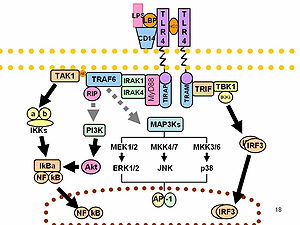
Recent data have shown stable patterns of activation among peripheral blood mononuclear cells and neutrophils in healthy human subjects. Although polymorphisms in Toll-like receptors play a contributory role in determining cellular activation, other factors are involved as well. In addition, circulating and locally released mediators of inflammation, including cytokines, complement fragments, and components of activated coagulation and fibrinolytic systems, that are generated in increased amounts during severe infection also interact with membrane-based receptors, leading to activation of intracellular path ways capable of further accelerating proinflammatory cascades. Circulating and organ-specific cell populations are activated to produce proinflammatory mediators during sepsis. Neutrophils and PBMCs bear TLR2 and TLR4, as well as other receptors, such as protein —coupled receptor, that induce increased generation of cytokines and other immunoregulatory proteins, as well as enhance release of proinflammatory mediators, including reactive oxygen species.
The expression of cytokines such as TNF-α and IL-1β is increased in sepsis, and engagement of TNF-α with type I(p55) and type II(p75) TNF receptors or IL-1β with IL-1 receptors belonging to the TLR/IL-1 receptor family produces activation of kinases (including Src, p38, extracellular signal—regulated kinase, and phosphoinositide 3–kinase) and transcriptional factors (such as nuclear factor [NF]–κB) important for further up-regulation of inflammatory proteins.
Genetic polymorphisms lead to alterations in TLR conformation (a small percentage of the variability in humans when their cells are exposed to bacterial products) that are accompanied by decreased cellular activation after exposure to bacterial products. The stable variability in cellular activation that is present among the genetically heterogeneous human population, only a limited number of studies have examined how such patterns may correlate with clinical outcome. A number of studies have examined the transcriptional factor NF-κB and kinases, including p38 and Akt, and provide insights into how heterogeneity in cell signaling may contribute to subsequent clinical course.
Increased activation of the mitogen-activated protein kinase protein 38, Akt, and nuclear factor (NF)–κB in neutrophils and other cell populations obtained at early time points in the clinical course of sepsis-induced acute lung injury or after accidental trauma is associated with a more-severe clinical course, suggesting that a proinflammatory cellular phenotype contributes to organ system dysfunction in such settings. Identification of patients with cellular phenotypes characterized by increased activation of NF-κB, Akt, and protein 38, as well as discrete patterns of gene activation, may permit identification of patients with sepsis who are likely to have a worse clinical outcome, thereby permitting early institution of therapies that modulate deleterious signaling pathways before organ system dysfunction develops, reducing morbidity and improving survival.
NF-kB
The transcriptional regulatory factor NF-κB is a central participant in modulating the expression of many immuno regulatory mediators involved in the acute inflammatory response [30–35]. NF-κB/rel transcription factors function as dimers held latently in the cytoplasm of cells by inhibitory IκB proteins. Signaling pathways initiated by engagement of TLRs, such as TLR 2 and TLR 4, by microbial products and other inflammatory mediators lead to nuclear accumulation of NF-κB and enhanced transcription of genes responsible for the expression of cytokines, chemokines, adhesion molecules, and other mediators of the inflammatory response associated with infection. Association of NF-κB with the inhibitory protein κB-α in the cytoplasm blocks the nuclear localization sequence of NF-κB, inhibiting its movement into the nucleus. Phosphorylation events, in addition to those involving IKKα/β and IκB-α, and involving NF-κB subunits (such as p 65) and nuclear coactivator proteins (such as TATA box binding protein or cAMP-responsive element—binding protein) are mediated by p 38, Akt, and other kinases and play an important role in regulating the transcriptional activity of NF-κB.
Studies have shown that greater nuclear accumulation of NF-κB is accompanied by higher mortality and worse clinical course in patients with sepsis. These clinical series demonstrated that persistent activation of NF-κB was found in nonsurvivors, with surviving patients having lower nuclear concentrations of NF-κB at early time points in their septic course than did nonsurvivors as well as more rapid return of nuclear accumulation of NF-κB. Although studies of patients with sepsis have generally shown that nuclear concentrations of NF-κB are higher in non survivors than in survivors, an unresolved issue is whether such changes occur early and, therefore, define the subsequent course of sepsis or whether pathophysiological changes that result in poor clinical outcome also produce NF-κB activation as a secondary event, so that such changes in NF-κB are simply associated with more severe organ system dysfunction but do not contribute directly to outcome. A study of surgical patients without sepsis supports the hypothesis that neutrophil phenotypes defined by NF-κB activation patterns predict clinical outcome [54]. In that clinical series of patients undergoing repair of aortic aneurysms, higher preoperative levels of NF-κB in peripheral neutrophils were associated with death and with the development of postoperative organ dysfunction.

NF-κB (Photo credit: Wikipedia)
Stable high and low responder phenotypes in the healthy population, implies that the presence of a preexistent high responder neutrophil phenotype, as characterized by increased nuclear translocation of NF-κB after stimulation with TLR 2 or TLR 4 ligands, would be associated with more severe pulmonary inflammatory response and clinical course in response to infection. Conversely, persons whose neutrophils have diminished activation of NF-κB after stimulation would be expected to have less-intense neutrophil-driven inflammation, as well as organ dysfunction. In addition, Nuclear levels of nuclear factor (NF)–κB are significantly increased in neutrophils obtained within 24h of initiation of mechanical ventilation in patients whose clinical course from sepsis-induced acute lung injury is more severe (as defined by death or ventilation for >14 days—that is, ⩽14 ventilator-free days [VFD]), compared with patients with a less-severe course (as defined by mechanical ventilation for <14 days, or >14 VFD). Baseline nuclear concentrations of NF-κB were lower in healthy volunteers than in patients with sepsis-induced acute lung injury, regardless of subsequent clinical course, demonstrating baseline activation of NF-κB in association with sepsis. *P <.05, vs. volunteers. †P< .05, vs. >14VFD.
Modulation of intracellular signaling cascades involving kinases, such as p 38 or Akt, or transcriptional factors, such as NF-κB, through specific inhibitory approaches has shown their pathophysiological importance in experimental models. However, the role of specific intra cellular pathways in contributing to clinical outcomes in patients with sepsis remains incompletely determined, primarily because such alterations in cellular activation patterns have not been examined at early time points before the onset of multiple organ dysfunction. Recent information shows that alterations in p38, Akt, and NF-κB among neutrophils and other cell populations not only precedes the development of organ system dysfunction but also has predictive value in identifying patients with a more severe subsequent clinical course.
RC Chambers. Procoagulant signalling mechanisms in lung inflammation and fibrosis: novel opportunities for pharmacological intervention? British Journal of Pharmacology 2008; 153, S367–S378; doi:10.1038/sj.bjp.0707603.
RC Bone. Toward a theory regarding the pathogenesis of the systemic inflammatory response syndrome: What we do and do not know about cytokine regulation. Crit Care Med 1996; 24:163-172.
Bouchon A, Facchetti F, Weigand MA, Colonna M. TREM-1 amplifies inflammation and is a crucial mediator of septic shock. Nature 2001; 410 (6832): 1103-7. doi:/10.1038/35074114. PMID 11323674.
Bleharski JR, Kiessler V, Buonsanti C, et al. A role for triggering receptor expressed on myeloid cells-1 in host defense during the early-induced and adaptive phases of the immune response. J. Immunol. 2003; 170 (7): 3812-8. PMID 12646648.
Colonna M, Facchetti F. TREM-1 (triggering receptor expressed on myeloid cells): a new player in acute inflammatory responses. J. Infect. Dis 2003; 187 (Suppl 2): S397-401. PMID 12792857.
Dempfle CE. Coagulopathy of Sepsis. Thromb Hemost 2004; 91:213-224.
Cunneen J, Cartwright M. The Puzzle of Sepsis: Fitting the Pieces of the Inflammatory Response with Treatment. AACN Clin Issues 2004;15:18-44.
Ren-Feng Guo, NC Riedemann, Lei Sun, Hongwei Gao, KX Shi, et al. Divergent Signaling Pathways in Phagocytic Cells during Sepsis. The Journal of Immunology, 2006, 177: 1306–1313.
Abraham E. Alterations in Cell Signaling in Sepsis. Clin Infect Dis 2005: 41 (Supplement 7): S459-S464. doi: 10.1086/431997
Yang KY, Arcaroli JJ, Abraham E. Early alterations in neutrophil activation are associated with outcome in acute lung injury. Am J Respir Crit Care Med 2003; 167:1567-74.
Abraham E. Neutrophils and Acute Lung Injury. Crit Care Med 2003; 31:195-9.
Abraham E, Carmody A, Shenkar R, Arcaroli J. Neutrophils as early immunologic effectors in hemorrhage- or endotoxemia-induced acute lung injury. Am J Physiol Lung Cell Mol Physiol 2000; 279:1137-45.
How is the disease recognized?
Of 289 patients with bacteremia, 52% had normal WBC count and 17% had neither WBC elevation nor fever. Despite multiple studies showing that a normal white blood cell (WBC) count does not exclude serious disease, physicians in all specialties continue to behave as if it did. Among 289 patients (8%) with positive blood cultures, 77% had fever and 48% had elevated WBC count on initial measurement. Neither fever nor an elevated WBC count was noted in 17% of bacteremic patients. The WBC count is not an adequate discriminatory test for bacteremia.
The term SIRS has been widely adopted by clinicians and investigators. As SIRS criteria are not specific for sepsis, several studies have evaluated the usefulness of SIRS criteria for the diagnosis of sepsis. A subanalysis of the Sepsis Occurrence In Acutely Ill Patients (SOAP) study based on intensive care unit (ICU) patients, showed that critically ill patients often fulfill the criteria for SIRS, regardless of whether they are infected or not. At ICU admission, 87% of patients had at least two SIRS criteria, most commonly respiratory rate (84%) or heart rate (71%). There was, however, a higher frequency of three or four SIRS criteria versus two SIRS criteria in infected than in noninfected patients. Interestingly, all infected patients had at least two SIRS criteria. Thus, although the SIRS criteria are so sensitive and are present in so many ICU patients that their value in identifying infected patients is limited, patients fulfilling two or more SIRS criteria should be closely evaluated for infection. The mortality attributable to infection seems to be similar in patients with sepsis and in those without.
The physiologic variables associated with SIRS and sepsis are not only important for the diagnosis and prognosis but also for guiding the treatment. In 1997, the ACCP/SCCM consensus group created a set of practice parameters for the hemodynamic management of patients in septic shock. According to these practice parameters, the initial priority in managing septic shock should be to maintain mean arterial pressure (MAP) by adequate hemodynamic support. In fact, treatment with either MAP or systolic blood pressure as the main therapeutic endpoint is the most commonly recommended and supported clinical monitoring practice. Maintenance of adequate MAP can help ensure adequate organ and tissue perfusion during the time required to detect and treat the infectious process causing the sepsis. the continuous monitoring of physiologic parameters for early sepsis screening continued to center on hypoperfusion and the clinical definitions of hypoperfusion were expanded to include systolic blood pressure less than90 mm Hg, MAP less than 65 mm Hg, a decrease in systolic blood pressure of more than 40 mm Hg, and a decrease in urine output.
This early identification of physiologic instability expedites basic resuscitation. Nine of the 10 signs of vitality can be assessed within several minutes; the 10th [base deficit, calculated after arterial puncture, or central venous oxygen saturation (ScVO2), obtained from a central venous catheter] requires 15-minutes.
Ten Signs of Vitality Triggering Parameter
Temperature 36 C
Pulse <50/min or >100/min
Pain New or significant increase
Respiratory rate <6/min or >20/min
SaO2 <90% and increased FiO2
Blood pressure SBP<90 mmHg, MAP <60 mmHg
Level of consciousness Anxiety or lethargy
Capillary refill >3s
Urinary output <30 mL/h 5 h, excluding renal failure
ScvO2/base deficit ScvO2<65% or base deficit 5 or lactic acid >2.0 mmol/L
SOFA score is used to predict the probability of infection in critically ill patients based on physiologic parameters like body temperature, respiratory rate, and heart rate, together with other parameters like white blood cell count, C-reactive protein, and Sequential Organ Failure Assessment (SOFA) score by using multiple regression to calculate the relative weight of each parameter in relation to the presence of infection. The significant variables were: body temperature greater than 37.5 C, heart rate greater than 140, and C-reactive protein greater than 6 mg/dL. Among the clinical variables, heart rate was the best predictor of infection, whereas respiratory rate had the poorest predictive value. However, the investigators decided to include all variables in the Infection Probability Score (IPS), assigning points according the relative weight of each parameter in relation to the presence of infection.
DJ Pallin. Normal White Blood Cell Count Does Not Rule Out Bacteremia. 07/03/2012; Journal Watch.
Cornbleet PJ. Clinical Utility of The Band Count. In Interpretation of The Peripheral Blood Film. CLINICS IN LABORATORY MEDICINE 2002; 22(1): 101-111.
Seigel TA et al. Inadequacy of temperature and white blood cell count in predicting bacteremia in patients with suspected infection. J Emerg Med 2012 Mar; 42:254.
R Ferrer, A Artigas. Physiologic Parameters as Biomarkers: What Can We Learn from Physiologic Variables and Variation? Crit Care Clin 27 (2011) 229–240. doi:10.1016/j.ccc.2010.12.008
The Next Step in Diagnosis
A biomarker has been defined as “a characteristic that is objectively measured and evaluated as an indicator of normal biologic processes, pathogenic processes, or pharmacologic responses to therapeutic intervention. The theoretic advantage of combining several biomarkers into a single classification rule is that it should help to improve their classification accuracy and, therefore, their clinical usefulness. when several markers are measured, they are often considered separately, irrespective of the additional information contained in their joint interpretation. This does not constitute a multimarker panel. This distinction is important, because these studies typically describe a list of different biomarkers with potential diagnostic or prognostic values that are used as individual predictors of disease or clinical outcome. Another common confusion is the term multiplex assay, which is a type of laboratory procedure that simultaneously measures multiple analytes (dozens or more) in a single assay. It is distinguished from procedures that measure 1 or a few analytes at a time.9 In contrast, a multimarker panel involves each biomarker representing the inputs to a multivariable, computational prediction or classification model.
Sepsis Bundles
The Institute for Healthcare Improvement (IHI) has highlighted sepsis as an area of focus and has identified several deficiencies that may cause suboptimal care of patients with severe sepsis.
These deficiencies include inconsistency in the early diagnosis of severe sepsis and septic shock, frequent inadequate volume resuscitation without defined endpoints, late or inadequate use of antibiotics, frequent failure to support the cardiac output when depressed, frequent failure to control hyperglycemia adequately, frequent failure to use low tidal volumes and pressures in acute lung injury, and frequent failure to treat adrenal inadequacy in refractory shock.
To address these deficiencies, the Surviving Sepsis Campaign and IHI have revised and added to the Surviving Sepsis Guidelines and created 2 sepsis treatment bundles (resuscitation and management) to guide therapy for patients with severe sepsis.
“Implicit in the use of the bundles is the need to adopt all the elements contained in the bundle,” the authors write. “One cannot choose to apply only selected items from the bundle and expect to achieve comparable benefit. The IHI sepsis website provides tools to screen patients for severe sepsis, as well as to measure success with adherence to implementing the bundles (http://www.ihi.org/IHI/Topics/CriticalCare/Sepsis/).” (The authors are employees of Eli Lilly and Co, the maker of drotrecogin alfa (activated). South Med J. 2007;100:594-600.
The sepsis resuscitation bundle, which should be accomplished as soon as possible and scored during the first 6 hours
Prealbumin (Transthyretin)
Discharge prealbumin and the change in prealbumin were positively correlated with protein and energy intake and inversely correlated with markers of inflammation, particularly CRP and IL-6. When all covariates were included in a multivariable regression analysis, the markers of inflammation predominantly accounted for the variance in prealbumin change (56%), whereas discharge protein intake accounted for 6%.
These authors propose an updated approach that incorporates current understanding of the systemic inflammatory response to help guide assessment, diagnosis, and treatment. An appreciation of a continuum of inflammatory response in relation to malnutrition syndromes is described. This discussion serves to highlight a research agenda to address deficiencies in diagnostics, biomarkers, and therapeutics of inflammation in relation to malnutrition.
Procalcitonin
The most frequent indication for antibiotic prescriptions in the northwestern hemisphere is lower respiratory tract infections (LRTIs),which range in severity from self-limited acute bronchitis to severe acute exacerbation of chronic obstructive pulmonary disease (COPD), and to life-threatening bacterial community-acquired pneumonia (CAP).4 Clinical signs and symptoms, as well as commonly used laboratory markers, are unreliable in distinguishing viral from bacterial LRTI. As many as 75% of patients with LRTI are treated with antibiotics, despitethe predominantly viral origin of their infection. An approach to estimate the probability of bacterial origin in LRTI is the measurement of serum procalcitonin (PCT).
In patients with LRTIs, a strategy of PCT guidance compared with standard guidelines resulted in similar rates of adverse outcomes, as well as lower rates of antibiotic exposure and antibiotic-associated adverse effects. (Trial Registration isrctn.org Identifier: ISRCTN95122877)
Neutrophil CD64
Despite improvements in the treatment of sepsis in recent years, there have been few diagnostic innovations which improve the sensitivity and specificity of diagnosis or facilitate therapeutic monitoring. The clinical reliance on the CBC and leukocyte differential with associated band count to indicate myeloid left shift of immaturity is not accurate, and it is not comparable to the measurement of the metamyeloctes and myelocytes. Only the introduction of a test which measures procalcitonin (PCT), an acute phase marker which is claimed to be more specific for bacterial infections than for viral infections, can be cited as a new diagnostic for the evaluation of patients with suspected infection. A need still persists for improved diagnostic indictors of infection or sepsis, as well as better tests to facilitate monitoring of therapy in the treatment of infection, so that use of antibiotics might be less empirical.
Studies have indicated that quantitative neutrophil CD64 expression is a sensitive and specific laboratory indicator of sepsis or the presence of a systemic acute inflammatory response. Neutrophil CD64 is a highly sensitive marker for neonatal sepsis. Prospective studies incorporating CD64 into a sepsis scoring system are warranted. Studies have indicated that quantitative neutrophil CD64 (high affinity Fc receptor) expression is a worthwhile candidate for evaluation as a more sensitive and specific laboratory indicator of sepsis or the presence of a systemic acute inflammatory response than available diagnostics . Neutrophil (PMN) CD64 is one of many activation-related antigenic changes manifested by neutrophils during the normal pathophysiological acute inflammatory or innate immune response. PMN expression of CD64 is up-regulated under the influence of inflammatory related cytokines such as interleukin 12 (IL-12), interferon gamma (IFN-y) and granulocyte colony stimulating factor (G-CSF).
The first commercially available assay for PMN CD64, developed by Trillium Diagnostics, LLC is a fluorescence based, no wash flow cytometric assay, namely the Leuko64. The assay kit contains a cocktail of monoclonal antibodies including two monoclonal antibodies to CD64 and a monoclonal antibody to CD163, red cell lysis buffer, fluorescence quantitation beads, and a software program for automated analysis of the flow cytometric data that reports PMN CD64 as a CD64 index. The PMN CD64 index is designed so that normal inactivated PMNs yield values of < 1.00 and blood samples from individuals with documented infection or sepsis typically show values > 1.50. Using clinical flow cytometers, the assay can be completed within 30 minutes. While this initial assay format was developed for multiparameter flow cytometers, a new version of the assay has been developed to give nearly identical results on the CD4000 and Sapphire (manufactured by Abbott Diagnostics, Santa Clara, CA) blood cell counters, which are equipped with laser light sources and fluorescence detection capabilities. If these blood cell counters are available in diagnostic haematology laboratories, the Leuko64 assay can be utilised on a 24 hour basis, in contrast to the more typical daytime operation hours of flow cytometric diagnostic laboratories.
Leukocare and Trillium Diagnostics entered an agreement to develop and market Leukocare’s method for detecting inflammatory activity using circulating cell-free DNA. Trillium aims to create a cf-DNA test as a “simple and cost effective” tool that healthcare professionals can use to obtain clinically relevant data on patients who are suspected of having sepsis. The companies said that they expect to finish developing the assay and market it in two years.
B Casserly, R Read, MM Levy. Multimarker Panels in Sepsis. Crit Care Clin 27 (2011) 391–405 doi:10.1016/j.ccc.2010.12.011 criticalcare.theclinics.com
Dennis RA, Johnson LE, Roberson PK, Heif M, Bopp MM, et al. Changes in prealbumin, nutrient intake, and systemic inflammation in elderly recuperative care patients. J Am Geriatr Soc. 2008; 56(7):1270-5. Epub 2008 Jun 10. PMID: 18547360
Jensen GL, Bistrian B, Roubenoff R, Heimburger DC. Malnutrition Syndromes: A Conundrum vs Continuum.
Bernstein LH. The systemic inflammatory response syndrome C-reactive protein and transthyretin conundrum. Clinical Chemistry Laboratory Medicine 2007; 45(11):1566–1567, ISSN (Online) 14374331, ISSN (Print) 14346621, DOI: 10.1515/CCLM.2007.334.
Schuetz P, Christ-Crain M, Thomann R, Falconnier C, Wolbers M, et al. for the ProHOSP Study Group. Effect of Procalcitonin-Based Guidelines vs Standard Guidelines on Antibiotic Use in Lower Respiratory Tract Infections: The ProHOSP Randomized Controlled Trial. JAMA 2009; 302(10): 1059
Bhandari V, Wang C, Rinder C, Rinder H. Hematologic Profile of Sepsis in Neonates: Neutrophil CD64 as a Diagnostic Marker. Pediatrics 2007; 31:4005. (ISSN Numbers: Print, 0031-4005; Online, 1098-4275). doi:10.1542/peds.2007-1308
Davis BH. Neutrophil CD64 expression in infection and sepsis. CLI Ocober 2006.
Leukocare, Trillium Partner on Sepsis Assay Development. Genome Web News. October 10, 2012.
Treatment of Sepsis
The sepsis consensus conference, led by Roger Bone, promulgated the concept of systemic inflammation as a prime mediator in the “sepsis syndrome”. The members of the consensus committee established “sepsis’ as the intersection between infection and inflammation (defined as SIRS criteria). the greatest importance in defining sepsis lies within the subgroups of the definition: those patients with organ dysfunction (severe sepsis) or refractory hypotension (septic shock). The consensus definition of sepsis emphasized that sepsis may be caused by a variety of infectious organisms (bacteria, fungi, viruses, and parasites) and need not be confined to the bloodstream or even involve bacteremia. Though potentially present in nearly all hospitalized patients, these inclusive criteria set the stage for defining subgroups of sepsis, which have become tremendously important. Septic patients with organ dysfunction were termed “severe sepsis,” while patients with refractory hypotension and/or hypoperfusion were termed “septic shock.”
One failure evident in the current definition is the inability to accurately “stage” the condition of a patient with sepsis. Analogous to staging conducted in the evaluation of malignancy, the experts felt it would be useful to have a similarly predictive process for sepsis. To that end, a new acronym — PIRO — was proposed:
P — Predisposition to sepsis and its altered physiology
I — Infection found to be the cause of sepsis
R — Response to the infection
O — Organ failure
Though vasopressors may be appropriate to increase coronary blood flow in a hypotensive patient with malignant ventricular arrhythmias, the effect of their use on other organ function and even on patient outcome remains uncertain. While we have often strived to maintain normality in critically ill patients, such as arterial blood gases in patient with acute lung injury/acute respiratory distress syndrome, we now realize that such practice is generally incorrect and may have induced harm in the process.
Anti-tumor necrosis factor
Anti-TNF strategies are only partially effective in patients with sepsis. Although individual studies show small, nonsignificant benefits, analysis of all trial data as well as data from a recent trial in a large population of septic patients show that anti-TNF strategies may confer a small survival benefit.
Reinhart K, Karzai W. Anti-tumor necrosis factor therapy in sepsis: update on clinical trials and lessons learned. Crit Care Med. 2001; 29(7 Suppl):S121-5.
Aprotinin
Aprotinin is a serine protease inhibitor that binds to human serine proteases with various affinities. This small protein has profound effects on the systemic inflammatory response syndrome induced by cardiopulmonary bypass. The intersecting pathways of complement, cytokines, coagulation, fibrinolytic, and kinin-kallikrein systems all converge with tremendous amplification and potentially damaging effects to the patient. Following publication of the original study describing high dose aprotinin therapy in repeat coronary artery bypass graft (CABG) surgery in 1987, an extensive body of literature has accumulated supporting the efficacy of aprotinin to reduce blood loss and transfusion requirements in cardiac and orthopedic surgeries. Cardiopulmonary bypass (CPB) initiates the activation of several intersecting plasma protease pathways: the kinin-kallikrein system, the coagulation-fibrinolytic cascade, and the complement system. Activation of each of these pathways results in the production of proinflammatory mediators, resulting in a systemic inflammatory response syndrome (SIRs). Ischemia reperfusion also contributes to the SIRs through the activation of humoral and cellular pathways. Such hemostatic and inflammatory responses are well orchestrated, inter-related processes with the capacity for tremendous amplification.
Activated Protein C
A great advance in treating sepsis patients came with the early completion of the activated protein C trial in June 2000. Since that time, trial results have been peer reviewed and recombinant human activated protein C has become available internationally (drotrecogin alfa [activated]). Recent controversy has arisen regarding protocol changes that occurred during the study and about reduced or absent benefit for patients of the lowest severity of illness. Jay Siegel of the US Food and Drug Administration published the indications for use the New England Journal of Medicine.
The use of activated protein C, as compared with placebo, was associated with a significant reduction in mortality in the Recombinant Human Activated Protein C Worldwide Evaluation in Severe Sepsis (PROWESS) trial (24.7 percent vs. 30.8 percent, P=0.005). Extensive review by physicians and scientists at the FDA confirmed the principal findings of the PROWESS trial but raised issues regarding the interpretation of data and appropriate use of the drug.
These issues were discussed with experts on sepsis from outside the FDA at a public meeting of the agency’s Anti-Infective Drugs Advisory Committee on October 16, 2001. The committee members provided valuable input; highlighted specific issues of concern, some of which are summarized in the accompanying Sounding Board by Warren et al.; and were evenly divided in a vote on a recommendation regarding approval.
The FDA then performed substantial additional evaluations addressing the issues that had been raised and concluded that activated protein C had been demonstrated to be safe and effective in reducing mortality among patients with severe sepsis and a high risk of death, as determined, for example, by the Acute Physiology and Chronic Health Evaluation (APACHE II) score.
Key matters of concern —
changes made during the trial,
the use of APACHE II scores,
and the risk of serious bleeding
In order to increase the capacity of the trial to detect effects on mortality due to sepsis, the eligibility criteria for the activated protein C study attempted to exclude patients who were likely to die from underlying disease within 28 days. The amendments to the eligibility criteria were intended to make this exclusion more effective. Two analyses indicate that these amendments did not account for the improved study outcomes.
Treatment with activated protein C was associated with a 3 percent absolute reduction in mortality among patients without chronic health points on APACHE II but with a 19 percent absolute reduction in mortality among patients who had chronic health points. The P value for the interaction of treatment effect and APACHE II chronic health points was 0.01. Both of these analyses indicate that the amendments to the protocol, rather than accounting for improved results, actually excluded patients who appeared more likely to benefit from therapy. In addition, these two analyses address the generalizability of the results of the PROWESS trial to patients with sepsis who have serious preexisting disease.3 They suggest strongly that serious preexisting disease should not, in general, be a reason for withholding activated protein C therapy.
A1AR Antagonists: Disease Modifying Drug Candidates
- Block endotoxin induced acute lung injury
- Block ischemia reperfusion injury of lung, heart, and liver
- Increase survival and reduce ALI in animal model of intra-abdominal polymicrobial sepsis (rat CLP) (Endacea data; NIH/NIAID-funded)
- Increase survival and reduce ALI in rat model of pneumonic plague (Endacea data; NIH/NIAID-funded)
Highly selective for human A1AR, water soluble, orally bioavailable A1AR antagonist
Analog of an approved off-patent anti-asthma drug
L-97-1 is a proprietary analog of bamiphylline with:
- Greater affinity for the human A1AR (increased potency)
- Greater selectivity for the human A1AR
- And L-97-1 retains the water solubility of bamiphylline
- Therapeutic index expected to exceed 200
- High selectivity, high affinity for human A1AR
Preclinical pharmacology profile for L-97-1:
Obiefunaet al. J Pharmacol Exp Ther 315:329, 2005
Taylor KM. Antiinflammatory Effects of Aprotinin. TATM 2004; 6(3 Suppl):39-46
Hill GE, Pohorecki R, Alonso A, Rennard SI, Robbins RA. Aprotinin Reduces Interleukin-8 Production and Lung Neutrophil Accumulation After Cardiopulmonary Bypass. Anesth Analg 1996; 83:696-700.
American College of Chest Physicians/Society of Critical Care Medicine Consensus Conference: Definitions for sepsis and organ failures and guidelines for the use of innovative therapies in sepsis. Crit Care Med 1992; 20:864-874.
Bernard GR, Vincent J-L, Laterre P-F, et al. Efficacy and safety of recombinant human activated protein C for severe sepsis. N Engl J Med 2001; 344:699-709.
Parillo JE. Plenary Presentation. Update on Sepsis Consensus Conference. Program and abstracts of Chest 2002: The 68th Annual Scientific Assembly of the American College of Chest Physicians; November 2-7, 2002; San Diego, California.
Siegel JP. Assessing the use of activated protein C in the treatment of severe sepsis. N Engl J Med. 2002; 347(13):1030-1034. • http://www.nejm.org
Read Full Post »


 2012pharmaceutical
 sjwilliamspa