Feeds:
Posts
Comments

Archive for the ‘Hematology’ Category

Ebola therapy breakthrough

Larry H. Bernstein, MD, FCAP, Curator

LPBI


Updated 11/23/2015

Giant Molecules Inhibit Ebola Infection

Nov 11, 2015   http://www.technologynetworks.com/medchem/news.aspx?ID=185080

European researchers have designed a “giant” molecule formed by thirteen fullerenes covered by carbohydrates which, by blocking this receptor, are able to inhibit the cell infection by an artificial ebola virus model.


Different studies have demonstrated that the ebola virus infection process starts when the virus reaches the cellular DC-SIGN receptor to infect the dendritic cells (of the immune system).

In this study researchers from the Universidad Complutense de Madrid/IMDEA-Nanociencia, the Instituto de Investigación Sanitaria Hospital 12 de Octubre (Madrid), and the Instituto de Investigaciones Químicas del CSIC-Universidad de Sevilla have collaborated, together with three european research groups (CNRS/Université de Strasbourg, France and Université de Namur, Belgium).

“Fullerenes are hollow cages exclusively formed by carbon atoms”, explains Nazario Martín, Professor of Organic Chemistry in the UCM and main author of the study. In this work, scientists have employed C60 fullerene, which is formed by 60 carbon atoms and has the shape of a truncated icosahedron, which resembles a football ball.

102815_web.jpg

These molecules decorated with specific carbohydrates (sugars) present affinity by the receptor used as an entry point to infect the cell and act blocking it, thus inhibiting the infection.

Researchers employed an artificial ebola virus by expressing one of its proteins, envelope protein GP1, responsible of its entry in the cells. In a model in vitro, this protein is covering a false virus, which is able of cell infection but not of replication.

“We have employed a cell model previously described in our lab which consists in a cell line of human lymphocytes expressing DC-SIGN receptor, which facilitates the entry of the virus in Dendritic Cells”, points out Rafael Delgado, researcher of the Hospital 12 de Octubre, and other of the authors of the study.

By blocking this receptor and inhibiting the virus infection, the authors think that the dissemination of the virus would decrease and the immune response increase, but this idea has still to be developed with in vivo studies.

The biggest fullerene system in the lab

The system designed by the chemists, based on carbon nanostructures developed in the UCM, mimic the presentation of carbohydrates surrounding virus like ebola or VIH.

The team has achieved an unprecedented success in fullerene chemistry and dendritic growth: connecting in one synthetic step twelve fullerene units, each with ten sugars, to other central fullerene, creating a globular superstructure with 120 sugar moieties on its surface, “this is the fastest dendrimeric growth developed in a laboratory up to now” says Beatriz Illescas, Professor in the UCM and coauthor of the work.

According to scientists, the results highlight the potential of these giant molecules as antiviral agents. “This work open the door to the design and preparation of new systems to inhibit the pathogens infection in cases where the current therapies are not effective or are inexistent, as occurs with the ebola virus”, clarifies Martín.

After these experiments on the cellular level, researchers will study the behavior of these systems in animal models, starting with mice. “We will study, on the one hand, the pharmacokinetics and, on the other, the antiviral activity in vivo” explains Javier Rojo, researcher of the Instituto de Investigaciones Químicas del CSIC and other of the authors of the study. Once the most effective compound has been identified, studies using the true ebola virus could be carried out.


http://www.sciencedirect.com/science/article/pii/S0092867400806935

DCSIGN, which is abundantly expressed by DC both in vitro and in vivo, … Whereas ICAM-3 binding by monocytes is for the greater part LFA-1 … The specificity of this adhesion receptor on DC for ICAM-3 is demonstrated by the ….


http://www.bloodjournal.org/content/100/5/1780.full.pdf

This subset coexpresses CD14, CD16, and CD33 and is thus of myeloid origin. In contrast to. CD14 monocytes, DCSIGN blood cells.


http://www.jimmunol.org/content/168/5/2118.full

Mar 1, 2002 Several receptors expressed by immature DCs belong to the C-type lectin superfamily, … Here, DCSIGN efficiently transmits the virus to T lymphocytes


http://journals.plos.org/plospathogens/article%3Fid%3D10.1371/journal.ppat.0020070

Jul 14, 2006 Although B cells that express DCSIGN do not replicate HIV-1, they serve as … receptors [12–15], with conflicting reports on expression of DCSIGN[16,17]. …..
human herpesvirus 8 infects DC and macrophages via DCSIGN …


http://www.jci.org/articles/view/25105/files/pdf

Results. The effect of human milk on direct HIV-1 infection of CD4+ T lymphocytesexpressing the DCSIGN receptor (Raji-DCSIGN) (8).


An indictment of Ebola response  

Panel calls for reform of global public health system in wake of epidemic

By B. D. Colen, Harvard Staff Writer

http://news.harvard.edu/gazette/story/2015/11/an-indictment-of-ebola-response/


http://media.news.harvard.edu/gazette/wp-content/uploads/2015/11/110515_Ebola_020_605.jpg

“The most egregious failure was by WHO in the delay in sounding the alarm,” said Harvard’s Ashish Jha.

An independent group of 19 international experts, convened by theHarvard Global Health Institute and the London School of Hygiene and Tropical Medicine (LSHTM), today issued a scathing analysis of the global response to the 2014-15 Ebola outbreak in West Africa.

The members of the Harvard-LSHTM Independent Panel on the Global Response to Ebola said that while the 2014-15 Ebola outbreak “engendered acts of understanding, courage, and solidarity,” it also caused “immense human suffering, fear and chaos, largely unchecked by high-level political leadership or reliable and rapid institutional responses.”

The report, published in the prestigious British medical journal The Lancet, is especially hard on the World Health Organization (WHO), which the panel contends failed to provide the leadership and support needed to deal properly with the outbreak of hemorrhagic fever that infected more than 28,000 people and claimed more than 11,000 lives.

The authors of the report, who were affiliated with, but functioned independently from, such disparate organizations as the Council on Foreign Relations, Médecins Sans Frontières, Indiana University law school, and theAIDS Health Care Foundation, reminded readers that the Ebola epidemic “brought national health systems to their knees, rolled back hard-won social and economic gains in a region recovering from civil wars, sparked worldwide panic, and cost at least several billion dollars in short-term control efforts and economic losses.”

“The most egregious failure was by WHO in the delay in sounding the alarm,” said Ashish Jha, director of the Harvard Global Health Institute, K.T. Li Professor of International Health at the Harvard T.H. Chan School of Public Health, and a professor of medicine at Harvard Medical School. “People at WHO were aware that there was an Ebola outbreak that was getting out of control by spring … and it took until August to declare a public health emergency … Those were precious months,” said Jha.

The panel was co-chaired by Professor Peter Piot, director of the LSHTM and co-discoverer of the Ebola virus. Piot said, “We need to strengthen core capacities in all countries to detect, report, and respond rapidly to small outbreaks, in order to prevent them from becoming large-scale emergencies. Major reform of national and global systems to respond to epidemics are not only feasible, but also essential so that we do not witness such depths of suffering, death, and social and economic havoc in future epidemics. The AIDS pandemic put global health on the world’s agenda. The Ebola crisis in West Africa should now be an equal game-changer for how the world prevents and responds to epidemics.”

Liberian Mosoka Fallah of Action Contre la Faim International and a member of the panel said, “The human misery and deaths from the Ebola epidemic in West Africa demand a team of independent thinkers to serve as a mirror of reflection on how and why the global response to the greatest Ebola calamity in human history was late, feeble, and uncoordinated. The threat of infectious disease anywhere is the threat of infectious disease everywhere. The world has become one big village.”

The global response to Ebola is being examined by a number of different panels, Jha said, including a group at WHO and another at the United Nations. During the height of the epidemic in fall, 2014, Jha met with Julio Frenk, then the dean of the Harvard Chan School, and Suerie Moon, research director and co-chair of the Harvard Kennedy School’s Forum on Global Governance for Health, and a Harvard Chan faculty member. Together, they “decided this deserves independent examination; we can’t let this happen again,” Jha said.

“The Ebola outbreak is a stark reminder of the fragility of health security in an interdependent word,” the report reads, “and of the importance of building a more robust global system to protect all people from such risks.

“A more humane, competent, and timely response to future outbreaks requires greater willingness to assist affected populations, and systematic investments to enable the global community to perform four key functions: strengthen core capacities within and among countries to prevent, detect, and respond to outbreaks when and where they occur; mobilize faster and more effective external assistance when countries are unable to prevent an outbreak from turning into a crisis alone; rapidly produce and widely share relevant knowledge, from community mobilization strategies to protective measures for health workers, from rapid diagnostic tools to vaccines; [and] provide stewardship over the whole system, entailing strong leadership, coordination, priority setting, and robust accountability from all involved actors.”

Though it pulls no punches in its criticism of the ways institutions and nations responded to the Ebola crisis, the Harvard-LSHTM report is also a positive document, offering 10 concrete recommendations to strengthen public health systems and future responses.

Those recommendations fall into four areas: preventing major disease outbreaks; responding to outbreaks; producing and sharing data, knowledge, and technologies; and improving the governance of the global health system, “with a focus on the World Health Organization.”

One recommendation is that WHO create a dedicated center “for outbreak response, with strong technical capacity, protected budget, and clear lines of accountability,” and that that center be governed by a separate board independent of the WHO bureaucracy.

“Our primary goal is to convince the high-level political leaders, north and south, to seize the moment to make necessary and enduring changes to better prepare for future outbreaks, while memories of the human health costs of inaction remain vivid and fresh,” the report said.

“There is a high risk here of not learning our lessons,” said Jha. “We’ve had outbreaks like this before, and often you get thoughtful reviews, and august bodies that look at it, and people say, ‘We will get to this right away,’ and then other things draw our attention. I think we owe it to the more than 11,000 people who died in West Africa to see that that doesn’t happen this time.”


The Lancet 2015

http://www.thelancet.com/campaigns/ebola

Ebola—lessons learned: Authors from Harvard’s Global Health Institute and the London School of Hygiene and Tropical Medicine outline 10 proposals to help prevent future health catastrophes, based on experiences from the 2014-15 Ebola outbreak in west Africa.

Timeline infographic

Illustration demonstrating pathogenesis of vascular leak in Ebola virus disease - Copyright: Elsevier
http://www.thelancet.com/pb/assets/raw/pb/assets/raw/lancet/campaigns/ebola/ebola-main-281114.jpg

The current outbreak of Ebola in west Africa is both a public health emergency of international concern and a human tragedy.

The Lancet Ebola Resource Centre contains all related resources from The Lancet family of journals offered with free access to assist health workers and researchers in their important work to bring this outbreak to a close a quickly as possible.

Find out more about Ebola in The Lancet’s Seminar.


WORLD REPORT
Expert panel slams WHO’s poor showing against Ebola
John Maurice
The Lancet, July 13, 2015;Vol. 386, No. 9990, e1

Criticism of WHO’s response to the west African Ebola crisis spawned an expert review that this week proposed several solutions to restore the agency’s performance. John Maurice reports.

WHO suffers from an incapacity “to deliver a full emergency public health response” against a severe epidemic. So concluded a panel of six international health experts in a damning report released on July 7. They prescribed 21 actions aimed at restoring WHO’s “pre-eminence as the guardian of global public health”.

The panel was commissioned by WHO Director-General Margaret Chan in response to widespread criticism that WHO had mishandled its response to the west African Ebola epidemic. The panel corroborated many of the criticisms. Chief among them was the “unjustifiable” time it took WHO to declare the outbreak a “public health emergency of international concern”. Chan made this declaration 5 months after the escalating spread of Ebola had become evident. WHO officials claim that the delay in making the official declaration did not affect its operations involving some 100 staff in the field in the early months of the epidemic.

WHO’s Member States also drew sharp criticism from the panel. Many applied travel bans during the epidemic without WHO authorisation, thereby contravening the International Health Regulations (IHR) and “causing negative political, economic and social consequences for the affected countries”. Perhaps the most damning criticism of WHO came from Médecins sans Frontières (MSF), whose teams were among the first to arrive at the scene of the outbreak in March, 2014. An MSF reportpublished in March, 2015, describes how MSF was unable to convince WHO that the epidemic was out of control. “WHO officials”, the report notes, “called us alarmists”.

Four of the panel’s recommendations stand out: countries should be given incentives to comply with the IHR and disincentives, such as sanctions, when they flout them; a brand-new WHO Centre for Emergency Preparedness and Response should be created; a contingency fund of US$100 million to be used solely to finance outbreak responses should be established; and an intermediate trigger should be set up to alert the health community to a health crisis before it becomes an emergency.

Asked whether the panel’s report meets her concerns, MSF president Joanne Liu tells The Lancet: “It has many strong points for us. But how they will translate into real action on the ground” is unclear. Liu is particularly pleased with the panel’s call for greater community engagement in epidemic response efforts. “As regards an intermediate alert”, she says, “it should be based on the needs of the affected communities, not just on a perceived security risk for other countries. MSF didn’t wait for an official declaration before going into the field.”

David Heymann, head and senior fellow at the Centre on Global Health Security in Chatham House, London, wonders whether the panel’s recommendations for fundamental changes in the decision-making processes can be implemented. “WHO has a flawed structure and I’m not sure its Member States have the will to change that.” He commends the panel’s call for strengthening existing emergency response mechanisms, such as the Global Outbreak Alert and Response Network (GOARN). “This is an agile, sustainable network of epidemiologists, logisticians, and other field-support experts from WHO Member States. It goes immediately into action to prevent outbreaks from becoming emergencies of international concern and has worked extremely well in previous Ebola outbreaks and in the 2003 SARS epidemic.” He believes that the existence of GOARN, with an added external advisory group, obviates the need for the new WHO emergency response centre proposed by the panel.

Will WHO implement the recommendations? “If it doesn’t implement them now”, says Jeremy Farrar, director of the Wellcome Trust, “it will never do so, because the Ebola epidemic has really shocked people and has exposed the structural weaknesses in WHO. Reforming its emergency response capabilities means reducing the bureaucracy and speeding up its capacity to respond. And that means appointing the very best people.” Farrar is enthusiastic about the proposed creation of a new WHO emergency response body. “It should be overseen by an independent board and needs to be outside the influence of politics and truly independent. It also needs to be given the right authority, the right budget, and the right mandate in order to attract the right leadership.”

Rick Brennan, director of WHO’s emergency operations, found the panel’s report constructive. “Work has already begun on several of the recommendations, such as increasing staff and funds for emergency operations and integrating our health security and humanitarian work. I’m convinced that we will implement the rest of the recommendations, including the creation of a new WHO health emergency centre.”

Experts were unanimous on one point made in the report. With 20–30 cases occurring every week, Ebola in west Africa is not over and many eyes are now on WHO’s role in ending it.

EDITORIAL
A plan to protect the world—and save WHO
The Lancet July 11, 2015
The Lancet, Vol. 386, No. 9989, p103

“WHO must reestablish its pre-eminence as the guardian of global public health.” These words resonate throughout the final report of the Ebola Interim Assessment Panel, requested by WHO’s Executive Board, chaired by Dame Barbara Stocking, and published this week. The findings of the panel present a devastating critique of WHO and the chronic inaction of its member states, which together created the conditions for an Ebola virus disease outbreak of unprecedented ferocity and human tragedy. The Stocking Report, as it will come to be known, sets out in agonising detail how the entire global health system fatally let down the people of west Africa.

Stocking reserves her harshest criticism for WHO. The delays in announcing a Public Health Emergency of International Concern (it took 5 months from announcing an “unprecedented outbreak” in April, 2014, to declaring a public health emergency on August 8) was “unjustifiable”. The agency’s culture is unfit to manage an emergency response. Independent and courageous decision-making by the Director-General of WHO and her team “was absent in the early months of the Ebola crisis”. The agency was slow and reactive to events. WHO has lost its position as the authoritative body on health emergencies. It thought it could manage Ebola through polite behind-the-scenes international diplomacy. It failed to recognise that Ebola was a health emergency, not a diplomatic puzzle. And WHO’s communication strategy for Ebola simply “failed”. The agency failed to communicate proactively and it failed to establish itself as the authoritative voice on the Ebola outbreak. Member States of WHO are not spared. They have persistently failed to take the International Health Regulations (IHR, 2005) seriously—a position that is “irresponsible” and “untenable” for global health security. They should adopt the notion of “shared sovereignty”. They need to invest in WHO (the Panel proposes a modest 5% increase in assessed contributions in 2016).

The Panel’s recommendations are clear and forthright. Although WHO was severely criticised, Stocking argues that the agency should still take the lead for emergency health responses. But to do so, WHO must undergo “significant transformation”—not least, adequate funding and a change in culture. It must provide costed plans for establishing core public health capacities as set out in the IHR (2005). It should establish a new WHO Centre for Emergency Preparedness and Response, with an independent board that publishes a report on Global Health Security annually. WHO country and regional offices should be strengthened. The agency should take its role in accelerating the research and development of diagnostics, vaccines, and medicines more seriously. And WHO should do more to coordinate its activities with other parts of the humanitarian community. The IHR Review Committee should examine the value of an intermediate alert for a public health emergency, lowering the threshold at which the world can be warned of a new health risk. And sanctions against countries that violate the IHR should be considered.

The Panel makes clear that global health must be put at the centre of the global security agenda. But while its recommendations are cogent, there are three important omissions that deserve attention. First, the Panel does not address the vicious cycle within which WHO is caught. The reason why WHO is so poorly resourced is that it lacks the confidence of donors. As the agency continues to underperform because of chronic underinvestment, so that lack of confidence (and the resultant unwillingness to invest) only worsens. The Panel presents no way out of this endless circle of failure. Second, one of the most important responsibilities for governments is the preservation of public order and national security. In the context of Ebola (indeed, any health crisis), this means creating resilient health systems to protect populations from unexpected shocks, as explained by Mosoka Fallah and colleagues in a letter from Liberia’s Ministry of Health this week. Universal health coverage should have been emphasised as a crucial instrument in building global health security. Finally, the Panel rightly notes that, “While WHO has already accepted the need for transformation of its organisational culture and delivery, it will need to be held accountable to ensure that this transformation is achieved”. However, nowhere does the Panel recommend the accountability mechanism to monitor and review the implementation of its recommendations. Our fear is that the unique opportunity presented by the Stocking Report will be squandered. We have little confidence that the governing bodies of WHO will deliver on the expectations of Stocking and her team. The responsibility for action therefore falls to WHO’s Director-General. Dr Margaret Chan has 20 months to save her agency from further and possibly irreversible reputational damage.

ReEBOV Antigen Rapid Test kit for point-of-care and laboratory-based testing for Ebola virus disease: a field validation study
Mara Jana Broadhurst, John Daniel Kelly, Ann Miller, Amanda Semper, Daniel Bailey, et al.

The Lancet, June 25, 2015; Vol. 386, No. 9996, p867–874    http://dx.doi.org/10.1016/S0140-6736(15)61042-X    
Background  At present, diagnosis of Ebola virus disease requires transport of venepuncture blood to field biocontainment laboratories for testing by real-time RT-PCR, resulting in delays that complicate patient care and infection control efforts. Therefore, an urgent need exists for a point-of-care rapid diagnostic test for this disease. In this Article, we report the results of a field validation of the Corgenix ReEBOV Antigen Rapid Test kit.
Methods   We performed the rapid diagnostic test on fingerstick blood samples from 106 individuals with suspected Ebola virus disease presenting at two clinical centres in Sierra Leone. Adults and children who were able to provide verbal consent or assent were included; we excluded patients with haemodynamic instability and those who were unable to cooperate with fingerstick or venous blood draw. Two independent readers scored each rapid diagnostic test, with any disagreements resolved by a third. We compared point-of-care rapid diagnostic test results with clinical real-time RT-PCR results (RealStar Filovirus Screen RT-PCR kit 1·0; altona Diagnostics GmbH, Hamburg, Germany) for venepuncture plasma samples tested in a Public Health England field reference laboratory (Port Loko, Sierra Leone). Separately, we performed the rapid diagnostic test (on whole blood) and real-time RT-PCR (on plasma) on 284 specimens in the reference laboratory, which were submitted to the laboratory for testing from many clinical sites in Sierra Leone, including our two clinical centres.
Findings   In point-of-care testing, all 28 patients who tested positive for Ebola virus disease by RT-PCR were also positive by fingerstick rapid diagnostic test (sensitivity 100% [95% CI 87·7–100]), and 71 of 77 patients who tested negative by RT-PCR were also negative by the rapid diagnostic test (specificity 92·2% [95% CI 83·8–97·1]). In laboratory testing, all 45 specimens that tested positive by RT-PCR were also positive by the rapid diagnostic test (sensitivity 100% [95% CI 92·1–100]), and 214 of 232 specimens that tested negative by RT-PCR were also negative by the rapid diagnostic test (specificity 92·2% [88·0–95·3]). The two independent readers agreed about 95·2% of point-of-care and 98·6% of reference laboratory rapid diagnostic test results. Cycle threshold values ranged from 15·9 to 26·3 (mean 22·6 [SD 2·6]) for the PCR-positive point-of-care cohort and from 17·5 to 26·3 (mean 21·5 [2·7]) for the reference laboratory cohort. Six of 16 banked plasma samples from rapid diagnostic test-positive and altona-negative patients were positive by an alternative real-time RT-PCR assay (the Trombley assay); three (17%) of 18 samples from individuals who were negative by both the rapid diagnostic test and altona test were also positive by Trombley.
Interpretation   The ReEBOV rapid diagnostic test had 100% sensitivity and 92% specificity in both point-of-care and reference laboratory testing in this population (maximum cycle threshold 26·3). With two independent readers, the test detected all patients who were positive for Ebola virus by altona real-time RT-PCR; however, this benchmark itself had imperfect sensitivity.
Malaria morbidity and mortality in Ebola-affected countries caused by decreased health-care capacity, and the potential effect of mitigation strategies: a modelling analysis
Patrick G T Walker, Michael T White, Jamie T Griffin, Alison Reynolds, Neil M Ferguson, Azra C Ghani
The Lancet Infectious Diseases, April 23, 2015; Vol. 15, No. 7, p825–832  http://dx.doi.org/10.1016/S1473-3099(15)70124-6    
Background  The ongoing Ebola epidemic in parts of west Africa largely overwhelmed health-care systems in 2014, making adequate care for malaria impossible and threatening the gains in malaria control achieved over the past decade. We quantified this additional indirect burden of Ebola virus disease.
Methods  We estimated the number of cases and deaths from malaria in Guinea, Liberia, and Sierra Leone from Demographic and Health Surveys data for malaria prevalence and coverage of malaria interventions before the Ebola outbreak. We then removed the effect of treatment and hospital care to estimate additional cases and deaths from malaria caused by reduced health-care capacity and potential disruption of delivery of insecticide-treated bednets. We modelled the potential effect of emergency mass drug administration in affected areas on malaria cases and health-care demand.
Findings  If malaria care ceased as a result of the Ebola epidemic, untreated cases of malaria would have increased by 45% (95% credible interval 43–49) in Guinea, 88% (83–93) in Sierra Leone, and 140% (135–147) in Liberia in 2014. This increase is equivalent to 3·5 million (95% credible interval 2·6 million to 4·9 million) additional untreated cases, with 10 900 (5700–21 400) additional malaria-attributable deaths. Mass drug administration and distribution of insecticide-treated bednets timed to coincide with the 2015 malaria transmission season could largely mitigate the effect of Ebola virus disease on malaria.
Interpretation  These findings suggest that untreated malaria cases as a result of reduced health-care capacity probably contributed substantially to the morbidity caused by the Ebola crisis. Mass drug administration can be an effective means to mitigate this burden and reduce the number of non-Ebola fever cases within health systems.

Read Full Post »

Biochemistry and Dysmetabolism of Aging and Serious Illness, Volume 2 (Volume Two: Latest in Genomics Methodologies for Therapeutics: Gene Editing, NGS and BioInformatics, Simulations and the Genome Ontology), Part 1: Next Generation Sequencing (NGS)

Biochemistry and Dysmetabolism of Aging and Serious Illness

Curator: Larry H. Bernstein, MD, FCAP


White Matter Lipids as a Ketogenic Fuel Supply in Aging Female Brain: Implications for Alzheimer’s Disease

Lauren P. Klosinski, Jia Yao, Fei Yin, Alfred N. Fonteh, Michael G. Harrington, Trace A. Christensen, Eugenia Trushina, Roberta Diaz Brinton
http://www.ebiomedicine.com/article/S2352-3964(15)30192-4/abstract      DOI: http://dx.doi.org/10.1016/j.ebiom.2015.11.002
Highlights
  • Mitochondrial dysfunction activates mechanisms for catabolism of myelin lipids to generate ketone bodies for ATP production.
  • Mechanisms leading to ketone body driven energy production in brain coincide with stages of reproductive aging in females.
  • Sequential activation of myelin catabolism pathway during aging provides multiple therapeutic targets and windows of efficacy.

The mechanisms underlying white matter degeneration, a hallmark of multiple neurodegenerative diseases including Alzheimer’s, remain unclear. Herein we provide a mechanistic pathway, spanning multiple transitions of aging, that links mitochondrial dysfunction early in aging with later age white matter degeneration. Catabolism of myelin lipids to generate ketone bodies can be viewed as an adaptive survival response to address brain fuel and energy demand. Women are at greatest risk of late-onset-AD, thus, our analyses in female brain address mechanisms of AD pathology and therapeutic targets to prevent, delay and treat AD in the sex most affected with potential relevance to men.


White matter degeneration is a pathological hallmark of neurodegenerative diseases including Alzheimer’s. Age remains the greatest risk factor for Alzheimer’s and the prevalence of age-related late onset Alzheimer’s is greatest in females. We investigated mechanisms underlying white matter degeneration in an animal model consistent with the sex at greatest Alzheimer’s risk. Results of these analyses demonstrated decline in mitochondrial respiration, increased mitochondrial hydrogen peroxide production and cytosolic-phospholipase-A2 sphingomyelinase pathway activation during female brain aging. Electron microscopic and lipidomic analyses confirmed myelin degeneration. An increase in fatty acids and mitochondrial fatty acid metabolism machinery was coincident with a rise in brain ketone bodies and decline in plasma ketone bodies. This mechanistic pathway and its chronologically phased activation, links mitochondrial dysfunction early in aging with later age development of white matter degeneration. The catabolism of myelin lipids to generate ketone bodies can be viewed as a systems level adaptive response to address brain fuel and energy demand. Elucidation of the initiating factors and the mechanistic pathway leading to white matter catabolism in the aging female brain provides potential therapeutic targets to prevent and treat demyelinating diseases such as Alzheimer’s and multiple sclerosis. Targeting stages of disease and associated mechanisms will be critical.

3. Results

  1. 3.1. Pathway of Mitochondrial Deficits, H2O2 Production and cPLA2 Activation in the Aging Female Brain
  2. 3.2. cPLA2-sphingomyelinase Pathway Activation in White Matter Astrocytes During Reproductive Senescence
  3. 3.3. Investigation of White Matter Gene Expression Profile During Reproductive Senescence
  4. 3.4. Ultra Structural Analysis of Myelin Sheath During Reproductive Senescence
  5. 3.5. Analysis of the Lipid Profile of Brain During the Transition to Reproductive Senescence
  6. 3.6. Fatty Acid Metabolism and Ketone Generation Following the Transition to Reproductive Senescence


4. Discussion

Age remains the greatest risk factor for developing AD (Hansson et al., 2006, Alzheimer’s, 2015). Thus, investigation of transitions in the aging brain is a reasoned strategy for elucidating mechanisms and pathways of vulnerability for developing AD. Aging, while typically perceived as a linear process, is likely composed of dynamic transition states, which can protect against or exacerbate vulnerability to AD (Brinton et al., 2015). An aging transition unique to the female is the perimenopausal to menopausal conversion (Brinton et al., 2015). The bioenergetic similarities between the menopausal transition in women and the early appearance of hypometabolism in persons at risk for AD make the aging female a rational model to investigate mechanisms underlying risk of late onset AD.

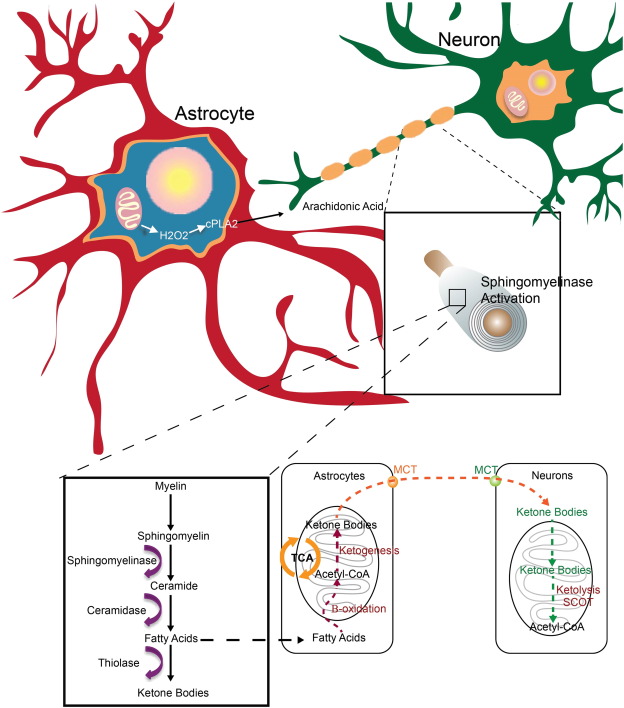
Findings from this study replicate our earlier findings that age of reproductive senescence is associated with decline in mitochondrial respiration, increased H2O2 production and shift to ketogenic metabolism in brain (Yao et al., 2010, Ding et al., 2013, Yin et al., 2015). These well established early age-related changes in mitochondrial function and shift to ketone body utilization in brain, are now linked to a mechanistic pathway that connects early decline in mitochondrial respiration and H2O2 production to activation of the cPLA2-sphingomyelinase pathway to catabolize myelin lipids resulting in WM degeneration (Fig. 12). These lipids are sequestered in lipid droplets for subsequent use as a local source of ketone body generation via astrocyte mediated beta-oxidation of fatty acids. Astrocyte derived ketone bodies can then be transported to neurons where they undergo ketolysis to generate acetyl-CoA for TCA derived ATP generation required for synaptic and cell function (Fig. 12).

Thumbnail image of Fig. 12. Opens large image

http://www.ebiomedicine.com/cms/attachment/2040395791/2053874721/gr12.sml

Fig. 12

Schematic model of mitochondrial H2O2 activation of cPLA2-sphingomyelinase pathway as an adaptive response to provide myelin derived fatty acids as a substrate for ketone body generation: The cPLA2-sphingomyelinase pathway is proposed as a mechanistic pathway that links an early event, mitochondrial dysfunction and H2O2, in the prodromal/preclinical phase of Alzheimer’s with later stage development of pathology, white matter degeneration. Our findings demonstrate that an age dependent deficit in mitochondrial respiration and a concomitant rise in oxidative stress activate an adaptive cPLA2-sphingomyelinase pathway to provide myelin derived fatty acids as a substrate for ketone body generation to fuel an energetically compromised brain.

Biochemical evidence obtained from isolated whole brain mitochondria confirms that during reproductive senescence and in response to estrogen deprivation brain mitochondria decline in respiratory capacity (Yao et al., 2009, Yao et al., 2010, Brinton, 2008a, Brinton, 2008b, Swerdlow and Khan, 2009). A well-documented consequence of mitochondrial dysfunction is increased production of reactive oxygen species (ROS), specifically H2O2 (Boveris and Chance, 1973, Beal, 2005, Yin et al., 2014, Yap et al., 2009). While most research focuses on the damage generated by free radicals, in this case H2O2 functions as a signaling molecule to activate cPLA2, the initiating enzyme in the cPLA2-sphingomyelinase pathway (Farooqui and Horrocks, 2006, Han et al., 2003, Sun et al., 2004). In AD brain, increased cPLA2 immunoreactivity is detected almost exclusively in astrocytes suggesting that activation of the cPLA2-sphingomyelinase pathway is localized to astrocytes in AD, as opposed to the neuronal or oligodendroglial localization that is observed during apoptosis (Sun et al., 2004, Malaplate-Armand et al., 2006, Di Paolo and Kim, 2011, Stephenson et al., 1996,Stephenson et al., 1999). In our analysis, cPLA2 (Sanchez-Mejia and Mucke, 2010) activation followed the age-dependent rise in H2O2 production and was sustained at an elevated level.

Direct and robust activation of astrocytic cPLA2 by physiologically relevant concentrations of H2O2 was confirmed in vitro. Astrocytic involvement in the cPLA2-sphingomyelinase pathway was also indicated by an increase in cPLA2 positive astrocyte reactivity in WM tracts of reproductively incompetent mice. These data are consistent with findings from brains of persons with AD that demonstrate the same striking localization of cPLA2immunoreactivity within astrocytes, specifically in the hippocampal formation (Farooqui and Horrocks, 2004). While neurons and astrocytes contain endogenous levels of cPLA2, neuronal cPLA2 is activated by an influx of intracellular calcium, whereas astrocytic cPLA2 is directly activated by excessive generation of H2O2 (Sun et al., 2004, Xu et al., 2003, Tournier et al., 1997). Evidence of this cell type specific activation was confirmed by the activation of cPLA2 in astrocytes by H2O2 and the lack of activation in neurons. These data support that astrocytic, not neuronal, cPLA2 is the cellular mediator of the H2O2 dependent cPLA2-sphingomyelinase pathway activation and provide associative evidence supporting a role of astrocytic mitochondrial H2O2 in age-related WM catabolism.

The pattern of gene expression during the shift to reproductive senescence in the female mouse hippocampus recapitulates key observations in human AD brain tissue, specifically elevation in cPLA2, sphingomyelinase and ceramidase (Schaeffer et al., 2010, He et al., 2010, Li et al., 2014). Further, up-regulation of myelin synthesis, lipid metabolism and inflammatory genes in reproductively incompetent female mice is consistent with the gene expression pattern previously reported from aged male rodent hippocampus, aged female non-human primate hippocampus and human AD hippocampus (Blalock et al., 2003, Blalock et al., 2004, Blalock et al., 2010, Blalock et al., 2011, Kadish et al., 2009, Rowe et al., 2007). In these analyses of gene expression in aged male rodent hippocampus, aged female non-human primate hippocampus and human AD hippocampus down regulation of genes related to mitochondrial function, and up-regulation in multiple genes encoding for enzymes involved in ketone body metabolism occurred (Blalock et al., 2003, Blalock et al., 2004, Blalock et al., 2010, Blalock et al., 2011, Kadish et al., 2009, Rowe et al., 2007). The comparability across data derived from aging female mouse hippocampus reported herein and those derived from male rodent brain, female nonhuman brain and human AD brain strongly suggest that cPLA2-sphingomyelinase pathway activation, myelin sheath degeneration and fatty acid metabolism leading to ketone body generation is a metabolic adaptation that is generalizable across these naturally aging models and are evident in aged human AD brain. Collectively, these data support the translational relevance of findings reported herein.

Data obtained via immunohistochemistry, electron microscopy and MBP protein analyses demonstrated an age-related loss in myelin sheath integrity. Evidence for a loss of myelin structural integrity emerged in reproductively incompetent mice following activation of the cPLA2-sphingomyelinase pathway. The unraveling myelin phenotype observed following reproductive senescence and aging reported herein is consistent with the degenerative phenotype that emerges following exposure to the chemotherapy drug bortezomib which induces mitochondrial dysfunction and increased ROS generation (Carozzi et al., 2010, Cavaletti et al., 2007,Ling et al., 2003). In parallel to the decline in myelin integrity, lipid droplet density increased. In aged mice, accumulation of lipid droplets declined in parallel to the rise in ketone bodies consistent with the utilization of myelin-derived fatty acids to generate ketone bodies. Due to the sequential relationship between WM degeneration and lipid droplet formation, we posit that lipid droplets serve as a temporary storage site for myelin-derived fatty acids prior to undergoing β-oxidation in astrocytes to generate ketone bodies.

Microstructural alterations in myelin integrity were associated with alterations in the lipid profile of brain, indicative of WM degeneration resulting in release of myelin lipids. Sphingomyelin and galactocerebroside are two main lipids that compose the myelin sheath (Baumann and Pham-Dinh, 2001). Ceramide is common to both galactocerebroside and sphingomyelin and is composed of sphingosine coupled to a fatty acid. Ceramide levels increase in aging, in states of ketosis and in neurodegeneration (Filippov et al., 2012, Blazquez et al., 1999, Costantini et al., 2005). Specifically, ceramide levels are elevated at the earliest clinically recognizable stage of AD, indicating a degree of WM degeneration early in disease progression (Di Paolo and Kim, 2011,Han et al., 2002, Costantini et al., 2005). Sphingosine is statistically significantly elevated in the brains of AD patients compared to healthy controls; a rise that was significantly correlated with acid sphingomyelinase activity, Aβ levels and tau hyperphosphorylation (He et al., 2010). In our analyses, a rise in ceramides was first observed early in the aging process in reproductively incompetent mice. The rise in ceramides was coincident with the emergence of loss of myelin integrity consistent with the release of myelin ceramides from sphingomyelin via sphingomyelinase activation. Following the rise in ceramides, sphingosine and fatty acid levels increased. The temporal sequence of the lipid profile was consistent with gene expression indicating activation of ceramidase for catabolism of ceramide into sphingosine and fatty acid during reproductive senescence. Once released from ceramide, fatty acids can be transported into the mitochondrial matrix of astrocytes via CPT-1, where β-oxidation of fatty acids leads to the generation of acetyl-CoA (Glatz et al., 2010). It is well documented that acetyl-CoA cannot cross the inner mitochondrial membrane, thus posing a barrier to direct transport of acetyl-CoA generated by β-oxidation into neurons. In response, the newly generated acetyl-CoA undergoes ketogenesis to generate ketone bodies to fuel energy demands of neurons (Morris, 2005,Guzman and Blazquez, 2004, Stacpoole, 2012). Because astrocytes serve as the primary location of β-oxidation in brain they are critical to maintaining neuronal metabolic viability during periods of reduced glucose utilization (Panov et al., 2014, Ebert et al., 2003, Guzman and Blazquez, 2004).

Once fatty acids are released from myelin ceramides, they are transported into astrocytic mitochondria by CPT1 to undergo β-oxidation. The mitochondrial trifunctional protein HADHA catalyzes the last three steps of mitochondrial β-oxidation of long chain fatty acids, while mitochondrial ABAD (aka SCHAD—short chain fatty acid dehydrogenase) metabolizes short chain fatty acids. Concurrent with the release of myelin fatty acids in aged female mice, CPT1, HADHA and ABAD protein expression as well as ketone body generation increased significantly. These findings indicate that astrocytes play a pivotal role in the response to bioenergetic crisis in brain to activate an adaptive compensatory system that activates catabolism of myelin lipids and the metabolism of those lipids into fatty acids to generate ketone bodies necessary to fuel neuronal demand for acetyl-CoA and ATP.

Collectively, these findings provide a mechanistic pathway that links mitochondrial dysfunction and H2O2generation in brain early in the aging process to later stage white matter degeneration. Astrocytes play a pivotal role in providing a mechanistic strategy to address the bioenergetic demand of neurons in the aging female brain. While this pathway is coincident with reproductive aging in the female brain, it is likely to have mechanistic translatability to the aging male brain. Further, the mechanistic link between bioenergetic decline and WM degeneration has potential relevance to other neurological diseases involving white matter in which postmenopausal women are at greater risk, such as multiple sclerosis. The mechanistic pathway reported herein spans time and is characterized by a progression of early adaptive changes in the bioenergetic system of the brain leading to WM degeneration and ketone body production. Translationally, effective therapeutics to prevent, delay and treat WM degeneration during aging and Alzheimer’s disease will need to specifically target stages within the mechanistic pathway described herein. The fundamental initiating event is a bioenergetic switch from being a glucose dependent brain to a glucose and ketone body dependent brain. It remains to be determined whether it is possible to prevent conversion to or reversal of a ketone dependent brain. Effective therapeutic strategies to intervene in this process require biomarkers of bioenergetic phenotype of the brain and stage of mechanistic progression. The mechanistic pathway reported herein may have relevance to other age-related neurodegenerative diseases characterized by white matter degeneration such as multiple sclerosis.

Blood. 2015 Oct 15;126(16):1925-9.    http://dx.doi.org:/10.1182/blood-2014-12-617498. Epub 2015 Aug 14.
Targeting the leukemia cell metabolism by the CPT1a inhibition: functional preclinical effects in leukemias.
Cancer cells are characterized by perturbations of their metabolic processes. Recent observations demonstrated that the fatty acid oxidation (FAO) pathway may represent an alternative carbon source for anabolic processes in different tumors, therefore appearing particularly promising for therapeutic purposes. Because the carnitine palmitoyl transferase 1a (CPT1a) is a protein that catalyzes the rate-limiting step of FAO, here we investigated the in vitro antileukemic activity of the novel CPT1a inhibitor ST1326 on leukemia cell lines and primary cells obtained from patients with hematologic malignancies. By real-time metabolic analysis, we documented that ST1326 inhibited FAO in leukemia cell lines associated with a dose- and time-dependent cell growth arrest, mitochondrial damage, and apoptosis induction. Data obtained on primary hematopoietic malignant cells confirmed the FAO inhibition and cytotoxic activity of ST1326, particularly on acute myeloid leukemia cells. These data suggest that leukemia treatment may be carried out by targeting metabolic processes.
Oncogene. 2015 Oct 12.   http://dx.doi.org:/10.1038/onc.2015.394. [Epub ahead of print]
Tumour-suppression function of KLF12 through regulation of anoikis.
Suppression of detachment-induced cell death, known as anoikis, is an essential step for cancer metastasis to occur. We report here that expression of KLF12, a member of the Kruppel-like family of transcription factors, is downregulated in lung cancer cell lines that have been selected to grow in the absence of cell adhesion. Knockdown of KLF12 in parental cells results in decreased apoptosis following cell detachment from matrix. KLF12 regulates anoikis by promoting the cell cycle transition through S phase and therefore cell proliferation. Reduced expression levels of KLF12 results in increased ability of lung cancer cells to form tumours in vivo and is associated with poorer survival in lung cancer patients. We therefore identify KLF12 as a novel metastasis-suppressor gene whose loss of function is associated with anoikis resistance through control of the cell cycle.
Mol Cell. 2015 Oct 14. pii: S1097-2765(15)00764-9. doi: 10.1016/j.molcel.2015.09.025. [Epub ahead of print]
PEPCK Coordinates the Regulation of Central Carbon Metabolism to Promote Cancer Cell Growth.
Phosphoenolpyruvate carboxykinase (PEPCK) is well known for its role in gluconeogenesis. However, PEPCK is also a key regulator of TCA cycle flux. The TCA cycle integrates glucose, amino acid, and lipid metabolism depending on cellular needs. In addition, biosynthetic pathways crucial to tumor growth require the TCA cycle for the processing of glucose and glutamine derived carbons. We show here an unexpected role for PEPCK in promoting cancer cell proliferation in vitro and in vivo by increasing glucose and glutamine utilization toward anabolic metabolism. Unexpectedly, PEPCK also increased the synthesis of ribose from non-carbohydrate sources, such as glutamine, a phenomenon not previously described. Finally, we show that the effects of PEPCK on glucose metabolism and cell proliferation are in part mediated via activation of mTORC1. Taken together, these data demonstrate a role for PEPCK that links metabolic flux and anabolic pathways to cancer cell proliferation.
Mol Cancer Res. 2015 Oct;13(10):1408-20.   http://dx.doi.org:/10.1158/1541-7786.MCR-15-0048. Epub 2015 Jun 16.
Disruption of Proline Synthesis in Melanoma Inhibits Protein Production Mediated by the GCN2 Pathway.
Many processes are deregulated in melanoma cells and one of those is protein production. Although much is known about protein synthesis in cancer cells, effective ways of therapeutically targeting this process remain an understudied area of research. A process that is upregulated in melanoma compared with normal melanocytes is proline biosynthesis, which has been linked to both oncogene and tumor suppressor pathways, suggesting an important convergent point for therapeutic intervention. Therefore, an RNAi screen of a kinase library was undertaken, identifying aldehyde dehydrogenase 18 family, member A1 (ALDH18A1) as a critically important gene in regulating melanoma cell growth through proline biosynthesis. Inhibition of ALDH18A1, the gene encoding pyrroline-5-carboxylate synthase (P5CS), significantly decreased cultured melanoma cell viability and tumor growth. Knockdown of P5CS using siRNA had no effect on apoptosis, autophagy, or the cell cycle but cell-doubling time increased dramatically suggesting that there was a general slowdown in cellular metabolism. Mechanistically, targeting ALDH18A1 activated the serine/threonine protein kinase GCN2 (general control nonderepressible 2) to inhibit protein synthesis, which could be reversed with proline supplementation. Thus, targeting ALDH18A1 in melanoma can be used to disrupt proline biosynthesis to limit cell metabolism thereby increasing the cellular doubling time mediated through the GCN2 pathway.  This study demonstrates that melanoma cells are sensitive to disruption of proline synthesis and provides a proof-of-concept that the proline synthesis pathway can be therapeutically targeted in melanoma tumors for tumor inhibitory efficacy. Mol Cancer Res; 13(10); 1408-20. ©2015 AACR.
SDHB-Deficient Cancers: The Role of Mutations That Impair Iron Sulfur Cluster Delivery.
BACKGROUND:  Mutations in the Fe-S cluster-containing SDHB subunit of succinate dehydrogenase cause familial cancer syndromes. Recently the tripeptide motif L(I)YR was identified in the Fe-S recipient protein SDHB, to which the cochaperone HSC20 binds.
METHODS:   In order to characterize the metabolic basis of SDH-deficient cancers we performed stable isotope-resolved metabolomics in a novel SDHB-deficient renal cell carcinoma cell line and conducted bioinformatics and biochemical screening to analyze Fe-S cluster acquisition and assembly of SDH in the presence of other cancer-causing SDHB mutations.

RESULTS:

We found that the SDHB(R46Q) mutation in UOK269 cells disrupted binding of HSC20, causing rapid degradation of SDHB. In the absence of SDHB, respiration was undetectable in UOK269 cells, succinate was elevated to 351.4±63.2 nmol/mg cellular protein, and glutamine became the main source of TCA cycle metabolites through reductive carboxylation. Furthermore, HIF1α, but not HIF2α, increased markedly and the cells showed a strong DNA CpG island methylator phenotype (CIMP). Biochemical and bioinformatic screening revealed that 37% of disease-causing missense mutations in SDHB were located in either the L(I)YR Fe-S transfer motifs or in the 11 Fe-S cluster-ligating cysteines.

CONCLUSIONS:

These findings provide a conceptual framework for understanding how particular mutations disproportionately cause the loss of SDH activity, resulting in accumulation of succinate and metabolic remodeling in SDHB cancer syndromes.


SR4 Uncouples Mitochondrial Oxidative Phosphorylation, Modulates AMPK-mTOR Signaling, and Inhibits Proliferation of HepG2 Hepatocarcinoma Cells

  1. L. Figarola, J. Singhal, J. D. Tompkins, G. W. Rogers, C. Warden, D. Horne, A. D. Riggs, S. Awasthi and S. S. Singhal.

J Biol Chem. 2015 Nov 3, [epub ahead of print]


CD47 Receptor Globally Regulates Metabolic Pathways That Control Resistance to Ionizing Radiation

  1. W. Miller, D. R. Soto-Pantoja, A. L. Schwartz, J. M. Sipes, W. G. DeGraff, L. A. Ridnour, D. A. Wink and D. D. Roberts.

J Biol Chem. 2015 Oct 9, 290 (41): 24858-74.


Knockdown of PKM2 Suppresses Tumor Growth and Invasion in Lung Adenocarcinoma

  1. Sun, A. Zhu, L. Zhang, J. Zhang, Z. Zhong and F. Wang.

Int J Mol Sci. 2015 Oct 15, 16 (10): 24574-87.


EglN2 associates with the NRF1-PGC1alpha complex and controls mitochondrial function in breast cancer

  1. Zhang, C. Wang, X. Chen, M. Takada, C. Fan, X. Zheng, H. Wen, Y. Liu, C. Wang, R. G. Pestell, K. M. Aird, W. G. Kaelin, Jr., X. S. Liu and Q. Zhang.

EMBO J. 2015 Oct 22, [epub ahead of print]


Mitochondrial Genetics Regulate Breast Cancer Tumorigenicity and Metastatic Potential.

Current paradigms of carcinogenic risk suggest that genetic, hormonal, and environmental factors influence an individual’s predilection for developing metastatic breast cancer. Investigations of tumor latency and metastasis in mice have illustrated differences between inbred strains, but the possibility that mitochondrial genetic inheritance may contribute to such differences in vivo has not been directly tested. In this study, we tested this hypothesis in mitochondrial-nuclear exchange mice we generated, where cohorts shared identical nuclear backgrounds but different mtDNA genomes on the background of the PyMT transgenic mouse model of spontaneous mammary carcinoma. In this setting, we found that primary tumor latency and metastasis segregated with mtDNA, suggesting that mtDNA influences disease progression to a far greater extent than previously appreciated. Our findings prompt further investigation into metabolic differences controlled by mitochondrial process as a basis for understanding tumor development and metastasis in individual subjects. Importantly, differences in mitochondrial DNA are sufficient to fundamentally alter disease course in the PyMT mouse mammary tumor model, suggesting that functional metabolic differences direct early tumor growth and metastatic efficiency. Cancer Res; 75(20); 4429-36. ©2015 AACR.


Cancer Lett. 2015 Oct 29. pii: S0304-3835(15)00656-4.    http://dx.doi.org:/10.1016/j.canlet.2015.10.025. [Epub ahead of print]
Carboxyamidotriazole inhibits oxidative phosphorylation in cancer cells and exerts synergistic anti-cancer effect with glycolysis inhibition.

Targeting cancer cell metabolism is a promising strategy against cancer. Here, we confirmed that the anti-cancer drug carboxyamidotriazole (CAI) inhibited mitochondrial respiration in cancer cells for the first time and found a way to enhance its anti-cancer activity by further disturbing the energy metabolism. CAI promoted glucose uptake and lactate production when incubated with cancer cells. The oxidative phosphorylation (OXPHOS) in cancer cells was inhibited by CAI, and the decrease in the activity of the respiratory chain complex I could be one explanation. The anti-cancer effect of CAI was greatly potentiated when being combined with 2-deoxyglucose (2-DG). The cancer cells treated with the combination of CAI and 2-DG were arrested in G2/M phase. The apoptosis and necrosis rates were also increased. In a mouse xenograft model, this combination was well tolerated and retarded the tumor growth. The impairment of cancer cell survival was associated with significant cellular ATP decrease, suggesting that the combination of CAI and 2-DG could be one of the strategies to cause dual inhibition of energy pathways, which might be an effective therapeutic approach for a broad spectrum of tumors.


Cancer Immunol Res. 2015 Nov;3(11):1236-47.    http://dx.doi.org:/10.1158/2326-6066.CIR-15-0036. Epub 2015 May 29.
Inhibition of Fatty Acid Oxidation Modulates Immunosuppressive Functions of Myeloid-Derived Suppressor Cells and Enhances Cancer Therapies.

Myeloid-derived suppressor cells (MDSC) promote tumor growth by inhibiting T-cell immunity and promoting malignant cell proliferation and migration. The therapeutic potential of blocking MDSC in tumors has been limited by their heterogeneity, plasticity, and resistance to various chemotherapy agents. Recent studies have highlighted the role of energy metabolic pathways in the differentiation and function of immune cells; however, the metabolic characteristics regulating MDSC remain unclear. We aimed to determine the energy metabolic pathway(s) used by MDSC, establish its impact on their immunosuppressive function, and test whether its inhibition blocks MDSC and enhances antitumor therapies. Using several murine tumor models, we found that tumor-infiltrating MDSC (T-MDSC) increased fatty acid uptake and activated fatty acid oxidation (FAO). This was accompanied by an increased mitochondrial mass, upregulation of key FAO enzymes, and increased oxygen consumption rate. Pharmacologic inhibition of FAO blocked immune inhibitory pathways and functions in T-MDSC and decreased their production of inhibitory cytokines. FAO inhibition alone significantly delayed tumor growth in a T-cell-dependent manner and enhanced the antitumor effect of adoptive T-cell therapy. Furthermore, FAO inhibition combined with low-dose chemotherapy completely inhibited T-MDSC immunosuppressive effects and induced a significant antitumor effect. Interestingly, a similar increase in fatty acid uptake and expression of FAO-related enzymes was found in human MDSC in peripheral blood and tumors. These results support the possibility of testing FAO inhibition as a novel approach to block MDSC and enhance various cancer therapies. Cancer Immunol Res; 3(11); 1236-47. ©2015 AACR.


Ionizing radiation induces myofibroblast differentiation via lactate dehydrogenase

  1. L. Judge, K. M. Owens, S. J. Pollock, C. F. Woeller, T. H. Thatcher, J. P. Williams, R. P. Phipps, P. J. Sime and R. M. Kottmann.

Am J Physiol Lung Cell Mol Physiol. 2015 Oct 15, 309 (8): L879-87.


Vitamin C selectively kills KRAS and BRAF mutant colorectal cancer cells by targeting GAPDH

  1. Yun, E. Mullarky, C. Lu, K. N. Bosch, A. Kavalier, K. Rivera, J. Roper, Chio, II, E. G. Giannopoulou, C. Rago, A. Muley, J. M. Asara, J. Paik, O. Elemento, Z. Chen, D. J. Pappin, L. E. Dow, N. Papadopoulos, S. S. Gross and L. C. Cantley.

Science. 2015 Nov 5, [epub ahead of print]


Down-regulation of FBP1 by ZEB1-mediated repression confers to growth and invasion in lung cancer cells

  1. Zhang, J. Wang, H. Xing, Q. Li, Q. Zhao and J. Li.

Mol Cell Biochem. 2015 Nov 6, [epub ahead of print]


J Mol Cell Cardiol. 2015 Oct 23. pii: S0022-2828(15)30073-0.     http://dx.doi.org:/10.1016/j.yjmcc.2015.10.002. [Epub ahead of print]
GRK2 compromises cardiomyocyte mitochondrial function by diminishing fatty acid-mediated oxygen consumption and increasing superoxide levels.

The G protein-coupled receptor kinase-2 (GRK2) is upregulated in the injured heart and contributes to heart failure pathogenesis. GRK2 was recently shown to associate with mitochondria but its functional impact in myocytes due to this localization is unclear. This study was undertaken to determine the effect of elevated GRK2 on mitochondrial respiration in cardiomyocytes. Sub-fractionation of purified cardiac mitochondria revealed that basally GRK2 is found in multiple compartments. Overexpression of GRK2 in mouse cardiomyocytes resulted in an increased amount of mitochondrial-based superoxide. Inhibition of GRK2 increased oxygen consumption rates and ATP production. Moreover, fatty acid oxidation was found to be significantly impaired when GRK2 was elevated and was dependent on the catalytic activity and mitochondrial localization of this kinase. Our study shows that independent of cardiac injury, GRK2 is localized in the mitochondria and its kinase activity negatively impacts the function of this organelle by increasing superoxide levels and altering substrate utilization for energy production.


Br J Pharmacol. 2015 Oct 27. doi: 10.1111/bph.13377. [Epub ahead of print]
All-trans retinoic acid protects against doxorubicin-induced cardiotoxicity by activating the Erk2 signalling pathway.
BACKGROUND AND PURPOSE:

Doxorubicin (Dox) is a powerful antineoplastic agent for treating a wide range of cancers. However, doxorubicin cardiotoxicity of the heart has largely limited its clinical use. It is known that all-trans retinoic acid (ATRA) plays important roles in many cardiac biological processes, however, the protective effects of ATRA on doxorubicin cardiotoxicity remain unknown. Here, we studied the effect of ATRA on doxorubicin cardiotoxicity and underlying mechanisms.

EXPERIMENTAL APPROACHES:

Cellular viability assays, western blotting and mitochondrial respiration analyses were employed to evaluate the cellular response to ATRA in H9c2 cells and primary cardiomyocytes. Quantitative PCR (Polymerase Chain Reaction) and gene knockdown were performed to investigate the underlying molecular mechanisms of ATRA’s effects on doxorubicin cardiotoxicity.

KEY RESULTS:

ATRA significantly inhibited doxorubicin-induced apoptosis in H9c2 cells and primary cardiomyocytes. ATRA was more effective against doxorubicin cardiotoxicity than resveratrol and dexrazoxane. ATRA also suppressed reactive oxygen species (ROS) generation, and restored the expression level of mRNA and proteins in phase II detoxifying enzyme system: Nrf2 (nuclear factor-E2-related factor 2), MnSOD (manganese superoxide dismutase), HO-1 (heme oxygenase1) as well as mitochondrial function (mitochondrial membrane integrity, mitochondrial DNA copy numbers, mitochondrial respiration capacity, biogenesis and dynamics). Both Erk1/2 (extracellular signal-regulated kinase1/2) inhibitor (U0126) and Erk2 siRNA, but not Erk1 siRNA, abolished the protective effect of ATRA against doxorubicin-induced toxicity in H9c2 cells. Remarkably, ATRA did not compromise the anticancer efficacy of doxorubicin in gastric carcinoma cells.

CONCLUSION AND IMPLICATION:

ATRA protected cardiomyocytes against doxorubicin-induced toxicity by activating the Erk2 pathway without compromising the anticancer efficacy of doxorubicin. Therefore, ATRA may be a promising candidate as a cardioprotective agent against doxorubicin cardiotoxicity.


Proteomic and Biochemical Studies of Lysine Malonylation Suggest Its Malonic Aciduria-associated Regulatory Role in Mitochondrial Function and Fatty Acid Oxidation

  1. Colak, O. Pougovkina, L. Dai, M. Tan, H. Te Brinke, H. Huang, Z. Cheng, J. Park, X. Wan, X. Liu, W. W. Yue, R. J. Wanders, J. W. Locasale, D. B. Lombard, V. C. de Boer and Y. Zhao.

Mol Cell Proteomics. 2015 Nov 1, 14 (11): 3056-71.


Foxg1 localizes to mitochondria and coordinates cell differentiation and bioenergetics

  1. Pancrazi, G. Di Benedetto, L. Colombaioni, G. Della Sala, G. Testa, F. Olimpico, A. Reyes, M. Zeviani, T. Pozzan and M. Costa.

Proc Natl Acad Sci U S A. 2015 Oct 27, 112(45): 13910-5.


Evidence of Mitochondrial Dysfunction within the Complex Genetic Etiology of Schizophrenia

  1. E. Hjelm, B. Rollins, F. Mamdani, J. C. Lauterborn, G. Kirov, G. Lynch, C. M. Gall, A. Sequeira and M. P. Vawter.

Mol Neuropsychiatry. 2015 Nov 1, 1 (4): 201-219.


Metabolic Reprogramming Is Required for Myofibroblast Contractility and Differentiation

  1. Bernard, N. J. Logsdon, S. Ravi, N. Xie, B. P. Persons, S. Rangarajan, J. W. Zmijewski, K. Mitra, G. Liu, V. M. Darley-Usmar and V. J. Thannickal.

J Biol Chem. 2015 Oct 16, 290 (42): 25427-38.


J Biol Chem. 2015 Oct 23;290(43):25834-46.    http://dx.doi.org:/10.1074/jbc.M115.658815. Epub 2015 Sep 4.
Kinome Screen Identifies PFKFB3 and Glucose Metabolism as Important Regulators of the Insulin/Insulin-like Growth Factor (IGF)-1 Signaling Pathway.

The insulin/insulin-like growth factor (IGF)-1 signaling pathway (ISP) plays a fundamental role in long term health in a range of organisms. Protein kinases including Akt and ERK are intimately involved in the ISP. To identify other kinases that may participate in this pathway or intersect with it in a regulatory manner, we performed a whole kinome (779 kinases) siRNA screen for positive or negative regulators of the ISP, using GLUT4 translocation to the cell surface as an output for pathway activity. We identified PFKFB3, a positive regulator of glycolysis that is highly expressed in cancer cells and adipocytes, as a positive ISP regulator. Pharmacological inhibition of PFKFB3 suppressed insulin-stimulated glucose uptake, GLUT4 translocation, and Akt signaling in 3T3-L1 adipocytes. In contrast, overexpression of PFKFB3 in HEK293 cells potentiated insulin-dependent phosphorylation of Akt and Akt substrates. Furthermore, pharmacological modulation of glycolysis in 3T3-L1 adipocytes affected Akt phosphorylation. These data add to an emerging body of evidence that metabolism plays a central role in regulating numerous biological processes including the ISP. Our findings have important implications for diseases such as type 2 diabetes and cancer that are characterized by marked disruption of both metabolism and growth factor signaling.


FASEB J. 2015 Oct 19.    http://dx.doi.org:/pii: fj.15-276360. [Epub ahead of print]
Perm1 enhances mitochondrial biogenesis, oxidative capacity, and fatigue resistance in adult skeletal muscle.

Skeletal muscle mitochondrial content and oxidative capacity are important determinants of muscle function and whole-body health. Mitochondrial content and function are enhanced by endurance exercise and impaired in states or diseases where muscle function is compromised, such as myopathies, muscular dystrophies, neuromuscular diseases, and age-related muscle atrophy. Hence, elucidating the mechanisms that control muscle mitochondrial content and oxidative function can provide new insights into states and diseases that affect muscle health. In past studies, we identified Perm1 (PPARGC1- and ESRR-induced regulator, muscle 1) as a gene induced by endurance exercise in skeletal muscle, and regulating mitochondrial oxidative function in cultured myotubes. The capacity of Perm1 to regulate muscle mitochondrial content and function in vivo is not yet known. In this study, we use adeno-associated viral (AAV) vectors to increase Perm1 expression in skeletal muscles of 4-wk-old mice. Compared to control vector, AAV1-Perm1 leads to significant increases in mitochondrial content and oxidative capacity (by 40-80%). Moreover, AAV1-Perm1-transduced muscles show increased capillary density and resistance to fatigue (by 33 and 31%, respectively), without prominent changes in fiber-type composition. These findings suggest that Perm1 selectively regulates mitochondrial biogenesis and oxidative function, and implicate Perm1 in muscle adaptations that also occur in response to endurance exercise.-Cho, Y., Hazen, B. C., Gandra, P. G., Ward, S. R., Schenk, S., Russell, A. P., Kralli, A. Perm1 enhances mitochondrial biogenesis, oxidative capacity, and fatigue resistance in adult skeletal muscle.


A conserved MADS-box phosphorylation motif regulates differentiation and mitochondrial function in skeletal, cardiac, and smooth muscle cells.
Exposure to metabolic disease during fetal development alters cellular differentiation and perturbs metabolic homeostasis, but the underlying molecular regulators of this phenomenon in muscle cells are not completely understood. To address this, we undertook a computational approach to identify cooperating partners of the myocyte enhancer factor-2 (MEF2) family of transcription factors, known regulators of muscle differentiation and metabolic function. We demonstrate that MEF2 and the serum response factor (SRF) collaboratively regulate the expression of numerous muscle-specific genes, including microRNA-133a (miR-133a). Using tandem mass spectrometry techniques, we identify a conserved phosphorylation motif within the MEF2 and SRF Mcm1 Agamous Deficiens SRF (MADS)-box that regulates miR-133a expression and mitochondrial function in response to a lipotoxic signal. Furthermore, reconstitution of MEF2 function by expression of a neutralizing mutation in this identified phosphorylation motif restores miR-133a expression and mitochondrial membrane potential during lipotoxicity. Mechanistically, we demonstrate that miR-133a regulates mitochondrial function through translational inhibition of a mitophagy and cell death modulating protein, called Nix. Finally, we show that rodents exposed to gestational diabetes during fetal development display muscle diacylglycerol accumulation, concurrent with insulin resistance, reduced miR-133a, and elevated Nix expression, as young adult rats. Given the diverse roles of miR-133a and Nix in regulating mitochondrial function, and proliferation in certain cancers, dysregulation of this genetic pathway may have broad implications involving insulin resistance, cardiovascular disease, and cancer biology.


Read Full Post »

Blocking Differentiation to Produce Stem Cells

Larry H. Bernstein, MD, FCAP, Curator

LPBI


Blocking Differentiation is Enough to Turn Mature Cells into Stem Cells


ID3 inhibitor of DNA binding 3, dominant negative helix-loop-helix protein [ Homo sapiens (human) ]

Gene ID: 3399, updated on 15-Nov-2015

http://www.ncbi.nlm.nih.gov/gene?Db=gene


Official Symbol ID3 provided by HGNC 

Official Full Name inhibitor of DNA binding 3, dominant negative helix-loop-helix protein provided by HGNC

Primary source HGNC:HGNC:5362 See related Ensembl:ENSG00000117318; HPRD:02608; MIM:600277; Vega:OTTHUMG00000003229

Gene type protein coding

RefSeq status REVIEWED

OrganismHomo sapiens

LineageEukaryota; Metazoa; Chordata; Craniata; Vertebrata; Euteleostomi; Mammalia; Eutheria; Euarchontoglires; Primates; Haplorrhini; Catarrhini; Hominidae; Homo

Also known as HEIR-1; bHLHb25

Summary The protein encoded by this gene is a helix-loop-helix (HLH) protein that can form heterodimers with other HLH proteins. However, the encoded protein lacks a basic DNA-binding domain and therefore inhibits the DNA binding of any HLH protein with which it interacts. [provided by RefSeq, Aug 2011]

Orthologs mouse all


Location:
1p36.13-p36.12
Exon count:
3
Annotation release Status Assembly Chr Location
107 current GRCh38.p2 (GCF_000001405.28) 1 NC_000001.11 (23557930..23559794, complement)
105 previous assembly GRCh37.p13 (GCF_000001405.25) 1 NC_000001.10 (23884421..23886285, complement)

Chromosome 1 – NC_000001.11Genomic Context describing neighboring genes

Related articles in PubMed


Induced Developmental Arrest of Early Hematopoietic Progenitors Leads to the Generation of Leukocyte Stem Cells

Tomokatsu Ikawa, Kyoko Masuda, Mirelle J.A.J. Huijskens, Rumi Satoh, Kiyokazu Kakugawa, Yasutoshi Agata, Tomohiro Miyai, Wilfred T.V. Germeraad, Yoshimoto Katsura, Hiroshi Kawamoto
Stem Cell Reports Nov 10, 2015; Volume 5, Issue 5, 716–727.   DOI: http://dx.doi.org/10.1016/j.stemcr.2015.09.012
Highlights
  • Overexpression of ID3 endows hematopoietic progenitors with self-renewal activity
  • A simple block of cell differentiation is sufficient to induce stem cells
  • Induced leukocyte stem (iLS) cells exhibit robust multi-lineage reconstitution
  • Equivalent progenitors were produced from human cord blood hematopoietic stem cells

Self-renewal potential and multipotency are hallmarks of a stem cell. It is generally accepted that acquisition of such stemness requires rejuvenation of somatic cells through reprogramming of their genetic and epigenetic status. We show here that a simple block of cell differentiation is sufficient to induce and maintain stem cells. By overexpression of the transcriptional inhibitor ID3 in murine hematopoietic progenitor cells and cultivation under B cell induction conditions, the cells undergo developmental arrest and enter a self-renewal cycle. These cells can be maintained in vitro almost indefinitely, and the long-term cultured cells exhibit robust multi-lineage reconstitution when transferred into irradiated mice. These cells can be cloned and re-expanded with 50% plating efficiency, indicating that virtually all cells are self-renewing. Equivalent progenitors were produced from human cord blood stem cells, and these will ultimately be useful as a source of cells for immune cell therapy.

Figure thumbnail fx1

http://www.cell.com/cms/attachment/2040173852/2053709392/fx1.jpg


Somatic tissues with high turnover rates, such as skin, intestinal epithelium, and hematopoietic cells, are maintained by the activity of self-renewing stem cells, which are present in only limited numbers in each organ (Barker et al., 2012,Copley et al., 2012, Fuchs and Chen, 2013). For example, the frequency of hematopoietic stem cells (HSCs) in the mouse is about 1 in 105 of total bone marrow (BM) cells (Spangrude et al., 1988). Once HSCs begin the differentiation process, their progeny cells have hardly any self-renewal capacity, indicating that self-renewal is a special feature endowed only to stem cells.

Cells such as embryonic stem (ES) cells that retain self-renewal potential and multipotency only in vitro can also be included in the category of stem cells. Such stemness of ES cells is thought to be maintained by formation of a core transcriptional network and an epigenetic status unique to ES cells (Lund et al., 2012, Meissner, 2010, Ng and Surani, 2011). A stem cell equivalent to ES cells, called induced pluripotent stem (iPS) cells, can be produced from somatic cells by overexpression of only a few specific transcription factors (OCT3/4, SOX2, KLF4, and C-MYC), which are thought to be the essential components in forming the core network of transcriptional factors that define the status of ES cells (Takahashi et al., 2007, Takahashi and Yamanaka, 2006, Yamanaka, 2012). It is thus generally conceived that acquisition of such a network for a somatic cell depends on the reprogramming of the epigenetic status of that cell.

On the other hand, it could be envisioned that the self-renewing status of cells represents a state in which their further differentiation is inhibited. It is known, for example, that to maintain ES/iPS cells, factors such as leukemia inhibitory factor and basic fibroblast growth factor, for mouse and human cultures, respectively (Williams et al., 1988, Xu et al., 2005), are required, and these factors are thought to block further differentiation of the cells. In this context, it has previously been shown that systemic disruption of transcription factors essential for the B cell lineage, such as PAX5, E2A, and EBF1, leads to the emergence of self-renewing multipotent hematopoietic progenitors, which can be maintained under specific culture conditions (Ikawa et al., 2004a, Nutt et al., 1999, Pongubala et al., 2008). It has recently been shown that the suppression of lymphoid lineage priming promotes the expansion of both mouse and human hematopoietic progenitors (Mercer et al., 2011, van Galen et al., 2014). Therefore, it would seem theoretically possible to make a stem cell by inducing inactivation of these factors at particular developmental stages. Conditional depletion of PAX5 in B cell lineage committed progenitors, as well as mature B cells, resulted in the generation of T cells from the B lineage cells (Cobaleda et al., 2007, Nutt et al., 1999, Rolink et al., 1999). These studies, however, were mainly focused on the occurrence of cell-fate conversion by de-differentiation of target cells. Therefore, the minimal requirement for the acquisition of self-renewal potential remains undetermined.

Our ultimate goal is to obtain sufficient number of stem cells by expansion to overcome the limitation of cell numbers for immune therapies. We hypothesize that stem cells can be produced by simply blocking differentiation. As mentioned earlier, self-renewing multipotent progenitors (MPPs) can be produced by culturing E2A-deficient hematopoietic progenitors in B cell-inducing conditions (Ikawa et al., 2004a). Because it remains unclear at which developmental stage the acquisition of self-renewing potential has occurred in the case of such a systemic deletion, we thought to develop a method in which E2A function could be inactivated and reactivated in an inducible manner. We decided to use the ID3 protein for this purpose, because it is known that ID proteins serve as dominant-negative inhibitors of E proteins (Norton et al., 1998, Sayegh et al., 2003). Here we show that the overexpression of ID3 into HSCs or hematopoietic progenitor cells (HPCs) in both mouse and human induces the stemness of the progenitors and that the cells acquire the self-renewal activity. The ID3-expressing cells can be maintained in vitro as MPPs with T, B, and myeloid lineage potentials.


Results

Jump to Section
Introduction
Results
  Generation of ID3-Transduced Hematopoietic Progenitors
  IdHP Cells Are Multipotent, Maintaining T, B, and Myeloid Lineage Potentials
  IdHP Cells Are Multipotent at a Clonal Level
  Generation of IdHP Cells from Mouse BM
  Generation of Inducible IdHP Cells Using ID3-ER Retrovirus
  Generation of IdHP Cells from Human Cord Blood Hematopoietic Progenitors
Discussion
Experimental Procedures
  Mice
  Antibodies
  Growth Factors
  Isolation of Hematopoietic Progenitors
  Retroviral Constructs, Viral Supernatants, and Transduction
  In Vitro Differentiation Culture System
  Cloning of mIdHP Cells
  Colony-Forming Unit in Culture Assay
  Cell Cycle Assay
  Adoptive Transfer of mIdHP and hIdHP Cells
  PCR Analysis of Igh Gene Rearrangement
  RNA Extraction and qRT-PCR
  Microarray Analysis
Author Contributions
Supplemental Information
References

Generation of ID3-Transduced Hematopoietic Progenitors

IdHP Cells Are Multipotent, Maintaining T, B, and Myeloid Lineage Potentials

IdHP Cells Are Multipotent at a Clonal Level

Generation of IdHP Cells from Mouse BM

Generation of Inducible IdHP Cells Using ID3-ER Retrovirus

Generation of IdHP Cells from Human Cord Blood Hematopoietic Progenitors

Thumbnail image of Figure 1. Opens large image

http://www.cell.com/cms/attachment/2040173852/2053709390/gr1.jpg


Identification of cellular and molecular events regulating self-renewal or differentiation of the cells is a fundamental issue in the stem cell biology or developmental biology field. In the present study, we revealed that the simple inhibition of differentiation in HSCs or HPCs by overexpressing ID proteins and culturing them in suitable conditions induced the self-renewal of hematopoietic progenitors and allowed the extensive expansion of the multipotent cells. The reduction of ID proteins in MPPs resulted in the differentiation of the cells into lymphoid and myeloid lineage cells. Thus, it is possible to manipulate the cell fate by regulating E-protein or ID-protein activities. This inducible system will be a useful tool to figure out the genetic and epigenetic program controlling the self-renewal activity of multipotent stem cells.

Previous studies have shown that hematopoietic progenitors deficient for E2A, EBF1, and PAX5 maintain multilineage differentiation potential without losing their self-renewing capacity (Ikawa et al., 2004a, Nutt et al., 1999, Pongubala et al., 2008), indicating that the inhibition of the differentiation pathway at certain developmental stages leads to the expansion of multipotent stem cells. However, the MPPs were not able to differentiate into B cells because they lacked the activities of transcription factors essential for the initiation of the B lineage program. In addition, a restriction point regulating the lineage-specific patterns of gene expression during B cell specification remained to be determined because of the lack of an inducible system that regulates B cell differentiation. Here we have established the multipotent iLS cells using ID3-ER retrovirus, which can be maintained and differentiated into B cells in an inducible manner by simply adding or withdrawing 4-OHT. The data indicated the essential role of E2A for initiation of the B cell program that restricts other lineage potentials, because the depletion of 4-OHT from the culture immediately leads to the activation of E proteins, such as E2A, HEB, and E2-2, that promote B cell differentiation. This strategy is useful in understanding the cues regulating the self-renewal or differentiation of uncommitted progenitors to the B cell pathway. Analysis of genome-wide gene expression patterns and histone modifications will determine the exact mechanisms that underlie the B cell commitment process.

The iLS cells can also be generated from human CB hematopoietic progenitors. Human iLS cells exhibited differentiation potential and self-renewal activity similar to those of murine iLS cells, suggesting a similar developmental program during human B cell fate specification. Our data are consistent with a study demonstrating the critical role of the activity of ID and E proteins for controlling the status of human HSCs and progenitors (van Galen et al., 2014). This study reported that the overexpression of ID2 in human CB HSCs enhanced the myeloid and stem cell program at the expense of lymphoid commitment. Specifically, ID2 overexpression resulted in a 10-fold expansion of HSCs, suggesting that the inhibition of E-protein activities promotes the self-renewal of HSCs by antagonizing the differentiation. This raises a question about the functional differences between ID2 and ID3. Id3 seems to suppress the B cell program and promote the myeloid program more efficiently than does ID2, because the ID2-expressing HPCs appear to retain more B cell potential than ID3-expressing iLS cells (Mercer et al., 2011, van Galen et al., 2014). The self-renewal activity and differentiation potential of ID2-HPCs derived from murine HSCs in the BM seemed to be limited both in vivo and in vitro analysis (Mercer et al., 2011). In our study, the iLS cells retained more myeloid potential and self-renewal capacity during the culture. Strikingly, the multipotent iLS cells enormously proliferated (>103-fold in 1 month) as long as the cells were cultured in undifferentiated conditions. This could be due to the functional differences among Id family genes. Alternatively, combination with additional environmental signals, such as cytokines or chemokines, may affect the functional differences of ID proteins, although any ID proteins can repress the activation of the E2A targets, such as Ebf1 and Foxo1, that are essential for B cell differentiation. ID1 and ID3, but not ID2, are demonstrated to be negative regulators of the generation of hematopoietic progenitors from human pluripotent stem cells (Hong et al., 2011). Further analysis is required to determine the physiological role of ID proteins in regulating hematopoietic cell fate. It also remains to be determined whether the ID3-ER system can be applied to human progenitors. It would be informative to compare the regulatory networks that control B cell differentiation in mouse and human.

Immune cell therapy has become a major field of interest in the last two decades. However, the required high cell numbers restrain the application and success of immune reconstitution or anti-cancer treatment. For example, DCs are already being used in cell therapy against tumors. One of the major limitations of DC vaccine therapy is the difficulty in obtaining sufficient cell numbers, because DCs do not proliferate in the currently used systems. The method of making iLS cells could be applied to such cell therapies. Taken together, the simplicity of this method and the high expansion rate and retention of multilineage potential of the cells make this cell source appealing for regenerative medicine or immune cell therapy.

In summary, we showed that an artificially induced block of differentiation in uncommitted progenitors is sufficient to produce multipotent stem cells that retain self-renewal activity. Once the differentiation block is released, the cells start differentiating into mature cells both in vivo and in vitro. Thus, this method could be applicable for establishing somatic stem cells from other organs in a similar manner, which would be quite useful for regenerative medicine. The relative ease of making stem cells leads us to conceive that a block in differentiation is essential not only in other types of artificially engineered stem cells, such as ES cells and iPS cells, but also in any type of physiological somatic stem cell. In this context, it is tempting to speculate that it could have been easy for a multicellular organism to establish somatic stem cells by this mechanism during evolution.

Read Full Post »

Chemotherapy in AML

Curator: Larry H. Bernstein, MD, FCAP


Sorafenib Showed Efficacy as Chemotherapy Add-On in AML
Results from the phase II SORAML trial indicated that adding sorafenib to standard chemotherapy for younger patients with acute myeloid leukemia was effective, but also resulted in increased toxicity

Reduced-Intensity HSCT Extends Remission in Older AML Patients
The use of reduced-intensity conditioning HSCT as a method to maintain remission was effective in a select group of older patients with acute myeloid leukemia


Sorafenib Showed Efficacy as Chemotherapy Add-On in AML

– See more at: http://www.cancernetwork.com/leukemia-lymphoma/sorafenib-showed-efficacy-chemotherapy-add-aml


Results from the phase II SORAML trial indicated that adding sorafenib to standard chemotherapy for younger patients with acute myeloid leukemia (AML) was effective, but also resulted in increased toxicity.


The drug increased event-free survival and reduced need for salvage therapy and allogeneic stem cell transplantation, but also produced worse grade 3 or higher fever, diarrhea, bleeding, cardiac events, and rash compared with placebo.

“After a decade of assessing the potential of kinase inhibitors in acute myeloid leukemia, their use in combination with standard treatment is becoming an important option for newly diagnosed younger patients,” wrote Christoph Röllig, MD, of Medizinische Klinik und Poliklinik I, Universitätsklinikum der Technischen Universität in Dresden, Germany, and colleagues in Lancet Oncology.

Patients age 18 to 60 years were enrolled in the phase II study between 2009 and 2011. All patients had to have newly diagnosed, treatment-naive AML and a performance status of 0–2. Patients were randomly assigned to 2 cycles of induction daunorubicin plus cytarabine followed by 3 cycles of high-dose cytarabine consolidation therapy plus either sorafenib 400 mg twice daily (n = 134) or placebo (n = 133).

With a median follow-up of 3 years, the researchers found that adding sorafenib to standard chemotherapy significantly improved event-free survival, from a median of 9 months with placebo to a median of 21 months with sorafenib. Patients assigned sorafenib had a 3-year event-free survival rate of 40% compared with 22% for patients assigned placebo (P = .013).

“The improvement in event-free survival and relapse-free survival is significant and clinically relevant since salvage treatment with or without allogeneic stem cell transplantation could be prevented or substantially delayed by sorafenib treatment,” the researchers wrote.

At 3 years, 63% of patients assigned sorafenib and 56% of patients assigned placebo were still alive, and the median overall survival was not reached in either group. Patients assigned sorafenib had fewer relapses after complete remission compared with placebo (54 vs 34) and, therefore, fewer allogeneic stem cell transplantations were required among patients assigned sorafenib (31 vs 18).

Finally, withdrawal from the trial due to adverse events was more common among patients assigned sorafenib (24% vs 12%).

In an editorial published with the study, Naval Daver, MD, and Marina Konopleva, MD, PhD, of the University of Texas MD Anderson Cancer Center in Houston, pointed out that these results contrast findings by Serve et al who found that “the addition of sorafenib to standard chemotherapy in patients older than 60 years with acute myeloid leukemia resulted in increased toxicity and early mortality,” without improved antileukemic efficacy compared with placebo, suggesting that older patients were unable to tolerate the toxicities associated with the addition of sorafenib to standard chemotherapy.

Daver and Konopleva agreed with Röllig and colleagues, writing that the lack of improvement in overall survival despite an improvement in event-free survival requires “further investigation to develop future strategies that will improve overall survival.”


Sorafenib and novel multikinase inhibitors in AML

Naval Daver, Marina Konopleva

The Lancet Oncology 2015.          DOI: http://dx.doi.org/10.1016/S1470-2045(15)00454-4

Induction chemotherapy can produce complete remission in most (50–70%) patients with acute myeloid leukaemia.1 However, between 50% and 80% of patients relapse, and only 20–30% achieve long-term disease-free survival.


Reduced-Intensity HSCT Extends Remission in Older AML Patients

– See more at: http://www.cancernetwork.com/leukemia-lymphoma/reduced-intensity-hsct-extends-remission-older-aml-patients


The use of reduced-intensity conditioning hematopoietic stem cell transplantation (HSCT) as a method to maintain remission was effective in a select group of older patients with acute myeloid leukemia (AML), resulting in a nonrelapse mortality (NRM) similar to that seen in younger patients, according to the results of the phase II Cancer and Leukemia Group B 100103/Blood and Marrow Transplant Clinical Trial Network 0502 trial. 


“Of critical importance, for the first time (to the best of our knowledge), favorable results in transplantation of older patients have been obtained in a multicenter cooperative group setting, which makes the results more likely to be generalizable,” wrote Steven M. Devine, MD, of the Ohio State University in Columbus, Ohio, and colleagues in the Journal of Clinical Oncology.

According to the study, although patients aged older than 60 have complete remission rates of 50% to 60%, many will ultimately relapse. HSCT is associated with lower rates of relapse compared with chemotherapy in younger patients, but has been considered too toxic for older patients.

This study looked at the use of reduced-intensity conditioning HSCT in an older patient population aged 60 to 74 years. It included 114 patients with AML who were in first complete remission. The median age of patients was 65 years. A little more than half of the patients received transplants from unrelated donors and were given rabbit antithymocyte globulin (ATG) for graft-versus-host disease (GVHD) prophylaxis.

At follow-up, 71 patients had died. The median follow-up of the 43 surviving patients was 1,602 days. At 2 years, the rate of disease-free survival (DFS) was 42% and overall survival (OS) was 48%. Among patients who had unrelated donors, the 2-year DFS was 40% and the OS was 50%.

“The 2-year DFS and OS rates in this group compare favorably to those in studies of conventional chemotherapy–based approaches to remission consolidation in which DFS and OS rates beyond 2 years are typically below 20%,” the researchers wrote.

The NRM at 2 years was 15% and was not different among those patients with related vs unrelated donors. Forty-four percent of patients relapsed at 2 years.

“The 44% relapse rate at 2 years was high, although relapse rates approaching 80% to 90% have been observed in older patients after conventional chemotherapy, suggesting a potential graft-versus-leukemia effect,” the researchers wrote. “Interpretation of our trial results is limited somewhat by lack of consistent knowledge of the mutational status of the patients at diagnosis or of disease burden at complete remission by minimal residual disease assessment.”

There was a cumulative incidence of grades 2 to 4 GVHD of 9.6% and of grade 3 to 4 GVHD of 2.6% at 100 days. The incidence of GVHD did not vary by donor type. Chronic GVHD occurred in 28% of patients.

Devine and colleagues noted that these rates were lower than they anticipated.

“The incorporation of rabbit ATG into the conditioning regimen for all patients, including recipients with matched sibling donors, may have contributed to the relatively low rates of GVHD and NRM, as has been observed in previous studies,” they wrote.


Read Full Post »

Computer Aided Design, Volume 2 (Volume Two: Latest in Genomics Methodologies for Therapeutics: Gene Editing, NGS and BioInformatics, Simulations and the Genome Ontology), Part 1: Next Generation Sequencing (NGS)

Computer Aided Design

Larry H. Bernstein, MD, FCAP, Curator

LPBI


IBM’s Watson shown to enhance human-computer co-creativity, support biologically inspired design

Watson Engagement Advisor AI system was trained to “learn” about biologically inspired design from biology articles, then answer questions
November 13, 2015   http://www.kurzweilai.net/ibms-watson-shown-to-enhance-human-computer-co-creativity-support-biologically-inspired-design

http://www.kurzweilai.net/images/Enhancing-Human-Computer-Co-Creativity.jpg

Georgia Institute of Technology researchers, working with student teams, trained a cloud-based version of IBM’s Watson called the Watson Engagement Advisor to provide answers to questions about biologically inspired design (biomimetics), a design paradigm that uses biological systems as analogues for inventing technological systems.


Ashok Goel, a professor at Georgia Tech’s School of Interactive Computing who conducts research on computational creativity. In an experiment, he used this version of Watson as an “intelligent research assistant” to support teaching about biologically inspired design and computational creativity in the Georgia Tech CS4803/8803 class on Computational Creativity in Spring 2015. Goel found that Watson’s ability to retrieve natural language information could allow a novice to quickly “train up” about complex topics and better determine whether their idea or hypothesis is worth pursuing.

An intelligent research assistant

In the form of a class project, the students fed Watson several hundred biology articles from Biologue, an interactive biology repository, and 1,200 question-answer pairs. The teams then posed questions to Watson about the research it had “learned” regarding big design challenges in areas such as engineering, architecture, systems, and computing.

Examples of questions:

“How do you make a better desalination process for consuming sea water?” (Animals have a variety of answers for this, such as how seagulls filter out seawater salt through special glands.)

“How can manufacturers develop better solar cells for long-term space travel?” One answer: Replicate how plants in harsh climates use high-temperature fibrous insulation material to regulate temperature.

Watson effectively acted as an intelligent sounding board to steer students through what would otherwise be a daunting task of parsing a wide volume of research that may fall outside their expertise.

This version of Watson also prompts users with alternate ways to ask questions for better results. Those results are packaged as a “treetop” where each answer is a “leaf” that varies in size based on its weighted importance. This was intended to allow the average user to navigate results more easily on a given topic.


http://www.kurzweilai.net/images/GT-Watson-Plus-Concept-Results.png

Results from training the Watson AI system were packaged as a “treetop” where each answer is a “leaf” that varies in size based on its weighted importance. Each leaf is the starting point for a Q&A with Watson. (credit: Georgia Tech)


“Imagine if you could ask Google a complicated question and it immediately responded with your answer — not just a list of links to manually open, says Goel. “That’s what we did with Watson. Researchers are provided a quickly digestible visual map of the concepts relevant to the query and the degree to which they are relevant. We were able to add more semantic and contextual meaning to Watson to give some notion of a conversation with the AI.”


http://www.kurzweilai.net/images/Watson-Screenshot.png

Georgia Tech’s Watson Engagement Advisor (credit: Georgia Tech)


Goel believes this approach to using Watson could assist professionals in a variety of fields by allowing them to ask questions and receive answers as quickly as in a natural conversation. He plans to investigate other areas with Watson such as online learning and healthcare.

The work was presented at the Association for the Advancement of Artificial Intelligence (AAAI) 2015 Fall Symposium on Cognitive Assistance in Government, Nov. 12–14, in Arlington, Va. and was published in Procs. AAAI 2015 Fall Symposium on Cognitive Assistance (open access).


Abstract of Using Watson for Enhancing Human-Computer Co-Creativity

We describe an experiment in using IBM’s Watson cognitive system to teach about human-computer co-creativity in
a Georgia Tech Spring 2015 class on computational creativity. The project-based class used Watson to support biologically
inspired design, a design paradigm that uses biological systems as analogues for inventing technological
systems. The twenty-four students in the class self-organized into six teams of four students each, and developed semester-long projects that built on Watson to support biologically inspired design. In this paper, we describe this experiment in using Watson to teach about human-computer co-creativity, present one project in detail, and summarize the remaining five projects. We also draw lessons on building on Watson for (i) supporting biologically inspired design, and (ii) enhancing human-computer co-creativity.

sjwilliams

Interesting however Google had just announced a big AI venture of their own. Although it is curious why they needed such a defined training set. It seems, as was said in the EmTechMIT lectures that AI is still in its infancy and is nowhere near a true AI system. It is also interesting to note how rapidly China is expanding their supercomputing power (growth of supercomputers in China is dwarfing that in the US, in fact US has 20 less suipercomputers).

Read Full Post »

What about Theranos?

Curator: Larry H. Bernstein, MD, FCAP

Is Theranos Situation False Crowdfunding Claims at Scale or ‘Outsider’ Naivety?

http://www.mdtmag.com/blog/2015/11/theranos-situation-false-crowdfunding-claims-scale-or-outsider-naivety

If you’ve been following the Theranos situation that involves several damning articles from the Wall Street Journal on the company (see sidebar below video), you know that “something is rotten in the state of Denmark.” That is to say, regardless of whether or not you believe the WSJ articles 100%, believe Theranos 100%, or land somewhere in between, it’s hard not to see that something at the company is definitely creating questions about their original claims. In fact, the company has apparently even tempered some language with regard to its capabilities while “debating” the accuracy of the WSJ articles. It’s really a big mess for a company that was supposedly making significant changes in the way we’d conduct blood testing and the way patients controlled and accessed their own health data (although, I think the idea behind that specific aspect is a very good one).

Due to FDA inspections and findings of concern with Thernos practices, the company is currently only collecting blood for one test using its revolutionary proprietary technology. While the company’s CEO Elizabeth Holmes continues to assure the public that the problems are tied to FDA related procedures and not an issue with the technology itself, stakeholders such as Walgreens put any further interactions with the company on hold.

In the following video from Fortune’s Global Forum, you can see Ms. Holmes discussing the situation over the FDA inspections and the changes that are currently in place with regard to the testing that’s happening at the company.

https://youtu.be/A8qgmGtRMsY

So what’s the story behind this story? Is this a deliberate attempt to deceive on the part of Theranos or is it an example of what can happen when an “outsider” gets involved in the highly regulated medical device industry and faces off with the FDA without the proper experience in place to address potential areas of concern?

In a recent blog, I looked at the crowdfunding of medical devices and what can happen when claims made don’t live up to the reality of the product that’s actually developed. Once enthusiastic investors can quickly (and loudly) turn on a company or project, venting their frustration even directly on the crowdfunding page for all to see. Unfortunately, with the way these sites seem to be set-up, the money is still provided to the company that produces a product, albeit one that does not live up to the initial concept.

Is that what Theranos ultimately is? Were the technology claims taken at face value by significant investment backers? It would seem very unlikely, but given some of the accusations of former Theranos employees in the WSJ articles, it wouldn’t be the only instance of Theranos trying to manipulate testing protocols for the sake of appearing more impressive. Theranos counters those claims by saying the former employees were actually unfamiliar with the actual testing the company performs. Whether or not you believe that is entirely up to you.

Another alternative to blatant deceit on the part of Theranos is the possibility that the company was simply playing in an industry it wasn’t truly experienced enough to handle. In other words, how many FDA savy employees work for Theranos? Did they seek consultants to help with the regulatory processes? Or were they simply naïve to the ways of the regulated industry in which they were entering?

Again, this scenario too seems unlikely, but it also brings in the debate over lab-developed tests and the FDA’s regulation of them. If Theranos testing protocols fall under the realm of LDTs, then they aren’t necessary under the oversight of the FDA. Sure, the blood collection device is (and that’s why changes are currently occurring at the company), but does the FDA have the authority to inspect the company’s tests if they are LDTs?

Ultimately, I think everyone (with the exception of competitors to Theranos perhaps) wants the company to be successful. The ideas and hope embedded within the original claims the company made will only enhance the quality of care that we are able to achieve within our healthcare system. Further, empowering patients to make decisions and get involved with their own healthcare management would likely improve their overall health.

Unfortunately, before any of that will be possible, Theranos is going to have an uphill battle in defending itself, its technology, and its CEO in this very public debate over the realistic capabilities it can provide. Hopefully, it learns from this experience and if the technology truly functions the way they’ve claimed, they’ll bring on the necessary regulatory experts and better navigate the troubled waters in which they currently find themselves.

Single Blood Drop Diagnostics Key to Resolving Healthcare Challenges

At TEDMED 2014, President and CEO of Theranos, Elizabeth Holmes, talked about the importance of enabling early detection of disease through new diagnostic tools and empowering individuals to make educated decisions about their healthcare.

Read Full Post »

Cancer Companion Diagnostics

Curator: Larry H. Bernstein, MD, FCAP


Companion Diagnostics for Cancer: Will NGS Play a Role?

Patricia Fitzpatrick Dimond, Ph.D.

http://www.genengnews.com/insight-and-intelligence/companion-diagnostics-for-cancer/77900554/

Companion diagnostics (CDx), in vitro diagnostic devices or imaging tools that provide information essential to the safe and effective use of a corresponding therapeutic product, have become indispensable tools for oncologists.  As a result, analysts expect the global CDx market to reach $8.73 billion by 2019, up from from $3.14 billion in 2014.

Use of CDx during a clinical trial to guide therapy can improve treatment responses and patient outcomes by identifying and predicting patient subpopulations most likely to respond to a given treatment.

These tests not only indicate the presence of a molecular target, but can also reveal the off-target effects of a therapeutic, predicting toxicities and adverse effects associated with a drug.

For pharma manufacturers, using CDx during drug development improves the success rate of drugs being tested in clinical trials. In a study estimating the risk of clinical trial failure during non-small cell lung cancer drug development in the period between 1998 and 2012 investigators analyzed trial data from 676 clinical trials with 199 unique drug compounds.

The data showed that Phase III trial failure proved the biggest obstacle to drug approval, with an overall success rate of only 28%. But in biomarker-guided trials, the success rate reached 62%. The investigators concluded from their data analysis that the use of a CDx assay during Phase III drug development substantially improves a drug’s chances of clinical success.

The Regulatory Perspective

According to Patricia Keegen, M.D., supervisory medical officer in the FDA’s Division of Oncology Products II, the agency requires a companion diagnostic test if a new drug works on a specific genetic or biological target that is present in some, but not all, patients with a certain cancer or disease. The test identifies individuals who would benefit from the treatment, and may identify patients who would not benefit but could also be harmed by use of a certain drug for treatment of their disease. The agency classifies companion diagnosis as Class III devices, a class of devices requiring the most stringent approval for medical devices by the FDA, a Premarket Approval Application (PMA).

On August 6, 2014, the FDA finalized its long-awaited “Guidance for Industry and FDA Staff: In Vitro Companion Diagnostic Devices,” originally issued in July 2011. The final guidance stipulates that FDA generally will not approve any therapeutic product that requires an IVD companion diagnostic device for its safe and effective use before the IVD companion diagnostic device is approved or cleared for that indication.

Close collaboration between drug developers and diagnostics companies has been a key driver in recent simultaneous pharmaceutical-CDx FDA approvals, and partnerships between in vitro diagnostics (IVD) companies have proliferated as a result.  Major test developers include Roche Diagnostics, Abbott Laboratories, Agilent Technologies, QIAGEN), Thermo Fisher Scientific, and Myriad Genetics.

But an NGS-based test has yet to make it to market as a CDx for cancer.  All approved tests include PCR–based tests, immunohistochemistry, and in situ hybridization technology.  And despite the very recent decision by the FDA to grant marketing authorization for Illumina’s MiSeqDx instrument platform for screening and diagnosis of cystic fibrosis, “There still seems to be a number of challenges that must be overcome before we see NGS for targeted cancer drugs,” commented Jan Trøst Jørgensen, a consultant to DAKO, commenting on presentations at the European Symposium of Biopathology in June 2013.

Illumina received premarket clearance from the FDA for its MiSeqDx system, two cystic fibrosis assays, and a library prep kit that enables laboratories to develop their own diagnostic test. The designation marked the first time a next-generation sequencing system received FDA premarket clearance. The FDA reviewed the Illumina MiSeqDx instrument platform through its de novo classification process, a regulatory pathway for some novel low-to-moderate risk medical devices that are not substantially equivalent to an already legally marketed device.

Dr. Jørgensen further noted that “We are slowly moving away from the ‘one biomarker: one drug’ scenario, which has characterized the first decades of targeted cancer drug development, toward a more integrated approach with multiple biomarkers and drugs. This ‘new paradigm’ will likely pave the way for the introduction of multiplexing strategies in the clinic using gene expression arrays and next-generation sequencing.”

The future of CDxs therefore may be heading in the same direction as cancer therapy, aimed at staying ahead of the tumor drug resistance curve, and acknowledging the reality of the shifting genomic landscape of individual tumors. In some cases, NGS will be applied to diseases for which a non-sequencing CDx has already been approved.

Illumina believes that NGS presents an ideal solution to transforming the tumor profiling paradigm from a series of single gene tests to a multi-analyte approach to delivering precision oncology. Mya Thomae, Illumina’s vice president, regulatory affairs, said in a statement that Illumina has formed partnerships with several drug companies to develop a universal next-generation sequencing-based oncology test system. The collaborations with AstraZeneca, Janssen, Sanofi, and Merck-Serono, announced in 2014 and 2015 respectively, seek to  “redefine companion diagnostics for oncology  focused on developing a system for use in targeted therapy clinical trials with a goal of developing and commercializing a multigene panel for therapeutic selection.”

On January 16, 2014 Illumina and Amgen announced that they would collaborate on the development of a next-generation sequencing-based companion diagnostic for colorectal cancer antibody Vectibix (panitumumab). Illumina will develop the companion test on its MiSeqDx instrument.

In 2012, the agency approved Qiagen’s Therascreen KRAS RGQ PCR Kit to identify best responders to Erbitux (cetuximab), another antibody drug in the same class as Vectibix. The label for Vectibix, an EGFR-inhibiting monoclonal antibody, restricts the use of the drug for those metastatic colorectal cancer patients who harbor KRAS mutations or whose KRAS status is unknown.

The U.S. FDA, Illumina said, hasn’t yet approved a companion diagnostic that gauges KRAS mutation status specifically in those considering treatment with Vectibix.  Illumina plans to gain regulatory approval in the U.S. and in Europe for an NGS-based companion test that can identify patients’ RAS mutation status. Illumina and Amgen will validate the test platform and Illumina will commercialize the test.

Treatment Options

Foundation Medicine says its approach to cancer genomic characterization will help physicians reveal the alterations driving the growth of a patient’s cancer and identify targeted treatment options that may not have been otherwise considered.

FoundationOne, the first clinical product from Foundation Medicine, interrogates the entire coding sequence of 315 cancer-related genes plus select introns from 28 genes often rearranged or altered in solid tumor cancers.  Based on current scientific and clinical literature, these genes are known to be somatically altered in solid cancers.

These genes, the company says, are sequenced at great depth to identify the relevant, actionable somatic alterations, including single base pair change, insertions, deletions, copy number alterations, and selected fusions. The resultant fully informative genomic profile complements traditional cancer treatment decision tools and often expands treatment options by matching each patient with targeted therapies and clinical trials relevant to the molecular changes in their tumors.

As Foundation Medicine’ s NGS analyses are increasingly applied, recent clinical reports describe instances in which comprehensive genomic profiling with the FoundationOne NGS-based assay result in diagnostic reclassification that can lead to targeted drug therapy with a resulting dramatic clinical response. In several reported instances, NGS found, among the spectrum of aberrations that occur in tumors, changes unlikely to have been discovered by other means, and clearly outside the range of a conventional CDx that matches one drug to a specific genetic change.

TRK Fusion Cancer

In July 2015, the University of Colorado Cancer Center and Loxo Oncology published a research brief in the online edition of Cancer Discovery describing the first patient with a tropomyosin receptor kinase (TRK) fusion cancer enrolled in a LOXO-101 Phase I trial. LOXO-101 is an orally administered inhibitor of the TRK kinase and is highly selective only for the TRK family of receptors.

While the authors say TRK fusions occur rarely, they occur in a diverse spectrum of tumor histologies. The research brief described a patient with advanced soft tissue sarcoma widely metastatic to the lungs. The patient’s physician submitted a tumor specimen to Foundation Medicine for comprehensive genomic profiling with FoundationOne Heme, where her cancer was demonstrated to harbor a TRK gene fusion.

Following multiple unsuccessful courses of treatment, the patient was enrolled in the Phase I trial of LOXO-101 in March 2015. After four months of treatment, CT scans demonstrated almost complete tumor disappearance of the largest tumors.

The FDA’s Elizabeth Mansfield, Ph.D., director, personalized medicine staff, Office of In Vitro Diagnostics and Radiological Health, said in a recent article,  “FDA Perspective on Companion Diagnostics: An Evolving Paradigm” that “even as it seems that many questions about co-development have been resolved, the rapid accumulation of new knowledge about tumor biology and the rapid evolution of diagnostic technology are challenging FDA to continually redefine its thinking on companion diagnostics.” It seems almost inevitable that a consolidation of diagnostic testing should take place, to enable a single test or a few tests to garner all the necessary information for therapeutic decision making.”

Whether this means CDx testing will begin to incorporate NGS sequencing remains to be seen.

Read Full Post »

developments in medical spectroscopy

Larry H. Bernstein, MD, FCAP, Curator

LPBI


Using QCLs for MIR-Based Spectral Imaging — Applications in Tissue Pathology
A quantum cascade laser (QCL) microscope allows for fast data acquisition, real-time chemical imaging and the ability to collect only spectral frequencies of interest. Due to their high-quality, highly tunable illumination characteristics and excellent signal-to-noise performance, QCLs are paving the way for the next generation of mid-infrared (MIR) imaging methodologies.

Using QCLs for MIR-Based Spectral Imaging — Applications in Tissue Pathology

http://www.photonics.com/images/Web/Articles/2015/9/8/Imaging_Prostate.png


Efficient Spectroscopic Imaging Demonstrated In Vivo
Although optical spectroscopy is routinely used study molecules in cell samples, it is currently not practical to perform in vivo. Now, a converted Raman spectroscopy system has been used to reveal the chemical composition of living tissues in seconds.

Efficient Spectroscopic Imaging Demonstrated In Vivo

http://www.photonics.com/images2/EmailBlasts%5CSpectroscopy/2015/11/Efficient_Spectroscopic_Imaging_Demonstrated_In_Vivo.jpg


Broadband Laser Aimed at Cancer Detection
Covering a wide swath of the mid-infrared region, a new laser system offers greater spectral sensitivity.

Broadband Laser Aimed at Cancer Detection

http://www.photonics.com/images/Web/Articles/2015/9/25/REAS_molecular_1.jpg


Using QCLs for MIR-Based Spectral Imaging — Applications in Tissue Pathology

A quantum cascade laser (QCL) microscope allows for fast data acquisition, real-time chemical imaging and the ability to collect only spectral frequencies of interest. Due to their high-quality, highly tunable illumination characteristics and excellent signal-to-noise performance, QCLs are paving the way for the next generation of mid-infrared (MIR) imaging methodologies.

MICHAEL WALSH, UNIVERSITY OF ILLINOIS AT CHICAGO; MATTHEW BARRE & BENJAMIN BIRD, DAYLIGHT SOLUTIONS

H. Sreedhar*1, V. Varma*2, A. Graham3, Z. Richards1, F. Gambacorata4, A. Bhatt1,
P. Nguyen1, K. Meinke1, L. Nonn1, G. Guzman1, E. Fotheringham5, M. Weida5,
D. Arnone5, B. Mohar5, J. Rowlette5
1 Department of Bioengineering, University of Illinois at Chicago
2 Department of Pathology, University of Illinois at Chicago
3 Department of Bioengineering, University of Illinois at Urbana-Champaign
4 Department of Chemical Engineering, University of Illinois at Chicago
5 Daylight Solutions, San Diego
*Contributed Equally

Real-time, MIR chemical imaging microscopes could soon become powerful frontline screening tools for practicing pathologists. The ability to see differences in the biochemical makeup across a tissue sample greatly enhances a practioner’s ability to detect early stages of disease or disease variants. Today, this is accomplished much as it was 100 years ago — through the use of specially formulated stains and dyes in combination with white light microscopy. A new MIR, QCL-based microscope from Daylight Solutions enables real-time, nondestructive biochemical imaging of tissues without the need to perturb the sample with chemical or heat treatments, thus preserving the sample for follow-on fluorescence tagging, histochemical staining or other “omics” testing within the workflow.
MIR chemical imaging is a well-established absorbance spectroscopy technique; it senses the relative amount of light that molecules absorb due to their unique vibrational resonances falling within the MIR portion of the electromagnetic spectrum (i.e., wavelengths from approximately 2 to 15 µm). This absorption can be detected with a variety of MIR detector types and can provide detailed information about the sample’s chemical composition.

The most common instrument for this type of measurement is known as a Fourier transform infrared (FTIR) spectrometer. FTIR systems use a broadband MIR light source, known as a globar, to illuminate a sample; the absorption spectrum is generated by the use of interferometry. Throughout the past decade, FTIR systems have incorporated linear arrays and 2D focal plane arrays (FPAs) in a microscope configuration to enable a technique known as chemical imaging.

With this approach, the illumination beam is expanded across a sample area, and the data produced is transformed into a hyperspectral data cube — a 2D image of the sample with an absorption profile associated with every pixel. This is a very versatile technique that allows the detailed spatial distribution of chemical content to be analyzed across a sample. Recently, this technique has proved to be very useful within the biomedical imaging sector for label-free, biochemical analyses of cells, tissue and biofluids.

While FTIR microscopy now is established as a powerful technique for a wide variety of applications, the instruments used for this methodology are fundamentally limited by the brightness of the globar source. Users looking to maximize the signal-to-noise ratios, and the associated resolutions of the images produced are forced to use synchrotron facilities, which replace the globar light source with a MIR beam generated by a particle accelerator. This approach can yield excellent results but clearly is not practical for benchtop applications; it is particularly unfit for biomedical imaging applications within clinical settings.

The recent advent of QCLs has provided an ideal light source for next-generation MIR microscopy. They are compact, semiconductor-based lasers that produce high-brightness light in the MIR region. The devices can be manufactured in an external cavity configuration to provide broadly tunable output with a narrow spectral bandwidth at each frequency. In this configuration, a QCL can be tuned across the MIR spectrum to sequentially capture an absorption profile for chemical identification.

Daylight Solutions’ IR microscope incorporates a broadly tunable and high-brightness QCL light source (it is an order of magnitude brighter than a synchrotron), a set of high numerical aperture (NA) diffraction-limited objectives, and an uncooled microbolometer FPA into a compact, benchtop instrument, as shown in Figure 1. The instrument provides rapid, high-resolution chemical images across very large fields of view and also provides a real-time chemical imaging mode. By overcoming the physical size, camera cooling and data collection time requirements of FTIR-based instruments, the microscope is positioned to bring MIR microscopy beyond research settings and into clinical use.

Schematic of a quantum cascade laser (QCL) microscope.


Figure 1. Schematic of a quantum cascade laser (QCL) microscope. Courtesy of Daylight Solutions.


Dr. Michael Walsh of the University of Illinois at Chicago (UIC) conducts research within the pathology department’s Spectral Pathology Lab, which has been using the IR microscope for the past several months. Walsh has been focused on developing chemical imaging techniques, with the ultimate goal of improving diagnoses within the field of tissue pathology.

Currently, the state-of-the-art method-ology used for the diagnosis of most solid-organ diseases is to extract a tissue sample via a biopsy. Tissue inherently has very little contrast and needs to be stained with dyes or probes to visualize and identify cell types and tissue structures. The field of pathology is based on examining the stained tissues, typically using white light, to determine if the tissue morphology deviates from a normal pattern. If the tissue looks abnormal, the disease state may be further subclassified by grade or by predicted outcome. However, the field of pathology is limited by the information that can be derived from the stained tissues and the subjective interpretation of the tissue by a highly trained pathologist.

Spero microscope.


Spero microscope. Courtesy of Daylight Solutions.


UIC’s Spectral Pathology Lab is focused on identifying areas in pathology where current techniques fail, or where there is a need for additional diagnostic or prognostic information that can help improve patient care. Potentially, MIR imaging is a very valuable adjunct to the current practice of pathology. Rather than using only stains, MIR imaging can interrogate the entire biochemistry of the tissue and render a diagnosis in an objective fashion. Traditionally, MIR imaging with an FTIR system has been limited by slow data acquisition speeds and the need to collect the entire spectral data cube. QCL imaging with the Spero microscope has the potential to speed up the data acquisition of images obtained from a tissue sample and to collect only the spectral frequencies of interest. The device also provides real-time imaging of samples at 30 fps, which could allow pathologists to very rapidly identify areas of interest on a tissue biopsy in a manner that is similar to their current clinical workflows. Some examples of the comparison of FTIR-derived and QCL-derived images from multiple organ tissues of interest are presented.

H&E-stained image of a mouse brain section on IR reflective slide, with selected regions labeled: hypothalamus, thalamus, and dentate gyrus.
Figure 2.
(a) H&E-stained image of a mouse brain section on IR reflective slide, with selected regions labeled: hypothalamus, thalamus, and dentate gyrus. (b) Transflectance QCL IR image of same region, prior to staining, at 1652 cm−1, in which the thalamus is clearly distinguished from surrounding regions. (c) Same region at 1548 cm−1. (d) Same region at 1500 cm−1. Courtesy of University of Illinois at Chicago (UIC)/Spectral Pathology Lab.


A tissue section from a mouse brain was scanned using the Spero microscope’s high-magnification objective (12.5×; 0.7 NA; 1.4 × 1.4-µm pixels) at various MIR frequencies in transflection mode, as shown in Figure 2. The tissue then was stained using hematoxylin and eosin (H&E), the most common stain in histopathology, and is displayed in Figure 2a. Using the H&E stain, regions were identified in the brain (thalamus, dentate gyrus and hypothalamus) that correlated with structures in the IR image. By illuminating the tissue at various wavelengths, discrete tissue features exhibit contrast due to the difference in absorption, as highlighted in the IR images taken at 1652, 1548 and 1500 cm−1 in Figure 2b-d, respectively. The microscope also makes it possible to visualize tissue at these individual wavelengths in real time. The identification of cell types and their biochemical changes is of particular interest in neuropathology.

Transmission FTIR image of a 4-µm thick section from a human liver tissue microarray on barium fluoride at 1650 cm-1.
Figure 3.
(a) Transmission FTIR image of a 4-µm thick section from a human liver tissue microarray on barium fluoride at 1650 cm-1. The image was taken with 64 coadditions of successive scans. (b) Transmission image from the Spero microscope of the same tissue at 1652 cm-1, both baseline corrected between 1796 cm-1 and 904 cm-1. In both images, the bright white stripe dividing the tissue core roughly in half is a region of fibrosis (red arrow), while the rest of the tissue on either side is composed primarily of hepatocytes (blue arrow). Courtesy of UIC/Spectral Pathology Lab.


A single biopsy core obtained from human liver tissue was scanned in transmission mode on a barium fluoride substrate by an Agilent Cary 600 Series FTIR microscope (Figure 3a). The FTIR image was acquired using a 36× Cassegrain collecting objective and a 15× Cassegrain condenser for a pixel size of 2.2 × 2.2 µm. Figure 3b shows the same liver core acquired using the Spero microscope with the high-magnification collecting objective (12.5×, 0.7 NA) and condenser objective for a pixel size of 1.4 × 1.4 µm. High-definition IR imaging enables clear contrast and identification of the band of fibrosis in the center of the core and the surrounding regions of liver cells, known as hepatocytes, and is indicated within Figure 3a-b. Acquisition of IR imaging data at the diffraction limit enables chemical information to be recorded from tissue structures at the single-cell level, allowing accurate characterization of individual tissue components, different cell types, varied disease states or other aspects of a tissue section.

Averaged spectra for regions of interest corresponding to the hepatocytes and the fibrotic area on the FTIR image in Figure 3a.
Figure 4.
(a) Averaged spectra for regions of interest corresponding to the hepatocytes and the fibrotic area on the FTIR image in Figure 3a. Spectra have been truncated from 1800 to 900 cm-1, normalized to 1650 cm-1, and baseline corrected between 1796 and 904 cm-1. (b) Averaged spectra for regions of interest corresponding to the hepatocytes and the fibrotic area on the Spero microscope image in Figure 3b. Spectra have been normalized to 1652 cm-1 and baseline corrected between 1796 and 904 cm-1.


Figure 4 displays average spectra calculated from homogenous tissue regions that describe hepatocytes and fibrosis within the liver tissue core shown in Figure 3. The spectra acquired from both FTIR and QCL systems are very similar. Walsh is focused on developing spectral classifiers that can aid pathologists in making very difficult diagnoses in the precancerous stages of liver cancer.

H&E-stained section of human colon tissue, and FTIR (with 16 coadditions) and Spero microscope transmission images of a 4-µm thick serial section of the same sample on barium fluoride. FTIR image shown at 1650 cm-1, Spero microscope image shown at 1652 cm-1.
Figure 5.
H&E-stained section of human colon tissue, and FTIR (with 16 coadditions) and Spero microscope transmission images of a 4-µm thick serial section of the same sample on barium fluoride. FTIR image shown at 1650 cm-1, Spero microscope image shown at 1652 cm-1. The red circle indicates mucin, the green circle indicates malignant colon carcinoma epithelium, and the blue circle indicates fibroblastic stroma. The raw spectra (taken from single pixels in approximately the same location for each of the three tissue features) are shown below their respective IR images. The FTIR spectra were truncated to match the Spero microscope’s spectral range of 1800 to 900 cm-1. Courtesy of UIC/Spectral Pathology Lab.


Point spectra from individual pixels were obtained and compared from a human colon sample on barium fluoride scanned in transmission on the same FTIR and QCL systems, which is shown in Figure 5. A serial section was obtained and stained with H&E to identify the different tissue structures. Using the H&E image as a reference, spectra from mucin (red), malignant colon carcinoma epithelium (green) and fibroblastic stroma (blue) were collected from a single pixel at approximately the same location. The unprocessed QCL and FTIR spectra are shown directly beneath their respective images. The FTIR system has an FPA size of 128 × 128 detector elements, while the Spero system has a microbolometer of 480 × 480 detector elements. Therefore, the FTIR image was collected as a mosaic and then stitched together.

FTIR and Spero microscope spectra from a single pixel of mucin, from the tissue shown in Figure 5.
Figure 6.
(a) FTIR and Spero microscope spectra from a single pixel of mucin, from the tissue shown in Figure 5. (b) FTIR and Spero microscope spectra from a single pixel of malignant colon carcinoma epithelium, from the same tissue. (c) FTIR and Spero microscope spectra from a single pixel of fibroblastic stroma. All spectra have been normalized (FTIR to 1650 cm-1, Spero to 1652 cm-1) and baseline corrected between 1796 and 904 cm-1, with the FTIR spectra truncated to match the Spero microscope’s spectral range of 1800 to 900 cm-1. Note that pixels for each tissue feature were located in approximately the same region, and that the two images have different pixel sizes (2.2 × 2.2 µm for FTIR, 1.4 × 1.4 µm for Spero microscope). Courtesy of UIC/Spectral Pathology Lab.


The spectra obtained from the regions of interest depicted in Figure 5 were preprocessed, as shown in Figure 6. The data was peak height normalized to the Amide I band. The FTIR data and QCL data were processed using a simple, two-point linear baseline correction between 1796 and 904 cm−1. Figure 6a-c shows the processed data from single pixels looking at the biochemistry of mucin, malignant colon carcinoma epithelium and fibroblastic stroma, respectively. The spectra from the QCL and FTIR systems are very similar on an individual-pixel level.

Finally, Figure 7 shows the scan of a frozen prostate tissue section captured with the microscope. Once thawed, the system can quickly image these sections at a single frequency of interest. The real-time capabilities of the system combined with the capacity for scanning frozen samples could someday allow for the analysis of samples in a time-critical intraoperative setting.

Transflectance scan of a 5-µm frozen human prostate tissue section on Kevley low-emissivity substrate captured with the Spero microscope.


Figure 7. Transflectance scan of a 5-µm frozen human prostate tissue section on Kevley low-emissivity substrate captured with the Spero microscope. Visualized with a false color map at 1640 cm-1. Data was baseline corrected between 1796 and 904 cm-1. Courtesy of UIC/Spectral Pathology Lab. University of Illinois at Chicago — Spectral Pathology Lab members, from left to right: David Martinez, Francesca Gambacorta, Vishal Varma, Andrew Graham and Michael Walsh. Courtesy of Daylight Solutions.


While there has been significant interest in MIR imaging for pathology applications for a number of years1-5, the technology has lacked the maturity to be ready for clinical implementation due to slow scanning speeds, low spatial resolutions and by a lack of computational power to fully handle large multispectral datasets. The Spero microscope, coupled with modern computing power, overcomes these limitations. The information detailed above demonstrates that the quality of the images and spectra obtained from the instrument are similar to those offered by FTIR imaging methods but with the additional benefits associated with the use of a QCL-based system. Recent advances in large multielement FPAs6-8) and high-resolution imaging approaches9-11 for tissue pathology have made this a much more attractive approach for fast and detailed image acquisition. QCLs represent the next step toward clinical implementation — they have demonstrated fast data acquisition, live-imaging capabilities and the ability to collect only spectral frequencies of diagnostic value.

Meet the authors

Michael Walsh holds a PhD in biological sciences and is an assistant professor at the University of Illinois at Chicago in Chicago; email: walshm@uic.edu. Matthew Barre is the business development manager at Daylight Solutions in San Diego; email: mbarre@daylightsolutions.com. Benjamin Bird is an applications scientist at Daylight Solutions in San Diego; email: bbird@daylightsolutions.com.

References

1. D.C. Fernandez et al. (2005). Infrared spectroscopic imaging for histopathologic recognition. Nat Biotechnol, Vol. 23, Issue 4, pp. 469-474.

2. C. Matthaus et al. (2008). Chapter 10: Infrared and Raman microscopy in cell biology. Methods Cell Biol, Vol. 89, pp. 275-308.

3. C. Kendall et al. (2009). Vibrational spectroscopy: a clinical tool for cancer diagnostics. Analyst, Vol. 134, Issue 6, pp. 1029-1045.

4. C. Krafft et al. (2009). Disease recognition by infrared and Raman spectroscopy. J Biophotonics, Vol. 2, Issue 1-2, pp. 13-28.

5. F.L. Martin et al. (2010). Distinguishing cell types or populations based on the computational analysis of their infrared spectra. Nat Protoc, Vol. 5, Issue 11, pp. 1748-1760.


Broadband Laser Aimed at Cancer Detection

Covering a wide swath of the mid-infrared, a new system offers greater spectral sensitivity

BY JAMES F. LOWE, WEB MANAGING EDITOR, JAMES.LOWE@PHOTONICS.COM

MUNICH, Sept. 25, 2015 — Mid-infrared (MIR) light is rich with molecular “fingerprint” information that can be used to detect substances from atmospheric pollutants to cancer cells.

While some lasers already operate in this region, enabling a variety of spectroscopy applications, their linewidth is relatively narrow, which limits the types of substances they can detect at any given moment.

Now a team of researchers from Germany and Spain has developed a laser system with phase-coherent emission from 6.8 to 16.4 μm and output power of 0.1 W. That is broad and powerful enough, they said, to detect subtle signs of cancer early in its development.

Molecules absorb portions of the MIR spectrum in ways that are unique to their atomic structures, and their absorption patterns provide a means of identifying the molecules with great specificity, even in low concentrations.


Emission spectrum


The emission spectrum of the laser and corresponding molecular fingerprint regions. Courtesy of the Institute of Photonic Sciences (ICFO).


“Cancer causes subtle modification in protein structure and content within a cell,” said professor Dr. Jens Biegert, a group leader at the Institute of Photonic Sciences (ICFO) in Barcelona. “Looking at only a few nanometer range, the probability of detection is extremely low. But comparing many of such intervals, one can have an extremely high confidence level.”

The new laser system generates MIR pulses via difference-frequency generation driven by the nonlinearly compressed pulses of a Kerr-lens mode-locked Yb:YAG thin-disc oscillator. It features a repetition rate of 100 MHz and pulse durations of 66 fs — so short that the electric field oscillates only twice per pulse.

Lab


Staff scientist Dr. Ioachim Pupeza (left) and postdoctoral researcher Oleg Pronin helped develop a laser system that emits ultrashort pulses of mid-infrared light. These pulses can be used to detect trace molecules in gaseous and liquid media. Courtesy of Thorsten Naeser/Ludwig Maximilian University.


“Since we now possess a compact source of high-intensity and coherent infrared light, we have a tool that can serve as an extremely sensitive sensor for the detection of molecules, and is suitable for serial production,” said project leader Dr. Ioachim Pupeza, a staff scientist at Ludwig Maximilian University of Munich (LMU).

The LMU and ICFO researchers aim to use their MIR laser to identify and quantify disease markers in exhaled air. Many diseases, including some types of cancer, are thought to produce specific molecules that end up in the air expelled from the lungs.

“We assume that exhaled breath contains well over 1000 different molecular species,” said Dr. Alexander Apolonskiy, an LMU group leader.

However, the amount of molecular biomarkers present in exhaled breath is extraordinarily low, meaning a diagnostic tool would need to be capable of detecting concentrations of at least one part per billion. The next step will be to couple the new laser system with a novel amplifier that would increase its brightness and boost sensitivity one part per trillion.

Detecting MIR signatures

The laser’s output spans more than one octave. Until now, the researchers said, such broadband emission has only been available from large-scale synchrotron sources.

Other more compact MIR sources, such as quantum cascade lasers (QCLs), have narrower linewidths. Tuning them to different sensing bands is time consuming, and combining multiple QCLs emitting in different parts of the MIR would be cost-prohibitive, Biegert said.

Meanwhile, the laser system’s 100-MHz pulse train is hundreds to thousands of times more powerful than state-of-the-art frequency combs that emit in the same range, the researchers said.

Detecting broadband MIR signals presents its own problems, however. Detectors for this region have poor signal-to-noise ratios unless cooled with liquid nitrogen, the researchers said.

In this case, electro-optical sampling proved to be a better option. Well-established for the terahertz range, the technique is less common in the fingerprint region.

“In the MIR range, there are not many groups who have implemented this already, because you need a broadband, phase-stable MIR pulse and an ultrashort sample pulse at the same time, which is quite challenging,” Pupeza said.

Having solved that problem with their broadband laser, the team now could use electro-optical sampling to extract the data they wanted.

In a nutshell, the process works like this: The electric field of an MIR pulse alters the birefringence of a crystal. This change can be measured by observing how the polarization of slightly shorter near-infrared (NIR) pulse is changed while propagating through the same crystal at the same time. In the end, only the NIR pulse is measured directly.

“Therefore, one big advantage is low-noise detection in the NIR, even though one obtains information on spectral components in the MIR,” said Ioachim Pupeza. “You only need to perform a Fourier transform numerically to get the spectrum of the pulse once you have its electric field.”

http://www.photonics.com/Article.aspx?AID=57757
The research was published in Nature Photonics (doi: 10.1038/nphoton.2015.179).


Read Full Post »

UPDATED: CAR-T Therapy in Leukemia

Curator: Larry H. Bernstein, MD, FCAP

UPDATED 3/15/2020

UCART19: First in Man Proof of Concept to be Presented at 2015 ASH Annual Meeting

November 05, 2015

DOWNLOAD

New York, November 5, 2015Cellectis (Alternext: ALCLS – Nasdaq: CLLS) today announced that Great Ormond Street Hospital (GOSH) and University College London (UCL)  will present encouraging data from a first in man clinical use of UCART19, at the 57th American Society of Hematology (ASH) Annual Meeting in Orlando during the poster session.
GOSH has treated in June 2015 a young leukemia patient under a special license from theMedicines & Healthcare products Regulatory Agency (MHRA) with Cellectis’ TALEN® gene edited allogeneic UCART19 product candidate because no other therapies were available for refractory relapsed Acute Lymphoblastic Leukemia (ALL) following mismatched allogeneic stem cell transplantation.
 
In response to an unsolicited request from Professor Waseem Qasim, Consultant Immunologist at GOSH and Professor of Cell and Gene Therapy at University College London (UCL) Institute of Child Health, Cellectis gave its approval for the use of its UCART19 product candidate and technologies under GOSH’s “Specials” license and responsibility, for the particular clinical needs of that individual patient.
Professor Qasim says: “The successful treatment of a patient with UCART19 cells represents a landmark in the use of new gene engineering technology. If replicated in other patients, it could represent a huge step forward in treating leukaemia and other cancers.”

An infant in London with an aggressive leukemia has been given TALEN-edited immune cells, a treatment that appears to have put her disease into remission, the Wall Street Journal reports.

The infant, Layla, had relapsed acute lymphoblastic leukemia against which conventional treatment was ineffective. The Journal notes that an experimental treatment called CAR in which patients’ T cells are removed and engineered to better find and eliminate leukemia cells had shown some success in trials. But Layla didn’t have enough of her own immune cells to use.

Instead, clinicians from Great Ormond Street and University College London researchers along with Cellectis turned to T cells from a healthy donor that they edited using TALENs so they didn’t attack the girl’s body as well as so they wouldn’t be attacked by the leukemia drugs then given to the girl.

Weeks after the cells were given to Layla, the Journal reports, she went into remission.

“We are very glad for this young patient to have benefited from our highly innovative TALEN® gene edited allogeneic CAR T therapy UCART19. We expect to accelerate our clinical development of TALEN® gene-edited allogeneic CAR-T therapies to further confirm this encouraging clinical proof of concept,” said Doctor Mathieu Simon, MD, Executive Vice President, Chief Operating Officer at Cellectis.
“Our team aims to provide to patients, with unmet medical needs, access to the first allogeneic CAR-T therapy, UCART19 made with Cellectis’ TALEN® gene-editing technologies,” said Doctor André Choulika, Founder, Chairman and Chief Executive Officer of Cellectis. “Cellectis had, is and will invest significant amounts of energy and creativity to provide cancer patients with an accessible, cost-effective, off-the-shelf allogeneic CAR-T therapies across all geographies. UCART19 has been provided for to a patientwho could not undergo an autologousCAR-T therapy. Our goal is to make our product candidates accessible to anyone.”
 

First Clinical Application of Talen Engineered Universal CAR19 T Cells in B-ALL

Gene Therapy and Transfer

Program: Oral and Poster Abstracts

Session: 801. Gene Therapy and Transfer:

Poster I Saturday, December 5, 2015, 5:30 PM-7:30 PM

Hall A, Level 2 (Orange County Convention Center)

Waseem Qasim, MBBS PHD1*, Persis Jal Amrolia2*, Sujith Samarasinghe, MD, PhD3*, Sara Ghorashian, MD, PhD, FRCPath1*, Hong Zhan, PhD4*, Sian Stafford, PHD1*, Katie Butler, PHD1*, Gul Ahsan5*, Kimberly Gilmour5*, Stuart Adams, PHD5*, Danielle Pinner5*, Robert Chiesa5*, Steve Chatters, PHD5*, Sue Swift, PHD1*, Nicholas Goulden, MD, PhD3, Karl Peggs, MBBChir, MRCP, FRCPath6*, Adrian J Thrasher, MD, PhD1*, Paul Veys2* and Martin Pule, PhD7*

1 INSTITUTE OF CHILD HEALTH, UCL, London, United Kingdom

2 Bone Marrow Transplantation Department, Great Ormond Street Hospital, London, United Kingdom

3 Department of Haematology, Great Ormond Street Hospital For Children, London, United Kingdom

4 Institute of Child Health / Molecular and Cellular Immunology Unit, University College London, London, United Kingdom

5 GREAT ORMOND STREET HOSPITAL, London, United Kingdom

6 CANCER INSTITUTE, UCL, London, United Kingdom

7 Cancer Institute, University College London, London, United Kingdom

About UCART19
UCART19 is a potential best-in-class allogeneic engineered T-cell product for treatment of CD19 expressing hematologic malignancies, initially developed in Chronic lymphocytic leukemia (CLL) and Acute lymphoblastic leukemia (ALL). Servier has an option under the collaboration agreement to acquire the exclusive rights to further develop and commercialize UCART19. Engineered allogeneic CD19 T-cells currently stand out as a real therapeutic innovation for treating various types of leukemia and lymphoma. Cellectis’ approach with UCART19 is based on the preliminary positive results from clinical trials using products based on the CAR technology and has the potential to overcome the limitation of the autologous current approach by providing an allogeneic frozen, “off the shelf” T-cell based medicinal product.
About Great Ormond Street Hospital (GOSH)
Great Ormond Street Hospital for Children NHS Trust is the country’s leading centre for treating sick children, with the widest range of specialists under one roof. With the UCL Institute of Child Health, they are the largest centre for paediatric research outside the US and play a key role in training children’s health specialists for the future.
About the UCL department of hematology
The UCL department of hematology is the major tertiary referral center in the UK for all types of hematological malignancies. They have assumed a global leadership position in stem cell transplantation and adoptive cell therapy for leukemia patients.

DOWNLOAD

UPDATED 3/15/2020

     An article by Jennifer Couzin-Frankel in Science discusses safety profile of early CRISPR gene editing trials in a set of cancer patients.  Two women and one man, all in their 60’s (one with sarcoma and the other two with multiple myeloma received CRISPR altered chimeric antigen receptor T cells (CAR-T) and tolerated the therapy quite well.  The study was led by University of Pennsylvania’s Carl June, M.D., who said the primary goal of the trial was designed to determine safety, not efficacy.  

However the trial also wanted to answer a conundrum which was evident from early CAR-T therapies: that not all patients showed complete response and some who showed initial response could show a relapse.  Therefore the investigators attempted to use CRISPR to knockout certain genes while hoping to prevent the off target effects that is sometimes seen with CRISPR gene-editing (note the problems with some of the Vertex/ CRISPR Therapeutics trials).

The trial criteria were very specific.  Patients tumor cells had to express the protein NY-ESO-1, to which the investigators would target in the engineered T-cells and to boost the immune response they also CRISPRed out the PD-1 protein in the engineered T-cells, thereby releasing the engineered CAR-T from immune block.  Fortunately any off target effects, which were small, decreased to minimal over time and CRSPR-edited cells lasted for 9 months versus only 2 months for conventional CAR-T.  However it appears at this point, due to limited number of patients, although very safe, therapeutic response was limited.

Source:

CRISPR Takes on Cancer

Science  07 Feb 2020:
Vol. 367, Issue 6478, pp. 616
DOI: 10.1126/science.367.6478.616


Read Full Post »

Management of Follicular Lymphoma

Curator: Larry H. Bernstein, MD, FCAP

Article ID #193: Management of Follicular Lymphoma. Published on 11/5/2015

WordCloud Image Produced by Adam Tubman


Targeted Approaches to the Management of Follicular Lymphoma  

By Chaitra Ujjani, MD

http://www.cancernetwork.com/oncology-journal/targeted-approaches-management-follicular-lymphoma


Despite high rates of response to initial chemoimmunotherapy, patients with follicular lymphoma experience frequent relapses, and better treatment options are needed. Several novel biologic agents have been developed based on a greater understanding of the intrinsic factors driving the development of this heterogeneous disease. Such therapies target extracellular surface proteins and intracellular signaling pathways, as well as manipulate and engage the tumor microenvironment. Many of these agents have shown great promise in early-phase studies and are the focus of ongoing clinical investigations.


Introduction As the second most common form of non-Hodgkin lymphoma (NHL), follicular lymphoma affects thousands of new patients in the United States each year. Although follicular lymphoma is considered an indolent disease, its clinical course is highly variable. Asymptomatic patients with low tumor burden can be monitored closely with the “watch and wait” strategy, given that the early intervention of chemotherapy or immunotherapy has not demonstrated a survival benefit.[1,2] The most widely accepted indications for treatment are one or more of the following criteria from the Groupe d’Etude des Lymphomes Folliculaires (GELF): a single lesion > 7 cm, three nodal sites > 3 cm, splenomegaly, effusions, threat or evidence of organ compression, or constitutional symptoms.[3] Whereas patients with limited-stage disease have several treatment options—including single-agent rituximab, radiation, and chemoimmunotherapy, those with advanced-stage disease typically receive chemoimmunotherapy.[4,5] Both the German Study Group Indolent Lymphomas (StiL) NHL-2 study and the pharmaceutical company–sponsored Bendamustine Rituximab Investigational Non-Hodgkin’s Trial (BRIGHT) have established the front-line role of combination therapy with bendamustine and rituximab in the treatment of follicular lymphoma, based on comparable efficacy and better tolerability than standard regimens such as R-CHOP (rituximab, cyclophosphamide, doxorubicin, vincristine, and prednisone).[6,7] Despite high response rates with initial therapy, follicular lymphoma is characterized by frequent relapses, and patients need improved treatment options.

Oncology (Williston Park). 29(10):760-768.


http://www.cancernetwork.com/sites/default/files/styles/figures_diagrams/public/figures_diagrams/1510ujjaniTable.png

Table: Targeted Therapies in Development and FDA-Approved for the Treatment of Follicular Lymphomas


Since the discovery of rituximab, there has been significant innovation in drug development, based on a greater understanding of the pathogenesis of the disease. The multistep process leading to follicular lymphoma is theorized to begin with an initial genetic insult, the hallmark t(14;18) translocation, which results in overexpression of the anti-apoptotic B-cell lymphoma protein, BCL-2.[8] This translocation is not the sole factor in malignant transformation, as it is a naturally occurring anomaly, often identified in healthy individuals. Furthermore, preclinical studies have indicated a positive correlation between increasing numbers of genetic alterations and the progression from follicular lymphoma in situ to grade 3A follicular lymphoma.[9] The B-cell receptor is a critical cellular factor in the development of the disease. Its active tonic signaling leads to recruitment of the spleen tyrosine kinase (SYK) and activation of multiple downstream pathways, including phosphatidylinositol 3-kinase (PI3K), nuclear factor kappa-light-chain-enhancer of activated B cells (NFκB), and mitogen-activated protein kinase (MAPK). Activation of these pathways ultimately results in the maturation, proliferation, and survival of malignant lymphocytes.[10] Other key components include immune cells such as T cells, dendritic cells, and reticular cells, which infiltrate among the centrocytes.[11] In addition to stimulating the B-cell receptor, these immune cells induce exhaustion of cytotoxic T cells and allow for T-cell evasion via disruption of synapses and secretion of interleukin-12.[12] Expression of the inhibitory receptor programmed cell death 1 (PD-1) is another contributing factor, as its presence is believed to affect the ability of T cells to mount appropriate antitumor responses.[13] Several novel therapies have been developed to target these various aspects of the disease in the hope of identifying more effective, yet tolerable, treatment options for patients with follicular lymphoma. (See the Table for a summary of therapies approved and in development for treatment of follicular lymphoma.)


Since the approval of rituximab, there has been significant investigation into the development of a superior anti-CD20 monoclonal antibody. Second- and third-generation versions vary in their structures and mechanisms of action. Two anti-CD20 antibodies, ofatumumab and obinutuzumab, have been approved by the US Food and Drug Administration (FDA) for indications in chronic lymphocytic leukemia (CLL). Ofatumumab, a type I human monoclonal antibody, was initially approved for patients whose disease is refractory to fludarabine and alemtuzumab.[14] Obinutuzumab was approved in combination with chlorambucil for patients with preexisting comorbidities that preclude conventional chemoimmunotherapy.[15] Although designed to induce stronger complement-dependent cytotoxicity than rituximab, ofatumumab demonstrated minimal activity in rituximab-refractory follicular lymphoma (overall response rate [ORR], 10% to 13%; median progression-free survival [PFS], 5.8 months).[16] In phase II trials of ofatumumab in combination with chemotherapy, including bendamustine and CHOP, results appeared comparable to those achieved with rituximab-based regimens, although no direct comparisons have been made.[17,18]

Obinutuzumab, a type II glycoengineered humanized antibody, is further in development for use in NHL. This agent, which works primarily by triggering antibody-dependent cellular cytotoxicity (ADCC) and apoptosis, has demonstrated superiority to rituximab in preclinical studies, including those employing whole blood B cell–depletion assays, human lymphoma xenograft mice models, and nonhuman primates.[19] When compared with rituximab in patients with indolent B-cell NHL, obinutuzumab produced a higher ORR by independent radiology review (45% vs 27%; P = .01); however, complete response (CR) and PFS rates were similar.[20] Like ofatumumab, treatment with obinutuzumab is associated with a higher rate of infusion-related reactions than rituximab (grade 1–4, 72% vs 49%; and grade 3/4, 11% vs 5%, respectively). In contrast to ofatumumab, it has efficacy in rituximab-refractory indolent NHL, producing an ORR of 50% and median PFS of 12 months among 10 patients.[21] The phase III GADOLIN study evaluated obinutuzumab in combination with bendamustine followed by maintenance obinutuzumab in the same disease setting (N = 413).[22] While the response rates by independent review were similar to those observed in the comparative arm of patients randomized to single-agent bendamustine (bendamustine-obinutuzumab ORR, 69% [CR, 11%] vs bendamustine alone ORR, 63% [CR, 12%]), the median PFS was significantly higher with the combination (not reached vs 14.9 months; P = .00011). Treatment with the combination of bendamustine and obinutuzumab was associated with a similar incidence of grade ≥ 3 adverse events compared with bendamustine monotherapy (68% vs 62%), which included neutropenia (33% vs 26.3%) and infusion-related reactions (9% vs 3.5%). While there was no difference in overall survival (OS) noted, the study did demonstrate the clinical benefit of obinutuzumab in rituximab-refractory disease. The role of the drug in this setting is becoming less clear, as more patients now receive bendamustine-rituximab as front-line therapy. In the phase Ib GAUDI study, bendamustine-obinutuzumab and obinutuzumab-CHOP produced similar response rates in patients with previously untreated follicular lymphoma, with ORRs of 93% (CR, 39%) and 95% (CR, 35%), respectively.[23] The incidences of grade 3/4 neutropenia and infection were similar to historical data on rituximab chemotherapy. These data prompted the front-line phase III GALLIUM study of chemotherapy (CHOP, CVP [cyclophosphamide, vincristine, and prednisone], or bendamustine) with obinutuzumab or rituximab followed by maintenance obinutuzumab or rituximab in advanced-stage indolent B-cell NHL (ClinicalTrials.gov identifier: NCT01332968). Newer monoclonal antibodies directed against CD20, such as ublituximab, and rituximab biosimilars are also in development.

Monoclonal antibodies to alternative targets

Monoclonal antibodies directed against other B-cell antigens have also been developed. Galiximab, a chimeric human-macaque anti-CD80 antibody, and epratuzumab, a humanized anti-CD22 antibody, were two of the first antibodies directed against these targets to be explored in follicular lymphoma. Both antibodies have shown activity as single agents and in combination with rituximab in follicular lymphoma. However, neither is being studied further due to the availability of newer, more promising therapies.[24-28] MEDI-551, an afucosylated humanized anti-CD19 antibody, induces cell death via ADCC and cytotoxic T-cell response. The lack of a fucose moiety on the Fc portion of the antibody is believed to enhance the activity of ADCC. Phase I studies of MEDI-551 in heavily pretreated follicular lymphoma have reported ORRs ranging from 31% to 82%.[29,30] The median PFS from the earlier study was nearly 10 months. MEDI-551 is currently being evaluated in aggressive lymphomas in combination with rituximab and salvage chemoimmunotherapy (ClinicalTrials.gov identifiers: NCT00983619 and NCT01453205). Also targeting CD19 is MOR208, a humanized monoclonal antibody that has been engineered to have a higher affinity to FcγRIIIa and FcγRIIa, resulting in stronger ADCC. In a phase II study of patients with relapsed and refractory B-cell NHL who had received a median of two prior therapies, the ORR was 26% among those with follicular lymphoma (n = 31).[31] The median duration of response (DOR) was 2.6 months; however, the longest DOR was 15.4 months. Upcoming trials with MOR208 include combination studies with lenalidomide in diffuse large B-cell lymphoma (DLBCL) and CLL (ClinicalTrials.gov identifiers: NCT02399085 and NCT02005289).

Radioimmunotherapy

One of the first attempts to improve upon the efficacy of the naked monoclonal antibody was radioimmunotherapy, which produced ORRs of 65% to 74% in patients with relapsed and refractory indolent B-cell lymphomas.[32,33] 90Y-ibritumomab tiuxetan, the first radioimmunotherapy to receive FDA approval, was approved in February 2002 for relapsed or refractory low-grade, follicular, or transformed B-cell NHL. In 2009, it was granted expanded approval as consolidation therapy in previously untreated follicular lymphoma patients with a partial or complete response to first-line chemotherapy. 131I-tositumomab was approved in June 2003 (along with tositumomab) for CD20-positive follicular NHL, with and without transformation, in relapsed rituximab-refractory patients with relapse following chemotherapy. The use of 131I-tositumomab and 90Y-ibritumomab tiuxetan has declined significantly over the past several years; the manufacture and sale of 131I-tositumomab (marketed in the United States and Canada as Bexxar) was stopped in February 2014. Radioimmunotherapy can be difficult; there are strict hematologic criteria (< 25% lymphomatous marrow involvement, platelet count > 100 × 109, leukocyte count > 1.5 × 10⁹), and its administration requires a certified nuclear medicine physician. In addition, the patient must not have had prior radiation to > 25% of the bone marrow nor undergone stem cell transplantation.[34]

Antibody-drug conjugates (ADCs)

Recent efforts in augmenting antibody-based therapy include the use of ADCs. Once bound to its target antigen, the ADC is engulfed via endocytosis, trafficked to the lysosome for degradation, and ultimately released, whereupon it causes damage to tubulin and DNA. The calicheamicin-bound anti-CD22, inotuzumab ozogamicin, was one of the first to be studied in patients with follicular lymphoma who were refractory to CD20-targeted therapy, yielding an ORR of 66%.[35] The ORR increased to 87% when inotuzumab ozogamicin was combined with rituximab in patients with relapsed and refractory follicular lymphoma, prompting a trial in which it was compared with combination treatment with rituximab plus chemotherapy.[36] The trial was closed early due to poor accrual. Inotuzumab ozogamicin is currently being studied in combination with the mammalian target of rapamycin (mTOR) inhibitor temsirolimus in relapsed and refractory CD22-expressing NHL (ClinicalTrials.gov identifier: NCT01535989). Pinatuzumab vedotin and polatuzumab vedotin, which target CD22 and CD79b, respectively, are ADCs linked to the anti-tubulin molecule monomethyl auristatin E. While both agents have demonstrated activity in indolent NHL (with reported ORRs of 50% and 47%, respectively), polatuzumab vedotin is being taken further in development.[37,38] When polatuzumab vedotin was administered at a higher dose (2.4 mg/kg) with rituximab in patients with relapsed and refractory follicular lymphoma (n = 25), the ORR was 76% (CR, 44%) and median PFS was 15 months.[39] The cohort of 20 patients treated at the lower rituximab dose (1.8 mg/kg) had a similar response rate (ORR, 70%; CR, 40%), and median PFS and DOR were not reached. Peripheral neuropathy, a common toxicity with ADCs, occurred less frequently with the lower dose of polatuzumab vedotin and was ameliorated in some patients by dose delay and reduction. Ongoing studies with polatuzumab vedotin include phase I/II combinations with bendamustine-rituximab or obinutuzumab-bendamustine in relapsed and refractory follicular lymphoma (ClinicalTrials.gov identifier: NCT02257567) and R-CHOP in B-cell NHL patients who have received less than one prior therapy (ClinicalTrials.gov identifier: NCT01992653). Coltuximab ravtansine (formerly SAR3419) is an anti-CD19 ADC that has also been associated with neurologic complications, primarily dose-limiting ocular toxicity.[40] IMGN529, which targets the overexpressed CD37 protein, is another B-cell–directed ADC in development.[41]

Despite high rates of response to initial chemoimmunotherapy, patients with follicular lymphoma experience frequent relapses, and better treatment options are needed. Several novel biologic agents have been developed based on a greater understanding of the intrinsic factors driving the development of this heterogeneous disease. Such therapies target extracellular surface proteins and intracellular signaling pathways, as well as manipulate and engage the tumor microenvironment. Many of these agents have shown great promise in early-phase studies and are the focus of ongoing clinical investigations.

Small-Molecule Inhibitors – PI3K inhibitors

In contrast to the various antibody-based therapies under investigation for treatment of follicular lymphoma, several small molecules have been designed to inhibit key intracellular pathways of the malignant B cell. The majority of these agents are directed against kinases downstream of the B-cell receptor, and many have been combined with bendamustine-rituximab, given this combination’s efficacy and tolerability. Idelalisib, a potent PI3K-δ inhibitor, was the first PI3K inhibitor to be approved by the FDA for follicular lymphoma. It received an indication for patients who have received at least two prior systemic therapies, based on results of a phase II study in rituximab-refractory indolent NHL[42] As reported at the 2015 American Society of Clinical Oncology Annual Meeting, of the 72 patients in the study who had follicular lymphoma, 54% were considered high-risk by the Follicular Lymphoma International Prognostic Index.[43] The patients had received a median of four prior therapies, and 86% had disease that was refractory to the last regimen they received. The ORR was 56% and the median PFS was 11 months. The median PFS for the 10 patients who achieved a CR was 27 months. Notable grade 3/4 adverse events included neutropenia (27% of all patients), diarrhea/colitis (16%), elevations in hepatic transaminases (13%), and pneumonia (7%).
Idelalisib was subsequently administered with rituximab, bendamustine, and bendamustine-rituximab in a phase I study of patients with relapsed (n = 79) and refractory (n = 59) indolent NHL, the majority of whom had follicular lymphoma.[44] The ORRs were similar between the arms (75% to 88%); however, treatment with bendamustine-rituximab-idelalisib was associated with the highest CR (43%) and longest median PFS (37.1 months). A phase III trial of bendamustine-rituximab with or without idelalisib in relapsed and refractory indolent B-cell NHL is ongoing (ClinicalTrials.gov identifier: NCT01732926). In phase I investigations, combined treatment with idelalisib and lenalidomide plus the second-generation SYK inhibitor entospletinib has demonstrated considerable toxicity, including hepatic transaminitis, sepsis, and refractory pneumonitis.[45,46] Second-generation PI3K inhibitors, including duvelisib (IPI-145), TGR-1202, and INCB040093, are in development. Duvelisib, a dual inhibitor of the delta and gamma isoforms of PI3K, has demonstrated an ORR of 69% (CR, 38%) in a heavily pretreated follicular lymphoma cohort (n = 13).[47] Based on these encouraging data, duvelisib is being administered with rituximab or obinutuzumab in patients with previously untreated follicular lymphoma (ClinicalTrials.gov identifier: NCT02391545) and with bendamustine and/or rituximab in those with relapsed B-cell malignancies (ClinicalTrials.gov identifier: NCT01871675).

Bruton tyrosine kinase (BTK) inhibitors

Ibrutinib, a selective and irreversible inhibitor of BTK, may also have some impact on the tumor microenvironment via cytokine and chemokine inhibition.[48] Approved in CLL, mantle cell lymphoma, and Waldenström macroglobulinemia, it has demonstrated activity in a number of B-cell malignancies.[49-53] In a phase II study of relapsed and refractory follicular lymphoma, ibrutinib yielded an ORR of 30% (with one CR) and a median PFS of 9.9 months. The 40 enrolled patients had received a median of three prior therapies, and 36% were considered refractory to treatment. Common adverse events included mild diarrhea, rash, and fatigue; rare events included atrial fibrillation and bleeding.[54] Like idelalisib, ibrutinib has been combined with bendamustine-rituximab in the treatment of B-cell NHL.[55] This triplet produced an ORR of 90% (CR, 50%) in a cohort of 10 patients with previously treated follicular lymphoma. At the time these results were reported, the median PFS had not been reached. Notable grade 3/4 adverse events included neutropenia (33%), rash (25%), and thrombocytopenia (19%). Results from SELENE, a randomized phase III trial of ibrutinib with bendamustine-rituximab or R-CHOP in previously treated follicular lymphoma and marginal zone lymphoma, will provide more insight into the role of ibrutinib in the management of indolent NHL (ClinicalTrials.gov identifier: NCT01974440). Phase I trials of combinations with targeted agents include the Alliance for Clinical Trials in Oncology study of rituximab, lenalidomide, and ibrutinib in previously untreated follicular lymphoma[56] and the pharmaceutical-sponsored trial of combination therapy with ublituximab, TGR-1202, and ibrutinib in relapsed and refractory B-cell malignancies.[57] Second-generation BTK inhibitors, including ACP-196 and ONO-4059, are also in development.

B-cell lymphoma–2 (BCL-2) inhibitors

The chromosomal translocation t(14;18) allows for dysregulation of the BCL-2 oncogene and overexpression of the anti-apoptotic BCL-2 family of proteins, contributing to development of follicular lymphoma. Venetoclax, formerly known as ABT-199, is a second-generation selective BCL-2 inhibitor in the early stages of clinical investigation. When this agent was administered at a dose greater than 600 mg daily to six patients with relapsed and refractory follicular lymphoma, three patients achieved a response.[58] Common toxicities reported included mild nausea (34%) and diarrhea (25%), and grade 3/4 myelosuppression occurred in less than 15% of patients. Two patients (one with DLBCL and one with mantle cell lymphoma) in the entire NHL cohort (of 44 patients then enrolled in the study) developed laboratory evidence of grade 3 tumor lysis syndrome. When venetoclax was combined with bendamustine-rituximab in 21 patients with relapsed and refractory follicular lymphoma, the ORR was 71% (CR, 29%).[59] While a maximum tolerated dose was not reached, dose-limiting toxicities included thrombocytopenia, neutropenia, and Stevens-Johnson syndrome. Venetoclax is being evaluated in relapsed and refractory follicular lymphoma, in a three-arm phase II study of bendamustine-rituximab vs rituximab-venetoclax vs bendamustine-rituximab-venetoclax (ClinicalTrials.gov identifier: NCT02187861). It will be studied with ibrutinib in a phase I/II trial of relapsed follicular and marginal zone lymphoma (Ujjani C, principal investigator). Small-molecule inhibitors aimed at less well known targets are also under investigation, including selinexor (a selective inhibitor of nuclear export), MK-2206 (an AKT inhibitor), alisertib (an Aurora-A kinase inhibitor), and cerdulatinib (a dual SYK/Janus tyrosine kinase [JAK] inhibitor).

TO PUT THAT INTO CONTEXT

Loretta J. Nastoupil, MD
Department of Lymphoma/Myeloma, Division of Cancer Medicine, The University of Texas MD Anderson Cancer Center Houston, Texas

What Are the Challenges of Treating Follicular Lymphoma?

Follicular lymphoma, the most common indolent lymphoma, is characterized by high rates of initial response to chemoimmunotherapy, but it is not curable with standard therapy. The clinical course of the disease is highly variable and somewhat unpredictable. As a result, the optimal management of follicular lymphoma, including the most effective sequencing of therapy, is undefined. Identifying the subsets of patients at risk for early failure and those with indolent disease that remains quiescent would assist clinicians in tailoring therapy for individual patients. Given the heterogeneity of treatment options and possible clinical outcomes, improvement in risk stratification and personalization in follicular lymphoma is needed, particularly given the expanding treatment options outlined by Dr. Ujjani.

What Can We Expect in the Future?

Historically, prognostication for patients with follicular lymphoma has relied primarily on clinical characteristics. The Follicular Lymphoma International Prognostic Index (FLIPI) can distinguish patients with low or intermediate risk from those at high risk, but it is not routinely used to guide risk-adapted therapy. More recently, the development of m7-FLIPI, a multivariable risk model incorporating the mutation status of seven genes with established clinical relevance in follicular lymphoma, improved the ability to predict early treatment failure in patients receiving front-line chemoimmunotherapy. Identifying the follicular lymphoma patients at highest risk for early treatment failure with standard therapy allows for their prioritization to a clinical trial assessing some of the novel therapies outlined by Dr. Ujjani.

Given the number of therapeutic agents under investigation in follicular lymphoma, and the vast combinatorial possibilities, consideration of toxicity is as imperative as the need to conduct correlational studies to unravel the complexity of this disease.

Tumor Microenvironment
Immunomodulatory agents

As stated previously, the tumor microenvironment plays a critical role in the pathogenesis of follicular lymphoma. Approaches to promoting a functional immune system have allowed for effective treatment of the disease. The second-generation immunomodulatory agent lenalidomide has been the most extensively studied of these therapies. Its mechanisms of action include activation of natural killer cells and T cells, stimulation of apoptosis, and inhibition of tumor necrosis factor (TNF)-α and vascular endothelial growth factor (VEGF).[60] In follicular lymphoma cell lines, lenalidomide has been shown to restore immunologic synapses between malignant lymphocytes and T cells and augment rituximab-mediated ADCC.[61] Lenalidomide has demonstrated modest activity as a single agent in relapsed or refractory follicular lymphoma (with ORRs ranging from 27% to 49%); however, when lenalidomide was added to rituximab the ORR improved to 76% and the median event-free survival time was 2 years.[62,63] The doublet (dubbed “R2,” for Revlimid [lenalidomide] plus rituximab) was evaluated by the Alliance study as a front-line regimen, producing an ORR of 93% (CR, 72%) and 2-year PFS of 89% (n = 65).[64] Minimal toxicity was noted with the regimen; common grade 3/4 adverse events included neutropenia (in 19% of patients), rash (8%), and infection (8%). In a similar study from the University of Texas MD Anderson Cancer Center, 35 of the 50 patients with follicular lymphoma achieved a CR (70%) and 5 had an unconfirmed CR.[65] The Swiss Group for Clinical Cancer Research and the Nordic Lymphoma Group reported an ORR of 78% (CR, 61%) with the R2 combination (n = 77).[66] The impressive activity noted in the Alliance and MD Anderson studies prompted the pharmaceutical-sponsored phase III RELEVANCE trial of R2 vs rituximab with chemotherapy (CVP, CHOP, or bendamustine) in previously untreated advanced-stage follicular lymphoma (ClinicalTrials.gov identifier: NCT01650701). R2 has been studied in combination with other regimens such as CHOP, producing an ORR of 94% (CR/unconfirmed CR, 74%) in patients with previously untreated follicular lymphoma.[67] These data are relatively comparable to previously reported results with R2 and call into question the need for CHOP. The Alliance has conducted subsequent studies of R2 with targeted agents including ibrutinib and idelalisib. Results with ibrutinib are pending; however, the trial of idelalisib was closed owing to considerable toxicity.[45,56] Lenalidomide has also been combined with obinutuzumab in the treatment of relapsed and refractory disease, yielding an ORR of 68% (CR, 35%) among the 20 patients enrolled in the phase I portion of a phase I/II study.[68]

Immune checkpoint modulators

In patients with follicular lymphoma, the overexpression of PD-1 in the intratumoral T cells results in an impairment in antitumor immune surveillance. Inhibition of PD-1 or its ligands, PD-L1 and PD-L2, has shown promise in the treatment of follicular lymphoma. Pidilizumab, a humanized PD-1 monoclonal antibody, was the first PD-1 inhibitor to be explored. Although minimally active as a single agent, when pidilizumab was administered in conjunction with rituximab in the setting of relapsed follicular lymphoma, the ORR was 66% and median PFS was 18.8 months (n = 29).[69,70] The majority of the responses were complete (52%), and the median PFS had not been reached for those who achieved a response. Nivolumab, a fully human monoclonal antibody approved for the treatment of melanoma and squamous non–small-cell lung cancer, has also demonstrated activity in relapsed and refractory follicular lymphoma. A phase I evaluation has reported an ORR of 40% (CR, 10%) in 10 patients.[71] Nivolumab is currently being studied in combination with ibrutinib in patients with relapsed B-cell malignancies (ClinicalTrials.gov identifier: NCT02329847). Pembrolizumab and MEDI-0680 are humanized PD-1 antibodies also under clinical investigation in CLL and other low-grade B-cell NHLs, as well as in relapsed and refractory aggressive B-cell lymphomas (ClinicalTrials.gov identifiers: NCT02332980 and NCT02271945, respectively). MEDI4736, a human anti–PD-L1 antibody, is also being studied with ibrutinib in patients with relapsed lymphoma (ClinicalTrials.gov identifier: NCT02401048). Similar to PD-1, cytotoxic T-lymphocyte-associated antigen 4 (CTLA-4) is a negative regulator of T-cell function. Inhibition of CTLA-4 with ipilimumab, also approved in melanoma, has demonstrated some activity in lymphoid malignancies, including in one patient with follicular lymphoma.[72]

Bispecific T-cell engager (BiTE)

The BiTE is a unique form of immunotherapy that stimulates T-cell function via binding simultaneously to CD3 on the surface of the T cell and a specific marker on the malignant B cell, resulting in caspase-mediated apoptosis. Blinatumomab, a CD19-specific BiTE approved for treatment of relapsed and refractory B-cell acute lymphoblastic leukemia (ALL), has demonstrated activity in other CD19-positive lymphoid diseases.[73] It produced an ORR of 100% in a phase I study of 13 patients with relapsed indolent NHL, the majority of whom had a follicular or mantle cell histology.[74] Four patients achieved a CR, and eight remained in remission at 13 months. A single cycle of blinatumomab requires a 4-week continuous IV infusion and is associated with significant, yet reversible, neurologic toxicity. The current focus of clinical investigations with this agent is ALL, and its role in follicular lymphoma is unclear.

Chimeric antigen receptor (CAR)-modified T cells

CAR-modified T cells are one of the newest, most intriguing, forms of immunotherapy. These autologous T cells have been genetically transduced using lentiviral vectors to express tumor cell–specific antigen receptors. Having demonstrated activity in CLL and ALL, CAR-modified T cells are now being explored in CD19-positive NHL. A phase II study at the University of Pennsylvania demonstrated an ORR of 100% among seven patients with relapsed and refractory follicular lymphoma who lacked curative treatment options.[75] Six patients achieved a CR by 6 months, and responses appeared to be durable. In all seven patients there was evidence of severe cytokine release syndrome (cytokine storm); in two of the patients this was a grade 3/4 toxicity. One patient developed grade 5 encephalopathy 2 months after completing therapy. Although quite promising, further investigation is necessary to fully understand this new method.

Conclusion
The treatment of follicular lymphoma has changed dramatically over the past several years. The availability of newer, novel forms of therapy has enabled the field to continue to evolve. In addition to having tumor-specific activity, these newer agents provide the possibility of a more favorable toxicity profile than conventional chemotherapy. Although chemoimmunotherapy has been the traditional front-line induction for patients with advanced-stage disease, this concept is being challenged by the remarkable efficacy of the R2 regimen (with ORR > 90%; CR, 61% to 72%).[64,66] If the phase III RELEVANCE trial demonstrates results with R2 that are even equivalent to those achieved with standard regimens such as R-CHOP or bendamustine-rituximab, a major paradigm shift will occur; R2 would then be the first chemotherapy-free option for the initial treatment of follicular lymphoma. Given that the attainment of a CR has been associated with a survival benefit in this setting, there is still room for improvement.[76] Although approved as a single agent, idelalisib is being studied in combination with rituximab in previously untreated and relapsed patients (ClinicalTrials.gov identifiers: NCT02258529 and NCT01732913). Ongoing clinical investigations, such as the Alliance phase I trial of R2 plus ibrutinib in previously untreated patients, are exploring the benefit of multitargeted agents in this population. Studies such as the phase II trial of bendamustine-rituximab vs rituximab-venetoclax vs bendamustine-rituximab-venetoclax are exploring the utility of other targeted agents in comparison to standard chemoimmunotherapy.

While the concept of multitargeted therapy is quite appealing, these regimens must be explored with caution. Early-phase investigations of idelalisib with R2 and entospletinib produced significant adverse events, requiring study closures.[45,46] In addition to understanding how to combine treatment with these agents safely and efficaciously, research efforts must incorporate sound correlative science. Through whole-exome sequencing, Woyach et al have already discovered mutations associated with resistance to ibrutinib in CLL.[77] The identification of other predictive biomarkers is imperative to tailor therapy effectively and to develop superior regimens for individual patients. Furthermore, this information may enable us to provide appropriate treatment options that are also financially prudent. Given the lengthy follow-up period required to achieve the traditional objectives of clinical trials, it is important to explore earlier, yet meaningful, surrogate endpoints. Residual positron emission tomography activity on post-induction imaging, the presence of minimal residual disease, and relapse within 2 years of chemoimmunotherapy have been associated with an inferior PFS and OS outcome; in contrast, the presence of a CR at 30 months has been correlated with a significantly reduced risk of progression in patients with follicular lymphoma.[78-81] By incorporating novel therapies into innovative clinical investigations, we may achieve significantly better outcomes and improve the outlook for patients with this incurable disease.

Financial Disclosure: Dr. Ujjani has served on advisory boards for Genentech, Inc., and Pharmacyclics, Inc.


Read Full Post »

« Newer Posts - Older Posts »