• Home
  • >>>>>>>>>>>>> 2026 & BEYOND MASTER PLAN >>>>>>>>>>>>>>>>
  • Virtual Data Room (VDR) for Strategic Customized Slide Decks
  • TRAINABLE DATA ASSETS IN CORPORATE LEGACY & ORGANIZATION’s STRATEGIC MEMORY (2012 – 2025)
  • 2.0 LPBI Executive Summary
  • 1.0 LPBI Executive Summary
  • Founder’s Vision
  • Portfolio of IP Assets
  • Knowledge PORTALS System (KPS)
  • 1.0 LPBI – 2012-2020 VISTA
  • LPBI Group’s History
  • 2.0 LPBI – 2021-2025 VISION
  • BioMed e-Series
  • Press Coverage
  • Investor Relations
  • Our TEAM
  • Founder’s Bio
  • Funding, Deals & Partnerships
  • 1.0 LPBI Group News
  • 1.0 LPBI CALENDAR
  • 2.0 LPBI Group News
  • Testimonials about LPBI
  • DrugDiscovery @LPBI Group
  • Medical 3D Printing
  • e-VOICES Podcasting
  • LPBI Newsletters
  • Customer Surveys
  • Health Care INVESTOR’s Corner ($)
  • 2021 Summer Internship Portal
  • 2021-2025 Medical Text Analysis (NLP)
  • Artificial Intelligence: Genomics & Cancer
  • Blockchain Transactions Network Ecosystem
  • 1.0 LPBI Brochure
  • 2.0 LPBI Brochure
  • 2.0 LPBI – Calendar of Zooms
  • Coronavirus, SARS-CoV-2 Portal
  • LPBI India
  • SOP Web STAT
  • Synthetic Biology in Drug Discovery
  • Certificate One Year
  • NFT: Redefined Format of IP Assets
  • Audio English-Spanish: BioMed e-Series
  • Five Bilingual BioMed e-Series
  • Press Releases
  • Intangibles CIM
  • BioMed Audio Podcast Library @LPBI Group
  • Medical School Education: Use of LPBI Group’s Contents
  • ChatGPT + Wolfram PlugIn
  • Medicine with GPT-4 & ChatGPT
  • AGI, generativeAI, Grok, DeepSeek & Expert Models in Healthcare
  • Multimodal Healthcare Foundation Model
  • Cell Therapy in Regenerative Medicine, 2026 and Beyond
  • Contact Us

Leaders in Pharmaceutical Business Intelligence Group, LLC, Doing Business As LPBI Group, Newton, MA

Healthcare analytics, AI solutions for biological big data, providing an AI platform for the biotech, life sciences, medical and pharmaceutical industries, as well as for related technological approaches, i.e., curation and text analysis with machine learning and other activities related to AI applications to these industries.

Feeds:
Posts
Comments

Archive for the ‘Global Partnering & Biotech Investment’ Category

Biotech Chinese and Israeli Strategic Collaboration: Pontifax and WuXi PharmaTech (Cayman) Inc. (NYSE: WX)

Posted in Cell Biology, Gene Regulation and Evolution, Genetics & Pharmaceutical, Genome Biology, Genomic Testing: Methodology for Diagnosis, Global Partnering & Biotech Investment, Medical Devices R&D Investment, Pharmaceutical Discovery, Pharmaceutical Drug Discovery, Pharmaceutical Industry Competitive Intelligence, Pharmaceutical R&D Investment, Pharmacogenomics, Regulated Clinical Trials: Design, Methods, Components and IRB related issues, Small Molecules in Development of Therapeutic Drugs, Technology Transfer: Biotech and Pharmaceutical, Translational Science on November 3, 2014| Leave a Comment »

Biotech Chinese and Israeli Strategic Collaboration: Pontifax and WuXi PharmaTech (Cayman) Inc. (NYSE: WX)

UPDATED on 12/15/2015

China’s WuXi raises a $290M VC fund with eyes on ‘cross-border’ biotech bets

By Damian Garde


WuXi PharmaTech, China’s largest CRO, closed an oversubscribed $290 million venture fund, turning its attention to biopharma startups at home and in the U.S.

Wuxi PharmaTech CEO Ge Li

The fund, which the company said exceeded its $200 million target, will bankroll investments in early-stage biotech and healthcare companies. WuXi’s first foray into VC, a $63 million fund debuted in 2011, bought the CRO stakes in 18 companies including U.S. biotechs Juno Therapeutics ($JUNO) and Agios Pharmaceuticals ($AGIO), plus Chinese upstarts Hua Medicine and Adagene.

Now WuXi wants to broaden its venture arm and deepen its presence in the growing biotech VC scene on two continents. The company plans to place its bets through deal-scouting offices in Shanghai and Boston, leaning on its fast-growing U.S. operation and decades of work in its native country.

“China and the United States are the two largest and most dynamic healthcare markets in the world and countries where our firm has deep investment expertise and experience,” WuXi Chief Financial Officer Edward Hu said in a statement. “The cross-border nature of our investment strategy and our appetite for early-stage innovation and entrepreneurship have aligned us well with the macro-trends in both countries.”

The move comes a week after WuXi abandoned its public listing and went private in a $3.3 billion deal led by founder and CEO Ge Li. The CRO, on pace for about $800 million in revenue this year, has been broadening its business model beyond traditional outsourced clinical trials, buying big into genomics and signing risk-sharing R&D deals with its pharma partners. And Li, joined by a syndicate of investors, believes its brightest future lies away from the public markets.

– read the statement

Related Articles:

WuXi Healthcare plots a $250M biotech venture fund for U.S., China

CRO giant WuXi is going private in a $3.3B deal

Biotech notches another $2B VC quarter, but can it last?

SOURCE 

From: Gerard Loiseau <gerard.loiseau@bluewin.ch>

Date: Tuesday, December 15, 2015 at 12:38 PM

To: Aviva Lev-Ari <AvivaLev-Ari@alum.berkeley.edu>

Subject: China !!

UPDATED on 11/5/2015

WuXi pads its revenue on the way to a big buyout decision

By Damian Garde

Wuxi PharmaTech CEO Ge Li

Chinese CRO WuXi PharmaTech ($WX) extended its run of quarterly growth on the eve of a shareholder vote that could take the company private in a multibillion-dollar deal.

In the third quarter, WuXi boosted its revenue 23.1% to $213.6 million, driven by 18% growth in lab services, a 19.6% jump in small-molecule manufacturing services and a 66% leap in biologics services. Profits, however, tumbled by nearly 50% to $16.1 million due largely to charges related to foreign exchange and losses tied to joint ventures with PRA Health Sciences ($PRAH) and AstraZeneca ($AZN), the company said.

WuXi is not providing a forward-looking guidance because it is preparing for the possibility of becoming a private company in the coming months. In April a group led by founder and CEO Ge Li made an offer to take the company off the market in a $3.3 billion deal. A special committee formed by WuXi’s board has voted in favor of the transaction, and the idea will come before a shareholder vote on Nov. 25.

If the deal is approved, WuXi will become part of a newly formed parent company through an all-cash transaction that trades $46 for each of WuXi’s American-traded securities. The total represents a 16.5% premium over WuXi’s closing price before the offer came to light.

Meanwhile, the company has continued to expand its business beyond traditional CRO work and more in line with Li’s long-stated vision of becoming “an open-access capability and technology platform that enables anyone and any company [to] discover and develop therapeutic products to benefit patients.” That has meant embracing genomics through its NextCODE subsidiary, which has signed deals with hospitals around the world to provide patient screening, and expanding its footprint to include capacity for cell therapies and other next-generation therapeutics.

WuXi AppTec Launches Representative Office in Israel, Forms Strategic Collaboration with Pontifax

SHANGHAI, Oct. 30, 2014 /PRNewswire/ — WuXi PharmaTech (Cayman) Inc. (NYSE: WX), a leading open-access R&D capability and technology platform company serving the pharmaceutical, biotechnology, and medical device industries, with operations in China and the United States, today announced the establishment of a representative office in the Tel Aviv area of Israel.

The new office will promote WuXi’s broad platform of integrated R&D services to local customers. It will also collaborate with Pontifax, a leading healthcare-dedicated venture capital firm based in Israel, to invest in promising technologies in Israel, particularly those that can potentially advance WuXi’s capabilities.

“We welcome WuXi’s presence in Israel and believe the new representative office will be mutually beneficial to WuXi and the Israeli biotech industry,” said Tomer Kariv, CEO of Pontifax.

“We are excited to establish a presence in Israel and to contribute to one of the most dynamic healthcare innovation ecosystems in the world,” said Dr. Ge Li, chairman and CEO of WuXi PharmaTech. “We value the expertise that Pontifax has developed in Israel’s biotech industry and look forward to working closely with them to help many of their portfolio companies and other startup companies. This step advances WuXi’s mission of helping entrepreneurs in the global life sciences industry to realize their dreams of developing innovative products to benefit the world’s patients.”

About WuXi PharmaTech

WuXi PharmaTech (NYSE: WX) is a leading open-access R&D capability and technology platform company serving the pharmaceutical, biotechnology, and medical device industries, with operations in China and the United States. As a research-driven and customer-focused company, WuXi PharmaTech provides pharmaceutical, biotechnology, and medical device companies with a broad and integrated portfolio of laboratory and manufacturing services throughout the drug and medical device R&D process. WuXi PharmaTech’s services are designed to help its global partners in shortening the cycle and lowering the cost of drug and medical device R&D. The operating subsidiaries of WuXi PharmaTech are known as WuXi AppTec. Please visit http://www.wuxiapptec.com.

For further information please contact:

Dana Yarden, MD, MBA
Executive Director, Israel Business Development
+972-9-9725617 or +972-54-8085692
dana_yarden@wuxiapptec.com

Ronald Aldridge
Director of Investor Relations
+1-201-585-2048
ron_aldridge@wuxiapptec.com

Aaron Shi
Associate Director of Corporate Communications
+86-21-5046-4362
aaron_shi@wuxiapptec.com

SOURCE WuXi PharmaTech

WuXi PharmaTech

Web Site: http://www.wuxiapptec.com

SOURCE

From: “PR Newswire for Journalists” <push_services@prnewswire.com>
Sent: Thursday, October 30, 2014 5:42 PM

Corporate Profile


Services & Solutions by WuXi AppTec WuXi PharmaTech (pronounced woo-shee pharma-tek) is a leading global contract R&D services provider serving the pharmaceutical, biotech, and medical device industries. The company is headquartered in Shanghai and has operations in both China and the United States. We provide a broad and integrated portfolio of laboratory and manufacturing services throughout the R&D process. Our services are designed to help our global partners shorten the time and lower the cost of R&D. The parent company is known as WuXi PharmaTech, and its operating divisions are known as WuXi AppTec (pronounced woo-shee app-tek)
WuXi PharmaTech is the product of the merger in early 2008 of WuXi PharmaTech Inc., a chemistry-based company founded in China in 2000, and AppTec Laboratory Services Inc., a U.S. company founded in 2001 with expertise in medical-device and biologics testing. WuXi PharmaTech Inc. expanded its services rapidly throughout the decade, offering discovery chemistry services in 2001; process development in 2003; research manufacturing in 2004; bioanalytical chemistry in 2005; discovery biology in 2006; toxicology and formulation in 2007; commercial manufacturing in 2009; genomics, clinical trial management and research reagents in 2011; and biologics discovery, development and manufacturing in 2012.Biopharmaceutical and medical device research and development is complex, high-risk, and expensive for our customers. Improving R&D productivity is vitally important not only for the continued success of life sciences companies but also for the health of our families and each of us. Our competitive advantage rests on these elements:

  • an experienced international management team;
  • a highly educated and trained workforce of about 7,000 employees, including about 6,000 scientists, the majority with advanced degrees;
  • broad technical expertise;
  • operational excellence;
  • world-class facilities in both China and the United States;
  • an intense focus on a diversified, high-quality customer base;
  • a flexible contractual approach; and
  • strong procedures to protect customers’ intellectual property.

The company’s client list includes most of the major pharmaceutical and biotechnology companies. As our customers recognize the value we bring, they give WuXi AppTec larger and more valuable contracts. In recognition of the key contributions we made to their success, WuXi AppTec has received awards from leading pharmaceutical customers, including Pfizer, Merck, AstraZeneca, Novartis, Genentech, Millennium, and other companies.

WuXi is recognized as a strong growth company that has delivered solid financial performance since its inception. Revenues totaled $499.9 million and GAAP net income totaled $86.6 million in 2012. Our management has strategies in place to build on this record and to sustain long-term growth. Key drivers of growth in 2012 are our expanding capabilities and capacity and high-quality services in China-based Laboratory Services; increasing utilization of our integrated drug development services for API manufacturing, IND-enabling toxicology studies and IND filings with the China SFDA and global regulatory authorities; strong growth in testing revenues for both biologics and medical devices in our U.S.-based Laboratory Services; an expanding pipeline in both research manufacturing and commercial manufacturing; and the ramp-up of biologics drug discovery, development, and manufacturing services. Success in these areas is expected to deliver strong customer benefit and drive growth in shareholder value for many years to come. Our goal is to be the outsourcing partner of choice from bench to market.

SOURCE
http://ir.wuxiapptec.com/phoenix.zhtml?c=212698&p=irol-homeProfile&t=&id=&

Services and Solutions – WuXi AppTec – WuXi PharmaTech

  • Genome Center

  • Clinical & Regulatory Services

  • Bioanalytical Services

  • Toxicology Services

  • Chemistry Services

  • Medical Device Services

  • Biologics Services

  • Development Services

  • API Development and Manufacturing (STA)

  • Lab Testing Division (LTD)

  • International Discovery Service Unit (IDSU)

  • Discovery Services

  • Biological Reagents – Abgent

  • Unsurpassed Development Capabilities
  • ELITE™ Custom Antibody Service
  • WuXi Venture Fund

Discovery Services

WuXi AppTec provides pharmaceutical discovery services across the entire spectrum of the drug discovery process. Our pharmaceutical discovery services can be fully integrated to provide a flexible and customized solution for client’s specific project needs.

Lab Testing Division (LTD)

Lab Testing Division (LTD) is comprised of seven business units. LTD’s integrated services and solutions in the fields of Chemistry and Biology span from early screening to preclinical development and into clinical sample analysis. Leveraging other established WuXi businesses in MedChem, synthesis and formulation, LTD is well positioned to enable customers to accelerate their discovery processes and empower them to bring new, innovative medicines to patients.

API Development and Manufacturing (STA)

Shanghai Syn-The-All Pharmaceutical Co. Ltd. (“STA”) is a wholly owned subsidiary of WuXi AppTec which provides an integrated platform with “end-to-end” small molecule APIs/intermediates development and manufacturing capabilities from preclinical to commercial stages. We proudly support over 100 life-science clients worldwide and manufacture over 100 APIs per year.

Development Services

WuXi AppTec provides end-to-end API services from process R&D, to API manufacturing at phase I, II, III and commercial scale. The services also include pre-formulation studies, analytical development, stability evaluation and formulation development, all the way to CMC services. All of these services are integrated to help our clients quickly and seamlessly move NCEs from preclinical stage to patients.

Biologics Services

WuXi AppTec provides a seamless, high-quality, single-source approach for the development, testing and manufacture of biotherapeutics. This single- source strategy can reduce the time-to-clinic and can significantly decrease the cost of our customers’ drug development efforts.

Medical Device Services

WuXi AppTec is uniquely positioned to support product development from concept to commercialization, with industry leading comprehensive testing programs that help ensure regulatory submission success.

Chemistry Services

WuXi AppTec offers a complete spectrum of chemistry services, all led by experts in their respective fields: from synthetic chemistry to chiral separations, from small molecule to peptide/peptidomimetics, from nucleoside to fluorinated building blocks, from milligram synthesis to kilogram GLP scale-up, and from reagent service to compound management.

Toxicology Services

WuXi AppTec’s toxicology services feature a full-range of in-vivo and in-vitro non-clinical safety evaluation programs. As the uniqueness of each product requires a case-by-case approach, we partner with clients to ensure that all study components meet specific program objectives.

Bioanalytical Services

WuXi AppTec offers comprehensive and FDA/OECD/SFDA GLP-compliant bioanalysis services to support preclinical and clinical development for small molecule drugs, biologics, vaccines and PD biomarkers.

Clinical and Regulatory Services

WuXi AppTec has strong experience in clinical trial management and regulatory affairs consultation; our experts are able to provide in-depth support to help clients bring new drugs and devices to the market smarter and faster.

Genome Center

WuXi Genome Center is a leading global genomic sequencing provider. It offers a complete solution to tackle biological and clinical challenges by combining components of genomics, bioinformatics, disease biology and clinical expertise to advance drug discovery, clinical development, and personalized medicine.

Biological Reagents

Abgent, a WuXi AppTec company, is a leading provider of antibodies and related services for biomedical research and drug discovery. Our competencies lie in the development of high quality antibodies and related reagents for the study of neurodegenerative diseases, stem cells, autophagy, and model organisms. Our antibodies are rigorously validated and optimized to ensure accurate and consistent performance.

SOURCE

http://www.wuxiapptec.com/services.html
For further information please contact:

Pontifax: Investor Details

Investments

18 Investments in 13 CompaniesExits

2 IPOs

– See more at: http://www.crunchbase.com/organization/pontifax#sthash.7o6U0khk.dpuf

Founders:

Ran Nussbaum, Tomer Kariv

Headquarters:

Herzliya, Israel

  • Office

    8 Hama 3236 Nofim St.

    Herzliya Pituach

    Herzliya, 46725

    ISRAEL

– See more at: http://www.crunchbase.com/organization/pontifax#sthash.7o6U0khk.dpuf

Description:

Venture capital Firm

– See more at: http://www.crunchbase.com/organization/pontifax#sthash.7o6U0khk.dpuf

Current Team (3)

UPDATE

  • Cb default image 98x98

    Tomer Kariv

    Founder and CEO
  • Cb default image 98x98

    Ran Nussbaum

    Co-Founder, Managing Partner, and Partner
  • Cb default image 98x98

    Michael Sela

    Chairman

– See more at: http://www.crunchbase.com/organization/pontifax#sthash.7o6U0khk.dpuf

Founded: 2004
Type: Venture Capital that does Early Stage Venture, Later Stage Venture, and Private Equity InvestmentsSectors:Biotechnology, Health Care, Pharmaceuticals

Pontifax Ltd. is a venture capital firm specialzing in investments in incubation, seed or startups, early, and mid stage. It seeks to invest in life sciences sector. The firm seeks to invest in companies based in Israel

– See more at: http://www.crunchbase.com/organization/pontifax#sthash.7o6U0khk.dpuf

Categories favored by Pontifax

  • Cb default image

    Biotechnology
    8 companies
  • Cb default image

    Health Care
    4 companies
  • Cb default image

    Medical Devices
    2 companies
  • Cb default image

    Pharmaceuticals
    2 companies
  • Cb default image

    Medical
    1 company

– See more at: http://www.crunchbase.com/organization/pontifax/insights/categories#sthash.EKcOI6Ij.dpuf

Investments
18 Investments in 13 CompaniesExits
2 IPOs &
Founders:Ran Nussbaum, Tomer Kariv
Headquarters:HerzliyaDescription:Venture capital Firm

– See more at: http://www.crunchbase.com/organization/pontifax#sthash.fWmB2WSO.dpuf

All Investments made by Pontifax

COMPANY INVESTMENTS
Arno TherapeuticsArno Therapeutics Private Equity

October 30, 2013
HeadSense MedicalHeadSense Medical Not Disclosed

July 8, 2013
Rewalk RoboticsRewalk Robotics Series D

June 17, 2013
TheraCoatTheraCoat Series A

May 21, 2013
cCAM BiotherapeuticscCAM Biotherapeutics Series A

September 15, 2012
Stimatix GIStimatix GI Not Disclosed

March 7, 2011
Avraham PharmaceuticalsAvraham Pharmaceuticals Series A

July 13, 2010
AposenseAposense Not Disclosed

May 23, 2010
Applied Immune TechnologiesApplied Immune Technologies Not Disclosed

April 26, 2010
ProtAbProtAb Series A

April 23, 2010
AposenseAposense Not Disclosed

August 20, 2008
CollplantCollplant Not Disclosed

April 1, 2008
CollplantCollplant Not Disclosed

April, 2007
CollplantCollplant Not Disclosed

February 13, 2007
CollplantCollplant Not Disclosed

September 4, 2006
CritiSenseCritiSense Not Disclosed

June 21, 2006
CritiSenseCritiSense Not Disclosed

June 8, 2005

Pontifax has co-invested with these investors

  • 02b04e0d61d7876150bee2cc466a9e58

    Docor International Management
    4 companies
  • 6096ae9e5d1e3e104436edb08e96b885

    Clal Biotechnology
    3 companies
  • 87efc57ff3eb26ebc027537da4998129

    Arkin Holdings
    1 company
  • Cb default image

    Bargal R&D Investment
    1 company
  • Cb default image

    Bellco Capital
    1 company
  • D3d9166d63a6d7753542c2e1155ba346

    Bridge Investment Fund
    1 company
  • Cb default image

    Commercial Capital LLC
    1 company
  • Cb default image

    Federman & Sons
    1 company
  • 5feb9500716b62dd07cc1d637dea8a52

    GE Healthcare
    1 company
  • E25bdc53bdc114eb8787f37929a4430d

    GE Ventures
    1 company
  • 6441558051350816ddd43bd5d532e323

    HBL Hadasit Bio Holdings
    1 company
  • 931713698c5e38fd2028106b946a14f6

    Israel Healthcare Ventures
    1 company
  • Cb default image

    Meitav Underwriting
    1 company
  • Cb default image

    Modgal Industries
    1 company
  • B1ce9d2887c930e2d5d82b64a7eebcb9

    OrbiMed Advisors
    1 company
  • Dtnvqetcgpwkkob18g1a

    OurCrowd
    1 company
  • 63acf575568e1a1288d8b5f8ceb3dfec

    Perceptive Advisors
    1 company
  • A3b47ab6cbb85e3ab8926172b9cd18a2

    Phoenix Insurance
    1 company
  • 704ba721dc396d01f5a4344ba79e333e

    Polar Investments
    1 company
  • Cb default image

    Sabby Capital
    1 company
  • Bcce6ed0baba102b263072bdf2049689

    SCP Vitalife Partners
    1 company
  • 6a662c8686252f8a1ffbdeaea9afbe82

    Shanghai Fosun Pharmaceutical
    1 company
  • Cfh1qsicbmkzr9limcuc

    Soros Fund Management
    1 company
  • Cb default image

    Technorov
    1 company
  • 69cf5930576ab39c372bd903593a14f6

    U.S. Venture Partners
    1 company
  • 1abc8818a43c22fb044e9a0b03db8d4e

    Yissum Research Development
    1 company
  • 12e735385fa05514d54620da463f0045

    Ziegler Meditech Equity Partners
    1 company
SOURCE
The Business Graph

410 Townsend Street
San Francisco, CA 94107

– See more at: http://www.crunchbase.com/organization/pontifax/insights/co-investors#sthash.ivYx5BBy.dpuf

– See more at: http://www.crunchbase.com/organization/pontifax/investments#sthash.DB87s0tR.dpuf

Share this:

  • Share on X (Opens in new window) X
  • Share on LinkedIn (Opens in new window) LinkedIn
  • Share on Facebook (Opens in new window) Facebook
  • Print (Opens in new window) Print
  • Email a link to a friend (Opens in new window) Email

Like this:

Like Loading…

Read Full Post »

ROFECOXIB

Posted in Acute Myocardial Infarction, Best evidence, Curation, Drug Toxicity, Epigenetics and Cardiovascular Risks, Evidence-based decision-making, Explanatory, FDA, FDA Regulatory Affairs, Global Partnering & Biotech Investment, Glycobiology: Biopharmaceutical Production, Historical relevance, Inferential analysis, Intellectual Property, Innovations, Commercialization, Investment in technological breakthrough, International Global Work in Pharmaceutical, Liver & Digestive Diseases Research, Pharmaceutical Analytics, Pharmaceutical R&D Investment, Pharmacologic toxicities, Population Health Management, Quality Assurance, Regulated Clinical Trials: Design, Methods, Components and IRB related issues, Translational Effectiveness, Translational Research, Translational Science, tagged arthritides, Cardiotoxicity, cardiovascular risk, cefecoxib, controversy, drug recall, NSAIDS, Pain management, review of data on October 29, 2014| Leave a Comment »

Larry H. Bernstein, MD, FCAP, Reporter, Reposted

Leaders in Pharmaceutical Intelligence

DR ANTHONY MELVIN CRASTO …..FOR BLOG HOME CLICK HERE

http://pharmaceuticalintelligence.com/10/29/2010/larryhbern/Rofecoxib

ROFECOXIB

MK-966, MK-0966, Vioxx

162011-90-7

C17-H14-O4-S
314.3596
\
Percent Composition: C 64.95%, H 4.49%, O 20.36%, S 10.20%
LitRef: Selective cyclooxygenase-2 (COX-2) inhibitor. Prepn: Y. Ducharme et al., WO 9500501; eidem, US5474995 (both 1995 to Merck Frosst).
Therap-Cat: Anti-inflammatory; analgesic.

Rofecoxib /ˌrɒfɨˈkɒksɪb/ is a nonsteroidal anti-inflammatory drug (NSAID) that has now been withdrawn over safety concerns. It was marketed by Merck & Co. to treat osteoarthritis, acute pain conditions, and dysmenorrhoea. Rofecoxib was approved by the Food and Drug Administration (FDA) on May 20, 1999, and was marketed under the brand names Vioxx, Ceoxx, and Ceeoxx.

Rofecoxib

Rofecoxib

Rofecoxib gained widespread acceptance among physicians treating patients with arthritis and other conditions causing chronic or acute pain. Worldwide, over 80 million people were prescribed rofecoxib at some time.[1]

On September 30, 2004, Merck withdrew rofecoxib from the market because of concerns about increased risk of heart attack and stroke associated with long-term, high-dosage use. Merck withdrew the drug after disclosures that it withheld information about rofecoxib’s risks from doctors and patients for over five years, resulting in between 88,000 and 140,000 cases of serious heart disease.[2] Rofecoxib was one of the most widely used drugs ever to be withdrawn from the market. In the year before withdrawal, Merck had sales revenue of US$2.5 billion from Vioxx.[3] Merck reserved $970 million to pay for its Vioxx-related legal expenses through 2007, and have set aside $4.85bn for legal claims from US citizens.

Rofecoxib was available on prescription in both tablet-form and as an oral suspension. It was available by injection for hospital use.


 Mode of action
 Cyclooxygenase (COX) has two well-studied isoforms, called COX-1 and COX-2.
  • COX-1 mediates the synthesis of prostaglandins responsible for protection of the stomach lining, while
  • COX-2 mediates the synthesis of prostaglandins responsible for pain and inflammation.
prostaglandin PGE2

prostaglandin PGE2

By creating “selective” NSAIDs that inhibit COX-2, but not COX-1, the same pain relief as traditional NSAIDs is offered, but with greatly reduced risk of fatal or debilitating peptic ulcers. Rofecoxib is a selective COX-2 inhibitor, or “coxib”.

Others include Merck’s etoricoxib (Arcoxia), Pfizer’s celecoxib (Celebrex) and valdecoxib (Bextra). Interestingly, at the time of its withdrawal, rofecoxib was the only coxib with clinical evidence of its superior gastrointestinal adverse effect profile over conventional NSAIDs. This was largely based on the VIGOR (Vioxx GI Outcomes Research) study, which compared the efficacy and adverse effect profiles of rofecoxib and naproxen.[4]

Pharmacokinetics

The therapeutic recommended dosages were 12.5, 25, and 50 mg with an approximate bioavailability of 93%.[5][6][7] Rofecoxib crossed the placenta and blood–brain barrier,[5][6][8]and took 1–3 hours to reach peak plasma concentration with an effective half-life (based on steady-state levels) of approximately 17 hours.[5][7][9] The metabolic products are cis-dihydro and trans-dihydro derivatives of rofecoxib[5][9] which are primarily excreted through urine.

Fabricated efficacy studies

On March 11, 2009, Scott S. Reuben, former chief of acute pain at Baystate Medical Center, Springfield, Mass., revealed that data for 21 studies he had authored for the efficacy of the drug (along with others such as celecoxib) had been fabricated in order to augment the analgesic effects of the drugs. There is no evidence that Reuben colluded with Merck in falsifying his data. Reuben was also a former paid spokesperson for the drug company Pfizer (which owns the intellectual property rights for marketing celecoxib in the United States). The retracted studies were not submitted to either the FDA or the European Union’s regulatory agencies prior to the drug’s approval. Drug manufacturer Merckhad no comment on the disclosure.[10]

Adverse drug reactions

See also: Non-steroidal anti-inflammatory drug
VIOXX sample blister pack.jpg

Aside from the reduced incidence of gastric ulceration, rofecoxib exhibits a similar adverse effect profile to other NSAIDs.

Prostaglandin is a large family of lipids. Prostaglandin I2/PGI2/prostacyclin is just one member of it. Prostaglandins other than PGI2 (such as PGE2) also play important roles in vascular tone regulation. Prostacyclin/thromboxane are produced by both COX-1 and COX-2, and rofecoxib suppresses just COX-2 enzyme, so there is no reason to believe that prostacyclin levels are significantly reduced by the drug. And there is no reason to believe that only the balance between quantities of prostacyclin and thromboxane is the determinant factor for vascular tone.[11] Indeed Merck has stated that there was no effect on prostacyclin production in blood vessels in animal testing.[12] Other researchers have speculated that the cardiotoxicity may be associated with maleic anhydride metabolites formed when rofecoxib becomes ionized under physiological conditions. (Reddy & Corey, 2005)

 Adverse cardiovascular events

VIGOR study and publishing controversy

The VIGOR (Vioxx GI Outcomes Research) study, conducted by Bombardier, et al., which compared the efficacy and adverse effect profiles of rofecoxib and naproxen, had indicated a significant 4-fold increased risk of acute myocardial infarction (heart attack) in rofecoxib patients when compared with naproxen patients (0.4% vs 0.1%, RR 0.25) over the 12 month span of the study. The elevated risk began during the second month on rofecoxib. There was no significant difference in the mortality from cardiovascular events between the two groups, nor was there any significant difference in the rate of myocardial infarction between the rofecoxib and naproxen treatment groups in patients without high cardiovascular risk. The difference in overall risk was by the patients at higher risk of heart attack, i.e. those meeting the criteria for low-dose aspirin prophylaxis of secondary cardiovascular events (previous myocardial infarction, angina, cerebrovascular accident, transient ischemic attack, or coronary artery bypass).

Merck’s scientists interpreted the finding as a protective effect of naproxen, telling the FDA that the difference in heart attacks “is primarily due to” this protective effect (Targum, 2001). Some commentators have noted that naproxen would have to be three times as effective as aspirin to account for all of the difference (Michaels 2005), and some outside scientists warned Merck that this claim was implausible before VIGOR was published.[13] No evidence has since emerged for such a large cardioprotective effect of naproxen, although a number of studies have found protective effects similar in size to those of aspirin.[14][15] Though Dr. Topol’s 2004 paper criticized Merck’s naproxen hypothesis, he himself co-authored a 2001 JAMA article stating “because of the evidence for an antiplatelet effect of naproxen, it is difficult to assess whether the difference in cardiovascular event rates in VIGOR was due to a benefit from naproxen or to a prothrombotic effect from rofecoxib.” (Mukherjee, Nissen and Topol, 2001.)

The results of the VIGOR study were submitted to the United States Food and Drug Administration (FDA) in February 2001. In September 2001, the FDA sent a warning letter to the CEO of Merck, stating, “Your promotional campaign discounts the fact that in the VIGOR study, patients on Vioxx were observed to have a four to five fold increase in myocardial infarctions (MIs) compared to patients on the comparator non-steroidal anti-inflammatory drug (NSAID), Naprosyn (naproxen).”[16] This led to the introduction, in April 2002, of warnings on Vioxx labeling concerning the increased risk of cardiovascular events (heart attack and stroke).

Months after the preliminary version of VIGOR was published in the New England Journal of Medicine, the journal editors learned that certain data reported to the FDA were not included in the NEJM article. Several years later, when they were shown a Merck memo during the depositions for the first federal Vioxx trial, they realized that these data had been available to the authors months before publication. The editors wrote an editorial accusing the authors of deliberately withholding the data.[17] They released the editorial to the media on December 8, 2005, before giving the authors a chance to respond. NEJM editor Gregory Curfman explained that the quick release was due to the imminent presentation of his deposition testimony, which he feared would be misinterpreted in the media. He had earlier denied any relationship between the timing of the editorial and the trial. Although his testimony was not actually used in the December trial, Curfman had testified well before the publication of the editorial.[18]

The editors charged that “more than four months before the article was published, at least two of its authors were aware of critical data on an array of adverse cardiovascular events that were not included in the VIGOR article.” These additional data included three additional heart attacks, and raised the relative risk of Vioxx from 4.25-fold to 5-fold. All the additional heart attacks occurred in the group at low risk of heart attack (the “aspirin not indicated” group) and the editors noted that the omission “resulted in the misleading conclusion that there was a difference in the risk of myocardial infarction between the aspirin indicated and aspirin not indicated groups.” The relative risk for myocardial infarctions among the aspirin not indicated patients increased from 2.25 to 3 (although it remained statitistically insignificant). The editors also noted a statistically significant (2-fold) increase in risk for serious thromboembolic events for this group, an outcome that Merck had not reported in the NEJM, though it had disclosed that information publicly in March 2000, eight months before publication.[19]

The authors of the study, including the non-Merck authors, responded by claiming that the three additional heart attacks had occurred after the prespecified cutoff date for data collection and thus were appropriately not included. (Utilizing the prespecified cutoff date also meant that an additional stroke in the naproxen population was not reported.) Furthermore, they said that the additional data did not qualitatively change any of the conclusions of the study, and the results of the full analyses were disclosed to the FDA and reflected on the Vioxx warning label. They further noted that all of the data in the “omitted” table were printed in the text of the article. The authors stood by the original article.[20]

NEJM stood by its editorial, noting that the cutoff date was never mentioned in the article, nor did the authors report that the cutoff for cardiovascular adverse events was before that for gastrointestinal adverse events. The different cutoffs increased the reported benefits of Vioxx (reduced stomach problems) relative to the risks (increased heart attacks).[19]

Some scientists have accused the NEJM editorial board of making unfounded accusations.[21][22] Others have applauded the editorial. Renowned research cardiologist Eric Topol,[23] a prominent Merck critic, accused Merck of “manipulation of data” and said “I think now the scientific misconduct trial is really fully backed up”.[24] Phil Fontanarosa, executive editor of the prestigious Journal of the American Medical Association, welcomed the editorial, saying “this is another in the long list of recent examples that have generated real concerns about trust and confidence in industry-sponsored studies”.[25]

On May 15, 2006, the Wall Street Journal reported that a late night email, written by an outside public relations specialist and sent to Journal staffers hours before the Expression of Concern was released, predicted that “the rebuke would divert attention to Merck and induce the media to ignore the New England Journal of Medicine‘s own role in aiding Vioxx sales.”[26]

“Internal emails show the New England Journal’s expression of concern was timed to divert attention from a deposition in which Executive Editor Gregory Curfman made potentially damaging admissions about the journal’s handling of the Vioxx study. In the deposition, part of the Vioxx litigation, Dr. Curfman acknowledged that lax editing might have helped the authors make misleading claims in the article.” The Journal stated that NEJM‘s “ambiguous” language misled reporters into incorrectly believing that Merck had deleted data regarding the three additional heart attacks, rather than a blank table that contained no statistical information; “the New England Journal says it didn’t attempt to have these mistakes corrected.”[26]

APPROVe study

In 2001, Merck commenced the APPROVe (Adenomatous Polyp PRevention On Vioxx) study, a three-year trial with the primary aim of evaluating the efficacy of rofecoxib for theprophylaxis of colorectal polyps. Celecoxib had already been approved for this indication, and it was hoped to add this to the indications for rofecoxib as well. An additional aim of the study was to further evaluate the cardiovascular safety of rofecoxib.

The APPROVe study was terminated early when the preliminary data from the study showed an increased relative risk of adverse thrombotic cardiovascular events (includingheart attack and stroke), beginning after 18 months of rofecoxib therapy. In patients taking rofecoxib, versus placebo, the relative risk of these events was 1.92 (rofecoxib 1.50 events vs placebo 0.78 events per 100 patient years). The results from the first 18 months of the APPROVe study did not show an increased relative risk of adverse cardiovascular events. Moreover, overall and cardiovascular mortality rates were similar between the rofecoxib and placebo populations.[28]

In summary, the APPROVe study suggested that long-term use of rofecoxib resulted in nearly twice the risk of suffering a heart attack or stroke compared to patients receiving a placebo.

Other studies

Several very large observational studies have also found elevated risk of heart attack from rofecoxib. For example, a recent retrospective study of 113,000 elderly Canadians suggested a borderline statistically significant increased relative risk of heart attacks of 1.24 from Vioxx usage, with a relative risk of 1.73 for higher-dose Vioxx usage. (Levesque, 2005). Another study, using Kaiser Permanente data, found a 1.47 relative risk for low-dose Vioxx usage and 3.58 for high-dose Vioxx usage compared to current use of celecoxib, though the smaller number was not statistically significant, and relative risk compared to other populations was not statistically significant. (Graham, 2005).

Furthermore, a more recent meta-study of 114 randomized trials with a total of 116,000+ participants, published in JAMA, showed that Vioxx uniquely increased risk of renal (kidney) disease, and heart arrhythmia.[31]

Other COX-2 inhibitors

Any increased risk of renal and arrhythmia pathologies associated with the class of COX-2 inhibitors, e.g. celecoxib (Celebrex), valdecoxib (Bextra), parecoxib (Dynastat),lumiracoxib, and etoricoxib is not evident,[31] although smaller studies[32][33] had demonstrated such effects earlier with the use of celecoxib, valdecoxib and parecoxib.

Nevertheless, it is likely that trials of newer drugs in the category will be extended in order to supply additional evidence of cardiovascular safety. Examples are some more specific COX-2 inhibitors, including etoricoxib (Arcoxia) and lumiracoxib (Prexige), which are currently (circa 2005) undergoing Phase III/IV clinical trials.

Besides, regulatory authorities worldwide now require warnings about cardiovascular risk of COX-2 inhibitors still on the market. For example, in 2005, EU regulators required the following changes to the product information and/or packaging of all COX-2 inhibitors:[34]

  • Contraindications stating that COX-2 inhibitors must not be used in patients with established ischaemic heart disease and/or cerebrovascular disease (stroke), and also in patients with peripheral arterial disease
  • Reinforced warnings to healthcare professionals to exercise caution when prescribing COX-2 inhibitors to patients with risk factors for heart disease, such as hypertension, hyperlipidaemia (high cholesterol levels), diabetes and smoking
  • Given the association between cardiovascular risk and exposure to COX-2 inhibitors, doctors are advised to use the lowest effective dose for the shortest possible duration of treatment

Other NSAIDs

Since the withdrawal of Vioxx it has come to light that there may be negative cardiovascular effects with not only other COX-2 inhibitiors, but even the majority of other NSAIDs. It is only with the recent development of drugs like Vioxx that drug companies have carried out the kind of well executed trials that could establish such effects and these sort of trials have never been carried out in older “trusted” NSAIDs such as ibuprofen, diclofenac and others. The possible exceptions may be aspirin and naproxen due to their anti-platelet aggregation properties.

Withdrawal

Due to the findings of its own APPROVe study, Merck publicly announced its voluntary withdrawal of the drug from the market worldwide on September 30, 2004.[35]

In addition to its own studies, on September 23, 2004 Merck apparently received information about new research by the FDA that supported previous findings of increased risk of heart attack among rofecoxib users (Grassley, 2004). FDA analysts estimated that Vioxx caused between 88,000 and 139,000 heart attacks, 30 to 40 percent of which were probably fatal, in the five years the drug was on the market.[36]

On November 5, the medical journal The Lancet published a meta-analysis of the available studies on the safety of rofecoxib (Jüni et al., 2004). The authors concluded that, owing to the known cardiovascular risk, rofecoxib should have been withdrawn several years earlier. The Lancet published an editorial which condemned both Merck and the FDA for the continued availability of rofecoxib from 2000 until the recall. Merck responded by issuing a rebuttal of the Jüni et al. meta-analysis that noted that Jüni omitted several studies that showed no increased cardiovascular risk. (Merck & Co., 2004).

In 2005, advisory panels in both the U.S. and Canada encouraged the return of rofecoxib to the market, stating that rofecoxib’s benefits outweighed the risks for some patients. The FDA advisory panel voted 17-15 to allow the drug to return to the market despite being found to increase heart risk. The vote in Canada was 12-1, and the Canadian panel noted that the cardiovascular risks from rofecoxib seemed to be no worse than those from ibuprofen—though the panel recommended that further study was needed for all NSAIDs to fully understand their risk profiles. Notwithstanding these recommendations, Merck has not returned rofecoxib to the market.[37]

In 2005, Merck retained Debevoise & Plimpton LLP to investigate Vioxx study results and communications conducted by Merck. Through the report, it was found that Merck’s senior management acted in good faith, and that the confusion over the clinical safety of Vioxx was due to the sales team’s overzealous behavior. The report that was filed gave a timeline of the events surrounding Vioxx and showed that Merck intended to operate honestly throughout the process. Any mistakes that were made regarding the mishandling of clinical trial results and withholding of information was the result of oversight, not malicious behavior….The report was published in February 2006, and Merck was satisfied with the findings of the report and promised to consider the recommendations contained in the Martin Report. Advisers to the US Food and Drug Administration (FDA) have voted, by a narrow margin, that it should not ban Vioxx — the painkiller withdrawn by drug-maker Merck.

They also said that Pfizer’s Celebrex and Bextra, two other members of the family of painkillers known as COX-2 inhibitors, should remain available, despite the fact that they too boost patients’ risk of heart attack and stroke. url = http://www.nature.com/drugdisc/news/articles/433790b.html The recommendations of the arthritis and drug safety advisory panel offer some measure of relief to the pharmaceutical industry, which has faced a barrage of criticism for its promotion of the painkillers. But the advice of the panel, which met near Washington DC over 16–18 February, comes with several strings attached.

For example, most panel members said that manufacturers should be required to add a prominent warning about the drugs’ risks to their labels; to stop direct-to-consumer advertising of the drugs; and to include detailed, written risk information with each prescription. The panel also unanimously stated that all three painkillers “significantly increase the risk of cardiovascular events”.

External links

  • National Public Radio 2004 Q&A on the case, following withdrawal announcement
  • Court TV’s full coverage of the Vioxx civil trials
  • Merck website on Vioxx litigation
  • FDA Public Health Advisory on Vioxx
  • David Michaels. Doubt is Their Product Scientific American, June 2004, p. 96-101
  • JURIST, Much Pain, Much Gain: Skeptical Ruminations on the Vioxx Litigation
  • Ted Frank, American Enterprise Institute, The Vioxx Litigation, Part I and Part II, December 2005
  • briandeer.com – Vioxx: the UK connection
  • Campaign for compensation for Vioxx victims outside the US

For more details and references.. they are provided in the entirety in the original post

Share this:

  • Share on X (Opens in new window) X
  • Share on LinkedIn (Opens in new window) LinkedIn
  • Share on Facebook (Opens in new window) Facebook
  • Print (Opens in new window) Print
  • Email a link to a friend (Opens in new window) Email

Like this:

Like Loading…

Read Full Post »

Development Of Super-Resolved Fluorescence Microscopy

Posted in Best evidence, Biochemical pathways, Cell Biology, Commercialization, Curation, Cytoskeleton, Developmental biology, Disease Biology, Electrophysiology, Enzyme Induction, Explanatory, Frontiers in Cardiology and Cardiovascular Disorders, Gene Regulation and Evolution, Global Partnering & Biotech Investment, Historical relevance, Image Processing/Computing, Imaging-based Cancer Patient Management, Infectious Disease & New Antibiotic Targets, Innovations, Innovations in Neurophysiology & Neuropsychology, Intellectual Property, Interviews with Scientific Leaders, Investment in Technological Breakthrough, Medical Devices R&D and Inventions, Medical Devices R&D Investment, Medical Imaging Technology, Metabolism, Metabolomics, Methods, Molecular Genetics & Pharmaceutical, Neurological Diseases, Patents, Pharmaceutical R&D Investment, Proteins, Proteomics, Signaling & Cell Circuits, Small Molecules in Development of Therapeutic Drugs, Synaptic vesicle, Technology Advance Assessment of, Technology Transfer: Biotech and Pharmaceutical, Translational Science, tagged cell organelles, cell structure, classical fluorescence microscopy, electron microscopy, high resolution imaging, intracellular particle definition, Super-Resolved Fluorescence Microscopy on October 12, 2014| Leave a Comment »

Development Of Super-Resolved Fluorescence Microscopy


Author and Curator: Larry H. Bernstein, MD, FCAP

CSO, Leaders in Pharmaceutical Business Intelligence

Article ID #153: Development Of Super-Resolved Fluorescence Microscopy. Published on 10/12/2014

WordCloud Image Produced by Adam Tubman

Development Of Super-Resolved Fluorescence Microscopy


Part I. Nobel Prize For Chemistry 2014: Eric Betzig, Stefan W. Hell
and William E. Moerner Honored For Development Of Super-
Resolved Fluorescence Microscopy

The 2014 Nobel Prize in Chemistry was awarded on 10/08/2014 to
Eric Betzig, Stefan W. Hell and William E. Moerner for
“the development of super-resolved fluorescence microscopy.”

The invention of the electron microscope by Max Knoll and Ernst Ruska at the
Berlin Technische Hochschule in 1931 finally overcame the barrier to higher
resolution that had been imposed by the limitations of visible light. Since then
resolution has defined the progress of the technology.

The ultimate goal was atomic resolution – the ability to see atoms – but this would
have to be approached incrementally over the course of decades. The earliest microscopes merely proved the concept: electron beams could, indeed, be tamed
to provide visible images of matter. By the late 1930s electron microscopes with theoretical resolutions of 10 nm were being designed and produced, and by 1944
this was further reduced to 2 nm. (The theoretical resolution of a an optical light microscope is 200 nm.)

Increases in the accelerating voltage of the electron beam accounted for much of
the improvement in resolution. But voltage was not everything. Improvements in electron lens technology minimized aberrations and provided a clearer picture,
which also contributed to improved resolution, as did better vacuum systems and brighter electron guns. So increasing the resolution of electron microscopes was a main driving force throughout the instrument’s development.

With nanoscopy, scientists could observe viruses, proteins and molecules there
are smaller than 0.0000002 metres.

Three researchers won the 2014 Nobel Prize in Chemistry on Wednesday,
October 8, for giving microscopes much sharper vision than was thought possible, letting scientists peer into living cells with unprecedented detail to seek the roots
of disease.  It was awarded to U.S. researchers Eric Betzig and William Moerner
and German scientist Stefan Hell. They found ways to use molecules that glow on demand to overcome what was considered a fundamental limitation for optical microscopes.

Hell, 52, of Germany, is the director at the Max Planck Institute for Biophysical Chemistry and the division head at the German Cancer Research Center in
Heidelberg. He was honored for his work on fluorescence microscopy, a kind
of nano-flashlight where scientists use fluorescent molecules to see parts of a
cell. Later in his career, he developed the STED microscope, which collects light
from “a multitude of small volumes to create a whole.”

Moerner, a 61-year-old professor in chemistry and applied physics at Stanford University in California, is the recipient of the 2008 Wolf Prize in Chemistry, the
2009 Irving Langmuir Award and the 2013 Peter Debye Award. In 1989, he
was the first scientist to be able to measure the light absorption of a single molecule.
This inspired many chemists to begin focusing on single molecules, including Betzig.

Betzig, 54, the group leader at Janelia Farm Research campus at the Howard
Hughes Medical Institute in Virginia, developed new optical imaging tools for
biology. His work involved taking images of the same area multiple times, and illuminating just a few molecules each time. These images were then
superimposed to create a dense super image at the nano level,

The limitation of optical microscopy was thought to have been determined in a calculation published in 1873 that defined the limit of how tiny a detail could be revealed by optical microscopes. Based on experimental evidence and basic principles of physics, Ernst Abbe and Lord Rayleigh defined and formulated
this diffraction-limited resolution in the late 19th century (Abbe, 1873; Rayleigh,
1896
).  However, only cellular structure and objects that were at least 200 to
350 nm apart could be resolved by light microscopy because, the optical resolution
of light microscopy was limited to approximately half of the wavelength of the light used.  Later key innovations—including fluorescence and confocal laser scanning microscopy (CLSM)—made optical microscopy one of the most powerful and
versatile diagnostic tools in modern cell biology. Using highly specific fluorescent labeling techniques such as immunocytochemistry, in situ hybridization, or
fluorescent protein tags, the spatial distribution and dynamics of virtually every subcellular structure, protein, or genomic sequence of interest can be analyzed in chemically fixed or living samples (Conchello and Lichtman, 2005; Giepmans et al., 2006).

The result of their advance is “really a window into the cell which we didn’t have before,” said Catherine Lewis, director of the cell biology and biophysics division
of the National Institute of General Medical Sciences in Bethesda, Maryland.

“You can observe the behavior of individual molecules in living cells in real time.
You can see … molecules moving around inside the cell. You can see them interacting with each other.”

The research of the three men has let scientists study diseases such as
Parkinson’s, Alzheimer’s and Huntington’s at a molecular level, the Royal
Swedish Academy of Sciences said.

Part II. Electron microscopy limitations

Manfred Von Ardenne in Berlin produced the earliest scanning-transmission
electron microscope in 1937. At the University of Toronto in Canada, Cecil Hall, James Hillier, and Albert Prebus, working under the direction of Eli Burton,
produced an advanced 1938 Toronto Model electron microscope that would
later become the basis for Radio Corporation of America’s Model B, the first commercial electron microscope in North America. Ruska at Siemens in
Germany produced the first commercial electron microscope in the world in 938.

Starting in 1939, scientists in Japan gathered to decide on the best way to build
an electron microscope. This group evolved into the Japan Electron Optics Laboratory (JEOL) that would eventually produce more models and varieties
of electron microscopes than any other company. Hitachi and Toshiba in Japan
also played a major role in the early development process.

The 1960s through the 1990s produced many innovative instruments and trends.
The introduction of the first commercial scanning electron microscopes (SEMs)
in 1965 opened up a new world of analysis for materials scientists. Ultrahigh
voltage TEM instruments (up to 3 MeV at CEMES-LOE/CNRS in Toulouse,
France, and at Hitachi in Tokyo, Japan), in the 1960s and 1970s gave electrons higher energy to penetrate more deeply into thick samples. The evolution and incorporation of other detectors (electron microprobes, electron energy loss spectroscopy (EELS), etc.) made the SEM into a true analytical electron
microscope (AEM) beginning in the 1970s. The development of brighter
electron sources, such as the lanthanum hexaboride filament (LAB6) and the
field emission gun in the 1960s, and their commercialization in the 1970s
brought researchers a brighter source of electrons and with it better imaging
and resolution. Tilting specimen stages permitting examination of the specimen
from different angles aided significantly in the determination of crystal structure.
In the late 1980s and throughout the 1990s, the environmental electron
microscopes that allow scientists to examine samples under more natural
conditions of temperature and pressure have dramatically expanded the
types of samples that can be examined.

In medicine, the EM made a unique contribution to diagnostic anatomic
pathology in renal biopsy analysis. However, the small sample had to be
embedded, and in the early days one cut the specimen by breaking glass
for the cutting of the specimen. But even though EM ushered in a new era of molecular pathology, the contribution was limited, despite incremental
improvements.

In the past, the use of microscopes was limited by a physical restriction;
scientists could only see items that were larger than roughly half the
wavelength of light (.2 micrometers)
. However, the groundbreaking work
of the Nobel laureates bypassed the maximum resolution of traditional
microscopes and launched optical microscopy into the nanodimension.

Part III. Super resolution fluorescence microscopy

Bo Huang,1,2 Mark Bates,3 and Xiaowei Zhuang1,2,4
Author information ► Copyright and License information ►
Annu Rev Biochem. 2009; 78: 993–1016.
http://dx.doi.org:/10.1146/annurev.biochem.77.061906.092014
PMCID: PMC2835776  NIHMSID: NIHMS179491

Achieving a spatial resolution that is not limited by the diffraction of
light, recent developments of super-resolution fluorescence microscopy
techniques allow the observation of many biological structures not
resolvable in conventional fluorescence microscopy. New advances
in these techniques now give them the ability to image three-dimensional
(3D) structures, measure interactions by multicolor colocalization, and
record dynamic processes in living cells at the nanometer scale. It is
anticipated that super-resolution fluorescence microscopy will become
a widely used tool for cell and tissue imaging to provide previously
unobserved details of biological structures and processes.

Keywords: Sub-diffraction limit, single-molecule, multicolor imaging,
three-dimensional imaging, live cell imaging, single-particle tracking,
photoswitchable probe

Among the various microscopy techniques, fluorescence microscopy is
one of the most widely used because of its two principal advantages:
Specific cellular components may be observed through molecule-specific
labeling, and light microscopy allows the observation of structures inside
a live sample in real time. Compared to other imaging techniques such
as electron microscopy (EM), however, conventional fluorescence
microscopy is limited by relatively low spatial resolution because of the
diffraction of light. This diffraction limit, about 200–300 nm in the lateral
direction and 500–700 nm in the axial direction, is comparable to or larger
than many subcellular structures, leaving them too small to be observed in
detail. In recent years, a number of “super-resolution” fluorescence microscopy techniques have been invented to overcome the diffraction barrier, including techniques that employ nonlinear effects to sharpen the point-spread function
of the microscope, such as stimulated emission depletion (STED) microscopy
(1, 2), related methods using other reversible saturable optically linear
fluorescence transitions (RESOLFTs) (3), and saturated structured-illumination microscopy (SSIM) (4), as well as techniques that are based on the localization
of individual fluorescent molecules, such as stochastic optical reconstruction microscopy (STORM) (5), photoactivated localization microscopy (PALM) (6),
and fluorescence photoactivation localization microscopy (FPALM) (7). These methods have yielded an order of magnitude improvement in spatial resolution
in all three dimensions over conventional light microscopy.

THE RESOLUTION LIMIT IN OPTICAL MICROSCOPY

Microscopes can be used to visualize fine structures in a sample by providing
a magnified image. However, even an arbitrarily high magnification does not
translate into the ability to see infinitely small details. Instead, the resolution
of light microscopy is limited because light is a wave and is subject to diffraction.

The diffraction limit

An optical microscope can be thought of as a lens system that produces a
magnified image of a small object. In this imaging process, light rays from
each point on the object converge to a single point at the image plane. However,
the diffraction of light prevents exact convergence of the rays, causing a sharp
point on the object to blur into a finite-sized spot in the image. The three-
dimensional (3D) intensity distribution of the image of a point object is called
the point spread function (PSF). The size of the PSF determines the resolution
of the microscope: Two points closer than the full width at half-maximum
(FWHM) of the PSF will be difficult to resolve because their images overlap substantially.

The FWHM of the PSF in the lateral directions (the x–y directions perpendicular
to the optical axis) can be approximated as Δxy ≈ 0.61λ / NA, where λ is the wavelength of the light, and NA is the numerical aperture of the objective
defined as NA = n sinα, with n being the refractive index of the medium and
α being the half-cone angle of the focused light produced by the objective.
The axial width of the PSF is about 2–3 times as large as the lateral width
for ordinary high NA objectives. When imaging with visible light (λ ≈ 550 nm),
the commonly used oil immersion objective with NA = 1.40 yields a PSF with
a lateral size of ~200 nm and an axial size of ~500 nm in a refractive index-
matched medium (Figure 1) (8).

Figure 1

The PSF of a common oil immersion objective with NA = 1.40, showing the
focal spot of 550 nm light in a medium with refractive index n = 1.515. The
intensity distribution in the x-z plane of the focus spot is computed numerically.

PFS of oil immersion microscope

PFS of oil immersion microscope

Because the loss of high-frequency spatial information in optical microscopy
results from the diffraction of light when it propagates through a distance larger
than the wavelength of the light (far field), near-field microscopy is one of the
earliest approaches sought to achieve high spatial resolution. By exciting the fluorophores or detecting the signal through the nonpropagating light near the fluorophore, high-resolution information be retained. Near-field scanning optical microscopy (NSOM) acquires an image by scanning a sharp probe tip across
the sample, typically providing a resolution of 20–50 nm (9–11). Wide-field
imaging has also been recently demonstrated in the near-field regime using
a super lens with negative refractive index (12, 13). However, the short range
of the near-field region (tens of nanometers) compromises the ability of light microscopy to look into a sample, limiting the application of near-field microscopy
to near-surface features only. This limit highlights the need to develop far-field
high-resolution imaging methods.

Among far-field fluorescence microscopy techniques, confocal and multiphoton microscopy are among the most widely used to moderately enhance the spatial resolution (14, 15). By combining a focused laser for excitation and a pinhole for detection, confocal microscopy can, in principle, have a factor of √2 improvement
in the spatial resolution. In multiphoton microscopy, nonlinear absorption processes reduce the effective size of the excitation PSF. However, this gain in the PSF size
is counteracted by the increased wavelength of the excitation light. Thus, instead
of improving the resolution, the main advantage of confocal and multi-photon microscopy over wide-field microscopy is the reduction of out-of-focus fluorescence background, allowing optical sectioning in 3D imaging.

Two techniques, 4Pi and I5M microscopy, approach this ideal situation by using
two opposing objectives for excitation and/or detection (16, 17). By acquiring
multiple images with illumination patterns of different phases and orientations,
a high-resolution image can be reconstructed. Because the illumination pattern
itself is also limited by the diffraction of light, structured illumination microscopy
(SIM) is only capable of doubling the spatial resolution by combining two diffraction-limited sources of information.  The best achievable result using these methods
would be an isotropic PSF with an additional factor of 2 in resolution improvement. This would correspond to ~100-nm image resolution in all three dimensions, as
has been demonstrated by the I5S technique, which combines I5M and SIM (22). Albeit a significant improvement, this resolution is still fundamentally limited by
the diffraction of light.

SUPER RESOLUTION FLUORESCENCE MICROSCOPY BY SPATIALLY PATTERNED EXCITATION

One approach to attain a resolution far beyond the limit of diffraction, i.e., to
realize super-resolution microscopy, is to introduce sub-diffraction-limit features
in the excitation pattern so that small-length-scale information can be read out.
We refer to this approach, including STED, RESOLFT, and SSIM, as super-
resolution microscopy by spatially patterned excitation or the “patterned excitation” approach.

The concept of STED microscopy was first proposed in 1994 (1) and subsequently demonstrated experimentally (2). Simply speaking, it uses a second laser (STED laser) to suppress the fluorescence emission from the fluorophores located off the center of the excitation. This suppression is achieved through stimulated emission: When an excited-state fluorophores encounters a photon that matches the energy difference between the excited and the ground state, it can be brought back to
the ground state through stimulated emission before spontaneous fluorescence emission occurs. This process effectively depletes excited-state fluorophores
capable of fluorescence emission (Figure 2a,b).

Figure 2

The principle of STED microscopy. (a) The process of stimulated emission. A
ground state (S0) fluorophore can absorb a photon from the excitation light and
jump to the excited state (S1).

STED microsopy

STED microsopy

The pattern of the STED laser is typically generated by inserting a phase mask
into the light path to modulate its phase-spatial distribution (Figure 2b). One such phase mask generates a donut-shaped STED pattern in the xy plane (Figure 2c)
and has provided an xy resolution of ~30 nm (24). STED can also be employed
in 4Pi microscopy (STED-4Pi), resulting in an axial resolution of 30–40 nm (25). STED has been applied to biological samples either immuno-stained with
fluorophore labeled antibodies (26) or genetically tagged with fluorescent
proteins (FPs) (27). Dyes with high photostability under STED conditions and
large stimulated emission cross sections in the visible to near infrared (IR) range
are preferred. Atto 532 and Atto 647N are among the most often used dyes for
STED microscopy.

Stimulated emission is not the only mechanism capable of suppressing
undesired fluorescence emission. A more general scheme using saturable
depletion to achieve super resolution has been formalized with the name
RESOLFT microscopy (3). This scheme employs fluorescent probes that
can be reversibly photoswitched between a fluorescent on state and a dark
off state. The off state can be the ground state of a fluorophores as in the
case of STED, the triplet state as in ground-state-depletion microscopy
(28, 29), or the dark state of a reversibly photoswitchable fluorophore (30).  RESOLFT has been demonstrated using a reversibly photoswitchable
fluorescent protein as FP595 which leads to a resolution better than 100 nm
at a depletion laser intensity of 600 W/cm2(30).

The same concept of employing saturable processes can also be applied
to SIM by introducing sub-diffraction-limit spatial features into the excitation
pattern. SSIM has been demonstrated using the saturation of fluorescence
emission, which occurs when a fluorophore is illuminated by a very high
intensity of excitation light (4). Under this strong excitation, it is immediately
pumped to the excited state each time it returns to the ground state. In SSIM,
where the sample is illuminated with a sinusoidal pattern of strong excitation
light, the peaks of the excitation pattern can be clipped by fluorescence
saturation and become flat, whereas fluorescence emission is still absent
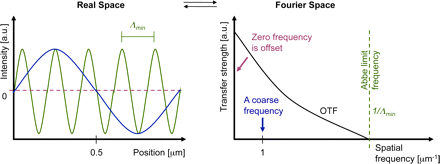
from the zero points in the valleys (Figure 3a). These effects add higher order
spatial frequencies to the excitation pattern. Mixing this excitation pattern with
the high-frequency spatial features in the sample can effectively bring the sub-diffraction-limit spatial features into the detection range of the microscopy
(Figure 3b).

Figure 3

The principle of SSIM. (a) The generation of the illumination pattern. A
diffractive grating in the excitation path splits the light into two beams. Their interference after emerging from the objective and reaching the sample creates
a sinusoidal illumination

SSIM

SSIM

Although the image of a single fluorophore, which resembles the PSF, is a
finite-sized spot, the precision of determining the fluorophores position from
its image can be much higher than the diffraction limit, as long as the image
results from multiple photons emitted from the fluorophore. Fitting an image
consisting of N photons can be viewed as N measurements of the fluorophore position, each with an uncertainty determined by the PSF (8), thus leading to
a localization precision approximated by:

Δloc≈ΔN−−√

where Δloc is the localization precision and Δ is the size of the PSF. This
scaling of the localization precision with the photon number allows super-
resolution microscopy with a resolution not limited by the diffraction of light.

High-precision localization of bright light has reached a precision as high
as ~1 Å (33). Taking advantage of single-molecule detection and imaging
(34, 35), nanometer localization precision has been achieved for single
fluorescent molecules (36).

Using fluorescent probes that can switch between a fluorescent and a dark
state, a recent invention overcomes this barrier by separating in the time
domain the otherwise spatially overlapping fluorescent images. In this approach, molecules within a diffraction limited region can be activated at different time
points so that they can be individually imaged, localized, and subsequently deactivated (Figure 4). Massively parallel localization is achieved through
wide-field imaging, so that the coordinates of many fluorophores can be
mapped and a super-resolution images subsequently reconstructed. This
concept has been independently conceived and implemented by three labs,
and it was given the names STORM (5), PALM (6), and FPALM (7), respectively.

Iterating the activation and imaging process allows the locations of many
fluorophores to be mapped and a super-resolution image to be constructed
from these fluorophore locations. In the following, we refer to this approach
as super-resolution microscopy by single-molecule localization.

Figure 4

The principle of stochastic optical reconstruction microscopy (STORM), photoactivated localization microscopy (PALM), and fluorescence photo-
activation localization microscopy (FPALM). Different fluorescent probes
marking the sample structure are activated.

STORM

STORM

After capturing the images with a digital camera, the point-spread functions
of the individual molecules are localized with high precision based on the
photon output before the probes spontaneously photo-bleach or switch to
a dark state. The positions of localized molecular centers are indicated with
black crosses. The process is repeated in Figures (c) through (e) until all of
the fluorescent probes are exhausted due to photo-bleaching or because the background fluorescence becomes too high. The final super-resolution image
(Figure (f)) is constructed by plotting the measured positions of the fluorescent probes.
http://microscopyu.com/tutorials/flash/superresolution/storm/index.html

The resolution of this technique is limited by the number of photons detected
per photoactivation event, which varies from several hundred for FPs (6) to
several thousand for cyanine dyes such as Cy5 (5, 46). These numbers
theoretically allow more than an order of magnitude improvement in spatial
resolution according to the √N scaling rule. In practice, a lateral resolution
of ~20 nm has been established experimentally using the photoswitchable
cyanine dyes (5, 46). Super-resolution images of biological samples have
been reported with directly labeled DNA structures and immunostained DNA-
protein complexes in vitro (5) as well as with FPtagged or immunostained
cellular structures (6, 44, 46).

Table 1   Photoswitchable fluorophores used in super resolution
fluorescence microscopy

Photoswitchable fluorophores

Photoswitchable fluorophores

Recent advances in super-resolution fluorescence microscopy
(including the capability for 3D, multicolor, live-cell imaging) enable
new applications in biological samples. These technical advances
were made possible through the development of both imaging optics
and fluorescent probes.

  • 3D imaging using the single-molecule localization approach
  • 3D imaging using the patterned excitation approach
  • Multicolor imaging
  • Multicolor imaging using the patterned excitation approach
  • Multicolor imaging using the single-molecule localization approach
  • Live cell imaging

Fluorescence imaging of a live cell has two requirements: specific labeling
of the cell and a time resolution that is high enough to record relevant
dynamics in the cell.  Many fluorescent proteins and organic dyes, including
cyanine dyes (46) and caged dyes, have been shown switchable in live cells.

Because STED has a much smaller PSF than scanning confocal microscopy,
STED would inherently take more time to scan though the same size of image
field. By increasing the scanning speed and limiting the field of view to a few µm, Westphal and coworkers have observed Brownian motion of a dense suspension
of nanoparticles with an impressive rate of 80 frames per second (fps) using
STED microscopy (63). More recently, they have demonstrated video-rate
(28 fps) imaging of live hippocampal neurons and observed the movement of individual synaptic vesicles with 60–80-nm resolution (64).

Sub-diffraction-limit imaging of focal adhesion proteins in live cells has recently
been demonstrated (65). Photoswitchable fluorescent protein, EosFP, was used
to label the focal adhesion protein paxillin. A time resolution of ~25–60 seconds
per frame was obtained, and during this time interval, approximately 103
fluorophores were activated and localized per square micrometer, providing
an effective resolution of 60–70 nm by the Nyquist criterion (65). More recently, super-resolution imaging has also been demonstrated in live bacteria with photoswitchable enhanced yellow fluorescent protein (EYFP), allowing the
MreB structure in the cell to be traced (66).

The optical resolution

Optical resolution is the intrinsic ability of a given method to resolve a structure
and can be defined as the ability to distinguish two point sources in proximity.
For the patterned excitation approaches, such as STED, SSIM, and RESOLFT,
the optical resolution is represented by the size of the effective PSF. For the
single-molecule localization approach, such as STORM/PALM/FPALM, the
precision of determining the positions of individual fluorescent probes is the
principal measure of optical resolution.

By using a spatially patterned excitation profile, this approach achieves super resolution by generating an effective excitation volume with dimensions far
below the diffraction limit. Taking STED as an example, the sharpness of the
PSF results from the saturation of depletion of excited-state fluorophores in
the region neighboring the zero point of the STED laser (which coincide with
the focal point of the excitation laser). With an increasing STED laser power,
the saturated region expands toward the zero point, but fluorophores at the
zero point are not affected by the STED laser if the zero point is strictly kept
at zero intensity. Therefore, a theoretically unlimited gain in spatial resolution
may be achieved if the zero point in the depletion pattern is ideal.

The single-molecule localization approach achieves super resolution through
high precision localization of individual fluorophores. The number of photons
collected from a fluorophore is a principal factor limiting the localization
precision and hence the resolution of the final image.

Several photoswitchable fluorophores have been reported to give thousands
of photons detected per activation event [e.g., 6000 from Cy5 (46)].With the
PSF fitting procedure and the mechanical stability of the system optimized,
the background signal suppressed, and the nonuniformity of camera pixels
corrected, optical resolution of just a few nanometers could potentially be
achieved, reaching the molecular scale. As in the case of the patterned
excitation approach, the optical resolution here is also unlimited, in principle,
given a sufficient number of photons detected from the fluorescent probes.

Part III. A guide to super-resolution fluorescence microscopy

L Schermelleh1, R Heintzmann2,3,4, and H Leonhardt1
JCB Jul 19, 2010 // 190(2): 165-175
The Rockefeller University Press,
http://dx.doi.org:/10.1083/jcb.201002018

Based on experimental evidence and basic principles of physics, Ernst Abbe
and Lord Rayleigh defined and formulated this diffraction-limited resolution in
the late 19th century (Abbe, 1873; Rayleigh, 1896). Later key innovations—including fluorescence and confocal laser scanning microscopy (CLSM)—made optical microscopy one of the most powerful and versatile diagnostic
tools in modern cell biology.

The optical resolution defines the physical limit of the smallest structure it
can resolve. When imaging a biological sample, the effective resolution is
also affected by several sample-specific factors, including the labeling density,
probe size, and how well the ultrastructures are preserved during sample
preparation.

The diffraction (Abbe) limit of detection

Resolution is often defined as the largest distance at which the image of
two point-like objects seems to amalgamate. Thus, most resolution criteria
(Rayleigh limit,Sparrow limit, full width at half maximum of the PSF) directly
relate to properties of the PSF. These are useful resolution criteria for visible
observation of specimen, but there are several shortcomings of such a definition
of resolution: (1) Knowing that the image is an image of two particles, these
can in fact be discriminated with the help of a computer down to arbitrary
smaller distances. Determining the positions of two adjacent particles thus
becomes a question of experimental precision and most notably photon statistics
rather than being described by the Rayleigh limit. (2) These limits do not
necessarily correspond well to what level of detail can be seen in images or
real world objects; e.g., the Rayleigh limit is defined as the distance from the
center to the first minimum of the point spread function, which can be made
arbitrarily small with the help of ordinary linear optics (e.g., Toraldo-filters),
albeit at the expense of the side lobes becoming much higher than the central
maximum. (3)

Abbe’s formulation of a resolution limit avoids all of the above shortcomings
at the expense of a less direct interpretation. The process of imaging can be
described by a convolution operation. With the help of a Fourier transformation,
every object (whether periodic or not) can uniquely be described as a sum of
sinusoidal curves with different spatial frequencies (where higher frequencies
represent fine object details and lower frequencies represent coarse details).
The rather complex process of convolution can be greatly simplified by looking
at the equivalent operation in Fourier space: The Fourier-transformed object
just needs to be multiplied with the
Fourier-transformed PSF to yield the Fourier-transformed ideal image (without
the noise). Because the Fourier-transformed PSF now describes how well each
spatial frequency of the Fourier-transformed object gets transferred to appear in the
image, this Fourier-transformed PSF is called the optical transfer function, OTF
(right panel). Its strength at each spatial frequency (e.g., measured in oscillations
per meter) conveniently describes the contrast that a sinusoidal object would
achieve in an image.

Abbe limit

Abbe limit

Interestingly, the detection OTF of a microscope has a fixed frequency
border (Abbe limit frequency, right panel). The maximum-to-maximum
distance Λmin of the corresponding sine curve is commonly referred to
as Abbe’s limit (left panel). In other words: The Abbe limit is the smallest
periodicity in a structure, which can be discriminated in its image. As a
point object contains all spatial frequencies, this Abbe limit sine curve
needs to also be present in the PSF. A standard wide-field microscope
creates an image of a point object (e.g., an emitting molecule) by capturing
the light from that molecule at various places of the objective lens, and
processing it with further lenses to then interfere at the image plane.
Conveniently due to the reciprocity principle in optics, the Abbe limit Λmin
along an in-plane direction in fluorescence imaging corresponds to the
maximum-to-maximum distance of the intensity structure one would get by
interfering two waves at extreme angles captured by the objective lens:
where λ/n is the wavelength of light in the medium of refractive index n.
The term NA = n sin(α) conveniently combines the half opening angle α
of the objective and the refractive index n of the embedding medium.

Abbe’s famous resolution limit is so attractive because it simply depends
on the maximal relative angle between different waves leaving the
object and being captured by the objective lens to be sent to the image.
It describes the smallest level of detail that can possibly be imaged with
this PSF “brush”. No periodic object detail smaller than this shortest
wavelength can possibly be transferred to the image.

Confocal laser scanning microscopy employs a redesigned optical
path and specialized hardware. A tightly focused spot of laser light is
used to scan the sample and a small aperture (or pinhole) in the
confocal image plane of the light path allows only light originating
from the nominal focus to pass (Cremer and Cremer, 1978; Sheppard
and Wilson, 1981
; Brakenhoff et al., 1985). The emitted light is
detected by a photomultiplier tube (PMT) or an avalanche photodiode
(APD) and the image is then constructed by mapping the detected
light in dependence of the position of the scanning spot. CLSM can
achieve a better resolution than wide-field fluorescence microscopy
but, to obtain a significant practical advantage, the pinhole needs to
be closed to an extent where most of the light is discarded
(Heintzmann et al., 2003).

Wide-field deconvolution and CLSM have long been the gold standards
in optical bioimaging, but we are now witnessing a revolution in light
microscopy that will fundamentally expand our perception of the cell.
Recently, several new technologies,collectively termed super-resolution
microscopy or nanoscopy, have been developed that break or bypass
the classical diffraction limit and shift the optical resolution down to
macromolecular or even molecular levels (Table I).

Super-resolution light microscopy methods

super resolution microscopy

super resolution microscopy

http://zeiss-campus.magnet.fsu.edu/articles/superresolution/introduction.html

Conceptually, one can discern near-field from far-field methods and
whether the subdiffraction resolution is based on a linear or nonlinear
response of the sample to its locally illuminating (exciting or depleting) irradiance. The required nonlinearity is currently achieved by using reversible saturable optical fluorescence transitions (RESOLFT) between molecular states (Hofmann et al., 2005; Hell, 2007).

Besides these saturable optical fluorescence transitions also other
approaches, e.g., Rabi oscillations, could be used to generate the
required nonlinear response.

Note that each of the novel imaging modes has its individual signal-
to-noise consideration depending on various factors.  A full
discussion of this issue is beyond the scope of this review, but as a
general rule, single-point scanning systems, albeit fundamentally limited
in speed by fluorescence saturation effects, can have better signal-
to-noise performance for thicker samples.

With three-dimensional SIM (3D-SIM), an additional twofold increase
in the axial resolution can be achieved by generating an excitation
light modulation along the z-axis using three-beam interference
(Gustafsson et al., 2008; Schermelleh et al.,2008) and processing a
z-stack of images accordingly. Thus, with 3D-SIM an approximately eightfold smaller volume can be resolved in comparison to conventional microscopy (Fig. 2). To computationally reconstruct a three-dimensional dataset of a typical mammalian cell of 8-µm height with a
z-spacing of 125 nm, roughly 1,000 raw images (512 × 512 pixels) are
recorded. Because no special photophysics is needed, virtually all modern fluorescent labels can be used provided they are sufficiently photostable
to accommodate the additional exposure cycles.

Resolvable volumes obtained with current commercial super-resolution microscopes.

A schematic 3D representation of focal volumes is shown for the indicated
emission maxima. The approximate lateral (x,y) and axial (z) resolution
and resolvable volumes are listed. Note that STED/CW-STED and 3D-SIM
can reach up to 20 µm into the sample, whereas PALM/STORM is usually
confined to the evanescent wave field near the sample bottom. It should be
noted that deconvolution approaches can further improve STED resolution.
For comparison the “focal volume” for PALM/STORM was estimated based
on the localization precision in combination with the z-range of TIRF.

Resolvable volumes obtained

Resolvable volumes obtained

Super-resolution microscopy of biological samples.

(A) Conventional wide-field image (left) and 3D-SIM image of a mouse
C2C12 prometaphase cell stained with primary antibodies against
lamin B and tubulin, and secondary antibodies conjugated to Alexa 488
(green) and Alexa 594 (red), respectively. Nuclear chromatin was stained
with DAPI (blue). 3D image stacks were acquired with a DeltaVision OMX
prototype system (Applied Precision). The bottom panel shows the
respective orthogonal cross sections. (B) HeLa cell stained with primary
antibodies against the nuclear pore complex protein Nup153 and
secondary antibodies conjugated with ATTO647N. The image was
acquired with a TCS STED confocal microscope (Leica). (C) TdEosFP-
paxillin expressed in a Hep G2 cell to label adhesion complexes at
the lower surface. The image was acquired on an ELYRA P.1
prototype system (Carl Zeiss, Inc.) using TIRF illumination. Single
molecule positional information was projected from 10,000 frames
recorded at 30 frames per second. On the left, signals were summed
up to generate a TIRF image with conventional wide-field lateral
resolution. Bars: 5 µm (insets, 0.5 µm).

biological images

biological images

APPLICATIONS IN BIOLOGICAL SYSTEMS

The cytoskeleton of mammalian cells, especially microtubules
(Figure 5a) (29, 44, 46, 52), is the most commonly used benchmark
structure for super-resolution imaging. Other cytoskeletal structures
imaged so far include actin filaments in the lamellipodium (6),
keratin intermediate filaments (59), neurofilaments (26, 83) and
MreB in Caulobacter (66).

Figure 5

cytoskeleton. f5.

cytoskeleton. f5.

Examples of super-resolution images of biological samples.
(a) Two-color STORM imaging of immunostained microtubule (green)
and clathrin-coated pits (red) (From Reference 46. Reprinted with
permission from AAAS).

Organelles, such as the endoplasmic reticulum (27), lysosome (6),
endocytic and exocytic vesicles (46, 52, 64), and mitochondria
(6, 53, 56), have also been imaged. For example, using the single-molecule localization approach, 3D STORM imaging has clearly
resolved the ~150-nm diameter, hemispherical cage shape of clathrin-coated pits (46, 52), which only appear as diffraction-limited spots
without any feature in conventional fluorescence microscopy (Figure 5a,b).
Two-color 3D STED has resolved the hollow shape of the mitochondrial
outer membrane (marked by the translocase protein Tom20), enclosing
a matrix protein Hsp60 (56), even though the diameter of mitochondria is
only about 300–500 nm (Figure 5c). The outer membrane structure of
mitochondria and their interactions with microtubules have been resolved
by two-color 3D STORM (53). The transport of synaptic vesicles
has been recorded at video rate using 2D STED (Figure 5d ) (64).

Many plasma membrane proteins or membrane associated protein
complexes have also been studied by super-resolution fluorescence
microscopy. For example, synaptotagmin clusters after exocytosis in
primary cultured hippocampal neurons (84), the donut-shaped
clusters of Drosophila protein Bruchpilot at the neuromuscular
synaptic active zone (85), and the size distribution of syntaxin clusters
have all been imaged (86, 87). Photoactivation has enabled the tracking
of the influenza protein hemagglutinin and the retroviral protein Gag in
live cells, revealing the membrane microdomains (67) and the spatial
heterogeneity of membrane diffusion (68). The morphology and transport
of the focal adhension complex has also been observed using live-cell
PALM (Figure 5e) (65).

Summary points

  1. Super resolution fluorescence microscopy with a spatial resolution not limited by the diffraction of
    light has been implemented using saturated depletion/excitation or single-molecule localization
    of switchable fluorophores.
  2. Three-dimensional imaging with an optical resolution as high as ~20 nm in the lateral direction
    and 40–50 nm in axial dimension has been achieved.
  3. The resolution of these super-resolution fluorescence microscopy techniques can in principle
    reach molecular scale.
  4. In practice, the resolution of the images are not only limited by the intrinsic optical resolution,
    but also by sample specific factors including the labeling density, probe size and sample preservation.
  5. Multicolor super resolution imaging has been implemented, allowing colocalization measurements
    to be performed at nanometer scale resolution and molecular interaction to be more précisely
    identified in cells.
  6. Super-resolution fluorescence imaging allows dynamic processes to be investigated at the tens of
    nanometer resolution in living cells.
  7. Many cellular structures have been imaged at sub-diffraction-limit resolution.

Future issues

  1. Achieving molecular scale resolution (a few nanometers or less).
  2. Fast super resolution imaging of a large view field by multi-point scanning or high-speed single-molecule switching/localization.
  3. Developing new fluorescent probes that are brighter, more photostable and switchable fluorophores
    that have high on-off contrast and fast switching rate.
  4. Developing fluorescent labeling methods that can stain the target with small molecules at high specificity,
    high density and good ultrastructure preservation.
  5. Application of super resolution microscopy to provide novel biological insights

Acronyms

FP

Fluorescent Protein

FPALM

Fluorescence PhotoActivation Localization Microscopy

I5M

Combination of I2M (Illumination Interference Microscopy) and I3M
(Incoherent Imaging Interference Microscopy)

PALM

PhotoActivated Localization Microscopy

PSF

Point Spread Function

RESOLFT

REversible Saturable Optically Linear Fluorescence Transition

SIM

Structured Illumination Microscopy

SSIM

Saturated Structured Illumination Microscopy

STED

STimulated Emission Depletion

STORM

STochastic Optical Reconstruction Microscopy

glossary

Numerical aperture (NA)

The numerical aperture of an objective characterizes the solid angle
of light collected from a point light source at the focus of the objective.

Stimulated emission

The process that an excited state molecule or atom jumps to the
ground state by emitting another photon that is identical to the incoming
photon. It is the basis of laser.

Fluorescence saturation

At high excitation intensity, the fluorescence lifetime instead of the excitation
rate becomes the rate limiting step of fluorescence emission, causing the
fluorescence signal not to increase proportionally with the excitation intensity.

Nyquist criterion

To determine a structure, the sampling interval needs to be no larger than
half of the feature size.

Mitochondria

Organelles in eukaryotic cells for APT generation, consisting of two
membrane (inner and outer) enclosing the inter membrane space and
the matrix inside the inner membrane.

Clathrin-coated pit

Vesicle forming machinery involved in endocytosis and intracellular
vesicle transport, consisting of clathrin coats, adapter proteins, and
other regulatory proteins.

Focal adhesion

The macromolecular complex serving as the mechanical connection
and signaling hub between a cell and the extracellular matrix or other cells.

Selected references with abstract

Near-Field Optics: Microscopy, Spectroscopy, and Surface
Modification Beyond the Diffraction Limit
Eric Betzig,  Jay K. Trautman
AT&T Bell Laboratories, Murray Hill, NJ 07974
Science 10 Jul 1992; 257(5067) pp. 189-195
http://dx.doi.org:/0.1126/science.257.5067.189

 The near-field optical interaction between a sharp probe and a sample
of interest can be exploited to image, spectroscopically probe, or modify
surfaces at a resolution (down to ∼12 nm) inaccessible by traditional far-field
techniques. Many of the attractive features of conventional optics are
retained, including noninvasiveness, reliability, and low cost. In addition, most
optical contrast mechanisms can be extended to the near-field regime,
resulting in a technique of considerable versatility. This versatility
is demonstrated by several examples, such as the imaging of nanometric-scale features in mammalian tissue sections and the creation of ultrasmall,
magneto-optic domains having implications for high density data storage.
Although the technique may find uses in many diverse fields, two of the
most exciting possibilities are localized optical spectroscopy of semiconductors
and the fluorescence imaging of living cells.

Imaging Intracellular Fluorescent Proteins at Nanometer Resolution

 E Betzig1,2,*,†, GH. Patterson3, R Sougrat3, O.W Lindwasser3,
S Olenych4, JS. Bonifacino3, MW. Davidson4, JL Schwartz3, HF. Hess5,*  1 Howard Hughes Medical Institute, Janelia Farm Research Campus,
Ashburn, VA   2 New Millennium Research, LLC, Okemos, MI.   3 Cell Biology and Metabolism Branch, National Institute of Child Health
and Human Development (NICHD), Bethesda, MD.  4 National High
Magnetic Field Laboratory, Florida State University, Tallahassee, FL.
5 NuQuest Research, LLC, La Jolla, CA.
Science 15 Sep 2006; 313(5793): pp. 1642-1645
http://dx.doi.org:/10.1126/science.1127344

We introduce a method for optically imaging intracellular proteins at
nanometer spatial resolution. Numerous sparse subsets of photo-activatable fluorescent protein molecules were activated, localized
(to ∼2 to 25 nanometers), and then bleached. The
aggregate position information from all subsets was then assembled
into a super-resolution image. We used this method—termed photo-
activated localization microscopy to image specific target proteins
in thin sections of lysosomes and mitochondria; in fixed whole cells,
we imaged vinculin at focal adhesions, actin within a lamellipodium,
and the distribution of the retroviral protein Gag at the plasma
membrane.

Toward fluorescence nanoscopy.

Hell SW.   Author information 
Nat Biotechnol. 2003 Nov; 21(11):1347-55.
http://www.ncbi.nlm.nih.gov/pubmed/14595362

For more than a century, the resolution of focusing light microscopy
has been limited by diffraction to 180 nm in the focal plane and to
500 nm along the optic axis. Recently, microscopes have been
reported that provide three- to seven-fold improved axial
resolution in live cells. Moreover, a family of concepts has emerged
that overcomes the diffraction barrier altogether. Its first exponent,
stimulated emission depletion microscopy, has so far displayed a
resolution down to 28 nm. Relying on saturated optical transitions,
these concepts are limited only by the attainable saturation level.
As strong saturation should be feasible at low light intensities,
nanoscale imaging with focused light may be closer than ever.
PMID: 14595362

Far-field optical nanoscopy.

Hell SW.  Author information 
Science. 2007 May 25;316(5828):1153-8.
http://www.ncbi.nlm.nih.gov/pubmed/17525330

In 1873, Ernst Abbe discovered what was to become a well-known
paradigm: the inability of a lens-based optical microscope to
discern details that are closer together than half of the wavelength
for its most popular imaging mode, fluorescence microscopy, the
diffraction barrier is crumbling. Here, I discuss the physical concepts
that have pushed fluorescence microscopy to the nanoscale, once
the prerogative of electron and scanning probe microscopes. Initial
applications indicate that emergent far-field optical nanoscopy will
have a strong impact in the life sciences and in other areas benefiting
from nanoscale visualization.
PMID:  17525330

Imaging intracellular fluorescent proteins at nanometer resolution.

Betzig E1, Patterson GH, Sougrat R, Lindwasser OW, Olenych S,
Bonifacino JS, Davidson MW, Lippincott-Schwartz J, Hess HF.
Author information
Science. 2006 Sep 15;313(5793):1642-5. Epub 2006 Aug 10
http://www.ncbi.nlm.nih.gov/pubmed/16902090

We introduce a method for optically imaging intracellular proteins at
nanometer spatial resolution. Numerous sparse subsets of photo-ctivatable fluorescent protein molecules were activated, localized
(to approximately 2 to 25 nanometers), and then bleached. The
aggregate position information from all subsets was then assembled
into a super-resolution image. We used this method–termed photo-activated localization microscopy–to image specific target proteins in
thin sections of lysosomes and mitochondria; in fixed whole cells,
we imaged vinculin at focal adhesions, actin within a lamellipodium,
and the distribution of the retroviral protein Gag at the plasma
membrane.

Comment in

  • The limits of light.[Nat Rev Mol Cell Biol. 2010]

PMID:  16902090  [PubMed – indexed for MEDLINE]

Illuminating single molecules in condensed matter.

Moerner WE1, Orrit M.  Author information 
Science. 1999 Mar 12;283(5408):1670-6.
http://www.ncbi.nlm.nih.gov/pubmed/10073924

Efficient collection and detection of fluorescence coupled with careful
minimization of background from impurities and Raman scattering
now enable routine optical microscopy and study of single molecules
in complex condensed matter environments. This ultimate method
for unraveling ensemble averages leads to the observation of
new effects and to direct measurements of stochastic fluctuations.
Experiments at cryogenic temperatures open new directions in
molecular spectroscopy, quantum optics, and solid-state dynamics.
Room-emperature investigations apply several techniques
(polarization microscopy, single-molecule imaging, emission time
dependence, energy transfer, lifetime studies, and the like) to a
growing array of biophysical problems where new insight may be
gained from direct observations of hidden static and dynamic
inhomogeneity.  PMID: 10073924

Fluorescence microscopy with super-resolved optical sections.

Egner A1, Hell SW.  Author information 
Trends Cell Biol. 2005 Apr;15(4):207-15.
http://www.ncbi.nlm.nih.gov/pubmed/15817377

The fluorescence microscope, especially its confocal variant, has
become a standard tool in cell biology research for delivering
3D-images of intact cells. However, the resolution of any standard
optical microscope is atleast 3 times poorer along the axis of the
lens that in its focal plane. Here, we review principles and applications
of an emerging family of fluorescence microscopes, such as 4Pi
microscopes, which improve axial resolution by a factor of seven by
employing two opposing lenses. Noninvasive axial sections of 80-160 nm
thickness deliver more faithful 3D-images of subcellular features,
providing a new opportunity to significantly enhance our understanding
of cellular structure and function. PMID: 15817377

4Pi-confocal microscopy provides three-dimensional images of the
microtubule network with 100- to 150-nm resolution.

Nagorni M1, Hell SW.  Author information 
J Struct Biol. 1998 Nov;123(3):236-47.

We show the applicability of 4Pi-confocal microscopy to three-dimensional imaging of the microtubule network in a fixed mouse
fibroblast cell.Comparison with two-photon confocal resolution
reveals a fourfold better axial resolution in the 4Pi-confocal case.
By combining 4Pi-confocal microscopy with Richardson-Lucy
image restoration a further resolution increase is achieved.
Featuring a three-dimensional resolution in the range 100-150 nm,
the 4Pi-confocal (restored) images are intrinsically more detailed
than their confocal counterparts. Our images constitute what
to our knowledge are the best-resolved three-dimensional
images of entangled cellular microtubules obtained with light
to date.  PMID: 9878578

Part IV. Super-resolution microscopy

Super-resolution microscopy is a form of light microscopy. Due
to the diffraction of light, the resolution of conventional light
microscopy is limited as stated by Ernst Abbe in 1873.[1]
A good approximation of the resolution attainable is the full
width at half maximum 
 (FWHM) of the point spread function,
and a precise wide-field microscope with high numerical
aperture
 and visible light usually reaches a resolution of ~250 nm.

Super-resolution techniques allow the capture of images with
a higher resolution than the diffraction limit. They fall into
two broad categories,
“true” super-resolution techniques, which capture information
contained in evanescent waves, and “functional” super-
resolution techniques, which use clever experimental
techniques and known limitations on the matter being
imaged to reconstruct a super-resolution image.[2]

True subwavelength imaging techniques include those that
utilize the Pendry Superlens and near field scanning optical
microscopy
, the 4Pi Microscope and structured illumination
microscopy technologies like SIM and SMI. However, the
majority of techniques of importance in biological imaging
fall into the functional category.

Groups of methods for functional super-resolution microscopy:

  1. Deterministic super-resolution: The most commonly used emitters in biological
    microscopy, fluorophores, show a nonlinear response to excitation, and this
    nonlinear response can be exploited to enhance resolution. These
    methods include STED, GSD, RESOLFTand SSIM.
  2. Stochastic super-resolution: The chemical complexity of many molecular
    light sources gives them a complex temporal behaviour, which can be used
    to make several close-by fluorophores emit light at separate times and
    thereby become resolvable in time.  These methods include SOFI and all
    single-molecule localization methods (SMLM) such as SPDM,
    SPDMphymod, PALM, FPALM, STORM and dSTORM.

Part V. HIV-1

Conformational dynamics of single HIV-1 envelope
trimers on the surface of native virions

James B. Munro1,*,‡, Jason Gorman2, Xiaochu Ma1,
Zhou Zhou3, James Arthos4,
Dennis R. Burton5,6, et al.
1Department of Microbial Pathogenesis, Yale University
School of Medicine, New Haven, CT. 2Vaccine Research
Center, National Institute of Allergy and Infectious
Diseases, National Institutes of Health, Bethesda, MD .
3Department of Physiology and Biophysics, Weill
Cornell Medical College of Cornell University, New York, NY .
4Laboratory of Immunoregulation, National Institute of Allergy
and Infectious Diseases, National Institutes of Health, Bethesda,
MD . 5Department of Immunology and Microbial Science, and
IAVI Neutralizing Antibody Center, The Scripps Research
Institute, La Jolla, CA . 6Ragon Institute of MGH, MIT, and
Harvard, Cambridge, MA. 7International AIDS Vaccine Initiative
(IAVI), New York, NY . 8Department of
Chemistry, University of Pennsylvania, Philadelphia, PA.

The HIV-1 envelope (Env) mediates viral entry into host cells.
To enable the direct imaging of conformational dynamics
within Env we introduced fluorophores into variable
regions of the gp120 subunit and measured single-molecule
fluorescence resonance energy transfer (smFRET) within
the context of native trimers on the surface of HIV-1 virions.
Our observations revealed unliganded HIV-1 Env to be
intrinsically dynamic, transitioning between three distinct
pre-fusion conformations, whose relative occupancies
were remodeled by receptor CD4 and antibody binding.
The distinct properties of neutralization-sensitive and
neutralization-resistant HIV-1 isolates support a dynamics-based mechanism of immune evasion and ligand recognition.

Share this:

  • Share on X (Opens in new window) X
  • Share on LinkedIn (Opens in new window) LinkedIn
  • Share on Facebook (Opens in new window) Facebook
  • Print (Opens in new window) Print
  • Email a link to a friend (Opens in new window) Email

Like this:

Like Loading…

Read Full Post »

14:00PM – 10/1/2014: Conference Workshop “Conundrums and Conflicts in Licensing & M&A Deals” @14th Global Partnering & Biotech Investment, Congress Center Basel – SACHS Associates, London

Posted in Conference Coverage with Social Media, Global Partnering & Biotech Investment, Scientific & Biotech Conferences: Press Coverage, tagged Conference Coverage with Social Media, Global Partnering & Biotech Investment, Scientific & Biotech Conferences: Press Coverage on October 1, 2014| Leave a Comment »

14:00PM – 10/1/2014: Conference Workshop “Conundrums and Conflicts in Licensing & M&A Deals” @14th Global Partnering & Biotech Investment, Congress Center Basel – SACHS Associates, London

Reporter: Aviva Lev-Ari, PhD, RN


Real Time Media Conference Coverage  –  Business and Scientific Channels by: https://pharmaceuticalintelligence.com

14:00PM  “Conundrums and Conflicts in Licensing & M&A Deals” – An interactive workshop considering ethical dilemmas and challenges in biopharmaceutical deal making

Workshop facilitators: 

  • Nigel Borshell, VP,
  • Fintan Walton, Chief Executive, PharmaVentures Ltd

Four groups of three executive are participating at the Workshop on M&A, One member will act as CEO and present the Scenario and the solution

Five different M&A Scenarios will be presented

  • TRANSPARENCY – trust
  • M&A – Consultancy agreement was rejected
  • Licensing a Medical Device permanently in-dwelling – Lifetime revenue per patient $600,000 – licensor proposes cut in royalties and fees for service
  • Licensee is locked in a crippling 40% on royalties

Case #1:

TRANSPARENCY – trust

M&A – Consultancy agreement was rejected

Licensing a Medical Device permanently in-dwelling – Lifetime revenue per patient $600,000 – licensor proposes cut in royalties and fees for service – Two parties need to solve

Licensee is locked in a crippling 40% on royalties – Royalties to be renegotiated

Gross sales – not the value added TAX, TAXES ASSESSED ON INCOME DERIVED FROM SALES – AGREEMENT OVER A PERIOD OF TIME TO BE ACHIEVED

Case #2:

TRANSPARENCY – a case of financial exhaustion of funding, transparency is very important

M&A – continue negotiation to pay less

Licensing a Medical Device permanently in-dwelling – Lifetime revenue per patient $600,000 – licensor proposes cut in royalties and fees for service – who own the device? sharing is the solution

Licensee is locked in a crippling 40% on royalties – Incentive for 40% is basis to secure debt

Gross sales – not the value added TAX, TAXES ASSESSED ON INCOME DERIVED FROM SALES – TRANSPARENCY NEEDED

Case #3:

Partnership consideration

M&A – continue with 5% minority shareholder, do accept the consultancy

Licensing a Medical Device permanently in-dwelling – Lifetime revenue per patient $600,000 – licensor proposes cut in royalties and fees for service – if a contract in place on device use — is their a monopoly?

Licensee is locked in a crippling 40% on royalties – Licensee, Board and Originator – try to advance the state to Phase III

Gross sales – not the value added TAX, TAXES ASSESSED ON INCOME DERIVED FROM SALES – CONSISTENCY with business practices – change agreement

Case #4:

not an easy answer, continue with the second proposition of increasing the investment to $50Million

Licensing a Medical Device permanently in-dwelling – Lifetime revenue per patient $600,000 – licensor proposes cut in royalties and fees for service – contractual obligation, while one party request change – split the gap, giant Pharma should not change contract

Licensee is locked in a crippling 40% on royalties – negotiate with originator, fall back position to be sought – option deal

obtained

Gross sales – not the value added TAX, TAXES ASSESSED ON INCOME DERIVED FROM SALES – New agreement to increase royalties

Moderator: was it a mistake  – NOT TO TAKE VAT WHEN 99% OF CONTRACTS REQUIRES VAT, no pay of royalties of VAT

time limit beyond 2 years in royalties

#startup#biotech#venturecapital

#mergers

#bioethics

#pharmanews

@SachsAssociates@pharma_BI@BiotechNews

Share this:

  • Share on X (Opens in new window) X
  • Share on LinkedIn (Opens in new window) LinkedIn
  • Share on Facebook (Opens in new window) Facebook
  • Print (Opens in new window) Print
  • Email a link to a friend (Opens in new window) Email

Like this:

Like Loading…

Read Full Post »

12:30 – 10/1/2014: Company Presentations @14th Global Partnering & Biotech Investment, Congress Center Basel – SACHS Associates, London

Posted in Conference Coverage with Social Media, Global Partnering & Biotech Investment, Scientific & Biotech Conferences: Press Coverage, tagged Conference Coverage with Social Media, Global Partnering & Biotech Investment, Scientific & Biotech Conferences: Press Coverage on October 1, 2014| Leave a Comment »

12:30AM – 10/1/2014: Company Presentations @14th Global Partnering & Biotech Investment, Congress Center Basel – SACHS Associates, London

Reporter: Aviva Lev-Ari, PhD, RN


Real Time Media Conference Coverage  –  Business and Scientific Channels by:

https://pharmaceuticalintelligence.com

Early Stage Investment

  • Hakan Goker, Director MS Ventures

– Participation of Corporate creation: 48% of new corp creation in Europe is via VCs

– early stage investment – Entrepreneur

– Serial Investors – what is the valuation process

– large institutions – where are the good fits, challenges in early stage funding?

– early stage involve understanding very complicated Science, acquisition in Pharma – Mechanism effect on Disease in the  past

– in the present public pressure on big Pharma in a therapeutics area – leverage focused R&D via a lower cost investment is done externally

– cash is available

– Pharma Ventures invest NOT in what VCs invests

– BIOTECH is the faster and cheaper pharma

– If financial are sufficient is taking additional external financing smart to do? – Mix sources of finance — are not successful since the 2009. On the venture side it did not apply.

– In Europe companies do get valuation like in the US sometime

  • David Sabow: Head of Life Sciences, Silicon Valley Bank

– trend in Europe

– Super Angels

– Venture Debt – is never welcomed, what are the drivers a reaction to later stage pipeline, or R&D

– Capital is available – concerns: Competitive insight

– increasing value is the name of the game any method works, mix financing source is included

Panelists:

  • Bernd Goergen

– Life sciences engage Super Angels, trend declined corporate

– comparison in financing Europe vs US/UK on information asymmetry

– VCs feel better if a corporate investor is involved

– without European investor hard to get US money

  • Frank Kalkbrenner

– Boston, SF easier to get Early stage investment

– Europe, mainland – Corporate venture funds are active in Netherlands and Germany

– Venture arms of Pharma involved in early stage

– UK and Boston fund are very LOCAL in proximity, no investment is more than 100 miles away

– no shortage of opportunities in Europe, some investments overseas, In UK, In US — so missing in Germany – less experience in commercial negotiation with Universities, Scientific base, Money, People – success requires Professional management — is not abundant in Europe vs UK, US – different cunture in Europe, CEO who failed in Europe is doom, in the US is hard

– 100% of all products and Phase IIa is from internal research, Gene therapy, cant cover internally, investing in external venture gives access to innovation not to be provided inside

– access external innovation, equity investment is one tool, Early investment to become an equity relations

– Big Pharma Venture Arm is a strategic instrument rather than an ROI strategy

– two corporate ventures, two institutional ventures

– later stage development requires ofter institutional investment

– time is money, get additional financing to get to market as soon as you can, even if you are able to finance operations

–

  • Soren Moller

– difficult market for early investment

– shareholder in Scandinavia: Private investment can be a hurdle

  • Ulf Grawunder, CEO, NBE Therapeutics, GmbH

– difficult to fund Early stage concepts

– Conventional VCs: funding by VCs are worry of the long tern to ROI – ten years on average – pay to Limited Partners

– Private VCs that reinvest in ventures may consider Early Stage

–  Seeking government grants, non diluted, Patents from Universities, Team up with Academic institution to help in value creation, for proof of concept,

– compelling data, academic collaboration, IP protection

– corporate structure need to allow all types of investments: Partners requires equity for very small investment in Switzerland – non dilutive is very important

– partnering to early on requires sharing equity to early

– Option of first refusal not a strategy

– GSK – no interference with pipeline

– Entrepreneur has concern of IP in due diligence  – internal to Pharma research input on external is important

Questions from the Audience

– asset financing vs VCs

– differential valuation

#biotech#startup

#investing

#venturecapital

#pharmanews

@SachsAssociates@pharma_BI

@BiotechNews

Share this:

  • Share on X (Opens in new window) X
  • Share on LinkedIn (Opens in new window) LinkedIn
  • Share on Facebook (Opens in new window) Facebook
  • Print (Opens in new window) Print
  • Email a link to a friend (Opens in new window) Email

Like this:

Like Loading…

Read Full Post »

11:00AM – 10/1/2014: Scientific Collaborations @14th Global Partnering & Biotech Investment, Congress Center Basel – SACHS Associates, London

Posted in Conference Coverage with Social Media, Global Partnering & Biotech Investment, Scientific & Biotech Conferences: Press Coverage, tagged Conference Coverage with Social Media, Global Partnering & Biotech Investment, Scientific & Biotech Conferences: Press Coverage on October 1, 2014| Leave a Comment »

11:00AM – 10/1/2014: Scientific Collaborations  @14th Global Partnering & Biotech Investment, Congress Center Basel – SACHS Associates, London

Reporter: Aviva Lev-Ari, PhD, RN

Real Time Media Conference Coverage  –  Business and Scientific Channels by:  https://pharmaceuticalintelligence.com

11:00AM – 10/1/2014: Scientific Collaborations

Introductory Speech by: 

  • Ora Dar, Head of Life Sciences Sector, Office of the Chief Scientist, Ministry of Economy, Israel – $70M gov. Budget

– IT is shared and used in collaboration

– Eight companies – 2 stem cells, Virtual Biopsy, Endoscopy

– 25% is from Academia rest from Industry

– Brain stimulation and Monitoring Technologies

– Synergies: with Roche; Pontifax

– collaboration announced 2009: new companies: BioVent, Quiet Therapeutics, cCAM

– Biotechnology Incubator – Government sponsored

— Advanced applied Research: Leveraging cultures of Innovations and Entrepreneurship

– Fund announced 4/2011 OrbiMed – $222M 4.5x Leverage Gov. commitment by OrbiMed

– PPPP – Public, Private, Philanthropy

Adaption to Change is critical not the smartest will survive

  • Chaired by: 

Beth Jacobs, Managing Partner, Excellentia Global Partners

– complicated approaches of Scientific Collaborations

– Building Trust is it difficult?

– Tech transfer is having a bad rap

– Pharma tried avenues for efficiencies, Scientists in BIOTECH many are from Pharma, now their inventions go back to Pharma

Panelists: 

  • Ora Dar, Head of Life Sciences Sector, Office of the Chief Scientist, Ministry of Economy, Israel – $70M gov. Budget

– all gov. funding must by in conjunction with Private investment and commercialization ideas

– small companies needs IP to raise funding. University owns and license it to investors collaborations is in place

– Weitzman institute: antibodies platform, $17Billion sales

  • Chris Maggos, Consultant, Business Development, Alpine Institute for Drug Discovery – Not for profit

– Platform development in Academia is allowing the University to maintain equity on Projects, Oversight from Pharma is important for the know how of the industrial process

– Trust will appear quickly after relationships are established

– Tech Transfer has a role to serve the Public, Europe Universities different than US Universities

  • Edwin Constable, Head of Research, Professor of Chemistry at the University of Basel and Project leader and Member of the Management Board within the SNI, University of Basel

– Universities have different  responsibilities, public who fund Universities,juggle basic research and considering Pipeline of molecules, as a University the public good is different than a compound in a big Pharma, IP of university need be protected, identify drugs, collaborate with Hospitals for Clinical Trials

– IP need belong to the University but maintaining the IP and Protecting it may not be sensible.

– Primary PI has an idealist view of the World

– Universities need a new culture of entrepreneurship, failure in Academia is dreadful, not in Industry, risk taking need augmentations in Universities

– PPPP – three partners: Philanthropy – Gov. Axis is interesting

– disappointment – the role benefit for the Patient, drug distribution need be in place

– Translational model is the only proven others are correct and incorrect at the same time

– Monetizing IP:

– Translational Industry is in transition, where is it going?

  • Florian Schoedel, MD, PhD, Owner, PhilImmune, LLC ex-Merck

– collaborations: Gov. and Biotech – start up can reach maturity. de-bridging goals, product concept in Biotech, if Gov. funding ends, no continuation of the idea pipeline

– translation of research, big Foundations, i.e., Gates Foundation, found the right way to fund research and commercialize drugs as vaccine and deploy at needy markets in underdeveloped countries

– PI needs often a change of mind, steps they do not know, Chem Engineering vs Chemistry major, i.e,

– Research dept inside Pharma changed very much, cheaper innovations from Academia and from Biotech – efficiencies are needed

  • Maina Bhaman, Director, Healthcare Ventures, Imperial Innovations – Publicly listed

– Commercialization process and collaboration requires alignment, upfront time investment

– Transfer of IP, business that develop the molecule, then too much emphasis is placed on early IP

– Agrees, trust building is not easy

–

  • Prem Das, Chief Research Business Development Officer and heads DFCI’s Office of Research and Technology Ventures (ORTV), Dana-Farber Cancer Institute (DFCI)

– Bio marker driven, cost consideration

– Diagnostics in Cancer – DGCI – is in competition with Foundations in the DIagnostics

– Infrastructure to develop the chemistry platform

– Gov funded research IP is owned by the Institution not by the Gov.

– Early stage IP: non-exclusive licensing

– Trust between the investigator and the commercializing entity, change attitude of PI needed, to make it work, the Scientists who is on a Journey

– gap exists in Academic mind vs industry

– R&D centers run by Scientists, Office of Innovation go to Scientists for solutions

QUESTION fro the audience

– Failure in Drug Development, why?

#startup#science#Collaboration

#biotech

#innovation

#pharmanews

@SachsAssociates@pharma_BI@BloombergTV

@BloombergNews

@BiotechNews


Share this:

  • Share on X (Opens in new window) X
  • Share on LinkedIn (Opens in new window) LinkedIn
  • Share on Facebook (Opens in new window) Facebook
  • Print (Opens in new window) Print
  • Email a link to a friend (Opens in new window) Email

Like this:

Like Loading…

Read Full Post »

10:00AM – 10/1/2014: Partnering II @14th Global Partnering & Biotech Investment, Congress Center Basel – SACHS Associates, London

Posted in Conference Coverage with Social Media, Global Partnering & Biotech Investment, Scientific & Biotech Conferences: Press Coverage, tagged Conference Coverage with Social Media, Global Partnering & Biotech Investment, Scientific & Biotech Conferences: Press Coverage on October 1, 2014| Leave a Comment »

10:00AM – 10/1/2014: Partnering II @14th Global Partnering & Biotech Investment, Congress Center Basel – SACHS Associates, London

Reporter: Aviva Lev-Ari, PhD, RN


Real Time Media Conference Coverage  –  Business and Scientific Channels by: https://pharmaceuticalintelligence.com


Co-Chaired by: 

  • Fintan Walton, CEO and Founder, PharmaVentures

– is it more expensive to auction?

– secrative negotiation, if successful, structure deal and terms to following – dynamics with uncertainty

  • Stephanie Leousson, Principal, Torreya Partners

Panel is asked describe investment strategies

– new strategies: geographic, going public

– past: equity in IPO, at present long tern relations to offset costs, as the price will go up

10:00AM Partnering II – Deal Making: The Evolving Landscape of Deal Terms

  • Carlos de Souza, Chief Business Officer, to-BBB

– Name chance to BBB Therapeutics, based in Netherland, BRAIN products, tumors, neural degeneration and MS.

– License or go to Public market

– partner need to bring a significant value, develop product in co-development – an alternative

– what type of deals will bering the recognition of value via selection of compaounds, win-win, cooperation and keeping the product in the pipelin

– small biotech clinical compounds and some pre-clinical: Plans to go to public market, requires years of preparation per schedule

  • Corina Savill, Head BD&L Novartis Pharma AG

– trends: 7Billion in Acquisition, deals, BIOTECH high valuation in last two years, Private market has higher pricing

– Public Market Choices: acquisition by Big Pharma via IPO and then do a deal, Avista, geographic deal, win-win, Alphatech MAD,

– Auctioneering since 2006 and continue to do such deals, Israeli Gene company – Auctioneer, proportion equiyt, company reach the level that transplant and acquision will follow. Expensive technology to develop, take Equity position in the company using auctions allowing to materialize an acquisition CONDITIONED that the technology matures per plan, maturation involve continual innovation

– Aid in Dialysis had success with IPO, no auction, An osteoporosis company – decision not to pursue OP then invest took place no further integration Plans,

– Companies running Corporate investment portfolios: allowing collaboration, numeration drives to the sky,

– licensing becomes harder than in the past, due to availability of alternative avenues for investment

– Cash value is an opportunity, acquisition need to help the company investing

– In a geographic licensing it will become an acquisition target, PERIOD needed to absorb the positioning

  • Lubor Gaal, Head of Europe Search & evaluation, Business Development BMS

– VCs some are very small following 2009, Deal to buy rather than integrate with development, staging acquision vs development of start ups — NEW landscape, late payment for VCs,

– both exist – Auctions of private companies

– first decision on Science then on Financials

– licensing and relationship:  right ot compound given, the reason to acquire a company for additional value

– companies flourish NOT in the original plan they were created

  • Luca Bolliger, VP and Group Licensing Director, RECORDATI S.A.

– In the 90s activity started, at present in 19 countries, integration PrimaryCare pursued by acquisition, move from PrimaryCare to become Global, risk profile across territories

– deals are not novelties, Upfront vs Royalties — not available to all companies, if you are not first in class less opportunity pools

  •  Philippe Lopes-Fernandes, Global Business Development, Merck Serono

– Outsourcing more that fully integration, NEW landscape smart decision are a must, sell alter is different than in the past — NO one can find the next Amgen

– Europe is the focus:

  •  Stuart Kay, Director Transactions, GlaxoSmithKline

– Access a network of connections, Source from Academia, run and manage is attractive, if not acquired, access to innovation can be yet maintained,

  •  QUESTION FROM THE AUDIENCE: Auction and Tax inversion any relations?
  • no
#startup#science#partnerships#biotech

#venturecapital

#pharmanews


@SachsAssociates@pharma_BI@BiotechNews


Share this:

  • Share on X (Opens in new window) X
  • Share on LinkedIn (Opens in new window) LinkedIn
  • Share on Facebook (Opens in new window) Facebook
  • Print (Opens in new window) Print
  • Email a link to a friend (Opens in new window) Email

Like this:

Like Loading…

Read Full Post »

9:00AM 10/1/2014: Partnering I @14th Global Partnering & Biotech Investment, Congress Center Basel – SACHS Associates, London

Posted in Conference Coverage with Social Media, Global Partnering & Biotech Investment, Scientific & Biotech Conferences: Press Coverage, tagged Conference Coverage with Social Media, Global Partnering & Biotech Investment, Scientific & Biotech Conferences: Press Coverage on October 1, 2014| Leave a Comment »

9:ooAM – 10/1/2014: Partnering I @14th Global Partnering & Biotech Investment, Congress Center Basel – SACHS Associates, London

Reporter: Aviva Lev-Ari, PhD, RN


Real Time Media Conference Coverage  –  Business and Scientific Channels by: https://pharmaceuticalintelligence.com


Co-Chaired by: 


  • Fintan Walton, CEO and Founder, PharmaVentures

– Strategies and Tactics


  • Stephanie Leouzon, Principal, Torreya Partners


Panelists Partnering I: 


  • Andrew Mackie, Global External R&D, Eli Lilly and Company

– Innovations with researches, series of molecule, prescreening, if interesting found, licensing agreement, engagement on Chemistry

– technology may be too early for the company, 20% funding from fund, advice as well as advice on coumpound of interest at the company

– pathways for selection, pipeline

– Pre clinical innovation – integration of Molecule the study is done.

– process id length, negotiation takes years

  • Jason Coloma, Global Head Venture & Innovation at Roche Partnering, F. Hoffmannn La Roche

– Oncology is Prime, structural include Genetech, contributes on Research, Access a and speed, business development in therapeutics. Venture Innovation is discovering pipeline, crossroad, partnership with VC, diversify biology, VC and non investment in area unless internal capabilities are existing,

– Which approach you are more proud of: early stage innovation, BIOTECH & VC, partnerships, value from working with Academics, Story of Scientist and building the relations takes time

  • Johan Verbeeck, Senior Director Alliance Management, J&J Innovation Center, Janssen Pharmaceutical of J&J

– Diagnostics, Pharmaceutical, growth from acquisition, 54% of pipeline are from external. Access to assets among big Pharma

– SF, Shanghai, Boston,

– presence and responsiveness and why the deal is not right

– Government and internal R&D are very important, internal R&D involves making calls on new directions

– North America is different that Europe, great good science in Europe, no risk taking. In USA, Kendall Square — risk is been taken 5 start ups over night.

– Question from the Floor: Scouts in Europe working on J&J Innovations from Spain to 8 countries in Europe,

– Satellite in Israel and in Moscow

– there are institutes for Drug Discoveries – collaboration with Pharma

– 25% from Academia, 50% partnership with industry  San Diego is a Hub

– Signing deals series of approval, university has funds and Pharma provide funds

– Some scientists can’t answer questions from Pharma

  • Frank Grams, VP, Head R&D Alliance Management & Contracting, Sanofi

– Sonafi more than 300 acquisitions, different company at present, process of integration, alliance with other industry and study from other Pharma, selling the opportunity in house, all Pharmaceutical in Sanofi: Diabetes, CVD, Opthalmonogy, OTC, Generic,

– Diabetes focus with therapeutics areas,investment in early stage all spectrum, academic alliance, pipeline, external sources, highly dependent on external world

– constant improvement

– right people to delegate, scouts, lawyer, communication – How do you create links to R&D? Structure organizational to allow for buyout.

– 80 and more collaborations, agreement with Academia in the US – outocme was almost zero, at present academic alliances must fit with strategy of Sanofi, look at it as a portfolio, getting out must be an option

  • Paola Casarosa, Corp. Vice President of Therapeutic Alliances and astrategic Partnerships, Boehringer Ingelheim

– CNS, Oncology, Immunology – How the portfolio looks and How to achieve,

– Internal vs. External — not invented here — not acceptable, integration of internal and external is in implementation, Fundamental in scouting, engagement with academia, BD acts Globally Boston, CHina, Japan, Deals – early partnering is very important to reach agreement early on

– colliding new target concepts, major effort on scouting in Academia, they are interested in external relation, No IP driven compound, but idea with innovation solution, investing in opportunities allowing foot in the door as first mover advantage

– depression, circuits of Brain — innovation

– people level very important

– Alliance reporting to R&D  – growing wiht project, supporter of this integration

– Japan support of Academia and Industry at the national level

  • Tomas Landh, Director, Strategy and Innovation Sourcing, Novo Nordisk

– new perspective on Diabetes and Obesity, Retinopathie, Hemopealia, Growth Disorder, advice on early stage research, establish repationship with PI and where PI, postdocs are moving. 60% Innovations in DIabetes from the US, face to face meeting, scientific Forums

– Integration with R&D Obesity as a complication of Diabetes, gate relations, Academia sees Pharma as friend, entrepreneurship from Academia — new direction – this is the successful adoptation


#startup#science#partnerships#biotech#pharmanews#venturecapital


@SachsAssociates@pharma_BI@BiotechNews


Share this:

  • Share on X (Opens in new window) X
  • Share on LinkedIn (Opens in new window) LinkedIn
  • Share on Facebook (Opens in new window) Facebook
  • Print (Opens in new window) Print
  • Email a link to a friend (Opens in new window) Email

Like this:

Like Loading…

Read Full Post »

17:00PM – 9/30/2014: Company Presentations @14th Global Partnering & Biotech Investment, Congress Center Basel – SACHS Associates, London

Posted in Conference Coverage with Social Media, Global Partnering & Biotech Investment, Scientific & Biotech Conferences: Press Coverage, tagged Conference Coverage with Social Media, Global Partnering & Biotech Investment, Scientific & Biotech Conferences: Press Coverage on September 30, 2014| Leave a Comment »

17:00PM – 9/30/2014: Company Presentations @14th Global Partnering & Biotech Investment, Congress Center Basel – SACHS Associates, London

Reporter: Aviva Lev-Ari, PhD, RN


Real Time Media Conference Coverage  –  Business and Scientific Channels by: https://pharmaceuticalintelligence.com

Share this:

  • Share on X (Opens in new window) X
  • Share on LinkedIn (Opens in new window) LinkedIn
  • Share on Facebook (Opens in new window) Facebook
  • Print (Opens in new window) Print
  • Email a link to a friend (Opens in new window) Email

Like this:

Like Loading…

Read Full Post »

4:00PM – 9/30/2014: Platform Technologies & Novel Therapeutics @14th Global Partnering & Biotech Investment, Congress Center Basel – SACHS Associates, London

Posted in Conference Coverage with Social Media, Global Partnering & Biotech Investment, Scientific & Biotech Conferences: Press Coverage, tagged Conference Coverage with Social Media, Global Partnering & Biotech Investment, Scientific & Biotech Conferences: Press Coverage on September 30, 2014| Leave a Comment »

4:00PM – 9/30/2014: Platform Technologies & Novel Therapeutics @14th Global Partnering & Biotech Investment, Congress Center Basel – SACHS Associates, London

Reporter: Aviva Lev-Ari, PhD, RN


Real Time Media Conference Coverage  –  Business and Scientific Channels by: https://pharmaceuticalintelligence.com

3:30PM  –  Industry Leader interview by Bloomberg News

4:00PM – 9/30/2014: Platform Technologies & Novel Therapeutics

C0-Chaired by: 

  • Christina Takke, Partner, Forbion Capital Partners

– What has changed in the technology and the environment in terms of Deals?

– Bioinformatics platform used on molecule behavior

– in the US the future potential is part of the valuation, in Europe only the present value not the future potential

– diversity

– how to structure companies

  • Robin Davison, Director, Healthcare, Edison Investment Research

question to co-chair

– what impact geographic location has on decision regional, market penetration

Panelists: 

  • Doug Doerfler, President & CEO, MaxCyte, Inc.

– Application technology, managing expectation of share holders, over 15 years, product companies play both sides, now platform companies and products. balancing act

– what is the best way to go?

– expertise drives all

  • Elena Startseva, Head of Business Development, OCT

– Challenge: Therapeutics not the platform

  • David Urech, Co-CEO & CSO Numab AG

– platform

– serendipity and lucky to start, T cell activation, safety to immunotherapy product

– proof of concept for ophthalmology product, franchise

  • Oliver Middendorp, Co-CEO & CBO, Numab AG
  • Philippe Calais, CEO, Isarna Therapeutics GmbH

– Partner is Roche, advanced the pipeline, with traditional investors, decision to approach the US VC markets capture more finance

– move to ophthalmology products from oncology, better economic rewards

– moving from 1st generation drugs, via Pharma partners, investors requested additional product to secure investment

  • Tim Knotnerus, Director Business Development, AM-Pharma

– valuation of platform technology companies, is very hard.

– investors suggests alternative opportunities

– Big Pharma

  • Vikas Sharma, Director, Business Development, Rexahn Pharmaceuticals, Inc.

– Platform for drugs, feedback from the industry, license,

– product obsolescence in pharmaceutical, the real 4 is in the therapeutics not in the platform

– decision on exit, investment drives the structure

–

  • Vincent Charlon, CEO, Anergis SA

– Lausanne based company, market opportunity, allergy vaccine, completed Phase II, product in Clinical stage, commercially shift in funds.

– confident to reproduce success, not as ease as should be, challenge continues

– Swiss based, originates in Hospital, if Global entry, locality matters less

  • Daniel Elgar, CFO, Genkyotex SA

– success in one molecule does not imply success for the next. if Cystic Fibrosis was a success, next drug may not be a success.

– product assets have different characteristics, patient selection, failure of mechanism for compound to fail salvage from the clinical trial something.

–

#startup#biotech

#CancerTherapy

#pharmanews

@SachsAssociates@pharma_BI

@BloombergNews

@CancerNews

@BiotechNews

Share this:

  • Share on X (Opens in new window) X
  • Share on LinkedIn (Opens in new window) LinkedIn
  • Share on Facebook (Opens in new window) Facebook
  • Print (Opens in new window) Print
  • Email a link to a friend (Opens in new window) Email

Like this:

Like Loading…

Read Full Post »

« Newer Posts - Older Posts »

  • Follow Blog via Email

    Enter your email address to follow this blog and receive notifications of new posts by email.

    Join 2,040 other subscribers
  • Recent Posts

    • Protected: KOL on Competitive Dynamics: LPBI Group’s Founder’s Radar Screens on AI in Health, Life Sciences & BioPharma June 15, 2026
    • Tumor Infiltrating Lymphocytes (TIL) as a first of kind FDA approved immunotherapy for cancer June 12, 2026
    • A Systematic Analysis of Competitive Dynamics in the AI Revolution — Strategic Relevance to LPBI Group’s Mission – Alex Wissner-Gross Daily Newsletters by KOL (March 1 – June 10, 2026, to be extended to Present) June 11, 2026
    • In Memoriam: Professor Yitzhak Apeloig, President and Distinguised Professor of the Technion June 4, 2026
    • Top VC Investors in AI / Health AI in 2026 May 26, 2026
    • Grok thinks like PhDs – Hybrid Model for Autonomous Update of Doctoral Dissertations with Original PhD Student Author editing and acceptance of Grok’s updated output. 3rd Joint article, a pilot study for Validation of an Autonomous Journal Articles Updating System (AJAUS) tested on Autonomous Update of Aviva Lev-Ari, PhD, RN Doctoral Thesis, UC, Berkeley, 1983. January 31, 2026
    • 2026 World Economic Forum, 1/19 – 1/23/2026, Davos, Switzerland, LPBI Group’s KOLs interpretation of AI in Health Videos January 24, 2026
    • Evolving LPBI Group’s Portfolio of Intellectual Properties (IP): From 2021 Vision to 2026 Reality January 12, 2026
    • Aviva Lev-Ari, PhD, RN – Biography ->> Grokepedia Entry January 11, 2026
    • List of Articles included in the Article SELECTION from Collection of Aviva Lev-Ari, PhD, RN Scientific Articles on PULSE on LinkedIn.com for Training Small Language Models (SLMs) in Domain-aware Content of Medical, Pharmaceutical, Life Sciences and Healthcare by 15 Subjects Matter January 10, 2026
  • Archives

  • Categories

  • Meta

    • Log in
    • Entries feed
    • Comments feed
    • WordPress.org
    • 1 2012pharmaceutical
    • 1 sjwilliamspa

Powered by WordPress.com.

WPThemes.


Loading Comments...

    %d