Feeds:
Posts
Comments

Archive for the ‘Chemical Biology and its relations to Metabolic Disease’ Category

Gene Editing by creation of a complement without transcription error

Larry H. Bernstein, MD, FCAP, Curator

LPBI

2.2.19

2.2.19   Gene Editing by Creation of a Complement without Transcription Error, Volume 2 (Volume Two: Latest in Genomics Methodologies for Therapeutics: Gene Editing, NGS and BioInformatics, Simulations and the Genome Ontology), Part 2: CRISPR for Gene Editing and DNA Repair

Nanoparticle-Based Artificial Transcription Factor  

NanoScript: A Nanoparticle-Based Artificial Transcription Factor for Effective Gene Regulation

Abstract Image

Transcription factor (TF) proteins are master regulators of transcriptional activity and gene expression. TF-based gene regulation is a promising approach for many biological applications; however, several limitations hinder the full potential of TFs. Herein, we developed an artificial, nanoparticle-based transcription factor, termed NanoScript, which is designed to mimic the structure and function of TFs. NanoScript was constructed by tethering functional peptides and small molecules called synthetic transcription factors, which mimic the individual TF domains, onto gold nanoparticles. We demonstrate that NanoScript localizes within the nucleus and initiates transcription of a reporter plasmid by over 15-fold. Moreover, NanoScript can effectively transcribe targeted genes on endogenous DNA in a nonviral manner. Because NanoScript is a functional replica of TF proteins and a tunable gene-regulating platform, it has great potential for various stem cell applications.

NanoScript_emulates_TF_Structure_and_Function_large.jpg

http://www.energyigert.rutgers.edu/sites/default/files/faculty/kibumlee/NanoScript_emulates_TF_Structure_and_Function_large.jpg

HIGHLIGHTS

  • Transcription Factors (TF) are proteins that regulate transcription and gene expression
  • NanoScript is an versatile, nanoparticle-based platform that mimics TF structure and biological function
  • NanoScript is stable in physiological environments and localizes within the nucleus
  • NanoScript initiates targeted gene expression by over 15-fold to 30 fold, which would be critical for stem cell differentiation and cellular reprogramming
  • NanoScript transcribes endogenous genes on native DNA in a non-viral manner

Transcription factor (TF) proteins are master regulators of transcriptional activity and gene expression. TF-based gene regulation is an essential approach for many biological applications such as stem cell differentiation and cellular programming, however, several limitations hinder the full potential of TFs.

To address this challenge, researchers in Prof. KiBum Lee’s group (Sahishnu Patel and Perry Yin) developed an artificial, nanoparticle-based transcription factor, termed NanoScript, which is designed to mimic the structure and function of TFs. NanoScript was constructed by tethering functional peptides and small molecules called synthetic transcription factors, which mimic the individual TF domains, onto gold nanoparticles. They demonstrated that NanoScript localizes within the nucleus and initiates transcription of a targeted gene with high efficiency. Moreover, NanoScript can effectively transcribe targeted genes on endogenous DNA in a non-viral manner.

NanoScript is a functional replica of TF proteins and a tunable gene-regulating platform. NanoScript has two attractive features that make this the perfect platform for stem cell-based application. First, because gene regulation by NanoScript is non-viral, it serves as an attractive alternative to current differentiation methods that use viral vectors. Second, by simply rearranging the sequence of one molecule on NanoScript, NanoScript can target any differentiation-specific genes and induce differentiation, and thus has excellent prospect for applications in stem cell biology and cellular reprogramming.

Perry To-tien Yin
PhD Candidate, Rutgers University
Prospects for graphene–nanoparticle-based hybrid sensors

PT Yin, TH Kim, JW Choi, KB Lee
Physical Chemistry Chemical Physics 15 (31), 12785-12799
31 2013
Axonal Alignment and Enhanced Neuronal Differentiation of Neural Stem Cells on Graphene‐Nanoparticle Hybrid Structures

A Solanki, STD Chueng, PT Yin, R Kappera, M Chhowalla, KB Lee
Advanced Materials 25 (38), 5477-5482
22 2013
Label‐Free Polypeptide‐Based Enzyme Detection Using a Graphene‐Nanoparticle Hybrid Sensor

S Myung, PT Yin, C Kim, J Park, A Solanki, PI Reyes, Y Lu, KS Kim, …
Advanced Materials 24 (45), 6081-6087
22 2012
Guiding Stem Cell Differentiation into Oligodendrocytes Using Graphene‐Nanofiber Hybrid Scaffolds

S Shah, PT Yin, TM Uehara, STD Chueng, L Yang, KB Lee
Advanced materials 26 (22), 3673-3680
21 2014
Design, Synthesis, and Characterization of Graphene–Nanoparticle Hybrid Materials for Bioapplications

PT Yin, S Shah, M Chhowalla, KB Lee
Chemical reviews 115 (7), 2483-2531
16 2015
Multimodal Magnetic Core–Shell Nanoparticles for Effective Stem‐Cell Differentiation and Imaging

B Shah, PT Yin, S Ghoshal, KB Lee
Angewandte Chemie 125 (24), 6310-6315
16 2013
Nanotopography-mediated reverse uptake for siRNA delivery into neural stem cells to enhance neuronal differentiation

A Solanki, S Shah, PT Yin, KB Lee
Scientific reports 3
14 2013
Combined Magnetic Nanoparticle‐based MicroRNA and Hyperthermia Therapy to Enhance Apoptosis in Brain Cancer Cells

PT Yin, BP Shah, KB Lee
small 10 (20), 4106-4112
11 2014

A highly robust, efficient nanoparticle-based platform to advance stem cell therapeutics

(Nanowerk News) Associate Professor Ki-Bum Lee has developed patent-pending technology that may overcome one of the critical barriers to harnessing the full therapeutic potential of stem cells.
One of the major challenges facing researchers interested in regenerating cells and growing new tissue to treat debilitating injuries and diseases such as Parkinson’s disease, heart disease, and spinal cord trauma, is creating an easy, effective, and non-toxic methodology to control differentiation into specific cell lineages. Lee and colleagues at Rutgers and Kyoto University in Japan have invented a platform they call NanoScript, an important breakthrough for researchers in the area of gene expression. Gene expression is the way information encoded in a gene is used to direct the assembly of a protein molecule, which is integral to the process of tissue development through stem cell therapeutics.
Stem cells hold great promise for a wide range of medical therapeutics as they have the ability to grow tissue throughout the body. In many tissues, stem cells have an almost limitless ability to divide and replenish other cells, serving as an internal repair system.
Nanoscript

Schematic representation of NanoScript’s design and function. (a) By assembling individual STF molecules, including the DBD (DNA-binding domain), AD (activation domain), and NLS (nuclear localization signal), onto a single 10 nm gold nanoparticle, we have developed the NanoScript platform to replicate the structure and function of TFs. This NanoScript penetrates the cell membrane and enters the nucleus through the nuclear receptor with the help of the NLS peptide. Once in the nucleus, NanoScript interacts with DNA to initiate transcriptional activity and induce gene expression. (b) When comparing the structure of NanoScript to representative TF proteins, the three essential domains are effectively replicated. The linker domain (LD) fuses the multidomain protein together and is replicated by the gold nanoparticle (AuNP). (c) The DBD binds to complementary DNA sequences, while the AD recruits transcriptional machinery components such as RNA polymerase II (RNA Pol II), mediator complex, and general transcription factors (GTFs). The synergistic function of the DBD and AD moieties on NanoScript initiates transcriptional activity and expression of targeted genes. (d) The AuNPs are monodisperse and uniform. The NanoScript constructs are shown to effectively localize within the nucleus, which is important because transcriptional activity occurs only in the nucleus. (Reprinted with permission y American Chemical Society) (click on image to enlarge)

Read more: Using nanotechnology to regulate gene expression at the transcriptional level

Transcription factor (TF) proteins are master regulators of gene expression. TF proteins play a pivotal role in regulating stem cell differentiation. Although some have tried to make synthetic molecules that perform the functions of natural transcription factors, NanoScript is the first nanomaterial TF protein that can interact with endogenous DNA.
ACS Nano, a publication of the American Chemical Society (ACS), has published Lee’s research on NanoScript (“NanoScript: A Nanoparticle-Based Artificial Transcription Factor for Effective Gene Regulation”). The research is supported by a grant from the National Institutes of Health (NIH).
“Our motivation was to develop a highly robust, efficient nanoparticle-based platform that can regulate gene expression and eventually stem cell differentiation,” said Lee, who leads a Rutgers research group primarily focused on developing and integrating nanotechnology with chemical biology to modulate signaling pathways in cancer and stem cells. “Because NanoScript is a functional replica of TF proteins and a tunable gene-regulating platform, it has great potential to do exactly that. The field of stem cell biology now has another platform to regulate differentiation while the field of nanotechnology has demonstrated for the first time that we can regulate gene expression at the transcriptional level.”
NanoScript was constructed by tethering functional peptides and small molecules called synthetic transcription factors, which mimic the individual TF domains, onto gold nanoparticles.
“NanoScript localizes within the nucleus and initiates transcription of a reporter plasmid by up to 30-fold,” said Sahishnu Patel, Rutgers Chemistry graduate student and co-author of the ACS Nano publication. “NanoScript can effectively transcribe targeted genes on endogenous DNA in a nonviral manner.”
Lee said the next step for his research is to study what happens to the gold nanoparticles after NanoScript is utilized, to ensure no toxic effects arise, and to ensure the effectiveness of NanoScript over long periods of time.
“Due to the unique tunable properties of NanoScript, we are highly confident this platform not only will serve as a desirable alternative to conventional gene-regulating methods,” Lee said, “but also has direct employment for applications involving gene manipulation such as stem cell differentiation, cancer therapy, and cellular reprogramming. Our research will continue to evaluate the long-term implications for the technology.”
Lee, originally from South Korea, joined the Rutgers faculty in 2008 and has earned many honors including the NIH Director’s New Innovator Award. Lee received his Ph.D. in Chemistry from Northwestern University where he studied with Professor Chad. A. Mirkin, a pioneer in the coupling of nanotechnology and biomolecules. Lee completed his postdoctoral training at The Scripps Research Institute with Professor Peter G. Schultz. Lee has served as a Visiting Scholar at both Princeton University and UCLA Medical School.
The primary interest of Lee’s group is to develop and integrate nanotechnologies and chemical functional genomics to modulate signaling pathways in mammalian cells towards specific cell lineages or behaviors. He has published more than 50 articles and filed for 17 corresponding patents.
Source: Rutgers University

Read more: A highly robust, efficient nanoparticle-based platform to advance stem cell therapeutics

Nanoparticle-based transcription factor mimics

http://nanomedicine.ucsd.edu/blog/article/nanoparticle-based-transcription-factor-mimics

Biologists have been enhancing expression of specific genes with plasmids and viruses for decades, which has been essential to uncovering the function of numerous genes and the relationships among the proteins they encode. However, tools that allow enhancement of expression of endogenous genes at the transcriptional level could be a powerful complement to these strategies. Many chemical biologists have made enormous progress developing molecular tools for this purpose; recent work by a group at Rutgers suggests how nanotechnology might allow application of this strategy in living organisms, and perhaps one day in patients.

In a paper published in ACS Nano, researchers led by KiBum Lee synthesized gold nanoparticles bearing synthetic or shortened versions of the three essential components of transcription factors (TFs), the proteins that “turn on” expression of specific genes in cells. Specifically, polyamides previously designed to bind to a specific promoter sequence, transactivation peptides, and nuclear localization peptides were conjugated to the nanoparticle surface. These nanoparticles enhanced expression of both a reporter plasmid (by ~15-fold) and several endogenous genes (by up to 65%). This enhancement is much greater than that possible using previous constructs lacking nuclear localization sequences; the team incorporated a high proportion of those peptides to ensure efficient delivery to the nucleus.

Nanoscript, a synthetic transciption factor
Diagram of the synthetic TF mimic (termed NanoScript). Decorated particles are ~35 nm in diameter. Letters are amino acid sequences; Py-Im, N-methylpyrrole-N-methylimidazole.

These nanoparticles offer an alternative to delivering protein TFs, which remains extremely challenging despite considerable effort towards the development of delivery systems that transport cargo into cells. Among other barriers to the use of native TFs, incorporating them into polymeric or lipid-based carriers often alters their shape, which would likely reduce their function.

While the group suggests future generations of these nanoparticles might one day be used to treat diseases caused by defects in TF genes, many questions remain. First, the duration of gene expression enhancement is not known; the study only assesses effects at 48 h post-administration. Further, whether gold is the best material for the core remains unclear, as its non-biodegradability means the particles would likely accumulate in the liver over time; synthetic TFs with biodegradable cores might also be considered.

Patel S et al., NanoScript: a nanoparticle-based artificial transcription factor for effective gene regulation,ACS Nano 2014; published online Sep 3.

http://www.wtec.org/bem/docs/BEM-FinalReport-Web.pdf

Biocompatibility and Toxicity of Nanobiomaterials

“Biocompatibility and Toxicity of Nanobiomaterials” is an annual special issue published in “Journal of Nanomaterials.”

http://www.hindawi.com/journals/jnm/toxicity.nanobiomaterials/

Porous Ti6Al4V Scaffold Directly Fabricated by Sintering: Preparation and In Vivo Experiment
Xuesong Zhang, Guoquan Zheng, Jiaqi Wang, Yonggang Zhang, Guoqiang Zhang, Zhongli Li, and Yan Wang
Department of Orthopaedics, Chinese People’s Liberation Army General Hospital, Beijing 100853, China AcademicEditor:XiaomingLi
The interface between the implant and host bone plays a key role in maintaining primary and long-term stability of the implants. Surface modification of implant can enhance bone in growth and increase bone formation to create firm osseo integration between the implant and host bone and reduce the risk of implant losing. This paper mainly focuses on the fabricating of 3-dimensiona interconnected porous titanium by sintering of Ti6Al4V powders, which could be processed to the surface of the implant shaft and was integrated with bone morphogenetic proteins (BMPs). The structure and mechanical property of porous Ti6Al4V was observed and tested. Implant shaft with surface of porous titanium was implanted into the femoral medullary cavity of dog after combining with BMPs. The results showed that the structure and elastic modulus of 3D interconnected porous titanium was similar to cancellous bone; porous titanium combined with BMP was found to have large amount of fibrous tissue with fibroblastic cells; bone formation was significantly greater in 6 weeks postoperatively than in 3 weeks after operation. Porous titanium fabricated by powders sintering and combined with BMPs could induce tissue formation and increase bone formation to create firm osseo integration between the implant and host bone.

Journal of Materials Chemistry B   Issue 39, 2013

Materials for biology and medicine
Synthesis of nanoparticles, their biocompatibility, and toxicity behavior for biomedical applications
J. Mater. Chem. B, 2013,1, 5186-5200    DOI: http://dx.doi.org:/10.1039/C3TB20738B

Nanomaterials research has in part been focused on their use in biomedical applications for more than several decades. However, in recent years this field has been developing to a much more advanced stage by carefully controlling the size, shape, and surface-modification of nanoparticles. This review provides an overview of two classes of nanoparticles, namely iron oxide and NaLnF4, and synthesis methods, characterization techniques, study of biocompatibility, toxicity behavior, and applications of iron oxide nanoparticles and NaLnF4nanoparticles as contrast agents in magnetic resonance imaging. Their optical properties will only briefly be mentioned. Iron oxide nanoparticles show a saturation of magnetization at low field, therefore, the focus will be MLnF4 (Ln = Dy3+, Ho3+, and Gd3+) paramagnetic nanoparticles as alternative contrast agents which can sustain their magnetization at high field. The reason is that more potent contrast agents are needed at magnetic fields higher than 7 T, where most animal MRI is being done these days. Furthermore we observe that the extent of cytotoxicity is not fully understood at present, in part because it is dependent on the size, capping materials, dose of nanoparticles, and surface chemistry, and thus needs optimization of the multidimensional phenomenon. Therefore, it needs further careful investigation before being used in clinical applications.

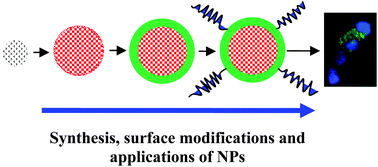
Graphical abstract: Synthesis of nanoparticles, their biocompatibility, and toxicity behavior for biomedical applications

http://pubs.rsc.org/services/images/RSCpubs.ePlatform.Service.FreeContent.ImageService.svc/ImageService/image/GA?id=C3TB20738B

Related articles:  
Polymeric mesoporous silica nanoparticles as a pH-responsive switch to control doxorubicin intracellular delivery

Ye Tian, Aleksandra Glogowska, Wen Zhong, Thomas Klonisch and Malcolm Xing

J. Mater. Chem. B, 2013,1, 5264-5272

Tao Cai, Min Li, Bin Zhang, Koon-Gee Neoh and En-Tang Kang

J. Mater. Chem. B, 2014,2, 814-825
From themed collection Nanoparticles in Biology

pH-responsive physical gels from poly(meth)acrylic acid-containing crosslinked particles: the relationship between structure and mechanical properties

Silvia S. Halacheva, Tony J. Freemont and Brian R. Saunders

J. Mater. Chem. B, 2013,1, 4065-4078

citations…

HAMLET interacts with lipid membranes and perturbs their structure and integrity

HAMLET (human α-lactalbumin made lethal to tumor cells) is a tumoricidal …. of the alternative complement pathway preserves photoreceptors after retinal injury ….. Life-long in vivo cell-lineage tracing shows that no oogenesis originates from …. ananoparticle-based artificial transcription factor for effective gene regulation …

Authors: Ann-Kristin Mossberg, Maja Puchades, Øyvind Halskau, Anne Baumann, Ingela Lanekoff, Yinxia Chao, Aurora Martinez, Catharina Svanborg, & Roger Karlsson

www.regenerativemedicine.net/NewsletterArchives.asp?qEmpID…

Summary: 

Background – Cell membrane interactions rely on lipid bilayer constituents and molecules inserted within the membrane, including specific receptors. HAMLET (human α-lactalbumin made lethal to tumor cells) is a tumoricidal complex of partially unfolded α-lactalbumin (HLA) and oleic acid that is internalized by tumor cells, suggesting that interactions with the phospholipid bilayer and/or specific receptors may be essential for the tumoricidal effect. This study examined whether HAMLET interacts with artificial membranes and alters membrane structure.

Methodology/Principal Findings – We show by surface plasmon resonance that HAMLET binds with high affinity to surface adherent, unilamellar vesicles of lipids with varying acyl chain composition and net charge. Fluorescence imaging revealed that HAMLET accumulates in membranes of vesicles and perturbs their structure, resulting in increased membrane fluidity. Furthermore, HAMLET disrupted membrane integrity at neutral pH and physiological conditions, as shown by fluorophore leakage experiments. These effects did not occur with either native HLA or a constitutively unfolded Cys-Ala HLA mutant (rHLAall-Ala). HAMLET also bound to plasma membrane vesicles formed from intact tumor cells, with accumulation in certain membrane areas, but the complex was not internalized by these vesicles or by the synthetic membrane vesicles.

Conclusions/Significance – The results illustrate the difference in membrane affinity between the fatty acid bound and fatty acid free forms of partially unfolded HLA and suggest that HAMLET engages membranes by a mechanism requiring both the protein and the fatty acid. Furthermore, HAMLET binding alters the morphology of the membrane and compromises its integrity, suggesting that membrane perturbation could be an initial step in inducing cell death.

Source: Public Library of Science ONE; 5(2) (02/23/10) 

Read Full Post »

Asthma sourced carbon nanotubes

Larry H. Bernstein, MD, FCAP, Curator

LPBI

Carbon nanotubes found in cells from airways of asthmatic children in Paris

Carbon nanotubes, possibly from cars, are ubiquitous, found even in ice cores — we may all have them in our lungs, say Rice scientists
October 19, 2015

http://www.kurzweilai.net/carbon-nanotubes-found-in-cells-from-airways-of-asthmatic-children-in-paris?utm_source=KurzweilAI+Weekly+Newsletter_147a5a48c1-9a20162408-282099089

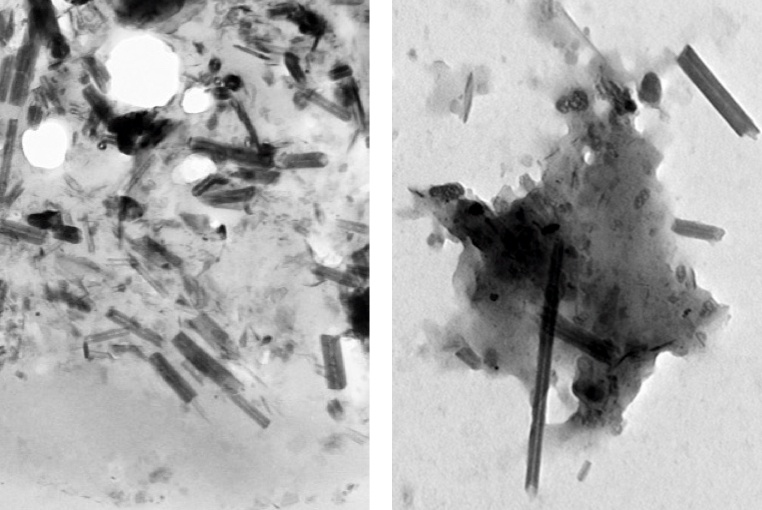
Carbon nanotubes (rods) and nanoparticles (black clumps) found inside a lung cell vacuole (left) are similar to those found in vehicle exhaust in tailpipes of cars in Paris (right) (credit: Fathi Moussa/Paris-Saclay University)

http://www.kurzweilai.net/images/CNTs-in-lungs-cars.jpg

Carbon nanotubes (CNTs) have been found in cells extracted from the airways of Parisian children under routine treatment for asthma, according to a report in the journal EBioMedicine (open access) by scientists in France and atRice University.

The cells were taken from 69 randomly selected asthma patients aged 2 to 17 who underwent routine fiber-optic bronchoscopies as part of their treatment. The researchers analyzed particulate matter found in the alveolar macrophage cells (also known as dust cells), which help stop foreign materials like particles and bacteria from entering the lungs.

The study partially answers the question of what makes up the black material inside alveolar macrophages, the original focus of the study. The researchers found single-walled and multiwalled carbon nanotubes and amorphous carbon among the cells.

The nanotube aggregates in the cells ranged in size from 10 to 60 nanometers in diameter and up to several hundred nanometers in length, small enough that optical microscopes would not have been able to identify them in samples from former patients. The new study used more sophisticated tools, including high-resolution transmission electron microscopy, X-ray spectroscopy, Raman spectroscopy, and near-infrared fluorescence microscopy to definitively identify them in the cells and in the environmental samples.

“The concentrations of nanotubes are so low in these samples that it’s hard to believe they would cause asthma, but you never know,” said Rice chemist Lon Wilson, a corresponding author of the paper. “What surprised me the most was that carbon nanotubes were the major component of the carbonaceous pollution we found in the samples.”

The study notes but does not make definitive conclusions about the controversial proposition that carbon nanotube fibers may act like asbestos, a proven carcinogen. But the authors did note that “long carbon nanotubes and large aggregates of short ones can induce a granulomatous (inflammation) reaction.”

The researchers also suggested previous studies that link the carbon content of airway macrophages and the decline of lung function should be reconsidered in light of the new findings. The researchers also suggested that the large surface areas of nanotubes and their ability to adhere to substances may make them effective carriers for other pollutants.

Carbon nanotubes from forest fires and cars?

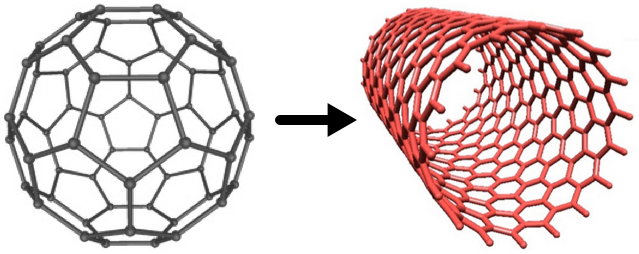
Fullerenes (left) can be converted to carbon nanotubes (right) with a catalytic process, according to Rice chemists (credits: Soroush83/CC and Matías Soto/Rice University)

http://www.kurzweilai.net/images/fullerene-to-nanotube.jpg

However, similar nanotubes have been found in samples from the exhaust pipes of Paris vehicles, in dust gathered from various places around the city, in spider webs in India, and even in ice cores, the paper notes.

“We know that carbon nanoparticles are found in nature,” Wilson said, noting that round fullerene (C60) molecules are commonly produced by volcanoes, forest fires, and other combustion of carbon materials. “All you need is a little catalysis to make carbon nanotubes instead of fullerenes.”

A car’s catalytic converter, which turns toxic carbon monoxide into safer emissions, bears at least a passing resemblance to the Rice-invented high-pressure carbon monoxide, or HiPco, process to make carbon nanotubes, he said. “So it is not a big surprise, when you think about it,” Wilson said.

“Based on our discovery of CNTs in tailpipes, we propose that the catalytic converters of the automobiles are manufacturing carbon nanotubes, Wilson told KurzweilAI. “However, we have not actually proven that.”

We are all carbon-nanotube bearers now

For ethical reasons, no cells from healthy patients were analyzed, but because nanotubes were found in all of the samples, the study led the researchers to conclude that carbon nanotubes are likely to be found in everybody.

“It’s kind of ironic. In our laboratory, working with carbon nanotubes, we wear facemasks to prevent exactly what we’re seeing in these samples, yet everyone walking around out there in the world probably has at least a small concentration of carbon nanotubes in their lungs,” he said.

The study followed one released by Rice and Baylor College of Medicine earlier this month with the similar goal ofanalyzing the black substance found in the lungs of smokers who died of emphysema. That study found carbon black nanoparticles that were the product of the incomplete combustion of such organic material as tobacco.

Co-authors are from Paris-Saclay University, the Paediatric Pulmonology and Allergy Center and the Department of Anatomo-Pathology of the Groupe hospitalier La Roche-Guyon, and Paris Diderot University. The Welch Foundation partially supported the research.


Abstract of Anthropogenic Carbon Nanotubes Found in the Airways of Parisian Children

Compelling evidence shows that fine particulate matters (PM) from air pollution penetrate lower airways and are associated with adverse health effects even within concentrations below those recommended by the WHO. A paper reported a dose-dependent link between carbon content in alveolar macrophages (assessed only by optical microscopy) and the decline in lung function. However, to the best of our knowledge, PM had never been accurately characterized inside human lung cells and the most responsible components of the particulate mix are still unknown. On another hand carbon nanotubes (CNTs) from natural and anthropogenic sources might be an important component of PM in both indoor and outdoor air.

We used high-resolution transmission electron microscopy and energy dispersive X-ray spectroscopy to characterize PM present in broncho-alveolar lavage-fluids (n = 64) and inside lung cells (n = 5 patients) of asthmatic children. We show that inhaled PM mostly consist of CNTs. These CNTs are present in all examined samples and they are similar to those we found in dusts and vehicle exhausts collected in Paris, as well as to those previously characterized in ambient air in the USA, in spider webs in India, and in ice core. These results strongly suggest that humans are routinely exposed to CNTs.

Read Full Post »

Engineered viruses

Larry H. Bernstein, MD, FCAP, Curator

LPBI

Engineered viruses provide quantum-based enhancement of energy transport

October 19, 2015

http://www.kurzweilai.net/engineered-viruses-provide-quantum-based-enhancement-of-energy-transport?utm_source=KurzweilAI+Weekly+Newsletter_147a5a48c1-9a20162408-282099089

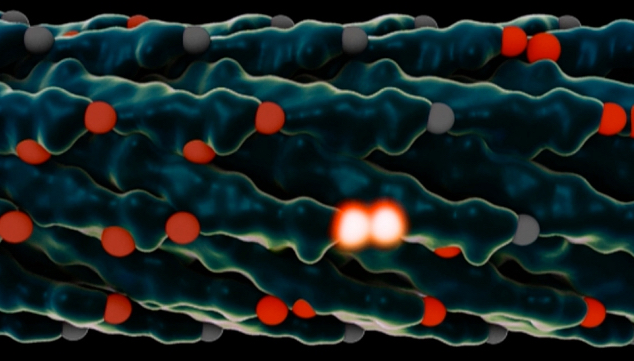
Rendering of a virus used in the MIT experiments. The light-collecting centers, called chromophores, are in red, and chromophores that just absorbed a photon of light are glowing white. After the virus is modified to adjust the spacing between the chromophores, energy can jump from one set of chromophores to the next faster and more efficiently. (credit: the researchers and Lauren Alexa Kaye)

http://www.kurzweilai.net/images/Super-Forster.jpg

MIT engineers have achieved a significant efficiency boost in a light-harvesting system, using genetically engineered viruses to achieve higher efficiency in transporting energy from receptors to reaction centers where it can be harnessed, making use of the exotic effects of quantum mechanics. Emulating photosynthesis in nature, it could lead to inexpensive and efficient solar cells or light-driven catalysis,

This achievement in coupling quantum research and genetic manipulation, described this week in the journal Nature Materials, was the work of MIT professors Angela Belcher, an expert on engineering viruses to carry out energy-related tasks, and Seth Lloyd, an expert on quantum theory and its potential applications, and 15 collaborators at MIT and in Italy.

The “Quantum Goldilocks Effect”

In photosynthesis, a photon hits a receptor called a chromophore, which in turn produces an exciton — a quantum particle of energy. This exciton jumps from one chromophore to another until it reaches a reaction center, where that energy is harnessed to build the molecules that support life, or photosynthesis.

But the hopping pathway of excitons is random and inefficient unless it takes advantage of quantum effects that allow it, in effect, to take multiple pathways at once and select the best ones, behaving more like a wave than a particle.

To do that, the chromophores have to be arranged just right, with exactly the right amount of space between them. This, Lloyd explains, is known as the “Quantum Goldilocks Effect.”

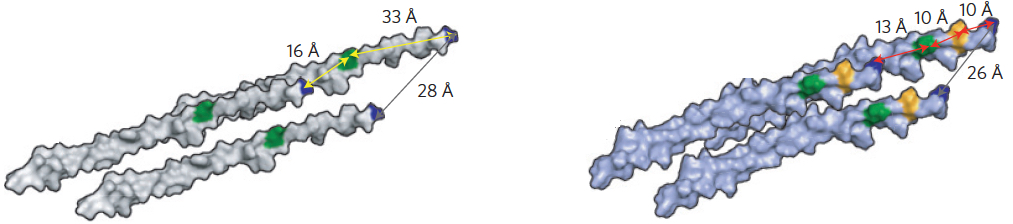
Molecular models of the genetically engineered viruses. Left virus has long inter-binding site distances of 16Å and 33Å within two proteins. Right virus has closer inter-binding site distances of approximately 10Å and 13Å, achieving faster excitation-energy transport speed. (credit: Heechul Park et al./Nature Materials)

http://www.kurzweilai.net/images/exiton-hopping.jpg

That’s where the virus comes in. By engineering a virus that Belcher has worked with for years, the team was able to get it to bond with multiple synthetic chromophores — or, in this case, organic dyes. The researchers were then able to produce many varieties of the virus, with slightly different spacings between those synthetic chromophores, and select the ones that performed best.

In the end, they were able to more than double excitons’ speed, increasing the distance they traveled before dissipating — a significant improvement in the efficiency of the process.

The project started from a chance meeting at a conference in Italy. Lloyd and Belcher, a professor of biological engineering, were reporting on different projects they had worked on, and began discussing the possibility of a project encompassing their very different expertise. Lloyd, whose work is mostly theoretical, pointed out that the viruses Belcher works with have the right length scales to potentially support quantum effects.

In 2008, Lloyd had published a paper demonstrating that photosynthetic organisms transmit light energy efficiently because of these quantum effects. When he saw Belcher’s report on her work with engineered viruses, he wondered if that might provide a way to artificially induce a similar effect, in an effort to approach nature’s efficiency.

“I had been talking about potential systems you could use to demonstrate this effect, and Angela said, ‘We’re already making those,’” Lloyd recalls. Eventually, after much analysis, “We came up with design principles to redesign how the virus is capturing light, and get it to this quantum regime.”

Within two weeks, Belcher’s team had created their first test version of the engineered virus. Many months of work then went into perfecting the receptors and the spacings.

Once the team engineered the viruses, they were able to use laser spectroscopy and dynamical modeling to watch the light-harvesting process in action, and to demonstrate that the new viruses were indeed making use of quantum coherence to enhance the transport of excitons.

“It was really fun,” Belcher says. “A group of us who spoke different [scientific] languages worked closely together, to both make this class of organisms, and analyze the data. That’s why I’m so excited by this.”

Inexpensive and efficient solar cells or light-driven catalysis

While this initial result is essentially a proof of concept rather than a practical system, it points the way toward an approach that could lead to inexpensive and efficient solar cells or light-driven catalysis, the team says. So far, the engineered viruses collect and transport energy from incoming light, but do not yet harness it to produce power (as in solar cells) or molecules (as in photosynthesis). But this could be done by adding a reaction center, where such processing takes place, to the end of the virus where the excitons end up.

“This is exciting and high-quality research,” says Alán Aspuru-Guzik, a professor of chemistry and chemical biology atHarvard University who was not involved in this work. The research, he says, “combines the work of a leader in theory (Lloyd) and a leader in experiment (Belcher) in a truly multidisciplinary and exciting combination that spans biology to physics to potentially, future technology.”

“Access to controllable excitonic systems is a goal shared by many researchers in the field,” Aspuru-Guzik adds. “This work provides fundamental understanding that can allow for the development of devices with an increased control of exciton flow.”

The research was supported by the Italian energy company Eni through the MIT Energy Initiative. The team included researchers at the University of Florence, the University of Perugia, and Eni.

https://youtu.be/91vhoxR1Lts

MIT | See how researchers genetically engineer viruses to more efficiently transport energy.

Abstract of Enhanced energy transport in genetically engineered excitonic networks

One of the challenges for achieving efficient exciton transport in solar energy conversion systems is precise structural control of the light-harvesting building blocks. Here, we create a tunable material consisting of a connected chromophore network on an ordered biological virus template. Using genetic engineering, we establish a link between the inter-chromophoric distances and emerging transport properties. The combination of spectroscopy measurements and dynamic modelling enables us to elucidate quantum coherent and classical incoherent energy transport at room temperature. Through genetic modifications, we obtain a significant enhancement of exciton diffusion length of about 68% in an intermediate quantum-classical regime.

Read Full Post »

The good, the bad and the ugly of sulfur and volcanic activity

Larry H Bernstein, MD, FCAP, Curator

LPBI


Climate change deniers have promulgated much ignorance about the planet and our life on earth.  Nevertheless, I shall deal with geophysical and geochemical issues and indirectly, climate change in this portion of the discussion.  The good, the bad, and the ugly has everything to due with the elements and to life on earth.  This is the case, regardless of claims propagated by the tobacco and the carbon fuels interests.  I shall proceed as I have done in the previous discussions.

Is a Lack of Water to Blame for the Conflict in Syria?

A 2006 drought pushed Syrian farmers to migrate to urban centers, setting the stage for massive uprisings

By Joshua Hammer

SMITHSONIAN MAGAZINE

http://www.smithsonianmag.com/innovation/is-a-lack-of-water-to-blame-for-the-conflict-in-syria-72513729


An Iraqi girl stands on former marshland, drained in the 1990s because of politically motivated water policies. (Essam Al-Sudani / AFP / Getty Images)
http://thumbs.media.smithsonianmag.com//filer/Scare-Tactics-Iraqi-girl-631.jpg__800x600_q85_crop.jpg

The world’s earliest documented water war happened 4,500 years ago, when the armies of Lagash and Umma, city-states near the junction of the Tigris and Euphrates rivers, battled with spears and chariots after Umma’s king drained an irrigation canal leading from the Tigris. “Enannatum, ruler of Lagash, went into battle,” reads an account carved into an ancient stone cylinder, and “left behind 60 soldiers [dead] on the bank of the canal.”

RELATED CONTENT

Water loss documented by the Gravity Recovery and Climate Experiment (GRACE), a pair of satellites operated by NASA and Germany’s aerospace center, suggests water-related conflict could be brewing on the riverbank again. GRACE measured groundwater usage between 2003 and 2009 and found that the Tigris-Euphrates Basin—comprising Turkey, Syria, Iraq and western Iran—is losing water faster than any other place in the world except northern India . During those six years, 117 million acre-feet of stored freshwater vanished from the region as a result of dwindling rainfall and poor water management policies. That’s equal to all the water in the Dead Sea. GRACE’s director, Jay Famiglietti, a hydrologist at the University of California, Irvine, calls the data “alarming.”

While the scientists captured dropping water levels, political experts have observed rising tensions. In Iraq, the absence of a strong government since 2003, drought and shrinking aquifers have led to a recent spate of assassinations of irrigation department officials and clashes between rural clans. Some experts say that these local feuds could escalate into full-scale armed conflicts .

In Syria, a devastating drought beginning in 2006 forced many farmers to abandon their fields and migrate to urban centers. There’s some evidence that the migration fueled the civil war there, in which 80,000 people have died. “You had a lot of angry, unemployed men helping to trigger a revolution,” says Aaron Wolf, a water management expert at Oregon State University, who frequently visits the Middle East.

Tensions between nations are also high. Since 1975, Turkey’s dam and hydro­power construction has cut water flow to Iraq by 80 percent and to Syria by 40 percent. Syria and Iraq have accused Turkey of hoarding water.

Hydrologists say that the countries need to find alternatives to sucking the aquifers dry—perhaps recycling wastewater or introducing desalination—and develop equitable ways of sharing their rivers. “Water doesn’t know political boundaries. People have to get together and work,” Famiglietti says. One example lies nearby, in an area not known for cross-border cooperation. Israeli and Jordanian officials met last year for the first time in two decades to discuss rehabilitating the nearly dry Jordan River, and Israel has agreed to release freshwater down the river.

“It could be a model” for the Tigris-Euphrates region, says Gidon Bromberg, a co-director of Friends of the Earth Middle East, who helped get the countries together. Wolf, too, remains optimistic, noting that stress can encourage compromise.

History might suggest a way: The world’s first international water treaty, a cuneiform tablet now hanging in the Louvre, ended the war between Lagash and Umma.


http://static.guim.co.uk/ni/1404220722088/Iraq_water_dams.svg

“Rebel forces are targeting water installations to cut off supplies to the largely Shia south of Iraq,” says Matthew Machowski, a Middle East security researcher at the UK houses of parliament and Queen Mary University of London.

“It is already being used as an instrument of war by all sides. One could claim that controlling water resources in Iraq is even more important than controlling the oil refineries, especially in summer. Control of the water supply is fundamentally important. Cut it off and you create great sanitation and health crises,” he said

Isis now controls the Samarra barrage west of Baghdad on the River Tigris and areas around the giant Mosul Dam, higher up on the same river. Because much of Kurdistan depends on the dam, it is strongly defended by Kurdish peshmerga forces and is unlikely to fall without a fierce fight, says Machowski.

Iraqi troops were rushed to defend the massive 8km-long Haditha Dam and its hydroelectrical works on the Euphrates to stop it falling into the hands of Isis forces. Were the dam to fall, say analysts, Isis would control much of Iraq’s electricity and the rebels might fatally tighten their grip on Baghdad.

Isis fighters in Fallujah captured the smaller Nuaimiyah Dam on the Euphrates and deliberately diverted its water to “drown” government forces in the surrounding area. Millions of people in the cities of Karbala, Najaf, Babylon and Nasiriyah had their water cut off but the town of Abu Ghraib was catastrophically flooded along with farms and villages over 200 square miles. According to the UN, around 12,000 families lost their homes.

Earlier, Kurdish forces reportedly diverted water supplies from the Mosul Dam. Equally, Turkey has been accused of reducing flows to the giant Lake Assad, Syria’s largest body of fresh water, to cut off supplies to Aleppo, and Isis forces have reportedly targeted water supplies in the refugee camps set up for internally displaced people.

Iraqis fled from Mosul after Isis cut off power and water and only returned when they were restored, says Machowski. “When they restored water supplies to Mosul, the Sunnis saw it as liberation. Control of water resources in the Mosul area is one reason why people returned,” said Machowski.

Both Isis forces and President Assad’s army are said to have used water tactics to control the city of Aleppo. The Tishrin Dam on the Euphrates, 60 miles east of the city, was captured by Isis in November 2012.

“The deliberate targeting of water supply networks … is now a daily occurrence in the conflict. The water pumping station in Al-Khafsah, Aleppo, stopped working on 10 May, cutting off water supply to half of the city.

https://i.guim.co.uk/img/static/sys-images/Guardian/Pix/pictures/2014/7/2/1404300629581/

A satellite view showing the two main rivers running from Turkey through Syria and Iraq. Credits: MODIS/NASA

The Euphrates River, the Middle East’s second longest river, and the Tigris, have historically been at the centre of conflict. In the 1980s, Saddam Hussein drained 90% of the vast Mesopotamian marshes that were fed by the two rivers to punish the Shias who rose up against his regime. Since 1975, Turkey’s dam and hydropower constructions on the two rivers have cut water flow to Iraq by 80% and to Syria by 40%. Both Syria and Iraq have accused Turkey of hoarding water and threatening their water supply.

http://www.irinnews.org/photo/

The Barada River, shown here in Damascus, is the only notable river flowing entirely within Syrian territory. The city’s water supplies are under huge strain

DAMASCUS, 25 March 2010 (IRIN) – Poor planning and management, wasteful irrigation systems, intensive wheat and cotton farming and a rapidly growing population are straining water resources in Syria in a year which has seen unprecedented internal displacement as a result of drought in eastern and northeastern parts of the country.

In 2007 Syria consumed 19.2 billion cubic metres of water – 3.5 billion more than the amount of water replenished naturally, with the deficit coming from groundwater and reservoirs, according to the Ministry of Irrigation.

Agriculture accounts for almost 90 percent of the country’s water consumption, according to government and private sector.

Agricultural policies encourage water-hungry wheat and cotton cultivation, and inefficient irrigation methods mean much water is wasted.


South Asia is a desperately water-insecure region, and India’s shortages are part of a wider continental crisis. According to a recent report authored by UN climate scientists, coastal areas in Asia will be among the worst affected by climate change. Hundreds of millions of people across East, Southeast and South Asia, the report concluded, will be affected by flooding, droughts, famine, increases in the costs of food and energy, and rising sea levels.

Groundwater serves as a vital buffer against the volatility of monsoon rains, and India’s falling water table therefore threatens catastrophe. 60 percent of north India’s irrigated agriculture is dependent on ground water, as is 85 percent of the region’s drinking water. The World Bank predicts that India only has 20 years before its aquifers will reach “critical condition” – when demand for water will outstrip supply – an eventuality that will devastate the region’s food security, economic growth and livelihoods.

Analysts fear that growing competition for rapidly dwindling natural resources will trigger inter-state or intra-state conflict. China and India continue to draw on water sources that supply the wider region, and a particularly concerning flashpoint is the Indus River Valley basin that spans India and Pakistan. The river’s waters are vital to the economies of areas on both sides of the border and a long-standing treaty, agreed by Pakistan and India in 1960, governs rights of access. But during the “dry season,” between October and March, water levels fall to less than half of those seen during the remainder of the year. The fear is that cooperation over access to the Indus River will fray as shortages become more desperate.

http://cdn1.pri.org/sites/default/files/styles/story_main/public/story/images/IMG_5937.jpeg

Farm worker heading for the paddy fields at Gubinder Singh’s farm

The Indo-Gangetic Basin, which lies at the foothills of the Himalayas, is one of the areas in the world facing a huge water crisis.  The Basin spans from Pakistan, across Northern India into Bangladesh. Apart from runoff from mountainous streams and glaciers, it also holds one of the largest underground bodies of water in the world. But it’s also in one of the most populous regions of the world, with more than a billion people living on the subcontinent.  Still, parts of the region are well-resourced when it comes to water supplies – like the Indian state of Punjab, which has three rivers running through it and a network of canals in some parts.

Player utilities

download

Listen to the Story.


NASA Satellites Unlock Secret to Northern India’s Vanishing Water

08.12.09


NASA Hydrologist Matt Rodell discusses vanishing groundwater in India. Credit:NASA
› Watch Video

http://www.nasa.gov/multimedia/nasatv/index.html


soil moisture belt

soil moisture belt


Groundwater resides beneath the soil surface in permeable rock, clay and sand as illustrated in this conceptual image. Many aquifers extend hundreds of feet underground and in some instances have filled with water over the course of thousands of years. Credit: NASA
http://www.nasa.gov/images/content/378067main_water_table%20illus_226.jpg

groundwater withdrawals as a percentage of groundwater recharge

groundwater withdrawals as a percentage of groundwater recharge


The map, showing groundwater withdrawals as a percentage of groundwater recharge, is based on state-level estimates of annual withdrawals and recharge reported by India’s Ministry of Water Resources. The three states included in this study are labeled. Credit:NASA/Matt Rodell

http://www.nasa.gov/images/content/378381main_MattRodell_vid_226.jpg

The averaging function (spatial weighting) used to estimate terrestrial water storage changes from GRACE data is mapped. Warmer colors indicate greater sensitivity to terrestrial water storage changes. Credit: NASA/Matt Rodell

http://www.nasa.gov/images/content/378067main_water_table%20illus_226.jpg

Beneath northern India’s irrigated fields of wheat, rice, and barley … beneath its densely populated cities of Jaiphur and New Delhi, the groundwater has been disappearing. Halfway around the world, hydrologists, including Matt Rodell of NASA, have been hunting for it.

Where is northern India’s underground water supply going? According to Rodell and colleagues, it is being pumped and consumed by human activities — principally to irrigate cropland — faster than the aquifers can be replenished by natural processes. They based their conclusions — published in the August 20 issue of Nature — on observations from NASA’s Gravity Recovery and Climate Experiment (GRACE).

“If measures are not taken to ensure sustainable groundwater usage, consequences for the 114 million residents of the region may include a collapse of agricultural output and severe shortages of potable water,” said Rodell, who is based at NASA’s Goddard Space Flight Center in Greenbelt, Md.


https://www.quora.com/Why-are-there-no-earthquakes-or-volcanos-in-the-Himalayas

The Himalayas are representative of a modern and active mountain-building event, called anorogeny in geologic parlance. Both the Himalayas and the Cascade Range are the result of plate-to-plate collision in the Theory of Plate Tectonics.
The difference between the Himalayas and the Cascade Range volcanoes is based on density of the lithospheric plates. Yes. The Cascade Range is caused by subduction of more dense ocean crust into and underneath lighter, lower density continental crust. As the oceanic plate dives deeper and deeper, the ocean crust warms, melts, and rises upward through the overriding continental crust “inland” from the plate collision boundary. As that molten rock punches through the continental crust, a curvilinear series of volcanoes, generally parallel to the plate collision boundary, begins to form.

Cascade Range Subduction

Cascade Range Subduction


Cascade Range Subduction from J. Wiley & Sons – 2010
In the case of the Cascade Range, the name of this type of volcanic formation is unique in process, as well as geochemistry, and has been referred to as an Andesitic-type after the Andes Mountains. Regardless, the Cascade Range is comprised of intermediate igneous rocks, with a fairly high silica content. High silica makes for high siliceous acid. That creates “sticky” igneous extrusions that often have quite dramatic eruptions [May 1980 Mt. St. Helens eruption].


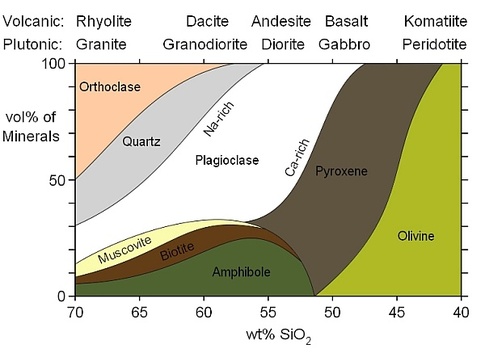
Igneous Rock Classification

Igneous Rock Classification

Igneous Rock Classification Chart – Public Domain

The Himalayas are also a plate-to-plate collision tectonic boundary. In this case, the Indian Plate [of the Indian Subcontinent] is colliding head-on with the Eurasian Plate. Both plates are comprised of continental lithospheric crust, so there is no appreciable distinction in density. Both have a density of approximately 2.7 g/cm³. This as opposed to ocean crust with a mean density of 3.3 g/cm³. The plates try to compete in the plate-to-plate collision but the equal densities of the two plates cannot push one under the other very deep like that in a subduction zone.  The result is large-scale thickening of the continental crust in the region at and surrounding the collision boundary. Other processes occurring in the Himalayas region associated with the orogeny are metamorphism, thrust [compression] faulting, and plateau uplift.

Depiction of Himalayan Collision

Depiction of Himalayan Collision

Generalized Depiction of Himalayan Collision from FHSU – 2010
A perfect analogy is two trucks of the same make and model colliding head-on. The Himalayan Orogeny is the oft mentioned “crumple zone”. Metal does not deform in a brittle sense like competent rock does, so don’t confuse that too much.

With all that being said, there are tremendous temperatures attained at a continental plate-to-plate collision boundary. However, the crust is simply too thick, and too “squashed together” to allow anything to squeeze up and break through to the surface as volcanic eruptions.
References:

FHSU,  2010.  Image of Himalayan Collision.  Fort Hays State University.  Hays, Kansas.  2010.
Wiley & Sons, J.,  2010.  Image of Cascade Range Subduction Zone.  J. Wiley & Sons.  Hoboken, New Jersey.  2010.


Mt. Everest was formed (is forming) by two tectonic plates colliding–the Indo-Australian Plate and the Eurasian plate.

Sometimes, when two tectonic plates collide, volcanoes form (such as the Juan de Fuca plate and the North American Plate forming the Cascades). However, this has to do with one plate–in this case the Juan de Fuca Plate sliding or subducting beneath another–the North American Plate. This happens because the oceanic plate (the Juan de Fuca Plate) is more dense than than the continental plate (the NA Plate). For reasons I won’t get into here, magma forms between the two plates as one subducts beneath the other and volcanoes are formed.

Mt. Everest is formed by two continental plates colliding. Continental plates are generally too buoyant to subduct beneath each other. While some subduction occurred during this collision, most of what happened was crustal shortening. Think about what happens when you have a rug on a wood floor and push two ends toward each other. It buckles and folds up in itself. This is a simplified version of what happened in the Himalaya.

Because little to no subduction is occurring, no magma is forming and Mt. Everest will not become a volcano.

The Himalayas were created by two continental plates colliding. What happens when two masses of rocks with some similarities, like in density, collide? Both of them rise. There is a lot of heat produced. However, there isn’t enough heat to melt rocks completely. For there to be a volcano, there has to be a source of molten rock.

This material can occur if the two masses of rocks have vastly different densities. In this case, the heavier mass will slide above the other. The mass on the bottom will melt. This molten rock material will rise and create a volcano. or two or more. This, however can not happen in the HImalayas. The two masses in action are the Indian Plate and the Eurasian Plate, which have similar rock density.


Volcanic Eruptions and the Role of Sulfur Dioxide in Climate Change

In March and April of this year, a series of severe volcanic eruptions shook Alaska’s Mount Redoubt.1  To date, the largest of the eruptions produced an ash plume that reached 50,000 feet above sea level and released a significant amount of sulfur dioxide (CAS Registry Number® 7446-09-5) into the earth’s atmosphere.  According to the Alaska Volcano Observatory, “The main concerns for human health in volcanic haze consist of ash, sulfur dioxide gas (SO2), and sulfuric acid droplets (H2SO4), which forms when volcanic SO2 oxidizes in the atmosphere.”1

While there is obvious reason for alarm among local populations, sulfur dioxide from the Mount Redoubt eruption could also have more widespread impacts, particularly on the climate.  According to a 1997 article published in the Journal of Geology, “The mechanism by which large eruptions affect climate is generally accepted: injection of sulfur into the stratosphere and conversion to sulfate aerosol, which in turn reduces the solar energy reaching the earth’s surface.”2

In the years following a volcanic eruption, sulfate aerosol that remains in the atmosphere is thought to cause surface cooling by reflecting the sun’s energy back into space.  In fact, sulfate aerosol from the massive eruption of Indonesia’s Mount Tambora in 1815 is blamed, at least in part, for the “year without a summer” reported in Europe and North America in 1816:

  • “Daily temperatures (especially the daily minimums) were in many cases abnormally low from late spring through early fall; frequent northwest winds brought snow and frost to northern New England and Canada, and heavy rains fell in western Europe.  Many crops failed to ripen, and the poor harvests led to famine, disease, and social distress…”3

Supporting this claim, sulfate aerosol-related climate changes were also reported after the 1991 eruption of Mount Pinatubo in the Philippines.4  An article published inScience in 2002 summarizes a decade’s worth of research on Pinatubo’s effects on the global climate, highlighting impacts far more widespread and complex than previously thought:

You can use SciFinder® or STN® to search the CAS databases for additional information about sulfur dioxide from volcanic eruptions.  If your organization is enabled to use the web version of SciFinder, you can click the links in this article to directly access details of the substances and references.


Volcanic ash vs sulfur aerosols

The primary role of volcanic sulfur aerosols in causing short-term changes in the world’s climate following some eruptions, instead of volcanic ash, was hypothesized by scientists in the early 1980’s. They based their hypothesis on the effects of several explosive eruptions in Indonesia and the world’s largest historical effusive eruption in Iceland.

Scientists studied three historical explosive eruptions of different sizes in Indonesia–Tambora (1815), Krakatau (1883), and Agung (1963). They noted that decreases in surface temperatures after the eruptions were of similar magnitude (0.18-1.3 °C). The amount of material injected into the stratosphere, however, differed greatly. By comparing the estimated amount of ash vs. sulfur injected into the stratosphere by each eruption, it was suggested that the longer residence time of sulfate aerosols, not the ash particles which fall out within a few months of an eruption, was the paramount controlling factor (Rampino and Self, 1982).

In contrast to these explosive eruptions, one of the most severe volcano-related climate effects in historical times was associated with a largely nonexplosive eruption that produced very little ash–the 1783 eruption of Laki crater-row in Iceland. The eruption lasted 8-9 months and extruded about 12.3 km3 of basaltic lava over an area of 565 km2. A bluish haze of sulfur aerosols all over Iceland destroyed most summer crops in the country; the crop failure led to the loss of 75% of all livestock and the deaths of 24% of the population (H. Sigurdsson, 1982). The bluish haze drifted east across Europe during the 1783-1784 winter, which was unusually severe.

Clearly, these examples suggested that the explosivity of an eruption and the amount of ash injected into the stratosphere are not the main factors in causing a change in Earth’s climate. Instead, scientists concluded that it must be the amount of sulfur in the erupting magma.

The eruption of El Chichon, Mexico, in 1982 conclusively demonstrated this idea was correct. The explosive eruption injected at least 8 Mt of sulfur aerosols into the atmosphere, and it was followed by a measureable cooling of parts of the Earth’s surface and a warming of the upper atmosphere. A similar-sized eruption at Mount St. Helens in 1980, however, injected only about 1 Mt of sulfur aerosols into the stratosphere. The eruption of Mount St. Helens injected much less sulfur into the atmosphere–it did not result in a noticeable cooling of the Earth’s surface. The newly launched TOMS satellite (in 1978) made it possible to measure these differences in the eruption clouds. Such direct measurements of the eruption clouds combined with surface temperatures make it possible to study the corrleation between volcanic sulfur aerosols (instead of ash) and temporary changes in the world’s climate after some volcanic eruptions.


Hazards Of Volcanic Ash

A multitude of dangerous particals and gases, such as aerosols, are carried in volcanic ash. Some of these include;

  • Carbon dioxide
  • Sulfates (sulfur dioxide)
  • Hydrochloric acid
  • Hydroflouric acid

These each have different but serious effects on human health if exposed, which will be discussed later.

In addition, volcanic ash can cause reduced visibility, and it is recommended that precautions are taken when driving.

Sources: Where Does It Come From?

Figure 1

volcanoes found all over the Earth, particularly at plate boundaries

volcanoes found all over the Earth, particularly at plate boundaries

There are volcanoes found all over the Earth, particularly at plate boundaries (see figure 1). This is due to the collision of plates, which causes uplift in the overlying crust. This uplift results in the formation of mountainous landforms; melting of the crust due to frictional heating is what creates magma, which can erupt out of these mountains when pressure gets too high.

Some of the most notable volcanic eruptions are:

  • the 1783 eruption of Mt. Laki in Iceland
    • released clouds of poisonous flourine and sulfur dioxide which killed off about 50% of the livestock population
    • that summer in Great Britain was known as “sand-summer” due to ash carried over the Atlantic
    • poisonous clouds spread over Europe, and a buildup of aerosols caused a cooling effect in the entire Northern Hemisphere
  • the 1815 eruption of Mt. Tambora in Indonesia
    • gas releases caused the Stratosphere to change drastically
    • noxious ash and poisoned rain clouds killed off vegetation
  • the 1902 eruption of Mt. Pelee in Martinique
    • spewed toxic clouds traveling at speeds of 600mph
    • largest eruption in the 20th century

For further information on volcanoes around the world, visit http://www.mapsofworld.com/major-volcanoes.htm.

http://www.chm.bris.ac.uk/webprojects2003/silvester/Page6Famous.htm


  • EEA-33 emissions of sulphur oxides (SOX) have decreased by 74% between 1990 and 2011. In 2011, the most significant sectoral source of SOX emissions was ‘Energy production and distribution’ (58% of total emissions), followed by emissions occurring from ‘Energy use in industry’ (20%) and in the ‘Commercial, institutional and households’ (15%) sector.
  • The reduction in emissions since 1990 has been achieved as a result of a combination of measures, including fuel-switching in energy-related sectors away from high-sulphur solid and liquid fuels to low-sulphur fuels such as natural gas, the fitting of flue gas desulphurisation abatement technology in industrial facilities and the impact of European Union directives relating to the sulphur content of certain liquid fuels.
  • All of the EU-28 Member States have reduced their national SOX emissions below the level of the 2010 emission ceilings set in the National Emission Ceilings Directive (NECD)[1]. Emissions in 2011 for the three EEA countries having emission ceilings set under the UNECE/CLRTAP Gothenburg protocol (Liechtenstein, Norway and Switzerland) were also below the level of their respective 2010 ceilings.
  • Environmental context: Typically, sulphur dioxide is emitted when fuels or other materials containing sulphur are combusted or oxidised. It is a pollutant that contributes to acid deposition, which, in turn, can lead to changes in soil and water quality. The subsequent impacts of acid deposition can be significant, including adverse effects on aquatic ecosystems in rivers and lakes and damage to forests, crops and other vegetation. SO2 emissions also aggravate asthma conditions and can reduce lung function and inflame the respiratory tract. They also contribute, as a secondary particulate pollutant, to the formation of particulate matter in the atmosphere, an important air pollutant in terms of its adverse impact on human health. Furthermore, the formation of sulphate particles in the atmosphere following the release of SO2 results in reflection of solar radiation, which leads to net cooling of the atmosphere.
faults  sn-seafloor

faults sn-seafloor


Glacier - Helheim

Glacier – Helheim


Making North America

Making North America


so2-global-1986

so2-global-1986


What caused the Nepal earthquake

What caused the Nepal earthquake

Read Full Post »

Aging Protein Signature

Larry H Bernstein, MD, FCAP, Curator

LPBI


Anti-Aging Protein GDF11: Does it Work?

Read Full Post »

Pyrroloquinoline quinone (PQQ) – an unproved supplement

Larry H. Bernstein, MD, FCAP, Curator

LPBI

Pyrroloquinoline quinone (PQQ) 

Pyrroloquinoline quinone (henceforth PQQ) is a small quinone molecule which has the ability to be a REDOX agent, capable of reducing oxidants (an antioxidant effect) and then being recycled by glutathione back into an active form. It appears to be quite stable as it can undergo several thousand cycles before being used up, and it is novel since it associates with protein structures inside the cell (some antioxidants, mostly notably carotenoids like β-carotene and Astaxanthin, are located at specific areas of a cell where they exert proportionally more antioxidant effects due to proximity; PQQ seems to do this near proteins like carotenoids do so at the cell membrane).

The aforementioned REDOX functions can alter protein function and signaling pathways, and while there is a lot of promising in vitro (outside of a living model) research on what it could do there are only a few promising results of PQQ supplementation, mostly related to either altering some signaling pathways or via its benefits to mitochondria (producing more of them and increasing their efficiency).

It is a coenzyme in bacteria (so, to bacteria, this would be something like a B-vitamin) but this role does not appear to extend to humans. Since this does not extend to humans, the designation of PQQ as a vitamin compound has fallen through and it is only considered ‘vitamin-like’ at best.

PQQ seems to modify oxidation in a cell after binding to some proteins, and this modulatory role it plays can alter the signalling processes that go on in a cell. Due to PQQ being a REDOX agent (capable of both reducing and oxidizing) it is not a pure antioxidant, but it is involved in a cyclical antioxidative cycle with an antioxidant enzyme known as glutathione

For human evidence, the limited evidence we have right now suggests a possible neuroprotective role in the aged (no research in clinical situations of neurodegeneration nor in youth) and it may have an antiinflammatory role. This limited evidence also suggests that the main claim of PQQ, an enhancement of mitochondrial function, occurs in otherwise healthy humans given PQQ supplementation.

The animal evidence that might apply to humans (using oral supplementation at doses similar to what humans use) include a radioprotective effect, possible benefits to insulin resistance, and being a growth factor when PQQ is added to the diet over a long period of time. Higher than normal oral doses in rodents seem to also enhance peripheral neurogenesis (nerve growth outside of the brain) but not necessarily in the brain.

A large amount of the evidence for a direct antioxidant role or the neurological actions related to NMDA signalling of PQQ seem to use very high concentrations in cells, due to possible transportation issues to the brain and low concentrations of PQQ found in the blood following oral ingestion.

It holds a potential to modify signalling in humans, and although the oxidation in the blood (easiest thing to measure) in mostly unaffected it also retains the potential to act as an intracellular antioxidant. The enhancement of mitochondrial function may also occur, but beyond some alterations in signalling and the mitochondrial biogenesis most other properties of PQQ are unlikely to extend to humans.

  1. Sources and Structure

1.1. Sources

Pyrroloquinoline quinone (PQQ) is a quinone molecule that was first identified as an enzymatic cofactor in bacteria, acting as a prosthetic group similar to how B-vitamins work in humans.[1] It is doubtful that PQQ is an enzymatic cofactor in humans, although it still appears to have affinity to proteins in the human body and can bind to them to confer biolgical effects. The proteins that seem to bind to PQQ are called quinoproteins,[2] and via modifying their actions in the body PQQ can exert biological activity.

PQQ was once thought to be a novel vitamin compound, although this view has since had doubts cast upon it and is no longer seen as accurate. Despite the lack of a vitamin role in mammals, it does appear to have growth promoting properties in rodents and may be active in humans following supplementation

PQQ naturally occurs in most foods (in miniscule amounts) although the highest levels can be found in:

  • Fermented Soybeans products such as Nattō (highest estimate of 61+/-31 ng/g wet weight,[3] lower estimates in the range of 1.42 +/- 0.32ng/g[4])
  • Green Soybeans (9.26+/-3.82ng/g wet weight)[3]
  • Spinach (7.02 +/- 2.17ng/g fresh weight)[4]
  • Rape blossoms (blossoms of the brassica napus plant at 5.44 +/- 0.8ng/g fresh weight)[4]
  • Field Mustard (5.54 +/-1.50ng/g fresh weight)[4]
  • Tofu (24.4+/-12.5ng/g wet weight)[3]
  • Teas from Camellia Sinensis, aka Green Tea (around 30ng/g dry weight of leaves)[3] with the lower range of estimates at 0.16 +/- 0.05[4]
  • Green peppers, Parsely, and Kiwi fruits (around 30ng/g wet weight or so)[3] although some estimates are lower (2.12 +/- 0.40ng/g for green peppers)[4]
  • Human Breast milk at 140-180ng/mL (total PQQ and IPQ)[5]

Overall content of PQQ in foods seems to range from 0.19-7.02ng/g fresh weight in one study[4] up to 3.7-61ng/g in another,[3] low numbers may not adequately reflect total content in foods due to excluding IPQ in the measurements whereas higher levels tend to include both PQQ and IPQ.[5]

PQQ is present in a wide variety of foods, but currently the estimates of its contents are quite variable. This may be due to confusion as to whether solely PQQ should be counted or PQQ conjugates (it is not known if these confer dietary benefit). In general, the PQQ content of food products listed above is substantially lower than the content of supplemented PQQ (10-20mg) and food ingestion is unlikely to replicate the effects of supplementation due to the magnitude of difference

It should be noted that due to an affinity of PQQ to bind to amino acids and form imidazolopyrroloquinoline derivatives that the PQQ content of foods may not be the same as the total bioactive amounts of PQQ,[6] probably due to rapid association with proteins forming amino acid conjugates (Imidazolopyrroloquinoline, or IPQ).[7] Human milk, for example, contained 15% PQQ and 85% IPQ derivatives. That being said, no direct studies have been undertaken to see whether PQQ and IPQ have similar or different properties in vivo.

PQQ may form conjugates with dietary protein similar to how it is known to react with proteins in the body, but it is not known if this potential interaction with dietary protein is beneficial or negatively influences bioavailability

1.2. Structure and Properties

Pyrroloquinoline quinone is heat-stable and water soluble,[1] and appears to be stable at ambient temperatures in the form of PQQ disodium salt either as trihydrate (12.7% water[8]) or pentahydrate (22.9% water[9]). It is thought to be a relatively stable REDOX factor in vivo, and is able to carry generally around 20,000 REDOX reactions before degradation,[10][11] and when it carries out REDOX reactions by itself it gets converted into its reduced form known as pyrroloquinoline dihydroquinone (PQQH2)[12] and is replenished (back to the PQQ form) by glutathione.[12]

PQQ binds to proteins via forming a schiff base, which is a spontaneous (no enzyme required) reaction to amino acids found in the protein structures such as lysine.[13] The binding of PQQ to proteins uses the carbonyl groups (C=O),[14]including the three carboxylic groups opposite of the two ketones used in REDOX reactions.

Pyrroloquinline quinone (PQQ) is a quinone structure with three carboxylic acid groups which are used to bind to proteins, and two ketone groups which are involved in the REDOX capacities of the molecule

In some in vitro studies, combining PQQ with reducing agents (SIN-1, sodium borohydride) can form a green precipitate[15] and the reddish coloration of PQQ turns increasing brown when water content is removed.[8]

PQQ (as a powder) appears to be able to change color depending on its hydration status and oxidation status

1.3. Biological Significance

PQQ was initially thought to be synthesized via the α-amino adipic acid-Δ-semialdehyde (AASDH; also known as U26) enzyme[16] although this seems to be incorrect[17][18] since despite this protein having many PQQ binding sites[19] its mRNA levels are not negatively regulated by PQQ levels[20] which would most likely occur if the enzyme synthesized PQQ. It is known to be synthesized (in bacteria) from the amino acids L-Tyrosine and glutamate[21][22] in a process requiring a series of enzymes labelled PqqA-F where PqqA formed the peptide precursor and the other enzymes structurally modify it into active PQQ.[23]

Although mammalian synthesis is not certain, PQQ does occur normally in the mammalian body[24] and approxiamtely 100-400 nanograms of PQQ are thought to be made in humans each day;[3][25] leading some authors to claim an estimated tissue concentration of approximately 0.8−5.9ng/g in humans.[3]

Since complete deprivation from the diet of animals has been shown to hinder growth and reproductive performance,[26][7] it was initially thought that this (paired with the initial guess of endogenous synthesis via AASDH) indicated a vitamin deficiency. However, due to the definition of vitamins being one that requires a disease state to occur during deficiency[16] and no apparent dysfunction aside from impaired growth seen with PQQ deficeincy it was not classified as an essential vitamin;[17] this claim of no vitamin-like property being supported by the idea that AASDH is not actually used for PQQ sythesis in humans.[17][18]

Pyrroloquinoline quinone (PQQ) is known to occur in both the diet and in mammalian tissue, and appears to have biological activity in the body. It was initially thought to be a new vitamin, but this conclusion seems unlikely and it is more likely a bioactive non-vitamin compound.

PQQ has been investigated for being a growth factor in youth (since deprivation in rats impairs growth[26][7]), secondary to its effects at improving mitochondrial biogenesis (making more mitochondria) at seemingly effective doses of 0.2-0.3mg/kg foodstuff (in mice),[27] which is surprisingly close to the levels found in human breast milk.[5] Preliminary evidence for mitochondrial efficacy has also been noted in adult humans given 0.075-0.3mg/kg daily,[28] with the latter dose being close to the recommended 20mg serving for a 150lb adult.

PQQ is thought to be a non-vitamin growth factor, in part due to its naturally high levels in breast milk and reduced growth in rats without dietary PQQ. It may do so via beneficially influencing mitochondrial function

It is seen as a novel REDOX catalyzing agent due to its stability, which prevents most self-oxidation (seen in catechins) and polymerization (tannins).[10] A case has been made that PQQs effects are constant between species and bacteria, which aims to validate extrapolation from one species to humans.[10] The potency of PQQ and its quinoproteins in REDOX cycling appears to be approximately 100-fold greater than Vitamin C or other polyphenolic compounds, when in alkaline conditions.[25][29][30]

PQQ, after associating with proteins (not in the role of a cofactor) appears to be capable of REDOX cycling suggesting that it can have conditional prooxidant and antioxidant roles. The association with proteins suggests that it can modify their structures either directly or via modifying the levels of oxidation at the level of the protein (similar to how carotenoids such as Astaxanthin are located at the cellular membrane which localizes their effects)

  1. Molecular Targets

2.1. Enzymatic Cofactor

Pyrroloquinoline quinone (PQQ) was discovered in 1979 as an enymatic cofactor in bacteria;[31] preliminary evidence in pig kidneys and adrenal glands suggested a similar role in mammals.[32][33][34][35] Doubts were later cast upon the role of PQQ as a mammalian enzymatic cofactor,[36][37][38] and currently the consensus is that PQQ is unlikely to be an enzymatic cofactor in humans as it is in bacteria and plants.

Pyrroloquinoline quinone (PQQ) was first discovered as a bacterial enzymatic cofactor (being required by bacterial enzymes to function properly) and preliminary evidence suggested it could play the same role in mammals, which would make PQQ a vitamin. But further study found no quality evidence supporting this role in mammals; it is currently believed that PQQ does not act as an enzymatic cofactor in humans

2.2. REDOX Signalling

REDOX (REDuction OXidation) signalling refers to stimulation or inhibition of cellular signalling systems by molecules that can switch from an oxidized state to a reduced state, such as the well-known REDOX-acting supplements Vitamin C andAlpha-Lipoic Acid.[39] Pyrroloquinoline quinone (PQQ) may have this property as well, although its primary mode of action seems to be acting on known REDOX proteins in the cell; this is in line with its high binding affinity for some proteins, despite not acting as their coenzyme.[40][21] For example, PQQ may function as a mammalian growth factor via signal transduction modification by both oxidation and redox cycling[41], and has been shown to improve insulin signalling in mice by redox cycling.[42]

PQQ may have an indirect influence on REDOX signalling in a cell by modifying the actions of proteins, which may underlie some antioxidative (and prooxidative) changes in a cell similar to any other REDOX agent

2.3. Thioredoxin Reductase 1

PQQ has been noted to partially inhibit thioredoxin reductase 1 (TrxR1), which is an enzyme in the cytosol that reducesthioredoxin.[43] PQQ has low potency yet high affinity in binding to TrxR1 and seems to outcompete thioredoxin binding.[44] When PQQ binds to TrxR1, the enzyme’s activity is modified so it acts more on an alternate substrate known as juglone.[45] Overall, NADPH oxidase activity of TrxR1 (a measure of the activity of this enzyme) is increased in the presence of 10-50µM PQQ due to increased activity of the TrxR1-Juglone interaction.[45]

Pyrroloquinoline quinone (PQQ) binds to an antioxidant enzyme (TrxR1) and alters its function, reducing its affinity towards its normal substrate and increasing its affinity towards an alternate substrate. Overall activity of this enzyme appears to be enhanced at high concentrations of PQQ, but the effect of more physiologically realistic (nanomolar) concentrations are not known

Inhibition of TrxR1 activity is known to cause an increase in the activity of the Nrf2 protein, which acts on the nucleus (via the antioxidant response element or ARE) to increase antioxidant gene expression.[46][47][48] Since oral supplementation of PQQ appears to influence a large amount of genes under control of TrxR1-related transcripts[49] it is thought that TrxR1 inhibition by PQQ occurs in vivo.[49]

It is thought that PQQ inhibits thioredoxin reductase (TrxR1) when ingested orally, since genes that would normally be activated when TrxR1 is inhibited do seem to be activated with PQQ in rats

2.4. Glutathione Reductase

PQQ has also been shown to inhibit glutathione reductase, but despite a decreased KM towards juglone (which would increase NAPDH oxidation and enzyme activity) the Kcat was also reduced and enzyme activity remains similar with or without PQQ.[45] However, GSSG reduction with 5µM PQQ was reduced approximately 2-fold relative to control.[45]

An inhibitory effect has been noted in regards to glutathione reductase as well, although the practical significance of this particular enzyme interaction is not known

2.5. Mitochondrial Biogenesis

In rats, PQQ depletion is known to influence genetic expression (238 out of 10,000 tested genes) and dietary repletion is known to influence 847 transcripts;[49] of these, the major pathways affected include Thioredoxin and MAPK signalling but also PGC-1α, a positive regulator of mitochondrial biogenesis[50]).[49] PQQ activates PGC-1α via CREB phosphorylation[51]and appears to positively regulate mitochondrial biogenesis in vivo. It also has other possible roles in blood pressure regulation, cellular cholesterol homeostasis, energy production, and protection of mitochondrial activity, all of which are beneficially associated with increased PGC-1α activity[10][50]).

When studies are undertaken in rats comparing a PQQ deficient diet, in which the rats must rely solely on de novobiogenesis of PQQ) against PQQ sufficient diets, the PQQ supplemented diets tend to promote up to 20-30% more mitochondria in the liver (on a mass basis, as assessed by mtDNA) over the rats’ lifetime.[27][26][10][52][7][49][51] Decreased permeability of the mitochondrial membrane has also been noted without alterations in functional capacity or mitochondrial size,[26] along with the mitochondrial count per cell increasing 60% from 56.8+/-7.8 to 91+/-6.6 with 2mg/kg PQQ fed by gavage starting from 2 weeks of age in rats on a PQQ deficient diet.[26]

Pyrroloquinoline quinone (PQQ) appears to be capable to increasing the activity of PGC-1α, which then promotes mitochondrial proliferation and membrane stabilization. This occurs in rats using oral doses similar to those in humans, and occurs secondary to CREB phosphoylation; this may suggest bioenergetic benefits of supplementation, but human evidence does not yet exist

When humans supplement PQQ (0.075-0.3mg/kg for one week at a time for each dose), urinary lactate decreased by 15% along with a reduction in urinary pyruvic acid.[28] A minor reduction of fumarate was noted, but other Kreb’s cycle intermediates (Isoaconitate, Citric acid, 2-oxoglutarate, and succinate) were not altered in the urine.[28] It was hypothesized, on the assumption that urinary metabolites reflect cellular energy status, that this indicated an increase in mitochondrial efficiency.[53][54]

A nonsignificant decreasing trend in urinary 4-hydroxyphenylacetate was noted with PQQ;[28] decreases in this and other urinary metabolites tend to suggest increased β-oxidation rates.[55]

The currently lone human study using doses of PQQ commonly found in supplements suggest that supplementation may increase mitochondrial efficiency

2.6. PTP1B

Pyrroloquinoline quinone (PQQ) is known to enhance signalling of some MAPK proteins, most notably ERK1/2, to significant extents, rivalling its effects on thioredoxin and PGC-1α.[49][56] This may be secondary to oxidative changes on the PTP1B protein; the changes occur when PQQ facilitates the production of hydrogen peroxide by associating with other proteins[57]) within a cell via direct REDOX cycling.[41] Hydrogen peroxide then modifies PTP1B on Cys-215.[58] The change of Cys-215 from a sulfenic acid moiety (-SOH) into a more oxidized sulfinic acid (–SO2H) or sulfonic acid (–SO3H) causes reversible inhibition of PTP1B.[59][60]

PTP1B is a negative regulator of the insulin receptor,[61] and is also a negative regulator of the epidermal growth factor receptor (EGFR).[58] By alleviating a negative inhibition, PQQ (via H2O2) can enhance signalling through the EGFR resulting in more ERK1/2 activation.

By acting as a direct REDOX couple, PQQ can inhibit PTP1B activity via hydrogen peroxide production within a cell. This inhibition of PTP1B enhances growth factor signalling (via EGFR signalling) and can enhance insulin sensitivity in a cell (by enhancing insulin receptor signalling)

  1. Pharmacology

3.1. Absorption

PQQ is absorbed well in the intestines, but its absorption is highly variable; 62% of PQQ is absorbed on average in rats in a fed state, with a range from 19-89%.[62]

3.2. Serum

A single dose (0.2mg/kg) of PQQ ingested by humans in a fruit-flavored drink has a tmax of about two hours and a Cmax of approximately 9nM.[28] Doubling PQQ dose from 0.075mg/kg PQQ daily for one week to 0.15mg/kg and then 0.3mg/kg in healthy subjects increased plasma PQQ levels in a linear manner. Fasting blood levels of PQQ ranged from 2 to 14nM when measurements were taken on day four of supplementation.[28] These levels may be similar to the steady state values as they were measured after the fourth day of dosing on the morning after PQQ was ingested.[28]

Daily supplementation of pyrroloquinoline quinone (PQQ) appears to increase plasma PQQ concentrations to a steady state level of around 10nM in humans

3.3. Distribution

PQQ appears to be eliminated from mice 24 hours after ingestion except in the skin and kidneys, which retain detectable levels of PQQ following oral ingestion.[62] In the skin, it was noted that 0.3% of the ingested dose was detectable six hours following a dose and 1.3% of the oral dose was detected after 24 hours. Greater than 95% of the PQQ in the blood seems to be associated with the blood cell fraction, with less than 5% remaining in the plasma fraction.[62]

3.4. Elimination

86% of an ingested dose of PQQ in mice appears to be eliminated via the kidneys within 24 hours of oral ingestion[62] and is excreted in a manner directly correlated with serum levels in humans;[28] in humans, less than 0.1% of the ingested dose is detected as unmodified PQQ, suggesting that PQQ is highly metabolized prior to elimination.[28]

3.5. Mineral Bioaccumulation

Pyrroloquinoline quinone has been noted to bind directly to metals such as uranium. This explains the toxicity of uranium to bacteria, which depend on PQQ as a cofactor for enzymes;[63] uranium displaces a calcium ion which is required to bind PQQ to certain enzymes in bacteria.[64][65]

Pyrroloquinoline quinone has a known affinity for some minerals, but the role of PQQ in the human body in regards to minerals is not known. It is unlikely to play a role in heavy mineral elimination due to the very low serum concentrations of PQQ

  1. Interactions with Neurology

4.1. Glutaminergic Neurotransmission

The NMDA receptor possesses a sulfhydryl REDOX modulatory site that is susceptible to oxidation[66] where oxidation suppresses NMDA signalling and reduction enhances NMDA signalling.[67][68] PQQ (50µM) does not affect basal currents through the receptor, but it can block reducing agents from enhancing signalling[69][70] in the 5-200µM range. The reduction of signalling is thought to be due to acting on the REDOX site, since PQQ can reduce excitotoxicity but fails to protect from H2O2 (which causes toxicity independent of the NMDA receptor).[71]

This mechanism is thought to underlie protective benefits of PQQ supplementation[70] seen at low concentrations of 5µM (other mechanisms require PQQ concentrations of up to 50µM in order to become appreciable).[71]

PQQ appears to have a regulatory effect on the glutamate receptor known as NMDA, by causing some oxidation of the REDOX site and preventing excess reduction from occurring it can suppress abnormal spikes in NMDA signalling; since an excess of NMDA signalling can be toxic, the result is a neuroprotective effect. This is thought to be applicable to oral supplementation due to a low concentration being required

4.2. Neuroprotection

100µM PQQ has been noted to protect cells from glutamate-induced cytotoxicity[72][73] associated with an increase in antioxidant enzyme activity, as assessed by Nrf2 and HO-1.[72] This is thought to be downstream of Akt/PI3K and GSK-3β activation,[74] of which the former is known to occur with PQQ in the 50-100µM range in vitro.[74]

PQQ also appears to prevent an increase in JNK signalling seen with NMDA-mediated toxicity, but it is not related to the protective effects on cellular survival[74] and PI3K activation cannot fully predict the protective effects of PQQ.[72]

PQQ appears to be related to an activation of PI3K/Akt signalling, which is known to cause an induction in antioxidant enzymes via Nrf2. This is thought to underlie some of the protective benefits of PQQ on cellular structure seen in vitro, but its significance to oral supplementation is not known

Protective effects against glutamate have been noted when PQQ is directly injected into the brain in a manner that is associated with the aforementioned antioxidant effects (PI3K activation and Nrf2/HO-1 induction).[73]

Injections of PQQ into the brain are known to be neuroprotective, but it is not known if this applies to oral ingestion as well

4.3. Neurogenesis

In fibroblastic cells (L-M), incubation of PQQ disodium salt (approximately 100µg/mL) for 24 hours has resulted in a peak 40-fold increase in Nerve Growth Factor (NGF) synthesis, with minor (around 5 to 10-fold) increases at 10-20µg/mL[75][76]in a manner dependent on COX2 induction[77] and PI3K/Akt.[78] Prostaglandins D2 and E2 (from Arachidonic acid) have been reported in vitro,[77] and while they were not tested as a mandatory intermediate the former (and its metabolite prostaglandin J2) are known to promote NGF synthesis in the 6.3-25µg/mL range[77] via CHRT2[79] extending to a variety of cell lines.[80][81][82]

This increase in NGF synthesis has also been noted in isolated mouse astrocytes exceeding Alpha-Lipoic Acid (ALA) in potency, but less than ALA in c/3T3 (embyotic fibroblast) cells.[83]

When tested in vitro, PQQ appears to concentration-dependently increase NGF synthesis up to a peak efficacy at 100µg/mL. The increase noted in isolated cells appears to be quite large. Eicosanoid signalling appears to be involved in this phenomena, suggesting that PQQ works via manipulating the actions of eicosanoids

When fat-soluble derivatives were tested (PQQ trimethyl esters) at injections of 0.1-1mg/kg every other day, it was noted that peripheral sciatic nerves had enhanced regeneration;[75] injections into the periphery failed to cause an increase in NGF in the neocortex, thought to be due to poor diffusion of PQQ across the blood brain barrier due to complexation with proteins in serum.[75] A pharmaceutical modification of the PQQ enzyme (oxapyrroloquinoline; OPQ) was able to enhance brain NGF concentrations,[75] and since OPQ is known to be metabolized into PQQ in bacteria (hypothesized to occur in rodents) and is fat soluble it was thought to act as a prodrug.

When tested later, PQQ added to silicon tubes confirmed an increase in the rate of physical recovery in a mouse model of physical nerve injury with benefits seen after four weeks extending to twelve weeks.[84] This improvement was associated with an increase in well-myelinated neurons.[84]

In a spinal cord injury model, 5mg/kg PQQ injected into the spine daily for a week after injury was able to suppress the expression of iNOS after one day (a biomarker for inflammation[85][86]) and improved both locomotor performance and neuronal health (axonal density) in the area relative to control.[87] Benefits to peripheral nerve function (in a rat model of sciatic nerve injury) have been noted orally; a low dose (20mg/kg) prevented hyperalgesia from the nerve injury while only the higher dose (40mg/kg) prevented muscular atrophy and lipid peroxidation.[88]

The enhancement of neurogenesis has been noted in the periphery (tissue excluding the brain) with injections of low doses of PQQ, but an increase in neurogenesis in the brain has failed to be noted which is thought to be due to transportation issues to the brain. While there are no oral studies in rodents yet, PQQ has been noted to enhance peripheral neurogenesis following nerve injuries

4.4. Neurooxidation

As mentioned in the glutaminergic section, the oxidative effects of PQQ on the NMDA modulatory site[69][70] can ultimately cause a reduction in NMDA-induced superoxide formation in the neuron[71] at concentrations (5uM) that do not affect oxidation per se (no effect against hydrogen peroxide which circumvents the receptor).[71]

The anti-glutaminergic effects that occur at lower concentrations may also ultimately cause anti-oxidative effects by suppressing NMDA signalling, despite this mechanism being reliant on the pro-oxidant effects of PQQ

PQQ does not appear to influence the toxicity of peroxynitrate (a combination of nitric oxide and the superoxide radical), despite inhibiting its formation.[89] When using SIN-1 as a way to produce peroxynitrate and induce cell death in vitro, PQQ at 100uM abolished cell death prior to peroxynitrate formation with an EC50 of 15+/-8.4uM, yet actually potentiated pre-existing peroxynitrate toxicity (also seen with superoxide dismutase, an anti-oxidant enzyme, when catalase was not present).[15] The mechanism appears to be through sequestering the superoxide radical without significantly influencing nitric oxide, as PQQ does not appear to modify many parameters of nitric oxide or peroxynitrate per se yet potentiated a SIN-1 induction of cGMP and production of nitrate, theoretically caused by a backlog of nitric oxide that could not convert to peroxynitrate due to less free superoxide radicals.[15] Interactions with PQQ and superoxide radicals has been noted previously.[90][91]

Can prevent superoxide radical induced cell death, but does not significantly influence nitric oxide cell death per se

4.5. Epilepsy and Convulsions

NMDA receptors are involved in the pathology of seizures (as seizures are involved with excessive NMDA signalling[92][93]) and the REDOX modulatory site that PQQ is known to interact with (suppressing high levels of activity) is further implicated[94] since seizures are associated with a high level of reducing agents in the brain[95][96] which can act upon that site to promote increased NDMA signalling;[94] it is thought that PQQ could have a therapeutic role (seen with pharmaceutical NMDA antagonist[97][98]) since by its oxidative role it hinders this particular site on NMDA receptors[69][70]and PQQ is thought to not associated with side-effects from excess suppression due to only suppressing high levels of NMDA signalling but not basal levels.

When seizures occur, they are potentiated by excessive signalling through the NMDA receptors and due to this NMDA receptor antagonists (or anything that can suppress excess signalling) are thought to be therapeutic. Since PQQ has been implicated in suppressing excess NMDA signalling, it is being investigated for anti-epileptic effects

Application of 200µM PQQ to isolated neurons undergoing epileptic activity can fully abolish such activity if induced by reducing agents (no effect on epileptic activity induced by other means),[94] supporting the role PQQ plays in epilepsy via NMDA antagonism which may occurs to limited levels at concentrations as low as 5µM.[71]

In vitro evidence support a role for PQQ, but due to quite high concentrations being used (relative to what is seen in the blood) and a hypothesized low transportation to the brain it is not sure if this will occur in a living organism following oral ingestion

4.6. Hypoxia and Stroke

Pyrroloquinoline quinone (PQQ) appears to have protective effects against ischemia (assessed by infart size) when 10mg/kg is injected either 30 minutes prior to ischemia (reducing the infarct size from a 95+/-3.6% increase to 68.8+/-10.4%)[99] and is slightly less effective when injected immediately after rather than preloaded (37.6% reduction seen previously reduced to 18.5%).[99] This has been replicated elsewhere with 3-10mg/kg (70-81% protection) but not 1mg/kg was given an hour after MCAO injury.[100]

Injections of PQQ have been noted to have protective effects in rats subject to stroke, but due to high injection doses being used and the low dose being ineffective preliminary evidence does not appear to look promising for oral supplementation of PQQ in this role; oral testing, however, has not yet been conducted

4.7. Brain Injury

Injections (intraperitoneal) of PQQ in the range of 5-10mg/kg to rats for three days prior to tramautic brain injury was able to dose-dependently protect the brain from injury with the highest dose appearing to confer absolute protection (assessed by histology and cognitive behaviour post-injury).[101]

4.8. Memory and Learning

When injected into rats at 10mg/kg bodyweight, PQQ does not appear to cause overt behavioural changes in regards to sedation, activty, or heart rate[99] with no alterations in EEG readings being observed.[99]

Several morphological changes are associated with PQQ that may confer pro-cognitive effects, such as proliferation of Schwann cells secondary to PI3K/Akt activation,[78] PQQ is also able to induce production of Nerve Growth Factor (NGF)[76] secondary to COX induction;[77] increases in NGF have been observed in vivo when using trimethylesters (for permeability into the brain) with a maximal increase of 1.7-fold over baseline associated with a PQQ metabolite named oxazopyrroloquinoline.[75]

PQQ supplementation has also been associated with preventing stress-associated (oxidative stress mediated) declines in memory[102] reducing damage done by methylmercury toxicity,[103][104] and reducing memory impairment induced by a lack of oxygen;[105] at 20mg/kg bodyweight PQQ has a potency nonsignificantly different than 200mg/kg Vitamin E (as R-R-R-Alpha tocopherol) in reversing age-related memory decline in rats.[105] which, together with its neuroprotective status, assure it a position as a rehabilitative Nootropic.

Currently, one study has been conducted in humans using PQQ at 20mg daily or using PQQ at 20mg paired with 300mgCoQ10.[106] This study used the supplements once-daily at breakfast for 12 weeks in persons aged 51.7-52.3yrs with the three tests being a Verbal Memory test (seven words read aloud and then asked to recite), the Stroop Test, and the CogHealth test. The results suggested a tendency towards improvement in the Verbal memory test (nonsignificant) a significant increase in performance in the Stroop test with PQQ+CoQ10 but not PQQ in isolation, and the choice reaction and simple reactions subsets of the CogHealth test showed statistically significant improvements with PQQ and PQQ+CoQ10 but the degree of improvement was not recorded.[106]

General nootropic benefit for those with impaired cognitive function (due to age, neural damage, etc.) but does not have ample evidence to be claimed a cognition promoting nootropic in otherwise healthy. The one study conducted in humans does not claim a 50% or doubling of memory, and was not suited to answer this question

4.9. Sedation

One open-label human study conducted with 20mg PQQ for 8 weeks in 17 persons with fatigue or sleep impairing disorder noted that PQQ was able to significantly improve sleep quality, with improvements in sleep duration and quality appearing at the first testing period 4 weeks after usage while a decrease in sleep latency required 8 weeks to reach significance.[107] This study also noted improved appetite, obsession, and pain ratings that may have been secondary to improved sleep; contentness with life trended toward significance over 8 weeks but did not reach.[107]

  1. Cardiovascular Health

5.1. Cardiac Tissue

Protective effects have been noted in cardiac myocytes subject to ischemia, secondary to scavenging of peroxynitrate radicals, at injectible doses of 15mg/kg bodyweight 30 minutes prior to ischemia.[108][109] PQQ was studied alongside metprolol as a combiantion anti-oxidant/beta-blocker therapy, and 3mg/kg PQQ and 1mg/kg metprolol were both insignificantly different in reducing mortality (40% of control passed, 8% of PQQ and 14% of metprolol) while no deaths were recorded in combination therapy.[110] Combination was also more effective in reducing infarct size relative to either therapy in isolation, and both groups using PQQ had a reduction of creatine kinase release that was insignificantly different between groups.[110]

The combination therapy study noted increased cardiac mitochondrial respiration with PQQ but neither metprolol nor PQQ+metprolol, and respiration was further increased even in the contrl groups with no ischemia/reperfusion done.[110]

Secondary to the pro-mitochondrial effects and anti-oxidative effects during ischemia/reperfusion, PQQ appears to be cardioprotective under certain contexts

5.2. Atherosclerosis

In otherwise healthy humans supplementing PQQ at 0.075-0.3mg/kg for three weeks (increasing the dose each week), supplementation was associated with a decrease in C-reactive protein concentrations in serum (45%).[28] This study also noted that urinary trimethylamine-N-oxide (TMAO) was reduced[28] and since both C-reactive protein (CRP)[111] and TMAO[112] are thought to be biomarkers for atherosclerosis PQQ is thought to have a role.

5.3. Triglycerides

In rats fed a PQQ deficient diet relative to the same diet fed with 2mg/kg PQQ, plasma diglycerides and triglycerides (DAG and TAG) were elevated 20-50% (higher value related to triglycerides) in the PQQ deficient diet relative to 2mg/kg with no significant difference in free fatty acids,[27] which is similar to levels previously seen with this experimental protocol.[26] The elevation of triglycerides in the deficient mice does not influence the n3/n6 omega fatty acid ratios.[27]

The increase seen in triglycerides may be due to this study being conducted for a long period of time, where previous research has demonstrated that PQQ deficient diets reduce mitochondrial density by 20-30%[26] and levels of mRNA for PPAR, Fatty Acid binding protein, and Acyl CoA oxidase being significantly reduced with PQQ deficiency.[27] Additionally, higher levels of beta-hydroxybutryic acid (indicative of less beta-oxidation) were seen in PQQ deficient rats. Inducing PQQ deficiency from a sufficient state can also elevate triglyceride levels to almost two-fold the previous levels, with the trend being reversed upon acute administration of PQQ in pharmacological amounts (2mg/kg bodyweight).[49]

Appears to reduce triglycerides very potently (to a greater extent than Fish Oil, empirically) in research animals relative to a PQQ deficient diet, and this is thought to be due to increased mitochondrial β-oxidation of fatty acids

The one human study to use supplemental PQQ (0.075-0.3mg/kg for three weeks in escalating doses) failed to find any significant influence on triglyceride concentrations in serum of otherwise healthy adults consuming a standard (but uncontrolled) diet.[28] This study also noted alterations in urinary metabolites (4-Hydroxyphenylacetate and 4-Hydroxyphenylactate) suggestive of an increase in mitochondrial β-oxidation despite no apparent changes in triglycerides.[28]

First study to assess the effects of PQQ on triglycerides has failed to find an influence in otherwise healthy humans

  1. Interactions with Glucose Metabolism

6.1. Glucose Deposition

PQQ (500nM) has been noted to inhibit protein tyrosine phosphatase 1B (PTP1B) secondary to producing H2O2[41] (H2O2is known to inactivate PTP1B in a reversible manner[58]), and aside from PTP1B being a negative regulator of a growth factor receptor (EGFR[58]) it also negatively influences insulin receptor signalling;[61] inhibition of PTP1B, seen also withBerberine and Ursolic Acid (albeit by different mechanisms), tends to increase the activity of the insulin receptor.

Sequestering the hydrogen peroxide made from PQQ appears to block its inhibition on PTP1B.[41]

Via prooxidative changes within a cell, PQQ can produce hydrogen peroxide which then impairs PTP1B function. Since PTP1B normally suppresses signalling via the insulin receptor, the result is a compensatory increase in insulin signalling

6.2. Serum Glucose

In young rats (before sexual maturation), PQQ either at 3mg/kg in the diet or having a PQQ deficient diet does not seem to significantly affect blood glucose or insulin levels.[27] An increased glucose AUC was seen when PQQ deficient mice were subject to an oral glucose tolerance test, but no single time point was significnatly different.[27] Injections of PQQ at 4.5mg/kg bodyweight also did not significantly influence blood sugar or insulin levels in healthy rats, but was able to significantly reduce glucose AUC (by 7%) and glucose disposition in diabetic rats fed glucose and injected with PQQ, with no effect of PQQ on fasting glucose levels in rats.[27]

6.3. Insulin resistance

It has potential for alleviating fat-induced insulin resistance (characterized by a dysregulation in beta-oxidation of the TCA cycle) by increasing mitochondrial biogenesis in muscle cells, similar to exercise.[113]

At this moment in time, nothing remarkable about PQQ and glucose metabolism

  1. Interactions with Obesity

7.1. Metabolic Rate

When comparing a rat diet deemed sufficient in dietary pyrroloquinoline quinone (PQQ; 2mg/kg) to a diet deficient in one, the deficient diet appeared to have a decreased metabolic rate (reaching only 90% of the control rats)[27] with the difference being more prominent during the fed rather than fasted state;[27] it appears that this decreased metabolic rate did not influence the rats of lipolysis nor glycolysis as assessed by the respiratory quotient.[27]

Depleting the rat diet of PQQ appears to reduce their metabolic rates relative to a diet with adequate levels of PQQ, but no studies have investigated whether an increase in metabolic rate occurs with extra supplemental PQQ

  1. Bone and Joint Health

8.1. Osteoclasts

Pyrroloquinoline quinone (PQQ) has been noted to inhibit RANKL-induced osteclast formation in RAW 264.7 macrophage-like cells at a concentration of 10µM, which occurred at all stages of cell maturation.[114]

RANKL normally signals through the transcription factor NFATc1[115][116] via a particular AP-1 signalling protein that contains c-Fos and c-Jun.[117][118] PQQ inhibited c-Fos induction from RANKL,[114] but other RANKL-induced proteins (NF-kB and MAPKs) were unaffected suggesting that RANKL signalling overall was unaffected.[114]

There is a negative regulatory pathway from RANKL, where RANKL increases IFN-β production which signals via its receptor (IFNAR[119]) to activate STAT1 and JAK1 to suppress the actions of RANKL.[120][121] IFN-β was not affected by PQQ, but the receptor expression (and its targets) appeared to be increased which were thought to underlie the observed inhibitory effects seen with PQQ.[114]

PQQ appears to enhance the negative feedback mechanism controlling osteoclastogenesis (production of osteoclasts, which are negative regulators of bone mass) and via this enhancement overall osteoclast activity is hindered somewhat and this is thought to promote bone mass over time. Due to a higher than normal concentration being used, it is not sure if this occurs following oral supplementation

  1. Skeletal Muscle and Physical Performance

9.1. Mechanisms

One study using 0.075-0.3mg/kg PQQ supplementation daily for three weeks (increasing with dose each week) in otherwise healthy adults has noted a decrease in overall urinary amino acid levels by approximately 15%,[28] with the decrease in some (serine, asparangine, aspartic acid) being biomarkers for skeletal muscle consumption of nitrogen (via being converted into Glutamine and alanine[28][122]).

Preliminary evidence suggests that oral PQQ supplementation can influence skeletal muscle metabolism in otherwise healthy humans with standard supplemental doses, but the practical significance of this is not yet known

  1. Immunology and Inflammation

10.1. Mechanisms

PQQ appears to have some interactions with the immune system, as deprivation of PPQ from the diet (relative to a PQQ sufficient diet) appears to cause abnormal immune function in mice, with altered immune response after stressors.[52][7]

A study on parental (intravenous) nutrition found that the addition of 3mcg PQQ to the parental nutrition in mice was able to increase the count of CD8+ cells and lymphocytes in intestinal Peyer’s Patches, although not to the level of oral control.[123]

10.2. Macrophages

Application of PQQ to macrophages in vitro was able to prevent osteoclast differentiation at doses as low as 0.1uM (but more potency at 10uM) secondary to increasing IFN-β secretion; IFNβ is a negative regulator of osteoclast differentiation normally released after inflammation, and PQQ increases its release (and subsequent suppression), which is also demonstrated by increased levels of proteins induced by IFN-β (iNOS, STAT1, JAK1).[114] PQQ was found to phosphorylate NF-kB, p38, and IKKβ in these cells which is a pro-inflammatory response in macrophages.[114]

Practical relevance unknown

  1. Interactions with Oxidation

11.1. Singlet Oxygen

The reduced form of pyrroloquinoline quinone (PQQ), known as pyrroloquinoline equinol or dihydroquinone pyrroloquinoline (PQQH2) appears to be able to sequester singlet oxygen (1O2) with a potency 6.4-fold less than β-carotene as reference yet higher than that of Vitamin E (2.2-fold) and Vitamin C (6.3-fold).[12]

PQQH2 appears to be produced (via reduction) from PQQ when in a buffer in the presence of glutathione[12] and this process is known to use the semiquinone (PQQH) as an intermediate;[57] exposure to oxygen either by ambient atmosphere or by singlet oxygen readily oxidizes PQQH2 back into PQQ.[12] This suggests that glutathione is capable of recycling PQQ as an antioxidant.

PQQ and its reduced form PQQH2 appear to form a cyclical relationship where PQQH2 sequesters oxygen radicals, and glutathione reduces it back into PQQ so it may sequester more radicals; the potency of this reaction, on a molecular level, seems intermediate to β-carotene (PQQ is lesser) and Vitamin C/E (greater)

11.2. Reactive Nitrogen Species

One study assessing whether PQQ could directly sequester peroxynitrate (ONOO) failed to find such a property of PQQ, as despite protecting cells form the toxic effects of SIN-1 (produces nitric oxide and superoxide radicals,[124] of which PQQ scavenged the superoxide radicals[15]) the toxicity of peroxynitrate directly was not protected against (in fact, it appeared to be augmented at 100-300µM PQQ).[15]

Pyrroloquinoline quinone (PQQ), even at impractically high concentrations, does not appear to direct sequester reactive nitrogen species (nitrogen based pro-oxidants) such as peroxynitrate

11.3. Lipid Peroxidation

One human study using supplemental pyrroloquinoline quinone (PQQ) and measuring serum antioxidant capacity via TBARS and TRAP values failed to find any significant influence on TRAP values but noted a decrease in TBARS (indicative of lipid peroxidation) to the degree of 0.2% when measured at peak serum PQQ values (6-12nM) seen with up to 300µg/kg supplementation;[28] this decrease in TBARS was noted to be significantly less than other dietary supplements such as procyanidins from Cocoa Extract which (560mg) can reduce TBARS by 25-35%[125] or sources of anthocyanins such as Aronia melanocarpa or Blueberry.

The decrease in serum biomarkers of lipid peroxidation that is known with PQQ supplementation is probably much too low to be indicative of anything significant

11.4. Radiation

Oral ingestion of 4mg/kg PQQ to mice (more effective than both 2mg/kg and 8mg/kg, as well as the reference drug of 10mg/kg nilestriol[126]) appears to reduce death from gamma irradiation when given an hour before and again seven days after irradiation; damage to select cells tested (white blood cells, reticulocytes, bone marrow cells) was also reduced with 4mg/kg PQQ supplementation to mice.[126]

Oral ingestion of PQQ (estimated human equivalent of 0.32mg/kg) appears to be able to protect mice from gamma irradiation to a respectable degree

  1. Peripheral Organ Systems

12.1. Liver

An intraperitoneal injection of pyrroloquinoline quinone (PQQ) to rats at 5mg/kg twice before CCl4 liver toxicity appeared to exert protective effects;[127] when tested in vitro, PQQ showed protective effects in isolated liver cells with most potency at 3µM.[127]

12.2. Intestines

Due to the involvement of pyrroloquinoline quinone (PQQ) in bacteria (from where it was discovered in 1979[31]) and the involvement of quinoproteins in the fermentation process [128] (which PQQ associates with) and the above higher count of PQQ recorded in fermented foods; it is hypothesized that fermentation may increase PQQ content. Interestingly, common strains of bacteria in the human intestinal tract do not appear to synthesis much PQQ[129][130] and in antibiotic fed mice (lacking intestinal microflora) it seems that dietary intake is the major determinent of bodily PQQ levels.[130]

Pyrroloquinoline quinone was thought to be synthesized by intestinal bacteria due to its discovery being that of a bacterial cofactor, but preliminary evidence does not support the intestinal microflora as a major producer of PQQ in the body

12.3. Kidney

Pyrroloquinoline quinone (PQQ) was once implicated in being an enzymatic cofacter for diamine oxidase (pig kidney)[32][33]and DOPA decarboxylase (pig kidney)[34] (as well as dopamine β-hydroxylase, albeit in the renal medulla[35]), although it is generally accepted to not be a significant component of eukaryotic enzymes in vivo (in the role of a cofactor) like it is in bacterial and plant enzymes.[36][37][38] Still, it is detectable in the kidney after oral ingestion in the rat[62] and elimination of PQQ is primarily via the urine[62] suggesting it may still play a role independent of being an enzymatic cofactor.

PQQ is not thought to play a role as a cofactor of enzymes in the kidneys like initially thought, but due to being eliminated by the kidneys and accumulating in them following oral ingestion in the rat it is still thought to play a role (perhaps as a REDOX couplet, like other mechanisms)

  1. Interactions with Cancer

13.1. Leukemia

PQQ has been shown to be cytotoxic to U937 leukemia cells, but not NIH3T3 nor L929 cells, in a dose-dependent manner.[131] Catalase treatment neutralized these effects, as they appear to be secondary to hydrogen peroxide production in cells which PQQ has been repeatedly shown to induce.[132] Superoxide dismutase had no effect on PQQ cytotoxicity, while glutathione or N-AcetylCysteine increased cytotoxicity 2-5fold without affecting the cells on their own (and thus working via PQQ by increasing H2O2 production form PQQ 1.5-2fold).[131] PQQ by itself decreased intracellular glutathione levels, and when glutathione was depleted (via BSO, an inhibitor of γ-glutamylcysteine synthetase) the apoptosis of cells morphed into necrosis, and this necrosis was still mediated by H2O2 due to being inhibited by catalase.[131]

Induces cell death via H2O2, and uses glutathoine to produce even more H2O2 to augment its efficacy. A depletion of glutathione induces necrosis

13.2. Melanoma

PQQ has been implicated in reducing melanogenic (melanin producing) protein expression in cultured B16 cells, where it can inhibit tyrosinase expression and reduce gene activity[133] and can prevent stimulation of tryosinase mRNA by alpha-melanocyte stimulating hormone.[134]

  1. Interactions with Medical Conditions

14.1. Parkinson’s Disease

Parkinson’s disease is known to be associated with what are known as Lewy Bodies (irregular cytoplasmic inclusions[135][136]) which are comprised of a molecule known as α-synuclein[137] which is known to damange dopaminergic neurons and is involved in the pathology of Parkinson’s disease when it aggregates.[138][139] It is involved in normal physiological function (as a chaperone) when unaggregated,[140] so the process of α-synuclein aggregation itself is seen as pathological.

Pyrroloquinline quinone (PQQ) is known to bind to some of these α-synuclein peptides directly via forming a schiff basewith the lysine amino acids in the peptides[13] similar to both EGCG (Green Tea Catechins) and baicalein (skullcap)[13]although baicalein seems relatively more potent.[141] This direct binding also reduces formation of truncated α-synuclein[142] (which accelerate the formation of larger aggregates[143]) and the larger protein aggregates themselves[13] by around 14.8-50% at 280µM.[142] This may indirectly reduce the cytotoxicity that is seen with large aggregates,[13] although PQQ seems to be capable of reducing cytotoxicity from pre-formed aggregates independent of the aforementioned binding.[142]

Protein aggregates tend to occur normally in the brain, and their aggregation is accelerated and seem to be central to the development of Parkinson’s Disease. PQQ appears to physically bind to these proteins in vitro to prevent the aggregation, but it occurs at a very high concentration and it does not seem likely to occur with respectable potency following oral supplementation

6-hydroxydopamine (6-OHDA), a metabolite of dopamine which is known to cause oxidative damage to dopaminergic neurons and detected at higher levels in persons with Parkinson’s,[144] may have its toxicity attenuated with coincubation of PQQ.[145] Oxidative neurotoxicity and DNA fragmentation induced by 6-hydroxydopamine was reduced in a concentration dependent manner with concentrations of 300nM showing efficacy, yet this protective effect was not seen with Vitamin C or Vitamin E, two other anti-oxidants tested at concentrations up to 100µM.[145]

Elsewhere in isolated neurons, the protein DJ-1 (plays roles in oxidative protection[146][147] and mutations in it underly some genetic cases of early onset Parkinson’s Disease[148]) does not have its expression altered by PQQ[149] but 15µM PQQ appeared to preserve cell survival in the presence of oxidants by preserving the actions of DJ-1;[149] excessive oxidation of DJ-1 at C106 ablates its antioxidant potential[150] and PQQ appears to prevent this from occurring despite no direct binding.[149]

There may be some protective effects at the level of dopaminergic neurons with PQQ that is not related to preventing the formation of protein aggregation, and although this happens at a much more respectable (lower) concentration it is still uncertain if this applies to oral supplementation of PQQ

14.2. Alzheimer’s Disease

Pyrroloquinline quinone appears to inhibit the formation of amyloid fibrils (Aβ1-42; full inhibition at 70μM PQQ[151]), and although it can also bind to α-synuclein this binding does not indirectly inhibit Aβ1-42 aggregation.[13]

and to reduce the cytotoxicity of these fibrils on neuronal cells.[152]

  1. Nutrient-Nutrient Interactions

15.1. Glutathione

PQQ has been shown to be cytotoxic to U937 leukemia cells, but not NIH3T3 nor L929 cells (but was observed in EL-4), in a dose-dependent manner with most significance at 20-50uM.[131] Catalase treatment neutralized these effects, as they appear to be secondary to hydrogen peroxide production in cells which PQQ has been repeatedly shown to induce.[132]Superoxide dismutase had no effect on PQQ cytotoxicity, while glutathione or N-AcetylCysteine increased cytotoxicity 2-5fold without affecting the cells on their own (and thus working via PQQ by increasing H2O2 production form PQQ 1.5-2fold).[131] PQQ by itself decreased intracellular glutathione levels, and when glutathione was depleted (via BSO, an inhibitor of γ-glutamylcysteine synthetase) the apoptosis of cells morphed into necrosis, and this necrosis was still mediated by H2O2 due to being inhibited by catalase.[131]

Glutathione can be increased by cysteine containing supplements including N-AcetylCysteine or Whey Protein

In cancer cells susceptible to PQQ’s induction of H2O2, adding glutathione to the cell by consuming Cysteine-containing supplements can augment the efficacy of PQQ

  1. Safety and Toxicology

16.1. General

PQQ has been associated with renal tubule inflammation at the dose of 11-12mg/kg bodyweight in rats after injections, and some symptoms of both renal and hepatic toxicity are seen with injections of 20mg/kg in rats.[110][153] Acute death from PQQ injections between doses of 500-1000mg/kg bodyweight has been recorded in rats.[10][153]

11-12mg/kg bodyweight, based on rudimentary body surface area conversions, is approximately 120-131mg/PQQ daily (although injections) if extrapolated to humans.

One human study using 20mg PQQ alone or in combination with 300mg CoQ10 noted that there were no toxicological signs or symptoms associated with treatment over a 12 week period,[106] and consumption of up to 0.3mg/kg PQQ (around 20mg for a 150lb person) for one week has been noted to be safe.[28]

Chronic toxicity to the kidneys and liver may be achieved at a relatively low dose, although acute death requires a very high and unpractical dose. Until more evidence surfaces, it would be prudent to avoid superloading

16.2. Genotoxicity

In an Ames test (TA1535, TA1537, TA98, and TA100 strains), 10-5000μg PQQ per plate (without metabolic activation) and 156-5000μg per plate (with activation) has failed to show appreciable genotoxic effects.[154]

In lung fibroblasts derived from chinese hamsters, 12.5-400μg/mL (no metabolic activation) and 117.2-3750μg/mL (with activation; highest concentration being 10mM) and the latter concentration in isolated lymphocytes failed to exert appreciable genotoxic effects as assessed by structural abberations and polyploidy.[154]

The aforementioned disodium salt of PQQ has failed to acutely exert genotoxic effects in mice (up to 2,000mg/kg) as assessed by a micronucleus assay and in bone marrow erythrocytes.[154]

No genotoxiticity has been noted with the disodium salt of PQQ

Scientific Support & Reference Citations

References

  1.  HAUGE JG GLUCOSE DEHYDROGENASE OF BACTERIUM ANITRATUM: AN ENZYME WITH A NOVEL PROSTHETIC GROUP . J Biol Chem. (1964)
  2.  Anthony C Pyrroloquinoline quinone (PQQ) and quinoprotein enzymes . Antioxid Redox Signal. (2001)
  3.  Kumazawa T1, et al Levels of pyrroloquinoline quinone in various foods . Biochem J. (1995)
  4.  Noji N, et al Simple and sensitive method for pyrroloquinoline quinone (PQQ) analysis in various foods using liquid chromatography/electrospray-ionization tandem mass spectrometry . J Agric Food Chem. (2007)
  5.  Mitchell AE, et al Characterization of pyrroloquinoline quinone amino acid derivatives by electrospray ionization mass spectrometry and detection in human milk . Anal Biochem. (1999)
  6.  Mitchell AE, et al Characterization of Pyrroloquinoline Quinone Amino Acid Derivatives by Electrospray Ionization Mass Spectrometry and Detection in Human Milk . Anal Biochem. (1999)
  7.  Steinberg F, et al Pyrroloquinoline quinone improves growth and reproductive performance in mice fed chemically defined diets . Exp Biol Med (Maywood). (2003)
  8.  Ikemoto K, Sakamoto H, Nakano M Crystal structure and characterization of pyrroloquinoline quinone disodium trihydrate . Chem Cent J. (2012)
  9.  Ishida T, et al Molecular and crystal structure of PQQ (methoxatin), a novel coenzyme of quinoproteins: extensive stacking character and metal ion interaction . J Am Chem Soc. (1989)
  10.  Rucker R, Chowanadisai W, Nakano M Potential physiological importance of pyrroloquinoline quinone . Altern Med Rev. (2009)
  11.  Kim J, et al Pyrroloquinoline quinone inhibits the fibrillation of amyloid proteins . Prion. (2010)
  12.  Mukai K, Ouchi A, Nakano M Kinetic study of the quenching reaction of singlet oxygen by Pyrroloquinolinequinol (PQQH(2), a reduced form of Pyrroloquinolinequinone) in micellar solution .J Agric Food Chem. (2011)
  13.  Yoshida W, et al Partial peptide of α-synuclein modified with small-molecule inhibitors specifically inhibits amyloid fibrillation of α-synuclein . Int J Mol Sci. (2013)
  14.  Adachi O, et al Adduct formation of pyrroloquinoline quinone and amino acid . Biofactors. (1988)
  15.  Zhang Y, Rosenberg PA The essential nutrient pyrroloquinoline quinone may act as a neuroprotectant by suppressing peroxynitrite formation . Eur J Neurosci. (2002)
  16.  Kasahara T, Kato T Nutritional biochemistry: A new redox-cofactor vitamin for mammals . Nature. (2003)
  17.  Felton LM, Anthony C Biochemistry: role of PQQ as a mammalian enzyme cofactor . Nature. (2005)
  18.  Rucker R, et al Biochemistry: is pyrroloquinoline quinone a vitamin . Nature. (2005)
  19.  Wang L, et al Cloning and characterization of a novel human homolog* of mouse U26, a putative PQQ-dependent AAS dehydrogenase . Mol Biol Rep. (2005)
  20.  Bauerly KA, et al Pyrroloquinoline quinone nutritional status alters lysine metabolism and modulates mitochondrial DNA content in the mouse and rat . Biochim Biophys Acta. (2006)
  21.  Stites TE, Mitchell AE, Rucker RB Physiological importance of quinoenzymes and the O-quinone family of cofactors . J Nutr. (2000)
  22.  Goodwin PM, Anthony C The Biochemistry, Physiology and Genetics of PQQ and PQQ-containing Enzymes . Adv Microb Physiol. (1998)
  23.  Puehringer S, Metlitzky M, Schwarzenbacher R The pyrroloquinoline quinone biosynthesis pathway revisited: a structural approach . BMC Biochem. (2008)
  24.  Flückiger R, et al Characterization of the glycine-dependent redox-cycling activity in animal fluids and tissues using specific inhibitors and activators: evidence for presence of PQQ .Biochem Biophys Res Commun. (1993)
  25.  Flückiger R, Paz MA, Gallop PM Redox-cycling detection of dialyzable pyrroloquinoline quinone and quinoproteins . Methods Enzymol. (1995)
  26.  Stites T, et al Pyrroloquinoline quinone modulates mitochondrial quantity and function in mice . J Nutr. (2006)
  27.  Bauerly K, et al Altering pyrroloquinoline quinone nutritional status modulates mitochondrial, lipid, and energy metabolism in rats . PLoS One. (2011)
  28.  Harris CB, et al Dietary pyrroloquinoline quinone (PQQ) alters indicators of inflammation and mitochondrial-related metabolism in human subjects . J Nutr Biochem. (2013)
  29.  Paz MA, et al The catalysis of redox cycling by pyrroloquinoline quinone (PQQ), PQQ derivatives, and isomers and the specificity of inhibitors . Anal Biochem. (1996)
  30.  Paz MA, et al Specific detection of quinoproteins by redox-cycling staining . J Biol Chem. (1991)
  31.  Salisbury SA, et al A novel coenzyme from bacterial primary alcohol dehydrogenase . Nature. (1979)
  32.  Dooley DM, et al The generation of an organic free radical in substrate-reduced pig kidney diamine oxidase-cyanide . FEBS Lett. (1987)
  33.  van der Meer RA, et al Primary structure of a pyrroloquinoline quinone (PQQ) containing peptide isolated from porcine kidney diamine oxidase . Biochem Biophys Res Commun. (1989)
  34.  Groen BW, van der Meer RA, Duine JA Evidence for PQQ as cofactor in 3,4-dihydroxyphenylalanine (dopa) decarboxylase of pig kidney . FEBS Lett. (1988)
  35.  van der Meer RA, Jongejan JA, Duine JA Dopamine beta-hydroxylase from bovine adrenal medulla contains covalently-bound pyrroloquinoline quinone . FEBS Lett. (1988)
  36.  Robertson JG, et al Spectral studies of bovine dopamine beta-hydroxylase. Absence of covalently bound pyrroloquinoline quinone . J Biol Chem. (1989)
  37.  Duine JA PQQ in plants (and animals) . Trends Biochem Sci. (1991)
  38.  Klinman JP, et al Status of the cofactor identity in copper oxidative enzymes . FEBS Lett. (1991)
  39.  Kamata H, Hirata H Redox regulation of cellular signalling . Cell Signal. (1999)
  40.  Ouchi A1, et al Kinetic study of the antioxidant activity of pyrroloquinolinequinol (PQQH(2), a reduced form of pyrroloquinolinequinone) in micellar solution . J Agric Food Chem. (2009)
  41.  Kimura K, et al Pyrroloquinoline quinone stimulates epithelial cell proliferation by activating epidermal growth factor receptor through redox cycling . Free Radic Biol Med. (2012)
  42.  Takada M, et al Pyrroloquinoline quinone, a novel protein tyrosine phosphatase 1B inhibitor, activates insulin signaling in C2C12 myotubes and improves impaired glucose tolerance in diabetic KK-A(y) mice . Biochem Biophys Res Commun. (2012)
  43.  Arnér ES, Holmgren A Physiological functions of thioredoxin and thioredoxin reductase . Eur J Biochem. (2000)
  44.  Xu J, Arnér ES Pyrroloquinoline quinone modulates the kinetic parameters of the mammalian selenoprotein thioredoxin reductase 1 and is an inhibitor of glutathione reductase . Biochem Pharmacol. (2012)
  45.  Cenas N, et al Interactions of nitroaromatic compounds with the mammalian selenoprotein thioredoxin reductase and the relation to induction of apoptosis in human cancer cells . J Biol Chem. (2006)
  46.  Brigelius-Flohé R, et al The yin and yang of nrf2-regulated selenoproteins in carcinogenesis . Int J Cell Biol. (2012)
  47.  Locy ML, et al Thioredoxin reductase inhibition elicits nrf2-mediated responses in clara cells: implications for oxidant-induced lung injury . Antioxid Redox Signal. (2012)
  48.  Suvorova ES, et al Cytoprotective Nrf2 pathway is induced in chronically txnrd 1-deficient hepatocytes . PLoS One. (2009)
  49.  Tchaparian E, et al Identification of transcriptional networks responding to pyrroloquinoline quinone dietary supplementation and their influence on thioredoxin expression, and the JAK/STAT and MAPK pathways . Biochem J. (2010)
  50.  Puigserver P Tissue-specific regulation of metabolic pathways through the transcriptional coactivator PGC1-alpha . Int J Obes (Lond). (2005)
  51.  Chowanadisai W, et al Pyrroloquinoline quinone stimulates mitochondrial biogenesis through cAMP response element-binding protein phosphorylation and increased PGC-1alpha expression . J Biol Chem. (2010)
  52.  Steinberg FM, Gershwin ME, Rucker RB Dietary pyrroloquinoline quinone: growth and immune response in BALB/c mice . J Nutr. (1994)
  53.  Wasserman K, et al Lactate, pyruvate, and lactate-to-pyruvate ratio during exercise and recovery . J Appl Physiol (1985). (1985)
  54.  Guan M, et al Systemic perturbations of key metabolites in diabetic rats during the evolution of diabetes studied by urine metabonomics . PLoS One. (2013)
  55.  Terán-García M, Ibarra I, Velázquez A Urinary organic acids in infant malnutrition . Pediatr Res. (1998)
  56.  Kumazawa T, et al Activation of Ras signaling pathways by pyrroloquinoline quinone in NIH3T3 mouse fibroblasts . Int J Mol Med. (2007)
  57.  Ishii T, et al Pro-oxidant action of pyrroloquinoline quinone: characterization of protein oxidative modifications . Biosci Biotechnol Biochem. (2010)
  58.  Lee SR, et al Reversible inactivation of protein-tyrosine phosphatase 1B in A431 cells stimulated with epidermal growth factor . J Biol Chem. (1998)
  59.  Rhee SG, et al Hydrogen peroxide: a key messenger that modulates protein phosphorylation through cysteine oxidation . Sci STKE. (2000)
  60.  Huyer G, et al Mechanism of inhibition of protein-tyrosine phosphatases by vanadate and pervanadate . J Biol Chem. (1997)
  61.  Goldstein BJ Protein-tyrosine phosphatase 1B (PTP1B): a novel therapeutic target for type 2 diabetes mellitus, obesity and related states of insulin resistance . Curr Drug Targets Immune Endocr Metabol Disord. (2001)
  62.  Smidt CR, et al Intestinal absorption and tissue distribution of {14C}pyrroloquinoline quinone in mice . Proc Soc Exp Biol Med. (1991)
  63.  VanEngelen MR, et al Uranium exerts acute toxicity by binding to pyrroloquinoline quinone cofactor . Environ Sci Technol. (2011)
  64.  Schürer G Is the calcium-ion catalysis of biological reoxidation of reduced PQQ purely electrostatic? . Chem Commun. (1998)
  65.  Zheng YJ, Bruice TC Conformation of coenzyme pyrroloquinoline quinone and role of Ca2+ in the catalytic mechanism of quinoprotein methanol dehydrogenase . Proc Natl Acad Sci U S A. (1997)
  66.  Aizenman E, Hartnett KA, Reynolds IJ Oxygen free radicals regulate NMDA receptor function via a redox modulatory site . Neuron. (1990)
  67.  Aizenman E, Lipton SA, Loring RH Selective modulation of NMDA responses by reduction and oxidation . Neuron. (1989)
  68.  Tang LH, Aizenman E The modulation of N-methyl-D-aspartate receptors by redox and alkylating reagents in rat cortical neurones in vitro . J Physiol. (1993)
  69.  Aizenman E, et al Further evidence that pyrroloquinoline quinone interacts with the N-methyl-D-aspartate receptor redox site in rat cortical neurons in vitro . Neurosci Lett. (1994)
  70.  Aizenman E, et al Interaction of the putative essential nutrient pyrroloquinoline quinone with the N-methyl-D-aspartate receptor redox modulatory site . J Neurosci. (1992)
  71.  Scanlon JM, Aizenman E, Reynolds IJ Effects of pyrroloquinoline quinone on glutamate-induced production of reactive oxygen species in neurons . Eur J Pharmacol. (1997)
  72.  Zhang Q, et al Pyrroloquinoline quinone rescues hippocampal neurons from glutamate-induced cell death through activation of Nrf2 and up-regulation of antioxidant genes . Genet Mol Res. (2012)
  73.  Zhang Q, et al Pyrroloquinoline quinine protects rat brain cortex against acute glutamate-induced neurotoxicity . Neurochem Res. (2013)
  74.  Zhang Q, et al The neuroprotective action of pyrroloquinoline quinone against glutamate-induced apoptosis in hippocampal neurons is mediated through the activation of PI3K/Akt pathwayToxicol Appl Pharmacol. (2011)
  75.  Yamaguchi K, et al Stimulation of nerve growth factor production by pyrroloquinoline quinone and its derivatives in vitro and in vivo . Biosci Biotechnol Biochem. (1993)
  76.  Urakami T, et al Synthesis of esters of coenzyme PQQ and IPQ, and stimulation of nerve growth factor production . Biofactors. (1995-1996)
  77.  Yamaguchi K, et al Cyclooxygenase induction is essential for NGF synthesis enhancement by NGF inducers in L-M cells . Biosci Biotechnol Biochem. (1996)
  78.  He B, Liu SQ, Li HH The roles of PI3K/Akt pathway in proliferation of Schwann cells promoted by pyrroloquinoline quinone . Zhonghua Zheng Xing Wai Ke Za Zhi. (2010)
  79.  Hatanaka M, et al 15d-prostaglandin J2 enhancement of nerve growth factor-induced neurite outgrowth is blocked by the chemoattractant receptor- homologous molecule expressed on T-helper type 2 cells (CRTH2) antagonist CAY10471 in PC12 cells . J Pharmacol Sci. (2010)
  80.  Bulló M, Peeraully MR, Trayhurn P Stimulation of NGF expression and secretion in 3T3-L1 adipocytes by prostaglandins PGD2, PGJ2, and Delta12-PGJ2 . Am J Physiol Endocrinol Metab. (2005)
  81.  Toyomoto M, et al Prostaglandins are powerful inducers of NGF and BDNF production in mouse astrocyte cultures . FEBS Lett. (2004)
  82.  Satoh T, et al Prostaglandin J2 and its metabolites promote neurite outgrowth induced by nerve growth factor in PC12 cells . Biochem Biophys Res Commun. (1999)
  83.  Murase K, et al Stimulation of nerve growth factor synthesis/secretion in mouse astroglial cells by coenzymes . Biochem Mol Biol Int. (1993)
  84.  Liu S, et al Enhanced rat sciatic nerve regeneration through silicon tubes filled with pyrroloquinoline quinone . Microsurgery. (2005)
  85.  Satake K, et al Nitric oxide via macrophage iNOS induces apoptosis following traumatic spinal cord injury . Brain Res Mol Brain Res. (2000)
  86.  Xu J, et al iNOS and nitrotyrosine expression after spinal cord injury . J Neurotrauma. (2001)
  87.  Hirakawa A, et al Pyrroloquinoline quinone attenuates iNOS gene expression in the injured spinal cord . Biochem Biophys Res Commun. (2009)
  88.  Gong D, et al Effect of pyrroloquinoline quinone on neuropathic pain following chronic constriction injury of the sciatic nerve in rats . Eur J Pharmacol. (2012)
  89.  Zhang Y, Rosenberg PA The essential nutrient pyrroloquinoline quinone may act as a neuroprotectant by suppressing peroxynitrite formation . Eur J Neurosci. (2002)
  90.  Urakami T, et al Synthesis of monoesters of pyrroloquinoline quinone and imidazopyrroloquinoline, and radical scavenging activities using electron spin resonance in vitro and pharmacological activity in vivo . J Nutr Sci Vitaminol (Tokyo). (1997)
  91.  Gallop PM, et al Is the antioxidant, anti-inflammatory putative new vitamin, PQQ, involved with nitric oxide in bone metabolism . Connect Tissue Res. (1993)
  92.  Chapman AG Glutamate receptors in epilepsy . Prog Brain Res. (1998)
  93.  Bradford HF Glutamate, GABA and epilepsy . Prog Neurobiol. (1995)
  94.  Sanchez RM, et al Novel role for the NMDA receptor redox modulatory site in the pathophysiology of seizures . J Neurosci. (2000)
  95.  Hoshi Y, Tamura M Dynamic changes in cerebral oxygenation in chemically induced seizures in rats: study by near-infrared spectrophotometry . Brain Res. (1993)
  96.  Fujikawa DG, et al Generalized seizures deplete brain energy reserves in normoxemic newborn monkeys . Brain Res. (1988)
  97.  Dannhardt G, Kohl BK The glycine site on the NMDA receptor: structure-activity relationships and possible therapeutic applications . Curr Med Chem. (1998)
  98.  Kornhuber J, Weller M Psychotogenicity and N-methyl-D-aspartate receptor antagonism: implications for neuroprotective pharmacotherapy . Biol Psychiatry. (1997)
  99.  Jensen FE, et al The putative essential nutrient pyrroloquinoline quinone is neuroprotective in a rodent model of hypoxic/ischemic brain injury . Neuroscience. (1994)
  100.  Zhang Y, Feustel PJ, Kimelberg HK Neuroprotection by pyrroloquinoline quinone (PQQ) in reversible middle cerebral artery occlusion in the adult rat . Brain Res. (2006)
  101.  Zhang L, et al The neuroprotective effect of pyrroloquinoline quinone on traumatic brain injury . J Neurotrauma. (2012)
  102.  Ohwada K, et al Pyrroloquinoline Quinone (PQQ) Prevents Cognitive Deficit Caused by Oxidative Stress in Rats . J Clin Biochem Nutr. (2008)
  103.  Zhang P, et al Protection of pyrroloquinoline quinone against methylmercury-induced neurotoxicity via reducing oxidative stress . Free Radic Res. (2009)
  104.  Zhang P, et al In vitro protective effects of pyrroloquinoline quinone on methylmercury-induced neurotoxicity . Environ Toxicol Pharmacol. (2009)
  105.  Takatsu H, et al Effect of vitamin E on learning and memory deficit in aged rats . J Nutr Sci Vitaminol (Tokyo). (2009)
  106.  Nakano M, et al Effect of Pyrroloquinoline Quinone (PQQ) on mental status of Middle-Aged and Elderly Persons . Food Style. (2009)
  107.  Nakano M, et al Effects of Oral Supplementation with Pyrroloquinoline Quinone on Stress, Fatigue, and Sleep . Funct Foods Health Dis. (2012)
  108.  Zhu BQ, et al Pyrroloquinoline quinone (PQQ) decreases myocardial infarct size and improves cardiac function in rat models of ischemia and ischemia/reperfusion . Cardiovasc Drugs Ther. (2004)
  109.  Tao R, et al Pyrroloquinoline quinone preserves mitochondrial function and prevents oxidative injury in adult rat cardiac myocytes . Biochem Biophys Res Commun. (2007)
  110.  Zhu BQ, et al Comparison of pyrroloquinoline quinone and/or metoprolol on myocardial infarct size and mitochondrial damage in a rat model of ischemia/reperfusion injury . J Cardiovasc Pharmacol Ther. (2006)
  111.  Singh SK, et al The connection between C-reactive protein and atherosclerosis . Ann Med. (2008)
  112.  Stella C, et al Susceptibility of human metabolic phenotypes to dietary modulation . J Proteome Res. (2006)
  113.  Muoio DM, Koves TR Skeletal muscle adaptation to fatty acid depends on coordinated actions of the PPARs and PGC1 alpha: implications for metabolic disease . Appl Physiol Nutr Metab. (2007)
  114.  Odkhuu E, et al Inhibition of receptor activator of nuclear factor-κB ligand (RANKL)-induced osteoclast formation by pyrroloquinoline quinine (PQQ) . Immunol Lett. (2012)
  115.  Zhao Q, et al NFATc1: functions in osteoclasts . Int J Biochem Cell Biol. (2010)
  116.  Takayanagi H, et al Induction and activation of the transcription factor NFATc1 (NFAT2) integrate RANKL signaling in terminal differentiation of osteoclasts . Dev Cell. (2002)
  117.  Ikeda F, et al Critical roles of c-Jun signaling in regulation of NFAT family and RANKL-regulated osteoclast differentiation . J Clin Invest. (2004)
  118.  Wagner EF, Eferl R Fos/AP-1 proteins in bone and the immune system . Immunol Rev. (2005)
  119.  Abraham AK, et al Mechanisms of interferon-beta effects on bone homeostasis . Biochem Pharmacol. (2009)
  120.  Takayanagi H, et al RANKL maintains bone homeostasis through c-Fos-dependent induction of interferon-beta . Nature. (2002)
  121.  Takayanagi H, et al Interplay between interferon and other cytokine systems in bone metabolism . Immunol Rev. (2005)
  122.  Tremblay F, et al Role of dietary proteins and amino acids in the pathogenesis of insulin resistance . Annu Rev Nutr. (2007)
  123.  Omata J, et al Influence of adding pyrroloquinoline quinone to parenteral nutrition on gut-associated lymphoid tissue . JPEN J Parenter Enteral Nutr. (2011)
  124.  Hogg N1, et al Production of hydroxyl radicals from the simultaneous generation of superoxide and nitric oxide . Biochem J. (1992)
  125.  Rein D, et al Epicatechin in human plasma: in vivo determination and effect of chocolate consumption on plasma oxidation status . J Nutr. (2000)
  126.  Xiong XH, et al Production and radioprotective effects of pyrroloquinoline quinone . Int J Mol Sci. (2011)
  127.  Tsuchida T, et al The protective effect of pyrroloquinoline quinone and its derivatives against carbon tetrachloride-induced liver injury of rats . J Gastroenterol Hepatol. (1993)
  128.  Adachi O, et al New developments in oxidative fermentation . Appl Microbiol Biotechnol. (2003)
  129.  Matsushita K, et al Escherichia coli is unable to produce pyrroloquinoline quinone (PQQ) . Microbiology. (1997)
  130.  Smidt CR, et al Does the intestinal microflora synthesize pyrroloquinoline quinone . Biofactors. (1991)
  131.  Shankar BS, et al Role of glutathione in augmenting the anticancer activity of pyrroloquinoline quinone (PQQ) . Redox Rep. (2010)
  132.  He K, et al Antioxidant and pro-oxidant properties of pyrroloquinoline quinone (PQQ): implications for its function in biological systems . Biochem Pharmacol. (2003)
  133.  Sato K, Toriyama M Effect of pyrroloquinoline quinone (PQQ) on melanogenic protein expression in murine B16 melanoma . J Dermatol Sci. (2009)
  134.  Kosano H, et al Pyrroloquinoline quinone (PQQ) inhibits the expression of tyrosinase mRNA by alpha-melanocyte stimulating hormone in murine B16 melanoma cells . Life Sci. (1995)
  135.  Irizarry MC, et al Nigral and cortical Lewy bodies and dystrophic nigral neurites in Parkinson’s disease and cortical Lewy body disease contain alpha-synuclein immunoreactivity . J Neuropathol Exp Neurol. (1998)
  136.  Wakabayashi K, et al NACP, a presynaptic protein, immunoreactivity in Lewy bodies in Parkinson’s disease . Neurosci Lett. (1997)
  137.  Spillantini MG, et al Alpha-synuclein in Lewy bodies . Nature. (1997)
  138.  Sode K, et al Engineered alpha-synuclein prevents wild type and familial Parkin variant fibril formation . Biochem Biophys Res Commun. (2005)
  139.  Moussa CE, et al Differential cytotoxicity of human wild type and mutant alpha-synuclein in human neuroblastoma SH-SY5Y cells in the presence of dopamine . Biochemistry. (2004)
  140.  Kim TD, Paik SR, Yang CH Structural and functional implications of C-terminal regions of alpha-synuclein . Biochemistry. (2002)
  141.  Zhu M, et al The flavonoid baicalein inhibits fibrillation of alpha-synuclein and disaggregates existing fibrils . J Biol Chem. (2004)
  142.  Kim J, et al The inhibitory effect of pyrroloquinoline quinone on the amyloid formation and cytotoxicity of truncated alpha-synuclein . Mol Neurodegener. (2010)
  143.  Liu CW, et al A precipitating role for truncated alpha-synuclein and the proteasome in alpha-synuclein aggregation: implications for pathogenesis of Parkinson disease . J Biol Chem. (2005)
  144.  Andrew R, et al The determination of hydroxydopamines and other trace amines in the urine of parkinsonian patients and normal controls . Neurochem Res. (1993)
  145.  Hara H, Hiramatsu H, Adachi T Pyrroloquinoline quinone is a potent neuroprotective nutrient against 6-hydroxydopamine-induced neurotoxicity . Neurochem Res. (2007)
  146.  Yokota T, et al Down regulation of DJ-1 enhances cell death by oxidative stress, ER stress, and proteasome inhibition . Biochem Biophys Res Commun. (2003)
  147.  Lev N, et al Oxidative insults induce DJ-1 upregulation and redistribution: implications for neuroprotection . Neurotoxicology. (2008)
  148.  Bonifati V, et al Mutations in the DJ-1 gene associated with autosomal recessive early-onset parkinsonism . Science. (2003)
  149.  Nunome K, et al Pyrroloquinoline quinone prevents oxidative stress-induced neuronal death probably through changes in oxidative status of DJ-1 . Biol Pharm Bull. (2008)
  150.  Zhou W, et al The oxidation state of DJ-1 regulates its chaperone activity toward alpha-synuclein . J Mol Biol. (2006)
  151.  Kobayashi M, et al Pyrroloquinoline quinone (PQQ) prevents fibril formation of alpha-synuclein . Biochem Biophys Res Commun. (2006)
  152.  Zhang JJ, Zhang RF, Meng XK Protective effect of pyrroloquinoline quinone against Abeta-induced neurotoxicity in human neuroblastoma SH-SY5Y cells . Neurosci Lett. (2009)
  153.  Watanabe A, et al Nephrotoxicity of pyrroloquinoline quinone in rats . Hiroshima J Med Sci. (1989)
  154.  Nakano M, et al Genotoxicity of pyrroloquinoline quinone (PQQ) disodium salt (BioPQQ™) . Regul Toxicol Pharmacol. (2013)

(Users who contributed to this page include shrillthrillGregoryLopezKurtisFrankKamalPatel )

Pyrroloquinoline quinone

Pyrroloquinoline quinone (PQQ) was discovered by J.G. Hauge as the third redox cofactor after nicotinamide and flavin in bacteria (although he hypothesised that it was naphthoquinone).[1] Anthony and Zatman also found the unknown redox cofactor in alcohol dehydrogenase and named it methoxatin.[2] In 1979, Salisbury and colleagues[3] as well as Duine and colleagues[4] extracted this prosthetic group from methanol dehydrogenase of methylotrophs and identified its molecular structure. Adachi and colleagues identified that PQQ was also found in Acetobacter.[5]

These enzymes containing PQQ are called quinoproteins. Glucose dehydrogenase, one of the quinoproteins, is used as a glucose sensor. Subsequently, PQQ was found to stimulate growth in bacteria.[6] In addition, antioxidant and neuroprotective effects were also found.[7]

https://en.wikipedia.org/wiki/Pyrroloquinoline_quinone

Research in animals[edit]

Mitochondrial biogenesis in mice[edit]

In 2010, researchers at the University of California at Davis released a peer-reviewed publication showing that PQQ’s critical role in growth and development stems from its unique ability to activate cell signaling pathways directly involved in cellular energy metabolism, development, and function. The study demonstrated that PQQ not only protects mouse hepatocyte mitochondria from oxidative stress—it promotes the spontaneous generation of new mitochondria within aging cells, a process known asmitochondrial biogenesis.[8]

The team of researchers at the University of California analyzed PQQ’s influence over cell signaling pathways involved in the generation of new mitochondria and found that there are three mouse proteins activated by PQQ that cause cells to undergo spontaneous mitochondrial biogenesis: peroxisome proliferator-activated receptor gamma coactivator 1-alpha, cAMP response element-binding protein, and the DJ-1 protein.[8]

Cardioprotection in rat models[edit]

Damage from a heart attack, like a stroke, is inflicted via ischemic reperfusion injury. PQQ administration reduces the size of damaged areas in animal models of acute heart attack (myocardial infarction). Significantly, this occurs irrespective of whether the chemical is given before or after the ischemic event itself, suggesting that administration within the first hours of medical response may offer benefits to heart attack victims.[9]

Researchers at the University of California at San Francisco investigated this potential, comparing PQQ with the beta blocker metoprolol—a standard post-MI clinical treatment. Independently, both treatments reduced the size of the damaged areas and protected against heart muscle dysfunction. When given together, the left ventricle’s pumping pressure was enhanced. The combination of PQQ with metoprolol also increased mitochondrial energy-producing functions—but the effect was modest compared with PQQ alone. Only PQQ favorably reduced lipid peroxidation. These results led the researchers to conclude that “PQQ is superior to metoprolol in protecting mitochondria from ischemia/reperfusion oxidative damage.” [10]

Subsequent research has also demonstrated that PQQ helps heart muscle cells resist acute oxidative stress by preserving and enhancing mitochondrial function.[11]

Radiation poisoning in mice[edit]

In a study of gamma radiation poisoning in mice, 4mg/kg of PQQ improved 30-day survival from 2/20 to 12/20 at an 8 Gy dose.[12]

Neuroprotection[edit]

PQQ is a neuroprotective compound that has been shown in a small number of preliminary studies to protect memory and cognition in aging animals and humans.[13][14] It has been shown to reverse cognitive impairment caused by chronic oxidative stress in animal models and improve performance on memory tests.[15] PQQ supplementation stimulates the production and release of nerve growth factors in cells that support neurons in the brain,[16] a possible mechanism for the improvement of memory function it appears to produce in aging humans and rats.

PQQ has also been shown to safeguard against the self-oxidation of the DJ-1 protein, an early step in the onset of some forms of Parkinson’s disease.[17]

PQQ protects brain cells against oxidative damage following ischemia-reperfusion injury—the inflammation and oxidative damage that result from the sudden return of blood and nutrients to tissues deprived of them by stroke.[18] Reactive nitrogen species (RNS) arise spontaneously following stroke and spinal cord injuries and impose severe stresses on damaged neurons, contributing to subsequent long-term neurological damage.[19] PQQ suppresses RNS in experimentally induced strokes,[20] and provides additional protection following spinal cord injury by blocking inducible nitric oxide synthase (iNOS), a major source of RNS.[21]

In animal models, administration of PQQ immediately prior to induction of stroke significantly reduces the size of the damaged brain area.[22] These observations have been compounded by the observation in vivo that PQQ protects against the likelihood of severe stroke in an experimental animal model for stroke and brain hypoxia.[18]

PQQ also affects some of the brain’s neurotransmitter systems. It protects neurons by modulating the properties of the N-methyl-D-aspartate (NMDA) receptor,[23][24] and so reducing excitotoxicity—the damaging consequence of long-term overstimulation of neurons that is associated with many neurodegenerative diseases and seizures.[25][26][27][28]

PQQ also protects the brain against neurotoxicity induced by other powerful toxins, including mercury[29](a suspected factor in the development of Alzheimer’s disease[30]) and oxidopamine[31] (a potent neurotoxin used by scientists to induce Parkinsonism in laboratory animals by destroying dopaminergic and noradrenergic neurons.[32])

PQQ prevents aggregation of alpha-synuclein, a protein associated with Parkinson’s disease.[33] PQQ also protects nerve cells from the toxic effects of the amyloid-beta protein linked with Alzheimer’s disease,[34]and reduces the formation of new amyloid beta aggregates.[35]

Controversy[edit]

Although Nature Magazine published the 2003 paper by Kasahara and Kato which essentially stated that PQQ was a new vitamin, they also subsequently published, in 2005, an article by Chris Anthony and his colleague L.M. Fenton of the University of Southhampton which states that the 2003 Kasahara and Kato paper drew incorrect and unsubstantiated conclusions.[36] On his website,[37] Anthony discusses the Nature Magazine publications:

When I pointed out to the journal Nature that their high reputation was being used to justify investments of millions of dollars in the development of PQQ as a vitamin, they investigated the original paper, agreed with our objections and published our argument against it (Felton & Anthony, Nature Vol. 433, 2005). They also published (alongside ours) a paper by Rucker disagreeing with the conclusions of Kasahara and Kato on nutritional grounds, concluding “that insufficient information is available so far to state that PQQ uniquely performs an essential vitamin function in animals”.

Anthony further states on his website that “No mammalian PQQ-containing enzyme (quinoprotein) has been described” and that PQQ therefore cannot be called a “vitamin”. The latter statement is an exaggeration, since there is one mammalian enzyme which appears to use PQQ as a cofactor:[38]

References[edit]

    1. Jump up^ Hauge JG (1964). “Glucose dehydrogenase of bacterium anitratum: an enzyme with a novel prosthetic group”. J Biol Chem 239: 3630–9. PMID 14257587.
    2. Jump up^ Anthony C, Zatman LJ (1967). “The microbial oxidation of methanol. The prosthetic group of the alcohol dehydrogenase of Pseudomonas sp. M27: a new oxidoreductase prosthetic group”. Biochem J 104 (3): 960–9. PMC 1271238PMID 6049934.
    3. Jump up^ Salisbury SA, Forrest HS, Cruse WB, Kennard O (1979). “A novel coenzyme from bacterial primary alcohol dehydrogenases”. Nature 280 (5725): 843–4. doi:10.1038/280843a0PMID 471057.
    4. Jump up^ Westerling J, Frank J, Duine JA (1979). “The prosthetic group of methanol dehydrogenase from Hyphomicrobium X: electron spin resonance evidence for a quinone structure”. Biochem Biophys Res Commun87 (3): 719–24. doi:10.1016/0006-291X(79)92018-7PMID 222269.
    5. Jump up^ Ameyama M, Matsushita K, Ohno Y, Shinagawa E, Adachi O (1981). “Existence of a novel prosthetic group, PQQ, in membrane-bound, electron transport chain-linked, primary dehydrogenases of oxidative bacteria”.FEBS Lett 130 (2): 179–83. doi:10.1016/0014-5793(81)81114-3PMID 6793395.
    6. Jump up^ Ameyama M, Matsushita K, Shinagawa E, Hayashi M, Adachi O (1988). “Pyrroloquinoline quinone: excretion by methylotrophs and growth stimulation for microorganisms”. BioFactors 1 (1): 51–3. PMID 2855583.
    7. Jump up^ Rucker R, Chowanadisai W, Nakano M. (2009). “Potential physiological importance of pyrroloquinoline quinone”. Altern Med Rev. 14 (3): 179–83.
    8. Jump up to:a b Chowanadisai, W.; Bauerly, K. A.; Tchaparian, E.; Wong, A.; Cortopassi, G. A.; Rucker, R. B. (January 2010). “Pyrroloquinoline quinone stimulates mitochondrial biogenesis through cAMP response element-binding protein phosphorylation and increased PGC-1alpha expression”Journal of Biological Chemistry 285 (1): 142–152. doi:10.1074/jbc.M109.030130PMC 2804159PMID 19861415.
    9. Jump up^ Zhu, B. Q.; Zhou, H. Z.; Teerlink, J. R.; Karliner, J. S. (November 2004). “Pyrroloquinoline quinone (PQQ) decreases myocardial infarct size and improves cardiac function in rat models of ischemia and ischemia/reperfusion”. Cardiovascular Drugs and Therapy 18 (6): 421–431. doi:10.1007/s10557-004-6219-x.PMID 15770429.
    10. Jump up^ Zhu, B. -Q.; Simonis, U.; Cecchini, G.; Zhou, H. -Z.; Li, L.; Teerlink, J. R.; Karliner, J. S. (June 2006). “Comparison of pyrroloquinoline quinone and/or metoprolol on myocardial infarct size and mitochondrial damage in a rat model of ischemia/reperfusion injury”. Journal of Cardiovascular Pharmacology and Therapeutics 11 (2): 119–128. doi:10.1177/1074248406288757PMID 16891289.
    11. Jump up^ Tao, R; Karliner, J; Simonis, U; Zheng, J; Zhang, J; Honbo, N; Alano, C (2007). “Pyrroloquinoline quinone preserves mitochondrial function and prevents oxidative injury in adult rat cardiac myocytes”Biochemical and Biophysical Research Communications 363 (2): 257–62. doi:10.1016/j.bbrc.2007.08.041PMC 2844438.PMID 17880922.
    12. Jump up^ Xiong, X. H.; Zhao, Y; Ge, X; Yuan, S. J.; Wang, J. H.; Zhi, J. J.; Yang, Y. X.; Du, B. H.; Guo, W. J.; Wang, S. S.; Yang, D. X.; Zhang, W. C. (2011). “Production and radioprotective effects of pyrroloquinoline quinone”. International Journal of Molecular Sciences 12 (12): 8913–23. doi:10.3390/ijms12128913.PMC 3257108PMID 22272111.
    13. Jump up^ Takatsu, H; Owada, K; Abe, K; Nakano, M; Urano, S (2009). “Effect of vitamin E on learning and memory deficit in aged rats”. Journal of nutritional science and vitaminology 55 (5): 389–93. doi:10.3177/jnsv.55.389.PMID 19926923.
    14. Jump up^ Nakano M, Ubukata K, Yamamoto T, Yamaguchi H. (2009). “Effect of pyrroloquinoline quinone (PQQ) on mental status of middle-aged and elderly persons”. Food Style 21 13 (7): 50–52.
    15. Jump up^ Ohwada, K.; Takeda, H.; Yamazaki, M.; Isogai, H.; Nakano, M.; Shimomura, M.; Fukui, K.; Urano, S. (January 2008). “Pyrroloquinoline quinone (PQQ) prevents cognitive deficit caused by oxidative stress in rats”. Journal of Clinical Biochemistry and Nutrition 42 (1): 29–34. doi:10.3164/jcbn.2008005.PMC 2212345PMID 18231627.
    16. Jump up^ Murase, K; Hattori, A; Kohno, M; Hayashi, K (1993). “Stimulation of nerve growth factor synthesis/secretion in mouse astroglial cells by coenzymes”. Biochemistry and molecular biology international 30 (4): 615–21.PMID 8401318.
    17. Jump up^ Nunome, K; Miyazaki, S; Nakano, M; Iguchi-Ariga, S; Ariga, H (2008). “Pyrroloquinoline quinone prevents oxidative stress-induced neuronal death probably through changes in oxidative status of DJ-1”. Biological & Pharmaceutical Bulletin 31 (7): 1321–6. doi:10.1248/bpb.31.1321PMID 18591768.
    18. Jump up to:a b Jensen, FE; Gardner, GJ; Williams, AP; Gallop, PM; Aizenman, E; Rosenberg, PA (1994). “The putative essential nutrient pyrroloquinoline quinone is neuroprotective in a rodent model of hypoxic/ischemic brain injury”. Neuroscience 62 (2): 399–406. doi:10.1016/0306-4522(94)90375-1PMID 7830887.
    19. Jump up^ Ono, K.; Suzuki, H.; Sawada, M. (2010-10-05). “Delayed neural damage is induced by iNOS-expressing microglia in a brain injury model”. Neuroscience Letters 473 (2): 146–150. doi:10.1016/j.neulet.2010.02.041.PMID 20178828.
    20. Jump up^ Zhang, Y; Rosenberg, PA (2002). “The essential nutrient pyrroloquinoline quinone may act as a neuroprotectant by suppressing peroxynitrite formation”. The European Journal of Neuroscience 16 (6): 1015–24. doi:10.1046/j.1460-9568.2002.02169.xPMID 12383230.

PQQ and Statin Damage
By Dr. Duane Graveline MD, MPH

Those of you who have been following my research during the past two years will know that I consider mitochondrial DNA damage as the ultimate result for some of statin drug intake.

Through mevalonate blockade, statins directly inhibit CoQ10 synthesis making mitochondrial damage and mutation all but inevitable. Furthermore, the inhibitory effect of statins on dolichol synthesis makes repair of DNA damage all the more difficult because of dolichol’s vital role in glycoprotein (glycohydrolase) synthesis.

Recently I have learned of another biochemical substance that also is implicated in this process of mitochondrial maintenance. The name of this biochemical is pyrroloquinoline quinone with the shorthand version being PQQ.

This substance has been discovered only in the past decade with its vital role in mitochondrial support having been documented only in the past several years. From what I have read of this substance, trying to get beyond the hype, it is worth considering for those of us who have been damaged by statins, whether by cognitive dysfunction, permanent myopathy, ALS like symptoms, or peripheral neuropathy.

Dietary sources of PQQ include many fruits and vegetables and egg yolk. Natto ( fermented soybeans ) has the highest concentration but parsley, green peppers, papaya, kiwi fruit and spinach are all good sources. PQQ is also available as a dietary supplement. Human trials and studies will need to be performed to support any claims for the benefits of PQQ supplementation.

One promotion for PQQ begins with, “The more functional mitochondria you have in your cells, the greater your overall health and durability,” which is the premise of my new e-book, The Dark Side of Statins, so my interest in this substance is obvious.

The problem is that as we age, our mitochondria degrade and become dysfunctional. Compared with nuclear DNA, mitochondrial DNA is left almost entirely exposed to the ravages of free radicals. It attaches directly to the inner membrane where the mitochondria’s furnace rages continuously.

Statin drugs directly hasten this process of mitochondrial DNA degradation by direct inhibition of CoQ10 and dolichol synthesis. The ultimate cause of statin associated adverse reactions is this progressive deterioration of mitochondrial DNA.  PQQ is being touted not only for its extra anti-oxidant protection in the fight against free radicals but also for its potential use for mitochondrial genesis

https://youtu.be/-PA-buwI3q4

https://youtu.be/-PA-buwI3q4?t=406

https://youtu.be/-PA-buwI3q4?t=455

https://youtu.be/j1FmK4582mA

This is part 1 (of nine parts) of the Preventing and Reversing Alzheimer’s Disease presentation, an earlier version of which was presented to the San Francisco bay area Smart Life Forum in January of 2009. This part covers the verbal introduction and the falling-dominoes illustration of the Alzheimer’s cascade

https://youtu.be/hQipKkFppzI

https://youtu.be/oX6RG6ky0yU

This is part three of the Prevention and Reversal of Alzheimer’s Disease presentation. This part covers the Alzheimer’s Map (schematic), mitochondria, and creatine kinase (the first domino in the Alzheimer’s disease cascade).

https://youtu.be/2dutY1zUM7k

https://youtu.be/kktDaCRwnFM

This is part six of the Prevention and Reversal of Alzheimer’s Disease presentation. This part covers the antioxidant defense system, glutathione (the “star of the movie”), and the brain’s phosphorylation cycle (the brains “biorhythm).

https://youtu.be/kktDaCRwnFM?t=81

https://youtu.be/kktDaCRwnFM?t=118

https://youtu.be/iC9GOU78OwU

Read Full Post »

 Rituximab for a Variety of B-cell Malignancies

Curator: Larry H Bernstein, MD, FCAP


Impact of Rituximab (Rituxan) on the Treatment of B-Cell Non-Hodgkin’s Lymphoma

Non-Hodgkin’s lymphoma (NHL) is the most common hematological malignancy in adults, with B-cell lymphomas accounting for 85% of all NHLs. The most substantial advancement in the treatment of B-cell malignancies, since the advent of combination chemotherapy, has been the addition of the monoclonal anti-CD20 antibody rituximab (Rituxan). Since its initially reported single-agent activity in indolent lymphomas in 1997, the role of rituximab has expanded to cover both indolent and aggressive lymphomas.

This article focuses on the impact of rituximab on the treatment, survival, and long-term outcomes of patients with indolent and aggressive lymphomas over the past two decades.

Keywords: rituximab, non-Hodgkin’s lymphoma
Non-Hodgkin’s lymphoma (NHL) is the most common adult hematological cancer. In 2009, almost 66,000 cases were anticipated in the U.S. alone.1The incidence of NHL in the U.S. over the previous 15 years has increased by approximately 4% annually, despite the decline in age-adjusted incidence rates for all cancers combined.

NHL encompasses a heterogeneous group of lymphomas that have been classified in various ways. In 1995, the World Health Organization developed a classification that included a combination of morphology, immunotyping, genetic features, and clinical syndromes. The goal was to define disease entities of B cells, T cells, and natural killer (NK) cells that pathologists could recognize and that had clinical relevance. The lymphomas were further subdivided into categories based on their clinical behavior (indolent, aggressive, or highly aggressive).2 More recent updates of this classification have clarified some less common entities but have left the overall schema intact.3

B-cell lymphomas account for about 85% of all NHL diagnoses.4 Although many subtypes of NHL exist clinically, most are grouped as either indolent (characterized by a prolonged median survival but generally considered incurable) or aggressive (characterized by rapid growth but with the potential for cure). Because patients with indolent lymphoma eventually die with this disease if they do not die of intercurrent illness, new treatments are needed to prolong survival, with the ultimate goal to provide cure. For patients with aggressive lymphoma, unmet needs include higher initial cure rates, improved salvage chemotherapy options, and less toxic therapies for old and frail patients.

Conventional methods of treatment, including chemotherapy and radiation, are associated with toxicity and lack specific antitumor-targeted activity. Cell–surface proteins, such as CD19, CD20, and CD22, are highly expressed on B-cell lymphomas and represent key potential targets for treatment.

Antibody therapy directed against CD20 has had the most important clinical impact to date. CD20 is thought to be involved in the regulation of intracellular calcium, cell cycle, and apoptosis. CD20 is not shed, modulated, or internalized significantly upon antibody binding, thus making it an ideal target for passive immunotherapy.5

Over the past two decades, significant progress has been made in the development of new therapies for B-cell lymphoma. Perhaps the most important advance is the addition of rituximab (Rituxan, Genentech/Biogen Idec), which the FDA approved for use in the U.S. in 1997. Rituximab is a chimeric (mouse and human) monoclonal antibody directed against the B-cell antigen CD20. It depletes B cells by several mechanisms, including direct antibody-dependent cellular cytotoxicity (ADCC), complement-mediated cell death, and signaling apoptosis.611

Phase 1 trials of two doses of rituximab (500 mg/m2 and 375 mg/m2 for four weeks) showed clinical responses with no dose-limiting toxicity.12 The weekly 375-mg/m2 dose, given for four weeks, was selected for further phase 2 evaluation and is currently the standard single-agent dose and schedule. Since this first reported activity, the role of rituximab has expanded to include both indolent and aggressive lymphomas.

This article addresses the effect of rituximab on survival and long-term outcomes in patients with NHL.

Indolent, Low-Grade Lymphomas

Unlike aggressive lymphomas, indolent B-cell lymphomas are not considered curable with conventional therapies. Many patients are observed for prolonged periods without requiring treatment.13 In one study, more than 50% of the patients remained untreated for a median period of almost six years after diagnosis.14 Treatment goals focus on maintaining good quality of life with minimal symptoms. The indications for treatment include the presence of B symptoms (fevers, night sweats, and weight loss), compromise of normal organ function, bulky disease, or the presence of cytopenias resulting from marrow involvement. Transformation to an aggressive histological pattern warrants treatment for the aggressive component.

Although many active therapies are available for indolent NHL, patients ultimately die of this disease, which is incurable. Additional therapeutic options with improved efficacy and reduced toxicity are still needed for patients with indolent NHL. In light of this unmet need, the FDA’s approval of rituximab for the treatment of relapsed or refractory CD20-positive (CD20+) NHL in 1997 was an important clinical advance. The approval was based on the pivotal trial reported by McLaughlin et al., in which single-agent rituximab brought about significant response rates in heavily pretreated patients with indolent lymphoma.15

Initial Therapy for Indolent (Follicular) Lymphoma

Rituximab as first-line therapy has been widely studied in patients with indolent lymphomas, both as a single agent and in combination with conventional chemotherapy (Table 1). Witzig et al. evaluated the use of single-agent rituximab, 375 mg/m2 weekly for four doses, as an initial therapy for patients with stage III or IV grade 1 follicular lymphoma (FL). In this small phase 2 trial of only 37 patients, the reported objective response rate (ORR) was 72% and the complete remission rate (CRR) was 36%.16 Similarly, a phase 2 study by Hainsworth et al., which evaluated initial therapy in patients with indolent lymphomas, showed response rates in the range of 50%.17

Table 1

Randomized Trials Using Rituximab in First-Line and Relapsed Settings in Indolent Lymphomas

Using rituximab as a first-line therapy in patients with low-tumor-burden, indolent NHL, Colombat et al. reported an ORR of 73%.18 Long-term follow-up results of the completed randomized phase 3 Rituximab ExtendedSchedule Or Re-treatment Trial (RESORT, ECOG 4402 [Eastern Cooperative Oncology Group]) are still pending. In this randomized study, patients received four weekly rituximab treatments. Retreatment is then given as a single dose of rituximab every three months or upon disease progression with four weekly doses. The aim of the study is to define the benefit of maintenance therapy or re-treatment with rituximab (in terms of time to requiring a therapy other than rituximab) when progressive disease is documented.

The benefit of adding rituximab to combination chemotherapy during the initial treatment of FL has been documented in multiple clinical trials over the past decade. The phase 3 trial by Marcus et al. compared cyclophosphamide, vincristine, and prednisone (CVP), with and without rituximab, in 318 previously untreated patients with stage III and IV CD20+ FL.19 The addition of rituximab to CVP (R-CVP) significantly improved time to disease progression (34 months with R-CVP vs. 15 months with CVP, respectively; P < 0.0001) and duration of response (38 months vs. 14 months, respectively; P < 0.0001). Disease-free survival was 21 months with CVP but has not yet been determined in the group receiving R-CVP.

The East German Study Group evaluated the combination of rituximab with mitoxantrone, chlorambucil, and prednisone (MCP), followed by maintenance interferon in treatment-naive patients with stage III/IV CD20+ FL.20 The ORR was 92% with rituximab and 75% with chemotherapy alone (P = 0.0009).

Rituximab was also tested in combination with cyclophosphamide, hydroxydaunorubicin (doxorubicin), Oncovin (vincristine), and prednisone (R-CHOP) as first-line therapy in 428 patients with FL in a randomized phase 3 study with three years of follow-up.21 This combination showed a significant prolongation of time to treatment failure (P < 0.001) and prolonged duration of remission (P = 0.001) with the addition of rituximab. A higher ORR was observed in the group receiving R-CHOP (96%), compared with CHOP alone (90%) (P = 0.011). Even with a short follow-up, overall survival rates improved in the group receiving chemotherapy and rituximab (P = 0.016).

Similar results were seen in the GELA–GOELAMS FL 2000 trial (Groupe d’Etude des Lymphomes de l’Adulte/Groupe Ouest Est des Leucémies etAutres Maladies du Sang). This study was designed to examine the combination of rituximab with cyclophosphamide, hydroxydaunorubicin (doxorubicin), etoposide (VP-16), and prednisolone (CHVP) plus interferon-2 .22 A significant improvement in event-free survival at five years was noted for the rituximab patients (37% vs. 53%, respectively; P = 0.0004).

A meta-analysis of seven randomized controlled trials assessed the value of adding rituximab to conventional chemotherapy for 1,943 patients with FL, mantle-cell lymphoma, and other indolent lymphomas.23 This analysis demonstrated improved overall survival with the combination, as follows:

  • hazard ratio (HR) for mortality, 0.65
  • 95% confidence interval (CI), 0.51–0.79
  • disease control (HR for the disease event, 0.62; 95% CI, 0.55–0.71)
  • response rates (relative risk for response 1.21; 91% CI, 1.16–1.27)

Specifically in FL, overall survival was better with rituximab plus chemotherapy (HR for mortality, 0.60; 95% CI, 0.37–0.98).23 The study authors concluded that the combination of rituximab and chemotherapy for patients with indolent lymphomas was superior to chemotherapy alone with respect to overall survival, disease-free survival, and response rates.23

Relapsed/Refractory Indolent Non-Hodgkin’s Lymphoma

The pivotal trial upon which the initial approval of rituximab was based showed the drug’s efficacy as a single agent in relapsed/refractory indolent NHL.15 Re-treatment with rituximab alone in 57 patients with low-grade FL who had previously responded to single-agent rituximab yielded a response rate of 40% and a similar duration of response, indicating sensitivity to re-treatment with the same agent.24

Davis et al. studied the use of single-agent rituximab in patients with bulky lesions (larger than 10 cm) and relapsed NHL.25 Patients receiving rituximab 375 mg/m2 weekly for four doses had an ORR of 43%. Among patients with a partial response, lesion size decreased by 76%.

The addition of rituximab to standard chemotherapy was found to be beneficial in the treatment of FL patients with relapsed/refractory NHL (see Table 1). An international trial by van Oers et al. evaluated the combination of six cycles of CHOP with rituximab 375 mg/m2 given intravenously on day 1 of each cycle, compared with chemotherapy alone in 465 patients with advanced disease.26 The ORR was higher with the addition of rituximab (85% with R-CHOP vs. 72% with CHOP alone; P < 0.001), and the median progression-free survival rate was also significantly improved in the rituximab group (33.1 vs. 20 months; P < 0.001). The addition of rituximab to the combination of fludarabine, cyclophosphamide, and mitoxantrone (FCM) in a similar group of patients also showed superior responses.27

Rituximab with bendamustine (Treanda, Cephalon) was studied in a phase 2 trial in patients with relapsed disease. This combination was found to be very effective, with an ORR of 92%.28

Maintenance Therapy for Follicular Lymphoma

Some authors consider rituximab to be an ideal medication to use as maintenance therapy for an incurable disease such as FL because of its minimal toxicity and long half-life, which obviates the need for frequent administration.29 The use of rituximab as maintenance therapy after induction treatment has been the subject of several studies (Table 2) and is being evaluated by two large phase 3 trials: Primary Rituximab and Maintenance (PRIMA) and RESORT.30,31

Table 2

Trials Showing Benefit for Maintenance Rituximab after Induction Therapy for Indolent Lymphomas

In the PRIMA trial, patients with previously untreated FL requiring therapy received a rituximab–chemotherapy regimen designated by the participating center as R-CHOP, R-CVP, or R-FCM. Responding patients were then randomly assigned to receive observation or scheduled re-treatment with rituximab as a single dose every eight weeks for two years. The RESORT trial was designed for asymptomatic patients with low-tumor-burden, indolent NHL (as discussed in detail on page 149).

The Swiss Group for Clinical Cancer Research (SAKK) evaluated maintenance rituximab following induction with rituximab monotherapy in a phase 3 trial in patients with newly diagnosed NHL and in previously treated patients with FL.32 In this study, the maintenance schedule consisted of four infusions at two-month intervals. Event-free survival was significantly longer among patients who received this maintenance schedule.

A phase 2 trial by the Minnie Pearl Cancer Research Network compared maintenance rituximab (four weekly doses repeated every six months for two years) with re-treatment using rituximab upon disease progression.33The study showed significant prolongation of progression-free survival in the maintenance therapy group (31.3 vs. 7.4 months, respectively; P = 0.007), although no difference in overall survival or duration benefit from rituximab was observed between the two cohorts.

ECOG 1496 was a study that compared the use of maintenance rituximab with observation after induction with a non-rituximab chemotherapy regimen (CVP) in 282 patients with newly diagnosed FL.34 Improvement in progression-free survival at three years (68% with rituximab vs. 33% with CVP; P < 0.001) and overall survival at three years (91% vs. 86%, respectively; P = 0.08) were noted in the maintenance arm. In the relapsed setting, the prolonged use of rituximab was found to be beneficial with improved progression-free survival when it was used after CHOP or R-CHOP and after treatment with R-FCM.26,35

Although significant evidence exists for the improved progression-free survival with the use of maintenance therapy for FL, the benefit in terms of overall survival is still controversial. Moreover, because different dosing schedules were used in these studies, no data are available for the optimal dosing schedule of maintenance therapy and the recommended duration of this treatment.

Rituximab plus Chemotherapy: Effect on Survival In Follicular Lymphoma

There is no doubt that the clinical development of rituximab has been a significant breakthrough in the field of indolent lymphomas. However, its effect on overall survival in this group of patients is still open to debate.

An analysis of survival in patients 15 years of age and older with NHL diagnosed between 1990 and 2004, using data from the Surveillance, Epidemiology and End Results (SEER) program, revealed a markedly improved outcome for patients with NHL in recent years. This finding may be related, in part, to the addition of rituximab.36

A large retrospective analysis by Swenson et al. was conducted to examine survival rates of 14,564 patients with FL diagnosed between 1978 and 1999 in the U.S.37 Improvement in survival was noted over the past 25 years, and a reduction in the relative risk of death by 1.8% per year was observed from 1983 to1999.

In a second analysis, the Southwest Oncology Group (SWOG) looked at the survival of patients with FL on three large randomized clinical trials between 1974 and 2000.38 Overall survival rates improved over this period of time. The greatest improvement was observed with the most recent treatment approach consisting of CHOP with an anti-CD20 monoclonal antibody.

The study by Marcus et al., published in 2008, showed improved survival rates among untreated patients receiving CVP plus rituximab when compared with CVP alone (four-year survival, 83% vs. 77%, respectively; P= 0.029).19 Other studies, including a Cochrane meta-analysis, have shown similar trends toward improved survival.23,26,34

These observations can be attributed to multiple factors, including improved supportive care measures, enhancements in education of physicians and patients, and better treatments of relapsed and transformed cases.39 Despite these uncertainties regarding its effect on overall survival, it is clear that rituximab has substantially advanced the treatment of indolent lymphomas in the last decade.

Diffuse Large B-Cell Lymphoma

As the most common high-grade form of NHL, diffuse large B-cell lymphoma (DLBCL) accounts for more than 30% of new diagnoses. The median age of presentation is 60 years. Unlike indolent lymphomas, DLBCL is an aggressive lymphoma; if it is untreated, survival can be measured in months. More than 70% of patients with DLBCL present at an advanced stage, and systemic chemotherapy is the foundation of treatment. Since its development in the 1970s, CHOP has been the mainstay of treatment for this group of patients.

A milestone phase 3 trial found that complex regimens that included the addition of other chemotherapy agents to CHOP did not demonstrate any significant difference in overall survival, disease-free survival, or remission rates over CHOP.4043 Moreover, CHOP was associated with significantly less toxicity and cost.

Based on these results, CHOP remained the gold standard of therapy for DLBCL. Nonetheless, long-term remission occurred in only about 45% of patients, so that more than half of patients relapsed with the best therapy possible in the early 1990s. A relatively small percentage of relapsed DLBCL patients (25%–50%) might have been “salvaged” with high-dose chemotherapy and stem-cell support, yet many patients were not even eligible for such therapy.

Thus, in the early 1990s, the addition of more chemotherapy drugs into complex regimens had not improved results with CHOP, and there was a sense that future improvements in therapy would not come from additional “standard” drugs. While rituximab was approved for treatment of low-grade lymphoma in 1997, several trials combining rituximab with CHOP (R-CHOP) for aggressive lymphomas began prior to that time. Because rituximab-related toxicities were not overlapping with those of CHOP, both CHOP and rituximab could be administered at full doses. Results from large international, randomized trials have demonstrated the significant benefits of the addition of rituximab to standard chemotherapy for DLBCL. These trials are summarized next.

Previously Untreated Diffuse Large B-Cell Lymphoma

Based on the efficacy of rituximab in low-grade lymphomas, Vose et al. conducted a phase 2 study of rituximab with CHOP chemotherapy in 33 previously untreated patients with advanced-stage, aggressive B-cell lymphoma.44 Rituximab at a dose of 375 mg/m2 was administered on day 1 of each of six cycles of CHOP. The ORR was 94%; 61% of patients had complete responses (CRs), and 33% had partial responses (PRs). This was the first report that demonstrated an improved efficacy of the combination without worsening toxicity.

GELA investigators randomized previously untreated elderly patients (60–80 years of age) to eight cycles of CHOP alone (197 patients) or eight cycles of R-CHOP given on day 1 of each cycle (202 patients).45 The rate of CRs was significantly higher in the rituximab group (76% vs. 63% receiving CHOP alone, P = 0.005). Sixty percent of patients exhibited features of poor risk, with age-adjusted International Prognostic Index (aaIPI) scores of 2 to 3. With a median follow-up of two years, event-free survival rates (57% vs. 38%; P < 0.001) and overall survival rates (70% vs. 57%; P = 0.007) were significantly higher with rituximab (Table 3). Furthermore, toxicity was not greater with the addition of rituximab.

Table 3

Trials Using Rituximab for Diffuse Large B-Cell Lymphomas in the First-Line Setting

A long-term analysis at seven years has confirmed the benefit of the addition of rituximab.46 Event-free survival (42% with R-CHOP vs. 25%; P < 0.0001), progression-free survival (52% vs. 29%, respectively; P < 0.0001) and disease-free survival (66% vs. 42% respectively, P = 0.0001) were all statistically better for patients treated with combination therapy.

A retrospective analysis of the GELA trial suggested that R-CHOP increased overall survival preferentially in bcl-2–positive patients compared with CHOP alone.47 These data suggested that rituximab may overcome chemotherapy resistance associated with bcl-2 in patients with DLBCL. However, other retrospective analyses have led to conflicting results on whether the benefit of R-CHOP is primarily or only observed in bcl-2expressing DLBCL.

Habermann et al. randomly assigned patients older than 60 years of age to receive CHOP or R-CHOP, with a second random assignment to maintenance rituximab therapy or observation in responders (see Table 3).48This study demonstrated the benefit of the addition of rituximab to CHOP using a modified schedule of rituximab administration. Three-year failure-free survival rates were 53% and 46% (P = 0.04). Failure-free survival was higher for patients who received maintenance therapy with rituximab after CHOP but not for patients who received R-CHOP initially.

The trials described above established R-CHOP as standard first-line therapy for elderly patients with DLBCL. With respect to younger patients, the MabThera (rituximab) International Trial (MInT) confirmed the benefit of adding rituximab to standard chemotherapy in 824 patients (18 to 60 years of age) with only zero (0) to one risk factor, as assessed by the IPI (seeTable 3).49 Patients with stage II to IV or stage I disease with bulky lymphadenopathy were randomly assigned to six cycles of CHOP-like chemotherapy with or without the addition of rituximab. Radiation therapy was subsequently administered to initial sites of bulky disease. Three-year event-free survival rates (79% vs. 59%; P < 0.0001) and overall survival rates (93% vs. 84%; P = 0.00001) were both significantly higher for patients treated with the addition of rituximab. There were no additional major adverse effects.

Sehn et al. compared outcomes during a three-year period; 18 months pre- and post-inclusion of rituximab in standard treatment protocols guided care for patients with newly diagnosed advanced-stage DLBCL in British Columbia.50 All age and risk factor groups were included. Adding rituximab resulted in dramatic improvement in both progression-free survival and overall survival (Figure 1). These studies have indicated significant benefit for the addition of rituximab to chemotherapy for the treatment of DLBCL in a wide range of patient ages and risk categories. Although adding other cytotoxic chemotherapy agents to CHOP failed to improve outcomes, R-CHOP is now the gold standard for treating DLBCL in all subgroups.43

Figure 1

Overall survival according to treatment regimen in diffuse large B-cell lymphoma. Results of a randomized trial of non-rituximab containing regimens as historical controls for British Columbia outcome data with R-CHOP. MACOP-B = methotrexate, Adriamycin,

Relapsed/Refractory Diffuse Large B-Cell Lymphoma

Coiffier et al. conducted a randomized phase 2 trial to evaluate the efficacy and tolerability of rituximab in patients with relapsed/refractory DLBCL, mantle-cell lymphoma, or other intermediate-grade or high-grade B-cell lymphomas and previously untreated patients older than 60 years of age.51 Fifty-four patients received eight weekly infusions of rituximab 375 mg/m2 in arm A or one infusion of 375 mg/m2, followed by seven weekly infusions of 500 mg/m2in arm B. A total of five complete responses and 12 partial responses were observed among the 54 enrolled patients, with no difference between the two doses. The ORR was 31%. An analysis of prognostic factors showed that response rates were lower in patients with refractory disease, in patients with lymphoma not classified as DLBCL, and patients with a tumor larger than 5 cm in diameter. Single-agent rituximab is active in aggressive NHL but not as active as in indolent NHL. This finding led to the use of combinations of rituximab plus chemotherapy in such patients.

The combination of rituximab, ifosfamide, carboplatin, and etoposide (R-ICE) was evaluated in relapsed DLBCL for cytoreduction prior to autologous hematopoietic stem cell transplantation (HSCT).52 Thirty-six eligible patients received rituximab plus ICE (RICE), and 34 patients received all three planned cycles. The CR rate was 53%, significantly better than the 27% CR rate (P = 0.01) achieved among 147 similar consecutive historical control patients with DLBCL treated with ICE; the PR rate was 25%. Progression-free survival in patients who underwent transplantation after RICE was marginally better than for 95 consecutive historical controls who underwent transplantation after ICE alone, but the results did not reach statistical significance (54% with RICE vs. 43% with ICE alone at two years, respectively; P = 0.25). Preliminary results of the CORAL study (Collaborative Trial in Relapsed Aggressive Lymphoma) demonstrated a decreased response to rituximab in the salvage setting of patients previously treated with rituximab-containing regimens.53

In a phase 2 study, rituximab was evaluated in addition to etoposide, prednisone, Oncovin (vincristine), doxorubicin, and cyclophosphamide (EPOCH) in patients with relapsed or refractory aggressive NHL.54 The ORR of 68% included 28% of patients in complete remission. At three years, event-free survival and overall survival rates were 28% and 38%, respectively.

Few studies have explored the use of rituximab as an adjunct to autologous HSCT after high-dose chemotherapy in patients with relapsed DLBCL.5557 These studies have reported positive results with rituximab in this setting. Larger, randomized trials are needed to establish a definitive role for rituximab in these patients. While overall the data on rituximab efficacy in aggressive NHL is not as strong in relapsed patients as for initial R-CHOP, rituximab is active and additional confirmatory studies are needed in various relapsed settings.

Maintenance Therapy for Diffuse Large B-Cell Lymphoma

Unlike the situation with indolent lymphomas, there is no apparent benefit to maintenance rituximab in DLBCL. In an ECOG trial, responding patients were randomly assigned to receive maintenance rituximab or to observation alone.48 Two-year failure-free survival was 76% for maintenance therapy and 61% for observation alone, but these figures were confounded depending on whether rituximab was used initially. No significant differences in survival were seen when rituximab was included either as maintenance or as induction therapy. Failure-free survival was prolonged with maintenance therapy after CHOP but not after R-CHOP. This study confirmed the role of R-CHOP as standard first-line therapy in older DLBCL patients, with maintenance therapy to be used only for patients not previously treated with rituximab.

ADVERSE EFFECTS

Rituximab is usually well tolerated, and toxicities are generally mild.12,24,58Common side effects include pruritus, nausea, vomiting, dizziness, headaches, fevers, and rigors. A major concern is the potential for an infusion-related reaction, such as rigors, chills, anaphylactic reactions potentially leading to myocardial infarction and cardiogenic shock. These reactions occur most commonly during the first administration of rituximab. Although infusion reactions are rarely fatal, predisposing cardiac conditions can increase the risk of death. Pre medication with acetaminophen and antihistamines is recommended prior to infusion. Reactions usually abate if the infusion is discontinued and can then be restarted at a slower rate. The benefit of premedication with glucocorticoids is not entirely clear, but they are useful if a reaction occurs. Mucocutaneous reactions, including Stevens–Johnson syndrome, have also been reported within one to 13 weeks following rituximab exposure.

Tumor lysis syndrome has also occurred in patients with bulky lymphoma. Hepatitis B reactivation with fulminant hepatitis, hepatic failure, and death have been reported in patients with previous hepatitis B infection who have been treated with rituximab. Consultation with a hepatologist and administration of antiviral therapy should be considered if hepatitis B antigen is detectable. The risk of reactivation of hepatitis C is not well defined. The use of live vaccines, including those against herpes zoster, is not recommended during rituximab therapy secondary to the risk of causing an active infection. Rituximab-treated patients are also at risk for other viral infections, including cytomegalovirus, herpes simplex, parvovirus B19, and West Nile virus.

Late-onset neutropenia has been described as a possible complication of adding rituximab to chemotherapy.59 In a retrospective review, patients who received chemotherapy plus rituximab for CD20+, B-cell NHL had a higher rate of late-onset neutropenia compared with historical controls receiving chemotherapy alone.

A study published in 2009 reported 57 cases of progressive multifocal leukoencephalopathy (PML) following the administration of rituximab, usually with additional therapy, in HIV-negative patients.60 PML, a viral infection that affects the white matter of the brain, is usually fatal. This cohort of patients was treated with a median of six doses of rituximab. The median time from last rituximab dose to PML diagnosis was 5.5 months, and median survival after the diagnosis of PML was two months. In accordance with these data, the FDA issued a boxed (black-box) warning.

Reversible posterior leukoencephalopathy (RPLE), a subacute neurological syndrome manifested as headaches, cortical blindness, and seizures with a characteristic appearance on magnetic resonance imaging (MRI), has also been described in rare cases.61,62 It is not clear whether these events are directly related to rituximab, because most of these patients have received multiple therapies, but RPLE has also been reported after other antibody and small-molecule therapeutics. Cardiac arrhythmias, renal toxicity, and bowel obstruction with perforation have also been reported.57

Rituximab induces B-cell depletion, which may compromise the immune system; however, recovery of the normal B-cell population usually occurs six to nine months after discontinuation of therapy.15 Despite this depletion, rituximab has not been definitively shown to cause a significant decrease in circulating immunoglobulin levels, although this may occur with more prolonged maintenance strategies. Stable immunoglobulin levels are likely to reflect that plasma cells are long-lived and do not express CD20.

In a prospective study, van der Kolk et al. investigated the effect of rituximab on the humoral immune response to two primary antigens and two recall antigens.63 After rituximab treatment, the humoral immune response to the recall antigens was significantly decreased when compared with the response before treatment.

FUTURE DIRECTIONS

Attempts to improve upon rituximab have focused on antibody engineering, including humanized instead of chimeric antibodies, stronger binding affinity for CD20, or enhancing effector functions such as antibody-dependent, cell-mediated cytotoxicity (ADCC) or complement activation. Ofatumumab (Arzerra, GlaxoSmithKline) is a humanized monoclonal anti-CD20 antibody that targets a small loop epitope of CD20. Compared with rituximab, in the laboratory it delivers stronger complement-dependent cytotoxicity, even in lymphoma cells with low expression of CD20. Approved by the FDA in October 2009 for the treatment of fludarabine and alemtuzumab–refractory chronic lymphocytic leukemia (CLL), the drug also showed activity in relapsed/refractory FL.64,65

Additional humanized antibodies under development include some with enhanced ADCC, stronger binding to low-affinity polymorphisms of FcgRIII, or targeting other epitopes on the CD20 molecule. Whether these agents are more effective, less immunogenic, or faster to infuse with fewer infusion reactions resulting may be difficult to determine.

Other proteins on the surface of B cells are also potential antibody targets. CD22 has a pattern of expression similar to that of CD20 on normal and malignant B lymphocytes, and it is targeted by epratuzumab (UCB/Immunomedics).66,67 Because CD22 is internalized upon antibody binding, it might be better suited for delivering toxins inside CD22+ cells. Examples of this approach include inotuzumab ozogamicin (CMC-544, Wyeth), an anti-CD22 immunoconjugate with the antitumor antibiotic calicheamicin, and CAT-3888 (Cambridge Antibody Technology), formerly called BL22, which uses a Pseudomonas exotoxin fragment.68,69

CONCLUSION

Rituximab (Rituxan) has changed the treatment paradigms and outcomes for all CD20+ NHL and represents arguably the most noteworthy advance in lymphoma treatment over the past decade. In patients with NHL, the addition of rituximab to standard treatment significantly enhanced response to therapy and overall outcomes. Rituximab is currently approved for treatment of relapsed and refractory indolent lymphomas as single-agent therapy and as initial therapy in combination with standard chemotherapy regimens. In patients with DLBCL, it is approved for use as initial therapy with CHOP or other anthracycline-based chemotherapy. The drug was also recently approved for use with chemotherapy in previously treated and untreated patients with CLL.

Benefits have been sustained among all age groups, and the drug has been safe and well tolerated in elderly patients as well. Overall survival of patients with NHL has improved over the last two decades. While some of this improvement may stem from earlier or more precise diagnosis and better supportive care, the results of many trials reviewed in this article indicate significant improvement in outcomes with the addition of rituximab to the therapeutic armamentarium.

Despite these advances, questions remain, mainly in the field of indolent lymphomas. More research is under way to establish the optimal schedule, timing, and duration for maintenance rituximab. Reports of clinical trials demonstrating longer follow-up of indolent lymphoma are eagerly awaited in an attempt to clarify the effect of rituximab on overall survival.

Rituximab represents a paradigm shift in treatment of B-cell NHL; it marks the beginning of a new age of targeted therapies in oncology, being the first approved therapeutic monoclonal antibody for cancer. In the years to come, we anticipate more clinical trials combining rituximab with targeted treatments that might further improve outcomes while minimizing toxicity.

REFERENCES
1. Jemal A, Siegel R, Ward E. Cancer statistics, 2008. CA Cancer J Clin.2008;58(2):71–96. [PubMed]
2. Rudiger T, Muller-Hermelink HK. WHO classification of malignant lymphomas. Radiologe. 2002;42(12):936–942. [PubMed]
3. Harris NL, Jaffe ES, Diebold J, et al. The World Health Organization Classification of Neoplastic Diseases of the Hematopoietic and Lymphoid Tissues. Report of the Clinical Advisory Committee meeting. Airlie House, Virginia, November 1997; Ann Oncol; 1999. pp. 1419–1432. [PubMed]
4. Armitage JO, Weisenburger DD. New approach to classifying non-Hodgkin’s lymphomas: Clinical features of the major histologic subtypes. Non-Hodgkin’s Lymphoma Classification Project. J Clin Oncol.1998;16(8):2780–2795. [PubMed]
5. Tedder TF, Engel P. CD20: A regulator of cell–cycle progression of B lymphocytes. Immunol Today. 1994;15(9):450–454. [PubMed]
6. Silverman GJ, Weisman S. Rituximab therapy and autoimmune disorders: Prospects for anti-B cell therapy. Arthritis Rheum. 2003;48(6):1484–1492.[PubMed]
7. Shan D, Ledbetter JA, Press OW. Apoptosis of malignant human B cells by ligation of CD20 with monoclonal antibodies. Blood. 1998;91(5):1644–1652. [PubMed]
8. Reff ME, Carner K, Chambers KS, et al. Depletion of B cells in vivo by a chimeric mouse human monoclonal antibody to CD20. Blood.1994;83(2):435–445. [PubMed]
9. Golay J, Zaffaroni L, Vaccari T, et al. Biologic response of B lymphoma cells to anti-CD20 monoclonal antibody rituximab in vitro: CD55 and CD59 regulate complement-mediated cell lysis. Blood. 2000;95(12):3900–3908.[PubMed]
10. Clynes RA, Towers TL, Presta LG, Ravetch JV. Inhibitory Fc receptors modulate in vivo cytotoxicity against tumor targets. Nat Med.2000;6(4):443–446. [PubMed]
11. Alas S, Bonavida B. Rituximab inactivates signal transducer and activation of transcription 3 (STAT3) activity in B–non-Hodgkin’s lymphoma through inhibition of the interleukin 10 autocrine/paracrine loop and results in down-regulation of Bcl-2 and sensitization to cytotoxic drugs.Cancer Res. 2001;61(13):5137–5144. [PubMed]
12. Maloney DG, Liles TM, Czerwinski DK, et al. Phase I clinical trial using escalating single-dose infusion of chimeric anti-CD20 monoclonal antibody (Idec-C2B8) in patients with recurrent B-cell lymphoma. Blood.1994;84(8):2457–2466. [PubMed]
13. Horning SJ, Rosenberg SA. The natural history of initially untreated low-grade non-Hodgkin’s lymphomas. N Engl J Med. 1984;311(23):1471–1475. [PubMed]
14. Advani R, Rosenberg SA, Horning SJ. Stage I and II follicular non-Hodgkin’s lymphoma: Long-term follow-up of no initial therapy. J Clin Oncol. 2004;22(8):1454–1459. [PubMed]
15. McLaughlin P, Grillo-Lopez AJ, Link BK, et al. Rituximab chimeric anti-CD20 monoclonal antibody therapy for relapsed indolent lymphoma: Half of patients respond to a four-dose treatment program. J Clin Oncol.1998;16(8):2825–2833. [PubMed]

Read Full Post »

Nanotechnology: aptamers for specific & better delivery systems of existing drugs

Larry H. Bernstein, MD, FCAP, Curator

LPBI

Oligonucleotide Aptamers: New Tools for Targeted Cancer Therapy
Hongguang Sun1, Xun Zhu2, Patrick Y Lu3, Roberto R Rosato1, Wen Tan4and Youli Zu1

Molecular Therapy Nucleic Acids (2014) 3, e182;  http://dx.doi.org:/10.1038/mtna.2014.32

Aptamers are a class of small nucleic acid ligands that are composed of RNA or single-stranded DNA oligonucleotides and have high specificity and affinity for their targets. Similar to antibodies, aptamers interact with their targets by recognizing a specific three-dimensional structure and are thus termed “chemical antibodies.” In contrast to protein antibodies, aptamers offer unique chemical and biological characteristics based on their oligonucleotide properties. Hence, they are more suitable for the development of novel clinical applications. Aptamer technology has been widely investigated in various biomedical fields for biomarker discovery, in vitro diagnosis, in vivo imaging, and targeted therapy. This review will discuss the potential applications of aptamer technology as a new tool for targeted cancer therapy with emphasis on the development of aptamers that are able to specifically target cell surface biomarkers. Additionally, we will describe several approaches for the use of aptamers in targeted therapeutics, including aptamer-drug conjugation, aptamer-nanoparticle conjugation, aptamer-mediated targeted gene therapy, aptamer-mediated immunotherapy, and aptamer-mediated biotherapy.

Keywords: cell surface biomarker; nanomedicine; oligonucleotide aptamer; SELEX; targeted cancer therapy

The terms “aptamer” and “SELEX” were introduced by two independent groups in 1990.1,2 The term “aptamer” refers to small nucleic acid ligands that exhibit specific therapeutic functions and an unambiguous binding affinity for their targets. Conversely, Systematic Evolution of Ligands by EXponential enrichment (SELEX) technology is the method used for aptamer development. Although using small molecule nucleic acids as therapeutics has been explored for decades, development of SELEX and aptamer technology revolutionized this field.

The most important property of an aptamer, from the Latin aptus (to fit), is its high target selectivity. These short, chemically synthesized, single-stranded (ss) RNA or DNA oligonucleotides fold into specific three-dimensional (3D) structures with dissociation constants usually in the pico- to nano-molar range.3 Moreover, in contrast to other nucleic acid molecular probes, aptamers interact with and bind to their targets through structural recognition (Figure 1), a process similar to that of an antigen-antibody reaction. Thus, aptamers are also referred to as “chemical antibodies.”

Figure 1.

Figure 1 - Unfortunately we are unable to provide accessible alternative text for this. If you require assistance to access this image, please contact help@nature.com or the authorSchematic diagram of aptamer binding to its target.

Full figure (43K)

Due to their small size and oligonucleotide properties, aptamers offer several advantages over protein antibodies in both their extensive clinical applicability and a less challenging industrial synthesis process. Specifically, (i) aptamers can penetrate tissues faster and more efficiently due to their significantly lower molecular weight (8–25kDa aptamers versus ~150kDa of antibodies). Therefore, aptamers penetrate tissues barriers and reach their target sites in vivo more efficiently than the larger-sized protein antibodies. (ii) Aptamers are virtually nonimmunogenic in vivo. In principal, as aptamers are oligonucleotides they should not be recognized by the immune system. In practice, a recent clinical study showed that aptamers did not stimulate an immune response in vivo,4,5 as compared to protein antibodies that are highly immunogenic, especially following repeat injections. (iii) Aptamers are thermally stable. Based on the intrinsic property of oligonucleotides, even after a 95 °C denaturation, aptamers can refold into their correct 3D conformations once cooled to room temperature. In comparison, protein-based antibodies permanently lose their activity at high temperatures. More importantly, a well-established synthesis protocol and chemical modification technology lead to (iv) rapid, large-scale aptamer synthesis and modification capacity that includes a variety of functional moieties; (v) low structural variation during chemical synthesis; and (vi) have lower production costs. Moreover, aptamers specifically recognize a wide range of targets, such as ions, drugs, toxins, peptides, proteins, viruses, bacteria, cells, and even tissues.6,7,8,9,10,11,12 In the clinic, aptamer-based therapeutics are gaining momentum. For example, Macugen, a modified RNA aptamer, specifically targets vascular endothelial growth factor. It has been approved by the US Food and Drug Administration (FDA)13 for the treatment of wet age-related macular degeneration and is under evaluation for other conditions.14 In the cancer setting, AS1411 targets nucleolin, a protein over-expressed in a variety of tumors. It is currently being evaluated as a potential treatment option in solid tumors and acute myeloid leukemia.15 An updated list of therapeutic aptamers undergoing clinical trials is included in ref. 16 and Table 1. Taken together, these clinical studies highlight many possible uses that aptamers may have in a variety of biomedical fields, including therapeutics.17

A list of therapeutic aptamers undergoing clinical trials

A list of therapeutic aptamers undergoing clinical trials

A list of therapeutic aptamers undergoing clinical trials

http://www.nature.com/mtna/journal/v3/n8/images/mtna201432t1.jpeg

Since aptamer technology was first introduced, the RNA-based sequence library has been widely used for SELEX. Based on the existing evidence, it is believed that the presence of a 2′-OH group and non-Watson-Crick base pairing allows RNA aptamer oligonucleotides to fold into more diverse 3D structures than ssDNA molecules. Consequently, using the more flexible RNA sequences simplifies the development of high-affinity and -specificity aptamers. Despite their advantages, RNA sequences are very sensitive to nucleases present in biological environments and can be rapidly degraded.18 To increase nuclease resistance of RNA-based aptamers, several chemical modifications have been investigated. Evidence shows that 2′-OH group and phosphodiester linkages of RNA sequences are the sites of nuclease hydrolysis. Subsequently, substitutions of the 2′-OH functional group by 2′-fluoro, 2′-amino, or 2′-O-methoxy motifs, and/or changes to the phosphodiester backbone with boranophosphate or phosphorothioate are the most common modifications aimed at increasing nuclease resistance.19 More recently, Wu et al. developed a novel chemical modification method to increase siRNA stability, in which phosphorodithioate and 2′-O-Methyl were simultaneously substituted in the same nucleotide.20 This modification method significantly enhanced siRNA stability and represents a potential new direction for utilization of RNA-based therapies in complex biological systems. Other effective modifications recently reported utilize the locked nucleic acid technology16,21 or generate “mirror” RNA sequence structures, termed spiegelmers.22 These modifications result in structural changes to the RNA sequences, which cannot be digested by nucleases.

In addition to RNA aptamers, ssDNA-based aptamers have also been developed. Due to their lack of 2′-OH groups, DNA molecules are naturally resistant to 2′-endonucleases and are stable in biological environments. Recently, our group developed a biostable DNA-based aptamer specific for CD30, a protein biomarker that is over-expressed in Hodgkin and anaplastic large cell lymphomas. Functional analysis demonstrated that this ssDNA-based aptamer exhibited high CD30 binding affinity as low as 2 nmol/l and was stable in human serum for up to 8 hours. Conversely, an RNA-based CD30 aptamer was digested within 10 minutes under similar conditions.23

In summary, unique chemical features and biological functions have made aptamers a very attractive tool in biomedical research over the past two decades. Currently, there are over 4,000 published articles referenced in the PubMed database that include the term “aptamer.” Research areas that include aptamer technology cover bioassays, drug development, cell detection, tissue staining, in vitro and in vivoimaging, nanotechnology, and targeted therapy. As chemical antibodies, aptamers represent an excellent alternative to replace or supplement protein antibodies, which have been extensively used in the clinic.

Aptamers Specifically Targeting Cell Surface Biomarkers

Using SELEX technology to develop aptamers for cell surface biomarkers

Similar to protein antibody development, purified recombinant proteins or peptides expressed in prokaryotic or eukaryotic systems can be used as targets for aptamers selected by the SELEX method. However, because of the posttranslational modifications, especially in the case of highly glycosylated proteins, purified proteins or peptides often cannot fold into the correct 3D structure that is formed under physiologic conditions.32 Consequently, the newly synthesized aptamers may not be able to selectively recognize and interact with their corresponding targets, which would result in failure of the biomedical application. As this is a common problem, it is very important to choose biomarkers in their native conformation for aptamers selection. Taking this issue into an account, a modified SELEX technology that uses whole living cells, Cell-based SELEX (or Cell-SELEX), was recently established.33 To develop cell-specific aptamers, the Cell-SELEX method uses whole living cells that express surface biomarkers of interest. However, the presence of many different cell surface molecules in addition to the target biomarker(s) results in the synthesis of many unrelated/unwanted aptamers. Therefore, in addition to all the SELEX steps described above, Cell-SELEX technology also utilizes control cells that do not express the target biomarker(s) during the counter-selection step.33

Well-characterized biomarkers that are endogenously expressed at high levels, such as the ErbB superfamily, MUC1, EpCAM, and CD30, offer the best potential for cell-based aptamer development. Subsequently, cell lines that have high endogenous expression of cell-specific or cancer type-specific biomarker(s) are commonly used for Cell-SELEX. However, if such cell lines are unavailable, a biomarker of interest could be over-expressed in a particular cell line via gene transfection and the parental cells used for counter-selection. Using this approach, aptamers targeting the cancer stem cell (CSC) biomarker CD133 have been recently developed.34 In this study, CD133 cDNA was transfected into HEK293T cells that were then used for aptamer enrichment, with the parental HEK293T cells serving as a negative control. Similarly, an aptamer specific for the human receptor tyrosine kinase was recently developed.35

Despite the advantages offered by the Cell-SELEX system, this method provides low aptamer enrichment efficiency because many off-target surface biomarkers/molecules are coexpressed on the cells of interest. To overcome this obstacle, our lab introduced a modified SELEX method that combines the cell-based SELEX with purified protein-based SELEX techniques. This hybrid (or cross-over) SELEX had been used to develop Tenascin-C-specific RNA aptamers.36 In our lab, by employing the hybrid-SELEX approach, we developed a DNA aptamer specific for CD30-positive lymphoma tumor cells.23 As shown in Figure 2, the synthesized ssDNA sequence library was initially selected through the cell-based SELEX with CD30-expressing cells, followed by further enrichment with the purified CD30 protein-based SELEX. The current thought is that aptamers developed through this hybrid-SELEX process will be more selective in recognizing and binding to their target biomarker(s). In addition to our hybrid-SELEX approach, other modified Cell-SELEX technologies have been developed, such as internalized Cell-SELEX, designed to select functional aptamers that could be internalized by human cells,37,38,39,40,41,42,43 and FACS-SELEX, that is used to eliminate dead cells that nonspecifically bind nucleic acids and affect subsequent aptamer selection results.44,45

Figure 2.

Schematic diagram of our hybrid-SELEX method

Schematic diagram of our hybrid-SELEX method

http://www.nature.com/mtna/journal/v3/n8/images/mtna201432f2.jpeg

Schematic diagram of our hybrid-SELEX method for selection of CD30-specific ssDNA aptamer. In our experiment, the hybrid-SELEX process is divided into (a) the cell-based SELEX selection and (b) CD30 protein-based SELEX enrichment. First, CD30-expressing lymphoma cells are used for positive selection and CD30-negative Jurkat cells are used in negative counter-selection. After 20 rounds of selection, the enriched aptamer pool is incubated with CD30 protein immobilized on magnetic beads for five additional rounds of enrichment. SELEX, Systematic Evolution of Ligands by EXponential enrichment.

>>>>

Figure 6.

Aptamer-based biotherapy

Aptamer-based biotherapy

http://www.nature.com/mtna/journal/v3/n8/images/mtna201432f6.jpeg

Aptamer-based biotherapy. (a) Schema showing receptor oligomerization-inducing downstream signaling. CD30-associated signaling is activated by its ligand through trimerization of the receptor, leading to varied outcomes that range from apoptosis to proliferation. (b) CD30-positive and -negative cells were incubated without any treatment or in the presence of control streptavidin, monomeric aptamer, and multimeric aptamer. Following 72-hour incubation, the multivalent CD30 aptamer induced cell death in the CD30-positive lymphoma cells, but had no effect on the CD30-negative control cells. Ratio of the dead/live cells was calculated by costaining the cells with Hoechst 33342 (live cells) and propidium iodide (dead cells).

Antibody-based targeted therapeutics provide high target specificity and affinity. However, their potential for immunogenicity is of a great concern, as is their high production cost, both of which have limited their clinical applicability. As discussed in this review, when compared to protein antibodies, oligonucleotide aptamers offer many advantages, including simple chemical synthesis, virtual nonimmunogenicity, smaller size, faster tissue penetration, ease of modification with different functional moieties, low cost of production, and high biological stability. Therefore, aptamers have become a promising new class of molecular ligands that could replace or supplement protein antibodies. In summary, aptamer technology has a strong market value and may be applied in various biomedical fields, including in vitro cancer cell detection, in vivo tumor imaging, and targeted cancer therapy (Figure 7).

Figure 7.

Although aptamer technology has a great potential in the biomedical field, several technical challenges remain and must be addressed. These include: (i) how can aptamers be rapidly adapted for specific targets by decreasing false-positive/-negative selection? Primarily dependent on the natural properties of targets of interest, such as proteins versus cells or tissues, the process of aptamer selection is usually time-consuming, and the success rate is sometimes low. To improve the speed and success rate, novel methods for aptamer selection have been recently described. They include bead-based selection, that can select aptamers as rapidly as a single round of selection,27,28 and the SOMAmer, which improves the aptamer production success rate from less than 30% to over 50%.29,30 More recently, a study by Cho et al.devised a Quantitative Parallel Aptamer Selection System (QPASS) method, which integrates microfluidic selection, NGS, and in situ-synthesized aptamer arrays. This approach allows for the simultaneous measurement of affinity and specificity for thousands of candidate aptamers in parallel.116 In addition to QPASS, evolving modifications to the Cell-SELEX approach are beginning to address difficulties with successful removal of the influence stemming from the presence of dead cells, slow enrichment aptamers recognizing targets of interest, and contamination with unwanted aptamer sequences. As described above, utilization of the above-mentioned FACS-mediated SELEX44,45and hybrid-SELEX23 offers novel approaches that address these technical challenges.

(ii) How can we select cancer-relevant targets for aptamer development and clinical applications? Tumorigenesis is a dynamic process that includes multiple constantly changing factors. Therefore, a one-size-fits-all cancer-specific biomarker is unlikely to ever be identified. Yet, it has been established that certain biomarkers present in healthy tissues are highly expressed in cancer cells. Moreover, certain biomarkers are associated with particular cancer cell types making them to be considered as useful targets for development of targeted cancer therapy. However, while use of cancer cells to identify biomarkers and to develop therapeutic agents is a reasonable approach, cultured cells, especially immortalized cell lines, greatly differ from tumor tissues in vivo. To overcome these limitations and to select more reliable cancer-relevant biomarkers for aptamer development, several innovative SELEX methods have been recently described. Of particular interest are the tissue-based SELEX117 and the in vivo-SELEX,118 which offer target selection under more relevant pathologic conditions. This cell/tissue-specific biomarker selection can also be utilized for development of noncancer related therapies, as shown for aptamers targeting the adipose tissue in obesity119 and for aptamers designed to penetrate the blood-brain barrier in order to combat brain diseases.120 Hence, we believe that the careful selection of cancer-associated biomarkers and cell/tissue type-specific biomarkers will expand the scopes of aptamer applicability and improve the feasibility of clinical applications.

(iii) What methods could improve aptamer biostability in vivo? Unmodified RNA-based aptamers are very susceptible to the nuclease-mediated degradation in vivo. Although many chemical modifications aimed at increasing biostability of the RNA aptamers have been developed, including 2′-modifications, 3′-modifications, phosphodiester backbone modifications,19,20 and utilizations of novel nucleic acids (locked nucleic acid and Spiegelmers),16,21,22 their effectiveness is still limited. When it was first described, PEGylation was a very attractive strategy for prolonging aptamer circulation half-life and enhancing their biostability. However, a recent report showed that the in vivo use of PEGylated aptamers induced production of anti-PEG antibodies,121emphasizing the need for the development of alternative approaches.

(iv) How can aptamer technology be modified to achieve a more effective drug delivery? Many drug delivery systems described in this review are tested in vitro or in animal models. Yet, as with any compound that is translated from the bench to the bedside, aptamer-drug conjugates may behave differently in a human patient than they do in laboratory animals. Therefore, aptamer-drug conjugation remains an important challenge that must be considered. Specifically, various coupling approaches lead to different pharmacokinetics, biodistribution, and tolerability in vivo, which in turn greatly affect treatment effectiveness. In the same vein, we must consider the effectiveness of aptamer-mediated target gene therapy. Gene therapy, including siRNA and miRNA aimed at silencing specific genes, is considered the next generation therapeutic approach. However, silencing a single pathogenic gene may not be a viable therapeutic option because tumorigenesis is a process regulated by multiple genes and signaling pathways. Therefore, combining targeted therapeutics with gene therapy may represent the most effective strategy. Such combinational therapy approaches can greatly improve the therapeutic efficacy while reducing the required dosages of both drugs and small molecule RNAs,122 and, more importantly, may offer new alternatives to combat chemotherapy-resistant cancers.110

(v) The last important point to consider is whether aptamer-mediated biotherapies can become effective, FDA-approved medications. Following Macugen approval by the FDA, many aptamer-mediated biotherapies have been evaluated in clinical trials. Of particular interest is AS1411, an antitumor aptamer that has completed several Phase I clinical trials.15 Trial results are promising and offer useful insights into further modifications that could be applied to therapeutic aptamer development.

Taken together, although some technical challenges remain to be addressed, oligonucleotide aptamers have become an attractive and promising tool for targeted cancer therapy. As more clinical data are accumulated, we and others will be better equipped to optimize aptamer formulations, leading to the expansion of aptamer use in the clinic.

  1. Ellington, AD and Szostak, JW (1990). In vitro selection of RNA molecules that bind specific ligands. Nature 346: 818–822. | Article | PubMed | ISI | CAS |
  2. Tuerk, C and Gold, L (1990). Systematic evolution of ligands by exponential enrichment: RNA ligands to bacteriophage T4 DNA polymerase. Science 249: 505–510. | Article | PubMed | ISI | CAS |
  3. Nimjee, SM, Rusconi, CP and Sullenger, BA (2005). Aptamers: an emerging class of therapeutics. Annu Rev Med 56: 555–583. | Article | PubMed | ISI | CAS |
  4. Eyetech Study Group (2002). Preclinical and phase 1A clinical evaluation of an anti-VEGF pegylated aptamer (EYE001) for the treatment of exudative age-related macular degeneration. Retina22: 143–152. | PubMed | ISI |
  5. Eyetech Study Group (2003). Anti-vascular endothelial growth factor therapy for subfoveal choroidal neovascularization secondary to age-related macular degeneration: phase II study results. Ophthalmology 110: 979–986. | Article | PubMed |
  6. Parekh, P, Tang, Z, Turner, PC, Moyer, RW and Tan, W (2010). Aptamers recognizing glycosylated hemagglutinin expressed on the surface of vaccinia virus-infected cells. Anal Chem 82: 8642–8649. | Article | PubMed |
  7. Sefah, K, Tang, ZW, Shangguan, DH, Chen, H, Lopez-Colon, D, Li, Y et al. (2009). Molecular recognition of acute myeloid leukemia using aptamers. Leukemia 23: 235–244. | Article | PubMed | CAS |
  8. Bayrac, AT, Sefah, K, Parekh, P, Bayrac, C, Gulbakan, B, Oktem, HA et al. (2011). In vitro Selection of DNA Aptamers to Glioblastoma Multiforme. ACS Chem Neurosci 2: 175–181. | Article | PubMed | ISI |
  9. Bruno, JG and Kiel, JL (1999). In vitro selection of DNA aptamers to anthrax spores with electrochemiluminescence detection.Biosens Bioelectron 14: 457–464. | Article | PubMed | CAS |
  10. Kirby, R, Cho, EJ, Gehrke, B, Bayer, T, Park, YS, Neikirk, DP et al. (2004). Aptamer-based sensor arrays for the detection and quantitation of proteins. Anal Chem 76: 4066–4075. | Article | PubMed | CAS |
  11. Shangguan, D, Li, Y, Tang, Z, Cao, ZC, Chen, HW, Mallikaratchy, Pet al. (2006). Aptamers evolved from live cells as effective molecular probes for cancer study. Proc Natl Acad Sci USA 103: 11838–11843. | Article | PubMed | CAS |
  12. Tang, Z, Parekh, P, Turner, P, Moyer, RW and Tan, W (2009). Generating aptamers for recognition of virus-infected cells. Clin Chem 55: 813–822. | Article | PubMed | CAS |
  13. Que-Gewirth, NS and Sullenger, BA (2007). Gene therapy progress and prospects: RNA aptamers. Gene Ther 14: 283–291. | Article | PubMed | CAS |
  14. Sundaram, P, Kurniawan, H, Byrne, ME and Wower, J (2013). Therapeutic RNA aptamers in clinical trials. Eur J Pharm Sci 48: 259–271. | Article | PubMed |
  15. Ireson, CR and Kelland, LR (2006). Discovery and development of anticancer aptamers. Mol Cancer Ther 5: 2957–2962. | Article | PubMed | CAS |

Nanomedicine

From bioimaging to drug delivery and therapeutics, nanotechnology is poised to change the way doctors practice medicine.

By Guizhi Zhu, Lei Mei and Weihong Tan | August 1, 2014

http://www.the-scientist.com/?articles.view/articleNo/40598/title/Nanomedicine/

Nanotechnology in Therapeutics

A Focus on Nanoparticles as a Drug Delivery System

Suwussa Bamrungsap; Zilong Zhao; Tao Chen; Lin Wang; Chunmei Li; Ting Fu; Weihong Tan

Nanomedicine. 2012;7(8):1253-1271. http://www.medscape.com/viewarticle/770397_1

Continuing improvement in the pharmacological and therapeutic properties of drugs is driving the revolution in novel drug delivery systems. In fact, a wide spectrum of therapeutic nanocarriers has been extensively investigated to address this emerging need. Accordingly, this article will review recent developments in the use of nanoparticles as drug delivery systems to treat a wide variety of diseases. Finally, we will introduce challenges and future nanotechnology strategies to overcome limitations in this field.

Nanotechnology involves the engineering of functional systems at the molecular scale. Such systems are characterized by unique physical, optical and electronic features that are attractive for disciplines ranging from materials science to biomedicine. One of the most active research areas of nanotechnology is nanomedicine, which applies nanotechnology to highly specific medical interventions for the prevention, diagnosis and treatment of diseases.[1,2,401] The surge in nanomedicine research during the past few decades is now translating into considerable commercialization efforts around the globe, with many products on the market and a growing number in the pipeline. Currently, nanomedicine is dominated by drug delivery systems, accounting for more than 75% of total sales.[3]

Nanomaterials fall into a size range similar to proteins and other macromolecular structures found inside living cells. As such, nanomaterials are poised to take advantage of existing cellular machinery to facilitate the delivery of drugs. Nanoparticles (NPs) containing encapsulated, dispersed, absorbed or conjugated drugs have unique characteristics that can lead to enhanced performance in a variety of dosage forms. When formulated correctly, drug particles are resistant to settling and can have higher saturation solubility, rapid dissolution and enhanced adhesion to biological surfaces, thereby providing rapid onset of therapeutic action and improved bioavailability. In addition, the vast majority of molecules in a nanostructure reside at the particle surface,[4] which maximizes the loading and delivery of cargos, such as therapeutic drugs, proteins and polynucleotides, to targeted cells and tissues. Highly efficient drug delivery, based on nanomaterials, could potentially reduce the drug dose needed to achieve therapeutic benefit, which, in turn, would lower the cost and/or reduce the side effects associated with particular drugs. Furthermore, NP size and surface characteristics can be easily manipulated to achieve both passive and active drug targeting. Site-specific targeting can be achieved by attaching targeting ligands, such as antibodies or aptamers, to the surface of particles, or by using guidance in the form of magnetic NPs. NPs can also control and sustain release of a drug during transport to, or at, the site of localization, altering drug distribution and subsequent clearance of the drug in order to improve therapeutic efficacy and reduce side effects.

Nanotechnology could be strategically implemented in new developing drug delivery systems that can expand drug markets. Such a plan would be applied to drugs selected for full-scale development based on their safety and efficacy data, but which fail to reach clinical development because of poor biopharmacological properties, for example, poor solubility or poor permeability across the intestinal epithelium, situations that translate into poor bioavailability and undesirable pharmacokinetic properties.[5] The new drug delivery methods are expected to enable pharmaceutical companies to reformulate existing drugs on the market, thereby extending the lifetime of products and enhancing the performance of drugs by increasing effectiveness, safety and patient adherence, and ultimately reducing healthcare costs.[6–8]

Commercialization of nanotechnology in pharmaceutical and medical science has made great progress. Taking the USA alone as an example, at least 15 new pharmaceuticals approved since 1990 have utilized nanotechnology in their design and drug delivery systems. In each case, both product development and safety data reviews were conducted on a case-by-case basis, using the best available methods and procedures, with an understanding that postmarketing vigilance for safety issues would be ongoing. Some representative examples of therapeutic nanocarriers on the market are briefly described in Table 1.

In this review, we focus mainly on the application of nanotechnology to drug delivery and highlight several areas of opportunity where current and emerging nanotechnologies could enable novel classes of therapeutics. We look at challenges and general trends in pharmaceutical nanotechnology, and we also explore nanotechnology strategies to overcome limitations in drug delivery. However, this article can only serve to provide a glimpse into this rapidly evolving field, both now and what may be expected in the future.

Read Full Post »

Secret Maoist Chinese Operation Conquered Malaria

Larry H. Bernstein, MD, FCAP, Curator

LPBI

Secret Maoist Chinese Operation Conquered Malaria — and Won a Nobel

10/07/2015 – Jia-Chen Fu, Emory University

http://www.scientificcomputing.com/articles/2015/10/secret-maoist-chinese-operation-conquered-malaria-%E2%80%94-and-won-nobel?et_cid=4866514&et_rid=535648082

http://www.scientificcomputing.com/sites/scientificcomputing.com/files/Secret_Maoist_Chinese_Operation_Conquered_Malaria_and_Won_a_Nobel_440.jpg

This photo taken September 23, 2011, and released by Xinhua News Agency on October 5, 2015, shows Chinese pharmacologist Tu Youyou posing with her trophy after winning the Lasker Award, a prestigious U.S. medical prize, in New York. Three scientists from Ireland, Japan and China won the 2015 Nobel Prize in medicine on October 5 for discovering drugs against malaria and other parasitic diseases that affect hundreds of millions of people every year. Tu was awarded the prize for discovering artemisinin, a drug that has helped significantly reduce the mortality rates of malaria patients. (Wang Chengyun/Xinhua via AP)

At the height of the Cultural Revolution, Project 523 — a covert operation launched by the Chinese government and headed by a young Chinese medical researcher by the name of Tu Youyou — discovered what has been the most powerful and effective antimalarial drug therapy to date.

Known in Chinese as qinghaosu and derived from the sweet wormwood (Artemisia annua L.), artemisinin was only one of several hundred substances Tu and her team of researchers culled from Chinese drugs and folk remedies and systematically tested in their search for a treatment to chloroquine-resistant malaria.

How Tu and her team discovered artemisinin tells us much about the continual Chinese effort to negotiate between traditional/modern and indigenous/foreign.

Indeed, contrary to popular assumptions that Maoist China was summarily against science and scientists, the Communist party-state needed the scientific elite for certain political and practical purposes.

Medicine, particularly when it also involved foreign relations, was one such area. In this case, it was the war in Vietnam and the scourge of malaria that led to the organization of Project 523.

North Vietnamese soldiers had to deal with disease as well as the enemy. manhhaiCC BY

North Vietnamese soldiers had to deal with disease

North Vietnamese soldiers had to deal with disease

https://62e528761d0685343e1c-f3d1b99a743ffa4142d9d7f1978d9686.ssl.cf2.rackcdn.com/files/97412/width668/image-20151006-7375-bhm608.jpg

A request from Vietnam and a military answer

As fighting escalated between American and Vietnamese forces throughout the 1960s, malaria became the number one affliction compromising Vietnamese soldier health. The increasing number of chloroquine-resistant malaria cases in the civilian population further heightened North Vietnamese concern.

In 1964, the North Vietnamese government approached Chinese leader Mao Tse Tung and asked for Chinese assistance in combating malaria. Mao responded, “Solving your problem is the same as solving our own.”

From the beginning, Project 523, which was classified as a top-secret state mission, was under the direction of military authorities. Although civilian agencies were invited to collaborate in May 1967, military supervision highlighted the urgent nature of the research and protected it from adverse political winds.

The original three-year plan produced by the People’s Liberation Army Research Institute aimed tointegrate far and near, integrate Chinese and Western medicines, take Chinese drugs as its priority, emphasize innovation, unify plans, divide labor to work together.

The medical mission

Project 523 had three goals: the identification of new drug treatments for fighting chloroquine-resistant malaria, the development of long-term preventative measures against chloroquine-resistant malaria, and the development of mosquito repellents.

To achieve these ends, research on Chinese drugs and acupuncture was integral.

The decision to investigate Chinese drugs was not without precedent. Back in 1926, Chen Kehui and Carl Schmidt of the Peking Union Medical College published their original paper on ephedrine, derived from Chinese herb mahuang. It ignited a research fire in which more than 500 scientific papers on ephedrine (for relief for asthma) appeared around the world by 1929.

In the 1940s, state interest in the Chinese drug changshan and its antimalarial properties led to the establishment of a state-funded research institute and experimental farm in Sichuan province.

Project 523’s embrace of Chinese materia medica — the traditional body of knowledge about substances’ healing properties — is a more recent example of the efforts to “scientize” Chinese medicine through selective appropriation and detailed investigation.

Biomedical interest in Chinese drugs was not in itself new. But the institutional climate within which Project 523 investigators worked was different from earlier antimalarial research efforts. The Vietnam War had exacerbated an epidemiological crisis to which Maoist China responded with nationalist fervor by turning to its institutions of traditional Chinese medicine.

In the 1960s, such institutions were a mixing ground of specialists, many of whom possessed more than a passing familiarity with Chinese medicine and biomedicine. This ensured that qinghao research proceeded within a climate in which scientists, “who themselves had learnt the ways of appreciating traditional knowledge, worked side by side with historians of traditional medicine, who had textual learning.”

Tons of Artemisia annua are grown annually in China today. Novartis AGCC BY-NC-ND

Tons of Artemisia

Tons of Artemisia

https://62e528761d0685343e1c-f3d1b99a743ffa4142d9d7f1978d9686.ssl.cf2.rackcdn.com/files/97373/width668/image-20151006-29239-8md0dg.jpg

Tu Youyou’s story

Tu Youyou’s research fits within this Maoist story of medical systematization and standardization.

Born in 1930, she was a medical student during the 1950s, when state efforts to make Chinese medicine scientific through the research and expertise of biomedical researchers were especially acute. She rose to the head of a malaria research group at the Beijing Academy of Traditional Chinese Medicine in 1969.

The group was composed of phytochemical researchers who studied the chemical compounds that occur naturally in plants and pharmacological researchers who focused on the science of drugs. They began with a list of over 2,000 Chinese herbal preparations, of which 640 preparations were found to have possible antimalarial activities. They worked steadily and obtained more than 380 extracts from some 200 Chinese herbs, which they then evaluated against a mouse model of malaria.

Of the 380+ extracts they had obtained, a qinghao (Artemisia annua L.) extract appeared promising, but inconsistently so. Faced with varying results, Tu and her team returned to the existing materia medica literature and reexamined each instance in which qinghao appeared in a traditional recipe.

Tu was drawn to one particular reference made by Ge Hong 葛洪 (284-363) in his fourth-century BC text, Emergency Prescriptions One Keeps Up One’s Sleeve. Ge Hong instructed: take a bunch of qing hao and two sheng [2 x 0.2 liter] of water for soaking it, wring it out to obtain the juice, and ingest it in its entirety.

Chinese woodcut portrait of Ge Hong. Gan Bozong via Wellcome ImagesCC BY

Chinese woodcut portrait of Ge Hong

Chinese woodcut portrait of Ge Hong

https://62e528761d0685343e1c-f3d1b99a743ffa4142d9d7f1978d9686.ssl.cf2.rackcdn.com/files/97408/width237/image-20151006-7333-1k4ymc1.jpg

In what can be characterized as her eureka moment, Tu had the idea that “the heating involved in the conventional extraction step we had used might have destroyed the active components, and that extraction at a lower temperature might be necessary to preserve antimalarial activity.” Herhunch proved correct; once they switched to a lower-temperature procedure, Tu and her team obtained much better and more consistent antimalarial activity with qinghao. By 1971, they had obtained a nontoxic and neutral extract that was called qinghaosu or artemisinin. It was 100 percent effective against malarial parasites in animal models.

Tu’s research has drawn accolades from the international scientific community, while also igniting adebate in the Chinese language media about the celebration of individual inventors over collective group efforts.

Tu Youyou poses with Chinese officials after the announcement of her Nobel Prize. China Daily China Daily Information Corp – CDIC/Reuters

This too, perhaps, may be part of the legacy of Maoist mass science, which demanded research that served practical needs and engaged the masses. Scientific achievement, while important, was not the be-all, end-all of scientific work. During the Cultural Revolution, it mattered that science proceed along revolutionary lines. It mattered that scientific advances resulted from collective endeavor and drew from popular sources. Does it still?

Jia-Chen Fu, Assistant Professor of Chinese, Emory University. This article was originally published on The Conversation. Read the original article.

The discovery of artemisinin (qinghaosu) and gifts from Chinese medicine

Youyou Tu

Lasker~DeBakey Clinical Medical Research Award
© 2011 Nature America, Inc. All rights reserved.
1218 volume 17 | number 10 | october 2011 nature medicine

Youyou Tu is at the Qinghaosu Research Center, Institute of Chinese Materia Medica, China Academy of Chinese Medical Sciences, Beijing, China.
e-mail: youyoutu1930cn@yahoo.com.cn

Joseph Goldstein has written in this journal that creation (through invention) and revelation (through discovery) are two different routes to advancement in the biomedical sciences1. In my work as a phytochemist, particularly during the period from the late 1960s to the 1980s, I have been fortunate enough to travel both routes. I graduated from the Beijing Medical University School of Pharmacy in 1955. Since then, I have been involved in research on Chinese herbal medicine in the China Academy of Chinese Medical Sciences (previously known as the Academy of Traditional Chinese Medicine). From 1959 to 1962, I was released from work to participate in a training course in Chinese medicine that was especially designed for professionals with backgrounds in Western medicine. The 2.5-year training guided me to the wonderful treasure to be found in Chinese medicine and toward understanding the beauty in the philosophical thinking that underlies a holistic view of human beings and the universe.

Discovery of antimalarial effect of qinghao

Malaria, caused by Plasmodium falciparum, has been a life-threatening disease for thousands of years. After the failure of international attempts to eradicate malaria in the 1950s, the disease rebounded, largely due to the emergence of parasites resistant to the existing antimalarial drugs of the time, such as chloroquine. This created an urgent need for new antimalarial medicines. In 1967, a national project against malaria was set up in China under the leadership of the Project 523 office. My institute quickly became involved in the project and appointed me to be the head of a malaria research group comprising both phytochemical and pharmacological researchers. Our group of young investigators started working on the extraction and isolation of constituents with possible antimalarial activities from Chinese herbal materials. During the first stage of our work, we investigated more than 2,000 Chinese herb preparations and identified 640 hits that had possible antimalarial activities. More than 380 extracts obtained from ~200 Chinese herbs were evaluated against a mouse model of malaria. However, progress was not smooth, and no significant results emerged easily. The turning point came when an Artemisia annua L. extract showed a promising degree of inhibition against parasite growth. However, this observation was not reproducible in subsequent experiments and appeared to be contradictory to what was recorded in the literature. Seeking an explanation, we carried out an intensive review of the literature. The only reference relevant to use of qinghao (the Chinese name of Artemisia annua L.) for alleviating malaria symptoms appeared in Ge Hong’s A Handbook of Prescriptions for Emergencies: “A handful of qinghao immersed with 2 liters of water, wring out the juice and drink it all” (Fig. 1). This sentence gave me the idea that the heating involved in the conventional extraction step we had used might have destroyed the active components, and that extraction at a lower temperature might be necessary to preserve antimalarial activity. Indeed, we obtained much better activity after switching to a lower temperature procedure.

Figure 1 A Handbook of Prescriptions for Emergencies by Ge Hong (284–346 CE). (a) Ming dynasty version (1574 CE) of the handbook. (b) “A handful of qinghao immersed with 2 liters of water, wring out the juice and drink it all” is printed in the fifth line from the right. (From volume 3.)

Beyond artemisinin Dihydroartemisinin was not initially considered a useful therapeutic agent by organic chemists because of concerns about its chemical stability. During evaluation of the artemisinin
covery of artemisinin was the first step in our advancement—the revelation. We then went on to experience the second step—creation— by turning the natural molecule into a drug. We had found that, in the genus Artemisia, only the species A. annua and its fresh leaves in the alabastrum stage contain abundant artemisinin. My team, however, used an Artemisia local to Beijing that contained relatively small amounts of the compound. For pharmaceutical production, we urgently required an Artemisia rich in artemisinin. The collaborators in the nationwide Project 523 found an A. annua L. native to the Sichuan province that met this requirement. The first formulation we tested in patients was tablets, which yielded unsatisfactory results. We found out in subsequent work that this was due to the poor disintegration of an inappropriately formulated tablet produced in an old compressing machine. We shifted to a new preparation—a capsule of pure artemisinin—that had satisfactory clinical efficacy. The road leading toward the creation of a new antimalarial drug opened again.

Spreading the word

In addition to problems of production and formulation, we also faced challenges regarding the dissemination of our findings to the world. The stereo-structure of artemisinin, a sesquiterpene lactone, was determined with the assistance of a team at the Institute of Biophysics, Chinese Academy of Sciences, in 1975. The structure (Fig. 3) was first published in 1977
commentary (ref. 2), and both the new molecule and the paper were immediately cited by the Chemical Abstracts Service in the same year. However, the prevailing environment in China at the time restrained the publication of any papers concerning qinghaosu, with the exception of several published in Chinese2–20. Fortunately, in 1979, the China National Committee of Science and Technology granted us a National Invention Certificate in recognition of the discovery of artemisinin and its antimalarial efficacy. In 1981, the fourth meeting of the Scientific Working Group on the Chemotherapy of Malaria, sponsored by the United Nations Development Programme, the World Bank and the World Health Organization (WHO), took place in Beijing (Fig. 4). During a special program for research and training in tropical diseases, a series of presentations on qinghaosu and its antimalarial properties elicited enthusiastic response. As the first speaker of the meeting, I presented our report “Studies on the Chemistry of Qinghaosu.” The studies disclosed on this presentation were then published in 1982 (ref. 10). The efficacy of artemisinin and its derivatives in treating several thousand patients infected with malaria in China attracted worldwide attention in the 1980s 21. We subsequently separated the extract into its acidic and neutral portions and, at long last, on 4 October 1971, we obtained a nontoxic, neutral extract that was 100% effective against parasitemia in mice infected with Plasmodium berghei and in monkeys infected with Plasmodium cynomolgi. This finding represented the breakthrough in the discovery of artemisinin.

From molecule to drug

During the Cultural Revolution, there were no practical ways to perform clinical trials of new drugs. So, in order to help patients with malaria, my colleagues and I bravely volunteered to be the first people to take the extract. After ascertaining that the extract was safe for human consumption, we went to the Hainan province to test its clinical efficacy, carrying out antimalarial trials with patients infected with both Plasmodium vivax and P. falciparum. These clinical trials produced encouraging results: patients treated with the extract experienced rapid disappearance of symptoms—namely fever and number of parasites in the blood—whereas patients receiving chloroquine did not. Encouraged by the clinical outcome, we moved on to investigate the isolation and purification of the active components from Artemisia (Fig. 2). In 1972, we identified a colorless, crystalline substance with a molecular weight of 282 Da, a molecular formula of C15H22O5, and a melting point of 156–157 °C as the active component of the extract. We named it qinghaosu (or artemisinin; su means “basic element” in Chinese).

Figure 2 Artemisia annua L. (a) A hand-colored drawing of qinghao in Bu Yi Lei Gong Pao Zhi Bian Lan (Ming Dynasty, 1591 CE). (b) Artemisia annua L. in the field.

Figure 3 Artemisinin. (a) Molecular structure of artemisinin. (b) A three-dimensional model of artemisinin. Carbon atoms are represented by black balls, hydrogen atoms are blue and oxygen atoms are red. The Chinese characters underneath the model read Qinghaosu.

Figure 4 Delegates at the fourth meeting of the Scientific Working Group on the Chemotherapy of Malaria in Beijing in 1981. Professor Ji Zhongpu (center, first row), president of the Academy of Traditional Chinese Medicine, delivered the opening remarks to the meeting. The author is in the second row (fourth from the left).

In keeping with Goldstein’s view, we found that dihydroartemisinin was more stable and ten times more effective than artemisinin. More importantly, there was much less disease recurrence during treatment with this derivative. Adding a hydroxyl group to the molecule also introduced more opportunities for developing new artemisinin derivatives through esterification.

My group later developed dihydroartemisinin into a new medicine. Over the past decade, my colleagues and I have explored the use of artemisinin and dihydroartemisinin for the treatment of other diseases22–33.

The history of the discovery of qinghaosu and the knowledge we gained about the molecule and its derivatives during the course of our studies are summarized in the book Research on Qinghaosu and Its Derivatives (in Chinese)34. In 2005, the WHO announced a switch in strategy to artemisinin combination therapy (ACT). ACT is currently widely used, saving many lives, mostly those of children in Africa. The therapy markedly reduces the symptoms of malaria because of its antigametocyte activity.

Other gifts from Chinese medicine Artemisinin, with its unique sesquiterpene lactone created by phytochemical evolution, is a true gift from old Chinese medicine. The route to the discovery of artemisinin was short compared with those of many other phytochemical discoveries in drug development. But this is not the only instance in which the wisdom of Chinese medicine has borne fruit. Clinical studies in China have shown that arsenic, an ancient drug used in Chinese medicine, is an effective and relatively safe drug in the treatment of acute promyelocytic leukemia (APL)35. Arsenic trioxide now is considered the firstline treatment for APL, exerting its therapeutic effect by promoting the degradation of promyelocytic leukemia protein (PML), which drives the growth of APL cells36. Huperzine A, an effective agent for treatment of memory dysfunction, is a novel acetylcholinesterase inhibitor derived from the Chinese medicinal herb Huperzia serrata37, and a derivative of huperzine A is now undergoing clinical trails in Europe and the United States for the treatment of Alzheimer’s disease. However, the use of a single herb for the treatment of a specific disease is rare in Chinese medicine. Generally, the treatment is determined by a holistic characterization of the patient’s syndrome, and a prescription comprises a group of herbs specifically tailored to the syndrome. The rich correlations between syndromes and prescriptions have fueled the advancement of Chinese medicine for thousands of years.

Progress in the therapy of cardiovascular and cerebrovascular diseases has also received gifts from Chinese medicine. A key therapeutic concern for Chinese medicine is the principle of activating blood circulation to remove blood stasis, and there are several examples of this principle in action in Western medicine. Compounds derived from Chinese medicinal products—the molecules chuangxiongol and paeoniflorin—have been tested for their efficacy in preventing restenosis after percutaneous coronary intervention (PCI). A multicenter, randomized, double-blind, placebo-controlled trial (335 patients, 6 months) showed that restenosis rates were significantly reduced by the medicine as compared with the placebo (26.0% versus 47.2%)38. Evidence supporting the therapeutic value of related strategies from Chinese medicine aimed at activating blood circulation has been obtained in the treatment of ischemic diseases39 and in the management of myocardial ischemiareperfusion injury40–43. Also in relation to cardiovascular disease, a new discipline called biomechanopharmacology aims at combining the pharmacological effects of Chinese medicine with the biomechanical properties of flowing blood44. The joint application of exercise (to increase the shear stress of blood flow) with extracts from shenlian, another Chinese medicine, shows promise for the prevention of atherosclerosis45. And recent reports have begun to provide a glimpse into the molecular mechanisms that account for the effects of Chinese remedies. For example, a recent study identified a potential mechanism to account for the effect of salvianolic acid B, a compound from the root of Salvia miltiorrhiza, in combination with increased shear stress, on the functions of endothelial cells46. The examples cited here represent only a sliver of the gifts or potential gifts Chinese medicine has to offer. It is my dream that Chinese medicine will help us conquer life threatening diseases worldwide, and that people across the globe will enjoy its benefits for health promotion.

ACKNOWLEDGMENTS I wish to express my heartfelt thanks to all my colleagues at the Academy of Traditional Chinese Medicine for their devotion to our work and for their exceptional contributions to the discovery and application of artemisinin and its derivatives. I thank my colleagues in the Shangdong Provincial Institute of Chinese Medicine, the Yunnan Provincial Institute of Materia Medica, the Institute of Biophysics and the Shanghai Institute of Organic Chemistry at the Chinese Academy of Sciences, Guangzhou University of Chinese Medicine and the Academy of Military Medical Sciences for their significant contributions to Project 523. I also would pay my respects to the leadership at the national Project 523 office and their sound efforts in organizing the malaria project activities.

COMPETING FINANCIAL INTERESTS The author declares no competing financial interests.

1. Goldstein, J.L. Creation and revelation: two different routes to advancement in the biomedical sciences. Nat. Med. 13, 1151–1154 (2007). 2. Collaboration Research Group for Qinghaosu. A new sesquiterpene lactone—qinghaosu [in Chinese]. Kexue Tongbao 3, 142 (1977). 3. Liu, J.M. et al. Structure and reaction of qinghaosu [in Chinese]. Acta Chimi. Sin. 37, 129–143 (1979). 4. Collaboration research group for Qinghaosu. Studies on new anti-malarial drug qinghaosu [in Chinese]. Yaoxue Tongbao 14, 49–53 (1979). 5. Collaboration research group for Qinghaosu. Antimalarial studies on qinghaosu [in Chinese]. Chin. Med. J. 92, 811–816 (1979). 6. Tu, Y.Y. The awarded Chinese invention: antimalarial drug qinghaosu [in Chinese]. Rev. World Invent. 4, 26 (1981). 7. Tu, Y.Y. et al. Studies on the constituents of Artemisia annua L [in Chinese]. Yao Xue Xue Bao 16, 366–370 (1981). 8. Tu, Y.Y., Ni, M.Y., Zhong, Y.R. & Li, L.N. Studies on the constituents of Artemisia annua L. and derivatives of artemisinin [in Chinese]. Zhongguo Zhong Yao Za Zhi 6, 31 (1981). 9. Tu, Y.Y. et al. Studies on the constituents of Artemisia annua L. (II). Planta Med. 44, 143–145 (1982). 10. Collaboration Research Group for Qinghaosu. Chemical studies on qinghaosu. J. Tradit. Chin. Med. 2, 3–8 (1982). 11. Xiao, Y.Q. & Tu, Y.Y. Isolation and identification of the lipophilic constituents from Artemisia anomala S. Moore [in Chinese]. Yao Xue Xue Bao 19, 909–913 (1984). 12. Tu, Y.Y., Yin, J.P., Ji, L., Huang, M.M. & Liang, X.T. Studies on the constituents of Artemisia annua L. (III) [in Chinese]. Chin. Tradit. Herbal Drugs 16, 200–201 (1985). 13. Wu, C.M. & Tu, Y.Y. Studies on the constituents of Artemisia apiacea Hance [in Chinese]. Chin. Tradit. Herbal Drugs 6, 2–3 (1985). 14. Tu, Y.Y., Zhu, Q.C. & Shen, X. Studies on the constituents of Young Artemisia annua L [in Chinese]. Zhongguo Zhong Yao Za Zhi 10, 419–420 (1985). 15. Wu, C.M. & Tu, Y.Y. Studies on the constituents of Artemisia gmelinii Web.exstechm [in Chinese]. Chin. Bull. Bot. 3, 34–37 (1985). 16. Wu, C.M. & Tu, Y.Y. Studies on the constituents of Artemisia argyi Levl et vant [in Chinese]. Zhongguo Zhong Yao Za Zhi. 10, 31–32 (1985). 17. Xiao, Y.Q. & Tu, Y.Y. Isolation and identification of the lipophilic constituents from Artemisia anomala S. Moore [in Chinese]. Acta Bot. Sin. 28, 307–310 (1986). 18. Tu, Y.Y. Study on authentic species of Chinese herbal drug winghao [in Chinese]. Bull. Chin. Mater. Med. 12, 2–5 (1987). 19. Yin, J.P. & Tu, Y.Y. Studies on the constituents of Artemisia eriopoda Bunge [in Chinese]. Chin. Tradit. Herbal Drugs 20, 149–150 (1989). 20. Gu, Y.C. & Tu, Y.Y. Studies on chemical constituents of Artemisia japonica Thunb [in Chinese]. Chin. Tradit. Herbal Drugs 24, 122–124 (1993). 21. Klayman, D.L. Qinghaosu (artemisinin): an antimalarial drug from China. Science 228, 1049–1055 (1985). 22. Sun, X.Z. et al. Experimental study on the immunosuppressive effects of qinghaosu and its derivatives [in Chinese]. Zhongguo Zhong Xi Yi Jie He Za Zhi 11, 37–38 (1993). 23. Yang, S.X., Xie, S.S., Ma, D., Long, Z.Z. & Tu, Y.Y. Immunologic enhancement and reconstitution by qinghaosu and its derivatives [in Chinese]. Chin. Bull. Pharm 9, 61–63 (1992). 24. Chen, P.H., Tu, Y.Y., Wang, F.Y., Li, F.W. & Yang, L. Effect of dihydroqinghaosu on the development of Plasmodium yoelii in Anopheles stephensi [in Chinese]. Ji Sheng Chong Xue Yu Ji Sheng Chong Bing Za Zhi 16, 421–424 (1998). 25. Huang, L. et al. Studies on the antipyretic and antiinflammatory effects of Artemisia annua L [in Chinese]. Zhongguo Zhong Yao Za Zhi 18, 44–48 (1993). 26. Tu, Y.Y. The development of new antimalarial drugs: qinghaosu and dihydro-qinghaosu. Chin. Med. J. 112, 976–977 (1999). 27. Xu, L.M., Chen, X.R. & Tu, Y.Y. Effect of hydroartemisinin on lupus BXSB mice [in Chinese]. Chin. J. Dermatovenerol. Integr. Tradit. West. Med. 1, 19–20 (2002). 28. Dong, Y.J. et al. Effect of dihydro-qinghaosu on autoantibody production, TNFa secretion and pathologic change of lupus nephritis in BXSB mice [in Chinese]. Zhongguo Zhong Xi Yi Jie He Za Zhi. 23, 676–679 (2003). 29. Dong, Y.J. et al. The effects of DQHS on the pathologic changes in BXSB mice lupus nephritis and the effect mechanism [in Chinese]. Chin. Pharmacol. Bull. 19, 1125–1128 (2003). 30. Tu, Y.Y. The development of the antimalarial drugs with new type of chemical structure—qinghaosu and dihydroqinghaosu. Southeast Asian J. Trop. Med. Public Health 35, 250–251 (2004). 31. Yang, L., Huang, M.M., Zhang, D. & Tu, Y.Y. Determination of scopoletin in qinghao by HPLC [in Chinese]. Chin. J. Exp. Tradit. Med. Formulae 12, 10–11 (2006). 32. Li, W.D., Dong, Y.J., Tu, Y.Y. & Lin, Z.B. Dihydroarteannuin ameliorates lupus symptom of BXSB mice by inhibiting production of TNF-alpha and blocking the signaling pathway NF-kappa B translocation. Int. Immunopharmacol. 6, 1243–1250 (2006). 33. Zhang, D., Yang, L., Yang, L.X., Huang, M.M. & Tu, Y.Y. Determination of artemisinin, arteannuin B and artemisinic acid in Artemisia annua by HPLC-UVELSD [in Chinese]. Yao Xue Xue Bao 42, 978–981 (2007).
34. Qinghao Ji Qinghaosulei Yaowu (Artemisia annua L., Artemisinin and its Derivatives) [in Chinese] (ed. Tu, Y.Y.) (Publisher of Chemical Industry, Beijing, 2009). 35. Chen, G.Q. et al. Use of arsenic trioxide (As2O3) in the treatment of acute promyelocytic leukemia (APL): I. As2O3 exerts dose-dependent dual effects on APL cells. Blood 89, 3345–3353 (1997). 36. Zhang, X.W. et al. Arsenic trioxide controls the fate of the PML-RARalpha oncoprotein by directly binding PML. Science 328, 240–243 (2010). 37. Tang, X.C. & Han, Y.F. Pharmacological profile of huperzine A, a novel acetylcholinesterase inhibitor from Chinese herb. CNS Drug Rev. 5, 281–300 (1999). 38. Chen, K.J. et al. XS0601 reduces the incidence of restenosis: a prospective study of 335 patients undergoing percutaneous coronary intervention in China. Chin. Med. J. 119, 6–13 (2006). 39. Gao, D. et al. The effect of Xuefu Zhuyu decoction on in vitro endothelial progenitor cell tube formation. Chin. J. Integr. Med. 16, 50–53 (2010). 40. Zhao, N. et al. Cardiotonic pills, a compound Chinese medicine, protects ischemia-reperfusion-induced microcirculatory disturbance and myocardial damage in rats. Am. J. Physiol. Heart Circ. Physiol. 298, H1166–H11176 (2010). 41. Xu, X.S. et al. The antioxidant Cerebralcare Granule attenuates cerebral microcirculatory disturbance during ischemia-reperfusion injury. Shock 32, 201–209 (2009). 42. Sun, K. et al. Cerebralcare Granule, a Chinese herb compound preparation, improves cerebral microcirculatory disorder and hippocampal CA1 neuron injury in gerbils after ischemia–reperfusion. J. Ethnopharmacol. 130, 398–406 (2010). 43. Han, J.Y. et al. Ameliorating effects of compounds derived from Salvia miltiorrhiza root extract on microcirculatory disturbance and target organ injury by ischemia and reperfusion. Pharmacol. Ther. 117, 280–295 (2008). 44. Liao, F. et al. Biomechanopharmacology: a new borderline discipline. Trends Pharmacol. Sci. 27, 287–289 (2006). 45. You, Y. et al. Joint preventive effects of swimming and Shenlian extract on rat atherosclerosis. Clin. Hemorheol. Microcirc. 47, 187–198 (2011). 46. Xie, L.X. et al. The effect of salvianolic acid B combined with laminar shear stress on TNF-alpha-stimulated adhesion molecule expression in human aortic endothelial cells. Clin. Hemorheol. Microcirc. 44, 245–258 (2010).


A race against RESISTANCE

Several African nations could strike a major blow against malaria by sacrificing the efficacy of some older drugs. Can they make it work?

BY AMY MAXMEN

It is September in southeastern Mali, and Louka Coulibaly is standing in the shade of a squat, concrete building, giving instructions to a dozen men and women perched on a wobbly wooden bench. Coulibaly, a local medical supervisor, hands out nylon backpacks, each filled with bags of pills, plastic cups and a porcelain mortar and pestle that the women pause to admire. By noon, the men and women are packing up and heading back to their respective villages on foot, bicycle and motorcycle.

The following day, they and about 1,400 other health workers throughout the region will set up shop in public spaces: under the shade of mango trees, in one-room schools, at market stands and in district health centres. They will mix and mash the pills with the mortar and pestle, dissolve them in water in a cup, and hand the bitter dandelion-coloured liquid to about 164,000 children.

The effort is part of a broad campaign to prevent malaria by providing African children with drugs usually used to treat the disease. Nearly 1.2 million healthy children from parts of Mali, Togo, Chad, Niger, Nigeria and Senegal received these drugs during the rainy season — from around July to November — when malaria usually ravages the population. The countries’ governments are deploying this intervention — known as seasonal malaria chemoprevention, or SMC — with financial support from the United States, the United Nations and the medical aid organization Médecins sans Frontières (MSF), also called Doctors Without Borders. Next year, many plan to expand the campaigns, and other countries hope to launch their own, encouraged by
recommendations from the World Health Organization (WHO).

Preventive use of anti-malarial drugs is not new: tourists routinely swallow them when travelling. But public-health officials have long instructed people living in regions where the disease is endemic to refrain from taking drugs prophylactically, in part because of concerns that the parasite that causes malaria will develop resistance when many people take the medicine on a long-term basis.

That risk has not disappeared. In fact, scientists fully expect SMC to encourage widespread drug resistance. No one knows when, exactly, but it could happen within as few as five years. Until then, SMC has the power to prevent 8.8 million cases and 80,000 deaths each year if implemented in regions with high rates of seasonal malaria. That is considered a powerful enough benefit to justify losing the drugs. “Life is a risk,” says Coulibaly, a Malian hired by MSF to train local health workers. “And if you don’t take risks, you don’t win.”

The project is designed to forestall drug resistance as long as possible, and to work in concert with mosquito nets and other preventive methods. Supporters hope that the combination will significantly suppress malaria, so that even if resistance eventually spreads, the caseload should be smaller and manageable with other treatments. But SMC will not be as successful if funding and infrastructure falter — and so far, programmes have had a shaky start. Still, advocates say that the challenges can be overcome.

WHEN INTENTIONS BACKFIRE

Previous attempts at large-scale malaria chemo prevention offer lessons on what not to do. In the 1950s, David Clyde, a malaria researcher with the British Colonial Medical Service, administered the drug pyrimethamine to villagers in Tanzania. At the time, pyrimethamine had a strong track record of clearing the parasite. But with any drug, there is a slim chance that some strains of parasite will be resistant and will survive to infect others — a chance that increases when many people take the medicine in an area where the parasites are abundant and circulate year-round.

Clyde’s experiment drove this concept home: malaria rates dropped at first, but after five months, 37% of infections in the village no longer responded to the drug1. Eight years later, pyrimethamine resistance had spread: up to 40% of infections within 25 kilometres of the original intervention site were unresponsive.

The 1960s brought more lessons — this time, when scientists tried adding the drug chloroquine to table salt. Clinical trials had shown2 that the salt drastically lowered malaria rates. But when the tactic was scaled up and the salt was distributed to markets in Guyana and Brazil, people consumed only what met their tastes. Others opted for untreated salt when they could, because the chloroquine made their skin itch. As a result, many people carried sub-therapeutic levels of the drug — not enough to reduce the malaria burden, but enough to promote resistance. “The salt campaigns were a disaster,” says Christopher Plowe, a malariologist at the University of Maryland School of Medicine in Baltimore.

Governments and aid organizations mostly shelved chemoprevention programmes after that, but resistance continued to grow — albeit slowly — as people used drugs to treat malaria infections. Between 1960 and 2000, chloroquine resistance crept around the globe and the malaria death toll steadily rose. That trend started to reverse around 2005, after the widespread adoption of the drug artemisinin, derived from Chinese sweet wormwood (Artemisia annua). Today, artemisinin-based drugs are the gold standard for treating malaria.

SECOND CHANCE

Alassane Dicko, a malariologist at the University of Bamako in Mali, was a graduate student in Plowe’s laboratory in 2001, when he started to think seriously about reviving chemoprevention. As a child, Dicko had lost his older brother and his best friend to malaria. Later, as a medical student working in hospitals, he was distraught at the number of children he saw dying. “You really feel it,” he says. “If we want to do anything for this country in terms of health, we need to stop malaria first.”

Dicko suggested that older antimalarials might be repurposed for prevention in places where resistance to them is not yet widespread. By using drugs seasonally, only in uninfected children and in combination rather than alone, he hoped to avoid some of the mistakes of the past. With drug combinations, parasites need to acquire several mutations to survive. These mutations usually come at a cost to the parasite, so removing the selective pressure of the drugs during the dry season would give parasites still sensitive to the treatment a chance to outcompete resistant ones.

Dicko proposed using a mixture of sulphadoxine and pyrimethamine called SP, which was known to be relatively safe over the long term. In 2002, his team treated 130 children with SP for two months in a placebo-controlled trial in Mali3. The treatment reduced malaria by 68%.

Other West African scientists followed the study. Among them was Badara Cissé, a Senegalese researcher then pursuing his doctorate with malariologist Brian Greenwood at the London School of Hygiene and Tropical Medicine. Greenwood had been considering chemoprevention since the 1980s, and he and Cissé immediately grasped the potential in Dicko’s approach. In 2004, they began a trial in Senegal to test three monthly doses of SP plus artesunate, an artemisinin derivative. Compared with the placebo group, nearly nine out of ten malaria cases were averted4.

With a US$4.5-million grant from the Bill & Melinda Gates Foundation in 2008, Cissé and his colleagues launched an as-yet-unpublished, 3-year clinical trial to study SP with another drug, amodiaquine (to preserve the efficacy of artemisinin). They treated nearly 200,000 children under 10 years old and found that they had 83% fewer cases of malaria than controls, says Cissé. Smaller trials in other African nations reported similar findings. These are impressive numbers, especially given how recalcitrant malaria has been to preventive measures. No vaccine has ever proved fully effective against the disease, for example. And the one that is closest to approval — RTS,S — has shown disappointing results in ongoing clinical trials, with less than a 50% reduction in cases (see Nature 502, 271–272; 2013).

RESISTING THE CRITICS

SMC raised some concerns that slowed its adoption. Some health officials suggested that natural, partial immunity to the parasite — built up as a child survives multiple bouts of malaria — would be compromised. Others fretted about the potential side effects of taking the drugs regularly. But the loudest complaints were about losing the drugs to resistance.

In a cramped office in a makeshift building at the University of Dakar, Cissé explains how he was frustrated by the deliberations among public-health officials as malaria waged war on Senegal’s children. He slumps in a chair that seems much too small for him and asks, “Isn’t it selfish to sit in our offices with air conditioning, saying that we should save these drugs?” He recalls a single night, 20 years ago, when he watched five children die of malaria. There was nothing he could do to save them. “If this happened to you, you would not be debating about the fear of losing a drug,” he says.

In 2012, SMC finally won over most officials. The Cochrane Collaboration — an international group based in Melbourne, Australia, that specializes in evidence assessment — analysed results from trials in Senegal, Mali, Burkina Faso, Ghana and Gambia, and concluded5 that SMC could prevent more than three-quarters of malaria cases in places where the disease struck seasonally. In the trials, the signs of side effects, resistance and reduced immunity were all minimal. According to another report6, nearly 21 million children in these regions stood to gain from SMC each year. And prevention is cheaper than treatment. Each month, chemoprevention costs $1.50 per child, which pales in comparison to the costs of travel and medical care for a child who falls ill. In November 2012, the WHO published SMC-implementation guidelines that enabled countries to apply for funds from international organizations7.

SLOW START

Implementation has been a challenge, however. Mamadou Lamine Diouf, the drug-procurement manager for Senegal’s National Malaria Control Program, says that the rollout there was supposed to reach nearly 600,000 children each month, starting in July and August. But he and the US agency footing the bill for the medicine had underestimated how much time it would take to get these older drugs manufactured anew and assessed by various organizations. By early November, health workers had managed to reach only 53,000 children. “We are learning by doing,” says Diouf. “Now we know that if we don’t master this long supply chain, nothing will be possible.”

Drug delays set back chemo prevention pilots in northern Nigeria by a month. Togo’s campaign did not start until September. Burkina Faso’s project failed to launch when funds came up short. And the size of Mali’s intended intervention dropped after a coup d’état and an invasion by al-Qaeda affiliates last year sent the nation into disarray.

Still, with the lessons learned, supporters say that they will be better prepared next year (see ‘A million ounces of prevention’). In March, some countries plan to apply for funding from the Global Fund to Fight AIDS, Tuberculosis and Malaria. Scott Filler, a disease coordinator at the Global Fund, which is based in Geneva, Switzerland, says, “There are not many things that can prevent malaria in 75% of children, so we will fully support it when countries come to us.”

A MILLION OUNCES OF PREVENTION

By November 2013, seasonal malaria chemoprevention (SMC) reached almost 1.2 million children in areas that receive at least 60% of their annual rainfall in the rainy season. If SMC were scaled up to cover all areas where it might be effective, it could reach 25 million children and prevent an estimated 80,000 deaths each year.

Areas where more than 60% of annual rainfall falls in the rainy season

Mali  344,00

Niger 230,00

Chad 274,000

Nigeria 190,000

Senegal 53,000

Togo 88,000

Plan to implement SMC in 2014
Implemented SMC by November 2013, with number of children treated

As the programmes continue, researchers will keep watch to see if resistance to the drugs mounts. Randomly selected people who come to hospitals to be treated for malaria in Mali, Chad and Niger will have a spot of their blood smeared on filter paper, placed in a ziplock bag and shipped to a laboratory in Bamako, where Dicko and his colleagues will look for mutations associated with resistance to SP and amodiaquine. The University of Dakar will conduct similar tests.

For the campaigns to have a long-lasting effect, chemoprevention must work faster than the parasites acquire resistance. Supporters hope that the treatments will destroy most malaria parasites over the next several years, driving down infection rates and keeping them down even when resistance begins to spread.

Ramanan Laxminarayan, director of the Center for Disease Dynamics, Economics and Policy, a health-policy think tank in Washington DC, is sceptical. He predicts that imperfect implementation will prevent campaigns from having the benefits seen in clinical trials, and that the disease will bounce back in the end. Importantly, says Paul Milligan, a malaria researcher at the London School of Hygiene and Tropical Medicine, funding agencies must support follow-up evaluations to catch unintended effects such as increased vulnerability to malaria in children who outgrow the interventions. Plowe adds: “If we just roll this out without surveillance, we risk repeating all of the mistakes made in the past.”

Yet surveillance and drug resistance mean little to the mothers who congregate in a small village in the Koutiala region of Mali just after sunrise in September. Awa Damale, 25 years old and clad in an embroidered aqua dress and matching headscarf, arrives by donkey cart with her four children and two from another family. Five of the children swallow their medicine, but one of Damale’s sons has felt ill this week. He tests positive for malaria and gets a referral to the nearest clinic. SMC is for prevention only.

The boy’s illness may be a sign that the drugs he took last month are not 100% effective — or that he did not swallow all of the medicine — but his condition does not dampen Damale’s enthusiasm. It is the first time this year that one of her children has had malaria. Before the intervention, she constantly juggled working on the farm with caring for sick children. She does not want to hear about the possibility of the programme drying up or the drugs losing potency years down the road. Most of her children are healthy now, and that is what matters most. ■

SEE EDITORIAL P.165

Amy Maxmen is a freelance science journalist in New York City. Travel for this story was paid for by a grant from the Pulitzer Center on Crisis Reporting in Washington DC.
1. Plowe, C. V. Trans. R. Soc. Trop. Med. Hyg. 103, S11– S14 (2009). 2. Giglioli, G., Rutten, F. J. & Ramjattan, S. Bull. World Health Org. 36, 283–301 (1967). 3. Dicko, A. et al. Malar. J. 7, 123 (2008). 4. Cissé, B. et al. Lancet 367, 659–667 (2006). 5. Meremikwu, M. M., Donegan, S., Sinclair, D., Esu, E. & Oringanje, C. Cochrane Database Systematic Rev. 2012 http://dx.doi.org/10.1002/14651858. CD003756.pub4 (2012). 6. Cairns, M. et al. Nature Commun. 3, 881 (2012). 7. World Health Organization Seasonal malaria chemoprevention with sulfadoxine-pyrimethamine plus amodiaquine in children: A field guide (2012).


Read Full Post »

Confluence of Chemistry, Physics, and Biology

Curator: Larry H. Bernstein, MD, FCAP


  1. How Nanotechnology Works by Kevin Bonsor and Jonathan Strickland

nanotechnology-4

Image Source:
http://s.hswstatic.com/gif/nanotechnology-4.gif

There’s an unprecedented multidisciplinary convergence of scientists dedicated to the study of a world so small, we can’t see it — even with a light microscope. That world is the field of nanotechnology, the realm ofatoms and nanostructures.Nanotechnology i­s so new, no one is really sure what will come of it. Even so, predictions range from the ability to reproduce things like diamonds and food to the world being devoured by self-replicating nanorobots.In order to understand the unusual world of nanotechnology, we need to get an idea of the units of measure involved. A centimeter is one-hundredth of a meter, a millimeter is one-thousandth of a meter, and a micrometer is one-millionth of a meter, but all of these are still huge compared to the nanoscale. A nanometer (nm) is one-billionth of a meter, smaller than the wavelength of visible light and a hundred-thousandth the width of a human hair

[source 2=”Lab</a>” language=”href=”][/source]

As small as a nanometer is, it’s still large compared to the atomic scale. An atom has a diameter of about 0.1 nm. An atom’s nucleus is much smaller — about 0.00001 nm. Atoms are the building blocks for all matter in our universe. You and everything around you are made of atoms. Nature has perfected the science of manufacturing matter molecularly. For instance, our bodies are assembled in a specific manner from millions of living cells. Cells are nature’s nanomachines. At the atomic scale, elements are at their most basic level. On the nanoscale, we can potentially put these atoms together to make almost anything.

In a lecture called “Small Wonders:The World of Nanoscience,” Nobel Prize winner Dr. Horst Störmer said that the nanoscale is more interesting than the atomic scale because the nanoscale is the first point where we can assemble something — it’s not until we start putting atoms together that we can make anything useful.

In this article, we’ll learn about what nanotechnology means today and what the future of nanotechnology may hold. We’ll also look at the potential risks that come with working at the nanoscale.

In the next section, we’ll learn more about our world on the nanoscale.

The World of Nanotechnology

Experts sometimes disagree about what constitutes the nanoscale, but in general, you can think ofnanotechnology dealing with anything measuring between 1 and 100 nm. Larger than that is the microscale, and smaller than that is the atomic scale.

Nanotechnology is rapidly becoming an interdisciplinary field. Biologists, chemists, physicists and engineers are all involved in the study of substances at the nanoscale. Dr. Störmer hopes that the different disciplines develop a common language and communicate with one another

nanotechnology-5

[source 1=”” 2=”2="2="2="2="2="2="2="href="http://video.google.com/videoplay?docid">Störmer"""""""&#8221; language=”:”][/source]

Only then, he says, can we effectively teach nanoscience since you can't understand the world of nanotechnology without a solid background in multiple sciences.

One of the exciting and challenging aspects of the nanoscale is the role that quantum mechanics plays in it. The rules of quantum mechanics are very different from classical physics, ­which means that the behavior of substances at the nanoscale can sometimes contradict common sense by behaving erratically. You can’t walk up to a wall and immediately teleport to the other side of it, but at the nanoscale an electron can — it’s called electron tunneling. Substances that are insulators, meaning they can’t carry an electric charge, in bulk form might become semiconductors when reduced to the nanoscale. Melting points can change due to an increase in surface area. Much of nanoscience requires that you forget what you know and start learning all over again.

So what does this all mean? Right now, it means that scientists are experimenting with substances at the nanoscale to learn about their properties and how we might be able to take advantage of them in various applications. Engineers are trying to use nano-size wires to create smaller, more powerful microprocessors. Doctors are searching for ways to use nanoparticles in medical applications. Still, we’ve got a long way to go before nanotechnology dominates the technology and medical markets.

In the next section, we’ll look at two important nanotechnology structures: nanowires and carbon nanotubes.

IT’S A SMALL WORLD AFTER ALL

At the nanoscale, objects are so small that we can’t see them — even with a light microscope. Nanoscientists have to use tools like scanning tunneling microscopes or atomic force microscopes to observe anything at the nanoscale. Scanning tunneling microscopes use a weak electric current to probe the scanned material. Atomic force microscopes scan surfaces with an incredibly fine tip. Both microscopes send data to a computer, which can assemble the information and project it graphically onto a monitor

[source 1=”” 2=”2="2="2="2="2="2="2="href="http://search.eb.com/eb/article-9384821">Encyclopædia"""""""&#8221; 3=”Britannica” language=”:”][/source]

nanotechnology-6

http://s.hswstatic.com/gif/nanotechnology-6.gif

Nanowires and Carbon Nanotubes

Currently, scientists find two nano-size structures of particular interest: nanowires and carbon nanotubes. Nanowires are wires with a very small diameter, sometimes as small as 1 nanometer. Scientists hope to use them to build tiny transistors for computer chips and other electronic devices. In the last couple of years, carbon nanotubes have overshadowed nanowires. We’re still learning about these structures, but what we’ve learned so far is very exciting.

A carbon nanotube is a nano-size cylinder of carbon atoms. Imagine a sheet of carbon atoms, which would look like a sheet of hexagons. If you roll that sheet into a tube, you’d have a carbon nanotube. Carbon nanotube properties depend on how you roll the sheet. In other words, even though all carbon nanotubes are made of carbon, they can be very different from one another based on how you align the individual atoms.

With the right arrangement of atoms, you can create a carbon nanotube that’s hundreds of times stronger than steel, but six times lighter

[source 1=”” 2=”2="2="2="2="2="2="2="href="http://science.howstuffworks.com/nanotechnology6.htm">The"""""""&#8221; 3=”Ecologist” language=”:”][/source]

Engineers plan to make building material out of carbon nanotubes, particularly for things like cars and airplanes. Lighter vehicles would mean better fuel efficiency, and the added strength translates to increased passenger safety.

Carbon nanotubes can also be effective semiconductors with the right arrangement of atoms. Scientists are still working on finding ways to make carbon nanotubes a realistic option for transistors in microprocessors and other electronics.

In the next section, we’ll look at products that are taking advantage of nanotechnology.

GRAPHITE VS. DIAMONDS

What’s the difference between graphite and diamonds? Both materials are made of carbon, but both have vastly different properties. Graphite is soft; diamonds are hard. Graphite conducts electricity, but diamonds are insulators and can’t conduct electricity. Graphite is opaque; diamonds are usually transparent. Graphite and diamonds have these properties because of the way the carbon atoms bond together at the nanoscale.

Products with Nanotechnology

You might be surprised to find out how many products on the market are already benefiting from nanotechnology.

Bridgestone engineers developed this Quick Response Liquid Powder Display, a flexible digital screen, using nanotechnology.

Yoshikazu Tsuno/AFP/Getty Images

  • Sunscreen – Many sunscreens contain nanoparticles of zinc oxide or titanium oxide. Older sunscreen formulas use larger particles, which is what gives most sunscreens their whitish color. Smaller particles are less visible, meaning that when you rub the sunscreen into your skin, it doesn’t give you a whitish tinge.
  • Self-cleaning glass – A company called Pilkington offers a product they call Activ Glass, which uses nanoparticles to make the glassphotocatalytic and hydrophilic. The photocatalytic effect means that when UV radiation from light hits the glass, nanoparticles become energized and begin to break down and loosen organic molecules on the glass (in other words, dirt). Hydrophilic means that when water makes contact with the glass, it spreads across the glass evenly, which helps wash the glass clean.
  • Clothing – Scientists are using nanoparticles to enhance your clothing. By coating fabrics with a thin layer of zinc oxide nanoparticles, manufacturers can create clothes that give better protection from UV radiation. Some clothes have nanoparticles in the form of little hairs or whiskers that help repel water and other materials, making the clothing stain-resistant.
  • Scratch-resistant coatings – Engineers discovered that adding aluminum silicate nanoparticles to scratch-resistant polymer coatings made the coatings more effective, increasing resistance to chipping and scratching. Scratch-resistant coatings are common on everything from cars to eyeglass lenses.
  • Antimicrobial bandages – Scientist Robert Burrell created a process to manufacture antibacterial bandages using nanoparticles of silver. Silver ions block microbes’ cellular respiration

    [source 1=”” 2=”2="2="2="2="2="2="2="href="http://www.burnsurgery.org/Modules/silver/section2.htm">Burnsurgery.org</a>"""""""&#8221; language=”:”][/source]

    . In other words, silver smothers harmful cells, killing them.

New products incorporating nanotechnology are coming out every day. Wrinkle-resistant fabrics, deep-penetrating cosmetics, liquid crystal displays (LCD) and other conveniences using nanotechnology are on the market. Before long, we’ll see dozens of other products that take advantage of nanotechnology ranging from Intel microprocessors to bio-nanobatteriescapacitors only a few nanometers thick. While this is exciting, it’s only the tip of the iceberg as far as how nanotechnology may impact us in the future.

In the next section, we’ll look at some of the incredible things that nanotechnology may hold for us.­

TENNIS, ANYONE?

Nanotechnology is making a big impact on the tennis world. In 2002, the tennis racket company Babolat introduced the VS Nanotube Power racket. They made the racket out of carbon nanotube-infused graphite, meaning the racket was very light, yet many times stronger than steel. Meanwhile, tennis ball manufacturer Wilson introduced the Double Core tennis ball. These balls have a coating of clay nanoparticles on the inner core. The clay acts as a sealant, making it very difficult for air to escape the ball.

Accelerate Your Time to Print Using ANSYS™ SpaceClaim 2015

Switching between multiple tools to prepare 3D models for printing is not only time consuming, but also inefficient and costly to maintain. In the 2015 release, ANSYS SpaceClaim has honed its 3D printing capabilities while adding a multitude of new features to streamline model preparation, providing you with the best 3D printing model prep solution.

ANSYS™ SpaceClaim 2015 provides new features to the STL Prep module, including:

  1. A one-click tool for adding a desired thickness to a part for printing
  2. Automatic facet smoothing for building precision into 3D parts
  3. A minimum thickness detection feature to check for areas falling below a tolerance limit
  4. An unsupported material warning with an overhangs button to add support material where it is needed

http://www.spaceclaim.com/en/Mkting/ppc_SpaceClaim2015_FacetedModels_Video_ThankYou.aspx

The Future of Nanotechnology

In the world of “Star Trek,” machines called replicators can produce practically any physical object, from weapons to a steaming cup of Earl Grey tea. Long considered to be exclusively the product of science fiction, today some people believe replicators are a very real possibility. They call it molecular manufacturing, and if it ever does become a reality, it could drastically change the world.

http://s.hswstatic.com/gif/nanotechnology-7.gif

Atoms and molecules stick together because they have complementary shapes that lock together, or charges that attract. Just like with magnets, a positively charged atom will stick to a negatively charged atom. As millions of these atoms are pieced together by nanomachines, a specific product will begin to take shape. The goal of molecular manufacturing is to manipulate atoms individually and place them in a pattern to produce a desired structure.

The first step would be to develop nanoscopic machines, called assemblers, that scientists can program to manipulate atoms and molecules at will. Rice University Professor Richard Smalley points out that it would take a single nanoscopic machine millions of years to assemble a meaningful amount of material. In order for molecular manufacturing to be practical, you would need trillions of assemblers working together simultaneously. Eric Drexler believes that assemblers could first replicate themselves, building other assemblers. Each generation would build another, resulting in exponential growth until there are enough assemblers to produce objects

[source 1=”” 2=”2="2="2="2="2="2="2="href="http://www.kurzweilai.net/articles/art0604.html">Ray"""""""&#8221; 3=”Kurzweil” language=”:”][/source]

Assemblers might have moving parts like the nanogears in this concept drawing.

Trillions of assemblers and replicators could fill an area smaller than a cubic millimeter, and could still be too small for us to see with the naked eye. Assemblers and replicators could work together to automatically construct products, and could eventually replace all traditional labor methods. This could vastly decrease manufacturing costs, thereby making consumer goods plentiful, cheaper and stronger. Eventually, we could be able to replicate anything, including diamonds, water and food. Famine could be eradicated by machines that fabricate foods to feed the hungry.

Nanotechnology may have its biggest impact on the medical industry. Patients will drink fluids containing nanorobots programmed to attack and reconstruct the molecular structure of cancer cells and viruses. There’s even speculation that nanorobots could slow or reverse the aging process, and life expectancy could increase significantly. Nanorobots could also be programmed to perform delicate surgeries — suchnanosurgeons could work at a level a thousand times more precise than the sharpest scalpel

[source 1=”” 2=”2="2="2="2="2="2="2="href="http://www.nanomedicine.com/Papers/IntlJSurgDec05.pdf">International"""""""&#8221; 3=”Journal” 4=”of” 5=”Surgery” language=”:”][/source]

By working on such a small scale, a nanorobot could operate without leaving the scars that conventional surgery does. Additionally, nanorobots could change your physical appearance. They could be programmed to perform cosmetic surgery, rearranging your atoms to change your ears, nose, eye color or any other physical feature you wish to alter.

Nanotechnology has the potential to have a positive effect on the environment. For instance, scientists could program airborne nanorobots to rebuild the thinning ozone layer. Nanorobots could remove contaminants from water sources and clean up oil spills. Manufacturing materials using the bottom-upmethod of nanotechnology also creates less pollution than conventional manufacturing processes. Our dependence on non-renewable resources would diminish with nanotechnology. Cutting down trees, mining coal or drilling for oil may no longer be necessary — nanomachines could produce those resources.

Many nanotechnology experts feel that these applications are well outside the realm of possibility, at least for the foreseeable future. They caution that the more exotic applications are only theoretical. Some worry that nanotechnology will end up like virtual reality — in other words, the hype surrounding nanotechnology will continue to build until the limitations of the field become public knowledge, and then interest (and funding) will quickly dissipate.

In the next section, we’ll look at some of the challenges and risks of nanotechnology.

HOW NEW IS NANOTECHNOLOGY?

In 1959, physicist and future Nobel prize winner Richard Feynman gave a lecture to the American Physical Society called “There’s Plenty of Room at the Bottom.” The focus of his speech was about the field of miniaturization and how he believed man would create increasingly smaller, powerful devices.

In 1986, K. Eric Drexler wrote “Engines of Creation” and introduced the term nanotechnology. Scientific research really expanded over the last decade. Inventors and corporations aren’t far behind — today, more than 13,000 patents registered with the U.S. Patent Office have the word “nano” in them

[source 1=”” 2=”2="2="2="2="2="2="2="href="http://www.uspto.gov/patft/index.html">U.S."""""""&#8221; 3=”Patent” 4=”and” 5=”Trademark” 6=”Office” language=”:”][/source]

Nanotechnology Challenges, Risks and Ethics

http://s.hswstatic.com/gif/nanotechnology-5.gif

The most immediate challenge in nanotechnology is that we need to learn more about materials and their properties at the nanoscale. Universities and corporations across the world are rigorously studying how atoms fit together to form larger structures. We’re still learning about how quantum mechanics impact substances at the nanoscale.

Because elements at the nanoscale behave differently than they do in their bulk form, there’s a concern that some nanoparticles could be toxic. Some doctors worry that the nanoparticles are so small, that they could easily cross the blood-brain barrier, a membrane that protects the brain from harmful chemicals in the bloodstream. If we plan on using nanoparticles to coat everything from our clothing to our highways, we need to be sure that they won’t poison us.

Closely related to the knowledge barrier is the technical barrier. In order for the incredible predictions regarding nanotechnology to come true, we have to find ways to mass produce nano-size products like transistors and nanowires. While we can use nanoparticles to build things like tennis rackets and make wrinkle-free fabrics, we can’t make really complex microprocessor chips with nanowires yet.

There are some hefty social concerns about nanotechnology too. Nanotechnology may also allow us to create more powerful weapons, both lethal and non-lethal. Some organizations are concerned that we’ll only get around to examining the ethical implications of nanotechnology in weaponry after these devices are built. They urge scientists and politicians to examine carefully all the possibilities of nanotechnology before designing increasingly powerful weapons.

If nanotechnology in medicine makes it possible for us to enhance ourselves physically, is that ethical? In theory, medical nanotechnology could make us smarter, stronger and give us other abilities ranging from rapid healing to night vision. Should we pursue such goals? Could we continue to call ourselves human, or would we become transhuman — the next step on man’s evolutionary path? Since almost every technology starts off as very expensive, would this mean we’d create two races of people — a wealthy race of modified humans and a poorer population of unaltered people? We don’t have answers to these questions, but several organizations are urging nanoscientists to consider these implications now, before it becomes too late.

Not all questions involve altering the human body — some deal with the world of finance and economics. If molecular manufacturing becomes a reality, how will that impact the world’s economy? Assuming we can build anything we need with the click of a button, what happens to all the manufacturing jobs? If you can create anything using a replicator, what happens to currency? Would we move to a completely electronic economy? Would we even need money?

Whether we’ll actually need to answer all of these questions is a matter of debate. Many experts think that concerns like grey goo and transhumans are at best premature, and probably unnecessary. Even so, nanotechnology will definitely continue to impact us as we learn more about the enormous potential of the nanoscale.

APOCALYPTIC GOO

Eric Drexler, the man who introduced the word nanotechnology, presented a frightening apocalyptic vision — self-replicating nanorobots malfunctioning, duplicating themselves a trillion times over, rapidly consuming the entire world as they pull carbon from the environment to build more of themselves. It’s called the “grey goo” scenario, where a synthetic nano-size device replaces all organic material. Another scenario involves nanodevices made of organic material wiping out the Earth — the “green goo” scenario.

The Technion’s Russell Berrie Nanotechnology Institute is a world-leader in nanotechnology research having made seminal discoveries in the field.

Breakthroughs in Nanotechnology

  • Prof. Ester Segal and a team of Israeli and American researchers find that silicon nanomaterials used for the localized delivery of chemotherapy drugs behave differently in cancerous tumors than they do in healthy tissues. The findings could help scientists better design such materials to facilitate the controlled and targeted release of the chemotherapy drugs to tumors.
  • Associate Professor Alex Leshansky of the Faculty of Chemical Engineering is part of an international team that has created a tiny screw-shaped propeller that can move in a gel-like fluid, mimicking the environment in a living organism. The breakthrough brings closer the day robots that are only nanometers – billionths of a meter – in length, can maneuver and perform medicine inside the human body and possibly inside human cells.
  • Prof. Amit Miller and a team of researchers at the Technion and Boston University have discovered a simple way to control the passage of DNA molecules through nanopore sensors. The breakthrough could lead to low-cost, ultra-fast DNA sequencing that would revolutionize healthcare and biomedical research, and spark major advances in drug development, preventative medicine and personalized medicine.

– Israeli Prime Minister Benjamin Netanyahu presents U.S. President Barack Obama with nano-sized inscribed replicas of the Declarations of Independence of the United States and the State of Israel. The replicas were created by scientists at the Technion’s Russell Berrie Nanotechnology Institute (RBNI). (03/13)

– Prof. Nir Tessler has found a way to generate an electrical field inside solar cells that use inorganic nanocrystals or “quantum dots,” making them more suitable for building an energy-efficient nanocrystal solar cell. (11/11)

– Researchers led by Prof. Wayne Kaplan discover the nature of nanometer-thick layers between different materials and find that they have both solid and liquid properties. The results could enable scientists to improve the resilience of the bond between ceramic materials and metals, two types of materials that “do not like” to come into contact. Applications include cutting tools for metal-working; composites for brake pads; the joins between metal conducting wires and chips in computers; and the application of protective ceramic coatings on jet engine blades. (05/11)

– Israeli President Shimon Peres presents Pope Benedict XVI with a “Nano-Bible” smaller than a pinhead. Created by researchers at the Technion-Israel Institute of Technology, the complete punctuated and vowelized version of the Old Testament takes up just 0.5 square millimeters. The idea to write the Bible on such a tiny surface was conceived by Professor Uri Sivan, the first head of the university’s Russell Berrie Nanotechnology Institute (RBNI). (05/09)

Nanotechnology and medicine

Expert Opinion on Biological Therapy  2003; Volume 3Issue 4, 655-663
Dwaine F Emerich & Christopher G Thanos   http://dx.doi.org:/10.1517/14712598.3.4.655

Nanotechnology, or systems/device manufacture at the molecular level, is a multidisciplinary scientific field undergoing explosive development. The genesis of nanotechnology can be traced to the promise of revolutionary advances across medicine, communications, genomics and robotics. On the surface, miniaturisation provides cost effective and more rapidly functioning mechanical, chemical and biological components. Less obvious though is the fact that nanometre sized objects also possess remarkable self-ordering and assembly behaviours under the control of forces quite different from macro objects. These unique behaviours are what make nanotechnology possible, and by increasing our understanding of these processes, new approaches to enhancing the quality of human life will surely be developed. A complete list of the potential applications of nanotechnology is too vast and diverse to discuss in detail, but without doubt one of the greatest values of nanotechnology will be in the development of new and effective medical treatments (i.e., nanomedicine). This review focuses on the potential of nanotechnology in medicine, including the development of nanoparticles for diagnostic and screening purposes, artificial receptors, DNA sequencing using nanopores, manufacture of unique drug delivery systems, gene therapy applications and the enablement of tissue engineering.

Nanotechnology in Medicine – Nanomedicine

The use of nanotechnology in medicine offers some exciting possibilities. Some techniques are only imagined, while others are at various stages of testing, or actually being used today.

Nanotechnology in medicine involves applications of nanoparticles currently under development, as well as longer range research that involves the use of manufactured nano-robots to make repairs at the cellular level (sometimes referred to as nanomedicine).

Whatever you call it, the use of nanotechnology in the field of medicine could revolutionize the way we detect and treat damage to the human body and disease in the future, and many techniques only imagined a few years ago are making remarkable progress towards becoming realities.

Nanotechnology in Medicine Application: Drug Delivery

One application of nanotechnology in medicine currently being developed involves employing nanoparticles to deliver drugs, heat, light or other substances to specific types of cells (such as cancer cells). Particles are engineered so that they are attracted to diseased cells, which allows direct treatment of those cells. This technique reduces damage to healthy cells in the body and allows for earlier detection of disease.

For example, nanoparticles that deliver chemotherapy drugs directly to cancer cells are under development. Tests are in progress for targeted delivery of chemotherapy drugs and their final approval for their use with cancer patients is pending. One company, CytImmune has published the results of a Phase 1 Clinical Trial of their first targeted chemotherapy drug and another company, BIND Biosciences, has published preliminary results of a Phase 1 Clinical Trial for their first targeted chemotherapy drug and is proceeding with a Phase 2 Clinical Trial.

Researchers at the University of Illinois have demonstated that gelatin nanoparticles can be used to deliver drugs to damaged brain tissue.

Researchers at MIT using nanoparticles to deliver vaccine. The nanoparticles protect the vaccine, allowing the vaccine time to trigger a stronger immune response.

Reserchers are developing a method to release insulin that uses a sponge-like matrix that contains insulin as well as nanocapsules containing an enzyme. When the glucose level rises the nanocapsules release hydrogen ions, which bind to the fibers making up the matrix. The hydrogen ions make the fibers positively charged, repelling each other and creating openings in the matrix through which insulin is released.

Researchers are developing a nanoparticle that can be taken orally and pass through the lining of the intestines into the bloodsteam. This should allow drugs that must now be delivered with a shot to be taken in pill form.

Researchers are also developing a nanoparticle to defeat viruses. The nanoparticle does not actually destroy viruses molecules, but delivers an enzyme that prevents the reproduction of viruses molecules in the patients bloodstream.

Read more about nanomedicine in drug delivery

Nanotechnology in Medicine Application: Therapy Techniques

Researchers have developed “nanosponges” that absorb toxins and remove them from the bloodstream. The nanosponges are polymer nanoparticles coated with a red blood cell membrane. The red blood cell membrane allows the nanosponges to travel freely in the bloodstream and attract the toxins.

Researchers have demonstrated a method to generate sound waves that are powerful, but also tightly focused, that may eventually be used for noninvasive surgery. They use a lens coated with carbon nanotubes to convert light from a laser to focused sound waves. The intent is to develop a method that could blast tumors or other diseased areas without damaging healthy tissue.

Researchers are investigating the use of bismuth nanoparticles to concentrate radiation used in radiation therapy to treat cancer tumors. Initial results indicate that the bismuth nanoparticles would increase the radiation dose to the tumor by 90 percent.

Nanoparticles composed of polyethylene glycol-hydrophilic carbon clusters (PEG-HCC) have been shown to absorb free radicals at a much higher rate than the proteins out body uses for this function. This ability to absorb free radicals may reduce the harm that is caused by the release of free radicals after a brain injury.

Targeted heat therapy is being developed to destroy breast cancer tumors. In this method antibodies that are strongly attracted to proteins produced in one type of breast cancer cell are attached to nanotubes, causing the nanotubes to accumulate at the tumor. Infrared light from a laser is absorbed by the nanotubes and produces heat that incinerates the tumor.

Read more about nanomedicine therapy techniques

Nanotechnology in Medicine Application: Diagnostic Techniques

Reseachers at MIT have developed a sensor using carbon nanotubes embedded in a gel; that can be injected under the skin to monitor the level of nitric oxide in the bloodstream. The level of nitric oxide is important because it indicates inflamation, allowing easy monitoring of imflammatory diseases. In tests with laboratory mice the sensor remained functional for over a year.

Researchers at the University of Michigan are developing a sensor that can detect a very low level of cancer cells, as low as 3 to 5 cancer cells in a one milliliter in a blood sample. They grow sheets of graphene oxide, on which they attach molecules containing an antibody that attaches to the cancer cells. They then tag the cancer cells with fluorescent molecules to make the cancer cells stand out in a microscope.

Researchers have demonstrated a way to use nanoparticles for early diagnosis of infectious disease. The nanoparticles attach to molecules in the blood stream indicating the start of an infection. When the sample is scanned for Raman scattering the nanoparticles enhance the Raman signal, allowing detection of the molecules indicating an infectious disease at a very early stage.

A test for early detection of kidney damage is being developed. The method uses gold nanorodsfunctionalized to attach to the type of protein generated by damaged kidneys. When protein accumulates on the nanorod the color of the nanorod shifts. The test is designed to be done quickly and inexpensively for early detection of a problem.

Read more about nanomedicine diagnostic techniques

Nanotechnology in Medicine Application: Anti-Microbial Techniques

One of the earliest nanomedicine applications was the use of nanocrystalline silver which is  as an antimicrobial agent for the treatment of wounds, as discussed on the Nucryst Pharmaceuticals Corporation website.

A nanoparticle cream has been shown to fight staph infections. The nanoparticles contain nitric oxide gas, which is known to kill bacteria. Studies on mice have shown that using the nanoparticle cream to release nitric oxide gas at the site of staph abscesses significantly reduced the infection.

Burn dressing that is coated with nanocapsules containing antibotics. If a infection starts the harmful bacteria in the wound causes the nanocapsules to break open, releasing the antibotics. This allows much quicker treatment of an infection and reduces the number of times a dressing has to be changed.

A welcome idea in the early study stages is the elimination of bacterial infections in a patient within minutes, instead of delivering treatment with antibiotics over a period of weeks. You can read about design analysis for the antimicrobial nanorobot used in such treatments in the following article: Microbivores: Artifical Mechanical Phagocytes using Digest and Discharge Protocol.

Nanotechnology in Medicine Application: Cell Repair

Nanorobots could actually be programmed to repair specific diseased cells, functioning in a similar way to antibodies in our natural healing processes.  Read about design analysis for one such cell repair nanorobot in this article: The Ideal Gene Delivery Vector: Chromallocytes, Cell Repair Nanorobots for Chromosome Repair Therapy

Nanotechnology in Medicine: Company Directory

Company Product
CytImmune Gold nanoparticles for targeted delivery of drugs to tumors
NanoBio Nanoemulsions for nasal delivery to fight viruses (such as the flu and colds) or through the skin to fight bacteria

More nanomedicine companies

Nanotechnology in Medicine: Resources

National Cancer Institute Alliance for Nanotechnology in Cancer; This alliance includes aNanotechnology Characterization Lab as well as eight Centers of  Cancer Nanotechnology Excellence.

Alliance for NanoHealth; This alliance includes eight research institutions performing collaborative research.

European Nanomedicine platform

The National Institute of Health (NIH) is funding research at eight Nanomedicine Development Centers.

Page 2: Nanomedicine based upon nano-robots

Compiled by Earl Boysen of Hawk’s Perch Technical Writing, LLC and UnderstandingNano.com.

Future impact of nanotechnology on medicine and dentistry

Mallanagouda Patil,1 Dhoom Singh Mehta,2 and Sowjanya Guvva3

J Indian Soc Periodontol. 2008 May-Aug; 12(2): 34–40.

doi:  10.4103/0972-124X.44088  PMCID: PMC2813556

The human characteristics of curiosity, wonder, and ingenuity are as old as mankind. People around the world have been harnessing their curiosity into inquiry and the process of scientific methodology. Recent years have witnessed an unprecedented growth in research in the area of nanoscience. There is increasing optimism that nanotechnology applied to medicine and dentistry will bring significant advances in the diagnosis, treatment, and prevention of disease. Growing interest in the future medical applications of nanotechnology is leading to the emergence of a new field called nanomedicine. Nanomedicine needs to overcome the challenges for its application, to improve the understanding of pathophysiologic basis of disease, bring more sophisticated diagnostic opportunities, and yield more effective therapies and preventive properties. When doctors gain access to medical robots, they will be able to quickly cure most known diseases that hobble and kill people today, to rapidly repair most physical injuries our bodies can suffer, and to vastly extend the human health span. Molecular technology is destined to become the core technology underlying all of 21st century medicine and dentistry. In this article, we have made an attempt to have an early glimpse on future impact of nanotechnology in medicine and dentistry.

Keywords: Nanodentistry, nanomedicine, nanoscience, nanotechnology

INTRODUCTION

The world began without man, and it will complete itself without him. …Cloude Levi Strauss. Winfred Phillips, DSc, said, “You have to be able to fabricate things, you have to be able to analyze things, you have to be able to handle things smaller than ever imagined in ways not done before”.[1] Many researchers believed that in future, scientific devices that are dwarfed by dust mites may one day be capable of grand biomedical miracles.

The vision of nanotechnology introduced in 1959 by late Nobel Physicist Richard P Faynman in dinner talk said, “There is plenty of room at the bottom,”[2] proposed employing machine tools to make smaller machine tools, these are to be used in turn to make still smaller machine tools, and so on all the way down to the atomic level, noting that this is “a development which I think cannot be avoided”. He suggested nanomachines, nanorobots, and nanodevices ultimately could be used to develop a wide range of automically precise microscopic instrumentation and manufacturing tools, could be applied to produce a vast quantities of ultrasmall computers and various nanoscale microscale robots.

Feynman’s idea remained largely undiscussed until the mid-1980s, when the MIT educated engineer K Eric Drexler published “Engines of Creation”, a book to popularize the potential of molecular nanotechnology.[3]

Nano comes from the Greek word for dwarf, usually nanotechnology is defined as the research and development of materials, devices, and systems exhibiting physical, chemical, and biological properties that are different from those found on a larger scale (matter smaller than scale of things like molecules and viruses).[4]

Old rules don’t apply, small things behave differently. Researchers in nanoland are also making really, really small things with astonishing properties like the carbon nanotube. Chris Papadopoulos, a nanotechnology researcher says, “The carbon nanotube is the poster boy for nanotechnology”. It’s is a very thin sheet of graphite that’s formed into a tube, its strength can be harnessed by embedding them in constructive materials, among other applications, nanotubes may be part of future improvements for high-performance air craft.

In nanoland, tiny differences in size can add up to huge differences in function. Ted Sergent, author of The dance of Molecules, says matter is tunable at nanoscale. For example, change the length of a guitar string and you change the sound it makes; change the size of semiconductors called quantum dots, and you change their rainbow of colors from a single material. Sergent made a three-nanometric dot that ‘glows’ blue, and four nanometer dot that glows red and a five nanometer dot that emits infrared rays or heat.

Nanotechnology will affect everything, says William Atkinson, author of Nanoscom. Nanotechnology and the big changes coming from the inconceivably small. It’ll be like a blizzard; snowflakes whose weight you can’t detect can bring a city to a standstill. Nanotechnology is going to be like that.

The unique quantum phenomena that happen at the nanoscale, draw researchers from many different disciplines to the field, including medicine, chemistry, physics, engineering, and others (dentistry).

The scientists in the field of regenerative medicine and tissue engineering are continually looking for new ways to apply the principles of cell transplantation, material science, and bioengineering to construct biological substitutes that will restore and maintain normal function in diseased and injured tissue. Development of more refined means of delivering medications at therapeutic levels to specific sites is an important clinical issue, for applications of such technology in medicine, and dentistry.[5]

Nanomedicine

The field of “Nanomedicine” is the science and technology of diagnosing, treating, and preventing disease and traumatic injury, of relieving pain, and of preserving and improving human health, using nanoscale structured materials, biotechnology, and genetic engineering, and eventually complex machine systems and nonorobots.[5] It was perceived as embracing five main subdisciplines that in many ways are overlapping by common technical issues [Figure 1].

Figure 1

Dimensions in Nanomedicine

Nanodiagnostics

It is the use of nanodevices for the early disease identification or predisposition at cellular and molecular level. In in-vitro diagnostics, nanomedicine could increase the efficiency and reliability of the diagnostics using human fluids or tissues samples by using selective nanodevices, to make multiple analyses at subcellular scale, etc. In in vivo diagnostics, nanomedicine could develop devices able to work inside the human body in order to identify the early presence of a disease, to identify and quantify toxic molecules, tumor cells.

Regenerative medicine

It is an emerging multidisciplinary field to look for the reparation, improvement, and maintenance of cells, tissues, and organs by applying cell therapy and tissue engineering methods. With the help of nanotechnology it is possible to interact with cell components, to manipulate the cell proliferation and differentiation, and the production and organization of extracellular matrices.

Present day nanomedicine exploits carefully structured nanoparticles such as dendrimers, carbon fullerenes (buckyballs), and nanoshells to target specific tissues and organs. These nanoparticles may serve as diagnostic and therapeutic antiviral, antitumor, or anticancer agents. Years ahead, complex nanodevices and even nanorobots will be fabricated, first of biological materials but later using more durable materials such as diamond to achieve the most powerful results.[6]

The human body is comprised of molecules, hence the availablity of molecular nanotechnology will permit dramatic progress to address medical problems and will use molecular knowledge to maintain and improve human health at the molecular scale.

Applications in medicine

Within 10–20 years it should become possible to construct machines on the micrometer scale made up of parts on the nanometer scale. Subassemblies of such devices may include such as useful robotic components as 100 nm manipulater arms, 10 nm sorting rotors for molecule by molecule reagent purification, and smooth super hard surfaces made of automically flawless diamond.

Nanocomputers would assume the important task of activating, controlling, and deactivating such nanomechanical devices. Nanocomputers would store and execute mission plans, receive and process external signals and stimuli, communicate with other nanocomputers or external control and monitoring devices, and possess contextual knowledge to ensure safe functioning of the nanomechanical devices. Such technology has enormous medical and dental implications.

Programmable nanorobotic devices would allow physicians to perform precise interventions at the cellular and molecular level. Medical nanorobots have been proposed for genotological[7] applicatons in pharmaceuticals research,[8] clinical diagnosis, and in dentistry,[9] and also mechanically reversing atherosclerosis, improving respiratory capacity, enabling near-instantaneous homeostasis, supplementing immune system, rewriting or replacing DNA sequences in cells, repairing brain damage, and resolving gross cellular insults whether caused by irreversible process or by cryogenic storage of biological tissues.

Feynman offered the first known proposal for a nanorobotic surgical procedure to cure heart disease,[2] “A friend of mine (Albert R. Hibbs) suggests a very interesting possibility for relatively small machines. He says that, although it is a very wild idea, it would be interesting in surgery if you could swallow the surgeon. You put the mechanical surgeon inside the blood vessel and it goes into the heart and looks around. It finds out which valve is the faulty and takes a little knife and slices it out, that we can manufacture an object that maneuvers at that level, other small machines might be permanently incorporated in the body to assist some inadequately functioning organs”.[2]

Many disease causing culprits such as bacteria and viruses are nanosize. So, it only makes sense that nanotechnology would offer us ways of fighting back. The ancient greeks used silver to promote healing and prevent infection, but the treatment took backseat when antibiotics came on the scene. Nycryst pharmaceuticals (Canada) revived and improved an old cure by coating a burn and wound bandage with nanosize silver particles that are more reactive than the bulk form of metal. They penetrate into skin and work steadily. As a result, burn victims can have their dressings changed just once a week.

Genomics and protomics research is already rapidly elucidating the molecular basis of many diseases. This has brought new opportunities to develop powerful diagnostic tools able to identify genetic predisposition to diseases. In the future, point of care diagnosis will be routinely used to identify those patients requiring preventive medication to select the most appropriate medication for individual patients, and to monitor response to treatment. Nanotechnology has a vital role to play in realizing cost-effective diagnostic tools.

Chris Backous developing Lab–on-Chip to give doctor immediate results from medical tests for cancer and viruses, it gets its information by analyzing the genetic material in individual cells. Advances in gene sequencing mean this can now be done quickly and sequencing with tiny samples of body fluids or tissues such as blood, bone marrow, or tumors. The device can also detect the BK virus, a sign of trouble in patients who have had kidney transplants. Ultimately (Pilarski thinks,) chip technology will be able to detect what kind of flu a person has, or, even if they have SARS or HIV.

Nanotechnology has the potential to offer invaluable advances such as use of nanocoatings to slow the release of asthma medication in the lungs, allowing people with asthma to experience longer periods of relief from symptoms after using inhalants. Thus, what nanotechnology tries to do is essentially make drug particles in such a way, that they don’t dissolve that fast, done this with.

Nanosensors developed for military use in recognizing airborne rogue agents and chemical weapons to detect drugs and other substances in exhaled breath.[1] Basically, you can detect many drugs in breath, but the amount you detect in breath is going to be related to the amount that you take and also to whether it partitions well between the blood and the breath. Drug abuse like marijuna (and things like), concentration of alcohol, testing of athletes for banned substances, and individual’s drug treatment programs are two areas long overdue for breath detection technologies. We see this in future totally replacing urine testing.

Currently, most legal and illegal drug overdoses have no specific way to be effectively neutralized, using nanoparticles as absorbents of toxic drugs, is another area of medical nanoscience that is rapidly gaining momentum. Goal is design nanostructures that effectively bind molecular entities, which currently don’t have effective treatments. We are putting nanosponges into the blood stream and they are soaking up toxic drug molecules to reduce the free amount in the blood, in turn, causes a resolution of the toxicity that was there before you put the nanosponges into the blood.

French and Italian researchers have come up with a completely new approach to render anticancer and antiviral nucleoside analoges significantly more potent. By linking the nucleoside analoges to sequalene, a biochemical precursor to the whole family of steroids, the researchers observed the self-organization of amphiphilic molecules in water. These nanoassemblies exhibited superior anticancer activity in vitro in human cancer cells.

Laurie B Gower, PhD, has been researching bone formation and structure at the nanoscale level. She is examining biomimetic methods of constructing a synthetic bone graft substitute with a nanostructured architecture that matches natural bone so that it would be accepted by the body and guide the cells toward the mending of damaged bones. Biomineralization refers to minerals that are formed biologically, which have very different properties than geological minerals or lab-formed crystals. The crystal properties found in bone are manipulated at nanoscale and are imbedded within collagen fibers to create an interpenetrating organic–inorganic composite with unique mechanical properties. She foresees numerous implications of the material in the future of osteology.

Hichan Fenniri, a chemistry professor, tried to make artificial joints act more like natural ones. Fenniri has made a nanotube coating for titanium hip or knee, is very good mimic of collagen, as a result of coating attracts and attaches more bone cells, osteoblasts, which help in bone growth quickly than uncoated hip or knee.

There is ongoing attempts to build ‘medical microrobots’ for in vivo medical use.[10] In 2002, Ishiyama et al,[11] at Tohku University developed tiny magnetically driven spinning screws intended to swim along veins and carry drugs to infected tissues or even to burrow into tumors and kill them with heat. In 2005, Brad Nelson’s[12] team reported the fabrication of a microscopic robot, small enough (approximately 200 µm) to be injected into the body through a syringe. They hope that this device or its descendants might someday be used to deliver drugs or perform minimally invasive eye surgery. Gorden’s[9,13] group at the University of Manitoba has also proposed magnetically controlled ‘cytobots’ and ‘karyobots’ for performing wireless intracellular and intranuclear surgery.

‘Respirocytes’, the first theoreotical design study of a complete medical nanorobot ever published in peer-reviewed journal described a hypothetical artificial mechanical red blood cell or ‘respirocyte’ made of 18 billion precisely arranged structural atoms.[10,14] The respirocyte is a bloodborne spherical 1 µm diamondedoid 1000 atmosphere pressure vessel with reversible molecule selective surface pumps powered by endogenous serum glucose. This nanorobot would deliver 236 times more oxygen to body tissues per unit volume than natural red cells and would manage carbonic acidity, controlled by gas concentration sensors and an onboard nanocomputer.

Nanorobotic microbivores

Artificial phagocytes called microbivores could patrol the bloodstream, seeking out and digesting unwanted pathogens including bacteria, viruses, or fungi.[10,15] Microbivores would achieve complete clearance of even the most severe septicemic infections in hours or less. The nanorobots do not increase the risk of sepsis or septic shock because the pathogens are completely digested into harmless sugars, amino acids, and the like, which are the only effluents from the nanorobot.

Surgical nanorobotics

A surgical nanorobot, programmed or guided by a human surgeon, could act as a semiautonomous on site surgeon inside the human body, when introduced into the body through vascular system or cavities. Such a device could perform various functions such as searching for pathology and then diagnosing and correcting lesions by nanomanipulation, coordinated by an onboard computer while maintaining contact with the supervising surgeon via coded ultrasound signals.[10]

The earliest forms of cellular nanosurgery are already being explored today. For example, rapidly vibrating (100 Hz) micropipette with a <1 µm tip diameter has been used to completely cut dentrites from single neurons without damaging cell viability.[16] Axotomy of roundworm neurons was performed by femtosecond laser surgery, after which the axons functionally regenerated.[17] Femtolaser acts like a pair of nanoscissors by vaporizing tissue locally while leaving adjacent tissue unharmed. Femtolaser surgery has performed the individual chromosomes.[18]

Nanogenerators’

They could make new class of self-powered implantable medical devices, sensors, and portable electronics, by converting mechanical energy from body movement, muscle stretching, or water flow into electricity.

Nanogenerators produce electric current by bending and then releasing zinc oxide nanowires, which are both piezoelectric and semiconducting. Nanowires can be grown on polymer-based films, use of flexible polymer substrates could one day allow portable devices to be powered by movement of their users.

“Our bodies are good at converting chemical energy from glucose into the mechanical energy of our muscles,” Wang (faculty at Peking University and National Center for Nanoscience and Technology of China) explained “these nanogenerators can take mechanical energy and convert it to electrical energy for powering devices inside the body. This could open up tremendous possibilities for self-powered implantable medical devices.”

Nanodentistry

Nanodentistry will make possible the maintenance of comprehensive oral health by employing nanomaterials, biotechnology, including tissue engineering, and ultimately, dental nanorobotics. New potential treatment opportunities in dentistry may include, local anesthesia, dentition renaturalization, permanent hypersensitivity cure, complete orthodontic realignments during a single office visit, covalently bonded diamondised enamel, and continuous oral health maintenance using mechanical dentifrobots.

When the first micro-size dental nanorobots can be constructed, dental nanorobots might use specific motility mechanisms to crawl or swim through human tissue with navigational precision, acquire energy, sense, and manipulate their surroundings, achieve safe cytopenetration and use any of the multitude techniques to monitor, interrupt, or alter nerve impulse traffic in individual nerve cells in real time.

These nanorobot functions may be controlled by an onboard nanocomputer that executes preprogrammed instructions in response to local sensor stimuli. Alternatively, the dentist may issue strategic instructions by transmitting orders directly to in vivo nanorobots via acoustic signals or other means.

Inducing anesthesia

One of the most common procedure in dental practice, to make oral anesthesia, dental professionals will instill a colloidal suspension containing millions of active analgesic micron-sized dental nanorobot ‘particles’ on the patient’s gingivae. After contacting the surface of the crown or mucosa, the ambulating nanorobots reach the dentin by migrating into the gingival sulcus and passing painlessly through the lamina propria or the 1–3-micron thick layer of loose tissue at the cementodentinal junction. On reaching dentin, the nanorobots enter dentinal tubules holes that are 1–4 microns in diameter and proceed toward the pulp, guided by a combination of chemical gradients, temperature differentials, and even positional navigation, all under the control of the onboard nanocomputer as directed by the dentist.[9]

There are many pathways to choose from, near to CEJ, midway between junction and pulp, and near to pulp. Tubules diameter increases as it nears the pulp, which may facilitate nanorobot movement, although circumpulpal tubule openings vary in numbers and size (tubules number density 22,000 mm DEJ, 37,000 mm square midway, ans 48000 mm square near to pulp). Tubules branching patterns, between primary and irregular secondary dentin, regular secondary dentin in young and old teeth (sclerosing) may present a significant challenge to navigation.

The presence of natural cells that are constantly in motion around and inside the teeth including human gingival and pulpal fibroblasts, cementoblasts of the CDJ, bacteria inside dentinal tubules, odontoblasts near the pulp dentin border, and lymphocytes within the pulp or lamina propria suggested that such journey should be feasible by cell-sized nanorobots of similar mobility.

Once installed in the pulp and having established control over nerve impulse traffic, the analgesic dental nanorobots may be commanded by the dentist to shut down all sensitivity in any particular tooth that requires treatment. When on the hand-held controller display, the selected tooth immediately becomes numb. After the oral procedures completed, the dentist orders the nanorobots to restore all sensation, to relinguish control of nerve traffic and to engress, followed by aspiration. Nanorobotic analgesics offer greater patient comfort and reduced anxiety, no needles, greater selectivity, and controllability of the analgesic effect, fast and completely reversible switchable action and avoidance of most side effects and complications.

Tooth repair

Nanorobotic manufacture and installation of a biologically autologous whole replacement tooth that includes both mineral and cellular components, that is, ‘complete dentition replacement therapy’ should become feasible within the time and economic constraints of a typical office visit through the use of an affordable desktop manufacturing facility, which would fabricate the new tooth in the dentist’s office.

Chen et al[19] took advantage of these latest developments in the area of nanotechnology to simulate the natural biomineralization process to create the hardest tissue in the human body, dental enamel, by using highly organized microarchitectural units of nanorod-like calcium hydroxyapatite crystals arranged roughly parallel to each other.

Dentin hypersensitivity

Natural hypersensitive teeth have eight times higher surface density of dentinal tubules and diameter with twice as large than nonsensitive teeth. Reconstructive dental nanorobots, using native biological materials, could selectively and precisely occlude specific tubules within minutes, offering patients a quick and permanent cure.[9]

Tooth repositioning

Orthodontic nanorobots could directly manipulate the periodontal tissues, allowing rapid and painless tooth straightening, rotating and vertical repositioning within minutes to hours.

Tooth renaturalization

This procedure may become popular, providing perfect treatment methods for esthetic dentistry. This trend may begin with patients who desire to have their (1) old dental amalgams excavated and their teeth remanufactured with native biological materials, and (2) full coronal renaturalization procedures in which all fillings, crowns, and other 20th century modifications to the visible dentition are removed with the affected teeth remanufactured to become indistinguishable from original teeth.

Dental durability and cosmetics

Durability and appearance of tooth may be improved by replacing upper enamel layers with covalently bonded artificial materials such as sapphire or diamond,[20] which have 20–100 times the hardness and failure strength of natural enamel or contemporary ceramic veneers and good biocompatibility. Pure sapphire and diamond are brittle and prone to fracture, can be made more fracture resistant as part of a nanostructured composite material that possibly includes embedded carbon nanotubes.

Nanorobotic dentifrice (dentifrobots) delivered by mouthwash or toothpaste could patrol all supragingival and subgingival surfaces at least once a day metabolizing trapped organic mater into harmless and odorless vapors and performing continous calculus debridement.

Properly configured dentifrobots could identify and destroy pathogenic bacteria residing in the plaque and elsewhere, while allowing the 500 species of harmless oral microflora to flourish in a healthy ecosystem. Dentifrobots also would provide a continous barriers to halitosis, since bacterial putrification is the central metabolic process involved in oral malodor. With this kind of daily dental care available from an early age, conventional tooth decay and gingival deseases will disappear into the annals of medical history.

Potential benefits of nanotechnology are its ability to exploit the atomic or molecular properties of materials and the development of newer materials with better properties. Nanoproducts can be made by: building-up particles by combining atomic elements and using equipments to create mechanical nanoscale objects.

Nanotechnology has improved the properties of various kinds of fibers.[21] Polymer nanofibers with diameters in the nanometer range, possess a larger surface area per unit mass and permit an easier addition of surface functionalities compared to polymer microfibers.[21,22] Polymer nanofiber materials have been studied as drug delivery systems, scaffolds for tissue engineering and filters. Carbon fibers with nanometer diamensions showed a selective increase in osteoblast adhesion necessary for successful orthopedic/dental implant applications due to a high degree of nanometer surface roughness.[23]

Nonagglomerated discrete nanoparticles are homogenously manufactured in resins or coatings to produce nanocomposites. The nanofiller used include an aluminosilicate powder having a mean particles size of about 80 nm and 1:4 M ratio of alumina to silica. Advantages – superior hardness, flexible strength, modulus of elasticity, translucency and esthetic appeal, excellent color density, high polish, and polish retention, and excellent handling properties.[24] (Filtek O supreme Univrasl Restorative Pure Nano O).

Heliometer, microfilled composite resin, a close examination of this composite suggests that a form of nanotechnology was in use years ago, yet never recognized.

Nanosolutions produce unique and dispersible nanoparticles that can be added to various solvents, paints, and polymers in which they are dispersed homogenously. Nanotechnology in bonding agents ensures homogeneity and so the operator can now be totally confident that the adhesive is perfectly mixed every time.

Nanofillers are integrated in the vinylsiloxanes, producing a unique addition siloxane impression material. Better flow, improved hydrophilic properties, hence fewer voids at margin and better model pouring, enhanced detail precision.[25]

DISCUSSION

Nanotechnology is part of a predicted future in which dentistry and periodontal practice may become more high-tech and more effective looking to manage individual dental health on a microscopic level by enabling us to battle decay where it begins with bacteria. Construction of a comprehensive research facility is crucial to meet the rigorous requirements for the development of nanotechnologies.

Researchers are looking at ways to use microscopic entities to perform tasks that are now done by hand or with equipment. This concept is known as nanotechnology. Tiny machines, known as nanoassemblers, could be controlled by computer to perform specialized jobs. The nanoassemblers could be smaller than a cell nucleus so that they could fit into places that are hard to reach by hand or with other technology. Used to destroy bacteria in the mouth that cause dental caries or even repair spots on the teeth where decay has set in, by use of computer to direct these tiny workers in their tasks.

Nanotechnology has tremendous potential, but social issues of public acceptance, ethics, regulation, and human safety must be addressed before molecular nanotechnology can be seen as the possibility of providing high quality dental care to the 80% of the world’s population that currently receives no significant dental care.

Role of periodontitis will continue to evolve along the lines of currently visible trends. For example, simple self-care neglect will become fewer, while cases involving cosmetic procedures, acute trauma, or rare disease conditions will become relatively more commonplace.

Trends in oral health and disease also may change the focus on specific diagnostic and treatment modalities. Increasingly preventive approaches will reduce the need for cure prevention a viable approach for the most of them.

Diagnosis and treatment will be customized to match the preferences and genetics of each patient. Treatment options will become more numerous and exciting. All this will demand, even more so than today, the best technical abilities, professional skills that are the hallmark of the contemporary dentist and periodontist. Developments are expected to accelerate significantly.

Nanometers and nanotubes, technologies could be used to administer drugs more precisely. Technology should be able to target specific cells in a patient suffering from cancer or other life-threatening conditions. Toxic drugs used to fight these illnessess would become much more direct and consequently less harmful to the body.

CONCLUSION

The visions described in this article may sound unlikely, implausible, or even heretic. Yet, the theoretical and applied research to turn them into reality is progressing rapidly. Nanotechnology will change dentistry, healthcare, and human life more profoundly than many developments of the past. As with all technologies, nanotechnology carries a significant potential for misuse and abuse on a scale and scope never seen before. However, they also have potential to bring about significant benefits, such as improved health, better use of natural resources, and reduced environmental pollution. These truly are the days of miracle and wonder.

Current work is focused on the recent developments, particularly of nanoparticles and nanotubes for periodontal management, the materials developed from such as the hollow nanospheres, core shell structures, nanocomposites, nanoporous materials, and nanomembranes will play a growing role in materials development for the dental industry.

Once nanomechanics are available, the ultimate dream of every healer, medicine man and physician throughout recorded history will, at last become a reality. Programmable and controllable microscale robots comprised of nanoscale parts fabricated to nanometer precision will allow medical doctors to execute curative and reconstructive procedures in the human body at the cellular and molecular levels. Nanomedical physicians of the 21st century will still make good use of the body’s natural healing powers and homeostatic mechanisms, because all else equal, those interventions are best that intervene least.

Footnotes

Source of Support: Nil

Conflict of Interest: None declared.

REFERENCES

  1. Rocco Castoro. U F expects big things from the science of small, nanotechnology. Think Small. The POST 02-2005.
  2. Feynman RP. There’s plenty of room at the bottom. Eng Sci. 1960;23:22–36.
  3. Drexler KE. New era of nanotechnology. New York: Anchor Press; 1986. Engines of creation: The coming era of nanotechnology; pp. 99–129.
  4. Freitas RA., Jr . Basic capabilities. Vol 1. Texas: Landes Bioscience; 1999. Nanomedicine. Available from: http//www.nanomedicine.com[last accessed on 2000 Sep 26] Georgetown.
  5. European Science Foundation. Nanomedicine. Forward look on Nanomedicine. 2005
  6. Frietas RA., Jr Current status of nanomedicine and medical nanorobotics. J Comut Ther Nanosci.2005;2:1–25.
  7. Fahy GM. Short-term and long term possibilities for interventive gerontology. Mt Sinai J Med.1991;58:328–40. [PubMed]
  8. Fahy GM. Molecular nanotechnology and its possible pharmaceutical implications. In: Bezold C, Halperin JA, Eng JL, editors. 2020 visions: Health care information standards and technologies. Rockville, MD: U.S Pharmacopenial Convention; 1993. pp. 152–9.
  9. Freitas RA., Jr Nanodentistry. J Am Dent Assoc. 2000;131:1559–66. [PubMed]
  10. Freitas R., Jr Nanotechnology, nanomedicine and nanosurgery. Int J Surg. 2005;3:243–6. [PubMed]
  11. Ishiyama K, Sendoh M, Arai KI. Magnetic micromachines for medical applications. J Magn Mater.2002;242:1163–5.
  12. Nelson B, Rajamani R. Biomedical micro-robotic system. In: Eighth international conference on medical image computing and computer assised intervention. MICCAI; 2005; Available from:http://www.miccai2005.orgPalm Springs CA: 26-29 Otober 2005.
  13. Chrusch DD, Podaima BW, Gordon R. Cytobots: Intracellular robotic micromanipulators. In: Kinsner W, Sebak A, editors. Conference proceedings, 2002 IEEE Canadian conference on electrical and computer engineering; 2002 May 12-15; Winnipeg, Canada. Winnipeg: IEEE; 2002.
  14. Freitas RA., Jr Exploratory design in medical nanotechnology: A mechanical artificial red cell. Artif Cells Blood Substit Immobil Biotechnol. 1998;26:411–30. [PubMed]
  15. Freitas RA., Jr Microbivores: Artificial mechanical phagocytes using digest and discharge protocol. J Evol Technol. 2005;14:1–52.
  16. Kirson ED, Yaari Y. A novel technique for micro-dissection of neuronal processes. J Neurosci Methods.2000;98:119–22. [PubMed]
  17. Yanik MF, Cinar H, Cinar HN, Chisholm AD, Jin Y, Ben-Yakar A. Neurosurgery: functional regeneration after laser axotomy. Nature. 2004;432:822. [PubMed]
  18. Konig K, Riemann I, Fischer P, Halbhuber KJ. Intracellular nanosurgery with near infrared femtosecond laser pulses. Cell Mol Biol. 1999;45:195–201. [PubMed]
  19. Chen HF, Clarkson BH, Sunk, Mansfield JF. Self assembly of synthetic hydroxyaptite nanorods into enamel prism like structure. J Colloid Interf Sci. 2005;188:97–103. [PubMed]
  20. Yunshin S, Park HN, Kim KH. Biologic evaluation of Chitosan Nanofiber Membrane for guided bone regeneration. J Periodontol. 2005;76:1778–84. [PubMed]
  21. Reifman EM. Diamond teeth. In: Crandall BC, editor. Nanotechnology: Molecular speculations on global abundance. Cambridge, Mass: MIT Press; 1996. pp. 81–6.
  22. Jayraman K, Kotaki M, Zhang Y, Mox, Ramakrishna S. Recent advances in Polymer nanofibers. J Nanosci Nanotechnol. 2004;4:52–65. [PubMed]
  23. Katti DS, Robinson KW, Ko FK, Laurenci CT. Bioresorbable nanofiber based systems for wound healing and drug delivery: Optimisation of fabrication parameters. J Biomed Mater Res. 2004;70:282–96.[PubMed]
  24. Price RL, Ellison K, Haberstroh KM, Webster TJ. Nano-meter surface roughness increases select osteoblasts adhesion on carbon nanofiber compacts. J Biomed Mater Res. 2004;70:129–38. [PubMed]
  25. Nano A. The A to Z of nanotechnology And nanomaterials. The Institute of nanotechnology, Azom Co Ltd; 2003.

http://www.ncbi.nlm.nih.gov/pmc/articles/PMC2813556/?report=reader

The MIT-Harvard Center for Cancer Nanotechnology Excellence is a collaborative effort among MIT, Harvard University, Harvard Medical School, Massachusetts General Hospital, and Brigham and Women’s Hospital. It is one of eight Centers of Cancer Nanotechnology Excellence awarded by The National Cancer Institute (NCI), part of the National Institutes of Health (NIH). It focuses on developing a diversified portfolio of nanoscale devices for targeted delivery of cancer therapies, diagnostics, non-invasive imaging, and molecular sensing. In addition to general oncology applications, the Consortium focuses on prostate, brain, lung, ovarian, and colon cancer.

Examples of projects that the Consortium is undertaking include the development of:

  • Targeted nanoparticles for treating prostate cancer
  • Polymer nanoparticles and quantum dots for siRNA delivery
  • Next-generation magnetic nanoparticles for multimodal, non-invasive tumor imaging
  • Implantable, biodegradable microelectromechanical systems (MEMS), also known as lab-on-a-chip devices, for in vivo molecular sensing of tumor-associated biomolecules
  • Low-toxicity nanocrystal quantum dots for biomedical sensing

In addition to drawing on the scientific and technological expertise of its investigators, the Consortium uses available facilities for toxicology testing and the extensive mouse models of cancer collection at the collaborating institutions.

  1.  Nanotechnology and CancerNanotechnology is one of the most popular areas of scientific research, especially with regard to medical applications. We’ve already discussed some of the new detection methods that should bring about cheaper, faster and less invasive cancer diagnoses. But once the diagnosis occurs, there’s still the prospect of surgery, chemotherapy or radiation treatment to destroy the cancer. Unfortunately, these treatments can carry serious side effects. Chemotherapy can cause a variety of ailments, including hair loss, digestive problems, nausea, lack of energy and mouth ulcers.But nanotechnologists think they have an answer for treatment as well, and it comes in the form o ftargeted drug therapies. If scientists can load their cancer-detecting gold nanoparticles with anticancer drugs, they could attack the cancer exactly where it lives. Such a treatment means fewer side effects and less medication used. Nanoparticles also carry the potential for targeted and time-release drugs. A potent dose of drugs could be delivered to a specific area but engineered to release over a planned period to ensure maximum effectiveness and the patient’s safety.These treatments aim to take advantage of the power of nanotechnology and the voracious tendencies of cancer cells, which feast on everything in sight, including drug-laden nanoparticles. One experiment of this type used modified bacteria cells that were 20 percent the size of normal cells. These cells were equipped with antibodies that latched onto cancer cells before releasing the anticancer drugs they contained.Another used nanoparticles as a companion to other treatments. These particles were sucked up by cancer cells and the cells were then heated with a magnetic field to weaken them. The weakened cancer cells were then much more susceptible to chemotherapy.It may sound odd, but the dye in your blue jeans or your ballpoint pen has also been paired with gold nanoparticles to fight cancer. This dye, known as phthalocyanine, reacts with light. The nanoparticles take the dye directly to cancer cells while normal cells reject the dye. Once the particles are inside, scientists “activate” them with light to destroy the cancer. Similar therapies have existed to treat skin cancers with light-activated dye, but scientists are now working to use nanoparticles and dye to treat tumors deep in the body.From manufacturing to medicine to many types of scientific research, nanoparticles are now rather common, but some scientists have voiced concerns about their negative health effects. Nanoparticles’ small size allows them to infiltrate almost anywhere. That’s great for cancer treatment but potentially harmful to healthy cells and DNA. There are also questions about how to dispose of nanoparticles used in manufacturing or other processes. Special disposal techniques are needed to prevent harmful particles from ending up in the water supply or in the general environment, where they’d be impossible to track.Gold nanoparticles are a popular choice for medical research, diagnostic testing and cancer treatment, but there are numerous types of nanoparticles in use and in development. Bill Hammack, a professor of chemical engineering at the University of Illinois, warned that nanoparticles are “technologically sweet” [Source: Marketplace]. In other words, scientists are so wrapped up in what they can do, they’re not asking if they should do it. The Food and Drug Administration has a task force on nanotechnology, but as of yet, the government has exerted little oversight or regulation.
  2. The U.S. Food and Drug Administration (FDA)regulates a wide range of products, including foods, cosmetics, drugs, devices, veterinary products, and tobacco products some of which may utilize nanotechnology or contain nanomaterials. Nanotechnology allows scientists to create, explore, and manipulate materials measured in nanometers (billionths of a meter).  Such materials can have chemical, physical, and biological properties that differ from those of their larger counterparts.Guidance documents issued
    • On June 24, 2014, FDA issued three final guidance documentsrelated to the use of nanotechnology in regulated products,incuding cosmetics and food substances.
    • On August 5, 2015, FDA issued one final guidance documentrelated to the use of nanotechnology in food for animals.
      • FDA Guidance on Nanotechnology
        1. Nanotechnology Fact Sheet
        2. FDA issues three final guidances related to nanotechnology applications in regulated products, including cosmetics and food substances (June 2014)
        3. FDA issues final guidance on the use of nanotechnology in food for animals (August 2015)
        4. Nanotechnology in TherapeuticsA Focus on Nanoparticles as a Drug Delivery SystemSuwussa Bamrungsap; Zilong Zhao; Tao Chen; Lin Wang; Chunmei Li; Ting Fu; Weihong TanDisclosuresNanomedicine. 2012;7(8):1253-1271.AbstractContinuing improvement in the pharmacological and therapeutic properties of drugs is driving the revolution in novel drug delivery systems. In fact, a wide spectrum of therapeutic nanocarriers has been extensively investigated to address this emerging need. Accordingly, this article will review recent developments in the use of nanoparticles as drug delivery systems to treat a wide variety of diseases. Finally, we will introduce challenges and future nanotechnology strategies to overcome limitations in this field.IntroductionNanotechnology involves the engineering of functional systems at the molecular scale. Such systems are characterized by unique physical, optical and electronic features that are attractive for disciplines ranging from materials science to biomedicine. One of the most active research areas of nanotechnology is nanomedicine, which applies nanotechnology to highly specific medical interventions for the prevention, diagnosis and treatment of diseases.[1,2,401] The surge in nanomedicine research during the past few decades is now translating into considerable commercialization efforts around the globe, with many products on the market and a growing number in the pipeline. Currently, nanomedicine is dominated by drug delivery systems, accounting for more than 75% of total sales.[3]

          Nanomaterials fall into a size range similar to proteins and other macromolecular structures found inside living cells. As such, nanomaterials are poised to take advantage of existing cellular machinery to facilitate the delivery of drugs. Nanoparticles (NPs) containing encapsulated, dispersed, absorbed or conjugated drugs have unique characteristics that can lead to enhanced performance in a variety of dosage forms. When formulated correctly, drug particles are resistant to settling and can have higher saturation solubility, rapid dissolution and enhanced adhesion to biological surfaces, thereby providing rapid onset of therapeutic action and improved bioavailability. In addition, the vast majority of molecules in a nanostructure reside at the particle surface,[4] which maximizes the loading and delivery of cargos, such as therapeutic drugs, proteins and polynucleotides, to targeted cells and tissues. Highly efficient drug delivery, based on nanomaterials, could potentially reduce the drug dose needed to achieve therapeutic benefit, which, in turn, would lower the cost and/or reduce the side effects associated with particular drugs. Furthermore, NP size and surface characteristics can be easily manipulated to achieve both passive and active drug targeting. Site-specific targeting can be achieved by attaching targeting ligands, such as antibodies or aptamers, to the surface of particles, or by using guidance in the form of magnetic NPs. NPs can also control and sustain release of a drug during transport to, or at, the site of localization, altering drug distribution and subsequent clearance of the drug in order to improve therapeutic efficacy and reduce side effects.

          Nanotechnology could be strategically implemented in new developing drug delivery systems that can expand drug markets. Such a plan would be applied to drugs selected for full-scale development based on their safety and efficacy data, but which fail to reach clinical development because of poor biopharmacological properties, for example, poor solubility or poor permeability across the intestinal epithelium, situations that translate into poor bioavailability and undesirable pharmacokinetic properties.[5] The new drug delivery methods are expected to enable pharmaceutical companies to reformulate existing drugs on the market, thereby extending the lifetime of products and enhancing the performance of drugs by increasing effectiveness, safety and patient adherence, and ultimately reducing healthcare costs.[6–8]

          Commercialization of nanotechnology in pharmaceutical and medical science has made great progress. Taking the USA alone as an example, at least 15 new pharmaceuticals approved since 1990 have utilized nanotechnology in their design and drug delivery systems. In each case, both product development and safety data reviews were conducted on a case-by-case basis, using the best available methods and procedures, with an understanding that postmarketing vigilance for safety issues would be ongoing. Some representative examples of therapeutic nanocarriers on the market are briefly described in Table 1.

          In this review, we focus mainly on the application of nanotechnology to drug delivery and highlight several areas of opportunity where current and emerging nanotechnologies could enable novel classes of therapeutics. We look at challenges and general trends in pharmaceutical nanotechnology, and we also explore nanotechnology strategies to overcome limitations in drug delivery. However, this article can only serve to provide a glimpse into this rapidly evolving field, both now and what may be expected in the future.

          Nanocarriers & Their Applications

          Various nanoforms have been attempted as drug delivery systems, varying from biological substances, such as albumin, gelatin and phospholipids for liposomes, to chemical substances, such as various polymers and solid metal-containing NPs (Figure 1). Polymer–drug conjugates, which have high size variation, are normally not considered as NPs. However, since their size can still be controlled within 100 nm, they are also included in these nanodelivery systems. These nanodelivery systems can be designed to have drugs absorbed or conjugated onto the particle surface, encapsulated inside the polymer/lipid or dissolved within the particle matrix. As a consequence, drugs can be protected from a critical environment or their unfavorable biopharmaceutical properties can be masked and replaced with the properties of nanomaterials. In addition, nanocarriers can be accumulated preferentially at tumor, inflammatory and infectious sites by virtue of the enhanced permeability and retention (EPR) effect. The EPR effect involves site-specific characteristics, not associated with normal tissues or organs, thus resulting in increased selective targeting. Based on those properties, nanodrug delivery systems offer many advantages,[9–11] including:

          (Enlarge Image)

          Figure 1.

          Some nanotechnology-based drug delivery platforms, including a nanocrystal, liposome, polymeric micelle, protein-based nanoparticle, dendrimer, carbon nanotube and polymer–drug conjugate.
          NP: Nanoparticle.

          • Improving the stability of hydrophobic drugs, rendering them suitable for administration;
          • Improving biodistribution and pharmacokinetics, resulting in improved efficacy;
          • Reducing adverse effects as a consequence of favored accumulation at target sites;
          • Decreasing toxicity by using biocompatible nanomaterials.

          By adopting nanotechnology, fundamental changes in drug production and delivery are expected to affect approximately half of the worldwide drug production in the next decade, totaling approximately US$380 billion in revenue.[12] Next, several main nanocarriers are briefly discussed.

          Nanocrystals

          One of the most obvious and important nanotechnology tools for product development is the opportunity to convert existing drugs with poor water solubility and dissolution rate into readily water-soluble dispersions by converting them into nanosized drugs.[13,14] In other words, the drug itself may be formulated at a nanoscale such that it can function as its own ‘carrier’.[15] Many approaches have been studied, but the most practical strategy involves reducing the drug particle size to nanometer range and stabilizing the drug NP surface with a layer of nonionic surfactants or polymeric macromolecules.[16] By reducing the particle size of the active pharmaceutical ingredient, the drug’s surface area is increased considerably, thereby improving its solubility and dissolution and consequently increasing both the maximum plasma concentration and area under the curve. Once the drug is nanosized, it can be formulated into various dosage forms, such as oral, nasal and injectable. These nanocrystal drugs may have advantages over association colloids (micelle solutions) because the level of surfactant per amount of drug can be greatly minimized, using only the amount that is necessary to stabilize the solid–fluid interface.[15]

          Furthermore, recent studies have shown that external agents, such as surfactants, for nanocrystal drug delivery can be eliminated. For example, a method was recently developed for the delivery of a hydrophobic photosensitizing anticancer drug in its pure form using nanocrystals.[17] Synthesized by the reprecipitation method, the resulting drug nanocrystals were stable in aqueous dispersion, without the necessity of any additional stabilizer. These nanocrystals are uniform in size distribution with an average diameter of 110 nm. Such nanocrystals were efficiently taken up by tumor cells in vitro, and irradiation of such cells with visible light (665 nm) resulted in significant cell death. An in vivo study of the nanocrystal drug also showed significant efficacy compared with the conventional surfactant-based delivery system. These results illustrate the potential of pure drug nanocrystals for photodynamic therapy. As shown in Table 1 , a number of well-known drugs have already been commercialized using the nanocrystal approach.

          Organic Nanoplatforms

          Liposomes Liposomes are self-assembled artificial vesicles developed from amphiphilic phospholipids. These vesicles consist of a spherical bilayer structure surrounding an aqueous core domain, and their size can vary from 50 nm to several micrometers. Liposomes have attractive biological properties, including general biocompatibility, biodegradability, isolation of drugs from the surrounding environment and the ability to entrap both hydrophilic and hydrophobic drugs. Through the addition of agents to the lipid membrane, or the alteration of the surface chemistry, liposome properties, such as size, surface charge and functionality, can be easily tuned.

          Liposomes are the most clinically established nanosystems for drug delivery. Their efficacy has been demonstrated in reducing systemic effects and toxicity, as well as in attenuating drug clearance.[18,19]Modified liposomes at the nanoscale have been shown to have excellent pharmacokinetic profiles for the delivery of DNA, antisense oligonucleotide, siRNA, proteins and chemotherapeutic agents.[20]Examples of marketed liposomal drugs with higher efficacy and lower toxicity than their nonliposomal analogues are listed in Table 1 . Doxorubicin is an anticancer drug that is widely used for the treatment of various types of tumors. It is a highly toxic compound affecting not only tumor tissue, but also heart and kidney, a fact that limits its therapeutic applications. However, the development of doxorubicin enclosed in liposomes culminated in an approved nanomedical drug delivery system.[21,22] This novel liposomal formulation has resulted in reduced delivery of doxorubicin to the heart and renal system, while elevating the accumulation in tumor tissue[23,24] by the EPR effect. Furthermore, a number of liposomal drugs are currently being investigated, including anticancer agents, such as camptothecin[25]and paclitaxel (PTX),[26] as well as antibiotics, such as vancomycin[27] and amikacin.[28]

          Liposomes are also subject to some limitations, including low encapsulation efficiency, fast burst release of drugs, poor storage stability and lack of tunable triggers for drug release.[29] Furthermore, since liposomes cannot usually permeate cells, drugs are released into the extracellular fluid.[30] As such, many efforts have focused on improving their stability and increasing circulation half-life for effective targeting or sustained drug action.[19,31] Surface modification is one method of conferring stability and structural integrity against a harsh bioenvironment after oral or parenteral administration.[32] Surface modification can be achieved by attaching polyethylene glycol (PEG) units, which form a protective layer over the liposome surface (known as stealth liposomes) to slow down liposome recognition, or by attaching other polymers, such as poly(methacrylic acid-co-cholesteryl methacrylate)[33] and poly(actylic acid),[34] to improve the circulation time of liposomes in blood. To overcome the fast burst release of the chemotherapeutic drugs from liposomes, drugs such as doxorubicin may be encapsulated in the liposomal aqueous phase by an ammonium sulphate gradient.[35] This strategy enables stable drug entrapment with negligible drug leakage during circulation, even after prolonged residence in the blood stream.[36] Further efforts to improve control over the rate of release and drug bioavailability have been made by designing liposomes whose release is environmentally triggered. Accordingly, the drug release from liposome-responsive polymers, or hydrogel, is triggered by a change in pH, temperature, radiofrequency or magnetic field.[37] Liposomes have also been conjugated with active-targeting ligands, such as antibodies[38–40] or folate, for target-specific drug delivery.[41]

          Polymeric NPs Polymeric NPs are colloidal particles with a size range of 10–1000 nm, and they can be spherical, branched or core–shell structures. They have been fabricated using biodegradable synthetic polymers, such as polylactide–polyglycolide copolymers, polyacrylates and polycaprolactones, or natural polymers, such as albumin, gelatin, alginate, collagen and chitosan.[42] Various methods, such as solvent evaporation, spontaneous emulsification, solvent diffusion, salting out/emulsification-diffusion, use of supercritical CO2 and polymerization, have been used to prepare the NPs.[43]Advances in polymer science and engineering have resulted in the development of smart polymer (stimuli-sensitive polymer), which can change its physicochemical properties in response to environmental signals. Physical (temperature, ultrasound, light, electricity and mechanical stress), chemical (pH and ionic strength) and biological signals (enzymes and biomolecules) have been used as triggering stimuli. Various monomers having sensitivity to specific stimuli can be tailored to a homopolymer in response to a certain signal or copolymers answering multiple stimuli. The versatility of polymer sources and their easy combination make it possible to tune up polymer sensitivity in response to a given stimulus within a narrow range, leading to more accurate and programmable drug delivery.

          Polymeric nanocarriers can be categorized based on three drug-incorporation mechanisms. The first includes polymeric carriers that use covalent chemistry for direct drug conjugation (e.g., linear polymers). The second group includes hydrophobic interactions between drugs and nanocarriers (e.g., polymeric micelles from amphiphilic block copolymers). Polymeric nanocarriers in the third group include hydrogels, which offer a water-filled depot for hydrophilic drug encapsulation.

          Polymer–Drug Conjugates (Prodrugs) Many polymer–drug conjugates have been developed since the first combination reported in the 1970s.[44,45] Conjugation of macromolecular polymers to drugs can significantly enhance the blood circulation time of the drugs. Especially, protein or peptide drugs, which can be readily digested inside the human body, can maintain their activity by conjugation of the water-soluble polymer PEG (PEGylation). For example, it was reported that PEGylated L-asparaginase increased its plasma half-life by up to 357 h.[46] Without PEG, the half-life of natural L-asparaginase is only 20 h. In addition to PEGylation of proteins, small molecular anticancer drugs can also be PEGylated to improve their pharmacokinetics for cancer therapy. For instance, PEG-camptothecin (PROTHECAN®) has entered clinical trials for cancer therapy.[47]

          Increasing the otherwise poor solubility of some drugs is another important function of polymer–drug conjugation. Specifically, conjugating water-soluble polymers to functional groups that already exist in the drug structure can significantly enhance the water solubility of the drug. Recently, a new category of polymer–drug conjugates called brush polymer–drug conjugates were prepared by ring-opening metathesis copolymerization.[48] In this report, as PEG was employed as the brush polymer side chains, the conjugates exhibited significant water solubility. However, polymer–drug conjugates require chemical modification of the existing drugs; as a consequence, their production could cost more, and additional purification steps are needed. Moreover, polymers that are chemically conjugated with drugs are often considered new chemical entities owing to a pharmacokinetic profile distinct from that of the parent drugs. As such, additional US FDA approval is required, even though the parent drug has already been approved. Despite the variety of novel drug targets and sophisticated chemistries available, only four drugs (doxorubicin, camptothecin, PTX and platinate) and four polymers (N-[2-hydroxylpropyl]methacrylamide [HPMA] copolymer, poly-L-glutamic acid [PGA], PEG and dextran) have been used to develop polymer–drug conjugates.[49–54] In addition to the commercially available polymer drugs listed in Table 1 , PGA-PTX (Xyotax™, CT-2103; Cell Therapeutics Inc./Chugai Pharmaceutical Co. Ltd.),[55] PGA-camptothecin (CT-2106; Cell Therapeutics Inc.)[56] and HPMA–doxorubicin (PK1/FCE-28068; Pfizer Inc./Cancer Research Campaign)[57] are now in clinical trials. As an example, PK1 has been evaluated in clinical trials as an anticancer agent, and a Phase I evaluation has been completed in patients with several types of tumors resistant to prior therapy, such as chemotherapy or radiation. However, although the clinical results for HPMA–doxorubicin conjugates look promising, PEG-based conjugation remains the gold-standard in the field of polymeric drug delivery. In addition, polymer–drug conjugates are still limited by their nonbiodegradability and the fate of polymers after in vivoadministration.[58]

          Polymeric Micelles Polymeric micelles are formed when amphiphilic surfactants or polymeric molecules spontaneously associate in aqueous medium to form core–shell structures. The inner core of a micelle, which is hydrophobic, is surrounded by a shell of hydrophilic polymers, such as PEG.[59] Their hydrophobic core serves as a reservoir for poorly water-soluble and amphiphilic drugs; at the same time, their hydrophilic shell stabilizes the core, prolongs circulation time in blood and increases accumulation in tumor tissues.[41] So far, a large variety of drug molecules have been incorporated into polymeric micelles, either by physical encapsulation[60,61] or covalent attachment.[62] Genexol-PM® (Samyang, Korea), PEG-poly(D,L-lactide)-PTX, employs cremophor-free polymeric micelles loaded with PTX drugs. It was found to have a three-times higher maximum tolerated dose in nude mice and two- to threefold higher levels of biodistribution, compared with those of pristine PTX, in various tissues, including tumors. A Phase I clinical trial has been evaluated in patients, and the results showed that Genexol-PM is superior to conventional PTX for the delivery of higher doses without additional toxicity.[63] Recently, a series of novel dual targeting micellar delivery systems were developed based on the self-assembled hyaluronic acid-octadecyl (HA-C18) copolymer and folic acid-conjugated HA-C18 (FA-HA-C18). PTX was successfully encapsulated by HA-C18 and FA-HA-C18 polymeric micelles, with a high encapsulation efficiency of 97.3%. Since these copolymers are biodegradable, biocompatible and cell-specifically targetable, they become promising nanostructure carriers for hydrophobic anticancer drugs.[64] In addition, stimuli-responsive drug-loaded micelles[65–69] and multifunctional polymeric micelles containing imaging as well as therapeutic agents[70–72] are now under active investigation with the potential to be the mainstream of the polymeric drug development in the near future. Furthermore, using computer simulation, the experimental preparation of drug-loaded polymeric micelles could be more efficiently guided, by providing insight into the mechanism of mesoscopic structures and serving as a complement to experiments.[73]

          Hydrogel NPs In recent years, hydrogel NPs have gained considerable attention as one of the most promising nanoparticulate drug delivery systems owing to their unique properties. Hydrogels are cross-linked networks of hydrophilic polymers that can absorb and retain more than 20% of their weight in water, while at the same time, maintaining the distinct 3D structure of the polymer network. Swelling properties, network structure, permeability or mechanical stability of hydrogels can be controlled by external stimuli or physiological parameters.[74–78] Hydrogels have been extensively studied for controlled release of therapeutics, stimuli-responsive release and applications in biological implants.[75,79–81] However, the hydration response to changes in stimuli in most hydrogel systems is too slow for therapeutic applications. To overcome this limitation, further development of hydrogel structures at the micro- and nano-scale is needed.[82] Recent reports showed some progress in micro- and nanogels of poly-N-isopropylacrylamide with ultrafast responses and attractive rheological properties.[83,84] Ding et al. demonstrated that cisplatin-loaded polyacrylic acid hydrogel NPs could be implanted and plastered on tumor tissue.[85] This hydrogel system exhibited superior efficacy in impeding tumor growth and prolonging lifespan in mice. The in vivo biodistribution assay also demonstrated that the hydrogel implant results in high concentration and retention of the drug. A multifunctional hybrid hydrogel was developed by combining the magnetic properties of NPs and the typical characteristics of the hydrogel. These hybrid hydrogels could be used to load a large number of drugs and transport them to the target site by the application of an external magnetic field.[86] To improve the specificity of the hydrogel drug delivery systems, core–shell nanogels were developed, which utilize aptamers as the recognition element and near-infrared light as a triggering stimulus for drug delivery. In this system, gold (Au)–silver nanorods, which possess intense absorption bands in the near-infrared range, were coated with DNA cross-linked polymeric shells, so that drugs can be rapidly and controllably released upon the near-infrared irradiation.[87] As the fate of hydrogel NPs after in vivo administration may be a concern for clinical applications, biodegradable hydrogel NPs with diameters of approximately 200 nm have been synthesized via inverse miniemulsion reversible addition–fragmentation chain-transfer polymerization of 2-(dimethylamino)ethyl methacrylate. A disulfide cross-linker was used to cross-link the NPs, so that the polymer network could be degraded to its constituent primary chains by exposure to a reductive environment. It is indicated that these biodegradable hydrogel NPs are currently being investigated for encapsulation and controlled release of siRNA.[88] Although hydrogel NPs-based drugs are not commercially available, they have high possibility to be further developed for drug delivery systems in the future, owing to their highly biocompatible and effective drug-loading properties.

          Protein-based NPs Hydrophobic drugs, such as taxanes, are highly active and widely used in a variety of solid tumor therapies. Both PTX and docetaxel, which are the commercially available taxanes for clinical treatments, are hydrophobic. Because of their solubility problems, they have been formulated as suspensions with nonionic surfactants, such as Cremophor EL® (BASF Corp.) for PTX and Tween-80 (ICI Americas, Inc.) for docetaxel. However, these surfactants are associated with hypersensitivity reaction and toxic side effects to tissues. To decrease toxicity, albumin conjugated with PTX has been formulated, yielding NPs approximately 130 nm in size and approved by the FDA for breast cancer treatment.[89–91] In addition to reduced toxicity, albumin–PTX has been found to bind with the albumin receptor (gp60) on endothelial cells, with further extravascular transport,[92–94] resulting in an increase in drug concentration at tumor sites without hypersensitivity reactions. The albumin–PTX complex is approved in 38 countries for the treatment of metastatic breast cancer. Furthermore, Abraxane® is currently in various stages of investigation for the treatment of other cancers, such as metastatic breast cancer, non-small-cell lung cancer, malignant melanoma, pancreatic and gastric cancer.

          Dendrimers Dendrimers are synthetic, branched macromolecules that form a tree-like structure. Unlike most linear polymers, the chemical composition and molecular weight of dendrimers can be precisely controlled; hence, it is relatively easy to predict their biocompatibility and pharmacokinetics.[95]Dendrimers are very uniform with extremely low polydispersities, and they are commonly created with dimensions incrementally grown in approximate nanometer steps from 1 to over 10 nm. Their globular structures and the presence of internal cavities enable drugs to be encapsulated within the macromolecule interior and are used to provide controlled release from the inner core.[96] Although the small size (up to 10 nm) of dendrimers limits extensive drug incorporation, their dendritic nature and branching allows drug loading onto the outside surface of the structure[97] via covalent binding or electrostatic interactions. Dendrimers can be synthesized by either divergent or convergent approaches. In the divergent approach, dendrimers are synthesized from the core and further built to other layers called generations. However, this method provides a low yield because the reactions that occur must be conducted on a single molecule processing a large number of equivalent reaction sites.[98] In addition, a large amount of reagents is required for the latter stages of synthesis, resulting in complication of purification. For the convergent method, synthesis begins at the periphery of the dendrimer molecules and stops at the core. In this approach, each synthesized generation can be subsequently purified.[98]

          Drug molecules associated with dendrimers can be utilized for cancer treatment,[99] the enhancement of drug solubility and permeability (dendrimer–drug conjugates)[100] and intracellular delivery.[101] Some drugs can be physically encapsulated inside the dendrimer network or form linkages (either covalently or noncovalently) on the dendrimer surface.[102] Furthermore, functionalization of the dendrimer surface with specific ligands can enhance potential targeting. For example, Myc et al. reported a polyamidoamine dendrimer conjugate containing FA as the targeting agent and methotroxate as the therapeutic agent.[103] Cytotoxicity and specificity were tested with both FA receptor-expressing and nonexpressing cells. Both in vitro and in vivo results showed that the dendrimer conjugate was preferentially cytotoxic to the target cells. The polyamido amine dendrimer conjugated with an anti-prostate specific membrane antigen antibody was also demonstrated.[104] The antibody–dendrimer conjugate specifically bound to anti-prostate specific membrane antigen-positive, but not negative, cell lines. However, dendrimer toxicity and immunogenicity are the main concerns when they are applied for drug delivery. Since the clinical experience with dendrimers has so far been limited, it is hard to tell whether the dendrimers are intrinsically ‘safe’ or ‘toxic’.

          Inorganic Platforms

          Au NPs Noble metal NPs, such as Au NPs, have emerged as a promising scaffold for drug and gene delivery in that they provide a useful complement to more traditional delivery vehicles. The combination of inertness and low toxicity,[105] easy synthesis, very large surface area, well-established surface functionalization (generally through thiol linkages) and tunable stability provide Au NPs with unique attributes to enable new delivery strategies. Moreover, excess loading of pharmaceuticals on NPs allows ‘drug reservoirs’ to accumulate for controlled and sustained release, thereby maintaining the drug level within the therapeutic window. An Au NP with 2-nm core diameter could, in principle, be conjugated with 100 molecules to available ligands (n = 108) in the monolayer.[106] Zubarev et al. have recently succeeded in coupling 70 PTX molecules, a chemotherapeutic drug, to an Au NP with a 2-nm core diameter.[107] Efficient release of these therapeutic agents could be triggered by internal (e.g., glutathione[108] or pH[109]) or external (e.g., light[110,111]) stimuli. In addition to serving as the carrier for drug delivery, Au NPs can also be imaged using contrast imaging techniques. Once the Au NPs are targeted to the diseased site, such as a tumor, hyperthermia treatment can be used for tumor destruction. For example, a recent study demonstrated that PEGylated Au NPs were employed for highly efficient drug delivery and in vivo photodynamic therapy of cancer.[112] Compared with conventional photodynamic therapy drug delivery in vivo, PEGylated Au NPs accelerated the silicon phthalocyanine 4 administration by approximately two orders of magnitude without side effects in treated mice. The key issue that needs to be addressed with Au NPs is the engineering of the particle surface for optimized properties, such as bioavailability and nonimmunogenicity.

          Superparamagnetic NPs Magnetic NPs have been proposed as drug carriers with a push towards clinical trials.[113] The superparamagnetic properties of iron (II) oxide particles can be used to guide microcapsules in place for delivery by external magnetic fields. Another advantage of using magnetic NPs is the ability to heat the particles after internalization, which is known as the hyperthermia effect. For example, Brazel et al. developed a grafted thermosensitive polymeric system by embedding FePt NPs in poly(N-isopropylacrylamide)-based hydrogels, which can be triggered to release the loaded drug by inducing an increase in temperature based on a magnetic thermal heating event.[114] The grafted hydrogel system is also shown to exhibit a desirable positive thermal response with an increased drug diffusion coefficient for temperatures higher than physiological temperature.[115]

          Besides being utilized for targeting and raising temperature, magnetic NPs can also affect the permeability of microcapsules by applying external oscillating magnetic fields and releasing encapsulated materials.[116] For example, ferromagnetic Au-coated cobalt NPs (3 nm in diameter) were incorporated into the polymer walls of microcapsules. Subsequently, application of external alternating magnetic fields of 100–300 Hz and 1200 Oe strength disturbed the capsule wall structures and dramatically increased their permeability to macromolecules. This work supports the hypothesis that magnetic NPs embedded in polyelectrolyte capsules can be used for the controlled release of substances by applying an external magnetic field.

          The main benefits of superparamagnetic NPs over classical cancer therapies are minimal invasiveness, accessibility of hidden tumors and minimal side effects. Conventional heating of a tissue by, for example, microwaves or laser light results in the destruction of healthy tissue surrounding the tumor. However, targeted paramagnetic particles provide a powerful strategy for localized heating of cancerous cells.

          Ceramic NPs Ceramic NPs are particles fabricated from inorganic compounds with porous characteristics, such as silica, alumina and titania.[117–119] Among these, silica NPs have attracted much research attention as a result of their biocompatibility and ease of synthesis, as well as surface modification.[120–122,301] Furthermore, the well-established silane chemistry facilitates the cross-linking of drugs to silica particles.[123,124] For example, recent breakthroughs in mesoporous silica NPs (MSNs) have brought new possibilities to this burgeoning area of research. MSNs contain hundreds of empty channels (mesopores) arranged in a 2D network of a honeycomb-like porous structure. In contrast to the low biocompatibility of other amorphous silica materials, recent studies have shown that MSNs exhibit superior biocompatibility at concentrations adequate for pharmacological applications.[125,126]Once the vehicle is localized in the cytoplasm, it is desirable to have effective control over the release of drug molecules in order to reach pharmacologically effective levels. The ability to selectively functionalize the external particle and/or the interior nanochannel surface of MSNs is advantageous in achieving this goal.[127,128] Different functional groups can be added by using this methodology, including, for example, functionalization with stimuli-responsive tethers that could be further attached to NPs (Au and iron [II] oxide). These NPs could work as gatekeepers and be removed by either intracellular or external triggers, such as changes in pH, reducing environment, enzymatic activity, light, electromagnetic field or ultrasound.[128] The surface of MSNs can be engineered with cell-specific moieties, such as organic molecules, peptides, aptamers and antibodies, to achieve cell type or tissue specificity. Moreover, optical and magnetic contrast agents can be introduced to develop multipurpose drug delivery systems.

          These strategies demonstrated that the application of target-specific MSN vehicles in vitro is promising; however, the application in vivo has not yet been reported. These particles are not biodegradable; consequently, there is a concern that they may accumulate in the human body and cause harmful effects.[117] For further in vivo applications, the biocompatibility, biodistribution, retention, degradation and clearance of MSNs must be systematically investigated.

          Carbon-based Nanomaterials Carbon-based nanomaterials have attracted particular interest because they can be surface functionalized for the grafting of nucleic acids, peptides and proteins. Carbon nanotubes (CNTs), fullerene, and nanodiamonds[129] have been extensively studied for drug delivery applications.[130] The size, geometry and surface characteristics of single-wall nanotubes (SWNTs), multiwall nanotubes and C60 fullerenes make them appealing for drug carrier usage. For example, PTX-conjugated SWNTs have shown promise for in vivo cancer treatment. SWNT delivery of PTX affords markedly improved treatment efficacy over clinical Taxol (Bristol-Myers Squibb Co.), as evidenced by its ability to slow down tumor growth at a low PTX dose.[131]

          However, the primary drawback of carbon-based nanomaterials appears to be their toxicity. Experiments have shown that CNTs can lead to cell proliferation inhibition and apoptosis. Although they are less toxic than carbon fibers and NPs, the toxicity of CNTs increases significantly when carbonyl, carboxyl and/or hydroxyl functional groups are present on their surface.[132] Because of the reported toxicity of CNTs,[133–137] studies involving their application for drug delivery are still being conducted.[138–140] In order to promote the application of CNTs for drug delivery, researchers have functionalized their surface, rendering them benign.[136] Unfortunately, concerns that functionalized CNTs may revert back to a toxic state if the functional group detaches has limited the pursuit of using these modified CNTs for biomedical applications.

          The toxicity of other forms of nanocarbons has also been reported.[132,140,141] One study of human lung tumor cells showed that carbon NPs are even more toxic than multiwall nanotubes and carbon nanofibers.[132] Given the mounting evidence demonstrating the toxicity of carbon NPs, the enthusiasm to develop carbon NPs for drug delivery has decreased significantly in recent years.

          Integrated Nanocomposite Particles

          A variety of nanoplatforms have been developed for a wide spectrum of applications, and each of these applications has unique advantages and limitations. By combining the specific function of each material, new hybrid nanocomposite materials can be fabricated. For instance, liposomes and polymeric NPs are the two most widely studied drug delivery platforms, and attempts have been made to combine the advantages of both systems. A recent study reported the use of nanocells consisting of nuclear poly(lactic-co-glycolic acid) NPs within an extranuclear PEGylated phospholipid envelope for temporal targeting of tumor cells and neovasculature.[142] Moreover, liposomes are routinely coated with a hydrophilic polymer, such as PEG or poly(ethylene oxide), to improve the circulation time in vivo, which is another example of a liposome–polymer composite.[143] Similarly, liposomal locked-in dendrimers, the combination of liposomes and dendrimers in one formulation, has resulted in higher drug loading and slower drug release from the composite, as compared with pure liposomes.[144] Another LipoMag formulation, which consists of an oleic acid-coated magnetic nanocrystal core and a cationic lipid shell, was magnetically guided to deliver and silence genes in cells and tumors in mice.[145]

          Targeting Strategies

          Two basic requirements should be realized in the design of nanocarriers to achieve effective drug delivery (Figure 2). First, drugs should be able to reach the desired tumor sites after administration with minimal loss to their volume and activity in blood circulation. Second, drugs should only kill tumor cells without harmful effects to healthy tissue.[146] These requirements may be enabled using two strategies: passive and active targeting of drugs.[147]

          (Enlarge Image)

          Figure 2.

          Passive and active targeting.
          By the enhanced permeability and retention effect, nanoparticles (NPs) can be passively extravasated through leaky vascularization, allowing their accumulation at the tumor region (A). In this case, drugs may be released in the extracellular matrix and then diffuse through the tissue. Active targeting (B) can enhance the therapeutic efficacy of drugs by the increased accumulation and cellular uptake of NPs through receptor-mediated endocytosis. NPs can be engineered to incorporate ligands that bind to endothelial cell surface receptors. In this case, the enhanced permeability and retention effect does not pertain, and the presence of leaky vasculature is not required.

          Passive Targeting

          Passive targeting takes advantage of the unique pathophysiological characteristics of tumor vessels, enabling nanodrugs to accumulate in tumor tissues. Typically, tumor vessels are highly disorganized and dilated with a high number of pores, resulting in enlarged gap junctions between endothelial cells and compromised lymphatic drainage. The ‘leaky’ vascularization, which refers to the EPR effect, allows migration of macromolecules up to 400 nm in diameter into the surrounding tumor region.[147–149] One of the earliest nanoscale technologies for passive targeting of drugs was based on the use of liposomes. More advanced liposomes are coated with a synthetic polymer that protects the agents from immune destruction.[150]

          Moreover, the EPR effect, the microenvironment surrounding tumor tissue, is different from that of healthy cells, a physiological phenomenon that also supports passive targeting. Based on the high metabolic rate of fast-growing tumor cells, they require more oxygen and nutrients. Consequently, glycolysis is stimulated to obtain extra energy, resulting in an acidic environment.[151] Taking advantage of this, pH-sensitive liposomes have been designed to be stable at physiological pH 7.4, but degraded to release drug molecules at the acidic pH.[152]

          Although passive targeting approaches form the basis of clinical therapy, they suffer from several limitations. Ubiquitously targeting cells within a tumor is not always feasible because some drugs cannot diffuse efficiently, and the random nature of the approach makes it difficult to control the process. The passive strategy is further limited because certain tumors do not exhibit an EPR effect, and the permeability of vessels may not be the same throughout a single tumor.[153]

          Active Targeting

          One way to overcome the limitations of passive targeting is to attach affinity ligands (antibodies,[154]peptides,[155] aptamers[156] or small molecules[157] that only bind to specific receptors on the cell surface) to the surface of the nanocarriers by a variety of conjugation chemistries. Nanocarriers will recognize and bind to target cells through ligand–receptor interactions by the expression of receptors or epitopes on the cell surface. In order to achieve high specificity, those receptors should be highly expressed on tumor cells, but not on normal cells. Furthermore, the receptors should homogeneously express and should not be shed into the blood circulation. Internalization of targeting conjugates can also occur by receptor-mediated endocytosis after binding to target cells, facilitating drug release inside the cells. Based on the receptor-mediated endocytosis mechanism, targeting conjugates bind with their receptors first, followed by plasma membrane enclosure around the ligand–receptor complex to form an endosome. The newly formed endosome is transferred to specific organelles, and drugs could be released by acidic pH or enzymes. Although the active targeting strategy looks intriguing, nanodrugs currently approved for clinical use are relatively simple and generally lack active targeting or triggered drug release components. Moreover, nanodrugs currently under clinical development lack specific targeting. To fully explore the application of targeted drug delivery, we need to investigate whether the specific diseases are the correct application for targeting, whether the properties of the therapeutic drugs, as well as their site and mode of action, are suited for targeting and whether the delivery vehicles are optimal for product development.[158]

          Key Factors Impacting Drug Delivery

          In order to achieve effective drug delivery, nanocarriers must have suitable circulation time to prevent the elimination of drugs before reaching their target. Based on previous investigations, size, shape and surface characteristics are key factors that impact the efficiency of drug delivery systems.

          Summary

          Nanotechnology is an emerging field with the potential to revolutionize drug delivery. Advances in this area have allowed some nanomedicines in the market to achieve desirable pharmacokinetic properties, reduce toxicity and improve patient compliance, as well as clinical outcomes. Integration of nanoparticulate drug delivery technologies in preformulation work not only accelerates the development of new therapeutic moieties, but also helps in the reduction of attrition of new molecular entities caused by undesirable biopharmaceutical and pharmacokinetic properties.

          Optimizing the integration of nanomaterials into drug delivery systems will require standardized metrics for their classification, as well as protocols for their handling. This will, in turn, result in a better understanding of the interactions of nanomaterials with biological systems, which will facilitate better engineering of their properties specific to biomedical applications. The development of such drug carriers will require a greater understanding of both the surface chemistry of nanomaterials and the interaction chemistry of these nanomaterials with biological systems. This can only be achieved through collaborative efforts among scientists in different disciplines. Those who work in this emerging field should have up-to-date information on related toxicology issues, potential health and safety risks and the regulatory environment that will impact patient use. Understanding both the benefits and the risks of these new nanotechnology applications will be essential to good decision-making for drug developers, regulators and ultimately the consumers and patients who will be the beneficiaries of new drug delivery technologies.

        5. Nanoparticles wrapped inside human platelet membranes serve as new vehicles for targeted drug delivery.

http://www.technologynetworks.com/news.aspx?ID=183111

Nanoparticles disguised as human platelets could greatly enhance the healing power of drug treatments for cardiovascular disease and systemic bacterial infections. These platelet-mimicking nanoparticles, developed by engineers at the University of California, San Diego, are capable of delivering drugs to targeted sites in the body — particularly injured blood vessels, as well as organs infected by harmful bacteria. Engineers demonstrated that by delivering the drugs just to the areas where the drugs were needed, these platelet copycats greatly increased the therapeutic effects of drugs that were administered to diseased rats and mice.

“This work addresses a major challenge in the field of nanomedicine: targeted drug delivery with nanoparticles,” said Liangfang Zhang, a nanoengineering professor at UC San Diego and the senior author of the study. “Because of their targeting ability, platelet-mimicking nanoparticles can directly provide a much higher dose of medication specifically to diseased areas without saturating the entire body with drugs.”

Schematic-of-platelet-nanoparticles-150915-f.jpg

The study is an excellent example of using engineering principles and technology to achieve “precision medicine,” said Shu Chien, a professor of bioengineering and medicine, director of the Institute of Engineering in Medicine at UC San Diego, and a corresponding author on the study. “While this proof of principle study demonstrates specific delivery of therapeutic agents to treat cardiovascular disease and bacterial infections, it also has broad implications for targeted therapy for other diseases such as cancer and neurological disorders,” said Chien.

The ins and outs of the platelet copycats

On the outside, platelet-mimicking nanoparticles are cloaked with human platelet membranes, which enable the nanoparticles to circulate throughout the bloodstream without being attacked by the immune system. The platelet membrane coating has another beneficial feature: it preferentially binds to damaged blood vessels and certain pathogens such as MRSA bacteria, allowing the nanoparticles to deliver and release their drug payloads specifically to these sites in the body.

Enclosed within the platelet membranes are nanoparticle cores made of a biodegradable polymer that can be safely metabolized by the body. The nanoparticles can be packed with many small drug molecules that diffuse out of the polymer core and through the platelet membrane onto their targets.

To make the platelet-membrane-coated nanoparticles, engineers first separated platelets from whole blood samples using a centrifuge. The platelets were then processed to isolate the platelet membranes from the platelet cells. Next, the platelet membranes were broken up into much smaller pieces and fused to the surface of nanoparticle cores. The resulting platelet-membrane-coated nanoparticles are approximately 100 nanometers in diameter, which is one thousand times thinner than an average sheet of paper.

This cloaking technology is based on the strategy that Zhang’s research group had developed to cloak nanoparticles in red blood cell membranes. The researchers previously demonstrated that nanoparticles disguised as red blood cells are capable of removing dangerous pore-forming toxins produced by MRSA, poisonous snake bites and bee stings from the bloodstream.

By using the body’s own platelet membranes, the researchers were able to produce platelet mimics that contain the complete set of surface receptors, antigens and proteins naturally present on platelet membranes. This is unlike other efforts, which synthesize platelet mimics that replicate one or two surface proteins of the platelet membrane.

“Our technique takes advantage of the unique natural properties of human platelet membranes, which have a natural preference to bind to certain tissues and organisms in the body,” said Zhang. This targeting ability, which red blood cell membranes do not have, makes platelet membranes extremely useful for targeted drug delivery, researchers said.

Platelet copycats at work

In one part of this study, researchers packed platelet-mimicking nanoparticles with docetaxel, a drug used to prevent scar tissue formation in the lining of damaged blood vessels, and administered them to rats afflicted with injured arteries. Researchers observed that the docetaxel-containing nanoparticles selectively collected onto the damaged sites of arteries and healed them.

When packed with a small dose of antibiotics, platelet-mimicking nanoparticles can also greatly minimize bacterial infections that have entered the bloodstream and spread to various organs in the body. Researchers injected nanoparticles containing just one-sixth the clinical dose of the antibiotic vancomycin into one of group of mice systemically infected with MRSA bacteria. The organs of these mice ended up with bacterial counts up to one thousand times lower than mice treated with the clinical dose of vancomycin alone.

“Our platelet-mimicking nanoparticles can increase the therapeutic efficacy of antibiotics because they can focus treatment on the bacteria locally without spreading drugs to healthy tissues and organs throughout the rest of the body,” said Zhang. “We hope to develop platelet-mimicking nanoparticles into new treatments for systemic bacterial infections and cardiovascular disease.”

6.  Sponge-like nanoporous gold could be key to new devices to detect disease-causing agents in humans and plants, according to UC Davis researchers.

http://www.technologynetworks.com/news.aspx?ID=182663

A group from the UC Davis Department of Electrical and Computer Engineering have demonstrated that they could detect nucleic acids  using nanoporous gold, a novel sensor coating material, in mixtures of other biomolecules that would gum up most detectors. This method enables sensitive detection of DNA in complex biological samples, such as serum from whole blood.

“Nanoporous gold can be imagined as a porous metal sponge with pore sizes that are a thousand times smaller than the diameter of a human hair,” said Erkin Şeker, assistant professor of electrical and computer engineering at UC Davis and the senior author on the papers. “What happens is the debris in biological samples, such as proteins, is too large to go through those pores, but the fiber-like nucleic acids that we want to detect can actually fit through them. It’s almost like a natural sieve.”

CoverArt_nanoporous_gold.png

Rapid and sensitive detection of nucleic acids plays a crucial role in early identification of pathogenic microbes and disease biomarkers. Current sensor approaches usually require nucleic acid purification that relies on multiple steps and specialized laboratory equipment, which limit the sensors’ use in the field. The researchers’ method reduces the need for purification.

“So now we hope to have largely eliminated the need for extensive sample clean-up, which makes the process conducive to use in the field,” Şeker said.

The result is a faster and more efficient process that can be applied in many settings.

The researchers hope the technology can be translated into the development of miniature point-of-care diagnostic platforms for agricultural and clinical applications.

“The applications of the sensor are quite broad ranging from detection of plant pathogens to disease biomarkers,” said Şeker.

For example, in agriculture, scientists could detect whether a certain pathogen exists on a plant without seeing any symptoms. And in sepsis cases in humans, doctors might determine bacterial contamination much more quickly than at present, preventing any unnecessary treatments.

7.  Pushing the limits of lensless imaging

http://www.rdmag.com/news/2015/09/pushing-limits-lensless-imaging?

The Optical Society

To take a picture with this method, scientists fire an X-ray or extreme ultraviolet laser at a target. The light scatters off, and some of those photons interfere with one another and find their way onto a detector, creating a diffraction pattern. By analyzing that pattern, a computer then reconstructs the path those photons must have taken, which generates an image of the target material—all without the lens that’s required in conventional microscopy.

WASHINGTON — Using ultrafast beams of extreme ultraviolet light streaming at a 100,000 times a second, researchers from the Friedrich Schiller University Jena, Germany, have pushed the boundaries of a well-established imaging technique. Not only did they make the highest resolution images ever achieved with this method at a given wavelength, they also created images fast enough to be used in real time. Their new approach could be used to study everything from semiconductor chips to cancer cells.

The team will present their work at the Frontiers in Optics, The Optical Society’s annual meeting and conference in San Jose, California, USA, on October 22, 2015.

The researchers’ wanted to improve on a lensless imaging technique called coherent diffraction imaging, which has been around since the 1980s. To take a picture with this method, scientists fire an X-ray or extreme ultraviolet laser at a target. The light scatters off, and some of those photons interfere with one another and find their way onto a detector, creating a diffraction pattern. By analyzing that pattern, a computer then reconstructs the path those photons must have taken, which generates an image of the target material—all without the lens that’s required in conventional microscopy.

“The computer does the imaging part—forget about the lens,” explained Michael Zürch, Friedrich Schiller University Jena, Germany and lead researcher. “The computer emulates the lens.”

Without a lens, the quality of the images primarily depends on the radiation source. Traditionally, researchers use big, powerful X-ray beams like the one at the SLAC National Accelerator Laboratory in Menlo Park, CA, USA. Over the last 10 years, researchers have developed smaller, cheaper machines that pump out coherent, laser-like beams in the laboratory setting. While those machines are convenient from the cost perspective, they have drawbacks when reporting results.

The table-top machines are unable to produce as many photons as the big expensive ones which limits their resolution. To achieve higher resolutions, the detector must be placed close to the target material—similar to placing a specimen close to a microscope to boost the magnification. Given the geometry of such short distances, hardly any photons will bounce off the target at large enough angles to reach the detector. Without enough photons, the image quality is reduced.

Zürch and a team of researchers from Jena University used a special, custom-built ultrafast laser that fires extreme ultraviolet photons a hundred times faster than conventional table-top machines. With more photons, at a wavelength of 33 nanometers, the researchers were able to make an image with a resolution of 26 nanometers — almost the theoretical limit. “Nobody has achieved such a high resolution with respect to the wavelength in the extreme ultraviolet before,” Zürch said.

The ultrafast laser also overcame another drawback of conventional table-top light sources: long exposure times. If researchers have to wait for images, they can’t get real-time feedback on the systems they study. Thanks to the new high-speed light source, Zürch and his colleagues have reduced the exposure time to only about a second — fast enough for real-time imaging. When taking snapshots every second, the researchers reached a resolution below 80 nanometers.

The prospect of high-resolution and real-time imaging using such a relatively small setup could lead to all kinds of applications, Zürch said. Engineers can use this to hunt for tiny defects in semiconductor chips. Biologists can zoom in on the organelles that make up a cell. Eventually, he said, the researchers might be able to cut down on the exposure times even more and reach even higher resolution levels.

About FiO/LS

Frontiers in Optics (FiO) 2015 is The Optical Society’s (OSA) 99th Annual Meeting and is being held together with Laser Science, the 31th annual meeting of the American Physical Society (APS) Division of Laser Science (DLS). The two meetings unite the OSA and APS communities for five days of quality, cutting-edge presentations, in-demand invited speakers and a variety of special events spanning a broad range of topics in optics and photonics—the science of light—across the disciplines of physics, biology and chemistry. The exhibit floor will feature leading optics companies, technology products and programs.

About The Optical Society

Founded in 1916, The Optical Society (OSA) is a leading professional organization for scientists, engineers, students and entrepreneurs who fuel discoveries, shape real-life applications and accelerate achievements in the science of light. Through world-renowned publications, meetings and membership initiatives, OSA provides quality research, inspired interactions and dedicated resources for its extensive global network of optics and photonics experts. OSA is a founding partner of the National Photonics Initiative and the 2015 International Year of Light.

SOURCE: The Optical Society

8.  Physicists determine three-dimensional positions of individual atoms for the first time
http://www.rdmag.com/news/2015/09/physicists-determine-three-dimensional-positions-individual-atoms-first-time?

Katherine Kornei, UCLA
The scientists were able to plot the exact coordinates of nine layers of atoms with a precision of 19 trillionths of a meter. Courtesy of Mary Scott and Jianwei (John) Miao/UCLAAtoms are the building blocks of all matter on Earth, and the patterns in which they are arranged dictate how strong, conductive or flexible a material will be. Now, scientists at UCLA have used a powerful microscope to image the three-dimensional positions of individual atoms to a precision of 19 trillionths of a meter, which is several times smaller than a hydrogen atom.

Their observations make it possible, for the first time, to infer the macroscopic properties of materials based on their structural arrangements of atoms, which will guide how scientists and engineers build aircraft components, for example. The research, led by Jianwei (John) Miao, a UCLA professor of physics and astronomy and a member of UCLA’s California NanoSystems Institute, is published September 21 in the online edition of the journal Nature Materials.

For more than 100 years, researchers have inferred how atoms are arranged in three-dimensional space using a technique called X-ray crystallography, which involves measuring how light waves scatter off of a crystal. However, X-ray crystallography only yields information about the average positions of many billions of atoms in the crystal, and not about individual atoms’ precise coordinates.

“It’s like taking an average of people on Earth,” Miao said. “Most people have a head, two eyes, a nose and two ears. But an image of the average person will still look different from you and me.”

Because X-ray crystallography doesn’t reveal the structure of a material on a per-atom basis, the technique can’t identify tiny imperfections in materials, such as the absence of a single atom. These imperfections, known as point defects, can weaken materials, which can be dangerous when the materials are components of machines like jet engines.

“Point defects are very important to modern science and technology,” Miao said.

Miao and his team used a technique known as scanning transmission electron microscopy, in which a beam of electrons smaller than the size of a hydrogen atom is scanned over a sample and measures how many electrons interact with the atoms at each scan position. The method reveals the atomic structure of materials because different arrangements of atoms cause electrons to interact in different ways.

However, scanning transmission electron microscopes only produce two-dimensional images. So, creating a 3-D picture requires scientists to scan the sample once, tilt it by a few degrees and re-scan it—repeating the process until the desired spatial resolution is achieved—before combining the data from each scan using a computer algorithm. The downside of this technique is that the repeated electron beam radiation can progressively damage the sample.

Using a scanning transmission electron microscope at the Lawrence Berkeley National Laboratory’s Molecular Foundry, Miao and his colleagues analyzed a small piece of tungsten, an element used in incandescent light bulbs. As the sample was tilted 62 times, the researchers were able to slowly assemble a 3-D model of 3,769 atoms in the tip of the tungsten sample.

The experiment was time consuming because the researchers had to wait several minutes after each tilt for the setup to stabilize.

“Our measurements are so precise, and any vibrations—like a person walking by—can affect what we measure,” said Peter Ercius, a staff scientist at Lawrence Berkeley National Laboratory and an author of the paper.

The researchers compared the images from the first and last scans to verify that the tungsten had not been damaged by the radiation, thanks to the electron beam energy being kept below the radiation damage threshold of tungsten.

Miao and his team showed that the atoms in the tip of the tungsten sample were arranged in nine layers, the sixth of which contained a point defect. The researchers believe the defect was either a hole in an otherwise filled layer of atoms or one or more interloping atoms of a lighter element such as carbon.

Regardless of the nature of the point defect, the researchers’ ability to detect its presence is significant, demonstrating for the first time that the coordinates of individual atoms and point defects can be recorded in three dimensions.

“We made a big breakthrough,” Miao said.

Miao and his team plan to build on their results by studying how atoms are arranged in materials that possess magnetism or energy storage functions, which will help inform our understanding of the properties of these important materials at the most fundamental scale.

“I think this work will create a paradigm shift in how materials are characterized in the 21st century,” he said. “Point defects strongly influence a material’s properties and are discussed in many physics and materials science textbooks. Our results are the first experimental determination of a point defect inside a material in three dimensions.”

The study’s co-authors include Rui Xu, Chien-Chun Chen, Li Wu, Mary Scott, Matthias Bartels, Yongsoo Yang and Michael Sawaya, all of UCLA; as well as Colin Ophus of Lawrence Berkeley National Laboratory; Wolfgang Theis of the University of Birmingham; Hadi Ramezani-Dakhel and Hendrik Heinz of the University of Akron; and Laurence Marks of Northwestern University.

This work was primarily supported by the U.S. Department of Energy’s Office of Basic Energy Sciences (grant DE-FG02-13ER46943 and contract DE-AC02—05CH11231).

9.  An SDSU chemist has developed a technique to identify potential cancer drugs that are less likely to produce side effects.

http://www.technologynetworks.com/medchem/news.aspx?ID=183124

A class of therapeutic drugs known as protein kinase inhibitors has in the past decade become a powerful weapon in the fight against various life-threatening diseases, including certain types of leukemia, lung cancer, kidney cancer and squamous cell cancer of the head and neck. One problem with these drugs, however, is that they often inhibit many different targets, which can lead to side effects and complications in therapeutic use. A recent study by San Diego State University chemist Jeffrey Gustafson has identified a new technique for improving the selectivity of these drugs and possibly decreasing unwanted side effects in the future.

Why are protein kinase–inhibiting drugs so unpredictable? The answer lies in their molecular makeup.

Many of these drug candidates possess examples of a phenomenon known as atropisomerism. To understand what this is, it’s helpful to understand a bit of the chemistry at work. Molecules can come in different forms that have exactly the same chemical formula and even the same bonds, just arranged differently. The different arrangements are mirror images of each other, with a left-handed and a right-handed arrangement. The molecules’ “handedness” is referred to as chirality. Atropisomerism is a form of chirality that arises when the spatial arrangement has a rotatable bond called an axis of chirality. Picture two non-identical paper snowflakes tethered together by a rigid stick.

Some axes of chirality are rigid, while others can freely spin about their axis. In the latter case, this means that at any given time, you could have one of two different “versions” of the same molecule.

Watershed treatment

As the name suggests, kinase inhibitors interrupt the function of kinases—a particular type of enzyme—and effectively shut down the activity of proteins that contribute to cancer.

“Kinase inhibition has been a watershed for cancer treatment,” said Gustafson, who attended SDSU as an undergraduate before earning his Ph.D. in organic chemistry from Yale University, then working there as a National Institutes of Health poctdoctoral fellow in chemical biology.

“However, it’s really hard to inhibit a single kinase,” he explained. “The majority of compounds identified inhibit not just one but many kinases, and that can lead to a number of side effects.”

Many kinase inhibitors possess axes of chirality that are freely spinning. The problem is that because you can’t control which “arrangement” of the molecule is present at a given time, the unwanted version could have unintended consequences.

In practice, this means that when medicinal chemists discover a promising kinase inhibitor that exists as two interchanging arrangements, they actually have two different inhibitors. Each one can have quite different biological effects, and it’s difficult to know which version of the molecule actually targets the right protein.

“I think this has really been under-recognized in the field,” Gustafson said. “The field needs strategies to weed out these side effects.”

Applying the brakes

So that’s what Gustafson did in a recently published study. He and his colleagues synthesized atropisomeric compounds known to target a particular family of kinases known as tyrosine kinases. To some of these compounds, the researchers added a single chlorine atom which effectively served as a brake to keep the atropisomer from spinning around, locking the molecule into either a right-handed or a left-handed version.

When the researchers screened both the modified and unmodified versions against their target kinases, they found major differences in which kinases the different versions inhibited. The unmodified compound was like a shotgun blast, inhibiting a broad range of kinases. But the locked-in right-handed and left-handed versions were choosier.

“Just by locking them into one or another atropisomeric configuration, not only were they more selective, but they inhibited different kinases,” Gustafson explained.

If drug makers incorporated this technique into their early drug discovery process, he said, it would help identify which version of an atropisomeric compound actually targets the kinase they want to target, cutting the potential for side effects and helping to usher drugs past strict regulatory hurdles and into the hands of waiting patients.

11.  ‘Nanocubes’ Make PSA Test Over 100 Times More Sensitive

http://www.mdtmag.com/news/2015/09/nanocubes-make-psa-test-over-100-times-more-sensitive?

A new catalyst that improves the sensitivity of the standard PSA test more than 100-fold, pictured above, is made of palladium nanocubes coated with iridium. (Credit: Xiaohu Xia, Michigan Technological University)

Say you’ve been diagnosed with prostate cancer, the second-leading cause of cancer death in men. You opt for surgery to remove your prostate. Three months later, a prostate surface antigen (PSA) test shows no prostate cells in your body. Everyone rejoices.

Until 18 months later, when another PSA test reveals that now prostate cells have reappeared. What happened?

The first PSA test yielded what’s known as a false negative result. It did not detect the handful of cells that remained after surgery and later multiplied. Now a chemist at Michigan Technological University has made a discovery that could, among other things, slash the numbers of false negatives in PSA tests.

Xiaohu Xia and his team, including researchers from Louisiana State University and the University of Texas at Dallas, have developed a new catalyst that could make lab tests like the PSA much more sensitive. And it may even speed up reactions that neutralize toxic industrial chemicals before they enter lakes and streams.

A paper on the research, “Pd-Ir Core-Shell Nanocubes: A Type of Highly Efficient and Versatile Peroxidase Mimic,” was published online Sept. 3 in ACS Nano. In addition to Xia, the coauthors are graduate students Jingtuo Zhang, Jiabin Liu and Haihang Ye and undergraduate Erin McKenzie of Michigan Tech; Moon J. Kim and Ning Lu of the University of Texas at Dallas; and Ye Xu and Kushal Ghale of Louisiana State University. The LSU team conducted theoretical calculations, and the UT Dallas team contributed high-resolution electron microscopy images.

Their new catalyst mimics the action of similar biochemicals found in nature, called peroxidases. “In animals and plants, these peroxidases are important– for example, they get rid of hydrogen peroxide, which is harmful to the organism,” said Xia, an assistant professor of chemistry at Michigan Tech. In medicine, peroxidases have become powerful tools for accelerating chemical reactions in diagnostic tests; a peroxidase found in the horseradish root is commonly used in the standard PSA test.

However, these natural peroxidases have drawbacks. They can be difficult to extract and purify. “And, they are made of protein, which isn’t very stable,” Xia explained. “At high temperatures, they cook, like meat.”

“Moreover, their efficiency is just fair,” he added. “We wanted to develop a mimic peroxidase that was substantially more efficient than the natural peroxidase, which would lead to a more-sensitive PSA test.”

Their new catalyst, made from nanoscale cubes of palladium coated with a few layers of iridium atoms, does just that. PSA tests Xia’s team conducted using the palladium-iridium catalyst were 110 times more sensitive than tests completed with the conventional peroxidase.

“After surgery, it’s vital to detect a tiny amount of prostate antigen, because otherwise you can get a false negative and perhaps delay treatment for cancer,” said Xia. “Our ultimate goal is to further refine our system for use in clinical diagnostic laboratories.”

Xia hopes that his mimic peroxidase will someday save lives through earlier detection of cancer and other maladies. He also plans to explore other applications, including how it compares with horseradish peroxidase in other catalytic reactions: breaking down toxic industrial-waste products like phenols into harmless substances.

Finally, the team wants to better understand why its palladium-iridium catalyst works so well. “We know the iridium coating is the key,” Xia said. “We think it makes the surface sticky, so the chemical reagents bind to it better.”

12.  Using Proteomics To Understand How Genetic Mutations Rewire Cancer Cells

http://www.laboratorynetwork.com/doc/using-proteomics-to-understand-genetic-mutations-rewire-cancer-cells-0001?

SAN JOSE, Calif.–(BUSINESS WIRE)–Thermo Fisher Scientific and the Biotech Research and Innovation Center (BRIC) at the University of Copenhagen (UCPH) have shared results from two important scientific papers that advance understanding of how gene mutations drive cancer progression. The two landmark studies, published this week in the journal ; CELL, are some of the early results of the strategic collaboration between Thermo Fisher Scientific and the Linding Lab at BRIC, UCPH.

Using advanced Thermo Scientific Orbitrap Fusion mass spectrometry and next-generation sequencing technologies, researchers from the Universities of Copenhagen, Yale, Zurich, Rome and Tottori describe how specific cancer mutations target and damage the protein signaling networks within human cells on a global scale.

By developing advanced algorithms to integrate data from quantitative mass-spectrometry and next generation sequencing of tumor samples, the researchers have been able to uncover cancer-related changes to phosphorylation signaling networks. This new breakthrough allows researchers to identify the effects of mutations on the function of protein pathways in cancer for individual patients, even if those mutations are very rare.

Lead BRIC researcher Dr. Rune Linding said: “The identification of distinct changes within our tissues that could have the potential to help predict and treat cancer is a major step forward and we are confident that it can aid in the development of novel therapies and screening techniques.”

Since the human genome was decoded more than a decade ago, large scale cancer genome studies have successfully identified gene mutations in individual patients and tumors. However to develop improved cancer therapies, researchers need to explain and relate this genomic data to proteins, the targets of most pharmaceutical drugs. Creating this linkage provides powerful new insights into cancer biology and potential therapeutic approaches.

“The studies highlight the importance of integrating proteomics with genomics in future cancer studies and underscores the value of the broad technological expertise within Thermo Fisher,” said Ken Miller, vice president of research product marketing, life sciences mass spectrometry at Thermo Fisher. “It is becoming increasingly apparent that the genetic basis for each patient’s cancer is subtly, but importantly, different. This realization will inevitably lead to a need for tools to acquire and assess patient-specific information to develop highly personalized therapies with the potential for much greater efficacy. It is hoped that the novel approaches described in these studies, together with best-in-class enabling technologies such as the Orbitrap and Ion Torrent systems, will continue to improve our knowledge of cancer biology.”

The Biotech Research & Innovation Centre (BRIC) was established in 2003 by the Danish Ministry of Science, Technology and Innovation to form an elite centre in biomedical research.

The two studies will be available in advance online and printed in the 24th September issue of CELL, a premier journal in life and biological sciences. More information about the studies and links to media content can be found on http://www.lindinglab.science and http://www.bric.ku.dk. The work was supported by the European Research Council (ERC), the Lundbeck Foundation and Human Frontier Science Program.

13.  Multi-Ancestry GWAS Uncovers a Dozen New Loci Linked to Blood Pressure

Sep 21, 2015

https://www.genomeweb.com/cardiovascular-disease/multi-ancestry-gwas-uncovers-dozen-new-loci-linked-blood-pressure?

NEW YORK (GenomeWeb) – In Nature Genetics, an international team described a dozen new loci influencing blood pressure patterns across individuals from multiple populations — a set that overlaps with variants implicated in epigenetic features of blood and other tissues.

Through a multi-stage genome-wide association study that relied on genotyping information for as many as 320,251 individuals of East Asian, South Asian, and European descent, the researchers focused in on SNPs at 12 blood pressure-associated sites in the genome, including loci previously linked to cardiac or metabolic functions.

In particular, the team saw blood pressure-linked variants in and around genes contributing to vascular smooth muscle and renal function. And a large proportion of the associated SNPs — or variants in linkage disequilibrium with them — turned up at sites already implicated in control of DNA methylation.

“We note an effect of genome-wide-associated sentinel SNPs on DNA methylation for traits in addition to blood pressure, suggesting that DNA methylation might have a wider role in linking common genetic variation to multiple phenotypes,” the study’s authors wrote.

More than a billion people around the world are affected by high blood pressure, the team explained, a condition that elevates the risk of heart disease, heart attack, stroke, and chronic kidney disease.

Because it occurs at especially high rates in East Asian and South Asian populations, the investigators reasoned that it might be possible to find both ancestry-specific and trans-ancestral genetic associations with high blood pressure.

The team started by analyzing imputed and directly genotyped SNPs in 31,516 individuals of East Asian ancestry, 35,352 individuals with European ancestry, and 33,126 individuals of South Asian descent, searching for variants associated with systolic blood pressure, diastolic blood pressure, pulse pressure, mean arterial pressure, and hypertension.

Through analyses on each population individually and in a meta-analysis of individuals from all three populations, the researchers initially identified 630 loci with suspected ties to at least one of the five blood pressure traits considered.

They then compared the top SNP at each site against data on as many as 87,205 individuals tested for various blood pressure traits for the International Consortium on Blood Pressure GWAS, narrowing in on 19 loci with potential ties to blood pressure that were not described in the past.

The team confirmed blood pressure associations for SNPs at 12 of the new loci through testing on another 48,268 East Asians, 68,456 Europeans, and 16,328 South Asians.

The analysis also verified almost two-dozen loci linked to blood pressure in the past and pointed to 17 sites in the genome with weaker ties to the traits of interest.

Variants at the 12 new loci seemed to have similar effects on the five traits in question, regardless of the population considered, while variants that first appeared to show population-specific effects in East Asians and Europeans did not pan out in replication testing.

By folding in linkage disequilibrium patterns for SNPs at the new blood pressure-associated sites, the researchers got a look at genes that fall near these linked SNPs — a collection that includes genes such as PDE3A, KCNK3, and PRDM6.

They also used these linkage patterns to look for overlap with DNA methylation-related SNPs, demonstrating that 28 of 35 SNPs at these loci seem to be linked to altered DNA methylation levels and related expression shifts in samples from thousands of Europeans or East Asians.

And the team saw similar effects in hundreds of cord blood samples subjected to methylation profiling, suggesting the effect is not simply a consequence of high blood pressure itself.

“The presence of these associations at an early stage of life, before substantial environmental exposure, lends support to the view that the sequence variants have a direct effect on DNA methylation and argues against reverse causation,” the study authors wrote.

14.  Elabela, A New Human Embryonic Stem Cell Growth Factor

September 20, 2015 by mburatov

When embryonic stem cell lines are made, they are traditionally grown on a layer of “feeder cells” that secrete growth factors that keep the embryonic stem cells (ESCs) from differentiating and drive them to grow. These feeder cells are usually irradiated mouse fibroblasts that coat the culture dish, but do not divide. Mouse ESCs can be grown without feeder cells if the growth factor LIF is provided in the medium. LIF, however, is not the growth factor required by human ESCs, and therefore, designing culture media for human ESCs to help them grow without feeder cells has proven more difficult.

Having said that, several laboratories have designed media that can be used to derive human embryonic stem cells without feeder cells. Such a procedure is very important if such cells are to be used for therapeutic purposes, since animal cells can harbor difficult to detect viruses and unusual sugars on their cell surfaces that can also be transferred to human ESCs in culture. These unusual sugars can elicit a strong immune response against them, and for this reason, ESCs must be cultivated or derived under cell-free conditions. However, to design good cell-free culture media, we must know more about the growth factors required by ESCs.

To that end, Bruno Reversade from The Institute of Molecular and Cell Biology in Singapore and others have identified a new growth factor that human ESCs secrete themselves. This protein, ELABELA (ELA), was first identified as a signal for heart development. However, Reversade’s laboratory has discovered that ELA is also abundantly secreted by human ESCs and is required for human ESCs to maintain their ability to self-renew.

Reversade and others deleted the ELA gene with the CRISPR/Cas9 system, and they also knocked the expression of this gene down in other cells with small interfering RNAs. Alternatively, they also incubated human ESCs with antibodies against ELA, which neutralized ELA and prevented it from binding to the cell surface. However Ela was inhibited, the results were the same; reduced ESC growth, increased amounts of cell death, and loss of pluripotency.

How does ELA signal to cells to grow? Global signaling studies of growing human ESCs showed that ELA activates the PI3K/AKT/mTORC1 signaling pathway, which has been show in other work to be required for cell survival. By activating this pathway, ELA drives human ESCs through the cell-cycle progression, activates protein synthesis, and inhibits stress-induced apoptosis.

Interestingly, INSULIN and ELA have partially overlapping functions in human ESC culture medium, but only ELA seems to prime human ESCs toward the endoderm lineage. In the heart, ELA binds to the Apelin receptor APLNR. This receptor, however, is not expressed in human ESCs, which suggests that another receptor, whose identity remains unknown at the moment, binds ELA in human ESCs.

Thus ELA seems to act through an alternate cell-surface receptor, is an endogenous secreted growth factor in human

This paper was published in the journal Cell Stem Cell.

15.  Multiwavelength TIRF Microscopy Enables Insight into Actin Filaments

http://www.photonics.com/Article.aspx?PID=1&AID=57707

Researchers at the University of California, San Francisco (UCSF) are combining multiple laser excitation wavelengths in total internal reflection fluorescence (TIRF) microscopy to investigate the binding dynamics of individual actin filaments.

DAN CALLEN, COHERENT INC.

TIRF microscopy provides a unique method of imaging isolated molecules and complexes in vitro. Additionally, the use of sensitive, low-noise cameras enables researchers to study this behavior in real time. A new plug-and-play method of combining several fiber-delivered, digitally modulated lasers into a single instrument, such as a TIRF microscope, now enables multiple labeled proteins to be imaged pseudosimultaneously at high frame rates. This article explores how multiwavelength excitation is being combined with TIRF microscopy in the laboratory of Dr. Dyche Mullins, a professor at UCSF, and how it’s being used to gain new insights into complex biochemical interactions that control the stability and function of actin filaments.

TIRF microscopy in single-filament studies

The Mullins Lab, located at UCSF’s Mission Bay campus, is widely recognized as a leading authority on the study of actin filaments. The protein filaments are fundamental to many processes in virtually every eukaryotic cell — they act as structural elements that enable movement of internal cargoes, amoeboid cell migration, cell division, etc. With these filaments playing so many different roles, it is not surprising that their combination of growth, branching, aggregation and movement involves many subtle control options, which are mediated by a range of different proteins. Sam Lord, the Mullins Lab’s microscope specialist, said, “One area of our research is studying how various proteins bind to actin filaments to enable aggregation, branching and other actions, and more specifically, how yet another set of proteins modulates these binding processes. Obviously, we do bulk studies in a cuvette that reveal overall kinetic data about these binding processes but we also want to image these processes in real time to study the structural biochemistry.” In order to do so, the lab uses TIRF microscopy to observe single actin filaments.

This process involves excitation light that is introduced into the sample region through either a glass slide or a cover slip. The microscope’s optics are configured so that the light hits the glass/sample interface beyond the critical angle, meaning that all of the light will undergo total internal reflection (TIR). However, even with TIR, some of the light’s electric field, called the evanescent wave, penetrates into the sample by an incredibly short distance — typically around 100 nm — beyond the interface. This means that TIRF microscopy can be used to selectively excite fluorescence in molecules and complexes that are adhered to the interface. However, because the light does not penetrate into the bulk (i.e., background) sample region, this methodology will not excite fluorescence from the huge backdrop of molecules freely floating within this medium.

TIRF microscopy is thus a 3D-resolved imaging technique. Its X-Y resolution is limited only by diffraction and/or the camera resolution, but the Z-axis sampling depth is much smaller than the diffraction limit. If there is sufficient signal for fast frame acquisition speeds, the important fourth dimension — time — enables dynamic processes, such as actin filament-protein binding, to be observed on a single filament or on a network of filaments, in real time.

In principle, both laser and nonlaser light sources may be used for fluorescence excitation in such TIRF-based applications. However, for experiments with naturally low signal levels, such as single-molecule monitoring, a laser beam’s extreme brightness is a critical advantage. In particular, a laser’s unique spatial brightness means that it is relatively simple to collimate and subsequently focus the beam into the sample with a narrow range of incidence angles, avoiding excitation of the bulk sample.

Through-objective TIRF microscopy

All TIRF microscope setups are based on one of two basic approaches: through-objective lens geometry or the prism-based method. In the former approach, light is directed in an off-axis geometry through an oil-immersion microscope objective so that the angle of incidence at the coverslip/sample interface is greater than the critical angle, as is shown schematically in Figure 1.


Figure 1.
 In TIRF microscopy, excitation light beyond the critical light is completely reflected. The evanescence of the light field at the refractive interface penetrates into the sample by about 100 nm, causing selective excitation of molecules and complexes adhered to this interface. TIRF microscopes are available with a choice of either through-objective excitation or prism excitation options.
In the prism-based method, the orientation of the sample is reversed with respect to the imaging objective. A light beam is introduced to the sample through a prism attached to the cover slip; the geometry of the prism ensures that the incidence angle at the sample is greater than the critical angle.

Depending on the type of experiment being performed, there are both advantages and disadvantages to each of the above methods. For example, the prism method limits physical access to the sample. As Lord explained, the Mullins Lab uses a Nikon microscope in the through-objective configuration with a very high numerical aperture (NA = 1.49) for several reasons. “For single-molecule studies, fluorescence signal strength is always a major challenge, particularly since we are following processes that need fast frame rates. So, we need a high-NA objective with a small working distance to maximize light collection efficiency. These objectives require a coverglass of precise thickness and the sample near the top of the coverslip to minimize aberrations.” Lord also stated that caution must be taken so the team does not introduce scattering and other losses due to viewing fluorescence through the bulk of the sample.

Multiple, simultaneous laser wavelengths

As has been noted, the mechanisms controlling the binding of regulatory proteins to actin filaments are quite complex. To better understand these processes, the Mullins Lab increasingly has been using sophisticated, multiwavelength TIRF-based experiments. In order to image multiple fluorophores, Lord explained, “We can use either multiple sequenced lasers or a scope equipped with multiple cameras — we have setups for both arrangements.” He continued, “Multiple excitation wavelengths that sequence at high rates enable us to selectively image multiple, differently labeled targets using a microscope equipped with a single high-sensitivity camera, and ensures near-perfect image registration.”

When using multiple lasers, the two technical challenges are to perfectly coalign the lasers into the microscope objective and then to be able to switch between different wavelengths. In order to follow fast binding processes in real time, researchers typically must switch wavelengths between alternate camera frames to build up pseudosimultaneous (i.e., interleaved) videos at two or sometimes three laser wavelengths. This switching must be performed with no undesirable dead time (i.e., shifts in the beam path) and without using mechanical shutters or a complex and costly approach, such as an acousto-optic tunable filter.

Lord notes, “As recently as five years ago, we simply didn’t have low-cost options to conduct single molecule studies using multiple laser wavelengths pseudosimultaneously at the requisite frame rates (30 fps) in order to follow critical binding processes.” He added, “Digitally controllable diode or solid-state lasers, hardware sequencing electronics and quad-band optical filters make it possible to achieve nearly simultaneous multicolor imaging with a single camera.”

In 2014, the lab acquired several digitally modulatable smart lasers to enable multiwavelength TIRF microscopy. These lasers included Coherent’s fiber-pigtailed OBIS FP modules that operate at 488, 561 and 640 nm. The lab also acquired the OBIS Galaxy, which enables simple plug-and-play combining of up to eight fiber-coupled lasers into one, single-mode output fiber. As was detailed by Coherent’s Dan Callen and Matthias Schulze in BioPhotonics’ November 2014 issue (“Laser Combiner Enables Scanning Fluorescence Endoscopy,” www.photonics.com/A56915), this passive module enables lasers to be added or subtracted (i.e., hot-swapped) to any fiber-coupled instrument or setup in a few minutes or less via standard fiber connectors, such as FC/UFC and FC/APC connectors.

Figure 2. The OBIS Galaxy (shown with the top cover removed) allows plug-and-play combining of up to eight separate fiber coupled lasers into a single output fiber. Courtesy of Sam Lord.
The timing hardware setup at the Mullins Lab is very simple in design due to the fact that these smart lasers support direct digital modulation. In each experiment, the frame rate is set by the microscope’s high-sensitivity camera, which is an Andor DU897. The camera’s TTL output trigger pulses are processed in either a programmable Arduino board or an ESio controller, which then directs TTL pulses to fire one of the three lasers without any hardware or software delays. Alternating wavelengths typically are used in most experiments, although any sequence of wavelength frames easily can be programed using the Arduino and Micro-Manager software.1

According to Lord, the flexibility of this arrangement supports future experimental setups that have even greater levels of complexity. In particular, he added, “We may well add a 405-nm laser option in the near future. If/when this arrives, we can simply plug it in and we are ready to go.”

Investigating modulation of actin binding processes

In the team’s work on the binding of actin filaments, this flexible TIRF setup enables the Mullins Lab to conduct experiments with several different approaches. For example, in typical two-wavelength experiments, the actin filament is labeled with one fluorophore, and the protein of interest is labeled with another fluorophore. The protein fluorophore only appears in the TIRF-produced images if/when it binds to the actin sitting on the cover slip. One use of the third wavelength is to image a second protein, which is labeled with a different fluorophore. The image sequences then may reveal, for example, whether the proteins are interspersed at different sites on the filament, or whether the second protein promotes filament growth or branching from a new site. Or, it may reveal that the second protein competitively displaces the first.

In a recently published study,2 Mullins Lab researchers used their multilaser TIRF setup to investigate the details of control mechanisms associated with the binding of tropomyosins to actin filaments. Tropomyosins are coiled-coil proteins whose known functions are to bind actin filaments and thereby regulate multiple cytoskeletal functions — including actin network dynamics near the leading edge of motile cells.

Mullins explained, “The binding of tropomyosins to actin filaments is known to be fundamentally important in actin dynamics. But, we do not yet fully understand how this binding is regulated, especially near the leading edge of migrating cells. Why, for example, are filaments in the lamellum coated with tropomyosin while filaments in the adjacent lamellipod are not?” (Lamellum and lamellipod are distinct, actin-based substructures involved in cell migration.) He went on to state that, prior to his team’s latest studies, previous research demonstrated that tropomyosins inhibit actin nucleation by the Arp2/3 protein complex and that this, in turn, prevented filament severing by the protein cofilin.3,4 “So, we have recently used TIRF and other methods to investigate if and how the Arp2/3 complex and cofilin in turn modulate the binding of tropomyosins to actin filaments,” he said.


Figure 3.
 TIRF images showing Tm1A binding preferentially to the pointed end of single actin filaments. The red signal is from Cy5 labeled Tm1A fluorescence excited at 640 nm, and the green signal is due to Alexa 488 labeled actin excited at 488 nm. Courtesy of J.Y. Hsiao, L.M. Goins, N.A. Petek, R.D. Mullins.
The team members studied these interactions in the specific case of nonmuscle Drosophila tropomyosin protein, Tm1A. They also compared some of these interactions in Tm1A to the same interactions in rabbit skeletal muscle tropomyosin, as other researchers previously have found that mammalian skeletal muscle tropomyosin is the least-effective Arp2/3 inhibitor.2

Data from dual-wavelength excitation produced by TIRF microscopy methodology when applied to single filaments is shown in Figure 3. This information shows that Tm1A preferentially binds near the pointed end of actin filaments. By comparing similar data that resulted from different experimental conditions, the researchers showed that pointed-end binding is dependent on the nucleotide state of the actin and the Tm1A concentration.

Although a complete evaluation of all of the research’s results, conclusions and wider implications falls outside the scope of this article, Mullins does summarize some of the key points. “Binding of cyto-skeletal tropomyosin to actin filaments turns out to be more complicated than previously appreciated. Both nucleation and spreading of tropomyosin are strongly influenced by the conformation of the actin filament and the presence of other regulatory proteins.” Mullins added that, based on TIRF-produced images and other collected data, “We have been able to propose a model where the cooperation of the severing activity of cofilin and tropomyosin binding helps establish the border between the lamellipod and lamellum.” The role of cofilin in the model referenced by Mullin is shown in Figure 4.


Figure 4.
 These images summarize the role of cofilin in the model proposed by Hsaio et al. [ref]. The branched actin network on the left shows the situation in the absence of cofilin, where tropomyosin binding is blocked by Arp2/3 branches. The branched actin network on the right illustrates that in the presence of cofilin, new pointed ends are created, which allows tropomyosin to bind. Once tropomyosin is bound, it protects the actin filaments from further cofilin severing, possibly resulting in the transition from the lamellipod to the lamellum. Courtesy of J.Y. Hsiao, L.M. Goins, N.A. Petek, R.D. Mullins.
In summation, TIRF microscopy is a well-established technique for imaging single molecular structures and protein complexes. This method also enables their respective dynamics to be observed in real time. By providing a method to rapidly switch between two or more excitation wavelengths, the latest lasers and laser-combining technologies are now enabling researchers to perform TIRF microscopy experiments with a greater number of separate labels. This capability is delivering unique insights into important and multifaceted processes in the study of cell biology.

Meet the author

Dan Callen is a product manager at Coherent Inc. in Santa Clara, Calif.; email: daniel.callen@coherent.com.

References

1. A.D. Edelstein et al. (2014). Advanced methods of microscope control using μManager software. J Biol Methods, Vol. 1, No. 2, e10.

2. J.Y. Hsiao et al. (2015). Arp2/3 complex and cofilin modulate binding of tropomyosin to branched actin networks. Curr Biol, pp. 1-10.

3. L. Blanchoin et al. (2001). Inhibition of the Arp2/3 complex-nucleated actin polymerization and branch formation by tropomyosin. Curr Biol, Vol. 11, No. 16, pp. 1300-1304.

4. J.H. Iwasa and R.D. Mullins (2007). Spatial and temporal relationships between actin-filament nucleation, capping and disassembly. Curr Biol, Vol. 17, No. 5, pp. 395-406.

18.  Using QCLs for MIR-Based Spectral Imaging — Applications in Tissue Pathology

http://www.photonics.com/Article.aspx?PID=1&AID=57708

A quantum cascade laser (QCL) microscope allows for fast data acquisition, real-time chemical imaging and the ability to collect only spectral frequencies of interest. Due to their high-quality, highly tunable illumination characteristics and excellent signal-to-noise performance, QCLs are paving the way for the next generation of mid-infrared (MIR) imaging methodologies.

MICHAEL WALSH, UNIVERSITY OF ILLINOIS AT CHICAGO; MATTHEW BARRE & BENJAMIN BIRD, DAYLIGHT SOLUTIONS

H. Sreedhar*1, V. Varma*2, A. Graham3, Z. Richards1, F. Gambacorata4, A. Bhatt1,
P. Nguyen1, K. Meinke1, L. Nonn1, G. Guzman1, E. Fotheringham5, M. Weida5,
D. Arnone5, B. Mohar5, J. Rowlette5
Real-time, MIR chemical imaging microscopes could soon become powerful frontline screening tools for practicing pathologists. The ability to see differences in the biochemical makeup across a tissue sample greatly enhances a practioner’s ability to detect early stages of disease or disease variants. Today, this is accomplished much as it was 100 years ago — through the use of specially formulated stains and dyes in combination with white light microscopy. A new MIR, QCL-based microscope from Daylight Solutions enables real-time, nondestructive biochemical imaging of tissues without the need to perturb the sample with chemical or heat treatments, thus preserving the sample for follow-on fluorescence tagging, histochemical staining or other “omics” testing within the workflow.
MIR chemical imaging is a well-established absorbance spectroscopy technique; it senses the relative amount of light that molecules absorb due to their unique vibrational resonances falling within the MIR portion of the electromagnetic spectrum (i.e., wavelengths from approximately 2 to 15 µm). This absorption can be detected with a variety of MIR detector types and can provide detailed information about the sample’s chemical composition.

The most common instrument for this type of measurement is known as a Fourier transform infrared (FTIR) spectrometer. FTIR systems use a broadband MIR light source, known as a globar, to illuminate a sample; the absorption spectrum is generated by the use of interferometry. Throughout the past decade, FTIR systems have incorporated linear arrays and 2D focal plane arrays (FPAs) in a microscope configuration to enable a technique known as chemical imaging.

19.  Inner Ear Undertakers

Support cells in the inner ear respond differently to two drugs that kill hair cells.

By Kerry Grens | September 1, 2015

http://www.the-scientist.com//?articles.view/articleNo/43824/title/Inner-Ear-Undertakers/

The paper
E.L. Monzack et al., “Live imaging the phagocytic activity of inner ear supporting cells in response to hair cell death,” Cell Death Differ, doi:10.1038/cdd.2015.48, 2015.

Killer drugs
A number of commonly used medications can cause hearing loss by killing off cochlear hair cells, which translate sound waves into neural activity. To understand how they die, Lisa Cunningham and Elyssa Monzack of the National Institute on Deafness and Other Communication Disorders and colleagues turned to the utricle, a vestibular inner-ear structure involved with balance whose hair cells are very similar to those in the cochlea, which are notoriously resistant to culturing when mature.

Body bags
The team developed a method to watch hair cells of whole mouse utricles die in real time after exposure to the chemotherapy drug cisplatin or the antibiotic neomycin. In response to the latter, supporting cells, glia-like neighbors of hair cells, appeared to form a phagosome around the corpses and engulf them. “You can see two, three, sometimes four supporting cells advancing simultaneously on that hair cell corpse,” says Cunningham—which suggests that the dying cell is giving off a specific and local signal.

Spilled guts
In contrast, cisplatin-induced hair cell death provoked hardly any phagocytic reaction from supporting cells, about half of which themselves succumbed. Cunningham says this could have clinical implications if dead hair cells then spill their cytoplasmic contents into the tissue, which can result in an immune response that can cause even further damage.

Distress call
Mark Warchol of Washington University in St. Louis says it will be important to identify the signal supporting cells are responding to after neomycin treatment. “There’s some molecular signal by which the hair cell causes [supporting cells] to execute this process. And with cisplatin, they’re just not capable of doing it.”

Tags

utriclesensory biologyphagocytosishearinghair cellearcell death and cell & molecular biology

20.  Inner Ear Cartography

Scientists map the position of cells within the organ of Corti.

By Ruth Williams | September 1, 2015

http://www.the-scientist.com//?articles.view/articleNo/43804/title/Inner-Ear-Cartography/

Age-related hearing loss caused by damage to the sensory hair cells within the cochlea is extremely common, but studying the inner ear is tough. “It’s in the densest bone in the body, so you don’t have access,” says John Brigande of Oregon Health and Science University in Portland. Even if you can extract cells, he says, “there are so darn few of them.”

Despite these technical difficulties, researchers have gleaned gene-expression information about different cell types within the organ of Corti—home to the sensory cells within the cochlea. But “it’s not only important to know what a cell expresses,” says Robert Durruthy-Durruthy, a postdoc in the Stanford University lab of Stefan Heller. “It’s also important to know where it can be found within a tissue.”

To this end, Durruthy-Durruthy, Heller, and postdoc Jörg Waldhaus have derived a 2-D map of organ of Corti cells from neonatal mice. First, the team sorted all cell types across the medial-to-lateral axis (or width) of the organ based on marker gene expression. The approximately 900 sorted cells, representing nine cell types, were then each quantitatively analyzed for the expression of 192 selected genes. Computational analysis of these expression data then enabled reconstruction of the cells’ positions along the organ’s apical-to-basal (length) and medial-to-lateral axes. In principle, the technique, which harnesses gene-expression information to determine cells’ spatial organization, could be applied to generate 2-D maps of any complex tissue, says Durruthy-Durruthy.

Within the mammalian cochlea, apical cells retain regenerative capacity for a few weeks after birth, but basal cells do not. “Spatial mapping allows us to get at the differences [between these cells],” says Brigande, and that could ultimately highlight possible ways to reinstate regeneration in the adult ear. (Cell Reports, 11:1385-99, 2015)

  FROM ORGAN TO SINGLE CELLS: To build a map of cells within the organ of Corti—where sound is translated to neural activity—scientists divide the cochlea in two. Each half of the organ of Corti is then broken up into its constituent cells, which comprise nine cell types (represented by the nine colors) spanning the organ’s edial-to-lateral axis.

http://www.the-scientist.com/images/August2015/MO_11.jpg

21.  Resveratrol Stabilizes Amyloid in Alzheimer’s

Pauline Anderson

September 17, 2015

http://www.medscape.com/viewarticle/851172?

High doses of purified resveratrol, a polyphenol found in some foods, appear to stabilize levels of amyloid beta (Aβ) in cerebrovascular fluid (CSF) and in plasma in patients with mild to moderate Alzheimer disease (AD) and are safe and well tolerated, a new phase 2 study has shown.

Although it is too soon to start recommending resveratrol supplements to patients, the research indicates that this compound is safe and is promising, lead author R. Scott Turner, MD, PhD, professor, Neurology, and director of the Memory Disorders Program, Georgetown University Medical Center, Washington, DC, one of 21 medical centers across the United States participating in the study.

“It seems to have some interesting effects, enough to justify further research into this strategy,” he told Medscape Medical News.

The study was published online September 11 as an Open Access article in Neurology.

Natural Compound

Resveratrol is a naturally occurring compound found in red grapes, red wine, dark chocolate, and some other foods, and is widely available as a supplement.

It is believed that resveratrol promotes resilience to stress, as levels increase in plants exposed to severe cold or to fungus, said Dr Turner. Animal research suggests that resveratrol may affect sirtuins, which are proteins that are activated with calorie restriction, which is a form of mild stress.

The study included 119 patients randomly assigned to either high doses of pure synthetic pharmaceutical grade resveratrol that is not available commercially (n = 64) or placebo (n = 55). The resveratrol used in the study was introduced at a dose of 500 mg a day and was increased every 3 months, so that by the end of the 1-year study, subjects were taking 2000 mg a day.

Results showed that at 1 year, the treated group’s levels of Aβ40 in CSF declined from 6574 to 6513 ng/mL, but in the placebo group, these levels went from 6560 to 5622 ng/mL, for a statistical difference at week 52 (P = .002).

This difference was also found in secondary analyses of study completers, in the mild dementia subgroup, and in APOE4 carriers and noncarriers.

The treated group’s Aβ40 levels in plasma declined from 163 to 153 ng/mL, and in the placebo group, these levels went from 165 to 132 ng/mL (for a statistical difference; P = .024).

“We can’t prove efficacy from this trial, but we’re looking for some movement in biomarkers, and we actually found that,” which is promising, said Dr Turner. “The major movement we found was in amyloid proteins in blood and CSF that were stabilized by resveratrol treatment compared to placebo, where it trended downhill, which is what happens with Alzheimer’s disease.”

This downhill trend could signal more amyloid being deposited into the brain. In contrast, that resveratrol seemed to stabilize Aβ40 in the CSF and plasma suggests the drug was able to penetrate the blood–brain barrier.

Unfortunately, said Dr Turner, the study could not fund amyloid positron emission tomography scans, which might have shed more light on the Aβ status of subjects.

Although there were no significant effects of the treatment on other amyloid biomarkers, including CSF and plasma Aβ42, trends were similar to the findings with Aβ40.

There was no difference in CSF tau. There was a trend toward an increase in CSF phospho-tau 181 with treatment (P = .08) and in secondary analysis of mild dementia (P = .047).

As for brain volume determined through magnetic resonance imaging (MRI), results showed that volumes declined more in the treatment group (going from 866 to 839 mL) than in the placebo group (going from 850 to 840 mL). This result was “mysterious” and “unexpected,” said Dr Turner.

However, he noted that the same effect has been reported in other AD trials, including those investigating immunotherapy. “The working hypothesis is that by treating AD, we are also decreasing the amount of inflammation and swelling in the brain.”

The study showed no significant effects on the mini mental state exam or on other clinical scales, but the researchers note that the phase 2 trial was not powered to detect differences in clinical outcomes.

However, they did find that the activities of daily living scale declined less in the resveratrol group than in the placebo group. “That’s also promising, because even with this phase 2, we are seeing what we think might be a clinical benefit,” said Dr Turner

A total of 657 adverse events were reported (355 in the treatment and 302 in the placebo groups), most of which were mild. The most common adverse events were gastrointestinal-related and included nausea and diarrhea.

Weight Loss

The placebo group gained about 1 pound of body weight, whereas the treated group lost almost 2 pounds. At the end of the study, the mean body mass index in the placebo group was 26.1, and in the treated group, it was 25.4.

“The weight loss is concerning, because Alzheimer disease itself causes weight loss, and we don’t want people to continue to lose weight,” said Dr Turner.

It is not clear whether the weight loss was a result of the adverse effects of diarrhea, nausea, and so on, or because of some metabolic effect.

Interestingly, six of the seven new neoplasms seen in study participants occurred in those taking placebo. This is of great interest to cancer researchers, said Dr Turner, adding that resveratrol and similar compounds are being tested in many age-related disorders, including diabetes and neurodegenerative disorders, as well as AD and cancer.

None of the 36 serious adverse events (19 on the drug and 17 on placebo), including three deaths, were deemed to be related to treatment.

Commenting on this study for Medscape Medical News, James Hendrix, PhD, director, Global Science Initiatives, Alzheimer’s Association, said that although the finding that resveratrol might stabilize Aβ40 is encouraging, the study needs to be followed up with a larger and longer phase 3 trial.

“The main focus of this study, and the main question it addressed, was whether a dose at such a high level is safe, and with the exception of some [gastrointestinal] discomfort for some people, it appears to be mostly safe.”

Dr Hendrix noted that the high dose used in the study is equivalent to 1000 bottles of red wine.

He pointed out that the study was relatively small, with 56 subjects completing the study in the treatment group, and only 48 in the placebo group.

The research was supported by a grant from the National Institute on Aging. Dr Turner reports no personal financial interests related to the study. Dr Hendrix is an employee of the Alzheimer’s Association, which has funded resveratrol grants in the past, but did not fund this study.

Neurology. Published online September 11, 2015. Full text

http://www.neurology.org/content/early/2015/09/11/WNL.0000000000002035.full.pdf

A randomized, double-blind, placebo-controlled trial of resveratrol for Alzheimer disease ABSTRACT Objective: A randomized, placebo-controlled, double-blind, multicenter 52-week phase 2 trial of resveratrol in individuals with mild to moderate Alzheimer disease (AD) examined its safety and tolerability and effects on biomarker (plasma Ab40 and Ab42, CSF Ab40, Ab42, tau, and phospho-tau 181) and volumetric MRI outcomes (primary outcomes) and clinical outcomes (secondary outcomes). Methods: Participants (n 5 119) were randomized to placebo or resveratrol 500 mg orally once daily (with dose escalation by 500-mg increments every 13 weeks, ending with 1,000 mg twice daily). Brain MRI and CSF collection were performed at baseline and after completion of treatment. Detailed pharmacokinetics were performed on a subset (n 5 15) at baseline and weeks 13, 26, 39, and 52. Results: Resveratrol and its major metabolites were measurable in plasma and CSF. The most common adverse events were nausea, diarrhea, and weight loss. CSF Ab40 and plasma Ab40 levels declined more in the placebo group than the resveratrol-treated group, resulting in a significant difference at week 52. Brain volume loss was increased by resveratrol treatment compared to placebo. Conclusions: Resveratrol was safe and well-tolerated. Resveratrol and its major metabolites penetrated the blood–brain barrier to have CNS effects. Further studies are required to interpret the biomarker changes associated with resveratrol treatment. Classification of evidence: This study provides Class II evidence that for patients with AD resveratrol is safe, well-tolerated, and alters some AD biomarker trajectories. The study is rated Class II because more than 2 primary outcomes were designated. Neurology® 2015;85:1–9

Caloric restriction prevents aging-dependent phenotypes1 and activates sirtuins (including SIRT1), a highly conserved family of deacetylases that are regulated by NAD1/NADH and thus link energy metabolism to gene expression.2 SIRT1 substrates include FOXO and PGC- 1a. 3 A screen of SIRT1 activators identified resveratrol (trans-3,49,5-trihydroxystilbene) as a potent compound.4 Similar to caloric restriction,5,6 resveratrol decreases aging-dependent cognitive decline and pathology in Alzheimer disease (AD) animal models.7,8

Resveratrol is under investigation to prevent age-related disorders including cancer, diabetes mellitus, and neurodegeneration.4,9–12 Due to its low bioavailability but high bioactivity,13,14 we increased the dose to the maximal amount considered safe and well-tolerated for this study.15 We conducted a randomized, placebocontrolled, double-blind, multicenter 52- week phase 2 trial of resveratrol in individuals with mild to moderate AD. The primary objectives were to (1) assess the safety and tolerability of resveratrol; (2) assess effect on plasma and CSF Ab42 and Ab40, CSF tau and phospho-tau 181, and volumetric MRI; and (3) examine pharmacokinetics. The secondary objectives were to (1) explore the effects of resveratrol on cognitive, functional, and behavioral outcomes; (2) examine the influence of APOE genotype; and (3) determine whether resveratrol affects insulin and glucose metabolism. We hypothesized that resveratrol would alter AD biomarker trajectories.

RESULTS A total of 179 participants were screened, of whom 60 were not randomized (50 screen-failed and 10 withdrew consent). Participants (119) were randomized as shown (figure 1). A total of 104 completed the study (12.6% dropout), and 77 completed 2 CSF collections (34% dropout). Eighteen participants discontinued treatment early and 15 discontinued the study. The population was English-speaking, 57% female, and 91% Caucasian.

Safety and tolerability. No differences between the resveratrol and placebo-treated groups were found on vital signs, physical examinations, or neurologic examinations. Routine laboratory tests were normal. A total of 657 AEs (490 mild, 139 moderate, 28 severe) were reported (355 on drug, 302 on placebo) (table 2). A total of 113 out of 119 (95%) participants reported at least 1 AE. The most common AEs were nausea and diarrhea (in 42% of individuals with drug vs 33% with placebo, p 5 0.35). Few participants reported nausea and diarrhea—the most likely drug-related AE—that led to treatment discontinuation, a treatment plateau at a lower dosage, or study discontinuation (figure 1). The placebo group gained 0.54 6 3.2 kg body weight, while the treated group lost 0.92 6 4.9 kg (mean 6 SD, p 5 0.038) resulting in a difference in body mass index (BMI). The treated group’s BMI was 25.4 6 4.0 vs the placebo group’s 26.1 6 4.1 at week 52 (mean 6 SD, p 5 0.047). Thirty-six serious AEs (SAEs) were reported (19 on drug, 17 on placebo) including 27 hospitalizations (14 on drug, 13 on placebo) and 3 deaths (1 on drug, 2 on placebo)—none study drug-related. There were no differences in participants who experienced at least one SAE (20.3% on drug, 18.2% on placebo), at least one hospitalization (18.8% drug, 16.4% placebo), or died (1.6% drug, 3.6% placebo). Seven new neoplasms were reported (1 on drug, 6 on placebo, p , 0.048) (table 2). Retrospective review of the brain MRIs of a placebo-enrolled participant with malignant glioma, which resulted in death, revealed that the tumor was present at screening. Two participant deaths were due to lung melanoma (placebo group) and drowning (drug group).

AD duration (from year of symptom onset), y, mean (SD)      Resv 3.9 (2.3)        Placebo 5.5 (2.6)     <0.001

Outcomes. At week 52, the treated group’s CSF Ab40 declined from 6,574 6 2,346 to 6,513 6 2,279 ng/mL and from 6,560 6 2,190 to 5,622 6 1,736 ng/mL with placebo, resulting in a difference at week 52 (mean 6 SD, p 5 0.002) (figure 2A). This difference was also found in secondary analyses of study completers (p 5 0.002), in the mild dementia subgroup (p 5 0.01), and in APOE4 carriers (p 5 0.05) and noncarriers (p 5 0.01) (table e-2). During the study, the treated group’s plasma Ab40 (figure 2B) declined from 163 6 58 to 153 6 54 ng/mL and from 165 6 55 to 132 6 54 ng/mL with placebo (mean 6 SD, p 5 0.024). Secondary analyses by APOE4 genotype revealed an effect of treatment on plasma Ab40 in APOE4 carriers (p 5 0.04) but not noncarriers (table e-2). There were no effects on CSF Ab42 or plasma Ab42 (figure 2, C and D), although trends were similar to Ab40. There was no difference in CSF tau and a trend toward an increase in CSF phospho-tau 181 with treatment (p 5 0.08), and in a secondary analysis of mild dementia (p 5 0.047) (data not shown). Volumetric MRIs revealed that brain volume (excluding CSF, brainstem, and cerebellum) declined more in the treatment group (p 5 0.025) with an increase in ventricular volume (p 5 0.05) at week 52 (figure 3, A and B). In the treatment group, brain volume decreased from 866 6 84 to 839 6 85 mL and ventricular volume increased from 55 6 24 to 81 6 24 mL (mean 6 SD). With placebo, brain volume decreased from 850 6 99 to 840 6 93 mL and ventricular volume increased from 56 6 19 to 76 6 25 mL (mean 6 SD). Secondary analyses revealed that brain volume declined with treatment in APOE4 carriers (p 5 0.02) but not noncarriers (table e-2). Similar results were found with ventricular volume, which increased with treatment in APOE4 carriers (p 5 0.05) but not noncarriers. This phase 2 trial (underpowered to detect differences in clinical outcomes) found no significant effects on CDR-SOB, ADAS-cog, MMSE, or NPI. The drugtreated group’s ADCS-ADL declined from 63.7 6 10.8 to 57.4 6 12.3 and from 60.5 6 10.7 to 51.3 6 14.5 in the placebo group (mean 6 SD, p 5 0.03), indicating less decline with treatment. No drug effects were found with plasma glucose or insulin metabolism (data not shown). We also analyzed (post hoc) the subset of individuals with CSF Ab42 ,600 ng/mL at baseline as a proxy of AD amyloid pathology. At week 52, differences between treatment groups persisted for CSF Ab40 (p 5 0.001, total n 5 70) and plasma Ab40 (p 5 0.02, n 5 83). In this analysis, we also found a treatment effect on CSF Ab42 (p 5 0.02, n 5 70) but lost significance in brain volume loss (p 5 0.06, n 5 83) and ADCSADL (p 5 0.055, n 5 88).

DISCUSSION High-dose oral resveratrol is safe and well-tolerated. The most common AEs were nausea and diarrhea, but results were similar to placebo. Weight and fat loss with resveratrol are reported in some preclinical studies,4 but human studies are scarce and of shorter duration. A decrease in body fat and a trend toward weight loss were reported in a 26- week trial with 200 mg/day resveratrol in healthy older participants.33 Weight and fat loss may be related to enhanced mitochondrial biogenesis mediated by SIRT1 activation of PCG-1a. 4,10,11 Ab levels declined as dementia advanced. The altered CSF Ab40 trajectory suggests that the drug penetrated the blood–brain barrier to have central effects. At week 52, the mean CSF levels of resveratrol, 3G-RES, 4G-RES, and S-RES were 3.3%, 0.4%, 0.4%, and 0.3%, respectively, of plasma levels at the same study visit. At the highest dosage, low mM levels of resveratrol and its metabolites were measured in plasma, with corresponding low nM levels found in CSF. Resveratrol has many targets, with some engaged at uM concentrations.4 These findings suggest that a central molecular target may be engaged at nM concentrations. In addition to anti-inflammatory, antioxidant, and anti-Ab aggregation, putative targets include sirtuin activation with enhanced a-cleavage of amyloid precursor protein34 and promotion of autophagy.35 Further studies of banked CSF, plasma, pellets, DNA, and blood mononuclear cells from participants will examine mechanisms.

Resveratrol treatment increased brain volume loss. This finding persisted when participants with weight loss (table 2) were excluded (data not shown). The etiology and interpretation of brain volume loss observed here and in other studies are unclear, but they are not associated with cognitive or functional decline. In the first human active Ab immunization trial, antibody responders had greater brain volume loss, and greater volumetric changes were associated with higher antibody titers.36 In the phase 2 bapineuzumab trial, treatment resulted in greater ventricular enlargement, but only in APOE4 carriers.37 In the phase 3 bapineuzumab APOE4 carrier trial and the high-dose noncarrier study, treatment resulted in a trend toward greater brain atrophy.38 Since this phase 2 study lacks consistent changes in clinical outcomes, interpretation of the effects on trajectories for plasma and CSF Ab40, and brain and ventricular volume, remain uncertain.

Resveratrol altered levels of CSF Ab40 (A) and plasma Ab40 (B) (ng/mL, mean 6 SE). Similar but nonsignificant trends were found for CSF Ab42 (C) and plasma Ab42 (D) (ng/mL, mean 6 SE). Note difference in scales. Sample sizes are indicated.

Resveratrol increased brain volume loss (A, C) (mL, mean 6 SE) with a corresponding increase in ventricular volume (B, D) (mL, mean 6 SE). Sample sizes are indicated.

This phase 2 study has limitations. It was designed to determine the safety and tolerability of resveratrol and to examine pharmacokinetics. Although some biomarker trajectories were altered, we found no effects of drug treatment on plasma Ab42, CSF Ab42, CSF tau, CSF phospho-tau 181, hippocampal volume, entorhinal cortex thickness, MMSE, CDR, ADAS-cog, NPI, or glucose or insulin metabolism. The altered biomarker trajectories must be interpreted with caution. Although they suggest CNS effects, they do not indicate benefit.

22.  Miniature VHS Solenoid Valves Play Significant Role in the Viability of 3D Bio-Printing of Human Cells  

The rapid development of viable inkjet technology for highly specialised applications, such as printing human cells, continues to generate significant interest. If successful, the realisation of this technology for specialised biological applications, generally known as ‘biofabrication’, has the potential to replace the long established (and often controversial) process of using animals for testing new drugs. However, there are many challenges to overcome to enable the successful production of a valve-based cell printer for the formation of human embryonic stem cell spheroid aggregates. For example, printing techniques need to be developed which are both controllable and less harmful to the process of preserving human cell tissue viability and functions.

One particular cell printing project at an advanced stage and which has benefitted from the features and benefits of Lee Products miniature VHS solenoid valves and nozzles, is the result of pioneering activities at Edinburgh’s Heriot-Watt University. Dr Will Shu at the University’s Biomedical micro-engineering Group and his colleagues, including Alan Faulkner-Jones a bioengineering PhD student have successfully developed a bio-printer which has been demonstrated at the 3D Print show in London. Also involved in the development of the bio-printer are specialists at Roslin Cellab in Midlothian, a leading stem cell technology company.

The valve based bio-printer has been validated to print highly viable cells in programmable patterns from two different bio-inks with independent control of the volume of each droplet (with a lower limit of 2nL or fewer than five cells per droplet). Human ESC’s (Embryonic Stem Cells) were used to make spheroids by overprinting two opposing gradients of bio-ink; one of hESC’s in medium and the other of medium alone.
The resulting array of uniform sized droplets with a gradient of cell concentrations was inverted to allow cells to aggregate and form spheroids via gravity.
The resulting aggregates have controllable and repeatable sizes and consequently they can be made to order for specific applications. Spheroids with between 5 and 140 dissociated cells resulted in spheroids of 0.25-0.6 mm diameter. The success of the bio-printer demonstrates that a valve based printing process is gentle enough to maintain stem cell viability, accurate enough to produce spheroids of uniform size and that printed cells maintain their pluripotency.
Looking closer at the design of the bio-printer platform reveals two dispensing systems, each comprising a Lee VHS Nanolitre solenoid dispensing valve with a Teflon coated 101.6 µm internal diameter Lee Minstac nozzle controlled by a Arduino microcontroller. Each dispensing system is attached to a static pressure reservoir for the bio-ink solution to be dispensed via flexible tubing. The dispensing system and bio-ink reservoirs are mounted within a custom-built enclosure on the tool head of a micrometer-resolution 3-axis 3d printing platform (High-Z S-400, CNC Step) and controlled by a customized CNC controller (based on G540, Geokodrives).

A relatively larger nozzle diameter (compared to the size of the cells that are printed) was selected to reduce the amount of shear stress that could be experienced by the cells during the dispensing process. The bio-ink reservoirs were kept as close as possible to the valves in order to minimise the amount of time it would take to charge the system with bio-ink and to purge it at the end of the experiment. A USB microscope is also included to enable visual inspection of the target substrate during the printing process. Due to the type of deposition system used, a direct line of sight view through the nozzle is not possible and therefore the USB microscope is mounted at an offset angle from the cell deposition system assemblies.
Commenting on the development of the bio-printer and the vital role played by Lee Product’s VHS solenoid valves, Dr Will Shu at Heriot-Watt University said: “Printing living cells is extremely challenging and to the best of our knowledge, this is the first time that these cells have been 3D printed. The technique will allow us to create more accurate human tissue models which are essential to in-vitro drug development and toxicity testing and since the majority of drug discovery is targeting human disease, it makes sense to use human tissues.
”The development of the bio-printer has taken many years of effort and we are very pleased with the performance of Lee’s VHS solenoid valves, they are a vital component within the bio-printer printhead and we recommend them to our colleagues working on similar projects.”
Dr Shu added, “We also acknowledge the support and interaction from our contacts at Lee Products which has helped us to overcome the challenges of this project.”
This highly specialised application is an excellent example of the performance of Lee’s range of VHS Micro-Dispense Solenoid Valves which provide precise, repeatable, non-contact dispensing of fluids in the nanolitre to microlitre range. The valves feature a number of port configurations to facilitate quick and convenient connections to Lee’s 062 MINSTAC fittings and press-on tubing. The 062 MINSTAC outlet port can be used with Lee 062 MINSTAC tubing or atomising nozzles. Custom configurations and voltages are also available to suit specific applications.

https://www.labmate-online.com/articles/laboratory-products/3/dr_will_shu_and_alan_faulkner-jones/miniature_vhs_solenoid_valves_play_significant_role_in_the_viability_of_3d_bio-printing_of_human_cells_/1833/#sthash.IbWGZ7fU.Maild7vy.dpuf

23. NEW MITOCHONDRIA-BASED INSULIN AMPLIFIER PATHWAY IDENTIFIED IN T2 DIABETES.

http://health-innovations.org/2015/09/23/new-mitochondria-based-insulin-amplifier-pathway-identified-in-t2-diabetes/

Posted on September 23, 2015 by Healthinnovations

Ten million Canadians are living with diabetes or pre-diabetes. The Canadian Diabetes Association reports that more than 20 Canadians are newly diagnosed with the disease every hour of every day. It is also the seventh leading cause of death in Canada, with associated health-care costs estimated at nearly $9 billion a year. Type 2 diabetes accounts for 90 per cent of all cases, increasing the risk of blindness, nerve damage, stroke, heart disease and several other serious health conditions.

Insulin secretion from β cells of the pancreatic islets of Langerhans is impaired in type 2 diabetes (T2D).  Evidence suggests that this metabolic amplification of insulin secretion occurs distally in the secretory pathway, possibly at the calcium dependent exocytotic site.  Therefore the regulation or amplification of insulin is an important target for researchers around the world

Now, researchers from the University of Alberta have identified a new molecular pathway that manages the amount of insulin produced by the pancreatic cells, essentially a ‘dimmer’ switch that adjusts how much or how little insulin is secreted when blood sugar increases.  The team state that the dimmer appears to be lost in Type 2 diabetes, however, it can be restored and ‘turned back on’, reviving proper control of insulin secretion from islet cells of people with Type 2 diabetes.  The opensource study is published in the Journal of Clinical Investigation.

Previous studies show that the canonical mechanism of glucose-stimulated insulin secretion involving increases in metabolism-derived ATP, inhibition of KATP channels, and activation of VDCCs was first introduced more than 30 years ago and remains as a cornerstone mechanism for the triggering of insulin secretion’.  The KATP channel mechanism does not define the entire secretory response with multiple metabolic coupling intermediates proposed as factors that amplify the secretory response to a Ca2+exocytosis-based signal, with the net export of mitochondrial substrates being of great interest.

The current study examined pancreatic islet cells from 99 human organ donors.  Results show that the glucose-dependent amplification of exocytosis in human β cells, which is disrupted in type 2 diabetes, requires isocitrate flux through mitochondrial export which generates cytosolic NADPH and GSH. These then act through SENP1 to amplify the exocytosis of insulin, thereby controlling glucose homeostasis.  The lab then validated these data findings in a transgenic animal model.

The researchers state that the discovery is a potential game-changer in Type 2 diabetes research, leading to a new way of thinking about the disease and its future treatment.  The go on to add that understanding the islet cells in the pancreas that make insulin, how they work, and how they can fail, could lead to new ways to treat the disease, delaying or even preventing diabetes.

The team surmise that although the ability to restore and fix the dimmer switch in islet cells may have been proven on a molecular level, finding a way to translate those findings into clinical use could yet take decades. Despite this the group conclude that the findings show an important new way forward.

Source: University of Alberta

https://michellepetersen76.files.wordpress.com/2015/09/identifying-the-dimmer-switch-of-diabetes-healthinnovations.jpg?w=860

Pancreatic islet–specific knockout of Senp1 blunts insulin secretion due to an impaired amplification of exocytosis. Proposed pathway linking mitochondrial export of (iso)citrate, glutathione biosynthesis (blue), and glutathione reduction (orange) pathways to the amplification of insulin exocytosis (yellow). Isocitrate-to-SENP1 signaling amplifies insulin secretion and rescues dysfunctional β cells. MacDonald et al 2015.

24.  Nanotechnology
http://www.nano.gov/nanotech-101/what/definition

Nanotechnology is science, engineering, and technology conducted at the nanoscale, which is about 1 to 100 nanometers.

Physicist Richard Feynman, the father of nanotechnology.

Nanoscience and nanotechnology are the study and application of extremely small things and can be used across all the other science fields, such as chemistry, biology, physics, materials science, and engineering.

The ideas and concepts behind nanoscience and nanotechnology started with a talk entitled “There’s Plenty of Room at the Bottom” by physicist Richard Feynman at an American Physical Society meeting at the California Institute of Technology (CalTech) on December 29, 1959, long before the term nanotechnology was used. In his talk, Feynman described a process in which scientists would be able to manipulate and control individual atoms and molecules. Over a decade later, in his explorations of ultraprecision machining, Professor Norio Taniguchi coined the term nanotechnology. It wasn’t until 1981, with the development of the scanning tunneling microscope that could “see” individual atoms, that modern nanotechnology began.

Medieval stained glass windows are an example of  how nanotechnology was used in the pre-modern era. (Courtesy: NanoBioNet)

It’s hard to imagine just how small nanotechnology is. One nanometer is a billionth of a meter, or 10-9 of a meter. Here are a few illustrative examples:

  • There are 25,400,000 nanometers in an inch
  • A sheet of newspaper is about 100,000 nanometers thick
  • On a comparative scale, if a marble were a nanometer, then one meter would be the size of the Earth

Nanoscience and nanotechnology involve the ability to see and to control individual atoms and molecules. Everything on Earth is made up of atoms—the food we eat, the clothes we wear, the buildings and houses we live in, and our own bodies.

But something as small as an atom is impossible to see with the naked eye. In fact, it’s impossible to see with the microscopes typically used in a high school science classes. The microscopes needed to see things at the nanoscale were invented relatively recently—about 30 years ago.

Once scientists had the right tools, such as the scanning tunneling microscope (STM) and the atomic force microscope (AFM), the age of nanotechnology was born.

Although modern nanoscience and nanotechnology are quite new, nanoscale materials were used for centuries. Alternate-sized gold and silver particles created colors in the stained glass windows of medieval churches hundreds of years ago. The artists back then just didn’t know that the process they used to create these beautiful works of art actually led to changes in the composition of the materials they were working with.

Today’s scientists and engineers are finding a wide variety of ways to deliberately make materials at the nanoscale to take advantage of their enhanced properties such as higher strength, lighter weight, increased control of light spectrum, and greater chemical reactivity than their larger-scale counterparts.

http://www.nano.gov/node/1415

Education and workforce development are critical to the advancement of nanotechnology and are encompassed within one of the four goals of the National Nanotechnology Initiative (NNI): “Develop and sustain educational resources, a skilled workforce, and a dynamic infrastructure and toolset to advance nanotechnology.” As new knowledge is created through exploratory research and development, it is a challenge to translate this understanding into the educational system and to the broader public. Over the past fifteen years of the NNI, there have been several activities that have made significant contributions in this area: public outreach and informal education by the NSF Nanoscale Informal Science Education  Network (NISE Net) through programs such as NanoDays; technician and workforce training through programs such as the NSF Advanced Technological Education Centers including the Nanotechnology Applications and Career Knowledge (NACK) Network; countless university courses and degree programs; and the emerging incorporation of nanoscience into the K-12 science education standards in states such as Virginia. To build upon this strong foundation, several announcements were made last week at the White House Forum on Small Business Challenges to Commercializing Nanotechnology including the establishment of a Nano and Emerging Technologies Student Leaders conference, a webinar series focused on providing information for teachers, and a web portal of nanoscale science and engineering educational resources.  – See more at: http://www.nano.gov/node/1415#sthash.fw1tMPiU.dpuf

25.  Antimicrobial film for future implants

http://www.nanowerk.com/news2/biotech/newsid=41408.php

(Nanowerk News) The implantation of medical devices is not without risks. Bacterial or fungal infections can occur and the body’s strong immune response may lead to the rejection of the implant. Researchers at Unit 1121 “Biomaterials and Bio-engineering” (Inserm/Strasbourg university) have succeeded in creating a biofilm with antimicrobial, antifungal and anti-inflammatory properties. It may be used to cover titanium implants (orthopaedic prostheses, pacemakers…) prevent or control post-operative infections. Other frequently used medical devices that cause numerous infectious problems, such as catheters, may also benefit.
These results are published in the journal Advanced Healthcare Materials (“Harnessing the Multifunctionality in Nature: A Bioactive Agent Release System with Self-Antimicrobial and Immunomodulatory Properties”).

26.  Characterizing the forces that hold everything together: UMass Amherst physicists offer new open source calculations for molecular interactions

http://www.nanotech-now.com/news.cgi?story_id=52274

UMass Amherst physicists, with others, provide a new software tool and database to help materials designers with the difficult calculations needed to predict the magnitude of van der Waals interactions between anisotropic or directionally dependent bodies such as those illustrated, with long-range torques. Though small, these forces are dominant on the nanoscale.

CREDIT: UMass Amherst

Abstract:
As electronic, medical and molecular-level biological devices grow smaller and smaller, approaching the nanometer scale, the chemical engineers and materials scientists devising them often struggle to predict the magnitude of molecular interactions on that scale and whether new combinations of materials will assemble and function as designed.

Characterizing the forces that hold everything together: UMass Amherst physicists offer new open source calculations for molecular interactions

Amherst. MA | Posted on September 23rd, 2015

This is because the physics of interactions at these scales is difficult, say physicists at the University of Massachusetts Amherst, who with colleagues elsewhere this week unveil a project known as Gecko Hamaker, a new computational and modeling software tool plus an open science database to aid those who design nano-scale materials.

In the cover story in today’s issue of Langmuir, Adrian Parsegian, Gluckstern Chair in physics, physics doctoral student Jaime Hopkins and adjunct professor Rudolf Podgornik on the UMass Amherst team report calculations of van der Waals interactions between DNA, carbon nanotubes, proteins and various inorganic materials, with colleagues at Case Western Reserve University and the University of Missouri who make up the Gecko-Hamaker project team.

To oversimplify, van der Waals forces are the intermolecular attractions between atoms, molecules, surfaces, that control interactions at the molecular level. The Gecko Hamaker project makes available to its online users a large variety of calculations for nanometer-level interactions that help to predict molecular organization and evaluate whether new combinations of materials will actually stick together and work.

In this work supported by the U.S. Department of Energy, Parsegian and colleagues say their open-science software opens a whole range of insights into nano-scale interactions that materials scientists haven’t been able to access before.

Parsegian explains, “Van der Waals forces are small, but dominant on the nanoscale. We have created a bridge between deep physics and the world of new materials. All miniaturization, all micro- and nano-designs are governed by these forces and interactions, as is behavior of biological macromolecules such as proteins and lipid membranes. These relationships define the stability of materials.”

He adds, “People can try putting all kinds of new materials together. This new database and our calculations are going to be important to many different kinds of scientists interested in colloids, biomolecular engineering, those assembling molecular aggregates and working with virus-like nanoparticles, and to people working with membrane stability and stacking. It will be helpful in a broad range of other applications.”

Podgornik adds, “They need to know whether different molecules will stick together or not. It’s a complicated problem, so they try various tricks and different approaches.” One important contribution of Gecko Hamaker is that it includes experimental observations seemingly unrelated to the problem of interactions that help to evaluate the magnitude of van der Waals forces.

Podgornik explains, “Our work is fundamentally different from other approaches, as we don’t talk only about forces but also about torques. Our methodology allows us to address orientation, which is more difficult than simply describing van der Waals forces, because you have to add a lot more details to the calculations. It takes much more effort on the fundamental level to add in the orientational degrees of freedom.”

He points out that their methods also allow Gecko Hamaker to address non-isotropic, or non-spherical and other complex molecular shapes. “Many molecules don’t look like spheres, they look like rods. Certainly in that case, knowing only the forces isn’t enough. You must calculate how torque works on orientation. We bring the deeper theory and microscopic understanding to the problem. Van der Waals interactions are known in simple cases, but we’ve taken on the most difficult ones.”

Hopkins, the doctoral student, notes that as an open-science product, Gecko Hamaker’s calculations and data are transparent to users, and user feedback improves its quality and ease of use, while also verifying the reproducibility of the science.

####

For more information, please click here

Contacts:
Janet Lathrop
jlathrop@admin.umass.edu
413-545-0444

27.  Researchers have succeeded in creating a biofilm with antimicrobial, antifungal and anti-inflammatory properties. (Image: Inserm / E.Falett)
Implantable medical devices (prosthesis/pacemakers) are an ideal interface for micro-organisms, which can easily colonize their surface. As such, bacterial infection may occur and lead to an inflammatory reaction. This may cause the implant to be rejected. These infections are mainly caused by bacteria such as Staphylococcus aureus, originating in the body, and Pseudomonas aeruginosa. These infections may also be fungal or caused by yeasts. The challenge presented by implanting medical devices in the body is preventing the occurrence of these infections, which lead to an immune response that compromises the success of the implant. Antibiotics are currently used during surgery or to coat certain implants. However, the emergence of multi-resistant bacteria now restricts their effectiveness.
A biofilm invisible to the naked eye…
It is within this context that researchers at the “Bioengineering and Biomaterials” Unit 1121 (Inserm/Strasbourg University) with four laboratories1 have developed a biofilm with antimicrobial and anti-inflammatory properties. Researchers have used a combination of two substances: polyarginine (PAR) and hyaluronic acid (HA), to develop and create a film invisible to the naked eye (between 400 and 600 nm thick) that is made of several layers. As arginine is metabolised by immune cells to fight pathogens, it has been used to communicate with the immune system to obtain the desired anti-inflammatory effect. Hyaluronic acid, a natural component of the body, was also chosen for its biocompatibility and inhibiting effect on bacterial growth.
…with embedded antimicrobial peptides,
The film is also unique due to the fact that it embeds natural antimicrobial peptides, in particular catestatin, to prevent possible infection around the implant. This is an alternative to the antibiotics that are currently used. As well as having a significant antimicrobial role, these peptides are not toxic to the body that they are secreted into. They are capable of killing bacteria by creating holes in their cellular wall and preventing any counter-attack on their side.
…on a thin silver coating,
In this study researchers show that poly(arginine), associated with hyaluronic acid, possesses microbial activity against Staphylococcus aureus (S. aureus) for over 24 hours. “In order to prolong this activity, we have placed a silver-coated precursor before applying the film. Silver is an anti-infectious material currently used on catheters and dressings. This strategy allows us to extend antimicrobial activity in the long term” explains Philippe Lavalle, Research Director at Inserm.
…effectively reducing inflammation, preventing and controlling infection
The results from numerous tests performed on this new film shows that it reduces inflammation and prevents the most common bacterial and fungal infections.
On the one hand, researchers demonstrate, through contact with human blood, that the presence of the film on the implant suppresses the activation of inflammatory markers normally produced by immune cells in response to the implant. Moreover, “the film inhibits the growth and long-term proliferation of staphylococcal bacteria (Staphylococcus aureus), yeast strains (Candida albicans) or fungi (Aspegillus fumigatus) that frequently cause implant-related infection” emphasises Philippe Lavalle.
Researchers conclude that this film may be used in vivo on implants or medical devices within a few years to control the complex microenvironment surrounding implants and to protect the body from infection.
Source: INSERM (Institut national de la santé et de la recherche médicale)

28.  Quantum dots light up under strain

http://www.nanotech-now.com/news.cgi?story_id=52274

Semiconductor nanocrystals, or quantum dots, are tiny, nanometer-sized particles with the ability to absorb light and re-emit it with well-defined colors. With low-cost fabrication, long-term stability and a wide palette of colors, they have become a building blocks of the display technology, improving the image quality of TV-sets, tablets, and mobile phones. Exciting quantum dot applications are also emerging in the fields of green energy, optical sensing, and bio-imaging.

Prospects have become even more appealing after a publication, entitled “Band structure engineering via piezoelectric fields in strained anisotropic CdSe/CdS nanocrystals,” was published in the journal Nature Communications last July. An international team, formed by scientists at the Italian Institute of Technology (Italy), the University Jaume I (Spain), the IBM research lab Zurich (Switzerland) and the University of Milano-Bicocca (Italy) demonstrated a radically new approach to manipulate the light emission of quantum dots.

The traditional operating principle of quantum dots is based on the so-called quantum confinement effect, where the particle size determines the color of the emitted light. The new strategy relies on a completely different physical mechanism; a strain induced electrical field inside the quantum dots. It is created by growing a thick shell around the dots. This way, researchers were able to compress the inner core, creating the intense internal electric field. This field now becomes the dominating factor in determining the emission properties.

The result is a new generation of quantum dots whose properties are beyond those enabled by quantum confinement alone. This not only broadens the application scope of the well-known CdSe/CdS material set but also of other materials. “Our findings add an important new degree of freedom to the development of quantum dot-based technological devices,” the researchers say. “For example, the elapsed time between light absorption and emission can be extended to be more than 100 times longer compared to conventional quantum dots, which opens the way towards optical memories and smart pixel new devices. The new material could also lead to optical sensors that are highly sensitive to the electrical field in the environment on the nanometer scale.”

Explore further: Resonant energy transfer from quantum dots to graphene

More information: “Band structure engineering via piezoelectric fields in strained anisotropic CdSe/CdS nanocrystals” Nat Commun. 2015 Jul 29; 6:7905. DOI: 10.1038/ncomms8905

Journal reference: Nature Communications

Read more at: http://phys.org/news/2015-09-quantum-dots-strain.html#jCp

29. Turing Reaction-diffusion Model Confirmed

http://www.scientificcomputing.com/news/2015/09/turing-reaction-diffusion-model-confirmed?

http://www.scientificcomputing.com/sites/scientificcomputing.com/files/Turing_Reaction-diffusion_Model_Confirmed_ml.jpg

In 1952, the legendary British mathematician and cryptographer Alan Turing proposed a model, which assumes formation of complex patterns through chemical interaction of two diffusing reagents. Russian scientists managed to prove that the corneal surface nanopatterns in 23 insect orders completely fit into this model.

Their work is published in the Proceedings of the National Academy of Sciences.

The work was done by a team working in the Institute of Protein Research of the Russian Academy of Sciences, (Pushchino, Russia) and the Department of Entomology at the Faculty of Biology of the Lomonosov Moscow State University. It was supervised by Professor Vladimir Katanaev, who also leads a lab in the University of Lausanne, Switzerland. Artem Blagodatskiy and Mikhail Kryuchkov performed the choice and preparation of insect corneal samples and analyzed the data. Yulia Lopatina from the Lomonosov Moscow State University played the role of expert entomologist, while Anton Sergeev performed the atomic force microscopy.

The initial goal of the study was to characterize the antireflective three-dimensional nanopatterns covering insect eye cornea, with respect to the taxonomy of studied insects and to get insight into their possible evolution path.

The result was surprising as the pattern morphology did not correlate with insect position on the evolutionary tree. Instead, Russian scientists have characterized four main morphological corneal nanopatterns as well as transition forms between them, omnipresent among the insect class. Another finding was that all the possible forms of the patterns directly matched to the array of patterns predicted by the famous Turing reaction-diffusion model published in 1952, what Russian scientists confirmed not by mere observation, but by mathematical modeling as well. The model assumes formation of complex patterns through chemical interaction of two diffusing reagents.

The analysis of corneal surface nanopatterns in 23 insect orders has been performed by means of atomic force microscopy with resolution up to single nanometers.

“This method allowed us to drastically expand the previously available data, acquired through scanning electron microscopy; it also made possible to characterize surface patterns directly, not based upon analysis of metal replicas. When possible, we always examined corneae belonging to distinct families of one order to get insight into intra-order pattern diversity,” Blagodatskiy said.

The main implication of the work is the understanding of the mechanisms underlying the formation of biological three-dimensional nano-patterns, demonstrating the first example of Turing reaction-diffusion model acting in the bio-nanoworld.

Interestingly, the Turing nanopatterning mechanism is common not only for the insect class, but also for spiders, scorpions and centipedes in other words — universal for arthropods. Due to the antireflective properties of insect corneal nanocoatings, the revealed mechanisms are paving the way for design of artificial antireflective nanosurfaces.

“A promising future development of the project is planned to be a genetic analysis of corneal nanopattern formation on platform of a well-studied Drosophila melanogaster (fruitfly) model. The wild-type fruitflies possess a nipple array type nanocoating on their eyes,” Blagodatskiy summarized.

Different combinations of overexpressed and underexpressed proteins known to be responsible for corneal development in Drosophila may alter the nipple pattern to another pattern type and thus shed the light on chemical nature of compounds, forming the Turing-type structures upon insect eyes. Revealing of proteins and\or other agents responsible for nanopattern formation will be a direct clue to artificial design of nanocoatings with desired properties. Another direction of project development will be the comparison

Citation: Artem Blagodatski, Anton Sergeev, Mikhail Kryuchkov, Yuliya Lopatina, Vladimir L. Katanaev. Diverse set of Turing nanopatterns coat corneae across insect lineages.Proceedings of the National Academy of Sciences, 2015; 112 (34): 10750 DOI:10.1073/pnas.1505748112

30.  Germ-free mice gain weight when transplanted with gut microbes from obese humans, in a diet-dependent manner.

By Ed Yong | September 5, 2013

Escherichia coliWIKIPEDIAPhysical traits like obesity and leanness can be “transmitted” to mice, by inoculating the rodents with human gut microbes. A team of scientists led byJeffrey Gordon from the Washington University School of Medicine in St. Louis found that germ-free mice put on weight when they were transplanted with gut microbes from an obese person, but not those from a lean person.

The team also showed that a “lean” microbial community could infiltrate and displace an “obese” one, preventing mice from gaining weight so long as they were on a healthy diet. The results were published today (September 5) in Science.

Gordon emphasized that there are many causes of obesity beyond microbes. Still, he said that studies like these “provide a proof-of-principle for ameliorating diseases.” By understanding how microbes and food interact to influence human health, researchers may be able to design effective probiotics that can prevent obesity by manipulating the microbiome.

The human gut is home to tens of trillions of microbes, which play crucial roles in breaking down food and influencing health. Gordon’s group and others have now shown that obese and lean people differ in their microbial communities. Just last week, the MetaHIT consortium showed that a quarter of Danish people studied had a very low number of bacterial genes in their gut—an impoverished state that correlated with higher risks of both obesity and metabolic diseases.

However, descriptive studies like these cannot tell scientists whether such microbial differences are the cause of obesity or a consequence of it. “A lot of correlations are being made between microbe community configurations and disease states, but we don’t know if these are casual or causal,” said Gordon. By using germ-free mice as living laboratories, Gordon and his colleagues aim to start moving “beyond careful description to direct tests of function,” he added.

“It’s extremely exciting and powerful to go from descriptive studies in humans to mechanistic studies in mice,” said Oluf Pedersen, an endocrinologist who was involved in the MetaHIT studies. “That’s beautifully illustrated in this paper.”

Gordon lab graduate student Vanessa Ridaura inoculated the germ-free mice with gut microbes from four pairs of female twins, each in which one person was obese and the other had a healthy weight. Mice that received the obese humans’ microbes gained more body fat, put on more weight, and showed stronger molecular signs of metabolic problems.

Once the transplanted microbes had taken hold in their guts, but before their bodies had started to change, Ridaura housed the two groups of mice together. Mice regularly eat one another’s feces, so these cage-mates inadvertently introduced their neighbors’ microbes to their own gut communities. Gordon called this the “Battle of the Microbiota.”

These co-housing experiments prevented the mice with “obese” microbes from putting on weight or developing metabolic problems, while those with the “lean” microbes remained at a healthy weight.

Gordon explains that the obese microbe communities, being less diverse than the lean ones, leave many “job openings” within the gut—niches that can be filled by the diverse lean microbes when they invade. “And obviously, those job openings aren’t there in the richer, lean gut community,” he said. “That’s why the invasion is one-directional.”

“But if invasion is so robust, why then isn’t there an epidemic of leanness?” asked Gordon. “The answer appears to be, in part, diet.”

In her initial experiments, Ridaura fed the mice standard chow, which is high in fiber and plant matter. She also blended up two new recipes, designed to reflect extremes of saturated fat versus fruit and vegetable consumption associated with Western diets.

If the mice were fed food low in fat and high in fruit and vegetables, Ridaura found the same results as before—the lean microbes could cancel out the effect of the obese ones. But when the mice were fed food low in fruit and vegetables and high in saturated fat, those with obese gut microbes still gained weight, no matter who their neighbors were.

This may be because the best colonizers among the lean communities were the Bacteroidetes—a group of bacteria that are excellent at breaking down the complex carbohydrates found in plant foods. When the mice ate plant-rich diets, the Bacteroidetes could fulfill a metabolic role that was vacant in the obese gut communities. When the mice ate unhealthy, plant-poor diets, “these vacancies weren’t there and the organisms couldn’t establish themselves,” said Gordon.

“We’re now trying to identify particular sets of organisms that can do what the complete community does,” Gordon added. The ultimate goal is to create a set of specific bacteria that could be safely administered as a probiotic that, along with a defined diet, could help these beneficial microbes to establish themselves and might effectively prevent weight gain.

“This study is an inspiration for us at MetaHIT,” said Pedersen. “It would be very interesting to take stools or cultures from extreme cases within our samples—people who have very rich or very poor gut microbiomes—and inoculate them into germ-free mice. . . . Now that we have a proof-of-concept, it’s obvious for us to follow up our findings through these studies.”

V.K. Ridaura et al., “Gut microbiota from twins discordant for obesity modulate metabolism in mice,” Science, doi: 10.1126/science.1241214, 2013.

31. Gut Microbes Treat Illness

Oral administration of a cocktail of bacteria derived from the human gut reduces colitis and allergy-invoked diarrhea in mice.

By Chris Palmer | July 10, 2013

Micrograph of germ-free mice colon colonized with 17 strains of human-derived Clostridia. Kenya Honda

An astounding array of microorganisms colonizes the human gut; our large intestines alone are home to 1014 bacteria from more than 1,000 species. Though scientists have long attempted to manipulate these microbial populations to affect health, probiotics have failed to reliably treat disease. However, a new study published today in Nature reports that a blend of specially selected strains of Clostridium bacteria derived from humans can significantly reduce symptoms of certain immune disorders in mice.

“[This work] shows that microbes can influence the balance and architecture of the immune system of their host,” said Sarkis Mazmanian, an immunologist at the California Institute of Technology who did not participate in the research. “I think it has tremendous potential for ameliorating human disease.”

Mammalian gut microbiota—the community of microorganisms that inhabit the gastrointestinal tract—have a long, intimate, and mostly symbiotic history with their hosts. The ubiquitous bugs are integral to some of the most basic of physiological functions, including metabolism and immune system development and function. However, specific gut microbes have also been linked to autoimmune disorders, obesity, inflammatory bowel disease, and possibly even neurological disorders. “It’s clear that gut microbes can affect many, many aspects of our physiology,” said Mazmanian.

Senior author Kenya Honda and his team previously reported that colonization of germ-free mice—mice that lack a microbiota—with a cocktail of a few dozen strains of Clostridium bacteria derived from wild-type mice promoted the activity of regulatory T cells (Treg) in the colon. Treg cells produce important anti-inflammatory immune molecules, including interleukin-10 and inducible T-cell co-stimulator, to prevent an overreaction of the immune system, and disruption of Treg cells is known to play a role in autoimmune disorders such as colitis, Crohn’s disease, food allergies, and type II diabetes. Indeed, mice treated with theClostridium cocktail appeared more resistant to allergies and intestinal inflammation.

Clostridia bacteria include the well-known tetanus and botulism toxins. “Clostridia are very diverse bacteria, and include some pathogens,” said Alexander Rudensky, an immunologist at the Memorial Sloan-Kettering Cancer Center in New York and a cofounder,  of Vedanta Biosciences, which he launched with the paper authors in 2010. “So, their role [in disease] may be surprising to immunologists and public, but not to microbiologists.”

To extend the clinical relevance of the previous results, Honda’s group repeated their experiment usingClostridium derived from a sample of human feces. As in the previous study, germ-free mice treated with specially selected strains of human-derived Clostridia displayed a significant increase in Treg cells. The treated mice also displayed reduced symptoms of colitis and allergy-induced diarrhea.

“This is a terrific advance to their previous studies where they showed that mouse microbiota can induce regulatory T cells,” said Mazmanian. “In this paper they’ve extended that to bacteria that come from humans, which they have tested in mice.”

The researchers used RNA sequencing of gut tissue samples of mice treated with human microbes to identify 17 specific non-virulent strains of Clostridium responsible for the increased production of Treg cells. They then sequenced the metagenomes of human ulcerative colitis patient guts, and found that they tended to carry lower levels of the 17 strains, with 5 out of the 17 showing a statistically significant reduction. “This work lays out the first instance of a rationally designed drug candidate isolated from human microbiota, which can be given to animals to treat autoimmune disease,” said study coauthor Bernat Olle, the chief operating officer of Vedanta Biosciences, which is developing therapies based on the new research.

Investigations into the mechanisms underlying Treg-cell induction pointed to small chain fatty acids and bacterial antigens that are cooperatively produced by the 17 strains of Clostridium. The small chain fatty acids and antigens in turn activate a transforming growth factor (TGF-beta) response that drives Treg cell differentiation and expansion.

“It’s very valuable to see studies like this one, where detailed analysis of microbial compositions is linked to biology,” said Rudensky.

Atarashi et al., “Treg induction by a rationally selected mixture of Clostridia strains from the human microbiota,” Nature, doi:10.1038/nature12331, 2013.


32.  Foxp3 targets revealed

The first comprehensive — but preliminary — list of Foxp3 targets in mice could provide clues to how the protein helps regulate the immune system

By Chandra Shekhar | January 22, 2007

The first comprehensive catalogue of mouse genes targeted by the transcriptional factor Foxp3 appears intwo papers published in this week’s Nature. The lists from both studies don’t always match, but the combined findings represent a key step in understanding how the protein helps regulatory T-cells maintain immune system tolerance and prevent autoimmune diseases. “The papers provide the first look at relating the transcriptional DNA-binding activity of Foxp3 with specific target genes,” said Fred Ramsdell of ZymoGenetics in Seattle, who was not involved in either study. “This is something the field has beenlooking to do for the past five years.” Expressed primarily in regulatory T-cells, Foxp3 is essential to both their development and normal function. Loss-of-function Foxp3 mutations in mice and humans result in fatal autoimmune diseases. A research team led by Alexander Rudensky of the University of Washington in Seattle, with Ye Zheng as first author, used ex vivo T-cells from mice with Foxp3 knocked out or tagged with GFP. Using a chromatin immunoprecipitation (ChIP) protocol, the team located nearly 1,300 Foxp3 binding sites on the mouse genome, from which it identified 702 Foxp3-bound genes. “Unlike other transcription factors, Foxp3 binds to only a few sites in the genome,” observed Rudensky. “But its binding results in very efficient changes in gene expression.” Another study, led by Richard Young of the Whitehead Institute in Cambridge, Mass. and Harald von Boehmer of the Dana-Farber Cancer Institute in Boston, also used ChIP to identify Foxp3 binding sites. Out of more than 1,500 binding sites, they identified 1,119 genes bound by Foxp3. Instead of ex vivo T-cells, however, the researchers used T-cell hybridomas transfected with Foxp3. This made it easier to observe the effects of T-cell receptor stimulation, explained study’s first author, Alexander Marson. “Foxp3 exerts a much stronger influence on its target genes in stimulated cells than in unstimulated cells,” he noted. Ethan Shevach of the National Institutes of Health in Bethesda, Md., who was not involved in either study, said he preferred the use of normal T-cells — as in the Zheng et al. study — to hybridomas. “There is no evidence that the cell [Marson et al] transfect with Foxp3 is a regulatory T-cell,” Shevach said. Some of the direct targets of Foxp3 identified in the two studies — such as members of the irf family — are transcription factors in their own right, indicating a second layer of regulation mediated by Foxp3. The target lists also include a number of genes for cell surface molecules, such as CD28, and signal transduction, such as Cdc42. “Some of these targets are red herrings,” cautioned Shevach. “Foxp3 may bind to them, but they may have nothing to do with regulatory cell function.” The results from the two studies differ significantly. For instance, Zheng et al. noted that ctla4 — an important T-cell inhibitor — was bound and strongly upregulated by Foxp3, but Marson et al. did not observe this. Conversely, while both studies found that Foxp3 bound to the receptor for IL2, a key player in immune response, only Marson et al. found IL2 itself to be a target. Further, while Zheng et al. determined that Foxp3 activated more genes than it suppressed, Marson et al. came to the opposite conclusion. “What I found most striking was the amount of non-overlap between the two datasets,” said Steve Ziegler of the Benaroya Research Institute in Seattle. “This may reflect the fact that they used two different systems for their chip-on-chip analysis.” Despite the discrepancies, experts said the studies would be a major help in research into immune tolerance. “Foxp3 is located in the nucleus and is hard to get at,” said Ziegler. “Downstream targets of it may be more accessible and give us more tractable surrogate markers of regulatory T-cells.” Chandra Shekhar cshekhar@the-scientist.com Links within this article Two papers: Y. Zheng, et al., “Genome-wide analysis of Foxp3 target genes in developing and mature regulatory T cells,” Nature, Jan 2007. A. Marson, et al., “Foxp3 occupancy and regulation of key target genes during T-cell stimulation,” Nature, Jan 2007. http://www.nature.com T.P. Toma, “Self-tolerance gene?” The Scientist, January 9, 2003 http://www.the-scientist.com/article/display/20994 M. Greener, “Hot on tolerance’s trail: The hunt for human Foxp3,” The Scientist, May 23, 2005http://www.the-scientist.com/article/display/15478 F. Ramsdell, “Foxp3 and natural regulatory T cells: Key to a cell lineage?” Immunity, August 2003. ‘http://www.immunity.com/content/article/abstract?uid=PIIS1074761303002073 Alexander Rudenskyhttp://depts.washington.edu/immunweb/faculty/profiles/rudensky.html Richard Younghttp://jura.wi.mit.edu/young_public/index.html Harald von Boehmer http://www.dana-farber.org/res/physician/detail.asp?personID=232&RD=True&group=%28Researcher%29 Ethan Shevachhttp://www3.niaid.nih.gov/labs/aboutlabs/li/cellularImmunologySection Steve Zieglerhttp://www.benaroyaresearch.org/investigators/ziegler_steven

32.  Lasker Winners Announced

This year’s prizes honor pioneering work on the unfolded protein response, deep-brain stimulation, and the discovery of cancer-related genes.

By Tracy Vence | September 8, 2014

Kazutoshi Mori (left), Peter Walter (right) ALBERT AND MARY LASKER FOUNDATION Kazutoshi Mori of Kyoto University in Japan and Peter Walter of the University of California, San Francisco, have won the 2014 Lasker Award for basic medical research. Mori and Walter are being honored by the Albert and Mary Lasker Foundation for their work related to the unfolded protein response—a cellular stress response that has been implicated in several protein-folding diseases.

In its announcement, the foundation said that “Mori and Walter’s work has led to a better understanding of inherited diseases such as cystic fibrosis, retinitis pigmentosa, and certain elevated cholesterol conditions in which unfolded proteins overwhelm the unfolded protein response.”

Three years ago, the Lasker Foundation honored Franz-Ulrich Hartl and Arthur Horwich for their protein-folding work with its 2011 basic research award.

Meanwhile, Alim Louis Benabid of Joseph Fourier University in Grenoble, France, and Mahlon DeLong of the Emory University School of Medicine in Atlanta, Georgia, have won the this year’s Lasker-DeBakey Clinical Medical Research Award for their deep-brain stimulation work that has been used to help restore and motor function in patients with advanced Parkinson’s disease.

And the University of Washington’s Mary-Claire King has won the 2014 Lasker-Koshland Special Achievement Award in Medical Science for “bold, imaginative, and diverse contributions to medical science and human rights” related to her work to reunite missing persons or their remains with their families, as well as her discovery of the cancer-related BRCA1 gene locus. In a commentary published in JAMA today (September 8), King and her colleagues advocated for population-based screening for cancer-related genetic variants. “Population-wide screening will require significant efforts to educate the public and to develop new counseling strategies, but this investment will both save women’s lives and provide a model for other public health programs in genomic medicine,” they wrote.

This year’s recipients will receive a $250,000 honorarium per category. The awards will be presented on Friday, September 19, in New York City.

33.  Protein Binding

Edited by: Thomas W. Durso S.D. Rosen, C.R. Bertozzi, “The selectins and their ligands,” Current Opinion in Cell Biology, 6:663-73, 1994. (Cited in more than 60 publications through April 1996) Comments by Steven D. Rosen, University of California, San Francisco The selectins are a trio of related proteins involved in leukocyte-endothelium interactions, affecting the ability of leukocytes-that is, white blood cells-to interact with blood vessel walls. THREEPEAT: The selectins are a threesome

By Carolyn Bertozzi | October 28, 1996

Edited by: Thomas W. Durso
S.D. Rosen, C.R. Bertozzi, “The selectins and their ligands,” Current Opinion in Cell Biology6:663-73, 1994. (Cited in more than 60 publications through April 1996) Comments by Steven D. Rosen, University of California, San Francisco

The selectins are a trio of related proteins involved in leukocyte-endothelium interactions, affecting the ability of leukocytes-that is, white blood cells-to interact with blood vessel walls.

THREEPEAT: The selectins are a threesome of related proteins, says UC-San Francisco’s Steven Rosen.

“One of the novel aspects of the selectins is that they function as carbohydrate-binding receptor molecules-that is, they recognize specific carbohydrate structures as their ligands, or counter-receptors,” Rosen says. “This means that in principle, it’s possible to interrupt the function of selectins by determining what carbohydrates they bind to and providing mimics for those carbohydrates in the form of soluble small molecules, thereby arriving at a new class or classes of anti-inflammatory substances.”The paper summarizes the three selectins and their physiological functions in leukocyte-endothelium interactions, and describes how they function.First identified at the molecular level in 1989 (L.M. Stoolman, Cell,56:907-10, 1989), selectins are the topic of this review paper by Steven D. Rosen, a professor in the department of anatomy and program in immunology at the University of California, San Francisco, and Carolyn R. Bertozzi, a former postdoc in Rosen’s lab and now an assistant professor of chemistry at the University of California, Berkeley.

Rosen explains that with leukocytes moving from the blood into tissues, the leukocyte-endothelium interaction is critical to inflammatory reactions.

ONE PLACE: UC-Berkeley’s Carolyn Bertozzi, Rosen’s former postdoc, was coauthor of the review paper.

“Leukocytes in tissue sites are protecting the individual from bacterial invasions and foreign substances that the individual wants to eliminate, but leukocytes can have an arsenal of destructive capabilities which can be turned on the individual’s own tissues. So inflammatory reactions have a down side. There are a lot of inflammatory diseases, such as rheumatoid arthritis, multiple sclerosis, lupus, and other autoimmune diseases.””In many cases, inflammatory reactions lead to pathological problems,” he points out. “It’s a defense mechanism the body has, but leukocytes being in tissue sites can cause problems as well as be of value to the individual.

He concludes: “The interest in the selectins was: Here’s a family of proteins that has involvement in leukocyte-endothelium interactions, therefore here’s a potential set of targets to prevent leukocyte entry into tissues and prevent inflammatory problems.”

Asked for his opinion on why this paper has been cited so much, Rosen replies: “There’s a huge amount of interest in the selectins, because there’s basic cell biology and biochemistry that everybody’s interested in here. . . . There’s a real convergence of the basic science with direct clinical applications. What you do in the lab can have immediate ramifications on the design of anti-inflammatory compounds. There’s tremendous biotech and pharmaceutical company interest in the selectins and their ligands.

“This has been a tremendously hot topic since 1989, and it will be for years to come. Our article put everything down in one place, from the basic cell biology to the clinical connections, and updated the carbohydrate information and ligand identification information in a very accessible way.”

In addition to reviewing the selectins, Rosen states, “the paper deals with what is known about the carbohydrates that the selectins recognize, and what is known about the macromolecules-the ligands-that carry these carbohydrates. What might make the carbohydrates that one selectin recognizes different from the carbohydrates that another selectin molecule might recognize-that is, what is the selectivity of carbohydrate binding among the three selectins?”

The paper also lists the animal models of inflammatory diseases in which selectins have been shown to play an important role, “where antagonism of the selectin leads to beneficial effects, in terms of decreasing damage,” Rosen notes.

Since the publication of this paper, he and Bertozzi have written a second review, updating ligand characterizations (S.D. Rosen, C.R. Bertozzi, Current Biology6:261-4, 1996).

“It has a lot more on carbohydrate specificity, and it’s got some new information on how one of the selectins recognizes its ligands,” Rosen notes. “Sulfation is important. At the time of the first review, sulfation was known to be important for the binding of one selectin to its ligands. . . . This review points to the importance of sulfation for the ligand of another selectin. The nature of the sulfation modifications of the ligands are very different for the two selectins.”

Additional LPBI articles:

MIT’s Promise for the MI Patient: A new cardiac patch uses Gold Nanowires to enhance Electrical Signaling between heart cells

Curator: Aviva Lev-Ari, PhD, RN

http://pharmaceuticalintelligence.com/2013/07/25/mits-promise-for-the-mi-patient-a-new-cardiac-patch-uses-gold-nanowires-to-enhance-electrical-signaling-between-heart-cells/

Nanotechnology and Heart Disease

Author and Curator:  Tilda Barliya PhD

http://pharmaceuticalintelligence.com/2013/03/04/nanotechnology-and-heart-disease/

AAAS February 14-18, 2013, Boston: Symposia – The Science of Uncertainty in Genomic Medicine

Reporter: Aviva Lev-Ari, PhD, RN

http://pharmaceuticalintelligence.com/2013/01/20/aaas-february-14-18-2013-bostonsymposia-the-science-of-uncertainty-in-genomic-medicine/

Robert S. Langer, Massachusetts Institute of Technology

Challenges and Opportunities at the Confluence of Biotechnology and Nanomaterials

Introduction to Tissue Engineering; Nanotechnology applications

Author, editor; Tilda Barliya PhD

http://pharmaceuticalintelligence.com/2013/01/01/introduction-to-tissue-engineering-nanotechnology-applications/

Building a Drug-Delivery System(DDS): choice of polymers and drugs

Author: Tilda Barliya PhD

http://pharmaceuticalintelligence.com/2012/10/04/building-a-drug-delivery-systemdds-choice-of-polymers-and-drugs/

Read Full Post »

« Newer Posts - Older Posts »