Feeds:
Posts
Comments

Archive for the ‘Regulated Clinical Trials: Design, Methods, Components and IRB related issues’ Category

The Automated Second Opinion Generator

Author: Larry H. Bernstein, MD, FCAP

Gil David and Larry Bernstein have developed a first generation software agent under the supervision of Prof. Ronal Coifman, in the Yale University Applied Mathematics Program that is the equivalent of an intelligent EHR Dashboard that learns.  What is a Dashboard?   A Dashboard is a visual display of essential metrics. The primary purpose is to gather information and generate the metrics relatively quickly, and analyze it, meeting the highest standard of accuracy.  This invention is a leap across traditional boundaries of Health Information Technology in that it integrates and digests extractable information sources from the medical record using the laboratory, the extractable vital signs, EKG, for instance, and documented clinical descriptors to form one or more  provisional diagnoses describing the patient status by inference from a nonparametric network algorithm.  This is the first generation of a “convergence” of medicine and information science.  The diagnoses are complete only after review of thousands of records to which diagnoses are first provided, and then training the algorithm, and validating the software by applying to a second set of data, and reviewing the accuracy of the diagnoses.

The only limitation of the algorithm is sparsity of data in some subsets, which doesn’t permit a probability calculation until sufficient data is obtained.  The limitation is not so serious because it does not disable the system from recognizing at least 95 percent of the information used in medical decision-making, and adequately covers the top 15 medical diagnoses.  An example of this exception would be the diagnosis of alpha or beta thalassemia, with a microcytic picture (MCV low) and RBC high with a low Hgb).  The accuracy is very high because the anomaly detection used for classifying the data creates aggregates that have common features.  The aggregates themselves are consistent within separatory  rules that pertain to any class.  As the model grows, however, there is unknown potential for there to be prognostic, as well as diagnostic information within classes (subclasses), and a further potential to uncover therapeutic differences within classes – which will be made coherent with new classes of drugs (personalized medicine) that are emerging from the “convergence” of genomics, metabolomics, and translational biology.

The fact that such algorithms have already been used for limited data sets and unencumbered diagnoses in many cases using the approach of studies with inclusions and exclusions common for clinical trials, the approach has proved ever more costly when used outside the study environment.   The elephant in the room is age-related co-morbidities and co-existence of obesity, lipid derangements, renal function impairment, genetic and environmental factors that are hidden from view.  The approach envisioned is manageable, overcoming these obstacles, and handles both inputs and outputs with considerable ease.

We anticipate that the effect of implementing this artificial intelligence diagnostic amplifier would result in higher physician productivity at a time of great human resource limitation(s), safer prescribing practices, rapid identification of unusual patients, better assignment of patients to observation, inpatient beds, intemsive care, or referral to clinic, shortened length of patients ICU and bed days.  If the observation of systemic issues in “To err is human” is now 10 years old with marginal improvement at great cost, this should be a quantum leap forward for the patient, the physician, the caregiving team, and the society that adopts it.


Read Full Post »

Scale‑Free Diagnosis of AMI from Clinical Laboratory Values

Author: Larry H. Bernstein, MD, FCAP


Scale‑Free Diagnosis of AMI from Clinical Laboratory Values

William P. Fisher, Jr., Larry H. Bernstein, Thomas A Naegele, Arden

Forrey, Asadullah Qamar, Joseph Babb, Eugene W. Rypka, Donna Yasick

Objective. Clinicians are often challenged with interpreting myriads of laboratory test results with few resources for knowing which values are most relevant, when any given value indicates a need for action, or how urgent the need for action is. The arrival of the electronic health record creates a context in which computational resources for meeting these challenges will be readily available. The purpose of this study was to evaluate the feasibility of employing probabilistic conjoint (Rasch) measurement models for creating the needed scale‑free standard measures and data quality standards.

Methods. Pathology data from 144 clients suspected of suffering myocardial infarctions were obtained. Thirty indicators were converted from their original values to ratings indicating a worsening of condition. These conversions took advantage of the fact that serial measurement of creatine kinase (CK; EC 2.7.3.2) isoenzyme MB (CK‑MB) and lactic dehydrogenase (LD; EC 1.1.1.27) isoenzyme 1 (LD‑1) in serum have characteristic evolutions in acute myocardial infarction (AMI). CK‑MB concentration begins to rise within 4 to 8 hours, peaks at 12 to 24 hours, and returns to normal within 48 to 72 hours. LD‑1 becomes elevated as early as 8 to 24 hours after infarction, and reaches a peak in 48 to 72 hours. However, the ratio of serum activity of LD‑1/total LD may be more definitive than LD‑1 activity itself. While these are most important in ECG negative AMI, they are not by themselves a “gold standard” for diagnosis.

The additional information and functionality required for such standards, including probabilistic estimates of scale parameters whose values do not depend on the calibrating sample and the capacity to deal with missing data, were sought by fitting the data to a Rasch partial credit model. This model estimates separate rating step values for each group of items sharing a common rating structure, en route to testing the hypothesis that the items work together to delineate a unidimensional measurement continuum defined by the repetition of a single unit quantity.

Results. Twenty of the 30 items were identified as delineating a unidimensional continuum.  Client measurement reliability was 0.90, and item calibration reliability was 0.96. Overall model fit is indicated by the client information‑ weighted mean square fit (infit) statistic (mean = .94, SD = .34) and  outlier‑ sensitive mean square fit (outfit) statistic (mean = 1.02, SD = .72), and the item infit (mean = .99, SD = .41) and outfit (mean = 1.04, SD = .72). The data‑to‑ model global fit is also indicated by the chi‑square of 3094.5, with 164 maximum independent parameters, 2766 maximum degrees of  freedom, and a probability (statistical significance) of less than .01 that this ora greater chi‑square would be observed with perfect data‑model fit.

Discussion. The analysis identified the 20 values most relevant to the diagnosis of AMI; these data may also support the construction of a unidimensional measure of AMI severity. If the construct supports both diagnostic and severity inferences, then the clinical action needed and its urgency will be indicated by the client’s measure. Similar analyses of data from other diagnostic groups will determine the extent to which lab value item relevance and hierarchies vary across diagnoses; such variation will be crucial to determining computer‑based decision support algorithms, which will match individual clients’ data with specific diagnostic profiles. Further analyses will also demonstrate the extent to which diagnosis is affected by missing data.


Read Full Post »


Demonstration of a diagnostic clinical laboratory neural network agent applied to three laboratory data conditioning problems

Izaak Mayzlin                                                                        Larry Bernstein, MD

Principal Scientist, MayNet                                            Technical Director

Boston, MA                                                                          Methodist Hospital Laboratory, Brooklyn, NY

Our clinical chemistry section services a hospital emergency room seeing 15,000 patients with chest pain annually.  We have used a neural network agent, MayNet, for data conditioning.  Three applications are – troponin, CKMB, EKG for chest pain; B-type natriuretic peptide (BNP), EKG for congestive heart failure (CHF); and red cell count (RBC), mean corpuscular volume (MCV), hemoglobin A2 (Hgb A2) for beta thalassemia.  Three data sets have been extensively validated prior to neural network analysis using receiver-operator curve (ROC analysis), Latent Class Analysis, and a multinomial regression approach.  Optimum decision points for classifying using these data were determined using ROC (SYSTAT, 11.0), LCM (Latent Gold), and ordinal regression (GOLDminer).   The ACS and CHF studies both had over 700 patients, and had a different validation sample than the initial exploratory population.  The MayNet incorporates prior clustering, and sample extraction features in its application.   Maynet results are in agreement with the other methods.

Introduction: A clinical laboratory servicing a hospital with an  emergency room seeing 15,000 patients with chest pain to produce over 2 million quality controlled chemistry accessions annually.  We have used a neural network agent, MayNet, to tackle the quality control of the information product.  The agent combines a statistical tool that first performs clustering of input variables by Euclidean distances in multi-dimensional space. The clusters are trained on output variables by the artificial neural network performing non-linear discrimination on clusters’ averages.  In applying this new agent system to diagnosis of acute myocardial infarction (AMI) we demonstrated that at an optimum clustering distance the number of classes is minimized with efficient training on the neural network. The software agent also performs a random partitioning of the patients’ data into training and testing sets, one time neural network training, and an accuracy estimate on the testing data set. Three examples to illustrate this are – troponin, CKMB, EKG for acute coronary syndrome (ACS); B-type natriuretic peptide (BNP), EKG for the estimation of ejection fraction in congestive heart failure (CHF); and red cell count (RBC), mean corpuscular volume (MCV), hemoglobin A2 (Hgb A2) for identifying beta thalassemia.  We use three data sets that have been extensively validated prior to neural network analysis using receiver-operator curve (ROC analysis), Latent Class Analysis, and a multinomial regression approach.

In previous studies1,2 CK-MB and LD1 sampled at 12 and 18 hours postadmission were near-optimum times used to form a classification by the analysis of information in the data set. The population consisted of 101 patients with and 41 patients without AMI based on review of the medical records, clinical presentation, electrocardiography, serial enzyme and isoenzyme  assays, and other tests. The clinical or EKG data, and other enzymes or sampling times were not used to form a classification but could be handled by the program developed. All diagnoses were established by cardiologist review. An important methodological problem is the assignment of a correct diagnosis by a “gold standard” that is independent of the method being tested so that the method tested can be suitably validated. This solution is not satisfactory in the case of myocardial infarction because of the dependence of diagnosis on a constellation of observations with different sensitivities and specificities. We have argued that the accuracy of diagnosis is  associated with the classes formed by combined features and has greatest uncertainty associated with a single measure.

Methods:  Neural network analysis is by MayNet, developed by one of the authors.  Optimum decision points for classifying using these data were determined using ROC (SYSTAT, 11.0), LCM (Latent Gold)3, and ordinal regression (GOLDminer)4.   Validation of the ACS and CHF study sets both had over 700 patients, and all studies had a different validation sample than the initial exploratory population.  The MayNet incorporates prior clustering, and sample extraction features in its application.   We now report on a new classification method and its application to diagnosis of acute myocardial infarction (AMI).  This method is based on the combination of clustering by Euclidean distances in multi-dimensional space and non-linear discrimination fulfilled by the Artificial Neural Network (ANN) trained on clusters’ averages.   These studies indicate that at an optimum clustering distance the number of classes is minimized with efficient training on the ANN. This novel approach to ANN reduces the number of patterns used for ANN learning and works also as an effective tool for smoothing data, removing singularities,  and increasing the accuracy of classification by the ANN. The studies  conducted involve training and testing on separate clinical data sets, which subsequently achieves a high accuracy of diagnosis (97%).

Unlike classification, which assumes the prior definition of borders between classes5,6, clustering procedure includes establishing these borders as a result of processing statistical information and using a given criteria for difference (distance) between classes.  We perform clustering using the geometrical (Euclidean) distance between two points in n-dimensional space, formed by n variables, including both input and output variables. Since this distance assumes compatibility of different variables, the values of all input variables are linearly transformed (scaled) to the range from 0 to 1.

The ANN technique for readers accustomed to classical statistics can be viewed as an extension of multivariate regression analyses with such new features as non-linearity and ability to process categorical data. Categorical (not continuous) variables represent two or more levels, groups, or classes of correspondent feature, and in our case this concept is used to signify patient condition, for example existence or not of AMI.

The ANN is an acyclic directed graph with input and output nodes corresponding respectively to input and output variables. There are also “intermediate” nodes, comprising so called “hidden” layers.  Each node nj is assigned the value xj that has been evaluated by the node’s “processing” element, as a non-linear function of the weighted sum of values xi of nodes ni, connected with nj by directed edges (ni, nj).

xj = f(wi(1),jxi(1) + wi(2),jxi(2) + … + wi(l),jxi(l)),

where xk is the value in node nk and wk,j is the “weight” of the edge (nk, nj).  In our research we used the standard function f(x), “sigmoid”, defined as f(x)=1/(1+exp(-x)).  This function is suitable for categorical output and allows for using an efficient back-propagation algorithm7 for calculating the optimal values of weights, providing the best fit for learning set of data, and eventually the most accurate classification.

Process description:  We implemented the proposed algorithm for diagnosis of AMI. All the calculations were performed on PC with Pentium 3 Processor applying the authors’ unique Software Agent Maynet. First, using the automatic random extraction procedure, the initial data set (139 patients) was partitioned into two sets — training and testing.  This randomization also determined the size of these sets (96 and 43, respectively) since the program was instructed to assign approximately 70 % of data to the training set.

The main process consists of three successive steps: (1) clustering performed on training data set, (2) neural network’s training on clusters from previous step, and (3) classifier’s accuracy evaluation on testing data.

The classifier in this research will be the ANN, created on step 2, with output in the range [0,1], that provides binary result (1 – AMI, 0 – not AMI), using decision point 0.5.

In this demonstartion we used the data of two previous studies1,2 with three patients, potential outliers, removed (n = 139). The data contains three input variables, CK-MB, LD-1, LD-1/total LD, and one output variable, diagnoses, coded as 1 (for AMI) or 0 (non-AMI).

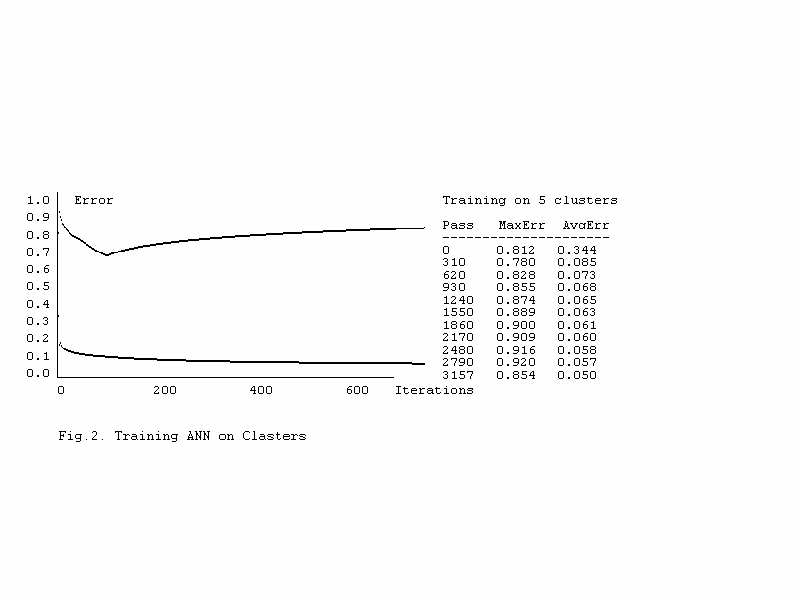
Results: The application of this software intelligent agent is first demonstrated here using the initial model. Figures 1-2 illustrate the history of training process. One function is the maximum (among training patterns) and lower function shows the average error. The latter defines duration of training process. Training terminates when the average error achieves 5%.

There was slow convergence of back-propagation algorithm applied to the training set of 96 patients. We needed 6800 iterations to achieve the sufficiently small (5%) average error.

Figure 1 shows the process of training on stage 2. It illustrates rapid convergence because we deal only with 9 patterns representing the 9 classes, formed on step 1.

Table 1 illustrates the effect of selection of maximum distance on the number of classes formed and on the production of errors. The number of classes increased with decreasing distance, but accuracy of classification does not decreased.

The rate of learning is inversely related to the number of classes. The use of the back-propagation to train on the entire data set without prior processing is slower than for the training on patterns.

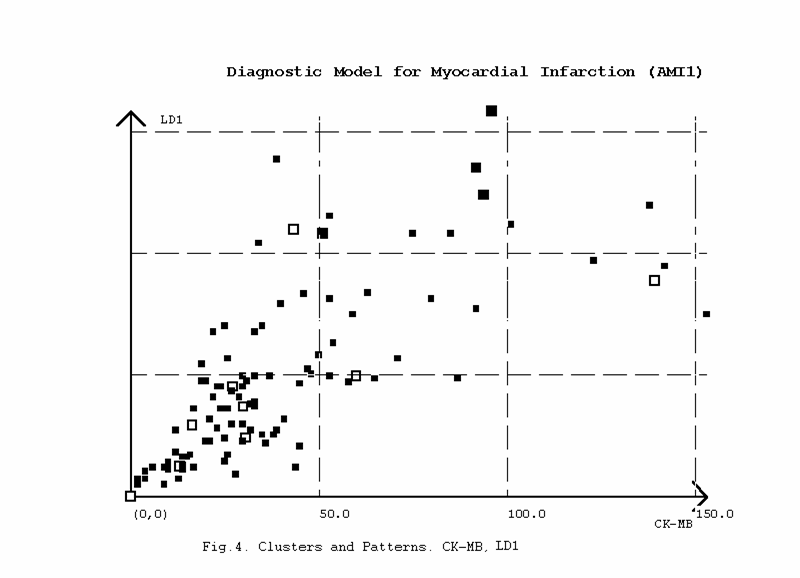
     Figures 2 is a two-dimensional projection of three-dimensional space of input variables CKMB and LD1 with small dots corresponding to the patterns and rectangular as cluster centroids (black – AMI, white – not AMI).

     We carried out a larger study using troponin I (instead of LD1) and CKMB for the diagnosis of myocardial infarction (MI).  The probabilities and odds-ratios for the TnI scaled into intervals near the entropy decision point are shown in Table 2 (N = 782).  The cross-table shows the frequencies for scaled TnI results versus the observed MI, the percent of values within MI, and the predicted probabilities and odds-ratios for MI within TnI intervals.  The optimum decision point is at or near 0.61 mg/L (the probability of MI at 0.46-0.6 mg/L is 3% and the odds ratio is at 13, while the probability of MI at 0.61-0.75 mg/L is 26% at an odds ratio of 174) by regressing the scaled values.

     The RBC, MCV criteria used were applied to a series of 40 patients different than that used in deriving the cutoffs.  A latent class cluster analysis is shown in Table 3.  MayNet is carried out on all 3 data sets for MI, CHF, and for beta thalassemia for comparison and will be shown.

Discussion:  CKMB has been heavily used for a long time to determine heart attacks. It is used in conjunction with a troponin test and the EKG to identify MI but, it isn’t as sensitive as is needed. A joint committee of the AmericanCollege of Cardiology and European Society of Cardiology (ACC/ESC) has established the criteria for acute, recent or evolving AMI predicated on a typical increase in troponin in the clinical setting of myocardial ischemia (1), which includes the 99th percentile of a healthy normal population. The improper selection of a troponin decision value is, however, likely to increase over use of hospital resources.  A study by Zarich8 showed that using an MI cutoff concentration for TnT from a non-acute coronary syndrome (ACS) reference improves risk stratification, but fails to detect a positive TnT in 11.7% of subjects with an ACS syndrome8. The specificity of the test increased from 88.4% to 96.7% with corresponding negative predictive values of 99.7% and 96.2%. Lin et al.9 recently reported that the use of low reference cutoffs suggested by the new guidelines results in markedly increased TnI-positive cases overall. Associated with a positive TnI and a negative CKMB, these cases are most likely false positive for MI. Maynet relieves this and the following problem effectively.

Monitoring BNP levels is a new and highly efficient way of diagnosing CHF as well as excluding non-cardiac causes of shortness of breath. Listening to breath sounds is only accurate when the disease is advanced to the stage in which the pumping function of the heart is impaired. The pumping of the heart is impaired when the circulation pressure increases above the osmotic pressure of the blood proteins that keep fluid in the circulation, causing fluid to pass into the lung’s airspaces.  Our studies combine the BNP with the EKG measurement of QRS duration to predict whether a patient has a high or low ejection fraction, a measure to stage the severity of CHF.

We also had to integrate the information from the hemogram (RBC, MCV) with the hemoglobin A2 quantitation (BioRad Variant II) for the diagnosis of beta thalassemia.  We chose an approach to the data that requires no assumption about the distribution of test values or the variances.   Our detailed analyses validates an approach to thalassemia screening that has been widely used, the Mentzer index10, and in addition uses critical decision values for the tests that are used in the Mentzer index. We also showed that Hgb S has an effect on both Hgb A2 and Hgb F.  This study is adequately powered to assess the usefulness of the Hgb A2 criteria but not adequately powered to assess thalassemias with elevated Hgb F.

References:

1.  Adan J, Bernstein LH, Babb J. Lactate dehydrogenase isoenzyme-1/total ratio: accurate for determining the existence of myocardial infarction. Clin Chem 1986;32:624-8.

2. Rudolph RA, Bernstein LH, Babb J. Information induction for predicting acute myocardial infarction.  Clin Chem 1988;34:2031- 2038.

3. Magidson J. “Maximum Likelihood Assessment of Clinical Trials Based on an Ordered Categorical Response.” Drug Information Journal, Maple Glen, PA: Drug Information Association 1996;309[1]: 143-170.

4. Magidson J and Vermoent J.  Latent Class Cluster Analysis. in J. A. Hagenaars and A. L. McCutcheon (eds.), Applied Latent Class Analysis. Cambridge: CambridgeUniversity Press, 2002, pp. 89-106.

5. Mkhitarian VS, Mayzlin IE, Troshin LI, Borisenko LV. Classification of the base objects upon integral parameters of the attached network. Applied Mathematics and Computers.  Moscow, USSR: Statistika, 1976: 118-24.

6.Mayzlin IE, Mkhitarian VS. Determining the optimal bounds for objects of different classes. In: Dubrow AM, ed. Computational Mathematics and Applications. MoscowUSSR: Economics and Statistics Institute. 1976: 102-105.

7. RumelhartDE, Hinton GE, Williams RJ. Learning internal representations by error propagation. In:

RumelhartDE, Mc Clelland JL, eds. Parallel distributed processing.   Cambridge, Mass: MIT Press, 1986; 1: 318-62.

8. Zarich SW, Bradley K, Mayall ID, Bernstein, LH. Minor Elevations in Troponin T Values Enhance Risk Assessment in Emergency Department Patients with Suspected Myocardial Ischemia: Analysis of Novel Troponin T Cut-off Values.  Clin Chim Acta 2004 (in press).

9. Lin JC, Apple FS, Murakami MM, Luepker RV.  Rates of positive cardiac troponin I and creatine kinase MB mass among patients hospitalized for suspected acute coronary syndromes.  Clin Chem 2004;50:333-338.

10.Makris PE. Utilization of a new index to distinguish heterozygous thalassemic syndromes: comparison of its specificity to five other discriminants.Blood Cells. 1989;15(3):497-506.

Acknowledgements:   Jerard Kneifati-Hayek and Madeleine Schlefer, Midwood High School, Brooklyn, and Salman Haq, Cardiology Fellow, Methodist Hospital.

Table 1. Effect of selection of maximum distance on the number of classes formed and on the accuracy of recognition by ANN

ClusteringDistanceFactor F(D = F * R)  Number ofClasses  Number of Nodes inThe HiddenLayers  Number ofMisrecognizedPatterns inThe TestingSet of 43 Percent ofMisrecognized   
  10.90.80.7  2414135  1, 02, 03, 01, 02, 03, 0

3, 2

3, 2

121121

1

1

2.34.62.32.34.62.3

2.3

2.3

Figure 1.

Figure 2.

Table 2.  Frequency cross-table, probabilities and odds-ratios for scaled TnI versus expected diagnosis

Range Not MI MI N Pct in MI Prob by TnI Odds Ratio
< 0.45 655 2 657 2 0 1
0.46-0.6 7 0 7 0 0.03 13
0.61-0.75 4 0 4 0. 0.26 175
0.76-0.9 13 59 72 57.3 0.82 2307
> 0.9 0 42 42 40.8 0.98 30482
679 103 782 100


Read Full Post »


Reporter: Aviva Lev-Ari, PhD, RN

Arti Rai, J.D.

N Engl J Med 2012; 367:491-493  August 9, 2012

The Drug Price Competition and Patent Term Restoration Act of 1984, commonly known as the Hatch–Waxman Act, aims to strike a balance between the innovation incentives provided by patents and the greater access provided by low-cost generic drugs. The legislation, which relies in part on an explicit link between the Food and Drug Administration (FDA) drug-approval process and the U.S. patent system, has been controversial, particularly because of the ways in which firms producing brand-name drugs have exploited that link to delay market entry of generics as long as possible. Now, the tactical landscape has shifted again, with a recently decided Supreme Court case, Caraco Pharmaceutical Laboratories v. Novo Nordisk.

Under current FDA regulations, the developer of a brand-name drug must submit all patents that it deems to cover the drug to the FDA for publication in the agency’s Approved Drug Products with Therapeutic Equivalence Evaluations — the so-called Orange Book. Before marketing a generic version of a drug, the generics manufacturer must certify that all Orange Book patents for the brand-name product are invalid, are not infringed by the generic product, or have expired. Certifications that patents that are invalid or not infringed, known as Paragraph IV certifications, allow the brand-name drug maker to sue the generics manufacturer to resolve questions of validity and infringement. As a result, FDA approval of the generic drug can be delayed for up to 30 months pending legal resolution.

Orange Book listings can include both product patents on small-molecule chemicals and patents on methods of use for treating particular conditions. FDA regulations require that, in addition to patent numbers and expiration dates, method-of-use patents must have “use codes” that describe their scope.

Frequently, the main product patent on a brand-name drug expires before the use patents do. In that case, FDA regulations based on Hatch–Waxman allow generics firms the option of filing a “section viii statement,” which “carves out” from the generic label those uses on which the brand-name firm still has patents. If the FDA finds this narrower labeling acceptable from the standpoint of safety and efficacy, the generic version has a potential path to market.

Brand-name drug manufacturers have sometimes tried to sue to prevent market entry by generics companies that file section viii statements, typically arguing that although a generics firm may not be directly infringing a use patent, it should be prohibited from marketing its product because such marketing will inevitably “induce” infringement. In other words, the generic-substitution practices of doctors and pharmacists — encouraged by FDA approval of “carved-out” generics as fully substitutable for brand-name drugs and by laws in many states — will inevitably lead to prescription of generic drugs for patented uses. Moreover, brand-name pharmaceutical firms argue that generics firms should be held liable because they are well aware that their products will be prescribed and dispensed in an infringing manner.

The Court of Appeals for the Federal Circuit, the intermediate appellate court for patent cases, has held that as a procedural matter, courts may hear suits brought by brand-name firms in response to a section viii statement filing. However, it has generally rejected the substantive claim of induced infringement, holding that because inducement requires more than mere knowledge that infringement is occurring, the generics firm cannot be held liable unless it specifically promoted the drug for a carved-out use.1

In recent years, carve-out labeling has assumed a prominent role in facilitating market entry of generics. For example, in fiscal year 2010, the FDA approved 11 generic drugs with carve-out labeling. In fact, 3 of the 5 top-selling brand-name drugs that “went generic” that year did so as a consequence of such labeling.2

On occasion, brand-name drug manufacturers have attempted to defeat carve-out attempts by listing use codes that substantially exceed the scope of the use patent. This tactic can be effective, since the FDA does not evaluate representations of patent information in use codes.3

In April 2012, however, the Supreme Court issued a decision enabling generics firms to challenge the submission to the FDA of overly broad use claims. In Caraco, Novo Nordisk’s only unexpired patent covered a relatively narrow use — treating non–insulin-dependent diabetes by combining its diabetes drug repaglinide with another drug, metformin. In the Orange Book, however, Novo Nordisk listed a much broader use code that covered all methods for “improving glycemic control in adults with type 2 diabetes mellitus,” thereby denying generics firms a meaningful carve-out.

The key question in this case was whether amendments to Hatch–Waxman implemented in 2003 allowed generics firms, in the course of a patent-infringement lawsuit brought by the brand-name company, to file a counterclaim to correct overly broad listings of Orange Book use codes. The unanimous opinion of the Court, delivered by Justice Elena Kagan, held that the amendments were indeed intended to correct such overbreadth. As Kagan noted, absent the ability to correct overbreadth, a company could not market a generic drug for noninfringing uses.

As a matter of statutory interpretation, the Supreme Court decision is correct. Both the language and legislative history of the 2003 amendments indicate that Congress intended to control inaccurate Orange Book listing practices with respect to product patents and method-of-use patents. Such misleading practices had been thoroughly documented in a 2002 Federal Trade Commission report. However, as Justice Sonia Sotomayor‘s concurrence points out, the mechanism provided by Congress is far from optimal. A claim to correct overbreadth can be filed only if the generics firm chooses to provoke litigation by filing a Paragraph IV certification and the brand-name firm then sues for infringement. An administrative approach to determining the accuracy of Orange Book listings — an approach in which the FDA might, for example, consult with the Patent and Trademark Office — would clearly be more efficient.

Lurking behind these technical legal disputes over carve-outs, induced infringement, and overly broad Orange Book listings is the broader policy issue of providing incentives to search for new uses. Brand-name pharmaceutical companies argue that the pervasive distribution of generic drugs for patented uses substantially undermines the efficacy of such patents and hence the incentives for finding other uses.4

Strong incentives are probably unnecessary for purposes of generating hypotheses regarding new uses. The heavy prevalence of off-label prescribing — which accounted for more than 20% of prescriptions written by office-based physicians in 2001, according to one study5 — suggests that hypotheses are pervasive. The incentives question is important, however, because the ultimate objective, from the standpoint of both patient welfare and cost, is reliable evidence of efficacy. Such evidence, which is required before the FDA can approve labeling (or allow marketing) for a new use, is generated through investment in well-designed trials.

Such investment need not emerge, however, only from individual firms operating in secrecy and motivated by patents. Indeed, one recent study found that publicly funded research formed the foundation for almost all the new-use FDA approvals that were examined.6 Going forward, the public sector’s role is likely to increase — the new National Center for Advancing Translational Sciences at the National Institutes of Health has explicitly embraced the search for new uses in a number of the programs it is funding.

In many arenas of innovation, proprietary research models supported by intellectual property and publicly funded open research models not only coexist, they play mutually reinforcing, synergistic roles. Brand-name firms could view Caraco‘s partial restriction on their deployment of overly broad use claims as an opportunity to rely less on dubious legal tactics and more on the pursuit of opportunities to leverage public-sector investment.

Disclosure forms provided by the author are available with the full text of this article at NEJM.org.

SOURCE INFORMATION

From the Duke University School of Law, Durham, NC.

REFERENCES

    1. 1

      Warner-Lambert Co. v. Apotex, 315 F.3d 1348 (Fed. Cir. 2003).

    1. 2

      Brief for the United States as amicus curiae supporting petitioners, Caraco v. Novo-Nordisk, 2011.

    1. 3

      68 Fed. Reg. 36683 (2003).

    1. 4

      Eisenberg RS. The problem of new uses. Yale J Health Policy Law Ethics 2005;5:717-739

    1. 5

      Radley DC, Finkelstein SN, Stafford RS. Off-label prescribing among office-based physicians. Arch Intern Med 2006;166:1021-1026

  1. 6

    Stevens AJ, Jensen JJ, Wyller K, Kilgore PC, Chatterjee S, Rohrbaugh ML. The role of public-sector research in the discovery of drugs and vaccines. N Engl J Med 2011;364:535-541


Read Full Post »

Patient Access to Medical Devices — A Comparison of U.S. and European Review Processes

Reporter: Aviva Lev-Ari, PhD, RN


Saptarshi Basu, M.P.A., and John C. Hassenplug, M.Sc.

N Engl J Med 2012; 367:485-488  August 9, 2012

The U.S. process for approving innovative, high-risk medical devices has been criticized for taking longer than the European approval process.1 This contention is often used to support the argument that the Food and Drug Administration (FDA) should lower its standards for approving medical devices, since a slow approval process is delaying Americans’ access to innovative and lifesaving technology. But a review of the data, using appropriate end points, suggests instead that it takes the same amount of time or less for patients to gain access to innovative, high-risk medical devices in the United States as it does in the four largest European markets (Germany, France, Italy, and Britain)2 — largely because patient access is generally delayed until reimbursement decisions are made, which often takes substantially longer in Europe than in the United States.

To compare the United States and Europe fairly on this front, three criteria must be considered: the level of device innovation, equivalent start and end points, and patient access as defined by time to reimbursement. First, we focused on innovative, high-risk devices because in the United States such devices require the strongest evidence of clinical benefit and are the subject of most debates about the relative effectiveness of approval processes in different countries. Furthermore, previous studies have shown that lower-risk devices achieve market access in a similar amount of time in the United States and in Europe.

Second, an accurate comparison of time to market access requires measurement of the total time that elapses between application submission and market access. Previous studies have compared the chronologic dates of application submission and market access, but the date an application is submitted varies from country to country.

Third, patient access should be equated with the availability of reimbursement rather than with device approval, because broad patient access to a new device doesn’t occur until reimbursement by a national or third-party payer is available. Previous comparisons of the U.S. and European systems have used the approval date to measure process duration, but innovative, high-risk devices don’t reach a market where most patients can benefit from them immediately after gaining regulatory approval, though they may be accessible to patients who can afford to pay out of pocket. Rather, there is a second level of review through which public or private insurers decide whether and at what price they will pay for a device. Generally, public systems take longer than private insurers to make reimbursement decisions, and significantly more Europeans than Americans have public insurance. Two thirds of the U.S. population is covered by private health insurance, whereas only a fifth receives publicly funded reimbursement, primarily administered by the Centers for Medicare and Medicaid Services (CMS).

For both private and public systems in the United States, the pathway to patient access to a device starts with the submission of an application to the FDA. The FDA reviews innovative, high-risk devices for safety and effectiveness (clinical benefit) under the premarket approval (PMA) process, and information on the duration of reviews is publicly available. In fiscal year 2011, the FDA approved 40 applications for PMA. The average review time was 13.1 months, with 8.4 months attributed to FDA review time, and 4.7 months to the time the agency waits for the sponsor to address deficiencies in the application (“sponsor time”).3 CMS provides reimbursement for the majority of devices when they earn FDA approval. For a limited number of devices each year, however, CMS conducts a national coverage determination in response to external requests for validation or for devices that have limited or conflicting evidence of clinical benefit. This process averaged 8.6 months over the past 5 fiscal years.4 Although it is difficult to obtain data on how long private insurers take to make coverage decisions, anecdotal information from private insurers suggests that decisions are made within a few weeks to a few months after FDA approval, depending on the amount and quality of evidence of clinical benefit.

In Europe, by contrast, most of the 27 member countries of the European Union (EU) have publicly financed health care systems; such systems cover approximately four fifths of the populations of the four largest device markets. All EU countries require devices to first obtain a Conformité Européenne (CE) marking, which refers to a symbol shown on products that indicates market approval throughout the EU. The CE marking process is conducted by for-profit, third-party “notified bodies” that have been accredited by a member country to assess device safety and performance but do not evaluate effectiveness (which requires more clinical data). Although publicly available data are limited, anecdotal information from notified bodies suggests that the process takes 1 to 3 months, excluding sponsor time.

Most European patients do not have access to innovative, high-risk devices as soon as the devices receive a CE marking. Each country must first make a decision about reimbursement, a process that varies substantially among countries.5 Though a CE marking can be granted on the basis of fewer clinical data than are required for FDA approval, European standards for reimbursement are often similar to or higher than those that the FDA imposes for device approval. European countries may require additional data on the device’s safety and effectiveness, as well as on cost-effectiveness.

In France, a centralized body makes reimbursement decisions after assessing the safety and effectiveness of individual devices. Reimbursement decisions in Italy are devolved to the various regions, and Britain and Germany conduct broader assessments of device types or procedures, rather than of individual devices. Typically, innovative devices not covered under an existing diagnosis-related group (DRG) require review under the lengthier Health Technology Assessment process, which assesses safety, clinical benefit, and cost-effectiveness. Government-provided information on time to reimbursement varies by country. Estimated time frames are an average of 71.3 months in Germany, a range of 36.0 to 48.0 months in France, a range of 16.4 to 26.3 months in Italy, and an estimated 18 months in Britain.

Using this information, we determined that the time it takes to bring innovative, high-risk devices to patients in the United States is similar to or shorter than that in the top four European markets (seefigureComparison of Time to Market in Premarket Approval and Reimbursement Processes.). The public (CMS) process in the United States takes approximately as long as those in Italy and Britain, approximately half as long as that in France, and less than a third as long as that in Germany. The difference in time to market access is even greater when it comes to private insurers (covering the majority of the U.S. population), which often make reimbursement decisions within a few months after FDA approval.

To further illustrate this point, we compared the time to approval for five innovative, high-risk medical devices available in France, Italy, and the United States (see tableComparison of Time to Market Access for Five Innovative Devices in France, Italy, and the United States.). These case studies indicate that the average time to market access for these devices was 26.3 months in France, 30.8 months in Italy, and 15.3 months in the United States.

These numbers may not fully capture the reasons why a device reaches the market more quickly in one country than in another and do not reflect experiences with all innovative, high-risk devices. However, unless one uses equivalent standards in terms of the level of risk, the start and end points of the process, and the key end point of market access, accurate comparisons cannot be made.

Disclosure forms provided by the authors are available with the full text of this article at NEJM.org.

This article was published on August 1, 2012, at NEJM.org.

SOURCE INFORMATION

From the Office of Planning, Office of the Commissioner, Food and Drug Administration, White Oak, MD.

Read Full Post »

Updated Transcatheter Aortic Valve Implantation (TAVI): risk for stroke and suitability for surgery

Reporter: Aviva Lev-Ari, PhD,RN


UPDATED on 5/27/2014

Survival After TAVI: Longest Follow-up Data Yet Yield Some Surprises

May 23, 2014

PARIS, FRANCE — Some of the longest follow-up for the first transcatheter aortic-valve implantations (TAVI) ever performed confirm earlier observations that the biggest threat to survival in TAVI-implanted patients remains their comorbidities and not problems related to their valves, regardless of valve type. More surprising, some of the procedural issues that preoccupy interventionalists and surgeons today did not emerge as important in this longer-term follow-up.

Presenting three- and five-year data from the UK TAVI registry in a press conference here at EuroPCR 2014 , Dr Neil Moat (Royal Brompton Hospital, London, UK) pointed to what he called “biphasic” survival curves. In the first few months after valve implantation, there is a steep drop in survival, he noted. Thereafter, the curve becomes significantly less steep, mirroring the survival curves typically seen in older patients who have undergone surgical valve replacement.

“In the first six months, you have quite a dramatic attrition of patients, then mortality falls to about 6% of patients per year,” he said. “What this is telling us is that patients undergoing TAVI are not dying of TAVI-related factors.”

The UK TAVI registry contains prospectively collected data from 100% of all consecutive transcatheter aortic-valve replacement (TAVR) patients treated since January 1, 2007. The current analysis includes 870 early patients whose mortality status was ascertained in July 2013.

In all, 62% of TAVR-treated patients were alive at three years, while just under half—48.4%—were still alive at five years.

Dr Neil Moat [Source: EuroPCR]

In multivariable analyses, the strongest baseline predictor of mortality at three years was

  • creatinine >200 µg/mmol, followed by
  • presence of atrial fibrillation,
  • chronic obstructive pulmonary disease (COPD), or a
  • high EuroSCORE (>18.5).

Of note, device- or procedure-related characteristics that typically get a lot of attention at interventional meetings were not significant predictors of late survival. For example,

  • 12.7% of patients still alive at three years had had moderate/severe aortic regurgitation at the time of their procedure, compared with
  • 14.9% of patients who’d died, but the difference was not statistically significant. Likewise,
  • permanent pacemaker implantation had been performed in 16.2% of patients still alive at follow-up and in
  • 19.3% of patients who died, again a nonsignificant difference.

Not surprisingly,

  • more transfemorally treated patients were alive at three years than
  • patients treated via a nontransfemoral procedure (64.3% vs 55.7%, p=0.017).

Roughly the same number of patients received the

  • Edwards Sapien device in the early days of the TAVI registry (410) as received the
  • Medtronic CoreValve (452).

By three years,

  • 40.7% of Sapien-treated patients had died, compared with
  • 35.4% of CoreValve-treated patients (p=0.078).
“CoreValve had a trend toward better survival, but I wouldn’t want to overinterpret that,” Moat cautioned. These are preliminary data, he stressed, but added, “There is a trend there that needs looking at” when the registry has more patients, with more follow-up.

One of the theories put forward in other sessions at EuroPCR is that the higher pacemaker-implantation rate with CoreValve might, in fact, help bump up survival rates with this device.

“It’s an interesting hypothesis,” Moat said. “But I don’t think we have any data to support that hypothesis, either here or in any other study. I think if there were an effect of early pacemaker implantation it would be in this first [six-month] phase. Some people are concerned that the early attrition is sudden death because of late heart block occurring two, three, or four months after the procedure. So if you are having pacemakers implanted more frequently, you are being protected from that, but I think our data strongly suggest that pacemaker implant does not affect long-term survival.”

Moat disclosed being a consultant for Medtronic.


UPDATED on 2/9/2014

Transcatheter Technologies Completes Durability Testing of Its Prosthetic Aortic Heart Valve, Intrinsic to World’s First ‘Truly Repositionable’ TAVI Device, TRINITY

January 28, 2014 6:29 AM 

Business Wire

“This 3rd-generation TRINITY technology could be a game-changer for TAVI.” Prof. Dr. Christian Hengstenberg, MD, German Heart Center, Munich (Note: Prof. Dr. med Hengstenberg has no financial ties to Transcatheter Technologies.)

REGENSBURG, Germany–(BUSINESS WIRE)–January 28, 2014–

Transcatheter Technologies GmbH, an emerging medical device company that is developing a third-generation transcatheter aortic valve implantation (TAVI) system-TRINITY-announced today that an independent laboratory has completed ‘advanced wear testing’ (AWT) of the company’s TRINITY valve prosthesis, far exceeding minimum testing standards. Indeed, AWT of the TRINITY heart valve has already completed 600 million cycles, or an estimated 15 years of durability testing.

Transcatheter Technologies has previously announced the successful 30-day follow-up results of a pilot study of its TRINITY TAVI system that is designed to be the world’s first ‘truly repositionable’ and, therefore, best TAVI system.

“Unlike second-generation TAVI systems, the Trinity aortic valve is designed to be positioned precisely or repositioned, even after full implantation, in a safe and simple manner,” said principal investigator Prof. Dr. Christian Hengstenberg, a cardiologist at the German Heart Center, Munich, Germany, with no financial interest or arrangement or affiliation with Transcatheter Technologies. “In our study, Trinity’s novel sealing cuff continues to provide outstanding follow-up results without PVL (paravalvular leak), a frequent complication of TAVI. Equally important, the TRINITY aortic valve is designed to reduce the risk of atrio-ventricular (AV) block significantly through supra-annular positioning of the TRINITY valve.”

“We are extremely pleased that our TRINITY valve has already demonstrated three times the minimum standard for advanced wear testing of a tissue heart valve,” said Wolfgang Goetz, M.D., Ph.D., CEO, a cardiac surgeon by training. We also are extremely pleased with the continuing excellent results of our third-generation TRINITY System in the follow-up of our first patient.

“The big issue with the second-generation TAVI systems is that they cannot be truly repositioned once fully implanted. TRINITY, however, is designed to solve this critically important issue and thereby potentially reduce the undesirable side consequences of PVL,” added Dr. Goetz. “With TRINITY, once our valve is completely expanded and anchored above the annulus, a cardiologist can fully evaluate the valve’s function to determine whether it needs to be repositioned, retrieved, or kept in the same position. This feature and its supra-annular anchoring are absolutely unique to TRINITY, which is why we have positioned TRINITY as a Third-Generation TAVI System.”

CAUTION: TRINITY is not approved for use in the United States

Ronald Trahan Associates Inc.
Ronald Trahan, APR, +1-508-359-4005, x108

SOURCE

Transcatheter aortic valve implantation (TAVI): risk for stroke and suitability for surgery

For additional discussion go to 

Transcatheter Aortic Valve Implantation (TAVI): Risky and Costly

http://pharmaceuticalintelligence.com/2012/08/02/transcatheter-aortic-valve-implantation-tavi-risky-and-costly/

BMJ 2012; 345 doi: 10.1136/bmj.e4710 (Published 31 July 2012) Cite this as: BMJ 2012;345:e4710

Evidence for TAVI Questioned

By Chris Kaiser, Cardiology Editor, MedPage Today

Published: July 31, 2012

The tens of thousands of transcatheter aortic valve implantations (TAVI) performed worldwide may not have solid evidence behind them, European researchers suggested.

To begin with, a health technology assessment commissioned by the Belgian government suggested that only patients who are “deemed inoperable for technical reasons such as a series of previous operations or irradiation of the chest wall” be reimbursed for TAVI, according to Mattias Neyt, PhD, of the Belgian Health Care Knowledge Centre in Brussels, and colleagues.

That’s about 10% of patients currently being considered for the procedure, they wrote online in an analysis article in BMJ.

Why is there such a big disconnect between the growing number of patients undergoing TAVI and the findings of the Belgian technology assessment? Neyt and colleagues said there are several factors that have resulted in more enthusiasm than evidence for TAVI.

One of those factors is the process by which medical devices receive marketing approval in the E.U., which, they said, puts medical devices “on the same footing as domestic appliances such as toasters.”

As a consequence of what the authors referred to as “Europe’s lax licensing laws,” the two TAVI devices in common use today – Medtronic’s CoreValve and Edward Lifescience’s Sapien – were approved in 2007, “long before any substantial clinical trial evidence was available.”

Even the U.K.’s National Institute for Health and Clinical Excellence (NICE) concluded that the evidence was “adequate from a clinical point of view” for the use of TAVI in those unsuitable for surgery, but when surgery is an option — even a high-risk one — the evidence for TAVI was inadequate.

However, the British analysis did not consider costs associated with the procedure, Neyt and colleagues pointed out.

In the U.S., the FDA approval process is more rigorous than that of the E.U., but Neyt and colleagues were “far from convinced” that the results from the PARTNER trials (Cohort A andCohort B) were adequate to justify approval of the Sapien valve.

Although the cost-effectiveness of TAVI for inoperable patients (cohort B) is “equivocal,” they wrote, the clinical evidence seems to suggest that TAVI can be justified. However, they pointed out some problems that they said were not considered within the overall evidence, such as a higher rate of comorbidities and a higher rate of previous MIs among the inoperable control patients.

In PARTNER cohort A, where TAVI was compared with high-risk surgical patients, the authors noted a concern for a higher rate of stroke or transient ischemic attack among the TAVI patients.

Nevertheless, an FDA panel in June recommended expanding the indication for the Sapien valve to include high-risk surgical candidates. One of the panelists said that stroke is “just an accepted risk of the procedure.”

But Neyt and colleagues don’t accept that. They concluded that based on the evidence, as well as the concern for efficient use of limited resources, “it is difficult to see how healthcare payers can justify reimbursing TAVI for patients suitable for surgery, given that the risk of stroke is twice as high after TAVI.”

Another issue that could undermine the integrity of the evidence, Neyt and colleagues said, was the absence of full disclosure on the part of principal investigator Martin B. Leon, MD, from Columbia University.

According to the Belgian researchers, part of the deal involving the sale of Leon’s valve company to Edwards included future payments from Edwards “on the achievement of three milestones: successful treatment of 50 patients, regulatory approval in Europe, and limited approval in the U.S.”

These three milestones were not disclosed in the original paper published in the New England Journal of Medicinethey said.

Neyt and colleagues also complained that the FDA and Edwards Lifesciences are holding on to negative findings from an FDA-authorized follow-on study of 90 inoperable patients. Some of the data released at an FDA meeting in 2011 showed a higher 1-year mortality rate among those receiving TAVI (34.3% versus 21.6%), they said, but efforts to obtain any of those data have been rebuffed by both the FDA and Edwards.

They brought this concern to the editors of the NEJM, but the editors didn’t think the concern invalidated the overall PARTNER findings.

Tying all this together, Neyt and colleagues called for “a major improvement in transparency of information” that would “allow clinicians to practice evidence-based medicine, patients to make informed decisions, and health technology assessment agencies to make the right judgments.”

The authors reported they had no relationships to disclose.

Primary source: BMJ

Read Full Post »

Reporter: Aviva Lev-Ari, PhD, RN

“A Synergistic Approach towards Biowaivers & Biosimilars”. Biosimilars-2012 is scheduled on September 10-12, 2012 at Hilton San Antonio Airport, USA.

Biosimilars or Follow-on biologics
http://en.wikipedia.org/wiki/Biologic_medical_product are terms used to describe officially-approved subsequent versions of innovator biopharmaceutical http://en.wikipedia.org/wiki/Biopharmaceutical  products made by a different sponsor following patent and exclusivity expiry on the innovator product.[1] http://en.wikipedia.org/wiki/Biosimilar#cite_note-biosimilars2012-0 Biosimilars are also referred to as subsequent entry biologics (SEBs) in Canada.[2] http://en.wikipedia.org/wiki/Biosimilar#cite_note-1 Reference to the innovator product is an integral component of the approval.
 
A Biowaiver is a waiver (exemption) of clinical bioequivalence studies given to a drug product.
 

Biowaivers and Biosimilars.

The main theme of the conference is “A Synergistic Approach towards Biowaivers & Biosimilars”.

Biosimilars-2012 is scheduled on September 10-12, 2012 at Hilton San Antonio Airport, USA.

 Click here to view the downloadable Preliminary Program 

 http://sm1.mailserv.in/omicsonlinebiz/lt.php?id=eR4DBVEEUA9UUksGBlMKAU4=UQMNDAgNSllRVQgECyUNWAodUg5C

This three day conference will cover the latest trends and challenges in Biowaivers and Biosimilars.   Biosimilars-2012 highlights the following topics:   

  • Biosimilars Pathway  
  • Immunogenicity   
  • Skill Set for Biosimilars Development  
  • Biosimilar Therapeutics      
  • Biomedical informatics  
  • BCS and IVIVC based biowaivers  
  • Transgenic animals & plants  
  • In vitro & In vivo Correlations  
  • Bioequivalence Testing  
  • BCS and IVIVC based biowaivers    
  • Oral drug delivery     

Conference assets are William Velander (University of Nebraska, USA), Lisa J. Murray (Absorption Systems, PA, USA), Leandro Mieravilla (Biosimilar-Biotech Global Expert, Canada) and David Goodall (Paraytec Limited, UK) who will discuss their novel research on Biosimilars & Biowaivers.

This conference is perfect for researchers and experts, as well as those who require in-depth analysis of the latest trends, technologies, and techniques.

Confirmed Speakers Including

Tentative Scientific Program18:00-19:00Registrations Sep-09-2012

Day 1

Sep-10-2012

07:00-08:00 Registrations

08:00-08:30 Breakfast

Breakout 1

08:30-09:00 Opening Ceremony

Keynote Forum

09:00-09:05 Introduction

09:05-09:30 Lisa J. Murray, Absorption Systems, USA

09:30-09:55 Yet to be Confirmed

09:55-10:20 Yet to be Confirmed

10:20-10:45 Yet to be Confirmed

Coffee Break 10:45-11:00

Track 1: Biosimilars : Innovator Pharmaceutical Products

Track 2: Biosimilars: Regulatory Approach

Session Introduction

11:00-11:20

Title: The role of scientific justification in the nascent us biosimilars approval pathway

Ben Kaspar, MMS Holdings Inc., USA

11:20-11:40

Title: The what million dollar question: Patent litigation and strategy under the biologics

price Competition and Innovation act

Bryan J. Vogel, Robins, Kaplan, Miller & Ciresi L.L.P., USA

11:40-12:00

Title: The role of patents in biosimilars and biobetters

Brian Dorn, Barnes & Thornburg LLP, USA

12:00-12:20

Title: New patent reform litigation options for biosimilars

Paul A. Calvo, Sterne, Kessler, Goldstein & Fox P.L.L.C., USA

12:20-12:40 Title: Regulatory consideration of the assessment of biosimilar products

Jun Wang, Duke University School of Medicine, USA

Lunch Break 12:40-13:20

13:20-13:40

Title: What hath FDA wrought: The February 2012 guidance and their implications for

securing biosimilar approval

Michal Swit, Duane Morris LLP, USA

13:40-14:00

Title: The role of clinical trials in demonstrating similarity of biological medicinal

products in the European Union

Cecil Nick, PARAXEL Consulting, UK

14:00-14:20

Title: Biosimilars panel: Opportunities and challenges to be overcome in the near term

Jennifer Brice, Frost & Sullivan, UK

14:20-14:40

Title: Graphical representation of the assessment of inventive step for patents using the

Problem-Solution-Approach (PSA)

Joachim Stellmach, European Patent Office, Germany

14:40-15:00

Title: IP strategies for the biosimilar arena

Ulrich Storz, Michalski Huettermann Patent Attorneys, Germany

15:00-15:20

Title: Biosimilars in emerging countries: Argentina

Gustavo Helguera, University of Buenos Aires, Argentina

15:20-15:40

Title: Developing biosimilars: Considerations, opportunities and challenges

Ming Wang, Gan & Lee Pharmaceuticals, China

Panel Discussion 15:40-15:55

Coffee Break 15:55-16:10

Track 3: Skill Set for Biosimilars Development

Track 4: Clinical Studies for Biosimilars

Session Introduction

16:10-16:30

Title: Strategies for development and validation of immunogenicity assays to support

preclinical and clinical biosimilar programs

Kelly S. Colletti, Charles River Preclinical Services, USA

16:30-16:50

Title: Transgenic blood proteins: An abundant source for next generation therapies with

worldwide availability

William Velander, University of Nebraska, USA

16:50-17:10

Title: The Danish HNPCC-system – Biomedical support to individual health care in

hereditary colon cancer families

Inge Thomsen Bernstein, Hvidovre University Hospital, Denmark

17:10-17:30

Title: Use of human protein transgenic animal models for immunogenicity testing and

their value for comparative studies of biosimilars

Melody Sauerborn, TNO Triskelion BV, The Netherlands

17:30-17:50

Title: Application of nanotechnology in drug delivery

Rawia Khalil, National Research Centre, Egypt

Panel Discussion 17:50-18:05

18:05-19:05 Cocktails: Sponsored by Journal of Bioequivalence & Bioavailability

Day 2

Sep-11-2012

Breakout 1

Track 5: Biosimilars Therapeutics

Track 6: Commercialization or Globalization of Biosimilars

Session Introduction

09:30-09:50

Title: Development of antibody arrays for measuring biosimilar conformational

comparability at molecular level

Xing Wang, Array Bridge Inc., USA

09:50-10:20

Title: Biosimilar market overview, present and future

Leandro Mieravilla, Biosimilar-Biotech Global Expert, Canada

10:20-10:40

Title: Modified biosimilars: Potential role in the emerging global biosimilar market

Pascal Bailon, Bailon Consultants, USA

Coffee Break 10:40-10:55

10:55-11:15

Title: The application of releasable pegylation linkers to improve the pharmaceutical

properties of biosimilars and biobetters

Hong Zhao, Enzon Pharmaceuticals, USA

11:15-11:35

Title: The clinical development of monoclonal biosimilars

Cecil Nick, PARAXEL Consulting, UK

11:35-11:55

Title: Ghrelin antagonist: Advantages and side-effects

Maria Vlasova, University of Eastern Finland, Finland

11:55-12:15

Title: Biosimilar market growth trends in emerging markets

Syamala Ariyanchira, Independent Consultant, Malaysia

12:15-12:35

Title: Developing of long acting glycoprotein hormones using gene fusion and gene

transfer: From bench to clinics

Fuad Fares, University of Haifa, Israel

Lunch Break 12:35-13:15

13:15-13:35

Title: Th1 immune response induced by Ipr1-PPE68 DNA vaccine in BALB/C mice model

Yang Chun, Chongqing Medical University, China

13:35-13:55

Title: Anticancer noscapinoids: Synthesis to nanomedicine

Ramesh Chandra, University of Delhi, India

Panel Discussion 13:55-14:10

Track 7: Plant Produ ced Biosimilar Products

Track 8: Aggregation and Immunogenicity of Biosimilars

Session Introduction

14:10-14:30

Title: Biosimilars: Lessons learned from development to commercial launch

Niranjan M. Kumar, ABS Inc. USA

14:30-14:50

Title: Plant-based production and preclinical analysis of biosimilar Trastuzumab

Michael D. McLean, PlantForm Corporation, Canada

Coffee Break 14:50-15:05

15:05-15:25

Title: Immunological aspects of formation of anti-drug antibodies against aggregated

protein drugs

Melody Sauerborn, TNO Triskelion BV, The Netherlands

15:25-15:45 Speech Opportunity Available

15:45-16:05 Speech Opportunity Available

Panel Discussion 16:05-16:20

Breakout 2

16:20-19:20

Editorial Board Meeting

Poster Presentations

Scientific Partnering

Cocktails: Sponsored by Pharmaceutica Analytica Acta

Day 3

Sep-12-2012

Breakout 1

Track 9: Biowaivers

Track 10: BCS & IVIVC Based Biowaivers

Track 11: Bioequivalence Assessment

Track 12: Analytical Strategies

Session Introduction

09:30-09:50

Title: Role of process controls in mitigating the risk associated with manufacturing of

biosimilars

Indu S. Javeri, CuriRx Inc., USA

09:50-10:20

Title: Current analytical techniques for analysis of carbohydrate containing biosimilars

Parastoo Azadi, University of Georgia, USA

10:20-10:40

Title: Improving outcomes: A decade of industry and regulatory experience with BCS

based biowaivers

Lisa J. Murray, Absorption Systems, USA

Coffee Break 10:40-10:55

10:55-11:15

Title: Approach for development of w-3 phospholipid dietary supplement to potential lipid

drug

Su Chen, Chainon Neurotrophin Biotechnology Inc., USA

11:15-11:35

Title: Bioanalytical challenges in development of biosimilars

Carmine Lanni, Bioanalytical Development Services, USA

11:35-11:55

Title: Some statistical issues on the evaluation of the similarity and interchangeability of

biologics

Laszlo Endrenyi, University of Toronto, Canada

11:55-12:15

Title: Rapid characterization of formulations: Protein size, aggregate levels and viscosity

David Goodall, Paraytec Limited, UK

12:15-12:35

Title: Taylor dispersion analysis, a rapid, nanolitre method to monitor protein aggregation

behavior

Wendy Louise Hulse, University of Bradford, UK

Lunch Break 12:35-13:15

13:15-13:35

Title: Effects of drying technology and polymers on integrity and biological activity of

proteins

Amal Ali Elkordy, University of Sunderland, UK

13:35-13:55

Title: A global perspective on the challenges of GLP/GCLP-bioanalysis for biosimilars

Aparna Kasinath, Clinigene International Limited, India

13:55-14:15 Speech Opportunity Available

14:15-14:35 Speech Opportunity Available

14:35-14:55 Speech Opportunity Available

14:55-15:15 Speech Opportunity Available

Panel Discussion 15:15-15:30

Editorial Board Meeting

For Biosimilars-2012 Organizing Committee 

OMICS Group Conferences
5716 Corsa Ave., Suite110
Westlake, Los Angeles
CA91362-7354, USA
Phone:+1-650-268-9744 <tel:%2B1-650-268-9744>
Fax:+1-650-618-1414 <tel:%2B1-650-618-1414>
Email: biosimilars2012@omicsgroup.com <mailto:biosimilars2012@omicsgroup.com>


Read Full Post »

Diagnostic Evaluation of SIRS by Immature Granulocytes: A model approach

Author and Curator: Larry H. Bernstein, MD

Executive Summary:

Sepsis is the most costly diagnosis in hospitalized patients and carries a high financial risk as a comorbidity and payment penalty under the new severity of illness CMS reimbursement guidelines as a patient safety hazard for failure to diagnose in a timely manner.  We carried out two studies of the early recognition of sepsis and related diseases in patients seen in the emergency department related to admission to the intensive care unit (ICU)(New YorkMethodistHospital) under the leadership of Lawrence Melniker, MD, Chairman of the Pharmacy and Therapeutics Committee.  The widely used SIRS criteria and the C-reactive protein, a long established acute phase protein, are each by themselves insufficient because of the low false negative rate of the former and the skewness and long tail of the latter related to uncurtailed noise from inconsequential inflammatory disease.  Using the elevated neutrophil count and left shift has proved to be elusive as well.  We and many others have established the validity of the European studies showing a marked benefit from using the procalcitonin (PCT, Brahms), and we propose to seize on the opportunity to calibrate the measurement of granulocyte maturation to the PCT.  The study would have to be carried out on a Sysmex instrument for accuracy and ease of use.  The Sysmex IG parameter is a measure of immature granulocyte counts and includes metamyelocytes, myelocytes and promyelocytes.

Background Study

Neutrophils thought to play a significant role in the early microvascular changes, are thought to be a key factor in the evolution of organ failure in the pathogenesis of severe sepsis and septic shock.  The mechanism of action of any drug or combination antibiotic combination therapy could potentially influence IG responses so that IG may be a useful way to monitor responses to therapy and disease progression by a simple, widely used hemocytometer that incorporates flow cytometry for cell identification.

An evaluation of the diagnostic performance of the Sysmex IG parameter and the procalcitonin (PCT, Brahms) assays when compared to existing practices and treatment decision guidelines is proposed following the establishment of a validated of a critical-decision cutoff for patients over 6 years old of 2.8% +0.2%.  Statistically significant numbers of samples representing the following patient groups would be assessed:

Group 1: Patients presenting to ICU with suspected Infection, SIRS (Systemic Inflammatory Response Syndrome, or severe sepsis, who are subjected to standard clinical and diagnostic investigation and do not fulfill criteria that warrant treatment with  antibiotic for the assessed state.

Group 2: Patients presenting to ICU with suspected Infection, SIRS (Systemic Inflammatory Response Syndrome, or severe sepsis, who are subjected to standard clinical and diagnostic investigation and are placed on antibiotic therapy (Infection) as a result of the investigation.

Group 3: Patients presenting to ICU with suspected Infection, SIRS (Systemic Inflammatory Response Syndrome, or severe sepsis, who are subjected to standard clinical and diagnostic investigation and are classified as having SIRS (Systemic Inflammatory Response Syndrome according to the equivalent of New York Methodist Hospital classification of SEPSIS (based on a modified Xigris (discontinue by Lilly) screening criteria, irrespective of the treatment option followed.

Group 4: Patients presenting to ICU with suspected Infection, SIRS (Systemic Inflammatory Response Syndrome, or severe sepsis, who are subjected to standard clinical and diagnostic investigation and have evidence of organ failure (New York Methodist Hospital classification of SEVERE SEPSIS; Xigris screening criteria for ACUTE ORGAN DYSFUNCTION.)

Diagnostic performance of both the Sysmex IG parameter and the procalcitonin (PCT, Brahms) assays are to be assessed as tools for sub-classification according to existing practices.

The ability of the IG parameter to detect the myeloid response associated prior to and increased with the onset of microvascular damage will be assessed. The potential to detect the IG response to predict progression towards multiple organ dysfunction could be an indication to initiate pharmacological therapy at a stage prior to significant evidence of organ failure.

The potential to use the IG parameter as a tool for monitoring responses to antibiotic and single or combination therapy could be assessed if the increase in IG shows good diagnostic performance alone or in combination as a necessary feature for decision-making.


SCREENING PATIENTS FOR SEVERE SEPSIS


http://www.xigris.com/140-screening-guide.jsp


GROUP 2: INFECTION–Does your patient have one or more of the following infection criteria?

  • Documented or Suspected–Does the patient have positive culture results (from blood, sputum, urine, etc.)?
  • Anti-Infective Therapy–Is the patient receiving antibiotic, antifungal, or other anti-infective therapy?
  • Pneumonia–Is there documentation of pneumonia (x-ray, etc.)?
  • WBCs–Have WBCs been found in normally sterile fl uid (urine, CSF, etc.)?
  • Perforated Viscus–Does the patient have perforated hollow organ (bowel)?
  • GROUP 3: SIRS-Does your patient have two or more of the following SIRS criteria?
  • Temperature–Is the patient’s temperature > 38°C (> 100.4°F) or < 36°C (< 96.8°F)?
  • Heart Rate–Is the patient’s heart rate > 90 bpm?
  • Respiratory Rate–Is the patient’s respiratory rate > 20 breaths/min?
  • WBC Count–Is the patient’s WBC count > 12,000/mm3, < 4000/mm3, absolute neutrophil count > 11,000/mm3, or are there > 2.8% immature granulocytes (myelocytes and metamyelocytes) discounting 10% band neutrophils and the less mature promyelocytes for left shift?
  • GROUP 4: ACUTE ORGAN DYSFUNCTION-Does your patient have one or more of the following organ dysfunction critera?
  • Cardiovascular–Does the patient have a systolic BP ≤ 90 mmHg or mean arterial pressure ≤ 70 mmHg (for at least 1 hour despite fl uid resuscitation) or require vasopressor support?
  • Respiratory–Does the patient have a PaO2/FiO2 ratio ≤ 250, PEEP > 7.5 or require mechanical ventilation?
  • Renal–Does the patient have low urine output (eg, <0.5 mL/kg/hr for 1 hour despite adequate fl uid rescuscitation),
  • increased creatinine (>50% increase from baseline) or require acute dialysis?
  • Hematologic–Does the patient have a low platelet count (< 100,000/mm3) or PT/PTT > upper limit of normal?
  • Metabolic–Does the patient have a low pH with high lactate (eg, pH < 7.30 and plasma lactate > upper limit of normal?
  • Hepatic–Are the patient’s liver enzymes > 2x upper limit of normal?
  • CNS-Does the patient have altered consciousness or reduced Glasgow Coma Score?

Guidelines For Management

Sepsis, Severe Sepsis, and Septic Shock

A. Definitions

Sepsis

Presence or Suspicion of infection and one or more of the following conditions

  • Fever (core temperature >38.3°C)
  • Hypothermia (core temperature <36°C)
  • Heart rate >90/min or >2 SD above the normal value for age
  • Tachypnea > 20/min or >2 SD above the normal value for age
  • Altered mental status
  • Leukocytosis (WBC count >12,000/µL)
  • Leukopenia (WBC count <4000/µL)
  • Neutrophilia as defined above
  • Normal WBC count with >2.8% immature granulocytes (IG)


Severe Sepsis

Sepsis and at least one New Organ Dysfunction

Organ dysfunction variables:

  • Altered level of consciousness or reduced Glasgow coma score
  • Arterial hypoxemia (PaO2/FIO2 <300)
  • Acute oliguria – urine output <0.5 mL/kg/hr)
  • Creatinine > 2.0 mg/dL or > 50% increase from baseline
  • Coagulation abnormalities (INR >1.5 or aPTT >60 secs)
  • Thrombocytopenia (Platelet count <100,000/µL)
  • Hyperbilirubinemia (Plasma total bilirubin > 2.0 mg/dL or 35 mmol/L)


Tissue perfusion variables:

  • Hyperlactatemia (>2 mmol/L)
  • Metabolic acidosis  ( pH < 7.30)


Hemodynamic variables:

  • Transient arterial hypotension (SBP <90, MAP <70, or SBP decrease >40 mm Hg from baseline) (Hypotension corrected with adequate volume resuscitation)


Septic Shock

Severe Sepsis and Persistent Arterial Hypotension

Screening Tool for Sepsis

Emergency Department, Med-Surg Floors, and Critical Care Units


1. Is the patient’s history suggestive of a NEW infection?                                                             ___ Yes ___No


[Check any that apply]

   
Pneumonia or Empyema

(  )

Skin/soft tissue infection

(  )

Urinary tract infection

(  )

Wound infection

(  )

Acute abdominal infection

(  )

Bone/joint infection

(  )

Meningitis

(  )

Bloodstream catheter

(  )

Endocarditis

(  )

Implantable device

(  )

Other

(  )


2. Are any two of the following signs, symptoms, or findings of infection

*both* – Present and New – to the patient?                                                                                    ___ Yes ___No


[Check any that apply]

     
Hyperthermia

> 38.3 °C (101.0 oF)

Hypothermia

< 36 °C     (96.8°F)

(  )

(  )

Leukocytosis

(WBC count >12,000/µL)

Leukopenia

(WBC count <4000/µL)

(  )

(  )

Tachycardia > 90 bpm

Tachypnea > 20 bpm

Altered mental status

(  )

(  )

(  )

Hyperglycemia

(serum glucose >120 mg/dL

– in the absence of diabetes)

(  )

If The Answer Is “YES” To BOTH Questions 1 And 2,


è  SUSPICION of INFECTION is Present:


  • Immediately obtain:
    • CBC with differential
    • Comprehensive metabolic panel
    • Procalcitonin
    • C-reative protein (CRP)
    • Lactate level
    • ABG
    • Blood cultures
    • Liver function tests
    • Coagulation profile
    • Urine analysis
    • CXR
    • Pulse co-oximetry

3. Are any of the following organ dysfunctioncriteria *both* – Present & New – in an organ remote from the site of the infection? 

___ Yes ___No


Organ Dysfunction Criteria


  • SBP < 90 mmHg or MAP < 65 mmHg
  • SBP decrease > 40 mm Hg from baseline
  • Bilateral pulmonary infiltrates with a:
New or increased O2 supplementation requirement to maintain SpO2 > 90%   OR
  • PaO2/FiO2 ratio < 300
  • Creatinine > 2.0 mg/dl (176.8 mmol/L)
  • Urine Output < 0.5 ml/kg/hour for > 2 hours
  • Bilirubin > 2 mg/dl (34.2 mmol/L)
  • Platelet count < 100,000
  • Coagulopathy (INR >1.5 or aPTT >60 secs)
  • Lactate > 2 mmol/L (18.0 mg/dl)
 

Note: the remote organ stipulation is waived in the case of bilateral pulmonary infiltrates


If suspicion of infection AND organ dysfunctionare present,

the patient meets the criteria for SEVERE SEPSIS


èInitiate severe sepsis protocol to achieve these goals <6 hrs


6-Hr Goals for Severe Sepsis
1)    Mean arterial pressure > 65 mm of Hg
2)    Urine output > 0.5 ml/kg/hr [average sized adult > 30-40 cc/hr]
3)    CVP > 8-10 mm Hg or Sonographic Signs of adequate filling pressures
4)    SVO2 > 70%

Early Goal-Directed Therapy for Severe Sepsis

[For Emergency Department / Med-Surg Floors / Critical Care Medicine settings]


First 6 hrs


  • Severe sepsis identified by screening                 Yes                  No
  • Blood cultures sent                                           Yes                  No
  • Serum lactate sent                                             Yes                 No
  • Patient hypotensive with
    • Systolic Blood Pressure <90 or                   Yes                  No
    • Mean Arterial Pressures < 65 mm of Hg     Yes                  No

0 – 1 hr Management

1)      Start fluid bolus normal saline 20 ml/kg at 500 – 1000ml over 30 minutes and re-evaluate blood pressure and urine output (expected value >0.5ml/kg/hr)

2)      Re-evaluate 10 minutes after fluid bolus

3)      If blood pressure is stabilized, continue fluids at maintenance rate [No CVP Monitoring Needed]

4)      O2 supplementation to maintain SaO2 > 90% — ventilatory support, if indicated

1 – 2 hrs Management

5)      If patient remains hypotensive [Med-Surg MUST Call for CVP Monitoring Approval]

  • ABG, if not done already
  • Measure CVP or Sonographic Signs of adequate filling pressure:                                           When possible:
    • Central Venous Catheterization with
    • Central Venous Pressure Transducer/Monitor


For CVP < 8-10 mm Hg and MAP < 65 mm Hg

(HYPOTENSION WITHOUT ADEQUATE FILLING PRESSURE)

  • Repeat fluid bolus 20 ml/kg at 500 –1000 ml over 30 minutes until:
    • Patient has CVP > 8-10 mm Hg
      • Continue fluid boluses to correct CVP > 8-10 mm Hg

OR

  • Signs of volume overload on physical examination
  • If patient is unstable
    • May start norepinephrine infusion at this time
 

For CVP > 8-10 mm Hg and MAP < 65 mm Hg

(HYPOTENSION WITH ADEQUATE FILLING PRESSURE)

  • Start norepinephrine infusion to achieve MAP >65 mm Hg


1 – 2 hrs Management (continued)


6)      Stat antibiotics (suggested agents – adjust for creatinine clearance)


  1. a.      Community Acquired Pneumonia  – Follow hospital protocol
  2. b.      Healthcare Associated Pneumonia – Follow hospital protocol
  3. Urinary tract infection (choose one)
    1. Ceftriaxone 1 gm IVPB (Community Acquired)

ii. Cefipime 1 gm IVPB (Hospital Acquired)

  1. Ciprofloxacin 400 mg IVPB (For PCN or Cephalosporin allergy)
  2. Suspected intra-abdominal infection (choose one)
    1. Cefipime 1 gm IVPB and Metronidazole 500 mg IVPB

ii. Ciprofloxacin 400 mg IVPB and Metronidazole 500 mg IVPB

  1. Piperacillin /Tazobactam 3.75 gm IVPB


2 – 6 hrs Management

6) Admit/Transfer the patient to Critical Care Medicine setting

7) Repeat lactate level in 4 hrs, if lactate > 4 mmol /L:                                                      Measure SVO2

8)  If SVO2 < 70 % & HCT < 30%:                                                                               Consider transfusion of PRBC to achieve HCT > 30%

9) Repeat SVO2 after optimization of CVP > 8-10 mm Hg & HCT > 30%:         Consider inotropic therapy

10) If SVO2 remains < 70%:                                                                                           Start Dobutamine infusion at 5 micrograms/kg/minute

6 –24 hrs Management [Critical Care Medicine]


   11) Evaluate for Relative Adrenal Insufficiency:                                                                      Send serum cortisol level and order cosyntropin test

12)While waiting for cortisol level:                                                                                   Start Decadron 4 mg IV

13) For blood sugar > 150 mg/dl:                                                                                                Start Critical Care Medicine Insulin protocol

14) Evaluate for drotrecogin alpha administration:                                                          Use Hospital protocol

15) If patient is on a ventilator, evaluate for ALI/ARDS:                                                  Start ARDS ventilator protocol in appropriative patients

16 If patient remain hypotensive and CVP > 8-10 mm Hg:                                                           Start Vasopressin infusion at 0.04 units per minute

Summary Approach to Problem

Objective: To sub-classify patients presenting to ICU into GROUPS 1-4 as described above, and to record the appropriate treatment decision (Antibiotics, and other).  Statistically significant numbers of patients representing each of the sub-groups will be included in the study.  Diagnostic performance of both the Sysmex IG parameter and the procalcitonin (PCT, Brahms) assays will be assessed as potential tools to differentiate groups 1 from 2, 2 from 3 and 3 from 4.

If the IG and/or procalcitonin tests are deemed valuable as markers of the microvascular damage which precedes multiple organ damage associated with sepsis, the potential exists to motivate for application as an index for the initiation of innovative drug therapy at an earlier stage, in an effort to prevent disease progression to multiple organ failure.  If data supports this change, the potential for monitoring responses to investigated antibiotic therapy in patients with raised IG and / or PCT values should be assessed.

Methods: A prospective, observational study from one or several large community or academically-linked hospitals following IRB requirements. A total of 1000 consecutive patients presenting to ICU with presumed infection/sepsis will be enrolled.  Clinical and diagnostic sub-classification according to groups 1-4 above have to be performed, in conjunction with a Sysmex CBC, Diff and IG, as well as a procalcitonin (PCT, Brahms) assay.

Results:  Statistically significant numbers of patients representing each of the 4 groups will be documented, and their treatment (antibiotic/combination drug) will be recorded.

Statistical assessment: At a minimum, ROC curve analysis of IG (and PCT) versus Group 1-4 classifications will be done. ROC curve analysis of IG (and PCT) versus therapy decisions will also be performed.  If successful, the capability of the parameters to monitor treatment responses will be assessed by serial measurements over time. A method of anomaly characterization developed by Gil David and Prof. Ronald Coifman of Yale University will be applied using key indicators to classify the patients such as WBC, percent neutrophils, IG, PCT, subclass 1-4, treatment, outcome (LOS in ICU, LOS, died).

Study Design:
Type study: Prospective and not interventional
Patient population: 1000 patients, admitted to ICU with suspected severe infection / SIRS / Sepsis.

Diagnostic information: Concurrent information gathered will be in accordance with Xigris Screening recommendations for severe sepsis, and theHospital guidelines for management of sepsis, severe sepsis and septic shock as described above.  Including – respiratory rate, heart rate, fever, location, primary and secondary diagnoses, APACHE score and SOFA score, antibiotic use, target therapy/other use etc.


Image

Read Full Post »

Reporter; Aviva Lev-Ari, PhD, RN

October 1, 2012 by MassDevice staff

More turnover at Stryker as the orthopedics giant names Kevin Lobo, former head of the orthopedics division, its new president & CEO.

Updated October 1, 2012 at 1:20 p.m. with comments from Stryker.

Stryker CEO Kevin Lobo

There was more turnover at orthopedics giant Stryker (NYSE:SYK) as the company pulled from its own ranks to name Kevin Lobo its new president & CEO.

Lobo replaces interim CEO Curt Hartman, who is leaving the company after a transitional period, the Wall Street Journalreported. Hartman was also CFO for the company, a role he held since April 2009.

“After a very thorough search process involving external and internal candidates, we are pleased to name Kevin Lobo as Stryker’s president and chief executive officer,” Stryker non-executive board chairman William Parfet said in prepared remarks. “Since joining Stryker in 2011 he has proven to be a highly effective leader for our Orthopedics Group, and he has won the confidence of employees, customers and the Board.”

Source:

http://www.massdevice.com/news/stryker-appoints-names-lobo-ceo-cfo-hartman-prepares-leave


“Mr. Lobo joined Stryker in April 2011 and most recently served as group president, orthopedics,” according to Lobo’s executive bio. “Prior to joining Stryker, Mr. Lobo served in several senior leadership roles at Johnson & Johnson (NYSE:JNJ), including as worldwide president of Ethicon Endo-Surgery.”

Not Having 510(k) Clearance, FDA Recall advised and Patient to Return Certificate of Medical Necessity form to Stryker by Oct. 2012: Neptune Rover Waste Management System in the United States, Asia Pacific, Canada, Japan, Latin America and EMEA. Following recall of  Hip Implant Recall by Stryker Orthopaedics Rejuvenate Modular Hip Systems in July 2012.

Urgent Medical Device Recall – Stryker Issues Class 1 Recall of Neptune Rover Waste Management System in the United States, Asia Pacific, Canada, Japan, Latin America and EMEA
KALAMAZOO, Mich., Sept. 25, 2012  /PRNewswire/ — On June 5, 2012, Stryker initiated a Class 1 recall of the Neptune Waste Management System. The devices are being recalled because Stryker has received two reports of serious injury as a result of tissue damage associated with the use of the Neptune 2, including an event in which one customer connected the Neptune 2 System to a passive chest drainage tube post operatively, resulting in a fatality.

The recall includes all serial numbers for the following model numbers:

Product Name Catalog Number Manufacture Dates Distribution Dates IFU Part Number
Neptune 1 Gold Rover 0700-001-000 1/11/01 – 12/23/09 3/26/01 – 1/30/10 0700-001-700
Neptune 1 Gold Rover – International 0700-002-000 9/15/05 10/3/05 – 10/3/05 0700-002-707
Neptune 1 Silver Rover 0700-003-000 1/31/02 – 9/3/09 5/31/02 – 11/19/09 0700-001-700
Neptune Bronze 0700-007-000 3/22/04 – 2/22/12 3/31/04 – 6/27/12 0700-007-720
Neptune 2 Rover Ultra (120 V) 0702-001-000 12/3/07 – 8/1/12 12/31/07 – 8/7/12 0702-002-700
Neptune 2 Rover Ultra (230 V) 0702-002-000 10/9/08 – 6/18/12 3/5/09 – 7/26/12 0702-002-700

On June 5, 2012, Stryker notified customers that it was recalling the IFUs for the above products. The current IFU did not specifically warn against connecting the Neptune Rover, which is a high vacuum/high flow device, to a passive drainage tube. Customers were instructed to review the revised IFU, distribute to affected departments, and educate users of the Neptune on this warning.  Customers must confirm with Stryker via business reply form that they have completed these actions.

Customers who have the Neptune 1 Gold, Neptune 1 Gold International or Neptune 1 Bronze will receive a follow up mailing in October containing warning labels for the device and instructions detailing how to apply them.  Customers may continue to use the Neptune 1 Gold, Neptune 1 Gold International, and the Neptune 1 Bronze.  Users must be aware of the warning that was added to each device.

On September 18, 2012, Stryker notified customers via letter delivered by FedEx overnight delivery that it is expanding the recall on the Neptune 1 Silver, Neptune 2 Ultra (120V) and Neptune 2 Ultra (230V)  because FDA has also advised Stryker that these devices require, but do not currently have, 510(k) clearance. FDA is therefore unable to determine whether these devices are as safe and effective as their legally marketed predicate, the Neptune 1 (Gold) Waste Management System (510(k) K012992).  As such, Stryker has ceased distribution of the Neptune Silver, Neptune 2 Ultra (120V) and Neptune 2 Ultra (230V) devices until FDA clears these devices.

At this time, FDA does not consider the Neptune Silver, the Neptune 2 Ultra (120V) or the Neptune 2 Ultra (230V) to be legally marketed devices because their safety and effectiveness have not yet been determined. As such, FDA advises that the devices not be used.  However, customers who do not have an alternative device to use should weigh the risks and benefits associated with continued use of these devices. If customers choose to continue use of the Neptune Silver, Neptune 2 Ultra (120V) or Neptune 2 (230V), they must complete a Certificate of Medical Necessity and return it to Stryker by October 12, 2012.

Customers who submit their signed Certificate of Medical Necessity to Stryker will receive a follow up mailing containing warning labels for the device and instructions detailing how to apply them.

Customers who have questions about this recall should contact Stryker Instruments’ Recall Coordinator, Angela Ragainis, Monday – Friday, 8am – 5pm ET, at 269-389-2316 or strykerinstrumentsrecalls@stryker.com.

Healthcare professionals and customers may report adverse events or quality problems experienced with the use of this product to Stryker by calling 1-800-253-3210 or by using the FDA’s MedWatch Adverse Event Reporting program either online athttp://www.fda.gov/Safety/MedWatch/HowToReport or by phone at 1-800-332-1088.

About Stryker

Stryker is one of the world’s leading medical technology companies and is dedicated to helping healthcare professionals perform their jobs more efficiently while enhancing patient care. The Company offers a diverse array of innovative medical technologies, including reconstructive, medical and surgical, and neurotechnology and spine products to help people lead more active and more satisfying lives. For more information about Stryker, please visit www.stryker.com.

SOURCE Stryker

http://www.stryker.com

http://www.prnewswire.com/news-releases/urgent-medical-device-recall—stryker-issues-class-1-recall-of-neptune-rover-waste-management-system-in-the-united-states-asia-pacific-canada-japan-latin-america-and-emea-171202271.html 

NEW YORK, Sept. 25, 2012 /PRNewswire/ — Seeger Weiss LLP advises that on July 6th, 2012, Stryker issued a voluntary recall of its Rejuvenate Modular Hip System and ABG II Modular-Neck stems due to mounting evidence that its design has led to major complications in hundreds of patients. According to the Stryker press release, these implants have an increased risk of “fretting and corrosion at the modular-neck junction.”The development is the latest in a string of recalls related to hip replacement devices that utilize metal-on-metal components, which have been linked to instances of metallosis, muscle damage and complete hip implant failure.

Hip replacement surgery, otherwise known as arthroplasty, is currently one of the most commonly practiced orthopedic surgeries  in the United States, with the Agency for Healthcare Research and Quality estimating that more than 285,000 hip replacements are performed each year within the country. In an article published on December 27th, 2011, the New York Times categorized the hip replacement crisis as “the most widespread medical implant failure in decades.”

There has been a sharp rise in the number of problems associated with the use of prostheses featuring either all-metal designs or designs that contain parts that produce metal-on-metal friction. While the Stryker Rejuvenate is not a metal-on-metal hip device, it has a metal neck piece that can, under some conditions, rub against a metal stem, causing metallic debris to come loose, and in some instances, cause metallosis.

Metallosis is an adverse tissue reaction to heavy metals in the body. It can cause pain, limited mobility, failure of the hip joint, pseudo-tumors, dissolution of the bone, DNA changes and chromosomal aberrations.

The result is that injured hip replacement patients are starting to file claims against Stryker. “The abundance of evidence against the integrity of the metal-on-metal design raises serious questions as to whether Stryker practiced due diligence before releasing their product to the market,” says Chris Seeger, partner at Seeger Weiss LLP. “If it is established that Stryker put company profits ahead of patient safety, then legal action may be necessary to provide justice for those injured.”

As industry leaders with decades of experience successfully representing plaintiffs in these types of injury cases and recovering large financial awards, the partners at Seeger Weiss LLP have the expertise to provide just compensation for individuals who have suffered injuries as the result of faulty hip implants. If you or a loved one has suffered an injury due to Stryker hip replacements, visit http://www.hipimplantrecall.com/ or call 888.584.0411 for a free case evaluation.

Contact: Patricia Issacson, 212-584-0700, PIsaacson@seegerweiss.com

http://www.prnewswire.com/news-releases/hip-implant-recall-stryker-orthopaedics-recalls-rejuvenate-modular-hip-systems-171200681.html

Stryker Recalls Neptune Devices After Death Reported

By Michelle Fay Cortez – Sep 25, 2012 4:18 PM ET

Stryker Corp. (SYK) stopped selling three versions of its Neptune Waste Management System after two people were harmed, one fatally, using the devices that were sold without formal clearance by U.S. regulators.

Stryker initiated a Class 1 recall, the most serious device withdrawal, on June 5 after two reports of serious injury from the products used to collect fluid waste during surgery, the Kalamazoo, Michigan-based company said today in a statement. In one instance, a patient’s passive chest drainage tube was hooked to the Neptune 2 System, a high-vacuum, high-flow device. The patient died, Stryker said.

The initial recall was intended to inform customers that the devices shouldn’t be connected to passive drainage tubes, a warning that wasn’t on the label. The company extended the recall on Sept. 18 to inform customers that the Neptune 1 Silver, Neptune 2 Ultra and a higher-powered Neptune 2 Ultra don’t have U.S. Food and Drug Administration approval.

The FDA doesn’t consider the devices “to be legally marketed devices because their safety and effectiveness have not yet been determined,” the company said in the statement. “As such, FDA advises that the devices not be used.”

Stryker stopped distributing the devices. Customers who don’t have an alternative machine available should weigh the risks and benefits of the recalled Neptune devices and request a certificate of medical necessity if they plan to continue using them, the company said.

Stryker fell less than 1 percent to $55.98 at the close in New York. The shares have risen 21 percent in the past 12 months.

To contact the reporter on this story: Michelle Fay Cortez in Minneapolis atmcortez@bloomberg.net

To contact the editor responsible for this story: Reg Gale at rgale5@bloomberg.net

http://www.bloomberg.com/news/2012-09-25/stryker-recalls-neptune-devices-after-death-reported.html

Tue Sep 25, 2012 3:35pm EDT

(Reuters) – Stryker Corp said on Tuesday it expanded the recall of its Neptune surgical waste management product line to include later versions because U.S. health authorities have advised the company that these devices do not have proper regulatory clearance.

In June, the company issued a Class 1 recall, the most serious type, of its Neptune waste system after receiving two reports of serious injury and a fatality resulting from the use of the product.

The device collects surgical waste in the operating room and then disposes of the fluids without ever exposing healthcare workers to the waste.

Stryker also notified customers that it was recalling the instructions for use because they did not specifically warn against connecting the high vacuum/high flow device to a passive drainage tube.

In a press release, Stryker, a maker of hospital beds and orthopedic implants, said the U.S. Food and Drug Administration is unable to determine whether these last-generation devices are as safe and effective as their legally marketed predecessor, the Neptune 1.

The recall affects the following products: Neptune 1 Gold Rover; Neptune 1 Gold Rover – International; Neptune 1 Silver Rover; Neptune Bronze; Neptune 2 Rover Ultra (120 V); and Neptune 2 Rover Ultra (230 V).

(Reporting by Debra Sherman; Editing by Gerald E. McCormickand Leslie Adler)

http://www.reuters.com/article/2012/09/25/us-stryker-recall-idUSBRE88O16U20120925

Stryker recalls models of waste management product that did not have requisite 510(k)s

September 25, 2012 3:55 pm by  | 0 Comments

medical device recall 510(k) process PMA

Stryker issued an urgent medical device recall notice Tuesday noting that it was expanding the recall to newer models of a waste management product recalled previously because it was selling those products without the necessary regulatory clearance.

The recall of the Neptune Rover Waste Management System appears to be a worldwide recall. The devices are being recalled because”Stryker has received two reports of serious injury as a result of tissue damage associated with the use of the Neptune 2, including an event in which one customer connected the Neptune 2 System to a passive chest drainage tube postoperatively,” killing the patient.

The company said that the U.S. Food and Drug Administration informed Stryker that the Neptune 1 Silver, Neptune 2 Ultra (120V) and Neptune 2 Ultra (230V) Waste Management systems do not have the requisite 510(k) clearance and customers should stop using these devices. The previous recall was designated a Class I.

As a result of the expanded recall, Stryker is no longer selling these products. Neptune 1 (Gold) Waste Management System is the predicate device for the models being recalled. Those customers who are using the Neptune 1 Gold,Neptune 1 Gold International and the Neptune 1 Bronze will receive follow-up letters containing the warning labels that now need to be applied with these devices.But the announcement noted customers who are currently using the recalled models and do not have an alternative can continue to use them although they need to complete and return a Certificate of Medical Necessity form to Stryker by Oct. 12.

It wasn’t clear from the announcement why these later models of the Neptune 1 Waste Management System were being sold without a 510(k) clearance. A Stryker spokeswoman declined to comment.

http://medcitynews.com/2012/09/stryker-recalls-models-of-waste-management-product-that-did-not-have-requisite-510ks/

Stryker recalls pair of metal hip implants, halts global production

July 6, 2012 by MassDevice staff

Orthopedic devices maker Stryker recalls a pair of metal-on-metal hip implants and halts global production after discovering potential for “fretting and/or corrosion” that could cause pain, swelling and tissue damage.

hip ipmlant x-ray

Orthopedic devices giant Stryker (NYSE:SYK) announced recall of a pair of hip implants over concerns that the devices may be prone to “fretting and/or corrosion at or about the modular-neck junction,” which may lead to pain, swelling and adverse reactions in surrounding tissue.

http://www.massdevice.com/news/flash-stryker-recalls-pair-metal-hip-implants-halts-global-production

Massachusetts Stryker Recall Warning:Rejuvenate & ABG II Modular Hip Systems

If you live in Massachusetts and were implanted with a Stryker Rejuvenate hip replacement or a Stryker ABG II hip replacement, you may be at risk for a corrective hip revision surgery. Stryker Orthopaedics warns that fretting and corrosion (wear and tear) can occur within these medical devices. Patients may experience the dangerous side effects of Metallosis (metal poisoning). Hospitalization and painful corrective surgeries are sometimes necessary if a blood test indicates elevated metal levels (cobalt and/or chromium) in a patient’s blood.

Our Stryker hip attorneys are most concerned with the following complications:

  • Implant wear and tear (corrosion or fretting)
  • Metallosis or Metal Poisoning (metal debris causes elevated metal ions in the patients blood)
  • Broken or fractured implants
  • Pseudo-tumors
  • Allergic responses or hypersensitivity
  • Unexplained pain or swelling in leg, hip or groin

Which Stryker Hip Replacements Have Been Recalled?

  • Rejuvenate Modular Hip System recall
  • ABG II modular-neck hip stem recall

Massachusetts patients can verify the model of their hip implant by requesting the operative report from the medical records department at the hospital where the implant surgery took place; or by discussing personally with your surgeon. If you have difficulty finding our whether your implant was part of the Stryker recall, contact us, our Stryker hip lawyers can assist you.


Serious Health Risks Associated with Stryker Hip Recall

Metallosis occurs when metallic debris builds up in the soft tissue around the artificial hip. In the case of the recalled Stryker hip devices, recalled devices are capable of deteriorating and creating metal debris over time. Corrosion or fretting of the device releases microscopic metallic ions of cobalt and chromium into the body, causing an autoimmune response. Metallosis can be further complicated by metal sensitivity or an allergic reaction to metal.


Know Your Legal Rights. Our Law Firm Can Help!

Our Stryker Rejuvenate lawyers are highly experienced in medical device litigation, and we have an impressive record of success to prove it. If you or a loved one has been implanted with a Rejuvenate or ABG II modular hip system in Massachusetts, contact us right away so we can answer your questions, evaluate your claim and explain your legal rights.


Stryker Orthopaedics Recalls Rejuvenate Modular Hip System

In July 2012, Stryker Orthopaedics voluntarily recalled its Rejuvenate Modular Hip System. The recall includes both Stryker’s Rejuvenate Modular and ABG II modular-neck hip stems.

Risks

Stryker initiated this voluntary recall due to potential risk associated with modular-neck stems. This risk includes:

  • possible fretting and/or corrosion at the modular-neck junction, which may result in pain and/or swelling.

Other risks associated with Stryker’s hip replacements include:

  • Joint loosening/dislocation
  • Device wear and tear, such as corrosion and fretting
  • Excessive metal debris leading to metal ion generation
  • Inflammation of tissue
  • Hypersensitivity/allergic response
  • Broken devices

Early Failure Rates

The Stryker Orthopaedics Rejuvenate Modular Hip System is associated with early failure rates. Most hip replacements last up to 20 years; however, Stryker Orthopaedics’ device may begin to malfunction at only six months. If you are experiencing any problems with your Stryker Orthopaedics hip implant, including any swelling or other seemingly mild discomfort, you may be eligible for compensation, and you need to contact an experienced attorney right away.

History of Problems with Stryker’s Hip Implants


Stryker Orthopaedic’s voluntary recall follows a May 2012 Health Canada recall and an April 2012 Urgent Safety Alert that Stryker released about serious health risks associated with the product.

The FDA issued warnings to the company from 2005 – 2007 before instituting, in January 2008, a nationwide recall of parts manufactured for use in the socket portion of hip replacements. The FDA recalled the products citing reports that the methods used in Stryker’s manufacturing plants did not conform with good manufacturing practices and that ‘manufacturing residuals’ at levels that exceeded company standards could contaminate the components.

 If you Have Pain…


Stryker Orthopaedics advises recipients of the Rejuvenate Modular Hip or ABG II modular-neck hip stem who have pain or swelling around the replaced hip, to contact their surgeons. Recipients who have no pain, should continue following the post-operative plan outlined by their doctors, the company says.

http://strykerhiplawsuits.com/recall-news/

Read Full Post »

Reporter: Aviva Lev-Ari, PhD, RN
UPDATED on 12/6/2013

23andMe Suspends Health Interpretations

December 06, 2013

Direct-to-consumer genetic testing company 23andMe hasstopped offering its health-related test to new customers, bringing it in line with a request from the US Food and Drug Administration.

In letter sent on Nov. 22, FDA said that 23andMe had not adequately responded to its concerns regarding the validity of their Personal Genome Service. The letter instructed 23andMe to “immediately discontinue marketing” the service until it receives authorization from the agency.

According to a post at the company’s blog from CEO Anne Wojcicki, 23andMe customers who purchased their kits on or after Nov. 22 “will not have access to health-related results.” They will, though, have access to ancestry information and their raw genetic data. Wojcicki notes that the customers may have access to the health interpretations in the future depending on FDA marketing authorization. Those customers are also being offered a refund.

Customers who purchased their kits before Nov. 22 will have access to all reports.

“We remain firmly committed to fulfilling our long-term mission to help people everywhere have access to their own genetic data and have the ability to use that information to improve their lives,” a notice at the 23andMe site says.

In a letter appearing in the Wall Street Journal earlier this week, FDA Commissioner Margaret Hamburg wrote that the agency “supports the development of innovative tests.” As an example, she pointed to its recent clearance of sequencing-based testsfrom Illumina.

She added that the agency also understands that some consumers do want to know more about their genomes and their genetic risk of disease, and that a DTC model would let consumers take an active role in their health.

“The agency’s desire to review these particular tests is solely to ensure that they are safe, do what they claim to do and that the results are communicated in a way that a consumer can understand,” Hamburg said.

In a statement, 23andMe’s Wojcicki says that the company remains committed to its ethos of allowing people access to their genetic information. “Our goal is to work cooperatively with the FDA to provide that opportunity in a way that clearly demonstrates the benefit to people and the validity of the science that underlies the test,” Wojcicki adds.

 SOURCE
23andMe

23andMe Takes First Step Toward FDA Clearance

Company Provides Leadership in Direct-to-Consumer Genetic Testing

Mountain View, CA – July 30, 2012 — 23andMe, the leading personal genetics company, today announced that it has delivered its first round of 510(k) documentation to the Food and Drug Administration (FDA). Since its 2006 inception, 23andMe largely created the direct-to-consumer market for genetic analysis. As a leader in personal genetics, the company is now the first in the industry to announce it is working towards FDA clearance. The FDA will review the filing over the next several months and the process of gaining clearance will take time as both the FDA and 23andMe attempt to apply current regulations to a new and growing industry.

“23andMe has pioneered the direct-to-consumer genetic testing industry and we are committed to helping individuals understand their own genetic information through proven DNA analysis technologies and web-based interactive tools,” stated 23andMe CEO and Co-Founder Anne Wojcicki. “23andMe is working proactively with the FDA to ensure the industry delivers high quality information that consumers can trust.”

23andMe’s Personal Genome Service® enables individuals to explore their own DNA and now provides more than 200 health and trait reports as well as genetic ancestry information. The extensive package of health and ancestry reports offered by 23andMe has grown dramatically as the body of research in the general scientific community has continued to make significant advances in assessing the role of genetics in health and diseases. That body of peer-reviewed, published research is regularly curated by the team of 23andMe scientists to determine which information meets the rigorous 23andMe criteria to be incorporated into its health and trait reporting as detailed in https://www.23andme.com/for/scientists/.

“23andMe has always valued the guidance of the FDA and, in fact, engaged the agency in conversations prior to launching the Personal Genome Service® in 2007. Our ongoing conversations with the FDA in the last year, in particular, resulted in a focused approach that resulted in our ability to compile a comprehensive analysis of 23andMe’s direct-to-consumer testing for FDA consideration,” stated 23andMe VP Corporate Development and Chief Legal Officer Ashley Gould.

In providing personalized health reports 23andMe believes that individuals have a fundamental right to their personal genetic data and that genetic data is an essential complement to family history for people to make informed decisions in conjunction with their healthcare provider.

The 23andMe platform is designed to be both fluid and transparent and the filing with the FDA is designed to accommodate this data-driven paradigm. The body of information provided by 23andMe grows over time, not only in adding more traits and health reports, but also in interpreting results based on the continued evolution of scientific literature. 23andMe uses a CLIA-certified laboratory to process customer DNA samples. The 510(k) documentation provided to the FDA builds upon the company’s scientifically sound practices by demonstrating the clinical and analytical validity of its reporting.

“FDA clearance is an important step on the path towards getting genetic information integrated with routine medical care,” explained Ms. Wojcicki. “As the knowledge around personalized medicine continues to grow, consumers should expect their healthcare providers to begin to incorporate genetic information into their treatments and preventative care.”

“We believe our ongoing conversations with the FDA and ultimately securing clearance will be very important as we continue to serve our customers with genetic information that is an essential consideration in their personal health, and continue to grow our community, which is now more than 150,000 strong,” concluded Ms. Wojcicki.

An ongoing service, 23andMe’s Personal Genome Service® provides a wealth of information about an individual’s DNA and updates about new research. Customers can also choose to participate in the company’s unique research programs. By completing online surveys, customers contribute directly to genetic research that can potentially lead to better understanding of and new treatments for a variety of health conditions.

To learn more, visit www.23andMe.com.

About 23andMe

23andMe, Inc. is a leading personal genetics company dedicated to helping individuals understand their own genetic information through DNA analysis technologies and web-based interactive tools. The company’s Personal Genome Service® enables individuals to gain deeper insights into their ancestry and inherited traits. The vision for 23andMe is to personalize healthcare by making and supporting meaningful discoveries through genetic research. 23andMe, Inc., was founded in 2006, and the company is advised by a group of renowned experts in the fields of human genetics, bioinformatics and computer science. More information is available atwww.23andme.com.

Seeking 510(k) Clearance for Genomic Testing Service, 23andMe Maintains Direct-to-Consumer Ethos

July 31, 2012

23andMe this week submitted the first of several 510(k) applications it plans to file in order to gain clearance from the US Food and Drug Administration for its Personal Genome Service. However, despite acquiescing to regulatory oversight, the firm hopes to keep marketing its genomic testing service directly to consumers.

“The fundamental philosophy of 23andMe is that people have the right to access their genomic information directly, and nothing has changed in that regard” now that the company is filing for 510(k) clearance, Ashley Gould, 23andMe’s VP of corporate development and chief legal officer, told PGx Reporter. “This submission to the FDA is under our existing business model where individuals can directly access their information.”

The de novo 510(k) application 23andMe submitted this week represents the first of several the company plans to file this year with the FDA related to its Personal Genome Service. The first submission, made to the Office of In Vitro Diagnostic Device Evaluation and Safety at the FDA’s Center for Devices and Radiological Health, included information about seven genetic tests that are included as part of its service.

23andMe said that its genetic tests provide information on the effects of specific gene variants on health conditions based on peer-reviewed, published literature. Each test that 23andMe submits to the FDA for clearance may contain more than one genetic marker or gene, but Gould explained that these tests don’t report on the combined effect of multiple genes on a particular condition unless such multi-gene effects are supported by the literature.

Gould added that 23andMe has submitted as part of its 510(k) application analytical validation data for its tests, as well as clinical validation data supported by published literature. By year end, 23andMe plans to file information with the agency on as many as 100 tests.

The company’s Personal Genome Service, performed in a CLIA lab by the Laboratory Corporation of America, currently provides so-called “health reports” for 242 diseases and conditions, including genetic associations associated with carrier status, disease risk, drug response, and physical traits.

23andMe declined to disclose which of these diseases or conditions would be among the tests that the company is submitting for FDA clearance. Gould noted that the agency has provided input on which tests needed to be reviewed by the agency and cleared.

“The FDA is now in the process of reviewing our submission, and it will be an iterative process where we go back and forth. They’ll have questions and we’ll answer them,” Gould said. The decision to file the first 510(k) application is the “culmination of an ongoing process” and wasn’t triggered by a particular event, she added.

A Rocky Regulatory Road

The company noted in a statement that its interactions with the FDA began before it launched its genotyping service in 2007. In the intervening years, however, the nascent DTC genomic testing services industry raised alarms among state and federal health regulators and became the subject of scrutiny that ultimately caused most DTC firms to modify their business models and require a physician’s prescription for their tests, leaving 23andMe as the only US-based firm marketing its service directly to consumers.

The regulatory kerfuffle began in 2008 when health regulators in New York and California asked DTC genomics companies to get the proper state certification and a doctor’s prescription in order to market medical tests to state residents. Then, in 2010, when DTC genomics company Pathway Genomics announced plans to market its online testing service via brick-and-mortar pharmacies, the FDA asked several DTC genomics firms why their tests weren’t cleared through the agency for marketing as medical devices (PGx Reporter 6/25/2008; 6/16/2010).

After this, the FDA held a public hearing on DTC genomic testing services, where stakeholders from the broader diagnostics industry asked the agency to promulgate regulations that would bring more consistency to the genetic risk information sold by DTC genomics firms. Meanwhile, 23andMe and other supporters of the DTC model maintained that people are capable of understanding genomic data and should have unfettered access to their genomic information, without the “paternalistic” intervention of health regulators and physicians (PGx Reporter 7/21/2010).

A few days after the FDA public meeting, the House Committee on Energy and Commerce held a hearing to discuss findings from an undercover Government Accountability Office investigation that found that the test results provided by DTC genomics companies were “misleading and of little or no practical use to consumers.” (PGx Reporter 7/28/2010)

By this time, many industry observers were already predicting the demise of the DTC genomics industry. Some regulatory officials and stakeholders had proposed at the time that certain types of medical testing offered by genomic testing services – such as pharmacogenomic testing – would have to become prescription-only, while other types of testing, such as those for learning about ancestry, could continue to be available directly by consumers.

In fact, the FDA’s Medical Devices Advisory Committee’s Molecular and Clinical Genetics Panel last year came to a similar conclusion. After discussing the regulatory issues affecting the DTC genomics services industry, the committee members concluded that consumers should get a prescription from a doctor before purchasing genetic tests that could potentially be used to inform healthcare decisions. The panel was more comfortable maintaining direct consumer access to certain nutrigenetic tests, but felt that carrier testing, genetic testing to gauge disease risk, and pharmacogenetic testing should be routed through a physician (PGx Reporter 3/9/2011).

After undergoing significant regulatory scrutiny, by the end of last year, half of the major players in the DTC genomics sector, including Navigenics and Pathway, had abandoned the DTC model and chose to market their tests through physicians. Navigenics was recently acquired by Life Technologies for its CLIA lab, a key piece of Life Tech’s plans to develop its own molecular diagnostics products. Having shifted its strategic focus under Life Tech, Navigenics will not be taking on any more customers for its genomic testing service (PGx Reporter 7/18/2012).

Meanwhile, as one of the last remaining firms still holding on to the DTC model, 23andMe has publicly expressed its willingness to meet FDA regulations, but has also insisted that the agency’s oversight shouldn’t necessarily preclude consumer access to genetic testing. FDA’s OIVD ensures the safety and efficacy of complex IVDs that are marketed through healthcare professionals, such as genetic tests that predict whether a person will respond to a particular treatment, though it also oversees tests that are available over-the-counter for consumers to use at home, such as pregnancy tests.

While it’s still unknown how OIVD intends to categorize 23andMe’s service, it’s likely that with regulatory approval, the company may need to change the language it uses to market its tests. “Part of any 510(k) review process includes a review of product ‘labeling,'” Gould said in an e-mail. “It is possible that some language may need to be modified based on the FDA labeling review.”

And even though 23andMe believes that it will be able to continue providing its customers with unfettered access to its testing services, the FDA of course could still delineate certain portions of its service as prescription only. The FDA does not discuss applications it is reviewing and did not respond to questions from PGx Reporter about 23andMe’s 510(k) submission.

For the time being, the company will continue to market the Personal Genome Service as a single, direct-to-consumer offering for $299.

The agency has 90 days to review the 510(k) submission. Gould said 23andMe is already working on its second application.

Seeking Validation

With FDA’s blessing to market its service, 23andMe is hoping to deflect the negative light in which the genomic testing service industry has been portrayed by some in the past. “We’re hopeful that FDA clearance will provide increased confidence in genetic testing services generally, [result in] increased understanding of what these services have to offer, and [establish] that these are valid tests,” Gould said.

“A big motivation for us seeking FDA clearance is to try to pave this pathway toward personalized medicine,” she added. “So, we’re absolutely proponents of people taking their DNA [information] to their healthcare providers and talking to them about the data, and being more individually empowered and knowledgeable about their own bodies.”

The 510(k) filing comes during a time when 23andMe is expanding its business. The firm earlier this month bolstered its potential customer base and strengthened its ability to conduct genome-wide association studies through the acquisition of CureTogether, a website where patients share qualitative information about more than 500 health conditions. The purchase marked 23andMe’s first acquisition.

The company is also working with pharmaceutical firms that are using the genomic and phenotypic information it has curated through its more than 150,000 customers to advance understanding of diseases and inform the development of new drugs. For example, 23andMe and Genentech announced last year that they are conducting research to learn about genes that might protect people against Alzheimer’s disease (PGx Reporter 6/29/2011).

Gould explained this week that 23andMe’s work with drug companies is separate from the Personal Genome Service that it markets to customers. “Our collaborations [with pharma] are not designed to launch companion diagnostics,” Gould said, adding that those partnerships are focused on advancing knowledge about the gene-disease or gene-drug relationship in specific populations.

 http://www.genomeweb.com/mdx/seeking-510k-clearance-genomic-testing-service-23andme-maintains-direct-consumer

Media Contacts

Rubenstein Communications
1345 Ave of the Americas
New York, NY 10105
Jane Rubinstein, 212-843-8287, jrubinstein@rubenstein.com
Alison Hendrie, 212-843-8029, ahendrie@rubenstein.com

Press Releases

Read Full Post »

« Newer Posts - Older Posts »