Feeds:
Posts
Comments

Archive for the ‘Life Sciences Breakthrough Prize’ Category

AI Initiatives in Big Pharma @Grok prompt & Proprietary Training Data and Inference by LPBI Group’s IP Asset Class X: +300 Audio Podcasts Library: Interviews with Scientific Leaders

AI Initiatives in Big Pharma @Grok prompt & Proprietary Training Data and Inference by LPBI Group’s IP Asset Class X: +300 Audio Podcasts Library: Interviews with Scientific Leaders

Curator: Aviva Lev-Ari, PhD, RN

We had researched the topic of AI Initiatives in Big Pharma in the following article:

  • Authentic Relevance of LPBI Group’s Portfolio of IP as Proprietary Training Data Corpus for AI Initiatives at Big Pharma

https://pharmaceuticalintelligence.com/2025/11/15/authentic-relevance-of-lpbi-groups-portfolio-of-ip-as-proprietary-training-data-corpus-for-ai-initiatives-at-big-pharma/


We are publishing a Series of Five articles that demonstrate the Authentic Relevance of Five of the Ten Digital IP Asset Classes in LPBI Group’s Portfolio of IP for AI Initiatives at Big Pharma.

  • For the Ten IP Asset Classes in LPBI Group’s Portfolio, See

https://pharmaceuticalintelligence.com/portfolio-of-ip-assets/

The following Five Digital IP Asset classes are positioned as Proprietary Training Data and Inference for Foundation Models in Health care.
This Corpus comprises of Live Repository of Domain Knowledge Expert-Written Clinical Interpretations of Scientific Findings codified in the following five Digital IP ASSETS CLASSES:
 IP Asset Class I: Journal: PharmaceuticalIntelligence.com
6,250 scientific articles (70% curations, creative expert opinions.  30% scientific reports).
2.4MM Views, equivalent of $50MM if downloading an article is paid market rate of $30.

https://pharmaceuticalintelligence.com/vision/pharmaceuticalintelligence-com-journal-projecting-the-annual-rate-of-article-views/


• IP Asset Class II: 48 e-Books: English Edition & Spanish Edition.
152,000 pages downloaded under pay-per-view. The largest number of downloads for one e-Publisher (LPBI)
• IP Asset Class III: 100 e-Proceedings and 50 Tweet Collections of Top Biotech and Medical Global Conferences, 2013-2025

• IP Asset Class V: 7,500 Biological Images in our Digital Art Media Gallery, as prior art. The Media Gallery resides in WordPress.com Cloud of LPBI Group’s Web site

• IP Asset Class X: +300 Audio Podcasts: Interviews with Scientific Leaders
BECAUSE THE ABOVE ASSETS ARE DIGITAL ASSETS they are ready for use as Proprietary TRAINING DATA and INFERENCE for AI Foundation Models in HealthCare.
Expert‑curated healthcare corpus mapped to a living ontology, already packaged for immediate model ingestion and suitable for safe pre-training, evals, fine‑tuning and inference. If healthcare domain data is on your roadmap, this is a rare, defensible asset.
The article TITLE of each of the five Digital IP Asset Classes matched to AI Initiatives in Big Pharma, an article per IP Asset Class are:
  • AI Initiatives in Big Pharma @Grok prompt & Proprietary Training Data and Inference by LPBI Group’s IP Asset Class I: PharmaceuticalIntelligence.com Journal, 2.5MM Views, 6,250 Scientific articles and Live Ontology

https://pharmaceuticalintelligence.com/2025/11/22/ai-initiatives-in-big-pharma-grog-prompt-proprietary-data-training-and-inference-by-lpbi-groups-ip-asset-class-i-pharmaceuticalintelligence-com-journal-2-5mm-views-6250-scientific-article/


  • AI Initiatives in Big Pharma @Grok prompt & Proprietary Training Data and Inference by LPBI Group’s IP Asset Class II: 48 e-Books: English Edition & Spanish Edition. 152,000 pages downloaded under pay-per-view

https://pharmaceuticalintelligence.com/2025/11/22/ai-initiatives-in-big-pharma-grog-prompt-proprietary-training-data-and-inference-by-lpbi-groups-ip-asset-class-ii-48-e-books-english-edition-spanish-edition-152000/


  • AI Initiatives in Big Pharma @Grok prompt & Proprietary Training Data and Inference by LPBI Group’s IP Asset Class III: 100 e-Proceedings and 50 Tweet Collections of Top Biotech and Medical Global Conferences, 2013-2025

https://pharmaceuticalintelligence.com/2025/11/22/ai-initiatives-in-big-pharma-grog-prompt-proprietary-training-data-and-inference-by-lpbi-groups-ip-asset-class-iii-100-e-proceedings-and-50-tweet-collections-of-top-biotech/


  • AI Initiatives in Big Pharma @Grok prompt & Proprietary Training Data and Inference by LPBI Group’s IP Asset Class V: 7,500 Biological Images in LPBI Group’s Digital Art Media Gallery, as prior art

https://pharmaceuticalintelligence.com/2025/11/22/ai-initiatives-in-big-pharma-grog-prompt-proprietary-training-data-and-inference-by-lpbi-groups-ip-asset-class-v-7500-biological-images-in-lpbi-groups-digital-art/


  • AI Initiatives in Big Pharma @Grok prompt & Proprietary Training Data and Inference by LPBI Group’s IP Asset Class X: +300 Audio Podcasts Library: Interviews with Scientific Leaders

https://pharmaceuticalintelligence.com/2025/11/22/ai-initiatives-in-big-pharma-grog-prompt-proprietary-training-data-and-inference-by-lpbi-groups-ip-asset-class-x-300-audio-podcasts-library-interviews-with-scientific-leaders/

Conclusions by @Grok
Conclusions and Implications
LPBI Group’s IP Asset Class X: A Library of Podcasts are a “live repository” primed for Big Pharma AI, fueling from R&D reviews to global equity. Technical Implications: Enables auditory-multimodal models for diagnostics/education. Business Implications: Accelerates $500M ROI; licensing for partnerships. Unique Insight: As unscripted leader interviews, they provide a “verbal moat” in AI—completing series’ holistic pharma data ecosystem.Promotional with links to podcast library/IP portfolio. Synthesizes series by emphasizing auditory human-AI synergy.

In the series of five articles, as above, we are presenting the key AI Initiatives in Big Pharma as it was created by our prompt to @Grok on 11/18/2025:

  • What are PFIZER’s AI INITIATIVES?

@Grok Response:

x.com/i/grok/share/0ol5VOJsEYs11baXq4xkzNb0h

Generative AI tools that save scientists up to 16,000 hours annually in literature searches and data analysis.
Drug Discovery and Development Acceleration Pfizer uses AI, supercomputing, and ML to streamline R&D timelines
Clinical Trials and Regulatory Efficiency AI:

-Predictive Regulatory Tools

-Decentralize Trials

-inventory management

Disease Detection and Diagnostics:

–       ATTR-CM Initiative

–       Rare diseases

Generative AI and Operational Tools:

–       Charlie Platform

–       Scientific Data Cloud AWS powered ML on centralized data

–       Amazon’s SageMaker /Bedrock for Manufacturing efficiency

–       Global Health Grants:

Pfizer Foundation’s AI Learning Lab for equitable access to care and tools for community care

Partnerships and Education

–       Collaborations: IMI Big Picture for 3M – sample disease database

–       AI in Pharma AIPM Symposium: Drug discovery and Precision Medicine

–       Webinars of AI for biomedical data integration

–       Webinar on AI in Manufacturing

Strategic Focus:

–       $500M R&D reinvestment by 2026 targets AI for Productivity

–       Part of $7.7B cost savings

–       Ethical AI, diverse DBs

–       Global biotech advances: China’s AI in CRISPR


  • AI Initiatives in Big Pharma @Grok prompt & Proprietary Training Data and Inference by LPBI Group’s IP Asset Class X: +300 Audio Podcasts Library: Interviews with Scientific Leaders

The Left Column was written @Grok

The Right Column was written by Aviva Lev-Ari, PhD, RN


AI Initiative at Big Pharma

i.e., Pfizer

Library of Audio and Video Podcasts

N = +300

Generative AI tools that save scientists up to 16,000 hours annually in literature searches and data analysis.
Drug Discovery and Development Acceleration Pfizer uses AI, supercomputing, and ML to streamline R&D timelines Review ALL SCIENTIFIC BREAKTHROUGHS
Clinical Trials and Regulatory Efficiency AI:

-Predictive Regulatory Tools

-Decentralize Trials

-inventory management

Disease Detection and Diagnostics:

–       ATTR-CM Initiative

–       Rare diseases

Generative AI and Operational Tools:

–       Charlie Platform

–       Scientific Data Cloud AWS powered ML on centralized data

–       Amazon’s SageMaker/Bedrock for Manufacturing efficiency

–       Global Health Grants:

Pfizer Foundation’s AI Learning Lab for equitable  access to care and tools for community care

Ingest to Charlie Platform all +300 Podcasts
Partnerships and Education

–       Collaborations: IMI Big Picture for 3M – sample disease database

–       AI in Pharma AIPM Symposium: Drug discovery and Precision Medicine

–       Webinars of AI for biomedical data integration

–       Webinard on Ai in Manufacturing

Use Podcast for Education

Use Podcast as Hybrid: Start presentation with a Podcast continue with a life interview

Strategic Focus:

–       $500M R&D reinvestment by 2026 targets AI for Productivity

–       Part of $7.7B cost savings

–       Ethical AI, diverse DBs

–       Global biotech advances: China’s AI in CRISPR


CONCLUSIONS: The Voice of Dr. Stephen J. Williams PhD

PENDING

Article Summary by @Grok of the ArticleTitle:

AI Initiatives in Big Pharma @Grok prompt & Proprietary Training Data and Inference by LPBI Group’s IP Asset Class X: +300 Audio Podcasts Library: Interviews with Scientific Leaders

Publication Date: November 22, 2025

Author/Curator: Aviva Lev-Ari, PhD, RN
(Curator; Posted by 2012pharmaceutical)
@Grok SOURCE:

Overview: Final (fifth) in LPBI Group’s five-article series on AI-ready digital IP assets for pharma. This installment highlights IP Asset Class X—+300 audio podcasts of interviews with scientific leaders—as a proprietary, expert-curated auditory corpus for training and inference in healthcare AI models. Using a November 18, 2025, Grok prompt on Pfizer’s AI efforts, it maps the library to pharma applications, emphasizing audio ingestion for breakthroughs review, education, and platform integration. Unlike visual/text prior classes, this focuses on verbal expert insights for multimodal/hybrid AI, positioning them as a “rare, defensible” resource for ethical, diverse foundation models.
Main Thesis and Key Arguments

  • Core Idea: LPBI’s +300 podcasts capture unscripted scientific discourse from leaders, forming a live repository of domain knowledge ideal for AI ingestion—enhancing Big Pharma’s shift from generic to human-curated models for R&D acceleration and equitable care.
  • Value Proposition: Part of ten IP classes (five AI-ready: I, II, III, V, X); podcasts equivalent to $50MM value in series benchmarks, with living ontology for semantic mapping. Unique for hybrid uses (e.g., education starters) and safe pre-training/fine-tuning, contrasting open-source data with proprietary, ethical inputs.
  • Broader Context: Caps series by adding auditory depth to text/visual assets; supports Pfizer’s $500M AI reinvestment via productivity gains (e.g., 16,000 hours saved).

AI Initiatives in Big Pharma (Focus on Pfizer) Reuses Grok prompt highlights, presented in an integrated mapping table (verbatim):

AI Initiative at Big Pharma i.e., Pfizer
Description
Generative AI tools
Save scientists up to 16,000 hours annually in literature searches and data analysis.
Drug Discovery and Development Acceleration
Pfizer uses AI, supercomputing, and ML to streamline R&D timelines.
Clinical Trials and Regulatory Efficiency AI
Predictive Regulatory Tools; Decentralize Trials; Inventory management.
Disease Detection and Diagnostics
ATTR-CM Initiative; Rare diseases.
Generative AI and Operational Tools
Charlie Platform; Scientific Data Cloud AWS powered ML on centralized data; Amazon’s SageMaker/Bedrock for Manufacturing efficiency; Global Health Grants: Pfizer Foundation’s AI Learning Lab for equitable access to care and tools for community care.
Partnerships and Education
Collaborations: IMI Big Picture for 3M-sample disease database; AI in Pharma AIPM Symposium: Drug discovery and Precision Medicine; Webinars of AI for biomedical data integration; Webinar on AI in Manufacturing.
Strategic Focus
$500M R&D reinvestment by 2026 targets AI for Productivity; Part of $7.7B cost savings; Ethical AI, diverse DBs; Global biotech advances: China’s AI in CRISPR.
Mapping to LPBI’s Proprietary DataCore alignment table (verbatim extraction, linking Pfizer initiatives to Class X podcasts):
AI Initiative at Big Pharma i.e., Pfizer
Library of Audio and Video Podcasts N = +300
Generative AI tools (16,000 hours saved)
(No specific mapping provided.)
Drug Discovery and Development Acceleration
Review ALL SCIENTIFIC BREAKTHROUGHS.
Clinical Trials and Regulatory Efficiency
(No specific mapping provided.)
Disease Detection and Diagnostics (ATTR-CM, rare diseases)
(No specific mapping provided.)
Generative AI and Operational Tools (Charlie, AWS, etc.)
Ingest to Charlie Platform all +300 Podcasts.
Partnerships and Education (IMI, AIPM, webinars)
Use Podcast for Education; Use Podcast as Hybrid: Start presentation with a Podcast continue with a life interview.
Strategic Focus ($500M reinvestment, ethics)
(No specific mapping provided.)

Methodologies and Frameworks

  • AI Training Pipeline: Ingest audio into Charlie/AWS for pre-training (expert discourse corpus), fine-tuning (e.g., breakthrough reviews), and inference (e.g., educational hybrids). Use ontology for thematic mapping; Grok prompt for sourcing initiatives.
  • Productivity Model: Boosts Pfizer’s $7.7B savings via auditory data for diverse, ethical AI (e.g., Learning Lab grants); hybrid formats for webinars/symposia.
  • Insights: Quote from Dr. Stephen J. Williams, PhD: Assets as “codified digital treasures” for safe healthcare AI. Predicts revolution in verbal inference for precision medicine.

Conclusions and Implications

LPBI Group’s IP Asset Class X:
A Library of Podcasts are a “live repository” primed for Big Pharma AI, fueling from R&D reviews to global equity. Technical Implications: Enables auditory-multimodal models for diagnostics/education. Business Implications: Accelerates $500M ROI; licensing for partnerships. Unique Insight: As unscripted leader interviews, they provide a “verbal moat” in AI—completing series’ holistic pharma data ecosystem.Promotional with links to podcast library/IP portfolio. Synthesizes series by emphasizing auditory human-AI synergy.
@Grok was prompted to summarize the Table of Contents of the e-Book that present the Library of Podcast INDEX.

Overview of IP Asset Class X: +300 Audio Podcasts – Interviews with Scientific LeadersThe BioMed Audio Podcast Library from LPBI Group is a valuable intellectual property asset in the biomedical field, featuring over 301 audio podcasts created from interviews, curations, and discussions with prominent scientific leaders. This collection highlights breakthroughs in areas like genomics, cancer research, immunology, precision medicine, and public health policy. Curated by experts such as Aviva Lev-Ari, PhD, RN (197 podcasts), Larry H. Bernstein, MD, FCAP (48 podcasts), and Stephen J. Williams, PhD (38 podcasts), the library is organized into 21 thematic chapters for easy navigation.Key features include:

  • Search and Accessibility: Filter by chapter, curator, subject, or podcast ID. Each entry includes text-to-speech conversion and NLP-generated WordClouds for topic visualization.
  • Content Focus: Emphasizes Nobel laureates, key opinion leaders, and innovators discussing technologies like CRISPR-Cas9, mRNA vaccines, immunotherapy, and biotechnology ventures.
  • Format and Updates: Derived from articles on real-time events (e.g., COVID-19 impacts, award announcements). The library continues to expand, with no direct audio embeds—access via linked articles for full transcripts and playback.
  • Themes Covered: Public health policy, cardiovascular science, neuroscience, academic institutions, and more, with a strong emphasis on translational research and personalized medicine.

This asset represents a rich repository for researchers, students, and professionals seeking insights from leaders like Francis Collins, Jennifer Doudna, and Siddhartha Mukherjee.Selected Highlights by ChapterBelow are curated examples from key chapters, showcasing interviews with scientific leaders. For the full library (301+ entries), visit the source page.

Chapter 1: Public Health
Podcast ID
Curator
Title
Scientific Leader(s)
Brief Description
Link
17
Aviva Lev-Ari
LEADERS in Genome Sequencing of Genetic Mutations for Therapeutic Drug Selection in Cancer Personalized Treatment: Part 2
Leaders in genome sequencing
Explores genetic mutations’ role in personalized cancer therapies.
161
Aviva Lev-Ari
FDA Commissioner, Dr. Margaret A. Hamburg on HealthCare for 310Million Americans and the Role of Personalized Medicine
Dr. Margaret A. Hamburg
Discusses personalized medicine’s impact on U.S. healthcare policy.
273
Aviva Lev-Ari
Live Notes and Conference Coverage in Real Time. COVID19 And The Impact on Cancer Patients Town Hall with Leading Oncologists; April 4, 2020
Leading oncologists
Real-time analysis of COVID-19’s effects on cancer care.
Chapter: Genomics & Genome Biology
Podcast ID
Curator
Title
Scientific Leader(s)
Brief Description
Link
23
Aviva Lev-Ari
2013 Genomics: The Era Beyond the Sequencing of the Human Genome: Francis Collins, Craig Venter, Eric Lander, et al.
Francis Collins, Craig Venter, Eric Lander
Reflections on post-human genome sequencing advancements.
226
Aviva Lev-Ari

Dr. Jennifer Doudna (UC Berkeley): PMWC 2017 Luminary Award, January 22, 2017

@PMWC

2017

Jennifer Doudna (CRISPR pioneer)
Award speech on CRISPR’s applications in biomedicine.
288
Aviva Lev-Ari
Allon Klein, Harvard Medical School, and Aviv Regev, Genentech, Recipients of National Academy of Sciences James Prize…
Allon Klein, Aviv Regev
Integration of science and technology in genomics research.
Chapter: Precision Medicine & Cancer (35+ Entries)
Podcast ID
Curator
Title
Scientific Leader(s)
Brief Description
Link
15
Aviva Lev-Ari
Harnessing Personalized Medicine for Cancer Management, Prospects of Prevention and Cure: Opinions of Cancer Scientific Leaders
Cancer scientific leaders
Expert opinions on preventing and curing cancer via personalization.
12
Aviva Lev-Ari
The “Cancer establishments” examined by James Watson, co-discoverer of DNA w/Crick, 4/1953
James Watson (Nobel laureate)
Critique of cancer research institutions by DNA co-discoverer.
132
Aviva Lev-Ari
Practicing Oncology: Medscape Editor-in-Chief Eric J. Topol, MD interviews Siddhartha Mukherjee, MD, PhD
Siddhartha Mukherjee (interviewed by Eric J. Topol)
Insights into oncology practices and patient care.
102
Aviva Lev-Ari
Reuben Shaw, Ph.D., a geneticist and researcher at the Salk Institute: Metabolism Influences Cancer
Reuben Shaw, Ph.D.
How metabolism drives cancer progression.
209
Aviva Lev-Ari
Pioneers of Cancer Cell Therapy: Turbocharging the Immune System to Battle Cancer Cells…
Immunotherapy pioneers
Advances in CAR-T and immune-based cancer therapies.
This selection captures the library’s depth, blending historical perspectives (e.g., Watson) with cutting-edge topics (e.g., CRISPR, immunotherapy). For deeper dives, use the site’s search tools to explore chapters like Cardiovascular Science (36 podcasts) or Immunology.

Read Full Post »

Jennifer A. Lewis: Revolutionizing Materials Science with the 2025 James Prize

Curator: Dr. Sudipta Saha, Ph.D.

Jennifer A. Lewis, the Hansjörg Wyss Professor of Biologically Inspired Engineering at Harvard University, has been awarded the prestigious 2025 James Prize in Science and Technology Integration by the National Academy of Sciences. This recognition highlights her ground breaking research in the programmable assembly of soft functional, structural, and biological materials.

Lewis has pioneered work in integrating various scientific fields, including materials science, soft matter physics, additive manufacturing, bioengineering, and stem cell biology. Her lab focuses on developing advanced materials, such as electrically and ionically conductive inks for micro-scale printed devices like electronics and batteries. Additionally, Lewis’s work on stem cell-derived organoids has enabled the creation of 3D organ-on-chip models and vascularized tissues, which hold promise for drug screening, disease modeling, and therapeutic applications.

The James Prize, awarded by the National Academy of Sciences, recognizes outstanding contributions made by individuals who integrate knowledge across multiple disciplines to address pressing challenges. Lewis’s innovative approach, exemplified in her multidisciplinary work, has transformed the way soft materials and biological systems are designed and utilized. The prize includes a $50,000 award, underscoring her exceptional impact on science and technology.

With numerous accolades to her name, including the NSF Presidential Faculty Fellow Award and election to the National Academy of Sciences and the National Academy of Engineering, Lewis’s work continues to reshape the future of biologically inspired engineering.

References

https://nasonline.swoogo.com/nas162_awards/7558066?utm_source=twitter&utm_medium=social&utm_term=thenasciences&utm_content=b029f1bc-6b38-43b2-aaec-bcc943b07bea&utm_campaign=hootsuite

https://seas.harvard.edu/news/2025/01/jennifer-lewis-awarded-james-prize-science-and-technology-integration

https://wyss.harvard.edu/news/jennifer-a-lewis-pioneer-in-3d-printing-and-bioinspired-materials-joins-harvard-faculty/

https://pharmaceuticalintelligence.com/knowledge-portals-system-kps/irina-robu-phd-3d-bioprinting-tissue-engineering-biomaterials-nanotechnology-drug-delivery/

https://pharmaceuticalintelligence.com/2020/06/09/targeting-atherosclerotic-plaques-with-drug-eluting-biomaterials/

Read Full Post »

Alliance for Cancer Gene Therapy to honor Dr. Crystal Mackall with Edward Netter Leadership Award

Reporter: Stephen J. Williams, PhD

Article ID #299: Alliance for Cancer Gene Therapy to honor Dr. Crystal Mackall with Edward Netter Leadership Award. Published on 4/8/2023

WordCloud Image Produced by Adam Tubman

Past recipient and cancer research pioneer Carl June, MD, to present award to Dr. Mackall

Alliance for Cancer Gene Therapy (ACGT) will award the Edward Netter Leadership Award to Crystal Mackall, MD, of Stanford University, at the ACGT Awards Luncheon on March 30 at Riverpark restaurant at the Alexandria Center for Life Science, located at 450 E. 29th St., New York City.

Named for ACGT co-founder, Edward Netter, the award recognizes a researcher who has made unparalleled and groundbreaking contributions to the field of cell and gene therapy for cancer. Dr. Mackall is a leader in advancing cell and gene therapies for the treatment of solid tumors, with a major focus on children’s cancers.

In addition to being an ACGT research fellow and a member of ACGT’s Scientific Advisory Council, Dr. Mackall is the Ernest and Amelia Gallo Family professor of Pediatrics and Medicine at Stanford University, the founding director of the Stanford Center for Cancer Cell Therapy, associate director of the Stanford Cancer Institute, leader of the Cancer Immunotherapy Program and director of the Parker Institute for Cancer Immunotherapy. She has led numerous groundbreaking clinical trials to treat children with sarcomas and brain cancers.

“There is exciting progress happening in the field of cancer cell and gene therapy,” said Kevin Honeycutt, CEO and president of ACGT. “We continue to see the FDA approve cell and gene therapy treatments for blood cancers, while research for solid tumors is now progressing to clinical trials. These successes are linked to the funding of ACGT, and Dr. Crystal Mackall is one of the best examples of a researcher who refused to accept the status-quo of standard cancer treatment and committed to developing novel cell and gene therapies for children with difficult-to-treat tumors. ACGT is proud that Dr. Mackall is an ACGT Research Fellow, a member of ACGT’s Scientific Advisory Council, and the newest recipient of the Edward Netter Leadership Award.”

The ACGT Awards Luncheon will celebrate the non-profit organization’s 20th anniversary and usher in a new decade as the only nonprofit dedicated exclusively to funding cancer cell and gene therapy research. ACGT funds innovative scientists and biotechnology companies working to harness the power of cell and gene therapy to transform how cancer is treated and to drive momentum toward a cure.

The Edward Netter Leadership Award will be presented to Dr. Mackall by Carl June, MD, of the University of Pennsylvania, who received the honor at ACGT’s 2019 Awards Gala. ACGT grant funding enabled Dr. June to research and develop cell and gene therapies that led to the first FDA approvals of CAR T-cell therapies for cancer.

For information about purchasing a ticket to the ACGT Awards Luncheon, visit the ACGT Awards Luncheon website (https://acgtfoundation.org/awards/), call Keri Eisenberg at (475) 400-4373, or email keisenberg@acgtfoundation.org

Alliance for Cancer Gene Therapy (ACGT) 

For more than 20 years, Alliance for Cancer Gene Therapy has funded research that is bringing innovative treatment options to people living with deadly cancers – treatments that save lives and offer new hope to all cancer patients. Alliance for Cancer Gene Therapy funds researchers who are pioneering the potential of cancer cell and gene therapy – talented visionaries whose scientific advancements are driving the development of groundbreaking treatments for ovarian, prostate, sarcoma, glioblastoma, melanoma and pancreatic cancers. One hundred percent of all public funds raised by Alliance for Cancer Gene Therapy directly support research and programs. For more information, visit acgtfoundation.org, call (203) 358-5055, or join the Alliance for Cancer Gene Therapy community on FacebookTwitterLinkedIn, Instagram and YouTube @acgtfoundation.

# # #

Other Related Articles in this Open Access Scientific Journal Include


Read Full Post »

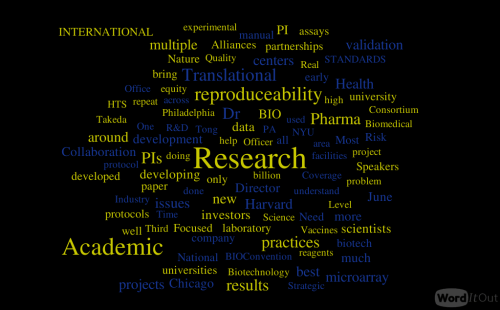
Real Time Coverage @BIOConvention #BIO2019:  Issues of Risk and Reproduceability in Translational and Academic Collaboration; 2:30-4:00 June 3 Philadelphia PA

Reporter: Stephen J. Williams, PhD @StephenJWillia2
Article ID #267: Real Time Coverage @BIOConvention #BIO2019:  Issues of Risk and Reproduceability in Translational and Academic Collaboration; 2:30-4:00 June 3 Philadelphia PA. Published on 6/3/2019
WordCloud Image Produced by Adam Tubman

Derisking Academic Science: The Unmet Need  

Translating academic research into products and new therapies is a very risky venture as only 1% of academic research has been successfully translated into successful products.
Speakers
Collaboration from Chicago area universities like U of Chicago, Northwestern, etc.  First phase was enhance collaboration between universities by funding faculty recruitment and basic research.  Access to core facilities across universities.  Have expanded to give alternatives to company formation.
Half of the partnerships from Harvard and companies have been able to spin out viable startups.
Most academic PI are not as savvy to start a biotech so they bring in biotechs and build project teams as well as developing a team of ex pharma and biotech experts.  Derisk as running as one asset project.  Partner as early as possible.  A third of their pipeline have been successfully partnered.  Work with investors and patent attorneys.
Focused on getting PIs to get to startup.  Focused on oncology and vaccines and I/O.  The result can be liscensing or partnership. Running around 50 to 60 projects. Creating a new company from these US PI partnerships.
Most projects from Harvard have been therapeutics-based.  At Harvard they have a network of investors ($50 million).   They screen PI proposals based on translateability and what investors are interested in.
In Chicago they solicit multiple projects but are agnostic on area but as they are limited they are focused on projects that will assist in developing a stronger proposal to investor/funding mechanism.
NYU goes around university doing due diligence reaching out to investigators. They shop around their projects to wet their investors, pharma appetite future funding.  At Takeda they have five centers around US.  They want to have more input so go into the university with their scientists and discuss ideas.
Challenges:
Takeda: Data Validation very important. Second there may be disconnect with the amount of equity the PI wants in the new company as well as management.  Third PIs not aware of all steps in drug development. Harvard:  Pharma and biotech have robust research and academic does not have the size or scope of pharma.  PIs must be more diligent on e.g. the compounds they get from a screen… they only focus narrowly NYU:  bring in consultants as PIs don’t understand all the management issues.  Need to understand development so they bring in the experts to help them.  Pharma he feels have to much risk aversion and none of their PIs want 100% equity. Chicago:  they like to publish at early stage so publication freedom is a challenge
Dr. Freedman: Most scientists responding to Nature survey said yes a reproduceability crisis.  The reasons: experimental bias, lack of validation techniques, reagents, and protocols etc.
And as he says there is a great ECONOMIC IMPACT of preclinical reproducability issues: to the tune of $56 billion of irreproducable results (paper published in PLOS Biology).  If can find the core drivers of this issue they can solve the problem.  STANDARDS are constantly used in various industries however academic research are lagging in developing such standards.  Just the problem of cell line authentication is costing $4 billion.
Dr. Cousins:  There are multiple high throughput screening (HTS) academic centers around the world (150 in US).  So where does the industry go for best practices in assays?  Eli Lilly had developed a manual for HTS best practices and in 1984 made publicly available (Assay Guidance Manual).  To date there have been constant updates to this manual to incorporate new assays.  Workshops have been developed to train scientists in these best practices.
NIH has been developing new programs to address these reproducability issues.  Developed a method called
Ring Testing Initiative” where multiple centers involved in sharing reagents as well as assays and allowing scientists to test at multiple facilities.
Dr.Tong: Reproduceability of Microarrays:  As microarrays were the only methodology to do high through put genomics in the early 2000s, and although much research had been performed to standardize and achieve best reproduceability of the microarray technology (determining best practices in spotting RNA on glass slides, hybridization protocols, image analysis) little had been done on evaluating the reproducibility of results obtained from microarray experiments involving biological samples.  The advent of Artificial Intelligence and Machine Learning though can be used to help validate microarray results.  This was done in a Nature Biotechnology paper (Nature Biotechnology volume28pages827–838 (2010)) by an international consortium, the International MAQC (Microarray Quality Control) Society and can be found here
However Dr. Tong feels there is much confusion in how we define reproduceability.  Dr. Tong identified a few key points of data reproduceability:
  1. Traceability: what are the practices and procedures from going from point A to point B (steps in a protocol or experimental design)
  2. Repeatability:  ability to repeat results within the same laboratory
  3. Replicatablilty:  ability to repeat results cross laboratory
  4. Transferability:  are the results validated across multiple platforms?
The panel then discussed the role of journals and funders to drive reproduceability in research.  They felt that editors have been doing as much as they can do as they receive an end product (the paper) but all agreed funders need to do more to promote data validity, especially in requiring that systematic evaluation and validation of each step in protocols are performed..  There could be more training of PIs with respect to protocol and data validation.

Other Articles on Industry/Academic Research Partnerships and Translational Research on this Open Access Online Journal Include

Envisage-Wistar Partnership and Immunacel LLC Presents at PCCI

BIO Partnering: Intersection of Academic and Industry: BIO INTERNATIONAL CONVENTION June 23-26, 2014 | San Diego, CA

R&D Alliances between Big Pharma and Academic Research Centers: Pharma’s Realization that Internal R&D Groups alone aren’t enough

Read Full Post »

Article ID #224: 2017 Life Sciences Breakthrough Prize. Published on 12/5/16

WordCloud Image Produced by Adam Tubman

Breakthrough Prize

LAUREATES

  • Breakthrough Prize

SOURCE

https://breakthroughprize.org/Laureates/2


Read Full Post »