Feeds:
Posts
Comments

Archive for the ‘Hematopoiesis’ Category

Biochemistry and Dysmetabolism of Aging and Serious Illness, Volume 2 (Volume Two: Latest in Genomics Methodologies for Therapeutics: Gene Editing, NGS and BioInformatics, Simulations and the Genome Ontology), Part 1: Next Generation Sequencing (NGS)

Biochemistry and Dysmetabolism of Aging and Serious Illness

Curator: Larry H. Bernstein, MD, FCAP


White Matter Lipids as a Ketogenic Fuel Supply in Aging Female Brain: Implications for Alzheimer’s Disease

Lauren P. Klosinski, Jia Yao, Fei Yin, Alfred N. Fonteh, Michael G. Harrington, Trace A. Christensen, Eugenia Trushina, Roberta Diaz Brinton
http://www.ebiomedicine.com/article/S2352-3964(15)30192-4/abstract      DOI: http://dx.doi.org/10.1016/j.ebiom.2015.11.002
Highlights
  • Mitochondrial dysfunction activates mechanisms for catabolism of myelin lipids to generate ketone bodies for ATP production.
  • Mechanisms leading to ketone body driven energy production in brain coincide with stages of reproductive aging in females.
  • Sequential activation of myelin catabolism pathway during aging provides multiple therapeutic targets and windows of efficacy.

The mechanisms underlying white matter degeneration, a hallmark of multiple neurodegenerative diseases including Alzheimer’s, remain unclear. Herein we provide a mechanistic pathway, spanning multiple transitions of aging, that links mitochondrial dysfunction early in aging with later age white matter degeneration. Catabolism of myelin lipids to generate ketone bodies can be viewed as an adaptive survival response to address brain fuel and energy demand. Women are at greatest risk of late-onset-AD, thus, our analyses in female brain address mechanisms of AD pathology and therapeutic targets to prevent, delay and treat AD in the sex most affected with potential relevance to men.


White matter degeneration is a pathological hallmark of neurodegenerative diseases including Alzheimer’s. Age remains the greatest risk factor for Alzheimer’s and the prevalence of age-related late onset Alzheimer’s is greatest in females. We investigated mechanisms underlying white matter degeneration in an animal model consistent with the sex at greatest Alzheimer’s risk. Results of these analyses demonstrated decline in mitochondrial respiration, increased mitochondrial hydrogen peroxide production and cytosolic-phospholipase-A2 sphingomyelinase pathway activation during female brain aging. Electron microscopic and lipidomic analyses confirmed myelin degeneration. An increase in fatty acids and mitochondrial fatty acid metabolism machinery was coincident with a rise in brain ketone bodies and decline in plasma ketone bodies. This mechanistic pathway and its chronologically phased activation, links mitochondrial dysfunction early in aging with later age development of white matter degeneration. The catabolism of myelin lipids to generate ketone bodies can be viewed as a systems level adaptive response to address brain fuel and energy demand. Elucidation of the initiating factors and the mechanistic pathway leading to white matter catabolism in the aging female brain provides potential therapeutic targets to prevent and treat demyelinating diseases such as Alzheimer’s and multiple sclerosis. Targeting stages of disease and associated mechanisms will be critical.

3. Results

  1. 3.1. Pathway of Mitochondrial Deficits, H2O2 Production and cPLA2 Activation in the Aging Female Brain
  2. 3.2. cPLA2-sphingomyelinase Pathway Activation in White Matter Astrocytes During Reproductive Senescence
  3. 3.3. Investigation of White Matter Gene Expression Profile During Reproductive Senescence
  4. 3.4. Ultra Structural Analysis of Myelin Sheath During Reproductive Senescence
  5. 3.5. Analysis of the Lipid Profile of Brain During the Transition to Reproductive Senescence
  6. 3.6. Fatty Acid Metabolism and Ketone Generation Following the Transition to Reproductive Senescence


4. Discussion

Age remains the greatest risk factor for developing AD (Hansson et al., 2006, Alzheimer’s, 2015). Thus, investigation of transitions in the aging brain is a reasoned strategy for elucidating mechanisms and pathways of vulnerability for developing AD. Aging, while typically perceived as a linear process, is likely composed of dynamic transition states, which can protect against or exacerbate vulnerability to AD (Brinton et al., 2015). An aging transition unique to the female is the perimenopausal to menopausal conversion (Brinton et al., 2015). The bioenergetic similarities between the menopausal transition in women and the early appearance of hypometabolism in persons at risk for AD make the aging female a rational model to investigate mechanisms underlying risk of late onset AD.

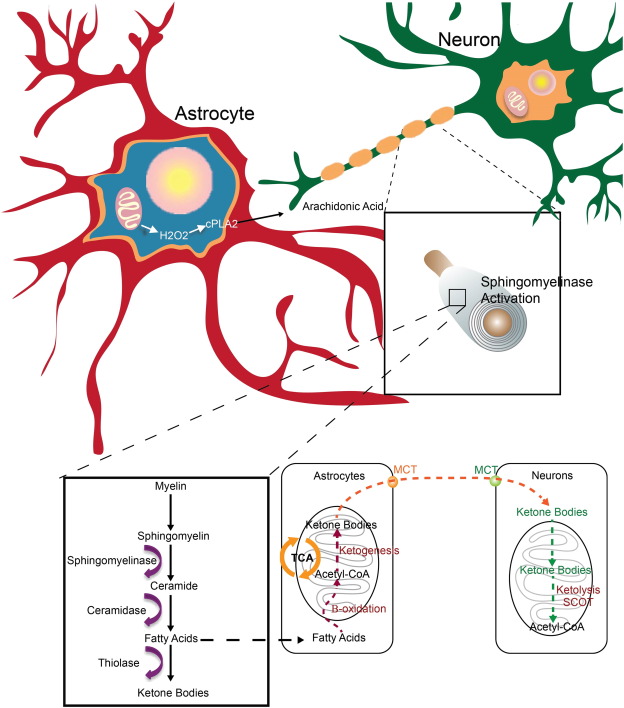
Findings from this study replicate our earlier findings that age of reproductive senescence is associated with decline in mitochondrial respiration, increased H2O2 production and shift to ketogenic metabolism in brain (Yao et al., 2010, Ding et al., 2013, Yin et al., 2015). These well established early age-related changes in mitochondrial function and shift to ketone body utilization in brain, are now linked to a mechanistic pathway that connects early decline in mitochondrial respiration and H2O2 production to activation of the cPLA2-sphingomyelinase pathway to catabolize myelin lipids resulting in WM degeneration (Fig. 12). These lipids are sequestered in lipid droplets for subsequent use as a local source of ketone body generation via astrocyte mediated beta-oxidation of fatty acids. Astrocyte derived ketone bodies can then be transported to neurons where they undergo ketolysis to generate acetyl-CoA for TCA derived ATP generation required for synaptic and cell function (Fig. 12).

Thumbnail image of Fig. 12. Opens large image

http://www.ebiomedicine.com/cms/attachment/2040395791/2053874721/gr12.sml

Fig. 12

Schematic model of mitochondrial H2O2 activation of cPLA2-sphingomyelinase pathway as an adaptive response to provide myelin derived fatty acids as a substrate for ketone body generation: The cPLA2-sphingomyelinase pathway is proposed as a mechanistic pathway that links an early event, mitochondrial dysfunction and H2O2, in the prodromal/preclinical phase of Alzheimer’s with later stage development of pathology, white matter degeneration. Our findings demonstrate that an age dependent deficit in mitochondrial respiration and a concomitant rise in oxidative stress activate an adaptive cPLA2-sphingomyelinase pathway to provide myelin derived fatty acids as a substrate for ketone body generation to fuel an energetically compromised brain.

Biochemical evidence obtained from isolated whole brain mitochondria confirms that during reproductive senescence and in response to estrogen deprivation brain mitochondria decline in respiratory capacity (Yao et al., 2009, Yao et al., 2010, Brinton, 2008a, Brinton, 2008b, Swerdlow and Khan, 2009). A well-documented consequence of mitochondrial dysfunction is increased production of reactive oxygen species (ROS), specifically H2O2 (Boveris and Chance, 1973, Beal, 2005, Yin et al., 2014, Yap et al., 2009). While most research focuses on the damage generated by free radicals, in this case H2O2 functions as a signaling molecule to activate cPLA2, the initiating enzyme in the cPLA2-sphingomyelinase pathway (Farooqui and Horrocks, 2006, Han et al., 2003, Sun et al., 2004). In AD brain, increased cPLA2 immunoreactivity is detected almost exclusively in astrocytes suggesting that activation of the cPLA2-sphingomyelinase pathway is localized to astrocytes in AD, as opposed to the neuronal or oligodendroglial localization that is observed during apoptosis (Sun et al., 2004, Malaplate-Armand et al., 2006, Di Paolo and Kim, 2011, Stephenson et al., 1996,Stephenson et al., 1999). In our analysis, cPLA2 (Sanchez-Mejia and Mucke, 2010) activation followed the age-dependent rise in H2O2 production and was sustained at an elevated level.

Direct and robust activation of astrocytic cPLA2 by physiologically relevant concentrations of H2O2 was confirmed in vitro. Astrocytic involvement in the cPLA2-sphingomyelinase pathway was also indicated by an increase in cPLA2 positive astrocyte reactivity in WM tracts of reproductively incompetent mice. These data are consistent with findings from brains of persons with AD that demonstrate the same striking localization of cPLA2immunoreactivity within astrocytes, specifically in the hippocampal formation (Farooqui and Horrocks, 2004). While neurons and astrocytes contain endogenous levels of cPLA2, neuronal cPLA2 is activated by an influx of intracellular calcium, whereas astrocytic cPLA2 is directly activated by excessive generation of H2O2 (Sun et al., 2004, Xu et al., 2003, Tournier et al., 1997). Evidence of this cell type specific activation was confirmed by the activation of cPLA2 in astrocytes by H2O2 and the lack of activation in neurons. These data support that astrocytic, not neuronal, cPLA2 is the cellular mediator of the H2O2 dependent cPLA2-sphingomyelinase pathway activation and provide associative evidence supporting a role of astrocytic mitochondrial H2O2 in age-related WM catabolism.

The pattern of gene expression during the shift to reproductive senescence in the female mouse hippocampus recapitulates key observations in human AD brain tissue, specifically elevation in cPLA2, sphingomyelinase and ceramidase (Schaeffer et al., 2010, He et al., 2010, Li et al., 2014). Further, up-regulation of myelin synthesis, lipid metabolism and inflammatory genes in reproductively incompetent female mice is consistent with the gene expression pattern previously reported from aged male rodent hippocampus, aged female non-human primate hippocampus and human AD hippocampus (Blalock et al., 2003, Blalock et al., 2004, Blalock et al., 2010, Blalock et al., 2011, Kadish et al., 2009, Rowe et al., 2007). In these analyses of gene expression in aged male rodent hippocampus, aged female non-human primate hippocampus and human AD hippocampus down regulation of genes related to mitochondrial function, and up-regulation in multiple genes encoding for enzymes involved in ketone body metabolism occurred (Blalock et al., 2003, Blalock et al., 2004, Blalock et al., 2010, Blalock et al., 2011, Kadish et al., 2009, Rowe et al., 2007). The comparability across data derived from aging female mouse hippocampus reported herein and those derived from male rodent brain, female nonhuman brain and human AD brain strongly suggest that cPLA2-sphingomyelinase pathway activation, myelin sheath degeneration and fatty acid metabolism leading to ketone body generation is a metabolic adaptation that is generalizable across these naturally aging models and are evident in aged human AD brain. Collectively, these data support the translational relevance of findings reported herein.

Data obtained via immunohistochemistry, electron microscopy and MBP protein analyses demonstrated an age-related loss in myelin sheath integrity. Evidence for a loss of myelin structural integrity emerged in reproductively incompetent mice following activation of the cPLA2-sphingomyelinase pathway. The unraveling myelin phenotype observed following reproductive senescence and aging reported herein is consistent with the degenerative phenotype that emerges following exposure to the chemotherapy drug bortezomib which induces mitochondrial dysfunction and increased ROS generation (Carozzi et al., 2010, Cavaletti et al., 2007,Ling et al., 2003). In parallel to the decline in myelin integrity, lipid droplet density increased. In aged mice, accumulation of lipid droplets declined in parallel to the rise in ketone bodies consistent with the utilization of myelin-derived fatty acids to generate ketone bodies. Due to the sequential relationship between WM degeneration and lipid droplet formation, we posit that lipid droplets serve as a temporary storage site for myelin-derived fatty acids prior to undergoing β-oxidation in astrocytes to generate ketone bodies.

Microstructural alterations in myelin integrity were associated with alterations in the lipid profile of brain, indicative of WM degeneration resulting in release of myelin lipids. Sphingomyelin and galactocerebroside are two main lipids that compose the myelin sheath (Baumann and Pham-Dinh, 2001). Ceramide is common to both galactocerebroside and sphingomyelin and is composed of sphingosine coupled to a fatty acid. Ceramide levels increase in aging, in states of ketosis and in neurodegeneration (Filippov et al., 2012, Blazquez et al., 1999, Costantini et al., 2005). Specifically, ceramide levels are elevated at the earliest clinically recognizable stage of AD, indicating a degree of WM degeneration early in disease progression (Di Paolo and Kim, 2011,Han et al., 2002, Costantini et al., 2005). Sphingosine is statistically significantly elevated in the brains of AD patients compared to healthy controls; a rise that was significantly correlated with acid sphingomyelinase activity, Aβ levels and tau hyperphosphorylation (He et al., 2010). In our analyses, a rise in ceramides was first observed early in the aging process in reproductively incompetent mice. The rise in ceramides was coincident with the emergence of loss of myelin integrity consistent with the release of myelin ceramides from sphingomyelin via sphingomyelinase activation. Following the rise in ceramides, sphingosine and fatty acid levels increased. The temporal sequence of the lipid profile was consistent with gene expression indicating activation of ceramidase for catabolism of ceramide into sphingosine and fatty acid during reproductive senescence. Once released from ceramide, fatty acids can be transported into the mitochondrial matrix of astrocytes via CPT-1, where β-oxidation of fatty acids leads to the generation of acetyl-CoA (Glatz et al., 2010). It is well documented that acetyl-CoA cannot cross the inner mitochondrial membrane, thus posing a barrier to direct transport of acetyl-CoA generated by β-oxidation into neurons. In response, the newly generated acetyl-CoA undergoes ketogenesis to generate ketone bodies to fuel energy demands of neurons (Morris, 2005,Guzman and Blazquez, 2004, Stacpoole, 2012). Because astrocytes serve as the primary location of β-oxidation in brain they are critical to maintaining neuronal metabolic viability during periods of reduced glucose utilization (Panov et al., 2014, Ebert et al., 2003, Guzman and Blazquez, 2004).

Once fatty acids are released from myelin ceramides, they are transported into astrocytic mitochondria by CPT1 to undergo β-oxidation. The mitochondrial trifunctional protein HADHA catalyzes the last three steps of mitochondrial β-oxidation of long chain fatty acids, while mitochondrial ABAD (aka SCHAD—short chain fatty acid dehydrogenase) metabolizes short chain fatty acids. Concurrent with the release of myelin fatty acids in aged female mice, CPT1, HADHA and ABAD protein expression as well as ketone body generation increased significantly. These findings indicate that astrocytes play a pivotal role in the response to bioenergetic crisis in brain to activate an adaptive compensatory system that activates catabolism of myelin lipids and the metabolism of those lipids into fatty acids to generate ketone bodies necessary to fuel neuronal demand for acetyl-CoA and ATP.

Collectively, these findings provide a mechanistic pathway that links mitochondrial dysfunction and H2O2generation in brain early in the aging process to later stage white matter degeneration. Astrocytes play a pivotal role in providing a mechanistic strategy to address the bioenergetic demand of neurons in the aging female brain. While this pathway is coincident with reproductive aging in the female brain, it is likely to have mechanistic translatability to the aging male brain. Further, the mechanistic link between bioenergetic decline and WM degeneration has potential relevance to other neurological diseases involving white matter in which postmenopausal women are at greater risk, such as multiple sclerosis. The mechanistic pathway reported herein spans time and is characterized by a progression of early adaptive changes in the bioenergetic system of the brain leading to WM degeneration and ketone body production. Translationally, effective therapeutics to prevent, delay and treat WM degeneration during aging and Alzheimer’s disease will need to specifically target stages within the mechanistic pathway described herein. The fundamental initiating event is a bioenergetic switch from being a glucose dependent brain to a glucose and ketone body dependent brain. It remains to be determined whether it is possible to prevent conversion to or reversal of a ketone dependent brain. Effective therapeutic strategies to intervene in this process require biomarkers of bioenergetic phenotype of the brain and stage of mechanistic progression. The mechanistic pathway reported herein may have relevance to other age-related neurodegenerative diseases characterized by white matter degeneration such as multiple sclerosis.

Blood. 2015 Oct 15;126(16):1925-9.    http://dx.doi.org:/10.1182/blood-2014-12-617498. Epub 2015 Aug 14.
Targeting the leukemia cell metabolism by the CPT1a inhibition: functional preclinical effects in leukemias.
Cancer cells are characterized by perturbations of their metabolic processes. Recent observations demonstrated that the fatty acid oxidation (FAO) pathway may represent an alternative carbon source for anabolic processes in different tumors, therefore appearing particularly promising for therapeutic purposes. Because the carnitine palmitoyl transferase 1a (CPT1a) is a protein that catalyzes the rate-limiting step of FAO, here we investigated the in vitro antileukemic activity of the novel CPT1a inhibitor ST1326 on leukemia cell lines and primary cells obtained from patients with hematologic malignancies. By real-time metabolic analysis, we documented that ST1326 inhibited FAO in leukemia cell lines associated with a dose- and time-dependent cell growth arrest, mitochondrial damage, and apoptosis induction. Data obtained on primary hematopoietic malignant cells confirmed the FAO inhibition and cytotoxic activity of ST1326, particularly on acute myeloid leukemia cells. These data suggest that leukemia treatment may be carried out by targeting metabolic processes.
Oncogene. 2015 Oct 12.   http://dx.doi.org:/10.1038/onc.2015.394. [Epub ahead of print]
Tumour-suppression function of KLF12 through regulation of anoikis.
Suppression of detachment-induced cell death, known as anoikis, is an essential step for cancer metastasis to occur. We report here that expression of KLF12, a member of the Kruppel-like family of transcription factors, is downregulated in lung cancer cell lines that have been selected to grow in the absence of cell adhesion. Knockdown of KLF12 in parental cells results in decreased apoptosis following cell detachment from matrix. KLF12 regulates anoikis by promoting the cell cycle transition through S phase and therefore cell proliferation. Reduced expression levels of KLF12 results in increased ability of lung cancer cells to form tumours in vivo and is associated with poorer survival in lung cancer patients. We therefore identify KLF12 as a novel metastasis-suppressor gene whose loss of function is associated with anoikis resistance through control of the cell cycle.
Mol Cell. 2015 Oct 14. pii: S1097-2765(15)00764-9. doi: 10.1016/j.molcel.2015.09.025. [Epub ahead of print]
PEPCK Coordinates the Regulation of Central Carbon Metabolism to Promote Cancer Cell Growth.
Phosphoenolpyruvate carboxykinase (PEPCK) is well known for its role in gluconeogenesis. However, PEPCK is also a key regulator of TCA cycle flux. The TCA cycle integrates glucose, amino acid, and lipid metabolism depending on cellular needs. In addition, biosynthetic pathways crucial to tumor growth require the TCA cycle for the processing of glucose and glutamine derived carbons. We show here an unexpected role for PEPCK in promoting cancer cell proliferation in vitro and in vivo by increasing glucose and glutamine utilization toward anabolic metabolism. Unexpectedly, PEPCK also increased the synthesis of ribose from non-carbohydrate sources, such as glutamine, a phenomenon not previously described. Finally, we show that the effects of PEPCK on glucose metabolism and cell proliferation are in part mediated via activation of mTORC1. Taken together, these data demonstrate a role for PEPCK that links metabolic flux and anabolic pathways to cancer cell proliferation.
Mol Cancer Res. 2015 Oct;13(10):1408-20.   http://dx.doi.org:/10.1158/1541-7786.MCR-15-0048. Epub 2015 Jun 16.
Disruption of Proline Synthesis in Melanoma Inhibits Protein Production Mediated by the GCN2 Pathway.
Many processes are deregulated in melanoma cells and one of those is protein production. Although much is known about protein synthesis in cancer cells, effective ways of therapeutically targeting this process remain an understudied area of research. A process that is upregulated in melanoma compared with normal melanocytes is proline biosynthesis, which has been linked to both oncogene and tumor suppressor pathways, suggesting an important convergent point for therapeutic intervention. Therefore, an RNAi screen of a kinase library was undertaken, identifying aldehyde dehydrogenase 18 family, member A1 (ALDH18A1) as a critically important gene in regulating melanoma cell growth through proline biosynthesis. Inhibition of ALDH18A1, the gene encoding pyrroline-5-carboxylate synthase (P5CS), significantly decreased cultured melanoma cell viability and tumor growth. Knockdown of P5CS using siRNA had no effect on apoptosis, autophagy, or the cell cycle but cell-doubling time increased dramatically suggesting that there was a general slowdown in cellular metabolism. Mechanistically, targeting ALDH18A1 activated the serine/threonine protein kinase GCN2 (general control nonderepressible 2) to inhibit protein synthesis, which could be reversed with proline supplementation. Thus, targeting ALDH18A1 in melanoma can be used to disrupt proline biosynthesis to limit cell metabolism thereby increasing the cellular doubling time mediated through the GCN2 pathway.  This study demonstrates that melanoma cells are sensitive to disruption of proline synthesis and provides a proof-of-concept that the proline synthesis pathway can be therapeutically targeted in melanoma tumors for tumor inhibitory efficacy. Mol Cancer Res; 13(10); 1408-20. ©2015 AACR.
SDHB-Deficient Cancers: The Role of Mutations That Impair Iron Sulfur Cluster Delivery.
BACKGROUND:  Mutations in the Fe-S cluster-containing SDHB subunit of succinate dehydrogenase cause familial cancer syndromes. Recently the tripeptide motif L(I)YR was identified in the Fe-S recipient protein SDHB, to which the cochaperone HSC20 binds.
METHODS:   In order to characterize the metabolic basis of SDH-deficient cancers we performed stable isotope-resolved metabolomics in a novel SDHB-deficient renal cell carcinoma cell line and conducted bioinformatics and biochemical screening to analyze Fe-S cluster acquisition and assembly of SDH in the presence of other cancer-causing SDHB mutations.

RESULTS:

We found that the SDHB(R46Q) mutation in UOK269 cells disrupted binding of HSC20, causing rapid degradation of SDHB. In the absence of SDHB, respiration was undetectable in UOK269 cells, succinate was elevated to 351.4±63.2 nmol/mg cellular protein, and glutamine became the main source of TCA cycle metabolites through reductive carboxylation. Furthermore, HIF1α, but not HIF2α, increased markedly and the cells showed a strong DNA CpG island methylator phenotype (CIMP). Biochemical and bioinformatic screening revealed that 37% of disease-causing missense mutations in SDHB were located in either the L(I)YR Fe-S transfer motifs or in the 11 Fe-S cluster-ligating cysteines.

CONCLUSIONS:

These findings provide a conceptual framework for understanding how particular mutations disproportionately cause the loss of SDH activity, resulting in accumulation of succinate and metabolic remodeling in SDHB cancer syndromes.


SR4 Uncouples Mitochondrial Oxidative Phosphorylation, Modulates AMPK-mTOR Signaling, and Inhibits Proliferation of HepG2 Hepatocarcinoma Cells

  1. L. Figarola, J. Singhal, J. D. Tompkins, G. W. Rogers, C. Warden, D. Horne, A. D. Riggs, S. Awasthi and S. S. Singhal.

J Biol Chem. 2015 Nov 3, [epub ahead of print]


CD47 Receptor Globally Regulates Metabolic Pathways That Control Resistance to Ionizing Radiation

  1. W. Miller, D. R. Soto-Pantoja, A. L. Schwartz, J. M. Sipes, W. G. DeGraff, L. A. Ridnour, D. A. Wink and D. D. Roberts.

J Biol Chem. 2015 Oct 9, 290 (41): 24858-74.


Knockdown of PKM2 Suppresses Tumor Growth and Invasion in Lung Adenocarcinoma

  1. Sun, A. Zhu, L. Zhang, J. Zhang, Z. Zhong and F. Wang.

Int J Mol Sci. 2015 Oct 15, 16 (10): 24574-87.


EglN2 associates with the NRF1-PGC1alpha complex and controls mitochondrial function in breast cancer

  1. Zhang, C. Wang, X. Chen, M. Takada, C. Fan, X. Zheng, H. Wen, Y. Liu, C. Wang, R. G. Pestell, K. M. Aird, W. G. Kaelin, Jr., X. S. Liu and Q. Zhang.

EMBO J. 2015 Oct 22, [epub ahead of print]


Mitochondrial Genetics Regulate Breast Cancer Tumorigenicity and Metastatic Potential.

Current paradigms of carcinogenic risk suggest that genetic, hormonal, and environmental factors influence an individual’s predilection for developing metastatic breast cancer. Investigations of tumor latency and metastasis in mice have illustrated differences between inbred strains, but the possibility that mitochondrial genetic inheritance may contribute to such differences in vivo has not been directly tested. In this study, we tested this hypothesis in mitochondrial-nuclear exchange mice we generated, where cohorts shared identical nuclear backgrounds but different mtDNA genomes on the background of the PyMT transgenic mouse model of spontaneous mammary carcinoma. In this setting, we found that primary tumor latency and metastasis segregated with mtDNA, suggesting that mtDNA influences disease progression to a far greater extent than previously appreciated. Our findings prompt further investigation into metabolic differences controlled by mitochondrial process as a basis for understanding tumor development and metastasis in individual subjects. Importantly, differences in mitochondrial DNA are sufficient to fundamentally alter disease course in the PyMT mouse mammary tumor model, suggesting that functional metabolic differences direct early tumor growth and metastatic efficiency. Cancer Res; 75(20); 4429-36. ©2015 AACR.


Cancer Lett. 2015 Oct 29. pii: S0304-3835(15)00656-4.    http://dx.doi.org:/10.1016/j.canlet.2015.10.025. [Epub ahead of print]
Carboxyamidotriazole inhibits oxidative phosphorylation in cancer cells and exerts synergistic anti-cancer effect with glycolysis inhibition.

Targeting cancer cell metabolism is a promising strategy against cancer. Here, we confirmed that the anti-cancer drug carboxyamidotriazole (CAI) inhibited mitochondrial respiration in cancer cells for the first time and found a way to enhance its anti-cancer activity by further disturbing the energy metabolism. CAI promoted glucose uptake and lactate production when incubated with cancer cells. The oxidative phosphorylation (OXPHOS) in cancer cells was inhibited by CAI, and the decrease in the activity of the respiratory chain complex I could be one explanation. The anti-cancer effect of CAI was greatly potentiated when being combined with 2-deoxyglucose (2-DG). The cancer cells treated with the combination of CAI and 2-DG were arrested in G2/M phase. The apoptosis and necrosis rates were also increased. In a mouse xenograft model, this combination was well tolerated and retarded the tumor growth. The impairment of cancer cell survival was associated with significant cellular ATP decrease, suggesting that the combination of CAI and 2-DG could be one of the strategies to cause dual inhibition of energy pathways, which might be an effective therapeutic approach for a broad spectrum of tumors.


Cancer Immunol Res. 2015 Nov;3(11):1236-47.    http://dx.doi.org:/10.1158/2326-6066.CIR-15-0036. Epub 2015 May 29.
Inhibition of Fatty Acid Oxidation Modulates Immunosuppressive Functions of Myeloid-Derived Suppressor Cells and Enhances Cancer Therapies.

Myeloid-derived suppressor cells (MDSC) promote tumor growth by inhibiting T-cell immunity and promoting malignant cell proliferation and migration. The therapeutic potential of blocking MDSC in tumors has been limited by their heterogeneity, plasticity, and resistance to various chemotherapy agents. Recent studies have highlighted the role of energy metabolic pathways in the differentiation and function of immune cells; however, the metabolic characteristics regulating MDSC remain unclear. We aimed to determine the energy metabolic pathway(s) used by MDSC, establish its impact on their immunosuppressive function, and test whether its inhibition blocks MDSC and enhances antitumor therapies. Using several murine tumor models, we found that tumor-infiltrating MDSC (T-MDSC) increased fatty acid uptake and activated fatty acid oxidation (FAO). This was accompanied by an increased mitochondrial mass, upregulation of key FAO enzymes, and increased oxygen consumption rate. Pharmacologic inhibition of FAO blocked immune inhibitory pathways and functions in T-MDSC and decreased their production of inhibitory cytokines. FAO inhibition alone significantly delayed tumor growth in a T-cell-dependent manner and enhanced the antitumor effect of adoptive T-cell therapy. Furthermore, FAO inhibition combined with low-dose chemotherapy completely inhibited T-MDSC immunosuppressive effects and induced a significant antitumor effect. Interestingly, a similar increase in fatty acid uptake and expression of FAO-related enzymes was found in human MDSC in peripheral blood and tumors. These results support the possibility of testing FAO inhibition as a novel approach to block MDSC and enhance various cancer therapies. Cancer Immunol Res; 3(11); 1236-47. ©2015 AACR.


Ionizing radiation induces myofibroblast differentiation via lactate dehydrogenase

  1. L. Judge, K. M. Owens, S. J. Pollock, C. F. Woeller, T. H. Thatcher, J. P. Williams, R. P. Phipps, P. J. Sime and R. M. Kottmann.

Am J Physiol Lung Cell Mol Physiol. 2015 Oct 15, 309 (8): L879-87.


Vitamin C selectively kills KRAS and BRAF mutant colorectal cancer cells by targeting GAPDH

  1. Yun, E. Mullarky, C. Lu, K. N. Bosch, A. Kavalier, K. Rivera, J. Roper, Chio, II, E. G. Giannopoulou, C. Rago, A. Muley, J. M. Asara, J. Paik, O. Elemento, Z. Chen, D. J. Pappin, L. E. Dow, N. Papadopoulos, S. S. Gross and L. C. Cantley.

Science. 2015 Nov 5, [epub ahead of print]


Down-regulation of FBP1 by ZEB1-mediated repression confers to growth and invasion in lung cancer cells

  1. Zhang, J. Wang, H. Xing, Q. Li, Q. Zhao and J. Li.

Mol Cell Biochem. 2015 Nov 6, [epub ahead of print]


J Mol Cell Cardiol. 2015 Oct 23. pii: S0022-2828(15)30073-0.     http://dx.doi.org:/10.1016/j.yjmcc.2015.10.002. [Epub ahead of print]
GRK2 compromises cardiomyocyte mitochondrial function by diminishing fatty acid-mediated oxygen consumption and increasing superoxide levels.

The G protein-coupled receptor kinase-2 (GRK2) is upregulated in the injured heart and contributes to heart failure pathogenesis. GRK2 was recently shown to associate with mitochondria but its functional impact in myocytes due to this localization is unclear. This study was undertaken to determine the effect of elevated GRK2 on mitochondrial respiration in cardiomyocytes. Sub-fractionation of purified cardiac mitochondria revealed that basally GRK2 is found in multiple compartments. Overexpression of GRK2 in mouse cardiomyocytes resulted in an increased amount of mitochondrial-based superoxide. Inhibition of GRK2 increased oxygen consumption rates and ATP production. Moreover, fatty acid oxidation was found to be significantly impaired when GRK2 was elevated and was dependent on the catalytic activity and mitochondrial localization of this kinase. Our study shows that independent of cardiac injury, GRK2 is localized in the mitochondria and its kinase activity negatively impacts the function of this organelle by increasing superoxide levels and altering substrate utilization for energy production.


Br J Pharmacol. 2015 Oct 27. doi: 10.1111/bph.13377. [Epub ahead of print]
All-trans retinoic acid protects against doxorubicin-induced cardiotoxicity by activating the Erk2 signalling pathway.
BACKGROUND AND PURPOSE:

Doxorubicin (Dox) is a powerful antineoplastic agent for treating a wide range of cancers. However, doxorubicin cardiotoxicity of the heart has largely limited its clinical use. It is known that all-trans retinoic acid (ATRA) plays important roles in many cardiac biological processes, however, the protective effects of ATRA on doxorubicin cardiotoxicity remain unknown. Here, we studied the effect of ATRA on doxorubicin cardiotoxicity and underlying mechanisms.

EXPERIMENTAL APPROACHES:

Cellular viability assays, western blotting and mitochondrial respiration analyses were employed to evaluate the cellular response to ATRA in H9c2 cells and primary cardiomyocytes. Quantitative PCR (Polymerase Chain Reaction) and gene knockdown were performed to investigate the underlying molecular mechanisms of ATRA’s effects on doxorubicin cardiotoxicity.

KEY RESULTS:

ATRA significantly inhibited doxorubicin-induced apoptosis in H9c2 cells and primary cardiomyocytes. ATRA was more effective against doxorubicin cardiotoxicity than resveratrol and dexrazoxane. ATRA also suppressed reactive oxygen species (ROS) generation, and restored the expression level of mRNA and proteins in phase II detoxifying enzyme system: Nrf2 (nuclear factor-E2-related factor 2), MnSOD (manganese superoxide dismutase), HO-1 (heme oxygenase1) as well as mitochondrial function (mitochondrial membrane integrity, mitochondrial DNA copy numbers, mitochondrial respiration capacity, biogenesis and dynamics). Both Erk1/2 (extracellular signal-regulated kinase1/2) inhibitor (U0126) and Erk2 siRNA, but not Erk1 siRNA, abolished the protective effect of ATRA against doxorubicin-induced toxicity in H9c2 cells. Remarkably, ATRA did not compromise the anticancer efficacy of doxorubicin in gastric carcinoma cells.

CONCLUSION AND IMPLICATION:

ATRA protected cardiomyocytes against doxorubicin-induced toxicity by activating the Erk2 pathway without compromising the anticancer efficacy of doxorubicin. Therefore, ATRA may be a promising candidate as a cardioprotective agent against doxorubicin cardiotoxicity.


Proteomic and Biochemical Studies of Lysine Malonylation Suggest Its Malonic Aciduria-associated Regulatory Role in Mitochondrial Function and Fatty Acid Oxidation

  1. Colak, O. Pougovkina, L. Dai, M. Tan, H. Te Brinke, H. Huang, Z. Cheng, J. Park, X. Wan, X. Liu, W. W. Yue, R. J. Wanders, J. W. Locasale, D. B. Lombard, V. C. de Boer and Y. Zhao.

Mol Cell Proteomics. 2015 Nov 1, 14 (11): 3056-71.


Foxg1 localizes to mitochondria and coordinates cell differentiation and bioenergetics

  1. Pancrazi, G. Di Benedetto, L. Colombaioni, G. Della Sala, G. Testa, F. Olimpico, A. Reyes, M. Zeviani, T. Pozzan and M. Costa.

Proc Natl Acad Sci U S A. 2015 Oct 27, 112(45): 13910-5.


Evidence of Mitochondrial Dysfunction within the Complex Genetic Etiology of Schizophrenia

  1. E. Hjelm, B. Rollins, F. Mamdani, J. C. Lauterborn, G. Kirov, G. Lynch, C. M. Gall, A. Sequeira and M. P. Vawter.

Mol Neuropsychiatry. 2015 Nov 1, 1 (4): 201-219.


Metabolic Reprogramming Is Required for Myofibroblast Contractility and Differentiation

  1. Bernard, N. J. Logsdon, S. Ravi, N. Xie, B. P. Persons, S. Rangarajan, J. W. Zmijewski, K. Mitra, G. Liu, V. M. Darley-Usmar and V. J. Thannickal.

J Biol Chem. 2015 Oct 16, 290 (42): 25427-38.


J Biol Chem. 2015 Oct 23;290(43):25834-46.    http://dx.doi.org:/10.1074/jbc.M115.658815. Epub 2015 Sep 4.
Kinome Screen Identifies PFKFB3 and Glucose Metabolism as Important Regulators of the Insulin/Insulin-like Growth Factor (IGF)-1 Signaling Pathway.

The insulin/insulin-like growth factor (IGF)-1 signaling pathway (ISP) plays a fundamental role in long term health in a range of organisms. Protein kinases including Akt and ERK are intimately involved in the ISP. To identify other kinases that may participate in this pathway or intersect with it in a regulatory manner, we performed a whole kinome (779 kinases) siRNA screen for positive or negative regulators of the ISP, using GLUT4 translocation to the cell surface as an output for pathway activity. We identified PFKFB3, a positive regulator of glycolysis that is highly expressed in cancer cells and adipocytes, as a positive ISP regulator. Pharmacological inhibition of PFKFB3 suppressed insulin-stimulated glucose uptake, GLUT4 translocation, and Akt signaling in 3T3-L1 adipocytes. In contrast, overexpression of PFKFB3 in HEK293 cells potentiated insulin-dependent phosphorylation of Akt and Akt substrates. Furthermore, pharmacological modulation of glycolysis in 3T3-L1 adipocytes affected Akt phosphorylation. These data add to an emerging body of evidence that metabolism plays a central role in regulating numerous biological processes including the ISP. Our findings have important implications for diseases such as type 2 diabetes and cancer that are characterized by marked disruption of both metabolism and growth factor signaling.


FASEB J. 2015 Oct 19.    http://dx.doi.org:/pii: fj.15-276360. [Epub ahead of print]
Perm1 enhances mitochondrial biogenesis, oxidative capacity, and fatigue resistance in adult skeletal muscle.

Skeletal muscle mitochondrial content and oxidative capacity are important determinants of muscle function and whole-body health. Mitochondrial content and function are enhanced by endurance exercise and impaired in states or diseases where muscle function is compromised, such as myopathies, muscular dystrophies, neuromuscular diseases, and age-related muscle atrophy. Hence, elucidating the mechanisms that control muscle mitochondrial content and oxidative function can provide new insights into states and diseases that affect muscle health. In past studies, we identified Perm1 (PPARGC1- and ESRR-induced regulator, muscle 1) as a gene induced by endurance exercise in skeletal muscle, and regulating mitochondrial oxidative function in cultured myotubes. The capacity of Perm1 to regulate muscle mitochondrial content and function in vivo is not yet known. In this study, we use adeno-associated viral (AAV) vectors to increase Perm1 expression in skeletal muscles of 4-wk-old mice. Compared to control vector, AAV1-Perm1 leads to significant increases in mitochondrial content and oxidative capacity (by 40-80%). Moreover, AAV1-Perm1-transduced muscles show increased capillary density and resistance to fatigue (by 33 and 31%, respectively), without prominent changes in fiber-type composition. These findings suggest that Perm1 selectively regulates mitochondrial biogenesis and oxidative function, and implicate Perm1 in muscle adaptations that also occur in response to endurance exercise.-Cho, Y., Hazen, B. C., Gandra, P. G., Ward, S. R., Schenk, S., Russell, A. P., Kralli, A. Perm1 enhances mitochondrial biogenesis, oxidative capacity, and fatigue resistance in adult skeletal muscle.


A conserved MADS-box phosphorylation motif regulates differentiation and mitochondrial function in skeletal, cardiac, and smooth muscle cells.
Exposure to metabolic disease during fetal development alters cellular differentiation and perturbs metabolic homeostasis, but the underlying molecular regulators of this phenomenon in muscle cells are not completely understood. To address this, we undertook a computational approach to identify cooperating partners of the myocyte enhancer factor-2 (MEF2) family of transcription factors, known regulators of muscle differentiation and metabolic function. We demonstrate that MEF2 and the serum response factor (SRF) collaboratively regulate the expression of numerous muscle-specific genes, including microRNA-133a (miR-133a). Using tandem mass spectrometry techniques, we identify a conserved phosphorylation motif within the MEF2 and SRF Mcm1 Agamous Deficiens SRF (MADS)-box that regulates miR-133a expression and mitochondrial function in response to a lipotoxic signal. Furthermore, reconstitution of MEF2 function by expression of a neutralizing mutation in this identified phosphorylation motif restores miR-133a expression and mitochondrial membrane potential during lipotoxicity. Mechanistically, we demonstrate that miR-133a regulates mitochondrial function through translational inhibition of a mitophagy and cell death modulating protein, called Nix. Finally, we show that rodents exposed to gestational diabetes during fetal development display muscle diacylglycerol accumulation, concurrent with insulin resistance, reduced miR-133a, and elevated Nix expression, as young adult rats. Given the diverse roles of miR-133a and Nix in regulating mitochondrial function, and proliferation in certain cancers, dysregulation of this genetic pathway may have broad implications involving insulin resistance, cardiovascular disease, and cancer biology.


Read Full Post »

Blocking Differentiation to Produce Stem Cells

Larry H. Bernstein, MD, FCAP, Curator

LPBI


Blocking Differentiation is Enough to Turn Mature Cells into Stem Cells


ID3 inhibitor of DNA binding 3, dominant negative helix-loop-helix protein [ Homo sapiens (human) ]

Gene ID: 3399, updated on 15-Nov-2015

http://www.ncbi.nlm.nih.gov/gene?Db=gene


Official Symbol ID3 provided by HGNC 

Official Full Name inhibitor of DNA binding 3, dominant negative helix-loop-helix protein provided by HGNC

Primary source HGNC:HGNC:5362 See related Ensembl:ENSG00000117318; HPRD:02608; MIM:600277; Vega:OTTHUMG00000003229

Gene type protein coding

RefSeq status REVIEWED

OrganismHomo sapiens

LineageEukaryota; Metazoa; Chordata; Craniata; Vertebrata; Euteleostomi; Mammalia; Eutheria; Euarchontoglires; Primates; Haplorrhini; Catarrhini; Hominidae; Homo

Also known as HEIR-1; bHLHb25

Summary The protein encoded by this gene is a helix-loop-helix (HLH) protein that can form heterodimers with other HLH proteins. However, the encoded protein lacks a basic DNA-binding domain and therefore inhibits the DNA binding of any HLH protein with which it interacts. [provided by RefSeq, Aug 2011]

Orthologs mouse all


Location:
1p36.13-p36.12
Exon count:
3
Annotation release Status Assembly Chr Location
107 current GRCh38.p2 (GCF_000001405.28) 1 NC_000001.11 (23557930..23559794, complement)
105 previous assembly GRCh37.p13 (GCF_000001405.25) 1 NC_000001.10 (23884421..23886285, complement)

Chromosome 1 – NC_000001.11Genomic Context describing neighboring genes

Related articles in PubMed


Induced Developmental Arrest of Early Hematopoietic Progenitors Leads to the Generation of Leukocyte Stem Cells

Tomokatsu Ikawa, Kyoko Masuda, Mirelle J.A.J. Huijskens, Rumi Satoh, Kiyokazu Kakugawa, Yasutoshi Agata, Tomohiro Miyai, Wilfred T.V. Germeraad, Yoshimoto Katsura, Hiroshi Kawamoto
Stem Cell Reports Nov 10, 2015; Volume 5, Issue 5, 716–727.   DOI: http://dx.doi.org/10.1016/j.stemcr.2015.09.012
Highlights
  • Overexpression of ID3 endows hematopoietic progenitors with self-renewal activity
  • A simple block of cell differentiation is sufficient to induce stem cells
  • Induced leukocyte stem (iLS) cells exhibit robust multi-lineage reconstitution
  • Equivalent progenitors were produced from human cord blood hematopoietic stem cells

Self-renewal potential and multipotency are hallmarks of a stem cell. It is generally accepted that acquisition of such stemness requires rejuvenation of somatic cells through reprogramming of their genetic and epigenetic status. We show here that a simple block of cell differentiation is sufficient to induce and maintain stem cells. By overexpression of the transcriptional inhibitor ID3 in murine hematopoietic progenitor cells and cultivation under B cell induction conditions, the cells undergo developmental arrest and enter a self-renewal cycle. These cells can be maintained in vitro almost indefinitely, and the long-term cultured cells exhibit robust multi-lineage reconstitution when transferred into irradiated mice. These cells can be cloned and re-expanded with 50% plating efficiency, indicating that virtually all cells are self-renewing. Equivalent progenitors were produced from human cord blood stem cells, and these will ultimately be useful as a source of cells for immune cell therapy.

Figure thumbnail fx1

http://www.cell.com/cms/attachment/2040173852/2053709392/fx1.jpg


Somatic tissues with high turnover rates, such as skin, intestinal epithelium, and hematopoietic cells, are maintained by the activity of self-renewing stem cells, which are present in only limited numbers in each organ (Barker et al., 2012,Copley et al., 2012, Fuchs and Chen, 2013). For example, the frequency of hematopoietic stem cells (HSCs) in the mouse is about 1 in 105 of total bone marrow (BM) cells (Spangrude et al., 1988). Once HSCs begin the differentiation process, their progeny cells have hardly any self-renewal capacity, indicating that self-renewal is a special feature endowed only to stem cells.

Cells such as embryonic stem (ES) cells that retain self-renewal potential and multipotency only in vitro can also be included in the category of stem cells. Such stemness of ES cells is thought to be maintained by formation of a core transcriptional network and an epigenetic status unique to ES cells (Lund et al., 2012, Meissner, 2010, Ng and Surani, 2011). A stem cell equivalent to ES cells, called induced pluripotent stem (iPS) cells, can be produced from somatic cells by overexpression of only a few specific transcription factors (OCT3/4, SOX2, KLF4, and C-MYC), which are thought to be the essential components in forming the core network of transcriptional factors that define the status of ES cells (Takahashi et al., 2007, Takahashi and Yamanaka, 2006, Yamanaka, 2012). It is thus generally conceived that acquisition of such a network for a somatic cell depends on the reprogramming of the epigenetic status of that cell.

On the other hand, it could be envisioned that the self-renewing status of cells represents a state in which their further differentiation is inhibited. It is known, for example, that to maintain ES/iPS cells, factors such as leukemia inhibitory factor and basic fibroblast growth factor, for mouse and human cultures, respectively (Williams et al., 1988, Xu et al., 2005), are required, and these factors are thought to block further differentiation of the cells. In this context, it has previously been shown that systemic disruption of transcription factors essential for the B cell lineage, such as PAX5, E2A, and EBF1, leads to the emergence of self-renewing multipotent hematopoietic progenitors, which can be maintained under specific culture conditions (Ikawa et al., 2004a, Nutt et al., 1999, Pongubala et al., 2008). It has recently been shown that the suppression of lymphoid lineage priming promotes the expansion of both mouse and human hematopoietic progenitors (Mercer et al., 2011, van Galen et al., 2014). Therefore, it would seem theoretically possible to make a stem cell by inducing inactivation of these factors at particular developmental stages. Conditional depletion of PAX5 in B cell lineage committed progenitors, as well as mature B cells, resulted in the generation of T cells from the B lineage cells (Cobaleda et al., 2007, Nutt et al., 1999, Rolink et al., 1999). These studies, however, were mainly focused on the occurrence of cell-fate conversion by de-differentiation of target cells. Therefore, the minimal requirement for the acquisition of self-renewal potential remains undetermined.

Our ultimate goal is to obtain sufficient number of stem cells by expansion to overcome the limitation of cell numbers for immune therapies. We hypothesize that stem cells can be produced by simply blocking differentiation. As mentioned earlier, self-renewing multipotent progenitors (MPPs) can be produced by culturing E2A-deficient hematopoietic progenitors in B cell-inducing conditions (Ikawa et al., 2004a). Because it remains unclear at which developmental stage the acquisition of self-renewing potential has occurred in the case of such a systemic deletion, we thought to develop a method in which E2A function could be inactivated and reactivated in an inducible manner. We decided to use the ID3 protein for this purpose, because it is known that ID proteins serve as dominant-negative inhibitors of E proteins (Norton et al., 1998, Sayegh et al., 2003). Here we show that the overexpression of ID3 into HSCs or hematopoietic progenitor cells (HPCs) in both mouse and human induces the stemness of the progenitors and that the cells acquire the self-renewal activity. The ID3-expressing cells can be maintained in vitro as MPPs with T, B, and myeloid lineage potentials.


Results

Jump to Section
Introduction
Results
  Generation of ID3-Transduced Hematopoietic Progenitors
  IdHP Cells Are Multipotent, Maintaining T, B, and Myeloid Lineage Potentials
  IdHP Cells Are Multipotent at a Clonal Level
  Generation of IdHP Cells from Mouse BM
  Generation of Inducible IdHP Cells Using ID3-ER Retrovirus
  Generation of IdHP Cells from Human Cord Blood Hematopoietic Progenitors
Discussion
Experimental Procedures
  Mice
  Antibodies
  Growth Factors
  Isolation of Hematopoietic Progenitors
  Retroviral Constructs, Viral Supernatants, and Transduction
  In Vitro Differentiation Culture System
  Cloning of mIdHP Cells
  Colony-Forming Unit in Culture Assay
  Cell Cycle Assay
  Adoptive Transfer of mIdHP and hIdHP Cells
  PCR Analysis of Igh Gene Rearrangement
  RNA Extraction and qRT-PCR
  Microarray Analysis
Author Contributions
Supplemental Information
References

Generation of ID3-Transduced Hematopoietic Progenitors

IdHP Cells Are Multipotent, Maintaining T, B, and Myeloid Lineage Potentials

IdHP Cells Are Multipotent at a Clonal Level

Generation of IdHP Cells from Mouse BM

Generation of Inducible IdHP Cells Using ID3-ER Retrovirus

Generation of IdHP Cells from Human Cord Blood Hematopoietic Progenitors

Thumbnail image of Figure 1. Opens large image

http://www.cell.com/cms/attachment/2040173852/2053709390/gr1.jpg


Identification of cellular and molecular events regulating self-renewal or differentiation of the cells is a fundamental issue in the stem cell biology or developmental biology field. In the present study, we revealed that the simple inhibition of differentiation in HSCs or HPCs by overexpressing ID proteins and culturing them in suitable conditions induced the self-renewal of hematopoietic progenitors and allowed the extensive expansion of the multipotent cells. The reduction of ID proteins in MPPs resulted in the differentiation of the cells into lymphoid and myeloid lineage cells. Thus, it is possible to manipulate the cell fate by regulating E-protein or ID-protein activities. This inducible system will be a useful tool to figure out the genetic and epigenetic program controlling the self-renewal activity of multipotent stem cells.

Previous studies have shown that hematopoietic progenitors deficient for E2A, EBF1, and PAX5 maintain multilineage differentiation potential without losing their self-renewing capacity (Ikawa et al., 2004a, Nutt et al., 1999, Pongubala et al., 2008), indicating that the inhibition of the differentiation pathway at certain developmental stages leads to the expansion of multipotent stem cells. However, the MPPs were not able to differentiate into B cells because they lacked the activities of transcription factors essential for the initiation of the B lineage program. In addition, a restriction point regulating the lineage-specific patterns of gene expression during B cell specification remained to be determined because of the lack of an inducible system that regulates B cell differentiation. Here we have established the multipotent iLS cells using ID3-ER retrovirus, which can be maintained and differentiated into B cells in an inducible manner by simply adding or withdrawing 4-OHT. The data indicated the essential role of E2A for initiation of the B cell program that restricts other lineage potentials, because the depletion of 4-OHT from the culture immediately leads to the activation of E proteins, such as E2A, HEB, and E2-2, that promote B cell differentiation. This strategy is useful in understanding the cues regulating the self-renewal or differentiation of uncommitted progenitors to the B cell pathway. Analysis of genome-wide gene expression patterns and histone modifications will determine the exact mechanisms that underlie the B cell commitment process.

The iLS cells can also be generated from human CB hematopoietic progenitors. Human iLS cells exhibited differentiation potential and self-renewal activity similar to those of murine iLS cells, suggesting a similar developmental program during human B cell fate specification. Our data are consistent with a study demonstrating the critical role of the activity of ID and E proteins for controlling the status of human HSCs and progenitors (van Galen et al., 2014). This study reported that the overexpression of ID2 in human CB HSCs enhanced the myeloid and stem cell program at the expense of lymphoid commitment. Specifically, ID2 overexpression resulted in a 10-fold expansion of HSCs, suggesting that the inhibition of E-protein activities promotes the self-renewal of HSCs by antagonizing the differentiation. This raises a question about the functional differences between ID2 and ID3. Id3 seems to suppress the B cell program and promote the myeloid program more efficiently than does ID2, because the ID2-expressing HPCs appear to retain more B cell potential than ID3-expressing iLS cells (Mercer et al., 2011, van Galen et al., 2014). The self-renewal activity and differentiation potential of ID2-HPCs derived from murine HSCs in the BM seemed to be limited both in vivo and in vitro analysis (Mercer et al., 2011). In our study, the iLS cells retained more myeloid potential and self-renewal capacity during the culture. Strikingly, the multipotent iLS cells enormously proliferated (>103-fold in 1 month) as long as the cells were cultured in undifferentiated conditions. This could be due to the functional differences among Id family genes. Alternatively, combination with additional environmental signals, such as cytokines or chemokines, may affect the functional differences of ID proteins, although any ID proteins can repress the activation of the E2A targets, such as Ebf1 and Foxo1, that are essential for B cell differentiation. ID1 and ID3, but not ID2, are demonstrated to be negative regulators of the generation of hematopoietic progenitors from human pluripotent stem cells (Hong et al., 2011). Further analysis is required to determine the physiological role of ID proteins in regulating hematopoietic cell fate. It also remains to be determined whether the ID3-ER system can be applied to human progenitors. It would be informative to compare the regulatory networks that control B cell differentiation in mouse and human.

Immune cell therapy has become a major field of interest in the last two decades. However, the required high cell numbers restrain the application and success of immune reconstitution or anti-cancer treatment. For example, DCs are already being used in cell therapy against tumors. One of the major limitations of DC vaccine therapy is the difficulty in obtaining sufficient cell numbers, because DCs do not proliferate in the currently used systems. The method of making iLS cells could be applied to such cell therapies. Taken together, the simplicity of this method and the high expansion rate and retention of multilineage potential of the cells make this cell source appealing for regenerative medicine or immune cell therapy.

In summary, we showed that an artificially induced block of differentiation in uncommitted progenitors is sufficient to produce multipotent stem cells that retain self-renewal activity. Once the differentiation block is released, the cells start differentiating into mature cells both in vivo and in vitro. Thus, this method could be applicable for establishing somatic stem cells from other organs in a similar manner, which would be quite useful for regenerative medicine. The relative ease of making stem cells leads us to conceive that a block in differentiation is essential not only in other types of artificially engineered stem cells, such as ES cells and iPS cells, but also in any type of physiological somatic stem cell. In this context, it is tempting to speculate that it could have been easy for a multicellular organism to establish somatic stem cells by this mechanism during evolution.

Read Full Post »

Cancer Companion Diagnostics

Curator: Larry H. Bernstein, MD, FCAP


Companion Diagnostics for Cancer: Will NGS Play a Role?

Patricia Fitzpatrick Dimond, Ph.D.

http://www.genengnews.com/insight-and-intelligence/companion-diagnostics-for-cancer/77900554/

Companion diagnostics (CDx), in vitro diagnostic devices or imaging tools that provide information essential to the safe and effective use of a corresponding therapeutic product, have become indispensable tools for oncologists.  As a result, analysts expect the global CDx market to reach $8.73 billion by 2019, up from from $3.14 billion in 2014.

Use of CDx during a clinical trial to guide therapy can improve treatment responses and patient outcomes by identifying and predicting patient subpopulations most likely to respond to a given treatment.

These tests not only indicate the presence of a molecular target, but can also reveal the off-target effects of a therapeutic, predicting toxicities and adverse effects associated with a drug.

For pharma manufacturers, using CDx during drug development improves the success rate of drugs being tested in clinical trials. In a study estimating the risk of clinical trial failure during non-small cell lung cancer drug development in the period between 1998 and 2012 investigators analyzed trial data from 676 clinical trials with 199 unique drug compounds.

The data showed that Phase III trial failure proved the biggest obstacle to drug approval, with an overall success rate of only 28%. But in biomarker-guided trials, the success rate reached 62%. The investigators concluded from their data analysis that the use of a CDx assay during Phase III drug development substantially improves a drug’s chances of clinical success.

The Regulatory Perspective

According to Patricia Keegen, M.D., supervisory medical officer in the FDA’s Division of Oncology Products II, the agency requires a companion diagnostic test if a new drug works on a specific genetic or biological target that is present in some, but not all, patients with a certain cancer or disease. The test identifies individuals who would benefit from the treatment, and may identify patients who would not benefit but could also be harmed by use of a certain drug for treatment of their disease. The agency classifies companion diagnosis as Class III devices, a class of devices requiring the most stringent approval for medical devices by the FDA, a Premarket Approval Application (PMA).

On August 6, 2014, the FDA finalized its long-awaited “Guidance for Industry and FDA Staff: In Vitro Companion Diagnostic Devices,” originally issued in July 2011. The final guidance stipulates that FDA generally will not approve any therapeutic product that requires an IVD companion diagnostic device for its safe and effective use before the IVD companion diagnostic device is approved or cleared for that indication.

Close collaboration between drug developers and diagnostics companies has been a key driver in recent simultaneous pharmaceutical-CDx FDA approvals, and partnerships between in vitro diagnostics (IVD) companies have proliferated as a result.  Major test developers include Roche Diagnostics, Abbott Laboratories, Agilent Technologies, QIAGEN), Thermo Fisher Scientific, and Myriad Genetics.

But an NGS-based test has yet to make it to market as a CDx for cancer.  All approved tests include PCR–based tests, immunohistochemistry, and in situ hybridization technology.  And despite the very recent decision by the FDA to grant marketing authorization for Illumina’s MiSeqDx instrument platform for screening and diagnosis of cystic fibrosis, “There still seems to be a number of challenges that must be overcome before we see NGS for targeted cancer drugs,” commented Jan Trøst Jørgensen, a consultant to DAKO, commenting on presentations at the European Symposium of Biopathology in June 2013.

Illumina received premarket clearance from the FDA for its MiSeqDx system, two cystic fibrosis assays, and a library prep kit that enables laboratories to develop their own diagnostic test. The designation marked the first time a next-generation sequencing system received FDA premarket clearance. The FDA reviewed the Illumina MiSeqDx instrument platform through its de novo classification process, a regulatory pathway for some novel low-to-moderate risk medical devices that are not substantially equivalent to an already legally marketed device.

Dr. Jørgensen further noted that “We are slowly moving away from the ‘one biomarker: one drug’ scenario, which has characterized the first decades of targeted cancer drug development, toward a more integrated approach with multiple biomarkers and drugs. This ‘new paradigm’ will likely pave the way for the introduction of multiplexing strategies in the clinic using gene expression arrays and next-generation sequencing.”

The future of CDxs therefore may be heading in the same direction as cancer therapy, aimed at staying ahead of the tumor drug resistance curve, and acknowledging the reality of the shifting genomic landscape of individual tumors. In some cases, NGS will be applied to diseases for which a non-sequencing CDx has already been approved.

Illumina believes that NGS presents an ideal solution to transforming the tumor profiling paradigm from a series of single gene tests to a multi-analyte approach to delivering precision oncology. Mya Thomae, Illumina’s vice president, regulatory affairs, said in a statement that Illumina has formed partnerships with several drug companies to develop a universal next-generation sequencing-based oncology test system. The collaborations with AstraZeneca, Janssen, Sanofi, and Merck-Serono, announced in 2014 and 2015 respectively, seek to  “redefine companion diagnostics for oncology  focused on developing a system for use in targeted therapy clinical trials with a goal of developing and commercializing a multigene panel for therapeutic selection.”

On January 16, 2014 Illumina and Amgen announced that they would collaborate on the development of a next-generation sequencing-based companion diagnostic for colorectal cancer antibody Vectibix (panitumumab). Illumina will develop the companion test on its MiSeqDx instrument.

In 2012, the agency approved Qiagen’s Therascreen KRAS RGQ PCR Kit to identify best responders to Erbitux (cetuximab), another antibody drug in the same class as Vectibix. The label for Vectibix, an EGFR-inhibiting monoclonal antibody, restricts the use of the drug for those metastatic colorectal cancer patients who harbor KRAS mutations or whose KRAS status is unknown.

The U.S. FDA, Illumina said, hasn’t yet approved a companion diagnostic that gauges KRAS mutation status specifically in those considering treatment with Vectibix.  Illumina plans to gain regulatory approval in the U.S. and in Europe for an NGS-based companion test that can identify patients’ RAS mutation status. Illumina and Amgen will validate the test platform and Illumina will commercialize the test.

Treatment Options

Foundation Medicine says its approach to cancer genomic characterization will help physicians reveal the alterations driving the growth of a patient’s cancer and identify targeted treatment options that may not have been otherwise considered.

FoundationOne, the first clinical product from Foundation Medicine, interrogates the entire coding sequence of 315 cancer-related genes plus select introns from 28 genes often rearranged or altered in solid tumor cancers.  Based on current scientific and clinical literature, these genes are known to be somatically altered in solid cancers.

These genes, the company says, are sequenced at great depth to identify the relevant, actionable somatic alterations, including single base pair change, insertions, deletions, copy number alterations, and selected fusions. The resultant fully informative genomic profile complements traditional cancer treatment decision tools and often expands treatment options by matching each patient with targeted therapies and clinical trials relevant to the molecular changes in their tumors.

As Foundation Medicine’ s NGS analyses are increasingly applied, recent clinical reports describe instances in which comprehensive genomic profiling with the FoundationOne NGS-based assay result in diagnostic reclassification that can lead to targeted drug therapy with a resulting dramatic clinical response. In several reported instances, NGS found, among the spectrum of aberrations that occur in tumors, changes unlikely to have been discovered by other means, and clearly outside the range of a conventional CDx that matches one drug to a specific genetic change.

TRK Fusion Cancer

In July 2015, the University of Colorado Cancer Center and Loxo Oncology published a research brief in the online edition of Cancer Discovery describing the first patient with a tropomyosin receptor kinase (TRK) fusion cancer enrolled in a LOXO-101 Phase I trial. LOXO-101 is an orally administered inhibitor of the TRK kinase and is highly selective only for the TRK family of receptors.

While the authors say TRK fusions occur rarely, they occur in a diverse spectrum of tumor histologies. The research brief described a patient with advanced soft tissue sarcoma widely metastatic to the lungs. The patient’s physician submitted a tumor specimen to Foundation Medicine for comprehensive genomic profiling with FoundationOne Heme, where her cancer was demonstrated to harbor a TRK gene fusion.

Following multiple unsuccessful courses of treatment, the patient was enrolled in the Phase I trial of LOXO-101 in March 2015. After four months of treatment, CT scans demonstrated almost complete tumor disappearance of the largest tumors.

The FDA’s Elizabeth Mansfield, Ph.D., director, personalized medicine staff, Office of In Vitro Diagnostics and Radiological Health, said in a recent article,  “FDA Perspective on Companion Diagnostics: An Evolving Paradigm” that “even as it seems that many questions about co-development have been resolved, the rapid accumulation of new knowledge about tumor biology and the rapid evolution of diagnostic technology are challenging FDA to continually redefine its thinking on companion diagnostics.” It seems almost inevitable that a consolidation of diagnostic testing should take place, to enable a single test or a few tests to garner all the necessary information for therapeutic decision making.”

Whether this means CDx testing will begin to incorporate NGS sequencing remains to be seen.

Read Full Post »

 Update on Chronic Myeloid Leukemia

Curator: Larry H Bernstein, MD, FCAP


Diagnosis and Treatment of Chronic Myeloid Leukemia in 2015
Philip A. Thompson, Hagop M. Kantarjian, Jorge E. Cortes,
Department of Leukemia, The University of Texas, MD Anderson Cancer Center, Houston
DOI: http://dx.doi.org/10.1016/j.mayocp.2015.08.010

Target Audience: The target audience for Mayo Clinic Proceedings is primarily internal medicine physicians and other clinicians who wish to advance their current knowledge of clinical medicine and who wish to stay abreast of advances in medical research.
Statement of Need: General internists and primary care physicians must maintain an extensive knowledge base on a wide variety of topics covering all body systems as well as common and uncommon disorders. Mayo Clinic Proceedings aims to leverage the expertise of its authors to help physicians understand best practices in diagnosis and management of conditions encountered in the clinical setting.
Learning Objectives: On completion of this article, you should be able to (1) identify clinical and laboratory features consistent with a diagnosis of chronic myeloid leukemia (CML) and diagnose the disease based on laboratory testing; (2) identify factors associated with poor treatment outcomes and how these are identified and managed; and (3) describe standard first and second line therapeutic options for CML and their adverse effects.
In their editorial and administrative roles, William L. Lanier, Jr, MD, Terry L. Jopke, Kimberly D. Sankey, and Nicki M. Smith, MPA, have control of the content of this program but have no relevant financial relationship(s) with industry.
Visit http://www.mayoclinicproceedings.com, select CME, and then select CME articles to locate this article online to access the online process. On successful completion of the online test and evaluation, you can instantly download and print your certificate of credit.
Privacy Policy: http://www.mayoclinic.org/global/privacy.html
Questions? Contact dletcsupport@mayo.edu.
Article Outline
I. Clinical Features
A. Presenting Hematologic Parameters
II. Differential Diagnosis
A. Chronic Myelomonocytic Leukemia
B. Atypical CML
C. Chronic Neutrophilic Leukemia
D. Essential Thrombocythemia
E. Diagnostic Workup
III. Determining Prognosis in CP-CML at Baseline
IV. Response Definitions
V. Routine Monitoring Schedule
VI. Initial Treatment of CP-CML
A. Which TKI and Dose?
VII. Treatment Objectives
A. Achievement of CCyR and MMR/MR3.0
B. Definitions of Treatment Failure
VIII. Treatment of Patients With Primary or Secondary Treatment Failure Who Remain in CP
A. Switching to a Second TKI
IX. Stopping Treatment in Patients With Prolonged CMR
X. Treatment of AP-CML
XI. Treatment of BP-CML
A. Treatment of LBP
B. Treatment of MBP
C. Which TKI Should Be Used in BP-CML?
D. Treatment of Refractory and Relapsed BP
XII. Conclusion
XIII. References

Abstract
Few neoplastic diseases have undergone a transformation in a relatively short period like chronic myeloid leukemia (CML) has in the last few years. In 1960, CML was the first cancer in which a unique chromosomal abnormality was identified and a pathophysiologic correlation suggested. Landmark work followed, recognizing the underlying translocation between chromosomes 9 and 22 that gave rise to this abnormality and, shortly afterward, the specific genes involved and the pathophysiologic implications of this novel rearrangement. Fast forward a few years and this knowledge has given us the most remarkable example of a specific therapy that targets the dysregulated kinase activity represented by this molecular change. The broad use of tyrosine kinase inhibitors has resulted in an improvement in the overall survival to the point where the life expectancy of patients today is nearly equal to that of the general population. Still, there are challenges and unanswered questions that define the reasons why the progress still escapes many patients, and the details that separate patients from ultimate cure. In this article, we review our current understanding of CML in 2015, present recommendations for optimal management, and discuss the unanswered questions and what could be done to answer them in the near future.
Chronic myeloid leukemia (CML) is a myeloproliferative neoplasm, characterized by the unrestrained expansion of pluripotent bone marrow stem cells.1 The hallmark of the disease is the presence of a reciprocal t(9;22)(q34;q11.2), resulting in a derivative 9q+ and a small 22q−. The latter, known as the Philadelphia (Ph) chromosome, results in a BCR-ABL fusion gene and production of a BCR-ABL fusion protein2; BCR-ABL has constitutive tyrosine kinase activity3 and is necessary and sufficient for production of the disease.4 In a few cases (5%-10%), the Ph chromosome is cytogenetically cryptic, often due to a complex translocation, and the diagnosis requires fluorescence in situ hybridization (FISH) to reveal the BCR-ABL fusion gene or polymerase chain reaction (PCR) to reveal the BCR-ABL messenger RNA transcript.5 A 210-kDa BCR-ABL transcript (p210) transcribed from the most common rearrangements between exons 13 or 14 of BCR and exon 2 of ABL (known as e13a2 [or b2a2] and e14a2 [or b3a2], respectively) is most common, but rare cases will have alternative BCR-ABL breakpoints, leading to a p190 transcript (from the e1a2 rearrangement, most typically seen in Ph-positive acute lymphoblastic leukemia [ALL]) or a p230 transcript.5 Indication of the typical hematopathologic features and the t(9;22)(q34;q11.2) by conventional cytogenetics or FISH and/or BCR-ABL by PCR is required for diagnosis.5

Clinical Features
Up to 50% of patients are asymptomatic and have their disease diagnosed incidentally after routine laboratory evaluation.6 Clinical features, when present, are generally nonspecific. Splenomegaly is present in 46% to 76%6, 7 and may cause left upper quadrant pain or early satiety, fatigue, night sweats, symptoms of anemia, and bleeding due to platelet dysfunction may occur, the last occurring most commonly in patients with marked thrombocytosis. Less than 5% of patients present with symptoms of hyperviscosity, including priapism, which are generally seen when the presenting white cell count exceeds 250,000/μL.7
The disease is classically staged into chronic phase (CP, most patients at presentation), accelerated phase (AP), and blast phase (BP).5 Many definitions have been used for these stages, but all the data generated from the tyrosine kinase inhibitor (TKI) studies have used the historically standard definition in which AP is defined by the presence of one or more of the following: 15% or more blasts in peripheral blood and bone marrow, 20% or more basophils in peripheral blood, and platelet counts less than 100,000/μL unrelated to treatment or the development of cytogenetic evolution. The blast phase is defined by the presence of 30% or more blasts in the peripheral blood or bone marrow, the presence of clusters of blasts in marrow, or the presence of extramedullary disease with immature cells (ie, a myeloid sarcoma).8 Progression to BP occurs at a median of 3 to 5 years from diagnosis in untreated patients, with or without an intervening identifiable AP.6

Presenting Hematologic Parameters
Characteristic complete blood cell count features are as follows: absolute leukocytosis (median leukocyte count of 100,000/μL) with a left shift and classic “myelocyte bulge” (more myelocytes than the more mature metamyelocytes seen on the blood smear); usual blast counts of less than 2%; nearly universal absolute basophilia, with absolute eosinophilia in 90% of cases5; monocytosis but generally not an increased monocyte percentage; absolute monocytosis in the unusual cases with a p190 BCR-ABL9; normal or elevated platelet count; and thrombocytopenia, which suggests an alternative diagnosis or the presence of AP, rather than CP, disease.

Differential Diagnosis
The differential diagnosis for chronic phase CML (CP-CML) includes the following Ph-negative conditions.

Chronic Myelomonocytic Leukemia
Chronic myelomonocytic leukemia is a myelodysplastic/myeloproliferative neoplasm that can be distinguished from CML by the presence of dysplastic features, more prominent cytopenias, more prominent monocytosis, and lack of basophilia. Chronic myelomonocytic leukemia is Ph negative and may have other cytogenetic abnormalities.5

Atypical CML
Atypical CML is a Ph-negative myelodysplastic/myeloproliferative neoplasm.

Chronic Neutrophilic Leukemia
Rare cases of CML with a p230 BCR-ABL transcript may be mistaken for chronic neutrophil leukemia (CNL) because of the predominant neutrophilia associated with this version of CML, but cytogenetics revealing the Ph chromosome will easily distinguish them. Importantly, this and other atypical rearrangements might not be detected by some standard PCR methods. The presence of these abnormalities should be suspected in instances where the Ph chromosome is detected by routine karyotype but with PCR “negative” for BCR-ABL, hence the importance of cytogenetic evaluation in all patients at baseline.

Essential Thrombocythemia
Rare cases of CML may present with isolated thrombocytosis, without leukocytosis. Basophilia is often present as a diagnostic clue. These cases will be distinguished by cytogenetics and molecular studies revealing Ph positivity and BCR-ABL positivity.10

Diagnostic Workup
The diagnosis will usually be suspected from the complete blood cell count and blood smear. FISH for t(9;22)(q34;q11.2) and quantitative reverse transcriptase PCR (qRT-PCR) for BCR-ABL can be performed on peripheral blood. However, bone marrow aspirate and unilateral biopsy with conventional cytogenetics and flow cytometry are essential at the time of diagnosis to exclude unrecognized advanced-stage disease and to detect rare cases with an alternative BCR-ABL transcript not detected by routine BCR-ABL PCR. Flow cytometry will identify cases with unrecognized progression to lymphoid blast crisis by their phenotypic features, whereas conventional karyotyping may identify additional cytogenetic abnormalities (cytogenetic clonal evolution).

Determining Prognosis in CP-CML at Baseline
The prognosis of CP-CML has markedly improved since the development of TKIs. The stage of disease is the most important prognostic feature. Most patients presenting with CP-CML achieve long-term control, and stem cell transplant is only needed in a few. Several prognostic scoring systems have been developed to assess the risk of poor outcome at presentation: the Sokal score11 and Hasford score were developed in the pre-imatinib era12 but retain prognostic significance in imatinib-treated patients. An online calculator is available to compute both these scores at http://www.leukemia-net.org/content/leukemias/cml/cml_score/index_eng.html. Approximately 25% of high-risk patients fail to achieve complete cytogenetic response (CCyR) with imatinib-based treatment by 18 months; this and other important therapeutic milestones are discussed in detail subsequently. A simpler system based on basophil percentage in peripheral blood and spleen size, the European Treatment and Outcome Study (EUTOS) system, found that 34% of high-risk patients fail to achieve CCyR by 18 months.13Notwithstanding the appeal of the simplicity of the EUTOS score, its predictive value has not been universally confirmed.14, 15 The prognostic relevance of these classifications is ameliorated but not completely eliminated among patients treated with second-generation TKIs. Currently, we do not make treatment decisions based solely on these risk scores.
Other proposed pretreatment predictors include the level of CML cell membrane expression of the organic cation transporter-1 (OCT-1). OCT-1 is required for entry of imatinib into the cell; this protein (and its corresponding RNA) can be measured, and higher levels of expression and/or activity are associated with superior survival in imatinib-treated patients.16 Importantly, patients with lesser OCT-1 activity may benefit more from higher starting doses of imatinib.16 OCT-1 activity is not important for nilotinib-17 or dasatinib-treated patients because these drugs are not OCT-1 substrates.18

Response Definitions
Dynamic response assessment is essential to identify patients at high risk of disease progression, who may benefit from a change of therapy. Response definitions are given in Table 1.19 A complete hematologic response (CHR) is defined by clinical and peripheral blood criteria. Cytogenetic response is classified according to the percentage of Ph-positive metaphases by routine karyotype on bone marrow aspiration. A CCyR has also been defined in some instances by interphase FISH on peripheral blood as the absence of detectable BCR-ABL fusion in at least 200 examined nuclei.20 Molecular testing for BCR-ABL transcripts using qRT-PCR is more sensitive for low-level residual disease than cytogenetics or FISH (sensitivity of 10−4 to 10−5). Levels of response in this qRT-PCR assay are clinically relevant and reported as a percentage of the transcript levels of a normal housekeeper gene, such as ABL1 or BCR. Given that assays used by different laboratories have significantly different sensitivities, attempts have been made to harmonize reporting by developing the international scale. By parallel testing of samples with a reference laboratory, laboratory-specific conversion factors are produced to correct for differing sensitivities and allow a laboratory to report BCR-ABL transcript levels in a more uniform way.21 A World Health Organization standard material has also been developed for assay calibration.22 Major molecular response (MMR or MR3.0) corresponds to less than 0.1% BCR-ABL on the international scale, which represents a 3-log reduction from the standardized baseline rather than a 3-log reduction from the individual patient’s baseline BCR-ABL transcript level (which can vary significantly).23 MR4.0is less than 0.01% bcr-abl on the international scale, and MR4.5 is 0.0032% or less on the international squale (equivalent to a ≥4.5-log reduction), which is the limit of sensitivity of many assays. There is also a fair correlation between transcript levels and depth of cytogenetic response such that transcript levels of 1% on the international scale are grossly equivalent to a CCyR.
Table 1Definitions of Response
Response Definition
CHR Leukocyte count <10 × 109/L, basophils <5%, platelets <450 × 109/L, the absence of immature granulocytes, impalpable spleen
Minor CyR 36%-95% Ph+ metaphases in bone marrow
Major CyR 1%-35% Ph+ metaphases in bone marrow
CCyR 0% Ph+ metaphases in bone marrow
MMR BCR-ABL International Scale ≤0.1%
CMR Undetectable BCR-ABL with assay sensitivity ≥4.5 or 5.0 logs
CHR = complete hematologic response; CMR = complete molecular response; CyR = cytogenetic response; MMR = major molecular response; Ph = Philadelphia chromosome.

Routine Monitoring Schedule
Different monitoring schedules have been proposed, with the aim of early identification of patients who are not achieving therapeutic milestones and are therefore at higher risk of disease progression. Our own practice is to monitor the complete blood cell count every 1 to 2 weeks for the first 2 to 3 months to identify treatment-related cytopenias and the achievement of complete hematologic response. Most instances of grade 3 to 4 myelosuppression occur in the first few months. Thus, once the peripheral blood cell counts become stable, monitoring with complete blood cell count can be reduced to every 4 to 6 weeks and eventually every 3 to 6 months. In addition, BCR-ABL qRT-PCR is performed from peripheral blood every 3 months until the achievement of MMR then every 6 months thereafter. We perform a bone marrow aspiration with cytogenetics every 6 months until achievement of stable CCyR. This allows not only for the confirmation of CCyR but also for the discovery of chromosomal abnormalities in the emerging Ph-negative metaphases, a phenomenon that occurs in 10% to 15% of patients and may be associated with eventual development of myelodysplastic syndrome or acute myeloid leukemia.24, 25, 26 Subsequently, bone marrow examination only need be performed in the following circumstances: failure to achieve therapeutic milestones; evaluation of a significant, unexplained increase in BCR-ABL after initial response, not attributable to lack of adherence (see later sections for evaluation of suboptimal response or loss of response); to monitor known chromosomal abnormalities in Ph-negative metaphases; and to investigate unexplained cytopenia(s).

Initial Treatment of CP-CML
The TKIs have transformed outcomes in CML. The pivotal International Randomized Study of Interferon and STI571 (IRIS) study found far superior rates of CHR, CCyR, and MMR in imatinib- compared with interferon-treated patients and a superior progression-free survival (PFS).27, 28 Before IRIS, other than interferon-based therapy, allogeneic stem cell transplant (alloSCT) was the treatment of choice for eligible patients and achieved long-term disease-free survival (DFS) in approximately 50% to 85% of patients29, 30, 31, 32, 33 due to a graft-vs-leukemia effect.34 AlloSCT is associated with a unique toxicity profile, particularly opportunistic infections and graft-vs-host disease, resulting in treatment-related mortality of 5% to 20% and significant morbidity in many long-term survivors. Combined with the marked success of TKIs, alloSCT is now reserved for patients with advanced-stage disease or treatment failure; this is discussed in more detail in later sections.

Which TKI and Dose?
Three TKIs are now approved by the Food and Drug Administration for initial treatment of CP-CML: imatinib, nilotinib and dasatinib. Debate continues regarding the optimal initial TKI and dose, with compelling arguments supporting each. A number of studies have attempted to improve on results achieved with 400 mg/d of imatinib.
Shortly after imatinib was introduced as frontline therapy for CML, studies focused on use of higher doses to improve outcome.35 The single-arm TIDEL (Therapeutic Intensification in De Novo Leukemia) study, in which patients were treated with 600 mg/d of imatinib, found superior rates of MMR at 12 and 24 months in those patients able to maintain a daily mean of 600 mg of imatinib for the first 6 months36; in our experience, 400 mg of imatinib twice daily was associated with superior cumulative rates of CCyR and MMR relative to a historical control cohort and was generally well tolerated, with 82% of patients continuing to take at least 600 mg/d.37, 38In a confirmatory randomized study, the German CML study group reported that an initial imatinib dose of 800 mg was associated with higher rates of MMR at 12 months than 400 mg of imatinib or 400 mg of imatinib plus interferon alfa (59% vs 44% vs 46%). The mean daily dose tolerated in the group assigned to 800 mg of imatinib was 628 mg because of the higher adverse event profile of higher doses.39 The higher initial dose was also associated with more rapid achievement of MR4.5. There was, however, no event-free survival (EFS) or survival benefit, relative to 400 mg/d of imatinib.
Combinations of imatinib and interferon have been reported in several randomized trials, with mixed results. The French SPIRIT (STI571 Prospective International Randomized Trial) study and a Nordic group found higher rates of MMR at 12 months for patients receiving imatinib plus pegylated interferon alfa 2a or pegylated interferon alfa 2b, respectively, but no difference in CCyR.40, 41 In contrast, the German CML study group found no difference in MMR at 12 months between 400 mg of imatinib with or without nonpegylated interferon alfa,39and there was no difference in the rates of CCyR or MMR when pegylated interferon alfa 2b was combined with 800 mg/d of imatinib compared with imatinib alone.42 All studies have found poor tolerability of interferons with high rates of discontinuation, and none have found PFS or survival benefit.
Ten years ago, the first studies using second-generation TKI as initial therapy for CML were initiated, which found very high rates of CCyR and MMR using first-line dasatinib, 100 mg/d or 50 mg twice daily,43 and nilotinib, 400 mg twice daily.44, 45 Two major company-sponsored randomized studies later confirmed these results, comparing second-generation TKIs to imatinib, 400 mg/d. The Evaluating Nilotinib Efficacy and Safety in Clinical Trials-Newly Diagnosed Patients study (ENEST-nd) compared imatinib, 400 mg, to nilotinib, 300 mg, twice daily and nilotinib, 400 mg, twice daily. Nilotinib at both doses was associated with more, faster, and deeper responses and higher freedom from progression. The 400-mg twice-daily dose was associated with a small, but statistically significant, improvement in overall survival (OS) compared with 400 mg of imatinib; however, the results were also notable for a significantly higher incidence of major arteriothrombotic events, including ischemic heart disease, cerebrovascular accidents, and peripheral arterial disease (especially at 400 mg twice daily).46 The Dasatinib versus Imatinib Study in Treatment-Naive CML Patients (DASASION) compared 400 mg/d of imatinib with 100 mg/d of dasatinib. More, faster, and deeper responses were seen, with fewer transformations to AP and BP, but at 5 years of follow-up (the end of the study), there was still no PFS or OS benefit.47 A frequent (although usually grade 1 or 2) adverse effect of dasatinib is the development of pleural effusions, which may require dose adjustments and occasionally thoracentesis. Of some concern, also, was the development of pulmonary hypertension, which was diagnosed in 8 patients by echocardiographic criteria; however, only one patient had right-heart catheterization, which did not confirm pulmonary hypertension.
Imatinib, 400 mg, has also been compared with bosutinib, 500 mg. Faster and deeper responses, with a higher rate of MMR (but not CCyR, the primary end point) at 12 months, were seen in the bosutinib group, leading to fewer transformations. There was a higher rate of treatment discontinuation in the bosutinib arm, particularly due to diarrhea and liver function test abnormalities.48 A second randomized trial, using a lower starting dose of bosutinib (400 mg/d), has been initiated, seeking regulatory approval for this indication.
Ponatinib is a highly potent TKI and is the only TKI with activity in patients with the T315I mutation in ABL1. Because of the high level of preclinical and clinical activity of ponatinib in the salvage setting,49 it was also investigated as frontline therapy. Both a single-arm, phase 2 study50 and a randomized phase 3 study were conducted, the latter comparing 400 mg of imatinib with 45 mg of ponatinib.51 Ponatinib treatment resulted in faster and deeper responses, including very high rates of early MR4.5. Both studies reported a 3-month rate of BCR-ABL/ABL less than 10% of 94%, the highest of any study with TKI. Unfortunately, the high rate of major arterial thrombotic events (7% in the ponatinib arm vs 1% in the imatinib arm) and pancreatitis led to the 2 studies being terminated early at a median follow-up of 23 and 5.1 months, respectively.51
We believe that imatinib, dasatinib, and nilotinib all constitute adequate treatment options for patients with CML at the time of diagnosis. Outside clinical trials, the decision regarding which TKI to use should be tailored to an individual patient and depends on an assessment of factors such as the relative risk of the disease, risk factors for specific adverse events (eg, arteriothrombotic events, pleural effusion, pulmonary hypertension, poorly controlled diabetes, and pancreatitis), possible effect of the dose administration schedule, and cost. In patients with a poorer likelihood of responding to 400 mg of imatinib (eg, those with high Sokal scores or those with e1a2 CML), a second-generation TKI might be preferred. Patients with low OCT-1 activity may also benefit from high-dose imatinib or a second-generation TKI, but this test is not clinically available in the United States. In contrast, in patients with lower-risk disease or those with a higher risk for arteriothrombotic events, imatinib might be preferred. Higher doses of imatinib might offer similar efficacy benefits as dasatinib or nilotinib (eg, similar rates of early responses and transformation to AP and BP).50 Although higher-dose imatinib is associated with increased incidence of some adverse events, these usually consist of peripheral edema, muscle cramps, and gastrointestinal toxicity, but not arteriothrombotic events. Specific agents may be avoided because of their particular toxicity profiles; for example, it may be preferable not to use nilotinib in a patient with a history of coronary artery disease or with several coronary risk factors, and dasatinib may be avoided in patients who have tenuous respiratory function because of the risk of pleural effusions. Increasingly, pharmacoeconomic concerns may drive therapeutic decision making; generic imatinib will soon be available, and there will be a substantial cost differential between imatinib and second-generation TKIs, which no doubt will be a factor in the decision-making process.

Treatment Objectives
Response definitions according to hematologic, cytogenetic, and molecular criteria are given in Table 1.19, 52 It is important to remember that different laboratories have different BCR-ABL qRT-PCR sensitivity, and quantitative results may differ markedly.53 If the laboratory does not report results on the international scale, BCR-ABL should be monitored in the same laboratory for consistency. In addition, MMR cannot be adequately identified if a laboratory does not report on the international scale, increasing the importance of cytogenetic analysis for response assessment.

Achievement of CCyR and MMR/MR3.0
The European LeukemiaNet (ELN) 2013 guidelines (Table 2) place a strong emphasis on the importance of achieving MMR, ideally by the 12-month time point. This is achieved by 1 year in 18% to 58% of patients taking 400 mg of imatinib and 43% to 77% taking 600 to 800 mg.19 This is based on data from long-term follow-up of IRIS,54 which found that, of patients in MMR at 18 months, only 3% lost CCyR, compared with 26% of patients with BCR-ABL levels of greater than 0.1% to less than 1.0%. The key transcript levels at the 6-, 12-, and 18-month landmarks found to be associated with favorable EFS were 10% or less, 1% or less, and 0.1% or less, respectively.54, 55 Despite the importance of achieving MMR with imatinib, however, there are no data to indicate that switching therapy in a patient in the ELN warning (formerly suboptimal response) category improves outcome.56 In addition, our own data suggest that achievement of MMR offers no EFS or survival advantage over the achievement of CCyR by 12 or 18 months during frontline treatment with second-generation TKIs; achievement of CCyR by 3 months should be considered optimal response in this setting, with PCyR considered suboptimal.57 In a combined analysis of patients receiving either imatinib or second-generation TKIs, patients achieving CCyR by 6 months have a 97% 3-year EFS on landmark analysis, which was the major point of difference, and this did not differ according to subsequent achievement of MMR or not.58
Table 2European LeukemiaNet (ELN) Response Criteriaa
Optimal Warning Failure
Baseline NA High risk or CCA/Ph+, major route NA
3 mo BCR-ABL1 ≤10% and/or Ph+ ≤35% BCR-ABL1 >10% and/or Ph+ 36%-95% Non-CHR and/or Ph+ >95%
6 mo BCR-ABL1 <1% and/or Ph+ 0 BCR-ABL1 1%-0% and/or Ph+ 1%-35% BCR-ABL1 >10% and/or Ph+ >35%
12 mo BCR-ABL1 ≤0.1% (ie, MMR) BCR-ABL1 >0.1%-1% (ie, lack of MMR) BCR-ABL1 >1% and/or Ph+ >0% (ie, lack of CCyR)
Then and at any time BCR-ABL1 ≤0.1% CCA/Ph− (−7, or 7q−) Loss of CHR

Loss of CCyR

Confirmed loss of MMRb

Mutations

CCA/Ph+
aCCA/Ph+ = clonal cytogenetic abnormalities in Ph-positive cells; CCA/Ph− = clonal cytogenetic abnormalities in Ph-negative cells; CCyR = complete cytogenetic response; MMR = major molecular response; NA = not applicable; Ph = Philadelphia chromosome.
bIn 2 consecutive tests, at least one of which has BCR-ABL transcripts of 1% or greater.
Several studies38, 47, 55, 56, 59 also support achievement of BCR-ABL of 10% or less at 3 months as an important goal. Patients with this level of response at 3 months have an improved long-term outcome (EFS and OS) compared with those who have more than 10% transcripts. Although this has triggered recommendations for change in therapy for patients without this depth of response, no data suggest that the change in therapy alters the long-term outcome. Furthermore, even when those with slower responses have a worse outcome, the EFS at 5 years is approximately 80% in all series. Changing therapy for all represents an overreaction for most patients who will still have a favorable outcome. In fact, with additional assessment at 6 months, 30% to 50% will catch up in their response, and these patients have a similarly favorable outcome as if they had achieved the less than 10% BCR-ABL/ABL at 3 months.60 Adding more than one time point thus improves the prognostication abilities of early response. The rate of change of BCR-ABL transcripts in the first 3 months of therapy may also be important; patients with BCR-ABL greater than 10% at 3 months had superior outcomes if they had a halving time of less than 76 days.61 Patients who receive less than 80% of the target dose of imatinib, either because of dose reductions or because of missed doses, have a significantly lower probability of achieving the optimal response. Thus, at the moment, it is most prudent to minimize unnecessary treatment interruptions and dose reductions and to monitor patients carefully at early time points. No change in therapy is indicated until there is clear evidence of failure as defined by the ELN.

Definitions of Treatment Failure
Primary treatment failure can be defined as failure to achieve CHR and less than 95% Ph positive at 3 months, less than 10% BCR-ABL and Ph less than 35% at 6 months, or less than 1% BCR-ABL and CCyR at 12 months. This occurs in approximately 25% of imatinib-treated patients.19 Progression to AP and BP defines treatment failure at any point. Secondary treatment failure is loss of response after initially meeting treatment targets. Loss of response is defined as loss of CCyR, loss of CHR, or progression to AP and BP. Loss of response should not be defined on the basis of a single qRT-PCR result due to potential fluctuations inherent in testing method. Increasing molecular markers on 2 occasions should prompt further investigation.62, 63However, only 11% of patients in CCyR who have increasing molecular markers develop clinical events (loss of CCyR, loss of CHR, development of AP and BC), and switching TKIs has not been found to benefit patients with only molecular relapse but without loss of CCyR.64 Similarly, although ELN recommends the appearance of mutations to be considered treatment failure, it is not advised to investigate the presence of mutations unless there is clinical evidence of treatment failure. Furthermore, if a mutation were to be identified in a patient with adequate response, there is no evidence suggesting that change of therapy at that time improves outcome compared with change when clinical failure becomes evident, further supporting the recommendation to only test for mutations in instances of clinical failure.
Causes of treatment failure are diverse.65 Poor adherence is the most frequent cause of treatment failure and must be carefully evaluated. BCR-ABL mutations, which alter drug binding by directly altering an amino acid at the drug-binding site (eg, T315I, F317L, F359C/V) or indirectly by altering protein conformation (eg, G250E, Q252H, E255K/V), are crucial to identify because they determine sensitivity to salvage therapy and the subsequent choice of TKI. Other potential causes include pharmacokinetic interactions, such as accelerated TKI metabolism due to use of CYP3A4 hepatic enzyme inducers, or the use of proton pump inhibitors, which inhibit drug absorption. Diverse mechanisms may result in lower drug concentration within the cell despite adequate plasma levels, such as p-glycoprotein or ABCG2 drug efflux protein overexpression (affecting imatinib, nilotinib, and dasatinb), or low OCT1 activity, which is required for imatinib transportation into the cell (see earlier). Finally, overexpression of the Src kinase Lyn66 has been reported in some instances of resistance, but the incidence of this phenomenon is unknown.
Changes in BCR-ABL transcript levels may be associated with disease progression or development of resistance. However, identification of a sustained increase and an increasing trend are more important than a single increase, given the fluctuation that can occur in the assay results. In addition, the kinetics of change in BCR-ABL may vary according to the type of loss of response: patients with a rapid increase in BCR-ABL generally have disease progression to AP and BP or are nonadherent with therapy; in contrast, patients who have developed BCR-ABL1 mutations generally have a more gradual increase in BCR-ABL transcripts.63 An increase in BCR-ABL on a single occasion, particularly if the increase is greater than 5-fold or if MMR is lost, should prompt questioning regarding adherence to therapy and an early additional BCR-ABL qRT-PCR. If the rise is confirmed and adherence is not thought responsible, bone marrow aspiration should be performed to assess for the presence of disease progression, cytogenetic evolution, and BCR-ABL1 mutations. As mentioned previously, routine testing for mutations in patients with adequate response is not warranted. Even in the instance of suboptimal response or warning, mutations are identified in less than 5% of instances.

Treatment of Patients With Primary or Secondary Treatment Failure Who Remain in CP
Treatment of patients with refractory disease still in CP depends on several factors, particularly the type of initial therapy, the presence of BCR-ABL1 mutations, adherence, comorbidities, and eligibility for alloSCT.67 Patients who meet the definition of failure per the ELN have a shortened survival, with a median of approximately 5 years, and thus need a change in therapy.68 No randomized comparisons of switching to a second TKI compared with performing alloSCT exist, but our practice is to treat with at least a second TKI; patients are closely monitored. Although eligible patients for alloSCT should be considered for this approach if meeting failure criteria after a second TKI, in practice, most patients prefer to try a third TKI; still, a discussion about alloSCT should be held after initial failure.

Switching to a Second TKI
Six-year results of switching to dasatinib after imatinib failure or intolerance have been reported and reveal PFS and OS of 49% and 71% at 6 years, respectively. The CCyR rates were less than 50%, and the MMR rate was approximately 40% in long-term follow-up69; importantly, early responses (BCR-ABL <10% at 3 months) predicted longer-term outcomes. Comparable results have been reported with nilotinib, 400 mg twice daily, with the option to escalate to 600 mg twice daily, with a 4-year OS of 78%, PFS of 57%, and CCyR rate of 45%.70 Finally, bosutinib is active in imatinib-resistant patients, including all those with ABL1 mutations except T315I, at a dose of 500 mg/d; CCyR was achieved in 41% of patients with a 2-year PFS of 73% in imatinib-refractory patients and 95% in imatinib-intolerant patients. Bosutinib has an adverse effect profile that does not overlap substantially with the other TKIs, with the most frequent adverse events being diarrhea, rash, and biochemical liver function abnormalities.48 The drug is approved by the Food and Drug Administration for patients in whom at least one TKI has previously failed. Higher response rates to second-line TKI after imatinib failure are seen in patients with a low baseline Sokal risk score, greater depth of initial cytogenetic response with imatinib (particularly if CCyR was achieved), lack of recurrent neutropenia during imatinib therapy, and a good performance status.71, 72
Identification of specific BCR-ABL1 mutations is critical to subsequent TKI choice. Patients with a T315I mutation are resistant to all TKIs except ponatinib. Patients with the F317L mutation are resistant to dasatinib but responsive to nilotinib. Y253H, E255K/V, and F359V/C mutations are resistant to nilotinib but sensitive to dasatinib. There are no randomized studies to guide choice of subsequent TKI; however, changing to dasatinib is superior to increasing imatinib dose.73 Although the three second-generation TKIs have never been compared head to head, it appears that they have somewhat equivalent efficacy and can be selected based on known mutations, risk factors for toxicity, and schedule preferences. Still, despite the overall good results, less than 50% of patients achieve a CCyR with either of these drugs. Thus, better second-line treatment options are needed. In addition, for patients treated with second-generation TKI as frontline therapy, the results with any of these agents as second-line therapy are not known but are expected to be inferior to what is achieved when used after imatinib failure. Ponatinib is a logical candidate to fill this void, but unfortunately there is limited experience in this setting. Still, in instances of resistance to a second-generation TKI used as initial therapy, we usually select ponatinib as second line provided the patient does not have excessive risk factors for arteriothrombotic events. It is clear then that, despite the many good treatment options available in CML, new drugs or new approaches would still be welcome for the relatively small percentage of patients facing this clinical scenario.
Patients in whom 2 TKIs failed have more limited options, and treatment should be individualized. In the absence of BCR-ABL1 mutations predicted to produce resistance, nilotinib or dasatinib could be used, although there is limited, mostly retrospective, data with these agents. Bosutinib was prospectively investigated and is active in patients with failure of 2 previous TKIs, with a CCyR rate of 22% to 40% and 2-year PFS of 73%.74, 75 The PACE (Ponatinib Ph ALL and CML Evaluation) study found that 45 mg/d of ponatinib is highly active, achieving a 63% CCyR rate in a heavily pretreated population (>90% of patients had previously received at least 2 TKIs, and nearly 60% had previously received at least 3 TKIs). A subgroup analysis of the PACE study found equivalent efficacy for patients with the T315I mutation, who are resistant to all other TKIs.76Ponatinib has therefore been approved for patients with the T315I mutation or for whom no other TKI is indicated, under a risk evaluation and mitigation strategy, due to the risk of arterial thrombotic events.77Omacetaxine is a non-TKI protein synthesis inhibitor, given by subcutaneous injection for 14 days in a 28-day cycle, that is approved by the Food and Drug Administration for patients in whom 2 or more TKIs have failed.78In a phase 2 study in patients in whom 2 TKIs had previously failed, the rates of CHR, minor cytogenic response, and CCyR were 67%, 22%, and 4%, respectively79; in addition, the drug is active in patients with T315I mutation. In a separate phase 2 study, the rates of CHR and CCyR were 77% and 16%, respectively. However, PFS was only 7.7 months.80 The drug is associated with substantial myelosuppression.79, 80Although these results are more modest than those seen with TKIs, we use omacetaxine in instances where TKIs have failed or may not be indicated because of unacceptably high risk of specific adverse events.
AlloSCT should be considered for patients with CP-CML in whom 2 TKIs have failed. There are no data to guide the choice between third-line TKI or alloSCT, and this decision must therefore be individualized. However, the relatively low rates of CCyR and 2-year PFS with bosutinib and the risk of cardiovascular toxicity of ponatinib suggest that alloSCT should be considered in eligible patients; conversely, there are limited data on transplant outcomes in these heavily pretreated patients. A recent German CML study group study found that, provided they remain in CP, patients who undergo transplant after imatinib failure have excellent results post-alloSCT, with an 89% achievement of CMR after transplant, a treatment-related mortality of 6%, and a 3-year survival of 94%.81 Whether these impressive results can be replicated in patients who have experienced resistance to 2 or more TKIs remains to be seen.

Stopping Treatment in Patients With Prolonged CMR
Overall, 41% to 47% of patients who have been in continuous CMR for at least 24 months may remain with stable undetectable transcripts after ceasing imatinib.82, 83, 84 If recurrence up to the level of MMR is tolerated, the success rate increases to approximately 60%. Predictors of increased relapse likelihood in this setting include a high baseline Sokal risk score and a duration of imatinib therapy of less than 5 years.82 Continuous CMR for more than 64 months and treatment with a second-generation TKI may be associated with lower incidence of relapse after TKI cessation.84 Relapses occur most frequently within approximately 6 months; notably, most patients remain imatinib sensitive and regain CMR when use of the drug is recommenced.85However, the follow-up is still relatively short. Therefore, one needs to consider that late relapses after interferon therapy or alloSCT occurring more than 10 years after cessation of therapy may occur, and these are often in the lymphoid BP. Thus, continued monitoring is required, perhaps indefinitely, through peripheral blood PCR. Most patients who stop taking imatinib and maintain undetectable transcripts by standard qRT-PCR still have evidence of low-level disease when more sensitive, patient-specific DNA-based PCR assays are used.83 In addition, some patients have low-level fluctuation of BCR-ABL levels detected by standard RNA-based qRT-PCR, without experiencing true molecular relapse.85 The reasons for the lack of relapses in these patients are unclear, but it has been suggested that these patients may have an increased number of natural killer cells that may contribute to keeping the disease at bay.86
Although reported to be safe in relatively small numbers of patients in the clinical trial setting, this approach should only be undertaken in a clinical study or where a protocol for prospective, very close monitoring of patients is implemented to allow detection of early relapses and intervene promptly.

Treatment of AP-CML
Criteria for the diagnosis of AP-CML have been outlined earlier. ABL1 mutations increase in frequency in advanced-stage disease; mutational evaluation should therefore be performed and TKI choice based on this.62, 67 The optimal therapeutic approach in AP-CML differs according to whether the patient is TKI naive or has progressed from CP while taking a TKI. Eighty to ninety percent of treatment-naive patients will achieve CCyR with TKI87, 88 and have a similar EFS and OS to patients presenting in CP, particularly when treated with second-generation TKI. Those patients with cytogenetic clonal evolution as the only criterion for AP also have superior outcomes to those with hematologic and clinical features of AP.89 In contrast, much lower response rates and inferior EFS, with continued relapses, have been seen in studies of second-generation TKIs in patients with imatinib failure and AP disease.90, 91
Treatment options include a TKI or alloSCT (either de novo or after initial TKI therapy). There are no randomized data to guide the choice or dose of TKI. However, there is a suggestion from nonrandomized studies that second-generation TKIs have superior response rates to imatinib,87 and ponatinib provides perhaps the best outcome.
There are also no randomized data to guide the decision to perform alloSCT for patients with AP-CML. In the pre-imatinib era, patients transplanted in AP had 30% to 40% DFS at 4 years compared with 70% to 80% for CP.92, 93 Nonrandomized data suggest superior outcomes in patients treated with imatinib followed by alloSCT compared with imatinib alone, but there is the standard selection bias in this study.94
In summary, patients with de novo AP-CML may have good outcomes, particularly if treated with a second-generation TKI. We treat these patients following the same guidelines we use for CP patients, and alloSCT is only considered on failure of 2 TKIs. However, patients with AP developing after imatinib failure have significantly poorer outcomes and may be best treated more aggressively with a second-generation TKI followed by alloSCT when eligible. Patients with excellent, rapid responses to the second TKI may be followed up closely and alloSCT considered only if showing recurrence. Another important question for which there are no data to guide decisions is the role of maintenance TKI after transplant. Our practice is to continue prescribing TKI after transplant after count recovery for patients who previously progressed to AP or BP.

Treatment of BP-CML
Criteria for BP progression were outlined above. Approximately 50% to 60% of patients have myeloid blast phase (MBP) and 20% to 30% lymphoid blast phase (LBP). The remaining 10% to 30% are mixed.5 The aim of treatment is to achieve reversion to CP, then perform alloSCT with or without posttransplant TKI maintenance.

Treatment of LBP
Induction chemotherapy is given as per de novo ALL, with the addition of a TKI. Chemotherapy with hyperfractionated cyclophosphamide, vincristine, doxorubicin (adriamycin), and dexamethasone (hyper-CVAD) with a TKI can achieve CHR in approximately 90% of patients.95 Most patients will have previously received a TKI. However, in patients presenting with de novo transformation, it is important (although sometimes difficult) to distinguish CML in LBP from Ph-positive ALL. Morphologic criteria to suggest preexisting CML, such as monolobated megakaryocytes and basophilia, may be useful, as is the BCR-ABL transcript type; p210 BCR-ABL is present in most CML-LBP, whereas most Ph-positive ALL has the p190 transcript. Mutations in BCR-ABL1 in patients in whom imatinib therapy has failed are more frequent in BP (73%) relative to C and/AP96; the use of ABL1 mutational analysis to guide treatment is therefore essential. T315I is very frequent and, in contrast to CP, may be identified even before exposure to a TKI. These patients require treatment with ponatinib, usually combined with chemotherapy (hyper-CVAD, in our hands). Additional chromosomal abnormalities are frequent (particularly monosomy 7),95 and outcomes are generally poor. AlloSCT after initial response appears to improve outcomes, but selection bias in such studies is inevitable.96

Treatment of MBP
CML-MBP has a poor response to standard acute myeloid leukemia induction regimens.97 Patients with de novo MBP may respond to TKI monotherapy, but responses are shallow and transient.98, 99 There are few studies of AML induction chemotherapy or low-dose cytarabine combined with TKI.100, 101 Our general approach is to give standard acute myeloid leukemia induction chemotherapy with the addition of a TKI and perform alloSCT in responding patients.102 Although outcome for patients with prior BP is better when there is only minimal residual disease or no detectable disease even by PCR, we recommend alloSCT as soon as a patient is back to CP or has CHR because continued chemotherapy is no guarantee of improved response and may cause complications that can disqualify the patient for a later transplant.

Which TKI Should Be Used in BP-CML?
There are no head-to-head data in this area, and much existing data concern use of single-agent TKIs, which are rarely used in practice. Imatinib, 600 mg, results in shallow and transient single-agent responses.98, 99Imatinib does not cross the blood brain barrier and so is inadequate when central nervous system involvement exists.103, 104 Dasatinib, 140 mg/d, achieves a significantly higher rate of CCyR (26% and 46% in MBP and LBP, respectively), but responses are again transient, with a median survival of less than 12 months for MBP and less than 6 months for LBP.105 Although dasatinib crosses the blood brain barrier, we do not rely on this for prophylaxis or management of central nervous system disease and give standard treatment with intrathecal chemotherapy, high-dose systemic chemotherapy, and occasionally radiotherapy to approach this issue. Nilotinib, 400 mg twice daily, is associated with no better results compared with dasatinib and is not approved for this indication.70 Bosutinib is also approved for BP and may induce hematologic response in 28% and minor cytogenic response in 37%.106 Ponatinib has resulted in favorable response in heavily pretreated patients and patients with T315I mutations. Approximately 50% patients had a hematologic response after failure of dasatinib or nilotinib in MBP or LBP,107 and 18% achieved CCyR. The 1-year survival was an impressive 55%. Whenever possible, we use ponatinib because this might be the most effective agent and covers all mutations. Dasatinib and bostunib are suitable alternatives.

Treatment of Refractory and Relapsed BP
Novel agents for ALL, such as the CD22-immunoconjugate inotuzumab ozogamicin and the CD3/19 bispecific antibody blinatumomab, are yet to be evaluated because major studies have excluded Ph-positive patients. However, these could potentially be effective, as could CAR T cells directed against CD19, although there would likely be potential for antigen-negative escape or development of frank myeloid reversion, and any response would require consolidation with alloSCT.

Conclusion
Although CML remains one of the great success stories in modern oncology treatment, a number of challenges remain. Pre-treatment identification of patients likely to have poor outcomes is crude at best, and predictive tools to guide the optimal choice of TKI at baseline are not widely available, making treatment decisions largely empiric. Patients with failure of more than 1 TKI have relatively poor outcomes, and no data exist for second-line therapy for patients treated initially with a second-generation TKI. The mechanisms underlying the risk of arteriothrombotic events seen with several of the TKIs need to be better understood so that prevention and management can be approached more rationally. Finally, most patients require indefinite suppressive therapy, with an associated cumulative risk of potential toxic effects, particularly cardiovascular disease, as well as chronic, low-grade toxic effects that affect quality of life. Strategies to produce eradication of MRD, with minimal toxic effects, are essential to address these issues and to reduce the long-term pharmacoeconomic burden of indefinite TKI therapy.

References
1. Melo JV, Hughes TP, Apperley JF. Chronic Myeloid Leukemia. In: ASH Education Program Book2003:132–152.
2. Shtivelman, E., Lifshitz, B., Gale, R.P., and Canaani, E. Fused transcript of abl and bcr genes in chronic myelogenous leukaemia. Nature. 1985; 315: 550–554
o View in Article
o | CrossRef

o | PubMed

o | Scopus (807)
3. Lugo, T.G., Pendergast, A.M., Muller, A.J., and Witte, O.N. Tyrosine kinase activity and transformation potency of bcr-abl oncogene products. Science. 1990; 247: 1079–1082
o View in Article
o | CrossRef

o | PubMed
4. Daley, G.Q., Van Etten, R.A., and Baltimore, D. Induction of chronic myelogenous leukemia in mice by the P210bcr/abl gene of the Philadelphia chromosome. Science. 1990; 247: 824–830
o View in Article
o | CrossRef

o | PubMed
5. in: S.H. Swerdlow, E. Campo, N.L. Harris, (Eds.) World Health Organization Classification of Tumors of Haematopoietics and Lymphoid Tissues. IARC Press, Lyon, France; 2008
o View in Article
6. Faderl, S., Talpaz, M., Estrov, Z., O’Brien, S., Kurzrock, R., and Kantarjian, H.M. The biology of chronic myeloid leukemia. N Engl J Med. 1999; 341: 164–172
o View in Article
o | CrossRef

o | PubMed

o | Scopus (757)
7. Savage, D.G., Szydlo, R.M., and Goldman, J.M. Clinical features at diagnosis in 430 patients with chronic myeloid leukaemia seen at a referral centre over a 16-year period. Br J Haematol. 1997; 96:111–116
o View in Article
o | CrossRef

o | PubMed

o | Scopus (113)
8. Kantarjian, H.M., Keating, M.J., Smith, T.L., Talpaz, M., and McCredie, K.B. Proposal for a simple synthesis prognostic staging system in chronic myelogenous leukemia. Am J Med. 1990; 88: 1–8
o View in Article
o | Abstract

o | Full Text PDF

o | PubMed

o | Scopus (100)
9. Melo, J.V., Myint, H., Galton, D.A., and Goldman, J.M. P190BCR-ABL chronic myeloid leukaemia: the missing link with chronic myelomonocytic leukaemia?. Leukemia. 1994; 8: 208–211
o View in Article
o | PubMed
10. Stoll, D.B., Peterson, P., Exten, R. et al. Clinical presentation and natural history of patients with essential thrombocythemia and the Philadelphia chromosome. Am J Hematol. 1988; 27: 77–83

Leukemia’s Molecular Biography Uncovered in New Genomic Study

GEN 10/15/2015

  • Click Image To Enlarge +
    A new study offers a glimpse of the wealth of information that can be gleaned by combing the genome of a large collection of leukemia tissue samples. [hidesy/iStock]

    Researchers from the Dana-Farber Cancer Institute and the Broad Institute of MIT and Harvard have harnessed the power of next-generation sequencing to analyze a large collection of leukemia tissue samples. Using whole exome sequencing (WES), the investigators screened genetic material from more than 500 samples of chronic lymphocytic leukemia (CLL) and normal tissue—identifying dozens of genetic drivers for the disease, including two genes that had previously not been linked to human cancer.

    The investigators began to trace how some mutations affect the course of the disease and its susceptibility to treatment. Moreover, they started tracking the evolutionary path of CLL, as its dynamic genome spawns new groups and subgroups of tumor cells within a single patient.

    “Sequencing the DNA of CLL has taught us a great deal about the genetic basis of the disease,” explained senior author Catherine Wu, M.D., physician at Dana-Farber and associate professor of medicine at Harvard Medical School. “Previous studies, however, were limited by the relatively small number of tumor tissue samples analyzed, and by the fact that those samples were taken at different stages of the treatment process, from patients treated with different drug agents.

    Dr. Wu continued, stating “in our new study, we wanted to determine if analyzing tissue samples from a large, similarly-treated group of patients provides the statistical power necessary to study the disease in all its genetic diversity—to draw connections between certain mutations and the aggressiveness of the disease, and to chart the emergence of new mutations and their role in helping the disease advance.  Our results demonstrate the range of insights to be gained by this approach.”

    The findings from this study were published recently in Nature through an article entitled “Mutations driving CLL and their evolution in progression and relapse.”

    The researchers collected tumor and normal tissue samples from 538 patients with CLL, 278 of whom had participated in a German clinical trial that helped determine the standard treatment for the disease. After WES analysis, they uncovered dozens of genetic abnormalities that may play a role in CLL, including 44 mutated genes and 11 genes that were over- or under-copied in CLL cells. Interestingly, two of the mutated genes—RPS15 and IKZF3—have not previously been associated with human cancer.

    “This study also provides a vision of what the next phase of large-scale genomic sequencing efforts may look like,” noted lead author Dan Landau M.D., Ph.D., research fellow at Dana-Farber and the Broad Institute. “The growing sample size allows us to start engaging deeply with the complex interplay between different mutations found in any individual tumor, as well as reconstructs the evolutionary trajectories in which these mutations are acquired to allow the malignancy to thrive and overcome therapy.”

    Another fascinating discovery was that certain gene mutations were particularly common in tumor tissue from patients who had already undergone treatment, suggesting that these mutations help the disease rebound after initial therapy. In addition, the investigators found that therapy tends to produce shorter remissions in patients whose tumors carry mutations in the genes TP53 or SF3B1.

    “We found that genomic evolution after therapy is the rule rather than the exception,” Dr. Wu remarked. “Certain mutations were present in a greater number of leukemia cells within a sample after relapse, showing that these mutations, presumably, allow the tumor to persevere.”

    Dr. Wu and her colleagues hope that the findings from their studies will continue the push initiated by precision medicine to help personalize cancer treatments and develop new therapeutics.

    “The breadth of our findings shows what we will be able to achieve as we systematically sequence and analyze large cohorts of tumor tissue samples with defined clinical status,” stated co-senior author Gad Getz, Ph.D., director of the Cancer Genome Computational Analysis group at the Broad Institute. “Our work has enabled us to discover novel cancer genes, begin to chart the evolutionary path of CLL, and demonstrate specific mutations affect patients’ response to therapy. These discoveries will form the basis for precision medicine of CLL and other tumor types.”

Aurelian Udristioiu commented on Update on Chronic Myeloid Leukemia

 Update on Chronic Myeloid Leukemia  Larry H Bernstein, MD, FCAP, Curator LPBI Diagnosis and Treatment of Chronic …

In previous work the diagnosis of LAM-3 I made based on blood smears, the examination of bone marrow (BM) aspirates, the evaluation of promyeloblasts (greater than 30% in BM), and the presence of a specific immune phenotype. Immunocytochemical detection was performed to confirm the diagnosis of LAM-3 using FAR Leukemia kits (Italy), and there were positive results for the peroxidase reaction for promyelocytes, myelocytes, granulocytes, and peripheral blood cells (POX+) and negative results for the peroxidase reaction for the blast cells. We performed the leukocyte alkaline phosphatase reaction using a SIGMA kit (www.sigmaaldrich.com) to determine the neutrophil alkaline phosphatase (NAP) levels in granulocytes (negative or low values in LAM-3) and to evaluate the alpha-naphthyl-esterase reaction in monocytes cells (positive results indicate CMoL).
Lactate dehydrogenase (LDH) is an enzyme that is localized to the cytosol of human cells and catalyzes the reversible reduction of pyruvate to lactate via using hydrogenated nicotinamide deaminase (NADH) as co-enzyme. The causes of high LDH and high Mg levels in the serum include neoplastic states that promote the high production of intracellular LDH and the increased use of Mg²+ during molecular synthesis: Pyruvate acid>> LDH/NADH >>Lactate acid + NAD).
LDH is released from tissues in patients with physiological or pathological conditions and is present in the serum as a tetramer that is composed of the two monomers LDH-A and LDH-B, which can be combined into 5 isoenzymes: LDH-1 (B4), LDH-2 (B3-A1), LDH-3 (B2-A2), LDH-4 (B1-A3) and LDH-5 (A4). The LDH-A gene is located on chromosome 11, whereas the LDH-B gene is located on chromosome 12. The monomers differ based on their sensitivity to allosteric modulators. They facilitate adaptive metabolism in various tissues. The LDH-4 isoform predominates in the myocardium, is inhibited by pyruvate and is guided by the anaerobic conversion to lactate. Total LDH, which is derived from hemolytic processes, is used as a marker for monitoring the response to chemotherapy in patients with advanced neoplasm with or without metastasis.
The number of chromosome copies in malignant tumors can be correlated with the total serum LDH values. LDH levels in patients with malignant disease are increased as the result of high levels of the isoenzyme LDH-3 in patients with hematological malignant diseases and of the high level of the isoenzymes LDH-4 and LDH-5, which are increased in patients with other malignant diseases of tissues such as the liver, muscle, lungs, and conjunctive tissues. High concentrations of serum LDH damage the cell membrane.
In aerobic glucose metabolism, the oxidation of citric acid requires ADP and Mg²+, which will increase the speed of the reaction: Iso-citric acid + NADP (NAD) — isocitrate dehydrogenase (IDH) = alpha-ketoglutaric acid.
In the Krebs cycle (the citric cycle), IDH1 and IDH2 are NADP+-dependent enzymes that normally catalyze the inter-conversion of D-isocitrate and alpha-ketoglutarate (α-KG). The IDH1 and IDH2 genes are mutated in > 75% of different malignant diseases. Two distinct alterations are caused by tumor-derived mutations in IDH1 or IDH2: the loss of normal catalytic activity in the production of α-ketoglutarate (α-KG) and the gain of catalytic activity to produce 2-hydroxyglutarate (2-HG).
This product is a competitive inhibitor of multiple α-KG-dependent dioxygenases, including demethylases, prolyl-4-hydroxylase and the TET enzymes family (Ten-Eleven Translocation-2), resulting in genome-wide alternations in histones and DNA methylation.
IDH1 and IDH2 mutations have been observed in myeloid malignancies, including de novo and secondary AML (15%–30%), and in pre-leukemic clone malignancies, including myelodysplastic syndrome and myeloproliferative neoplasm (85% of the chronic phase and 20% of transformed cases in acute leukemia).
Today, the oncologists try a new drug, anti-IDH mutant, to treat AML..

Dr. Aurelian Udristioiu, MD,
Emergency County Hospital TARGU-JIU &USB University,
Primary Physician of Laboratory Medicine,
General Chemical Pathology, EuSpLM,
City Targu Jiu, Romania
National Academy of Biochemical Chemistry (NACB) Member,
Washington D.C, USA.

Aurelian Udristioiu commented on your update
” The IDH1 and IDH2 genes are mutated in > 75% of different malignant diseases. Two distinct alterations are caused by tumor-derived mutations in IDH1 or IDH2: the loss of normal catalytic activity. IDH1 and IDH2 mutations have been observed in myeloid malignancies, including de novo and secondary AML (15%–30%), and in pre-leukemic clone malignancies, including myelodysplastic syndrome and myeloproliferative neoplasm (85% of the chronic phase and 20% of transformed cases in acute leukemia). Today, the oncologists try a new drug, anti-IDH mutant, to treat AML.”

Read Full Post »

Platelet Transfusions

Larry H. Bernstein, MD, FCAP, Curator

LPBI

Platelet Transfusion: A Clinical Practice Guideline From the AABB

Richard M. Kaufman, MD; Benjamin Djulbegovic, MD, PhD; Terry Gernsheimer, MD; Steven Kleinman, MD,
Alan T. Tinmouth, MD; Kelley E. Capocelli, MD; Mark D. Cipolle, MD, PhD; Claudia S. Cohn, MD, PhD; et al.

Ann Intern Med. 2015;162(3):205-213. http://dx.doi.org:/10.7326/M14-1589

Annals of Internal Medicine 3 February 2015, Vol 162, No. 3>

Approximately 2.2 million platelet doses are transfused annually in the United States (1). A high proportion of these platelet units are transfused prophylactically to reduce the risk for spontaneous bleeding in patients who are thrombocytopenic after chemotherapy or hematopoietic progenitor cell transplantation (HPCT) (13). Unlike other blood components, platelets must be stored at room temperature, limiting the shelf life of platelet units to only 5 days because of the risk for bacterial growth during storage. Therefore, maintaining hospital platelet inventories is logistically difficult and highly resource-intensive (45). Platelet transfusion is associated with several risks to the recipient (Table 1), including allergic reactions and febrile nonhemolytic reactions. Sepsis from a bacterially contaminated platelet unit represents the most frequent infectious complication from any blood product today (8). In any situation where platelet transfusion is being considered, these risks must be balanced against the potential clinical benefits.

Background: The AABB (formerly, the American Association of Blood Banks) developed this guideline on appropriate use of platelet transfusion in adult patients.

Methods: These guidelines are based on a systematic review of randomized, clinical trials and observational studies (1900 to September 2014) that reported clinical outcomes on patients receiving prophylactic or therapeutic platelet transfusions. An expert panel reviewed the data and developed recommendations using the Grading of Recommendations Assessment, Development and Evaluation (GRADE) framework.

Recommendation 1: The AABB recommends that platelets should be transfused prophylactically to reduce the risk for spontaneous bleeding in hospitalized adult patients with therapy-induced hypoproliferative thrombocytopenia. The AABB recommends transfusing hospitalized adult patients with a platelet count of 10 × 109 cells/L or less to reduce the risk for spontaneous bleeding. The AABB recommends transfusing up to a single apheresis unit or equivalent. Greater doses are not more effective, and lower doses equal to one half of a standard apheresis unit are equally effective. (Grade: strong recommendation; moderate-quality evidence)

Recommendation 2: The AABB suggests prophylactic platelet transfusion for patients having elective central venous catheter placement with a platelet count less than 20 × 109 cells/L. (Grade: weak recommendation; low-quality evidence)

Recommendation 3: The AABB suggests prophylactic platelet transfusion for patients having elective diagnostic lumbar puncture with a platelet count less than 50 × 109 cells/L. (Grade: weak recommendation; very-low-quality evidence)

Recommendation 4: The AABB suggests prophylactic platelet transfusion for patients having major elective nonneuraxial surgery with a platelet count less than 50 × 109 cells/L. (Grade: weak recommendation; very-low-quality evidence)

Recommendation 5: The AABB recommends against routine prophylactic platelet transfusion for patients who are nonthrombocytopenic and have cardiac surgery with cardiopulmonary bypass. The AABB suggests platelet transfusion for patients having bypass who exhibit perioperative bleeding with thrombocytopenia and/or evidence of platelet dysfunction. (Grade: weak recommendation; very-low-quality evidence)

Recommendation 6: The AABB cannot recommend for or against platelet transfusion for patients receiving antiplatelet therapy who have intracranial hemorrhage (traumatic or spontaneous). (Grade: uncertain recommendation; very-low-quality evidence)

Table 1. Approximate Per-Unit Risks for Platelet Transfusion in the United States

Approximate_Per-Unit_Risks_for_Platelet_Transfusion_in_the_United_States

Approximate_Per-Unit_Risks_for_Platelet_Transfusion_in_the_United_States

Clinical and laboratory aspects of platelet transfusion therapy
Literature review current through: Sep 2015. | This topic last updated: Jun 12, 2015.

INTRODUCTION — Hemostasis depends on an adequate number of functional platelets, together with an intact coagulation (clotting factor) system. This topic covers the logistics of platelet use and the indications for platelet transfusion in adults. The approach to the bleeding patient, refractoriness to platelet transfusion, and platelet transfusion in neonates are discussed elsewhere.

(See “Approach to the adult patient with a bleeding diathesis”.)

(See “Refractoriness to platelet transfusion therapy”.)

(See “Clinical manifestations, evaluation, and management of neonatal thrombocytopenia”, section on ‘Platelet transfusion’.)

PLATELET COLLECTION — There are two ways that platelets can be collected: by isolation from a unit of donated blood, or by apheresis from a donor in the blood bank.

Pooled platelets – A single unit of platelets can be isolated from every unit of donated blood, by centrifuging the blood within the closed collection system to separate the platelets from the red blood cells (RBC). The number of platelets per unit varies according to the platelet count of the donor; a yield of 7 x 10¹⁰platelets is typical [1]. Since this number is inadequate to raise the platelet count in an adult recipient, four to six units are pooled to allow transfusion of 3 to 4 x 10¹¹ platelets per transfusion [2]. These are called whole blood-derived or random donor pooled platelets.

Advantages of pooled platelets include lower cost and ease of collection and processing (a separate donation procedure and pheresis equipment are not required). The major disadvantage is recipient exposure to multiple donors in a single transfusion and logistic issues related to bacterial testing.

Apheresis (single donor) platelets – Platelets can also be collected from volunteer donors in the blood bank, in a one- to two-hour pheresis procedure. Platelets and some white blood cells are removed, and red blood cells and plasma are returned to the donor. A typical apheresis platelet unit provides the equivalent of six or more units of platelets from whole blood (ie, 3 to 6 x 10¹¹platelets) [2]. In larger donors with high platelet counts, up to three units can be collected in one session. These are called apheresis or single donor platelets.

Advantages of single donor platelets are exposure of the recipient to a single donor rather than multiple donors, and the ability to match donor and recipient characteristics such as HLA type, cytomegalovirus (CMV) status, and blood type for certain recipients. (See ‘Ordering platelets’ below.)

Issues related to the effects of platelet pheresis on the donor are covered elsewhere. (See “Blood donor screening: Procedures and processes to enhance safety for the blood recipient and the blood donor”, section on ‘Apheresis platelet donors’.)

Both pooled and apheresis platelets contain some white blood cells (WBC) that were collected along with the platelets. These WBC can cause febrile non-hemolytic transfusion reactions (FNHTR), alloimmunization, and transfusion-associated graft-versus-host disease (ta-GVHD) in some patients.

Platelet products also contain plasma, which can be implicated in adverse reactions including transfusion-related acute lung injury (TRALI) and anaphylaxis. (See‘Complications of platelet transfusion’ below.)

Several strategies are used to prevent the complications associated with WBC and plasma contamination of platelets. (See ‘Ordering platelets’ below.)

Platelets concentrates also contain a small number of red blood cells (RBCs) that express Rh antigens on their surface (platelets do not express Rh antigens). The small numbers of RBCs in apheresis platelets negates the issue of Rh alloimmunization in most patients. However, blood banks avoid giving platelets from Rh+ donors to Rh female patients because of the potential risk of Rh alloimmunization and subsequent hemolytic disease of the newborn. (See “Overview of Rhesus D alloimmunization in pregnancy”.)

PLATELET STORAGE AND PATHOGEN REDUCTION — Platelets are stored at room temperature, because cold induces clustering of von Willebrand factor receptors on the platelet surface and morphological changes of the platelets, leading to enhanced clearance by hepatic macrophages and reduced platelet survival in the recipient [3-6].

All cells are more metabolically active at room temperature, so platelets are stored in bags that allow oxygen and carbon dioxide gas exchange. Citrate is included to prevent clotting and maintain proper pH, and dextrose is added as an energy source [2].

A disadvantage of room temperature storage is the increased growth of bacteria compared with blood products stored in the refrigerator or freezer. (See‘Complications of platelet transfusion’ below.)

Strategies for reducing exposure to contaminating pathogens include:

Donor screening for bloodborne pathogens (see “Blood donor screening: Laboratory testing”, section on ‘Infectious disease screening’ and “Blood donor screening: Procedures and processes to enhance safety for the blood recipient and the blood donor”, section on ‘Protection of the recipient’)

Proper skin sterilization techniques during collection, and discarding the first 15 to 30 mL of blood collected, which is most likely to be contaminated by skin bacteria

Performing tests to screen for bacterial contamination, such as automated culture-based assays, and rapid point-of-issue tests (see “Transfusion-transmitted bacterial infection”, section on ‘Detection of contamination’)

Using blood products that have been subjected to pathogen inactivation or reduction treatment (not available in the United States) (see “Pathogen inactivation of blood products”, section on ‘Pathogen inactivation of platelets’and “Preparation of blood components”, section on ‘Pathogen reduction’)

The shelf life of platelets stored at room temperature is five days because of the bacterial infection risk that increases in relationship to the storage duration. This short shelf life contributes to the greater sensitivity of platelet inventory to shortages.

INDICATIONS FOR PLATELET TRANSFUSION — Platelets can be transfused therapeutically (ie, to treat active bleeding or in preparation for an invasive procedure that would cause bleeding), or prophylactically (ie, to prevent spontaneous bleeding).

Actively bleeding patient — Actively bleeding patients with thrombocytopenia should be transfused with platelets immediately to keep platelet counts above50,000/microL in most bleeding situations, and above 100,000/microL if there is disseminated intravascular coagulation or central nervous system bleeding. (See“Clinical features, diagnosis, and treatment of disseminated intravascular coagulation in adults”, section on ‘Treatment’ and “Spontaneous intracerebral hemorrhage: Treatment and prognosis”, section on ‘Initial treatment’.).

Other factors contributing to bleeding should also be addressed. These include:

Surgical or anatomic defect

Fever

Infection or inflammation

Coagulopathy

Acquired or inherited platelet function defect

The dose and frequency of platelet transfusions will depend on the platelet count and the severity of bleeding. (See ‘Dose’ below.)

Preparation for an invasive procedure — Platelets are transfused in preparation for an invasive procedure if the thrombocytopenia is severe and the risks of bleeding are deemed high. Most of the data used to determine bleeding risk come from retrospective studies of patients who are afebrile and have thrombocytopenia but not coagulopathy [7]. Typical platelet count thresholds that are used for some common procedures are as follows:

Neurosurgery or ocular surgery – 100,000/microL

Most other major surgery – 50,000/microL

Endoscopic procedures – 50,000/microL for therapeutic procedures;20,000/microL for low risk diagnostic procedures (see “Endoscopic procedures in patients with disorders of hemostasis”, section on ‘Procedure-related bleeding risk’)

Central line placement – 20,000/microL [8]

Lumbar puncture – 10,000 to 20,000/microL in patients with hematologic malignancies and greater than 40,000 to 50,000 in patients without hematologic malignancies, but lower in patients with immune thrombocytopenia (ITP) [9-11]

Epidural anesthesia – 80,000/microL [11]

Bone marrow aspiration/biopsy20,000/microL

Prevention of spontaneous bleeding — Prophylactic transfusion is used to prevent spontaneous bleeding in patients at high risk of bleeding. The threshold for prophylactic transfusion varies depending on the patient and on the clinical scenario. (See ‘Specific clinical scenarios’ below.)

Predicting spontaneous bleeding — There are no ideal tests for predicting who will bleed spontaneously [12]. Studies of patients with thrombocytopenia suggest that patients can bleed even with platelet counts greater than 50,000/microL [13]. However, bleeding is much more likely at platelet counts less than 5000/microL. Among individuals with platelet counts between 5000/microL and 50,000/microL,clinical findings can be helpful in decision-making regarding platelet transfusion.

The platelet count at which a patient bled previously can be a good predictor of future bleeding.

Petechial bleeding and ecchymoses are generally not thought to be predictive of serious bleeding, whereas mucosal bleeding and epistaxis (so-called “wet” bleeding) are thought to be predictive.

Coexisting inflammation, infection, and fever also increase bleeding risk.

The underlying condition responsible for a patient’s thrombocytopenia also may help in estimating the bleeding risk. As an example, some patients with ITP often tolerate very low platelet counts without bleeding, while patients with some acute leukemias that are associated with coagulopathy (eg, acute promyelocytic leukemia) can have bleeding at higher platelet counts (eg, 30,000 to 50,000/microL). (See ‘Specific clinical scenarios’ below.)

Compared with adults, children with bone marrow suppression may be more likely to experience bleeding at the same degree of thrombocytopenia. In a secondary subgroup analysis of the PLADO trial, in which patients were randomly assigned to different platelet doses, children had more days of bleeding, more severe bleeding, and required more platelet transfusions than adults with similar platelet counts [14]. However, these findings do not suggest a different threshold for platelet transfusion in children, as the increased risk of bleeding was distributed across a wide range of platelet counts.

Tests for platelet-dependent hemostasis (ie, bleeding time, thromboelastography, and other point of care tests) are generally not used to predict bleeding in thrombocytopenic patients. (See “Platelet function testing”, section on ‘The in vivo bleeding time’ and “Platelet function testing”, section on ‘Instruments that simulate platelet function in vitro’.)

Therapeutic versus prophylactic transfusion — By convention, most authors use the term “therapeutic transfusion” to refer both to transfusion of platelets to treat active bleeding and transfusion of platelets in preparation for an invasive procedure that could cause bleeding. The term “prophylactic transfusion” is used to refer to platelet transfusion given to prevent spontaneous bleeding.

We use prophylactic platelet transfusion to prevent spontaneous bleeding in most afebrile patients with platelet counts below 10,000/microL due to bone marrow suppression. We use higher thresholds (ie, 30,000/microL) in patients who are febrile or septic. Patients with acute promyelocytic leukemia (APL) have a coexisting coagulopathy, and we use a platelet transfusion threshold of 30,000 to 50,000/microLfor them. (See ‘Leukemia and chemotherapy’ below.)

Patients with platelet consumption disorders (eg, immune thrombocytopenia [ITP], disseminated intravascular coagulation) and platelet function disorders are typically transfused only for bleeding or, in some cases, invasive procedures. Platelets should not be withheld in bleeding patients with these conditions due to fear of “fueling the fire” of thrombus formation. (See ‘Immune thrombocytopenia (ITP)’ below and ‘TTP or HIT’ below and ‘Platelet function defects’ below.)

Given the need to balance the risk of spontaneous bleeding with the potential complications of unnecessary platelet transfusion, the decision of whether to transfuse platelets based upon a clinical event (ie, for active bleeding or invasive procedures) or at a particular threshold (ie, to prevent spontaneous bleeding) is challenging. Standard practice has evolved to transfusion of platelets at a threshold platelet count of 10,000 to 20,000/microL for most patients with severe hypoproliferative thrombocytopenia due to hematologic malignancies, cytotoxic chemotherapy, and hematopoietic cell transplant (HCT) [15]. However, the risks and benefits of reserving platelet transfusion for active bleeding episodes in these patients continue to be evaluated [7,16-19].

In a randomized trial, 400 patients with acute myeloid leukemia (AML; patients with APL were excluded) and patients undergoing autologous HCT for hematologic malignancies were assigned to receive platelet transfusions when morning platelet counts were ≤10,000/microL or only for active bleeding [20]. Patients transfused only for active bleeding received fewer platelet transfusions during the 14-day period after induction or consolidation chemotherapy (1.63 versus 2.44 per patient, a 33.5 percent reduction). However, among patients with AML who were transfused only for active bleeding, there were more episodes of major bleeding (six cerebral, four retinal, and one vaginal) and there were two fatal intracranial hemorrhages compared with four retinal hemorrhages among patients transfused for a platelet count ≤10,000/microL. Patients undergoing HCT also experienced more bleeding episodes when transfused only for active bleeding, but most of these were minor.

In another randomized trial, 600 patients with hematologic malignancies receiving chemotherapy, autologous, or allogeneic HCT were assigned to receive platelet transfusion for a platelet count ≤10,000/microL or only for active bleeding (the Trial of Prophylactic Platelets [TOPPS]) [21-23]. Compared with those who received prophylactic transfusions, patients transfused only for active bleeding received fewer platelet transfusions during the 30-day period after randomization, but had a higher incidence of major bleeding (50 versus 43 percent) and a shorter time to first bleed (1.2 versus 1.7 days) [24]. There were no differences in the duration of hospitalization, and no deaths due to bleeding. In a predefined subgroup analysis, patients undergoing autologous HCT had similar rates of major bleeding whether they were transfused for a platelet count≤10,000/microL or only for active bleeding (45 and 47 percent).

The findings from these trials support continued use of prophylactic transfusion for patients with hematologic malignancies and HCT until further data become available. Although the findings suggest that reserving platelet transfusion for active bleeding may be safe for some adults undergoing autologous HCT, such a strategy requires intensive monitoring and the ability to perform immediate imaging for suspected CNS or ocular bleeding. We do not recommend reserving platelet transfusion for active bleeding in patients with HCT outside of highly specialized centers with the ability to support this level of vigilance.

SPECIFIC CLINICAL SCENARIOS — There are several common clinical scenarios that raise the questions of whether to transfuse patients prophylactically to prevent bleeding, and, if prophylactic transfusion is used, of what platelet count is the best threshold for transfusion.

Leukemia and chemotherapy — Patients with leukemia, hematopoietic cell transplant (HCT), or those being treated with cytotoxic chemotherapy have a suppressed bone marrow that cannot produce adequate platelets. We use prophylactic transfusion in these settings. The thresholds suggested below apply to patients with thrombocytopenia who are afebrile and without active infection. If fever or sepsis is present, higher thresholds may be needed.

Acute myeloid leukemia (AML) – Patients with AML can have suppressed bone marrow from AML, chemotherapy, or HCT. We use standard dose prophylactic transfusion of these patients at a threshold platelet count of10,000/microL, and transfusion for any bleeding greater than petechial bleeding. (See ‘Dose’ below.)

This approach is in line with the 2001 American Society for Clinical Oncology (ASCO) guidelines (table 1) and a practice guideline from the AABB [25]. It is supported by randomized trials comparing prophylactic (ie, threshold-based) and therapeutic platelet transfusion, in which patients who did not receive prophylactic transfusion had more severe bleeding [20,24,26]. (See ‘Therapeutic versus prophylactic transfusion’ above and “Overview of the complications of acute myeloid leukemia”, section on ‘Bleeding’.)

Acute promyelocytic leukemia (APL) – Patients with APL differ from other patients with AML because they often have an associated coagulopathy that puts them at high risk for disseminated intravascular coagulation and bleeding. We prophylactically transfuse these patients at a platelet count of 30,000 to50,000/microL, and treat any sign of bleeding, especially central nervous system bleeding, with immediate platelet transfusion. (See “Clinical manifestations, pathologic features, and diagnosis of acute promyelocytic leukemia in adults”, section on ‘Disseminated intravascular coagulation’ and“Initial treatment of acute promyelocytic leukemia in adults”, section on ‘Control of coagulopathy’.)

Acute lymphoblastic leukemia (ALL) – Patients with ALL have thrombocytopenia from bone marrow suppression. In addition, these patients are often treated with L-asparaginase, which causes severe hypofibrinogenemia. However, the risk of life-threatening bleeding is low. As an example, in over 2500 children with ALL, only two intracranial hemorrhages occurred, and they were associated with hyperleukocytosis in one case and intracerebral fungal infection in the other [9]. We transfuse adults with ALL at a threshold platelet count of 10,000/microL. The use of platelet transfusion in children with ALL is discussed separately. (See “Overview of the treatment of acute lymphoblastic leukemia in children and adolescents”, section on ‘Bleeding’.)

Chemotherapy for solid tumors – Cancer chemotherapy often makes patients thrombocytopenic from bone marrow suppression. Randomized trials of platelet transfusion threshold in this population have not been performed. Observational studies support a prophylactic platelet transfusion threshold of 10,000/microL[26]. A threshold of 20,000/microL may be appropriate for patients with necrotic tumors. These recommendations are generally consistent with the ASCO 2001 Guidelines (table 1) [26].

Hematopoietic cell transplant (HCT) – Chemotherapy and radiation therapy administered as part of the conditioning regimen for HCT can be highly bone marrow suppressive, depending on the doses used. We use standard dose prophylactic transfusion of these patients at a threshold platelet count of10,000/microL, and therapeutic transfusion for any bleeding greater than petechial bleeding. (See “Hematopoietic support after hematopoietic cell transplantation”, section on ‘Platelet transfusion’.)

Aplastic anemia – Patients with aplastic anemia do not have a malignancy, but they may have severe thrombocytopenia, and they may be candidates for HCT. Issues related to platelet transfusion in these patients are discussed separately. (See “Treatment of aplastic anemia in adults”.)

Prophylactic platelet transfusion for a platelet count ≤10,000/microL in hospitalized patients with thrombocytopenia from therapy-induced bone marrow suppression is consistent with a practice guideline from the AABB [25].

Immune thrombocytopenia (ITP) — Individuals with immune thrombocytopenia produce anti-platelet antibodies that destroy circulating platelets and megakaryocytes in the bone marrow. Circulating platelets in patients with ITP tend to be highly functional, and platelet counts tend to be well above 30,000/microL. Bleeding is rare even in patients with severe thrombocytopenia (ie, platelet count <30,000/microL). (See “Immune thrombocytopenia (ITP) in adults: Clinical manifestations and diagnosis”, section on ‘Pathogenesis’.)

Our general approach to platelet transfusion in patients with ITP is to transfuse for bleeding rather than at a specific platelet count. (See “Immune thrombocytopenia (ITP) in adults: Initial treatment and prognosis”, section on ‘Indications for treatment’.)

TTP or HIT — Thrombotic thrombocytopenic purpura (TTP) and heparin-induced thrombocytopenia (HIT) are disorders in which platelet consumption causes thrombocytopenia and an increased risk of bleeding; but the underlying platelet activation in these conditions also increases the risk of thrombosis.

Platelet transfusions can be helpful or even life-saving in patients with these conditions who are bleeding and/or have anticipated bleeding due to a required invasive procedure (eg, placement of a central venous catheter), and platelet transfusion should not be withheld from a bleeding patient due to concerns that platelet transfusion will exacerbate thrombotic risk. However, platelet transfusions may cause a slightly increased risk of thrombosis in patients with these conditions; thus, we do not use prophylactic platelet transfusions routinely in patients with TTP or HIT in the absence of bleeding or a required invasive procedure.

Support for this approach comes from a large retrospective review of hospitalized patients with TTP and HIT, in which platelet transfusion was associated with a very slight increased risk of arterial thrombosis but not venous thromboembolism [27]. In contrast, the review found that patients with immune thrombocytopenia (ITP) had no increased risk of arterial or venous thrombosis with platelet transfusion. Of note, this was a retrospective study in which sicker patients were more likely to have received platelets, and the temporal relationships between platelet transfusions and thromboses were not assessed.

TTP – Of 10,624 patients with TTP in the large review mentioned above, approximately 10 percent received a platelet transfusion [27]. Arterial thrombosis occurred in 1.8 percent of patients who received platelets, versus 0.4 percent of patients who did not (absolute increase, 1.4 percent; adjusted odds ratio [OR], 5.8; 95% CI, 1.3-26.6). The rate of venous thrombosis was not different in those who received platelets and those who did not (adjusted OR 1.1; 95% CI 0.5-2.2).

In contrast, a systematic review of patients with TTP who received platelet transfusions, which included retrospective data for 358 patients and prospective data for 54 patients, did not find clear evidence that platelet transfusions were associated with adverse outcomes [28].

HIT – Of 6332 patients with HIT in the large review mentioned above, approximately 7 percent received a platelet transfusion [27]. Arterial thrombosis occurred in 6.9 percent of patients who received platelets, versus 3.1 percent of patients who did not (absolute increase, 3.8 percent; adjusted OR, 3.4; 95% CI, 1.2-9.5). The rate of venous thrombosis was not different in those who received platelets and those who did not (adjusted OR 0.8; 95% CI 0.4-1.7).

In a series of four patients with HIT who received platelet transfusions, two of three with active bleeding had cessation of bleeding following platelet transfusion, and no thromboses occurred; a literature review was not able to identify any complications clearly attributable to platelet transfusion [29].

Management of TTP and HIT is discussed in detail separately. (See “Acquired TTP: Initial treatment” and “Management of heparin-induced thrombocytopenia”.)

Liver disease and DIC — Patients with liver disease and DIC have a complex mixture of procoagulant and anticoagulant defects along with thrombocytopenia, and therefore they are at risk for thrombosis and bleeding. There is no evidence to support the administration of platelets in these patients if they are not bleeding. However, platelet transfusion is justified in patients who have serious bleeding, are at high risk for bleeding (eg, after surgery), or require invasive procedures. (See “Clinical features, diagnosis, and treatment of disseminated intravascular coagulation in adults”, section on ‘Prevention/treatment of bleeding’ and “Hemostatic abnormalities in patients with liver disease”, section on ‘Bleeding’.)

Platelet function defects — Platelet function defects can be inherited or acquired, and may be associated with thrombocytopenia or a normal platelet count. Platelet transfusion in these settings is typically reserved for bleeding.

Inherited diseases Platelet function is impaired in Wiskott-Aldrich syndrome, Glanzmann thrombasthenia, and Bernard-Soulier syndrome. Bleeding in patients with these conditions is treated with platelet transfusion, along with other hemostatic agents discussed below. (See “Congenital and acquired disorders of platelet function”, section on ‘Inherited disorders of platelet function’ and‘Alternatives to platelet transfusion’ below.)

Acquired conditions – Uremia, diabetes mellitus, myeloproliferative disorders, and other medical conditions can impair platelet function. Bleeding risk can be reduced by treating the underlying condition. Platelet transfusion is typically reserved for major bleeding in these conditions. (See “Congenital and acquired disorders of platelet function”, section on ‘Acquired platelet functional disorders’.)

Patients who are febrile or septic can have impaired platelet function. We transfuse these patients for bleeding. We also use a higher threshold for when fever or sepsis coexist with thrombocytopenia (eg, in patients with leukemia). (See ‘Leukemia and chemotherapy’ above.)

Antiplatelet agentsAspirin, nonsteroidal antiinflammatory drugs (NSAIDs),dipyridamole, ADP receptor (P2Y12) inhibitors (eg, clopidogrel, ticlopidine), andGPIIb/IIIa antagonists (eg, abciximab, eptifibatide) are used to prevent thrombosis by interfering with normal platelet function. The antiplatelet effects of these agents are weakest with aspirin and more potent with the P2Y12inhibitors. (See “Platelet biology”, section on ‘Drugs with antiplatelet actions’.)

Typically, the approach to treating mild bleeding in a patient taking an antiplatelet agent is to discontinue the drug, assuming a favorable risk-benefit ratio. Although data are limited, platelet transfusion appears to be the best option in patients taking antiplatelet agents who experience severe bleeding [30].

Patients taking these agents may also require urgent surgical procedures (eg, coronary artery bypass grafting, neurosurgical interventions, and others). The role of platelet transfusion in this setting is not well defined. Some clinicians give prophylactic platelet transfusions to patients taking antiplatelet drugs who require major surgery, while other clinicians use platelet transfusion only to treat excessive surgical bleeding [30,31]. These cases can be complex, and we favor an individualized approach based on the complete clinical picture.

Other medications – Other medications may impair platelet function. As an example, the Bruton’s tyrosine kinase (BTK) inhibitor ibrutinib inhibits platelet aggregation by interfering with activation signals. The role of platelet transfusion in patients with ibrutinab-associated bleeding despite a sufficient platelet count is unknown, and decisions are individualized according to the platelet count and the severity and site of bleeding.

Massive blood loss — Patients with massive blood loss from surgery or trauma are transfused with red blood cells (RBC), resulting in partial replacement of the blood volume with a product lacking platelets and clotting factors. In this setting, we transfuse RBC, fresh frozen plasma (FFP), and random donor platelet units in a 1:1:1 ratio. As an example, a patient transfused with six units of RBC would also receive six units of pooled platelets or one apheresis unit (both of which provide approximately 5 x 10¹¹ platelets) and six units of FFP. (See “Initial evaluation and management of shock in adult trauma”, section on ‘Transfusion of blood products’.).

Cardiopulmonary bypass — Patients who undergo prolonged cardiopulmonary bypass can have thrombocytopenia and impaired platelet function. The use of platelet transfusion in the cardiopulmonary bypass setting is discussed separately. (See“Congenital and acquired disorders of platelet function”, section on ‘Cardiopulmonary bypass’ and “Early noncardiac complications of coronary artery bypass graft surgery”, section on ‘Bleeding’.)

Read Full Post »

Granulocyte colony stimulating factor (G-CSF)

Larry H. Bernstein, MD, FCAP, Curator

LPBI

G-CSF (granulocyte colony stimulating factor)

http://www.cancerresearchuk.org/about-cancer/cancers-in-general/treatment/cancer-drugs/gcsf

G-CSF is a type of growth factor. Growth factors are proteins made in the body and some of them make the bone marrow produce blood cells. G-CSF makes the body produce white blood cells to reduce the risk of infection after some types of cancer treatment. It also makes some stem cells move from the bone marrow into the blood. Stem cells are the cells in the bone marrow from which red blood cells, white cells and platelets develop.

The full name for G-CSF is granulocyte colony stimulating factor.

There are different types, including

  • Lenograstim (Granocyte)
  • Filgrastim (Neupogen, Zarzio, Nivestim, Ratiograstim)
  • Long acting (pegylated) filgrastim (pegfilgrastim, Neulasta) and lipegfilgrastim (Longquex)

Pegylated G-CSF stays in the body for longer so you have treatment less often than with the other types of G-CSF.

G-CSF after chemotherapy

A common side effect of chemotherapy is a drop in the number of white blood cells, which leads to an increased risk of getting an infection. Most people’s white blood cells recover quickly after chemotherapy and they don’t need treatment with G-CSF. But with some types of chemotherapy, such as high dose treatment, it can take a long time for the number of white blood cells to rise again.

Having G-CSF treatment can make white blood cell levels go up faster. So if your white blood cell count doesn’t go up as it should you may have G-CSF treatment. With some types of chemotherapy you have G-CSF as a standard part of your treatment plan.

G-CSF before and after a stem cell transplant

You may have G-CSF as part of a stem cell transplant. Before the treatment you have G-CSF to stimulate the bone marrow to produce stem cells and release them into the blood. The stem cells are collected and then you have high dose chemotherapy.

The chemotherapy stops your bone marrow producing blood cells. So you have the stem cells back into your bloodstream. They go into the bone marrow and start making the different types of blood cells again.

You can have G-CSF either

You may have G-CSF as a drip into your bloodstream (intravenously). You can have it through a thin, short tube (a cannula) put into a vein in your arm each time you have treatment. Or you may have it through a central line, a portacath or aPICC line. These are long, plastic tubes that give the drugs directly into a large vein in your chest. You have the tube put in just before your course of treatment starts and it stays in place as long as you need it.

If you have G-CSF as an injection under the skin you have it daily for up to 14 days. You have regular blood tests to check your white blood cell count. If you are having it as part of a planned treatment you start at least a day after your chemotherapy and continue until the number of white blood cells called neutrophils is within the normal range.

If you are having pegylated G-CSF you only need to have one injection at least 24 hours after the end of the chemotherapy.

Common side effects

More than 10 in every 100 people have one or more of the side effects listed below.

  • Headaches
  • Loss of appetite
  • Redness and irritation at the injection site
  • Feeling or being sick, but this is usually well controlled with anti sickness medicines
  • Bone pain happens in up to 4 out of 10 people (40%). It is caused by the bone marrow making blood cells. Paracetamol can help to control any pain
  • Diarrhoea – drink plenty of fluids. Tell your doctor or nurse if diarrhoea becomes severe, or continues for more than 3 days
  • Constipation – your doctor or nurse may give you laxatives to help prevent this but do tell them if you are constipated for more than 3 days
  • Liver changes that are very mild and unlikely to cause symptoms – the liver will almost certainly go back to normal when the treatment ends. You will have regular blood tests to check how well your liver is working

Read Full Post »

Blood Transfusions

Larry H Bernstein, MD, FCAP, Curator

LPBI

What Is a Blood Transfusion?  

A blood transfusion is a safe, common procedure in which blood is given to you through an intravenous (IV) line in one of your blood vessels.

Blood transfusions are done to replace blood lost during surgery or due to a serious injury. A transfusion also may be done if your body can’t make blood properly because of an illness.

During a blood transfusion, a small needle is used to insert an IV line into one of your blood vessels. Through this line, you receive healthy blood. The procedure usually takes 1 to 4 hours, depending on how much blood you need.

Blood transfusions are very common. Each year, almost 5 million Americans need a blood transfusion. Most blood transfusions go well. Mild complications can occur. Very rarely, serious problems develop.

Blood is made up of various parts, including red blood cells, white blood cells, platelets (PLATE-lets), and plasma. Blood is transfused either as whole blood (with all its parts) or, more often, as individual parts.

Blood Types

Every person has one of the following blood types: A, B, AB, or O. Also, every person’s blood is either Rh-positive or Rh-negative. So, if you have type A blood, it’s either A positive or A negative.

The blood used in a transfusion must work with your blood type. If it doesn’t, antibodies (proteins) in your blood attack the new blood and make you sick.

Type O blood is safe for almost everyone. About 40 percent of the population has type O blood. People who have this blood type are called universal donors. Type O blood is used for emergencies when there’s no time to test a person’s blood type.

People who have type AB blood are called universal recipients. This means they can get any type of blood.

If you have Rh-positive blood, you can get Rh-positive or Rh-negative blood. But if you have Rh-negative blood, you should only get Rh-negative blood. Rh-negative blood is used for emergencies when there’s no time to test a person’s Rh type.

Blood Banks

Blood banks collect, test, and store blood. They carefully screen all donated blood for possible infectious agents, such as viruses, that could make you sick. (For more information, see“What Are the Risks of a Blood Transfusion?”)

Blood bank staff also screen each blood donation to find out whether it’s type A, B, AB, or O and whether it’s Rh-positive or Rh-negative. Getting a blood type that doesn’t work with your own blood type will make you very sick. That’s why blood banks are very careful when they test the blood.

To prepare blood for a transfusion, some blood banks remove white blood cells. This process is called white cell or leukocyte (LU-ko-site) reduction. Although rare, some people are allergic to white blood cells in donated blood. Removing these cells makes allergic reactions less likely.

Not all transfusions use blood donated from a stranger. If you’re going to have surgery, you may need a blood transfusion because of blood loss during the operation. If it’s surgery that you’re able to schedule months in advance, your doctor may ask whether you would like to use your own blood, rather than donated blood.

Alternatives to Blood Transfusions 

Researchers are trying to find ways to make blood. There’s currently no man-made alternative to human blood. However, researchers have developed medicines that may help do the job of some blood parts.

For example, some people who have kidney problems can now take a medicine called erythropoietin that helps their bodies make more red blood cells. This means they may need fewer blood transfusions.

Surgeons try to reduce the amount of blood lost during surgery so that fewer patients need blood transfusions. Sometimes they can collect and reuse the blood for the patient.

https://www.nhlbi.nih.gov/health/health-topics/topics/bt

Your options may be limited by time and health factors, so it is important to begin carrying out your decision as soon as possible. For example, if friends or family members are donating blood for a patient (directed donors), their blood should be drawn several days prior to the anticipated need to allow adequate time for testing and labeling. The exact protocols are hospital and donor site specific.

The safest blood product is your own, so if a transfusion is likely, this is your lowest risk choice. Unfortunately this option is usually only practical when preparing for elective surgery. In most other instances the patient cannot donate their own blood due to the acute nature of the need for blood. Although you have the right to refuse a blood transfusion, this decision may have life-threatening consequences. If you are a parent deciding for your child, you as the parent or guardian must understand that in a life-threatening situation your doctors will act in your child’s best interest to insure your child’s health and wellbeing in accordance with standards of medical care regardless of religious beliefs. Please carefully review this material and decide with your doctor which option(s) you prefer, understanding that your doctor will always act in the best interest of his or her patient.

To assure a safe transfusion make sure your healthcare provider who starts the transfusion verifies your name and matches it to the blood that is going to be transfused. Besides your name, a second personal identifier usually used is your birthday. This assures the blood is given to the correct patient.

If during the transfusion you have symptoms of shortness of breath, itching,fever or chills or just not feeling well, alert the person transfusing the blood immediately.

Blood can be provided from two sources: autologous blood (using your own blood) or donor blood (using someone else’s blood).

Autologous blood (using your own blood)

Pre-operative donation: donating your own blood before surgery. The blood bank draws your blood and stores it until you need it during or after surgery. This option is only for non-emergency (elective) surgery. It has the advantage of eliminating or minimizing the need for someone else’s blood during and after surgery. The disadvantage is that it requires advanced planning which may delay surgery. Some medical conditions may prevent the pre-operative donation of blood products.

Intra-operative autologous transfusion: recycling your blood during surgery. Blood lost during surgery is filtered, and put back into your body during surgery. This can be done in emergency and elective surgeries. It has the advantage of eliminating or minimizing the need for someone else’s blood during surgery. Large amounts of blood can be recycled. This process cannot be used if cancer or infection is present.

Post-operative autologous transfusion: recycling your blood after surgery. Blood lost after surgery is collected, filtered and returned to your body. This can be done in emergency and elective surgeries. It has the advantage of eliminating or minimizing the need for someone else’s blood during surgery. This process can’t be used in patients where cancer or infection is present.

Hemodilution: donating your own blood during surgery. Immediately before surgery, some of your blood is taken and replaced with IV fluids. After surgery, your blood is filtered and returned to you. This is done only for elective surgeries. This process dilutes your own blood so you lose less concentrated blood during surgery. It has the advantage of eliminating or minimizing the need for someone else’s blood during surgery. The disadvantage of this process is that only a limited amount of blood can be removed, and certain medical conditions may prevent the use of this technique.

Apheresis: donating your own platelets and plasma. Before surgery, your platelets and plasma, which help stop bleeding, are withdrawn, filtered and returned to you when you need it later. This can be done only for elective surgeries. This process may eliminate the need for donor platelets and plasma, especially in high blood-loss procedures. The disadvantage of this process is that some medical conditions may prevent apheresis, and in actual practice it has limited applications. 

http://www.medicinenet.com/blood_transfusion/article.htm

Diseases Requiring Blood Transfusion

Cancer

Some illnesses cause your body to make too few platelets or clotting factors. You may need transfusions of just those blood components to make up for low levels.

Cancer may decrease your body’s production of red blood cells, white blood cells and platelets by impacting the organs that influence blood count, such as the kidneys, bone marrow and the spleen. Radiation and chemotherapy drugs also can decrease components of the blood. Blood transfusions may be used to counter such effects.

Other illness

Some illnesses cause your body to make too few platelets or clotting factors. You may need transfusions of just those blood components to make up for low levels.

Infection, liver failure or severe burns

If you experience an infection, liver failure or severe burns, you may need a transfusion of plasma. Plasma is the liquid part of blood.

Blood disorders

People with blood diseases may receive transfusions of red blood cells, platelets or clotting factors.

Severe liver malfunction

If you have severe liver problems, you may receive a transfusion of albumin, a blood protein.

Risks

By Mayo Clinic Staff

Blood transfusions are generally considered to be safe. But they do carry some risk of complications. Complications may happen during the transfusion or not for weeks, months or even years afterward. They include the following:

Allergic reaction and hives

If you have an allergic reaction to the transfusion, you may experience hives and itching during the procedure or very soon after. This type of reaction is usually treated with antihistamines. Rarely, a more serious allergic reaction causes difficulty breathing, low blood pressure and nausea.

Fever

If you quickly develop a fever during the transfusion, you may be having a febrile transfusion reaction. Your doctor will stop the transfusion to do further tests before deciding whether to continue. A febrile reaction can also occur shortly after the transfusion. Fever may be accompanied by chills and shaking.

Acute immune hemolytic reaction

This is a very rare but serious transfusion reaction in which your body attacks the transfused red blood cells because the donor blood type is not a good match. In response, your immune system attacks the transfused red blood cells, which are viewed as foreign. These destroyed cells release a substance into your blood that harms your kidneys. This usually occurs during or right after a transfusion. Signs and symptoms include fever, nausea, chills, lower back or chest pain, and dark urine.

Lung injury

Transfusion-related acute lung injury (TRALI) is thought to occur due to antibodies or other biologic substances in the blood components. With TRALI, the lungs become damaged, making it difficult to breathe. Usually, TRALI occurs within one to six hours of the transfusion. People usually recover, especially when treated quickly. Most people who die after TRALI were very sick before the transfusion.

Bloodborne infections

Blood banks screen donors for risk factors and test donated blood to reduce the risk of transfusion-related infections. Infections related to blood transfusion still rarely may occur. It can take weeks or months after a blood transfusion to determine that you’ve been infected with a virus, bacterium or parasite.

The National Institutes of Health offers the following estimates for the risk of a blood donation carrying an infectious disease:

  • HIV — 1 in 2 million donations, which is lower than the risk of being killed by lightning
  • Hepatitis B — 1 in 205,000 donations
  • Hepatitis C — 1 in 2 million donations

Delayed hemolytic reaction

This type of reaction is similar to an acute immune hemolytic reaction, but it occurs much more slowly. Your body gradually attacks the donor red blood cells. It could take one to four weeks to notice a decrease in red blood cell levels.

Iron overload  

If you receive multiple blood transfusions, you may end up with too much iron in your blood. Iron overload (hemochromatosis) can damage parts of your body, including the liver and the heart. You may receive iron chelation therapy, which uses medication to remove excess iron.

Graft-versus-host disease

Transfusion-associated graft-versus-host disease is a very rare condition in which transfused white blood cells attack the recipient’s bone marrow. This disease is usually fatal. It is more likely to affect people with severely weakened immune systems, such as those being treated for leukemia or lymphoma. Signs and symptoms include fever, rash, diarrhea and abnormal liver function test results. Irradiating the blood before transfusing it reduces the risk.

Most of the donated blood collected by the American Red Cross is used for direct blood transfusions. Common types of blood transfusions including platelet, plasma and red blood cell transfusions.

A patient suffering from an iron deficiency or anemia, a condition where the body does not have enough red blood cells, may receive a Red Blood Cell Transfusion. This type of transfusion increases a patient’s hemoglobin and iron levels, while improving the amount of oxygen in the body.

Platelets are a component of blood that stops the body from bleeding. Often patients suffering from leukemia, or other types of cancer, have lower platelet counts as a side effect of their chemotherapy treatments. Patients who have illnesses that prevent the body from making enough platelets have to get regular transfusions to stay healthy.

Plasma is the liquid part of the body’s blood. It contains important proteins and other substances crucial to one’s overall health. Plasma transfusions are used for patients with liver failure, severe infections, and serious burns.

If you experience an infection, liver failure or severe burns, you may need a transfusion of plasma. Plasma is the liquid part of blood.

Blood disorders

People with blood diseases may receive transfusions of red blood cells, platelets or clotting factors.

Severe liver malfunction

If you have severe liver problems, you may receive a transfusion of albumin, a blood protein.

Read Full Post »

Erythropoietin

Larry H. Bernstein, MD, FCAP, Curator

LPBI

 Erythropoietin test

The erythropoietin test measures the amount of a hormone called erythropoietin (EPO) in blood.

The hormone tells stem cells in the bone marrow to make more red blood cells. EPO is made by cells in the kidney. These cells release more EPO when blood oxygen levels are low.

https://www.nlm.nih.gov/medlineplus/ency/article/003683.htm

The Story of Erythropoietin

Millions of patients worldwide have benefited from research on erythropoietin spanning many decades. In the last 15 years, epoetin alfa (Epo) has become one of the most widely used drugs created through recombinant DNA technology, in which a nearly identical form of a substance that naturally occurs in the body – in this case, erythropoietin – is created by replicating human DNA in a laboratory. Epo is used to treat anemia, a shortage of red blood cells. Since red blood cells carry oxygen to the tissues and organs, anemia causes symptoms such as weakness, fatigue, and shortness of breath. Epo treats this condition by imitating the action of the hormone erythropoietin, stimulating the body to produce more red blood cells. Patients who may benefit from Epo therapy include those with chronic kidney disease, those who are anemic from AIDS or from a wide variety of hematologic disorders (including multiple myeloma and myelodysplastic syndromes), and some cancer patients who are anemic from receiving chemotherapy. In selected patients, Epo may be used to reduce the need for blood transfusions in surgery.

A century ago, two French investigators reported that small amounts of plasma from anemic rabbits injected into normal animals caused an increase in red blood cell production (erythropoiesis) within a few hours. They referred to this activity as hemopoietine. Over time, as investigators became more convinced that this red-blood-cell stimulating activity was caused by a single protein in the blood plasma, they gave it a variety of names – erythropoietic-stimulating activity, erythropoietic-stimulating factor, and, ultimately, “erythropoietin.”

It wasn’t until the 1950s and ’60s that several American investigators again took up the concept that a hormone regulated red cell production. Refining the work of the French scientists, the American investigators conclusively showed that a hormone stimulated red cell production, that the kidneys were the primary source of erythropoietin, and that low oxygen was the main driver of erythropoietin production. Soon, researchers found that patients with anemia responded by increasing their levels of erythropoietin to stimulate increased red blood cell production. Patients who required an increase in red blood cells in order to make up for low oxygen levels in the blood (such as patients with lung disease or patients living at high altitudes) also had elevated erythropoietin levels.

At the same time, other technologies were being developed that set the stage for a remarkable breakthrough involving a combination of medical and molecular engineering. In the early 1960s came the development of hemodialysis, a method of removing waste products from the blood when the kidneys are unable to perform this function, to sustain the lives of patients with end-stage kidney disease. As a result of this treatment advance, these patients were able to survive the underlying disease, but their damaged kidneys could no longer make erythropoietin, leaving them severely anemic and in desperate need of Epo therapy.

In 1983, scientists discovered a method for mass producing a synthetic version of the hormone. Experiments were conducted to test the safety and effectiveness of the new drug, Epo, for treating anemia in patients with kidney failure. The results of these early clinical trials were dramatic. Patients who had been dependent on frequent blood transfusions were able to increase their red blood cell levels to near-normal within just a few weeks of starting therapy. Patients’ appetites returned, and they resumed their active lives. It was the convergence of two technologies – long-term dialysis and molecular biology – that set the stage for anemia management in this group of patients. Since then, millions of patients worldwide have benefited from Epo therapy.

This article was published in December 2008 as part of the special ASH anniversary brochure,50 Years in Hematology: Research That Revolutionized Patient Care.

http://www.hematology.org/About/History/50-Years/1532.aspx

Erythropoietin Stimulating Agents

https://my.clevelandclinic.org/health/diseases_conditions/hic_Anemia/hic_erythropoietin-stimulating_agents

What is erythropoietin?

Red blood cells are produced in the bone marrow (the spongy tissue inside the bone). In order to make red blood cells, the body maintains an adequate supply of erythropoietin (EPO), a hormone that is produced by the kidney.

EPO helps make red blood cells. Having more red blood cells raises your hemoglobin levels. Hemoglobin is the protein in red blood cells that helps blood carry oxygen throughout the body.

Anemia is a disorder that occurs when there is not enough hemoglobin in a person’s blood. There are several different causes of anemia. For instance, anemia can be caused by the body’s inability to produce enough EPO to make red blood cells. If this is the case, the person may have to have a blood transfusion to treat this type of anemia. If you have anemia, your physician can determine the cause.

What is recombinant erythropoietin?

In cases where transfusions are not an option—for example, when the patient cannot have, or refuses, a transfusion—it may be necessary to give the patient recombinant erythropoietin. Recombinant erythropoietin is a man-made version of natural erythropoietin. It is produced by cloning the gene for erythropoietin.

Recombinant erythropoietin drugs are known as erythropoietin-stimulating agents (ESAs). These drugs are given by injection (shot) and work by stimulating the production of more red blood cells. These cells are then released from the bone marrow into the bloodstream.

There are two ESAs on the U.S. market: epoetin alfa (Procrit,® Epogen®), and darbepoietin alfa (Aranesp®).

Who receives ESAs?

ESAs are usually given to patients who have chronic (long-lasting) kidney disease or end-stage renal (kidney) disease. These patients usually have lower hemoglobin levels because they can’t produce enough erythropoietin.

ESAs are also prescribed for patients who have cancer. These patients often have anemia, which can be caused by chemotherapy.

What are the side effects of ESAs?

The side effects that occur most often with ESA use include:

  • High blood pressure
  • Swelling
  • Fever
  • Dizziness
  • Nausea
  • Pain at the site of the injection.

What should the patient consider before using ESAs?

There are several safety issues with ESAs:

  • ESAs increase the risk of venous thromboembolism (blood clots in the veins). A blood clot can break away from one location and travel to the lung (pulmonary embolism), where it can block circulation. Symptoms of blood clots include chest pain, shortness of breath, pain in the legs, and sudden numbness or weakness in the face, arm, or leg.
  • ESAs can cause hemoglobin to rise too high, which puts the patient at higher risk for heart attack, stroke, heart failure, and death.
  • In patients who have cancer, ESAs may cause the tumor to grow. If ESAs are used for these patients, they are usually stopped after the patient’s chemotherapy is finished.
  • The health care provider will keep an eye on the patient’s blood cell counts to make sure they do not put him or her at a higher risk. The dosing may change, depending on the patient’s needs.

Patients who have the following conditions need to consult with their health care provider if an ESA is being considered as part of the treatment plan:

  • Heart disease
  • High blood pressure
  • Porphyria (a group of diseases that are caused by enzyme deficiencies)
  • Seizures
  • An allergy to epoetin alfa or any other part of this medicine
  • Uncontrolled high blood pressure

In addition, women who are pregnant, planning to become pregnant, or breastfeeding should consult with their health care provider before taking an ESA.

Other issues to consider:

  • Transfusions may improve symptoms of anemia right away. ESAs may take from weeks to months to provide noticeable relief of the symptoms of anemia.
  • If a patient has several transfusions, he or she can develop an “iron overload,” or high iron levels. This is a serious medical problem.
  • Iron supplements are often needed for patients who are on ESAs.
  • Keep your health care provider informed about any change in your condition.
  • Check your blood pressure and heart rate as recommended by your health care provider.
  • Remain informed about the results from any blood work that is done.
  • The body may develop antibodies to an ESA. If this happens, the antibodies will block or lessen the body’s ability to make red blood cells. This could result in an anemia. It is important that the patient keep the health care provider informed of any unusual tiredness, lack of energy, dizziness, or fainting.

Read Full Post »

Treatment of Acute Leukemias

Author and Curator: Larry H. Bernstein, MD, FCAP

2.4.4 Treatment of Acute Leukemias

Treatment of Acute Lymphoblastic Leukemia

Ching-Hon Pu, and William E. Evans
N Engl J Med Jan 12, 2006; 354:166-178
http://dx.doi.org:/10.1056/NEJMra052603

Although the overall cure rate of acute lymphoblastic leukemia (ALL) in children is about 80 percent, affected adults fare less well. This review considers recent advances in the treatment of ALL, emphasizing issues that need to be addressed if treatment outcome is to improve further.

Acute Lymphoblastic Leukemia

Ching-Hon Pui, Mary V. Relling, and James R. Downing
N Engl J Med Apr 8, 2004; 350:1535-1548
http://dx.doi.org:/10.1056/NEJMra023001

This comprehensive survey emphasizes how recent advances in the knowledge of molecular mechanisms involved in acute lymphoblastic leukemia have influenced diagnosis, prognosis, and treatment.

Gene-Expression Patterns in Drug-Resistant Acute Lymphoblastic Leukemia Cells and Response to Treatment

Amy Holleman, Meyling H. Cheok, Monique L. den Boer, et al.
N Engl J Med 2004; 351:533-42

Childhood acute lymphoblastic leukemia (ALL) is curable with chemotherapy in approximately 80 percent of patients. However, the cause of treatment failure in the remaining 20 percent of patients is largely unknown.

Methods We tested leukemia cells from 173 children for sensitivity in vitro to prednisolone, vincristine, asparaginase, and daunorubicin. The cells were then subjected to an assessment of gene expression with the use of 14,500 probe sets to identify differentially expressed genes in drug-sensitive and drug-resistant ALL. Gene-expression patterns that differed according to sensitivity or resistance to the four drugs were compared with treatment outcome in the original 173 patients and an independent cohort of 98 children treated with the same drugs at another institution.

Results We identified sets of differentially expressed genes in B-lineage ALL that were sensitive or resistant to prednisolone (33 genes), vincristine (40 genes), asparaginase (35 genes), or daunorubicin (20 genes). A combined gene-expression score of resistance to the four drugs, as compared with sensitivity to the four, was significantly and independently related to treatment outcome in a multivariate analysis (hazard ratio for relapse, 3.0; P=0.027). Results were confirmed in an independent population of patients treated with the same medications (hazard ratio for relapse, 11.85; P=0.019). Of the 124 genes identified, 121 have not previously been associated with resistance to the four drugs we tested.

Conclusions  Differential expression of a relatively small number of genes is associated with drug resistance and treatment outcome in childhood ALL.

Leukemias Treatment & Management

Author: Lihteh Wu, MD; Chief Editor: Hampton Roy Sr
http://emedicine.medscape.com/article/1201870-treatment

The treatment of leukemia is in constant flux, evolving and changing rapidly over the past few years. Most treatment protocols use systemic chemotherapy with or without radiotherapy. The basic strategy is to eliminate all detectable disease by using cytotoxic agents. To attain this goal, 3 phases are typically used, as follows: remission induction phase, consolidation phase, and maintenance therapy phase.

Chemotherapeutic agents are chosen that interfere with cell division. Tumor cells usually divide more rapidly than host cells, making them more vulnerable to the effects of chemotherapy. Primary treatment will be under the direction of a medical oncologist, radiation oncologist, and primary care physician. Although a general treatment plan will be outlined, the ophthalmologist does not prescribe or manage such treatment.

  • The initial treatment of ALL uses various combinations of vincristine, prednisone, and L-asparaginase until a complete remission is obtained.
  • Maintenance therapy with mercaptopurine is continued for 2-3 years following remission.
  • Use of intrathecal methotrexate with or without cranial irradiation to cover the CNS varies from facility to facility.
  • Daunorubicin, cytarabine, and thioguanine currently are used to obtain induction and remission of AML.
  • Maintenance therapy for 8 months may lengthen remission. Once relapse has occurred, AML generally is curable only by bone marrow transplantation.
  • Presently, treatment of CLL is palliative.
  • CML is characterized by a leukocytosis greater than 100,000 cells. Emergent treatment with leukopheresis sometimes is necessary when leukostastic complications are present. Otherwise, busulfan or hydroxyurea may control WBC counts. During the chronic phase, treatment is palliative.
  • When CML converts to the blastic phase, approximately one third of cases behave as ALL and respond to treatment with vincristine and prednisone. The remaining two thirds resemble AML but respond poorly to AML therapy.
  • Allogeneic bone marrow transplant is the only curative therapy for CML. However, it carries a high early mortality rate.
  • Leukemic retinopathy usually is not treated directly. As the hematological parameters normalize with systemic treatment, many of the ophthalmic signs resolve. There are reports that leukopheresis for hyperviscosity also may alleviate intraocular manifestations.
  • When definite intraocular leukemic infiltrates fail to respond to systemic chemotherapy, direct radiation therapy is recommended.
  • Relapse, manifested by anterior segment involvement, should be treated by radiation. In certain cases, subconjunctival chemotherapeutic agents have been injected.
  • Optic nerve head infiltration in patients with ALL is an emergency and requires prompt radiation therapy to try to salvage some vision.

Treatments and drugs

http://www.mayoclinic.org/diseases-conditions/leukemia/basics/
treatment/con-20024914

Common treatments used to fight leukemia include:

  • Chemotherapy. Chemotherapy is the major form of treatment for leukemia. This drug treatment uses chemicals to kill leukemia cells.

Depending on the type of leukemia you have, you may receive a single drug or a combination of drugs. These drugs may come in a pill form, or they may be injected directly into a vein.

  • Biological therapy. Biological therapy works by using treatments that help your immune system recognize and attack leukemia cells.
  • Targeted therapy. Targeted therapy uses drugs that attack specific vulnerabilities within your cancer cells.

For example, the drug imatinib (Gleevec) stops the action of a protein within the leukemia cells of people with chronic myelogenous leukemia. This can help control the disease.

  • Radiation therapy. Radiation therapy uses X-rays or other high-energy beams to damage leukemia cells and stop their growth. During radiation therapy, you lie on a table while a large machine moves around you, directing the radiation to precise points on your body.

You may receive radiation in one specific area of your body where there is a collection of leukemia cells, or you may receive radiation over your whole body. Radiation therapy may be used to prepare for a stem cell transplant.

  • Stem cell transplant. A stem cell transplant is a procedure to replace your diseased bone marrow with healthy bone marrow.

Before a stem cell transplant, you receive high doses of chemotherapy or radiation therapy to destroy your diseased bone marrow. Then you receive an infusion of blood-forming stem cells that help to rebuild your bone marrow.

You may receive stem cells from a donor, or in some cases you may be able to use your own stem cells. A stem cell transplant is very similar to a bone marrow transplant.

2.4.4.2 Acute Myeloid Leukemia

New treatment approaches in acute myeloid leukemia: review of recent clinical studies.

Norsworthy K1Luznik LGojo I.
Rev Recent Clin Trials. 2012 Aug; 7(3):224-37.
http://www.ncbi.nlm.nih.gov/pubmed/22540908

Standard chemotherapy can cure only a fraction (30-40%) of younger and very few older patients with acute myeloid leukemia (AML). While conventional allografting can extend the cure rates, its application remains limited mostly to younger patients and those in remission. Limited efficacy of current therapies and improved understanding of the disease biology provided a spur for clinical trials examining novel agents and therapeutic strategies in AML. Clinical studies with novel chemotherapeutics, antibodies, different signal transduction inhibitors, and epigenetic modulators demonstrated their clinical activity; however, it remains unclear how to successfully integrate novel agents either alone or in combination with chemotherapy into the overall therapeutic schema for AML. Further studies are needed to examine their role in relation to standard chemotherapy and their applicability to select patient populations based on recognition of unique disease and patient characteristics, including the development of predictive biomarkers of response. With increasing use of nonmyeloablative or reduced intensity conditioning and alternative graft sources such as haploidentical donors and cord blood transplants, the benefits of allografting may extend to a broader patient population, including older AML patients and those lacking a HLA-matched donor. We will review here recent clinical studies that examined novel pharmacologic and immunologic approaches to AML therapy.

Novel approaches to the treatment of acute myeloid leukemia.

Roboz GJ1
Hematology Am Soc Hematol Educ Program. 2011:43-50.
http://dx.doi.org:/10.1182/asheducation-2011.1.43.

Approximately 12 000 adults are diagnosed with acute myeloid leukemia (AML) in the United States annually, the majority of whom die from their disease. The mainstay of initial treatment, cytosine arabinoside (ara-C) combined with an anthracycline, was developed nearly 40 years ago and remains the worldwide standard of care. Advances in genomics technologies have identified AML as a genetically heterogeneous disease, and many patients can now be categorized into clinicopathologic subgroups on the basis of their underlying molecular genetic defects. It is hoped that enhanced specificity of diagnostic classification will result in more effective application of targeted agents and the ability to create individualized treatment strategies. This review describes the current treatment standards for induction, consolidation, and stem cell transplantation; special considerations in the management of older AML patients; novel agents; emerging data on the detection and management of minimal residual disease (MRD); and strategies to improve the design and implementation of AML clinical trials.

Age ≥ 60 years has consistently been identified as an independent adverse prognostic factor in AML, and there are very few long-term survivors in this age group.5 Poor outcomes in elderly AML patients have been attributed to both host- and disease-related factors, including medical comorbidities, physical frailty, increased incidence of antecedent myelodysplastic syndrome and myeloproliferative disorders, and higher frequency of adverse cytogenetics.28 Older patients with multiple poor-risk factors have a high probability of early death and little chance of long-term disease-free survival with standard chemotherapy. In a retrospective analysis of 998 older patients treated with intensive induction at the M.D. Anderson Cancer Center, multivariate analysis identified age ≥ 75 years, unfavorable karyotype, poor performance status, creatinine > 1.3 mg/dL, duration of antecedent hematologic disorder > 6 months, and treatment outside a laminar airflow room as adverse prognostic indicators.29 Patients with 3 or more of these factors had expected complete remission rates of < 20%, 8-week mortality > 50%, and 1-year survival < 10%. The Medical Research Council (MRC) identified cytogenetics, WBC count at diagnosis, age, and de novo versus secondary disease as critical factors influencing survival in > 2000 older patients with AML, but cautioned in their conclusions that less objective factors, such as clinical assessment of “fitness” for chemotherapy, may be equally important in making treatment decisions in this patient population.30 It is hoped that data from comprehensive geriatric assessments of functional status, cognition, mood, quality of life, and other measures obtained during ongoing cooperative group trials will improve our ability to predict how older patients will tolerate treatment.

Current treatment of acute myeloid leukemia.

Roboz GJ1.
Curr Opin Oncol. 2012 Nov; 24(6):711-9.
http://dx.doi.org:/10.1097/CCO.0b013e328358f62d.

The objectives of this review are to discuss standard and investigational nontransplant treatment strategies for acute myeloid leukemia (AML), excluding acute promyelocytic leukemia.

RECENT FINDINGS: Most adults with AML die from their disease. The standard treatment paradigm for AML is remission induction chemotherapy with an anthracycline/cytarabine combination, followed by either consolidation chemotherapy or allogeneic stem cell transplantation, depending on the patient’s ability to tolerate intensive treatment and the likelihood of cure with chemotherapy alone. Although this approach has changed little in the last three decades, increased understanding of the pathogenesis of AML and improvements in molecular genomic technologies are leading to novel drug targets and the development of personalized, risk-adapted treatment strategies. Recent findings related to prognostically relevant and potentially ‘druggable’ molecular targets are reviewed.

SUMMARY: At the present time, AML remains a devastating and mostly incurable disease, but the combination of optimized chemotherapeutics and molecularly targeted agents holds significant promise for the future.

Adult Acute Myeloid Leukemia Treatment (PDQ®)
http://www.cancer.gov/cancertopics/pdq/treatment/adultAML/healthprofessional/page9

About This PDQ Summary

This summary is reviewed regularly and updated as necessary by the PDQ Adult Treatment Editorial Board, which is editorially independent of the National Cancer Institute (NCI). The summary reflects an independent review of the literature and does not represent a policy statement of NCI or the National Institutes of Health (NIH).

Board members review recently published articles each month to determine whether an article should:

  • be discussed at a meeting,
  • be cited with text, or
  • replace or update an existing article that is already cited.

Treatment Option Overview for AML

Successful treatment of acute myeloid leukemia (AML) requires the control of bone marrow and systemic disease and specific treatment of central nervous system (CNS) disease, if present. The cornerstone of this strategy includes systemically administered combination chemotherapy. Because only 5% of patients with AML develop CNS disease, prophylactic treatment is not indicated.[13]

Treatment is divided into two phases: remission induction (to attain remission) and postremission (to maintain remission). Maintenance therapy for AML was previously administered for several years but is not included in most current treatment clinical trials in the United States, other than for acute promyelocytic leukemia. (Refer to the Adult Acute Myeloid Leukemia in Remission section of this summary for more information.) Other studies have used more intensive postremission therapy administered for a shorter duration of time after which treatment is discontinued.[4] Postremission therapy appears to be effective when given immediately after remission is achieved.[4]

Since myelosuppression is an anticipated consequence of both the leukemia and its treatment with chemotherapy, patients must be closely monitored during therapy. Facilities must be available for hematologic support with multiple blood fractions including platelet transfusions and for the treatment of related infectious complications.[5] Randomized trials have shown similar outcomes for patients who received prophylactic platelet transfusions at a level of 10,000/mm3 rather than 20,000/mm3.[6] The incidence of platelet alloimmunization was similar among groups randomly assigned to receive pooled platelet concentrates from random donors; filtered, pooled platelet concentrates from random donors; ultraviolet B-irradiated, pooled platelet concentrates from random donors; or filtered platelets obtained by apheresis from single random donors.[7] Colony-stimulating factors, for example, granulocyte colony–stimulating factor (G-CSF) and granulocyte-macrophage colony–stimulating factor (GM-CSF), have been studied in an effort to shorten the period of granulocytopenia associated with leukemia treatment.[8] If used, these agents are administered after completion of induction therapy. GM-CSF was shown to improve survival in a randomized trial of AML in patients aged 55 to 70 years (median survival was 10.6 months vs. 4.8 months). In this Eastern Cooperative Oncology Group (ECOG) (EST-1490) trial, patients were randomly assigned to receive GM-CSF or placebo following demonstration of leukemic clearance of the bone marrow;[9] however, GM-CSF did not show benefit in a separate similar randomized trial in patients older than 60 years.[10] In the latter study, clearance of the marrow was not required before initiating cytokine therapy. In a Southwest Oncology Group (NCT00023777) randomized trial of G-CSF given following induction therapy to patients older than 65 years, complete response was higher in patients who received G-CSF because of a decreased incidence of primary leukemic resistance. Growth factor administration did not impact on mortality or on survival.[11,12] Because the majority of randomized clinical trials have not shown an impact of growth factors on survival, their use is not routinely recommended in the remission induction setting.

The administration of GM-CSF or other myeloid growth factors before and during induction therapy, to augment the effects of cytotoxic therapy through the recruitment of leukemic blasts into cell cycle (growth factor priming), has been an area of active clinical research. Evidence from randomized studies of GM-CSF priming have come to opposite conclusions. A randomized study of GM-CSF priming during conventional induction and postremission therapy showed no difference in outcomes between patients who received GM-CSF and those who did not receive growth factor priming.[13,14][Level of evidence: 1iiA] In contrast, a similar randomized placebo-controlled study of GM-CSF priming in patients with AML aged 55 to 75 years showed improved disease-free survival (DFS) in the group receiving GM-CSF (median DFS for patients who achieved complete remission was 23 months vs. 11 months; 2-year DFS was 48% vs. 21%), with a trend towards improvement in overall survival (2-year survival was 39% vs. 27%, = .082) for patients aged 55 to 64 years.[15][Level of evidence: 1iiDii]

References

  1. Kebriaei P, Champlin R, deLima M, et al.: Management of acute leukemias. In: DeVita VT Jr, Lawrence TS, Rosenberg SA: Cancer: Principles and Practice of Oncology. 9th ed. Philadelphia, Pa: Lippincott Williams & Wilkins, 2011, pp 1928-54.
  2. Wiernik PH: Diagnosis and treatment of acute nonlymphocytic leukemia. In: Wiernik PH, Canellos GP, Dutcher JP, et al., eds.: Neoplastic Diseases of the Blood. 3rd ed. New York, NY: Churchill Livingstone, 1996, pp 283-302.
  3. Morrison FS, Kopecky KJ, Head DR, et al.: Late intensification with POMP chemotherapy prolongs survival in acute myelogenous leukemia–results of a Southwest Oncology Group study of rubidazone versus adriamycin for remission induction, prophylactic intrathecal therapy, late intensification, and levamisole maintenance. Leukemia 6 (7): 708-14, 1992. [PUBMED Abstract]
  4. Cassileth PA, Lynch E, Hines JD, et al.: Varying intensity of postremission therapy in acute myeloid leukemia. Blood 79 (8): 1924-30, 1992. [PUBMED Abstract]
  5. Supportive Care. In: Wiernik PH, Canellos GP, Dutcher JP, et al., eds.: Neoplastic Diseases of the Blood. 3rd ed. New York, NY: Churchill Livingstone, 1996, pp 779-967.
  6. Rebulla P, Finazzi G, Marangoni F, et al.: The threshold for prophylactic platelet transfusions in adults with acute myeloid leukemia. Gruppo Italiano Malattie Ematologiche Maligne dell’Adulto. N Engl J Med 337 (26): 1870-5, 1997. [PUBMED Abstract]
  7. Leukocyte reduction and ultraviolet B irradiation of platelets to prevent alloimmunization and refractoriness to platelet transfusions. The Trial to Reduce Alloimmunization to Platelets Study Group. N Engl J Med 337 (26): 1861-9, 1997. [PUBMED Abstract]
  8. Geller RB: Use of cytokines in the treatment of acute myelocytic leukemia: a critical review. J Clin Oncol 14 (4): 1371-82, 1996. [PUBMED Abstract]
  9. Rowe JM, Andersen JW, Mazza JJ, et al.: A randomized placebo-controlled phase III study of granulocyte-macrophage colony-stimulating factor in adult patients (> 55 to 70 years of age) with acute myelogenous leukemia: a study of the Eastern Cooperative Oncology Group (E1490). Blood 86 (2): 457-62, 1995. [PUBMED Abstract]
  10. Stone RM, Berg DT, George SL, et al.: Granulocyte-macrophage colony-stimulating factor after initial chemotherapy for elderly patients with primary acute myelogenous leukemia. Cancer and Leukemia Group B. N Engl J Med 332 (25): 1671-7, 1995. [PUBMED Abstract]
  11. Dombret H, Chastang C, Fenaux P, et al.: A controlled study of recombinant human granulocyte colony-stimulating factor in elderly patients after treatment for acute myelogenous leukemia. AML Cooperative Study Group. N Engl J Med 332 (25): 1678-83, 1995. [PUBMED Abstract]
  12. Godwin JE, Kopecky KJ, Head DR, et al.: A double-blind placebo-controlled trial of granulocyte colony-stimulating factor in elderly patients with previously untreated acute myeloid leukemia: a Southwest oncology group study (9031). Blood 91 (10): 3607-15, 1998. [PUBMED Abstract]
  13. Buchner T, Hiddemann W, Wormann B, et al.: GM-CSF multiple course priming and long-term administration in newly diagnosed AML: hematologic and therapeutic effects. [Abstract] Blood 84 (10 Suppl 1): A-95, 27a, 1994.
  14. Löwenberg B, Boogaerts MA, Daenen SM, et al.: Value of different modalities of granulocyte-macrophage colony-stimulating factor applied during or after induction therapy of acute myeloid leukemia. J Clin Oncol 15 (12): 3496-506, 1997. [PUBMED Abstract]
  15. Witz F, Sadoun A, Perrin MC, et al.: A placebo-controlled study of recombinant human granulocyte-macrophage colony-stimulating factor administered during and after induction treatment for de novo acute myelogenous leukemia in elderly patients. Groupe Ouest Est Leucémies Aiguës Myéloblastiques (GOELAM). Blood 91 (8): 2722-30, 1998. [PUBMED Abstract]

Read Full Post »

Proceedings of the NYAS

Larry H. Bernstein, MD, FCAP, Curator

LPBI

Harnessing Cell Signaling to Treat Cancer

The 2015 Ross Prize in Molecular Medicine

Speakers: José Baselga (Memorial Sloan-Kettering Cancer Center) and Lewis C. Cantley (Weill Cornell Medical College)Presented by the Feinstein Institute for Medical ResearchMolecular Medicine, and the New York Academy of Sciences

Reported by Hema Bashyam | Posted September 10, 2015

http://www.nyas.org/Publications/EBriefings/Detail.aspx?cid=9f87d38e-7295-4205-a46e-6d5839c8a471

The Ross Prize in Molecular Medicine was established in conjunction with the Feinstein Institute for Medical Research and Molecular Medicine.  The Prize recognizes biomedical scientists whose discoveries have changed the way medicine is practiced.  It is awarded to scientists who have made a significant impact in the understanding of human disease pathogenesis and/or treatment and who hold significant promise for making even greater contributions to the general field of molecular medicine.

The 2015 Ross Prize in Molecular Medicine was awarded to Dr. Lewis C. Cantley for his critical discoveries regarding signaling pathways in cancer cells. Dr. Cantley discovered the phosphoinositide 3-kinases (PI3K), which are critical for cell growth, proliferation, and survival. Following this discovery, he demonstrated that activity-enhancing mutations in PI3K were present in several types of human cancer, and he continued to investigate small molecule inhibitors of PI3K that are now approved for use in the treatment of cancer.

PI3K.Akt signaling pathway

PI3K.Akt signaling pathway

PI3K signaling pathway inhibitors in solid tumors and hematological malignancies

PI3K signaling pathway inhibitors in solid tumors and hematological malignancies

On June 8, 2015, the Feinstein Institute for Medical Research and its journal Molecular Medicine presented the 2015 Ross Prize at the New York Academy of Sciences. The Feinstein Institute’s focus is on advancing science to prevent disease and cure patients. Established in 2013, the prize has gone to scientists who have made seminal scientific observations and translated their findings into clinical applications. The symposium, titled Harnessing Cell Signaling Pathways to Treat Cancer, honored Lewis C. Cantley, the Meyer Director of the Sandra and Edward Meyer Cancer Center at Weill Cornell Medical College and New York-Presbyterian Hospital.

Cantley’s work on cellular responses to growth factors and hormones and his discovery of the enzyme phosphoinositide 3-kinase (PI3K), its signaling pathway, and the PI3K activity-enhancing mutations in several cancers furthered the current understanding of cell growth, malignant transformation, and the relationship between metabolism and cancer. The PI3K enzyme, which produces a cancer-driving lipid, is the target of several inhibitor molecules now in clinical trials for different types of cancer. Idelalisib, the first PI3K inhibitor to win FDA approval, has been a second-line treatment for chronic lymphocytic leukemia since mid-2014.

Harnessing Cell Signaling to Treat Cancer: The 2015 Ross Prize in Molecular MedicineAcademy eBriefings. 2015. Available at: www.nyas.org/RossPrize2015-eB

Advances in Immunomodulation

The 2014 Ross Prize in Molecular Medicine

Speakers: James P. Allison (University of Texas MD Anderson Cancer Center), Charles A. Dinarello (University of Colorado–Denver), and John J. O’Shea (National Institute of Arthritis and Musculoskeletal and Skin Diseases, NIH)

Presented by the Feinstein Institute for Medical Research, Molecular Medicine, and the New York Academy of Sciences

Reported by Hema Bashyam | Posted August 12, 2014

On June 9, 2014, the Feinstein Institute for Medical Research and Molecular Medicine presented the 2014 Ross Prize in Molecular Medicine at New York Academy of Sciences. The symposium, titled Advances in Immunomodulation, honored this year’s awardee, John J. O’Shea, scientific director of the National Institute of Arthritis and Musculoskeletal and Skin Diseases (NIAMS) at the National Institutes of Health (NIH). The award ceremony was followed by presentations by O’Shea and other immunologists, who described discoveries that have enabled therapeutic targeting of cytokine signaling molecules in autoimmune and inflammatory diseases and of immune checkpoint modulators such as CTLA4 in cancer.

https://youtu.be/3dtKDonbraA

The 2014 Ross Prize in Molecular Medicine was awarded to Dr. John J. O’Shea for his discoveries in immunology and cytokine biology.

Cancer Cell Metabolism

Unique Features Inform New Therapeutic Opportunities

Organizers: Lydia Finley (Memorial Sloan-Kettering Cancer Center), Steven S. Gross (Weill Cornell Medical College), Costas A. Lyssiotis (Weill Cornell Medical College), and Sonya Dougal (The New York Academy of Sciences)
Keynote Speaker: Craig B. Thompson (Memorial Sloan-Kettering Cancer Center)Presented by Hot Topics in Life Sciences

Reported by Paul Riccio | Posted August 14, 2015

Cancer cells become lethal when they form large tumors, metastasize, and colonize diverse tissue types. These functions depend on different metabolic pathways from those active in non-transformed cells. Rapidly growing and proliferating cells require constant biosynthesis, in addition to energy in the form of ATP that all cells need for normal functions. The glucose and glutamine that are exclusively catabolized to water and carbon dioxide in quiescent cells are partly diverted to macromolecule production in dividing cells. Cell metabolism has long been a focus of molecular biology; for the cancer field its study represents a return to original lines of inquiry after years of focus on the genetics of cell transformation and the oncogenes involved in signal transduction pathways. At the May 28, 2015, Hot Topics in Life Sciences symposium Cancer Cell Metabolism: Unique Features Inform New Therapeutic Opportunities, the speakers expressed hope that a synthesis of these two approaches will yield progress in cancer research.

Craig B. Thompson of the Memorial Sloan-Kettering Cancer Center reviewed the basics of cell metabolism. After the initial step in glucose metabolism—glycolysis, conversion of glucose to two molecules of pyruvate—mitochondrial oxidative phosphorylation usually proceeds to yield ATP. But even in the presence of oxygen, many cancer cells divert pyruvate to fermentation, producing lactate. This less rewarding mode of ATP production demands a relatively high rate of glycolysis. Otto Warburg described this shift toward “aerobic glycolysis” in cancer cells in 1924. The molecular and genetic basis of the Warburg effect, however, has only recently come to light. Contrary to Warburg’s hypothesis that mitochondrial defects necessitate this shift, most cancer cells maintain the ability to execute oxidative phosphorylation and do fully catabolize a small amount of glucose.

Cancer cells are genetically differentiated from normal cells, but it is now clear that the metabolic shifts they exhibit are also partly required for division of normal cells. In a quiescent cell, maximum ATP production yields enough energy for cellular machinery, and at least 50% of free energy is used for ion transport across the membrane. When a cell divides, glycolytic intermediates are diverted from the tricarboxylic acid (TCA/Krebs) cycle to reserve carbon and nitrogen for fatty acid synthesis and for production of nonessential amino acids. DNA replication demands de novo nucleotide synthesis, beyond the supply garnered from recycling pathways in a non-dividing cell. Ribose, serine, and glycine (byproducts of glucose metabolism), as well as glutamine for pyrimidine production, are needed for nucleotide synthesis.

cancer cells consume glucose and glutamine

cancer cells consume glucose and glutamine

http://www.nyas.org/image.axd?id=62a5b6cc-1a92-4740-9cb9-b4f027726c09&t=635738696433870000

Cancer cells consume glucose and glutamine at higher levels than normal cells; many oncogenes implicated in signaling cascades also regulate metabolism of these nutrients. Research in cell signaling and metabolism may produce more effective combination therapies to treat cancer. (Image courtesy of Craig B. Thompson)

Glutamine carbon is required for hypoxic cell viability

Glutamine carbon is required for hypoxic cell viability

glutamine-supplies-the-succinate-pool-through-oxidative-and-reductive-metabolism

glutamine-supplies-the-succinate-pool-through-oxidative-and-reductive-metabolism

Thompson noted that previously overlooked clues from cell biology research are fundamental to current work to understand the unique metabolism of cancer cells. Harvey Eagle, who is largely credited with establishing a protocol and eponymous growth medium for culturing mammalian cells, did much of his foundational work with the HeLa cell line, derived from a pancreatic tumor. He observed a key feature of proliferating cells’ metabolism when he found that these cells need to be cultured in a buffered solution supplemented with glucose and, to his surprise, high levels of the nonessential amino acid glutamine. In an anabolic cell where Kreb’s intermediates are diverted to biosynthesis, glutamine metabolism provides a means of anaplerosis. Indeed, some tumors are said to be “glutamine addicted” and cannot survive without exogenous glutamine. The pharmaceutical company Calithera seeks to exploit this property with a new drug, CB-839, that inhibits glutaminase. It is in phase I clinical trials for treating cancer.

Christian Metallo of the University of California, San Diego, has used metabolic tracing to show that the glutamine contribution to lipogenesis shifts in mammalian cells in an oxygen-dependent manner. Cells cultured under hypoxic conditions, which might mimic those experienced by cancer cells in a poorly vascularized tumor, shift to reductive carboxylation of α-ketoglutarate. This glucose and glutamine derivative is also critical in stem cells.Lydia Finley of the Memorial Sloan-Kettering Cancer Center linked α-ketoglutarate levels in embryonic stem cells to the maintenance of demethylation and pluripotency.

Thompson argued that metabolic shifts that define cancer cells are not a secondary consequence of transformation, as has long been thought. The most common genetic mutations that drive cancers are in proto-oncogenes and tumor suppressor genes, which regulate pathways that control cell division. The constitutive activation of the cell cycle and the loss of checkpoints, however, are not enough to drive unmitigated growth; the cell must also undergo metabolic transformation to meet the energetic and synthetic demands of growth. This hypothesis, although perhaps intuitive, has only gained prominence with observations linking metabolic genes to control by signal transduction pathways.

The most commonly mutated gene in cancers is KRAS. The KRAS protein, a GTPase, normally functions as a molecular switch, relaying signals received by receptor tyrosine kinases and other receptors of extracellular signals. Two of its main targets include the MAPK and PI3K signal transduction cascades. But many indirect targets of KRAS are involved in cellular metabolism, including glucose transporters that are positively regulated by the PI3K/Akt pathway. Glutamine-addicted tumors are often characterized by the oncogenic expression of Myc, a transcription factor that promotes the expression of glutamine transporters as well as metabolic enzymes needed for biosynthesis. Constitutively activated KRAS thus primes a cell to undergo aerobic glycolysis by ensuring a steady influx of glucose. Selina Chen-Kiang of the Weill Cornell Medical College showed that therapies targeting the cell cycle indirectly reduce PI3K activation in cancer cells. In collaboration with Pfizer, her research group has tested the Cdk4/6 inhibitor palbociclib in early-phase clinical trials in Mantle cell lymphoma (MCL) patients. Genetic and biochemical analysis of tumors from palbociclib-responsive MCL patients exhibited reduced glucose transporter expression. Palbociclib is currently being tested as a cancer therapy in five separate clinical trials.

Jon Blenis of the Weill Cornell Medical Center identified another common genetic hallmark of cancer linked to metabolism, activated mTORC1 (mTOR Complex 1) signaling. Pathways that activate this complex integrate metabolism by sensing levels of nutrients, such as amino acids leucine and glutamine. The complex then regulates glucose and glutamine metabolism, amino acid production, and lipid biosynthesis. Blenis’s group has screened for targets in the pathways to identify combination therapies for mTORC1-activated cancers. One combines the glutamine metabolism inhibitor BAPTES with the HSP90 inhibitor 17-AAG to reduce transformed cells’ ability to carry out aerobic glycolysis and confront oxidative stress. A novel downstream target of mTORC1, the kinase SPRK2, is another promising lead.

Each tumor arises from a unique sequence of genetic lesions. Does each also have a unique metabolic signature? Most conclusions on this topic are drawn from studying isolated cancer cell lines, but tumor cells may execute metabolism differently in vivoMatthew G. Vander Heiden of the Massachusetts Institute of Technology described rodent models of non-small cell lung carcinoma and pancreatic cancer, both driven by KRAS-activation and p53-knockout mutations. The first model had tumors characterized by increased glucose uptake; surprisingly, these tumors had elevated glucose catabolism through oxidative phosphorylation, in addition to elevated glycolytic metabolism. Glutamine tracing, however, showed almost no glutamine anaplerosis in vivo. But when explanted to culture conditions, cells from these tumors acquired glutamine dependence. In the pancreatic cancer model, no single nutrient was clearly favored as a metabolite. Albumin labeling experiments, however, showed that most of the pancreatic cancer cell biomass was derived from this extracellular protein.

It has long been assumed that extracellular protein is not a major fuel for most cells, but as Thompson observed, there is evidence that mammalian cells can draw on this energy source. Most cell culture media are supplemented with serum containing albumin, and the 0.74 mM concentration of albumin found in human plasma is equivalent to a 400 mM source of amino acids. The finding that cancer cells and cultured normal cells ingest extracellular protein through micropinocytosis has invigorated the field. The normal pathway to nutrient acquisition in slime molds, this process involves forming a vesicle around the extracellular contents and ingesting whatever is present in the surrounding media. The tumor cells in Vander Heiden’s pancreatic cancer model fed biosynthesis and anaplerosis through this unusual process of macropinocytosis and protein catabolism.

branched-chain amino acids are significant contributors to fatty acid synthesis in proliferating adipocytes

branched-chain amino acids are significant contributors to fatty acid synthesis in proliferating adipocytes

http://www.nyas.org/image.axd?id=7fdc9086-1a45-4711-a22d-a3ce9b6bdaef&t=635738696331830000

Using stable isotope tracers and mass spectrometry to quantify label incorporation, Metallo made the surprising observation that branched-chain amino acids are significant contributors to fatty acid synthesis in proliferating adipocytes. Cancer cells also catabolize protein through a lysosomal pathway to fuel biosynthesis. Inhibiting autophagy and protein catabolism in tumor cells could thus be new strategies for cancer therapies. (Image courtesy of Christian Metallo)

Thompson’s data show that mouse embryonic fibroblasts grown in leucine-depleted media cease proliferating. But their growth is rescued by the addition of albumin in excess of 3%. The addition of chloroquine to inhibit lysosomal proteolysis confirmed that albumin is metabolized via a macropinocytic mechanism; blocking the cell’s ability to form lysosomal vesicles abrogated the albumin rescue. Alec C. Kimmelman of Harvard Medical School explained that autophagy, another lysosome-dependent pathway, could be a therapeutic target in cancers such as pancreatic adenocarcinoma. Activated KRAS–driven pancreatic cancers have historically been among the most difficult to treat, with a 5-year survival rate of 6%. Kimmelman’s data show that genetic or pharmacologic inhibition of autophagy slows growth of pancreatic cancer cell lines and of tumors in genetically engineered mouse models. This work also demonstrates that autophagy has key roles in the metabolism of these tumors.

Altered metabolism facilitates the rapid proliferation of transformed cells; it is also implicated in metastasis and in the maintenance of pluripotency. Elena Piskounova of the University of Texas Southwestern Medical Center explained that successful metastasis, which is associated with worse cancer outcomes, is a relatively rare event; for every thousand cells that dissociate from a tumor, only one or two will successfully colonize a new site. Using a xenograft model with human melanoma cells introduced to immunocompromised mice, Piskounova showed that the limiting step in metastasis was cell survival in the circulatory system. Metabolic profiling revealed that these cells have high levels of oxidized glutathione and reactive oxygen species. Treatment of the xenografted mice with antioxidants increased the rate of metastasis, suggesting that, to survive, circulating tumor cells (CTCs) must overcome oxidative stress. Piskounova explained that cancer cells’ need for NADPH, a reducing molecule that helps cells combat oxidative stress, might be met through folate metabolism.

If it survives oxidative stress, a CTC must adapt metabolically to the target tissue it colonizes. Sohail Tavazoie of the Rockefeller University studies how colon cancer–derived cells colonize the liver. A screen for microRNAs that suppress colon-to-liver metastasis identified mir-483 and mir-551a, which targeted the brain-type creatine kinase (CKB). Further study revealed that this kinase is secreted from cells and then converts creatine to phosphocreatine in an ATP-dependent reaction. Transport of the phosphocreatine back into the cells provides a catabolic substrate to fuel cellular energy and biosynthetic needs. Drugs that promote oxidative stress or block folate metabolism, NADPH production, or creatine utilization hold promise as therapies to prevent metastasis.

The New York Academy of Sciences. Cancer Cell Metabolism: Unique Features Inform New Therapeutic OpportunitiesAcademy eBriefings. 2015. Available at: www.nyas.org/TumorMetabolism-eB

Click Chemistry in Biology and Medicine

Organizers: Peng Wu (Albert Einstein College of Medicine) and Jennifer Henry (formerly at The New York Academy of Sciences)
Keynote Speakers: Jim Paulson (Scripps Research Institute) and K. Barry Sharpless (Scripps Research Institute)Presented by the Chemical Biology Discussion Group

Reported by Megan Stephan | Posted November 21, 2014

click chemistry

click chemistry

http://www.nyas.org/image.axd?id=b9daf7c7-763f-4fe7-8b85-959be16e67e0&t=635513990247670000

Click chemistry is a new approach to synthetic organic chemistry that uses simple chemical building blocks and mild aqueous conditions to produce high-specificity ligands and labeling molecules for the investigation of biological systems. These reactions mimic those found in nature for building large complex molecules such as proteins, DNA, and RNA. Since its inception by K. Barry Sharpless, click chemistry has yielded several novel reactions that have been used to produce experimental tools and therapeutic agents, some of which are now in preclinical testing. The products of these reactions are particularly useful for investigating difficult-to-synthesize biological products such as glycans, and challenging, highly transient signaling activities such as those depending on redox reactions. On September 15, 2014, pioneers and young investigators in the field presented their recent work, providing a glimpse into the expanding possibilities of this synthetic methodology. The symposium, Click Chemistry in Biology and Medicine: New Developments and Strategies, was presented by the Academy’s Chemical Biology Discussion Group.

Lung Cancer

Advances in Current Treatment Modalities and Patient Classification

Organizers: Magdalena Alonso-Galicia (Forest Research Institute), Shashidhar S. Jatiani (Forest Research Institute), Huiping Jiang (Boehringer Ingelheim Pharmaceuticals), George Zavoico (HC Wainwright), and Jennifer Henry (The New York Academy of Sciences)
Speakers: Rolf Brekken (UT Southwestern Medical Center), Jessica S. Donington (NYU Langone Medical Center), Balazs Halmos (Columbia University Medical Center), Roy S. Herbst (Yale School of Medicine), and Suresh S. Ramalingam (Emory University)Presented by the Biochemical Pharmacology Discussion Group

Reported by Paul Riccio | Posted May 28, 2014

Like other cancers of the internal organs not often diagnosed until late stages of disease, lung cancer is among the deadliest. In the U.S., the 5-year survival rate after diagnosis is lower than 15%. Lung cancer is also among the most common cancers, in part because of the continued prevalence of tobacco smoking. The American Cancer Association estimates that in 2014, 224 210 people will be newly diagnosed with lung cancer and 159 260 deaths will be associated with the disease. On March 25, 2014, the Biochemical Pharmacology Discussion Group convened physicians and scientists for the Lung Cancer: Advances in Current Treatment Modalities and Patient Classification symposium, to discuss advances in treatment as well as new information about genetic heterogeneity that may inform future trials. Despite poor outcomes for current treatments, the speakers were optimistic that therapeutic innovations will gradually improve prognoses for this seemingly intractable disease.

From refinements in surgical techniques to drugs targeting specific oncoproteins, the range of precision therapeutic tools to combat lung cancer is growing. Several speakers cautioned, however, that technological innovation alone will not dramatically transform lung cancer treatment. Rather, physicians must tailor treatments for each patient and deploy tools discriminately, biopsying and sequencing each tumor, for example, and choosing the most appropriate drugs among many. Roy Herbst and Balazs Halmos both related adaptive treatments that resulted in several rounds of remission in patients. However, successes like these have been achieved in large medical centers where clinicians had access to drug trials. Adapting protocols for personalized medicine in a wide range of clinical settings remains challenging.

In his introduction to the symposium, Shashidhar S. Jatiani of the Forest Research Institute reviewed the sub-classification of lung cancer into small cell and non-small cell types. The former is a grim diagnosis: patients almost always present with advanced disease because metastasis occurs early. Chemotherapy is the standard treatment. More common, however, is a diagnosis of non-small cell lung cancer (NSCLC), which accounts for approximately 85% of new cases. The speakers focused on the treatment of NSCLCs, which usually arise in the epithelium of the branched lung, most commonly as an adenocarcinoma.

When NSCLC is identified as a pre-metastatic tumor, the most effective treatment is surgery. Jessica S. Doningtonof NYU Langone Medical Center explained that a balance must be achieved between complete removal of cancerous cells and preservation of lung function. The standard of care is removal of the lobe containing the tumor, one of five lobes in the lungs. A complete lobectomy is an invasive procedure, requiring the surgeon to break several ribs to access the thoracic cavity. The average age of patients at diagnosis is 70 years old, and many patients require substantial care to recover from such a surgery. But it has become possible to perform more precise surgery: rather than remove the lobe entirely, many surgeons now resect a minimal amount of tissue, directed by the branched morphology of the lung, in a procedure called a segmentectomy. In addition, the use of laparoscopic cameras in a technique known as video-assisted thoracic surgery (VATS) now limits the size of the incision to the circumference of the tumor itself. An increasing number of hospitals now support robot-assisted surgery using the da Vinci Surgical System, which can also be used to achieve less-invasive segmentectomies. Both techniques decreased morbidity and mortality when compared to open thoracic surgery. Although purchasing and maintaining a da Vinci system is a substantial investment, significantly less money is required for postoperative intensive care and respiratory therapy when VATS and robot-assisted surgery are used compared to open surgery.

New technologies in the operating room, such as the robotic da Vinci Surgical System pictured above, allow surgeons to remove malignant tissue more precisely. Laparoscopic and robot-assisted surgeries yield faster patient recoveries and fewer post-operative expenses. (Image courtesy of Jessica S. Donington)

http://www.nyas.org/image.axd?id=9c706d8a-56c0-4a41-a38c-1070e94d8301&t=635358375925400000

Inoperable tumors that arise close to the main airways, or in patients too frail to undergo surgery, are treated with radiation therapy. In an adaptation of a radiotherapy technique originally applied to brain tumors, lung tumors are now targeted more precisely and with higher doses of radiation using hypo-fractionated stereotactic body radiation therapy (SBRT). In the Netherlands, where practitioners have aggressively phased out older modes of radiation therapy in favor of SBRT, a greater than 36% increase in 8-month survival has been observed concurrent with the change.

Underlying the success of VATS, robot-assisted surgery, and SBRT is the theme that “less is more,” Donington said. Less healthy tissue is destroyed, less time and resources are required for patient recovery, and patients are ideally better prepared to undergo adjuvant therapy.

When the primary tumor has metastasized, as in more advanced cases, chemotherapy is often prescribed in addition to surgical or radiological interventions. Unfortunately, in most patients traditional chemotherapy regimens afford delayed progression at best and are rarely curative. No progress has been achieved in developing more potent chemotherapies or combinations of cytotoxic drugs for lung cancer in over ten years. In response, many physician-scientists, including symposium speakers Roy S. Herbst, Balazs Halmos, and Suresh S. Ramalingam, have begun studying the efficacy of new drugs targeting specific oncogenic pathways. Through whole exome sequencing of lung tumors, a portrait of the most common genetic aberrations has emerged. Mutations in KRAS have been known to occur in lung adenocarcinomas for at least ten years, and comprehensive sequencing efforts have additionally implicated oncogenes, including the receptor tyrosine kinases EGFR, MET, RET, NTRK1, ROS1, and HER2; the serine threonine kinase BRAF; and the atypical receptor tyrosine kinase ALK. In fact, only 37% of examined lung adenocarcinomas do not harbor mutations in any of these genes.

Molecular testing of biopsied lung tumors

Molecular testing of biopsied lung tumors

http://www.nyas.org/image.axd?id=b00258fa-70f3-4be6-a516-d78a44c89b97&t=635358376025530000

Molecular testing of biopsied lung tumors is necessary to match patients with the best therapeutic options. Through clinical trials and collaborative sequencing efforts, a comprehensive list of the mutations that drive lung cancer is emerging. As shown above in data reported by the Lung Cancer Mutation Consortium, these mutations are frequently in oncogenes, particularly receptor tyrosine kinases. (Image courtesy of Suresh S. Ramalingam)

Providing some historical perspective, Roy S. Herbst of Yale School of Medicine told participants that the first-generation receptor tyrosine kinase inhibitors (TKIs) gefitinib and erlotinib entered the clinic in 1997, delivering modest response rates of less than 10%. Ten years later, with the emergence of deeper tumor exome sequencing, it became clear that responders were much more likely to harbor specific EGFR mutations, such as deletion of exons 19 or 21, which encode parts of the catalytic domain. Tumors with EGFR exon 19 deletion, in particular, exhibit susceptibility to erlotinib, which functions as a competitive inhibitor at the ATP binding site. Balazs Halmosof Columbia University Medical Center observed that based on the specificity of the TKIs, the conscientious clinician will need to become something of a “mutation aficionado,” to be able to match the most efficacious TKI to each patient. At present, such choices are largely confined to clinical trials because erlotinib, gefitinib, imatinib, and afatinib are the only TKIs approved for lung cancer. Physician training will be needed as more of these drugs achieve FDA approval. To illustrate the complexity of genetics-based drug choice, Herbst mentioned the BATTLE-2 clinical trial, which he oversees. It compares several TKIs and employs a full-time statistician to conduct a Bayesian learning method to help oncologists to make the best drug/tumor match.

Receptor tyrosine kinase (RTK) inhibitors may target the mutated pathways that manifest in many lung adenocarcinomas, but a considerable proportion of tumors do not exhibit obvious mutations. From a therapeutic perspective, therefore, drugs must be developed to target more general molecular pathways that are active in tumor cells. Suresh S. Ramalingam of Emory University reviewed one such strategy, which targets the heat-shock protein HSP90. Heat-shock proteins bind and stabilize client proteins, including oncoproteins, thus preventing their degradation through the proteasome. Drugs that inhibit HSPs, such as the second-generation HSP90 inhibitor ganetespib, should theoretically facilitate the indirect degradation of oncoproteins. Moreover, such drugs will only target cancer cells, because HSP90 remains at very low levels in healthy tissue. Ramalingam outlined an active phase III study of ganetespib, the GALAXY-2 trial.

The TKIs are indeed revolutionary tools in the field of molecular oncology, but frustratingly, these novel agents only delay disease progression and do not increase survival rates among lung cancer patients. Selective pressures in the tumor microenvironment favor either cells that acquire subsequent mutations or the activation of downstream effectors that thwart the loss of the RTK. As Halmos explained, these mutations often occur in the RTKs themselves. In the case of epidermal growth factor receptor (EGFR), insertions into exon 20, or a threonine to methionine substitution in a part of the protein encoded by exon 20, render the mutant receptor resistant to TKIs. The speakers speculated that combinations of drugs targeting several oncoproteins may circumvent the problem of tumor resistance, but available agents are limited and there are no obvious putative combination therapies.

Rolf Brekken of UT Southwestern Medical Center outlined the rationale for using immunotherapy to combat lung cancer. A hallmark of tumor cells is their evasion of immune detection, achieved in part by the presentation of phosphatidylserine (PS) in the outer cell membrane. In healthy cells, this phospholipid is confined to the inner leaflet of the cell membrane. When PS becomes externalized, as in normal apoptosis, PS receptors in macrophages that detect the dying cell trigger the release of immunosuppressive cytokines. Brekken hypothesized that if this process can be inhibited, an adaptive immune response might ensue. The monoclonal antibody bavituximab, developed by Peregrine Pharmaceuticals, targets glycoprotein-bound PS. Preclinical data using bavituximab to combat a rodent tumor model is encouraging, with tumors completely regressing in some rats. Brekken’s lab has observed several lines of evidence suggesting that an innate immune response occurred in bavituximab-treated rats, leading to the development of anti-tumor T cells. As several speakers noted, the best test of this therapy would be to reintroduce tumor cells to the rats and observe whether the cells are targeted and destroyed by an immune response. Such a result would be astonishing. Indeed, the potential of immunotherapy in cancer treatment has recently received considerable attention from the popular media. Several antibodies have entered clinical trials, including bavituximab, which is in a phase III NSCLC trial called SUNRISE.

From new developments in surgery and radiation therapy to a rapidly expanding collection of drugs in the field of molecular oncology, we are poised to improve the prognosis for many lung cancer patients. Key to success will be a continued emphasis on personalized medicine, augmenting the standard diagnostic regimen to include molecular testing to match each patient with a targeted therapeutic approach.

Read Full Post »

« Newer Posts - Older Posts »