Feeds:
Posts
Comments

Archive for December, 2013

MicroRNA in Serum as Biomarker for Cardiovascular Pathologies: acute myocardial infarction, viral myocarditis,  diastolic dysfunction, and acute heart failure

Reporter: Aviva Lev-Ari, PhD, RN

Increased MicroRNA-1 and MicroRNA-133a Levels in Serum of Patients With Cardiovascular Disease Indicate Myocardial Damage

Yasuhide Kuwabara, MD, Koh Ono, MD, PhD, Takahiro Horie, MD, PhD, Hitoo Nishi, MD, PhD, Kazuya Nagao, MD, PhD, Minako Kinoshita, MD, PhD, Shin Watanabe, MD, PhD, Osamu Baba, MD, Yoji Kojima, MD, PhD, Satoshi Shizuta, MD, Masao Imai, MD,Toshihiro Tamura, MD, Toru Kita, MD, PhD and Takeshi Kimura, MD, PhD

Author Affiliations

From the Department of Cardiovascular Medicine, Graduate School of Medicine, Kyoto University, Kyoto, Japan (Y. Kuwabara, K.O., T.H., H.N., K.N., M.K., S.W., O.B., Y. Kojima, S.S., M.I., T.T., T. Kimura); and Kobe City Medical Center General Hospital, Kobe, Japan (T. Kita).

Correspondence to Koh Ono, MD, PhD, Department of Cardiovascular Medicine, Graduate School of Medicine, Kyoto University, 54 Shogoin-kawahara-cho, Sakyo-ku, Kyoto, Japan 606-8507. E-mail kohono@kuhp.kyoto-u.ac.jp

Abstract

Background—Recently, elevation of circulating muscle-specific microRNA (miRNA) levels has been reported in patients with acute myocardial infarction. However, it is still unclear from which part of the myocardium or under what conditions miRNAs are released into circulating blood. The purpose of this study was to identify the source of elevated levels of circulating miRNAs and their function in cardiovascular diseases.

Conclusions—These results suggest that elevated levels of circulating miRNA-133a in patients with cardiovascular diseases originate mainly from the injured myocardium. Circulating miR-133a can be used as a marker for cardiomyocyte death, and it may have functions in cardiovascular diseases.

SOURCE:

Circulation: Cardiovascular Genetics. 2011; 4: 446-454

Published online before print June 2, 2011,

doi: 10.1161/ CIRCGENETICS.110.958975


Read Full Post »

Common Heart Failure: Clinical Considerations of Heritable Factors

Reporter: Aviva Lev-Ari, PhD, RN


Clinical Considerations of Heritable Factors in Common Heart Failure

Thomas P. Cappola, MD, ScM and Gerald W. Dorn II, MD

Author Affiliations

From the Department of Medicine, University of Pennsylvania, Philadelphia, PA (T.P.C.), and Center for Pharmacogenomics, Washington University School of Medicine, St Louis, MO (G.W.D.II.).

Correspondence to Gerald W. Dorn II, MD, Center for Pharmacogenomics, Washington University, 660 S Euclid Ave, Campus Box 8220, St Louis, MO 63110. E-mail gdorn@dom.wustl.edu

Introduction

Heart failure is a common condition responsible for at least 290 000 deaths each year in the United States alone.1 A small minority of heart failure cases are attributed to Mendelian or familial cardiomyopathies. The majority of systolic heart failure cases are not familial but represent the end result of 1 or many conditions that primarily injure the myocardium sufficiently to diminish cardiac output in the absence of compensatory mechanisms. Paradoxically, because they also injure the myocardium, it is the chronic actions of the compensatory mechanisms that in many instances contribute to the progression from simple cardiac injury to dilated cardiomyopathy and overt heart failure. Thus, the epidemiology of common heart failure appears to be just as sporadic as its major antecedent conditions (atherosclerosis, diabetes, hypertension, and viral myocarditis).

Familial trends in preclinical cardiac remodeling2 and risk of developing heart failure3reveal an important role for genetic modifiers in addition to clinical and environmental factors. Candidate gene studies performed over the past 10 years have identified a few polymorphic gene variants that modify risk or progression of common heart failure.4 Whole-genome sequencing will lead to the discovery of other genetic modifiers that were not candidates.5 The imminent availability of individual whole-genome sequences at a cost competitive with available genetic tests for familial cardiomyopathy will no doubt further expand the list of putative genetic heart failure modifiers. Heart failure risk alleles along with traditional clinical factors will need to be considered by clinical cardiologists in their design of optimal disease surveillance and prevention programs and in individually tailoring heart failure management.

The use of individual genetic make-up is likely to have the earliest and greatest impact on managing patients with heart failure by tailoring available pharmacotherapeutics to optimize patient response and minimize adverse effects (ie, the area of pharmacogenetics). Modern heart failure management has been derived and directed by the results of large, randomized, multicenter clinical trials. When standard therapies are applied according to the selection criteria used in these trials, they prolong average survival across affected populations or decrease the incidence of heart failure in populations at risk.6 For this reason, standardized treatment guidelines prescribe heart failure therapies according to trial designs, aiming for the same target doses and general treatment approaches,7 and largely ignore individual characteristics. In this article, we review established and emerging knowledge of genetic influence on common heart failure and try to anticipate how these genetic factors may be best used to eschew the cookie-cutter approach to heart failure management and move toward implementing a personalized medicine approach for the treatment and prevention of this important and prevalent disease.

The Concept of Genotype-Directed Personal Medical Management in Heart Failure

Variation in clinical heart failure progression and therapeutic response (either benefits or side effects) supports the need for a more individualized approach to disease management. On the basis of clinical stratification (eg, by etiology of heart failure as ischemic versus nonischemic, functional status, comorbid disease), physicians try to match each patient’s specific heart failure syndrome with a therapeutic regime devised to provide the most benefit. Standard heart failure pharmacotherapy currently comprises a minimum of 3 medications (angiotensin-converting enzyme [ACE] inhibitors, β-blockers, and aldosterone antagonists), with consideration of additional medications (hydralazine/isosorbide, angiotensin receptor blockers) and diuretics. The recommended target dosages for these agents, derived from their respective clinical trials, is rarely achieved,8 partly because of untoward clinical side effects such as low blood pressure or renal dysfunction. Accordingly, the published guidelines most often are applied in each individual patient using ad hoc approaches derived from personal experience and the “art of medicine.”

Technological advances in human genomics promise a different approach and are bringing cardiology into an era of clinically applied pharmacogenetics9 (whether we want to or not). As sequencing costs decline, it is not hard to envision that patients will present having had their entire genome already sequenced. The imperative to apply genome information in clinical settings will increase, as demonstrated by recent proof-of-concept studies.10 Our field seems poorly prepared for this type of evolution in care; Roden et al9 identified 3 major barriers: First is the absence of rapidly available genotype information in the clinical workflow. This barrier is being overcome with whole-genome sequencing, which (with proper analysis) promises a permanent and largely immutable genetic roadmap for individual disease risk and drug response at a cost comparable to many other clinical tests.11 Second, we must have the knowledge to properly apply information on genetic variants for the diseases we are managing and the drugs we are using. As we describe, this knowledge is accumulating for heart failure and for other cardiac conditions, and the rate at which we are gaining additional information and developing further expertise appears to be accelerating.

The third and perhaps most formidable barrier is the lack of clinical evidence showing how real-time application of genetic information can best benefit patients. As has been broadly communicated to the medical community and lay public, common functional gene variants in CYP2C19 can impair the transformation of clopidogrel into its active metabolite, leading to increased risk of stent thrombosis after percutaneous coronary intervention.12 The relevant question thus becomes the following: If physicians have this information at the time of clinical care and reacted by adjusting clopidogrel dose or substituting prasugrel, which is unaffected by CYP2C19genotype,13 would there be any improvement in clinical outcome? It is also important to consider whether any observed benefits justify the additional costs of genetic testing and for the alternate drug. Studies are currently examining these questions, and similar clinical trials will prospectively examine whether a genotype-guided strategy of warfarin dosing will be superior to the standard genotype-blinded approach in reaching target anticoagulation goals. At this time, there are no similar prospective, randomized, blinded trials of genotype-guided care for common heart failure.

Emerging Variants

The variants described here are established, but new ones are emerging. Although findings in heart failure genome-wide association studies have been limited, we can expect additional common heart failure variants to emerge as sample sizes increase.65 The CHARGE (Cohorts for Heart and Aging Research in Genomic Epidemiology) consortium published a genome-wide association study of incident heart failure that tested for associations between >2.4 million HapMap-imputed polymorphisms in >20 000 subjects.7 They identified 2 loci associated with heart failure, rs10519210 (15q22, containing USP3 encoding a ubiquitin-specific protease) in subjects of European ancestry and rs11172782 (12q14, containing LRIG3encoding a leucine-rich, immunoglobulin-like domain-containing protein of uncertain function) in subjects of African ancestry.66 In a companion study using the same population and genotyping results, mortality analysis of the subgroup of individuals who developed heart failure implicated an intronic SNP in CMTM7 (CKLF-like MARVEL transmembrane domain-containing 7).67 These genetic associations require independent replication and further study to identify the underlying biological mechanisms.

A recently published genome-wide association study by a European consortium on dilated cardiomyopathy identified common variants in BAG3 (BCL2-associated athanogene 3) associated with heart failure57 and identified rare BAG3 missense and truncation mutations that segregate with familial cardiomyopathy. These findings were consistent with an earlier exome-sequencing study that identifiedBAG3 as a familial dilated cardiomyopathy gene and showed recapitulation of cardiomyopathy with BAG3 morpholino knockdown in zebra fish.68 Together, these studies convincingly support variation in BAG3 as a genetic risk factor of cardiomyopathy and heart failure. It is noteworthy that both common and rare functional variations were identified at this locus. A unifying hypothesis for these findings, which needs to be formally tested, is that common variants in BAG3 serve as proxies for rare functional BAG3 mutations with large effects. In this situation, the underlying genetic lesion is a rare variant with a large functional effect. This has recently been described for common variants in MYH6 that correlated with rare functional MYH6 variants to cause sick sinus syndrome.69 It is premature to speculate on the clinical applications of these newer findings.

Moving Knowledge to Practice

A small number of genomic variants have been identified that modify heart failure by affecting well-understood physiological systems. The principal barrier preventing their adoption in practice may be lack of evidence showing how application of this information can best be used for clinical benefit. Trials testing genotype targeting of antiplatelet therapy and anticoagulation will be completed in the coming years. The findings from these studies will likely determine the level of enthusiasm for conducting genotype-guided trials of β-blockers and RAAS antagonists in heart failure. Given that the lifetime risk of heart failure in the United States is estimated at 1 in 5, even a small favorable effect on heart failure prevention or outcome through use of genome-guided therapy has the potential for a large public health impact. We therefore believe that a near-term goal should be to conduct pharmacogenomic trials in heart failure based on our current understanding of heart failure variants.

Looking ahead, unbiased approaches will continue to reveal a large number heart failure-modifying variants (both common and rare). Based on experience in other complex phenotypes, such has height70 and plasma lipid levels,71 the underlying genetic mechanisms for many new heart failure variants will be completely unknown, and their sheer number will preclude detailed experimentation using murine models to figure them out. Leveraging these variants for clinical application is a challenge that we will be forced to confront.

As our ability to identify rare, disease-causing variants improves through personal genome sequencing, we will be faced with the additional problem of how best to estimate the disease risk conferred by a sequence variant for which there has been no biological validation. In probabilistic terms, because there are 3 billion nucleotides in the human genome and over twice that many humans on the planet, it is likely that a nucleotide substitution for every position is represented in someone. Obviously, it will be impossible to recombinantly express and functionally characterize every DNA variant that is going to be implicated in heart failure. Bioinformatics filters have been used to try and separate functionally significant from insignificant variants based on the likelihood of changing transcript expression or protein function. These tools are limited but will improve if we tailor their results to the known characteristics of each gene product. For example, current approaches to categorize amino acid substitutions as conservative or nonconservative based only on charge or side chains can be improved by molecular modeling that incorporates protein-specific structure-function information. This approach has been used to estimate the pathogenicity of myosin heavy chain (MHC) mutations in an effort to determine which mutations are likely to cause familial cardiomyopathy when linkage analysis is not feasible.72 In concept, this approach can be applied to any protein for which structure-function activities have been finely mapped to distinct domains.

A promising extension of this approach may be to use evolutionary genetics to infer disease causality. Again, using the MHC genes as examples, human genome data show a greater prevalence of nonsynonymous gene variants in MYH6, which encodes the minor cardiac α-MHC isoform, compared with the adjacent MYH7, which encodes the major β-MHC isoform. This disparity suggests a greater tolerance for protein changes in the α-MHC isoform and negative selection against these in β-MHC. We can infer, therefore, that amino acid changes are more likely to have adverse impacts in MYH7-encoded β-MHC. If this paradigm survives prospective testing, then the forthcoming explosion of individual genetic data not only will present a massive problem in interpretation, but also will provide the genetic information by which analyses of rare sequence variants across large unaffected populations can help to differentiate the tolerable variants from those that are more likely to alter disease risk.

Each Reference above is found in:

http://circgenetics.ahajournals.org/content/4/6/701.full

SOURCE: 

Circulation: Cardiovascular Genetics.2011; 4: 701-709

doi: 10.1161/ CIRCGENETICS.110.959379


Read Full Post »

Implications of Inheritance for Clinical Management: Common Cardiovascular Disorders When There Is a Family History

Reporter: Aviva Lev- Ari, PhD, RN


A Clinical Approach to Common Cardiovascular Disorders When There Is a Family History:  The Implications of Inheritance for Clinical Management

Srijita Sen-Chowdhry, MBBS, MD, FESC, Daniel Jacoby, MD and William J. McKenna, MD, DSc, FESC

Author Affiliations

From the Institute of Cardiovascular Science, University College London, London, United Kingdom (S.S-C., W.J.M.); Department of Epidemiology, Imperial College, London, London, United Kingdom (S.S-C.); Division of Cardiology, Yale School of Medicine, New Haven, CT (D.J., W.J.M.).

Correspondence to Professor William J. McKenna, MD, DSc, FESC, Institute of Cardiovascular Science, University College London, The Heart Hospital, 16-18 Westmoreland Street, London, E-mail william.mckenna@uclh.nhs.uk

Introduction

Since the advent of genotyping, recognition of heritable disease has been perceived as an opportunity for genetic diagnosis or new gene identification studies to advance understanding of pathogenesis. Until recently, however, clinical application of DNA-based testing was confined largely to Mendelian disorders. Even within this remit, predictive testing of relatives is cost-effective only in diseases in which the majority of families harbor mutations in known causal genes, such as adult polycystic kidney disease and hypertrophic cardiomyopathy, but not dilated cardiomyopathy. Confirmatory genetic testing of index cases with borderline clinical features may be economic in the still smaller subset of diseases with limited locus heterogeneity, such as Marfan syndrome. Furthermore, Mendelian diseases account for ≈5% of total disease burden.1 Genome-wide association studies have made headway in elucidating the genetic contribution to the more common, complex diseases, and high throughput techniques promise to facilitate integration of genetic analysis into clinical practice. Nevertheless, many genes remain to be identified and implementation of genomic profiling as a population screening tool would not be cost-effective at present. The implications of heredity, however, extend beyond serving as a platform for genetic analysis, influencing diagnosis, prognostication, and treatment of both index cases and relatives, and enabling rational targeting of genotyping resources. This review covers acquisition of a family history, evaluation of heritability and inheritance patterns, and the impact of inheritance on subsequent components of the clinical pathway.

SOURCE:

Circulation: Cardiovascular Genetics.2012; 5: 467-476

doi: 10.1161/ CIRCGENETICS.110.959361


Read Full Post »

Novel Macromolecular IV to Oral Delivery Conversion Pathway: Anti-thrombolytic post-surgical – Catalent OptiGel Bio™ Technology

Reporter: Aviva Lev-Ari, PhD, RN

Case Study

OptiGel Bio™ Technology Enables IV to Oral Therapy Conversion

Executive Summary

An early-stage biotechnology company had developed a novel macromolecular intravenous (IV) therapy for an anti-thrombolytic post-surgical indication. While the therapy had shown complete absorption via IV, the dose form was not ideal due to a number of factors including manufacturing costs, compliance, and ease of use, as well as as well as the long term treatment requirements. This case study demonstrates how Catalent OptiGel Bio™ technology can provide a pathway for an IV to oral delivery conversion, resulting in enhanced therapies for patients.

The Challenges

Though soluble, the macromolecule presented a number of permeability challenges, which hindered delivery of an active therapeutic dose across the lumen of the small intestine to achieve the desired therapeutic effect.

*Salamat-Miller N et al. , Pharmaceutical Research, 2005, 22(2):245-254

By incorporating OptiGel Bio™ technology and our formulation expertise, an optimized oral therapy was developed combining permeation enhancement and targeted delivery.

physiochemical properties High molecular weight (>2500 Da)Strong negative charge*

Rigid, inflexible geometry*

targeted delivery Functional API must be delivered to the small intestine in order to achieve bioavailability
permeability Mucus layer physical barrierRandom and limited transcellular pathways

“Fence and gate” function of tight junctions

pharmacokinetic profile Oral delivery must reach exposure within therapeutic range

The Catalent Solution

enhanced permeability The first challenge to overcome in development was enhancing the permeability of the macromolecule. A stepwise screening approach utilizing both in vitro and in vivo models yielded lead formulation candidates for further evaluation.

The Catalent Solution

https://kapost-files-prod.s3.amazonaws.com/uploads/direct/1382388405-22-3748/274-01_CaseStudy_OptiGelBio.pdf

enhanced permeability The first challenge to overcome in development was enhancing the permeability of the macromolecule. A stepwise screening approach utilizing both in vitro and in vivo models yielded lead formulation candidates for further evaluation.

Conclusion

Using OptiGel Bio™ technology, we overcame the challenges traditionally associated with the oral delivery of macromolecules and enabled conversion from an IV to a more efficient, more convenient and less invasive oral dose form while maintaining an effective pK profile. Through a multi-step drug delivery screening process and our OptiGel Bio™ technology, we can enable enhanced therapies—resulting in better treatments and more value for innovators, healthcare professionals and patients.

SOURCE

https://kapost-files-prod.s3.amazonaws.com/uploads/direct/1382388405-22-3748/274-01_CaseStudy_OptiGelBio.pdf

Read Full Post »

Comorbidity of Diabetes and Aging in Cardiovascular Diseases

Reporter: Aviva Lev-Ari, PhD, RN

Heart and Aging Research in Genomic Epidemiology: 1700 MIs and 2300 coronary heart disease events among about 29 000 eligible patients

Cohorts for Heart and Aging Research in Genomic Epidemiology (CHARGE) ConsortiumDesign of Prospective Meta-Analyses of Genome-Wide Association Studies From 5 Cohorts

Bruce M. Psaty, MD, PhD, Christopher J. O’Donnell, MD, MPH, Vilmundur Gudnason, MD, PhD, Kathryn L. Lunetta, PhD, Aaron R. Folsom, MD, Jerome I. Rotter, MD, André G. Uitterlinden, PhD, Tamara B. Harris, MD, Jacqueline C.M. Witteman, PhD, Eric Boerwinkle, PhD and on Behalf of the CHARGE Consortium

Author Affiliations

From the Cardiovascular Health Research Unit, Departments of Medicine, Epidemiology, and Health Services (B.M.P.), University of Wash; Center for Health Studies, Group Health (B.M.P.), Seattle, Wash; the National Heart, Lung and Blood Institute and the Framingham Heart Study (C.J.O.D.), Framingham, Mass; Icelandic Heart Association and the Department of Cardiovascular Genetics (Y.G.), University of Iceland, Reykjavik, Iceland; Department of Biostatistics (K.L.), Boston University School of Public Health, Mass; Division of Epidemiology and Community Health (A.R.F.), University of Minnesota, Minneapolis; Medical Genetics Institute (J.I.R.), Cedars-Sinai Medical Center, Los Angeles, Calif; Departments of Internal Medicine (A.G.U.) and Epidemiology (A.G.U., J.C.M.W.), Erasmus Medical Center, Rotterdam, The Netherlands; Laboratory of Epidemiology, Demography, and Biometry (T.B.H.), Intramural Research Program, National Institute on Aging, Bethesda, Md; and Human Genetics Center and Division of Epidemiology (E.B.), University of Texas, Houston.

Guest editor for this article was Elizabeth R. Hauser, PhD.

Abstract

Background— The primary aim of genome-wide association studies is to identify novel genetic loci associated with interindividual variation in the levels of risk factors, the degree of subclinical disease, or the risk of clinical disease. The requirement for large sample sizes and the importance of replication have served as powerful incentives for scientific collaboration.

Methods— The Cohorts for Heart and Aging Research in Genomic Epidemiology Consortium was formed to facilitate genome-wide association studies meta-analyses and replication opportunities among multiple large population-based cohort studies, which collect data in a standardized fashion and represent the preferred method for estimating disease incidence. The design of the Cohorts for Heart and Aging Research in Genomic Epidemiology Consortium includes 5 prospective cohort studies from the United States and Europe: the Age, Gene/Environment Susceptibility—Reykjavik Study, the Atherosclerosis Risk in Communities Study, the Cardiovascular Health Study, the Framingham Heart Study, and the Rotterdam Study. With genome-wide data on a total of about 38 000 individuals, these cohort studies have a large number of health-related phenotypes measured in similar ways. For each harmonized trait, within-cohort genome-wide association study analyses are combined by meta-analysis. A prospective meta-analysis of data from all 5 cohorts, with a properly selected level of genome-wide statistical significance, is a powerful approach to finding genuine phenotypic associations with novel genetic loci.

Conclusions— The Cohorts for Heart and Aging Research in Genomic Epidemiology Consortium and collaborating non-member studies or consortia provide an excellent framework for the identification of the genetic determinants of risk factors, subclinical-disease measures, and clinical events.

Example of Coronary Heart Disease

The cohort-study methods papers provide detail about many of the phenotypes listed in Table 2. For coronary heart disease, investigators knowledgeable about the phenotype in each study decided to focus on fatal and nonfatal myocardial infarction (MI) as the primary outcome because the MI criteria differed in only trivial ways among the studies. There were some minor differences in the definition of the composite outcome of MI, fatal coronary heart disease, and sudden death, which became the secondary outcome. Only subjects at risk for an incident event were included in the analysis. MI survivors whose DNA was drawn after the event were not eligible. The primary analysis was restricted to Europeans or European Americans. Patients entered the analysis at the time of the DNA blood draw, and were followed until an event, death, loss to follow up, or the last visit. The main recommendations of the Analysis Committee were adopted, and a threshold of 5×10⁻⁸ was selected for genome-wide statistical significance. Analyses in progress include about 1700 MIs and 2300 coronary heart disease events among about 29 000 eligible patients. Each cohort conducted its own analysis, and results were uploaded to a secure share site for the fixed-effects meta-analysis. Even with this number of events (Supplemental Figure 2), power is good for only for relatively high minor allele frequencies (>0.25) and large relative risks (>1.3).

The authors had full access to and take full responsibility for the integrity of the data. All authors have read and agree to the manuscript as written.

Discussion

In thousands of published papers, the 5 CHARGE cohort studies and many of the collaborating studies have already characterized the risk factors for and the incidence and prognosis of a variety of aging-related and cardiovascular conditions. The analysis of the incident MI, for instance, is free from the survival bias typically associated with cross-sectional or case-control studies. The methodologic advantages of the prospective population-based cohort design, the similarity of phenotypes across 5 studies, the availability of genome-wide genotyping data in each cohort, and the need for large sample sizes to provide reliable estimates of genotype-phenotype associations have served as the primary incentives for the formation of the CHARGE consortium, which includes GWAS data on about 38 000 individuals. The consortium effort relies on collaborative methods that are similar to those used by the individual contributing cohorts.

Phenotype experts who know the studies and the data well are responsible for phenotype-standardization across cohorts. The coordinated prospectively planned meta-analyses of CHARGE provide results that are virtually identical to a cohort-adjusted pooled analysis of individual level data. This approach–the within-study analysis followed by a between-study meta-analysis–avoids the human subjects issues associated with individual-level data sharing.

Editors, reviewers, and readers expect replication as the standard in science.6 The finding of a genetic association in one population with evidence for replication in multiple independent populations provides moderate assurance against false-positive reports and helps to establish the validity of the original finding. In a single experiment, the discovery-replication structure is traditionally embodied in a 2-stage design. The CHARGE consortium includes up to 5 independent replicate samples as well as additional collaborating studies for some phenotype working groups, so that it would have been possible to set up analysis plans within CHARGE to mimic the traditional 2-stage design for replication. For instance, the 2 largest cohorts could have served as the discovery set and the others as the replication set. However, attaining the extremely small probability values expected in GWAS requires large sample sizes. For any phenotype, a prospective meta-analysis of all participating cohorts, with a properly selected level of genome-wide statistical significance to minimize the chance of false-positives, is the most powerful approach to finding new genuine associations for genetic loci.25 When findings narrowly miss the prespecified significance threshold, genotyping individuals in other independent populations provides additional evidence about the association. For findings that substantially exceed pre-established significance thresholds, the results of a CHARGE meta-analysis effectively provide evidence of a multistudy replication.

The effort to assemble and manage the CHARGE consortium has provided some interesting and unanticipated challenges. Participating cohorts often had relationships with outside study groups that predated the formation of CHARGE. Timelines for genotyping and imputation have shifted. Purchases of new computer systems for the volume of work were sometimes necessary. Each cohort came to the consortium with their own traditions for methods of analysis, organization, and authorship policies that, while appropriate for their own work, were not always optimal for collaboration with multiple external groups. Within each cohort, the investigators had often formed working groups that divided up the large number of available phenotypes in ways that made sense locally but did not necessarily match the configuration that had been adopted by other cohorts. The Research Steering Committee has attempted to create a set of CHARGE working groups that accommodate the needs and the conventions of the various cohorts. Transparency, disclosure, and professional collaborative behavior by all participating investigators have been essential to the process.

Resource limitations are another challenge. Grant applications that funded the original single-study genome-wide genotyping effort typically imagined a much simpler design. The CHS whole-genome study had as its primary aim, for instance, the analysis of data on 3 endpoints, coronary disease, stroke and heart failure. With a score of active phenotype working groups, the CHARGE collaboration broadened the scope of the short-term work well beyond initial expectations for all the participating cohorts.

One of the premier challenges has been communications among scores of investigators at a dozen sites. CHS and ARIC are themselves multi-site studies. To be successful, the CHARGE collaboration has required effective communications: (1) within each cohort; (2) between cohorts; (3) within the CHARGE working groups; and (4) among the major CHARGE committees. In addition to the traditional methods of conference calls and email, the CHARGE “wiki,” set up by Dr J. Bis (Seattle, Wash), has provided a crucial and highly functional user-driven website for calendars, minutes, guidelines, working group analysis plans, manuscript proposals, and other documents. In the end, there is no substitute for face-to-face meetings, especially at the beginning of the collaboration, and this complex meta-organization has benefited from several CHARGE-wide meetings.

The major emerging opportunity is the collaboration with other studies and consortia. Many working groups have already incorporated nonmember studies into their efforts. Several working groups have coordinated submissions of initial manuscripts with the parallel submission of manuscripts from other studies or consortia. Several working groups have embarked on plans for joint meta-analyses between CHARGE and other consortia. CHARGE has tried to acknowledge and reward the efforts of champions, who assume leadership responsibility for moving these large complex projects forward and who are often hard-working young investigators, the key to the future success of population science.

The CHARGE Consortium represents an innovative model of collaborative research conducted by research teams that know well the strengths, the limitations, and the data from 5 prospective population-based cohort studies. By leveraging the dense genotyping, deep phenotyping and the diverse expertise, prospective meta-analyses are underway to identify and replicate the major common genetic determinants of risk factors, measures of subclinical disease, and clinical events for cardiovascular disease and aging.

SOURCE:

Circulation: Cardiovascular Genetics.2009; 2: 73-80

doi: 10.1161/ CIRCGENETICS.108.82974


Read Full Post »

Genomics in Medicine – Establishing a Patient-Centric View of Genomic Data

Reporter: Aviva Lev-Ari, PhD, RN

UPDATED on 12/13, 2013

Second  Annual
Genomics in Medicine
Establishing a Patient-Centric View of  Genomic Data
February 13-14, 2014 | San Francisco,  CA

Dr. Michael Christman, President and CEO of the  Coriell Institute for Medical Research, to Present “Using a  Patient’s Genetic Information in the Real World” at the Second  Annual Genomics in Medicine  Symposium

When  a patient needs a new prescription, it will be necessary for the  physician to quickly and securely access his/her genetic data to  understand drug efficacy prior to dosing. Who will patients and  doctors trust to store and interpret the data? Coriell and the CPMC  research study have defined several of the key barriers to  accelerate the adoption and routine use of genomics in medicine and  have proposed solutions that are generally  applicable.

Dr.  Christman is an expert in genetics and genomics, with a focus on the  integration of genome information into the delivery of clinical  care. In 2007, he joined Coriell and initiated the Coriell  Personalized Medicine Collaborative® (CPMC®), a research study  evaluating the utility of using the knowledge of genetics in  medicine. Prior to joining Coriell, he served as professor and  founding chair of the Department of Genetics and Genomics for Boston  University School of Medicine. There he led an international team of  scientists in one of the first genome-wide association studies using  the Framingham Heart Study cohort, published in Science magazine.  Dr. Christman received his bachelor’s degree in chemistry with  honors from the University of North Carolina, Chapel Hill, his  doctorate in biochemistry from the University of California,  Berkeley, and was a Jane Coffin Childs postdoctoral fellow at the  Massachusetts Institute of Technology.

FINAL AGENDA

RETURNING GENOMIC INFORMATION TO THE  PATIENT

KEYNOTE  PRESENTATION
Incidental Findings in Genomic  Medicine: The Debate and the Data
Robert C.  Green, M.D., MPH, Director, G2P Research Program; Associate  Director, Research, Partners Center for Personalized Genetic  Medicine, Division of Genetics, Department of Medicine, Brigham and  Women’s Hospital and Harvard Medical  School

Genomic Medicine Implementations for  Primary Care
Erwin Bottinger, M.D., The Irene and  Dr. Arthur Fishberg Professor of Medicine; Director, The Charles  Bronfman Institute for Personalized Medicine, Icahn School of  Medicine, Mount Sinai

Ethical Issues Related to the  Return of Incidental Findings in  Children/Families
Ingrid A. Holm, M.D., MPH,  Director, Phenotyping Core, Program in Genomics, Divisions of  Genetics and Endocrinology, Boston Children’s  Hospital

EMERGING TOOLS TO ENABLE  PHYSICIAN USE

Reducing the Complexity of  Clinical Omics Reporting for Clinicians and  Laboratories   [Listen  to Podcast <http://www.chicorporate.com/click-thru/131500/?email=avivalev-ari@alum.berkeley.edu> ]
Jonathan Hirsch, Founder &  President, Syapse

Beyond Sequence: Integration of Full-Genome  Technologies for Personalized Medicine in the  Clinic
Raphael Lehrer, Founder and Chief Scientist,  GeneKey

Targeted NGS of Clinical Samples:  Overcoming the Challenges of Obtaining High Quality Data from Low  Quality DNA
Diane Ilsley, Ph.D., Marketing Manager,  Genomic Services, Asuragen
Sponsored  by:
<http://www.asuragen.com/>

BRIDGING THE  GAP BETWEEN RESEARCH AND  TREATMENT

Genome Sequencing in the Clinic:  Found the Variants – Now What?
Jennifer Friedman,  M.D., Associate Clinical Professor, Neurosciences and Pediatrics,  UCSD/Rady Children’s Hospital San Diego

The  Answer is There, but I Don’t Understand It: Solutions from the Front  Line
Vanya Gant, Ph.D., FRCP, FRCPath, Divisional  Clinical Director for Infection, The Department of Microbiology,  UCLH NHS Foundation Trust

Using a Patient’s  Genetic Information in the Real World
Michael F.  Christman, Ph.D., President and CEO, Coriell Institute for Medical  Research

Developing Clinical Sequencing Assays  at Einstein-Montefiore
Cristina Montagna, Ph.D.,  Associate Professor, Genetics, Albert Einstein College of  Medicine

THE IMPACT OF DTC  TESTING

Direct-to-Consumer Genetic  Testing: Balancing the Good and the Bad
Nazneen  Aziz, Ph.D., Director, Molecular Medicine, Transformation Program  Office, College of American  Pathologists

Crowdsourcing Genetic  Discovery
Nicholas Eriksson, Ph.D., Principal  Scientist, Statistical Genetics,  23andMe

Personal Genomics through Smart Digital  Media
Patrick Merel, Ph.D., Founder & CEO,  Portable Genomics

> Sponsored Presentation  (Opportunities  Available
<http://www.triconference.com/click-thru/127354/?email=avivalev-ari@alum.berkeley.edu> )

The Ethical and Social  Implications of Direct-to-Consumer Genetic  Testing
Sandra Soo-Jin Lee, Ph.D., Senior Research  Fellow, Center for Biomedical Ethics, Stanford University Medical  School

THE IMPACT AND EVOLVING ROLE OF  GENETIC COUNSELING

Next-Generation Genetic  Counseling
Ramji Srinivasan, CEO & Co-Founder,  Counsyl

TDTC(CC) – Consumers, Clinicians and  Counseling
Erica Ramos, MS, CGC, Clinical Genomics  Specialist, Certified Genetic Counselor, Translational and Consumer  Genomics, Illumina, Inc.

For  exhibit and sponsorship information, including sponsored  podium presentations <http://www.triconference.com/click-thru/127354/?email=avivalev-ari@alum.berkeley.edu> , please  contact:

Jon Stroup  (Companies A-K)
Manager, Business  Development
Cambridge Healthtech Institute
T: (+1)  781-972-5483
E: jstroup@healthtech.com

Joseph Vacca (Companies  L-Z)
Manager, Business Development
Cambridge Healthtech  Institute
T: (+1) 781-972-5431
E: jvacca@healthtech.com 

Cambridge Healthtech Institute’s Second Annual

Part of the 21st Annual Molecular Medicine Tri-Conference
February 13-14, 2014 | Westin St. Francis | San Francisco, CA

Cambridge Healthtech Institute’s Second Annual Genomics in Medicine symposium will provide insight into common implementation issues as they relate to practicing clinicians, as well as address the evolving role of genomics in guiding diagnoses and treatments. Special focus will be given to processing and delivering complex data to the practicing physician. Integration of decision-making tools with existing patient records will also be discussed. This symposium will provide a forum for those hoping to learn more about genomic medicine as well as those currently practicing and looking for an update on the field’s latest advances.

Thursday, February 13

7:30 am Registration and Morning Coffee

RETURNING GENOMIC INFORMATION TO THE PATIENT

9:00 Chairperson’s Opening Remarks

9:05 KEYNOTE PRESENTATION:

Incidental Findings in Genomic Medicine: The Debate and the Data

Robert C. Green, M.D., MPH, Director, G2P Research Program; Associate Director, Research, Partners Center for Personalized Genetic Medicine, Division of Genetics, Department of Medicine, Brigham and Women’s Hospital and Harvard Medical School

Genomics is being rapidly integrated into medicine with many unanswered questions about how and how much risk information should be communicated, and how such information will influence physician and patient behaviors, health outcomes and health care costs. This presentation will summarize data from over 10 years of experimental work in translational genomics and health outcomes, discuss recent ACMG recommendations for incidental findings and preview results from our newest NIH-funded studies, the ongoing MedSeq Project and the recently funded BabySeq Project.

9:35 Genomic Medicine Implementations for Primary Care

Erwin Bottinger, M.D., The Irene and Dr. Arthur Fishberg Professor of Medicine; Director, The Charles Bronfman Institute for Personalized Medicine, Icahn School of Medicine, Mount Sinai

Increasingly, genomic discoveries provide opportunities to personalize medication use and prediction and prevention of common chronic diseases. However, effective integration of genomic medicine in busy primary care practices is hampered by multiple barriers, including provider education gaps and negative impact on clinical workflow. Innovative programs for real-time, point-of-care integration of genomic medicine for primary care providers through genome-informed clinical decision support enabled in electronic health records will be presented.

10:05 Ethical Issues Related to the Return of Incidental Findings in Children/Families

Ingrid A. Holm, M.D., MPH, Director, Phenotyping Core, Program in Genomics, Divisions of Genetics and Endocrinology, Boston Children’s Hospital

10:35 Coffee Break with Exhibit and Poster Viewing

EMERGING TOOLS TO ENABLE PHYSICIAN USE

11:05 Reducing the Complexity of Clinical Omics Reporting for Clinicians and Laboratories

Jonathan Hirsch, Founder & President, Syapse

Syapse has built a cloud-based software platform that enables the use of omics at the point of care through an interactive web portal. We will describe how clinical omics labs use the Syapse platform to maintain an evolving omics knowledgebase which drives updated clinical reporting through interactive, intuitive interfaces designed for ease of use and comprehension. We will describe how hospitals use the Syapse platform to place omics results in the context of clinical guidelines, enabling physicians to easily adopt and integrate omics into their clinical workflow.

11:35 Beyond Sequence: Integration of Full-Genome Technologies for Personalized Medicine in the Clinic

Raphael Lehrer, Founder and Chief Scientist, GeneKey

Here we describe how we have used a combination of multiple full genome technologies to triangulate on key dysregulated mechanisms in a patient’s sample. By using a combination of systems biology and statistical analysis, we are able to draw conclusions far more precise than one could from sequence alone. We describe how we have applied in the clinic with patients and their oncologists and what we have seen/learned to date, including cases where the dysfunction is not mutation-based.

Sponsored by

Asuragen

12:05 pm Targeted NGS of Clinical Samples: Overcoming the Challenges of Obtaining High Quality Data from Low Quality DNA

Diane Ilsley, Ph.D., Marketing Manager, Genomic Services, Asuragen

12:35 Luncheon Presentation (Sponsorship Opportunity Available) or Lunch on Your Own

1:05 Session Break

BRIDGING THE GAP BETWEEN RESEARCH AND TREATMENT

1:50 Chairperson’s Remarks

1:55 Genome Sequencing in the Clinic: Found the Variants – Now What?

Jennifer Friedman, M.D., Associate Clinical Professor, Neurosciences and Pediatrics, UCSD/Rady Children’s Hospital San Diego

Advances in genome sequencing hold tremendous promise for providing answers and tailored therapies for undiagnosed patients. How to interpret, transmit and act upon volumes of complex data remains a challenge for sequencing providers, physicians and their patients. This presentation will use case-based examples to demonstrate promises and pitfalls encounter along the way.

2:25 The Answer is There but I Don’t Understand It: Solutions from the Front Line

Vanya Gant, Ph.D., FRCP, FRCPath, Divisional Clinical Director for Infection, The Department of Microbiology, UCLH NHS Foundation Trust

This talk will introduce the concept and fundamental problem of how to present complex NGS datasets to clinicians – and how this will be critical for rapid uptake. A case study outlining the principles behind a very new and innovative pathology project and way of delivering healthcare diagnostics will also be presented.

2:55 Refreshment Break with Exhibit and Poster Viewing

3:25 Using a Patient’s Genetic Information in the Real World

Michael F. Christman, Ph.D., President and CEO, Coriell Institute for Medical Research

When a patient needs a new prescription, it will be necessary for the physician to quickly and securely access his/her genetic data to understand drug efficacy prior to dosing. Who will patients and doctors trust to store and interpret the data? Coriell and the CPMC research study have defined several of the key barriers to accelerate the adoption and routine use of genomics in medicine and have proposed solutions that are generally applicable.

3:55 Developing Clinical Sequencing Assays at Einstein-Montefiore

Cristina Montagna, Ph.D., Associate Professor, Genetics, Albert Einstein College of Medicine

We developed a program to introduce Next-Generation Sequencing (NGS) to address the needs of individuals receiving clinical care at Montefiore Medical Center. After extensive dialogue with clinicians, we designed a custom gene panel, spanning 5Mb and consisting of 650 genes targeting known Mendelian loci, some pediatric diseases and several hotspot genes in various cancer types. By building a basic infrastructure for transitioning NSG in the clinic we have encountered roadblocks and established protocols to overcome these.

4:25 Breakout Discussions (see website for details)

5:25 Close of Day

Read Full Post »

Erythropoietin (EPO) and Intravenous Iron (Fe) as Therapeutics for Anemia in Severe and Resistant CHF: The Elevated N-terminal proBNP Biomarker


Co-Author of the FIRST Article: Larry H. Bernstein, MD, FCAP

Reviewer and Curator of the SECOND and of the THIRD Articles: Larry H. Bernstein, MD, FCAP

and

Article Architecture Curator: Aviva Lev-Ari, PhD, RN

This article presents Advances in the Treatment using Subcutaneous Erythropoietin (EPO) and Intravenous Iron (Fe) for IMPROVEMENT of Severe and Resistant Congestive Heart Failure and its resultant Anemia.  The Leading Biomarker for Congestive Heart Failure is an Independent Predictor identified as an Elevated N-terminal proBNP.

NT-proBNP schematic diagram-Copy.pdf_page_1

FIRST ARTICLE

Anemia as an Independent Predictor of Elevated N-terminal proBNP

Salman A. Haq, MD1, Mohammad E. Alam2, Larry Bernstein, MD, FCAP3,  LB Banko 1, Leonard Y. Lee, MD, FACS4, Barry I. Saul, MD, FACC5, Terrence J. Sacchi, MD, FACC6,  John F. Heitner, MD, FACC7
1Cardiology Fellow,  2  Clinical Chemistry Laboratories, 3 Program Director, Cardiothoracic Surgery, 4 Division of Cardiology,  Department of Medicine, New York Methodist Hospital-Weill Cornell, Brooklyn, NY

(Unpublished manuscript)  Poster Presentation

SECOND ARTICLE

The effect of correction of mild anemia in severe, resistant congestive heart failure using subcutaneous erythropoietin and intravenous iron: a randomized controlled study

Donald S Silverberg, MDa; Dov Wexler, MDa; David Sheps, MDa; Miriam Blum, MDa; Gad Keren, MDa; Ron Baruch, MDa; Doron Schwartz, MDa; Tatyana Yachnin, MDa; Shoshana Steinbruch, RNa; Itzhak Shapira, MDa; Shlomo Laniado, MDa; Adrian Iaina, MDa

J Am Coll Cardiol. 2001;37(7):1775-1780. doi:10.1016/S0735-1097(01)01248-7

http://content.onlinejacc.org/article.aspx?articleid=1127229

THIRD ARTICLE

The use of subcutaneous erythropoietin and intravenous iron for the treatment of the anemia of severe, resistant congestive heart failure improves cardiac and renal function and functional cardiac class, and markedly reduces hospitalizations

Donald S Silverberg, MDa; Dov Wexler, MDa; Miriam Blum, MDa; Gad Keren, MDa; David Sheps, MDa; Eyal Leibovitch, MDa; David Brosh, MDa; Shlomo Laniado, MDa; Doron Schwartz, MDa; Tatyana Yachnin, MDa; Itzhak Shapira, MDa; Dov Gavish, MDa; Ron Baruch, MDa; Bella Koifman, MDa; Carl Kaplan, MDa; Shoshana Steinbruch, RNa; Adrian Iaina, MDa

J Am Coll Cardiol. 2000;35(7):1737-1744. doi:10.1016/S0735-1097(00)00613-6

http://content.onlinejacc.org/article.aspx?articleid=1126474

Perspective

This THREE article sequence is related by investigations occurring by me, a very skilled cardiologist and his resident, and my premedical student at New York Methodist Hospital-Weill Cornell, in Brooklyn, NY, while a study had earlier been done applying the concordant discovery, which the team in Israel had though was knowledge neglected.  There certainly was no interest in the problem of the effect of anemia on the patient with severe congestive heart failure, even though erythropoietin was used widely in patients with end-stage renal disease requiring dialysis, and also for patients with myelofibrosis.  The high cost of EPO was only one factor, the other being a guideline to maintain the Hb concentration at or near 11 g/dl – not higher.  In the first article, the authors sought to determine whether the amino terminal pro– brain type natriuretic peptide (NT-pro BNP) is affected by anemia, and to determine that they excluded all patients who had renal insufficiency and/or CHF, since these were associated with elevated NT-proBNP.  It was already well established that this pro-peptide is secreted by the heart with the action as a urinary sodium retention hormone on the kidney nephron, the result being an increase in blood volume.  Perhaps the adaptation would lead to increased stroke volume from increased venous return, but that is not conjectured.  However, at equilibrium, one would expect there to be increased red cell production to maintain the cell to plasma volume ratio, thereby, resulting in adequate oxygen exchange to the tissues.  Whether that is always possible is uncertain because any reduction in the number of functioning nephrons would make the kidney not fully responsive at the Na+ exchange level, and the NT-pro BNP would rise.  This introduces complexity into the investigation, requiring a removal of confounders to establish the effect of anemia.

The other two articles are related studies by the same group in Israel.  They surmised that there was evidence that was being ignored as to the effect of anemia, and the treatment of anemia was essential in addition to other treatments.  They carried out a randomized trial to determine just that, a benefit to treating the anemia.  But they also conjectured that an anemia with a Hb concentration below 12 g/dl has an deleterious effect on the targeted population.  Treatment by intermittent transfusions could potentially provide the added oxygen-carrying capacity, but the fractionation of blood, the potential for transfusion-transmitted disease and transfusion-reactions, combined with the need for the blood for traumatic blood loss made EPO a more favorable alternative to packed RBCs.  The proof-of-concept is told below.  Patients randomized to receive EPO at a lower than standard dose + iron did better.


Introduction

In this article, Erythropoietin (EPO) and Intravenous Iron (Fe) as Therapeutics for Anemia in Severe and Resistant CHF: The Elevated N-terminal proBNP Biomarker we provides a summary of three articles on the topic and we shading new light on the role that Anemia Hb < 12 g%  plays as a Biomarker for CHF and for

  • prediction of elevated BNP, known as an indicator for the following Clinical Uses:
Clinical Use
  • Rule out congestive heart failure (CHF) in symptomatic individuals
  • Determine prognosis in individuals with CHF or other cardiac disease
  • Maximize therapy in individuals with heart failure by the use of Subcutaneous Erythropoietin (EPO) and Intravenous Iron (Fe)
Evaluation of BNP and NT-proBNP Clinical Performance
Study Sensitivity(%) Specificity(%) PPV(%) NPV(%)
Diagnose impaired LVEF3
BNP 73 77 70 79
NT-proBNP 70 73 61 80
Diagnose LV systolic dysfunction after MI2
BNP 68 69 56 79
NT-proBNP 71 69 56 80
Diagnose LV systolic dysfunction after MI12
BNP 94 40 NG 96
NT-proBNP 94 37 NG 96
Prognosis in newly diagnosed heart failure patients: prediction of mortality/survival1
BNP 98 22 42 94
NT-proBNP 95 37 47 93
Prognosis post myocardial infarction: prediction of mortality2
BNP 86 72 39 96
NT-proBNP 91 72 39 97
Prognosis post myocardial infarction: prediction of heart failure2
BNP 85 73 54 93
NT-proBNP 82 69 50 91
PPV, positive predictive value; NPV, negative predictive value; LVEF, left ventricular ejection fraction; NG, not given.
Reference Range
BNP: < 100 pg/mL13
proBNP, N-terminal: ≤ 300 pg/mL
The NT-proBNP reference range is based on EDTA plasma. Other sample types will produce higher values.
Interpretive Information
Symptomatic patients who present with a BNP or NT-proBNP level within the normal reference range are highly unlikely to have CHF. Conversely, an elevated baseline level indicates the need for further cardiac assessment and indicates the patient is at increased risk for future heart failure and mortality.BNP levels increase with age in the general population, with the highest concentrations seen in those greater than 75 years of age.14 Heart failure is unlikely in individuals with a BNP level <100 pg/mL and proBNP level ≤300 pg/mL. Heart failure is very likely in individuals with a BNP level >500 pg/mL and proBNP level ≥450 pg/mL who are <50 years of age, or ≥900 pg/mL for patients ≥50 years of age. Patients in between are either hypertensive or have mild ischemic or valvular disease and should be observed closely.15BNP is increased in CHF, left ventricular hypertrophy, acute myocardial infarction, atrial fibrillation, cardiac amyloidosis, and essential hypertension. Elevations are also observed in right ventricular dysfunction, pulmonary hypertension, acute lung injury, subarachnoid hemorrhage, hypervolemic states, chronic renal failure, and cirrhosis.NT-proBNP levels are increased in CHF, left ventricular dysfunction, myocardial infarction, valvular disease, hypertensive pregnancy, and renal failure, even after hemodialysis.Although levels of BNP and NT-proBNP are similar in normal individuals, NT-proBNP levels are substantially greater than BNP levels in patients with cardiac disease due to increased stability (half-life) of NT-proBNP in circulation. Thus, results from the two tests are not interchangeable.
References
  1. Cowie MR and Mendez GF. BNP and congestive heart failure. Prog Cardiovasc Dis. 2002;44:293-321.
  2. Richards AM, Nicholls MG, Yandle TG, et al. Plasma N-terminal pro-brain natriuretic peptide and adrenomedullin. New neurohormonal predictors of left ventricular function and prognosis after myocardial infarction. Circulation. 1998:97:1921-1929.
  3. Hammerer-Lercher A, Neubauer E, Muller S, et al. Head-to-head comparison of N-terminal pro-brain natriuretic peptide, brain natriuretic peptide and N-terminal pro-atrial natriuretic peptide in diagnosing left ventricular dysfunction. Clin Chim Acta. 2001;310:193-197.
  4. McDonagh TA, Robb SD, Murdoch DR, et al. Biochemical detection of left-ventricular systolic dysfunction. Lancet. 1998;351:9-13.
  5. Mukoyama Y, Nakao K, Hosoda K, et al. Brain natriuretic peptide as a novel cardiac hormone in humans: Evidence for an exquisite dual natriuretic peptide system, ANP and BNP. J Clin Invest. 1991;87:1402-1412.
  6. Hunt PJ, Richards AM, Nicholls MG, et al. Immunoreactive amino-terminal pro-brain natriuretic peptide (NT-PROBNP): a new marker of cardiac impairment. Clin Endocrinol. 1997;47:287-296.
  7. Davis M, Espiner E, Richards G, et al. Plasma brain natriuretic peptide in assessment of acute dyspnoea. Lancet. 1994;343:440-444.
  8. Kohno M, Horio T, Yokokawa K, et al. Brain natriuretic peptide as a cardiac hormone in essential hypertension. Am J Med. 1992;92:29-34.
  9. Bettencourt P, Ferreira A, Pardal-Oliveira N, et al. Clinical significance of brain natriuretic peptide in patients with postmyocardial infarction. Clin Cardiol. 2000;23:921-927.
  10. Jernberg T, Stridsberg M, Venge P, et al. N-terminal pro brain natriuretic peptide on admission for early risk stratification of patients with chest pain and no ST-segment elevation. J Am Coll Cardiol. 2002;40:437-445.
  11. Richards AM, Troughton RW. Use of natriuretic peptides to guide and monitor heart failure therapy. Clin Chem. 2012;58:62-71.
  12. Pfister R, Scholz M, Wielckens K, et al. The value of natriuretic peptides NT-pro-BNP and BNP for the assessment of left-ventricular volume and function. A prospective study of 150 patients.Dtsch Med Wochenschr. 2002;127:2605-2609.
  13. Siemens ADVIA Centaur® BNP directional insert; 2003.
  14. Redfield MM, Rodeheffer RJ, Jacobsen SJ, et al. Plasma brain natriuretic peptide concentration: impact of age and gender. J Am Coll Cardiol. 2002;40:976-982.
  15. Weber M, Hamm C. Role of B-type natriuretic peptid (BNP) and NT-proBNP in clinical routine.Heart. 2006;92:843-849.

SOURCE

B-type Natriuretic Peptide and proBNP, N-terminal

http://www.questdiagnostics.com/testcenter/testguide.action?dc=TS_BNP_proBNP

FIRST ARTICLE

Anemia as an Independent Predictor of Elevated N-terminal proBNP

Salman A. Haq, MD1, Mohammad E. Alam2, Larry Bernstein, MD, FCAP3,  LB Banko 1, Leonard Y. Lee, MD, FACS4, Barry I. Saul, MD, FACC5, Terrence J. Sacchi, MD, FACC6,  John F. Heitner, MD, FACC7
1Cardiology Fellow,  2  Clinical Chemistry Laboratories, 3 Program Director, Cardiothoracic Surgery, 4 Division of Cardiology,  Department of Medicine, New York Methodist Hospital-Weill Cornell, Brooklyn, NY

(Unpublished manuscript)  Poster Presentation:

Anemia as an Independent Predictor of Elevated N-Terminal proBNP Levels in
Patients without Evidence of Heart Failure and Normal Renal Function.

Haq SA, Alam ME, Bernstein L, Banko LB, Saul BI, Lee LY, Sacchi TJ, Heitner JF.

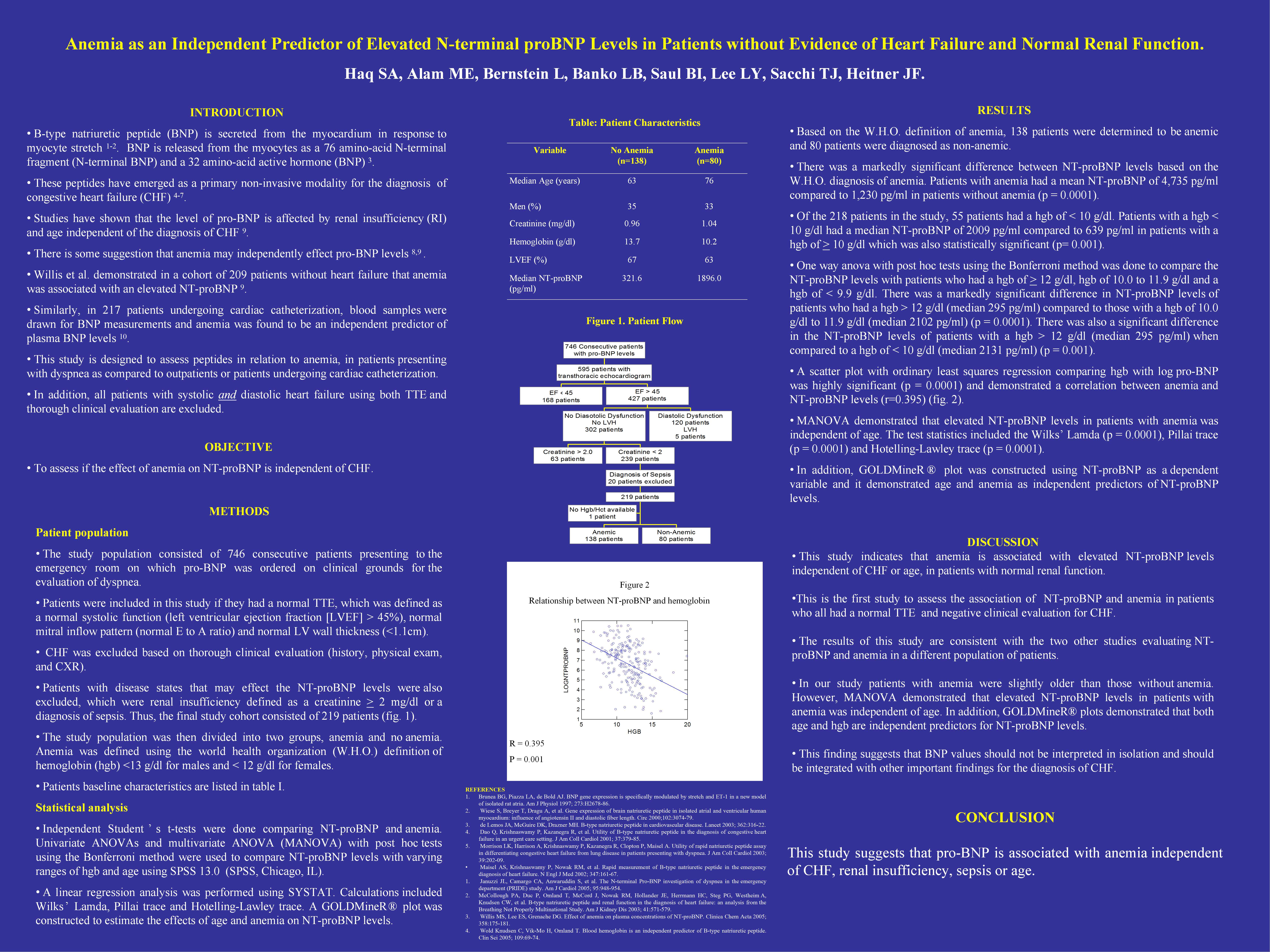
Table 1.  Patient Characteristics

Variable No Anemia(n=138) Anemia(n=80)
Median Age (years) 63 76
Men (%) 35 33
Creatinine (mg/dl) 0.96 1.04
Hemoglobin (g/dl) 13.7 10.2
LVEF (%) 67 63
Median NT-proBNP (pg/ml) 321.6 1896.0

Poster-ProBNP_final[1]

A series of slide showing the determination of the representation of normal NT-proBNP range
after removal of patient confounders.

Slide1

Slide10

Slide5

Slide8

ABSTRACT

Introduction

N-terminal proBNP (NT-proBNP) has emerged as a primary tool for diagnosing congestive heart failure (CHF). Studies have shown that the level of

  • NT-proBNP is affected by renal insufficiency (RI) and age, independent of the diagnosis of CHF.

There is some suggestion from recent studies that

  • anemia may also independently affect NT-proBNP levels.

Objective

To assess the affect of anemia on NT-proBNP independent of CHF, RI, and age.

Methods

We evaluated 746 consecutive patients presenting to the Emergency Department (ED) with shortness of breath and underwent evaluation with serum NT-proBNP.

All patients underwent a trans-thoracic echocardiogram (TTE) and clinical evaluation for CHF. Patients were included in this study if they had a normal TTE (normal systolic function, mitral inflow pattern and left ventricular (LV) wall thickness) and no evidence of CHF based on clinical evaluation. Patients were excluded if they had RI (creatinine > 2 mg/dl) or a diagnosis of sepsis. Anemia was defined using the World Health Organization (W.H.O.) definition of

  • hemoglobin (hgb) < 13 g/dl for males and hgb < 12 g/dl for females.

Results

Of the 746 consecutive patients, 218 patients (138 anemia, 80 no anemia) met the inclusion criteria. There was a markedly significant difference between

  • NT- proBNP levels based on the W.H.O. diagnosis of anemia.

Patients with anemia had a

  • mean NT- proBNP of 4,735 pg/ml compared to 1,230 pg/ml in patients without anemia (p=0.0001).

There was a markedly

  • significant difference in patients who had a hgb > 12 (median 295 pg/ml) when compared to
  • both patients with an hgb of 10.0 to 11.9 (median 2,102 pg/ml; p = 0.0001) and
  • those with a hgb < 10 (median 2,131 pg/ml; p = 0.001).

Linear regression analysis comparing hgb with log NT-proBNP was statistically significant (r = 0.395; p = 0.0001). MANOVA demonstrated that

  • elevated NT- proBNP levels in patients with anemia was independent of age.

Conclusion

This study shows that NT-proBNP is associated with anemia independent of CHF, renal insufficiency, sepsis or age.

INTRODUCTION

B-type natriuretic peptide (BNP) is secreted from the myocardium in response to myocyte stretch. 1-2 BNP is released from the myocytes as a 76 aminoacid N-terminal fragment (NT-proBNP) and a 32-amino acid active hormone (BNP). 3 These peptides have emerged as a primary non-invasive modality for the diagnosis of congestive heart failure (CHF). 4- 7 In addition, these peptides have demonstrated prognostic significance in patients with invasive modality for the diagnosis of

  • congestive heart failure (CHF). 4- 7
  • heart failure 8-9,
  • stable coronary artery disease 10, and
  • in patients with acute coronary syndromes. 11-14

Studies have shown that the level of NT- proBNP is affected by

  • age and renal insufficiency (RI) independent of the diagnosis of CHF. 15,16

There is some suggestion from the literature that

  • anemia may also independently affect NT-proBNP levels. 17-20

Willis et al. demonstrated in a cohort of 209 patients without heart failure that anemia was associated with an elevated NT- proBNP. 17 Similarly, in 217 patients undergoing cardiac catheterization, blood samples were drawn from the descending aorta prior to contrast ventriculography for BNP measurements and

  • anemia was found to be an independent predictor of plasma BNP levels. 18

The objective of this study is to assess the effect of anemia on NT-proBNP independent of CHF, sepsis, age or renal insufficiency.

METHODS

Patient population

The study population consisted of 746 consecutive patients presenting to the emergency room who underwent NT-proBNP evaluation for the evaluation of dyspnea. Transthoracic echocardiogram (TTE) was available on 595 patients. Patients were included in this study if they had a normal TTE, which was defined as normal systolic function (left ventricular ejection fraction [LVEF] > 45%), normal mitral inflow pattern and normal LV wall thickness. CHF was excluded based on thorough clinical evaluation by the emergency department attending and the attending medical physician. Patients with disease states that may affect the NT- proBNP levels were also excluded:

  1. left ventricular systolic dysfunction (LVEF < 45%),
  2. renal insufficiency defined as a creatinine > 2 mg/dl and
  3. sepsis (defined as positive blood cultures with two or more of the following systemic inflammatory response syndrome (SIRS) criteria: heart rate > 90 beats per minute;
  4. body temperature < 36 (96.8 °F) or > 38 °C (100.4 °F);
  5. hyperventilation (high respiratory rate) > 20 breaths per minute or, on blood gas, a PaCO2 less than 32 mm Hg;
  6. white blood cell count < 4000 cells/mm3 or > 12000 cells/mm³ (< 4 x 10⁹ or > 12 x 109 cells/L), or greater than 10% band forms (immature white blood cells). 21

The study population was then divided into two groups, anemic and non- anemic. Anemia was defined using the world health organization (W.H.O.) definition of hemoglobin (hgb) < 13 g/dl for males and < 12 g/dl for females.The data was also analyzed by dividing the patients into three groups based on hgb levels i.e. hgb > 12, hgb 10 to 11.9 and hgb < 10.

Baseline patient data

Patient’s baseline data including age, gender, ethnicity, hemoglobin (hgb), hematocrit (hct), creatinine, NT- proBNP were recorded from the electronic medical record system in our institution. Chemistry results were performed on the Roche Modular System (Indianapolis, IN), with the NT- proBNP done by chemiluminescence assay. The hemogram was performed on the Beckman Coulter GenS. All TTE’s were performed on Sonos 5500 machine. TTE data collected included LVEF, mitral inflow pattern and LV wall thickness assessment.

Statistical analysis

The results are reported in the means with p < 0.05 as the measure of significance for difference between means. Independent Student’s t-tests were done comparing NT proBNP and anemia. Univariate ANOVAs and multivariate ANOVA (MANOVA) with post hoc tests using the Bonferroni method were used to compare NT- proBNP levels with varying ranges of hgb and age using SPSS 13.0 (SPSS, Chicago, IL). A linear regression analysis was performed using SYSTAT. Calculations included Wilks’Lamda, Pillai trace and Hotelling-Lawley trace. A GOLDMineR® plot was constructed to estimate the effects of age and anemia on NT- proBNP levels. The GOLDMineR® effects plot displays the odds-ratios for predicted NT-proBNP elevation versus the predictor values. Unlike the logistic regression, the ordinal regression, which the plot is derived from, can have polychotomous as well as dichotomous values, as is the case for NT-proBNP.

RESULTS

Of the 746 consecutive patients, 218 patients met the inclusion criteria (fig 1). Baseline characteristics of patients are listed in table 1. The median age for anemic patients was 76 years and 63 years for patients without anemia. One third of patients in both groups were men. The mean hemoglobin for

  • anemic patients was 10.2 g/dl as compared to 13.7 g/dl for non-anemic patients.
  • The mean LVEF of patients with anemia was 64% as compared to 67% for non-anemic patients.

Based on the WHO definition of anemia, 138 patients were determined to be anemic while 80 patients were diagnosed as non-anemic. There was a markedly  significant difference between NT-proBNP levels based on the WHO diagnosis of anemia.

Patients with anemia had a

  • mean NT-proBNP of 4,735 pg/ml compared to 1,230 pg/ml in patients without anemia (p = 0.0001).

Of the 218 patients in the study, 55 patients had a hgb of < 10 g/dl. Analysis using

  • hgb < 10 g/dl for anemia demonstrated a statistically significant difference in the NT-proBNP values.

Patients with a hgb < 10 g/dl had a mean NT- proBNP of 5,130 pg/ml

  • compared to 2,882 pg/ml in patients with a hgb of > 10 g/dl (p = 0.01)

The groups were also divided into three separate categories of hgb for subset analysis:

  • hgb > 12 g/dl,
  • hgb 10 to 11.9 g/dl and
  • hgb < 10 g/dl.

There was a markedly significant difference in

  •  the NT- ProBNP levels of patients who had a hgb > 12 g/dl (median 295 pg/ml) when
  • compared to those with a hgb range of 10.0 g/dl to 11.9 g/dl (median 2,102 pg/ml) (p = 0.0001),

and also a significant difference in

  • NT- proBNP levels of patients with a hgb > 12 g/dl (median 295 pg/ml) when
  • compared to a hgb of < 10 g/dl (median 2,131 pg/ml) (p = 0.001).

However, there was no statistically significant difference in NT-proBNP levels of patients with hgb 10 g/dl to 11.9 g/dl

  • when compared to those with a hgb of < 10 g/dl (p = 1.0).

A scatter plot comparing hgb with log NT-proBNP and fitting of a line to the data by ordinary least squares regression was significant (p = 0.0001) and demonstrated

  • a correlation between anemia and NT-proBNP levels (r = 0.395) (fig. 2).

MANOVA demonstrated that elevated NT- proBNP levels in patients with anemia was independent of age (Wilks’ Lambda [p = 0.0001]). In addition, using GOLDMineR® plots (figure 3a and 3b) with a combination of age and hb scaled as predictors of elevated NT-proBNP,

  • both age and hgb were required as independent predictors.

What about the effect of anemia? The GOLDminer analysis of ordinal regression was carried out in a database from which renal insufficiency and CHF were removed. The anemia would appear to have an independent effect on renal insufficiency. Figure 4 is a boxplot comparison of NT – proBNP, the age normalized function NKLog (NT- proBNP)/eGFR formed from taking 1000*Log(NT- proBNP) divided by the MDRD at eGFR exceeding 60 ml/min/m2 and exceeding 30 ml/min/m2. The transformed variable substantially makes the test independent of age and renal function. The boxplot shows the medians, 97.5, 75, 25 and 2.5 percentiles. There appears to be no significance in the NKLog(NT pro-BNP)/MDRD plot. Table II compares the NT-proBNP by WHO criteria at eGFR 45, 60 and 75 ml/mln/m2 using the t-test with unequal variance assumed, and the Kolmogorov-Smirnov test for nonparametric measures of significance. The significance at 60 ml/min/m2 is marginal and nonexistent at 75 ml/min/m2. This suggests that the contribution from renal function at above 60 ml/min2 can be ignored. This is consistent with the findings using the smaller, trimmed database, but there is an interaction between

  •  anemia, and
  •  eGFR at levels below 60 ml/min/m2

DISCUSSION

The findings in this study indicate that

  • anemia was associated with elevated NT-proBNP levels independent of CHF, renal insufficiency, sepsis or age.

These findings have been demonstrated with NT-proBNP in only one previous study. Wallis et al. demonstrated that after adjusting for age, sex, BMI, GFR, LVH and valvular disease;

  1. only age,
  2. valvular disease and
  3. low hemoglobin

were significantly associated with increased NT-proBNP. 18.

In our study, CHF was excluded based on both a normal TTE and a thorough clinical evaluation. In the only other study directly looking at NT- proBNP levels in anemic patients without heart failure

  • only 25% of patients had TTEs, with one patient having an LVEF of 40%. 17

BNP, the active molecule released after cleavage along with NT- proBNP, has also been studied in relation to blood hemoglobin levels. 18 In 263 patients undergoing cardiac catheterization  blood samples were drawn from the descending aorta prior to contrast ventriculography to determine the value of BNP. Anemia was present in 217 patients. Multivariate linear regression model adjusting for

  1.  age,
  2.  gender,
  3.  body mass index,
  4.  history of myocardial infarction,
  5.  estimated creatinine clearance, and
  6.  LVEF
  • found hgb to be an independent predictor of BNP levels.

In our study, patients with anemia were slightly older than those without anemia. However, both MANOVA and GOLDMineR® plot demonstrated that

  • elevated NT-proBNP levels in patients with anemia was independent of age.

Other studies have found that BNP is dependent on renal insufficiency and age. Raymond et al. randomly selected patients to complete questionnaires regarding CHF and

  1. then underwent pulse and blood pressure measurements,
  2.  electrocardiogram (ECG),
  3.  echocardiography and
  4.  blood sampling. 15

A total of 672 subjects were screened and 130 were determined to be normal, defined as

  • no CHF or ischemic heart disease,
  • normal LVEF,
  • no hypertension,
  • diabetes mellitus,
  • lung disease, and
  • not on any cardiovascular drugs.

They found

  1. older age,
  2. increasing dyspnea,
  3. high plasma creatinine and a
  4. LVEF < 45%

to be independently associated with an elevated NT-proBNP plasma level by multiple linear regression analysis. In another study, McCullough et al. evaluated the patients from the Breathing Not Properly Multinational Study

  • looking at the relationship between BNP and renal function in CHF. 16

Patients were excluded if they were on hemodialysis or had a estimated glomerular filteration rate (eGFR) of < 15 ml/min. They found that the BNP levels correlated significantly with the eGFR, especially in patients without CHF, suggesting

  1. chronic increased blood volume and
  2. increased left ventricular wall tension as a possible cause. 16

Our study was designed to exclude patients with known diseases such as CHF and renal insufficiency in order to demonstrate

  • the independent effect of anemia on elevated NT-proBNP levels.

The mechanism for elevated NT-proBNP levels in patients with anemia is unknown. Some possible mechanisms that have been reported in the literature include

  • hemodilution secondary to fluid retention in patients with CHF 18,
  • decreased oxygen carrying capacity with accompanying tissue hypoxia which
  • stimulates the cardio-renal compensatory mechanism leading to increased release of NT-proBNP. 17

The findings from our study suggest that

  •  NT-proBNP values should not be interpreted in isolation of hemoglobin levels and
  • should be integrated with other important clinical findings for the diagnosis of CHF.

Further studies are warranted

  1.  to assess the relationship between anemia and plasma natriuretic peptides, and
  2. possibly modify the NT-proBNP cutoff points for diagnosing acutely decompensated CHF in patients with anemia.

CONCLUSION

This study shows that elevated NT-proBNP levels are associated with anemia independent of

  •   CHF,
  •  renal insufficiency,
  •  sepsis and
  •  age.

NT-proBNP levels should be interpreted with caution in patients who have anemia.

 REFERENCES

1. Brunea BG, Piazza LA, de Bold AJ. BNP gene expression is specifically modulated by stretch and ET-1 in a new model of isolated rat atria.Am J Physiol  1997; 273:H2678-86.

2. Wiese S, Breyer T, Dragu A, et al. Gene expression of brain natriuretic peptide  in isolated atrial and ventricular human myocardium: influence of angiotensin II and diastolic fiber length. Circ 2000; 102:3074-79.

3. de Lemos JA, McGuire DK, Drazner MH. B-type natriuretic peptide in cardiovascular disease. Lancet 2003; 362:316-22.

4.   Dao Q, Krishnaswamy P, Kazanegra R, et al. Utility of B-type natriuretic  peptide in the diagnosis of congestive heart failure in an urgent care setting. J Am  Coll Cardiol 2001; 37:379-85.

5. Morrison LK, Harrison A, Krishnaswamy P, Kazanegra R, Clopton P, Maisel A. Utility of rapid natriuretic peptide assay in differentiating congestive heart failure from lung  disease in patients presenting with dyspnea.
J Am Coll Cardiol  2003; 39:202-09.

6.  Maisel AS, Krishnaswamy P, Nowak RM, et al.  Rapid measurement of B-type natriuretic peptide in the emergency diagnosis of heart failure. N Engl J Med 2002; 347:161-67.

7. Januzzi JL, Camargo CA, Anwaruddin S, et al. The N-terminal Pro-BNP investigation of dyspnea in the emergency department (PRIDE) study. Am J  Cardiol 2005; 95:948-954.

8.  Tsutamoto T, Wada A, Meada K, et al.   Attenuation of compensation of  endogenous cardiac natriuretic peptide system  in chronic heart failure: prognostic role  of plasma  brain natriuretic peptide concentration in patients with chronic  symptomatic  left ventricular dysfunction.
Circulation 1997; 96(2): 509-16.

9.  Anand IS, Fisher LD, Chiang YT, et al. Changes in brain natriuretic peptide and norepinephrine over time and mortality and morbidity in the Valsartan Heart Failure Trial (Val-HEFT). Circulation 2003; 107:1278-1283.

10. Omland T, Richards AM, Wergeland R and Vik-Mo H. B-type natriuretic peptide and long term survival in patients with stable coronary artery disease.
Am J Cardiol 2005; 95:24-28.

11. Omland T, Aakvaag A, Bonarjee VV. et al. Plasma brain natriuretic peptide as an indicator of left ventricular systolic dysfunction and long term prognosis after acute myocardial infarction. Comparison with plasma atrial natriuretic peptide and N-terminal proatrial natriuretic peptide.
Circulation 1996; 93:1963-1969.

12. de Lemos JA, Morrow DA, Bently JH, et al. The prognostic value of B-type natriuretic peptide in patients with acute coronary syndromes. N Engl J Med 2001; 345:1014-1021.

13. Richards AM, Nicholls MG, Espiner EA, et al. B-type natriuretic peptides and  ejection fraction for prognosis after myocardial infarction. Circulation 2003; 107:2786-2792.

14. Sabatine MS, Morrow DA, de Lemos JA, et al.  Multimarker approach to risk  stratification in non-ST elevation acute coronary syndromes: simultaneous  assessment of troponin I, C-reactive protein and B-type natriuretic peptide.
Circulation 2002; 105:1760-1763.

15. Raymond I, Groenning BA, Hildebrandt PR, Nilsson JC, Baumann M, Trawinski   J, Pedersen F.  The influence of age, sex andother variables on the plasma level of N-terminal pro brain natriureticpeptide in a large sample of the general  population. Heart 2003; 89:745-751.

16. McCollough PA, Duc P, Omland T, McCord J, Nowak RM, Hollander JE, et al. B-type natriuretic peptide and renal function in the diagnosis of heartfailure:  an analysis from the  Breathing Not Properly Multinational Study.
Am J Kidney Dis 2003; 41:571-579.

17. Willis MS, Lee ES, Grenache DG. Effect of anemia on plasma concentrations of  NT-proBNP.
Clinica Chim Acta 2005; 358:175-181.

18. Wold Knudsen C, Vik-Mo H, Omland T. Blood hemoglobin is an independent  predictor of B-type natriuretic peptide.
Clin Sci 2005; 109:69-74.

19. Tsuji H, Nishino N, Kimura Y, Yamada K, Nukui M, et al. Haemoglobin level influences plasma brain natriuretic peptide concentration. Acta Cardiol 2004;59:527-31.

20. Wu AH, Omland T, Wold KC, McCord J, Nowak RM, et al. Relationship  of B-type natriuretic peptide and anemia  in patients withand without heart failure:  A substudy from the Breathing Not Properly(BNP) Multinational Study.
Am J  Hematol 2005; 80:174-80.

22. Bone RC, Balk RA, Cerra FB, Dellinger RP, Fein AM, et al.  Definitions for sepsis and organ failure and guidelines for theuse of innovative therapies in sepsis.  The ACCP/SCCM Consensus Conference Committee. Chest. 1992;101(6):1644-55.

Table Legends

Table I. Clinical characteristics of the study population

Table II. Comparison of NT- proBNP means under WHO criteria at different GFR

Table I
Variable No Anemia(n=80) Anemia(n=138)
Median age (years) 63 76
Gender
    Men (%) 27 (34) 47 (34)
    Women (%) 53 (66) 91 (66)
Weight (kg) 82.9 80.1
Chest Pain 21 (26) 3 (2)
Hemoglobin (g/dl) 13.7 10.2
Hematocrit (%) 40.5 30.5
Mean Corpuscular Volume 97 87
Creatinine (mg/dl) 0.99 1.07
Median NT-proBNP (pg/ml) 321 1896
Medical History
    HTN (%) 12 (15) 51 (37)
    Prior MI (%) 11 (14) 5 (4)
    ACS (%) 16 (20) 3 (2)
    CAD (%) 2 (1) 3 (2)
     DM (%) 18 (22) 11 (8)
Medication
   Clopidogrel 58 (72) 15 (11)
   Beta Blockers 68 (85) 27 (20)
   Ace Inhibitors 45 (56) 18 (13)
   Statins 57 (71) 17 (12)
   Calcium Channel Blocker 17 (21) 8 (6)
LVEF (%) 67 64

HTN: Hypertension CAD: Coronary Artery Disease
MI: Myocardial Infarction DM: Diabetes Mellitus
ACS: Acute Coronary Syndrome LVEF: Left Ventricular Ejection Fraction

Table II
GFR WHO Mean P (F) N NPar
> 45 0 3267 0.022 (4.33) 661
1 4681
> 60* 0 2593 0.031 (5.11) 456 0.018
1 4145
> 60r 0 786 0.203 (3.63) 303 0.08
1 3880
> 75 0 2773 > 0.80 320 0.043
1 3048

*AF, valve disease and elevated troponin T included
r AF, valve disease and elevated troponin T removed

FIGURE LEGENDS

FIGURE 1. Study population flow chart. (see poster)
FIGURE 2. Relationship between proBNP and hemoglobin. (see above)
FIGURE 3. NT-proBNP levels in relation to anemia (see above)

Supplementary Material

Table based on LatentGOLD Statistical Innovations, Inc., Belmont, MA., 2000: Jeroen Vermunt & Jay Magidson)

4-Cluster Model

Number of cases                                   408
Number of parameters (Npar)             24

Chi-squared Statistics
Degrees of freedom (df)                          71                     p-value
L-squared (L²)                                    80.2033                    0.21
X-squared                                            80.8313                     0.20
Cressie-Read                                        76.6761                     0.30
BIC (based on L²)                          -346.5966
AIC3 (based on L²)                        -132.7967
CAIC (based on L²)                       -417.5966

Model for Clusters
 Intercept                Cluster1      Cluster2     Cluster3     Cluster4     Wald     p-value
————–           0.1544           0.1434        0.0115        -0.3093     1.1981     0.75
Cluster Size           0.2870          0.2838       0.2487          0.1805
(across)

LogNTpr
< 1.5                       0.0843           0.2457       0.0006          0.0084
1.6-2.5                   0.6179            0.6458       0.0709          0.2809
2.5-3.5                  0.2848           0.1067         0.5319          0.5883
> 3.5                      0.0130           0.0018         0.3966         0.1224
MDRD
> 90                     0.1341             0.7919         0.0063         0.6106
61-90                  0.6019            0.2040          0.1633         0.3713
41-60                  0.2099            0.0041          0.3317         0.0175
< 41                     0.0542            0.0001         0.4987        0.0006
age
under 51           0.0668           0.5646          0.0568        0.0954
51-70                 0.3462            0.3602          0.3271         0.3880
over 70             0.5870            0.0752          0.6161         0.5166
WHO
No anemia      0.7518             0.6556          0.2041         0.0998
Anemia            0.2482             0.3444          0.7959         0.9002

———          Cluster1          Cluster2      Cluster3      Cluster4
Overall           0.2870            0.2838         0.2487        0.1805
(down)

LogNTpro
< 1.5                0.2492              0.7379           0.0013         0.0116
1.6-2.5            0.4163               0.4243           0.0427        0.1167
2.6-3.5           0.2296               0.0887          0.3723        0.3095
> 3.5              0.0328                0.0023          0.7982        0.1666
MDRD
> 90              0.1001                0.5998           0.0043        0.2958
61-90           0.5198                 0.1716           0.1136         0.1950
41-60           0.3860                 0.0055          0.5847         0.0238
< 41             0.1205                  0.0002          0.8785         0.0008
 age
< 51            0.0720                 0.7458           0.0910          0.0912
51-70         0.3036                 0.3084           0.2013          0.1867
over 70     0.3773                  0.0409          0.3633           0.2186
 WHO
No anemia 0.4589              0.3957           0.1076           0.0378
Anemia     0.1342                 0.1844            0.3742           0.3073

Hemoglobin on NT proBNP 3

SECOND ARTICLE

The effect of correction of mild anemia in severe, resistant congestive heart failure using subcutaneous erythropoietin and intravenous iron: a randomized controlled study

Donald S Silverberg, MDa; Dov Wexler, MDa; David Sheps, MDa; Miriam Blum, MDa; Gad Keren, MDa; Ron Baruch, MDa; Doron Schwartz, MDa; Tatyana Yachnin, MDa; Shoshana Steinbruch, RNa; Itzhak Shapira, MDa; Shlomo Laniado, MDa; Adrian Iaina, MDa

J Am Coll Cardiol. 2001;37(7):1775-1780. doi:10.1016/S0735-1097(01)01248-7

http://content.onlinejacc.org/article.aspx?articleid=1127229

OBJECTIVES

This is a randomized controlled study of anemic patients with severe congestive heart failure (CHF) to assess the effect of correction of the anemia on cardiac and renal function and hospitalization.

BACKGROUND

Although mild anemia occurs frequently in patients with CHF, there is very little information about the effect of correcting it with erythropoietin (EPO) and intravenous iron.

METHODS

Thirty-two patients with moderate to severe CHF (New York Heart Association [NYHA] class III to IV)
who had a left ventricular ejection fraction (LVEF) of 40% despite maximally tolerated doses of CHF medications and
  • whose hemoglobin (Hb) levels were persistently between 10.0 and 11.5 g% were randomized into two groups.
Group A (16 patients) received subcutaneous EPO and IV iron to increase the level of Hb to at least 12.5 g%. In Group B (16 patients) the anemia was not treated. The doses of all the CHF medications were maintained at the maximally tolerated levels except for oral and intravenous (IV) furosemide, whose doses were increased or decreased according to the clinical need.

RESULTS

Over a mean of 8.2 +/- 2.6 months,
  • four patients in Group B and none in Group A died of CHF-related illnesses.
  • The mean NYHA class improved by 42.1% in A and worsened by 11.4% in B.
  • The LVEF increased by 5.5% in A and decreased by 5.4% in B.
  • The serum creatinine did not change in A and increased by 28.6% in B.
  • The need for oral and IV furosemide decreased by 51.3% and 91.3% respectively in A and increased by 28.5% and 28.0% respectively in B.
  • The number of days spent in hospital compared with the same period of time before entering the study decreased by 79.0% in A and increased by 57.6% in B.

CONCLUSIONS

When anemia in CHF is treated with EPO and IV iron, a marked improvement in cardiac and patient function is seen,
  • associated with less hospitalization and renal impairment and less need for diuretics. (J Am Coll Cardiol 2001;37:1775– 80)

Anemia of any cause is known to be capable of causing congestive heart failure (CHF) (1). In patients hospitalized with CHF the 

  • mean hemoglobin (Hb) is about 12 g% (2,3),

which is considered the lower limit of normal in adults (4). Thus, anemia appears to be

common in CHF. Recently, in 142 patients in our special CHF outpatient clinic, we found that

  • as the CHF worsened, the mean Hb concentration decreased, from 13.7 g% in mild CHF (New York Heart Association [NYHA] class I) to 10.9 g% in severe CHF (NYHA 4), and
  • the prevalence of a Hb 12 g% increased from 9.1% in patients with NYHA 1 to 79.1% in those with NYHA 4 (5).
The Framingham Study has shown that anemia is an
  • independent risk factor for the production of CHF (6).
Despite this association of CHF with anemia,
  • its role is not mentioned in the 1999 U.S. guidelines for the diagnosis and treatment of CHF (7), and
  • many studies consider anemia to be only a rare contributing cause of hospitalization for CHF (8,9).
Recently, we performed a study in which the anemia of severe CHF that was resistant to maximally tolerated doses of standard medications
  • was corrected with a combination of subcutaneous (sc) erythropoietin (EPO) and intravenous iron (IV Fe) (5).
We have found this combination to be safe, effective and additive
  • in the correction of the anemia of chronic renal failure (CRF) in both
  • the predialysis period (10) and the dialysis period (11).
The IV Fe appears to be more effective than oral iron (12,13). In our previous study of CHF patients (5), the treatment resulted in
  • improved cardiac function,
  • improved NYHA functional class,
  • increased glomerular filtration rate,
  • a marked reduction in the need for diuretics and
  • a 92% reduction in the hospitalization rate
compared with a similar time period before the intervention. In the light of these positive results, a prospective randomized study was undertaken
  • to determine the effects of the correction of anemia in severe symptomatic CHF resistant to maximally tolerated CHF medication.

Abbreviations and Acronyms

CABG coronary artery bypass graft
CHF congestive heart failure
CRF chronic renal failure
EPO erythropoietin
%Fe Sat percent iron saturation
GFR glomerular filtration rate
Hb hemoglobin
Hct hematocrit
IU international units
IV intravenous
LVEF left ventricular ejection fraction
NYHA New York Heart Association
PA pulmonary artery
sc subcutaneous
SOLVD Studies Of Left Ventricular Dysfunction

MATERIALS AND METHODS

Patients.Thirty-two patients with CHF were studied. Before the study, the patients were treated for least six months in the CHF clinic with

  • maximally tolerated doses of angiotensin-converting enzyme inhibitors, the beta-blockers bisoprolol or carvedilol, aldospirone, long-acting nitrates, digoxin and oral and intravenous (IV) furosemide.

In some patients these agents could not be given because of contraindications and in others they had to be stopped because of side effects. Despite this maximal treatment

  • the patients still had severe CHF  (NYHA classIII), with  fatigue and/or shortness of breath  on even mild exertion or at rest.  All had levels of
  • Hb in the range of 10 to 11.5 g%  on at least three consecutive visits over a three-week period.
  • All had a LVEF of 40%.

Secondary causes of anemia including hypothyroidism, and folic acid and vitamin B12 deficiency were ruled out and

  • there was no clinical evidence of gastrointestinal bleeding.

The patients were randomized consecutively into two groups:

  • Group A, 16 patients, was treated with sc EPO and IV Fe to achieve a target Hb of at least 12.5 g%.
  • Group B, 16 patients, did not receive the EPO and IV Fe.

Treatment protocol for correction of anemia.

All patients in Group A received the combination of sc EPO and IV Fe. The EPO was given once a week at a starting dose of 4,000 international units (IU) per week  and
the dose was increased  to two  or  three  times a week or decreased to once every few weeks as  necessary

  • to achieve and maintain a target Hb of 12.5 g%.

The IV Fe (Venofer-Vifor International, Switzerland), a ferric sucrose product, was given in a dose of 200 mg IV in 150 ml saline over 60 min every two weeks

  • until the serum ferritin reached 400 g/l or
  • the %Fe saturation (%Fe Sat is serum iron/total iron binding capacity 100) reached 40% or
  • the Hb reached 12.5g%. 

The IV Fe was then given at longer intervals as needed to maintain these levels.

Investigations. 

Visits to the clinic were at two- to three week intervals depending on the patient’s status. This was the same frequency of visits to the CHF clinic as before then,

  • potassium and ferritin and %Fe Sat were performed on every visit.
  • blood pressure was measured by an electronic device on every visit.
  • LVEF was measured initially and at four- to six-month intervals by MUGA radioisotope ventriculography.

This technique measures

  • the amount of blood in the ventricle at the end of systole and at the end of diastole, thus giving
  • a very accurate assessment of the ejection fraction.

It has been shown to be an accurate and reproducible method of measuring the ejection fraction (14).  Hospital records were reviewed at the end of the intervention period to compare

  • the number of days hospitalized during the study with 
  • the number of days hospitalized during a similar period 
    • when the patients were treated in the CHF clinic before the initial randomization and entry into the study.

Clinic records were reviewed to evaluate the types and doses of CHF medications used before and during the study. The mean follow-up for patients was 8.2 +/-  2.7 months (range 5 to 12 months).  The study was done with the approval of the local ethics committee.Statistical analysis.

An analysis of variance with repeated measures (over time) was performed to compare the two study groups (control vs. treatment) and

  • to assess time trend and the interactions between the two factors.
  • A separate analysis was carried out for each of the outcome parameters.
  • The Mann-Whitney test was used to compare the change in NYHA class between two groups.

All the statistical analysis was performed by SPSS (version 10).

RESULTS

The mean age in Group A (EPO and Fe) was 75.3 +/-  14.6 years and in group B was 72.2 +/-  9.9 years. There were 11 and 12 men in Groups A and B, respectively.
Before the study the two groups were similar in
  1. cardiac function,
  2. comorbidities,
  3. laboratory investigations and
  4. medications
  • (Tables 1, 2 and 3), except for IV furosemide (Table 3),
which was higher in the treatment group. The mean NYHA class of Group A before the study was 3.8  0.4 and was 3.5  0.5 in Group B. The contributing factors to CHF in Groups A and B, respectively, are seen in Table 1 and were similar.
Table 1. Medical Conditions and Contributing Factors to Congestive Heart Failure in the 16 Patients Treated for the Anemia and in the 16 Controls

Table 1 medical conditions heart failure anemia

Table 2. The Effect of Correction of Anemia by Intravenous Iron and Erythropoietin Therapy on Various Parameters in 16 Patients in the Treatment (A) and 16 in the Control (B) Group

Table 2 medications to treat heart failure anemia

p values are given for analysis of variance with repeated measures and for independent t tests for comparison of baseline levels between the two groups.
BP  blood pressure; Fe Sat  iron saturation; Hb  hemoglobin; IV  intravenous; NS  not stated; Std Dev.  standard deviation.

The main contributing factors to CHF were considered to be

  • ischemic heart disease (IHD) in 11 and 10 patients respectively,
  • hypertension in two and two patients,
  • valvular heart disease in twoand two patients, and
  • idiopathic cardiomyopathy in one and two patients, respectively.

A significant change after treatment was observed in the two groups in the following parameters:

  • IV furosemide,
  • days in hospital,
  • Hb,
  • ejection fraction,
  • serum creatinine and
  • serum ferritin.
In addition, the interaction between the study group and time trend was significant in all measurements except for blood pressure and %Fe Sat. This interaction indicates that
  • the change over time was significantly different in the two groups.
Table 3. The Effect of Correction of Anemia by Intravenous Iron and Erythropoietin Therapy on Various Parameters in 16 Patients in the Treatment (A) and 16 in the Control (B) Group

Table 3  CHF aneia EPO

p values are given for analysis of variance with repeated measures and for independent t tests for comparison of baseline levels between the two groups.
BP  blood pressure; Fe Sat  iron saturation; Hb  hemoglobin; IV  intravenous; NS  not stated; Std Dev.  standard deviation.

We find in the comparisons of Tables 2 and 3:

  1. before treatment the level of oral furosemide was higher in the control group (136.2 mg/day) compared with the treatment group (132.2 mg/day).
  2. after treatment, while the dose of oral furosemide of the treated patients was reduced  to 64.4 mg/day
  • the dose of the nontreated patients was increased to 175 mg/day.

The same results of improvement in the treated group and deterioration in the control group are expressed in the following parameters:

  1. IV furosemide, days in hospital,
  2. Hb,
  3. ejection fraction and
  4. serum creatinine.

The NYHA class was

  • 3.8 +/- 0.4 before treatment and 2.2 +/- 0.7 after treatment in Group A  (delta mean = – 1.6) and
  • 3.5 +/-  0.7 before treatment and 3.9 +/- 0.3 after treatment in Group B. (delta mean = 0.4)

The improvement in NYHA class was significantly higher (p < 0.0001) in the treatment group compared with the control group (Table 4).

Table 4. Changes from Baseline to Final New York Heart Association (NYHA) Class
Initial minus final

Table 4  changes from NYHA baseline  CHF anemia

The improvement in NYHA class was statistically higher (p <  0.0001) in the treatment group compared with control.

There were no deaths in Group A and four deaths in Group B.

Case 1: A 71-year-old woman with severe mitral insufficiency and severe pulmonary hypertension  (a pulmonary artery [PA] pressure of 75 mm Hg) had persistent NYHA 4 CHF  and died during mitral valve surgery  seven months after onset of the study. She was hospitalized for 21 days  in the seven months before randomization and for 28 days  during the seven months after randomization.

Case 2:

A 62-year-old man with a longstanding history of hypertension complicated by IHD, coronary artery bypass graft (CABG) and atrial fibrillation had persistent NYHA 4 CHF  and a PA pressure of 35 mm Hg,  and died from pneumonia and septic shock eight months after onset of the study. He was hospitalized for seven days in the eight months before randomization and for 21 days during the eight months  after
randomization.

Case 3:
A 74-year old man with IHD, CABG, chronic obstructive pulmonary disease, a history of heavy smoking and diabetes had persistent NYHA 4 CHF and a PA pressure of  28 mm Hg, and died of pulmonary  edema and cardiogenic shock nine months after onset of the study. He was hospitalized for 14 days in the nine months before  randomization and for 41 days during the nine months after randomization.

Case 4:
A 74-year-old man with a history of IHD, CABG, diabetes, dyslipidemia, hypertension and atrial fibrillation, had persistent NYHA 4 CHF and a PA pressure of 30 mm Hg,  and died of pneumonia and septic shock   six months after onset of the study. He was hospitalized for five days in the six months before randomization and for 16 days during the nine months after randomization.

DISCUSSION

 Main findings.

The main finding of the present study is that the correction of

  • even mild anemia in patients with symptoms of very severe CHF despite being on maximally tolerated drug therapy
  • resulted in a significant improvement in their cardiac function and NYHA functional class.

There  was also a large

  • reduction in the number of days of  hospitalization compared with a similar period before the  intervention.
  • all this was achieved despite a marked reduction in the dose of oral and IV furosemide.

In the group in whom the anemia was not treated, four  patients died during the study. In all four cases

  • the CHF was unremitting and contributed to the deaths. 

In addition,  for the group as a whole, 

  • the LVEF, the NYHA class and  the renal function worsened.

There was also need for

  • increased oral and IV furosemide as well as increased  hospitalization.

Study limitations.

The major limitations of this study are

  1. the smallness of the sample size and
  2. the fact that randomization and treatment were not done in a blinded fashion.

Nevertheless, the two groups were almost identical in

  1. cardiac, renal and anemia status;
  2. in the types and doses of medication they were taking before and during the intervention and
  3. in the number of hospitalization days before the intervention.

Although the results of this study, like those of  our previous uncontrolled study (5), suggest that

  • anemia may play an important role in the mortality and morbidity of  CHF,
  • a far larger double-blinded controlled study should be carried out to verify our findings.

Anemia as a risk factor for hospitalization and death in CHF.

Our results are consistent with a recent analysis of 91,316 patients hospitalized with CHF (15). Anemia was found to be a stronger predictor of

  • the need for early rehospitalization than  was hypertension,  IHD or the presence of a previous CABG.  

A recent analysis of the Studies Of Left Ventricular Dysfunction (SOLVD) (16) showed that

  • the level of hematocrit (Hct) was an independent risk factor for mortality.

During a mean follow-up of 33 months the mortality was

  • 22%, 27% and 34% for those with a Hct of 40, 35 to 40 and 35 respectively.

The striking response of our patients to

  • correction of mild anemia suggests that the failing heart may be very susceptible to anemia.

It has, in fact, been found in both animal (17) and human studies (17–19) that

  • the damaged heart is more vulnerable to anemia and/or ischemia than is the normal heart.

These stimuli may result in a more marked reduction in cardiac function than occurs in the normal heart and may explain why,  in our study,

  • the patients were so resistant to high doses of CHF medications and
  • responded so well when the anemia was treated.

Our findings about the importance of anemia in CHF are not surprising when one considers that, in dialysis patients,

  • anemia has been shown to be associated with an increased prevalence and incidence of CHF (20) and that
  • correction of anemia in these patients is associated with improved
    • cardiac function (21,22),
    • less mortality (23,24) and
    • fewer hospitalizations (23,25).

Effect of improvement of CHF on CRF.

Congestive heart failure can cause progressive renal failure (26,27). Renal ischemia is found very early on

  • in patients with cardiac dysfunction (28,29), and
  • chronic ischemia may cause progression of renal failure (30). Indeed, the development of
  • CHF in patients with essential hypertension has been found to be one of the most powerful predictors of
  • the eventual development of end-stage renal disease (31).

Patients who develop CHF after a myocardial infarction experience a

  • fall in the glomerular filtration rate (GFR) of about 1 ml/min/month if the CHF is not treated (32).

In another recent analysis of the SOLVD study, treating the CHF with

  • both angiotensin-converting enzyme inhibitors and beta-blockers resulted in better preservation of the renal function than did
  • angiotensin-converting enzyme inhibitors alone (26),
suggesting that the more aggressive the treatment of the CHF, the better the renal function is preserved. In the present study, as in our previous one (5), we found that the deterioration of GFR was prevented with
  • successful treatment of the CHF, including correction of the anemia, whereas
  • the renal function worsened when the CHF remained severe. 

All these findings suggest that early detection and treatment of CHF and systolic and/or diastolic dysfunction from whatever cause could prevent

  • the deterioration not only of the cardiac function
  • but of the renal function as well.

This finding has very broad implications in the prevention of CRF, because most patients with advanced CRF have

  • either clinical evidence of CHF or at least some degree of systolic dysfunction (33).

Systolic and/or diastolic dysfunction can occur early on in many  conditions, such as

  • essential hypertension (34),
  • renal disease of any cause (35,36) or
  • IHD, especially after a myocardial infarction (37).

The early detection and adequate treatment of this cardiac dysfunction, including correction of the anemia, could prevent this cardiorenal insufficiency. To detect cardiac dysfunction early on, one would need  at least an echocardiogram and MUGA radio-nucleotide ventriculography. These tests should probably be done not only in patients with signs and symptoms of CHF,   but in all patients where CHF or systolic  and/or diastolic dysfunction are suspected, such as those with a history of heart disease or suggestive changes of ischemia or hypertrophy on the electrocardiogram, or in patients with hypertension or renal disease.

Other positive cardiovascular effects of EPO treatment.

Another possible explanation for the improved cardiac function in this study may be the direct effect that EPO itself has on improving cardiac muscle function (38,39) and myocardial cell growth (39,40) unrelated to its  effect of the anemia. In fact EPO may be  crucial in the formation of the heart muscle in utero (40). It may also improve  endothelial function (41).  Erythropoietin may be superior to blood transfusions  not only  because adverse reactions to EPO are infrequent, but also because

  • EPO causes the production and release of young cells from the bone marrow into the blood.

These cells have an oxygen dissociation curve that is shifted to the right of the normal curve, causing the release of

  • much greater amounts of oxygen into the tissues than occurs normally (42).

On the other hand, transfused blood consists of older red cells with an oxygen dissociation curve that is

  • shifted to the left, causing the release of much less oxygen into the tissues than occurs normally (42).

The combination of IV Fe and EPO. The use of IV Fe along with EPO has been found to have an additive effect, 

  • increasing the Hb even more than would occur with EPO alone while at the same time
  • allowing the dose of EPO to be reduced (10 –13).
  • The lower dose of EPO will be cost-saving and also reduce the chances of hypertension developing (43).
 We used iron sucrose (Venofer) as our IV Fe medication because, in our experience, it is extremely well tolerated (10,11) and  
  • has not been  associated  with any serious side effects in more than 1,200 patients over six years.

Implications of treatment of anemia in CHF. The correction of anemia is not a substitute for the well-documented effective therapy of CHF but seems to be  an important, if not vital,  addition to the therapy. It is surprising, therefore,  that judging from  the  literature  on CHF,

  • such an obvious treatment for improving CHF is so rarely considered.

We believe that correction of the anemia will have an important role to play in

  • the amelioration of cardiorenal insufficiency, and that this improvement will have
  • significant economic  implications as well.

Acknowledgments

The authors thank Rina Issaky, Miriam Epstein, Hava Ehrenfeld and Hava Rapaport for their secretarial assistance.
Reprint requests and correspondence: Dr. D. S. Silverberg, Department of Nephrology, Tel Aviv Medical Center, Weizman 6, Tel Aviv, 64239, Israel.

 THIRD ARTICLE

The use of subcutaneous erythropoietin and intravenous iron for the treatment of the anemia of severe, resistant congestive heart failure improves cardiac and renal function and functional cardiac class, and markedly reduces hospitalizations

Donald S Silverberg, MDa; Dov Wexler, MDa; Miriam Blum, MDa; Gad Keren, MDa; David Sheps, MDa; Eyal Leibovitch, MDa; David Brosh, MDa; Shlomo Laniado, MDa; Doron Schwartz, MDa; Tatyana Yachnin, MDa; Itzhak Shapira, MDa; Dov Gavish, MDa; Ron Baruch, MDa; Bella Koifman, MDa; Carl Kaplan, MDa; Shoshana Steinbruch, RNa; Adrian Iaina, MDa

J Am Coll Cardiol. 2000;35(7):1737-1744. doi:10.1016/S0735-1097(00)00613-6

http://content.onlinejacc.org/article.aspx?articleid=1126474

OBJECTIVES

This study evaluated the prevalence and severity of anemia in patients with congestive heart failure (CHF) and

  • the effect of its correction on cardiac and renal function and hospitalization.

BACKGROUND

The prevalence and significance of mild anemia in patients with CHF is uncertain, and the role of erythropoietin with intravenous iron supplementation in treating this anemia is unknown.

METHODS

In a retrospective study, the records of the 142 patients in our CHF clinic were reviewed to find
  • the prevalence and severity of anemia (hemoglobin [Hb]12 g).
In an intervention study, 26 of these patients, despite maximally tolerated therapy of CHF for at least six months, still had had severe CHF and were also anemic. They were treated with
  • subcutaneous erythropoietin and intravenous iron sufficient to increase the Hb to 12 g%.
The doses of the CHF medications, except for diuretics, were not changed during the intervention period.

RESULTS

The prevalence of anemia in the 142 patients increased with the severity of CHF,
  • reaching 79.1% in those with New York Heart Association class IV.
In the intervention study, the anemia of the 26 patients was treated for a mean of 7.2 5.5 months.
  • The mean Hb level and mean left ventricular ejection fraction increased significantly.
  • The mean number of hospitalizations fell by 91.9% compared with a similar period before the study.
  • The New York Heart Association class fell significantly,
  • as did the doses of oral and intravenous furosemide.
  • The rate of fall of the glomerular filtration rate slowed with the treatment.

CONCLUSIONS

Anemia is very common in CHF and its successful treatment is associated with a significant improvement in
  • cardiac function,
  • functional class,
  • renal function and
  • in a marked fall in the need for diuretics and hospitalization.
Abbreviations and Acronyms
ACE Angiotensin-converting enzyme
CHF congestive heart failure
COPD chronic obstructive pulmonary disease
CRF chronic renal failure
CVA cerebrovascular accident
EPO erythropoietin
Fe iron
g% grams Hb /100 ml blood
GFR glomerular filtration rate
Hb hemoglobin
Hct hematocrit
IV intravenous
LVEF left ventricular ejection fraction
LVH left ventriculr hypertrophy
NYHA New York Heart Association
%Fe Sat percent iron saturation
sc subcutaneous
TNF tumor becrosis factor

The mean hemoglobin (Hb) in patients with congestive heart failure (CHF) is about 12 g Hb per 100 ml blood (g%) (1–3), which is considered to be the lower limit of normal in adult men and postmenopausal women (4). Thus, many patients with CHF are anemic, and

  • this anemia has been shown to worsen as the severity of the CHF progresses (5,6).
Severe anemia of any cause can produce CHF, and treatment of the anemia can improve it (7). In patients with chronic renal failure (CRF) who are anemic,
  • treatment of the anemia with erythropoietin (EPO) has improved many of the abnormalities seen in CHF,
  • reducing left ventricular hypertrophy (LVH) (8 –10),
  • preventing left ventricular dilation (11) and,
    • in those with reduced cardiac function, increasing the left ventricular ejection fraction (LVEF)(8 –10),
    • the stroke volume (12) and
    • the cardiac output (12).
In view of the high prevalence of anemia in CHF, it is surprising that we could find no studies in which EPO was used in the treatment of the anemia of CHF, and the use of EPO is not included in U.S. Public Health Service guide-lines of treatment of the anemia of CHF (13). In fact, anemia has been considered
  • only a rare contributing factor to the worsening of CHF, estimated as contributing to
  • no more than 0% to 1.5% of all cases (14 –16).
Perhaps for this reason, recent guidelines for the prevention and treatment of CHF do not mention treatment of anemia at all (17). If successful treatment of anemia could improve cardiac function and patient function in CHF,
  • this would have profound implications, because,
  • despite all the advances made in the treatment of CHF, it is still a major and steadily increasing cause of hospitalizations, morbidity and mortality (18 –20).
The purpose of this study is to examine
  • the prevalence of anemia (Hb 12 g%) in patients with different levels of severity of CHF and
  • to assess the effect of correction of this anemia in severe CHF patients
  • resistant to maximally tolerated doses of CHF medication.
A combination of subcutaneous (SC) EPO and intravenous (IV) iron (Fe) was used. We have found this combination to be additive in improving the anemia of CRF (21,22).

METHODS 

Patients.

The medical records of the 142 CHF patients being treated in our special outpatient clinic devoted to CHF were reviewed to determine the prevalence and severity of anemia and CRF in these patients. These patients were referred to the clinic either from general practice or from the various wards in the hospital.

Intervention study.

Despite at least six months of treatment in the CHF clinic,
  • 26 of the above patients had persistent, severe CHF (New York Heart Association [NYHA] class III),
  • had a Hb level of 12 g% and were on
    • angiotensin-converting enzyme [ACE] inhibitors, the 
    • alpha-beta-blocker carvedilol,
    • long-acting nitrates,
    • digoxin, 
    • aldactone and
    • oral and IV furosemide.

These 26 patients participated in an intervention study. The mean age was 71.76  8.12 years. There were 21 men and 5 women. They  all had a

  • LVEF below 35%,
  • persistent fatigue and
  • shortness

    of breath on mild to moderate exertion and often at rest, and had

  • required hospitalizations at least once during their follow-up in the CHF clinic for pulmonary edema.
In 18 of the 26 patients, the CHF was associated with ischemic heart disease either
  • alone in four patients, or
  • with hypertension in six,
  • diabetes in four,
  • the two together in three, or with
  • valvular heart disease in one.
Of the remaining eight patients,
  • four had valvular heart disease alone and
  • four had essential hypertension alone.
Secondary causes of anemia including
  • gastrointestinal blood loss (as assessed by history and by three negative stool occult blood examinations),
  • folic acid and vitamin B12 deficiency and
  • hypothyroidism were ruled out.
Routine gastrointestinal endoscopy was not carried out. The study passed an ethics committee.
Table 1. Initial Characteristics of the 142 Patients With CHF Seen in the CHF Clinic
Age, yearsMale/female,  %Associated conditionsDiabetesHypertensionDyslipidemiaSmoking

Main cardiac diagnosis
Ischemic heart disease

Dilated CMP

Valvular heart disease

Hypertension

LVEF,  %

Left atrial area (n 15 cm2)

Pulmonary artery pressure  (15 mm Hg)

Previous hospitalizations/year

Serum Na, mEq/liter

Serum creatinine, mg%

Hemoglobin, g%

70.1 +/- 11.1

79/21

28%

64%

72%

40%

74%

15%

6%

5%

32.5 +/- 12.2

31.3  +/- 10.3

43.1  +/-14.9

3.2  +/- 1.5

139.8  +/- 4.0

1.6   +/-  1.1

11.9   +/- 1.5

CMP  cardiomyopathy; LVEF  left ventricular ejection fraction; NYHA  New York Heart Association class.

Correction of the anemia.

All patients received the combination of SC EPO and IV Fe. The EPO was given once a week at a starting dose of 2,000 IU per week subcutaneously, and the dose was increased or decreased as necessary to achieve and maintain a target Hb of 12 g%. The IV Fe (Venofer-Vifor International, St. Gallen, Switzerland), a ferric sucrose product, was given in a dose of 200 mg IV in 150 ml saline over 60 min every week until the serum ferritin reached 400  g/liter or the percent Fe saturation (%Fe Sat: serum iron/total iron binding capacity   100) reached 40% or until the Hb reached 12 g%. The IV Fe was then given at longer intervals as needed to maintain these levels.

Medication dose.

Except for oral and IV furosemide therapy, the doses of all the other CHF medications, which were used in the maximum tolerated doses before the intervention, were kept unchanged during the intervention period.

Duration of the study.

The study lasted for a mean of 7.2  5.5 months (range four to 15 months).

Investigations.

Visits were at weekly intervals initially and then at two- to three-week intervals depending on the patient’s status. This was the same frequency of visits to the CHF clinic as before the intervention study.
  • A complete blood count, serum creatinine, serum ferritin and % Fe Sat were performed on every visit.
  •  An electronic device measured the blood pressure on every visit.
  • The LVEF was measured by a multiple gated ventricular angiography heart scan initially and at four- to six-month intervals.
Hospital records were reviewed to compare the number of hospitalizations during the time the patients were treated for the anemia with the number of hospitalizations
  • during a similar period of time that they were treated in the CHF clinic 
    before the anemia was treated.
Clinic records were reviewed to evaluate the types and doses of CHF medications used 
before and during the study.

Period of time that they were treated in the CHF clinic before the anemia was treated.

Clinic records were reviewed to evaluate the types and doses of CHF medications used before and during the study.  The glomerular filtration rate (GFR) was calculated from the serum creatinine by the formula: 1/serum creatinine in mg% x 100 GFR in ml/min. The rate of change of the GFR before and during the intervention period was calculated by comparing the change in GFR per month in the year before the intervention with that during the intervention.

Statistical analysis.

Mean standard deviation was calculated. One-way analysis of variance (ANOVA) was performed to compare parameter levels between the four NYHA groups. Hochberg’s method of multiple comparisons (23) was used for pair-wise comparison between two groups. A p value of less than 0.05 was considered statistically significant. In the intervention study, the significance of the difference between the initial values and those at the end of the study for the individual parameters in the 26 treated patients was assessed by paired student’s t test; p < 0.05 was considered statistically significant. All the statistical analysis was performed by the SPSS program (Version 9, Chicago, Illinois).

 RESULTS

CHF: the whole study group.

The clinical, biochemical and hematological characteristics of the 142 patients seen in the clinic are shown in Tables 1 and 2.

  • Sixty-seven patients (47%) had severe CHF as judged by a NYHA class of IV (Table 2).
  • Seventy- nine of the 142 patients (55.6%) were anemic (Hb  12 g%).

The mean Hb level fell progressively from 13.73 +/- 0.83 g% in class I NYHA to 10.90 +/- 1.70 g% in class IV NYHA (p  0.01). The percentage of patients with Hb  12 g% increased from 9.1% in class I to 79.1% in class IV.
Fifty eight patients (40.8%) had CRF as defined as a serum creatinine  1.5 mg%. The mean serum creatinine increased from 1.18 +/_  0.38 mg% in class I NYHA, to 2.0 +/-    1.89 mg% in class IV NYHA, p  0.001. The percentage of patients with an elevated serum creatinine ( 1.5 mg%)      increased from 18.2% in class I to 58.2% in class IV.

The mean ejection fraction fell from 37.67 +/-  15.74% in class I to 27.72 +/-  9.68% (p  0.005) in class IV.

Table 2. LVEF and Biochemical and Hematological Parameters by NYHA Class in 142 Patients With CHF 
NYHA Class I II III IV  Significantly Different Pairs*

 *p  0.05 at least between the two groups by pair-wise comparison between groups.

†p  0.05 at least between the groups by ANOVA.

No. of patients

11

26  

38

67

(total 142) (%)

    (7.7)    (18.3)    (26.8)    (47.2)

Hb, g%†

13.73 (0.83)

13.38 (1.26)

11.95 (1.48)

10.90 (1.70) 

1–3, 1–4, 2–3, 2–4

Serum creatinine,

1.18

1.22

1.32

2.00

1–2, 1–3, 1–4

mg%†

    (0.38)     (0.29)      (0.38)     (1.89)

LVEF, %†

37.67 (15.74)

32.88 (12.41)

32.02 (10.99)

27.72 (9.68)

1–4, 2–4

Hb 12 g%,  (%)

1
(9.1)

5 (19.2) 

20 (52.6) 

53 (79.1)

Serum creatinine

    2      5     12     39

1.5 mg%,  (%) 

 (18.2)

(19.2)

(31.6)

 (58.2)

The intervention study: medications.

The percentage of patients receiving each CHF medication before and after the intervention period and the reasons for not receiving  them are seen in Table 3.

Table 3. Number (%) of the 26 Patients Taking Each Type of Medication Before and During the Intervention Period and the Reason Why the Medication Was Not Used

Medication    No. of Patients  (%)         Reason for Not Receiving the Medications (No. of Patients)
BP  blood pressure; CRF  chronic renal failure; IV  intravenous.

The main reason for not receiving:

  • 1) ACE inhibitors was the presence of reduced renal function;
  • 2) carvedilol was the presence of chronic obstructive pulmonary disease (COPD);
  • 3) nitrates was low blood pressure and aortic stenosis and
  • 4) aldactone was hyperkalemia.
Table 4. Mean Dose of Each Medication Initially and at the End of the Intervention Period in the 26 Patients

                                       No. of Patients                                 Initial Dose ^                 Final Dose^
Carvedilol (mg/day)                      20                                                        26.9 15.5                                   28.8 14.5
Captopril (mg/day)                          7                                                        69.6 40.0                                 70.7 40.4
Enalapril (mg/day)                        13                                                        25.7 12.5                                   26.9 12.6
Digoxin (mg/day)                          25                                                       0.10 0.07                                    0.10 0.07
Aldactone (mg/day)                       19                                                        61.2 49.2                                   59.9 47.1
Long-acting nitrates                      23                                                        53.2 13.2                                   54.1 14.4
Oral furosemide (mg/day)           26                                                      200.9 120.4                                78.3 41.3*
IV furosemide (mg/month)         26                                                      164.7 178.9                                  19.8 47.0*
*p  0.05 at least vs. before by paired Student’s t test.
^  +/-

The mean doses of the medications are shown in Table 4. 

The mean dose of oral furosemide was 200.9 +/-  120.4 mg/day before and 78.3 +/-  41.3 mg/day after the intervention (p   0.05). The dose of IV furosemide was 164.7 +/-  19.8,  178.9 mg/month before and  7.0 mg/month after the intervention (p  0.05).  

The doses of the other CHF medications were almost identical in the two periods.

Clinical results.

DEATHS.
There were three deaths during the intervention period. An 83-year-old man died after eight months of respiratory failure after many years of COPD, a 65-year-old man at eight months of a CVA with subsequent pneumonia and septic shock and a 70-year-old man at four months of septicemia related to an empyema that developed after aortic valve replacement.
HEMODIALYSIS.
Three patients, a 76-year-old man, an 85-year-old woman and a 72-year-old man, required chronic hemodialysis after six, 16 and 18 months, respectively. The serum creatinines of these three patients at onset of the anemia treatment were 4.2, 3.5 and 3.6 mg%, respectively. All three had improvement in their NYHA status but
  • their uremia worsened as the renal function deteriorated, demanding the initiation of dialysis.

In no cases, however, was pulmonary congestion an indication for starting dialysis.

Functional results (Table 5).

During the treatment period, the NYHA class fell from a mean of 3.66 +/- 0.47 to 2.66 +/- 0.70 (p 0.05), and
  • 24 had some improvement in their functional class.
The mean LVEF increased from 27.7 +/- 4.8 to 35.4  +/- 7.6% (p 0.001), an increase of 27.8%.
Compared with a similar period of time before the onset of the anemia treatment, the mean number of hospitalizations fell from 2.72 +/-  1.21 to 0.22 +/-  0.65 per patient (p   0.05), a decrease of 91.9%.
No significant changes were found in the mean systolic/diastolic blood pressure.

Hematological results (Table 5).

  • The mean hematocrit (Hct) increased from 30.14 +/- 3.12%) to 35.9  +/- 4.22% (p < 0.001).
  • The mean Hb increased from 10.16 +/- 0.95 g%) to 12.10 +/-  1.21 g% (p <  0.001).
  • The mean serum ferritin increased from 177.07 +/-  113.80  g/liter to 346.73 +/- 207.40 g/liter (p  0.005).
  • The mean serum Fe increased from 60.4 +/- 19.0 g% to 74 +/- .80  20.7 g% (p  0.005). 
  • The mean %Fe Sat increased from 20.05   6.04% to 26.14 =/- 5.23% (p  0.005).
  • The mean dose of EPO used throughout the treatment period was 5,227  +/- 455 IU per week, and
  • the mean dose of IV Fe used was 185.1 +/- 57.1 mg per month.
In four of the patients, the target Hb of 12 g% was maintained despite stopping the EPO for at least four months.

Renal results (Table 5).

The changes in serum creatinine were not significant. The estimated creatinine clearance fell at a rate of 0.95 + 1.31 ml/min/month before the onset of treatment of the anemia and increased at a rate of 0.85 + 2.77 ml/min/month during the treatment period.
Table 5. The Hematological and Clinical Data of the 26 CHF Patients at Onset and at the End of the Intervention Period

————–                                         Initial ^                                    Final^
Hematocrit, vol%                              30.14 3.12                            35.90 4.22*
Hemoglobin, g%                                10.16 0.95                              2.10 1.21*
Serum ferritin, g/liter                    177.07 113.80                       346.73  207.40*
Serum iron, g%                                  60.4 19.0                               74.8  20.7*
% iron saturation                              20.5 6.04                               26.14 5.23*
Serum creatinine, mg%                   2.59 0.77                                 2.73 1.55
LVEF, %                                              27.7 4.8                                   35.4  7.6*
No. hospitalizations/patient          2.72 1.21                                 0.22   0.65*
Systolic BP, mm Hg                       127.1 19.4                                128.9  26.4
Diastolic BP, mm Hg                       73.9 9.9                                   74.0   12.7
NYHA (0–4)                                     3.66 0.47                                2.66 0.70*
*p  0.05 at least vs before by paired Student’s t test.     ^ +/-
BP  blood pressure; LVEF  left ventricular ejection fraction; NYHA  New York Heart Association.

DISCUSSION

The main findings in the present study are that anemia is common in CHF patients and becomes progressively more prevalent and severe as CHF progresses. In addition, for patients with resistant CHF, the treatment of the associated anemia causes a marked improvement in their

  1. functional status,
  2. ejection fraction and
  3. GFR.
        • All these changes were associated with a markedly
            • reduced need for hospitalization and
            • for oral and IV furosemide.

The effect of anemia on the ischemic myocardium.

We used the IV Fe together with EPO to avoid the Fe deficiency caused by the use of EPO alone (38,39).
The Fe deficiency will cause

  • a resistance to EPO therapy and
  • increase the need for higher and higher doses to maintain the Hb level (39,40).

These high doses will not only be expensive but may increase the blood pressure excessively (41). The IV Fe reduces the dose of EPO needed to correct the anemia, because

  • the combination of SC EPO and IV Fe has been shown to have an additive effect on correction of the anemia of CRF (21,22,39,42).

Oral Fe, however, has no such additive effect (39,42). The relatively low dose of EPO needed to control the anemia in our study may explain why

  • the blood pressure did not increase significantly in any patient.

We used Venofer, an Fe sucrose product, as our IV Fe supplement because, in our experience (21,22,43), it has very few side effects and, indeed, no side effects with its use were encountered in this study.

The Effect of Anemia Correction on Renal Function.

Congestive heart failure is often associated with some degree of CRF (1–3,27–29), and

  • this is most likely due to renal vasoconstriction and ischemia (28,29).

When the anemia is treated and the cardiac function improves,

  • an increase in renal blood flow and glomerular filtration is seen (7,28).

In the present study, renal function decreased as the CHF functional class worsened (Table 2). The rate of deterioration of renal function was slower during the intervention period. Treatment of anemia in CRF has been associated with

  • a rate of progression of the CRF that is either unchanged (30) or is slowed (31–33).

It is possible, therefore, that adequate treatment of the anemia in CHF may, in the long term, help slow down the progression of CRF.

Possible Adverse Effects of Correction of the Anemia.

There has been concern, in view of the recent Amgen study (34), that correction of the Hct to a mean 42% in hemodialysis patients might increase cardiovascular events in those receiving EPO compared with those maintained at a Hct of 30%. Although there is much uncertainty about how to interpret this study (35), there is a substantial body of evidence that shows

  • correction of the anemia up to a Hb of 12 g% (Hct 36%) in CRF on dialysis is safe and desirable (35–38), and
  • results in a reduction in mortality, morbidity and in the number and length of hospitalizations.

The same likely holds true for the anemia of CHF with or without associated CRF. Certainly, our patients’ symptoms were strikingly improved, as was their cardiac function (LVEF) and need for hospitalization and diuretics. It remains to be established

  • if correction of the anemia up to a normal Hb level of 14 g% might be necessary in order to further improve the patient’s clinical state.

The Role of Fe Deficiency and its Treatment in the Anemia of CHF.

We used the IV Fe together with EPO to avoid the Fe deficiency caused by the use of EPO alone (38,39). The Fe deficiency will cause

  • a resistance to EPO therapy and increase the need for higher and higher doses to maintain the Hb level (39,40).

These high doses will not only be expensive but may

  • increase the blood pressure excessively (41).

The IV Fe reduces the dose of EPO needed to correct the anemia, because the combination of SC EPO and IV Fe has been shown to have an additive effect on correction of the anemia of CRF (21,22,39,42). Oral Fe,  however, has no such additive effect (39,42). The relatively low dose of EPO needed to control the anemia in our study may explain

  • why the blood pressure did not increase significantly in any patient.

We used Venofer, an Fe sucrose product, as our IV Fe supplement because, in our experience (21,22,43), it has very few side effects and, indeed, no side effects with its use were encountered in this study.

Read Full Post »

The Young Surgeon and The Retired Pathologist: On Science, Medicine and HealthCare Policy – The Best Writers Among the WRITERS

Curator: Aviva Lev-Ari, PhD, RN

Article ID #93: The Young Surgeon and The Retired Pathologist: On Science, Medicine and HealthCare Policy – Best writers Among the WRITERS. Published on 12/10/2013

WordCloud Image Produced by Adam Tubman

Updated on 2/18/2016

Since January 2005, I am a Reader, Curator and Author of scientific articles in Life Sciences and Medicine.

On 2/18/2016, the Open Access Online Scientific Journal launched in 4/2012,

Open Access Online Scientific Journal

http://pharmaceuticalintelligence.com

Site Statistics

Date

Views to Date

# of articles

NIH Clicks

Nature Clicks

6/24/2013

199,857

1,034

1,275

661

 7/29/2013  217,356  1,138  1,389  705
       12/11/2013  293,694  1,464  1,693  828
10/17/2015  765,762  3,444  2,726 1,683 
02/18/2016  886,454 4,162  2,911 1,813 

By 2/18/2016, I have curated 2,333 articles, the list of titles is on 109 pages on http://pharmaceuticalintelligence.com

Links to each article to be found at

http://pharmaceuticalintelligence.com/?s=Aviva+Lev-Ari%2C+PhD%2C+RN

Frontiers in Cardiology – 653 articles

http://pharmaceuticalintelligence.com/?s=Frontiers+in+Cardiology

These articles have been viewed, since the first article was published on 4/30/2012, by +886,454 viewers.

Author and Curator e-Readers since

4/30/2012

Journal Articles

on

2/18/2016

Aviva Lev-Ari, PhD, RN 248,163 2,333
Larry H Bernstein, MD, FCAP  

155,253


1,183

Of all the readings and reviews I completed to date, my appreciation got bonded to two Science and Medicine writers:

and

I am inviting the e-Readers to join me on a language immersion during a LITERARY TOUR in Science, Medicine and HealthCare Policy. 

Part One: The Young Surgeon

Eric J. Topol, MD: Editor’s Note on The Young Surgeon

Atul Gawande, MD, MPH, wears many hats, including that of a surgeon, researcher, journalist, and author. In this segment of Medscape One-on-One, Dr. Gawande talks with Eric J. Topol, MD, about what inspires him, his plans for the future, and why he’s secretly a frustrated rock singer.

WATCH the INTERVIEW of December 06, 2013 on VIDEO

Eric Topol on Medscape > Medscape One-on-One

Atul Gawande on the Secrets of a Puzzle-Filled Career

, Atul Gawande, MD, MPH

http://www.medscape.com/viewarticle/815241?nlid=41903_2105&src=wnl_edit_medp_card&uac=93761AJ&spon=2

Atul Gawande is a surgeon, writer, and public health researcher. He practices general and endocrine surgery at Brigham and Women’s Hospital in Boston, and is Director of Ariadne Labs, a joint center for health systems innovation. He is Professor in the Department of Health Policy and Management at the Harvard School of Public Health and Professor of Surgery at Harvard Medical School. And he is also co-founder and chairman of Lifebox, an international not-for-profit implementing systems and technologies to reduce surgical deaths globally.

Soon after he began his residency, his friend Jacob Weisberg, editor of Slate, asked him to contribute to the online magazine. His pieces on the life of a surgical resident caught the eye of The New Yorker which published several pieces by him before making him a staff writer in 1998.

A June 2009 New Yorker essay by Gawande[12] compared the health care of two towns in Texas to show why health care was more expensive in one town compared to the other. Using the town of McAllen, Texas, as an example, it argued that a revenue-maximizing businessman-like culture (which can provide substantial amounts of unnecessary care) was an important factor in driving up costs, unlike a culture of low-cost high-quality care as provided by the Mayo Clinic and other efficient health systems.

Ezra Klein of The Washington Post called it “the best article you’ll see this year on American health care—why it’s so expensive, why it’s so poor, [and] what can be done.”[13] The article was cited by Pres. Barack Obama during Obama’s attempt to get health care reform legislation passed by the United States Congress. The article “made waves”[14] and according to Senator Ron Wyden, the article “affected [Obama’s] thinking dramatically”, and was shown to a group of senators by Obama, who said, “This is what we’ve got to fix.”[15] After reading the New Yorker article, Warren Buffett‘s long-time business partner Charlie Mungermailed a check to Gawande in the amount of $20,000 as a thank you to Dr. Gawande for providing something so socially useful.[16] Gawande donated the $20,000 to the Brigham and Women’s Hospital Center for Surgery and Public Health.[17]

In addition to his popular writing, Gawande has published studies on topics including military surgery techniques and error in medicine, included in the New England Journal of Medicine. He is also the director of theWorld Health Organization‘s Global Patient Safety Challenge. His essays have appeared in The Best American Essays 2003, The Best American Science Writing 2002, The Best American Science Writing 2009 andBest American Science and Nature Writing 2011.

He has been a staff writer for the New Yorker magazine since 1998. He has written three bestselling books: Complications, which was a finalist for the National Book Award in 2002; Better, which was selected as one of the ten best books of 2007 by Amazon.com; and The Checklist Manifesto. He has won two National Magazine Awards, AcademyHealth’s Impact Award for highest research impact on health care, a MacArthur Fellowship, and he has been named one of the world’s hundred most influential thinkers by Foreign Policy and TIME.

ADDITIONAL LINKS

http://gawande.com/about

RESEARCH by Dr. Atul Gawande

Tsai TC, Joynt KE, Orav EJ, Gawande AA, Jha AK. Variation in Surgical-Readmission Rates and Quality of Hospital Care. New England Journal of Medicine Published online September, 2013.

Funk LM, Conley DM, Berry WR, Gawande AA. Hospital Management Practices and Availability of Surgery in Sub-Saharan Africa: A Pilot Study of Three Hospitals. World Journal of Surgery Published online August, 2013.

Nehs MA, Ruan DT, Gawande AA, Moore FD Jr, Cho NL.Bilateral neck exploration decreases operative time compared to minimally invasive parathyroidectomy in patients with discordant imaging. World Journal of SurgeryPublished online July, 2013.

Joynt KE, Gawande AA, Orav EJ, Jha AK.Contribution of Preventable Acute Care Spending to Total Spending for High-Cost Medicare Patients. JAMA Published online June 24, 2013.

McCrum ML, Joynt KE, Orav EJ, Gawande AA, Jha AK.Mortality for Publicly Reported Conditions and Overall Hospital Mortality Rates. JAMA Published online June 24, 2013.

Spector JM, Lashoher A, Agrawal P, Lemer C, Dziekan G, Bahl R, Mathai M, Merialdi M, Berry W, and Gawande AA.Designing the WHO Safe Childbirth Checklist Program to Improve Quality of Care at Childbirth. International Journal of Gynecology & Obstetrics Published online June 5, 2013.

Barnet CS, Arriaga AF, Hepner DL, Correll DJ, Gawande AA, Bader AM. Surgery at the End of Life. The Journal of the American Society of Anathesiologists Published online June, 2013.

Bowman KG, Jovic G, Rangel S, Berry WR, Gawande AA.Pediatric emergency and essential surgical care in Zambian hospitals: A nationwide study. Journal of Pediatric Surgery Published online June, 2013.

Rice-Townsend S, Gawande A, Lipsitz S, Rangel SJ.Relationship between unplanned readmission and total treatment-related hospital days following management of complicated appendicitis at 31 children’s hospitals. Journal of Pediatric Surgery Published online June, 2013.

Eappen S, Lane BH, Rosenberg B, Lipsitz SA, Sadoff D, Matheson D, Berry WR, Lester M, Gawande AA. Relationship Between Occurrence of Surgical Complications and Hospital Finances. JAMA April 17, 2013;309:1599-1606.

Kwok AC, Funk LM, Baltaga R, Lipsitz SR, Merry AF, Dziekan G, Ciobanu G, Berry WR, Gawande AA. Implementation of the World Health Organization Surgical Safety Checklist, Including Introduction of Pulse Oximetry, in a Resource-Limited Setting. Annals of Surgery April 4, 2013.

Molina G, Funk LM, Rodriguez V, Lipsitz SR, Gawande A.Evaluation of Surgical Care in El Salvador Using the WHO Surgical Vital Statistics. World Journal of Surgery Published online, March 2013.

Arriaga AF, Bader AM, Wong JM, Lipsitz SR, Berry WR, Ziewacz JE, Hepner DL, Boorman DJ, Pozner CN, Smink DS, Gawande AA. Simulation-Based Trial of Surgical-Crisis Checklists. New England Journal Of Medicine 2013;368:246-53.

Spector JM, Reisman J, Lipsitz S, Desai P, and Gawande AA.Access to Essential Technologies for Safe Childbirth: A Survey of Health Workers in Africa and Asia. BMC Pregnancy and Childbirth February 20, 2013;13:43-49.

Wong JM, Panchmatia JR, Ziewacz JE, Bader AM, Dunn IF, Laws ER, Gawande AA. Patterns in neurosurgical adverse events: intracranial neoplasm surgery. Journal of Neurosurgery 2012;33(5):E16.

Wong JM, Ziewacz JE, Ho AL, Panchmatia JR, Kim AH, Bader AM, Thompson BG, Du R, Gawande AA. Patterns in neurosurgical adverse events: open cerebrovascular neurosurgery. Journal of Neurosurgery 2012;33(5):E15.

GO TO the First article

http://gawande.com/articles

FIRST ARTICLE

Nanevicz TM, Prince MR, Gawande AA, Puliafito CA. Excimer laser ablation of the lens.Archives of Ophthalmology. 1986;104(12):1825-9.

Selected References

  1. Dr Atul Gawande – 2014 Reith Lectures. BBC Radio 4. Retrieved October 18, 2014.
  2. Atul Gawande on Twitter
  3.  Atul Gawande: ‘If I haven’t succeeded in making you itchy, disgusted or cry I haven’t done my job’, The Guardian
  4.  Former Policymaker Opts for Hands-On Health Care – International Herald Tribune
  5. MacArthur Fellows 2006. Atul Gawand
  6. “Atul Gawande Named MacArthur Fellow”. Press release by Brigham and Women’s Hospital. September 19, 2006. Retrieved February 25, 2010
  7. “Q&A with Atul Gawande, Part 2” H&HN. June 30, 2011. Retrieved July 7, 2011.
  8. Why Do Doctors Fail?The Reith Lectures, Dr Atul Gawande: The Future of Medicine Episode 1 of 4, BBC
  9. “Atul Gawande: surgeon, health policy scholar, and writer”.Harvard Magazine. Sep–Oct 2009
  10. Bates, D. W.; Gawande, A. A. (2003). “Improving Safety with Information Technology”. New England Journal of Medicine 348 (25): 2526. doi:10.1056/NEJMsa020847.
  11. Weiser, T. G.; Regenbogen, S. E.; Thompson, K. D.; Haynes, A. B.; Lipsitz, S. R.; Berry, W. R.; Gawande, A. A. (2008). “An estimation of the global volume of surgery: A modelling strategy based on available data”. The Lancet 372 (9633): 139. doi:10.1016/S0140-6736(08)60878-8.
  12. Gawande, A. A.; Studdert, D. M.; Orav, E. J.; Brennan, T. A.; Zinner, M. J. (2003). “Risk factors for retained instruments and sponges after surgery”. New England Journal of Medicine 348 (3): 229–35. doi:10.1056/NEJMsa021721. PMID 12529464.
  13. Gawande, A. A.; Thomas, E. J.; Zinner, M. J.; Brennan, T. A. (1999). “The incidence and nature of surgical adverse events in Colorado and Utah in 1992”. Surgery 126 (1): 66–75.doi:10.1067/msy.1999.98664. PMID 10418594.

Dr. Atul Gawande’s Articles in the New Yorker

States of Health
New Yorker
October 7, 2013

Slow Ideas
New Yorker
July 29, 2013

Why Boston’s Hospitals Were Ready
New Yorker
April 17, 2013

Big Med
New Yorker
August 6, 2012

Something Wicked This Way Comes
New Yorker
June 28, 2012

Failure and Rescue
New Yorker
June 4, 2012

200 Years of Surgery
New England Journal of Medicine
May 2, 2012
Documentary

Personal Best
The New Yorker
September 26, 2011

A Townie Speaks
Ohio University Commencement Address
June 11, 2011

Cowboys and Pit Crews
2011 Harvard Medical School Commencement Address
May 26, 2011

The Hot Spotters
The New Yorker
January 17, 2011

Seeing Spots
The New Yorker News Desk
January 27, 2011

Letting Go
The New Yorker
July 26, 2010
(citations)

Now What?
The New Yorker
Apr 5, 2010

Testing, Testing 
The New Yorker
Dec 14, 2009

The Cost Conundrum Redux
The New Yorker
News Desk Blog
Jun 23, 2009

The Cost Conundrum 
The New Yorker
Jun 1, 2009

Hellhole
The New Yorker
Mar 30, 2009

Getting There from Here 
The New Yorker
Jan 26, 2009

The Itch 
The New Yorker
Jun 30, 2008

A Lifesaving Checklist 
The New York Times
Dec 30, 2007

The Checklist 
The New Yorker
Dec 10, 2007

Sick and Twisted
The New Yorker
Jul 23, 2007

The Obama Health Plan
The New York Times
May 31, 2007

A Katrina Health Care System 
The New York Times
May 26, 2007

Rethinking Old Age
The New York Times
May 24, 2007

Let’s Talk About Sex 
The New York Times
May 19, 2007

Doctors, Drugs, and the Poor 
The New York Times
May 17, 2007

Bad Medicine, Sneaking In 
The New York Times
May 12, 2007

Curing the System
The New York Times
May 10, 2007

Can This Patient Be Saved? 
The New York Times
May 5, 2007

The Power of Negative Thinking
The New York Times
May 1, 2007

The Way We Age Now 
The New Yorker
Apr 30, 2007

The Score
The New Yorker
Oct 9, 2006

The Malpractice Mess
The New Yorker
Nov 14, 2005

Piecework
The New Yorker
Apr 4, 2005

The Bell Curve
The New Yorker
Dec 6, 2004

The Mop-Up
The New Yorker
Jan 12, 2004

Desperate Measures
The New Yorker
May 5, 2003

Cold comfort
The New Yorker
Mar 11, 2002

The learning curve
The New Yorker
Jan 28, 2002

The man who couldn’t stop eating
The New Yorker
Jul 9, 2001

Final cut
The New Yorker
Mar 19, 2001

Crimson tide

The New Yorker

Feb 12, 2001

Under suspicion
The New Yorker
Jan 8, 2001

When good doctors go bad
The New Yorker
Aug 7, 2000

GO TO the First article

FIRST ARTICLE
The Gist: Persian Gulf War Syndrome
The Gist
Slate
Oct 25, 1996
BOOKS

THE CHECKLIST MANIFESTO

A New York Times Bestseller and an Amazon Best Book of the Month: December 2009

http://gawande.com/the-checklist-manifesto

BETTER
One of Amazon.com’s 10 Best Books of 2007
Complications
“Essential Reading For Anyone Involved In Medicine”–Amazon.com –  2002

Overkill
An avalanche of unnecessary medical care is harming patients physically and financially. What can we do about it?
Annals of Health Care MAY 11, 2015
http://www.newyorker.com/magazine/2015/05/11/overkill-atul-gawande

It was lunchtime before my afternoon surgery clinic, which meant that I was at my desk, eating a ham-and-cheese sandwich and clicking through medical articles. Among those which caught my eye: a British case report on the first 3-D-printed hip implanted in a human being, a Canadian analysis of the rising volume of emergency-room visits by children who have ingested magnets, and a Colorado study finding that the percentage of fatal motor-vehicle accidents involving marijuana had doubled since its commercial distribution became legal. The one that got me thinking, however, was a study of more than a million Medicare patients. It suggested that a huge proportion had received care that was simply a waste.
tests, drugs, and operations

tests, drugs, and operations

Millions of Americans get tests, drugs, and operations that won’t make them better, may cause harm, and cost billions.
Our medical systems are broken. Doctors are capable of extraordinary (and expensive) treatments, but they are losing their core focus: actually treating people. Doctor and writer Atul Gawande suggests we take a step back and look at new ways to do medicine — with fewer cowboys and more pit crews.

Being Mortal: Medicine and What Matters in the End – Deckle Edge, Oct 7, 2014

Part Two: The Retired Pathologist 

On Science, Medicine and HealthCare Policy – The Best Writers Among the WRITERS

Roles at http://pharmaceuticalintelligence.com

Chief Scientific Officer, Member of the Board

Research Categories OWNER:

  • Biomarkers & medical diagnosis in Pathology (Co-Owner)
  • Clinical Trials and IRB related Issues
  • Acute and Chronic Disease Classifications
  • Biomarker Discovery and Validation
  • Cardiovascular Research
  • Clinical Laboratory-Related Issues
  • Healthcare and Hospital Costs
  • Health Information Technology  and Workflow Redesign
  • Metabolomics
  • Metabolic Derangements
  • Nutraceuticals
  • Nutrigenomics
  • Nutrition
  • Nutrition and Phytochemistry
  • Proteomics
  • Statistical Methods for Research Evaluation
  • Systemic Inflammatory Response Related Disorders


Larry H. Bernstein, M.D., FCAP – My Life in Medicine 

www.linkedin.com/pub/larry-h-bernstein/a/599/50

I retired from a five year position as Chief of the Division of Clinical Pathology (Laboratory Medicine) at  New York Methodist Hospital-Weill Cornell Affiliate, Park Slope, Brooklyn in 2008 folowed by an interim consultancy at Norwalk Hospital in 2010.  I then became engaged with a medical informatics project called “Second Opinion” with Gil David and Ronald Coifman, Emeritus Professor and Chairman of the Department of Mathematics in the Program in Applied Mathematics at Yale.  I went to Prof. Coifman with a large database of 30,000 hemograms that are the most commonly ordered test in medicine because of the elucidation of red cell, white cell and platelet populations in the blood.  The problem boiled down to a level of noise that exists in such data, and developing a primary evidence-based classification that technology did not support until the first decade of the 21st century.

Realtime Clinical Expert Support and Validation System

Gil David and Larry Bernstein have developed, in consultation with Prof. Ronald Coifman, in the Yale University Applied Mathematics Program, a software system that is the equivalent of an intelligent Electronic Health Records Dashboard that provides empirical medical reference and suggests quantitative diagnostics options.

Our dashboard is a visual display of essential metrics. The primary purpose is to gather medical information, generate metrics, analyze them in realtime and provide a differential diagnosis, meeting the highest standard of accuracy. The diagnosis provides a risk assessment to the patient’s medical condition, while locating and presenting similar cases of other patients with the same anomalous profile and their corresponding treatment and followup. Given medical information of a patient, the system builds its unique characterization and provides a list of other patients that share this unique profile, therefore utilizing the vast aggregated knowledge (diagnosis, analysis, treatment, etc.) of the medical community.

The main mathematical breakthroughs are provided by accurate patient profiling and inference methodologies in which anomalous subprofiles are extracted and compared to potentially relevant cases. Our methodologies organize numerical medical data profiles into demographics and characteristics relevant for inference and case tracking. As the model grows and its knowledge database is extended, the diagnostic and the prognostic become more accurate and precise.

We anticipate that the effect of implementing this diagnostic amplifier would result in higher physician productivity at a time of great human resource limitations, safer prescribing practices, rapid identification of unusual patients, better assignment of patients to observation, inpatient beds, intensive care, or referral to clinic, shortened length of patients ICU and bed days.

[Second Opinion 2009-2011 Proprietary]

As an example, inputs from test data such as Hematology results are processed for anomaly characterization and compared with similar anomalies in a data base of 30,000 patients, provide diagnostic statistics, warning flags , and risk assessment . These are based on past prior experience , including ,diagnostics and treatment outcomes (collective experience). The system was trained on this database of patients, built the learning knowledge base and used to analysis and diagnosis 5,000 new patients. Our system identified successfully the main risks with very high accuracy (more than 96%) and very low false rate (less than 0.5%).

The main benefit is a real time assessment as well as diagnostic options based on

comparable cases, flags for risk and potential problems as illustrated in the following case acquired on 04/21/10. The patient was diagnosed by our system with severe SIRS at a grade of .61 .

The patient was treated for SIRS and the blood tests were repeated during the following week. Following treatment, the SIRS risk as a major concern was eliminated and the system provides a positive feedback for the treatment of the physician.

To experiment with our demo system using our existing database or your own data it  resides online at:

http://netlab2.math.yale.edu:30049/cgi-bin/second opinion.py

[Second Opinion 2009-2011 Proprietary]

I have been reviewing manuscripts somewhat frequently for Nutrition, Clin Chem Lab Med, Clin Biochem, and J Ped Hem Oncol., and serve on the Editorial Advisory Board of Nutrition.

I was the Chief, Clinical Pathology at NY Methodist Hospital, a 600+ bed hospital in Park Slope, Brooklyn, 2 hours from Bridgeport, CT, where I worked for 5 years,  and was previously Chief of Clinical Chemistry and Chief of Blood Bank at Bridgeport Hospital for 20 years, and Acting Chairman of Yale University Department of Pathology at Bridgeport Hospital for one year prior to my experience at NY Methodist Hospital Weill-Cornell.

My work with nutrition is extensive as a consulting pathologist on the Nutritional Support Team and I worked closely with the Burn Unit at Bridgeport Hospital, led by Dr. Walter Pleban, the first physician expert in burn and wound care to use TPN in Connecticut.  I rejected the dependence on serum albumin and implemented the first use of prealbumin (transthyretin)(half-life of 2 days) to follow the return to anabolic status of severely stressed patients, starting with Immunodiffusion plates from Behring Diagnostics, then converting to running batch turbidimetric assays on the Roche centrifugal analyzer, and finally running on a Beckman. My lab was the only one to get down to reliable measurements of 20 mg/L.  I co-chaired the First International Transthyretin Congress in Strasbourg, chaired the 14th and was an invited participant in the 17th Ross Roundtable on Nutrition, Organized and Chaired the Beckman Roundtable on Prealbumin in Los Angeles, was responsible for the AACC first document of Standards of Clinical Laboratory Practice with Lawrence Kaplan, and was recipient of the Labbe/Garry award of the Nutrition Division of AACC).  I did some of the earliest work on point of care diagnostics in neonatal care. My work with Creatine kinase isoenzyme MB and the isonzyme 1 of LD goes back to my residency and my long term contact with Burton Sobel. The improved use of troponins and NT-proBNP and have  been ongoing projects for the last 10 years, some of which was supported by Roche Diagnostics on the recommendation of Pauline Lau and Bernard Statland. The projects in normalizing the NT-proBNP for age and estimated glomerular filtration rate (eGFR), was successful, but widespread implementation is even more gradual than was TTR.

I have served on the Board of Directors of NAACLS and the American Library Association Commission on Accreditation, am listed in America’s Top Physicians, Marquis Who’s Who in Science and Engineering and Marquis’ Who’s Who in Medicine, Who’s Who in Pathology, Continental Who’s Who, Strathmore’s Who’s Who, and have 3 patents.

BIO
Selected Peer Reviewed publications

1. Rosser A. Rudolph, Larry H. Bernstein,and Joseph Babb. Information Induction for
Predicting Acute Myocardial Infarction. CLIN CHEM 1988; 34(10): 2031-2038.

2. Zarich SW, Bradley K, Mayall ID, Bernstein LH. Minor elevations in troponin T values enhance risk assessment in emergency department patients with suspected myocardial ischemia: analysis of novel troponin T cut-off values. Clin Chim Acta 2004; 343:223-29.

3. Bernstein, L.H.; Devakonda, A.; Engelman, E.; Pancer, G.; Ferrara, J.; Rucinski, J.; Raoof, S.; George, L.; Melniker, L. The Role of Procalcitonin in the Diagnosis of Sepsis and Patient Assignment to Medical Intensive Care.  J Clinical Ligand Assay, 2007; 30 (3-4):98-104

Older patients, make up a large part of the ICU population and tend to have an acute stressful condition superimposed on chronic illness.  The effects of anorexia, hypermetabolism, and malabsorption on these patients lead to substantial nitrogen losses. The most widely used methods for assessing malnutrition are the Subjective Global Assessment (SGA); TTR, and a combination of laboratory and biochemical features. The simplest of these, transthyretin (TTR) has become a commonly assayed protein in assessing PEM status. Clinical studies indicate that determination of the TTR level may allow for earlier recognition of malnutrition risk and timely intervention. Since TTR has a relatively short circulating half-life, it is expected to respond rapidly in response to metabolic support. TTR production decreases after 14 days of consuming a diet that provides only 60% of required proteins. Rapid turnover proteins, such as transthyretin (half-life < 2 days) respond early to nutrition support, and reflect a delayed return to anabolic status.It is particularly helpful in removing interpretation bias, and it is an excellent measure of the systemic inflammatory response concurrent with a preexisting state of chronic inanition. In the ICU patients we studied, TTR removed interpretation bias because the sickest patients experienced an uncommon delayed return of TTR to normal levels with adequate nutritional support.
DevakondaA, et al,Transthyretin as a marker to predict outcome in critically ill patients,ClinBiochem(2008),doi:10.1016/j.clinbiochem.2008.06.016
Protein energy malnutrition; Critically ill patients; Stress hypermetabolism; Transthyretin;  Multivariate classification.

4. Bernstein LH, Zions MY, Haq SA, Zarich S, Rucinski J, Seamonds B, Berger S, Lesley DY, Fleischman W, Heitner JF: Effect of renal function loss on NT-proBNP level variations. Clin Biochem; 2009;42(10-11):1091-8 [PMID: 19298805]

OBJECTIVE: NT-proBNP level is used for the detection of acute CHF and as a predictor of survival. However, a number of factors, including renal function, may affect the NT-proBNP levels. This study aims to provide a more precise way of interpreting NT-proBNP levels based on GFR, independent of age. METHODS: This study includes 247 pts in whom CHF and known confounders of elevated NT-proBNP were excluded, to show the relationship of GFR in association with age. The effect of eGFR on NT-proBNP level was adjusted by dividing 1000 x log(NT-proBNP) by eGFR then further adjusting for age in order to determine a normalized NT-proBNP value. RESULTS: The normalized NT-proBNP levels were affected by eGFR independent of the age of the patient. CONCLUSION: A normalizing function based on eGFR eliminates the need for an age-based reference ranges for NT-proBNP.
Kidney Function Tests. Natriuretic Peptide, Brain / blood. Peptide

5. David G, Bernstein LH, Coifman RR.  Generating Evidence Based Interpretation of Hematology Screens via Anomaly Characterization. The Open Clinical Chemistry Journal, 2011; 4:10-16. ISSN 1874-2416/11. Bentham Journal.
Introduction: We propose an automated nutritional assessment (ANA) algorithm that provides a method for malnutrition risk prediction with high accuracy and reliability. Materials  and Methods: The database used for this study is a file of 432 patients, where each patient is described by 4 laboratory parameters and 11 clinical parameters. A malnutrition risk assessment of low (1), moderate (2) or high (3) was assigned by a dietitian for each patient. An algorithm for data organization and classification via characteristic metrics is proposed.  For each patient, the algorithm characterizes its unique profile and builds a characteristic metric to identify similar patients who are mapped into a classification. Results: The algorithm assigned a malnutrition risk level for each patient based on different training sizes that were taken out of the data. Our method resulted in an average error (distance between the automated score and the real score) of 0.386, 0.3507, 0.3454, 0.34 and 0.2907 for 10%, 30%, 50%, 70% and 90% training sizes, respectively. Our method outperformed the compared method even when our method used a smaller training set then the compared method. In addition, we show that the laboratory parameters themselves are sufficient for the automated risk prediction and adding the clinical parameters does not improve the accuracy. We present an organization of the patients into several clusters and sub-clusters. These  clusters  correspond to low risk areas, low-moderate risk areas, moderate risk areas, moderate-high risk areas and high risk areas. The organization and visualization methods provide a tool for exploration and navigation of the data points. Discussion: The problem of rapidly identifying risk and severity of malnutrition is crucial for minimizing medical and
surgical complications associated with previsit under-nutrition, chronic illness affecting swallowing, eating, and weight loss.

6. Brugler L, Stankovic AK, Schlefer M, Bernstein L. A simplified nutrition screen for hospitalized patients using readily available laboratory and patient information. Nutrition 2005; 21(6): 650-658

Results:  The analysis demonstrated the characteristics that correlated best with MRC risk level assignment were: the occurrence of a wound (p=2.5e–14), poor oral intake (p=3.2e-14), malnutrition related admission diagnosis (p=3.9e-9), serum albumin value (p=1.4e-31), hemoglobin value (p=3.3e-10), and total lymphocyte count   (p=1.4e-29). The 6 variable model had an R2 of 0.773 and p = 4.6e-116. A second model had 4 variables (malnutrition related admission diagnosis, serum albumin value, hemoglobin value and total lymphocyte count) and 3 (high, moderate and low) versus 4 (high, moderate, low and no) MRC risk levels with an R2 of 0.721 and p = 1.6e-104. Discussion: The ability of admission information to accurately reflect MRC risk is crucial to early initiation of restorative medical nutrition therapy (MNT), the efficient utilization of nutrition care resources and compliance with regulatory requirements. There is currently no uniform or proved standard for identifying MRC risk within 24 hours of acute care admission. The ideal nutrition screen correlates well with the occurrence of MRCs and also contains parameters that can be quickly and routinely obtained at admission. The six and even four parameter models described above meet both criteria and they can be uniformly used by hospitals to screen patients for MRC risk.7. Larry H. Bernstein, and James Rucinski. The relationship between granulocyte maturation and theseptic state measurement of granulocyte maturation may improve the early  diagnosis of the septic state,   Clin Chem Lab Med 2011;49   DOI 10.1515/CCLM.2011.688

Methods: This study calibrates and validates the measurement of granulocyte maturation with Immature granulocytes (IG) to the identification of sepsis, a study carried out on a
Sysmex Analyzer, model XE 2100 (Kobe, Japan). The Sysmex IG parameter is a crucial measure of immature granulocyte counts and includes metamyelocytes and myelocytes,
but not band neutrophils. Results and conclusions: We found agreement with previous work that designated an IG measurement cut-off of 3.2  as optimal. The analysis was then carried a step further with a multivariable discriminator.

8. Larry H Bernstein and Johannes Everse. Studies on the Mechanism of the Malate Dehydrogenase Reaction. J Biol Chemistry.  Dec 25, 1978; 253(24): 8702-8707.

These studies determine the levels of malate dehydrogenase isoenzymes in cardiac muscle by a steady state kinetic method which depends on the differential inhibition of these isoenzyme forms by high concentrations of oxaloacetate. This inhibition is similar to that exhibited by lactate dehydrogenase in the presence of high concentrations of pyruvate. The results obtained by this method are comparable in resolution to those obtained by CM-Sephadex fractionation and by differential centrifugation for the analyses of mitochondrial malate dehydrogenase and cytoplasmic malate dehydrogenase in tissues. The use of standard curves of percent inhibition of malate dehydrogenase activity plotted against the ratio of mitochondrial MDH activity to the total of mMDH and cMDH activities [ malate dehydrogenase ratio] (percent m-type) is introduced for studies of comparative mitochondrial function in heart muscle of different species or in different tissues of the same species.

9. MB Grisham, LH Bernstein, J Everse. The cytoplasmic malate dehydrogenase in neoplastic tissues” presence of a novel isoenzyme? Br J Cancer 1983; 47: 727-731

Malate dehydrogenase (MDH,EC1.1.1.37) catalyzes the reversible reduction of oxaloacetate tomalate in the presence of NADH. In eukaryotic cells the enzyme is generally found to be present as two distinct isoenzymes; one form is present in the cellular cytosol and the other is present exclusively in the mitochondria. These 2 isoenzymes form part of a shuttle system (the malate-aspartate shuttle) that functions as the major mechanism for the transportation of reducing equivalents between the cytosol and the mitochondria. As part of our ongoing studies on the mechansim of action and metabolic function of the malate dehydrogenases (Bernstein,etal. 1978; Bernstein & Everse, 1978; Bernstein & Grisham 1978), we recently
investigated the kinetic properties of the 2 isoenzymes present in rat Novikoff hepatoma tissues.These studies were initiated to evaluate whether or not the enzymes in the malate-asparate shuttle of tumour tissues are structurally and functionally identical to those of normal tissues. Fresh tumour or liver was homogenized with a glass tissue homogenizer in 0.1M potassium phosphate buffer, pH 7.5, containing 0.25M sucrose, centrifuged to remove tissue debris, and the supernatant was then centrifuged to obtain a supernatant that contained the cytoplasmic enzymes. The supernatantant did not contain any isocitrate dehydrogenase activity or transhydrogenase activity and was therefore judged to be free of mitochondrial enzymes.This high-speed supernatant was used without further fractionation for the determination of the cytoplasmic MDH activity. Mitochondria were prepared by suspending the pellet in 0.1M phosphate buffer, pH7.5, containing 0.25M sucrose and centrifuging the suspension at 600 g,  and re-centrifuged at 20,000 g for 30 min, and the precipitate was collected and washed, then suspended in phosphate buffer and sonicated for 1 min. The resulting solution was used for the assays for the mitochondrial enzyme. The assays were performed in 0.1M phosphate buffer, pH 7.0, at room temperature with a Beckman Model 24 recording spectrophotometer. We found that the Km values of the mitochondrial enzyme from the hepatoma tissue were identical with the values obtained with the enzyme from normal liver mitochondria. The cytoplasmic enzymes also have identical Km values for the coenzyme; however,the Lineweaver-Burk plots for oxaloacetate were non-identical. Whereas the Km value for oxaloacetate obtained with the liver enzyme was- 55 M, the Lineweaver-Burk plot obtained with the hepatoma enzyme displayed 2 slopes. One of the slopes corresponded with a Km value that is approximately identical to that of the liver enzyme, whereas the other slope yielded a Km value for oxaloacetate of-1mM. We interpret these data to indicate that Novikoff hepatoma tissue contains 2 cytoplasmic enzymes that possess MDH activity, one of which closely resembles that present in the rat liver cytoplasm. The other enzyme, having a Km of-1mM, is not found in normal liver tissue.

Is the Warburg Effect the Cause or the Effect of Cancer: A 21st Century View?

Author: Larry H. Bernstein, MD, FCAP  

Article Published 10/17/2012 — 4,111 VIEWS on 12/10/2013

Top Author Views in 12 mo
larryhbern 40,730

Electronic Books EDITORIAL 

Series A: e-Books on Cardiovascular Diseases

Content Consultant: Justin D Pearlman, MD, PhD, FACC

Volume One: Perspectives on Nitric Oxide

Sr. Editor: Larry Bernstein, MD, FCAP, Editor: Aviral Vatsa, PhD and Content Consultant: Stephen J Williams, PhD

available on Kindle Store @ Amazon.com

http://www.amazon.com/dp/B00DINFFYC

Volume Two: Cardiovascular Original Research: Cases in Methodology Design for Content Co-Curation

Curators: Justin D Pearlman, MD, PhD, FACC, Larry H Bernstein, MD, FCAP, Aviva Lev-Ari, PhD, RN

  • Causes
  • Risks and Biomarkers
  • Therapeutic Implications

Volume Three: Etiologies of CVD: Epigenetics, Genetics & Genomics

Curators: Larry H Bernstein, MD, FCAP and Aviva Lev-Ari, PhD, RN

  • Causes
  • Risks and Biomarkers
  • Therapeutic Implications

Genomics and Medicine by Prof. Marcus Feldman, Stanford University

Volume Four: Therapeutic Promise: CVD, Regenerative & Translational Medicine

Curators: Larry H Bernstein, MD, FCAP and Aviva Lev-Ari, PhD, RN

  • Causes
  • Risks and Biomarkers
  • Therapeutic Implications

Volume Five: Pharmaco-Therapies for CVD

Curators: Justin D Pearlman, MD, PhD, FACC and Aviva Lev-Ari, PhD, RN

  • Causes
  • Risks and Biomarkers
  • Therapeutic Implications

Volume Six: Interventional Cardiology and Cardiac Surgery

Curators: Justin D Pearlman, MD, PhD, FACC, Larry H Bernstein, MD, FCAP, Aviva Lev-Ari, PhD, RN

  • Causes
  • Risks and Biomarkers
  • Therapeutic Implications

Series B: e-Books on Genomics & Medicine

Content Consultant: Larry H Bernstein, MD, FCAP

Volume 1: Genomics and Individualized Medicine

Sr. Editor: Stephen J Williams, PhD

Editors: Larry H Bernstein, MD, FCAP and Aviva Lev-Ari, PhD, RN

Volume 2: Latest in Genomics Methodologies for Therapeutics: Gene Editing, NGS & BioInformatics, Simulations and the Genome Ontology

Editor: Stephen J Williams and Aviva Lev-Ari, PhD, RN

Volume 3: Institutional Leadership in Genomics

Editors: Marcus Feldman, PhD and Aviva Lev-Ari, PhD, RN 

Series C: e-Books on Cancer & Oncology

Content Consultant: Larry H Bernstein, MD, FCAP

Volume 1: Cancer and Genomics

Sr. Editor: Stephen J Williams, PhD

Editors: Ritu Saxena, PhD, Tilda Barliya, PhD

Volume 2: Radiation Oncology & Immunotherapy in Cancer

Editor: Larry H Bernstein, MD, FCAP

Volume 3: Nanotechnology and Drug Delivery

Editor and Author: Tilda Barliya, PhD

Series D: e-Books on BioMedicine

Volume 1: Metabolomics

Sr. Editors: Larry H Bernstein, MD, FCAP

Series E: Patient-Centered Medicine

Expert, Author, Writer: Larry H Bernstein, MD, FCAP

Editor: Larry H Bernstein, MD, FCAP

Editor: Larry H Bernstein, MD, FCAP

Expert, Author, Writer: Larry H Bernstein, MD, FCAP

ARTICLES on http://pharmaceuticalintelligence.com

12/10/2013: 276 Scientific Articles
FIRST Article on This Open Access Scientific Journal, 7/28/2013, 569 Views:

The role of biomarkers in the diagnosis of sepsis and patient management

L. H. Bernstein, MD, FCAP

LIST of 276 ARTICLES on http://pharmaceuticalintelligence.com

Recommended Reading by the Curator of this article:

The Essential Role of Nitric Oxide and Therapeutic NO Donor Targets in Renal Pharmacotherapy


Author’s Selection of his Top Articles to date on the Journal

  • Developments in the Genomics and Proteomics of Type 2 Diabetes Mellitus and Treatment Targets

http://pharmaceuticalintelligence.com/2013/12/08/developments-in-the-genomics-and-proteomics-of-type-2-diabetes-mellitus-and-treatment-targets/

  • Vegan Diet is Sulfur Deficient and Heart Unhealthy
  • Erythropoietin (EPO) and Intravenous Iron (Fe) as Therapeutics for Anemia in Severe and Resistant CHF: The Elevated N-terminal proBNP Biomarker

Selected citations to peer reviewed publications

 Clinical value of NT-proBNP assay in the emergency department for the diagnosis of heart f…
Archives of gerontology and geriatrics 05/2015; 61(2). DOI:10.1016/j.archger.2015.05.001
 Diagnostic Yield of Targeted Next-Generation Sequencing in Various Cancer Types: An Inform…
Cancer Genetics 05/2015; 208(9). DOI:10.1016/j.cancergen.2015.05.030
Information induction for predicting acute myocardial infarction…in –
The economic cost of hospital malnutrition in Europe; a narrative review
e-SPEN the European e-Journal of Clinical Nutrition and Metabolism 04/2015; DOI:10.1016/j.clnesp.2015.04.003

Plasma Transthyretin as a Biomarker of Lean Body Mass and Catabolic States

Sep 2015 · Advances in Nutrition  Yves Ingenbleek  Larry H Bernstein

Transthyretin as a marker to predict outcome in critically ill patients
Devakonda, A., George, L., Raoof, S., Esan, A., Saleh, A., Bernstein, L.H.
Clinical Biochemistry  2008; 41(14-15):1126 – 1130

Biomarkers in critically ill patients with systemic inflammatory response syndrome or sepsis supplemented with high-dose selenium
Brodska, H., Valenta, J., Malickova, K., Kohout, P., Kazda, A., Drabek, T.
Journal of Trace Elements in Medicine and Biology 2015; 31:25-32View all citations to your article in Scopus


Read Full Post »

St. Jude’s CEO is still betting on EnligHTN IV Study Renal Denervation System, despite Medtronic’s setback related to SYMPLICITY Phase IV

Reporter: Aviva Lev-Ari, PhD, RN

Article ID #92: St. Jude’s CEO is still betting on EnligHTN IV Study Renal Denervation System, despite Medtronic’s setback related to SYMPLICITY Phase IV. Published on 12/10/2013

WordCloud Image Produced by Adam Tubman

UPDATED on 1/14/2014

This is in continuation to our 1/9/2014 article:

Market Impact on Global Suppliers of Renal Denervation Systems by Pivotal US Trial: Metronics’ Symplicity Renal Denervation System FAILURE at Efficacy Endpoint

http://pharmaceuticalintelligence.com/2014/01/09/market-impact-on-global-suppliers-of-renal-denervation-systems-by-pivotal-us-trial-metronics-symplicity-renal-denervation-system-failure-at-efficacy-endpoint/

In the short term, the company, St. Jude suspended enrollment in three other related trials and announced plans to gather an independent panel of experts to plot a future course. 

St. Jude Medical won a CE mark for its next-gen EnligHTN IV renal denervation system over the summer, but halted its own U.S. trial in December. Minnesota-based St. Jude said it had struggled to recruit viable candidates for the 590-patient trial, and was concerned that Medtronic’s Symplicity might siphon off viable patients needed for its own study. At the time, St. Jude said it would work to develop a new protocol to address trial enrollment challenges.

According to Mark Hollmer:

Symplicity’s setbacks may make that job much easier for St. Jude. They also create new opportunities for other rivals focused on developing similar technology, such as Boston Scientific ($BSX) and Covidien ($COV).

Curator of this article has expressed a different view in 

http://pharmaceuticalintelligence.com/2014/01/09/market-impact-on-global-suppliers-of-renal-denervation-systems-by-pivotal-us-trial-metronics-symplicity-renal-denervation-system-failure-at-efficacy-endpoint/

St. Jude’s CEO is still betting on renal denervation, despite Medtronic’s setback

By Mark Hollmer

Medtronic’s Symplicity renal denervation device

If Medtronic’s ($MDT) recent U.S. clinical trial failure for its Symplicity renal denervation device throws the door wide open for its competitors, St. Jude Medical ($STJ) will likely waste no time walking through.

As MassDevice reported, St. Jude CEO Daniel Starks told an audience at the JPMorgan Healthcare conference in San Francisco that the company plans to keep plowing ahead with the development of its own technology.

“The fact that we had and that there have been favorable early clinical results in numerous other experiences is still valid,” MassDevice quoted Starks as saying. “There is open surgical data dating back several decades that was favorable to the impact of surgical renal denervation to treat hypertension.

That said, he also expressed genuine surprise about Medtronic’s trial setback.

“This was unexpected for us, to have a negative result from Medtronic’s trial, and it’s too soon for us to know what to make of that,” Starks said in the story.

Medtronic’s Symplicity device, which has a CE mark and is a market leader, had done well in previous trials in patients with different forms of hypertension and was on track to win FDA approval in 2015–potentially the first renal denervation device to reach that point.

The Minnesota device giant announced a few days ago that Symplicity proved safe in a 535-patient trial but failed to significantly lower blood pressure for drug-resistant hypertension.

This was a trial that mattered, designed to help fuel FDA approval.

Related Articles:

Medtronic’s flunked trial throws its hypertension program into doubt

St. Jude Medical will try again another day for a U.S. renal denervation study

St. Jude bags EU approval for next-gen renal denervation

 SOURCE

From: FierceMedicalDevices <editors@fiercemedicaldevices.com>
Date: Tue, 14 Jan 2014 18:14:06 +0000 (GMT)
To: <avivalev-ari@alum.berkeley.edu>

Renal Denervation: EnligHTN IV Study Called Off and Potential Novel Indications – Diastolic Heart Failure

Reporter: Aviva Lev-Ari, PhD, RN

This Open Access Scientific Journal has covered all the major developments reported on Renal Denervation since its inception

The Archive for Renal denervation

http://pharmaceuticalintelligence.com/category/cardiac-and-cardiovascular-surgical-procedures/renal-denervation/

Search Results for Renal Denervation

http://pharmaceuticalintelligence.com/?s=Renal+denervation

Heartwire Reported on December 09, 2013

EnligHTN IV Renal Denervation Study Called Off

ST PAUL, MN – The EnligHTN IV study (St Jude Medical, St Paul, MN), testing the multielectrode renal-denervation system in patients with resistant hypertension, has been stopped almost before it even began. The trial, which was announced in June and began enrolling a small number of patients this fall, was canceled because of concerns about slow enrollment.

To heartwire ,

Denise Perkins-Landry, a spokesperson for St Jude Medical, said the decision to discontinue the study was based on “anticipated recruitment challenges” and is not the result of any safety or efficacy issues with the device. “A US clinical trial for EnligHTN remains a very high priority for St Jude Medical, and we will be working with the FDA to develop a new protocol that will address anticipated enrollment challenges,” she stated in an email.

The full results of the SYMPLICITY HTN-3 trial, a study similar to the EnligHTN IV study, which is sponsored by Medtronic (Minneapolis, MN), are expected in early 2014. While neither device is approved for clinical use in the US, it is expected that the Medtronic renal-denervation system will be first. As a result, it might be difficult to enroll patients to a sham procedure if there is another commercially available system for treating resistant hypertension, according to St Jude.

EnligHTN IV was to be a randomized, single-blind, controlled study with patients randomized from as many as 80 clinical centers in the US and Canada. It was intended to show the safety and effectiveness of the renal-denervation system in the reduction of systolic blood pressure in 590 patients with an office blood pressure >160 mm Hg despite taking three or more antihypertensive medications, including a diuretic.

Abrupt Decision to Stop the Study

Dr William White (University of Connecticut Medical Center, Farmington), one of the cochairs of the EnligHTN IV steering committee, told heartwire the decision to cancel the study was made just last week. In fact, there were clinical centers already up and running in terms of enrollment, although these were pilot centers where any “bugs could be worked out.” The meeting for training investigators participating in the trial was scheduled for Saturday in Chicago, IL, although that is now off.

“In the grander scheme of things, I can tell you that the decision was not made because of any problem with the catheter or any safety issues,” said White. “Outside the US, the development is continuing as planned, but the biggest concern is that it might be very difficult, if not impossible, to continue doing a sham-controlled study a year from now if there were a commercially available renal-denervation catheter in the US, which there very well could be with Medtronic.”

Still, White said that it’s not even known if the SYMPLICITY HTN-3 study is positive or if the FDA will be satisfied with the trial and its outcomes. He said a lot of assumptions are being made by St Jude Medical in stopping the trial, and it could turn out to be a bad decision. In addition, reimbursement remains an open question.

“Commercially available doesn’t mean there’s going to be a payer,” White told heartwire . “If that happens, it will be doubly unfortunate for the patients that are out there because they might be willing and able to go into a clinical trial but they won’t have that opportunity.”

As a scientist, White said that he would have preferred the trial be pursued, regardless of what happens with Medtronic. He believes the EnligHTN catheter is “outstanding,” as it has multiple electrodes to enable physicians to thoroughly ablate the renal arteries within a couple of minutes. “The clinical scientist in me would have preferred that we go ahead as planned,” he said. “I think we would have gained a great deal of knowledge. And just because one study shows a p value of 0.05 doesn’t mean a second study will.”

The Medtronic SYMPLICITY renal-denervation system was launched in 2010 and is available in parts of Europe, Asia, Africa, and South America. The first-generation EnligHTN device has had CE Mark approval in Europe since 2012 while the updated second-generation system with multiple electrodes received European approval this past summer.

News of the halting of EnligHTN IV was first reported by Wells Fargo analyst Larry Biegelsen.

SOURCE

http://www.medscape.com/viewarticle/817482?nlid=41903_2105&src=wnl_edit_medp_card&uac=93761AJ&spon=2

On December 06, 2013 Marlene Busko reported to Heartwire on

Renal Denervation’s Structural, Functional Heart Benefits May Be Independent of BP

HAMBURG, GERMANY — In a small study of patients undergoing renal denervation for resistant hypertension, left-ventricular hypertrophy and diastolic function improved independently of changes in blood pressure and heart rate [1].

“The novelty of our findings is the independence of morphologic improvements [regression of LV hypertrophy] from hemodynamic changes (reduction of blood pressure and heart rate),” Dr Stephan H Schirmer (University of Saarland, Hamburg, Germany) told heartwire in an email. “If this is confirmed in larger trials, it might open up novel indications for the use of renal denervation, for example, in [diastolic] heart-failure patients, independent of blood pressure.”

Dr Deepak L Bhatt (Harvard Medical School, Boston, MA) told heartwire that the study observations are “provocative” and “exciting” but stressed that they need to be confirmed in a blinded, larger, multicenter study before they could be accepted into clinical practice. Bhatt and Dr George Bakris (University of Chicago, IL) are co–principal investigators for the ongoing SYMPLICITY HTN-3 trial of bilateral renal denervation in patients with uncontrolled hypertension.

The study was published online December 4, 2013 in the Journal of the American College of Cardiology.

Are Renal Denervation Effects Always Tied to BP Change?

Renal denervation reduces heart rate and blood pressure in patients with resistant hypertension, and as reported by heartwire , a recent small study suggested that the procedure also reduces left-ventricular mass and improves diastolic function in such patients, Schirmer and colleagues write.

They hypothesized that renal denervation might affect cardiac structure and function, independent of the effect on blood pressure.

They enrolled 66 consecutive patients who underwent renal denervation using the Flex catheter system (Medtronic) at their center during 2010 and 2011 for treatment of resistant hypertension (office systolic blood pressure >140 mm Hg). Patients had a mean age of 64 years, and 55% were men. They were on a mean of 4.3 antihypertensive drugs. All were taking a diuretic, 89% were taking a beta-blocker, and 55% were taking an angiotensin-receptor blocker.

Six months after renal denervation,

  • Mean blood pressure decreased from 172.9/92.5 to 151.3/85.5 mm Hg, confirmed by 24-hour ambulatory monitoring, if available (n=50).
  • Mean heart rate decreased from 67.7 to 60.5 bpm.
  • Mean left-ventricular mass index decreased from 61.5 to 53.4 g/m2.
  • Measures of diastolic function also improved.

The changes in cardiac function and ventricular size were not tied to the magnitude of the blood-pressure reduction, which “suggest[s] a direct effect of the sympathetic nervous system on myocardial morphology and function,” Schirmer and colleagues write. They call for further research to investigate functional cardiovascular benefits of renal denervation beyond blood-pressure reduction.

Promising Early Benefit, Needs Confirmation

In an accompanying editorial [2], Bakris and Dr Sandeep Nathan (University of Chicago) commend Schirmer and colleagues “for providing promising early benefit of catheter-based renal denervation and for highlighting a possible blood-pressure–independent facet of this technique.” However, they caution that although the findings are “intriguing,” the study’s limitations include that it was

  • relatively small,
  • conducted at a single center,
  • lacked a sham control, and
  • relied on echocardiography rather than magnetic resonance imaging.

Therefore, “these observations need confirmation before acceptance in clinical practice . . . and can only be applied to those with inclusion criteria used in their study,” the editorialists conclude.

“It’s an exciting, provocative result, and there’s a good chance that it will stand the test of time, but I still think in general, it’s best to be cautious about new technologies and relatively small studies, because time typically shows that they provide an overestimate of what the true effects will be,” Bhatt commented when interviewed.

“Whether the reduction in left-ventricular mass is beyond what would be anticipated with blood-pressure and heart-rate reduction—certainly this analysis suggests that is a possibility—needs to be confirmed in larger studies,” he added, echoing the authors and editorialists.

Potentially referring physicians, in the United States where the procedure is investigational, and even in Europe where it’s approved, appear to be waiting for the results of SYMPLICITY HTN-3, Bhatt said. This blinded, randomized, multicenter trial will provide a clearer picture of what sort of blood-pressure reductions are achievable in patients with resistant hypertension who undergo renal denervation. Results are expected by mid-2014.

References

  1. Schirmer SH, Sayed M, Reil J-C, et al. Improvements of left-ventricular hypertrophy and diastolic function following renal denervation – Effects beyond blood pressure and heart rate reduction. J Am Coll Cardiol 2013; DOI:10.1016/j.jacc.2013.10.073. Abstract
  2. Bakris G, Nathan S. Renal denervation and left ventricular mass regression: A benefit beyond blood pressure reduction? J Am Coll Cardiol 2013; DOI:10.1016/j.jacc.2013.11.015. Editorial

SOURCE

This Open Access Scientific Journal has covered all the major developments reported on Renal Denervation since its inception

The Archive for Renal denervation

http://pharmaceuticalintelligence.com/category/cardiac-and-cardiovascular-surgical-procedures/renal-denervation/

Search Results for Renal Denervation

http://pharmaceuticalintelligence.com/?s=Renal+denervation

For the ORIGINAL work on 

Renal Sympathetic Denervation: Updates on the State of Medicine

the Readers is called to go to the ORIGINAL SOURCES listed below:

Intravascular Stimulation of Autonomics: A Letter from Dr. Michael Scherlag

http://pharmaceuticalintelligence.com/2012/09/02/intravascular-stimulation-of-autonomics-a-letter-from-dr-michael-scherlag/

Imbalance of Autonomic Tone: The Promise of Intravascular Stimulation of Autonomics

http://pharmaceuticalintelligence.com/2012/09/02/imbalance-of-autonomic-tone-the-promise-of-intravascular-stimulation-of-autonomics/

Interaction of Nitric Oxide and Prostacyclin in Vascular Endothelium

http://pharmaceuticalintelligence.com/2012/09/14/interaction-of-nitric-oxide-and-prostacyclin-in-vascular-endothelium/

Absorb™ Bioresorbable Vascular Scaffold: An International Launch by Abbott Laboratories

http://pharmaceuticalintelligence.com/2012/09/29/absorb-bioresorbable-vascular-scaffold-an-international-launch-by-abbott-laboratories/

The Molecular Biology of Renal Disorders: Nitric Oxide – Part III

http://pharmaceuticalintelligence.com/2012/11/26/the-molecular-biology-of-renal-disorders/

Treatment of Refractory Hypertension via Percutaneous Renal Denervation

http://pharmaceuticalintelligence.com/2012/06/13/treatment-of-refractory-hypertension-via-percutaneous-renal-denervation/

Renal Denervation Technology of Vessix Vascular, Inc. been acquired by Boston Scientific Corporation (BSX) to pay up to $425 Million

http://pharmaceuticalintelligence.com/2012/11/08/renal-denervation-technology-of-vessix-vascular-inc-been-acquired-by-boston-scientific-corporation-bsx-to-pay-up-to-425-million/

Read Full Post »

Breaching Drug Disclosure on Tresiba been refused U.S. approval – Novo Nordisk A/S (NVO) Reported To Police

Reporter: Aviva Lev-Ari, PhD, RN

SOURCE

http://www.biospace.com/news_story.aspx?NewsEntityId=318189&type=email&source=GP_121013

Novo Nordisk A/S (NVO) Reported To Police For Breaching Drug Disclosure Rules

12/10/2013 7:32:19 AM

Novo Nordisk, the world’s largest insulin maker, is facing a Danish police probe after it was reported by the financial watchdog for not disclosing at once that its big new product hope Tresiba had been refused U.S. approval.

Although the probe is unlikely to have a serious financial impact on the company, the largest by market value in the Nordic region, it may tarnish its reputation and could leave it open to lawsuits from investors in the United States, where its shares also trade.

The Danish Financial Supervisory Authority (FSA) said on Tuesday Novo should have issued a statement about the U.S. decision not to approve Tresiba, its new long-acting insulin, on the evening of Friday, February 8 instead of waiting until Sunday, February 10.


Read Full Post »

« Newer Posts - Older Posts »