Feeds:
Posts
Comments

Posts Tagged ‘brain’

Exercise and the brain

Larry H. Bernstein, MD, FCAP, Curator

LPBI


Importance of physical activity and aerobic exercise for healthy brain function

December 15, 2015   http://www.kurzweilai.net/importance-of-physical-activity-and-aerobic-exercise-for-healthy-brain-function

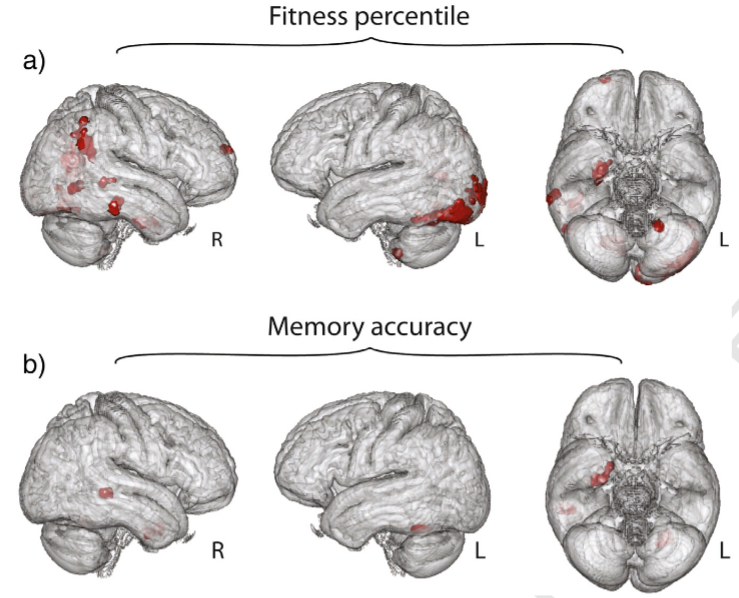
http://www.kurzweilai.net/images/fitness-vs.memory-accuracy.jpg

Results of exploratory whole-brain analysis. Parts (a) and (b) illustrate the results of an exploratory whole brain analysis, showing regions (red) where gray matter volume may be associated with fitness percentile or memory accuracy, respectively. Results are depicted within the group average brain. (credit: Andrew S. Whiteman et al./NeuroImage)


Young adults who have greater aerobic fitness also have greater volume of their entorhinal cortex, an area of the brain responsible for memory, Boston University School of medicine (BUSM) researchers have found.

While aerobic fitness is not directly associated with performance on a recognition memory task, the participants with a larger entorhinal cortex also performed better on a recognition memory task.

The entorhinal cortex is a brain area known to show early pathology in Alzheimer’s disease, which is characterized by profound memory impairment.

The researchers recruited healthy young adults (ages 18-35 years) who underwent a treadmill test to measure aerobic capacity. During this test, the amount of oxygen and carbon dioxide in the participants’ breath as they walked or ran on a treadmill was measured.

Participants then underwent magnetic resonance imaging and performed a recognition memory task. Entorhinal and hippocampal volume was determined using a method known as voxel-based morphometry and then regression analysis to examine whether recognition memory and aerobic fitness predicted brain volumes.

Effects of aerobic exercise

“Our results suggest that aerobic exercise may have a positive effect on the medial temporal lobe memory system (which includes the entorhinal cortex) in healthy young adults. This suggests that exercise training, when designed to increase aerobic fitness, might have a positive effect on the brain in healthy young adults,” explained corresponding author and principal investigator Karin Schon, PhD, BUSM assistant professor of anatomy and neurobiology.

Researchers said this work could support previous studies that suggest aerobic exercise may forestall cognitive decline in older individuals at risk of dementia, and extends the idea that exercise may be beneficial for brain health to younger adults. “This is critical given that obesity, which has recently been linked with cognitive deficits in young and middle-aged adults, and physical inactivity are on the rise in young adults,” Schon said.

These findings appear in the journal NeuroImage.


Abstract of Entorhinal volume, aerobic fitness, and recognition memory in healthy young adults: A voxel-based morphometry study

Converging evidence supports the hypothesis effects of aerobic exercise and environmental enrichment are beneficial for cognition, in particular for hippocampus-supported learning and memory. Recent work in humans suggests that exercise training induces changes in hippocampal volume, but it is not known if aerobic exercise and fitness also impact the entorhinal cortex. In animal models, aerobic exercise increases expression of growth factors, including brain derived neurotrophic factor (BDNF). This exercise-enhanced expression of growth hormones may boost synaptic plasticity, and neuronal survival and differentiation, potentially supporting function and structure in brain areas including but not limited to the hippocampus. Here, using voxel based morphometry and a standard graded treadmill test to determine cardio-respiratory fitness (Bruce protocol; VO2 max), we examined if entorhinal and hippocampal volumes were associated with cardio-respiratory fitness in healthy young adults (N = 33). In addition, we examined if volumes were modulated by recognition memory performance and by serum BDNF, a putative marker of synaptic plasticity. Our results show a positive association between volume in right entorhinal cortex and cardio-respiratory fitness. In addition, average gray matter volume in the entorhinal cortex, bilaterally, was positively associated with memory performance. These data extend prior work on the cerebral effects of aerobic exercise and fitness to the entorhinal cortex in healthy young adults thus providing compelling evidence for a relationship between aerobic fitness and structure of the medial temporal lobe memory system.

references:

Aurelian Udristioiu
Two comprehensive reviews found little evidence of an intensity threshold for changes in HDL cholesterol, LDL cholesterol, or triglycerides, although most studies did not control for exercise volume, frequency and/or duration, and were conducted using intensities ≥40% VO2max[17]. The American College of Sports Medicine (ACSM) recommends that most adults engage in moderate-intensity cardio-respiratory exercise for at least 30 min/day, at least 5 days per week, for a total of over 150 min of exercise per week.

The levels of physical exercises are associated with lower total visceral fat, liver fat, and intramuscular body fat, with the active twin having on average 50% less visceral fat and 25% less subcutaneous abdominal fat than the inactive twin.

[17] Edwar MA, Clark N, Macfadyen MA. Lactate and ventilatory thresholds reflect the training status of professional soccer players where maximum aerobic power is unchanged. JSSM 2003; 2: 23-29.

Read Full Post »

Schizophrenic hallucinations

Larry H. Bernstein, MD, FCAP, Curator

LPBI

Update 11/23/2015

Brain Fold Tied to Hallucinations

A shorter crease in the medial prefrontal cortex is linked with a higher risk of schizophrenics experiencing hallucinations.

By Kerry Grens | November 19, 2015

http://www.the-scientist.com//?articles.view/articleNo/44547/title/Brain-Fold-Tied-to-Hallucinations/

WIKIMEDIA, DATABASE CENTER FOR LIFE SCIENCE

People with schizophrenia who experience hallucinations are more likely to have a certain contour to their brain—specifically, a shorter groove in the medial prefrontal cortex called the paracingulate sulcus (PCS). That’s according to a study published this week (November 17) in Nature Communications of 153 people, some of whom had schizophrenia with and without hallucinations and some who did not.

“We think that the PCS is involved in brain networks that help us recognize information that has been generated ourselves,” Jane Garrison, the lead author of the study and a researcher at the University of Cambridge, said in a press release. “People with a shorter PCS seem less able to distinguish the origin of such information, and appear more likely to experience it as having been generated externally.”

Garrison and her colleagues used MRI scans to gather PCS length. They found that schizophrenics who experienced hallucinations tended to have a shorter PCS, and a 1-cm reduction in the fold related to a 20 percent higher chance of having hallucinations. People with schizophrenia who did not have hallucinations and the healthy controls did not differ in their PCS length.

“We’ve known for some time that disorders like schizophrenia are not down to a single region of the brain. Changes are seen throughout various different areas. To be able to pin such a key symptom to a relatively specific part of the brain is quite unusual,” study coauthor Jon Simons of Cambridge told BBC News.

The study could not determine whether PCS length is a causal factor in hallucinations in schizophrenia.


Paracingulate sulcus morphology is associated with hallucinations in the human brain

Jane R. GarrisonCharles FernyhoughSimon McCarthy-JonesMark HaggardThe Australian Schizophrenia Research Bank & Jon S. Simons

Nature Communications  2015; 6(8956).      http://dx.doi.org:/10.1038/ncomms9956


Hallucinations are common in psychiatric disorders, and are also experienced by many individuals who are not mentally ill. Here, in 153 participants, we investigate brain structural markers that predict the occurrence of hallucinations by comparing patients with schizophrenia who have experienced hallucinations against patients who have not, matched on a number of demographic and clinical variables. Using both newly validated visual classification techniques and automated, data-driven methods, hallucinations were associated with specific brain morphology differences in the paracingulate sulcus, a fold in the medial prefrontal cortex, with a 1cm reduction in sulcal length increasing the likelihood of hallucinations by 19.9%, regardless of the sensory modality in which they were experienced. The findings suggest a specific morphological basis for a pervasive feature of typical and atypical human experience.


PCS measurement for two example images.

Figure 1: PCS measurement for two example images.

The paracingulate sulcus (PCS), marked in red, lies dorsal and parallel to the cingulate sulcus (CS), itself dorsal to the corpus callosum. (a) In this image, the PCS is continuous and is measured from its origin in the first quadrant (indicated by the cross-hairs at y=0 and z=0) to its end. (b) In this example, the PCS appears less distinct; it is measured from the point at which it runs in a posterior direction, dorsal to the cingulate sulcus.


PCS length by group.

Figure 2: PCS length by group

(a) Total PCS length across both hemispheres. (b) PCS length in the left hemisphere. (c) PCS length in the right hemisphere. ***P<0.001, **P<0.01, *P<0.05. Error bars represent standard error of the mean. Controls: 40 healthy control subjects; no hallucinations: 34 patients with schizophrenia who had not experienced hallucinations; hallucinations: 79 patients with schizophrenia who experienced hallucinations in any modality.


Hallucinations are a primary symptom of numerous mental health disorders, as well as featuring in the experience of many individuals within the healthy population. Previous attempts to characterize the brain mechanisms of hallucinations have often been confounded by designs relying on comparisons between patients and non-patients1. However, around 30% of patients who meet diagnostic criteria for schizophrenia never report such anomalous experiences, providing the potential for the discovery of brain structural markers that are specifically associated with the occurrence of hallucinations.

Undoubtedly, many neurobiological factors underlie hallucinations. In the present study, we focused on the paracingulate sulcus (PCS) in the medial prefrontal cortex (mPFC) given its previously established role in reality monitoring2, among other cognitive functions, defined as the ability to discriminate between real and imagined information3. Reality monitoring is impaired in patients with schizophrenia with hallucinations4, 5, 6 and in non-patients prone to hallucinations7. In the study by Buda et al.2, we previously identified that bilateral absence of the PCS was associated with reductions in reality monitoring performance in healthy individuals with no neurological damage. The PCS is one of the last sulci to develop in utero, providing the potential for individual differences in its morphology, such as sulcal length, to be particularly informative about functional variation in an area of the brain extensively implicated in reality monitoring judgments8, 9.

Here, we investigate PCS length in both hemispheres in three matched groups: schizophrenia patients with a history of hallucinations, schizophrenia patients with no history of hallucinations and healthy controls (see Table 1 for participant details). PCS length was measured from structural MRI scans using a newly validated visual classification technique and data-driven whole-brain analysis methods, carried out blind to diagnosis (see Methods section for details). Examples of long and short PCS images are displayed in Fig. 1. We report converging results from across methods indicating that hallucination status can be determined by specific brain morphology differences in the PCS.

Validation of PCS measurement protocol

To validate the new PCS measurement protocol, it was first applied to 53 healthy volunteer structural scans previously analysed by Buda et al.2, with the analysis undertaken blind to the ratings in the earlier study, to give 106 measurements of sulcal length across hemispheres. The left and right hemisphere PCS for each individual was classified as ‘prominent’ if the length was >40mm, ‘absent’ if PCS length was <20mm and ‘present’ if PCS length fell between these two limits, based on the earlier protocols2, 10. The PCS classifications obtained were then compared with the original ratings from the study by Buda et al.2 In all, 94 out of the 106 measurements matched precisely, resulting in a Cohen’s Kappa of 0.79 (P<0.001), 95% CI (0.68, 0.84), indicating ‘substantial agreement’11 between the two protocols.

To validate the measurement protocol further, and verify its sensitivity to morphological variations in schizophrenia, we measured PCS length in a small, locally acquired independent sample of 19 patients with schizophrenia, all of whom experienced hallucinations, as well as in 19 matched control participants. Informed consent was obtained from these participants in a manner approved by the UK National Research Ethics Service. Total PCS length was significantly reduced in the patients with schizophrenia (mean=84.1mm, s.d.=30.5mm) compared with controls (mean=110.2mm, s.d.=38.5mm), t(36)=2.31, P=0.027, d=0.77. These independent validations provide grounds for confidence about the reliability of our measurement protocol, and the likelihood that it will be sufficiently sensitive to identify morphological differences in our larger sample of 153 patients with schizophrenia and controls that may distinguish those who experienced hallucinations from those without hallucinations.

PCS measurement differences associated with hallucinations

Turning to the principal analysis of PCS morphology differences as a function of hallucination status, we compared PCS length between three large matched groups (patients with schizophrenia who had experienced hallucinations, patients with schizophrenia who had not experienced hallucinations and matched healthy controls; see Methods section for participant details and matching procedure). There was a main effect of group on total PCS length, summed across both hemispheres, F(2, 150)=8.90, P<0.001, ηp2=0.106, which survived the addition of cortical surface area as a covariate, F(2, 149)=7.03, P=0.001, ηp2=0.086. Other potential covariates such as age, IQ, intracranial volume and global brain gyrification index had no significant effect on PCS length and were removed from the model.

Planned comparisons revealed that patients with schizophrenia who experienced hallucinations exhibited significantly reduced PCS length compared with the patients without hallucinations (mean reduction=19.2mm), t(111)=2.531, P=0.013, d=0.519 and healthy controls (mean reduction=29.2mm), t(117)=4.149, P<0.001, d=0.805, whereas sulcal length between patients who did not experience hallucinations and healthy controls did not differ significantly, t(72)=1.07,P=0.288, d=0.246 (Fig. 2a).

With earlier research providing conflicting evidence of differential cortical-folding patterns between the two cerebral hemispheres in schizophrenia, we next investigated possible laterality effects on PCS length. There were main effects of hemisphere, F(1,150)=9.978, P=0.002, ηp2=0.062, and group, F(2,150)=8.900, P<0.001, ηp2=0.106, on PCS length, but no interaction between hemisphere and group. PCS length was greater in the left than the right hemisphere across all subject groups, t(152)=2.959, P=0.004, d=0.317 (Fig. 2b,c). Patients with schizophrenia who had experienced hallucinations exhibited reduced PCS length compared with the healthy controls in both hemispheres, t>2.636, P<0.01, d>0.546. The difference in PCS length between patients with schizophrenia who had experienced hallucinations and patients who had not experienced hallucinations was significant only in the left hemisphere, t(111)=2.464, P=0.015, d=0.505.

We tested the modality specificity of the observed relations by comparing PCS length between patients with auditory hallucinations and patients with hallucinations limited to other modalities (for example, visual, tactile, olfactory). The PCS reductions could not be differentiated according to hallucination modality, either summed across both hemispheres, t(77)=0.067, P=0.947, d=0.015, or within the left, t(77)=0.600, P=0.551, d=0.135, or right, t(77)=0.822, P=0.413, d=0.185, hemispheres alone, consistent with a generalized role for reality monitoring impairment in the formation of hallucinations, regardless of the sensory modality in which they occur.

……..

Data-driven whole-brain analyses

To further validate the PCS measurement protocol and to determine whether between-group differences in PCS length were accompanied by structural variations elsewhere in the brain, we conducted separate automated whole-brain analyses of surface-based cortical gyrification and of voxel-based grey matter volume (see Methods section for details). Confirming the results of the PCS measurement method, significant differences in local gyrification index were observed in the mPFC regions of interest surrounding the PCS, namely bilateral frontopolar, medial orbitofrontal, superior frontal and paracentral cortices, with patients with schizophrenia who experienced hallucinations exhibiting significantly reduced gyrification in these regions compared with patients without hallucinations, t(111)=2.165, P=0.033, d=0.448 (Fig. 3). No significant regional group differences elsewhere in the brain survived correction for multiple comparisons


Figure 3: Whole-brain cortical gyrification differences as a function of hallucination status.

Whole-brain cortical gyrification differences as a function of hallucination status.

http://www.nature.com/ncomms/2015/151117/ncomms9956/images_article/ncomms9956-f3.jpg

a) mPFC regions surrounding the PCS exhibiting significantly reduced gyrification in 79 patients who experienced hallucinations compared with 34 patients without hallucinations, rendered on a canonical pial cortical surface, viewed from the midline. (b) Local gyrification index in regions surrounding the PCS significantly differentiates patients with schizophrenia as a function of hallucination status, t(111)=2.165,P=0.033, d=0.448. Error bars represent standard error of the mean.

Consistent with reductions in mPFC cortical folding in hallucinations, grey matter volume was significantly greater in the functionally defined 8-mm sphere mPFC region of interest surrounding the anterior PCS in patients with schizophrenia who experienced hallucinations than in those who did not (x=6, y=54, z=−5; BA 10; Z=2.82; P=0.036 (small volume corrected), Fig. 4). The region identified as significant using this voxel-based method was smaller than the region that emerged in the surface-based gyrification analysis, which may be attributable to the different properties of cortical morphology measured, as well as any of numerous statistical and methodological differences between the two techniques (see Methods section for details). In any event, no significant grey matter volume differences elsewhere in the brain, associated with the occurrence of hallucinations, survived correction for multiple comparisons.


Figure 4: Grey matter volume differences measured with voxel-based morphometry.

Grey matter volume differences measured with voxel-based morphometry.

http://www.nature.com/ncomms/2015/151117/ncomms9956/images_article/ncomms9956-f4.jpg

(a) Significantly greater grey matter volume in 79 patients who experienced hallucinations than in 34 patients without hallucinations in the mPFC region of interest in the vicinity of the anterior PCS (circled), rendered on an inflated canonical cortical surface, viewed from the front. (b) Grey matter volume in PCS region significantly differentiates patients with schizophrenia as a function of hallucination status, Z=2.82;P=0.036 (small volume corrected). Error bars represent standard error of the mean.


Using newly validated visual classification techniques and automated, data-driven analysis methods, the present study identified that hallucinations were associated with specific brain morphology differences in the PCS region of the mPFC. Because the connection between PCS reduction and hallucinations was evident in participants who all had diagnoses of schizophrenia, our findings avoid confounding with patient status, as can occur in case–control comparisons. The hallucinating and non-hallucinating groups with schizophrenia in our study were matched for age, sex, handedness, IQ, duration of illness, antipsychotic medication and incidence of delusions and negative symptoms. In identifying that hallucinations can be distinguished by structural brain imaging data, we demonstrate that a multifactorial phenomenon which is defined experientially can be related to a single morphological change in the mPFC. As a tertiary sulcus forming around 36 weeks of gestation12, the 19.2mm mean reduction in PCS length that distinguished patients who hallucinated from those who did not hallucinate might arise from genetic factors that influence primary folding of the cortex through a disruption to neurodevelopmental pathways. Alternatively, the variability in PCS length might be a non-genetic consequence of some disturbance in primary sulcal development, or might represent extremes of normal statistical variation in the development of primary and secondary sulci.

Our results go beyond previous findings of changes in cortical-folding patterns associated with schizophrenia. Several previous studies have reported differences in PCS morphology in patients with schizophrenia compared with healthy controls13, 14, or investigated differences in global measures of cortical gyrification or sulcation associated with hallucination status15. The present study is the first to identify that PCS morphology changes can discriminate between hallucinating and non-hallucinating groups that are matched for overall brain volume, cortical surface area and global gyrification index, among other variables. The present findings are consistent with earlier research suggesting that leftward PCS hemispheric asymmetries in schizophrenia might be similar to those typically observed in healthy controls14, 16, though some previous studies have reported reduced PCS asymmetry in schizophrenia13, 17. In the present data, comparable laterality effects were observed in all subject groups, with significantly greater PCS length in the left than right hemisphere, and group differences evident across both hemispheres. Methodological differences might explain the discrepancies between previous studies, motivating the development of common measurement protocols, preferably incorporating both visual classification and automated, data-driven components, to optimize the identification and measurement of sometimes relatively indistinct or discontinuous anatomical landmarks such as the PCS.

Evidence from research in healthy individuals indicates that PCS reductions are associated with increased grey matter volume in the surrounding anterior cingulate cortex18, with Buda et al.2reporting that increased grey matter volume in the mPFC correlated negatively with an individual’s reality monitoring ability. Such findings fit with the present results, in which reduced mPFC surface-based gyrification and concomitant increased voxel-based grey matter volume were the only significant differences in the brain to be associated with the occurrence of hallucinations. Together with the results by Buda et al., these findings are consistent with a role for reality monitoring impairment in the generation of hallucinations, with a structural basis for that ability in the region of the PCS. An influence of reduced paracingulate folding and greater surrounding cortical volume may arise from weakened connectivity between the mPFC and both proximal and distal brain regions. Prominent theories of morphogenesis suggest that cortical folding in the human brain, which begins at around the 26th week of gestation19, 20, results either from differential mechanical tension along white matter axons linking disparate brain areas21, 22 or from variable tangential expansion of the cortical surface23.

Altered PCS morphology could thus lead to hallucinations through changes in connectivity between cortical regions involved in processing sensory representations and mPFC areas that support decision-making processes such as distinguishing real experiences from those that might have been imagined, among other cognitive functions8, 9, 24. This hypothesis has yet to be tested directly, although there is evidence of impaired anterior cingulate modulation of fronto–temporal connectivity in schizophrenia25. Investigating functional and structural connectivity between the broader mPFC and, for example, posterior auditory and language regions around the superior temporal gyrus, would further inform models of hallucination formation. Hallucinations are likely to be a multifactorial phenomenon5, and theoretical models implicate a range of cognitive and affective variables in their occurrence26, 27. It is possible that modality-general risk factors, such as reduced PCS length, may interact in some individuals with modality-specific risk factors, such as reduced arcuate fasciculus integrity in the case of auditory hallucinations28, to produce hallucinations in specific sensory modalities. Information on neurodevelopmental models of schizophrenia could also be gained by comparing PCS morphology in family studies and during disease development.

Our findings support modality-general views of hallucinations as stemming from atypicalities in reality monitoring. They raise important questions for cognitive models of hallucinations including how the internal ‘raw material’ of reality monitoring errors might be defined. In the case of auditory hallucinations, there is compelling evidence that hallucinations arise through the misattribution of internal events (for example, inner speech) as external auditory stimuli. A modality-general account would need to specify analogous internal events that could be misattributed as external ones in, for example, the visual or tactile modalities. A modality-general account would also have to explain considerable phenomenological variability in the experience as it is described in all modalities. Moreover, as with all theories proposing brain structural or functional changes associated with hallucinations, a reality monitoring account must explain why hallucinations are often transient phenomena rather than being experienced constantly. Susceptibility to hallucinations, and their triggering and maintenance by psychological and environmental factors, are likely to be multifactorial, complex processes. We show that a simple morphological variation is an important factor in determining why some individuals can have quasi-perceptual experience of entities that are not physically present.


How hallucinations emerge from trying to make sense of an ambiguous world

http://www.neuroscience.cam.ac.uk/news/article.php?permalink=edbb8aa287

Take a look at the black and white image. It probably looks like a meaningless pattern of black and white blotches. But now take a look at the image below and then return to the picture: it’s likely that you can now make sense of the black and white image. It is this ability that scientists at Cardiff University and the University of Cambridge believe could help explain why some people are prone to hallucinations.

http://www.cam.ac.uk/sites/www.cam.ac.uk/files/inner-images/press_twotone_sml.jpg


http://www.cam.ac.uk/sites/www.cam.ac.uk/files/inner-images/press_colour_smal.jpg


Adapted from University of Cambridge News
Press coverage: BBC News Cambridge News Daily Mail Motherboard ITV News Irish Examiner Belfast Telegraph

Posted on 10/13/2015

A bewildering and often very frightening experience in some mental illnesses is psychosis – a loss of contact with external reality. This often results in a difficulty in making sense of the world, which can appear threatening, intrusive and confusing. Psychosis is sometimes accompanied by drastic changes in perception, to the extent that people may see, feel, smell and taste things that are not actually there – so-called hallucinations. These hallucinations may be accompanied by beliefs that others find irrational and impossible to comprehend.

In research published today in the journal Proceedings of National Academy of Sciences (PNAS), a team of researchers based at Cardiff University and the University of Cambridge explore the idea that hallucinations arise due to an enhancement of our normal tendency to interpret the world around us by making use of prior knowledge and predictions.

In order to make sense of and interact with our physical and social environment, we need appropriate information about the world around us, for example the size or location of a nearby object. However, we have no direct access to this information and are forced to interpret potentially ambiguous and incomplete information from our senses. This challenge is overcome in the brain – for example in our visual system – by combining ambiguous sensory information with our prior knowledge of the environment to generate a robust and unambiguous representation of the world around us. For example, when we enter our living room, we may have little difficulty discerning a fast-moving black shape as the cat, even though the visual input was little more than a blur that rapidly disappeared behind the sofa: the actual sensory input was minimal and our prior knowledge did all the creative work.

“Vision is a constructive process – in other words, our brain makes up the world that we ‘see’,” explains first author Dr Christoph Teufel from the School of Psychology at Cardiff University. “It fills in the blanks, ignoring the things that don’t quite fit, and presents to us an image of the world that has been edited and made to fit with what we expect.”

“Having a predictive brain is very useful – it makes us efficient and adept at creating a coherent picture of an ambiguous and complex world,”adds senior author Professor Paul Fletcher from the Department of Psychiatry at the University of Cambridge. “But it also means that we are not very far away from perceiving things that aren’t actually there, which is the definition of a hallucination.

“In fact, in recent years we’ve come to realise that such altered perceptual experiences are by no means restricted to people with mental illness. They are relatively common, in a milder form, across the entire population. Many of us will have heard or seen things that aren’t there.”

In order to address the question of whether such predictive processes contribute to the emergence of psychosis, the researchers worked with 18 individuals who had been referred to a mental health service run by the NHS Cambridgeshire and Peterborough Foundation Trust, and led by Dr Jesus Perez, one of the co-authors on the study, and who suffered from very early signs of psychosis. They examined how these individuals, as well as a group of 16 healthy volunteers, were able to use predictions in order to make sense of ambiguous, incomplete black and white images, similar to the one shown above.

The volunteers were asked to look at a series of these black and white images, some of which contained a person, and then to say for a given image whether or not it contained a person. Because of the ambiguous nature of the images, the task was very difficult at first. Participants were then shown a series of full colour original images, including those from which the black and white images had been derived: this information could be used to improve the brain’s ability to make sense of the ambiguous image. The researchers reasoned that, since hallucinations may come from a greater tendency to superimpose one’s predictions on the world, people who were prone to hallucinations would be better at using this information because, in this task, such a strategy would be an advantage.

The researchers found a larger performance improvement in people with very early signs of psychosis in comparison to the healthy control group. This suggested that people from the clinical group were indeed relying more strongly on the information that they had been given to make sense of the ambiguous pictures.

When the researchers presented the same task to a larger group of 40 healthy people, they found a continuum in task performance that correlated with the participants’ scores on tests of psychosis-proneness. In other words, the shift in information processing that favours prior knowledge over sensory input during perception can be detected even before the onset of early psychotic symptoms.

“These findings are important because they tell us that the emergence of key symptoms of mental illness can be understood in terms of an altered balance in normal brain functions,” says Naresh Subramaniam from the Department of Psychiatry at the University of Cambridge. “Importantly, they also suggest that these symptoms and experiences do not reflect a ‘broken’ brain but rather one that is striving – in a very natural way – to make sense of incoming data that are ambiguous.”

The study was carried out in collaboration with Dr Veronika Dobler and Professor Ian Goodyer from the Department of Child and Adolescent Psychiatry at the University of Cambridge. The research was funded by the Wellcome Trust and the Bernard Wolfe Health Neuroscience Fund. It was carried out within the Cambridge and Peterborough NHS Foundation Trust. Additional support for the Behavioural and Clinical Neuroscience Institute at the University of Cambridge came from the Wellcome Trust and the Medical Research Council.

Shift toward prior knowledge confers a perceptual advantage in early psychosis and psychosis-prone healthy individuals

Christoph Teufela,b,1Naresh SubramaniambVeronika Doblerc,dJesus Perezc,dJohanna Finnemannb,ePuja R. Mehtab, et al.

PNAS 2013; 112(43): 13401–13406    http//dx.doi.org:/10.1073/pnas.1503916112

Significance

Perceiving things that are not there and holding unfounded, bizarre beliefs (hallucinations and delusions, respectively) are psychotic symptoms that occur in particular syndromes including affective psychoses, paranoid states, and schizophrenia. We studied the emergence of this loss of contact with reality based on current models of normal brain function. Working with clinical individuals experiencing early psychosis and nonclinical individuals with high levels of psychosis proneness, we show that their visual perception is characterized by a shift that favors prior knowledge over incoming sensory evidence. Given that these alterations in information processing are evident early on in psychosis and even in association with subtle perceptual changes indicating psychosis proneness, they may be important factors contributing to the emergence of severe mental illnesses.


Many neuropsychiatric illnesses are associated with psychosis, i.e., hallucinations (perceptions in the absence of causative stimuli) and delusions (irrational, often bizarre beliefs). Current models of brain function view perception as a combination of two distinct sources of information: bottom-up sensory input and top-down influences from prior knowledge. This framework may explain hallucinations and delusions. Here, we characterized the balance between visual bottom-up and top-down processing in people with early psychosis (study 1) and in psychosis-prone, healthy individuals (study 2) to elucidate the mechanisms that might contribute to the emergence of psychotic experiences. Through a specialized mental-health service, we identified unmedicated individuals who experience early psychotic symptoms but fall below the threshold for a categorical diagnosis. We observed that, in early psychosis, there was a shift in information processing favoring prior knowledge over incoming sensory evidence. In the complementary study, we capitalized on subtle variations in perception and belief in the general population that exhibit graded similarity with psychotic experiences (schizotypy). We observed that the degree of psychosis proneness in healthy individuals, and, specifically, the presence of subtle perceptual alterations, is also associated with stronger reliance on prior knowledge. Although, in the current experimental studies, this shift conferred a performance benefit, under most natural viewing situations, it may provoke anomalous perceptual experiences. Overall, we show that early psychosis and psychosis proneness both entail a basic shift in visual information processing, favoring prior knowledge over incoming sensory evidence. The studies provide complementary insights to a mechanism by which psychotic symptoms may emerge.


To interact successfully with our physical and social environment, we need appropriate information about relevant states of the world, such as the size, location, or distance of an object. However, there is no direct access to this information, only to sensory stimulation caused by the environment. This sensory information is inherently ambiguous and, on its own, rarely suffices to uniquely specify our surroundings (1). The human visual system overcomes this challenge by combining ambiguous sensory information with prior knowledge of the environment to generate a robust and unambiguous representation of the world around us (17). This insight has been formalized under the tenets of Bayesian decision theory and is typically modeled within a predictive coding framework. Here, the notion is that expectations based on prior knowledge are fed back from higher to lower levels of information processing, thereby shaping the way incoming signals are treated by lower-level mechanisms. This influence is labeled top-down processing. The present study tests the hypothesis that psychotic experiences arise from an increased use of prior knowledge in constructing meaningful percepts from ambiguous sensory inputs.

Psychosis—a loss of contact with external reality—is characterized by delusions (irrational, often bizarre beliefs) and hallucinations (perceptions in the absence of causative stimuli). Conceptual and computational models of psychosis have hypothesized that an imbalance in the combination of bottom-up sensory evidence and top-down prior knowledge is at the core of this altered state of mind (812). According to such models, at the perceptual level, an undue reliance on prior knowledge in perception may lead to the emergence of aberrant perceptions such as hallucinations. The current study tests this hypothesis in the visual domain by characterizing the impact of prior knowledge on the perception of ambiguous stimuli in two groups of people: a clinical group with early psychotic experiences (study 1) and healthy volunteers showing differing levels of proneness to such experiences (study 2). Although the conventional view focuses preferentially on auditory hallucinations in psychosis, epidemiological evidence indicates that hallucinations in the visual domain are very common in, for example, schizophrenia (13). In fact, vision seems to play a prominent role in the development of psychosis given that basic visual symptoms identified before illness onset are one of the most powerful predictors of the emergence of later psychotic disorders (14).

To determine mechanisms for the emergence of perceptual psychotic symptoms as purely as possible, we conducted two complementary studies. First, using a case-control study design, we characterized the balance between visual bottom-up and top-down processing in a group of patients with early psychotic experiences and matched healthy controls (SI Materials and Methods and Table S1). Individuals in our clinical group were recruited from a dedicated mental health service identifying help-seeking people who have low-level but measurable psychotic experiences. Although, at the time of testing, these individuals fell below the threshold for a categorical diagnosis, they already showed symptoms and have an increased risk for transitioning to a severe mental illness such as schizophrenia or an affective disorder (15). Importantly, working with such a group of patients and comparing them to controls enabled us to focus on the features of early psychosis before any formal categorical diagnosis. Moreover, and also critically, this comparison is not confounded by the effects of antipsychotic medication or the impact of chronic illness, allowing us, as purely as possible, to explore the mechanisms of early psychosis.

In a second study, we explored psychosis proneness in healthy participants characterized according to the presence of perceptual (16) and belief-related schizotypal features (17). Schizotypy refers to a personality measure that has established predictive value for psychotic and other mental illnesses (18). Although it has been traditionally considered a specific risk measure for schizophrenia, more recently it has been proposed to reflect a general psychosis proneness. A number of schizotypy scales have been devised to characterize various dimensions of psychosis. In the current study, we focused on individual variation in measures relating to perception and belief (16, 17) because they most clearly relate to the key features of psychosis. These measures provided us with a fine-grained index for relevant perceptual experience and beliefs, allowing us to characterize the bottom-up/top-down balance in relation to subtle, nonclinical but specific and measurable markers associated with psychosis proneness.

Characterizing these two situations enabled us to pursue our central aim of exploring information-processing mechanisms that are altered in association with the occurrence of early symptoms (study 1) and also identifiable even before such symptoms arise (study 2). As well as offering a purer assessment of the emergence of psychotic experiences, this approach is inspired by growing evidence suggesting that psychosis lies on a continuum with normality (19, 20) and is associated with a range of different psychiatric disorders (15, 21). According to this perspective, existing diagnostic categories group biologically heterogeneous syndromes with potentially different pathophysiological mechanisms into one disorder (22); this may obfuscate our attempts to understand the neurobiological underpinnings of mental illness. In keeping with a broader move within the field, the aim of this approach is therefore to characterize deeper dimensions in their own right, such as psychosis as in the current study, irrespective of diagnostic categorization to advance our mechanistic understanding of specific symptom clusters.

In summary, we explored how the use of prior knowledge in visual information processing is related to early psychosis and to psychosis proneness. Importantly, given our hypothesis, we predicted that the putative mechanism associated with the emergence of psychosis would confer a relative advantage in this task, given that successful performance required the use of prior knowledge to discriminate ambiguous stimuli. Together, the two studies provide evidence to suggest that early psychosis and psychosis proneness is associated with a shift in visual processing that favors prior knowledge over incoming sensory evidence. We also demonstrate that this relation is specific to atypical perceptual experiences rather than being linked to psychotic experiences more generally.


Our studies were designed to characterize, in complementary ways, the balance between visual bottom-up and top-down processing in clinical individuals with early psychosis and healthy people prone to developing psychotic symptoms. A relative advantage in using prior knowledge to discriminate between ambiguous images was observed in both situations. This finding is especially striking in the clinical group in study 1 given that performance in this group (as in psychiatrically ill individuals more generally) is typically impaired. Such a result is rare and revealing in that it highlights a specific information-processing atypicality rather than a general performance deficit. Study 2 allowed us to characterize these alterations in visual function more completely by adopting an individual differences approach with healthy participants and by capitalizing on subtle variations in perception and belief that exhibit graded similarity with psychotic experiences. In line with our clinical findings, we uncovered a relation between an individual’s visual performance benefit due to prior knowledge and their scores on two scales of psychosis proneness. Importantly, also, our data suggest that this relation is primarily driven by perceptual alterations rather than unusual beliefs. Taken together, these results indicate that visual function in early psychosis and in healthy people who are prone to such experiences is characterized by a basic information-processing shift that favors existing knowledge over incoming sensory evidence. Although, in the current experimental task, this shift conferred a performance benefit, under most natural viewing situations, it may provoke anomalous perceptual experiences. Specifically, it might impose prior expectations on inputs to the extent that, ultimately, formed percepts are generated that have no direct sensory cause: hallucinations.

These findings fit neatly with and support current conceptual and computational models of psychotic symptoms (812). For instance, it has been hypothesized that a single core disturbance relating to the balance between bottom-up and top-down processing can explain both the hallucinatory experiences and the bizarre delusional beliefs of psychotic patients (8, 11). Importantly, we show that, on the perceptual level, a shift in this balance toward prior knowledge is present both in a clinical group of individuals with early psychosis and even associated with psychosis proneness in the general population. Although schizotypy is a marker for psychosis proneness as ascertained by previous longitudinal studies (18), it is important to acknowledge that individuals in study 2 were not suffering from psychosis or even a diagnosed mental illness. Rather, those individuals scoring high on the scales identified a number of unusual perceptual experiences. It is therefore striking that the same information-processing shift was observed as was found in early psychosis. Indeed, even in the early psychosis group, no formal, categorical diagnosis was applicable (although it is known that such groups have a high risk of transition to full psychiatric illness) (15). The findings may therefore suggest that the altered balance is a fundamental trait that contributes to the emergence of psychosis rather than a reflection or consequence of the psychotic state.

The specificity of the relation between performance on our task and perceptual aspects of schizotypy is of particular interest. It has long been known that altered perceptual experiences form a key part of the emergence of psychosis (29). Given that the CAPS is selective for measuring schizotypal perceptual phenomena rather than targeting schizotypy in general (16), our findings indicate that a shift in visual information processing that favors prior knowledge over sensory evidence might be a marker for the mechanisms underlying this observation. The finding that healthy individuals that score high on this scale share this marker with our clinical group is in line with the growing belief that psychotic mental illnesses are part of a continuum with normality (19, 20). It supports the idea that the putative atypicality underlying the emergence of perceptual psychotic experiences relates directly to normal function of the system. In other words, the potential for psychotic experiences such as hallucinations might be a logical consequence of the way in which our brain deals with the inherent ambiguity of sensory information by incorporating prior knowledge into our perceptual processing. The current study uncovered an imbalance of this processing type that shows its effects at the perceptual level. However, within a hierarchical and recurrent information-processing system such as the human brain, an imbalance at any level will, in time, propagate up and down the hierarchy and affects the whole system (8, 30), a notion that might ultimately account for atypicalities in both lower-level perceptual processing and higher-level belief formation in severe mental illnesses and psychosis proneness (30).


Read Full Post »

Lab Grown Brains and more from Twittersphere on 3D Bio-Printing News

Curator: Stephen J. Williams, Ph.D

How Tiny Lab-Grown Human Brains Are Giving Big Insights Into Autism and more from the Twittershpere


https://twitter.com/singularityhub/status/664508353771610112

(more…)

Read Full Post »

Dark Cellular Receptors

Larry H. Bernstein, MD, FCAP, Curator

LPBI


Nov 10, 2015   GEN News Highlights

Unraveling the Mysteries of “Dark” Cellular Receptors   

http://www.genengnews.com/gen-news-highlights/unraveling-the-mysteries-of-dark-cellular-receptors/81251956/


  • A research team from the University of North Carolina School of Medicine (UNC) and University of California, San Francisco (UCSF) says it has created a general tool to probe the activity of orphan receptors, which are highly expressed in particular tissues but whose functions remain unknown. The team intends to illuminate the roles of orphan receptors in behavior and make them accessible for drug discovery.

    The creation of the research tool, which involves computer modeling, yeast- and mammalian cell-based molecular screening techniques, and mouse models, is published in an article (“Allosteric ligands for the pharmacologically dark receptors GPR68 and GPR65”) in Nature.

    According to Brian Shoichet, Ph.D., professor of pharmaceutical chemistry at UCSF, this work will help researchers learn how orphan receptors interact with molecules inside the body or with drugs. Specifically, the UNC and UCSF scientists used their new tool to find a novel probe molecule that can modulate the orphan G protein-coupled receptor 68 (GPR68, also known as OGR1), an orphan receptor that is highly expressed in the brain.

    “GPCRs are the single most important family of therapeutic drug targets,” said Dr. Shoichet. “About 27 percent of FDA-approved drugs act through GPCRs. They are considered to be among the most useful targets for discovering new medications.”

    The new probe molecule, dubbed “ogerin,” turns on GPR68, activating its signaling role. To understand how this activation of GPR68 affects brain function, the investigators gave it to mice and put them through a battery of behavioral tests. Mice that had been given ogerin were much less likely to learn to fear a specific stimulus. This fear-conditioning is controlled by the hippocampus, where GPR68 is highly expressed. But ogerin had no effect on mice that lacked this receptor.

    To demonstrate general research applicability, the UNC and UCSF researchers also used their technique to find molecules that can modulate GPR65, another orphan receptor.

    “We provide an integrated approach that we believe can be applied to many other receptors,” explained Bryan L. Roth, M.D., Ph.D., co-senior author of the Nature paper and the Michael Hooker Distinguished Professor of Protein Therapeutics and Translational Proteomics in the department of pharmacology at UNC. “The goal is to quickly find drug-like compounds for these receptors. This should facilitate discovery of novel and safer therapeutics for a host of diseases.”

    “We used yeast-based screening techniques to find compounds that activate an orphan receptor,” noted Xi-Ping Huang, Ph.D., co-first author and research assistant professor at UNC. “Then [co-first author] Joel Karpiak, a graduate student in Shoichet’s lab at UCSF, created a computer model and searched libraries of millions of compounds to find out what kind of molecular structure ensures proper binding and interaction with a specific receptor. Then, back in the lab, we tested new molecules and found a novel ligand.”

    “The fact that GPR68 is highly expressed in several tissues, especially the brain, and that it is a member of the large GPCR family, suggests that this discovery can be further leveraged for drug discovery,” added Dr. Shoichet.

    Currently, few drug developers would seek drugs for a target with an unknown role in human biology. With new evidence of the role of GPR68, and a molecule that can modulate that role, the door has been opened for further research studies, both basic and applied.

    “The druggable genome is an iceberg that is mostly submerged,” pointed out Dr. Shoichet. “This paper illuminates a small piece of it, providing new reagents to modulate a previously dark, unreachable drug target. Just as important, the strategy should be useful to many other dark targets in the genome.”

Read Full Post »

Brain and Cognition

Larry H. Bernstein, MD, FCAP, Curator

LPBI

Brain activity may be as unique as fingerprints

Tue, 10/13/2015 – Bill Hathaway, Yale Univ.

http://www.rdmag.com/news/2015/10/brain-activity-may-be-unique-fingerprints?et_cid=4877245&et_rid=535648082

Image: Michael S. Helfenbeing/Shutterstock

A person’s brain activity appears to be as unique as his or her fingerprints, a new Yale Univ.-led imaging study shows. These brain “connectivity profiles” alone allow researchers to identify individuals from the fMRI images of brain activity of more than 100 people, according to the study published in Nature Neuroscience.

“In most past studies, fMRI data have been used to draw contrasts between, say, patients and healthy controls,” said Emily Finn, a PhD student in neuroscience and co-first author of the paper. “We have learned a lot from these sorts of studies, but they tend to obscure individual differences which may be important.”

Finn and co-first author Xilin Shen, under the direction of R. Todd Constable, professor of diagnostic radiology and neurosurgery at Yale, compiled fMRI data from 126 subjects who underwent six scan sessions over two days. Subjects performed different cognitive tasks during four of the sessions. In the other two, they simply rested. Researchers looked at activity in 268 brain regions: specifically, coordinated activity between pairs of regions. Highly coordinated activity implies two regions are functionally connected. Using the strength of these connections across the whole brain, the researchers were able to identify individuals from fMRI data alone, whether the subject was at rest or engaged in a task. They were also able to predict how subjects would perform on tasks.

Finn said she hopes that this ability might one day help clinicians predict or even treat neuropsychiatric diseases based on individual brain connectivity profiles.

Brain Activity Identifies Individuals

By Kerry Grens

Neural connectome patterns differ enough between people to use them as a fingerprint.

New Alzheimer’s Gene Identified

Megan Brooks

http://www.medscape.com/viewarticle/852556

Researchers have identified a new gene involved in the immune system that increases the risk for Alzheimer’s disease (AD), providing a potential new target for prevention and treatment.

They found that older adults at risk for AD and those with the disease who carry a specific variant in the interleukin-1 receptor accessory protein (IL1RAP) had higher rates of amyloid plaque accumulation in the brain over 2 years. The effect of the variant was stronger than the well-known AD risk allele APOE ε4.

“These findings suggest that targeting the IL1RAP immune pathway may be a viable approach for promoting the clearance of amyloid deposits and fighting an important cause of progression in Alzheimer’s disease,” Andrew J. Saykin, PsyD, director of the Indiana Alzheimer Disease Center, Indianapolis, and the national Alzheimer’s Disease Neuroimaging Initiative Genetics Core, said in a statement.

The study was published in the October 1 issue of Brain.

Novel Association

The researchers conducted a genome-wide association study of longitudinal changes in brain amyloid burden measured by florbetapir positron emission tomography (PET) in nearly 500 individuals. They assessed the levels of brain amyloid deposits at an initial visit and again 2 years later.

Study participants came from the Alzheimer’s Disease Neuroimaging Initiative, the Indiana Memory and Aging Study, the Religious Orders Study, and the Rush Memory and Aging Project, all longitudinal studies of older adults representing clinical stages along the continuum from normal aging to AD.

As expected, APOE ε4 was associated with higher rates of amyloid plaque buildup. However, they also identified a novel association between a single nucleotide polymorphism in IL1RAP (rs12053868-G) and higher rates of amyloid accumulation, independent of APOE ε4.

Carriers of the IL1RAP rs12053868-G variant showed accelerated cognitive decline and were more likely to progress from mild cognitive impairment to AD. They also showed greater longitudinal atrophy of the temporal cortex, which is involved in memory and had a lower level of microglial activity as measured by PET scans, the researchers report.

“This was an intriguing finding because IL1RAP is known to play a central role in the activity of microglia, the immune system cells that act as the brain’s ‘garbage disposal system’ and the focus of heavy investigation in a variety of neurodegenerative diseases,” Vijay K. Ramanan, MD, PhD, postdoctoral researcher at the Indiana University School of Medicine, Indianapolis, who worked on the study, said in the statement.

“These results suggest a crucial role of activated microglia in limiting amyloid accumulation and nominate the IL-1/IL1RAP pathway as a potential target for modulating this process,” the investigators write.

The study was supported by the National Institute on Aging and a consortium of private partners through the Foundation for the National Institutes of Health. Several authors disclosed relationships with pharmaceutical companies. A complete list can be found with the original article.

Brain. 2015;138:3076-3088. Abstract

Cognitive Impairments in Elderly Diabetic Patients: Understanding the Risks for Better Management

Medscape Medical News from the

Visit Medscape in Hall B Booth #B13:31

Medscape Diabetes & Endocrinology

COMMENTARY

Lyse Bordier, MD

http://www.medscape.com/viewarticle/852112

Editor’s Note: The following is an edited, translated transcript of a presentation by Professor Lyse Bordier, a diabetologist at Military Hospital Bégin, Saint-Mandé, France, summarizing her lecture at the European Association for the Study of Diabetes (EASD) 2015 AnnualMeeting in Stockholm, Sweden.

Hello. I am Professor Lyse Bordier. I work at the Bégin Military Hospital, in Saint-Mandé, France, and I had the pleasure of participating in a symposium organized by the EASD 2015 conference in Stockholm on elderly patients, specifically on cognitive impairments.

A Public Health Problem

Dementia and cognitive impairments are a major problem; Alzheimer disease accounts for 70% of all cases of dementia. The other main causes are vascular dementias and mixed dementias. They are a real public health problem; it is estimated that, in the United States, 5.2 million people have this condition, and worldwide, every 7 seconds, a new case of dementia is diagnosed.[1,2] In France, for example, it was estimated in 2010 that 750,000-850,000 people had dementia and that this figure will increase by a factor of 2.4 by the year 2050.

Diabetes is an important contributor to the development of cognitive impairments, all the way up to dementia. In Europe, it is estimated that nearly 25% of people over age 85 years have dementia. Its prevalence and incidence are higher in women than in men.[2] We know that the complications of diabetes have changed over the years and that acute metabolic complications are, in the end, much less important. With the improvement in life expectancy in our diabetic patients, who are now better treated thanks to better therapeutic management, new complications have arisen, such as renal failure, heart failure, and, of course, geriatric complications, which are, in large part, cognitive disorders.[3]

Prevalence Underestimated by Physicians

These cognitive impairments are common and largely underestimated. This was clearly shown in the GERODIAB study,[4] which included a cohort of 987 patients over the age of 70 years. At inclusion, the physicians reported that 11% of their patients had cognitive impairments and that 3% had dementia. In actual fact, 25% of the patients had impaired cognitive functions, with a Mini-Mental State Examination (MMSE) score under 25. The prevalence is therefore significantly underestimated by physicians.

Cognitive impairments are more prevalent and more severe in diabetics than in nondiabetics. It is estimated that the risk for cognitive impairments and that for dementia are 20% to 70% and 60% higher, respectively, in the presence of diabetes.[5] Furthermore, the risk for Alzheimer dementia is considerable, it being 40% higher in diabetics. As expected (given the combination of the other cardiovascular risk factors), the increase in the risk is even greater for vascular dementia, with an odds ratio of 2.38.[6]

Mechanisms

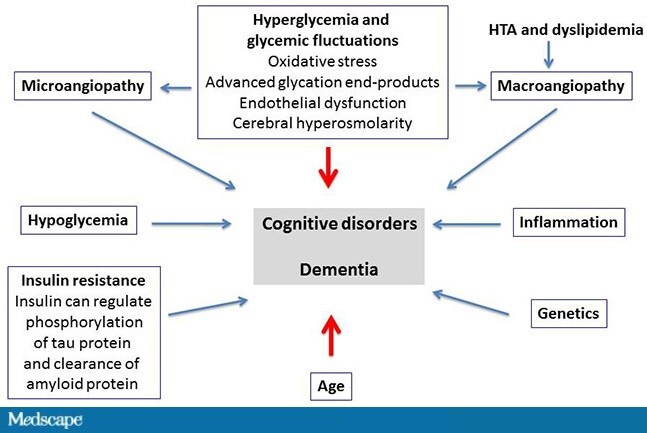
What are the mechanisms in the development of cognitive impairments and dementia? There are many mechanisms, and they are often poorly understood. Hyperglycemia plays a very important role as a direct result of oxidative stress, of advanced glycation end-products, but also as a result of micro- and macroangiopathy, hypertension, and dyslipidemia.[7,8] Other major factors, such as hypoglycemia,[9-12]play an extremely important role in the development of cognitive impairments. As well, a great deal of literature has been published lately on the role of inflammation[13] and genetic factors. Another widely known aspect is insulin resistance, which increases the risk for dementia at a fairly early stage by 40%[14,15]; this already during the metabolic syndrome, even before the onset of type 2 diabetes.

http://img.medscape.com/article/852/112/852112-Figure1.jpg

Figure. Multiple and poorly understood mechanisms of cognitive impairments and dementia. HTA = arterial hypertension. Adapted from Buysschaert M, et al.[16]

What Are the Consequences of Cognitive Impairments?

Cognitive impairments lead to a number of complications, including a reduction in life expectancy. In the GERODIAB cohort, we found, after 2 years of follow-up, that the mortality rate was twice as high in the patients with an MMSE score <24 compared with those with an MMSE score >24. In this study, the patients with a lower MMSE score had less well-controlled diabetes, were usually treated with insulin, and had heart failure and cerebrovascular complications more often. Very surprisingly, hypoglycemia was not more prevalent in these patients, perhaps because, being less independent, they were better managed by care teams.[17]

Cognitive impairments lead to geriatric complications, such as malnutrition, falls, and a loss of autonomy. They also promote social and family isolation and iatrogenic accidents, as well as depression, which can both mask cognitive impairments and exacerbate an underlying dementia. Another important aspect is that cognitive impairments increase the risk for hypoglycemia. This has been shown very clearly in all of the studies. There is, in fact, a bidirectional link between dementia and hypoglycemia: Hypoglycemia doubles the risk for dementia, and dementia triples the risk for hypoglycemia.[18]

Screening and Management

What do we do when a patient presents with cognitive impairments? First, they should be identified so that they can be managed. We need to be vigilant for certain little signs: changes in the patient’s behavior (eg, a patient who forgets his appointments, whose personal hygiene has declined, who is less diligent in keeping his blood glucose diary, and, lastly, who has an unexplained diabetic imbalance). We should also know how to use simple tests, such as the MMSE, which provides an overall assessment of space-time orientation, cognitive functions, language functions, and calculation, and how to assess the patient’s autonomy and loss of autonomy.[19] Next, we should, as per the recommendations of the American Diabetes Association[20] and the EASD, individualize the glycemic goals, taking into account, in the most fragile, elderly patients, cognitive status, the level of autonomy, depression, nutritional status—in particular, sarcopenia, which can coexist with obesity, and the risk for hypoglycemia.[21]

We should therefore avoid overtreating the most fragile patients (those at greatest risk for hypoglycemia), but neither should we undertreat patients who have a long life expectancy and who could develop micro- and macroangiopathic complications.

One last aspect, which is very important, is the family. Help needs to be provided to prevent the patient’s loss of autonomy.[21] Lastly, I think that cognitive decline should be added to the already long list of degenerative complications of diabetes.

PDGFR-ß Plays a Key Role in the Ectopic Migration of Neuroblasts in Cerebral Stroke

Hikari Sato et al.

The neuroprotective agents and induction of endogenous neurogenesis remain as the urgent issues to be established for the care of cerebral stroke. Platelet-derived growth factor receptor beta (PDGFR-ß) is mainly expressed in neural stem/progenitor cells (NSPCs), neurons and vascular pericytes of the brain; however, the role in pathological neurogenesis remains elusive. This review examined the role of PDGFR-ß in the migration and proliferation of NSPCs after stroke.

Read Full Post »

To understand what happens in the brain to cause mental illness

Larry H Bernstein, MD, FCAP, Curator

Leaders in Pharmaceutical Intelligence

Series E. 2; 5.10

https://bbrfoundation.org/research/basic-research

Fernando Sampaio Goes, M.D., a 2008 NARSAD Young Investigator at Johns Hopkins School of Medicine, and his colleagues took an alternative approach to the ongoing genome-wide association studies (GWAS) that hunt for these factors by scouring the complete genomes of tens of thousands of individuals. The team––which included 2005 Young InvestigatorDimitrios Avramopoulos, M.D., Ph.D.; 2000 Young Investigator, 2008 Independent Investigator, and BBRF Scientific Council member James B. Potash, M.D., M.P.H.; and 2004 Young Investigator Peter P. Zandi, Ph.D.––conceived the study to detect rare genetic variations that GWAS are not designed to find.

Rather than scanning entire genomes for depression-associated variations, Goes’s team narrowed its search to a set of genes in which they already suspected alterations might contribute to depression: those that encode proteins found at or near the junctions between neurons, where cell-to-cell communication takes place. Based on previous surveys of these synaptic proteins, the scientists chose 1,742 genes to include in their analysis.

They compared the protein-coding sequences of that set of genes in 259 people with major depression to the same set in 334 unaffected individuals. To increase the chance of finding relevant genetic factors, all the patients with depression were selected based on the criterion of early-onset, recurrent depression, which is suspected by some to be a more heritable form of the illness. (An important component of depression causation is environmental, and reflects the particular life circumstances of those affected, who may or may not be naturally resilient when faced with stress and other environmental factors.)

The team’s analysis pointed to two sets of genes in which variations were linked with major depression. One includes genes that control the growth of dendritic spines (tiny knob-like protrusions from a neuron’s surface that receive inputs from other neurons). Other research has suggested that the size, density, and shape of these structures may be involved in mood disorders and other mental illnesses. The second gene set includes genes linked with the entry of calcium into neurons, which regulates a variety of processes, including the release of message-propagating neurotransmitters. Variations within this gene set have also been linked to autism and epilepsy.

Researchers have identified unique characteristics of emotional processing in young people with post-traumatic stress disorder (PTSD), showing for the first time how that processing might be disrupted at different ages.

Publishing their findings online August 5th in Neuropsychopharmacology, were 2012 NARSAD Young Investigator grantee Ryan J. Herringa, M.D., Ph.D., of the University of Wisconsin School of Medicine and Public Health and Richard C. Wolf, a Ph.D. candidate at the university. Together they  looked at brain activity during an emotion-related task in children aged 8 to 18, both with and without PTSD. The children with PTSD had experienced trauma such as sexual abuse, the death of a loved one, a physical accident, or witnessing violence.

The children viewed emotionally “threatening” and “neutral” pictures. During this task, the researchers used imaging to measure activity in brain regions associated in PTSD with an increased fear response and sense of threat. These regions include the amygdala, important for processing emotions; the dorsal anterior cingulate cortex (dACC), which helps to gauge threat levels; and the medial portion of the prefrontal cortex (PFC), crucial for dialing back fear responses and putting perceived threats in context.

The researchers found higher threat-related dACC activity in youths with PTSD, as well as weaker connections between the amygdala and mPFC. The findings suggest these brain regions contribute to the difficulty young people with PTSD have in assessing perceptions of threat.  The study also found that amygdala-PFC connections followed a different developmental path for youths with PTSD. Whereas those connections were stronger at older ages in those without PTSD, the same connections grew weaker for children with PTSD as they aged. This may reflect a progressive weakening in the ability of the PFC to reduce fear.

In research reported June 17th in the journal Neuron, scientists have shown that a protein called CPEB3 is critical for the stabilization and storage of long-term memories in mice. Three-timeNARSAD Distinguished Investigator and BBRF Scientific Council member Eric Kandel, M.D., led the research. Also on the team is 2013 NARSAD Young Investigator Pierre Trifilieff, Ph.D.

CPEB3 is a “prion-like” protein. Prions––infectious, misshapen proteins best known for the devastation they cause––clump together and lead to brain damage in people and animals with mad cow disease and related conditions. Similar protein-clumping mechanisms may also contribute to neurodegenerative diseases including Alzheimer’sParkinson’s, and amyotrophic lateral sclerosis. (Curiously, certain proteins with prion-like properties have an important role in the healthy brain.)

The new finding extends previous work showing that prion-like proteins are vital for the stabilization of long-term term memory in sea slugs and fruit flies. Although further work is needed to understand whether the same mechanism is at work in humans, humans do produce a protein similar to the mouse protein CPEB3.

Memories are stored in the connections between neurons, and proteins play a role in the long-term storage of the information. But since proteins degrade over time, scientists had wondered how a memory can persist long after a new experience triggers neurons to make memory-specific proteins. Prion-like proteins, which are self-perpetuating because they can convert normal proteins to their own misshapen form, appear to be the answer.

Genetic studies have recently yielded large numbers of “hits” for genes that subtly increase or decrease risk for disorders, including for schizophrenia. However, there have been no hits for major depression, perhaps because the studies are not yet large enough or because depression is less heritable. Estimates put the heritability of major depression at around 50%, with the remaining contribution coming from environmental and experiential causes.

However, a new approach has paid off: a study published online July 15th at the journal Natureidentifies two genomic regions that harbor genes that increase risk of major depression. A multinational collaboration employed a strategy of narrowing the pool of subjects to women in China with the most severe and stubborn form of depression, with the hope that a more homogenous population would yield results.

In an accompanying News and Views, 2014 Lieber Prizewinner for Outstanding Achievement in Schizophrenia Research,Patrick Sullivan, M.D., of the University of North Carolina, writes, “This first identification of replicable, significant genome-wide associations for MDD is exceptional.”

Qi Xu, Ph.D., of Peking Union Medical College and Jun Wang, Ph.D., of BGI-Shenzhen, who led the China components of the study, along with Foundation Scientific Council Member Kenneth Kendler, M.D., of Virginia Commonwealth University and 2007 NARSAD Distinguished Investigator Grantee Jonathan Flint, M.D., of the University of Oxford in the United Kingdom focused exclusively on women with severe, recurrent depression (an average of more than five episodes), building a sample of 5,303 cases and 5,337 controls. The results were replicated in a separate group of 3,231 Chinese women with major depression and 3,186 mixed male/female controls.

“I think this paper is groundbreaking because it really demonstrates that we can make progress in reducing genetic heterogeneity by paying attention to key clinical indicators,” said three-time NARSAD Grantee, Francis McMahon, M.D., of the National Institute of Mental Health (NIMH), who was not an author on the paper.

A team based at the University of Edinburgh analyzed data from thousands of Scottish adults to see whether they had genetic mutations either linked with obesity or major depressive disorder. They tested for relationships between those genetic profiles, the presence of depression or other psychological distress, and body mass index, a measure used to determine obesity. A genetic predisposition for obesity more strongly predicted actual obesity among those adults who were also depressed.

The findings were reported June 30th in Translational Psychiatry by a team including 2008NARSAD Distinguished Investigator Grantee David J. Porteous, Ph.D., and 2010 Independent Investigator Andrew M. McIntosh, Ph.D.

The study results show people becoming obese in part because of their depression, rather than becoming depressed because they are already obese. The experience of depression may drive disordered eating habits. It may also trigger chemical responses in the body (such as the release of the stress hormone cortisol) that promote weight gain, the researchers hypothesize.

The team also found some degree of association between a genetic profile linked to obesity and current psychological distress, even among individuals who were not obese. Obesity-linked genes also more closely predicted actual obesity among people experiencing distress even if they were not diagnosed with depression. This indicates that psychological strain, and not just depression per se, contributes to obesity.

Read Full Post »

Endocrine Action on Midbrain

Writer and Curator: Larry H. Bernstein, MD, FCAP

 
  • Brain’s Role in Browning White Fat
  • Insulin and leptin act on specialized neurons in the mouse hypothalamus to promote conversion of white to beige fat.

By Anna Azvolinsky | January 15, 2015

JUSTIN HEWLETT, MNHS MULTIMEDIA, MONASH UNIVERSITY

Ever since energy-storing white fat has been shown to convert to metabolically active beige fat, through a process called browning, scientists have been trying to understand how this switch occurs. The immune system has been shown to contribute to activation of brown fat cells. Now, researchers from Monash University in Australia and their colleagues have shown that insulin and leptin—two hormones that regulate glucose metabolism and satiety and hunger cues—activate “satiety” neurons in the mouse hypothalamus to promote the conversion of white fat to beige. The results are published today (January 15) in Cell.

Hypothalamic appetite-suppressing proopiomelanocortin (POMC) neurons are known to relay the satiety signals in the bloodstream to other parts of the brain and other tissues to promote energy balance. “What is new here is that one way that these neurons promote calorie-burning is to stimulate the browning of white fat,” said Xiaoyong Yang, who studies the molecular mechanisms of metabolism at the Yale University School of Medicine, but was not involved in the work. “The study identifies how the brain communicates to fat tissue to promote energy dissipation.”

“The authors show that [insulin and leptin] directly interact in the brain to produce nervous-system signaling both to white and brown adipose tissue,” said Jan Nedergaard, a professor of physiology at Stockholm University who also was not involved in the study. “This is a nice demonstration of how the acute and chronic energy status talks to the thermogenic tissues.”

Although the differences between beige and brown fat are still being defined, the former is currently considered a metabolically active fat—which converts the energy of triglycerides into heat—nestled within white fat tissue. Because of their energy-burning properties, brown and beige fat are considered superior to white fat, so understanding how white fat can be browned is a key research question. Exposure to cold can promote the browning of white fat, but the ability of insulin and leptin to act in synergy to signal to the brain to promote browning was not known before this study, according the author Tony Tiganis, a biochemist at Monash.

White fat cells steadily produce leptin, while insulin is produced by cells of the pancreas in response to a surge of glucose into the blood. Both hormones are known to signal to the brain to regulate satiety and body weight. To explore the connection between this energy expenditure control system and fat tissue, Garron Dodd, a postdoctoral fellow in Tiganis’s laboratory, and his colleagues deleted one or both of two phosphatase enzymes in murine POMC neurons. These phosphatase enzymes were previously known to act in the hypothalamus to regulate both glucose metabolism and body weight, each regulating either leptin or insulin signaling. When both phosphatases were deleted, mice had less white fat tissue and increased insulin and leptin signaling.

“These [phosphatase enzymes] work in POMC neurons by acting as ‘dimmer switches,’ controlling the sensitivity of leptin and insulin receptors to their endogenous ligands,” Dodd told The Scientist in an e-mail. The double knockout mice also had an increase in beige fat and more active heat-generating brown fat. When fed a high-fat diet, unlike either the single knockout or wild-type mice, the double knockout mice did not gain weight, suggesting that leptin and insulin signaling to POMC neurons is important for controlling body weight and fat metabolism.

The researchers also infused leptin and insulin directly into the hypothalami of wild-type mice, which promoted the browning of white fat. But when these hormones were infused but the neuronal connections between the white fat and the brain were physically severed, browning was prevented. Moreover, hormone infusion and cutting the neuronal connection to only a single fat pad resulted in browning only in the fat pad that maintained signaling ties to the brain. “This really told us that direct innervation from the brain is necessary and that these hormones are acting together to regulate energy expenditure,” said Tiganis.

These results are “really exciting as, perhaps, resistance to the actions of leptin and insulin in POMC neurons is a key feature underlying obesity in people,” said Dodd.

Another set of neurons in the hypothalamus, the agouti-related protein expressing (AgRP) or “hunger” neurons, are activated by hunger signals and promote energy storage. Along with Tamas Horvath, Yale’s Yang recently showed that fasting activates AgRP neurons that then suppress the browning of white fat. “These two stories are complimentary, providing a bigger picture: that the hunger and satiety neurons control browning of fat depending on the body’s energy state,” said Yang. Activation of POMC neurons during caloric intake protects against diet-induced obesity while activation of AgRP neurons tells the body to store energy during fasting.

Whether these results hold up in humans has yet to be explored. Expression of the two phosphatases in the hypothalamus is known to be higher in obese people, but it is not clear whether this suppresses the browning of white fat.

“One of the next big questions is whether this increased expression and prevention of insulin plus leptin signaling, and conversion of white to brown fat perturbs energy balance and promotes obesity,” said Tiganis. Another, said Dodd, is whether other parts of the brain are involved in signaling to and from adipose tissue.

  1. Dodd et al., “Leptin and insulin act on POMC neurons to promote the browning of white fat,”

Cell, 2015.    http://dx.doi.org:/10.1016/j.cell.2014.12.022   http://medicine.yale.edu/lab/horvath/index.aspx

Our main interest is the neuroendocrine regulation of homeostasis with particular emphasis on metabolic disorders, such as obesity and diabetes, and the effect of metabolic signals on higher brain functions and neurodegeneration. We have active research programs to pursue the role of synaptic plasticity in the mediation of peripheral hormones’ effects on the central nervous system.

We also study the role of mitochondrial membrane potential in normal and pathological brain functions with particular emphasis on the acute effect of mitochondria in neuronal transmission and neuroprotection. We combine classical neurobiological approaches, including electrophysiology and neuroanatomy, with endocrine and genetic techniques to better understand biological events at the level of the organism.

Leptin and Insulin Act on POMC Neurons to Promote the Browning of White Fat

Garron T. Dodd, Stephanie Decherf, Kim Loh, Stephanie E. Simonds, Florian Wiede, Eglantine Balland, Troy L. Merry, et al.

http://dx.doi.org/10.1016/j.cell.2014.12.022

Highlights

  • Insulin and leptin act synergistically on POMC neurons to promote WAT browning
  • Increased POMC-mediated WAT browning prevents diet-induced obesity
  • PTP1B and TCPTP attenuate leptin and insulin signaling in POMC neurons
  • Combined PTP1B and TCPTP deficiency in POMC neurons promotes white fat browning

The primary task of white adipose tissue (WAT) is the storage of lipids. However, “beige” adipocytes also exist in WAT. Beige adipocytes burn fat and dissipate the energy as heat, but their abundance is diminished in obesity. Stimulating beige adipocyte development, or WAT browning, increases energy expenditure and holds potential for combating metabolic disease and obesity. Here, we report that insulin and leptin act together on hypothalamic neurons to promote WAT browning and weight loss. Deletion of the phosphatases PTP1B and TCPTP enhanced insulin and leptin signaling in proopiomelanocortin neurons and prevented diet-induced obesity by increasing WAT browning and energy expenditure. The coinfusion of insulin plus leptin into the CNS or the activation of proopiomelanocortin neurons also increased WAT browning and decreased adiposity. Our findings identify a homeostatic mechanism for coordinating the status of energy stores, as relayed by insulin and leptin, with the central control of WAT browning.  http://www.cell.com/cms/attachment/2023992410/2043906325/fx1.jpg

Light on the Brain

Researchers find that photoreceptors expressed in zebrafish hypothalamus contribute to light-dependent behavior.

By Sabrina Richards | September 20, 2012

A 21 day old zebrafish. Their optical clarity and relatively easy maintenance make them a favorite for geneticists and developmental biologists. In this fish, the muscles can be seen as chevron shapes in the tail, the swim bladder as a “bubble” just behind the head, and the food that the fish has been eating as a brown patch just below the swim bladder.

Juvenile zebrafish. Shawn Burgess, NHGRI

Zebrafish larvae without eyes or pineal glands can still respond to light using photopigments located deep within their brains.  Published today (September 20) in Current Biology, the findings are the first to link opsins, photoreceptors in the hypothalamus and other brain areas, to increased swimming in response to darkness, a behavior researchers hypothesize may help the fish move toward better-lit environments.

“[It’s a] strong demonstration that opsin-dependent photoreceptors in deep brain areas affect behaviors,” said Samer Hattar, who studies light reception in mammals at Johns Hopkins University but did not participate in the research.

Photoreceptors in eyes enable vision, and photoreceptors in the pineal gland, a small endocrine gland located in the center of the vertebrate brain, regulate circadian rhythms. But photoreceptors are also found in other brain areas of both invertebrates and vertebrate lineages. The function of these extraocular photoreceptors has been best studied in birds, where they regulate seasonal reproduction, explained Harold Burgess, a behavioral neurogeneticist at the Eunice Kennedy Shriver National Institute for Child Health and Human Development. Many opsins have been reported in the brains of tiny and transparent larval zebrafish, raising the possibility that light could be stimulating the photoreceptors even deep in the brain. To test for behaviors that may be regulated by deep brain photoreceptors, Burgess and his colleagues in Wolfgang Driever’s lab at the University of Freiburg removed the eyes of zebrafish larvae, and compared their behavior to larvae that retained their eyes. Although most light-dependent behavior required eyes, the eyeless larvae did respond when the lights were turned off, increasing their activity for a several minutes, though to a somewhat lesser extent than control larvae. But the fact that they responded at all suggests that non-retinal photoreceptors contributed to the behavior.

To confirm the role of the deep brain photoreceptors, the researchers also tested eyeless larvae that had been genetically modified to block expression of photoreceptors in the pineal gland. This fish still showed this jump in activity for several minutes after entering darkness.

Two different types of opsins—melanopsin and multiple tissue opsin—are expressed in the same type of neuron in zebrafish hypothalamus. Burgess and his colleagues looked at zebrafish missing the transcription factor Orthopedia, which is unique to these neurons, and found that the darkness-induced activity boost is nearly absent in these fish. To further narrow the search for the responsible photoreceptors, the researchers overexpressed melanopsin in hypothalamus neurons that co-express Orthopedia and melanopsin, and found that it increased the sensitivity of eyeless zebrafish to reductions in light. The results point to both melanopsin and Orthopedia as key players in modulating this behavior and pinpoint the location to neurons that coexpress these factors in the zebrafish hypothalamus.

Interestingly, the hypothalamus is one of the oldest parts of the vertebrate brain, said Detlev Arendt, a developmental biologist at the European Molecular Biology Laboratory in Heidelberg. “It’s very possible that this is one of the oldest functions”—one that evolved in “non-visual organisms” that had no eyes but still needed to sense light.

Although not as directed and efficient as eye-dependent behaviors that help fish swim toward light, Burgess speculates that deep brain opsins can still benefit zebrafish larvae. “You could imagine situation where it can’t see light, if a leaf falls on it and it doesn’t know where to swim. I think this behavior puts it in a hyperactive state where it swims wildly for several minutes until it reaches enough light for eyes to take over,” he explained, noting that such behavior is common in invertebrates.

It remains to be seen whether these deep brain opsins regulate other behaviors, perhaps in similar fashion to seasonal hormonal regulation in birds, but Hattar believes it is likely. “It’s beyond reasonable doubt there are many functions for these deep brain photoreceptors.”

Fernandes et al., “Deep brain photoreceptors control light-seeking behavior in zebrafish larvae,” Current Biology, 22:1-6, 2012.

Neuroendocrine basis of sexuality, mood, anxiety, social consciousness

Physiology, signaling, and pharmacology of galanin peptides and receptors: Three decades of emerging diversity

Lang, R., Gundlach, A.L., Holmes, F.E., (…), Hökfelt, T., Kofler, B.
Pharmacological Reviews 2015: 67 (1), pp. 118-175
http://dx.doi.org:/10.1124/pr.112.006536

Galanin was first identified 30 years ago as a “classic neuropeptide,” with actions primarily as a modulator of neurotransmission in the brain and peripheral nervous system. Other structurally-related peptides—galanin-like peptide and alarin—with diverse biologic actions in brain and other tissues have since been identified, although, unlike galanin, their cognate receptors are currently unknown. Over the last two decades, in addition to many neuronal actions, a number of nonneuronal actions of galanin and other galanin family peptides have been described. These include actions associated with neural stem cells, nonneuronal cells in the brain such as glia, endocrine functions, effects on metabolism, energy homeostasis, and paracrine effects in bone. Substantial new data also indicate an emerging role for galanin in innate immunity, inflammation, and cancer. Galanin has been shown to regulate its numerous physiologic and pathophysiological processes through interactions with three G protein–coupled receptors, GAL1, GAL2, and GAL3, and signaling via multiple transduction pathways, including inhibition of cAMP/PKA (GAL1, GAL3) and stimulation of phospholipase C (GAL2). In this review, we emphasize the importance of novel galanin receptor–specific agonists and antagonists. Also, other approaches, including new transgenic mouse lines (such as a recently characterized GAL3 knockout mouse) represent, in combination with viral-based techniques, critical tools required to better evaluate galanin system physiology. These in turn will help identify potential targets of the galanin/galanin-receptor systems in a diverse range of human diseases, including pain, mood disorders, epilepsy, neurodegenerative conditions, diabetes, and cancer.

Estradiol regulates responsiveness of the dorsal premammillary nucleus of the hypothalamus and affects fear- and anxiety-like behaviors in female rats

Litvin, Y., Cataldo, G., Pfaff, D.W., Kow, L.-M.
European Journal of Neuroscience 2014; 40 (2), pp. 2344-2351
10.1111/ejn.12608

Research suggests a causal link between estrogens and mood. Here, we began by examining the effects of estradiol (E2) on rat innate and conditioned defensive behaviors in response to cat odor. Second, we utilized whole-cell patch clamp electrophysiological techniques to assess noradrenergic effects on neurons within the dorsal premammillary nucleus of the hypothalamus (PMd), a nucleus implicated in fear reactivity, and their regulation by E2. Our results show that E2 increased general arousal and modified innate defensive reactivity to cat odor. When ovariectomized females treated with E2 as opposed to oil were exposed to cat odor, they showed elevations in risk assessment and reductions in freezing, indicating a shift from passive to active coping. In addition, animals previously exposed to cat odor showed clear cue + context conditioning 24 h later. However, although E2 persisted in its effects on general arousal in the conditioning task, its effects on fear disappeared. In the patch clamp experiments noradrenergic compounds that typically induce fear clearly excited PMd neurons, producing depolarizations and action potentials. E2 treatment shifted some excitatory effects of noradrenergic agonists to inhibitory, possibly by differentially affecting α- and β-adrenoreceptors. In summary, our results implicate E2 in general arousal and fear reactivity, and suggest these may be governed by changes in noradrenergic responsivity in the PMd. These effects of E2 may have ethological relevance, serving to promote mate seeking even in contexts of ambiguous threat and shed light on the involvement of estrogen in mood and its associated disorders.

Endogenous opiates and behavior: 2013

Richard J. Bodnar
Peptides 62 (2014) 67–136
http://dx.doi.org/10.1016/j.peptides.2014.09.013

This paper is the thirty-sixth consecutive installment of the annual review of research concerning the endogenous opioid system. It summarizes papers published during 2013 that studied the behavioral effects of molecular, pharmacological and genetic manipulation of opioid peptides, opioid receptors, opioid agonists and opioid antagonists. The particular topics that continue to be covered include the molecular-biochemical effects and neurochemical localization studies of endogenous opioids and their receptors related to behavior, and the roles of these opioid peptides and receptors in pain and analgesia; stress and social status; tolerance and dependence; learning and memory; eating and drinking; alcohol and drugs of abuse; sexual activity and hormones, pregnancy, development and endocrinology; mental illness and mood; seizures and neurologic disorders; electrical-related activity and neurophysiology; general activity and locomotion; gastrointestinal, renal and hepatic functions; cardiovascular responses; respiration and thermoregulation; and immunological responses.

Brain aromatase (cyp19a1b) and gonadotropin releasing hormone (gnrh2 and gnrh3) expression during reproductive development and sex change in black sea bass (Centropristis striata)

Timothy S Breton, Matthew A DiMaggio, Stacia A Sowe, David L Berlinsky, et al.
Comparative Biochemistry and Physiology, Part A 181 (2015) 45–53
http://dx.doi.org/10.1016/j.cbpa.2014.11.020

Teleost fish exhibit diverse reproductive strategies, and some species are capable of changing sex. The influence of many endocrine factors, such as gonadal steroids and neuropeptides, has been studied in relation to sex change, but comparatively less research has focused on gene expression changes within the brain in temperate grouper species with non-haremic social structures. The purpose of the present study was to investigate gonadotropin releasing hormone (GnRH) and brain aromatase (cyp19a1b) gene expression patterns during reproductive development and sex change in protogynous (female to male) black sea bass (Centropristis striata). Partial cDNA fragments for cyp19a1b and eef1a (a reference gene) were identified, and included with known gnrh2 and gnrh3 sequences in real time quantitative PCR. Elevated cyp19a1b expression was evident in the olfactory bulbs, telencephalon, optic tectum, and hypothalamus/
midbrain region during vitellogenic growth, which may indicate changes in the brain related to neurogenesis or sexual behavior. In contrast, gnrh2 and gnrh3 expression levels were largely similar among gonadal states, and all three genes exhibited stable expression during sex change. Although sex change in black sea bass is not associated with dramatic changes in GnRH or cyp19a1b gene expression among brain regions, these genes may mediate processes at other levels, such as within individual hypothalamic nuclei, or through changes in neuron size, that warrant further research.

Evaluation for roles of neurosteroids in modulating forebrain mechanisms controlling vasopressin secretion and related phenomena in conscious rats

Ken’ichi Yamaguchi
Neuroscience Research xxx (2015) xxx–xxx
http://dx.doi.org/10.1016/j.neures.2015.01.002

Anteroventral third ventricular region (AV3V) regulates autonomic functions through a GABAergic mechanism that possesses neuroactive steroid (NS)-synthesizing ability. Although NS can exert effects by acting on a certain type of GABAA-receptor (R), it is not clear whether NS may operate to modulateAV3V GABAergic activity for controlling autonomic functions. This study aimed to investigate the issue.AV3V infusion with a GABAA antagonist bicuculline increased plasma vasopressin (AVP), glucose, blood pressure (BP), and heart rate in rats. These events were abolished by preinjecting its agonist muscimol, whereas the infusion with allopregnanolone, a NS capable of potentiating GABAA-R function, affectednone of the variables in the absence or presence of such bicuculline actions. Similarly, AV3V infusion with pregnanolone sulfate, a NS capable of antagonizing GABAA-R, produced no effect on those variables.AV3V infusion with muscimol was effective in inhibiting the responses of plasma AVP or glucose, orBP to an osmotic loading or bleeding. However, AV3V infusion with aminoglutethimide, a NS synthesis inhibitor, did not affect any of the variables in the absence or presence of those stimuli. These results suggest that NS may not cause acute effects on the AV3V GABAergic mechanism involved in regulating AVP release and other autonomic function.

Novel receptor targets for production and action of allopregnanolone in the central nervous system: a focus on pregnane xenobiotic receptor

Cheryl A. Frye, Carolyn J. Koonce, and Alicia A. Walf
Front in Cell Neurosci Apr 2014; 8(106)
http://dx.doi.org:/10.3389/fncel.2014.00106

Neurosteroids are cholesterol-based hormones that can be produced in the brain, independent of secretion from peripheral endocrine glands, such as the gonads and adrenals. A focus in our laboratory for over 25 years has been how production of the pregnane neurosteroid, allopregnanolone, is regulated and the novel (i.e., non steroid receptor) targets for steroid action for behavior. One endpoint of interest has been lordosis, the mating posture of female rodents. Allopregnanolone is necessary and sufficient for lordosis, and the brain circuitry underlying it, such as actions in the midbrain ventral tegmental area (VTA), has been well-characterized. Published and recent findings supporting a dynamic role of allopregnanolone are included in this review. First, contributions of ovarian and adrenal sources of precursors of allopregnanolone, and the requisite enzymatic actions for de novo production in the central nervous system will be discussed.
Second, how allopregnanolone produced in the brain has actions on behavioral processes that are independent of binding to steroid receptors, but instead involve rapid modulatory actions via neurotransmitter targets (e.g., g-amino butyric acid-GABA, Nmethyl-D-aspartate- NMDA) will be reviewed.
Third, a recent focus on characterizing the role of a promiscuous nuclear receptor, pregnane xenobiotic receptor (PXR), involved in cholesterol metabolism and expressed in the VTA, as a target for allopregnanolone and how this relates to both actions and production of allopregnanolone will be addressed. For example, allopregnanolone can bind PXR and knocking down expression of PXR in the midbrain VTA attenuates actions of allopregnanolone via NMDA and/or GABAA for lordosis. Our understanding of allopregnanolone’s actions in the VTA for lordosis has been extended to reveal the role of allopregnanolone for broader, clinically-relevant questions, such as neurodevelopmental processes, neuropsychiatric disorders, epilepsy, and aging.

Long-term dysregulation of brain corticotrophin and glucocorticoid receptors and stress reactivity by single early-life pain experience in male and female rats

Nicole C. Victoria, Kiyoshi Inoue, Larry J. Young, Anne Z. Murphy
Psychoneuroendocrinology (2013) 38, 3015—3028
http://dx.doi.org/10.1016/j.psyneuen.2013.08.013

Inflammatory pain experienced on the day of birth (postnatal day 0: PD0) significantly dampens behavioral responses to stress- and anxiety-provoking stimuli in adult rats. However, to date, the mechanisms by which early life pain permanently alters adult stress responses remain unknown. The present studies examined the impact of inflammatory pain, experienced on the day of birth, on adult expression of receptors or proteins implicated in the activation and termination of the stress response, including corticotrophin releasing factor receptors (CRFR1 and CRFR2) and glucocorticoid receptor (GR). Using competitive receptor autoradiography, we show that Sprague Dawley male and female rat pups administered 1% carrageenan into the intraplantar surface of the hindpaw on the day of birth have significantly decreased CRFR1 binding in the basolateral amygdala and midbrain periaqueductal gray in adulthood. In contrast, CRFR2 binding, which is associated with stress termination, was significantly increased in the lateral septum and cortical amygdala. GR expression, measured with in situ hybridization and immunohistochemistry, was significantly increased in the paraventricular nucleus of the hypothalamus and significantly decreased in the hippocampus of neonatally injured adults. In parallel, acute stress-induced corticosterone release was significantly attenuated and returned to baseline more rapidly in adults injured on PD0 in comparison to controls. Collectively, these data show that early life pain alters neural circuits that regulate responses to and neuroendocrine recovery from stress, and suggest that pain experienced by infants in the Neonatal Intensive Care Unit may permanently alter future responses to anxiety- and stress provoking stimuli.

Dysruption of Corticotropin Releasing Factor in hypocampal region

Stress and trauma: BDNF control of dendritic-spine formation and regression

M.R. Bennett, J. Lagopoulos
Progress in Neurobiology 112 (2014) 80–99
http://dx.doi.org/10.1016/j.pneurobio.2013.10.005

Chronic restraint stress leads to increases in brain derived neurotrophic factor (BDNF) mRNA and protein in some regions of the brain, e.g. the basal lateral amygdala (BLA) but decreases in other regions such as the CA3 region of the hippocampus and dendritic spine density increases or decreases in line with these changes in BDNF. Given the powerful influence that BDNF has on dendritic spine growth, these observations suggest that the fundamental reason for the direction and extent of changes in dendritic spine density in a particular region of the brain under stress is due to the changes in BDNF there.
The most likely cause of these changes is provided by the stress initiated release of steroids, which readily enter neurons and alter gene expression, for example that of BDNF. Of particular interest is how glucocorticoids and mineralocorticoids tend to have opposite effects on BDNF gene expression offering the possibility that differences in the distribution of their receptors and of their downstream effects might provide a basis for the differential transcription of the BDNF genes. Alternatively, differences in the extent of methylation and acetylation in the epigenetic control of BDNF transcription are possible in different parts of the brain following stress.
Although present evidence points to changes in BDNF transcription being the major causal agent for the changes in spine density in different parts of the brain following stress, steroids have significant effects on downstream pathways from the TrkB receptor once it is acted upon by BDNF, including those that modulate the density of dendritic spines.
Finally, although glucocorticoids play a canonical role in determining BDNF modulation of dendritic spines, recent studies have shown a role for corticotrophin releasing factor (CRF) in this regard. There is considerable improvement in the extent of changes in spine size and density in rodents with forebrain specific knockout of CRF receptor 1 (CRFR1) even when the glucocorticoid pathways are left intact. It seems then that CRF does have a role to play in determining BDNF control of dendritic spines.

Central CRF system perturbation in an Alzheimer’s disease knockin mouse model

Qinxi Guo, Hui Zheng, Nicholas John Justice
Neurobiology of Aging 33 (2012) 2678–2691
http://dx.doi.org:/10.1016/j.neurobiolaging.2012.01.002

Alzheimer’s disease (AD) is often accompanied by changes in mood as well as increases in circulating cortisol levels, suggesting that regulation of the stress responsive hypothalamic-pituitary-adrenal (HPA) axis is disturbed. Here, we show that amyloid precursor protein (APP) is endogenously expressed in important limbic, hypothalamic, and midbrain nuclei that regulate hypothalamic-pituitary-adrenal axis activity. Furthermore, in a knockin mouse model of AD that expresses familial AD (FAD) mutations of both APP with humanized amyloid beta (hA), and presenilin 1 (PS1), in their endogenous patterns (APP/hA/PS1 animals), corticotropin releasing factor (CRF) levels are increased in key stress-related nuclei, resting corticosteroid levels are elevated, and animals display increased anxiety-related behavior. Endocrine and behavioral phenotypes can be normalized by loss of 1 copy of CRF receptor type-1 (Crfr1), consistent with a perturbation of central CRF signaling in APP/hA/PS1 animals. However, reductions in anxiety and corticosteroid levels conferred by heterozygosity of CRF receptor type-1 do not improve a deficit in working memory observed in APP/hA/PS1 mice, suggesting that perturbations of the CRF system are not the primary cause of decreased cognitive performance.

Alzheimer’s disease-like neuropathology of gene-targeted APP-SLxPS1mut mice expressing the amyloid precursor protein at endogenous levels

Christoph Kohler, Ulrich Ebert, Karlheinz Baumann, and Hannsjorg Schroeder
Neurobiology of Disease 20 (2005) 528 – 540
http://dx.doi.org:/10.1016/j.nbd.2005.04.009

Most transgenic mice used for preclinical evaluation of potential disease-modifying treatments of Alzheimer’s disease develop major histopathological features of this disease by several-fold overexpression of the human amyloid precursor protein. We studied the phenotype of three different strains of gene-targeted mice which express the amyloid precursor protein at endogenous levels. Only further crossing with transgenic mice overexpressing mutant human presenilin1 led to the deposition of extracellular amyloid, accompanied by the deposition of apolipoprotein E, an astrocyte and microglia reaction, and the occurrence of dilated cholinergic terminals in the cortex. Features of neurodegeneration, however, were absent. The pattern of plaque development and deposition in these mice was similar to that of amyloid precursor protein overproducing strains if crossed to presenilin1-transgenics. However, plaque development started much later and developed slowly until the age of 18 months but then increased more rapidly.

Central Cholinergic Functions In Human Amyloid Precursor Protein Knock-In/Presenilin-1 Transgenic Mice

Hartmann, C. Erb, U. Ebert, K. H. Baumann, A. Popp, G. Koenig, J. Klein
Neuroscience 125 (2004) 1009–1017
http://dx.doi.org:/10.1016/j.neuroscience.2004.02.038

Alzheimer’s disease is characterized by amyloid peptide formation and deposition, neurofibrillary tangles, central cholinergic dysfunction, and dementia; however, the relationship between these parameters is not well understood. We studied the effect of amyloid peptide formation and deposition on central cholinergic function in knock-in mice carrying the human amyloid precursor protein (APP) gene with the Swedish/London double mutation (APP-SL mice) which were crossbred with transgenic mice overexpressing normal (PS1wt) or mutated (M146L; PS1mut) human presenilin-1. APP-SLxPS1mut mice had increased levels of Aβ peptides at 10 months of age and amyloid plaques at 14 months of age while APP-SLPS1wt mice did not have increased peptide levels and did not develop amyloid plaques. We used microdialysis in 15–27 months old mice to compare hippocampal acetylcholine (ACh) levels in the two mouse lines and found that extracellular ACh levels were slightly but significantly reduced in the APP-SLPS1mut mice (-26%; P=0.044). Exploratory activity in the open field increased hippocampal ACh release by two-fold in both mouse lines; total and relative increases were not significantly different for the two strains under study. Similarly, infusion of scopolamine (1 µM) increased hippocampal ACh release to a similar extent (3–5-fold) in both groups. High-affinity choline uptake, a measure of the ACh turnover rate, was identical in both mouse lines. Neurons expressing choline acetyltransferase were increased in the septum of APP-SLPS1mut mice (26%; P =0.046). We conclude that amyloid peptide production causes a small decrease of extracellular ACh levels. The deposition of amyloid plaques, however, does not impair stimulated ACh release and proceeds without major changes of central cholinergic function.

Glutamate Neurotoxicity

Glutamate Neurotoxicity and Diseases of the Nervous System

Dennis W. Choi
Neuron. Oct, 1988; 1: 623-634

A growing number of studies now suggest that the cellular mechanisms which normally participate in signaling in the central nervous system (CNS) can be transformed by disease into instruments of neuronal cell destruction. Excitatory synaptic transmission in the mammalian CNS is principally mediated by L-glutamate. In fact, glutamate excites virtually all central neurons and is present in nerve terminals at millimolar levels (Curtis and Johnston, 1974). Normally, the extracellular levels of glutamate rise to high levels only in the brief and spatially localized fashion appropriate to synaptic transmission. This is fortunate, because as Lucas and Newhouse first showed in 1957, sustained exposure to glutamate can destroy retinal neurons. In a subsequent set of pioneering experiments, Olney (Olney and Sharpe, 1969; Olney et al., 1971) established that this toxicity, which he later called excitotoxicity, was not unique to glutamate or to retinal neurons, but was a feature common to the actions of all excitatory amino acids on central neurons. He postulated therefore that glutamate, or related compounds, might be the cause of the neuronal cell loss found in certain neurological diseases. In recent years, this hypothesis has gathered considerable support, fueled by new insights into glutamate receptor function and the development of effective glutamate antagonist drugs. The evidence is most convincing in diseases involving an acute insult to the brain, as occurs in a stroke, with abrupt deprivation of blood supply. But neurotoxicity due to excitatory amino acids may also be involved in slowly progressive degenerative diseases such as Huntington’s disease. Although the detailed molecular basis of glutamate neurotoxicity is not known, it appears that Ca2+ influx may play a critical role.
Glutamate interacts with at least three classes of membrane receptors, each commonly referred to by preferred pharmacological agonists: N-methyl-o-aspartate (NMDA), quisqualate, and kainate (Watkins and Olverman, 1987) (Figure I). These three classes are linked to membrane cation channels. A second type of quisqualate receptor has been additionally linked to a second messenger system (see below). It has been suggested that all three classes might actually be substates of a single molecular complex, but binding studies and newer physiological studies favor separate structures.

Quisqualate                         NMDA                       Kainate

Three Classes of Glutamate Receptors

Three Classes of Glutamate Receptors

Three Classes of Glutamate Receptors

One type of quisqualate receptor stimulates the formation of inositol 1,4,5-trisphosphate UPS) and diacylglycerol (DAG) from phosphatidylinositol-4,5-biphosphate (PIP,); the other is linked directly to a Na+ ionophore. Activation of the quisqualate receptor-ionophore complex can be potentiated by Zn2+. The NMDA receptor opens a channel permeable to Ca2+ as well as Na+; this receptor-channel complex has several modulatory sites discussed in the text. The kainate receptor opens an ionophore permeable to Na+.

Best defined is the NMDA receptor. This receptor opens a distinctive membrane channel characterized by high conductance (main state about 50 pS), voltage dependent Mgz+ blockade and permeability to both Ca2+ and Na+. The NMDA receptor can be selectively activated by several endogenous compounds, including L-aspartate, homocysteate, and quinolinate. Activation requires the coavailability of glycine in near micromolar concentrations. The action of glutamate at the NMDA receptor can be selectively antagonized: competitively by 2-amino-5-phosphonovalerate (APV) and 2-amino-5-phosphonoheptanoate (APH), or noncompetitively by drugs that bind to the phencyclidine site within the open channel (such as phencyclidine, MK-801, dextrorphan, or ketamine. The NMDA receptor-activated channel can also be blocked noncompetitively by Znz+, most likely at a site different from that which binds Mg2.
Although glutamate has high affinity for all three classes of postsynaptic receptors, it is not easy to demonstrate its neurotoxicity in vivo. Even when directly injected into brain, bypassing the blood-brain barrier, extremely high doses of glutamate are required to create lesions.  Mangano & Schwartz found that they could infuse 0.5 crl/hr of a 300 mM glutamate solution into the hippocampus of a rat for 2 weeks without producing neuronal injury. This apparent low in vivo neurotoxic potency of glutamate may represent one reason why Olney’s “glutamate hypothesis” of neurological disease did not initially achieve a more widespread following. However, in fact, glutamate is a potent and rapidly acting neurotoxin; its neurotoxicity in vivo is likely masked by the efficiency of normal cellular uptake mechanisms in removing glutamate from the extracellular space. Glutamate neurotoxicity can be most directly studied in cell culture where bath exposure is not limited by cellular uptake.
The toxic changes produced by glutamate or related excitatory amino acids in vivo are of two sorts:

  1. acute swelling of neuronal dendrites and cell bodies and a
  2. more slowly evolving neuronal degeneration (Olney, 1986).

Axons and glia are relatively spared, although high levels of excitatory amino acids can produce some swelling of glia. A hallmark of excitatory amino acid neurotoxicity is its cellular selectivity, with distinctive patterns of neuronal loss produced by different excitatory amino acids and different routes of administration. For example, Nadler and co-workers (1978) found that intraventricular kainate preferentially destroys hippocampal CA3 neurons but spares dentate granule neurons. Different neuronal subpopulations
may differ in their intrinsic vulnerability to damage.

Possible Mechanisms Involved in Glutamate Neurotoxicity

How Ca*+ may mediate glutamate-induced neuronal degeneration. Glutamate acts on NMDA, non-NMDA, and “metabotropic” receptors (the quisqualate receptor linked to a second messenger system) to produce an increase in cytosolic free Ca*+. This cytosolic Ca *+, in concert with diacylglycerol liberated by the quisqualate-triggered second messenger system, activates protein kinase C, which acts via a number of mechanisms (primarily by altering membrane ion channels) to increase neuronal excitability and further increase cytosolic Ca*+. Elevated cytosolic Ca2+ then activates several enzymes capable of either directly or indirectly (through free radical formation) destroying cellular structure. Glutamate released from synaptic terminals or leaking nonspecifically from ruptured neurons contributes to additional injury propagation.

Glutamate Neurotoxicity in Perspective

The hypothesis that excitatory amino acids may specifically mediate pathological neuronal injury gives new form to this age-old enemy and raises the tantalizing possibility that current molecular and cellular insights into excitatory amino acid transmitter systems might be harnessed to develop an efficacious clinical therapy. Some points of attack are already apparent; others will likely be defined as the biology of excitatory amino acids continues to be unraveled. An intriguing area for investigation is the relationship between excitatory amino acid neurotoxicity and normal neuronal processes such as maturation, neurite outgrowth, and synaptic plasticity.

Glutamate Toxicity in a Neuronal Cell line Involves Inhibition of Cystine Transport Leading to Oxidative Stress

Timothy H. Murphy, M Miyamoto, A Sastre, R Schnaar and JT Coyle
Neuron 1989: 2: 1547-88.

Glutamate binds to both excitatory neurotransmitter binding sites and a W-dependent, quisqualate- and cystine-inhibited transport site on brain neurons. The neuroblastoma-primary retina hybrid cells (NWRE-105) are susceptible to glutamate-induced cytotoxicity. The Cl–dependent transport site to which glutamate and quisqualate (but not kainate or NMDA) bind has a higher affinity for cystine than for glutamate. Towering cystine concentrations in the cell culture medium results in cytotoxicity similar to that induced by glutamate addition in its morphology, kinetics, and CaZ+ dependence. Glutamate-induced cytotoxicity is directly proportional to its ability to inhibit cystine uptake. Exposure to glutamate (or lowered cystine) causes a decrease in glutathione levels and an accumulation of intracellular peroxides. Like NW-RE-105 cells, primary rat hippocampal neurons (but not glia) in culture degenerate in medium with lowered cystine concentration. Thus, glutamate-induced cytotoxicity in N18-RE-105 cells is due to inhibition of cystine uptake, resulting in lowered glutathione levels leading to oxidative stress and cell death.

Mechanism of glutamate-induced neurotoxicity in HT22 mouse hippocampal cells

Masayuki Fukui, Ji-Hoon Song, Jinyoung Choi, Hye Joung Choi, Bao Ting Zhu
European Journal of Pharmacology 617 (2009) 1–11
http://dx.doi.org:/10.1016/j.ejphar.2009.06.059

Glutamate is an endogenous excitatory neurotransmitter. At high concentrations, it is neurotoxic and contributes to the development of certain neurodegenerative diseases. There is considerable controversy in the literature with regard to whether glutamate-induced cell death in cultured HT22 cells (an immortalized mouse hippocampal cell line) is apoptosis, necrosis, or a new form of cell death. The present study focused on investigating the mechanism of glutamate-induced cell death. We found that glutamate induced, in a time dependent manner, both necrosis and apoptosis in HT22 cells. At relatively early time points (8–12 h), glutamate induced mostly necrosis, whereas at late time points (16–24 h), it induced mainly apoptosis. Glutamate-induced mitochondrial oxidative stress and dysfunction were crucial early events required for the induction of apoptosis through the release of the mitochondrial apoptosis-inducing factor (AIF), which catalyzed DNA fragmentation (an ATP-independent process). Glutamate-induced cell death proceeded independently of the Bcl-2 family proteins and caspase activation. The lack of caspase activation likely resulted from the lack of intracellular ATP when the mitochondrial functions were rapidly disrupted by the mitochondrial oxidative stress. In addition, it was observed that activation of JNK, p38, and ERK signaling molecules was also involved in the induction of apoptosis by glutamate. In conclusion, glutamate-induced apoptosis is AIF-dependent but caspase-independent, and is accompanied by DNA ladder formation but not chromatin condensation.

Understanding Low Reliability of Memories for Neutral Information Encoded under Stress: Alterations in Memory-Related Activation in the Hippocampus and Midbrain

Shaozheng Qin, EJ Hermans, HJF van Marle, and G Fernandez, et al.
The Journal of Neuroscience, Mar 21, 2012; 32(12): 4032–4041
http://dx.doi.org:/10.1523/JNEUROSCI.3101-11.2012

Exposure to an acute stressor can lead to unreliable remembrance of intrinsically neutral information, as exemplified by low reliability of eyewitness memories, which stands in contrast with enhanced memory for the stressful incident itself. Stress-sensitive neuromodulators (e.g., catecholamines) are believed to cause this low reliability by altering neurocognitive processes underlying memory formation. Using event-related functional magnetic resonance imaging, we investigated neural activity during memory formation in 44 young, healthy human participants while incidentally encoding emotionally neutral, complex scenes embedded in either a stressful or neutral context.
We recorded event-related pupil dilation responses as an indirect index of phasic noradrenergic activity. Autonomic, endocrine, and psychological measures were acquired to validate stress manipulation. Acute stress during encoding led to a more liberal response bias (more hits and false alarms) when testing memory for the scenes 24 h later. The strength of this bias correlated negatively with pupil dilation responses and positively with stress-induced heart rate increases at encoding. Acute stress, moreover, reduced subsequent memory effects (SMEs; items later remembered vs forgotten) in hippocampus and midbrain, and in pupil dilation responses.
The diminished SMEs indicate reduced selectivity and specificity in mnemonic processing during memory formation. This is in line with a model in which stress-induced catecholaminergic hyperactivation alters phasic neuromodulatory signaling in memory-related circuits, resulting in generalized (gist-based) processing at the cost of specificity. Thus, one may speculate that loss of specificity may yield less discrete memory representations at time of encoding, thereby causing a more liberal response bias when probing these memories.

Neuroendocrinology – Signaling, neuron plasticity and memory

Leptin Signaling Modulates the Activity of Urocortin 1 Neurons in the Mouse Nonpreganglionic Edinger-Westphal Nucleus

Lu Xu, Wim J. J. M. Scheenen, Rebecca L. Leshan, Christa M. Patterson, et al.
Endocrinology 152(3): 979–988, 2011
http://dx.doi.org:/10.1210/en.2010-1143

A recent study systematically characterized the distribution of the long form of the leptin receptor (LepRb) in the mouse brain and showed substantial LepRb mRNA expression in the nonpreganglionic Edinger-Westphal nucleus (npEW) in the rostroventral part of the midbrain. This nucleus hosts the majority of urocortin 1 (Ucn1) neurons in the rodent brain, and because Ucn1 is a potent satiety hormone and electrical lesioning of the npEW strongly decreases food intake, we have hypothesized a role of npEW-Ucn1 neurons in leptin-controlled food intake. Here, we show by immunohistochemistry that npEW-Ucn1 neurons in the mouse contain LepRb and respond to leptin administration with induction of the Janus kinase 2-signal transducer and activator of transcription 3 pathway, both in vivo and in vitro. Furthermore, systemic leptin administration increases the Ucn1 content of then pEW significantly, whereas in mice that lack LepRb (db/db mice), then pEW contains considerably reduced amount of Ucn1. Finally, we reveal by patch clamping of midbrain Ucn1 neurons that leptin administration reduces the electrical firing activity of the Ucn1 neurons. In conclusion, we provide ample evidence for leptin actions that go beyond leptin’s well-known targets in the hypothalamus and propose that leptin can directly influence the activity of the midbrain Ucn1 neurons.

Leptin regulation of hippocampal synaptic function in health and disease

Andrew J. Irving and Jenni Harvey
Trans. R. Soc. B 369: 20130155 http://dx.doi.org/10.1098/rstb.2013.0155

The endocrine hormone leptin plays a key role in regulating food intake and body weight via its actions in the hypothalamus. However, leptin receptors are highly expressed in many extra-hypothalamic brain regions and evidence is growing that leptin influences many central processes including cognition. Indeed, recent studies indicate that leptin is a potential cognitive enhancer as it markedly facilitates the cellular events underlying hippocampal-dependent learning and memory, including effects on glutamate receptor trafficking, neuronal morphology and activity-dependent synaptic plasticity. However, the ability of leptin to regulate hippocampal synaptic function markedly declines with age and aberrant leptin function has been linked to neurodegenerative disorders such as Alzheimer’s disease (AD). Here, we review the evidence supporting a cognitive enhancing role for the hormone leptin and discuss the therapeutic potential of using leptin-based agents to treat AD.

The Y2 receptor agonist PYY3–36 increases the behavioral response to novelty and acute dopaminergic drug challenge in mice

Ulrike Stadlbauer, Elisabeth Weber, Wolfgang Langhans and Urs Meyer
International Journal of Neuropsychopharmacology (2014), 17, 407–419
http://dx.doi.org:/10.1017/S1461145713001223

The gastrointestinal hormone PYY3–36 is a preferential Y2 neuropeptide Y (NPY) receptor agonist. Recent evidence indicates that PYY3–36 acts on central dopaminergic pathways, but its influence on dopamine-dependent behaviors remains largely unknown. We therefore explored the effects of peripheral PYY3–36 treatment on the behavioral responses to novelty and to dopamine-activating drugs in mice. In addition, we examined whether PYY3–36 administration may activate distinct dopamine and γ-aminobutyric acid (GABA) cell populations in the mesoaccumbal and nigrostriatal pathways. We found that i.p. PYY3–36 injection led to a dose-dependent increase in novel object exploration. The effective dose of PYY3–36 (1 μg/100 g body weight) also potentiated the locomotor reaction to the indirect dopamine receptor agonist amphetamine and increased stereotyped climbing/leaning responses following administration of the direct dopamine receptor agonist apomorphine. PYY3–36 administration did not affect activity of midbrain dopaminergic cells as evaluated by double immuno-enzyme staining of the neuronal early gene product c-Fos with tyrosine hydroxylase. PYY3–36 did, however, lead to a marked increase in the number of cells co-expressing c-Fos with glutamic acid decarboxylase in the nucleus accumbens and caudate putamen, indicating activation of GABAergic cells in dorsal and ventral striatal areas. Our results support the hypothesis that acute administration of the preferential Y2 receptor agonist PYY3–36 modulates dopamine-dependent behaviours. These effects do not seem to involve direct activation of midbrain dopamine cells but instead are associated with neuronal activation in the major input areas of the mesoaccumbal and nigrostriatal pathways.

Somatostatin and nociceptin inhibit neurons in the central nucleus of amygdala that project to the periaqueductal grey

Billy Chieng, MacDonald J. Christie
Neuropharmacology 59 (2010) 425e430
http://dx.doi.org:/10.1016/j.neuropharm.2010.06.001

The central nucleus of amygdala (CeA) plays an important role in modulation of the descending antinociceptive pathways. Using whole-cell patch clamp recordings from brain slices, we found that CeA neurons responded to the endogenous ligands somatostatin (SST) and nociceptin/orphanin FQ (OFQ) via an increased K-conductance. Co-application with selective antagonists suggested that SST and OFQ act on SSTR2 and ORL1 receptors, respectively. Taking account of anatomical localisation of recorded neurons, the present study showed that many responsive neurons were located within the medial subdivision of CeA and all CeA projection neurons to the midbrain periaqueductal grey invariably responded to these peptides. Randomly selected agonist-responsive neurons in CeA predominantly classified physiologically as low-threshold spiking neurons. The similarity of SST, OFQ and, as previously reported, opioid responsiveness in a sub-population of CeA neurons suggests converging roles of these peptides to inhibit the activity of projections from CeA to vlPAG, and potentially similar antinociceptive actions in this pathway.

In vitro identification and electrophysiological characterization of dopamine neurons in the ventral tegmental area

Tao A. Zhang, Andon N. Placzek, John A. Dani
Neuropharmacology 59 (2010) 431e436
http://dx.doi.org:/10.1016/j.neuropharm.2010.06.004

Dopamine (DA) neurons in the ventral tegmental area (VTA) have been implicated in brain mechanisms related to motivation, reward, and drug addiction. Successful identification of these neurons in vitro has historically depended upon the expression of a hyperpolarization-activated current (Ih) and immunohistochemical demonstration of the presence of tyrosine hydroxylase (TH), the rate-limiting enzyme for DA synthesis. Recent findings suggest that electrophysiological criteria may be insufficient for distinguishing DA neurons from non-DA neurons in the VTA. In this study, we sought to determine factors that could potentially account for the apparent discrepancies in the literature regarding DA neuron identification in the rodent brain slice preparation. We found that confirmed DA neurons from the lateral VTA generally displayed a larger amplitude Ih relative to DA neurons located in the medial VTA. Measurement of a large amplitude Ih (>100 pA) consistently indicated a dopaminergic phenotype, but non-dopamine neurons also can have Ih current. The data also showed that immunohistochemical TH labeling of DA neurons can render false negative results after relatively long duration (>15 min) wholecell patch clamp recordings. We conclude that whole-cell patch clamp recording in combination with immunohistochemical detection of TH expression can guarantee positive but not negative DA identification in the VTA.

Dopamine Enables In Vivo Synaptic Plasticity Associated with the Addictive Drug Nicotine

Jianrong Tang and John A. Dani
Neuron, Sept 10, 2009; 63, 673–682
http://dx.doi.org:/10.1016/j.neuron.2009.07.025

Addictive drugs induce a dopamine signal that contributes to the initiation of addiction, and the dopamine signal influences drug-associated memories that perpetuate drug use. The addiction process shares many commonalities with the synaptic plasticity mechanisms normally attributed to learning and memory. Environmental stimuli repeatedly linked to addictive drugs become learned associations, and those stimuli come to elicit memories or sensations that motivate continued drug use. Applying in vivo recording techniques to freely moving mice, we show that physiologically relevant concentrations of the addictive drug nicotine directly cause in vivo hippocampal synaptic potentiation of the kind that underlies learning and memory. The drug-induced long-term synaptic plasticity required a local hippocampal dopamine signal. Disrupting general dopamine signaling prevented the nicotine-induced synaptic plasticity and conditioned place preference. These results suggest that dopaminergic signaling serves as a functional label of salient events by enabling and scaling synaptic plasticity that underlies drug-induced associative memory.

NCS-1 in the Dentate Gyrus Promotes Exploration, Synaptic Plasticity, and Rapid Acquisition of Spatial Memory

Bechara J. Saab, John Georgiou, Arup Nath, Frank J.S. Lee, et al.
Neuron, Sept 10, 2009; 63, 643–656
http://dx.doi.org:/10.1016/j.neuron.2009.08.014

The molecular underpinnings of exploration and its link to learning and memory remain poorly understood. Here we show that inducible, modest overexpression of neuronal calcium sensor 1 (Ncs1) selectively in the adult murine dentate gyrus (DG) promotes a specific form of exploratory behavior. The mice also display a selective facilitation of longterm potentiation (LTP) in the medial perforant path and a selective enhancement in rapid-acquisition spatial memory, phenotypes that are reversed by direct application of a cell-permeant peptide (DNIP) designed to interfere with NCS-1 binding to the dopamine type-2 receptor (D2R). Moreover, the DNIP and the D2R-selective antagonist L-741,626 attenuated exploratory behavior, DG LTP, and spatial memory in control mice. These data demonstrate a role for NCS-1 and D2R in DG plasticity and provide insight for understanding how the DG contributes to the origin of exploration and spatial memory acquisition.

Neuroligin 2 Drives Postsynaptic Assembly at Perisomatic Inhibitory Synapses through Gephyrin and Collybistin

Alexandros Poulopoulos, Gayane Aramuni, Guido Meyer, Tolga Soykan, et al.
Neuron 63, 628–642, Sept 10, 2009
http://dx.doi.org:/10.1016/j.neuron.2009.08.023

In the mammalian CNS, each neuron typically receives thousands of synaptic inputs from diverse classes of neurons. Synaptic transmission to the postsynaptic neuron relies on localized and transmitter-specific differentiation of the plasma membrane with postsynaptic receptor, scaffolding, and adhesion proteins accumulating in precise apposition to presynaptic sites of transmitter release. We identified protein interactions of the synaptic adhesion molecule neuroligin 2 that drive postsynaptic differentiation at inhibitory synapses. Neuroligin 2 binds the scaffolding protein gephyrin through a conserved cytoplasmic motif and functions as a specific activator of collybistin, thus guiding membrane tethering of the inhibitory postsynaptic scaffold. Complexes of neuroligin 2, gephyrin and collybistin are sufficient for cell-autonomous clustering of inhibitory neurotransmitter receptors. Deletion of neuroligin 2 in mice perturbs GABAergic and glycinergic synaptic transmission and leads to a loss of postsynaptic specializations specifically at perisomatic inhibitory synapses.

A Subset of Ventral Tegmental Area Neurons is Inhibited by Dopamine, 5-Hydroxytryptamine and Opioids

L. Cameron, M. W. Wessendorf and J. T. Williams
Neuroscience 1997; 77(1), pp. 155–166 PII: S0306-4522(96)00444-7

Neurons originating in the ventral tegmental area are thought to play a key role in the formation of addictive behaviors, particularly in response to drugs such as cocaine and opioids. In this study we identified different populations of ventral tegmental area neurons by the pharmacology of their evoked synaptic potentials and their response to dopamine, 5-hydroxytryptamine and opioids. Intracellular recordings were made from ventral tegmental area neurons in horizontal slices of guinea-pig brain and electrical stimulation was used to evoke synaptic potentials. The majority of cells (61.3%) hyperpolarized in response to dopamine, depolarized to 5-hydroxytryptamine, failed to respond to [Met]5enkephalin and exhibited a slow GABAB-mediated inhibitory postsynaptic potential. A smaller proportion of cells (11.3%) hyperpolarized in response to [Met]5enkephalin, depolarized to 5-hydroxytryptamine, failed to respond to dopamine and did not exhibit a slow inhibitory postsynaptic potential. These two groups of cells corresponded to previously described ‘‘principal’’ and ‘‘secondary’’ cells, respectively. A further group of cells (27.4%) was identified that, like the principal cells, hyperpolarized to dopamine.

However, these ‘‘tertiary cells’’ also hyperpolarized to both 5-hydroxytryptamine and [Met]5enkephalin and exhibited a slow, cocaine-sensitive 5-hydroxytryptamine1A-mediated inhibitory postsynaptic potential. When principal and tertiary cells were investigated immuno-histochemically, 82% of the principal cells were positive for tyrosine hydroxylase compared
with only 29% of the tertiary cells. The 5-hydroxytryptamine innervation of both these cell types was investigated and a similar density of putative contacts was observed near the somata and dendrites in both groups. This latter finding suggests that the existence of a 5-hydroxytryptamine-mediated inhibitory postsynaptic potential in the tertiary cells may be determined by the selective expression of 5-hydroxytryptamine receptors, rather than the distribution or density of the 5-hydroxytryptamine innervation.
We conclude that tertiary cells are a distinct subset of ventral tegmental area neurons where cocaine and μ-opioids both mediate inhibition.

Dopamine reward circuitry: Two projection systems from the ventral midbrain to the nucleus accumbens–olfactory tubercle complex

Satoshi Ikemoto
Brain Research Reviews 56 (2007) 27–78
http://:dx.doi.org:/10.1016/j.brainresrev.2007.05.004

Anatomical and functional refinements of the meso-limbic dopamine system
of the rat are discussed. Present experiments suggest that dopaminergic neurons localized in the posteromedial ventral tegmental area (VTA) and central linear nucleus raphe selectively project to the ventromedial striatum (medial olfactory tubercle and medial nucleus accumbens shell), whereas
the anteromedial VTA has few if any projections to the ventral striatum,
and the lateral VTA largely projects to the ventrolateral striatum (accumbens
core, lateral shell and lateral tubercle). These findings complement the recent behavioral findings that cocaine and amphetamine are more rewarding when administered into the ventromedial striatum than into the ventrolateral striatum. Drugs such as nicotine and opiates are more rewarding when administered into the posterior VTA or the central linear nucleus than into
the anterior VTA. A review of the literature suggests that
(1) the midbrain has corresponding zones for the accumbens core and medial shell;
(2) the striatal portion of the olfactory tubercle is a ventral extension of the nucleus accumbens shell; and
(3) a model of two dopamine projection systems from the ventral midbrain to the ventral striatum is useful for understanding reward function.
The medial projection system is important in the regulation of arousal characterized by affect and drive and plays a different role in goal directed learning than the lateral projection system, as described in the variation–selection hypothesis of striatal functional organization.

Metabolic hormones, dopamine circuits, and feeding

Nandakumar S. Narayanan, Douglas J. Guarnieri, Ralph J. DiLeone
Frontiers in Neuroendocrinology 31 (2010) 104–112
http://dx.doi.org:/10.1016/j.yfrne.2009.10.004

Recent evidence has emerged demonstrating that metabolic hormones such as ghrelin and leptin can act on ventral tegmental area (VTA) midbrain dopamine neurons to influence feeding. The VTA is the origin of mesolimbic dopamine neurons that project to the nucleus accumbens (NAc) to influence behavior. While blockade of dopamine via systemic antagonists or targeted gene delete can impair food intake, local NAc dopamine manipulations have little effect on food intake. Notably, non-dopaminergic manipulations in the VTA and NAc produce more consistent effects on feeding and food choice. More recent genetic evidence supports a role for the substantia nigra-striatal dopamine pathways in food intake, while the VTA–NAc circuit is more likely involved in higher-order aspects of food acquisition, such as motivation and cue associations. This rich and complex literature should be considered in models of how peripheral hormones influence feeding behavior via action on the midbrain circuits.

Control of brain development and homeostasis by local and systemic insulin signaling

Liu, P. Speder & A. H. Brand
Diabetes, Obesity and Metabolism 16 (Suppl. 1): 16–20, 2014

Insulin and insulin-like growth factors (IGFs) are important regulators of growth and metabolism. In both vertebrates and invertebrates, insulin/IGFs are made available to various organs, including the brain, through two routes: the circulating systemic insulin/IGFs act on distant organs via endocrine signaling, whereas insulin/IGF ligands released by local tissues act in a paracrine or autocrine fashion. Although the mechanisms governing the secretion and action of systemic insulin/IGF have been the focus of extensive investigation, the significance of locally derived insulin/IGF has only more recently come to the fore. Local insulin/IGF signaling is particularly important for the development and homeostasis of the central nervous system, which is insulated from the systemic environment by the blood–brain barrier. Local insulin/IGF signaling from glial cells, the blood–brain barrier and the cerebrospinal fluid has emerged as a potent regulator of neurogenesis. This review will address the main sources of local insulin/IGF and how they affect neurogenesis during development. In addition, we describe how local insulin/IGF signaling couples neural stem cell proliferation with systemic energy state in Drosophila and in mammals.

Pharmacology, Physiology, and Mechanisms of Action of Dipeptidyl Peptidase-4 Inhibitors

Erin E. Mulvihill and Daniel J. Drucker
Endocrine Reviews 35: 992–1019, 2014
http://dx.doi.org/10.1210/er.2014-1035

Dipeptidyl peptidase-4 (DPP4) is a widely expressed enzyme transducing actions through an anchored transmembrane molecule and a soluble circulating protein. Both membrane-associated and soluble DPP4 exert
catalytic activity, cleaving proteins containing a position 2 alanine or proline. DPP4-mediated enzymatic cleavage alternatively inactivates peptides or generates new bioactive moieties that may exert competing or novel activities. The widespread use of selective DPP4 inhibitors for the treatment of type 2 diabetes has heightened interest in the molecular mechanisms through which DPP4 inhibitors exert their pleiotropic actions. Here we review the biology ofDPP4with a focus on:
1) identification of pharmacological vs physiological DPP4 substrates; and
2) elucidation of mechanisms of actions of DPP4 in studies employing genetic elimination or chemical reduction of DPP4 activity.
We review data identifying the roles of key DPP4 substrates in transducing the glucoregulatory, anti-inflammatory, and cardiometabolic actions of DPP4  inhibitors in both preclinical and clinical studies. Finally, we highlight experimental pitfalls and technical challenges encountered in studies designed to understand the mechanisms of action and downstream targets activated by inhibition of DPP4.
Dipeptidyl peptidase-4 (DPP4) is a multifunctional protein that exerts biological activity through pleiotropic actions including:

  • protease activity (1),
  • association with adenosine deaminase (ADA) (2),
  • interaction with the extracellular matrix (3),
  • cell surface coreceptor activity mediating viral entry (4), and
  • regulation of intracellular signal transduction coupled to control of cell migration and proliferation (5).

The complexity of DPP4 action is amplified by the panoply of bioactive DPP4 substrates, which in turn act as elegant biochemical messengers in multiple tissues, including the immune and neuroendocrine systems.

DPP4 transmits signals across cell membranes and interacts with other membrane proteins (Figure). Remarkably, most of the protein is extracellular, including the C-terminal catalytic domain, a cysteine-rich area, and a large glycosylated region linked by a flexible stalk to the transmembrane segment. Only six N-terminal amino acids are predicted to extend into the cytoplasm. The active site, Ser 630, is flanked by the classic serine peptidase motif Gly-Trp-Ser630-Tyr-Gly-Gly-Tyr-Val.

Membrane-bound DPP4

Membrane-bound DPP4

Membrane-bound DPP4 contains residues 1–766, whereas sDPP4 contains residues 39–766. sDPP4 is lacking the cytoplasmic domain [residues 1–6], transmembrane domain [residues 7–28], and the flexible stalk [residues 29–39]. Both membrane-bound and circulating sDPP4 share many domains including the glycosylated region [residues 101–535, specific residues 85,92, 150], ADA binding domain [340–343], fibronectin binding domain [468–479], cysteine-rich domain [351–506, disulfide bonds are formed from 385–394, 444–472, and 649–762], and the catalytic domain [507–766 including residues composing the catalytic active site 630, 708, and 740].

DPP4 activity is subject to regulation at many levels, including control of gene and protein expression, interaction with binding partners, and modulation of enzyme activity. The DPP4 gene does not contain conventional TATAA or CCAAT promoter sequences but is characterized by a cytosine/guanine-rich promoter region.
DPP4 contains eight to 11 potential N-glycosylation sites, which can contribute to its folding and stability. Although glycosylation may contribute approximately 18–25% of the total molecular weight, mutational analysis has determined that the glycosylation sites are not required for dimerization, catalytic activity, or ADA binding. However, N-terminal sialylation facilitates trafficking of DPP4 to the apical membrane. Interestingly, molecular analysis of DPP4 isoforms isolated from the rat kidney brush border membrane reveals extensive heterogeneity in the oligosaccharides of DPP4.DPP4 was first investigated for its role in hydrolysis of dietary prolyl peptides (58); subsequent studies using DPP4 isolated using immunoaffinity chromatography and ADA binding identified DPP4 as the primary enzyme responsible for the generation of Gly-Prop-nitroanilide substrates in human serum. It is now known that DPP4 can cleave dozens of peptides, including chemokines, neuropeptides, and regulatory peptides, most containing a proline or alanine residue at position 2 of the amino-terminal region. Despite the preference for a position 2 proline, alternate residues (hydroxyproline, dehydroproline > alanine >,  glycine, threonine, valine, or leucine) at the penultimate position are also cleaved by DPP4, suggesting a required stereochemistry. The DPP4 cleavage at postproline peptide bonds inactivates peptides and/or generates new bioactive peptides (see Figure), thereby regulating diverse biological processes.

DPP4 cleavage regulates substrate-receptor interactions

DPP4 cleavage regulates substrate-receptor interactions

DPP4 cleavage regulates substrate/receptor interactions. A, DPP4 cleaves NPY [1–36] and PYY [1–36]. The intact forms of these peptides signal through Y1R-Y5R. After DPP4 cleavage, NPY [3–36] and PYY [3–36] are generated and preferentially signal through the Y2R and Y5R. B, DPP4 cleaves SP [1–11], which signals through the NK1R receptor to generate SP [5–11], which can signal through (NK1R, -2R, -3R).

GHRH and IGF-1

GHRH [1–44] and [1–40] are produced in the arcuate nucleus of the hypothalamus and bind its receptor on the anterior pituitary to stimulate the release of GH, and in turn, GH stimulates hepatic IGF-1 release. GHRH was among the first peptides to be identified as a DPP4 substrate; it is rapidly degraded in rodent and human plasma to GHRH [3–44]/GHRH [3–40], and this cleavage was blocked upon incubation of human plasma with the DPP4 inhibitor, diprotin A (99).GHRH[1–44] or [1–40] exhibits a very short half-life (6 min) andDPP4 cleavage was initially perceived to be a critical regulator of GHRH bioactivity and, in turn, the GH-IGF-1 axis. IGF-1, the downstream effector of GHRH and GH, is a 105-amino acid protein produced mainly by the liver.
IGF-1 was identified as a pharmacological DPP4 substrate by matrix-assisted laser desorption/ionization-time of flight analysis of molecular forms of IGF-1 generated after incubation with DPP4 purified from baculovirus-infected insect cells. However, studies in pigs treated with sitagliptin at doses inhibiting 90% of DPP4 activity failed to demonstrate an increase in active intact IGF-1.
Clinically, treatment of healthy human male subjects with sitagliptin (25–600 mg) for 10 days did not produce increased concentrations of serum IGF-1 or IGF-binding protein 3 as measured by ELISA. Furthermore, Dpp4/ mice or rats do not exhibit increased organ growth or body size. Hence, the available data suggest that although DPP4 cleaves and inactivates both GHRH and IGF-1, enzymatic inactivation by DPP4 is not the major mechanism regulating the bioactivity of the GHRH-IGF-1 axis.

The role of acute cortisol and DHEAS in predicting acute and chronic PTSD symptoms

Joanne Mouthaan, Marit Sijbrandij, Jan S.K. Luitse
Psychoneuroendocrinology (2014) 45, 179—186
http://dx.doi.org/10.1016/j.psyneuen.2014.04.001

Background: Decreased activation of the hypothalamus—pituitary—adrenal (HPA) axis in response to stress is suspected to be a vulnerability factor for posttraumatic stress disorder (PTSD). Previous studies showed inconsistent findings regarding the role of cortisol in predicting PTSD. In addition, no prospective studies have examined the role of dehydroepiandrosterone (DHEA), or its sulfate form DHEAS, and the cortisol-to-DHEA(S) ratio in predicting PTSD. In this study, we tested whether acute plasma cortisol, DHEAS and the cortisol-to-DHEAS ratio predicted PTSD symptoms at 6 weeks and 6 months post-trauma. Methods: Blood samples of 397 adult level-1 trauma center patients, taken at the trauma resuscitation room within hours after the injury, were analyzed for cortisol and DHEAS levels. PTSD symptoms were assessed at 6 weeks and 6 months post-trauma with the Clinician Administered PTSD Scale. Results: Multivariate linear regression analyses showed that lower cortisol predicted PTSD symptoms at both 6 weeks and 6 months, controlling for age, gender, time of blood sampling, injury, trauma history, and admission to intensive care. Higher DHEAS and a smaller cortisol-to-DHEAS ratio predicted PTSD symptoms at 6 weeks, but not after controlling for the same variables, and not at 6 months. Conclusions: Our study provides important new evidence on the crucial role of the HPA-axis in response to trauma by showing that acute cortisol and DHEAS levels predict PTSD symptoms in survivors of recent trauma.
Neurobiology of DHEA and effects on sexuality, mood and cognition

  1. Pluchino, P.Drakopoulos, F.Bianchi-Demicheli, J.M.Wenger
    J Steroid Biochem & Molec Biol 145 (2015) 273–280
    http://dx.doi.org/10.1016/j.jsbmb.2014.04.012

Dehydroepiandrosterone (DHEA) and its sulfate ester, DHEAS, are the most abundant steroid hormones in the humans. However, their physiological significance, their mechanisms of action and their possible roles as treatment are not fully clarified. Biological actions of DHEA(S) in the brain involve neuroprotection, neurite growth, neurogenesis and neuronal survival, apoptosis, catecholamine synthesis and secretion, as well as anti-oxidant, anti- inflammatory and antiglucocorticoid effects. In addition, DHEA affects neurosteroidogen is and endorphin synthesis/release. We also demonstrated in a model of ovariectomized rats that DHEA therapy increases proceptive behaviors, already after 1 week of treatment, affecting central function of sexual drive. In women, the analyses of clinical outcomes are far from being conclusive and many issues should still be addressed. Although DHEA preparations have been available in the market since the 1990s, there are very few definitive reports on the biological functions of this steroid. We demonstrate that 1 year DHEA administration at the dose of 10mg provided a significant improvement in comparison with vitamin D in sexual function
and in frequency of sexual intercourse in early postmenopausal women. Among symptomatic women, the spectrum of symptoms responding to DHEA requires further investigation, to define the type of sexual symptoms (e.g. decreased sexual function or hypoactive sexual desire disorder) and the degree of mood/cognitive symptoms that could be responsive to hormonal treatment.
In this regard, our findings are promising, although they need further exploration with a larger and more representative sample size.
Although adrenal cortex is considered to be the primary source of DHEAS in the brain, it was reported that DHEAS did not dis- appear or decrease in the brain 15 days neither after orchiectomy, adrenalectomy, or both, nor after the inhibition of adrenal secretion by dexamethasone. DHEA and DHEAS were among the first neurosteroids identified in rat brains. Cytochrome P450c17 was found in a subset of neurons of embryonic rodent brains. While P450c17 protein was readily detected in the brain, the abundance of P450c17 mRNA transcripts in the embryonic mouse brain or hippocampus of adult male rats was low, and was approximated to be 1/200th of the expression in testis.
DHEAS may be synthesized in the brain from DHEA. Sulfation of DHEA has been observed in the brains of rhesus monkeys in vivo and in human fetal brain slices in vitro. DHEA sulfotransferase (HSTor SULT2A1) is an enzyme that sulfonates DHEA (in addition to pregnenolone).Western blotting and immune-histochemistry showed protein expression of an HST in adult Wistar rat brain. In addition SULT2A1 mRNA expression has been shown in rat brains. DHEAS is predominately transported out of the brain across the blood–brain barrier and DHEAS found in the brain is most likely due to local synthesis . DHEA(S) may mediate some of its actions through conversion into more potent sex steroids and activation of androgen or estrogen receptors in tissue.
According to existing assumption of the biology of depression, DHEA(S) ability to modulate many neurobiological actions could underlie relationships between endogenous and/or exogenously- supplemented DHEA(S) concentrations and depression. There is evidence that DHEAS concentrations are negatively correlated with ratings of depressed mood. However, the remaining literature examining plasma and serum DHEA(S) concentrations in depression is still inconsistent and other plasma indexes were studied in order to more accurately discriminate depressed from nondepressed individuals. Hypothalamic–pituitary–adrenal axis (HPA) hyperactivity has
been demonstrated in chronic diseases affecting nervous system disorders like depression. The end products of HPA axis, glucocorticoids (GCs), regulate many physiological functions and play an important role in affective regulation and dysregulation. Despite DHEAS levels which markedly decrease throughout adulthood, an increase in circulating cortisol with advanced age has been observed in human and nonhuman primates.
The most relevant aspect meriting attention is certainly the controversial finding among the studies that investigate the correlation of the endogenous DHEA sulfate (DHEAS) level, the aging process or organ illness with the results coming from studies focusing on the effects of exogenous DHEAS administration on brain function, sexuality, cardiovascular health and metabolic syndrome. Indeed, the marked age-related decline in serum DHEA and DHEAS has suggested that a deficiency of these steroids may be causally related to the development of a series of diseases that are generally associ- ated with aging. The postulated consequences of low DHEA levels include insulin resistance, obesity, cardiovascular disease, cancer, reduction of the immune defense system as well as psychosocial problems such as depression and a general deterioration in the sensation of well-being and cognitive function, DHEA replacement may seem an attractive treatment opportunity. Nevertheless, the analyses of clinical outcomes are far from being conclusive.

Dehydroepiandrosterone, its metabolites and ion channels

Hill, M. Dusková, L. Stárka
J Steroid Biochem & Molec Biology 145(2015)293–314
http://dx.doi.org/10.1016/j.jsbmb.2014.05.006

This review is focused on the physiological and pathophysiological relevance of steroids influencing the activities of the central and peripheral nervous systems with regard to their concentrations in body fluids and tissues in various stages of human life like the fetal development or pregnancy. The data summarized in this review shows that DHEA and its unconjugated and sulfated metabolites are physiologically and pathophysiologically relevant in modulating numerous ion channels and participate in vital functions of the human organism. DHEA and its unconjugated and sulfated metabolites including 5 _/ _-reduced androstane steroids participate in various physiological and pathophysiological processes like the management of GnRH cyclic release, regulation of glandular and neurotransmitter secretions, maintenance of glucose homeostasis on one hand and insulin insensitivity on the other hand, control of skeletalmuscle and smooth muscle activities including vasoregulation, promotion of tolerance to ischemia and other neuroprotective effects. In respect of prevalence of steroid sulfates over unconjugated steroids in the periphery and the opposite situation in the CNS, the sulfated androgens and androgen metabolites reach relevance in peripheral organs. The unconjugated androgens and estrogens are relevant in periphery and so much the more in the CNS due to higher concentrations of most unconjugated steroids in the CNS tissues than in circulation and peripheral organs.

Neurotrophins are proteins found within a broad range of cell types in the brain and periphery that facilitate neuronal growth, survival, and plasticity. The neurotrophin ‘‘superfamily’’ includes nerve growth factor (NGF), brain-derived neurotrophic factor (BDNF), neurotrophin-3 (NT3), neurotrophin-4/5 (NT4/5), and neurotrophin-6. Target tissues are hypothesized to regulate neuron survival by making neurotrophins available in limited amounts, resulting in selection of neurons with the best connectivity to the target tissue. NGF, in particular, is released by the target tissue and taken up in responsive neurons by receptor-mediated endocytosis. It is then transported retrogradedly into the cell where it exerts trophic effects. Lu et al. proposed a ‘‘Yin and Yang model,’’ whereby neurotrophic action is mediated by two principal classes of transmembrane receptor systems: the tyrosine kinase (Trk) receptors (including TrkA [selective for NGF], TrkB [selective for BDNF and NT4/5], and TrkC [selective for NT3]) and the neurotrophin receptor p75NTR. Each receptor type binds mature neurotrophins and/or neurotrophin precursors (proneurotrophins), creating a complex ‘‘balance’’ that then causes neuronal survival or death.
DHEA has been shown to evoke NGF mRNA expression in target cells. In a study of pregnant women, Schulte-Herbrüggen et al. showed no relationships between serum DHEAS and NGF. In contrast, we showed that DHEAS independently associated with salivary NGF (sNGF) in military men under baseline conditions, while DHEA did not. We now know that both DHEA(S) and NGF respond affirmatively to stressful insult, yet the association between these analytes during stress exposure is not understood. Characterization of this relationship has implications for prevention and treatment of traumatic stress and injury, degenerative disease management, and nerve repair. In this report, we extended our prior study of neuroprotective properties of DHEAS in men under baseline conditions to a prospective paradigm involving intense stress exposure in both men and women. We hypothesized that

(a) robust associations would prevail between total output of DHEAS and sNGF across the stress trajectory and at each time point,
(b) changes in DHEAS would predict corresponding changes in sNGF, and
(c) baseline DHEAS would positively predict total sNGF output across the stress trajectory.
We also explored the roles of testosterone and cortisol. In light of less definitive prior literature, directional hypotheses were not stated regarding these analytes.

In the first regression model, total hormone output (AUCG) of the independent variables (DHEAS, testosterone, and cortisol) combined to explain 63.7% of variance in sNGF output (F = 65.4, p < 0.001). Standardized beta coefficients revealed that testosterone exerted an independent effect (b = 0.80, p < 0.001), while the other predictors were not significant. In light of this unexpected finding, we then used regression-based causal steps modeling to evaluate whether testosterone mediated a hypothesized direct effect of DHEAS on sNGF. Following this approach, DHEAS predicted sNGF in an initial regression model (b = 0.45, p < 0.001). When testosterone was added, the direct effect of DHEAS (path c0) on sNGF was nearly eradicated and no longer significant (b = .04, p = .57), thus suggesting a mediated effect. An alternate statistical test (Sobel Test; 34) evaluating the hypothesized difference between the total effect (path c) and the direct effect (path c0) of DHEAS on sNGF produced a similar result (test statistic = 4.0, p < 0.001). Fig. 1 depicts positive association of DHEAS to sNGF, while Fig. 2 depicts Positive association of testosterone to sNGF.

Positive association of DHEAS total output and sNGF total output

Positive association of DHEAS total output and sNGF total output

Positive association of DHEAS total output and sNGF total output

Positive association of testosterone total output and sNGF total output

Positive association of testosterone total output and sNGF total output

Positive association of testosterone total output and sNGF total output.
The models were then decomposed at each time point. At baseline, the independent variables (DHEAS, testosterone, and cortisol) combined to account for 10.2% of variance in sNGF (F = 5.3, p < 0.01). Standardized beta coefficients showed that DHEAS exerted an independent effect on sNGF (b = 0.39, p < 0.001), while the other predictors were not significant. During stress exposure, the independent variables combined to account for 28.0% of variance in NGF (F = 15.8, p < 0.001). Again, DHEAS exerted an independent effect (b = 0.56, p < 0.001) while the other predictors were not significant. During recovery, the predictor set accounted for 18.0% of variance in sNGF (F = 9.2, p < 0.001), and DHEAS exerted an independent effect (b = 0.47, p < 0.001) while the other predictors did not.
The models were then decomposed relative to each change index. In terms of reactivity, the independent variables (DHEAS, testosterone, and cortisol reactivity) and covariate (sex) combined to account for 20.3% of variance in sNGF reactivity (F = 8.2, p < 0.001). Standardized beta coefficients revealed that DHEAS reactivity exerted an independent effect (b = 0.39, p < 0.001), while the other predictors were not significant. In terms of recovery, the predictors combined to account for 28.2% of variance in sNGF recovery (F = 15.5, p < 0.001); DHEAS recovery exerted an independent effect (b = 0.52, p < 0.001), as did testosterone recovery (b = [1]0.27, p < 0.01). In terms of residual elevation/depression, the independent variables explained 12.4% of variance in sNGF residual elevation (F = 6.2, p < 0.001). DHEAS residual elevation exerted an independent effect (b = 0.35, p < 0.001), while the other predictors did not.

Endocrine-Disrupting Chemicals and Human Growth and Maturation: A Focus on Early Critical Windows of Exposure

Julie Fudvoye, Jean-Pierre Bourguignon, Anne-Simone Parent
Vitamins and Hormones, 2014; 94: Chapt 1. 1-25.
http://dx.doi.org/10.1016/B978-0-12-800095-3.00001-8

Endocrine-disrupting chemicals (EDCs) are exogenous substances that interfere with hormone synthesis, metabolism, or action. In addition, some of them could cause epigenetic alterations of DNA that can be transmitted to the following generations. Because the developing organism is highly dependent on sex steroids and thyroid hormones for its maturation, the fetus and the child are very sensitive to any alteration of their hormonal environment. An additional concern about that early period of life comes from the shaping of the homeostatic mechanisms that takes place also at that time with involvement of epigenetic mechanisms along with the concept of fetal origin of health and disease. In this chapter, we will review the studies reporting effects of EDCs on human development. Using a translational approach, we will review animal studies that can shed light on some mechanisms of action of EDCs on the developing organism. We will focus on the major hormone-dependent stages of development: fetal growth, sexual differentiation, puberty, brain development, and energy balance. We will also discuss the possible epigenetic effects of EDCs on human development.

Several studies have reported that prenatal or early postnatal exposure to some EDCs is associated with alterations of cognitive or motor functions in children. Knowing the fundamental role played by thyroid hormones and sex steroids in cortex development, one can hypothesize that disruption of those hormones could cause alteration of the development of the cerebral cortex and of its functions later in life. We will review here the human data suggesting a causal effect for endocrine disrupters on impairment of cortical functions and approach some EDC mechanisms of action using animal models.

Thyroid hormones are known to be essential for brain development. They regulate progenitor proliferation and differentiation, neuron migration, and dendrite outgrowth (Parent, Naveau, Gerard, Bourguignon, & Westbrook, 2011). Even mild thyroid hormone insufficiency in humans can produce measurable deficits in cognitive functions (Zoeller & Rovet, 2004). Thyroid hormone action is mediated by two classes of nuclear receptors (Forrest & Vennstro¨m, 2000) that exhibit differential spatial and temporal expressions in the brain, suggesting that thyroid hormones have variable functions during brain development. This differential expression of thyroid hormone receptors explains the critical period of thyroid hormone action on brain development as suggested by models of maternal hypothyroidism or congenital hypothyroidism.

Depending on the timing of onset of hypothyroidism, the offspring will display problems of visual attention, gross or fine motor skills, or language and memory skills. Similarly, one can hypothesize that disruption of thyroid function by EDCs will have different effects based on the timing of exposure. However, few studies focused on that aspect. Polychlorinated biphenyls (PCBs) form a group of widespread environmental contaminants composed of 209 different congeners used in a wide variety of applications. Their production was banned in the 1970s but PCBs are still present in the environment due to their high stability. PCBs were among the first EDCs identified as responsible for alterations of cognitive functions. Indeed, impaired memory and altered learning abilities have been associated with prenatal exposure to EDCs in humans and In animal models, perinatal exposure to PCBs has been consistently associated with a decrease of thyroid hormone concentration in maternal serum as well as pup serum. Some but not all epidemiological studies in human have found an association between PCB body burden and thyroid hormone levels. This disruption of thyroid function could explain some of the effects of PCBs on the developing brain. Indeed, animal models have shown that the ototoxic effects of PCBs could be partially ameliorated by thyroxin replacement and PCBs seem to alter some of the developmental processes in the cortex and the cerebellum that are dependent on thyroid hormones. However, recent publications raise important issues.

As it is the case for other EDCs, some windows of susceptibility have been identified during pre- and postnatal brain development. Recent studies have shown that exposure to PBDEs causes alteration of thyroid hormone levels in pregnant women and infants as it is the case in rodents. Only very few studies, however, have focused on the molecular or cellular effects of perinatal exposure to PBDEs in vivo. Viberg et al. have reported a decrease of cholinergic nicotinic receptors in the hippocampus after exposure to BDE-99 and BDE-153. However, the link between such a decrease and the behavioral effects of PBDEs is still unclear. Other teams have reported that exposure to PBDEs reduced hippocampal long term potentiation and decreased brain-derived neurotrophic factor expression in the brain. While several studies have reported negative effect of PBDEs on brain development and cognitive function in animals, there is relatively little information about adverse health effects of PBDEs in humans. Some very recent studies have identified a correlation between prenatal exposure to PBDEs and alteration of cognitive functions.

Endocrine-Disrupting Chemicals: Elucidating Our Understanding of Their Role in Sex and Gender-Relevant End Points

Cheryl A. Frye
Vitamins and Hormones, 2014; 94: 41-98
http://dx.doi.org/10.1016/B978-0-12-800095-3.00003-1

Endocrine-disrupting chemicals (EDCs) are diverse and pervasive and may have significant consequence for health, including reproductive development and expression of sex-/gender-sensitive parameters. This review chapter discusses what is known about common EDCs and their effects on reproductively relevant end points. It is proposed that one way that EDCs may exert such effects is by altering steroid levels (androgens or 17-estradiol, E2) and/or intracellular E2 receptors (ERs) in the hypothalamus and/or hippocampus. Basic research findings that demonstrate developmentally sensitive end points to androgens and E2 are provided. Furthermore, an approach is suggested to examine differences in EDCs that diverge in their actions at ERs to elucidate their role in sex-/gender-sensitive parameters.

Reproductive dysfunction among adults and emotional, attentional, and behavioral disorders among children are on the rise. Sperm counts and fertility have declined in the last 50 years . Incidence of attention-deficit hyperactivity disorder (ADHD) and autism has increased in the last 30 years. These increases in reproductive dysfunction and developmental disorders may be due to increased exposure to environmental contaminants, although there is controversy about the relationship between exposure and these effects.
Many contaminants in the environment, including polychlorinated biphenyls (PCBs), dioxins, and metals, accumulate in exposed individuals and may have adverse consequences due to effects as endocrine-disrupting chemicals (EDCs). EDCs may have effects by altering steroid levels (androgens or 17β-estradiol, E2) and/or intracellular E2 receptors (ERs) in the hypothalamus and/or hippocampus.
Steroid hormones, during critical periods of development, organize sexual dimorphisms in brain and behavior and give rise to sex differences in later responses to steroid hormones. EDCs can profoundly disrupt reproductive responses following adult exposure and result in pervasive effects that extend throughout the life of their offspring. Many nonreproductive behaviors, such
as spatial performance, activity, and arousal, are also sexually dimorphic and organized and activated by steroid hormones. Thus, EDCs may affect reproductive and the aforementioned nonreproductive parameters by altering E2 levels and/or ER binding in the hypothalamus and/or hippocampus.
Results from the literature and preliminary data will be presented that demonstrate our use of a whole-animal model to begin to investigate effects of exposure (in adulthood and/or development) to EDCs on steroid levels (androgens and E2), actions at ERs (in hypothalamus and hippocampus), and reproductive-sensitive measures (anogenital distance, accessory structure weight, onset of puberty and sexual maturity, and reproductive behavior) and nonreproductive behaviors (spatial performance, play behavior, and arousal) throughout development.

A common feature of many environmental contaminants is their estrogenic effects. Some contaminants can alter production of E2 and/or androgens or act as agonists or antagonists for intracellular or membrane ERs. Thus, the term “endocrine-disrupting chemicals” (EDCs) in this chapter is used to refer to contaminants with these effects. An important question considered here is the extent to which EDCs’ actions to alter E2 levels and/or ER binding in the hypothalamus or hippocampus mitigates effects on reproductive or nonreproductive processes. There are potential pervasive, negative effects of endocrine disrupters on steroid sensitive tissues, which may confer risk to disease states, such as cancer, heart disease, and neurodegenerative disorders. The following discussion provides evidence that exposure to EDCs during development may result in permanent, lifelong differences in sexual function and reproductive ability, as well as cognitive function and/or emotional reactivity/arousal. Gonad development, sex determination, and reproductive success of offspring are highly dependent on sex hormone systems. The developing organism is exquisitely sensitive to alterations in hormone function. In the early embryonic state, the gonads of human males and females are morphologically identical. Sexual differentiation begins under hormonal influence during the fifth and sixth weeks of fetal development, and thus, alterations in hormones during this highly sensitive period can have profound consequences. Disruption of the sex steroid system during fetal stages of life results in profound adverse developmental reproductive effects, as is well known from the effects of DES. The balance of estrogens and androgens is critical for normal development, growth, and functioning of the reproductive system. Although especially important during development, this balance is important throughout life for the preservation of normal feminine or masculine traits, as well as the expression of some sexually dimorphic behaviors (sex, spatial performance, and arousal).

Proposed negative effects of exposure to endocrine disrupters during development in people and in animals. The focus here is on vulnerability to sexually dimorphic processes that are estrogen-sensitive, such as reproductive, cognitive, and emotional development and associated behavioral processes

The existing data clearly indicate that developmental exposure to EDCs can adversely affect sexual development of people and animals; however, there are different effects depending upon the EDCs and when in development exposure occurs. Therefore, we consider the next effects of EDCs exposure at different point in development and the consequences for reproductive development and behavior, as well as E2 levels and hypothalamic ER binding.
Steroid hormones also play a critical role in neurodevelopment that influences not only reproductive but also nonreproductive behaviors that show sex differences. Specific behavioral differences in nonreproductive behaviors between males and females include differences in spatial learning, play, exploration, activity levels, novelty-seeking behavior, and emotional reactivity. These sex dimorphisms are thought to reflect adaptive differences for behavioral strategies in coping as a result of sexual selection. Moreover, these sexually dimorphic behaviors may be relevant for concerns regarding increased developmental, cognitive, or emotional disabilities over the past 30 years. Also, behaviors are particularly sensitive measures of effects of EDCs.
EDCs can alter cognitive development. Some, but not all, studies have shown a predictive relationship between prenatal PCB exposure and cognitive development in infancy through preschool years. EDCs have direct effects on nervous system function. Long-term potentiation (LTP), a form of synaptic plasticity used as a model system for study of cognitive potential, is altered by PCBs and lead. The protein kinase C (PKC)-signaling pathway is involved in the modulation of learning, memory, and motor behavior and may be a target of E2’s actions. PCBs also alter PKC signaling. Although findings provide evidence that EDCs can alter cognitive performance, these measures of cognition are neither sexually dimorphic nor E2- or ER-dependent.
There are sex-specific effects of perinatal PCB and dioxin exposure on spatial learning. Yu-Cheng boys that were prenatally exposed to high levels of PCBs and PCDFs when their mothers were accidentally exposed to these contaminants in rice oil show more disrupted cognitive development, mainly spatial function, than did exposed girls. In animal studies, spatial learning that favors males is mediated by perinatal exposure to androgens. Gestational and lactational exposure to ortho-substituted PCBs produces spatial deficits at adolescence in male mice or adulthood in male rats. The sparse data suggest that developmental exposure to EDCs disrupts spatial memory. Furthermore, Exposure during adulthood to EDCs can also have activational effects on spatial memory. Females exposed to a phytoestrogen-rich diet exhibit “masculinized” spatial performance in a radial arm maze, while males fed with a phytoestrogen-free diet show “feminized” performance.
An important question is what are the mechanisms by which developmental and/or adult exposure to EDCs alters spatial performance? There is evidence for sex differences in spatial performance and activational effects of E2 in adulthood to alter spatial performance of rats. Systemic or intrahippocampal administration of E2 improves spatial performance of female rats. Further, E2’s actions at intracellular ERs in the hippocampus of adults do not seem to be required to mediate these effects on spatial performance.
EDCs may have effects on E2 metabolism in a number of ways. First, some EDCs can alter serum lipid concentrations. Cholesterol is the precursor for the production of E2 and other steroid hormones (see Fig. 3.3). Second, there is also evidence that some EDCs can alter metabolism enzymes that are necessary for converting cholesterol to steroid hormones. Induction of CYP occurs when EDCs, such as TCDD, bind the aromatic hydrocarbon receptor (AhR). There is a firm link between PCBs, enzyme induction, and AhR. The binding of EDCs with AhR can result in antiestrogenic activity through increased metabolism and depletion of endogenous E2. Elevated levels of CYP enzymes, primarily expressed not only in the liver but also in the brain and other tissues, result in increased E2 metabolism and excretion. Alternatively, compounds that are metabolized by P450s may result in a net estrogenic effect if they inhibit endogenous estrogens from being metabolized.
Steroid hormones are lipid molecules with limited solubility in plasma and are accordingly carried through the plasma compartment to target cells by specific plasma transporter proteins. Each transporter protein has a specific ligand-binding domain for its associated hormone. It is generally accepted that the “free” formof the steroid hormone, and not the conjugate of the hormone with its plasma transport protein, enters target cells and binds with the appropriate receptor. Receptors for the steroid hormones are proteins located primarily in the cell nucleus or partitioned between the cytoplasm and the nucleus. The unoccupied steroid receptors may reside in the cell as heterodimeric complexes with the 90 kDa heat-shock protein, which prevents the receptor from binding with the DNA until the receptor has first bound with its steroid hormone. Once the hormone binds to the receptor, the hormone receptor complexes with the heterodimeric heat-shock protein and undergoes a conformational change and is activated. The activated receptor binds with DNA at a specific site, initiating gene transcription.

Traditional effects of steroid hormones at their cognate steroid receptors

Traditional effects of steroid hormones at their cognate steroid receptors

Traditional effects of steroid hormones at their cognate steroid receptors, which act as transcription factors. In this example, effects of steroid hormones, such as estradiol, to bind estrogen receptor (ER) subtypes, referred to as ERa and ERb, are shown.

Beyond traditional actions solely through intracellular cognate estrogen receptors (ERs; ERa and ERb), steroids, such as estradiol, and estradiol-mimetics (endocrine disrupters) may have novel actions involving membrane bound ERs, other neurotransmitter systems (e.g., NMDA receptor), and signal transduction cascades (e.g., growth factors, MAPK).

To date, there has been little investigation in a whole-animal model of the effects of EDCs on E2 levels and/or activity at intracellular ERs in the brain. Thus, changes in E2 levels and ER activity in the hypothalamus and hippocampus, concomitant with alterations in endocrine parameters and reproductive behavior and nonreproductive behavior, respectively, are
needed to elucidate tissue specificity of EDCs’ functions and mechanisms.

Low-Dose Effects of Hormones and Endocrine Disruptors

Laura N. Vandenberg
Vitamins and Hormones, 2014; 94: 129-165
http://dx.doi.org/10.1016/B978-0-12-800095-3.00005-5

Endogenous hormones have effects on tissue morphology, cell physiology, and behaviors at low doses. In fact, hormones are known to circulate in the part-per-trillion and part-per-billion concentrations, making them highly effective and potent signaling molecules.

Many endocrine-disrupting chemicals (EDCs) mimic hormones, yet there is strong debate over whether these chemicals can also have effects at low doses. In the 1990s, scientists proposed the “low-dose hypothesis,” which postulated that EDCs affect humans and animals at environmentally relevant doses. This chapter focuses on data that support and refute the low-dose hypothesis. A case study examining the highly controversial example of bisphenol A and its low-dose effects on the prostate is examined through the lens of endocrinology. Finally, the chapter concludes with a discussion of factors that can influence the ability of a study to detect and interpret low-dose effects appropriately.

Since EDCs began to be studied in depth in the 1990s, there has been intense debate over whether the public should be concerned about low level exposures to these chemicals. The low-dose hypothesis, proposed at that time, has steadily accumulated evidence that EDCs have actions at low doses, and these effects are not necessarily predicted from high-dose toxicology testing. In 2002, the NTP expert panel reported evidence for low-dose effects for a small number of EDCs and estradiol. In 2012, an updated approach identified several dozen additional EDCs with evidence for low-dose effects. Further, epidemiology studies continue to find relationships between EDC exposure levels and diseases in the general public, which has raised concerns because the general public is exposed to a large number of environmental chemicals at low doses. For decades, hormones have been known to produce striking changes in tissue morphology, physiology, and behaviors at exceedingly low doses.

A relatively large body of evidence suggests that EDCs, and in particular those environmental chemicals that mimic endogenous hormones, have similar effects at low doses. Although there is still no consensus about the universality of “low-dose effects” in the toxicology community, the Endocrine Society (Diamanti-Kandarakis et al., 2009; Zoeller et al., 2012) believes not only that there is sufficient evidence in support of this phenomenon but also that it is time for public health agencies to make changes to risk assessment paradigms and give greater consideration to studies that specifically identify low-dose effects when considering risks from chemical exposures.

Bisphenol A interferes with synaptic remodeling

Tibor Hajszan, Csaba Leranth
Frontiers in Neuroendocrinology 31 (2010) 519–530
http://dx.doi.org:/10.1016/j.yfrne.2010.06.004

The potential adverse effects of Bisphenol A (BPA), a synthetic xenoestrogen, have long been debated. Although standard toxicology tests have revealed no harmful effects, recent research highlighted what was missed so far: BPA-induced alterations in the nervous system. Since 2004, our laboratory has been investigating one of the central effects of BPA, which is interference with gonadal steroid-induced synaptogenesis and the resulting loss of spine synapses. We have shown in both rats and nonhuman primates that BPA completely negates the ~70–100% increase in the number of hippocampal and prefrontal spine synapses induced by both estrogens and androgens. Synaptic loss of this magnitude may have significant consequences, potentially causing cognitive decline, depression, and schizophrenia, to mention those that our laboratory has shown to be associated with synaptic loss. Finally, we discuss why children may particularly be vulnerable to BPA, which represents future direction of research in our laboratory.

Bisphenol-A rapidly promotes dynamic changes in hippocampal dendritic morphology through estrogen receptor-mediated pathway by concomitant phosphorylation of NMDA receptor subunit NR2B

Xiaohong Xu ⁎, Yinping Ye, Tao Li, Lei Chen, Dong Tian, Qingqing Luo, Mei Lu
Toxicology and Applied Pharmacology 249 (2010) 188–196
http://dx.doi.org:/10.1016/j.taap.2010.09.007

Bisphenol-A (BPA) is known to be a potent endocrine disrupter. Evidence is emerging that estrogen exerts a rapid influence on hippocampal synaptic plasticity and the dendritic spine density, which requires activation of NMDA receptors. In the present study, we investigated the effects of BPA (ranging from 1 to 1000 nM), focusing on the rapid dynamic changes in dendritic filopodia and the expressions of estrogen receptor (ER) β and NMDA receptor, as well as the phosphorylation of NMDA receptor subunit NR2B in the cultured hippocampal neurons. A specific ER antagonist ICI 182,780 was used to examine the potential involvement of ERs. The results demonstrated that exposure to BPA (ranging from 10 to 1000 nM) for 30 min rapidly enhanced the motility and the density of dendritic filopodia in the cultured hippocampal neurons, as well as the phosphorylation of NR2B (pNR2B), though the expressions of NMDA receptor subunits NR1, NR2B, and ERβ were not changed. The antagonist of ERs completely inhibited the BPA-induced increases in the filopodial motility and the number of filopodia extending from dendrites. The increased pNR2B induced by BPA (100 nM) was also completely eliminated. Furthermore, BPA attenuated the effects of 17β-estradiol (17β-E2) on the dendritic filopodia outgrowth and the expression of pNR2B when BPA was co-treated with 17β-E2. The present results suggest that BPA, like 17β-E2, rapidly results in the enhanced motility and density of dendritic filopodia in the cultured hippocampal neurons with the concomitant activation of NMDA receptor subunit NR2B via an ER-mediated signaling pathway. Meanwhile, BPA suppressed the enhancement effects of 17β-E2 when it coexists with 17β-E2. These results provided important evidence suggesting the neurotoxicity of the low levels of BPA during the early postnatal development of the brain.

Bisphenol-A rapidly enhanced passive avoidance memory and phosphorylation of NMDA receptor subunits in hippocampus of young rats

Xiaohong Xu⁎, Tao Li, Qingqing Luo, Xing Hong, Lingdan Xie, Dong Tian
Toxicology and Applied Pharmacology 255 (2011) 221–228
http://dx.doi.org:/10.1016/j.taap.2011.06.022

Bisphenol-A (BPA), an endocrine disruptor, is found to influence development of brain and behaviors in rodents. The previous study indicated that perinatal exposure to BPA impaired learning-memory and inhibited N-methyl-D-aspartate receptor (NMDAR) subunits expressions in hippocampus during the postnatal development in rats; and in cultured hippocampal neurons, BPA rapidly promotes dynamic changes in dendritic morphology through estrogen receptor-mediated pathway by concomitant phosphorylation of NMDAR subunit NR2B. In the present study, we examined the rapid effect of BPA on passive avoidance memory and NMDAR in the developing hippocampus of Sprague–Dawley rats at the age of postnatal day 18. The results showed that BPA or estradiol benzoate (EB) rapidly extended the latency to step down from the platform 1 h after foot shock and increased the phosphorylation levels of NR1, NR2B, and mitogen-activated extracellular signal-regulated kinase (ERK) in hippocampus within 1 h. While 24 h after BPA or EB treatment, the improved memory and the increased phosphorylation levels of NR1, NR2B, ERK disappeared. Furthermore, pre-treatment with an estrogen receptors (ERs) antagonist, ICI182, 780, or an ERK-activating kinase inhibitor, U0126, significantly attenuated EB- or BPA-induced phosphorylations of NR1, NR2B, and ERK within 1 h. These data suggest that BPA rapidly enhanced short-term passive avoidance memory in the developing rats. A non-genomic effect via ERs may mediate the modulation of the phosphorylation of NMDAR subunits NR1 and NR2B through ERK signaling pathway.

Bisphenol A promotes dendritic morphogenesis of hippocampal neurons through estrogen receptor-mediated ERK1/2 signal pathway

Xiaohong Xu, Yang Lu, Guangxia Zhang, Lei Chen, Dong Tian, et al.
Chemosphere 96 (2014) 129–137
http://dx.doi.org/10.1016/j.chemosphere.2013.09.063

Bisphenol A (BPA), an environmental endocrine disruptor, has attracted increasing attention to its adverse effects on brain developmental process. The previous study indicated that BPA rapidly increased motility and density of dendritic filopodia and enhanced the phosphorylation of N-methyl-D-aspartate (NMDA) receptor subunit NR2B in cultured hippocampal neurons within 30 min. The purpose of the present study was further to investigate the effects of BPA for 24 h on dendritic morphogenesis and the underlying mechanisms. After cultured for 5 d in vitro, the hippocampal neurons from 24 h-old rat were infected by AdV-EGFP to indicate time-lapse imaging of living neurons. The results demonstrated that the exposure of the cultured hippocampal neurons to BPA (10, 100 nM) or 17β-estradiol (17β-E2, 10 nM) for 24 h significantly promoted dendritic development, as evidenced by the increased total length of dendrite and the enhanced motility and density of dendritic filopodia. However, these changes were suppressed by an ERs antagonist, ICI182,780, a non-competitive NMDA receptor antagonist, MK-801, and a mitogen activated ERK1/2-activating kinase (MEK1/2) inhibitor, U0126. Meanwhile, the increased F-actin (filamentous actin) induced by BPA (100 nM) was also completely eliminated by these blockers. Furthermore, the result of western blot analyses showed that, the exposure of the cultures to BPA or 17β-E2 for 24 h promoted the expression of Rac1/Cdc42 but inhibited that of RhoA, suggesting Rac1 (Ras related C3 botulinum toxinsubstrate 1)/Cdc42 (cell divisioncycle 42) and RhoA (Ras homologous A), the Rho family of small GTPases, were involved in BPA- or 17β-E2-induced changes in the dendritic morphogenesis of neurons. These BPA- or 17b-E2-induced effects were completely blocked by ICI182,780, and were partially suppressed by U0126. These results reveal that, similar to 17β-E2, BPA exerts its effects on dendritic morphogenesis by eliciting both nuclear actions and extranuclear-initiated actions that are integrated to influence the development of dendrite in hippocampal neurons.

Tyreoliberin (Trh) – The Regulatory Neuropeptide Of Cns Homeostasis
Danuta Jantas
Advances In Cell Biology 2;(4)/2010 (139–154)
http://dx.doi.org:/10.2478/v10052-010-0008-4

The physiological role of thyreoliberin (TRH) is the preservation of homeostasis within four systems
(i) the hypothalamic-hypophsysiotropic neuroendocrine system,
(ii) the brain stem/midbrain/spinal cord system,
(iii) the limbic/cortical system, and
(iv) the chronobiological system.

Thus TRH, via various cellular mechanisms, regulates a wide range of biological processes (arousal, sleep, learning, locomotive activity, mood) and possesses the potential for unique and widespread applications for treatment of human illnesses. Since the therapeutic potential of TRH is limited by its pharmacological profile (enzymatic instability, short half-life, undesirable effects), several synthetic analogues of TRH were constructed and studied in mono- or adjunct therapy of central nervous system (CNS) disturbances. The present article summarizes the current state of understanding of the physiological role of TRH and describes its putative role in clinical indications in CNS maladies with a focus on the action of TRH analogues.

Breakthrough in neuroendocrinology by discovering novel neuropeptides and neurosteroids: 2. Discovery of neurosteroids and pineal neurosteroids

Kazuyoshi Tsutsui, Shogo Haraguchi
General and Comparative Endocrinology 205 (2014) 11–22
http://dx.doi.org/10.1016/j.ygcen.2014.03.008

Bargmann–Scharrer’s discovery of ‘‘neurosecretion’’ in the first half of the 20th century has since matured into the scientific discipline of neuroendocrinology. Identification of novel neurohormones, such as neuropeptides and neurosteroids, is essential for the progress of neuroendocrinology. Our studies over the past two decades have significantly broadened the horizons of this field of research by identifying novel neuropeptides and neurosteroids in vertebrates that have opened new lines of scientific investigation in neuroendocrinology. We have established de novo synthesis and functions of neurosteroids in the brain of various vertebrates. Recently, we discovered 7α-hydroxypregnenolone (7α-OH PREG), a novel bioactive neurosteroid that acts as a key regulator for inducing locomotor behavior by means of the dopaminergic system. We further discovered that the pineal gland, an endocrine organ located close to the brain, is an important site of production of neurosteroids de novo from cholesterol (CHOL). The pineal gland secretes 7α-OH PREG and 3α,5α-tetrahydroprogesterone (3α,5α-THP; allopregnanolone) that are involved in locomotor rhythms and neuronal survival, respectively. Subsequently, we have demonstrated their mode of action and functional significance. This review summarizes the discovery of these novel neurosteroids and its contribution to the progress of neuroendocrinology.

Mechanisms of crosstalk between endocrine systems: Regulation of sex steroid hormone synthesis and action by thyroid hormones

Paula Duarte-Guterman, Laia Navarro-Martín, Vance L. Trudeau
General and Comparative Endocrinology 203 (2014) 69–85
http://dx.doi.org/10.1016/j.ygcen.2014.03.015

Thyroid hormones (THs) are well-known regulators of development and metabolism in vertebrates. There is increasing evidence that THs are also involved in gonadal differentiation and reproductive function. Changes in TH status affect sex ratios in developing fish and frogs and reproduction (e.g., fertility), hormone levels, and gonad morphology in adults of species of different vertebrates. In this review, we have summarized and compared the evidence for cross-talk between the steroid hormone and thyroid axes and present a comparative model. We gave special attention to TH regulation of sex steroid synthesis and action in both the brain and gonad, since these are important for gonad development and brain sexual differentiation and have been studied in many species. We also reviewed research showing that there is a TH system, including receptors and enzymes, in the brains and gonads in developing and adult vertebrates. Our analysis shows that THs influences sex steroid hormone synthesis in vertebrates, ranging from fish to pigs. This concept of crosstalk and conserved hormone interaction has implications for our understanding of the role of THs in reproduction, and how these processes may be dysregulated by environmental endocrine disruptors.

Insights into the structure of class B GPCRs

Kaspar Hollenstein, Chris de Graaf, Andrea Bortolato, Ming-Wei Wang, et al.
Trends in Pharmacological Sciences, Jan 2014; 35(1)
http://dx.doi.org/10.1016/j.tips.2013.11.001

The secretin-like (class B) family of G protein-coupled receptors (GPCRs) are key players in hormonal homeostasis and are interesting drug targets for the treatment of several metabolic disorders (such as type 2 diabetes, osteoporosis, and obesity) and nervous system diseases (such as migraine, anxiety, and depression). The recently solved crystal structures of the transmembrane domains of the human glucagon receptor and human corticotropin-releasing factor receptor 1 have opened up new opportunities to study the structure and function of class B GPCRs. The current review shows how these structures offer more detailed explanations to previous biochemical and pharmacological studies of class B GPCRs, and provides new insights into their interactions with ligands.

Class B G protein-coupled receptors (GPCRs), also referred to as the secretin family of GPCRs, include receptors for 15 peptide hormones, which can be grouped into five subfamilies based on their physiological role (see Table 1 for an overview) [1]. These receptors are important drug targets in many human diseases, including diabetes, osteoporosis, obesity, cancer, neurodegeneration, cardiovascular disease, headache, and psychiatric disorders. However, the identification of small-molecule oral drugs for this family has proved extremely challenging.

(A,B) Crystal structures of the class B G protein-coupled receptors corticotropin-releasing factor receptor 1 (CRF1) [Protein Data Bank (PDB) identifier: 4K5Y] and glucagon receptor (PDB identifier: 4L6R) are shown in blue and orange ribbons, respectively, in two different views from within the membrane. Transmembrane (TM) helices and helix 8 are labelled. The disulfide bond tethering extracellular loop 2 (ECL2) to the tip of TM3 is shown as purple sticks. In CRF1 the small-molecule antagonist CP-376395 is shown in stick representation with carbon, nitrogen, and oxygen atoms colored magenta, blue, and red, respectively, and as skeletal formula in an inset. (C) Superposition of the two structures, with insets highlighting regions of particular interest. To highlight the structural differences in the extracellular halves of CRF1 and glucagon receptor, the distance of approximately 11 A° between the Ca-atoms of residues 7.33b at the N-terminal end of TM7 is indicated with a red arrow. The small molecule binding pocket is shown as a superposition of the two receptors around CP-376395, illustrating the antagonist binding mode and the substantial structural differences observed for TM6 of the two receptors.

  • Overview of NMR and crystal structures of class B G protein-coupled

receptor (GPCR) extracellular domains (ECDs; magenta) and their complexes with peptide ligands (different colors). A complete overview of corresponding Protein Data Bank identifiers is presented in Table 1 (not shown). (B) Structure-based sequence alignment of representative peptide ligands of class B GPCR, adopted from Parthier et al. [6]. The residues of the peptide ligands solved in ECD–ligand complex crystal structures are marked using the same colour as in Figure 2A. The residues that are boxed black are found in an α-helical conformation in the complex. Peptide ligand residues that covalently bind receptors in photo-crosslinking or cysteine-trapping studies are colored and boxed green, whereas peptide ligand residues that have been mutated and studied in combination with receptor mutants are colored and boxed red. Note that the first residue of glucagon-like peptide-1 (GLP-1) is His7. A complete overview of all ECD structures and important peptide ligands for all class B GPCRs is presented in Table 1. Putative helix-capping residues [6] are coloured blue and cysteines involved in a disulfide-bridge (calcitonin) are coloured orange. D-phenylalanine (f), and norleucine (m) residues are indicated in stressin and astressin. The last 41 and 99 residues of parathyroid hormone (PTH) and PTH-related protein.  (PTHrP), respectively, are not displayed. Abbreviations: CGRP, calcitonin gene-related peptide; CLR, calcitonin receptor-like receptor; CRF, corticotropin-releasing factor; CT, calcitonin; Ext-4, exendin-4; GHRHR, growth hormone releasing hormone receptor; GIP, glucose-dependent insulinotropic peptide; PAC, pituitary adenylate cyclase; PACAP, pituitary adenylate cyclase activating polypeptide; RAMP, receptor-activity modifying proteins; SCTR, secretin receptor; Ucn, urocortin; VPAC, vasoactive pituitary adenylate cyclase.

Figure 3. (not shown) (A) The spatial correspondence between residues in transmembrane (TM) helices of class A and class B G protein-coupled receptors (GPCRs) makes it possible to align the most conserved residues in class A (designated X.50, Ballesteros–Weinstein numbering) and class B (designated X.50b, Wootten numbering) for comparisons between GPCR classes (Box 1). (B) Structural alignment of corticotropin-releasing factor receptor 1 (CRF1; blue) and glucagon receptor (GCGR; orange) to two representative class A GPCRs, histamine H1 receptor (H1R; Protein Data Bank identifier: 3RZE) and CXC-chemokine receptor 4 (CXCR4; Protein Data Bank identifier: 3ODU/3OE0) (in grey). Helices are depicted as cylinders, and the ligands glucagon (for GCGR), CP-376395 (for CRF1), doxepin (for H1R), and IT1t and CVX15 (for CXCR4) are shown as sticks. The

location of the Ca-atoms of the most conserved residues of TM1–3 and TM5 among class A and class B GPCRs (Box 1) are indicated by spheres (TM4 is not depicted for clarity).

The GCGR and CRF1 crystal structures show distinct structural features and different binding pockets compared to class A GPCRs, and give new insights into the molecular details of peptide and small-molecule binding to class B GPCRs. The first two crystal structures of the TM domains of class B GPCRs provide a structural framework that will enable the design of biochemical and biophysical experiments detailing the complex structure of this class of receptors, and facilitate the design of stabilized constructs that might lead to the solution of full-length class B GPCR–ligand complexes. The structures furthermore present more reliable structural templates for the design of specific and potent small molecules for the treatment of type 2 diabetes (GCGR) and depression (CRF1) in particular, and open new avenues for structure-based small-molecule drug discovery for class B GPCRs as a whole.

Novel receptor targets for production and action of allopregnanolone in the central nervous system: a focus on pregnane xenobiotic receptor

Cheryl A. Frye, Carolyn J. Koonce and Alicia A. Walf
Front in Cell Neurosci  Apr 2014; 8(106): 1-13.
http://dx.doi.org:/10.3389/fncel.2014.00106

Neurosteroids are cholesterol-based hormones that can be produced in the brain,

independent of secretion from peripheral endocrine glands, such as the gonads and

adrenals. A focus in our laboratory for over 25 years has been how production of the

pregnane neurosteroid, allopregnanolone, is regulated and the novel (i.e., non steroid

receptor) targets for steroid action for behavior. One endpoint of interest has been lordosis, the mating posture of female rodents. Allopregnanolone is necessary and sufficient for lordosis, and the brain circuitry underlying it, such as actions in the midbrain ventral tegmental area (VTA), has been well-characterized. Published and recent findings supporting a dynamic role of allopregnanolone are included in this review.
First, contributions of ovarian and adrenal sources of precursors of allopregnanolone, and the requisite enzymatic actions for de novo production in the central nervous system will be discussed.
Second, how allopregnanolone produced in the brain has actions on behavioral processes that are independent of binding to steroid receptors, but instead involve rapid modulatory actions via neurotransmitter targets (e.g., g-amino butyric acid-GABA, N methyl-D-aspartate- NMDA) will be reviewed.
Third, a recent focus on characterizing the role of a promiscuous nuclear receptor, pregnane xenobiotic receptor (PXR), involved in cholesterol metabolism and expressed in the VTA, as a target for allopregnanolone and how this relates to both actions and production of allopregnanolone will be addressed. For example, allopregnanolone can bind PXR and knocking down expression of PXR in the midbrain VTA attenuates actions of allopregnanolone via NMDA and/or GABAA for lordosis. Our understanding of allopregnanolone’s actions in the VTA for lordosis has been extended to reveal the role of allopregnanolone for broader, clinically-relevant questions, such as neurodevelopmental processes, neuropsychiatric disorders, epilepsy, and aging.

Genetically Encoded Chemical Probes in Cells Reveal the Binding Path of Urocortin-I to CRF Class B GPCR

Irene Coin, Vsevolod Katritch, Tingting Sun, Zheng Xiang, Fai Yiu Siu
Cell  Dec 2013; 155, 1258–1269
http://dx.doi.org/10.1016/j.cell.2013.11.008

Molecular determinants regulating the activation of class B G-protein-coupled receptors (GPCRs) by native peptide agonists are largely unknown. We have investigated here the interaction between the corticotropin releasing factor receptor type 1 (CRF1R) and its native 40-mer peptide ligand Urocortin- I directly in mammalian cells. By incorporating unnatural amino acid photochemical and new click chemical probes into the intact receptor expressed in the native membrane of live cells, 44 intermolecular spatial constraints have been derived for the ligand-receptor interaction. The data were analyzed in the context of the recently resolved crystal structure of
CRF1R transmembrane domain and existing extracellular domain structures, yielding a complete conformational model for the peptide-receptor complex. Structural features of the receptor-ligand complex yield molecular insights
on the mechanism of receptor activation and the basis for discrimination between agonist and antagonist function.

Investigation of GPCR-Ligand Interactions under Native Conditions Using Genetically Encoded Chemical Probes GPCRs are integral membrane proteins containing multiple domains and various posttranslational modifications. To understand GPCR-ligand interactions by crystallography, receptors have to be extracted from the cell membrane and modified with a series of expedients such as deglycosylation, therm-stabilizing mutations, fusions with soluble proteins, or complexes with stabilizing nanobodies. We present here a method to investigate GPCR-ligand interactions at the intact fully posttranslationally modified receptor bound to its WT ligand on the membrane of the live cell, which mimics the native conditions for GPCR function. We first genetically incorporated into the receptor the photocrosslinking Uaa Azi, which served as
a proximity probe to provide an overall map of the ligand binding sites on the receptor. We then determined the relative position of the ligand in the binding pocket using a residue-specific chemical crosslinking reaction between Ffact genetically incorporated into the receptor and Cys introduced into the ligand. The derived intermolecular spatial constraints served eventually to build a detailed conformational model for the receptor-ligand complex.

Glutamate Neurons within the Midbrain Dopamine Regions

  1. Morales and D. H. Root
    Neuroscience 282 (2014) 60–68
    http://dx.doi.org/10.1016/j.neuroscience.2014.05.032

Midbrain dopamine (DA) neurons are hypothesized to play roles in reward-based behavior and addiction, reward prediction and learning by error detection, effort-based decision making, flexible reward-directed behaviors,

incentive salience, stimulus salience (e.g., prediction of rewarding and aversive events), aversion, depression, and fear. The extensive, divergent behavioral roles of midbrain dopamine neurons, predominantly from the ventral tegmental area (VTA), indicate that this system is highly heterogeneous.
This heterogeneity may be reflected in part by the diverse phenotypic characteristics among DAergic neurons and their interactive brain structures.

Midbrain dopamine systems play important roles in Parkinson’s disease, schizophrenia, addiction, and depression. The participation of midbrain dopamine systems in diverse clinical contexts suggests these systems are highly complex. Midbrain dopamine regions contain at least three neuronal phenotypes: dopaminergic, GABAergic, and glutamatergic. Here, we review the locations, subtypes, and functions of glutamatergic neurons within midbrain dopamine regions. Vesicular glutamate transporter 2 (VGluT2) mRNA-expressing neurons are observed within each midbrain dopamine system. Within rat retrorubral field (RRF), large populations of VGluT2 neurons are observed throughout its anteroposterior extent. Within rat substantia nigra pars compacta (SNC), VGluT2 neurons are observed centrally and caudally, and are most dense within the laterodorsal subdivision. RRF and SNC rat VGluT2 neurons lack tyrosine hydroxylase (TH), making them an entirely distinct population of neurons from dopaminergic neurons. The rat ventral tegmental area (VTA) contains the most heterogeneous populations of VGluT2 neurons. VGluT2 neurons are found in each VTA subnucleus but are most dense within the anterior midline subnuclei. Some subpopulations of rat VGluT2 neurons co-express TH or glutamic acid decarboxylase (GAD), but most of the VGluT2 neurons lack TH or GAD. Different subsets of rat VGluT2-TH neurons exist based on the presence or absence of vesicular monoamine transporter 2, dopamine transporter, or D2 dopamine receptor. Thus, the capacity by which VGluT2-TH neurons may release dopamine will differ based on their capacity to accumulate vesicular dopamine, uptake extracellular dopamine, or be autoregulated by dopamine. Rat VTA VGluT2 neurons exhibit intrinsic VTA projections and extrinsic projections to the accumbens and to the prefrontal cortex. Mouse VTA VGluT2 neurons project to accumbens shell, prefrontal cortex, ventral pallidum, amygdala, and lateral habenula. Given their molecular diversity and participation in circuits involved in addiction, we hypothesize that individual VGluT2 subpopulations of neurons play unique roles in addiction and other disorders. This article is part of a Special Issue entitled: Ventral Tegmentum & Dopamine. Published by Elsevier Ltd. On behalf of IBRO.

Read Full Post »

Thyroid Function and Disorders

Writer and Curator: Larry H. Bernstein, MD, FCAP 

Normal thyroid function is maintained by endocrine interactions between the hypothalamus, anterior pituitary and thyroid gland [Matfin, 2009]. Iodide is transported across the basement membrane of the thyroid cells by an intrinsic membrane protein called the Na/I symporter (NIS). At the apical border, a second iodide transport protein called pendrin moves iodide into the colloid, where it is involved in hormono-genesis. Once inside the follicle, most of the iodide is oxidized by the enzyme thyroid peroxidase (TPO) in a reaction that facilitates combination with a tyrosine molecule to ultimately form thyroxine (T4) and triiodothyronine (T3). Thyroxine is the major thyroid hormone secreted into the circulation (90%, with T3 composing the other 10%). There is evidence that T3 is the active form of the hormone and that T4 is converted into T3 before it can act physiologically.

All of the major organs in the body are affected by altered levels of thyroid hormone. These actions are mainly mediated by T3. In the cell, T3 binds to a nuclear receptor, resulting in transcription of specific thyroid hormone response genes.

Maternal thyroid hormones are essential for neural development in zebrafish.

Marco A Campinho, João Saraiva, Claudia Florindo, Deborah M Power Molecular endocrinology (Baltimore, Md.) 05/2014;
http://dx.doi.org:/10.1210/me.2014-1032

ABSTRACT Teleost eggs contain an abundant store of maternal thyroid hormones (THs) and early in zebrafish embryonic development all the genes necessary for TH signalling are expressed. Nonetheless the function of THs in embryonic development remains elusive. To test the hypothesis that THs are fundamental for zebrafish embryonic development an MCT8 knockdown strategy was deployed to prevent maternal TH uptake. Absence of maternal THs did not affect early specification of the neural epithelia but profoundly modified later dorsal specification of the brain and spinal cord as well as specific neuron differentiation. Maternal THs acted upstream of pax2a, pax7 and pax8 genes but downstream of shha and fgf8a signalling. The lack of inhibitory spinal cord interneurons and increased motorneurons in the MCT8 morphants is consistent with their stiff axial body and impaired mobility. MCT8 mutations are associated with X-linked mental retardation in humans and the cellular and molecular consequences of MCT8 knockdown during embryonic development in zebrafish provides new insight into the potential role of THs in this condition.
Relationship between thyroid status and renal function in a general population of unselected outpatients

Giuseppe Lippi, Martina Montagnana, Giovanni Targher, Gian Luca Salvagno, Gian Cesare Guidi
Clin Biochem May 2008; 41(7–8): 625-627

When compared with euthyroid subjects, those with TSH < 0.2 mIU/L and > 2.5 mIU/L had increased and decreased estimated glomerular filtration rate (e-GFR), respectively. TSH levels were an independent predictor of e-GFR.

Serum Thyroid-Stimulating Hormone Measurement for Assessment of Thyroid Function and Disease

Douglas S. Ross
Endocr and Metab Clinics of N Am, Jun 2001; 30(2, 1): 245-264

Thyrotropin, or thyroid-stimulating hormone (TSH), is one of a family of glycoprotein hormones including luteinizing hormone (LH), follicle-stimulating hormone (FSH), and human chorionic gonadotropin (hCG) that share a common α-subunit and a unique β-subunit. Pituitary TSH regulates the secretion of the thyroid hormones T4 (thyroxine) and T3 (triiodothyronine). TSH secretion, in turn, is controlled through negative feedback by thyroid hormone on the pituitary thyrotrope. This relationship is negative log-linear. Small changes in serum free thyroid hormone concentrations result in large changes in serum TSH concentrations, and even subtle changes in thyroid hormone production are best assessed by measurement of serum TSH . Until the late 1980s, the detection limit of TSH assays was within the normal range, and these first-generation TSH assays were useful only for the detection of hypothyroidism. Free T4 measurements were primarily used for assessing thyroid function despite the technical difficulties in free thyroid hormone measurements owing to abnormal binding proteins, changes in binding protein concentrations, and the effects of drugs and illness on thyroid hormone binding. With the use of sensitive second- and third-generation TSH assays, TSH measurement has emerged as the single most useful test of thyroid function. It is widely and appropriately used as a screening test. Unfortunately, the trend has been to rely on TSH measurements alone for the assessment of complicated thyroid disease and patients undergoing treatment for thyroid dysfunction. This article focuses on the potential and real limitations of TSH measurement.
Correlation of creatinine with TSH levels in overt hypothyroidism — A requirement for monitoring of renal function in hypothyroid patients?

Vandana Saini, Amita Yadav, Megha Kataria Arora, Sarika Arora, Ritu Singh, Jayashree Bhattacharjee
Clin Biochem  Feb 2012; 45(3): 212-214

Highlights
► Increase serum creatinine levels in both subclinical and overt hypothyroidism. ► Creatinine levels progressively increase with increasing degree of hypothyroidism. ► Increase in creatinine correlated with TSH levels in overt hypothyroid subjects. ► Regular monitoring of renal function is required in hypothyroid patients.

Renal function is influenced by thyroid status. Therefore, this study was done to determine the relationship between renal function and different degrees of thyroid dysfunction.
Design and methods
Thyroid and kidney function tests were analyzed in 47 patients with overt (TSH ≥ 10.0 μIU/L) and 77 patients with subclinical hypothyroidism (TSH 6.0–9.9 μIU/L) in a cross-sectional study. These were compared with 120 age- and sex-matched euthyroid controls.
Results
Overt hypothyroid subjects showed significantly raised serum urea, creatinine and uric acid levels as compared to controls whereas subclinical hypothyroid patients showed significant increased levels of serum urea and creatinine levels. TSH showed significant positive correlation with creatinine and uric acid values and, fT4 had a negative correlation with uric acid in overt hypothyroidism.
Conclusion
Hypothyroid state is associated with significant derangement in biochemical parameters of renal function. Hence the renal function should be regularly monitored in hypothyroid patients.

  1. Ability of Serum Thyroid-Stimulating Hormone Levels to Reflect Peripheral and Central Thyroid Hormone Action Appropriately
  • Uncertainty Owing to Heterogeneity of T4 Deiodinases
  • Uncertainty Owing to Heterogeneity of T3 Receptors
  • Uncertainty Owing to Resetting of the Threshold for Negative Feedback
  1. Clinical Utility of Thyroid-Stimulating Hormone Measurement
  2. Screening for Thyroid Disease and Assessment of Patients Suspected of Having Thyroid Disease
  • Limitations of Thyroid-Stimulating Hormone Testing in Patients with Known Thyroid Disease Central Hypothyroidism
  • Thyrotoxicosis Owing to Inappropriate Thyroid-Stimulating Hormone Secretion
  • Monitoring Thyroid Hormone Therapy
  • Patients Treated for Hyperthyroidism
  1. The Pituitary-Thyroid Axis in Nonthyroidal Illness
  • Measurement of Thyroid-Stimulating Hormone
  • Drugs that Affect Serum Thyroid-Stimulating Hormone Concentrations

Investigations into the etiology of elevated serum T3 levels in protein-malnourished rats

Robert C. Smallridge, Allan R. Glass, Leonard Wartofsky, Keith R. Latham, Kenneth D. Burman
Metabolism, V June 1982; 31(6): 538-542

Thyroid function studies and the peripheral metabolism of thyroid hormone were examined in rats fed a low protein diet (9% casein) for 4–8 wk. Compared to animals fed a normal protein diet ad libitum, both the low protein rats and a pair-fed control group weighed less at the end of the study. However, serum total T3 levels were significantly higher only in the protein deficient rats. The elevated serum T3 was not explainable by enhanced peripheral T4 to T3 conversion, as there was no evidence of any change in hepatic or renal 5′-deiodinase activity when homogenates were examined for conversion of T4 to T3, reverse T3 to 3,3′-diiodothyronine, or 3′,5′-diiodothyronine to 3′-monoiodothyronine. Neither was there an effect on hepatic T3 receptor maximal binding capacity (204 ± 24 versus 168 ± 15 fmol/mg DNA control) or binding affinity (2.07 ± 0.38 versus 2.49 ± 0.24 × 10⁻¹⁰ M control). In two separate experiments the dialyzable fraction of T3 was significantly lower in the low protein group while free T3 concentrations were unchanged or reduced. In contrast, serum total and free T4 were either normal or reduced and dialyzable T4 was unaffected by protein deficiency. We conclude that while serum total T3 is elevated in rats chronically fed a low protein diet, this elevation is not due to enhanced T4 to T3 conversion. Rather, the increased T3 levels can be accounted for by a striking alteration in protein binding to T3. Moreover, the failure to demonstrate similar changes in serum total and dialyzable T4 suggests that in the rat, protein deficiency has different effects on binding to the two major thyroid hormones. Dietary induced changes in serum thyroid hormone binding must be kept in mind in nutrition studies in the rat.

Role of thyrotropin in metabolism of thyroid hormones in nonthyroidal tissues

Udaya M. Kabadi
Metabolism, Jun 2006; 55(6): 748-750

T4 conversion into T3 in peripheral tissues is the major source of circulating T3. However, the exact mechanism of this process is ill defined. Several in vitro studies have demonstrated that thyrotropin facilitates deiodination of T4 into T3 in liver and kidneys. However, there is a paucity of in vitro studies confirming this activity of thyrotropin. Therefore, this study was conducted to examine the influence of thyrotropin on thyroid hormone metabolism in nonthyroidal tissues. We assessed T4, T3, reverse T3 (rT3), and T3 resin uptake (T3RU) responses up to 12 hours at intervals of 4 hours in 6 thyroidectomized female mongrel dogs rendered euthyroid with LT4 replacement therapy before and after subcutaneous (SC) administration of bovine thyrotropin (5 U) on one day and normal saline (0.5 mL) on another in a randomized sequence between 08:00 and 09:00 am. Euthyroid state after LT4 replacement was confirmed before thyrotropin administration. Serum T4, T3, rT3, and T3RU all remained unaltered after SC administration of normal saline. No significant alteration was noted in serum T3RU values on SC administration of thyrotropin. However, serum T3 rose progressively reaching a peak at 12 hours with simultaneous declines being noted in both serum T4 and rT3 concentrations (P < .05 vs prethyrotropin values for all determinations). The changes after SC administration were significantly different (P < .001) in comparison to those noted on SC administration of normal saline. Thyrotropin may promote both the conversion of T4 to T3 and metabolism of rT3 into T2 in nonthyroidal tissues via enhancement of the same monodeionase.

Effects of growth hormone administration on fuel oxidation and thyroid function in normal man

Jens Møller, Jens O.L. Jørgensen, Niels Møller, Jens S. Christiansen, Jørgen Weeke
Metabolism, Jul 1992;  41(7): 728-731

In a randomized, double-blind, placebo-controlled, cross-over study, we examined the effects of 14 days of growth hormone (GH) administration (12 IU/d subcutaneously) on energy expenditure (EE), respiratory exchange ratio (RER), and thyroid function in 14 normal adults of normal weight (eight men and six women). EE (kcal/24 h) was significantly elevated after GH administration (2,073 ± 392, [GH], 1,900 ± 310, [placebo], P = .01). RER was significantly lowered during GH administration (0.73 ± 0.04 v 0.78 ± 0.06, P = .02), reflecting increased oxidation of lipids. Total triiodothyronine (TT3) (nmol/L) and free T3 (FT3) (pmol/L) increased significantly during GH (TT3: 1.73 ± 0.06 [GH], 1.48 ± 0.08 [placebo], P = .01; FT3: 6.19 ± 0.56 [GH], 5.49 ± 0.56 [placebo], P = .01). Concomitantly, an insignificant decrease in reverse T3 (rT3) (nmol/L) was observed (0.07 ± 0.01 [GH], 0.15 ± 0.01 [placebo], P = .08). GH caused a highly significant increase in T3/thyroxine (T4 (×100) ratio (1.84 ± 0.12 [GH], 1.37 ± 0.06 [placebo]). Serum thyrotropin (TSH) was not significantly changed by GH. No changes in total thyroxine (TT4) (nmol/L) (98 ± 6 [GH], 111 ± 8 [placebo], P = .40) and free thyroxine (FT4) (pmol/L) (17.4 ± 1.3 [GH], 18.6 ± 1.1 [placebo], P = .37) after 14 days of GH administration were observed. In conclusion, 2 weeks of GH administration increases EE and lipidoxidation. This finding may partly be mediated by an increase in peripheral T4 to T3 conversion.

Studies on the deiodination of thyroid hormones in Xenopus laevis tadpoles

Helen Robinson, Valerie Anne Galton
Gen Compar Endocr, Sept 1976; 30(1): 83-90

Liver and tail tissues from Xenopus laevis tadpoles possess deiodinating systems capable of degrading both thyroxine (T4) and 3,5,3′-triiodothyronine (T3). Deiodinating activity in liver remains at a constant level throughout late development and metamorphosis with the exception of a transient increase at stage 59, the onset of metamorphosis. Tail activity remains constant during development but rises sharply during metamorphosis when the tail is undergoing regression. In contrast to these findings on spontaneously metamorphosing tadpoles, tail tips induced to regress in vitro do not exhibit any rise in deiodinating activity, even when the tail tips are undergoing extensive autolysis. These results indicate that, while a rise in deiodinating activity may coincide temporarily with hormone action during metamorphosis, the two phenomena may be separated. The deiodinating activity present in tadpole tissues appears to be enzymic and possesses properties characteristic of peroxidase activity. The reaction catalyzed by this mechanism does not appear to involve monodeiodination and hence cannot be considered a mechanism for the peripheral conversion of T4 to T3.

Mechanisms governing the relative proportions of thyroxine and 3,5,3′-triiodothyronine in thyroid secretion

Peter Laurberg
Metabolism, Apr 1984; 33(4): 379-392

In subjects with normal thyroid function only a minor part of circulating 3,5,3′-triiodothyronine (T3) originates directly from the thyroid; the majority is produced in the peripheral tissues by deiodination of thyroxine (T4). However, T3 of thyroidal origin constitutes a relatively high fraction of the total T3 produced in many patients with thyroid hyperfunction or hypofunction. Such a relatively high T3 content in the secretion of the thyroid could be caused by a low T4T3 ratio in thyroglobulin. Severe iodine deficiency is a well-known inducer of a low T4T3 ratio, but a low T4T3 ratio can also be produced independent of the iodine content. This is seen in in vitro studies of thyroglobulin iodination when small amounts of DIT are added to the incubation mixture and in vivo in TSH-treated animals and in patients with Graves’ disease. Another mechanism for high thyroidal secretion of T3 could be an enhanced fractional deiodination of T4 to T3 in the thyroid. In vitro thyroid perfusion studies have shown that the T3 content of thyroid secretions is higher than would be expected from the T4T3 ratio of thyroid hydrolysate and that the major mechanism is deiodination of T4 to T3. Thyroxine deiodinases are also present in the human thyroid, and the amount of T4 deiodinase is enhanced in the thyroids from patients with medically treated Graves’ disease and in the hyperstimulated thyroids of rats. Other factors of possible importance for the mixture of T3 and T4 secreted by the thyroid are a relatively faster liberation of T3 than of T4 from thyroglobulin during partial hydrolysis (this faster release of T3 is probably the mechanism behind the more “rapid” secretion of T3 than of T4), or some kind of thyroid heterogeneity leading to pinocytosis and hydrolysis of thyroglobulin with a lower T4T3 ratio than that of average thyroglobulin.

Starvation-induced alterations of circulating thyroid hormone concentrations in man

Thomas J. Merimee, E.S. Fineberg
Metabolism Jan 1976; 25(1): 79-83

Serum concentrations of triiodothyronine (T3), thyroxine (T4), and TSH were examined in seven men and seven women of normal weight during a 60-hr fast. Similar studies were conducted in two women who received daily for 1 mo before and during a similar fast, 0.4 mg and 0.5 mg of l-thyroxine.
The serum concentrations of T3 decreased in each of the untreated normal subjects (sign test of significance, p < 0.001). The mean control concentration of T3 in women was 152 ± 9 ng100 ml (X ± SEM); after 24 hr of fasting, 131 ± 31 ng100 ml; and at the termination of the fast, 90 ± 15 ng100 ml. The latter value differed from the control value with a p value of < 0.01. Similar changes of T3 concentration occurred in men (mean basal T = 160 ± 11 ng100 ml; mean at termination of fast = 87 ± 16 ng100 ml). The range of decrease for T3 in all subjects varied from 24% to 55%.
The mean T4 concentration at the beginning of the fast was  6.9 ± 0.9, and at the termination of the fast, 7.5 ± 0.6 (p = NS). TSH concentrations remained unchanged (Control, 3.8 ± 0.45 μU/ml; at 60 hr, 4.0 ± 0.26 μU/ml, p = NS).
Studies in two women who received, before and during a fast, T4, indicate that a decreased peripheral conversion of T4 to T3 is the most likely mechanism responsible for this change.

Effect of estrogens on thyroid function. II. Alterations in plasma thyroid hormone levels and their metabolism

Ramesh C. Sawhney, Indra Rastogi, Gopal K. Rastogi
Metabolism Mar 1978; 27(3): 279-288

The circulating levels of total triiodothyronine (TT3), thyroxine (TT4, and T4-bbinding globulin (TBG) and the kinetics of T3 and T4 were studied in five menstruating rhesus monkeys before, during, and after prolonged treatment with estradiol monobenzoate (E2B, 50 μg/kg body weight/day subcutaneously). A significant increase over pretreatment (p < 0.01) plasma TT3, TT4, and TBG was recorded on day 6 of E2B therapy. A further significant stepwise increase in these parameters was noted up to day 19 of E2B, when the levels plateaued for the rest of the period of E2B treatment. Two weeks after discontinuation of E2B, plasma TT3, TT4, and TBG had returned to the pretreatment range and remained so up to 40 days of observation. Although the percent free T3 and percent free T4 were significantly decreased (p < 0.01) during E2B therapy, the absolute concentrations of free T3 and free T4 were not altered. After prolonged E2B treatment the metabolic clearance rate, distribution space, and production rate (PR) of both T3 and T4 were decreased (p < 0.01). The extrathyroidal T4 pool (ETT4P) was significantly increased (p < 0.01), whereas ETT3P did not show any significant alterations (p > 0.05). The decreased PR of T4 might have been due to a direct inhibitory effect of E2B on the thyroid, whereas the decrease in PR of T3 might have been due to either decreased conversion of T4 to T3, to decreased secretion by the thyroid, or both.
Zebrafish as a model to study peripheral thyroid hormone metabolism in vertebrate development

Marjolein Heijlen, Anne M. Houbrechts, Veerle M. Darras
Gen Compar Endocr 1 Jul 2013; 188: 289-296

To unravel the role of thyroid hormones (THs) in vertebrate development it is important to have suitable animal models to study the mechanisms regulating TH availability and activity. Zebrafish (Danio rerio), with its rapidly and externally developing transparent embryo has been a widely used model in developmental biology for some time. To date many of the components of the zebrafish thyroid axis have been identified, including the TH transporters MCT8, MCT10 and OATP1C1, the deiodinases D1, D2 and D3, and the receptors TRα and TRβ. Their structure and function closely resemble those of higher vertebrates. Interestingly, due to a whole genome duplication in the early evolution of ray-finned fishes, zebrafish possess two genes for D3 (dio3 and dio3a) and for TRα (thraa and thrab). Transcripts of all identified genes are present during embryonic development and several of them show dynamic spatio-temporal distribution patterns. Transient morpholino-knockdown of D2, D3 or MCT8 expression clearly disturbs embryonic development, confirming the importance of each of these regulators during early life stages. The recently available tools for targeted stable gene knockout will further increase the value of zebrafish to study the role of peripheral TH metabolism in pre- and post-hatch/post-natal vertebrate development.

The consequences of inappropriate treatment because of failure to recognize the syndrome of pituitary and peripheral tissue resistance to thyroid hormone

Samuel Refetoff, Angel Salazar, Terry J. Smith, Neal H. Scherberg
Metabolism  Aug 1983; 32(8); 822-834

Since the description of the syndrome of global (peripheral tissues and pituitary) resistance to thyroid hormone, new cases are being recognized with increasing frequency. The patient described herein had a markedly elevated serum TSH concentration of 260 μU/mL at the time of diagnosis. Studies suggest that elevations of serum TSH levels in this and other patients with the syndrome are most likely iatrogenic in origin. The patient was 312 years old when a goiter and a high serum T4 concentration were detected. Despite subtotal thyroidectomy, antithyroid drugs were required to maintain her T4 level in the normal range. She was referred at age 1112 years because of recurrent goiter. Her parents and five older siblings had normal thyroid function. Off therapy, her serum T4 level was 14.9 μg/dL, FT4I was 17.0, T3 was 362 ng/dL, TSH was 260 μU/mL, and antibodies were negative. There were no signs of thyrotoxicosis, her bone age was 7 years, her growth was stunted (third percentile), her intellectual quotient (IQ) was 67, and there was a 30–50 dB sensorineural hearing loss. The presence of a pituitary adenoma was ruled out. Her TSH had normal bioreactivity and rose to 540 μU/mL in response to TRH. Triiodothyronine was given in incremental doses of 50, 100, 200, and 400 μg/d over 28 days. The log concentrations of serum TSH showed an inverse linear correlation with serum T3. While receiving the highest dose of T3, on which the level of serum T3 ranged from 1400 to 2500 ng/dL, the TSH response to TRH normalized (basal 4.2 and peak 20 μU/mL), as did the high levels of serum cholesterol, carotene, and T4. Her BMR rose from +5 to +22%, her IQ rose to 77, and she gained weight without an increase in caloric intake. Only minimal changes were observed in levels of urinary cAMP, hydroxyproline, magnesium, and nitrogen. All values, with the exception of the weight gain, returned to baseline 2 months after T3 treatment was discontinued. The TSH level was suppressed by l-dopa and by prednisone. Long-term therapy with equivalent doses of T4 (from 300 to 1000 μg/d) produced a growth of 3 cm during the initial 6 weeks, 10.5 cm over the ensuring year (above the 10th percentile), and regression of goiter without thyrotoxicosis. The patient exhibited resistance to thyroid hormone in pituitary and peripheral tissues. The optimal dose of T4 replacement could be predicted by studying tissue responses to incremental doses of T3. The marked elevation in serum TSH concentration, stunted growth, and laboratory evidence of hypothyroidism were due to the limited thyroidal reserve caused by thyroidectomy. All patients with an impaired ability to compensate for the defect as a result of inappropriate treatment should be given thyroid hormone in amounts short of producing catabolic effects. Such a dose is expected to normalize the basal serum TSH concentration and its response to TRH.

Solving the mystery of iodine uptake

Valda Vinson
Science 20 Jun 2014; 344(6190), p. 1355
http://dx.doi.org:/10.1126/science.344.6190.1355-a

The thyroid gland produces iodine-containing hormones that regulate metabolism. The cell membrane protein NIS (sodium/iodine symporter) transports iodine into thyroid cells, but because iodine concentrations outside of the cell are so low, how it does so is a mystery. The key? Moving two sodium ions along with the iodine ion, Nicola et al found. NIS also does not bind sodium very tightly, but the high concentrations of sodium outside the cell allow one sodium ion to bind. This binding increases the affinity of NIS for a second sodium ion and also for iodine. With the three ions bound, NIS changes its conformation so that it opens to the inside of the cell, where the sodium concentration is low enough for NIS to release its sodium ions. When the sodium goes away, so does NIS’s affinity for iodine, leading NIS to release it.

Unliganded Thyroid Hormone Receptor α Regulates Developmental Timing via Gene Repression in Xenopus tropicalis

Jinyoung Choi, Ken-ichi T. Suzuki, Tetsushi Sakuma, Leena Shewade, Takashi Yamamoto, and Daniel R. Buchholz
Endocr Feb 2015; 156(2): 735–744 http://dx.doi.org:/10.1210/en.2014-1554

Thyroid hormone (TH) receptor (TR) expression begins early in development in all vertebrates when circulating TH levels are absent or minimal, yet few developmental roles for unliganded TRs have been established. Unliganded TRs are expected to repress TH-response genes, increase tissue responsivity to TH, and regulate the timing of developmental events. Here we examined the role of unliganded TRα in gene repression and development in Xenopus tropicalis. We used transcription activator-like effector nuclease gene disruption technology to generate founder animals with mutations in the TRα gene and bred them to produce F1 offspring with a normal phenotype and a mutant phenotype, characterized by precocious hind limb development. Offspring with a normal phenotype had zero or one disrupted TRα alleles , and tadpoles with the mutant hind limb phenotype had two truncated TRα alleles with frame shift mutations between the two zinc fingers followed by 40–50 mutant amino acids and then an out-of-frame stop codon. We examined TH-response gene expression and early larval development with and without exogenous TH in F1 offspring. As hypothesized, mutant phenotype tadpoles had increased expression of TH-response genes in the absence of TH and impaired induction of these same genes after exogenous TH treatment, compared with normal phenotype animals. Also, mutant hind limb phenotype animals had reduced hind limb and gill responsivity to exogenous TH. Similar results in methimazole-treated tadpoles showed that increased TH-response gene expression and precocious development were not due to early production of TH. These results indicate that unliganded TRα delays developmental progression by repressing TH-response genes.
The discovery of thyroid replacement therapy. Part 2: The critical 19th century
Conceptualizing the link between the thyroid and myxoedema

Stefan Slater
R Soc Med 2011; 104: 59–63. http://dx.doi.org:/10.1258/jrsm.2010.10k051

Sir William Withey Gull (1816–1890)

Frederik Ruysch, anatomist in Leyden around 1690, adopted, according to Albrecht von Haller in 1766, the opinion that a peculiar fluid was elaborated in the gland and poured into the veins’. The 19th century thus began with thyroidology at best in embryo; but during that century endocrinology was born and the thyroid was its standard bearer. In 1836, Thomas Wilkinson King of Guys Hospital, regarded by some as the ‘Father of Endocrinology’, anticipated on the basis of observation and experiment the internal secretion of the thyroid. In a meticulous paper on its anatomy: he wrote of the thyroid gland that ‘its absorbent vessels carry its peculiar secretion to the great veins of the body’. This language is almost identical to that of Ruysch and Haller more than a century earlier. The idea was prompted by the thyroid’s disproportionately large vascular supply in the absence of any evident mechanical or other local function and also at what he described as its ‘peculiar’ fluid. King notes that his view ‘has been indirectly surmised by Morgagni [probably in 1761] and others’.
In 1850, at a meeting of the Royal Medical and Chirurgical Society of London, chaired by Thomas Addison, Thomas Blizzard Curling, surgeon at the London Hospital, provided a clear clinicopathological correlate in a paper entitled ‘Two cases of absence of the thyroid body and symmetrical swellings of fat tissue at the sides of the neck, connected with defective cerebral development’.  Postmortem examination in each revealed no trace of thyroid tissue and that the swellings consisted only of fat.  Curling’s important observation was not pursued until 1871 when, at another meeting of the Society, Curling himself then in the chair, Charles Hilton Fagge, a physician at Guy’s Hospital, presented a paper on sporadic cretinism. He described four living cases and noted that none of them had a goiter and that one had been well up to the age of eight and, although now physically cretinous at age 16, she remained very intelligent. He referred to Curling’s paper and reached the same conclusion that the ‘healthy thyroid body is capable of exerting a counteracting influence [on cretinism]’.
Two years later, in 1873, Fagge’s senior colleague at Guy’s, Sir William Withey Gull, presented before the Clinical Society of London two of the five cases he had seen of what he called ‘A Cretinoid State supervening in Adult Life in Women’. He described their cretin-like appearance, drawing particular attention to the broad and thick tongue and the guttural voice and its pronunciation ‘as if the tongue were too large for the mouth’. He acknowledged his remarks were tentative, hence, he said, his use of the word ‘cretinoid’, but he had no doubt this was a ‘substantive’ condition and not one of cardiac or renal origin.
Gull was an interesting personality with apparently a remarkable presence, resembling Napoleon in face, form and manner (Figure). In the 1970s, 80 years after his death in 1890, he was the subject of a theory, quickly discredited, that he had been ‘Jack the Ripper’, the killer in the still unsolved murders and mutilations of at least five Whitechapel prostitutes in 1888. He figured in the 1988 TV film series, Jack the Ripper, starring Michael Caine as the detective. Gull is credited with the first description of hypothyroidism in adults and his paper was important in defining a recognizable clinical syndrome.
Then, in 1877, William Miller Ord, read his paper before the Royal Medical and Chirurgical Society of London and proposed the term ‘myxoedema’ for the adult condition. He described the non-pitting, ‘mucous edema’.   He also presented an engaging theory to explain the lethargy, inertia and slow responses associated with the disease. He suggested that these might result from the sheathing and insulation of the body in a ‘jelly-like’, mucin-laden integument that interfered with sensory perceptions and stimulation. Six years later, he chaired the committee set up by the Clinical Society of London to investigate the whole matter. He also later undertook some of the earliest metabolic studies of the effects of treating myxoedema with thyroid extract, showing the rapid weight loss and rise in temperature and in urinary volume and nitrogen excretion that occurred.
The key papers, which advanced these English authors observations, were those of the Swiss surgeons, Jaques-Louis Reverdin in Geneva and Emil Theodor Kocher in Bern, Kocher later receiving the Nobel Prize for his work on the thyroid. How fitting it is that it should be two Swiss doctors whose practices unlocked an understanding of the importance of the thyroid. For they each identified the late effects of total ablation (extirpation) of goiters. they

noted the great similarity of Gull’s and Ord’s myxoedema cases with their affected postoperative patients, referring to the comparison as a ‘rapprochement complet’, clearly making the connection. They acknowledged Gull’s primacy in describing the clinical manifestations and Ord’s ‘christening’ the condition ‘myxoedema’, and proposed that surgical cases be known as ‘myxoedème opératoire’. In light of his findings in 1882, Reverdin thereafter sought to conserve a part of the gland during thyroidectomy for goiter, speculating that its complete removal may have been responsible for these late effects. He had noticed that no such problems followed a just unilateral lobectomy. Kocher called the disease picture in his affected cases ‘cachexia strumipriva’ – literally, a bad condition due to the removal of a struma (goiter) without reference to the earlier work of Reverdin. Halsted noted in his monumental review of goiter surgery: ‘It is interesting to follow the argumentation of a mind so exceptionally keen and sane as Kocher’s in its futile efforts to explain insufficiently illuminated phenomena’. In reading Kocher’s 1909 Nobel Prize Lecture (in English translation), one gets the impression that Kocher was aware in 1883 of Gull’s and Ord’s reports, despite not referring to them, and he dismisses Reverdin’s contribution.
There ensued a competition over the contribution to the thyroid discovery.  When post-thyroidectomy myxedema wsas brought to the attention of Kocher, he agreed it was analogous to his cases of cachexia strumipriva. It is also obvious that Kocher, like many surgeons of the time, cannot have engaged in routine postoperative outpatient follow-up, for otherwise the ensuing problems in his goiter-operated patients would have been detected years earlier. In respect of this key moment in the history of the thyroid, Reverdin could be said to hold the intellectual property. The thought has been expressed that perhaps he should have shared the 1909 Nobel Prize with Kocher.
The Emerging Roles of Thyroglobulin

Yuqian Luo, Yuko Ishido, Naoki Hiroi, Norihisa Ishii, and Koichi Suzuki
Adv in Endocr 2014, Article ID 189194, 7 pp http://dx.doi.org/10.1155/2014/189194

Thyroglobulin (Tg), the most important and abundant protein in thyroid follicles, is well known for its essential role in thyroid hormone synthesis. In addition to its conventional role as the precursor of thyroid hormones, we have uncovered a novel function of Tg as an endogenous regulator of follicular function over the past decade. The newly discovered negative feedback effect of Tg on follicular function observed in the rat and human thyroid provides an alternative explanation for the observation of follicle heterogeneity. Given the essential role of the regulatory effects of Tg, we consider that dysregulation of normal Tg function is associated with multiple human thyroid diseases including autoimmune thyroid disease and thyroid cancer. Additionally, extrathyroid Tg may serve a regulatory function in other organs. Further exploration of Tg action, especially at the molecular level, is needed to obtain a better understanding of both the physiological and pathological roles of Tg.

The Surgical Management of Thyroid Cancer

Sara A. Morrison, Hyunsuk Suh, and Richard A. Hodin
Rambam Maimonides Med J 2014; 5(2):e0008. http://dx.doi.org:/10.5041/RMMJ.10142

There are approximately 63,000 reported cases of thyroid carcinoma annually in the United States, representing roughly 4% of all documented malignancies.1 Diagnosis typically stems from work-up of a thyroid nodule. Data from the Framingham study suggests that palpable thyroid nodules are present in 4% of the US population,2 but non-palpable nodules may exist in up to 67% of the population. Such nodules are often found incidentally secondary to the rising use of imaging modalities in medical settings. The large majority of thyroid nodules are benign, with an overall reported risk of malignancy from 5% to 15%.
Thyroid cancer has been increasing in incidence, with the number of reported cases in the US rising by 25% over the last 3 years. With growing technological advances in the field and improved contributions of diagnostics, surgical decision-making and operative planning have taken on new challenges. Herein, we review the current clinical practice recommendations and active areas of surgical controversy, reflective of the most recently published professional consensus guidelines and a systematic review of the literature.
The use of FNA in current clinical practice has resulted in post-surgical pathology findings of malignancy in over 50% of specimens.7 The Bethesda System for Reporting Thyroid Cytopathology (TBSRTC) was developed in order to allow pathologists among varying institutions to communicate results to clinical care-takers with widely under-stood descriptors. Results of FNA biopsies are broken down into the following categories with the corresponding risks of malignancy: non-diagnostic or unsatisfactory (1%–4%), benign (0%–3%), atypia of undetermined significance or follicular lesion of undetermined significance (AUS/FLUS; 5%–15%), follicular neoplasm or suspicious for a follicular neoplasm (FN/sFN; 15%–30%), suspicious for malignancy (60%–75%), and malignant (97%–99%).
Mutational Panels.
AsuragenmiR Inform (Austin, TX, USA) mutation analysis assay and Thyroid Cancer Mutation Panel by Quest Diagnostics (Madison, NJ, USA) are the two main commercially available mutational tests which test for known genetic alterations such as BRAF, RAS, RET/PTC, and PAX8/PPAR. These mutational panels are highly specific for malignancy; however, due to the low overall frequency of these mutations in thyroid cancers, negative results do not rule out cancer. Therefore, mutational panel tests are considered a “rule-in” test. If a preoperative mutational test is positive, the nodule should be considered malignant, and total thyroidectomy should be recommended.
Gene Expression Profiling.
The most widely known gene expression profiling test is Afirma Gene Expression Classifier (Veracyte, San Francisco, CA, USA), and, with its recent clinical validation by Alexander et al., Afirma is already being utilized in many clinical settings. The Afirma Gene Expression Classifier (GEC) is an RNA-based assay that utilizes FNA samples to evaluate 167 molecular genes associated with benign nodules based on their proprietary algorithm. Unlike the mutational panel testing, Afirma testing is considered a “rule-out” test since the test has a high negative predictive value in distinguishing benign nodules. However, a positive result reported as “suspicious” carries only 38% risk of malignancy.
In all, these molecular tests should be utilized judiciously and should be considered as a complementary diagnostic tool in the management of thyroid nodules. In the future, molecular testing could become more cost-effective and accurate as a diagnostic tool while providing prognostic and therapeutic information.
Papillary Thyroid Cancer.
Total thyroidectomy is the gold standard for patients with a preoperative diagnosis of papillary thyroid cancer when the nodule is greater than 1 cm in size. Completion thyroidectomy is indicated in patients who have undergone prior lobectomy and are found on final pathology to have papillary thyroid cancer that is larger than 1 cm. The completion thyroidectomy should generally be performed within 6 months of the original procedure in order to minimize the risk of lymph node metastasis.
Involvement of cervical lymph nodes in papillary thyroid cancer is frequent, reported to occur in up to 50% of patients. The role of neck dissection at the time of total thyroidectomy is somewhat controversial, however, since most of the nodal involvement is microscopic and does not affect overall survival. It is generally agreed upon that a therapeutic neck dissection should be pursued in the setting of well-differentiated thyroid cancer patients with clinically positive lymph nodes, whether in the central or lateral neck compartments. Prophylactic neck dissection is not done for follicular thyroid cancer, as the rates of lymph node metastasis are typically less than 10%.
Medullary thyroid cancer (MTC) comprises 4% of all thyroid malignancies. The majority of cases are sporadic in nature; approximately 20%–25% represent familiar/hereditary syndromes. Diagnosis is commonly made by FNA biopsy with specific staining for the presence of calcitonin in the tissue specimen. All patients with a diagnosis of medullary thyroid cancer must be evaluated for multiple endocrine neoplasia (MEN) 2 and be ruled out for the synchronous presence of pheochromocytoma prior to scheduling thyroid surgery.
Effects of Dose Level of Anti-thyroid Drug Carbimazole on Thermoregulation and Blood Constituents in Male Rabbits (Oryctolagus cuniculus)

Intisar H. Saeed, Abdalla M. Abdelatif and Mohamed E. Elnageeb
Adv in Research 2014; 2(3): 129-144. Article no. AIR.2014.002

Carbimazole (CBZ) is an anti-thyroid drug commonly used in the treatment of hyperthyroidism. The objective of this study was to evaluate the effects of dose level of CBZ on thermoregulation and blood constituents in mature male rabbits. Twenty animals were assigned to 4 groups (A, B, C, D) of 5 each. Group A served as control and treated animals in groups B,C,D, received daily orally CBZ doses of 10, 15 and 20 mg/animal for 3 weeks, respectively.
The values of rectal temperature (Tr,), respiration rate (RR) and heart rate (HR) decreased in treated rabbits and the mean values of HR decreased with increase in the dose level of CBZ. The packed cell volume (PCV),  Hb concentration and total leukocyte count (TLC) were lower in CBZ treated rabbits. Serum levels of total protein and globulins increased and serum albumin level decreased in treated groups of rabbits. Serum urea level was lower in CBZ treated groups and there was an increase in serum urea level with increase in CBZ dose level. Serum cholesterol level was higher in treated groups and there was an increase in serum cholesterol level with increase in CBZ dose level. Plasma glucose level decreased significantly in CBZ treated groups compared with the control and the mean values decreased with increase in the dose level of CBZ. The results indicate that the responses of basic physiological parameters were almost dose dependent in the range adopted in this study.
Phosphatase Inhibitor Calyculin A Activates TRPC2 Channels in Thyroid FRTL-5 Cells

Pramod Sukumaran, MY Asghar, C Löf, T Viitanen, and Kid Törnquist
Calcium Signaling Jun 2014; 1(2)  http://www.researchpub.org/journal/cs/cs.html

We have previously shown that rat thyroid FRTL-5 cells express a calcium entry pathway regulated by a phosphatase. The nature of the calcium entry pathway is presently unknown. We have also shown that FRTL-5 cells express only the TRPC2 channel of the TRPC family of cation channels. In the present investigation we show, using pharmacological inhibitors, the measurement of sodium and calcium entry, stable TRPC2 knock-down cells, and transfection with a non-conducting form of TRPC2, that the calcium entry pathway regulated by a phosphatase is, in fact, the TRPC2 channel. Our data thus point to a novel mechanism by which the TRPC2 channels can be regulated.

Thyroxine Uptake by Perfused Rat Liver
No Evidence for Facilitation by Five Different Thyroxine-binding Proteins

Carl M. Mendel and Richard A. Weisiger
J. Clin. Invest.  1990; 86: 1840-1847

For each of the five protein-hormone complexes studied, the rate of hepatic uptake of T4 (measured under conditions expected to result in dissociation-limited uptake) closely approximated the rate of spontaneous dissociation of the protein-hormone complex within the hepatic sinusoids. These findings indicate an absence of special cellular mechanisms that facilitate the hepatic uptake of T4 from its plasma binding proteins, and support the view that uptake occurs from the free T4 pool after spontaneous dissociation of T4 from its binding proteins.
Thyroxine Transport and Distribution in Nagase Analbuminemic Rats

Carl M. Mendel, RR Cavalieri, LA Gavin, T Pettersson, and M Inoue
J. Clin. Invest. 1989; 83: 143-148

The postulate that thyroxine (T4) in plasma enters tissues by protein-mediated transport or enhanced dissociation from plasma-binding proteins leads to the conclusion that almost all T4 uptake by tissues in the rat occurs via the pool of albumin bound T4 (Pardridge, W. M., B. N. Premachandra, and G. Fierer. 1985. Am. J. Physiol. 248:G545-G550).
To directly test this postulate, and to test more generally whether albumin might play a special role in T4 transport in the rat, we performed in vivo kinetics studies in six Nagase analbuminemic rats and in six control rats, all of whom had similar serum T4 concentrations and percent free T4 values.
Evaluation of the plasma disappearance curves of simultaneously injected 125I-T4 and I31I-albumin indicated that the flux of T4 from the extracellular compartment into the rapidly exchangeable intracellular compartment was similar in the analbuminemic rats (51±21 ng/min, mean±SD) and in the control rats (54±15 ng/min), as was the size of the rapidly exchangeable intracellular pool of T4 (1.13±0.53 vs. 1.22±036 Mg). This latter finding was confirmed by direct analysis of tissue samples (liver, kidney, and brain). We also performed in vitro kinetics studies using the isolated perfused rat liver. The single-pass fractional extraction by normal rat liver of T4 in pooled analbuminemic rat serum was indistinguishable from that of T4 in pooled control rat serum (10.9±3.3%, n = 3, vs. 11.4±3.4%). When > 98% of the albumin was removed from normal rat serum by chromatography with Affi-Gel blue, the single-pass fractional extraction of T4 (measured by a bolus injection method) did not change (16.3±2.1%, n = 5, vs. 15.2±2.5%). These data provide the first valid experimental test of the enhanced

dissociation hypothesis and indicate that there is no special, substantive role for albumin in T4 transport in the rat.
Influence of thyroid receptors on breast cancer cell proliferation

  1. Conde, R. Paniagua, J. Zamora, M. J. Blanquez, B. Fraile, A. Ruiz & M. I. Arenas
    Ann Oncol 2005; http://dx.doi.org:/10.1093/annonc/mdj040

Background: The involvement of thyroid hormones in the development and differentiation of normal breast tissue has been established. However, the association between breast cancer and these hormones is controversial. Therefore, the objective of the present study was to determine the protein expression pattern of thyroid hormone receptors in different human breast pathologies and to evaluate their possible relationship with cellular proliferation.
Patients and methods: The presence of thyroid hormone receptors was evaluated by immunohistochemistry and western blot analysis in 84 breast samples that included 12 cases of benign proliferative diseases, 20 carcinomas in situ and 52 infiltrative carcinomas.
Results: TR-α was detected in the nuclei of epithelial cells from normal breast ducts and acini, while in any pathological type this receptor was located in the cytoplasm. However, TR-b presented a nuclear location in benign proliferative diseases and carcinomas in situ and a cytoplasmatic location in normal breast and infiltrative carcinomas. The highest proliferation index was observed in carcinomas in situ, although in infiltrative carcinomas an inverse correlation between this index and the TR-α expression was encountered.
Conclusions: The results of this study reveal substantial changes in the expression profile of thyroid hormone.
Zebrafish as a model for monocarboxyl transporter 8-deficiency

GD Vatine, D Zada, T Lerer-Goldshtein, A Tovin, G Malkinson, K Yaniv and L Appelbaum
J Biol Chem Nov 2012; Manuscript M112.413831
http://dx.doi.org:/10.1074/jbc.M112.413831

Background: Mutations in the thyroid hormone transporter MCT8 are associated with psychomotor retardation AHDS.
Results: In zebrafish, as in humans, mct8 is expressed primarily in the nervous system. Elimination of MCT8 causes severe neural impairment.
Conclusion: MCT8 is a crucial regulator during zebrafish embryonic development. Significance: Establishment of the first vertebrate model for MCT8-deficiency, which exhibits a neurological phenotype.
Unusual Ratio between Free Thyroxine and Free Triiodothyronine in a Long-Lived Mole-Rat Species with Bimodal Ageing

Yoshiyuki Henning, Christiane Vole, Sabine Begall, Martin Bens, et al.
PlusOne Nov 2014; 9(11),e113698. http://dx.doi.org:/10.1371/journal.pone.0113698

Ansell’s mole-rats (Fukomys anselli) are subterranean, long-lived rodents, which live in eusocial families, where the maximum lifespan of breeders is twice as long as that of non-breeders. Their metabolic rate is significantly lower than expected based on allometry, and their retinae show a high density of S-cone opsins. Both features may indicate naturally low thyroid hormone levels.
In the present study, we sequenced several major components of the thyroid hormone pathways and analyzed free and total thyroxine and triiodothyronine in serum samples of breeding and non-breeding F. anselli to examine whether
a) their thyroid hormone system shows any peculiarities on the genetic level,
b) these animals have lower hormone levels compared to euthyroid rodents (rats and guinea pigs), and
c) reproductive status, lifespan and free hormone levels are correlated.
Genetic analyses confirmed that Ansell’s mole-rats have a conserved thyroid hormone system as known from other mammalian species. Interspecific comparisons revealed that free thyroxine levels of F. anselli were about ten times lower than of guinea pigs and rats, whereas the free triiodothyronine levels, the main biologically active form, did not differ significantly amongst species. The resulting fT4:fT3 ratio is unusual for a mammal and potentially represents a case of natural hypothyroxinemia.
Comparisons with total thyroxine levels suggest that mole-rats seem to possess two distinct mechanisms that work hand in hand to downregulate fT4 levels reliably. We could not find any correlation between free hormone levels and reproductive status, gender or weight. Free thyroxine may slightly increase with age, based on subsignificant evidence. Hence, thyroid hormones do not seem to explain the different ageing rates of breeders and nonbreeders. Further research is required to investigate the regulatory mechanisms responsible for the unusual proportion of free thyroxine and free triiodothyronine.
Transthyretin Regulates Thyroid Hormone Levels in the Choroid Plexus, But Not in  the Brain Parenchyma: Study in a Transthyretin-Null Mouse Model

JA Palha, R Fernandes, GM De Escobar, V Episkopou, M Gottesman, and MJ Saraiva
Endocr 2000; 141(9): 3267–3272.

Transthyretin (TTR) is the major T4-binding protein in rodents. Using a TTR-null mouse model we asked the following questions.
1) Do other T4 binding moieties replace TTR in the cerebrospinal fluid (CSF)?
2) Are the low whole brain total T4 levels found in this mouse model associated with hypothyroidism, e.g. increased 59-deiodinase type 2 (D2) activity and RC3-neurogranin messenger RNA levels?
3) Which brain regions account for the decreased total whole brain T4 levels?
4) Are there changes in T3 levels in the brain?
Our results show the following.
1) No other T4-binding protein replaces TTR in the CSF of the TTR-null mice.
2) D2 activity is normal in the cortex, cerebellum, and hippocampus, and total brain RC3-neurogranin messenger RNA levels are not altered.
3) T4 levels measured in the cortex, cerebellum, and hippocampus are normal. However T4 and T3 levels in the choroid plexus are only 14% and 48% of the normal values, respectively.
4) T3 levels are normal in the brain parenchyma.
The data presented here suggest that TTR influences thyroid hormone levels in the choroid plexus, but not in the brain. Interference with the blood-choroid-plexus-CSF-TTR-mediated route of T4 entry into the brain caused by the absence of TTR does not produce measurable features of hypothyroidism. It thus appears that TTR is not required for T4 entry or for maintenance of the euthyroid state in the mouse brain.
Identification of monocarboxylate transporter 8 as a specific thyroid hormone transporter

E.C.H. Friesema, S Ganguly, A. Abdalla, J.E.M. Fox, AP. Halestrap, and TJ. Visser
J Biol Chem 2003; Manuscript M300909200
http://dx.doi.org/10.1074/jbc.M300909200

Transport of thyroid hormone across the cell membrane is required for its action and

metabolism. Recently, a T-type amino acid transporter was cloned which transports aromatic amino acids but not iodothyronines. This transporter belongs to the monocarboxylate transporter (MCT) family, and is most homologous with MCT8 (SLC16A2). Therefore, we cloned rat MCT8, and tested it for thyroid hormone transport in Xenopus laevis oocytes. Oocytes were injected with rat MCT8 cRNA, and after 3 days immunofluorescence microscopy demonstrated expression of the protein at the plasma membrane. MCT8 cRNA induced a ~10-fold increase in uptake of 10 nM 125I-labeled thyroxine (T4), 3,3′,5-triiodothyronine (T3), 3,3′,5′-triiodothyronine (rT3) and 3,3′-diiodothyronine. Due to the rapid uptake of the ligands, transport was only linear with time for <4 min. MCT8 did not transport Leu, Phe, Trp or Tyr. [125I]T4 transport was strongly inhibited by L-T4, D-T4, L-T3, D-T3, 3,3’,5-triiodothyroacetic acid, N-bromoacetyl-T3, and bromosulfophthalein. T3 transport was less affected by these inhibitors. Iodothyronine uptake in uninjected oocytes was reduced by albumin but the stimulation induced by MCT8 was markedly increased. Saturation analysis provided apparent Km values of 2-5 μM for T4, T3 and rT3. Immunohistochemistry showed high expression in liver, kidney, brain and heart. In conclusion, we have identified MCT8 as a very active and specific thyroid hormone transporter.
Thyroid hormones,T3 andT4, in the brain
Amy C. Schroeder and Martin L. Privalsky
Front Endocr Mar 2014; 5 article 40.  http://dx.doi.org:/10.3389/fendo.2014.00040

Thyroid hormones (THs) are essential for fetal and post-natal nervous system development and also play an important role in the maintenance of adult brain function. Of the two major THs, T4 (3,5,30,50-tetraiodo-l-thyronine) is classically viewed as an pro-hormone that must be converted toT3 (3,5,30-tri-iodo-l-thyronine) via tissue-level deiodinases for biological activity. THs primarily mediate their effects by binding to thyroid hormone receptor (TR) isoforms, predominantly TRα1 and TRβ1, which are expressed in different tissues and exhibit distinctive roles in endocrinology. Notably, the ability to respond toT4 and toT3 differs for the two TR isoforms, with TRα1 generally more responsive to T4 than TRβ1. TRα1 is also the most abundantly expressed TR isoform in the brain, encompassing 70–80% of all TR expression in this tissue. Conversion of T4 into T3 via deiodinase 2 in astrocytes has been classically viewed as critical for generating local T3 for neurons. However, deiodinase-deficient mice do not exhibit obvious defectives in brain development or function. Considering that TRα1 is well-established as the predominant isoform in brain, and that TRα1 responds to both T3 and T4, we suggest T4 may play a more active role in brain physiology than has been previously accepted.
Thyroid hormone action: astrocyte–neuron communication

Beatriz Morte and Juan Bernal
Front Endocr May 2014; 5, Article 82 http://dx.doi.org:/10.3389/fendo.2014.00082

Thyroid hormone (TH) action is exerted mainly through regulation of gene expression by binding of T3 to the nuclear receptors.T4 plays an important role as a source of intracellular T3 in the central nervous system via the action of the type 2 deiodinase (D2), expressed in the astrocytes. A model of T3 availability to neural cells has been proposed and validated. The model contemplates that brain T3 has a double origin: a fraction is available directly from the circulation, and another is produced locally from T4 in the astrocytes by D2. The fetal brain depends almost entirely on theT3 generated locally. The contribution of systemic T3 increases subsequently during development to account for approximately 50% of total brain T3 in the late postnatal and adult stages. In this article, we review the experimental data in support of this model, and how the factors affectingT3 availability in the brain, such as deiodinases and transporters, play a decisive role in modulating local TH action during development.
The Significance of Thyroid Hormone Transporters in the Brain

Juan Bernal
Endocr Apr 2005; 146(4):1698–1700. http://dx.doi.org:/10.1210/en.2005-0134

The MCT family comprises up to 14 members, some of which are involved in the transport of important substrates for the brain such as lactate and pyruvate. MCT8 has been shown to act as a specific transporter for T4 and T3 and displays slightly higher affinity for T3. Heuer et al. have also studied the regional expression of MCT8 mRNA. In addition to high expression levels in the choroid plexus, they found that MCT8 is expressed in neurons of the neocortex, hippocampus, basal ganglia, amygdala, hypothalamus, and the Purkinje cells of the cerebellum, all regions known to be sensitive to thyroid hormones. Expression of MCT8 in neurons suggests that neuronal uptake of the T3 produced in astrocytes is facilitated by this transporter.
The physiological significance ofMCT8 as a transporter for thyroid hormone is supported by the finding of mutations in humans by Dumitrescu et al. and Friesema et al.  The syndrome affects children from an early age and consists of severe developmental delay and neurological damage together with an unusually altered pattern of thyroid hormone levels in blood. The patients presented low total and free T4, high total and free T3, and low rT3. TSH was moderately elevated in two of the patients and normal or slightly elevated in the other five. Inactivating mutations of the MCT8 transporter could result in the altered thyroid hormone levels. In vitro uptake of T4 and T3 by fibroblasts isolated from affected males was strongly reduced, and intracellular D2 was increased 6- to 8-fold. It is thus hypothesized that the resulting increase in intracellularly generated T3 accumulates in blood because of its poor reuptake into cells.
The second trimester is also the period when thyroid hormone receptors increase in concentration in the brain. If MCT8 is needed at this stage of development for T3 entry into neurons, mutations of the transporter could interfere with T3-dependent developmental processes. Knowledge of the ontogenetic patterns of MCT8 in the human fetal brain would certainly be helpful. On the other hand, there is also the possibility that MCT8 mutations interfere with transport of other substrates for brain metabolism that could be even more important than T3 in determining the severity and outcome of the syndrome. Other members of the family transport metabolic substrates such as pyruvate and lactate, but MCT8 so far appears to be specific for iodothyronines

Peripheral markers of thyroid function: The effect of T4 monotherapy versus T4/T3 combination therapy in hypothyroid subjects: A randomized cross-over study

Ulla Schmidt, B Nygaard, EW Jensen, J Kvetny, A Jarløv, and Jens Faber
Endocrine Connections Jan 10, 2013 http://dx.doi.org:/10.1530/EC-12-0

Background: A recent randomized controlled trial suggests that hypothyroid subjects may find L-T4 and L-T3 combination therapy to be

superior to L-T4 monotherapy in terms of quality of life, suggesting that the brain registered increased T3 availability during the

combination therapy.

Hypothesis: Peripheral tissue might also be stimulated during T4/T3 combination therapy compared to T4 monotherapy.
Methods: Serum levels of Sex Hormone-Binding Globulin (SHBG), pro-collagen-1-N-terminal peptide (PINP), and N-terminal pro-brain natriuretic peptide (NT-proBNP) (representing hepatocyte, osteoblast, and cardiomyocyte stimulation, respectively) were measured in 26 hypothyroid subjects in a double blind, randomized, cross-over trial, which compared the replacement therapy with T4/T3 in combination (50 Fg T4 was substituted with 20 Fg T3) to T4 alone (once daily regimens). This was performed to obtain unaltered serum thyroid stimulating hormone (TSH) levels during the trial and between the two treatment groups. Blood sampling was performed 24 hours after the last intake of thyroid hormone medication.
Results: TSH remained unaltered between the groups ((median) 0.83 vs. 1.18 mU/l in T4/T3 combination and T4 mono-therapy, respectively; p=0.534). SHBG increased from (median) 75 nmol/l at baseline to 83 nmol/l in the T4/T3 group (p=0.015), but remained unaltered in the T4 group (67 nmol/l); thus, it was higher in the T4/T3 vs. T4 group (p=0.041). PINP levels were higher in the T4/T3 therapy (48 vs. 40 Fg/l (p<0.001)). NT-proBNP did not differ between the groups. Conclusions: T4/T3 combination therapy in hypothyroidism seems to have more metabolic effects than the T4 monotherapy.
Stimulatory effects of thyroid hormone on brain angiogenesis in vivo and in vitro

Liqun Zhang, CM Cooper-Kuhn, U Nannmark, K Blomgren and HG Kuhn
J Cereb Blood Flow & Metab 2010; 30:323–335. http://dx.doi.org:/10.1038/jcbfm.2009.216

Thyroid hormone is critical for the proper development of the central nervous system. However, the specific role of thyroid hormone on brain angiogenesis remains poorly understood. Treatment of rats from birth to postnatal day 21 (P21) with propylthiouracil (PTU), a reversible blocker of triiodothyronine (T3) synthesis, resulted in decreased brain angiogenesis, as indicated by reduced complexity and density of microvessels. However, when PTU was withdrawn at P22, these parameters were fully recovered by P90. These changes were paralleled by an  altered expression of vascular endothelial growth factor A (Vegfa) and basic fibroblast growth factor (Fgf2). Physiologic concentrations of T3 and thyroxine (T4) stimulated proliferation and tubulogenesis of rat brain derived endothelial (RBE4) cells in vitro. Protein and mRNA levels of VEGF-A and FGF-2 increased after T3 stimulation of RBE4 cells. The thyroid hormone receptor blocker NH-3 abolished T3-induced Fgf2 and Vegfα upregulation, indicating a receptor-mediated effect. Thyroid hormone inhibited the apoptosis in RBE4 cells and altered mRNA levels of apoptosis-related genes, namely Bcl2 and Bad. The present results show that thyroid hormone has a substantial impact on vasculature development in the brain. Pathologically altered vascularization could, therefore, be a contributing factor to the neurologic deficits induced by thyroid hormone deficiency.

Molecules important for thyroid hormone

synthesis and action – known facts and future perspectives

Klaudia Brix, Dagmar Führer, Heike Biebermann
Thyroid Research 2011, 4(Suppl 1):S9 http://www.thyroidresearchjournal.com/content/4/S1/S9

Thyroid hormones are of crucial importance for the functioning of nearly every organ. Remarkably, disturbances of thyroid hormone synthesis and function are among the most common endocrine disorders affecting approximately one third of the working German population. Over the last ten years our understanding of biosynthesis and functioning of these hormones has increased tremendously. This includes the identification of proteins involved in thyroid hormone biosynthesis like Thox2 and Dehal where mutations in these genes are responsible for certain degrees of hypothyroidism. One of the most important findings was the identification of a specific transporter for triiodothyronine (T3), the monocarboxylate transporter 8 (MCT8) responsible for directed transport of T3 into target cells and for export of thyroid hormones out of thyroid epithelial cells. Genetic disturbances of MCT8 in patients result in a biochemical constellation of high T3 levels in combination with low or normal TSH and thyroxine levels leading to a new syndrome of severe X-linked mental retardation. Importantly mice lacking MCT8 presented only with a mild phenotype, indicating that compensatory mechanisms exist in mice. Moreover, it has become clear that not only genomic actions of T3 exist. T3 is also capable to activate adhesion receptors and it signals via activation of PI3K and MAPK pathways. Most recently, thyroid hormone derivatives were identified, the thyronamines which are decarboxylated thyroid hormones initiating physiological actions like lowering body temperature and heart rate, thereby acting in opposite direction to the classical thyroid hormones. So far it is believed that thyronamines function via the activation of a G-protein coupled receptor, TAAR1. The objective of this review is to summarize the recent findings in thyroid hormone synthesis and action and to discuss their implications for diagnosis of thyroid disease and for treatment of patients.

Retinoic Acid Induces Expression of the Thyroid Hormone Transporter, Monocarboxylate Transporter 8 (Mct8)

T Kogai, Yan-Yun Liu, LL Richter, K Mody, H Kagechika, and GA Brent
J Biol Chem Jun 2010. Manuscript M110.123158
http://www.jbc.org/cgi/doi/10.1074/jbc.M110.123158

Retinoic acid (RA) and thyroid hormone are critical for differentiation and organogenesis in the embryo. The monocarboxylate transporter-8 (Mct8), expressed predominantly in brain and placenta, mediates thyroid hormone uptake from the circulation and is required for normal neural development. RA induces differentiation of F9 mouse teratocarcinoma cells towards neurons as well as extraembryonal endoderm. We hypothesized that Mct8 is functionally expressed in F9 cells and induced by RA.  All trans RA (tRA), and other RA receptor (RAR) agonists, dramatically (> 300-fold) induced Mct8. tRA treatment significantly increased uptake of triiodothyronine and thyroxine (4.1 fold and 4.3 fold, respectively), which was abolished by a selective Mct8 inhibitor, bromosulfophthalein. Sequence inspection of the Mct8 promoter region and
5′-rapid amplification of cDNA ends (5’-RACE) PCR analysis in F9 cells identified
11 transcription start sites and a proximal Sp1 site, but no TATA-box.  tRA significantly enhanced Mct8 promoter activity through a consensus RA responsive element located 6.6 kilobases upstream of the coding region. Chromatin immunoprecipitation assay demonstrated binding of RAR and retinoid-X receptor (RXR) to the RA response element. The promotion of thyroid hormone uptake through the transcriptional up-regulation of Mct8 by RAR is likely to be important for extraembryonic endoderm development and neural differentiation. This finding demonstrates crosstalk between RA signaling and thyroid hormone signaling in early development at the level of the thyroid hormone transporter.
Abnormal thyroid hormone metabolism in mice lacking the monocarboxylate transporter 8

Marija Trajkovic, Theo J. Visser, Jens Mittag, Sigrun Horn, et al.
J. Clin. Invest.  2007; 117:627–635. http://dx.doi.org:/10.1172/JCI28253

In humans, inactivating mutations in the gene of the thyroid hormone transporter monocarboxylate transporter 8 (MCT8; SLC16A2) lead to severe forms of psychomotor retardation combined with imbalanced thyroid hormone serum levels. The MCT8-null mice described here, however, developed without overt deficits but also exhibited distorted 3,5,3′-triiodothyronine (T3) and thyroxine (T4) serum levels, resulting in increased hepatic activity of type 1 deiodinase (D1). In the mutants’ brains, entry of T4 was not affected, but uptake of T3 was diminished. Moreover, the T4 and T3 content in the brain of MCT8-null mice was decreased, the activity of D2 was increased, and D3 activity was decreased, indicating the hypothyroid state of this tissue. In the CNS, analysis of T3 target genes revealed that in the mutants, the neuronal T3 uptake was impaired in an area-specific manner, with strongly elevated thyrotropin-releasing hormone transcript levels in the hypothalamic paraventricular nucleus and slightly decreased RC3 mRNA expression in striatal neurons; however, cerebellar Purkinje cells appeared unaffected, since they did not exhibit dendritic outgrowth defects and responded normally to T3 treatment in vitro.
In conclusion, the circulating thyroid hormone levels of MCT8-null mice closely resemble those of humans with MCT8 mutations, yet in the mice, CNS development is only partially affected.
3-Monoiodothyronamine: the rationale for its action as an endogenous adrenergic-blocking neuromodulator

HS Gompf, JH Greenberg, G Aston-Jones, A Ianculescu, TS Scanlan, and MB Dratman
Brain Res. 2010 Sep 10; 1351: 130–140. http://dx.doi.org:/10.1016/j.brainres.2010.06.067

The investigations reported here were designed to gain insights into the role of
3-monoiodothyronamine (T1AM) in the brain, where the amine was originally identified and characterized.
Extensive deiodinase studies indicated that T1AM was derived from the T4 metabolite, reverse triiodothyronine (revT3), while functional studies provided well-confirmed evidence that T1AM has strong adrenergic blocking effects. Because a state of adrenergic overactivity prevails when triiodothyronine (T3) concentrations becomes excessive, the possibility that T3’s metabolic partner, revT3, might give rise to an antagonist of those T3 actions was thought to be reasonable.
All T1AM studies thus far have required use of pharmacological doses.
Therefore we considered that choosing a physiological site of action was a priority and focused on the locus coeruleus (LC), the major noradrenergic control center in the brain. Site-directed injections of T1AM into the LC elicited a significant, dose-dependent neuronal firing rate change in a subset of adrenergic neurons with an EC50=2.7 μM, a dose well within the physiological range. Further evidence for its physiological actions came from autoradiographic images obtained following intravenous carrier-free 125I-labeled T1AM injection. These showed that the amine bound with high affinity to the LC and to other selected brain nuclei, each of which is both an LC target and a known T3 binding site. This new evidence points to a physiological role for T1AM as an endogenous adrenergic-blocking neuromodulator in the central noradrenergic system.

Thyroid hormones are transported through the blood-brain barrier

Thyroid hormones are transported through the blood-brain barrier

Thyroid hormones are transported through the blood-brain barrier (OATP) or the blood-CSF barrier (OATP and MCT8). In the astrocytes and tanycytes T4 is converted to T3 which then enters the neurons through MCT8. In the neurons both T4 and T3 are degraded by D3. T3 from the tanycytes may reach the portal vessels in the median eminence. Other transporters may be present on the astrocyte or tanycyte membranes. In most cases the transport could be bidirectional, although only one direction is shown.
Juan Bernal – Instituto de Investigaciones Biomedicas – 28029 Madrid, Spain

the interactions of maternal, placental and fetal thyroid

the interactions of maternal, placental and fetal thyroid

Old and new concepts of thyroid hormone action.

A: Old concept of thyroid hormone action. In former times it was assumed that thyroid hormones are able to pass the plasma membrane by passive transport. Once in the cytosol T4 is deiodinated to T3 which exerts genomic effects by binding to the thyroid hormone receptor (TR). After hetero-dimerization with other nuclear receptors like retinoic X receptor (RXR), transcriptional regulation is initiated resulting in activation or inactivation of target genes.
B: New concepts of thyroid hormone action. Thyroid hormones enter a target cell via specific transporters, e.g. T3 uses the monocarboxylate transporter MCT8 while T4 entry is mediated by Lat2 or Oatp14. Moreover, T3 can interact with avb3 integrins to induce ERK1/2 signalling. Cytosolic T3 exerts genomic effects but can additionally also act by non-genomic means after TR binding and activation of down-stream PI-3 kinase. Likewise, the naturally occurring iodothyronine T2 is believed to stimulate metabolic rates via mitochondrial pathways, thereby bypassing genomic regulation. Besides thyroid hormones, derivatives like the thyronamines T1AM or T0AM, modulate the action of T3, e.g. counter-acting its effects in certain target cells. Thyronamines (TAMs) bind to and activate G-protein coupled receptors (GPCRs) of the trace amine associated receptor (TAAR) family. So far, it is only known that TAAR1 is activated by TAMs and signals via adenylylcyclase (AC) activation with subsequent rise of cAMP levels. However other GPCRs are likely targets for thyroid hormone derivatives

Brix et al.: Molecules important for thyroid hormone synthesis and action – known facts and future perspectives. Thyroid Research 2011 4(Suppl 1):S9.
http://dx.doi.org:/10.1186/1756-6614-4-S1-S9

Read Full Post »

« Newer Posts