Feeds:
Posts
Comments

Archive for August, 2012

Doctors, Patients, and Lawyers — Two Centuries of Health Law

Reporter: Aviva Lev-Ari, PhD, RN

George J. Annas, J.D., M.P.H.

N Engl J Med 2012; 367:445-450   August 2, 2012

Medical care in 2012 is unrecognizable as compared with what it was in 1812, and no 19th-century physician would be at home in a modern hospital. A 19th-century lawyer, however, would be completely at home in a contemporary courtroom, as would a present-day lawyer transported back to the early 19th century. Although slavery was still legal and women did not yet have the right to vote, the U.S. Supreme Court was the highest court in the land and the U.S. Constitution and its Bill of Rights would be familiar, as would the jury and the common law system adopted from England.

Physicians and lawyers did not necessarily get along better in 1812 than they do today, primarily because of medical malpractice litigation. Herman Melville’s 1851 metaphoric Massachusetts masterpiece, Moby-Dick, symbolizes the view of many physicians, then and now, that medical malpractice litigation is the white whale: evil, ubiquitous, and seemingly immortal (Figure 1FIGURE 1The Whale.). Medicine and law were nonetheless often viewed as the two major professions, and for the leading physicians at that time, including Walter Channing (Figure 2FIGURE 2Portrait of Dr. Walter Channing (William Franklin Draper, after Joseph Alexander Ames, 1946).), editor-in-chief from 1825 to 1835 of what is now theNew England Journal of Medicine, the relationship between medicine and law was of great intellectual and practical interest.1

Over the past two centuries, the discipline of medical jurisprudence — the application of medical knowledge to the needs of justice — has been renamed legal medicine (including forensic science), and applying the law to medicine has expanded from medical law to health law. Legal procedures and courtrooms have changed little, but there have been almost as many changes in the application of law to medicine over the past 200 years as there have been changes in the practice of medicine. Health law’s intimate relationship with medical ethics also has a strong precedent. Thomas Percival’s original title for his 1803 Medical Ethics text, which has been described as “the most influential treatise on medical ethics in the past two centuries,”2 was Medical Jurisprudence.3 More than half of Percival’s text specifically addresses “professional duties . . . which require a knowledge of law.”3

Walter Channing’s almost-poetic academic title was Professor of Midwifery and Medical Jurisprudence.1 In his lectures on the latter subject at what would become Harvard Medical School, he relied primarily on the 1823 text by Theodoric Beck, Elements of Medical Jurisprudence.1,4 The major areas of medical jurisprudence in the early and mid-19th century were forensic pathology (determination of the cause of death in criminal cases, especially when poisoning was suspected) and forensic psychiatry (determination, for example, of whether a defendant was “sane” at the time he committed a crime). In 1854, the year Channing retired from teaching, his course was entitled “Obstetrics and Medical Jurisprudence.”1 Insight into the medical jurisprudence of Channing’s times can be found in a remarkable three-part book review, spanning 24 journal pages, which he wrote 6 years later.5 The book he reviewed, by physician–lawyer John J. Elwell, A Medico-Legal Treatise on Malpractice and Medical Evidence: Comprising the Elements of Medical Jurisprudence, was also published in 1860.6 Both the book and Channing’s review can help us see how medical jurisprudence evolved into health law in much the way that midwifery evolved into obstetrics.

PHYSICIANS AND THE LAW

Apart from the many areas of the law that directly affected the practice of obstetrics in the 19th century (most notably, abortion, feticide, and infanticide), medical jurisprudence was not Channing’s main subject.1 Nonetheless, primarily on the basis of the importance of medical testimony in both civil and criminal cases and on the basis of his own courtroom experiences as an expert witness, Channing strongly believed that physicians should know enough law to be useful and credible witnesses in court. He made this conviction a core of his medical school lectures on the subject. Channing believed that medicine and law, “two of the most diverse callings may act in perfect harmony, and for the equal benefit of both.”5 He also quoted medicolegal expert David Paul Brown: “A doctor who knows nothing of law, and a lawyer who knows nothing of medicine, are deficient in essential requisites of their respective professions.”5 Two cases dealt with in some detail by Elwell illustrate the standards to which courts held physicians (and quacks) in the late 18th and early 19th centuries.

MEDICAL MALPRACTICE AND MEDICAL LICENSURE

The first is the celebrated case of Slater v. Baker and Stapleton, decided in England in 1767.7Slater had broken his leg, it had not healed well, and he had sought treatment from another physician, a surgeon named Baker (and apothecary Stapleton). They broke the leg again and set it in “a heavy steel thing that had teeth” to stretch it, with a poor result. Slater sued them, and three surgeons testified that the “steel thing” should not have been used.7 The jury awarded Slater £500 (approximately £60,000 today), and the defendants appealed. The appeals court affirmed the award, saying that a radical experiment could itself be considered malpractice, at least in the absence of the patient’s consent. In the court’s words,

this was the first experiment made with this new instrument; and although the defendants in general may be as skillful in their respective professions as any two gentlemen in England, yet the Court cannot help saying that in this particular case they have acted ignorantly and unskillfully, contrary to the known rule and usage of surgeons.7

Elwell reasonably objected to the court’s conclusion that if a physician is engaging in a unique experiment, then that fact alone makes the physician “guilty of rashness and recklessness.”6 He noted that the “recklessness” standard “points strongly to criminal intent or of foolhardiness and culpable rashness [which would make the physician] actually guilty of a crime.”6 Later in his text, Elwell described just such a case, which he termed “the leading American case on criminal malpractice” and which I call “the case of the coffee quack.”8

The coffee quack was charged with murder in the death of his patient. He had come to Beverly, Massachusetts, in 1807 and announced himself as a physician with “the ability to cure all fevers.” He used several concoctions, including drugs he called “coffee,” “well-my-gristle,” and “ram-cats.” He administered these drugs, together with heat and blankets, for approximately 1 week to a patient who had employed him to cure a severe cold. The patient vomited frequently, became exhausted, and within days suffered a series of convulsions from which he died. There was testimony that in high doses the “coffee” drug could act as a poison. The jury was instructed that to find the coffee quack guilty of murder they must find that the killing was done with malice, and there was no evidence of this. A finding of manslaughter required that the killing be “the consequence of some unlawful act,”8 but there was no legal requirement at the time for either licensure or education in order to call oneself a physician. The judge summed up his instructions to the jury:

It is to be exceedingly lamented, that people are so easily persuaded to put confidence in these itinerant quacks . . . If this astonishing infatuation should continue, there seems to be no adequate remedy by a criminal prosecution, without the interference of the legislature, if the quack . . . should prescribe, with honest intentions and expectations of relieving his patients.8

The jury accordingly found the defendant not guilty. At least partially as a result of this verdict, the Massachusetts legislature passed its first physician-licensing law in 1818. That law prohibited unlicensed healers from using the courts to collect payment. It was not until the end of that century that practicing medicine without a license was made a crime.9

MEDICAL MALPRACTICE AND LAY JURIES

Historian Michael Bliss argues that in the 19th century, “much of the therapeutic power of medicine stemmed from surgery.”10 Whether or not it was therapeutic, Channing noted in the mid-19th century that malpractice was “almost exclusively charged on surgical practice.”5 Elwell catalogued and provided specific examples of the most common surgical malpractice cases, those involving amputation and the treatment of fractures.6 Beck also appropriately devoted, in Channing’s words, “much of his work” (15 of 42 chapters, and 232 of 582 pages) to the issue of medical malpractice, which “gives to his volume a great value, and makes him a large benefactor to the profession.”4,5

Although Channing thought the jury a wonderful institution, he did not think it was appropriate for medical malpractice cases. He argued that medicine was inherently difficult to understand and not suited to lay juries, which he thought were mostly influenced by dueling expert witnesses whose testimony they could not fathom.5 Channing asked, in words that find common expression today, “What shall be done to remedy so glaring a defect in our jurisprudence — a defect involving so much evil to the accused, and to a profession?”5 His own response was to suggest that, like military officers, physicians should be tried by their “peers” because “there is no other way it is possible for them to get justice.”5

His view was not unique at the time. It has been independently reported that “between 1845 and 1861 physicians were truly alarmed at the increase of malpractice claims,” and an 1850 communication to the Massachusetts Medical Society referred to the “alarmingly frequent” prosecutions for malpractice and the belief that some surgeons were closing their practices because of this.11 The Massachusetts Medical Society “recommended that a disinterested physician be engaged to adjudicate a threat of malpractice by a disgruntled patient.”11

A century and a half of “malpractice reforms” has not changed the medical profession’s views on medical malpractice litigation, which is still seen as unnecessarily adversarial, shaming, and unfair.12-14 To many physicians, medical malpractice litigation remains the dangerous white whale. Lawyers themselves are not uncommonly viewed as sharks or vultures, bringing to mind Melville’s description of the sharks that harass the whale boats, “seemingly rising from out the dark waters . . . maliciously snap[ping] at the oars . . . following them in the same prescient way that vultures hover.”

CONTEMPORARY HEALTH LAW AND THE SUPREME COURT

Law and medicine have been intimately associated for at least the past two centuries, but it was not until 1964 that the Journal inaugurated a regular feature on the subject (then called “medicolegal relations”) and William J. Curran began writing his “Law–Medicine Notes.”15 Like Elwell and Beck before him, Curran devoted a significant number of his articles to medical malpractice (including hospital liability), forensic medicine (including abortion), and forensic psychiatry, but he also addressed new topics, including the physician’s changing roles in capital punishment, torture, care of the dying, fetal research, and determining death according to brain criteria.15

In 1991, I began writing a Journal feature called “Legal Issues in Medicine” (now “Health Law, Ethics, and Human Rights”). Of the 60 articles that I have written under these two rubrics, approximately 20% have dealt with the power of government over physicians and medical practice; 20% with abortion, pregnancy, and childbirth; 20% with public health issues; and the remainder with research, care of the dying, patient rights, forensic medicine, and forensic psychiatry. What is perhaps most noteworthy, however, is the number of health law cases that have been decided by the U.S. Supreme Court.

Health law — that is, law applied to the health care field — has expanded far beyond anything Channing could have imagined. The recognition of patients’ rights and the expansion of regulatory-oversight rules and mechanisms, for both medical practice and financing, has vastly enlarged the field. Patients’ rights, especially the doctrine of informed consent, were furthered by such judgments as that at the trial of the Nazi doctors at Nuremberg (1946–1947)16 and the Supreme Court’s decision on abortion in Roe v. Wade (1973).17 Informed consent is the core of the Nuremberg Code, as it could have been the core of Slater v. Baker nearly 250 years ago. On its face, Roe v. Wade overturned most state laws that made abortion a crime, but its impact on medical care goes far beyond abortion. The Court ruled that the rights of both the physician and the patient have a constitutional dimension that limits the state’s power to interfere in the physician–patient relationship.17 The politics of abortion have led the Court to decide more than 3 dozen cases on state abortion laws in the past 40 years. The evolving structures of health care financing and practice would also be unrecognizable to 19th-century medical practitioners, including private health insurance plans, Medicare and Medicaid, managed care, the health insurance exchanges and accountable care organizations encouraged by the Affordable Care Act, antitrust regulations, measures to prevent fraud and abuse, and financial disclosure requirements.

A third development is also noteworthy — the application of health law to the field of international human rights, including the right to health, the regulation of research on human subjects, and the physician’s role in war and civil conflict. Physicians and lawyers now work together in U.S.-based organizations such as Physicians for Human Rights and Global Lawyers and Physicians. Working separately, medical associations, including the British Medical Association and the World Medical Association, rather than legal associations, deserve much of the credit for the growth of the international “health and human rights” arena.18 Both law and medicine are critical tools for improving health and well-being on a global level, and each profession is more effective when the two work together.

Law remains interwoven with the practice of medicine, as it was in the 19th century. Physicians who do not have a basic understanding of the law are, as Channing recognized, at a distinct disadvantage when practicing medicine. The evolution of medical jurisprudence into health law over the past two centuries has been dramatic (Table 1TABLE 1Some Health Law Highlights.). But equally consequential are the ways in which health law issues are framed and the legal forums in which they are resolved. State laws governing medical practice (including abortion and end-of-life care) are now challenged as unconstitutional infringements of individual rights, with the final determination made by the Supreme Court. The Court has also become active in determining the constitutionality of federal health-related legislation and in interpreting the meaning of federal statutes in the health field, ranging from regulation of tobacco and drugs to gun control. The fate of the Affordable Care Act, the major “health law” of the past decade, has also been decided by the Supreme Court — unthinkable in Channing’s day.
The changes in substance and emphasis in health law from the publication of Moby-Dick can be appreciated by reading a contemporary nonfiction best seller about an event that occurred in 1951, which was 100 years after Melville published his masterpiece: the taking of cells that would later be called “HeLa” cells from Henrietta Lacks.19 Although malpractice remains a concern, more central legal issues in contemporary medical practice include the fiduciary nature of the doctor–patient relationship, patient rights and patient safety, informed consent, privacy, commercialization, the regulation of medical research and biobanking, the patenting of genes and cell lines, the application of genomic information to medical practice, racial disparities, and equitable access to quality medical care.20,21 The author of The Immortal Life of Henrietta Lacks, Rebecca Skloot, opens her book with the words of Elie Wiesel that almost all physicians and lawyers would agree should apply to all patients, not least because of the “fiduciary duty” that physicians owe patients under the law (and medical ethics): “We must not see any person as an abstraction. Instead, we must see in every person a universe with its own secrets, with its own sources of anguish, and with some measure of triumph.”19

Disclosure forms provided by the author are available with the full text of this article at NEJM.org.

I thank my health law colleagues Leonard Glantz and Wendy Mariner for their thoughtful comments on early drafts of this article.

SOURCE INFORMATION

From the Department of Health Law, Bioethics, and Human Rights, Boston University School of Public Health, Boston.

Address reprint requests to Dr. Annas at the Department of Health Law, Bioethics, and Human Rights, Boston University School of Public Health, Boston, MA 02118, or at annasgj@bu.edu.

Read Full Post »

Author and Reporter: Ritu Saxena, Ph.D.

On 5th of July, I  discussed a general overview of varied mitochondrial functions, diseases, diagnosis and the current research focused on treatment of mitochondrial diseases in a post titled “Mitochondria: More than just the powerhouse of the cell”. http://pharmaceuticalintelligence.com/2012/07/09/mitochondria-more-than-just-the-powerhouse-of-the-cell/

Current post talks about a new technique that has been introduced by the authors as a ‘Comprehensive 1-Step Molecular Analyses of Mitochondrial Genome by Massively Parallel Sequencing’. The technique was recently published in the Clinical Chemistry journal (2012) by Zhang et al.

One mitochondria may have multiple copies of mtDNA  and an interesting feature observed in mitochondria is the heteroplasmy, a phenomenon where mutant and wild-type mtDNA can co-exist. During cell division, the mutant and wild-type copies are distributed randomly in daughter cells. The impact is in the heterogeneity with respect to penetrance and expressivity along that has diverse manifestations in terms of organs being affected, age of onset and the rate of progression. With such variability, the diagnosis becomes even more challenging. Therefore, mutational analysis along with accurate heteroplasmy detection in the mtDNA is an important part of the diagnosis. Thus, there is need for accurate and faster mutation detection methods for patients that are suspected to carry a mitochondrial disease.

The current molecular diagnostic methods for the detection of mtDNA mutations involves several different and complimentary methods. The detection of mutations is approached by first screening for a panel of point mutations that have been commonly associated with the mitochondrial diseases, followed by the quantification of the mutant load. In case none of the point mutations show up in the screening, the whole genome sequencing of mtDNA is performed to identify rare or novel mutations that might be associated with the disease. Also, in order to analyze large deletions within the genome, a an additional step of Southern blotting needs to be performed. Zhang et al, however, developed a novel approach to analyze the mtDNA in “single” step.

The method employed for the 1-step technique is to first enrich the entire mtDNA using amplification by PCR followed by massively parallel sequencing to detect point mutations as well as large heteroplasmic deletions simultaneously. A total of 45 samples were analyzed for the evaluation of analytic sensitivity and specificity. As stated by the authors “Our analysis demonstrated 100% diagnostic sensitivity and specificity of base calls compared to the results from Sanger sequencing” and added ” the method also detected large deletions with the breakpoints mapped”. Apart from the fact that the 1-step technique is less complex, the detection of point mutations has been found to be more accurate compared to Sanger sequencing that doesn’t provide any quantitative information and falls short of detecting heteroplasmy lying below 15%.

Thus,  the 1-step technique developed by Zhang et al has been demonstrated to be better than the combination of methods currently utilized for the detection of mtDNA mutations in terms of simplicity, cost effectiveness and accuracy.

Sources:

http://www.ncbi.nlm.nih.gov/pubmed?term=Comprehensive%201-Step%20Molecular%20Analyses%20of%20Mitochondrial%20Genome%20by%20Massively%20Parallel%20Sequencing

http://pharmaceuticalintelligence.com/2012/07/09/mitochondria-more-than-just-the-powerhouse-of-the-cell/

Read Full Post »

Regression: A richly textured method for comparison and classification of predictor variables: The multivariable Case

Author: Larry H. Bernstein, MD

 e-mail: plbern@yahoo.com.

Keywords:  bias correction, chi square, linear regression, logistic regression, loglinear analysis, multivariable regression, normal distribution, odds ratio, ordinal regression, regression methods

Abstract

Multivariate statistical analysis is used to extend this analysis to two or more predictors.   In this case a multiple linear regression or a linear discriminant function would be used to predict a dependent variable from two or more independent variables.   If there is linear association dependency of the variables is assumed and the test of hypotheses requires that the variances of the predictors are normally distributed.  A method using a log-linear model circumvents the problem of the distributional dependency in a method called ordinal regression.    There is also a relationship of analysis of variance, a method of examining differences between the means of  two or more groups.  Then there is linear discriminant analysis, a method by which we examine the linear separation between groups rather than the linear association between groups.  Finally, the neural network is a nonlinear, nonparametric model for classifying data with several variables into distinct classes. In this case we might imagine a curved line drawn around the groups to divide the classes. The focus of this discussion will be  the use of linear regression  and explore other methods for classification purposes.

Introduction

Multivariate statistical analysis extends regression analysis and introduces combinatorial analysis for two or more predictors.   Multiple linear regression or a linear discriminant function would be used to predict a dependent variable from two or more independent variables.   If there is linear association dependency of the variables is assumed and the test of hypotheses requires that the variances of the predictors are normally distributed.  Linear discriminant analysis examines the linear separation between groups rather than the linear association between groups, and it also requires adherence to distributional assumption. There is also a relationship of analysis of variance as a special case of linear regression, a method of examining differences between the means of two or more groups. A method using a log-linear model circumvents the problem of the distributional dependency in a method called ordinal regression.  Finally, the neural network is a nonlinear, nonparametric model for classifying data with several variables into distinct classes. In this case we might imagine a curved line drawn around the groups to divide the classes.

Regression analysis.

The use of linear regression, linear discriminant analysis and analysis of variance has to meet the following assumptions:

The variables compared are assumed to be independent measurements.

The correlation coefficient is a useful measure of the strength of the relationship between two variables only when the variables are linearly related.

The correlation coefficient is bounded in absolute value by 1.

All points on a straight line imply correlation of 1.

Correlation of 1 implies all points are on a straight line.

A high correlation coefficient between two variables does not imply a direct effect of one variable on another (both may be influenced by a hidden explanatory variable).

The correlation coefficient is invariant to linear transformations of either variable.

The correlation coefficient is also expressed as the covariance or product of the deviations of X and Y from their means standardized by dividing by the respective standard deviations.

These assumptions may be valid if the amount of data compared is very large, and if the data is parametric.  This is not necessarily the case.  There are also special applications in laboratory evaluations and crossover studies between methods and instruments that require correction for bias or for differences in the error variance term.

How do we measure the difference if there is any?  We use the t-test (19, 21).   If t is small than the null hypothesis is satisfied and no difference is detected in the means.   The conclusion is that the null hypothesis is accepted and the means are essentially the same .  However, the ability to accept or reject the null hypothesis is dependent on sample size, or power.  If the null hypothesis is rejected, bias has to be suspected.  This is useful when analyzing certain data, where the results of OLS are unsatisfactory. This test is here applied to linear increasing values of Y on X measured by A and B methods.   Of course the measurements are plotted and a line is fitted to the scatterplot.   OLS gives the fit of the line based on the least squares error, where the slope of the line is given by (20,22).

B = å (xi – mean x)yi .

å(xi – mean x)2

It is assumed that there are n pairs of values of x and y, and xi and yi denote the ith pair of values.   The slope defines the regression line of y on x.  An intercept that differs from zero is the bias.  It is worthwhile to mention that there is a difference here between the correlation measurement and the least squares fit of y on x.   We are measuring X by methods A and B.  We can then determine that the is a linear association with r valued between 0 and 1 (-values excluded).  In the case of the regression model, we are predicting B from A by plotting B on y from A on x.   Of course, experimentally, we are expecting the prediction to hold over a range of measurements, and the agreement drops off at some value of the coordinates (xi, yi).

Multiple regression is an extension of linear regression where the dependent variable is predicted by several independent variables.

In this case, the extended equation is (23)

Y = b0 + b1x1 + b2x2 + b3x3 …bnxn.

The model assumes a linear relationship between many predictor variables and the dependent variable.  The model usually assumes that the independent variables are not correlated with each other, which may not be the case.  The model can be tested by stepwise removal of predictor variables to assess their contribution to the model.     The model is  considered to be parametric, and so it requires that the inputs are normally distributed.  The bs (or betas) are also partial correlation coefficients.  The partial F test is the measure of the contribution of each variable after all the variables are in the equation.

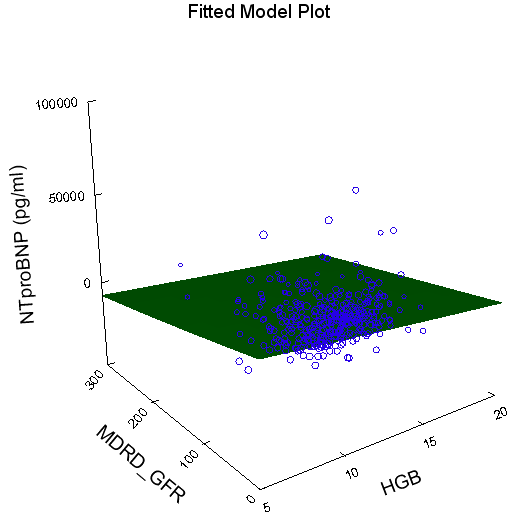
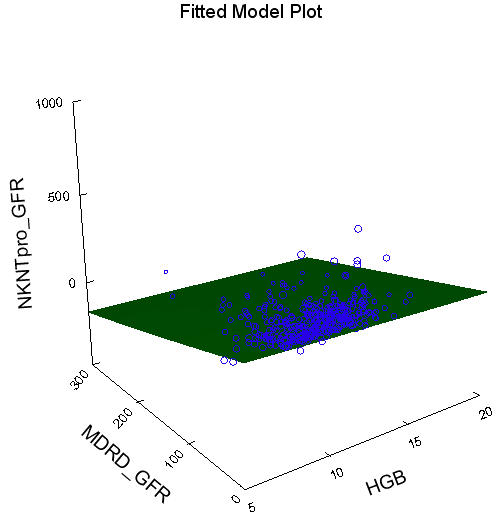
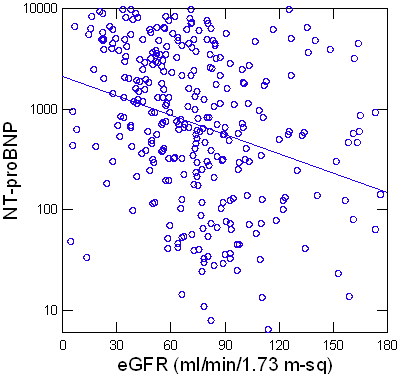
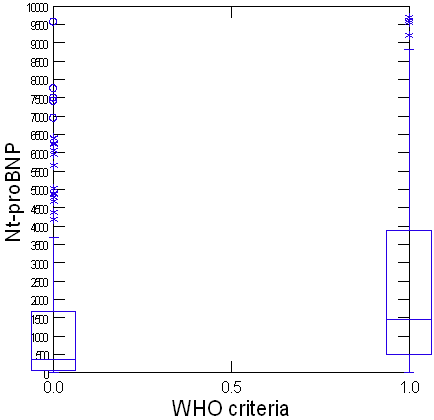
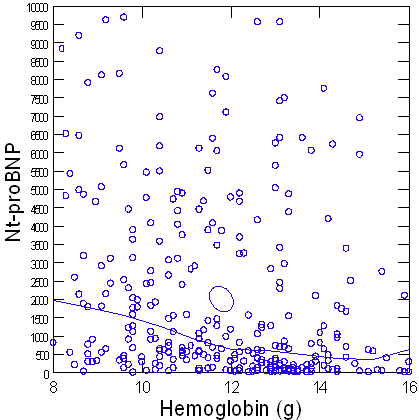
Figures 1-3 are scatterplots of eGFR (glomerular filtration rate calculated by MDRD equation) and of hemoglobin vs Nt-proBNP, and a boxplot of Nt-proBNP by WHO criteria for anemia. Figure 2 is a 3D plot of NT-proBNP spliced by eGFR and hemoglobin.  The linear regression model is presented in Table I.  The correlation coefficient (R ) for the model is weak, but not insignificant. What do you think is the effect of the large variance in the dependent variable?   Figure 3 is a 3D plot of the eGFR and hemoglobin vs a transformed variable – age normalized 1000*Log(Nt-proBNP)/eGFR.  The variance is reduced on the transformed variable.  Table II is the regression model on the data.  The correlation coefficient R is improved.

Analysis of variance (ANOVA) and Analysis of covariance (ANCOVA)

ANOVA is used if the dependent variable is continuous and all of the independent variables are categorical.   One-way ANOVA is used for a single independent variable, and multi-way ANOVA is used for multiple independent variables.   The ANOVA is based on the general linear model.   The F-test is used to compare the difference between the means of groups.   The independent variable has discrete values is not used as a measure.   The t-test can be used between each pair in the groups.   The goal of ANOVA is to explain the total variation found in the study.   An example of this application is shown in Figure 4.

Figure 4.  BNP determined within ejection fraction above or within 40

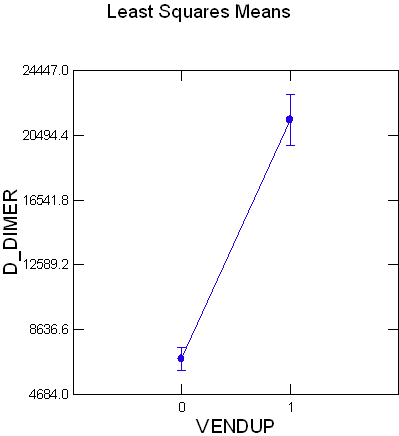
Figure 5 is the means and 95% confidence intervals for a comparison of D-dimer and positive or negatine venous duplex scans.  There are only two variables so the corresponding ANOVA is one-way.  The F-value is high and corresponds to a high t in the t-test.  F is the same as t2 and p = 0.0001 (Table III).  Our interest here is in multiple variables so we’ll hold the discussion of difference testing between two variables.

Figure 5.

Table III.

If some of the independent variables are categorical (nominal, ordinal or dichotomous) and some are continuous ANCOVA is used.   The ANCOVA procedure first adjusts the dependent variable on the basis of the continuous independent variable and then does ANOVA on the adjusted dependent variable.

Generalized linear and generalized additive models

Generalized linear models transform the response by assuming that a transformation of the expected response is a linear function of the predictor variables.   The variance of the response is a function of the mean response.   When the relationship between the parameters is not linear, a generalized linear model can’t be used.   A generalized additive model can be used to fit nonlinear data-dependent functions of the predictor.   Tree-based models are used for exploratory analysis and are related to clustering, which is a method for studying the structure of the data, creating clusters of data with similar characteristics.

Discriminant analysis

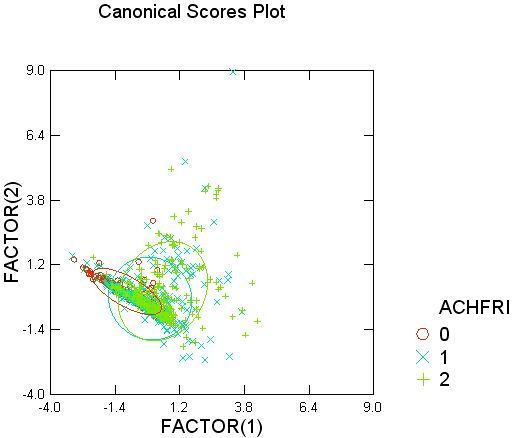
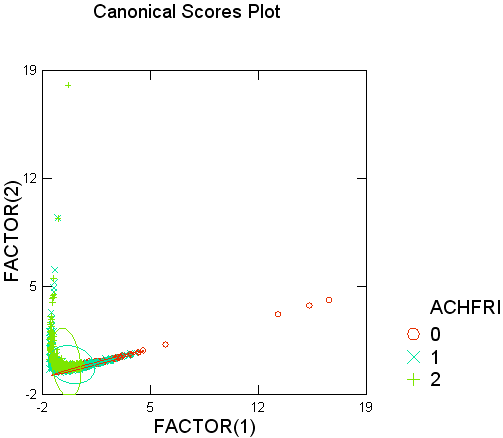
The discriminant analysis is a modification of the general linear regression model.   The method is used to assign data to any of distinct classes as the dependent variable.   The linear regression model predicts based on a linear relationship between the dependent and the independent variables.   They are codependent.   In the discriminant function they are independent.   The function determines a separation between the classes to which the data assigns patients.   The goal is to assign a new incoming patient based on the independent variables to one of the different groups.   The mathematical function can be linear, quadratic, or another function.   The stepwise linear regression with removal or addition of variables is viewed in the same way.   However, the discriminant function produces a separation between the classes rather than through them.  The same qualifications for the method fit pertaining to distributional assumptions that applies to multiple linear regression applies to the linear discriminant function, but the analysis of data on congestive heart failure, renal insufficiency and anemia partitioned with NT-proBNP, creatinine, age and hemoglobin concentration shown in Figure 6 and Table IV uses a quadratic equation.  I re-classify the data using the transformed variable age-normalized 1000*Log(NT proBNP)/eGFR presented in Figure 7 and Table V.  The use of the logarithmic transform and removal of age and hemoglobin as predictors give impressive results.

Figure  6.

Table IV.

Figure 7.

Table V.

Mahalanobis D2

The euclidean distance between two coordinates having the position (x1y1), (x2y2) is given by the distance D = ([x1 – x2]2 + [y1 – y2]2)1/2.   This is generalized for N-dimensional space, and the square of the distance is D2.   The two points are the centroids in a cloud of points in space separated by D, the euclidean distance between the points in an N-dimensional space.   The multiplication of a vector and a variance-covariance matrix T-1 yields the linear discriminant functions.   The Mahalanobis distance can be used to evaluate the distances of centroids and also the distances of objects towards the centroid of their class.

Logistic regression

The linear probability model (logistic regression) is the standard regression model applied to data for which the dependent variable is dichotomous (0,1). It fits a logistic function to the dependent variables valued at 0 or 1 and estimates the probabilities associated with each observation (24).  The predicted values from the model are interpreted as a probability that the response is a 1.  The test of significance of the model is the Maximum Likelihood Estimator (MLE).  The significance is determined by adjusting the parameters to maximize the likelihood of the observed data arising from the linear sum of the variables.

There are problems in using the linear probability model (49).

The residuals don’t have a constant variance so that estimates from regression are not best linear unbiased, therefore, not minimum variance.

Standard errors of regression coefficients can be erroneous giving invalid confidence intervals.

The predicted values from regression can range outside the interval [0,1], whereas probabilities are bounded by that interval

The linearity assumption inherently imposes constraints on the marginal effects of predictor variables that are not taken into account by the OLS estimation.

The linearity assumption implies that the marginal effect of a predictor is constant across its range.

The usual r squared measure is problematic.

Ordinal regression

I now turn to the application of a special nonparametric regression program developed by Jay Magidson (GOLDmineR; Statistical Innovations Inc., Belmont, MA), referred to as Ordinal regression, or universal regression (25-28).   Let’s look at the application of this tool, which makes outcomes analysis easy.   This method brings a powerful tool to the analysis of laboratory data for clinical validation of diagnostic tests.  It overcomes serious limitations of logistic analysis when there is more than two possible outcomes to consider.   This has become more important as we introduce tests that have results that are affected by morbid conditions so that a range of probabilities might be associated with scaled “dummy values” of the test (possibly because of hidden or unspecified variables).

Ordinal dependent variables are multivalued and have an ordered relationship to the predictor variable(s).   Magidson (25-28), inspired by the work of Leo Goodman (29,30), suggests the existence of a single regression model that can accomodate dependent variables of any metric – dichotomous, ordinal, or continuous.   This supermodel holds true under the assumption of bivariate normality and under other distributional assumptions and subsumes linear distribution and logistic regression as special cases (25).    It uses a log odds model fit and the odds ratio is obtained from the log(odds ratio).   In the linear probability model, the coefficients (bi) are partial correlation coefficients.   In the logit model the coefficients are partial log(odds-ratio).

The monotonic regression of X on Y is described by:

J

E(Y|X = x) = å   Pj.x yj

J=1

Where Pj.x, the conditional probability of the occurrence of Y=yj (an ordinal dependent variable) given X=x (qualitative or quantitative predictor variables), is estimated from a sample of N observations using 2 steps.

1)      Conditional logits Yj.x are predicted using the generalized logit model, where Yj.x*  is: Yj.x = aj + (b1x1* +  b2x2*  + bMxM*)yj*    j= 1,2,…, J.
The Y-scores, which determine the ordering and relative spacing of the J outcomes, may be specified or if unspecified, they are treated as model parameters and estimated with other parameters.   Yj* , the relative Y-score, is the difference between yj and some Y-reference score y0 defined as a weighted average of the original Y-scores.

2)      The predicted logits are transformed to predicted probabilities using the identity:

J

Pj.x º exp(Yj.x)/å exp(Yj.x)

J=1

For a given X=x, the generalized logit is defined as

Yj.x º ln(Pj.x/P0.x)

where Pj.x is the conditional probability of the jth outcome occurring when X=x

J

and P0.x =  P (Pj.x)ej

j=1

I performed a nonparametric regression using the universal regression program GOLDminer, developed by Jay Magidson (25-28) at Statistical Innovations, Belmont, MA.  The universal regression program is a logistic regression if the dependent variable is a binary outcome, and it is a polytomous regression if there are more than two dependent variables, but it can accommodate a paired comparison of covariates.  The measure of association is phi and R2.  The measure of fit is L2 (chi square).  The logarithmic form transforms into a probability model, which we aren’t concerned with here.

Graphical Ordinal Logit Display (GOLDminer)

I have mentioned the nonparametric universal regression of Magidson (25-28), based on work with log-linear modeling with Prof. Leo Goodman (29,30).  The logistic regression and linear regression models can be viewed as special cases of this more general model.  This regression model has greatest use for examining structure in data where there are more than two dependent variables, and the independent variables are scaled to intervals (25-28).  The model is more general than the logistic regression and is not constrained by the conditions encountered with logistic regression identified above.

I cite a number of publications of its use in clinical laboratory outcomes analysis.

Example  1.  The association between predictors of nutrition risk and malnutrition risk

I use here data obtained by Linda Brugler and coworkers at St.FrancisHospital in Wilmington, DE (31) that examines association between the malnutrition assessed before intervention with three predictors of malnutrition risk.  Poor oral intake and malnutrition related diagnosis are categorical, and the laboratory-derived serum albumin is scaled to form an ordinal predictor.   The strength of the predictors is given by Table VI:

Table VI.  Ordinal regression model for combined 3 predictors of malnutrition risk.

The model is defined by the following:  L2 = 267.68, R2 = 0.405, phi = 1.1134,

Df (3, 42), p = 9.7e-58.

Example 2:  Ordinal regression for thalassemia risk

Table VII shows the odds-ratios for the combinatorial scaled results of Mentzer score (ratio of MCV: red cell count), MCV, and Hgb A2(e)(by electrophoresis is higher than by HPLC).  The presence of only a single positive test gives an unlikely result for thalassemia, while two or more positive tests give a high likelihood of thalassemia.   This is summarized as follows: 0,0,0-0,0,1-0,1,0-1,0,0 = 0; 1,1,1-1,0,1-0,1,1-1,1,0 = 1.

Table VIII.   Expected Odds Ratios – Diagnosis Thalassemia

Example 3. Ordinal regression for risk of newborn respiratory distress syndrome

A study by Kaplan, Chapman and coworkers (32) extending work by Bernstein and Rundell (33) looked at the relationship between gestational age and RDS of the newborn and used the ordinal regression model to predict expected outcomes (33).  Table IX gives probabilities for the prediction of risk.

Table IX.   Probabilities of RDS given by gestational age and S/A ratio.

Example 4.  Prediction of myocardial infarction risk by EKG and troponin T at 0.1 ng/ml

Bernstein, Zarich and Qamar (34) carried out a study in which the physicians were blinded to the troponin T results.  A randomized prospective study of over 800 patients followed (35-37).  The chest pain characteristics, EKG findings and troponin T results were reviewed for consecutive patients entered into the study (34).   EKG results were scaled as: negative, nonspecific, 0; ST depression or T wave inversion, 1, ST elevation or new Q-wave, 2.  Troponin T was scaled as follows: 0-0.075 ng/ml, 0; 0.076-0.099, 1; > 0.1.The diagnoses were as follows: noncardiac, cardiac and nonischemic, 1; Unstable angina with MI ruled out, 2; non ST or ST elevation MI, 3.  Table X is the table of odds ratios and probabilities.

Table X. Ordinal regression of EKG and troponin T on diagnoses

Ovarian Cancer Survival

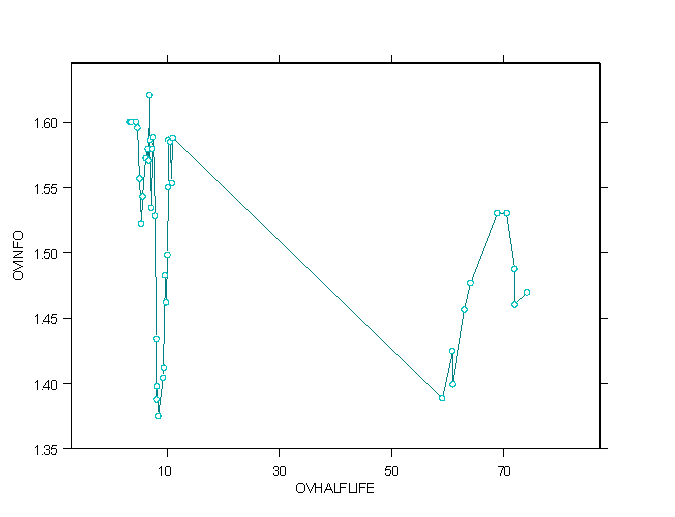
Rosman and Schwartz have reported a relationship between CA125 post-chemotherapy of ovarian carcinomatosis and serum half-life of CA125.  We examined a published data set provided by Dr. Martin Rosman.  Data were analyzed from 55 women who were treated at YaleUniversity, had an evaluable CA125 half-life (t1/2), and were followed for disease recurrence for at least 3 years.  We modeled survival or remission for ovarian cancer using operative findings, stage, and CA125 halflife (46).  Figure 9 is a plot of the CA125 elimination half-life vs the Kullback-Liebler distance using the data provided by Dr. Martin Rosman. The K-L distance is the difference between the total entropy of the data in which association is removed and the observed entropy for each value of CA125.  The t1/2 is 10 days.  What Rudolph and Bernstein (43) have referred to as effective information is KL distance. This was done to determine the value of CA125 that best predicts survival.

Figure 9 CA125 halflife

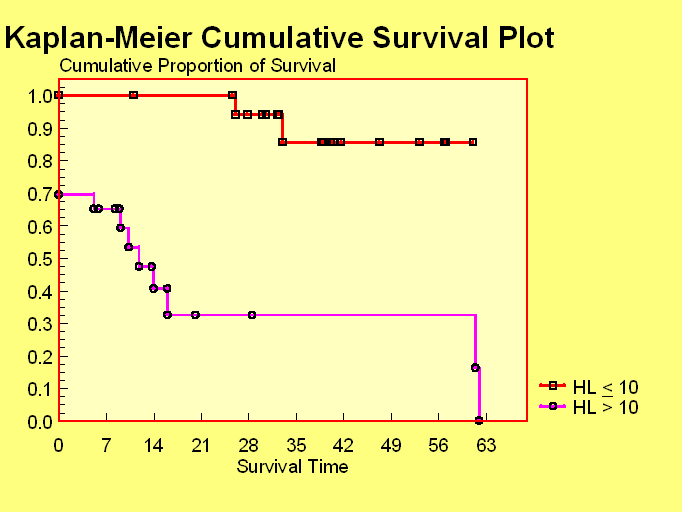
The next step was to carry out a Kaplan Meier survival plot with Cox regression on the data vs the time to death or remission.  A survival of 30 months is considered a cure.  A survival less is considered a remission.  Some patients died only shortly into chemotherapy.   The study result is shown in Figure 11.

Figure 10.  Kaplan Meier plot

We also examined the associations between OPERATIVE FINDINGS and CA125 to REMISSION and NONREMISSION or RELAPSE using a universal regression model under bivariate normality with estimation of generalized odds-ratios developed by Jay Magidson (Statistical Innovations, Inc., Belmont, MA).  It uses a parallel log-odds model based on adjacent odds to describe the data.  The universal regression is carried out after scaling the continuous variables with intervals we determined as follows: halflife- 0-5, 6-10, 11-15, 16-20, >20.   A crosstabulation is constructed using the scaled variables as treatment vs. the effect (full, short remission or none), to obtain the frequency tabulation of treatment level vs remission, relapse or nonremission.

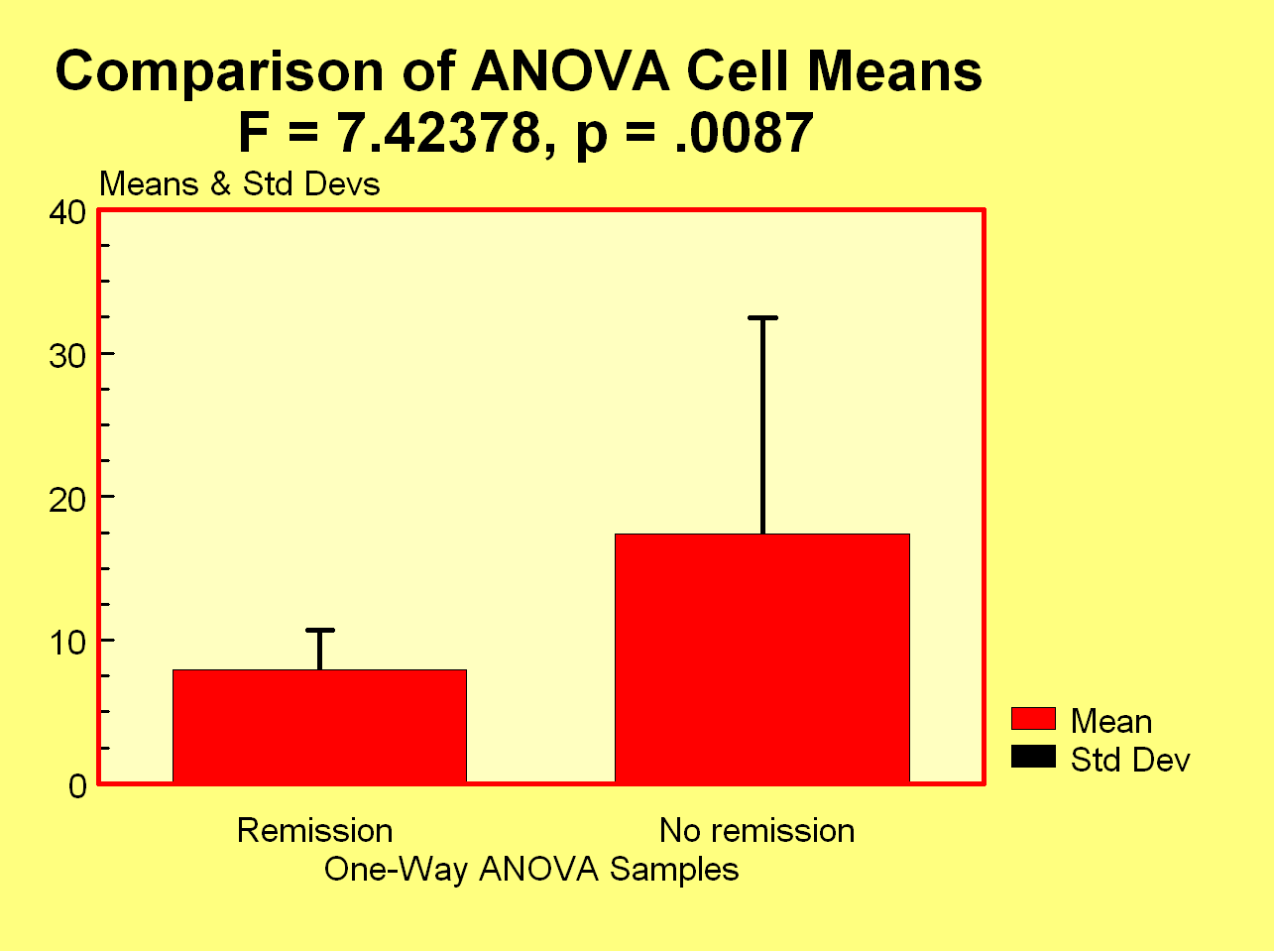
Table XI is a cross-tabulation of the observed and expected outcome frequencies in remission (rem), short remission (short,< 30 months) and non-remission (none) versus the scaled half-lives.   Relapse and failure to achieve remission were combined into one outcome class.  The means and standard error of the means (SEM) of half-life versus remission or non-remission/relapse are effectively separated (F=7.42, p < 0.01) as follows: Remission, 7.9, 2.8, [19];  Relapse/Non-remission, 17.4, 2.05, [36].

Table XII.  Observed and expected odds and odds-ratios of remission, relapse and no response by half-life

Perspective for the Future

Linear regression has been used extensively for methods comparison and for quality control, exclusively based on distributional assumptions and distance from the center of the population sample.   This is essential to analytical chemistry principles, but it has reached a limit.  The last 30 years has seen the development of very powerful regression tools that are not dependent on distributional assumptions and that move the method into classification and prediction.  The development of the Akaike Information Criterion (38-40) brought together two major disciplines that had separate developments, information theory and statistics.   The work by Bernstein et al. (41-42) in predicting myocardial infarction using bivariate density estimation, and with Kullback-Liebler Distance (43, 44), an extension of work by Rypka (45) is closely related. The use of tables and the scaling of data has been the dominant approach to statistics that uses ordinal and categorical data in outcomes research.  This has become a powerful method used in studies of placebo and drug effects.   The approach is readily amenable to studies of laboratory tests and outcomes.   Outcomes studies will be designed and carried out for laboratory tests that will ask questions appropriate for the clinical laboratory sciences, and that will not be subordinated to pharmaceutical evaluations, which currently have exclusion criteria that are inappropriate for laboratory investigations.

Summary

Regression has a long history in the development of modern science since the 18th century.  Regression has had a role in the emergence of physics, anthropology, psychology, and chemistry.  But its development was initially tied to linear association and assumption of normal distribution.   There are many associations that are tied to frequency of discrete events.  The use of chi-square as a measure of goodness of fit has such a tie to genetic analysis and to classification tables.   The importance of outcomes management and the recognition of a multivariable data structure that needs to be explored leads us to a new domain of regression models and includes an assumption that the dependent variable may not be know with certainty.  This is the case with the emerging models known as mixture models, structural equation models and latent class models.  This type of model is not traditionally a regression model and looks at defined variables and also unmeasured, hidden or latent variables (factors) in the model.  However, there are factor analysis and regression forms of the LCM that are included in the LCM software releases of Statistical Innovations, Inc. (Latent Gold). This important subject is beyond the scope of this review, but Demidenko (47) has written an excellent text on the subject.

References:

19. Hoel PG. Elementary Statistics, Testing Hypotheses: The difference between two means. Chapter 3.3. pp133-117. 1960. Wiley, New York.

20. Hoel PG. Ibid. Regression. Chapter 9. pp141-153.

21. Norman GR, Streiner DL. Biostatistics: The Bare Essentials. Two repeated observations: The paired t-test and alternatives. Chapter 10. pp89-93. 2000, BC Deckker, Hamilton, Ont., Canada.

22. Norman GR, Streiner DL. Ibid. Simple regression and correlation. Chapter 13. pp118-126.

23. Norman GR, Streiner DL. Ibid. Multiple regression. Chapter 14. pp127-137.

24. Norman GR, Streiner DL.Ibid. Logistic regression. Chapter 15. pp139-144.

25.  Magidson J.  “Multivariate Statistical Models for Categorical Data,” Chapters 3 & 4   in Bagozzi R, Advanced Methods of Marketing Research, Blackwell, 1994.

26.  Magidson J. Introducing a new graphical method for the analysis of an ordered categorical response – Part I. Journal of Targeting, Measurement and Analysis for Marketing (UK). 1995; IV(2):133-148.

27.  Magidson J.  Introducing a new graphical model for the analysis of  an ordered categorical response – Part II. Ibid. 1996;IV(3):214-227.

28.  Magidson J.  Maximum likelihood assessment of clinical trials based on an ordered categorical response. Drug information Journal. 1996;30:143-170.

29.   Goodman LA.  Simple models for the analysis of associations in cross-  classifications having ordered categories.  Journal of the American Statistical Association. 1979;74: 537-552.  Reprinted in The Analysis of Cross-Classified Data Having Ordered Categories. 1984, HarvardUniversity Press.

30. Goodman LA.  Association models and the bivariate normal for contingency tables with ordered categories. Biometrika 1981;68:347-355.

31.Brugler L, Stankovic AK, Schlefer M, Bernstein L. A simplified nutrition screen for hospitalized patients using readily available laboratory and patient information. Nutrition 2005;21:650-658.

32. Kaplan LA, Chapman JF, Bock JL, Santa Maria E, Clejan S, et al. Prediction of respiratory distress syndrome using the Abbott FLM-II amniotic fluid assay. Clin Chim Acta 2002;326[1-2]:61-68.

33.  Bernstein LH, Stiller R, Menzies C, McKenzie M, Rundell C. Amniotic fluid    polarization of fluorescence and lecithin/sphingomyelin ratio decision criteria assessed. Yale J Biol Med 1995; 68(2):101-117.

34.  Bernstein LH, Qamar A, McPherson C, Zarich S.   Evaluating a new graphical   ordinal logit method (GOLDminer) in the diagnosis of myocardial infarction utilizing clinical features and laboratory data.   Yale J Biol Med 1999; 72:259-268.

35. Bernstein L, Bradley K, Zarich S. GOLDmineR: Improving Models for Classifying Patients with Chest Pain. Yale J Biol Med 2002;75: 183-198.

36. Zarich S, Bradley K, Seymour J, Ghali W, Traboulsi A, et al. Impact of troponin T determinations on hospital resources and costs in the evaluation of patients with suspected myocardial ischemia. Amer J Cardiol 2001;88:732-6.

37. Zarich SW, Qamar AU, Werdmann MJ, Lizak LS, McPhersonCA, Bernstein LH. Value of a single troponin T at the time of presentation as compared to serial CK-MB determinations in patients with suspected myocardial ischemia. Clin Chim Acta 2002;326:185-192.

38. Akaike H. Information theory and an extension of maximum likelihood principle.    In B.N. Petrov and F. Csake (eds.), Second International Symposium on Information Theory. 1973, Akademiai Kiado, pp 267-281, Budapest.

39. Akaike H. A new look at the statistical model identification.  IEEE Transactions on Automation Control, AC-19, 1974; 716-723.

40. Dayton CM. Information Criteria for the Paired-Comparisons Problem.  American Statistician. 1998;52: 144-151.

41. Bernstein LH, Good IJ, Holtzman GI, Deaton ML, Babb J:  Diagnosis of myocardial infarction from two enzyme measurements of creatine kinase isoenzyme MB with use of nonparametric probability estimation.  Clin Chem 1989;35:444-7.

42. Bernstein LH, Good IJ, Holtzman GI, Deaton ML, and Babb J. Diagnosis of heart attack from two enzyme measurements by means of bivariate probability density estimation: statistical details. J Statistical Computation and Simulation. 1989.

43. Rudolph RA, Bernstein LH, Babb J. Information-induction for the diagnosis of myocardial infarction. Clin Chem 1988;34:2031-8.

44. Kullback S, Liebler RA. On information and sufficiency. Ann Mathematical Statistics 1951;22:79-86.

45. Rypka EW. Methods to evaluate and develop the decision process in the selection of tests. Clinics in Laboratory Med 1992;12[2]: 351-385.

46. Bernstein LH. Outcomes-based Decision Support: How to Link Laboratory Utilization to Clinical Endpoints. Chapter 8. Pp91-128. In Bissell MG, ed. Laboratory-Related Measures of Patient Outcomes: An Introduction. 2000. AACC Press. Washington, DC.

47. Demidenko E.  Mixture models: Theory and applications.  2004.  Wiley-Interscience. Hoboken, NJ.

48. Martin RF. General Deming regression for estimating systematic bias and confidence interval in method-comparison studies. Clin Chem 2000;46:100-104.

49. Magidson J.  Opportunities grow on trees. A general alternative to linear regression. Monotonic regression of dichotomous, ordinal and grouped continuous dependent variables.  1998. Statistical Innovations, Inc. Belmont, MA.

 Figures and Tables Version 8 Multivariable

Table I.  Regression of eGFR and hemoglobin to predict Nt-proBNP

Step number : 0
R : 0.376
R-square : 0.141


In Effect Coefficient Standard Error Std.
Coefficient
Tolerance df F-ratio p-value
1 Constant
2 eGFR -83.499 14.063 -0.297 0.951 1 35.256 0.000
3 Hgb -910.224 260.436 -0.175 0.951 1 12.215 0.001

Information Criteria

AIC 7785.028
AIC (Corrected) 7785.139
Schwarz’s BIC 7800.628


Dependent Variable NTproBNP
(pg/ml)
N 365
Multiple R 0.376
Squared Multiple R 0.141
Adjusted Squared Multiple R 0.137
Standard Error of Estimate 10287.156

Analysis of Variance

Source SS df Mean Squares F-ratio p-value
Regression 6.309E+009 2 3.155E+009 29.809 0.000
Residual 3.831E+010 362 1.058E+008

Table II. Linear regression of NKLog(Nt-proBNP0/eGFR by eGFR and hemoglobin

Log transform flattens the high Nt-proBNP scale and eGFR and age are normalized

R

:

0.597
R-square

:

0.357


In Effect Coefficient Standard Error Std.
Coefficient
Tolerance df F-ratio p-value
1 Constant
2 eGFR -1.873 0.144 -0.573 0.933 1 170.011 0.000
3 Hgb -4.259 2.436 -0.077 0.933 1 3.056 0.081

Information Criteria

AIC 4299.786
AIC (Corrected) 4299.899
Schwarz’s BIC 4315.331


Dependent Variable NKLogNTGFR
N 360
Multiple R 0.597
Squared Multiple R 0.357
Adjusted Squared Multiple R 0.353
Standard Error of Estimate 94.260

Regression Coefficients B = (X’X)-1X’Y

Effect Coefficient Standard Error Std.
Coefficient
Tolerance t p-value
CONSTANT 256.151 27.745 0.000 . 9.232 0.000
MDRD_GFR -1.873 0.144 -0.573 0.933 -13.039 0.000
Hgb -4.259 2.436 -0.077 0.933 -1.748 0.081

Table III. One-way ANOVA of D-dimer for positive and negative scans

Dependent Variable D_DIMER
N 817

Analysis of Variance

Source Type III SS df Mean Squares F-ratio p-value
VENDUP 43456570.851 1 43456570.851 68.278 0.000
Error 5.187E+008 815 636461.763

Table 4.   Discriminant function for CHF, renal insufficiency and anemia by age, NT-proBNP, creatinine and hemoglobin

Group Frequencies
0 1 2
135 335 235
Group Means
  0 1 2
NTproBNP (pg/ml) 1516.369 5964.054 12902.662
Creatinine 0.716 1.654 2.103
Hgb 11.972 11.533 11.305
Age 60.570 71.373 74.966
Between Groups F-matrix
df : 4 699
  0 1 2
0 0.000
1 23.445 0.000
2 45.108 11.788 0.000

Wilks’s Lambda

Lambda

:

0.778

df

:

(4,2,702)

Approx. F-ratio

:

23.337

df

:

(8,1398)

p-value

:

0.000


Classification Functions
  0 1 2
CONSTANT -32.018 -35.196 -37.394

Variable

F-to-remove Tolerance
5 NTproBNP
(pg/ml)
13.489 0.801
6 Creatinine 21.368 0.799
7 Hgb 0.190 0.928
3 Age 38.632 0.948
Test Statistic
Statistic Value Approx. F-ratio

df

p-value
Wilks’s Lambda 0.778 23.337 8 1398 0.000
Pillai’s Trace 0.226 22.295 8 1400 0.000
Lawley-Hotelling Trace 0.279 24.382 8 1396 0.000

Table V.  The DFA calculations for Figure 9.

Group Frequencies
  0 1 2
221.000 631.000 571.000
Means
NKLgNTproGFRe 15.589 55.971 81.159
MDRD 123.130 61.940 48.748
Group 0 Discriminant Function Coefficients
  NormKLgNTproGFR-
e
MDRDest Constant
NKLgNTproGFRe -0.015
MDRD -0.001 0.000
Constant 0.588 0.052 -15.590
Group 1 Discriminant Function Coefficients
  NormKLgNTproGFR-
e
MDRDest Constant
NKLgNTproGFRe 0.000
MDRD 0.000 -0.001
Constant 0.024 0.089 -12.106
Group 2 Discriminant Function Coefficients
  NormKLgNTproGFR-
e
MDRDest Constant
NKLgNTproGFRe 0.000
MDRD 0.000 -0.001
Constant 0.015 0.147 -13.077
Between Groups F-matrix
df : 2 1419
  0 1 2
0 0.000
1 236.650 0.000
2 335.228 21.342 0.000

Wilks’s Lambda for the Hypothesis

Lambda

:

0.671

df

:

(2,2,1420)

Approx. F-ratio

:

156.542

df

:

(4,2838)

p-value

:

0.000


Classification Matrix (Cases in row categories classified into columns)
  0 1 2 %correct
0 206 15 0 93
1 237 363 31 58
2 69 459 43 8
Total 512 837 74 43
Jackknifed Classification Matrix
  0 1 2 %correct
0 205 16 0 93
1 237 363 31 58
2 69 462 40 7
Total 511 841 71 43
Test Statistic
Statistic Value Approx. F-ratio

df

p-value
Wilks’s Lambda 0.671 156.542 4 2838 0.000
Pillai’s Trace 0.330 140.347 4 2840 0.000
Lawley-Hotelling Trace 0.488 173.026 4 2836 0.000
Canonical Discriminant Functions
  1 2
Constant -1.912 -1.075
NKLgNTproGFRe 0.001 0.009
MDRD 0.028 0.008
Canonical Discriminant Functions : Standardized by Within Variances
  1 2
NKLgNTproGFRe 0.085 1.061
MDRD 1.026 0.284
Canonical Scores of Group Means
  1 2
0 1.576 0.034
1 -0.122 -0.069
2 -0.476 0.063

Table VI  Ordinal regression model for combined 3 predictors of malnutrition risk.

Predictor                                              L2                     p                      exp(beta)

Poor oral intake                                    60.29               8.2e-15              5.3

Malnutrition related condition    46.29               1.0e-11              3.06

Albumin                                                152.01             6.3e-35              3.16

Table VII.   Expected Odds Ratios – Diagnosis Thalassemia

Odds-Ratios

Me,M,A2(e)                 Thalassemia

1,1,1                                 9713

1,1,0                                 1696

1,0,1                                   263

0,1,1                                   212          

1,0,0                                     46

0,1,0                                     37

0,0,1                                       6

0,0,0                                       1

Table VIII.   Probabilities of RDS given by gestational age and S/A ratio.

Dependent variable: Respiratory outcome (Resp_Sca)

Predictors: Surfactant to albumin (S/A) Ratio_45: 0, > 45; 1, 21-44; 2, < 21;

Gestational age at delivery: 0, > 36; 1, 34-36; 2, < 34.

S/A Ratio_45               p = 8.7*10-22

Gestational Age at Delivery Scaled        p = 4.2*10-9

Combined variables: ChiSq = 130.14,   p = 5.1*10-28,   R2 = 0.433,   phi = 0.8231,   exp(beta) = 2.16 (S/A),   1.88 (GA)

Definition (S/A, GA) Exp. Probabilities Exp. Odds-Ratios
0-20, < 34 0.84 4427
0-20, 34-36 0.64 668
21-44, < 34 0.57 441
0-20, > 36 0.31 101
21-44, 34-36 0.25 67
> 45, < 34 0.19 44
21-44, > 36 0.06 10
> 45, 34-36 0.04 7
> 45, > 36 0.01 1

Table IX. Ordinal regression of EKG and troponin T on diagnoses

Association Summary               L²                     df         p-value             R²        phi

Explained by Model                  206.52             2          1.4e-45            0.686   1.3856

Residual                                         48.64               14        1.0e-5

Total                                               255.16             16        4.5e-45

Odds Ratios and probabilities for diagnoses

average                        1                2                              0          1          2

score                            0.00        0.00

2,3       2.87                             466.82   10086.03         0.01     0.11     0.88

2,2       2.67                             105.78    1087.95           0.04     0.20     0.75

1,3       2.64                             95.35          931.05            0.05     0.21     0.74

2,1       1.95                             23.97          117.35            0.26     0.27     0.47

1,2       1.87                             21.61           100.43           0.29     0.26     0.45

0,3       1.79                             19.48             85.95           0.32     0.26     0.42

1,1       0.67                             4.90                10.83          0.73     0.15     0.12

0,2       0.61                             4.41                   9.27          0.75     0.14     0.11

0,1       0.12                             1.00                 1.00            0.95     0.04     0.01

Table X.  Observed and expected odds and odds-ratios of remission, relapse and no response by half-life

Half-life          exp. odds     exp. odds-ratios

(range, days)      Rem    short    none     Rem   short  none

> 20                           1      4.16    17.11      1    12.49  56.07

16-20                         1      2.21     4.84      1     6.64  44.16

11-15                          1      1.18     1.37      1     3.53  12.49

6-10                            1     0.63     0.39      1     1.88   3.53

< 6                               1     0.33     0.11       1       1         1

HL-ref                         1    0.33      0.11       1       1         1

Figure 1.  log_NT-proBNP vs eGRF

Figure 2.   Boxplots of NT-proBNP and WHO criteria

Figure 3.  NT-proBNP vs Hb

Figure 4.   3D plot of NT-proBNP, MDRD eGFR, Hb

Figure 5.   3D plot of Normalized K*Log_NTproBNP/eGFR, eGFR, Hb

Figure  6. D-dimer Confidence Intervals vs Imaging

Figures 7 & 8.   Canonical Scores Plots

Figure 9.  Entropy Plot of CA125 halflife (x) vs Effective Information
(Kullback Entropy) showing sharp drop in Entropy at 10 days (equivalent to information added to resolve uncertainty).  AS developed by Rosser R Rudolph

Figure 10.  Kaplan Meier Plot of CA125 half-life vs Survival in Ovarian Cancer

Read Full Post »


Reported by: Dr. Venkat S. Karra, Ph.D.


Brain structures involved in dealing with fear...


Major depression or chronic stress can cause the loss of brain volume, a condition that contributes to both emotional and cognitive impairment. Now a team of researchers led by Yale University scientists has discovered one reason why this occurs—a single genetic switch that triggers loss of brain connections in humans and depression in animal models.


The findings, reported in Nature Medicine, show that the genetic switch known as a transcription factor represses the expression of several genes that are necessary for the formation of synaptic connections between brain cells, which in turn could contribute to loss of brain mass in the prefrontal cortex.


“We wanted to test the idea that stress causes a loss of brain synapses in humans,” said senior author Ronald Duman, the Elizabeth Mears and House Jameson Professor of Psychiatry and professor of neurobiology and of pharmacology. “We show that circuits normally involved in emotion, as well as cognition, are disrupted when this single transcription factor is activated.”


The research team analyzed tissue of depressed and non-depressed patients donated from a brain bank and looked for different patterns of gene activation. The brains of patients who had been depressed exhibited lower levels of expression in genes that are required for the function and structure of brain synapses. Lead author and postdoctoral researcher H.J. Kang discovered that at least five of these genes could be regulated by a single transcription factor called GATA1. When the transcription factor was activated, rodents exhibited depressive-like symptoms, suggesting GATA1 plays a role not only in the loss of connections between neurons but also in symptoms of depression.


Duman theorizes that genetic variations in GATA1 may one day help identify people at high risk for major depression or sensitivity to stress.


“We hope that by enhancing synaptic connections, either with novel medications or behavioral therapy, we can develop more effective antidepressant therapies,” Duman said.


source:


http://www.rdmag.com/News/2012/08/Life-Sciences-Team-Discovers-How-Stress-Depression-Can-Shrink-The-Brain/


Read Full Post »

Reported by: Dr. Venkat S. Karra, Ph.D.

Many of us are familiar with prion disease from its most startling and unusual incarnations—the outbreaks of “mad cow” disease (bovine spongiform encephalopathy) that created a crisis in the global beef industry. Or the strange story of Kuru, a fatal illness affecting a tribe in Papua New Guinea known for its cannibalism. Both are forms of prion disease, caused by the abnormal folding of a protein and resulting in progressive neurodegeneration and death.

While exactly how the protein malfunctions has been shrouded in mystery, scientists at The Scripps Research Institute now report in the journal Proceedings of the National Academy of Sciences (PNAS) that reducing copper in the body delays the onset of disease. Mice lacking a copper-transport gene lived significantly longer when infected with a prion disease than did normal mice.

“This conclusively shows that copper plays a role in the misfolding of the protein, but is not essential to that misfolding,” said Scripps Research Professor Michael Oldstone, who led the new study.

“We’ve known for many years that prion proteins bind copper,” said Scripps Research graduate student Owen Siggs, first author of the paper with former Oldstone lab member Justin Cruite. “But what scientists couldn’t agree on was whether this was a good thing or a bad thing during prion disease. By creating a mutation in mice that lowers the amount of circulating copper by 60%, we’ve shown that reducing copper can delay the onset of prion disease.”

Zombie Proteins
Unlike most infections, which are caused by bacteria, viruses, or parasites, prion disease stems from the dysfunction of a naturally occurring protein.

“We all contain a normal prion protein, and when that’s converted to an abnormal prion protein, you get a chronic nervous system disease,” said Oldstone. “That occurs genetically (spontaneously in some people) or is acquired by passage of infectious prions. Passage can occur by eating infected meat; in the past, by cannibalism in the Fore population in New Guinea through the ingestion or smearing of infectious brains; or by introduction of infectious prions on surgical instruments or with medical products made from infected individuals.”

When introduced into the body, the abnormal prion protein causes the misfolding of other, normal prion proteins, which then aggregate into plaques in the brain and nervous system, causing tremors, agitation, and failure of motor function, and leads invariably to death.

A Delicate Balance
The role of copper in prion disease had previously been studied using chelating drugs, which strip the metals from the body—an imprecise technique. The new study, however, turned to animal models engineered in the lab of Nobel laureate Bruce Beutler while at The Scripps Research Institute. (Beutler is currently director of the Center for the Genetics of Host Defense at UT Southwestern.)

The Beutler lab had found mice with mutations disrupting copper-transporting enzyme ATP7A. The most copper-deficient mice died in utero or soon after birth, but those with milder deficiency were able to live normally.

“Copper is something we can’t live without,” said Siggs. “Like iron, zinc, and other metals, our bodies can’t produce copper, so we absorb small amounts of it from our diet. Too little copper prevents these enzymes from working, but too much copper can also be toxic, so our body needs to maintain a fine balance. Genetic mutations like the one we describe here can disrupt this balance.”

Death Delayed
In the new study, both mutant and normal mice were infected with Rocky Mountain Laboratory mouse scrapie, which causes a spongiform encephalopathy similar to mad cow disease. The control mice developed illness in about 160 days, while the mutant mice, lacking the copper-carrying gene, developed the disease later at 180 days.

Researchers also found less abnormal prion protein in the brains of mutant mice than in control mice, indicating that copper contributed to the conversion of the normal prion protein to the abnormal disease form. However, all the mice eventually died from disease.

Oldstone and Siggs note the study does not advocate for copper depletion as a therapy, at least not on its own. However, the work does pave the way for learning more about copper function in the body and the biochemical workings of prion disease.

source:

http://www.dddmag.com/news/2012/08/copper-facilitates-prion-disease?et_cid=2794933&et_rid=45527476&linkid=http%3a%2f%2fwww.dddmag.com%2fnews%2f2012%2f08%2fcopper-facilitates-prion-disease


Read Full Post »

Reported by: Dr. Venkat S. Karra, Ph.D.

Mitochondria are responsible for more than 90% of a cell’s energy production via ATP (adenosine triphosphate) generation, in addition to playing a significant role in respiration and many signaling events within most eukaryotic cells. These intracellular powerhouses range in size and quantity within each cell depending on the organism and overall cell function.

Mitochondria consist of a semi-permeable outer membrane, a thin inter-membrane space where oxidative phosphorylation occurs, an impermeable inner membrane that is intricately folded to create layered compartments—or christae—and the matrix that contains ATP-producing enzymes and the organelle’s own independent genome. Each section has a highly specialized function, and any impairment within the organelle can lead to disease or disorders within the overall organism.

Mitochondrial dysfunction may be due to:

1. Hereditary:

Inherited mitochondrial disorders can play a role in prevalent diseases such as cardiac disease and diabetes, and can also result in rare diseases such as Pearson syndrome or Leigh’s disease.

2. Drug Toxicity:

Mitochondrial toxicity as a result of pharmaceutical use may damage key organs, such as the liver and heart. For example:

nefazodone—a depression treatment—was withdrawn from the U.S. market after it was shown to significantly inhibit mitochondrial respiration in liver cells, leading to liver failure.

Troglitazone, an anti-diabetic and anti-inflammatory, was withdrawn from all markets after research concluded that it caused acute mitochondrial membrane depolarization, also leading to liver failure.

Drug recalls are costly to a manufacturer’s bottom line and reputation, and more importantly, can be harmful or even fatal to users. As drug discovery continues to evolve, much lead compound research now includes careful review of its interaction and potential toxicity with mitochondria.

Cell-based mitochondrial assays in microplate format may include mitochondrial membrane potential, total energy metabolism, oxygen consumption, and metabolic activity; and offer a truer environment for mitochondrial function in the presence of drug compounds compared to isolated mitochondria-based tests. Combining more than one assay in a multiplex format increases the amount of data per well while decreasing data variability arising from running the assays separately. The aggregated data also provides a more encompassing analysis of the drug’s effect on mitochondria than a single test.

One example, when testing compound effects on mitochondria, would be to measure cell membrane integrity as a function of cytotoxicity and mitochondrial function via ATP production concurrently, thus distinguishing between compounds that exhibit mitochondrial toxicity versus overt cytotoxicity.

General cytotoxicity is characterized by a decrease in ATP production and a loss of membrane integrity whereas mitochondrial toxicity results in decreased ATP production with little to no change in membrane integrity.

The assay’s efficiency is further enhanced via automation.

Robotic instrumentation ensures repeatable operation within the microplate wells when performing tasks such as cell dispensing, serial titration and transfer of compounds, and reagent dispensing. Additionally, by automating tasks within the assay process, researchers are free to attend to other tasks, reducing overall active time spent on the assay. Multi-mode microplate readers are compact instruments that can detect both fluorescent and luminescent signals. In addition, an automated process—including liquid handling and detection—can increase throughput capacity compared to manual methods.

Multiplexed cell-based mitochondrial assays increase sample throughput and decrease variability, costs, and overall time for project completion. Automating the process with robotic instrumentation allows for rapid compound profiling, repeatability, further throughput increase, and decreased per-assay and overall project time.

source:

http://www.dddmag.com/articles/2012/08/detecting-potential-toxicity-mitochondria?et_cid=2794933&et_rid=45527476&linkid=http%3a%2f%2fwww.dddmag.com%2farticles%2f2012%2f08%2fdetecting-potential-toxicity-mitochondria

Read Full Post »

Coronary Artery Disease – Medical Devices Solutions: From First-In-Man Stent Implantation, via Medical Ethical Dilemmas to Drug Eluting Stents

Author: Aviva Lev-Ari, PhD, RN

Real medical ethical dilemmas involved in physician assignment of patients to participate in Clinical Trials

Randomized controlled clinical trials have become the method of choice or the standard technique for obtaining scientific information to be used in changing diagnostic or therapeutic methods. The use of this technique creates an ethical dilemma (Hellman and Hellman, 1991).

Physicians using a randomized clinical trial are cast in two opposing roles at the same time: clinicians and researchers. As clinicians, they have an ethical commitment to individual patients: to practice professionally in an empathetic profession that is concerned with each patient as an individual. By entering into a relationship with an individual patient, the physician assumes obligations and commitments to act always in the patient’s best interest, derived from values of loyalty and the virtue of fidelity to his/her patients. Modifications of these relationships, otherwise dyadic relationship, occurs when a physician assumes legal obligations to report wounds of a suspicious nature and certain infectious diseases. Such obligations do not conflict with the physician’s ethical obligation to act in the best medical interests of his/her patient. Social concerns have pre-empted physician reporting of disease manifestations which are suspected to have public health bearing (Hellman and Hellman, 1991).

The other role assumed by a physician participating in randomized clinical trials, is that of a scientific researcher, committed to determine the validity of formally constructed hypotheses and their testing. Results of scientifically formulated studies using the methods developed in experimental design, derived from the disciplines of Statistics and Operations Research, are presumed to benefit humanity in general, and not only the individual patient participating in such a formally designed clinical trial. The goals of randomized clinical trials were stated by the Director of the National Institute of Allergy and Infectious Diseases, in these words: “It’s not to deliver therapy. It’s to answer a scientific question so that the drug can be available for everybody once you’ve established safety and efficacy” (as cited in Hellman and Hellman, 1991).

How do randomized clinical trials conflict with a physician’s duty towards his/her individual patients? It is a conflict between rights-based Moral Theories on one hand and Utilitarian Theory on the other.  Moral theories by Immanuel Kant and John Rowls assert that human beings, by virtue of their unique capacity for rational thinking, are bearers of dignity and ought to be treated as ends in themselves not as means to an end. In contrast, Utilitarianism by Stuart Mills defines what is right as the greatest good for the greatest number, known as social utility (Hellman and Hellman, 1991). Pleasures among them, health and well-being, need be counterbalanced by pain. The morally correct act is the act that produces the most pleasure and the least pain overall. Respectively, believers in Moral theory oppose conduct and self participation in randomized clinical trials, while believers in Utilitarianism support them in earnest.

However, since the distribution of pleasure and pain does have moral consequences, physicians must care about that distribution, since they enter into relationships with many patients. They can’t be indifferent to whether it is these patients or others that suffer for the general benefit of society, even though society might gain from the suffering of a few, even if the physician believes that the suffering by a few is worth the benefit to society. The doctor-patient relationship requires doctors to see their patients as bearers of rights who cannot be merely used for the greater good of humanity.

Consider a new agent that promises more effectiveness of treatment. The control group must be given either an unsatisfactory treatment or a placebo. Even though the therapeutic value of the new agent is unproven, if physicians think it has promise, are they acting in the best interest of their patients in allowing them to be randomly assigned to the control group?

Ethical validity of the assignment of patients to randomized clinical trials involves the following three matters in medical ethics (Hellman and Hellman, 1991, Markman, 1992):

  • If the physician has no opinion about whether the new treatment is acceptable, then random assignment is ethically acceptable. Lack of enthusiasm does not lore patients to participate or support the merit of conducting the study anyway. Treatment may show promise of beneficial results but also present undesirable complications (Markman paraphrased)
  • Physician believes that the severity and likelihood of harm and good are evenly balanced, randomization may be ethically acceptable. If the physician has no preference for either treatment, he or she are in a state of equipoise (Freedman, 1992), then randomization is acceptable.
  • If the physician believes that the new treatment may be either more or less successful or more or less toxic, the use of randomization is NOT consistent with fidelity to the patient.

After patient assignment to a Clinical Trial — What are the risks involved in participation in First-In-Man Stent Implantation as a treatment for cardiovascular diseases?

Dr. R. Stack, professor emeritus of medicine at Duke University, Durham, NC, and president of Synecor, a company developing Bioabsorbable stent, traced the evolution of interventional cardiology from inflation of the first angioplasty balloon to implantation of the first Bioabsorbable stent, in a Founders’ Lecture entitled, “How Can You Get Out of a Full-Metal Jacket?” at the Society for Cardiovascular Angiography and Interventions (SCAI), 29th Annual Scientific Sessions in Chicago, May, 2006, and said:

“In the early days of percutaneous transluminal coronary angioplasty (PTCA), each procedure took three to four hours to complete, and fully one in 20 patients suffered a heart attack in the catheterization laboratory. There was little an interventional cardiologist could do, other than rush the patient to surgery. Introduction of the steerable guidewire made PTCA easier to do and shortened procedure times. Development of the perfusion catheter meant that interventional cardiologists could re-establish blood flow to the heart and stabilize patients in case of a sudden arterial blockage. “(cited in David, 2006).

Risks of Participation in Randomized and Non-randomized Clinical Trials: Technology and Procedural Considerations

  • Assignment to a “control group” means implantation of a stent that is gold standard, rather than having the chance of benefiting from an innovative technology such as bioabsorabable stents (Guidant Corporation, 2006) or bioengineered stents (Chadwick, 2006).
  • During the clinical trials manufacturing defects in the device are identified after the device has been implanted in the participants but not in the control group. Wood (2006) reports that: Guidant Corporation has voluntarily stopped enrolling patients in several arms of the nonrandomized portion of its SPIRIT III clinical trial, because one out of every 100 Xience V everolimus-eluting stents may have been manufactured in substandard conditions. The Xience V everolimus-eluting stent received CE Mark approval in 1/2006. Earlier in March 2006, the company announced that it has completed enrollment of 1002 patients in the randomized US portion of the SPIRIT III trial, comparing the Xience V with the TAXUS paclitaxel-eluting stent. Company intents to restock investigators’ supplies and relaunch the trial.
  • Shortcomings of an entire generation of stent technology which is the Gold Standard in major hospitals in US – Drug Eluting Stents (DES)

Drug-eluting stents, introduced just a few years ago, markedly reduce the risk of restenosis. These stents have quickly become a mainstay of interventional therapy, but their use to treat large segments of the coronary circulation has created new challenges. (ABSORB, 2006, Menichelli, 2006, Pfisterer, 2006, Simonton, 2006, Turco, 2006)

Pfisterer, P.E. (2006) at American College of Cardiology 55th Annual ScientificSession, March 11 – 14, 2006, Atlanta, Georgia in his presentation on Basel Stent Cost-Effectiveness Trial-Late Thrombotic Events (BASKET LATE) Trialcompared Drug-eluting stents (DES) with Bare metal stents (BMS) and told the largest audience of interventional cardiologists in the US that

“The results of this small study and the conclusions reached by the authors are certainly a cause for concern. As has been demonstrated by previous studies, the rate of late stent thrombosis after DES implantation was not significantly higher than the rate associated with BMS, but, nevertheless, the consequences are dire. What I find especially troublesome is the fact that we cannot predict with certainty which patients are prone to develop late stent thrombosis and when stent thrombosis is likely to occur — the latter of which is extremely variable in relation to clopidogrel discontinuation. I am not completely convinced that we should advise all patients treated with a DES to continue dual antiplatelet therapy indefinitely, especially when considering high costs and the potential for bleeding complications. This issue generated plenty of debate at the ACC meeting and is far from being resolved” (Pfisterer, 2006).

Does his message have any impact on Cath Labs in US where thousand of drug-eluting stents are stocked and implanted everyday in thousands of cardiovascular patients, and patients with peripheral vascular diseases?

Risk Sources for Complication during Cardiac Catheterization: Patient participation in a randomized or non-randomized Clinical Trial for a new generation of stent devices

  • Clinical – iatrogenic, induced inadvertently by the medical treatment or procedures or activity of a physician
  • Procedural – no change in practice induced, though scientific evidence is available
  • Idiopathic,of the nature of an idiopathy, self originated, of unknown causation.

The first two risk types are addressed, below.

Clinical – iatrogenic, induced inadvertently by the medical treatment or procedures or activity of a physician

  • Access site complications

The most frequently observed complications are related to access site. Such complications, albeit rarely life-threatening, may require additional treatment, including further compression or thrombin injection (for pseudoaneurysms), blood transfusions or vascular surgery. Access site complications may also expose patients to further discomfort, a longer hospital stay and higher hospital costs. For local vascular complications, established predictors are older age, female gender, body surface area, peripheral vascular disease, some antithrombotic regimens and access site (Agostoni, et al. 2006).

  • Expertise level of the physician operator

A recent paper from a non-university hospital showed that expert operators (> 500 procedures performed) had an overall complication rate lower than cardiologists-in-training (despite the fact that it is not clear if they were cardiology fellows or interventional cardiologists-in-training), with a relative risk reduction of approximately 40%, Ammann, et al.(2003). This result is not confirmed by our report. Indeed, fellows, whose maximum caseload is around 300 procedures during the training period, can safely perform cardiac catheterizations, with a complication rate very similar to that of attending physicians. We focused, in particular, on local vascular complications, as arterial puncture is the first procedure step in the training of fellows and usually the only part of the examination they perform alone. An attending physician, who is directly responsible for the whole procedure, supervises the rest. In a recent registry on postcatheterization complications, it was stated: “the involvement of fellows-in-training may have contributed to some complications, especially local” according to Chandrasekar, B., et al.(2001). A study may well complement that report, suggesting the opposite conclusions (Agostoni, et al. 2006).

We report that for Procedural and during Procedure – no change in practice introduced though scientific evidence is available.

  • Extensive use of antithrombotic therapy

The majority of the patients reported in Agostoni, et al.(2006), underwent left heart catheterization because of suspected or known CAD. Thus, they were taking at least one antiplatelet drug despite the fact that it is common practice at our institution to administer a double antiplatelet regimen (aspirin associated with either ticlopidine or clopidogrel) at least 2 days prior to coronary angiography. And for patients with unstable symptoms, they routinely administer subcutaneous unfractionated or low-molecular-weight heparin, which has been shown to significantly increase the risk of local complications. Moreover, in these unstable patients, intravenous heparin was always administered during the procedure, irrespective of the concomitant administration of subcutaneous heparin. Nevertheless, the complication rate in catheterizations performed for reasons other than CAD remained particularly high (3.1%) (Agostoni, et al., 2006).

  • Selection of Access Site

In terms of arterial access site, the radial approach clearly reduced the rate of local complications, with an overall incidence of 0.8% compared to 3.4% after transfemoral catheterizations. A recently published meta-analysis comparing the radial versus the femoral approach for percutaneous coronary diagnostic and interventional procedures, including patients with similar overall characteristics, yielded results comparable to those of the present study. The radial artery approach was electively performed by one senior cardiologist and only occasionally by the others, while cardiology fellows did not perform any transradial procedures (Agostoni, et.al. 2006) [italics added].

If radial artery is implicated with less site access-related complications, why is radial artery used in 30% of the cases, and femoral artery in 70% of percutaneous coronary interventions (PCI)?

  • Additional Risk Factors for Complication during Cardiac Catheterization that are not routinely Checked or Used Peri-procedure.

Percutaneous left heart catheterization, including pressure measurements, left ventriculography, coronary angiography and percutaneous coronary interventions (PCI), is nowadays considered the gold standard for the diagnosis, evaluation and treatment of several cardiac diseases (coronary artery disease [CAD], valvular and congenital heart diseases, cardiomyopathies, status post-heart transplant) (Agostoni, et al. 2006).

Other variables may increase the probability of complication during Cardiac Catheterization.

These intermediate variables are not routinely checked or used.  Thus, they compromise the patient’s chance of achieving the optimal medical results and the best of care. That is after playing the odds of obtaining an assignment in the clinical trial to the “Treatment Group” if a patient was not assigned to either the “Control Group” to be implanted a traditional device or to the “Placebo Group” calling for no device implantation on this round.

Among these variable one finds:

  • antithrombotic regimens other than GP IIb/IIIa inhibitors
  • body surface area calculation
  • identification and consideration of presence of peripheral vascular disease
  • absence of testing for  systematic screening of serum CK-MB levels needed for detection of postprocedural myocardial infarction.
  • absence of cardiac enzymes measurement: before, after, follow up: 2 weeks, 1 month, 6 month, 12 month

Discussion

The first part of the paper deals with the physician’s medical dilemma of assigning patients to randomized clinical trials. The Moral Theory was contrasted with the Utilitarian one. My chosen side/stand on this matter is to identify my values with the Utilitarian group that will participate in randomized clinical trials if medical conditions so require.

In the second part of the paper, I dealt with a realm of risk factors the patient is exposed to after he/she has signed an informed consent and has no longer control. Noteworthy, the risk factors discussed in the paper are not included on any informed consent form. These risks call for modifications to current practices involved in stent implantation technology requiring an immediate consideration.

Two sources of risks were addressed: Clinical and Procedural. These sets of risks are identical for any patient in the Cath Lab, regardless of being assigned to the Treatment Group or to the Control Group. One may not assume that the implantation procedure for a traditional device vs. a new generation device, carries similar risk.  Though the risk of complication during the procedure is very low, when it occurs to someone you care for or to yourself, it is very dire.

Major adverse cardiovascular and cerebrovascular events (MACCE: death, myocardial infarction, cerebrovascular event) were also assessed. The overall access site complication rate was 2.6%. On multivariate regression analysis, the only two predictors of local complications were female gender (odds ratio [OR] 3.2, 95% confidence interval [CI] 1.6–6.5) and femoral approach (OR 3.9, 95% CI 1.2–12.1). The rate of MACCE  (major cardiovascular and cerebrovascular events was 1.2%, mainly after percutaneous coronary interventions, with only 1 death overall (0.07%)(Agostoni, et.al. 2006).

Like most medical ethics issues, there is no single right answer. I would recommend every Cath Lab to revisit every risk factor listed above, discuss them with the Ethics Committee in the Hospital and initiate new procedures to address the clinical and procedural risk factors identified in the context of First-In-Man Stent Implantation.

As other interventional cardiologists, we are looking forward to Generation Five of Stenting Technology that will include the following innovations:

(a) Stents eluding Nitric Oxide (Verma and Marsden, 2005);

(b) stents with coating of an antibody specific (anti-CD34) to the antigen cells that are in the blood, therefore capturing the patient’s circulating endothelial progenitor cells (cEPCs) in order to accelerate the natural healing process (Chadwick, 2006),(Aoki et al., 2005), (Ben-Shoshan & George, 2007), and

(c) EPC-covered intravascular stents deployed for prevention of stent thrombosis and restenosis as well as for rapid formation of normal tissue architecture (Shirota et al., 2003).

Patient safety will be improved if the risk factors identified will raise awareness and will be addressed — preferably, before the next procedure starts in Angiography/Angioplasty Suite #14, ten minutes from now!

According to Rogers & Edelman (2006), “the spectacular success of drug-eluting stents is still plagued by an aura of unease and an insistent drumbeat demanding evidence of success and safety…dramatic reduction in restenosis attended by enhanced rates of thrombosis.” The performance of the two FDA-approved drug-eluting stents (Taxus and Cypher) varies. Cypher is associated with lower restenosis risk. Both devices are pushed into very complex settings to include patients diagnosed with diabetes (different diabetic states may affect restenosis after stenting in different ways). Percutaneous interventions routinely performed in small-vessels, multilesions, diffuse disease, acute coronary syndrome settings and stent-inside-stent as followed up therapy to restenosis. Other failure modes are stent thrombosis, post-procedural myonecrosis, plaque rupture, enhanced disease at a distance and excitation of patients’ already heightened immune state. Other predictors of device failure include lesion type, patient demographics, prior history of coronary bypass surgery, calcification, degree of pre-stent and post-stent stenosis. The variation in performance is critical for patient care decisions and physician’s discrimination between alternative therapies. In most cases the device is selected by the interventional cardiologist with little or no input from the patient.

Research of Clinical/Ethical issues, to emerge in the context of development of clinical trials for First-In-Man Stents, as well as medical ethical issues, to arise during the implantation procedure of the device, and during the period of follow up of the installed base of the device in humans, requires formalization of the data collection and standardization of the statistical analysis procedures. The two leading conferences, where research findings are reported, in the US in 2006 [American College of Cardiology, Annual Scientific Session] and in Europe in 2006 [The European Paris Course on Revascularization (EuroPCR)] are currently presenting challenges for comparative analysis of safety and efficacy.

Development of a schematic rubric, a conceptual proposal for a future study on the “Ethical Medical Issues involved in Clinical Trials for Next Generation Stent Technology.” Implementation of such a study will be most beneficial to all parties involved: physicians, patients, FDA, device manufacturers and medical ethicists. It will involve the following comparative criteria:

  • Medical Ethical Issue
  • Clinical Trial Name
  • Stent Type
  • Number of Patients
  • Major adverse cardiac events
  • Treatment Efficacy
  • Follow up  Studies
  • Clinical Trial Sites
  • Safety of Risk Factors
  • Study Discontinued

REFERENCES

ABSORB (2006). Everolimus Eluting Coronary Stent System First in Man Clinical Investigation. ClinicalTrials.gov Identifier: NCT00300131

Study start: March 2006; Expected completion: June 2011

Last follow-up: March 2011; Data entry closure: May 2011

http://www.clinicaltrials.gov/ct/gui/show/NCT00300131?order=1

Agostoni, P., Anselmi, M., Gasparini, G., Morando, G., Tosi, P., De Benedictis, M.L., Quintarelli, S., Molinari, G., Zardini, P., Turri, M. (2006). Safety of percutaneous left heart catheterization directly performed by cardiology fellows: A cohort analysis. The Journal of Invasive Cardiology, 18 (6), 248-252.

Ammann, P., Brunner-La Rocca H.P., et al. (2003). Procedural complications following diagnostic coronary angiography are related to the operator’s experience and the catheter size. Catheter Cardiovasc Interv , 59, 13–18. 

Aoki, J., Serruys, P.W., van Beusekom, H., Ong, A.T., McFadden, E.P., Sianos, G., et al. (2005). Endothelial progenitor cell capture by stents coated with antibody against CD34: the HEALING-FIM (Healthy Endothelial Accelerated Lining Inhibits Neointimal Growth-First In Man) Registry. J Am Coll Cardiol 45 (10), 1574–1579.

Ben-Shoshan, J. George, J. (2007). Endothelial progenitor cells as therapeutic vectors in cardiovascular disorders: From experimental models to human trials. Pharmacology & Therapeutics, 115, 25-36.

Chadwick , D.(2006) OrbusNeich’s Genous Bioengineered R-stent . Cath Lab Digest, 14 (1), 20-26

Chandrasekar, B., Doucet, S., Bilodeau, L., et al. (2001). Complications of cardiac catheterization in the current era: A single-center experience. Catheter Cardiovasc Interv , 52, 289–295.

David, K.B. (2006). Impressive Progress In Interventional Cardiology – From 1st Balloon Inflation To First Bioabsorbable Stent, Society for Cardiovascular Angiography and Interventions, http://www.scai.org, http://www.medicalnewstoday.com/medicalnews.php?newsid=43313

Freedman, B. (1992). A response to a purported ethical difficulty with randomized clinical trials involving cancer patients.Journal of Clinical Ethics, 3 (3), 231-234.

Guidant Corporation, (2006). Guidant Announces Enrollment of First Patient in Clinical Trial of the World’s First Fully Bioabsorbable Drug Eluting Coronary Stent, 3/9/2006, Source: Guidant Corporation, Indianapolis, IN, www.guidant.com

Hellman, S. and D.S. Hellman (1991). Of mice but not men: Problems of the randomized clinical trial. New England Journal of Medicine, 324 (22), 1589-1592.

Markman, M. (1992). Ethical difficulties with randomized clinical trials involving cancer patients: Examples from the field of gynecologic oncology. Journal of Clinical Ethics, 3 (3), 193-193.

Menichelli, M. (2006). Sirolimus Stent vs. Bare Stent in Acute Myocardial Infarction Trial. Presented at The European Paris Course on Revascularization (EuroPCR), May 16-19, 2006, Paris, France Paris, France. http://www.medscape.com/viewprogram/5505?rss

Pfisterer, P.E. (2006). Basel Stent Cost-effectiveness Trial-Late Thrombotic events (BASKET LATE) Trial. Presented at American College of Cardiology 55th Annual Scientific Session, March 11 – 14, 2006, Atlanta, Georgia. http://www.medscape.com/viewprogram/5185 

Rogers, C. Edelman E.R. (2006). Pushing drug-eluting stents into uncharted territory, Simpler then you think – more complex than you imagine. Circulation, 113, 2262-2265.

Shirota, T., Yasui, H., Shimokawa, H. & Matsuda, T. (2003). Fabrication of endothelial progenitor cell (EPC)-seeded intravascular stent devices and in vitro endothelialization on hybrid vascular tissue. Biomaterials 24(13), 2295–2302.

Simonton, C. (2006). The STENT Registry: A real-world look at Sirolimus- and Pacitaxel-Eluting Stents. Cath Lab Digest, 14 (1), 1-10.

Turco, M. (2006). TAXUS ATLAS Trial – 9-Month results: Evaluation of TAXUS Liberte vs. TAXUS Express. Presented at The European Paris Course on Revascularization (EuroPCR), May 16-19, 2006, Paris, France Paris, France. http://www.medscape.com/viewprogram/5505?rss

Verma, S. and Marsden, P.A. (2005). Nitric Oxide-Eluting Polyurethanes – Vascular Grafts of the Future? New England Journal Medicine, 353 (7), 730-731.

Wood, S. (2006). Guidant suspends release of Xience V everolimus-eluting stent due to manufacturing standards http://www.theheart.org/article/679851.do 

Read Full Post »

Normality and the Parametric Paradigm

Author and Reporter: Larry H. Bernstein, MD, FCAP

plbern@yahoo.com

This article is about the measure of central tendancy and dispersion of values around the center (mean or median), the underpinning of parametric methods of comparison of 2 or more sets of data.  More importantly, it is the beginning of a statistical journey.  The clinical laboratory deals with large volumes of patient data.  The use of a parametric approach is limited and is prone to problems introduced in the clinical domain.  Consequently, Galen and Gambino introduced the concept of predictive value and the effect of prevalence in a Bayesian context in Beyond Normality. These calculations work off of tables, the same tables that are used for sensitivity and specificity, and are used to calculate a chi squared probability.  The subsequent influence of epidemiology went further in introducing odds and odds ratios.  The third and last article will address the more recent advances beyond, beyond normality.  These improvements have all come about by the development of a powerful statistical methodology that is not constraint by the parametric paradigm and is well developed for hypothesis generation and validation, not just testing of simple hypotheses.

We have grown up with the normal curve and have incorporated it in our thinking, not just our work.  Even the use of the term Six Sigma for reduction of errors has reference to the classical “normal curve” introduced by Johann Carl Friedrich Gauss (1777–1855).  The normal or “bell shaped” curve is a plot of numerical values along the x-axis and the frequency of the occurrence on the y-axis.  If the set of measurements occurs as a random and independent event, we refer to this as parametric, and the distribution of the values is a bell shaped curve with all but 2.5% of the values included within both ends, with the mean or arithmetic average at the center, and with 67% of the sample contained within 1 standard deviation of the mean.   The reference to normality has been used with respect to student test scores, with respect to coin flipping and games of chance, with respect to investment, and in our experience with respect to errors of quality controlled measurements.  The expected value we refer to as the mean (closest to the true value), and the distance from the mean (or scatter) we refer to as dispersion, measured as the standard deviation.  Viewed in this light, we can convert the curve from a standard curve with an actual mean to a standard normal curve with a mean at the center of “0”, and with distances from “0” in standard deviations.   A bad example of this is the distribution of serum AST measurements of a large unselected population enrolled in a clinical trial.  The AST values tend to have many high values, which we call skewness to the right of the curve, so the behavior we are looking for is better described by a log transformation of the values to minimize nonlinearities in the measurement.  This is illustrated by the comparison of AST and log(AST) in Figure 1.

What has not been said is that we view a reference range in terms of a homogeneous population.  This means that while all values might not be the same, the values are scattered within a distance from the mean that becomes less frequent as the distance is larger so that we can describe a mean and a 95% confidence interval around the mean.  In mineralogy we can measure physical elements that have structure defined by a relationship of structure to spectral lines.  Hence, the scatter about the mean is very small because of the precise measurements, even though the quantity may be very small.  This is not necessarily the case with clinical laboratory measurement because of hidden variables, such as – age, diurnal variation, racial factors, and disease.  One way to level the playing field is to compose uniform specimens for quality control that are representative of a population for comparison of laboratory measurements among many laboratories, which is established practice.  What is assumed is that a “normal” population is that population that is found after we remove bias, or contamination of the population by the hidden variable effects mentioned above.  Therefore, parametric statistics is actually a comparison of one or more populations that are to be compared with the hypothetical normal population.   The test of significance is a comparison of A and B with the assumption that they are sampled from the same population, but when they are found to have different means and confidence intervals by a t-test or an analysis of variance, we reject the “null hypothesis” and conclude that they are different based on a p (significance) less than 5%.   There are basic assumptions that are required when we use the parametric paradigm.   The distributions of the samples are the same, normality, the variances are the same, and errors are independent.  Consequently, when comparing 2 samples, as for a placebo and a test drug, these assumptions must hold (which is inherent in the logistic regression).   When we run quality control material, the confidence lines that we use are equivalent to a normal curve turned on its side.  When doing the t-test, the parametric limitations have to be followed.  A result of this is that a minimum of 40 samples are required because as N approaches 40 and over the fit of the data to a normal distribution is more likely.  This is a daily phenomenon in laboratories globally – it takes about 10 – 14 days to be confident about the reference range for a new lot of quality control material, regardless of high, low or normal.  Nevertheless, we have to ask whether we can use a small sample size to validate the reference range of a population sample.  The answer is not so simple.  One can minimize sampling bias by taking a sample of blood donors who are prescreened for serious medical conditions.  The use of laboratory staff donors historically introduced selection bias when the staff was uniformly younger. On the other hand, the amount of computing power readily available to the average practitioner has substantially improved in the last 5 years, and middleware may offer a further opportunity for improvement.  One can download a file with two weeks of results for any test and review and exclude outliers to the established values for the method.  The substantial remaining sample has at least 1,000 patients to work with.  Another method would use a nonparametric adjustment of the data by randomly removing a patient at a time and recalculating. We are not here concerned with distributional assumptions and population parameters. We work only with the data, and we observe the effects of recalculation.   That is an uncommon and unfamiliar approach.

We proceed to the important problem of comparing 2 variables.  Figure 1 is a bivariate plot of data with log(AST) and log(ALT) on each axis.  The result is a scattergram with 95 and 99 percent confidence limits for a reference range formed from two liver tests that meet the parametric constraints.   The scattergram shown in Figure 2 may show correlation, method A and method B, distinctly different, but having a linear association between them.  The parametric assumption holds, and the confidence interval along the so called regression line is determined by ordinary least square regression (OLS).  The subject of regression is a subject worthy of a separate topic.

The next topic is comparing two classes of subjects that we expect to be different because of effects on each group.  This can be represented by the plot of means and standard deviations between patients with ovarian cancer who underwent chemotherapy and either had no or short remission, or had a remission of 20 months, defining treatment success (Figure 2).   The result of means comparison is significant at p < 0.01 using the t-test (Figure 3).   But what if we were to take the same data and compare the patients with no remission, small remission, and complete remission?  One would do the one-way analysis of variance (ANOVA1), which uses the F test (Fisher’s variance ratio).  F is the same as t squared, or t is the square root of F.  The result would again be significant at p < 0.01.

This is a light review of very important methods used in both clinical and research laboratory studies.  They have a history of widespread use going back at least 5 decades, and certainly in experimental physics before biology, although it is from biological observations that we have Fisher’s discriminant function, which gives a linear distance between classified variable, i.e., petal length and petal width.  The discussion to follow will be concerned with tables and the chi squared distribution.

Read Full Post »

The Role of Informatics in The Laboratory

Larry H. Bernstein, M.D.

Introduction

The clinical laboratory industry, as part of a larger healthcare entrerprise, is in the midst of large changes that can be traced to the mid 1980’s, and that have accelerated in the last decade.   These changes are associated with a host of dramatic events that require accelerated readjustments in the work force, scientific endeavors, education, and the healthcare enterprise.   These changes are highlighted by the following (not unrelated) events:  globalization, a postindustrial information explosion driven by advances in computers and telecommunications networks, genomics and proteomics in drug discovery, consolidation in retail, communication, transportation, the healthcare and pharmaceutical industries.   Let us consider some of these events.   Globalization is driven by the principle that a manufacturer may seek to purchase labor, parts or supplies from sources that are less than is available at home.   The changes in the airline industry have been characterized by growth in travel, reductions in force, and ability of customers to find the best fares.   The discoveries in genetics that have evolved from asking questions about replication, translation and transcription of the genetic code, has moved to functional genomics and to elucidation of cell signaling pathways.   All of these changes were impossible without the information explosion.

The Laboratory as a Production Environment

The clinical laboratory produces about 60 percent of the information used by nurses and physicians to make decisions about patient care.   In addition, the actual cost of the laboratory is only about 3 – 4 percent of the cost of the enterprise.   The result is that the requirements for the support of the laboratory don’t receive attention without a proactive argument of how it contributes to realizing the goals of the organization.   The key issues affecting laboratory performance are:  staffing requirement, instrument configuration, workflow, what to send out, what to move to point-of-care, how to reconfigure workstations, and how to manage the information generated by the laboratory.

Staffing requirement, instrument configuration and workflow are being addressed by industry automation.   The first attempt was based on connecting instruments by tracks.   This  system proved unable to handle STAT specimens without a noticeable degrading of turnaround time.   The consequence of the failure is to drive creation of  a parallel system of point-of-care, and connecting them in a network with a RAWLS.  Another adjustment was to have an infrastructure for pneumatic tube delivery of specimens, and to redesign the laboratory. This had some success, but required capitalization.   The pneumatic tube system could be justified on the basis to a value to the organization in supporting services besides the laboratory. The industry is moving in the direction of connected modules that share an automated pipettor and reduce the amount of specimen splitting.   These are primarily PREANALYTICAL refinements.

There are other improvements that affect quality and cost that are not standard, and should be.   These are:  autoverification, embedded quality control rules and algorithms, and incorporation of the X-bar into standard quality monitoring.   This can be accomplished using middleware between the enterprise computer and the instruments designed to do more than just connect instruments with the medical information system.   The most common problem encountered when installing a medical repository is the repeated slowdown of the system as more users are connected with the system.   The laboratory has to be protected from this phenomenon, which can be relieved considerably by an open-architecture.   Another function of middleware will be to keep track of productivity by instrument, and to establish the cost per reportable result.

The Laboratory and Informatics

A few informatics requirements for the processing of tests are:

  1. Reject release of runs that fail Quality Control rules
  2. Flag results that fail clinical rules for automatic review
  3. Ability to construct a report that has correlated information for physician review, regardless of where the test is produced (RBC, MCV, reticulocytes and ferritin)
  4. Ability to present critical information in a production environment without technologist intervention (platelet count or hemoglobin in preparation of transfusion request)
  5. Ability to download 20,000 patients from an instrument for review of reference ranges
  6. Ability to look at quality control of results on more than one test on more than one instrument at a time
  7. Ability to present risks in a report for physicians for medical decisions as an alternative to a traditional cutoff value

I list essential steps of the workload processing sequence and identification of informatics enhancement of the process (bolded):

Prelaboratory (ER) 1:

Nurse draws specimens from patient (without specimen ID) and places tubes in bag labeled with name

Nurse prints labels after patient is entered.

Labels put on tubes

Orders entered into computer and labels put on tubes

Tubes sent to laboratory

Lab test  is shown as PENDING

Prelaboratory 2:

Tubes in bags sent to lab (by pneumatic tube)

Time of arrival is not same as time of order entry (10 minutes later)

If order entry is not done prior to sending specimen – entry is done in front processing area –

Sent to lab area 10 minutes later after test is entered into computer

Preanalytical:

Centrifugation

Delivery to workareas (bins)

Aliquoting for serological testing

Workstation assignment

Dating and amount of reagents

Blood gas or co-oximetry – no centrifugation

Hematology – CBC – no centrifugation
send specimen for Hgb A1c

Send specimen for Hgb electrophoresis and Hgb F/Hgb A2

Specimen to Aeroset and then to Centaur

Analytical:

Use of bar code to encode information

Check alignment of bar code

Quality control and calibration at required interval – check before run

Run tests

Manual:

2 hrs per run

enter accession #

enter results 1 accession at a time

Post analytical:

Return to racks or send to another workarea

Verify results

Enter special comments

Special  problems:

Calling results

Add-on tests

Misaligned bar code label

Inability to find specimen

Coagulation

Manual differentials

Informatics and Information Technology

The traditional view of the laboratory environment has been that it is a manufacturing center, but the main product of the laboratory is information, and the environment is a knowledge business.   This will require changes in the education of clinical laboratory professionals.   Biomedical Informatics has been defined as the scientific field that deals with the storage, retrieval, sharing, and optimal use of biomedical information, data, and knowledge for problem solving and decision making. It touches on all basic and applied fields in biomedical science and is closely tied to modern information technologies, notably in the areas of computing and communication.   The services supported by an informatics architecture include operations and quality management, clinical monitoring, data acquisition and management, and statistics supported by information technology.

The importance of a network architecture is clear.   We are moving from computer-centric processing to a data-centric environment. We will soon manage a wide array of complex and inter-related decision-making resources. The resources, commonly referred to as objects and contents, can now include voice, video, text, data, images, 3D models, photos, drawings, graphics, audio and compound documents.  The architectural features required to achieve this is in Fig 1.

According to Coeira and Dowton (Coiera E and Dowton SB. Reinventing ourselves: How innovations such as on-line ‘just-in-time’ CME may help bring about a genuinely evidence-based clinical practice. Medical Journal of Australia 2000;173:343-344), echoing Lawrence Weed, “Clinicians in the past were trained to master clinical knowledge and become experts in knowing why and how. Today’s clinicians have no hope of mastering any substantial portion of the medical knowledge base.  Every time we make a clinical decision, we should stop to consider whether we need to access the clinical evidence-base. Sometimes that will be in the form of on-line guidelines, systematic reviews or the primary clinical literature.”

Fig 1

Interoperability across environments

Define representation for storage that is independent of  implementation

Define a representation of collection that is independent of the database – schema, table structures

Informatics and the Education of Laboratory Professionals

The increasing dependence on laboratory information and the incorporation of laboratory information into Evidence-Based Guidelines necessitates a significant component of education in informatics.   The public health service has mandated informatics as a component of competencies for health services professionals (“Core Competencies for Public Health Professionals” compendium developed by the Council on Linkages Between Academia and Public Health Practice.), and nursing informatics competencies have already been written.   Coiera (E. Coiera, Medical informatics meets medical education: There’s more to understanding information than technology, Medical Journal of Australia 1998; 168: 319-320) has suggested 10 essential informatics skills for physicians.

I have put together a list below with items taken from Coiera and the Public Health Service competencies for elaboration of competencies for Clinical Laboratory Sciences.
A.   Personal Maintenance
1.   Understands the dynamic and uncertain nature of medical knowledge and know how to keep personal knowledge and skills up-to-date

  1.  Searches for and assesses knowledge according to the statistical basis of scientific evidence
  2. Understands some of the logical and statistical models of the diagnostic process
  3. Interprets uncertain clinical data and deals with artefact and error
  4. Evaluates clinical outcomes in terms of risks and benefits

B.   Effective Use of Information

Analytic Assessment Skills

  1. Identifies and retrieves current relevant scientific evidence
  2. Identifies the limitations of research
  3. Determines appropriate uses and limitations of both quantitative and qualitative data

9.  Evaluates the integrity and comparability of data and identifies gaps in data sources

10.  Applies ethical principles to the collection, maintenance, use, and dissemination of data and information
11.  Makes relevant inferences from quantitative and qualitative data
12.  Applies data collection processes, information technology applications, and computer systems storage/retrieval strategies

13.  Manages information systems for collection, retrieval, and use of data for decision-making
14.  Conducts cost-effectiveness, cost-benefit, and cost utility analyses

  1. Effective Use of Information Technology
  1.  Select and utilize the most appropriate communication method for a given task (eg, face-to-face conversation, telephone, e-mail, video, voice-mail, letter)
  2.  Structure and communicate messages in a manner most suited to the recipient, task and chosen communication medium.

17.  Utilizes personal computers and other office information technologies for working with documents and other computerized files

  1.  Utilizes modern information technology tools for the full range of electronic communication appropriate to one’s duties and programmatic area.
  2. Utilizes information technology so as to ensure the integrity and protection of electronic files and computer systems
  1.  Applies all relevant procedures (policies) and technical means (security) to ensure that confidential information is appropriately protected.

I expand on these recommended standards.   The first item is personal maintenance.   This requires continued education to meet the changing needs of the profession in expanding knowledge and access to knowledge that requires critical evaluation.   The payment for the profession has been paid for recognizing the technical contributions made by the laboratory profession as a task oriented contribution, but not for a contribution as a knowledge worker.   This can be changed, but it can’t be realized through the usual bacchalaureate educated requirement.   Most technologists want to get out in the workforce, but after they are out in the workforce – what next?   In many institutions, it falls back on the laboratory to provide the expertise to drive the organization in the computer and information restructuring, from staff taken from the transfusion service, microbiology, and elsewhere.   The laboratory is recognized for an information expertise, but then there is still reason to do more.   The fact is that the mind set of the laboratory staff has been in a manufacturing productivity related to test production, but the data that the production represents is information.   We have the quality control of the test process, but we are required to manage the total process, including the quality of the information we generate.   Another consideration is that the information we generate is used for clinical trials, and a huge variation in the way the information is used is problematic.

The first category for discussion is personal maintenance.  These items are keeping up with knowledge about advances in medical knowledge,  being critical about the quality of the evidence for current knowledge, and being aware of the statistical underpinnings for that thinking (1-5).   It is not enough to keep up with changes in medical thinking using only the professional laboratory literature. A systematic review of problem topics using PubMed as a guide is also essential.  This requires that the clinical laboratory scientist will have to know how to access the internet and search for key studies concerning the questions that are being asked.   The reading of abstracts and papers also requires an education in methods of statistical analysis, contingency tables, study design, and critical thinking.   The most common methods used in clinical laboratory evaluation are linear regression, linear regression, and yes, linear regression.  A discussion over distance learning among members of the American Statistical Association reveals that much of statistical education for the biologists, chemists, and engineers now comes from *software*.  Knowledge workers in drug development and in molecular diagnostics are increasingly challenged with larger, more complicated data sets, and there is a need to interpret and report results quickly. This need is not confined to basic research or the clinical setting, and it may have to be done without consulting with statisticians.  Category A slides into category B, effective use of information.

Effective use of information requires skills that support the design of evaluations of laboratory tests, methods of statistical analysis, and the critical assessment of published work (6-9), and the processes for collecting data, using information technology application, and interpreting the data (10-12).   Items 13 and 14 address management issues.

There is a vocabulary that has to be mastered and certain questions that have to be answered whenever a topic is being investigated.   I identify a number of these at this point in the discussion.

Contingency Table:  A table of frequencies, usually two-way, with event type in columns and test results as positive or negative in rows.   A multi-way table can be used for multivalued categorical analysis.   The conventional 2X2 contingency table is shown below –

No disease Disease
Test negative A  (TN) B  (FN) A+B

PVN =

TN/(FN+TN)Test positiveC  (FP)D  (TP)C+D

PVP =

TP/(TP+FP) A+C

Specificity=
TN/(FP+TN)B+C

Sensitivity =
TP/(TP+FN)A+B+C+D

Type I error:  There is no finding when one actually exists (missed diagnosis)(false negative error).

Type II error:  There is a finding when none exists (false positive error).

Sensitivity:  Percentage of true positive results.  D/(B + D)

Specificity:  Percentage of true negative results. A/(A + C)

False positive error rate:  The percentage of results that are positive in the absence of disease (1 – specificity).  C/(A + C)

ROC curve:  Receiver operator characteristic curve is plot of sensitivity vs I-specificity.  Two methods can be compared in ROC analysis by the area under the curve.   The optimum decision point can be identified as within a narrow range of coordinates on the curve.

Predictive value (+)(PVP):  Probability there is disease when a test is positive (D/C + D), or percentage of patients with disease, given a positive test.   The observed and expected probability may be the same or different.

Predictive value (-)(PVN):  Probability of absence of disease given a negative test result (A/A + B), or percentage of patients without disease given a negative test.  The observed and expected probability may be the same or different.

Power:   When a statement is made that there is no effect, or a test fails to predict the finding of disease, are there enough patients included in the study to see the effect if it exists.   This applies to randomized controlled drug studies as well as studies of tests. Power protects against the error of finding no effect when it exists.

Selection Bias:  It is common to find a high performance claimed for a test that is not later substantiated when it is introduced and widely used.   Why does this occur?   A common practice in experimental design is to define inclusion criteria and exclusion criteria so that the effect is very specific for the condition and to eliminate the interference by “confounders”, unanticipated effects that are not intended.   A common example of this is the removal of patients with acute renal failure and chronic renal insufficiency because of delayed clearance of analytes from the circulation.   The result is that the test is introduced into a population different than the trial population with claims  based on the performance in a limited population.   The error introduced could be prediction of disease in an individual in whom the effect is not true.   This error is reduced by elimination of selection bias, which may require multiple studies using patients who have the confounding conditions (renal insufficiency, myxedema).   Unanticipated effects often aren’t designed into a study.   In many studies about cardiac markers, the study design included only patients who had Acute Coronary Syndrome (ACS)  This is an example of selection bias.   Patients who have ACS  have chest pain of anginal nature that lasts at least 30 minutes, and usually have more than a single episode in 24 hours.   That is not how a majority of patients present to the emergency department who are suspected of having a myocardial infarct.   How then is one to evaluate the effectiveness of a cardiac marker?

Randomization:   Randomization is the assignment of the treatment group to either placebo (no treatment) or treatment.   The investigator and the participant enrolled in the study are blinded.   The analyst might also be blinded.   A potential problem is selection bias from dropouts who skew the characteristics of the population.

Critical questions:

What is the design of the study that you are reading?   Is there sufficient power or is there selection bias?  What are the conclusions of the authors?   Are the conclusions in line with the study design, or overstated?

Statistical tests and terms:   

Normal distribution:  Symmetrical bell shaped curve (Gaussian distribution).   The 2 standard deviation limits is approximately the 95% confidence interval.

Chi square test:  Has a chi square distribution.   Used for measuring probability from a contingency table.   Non-parametric test.

Student’s t-test:  Parametric measure of difference between two population means.

F-test:  An F-test ( Snedecor and Cochran, 1983) is used to test if the standard deviations of two populations are equal.  In comparing two independent samples of size N1 and N2 the F Test provides a measure for the probability that they have the same variance. The estimators of the variance are s12 and s22. We define as test statistic their ratio T = s12/ s22, which follows an F Distribution with f1= N1-1 and f2= N2-1 degrees of freedom.

F Distribution: The F distribution is the ratio of two chi-square distributions with degrees of freedom and , respectively, where each chi-square has first been divided by its degrees of freedom.

Z scores:  Z scores are sometimes called “standard scores”. The z score transformation is especially useful when seeking to compare the relative standings of items from distributions with different means and/or different standard deviations.

Analysis of variance:  Parametric measure of two or more population means by the comparison of variances between the populations.   Probability is measured by the F-test.

Linear Regression:  A classic statistical problem is to try to determine the relationship between two random variables  X and Y. For example, we might consider height and weight of a sample of adults.  Linear regression attempts to explain this relationship with a straight line fit to the data.  The simplest case of regression — one dependent and one independent variable — one can visualize in a scatterplot, is simple linear regression (see below).   The linear regression model is the most commonly used model in Clinical Chemistry.

Multiple Regression:  The general purpose of multiple regression (the term was first used by Pearson, 1908) is to learn more about the relationship between several independent or predictor variables and a dependent or criterion variable.  The general computational problem that needs to be solved in multiple regression analysis is to fit a straight line to a number of points.  A multiple regression fits a line using two or more predictors to the dependent variable by a model — Y = a1X1 + a2X + b + g.

Discriminant function:  Discriminant analysis is a technique for classifying a set of observations into predefined classes. The purpose is to determine the class of an observation based on a set of variables known as predictors or input variables. The model is built based on a set of observations for which the classes are known. This set of observations is sometimes referred to as the training set. Based on the training set , the technique constructs a set of linear functions of the predictors, known as discriminant functions, such that

L = b1x1 + b2x2 + … + bnxn + c , where the b’s are discriminant coefficients, the x’s are the input variables or predictors and c is a constant.

These discriminant functions are used to predict the class of a new observation with unknown class. For a k class problem k discriminant functions are constructed. Given a new observation, all the k discriminant functions are evaluated and the observation is assigned to class i if the ith discriminant function has the highest value.

Nonparametric Methods:

Logistic Regression: Researchers often want to analyze whether some event occurred or not.  The outcome is binary.  Logistic regression is a type of regression analysis where the dependent variable is a dummy variable (coded 0, 1).   The linear probability model, expressed as Y = a + bX + e, is problematic because

  1. The variance of the dependent variable is dependent on the values of the independent variables.
  2. e, the error term, is not normally distributed.
  3. The predicted probabilities can be greater than 1 or less than 0.

The “logit” model has the form:

ln[p/(1-p)] = a + BX + e or

[p/(1-p)] = expa expBX expe

where:

  • ln is the natural logarithm, logexp, where exp=2.71828…
  • p is the probability that the event Y occurs, p(Y=1)
  • p/(1-p) is the “odds ratio”
  • ln[p/(1-p)] is the log odds ratio, or “logit”

The logistic regression model is simply a non-linear transformation of the linear regression. The logit distribution constrains the estimated probabilities to lie between 0 and 1.

Graphical Ordinal Logit Regression:  The logistic regression fits a non-parametric solution to a two-valued event.   The outcome in question might have 3 or more values.

For example, scaled values of a test – low, normal, and high – might have different meanings.   This type of behavior occurs in certain classification problems.  For example, the model has to deal with anemia, normal, and polycythemia, or similarly, neutropenia, normal, and systemic inflammatory response (sepsis).   This model fits the data quite readily.

Clustering methods:  There are a number of methods to classify data when the dependent variable is not known, but is presumed to exist.   A commonly used method classifies data using geometric distance of the average point coordinates.   A very powerful method used is Latent Class Cluster analysis.

Data Extraction:

Data can be extracted from databases, but have to be worked at in a flat file format.   The easiest and most commonly used methods are to collect data in a relational database, such as Access (if the format is predefined), or the convert data into an Excel format.   A common problem is the inability to extract certain data because it is not in an extractable or usable format.

Let us examine how these methods are actually used in a clinical laboratory setting.

The first example is a test introduced almost 30 years ago into quality control in hematology by Brian Bull at Loma LindaUniversity called the x-bar function (also the Bull algorithm).   The method looks at the means of runs of the population data on the assumption the means of the MCV don’t vary for a stable population from day-to-day.  This is a very useful method that can be applied to the evaluation of laboratory.   It is a standard quality control program used in industrial processes since the 1930s.

We next examine the Chi Square distribution.  Review the formula for calculating chi square and calculations of expected frequencies.  Take a two-by-two table of the type

Effect               No effect          Sum Column

Predictor positive          87                     12                     99

Predictor negative         18                     93                    111

Sum Rows                    105                   105                   210

Experiment with the recalculation of chi square by changing the frequencies in the columns for effect and no effect, keeping the total frequencies the same.  The result is a decrease in the chi square as predictor negative – effect and predictor positive – no effect both increase.  The exercise can be carried out on the chi square calculator using Google to find the site.   The chi square can be used to test the contingency table that is used to indicate the effectiveness of fetal fibronectin for assessing low risk of preterm delivery.

For example,

No Preterm Labor Yes Preterm Labor Sum Row
FFN – neg

99

1

100

FFN – pos

35

65

100

Sum Column

134

66

200

PVN = 100*(1/100)% = 99%

99% observed probability that there will not be preterm delivery with a negative test.

Chi square goodness of fit:

Degrees of freedom: 1
Chi-square = 92.6277702397105
p is less than or equal to 0.001.
The distribution is significant.

Examine the effects of scaling of continuous data from a heart attack study to obtain ordered intervals.  Look at the chi square test for the heart attack test by a Nx2 table with the table columns as heart attack or no heart attack.  This allowed us to determine the significance of the test in predicting heart attack.   Look at the Student T test for comparing the continuous values of the test between the heart attack and non-heart attack population.  The T test is like the one-way analysis of variance with only two values for the factor variable.  The T test and ANOVA1 compares the means between two populations.  If the result is significant, then the null hypothesis that the data is taken from the same population is rejected.  The alternative hypothesis is that they are different.

One can visualize the difference by plotting the means and confidence intervals for the two groups.

One can visualize the difference by plotting the means and confidence intervals for the two groups.

We can plot a frequency distribution before we calculate the means and check the distribution around the means.   The simplest way to do this is the histogram.   The histogram for a large sample of potassium values is used to illustrate this.   The mean is 4.2.

We can use a method for quality control called the X-bar (Beckman Coulter has it on the hematology analyzer) to test the deviation from the means of runs.   I illustrate the validity of the X-bar by comparing the means of a series of runs.

Sample size                   =       958

Lowest value                  =        84.0000

Highest value                 =        90.7000

Arithmetic mean               =        87.8058

Median                        =        87.8000

Standard deviation            =         0.9362

————————————————————

Kolmogorov-Smirnov test

for Normal distribution       :   accept Normality (P=0.353)

If I compare the means by the T-test, I am testing whether the sampling is taken from the same or different populations.   When we introduce a third group, then we are asking whether the sampling is taken from a single population or to reject the hypothesis, taking the alternative hypothesis that the samples are different.   This is illustrated by sampling from a group of patients with no cardiac disease and normal, neither of which have acute myocardial infarction.   This is illustrated below:

Two-sample t-test on CKMB grouped by OTHER against Alternative = ‘not equal’

      Group N Mean SD
   0          660       1.396       3.085
   1          90       4.366       4.976

Separate variance:

t                         =       -5.518

df                        =         98.5

p-value                   =        0.000

Bonferroni adj p-value    =        0.000

Pooled variance:

t                         =       -7.851

df                        =          748

p-value                   =        0.000

Bonferroni adj p-value    =        0.000

Two-sample t-test on TROP grouped by OTHER against Alternative = ‘not equal’

      Group N Mean SD
   0          661       0.065       0.444
   1          90       1.072       3.833

Separate variance:

t                         =       -2.489

df                        =         89.3

p-value                   =        0.015

Bonferroni adj p-value    =        0.029

Pooled variance:

t                         =       -6.465

df                        =          749

p-value                   =        0.000

Bonferroni adj p-value    =        0.000

Another example illustrates the application of this significance test.   Beta thalassemia is characterized by an increase in hemoglobin A2.   Thalassemia gets more complicated when we consider delta beta deletion and alpha thalassemia.   Nevertheless, we measure the hemoglobin A2 by liquid chromatography on the Biorad Variant II.   The comparison of hemoglobin A2 in affected and unaffected is shown below (with random resampling):

Two-sample t-test on A2 grouped by THALASSEMIA DIAGNOSIS against Alternative = ‘not equal’

      Group N Mean SD
   0          257       3.250       1.131
   1          61       6.305       2.541

Separate variance:

t                         =       -9.177

df                        =         65.7

p-value                   =        0.000

Bonferroni adj p-value    =        0.000

Pooled variance:

t                         =      -14.263

df                        =          316

p-value                   =        0.000

Bonferroni adj p-value    =        0.000

When we do a paired comparison of the Variant hemoglobin A2 versus quantitation of Helena isoelectric focusing, the results with the T-test shows no significance.

Paired samples t-test on A2 vs A2E with 130 cases

Alternative = ‘not equal’

Mean A2                   =        3.638

Mean A2E                  =        3.453

Mean difference           =        0.185

SD of difference          =        1.960

t                         =        1.074

df                        =          129

p-value                   =        0.285

Bonferroni adj p-value    =        0.285

Consider overlay box plots of the troponin I means for normal, stable cardiac patients and AMI patients:

The means between two subgroups may be close and the confidence intervals around the means may be wide so that it is not clear whether to accept or reject the null hypothesis.  I illustrate this by taking for comparison the two groups that feature normal cardiac status and stable cardiac disease, neither having myocardial infarction.   I use the nonparametric Kruskal Wallis analysis of ranks between two groups, and I increase the sample size to 100,000 patients by a resampling algorithm.   The result for CKMB and for troponin I is:

Kruskal-Wallis One-Way Analysis of Variance for 93538 cases

Dependent variable is CKMB

Grouping variable is OTHER

Group       Count   Rank Sum

0                     83405            3.64937E+09

1                    10133             7.25351E+08

Mann-Whitney U test statistic =  1.71136E+08

Probability is        0.000

Chi-square approximation =     9619.624 with 1 df

Kruskal-Wallis One-Way Analysis of Variance for 93676 cases

Dependent variable is TROP

Grouping variable is OTHER

Group       Count   Rank Sum

0                    83543             3.59446E+09

1                    10133             7.93180E+08

Mann-Whitney U test statistic =  1.04705E+08

Probability is        0.000

Chi-square approximation =    21850.251 with 1 df

Examine a unique data set in which a test is done on amniotic fluid to determine whether there is adequate surfactant activity so that fetal lung compliance is good at delivery.  If there is inadequate surfactant activity there is risk of respiratory distress of the newborn soon after delivery.  The data includes the measure of surfactant activity, gestational age, and fetal status at delivery.  This study emphasized the calculation of the odds-ratio and probability of RDA using surfactant measurement with, and without gestational age for infants delivered within 72 hours of the test.  The statistical method (Goldmine) has a graphical display with the factor variable as the abscissa and the scaled predictor and odds-ratio as the ordinate.  The data acquisition required a multicenter study of the National Academy of Clinical Biochemistry led by John Chapman (Chapel Hill, NC) and Lawrence Kaplan (Bellevue Hospital, NY, NY), published in Clin Chimica Acta (2002).

The table generated is as follows:

Probability and Odds-Ratios for Regression of S/A on Respiratory Outcomes

S/A interval Probability of RDS Odds Ratio
0 – 10  0.87  713
11 – 20  0.69  239
21 – 34  0.43  80
35 – 44  0.20  27
45 – 54  0.08 9
55 – 70  0.03 3
> 70 0.01 1

There is a plot corresponding to the table above.  It is patented as GOLDminer (graphical ordinal logit display).  As the risk increases, the odds-ratio (and probability of an event)  increases.  The calculation is an advantage when there is more than two values of the factor variable, such as, heart attack, not heart attack, and something else.  We  look at the use of the Goldminer algorithm, this time using the acute myocardial infarction and troponin T example.   The ECG finding is scaled so that the result is normal (0), NSSTT (1), ST depression or t-wave inversion, ST elevation.   The troponin T is scaled to: 0.03, 0.031-0.06, 0.061-0.085, 0.086-0.1, 0.11-0.2, > 0.20 ug/L.   The Goldminer plot is shown below with troponin T as 2nd predictor.

(Joint Y)                                   DXSCALE

average            0                      4

X-profile          score                1.00                 0.00

4,5                   3.64                 0.00                 0.68

4,4                   3.51                 0.00                 0.59

4,3                   3.35                 0.00                 0.48

3,5                   3.07                 0.01                 0.34

4,1                   2.87                 0.02                 0.27

3,4                   2.79                 0.02                 0.24

4,0                   2.54                 0.04                 0.17

3,3                   2.43                 0.06                 0.15

3,2                   2.00                 0.12                 0.08

2,5                   1.88                 0.15                 0.07

3,1                   1.55                 0.23                 0.04

2,4                   1.42                 0.26                 0.03

3,0                   1.12                 0.36                 0.01

2,3                   1.02                 0.40                 0.01

2,2                   0.70                 0.53                 0.00

2,1                   0.47                 0.65                 0.00

2,0                   0.32                 0.74                 0.00

1,3                   0.29                 0.77                 0.00

1,2                   0.20                 0.83                 0.00

1,1                   0.13                 0.88                 0.00

1,0                   0.09                 0.91                 0.00

The table is the table of probabilities from the Goldminer program.   The diagnosis scale 4 is MI.   Diagnosis 0 is baseline normal.

We return to a comparison of CKMB and troponin I.   CKMB may be used as a surrogate test for examining the use of troponin I.   We scale the CKMB to 3 and the troponin to 6 intervals.   We construct a 3-by-6 table shown below, with the chi square analysis.

Frequencies

TNISCALE (rows) by CKMBSCALE (columns)

0 1 2 Total
         0          709          12          9          730
         1          14          0          2          16
         2          3          0          0          3
         3          2          0          0          2
         4          4          0          0          4
         5          22          5          17          44
Total          754          17          28          799

Expected values

TNISCALE (rows) by CKMBSCALE (columns)

0 1 2
   0             688.886             15.532             25.582
   1             15.099             0.340             0.561
   2             2.831             0.064             0.105
   3             1.887             0.043             0.070
   4             3.775             0.085             0.140
   5             41.522             0.936             1.542
Test statistic Value df Prob
Pearson Chi-square             198.580             10.000             0.000

How do we select the best value for a test?  The standard accepted method is a ROC plot.  We have seen how to calculate sensitivity, specificity, and error rates.  The false positive error is 1 – specificity.  The ROC curve plots sensitivity vs 1 – specificity.  The ROC plot requires determination of the “disease” variable by some means other than the test that is being evaluated.   What if the true diagnosis is not accurately known?   The question posed introduces the concept of Latent Class Models.


A special nutritional study set was used in which the definition of the effect is not as clear as that for heart attack.  The risk of malnutrition is assessed at the bedside by a dietitian using observed features (presence of wound, malnutrition related condition, and poor oral intake), and by laboratory tests, using serum albumin (protein), red cell hemoglobin, and lymphocyte count.  The composite score was a value of 1 to 4.  Data was collected by Linda Brugler, RD, MBA, at St.FrancisHospital, (Wilmington, DE) on 62 patients to determine whether a better model could be developed using new predictors.

The new predictors were laboratory tests not used in the definition of the risk level, which could be problematic.  The tests albumin, lymphocyte count, and hemoglobin were expected to be highly correlated with the risk level because they were used in its definition.  The prealbumin, but not retinol binding protein or C reactive protein, was correlated with risk score and improved the prediction model.

The crosstable for risk level versus albumin is significant at p < 0.0001.

  A GOLDminer plot showed scaled prealbumin versus levels 3 & 4.    A value less than 5 is severe malnutrition and over 19 is not malnourished.  Mild and moderate malnutrition are between these values.

A method called latent class cluster analysis is used to classify the data.   A latent class is identified when the classification isn’t accurately known.   The result of the analysis is shown in Table 4.   The percent of variable subclasses are shown within each class and total 1.00 (100%).

Cluster1           Cluster2           Cluster3

Cluster Size

0.5545             0.3304             0.1151

PAB1COD

1          0.6841             0.0383             0.0454

2          0.3134             0.6346             0.6662

3          0.0024             0.1781             0.1656

4          0.0001             0.1490             0.1227

ALB0COD

1          0.9491             0.4865             0.1013

2          0.0389             0.1445             0.0869

3          0.0117             0.3167             0.5497

4          0.0003             0.0523             0.2621

LCCOD

1          0.1229             0.0097             0.7600

2          0.3680             0.0687             0.2381

4          0.2297             0.2383             0.0016

5          0.2793             0.6832             0.0002

There are other aspects of informatics that are essential for educational design of the laboratory professional of the future.  These include preparation of powerpoint presentations, use of the internet to obtain current information, quality control designed into the process of handling laboratory testing, evaluating data from different correlated workstations, and instrument integration.   The integrated open architecture will be essential for financial management of the laboratory as well. The continued improvement of the technology base of the laboratory will become routine over the next few years.   The education of the CLS for a professional career in medical technology will require an individual who is adaptive and well prepared for a changing technology environment.   The next section of this document will describe the information structure needed just to carry out the day-to-day operations of the laboratory.

Cost linkages important to define value

Traditional accounting methods do not take into account the cost relationships that are essential for economic survival in a competitive environment so that the only items on the ledger are materials and supplies, labor and benefits, and indirect costs.   This is a description of the business as set forth by an NCCLS cost manual, but it is not sufficient to account for the dimensions of the business in relationship to its activities.   The emergence of spreadsheets, and even as importantly, the development of relational database structures, has transformed and is transforming how we can look at the costing of organizations in relationship to how individuals and groups within the organization carry out the business plan and realize the mission set forth by the governing body.   In this sense, the traditional model was incomplete because it only accounted for the costs incurred by departments in a structure that allocates resources to each department based on the assessed use of resources in providing services.   The model has to account for the allocation of resources to product lines of services (as a DRG model developed by Dr. Eleanor Travers).   A revised model has to take into account two new dimensions.   The first dimension is that of the allocation of resources to provide services that are distinct medical/clinical activities.   This means that in the laboratory service business there may be distinctive services as well as market sectors.   That is, health care organizations view their markets as defined by service Zip codes which delineate the lines drawn between their market and the competition (in the absence of clear overlap).

We have to keep in mind that there are service groups that were defined by John Thompson and Robert Fetter in the development of the DRGs (Diagnosis Related Groups) that have a real relationship to resource requirements for pediatric, geriatric, obstetrics, gynecology, hematology, oncology, cardiology, medical and surgical.   These groups are derived from bundles of ICDs (International Code of Diagnosis) that have comparable within group use of laboratory, radiology, nutrition, pharmacy and other resources.   There was an early concern that there was too much variability within DRGs, which was addressed by severity of illness adjustment (Susan Horn).   It is now clear that ICD’s don’t capture a significant content of the medical record. A method is being devised to correct this problem by Kaiser and Mayo using the SNOMED codes as a starting point.   The point is that it is essential that the activities, resources required, and payment be aligned for validity of the payment system.   Of some interest is the association of severity of illness with more than two comorbidities, and of an association with critical values of a few laboratory tests, e.g., albumin, sodium, potassium, hemoglobin, white cell count.   The actual linkages of these resources to cost of the ten or 20 most common diagnostic categories is only a recent event.   As a rule the top 25 categories account for a substantial volume of the costs that it is of great interest to control.   The improvement of database technology makes it conceivable that 100 categories of disease classification could be controlled without difficulty in the next ten years.

Quality cost synergism

What is traditionally described is only one dimension of the business of the operation.   It is the business of the organization, but it is only one-third of the description of the organization and the costs that drive it.   The second dimension of the organization’s cost profile is only obtained by cost accounting how the organization creates value.   Value is simply the ratio of outputs to inputs.   The traditional cost accounting model looks only at business value added.   The value generated by an organization is attributable to a service or good produced that a customer is willing to purchase.   We have to measure the value by measuring some variable that is highly correlated with the value created.   That measure is partly accounted for by transaction times.  We can borrow from the same model that is used in other industries.   The transportation business is an example.   A colleague has designed a surgical pathology information system on the premise that a report in the pathology office or a phone inquiry by a surgeon is a failure of the service.   This is analogous to the Southeast Airlines mission to have the lowest time on the ground in the industry.   The growing complexity of service needs, the capital requirements to support the needs, and the contractual requirements are driving redesign of services in a constantly changing environment.


Technology requirements

We have gone from predominantly batch and large scale production to predominantly random access and a growing point-of-care application with pneumatic tube delivery systems in the acute care setting in the last 15 years.   The emphasis on population-based health and increasing shift from acute care to ambulatory care has increased the pressure for point-of-care testing to reduce second visits for adjustment of medication.   The laboratory, radiology and imaging services, and pharmacy information have to be directed to a medical record that may be accessed in acute care or ambulatory setting.   We not only have the proposition that faster is better, but access is from anyplace and almost anytime – connectivity.

There has been a strategic discussion about configuration of information services that is resolving itself by the needs of the marketplace.   Large, self contained organizations are short-lived, and with the emergence of networked provider organizations there will be no compelling interest in having systems that are not tailored to the variety of applications and environments that are served.   The migration from minicomputer to microcomputer client-server networks will go rapidly to N-tiered systems with distributed object-oriented features.   The need for laboratory information systems as a separate application can be seriously challenged by the new paradigm.


Utilization and Cost Linkages

Laboratory utilization has to be looked at from more than one perspective in relationship to costs and revenues.   The redefinition of panels cuts the marginal added cost to produce an additional test, but it doesn’t cut the largest cost in obtaining and processing the specimen.   Unfortunately, there is a fixed cost of the operations that has to be achieved, which also drives the formation of laboratory consolidations to have sufficient volume.    If one looks at the capital requirements and labor to support a minimum volume of testing, the marginal cost of added tests decreases with large volume.   The problem with the consolidation argument is that one has to remove testing from the local site in order to increase the volume with an anticipated effect on cycle time for processing.   There is also a significant resource cost for courier service, specimen handling and reporting.   Lets look at the reverse.   What is the effect of decreasing utilization?   One increases the marginal added cost per unit of testing on specimens or accessions.   There is the same basic fixed cost, and if the volume of testing needed to break even is met, the advantage of additional volume is lost.   Fixing the expected cost per patient or per accession becomes problematic if there is a requirement to reduce utilization.

The key volume for processing in the service sense is the number of specimens processed, which has an enormous impact on the processing requirements (number of tests adds to reagent costs and turnaround time per accession).   The result is that one might consider the reduction of testing that is done to monitor critical patients’ status more frequently than is needed.   One can examine the frequency of the CBC, PT/APTT, panels, electrolytes, glucose, and blood gases in the ICUs.   The use of the laboratory is expected to be more intense, reflecting severity of illness, in this setting.   On the other hand, excess redundancy may reflect testing that makes no meaningful contribution to patient care.   This may be suggested by repeated testing with no significant variation in the lab results.

Intangible elements

Competitive advantage may have marginal costs with enormous value enhancement.   This is in the manner of reporting the results.   My colleagues have proposed the importance of a scale-free representation of the laboratory data for presentation to the provider and the patients.   This can be extended further by the scaling of the normalized data into intervals associated with expected risks for outcomes.   This would move the laboratory into the domain of assisting in the management of population adjusted health outcomes.

Blume P. Design of a clinical laboratory computer system. Laboratory and  Hospital Information Systems. In Clinics Lab Med 1991;11:83-104.

Didner RS. Back-to-front systems design: a guns and butter approach. Proc Intl Ergonomics Assoc 1982;–

Didner RS, Butler KA. Information requirements for user decision support: designing systems from back to front. Proc Intl Conf on Cybernetics and Society. IEEE. 1982;–:415-419.

Bernstein LH. An LIS is not all pluses. MLO 1986;18:75-80.

Bernstein LH, Sachs B. Selecting an automated chemistry analyzer: cost analysis. Amer Clin Prod Rev 1988;–:16-19.

Bernstein L, Sachs E, Stapleton V, Gorton J. Replacement of a laboratory instrument system based on workflow design. Amer Clin Prod Rev 1988; –: 22-24.

Bernstein LH. Computer-assisted restructuring services. Amer Clin Prod Rev1986;9:–

Bernstein LH, Sachs B, Stapleton V, Gorton J, Lardas O. Implementing a laboratory information management system and verifying its performance. Informatics in Pathol 1986;1:224-233.

Bernstein LH. Selecting a laboratory computer system: the importance of auditing laboratory performance. Amer Clin Prod Rev 1985;–:30-33.

Castaneda-Mendez K, Bernstein LH. Linking costs and quality improvement to clinical outcomes through added value. J Healthcare Qual 1997;19:11-16.

Bernstein LH. The contribution of laboratory information systems to quality assurance. Amer Clin Prod Rev 1987;18:10-15.

Bernstein LH. Predicting the costs of laboratory testing. Pathologist 1985;39:–

Bernstein LH, Davis G, Pelton T. Managing and reducing lab costs. MLO 1984;16:53-56.

Bernstein LH, Brouillette R. The negative impact of untimely data in the diagnosis of acute myocardial infarction. Amer Clin Lab 1990;__:38-40.

Bernstein LH, Spiekerman AM, Qamar A, Babb J. Effective resource management using a clinical and laboratory algorithm for chest pain triage. Clin Lab Management Rev 1996;–:143-152.

Shaw-Stiffel TA, Zarny LA, Pleban WE, Rosman DD, Rudolph RA, Bernstein LH. Effect of nutrition status and other factors on length of hospital stay after major gastrointestinal surgery. Nutrition (Intl) 1993;9:140-145.

Bernstein LH. Relationship of nutritional markers to length of hospital stay. Nutrition (Intl)(suppl) 1995;11:205-209.

Bernstein LH, Coles M, Granata A. The BridgeportHospital experience with autologous transfusion in orthopedic surgery. Orthopedics 1997;20:677-680.

Bernstein LH. Realization of the projected impact of a chemistry workflow management system at BridgeportHospital. In Quality and Statistics: Total Quality Management. Kowalewski MJ, Ed. 1994; 120-133 ASTM: STP 1209. Phila, PA.

Bernstein LH, Kleinman GM, Davis GL, Chiga M. Part A reimbursement: what is your role in medical quality assurance? Pathologist 1986;40:–.

Bernstein LH. What constitutes a laboratory quality monitoring program? Amer J Qual Util Rev 1990;5:95-99.

Mozes B, Easterling J, Sheiner LB, Melmon KL, Kline R, Goldman ES, Brown AN. Case-mix adjustment using objective measures of severity: the case for laboratory data. Health Serv Res 1994;28:689711.

            Bernstein LH, Shaw-Stiffel T, Zarny L, Pleban W. An informational approach to likelihood of malnutrition. Nutr (Intl) 1996;12:772-226.

Read Full Post »

The Automated Second Opinion Generator

Author: Larry H. Bernstein, MD, FCAP

Gil David and Larry Bernstein have developed a first generation software agent under the supervision of Prof. Ronal Coifman, in the Yale University Applied Mathematics Program that is the equivalent of an intelligent EHR Dashboard that learns.  What is a Dashboard?   A Dashboard is a visual display of essential metrics. The primary purpose is to gather information and generate the metrics relatively quickly, and analyze it, meeting the highest standard of accuracy.  This invention is a leap across traditional boundaries of Health Information Technology in that it integrates and digests extractable information sources from the medical record using the laboratory, the extractable vital signs, EKG, for instance, and documented clinical descriptors to form one or more  provisional diagnoses describing the patient status by inference from a nonparametric network algorithm.  This is the first generation of a “convergence” of medicine and information science.  The diagnoses are complete only after review of thousands of records to which diagnoses are first provided, and then training the algorithm, and validating the software by applying to a second set of data, and reviewing the accuracy of the diagnoses.

The only limitation of the algorithm is sparsity of data in some subsets, which doesn’t permit a probability calculation until sufficient data is obtained.  The limitation is not so serious because it does not disable the system from recognizing at least 95 percent of the information used in medical decision-making, and adequately covers the top 15 medical diagnoses.  An example of this exception would be the diagnosis of alpha or beta thalassemia, with a microcytic picture (MCV low) and RBC high with a low Hgb).  The accuracy is very high because the anomaly detection used for classifying the data creates aggregates that have common features.  The aggregates themselves are consistent within separatory  rules that pertain to any class.  As the model grows, however, there is unknown potential for there to be prognostic, as well as diagnostic information within classes (subclasses), and a further potential to uncover therapeutic differences within classes – which will be made coherent with new classes of drugs (personalized medicine) that are emerging from the “convergence” of genomics, metabolomics, and translational biology.

The fact that such algorithms have already been used for limited data sets and unencumbered diagnoses in many cases using the approach of studies with inclusions and exclusions common for clinical trials, the approach has proved ever more costly when used outside the study environment.   The elephant in the room is age-related co-morbidities and co-existence of obesity, lipid derangements, renal function impairment, genetic and environmental factors that are hidden from view.  The approach envisioned is manageable, overcoming these obstacles, and handles both inputs and outputs with considerable ease.

We anticipate that the effect of implementing this artificial intelligence diagnostic amplifier would result in higher physician productivity at a time of great human resource limitation(s), safer prescribing practices, rapid identification of unusual patients, better assignment of patients to observation, inpatient beds, intemsive care, or referral to clinic, shortened length of patients ICU and bed days.  If the observation of systemic issues in “To err is human” is now 10 years old with marginal improvement at great cost, this should be a quantum leap forward for the patient, the physician, the caregiving team, and the society that adopts it.


Read Full Post »

« Newer Posts - Older Posts »