Feeds:
Posts
Comments

Archive for August, 2012

Scale‑Free Diagnosis of AMI from Clinical Laboratory Values

Author: Larry H. Bernstein, MD, FCAP


Scale‑Free Diagnosis of AMI from Clinical Laboratory Values

William P. Fisher, Jr., Larry H. Bernstein, Thomas A Naegele, Arden

Forrey, Asadullah Qamar, Joseph Babb, Eugene W. Rypka, Donna Yasick

Objective. Clinicians are often challenged with interpreting myriads of laboratory test results with few resources for knowing which values are most relevant, when any given value indicates a need for action, or how urgent the need for action is. The arrival of the electronic health record creates a context in which computational resources for meeting these challenges will be readily available. The purpose of this study was to evaluate the feasibility of employing probabilistic conjoint (Rasch) measurement models for creating the needed scale‑free standard measures and data quality standards.

Methods. Pathology data from 144 clients suspected of suffering myocardial infarctions were obtained. Thirty indicators were converted from their original values to ratings indicating a worsening of condition. These conversions took advantage of the fact that serial measurement of creatine kinase (CK; EC 2.7.3.2) isoenzyme MB (CK‑MB) and lactic dehydrogenase (LD; EC 1.1.1.27) isoenzyme 1 (LD‑1) in serum have characteristic evolutions in acute myocardial infarction (AMI). CK‑MB concentration begins to rise within 4 to 8 hours, peaks at 12 to 24 hours, and returns to normal within 48 to 72 hours. LD‑1 becomes elevated as early as 8 to 24 hours after infarction, and reaches a peak in 48 to 72 hours. However, the ratio of serum activity of LD‑1/total LD may be more definitive than LD‑1 activity itself. While these are most important in ECG negative AMI, they are not by themselves a “gold standard” for diagnosis.

The additional information and functionality required for such standards, including probabilistic estimates of scale parameters whose values do not depend on the calibrating sample and the capacity to deal with missing data, were sought by fitting the data to a Rasch partial credit model. This model estimates separate rating step values for each group of items sharing a common rating structure, en route to testing the hypothesis that the items work together to delineate a unidimensional measurement continuum defined by the repetition of a single unit quantity.

Results. Twenty of the 30 items were identified as delineating a unidimensional continuum.  Client measurement reliability was 0.90, and item calibration reliability was 0.96. Overall model fit is indicated by the client information‑ weighted mean square fit (infit) statistic (mean = .94, SD = .34) and  outlier‑ sensitive mean square fit (outfit) statistic (mean = 1.02, SD = .72), and the item infit (mean = .99, SD = .41) and outfit (mean = 1.04, SD = .72). The data‑to‑ model global fit is also indicated by the chi‑square of 3094.5, with 164 maximum independent parameters, 2766 maximum degrees of  freedom, and a probability (statistical significance) of less than .01 that this ora greater chi‑square would be observed with perfect data‑model fit.

Discussion. The analysis identified the 20 values most relevant to the diagnosis of AMI; these data may also support the construction of a unidimensional measure of AMI severity. If the construct supports both diagnostic and severity inferences, then the clinical action needed and its urgency will be indicated by the client’s measure. Similar analyses of data from other diagnostic groups will determine the extent to which lab value item relevance and hierarchies vary across diagnoses; such variation will be crucial to determining computer‑based decision support algorithms, which will match individual clients’ data with specific diagnostic profiles. Further analyses will also demonstrate the extent to which diagnosis is affected by missing data.


Read Full Post »


Demonstration of a diagnostic clinical laboratory neural network agent applied to three laboratory data conditioning problems

Izaak Mayzlin                                                                        Larry Bernstein, MD

Principal Scientist, MayNet                                            Technical Director

Boston, MA                                                                          Methodist Hospital Laboratory, Brooklyn, NY

Our clinical chemistry section services a hospital emergency room seeing 15,000 patients with chest pain annually.  We have used a neural network agent, MayNet, for data conditioning.  Three applications are – troponin, CKMB, EKG for chest pain; B-type natriuretic peptide (BNP), EKG for congestive heart failure (CHF); and red cell count (RBC), mean corpuscular volume (MCV), hemoglobin A2 (Hgb A2) for beta thalassemia.  Three data sets have been extensively validated prior to neural network analysis using receiver-operator curve (ROC analysis), Latent Class Analysis, and a multinomial regression approach.  Optimum decision points for classifying using these data were determined using ROC (SYSTAT, 11.0), LCM (Latent Gold), and ordinal regression (GOLDminer).   The ACS and CHF studies both had over 700 patients, and had a different validation sample than the initial exploratory population.  The MayNet incorporates prior clustering, and sample extraction features in its application.   Maynet results are in agreement with the other methods.

Introduction: A clinical laboratory servicing a hospital with an  emergency room seeing 15,000 patients with chest pain to produce over 2 million quality controlled chemistry accessions annually.  We have used a neural network agent, MayNet, to tackle the quality control of the information product.  The agent combines a statistical tool that first performs clustering of input variables by Euclidean distances in multi-dimensional space. The clusters are trained on output variables by the artificial neural network performing non-linear discrimination on clusters’ averages.  In applying this new agent system to diagnosis of acute myocardial infarction (AMI) we demonstrated that at an optimum clustering distance the number of classes is minimized with efficient training on the neural network. The software agent also performs a random partitioning of the patients’ data into training and testing sets, one time neural network training, and an accuracy estimate on the testing data set. Three examples to illustrate this are – troponin, CKMB, EKG for acute coronary syndrome (ACS); B-type natriuretic peptide (BNP), EKG for the estimation of ejection fraction in congestive heart failure (CHF); and red cell count (RBC), mean corpuscular volume (MCV), hemoglobin A2 (Hgb A2) for identifying beta thalassemia.  We use three data sets that have been extensively validated prior to neural network analysis using receiver-operator curve (ROC analysis), Latent Class Analysis, and a multinomial regression approach.

In previous studies1,2 CK-MB and LD1 sampled at 12 and 18 hours postadmission were near-optimum times used to form a classification by the analysis of information in the data set. The population consisted of 101 patients with and 41 patients without AMI based on review of the medical records, clinical presentation, electrocardiography, serial enzyme and isoenzyme  assays, and other tests. The clinical or EKG data, and other enzymes or sampling times were not used to form a classification but could be handled by the program developed. All diagnoses were established by cardiologist review. An important methodological problem is the assignment of a correct diagnosis by a “gold standard” that is independent of the method being tested so that the method tested can be suitably validated. This solution is not satisfactory in the case of myocardial infarction because of the dependence of diagnosis on a constellation of observations with different sensitivities and specificities. We have argued that the accuracy of diagnosis is  associated with the classes formed by combined features and has greatest uncertainty associated with a single measure.

Methods:  Neural network analysis is by MayNet, developed by one of the authors.  Optimum decision points for classifying using these data were determined using ROC (SYSTAT, 11.0), LCM (Latent Gold)3, and ordinal regression (GOLDminer)4.   Validation of the ACS and CHF study sets both had over 700 patients, and all studies had a different validation sample than the initial exploratory population.  The MayNet incorporates prior clustering, and sample extraction features in its application.   We now report on a new classification method and its application to diagnosis of acute myocardial infarction (AMI).  This method is based on the combination of clustering by Euclidean distances in multi-dimensional space and non-linear discrimination fulfilled by the Artificial Neural Network (ANN) trained on clusters’ averages.   These studies indicate that at an optimum clustering distance the number of classes is minimized with efficient training on the ANN. This novel approach to ANN reduces the number of patterns used for ANN learning and works also as an effective tool for smoothing data, removing singularities,  and increasing the accuracy of classification by the ANN. The studies  conducted involve training and testing on separate clinical data sets, which subsequently achieves a high accuracy of diagnosis (97%).

Unlike classification, which assumes the prior definition of borders between classes5,6, clustering procedure includes establishing these borders as a result of processing statistical information and using a given criteria for difference (distance) between classes.  We perform clustering using the geometrical (Euclidean) distance between two points in n-dimensional space, formed by n variables, including both input and output variables. Since this distance assumes compatibility of different variables, the values of all input variables are linearly transformed (scaled) to the range from 0 to 1.

The ANN technique for readers accustomed to classical statistics can be viewed as an extension of multivariate regression analyses with such new features as non-linearity and ability to process categorical data. Categorical (not continuous) variables represent two or more levels, groups, or classes of correspondent feature, and in our case this concept is used to signify patient condition, for example existence or not of AMI.

The ANN is an acyclic directed graph with input and output nodes corresponding respectively to input and output variables. There are also “intermediate” nodes, comprising so called “hidden” layers.  Each node nj is assigned the value xj that has been evaluated by the node’s “processing” element, as a non-linear function of the weighted sum of values xi of nodes ni, connected with nj by directed edges (ni, nj).

xj = f(wi(1),jxi(1) + wi(2),jxi(2) + … + wi(l),jxi(l)),

where xk is the value in node nk and wk,j is the “weight” of the edge (nk, nj).  In our research we used the standard function f(x), “sigmoid”, defined as f(x)=1/(1+exp(-x)).  This function is suitable for categorical output and allows for using an efficient back-propagation algorithm7 for calculating the optimal values of weights, providing the best fit for learning set of data, and eventually the most accurate classification.

Process description:  We implemented the proposed algorithm for diagnosis of AMI. All the calculations were performed on PC with Pentium 3 Processor applying the authors’ unique Software Agent Maynet. First, using the automatic random extraction procedure, the initial data set (139 patients) was partitioned into two sets — training and testing.  This randomization also determined the size of these sets (96 and 43, respectively) since the program was instructed to assign approximately 70 % of data to the training set.

The main process consists of three successive steps: (1) clustering performed on training data set, (2) neural network’s training on clusters from previous step, and (3) classifier’s accuracy evaluation on testing data.

The classifier in this research will be the ANN, created on step 2, with output in the range [0,1], that provides binary result (1 – AMI, 0 – not AMI), using decision point 0.5.

In this demonstartion we used the data of two previous studies1,2 with three patients, potential outliers, removed (n = 139). The data contains three input variables, CK-MB, LD-1, LD-1/total LD, and one output variable, diagnoses, coded as 1 (for AMI) or 0 (non-AMI).

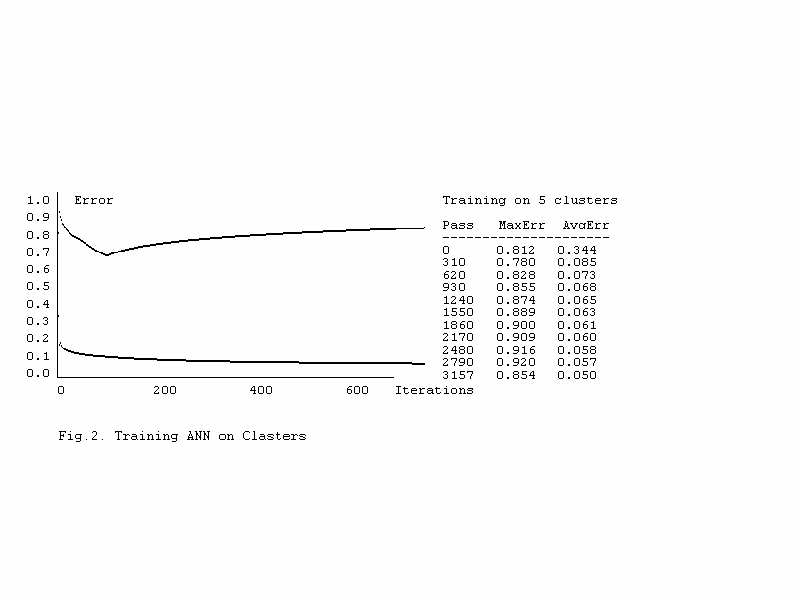
Results: The application of this software intelligent agent is first demonstrated here using the initial model. Figures 1-2 illustrate the history of training process. One function is the maximum (among training patterns) and lower function shows the average error. The latter defines duration of training process. Training terminates when the average error achieves 5%.

There was slow convergence of back-propagation algorithm applied to the training set of 96 patients. We needed 6800 iterations to achieve the sufficiently small (5%) average error.

Figure 1 shows the process of training on stage 2. It illustrates rapid convergence because we deal only with 9 patterns representing the 9 classes, formed on step 1.

Table 1 illustrates the effect of selection of maximum distance on the number of classes formed and on the production of errors. The number of classes increased with decreasing distance, but accuracy of classification does not decreased.

The rate of learning is inversely related to the number of classes. The use of the back-propagation to train on the entire data set without prior processing is slower than for the training on patterns.

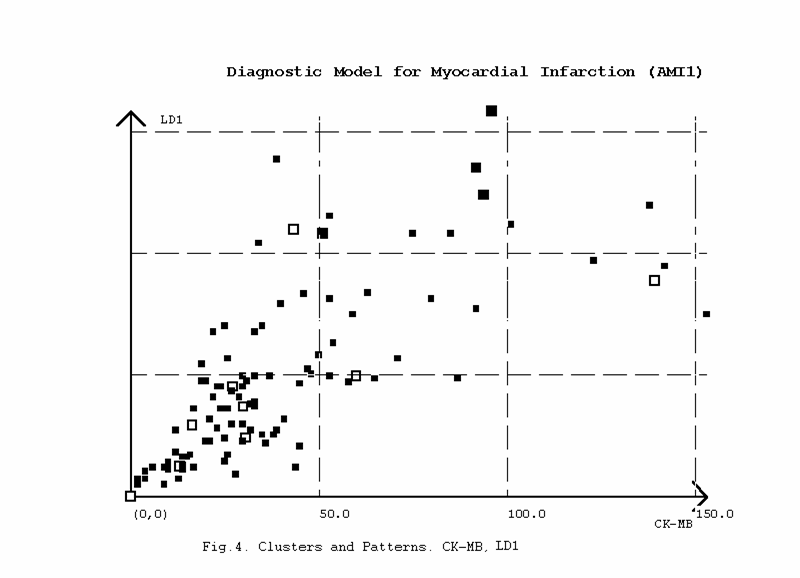
     Figures 2 is a two-dimensional projection of three-dimensional space of input variables CKMB and LD1 with small dots corresponding to the patterns and rectangular as cluster centroids (black – AMI, white – not AMI).

     We carried out a larger study using troponin I (instead of LD1) and CKMB for the diagnosis of myocardial infarction (MI).  The probabilities and odds-ratios for the TnI scaled into intervals near the entropy decision point are shown in Table 2 (N = 782).  The cross-table shows the frequencies for scaled TnI results versus the observed MI, the percent of values within MI, and the predicted probabilities and odds-ratios for MI within TnI intervals.  The optimum decision point is at or near 0.61 mg/L (the probability of MI at 0.46-0.6 mg/L is 3% and the odds ratio is at 13, while the probability of MI at 0.61-0.75 mg/L is 26% at an odds ratio of 174) by regressing the scaled values.

     The RBC, MCV criteria used were applied to a series of 40 patients different than that used in deriving the cutoffs.  A latent class cluster analysis is shown in Table 3.  MayNet is carried out on all 3 data sets for MI, CHF, and for beta thalassemia for comparison and will be shown.

Discussion:  CKMB has been heavily used for a long time to determine heart attacks. It is used in conjunction with a troponin test and the EKG to identify MI but, it isn’t as sensitive as is needed. A joint committee of the AmericanCollege of Cardiology and European Society of Cardiology (ACC/ESC) has established the criteria for acute, recent or evolving AMI predicated on a typical increase in troponin in the clinical setting of myocardial ischemia (1), which includes the 99th percentile of a healthy normal population. The improper selection of a troponin decision value is, however, likely to increase over use of hospital resources.  A study by Zarich8 showed that using an MI cutoff concentration for TnT from a non-acute coronary syndrome (ACS) reference improves risk stratification, but fails to detect a positive TnT in 11.7% of subjects with an ACS syndrome8. The specificity of the test increased from 88.4% to 96.7% with corresponding negative predictive values of 99.7% and 96.2%. Lin et al.9 recently reported that the use of low reference cutoffs suggested by the new guidelines results in markedly increased TnI-positive cases overall. Associated with a positive TnI and a negative CKMB, these cases are most likely false positive for MI. Maynet relieves this and the following problem effectively.

Monitoring BNP levels is a new and highly efficient way of diagnosing CHF as well as excluding non-cardiac causes of shortness of breath. Listening to breath sounds is only accurate when the disease is advanced to the stage in which the pumping function of the heart is impaired. The pumping of the heart is impaired when the circulation pressure increases above the osmotic pressure of the blood proteins that keep fluid in the circulation, causing fluid to pass into the lung’s airspaces.  Our studies combine the BNP with the EKG measurement of QRS duration to predict whether a patient has a high or low ejection fraction, a measure to stage the severity of CHF.

We also had to integrate the information from the hemogram (RBC, MCV) with the hemoglobin A2 quantitation (BioRad Variant II) for the diagnosis of beta thalassemia.  We chose an approach to the data that requires no assumption about the distribution of test values or the variances.   Our detailed analyses validates an approach to thalassemia screening that has been widely used, the Mentzer index10, and in addition uses critical decision values for the tests that are used in the Mentzer index. We also showed that Hgb S has an effect on both Hgb A2 and Hgb F.  This study is adequately powered to assess the usefulness of the Hgb A2 criteria but not adequately powered to assess thalassemias with elevated Hgb F.

References:

1.  Adan J, Bernstein LH, Babb J. Lactate dehydrogenase isoenzyme-1/total ratio: accurate for determining the existence of myocardial infarction. Clin Chem 1986;32:624-8.

2. Rudolph RA, Bernstein LH, Babb J. Information induction for predicting acute myocardial infarction.  Clin Chem 1988;34:2031- 2038.

3. Magidson J. “Maximum Likelihood Assessment of Clinical Trials Based on an Ordered Categorical Response.” Drug Information Journal, Maple Glen, PA: Drug Information Association 1996;309[1]: 143-170.

4. Magidson J and Vermoent J.  Latent Class Cluster Analysis. in J. A. Hagenaars and A. L. McCutcheon (eds.), Applied Latent Class Analysis. Cambridge: CambridgeUniversity Press, 2002, pp. 89-106.

5. Mkhitarian VS, Mayzlin IE, Troshin LI, Borisenko LV. Classification of the base objects upon integral parameters of the attached network. Applied Mathematics and Computers.  Moscow, USSR: Statistika, 1976: 118-24.

6.Mayzlin IE, Mkhitarian VS. Determining the optimal bounds for objects of different classes. In: Dubrow AM, ed. Computational Mathematics and Applications. MoscowUSSR: Economics and Statistics Institute. 1976: 102-105.

7. RumelhartDE, Hinton GE, Williams RJ. Learning internal representations by error propagation. In:

RumelhartDE, Mc Clelland JL, eds. Parallel distributed processing.   Cambridge, Mass: MIT Press, 1986; 1: 318-62.

8. Zarich SW, Bradley K, Mayall ID, Bernstein, LH. Minor Elevations in Troponin T Values Enhance Risk Assessment in Emergency Department Patients with Suspected Myocardial Ischemia: Analysis of Novel Troponin T Cut-off Values.  Clin Chim Acta 2004 (in press).

9. Lin JC, Apple FS, Murakami MM, Luepker RV.  Rates of positive cardiac troponin I and creatine kinase MB mass among patients hospitalized for suspected acute coronary syndromes.  Clin Chem 2004;50:333-338.

10.Makris PE. Utilization of a new index to distinguish heterozygous thalassemic syndromes: comparison of its specificity to five other discriminants.Blood Cells. 1989;15(3):497-506.

Acknowledgements:   Jerard Kneifati-Hayek and Madeleine Schlefer, Midwood High School, Brooklyn, and Salman Haq, Cardiology Fellow, Methodist Hospital.

Table 1. Effect of selection of maximum distance on the number of classes formed and on the accuracy of recognition by ANN

ClusteringDistanceFactor F(D = F * R)  Number ofClasses  Number of Nodes inThe HiddenLayers  Number ofMisrecognizedPatterns inThe TestingSet of 43 Percent ofMisrecognized   
  10.90.80.7  2414135  1, 02, 03, 01, 02, 03, 0

3, 2

3, 2

121121

1

1

2.34.62.32.34.62.3

2.3

2.3

Figure 1.

Figure 2.

Table 2.  Frequency cross-table, probabilities and odds-ratios for scaled TnI versus expected diagnosis

Range Not MI MI N Pct in MI Prob by TnI Odds Ratio
< 0.45 655 2 657 2 0 1
0.46-0.6 7 0 7 0 0.03 13
0.61-0.75 4 0 4 0. 0.26 175
0.76-0.9 13 59 72 57.3 0.82 2307
> 0.9 0 42 42 40.8 0.98 30482
679 103 782 100


Read Full Post »

A Software Agent for Diagnosis of ACUTE MI

Authors: Isaac E. Mayzlin, Ph.D.1, David Mayzlin1,Larry H. Bernstein, M.D.2

1MayNet, Carlsbad, CA, 2Department of Pathology and Laboratory Medicine, BridgeportHospital, Bridgeport, CT.

Agent-based  decision  support  systems  are  designed  to  provide  medical  staff  with  information  needed  for making critical decisions. We describe a Software Agent for evaluating multiple tests based on a large data base  especially  efficient  when  time  for  making  the  decision  is  critical  for  successful  treatment  of  serious conditions, such as stroke or acute myocardial infarction (AMI).

Goldman and others (1) developed a screening algorithm based on characteristics of the chest pain, EKG changes, and key clinical findings to separate high-risk from low-risk patients at the time they present using clinical features without using a serum marker. The Goldman algorithm was not widely used because of a 7 percent misclassification error, mostly false positives.       Nonetheless, A third of emergency room visits by patients presenting with symptoms of rule out AMI are not associated with chest pain. A related issue is the finding that a significant number of patients who are at high risk have to be identified using a cardiac marker. The use of cardiac isoenzymes has been to classify patients meeting the high risk criteria, many of whom are not subsequently found to have AMI.

Software Agent for Diagnosis based on the Knowledge incorporated in the Trained Artificial Neural Network and Data Clustering

This Software Agent is based on the combination of clustering by Euclidean distances in multi-dimensional space and non-linear  discrimination  fulfilled  by  the  Artificial  Neural  Network  (ANN)  trained  on  clusters’  averages.         Our  studies indicate that at an optimum clustering  distance the number of classes is minimized with efficient training on the ANN, retaining accuracy of classification by the ANN at 97%. The studies   conducted involve training and testing on separate clinical data sets.  We perform clustering using the geometrical (Euclidean) distance between two points in n-dimensional space,  formed  by  n  variables,  including  both  input  and  output  variables.  Since  this  distance  assumes  compatibility  of different variables, the values of all input variables are linearly transformed (scaled) to the range from 0 to 1.

The ANN technique for readers accustomed to classical statistics can be viewed as an extension of multivariate regression analyses with such new features as non-linearity and ability to process categorical data. Categorical (not continuous) variables represent two or more levels, groups, or classes of correspondent features, and in our case this concept is used to signify patient condition, for example existence or not of AMI.

Process  description. We  implemented  the  proposed  algorithm  for  diagnosis  of  AMI.  All  the  calculations  were performed on the authors’ unique Software Agent Maynet. First, using the automatic random extraction procedure, the initial data set (139 patients) was partitioned into two sets — training and testing.  This randomization also determined the size of these sets (96 and 43, respectively) since the program was instructed to assign approximately 70 % of data to the training set.

The main process consists of three successive steps:

(1)        clustering performed on training data set,

(2)        neural network’s training on clusters from previous step, and

(3)        classifier’s accuracy evaluation on testing data.

The classifier in this research will be the ANN, created on step 2, with output in the range [0,1], that provides binary result (1 – AMI, 0 – not AMI), using decision point 0.5.

In this paper we used the data of two previous studies (2,3) with three patients, potential outliers, removed (n = 139). The data contains three input variables, CK-MB, LD-1, LD-1/total LD, and one output variable, diagnoses, coded as 1 (for AMI) or 0 (non-AMI).

Table  1.  Effect  of  selection  of  maximum  distance  on  the  number  of  classes  formed  and  on  the accuracy of recognition by ANN

Clustering Distance Factor F(D = F * R) Number ofClasses Number of Nodes in The Hidden Layers Number of Misrecognized Patterns inThe TestingSet of 43 Percent ofMisrecognized
10.90.8

0.7

241413

5

1,  02,  03,  0

1,  0

2,  0

3,  0

3,  2

3,  2

121

1

2

1

1

1

2.34.62.3

2.3

4.6

2.3

2.3

2.3

Abbreviations: creatine kinase MB isoenzyme: CK-MB; lactate dehydrogenase isoenzyme-1: LD1; LD1/total LD ratio: %LD1; acute myocardial infarction: AMI; artificial neural network: ANN

Read Full Post »

Reporter: Prabodh Kandala, PhD

When it comes to the FOXP2 gene, humans have had most to shout about. Discoveries that mutations in this gene lead to speech defects and that the gene underwent changes around the time language evolved both implicate FOXP2 in the evolution of human language.

More recently, patterns of gene expression in birds, humans and rodents have suggested a wider role in the production of vocalisations. Yet numerous reports have established that FOXP2 shows very little genetic variation across even distantly related vertebrates – from reptiles to mammals — providing few extra clues as to the gene’s role.

A new study, undertaken by a joint of team of British and Chinese scientists, has found that this gene shows unparalleled variation in echolocating bats. The results, appearing in a study published in the online, open-access journal PLoS ONE on September 19, report that FOXP2 sequence differences among bat lineages correspond well to contrasting forms of echolocation.

Like speech, bat echolocation involves producing complex vocal signals via sophisticated coordination of the mouth and face. The involvement of FOXP2 in the evolution of echolocation adds weighty support to the theory that FOXP2 functions in the sensory-motor coordination of vocalisations.

Ref:

http://www.sciencedaily.com/releases/2007/09/070919073014.htm


Read Full Post »

Reporter: Prabodh Kandala, PhD

Do special “human” genes provide the biological substrate for uniquely human traits, like language?

Genetic aberrations of the human FoxP2 gene impair speech production and comprehension, yet the relative contributions of FoxP2 to brain development and function are unknown.

Songbirds are a useful model to address this because, like human youngsters, they learn to vocalize by imitating the sounds of their elders.

Previously, Dr. Constance Sharff and colleagues found that, when young zebra finches learn to sing or when adult canaries change their song seasonally, FoxP2 is up-regulated in Area X, a brain region important for song learning.

Dr. Sebastian Haesler, Dr. Scharff, and colleagues experimentally reduce FoxP2 levels in Area X before zebra finches started to learn their song. They used a virus-mediated RNA interference for the first time in songbird brains.

The birds, with lowered levels of FoxP2, imitated their tutor’s song imprecisely and sang more variably than controls.

FoxP2 thus appears to be critical for proper song development.

These results suggest that humans and birds may employ similar molecular substrates for vocal learning, which can now be further analyzed in an experimental animal system.

Abstract:

The gene encoding the forkhead box transcription factor, FOXP2, is essential for developing the full articulatory power of human language. Mutations of FOXP2 cause developmental verbal dyspraxia (DVD), a speech and language disorder that compromises the fluent production of words and the correct use and comprehension of grammar. FOXP2 patients have structural and functional abnormalities in the striatum of the basal ganglia, which also express high levels of FOXP2. Since human speech and learned vocalizations in songbirds bear behavioral and neural parallels, songbirds provide a genuine model for investigating the basic principles of speech and its pathologies. In zebra finch Area X, a basal ganglia structure necessary for song learning, FoxP2 expression increases during the time when song learning occurs. Here, we used lentivirus-mediated RNA interference (RNAi) to reduce FoxP2 levels in Area X during song development. Knockdown of FoxP2 resulted in an incomplete and inaccurate imitation of tutor song. Inaccurate vocal imitation was already evident early during song ontogeny and persisted into adulthood. The acoustic structure and the duration of adult song syllables were abnormally variable, similar to word production in children with DVD. Our findings provide the first example of a functional gene analysis in songbirds and suggest that normal auditory-guided vocal motor learning requires FoxP2.

Ref:

1. http://www.sciencedaily.com/releases/2007/12/071204091933.htm

2. http://www.ncbi.nlm.nih.gov/pmc/articles/PMC2100148/

2.


Read Full Post »

Reporter: Prabodh Kandala, PhD

Foxp2, a gene involved in speech and language, helps regulate the wiring of neurons in the brain, according to a study which will be published on July 7th in the open-access journal PLoS Genetics. The researchers identified this functional link by first identifying the major targets of Foxp2 in developing brain tissue and then analysing the function of relevant neurons.

Foxp2 codes for a regulatory protein that provides a window into unusual aspects of brain function. In 2001, scientists discovered that mutations of the human gene cause a rare form of speech and language disorder. The finding triggered a decade of intense research into the human gene and corresponding versions found in other species — for example, it has been shown to affect vocal imitation in songbirds, and learning of rapid movement sequences in mice.

In the PLoS Genetics study, the researchers, led by Dr. Sonja C. Vernes and Dr. Simon E. Fisher (The Wellcome Trust Centre for Human Genetics, University of Oxford), gained insights into the functions of Foxp2 within the developing brain by exploiting its role as a genetic dimmer switch, turning up or down the amount of product made by other genes. In their large-scale screening of embryonic brain tissue, they identified many novel targets regulated by Foxp2. Remarkably, many of these targets were known to be important for connectivity of the central nervous system. The team went on to show that changing Foxp2 levels in neurons impacted on the length and branching of neuronal projections, a key route for modulating the wiring of the developing brain.

“Studies like this are crucial for building bridges between genes and complex aspects of brain function” says Dr. Fisher, who is also director of a newly established Language and Genetics department at the Max Planck Institute for Psycholinguistics, The Netherlands. The research was carried out with mouse models, since they can be used to comprehensively analyse genetic networks in a way that remains difficult in the human brain. However, “the current study provides the most thorough characterisation of Foxp2 target pathways to date,” notes Dr. Fisher. “It offers a number of compelling new candidate genes that could be investigated in people with language problems.”

Abstract:

Forkhead-box protein P2 is a transcription factor that has been associated with intriguing aspects of cognitive function in humans, non-human mammals, and song-learning birds. Heterozygous mutations of the human FOXP2 gene cause a monogenic speech and language disorder. Reduced functional dosage of the mouse version (Foxp2) causes deficient cortico-striatal synaptic plasticity and impairs motor-skill learning. Moreover, the songbird orthologue appears critically important for vocal learning. Across diverse vertebrate species, this well-conserved transcription factor is highly expressed in the developing and adult central nervous system. Very little is known about the mechanisms regulated by Foxp2 during brain development. We used an integrated functional genomics strategy to robustly define Foxp2-dependent pathways, both direct and indirect targets, in the embryonic brain. Specifically, we performed genome-wide in vivo ChIP–chip screens for Foxp2-binding and thereby identified a set of 264 high-confidence neural targets under strict, empirically derived significance thresholds. The findings, coupled to expression profiling and in situ hybridization of brain tissue from wild-type and mutant mouse embryos, strongly highlighted gene networks linked to neurite development. We followed up our genomics data with functional experiments, showing that Foxp2 impacts on neurite outgrowth in primary neurons and in neuronal cell models. Our data indicate that Foxp2 modulates neuronal network formation, by directly and indirectly regulating mRNAs involved in the development and plasticity of neuronal connections.

Ref:

http://www.sciencedaily.com/releases/2011/07/110707173316.htm

http://www.plosgenetics.org/article/info%3Adoi%2F10.1371%2Fjournal.pgen.1002145

Read Full Post »

Reporter: Prabodh Kandala, PhD

Scientists of the German Mouse Clinic at Helmholtz Zentrum München have made a major contribution to understanding human language development. Using a comprehensive screening method, they studied a mouse model carrying a “humanized version” of a key gene associated with human language.

In the brains of the mice the researchers found alterations which may be closely linked to speech and language development. Their analyses comprise part of an international study led by the Leipzig Max Planck Institute for Evolutionary Anthropology. The findings have been published in the current issue of the journal Cell.

Scientists of the German Mouse Clinic at Helmholtz Zentrum München have generated and analyzed a mouse model in which parts of the human Foxp2 gene were introduced. Foxp2 is known to be a key gene for language. Since the human and chimpanzee lineages diverged, only minimal genetic alterations have occurred, even with reference to the mouse: The alterations, as scientists surmised, are closely associated with speech and language ability. However, proof on a functional level has been lacking until now.

The Helmholtz scientists in the German Mouse Clinic conduct comprehensive analyses to elucidate which organs are influenced by a gene – in this case the Foxp2 gene. “It is rare for a gene to have only one function,” explained Professor Martin Hrabé de Angelis, director of the German Mouse Clinic. That is why a comprehensive research approach like that of the German Mouse Clinic is so crucial – to ensure that relevant gene functions can be identified in the mouse phenotype.

The study of the Foxp2 mice was funded within the scope of the National Genome Research Network (NGFN). As with each mouse lineage studied in the German Mouse Clinic, the Helmholtz scientists analyzed the Foxp2 mice by screening for more than 300 parameters, including the ability to see and hear, bone density, important metabolic functions and a number of neurological functions. The mice carrying the humanized Foxp2 gene showed no physiological abnormalities. However, behavioral tests showed an altered exploratory behavior and reduced movement activity – both results point to altered brain functions. Further investigations carried out by the colleagues in Leipzig supported and confirmed the findings.

In a second step to further substantiate this hypothesis, the Helmholtz scientists analyzed the heterozygous knockout mouse model in which one of the normally two copies of the Foxp2 gene is missing. This loss leads to serious changes: The ability of the mice to hear and learn is diminished in comparison to their healthy littermates; they have more fat and less muscle, and they eat more and consume more energy. Moreover, they have altered blood parameters.

“We were able to show that the Foxp2 gene has significant influence on various organ systems,” Martin Hrabé de Angelis said. “Our research supports the hypothesis of our colleagues in Leipzig that specifically these alterations in the brain were the evolutionary step that gave humans the advantage of speech and language.” Furthermore, the involvement of the Hrabé de Angelis team in the Leipzig study demonstrates the usefulness of the German Mouse Clinic. Only through broad-based, comprehensive analysis can scientists recognize even unexpected effects of genetic defects and thus identify additional functions of known genes.

Abstract:

It has been proposed that two amino acid substitutions in the transcription factor FOXP2 have been positively selected during human evolution due to effects on aspects of speech and language. Here, we introduce these substitutions into the endogenous Foxp2 gene of mice. Although these mice are generally healthy, they have qualitatively different ultrasonic vocalizations, decreased exploratory behavior and decreased dopamine concentrations in the brain suggesting that the humanized Foxp2 allele affects basal ganglia. In the striatum, a part of the basal ganglia affected in humans with a speech deficit due to a nonfunctional FOXP2allele, we find that medium spiny neurons have increased dendrite lengths and increased synaptic plasticity. Since mice carrying one nonfunctional Foxp2 allele show opposite effects, this suggests that alterations in cortico-basal ganglia circuits might have been important for the evolution of speech and language in humans.

Ref:

http://www.sciencedaily.com/releases/2012/08/120810193755.htm

http://www.cell.com/retrieve/pii/S009286740900378X

Read Full Post »

Reporter: Prabodh Kandala, PhD

If humans are genetically related to chimps, why did our brains develop the innate ability for language and speech while theirs did not?

Part of the answer to this mystery lies in a gene called FOXP2. When mutated, FOXP2 can disrupt speech and language in humans. Now, a UCLA/Emory study reveals major differences between how the human and chimp versions of FOXP2 work, perhaps explaining why language is unique to humans.

The findings from this study provide insight into the evolution of the human brain and may point to possible drug targets for human disorders characterized by speech disruption, such as autism and schizophrenia.

Earlier research suggests that the amino-acid composition of human FOXP2 changed rapidly around the same time that language emerged in modern humans. This is the first study to examine the effect of these amino-acid substitutions in FOXP2 in human cells.

We showed that the human and chimp versions of FOXP2 not only look different but function differently too. These findings may shed light on why human brains are born with the circuitry for speech and language and chimp brains are not.

FOXP2 switches other genes on and off. Geschwind’s lab scoured the genome to determine which genes are targeted by human FOXP2. The team used a combination of human cells, human tissue and post-mortem brain tissue from chimps that died of natural causes.

The chimp brain dissections were performed in the laboratory of coauthor Todd Preuss, associate research professor of neuroscience at Emory University’s Yerkes National Primate Research Center.

The scientists focused on gene expression — the process by which a gene’s DNA sequence is converted into cellular proteins.

To their surprise, the researchers discovered that the human and chimp forms of FOXP2 produce different effects on gene targets in the human cell lines.

This study found that a significant number of the newly identified targets are expressed differently in human and chimpanzee brains. This suggests that FOXP2 drives these genes to behave differently in the two species.

The research demonstrates that mutations believed to be important to FOXP2’s evolution in humans change how the gene functions, resulting in different gene targets being switched on or off in human and chimp brains.

Genetic changes between the human and chimp species hold the clues for how our brains developed their capacity for language. By pinpointing the genes influenced by FOXP2, this interesting study shows a new set of tools for studying how human speech could be regulated at the molecular level.

The discovery will provide insight into the evolution of humans’ ability to learn through the use of higher cognitive skills, such as perception, intuition and reasoning.

This study demonstrates how critical chimps and macaques are for studying humans. They open a window into understanding how we evolved into who we are today.

Because speech problems are common to both autism and schizophrenia, the new molecular pathways will also shed light on how these disorders disturb the brain’s ability to process language.

Ref:

http://www.sciencedaily.com/releases/2009/11/091111130942.htm


Read Full Post »

Reporter: Prabodh Kandala, PhD

Singing mice (scotinomys teguina) are not your average lab rats. Their fur is tawny brown instead of the common white albino strain; they hail from the tropical cloud forests in the mountains of Costa Rica; and, as their name hints, they use song to communicate.

University of Texas at Austin researcher Steven Phelps is examining these unconventional rodents to gain insights into the genes that contribute to the unique singing behavior — information that could help scientists understand and identify genes that affect language in humans.

“We can choose any number of traits to study but we try and choose traits that are not only interesting for their own sake but also have some biomedical relevance,” said Phelps. “We take advantage of the unique property of the species.”

The song of the singing mouse song is a rapid-fire string of high-pitched chirps called trills used mostly used by males in dominance displays and to attract mates. Up to 20 chirps are squeaked out per second, sounding similar to birdsong to untrained ears. But unlike birds, the mice generally stick to a song made up of only a single note.

“They sound kind of soft to human ears, but if you slow them down by about three-fold they are pretty dramatic,” said Phelps.

Most rodents make vocalizations at a frequency much too high for humans to hear. But other rodents typically don’t vocalize to the extent of singing mice, which use the song to communicate over large distances in the wild, said Andreas George, a graduate student working in Phelps’ lab.

Within the last year Phelps research on the behavior of the mouse has appeared in the journals Hormones and Behaviorand Animal Behavior. But one of his newest research projects is looking deeper: examining the genetic components that influence song expression. Center stage is a special gene called FOXP2.

“FOXP2 is famous because it’s the only gene that’s been implicated in human speech disorders specifically,” said Phelps.

Having at least one mutated copy of the gene has been associated with a host of language problems in humans, from difficulty understanding grammar to an inability to make the precise mouth movements needed to speak a clear sentence.

The FOXP2 gene is remarkably similar overall between singing mice, lab mice and humans, said Phelps. To find parts of the gene that may contribute to the singing mouse’s songs, Phelps is searching for sequences unique to the singing mouse and testing them for evidence of natural selection, which weeds out mutations with no likely observable effect from those that are likely to contribute to singing behavior.

“Those two things go a long way,” said Phelps, ” And when you look at the intersection of those two things they give us a really good set of candidate regions for what might be causing species differences.”

The Molecular Connection

Most genetic mutations don’t cause serious problems. They are often a part of the genome that is not expressed, still make a functional product, or are simply drowned out by the amount of genes and gene products that are working correctly.

FOXP2 mutations, on the other hand, can have significant effects on speech because of the gene’s role as a transcription factor — a gene product that helps control the expression of other genes.

This means a mutation in the FOXP2 gene can start a chain of events that can lead to reduced expression, or possibly even no expression, of a number of other genes.

Phelps and his team are figuring out what activates FOXP2 expression and the genes that are expressed after its activation by playing singing mice recording of songs from their own species and neighboring species and observing the gene expression patterns.

“We found that when an animal hears a song from the same species, these neurons that carry FOXP2 become activated. So we think that FOXP2 may play a role in integrating that information,” said Lauren O’Connell, a post-doctoral researcher in the Phelps lab.

Learning what activates FOXP2 and what genes are activated by it could provide clues into how outside stimuli affects gene expression and what genes are important in the understanding and integration of information, said Phelps.

“We ask two things, whether there are sequence changes in the DNA that are associated with the elaboration of the song and whether particular elements seem to be interacting with FOXP2 more,” said Phelps. “That gives us leads into what role FOXP2 might play into the elaboration of vocalization.”

Big Data Mining

Phelps’ uses next-generation sequencing to decipher how FOXP2 interacts with DNA to regulate the function of other genes. The process involves reading tiny fragments of overlapping DNA so that the entire sequence can be deduced. It is a procedure that generates massive amount of data that only the processing power of a supercomputer can handle, said O’Connell.

“You need TACC to do it,” said O’Connell, referring to the Texas Advanced Computing Center, which houses the supercomputers the lab uses. “The more data you have, the more memory it requires, so a lot of the data we can only process on Lonestar’s high memory nodes.”

Lonestar and Ranger are the names of the two supercomputers that the Phelps lab uses to crunch their data, with Ranger running programs in two hours that used to take the lab three days to run on their desktop. Both computers are among the top 100 supercomputers in the world.

Future Applications

At the most basic level, Phelps’ research is asking questions about the biology and behavior of an exotic rodent. But finding out more about the link between FOXP2 and the song of the signing mouse could bring a better understanding into how the gene may contribute to language deficits in people, especially those with autism, said Phelps.

“When people do genome wide association studies in humans the genetic variation tends to occur in huge blocks. So if you get some DNA sequence that predicts a phenotype, like risk for autism, it’s very hard to know what aspect in this very long stretch of DNA is actually important for that,” said Phelps.

By identifying the sequences of DNA that interact with FOXP2 and other associated genes that are most vital to gene function, researchers in the future might be able to narrow down the “huge blocks” where a possible causal sequence is located into smaller pieces. In other words, reducing the size of the metaphorical haystack to a size where finding the needle is a much simpler task.

While a singing mouse may seem like a strange place to look to study the impact of genetics on language, O’Connell says that the advent of gene sequencing technology is allowing a whole menagerie of animals to be used for research that could later be applied to humans.

“I use TACC to sequence a lot of different animals: birds and fish and frogs and mammals and beetles,” said O’Connell, mentioning the other organisms she studies outside of the Phelps lab. “Each of these model systems has something unique to contribute that teaches us about biology that is still applicable to humans.”

Abstracts:

1. Androgens are an important class of steroid hormones involved in modulating the expression and evolution of male secondary sex characters. Vocalizations used in the context of aggression and mate attraction are among the most elaborate and diverse androgen-dependent animal displays as reflected in a rich tradition of studies on bird song and anuran calls. Male Alston’s singing mice (Scotinomys teguina) commonly emit trilled songs that appear to function in male–male aggression. In this study, we experimentally manipulated androgens in singing mice to assess their role in modulating aggression and song effort. Testosterone- and DHT-treated animals retained aggressive and song attributes similarly. However, castrated mice administered empty implants showed more subordinate behavior and sang fewer songs that were shorter, lower in power, higher in frequency, and less stereotyped. The extensive effects of androgens on a suite of phenotypes highlight their role in linking gonadal status with decisions about investment in reproductive behaviors.

2.

Vocalizations used in aggressive and mating contexts often convey reliable information about signaller condition when physical or physiological limitations constrain signal expression. In vertebrates, androgens modulate the expression of vocal signals and provide a proximate link between male condition and signal form. In many songbirds, assessment of males is based on production of trills that are constrained by a performance trade-off between how fast notes are repeated and the frequency bandwidth of each note. In this study, we first recorded trills of male Neotropical singing mice (Scotinomys) to examine whether they show a similar performance trade-off, and then manipulated androgen levels to assess their role in modulating vocal performance. Lastly, we broadcast experimentally manipulated trills to females to determine whether they preferred versions resembling those of androgen-treated males. Singing mice showed a vocal performance trade-off similar to that of birds. Males treated with androgens maintained vocal performance, but castrated mice that were administered empty implants produced trills with lower performance. Females approached high-performance trills more rapidly and spent more time near corresponding speakers. Together, our results demonstrate that androgens modulate the production of physically challenging vocalizations, and the resulting signal variation influences female receiver response.

Ref:

1. http://www.sciencedaily.com/releases/2012/08/120810193755.htm

2. http://www.sciencedirect.com/science/article/pii/S0018506X10002746

3. http://www.sciencedirect.com/science/article/pii/S0003347211001795


Read Full Post »

Aspirin a Day Tied to Lower Cancer Mortality

Reporter: Aviva Lev-Ari, PhD, RN

Aspirin a Day Tied to Lower Cancer Mortality

Download Complimentary Source PDF 

Daily aspirin use is associated with a modest decrease in mortality from cancer, particularly for malignancies of the gastrointestinal tract, a large retrospective study confirmed.

Individuals who were current daily users for 5 years or more at baseline had an 8% decrease in cancer mortality compared with non-users (RR 0.92, 95% CI 0.83 to 1.02), according to Eric J. Jacobs, PhD, and colleagues from the American Cancer Society in Atlanta.

The association was stronger, with a 16% decrease for those with daily use for 5 years or more, when the analysis included data collected periodically during 2 decades of follow-up (RR 0.84, 95% CI 0.75 to 0.95), the researchers reported in the Journal of the National Cancer Institute.

A recent pooled analysis of more than 50 trials involving aspirin use for cardioprotection found a 37% reduction in deaths from cancer among users, which was considerably greater than in observational studies and trials of alternate-day aspirin.

To clarify the magnitude of the association between aspirin use and overall cancer mortality, Jacobs and colleagues analyzed data from the Cancer Prevention Study II, which began in 1992 and included 100,139 participants who completed questionnaires with information on demographics, medical history, and behavioral influences.

Beginning in 1997, participants also provided information about aspirin use, and continued to provide updates every 2 years.

The 1997 questionnaire was considered the baseline for the analysis, at which time 23.8% of participants were using either low-dose or adult-strength aspirin.

More than half of participants were older than 60 and female, and almost all were white.

During the 20 years of follow-up, there were 5,138 deaths from cancer.

Among those who reported aspirin use in 1997, three-quarters said they were still taking it in 2003, while among those who were non-users at baseline, 25% had begun doing so.

Baseline aspirin users tended to be more educated, former smokers, and obese, as well as to have a history of cardiovascular disease and diabetes.

Male users also were more likely to have a history of prostate specific antigen (PSA) testing, and women users were more likely to have a history of mammography.

Overall mortality was slightly lower even for individuals who had been users for less than 5 years (RR 0.84, 95% CI 0.76 to 0.94).

Relative risks were similar for users of low-dose and full-strength aspirin, and for those with and without a history of cardiovascular disease, ranging from 0.82 (95% CI 0.72 to 0.91) to 0.95 (95% CI 0.86 to 1.04).

Current users who had never smoked had considerably lower mortality (RR 0.68, 95% CI 0.57 to 0.81), a reduction that was not seen for former smokers (RR 0.92, 95% CI 0.82 to 1.04) or those currently smoking (RR 0.91, 95% CI 0.70 to 1.19).

Even after discounting lung cancer deaths, the only lower mortality among aspirin users was for never-smokers (RR 0.67, 95% CI 0.56 to 0.81).

A possible explanation for the lack of effect on cancers other than those in the lung among ever-smokers is that smoking may attenuate the antiplatelet activity of aspirin, and activated platelets are thought to promote tumor metastases, the researchers explained.

Aspirin use at the 1997 baseline was not significantly associated with mortality from specific cancers, but differences were seen when data through 2008 were included in the analysis:

  • Cancers within the gastrointestinal tract, RR 0.61 (95% CI 0.44 to 0.84)
  • Cancers outside the gastrointestinal tract, RR 0.88 (95% CI 0.78 to 1)
  • Colorectal cancer, OR 0.64 (95% CI 0.42 to 0.98)
  • Esophageal and stomach cancer, RR 0.56 (95% CI 0.37 to 0.86)

“The reduction in overall cancer mortality was driven by both a substantial reduction in mortality from gastrointestinal tract cancers and a small, but statistically significant, reduction in mortality from cancers outside the gastrointestinal tract,” they stated.

They noted that their study was observational, which was an important limitation, in that confounding factors could have resulted in either an underestimate or an overestimate of the effects of aspirin on mortality.

Also, the absolute risk for cancer mortality between non-users and daily long-term aspirin users — approximately 100 per 100,000 person-years for men and about 40 per 100,000 person-years for women — would represent an important benefit of aspirin use if it were causal, the authors stated.

“However, even if causal, differences in absolute rates are likely to differ between our predominantly elderly population and younger populations at much lower risk of cancer mortality,” they warned.

They concluded that the “relatively modest benefit” seen in their analysis could “meaningfully influence the balances of risks and benefits of prophylactic aspirin use.”

In an accompanying editorial, John Baron, MD, of the University of North Carolina in Chapel Hill, offered a word of caution. Baron was the lead author of the meta-analysis on aspirin use and cancer risk.

“Just because aspirin is effective does not mean it necessarily should be used,” he argued.

“Aspirin is a real drug, with definite toxicity. As for any preventative intervention, the benefits must be balanced against the risks, particularly when the benefits are delayed whereas the risks are not,” Baron stated.

The American Cancer Society funds the Cancer Prevention Study II cohort.

The authors are employees of the American Cancer Society.

Editorialist Baron has been a consultant for Bayer, and holds a use patent for aspirin chemoprevention.

Primary source: Journal of the National Cancer Institute
Source reference:
Jacobs E, et al “Daily aspirin use and cancer mortality in a large US cohort” JNCI 2012; DOI: 10.1093/jnci/djs318.

Additional source: Journal of the National Cancer Institute
Source reference:
Baron JA, et al “Aspirin and cancer: trials and observational studies” JNCI 2012; DOI: 10.1093/jnci/djs318.

Read Full Post »

« Newer Posts - Older Posts »