Feeds:
Posts
Comments

McKinsey Top Ten Articles on Artificial Intelligence: 2018’s most popular articles – An executive’s guide to AI

Reporter: Aviva Lev-Ari, PhD, RN

3.4.1

3.4.1   McKinsey Top Ten Articles on Artificial Intelligence: 2018’s most popular articles – An executive’s guide to AI, Volume 2 (Volume Two: Latest in Genomics Methodologies for Therapeutics: Gene Editing, NGS and BioInformatics, Simulations and the Genome Ontology), Part 2: CRISPR for Gene Editing and DNA Repair

TOP TEN | ARTIFICIAL INTELLIGENCE 2018
The year’s most popular articles on artificial intelligence

An executive’s guide to AI

1. An executive’s guide to AI
Staying ahead in the accelerating artificial-intelligence race requires executives to make nimble, informed decisions about where and how to employ AI in their business. One way to prepare to act quickly: know the AI essentials presented in this guide. More →

Notes from the AI frontier: Applications and value of deep learning

2. Notes from the AI frontier: Applications and value of deep learning
An analysis of more than 400 use cases across 19 industries and nine business functions highlights the broad use and significant economic potential of advanced AI techniques. More →

What AI can and can’t do (yet) for your business

3. What AI can and can’t do (yet) for your business
Artificial intelligence is a moving target. Here’s how to take better aim. More →

4. The economics of artificial intelligence
Rotman School of Management professor Ajay Agrawal explains how AI changes the cost of prediction and what this means for business. More →

5. Notes from the AI frontier: Modeling the impact of AI on the world economy
Artificial intelligence has large potential to contribute to global economic activity. But widening gaps among countries, companies, and workers will need to be managed to maximize the benefits. More →

6. The executive’s AI playbook
It’s time to break out of pilot purgatory and more effectively apply artificial intelligence and advanced analytics throughout your organization. Our interactive playbook can help. More →

7. Artificial intelligence: Why a digital base is critical
Early AI adopters are starting to shift industry profit pools. Companies need strong digital capabilities to compete. More →

8. The promise and challenge of the age of artificial intelligence
AI promises considerable economic benefits, even as it disrupts the world of work. These three priorities will help achieve good outcomes. More →

9. The real-world potential and limitations of artificial intelligence
Artificial intelligence has the potential to create trillions of dollars of value across the economy—if business leaders work to understand what AI can and cannot do. More →

10. How artificial intelligence and data add value to businesses
Artificial intelligence will transform many companies and create completely new types of businesses. The cofounder of Coursera, AI Fund, and Landing.AI shares how businesses can benefit. More →

SOURCE

From: McKinsey Top Ten <publishing@email.mckinsey.com>

Reply-To: support@email.mckinsey.com” <support-HP2v40000016815507486b77a82f4bbc782e8252@email.mckinsey.com>

Date: Thursday, January 3, 2019 at 3:03 PM

To: Aviva Lev-Ari <AvivaLev-Ari@alum.berkeley.edu>

Subject: Artificial Intelligence: 2018’s most popular articles

Reporter and Curator: Dr. Sudipta Saha, Ph.D.


Clostridium difficile-associated disease, a significant problem in healthcare facilities, causes an estimated 15,000 deaths in the United States each year. Clostridium difficile, commonly referred to as C. diff, is a bacterium that infects the colon and can cause diarrhea, fever, and abdominal pain. Clostridium difficile-associated disease (CDAD) most commonly occurs in hospitalized older adults who have recently taken antibiotics. However, cases of CDAD can occur outside of healthcare settings as well.


Although antibiotics often cure the infection, C. diff can cause potentially life-threatening colon inflammation. People with CDAD usually are treated with a course of antibiotics, such as oral vancomycin or fidaxomicin. However, CDAD returns in approximately 20 percent of people who receive such treatment, according to the Centers for Disease Control and Prevention (CDC).


Multiple research studies have indicated that fecal microbiota transplantation (FMT) is an effective method for curing patients with repeat C. diff infections. However, the long-term safety of FMT has not been established. Although more research is needed to determine precisely how FMT effectively cures recurrent CDAD, the treatment appears to rapidly restore a healthy and diverse gut microbiome in recipients. Physicians perform FMT using various routes of administration, including oral pills, upper gastrointestinal endoscopy, colonoscopy, and enema.


A research consortium recently began enrolling patients in a clinical trial examining whether FMT by enema (putting stool from a healthy donor in the colon of a recipient) is safe and can prevent recurrent CDAD, a potentially life-threatening diarrheal illness. Investigators aim to enroll 162 volunteer participants 18 years or older who have had two or more episodes of CDAD within the previous six months.


Trial sites include Emory University in Atlanta, Duke University Medical Center in Durham, North Carolina, and Vanderbilt University Medical Center in Nashville, Tennessee. Each location is a Vaccine and Treatment Evaluation Unit (VTEU), clinical research sites joined in a network funded by the National Institute of Allergy and Infectious Diseases (NIAID), part of the National Institutes of Health. This randomized, controlled trial aims to provide critical data on the efficacy and long-term safety of using FMT by enema to cure C. diff infections.


Volunteers will be enrolled in the trial after completing a standard course of antibiotics for a recurrent CDAD episode, presuming their diarrhea symptoms cease on treatment. They will be randomly assigned to one of two groups. The first group (108 people) will take an anti-diarrheal medication and receive a stool transplant (FMT) delivered by retention enema. The second group (54 people) will take an anti-diarrheal medication and receive a placebo solution delivered by retention enema.


Participants in either group who have diarrhea with stools that test positive for C. diff shortly after the enema will be given an active stool transplant for a maximum of two FMTs. If participants in either group have another C. diff infection after receiving two FMTs, then they will be referred to other locally available treatment options. Investigators will evaluate the stool specimens for changes in gut microbial diversity and infectious pathogens and will examine the blood samples for metabolic syndrome markers.


To learn more about the long-term outcomes of FMT, the researchers will monitor all participants for adverse side effects for three years after completing treatment for recurrent CDAD. Investigators will also collect information on any new onset of CDAD, related chronic medical conditions or any other serious health issues they may have.


References:


https://www.nih.gov/news-events/news-releases/clinical-trial-testing-fecal-microbiota-transplant-recurrent-diarrheal-disease-begins


https://www.ncbi.nlm.nih.gov/pmc/articles/PMC4749851/


https://bmjopengastro.bmj.com/content/3/1/e000087


https://jamanetwork.com/journals/jama/fullarticle/2635633


https://www.hopkinsmedicine.org/gastroenterology_hepatology/clinical_services/advanced_endoscopy/fecal_transplantation.html


https://en.wikipedia.org/wiki/Fecal_microbiota_transplant


https://www.openbiome.org/about-fmt/


https://taymount.com/faecal-microbiota-transplantation-fmt


@Amazon.com @pharma_BI BUNDLES for $274 #Patients #Voices #Precision #Medicine #Physiology #Genomics #Therapeutics #3D #BioPrinting: Series E: Volumes 1,2,3,4 by Editors:

Larry H Bernstein @bernstein_h  

Gail Thornton @GailThornt 

Aviva Lev-Ari @AVIVA1950 


Article ID #263: @Amazon.com @pharma_BI BUNDLES for $274 #Patients #Voices #Precision #Medicine #Physiology #Genomics #Therapeutics #3D #BioPrinting: Series E: Volumes 1,2,3,4 by Editors:  Larry H Bernstein @bernstein_h   Gail Thornton @GailThornt  Aviva Lev-Ari @AVIVA1950. Published on 1/20/2019

WordCloud Image Produced by Adam Tubman

Series E: Patient-Centered Medicine – LINKS to e-Books & Cover Pages for Volumes 1,2,3,4


  • Volume 1: The VOICES of Patients, Hospitals CEOs, Health Care Providers, Caregivers and Families: Personal Experience with Critical Care and Invasive Medical Procedures. On Amazon.com  since 10/16/2017

https://www.amazon.com/dp/B076HGB6MZ

 
  • Volume 2: Medical Scientific Discoveries for the 21st Century & Interviews with Scientific Leaders. On Amazon.com since12/9/2017

https://www.amazon.com/dp/B078313281


  • Volume 3: Milestones in Physiology: Discoveries in Medicine, Genomics and Therapeutics. On Amazon.com since 12/27/2015

http://www.amazon.com/dp/B019VH97LU

 
  • Volume 4: Medical 3D BioPrinting – The Revolution in Medicine, Technologies for Patient-centered Medicine: From R&D in Biologics to New Medical Devices. On Amazon.com  since 12/30/2017

https://www.amazon.com/dp/B078QVDV2W


Palmaz, Pinchuk, Schatz, Simpson and Yock are the 10th recipients of the Russ Prize for innovations leading to the widespread adoption of PCI at NAE Gala Ceremony, 2/20/2019, WashDC

Reporter: Aviva Lev-Ari, PhD, RN

Article ID #262: Palmaz, Pinchuk, Schatz, Simpson and Yock are the 10th recipients of the Russ Prize for innovations leading to the widespread adoption of PCI at NAE Gala Ceremony, 2/20/2019, WashDC. Published on 1/16/2019

WordCloud Image Produced by Adam Tubman


National Academy of Engineering, Ohio University Award 2019 Russ Prize

Five interventional cardiologists awarded biennial $500,000 prize for innovations leading to the widespread adoption of PCI

National Academy of Engineering, Ohio University Award 2019 Russ Prize

January 3, 2019 — Ohio University and the National Academy of Engineering announced the 2019 Fritz J. and Dolores H. Russ Prize will be given to Julio Palmaz, Leonard Pinchuk, John Simpson, Richard Schatz and Paul Yock for innovations leading to the widespread adoption of percutaneous coronary intervention (PCI), also known as angioplasty with stent or coronary angioplasty. The $500,000 biennial prize, which recognizes a bioengineering achievement that significantly improves the human condition, cites PCI for “seminal contributions to coronary angioplasty, enabling minimally invasive treatment of advanced coronary artery disease.”

“The Russ Prize recipients personify engineering creations that advance health and healthcare every day,” said NAE President C. D. Mote, Jr.  “The PCI makes a remarkable contribution to patient well-being, helping millions afflicted with advanced coronary artery disease and significant angina. “

Ohio University alumnus and esteemed engineer Fritz Russ, BSEE ’42, HON ‘75, and his wife, Dolores Russ, established the biennial prize in 1999 with a multimillion dollar gift to Ohio University. They modeled it after the Nobel Prize, with the goal of recognizing bioengineering achievements worldwide that are in widespread use.

“This innovation — truly, sets of innovations — enables the treatment of coronary artery disease without the complexities, cost and risk of open heart surgery. Most of us have a friend or relative who has benefited greatly from angioplasty treatment,” said Russ College Dean Dennis Irwin. “These contributions have truly improved the human condition. Rewarding such innovations was the Russes’ intent.”

Percutaneous coronary intervention, also referred to as percutaneous transluminal coronary angioplasty (PTCA), is a minimally invasive procedure that uses a catheter to place a small structure called a stent to open up blood vessels in the heart that have been narrowed by plaque buildup. PCI improves blood flow, thus decreasing heart-related chest pain, making patients feel better and increasing their ability to be active. Ten of millions of patients have benefited from PCI worldwide, and this procedure has replaced or significantly delayed the need for open heart coronary bypass surgery.

Julio C. Palmaz, inventor of the first U.S. Food and Drug Administration (FDA)-approved balloon-expandable vascular stent (1990), is Ashbel Smith Professor at the University of Texas Health Science Center in San Antonio and scientific adviser of Vactronix Scientific. The Palmaz stent is on display at the Smithsonian’s National Museum of American History in Washington, D.C. In 1994 he and Richard Schatz created a modified coronary stent — two Palmaz stents joined by a single connector — approved by the FDA as the first stent indicated for the treatment of failure of coronary balloon angioplasty. The Palmaz-Schatz stent became the gold standard for every subsequent stent submitted for FDA approval.

Leonard Pinchuk is an inventor and entrepreneur in biomedical engineering, with 128 U.S. patents and 90 publications. He has co-founded 10 companies where his major accomplishments include invention of the Nylon 12 angioplasty balloon, helical wire stent, modular stent-graft, a drug-eluting stent (Taxus), several biomaterials (Bionate and polystyrene-block-isobutylene-block-styrene [SIBS]), a novel glaucoma tube (InnFocus MicroShunt), and the next-generation intraocular lens. He is a Distinguished Research Professor of Biomedical Engineering at the University of Miami.

John Simpson has helped revolutionize the field of cardiology through innovations that fundamentally altered how physicians treat cardiovascular disease. In 1981 he created a new catheter system for coronary angioplasty with an independently steerable guidewire in the central lumen of the balloon catheter, patented as the over-the-wire balloon angioplasty catheter. He now focuses his efforts on the treatment of vascular disease through the development of new technologies combined with a new approach to optical imaging.

Read the related article “Requirements for Interventional Echocardiographers”

Richard Schatz is research director of cardiovascular interventions at the Scripps Heart, Lung and Vascular Center, and director of gene and stem cell therapy. He is a recognized international expert in interventional cardiology and has published and lectured extensively. His seminal work in coronary stents spurred a revolution in the treatment of coronary artery disease — over 2 million of them are placed annually worldwide, with an immeasurable impact on relieving mortality and morbidity, improving patients’ lives, and reducing healthcare costs.

Paul Yock is the Martha Meier Weiland Professor of Medicine and founding co-chair of Stanford’s Department of Bioengineering, with courtesy appointments in the Graduate School of Business and the Department of Mechanical Engineering. He is also founder and director of the Stanford Byers Center for Biodesign. He has authored over 300 peer-reviewed publications, chapters, and editorials and two textbooks, and holds over 50 U.S. patents. Yock is internationally known for his work in inventing, developing and testing new devices, including the Rapid Exchange stenting and balloon angioplasty system, which is now the primary system in use worldwide. He also invented the fundamental approach to intravascular ultrasound imaging and founded Cardiovascular Imaging Systems (CVIS), later acquired by Boston Scientific.

“Ohio University is honored to join the National Academy of Engineering in recognizing these accomplished individuals, who have contributed to a bioengineering advancement that has enabled better health for heart patients across the world,” said Ohio University President M. Duane Nellis. “Their multi-disciplinary collaboration that lead to the development of PCI, a technology that has revolutionized coronary health, truly embraces the vision that Fritz and Dolores Russ had when creating the Russ Prize.”

Palmaz, Pinchuk, Schatz, Simpson and Yock are the 10th recipients of the Russ Prize. They will receive the award at a National Academy of Engineering gala ceremony in Washington, D.C., on Feb. 20, 2019

For more information: www.nae.edu

Morbid Obesity linked to socioeconomic status was in a Twin Pairs Research on effects of genes and environment in 560 common conditions – Disease and Health by ZIP code (Environment) and genetic code (Human Genome)

Reporter: Aviva Lev-Ari, PhD, RN


  • Senior study author Chirag Patel, assistant professor of biomedical informatics in the Blavatnik Institute at HMS.
  • Co-investigators were Braden Tierney and Arjun Manrai of Harvard Medical School, and
  • Jian Yang and Peter Visscher of the University of Queensland, Australia.

Data sets for the study were provided by Aetna insurance company. Aetna had no funding role in the study. The research was supported by the Australian National Health and Medical Research Council (grants 1078037 and 1113400), National Science Foundation (grant 1636870), and Sylvia and Charles Viertel Charitable Foundation.


Detailed study results available here: http://apps.chiragjpgroup.org/catch/

Conclusions 

Nearly 40 percent of the diseases in the study (225 of 560) had a genetic component, while 25 percent (138) were driven at least in part by factors stemming from sharing the same household, social influences, and the like. Cognitive disorders demonstrated the greatest degree of heritability — four out of five diseases showed a genetic component — while connective tissue diseases had the lowest degree of genetic influence. Of all disease categories, eye disorders carried the highest degree of environmental influence, with 27 of 42 diseases showing such effect. They were followed by respiratory diseases, with 34 out of 48 conditions showing an effect from sharing a household. The disease category with lowest environmental influence was reproductive illnesses, with three of 18 conditions showing such effect, and cognitive conditions, with two out of five showing an influence.

Overall, socioeconomic status, climate conditions, and air quality in each twin pair’s ZIP code had a far weaker effect on disease than genes and shared environment — a composite measure of external, nongenetic influences including family and lifestyle, household, and neighborhood.

In total, 145 of 560 diseases were modestly influenced by socio-economic status derived by ZIP code. Thirty-six diseases were influenced at least in part by air quality, and 117 were affected by changes in temperature. The condition with the strongest potential link to socioeconomic status was morbid obesity. While obesity undoubtedly has a genetic component, the researchers said, the findings raise an important question about the influence of environment on genetic predispositions.

“This finding opens up a whole slew of questions, including whether and how a change in socioeconomic status and lifestyle might compare against genetic predisposition to obesity,” Patel said.

Lead poisoning was, not surprisingly, entirely driven by environment. Conditions such as flu and Lyme disease were, again unsurprisingly, affected by differences in climate.

When researchers looked at classes of diseases by monthly health care spending, they found that both genes and environment significantly contributed to cost of care, with the two being nearly equal drivers of spending. Almost 60 percent of monthly health spending could be predicted by analyzing genetic and environmental factors.

Large-scale analysis like this study can help forecast long-term spending for various conditions and inform resource allocation and policy decisions, the researchers said.

Detailed study results available here: http://apps.chiragjpgroup.org/catch/

SOURCE

http://apps.chiragjpgroup.org/catch/

https://news.harvard.edu/gazette/story/2019/01/researchers-able-to-determine-the-effects-of-genes-and-environment-in-560-common-conditions/?utm_source=SilverpopMailing&utm_medium=email&utm_campaign=Daily%20Gazette%202%20stories%201%20event%20(no%20Seen%20or%20Heard)%20(1)

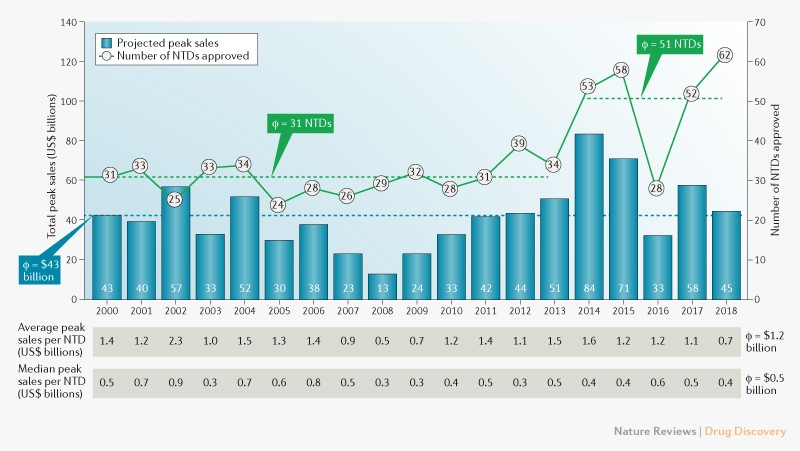
In 2018, FDA approved an all-time record of 62 new therapeutic drugs (NTDs) [Not including diagnostic imaging agents, included are combination products with at least one new molecular entity as an active ingredient] with average Peak Sales per NTD $1.2Billion.


Reporter: Aviva Lev-Ari, PhD, RN

BIOBUSINESS BRIEFS

2018 FDA approvals hit all-time high — but average value slips again

In 2018, the FDA approved an all-time record of 62 new therapeutic drugs (NTDs; see Fig. 1 for the definition and the difference compared with new molecular entities). This is consistent with the increase we predicted last year (Nat. Rev. Drug Discov. 17, 87; 2018) and the overall resurgence of R&D in the last 5 years, with an average of 51 approvals per year in this period even with a low count in 2016. This is substantially more than the average of 31 approvals per year in the period 2000–2013 (Fig. 1).

Fig. 1 | FDA approvals of new therapeutic drugs and aggregate projected peak global annual sales: 2000–2018. We analysed 2018 FDA approvals of new therapeutic drugs (NTDs), defined as new molecular entities approved by the FDA’s Center for Drug Evaluation and Research (CDER) and Center for Biologics Evaluation and Research (CBER), but with two adjustments: first, we excluded diagnostic imaging agents; and second, we included combination products with at least one new molecular entity as an active ingredient. The analysis is based exclusively on approvals by the FDA and the year in which the first indication approval took place. All peak sales values were obtained from EvaluatePharma and were inflation-adjusted to 2018 using standard global GDP-based inflators sourced from the Economist Intelligence Unit. To arrive at peak sales for each NTD, we reviewed both historical actual sales as well as the full range of forecast sales that are available from EvaluatePharma and selected the highest value. Sources: EvaluatePharma, FDA and Boston Consulting Group analysis.

SOURCE

https://www.nature.com/articles/d41573-019-00004-z

R&D for Artificial Intelligence Tools & Applications: Google’s Research Efforts in 2018

Reporter: Aviva Lev-Ari, PhD, RN

3.2.1

3.2.1   R&D for Artificial Intelligence Tools & Applications: Google’s Research Efforts in 2018, Volume 2 (Volume Two: Latest in Genomics Methodologies for Therapeutics: Gene Editing, NGS and BioInformatics, Simulations and the Genome Ontology), Part 2: CRISPR for Gene Editing and DNA Repair

Looking Back at Google’s Research Efforts in 2018

Tuesday, January 15, 2019
2018 was an exciting year for Google’s research teams, with our work advancing technology in many ways, including fundamental computer science research results and publications, the application of our research to emerging areas new to Google (such as healthcare and robotics), open source software contributions and strong collaborations with Google product teams, all aimed at providing useful tools and services. Below, we highlight just some of our efforts from 2018, and we look forward to what will come in the new year. For a more comprehensive look, please see our publications in 2018.
SOURCE & VIDEOS

Perspectives on AI

  • Ethical Principles and AI
  • AI for Social Good
  • Research Outreach
  • New Places, New Faces
  • Looking Forward to 2019

Theoretical Innovations in AI

  • Algorithms and Theory
  • Software Systems

R&D for Artificial Intelligence Application @Google in 2018 included the following Application Types:

  • Assistive Technology
  • Quantum computing
  • Natural Language Understanding
  • Perception
  • Computational Photography
  • AutoML
  • Tensor Processing Units (TPUs)
  • Open Source Software and Datasets
  • Robotics

Applications of AI to Other Fields

SOURCES

https://ai.googleblog.com/2019/01/looking-back-at-googles-research.html

Google Publication in 2018

 publications in 2018.

The Arrow Lecture Series on Ethics and Leadership @Stanford University

Reporter: Aviva Lev-Ari, PhD, RN

Personal memories from attending the Decision Theory Colloquium @Stanford University, 1985 – 1988

The Colloquium was led by Prof. Kenneth Arrow, Economics, Prof. Amos Tversky, Psychology and Prof. Abernethy, Healthcare System expert at Graduate School of Business.

These years, I worked at SRI, International in Menlo Park, CA. The Monthly meetings were on WEDs at 4PM.

I learned a lot and was most privileged to be inspired by the Colloquium leaders, students, postdocs and to attend Prof. Kenneth Arrow Class on An Economics Approach to Information Theory in Fall 1988.

Article ID #261: The Arrow Lecture Series on Ethics and Leadership @Stanford University. Published on 1/16/2019

WordCloud Image Produced by Adam Tubman

Arrow Lectures

The Arrow Lecture Series on Ethics and Leadership honors the late Nobel Laureate Kenneth Arrow, the Joan Kenney Professor of Economics and Professor of Operations Research, Emeritus.

Professor Arrow made many contributions to welfare economics, social choice theory and collective decision-making. He was also a founding member of the Ethics in Society Undergraduate Honors program. Ken passed away in 2017.

Kenneth Arrow, one of the greatest economists of the twentieth century, died last month at the age of ninety-five. He was of the generation of economists whose ideas were formed by the dislocation and turmoil of the Great Depression and World War II, a generation that includes John Nash, Paul Samuelson, Harold Hotelling, and Milton Friedman. Now when so much of economics is straightjacketed by a failure to take account of ethical considerations, Arrow’s work demonstrates that economics is fundamentally a moral science. Whether tackling climate change, international security, healthcare provision, inequality, or racial prejudice, for Ken, economics was first and foremost a means to help improve human well-being. Indeed, his focus on well-being led him to consider the importance of trust and moral codes, as well as government regulations, for market behavior. Homo economicus cannot be out for himself alone. Read more of Debra Satz’s tribute to Ken.


In 2005, Patrick Byrne endowed the Arrow Lecture Series in Ethics and Leadership. Byrne is the founder and CEO of Internet retailer Overstock.com and he holds a Ph.D. in philosophy from Stanford.


Opportunities and Ethics of Editing Genomes: A CRISPR-Inspired Conversation, Prof. Jennifer Doudna’s Lecture at Stanford University, JANUARY 24, 2019 – 7:00PM TO 8:30PM, CEMEX AUDITORIUM, GRADUATE SCHOOL OF BUSINESS

Reporter: Aviva Lev-Ari, PhD, RN

2.1.4.2

2.1.4.2   Opportunities and Ethics of Editing Genomes: A CRISPR-Inspired Conversation, Prof. Jennifer Doudna’s Lecture at Stanford University, JANUARY 24, 2019 – 7:00PM TO 8:30PM, CEMEX AUDITORIUM, GRADUATE SCHOOL OF BUSINESS, Volume 2 (Volume Two: Latest in Genomics Methodologies for Therapeutics: Gene Editing, NGS and BioInformatics, Simulations and the Genome Ontology), Part 2: CRISPR for Gene Editing and DNA Repair

Opportunities and Ethics of Editing Genomes: A CRISPR-Inspired Conversation

JANUARY 24, 2019 – 7:00PM TO 8:30PM
EVENT SERIES:
EVENT SPONSOR:
CENTER FOR BIOMEDICAL ETHICS, MCCOY FAMILY CENTER FOR ETHICS IN SOCIETY, CENTER FOR LAW AND BIOSCIENCES

Recent reports of the first babies to be born with CRISPR-edited genes have sparked widespread condemnation and calls for action. These concerns will be top of mind when world-renowned scientist Jennifer Doudna, co-inventor of CRISPR, speaks at Stanford on Thursday, Jan. 24, as part of the Arrow Lecture Series on Ethics and Leadership.

Doudna, a professor of chemistry and molecular and cell biology at U.C. Berkeley, rocked the research world in 2012 when she and her colleagues announced the invention of CRISPR-Cas9, a technology that uses an RNA-guided protein found in bacteria to edit an organism’s DNA quickly and inexpensively.

Following her lecture, Doudna will have an on-stage conversation with Political Science Professor Rob Reich, faculty director of the McCoy Family Center for Ethics in Society, and Kelly Ormond, a professor of genetics at Stanford’s School of Medicine and faculty member of the Stanford Center for Biomedical Ethics.

Doudna is the co-author with Sam Sternberg of “A Crack in Creation,” a personal account of her research and the societal and ethical implications of gene editing. Doudna has received many other honors including the Breakthrough Prize in Life Sciences and membership in the National Academy of Sciences, the National Academy of Medicine, the National Academy of Inventors and the American Academy of Arts and Sciences.

The Arrow Lecture Series, presented by the Center for Ethics in Society, honors the late Nobel Laureate Kenneth Arrow, the Joan Kenney Professor of Economics and Professor of Operations Research, Emeritus.

This event is co-sponsored by the Stanford Center for Law and the Biosciences and the Stanford Center for Biomedical Ethics.

LOCATION:
CEMEX AUDITORIUM, GRADUATE SCHOOL OF BUSINESS
ADMISSION:
FREE AND OPEN TO THE PUBLIC
CONTACT EMAIL:
MVPENA@STANFORD.EDU

SOURCE

https://ethicsinsociety.stanford.edu/events/opportunities-and-ethics-editing-genomes-crispr-inspired-conversation

What is Ethics in Society?

The McCoy Family Center for Ethics in Society is committed to bringing ethical reflection to bear on important social problems through research, teaching, and community engagement. Drawing on the established strengths of Stanford’s interdisciplinary faculty, the Center develops initiatives with ethical dimensions that relate to pressing public problems. A bridge to the undergraduate Stanford community, the Center houses the Undergraduate Program in Ethics in Society in addition to these current initiatives:

  • Public events, including the Tanner, Wesson, and Arrow lectures, and multi-year themed lecture series
  • Postdoctoral Fellowship Program to promote teaching and research in ethics in society
  • An Undergraduate Program that supports an honors thesis option and the opportunity to minor in Ethics in Society for students in every major
  • Conferences, seminars, and workshops in partnership with other departments across campus
  • Curriculum development around the undergraduate Ethical Reasoning breadth requirement
  • The Hope House Scholars Program in which Stanford faculty, postdocs, or graduate students teach a course in the humanities to the residents of Hope House, a residential drug and alcohol treatment facility for women, many of whom have recently been incarcerated.
  • The Buzz blog which features the voices of Stanford students and freelance writers on happenings at the McCoy Center

https://ethicsinsociety.stanford.edu/about/what-ethics-society

Higher soluble platelet-derived Growth Factor Receptor-beta – a significant Predictor of Cognitive impairment even after controlling for Amyloid-beta or Tau in multiple types of Dementia

Reporter: Aviva Lev-Ari, PhD, RN


Researchers studied brain capillary damage [blood–brain barrier (BBB) breakdown] using 

  • a novel cerebrospinal fluid biomarker of BBB-associated capillary mural cell pericyte, soluble platelet-derived growth factor receptor-β
  • regional BBB permeability using dynamic contrast-enhanced magnetic resonance imaging (MRI)
  • Results: early cognitive dysfunction develop brain capillary damage and BBB breakdown in the hippocampus irrespective of Alzheimer’s Aβ and/or tau biomarker changes, suggesting that BBB breakdown is an early biomarker of human cognitive dysfunction independent of Aβ and tau.


Multiple Types of Dementia:

  • vascular dementia,
  • vascular cognitive impairment,
  • Parkinson’s disease,
  • Lewy body dementia,
  • frontotemporal dementia, or
  • other disorders that might account for cognitive impairment.

In a subset of 73 patients who had gadolinium-based contrast MRI, soluble platelet-derived growth factor receptor-beta was positively correlated with blood-brain barrier breakdown, limited to the hippocampus and medial temporal lobe structures.

“These brain regions show the earliest pathology in Alzheimer’s disease and are associated with memory deficits,” observed Gwenn Smith, PhD, of Johns Hopkins School of Medicine, who was not part of the research. “These promising results support further investigation of CSF and MRI measures of blood-brain barrier breakdown as an early pathological event associated with the development of Alzheimer’s disease,” she told MedPage Today.

The findings represent only one point in time, the researchers cautioned. Future studies will look at how soon cognitive decline occurs after blood vessel damage starts.

https://www.medpagetoday.com/neurology/dementia/77414?xid=nl_mpt_DHE_2019-01-15&eun=g99985d0r&pos=&utm_source=Sailthru&utm_medium=email&utm_campaign=Daily%20Headlines%202019-01-15&utm_term=NL_Daily_DHE_Active

— W.E. Feeman, Jr, MD

Small vessel vascular disease can be due to the usual atherothrombotic disease (ATD) risk facotrs: dyslipidemia, cigarette smoking, and hypertension, with some contribution by the very high blood sugar levels of uncontrolled diabetes. It all fits together.