Feeds:
Posts
Comments

See on Scoop.itCardiovascular Disease: PHARMACO-THERAPY

Economic Times GSK’s Darapladip Fails Second Phase III Trial Genetic Engineering News The primary endpoint measure in the SOLID-TIMI 52 study was time to first occurrence of any event from the composite of coronary heart disease death, heart attack…

See on www.genengnews.com

See on Scoop.itCardiovascular and vascular imaging

Read the latest article version by Sadiq Muhammed Al-Hammash, Abd El-Salam Dawood Al-Ethawi, Kasim Abbas Ismail, at F1000Research. (Newly indexed case report: Endovascular treatment of chronic mesenteric ischemia in an adolescent male.

See on f1000research.com

See on Scoop.itCardiovascular and vascular imaging

Chilling Patients’ Bodies to Give Doctors More Time to Save Lives
Care2.com
… lies in hypothermia, which under normal conditions is very dangerous.

See on www.care2.com

Should Smallpox’s Last Two Samples Be Destroyed Or Preserved To Best Safeguard Humanity?

Reporter: Aviva Lev-Ari, PhD, RN


See on Scoop.itCardiovascular Disease: PHARMACO-THERAPY

Although the world hasn’t seen a case of smallpox in over 30 years, it isn’t quite gone yet. Two vials of the deadly virus remain: one in the United States and the other over 5,000 miles away in Russia. Experts around the world agree that these vials need to be destroyed at some point, but some believe that, for now, humanity is safer with the vials intact. Others insist their destruction is well overdue. The fate of the vials will be decided at an upcoming World Health Assembly meeting later this month.


Smallpox was arguably one of the most deadly diseases to ever exist. It is estimated to have killed up to 500 million people in the 20th century. Throughout time, it has probably killed more people than all other infectious diseases combined. By 1980, smallpox was eradicated, and today it remains the only disease to have been eliminated by the World Health Organization (WHO).


An opinion piece on the fate of the last two remaining strains of smallpox was released on PLoS Pathogens Thursday. In it, experts explain how research with the live smallpox virus is “not yet finished.” If the virus were to reappear, some researchers believe humanity is not prepared to fight it off. Although there is a vaccine against smallpox, it is in limited supply. This vaccine is also known to have a high rate of adverse and sometimes severe side effects. It can infect the brain and cause permanent damage. The International Business Times reports that the WHO’s original goals for a newer and safer vaccine, fully licensed antiviral drugs, and better diagnostics are still underway. The researchers believe that further screening and using new approaches such as genomics or proteomics can help enhance man’s preparedness against a possible smallpox resurgence.


So far, there have been two new antivirals that seem promising in treating smallpox. Neither has been licensed for use yet, and researchers feel they need live samples of the virus to continue their research. “Variola is unusual in that it is known to be a sole human pathogen, the viral and host factors responsible for this human-specific tropism remain essentially unknown to this day,” the researcher explained, IBT reported. Live samples of smallpox are also used to help understand other viruses and develop treatments for them.


Advances in synthetic biology mean that one day it may be possible to create smallpox from scratch. “The synthetic biology adds a new wrinkle to it. We now aren’t as sure that our countermeasures are going to be as effective as we’d though even five years ago,” Jimmy Kolker, Health and Human Services assistant secretary for global affairs told The Associated Press. Even if all traces of smallpox are essentially eliminated, there is still no saying that the virus won’t reappear again in the future. The researchers believe further observation of the living virus can help “to better respond to any future emergency situation resulting from a smallpox appearance.”

See on www.medicaldaily.com

See on Scoop.itCardiovascular Disease: PHARMACO-THERAPY

French plan to push copycat biotech drugs worries Big Pharma Chicago Tribune (blog) The government quietly introduced the measure allowing pharmacists to substitute prescribed brand-name biotech drugs with cheaper, similar versions in its 2014…

See on www.chicagotribune.com

See on Scoop.itCardiovascular and vascular imaging

Stem cell therapy for heart failure treatment information. Stem Cell Institute uses stem cells from umbilical cord blood and Wharton’s jelly. Patient’s receive mutliple injections over the course of one week.

See on www.cellmedicine.com

See on Scoop.itCardiovascular and vascular imaging

European Journal of Radiology

See on www.mdlinx.com

New blood test accurately detects presence of breast cancer and monitors response to treatment

Reporter: Aviva Lev-Ari, PhD, RN


See on Scoop.itCardiovascular Disease: PHARMACO-THERAPY

Johns Hopkins Kimmel Cancer Center investigators report they have designed a blood test that accurately detects the presence of advanced breast cancer and also holds promise for precisely monitoring response to cancer treatment.


The test, called the cMethDNA assay, accurately detected the presence of cancer DNA in the blood of patients with metastatic breast cancers up to 95 percent of the time in laboratory studies. The findings were described in the April 15 issue of the journal Cancer Research.

Currently, there is no useful laboratory test to monitor patients with early stage breast cancer who are doing well, but could have an asymptomatic recurrence, says Saraswati Sukumar, Ph.D., who is the Barbara B. Rubenstein Professor of Oncology and co-director of the Breast Cancer Program at the Johns Hopkins Kimmel Cancer Center.


Generally, radiologic scans and standard blood tests are indicated only if a woman complains of symptoms, such as bone aches, shortness of breath, pain, or worrisome clinical exam findings. Otherwise, routine blood tests or scans in asymptomatic patients often produce false positives, leading to additional unnecessary tests and biopsies, and have not been shown to improve survival outcomes in patients with early stage breast cancer who develop a recurrence.


Sukumar, also a professor of pathology at Johns Hopkins, says that the current approach to monitoring for recurrence is not ideal, and that “the goal is to develop a test that could be administered routinely to alert the physician and patient as soon as possible of a return of the original cancer in a distant spot. With the development of cMethDNA, we’ve taken a first big step toward achieving this goal.”


To design the test, Sukumar and her team scanned the genomes of primary breast cancer patients, as well as DNA from the blood of metastatic cancer patients. They selected 10 genes specifically altered in breast cancers, including newly identified genetic markers AKR1B1, COL6A2, GPX7, HIST1H3C, HOX B4, RASGRF2, as well as TM6SF1, RASSF1, ARHGEF7, and TMEFF2, which Sukumar’s team had previously linked to primary breast cancer.


The test, developed by Sukumar, collaborator Mary Jo Fackler, Ph.D., and other scientists, detects so-called hypermethyation, a type of chemical tag in one or more of the breast cancer-specific genes present in tumor DNA and detectable in cancer patients’ blood samples. Hypermethylation often silences genes that keep runaway cell growth in check, and its appearance in the DNA of breast cancer-related genes shed into the blood indicates that cancer has returned or spread.

See on www.news-medical.net

The Bioscience Crowdfunding Environment: Will Crowdfunding be the Bigger, New VC

Reporter: Stephen J. Williams, Ph.D.

Article ID #136: The Bioscience Crowdfunding Environment: The Bigger Better VC?. Published on 5/14/2014

WordCloud Image Produced by Adam Tubman


Pharmaceutical Consulting Consortium International Inc. (PCCI) recently presented their 7th annual Roundtable “CROWDFUNDING FOR LIFE SCIENCES: A BRIDGE OVER TROUBLED WATERS?”, a panel discussion on how this new funding mechanism applies to early stage life science companies and changes the funding landscape.

A major provision in the recently passed JOBS Act resulted in Securities & Exchange Commission (SEC) rule changes revolutionizing the way companies can raise capital, with some figures in the range of $11 trillion dollars. Companies, startups, and entrepreneurs can, in a manner, now go directly to the individual investor and raise capital. This method is generally referred to as CROWDFUNDING.

As explained by Mark Roderick, moderator for the meeting, there are two main types of approved crowdfunding:

  • Donation-based Crowdfunding – Popularized by the crowdfunding platform Kickstarter, this method of raising capital can accept small donations from anyone for an idea/project to be completed. The donor may either get a free token of appreciation or access to enjoy the fruits of the project, for example, a watching a movie funded by the donor. Some scientific researchers have used Kickstarter as a method to fund their research.
  • Investor-based Crowdfunding– This type of crowdfunding involves the actual transfer of securities, and investors must qualify according to rules set by the SEC and go thru brokers, or portals, like the bioscience and healthcare internet portal Poliwogg.

Investor-based crowdfundingwas discussed at the meeting.  There are five different mechanisms with this type of funding: Title II (Rule 506c), Title II, Title IV, Existing Regulation A, and Rule 504. The main focus of the meeting was on Title II as, according to Mr. Roderick, involves the mechanism most suited for biotech startups, while rules for Title III still need to be finalized.

Title II crowdfunding requires that “accredited” or “qualified” investors (those who make at least $200,000/year or net worth $1 million US) go through licensed dealer internet nodes (or Portals) like Poliwog. The Portal will have lists of startups they deem legitimate which investors can choose from. For instance the Epilepsy Foundation uses Poliwog to fund certain projects.

The panelists discussed matters including:

  • How crowdfunding is different than other mechanisms like venture capital
  • What are the regulations and financial responsibilities for both biotech and crowdfunder
  • Liabilities
  • Due-diligence issues

The panelists included:

  1. Mark Roderick, moderator. Mark is an attorney at Flaster/Greenberg PC (@CrowdfundAttny on Twitter) and has developed great experience and expertise in the details of crowdfunding. He maintains a Crowdfunding blog www.crowdfundattny.com, which contains information and links about the JOBS Act and crowdfunding.
  2. Barbara Schiberg, Managing Director at BioAdvance, a Mid-Atlantic bioangel investment community.
  3. Samuel Wertheimer, PhD, CIO Poliwogg, a crowdfunding internet portal.
  4. Darrick Mix, Partner, Duane Morris LLP, corporate lawyer with experience in the JOBS act
  5. Donlon Skerret, PCCI President and CEO of NanoScan Imaging and serial entrepreneur

The Opportunity


 crowdcrowdingoutVC


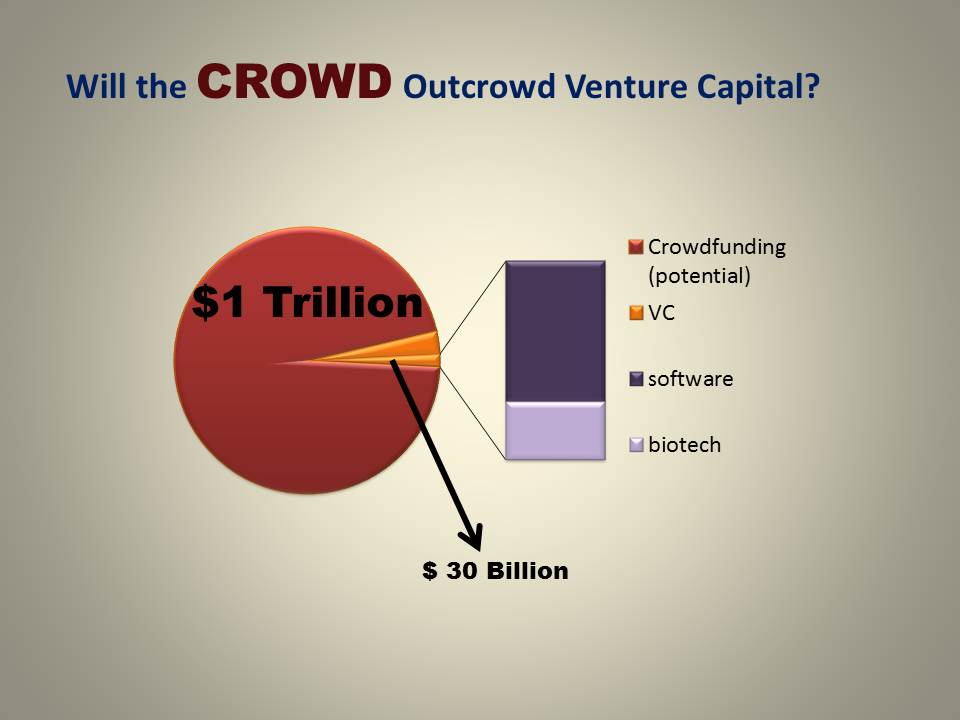
Recent estimates place Title II Crowdfunding capacity to $1 Trillion.

Venture Capital (VC) had estimated only $5 Billion bio-investment in 2013.

Where does the rest go?


Mr. Skerret noted that bioangels can only take you so far but thinks that crowdfunding may fill this “valley of death”.

Liabilities


Crowdfunding is SELLING SECURITIESso there is liability, disclosure and nondisclosure issues.

Title II contains 580 pages of regulations and SEC needs a licensed intermediary.


Due-Diligence


Barbara Schiberg also noted that with VCs or bioangels groups you also get s support network, basically their rolodex of contacts and KOL’s and experts. With Crowdfunding like Poliwog they just handle linking investors with entrepreneur. Any contact is done through social media and the crowd.


BioAdvance hires experts – may take months to years to get expert opinion


Poliwog only has responsibility to investor to make sure company is legitimate. They don’t do extensive due diligence like bioangels. Most crowdfunding do not have extensive networks of professionals.


To obtain a video recording of this meeting and get more information please go to PCCI’s web site at http://www.rxpcci.com/meetings.htm.


Other posts on this site related to FUNDING and Bio Investing include:


PCCI’s 7th Annual Roundtable “Crowdfunding for Life Sciences: A Bridge Over Troubled Waters?” May 12 2014 Embassy Suites Hotel, Chesterbrook PA 6:00-9:30 PM

10 heart-focused apps & devices are crowdfunding for American Heart Association’s open innovation challenge

Importance of Funding Replication Studies: NIH on Credibility of Basic Biomedical Studies

Partnerships & Funding

Updated: Investing and Inventing: Is the Tango of Mars and Venus Still on

Transforming Biotech & Pharma: LinkedIn is the Quiet Force by Timmerman

Technion-Cornell Innovation Institute in NYC: Postdocs keep exclusive license to their IP and take a fixed dollar amount of Equity if the researchers create a Spinoff company