Guidelines for the Diagnosis and Treatment of Endocarditis
from
British Society of Antimicrobial Chemotherapy (BSAC)
Clinicians who care for patients diagnosed with infective endocarditis (IE) are (un)fortunate to be able to refer to several guidelines about its diagnosis and treatment. The guidelines vary considerably, especially with regards to antibiotic prescribing recommendations, which generally reflect local practice and expert opinion in light of largely observational data. All guidelines recommend a multidisciplinary approach to the management of IE.
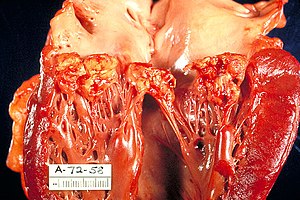
Infective endocarditis (Photo credit: Wikipedia)
Echocardiography remains a cornerstone of IE diagnosis but is neither 100% sensitive nor specific and multiple scans may be needed to identify vegetations. Echocardiography should also be used in all patients with Staphylococcus aureus bacteraemia. The prevalence of IE among patients with S aureus bacteraemia is variable but was reported as 13% in one large prospective US study and 22% in a recent European study. Clinical assessment is unreliable in diagnosing IE in patients with S aureus bacteraemia and without echocardiography the diagnosis may be missed. Transoesophageal echocardiography is now recommended in most cases of suspected or confirmed IE but may be unnecessary in patients with right-sided valve involvement.
Establishing a microbiological diagnosis in an era of increasingly complex infections with unpredictable resistance patterns is important. However, traditional recommendations for blood culture sampling have been amended for patients with suspected IE and severe sepsis or septic shock. In this situation, two (rather than three) sets of blood cultures, taken at different times within an hour before the start of empirical treatment, are now advised. This is a pragmatic recommendation to avoid undue delay in starting empirical antimicrobial treatment. In other patients, the usual need for three sets of blood cultures is recommended but with at least 6 h between sampling times; an important aim of multiple sampling is to demonstrate the presence of a sustained or persistent bacteraemia, which is characteristic of IE. Identification of atypical micro-organisms using serology in culture-negative cases should be limited to Coxiella and Bartonella in the first instance—a reflection of the extremely small numbers of reported cases of IE caused by Mycoplasma, Brucella and Legionella.
Fungal causes of IE should be considered in culture-negative IE if serology is non-diagnostic and the patient is immunocompromised, has a prosthetic valve, is an intravenous drug user or is not responding to empirical antibacterial treatment. The application of broad-range (16S ribosomal RNA gene) PCR on surgically resected valves or embolic material should be used when culture has failed. False-negative 16S ribosomal RNA gene PCR reactions can occur in the presence of inhibitors of the DNA polymerase within clinical samples or as a result of the vagaries of sampling (ie, processing a piece of tissue that does not contain any bacteria). Bacterial DNA has been shown to be present within cardiac tissue several years after successful treatment of IE, so results should be interpreted with caution in a patient with a previous diagnosis of IE. Application of 16S ribosomal gene PCR to blood in patients with IE is problematic owing to the low levels of bacteria present (1–10 fu/ml) and subsequent difficulty in DNA extraction; as a result it is not currently available for routine clinical use.
Empirical treatment (that started before obtaining a microbiological diagnosis) is generally discouraged, except in those who are acutely unwell or shocked. There is no clear evidence that speeding up the diagnosis, and instigation of treatment, improves outcomes, although this would seem intuitive. Early treatment (started within days of onset of symptoms rather than weeks) is a laudable aim, but the few days delay in hospital while appropriate echocardiographic and microbiological tests are undertaken on a stable patient are unlikely to have a negative impact on outcome. Conversely, the administration of broad-spectrum antibiotics when the diagnosis of IE has not been considered (and often when inadequate samples have been obtained) may have considerable impact on the ability to establish the diagnosis and subsequently deliver effective treatment.
Outpatient antibiotic treatment (OPAT) for IE is included in the BSAC guidelines in response to increasing efforts to expand these services and manage more patients outside hospital. Patients who might be considered for OPAT include those who are stable and responding well to treatment, are without signs of heart failure and without any indications for surgery or uncontrolled extracardiac foci of infection. Delivery of OPAT requires appropriate funding, support and infrastructure, coupled with the ability to rapidly access inpatient services and obtain urgent expert advice if needed. This has been proved to be feasible and safe in the UK, even in high-risk IE cases.
Although the guidelines include recommendations for most causes of IE, the predominant pathogens remain staphylococci, streptococci and enterococci. Routine addition of gentamicin to flucloxacillin for the treatment of native valve staphylococcal IE is no longer recommended (see Table 1). This recommendation is unchanged from previous BSAC guidelines but the ESC continue to include gentamicin as an optional addition. Further evidence of the toxicity of gentamicin has been published, based on findings from a randomised controlled trial comparing daptomycin with either vancomycin or cloxacillin plus gentamicin for the treatment of S aureus bloodstream infection or IE Recommendations for meticillin-resistant staphylococci also differ from those of the ESC; although vancomycin is the primary agent in both sets of guidelines, rifampicin is recommended by BSAC in place of gentamicin because of concerns about efficacy and toxicity. Daptomycin, a recently licensed lipopeptide, is also recommended as an alternative agent for patients who are intolerant to vancomycin or have infection caused by vancomycin-resistant isolates.
Previous recommendations for treatment of streptococcal IE have been simplified, with greater emphasis placed on benzylpenicillin rather than amoxicillin as the primary agent to reduce risk of Clostridium difficile infection. Enterococcal treatment regimens are largely consistent with the ESC guidelines, though a low threshold for withdrawing gentamicin in patients with deteriorating renal function or other signs of toxicity is advised, based on observational data that shorter gentamicin courses are not associated with worse outcomes.
The timing of cardiac surgery in IE should be evaluated by the multidisciplinary team on a case by case basis. Attempts to advise whether cardiac surgery should be emergent, urgent or elective can seem artificial. The traditional indications for surgery in IE are well established but it is becoming apparent that patients with IE caused by S aureus, or patients with evidence of systemic embolisation, should also be considered for early surgery, which may confer a mortality benefit.
Device-related infections have been deliberately omitted from the current BSAC guidance as the challenges in preventing, diagnosing and treating cases of intracardiac device IE are different from ‘traditional’ native or prosthetic valve IE. Further specific device-related guidance is likely to be published in the future and a joint working party involving the BSAC, BCS and Heart Rhythm UK has been established. IE guidelines are always imperfect owing to the difficulties in studying this relatively uncommon condition and the scarcity of randomised trials. At present, we are uncertain of the incidence, risk factors, causative micro-organisms (and their antimicrobial sensitivities), and patient outcomes in IE affecting the UK population. A recently established national endocarditis database may help to answer some of these questions, but its success will be crucially determined by the degree of support and national participation. See http://www.neemo.leedsth.nhs.uk/ (only via the N3 network) for details.
see source for more
Reported by: Dr. V. S. Karra, Ph.D
Read Full Post »


 2012pharmaceutical
 sjwilliamspa