Feeds:
Posts
Comments

Posts Tagged ‘Diabetes’

Reporter and Curator: Dr. Sudipta Saha, Ph.D.

Antioxidant micronutrients, such as vitamins and carotenoids, exist in abundance in fruit and vegetables and have been known to contribute to the body’s defence against reactive oxygen species. Numerous epidemiological studies have demonstrated that a high dietary consumption of fruit and vegetables rich in carotenoids or with high serum carotenoid concentrations results in lower risks of certain cancers, diabetes and cardiovascular disease. These epidemiological studies have suggested that antioxidant carotenoids may have a protective effect against diabetes or cardiovascular disease. However, the consumption of carotenoids in pharmaceutical forms for the treatment or prevention of these chronic diseases cannot be recommended, because some large randomized controlled trials did not reveal any reduction in cardiovascular events or type 2 diabetes with b-carotene. High doses of carotenoids used in the supplementation studies could have a pro-oxidant effect. Therefore, it is favourable to intake carotenoids from foods through the combination of other nutrients such as vitamins, minerals or phytochemicals, not by supplements.

The metabolic syndrome is a clustering of metabolic abnormalities that increase the risk for diabetes and cardiovascular disease. Typically, it includes excess weight, hyperglycaemia, evaluated blood pressure, low concentration of HDL-cholesterol, and hypertriacylglycerolaemia. This syndrome is emerging as one of the major medical and public health problems in Japan, and persons with this syndrome have an increased risk of morbidity and mortality due to cardiovascular disease and diabetes. Recently, many studies have examined the associations of dietary patterns with the metabolic syndrome and shown that diets rich in fruit and vegetables have been inversely associated with the metabolic syndrome. These previous reports suggest that a high intake of fruit and vegetables may reduce the risk of the metabolic syndrome through the beneficial combination of antioxidants, fibre, minerals, and other phytochemicals. Some recent cross-sectional and case–control studies have shown the associations of serum antioxidant status with the metabolic syndrome. Ford et al. reported that low intake and/or low serum concentrations of vitamins and carotenoids were associated with the risk of the metabolic syndrome. Although very few data are available about the associations of antioxidant carotenoids with the metabolic syndrome, people who have the metabolic syndrome are more likely to have increased oxidative stress than people who do not have this syndrome.

In some recent studies, it has been reported that oxidative stress, which is an imbalance between pro-oxidants and antioxidants, occurs more frequently in metabolic syndrome subjects than in non-metabolic syndrome subjects. Oxidative stress may play a key role in the pathophysiology of diabetes and cardiovascular disease. On the other hand, smoking is a potent oxidative stress in man. This increment of oxidative stress induced by smoking may develop insulin resistance, and increased insulin resistance may result in the clustering of the metabolic abnormality. Therefore, antioxidants could have a beneficial effect on reducing the risk of these conditions in smokers. However, there is limited information about the interaction of serum antioxidant carotenoids and the metabolic syndrome with smoking habit. This study was aimed to investigate the interaction of serum carotenoid concentrations and the metabolic syndrome with smoking. The association of the concentrations of six serum carotenoids, i.e. lutein, lycopene, a-carotene, b-carotene, b-cryptoxanthin and zeaxanthin, with metabolic syndrome status stratified by smoking status was evaluated crosssectionally.

In this study, the associations of the serum carotenoids with the metabolic syndrome stratified by smoking habit were evaluated cross-sectionally. A total of 1073 subjects (357 male and 716 female) who had received health examinations in the town of Mikkabi, Shizuoka Prefecture, Japan, participated in the study. Inverse associations of serum carotenoids with the metabolic syndrome were more evident among current smokers than non-smokers. These results support that antioxidant carotenoids may have a protective effect against development of the metabolic syndrome, especially in current smokers who are exposed to a potent oxidative stress.

Source References:

http://www.ncbi.nlm.nih.gov/pubmed/18445303

http://www.ncbi.nlm.nih.gov/pubmed/19450371

http://www.ncbi.nlm.nih.gov/pubmed/21216053

http://www.ncbi.nlm.nih.gov/pubmed/19631019

http://www.ncbi.nlm.nih.gov/pubmed/12324189

http://www.ncbi.nlm.nih.gov/pubmed/18689373

Read Full Post »

Reporter: Ritu Saxena, Ph.D.

Diabetes currently affects more than 336 million people worldwide, with healthcare costs by diabetes and its complications of up to $612 million per day in the US alone.  The islets of Langerhans, miniature endocrine organs within the pancreas, are essential regulators of blood glucose homeostasis and play a key role in the pathogenesis of diabetes.  Islets of Langerhans are composed of several types of endocrine cells.  The α- and β-cells are the most abundant and also the most important in that they secrete hormones (glucagon and insulin, respectively) crucial for glucose homeostasis (Bosco D, et al, Diabetes, May 2010;59(5):1202-10).

Diabetes is a ‘bihormonal’ disease, involving both insulin deficiency and excess glucagon.  For decades, insulin deficiency was considered to be the sole reason for diabetes; however, recent studies emphasize excess glucagon as an important part of diabetes etiology.  Thus, insulin-secreting β cells and glucagon-secreting α cells maintain physiological blood glucose levels, and their malfunction drives diabetes development.  Increasing the number of insulin-producing β cells while decreasing the number of glucagon-producing α cells, either in vitro in donor pancreatic islets before transplantation into type 1 diabetics or in vivo in type 2 diabetics, is a promising therapeutic avenue.  A huge leap has been taken in this direction by the researchers at the University of Pennsylvania (Philadelphia, PA) in collaboration with Oregon Health and Science University (Portland, OR), USA by demonstrating that α to β cell reprogramming could be promoted by manipulating the histone methylation signature of human pancreatic islets.  In fact, the treatment of cultured pancreatic islets with a histone methyltransferase inhibitor leads to colocalization of both glucagon and insulin and glucagon and insulin promoter factor 1 (PDX1) in human islets and colocalization of both glucagon and insulin in mouse islets.  The research findings were published in the Journal of Clinical Investigation.

Study design: First step was to study and analyze the epigenetic and transcriptional landscape of human pancreatic human pancreatic α, β, and exocrine cells using ChIP and RNA sequencing.  Study design for determination of the transcriptome and differential histone marks included the dispersion and FACS to of human islets to obtain cell populations highly enriched for α, β, and exocrine (duct and acinar) cells.  Then, chromatin was prepared for ChIP analysis using antibodies for histone modifications, H3K4me3 (represents gene activation) and H3K27me3 (represents gene repression).  RNA-Sequencing analysis was then performed to determine mRNA and lncRNA.  Sample purity was confirmed using qRT-PCR of insulin and glucagon expression levels of the individual α and β cell population revealing high sample purity.

Results:

  • Long noncoding transcripts: Long noncoding RNA molecules have been implicated as important developmental regulators, cell lineage allocators, and contributors to disease development.  The authors discovered 12 cell–specific and 5 α cell–specific noncoding (lnc) transcripts, indicative of the valuable research resource represented from transcriptome data.  Recently discovered lncRNA molecules in islets are regulated during development and dysregulated in type 2 diabetic islets.
  • Monovalent histone modification landscapes shared among three cell types:  Monovalent H3K4me3-enriched regions, indicative of gene activation, were identified and compared in α, β, and exocrine cells.  Strikingly, the vast majority of monovalently H3K4me3-marked genes were shared among the 3 pancreatic cell lineages (83%–95%), reflecting both their related function in protein secretion and common embryonic descent. Similarly, a high degree of overlap was observed in H3K27me3 modification patterns in all the three cell types (73%–83%).
  • Bivalent histone modifications (H3K4me3 and H3K27me3) were high in α cells: Bernstein colleagues observed bivalent marks to be common in undifferentiated cells, such as ES cells and pluripotent progenitor cells, and in most cases, one of the histone modification marks was lost during differentiation, accompanying lineage specification (Bernstein BE, et al, Cell, 21 Apr 2006; 125(2):315-26).  α cells exhibited many more genes bivalently marked, followed by β cells and exocrine cells.  Bivalent state was remarkably similar to that of hESC, suggesting a more plastic epigenomic state for α cells.
  • Monovalent histone modifications were high in β cells: Thousands of the genes that were in bivalent state in α cells were in a monovalent state, carrying only the activating or repressing mark.
  • Inhibition of histone methyltransferases led to partial cell-fate conversion: Adenosine dialdehye (Adox), a drug that interferes with histone methylation and decreases H3K27me3, when administered in human islet tissue, led to decrease of H3K27me3 enrichment at the 3 gene loci that are originally expressed bivalently in α cells and monovalently in β cells:  MAFA, PDX1 and ARX.  Adox resulted in the occasional cooccurrence of glucagon and insulin granules within the same islet cell, which was not observed in untreated islets.  Thus, inhibition of histone methyltransferases leads to partial endocrine cell-fate conversion.

Conclusion:  α cells have been reprogrammed into β cell fate in various mouse models.  The reason, as proposed by the authors, might be the presence of more bivalently marked genes that confers a more plastic epigenomic state of the cells that probably drives them to the β cell fate.  Therefore, using epigenomic information of different cell types in pancreatic islets and harnessing it for subsequent manipulation of their epigenetic signature could be utilized to reprogram cells and hence provide a path for diabetes therapy.

Source: Bramswig NC, et al, Epigenomic plasticity enables human pancreatic α to β cell reprogramming. J Clin Invest, 22 Feb 2013. pii: 66514.

Related reading on Pharmaceutical Intelligence:

Junk DNA codes for valuable miRNAs: non-coding DNA controls Diabetes

Therapeutic Targets for Diabetes and Related Metabolic Disorders

Reprogramming cell fate

CRACKING THE CODE OF HUMAN LIFE: Recent Advances in Genomic Analysis and Disease – Part IIC

2013 Genomics: The Era Beyond the Sequencing of the Human Genome: Francis Collins, Craig Venter, Eric Lander, et al.

Genome-Wide Detection of Single-Nucleotide and Copy-Number Variation of a Single Human Cell

SNAP: Predict Effect of Non-synonymous Polymorphisms: How well Genome Interpretation Tools could Translate to the Clinic

Genomic Endocrinology and its Future

Read Full Post »

Author, Editor: Tilda Barliya PhD

We previously started a discussion on Transdermal Drug Delivery system (TDDS), see: http://pharmaceuticalintelligence.com/2013/01/28/introduction-to-transdermal-delivery-tdd-system-and-nanotechnology/

We introduced the main aspects of the anatomy of the skin, the advantages and disadvantages of TDDS and the main factors that affect the efficacy of a TDDS and their different types. In this followup, will try to dig a little bit deeper and analyze some examples of TDDS already made it to public use. The first TDD patch to be introduced to the US market was scopolamine in 1979 (1a,1b) for prevention of nausea and vomiting associated with motion sickness and recovery from anesthesia and surgery. But the TDDS that revolutionized the transdermal market was the nicotine patch, which was first introduced in 1991 as a treatment for smoking cessation (1c). Since then there has been development of a number of different patches, including a testosterone patch for hypogonadism in males and combination patches of estradiol and norethindrone or levonorgestrel for menopausal symptoms. Figure 1 shows the global sales of TDDS products by segments.

However, there are many disease applications that are treated with peptide or protein preparations (ranging from 900 Da molecular mass to > 150,000 Da molecular mass), usually by means of injection, as they cannot be delivered via topical application at present. Dermal and transdermal delivery of large molecules such as peptides, proteins, and DNA has remained a significant challenge.

Several attempts have been made to develop topical formulations for macromolecules using a wide variety of tools such as using delivery enhancers, delivery vehicles, and different penetration methods. For instance, the chemical enhancers such as alcohols, fatty acids, surfactants, and physical enhancers such as microneedles, ultrasonic waves and low electrical current (iontophoresis) methods  have been examined to improve topical delivery of macromolecules. These techniques however, suffer from different obstacles, ranging from inverse correlation between size and transdermal transport up to variably due to solvent ions, cargo charge and pH.  Poorly water-soluble peptides and proteins, which can be more readily solubilized by the dual water/oil formulation may offset some of these disadvantages.

The majority of topically applied peptides and proteins cannot enter the circulation in the skin as there is no basal-to-apical transport of such molecules through the vascular endothelium, and as such they must travel in the lymphatics in order ultimately to reach the circulation.

In a recent paper, Dr. Gregory Russell-Jones and colleagues review the use of a microemulsion system to effectively deliver proteins through the skin (2).

Water-in-Oil microemulsions:

Microemulsions are  nanosized, clear, thermodynamically stable, isotropic liquid mixtures of oil, water and surfactant, frequently in combination with a co-surfactant.  These droplets can ‘hide’ water-soluble molecules within a continuous oil phase and therefore enable the use of water-soluble therapeutic drugs for different diseases, that otherwise cannot be achieved by the transdermal route.

Microemulsion system may have the potential advantages in delivery because of their:

  • High solubilization capacity
  • Ease of preparation,
  • Transparency,
  • Thermodynamic stability,
  • High diffusion and absorption rates

Previous work, both in small animals and humans, has utilized microemulsions containing small hydrophobic molecules, or small ‘model’ hydrophilic molecules.  The validity of these models in measuring lateral movement of topically applied material is rather questionable. Whereas only few of the studies evaluated the efficacy of microemulsions as transdermal drug delivery systems and were shown for desmopressin, cyclosporine and folate analogue methotrexate ( ref 2). More notably are the advances in insulin delivery.

Diabetes for instance , is the most common endocrine disorder and by the year 2010, is estimated that more than 200 million people worldwide will have DM and 300 million will subsequently have the disease by 2025 (7). DM patients suffer from a defect in insulin secretion, insulin action, or both and therefore require a constant external administration of insulin to keep their sugar levels under control. Insulin is most commonly being administrated using a pen, a syringe, an automated pump and more recently using a patch to ensure a pain-free approach. Some of these patcesh are being evaluated in clinical trials.

As a different approach, the authors have evaluated the use of microemulsion to delivery different type of peptides such as IGF-1, GHRP-6 and Insulin in an obese mice model. Among the studies that were conducted they evaluated the effect of increasing the dose of topically administered insulin formulated in a water-in-oil microemulsion which was compared with subcutaneously administered insulin. It was possible to increase the dose of topically administered insulin from 10 to 100 µg as there was no reduction in serum glucose seen at this dose. By contrast, it was not possible to increase the dose of subcutaneously administered insulin owing to the potential of death through induction of hypoglycemia (2). These are very encouraging results!!!

The authors also noted changes in weight loss/gain of the mice upon treatment depending on the initial weight and which was consistent with the known anabolic effect of insulin. Presumably the greater effect seen with the topical insulin is due to the depot-like effect of this route of administration, leading to a longer stimulation of both adipocytes and muscle cells.

An exciting area of potential development is weight control management. The results using insulin, IGF-I and GHRP-6 given topically are particularly intriguing. Whether these results can be replicated in humans and whether the use of these drugs for potential treatment of obesity will be commercially viable will be particularly interesting to observe.

Summary:

Effective peptide and protein delivery to the skin has received much attention in the pharmaceutical industry, with many companies developing a variety of delivery devices to force peptides and proteins into and across the epithelium of the skin. Despite these many attempts, effective delivery of high-molecular-mass compounds has at best been poor. The water-in-oil microemulsion system may overcome the water-impermeable barrier of the epidermis and allows for effective delivery of highly water-soluble molecules such as peptides and proteins following topical application.

Ref:

1a. http://www.ncbi.nlm.nih.gov/pmc/articles/PMC2995530/

1b. http://dailymed.nlm.nih.gov/dailymed/drugInfo.cfm?id=76671

1c. http://dailymed.nlm.nih.gov/dailymed/lookup.cfm?setid=92761472-2bdb-4ef9-9c81-a39b1852d7e0

2. Gregory Russell-Jones and Roy Himes. “Water-in-oil microemulsions for effective transdermal delivery of proteins”. Expert Opin. Drug Delivery 2011 Invited review –  8, 537-546.

http://www.mentorconsulting.net/publications_files/Russell-Jones%202011%20WOW%20transdermal.pdf

3.  Ellen Jett Wilson. “Three Generations: The Past, Present, and Future of Transdermal Drug Delivery Systems”

http://www.freece.com/Files/Classroom/ProgramSlides/1be80281-23ef-4687-a334-c79b7200dd19/3%20Gen%20Homestudy%20(TV).pdf

4. http://www.ema.europa.eu/docs/en_GB/document_library/Scientific_guideline/2012/09/WC500132404.pdf

5. http://www.fda.gov/downloads/Drugs/…/Guidances/UCM220796.pdf

6. http://onlinelibrary.wiley.com/doi/10.1111/cbdd.12008/pdf

7. Salim Bastaki. Diabetes mellitus and its treatment. Int J Diabetes & Metabolism (2005) 13:111-134. http://ijod.uaeu.ac.ae/iss_1303/a.pdf

8. http://sphinxsai.com/Vol.3No.4/pharm/pdf/PT=39(2140-2148)OD11.pdf

9. Dhote V et al. Iontophoresis: A Potential Emergence of a Transdermal Drug Delivery System. Sci Pharm. 2012 March; 80(1): 1–28.

http://www.ncbi.nlm.nih.gov/pmc/articles/PMC3293348/

Read Full Post »

Overview of New Strategy for Treatment of T2DM: SGLT2 Inhibiting Oral Antidiabetic Agents


Author and Curator: Aviral Vatsa, PhD, MBBS

Type 2 diabetes mellitus (T2DM) is a chronic disease, which is affecting widespread populations in epidemic proportions across the globe 1. It is characterised by hyperglycemia, which if not controlled adequately, eventually leads to microvascular and metabolic complications (Fig 1). Traditionally, T2DM management includes alteration in lifestyle, oral hypoglycemic agents and/or insulin. The present pharmacological approaches predominantly target glucose metabolism by compensating for reduction in insulin secretion and/or insulin action. However, these approaches are often limited by inadequate glucose control and the the possibility of severe adverse effects such as hypoglycemia, weight gain, nausea, and sometimes lactic acidosis 2–4 (Fig 1). Hence the search for new drugs with different mechanism of action and with little side affects is key in providing better glycemic control in T2DM patients and hence offering better prognosis with reduced morbidity and mortality.

Figure 1 (credit: aviral vatsa): Short overview of Type 2 diabetes mellitus (T2DM): complications, present therapeutic approaches and their limitations.

Along with pancreas, our kidneys play a vital role in regulating glucose levels in the plasma. Under physiological conditions, kidneys absorb 99% of the plasma glucose filtered through the renal glomeruli tubules. Majority i.e. 80-90% of this renal glucose resorbtion is mediated via the sodium glucose co-transporter 2 (SGLT2) 5,6. SGLT2 is a high-capacity low-affinity transporter that is mainly located in the proximal segment S1 of the proximal convoluted tubule 6. Inhibition of SGLT2 activity can thus induce glucosuria which inturn can lower blood glucose levels without targeting insulin resistance and insulin secretion pathways of glucose modulation (Fig 2).

Figure 2 (credit: aviral vatsa): Schematic overview of regulation of plasma glucose by sodium glucose co-transporter (SGLT).

Thus inhibition of SGLT2 provides a novel way to modulate blood glucose levels and consequently limit long term complications of hyperglycemia 7,8. Moreover, SGLT2 inhibitors will selectively target the renal glucose transportation and spare the counter regulatory hormones involved in glucose metabolism because SGLT2 is almost exclusively located in the kidneys. This novel way of glucose modulation will likely avoid severe side affects, e.g. hypoglycemia and weight gain, that are seen with present antidiabetic pharmacological agents.

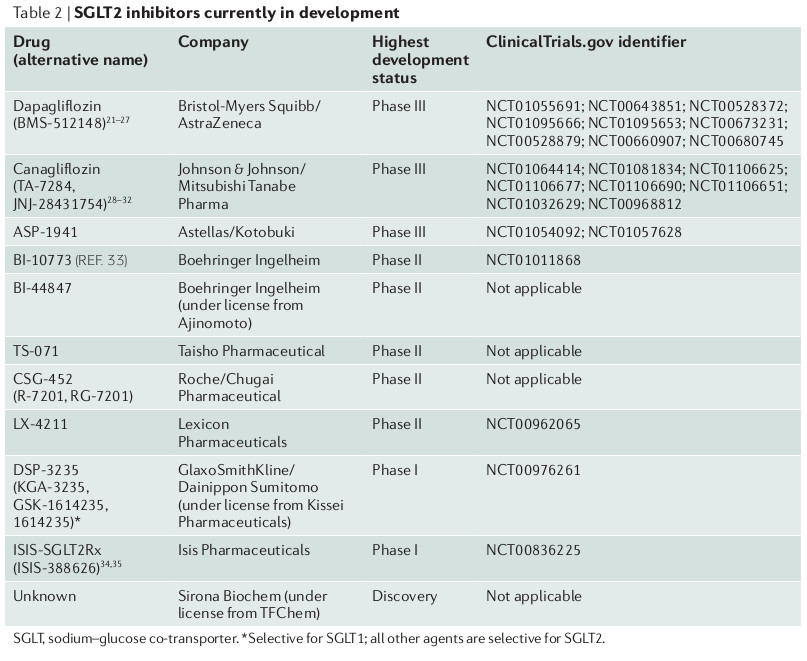
Agents currently under development

Table below gives an overview of the SGLT2 inhibotors in development.

(Credit: Chao et al 2010)


In summary, increasing urinary glucose excretion represents a new approach to addressing the challenge of hyperglycaemia. SGLT2 inhibitors may have indications both in the prevention and treatment of T2DM, and perhaps T1DM, with a possible application in obesity. Further studies in large numbers of human subjects are necessary to delineate efficacy, safety and how to most effectively use these agents in the treatment of diabetes.

Bibliography

  1. Diabetes Atlas. International Diabetes Federation, (2009) at <www.diabetesatlas.org>
  2. Intensive blood-glucose control with sulphonylureas or insulin compared with conventional treatment and risk of complications in patients with type 2 diabetes (UKPDS 33). UK Prospective Diabetes Study (UKPDS) Group. Lancet 352, 837–853 (1998).
  3. Buse, J. B. et al. Effects of exenatide (exendin-4) on glycemic control over 30 weeks in sulfonylurea-treated patients with type 2 diabetes. Diabetes Care 27, 2628–2635 (2004).
  4. Inzucchi, S. E. Oral antihyperglycemic therapy for type 2 diabetes: scientific review. JAMA 287, 360–372 (2002).
  5. Brown, G. K. Glucose transporters: Structure, function and consequences of deficiency. Journal of Inherited Metabolic Disease 23, 237–246 (2000).
  6. Wright, E. M. Renal Na+-glucose cotransporters. Am J Physiol Renal Physiol 280, F10–F18 (2001).
  7. Chao, E. C. & Henry, R. R. SGLT2 inhibition — a novel strategy for diabetes treatment. Nature Reviews Drug Discovery 9, 551–559 (2010).
  8. Ferrannini, E. & Solini, A. SGLT2 inhibition in diabetes mellitus: rationale and clinical prospects. Nature Reviews Endocrinology 8, 495–502 (2012).


Read Full Post »

Reported by: Dr. V.S.Karra, ph.d

Researchers have created a new type of biosensor that can detect minute concentrations of glucose in saliva, tears, and urine, and might be manufactured at low cost because it does not require many processing steps to produce.

“It’s an inherently noninvasive way to estimate glucose content in the body,” says Jonathan Claussen, a former Purdue University doctoral student and now a research scientist at the U.S. Naval Research Laboratory. “Because it can detect glucose in the saliva and tears, it’s a platform that might eventually help to eliminate or reduce the frequency of using pinpricks for diabetes testing. We are proving its functionality.”

Claussen and Purdue doctoral student Anurag Kumar led the project, working with Timothy Fisher, a Purdue professor of mechanical engineering; D. Marshall Porterfield, a professor of agricultural and biological engineering; and other researchers at the university’s Birck Nanotechnology Center.

Findings are detailed in a research paper published in Advanced Functional Materials.

“Most sensors typically measure glucose in blood,” Claussen says. “Many in the literature aren’t able to detect glucose in tears and the saliva. What’s unique is that we can sense in all four different human serums: the saliva, blood, tears, and urine. And that hasn’t been shown before.”

The paper, featured on the journal’s cover, was written by Claussen, Kumar, Fisher, Porterfield, and Purdue researchers David B. Jaroch, M. Haseeb Khawaja, and Allison B. Hibbard.

The sensor has three main parts: layers of nanosheets resembling tiny rose petals made of a material called graphene, which is a single-atom-thick film of carbon; platinum nanoparticles; and the enzyme glucose oxidase.

Each petal contains a few layers of stacked graphene. The edges of the petals have dangling, incomplete chemical bonds, defects where platinum nanoparticles can attach. Electrodes are formed by combining the nanosheet petals and platinum nanoparticles. Then the glucose oxidase attaches to the platinum nanoparticles. The enzyme converts glucose to peroxide, which generates a signal on the electrode.

“Typically, when you want to make a nanostructured biosensor you have to use a lot of processing steps before you reach the final biosensor product,” Kumar says. “That involves lithography, chemical processing, etching, and other steps. The good thing about these petals is that they can be grown on just about any surface, and we don’t need to use any of these steps, so it could be ideal for commercialization.”

In addition to diabetes testing, the technology might be used for sensing a variety of chemical compounds to test for other medical conditions.

“Because we used the enzyme glucose oxidase in this work, it’s geared for diabetes,” Claussen says. “But we could just swap out that enzyme with, for example, glutemate oxidase, to measure the neurotransmitter glutamate to test for Parkinson’s and Alzheimer’s, or ethanol oxidase to monitor alcohol levels for a breathalyzer. It’s very versatile, fast, and portable.”

The technology is able to detect glucose in concentrations as low as 0.3 micromolar, far more sensitive than other electrochemical biosensors based on graphene or graphite, carbon nanotubes, and metallic nanoparticles, Claussen says.

“These are the first findings to report such a low sensing limit and, at the same time, such a wide sensing range,” he says.

The sensor is able to distinguish between glucose and signals from other compounds that often cause interference in sensors: uric acid, ascorbic acid and acetaminophen, which are commonly found in the blood. Unlike glucose, those compounds are said to be electroactive, which means they generate an electrical signal without the presence of an enzyme.

Glucose by itself doesn’t generate a signal but must first react with the enzyme glucose oxidase. Glucose oxidase is used in commercial diabetes test strips for conventional diabetes meters that measure glucose with a finger pinprick.

Source:

www.rdmag.com

Purdue University


Read Full Post »

Reporter: Aviva Lev-Ari, PhD, RN

Diabetes Drug Discovery and Beyond

October 1-3, 2012

Copley Marriott Hotel, Boston, MA

The Diabetes Drug Discovery and Beyond meeting will cover progress on promising pre-clinical and early clinical phase diabetes drug candidates. But this year, we will also highlight emerging therapeutic targets that probe how the underlying defects in metabolic diseases are connected. Some presentations will cover obesity, other metabolic disorders and cardiovascular disease in the context of diabetes and energy homeostasis.

TUESDAY, OCTOBER 2


TARGETS FOR NEW DIABETES THERAPIES

1:30 pm Chairperson’s Remarks

Claire Steppan, Ph.D., Associate Research Fellow, Diabetes, Pfizer

1:40 FEATURED SPEAKER

Targeting Diabetes via Glucocorticoid Modulation: The Identification of Advanced 11b-HSD-1 Inhibitors

Jeffrey RoblJeffrey A. Robl, Ph.D., Executive Director, Metabolic Diseases R&D, Bristol-Myers Squibb

Preventing excess glucocorticoid tone in metabolically active tissues such as the liver and adipose may be  beneficial in addressing glucose homeostasis and hyperglycemia in patients with type 2 diabetes. We have optimized a series of triazolopyridine based inhibitors resulting in the advancement of BMS-770767 to phase 2 clinical trials. The discovery of BMS-770767 will be presented as well as a description of its development  properties, pharmacokinetics, and pre-clinical pharmacology profile.

2:10 Dyslipidemia Targets and Diabetes

Rebecca Taub, M.D., CEO, Madrigal Pharmaceuticals

This talk will defining diabetic dyslipidemia and discuss how elevated VLDL, triglycerides and fatty liver might contribute to diabetic CV disease. Novel dyslipidemia mechanisms to treat diabetic dyslipidemia including THRbeta agonists will also be covered.

2:40 Effects of PF-04620110, a Novel Diacylglycerol Acyl-Transferase 1 (DGAT1) Inhibitor on Healthy-Obese Volunteers and Type 2 Diabetic Subjects

Claire Steppan, Ph.D., Associate Research Fellow, Diabetes, Pfizer

Inhibition of DGAT1, the terminal enzyme in the synthesis of triglycerides (TG), has been proposed for the treatment of type 2 diabetes (T2DM). We sought to examine the effects of a potent and selective DGAT1 inhibitor, PF-04620110, on vitamin A absorption, TG, glucose, insulin and total amide glucagon like peptide-1 (GLP-1) levels in both healthy-obese volunteers and Type 2 Diabetic subjects. The results of these studies will be presented.

3:10 Refreshment Break in the Exhibit Hall with Poster Viewing

3:45 Pharmacological Manipulation of Diacyl Glycerol Acyl Transferase 1 Using Pre-Clinical Models

Shirly Pinto, Ph.D., CVD – Atherosclerosis Team Lead, Merck Research Laboratories

4:15 Sponsored Presentations (Opportunities Available)

4:45 Beneficial and Adverse Effects of Glucokinase Activators on Glucose Metabolism in Rat Liver Cells

Gabriel Baverel, Ph.D., CEO and CSO, Metabolomics, Metabolys, Inc.

Using a metabolic flux approach, we show the potential beneficial and adverse effects of three gluco-kinase activator drug candidates for type2 diabetes. We report the gluco-kinase activators’ effects on glucose utilization and production, glycogen synthesis and degradation, lactic acid and triglyceride accumulation and on the citric acid cycle during glucose metabolism in rat liver cells. Our work illustrates the advantage of metabolic flux analysis for predicting early during the drug development process, both the efficacy and safety of very small amounts of antidiabetic drug candidates.

5:15 Connecting Mitochondrial Dysfunction and Diabetes

James Dykens, CEO, Eyecyte Therapeutics

Mitochondrial dysfunction contributes via bioenergetic and oxidative mechanisms to a host of degenerative and metabolic diseases, including diabetes. Mitochondrial Ca2+ dynamics alter insulin release, while production of free radicals yields dysregulation of glycolysis. Importantly, xenobiotic therapies for diabetes, e.g., biguanides and thiazolidinediones, directly undermine mitochondrial function thereby lowering blood glucose, albeit via an untoward mechanism. The latter results from cell culture conditions that model diabetes and anaerobic poise, not normal aerobic physiology.

5:45 End of Day

WEDNESDAY, OCTOBER 3

8:00 am Interactive Breakfast Breakout Discussion Groups

Targeting GPCRs

Moderator: Peter Cornelius, Ph.D., Director of Metabolic Diseases, SystaMedic Inc.

  • Screening strategies for discovery of novel GPCR agonists
  • GPCRs linked to incretin release
  • Targeting GPCRs in the periphery versus CNS

Cardiovascular Challenges

Moderator: Rebecca Taub, CEO, Madrigal Pharmaceuticals

  • Cardiovascular disease in diabetics—why the high incidence
  • History of anti-diabetic therapies effects on diabetic CV disease
  • Update on regulatory requirements to show CV safety with new diabetic therapies

Better Diabetes Models and Markers

Moderator: Jerome J. Schentag, PharmD, Professor of Pharmaceutical Sciences, University at Buffalo

  • Are there diabetes biomarkers coming forward that offer sufficient advantages to replace our current reliance on glucose and HBA1c?
  • What models and biomarkers are best suited to re-cast our perspective on diabetes as a cardiovascular event with MACE consequences?
  • Should we consider biomarkers of Type 1 diabetes to be different than for Type 2 diabetes from the perspective of CV events and metabolic syndrome?


TARGETING MEMBRANE PROTEINS FOR TYPE2 DIABETES

9:05 Chairperson’s Remarks

Peter Cornelius, Ph.D., Director of Metabolic Diseases, SystaMedic Inc.

9:10 FEATURED PRESENTATION

Discovery of Ertugliflozin: An Anti-Diabetic Agent from a New Class of SGLT2 Inhibitors

Vincent MascittiVincent Mascitti, Ph.D., Senior Director, Pfizer Global R&D

Inhibition of sodium-dependent glucose co-transporter 2 (SGLT2), located in the kidney, promotes reduction of plasma glucose concentration. The medicinal and synthetic organic chemistry rationale that led to the rapid identification of Ertugliflozin (PF-04971729), an anti-diabetic agent currently in development and belonging to a new class of SGLT2 inhibitors bearing a dioxa-bicyclo[3.2.1]octane bridged ketal motif, will be presented.

9:40 Targeting FGF21 for Type 2 Diabetes

Andrew C. Adams, Ph.D., Post-Doctoral Research Fellow, Diabetes Research, Lilly Research Laboratories

10:10 Coffee Break in the Exhibit Hall with Poster Viewing

10:55 Update on the Clinical Candidate ARRY-981: A GPR119 Agonist

Brad Fell, Senior Research Investigator, Medicinal Chemistry, Array BioPharma

GPR119 is a promising new target for the treatment of type 2 diabetes. Agonists of this GPCR, which promote insulin secretion from pancreatic ß-cells and GLP-1 release from enteroendocrine L-cells, provide a unique opportunity for a single drug to elicit insulin secretion via two distinct pathways. However, several GPR119 agonists have recently demonstrated poor clinical efficacy. We will discuss our novel GPR119 clinical candidate, ARRY-981, that has shown meaningful and durable glucose control in preclinical models of diabetes.

11:25 Inflammation, Obesity and Diabetes: Pre-Clinical Investigations of a CCR2 Antagonist

Dana Johnson, Ph.D., Senior Scientific Director, Drug Discovery, Janssen Pharmaceuticals, Johnson & Johnson

With the growing idea of insulin resistance due, in part, to low grade systemic inflammation, mechanistic investigations aimed at altering inflammatory tone have been undertaken by us as well as others. Recruitment of the macrophage and continued activity in the adipose tissue appears to drive insulin resistance, in part, via the secretion of Moncocyte Chemoattractant Protein 1 (MCP-1) and its cognate receptor C-C Chemokine Receptor-2 (CCR2). Our efforts in disrupting the macrophage recruitment via the use of CCR2 antagonists will be presented.

11:55 Monoclonal Antibody Antagonists of the Glucagon Receptor as Therapeutic Agents

Bernard B. Allan, Ph.D., Scientist, Department of Molecular Biology, Genentech, Inc.

Excess glucagon signaling plays a key role in the development of hyperglycemia in type 1 and type 2 diabetic patients. We have generated potent anti-glucagon receptor antagonist antibodies and will present the mechanisms underlying their anti-diabetic activities in pre-clinical models, including their direct effects on hepatic glucose metabolism and indirect effects on beta-cell mass.

12:25 pm Sponsored Presentation (Opportunity Available)

12:40 Luncheon Workshop (Sponsorship Opportunity Available) or Lunch on Your Own


NEW THERAPEUTIC APPROACHES

1:55 Chairperson’s Remarks

Jesper Gromada, Ph.D., Executive Director, Cardiovascular and Metabolic Diseases, Novartis Institutes for BioMedical Research

2:00 XMetA, an Allosteric Agonist Antibody to the Insulin Receptor that Selectively Activates Insulin Receptor Metabolic Signaling and Restores Glycemic Control in Mouse Models of Diabetes

John Corbin, Ph.D., Associate Director, Molecular Interactions and Biophysics, Preclinical Research, XOMA

The XMetA antibody represents novel drug class for the treatment of diabetes. XMetA has unique properties including selective partial agonism of insulin receptor metabolic signaling resulting in improvements in the disease state of both hyperinsulinemic insulin resistant and insulinopenic diabetic animals. The in vitro and in vivo data to be presented for XMetA will provide a clear demonstration of how allosteric modulation of the insulin receptor with a monoclonal antibody can translate to improvements in disease.

2:30 Phenotype-Driven Approaches towards Novel Beta-Cell Proliferative and Protective Therapies

Bryan Laffitte, Ph.D., Associate Director, Genomics Institute of the Novartis Research Foundation

Type 1 and type 2 diabetes are characterized by a loss of beta cell mass. However, therapeutic options aimed at preservation or restoration of endogenous beta cell mass, are not currently available. We used phenotypic screening approaches for both small molecule and biologic agents to identify regulators of beta cell survival and beta cell proliferation. We report on several series of small molecules that induce beta cell proliferation and/or protect beta cells from various forms of stress and have potential as therapeutic options for both type 1 and type 2 diabetes.

3:00 Refreshment Break in the Exhibit Hall with Poster Viewing

3:40 Gastric Bypass in Mice as a Model for Target Identification

Vincent Aguirre, M.D., Ph.D., Assistant Professor, Internal Medicine, University of Texas Southwestern Medical Center

We will discuss a mouse model of gastric bypass, which recapitulates effects of this procedure on body weight, body composition, glucose homeostasis, and stool energy observed in humans. The reproducibility of this model allows high-resolution comparison of effects of gastric bypass across genetic models using advanced methodologies, such as MRS metabolic flux, proteo metabolomics, and deep sequencing. As such, it enables targeted investigation of bypass-induced biological pathways and refined identification of novel pharmaceutical targets capable of mimicking beneficial effects of bariatric surgery.

4:10 Cell-Based Therapies to Treat Diabetes

Norma Kenyon, Ph.D., Professor of Surgery, Microbiology and Immunology and Biomedical Engineering; Executive Director of the Wallace H. Coulter Center for Translational Research; School of Medicine, University of Miami

This presentation will focus on the role of stem cell-based therapies to treat diabetes, highlighting the therapeutic potential of mesenchymal stem cells in diabetes. Our research group’s focus is on ways to transplant islet cells without the need for anti-rejection drugs, including the incorporation of stem cells into transplant protocols.

4:40 Discovery of Lorcaserin: A Selective 5-HT2C Agonist for Weight Management

Graeme Semple, Ph.D., Vice President, Discovery Chemistry, Arena Pharmaceuticals, Inc.

Compelling evidence suggests that drugs which activate the 5-HT2C receptor cause weight loss and thus have potential for use as weight management agents. Because serotonin elicits a number of biological responses through modulation of other 5HTrelated proteins, selectivity was a critical challenge particularly with respect to the closely related 5-HT2A and 5-HT2B receptors. This presentation outlines some of events, challenges and achievements that led to the discovery and development of lorcaserin.

SOURCE

Read Full Post »


Pathophysiology of GLP-1 in Type 2 Diabetes

Reporter: Aviva Lev-Ari, PhD, RN

By Mark Abrahams, MD

Reviewed by Loren Wissner Greene, MD, MA (Bioethics), Clinical Associate Professor of Medicine, NYU School of Medicine, New York, NY

Published: 05/23/2012


For many years, it has been well known that causes of type 2 diabetes include: decreased ability of pancreatic beta cells to produce insulin, insulin resistance, and increased production of glucose by the liver.1,2 More recently, the role of the incretin hormones, GLP-1 (glucagon-like peptide 1) and GIP (glucose-dependent insulinotropic polypeptide) has been elucidated. This article reviews the pathophysiology of GLP-1 and the impaired incretin effect observed in type 2 diabetes.

The significant reduction in the “incretin effect” observed in patients with type 2 diabetes offers strong evidence as to the importance of GLP-1. The incretin effect refers to the observation that, when challenged by glucose delivered via an oral route (as would occur with ingestion of a meal), the resulting increase in insulin levels is higher than that seen when glucose is delivered intravenously.3 The impaired ability of patients with type 2 diabetes to mount such a postprandial incretin effect appears to be due primarily to decreased circulating levels of GLP-1. This may be secondary to either decreased secretion by the gut or increased elimination of GLP-1 (elimination occurs most notably via enzymatic degradation by DPP-4 [dipeptidyl peptidase-4]).4

Despite the impaired incretin effect seen in patients with type 2 diabetes, the ability of GLP-1, when present, to elicit the secretion of insulin by pancreatic beta cells appears to be preserved.4Furthermore, it has also been shown that the ability of GLP-1 to slow gastric emptying and decrease glucagon secretion remains intact in these patients.4 This implies that the impaired incretin effect appears to be largely a function of decreased circulating levels of incretin hormones, rather than a decreased ability of target tissues to respond appropriately.

At present, it is not known if the decreased incretin effect seen in patients with type 2 diabetes is a cause or effect of the disease. While it may be intuitive to think about pathophysiology as preceding clinical disease, at least two studies suggest otherwise. In one study in patients with chronic pancreatitis, the investigators leveraged the assumption that these patients eventually develop diabetes.5 This study compared patients with chronic pancreatitis and secondary diabetes to patients with chronic pancreatitis and normal glucose tolerance. In the patients with secondary diabetes, the incretin effect was significantly impaired—but not so in patients with normal glucose tolerance. The authors concluded that clinical diabetes is more likely a cause of an impaired incretin effect rather than a consequence. In another study comparing identical twins, one with type 2 diabetes and one without, impaired secretion of GLP-1 was seen only in the siblings with diabetes—also suggesting that clinical disease may precede deficits in GLP-1 secretion.6Regardless, this subject remains controversial.

The relationship between obesity and the incretin effect is an area of active exploration as well. In one study investigating the impact of obesity on the incretin effect, a proportional relationship was observed between severity of obesity and degree of impairment of incretin effect. The authors concluded that obesity was an independent cause of diminished incretin effect.7

In summary, decreased levels of circulating GLP-1 and GIP appear to be primarily responsible for the impaired ability of the type 2 diabetes patient to mount an effective postprandial insulin response—while tissue sensitivity to hormone, when present, remains intact. Obesity is believed to contribute to the development of such an impaired incretin effect, and the question of incretin effect as either causing, or resulting from, clinical disease remains controversial.


References:

  1. Boyle PJ, et al. Application of Incretin Mimetics and Dipeptidyl Peptidase IV Inhibitors in Managing Type 2 Diabetes Mellitus. J Am Osteopath Assoc. 2007;107(suppl):S10-S16.
  2. Freeman JS. The Pathophysiologic Role of IncretinsJ Am Osteopath Assoc. 2007;107(suppl):S6-S9.
  3. Phillips WT, et al. Rapid Gastric Emptying of an Oral Glucose Solution in Type 2 Diabetic Patients. J Nucl Med. 1992;33:1496-1500.
  4. Freeman JS. Role of the Incretin Pathway in the Pathogenesis of Type 2 Diabetes Mellitus. Cleve Clin J Med. 2009;76(suppl 5):S12-S19.
  5. Knop FK, et al. Reduced Incretin Effect in Type 2 Diabetes: Cause or Consequence of the Diabetic State?Diabetes. 2007;56:1951-1959.
  6. Vaag AA, et al. Gut Incretin Hormones in Identical Twins Discordant for Non-Insulin-Dependent Diabetes Mellitus (NIDDM)-Evidence for Decreased Glucagon-Like Peptide 1 Secretion During Oral Glucose Ingestion in NIDDM Twins. Eur J Endocrinol. 1996;135:425-432.
  7. Muscelli E, et al. Separate Impact of Obesity and Glucose Tolerance on the Incretin Effect in Normal Subjects and Type 2 Diabetic Patients. Diabetes. 2008;57:1340-1348.


More on GLP-1 and Type 2 Diabetes

Read Full Post »

« Newer Posts