Feeds:
Posts
Comments

Archive for the ‘BioPrinting in Regenerative Medicine’ Category


Cell_Ts3


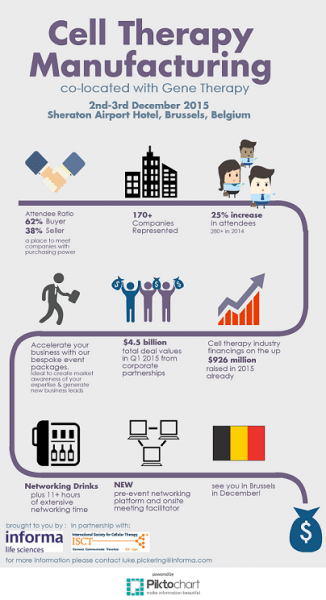
Cell Therapy Manufacturing and Gene Therapy Conference, December 2-3, 2015, Sheraton Airpost Hotel, Brussels, Belgium

Reporter: Aviva Lev-Ari, PhD, RN


Exclusive Site Visit to South Brussels Biopark


AGENDA

http://www.informa-ls.com/appdata/downloads/celltherapy15/CQ3554_Cell_Therapy_and_Gene_Therapy_2.pdf

Day One Wednesday 2 December 2015

Joint PLENARY SESSION: Regulatory Updates and Recent Progress


Day Two Thursday 3 December 2015

Plenary Session: Manufacturing Genetically Modified T-Cells

SPEAKERS

Jonathan Appleby
GSK, UK
Jonathan ApplebyMDL and CSO, Rare Diseases Gene TherapyGSK, UK


Lothar Germeroth,
Juno Therapeutics GmbH
Lothar Germeroth,SVP, Managing DirectorJuno Therapeutics GmbH


Christian-Homsy
Celyad, Belgium
Christian-HomsyCEOCelyad, Belgium


Dr Anthony Davies,
Dark Horse Consulting Inc, USA
Dr Anthony Davies,President,Dark Horse Consulting Inc, USA


Ms Bernadette Keane,
Bluebird bio, USA
Ms Bernadette Keane,Vice President, Quality,Bluebird bio, USA


Dr Knut Niss,
Novartis, USA
Dr Knut Niss,Senior Technical Project Leader, Global Biopharm Operations,Novartis, USA


Dr Ohad Karnieli
Pluristem Therapeutics, Israel
Dr Ohad KarnieliVP, Development and ManufacturingPluristem Therapeutics, Israel


Christopher Bravery
Consulting on Advanced Biologicals, UK
Christopher BraveryDirectorConsulting on Advanced Biologicals, UK


Dr Harald Petry
uniQure, The Netherlands
Dr Harald PetryCSOuniQure, The Netherlands


James Miskin
Oxford Biomedica
James MiskinCTOOxford Biomedica


Robert Kotin,
Voyager Therapeutics, USA
Robert Kotin,Vice President, Production,Voyager Therapeutics, USA


Guang Qu,
Spark Therapeutics, USA
Guang Qu,Head, Process Development,Spark Therapeutics, USA


Abraham Scaria,
Sanofi-Genzyme, USA
Abraham Scaria,Senior Scientific Director, Gene Therapy/Ophthalmology,Sanofi-Genzyme, USA


Dr Matthias Hebben,
Genenthon, France
Dr Matthias Hebben,Head, Bioprocess,Genenthon, France


Read Full Post »

Join These Medical 3D Printing Groups on Twitter and LinkedIn for great up to date news

Curator: Stephen J. Williams, Ph.D.

Below is a list with links to great groups on Twitter and LinkedIn that focus on the Medical 3D Printing Industry and Breaking News.  These are Great resources for news, information, investment opportunities, and conference announcements!

Twitter Groups on Medical 3D Printing

3D Printing Industry

@3dprintindustry

Leading source for #3DPrinting news & information – industry reports, business directory, jobs board, 3DPI.tv and more.

3D Printing News

@My3DPrinting

All the latest 3D Printing News from around the World.

3D Printing

@3DPrintBoardcom

http://3DPrintBoard.com  – The one forum for all your 3D Printing needs!

3D Printing News

@3DPrintGirl

Your source for The Latest 3D printing News

3D Printing Fans

@3DPrintingFans follows you

We cover all the latest, breaking news surrounding 3D printing and 3D scanning

TeVido BioDevices

@TeVidoBioDevice follows you

The convergence of #3Dprinting with biotechnology to #reconstructhope for #breast cancer #survivors

LinkedIN Groups on Medical 3D Printing

Medical Additive Manufacturing & 3D Printing

This group aims show the possibilities of Additive Manufacturing & 3D Printing technologies for the medical field.

299 discussions

1,966 members

View

  • ·

Medical 3D Printing

Sharing knowledge and expertise in Medical 3D printing.

139 discussions

739 members

View

  • ·

3D Printing Medical Devices

Members OnlyThe use of 3D printing in the Medical Device Field is growing at an exponential rate. Use this group to network with …

104 discussions

199 members

Join

3D Printing in Hospitals

Members Only3D printing is seen by some as the next generation of medical imaging. The goal of this group is to discuss and learn from…

51 discussions

161 members

Join

3D printing industry Finland

3D printing Finland is a group that disseminates information of 3D printing and enlightens its effects on Finnish …

22 discussions

34 members

View

  • ·

Chicago 3D Printing forum

A group discussion forum to help foster the relationship between additive manufacturing (3D Printing), and manufacturing …

7 members

View

3D Medical

3D Bio-Printing advancements.

7 members

View

3D Development in Ireland

This group is connecting those in Ireland interested in 3D printing for all its possible uses; design, building, gaming, …

5 members

View

Creatz3D Medical Luncheon

Members OnlyThis members only group facilitates the discussion between medical practitioners as well as the speakers present at Creatz3D …

1 member

Join

Protoform Rapid Prototyping

Members OnlyProtoform is a South African based 3D printing and prototyping company. Although Industrial Designers we have created …

20 discussions

16 members

Join

Read Full Post »

Global 3D Bioprinting Market: Industry Size, Share and Segments Analysis to 2015 – 2021

Reporter: Irina Robu, PhD

“3D bioprinting is a process of creating spatially-controlled cell patterns in 3D, where viability and cell function are conserved within printed construct. The 3D bioprinting industry that is currently at the embryonic stage of generating replacement human tissue has been forecast to be worth billion dollars by 2019. 3D bioprinting at present largely involves the creation of simple tissue structures in lab settings, but is estimated to be scaled up to involve the creation of complete organs for transplants. This technology is expected to be used for more speedy and accurate drug testing, as potential drug compounds could be tested on bioprinted tissue before human trials commenced.

3D bioprinting is steadily emerging as an area that is gathering attention from a lot of academicians. Some of the researchers have recently opened start-up firms with aim of commercializing the technology in coming years. A number of start-ups have recently sprung up to build up products based on bioprinting. Some are spin outs from university research. The market at present has 14 industry sponsored bioprinters, focused on variety of commercial applications. The widen supply-demand gap for organ transplants is an unmet need; the ultimate goal of researchers is to be able to create bioprinted organs for organ transplants. The focus of this market is expected to shift from research to commercialization. At this stage, the applications such as tissue engineering (skin and cartilage) and drug testing (skin and cartilage) are expected to be popular.

In coming years, 3D bioprinting to be a multi-billion dollar industry owning to early success of bioprinted organ transplants is expected to offer additional boost in subsequent years. The next generation of bioprinters is to offer additional features such as multiple arms and is expected to be comparatively more affordable driving wider adoption. Aspect Biosystems would dramatically cut the cost and time it takes to develop and test the drugs leading to cures for presently incurable diseases and cheaper treatment options. The companies in bioprinting market include SkinPrint that is developing a replacement skin for the burns patients or for those suffering from skin disorders. Aspect Biosystems that is developing printed tissue for drug testing.

Some of the major players for 3D bioprinting market are Advanced Biomatrix, 3D Biotek, 3D Systems, Avita Medical, Bespoke Innovations, Autodesk, EnvisionTEC, Cyfuse Biomedical, CMC Microsystems, Digilab, United Therapeutics, TeVido BioDevices, DTM, Bio3D Technologies, Helisys Inc. CMC Microsystems, InSphero AG and BD Biosciences among others.”

Source

https://www.persistencemarketresearch.com/market-research/3d-bioprinting-market.asp


Read Full Post »

Organs-on-Chips: An Alternative to 3D Bioprinting?

Reporter: Irina Robu, PhD

“Human “organs-on-chips” are composed of a clear, flexible polymer about the size of a computer memory stick, and contain hollow microfluidic channels lined by living human cells. These 3D organ and tissue models allow researchers to recreate the physiological and mechanical functions of the organ, and have the potential to eliminate the need to use animals for drug development and toxin testing. While saving animals has a certain feel good element to it, it is more likely the cost savings that will appeal to pharmaceuticals looking for alternatives to existing drug testing methods. Scientists test potential pharmaceuticals on animals because it is too dangerous to perform initial tests on humans. The problem with this method is that more often than not, the predictions gleaned from animal tests will fail when a compound is tested on humans.”

Source

http://www.nanalyze.com/2014/07/organs-on-chips-an-alternative-to-3d-bioprinting/

Human-on-a-chip

Read Full Post »

3D ‘printouts’ at the nanoscale using self-assembling DNA structures

Reporter: Aviva Lev-Ari, PhD, RN


A novel way of making 3D nanostructures from DNA is described in a study published in the renowned journal Nature . The study was led by researchers at Sweden’s Karolinska Institutet who collaborated with a group at Finland’s Aalto University. The new technique makes it possible to synthesize 3D DNA origami structures that are also able to tolerate the low salt concentrations inside the body, which opens the way for completely new biological applications of DNA nanotechnology. The design process is also highly automated, which enables the creation of synthetic DNA nanostructures of remarkable complexity.

Sourced through Scoop.it from: news.cision.com

See on Scoop.itCardiovascular Disease: PHARMACO-THERAPY

Read Full Post »

The Possibilities for Solid Tumor Modeling With 3D Printers Are Just Beginning – OncLive

Reporter: Aviva Lev-Ari, PhD, RN


See our Book

Medical 3D BioPrinting – The Revolution in Medicine

Technologies for Patient-centered Medicine:

From R&D in Biologics to New Medical Devices

@M3DP, LPBI Group

Available on Kindle Store @ Amazon.com since 12/30/2017

https://www.amazon.com/dp/B078QVDV2W


Three-dimensional printers are on the cusp of revolutionizing the way every doctor practices medicine.

Source: www.onclive.com

See on Scoop.itCardiovascular and vascular imaging

Read Full Post »

Engineers Build World’s Smallest and Fastest Nanomotor, Fitting Inside Living Cell

Reporter: Aviva Lev-Ari, PhD, RN


See on Scoop.itCardiovascular Disease: PHARMACO-THERAPY

Researchers at the Cockrell School of Engineering at The University of Texas at Austin have built the smallest, fastest and longest-running tiny synthetic motor to date. The team’s nanomotor is an important step toward developing miniature machines that could one day move through the body to administer insulin for diabetics when needed, or target and treat cancer cells without harming good cells.


With the goal of powering these yet-to-be invented devices, UT Austin engineers focused on building a reliable, ultra-high-speed nanomotor that can convert electrical energy into mechanical motion on a scale 500 times smaller than a grain of salt.


Mechanical engineering assistant professor Donglei “Emma” Fan led a team of researchers in the successful design, assembly and testing of a high-performing nanomotor in a nonbiological setting. The team’s three-part nanomotor can rapidly mix and pump biochemicals and move through liquids, which is important for future applications. The team’s study was published in the April issue of Nature Communications.


Fan and her team are the first to achieve the extremely difficult goal of designing a nanomotor with large driving power.


With all its dimensions under 1 micrometer in size, the nanomotor could fit inside a human cell and is capable of rotating for 15 continuous hours at a speed of 18,000 RPMs, the speed of a motor in a jet airplane engine. Comparable nanomotors run significantly more slowly, from 14 RPMs to 500 RPMs, and have only rotated for a few seconds up to a few minutes.


Looking forward, nanomotors could advance the field of nanoelectromechanical systems (NEMS), an area focused on developing miniature machines that are more energy efficient and less expensive to produce. In the near future, the Cockrell School researchers believe their nanomotors could provide a new approach to controlled biochemical drug delivery to live cells.

See on www.engr.utexas.edu

Read Full Post »

« Newer Posts