Healthcare analytics, AI solutions for biological big data, providing an AI platform for the biotech, life sciences, medical and pharmaceutical industries, as well as for related technological approaches, i.e., curation and text analysis with machine learning and other activities related to AI applications to these industries.
Vectorisation Of Immune Checkpoint Inhibitor Antibodies
Reporter: David Orchard-Webb, PhD
The FDA approved ipilimumab (anti-CTLA-4) and nivolumab (anti-PD-1) combination in October 2015 for the treatment of advanced melanoma. The antibodies have recently been approved in the UK for the same indication. Over half of patients respond to the combination [1]. These drugs belong to the class of monoclonal antibodies known as immune checkpoint inhibitors. The binding of anti-CTLA-4 antibodies to activated T cells prevents the surface CTLA-4 receptor from binding CD80 and/or CD86 on antigen presenting cells (APCs). Normally CTLA-4 binding to APCs deactivates the T-cell. Antibodies against programmed cell death protein 1 (PD-1) work by a similar mechanism to CTLA-4. These drugs are delivered by repeated intravenous injections (iv) [2].
Oncolytic viruses are an emerging class of immunotherapeutics that actively stimulate the immune system by releasing tumour antigens via lysis and by virtue of anti-viral immunity. The first FDA approved oncolytic virus (Imlygic), developed by Amgen/ BioVex, was given the green light in October 2015 for advanced melanoma patients delivered via direct tumour injection. The mechanism of action of oncolytic viruses is highly complementary with checkpoint inhibitor antibodies and multiple trials combining these two classes of agent are under way.
At the recent American Association for Cancer Research (AACR) annual meeting in New Orleans, Louisiana, the oldest biotechnology company in France – Transgene, presented preclinical data concerning oncolytic vaccinia viruses that express whole antibody (mAb), Fragment antigen-binding (Fab) or single-chain variable fragment (scFv) against mouse PD-1 [3]. These combinations proved superior over virus alone in mouse xenografts of melanoma and fibrosarcoma cell lines. Transgene claim that “these results pave the way for next generation of oncolytic vaccinia armed with immunomodulatory therapeutic proteins such as mAbs” (Figure 1) [3].
Figure 1: The convergence of therapeutics based on oncolytic viruses and monoclonal antibodies against immune checkpoint inhibotor proteins. Image Source:Eric Molina. No changes were made. Creative Commons Attribution 2.0 Generic (CC BY 2.0).
The combination of immune checkpoint inhibitors and oncolytic virus as a single molecular entity clearly has advantages in terms of manufacturing cost effectiveness. In addition viral vectors have the capacity for perfect specificity to tumours which has potential safety advantages.
Pancreatic Cancer Modeling using Retrograde Viral Vector Delivery and IN-Vivo CRISPR/Cas9-mediated Somatic Genome Editing, Volume 2 (Volume Two: Latest in Genomics Methodologies for Therapeutics: Gene Editing, NGS and BioInformatics, Simulations and the Genome Ontology), Part 2: CRISPR for Gene Editing and DNA Repair
Pancreatic Cancer Modeling using Retrograde Viral Vector Delivery and IN-Vivo CRISPR/Cas9-mediated Somatic Genome Editing
Curators: Larry H. Benstein, MD, FCAP and Aviva Lev-Ari, PhD, RN
Little is known about how these alterations contribute to the development of metastatic and therapy-refractory PDAC. Given the inability to test gene function in human cancers in vivo, genetically engineered mouse models represent tractable and biologically relevant systems with which to interrogate the molecular determinants of each stage of pancreatic cancer development.
Identification of the mutations that drive the development of human pancreatic cancer combined with the ability to alter gene function in mice has enabled the development of genetically engineered murine PDAC models. Transgenic expression of Cre-recombinase in pancreatic cells of loxP-Stop-loxP (LSL)KrasG12Dknock-in mice (KrasLSL-G12D/+) results in deletion of the transcriptional/translational Stop element, expression of oncogenic KrasG12D, and development of lesions that closely resemble early stage human pancreatic intraepithelial neoplasms (PanINs) (Hingorani et al. 2003). Concomitant expression of a point mutantp53 allele, deletion ofp53, deletion of Cdkn2a, and/or deletion of Smad4 allow(s) for the development of invasive and metastatic PDAC
(Aguirre et al. 2003; Hingorani et al. 2005; Bardeesy et al. 2006a,b; Gidekel Friedlander et al. 2009; Whittle et al. 2015).
Pancreatic ductal adenocarcinoma (PDAC) is a genomically diverse, prevalent, and almost invariably fatal malignancy. Although conventional genetically engineered mouse models of human PDAC have been instrumental in understanding pancreatic cancer development, these models are much too labor-intensive, expensive, and slow to perform the extensive molecular analyses needed to adequately understand this disease. Here we demonstrate that retrograde pancreatic ductal injection of either adenoviral-Cre or lentiviral-Cre vectors allows titratable initiation of pancreatic neoplasias that progress into invasive and metastatic PDAC. To enable in vivo CRISPR/Cas9-mediated gene inactivation in the pancreas, we generated a Cre-regulated Cas9 allele and lentiviral vectors that express Cre and a single-guide RNA. CRISPR-mediated targeting of Lkb1 in combination with oncogenic Kras expression led to selection for inactivating genomic alterations, absence of Lkb1 protein, and rapid tumor growth that phenocopied Cre-mediated genetic deletion of Lkb1. This method will transform our ability to rapidly interrogate gene function during the development of this recalcitrant cancer.
Keywords: CRISPR, genome editing, mouse model, pancreatic cancer
Pancreatic ductal adenocarcinoma (PDAC) is an almost uniformly lethal tumor type that is projected to become the second leading cancer killer in the United States by 2030 (Rahib et al. 2014). PDAC patients have a 5-year survival rate of ∼5%, underscoring the need for novel approaches to accelerate the molecular characterization of this disease. Although high-prevalence mutations have been identified in pancreatic cancer, these tumors also incur low-frequency mutations and genomic alterations, interact with their extensive and complex stromal environment, and undergo poorly characterized changes in their gene expression programs (Biankin et al. 2012; Waddell et al. 2015). Despite the potential importance of these molecular and cellular changes, very little is known about how these alterations contribute to the development of metastatic and therapy-refractory PDAC. Given the inability to test gene function in human cancers in vivo, genetically engineered mouse models represent tractable and biologically relevant systems with which to interrogate the molecular determinants of each stage of pancreatic cancer development.
Identification of the mutations that drive the development of human pancreatic cancer combined with the ability to alter gene function in mice has enabled the development of genetically engineered murine PDAC models. Transgenic expression of Cre-recombinase in pancreatic cells of loxP-Stop-loxP (LSL)KrasG12D knock-in mice (KrasLSL-G12D/+) results in deletion of the transcriptional/translational Stop element, expression of oncogenic KrasG12D, and development of lesions that closely resemble early stage human pancreatic intraepithelial neoplasms (PanINs) (Hingorani et al. 2003). Concomitant expression of a point mutant p53 allele, deletion of p53, deletion of Cdkn2a, and/or deletion of Smad4 allow(s) for the development of invasive and metastatic PDAC (Aguirre et al. 2003; Hingorani et al. 2005; Bardeesy et al. 2006a,b;Gidekel Friedlander et al. 2009; Whittle et al. 2015).
These in vivo models have been instrumental in our understanding of the genetic determinants of cancer progression as well as the functional interactions of neoplastic cells with the immune system and stromal environment. However, using conventional genetically engineered autochthonous mouse models of PDAC to interrogate gene function is complicated by inherent practical and biological limitations of these systems. Existing mouse models typically fail to model the adult onset of pancreatic cancer and induce genomic alteration in nearly every cell in the pancreas. In the decade since the first genetically engineered PDAC models were developed, few technical advances have been made, and generating the mice required to investigate a gene of interest in the established PDAC models remains a time-consuming and costly endeavor (Aguirre et al. 2003; Hingorani et al. 2003,2005; Saborowski et al. 2014).
Systems that enable in vivo functional interrogation of genes in pancreatic cancer without the financial and temporal cost of generating new mouse alleles and incorporating them into increasingly complex mouse models could have an extremely broad impact on pancreatic cancer research. To functionally investigate the molecular changes that drive each step of pancreatic cancer development, it would be desirable to have a system in which the timing of tumor initiation and the number of lesions that form in the adult pancreas can be controlled, the number of germline-encoded alleles is minimized, and genes of interest can be eliminated without having to generate a conditional allele and breed it into a complex genetically engineered mouse model.
Here we describe methods for the direct delivery of viral vectors to the pancreas and transgenic mouse lines to allow CRISPR/Cas9-mediated genomic alterations in pancreatic cells in vivo. These systems allow titratable initiation of pancreatic tumors in adult mice and functional interrogation of candidate genes in pancreatic cancer in vivo.
Pancreatic retrograde ductal injection of Adeno-Cre or Lenti-Cre induces widespread recombination and initiates the development of PanINs and ductal adenocarcinoma. (A) Diagram of the pancreatic retrograde ductal injection procedure. (B) Images of retrograde …
Chronic pancreatitis is associated with an increased incidence of PDAC in humans, and experimental evidence from mouse models suggests that adult cells may be refractory to transformation in the absence of pancreatic inflammation (Guerra et al. 2007; Raimondi et al. 2010). Therefore, we assessed whether retrograde ductal viral infection induces pancreatitis. Both Ad-Cre and Lenti-Cre infection induced acute pancreatitis with morphological evidence of ADM and focal replacement of acinar cells by infiltrating mononuclear cells (Supplemental Figs. 1C,D, 4C). The induction of pancreatitis is consistent with the efficient tumor initiation observed in adult animals following retrograde ductal injection of viral-Cre.
Diverse expansion potential and metastatic ability of viral-Cre-initiated PDAC. (A) DTCs can be detected in the peritoneal cavity of Ad-Cre-infected KPTmice. Viable (DAPInegative), lineage-negative (CD31, CD45, Ter119, F4/80)negative cells are shown. …
CRISPR/Cas9 enables in vivo genetic alteration in pancreatic cancer. (A) Schematic of the Cre-regulatedCas9 allele. (CAGGS) Cytomegalovirus immediate–early enhancer/chicken β-actin promoter; (hSpCas9) human codon-optimized Streptococcus…
Somatic genome engineering enables rapid generation of genetically defined pancreatic cancer mouse models
To assess the impact of Lkb1 deletion on pancreatic cancer, we performed retrograde ductal injections of KT;H11LSL-Cas9/+, control KT, and KT;Lkb1flox/flox mice with Lenti-sgLkb1/Cre as well as KT;H11LSL-Cas9/+ mice with lentiviral vectors containing negative control sgRNAs. Control KT mice infected with Lenti-sgLkb1/Cre as well as KT;H11LSL-Cas9/+ mice infected with a Lenti-sgRNA/Cre vector containing either a nontargeting sgRNA (sgNT) or an sgRNA targeting an inert region of the genome (sgNeo) formed only rare Tomatopositive lesions (Fig. 3F–H). Both Lenti-sgLkb1/Cre-infected KT;H11LSL-Cas9/+ and KT;Lkb1flox/flox mice had extensive tumor growth as early as 2 mo after tumor initiation (Fig. 3I,J, respectively).
All three groups of negative control mice developed only rare PanIN lesions within almost completely normal pancreata (Fig. 4A–C; Supplemental Fig. 9A; data not shown). The tumors that formed in Lenti-sgLkb1/Cre-infectedKT;H11LSL-Cas9/+ mice were cystic lesions comprised of Tomatopositive, CK19positive tall cuboidal to columnar epithelial cells with otherwise bland cytological features (Fig. 4D; Supplemental Fig. 9B). Some smaller lesions also contained high levels of mucin (Supplemental Fig. 9B). Importantly, these features were histologically indistinguishable from those found in KT;Lkb1flox/flox mice infected with Lenti-sgLkb1/Cre (Fig. 4E; Supplemental Fig. 9C). Lenti-sgLkb1/Cre-infected KT;H11LSL-Cas9/+ mice also had a substantially higher tumor burden when compared with all three groups of negative control mice (Fig. 4F).
Cas9-mediated targeting of Lkb1 in the pancreas promotes tumor growth. (A) Control Lenti-sgLkb1/Cre-infected KT mice (n= 5) have small clusters of Tomatopositive cells and very rare ADMs and PanINs. (B,C) KT;H11LSL-Cas9/+ mice infected with Lenti-sgNT/Cre …
Diverse indels at the targetedLkb1 locus were specifically detected in the neoplastic cells from these tumors (Fig. 5A,B; Supplemental Fig. 9F). The indels were all frameshift mutations or large exon deletions that included the splice acceptor or donor regions of Lkb1exon 6, further supporting the strong selective advantage of Lkb1 inactivation (Fig. 5B,C). Consistent with the presence of CRISPR/Cas9-induced frameshift mutations and large deletions, Lkb1 protein was absent from most neoplastic cells in the Lenti-sgLkb1/Cre-induced tumors in KT;H11LSL-Cas9/+ mice (Fig. 5D,E; Supplemental Fig. 9G).
Cas9-mediated targeting leads to the formation of pancreatic tumors harboring deleterious Lkb1mutations and lacking Lkb1 protein. (A) Genomic cleavage detection assay detected indels in the targeted Lkb1 locus in Tomatopositive cells isolated from Lenti-sgLkb1/Cre-infected …
The development of systems that accelerate our ability to investigate pancreatic carcinogenesis at the molecular level will be a critical step toward overcoming the dismal rate of successful treatment and low survival rate of patients with this recalcitrant cancer. The ability to induce pancreatic cancer using viral vectors will be instrumental in understanding the mechanisms that sustain tumor growth, lead to metastatic spread, and drive drug resistance. Our CRISPR/Cas9-based model should allow any gene of interest to be inactivated in pancreatic cancer in vivo without the need to generate any new mouse alleles. The method developed in this study could have a profound impact on both basic and translational pancreatic cancer research. Collectively, these methods will enable a more rapid and complete understanding of the molecular regulators of all aspects of pancreatic tumorigenesis and complement the strength of existing genetically engineered models, human patient-derived xenograft models, and studies on human and murine cell lines.
Retrograde ductal injection of Adeno-Cre and Lenti-Cre vectors allows titratable pancreatic tumor initiation in the adult pancreas. This removes the requirement for the transgenic Cre(ER) alleles used in conventional genetically engineered pancreatic cancer models and enables sparse rather than widespread expression of oncogenic Kras and deletion of tumor suppressor genes, more closely recapitulating the initiating events in human PDAC. The inclusion of a fluorescent Cre reporter in transgenic Cre(ER)-induced PDAC models leads to the fluorescent labeling of not only the neoplastic cells but also most of the nontransformed pancreatic epithelial cells, making unequivocal distinction of neoplastic from normal cells difficult.
The ability to induce PDAC in Cre-lox models without having to include a transgenic Cre line will make the molecular investigation of pancreatic cancer more rapid and less expensive (Supplemental Table 2). Additionally, with the ease of generating pancreatic tumors now approaching that of lung tumors (via intranasal or intratracheal injection), comparing the impact of the same genetic alterations on each cancer type should become standard practice and will uncover the commonalities and differences between these lethal adenocarcinomas.
PDAC models often generate tumor masses of unknown clonal origin. By incorporating a multicolor fluorescent reporter, we were able to mark individual clonal lesions and identify the relationship between primary tumors and metastases. Unexpectedly, some late time point mice had only one or two large cancers, underscoring the dramatic heterogeneity in expansion potential of pancreatic lesions initiated with identical engineered genetic events.
Oncolytic Viruses: A New Class of Immunotherapy Drugs against Cancer
Reporter: Aviva Lev-Ari, PhD, RN
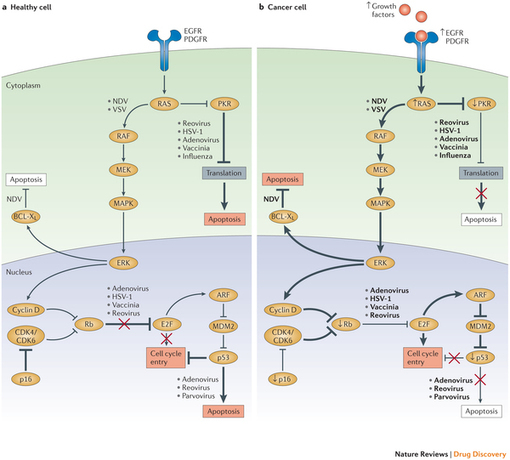
Oncolytic viruses represent a new class of therapeutic agents that promote anti-tumour responses through a dual mechanism of action that is dependent on selective tumour cell killing and the induction of systemic anti-tumour immunity. The molecular and cellular mechanisms of action are not fully elucidated but are likely to depend on viral replication within transformed cells, induction of primary cell death, interaction with tumour cell antiviral elements and initiation of innate and adaptive anti-tumour immunity. A variety of native and genetically modified viruses have been developed as oncolytic agents, and the approval of the first oncolytic virus by the US Food and Drug Administration (FDA) is anticipated in the near future. This Review provides a comprehensive overview of the basic biology supporting oncolytic viruses as cancer therapeutic agents, describes oncolytic viruses in advanced clinical trials and discusses the unique challenges in the development of oncolytic viruses as a new class of drugs for the treatment of cancer.

 2012pharmaceutical
 sjwilliamspa