Feeds:
Posts
Comments

See on Scoop.itCardiovascular and vascular imaging

The authors evaluated the ability of resting single–phase 64–slice CCTA to detect the presence of myocardial infarction (MI) compared with nuclear myocardial perfusion imaging (MPI). Resting single–phase CCTA is highly …

See on www.mdlinx.com

See on Scoop.itCardiovascular and vascular imaging

Your Health: Gut problems can have multiple causes
Richmond Times Dispatch
“The older we get the more likely we are to have hardening of our arteries, so the greater the possibility for mesenteric ischemia,” he said.

See on www.timesdispatch.com

See on Scoop.itCardiovascular and vascular imaging

ANN ARBOR: New program at UM will help cancer patients deal with heart …

See on www.heritage.com

See on Scoop.itCardiovascular and vascular imaging

Tissue Injury Has Lead in New Stroke Definition – MedPage Today MedPage Today “A tissue-based definition of ischemic stroke and transient ischemic attack enhances diagnostic criteria and relies on utilization of various imaging techniques in the…

See on www.medpagetoday.com

See on Scoop.itCardiovascular and vascular imaging

Clot Busters May Not Be Best for Major Stroke – MedPage Today MedPage Today Endovascular interventions appear to be superior to intravenous clot-busting drugs for treating a specific type of ischemic stroke in the emergency setting, a study has…

See on www.medpagetoday.com

Stenosis, ischemia and heart failure

Reporter: Aviva Lev-Ari, PhD, RN


See on Scoop.itCardiovascular and vascular imaging

Learn more: http://www.khanacademy.org/video?v=3858MaULDdI Clarifying a bunch of medical terms around heart disease (Stenosis, ischemia and heart failure http://t.co/jokVvUsfTF)…

See on www.youtube.com

ECOSPHERE: Social media meets 3D digital art

Reporter: Aviva Lev-Ari, PhD, RN


See on Scoop.itCardiovascular Disease: PHARMACO-THERAPY

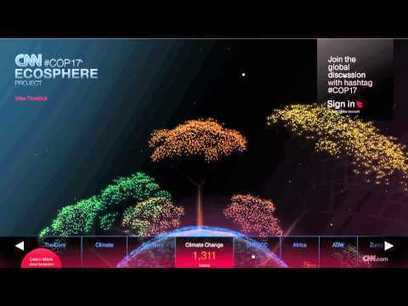
WELCOME TO THE ECOSPHERE.


A real-time view of the global climate change discussion around the COP17 Conference.

Every tweet tagged with hashtag #COP17 will stimulate growth in a plant or tree in the ECOPSHERE that represents a certain topic (e.g. Sustainability). In this constantly evolving environment users are able to see the discussion develop as people talk on Twitter – a real-time visualisation of the global conversation.

The-state-of-the art ECOSPHERE microsite was produced by STINK DIGITAL LONDON/NEW YORK and developed and designed by MINIVEGAS Amsterdam/Los Angeles.

MINIVEGAS has developed a real-time infographic of sorts, treating the viewer to a stunning visual representation of the evolving global discussion. A lush 3D environment that allows the viewer to explore, view content up close or zoom out to observe the visualisation as a whole. At the core of the experience is a digital growth algorithm is based on actual organic growth in the plant world — plants and trees grow organically with every #COP17 tweet and topics compete for space and light on the sphere.

The ECOSPHERE constantly listens to the global conversation on Twitter — every new tweet tagged with hashtag #COP17 is brought into the environment, scanned for keywords and then grouped with similar contributions, connecting input from around the world – building conversations in a fascinating evolving environment.

CNN COVERAGE
CNN International will also use the ECOSPHERE Project in its live reporting about the summit. CNN correspondents Robyn Curnow and Diana Magnay will report and comment on events in and around the meeting, exploring what effect the decisions taken in Durban will have on the world, on business and on every individual person on the planet.

In addition, the ECOSPHERE Project will also be part of the December edition of “Road to Durban: A Green City Journey”. In the months approaching the summit, CNN made the journey to Durban starting in the UK and travelling across Germany and Turkey reporting on local climate protection projects. In December “Road to Durban: A Green City Journey” will be dedicated to the themes of the 17th World Climate Summit. For more information please go to www.cnn.com/roadtodurban.

See on www.youtube.com

Bitcoin Network Speed 8 Times Faster than Top 500 Supercomputers Combined

Reporter: Aviva Lev-Ari, PhD, RN


See on Scoop.itCardiovascular Disease: PHARMACO-THERAPY

The bitcoin network speed estimate on bitcoinwatch.com passed 1 exaFLOPS (1,000 petaFLOPS) this week – over 8 times the combined speed of the top 500 supercomputers.


The bitcoin network hashrate estimate on bitcoinwatch.compassed 1 exaFLOPS (1,000 petaFLOPS) this week – over 8 times the combined speed of the top 500 supercomputers. Experts will be quick to point out that this estimate is flawed, since no FLOPS are actually used in bitcoin mining. FLOPS stands for FLoating-point Operations Per Second, and is frequently used as a standard to measure computer speed. Bitcoin mining uses an integer calculation and almost no floating-point operations, so converting bitcoin network speed to this standard is somewhat clumsy.


The FLOPS estimate is based on the opportunity cost of computers using their hardware for mining instead of other applications.  Miners are using their graphics cards to perform hashes instead of other FLOPS-based distributed computing. Therefore, a conversion rate of 1 hash = 12.7K FLOP is used to estimate what this hardware could be doing.


The estimate was created in 2011, before the production of ASIC hardware that now dominates the network. ASICS are custom designed chips that can only perform bitcoin mining calculations. The exaFLOPS estimate breaks down with ASICs, because they are not capable of floating-point operations, and therefore there is no opportunity cost associated with their use.


Interestingly, the estimate may still be useful for estimating how well other supercomputers and distributed networking projects would be able to mine bitcoins. Their speed is measured in FLOPS, but they also have the capability of performing the integer operations used in hashing. What would happen if the top 10 supercomputers all switched to bitcoin mining? How much would that affect the network? Lets reverse the equation, and say that they would receive 1 hash for every 12.7k FLOP.


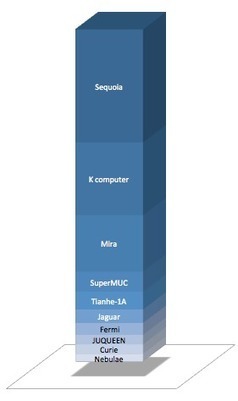
The fastest computer, Sequoia, would measure at about 1.6% of the bitcoin network. Their combined speed is 48 petaFLOPS, roughly equivalent to 5% of the bitcoin network. In fact, the top 500 supercomputers have a combined speed of 12% of the bitcoin network.


To actually use these computers for mining, It would take more than just installing standard mining software. But lets be honest, these computers have better things to work on like curing cancer, solving global warming, and monitoring banking transactions.

See on www.thegenesisblock.com

New device can extract human DNA with full genetic data in minutes

Reporter: Aviva Lev-Ari, PhD, RN


See on Scoop.itAmazing Science

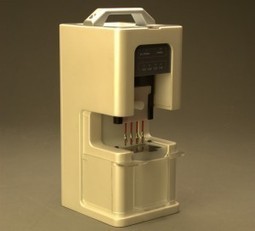
Take a swab of saliva from your mouth and within minutes your DNA could be ready for analysis and genome sequencing with the help of a new device.


University of Washington engineers and NanoFacture, a Bellevue, Wash., company, have created a device that can extract human DNA from fluid samples in a simpler, more efficient and environmentally friendly way than conventional methods.


The device will give hospitals and research labs a much easier way to separate DNA from human fluid samples, which will help with genome sequencing, disease diagnosis and forensic investigations.


“It’s very complex to extract DNA,” said Jae-Hyun Chung, a UW associate professor of mechanical engineering who led the research. “When you think of the current procedure, the equivalent is like collecting human hairs using a construction crane.”


This technology aims to clear those hurdles. The small, box-shaped kit now is ready for manufacturing, then eventual distribution to hospitals and clinics. NanoFacture, a UW spinout company, signed a contract with Korean manufacturer KNR Systems last month at aceremony in Olympia, Wash.


The UW, led by Chung, spearheaded the research and invention of the technology, and still manages the intellectual property. Separating DNA from bodily fluids is a cumbersome process that’s become a bottleneck as scientists make advances in genome sequencing, particularly for disease prevention and treatment. The market for DNA preparation alone is about $3 billion each year.


Conventional methods use a centrifuge to spin and separate DNA molecules or strain them from a fluid sample with a micro-filter, but these processes take 20 to 30 minutes to complete and can require excessive toxic chemicals.


UW engineers designed microscopic probes that dip into a fluid sample – saliva, sputum or blood – and apply an electric field within the liquid. That draws particles to concentrate around the surface of the tiny probe. Larger particles hit the tip and swerve away, but DNA-sized molecules stick to the probe and are trapped on the surface. It takes two or three minutes to separate and purify DNA using this technology.

See on www.washington.edu

AT13148 – A Novel Oral Multi-AGC Kinase Inhibitor Has Potent Antitumor Activity

Reporter: Aviva Lev-Ari, PhD, RN


See on Scoop.itCardiovascular Disease: PHARMACO-THERAPY

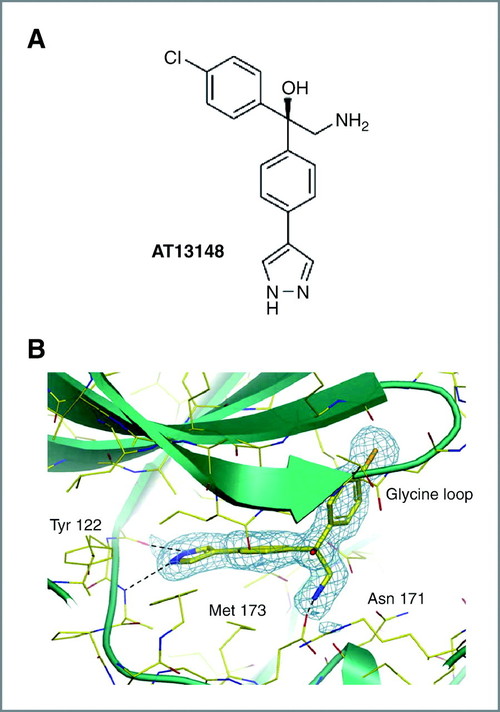
Deregulated phosphatidylinositol 3-kinase pathway signaling through AGC kinases including AKT, p70S6 kinase, PKA, SGK and Rho kinase is a key driver of multiple cancers. The simultaneous inhibition of multiple AGC kinases may increase antitumor activity and minimize clinical resistance compared with a single pathway component.


A research team from the UK investigated the detailed pharmacology and antitumor activity of the novel clinical drug candidate AT13148, an oral ATP-competitive multi-AGC kinase inhibitor. Gene expression microarray studies were undertaken to characterize the molecular mechanisms of action of AT13148.


Their results show that AT13148 caused a substantial blockade of AKT, p70S6K, PKA, ROCK, and SGK substrate phosphorylation and induced apoptosis in a concentration and time-dependent manner in cancer cells with clinically relevant genetic defects in vitro and in vivo. Antitumor efficacy in HER2-positive, PIK3CA-mutant BT474 breast, PTEN-deficient PC3 human prostate cancer, and PTEN-deficient MES-SA uterine tumor xenografts was shown. These experiments demonstrate for the first time that induction of AKT phosphorylation at serine 473 by AT13148, as reported for other ATP-competitive inhibitors of AKT, is not the therapeutically relevant reactivation step. Gene expression studies showed that AT13148 has a predominant effect on apoptosis genes, whereas the selective AKT inhibitor CCT128930 modulates cell-cycle genes. Induction of upstream regulators including IRS2 and PIK3IP1 as a result of compensatory feedback loops was observed.


Thus, the clinical candidate AT13148 is a novel oral multi-AGC kinase inhibitor with potent pharmacodynamic and antitumor activity, which shows a distinct mechanism of action from other AKT inhibitors. AT13148 will now be assessed in a first-in-human phase I trial.

See on clincancerres.aacrjournals.org