Feeds:
Posts
Comments

See on Scoop.itCardiotoxicity

BP reductions with EnligHTN ablation system sustained at 1 year Healio The prospective, multicenter, feasibility EngligHTN I trial enrolled 46 patients (mean age, 60 years; mean BMI, 32) who were taking at least three antihypertensive medications…

See on www.healio.com

See on Scoop.itCardiotoxicity

Boston Globe
G Cover When the brain is under attack
Boston Globe
“What if people were walking around with a psychiatric diagnosis, treated with psychotropic medications, but who may in fact have a potentially curable auto-immune disease?

See on www.bostonglobe.com

See on Scoop.itCardiovascular Disease: PHARMACO-THERAPY
Angry outbursts are linked to increased risk of heart attack Washington Post In the study, patients on blood pressure medications known as beta blockers had a lower chance of having a heart attack following an angry outburst, Mostofsky’s team notes…

See on www.washingtonpost.com

See on Scoop.itCardiovascular Disease: PHARMACO-THERAPY

This is one of those “good news, but” medical stories.

New treatments for heart failure have made it much less likely that people with this chronic condition will die suddenly.

But an analysis by researchers at UCLA finds that the death rate for people with advanced heart failure remains stubbornly high, with 30 percent of people dying within three years.

“They’re not dying suddenly, but their disease is still progressing,” says Dr. Tamara Horwich, an assistant professor of medicine at UCLA and a co-author of the study, which was published inCirculation Heart Failure.

Still, that’s a lot better than 50 years ago, when heart failure patients were pretty much sent home to die. Heart failure has many causes, including heart attack, diabetes, high blood pressure and viral infections. But the effect is the same: a heart that doesn’t move blood effectively.

About 6 million people in the United States have heart failure, according to the Centers for Disease Control and Prevention, and is the primary cause of 55,000 deaths a year.

In the past 20 years, medical care for heart failure has changed radically, with new medications and devices. Horwich and her colleagues wanted to see if these advances were helping patients in the real world.

The people in this study were referred the UCLA center in their early 50s, on average; this is not a disease just for the old. The study looked at 2,500 patients who had been treated at UCLA from 1993 to 2010.

They found that three drugs — ACE inhibitors, beta blockers, and aldosterone antagonists — had been widely adopted for treatment of heart failure between 1993 and 2010. At the same time, the number of people with implanted automatic heart defibrillators went from 11 percent to 68 percent. The implanted defibrillators correct abnormal heart rhythms, a big cause of sudden death.

Death rates were 42 percent lower for patients in the most recent treatment group, between 2005 and 2010, than for the patients in the 1990s. That was largely due to a drop in sudden cardiac deaths.

But deaths from progressive heart failure remained high, with 31 percent of patients dying in the latter part of the study, compared to 36 percent in the 1990s. People could be coming to UCLA sicker than in years past, Horvich speculates, having survived heart attacks and other problems that would have killed them in the past.

But it could also be because those people are ending up on implantable ventricular assist pumps or getting heart transplants, very expensive treatments that are difficult for many people to tolerate.

“We’re not curing the disease,” Horvich tells Shots. “We’re delaying the inevitable.” And that means, she says, that “we still have a lot of hard work ahead of us” in finding ways to prevent and treat heart failure.

See on www.npr.org

See on Scoop.itCardiovascular Disease: PHARMACO-THERAPY

Telegraph.co.uk CoQ10 suggested to be added to standard heart failure therapy Examiner.com Researchers have reported that CoQ10 is the first medication which has been found to improve survival in chronic heart failure since ACE inhibitors and beta…

See on www.examiner.com

See on Scoop.itCardiovascular Disease: PHARMACO-THERAPY

WRAL.com
New drug treatment can control damaging stress
WRAL.com
Using heart and blood pressure monitors, Duke researchers looked at how mental stress triggers ischemia, or poor blood flow in the heart which can cause chest pain.

See on www.wral.com

See on Scoop.itCardiovascular Disease: PHARMACO-THERAPY

1. Rates of mental stress-induced myocardial ischemia (MSIMI) were significantly lower in patients taking escitalopram (Lexapro) vs. placebo at the end of 6 weeks. 2. Rates of exercise-induced myocardial ischemia (ESIMI) …

See on www.2minutemedicine.com

See on Scoop.itCardiovascular and vascular imaging

Myocardial Ischemia – Pipeline Review, H1 2013 – New Market Study Published SBWire (press release) This report provides information on the therapeutic development for Myocardial Ischemia, complete with latest updates, and special features on…

See on www.sbwire.com

See on Scoop.itCardiovascular and vascular imaging

BUENOS AIRES – Traditional tools such as the Framingham risk score have long been known to underestimate cardiovascular risk in people with systemic lupus erythematosus.
At the international congress on systemic lupus erythematosus, Dr.

See on www.internalmedicinenews.com

Scientists prevent heart failure in mice

Reporter: Aviva Lev-Ari, PhD, RN


See on Scoop.itCardiovascular and vascular imaging

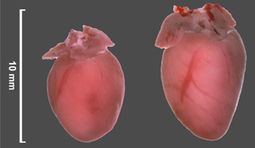
Cardiac stress, for example a heart attack or high blood pressure, frequently leads to pathological heart growth and subsequently to heart failure. Two tiny RNA molecules play a key role in this detrimental development in mice, as researchers at the Hannover Medical School and the Göttingen Max Planck Institute for Biophysical Chemistry have now discovered. When they inhibited one of those two specific molecules, they were able to protect the rodent against pathological heart growth and failure. With these findings, the scientists hope to be able to develop therapeutic approaches that can protect humans against heart failure.


The scientists involved in this study had observed that these microRNAs are more prevalent in the cardiac muscle cells of mice suffering from cardiac hypertrophy. To determine the role that the two microRNAs play, the scientists bred genetically modified mice that had an abnormally large number of these molecules in their heart muscle cells. “These rodents developed cardiac hypertrophy and lived for only three to six months, whereas their healthy conspecifics had a normal healthy life-span of several years,” explained Kamal Chowdhury, researcher in the Department of Molecular Cell Biology at the Max Planck Institute for Biophysical Chemistry. “For comparison, we also selectively switched off these microRNAs in other mice. These animals had a slightly smaller heart than their healthy conspecifics, but did not differ from them in behaviour or life-span,” continued the biologist. The crucial point is when the scientists subjected the hearts of these mice to stress by narrowing the aorta, the mice did not develop cardiac hypertrophy – in contrast to normal mice.


The scientists were also able to protect normal mice against the disease. When they gave them a substance that selectively inhibits microRNA-132, no pathological cardiac growth occurred – even when the hearts of these mice were subjected to stress. “Thus, for the first time ever, we have found a molecular approach for treating pathological cardiac growth and heart failure in mice,” said the cardiologist Thomas Thum, MD, Director of the Institute for Molecular and Translational Therapy Strategies (IMTTS) at the Hannover Medical School. With these findings, the researchers hope that they will be able to develop therapeutic approaches that can also protect humans against heart failure. “Such microRNA inhibitors, alone or in combination with conventional treatments, could represent a promising new therapeutic approach,” said Thum.


“In mice with an overdosage of the two microRNAs in their heart muscle cells, the cellular ‘recycling program’ is curbed,” explained Ahmet Ucar, who together with Shashi K. Gupta was responsible for the experiments. In this recycling process, the cell breaks down components that are damaged or no longer required and reuses their constituents – a vital process that, for example, ensures the organism’s survival under stress conditions. In mice without the microRNAs -212 and 132, this recycling program is more active than in their normal conspecifics. Conceivably, the reduced cellular recycling could be a cause of the observed cardiac hypertrophy.

See on www.mpibpc.mpg.de