Feeds:
Posts
Comments

Archive for the ‘Advanced Computing Platform’ Category

Gold chip ion-trap captures Science Photography Competition’s top prize – EPSRC website

Reporter: Aviva Lev-Ari, PhD, RN


An image of a gold chip that traps ions for use in quantum computing has come first in EPSRC’s third science photography competition.

‘Microwave ion-trap chip for quantum computation’, by Diana Prado Lopes Aude Craik and Norbert Linke, from the University of Oxford, shows the chip’s gold wire-bonds connected to electrodes which transmit electric fields to trap single atomic ions a mere 100 microns above the device’s surface. The image, taken through a microscope in one of the university’s cleanrooms, came first in the Eureka category as well as winning overall against many other stunning pictures, featuring research in action, in the EPSRC competition – now in its third year.


Doctoral student Diana Prado Lopes Aude Craik, explained how the chip works: “When electric potentials are applied to the chip’s gold electrodes, single atomic ions can be trapped. These ions are used as quantum bits (‘qubits’), units which store and process information in a quantum computer. Two energy states of the ions act as the ‘0’ and ‘1’ states of these qubits.


Slotted electrodes on the chip deliver microwave radiation to the ions, allowing us to manipulate the stored quantum information by exciting transitions between the ‘0’ and ‘1’ energy states. “This device was micro-fabricated using photolithography, a technique similar to photographic film development. Gold wire-bonds connect the electrodes to pads around the device through which signals can be applied. You can see the wire-bonding needle in the top-left corner of the image. The Oxford team recently achieved the world’s highest-performing qubits and quantum logic operations.”


The development of the ion-trap chip was funded jointly by the EPSRC and the US Army Research Office.

The competition’s five categories were: Eureka, Equipment, People, Innovation, and Weird and Wonderful. Winning images feature:

A spectacular 9.5 meter wave created to wow crowds at the FloWave Ocean Energy Research Facility at the University of EdinburghAn iCub humanoid robot learning about how to play from a baby as part of robotics research taking place at Aberystwyth UniversityThe intense, blinding light of plasma formed by an ultrafast laser being used to process glass at the EPSRC Centre for Innovative Manufacturing in Ultra Precision at the University of CambridgeA beautiful rotating jet of viscoelastic liquid water resembling a spinning dancer that demonstrates the effect of adding a tiny amount of polymer to water and an example of fluid dynamics research at Imperial College London


One of the judges was Professor Robert Winston, he said: “This competition helps us engage with academics and these stunning images are a great way to connect the general public with research they fund, and inspire everyone to take an interest in science and engineering.”

Sourced through Scoop.it from: www.epsrc.ac.uk

See on Scoop.itCardiovascular and vascular imaging

Read Full Post »

Unsupervised, Mobile and Wireless Brain–Computer Interfaces on the Horizon


Reporter: Aviva Lev-Ari, PhD, RN

Juliano Pinto, a 29-year-old paraplegic, kicked off the 2014 World Cup in São Paulo with a robotic exoskeleton suit that he wore and controlled with his mind. The event was broadcast internationally and served as a symbol of the exciting possibilities of brain-controlled machines. Over the last few decades research into brain–computer interfaces (BCIs), which allow direct communication between the brain and an external device such a computer or prosthetic, has skyrocketed. Although these new developments are exciting, there are still major hurdles to overcome before people can easily use these devices as a part of daily life.

Until now such devices have largely been proof-of-concept demonstrations of what BCIs are capable of. Currently, almost all of them require technicians to manage and include external wires that tether individuals to large computers. New research, conducted by members of the BrainGate group, a consortium that includes neuroscientists, engineers and clinicians, has made strides toward overcoming some of these obstacles. “Our team is focused on developing what we hope will be an intuitive, always-available brain–computer interface that can be used 24 hours a day, seven days a week, that works with the same amount of subconscious thought that somebody who is able-bodied might use to pick up a coffee cup or move a mouse,” says Leigh Hochberg, a neuroengineer at Brown University who was involved in the research. Researchers are opting for these devices to also be small, wireless and usable without the help of a caregiver.

Sourced through Scoop.it from: www.scientificamerican.com

See on Scoop.itCardiovascular and vascular imaging
Read Full Post »

China still has the fastest supercomputer, and now has more than 100 in service – Digital Trends


Reporter: Aviva Lev-Ari, PhD, RN


Perhaps unsurprisingly, China beat out the United States for the most powerful supercomputer in the world for the sixth time in a row.

Sourced through Scoop.it from: www.digitaltrends.com

See on Scoop.itCardiovascular and vascular imaging

Read Full Post »

Gartner identifies the top 10 strategic IT technology trends for 2016 | KurzweilAI

Reporter: Aviva Lev-Ari, PhD, RN


Top 10 strategic trends 2016 (credit: Gartner, Inc.) At the Gartner Symposium/ITxpo today (Oct. 8), Gartner, Inc. highlighted the top 10 technology trends

Sourced through Scoop.it from: www.kurzweilai.net

See on Scoop.itCardiovascular and vascular imaging

Read Full Post »

China is set to complete the installation of the world’s longest quantum communication network

Reporter: Aviva Lev-Ari, PhD, RN

China is set to complete the installation of the world’s longest quantum communication network stretching 2,000km (1,240miles) from Beijing to Shanghai by 2016, say scientists leading the project. Quantum communications technology is considered to be “unhackable” and allows data to be transferred at the speed of light. By 2030, the Chinese network would be extended worldwide, the South China Morning Post reported. It would make the country the first major power to publish a detailed schedule to put the technology into extensive, large-scale use.


The development of quantum communications technology has accelerated in the last five years. The technology works by two people sharing a message which is encrypted by a secret key made up of quantum particles, such as polarized photons. If a third person tries to intercept the photons by copying the secret key as it travels through the network, then the eavesdropper will be revealed by virtue of the laws of quantum mechanics – which dictate that the act of interfering with the network affects the behaviour of the key in an unpredictable manner.


If all goes to schedule, China would be the first country to put a quantum communications satellite in orbit, said Wang Jianyu, deputy director of the China Academy of Science’s (CAS) Shanghai branch. At a recent conference on quantum science in Shanghai, Wang said scientists from CAS and other institutions have completed major research and development tasks for launching the satellite equipped with quantum communications gear, South China Morning Post said.


The potential success of the satellite was confirmed by China’s leading quantum communications scientist, Pan Jianwei, a CAS academic who is also a professor of quantum physics at the University of Science and Technology of China (USTC) in Hefei, in the eastern province of Anhui. Pan said researchers reported significant progress on systems development after conducting experiments at a test center in the northwest of China.


The satellite would be used to transmit encoded data through a method called quantum key distribution (QKD), which relies on cryptographic keys transmitted via light pulse signals. QKD is said to be nearly impossible to hack, since any attempted eavesdropping would change the quantum states and thus could be quickly detected by dataflow monitors.

Sourced through Scoop.it from: uk.news.yahoo.com

See on Scoop.itCardiovascular and vascular imaging
Read Full Post »

IBM’s $3 Billion Investment In Synthetic Brains And Quantum Computing

Reporter: Aviva Lev-Ari, PhD, RN

IBM thinks the future belongs to computers that mimic the human brain and use quantum physics…and they’re betting $3 billion on it.

Sourced through Scoop.it from: www.fastcompany.com

See on Scoop.itCardiovascular and vascular imaging

Read Full Post »

World’s first $1,000 genome enables ‘factory’ scale sequencing for population and disease studies

Reporter: Aviva Lev-Ari, PhD, RN


See on Scoop.itCardiovascular and vascular imaging

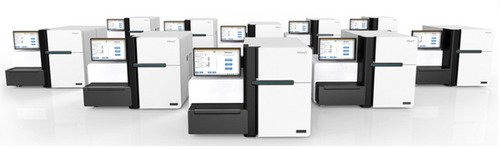
Illumina, Inc. announced Tuesday that its new HiSeq X Ten Sequencing System has broken the “sound barrier” of human genomics by enabling the $1,000 genome. “This platform includes dramatic technology breakthroughs that enable researchers to undertake studies of unprecedented scale by providing the throughput to sequence tens of thousands of human whole genomes in a single year in a single lab,” Illumina stated.


Initial customers for the HiSeq X Ten System, which will ship in Q1 2014, include Macrogen, based in Seoul, South Korea and its CLIA laboratory in Rockville, Maryland, the Broad Institute in Cambridge, Massachusetts, and the Garvan Institute of Medical Research in Sydney, Australia.


“For the first time, it looks like it will be possible to deliver the $1,000 genome, which is tremendously exciting,” said Eric Lander, founding director of the Broad Institute and a professor of biology at MIT. “The HiSeq X Ten should give us the ability to analyze complete genomic information from huge sample populations. Over the next few years, we have an opportunity to learn as much about the genetics of human disease as we have learned in the history of medicine.”


“The HiSeq X Ten is an ideal platform for scientists and institutions focused on the discovery of genotypic variation to enable a deeper understanding of human biology and genetic disease,” Illumina stated. “It can sequence tens of thousands of samples annually with high-quality, high-coverage sequencing, delivering a comprehensive catalog of human variation within and outside coding regions.”


HiSeq X Ten utilizes a number of advanced design features to generate massive throughput. Patterned flow cells, which contain billions of nanowells at fixed locations, combined with a new clustering chemistry deliver a significant increase in data density (6 billion clusters per run). Using state-of-the art optics and faster chemistry, HiSeq X Ten can process sequencing flow cells more quickly than ever before — generating a 10x increase in daily throughput when compared to current HiSeq 2500 performance.


The HiSeq X Ten is sold as a set of 10 or more ultra-high throughput sequencing systems, each generating up to 1.8 terabases (Tb) of sequencing data in less than three days or up to 600 gigabases (Gb) per day, per system, providing the throughput to sequence tens of thousands of high-quality, high-coverage genomes per year.


Illumina Introduces the HiSeq X™ Ten Sequencing System


Nature: Is the $1000 Genome for real?


See on www.kurzweilai.net

Read Full Post »

UC Berkeley Researchers Propose “Neural Dust” Brain-Computer Interface

Reporter: Aviva Lev-Ari, PhD, RN


See on Scoop.itCardiovascular and vascular imaging

Advances in brain imaging and neural activity detection technologies, such as fMRI and EEG, have allowed us to learn much about the brain over the years, and neural implants have offered the ability to stimulate and all but control activity in certain parts of the brain. However, these brain-computer interfaces are limited in that they offer finite resolution, are hard to apply to many brain regions, and usually can only stay directly connected to the brain for a short period of time due to their invasiveness.


Engineers at the University of California, Berkeley, have proposed an ultra-small, ultrasound-based neural recording system that they call “neural dust”. Neural dust consists of thousands of sensors that are 10-100 micrometers in size containing CMOS circuits and sensors to detect and report local extracellular electrophysiological data. The neural dust is powered by ultrasonic waves via a transducer that is implanted just below the dura. The sub-dural unit also interrogates the neural dust and sends information to another receiver outside the body.


If neural dust becomes a reality, it could give us a much higher resolution look at what is going on inside the brain, as it will be able to record from thousands of sites within the brain, in contrast to the hundreds of channels that current technology allows. Moreover, because these tiny sensors are literally the size of dust particles, they could cause far less damage to the surrounding brain tissue and could stay embedded in the brain for long periods of time.


Journal article: arXiv: Neural Dust: An Ultrasonic, Low Power Solution for Chronic Brain-Machine Interfaces

See on www.medgadget.com

Read Full Post »

ECOSPHERE: Social media meets 3D digital art

Reporter: Aviva Lev-Ari, PhD, RN


See on Scoop.itCardiovascular Disease: PHARMACO-THERAPY

WELCOME TO THE ECOSPHERE.


A real-time view of the global climate change discussion around the COP17 Conference.

Every tweet tagged with hashtag #COP17 will stimulate growth in a plant or tree in the ECOPSHERE that represents a certain topic (e.g. Sustainability). In this constantly evolving environment users are able to see the discussion develop as people talk on Twitter – a real-time visualisation of the global conversation.

The-state-of-the art ECOSPHERE microsite was produced by STINK DIGITAL LONDON/NEW YORK and developed and designed by MINIVEGAS Amsterdam/Los Angeles.

MINIVEGAS has developed a real-time infographic of sorts, treating the viewer to a stunning visual representation of the evolving global discussion. A lush 3D environment that allows the viewer to explore, view content up close or zoom out to observe the visualisation as a whole. At the core of the experience is a digital growth algorithm is based on actual organic growth in the plant world — plants and trees grow organically with every #COP17 tweet and topics compete for space and light on the sphere.

The ECOSPHERE constantly listens to the global conversation on Twitter — every new tweet tagged with hashtag #COP17 is brought into the environment, scanned for keywords and then grouped with similar contributions, connecting input from around the world – building conversations in a fascinating evolving environment.

CNN COVERAGE
CNN International will also use the ECOSPHERE Project in its live reporting about the summit. CNN correspondents Robyn Curnow and Diana Magnay will report and comment on events in and around the meeting, exploring what effect the decisions taken in Durban will have on the world, on business and on every individual person on the planet.

In addition, the ECOSPHERE Project will also be part of the December edition of “Road to Durban: A Green City Journey”. In the months approaching the summit, CNN made the journey to Durban starting in the UK and travelling across Germany and Turkey reporting on local climate protection projects. In December “Road to Durban: A Green City Journey” will be dedicated to the themes of the 17th World Climate Summit. For more information please go to www.cnn.com/roadtodurban.

See on www.youtube.com

Read Full Post »

Bitcoin Network Speed 8 Times Faster than Top 500 Supercomputers Combined

Reporter: Aviva Lev-Ari, PhD, RN


See on Scoop.itCardiovascular Disease: PHARMACO-THERAPY

The bitcoin network speed estimate on bitcoinwatch.com passed 1 exaFLOPS (1,000 petaFLOPS) this week – over 8 times the combined speed of the top 500 supercomputers.


The bitcoin network hashrate estimate on bitcoinwatch.compassed 1 exaFLOPS (1,000 petaFLOPS) this week – over 8 times the combined speed of the top 500 supercomputers. Experts will be quick to point out that this estimate is flawed, since no FLOPS are actually used in bitcoin mining. FLOPS stands for FLoating-point Operations Per Second, and is frequently used as a standard to measure computer speed. Bitcoin mining uses an integer calculation and almost no floating-point operations, so converting bitcoin network speed to this standard is somewhat clumsy.


The FLOPS estimate is based on the opportunity cost of computers using their hardware for mining instead of other applications.  Miners are using their graphics cards to perform hashes instead of other FLOPS-based distributed computing. Therefore, a conversion rate of 1 hash = 12.7K FLOP is used to estimate what this hardware could be doing.


The estimate was created in 2011, before the production of ASIC hardware that now dominates the network. ASICS are custom designed chips that can only perform bitcoin mining calculations. The exaFLOPS estimate breaks down with ASICs, because they are not capable of floating-point operations, and therefore there is no opportunity cost associated with their use.


Interestingly, the estimate may still be useful for estimating how well other supercomputers and distributed networking projects would be able to mine bitcoins. Their speed is measured in FLOPS, but they also have the capability of performing the integer operations used in hashing. What would happen if the top 10 supercomputers all switched to bitcoin mining? How much would that affect the network? Lets reverse the equation, and say that they would receive 1 hash for every 12.7k FLOP.


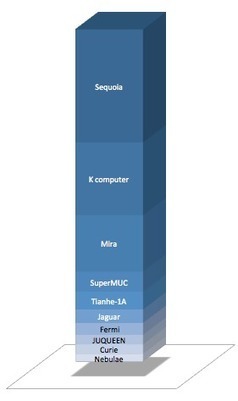
The fastest computer, Sequoia, would measure at about 1.6% of the bitcoin network. Their combined speed is 48 petaFLOPS, roughly equivalent to 5% of the bitcoin network. In fact, the top 500 supercomputers have a combined speed of 12% of the bitcoin network.


To actually use these computers for mining, It would take more than just installing standard mining software. But lets be honest, these computers have better things to work on like curing cancer, solving global warming, and monitoring banking transactions.

See on www.thegenesisblock.com

Read Full Post »

« Newer Posts - Older Posts »