New device can extract human DNA with full genetic data in minutes
Reporter: Aviva Lev-Ari, PhD, RN
See on Scoop.it – Amazing Science
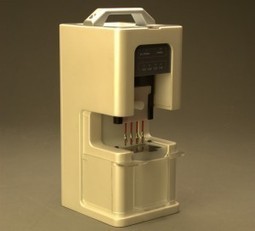
Take a swab of saliva from your mouth and within minutes your DNA could be ready for analysis and genome sequencing with the help of a new device.
University of Washington engineers and NanoFacture, a Bellevue, Wash., company, have created a device that can extract human DNA from fluid samples in a simpler, more efficient and environmentally friendly way than conventional methods.
The device will give hospitals and research labs a much easier way to separate DNA from human fluid samples, which will help with genome sequencing, disease diagnosis and forensic investigations.
“It’s very complex to extract DNA,” said Jae-Hyun Chung, a UW associate professor of mechanical engineering who led the research. “When you think of the current procedure, the equivalent is like collecting human hairs using a construction crane.”
This technology aims to clear those hurdles. The small, box-shaped kit now is ready for manufacturing, then eventual distribution to hospitals and clinics. NanoFacture, a UW spinout company, signed a contract with Korean manufacturer KNR Systems last month at aceremony in Olympia, Wash.
The UW, led by Chung, spearheaded the research and invention of the technology, and still manages the intellectual property. Separating DNA from bodily fluids is a cumbersome process that’s become a bottleneck as scientists make advances in genome sequencing, particularly for disease prevention and treatment. The market for DNA preparation alone is about $3 billion each year.
Conventional methods use a centrifuge to spin and separate DNA molecules or strain them from a fluid sample with a micro-filter, but these processes take 20 to 30 minutes to complete and can require excessive toxic chemicals.
UW engineers designed microscopic probes that dip into a fluid sample – saliva, sputum or blood – and apply an electric field within the liquid. That draws particles to concentrate around the surface of the tiny probe. Larger particles hit the tip and swerve away, but DNA-sized molecules stick to the probe and are trapped on the surface. It takes two or three minutes to separate and purify DNA using this technology.
See on www.washington.edu
 2012pharmaceutical
 sjwilliamspa